How to Design High-Converting eCommerce Ad Creatives in 2026
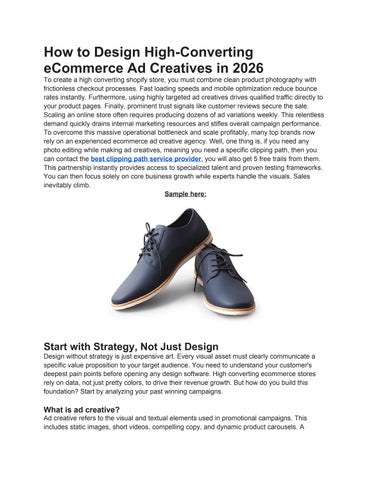
To create a high converting shopify store, you must combine clean product photography with frictionless checkout processes. Fast loading speeds and mobile optimization reduce bounce rates instantly. Furthermore, using highly targeted ad creatives drives qualified traffic directly to your product pages. Finally, prominent trust signals like customer reviews secure the sale. Scaling an online store often requires producing dozens of ad variations weekly. This relentless demand quickly drains internal marketing resources and stifles overall campaign performance. To overcome this massive operational bottleneck and scale profitably, many top brands now rely on an experienced ecommerce ad creative agency. Well, one thing is, if you need any photo editing while making ad creatives, meaning you need a specific clipping path, then you can contact the best clipping path service provider, you will also get 5 free trails from them. This partnership instantly provides access to specialized talent and proven testing frameworks. You can then focus solely on core business growth while experts handle the visuals. Sales inevitably climb. Sample here:
Start with Strategy, Not Just Design
Design without strategy is just expensive art. Every visual asset must clearly communicate a specific value proposition to your target audience. You need to understand your customer's deepest pain points before opening any design software. High converting ecommerce stores rely on data, not just pretty colors, to drive their revenue growth. But how do you build this foundation? Start by analyzing your past winning campaigns.
What is ad creative?
Ad creative refers to the visual and textual elements used in promotional campaigns. This includes static images, short videos, compelling copy, and dynamic product carousels. A
beautiful design is completely useless if it fails to generate actual, measurable revenue. Highconverting creatives blend psychological triggers with clear, undeniable product benefits to capture user attention. Testing different angles reveals what truly resonates with your specific target buyer.
Creative Themes
You must categorize your visuals into specific strategic themes. A scattered approach confuses potential buyers and dilutes your core brand messaging entirely. Grouping ads by theme allows for precise performance tracking and smarter budget allocation. The most successful brands rotate these themes to avoid ad fatigue and maintain engagement. Here are the core themes to master. Feature & Benefits Showcase exactly what the product does. Highlight specific features and immediately tie them to a tangible consumer benefit. For example, a waterproof jacket keeps you perfectly dry during unexpected rainstorms. Clear benefits always outperform complex technical jargon. Pain Points Identify a frustrating problem your customer faces daily. Next, position your clean product shot as the ultimate, undeniable solution to this specific agony. Agitating the problem makes your solution appear infinitely more valuable and necessary. User-Generated Content (UGC) Real people using your product builds instant, authentic trust. Consumers crave authenticity and often ignore highly polished, overly corporate advertisements entirely. Authentic UGC acts as a powerful digital word-of-mouth recommendation. Testimonials & Social Proof Overlay positive customer reviews directly onto your clean product shots. Seeing that others have purchased and loved the item drastically reduces buying friction. This simple tactic builds unwavering confidence in hesitant shoppers.
The Core Elements of a High-Converting Static Ad
Static ads still dominate direct-response marketing in 2026. They load instantly and deliver your core message without demanding a time commitment. To make high-converting static ads that scale, you must master visual hierarchy. Here is how you build them. First, nail the headline with bold, highly readable typography. Your visuals must stop the infinite scroll instantly, utilizing high contrast and clean product photography. Next, write a concise copy that converts by focusing entirely on the buyer's desired outcome. Structure the ad using proven visual frameworks rather than relying on random, untested ideas. Finally, test variations relentlessly to uncover the ultimate winning combination.
Static vs. Video Ads Comparison Feature
Static Image Ads
Video Ads
Production Cost
Very low
Moderate to High
Testing Speed
Extremely fast
Slower, requires editing
Best Funnel Stage
Bottom-funnel (Retargeting)
Top-funnel (Awareness)
Primary Goal
Direct conversion
Storytelling & Education
Case Study: Superside's Scale Strategy
Company/Brand: PicsArt (via Superside) Challenge: The company faced a massive volume of design requests that overwhelmed their internal team. Strategy Implemented: They partnered with a specialized agency to build AI-powered ad creatives. Execution Process: The team developed a robust brand toolkit to ensure fast, asynchronous feedback and rapid ad deployment. Results: PicsArt achieved a 70% savings in overall design time while maintaining strict brand consistency. Key Takeaways: Clean visuals scale exponentially faster when supported by properly managed external systems.
Understanding Creative by Funnel Stage
Different stages of the buyer's journey require entirely different visual approaches. A top-funnel ad must educate, while a bottom-funnel ad must aggressively convert. Using the wrong creative at the wrong time wastes your advertising budget completely. High converting ecommerce product pages align perfectly with the specific ad that drove the traffic.
Top-Funnel Creative Ad Examples That Engage
At this stage, your audience doesn't know you exist. You must capture their fleeting attention using broad, highly engaging problem-solution dynamics. Product demonstration ads show your value in action, proving your claims instantly. Before-and-after visuals powerfully illustrate the transformation your product delivers to the end user.
Bottom-Funnel Ad Creative Examples That Drive Conversion
Here, the buyer already knows your brand well. They just need a final, irresistible push to complete their pending transaction. Incentive ads offering a time-sensitive discount motivate incredibly quick purchasing action. Urgency ads create a profound fear of missing out, driving immediate, high-value conversions.
Case Study: Tinuiti's Omnichannel Dominance
Company/Brand: Enterprise DTC Brand (via Tinuiti) Challenge: A large retailer struggled to manage complex ad spend across both DTC channels and Amazon marketplaces. Strategy Implemented: They deployed a highly coordinated, full-funnel marketing strategy across multiple platforms simultaneously. Execution Process: The agency utilized their proprietary Mobius AI tools to allocate budgets based on unified attribution data. Results: The brand successfully scaled their Amazon presence without cannibalizing their direct, highly profitable storefront sales. Key Takeaways: Coordinated, data-driven creative strategies prevent channel conflict and maximize total enterprise revenue.
Creative Testing
You cannot guess what your audience wants. Relying on gut feelings will inevitably burn your marketing budget and ruin your campaign ROAS. Relentless creative testing is the only proven method to discover what truly drives purchases.
Types of Creative Tests
Start by testing completely different visual angles against each other. Once you find a winning image, test various headlines to optimize the click-through rate. Next, experiment with different calls-to-action to see which drives the most actual sales. Small, incremental changes often yield unexpectedly massive improvements in overall campaign profitability.
Frequently Asked Questions (FAQs)
How much does it cost to advertise on e-commerce platforms? Advertising costs vary wildly based on your specific industry, platform, and target audience. However, most high converting ecommerce stores allocate roughly 10% to 20% of their gross revenue toward sustained paid acquisition. Why aren't my e-commerce Facebook ads performing well? Poor performance usually stems from severe ad fatigue or a fundamental mismatch between the creative and the audience. You must continuously cycle in fresh, clean product shots to maintain a healthy, profitable click-through rate. What is a good ROAS for Facebook Ads? A good Return on Ad Spend depends entirely on your specific profit margins. Generally, a ROAS between 2.5 and 4.0 is considered healthy for most standard direct-to-consumer physical product brands, check this How do clean product shots improve conversions?
Clean shots instantly remove distracting background elements, allowing the user to focus entirely on the product's details. This visual clarity builds immediate trust and significantly reduces hesitation during the final checkout process. What is the best format for mobile ecommerce ads? Vertical formats (9:16 ratio) are absolutely essential for modern mobile advertising platforms like Meta and TikTok. They occupy the entire screen, entirely eliminating external distractions and forcing the user to engage deeply. What specific challenges are you currently facing when trying to scale your own ad creative production?