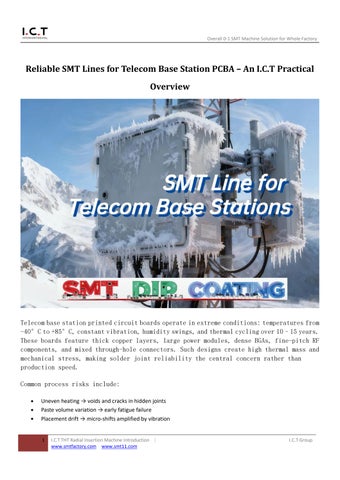

Reliable SMT Lines for Telecom Base Station PCBA – An I.C.T Practical
Overview


Telecom base station printed circuit boards operate in extreme conditions: temperatures from -40°C to +85°C, constant vibration, humidity swings, and thermal cycling over 10–15 years. These boards feature thick copper layers, large power modules, dense BGAs, fine-pitch RF components, and mixed through-hole connectors. Such designs create high thermal mass and mechanical stress, making solder joint reliability the central concern rather than production speed.
Common process risks include:
Uneven heating → voids and cracks in hidden joints
Paste volume variation → early fatigue failure
Placement drift → micro-shifts amplified by vibration
Lack of traceability → delayed root-cause analysis after field returns
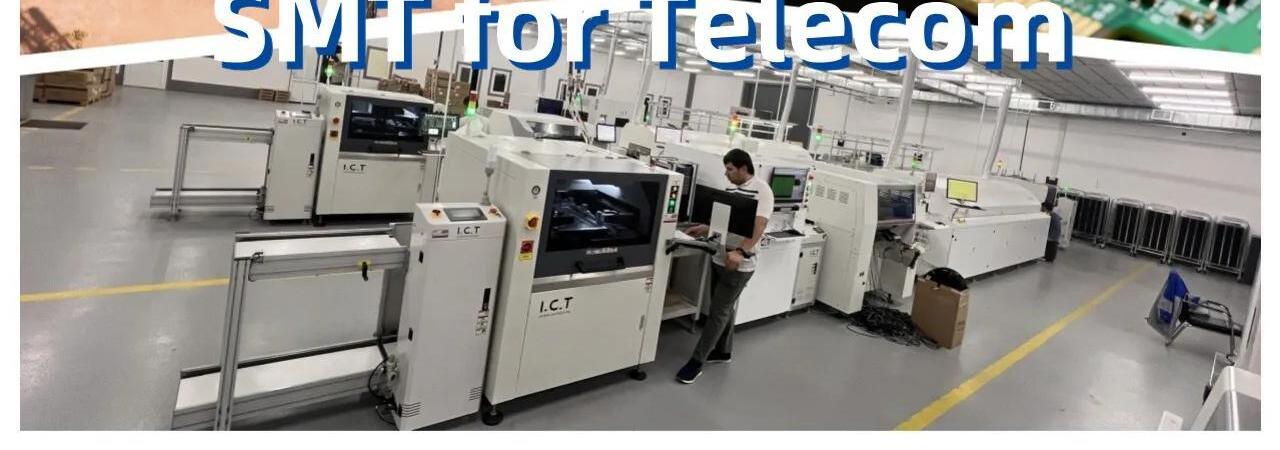
I.C.T addresses these through purpose-built configurations:
Solder paste printers with closed-loop pressure control and ambient compensation for stable deposition
High-rigidity pick-and-place machines maintaining <50 μm accuracy under continuous operation
Extended 10–12 zone reflow ovens with nitrogen atmosphere and ±1–2°C uniformity across heavy boards
Full inspection chain: SPI for paste, AOI for placement, 3D X-ray for hidden joints, integrated with MES for complete data logging
In a Southeast Asian telecom production case, a manufacturer switched from shorter consumer-grade lines to an I.C.T setup. Initial challenges included rising void rates (>10%) on large BGAs during thermal stress tests and inconsistent paste volume due to factory humidity changes. After installation, I.C.T engineers spent two weeks on-site optimizing profiles (extended soak and peak zones for thermal equilibrium), training operators on thermocouple placement and daily belt checks, and linking inspection data to traceability software.

Results observed over 24 months:
Void rates dropped below 5% (X-ray verified)
Process yields stabilized above 98%
Field feedback indicated noticeably fewer warranty returns compared to previous equipment
This reflects I C T’s focus: engineered stability, detailed customization, hands-on global support, and long-term process repeatability. The goal is lower total cost of ownership through reduced site maintenance and sustained network uptime
For deeper discussion of these factors, see the original detailed telecom SMT line guide
Contact: market@smt11.com for line consultation or profile discussion.