4 May 1978.
![]()

4 May 1978.
When I returned to Adelaide in late 1977 after two-and-a-half years in the UK, I came back with 25 singlesâSex Pistols, The Clash, The Damned, Elvis Costello, Wreckless Eric, Tom Robinson Band, X-Ray Spex, The Rezillos, Slaughter & the Dogs etc.
I moved into a small cottage at 14 Donegal Street, Norwood, owned by my old Adelaide Uni friends Larry Buttrose and Donna Maegraith, and proceeded to visit all my other mates in an evangelical wayâto convert them to this fantastic new music. Most looked at me rather strangely and asked if Iâd like another cup of tea, but Span, an old friend from Whyalla, introduced me to Stuart Coupe.
Coupe was editor of the Flinders University student newspaper, Empire Times. We got talking and quickly realised we shared this zeal about the punk/new wave explosion. We used to frequent the go-to import shop of the dayâModern Love Songs in Twin Streetâand with the encouragement of the owner, Bo and help from the crowd that hung around there, we decided to channel the prevailing do-it-yourself ethos and put together a fanzine.
As well as enjoying blanket coverage in the British rock weeklies like New Musical
Express, Sounds and Melody Maker, the punk explosion had inspired a flush of fanzines. The first and most famous was Londoner Mark Pâs Sniffinâ Glue (+ Other RockânâRoll Habits for Punks), which launched in July 1976 and spawned a rash of imitators.
â⊠one of the greatest singles EVERâa song about cruising with the radio on and being in electric communion with the modern world, modern girls and modern rockânâroll.â
Stuart
Coupe on Jonathan Richmanâs âRoadrunnerâ.
The day after the December 1977 federal election that returned Malcolm Fraserâs conservative coalition to government, a motley (and hung-over) crew assembled at Modern Love Songs to put together the fanzine, armed with typed contributions, photos, and magazines to cut up and paste. Apart from Coupe and myself, there were David Walker, Andy Vague and Nick Hope from the soon-to-be-legendary Adelaide punk outfit The Accountants; Chuckie Suicide (who became The Accountantsâ roadie); Lloyd (who went on to play in Spanish Holiday) plus David Crowe, Tracey and Alex. On the credits page we namechecked the other Australian âzines we were aware ofâSuicide Alley (Brisbane), Pulp (Melbourne), Alive and Kicking (Melbourne) and Spurt (Sydney).
We laid out the magazine on the floor of the basement record shop and Stuart got it printed at Empire Times. Bo said heâd pay the print bill in exchange for a full-page ad. The bill was never paid. Very punk. The fanzine was called Street Fever.
Coupe and I enjoyed the exercise so we started talking about âWhat if we started a magazine?â At that time there was a booking agency in Adelaide called Sphere, managed by Chris Plimmer, who later became prominent in Sydney with the Nucleus
agency. He thought it was a great idea to have an Adelaide music magazine. We agreed to include a gig guide and Plimmer persuaded music venues, shops and bands to buy ads, so weâd get some money coming in. We did the rounds of the major record companies in Adelaide, which were generally enthusiasticâparticularly Phonogram which had albums from The Ramones, Talking Heads, and Richard Hell and The Voidoids, and really didnât know what to do with them!
We needed a name. One of the singles Iâd brought back from the UK was âRoadrunnerâ, an unlikely 1977 hit there for Jonathan Richman. A hymn to the power and magic of rockânâroll, I thought the name was a contender. Coupe obviously liked it tooâin Street Fever he had waxed lyrical: â⊠one of the greatest singles EVERâa song about cruising with the radio on and being in electric communion with the modern world, modern girls and modern rockânâroll.â
One lunchtime in the Adelaide Uni refectory, I suggested we call the magazine Roadrunner. Coupe pondered only for a second. âYeahâthatâs great!â
Coupe was living in a share house at 13 Wainhouse Street, Torrensville with Alex Ehlert and Mark Burford. He also knew a slightly dotty layout artist at Flinders called Allan Coop (no relation). So with no capital and no assets, but bucketloads of energy and enthusiasm, Roadrunner was born. For the first issue in March 1978, the crew was Coupe and myself as editors, Allan Coop on layout and design, Alex Ehlert leading the Construction team, Mark Burford as reviews editor and Chris Plimmer as advertising manager. Larry Buttrose got in touch with his sixties surfing memories for the cover story on The Beach Boys. As well as writing articles and reviews, Jillian Burt smuggled us into Adelaide Universityâs radio station
5UV to use their IBM Selectric, or âgolf ballâ typewriter for the copy. This enabled us to set columns of justified type and get different type fonts and sizes.
Coop did the layout in a shed out the back of the house in Torrensville, Empire Times did the printing and on Sunday, 12 March, a few of us trekked out to Football Park at West Lakes to try selling copies before The Beach Boysâ concert. Not many were interested, even at a price of just 30 cents, but we werenât discouraged.
Apart from setting up the magazine, I had been looking for a ârealâ job over the summer. In March I was offered a position in the unemployment benefits section of the Commonwealth Department of Social Securityâironically located in Hindmarsh Square, directly above Modern Love Songs. I accepted, but remained committed to the magazine. Coupe enlisted some other contributors. John Altree-Williams took some great photos of the Suicide Records bands and started helping with the layout. Coupe was also in touch with Bruce Milne and Clinton Walker, who had published the fanzine Pulp in Melbourne, and they thought what we were doing was interesting so came over to help.
The News, Adelaideâs afternoon paper, ran a snippet on 11 May 1978.
Adelaideâs own music mag, Roadrunner, looks like being around for a while. The second issue is out and costs 30c from newsagents and record stores. The typos and spelling mistakes are a bit hard on the eyes, but buy it for the interesting âlet it all hang outâ interview with Molly Meldrum. Also in the issue are stories on Quasar, Clean Cut, Chick Corea, Ry Cooder and the Resident [sic], and Steve Whitham starts a regular âHi, Iâm your local friendly DJâ column.
The content in the early issues was an idiosyncratic mix of the local (Young
Modern, Riff Raff, Neon Heart, The Sultan Brothers, The Warm Jets, Cunning Stunt, Middle Class); interstate new wavers (The Sports, High Rise Bombers, Boys Next Door, Stiletto); international tourists (Dylan, Weather Report, John Martyn, Graham Parker and the Rumour, Billy Connolly); retrospectives (The Beach Boys, The Monkees, Marc Bolan); think pieces (The Death of Punk, Powerpop); and stories about the music industry (the abovementioned interview with Countdownâs Ian âMollyâ Meldrum, 5KA DJ David Day, the birth of community radio station 5MMM, how to be a rock writer). All this plus live reports, album and singles reviews, and an Adelaide gig guide. Advertising came from the bands, venues, record shops and equipment suppliers of the Adelaide scene plus record companies (EMI, CBS, Festival and Phonogram), television and radio stations (Seven, Nine and 5UV), and a couple of corporate entitiesâthe State Bank of South Australia and Coke.
In 1978, Roadrunner was available only in South Australia. Record shops and musical hire outlets sold it off the counter and BJ & KL Fuller distributed to SA newsagents. Coupe drew on his Empire Times experience, Iâd dabbled in poetry magazines while at uni, Bruce Milne and Clinton Walker had produced their fanzines, but none of us had any real experience in the business of magazine publishing. We all just loved the music and liked writing about it, and photographers such as Eric Algra and Joe Murray approached us and offered photos.
Things went well for the first three issues and I guess we were starting to get a bit full of ourselves. A self-righteous editorial manifesto by Coupe in Issue 4, July 1978 provoked Rock Australia Magazine editor Anthony OâGrady to a response. âDear Roadrunner,â he wrote, âThanx for at least for spelling RAMâs name right in your July edition. And thatâs all Iâm thanking you for.â
Uh oh.
OâGrady asked us to consider two quotes.
âRoadrunner seeks to be a Pop/Popular CULTURE magazine as opposed to a Pop MUSIC magazine. Future issues will focus on books, movies, rockânâroll theory âŠâ (Quote 1, Roadrunner, July 1978).
âWe also know our rockânâroll generation is more a lifestyle choice and its expression is more than music.â (Quote 2, from the editorial in RAMâs first issue, March 1975).
He then went on:
Hmmm. Sounds like neither publication wants to fall into the trap expressed by Quote No. 3: âThe major purpose and I suggest failing of these newsy rockânâroll papers is that they serve to maintain the illusion that rockânâroll exists independently of the forces around it.â (Roadrunner No. 4 again.) So it really hurts (maaaaan) that No. 3 is how Roadrunner categories [sic] RAM in 1978.
So. Guess RAM failed the culture test. The Roadrunner culture test anyway.
On the other hand, can it be, (el gaspo!) Roadrunner just hasnât noticed all the youth/lifestyle articles on movies, living on the cheap, sci-fi, mysiticism [sic], surfing, politics, conservation we at RAM have been assiduously including (average over one-and-a-half editorial pages per issue) for the past three years?
OâGrady offered Coupe a staff position on RAM in Sydney a month later.
As the year wound down we convened a summit meeting in Torrensville. Coupe had gone. Clinton Walker was back in Melbourne, but still involved as Melbourne editor. The live scene in Adelaide at the time was still pretty much stuck in blues and boogie mode, and the recording scene was
almost non-existent, so it was no surprise that Bruce Milne had also decided to return to Melbourne. The novelty having worn off, Alex Ehlert and Allan Coop decided, nicely, to take their bat and ball and play elsewhere. So it was only me left standing. Collette Snowden, who had been writing for the mag under the nom de plume Sue Denim (geddit?), attended the meeting and was a strong supporter for continuing.
I decided to carry on. I didnât think the magazine had reached anywhere near its potential and it was certainly more fun than my day job.
Excitement was building in Adelaide at the prospect of the Progressive Music Broadcasting Association (PMBA) obtaining a community radio licence and what that would do for the diversity of the airwaves. It boded for increased exposure for the local music scene and the new music that Roadrunner was championing. Michael Zerman, who was based at the South Australian Media Resource Centre in the old Sym Choon fireworks factory off the east end of Rundle Street, had been involved in the launch of 2JJ in Sydney and was providing advice to the PMBA. He also offered invaluable publishing advice to Roadrunner.
Zerman had been a key figure in the Sydney office of the collective headed by publisher Phillip Frazer that produced the Australian version of Rolling Stone, as well as the alternative magazines Revolution, High Times and The Digger in the period 1971â75. Frazer had founded Australiaâs most influential music magazine, Go-Set, in 1966, and remained publisher until 1972, when it was taken over by its printer, Waverley Press. Zerman recently told me
he had actually been company secretary of the Australian Rolling Stone publishing company, Green Grass Pty Ltd. As The Digger was dying in late 1975, under the threat of lawsuits from Norm Gallagher and the BLF, as well as the general decline after the sale of the Rolling Stone licence to Paul Gardiner and Jane Matheson, Zerman also took on the company secretaryship of High Times Pty Ltd.
It doesnât matter if you run up a debt with your printer, Zerman confided âit gives them an interest in keeping you going. And so it proved.
Zerman was production editor on another new Adelaide magazine, Preview, and had already steered us in the direction of Previewâs printer, Bridge Press in Murray Bridge, an hour out of Adelaide on the South Eastern Freeway. Bridge Press was cheaper than anyone in Adelaide and was keen for the extra work. It ended up printing the magazine for virtually the remainder of its life (September 1978 right through to July 1982). It doesnât matter if you run up a debt with your printer, Zerman confided âit gives them an interest in keeping you going. And so it proved.
A more professional production set-up was an immediate priority. Clive Dorman was a newspaper journalist who had seen the potential of phototypesetting. He set up his own business, Neighbourhood Typesetting, and became Roadrunnerâs production editor. Geoffrey Gifford, who ran a small design studio, took over design and layout, and Collette Snowden joined as office manager.
As the new production crew moved in, it was becoming clear that there was a growing disconnect between the type of music we wanted to write about and the Adelaide music scene that had initially supported the magazine. The solution? Nationalâand internationalâcoverage and national distribution.
On the writing side, Keith Shadwick became
the magazineâs first London editor. A poet, writer and saxophone player with Uncle Bobâs Band, The Bleeding Hearts and, most recently, High Rise Bombers (with Paul Kelly and Martin Armiger), Shadwick left Melbourne in mid-1978 and quickly established himself on the London scene, where the New Wave was still cresting. He contributed news, live reviews (including one about Public Image Limitedâs first performance), a fond retrospective on Marc Bolan andâafter embedding himself on the tourâan exhaustive behind-the-scenes account of The Sportsâ early 1979 twirl around the UK supporting Graham Parker and the Rumour.
Michael Zerman gave me an address for Phillip Frazer in New York and I wrote to ask if he would be interested in writing about New York. While wishing us the best of luck, Frazer declined, saying, âI donât know if I can help you. Iâm not particularly following the music scene here because I dislike most of it. New York punk is mostly ephemeral, weighed down by posturing about decadence/pain/how sleazy it all is etc., rather like the Beatnik era.â Fair enough. He went to say he âliked the general feel of Roadrunnerâsome careful or maybe just talented writingâbut itâs a shock just how other-directed people in Australia areâ.
Michael Hope, an old friend, sat down with The Accountants for a double-page spread in the November issue. Clare Leaver âschlepped out to Elizabethâ to take the photos, including a nude shot of guitarist Sid intended for the cover. But just like Janis Joplinâwho was bumped from the front of Newsweek in 1969 when former President Dwight D. Eisenhower diedâ Sid had to step aside for the real Sid (Mr Vicious) after the Sex Pistol was charged with the murder of his girlfriend, Nancy Spungen, at New Yorkâs Chelsea Hotel. Ross Stapleton provided the âinside accountâ but Michael Hope was less than impressed, writing to the letters page, âIt was sad to see a sensationalist piece of gossip on this yearâs media fodder, Sid Vicious, totally invalidate

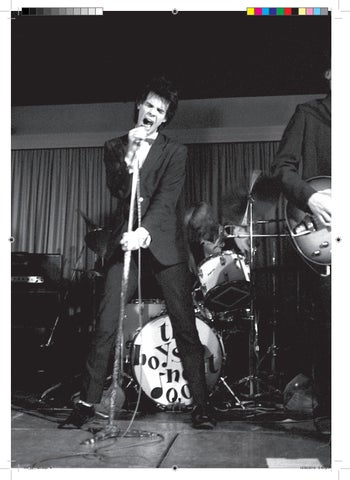
a line-up of the best new talent Adelaide had to offerâSoka, The Warm Jets and Young Modernâit was a magical night. And Buttrose caught the mood perfectly.
the spoken understanding Roadrunner had with next yearâs media fodderâour own Accountants.â
After some encouragement from Coupe, who maintained friendly relations with his comrades in the south throughout his tenure at RAM, Stuart Matchett from 2JJ signed on as Sydney editor, and Scott Matheson, then guitarist with Brisbane band The Numbers, offered to contribute stories from Queensland. Ian Henderson started writing about Perth, and with Bruce Milne and Clinton Walker in Melbourne we had all mainland states covered. We even appointed a poetry editorâDonna Maegraith. And did publish some poems. It was the seventies after all.
One poem that was submitted but never ran was Larry Buttroseâs reminiscence about 5MMMâs New Yearâs Eve fund-raising bash at the Burnside Town Hall in Adelaide. With
In December, Clive Dorman hit the road and tied up newsagent distribution in NSW through Allan Rodney Wright and Victorian distribution through Melbourne Wholesale Newsagency. In SA we already had distribution through Fullers, while in Queensland, Scott Matheson, under the banner of Riptide Distribution, supplied Rocking Horse Records and other interested record shops. Copies to White Rider Records in Perth rounded out the picture. I took a deep breath, quit my day job and took the plunge into full-time rockânâroll publishing.
As Young Modern played, long ago.
Recently, you told me you were up the front, to the right. at the public radio station ball that New Yearâs Eve, bopping your hardest, the big red strawberry on your chest which said please eat me & one did not
I didnât know you, despite all the parties, protests, despite us knocking inevitably into each otherâs partner at so many dances; I didnât know you, but we all danced togetheryou, Donna, Donald; Collette, Heather; me; as Young Modern played those Beatles standards so crisply, it was becoming 1979; another end of another era, and we
were not being told; we were not ready
near Alice Springs, the boulder which finally cracked that night might just have known; John Dowler might even have, and the asteroid which disappeared into the green mists of Venus was perhaps in possession of some pertinent information; but the drummer you took home that night did not know: and you did not
I was with another woman: you were with 4 women, and have told me how you were all half mad with despair, the anxiety of starting yet another year alone, & everyone there was a bit
crazy, taking someone home for a little relief, jiving to the band for lunacy, play faster, play faster you probably brushed me; I probably trod on your toe & we would have grinned idiotically and breathlessly a half moment; but the night sky did not have the certain stars, and would not have them until some myth of time some fabrication of our brains, could unravel at last the knots of our isolation, take all our near misses and pluck them from the mass of human static, & though I should have loved to
I did not kiss you New Year, or goodnight; for us it was never automatic
Larry Buttrose

Roadrunnerâs first national issue hit the newsstands in February 1979. The cover story on the riots and run-ins of Elvis Costelloâs summer tour was by the hard-hitting Ross Stapleton, whose fascination with the behind-the-scenes machinations of the music industry was to yield a series of lengthy features over the following twelve months. As well as being engrossing exposes in their own right, they had the effect of making Roadrunner a must-read for industry participants in the eastern states.
My indulgence of Rossâs tireless championing of The Angelsâadmittedly the countryâs biggest drawing live bandâin the year to come would, however, cause ructions amongst the magazineâs founders.
To help publicise the national launch, production editor Clive Dorman wrote the following piece, which he sent to various newspapers and magazines. It actually did prompt a nice article by Stephen Hunter in Adelaideâs morning paper, the Advertiser It sets the scene as I strapped in for what turned out to be a wild ride.