Visit us @ www.prideag.com
MANAGER’S DESK
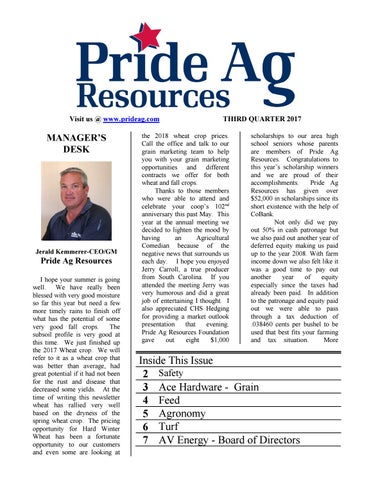
Jerald Kemmerer-CEO/GM
Pride Ag Resources I hope your summer is going well. We have really been blessed with very good moisture so far this year but need a few more timely rains to finish off what has the potential of some very good fall crops. The subsoil profile is very good at this time. We just finished up the 2017 Wheat crop. We will refer to it as a wheat crop that was better than average, had great potential if it had not been for the rust and disease that decreased some yields. At the time of writing this newsletter wheat has rallied very well based on the dryness of the spring wheat crop. The pricing opportunity for Hard Winter Wheat has been a fortunate opportunity to our customers and even some are looking at
THIRD QUARTER 2017
the 2018 wheat crop prices. Call the office and talk to our grain marketing team to help you with your grain marketing opportunities and different contracts we offer for both wheat and fall crops. Thanks to those members who were able to attend and celebrate your coop’s 102nd anniversary this past May. This year at the annual meeting we decided to lighten the mood by having an Agricultural Comedian because of the negative news that surrounds us each day. I hope you enjoyed Jerry Carroll, a true producer from South Carolina. If you attended the meeting Jerry was very humorous and did a great job of entertaining I thought. I also appreciated CHS Hedging for providing a market outlook presentation that evening. Pride Ag Resources Foundation gave out eight $1,000
scholarships to our area high school seniors whose parents are members of Pride Ag Resources. Congratulations to this year’s scholarship winners and we are proud of their accomplishments. Pride Ag Resources has given over $52,000 in scholarships since its short existence with the help of CoBank. Not only did we pay out 50% in cash patronage but we also paid out another year of deferred equity making us paid up to the year 2008. With farm income down we also felt like it was a good time to pay out another year of equity especially since the taxes had already been paid. In addition to the patronage and equity paid out we were able to pass through a tax deduction of .038460 cents per bushel to be used that best fits your farming and tax situation. More
Inside This Issue 2 Safety 3 Ace Hardware - Grain 4 Feed 5 Agronomy 6 Turf 7 AV Energy - Board of Directors
information on the tax deduction will be coming out this fall so you can preplan for your year end. If you have not heard by now, we made a business decision to close down the Great Bend ACE Hardware store at the first of June. The main reason was because of the economic slowdown in the Great Bend economy. The store was also not giving us the financial return it was projected to meet our expectations for you the members. The decision was difficult, especially when regarding loss of jobs for employees, but at the end day it was the right thing to do for our member’s owners. The inventory that was placed in the opening stock order and purchased afterwards is easily being distributed through the other four stores at normal margins. I appreciate the staff we had in Great Bend and their efforts but also the current staff of ACE Hardware managers and other Pride Ag Resources employees in getting the inventory distributed on a weekly basis. You know summer is starting to wind down when it becomes county fair time. Congratulations to all the youth that participated in 4-H and FFA with their fair projects this year. Pride Ag Resources is proud to be involved with supporting 4-H and FFA in the eight counties that we serve. It was exciting to see the accomplishments by our youth especially the ones that our team of employees was able to help provide service for. I hope you are able to enjoy the rest of your summer with your family before school starts up again. We appreciate your wheat harvest bushels and
are looking forward to helping you with your fall harvest. Thanks for your business. It is always a pleasure from the team of employees to help you succeed in production agriculture. Jerald S. Kemmerer CEO Pride Ag Resources
Safety Division
Skyler Hayes Safety Director GRAIN BIN SAFETY ON THE FARM
Although I wrote an article three years ago about grain bin safety, I think it is appropriate that I address this important topic again. Some of you store just enough wheat to plant a new crop in the fall, and others of you store most of your crop in bins on your farm. Whether you store a little or a lot of grain, there are some precautions that each farmer should take to prevent grain bin incidents, such as engulfments, entrapments and injuries due to machinery. The Occupational Safety and Health Administration (OSHA) recognizes the dangers of grain bin entries in commercial businesses such as grain elevators and strictly regulates those businesses regarding bin entry. The leading cause of death in grain elevators is from entry into grain bins, and we in the grain industry are required to take many precautions when working inside grain bins. Non-
commercial farming operations are not regulated by OSHA, and many farms do not take the same precautions that grain elevators do. Approximately half of the known grain entrapments occur on farms. Grain can quickly engulf or entrap a person. Flowing grain has the potential to cover an adult to his or her knees in as little as four seconds and completely engulf an adult in as little as twenty seconds. When a person is engulfed in grain up to his or her waist, it takes a force of their body weight plus 600 lbs. to pull the person out of the grain. When a person is buried under the grain, it can take 2000 lbs. of force to pull the person free. Certainly a force of 2000 lbs. would do great bodily harm to the individual being pulled out of the grain. Eighty percent of grain entrapments occur when a worker is inside a grain bin while an auger or other unloading equipment is running, and over half of the reported grain entrapments involve grain that is out of condition. These two percentages are related, because often the reason the worker is inside the bin while grain is unloaded is because the grain is not flowing properly due to condition factors such as clumping and hanging up on the walls of the grain bin. Following are some things to consider when working in and around bins. •
•
As much as possible, perform work from outside the bin. Keep grain in condition. By keeping grain in condition, you will lessen the need to be inside the bin at all, and grain in condition is more predictable in the way it flows.
2
•
•
•
If you must go into a bin, make certain to visually inspect the grain from the outside before you go in. Look for out of condition grain, and if the grain is bridged, cliffed or hung up, do not enter the bin. Never enter a bin without at least one other person outside. The person(s) outside the bin has just two jobs: to assist the worker inside the bin with any needs the worker inside may have and to get help in case the worker inside gets into trouble. The worker outside must never enter the bin, even to rescue the worker inside, as the rescuer often becomes a victim of engulfment as well. A means of getting help should be worked out before anybody enters the bin. Make certain that discharge equipment such as an auger is disabled (locked out) whenever there is a worker inside a bin.
location and taking it to the other stores. In the Dodge City area we are seeing a large influx of spider mites attacking several different types of trees and bushes. We are also seeing a lot of bag worm damage in the different cedars and arborvitae trees. I would advise everyone to keep a close eye on their tree rows and shrubs. You can get a lot of damage in a short period of time. Check with your local locations for spray treatment of these devastating pests. Unfortunately, the spider mites move into trees for moisture in dry conditions and can wipe out a tree row in a short period of time. Ace has a strong inventory for the pests that attack your lawn and garden. Visit your Ace locations for all your lawn and garden needs.
GRAIN DIVISION
ACE HARDWARE
Gary L. Friesen Grain Operations Taking the Roller Coaster Ride
Jack Lane,
Ace Manager The Ace managers have been working hard and spending every Monday in Great Bend moving inventory to the other 4 Ace locations. The Great Bend location was closed due to an economical down turn in the Great Bend area. We have been pulling part of our weekly Ace orders from the Great Bend
Wheat harvest is over and once again this year’s wheat harvest turned out to be an interesting event. It started slowly and lasted a long time but was still very rewarding. This year’s wheat crop had many obstacles to overcome but in the end it turned out to be a good harvest. We are all blessed to live and work in Western Kansas. Thanks for your grain business this year and we hope your wheat harvest
was everything or more than you hoped it would be. Now that harvest is over, it’s time to look forward to the excitement of county fairs. These events are always a fun time. Pride Ag Resource’s trade area covers a good number of counties so there will be plenty of opportunities to see friends and enjoy the fun. Date Wheat Corn 04/6/17 3.10 3.06 05/3/17 3.53 3.20 05/17/17 3.27 3.32 06/16/17 3.89 3.59 Last Year –May 2016 AVG. 3.73 3.66
Milo 2.61 2.75 2.86 3.14
Soybean 8.22 8.45 8.46 8.19
3.11 9.57
If you like carnival rides at these fairs, you probably liked the roller coaster ride that the wheat market has provided lately. Given the huge U.S. and World wheat supplies, it appeared that Hard Red Winter wheat prices this year would hover around last year’s disappointing levels. Much to my surprise, and too many in the industry, the grain markets made an incredible run up beginning in late June. This market run up was led primarily by the Minneapolis September wheat contract. Concerns about this year’s spring wheat crop surfaced as the Dakotas and Montana dried out and spring wheat production estimates began to be lowered. This carried both the Chicago and Kansas City September wheat contracts to the highest levels since June of 2016. On July 5th Kansas City September wheat futures reached a high of $5.77 ¼ /bu. and closed at $5.69 ½. Pride Ag Resources closing cash wheat price on July 5th was $4.95/ bushel. Just for perspective, last year the July 5th closing cash wheat price was 3
$2.97/ bushel. This was an astonishing development. We stayed busy with wheat settlements as wheat producers took advantage of these higher price levels. We also had a number of Hedge to Arrive and New Crop wheat contracts priced when July 2018 Kansas City wheat futures were in the $6.00/ bushel and above range. However the roller coaster ride was not over. At the end of the week, Friday, July 7th, we were off $.43 from the July 5th close. On Monday, July 10th, renewed dry weather concerns pushed wheat prices up $.14 but by week’s end, following USDA’s July Supply and Demand report, cash wheat prices had decreased another $.18 from the previous Friday close and closed at $4.34/bu. Much like a carnival ride the movement in prices has been a little disorienting. The September Corn and soybean contracts were higher on weather concerning during this time and also benefited from the rapid rise in wheat prices, but they too have settled back from their July 11th highs. With the price activity we saw this month, both up and down, it points out the need to be in the market and ready to take advantage of upward price swings. Having open market orders in place can allow you to participate when the grain markets take the unexpected run up. The Compass contracts we offer will also let you price above current market levels. Please don’t hesitate to call if you have any interest in any of these marketing opportunities. Thanks for your business and here’s hoping the rest of the summer will be as thrilling for you as your county fair’s roller coaster ride and the
remainder of the season will bring needed.
growing rain as
As this wheat harvest concludes, all the employees at Pride Ag Resources would like to thank you for your business. We are happy to report a successful wheat harvest with our receipts being just above our 10 average. Hopefully everything went smoothly for you and your harvest again this year. As always, if there is anything we can do here at Pride Ag Resources to help during this busy time of year, please let us know and we will do our best to help things run as smoothly as possible. Remember to stay safe and keep your water jug close by this summer, as it is getting hot and humid. We all look forward to seeing you this fall harvest.
FEED DIVISION
Calvin Carey Hope you had a safe harvest. We have heard of some excellent yields in our area. The weather has gone from wet and humid to hot and dry. It was nice to have the rains that have benefited the pastures to get the pastures off to a good start. Pastures were growing well. We need to watch for heat stress on cows and calves now. Cows and calves behave differently when stressed. As the temperature rises, watch calves closely for early signs of dehydration. Make sure when we are checking cows or calves that
you know the signs of dehydration. Three key areas can help you determine if a calf is becoming dehydrated. Eyes should appear bright and not sunken into their head. Pinch Test - can help determine if a calf is dehydrated. Grab a fold of skin on the calf’s neck and squeeze it together to make a tent. Once the “pinch” of skin is let go, it should go back to normal in two or less seconds. If the skin stays pinched together longer, the calf is experiencing dehydration. Behavior is another great way to monitor a calf’s hydration level. If the calf is sluggish, slow to eat or respond during feeding time, it may be dehydrated. If the calf is away from the herd and by himself the calf may be dehydrated. If your calves show any signs of dehydration, it is important to begin feeding electrolytes to help restore hydration. By catching hydration early, you can step in and provide calves with electrolytes immediately to help replenish fluid loss. Heat Stress in calves can cause an increase respiration rates, body temperature, decreased feed intake, rapid dehydration and a reduced immune system functions. The first way and most important aspect to combat summer heat stress this summer is to make sure you have plenty of clean fresh water. Calves exposed to heat stress can consume up to 3 to 6 gallon of water a day. Water is the most important nutrient for your cows and calves. It is important to check availability and cleanliness of water on a daily basis. It is also good idea to have your water tested especially pond and creek water. 4
Modifying your cow and calf environment is another way to protect them from the weather and reduce stress. Reducing sun exposure can help keep calves cool as temperature rises. Modifying your calf hutches and shelters that block the sun and that provide maximum air flow is beneficial. Naturally ventilated buildings should have all vents open. Fans can be used as additional source of air flow. Shade cloth is also a good and inexpensive way to provide shade for your cows and calves. If you can smell ammonia in the barn or see condensation on the walls or ceiling, it may be a sign the barn does not have adequate ventilation. Another factor to monitor is your calf starter or creep feed freshness during hot weather. Make sure to avoid mold growth from the recent rain or fines left in your creep feeder as will it reduce intake to the calf. Your creep feed should be a high fiber 14% protein complete pellet. It should be a balanced creep feed for growth that does not increase body condition to the calf. Creep Feed will provide nutrition to help fill the “Hungry Calf Gap� to keep your calves growing by increasing the fiber bugs in the rumen so the calves will improve grass digestibility. Body condition score your cows to make sure they are performing well. Make sure they are not skipping mineral supplementation. You can be losing performance on your cows by low mineral intake. Minerals are vital to cattle productivity. Research shows that providing cattle with an organic trace mineral source can help cows breed back sooner, have higher conception rates, have enhanced reproductive
performance early in the breeding season, improved average daily gain and reduced disease incidence in calves. Availa-4 mineral is our chelated mineral. Availa-4 is a nutritional feed ingredient for animals that contains a combination of organic zinc, manganese, copper and cobalt. These trace minerals are required by animals for numerous functions including immunity response, skin and hoof integrity, growth and muscle development, milk production, fiber digestion, and energy metabolism. When an animal has the proper balance of trace minerals he is able to cope with the challenging effects of stress. Availa-4 is a unique, patented molecule that consists of one metal ion bound to one amino ion - called a metal amino acid complex. Availa-4 mineral helps when we have cows and calves and in a heat stress pasture or in the feedlot. Reduce stressful events such as moving, grouping new calves together, vaccinating or dehorning. Plan on stressful events in the morning or evenings. Evening temperatures may seem cooler, but the animal body temperature lags the weather by four to six hours. We will be recommending Pro Phos 8 with Altosid mineral to control horn flies in your herd. Pro Phos 8 is an 8% Phosphorus to help improve reproduction in your cows and improved average daily gain in your calves. It also contains DDG to help improve palatability and intake. Diamond V XP yeast culture to improve mineral and fiber palatability. We have a complete line of fly sprays, back rubbers, dust bags, and vet guns to help
reduce fly population in your cow and calf herd. We have a range of product lines to make sure that your cows and calves will be able to perform the way you want them to in the heat this summer. We have the right mineral (chelated and organic), fly control with Altosid, 14% complete creep feed and protein tubs when the grass starts to dry up later this summer. Give us a call to discuss a program that is right for you.
AGRONOMY Agronomy Sales Brock Welch With this being my first newsletter I would like to introduce myself to the Pride Ag Resources Company and costumers. My name is Brock Welch and I am a graduate of Kansas State University with a degree in Agronomy and a minor in ATM (Agriculture Technology Management). I will be covering the western edge of our territory in the area north and west of Cimarron and west of Ingalls. If you have any questions or need anything give me a call and I will see what I can get done for you. With wheat harvest coming to a fast close we will be switching our thinking to our corn, milo and soybean harvest coming this fall. So far all the corn, milo and soybeans I have looked at is looking very good and coming along nicely. A common theme I have been running into with soybeans is a yellowing of the leaves at about the V3 to V4 stage which is a common sulfur deficiency look on soybeans. I have been pulling tissue samples and sending a lot of 12-0-0-26 out the door to fertigate or spray on 5
to correct the sulfur deficiency. Another thing I will be looking out for in the coming weeks is spider mites, gray leaf spot and bacterial leaf streak in the corn and sugarcane aphids in milo. Once again if you have any questions or need anything do not hesitate to give me a call.
Pride Ag Resources“Augusta Green” Turf Shed
“Turf Talk” What an interesting summer we have had. I really didn’t mind the beautiful May/June weather we had this year! With all that rain it really greened everything up nicely but in most cases the amount of rain in May and June set up for a tougher summer in terms of plant health. The late spring months are usually a prime time for the grasses to set hold and allow the roots to dig deeper in preparation for summer, but when we receive an enormous amount of rain, the roots do not need to go far for water leaving us with a very shallow root system. The humidity levels have also brought on a variety of turf diseases as well. One item I am extremely happy to announce is you will be seeing our new Pride Turf bags rolling into stores, we have made it very user friendly in terms of bag colors that go along with some of the industry standards. This color system will be a simple
reminder of what you have used in the past for next year and on, and it will also be very easy to locate the right product on the store shelves! We will have some products that will be using the same bag color, however the label page will be on different color of paper. We will also be using our yellow bags for certain products and straight fertilizers or soil amendments. I have had quite a few questions in terms of “I put down a PreEmergent this spring but now I have Crabgrass?” These chemicals are normally pretty solid in terms of control, however I know we had many customers applying them at a much earlier time with the early warm spring months, could this have caused some breakthrough? Or was it the percentages of active ingredient, proper application rates, or proper watering? With so many variables and questions I still want to believe that the amount of rains we had virtually broke the barrier set up by the product. So what should we do now? There are plenty of herbicides labeled for crabgrass control, however the longer we go without treating them the harder it is to get a good control as many of the plants are at their peak growth stage. Another weed that might have emerged could be goosegrass and this one will break your back trying to pull it out of the ground with a massively strong root structure. This one can also be controlled with a post emergent spray. Both of the two weeds mentioned above are a summer weed and once we get a good hard frost, they will be done for the year! You are also not completely out of the window
of using grub control, even though we have potentially passed the annual egg laying stage, there is still the potential to get the product onto your lawn for fall success. Once applied, water the lawn heavily to allow the product to work past your thatch layer. The product we have is our “Grub Guard” which is a .22% imadicloprid sprayed onto gypsum, so you get 2 benefits in 1 application! We are fast approaching optimum fertilizer and seeding times of the year for all of the cool season grasses. Make sure you stop in at one of our Pride Ag Ace Hardware’s to pick up all of your fall lawn supplies! We are scheduled for 2 applications of fertilizer to finish out the season, the first one being our fall application to be applied around Labor Day. We have built this one to be a versatile application. If you have kept up with the weeds this summer and your lawn just needs a fall boost and a good shot of our Non-Staining Iron, I would highly recommend the “Maintainer”. If the summer brought in dandelions, spurge or other broadleaf weeds into your yard, you might consider using the “Weed and Feed +” instead of the Maintainer. Studies have shown that a fall application of herbicide will greatly reduce spring weed populations as the product is taken all the way into the root system. One key element to combat future weed infestations is to build a good thick turf stand of grass to out compete many of the weeds! For those that plan to over seed, DO NOT apply the “Weed and Feed+” for 1 month before seeding as the herbicide will prevent good germination 6
and wait 1 month or 3-4 mowing’s after the seed has emerged before applying any herbicides to prevent damage to the new seedlings. If your plan is to overseed your lawn, choose a good seed variety that does well in our area and try to get good seed to soil contact by slicing and or aerifying and keep it watered well to get as many of the seedlings to thrive. I would highly recommend our “Starter” fertilizer to go down at that time to get the grass started on the right path! I would also recommend a separate application of gypsum during this time if possible. We then conclude the season with our winter application to be applied around daylight savings/Halloween. This application of our “Winterizer” will allow the turf to get ready for dormancy and also provide a quicker wake-up in the spring! The Winterizer is built to provide good turf growth on many levels with a 5:1:2 ratio, building a better, stronger turfgrass stand for the next season. One key note….The fall and early winter months are THE MOST Important applications you can do for your lawn. All of our stores and branches of Pride Ag Resources will have these products in stock and remember we build our products “in Kansas for Kansas” soils!! We also have many other products including gypsum, Triple 13, Quick Iron and many more to choose from that are all blended in our Ensign Turf Facility. So make sure to stop in and see our selections. We also do many custom blends in bulk quantities to service anyone in the Turf industry.
As always, please send me questions or comments as I would be glad to answer anything you might have, if I don’t have the perfect answer, I will at least route you in the right direction! You can reach me via email at Rbourne@prideag.com. Thanks and have a great Fall Season.
AV Energy Chris Klein AV Energy, LLC O. (800)752-1580 O. (620)225-4994
It’s that time again to start thinking about your propane needs for the upcoming winter. I know it’s still hot and the last thing you want to think about is propane, but now is normally the best time to contract for your propane needs this winter. AV Energy recently sent out our propane contracts and if you didn’t get a contract or would like to talk to us about becoming a propane customer please give us a call. With our contract AV Energy also sent out a “Duty to Warn” pamphlet. The “Duty to Warn” goes over what you need to do if you smell gas. The “Duty to Warn” pamphlet even has a scratch and sniff that has an odor that is similar to propane odor. The pamphlet also gives good information on propane gas detectors and carbon monoxide safety. If you received this pamphlet please take some time to read it and share it with every member of your house hold. Below is some information from the “Duty to Warn” pamphlet AV Energy sent out. Read through it and if you have any questions please give AV Energy a call.
IF YOU SMELL GAS 1. NO FLAMES OR SPARKS! Immediately put out all smoking materials
and other open flames. Do not operate lights, appliances, telephones, or cell phones. Flames or sparks from these sources can trigger an explosion or a fire. 2. LEAVE THE AREA IMMEDIATELY! Get everyone out of the building or area where you suspect gas is leaking. 3. SHUT OFF THE GAS. Turn off the main gas supply valve on your propane tank if it is safe to do so. To close the valve, turn it to the right (clockwise). 4. REPORT THE LEAK. From a neighbor’s home or other nearby building away from the gas leak, call your propane retailer right away. If you can’t reach your propane retailer, call 911 or your local fire department. 5. DO NOT RETURN TO THE BUILDING OR AREA until your propane retailer, emergency responder, or qualified service technician determines that it is safe to do so. 6. GET YOUR SYSTEM CHECKED. Before you attempt to use any of your propane appliances, your propane retailer or a qualified service technician must check your entire system to ensure that it is leakfree. All of us at AV Energy are committed to providing you with the best possible services and affordable values. We operate our business in a manner that assures you a safe, reliable and economical fuel source for all of your energy needs.
BOARD OF DIRECTORS Scott Mac Nair ........................ Chairman Jeff Reinert…………….....Vice-Chairman Clint Hamilton ......... Secretary-Treasurer Jeremy Derstein ........................ Director Butch Irsik ................................. Director Tony Bleumer ............................ Director Toby Whipple ............................ Director Weston Vogel…........Associate Director Brian Pinkney …..…..Associate Director Jerald Kemmerer………………CEO/GM Debby Kennedy….......Newsletter Editor
7
Pride Ag Resources
Published quarterly by the
PRSRT STD U.S. POSTAGE
Pride Ag Resources
PAID
3rd Quarter 2017
710 West Trail, Dodge City, KS 67801
DODGE CITY, KS PERMIT #399
(620) 225-4193
8