Visit us @ www.prideag.com
MANAGER’S DESK
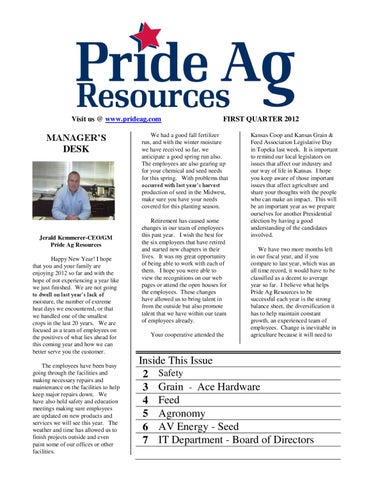
Jerald Kemmerer-CEO/GM Pride Ag Resources Happy New Year! I hope that you and your family are enjoying 2012 so far and with the hope of not experiencing a year like we just finished. We are not going to dwell on last year’s lack of moisture, the number of extreme heat days we encountered, or that we handled one of the smallest crops in the last 20 years. We are focused as a team of employees on the positives of what lies ahead for this coming year and how we can better serve you the customer. The employees have been busy going through the facilities and making necessary repairs and maintenance on the facilities to help keep major repairs down. We have also held safety and education meetings making sure employees are updated on new products and services we will see this year. The weather and time has allowed us to finish projects outside and even paint some of our offices or other facilities.
FIRST QUARTER 2012
We had a good fall fertilizer run, and with the winter moisture we have received so far, we anticipate a good spring run also. The employees are also gearing up for your chemical and seed needs for this spring. With problems that occurred with last year’s harvest production of seed in the Midwest, make sure you have your needs covered for this planting season. Retirement has caused some changes in our team of employees this past year. I wish the best for the six employees that have retired and started new chapters in their lives. It was my great opportunity of being able to work with each of them. I hope you were able to view the recognitions on our web pages or attend the open houses for the employees. These changes have allowed us to bring talent in from the outside but also promote talent that we have within our team of employees already. Your cooperative attended the
Kansas Coop and Kansas Grain & Feed Association Legislative Day in Topeka last week. It is important to remind our local legislators on issues that affect our industry and our way of life in Kansas. I hope you keep aware of those important issues that affect agriculture and share your thoughts with the people who can make an impact. This will be an important year as we prepare ourselves for another Presidential election by having a good understanding of the candidates involved. We have two more months left in our fiscal year, and if you compare to last year, which was an all time record, it would have to be classified as a decent to average year so far. I believe what helps Pride Ag Resources to be successful each year is the strong balance sheet, the diversification it has to help maintain constant growth, an experienced team of employees. Change is inevitable in agriculture because it will need to
Inside This Issue 2 Safety 3 Grain - Ace Hardware 4 Feed 5 Agronomy 6 AV Energy - Seed 7 IT Department - Board of Directors
continue to change and maybe even at a faster pace as the American Farmer takes on the challenges of feeding a growing world population. Our fiscal year will close out at the end of February, and at that time we will take inventory, while going through the audit procedures to bring you the final numbers. Go ahead and mark on your calendars, our 97th annual meeting will be on May 15th, 2012 I hope you have a great spring and thank you for your business. It is always appreciated!
------------
Safety Division
Skyler Hayes Safety Director
CELL PHONES AND DRIVING Nine states have laws prohibiting the use of hand held cell phones by all drivers while driving. No state bans all cell phone use (handheld and hands free) for all drivers, but many prohibit all cell phone use by certain drivers. Examples include thirty states (including Kansas) that ban all cell phone use by novice drivers and nineteen states that ban school bus drivers from using a cell phone while passengers are present. Thirty-five states (including Kansas) ban text messaging for all drivers. Many states (including Kansas) require a category for cell phone / electronic equipment distraction on police accident report forms. Recently proposed federal
legislation would require states to collect this data in order to qualify for certain federal funding. Recently the United States Department of Transportation implemented a law banning interstate truck drivers and truck drivers hauling hazardous materials from using hand held cell phones while driving. The law pertaining to drivers hauling hazardous materials applies to Pride Ag Resources employees who are engaged in delivering anhydrous ammonia to and from our producer customers. In December 2011 the National Transportation Safety Board (NTSB) recommended that all states prohibit drivers from using cell phones, the first federal agency to call for a complete ban on telephone conversations from behind the wheel. Although the NTSB has no enforcement authority, as the federal government’s leading advocate for safety, its recommendations are influential in Congress and the White House. These laws and regulations reflect a trend toward more and tighter control of all cell phone use while driving by all drivers. You may not like this trend, but the reasons behind the rule changes are many and well documented. Motorists who use cell phones while driving are four times as likely to get into crashes serious enough to injure themselves, according to a study of drivers in Perth, Australia, conducted by the Insurance Institute of Highway Safety. The results suggest that banning handheld phone use will not necessarily improve safety if drivers simply switch to hands free phones. The study found that injury crash risk did not vary with type of phone. Although many studies have shown that using hand-held cell phones while driving can constitute a hazardous distraction, the theory that hands-free sets are safer has been challenged by the findings of several studies. A study from researchers at the University of
Utah, published in 2006, concludes that talking on a cell phone while driving is as dangerous as driving drunk, even if the phone is a handsfree model. An earlier study by researchers at the university found that motorists who talked on handsfree cell phones had to redial calls 40 percent of the time, compared with 18 percent for drivers using hand-held sets, suggesting that hands-free sets may provide drivers with a false sense of ease. A study released in April 2006, found that almost 80 percent of crashes and 65 percent of nearcrashes involved some form of driver inattention within three seconds of the event. The study found that the most common distraction is the use of cell phones. In light of the evidence showing that cell phone use can increase the chances of a motor vehicle crash, please consider the following safety tips. Turn off your cell phone or switch to silent mode before you drive your car. Set up a message to tell callers that you are driving and that you will get back to them as soon as possible. If you need to make a call, pull over to a safe area first. Ask a passenger to make the call for you. Don’t ever text, surf the web, or read your e-mail while driving. Although it is still legal (with a few exceptions) to drive and talk on a cell phone in Kansas, you might want to consider if that call you are making while driving could wait until you have reached your destination.
-----------2
ACE HARDWARE
slow release with a very low burn potential but also has a higher cost. A balanced fertilizer is always a better choice. High sulfur content is good as it helps neutralize the alkaline soil to make the natural soil elements more readily available to the plants. Studies and test show it helps prevent some types of fungus. High iron content is also good as it eliminates or reduces iron chlorosis, which is a yellowing of your lawn. Iron will produce rich lush green color in your lawn.
Jack Lane, Ace Manager
Lawn Fertilizer Basic Facts The information you really need to know. N_P_K Ratio N = Nitrogen: Nitrogen promotes tip growth and healthy green color. Excessive nitrogen in the summer can promote disease. P = Phosphorus promotes good root development and growth. It is important when starting new seed. K = Potassium promotes a better vascular system for strong stems and transfer of nutrients as well as stress resistance and cold hardness. Primary Micro Nutrients:
Slightly acidic soil is suitable for good lawns. A PH of 6.5 to 7.0 is ideal. Kansas and most states west of the Missouri river are considered neutral to highly alkaline. PH imbalance either alkaline or acid ties up many soil nutrients and elements making them unavailable for plant uptake. Soil testing is important to get a baseline of what your lawn actually needs and the right application will make a world of difference on how your lawn looks. Ace is your place for all your lawn and garden needs.
------------
GRAIN DIVISION
Iron is required for chlorophyll synthesis to keep a deep green colored lawn. Iron can reduce the amount of nitrogen needed. Sulfur is to help neutralize alkaline soil and prevent some types of fungus. It can also help reduce the amount of nitrogen needed. There are three different types of nitrogen in fertilizer. Ammonical is one that is fast release but can have high burn potential. It is highly soluble. Sulfur coated or poly coated urea is another type of nitrogen. It is a
Patrice Howley Grain Merchandiser Up, down, up, up, down, markets as of late have been trading both sides of the line. The
confusing part depending on your own personal opinion we can paint the picture to go either way. Fortunately, though prices are still at profitable levels. CORN The 100 day moving average for March corn is at $6.46 as of this writing. Why is this important you may ask? Generally speculative fund managers often make major buying/selling decisions at the 100 day moving average. So, $6.46 is the next level of major resistance. If the market would push above $6.46, it could attract significant buying and lead the market towards the January high of $6.64. Taking out $6.64 resistance will be difficult. Key events remaining for Old Crop Corn (2011) are February for the pricing window for crop insurance and the Prospective Plantings report that comes out on Friday, March 30th. Both will have an impact on market direction. If you haven’t kept up with recent sells these levels still are good. A great option we offer is market orders. All you need to do is let us know what level you would like to sell at, and we will watch the market for you. One less thing you have to worry about during the day. Any bushel amount over 5000 we can work against the overnight markets. This can be beneficial because sometimes there are wild swings during the night session, due to the lack of volume. 2012 Crop, hummmm…… what to do? We are still in the Pre-Plant stage. If you have locked in your inputs but no grain, now is a good time to at least get your input costs covered with a grain contract. If no inputs are locked in, get with your supplier and start looking at prices. With these volatile markets the best thing a producer can do is stay disciplined. It’s hard not to throw emotions in when you put your heart and soul into your operation. First, lock in cost of production, cover that cost of production with a grain contract, and then any other 3
grain sells locked in is profit. Profit = another year of farming! WHEAT Rumors are out that Russia might raise the export tax to slow the flow of grain out the country. Russian officials stated they want to keep wheat exports at 880mbu or below for the marketing year. Currently, shipments have been reported to have reached 735 mbu with nearly six months left in their marketing year. If rumors come true, late spring we should see export limitations in Russia. Remember, U.S. stocks are bountiful; it will take a significant increase in export business to turn U.S. stocks into a bullish market setting. Texas released a state condition report as of Jan. 24th. The wheat crop is rated 2% excellent, 21% good, 37% fair, 26% poor and 14% very poor. The condition index is 51 compared to 46 last year. The U.S. dollar has backed off lately making our wheat competitive in export channels, leading to stronger demand, creating higher domestic prices. If the dollar would creep higher again our only hope for higher prices is weather problems. Lets pray for a lower dollar, none of us want to see a repeat of last year. Keep in mind wheat follows corn; it basically has to being a feed substitute. Patience is key in the wheat market for now, unless you have costs that need covered. SOYBEANS South American and Argentina weather is what is singing the song for the soybean markets currently. Rain in Argentina is making soybean traders nervous because there still is time for the bean crop to be saved. From a technical stand point the March contract is at a critical point. The 100 day moving average is at $12.29. As mentioned previously, the 100 day moving average is often the point of decision for fund managers- above, they buy; below, they sell. Currently South American
weather is supportive enough to keep sellers sidelined. Soybeans need continued buying from hedge funds, odds favor moving above the 100 day moving average. Old crop soybeans, if you are still holding beans remember it costs money to, even if they are in your own bin. At the elevator it is costing you 3 ½ cents a month per bushel. If your beans have been in the elevator since October, that is a total of 14 cents per bushel just in storage. Right now the carry from the March to the May futures is only around 9 cents. That tells you the market is not paying you to hold to your beans. Spreads are something to look at when deciding to hold or sell your old crop grains. After you have sold grain you can still participate in any market rallies by buying a call option. Remember there are always marketing alternatives out there above and beyond your standard grain contract that allow you to still participate in market rallies or protection from market dumps. Contact Troy or Patrice for further assistance in improving your marketing needs through our brokerage services. Contract Delivery Period Changes: Corn & Milo- previous period: Oct. 1st- Dec. 31st new period: Sep. 15th- Nov. 30th Soybeans- previous period: Sep. 1st- Nov. 30th new period: Sep. 1st – Oct. 31st Any questions please contact Troy, Patrice, Bill or Gaylene.
------------
FEED DIVISION
Galen Frick, Livestock Advisor
Tally Time: Beware of “creeping stocking rates” The number of cow-calf pairs placed on a pasture is often determined based on previous experience and/or conventional wisdom. One of the factors that easily can be overlooked in establishing stocking rates is cow weight. Range scientists typically use a 1,000 pound cow with calf as the base definition of one animal unit and cattlemen often use 1,200 pounds to describe the mature body weight of their cows. However, the average mature weight of cows in the U.S. has changed in the last 20 years. If we use feedlot exit weights as a base and the relationship between hot carcass weight and mature dam weight, the estimated mature weight of the 1990 U.S. cowherd was 1,228 pounds compared to 1,386 pounds in 2010 (Table 1). Therefore, using 1,200 pounds for a cow in 1990 was accurate, but today using a weight of 1,350 or 1,400 pounds would be more appropriate. If the total number of animals per unit of land, per month has not been adjusted, then the pounds of animal per unit of land may have increased by about 150 to 200 pounds per animal. This scenario can be referred to as ―creeping stocking rate.‖ For example, a particular 4
pasture supporting 200 cow-calf pairs in 1990, with the cows weighing about 1,200 pounds each, equals a total stocking number of 240,000 pounds. If the number of pairs turned out every spring has not been changed, the actual stocking number today would be 270,000 pounds, an increase of 12.5 percent! This could have serious implications on long-term forage quality and quantity. To get a comparable stocking rate today versus 1990, using 1,350 pound cows, only about 178 pairs should be placed on the pasture.
AGRONOMY
As many producers make plans for the upcoming grazing season, they should weigh a few cows and give this some thought. It may lead to some difficult decisions, but the long-term sustainability of the forage base may depend on it.
Topdressing Spring Wheat
Year
Steer Mkt.Wt . (lbs.)
Hot Carcass Wt.(lbs)
Mature Cow Wt.(lbs)
Animal Unit Equival ents
1990 2010
1187 1340
736 831
1228 1386
1.1 1.3
Source: Justin Waggoner, beef systems specialist, Kansas State University
David Seymore Sales/Agronomist
As the Geese are flying in circles, it is hard to tell if they are going north because winter is over or south because there is more to come. It is time to look at starting another year of fertilizing. The moisture we have received needs to be managed to make the best possible yield. We need to look at when to fertilize, whether it would be liquid or dry, and how much you put down. When applying N through topdressing the purpose is to move into the root zone before jointing begins. The dry year we have been through it seems like everyone has short wheat. Having enough N next to the plant is crucial for tillering as the wheat breaks dormancy. This is when head size is determined and can start two weeks before tillering. For the most part of our area the odds of losing much of the N that is top dress-applied in the winter is low since we typically don’t get enough precipitation over the winter to cause significant leaching. For these soils, topdressing can begin anytime now and usually the earlier the better.
applying dry urea since it falls to the soil surface and may be less affected by immobilization than broadcast liquid UAN, which tends to get hung up on surface residues. If producers plan to tank-mix with an herbicide, they’ll have to use liquid UAN and broadcast it. If the wheat was grazed this fall and winter, producers should add an additional 30-40 lbs N/acre for every 100 lbs of beef weight gain removed from the field. If conditions are favorable for heavy fall and/or spring grazing, additional N may be necessary, especially for a grain crop. Checking fields for weed seed just now coming up after the winter moisture is critical. As dry as we were there is a lot of weed seed which has not germinated. Moisture we have received will change this once the soil temperature begins to rise. There are a number of herbicides (Ally Extra, Finesse, Affinity Broad Spec, Rave, Amber, Powerflex, Olympus Flex, and combinations of others) which will be good to apply for weed control. Be sure to contact your local Pride Ag office or Jim at 620-338-5506 and David at 620-338-5553 for what we can do together to help you make a profit.
Date
Wheat
Corn
Milo Soybean
9/6/11
8.11
7.61
6.81
13.28
10/3/11
6.47
6.01
5.23
10.73
10/18/11
6.59
6.57
6.02
11.56
11/23/11
6.11
6.12
5.61
10.38
6.43
6.04
12.88
Last Year –FEB., 2011 AVG.
8.30
The typical sources of N used for topdressing wheat are UAN solution and dry urea. Numerous trials by K-State over the years have shown that both are equally effective. In no-till situations, there may be some slight advantage to 5
AV Energy
You'll protect your bottom line. The Cenex Total Protection Plan Warranty:
SEED DIVISION
Provides unsurpassed coverage that goes above and beyond (but won't interfere with) your original manufacturer's warranty — up to 10 years or 10,000 hours on new equipment and 8 years or 8,000 hours on used equipment
Chris Klein AV Energy Hope everyone had a safe and happy holiday season. Below is an article from Cenex that gives information about their Total Protection Warranty program. This warranty is one of the best in the industry and I encourage you to read through the article and give us a call if you have questions or would like to sign up. Did You Know...There's a Simple Way to Protect the Performance of Your Agricultural Equipment and Gain Warranty Coverage for up to 10 Years or 10,000 Hours? In this business, there's no time for downtime — and there's no such thing as an "inexpensive" repair. That's why it pays to protect your equipment with the Cenex® Total Protection Plan™ Warranty. It's a small investment to make in exchange for valuable coverage and peace of mind. You get unsurpassed coverage while helping to ensure that only high-quality energy products go into your equipment. Think of it as a no-fault insurance policy — one that helps keep you in the fields when you need to be there. There's no deductible, which can really pay off and help keep things moving during crunch times like planting and harvest.
Pays for repair or replacements costs (including installation and labor) of faulty parts that fail during normal use — doesn't have to be related to an oil or fuel defect Has no deductible, and a no-hassle claims process Covers new equipment for just $299 and used equipment for $399 Is transferable Receive $200 in free product when you enroll You'll Avoid Downtime with Premium Products and Oil Sampling By using Cenex® Ruby Fieldmaster® Premium Diesel Fuels and high-quality Cenex® lubricants, you'll get all the benefits of proven products that are specially formulated for the tough challenges of farming By submitting fluid samples from each oil change or drain, you'll receive a LubeScan® analysis that will help you catch minor problems early and perform timely maintenance before expensive damage occurs Contact Terry Summers @620-2254994 with questions or to enroll your new or used equipment.
Jim Halling jhalling@prideag.com 620-338-5506 Sales Agronomist 2011 ended with a tease of moisture and a shortage of feed options in most of our trade area. Although we are moving in the right direction, we have a long way to get caught up. With poor seed production conditions last year both in grain and forage crops, it creates a major threat in planning for spring planting in 2012. We at Pride Ag Resources have tried to position ourselves with supply as well as we can for the coming season. Although we are comfortable in supply this year, it appears this is going to run out fast. Seed corn and milo supply is already short and forages are catching up fast. Please try to plan ahead in your rotational plans to help us help you. This season bookings are running 2-3 months ahead of schedule. It is important to organize your planting schedule as soon as possible. We are proud to make taking care of our loyal consistent customers our first priority. Our partnerships with Sharp Brothers and Sorghum Partners have given us wonderful opportunities to diversify our selection of products. We are also exploring options with more suppliers as we go. Please give us the opportunity to supply your forage and seed needs, but don’t waste valuable time while supplies are running out. Feel free to touch 6
base with your local Branch Manager, Fieldman or Mill Manager to see how we can meet your needs. As always we appreciate your business and hope we can work with you as a partner in 2012.
IT Department
Richard Broz rbroz@prideag.com
For Sale: 30 gallon drums – quantities follow our cost Double Circle 40 - $146.40 (5) Double Circle 30 - $276.59 (5) Double Circle 20w20 - $150.00 (2) Super Auto Plus 10w40 - $180.00 (1) Super lube 518 10w - $131.70 (5) Auto Gold 10w30 – $263.67 (4) Auto Gold 5w30 - $218.70 (1) Super lube 518 50w – $149.40 (1) Tms 10w30 - $153.30 (1) 50 gallon drums Glide-A-Matic ATF - $252.45 (1) Mercon/Dexron 111 ATF - $252.45 (5) Super lube 518 30w - $341.83 (3) MP Gear lube 80w90 - $265.65 (2) Indol 46 - $231.55 (3) Superlube518 50w - $469.18 (4) Tms 10w30 - $500.06 (1)
Did you know Pride Ag Resources has a Face Book page? Check out our page and become a fan to see what is happening with Pride Ag. We are currently making changes to our web site to make it user friendly. If there is information you are unable to find please email webmaster@prideag.com
BOARD OF DIRECTORS Scott Mac Nair ........................ Chairman Tony Bleumer... .............. Vice-Chairman
Kerosene - $238.69 (3)
Larry D Scott .......... Secretary-Treasurer
If interested please contact Patty @ 620-338-8770 at Pride Ag Resources Ware house, Kansas
Steve Riegel .............................. Director
There are limited items, please call for on hand stock.
Jeremy Derstein ........................ Director Butch Irsik ................................. Director Clint Hamilton ............................ Director Josh Koehn.…...........Associate Director Jeff Reinert…….…….Associate Director Jerald Kemmerer………………CEO/GM Debby Kennedy….......Newsletter Editor
7
Pride Ag Resources 1st Quarter 2012 Published quarterly by the Pride Ag Resources 710 West Trail, Dodge City, KS 67801 (620) 225-4193
8