Visit us @ www.prideag.com
MANAGER’S DESK
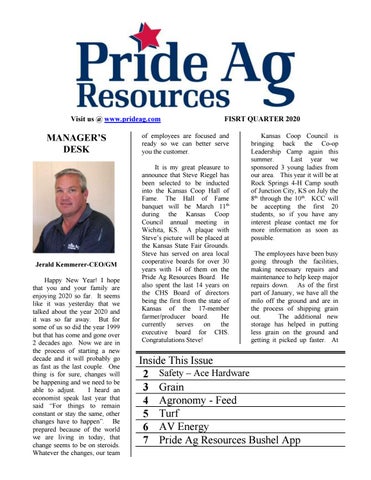
Jerald Kemmerer-CEO/GM Happy New Year! I hope that you and your family are enjoying 2020 so far. It seems like it was yesterday that we talked about the year 2020 and it was so far away. But for some of us so did the year 1999 but that has come and gone over 2 decades ago. Now we are in the process of starting a new decade and it will probably go as fast as the last couple. One thing is for sure, changes will be happening and we need to be able to adjust. I heard an economist speak last year that said “For things to remain constant or stay the same, other changes have to happen”. Be prepared because of the world we are living in today, that change seems to be on steroids. Whatever the changes, our team
FISRT QUARTER 2020
of employees are focused and ready so we can better serve you the customer. It is my great pleasure to announce that Steve Riegel has been selected to be inducted into the Kansas Coop Hall of Fame. The Hall of Fame banquet will be March 11th during the Kansas Coop Council annual meeting in Wichita, KS. A plaque with Steve’s picture will be placed at the Kansas State Fair Grounds. Steve has served on area local cooperative boards for over 30 years with 14 of them on the Pride Ag Resources Board. He also spent the last 14 years on the CHS Board of directors being the first from the state of Kansas of the 17-member farmer/producer board. He currently serves on the executive board for CHS. Congratulations Steve!
Kansas Coop Council is bringing back the Co-op Leadership Camp again this summer. Last year we sponsored 3 young ladies from our area. This year it will be at Rock Springs 4-H Camp south of Junction City, KS on July the 8th through the 10th. KCC will be accepting the first 20 students, so if you have any interest please contact me for more information as soon as possible. The employees have been busy going through the facilities, making necessary repairs and maintenance to help keep major repairs down. As of the first part of January, we have all the milo off the ground and are in the process of shipping grain out. The additional new storage has helped in putting less grain on the ground and getting it picked up faster. At
Inside This Issue 2 Safety – Ace Hardware 3 Grain 4 Agronomy - Feed 5 Turf 6 AV Energy 7 Pride Ag Resources Bushel App
the end of the day the new storage allows for us to have a very marketable grain that the market prefer to buy. I believe that’s where your upright storage is better than having lots of bunkers. Bunkers are not as efficient in keeping grain in condition and make it difficult to get the grain in position for quick load out. Once you open a bunker you need to empty it quickly. This requires you have enough space at that given time to handle all the grain contained in the bunker.
you think about how much faith you put in the person in the vehicle coming towards you in the other lane; it really causes you to pause. This is one of the few times throughout the day that we are putting our complete faith in someone else for our immediate safety. There are two things that can drastically improve your operational safety in terms of driving I would like to discuss. One being practicing preventative maintenance and the other, active driver management.
We had a good fall fertilizer run. With the winter moisture we have received so far, we anticipate a good spring run also. The employees are gearing up for your chemical and seed needs for this spring. We have had a good anhydrous and dry fertilizer run so far this winter. The agronomy team has been working on getting doubles and other anhydrous tanks inspected and updated.
Roger Maple Safety Director
Preventative maintenance is extremely simple, yet often disregarded. Part of the reason is that the individuals with the skills to maintain vehicles often have poor recordkeeping skills. While this is not always the case, it often poses a unique challenge. Recordkeeping for preventative maintenance is of the utmost importance because it can help you to identify subtle trends in your vehicles and how frequently maintenance is needing done on your various vehicles. This is only a requirement for commercial motor vehicles. I want to encourage you, if it isn’t an integral part of your operational program, to properly integrate a maintenance file for all your company and farm owned vehicles, whether they are considered off road or not. The difference in having things like good tires, brakes, brake lights, turn signals, horns that work, or even a good and clear windshield, and not, can each be the difference between life and death for you and/or the general motoring public.
Driving is absolutely the single most dangerous thing that many of us do each day. When
The other key item to address to improve driving safety in your farming operation is to
Our fiscal year will close out February 29th, and at that time we will take inventory while going through the audit procedures to bring you the final numbers. I hope you have a great spring and thank you for your business. It is always appreciated! Jerald Kemmerer-CEO/GM Pride Ag Resources
Safety Division
actively manage your drivers. There are regulations in place as a bare minimum for your driver’s that can assist with this. However, I recommend that each of you make a conscious effort to spend personal time with each person who drives one of your vehicles to help ensure that safe and practical driving habits are being practiced as they navigate the roads we all travel. Don’t assume that they have all seen the things you have seen as they experience different seasons of the year, perhaps for the first time. A little explanation of what they may see as they travel will go a long way. The toughest part of winter is now upon us and I hope you make it through without anything serious to report. Please be safe!
ACE HARDWARE Jack Lane, ACE Manager It’s hard to believe that spring is just around the corner but it will be here before you know it. It’s time to start thinking about the pride turf fertilizer applications for your yard, trees and shrubs. Your Ace stores have a full line of Pride Turf products available including the pre and post emergents. It always seems to sneak up on everyone but it is time to start getting ready for those products to be applied. Your Ace stores carry a full line of Stihl products including power washers, chainsaws, blowers and trimmers just to name a few. Stihl also has a line of battery operated equipment that is pretty impressive. 2
For you Milwaukee tool owners. Milwaukee also has a line of lawn tools and equipment that is battery operated. It will use your 18volt tool batteries. Stop by your Pride Ag Ace stores and take a look.
GRAIN DIVISION Gary Friesen Grain Merchandizer In 1939 Winston Churchill famously described Russia as “a riddle, wrapped in a mystery, inside an enigma”. Eighty years later Churchill’s quote could be used to describe the uncertainty that was encountered in the grain market this past growing season. The grain market continues its mysterious way even as we get the final production numbers for this year’s fall crop. The wheat market began a move higher on December 10, 2019 with the Kansas City March 2020 Wheat contract trading from a low of $4.23 ½ to its recent high of $5.04 ¾ on Jan. 22, 2020. Strong export sales as well as continued concerns about dry conditions in Australia and Argentina supported the wheat market. Lower planted acres in the U. S. and concerns about dry conditions through the wheat belt as well as concerns of winter kill in the northern plains also supported the wheat market. The Kansas City July 20 Wheat contract closed above $5.00 on December 31, 2019, dipped down to $4.90 ¼ shortly after the first of the year but is currently trading above $5.00.
March corn has been supported by better export sales numbers as the calendar year came to a close but futures continue to trade in a narrow range between $3.80 and $3.90. Domestic demand for corn for both feed use and alcohol continues to be strong. The new crop December 2020 Chicago Corn contract moved from its lows on Dec. 12, 2019 to a high of $4.04 ¾ on Jan. 15, 2020. The corn market continues to lack direction due to an ongoing uncertain production picture and a lack of Chinese demand. Soybeans rallied from a low of $8.82 ½ on December 2, 2019 to a high of $9.61 on January 2, 2020 before sliding to a recent low of $9.04. New Crop November 2020 Soybeans have traversed the same path closing most recently at $9.47 ¼. Harvest prospects for soybeans appear good in South American and depending on yields could pressure nearby soybeans. In January the grain markets got the highly anticipated USDA World supply and Demand Report as well as the important news that Phase 1 of the Trade Deal with China would be signed. Neither of these events provided significant support for the grain markets and in fact continued to leave lingering doubts that added to uncertainty in the grain markets. The trade deal was signed on Jan. 15th by both President Trump and Chinese Vice Premier Liu but the grain markets shrugged off the news with soybeans ending the trading session down 13 cents, wheat unchanged and milo and corn down 1 cent. It seemed to be a classic case of traders
“buying the rumor and selling the fact”. After looking at the details of the Phase 1 agreement, there seemed to be little to really hang a hat on. The agreement was set to kick in 30 days from the sign up day and contained language that China would purchase and import on average at least $40 billion annually of U.S. food, agricultural and seafood products for a total of $80 billion over the next two years. Strangely, the agreement also recognized that Chinese purchases are to be made at market prices based on commercial considerations and that market conditions may dictate the time of year that agricultural purchases are made within any given year. I’m not sure just what that means but leaves me with doubts that these commitments can or will be met. The agreement certainly addressed a wide range of trade issues but so far the grain markets continue to wait to see what the outcomes will be. There are lingering concerns about Phase 2 of the agreement including when it will be completed and what Phase 2 will contain. Date Wheat Corn 10/7/19 3.47 3.77 11/6/19 3.78 3.69 11/21/19 3.76 3.59 12/18/19 4.12 3.72 Last Year –Feb. 2019 AVG. 4.31 3.64
Milo 3.22 3.14 3.54 3.22
Soybean 7.90 8.03 7.76 8.14
3.14
7.75
USDA’s Jan. 16, 2020 WASDE report moved the grain markets lower, with wheat losing 11 ¾ cents, corn losing 12 cents and soybeans losing 4 ¾ cents at the close of that day’s trading session. Because this report is the final report on corn production for the year, many traders expected USDA to 3
adjust this year’s corn yields down. However, USDA found a way to increase both yields and beginning corn stocks in the January report. Corn for feed use was increased 250 million bushels while exports were decreased 75 million bushels. The net effect was that ending stocks were reduced 16.6 million bushel leaving the stocks to use ratio mostly unchanged from last month at 13.5%. USDA also stated that they would be resurveying corn farmers in Michigan, Minnesota, the Dakotas and Wisconsin in the spring, to get a more complete harvest picture. Both Wheat and soybean ending stocks were minimally lowered from the December 2019 report. In spite of the fact that South American production will soon come on line, I believe the extent of the production issues we had in the eastern Corn Belt are still unknown and given the incomplete picture USDA has painted with their corn production reports this past year, the corn market continues to face uncertainty. This uncertainty suggests that having market orders in place, should the market move suddenly higher, could be to your benefit. Please let us know how we can help you as you market the remainder of your production from last harvest and let us help you begin making your plans to market your next crop. As always, we appreciate your past business and look forward to helping you with all your grain handling and grain marketing needs.
AGRONOMY Tim Spector Agronomy Manager Fertilizer–Current markets are a good investment for your Nitrogen and Phosphate needs. The market hit the lowest point on Nitrogen in mid-December, phosphates are at the lowest value per LB. of actual since 2007. Looking forward, the Midwest is behind on their N applications and that will put pressure on supply and logistics once they start application. Our markets are affected daily with international purchasing. India and Europe are currently buying N needs of which we have seen a bullish uptick in the replacement values. I look for a steady increase in values over the next 4-6 weeks. Your Pride Ag Resources agronomy team and location managers are eager to assist in your operation needs. Crop Protection – Tariff war between the US and China have technical cost up on generic and some branded products anywhere from 5% to 25% depending the key active ingredient (AI). Is generic chemistry the same as branded chemistry? No, we are all guilty in focusing on the Active Ingredient and ignore the most important part of the formula called Inert Ingredients. Depending on the source point, Inert Ingredients can cause crop injury and difficulty in mixing. We offer a full offering of Branded Chemistry and we do source some generic products that have a reputable production source. Keep in mind that when
utilizing a branded strategy, you receive support after the sale from each of the producers. (BASF, Bayer, Corteva and Syngenta). Seed- The sales team is out with pricing and early order specials for NK and Croplan seed. The genetic offerings through these two suppliers have multiple Hybrid and Variety offerings to maximize your potential in Corn, Milo and Soybean production. Finance – Your Pride Ag Resources Agronomist have information available to discuss input financing options for your seed, chemical and fertilizer needs for the 2020 crop year. Currently we offer CFA and Secure Finance options with terms to Feb 2021. Your Pride Ag Resources agronomy team has information available if you have an interest.
FEED DIVISION Warm From the Inside Out 7 Tips for wintering cattle Author: Ted Perry Purina Animal Nutrition Cold weather is upon us, which means it’s time to break out your cold-weather clothes. Colder weather also impacts your cattle, but they can’t stay warm by putting on winter boots, a coat and a hat. They need other ways to keep warm. Nutrition and environment management will help maintain a cow’s core body temperature, keeping cows warm from the inside out. Here are 7 tips to keep cattle warm this winter: 1. Focus on body condition score the number one way to 4
reduce cold stress in cattle is to improve body condition score. Having a good body condition score going into winter does two things. “First, a cow in score 5 or 6 has a layer of fat insulation helping her conserve body heat,” says Ted Perry, cattle nutritionist with Purina Animal Nutrition. “Second, cows in good body condition likely have a good diet, which can result in nice, warm winter hair coats.” 2. Deliver more feed “Make sure cows have enough feed and water,” says Perry. “A cow’s feed intake will increase by 20 percent during cold weather.” Before temperatures drop, increase the amount of feed delivered. Provide additional hay, or offer 20 percent more feed in the bunk. “Increasing intake will increase the amount of fermentation in the rumen, and one of the biggest waste products of fermentation is heat,” says Perry. “If we can provide cows with more energy and get more forage into the rumen, more fermentation happens and more heat is produced. The process helps keep cows warm from the inside out.” 3. Separate thin cows. Thin cows mixed with the rest of the herd probably won’t get the nutrition they need to maintain or gain condition. Separate thinner cows – young or old – to help take off feeding pressure. Once separated, make sure cows have plenty of forage and access to minerals and protein supplements. If you can’t separate thin cows, feed a freechoice supplement like a protein tub to give those cows access to feed at all times. Free-choice supplements also provide a less competitive atmosphere than
group-feeding protein cubes or hand-fed feeds. 4. Put up windbreaks Wind chill affects cattle just like it affects people, so it’s important to keep cattle out of the wind if possible. You can put up a homemade windbreak, create one out of bales or install a permanent windbreak. Wooded areas also provide shelter from the wind. “When cows don’t have a windbreak, they feel the full effect of the wind, and it will cost you body condition,” says Perry. “A drop in body condition will result in additional feed cost to regain condition.” 5. Provide minerals and supplements Minerals are vital during cold weather because they impact a cow’s metabolic process. If cows are short on minerals, their metabolism will slow down. Once metabolism slows, the cow isn’t producing as much heat, and she may start losing body condition. Providing minerals and protein supplements can also lead to better forage digestibility. A cow’s rumen microbes have mineral requirements and can also benefit from supplementation. “Supplementing ramps up rumen microbes so they can digest more forage,” says Perry. “The microbes can also get 25 or 30 percent more energy out of the forage they’re eating.” 6. Keep a clean environment the winter environment tends to be muddy. Mud reduces the insulation factor of a cow’s hair coat, and a cow’s lower critical temperature goes up as a result. For instance, if a cow is clean and dry, she may be okay down to 5 degrees Fahrenheit. If a cow is dirty, her lower critical temperature may go up to 20
degrees Fahrenheit. “Give cows plenty of space, and move hay rings and feeding stations to limit the creation of muddy areas,” says Perry. “The cleaner cows stay, the better insulation their hair will provide.” ©2018 Purina Animal Nutrition LLC. All rights reserved. Talk to your local Purina representative to learn more, or visit ProofPays.com to start your feeding trial. 7. Break routine “We tend to feed cattle on a routine. We put out X amount of feed per day because we think that’s what the herd should need,” says Perry. “But we need to pay close attention to temperature and watch cattle closely.” When you know it will be cold for the next few days, increase the feed offered at least 24 hours in advance to give cows a head start. Feeding cows after the storm is helpful, but the impact is greater when they are fed before.
Pride Ag Resources“Pride Turf” “Turf Talk” Nathan Ratzlaff nratzlaff@prideag.com It is hard to believe that 2019 is over and we are well into 2020 already. 2019 was a strange weather year with record rainfall throughout the spring and early summer turning into very dry conditions throughout the fall and early winter. The wet spring brought on several challenges with growing grass this past year. There seemed to be more crabgrass breakthrough than normal. This most likely was caused by the pre-emergent 5
chemical being flushed through the soil due to the amount of rain we experienced. Also with the wet spring came shallower roots in the heat of the summer, causing grass to struggle. Our Pride Turf Summerizer would have been an ideal product to put down to help build a stronger root system. As we will be moving from winter into spring, the time to apply a pre-emergent will be here before we know it. We have a couple different preemergent options that we can provide to our customers. Our “Preventer P” is an early application product with a lasting residual. A good time to apply this product is around the middle of March before any crabgrass starts to germinate. Another option we have is our “Preventer D.” It is the ultimate crabgrass preventer; it has a later application window than Preventer P, as it should be applied around the middle of April. This product will actually kill any immature crabgrass plants that may have germinate a little early. I would also like to remind everyone about our ice melt products that we carry. The “Royal Blue Melter” is perfect for fast effective melting. It can be used for high traffic surfaces, driveways, sidewalks and steps. It has melting capabilities from 20 degrees to -20 degrees. The “Green Melter” is great for large applications and has an anti-slip material added in. This product has melting capabilities from 20 degrees to -15 degrees. Make sure you get into one of
our Ace Hardware stores and stock up so you are prepared when winter weather hits. If you ever have a question about your turf grass, weather it is about fertilizing or you are having issues with pests or diseases, do not hesitate to ask. I am always glad to help anyone with a turf grass problem. Nathan Ratzlaff nratzlaff@prideag.com AV Energy Chris Klein AV Energy Manager
I hope everyone had a Merry Christmas and their New Year’s has started off great! Refined Fuels Contracting Fuel contracting has started off slow this year compared to years past and I believe it is for a good reason. The market has been much over stated the last couple of months. Customers have been very hesitant to lock in fuel for the summer, which has been a good decision so far. The crude market has come down almost $10.00 since the beginning of November and as I write this article it is down another $1.00 on the board. So, now would be a great time to start looking at summer contracts and to take advantage of a softer market. Propane Suppliers
on the propane system to verify there are no leaks. To be truthful I do not know how they can sleep at night knowing that their customers could be at risk. A propane safety check is required to be performed by the propane supplier when: A customer runs out of propane. If the system has been shut down. If there has been a change of tenant. If the customer is new. If a propane appliance is installed, replaced or removed. AV Energy also does follow up inspections every five years after the initial inspection. To insure the safety of you and your family call your propane supplier and ask them to perform a safety check. If your propane supplier has never done a safety check on your propane system, ask them why! If they tell you that they are not required to do safety checks they are mistaken and should be reported to the Office of the State Fire Marshal. After being in the propane business for more than 20 years I have seen what a propane explosion can do, so don’t let your propane supplier sacrifice you and your family’s safety. Make sure your propane supplier is doing the job they are licensed to do. Thanks, and have a great rest of your winter.
It is very disturbing to me that there continues to be Propane Suppliers in our area that deliver to customers without performing safety checks. A safety check is a test 6
Pride Ag Resources App DOWNLOAD/LOGIN INSTRUCTIONS
Click ‘DOWNLOAD/GET’
1
2
3
4
Install ‘Pride Ag Resources’ from the App or Play Store.
Select Login
Enter Your Phone Number with Area Code
Enter the Code from the text message
GROWER BENEFITS Smarter, faster, more informed decisions for grower operations Track actual yield with digitized real-time scale tickets Check contract status or sign immediately to lock in the best grain prices Check the percentage fulfilled towards contracts Business information any time of the day, from anywhere (Plus, it’s free for growers)
W W W. B U S H E L P OW E R E D.CO M / P R I D E -AG - R E S O U R C E S
Pride Ag Resources
Published quarterly by the
PRSRT STD U.S. POSTAGE
Pride Ag Resources
PAID
1st Quarter 2020
710 West Trail, Dodge City, KS 67801
DODGE CITY, KS PERMIT #399
(620) 225-4193
8