Visit us @ www.prideag.com
MANAGER’S DESK
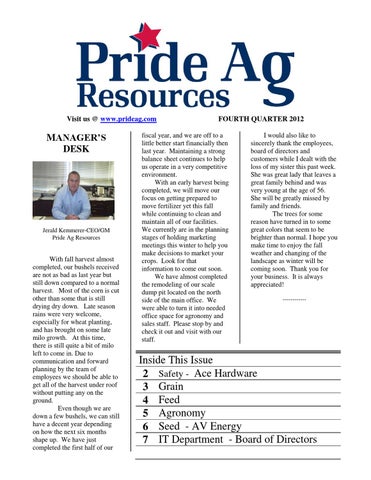
Jerald Kemmerer-CEO/GM Pride Ag Resources
With fall harvest almost completed, our bushels received are not as bad as last year but still down compared to a normal harvest. Most of the corn is cut other than some that is still drying dry down. Late season rains were very welcome, especially for wheat planting, and has brought on some late milo growth. At this time, there is still quite a bit of milo left to come in. Due to communication and forward planning by the team of employees we should be able to get all of the harvest under roof without putting any on the ground. Even though we are down a few bushels, we can still have a decent year depending on how the next six months shape up. We have just completed the first half of our
FOURTH QUARTER 2012
fiscal year, and we are off to a little better start financially then last year. Maintaining a strong balance sheet continues to help us operate in a very competitive environment. With an early harvest being completed, we will move our focus on getting prepared to move fertilizer yet this fall while continuing to clean and maintain all of our facilities. We currently are in the planning stages of holding marketing meetings this winter to help you make decisions to market your crops. Look for that information to come out soon. We have almost completed the remodeling of our scale dump pit located on the north side of the main office. We were able to turn it into needed office space for agronomy and sales staff. Please stop by and check it out and visit with our staff.
I would also like to sincerely thank the employees, board of directors and customers while I dealt with the loss of my sister this past week. She was great lady that leaves a great family behind and was very young at the age of 56. She will be greatly missed by family and friends. The trees for some reason have turned in to some great colors that seem to be brighter than normal. I hope you make time to enjoy the fall weather and changing of the landscape as winter will be coming soon. Thank you for your business. It is always appreciated! ------------
Inside This Issue 2 Safety - Ace Hardware 3 Grain 4 Feed 5 Agronomy 6 Seed - AV Energy 7 IT Department - Board of Directors
Safety Division
Skyler Hayes Safety Director
School Bus Safety From September through May there are many school buses loaded with children traveling on our public roads. Riding the school bus is a very safe means of transportation. It is safer than carpooling, another common form of transporting students. In fact, statistics indicate that riding the school bus is safer than getting to and from the bus itself. More than twice as many children die in school bus / pedestrian accidents than do in school bus traffic accidents. October 22 – 26 was National School Bus Safety Week, which makes this a great time to discuss school bus safety. This year’s theme is “I See the Driver. The Driver Sees Me”. Following are some rules that all children who ride buses should be aware of. Arrive at the bus stop a few minutes early. While waiting for the school bus, stay in a safe place, preferably five steps from the side of the road.
Wait until the bus stops, the door opens, and the driver says it is okay before attempting to get on the bus. Be careful that clothing, drawstrings, and book bags don’t get caught in the handrail or door when getting off the bus. If something falls under or near the bus, tell the driver. Never attempt to get the item yourself. When getting off the bus, look for the bus safety lights and make certain that they are flashing. Watch for traffic. Look both ways before entering or crossing the street. Cross the street only at the crosswalks. Sit quietly in your seat so as not to distract the driver. If the school bus is equipped with seat belts, learn how to use them correctly. When driving near school buses or schools, there are some rules that drivers need to be aware of. Remember that it is illegal to pass a
stopped school bus from either direction when the stop arm is extended. Wait until the driver turns everything off before you pass. Never pass on the right side of a school bus, where children enter and exit. Drive slowly and be alert when driving near bus stops and school zones. Children hurrying to meet the bus or get to school might dart into the street. In some areas, there may not be sidewalks, and children might walk in the street.
_____________________
ACE HARDWARE
Jack Lane, Ace Manager
On Friday after Thanksgiving also known as Black Friday Ace Hardware in Dodge City, Meade and Maize will have a tremendous buy available on 2
Traeger grills. It will be one day only and will include two wood pellet grills. The Texas grill that regularly sells for 999.00 will be an amazing price of 699.00 a savings of 300.00 dollars. The Lil Tex Elite will be on sale for 699.00 regular price of 799.00 a savings of 100.00. Remember it will be a one day only with no exceptions from Traeger. HOW THE TRAEGER GRILL WORKS: The Traeger Wood Pellet Barbecue Grill is simple and safe to operate. Traeger grills require standard household electric current (110 VAC), which powers the igniter rod, auger motor and draft induction fan. Once you turn the grill on, the igniter rod is activated; the auger begins to feed pellets into the firepot and the draft induction feeds air into the firepot. The igniter rod is a small heating element that gets red hot and then shuts off after two minutes-just long enough to ignite the pellets in the firepot. The start- up process and operating temperature of the grill are controlled by the electronic control board. The microprocessor circuitry regulates the smoke and heat in the Traeger by starting and stopping the auger motor. As the hot smoky air circulates around the cooking chamber, it surrounds your food with heat, cooking it evenly on all sides, both top and bottom. This means Traeger needs no rotisserie. In most cases you don’t even have to turn the food unless you are cooking at high temperature or want grill marks on both sides of the meat. This even heating means that you achieve perfectly cooked food
every time, with no flare-ups, no burnt food and no hassles. Ace will have other amazing deals on Black Friday and throughout November and December watch for the circular and information in your local newspaper or radio station for more details. ------------
GRAIN DIVISION
Tim Lehman Grain Merchandiser
With the Holiday season fast approaching let’s not forget to be thankful. Thankful for the things that are good in our life and the things that make life feel complete. Although it has been a difficult year for production and marketing, be thankful for what production we did get and for the prices we have. Current prices are below the summer highs but are still high from a historical perspective. The first major drought to hit the corn-belt since 1988 made for a dramatic upward move in prices. In 1988 the talk of a U.S. corn production figure in excess of 10 billion bushel would have generated talk of how low would prices go rather than it being a disaster. Now it raises the question of do you think the highs are in. The current demand, both domestically and
internationally, has made it so that this is considered a low production number. A combination of reduced production and low ending stocks from last year now creates the situation for historically high prices. The soybean market is much like the corn market in this regard. Both will turn their attention to South America for direction. Weather will be a major influence for the crop and can cause erratic market moves just as North American weather did this last summer. This will not be the only market mover but may cause the most erratic price swings. Some other factors to watch are planted acres in South America, estimates for planted acres for North America, Chinese demand for soy and domestic demand within the United States. This is far from a complete list but some influences to be aware of and to monitor. The wheat market will be watching acreage, winter moisture and world competition to name a few. All the uncertainty and unknowns can cause much anxiety but don’t forget to be thankful. Don’t forget that Pride Ag offers several types of cash contracts and will be available to help with those decisions. The grain department has added a new employee. Jessica Schwartz has joined the Pride Ag Resources crew. This addition will allow us to offer more complete services from the grain department in the form of a futures brokerage office and direct shipment program. We plan to hold some marketing meetings during January and February so that Jessica can get introduced to the area and these enhanced services can be explained. 3
When dates are set we will be notify customers of times and places. Date
Wheat Corn Milo Soybean
7/6/12
8.41
8.04
7.39 16.47
8/4/12
8.37
8.10
7.45 16.68
8/24/12
8.48
7.55
6.95 15.10
9/21/12
8.61
7.58
6.98 15.22
nutritional requirements. Over a 200-day feeding period, a 1,300-lb. cow can consume an extra 1,560 lbs. of feed.
Last Year –Nov`., 2011 AVG.
6.49
6.50
5.99 10.84
FEED DIVISION
Galen Frick, Livestock Advisor
Tips for minimizing feed waste during winter feeding periods
Livestock trample, over-consume, foul, and use for bedding 25-45% of hay that is fed freechoice.
Feed daily to reduce wastage. Provide only enough for a daily feeding, which will force livestock to eat feed that might otherwise be refused or trampled.
Over-consumption of feed is a form of wastage. A dry, pregnant cow will eat 20-30% more hay than is required to meet
Proper feeder design reduces waste. A round bale feeder with a sloped entry bar design saves feed when cows back away from the feeder. A solid lower section in the feeder prevents feed from being pulled out of the bottom. When feeding large round bales, ensure adequate numbers of cattle are present to clean up the feed on a daily basis. All cattle should have space at the feeder at the same time. Too much or too little competition for feed increases waste.
Feed outside-stored hay first. Hay stored outside usually has more spoilage during storage and reduced palatability than covered feed. Cattle will waste a greater percentage of poor-quality hay than of good-quality hay.
Feed using an electric fence to minimize access and trampling. This is particularly important during times when the ground is soft or wet. By exposing only a portion of the daily feed, cattle will reach under the electric wire and gather the hay by the mouthful. Wastage by trampling
and soiling only occurs on hay that they pull out from under the wire.
When feeding on the ground, select clean areas daily to improve palatability of feed that's been trampled on.
During winter months, select feeding sites that are separate from the cows' resting area. Purposely select areas somewhat exposed to limit the amount of time cows loiter in the feeding area. Cattle typically will come to feed and then return to more protected areas for resting.
Depending on the feed's market value, the use of a tub grinder or hay processor may be feasible to reduce wastage and increase consumption of an otherwise unpalatable feed. (source: Canada's Foragebeef.ca)
4
AGRONOMY
would be lacking by the levels available to crops. These are likely to show the most limiting nutrients available to crops. Being measured in the fall can give an indication on the residual amount of the current crop. Save Valuable time next Spring
David Seymore Sales/ Agronomist Make Fall Fertilizer a part of your Plan
In high yield agriculture planning and timing of application is a very important aspect of the everyday process over the next year. Fall fertilizer application is a process of all or at least part of your nutrient requirements. Consideration would be time management, economics, soil condition, and environmental conditions. There is really nothing new however it is important to keep in mind these points each year to consider. You will need to evaluate how fall fertilization would benefit your operation. Fall is an ideal time to Soil Sample
An important factor is to be consistent with soil sampling showing changes in nutrient levels. Taking a soil test can benefit your operation by giving an idea of what nutrients are lacking in the soil profile because nutrients like Phosphate and Potash are at their lowest levels. These levels are the lowest after harvest of a grain crop of from forage taken as silage. With sampling in the fall you can get the best assessment of what nutrient
Weather cannot be predicted at any time let alone 4-6 months in advance. If fall conditions are good the application of Phosphate and Potassium can avoid a rush condition in the spring. Once you are in a rush you will tend to forget fertilizing because of time. A fall application is one way to show an impact of yield potential of a crop to be planted. Spread the Workload for both the Producer and the Supplier This is a business of highs and lows. These highs and lows can be smoothed out with the workload of application in the fall. In the spring we do not have the time to work with the variations in weather. When utilizing a fall application the number of days is lengthen between crops allowing more time. It also allows the supplier to more flexibility for ordering and scheduling. Soil Structure In the fall the soils tend to be drier. When soils are drier they are better able to handle the heavy equipment of application. Fall application will give the time for freezing and thawing which will help reduce the effects of tracks.
More reaction time Fall application will give nutrients such as Phosphate and Potassium more time to penetrate the soil structure to be picked up in the root zone. Having enough nutrients in the root zone can lead to higher yield potential. Doesn’t everyone utilize a Fall Application? A place where there is a disadvantage to fall application would be on sandy soils. Fertilizer applied in the fall is still a good idea with the acceptation on sand where leaching can be a problem. In these situations Phosphate should be applied closer to the time a crop is being put in. It is never a good idea to apply Nitrogen in the sand in the fall. You will lose nitrogen in the sand for leaching. Wheat topdressing is an acceptation to the rule as it is the best time to apply. It could even be programs to split apply nitrogen with an application in the fall following with another in the spring. For most producers there are opportunities to use a fall application. Using the assessment of nutrients needed to produce high yielding crops can help maintain long term goals. Fall is a good time to assess needs and the having the opportunity to fulfill them with time. Fall application is giving the distributor time for planning the operation, scheduling of equipment, personal, and storage.
5
SEED DIVISION
Jim Halling Agronomy/Sales
Planting wheat in the fall and having it come up in the same year has been tough in the last 3 seasons. This year has been a good change in that respect. Although we have had to replant in some areas, stands look good overall across our trade territory. The recent rains have set us up for a wonderful opportunity for next year’s wheat crop. With this in mind we need to start looking at management strategies for maximizing yields and plant health for this coming wheat harvest. Top-dress is right around the corner and it will be time to evaluate weed and disease pressure as well as fertilizer needs. Corn, soybean and milo acres seem to be changing rapidly with time. Water allocation, weather and management of rotations are constantly opening up different options for grain crops. Changing technology in plant breeding brings new opportunity for corn packages in our Garst line up. Things like refuge in the bag, Viptera earworm resistance, above and below ground pest control combinations, as well as drought tolerant Artesian
hybrids give producers more tools to maximize yields in many different management scenarios. Soybeans still offer a good rotational option in some areas. We continue to offer varieties to handle both chlorosis and our sometimes extreme conditions. Milo is covering more acres in the tough years. Although there were more acres harvested this season, it was a struggle to make grain in some areas. The fall moisture has gained us a head start on conditions for spring planting. We continue to offer hybrids from early to medium maturity for our region, along with both dryland and irrigated options depending on your needs. Feed prices and availability are also driving forages as a cash crop for next year. We are currently securing supply on forage availability for the coming season. We will have options to fit most needs for your hay and silage uses. Products will be available for those wanting strictly tons to options for producers concentrating more on quality and feed value, and options in between. As you are making plans for 2013, let us at Pride Ag Resources help you with your seed needs. Please contact any of the Branch Managers or our Agronomy team to help you with any questions.
AV Energy
Terry Summers
Hardworking Rewards Program for Cenex Lubricant Users: Buy your Cenex Lubricants early and earn great rewards and a chance to win a vacation by purchasing Cenex Lubricants! Using Cenex products regularly will reward you many times over, but now, when you purchase high-quality Cenex Lubricants like Superlube TMS, Qwiklift HTB, Maxtron EnviroEDGE, DEO and /or Maxtron THF+, you’ll earn rewards and entry in a sweepstakes for a vacation getaway package. The more gallons purchased, the greater the rewards! Earn a merchandise reward of your choice for purchasing at least 100 gallons of qualifying Cenex lubricants between November 1, 2012 and January 31, 2013. The merchandise comes with a 100% satisfaction guarantee and free shipping. AV Energy will assist you in submitting your proof of purchase claims. Claims will go through a validation process and customers will be notified when their claims have been approved and when their points are available for use. Participants will also earn 1 sweepstakes entry per 100 gallons purchased to win a 6
vacation getaway package of their choice. Choose from Las Vegas, Nevada; San Diego, California or Washington, D.C. Note: New and current customers must take delivery and pay for the qualifying Cenex Lubricants, before the January 31, 2013 deadline. To find out more about the Hardworking Rewards Program go to www.hardworkingrewards.com. Don’t let this opportunity pass! If you are a current Cenex lubricant user or would be interested in becoming one please contact Terry Summers at 620-338-0879 cell or 620225-4994 office. Thanks, and have a safe and happy holiday season! Terry Summers Director of Sales AV Energy
IT Department
Richard Broz rbroz@prideag.com Pride Ag Resources IT Manager
Pride Ag Resources would like to invite you to browse our website www.prideag.com. This site is updated daily with local and national news. We try to inform you what is happening at our local branch locations. The website will provide you information on our departments,
coop news, and employment opportunities. Use it to look at your local Grain and Overnight cash bids. (These prices reflect a 10 minute delay). Our feature this month will be Patron Access. Features: • Access your accounts 24/7, with the ability to view multiple accounts. • Summary and detail information and the ability to print copies of A/R tickets. • Grain tickets available when YOU have time (after daily Updates are complete). Sign up to receive daily cash bids by emails and text messages. Welcome to Patron Access! As patrons of Pride Ag Resources, you will now be able to access your accounts receivable balances as well as individual invoices, grain receiving accounts, grain contracts, prepaid and booking balances, And equity balances. You will also be able to pull volume statements for the year. Patron Access is located in the navigation bar on the left side of our Web site (www.prideag.com). If you are new to Patron Access, please choose “New Account Request.” When the information is completed and sent, an e-mail will be forwarded to the main office. We will set up the accounts you requested and advise via e-mail when this is complete. After that, you simply sign on using your own username and password that you created. Only you have access to your accounts.
BOARD OF DIRECTORS Scott Mac Nair ........................ Chairman Tony Bleumer... .............. Vice-Chairman Larry D Scott .......... Secretary-Treasurer Steve Riegel .............................. Director Jeremy Derstein ........................ Director Butch Irsik ................................. Director Clint Hamilton ............................ Director Jeff Reinert.…...........Associate Director Bruce Giessel……….Associate Director Jerald Kemmerer………………CEO/GM Debby Kennedy….......Newsletter Editor
7
Pride Ag Resources
Published quarterly by the
PRSRT STD U.S. POSTAGE
Pride Ag Resources
PAID
4th Quarter 2012
710 West Trail, Dodge City, KS 67801
DODGE CITY, KS PERMIT #399
(620) 225-4193
8