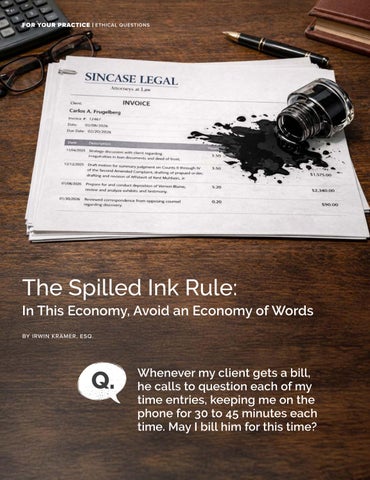
The Spilled Ink Rule:
In This Economy, Avoid an Economy of Words
BY IRWIN KRAMER, ESQ.
Q.
Whenever my client gets a bill, he calls to question each of my time entries, keeping me on the phone for 30 to 45 minutes each time. May I bill him for this time?
A.
That depends on whether the call is limited to dollars-and-cents discussions or veers into more substantive issues. But billing for billing questions is as close as you can come to inviting grievances.
LIKE IT OR NOT, our clients have every right to question the charges on their invoices. In this economy, they would be foolish not to. When times are tough, many clients get tough with their lawyers. They read each invoice line by line, questioning items that seem excessive or ambiguous.
While we must respond promptly and reasonably to client inquiries, this professional duty does not ordinarily entitle us to bill for the time spent justifying our fees. Time spent preparing invoices, explaining charges, or following up on past-due bills is generally treated as office overhead.
Yet not every call framed as a billing inquiry is entirely about the money. These questions often mask deeper anxieties about the future of a case, particularly for clients who have not previously engaged a lawyer. Even when fees are discussed at the outset, the arrival of a bill brings a sobering reality to the experience. Often, clients express frustration with the legal process or fear of mounting expenses. What may easily devolve into a billing dispute may actually be an opportunity to refine objectives and adopt a strategy that better aligns with the client’s needs.
Naturally, it is better to preempt complaints by minimizing uncomfortable questions before they arise. In my office, we do so by following what I call the “Spilled Ink Rule.” Invoices must show our effort. The more time we bill for a task, the more ink we need to spill describing it. A few words may suffice for a tenth of an hour, but may be entirely inadequate as the clock continues to tick. In this economy, an “economy of words” is not a virtue.
Our invoices should explain in detail what we did and why it took that amount of time. Rather than a cryptic 2.7-hour entry for “reviewing transactional documents,” describe the specific categories of records, the
issues analyzed, and perhaps even the number of pages read. Let the client see the complexity of the task through the description.
Regardless of how we describe the entry, our client should see our effort on the invoice itself, rather than wondering, “What took so long?” Ironically, the more ink we spill, the more transparent the billing process becomes.
Yet, even the best invoice may prompt questions. Before returning the call, review the bill carefully—even if you already approved the pre-bill—and refresh your familiarity with the matter. Clients expect us to be fully conversant with their files no matter how many other clients we serve. A lack of familiarity with their particular matter will be held against you. Demonstrating a command of the details goes a long way toward defusing tension, corroborating your attention to the case, and increasing the client’s confidence in your work as counsel.
No matter how much you dislike these conversations, return the call promptly. Clients dislike unanswered calls under any circumstances, but delays are especially corrosive when a client is already brooding over a bill.
Professionalism matters. How we handle these questions matters more than the answers we provide. Billing inquiries should never be met with irritation or defensiveness. We must avoid saying anything that might dissuade a client from asking questions about their bill. Our primary job is to listen.
When billing inquiries shift toward strategy, case objectives, or complex budgeting, the conversation may cross
the line into billable legal work. While you may diplomatically advise the client that billing will resume for this substantive analysis, tread carefully. Charging a frustrated client for a call they believed was “off the clock” can create more relational damage than the fee is worth. To resolve this ambiguity, address the distinction between administrative forecasting and billable strategy in your retainer agreement or, at the very least, educate the client on these boundaries and confirm the understanding in writing before the next invoice arrives.
Handled correctly, billing questions provide an opportunity to demonstrate strategic judgment, value, and professionalism. If the invoice shows the work and we show patience, many concerns will resolve themselves.
In this economy, billing questions are inevitable. How we respond to them— and how clearly we explain our work before the question is ever asked—may matter more than the numbers at the bottom of the page.

Irwin Kramer has devoted a significant portion of his practice to the defense of his fellow attorneys in disciplinary matters and regularly counsels law firms on ethical duties, client relations, and practice management. Mr. Kramer regularly addresses these issues on his blog, The Lawyer’s Lawyer, at https://attorneygrievances.com.