The Future of Broadcasting


![]()


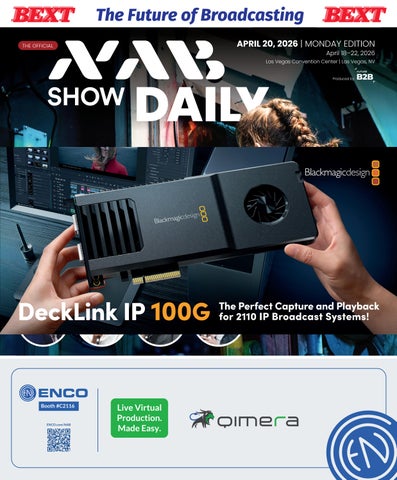
DeckLink IP 100G is the easiest way to capture and play back video directly into 2110 IP based broadcast systems! DeckLink IP 100G supports multiple video channels plus each channel can capture and play back at the same time. This means you can build racks of servers generating broadcast graphics, virtual sets or GPU based AI image processing, all directly integrated into 2110 IP broadcast infrastructure.
You can even use DaVinci Resolve for 2110 IP based broadcast editing workstations! DeckLink IP 100G features a high speed PCIe connection so it works on the latest Mac, Windows and Linux computers. DeckLink IP 100G also features 2 x 100G Ethernet QSFP ports, providing full redundancy.


How horror icks have become one of entertainment’s most reliable business bets


Now you can build affordable live production and broadcast systems with SMPTE-2110 video! Blackmagic Design has a wide range of 2110 IP products, including converters, video monitors, audio monitors and even cameras! You get the perfect solution for intergating SDI and IP based systems. Plus all models conform to the SMPTE ST-2110 standard, including PTP clocks and even NMOS support for routing.
The Blackmagic 2110 IP Converters have been designed to integrate SDI equipment into 2110 IP broadcast systems. The rack mount models can be installed in equipment racks right next to the equipment you’re converting. Simply add a Blackmagic 2110 IP Converter to live production switchers, disk recorders, streaming processors, cameras, TVs and more.
Conforms to the SMPTE-2110 IP Video Standard
Blackmagic 2110 IP products conform to the SMPTE ST-2110 standard for IP video, which specifies the transport, synchronization and description of 10 bit video, audio and ancillary data over managed IP networks for broadcast. Blackmagic 2110 IP products support SMPTE-2110-20 video, SMPTE-2110-21 traffic shaping/ timing, SMPTE-2110-30 audio and SMPTE-2110-40 for ancillary data.


Uses Simple 10G Ethernet for Low Cost
Blackmagic 2110 IP Converters are available in models with RJ-45 connectors for simple Cat6 copper cables or SFP sockets for optical fiber modules and cables. Using simple Cat6 copper cables means you can build SMPTE-2110 systems at a dramatically lower cost. Plus copper cables can remote power devices such as converters and cameras. There are also models for optical fiber Ethernet.
Incredibly Easy to Install
One of the biggest problems with SMPTE-2110 is needing an IT tech on standby to keep video systems running. Blackmagic 2110 IP converters solve this problem because they can connect point to point, so you don’t need to use a complex Ethernet switch if you don’t want to. That means you get the advantage of SMPTE-2110 IP video with simple Ethernet cables, remote power and bidirectional video.

From Future B2B, the publisher of TV Tech, TVBEurope, Radio World, SmartBrief on Media & Entertainment, Mix, Sound & Video Contractor, Systems Contractor News, AV Technology, TWICE and more!
VP, Market Lead Carmel King MD, Content, Broadcast Tech Paul McLane
Content Director Michael Demenchuk Content Manager Wayne Cavadi
Contributors Tom Butts, David Cohen, Matthew Corrigan, Cindy Davis, Fred Dawson, Robert Edelstein, Michael Grotticelli, Carolyn Heinze, Elle Kehres, Phil Kurz, Nicholas Langan, Jon Lafayette, Victoria Martinez, Deborah D. McAdams, David McGee, Stuart Miller, Addie Morfoot, James E. O’Neal, Mark Pescatore, Jenny Priestley, Randy J. Stine, R. Thomas Umstead, George Winslow, Clive Young
Photographers
John Staley Photography & Phototechnik International
DESIGN & DISTRIBUTION
Senior Design Director Lisa S. McIntosh
Production Managers Heather Tatrow, Nicole Schilling
ADVERTISING
Managing VP Sales, B2B Tech Group Adam Goldstein
Ad Sales Raffaella Calabrese, John Casey, Janis Crowley, Zahra Majma, Joe Palombo, Debbie Rosenthal, Andi Tureson, Hayley Brailey-Woolfson
MANAGEMENT
SVP, MD, B2B Amanda Darman-Allen
VP, Head of US Sales, B2B Tom Sikes
VP, Global Head of Strategy & Ops, B2B Allison Markert
VP, Product & Marketing, B2B Andrew Buchholz
Head of Production US & UK Mark Constance
Head of Design, B2B Nicole Cobban

4 Google Cloud Embraces the Rise of Agentic Production
NAB Show exhibitor sees production-scale AI as key to accelerating media’s human creativity
8 Why Primal Fear Outperforms
Collective experience fuels interest in scary movies to the tune of nearly $1 billion

NAB Show 2026 in pictures
24, 35, 46, 47 Exhibitor Spotlights 12, 52 Show Shots


NBC Sports’ Jon Miller: Broadcast Is ‘Having a Moment’ Reach, innovation and promotion afford linear TV continued relevance in the sports arena
16 Beyond the ‘Lift and Shift’: Cloud Migration’s New Mandate
Broadcasters and streamers are treating migration as a creative and operational transformation, leveraging AI, hybrid work ows and human judgment
20 Virtual Production Finds Its Footing
Providers point to a shift toward standardized systems and accessible tools for everyday use
26 What’s Happening Today on the Main Stage
Show Overview Map
What’s Happening Today in Show Floor
36 All Companies Are Media Companies Now
New NAB Show track connects enterprise communicators with broadcast and production talent as video becomes mission-critical
38 U.S., Brazilian Officials to Talk
ATSC 3.0 at NAB Show
FCC’s Olivia Trusty and Brazil Communications Minister Frederico de Siqueira Filho headline session today
39 Spotlight on: Wallonia Export and Investment Agency Pavilion
40 Data, Reach Drive Broadcast Digital Strategies
With streaming dominating viewers’ time, broadcasters must be exible and adaptable
42 Sports: The State of Play
Infographic
44 When It Comes to Sports Rights, Fans Will Blow the Final Horn
Leagues must prioritize accessibility to drive long-term value, panelists said
45 Creators Go All in on AI, Niche Content
Growth trends now favor engagement over audience scale, panelists say
48 TV Picks Up the Pieces of Audience Fragmentation
Platform ubiquity and the battle for attention create complications for programmers
50 How Creators Drive Conversion for Big Brands
Leading companies are turning to content creators in a big way
54 Prediction Markets Transform How Stories Are Told
Platforms like Kalshi, Mogul by MoviePass drive engagement by turning fandom into participation

NAB Show exhibitor sees production-scale AI as key to accelerating media’s human creativity
By Paul McLane RADIO WORLD
“For the past year, the media industry has asked, ‘What is possible with AI?’” says Google Cloud’s Global Managing Director, Strategic Industries, Anil Jain.
“Now the conversation has shifted from experimental pilots to production-scale execution. And as we enter the era of agentic AI, the distance between a creative spark and a finished frame is shrinking even further.”
Whereas generative AI helps people produce content, Jain said, agentic AI goes further, “reasoning through multistep processes and using specialized tools to solve complex problems, always with human oversight.”
At NAB Show, Google Cloud
is discussing its holistic AI strategy and highlighting the use of its technology by companies like Adobe, Dailymotion, Globo, Fox Sports, Sphere and Paramount to remove production bottlenecks from the creative process.
For instance, Brahma AI uses Google’s AI stack to deploy and scale high-fidelity digital likeness-

es that help humanize data sets.
Groupe CANAL+ is applying generative media models to extract value from its archives. Using Gemini’s multimodality, it can process video, audio and text to automate asset categorization.
Media companies are also using AI to personalize audience experiences, as with Major League Baseball’s new Scout Insights in the MLB Gameday app. It uses Gemini to provide AI-powered color commentary based on millions of Statcast data points.
And AI is enhancing enterprise productivity. For example, Cadent uses custom AI agents built on Gemini Enterprise to automate complex tasks, leading to an increase in campaign return on

ad spend and saving thousands of hours of manual internal work.
Global Director, Telco, Media & Technology, Albert Lai said Google’s tools are used by broadcasters and studios, social networks, streamers, news publications and pay TV operations, and noted that using agentic AI at production scale in such


chief data officers,” he said.
“Our mission is to help organizations think through and
implement new ways of working. You can think about us as the AI cloud now, and we’re here for the long game.”
Google Cloud is in booth W2731. It also will participate in several sessions, including one on the Main Stage (N141) Tuesday afternoon.
Jain and Google’s Márcia Mayer will discuss “The Augmented Studio: Supercharging Creativity With the Power of AI,” along with Dustin Myers, executive vice president of production operations and technology for Fox Sports. ●
applications requires specialized infrastructure.
He said Google Cloud provides multimodal intelligence that understands and generates text, audio and video natively. Its DeepMind research has enhanced the capabilities of Gemini, Veo, Nano Banana and Lyria. Google’s infrastructure also offers custom chips that match media workloads, all protected with enterprise-grade security.
“Media companies are integrating agentic AI into a supply chain that they themselves describe as ‘AI in the loop,’” Lai said. “It means creatives are being deliberate in their application of agentic AI into their workflows to augment human creativity and storytelling.”
In just two years, Jain said, AI has moved from experimentation and pilot projects into production and now into the realization of
business value across the media supply chain.
Companies are using it to create storyboards, extract metadata, automate the logging of clapperboards, generate subtitles and dubs, turn text into animation, identify ad breaks, change aspect ratios, create multiple pieces of content for highlight reels and personalize that content.
At a time when the creator economy has exploded and a platform like TikTok can create cultural change, Jain said media companies must reshape their content pipelines to meet consumer demands.
“We believe AI is a much larger and more impactful, transformative technological shift than we’ve seen in our lifetimes. But it’s also a time of tool fragmentation, which is a nightmare for CTOs, CIOs and

Media workflow icon Avid is integrating Google’s AI, including advanced models like Gemini and Veo, into its Media Composer and new cloud-native Content Core platform.

“This collaboration enables agentic workflows, where editors can automate complex creative tasks, such as video generation and intelligent metadata search, transforming manual production workflows into collaborative, AI-driven experiences,” Google Cloud said in the announcement Thursday.
“By embedding Google’s Gemini models and Vertex AI directly into Avid’s solutions, the collaboration aims to transform video editing from a mostly manual process into an intelligent, AI-assisted experience, significantly reducing the time required for media discovery and production.”
It said these AI capabilities serve as a foundation for future agentic integrations across Avid’s portfolio.


Collective experience fuels interest in scary movies to the tune of nearly $1 billion
By Jenny Priestley TVBEUROPE
In 2025, horror movies made almost $1 billion at the U.S. domestic box office, proving that the genre is alive and well, even if some of its characters aren’t.
Much of this is due to the collective experience, according to Michael Clear, president of production company Atomic Monster.
“Everyone is kind of driven by watching media alone. But I think horror movies are an opportunity to go on a ride with a group of people,” Clear told the audience at “The Scary-Smart Business of Horror” panel.
When evaluating whether to go ahead with a project, Clear added, the team at Atomic Monster is all about the scares.
“It always goes back to that core experiential element,” he said.
“We don’t need big scope or spectacle to really scare people. For us, it always starts with, ‘What are we afraid of? What’s the primal fear at the core of this?’ And then you build the scaffolding on top of it. You try to tell a compelling, emotional story.”
“M3GAN” screenwriter Akela Cooper revealed that when writing the movie’s script, she began to think of her character as one of the most iconic horror movie characters of all time.
“When I got the notes on my first draft, the producers said they had no idea how the doll was go-
ing to be made and that I needed to pull back on active movement,” she recalled. “That created a creative challenge for me, but it was also like a fun challenge.
“I then started thinking of ‘M3GAN’ kind of like ‘Jaws.’ Famously, they could not get that shark to work, so then they had to fill around it. You saw it in bits and pieces. So in the sequence where M3GAN is chasing the bully

through the woods, I wrote that you only see her in certain spots, very, very quickly. It was kind of like a shark on land hunting this little boy.”
YouTube creator Mark Fischbach, aka Markiplier, worked outside the traditional Hollywood machine, writing, producing, directing and starring in his movie “Iron Lung.” He even self-distributed the project, which has earned more than $50 million at the global box office. And on top of all that, he edited the trailer.
“Being outside the traditional


studio sphere, there were deadlines that I didn’t know about,” he said. “When it came to the deadline of the trailer going out to movie theaters, I had no idea. So I put it together in two days.”
However, Fischbach acknowledged that doing everything yourself can be dangerous, as there is no one to say no.
“You have to say no to yourself,” he said, “and I often won’t do that. I was like, ‘I can take some Houdini tutorials, I could do that. I could build a render farm, I can do that.’”

The panel offered budding horror filmmakers words of advice when trying to find an audience for their movies: Don’t chase virality. “M3GAN” became a meme following the release of the movie’s trailer, but Clear stressed that when marketing a project, it’s important to stay authentic.
“We were never chasing that type of attention,” he said. “People responded to the uniqueness of M3GAN and the authenticity of it, and then it took on a life of its own.” l


16-channel multi-codec HDMI to Dante converter


Dolby ATMOS

Dolby Digital
Dolby Digital Plus
Dolby True HD
Dolby Surround
DTS.DTS:X


DA-SDI-EM-12G DANTE
Standalone Embeder up to 16 channels of Dante audio into 12G-SDI

OG-DA-SDI-EM-12G DANTE
Embed up to 16 channels of Dante audio into 12G-SDI


DA-SDI-DE-12G DANTE
Standalone De-embed up to 16 channel of Dante audio from 12G SDI

OG-DA-SDI-DE-12G DANTE
De-embed up to 16 channel of Dante audio from 12G SDI
DA-HDM-EM-12G DANTE
Standalone HDMI to SDI converter with 16 channel audio Dante embedder

OG-DA-HDM-EM-12G DANTE
HDMI to SDI converter with 16 channel audio Dante embedder


By Tom Butts TV TECH
Although the current U.S. sports TV market is more fluid than ever — with sports rights getting more expensive and more leagues moving onto streaming platforms — the state of broadcast sports has never been stronger.
That was the sentiment of Jon Miller, president, acquisitions and partnerships for NBC Sports, during the “NBC Sports Playbook: Rights, Partnerships and What’s Next” panel, held on the Main Stage. Moderator John Ourand, sports correspondent for Puck, led the conversation that covered everything from NBC’s commitment to expanding its broadcast sports lineup to recruiting Snoop Dogg to “make the Olympics cool again.”
It’s easy to understand Miller’s enthusiasm. Getting his start at local NBC affiliate WRC-TV Washington, D.C., nearly 50 years ago, Miller rose through the ranks at NBC to his current role man-
aging the network’s relationships with sports of all stripes.
Miller said he’s seen this movie before.
“I don’t think [broadcast] really went anywhere — a lot of people wrote our obituaries, which happens quite often,” he said. “But I think broadcast is, quite honestly, stronger and more important than ever. And I think our partners realize that.”
While certainly not dismissive of streaming’s encroachment on live televised sports — all of NBC’s programming, including sports, appear on NBCUniversal’s Peacock streaming service — Miller said broadcasters’ reach and ability to adapt to new technologies gives the industry continued relevance.
“I think the streamers have a different set of priorities and strategic objectives than we do,” he said. “They have very deep pockets, but they can’t offer a lot of what broadcast can offer, and they can’t offer the marketing and
the promotion. Certainly, they can’t offer the production expertise that NBC, CBS, Fox and Disney [ABC/ ESPN] can offer to partners.
“The investment NBCUniversal has made over the last several decades — not only in broadcast rights, but in production infrastructure and data analytics and being able to provide 1080 HDR or 4K to our broadcast affiliates — I think all of those things are key factors,” he said. “And it’s the largest reach that you can get out there.”
Miller said NBC’s expansion into streaming has given the network more leverage when negotiating sports rights.
“Peacock is a great complementary service to NBC,” Miller said. Noting Peacock’s penetration into about 65 million homes — “numbers equivalent to ESPN, Fox or Turner [TNT Sports],” Miller added that the service was “never meant to displace anything on broadcast.”
“But it’s enabled us to make investments in properties that
we wouldn’t have been able to make otherwise,” Miller added. “We would not have been able to acquire NBA [rights] if we didn’t have Peacock as a platform; we would not be able to acquire the exclusive [U.S.] rights to the Premier League.”
As the longtime U.S. broadcaster of the Olympics, Miller said the network has aspired to make the event more relevant to younger viewers.
“Snoop Dogg has been spectacular, and he’s really become an Olympic fan and he knows the games, he goes to the events, the athletes react to him and they embrace him,” he said.
Miller said NBC is dedicated to building on broadcasters’ legacy in delivering the most exciting and entertaining action to fans.
“We think it’s really important that broadcast television be recognized for how it delivers audiences, for how the quality of production is important to partners,” he said. “And we like the hand we’ve been dealt.” l
Transform performances from everyday to epic with Axient® Digital PSM.

Unparalleled transmission quality and flexibility, check. Complex productions that push creative boundaries, check. Up to 28 channels in a single 6 MHz band, check. Simpler, quicker setup that frees up more time for mixing, check.
Axient Digital PSM checks all the boxes, setting the new standard for wireless, in-ear monitoring. Built on Shure’s extraordinary legacy, it delivers a balanced, clear mix in any venue, any time.
Learn More at shure.com/adpsm
VISIT US AT BOOTH C4916


He shoots; he scores. Shure introduced a new era of audio capture at booth C4916. Guests were invited to take free throws while wearing headphones to hear how swishingly sweet the new Shure DCA901 Broadcast portable wireless systems are.
❶ Canon brings broadcast and production to life at booth C3825. Along with television show production and talk show broadcasts, a guitarist and amenco dancer are lmed using cameras like the EOSC400.
A crowd gathers at Blackmagic Design’s NAB Show space, where it demonstrated its latest DaVinci Resolve 21. The software’s new photo page update lets colorists and photographers apply advanced color tools for still photos.
Dave Campbell of Apantac discusses with Gray Media Chief Engineer Daniel Crandell the uses for Apantac’s T# multiviewer display. The platform supports up to 86 different windows.
Celebrating 25 years of block and le storage, Nexsan invited showgoers like Bruno Loureiro a chance to sink a hole in one putt for a chance at some delicious Napa Valley wine.
CREATE ViBox All-In-One


The Simplylive Production Suite Flex is a software-driven live production platform that lets you choose from a range of application layers, tuned to the tasks you need to do –from live production to instant replay, ingest recording, streaming or video review


SIMPLYLIVE

HARDWARE, CLOUD, OR HYBRID. YOUR PRODUCTION, YOUR WAY.
• Intuitive smart UI design
• New Flex licensing: freedom to scale, flexibility to save
• Adaptive to all of today’s video formats
• Running on rock-solid commodity hardware
REPLAY REVIEW RECORD


C5816 | Camera Corps, a Videndum brand, is featuring its latest 4K innovations at NAB Show, including:
• 4K Mini Zoom: Optimized for high-end broadcast, this next-generation POV camera delivers outstanding 4K UHD 60p imagery with an integrated 18x optical AF zoom lens.

• EV-60 OB Nodal Remote Head: This highly versatile nodal head is a game-changer for outside broadcast (OB) operations. It delivers ultrasmooth remote pan-and-tilt control for a wide range of industry-standard cameras.
• Q4K Robotic PTZ Camera: Making its NAB Show debut, the Q4K is the evolution of the Qx camera. It features a major sensor upgrade, improved low-light performance and enhanced metadata integration, bringing new levels of image quality.
• 4K Aquatics Turn Camera: These robust 4K-capable systems deliver exceptional clarity, stability and reliability in challenging aquatic environments.
C6928 | In its full return to the NAB Show exhibit floor following several years of co-exhibiting with distributors, Bittree is offering a host of video, audio and patching solutions for IP and baseband transport layers:
• Flush-mount, high-density, modular keystone patchbays for IP and data-centric workflows feeding ST 2110, AES67 and other modern networks. The series supports fiber, copper and mixed configurations, with connectivity options for ST, LC and SC fiber, RJ45 CAT-6 and CAT-6A punchdown, or feed-through, shielded or unshielded adapters.
• Bittree’s Patch32A Dante audio patchbay streamlines the integration of analog
W1503 | Telestream is showcasing expanded integration with Adobe Premiere, Adobe Media Encoder (AME), and Frame.io, delivering a fully orchestrated creative-to-delivery pipeline powered by Telestream Vantage. Together, these updates eliminate the final manual gaps between creative editorial and enterprise workflow automation, enabling editors to move from timeline to governed delivery in a single action.

With the updated Vantage panel inside Premiere, editors can now submit sequences directly into Vantage workflows without leaving their creative environment. Vantage then orchestrates Adobe Media Encoder rendering, applies workflow-defined metadata and delivery logic, and automatically routes proxies and deliverables to Frame.io for review and approval.
For media organizations standardized on Adobe Creative Cloud, these integrations position Vantage as the operational backbone connecting creative tools to enterprise delivery infrastructure. Editors continue working in Premiere Pro; Adobe Media Encoder handles rendering; Vantage supports workflow automation, QC, routing and compliance processes; and Frame.io V4 enables collaborative review.
W1531 | Live production technology provider Appear and Canada’s Corus Entertainment are undertaking a major nationwide modernization of Corus’ news contribution architecture, replacing legacy leased circuits with an IP-based approach, using SRT as the primary transport protocol across the network’s affiliates, news bureaus and operational hubs. The transition reflects the changing realities of broadcast environments in North America, including more live output, locations, as well as greater pressure to operate efficiently while maintaining the reliability required for news production.

Corus’ transformation centers on shifting from leased circuits to IP, using the SRT protocol to enable secure, stable media transport for this always-on news environment.
Corus is using Appear’s X Platform, a high-capacity, ultradense, low-latency media processing and gateway platform, to consolidate key functions into a more streamlined nationwide workflow. This reduces complexity and helps engineering teams maintain a robust operating model across a distributed footprint.
audio and Dante network patching while providing professional, transparent A/D>D/A cross-conversions.

• Proven high-performance, wide-bandwidth 12G+ BNC patch panels for HD, 4K and 8K Applications, supporting data rates up to 48 Gbps and offer 75-ohm impedance with low return loss. Available in 1 x 16, 1 x 24, 1 x 32, 2 x 16 and 2 x 24 jack configurations.
C2250 | At NAB Show, WorldCast Systems is launching the Audemat FM/HD Probe, a next-generation monitoring solution designed to ensure the quality, compliance and performance of FM and HD Radio broadcasts.
Developed specifically for HD broadcasters’ evolving needs, the FM/HD Probe provides comprehensive supervision of HD1, HD2 and HD3 channels, alongside full FM and RDS analysis, the company said. The system helps broadcasters maintain a seamless, consistent listener experience across all platforms by continuously monitoring signal presence, audio levels, metadata integrity and alignment between analog and digital paths.
The Audemat FM/HD Probe integrates advanced NRSC mask monitoring and real-time spectrum analysis, WorldCast said, enabling engineers to verify regulatory compliance and quickly detect out-of-tolerance conditions. Its HD/FM alignment measurement tools allow broadcasters to ensure synchronization between digital and analog signals, minimizing audio delay discrepancies and preserving on-air quality, the company said.


Broadcasters and streamers are treating migration as a creative and operational transformation, leveraging AI, hybrid workflows and human judgment

By Jenny Priestley TVBEUROPE
For broadcasters and streamers, a migration to the cloud is no longer a simple technical upgrade. The era of merely replicating on-premise infrastructure in a virtual environment — the so-called lift and shift — is over.
The most successful organizations are embracing the journey as a fundamental operational and creative transformation, requiring a phased approach that addresses architectural resilience, cultural change and the accelerated adoption of new technologies like AI.
The initial hurdle for many is
realizing that the journey to the cloud is less about IT infrastructure and more about people.
“Cloud migration isn’t just a technical decision. It’s a creative and operational one,” Sami Aziz, executive producer and founder of Pale Blue Originals and former head of live broadcasts at NASA, said.
“ The organizations that navigate the move to cloud best treat it like a production: a phased approach, very clear communication, investment in training and intentional standardization across tools.”
Any move to the cloud comes with challenges, including managing real-time media workflows
that demand low latency and high reliability.
“To tackle this, it’s important to ensure workflows are consistent to reduce training time and use real-time monitoring tools to keep an eye on network and media

performance,” said Bryan Bedford, director of consumer industries and business solutions at Cisco Systems.
“Automation and orchestration can simplify operations and help scale efficiently. Plus, collaborating with vendors and adopting open standards ensures everything works well together.”
Reliability, especially for real-time media workflows that demand low latency, remains a constant challenge. Organizations must design their systems to survive multiple problems, from public internet performance issues to data center and region outages.
Mike Pilone, enterprise architect at National Public Radio, suggested that any system deployed in the cloud has to “utilize multiple regions to ensure they can survive an interruption. Using multiple cloud providers can give you an additional layer of availability as well as flexibility if a provider is no longer attractive due to service or pricing changes.”
Content protection and ownership in a cloud-first world are also new challenges facing content


When it comes to the latest in advanced HDR performance, one format continues to deliver an amazing entertainment experience.


With more than 170 adopters and over 20,000 certified devices, HDR10+ dynamic metadata delivers a compelling combination of benefits including outstanding brightness and contrast, robust standardization, easy implementation, and no licensing fees. Making it an ideal choice for broadcasting, streaming and packaged media.
Now with HDR10+ ADVANCED, enthusiasts can also enjoy a variety of other exciting features including:

• Enhanced Overall Brightness
• Advanced Color Control
• Local Tone Mapping

• Genre-based Optimization
• Intelligent Motion Smoothing
• Adaptive Cloud Gaming
All of this is why leading content providers like Prime Video have announced their support for HDR10+ ADVANCED. To receive our latest white paper on HDR10+ ADVANCED, go to hdr10plus.org.


owners, especially with the need to protect their assets and set clear parameters in case a platform goes down.
“Most broadcasters don’t ask these questions until something goes wrong,” Aziz said. “Redundancy and contracts with clear data ownership language are two critical starting points. Security should also be treated as an ongoing operational priority, not just a one-time setup. The same care you would apply to protecting a finished master should apply to every stage of your cloud pipeline.”
The growth of AI is also linked to the move beyond a basic cloud deployment. Most AI tools, such as automated captioning, content tagging and quality control, are cloud-based. AI models are resource-intensive operations that may only be practical in a shared computing environment such as the cloud.
“As we see more AI adoption in various use cases, we can expect to see greater use of the cloud to provide the core models and compute,” said Jon Cyphers, senior manager of product and support, distribution at NPR.
AI is transforming how broadcasters operate in the cloud, Bedford agreed, helping to automate and optimize media


production and delivery, making workflows more efficient and reducing manual errors.
“Combining AI with cloud and edge computing opens up exciting possibilities like personalized content delivery and intelligent network orchestration,” he said.
“This integration helps broadcasters stay competitive by enhancing efficiency and creating
• Start by making sure your creative and technology teams are working together and not independently. The people making the content have the clearest view of what’s broken and needs work.
• Embrace flexibility and agility, don’t just “lift and shift.”
• Adopt software-centric workflows that let you scale and innovate quickly.
• Explore hybrid models or edge computing, which can help reduce latency and improve streaming quality.
• Understand the problem you’re trying to solve and the specific requirements of your solution.
• Map your production process and identify where physical infrastructure is slowing you down.
• Consider building your own solutions on top of core features to stop vendor lock-in.
new ways to engage audiences.”
According to Aziz, organizations that have already started migrating to the cloud will be able to adopt and adapt to AI incrementally, with human judgment still a large part of the workflow.
“Organizations still anchored to legacy systems will have a
harder time making the leap all at once,” he said. “We’re all watching how quickly AI is evolving. The honest truth is, it’s moving faster than any of us can set editorial and ethical standards, and that’s a conversation our entire industry needs to be having.” l
Q. What technology trends will you be following most closely at NAB Show this year?
A: I’ll be closely watching how AI is being applied in real-world applications, particularly automated metadata tagging and intelligent content management within MAM systems. I’m also interested in how AI-driven and cloud-based workflows are influencing cost, scalability and operational efficiency across broadcast and ProAV.

Thomas Tang President, Founder and CEO
Q. Apantac is a longtime exhibitor at NAB Show. What brings the company back to this event each year?
A: Apantac was founded 18 years ago, and we look forward to returning each year to stay close to the industry’s pulse and to reconnect with many longtime friends. NAB Show brings together global partners, customers and technology leaders, giving us a great opportunity to exchange ideas, understand evolving workflows and validate market direction. It’s also where we showcase new innovations, gather valuable feedback and ensure our roadmap stays aligned with real-world broadcast and ProAV needs.
At the same time, while AI can significantly improve efficiency and reduce labor costs, it is also contributing to higher hardware costs by driving increased demand for components and manufacturing capacity.
Scale Remote Production Scale Remote Production


Harness the power of 140Gbps in a single X20
Find out more at NAB booth W1531

Providers point to a shift toward standardized systems and accessible tools for everyday use
By Matthew Corrigan TVBEUROPE
Virtual production is coming of age and entering a phase defined less by experimentation and more by repeatability, scalability and real-world usability.
Industry observers cite a clear shift in how VP technologies are deployed.
“There’s been a notable maturation in how productions think about workflow,” Pixotope Chief Experience Officer Simon Davis said. “The early conversation was largely about what’s possible; now it’s about what’s repeatable and reliable.”
Clients want solutions that their existing teams can operate, rather than relying only on specialist technicians, he said.
“We’ve also seen growing interest in hybrid approaches that blend physical and virtual elements more fluidly, as well as a continued push toward tighter integration between the creative and technical sides of production.”
Davis said Pixotope is working to democratize virtual production. The Oslo-based company announced its latest strategic partnership last month; it is working with Qatar-based systems integrator Ventum Tech to extend the reach of its accessible virtual production and extended reality solutions across the Gulf Cooperation Council (GCC) region.
Pixotope sees growing demand for advanced broadcast graphics, extended reality, augmented reality and virtual studios.
Cesar Caceres, product lead at LED processing technology producer Brompton Technology, noted quite a bit of change since the industry last gathered at the Las Vegas Convention Center.
“Over the past year, virtual production has moved decisively toward greater accessibility and scalability,” he said. “Networked systems now allow studios to expand or reconfigure setups on demand, making workflows far more adaptable. On the hardware side, higher-resolution LED panels combined with next-generation processors have set a new benchmark for control and image quality, enabling consistent in-camera final pixels.”


Virtual production is moving from an emerging technology to scalable, repeatable work ows that teams of all sizes can operate. Hybrid work ows, AI-assisted asset creation and exible, IP-based production ecosystems are making it easier for midmarket broadcasters, sports leagues and content creators to adopt advanced production techniques and deliver highquality content ef ciently.
At the same time, he said, hybrid workflows that blend physical sets with virtual environments have become more common, improving efficiency and creative control.
“More importantly, there’s been a shift in mindset: Productions are no longer building fixed pipelines but flexible ecosystems that can scale from smaller shoots to large, complex volumes,” Caceres said. “That adaptability is becoming a key requirement rather than a differentiator.”
AI EXPANDS FURTHER
AI has also made further significant inroads into virtual production this year. Considering the technology’s impact, Davis anticipated how it might continue to expand.
“Within the Pixotope ecosystem, we already have products such as Fly and Zone that leverage machine-learning algorithms to support through-the-lens camera tracking,” Davis said.
“We see a huge interest in cutting down the work on modelling and creation of environments, and we now support Gaussian splatting formats — this is a technology we’re watching and actively engaging with.”
The ability to capture real-world spaces and objects as photorealis-
See Dante, 12G and more at booth C6928


tic, renderable scenes in a fraction of the time traditional workflows take is something to watch as technology improves, he said.
“Text- and image-to-3D-object workflows open new possibilities for background creation and asset pipelines. It’s still maturing, and its consistency and accuracy need to improve for it to be a reliable tool.”
Given the rapidly evolving nature of innovation driving the sector, Davis and Caceres each discussed challenges and how their respective companies are positioned to tackle them.
“The biggest challenge is argu-

ably the gap between ambition and operability,” Davis said. “The technology has advanced rapidly, but the pool of people who know how to deploy and run it confidently hasn’t kept pace.”
He said that puts pressure on platform providers to build tools that are more intuitive, better documented and easier for production teams who aren’t virtual production specialists by background to support.
“Beyond skills, we’re seeing hardware prices rise due to the memory demands of the AI boom,” he continued. “Pixotope is


slightly removed from that, being a software-only solution, so our customers can shop around for hardware rather than relying on vendor-locked hardware supply chains.”
Workflow standardization and monetization continue to be a struggle for many studios despite technological advances, Caceres added.
“Smaller teams often find it difficult to scale processes used in larger productions, which can complicate project management and profitability,” he said.
“Integration across multiple vendors’ hardware, real-time engines, servers and processing also remains complex, requiring specialized expertise.
“Balancing quality, cost and operational reliability continues to be a challenge, particularly for smaller studios seeking to compete in an increasingly sophisticated market,” he said.
At the convention, Davis said, “We’ll be talking about the Pixotope platform and a host of quality-of-life improvements for our customers — demonstrating how we’re making real-time virtual production more accessible, stable and scalable for teams of every size.
“With the biggest XR (eXtended Reality) installs under our belt this past year, we’ve continued to focus on workflow. How do you take genuinely complex, multimachine production environments and make them manageable without sacrificing the power
that large-scale productions demand?” Pixotope also will announce support for some Gaussian splatting formats.
Brompton, Caceres said, will focus on the evolution of LED processing and display technologies across industries, highlighting the importance of flexibility, scalability and real-time control.
“We will explore how creators are moving beyond static pipelines and adopting IP-based workflows that can support projects of any size. We will also examine how industry evolution and standardization work hand in hand with flexibility, ensuring consistent results across productions.
“Our goal is to show how adaptable systems empower teams to deliver high-quality content efficiently, while remaining creative and responsive on set.”
Davis said technological democratization should continue, with changes driven by those who are creating content. “We anticipate that Gaussian splatting and similar capture technologies will become a mainstream part of asset pipelines, dramatically compressing the time from location to a usable virtual environment,” he said.
“Perhaps most importantly, we see the center of gravity in the market continuing to shift: The next wave of growth won’t come from the biggest productions, but from midmarket broadcasters, sports leagues and content creators who are just now discovering what’s possible — and building the workflows
match.”
AI-Media is building the global infrastructure layer that makes live video accessible in every language.
Powered by the LEXI platform, we enable real-time AI voice translation, captioning, and accessibility for live broadcast and production workflowshelping content reach global audiences instantly.


Purpose-built hardware enabling real time AI translation, captioning and multilingual audio for modern broadcast workflows.


C4908 | At the 2026 NAB Show, Riedel is unveiling the new MediorNet HorizoN ST 2110 MultiViewer App, expanding native IP capabilities and reinforcing HorizoN’s role in modern ST 2110-based infrastructures. The company also is highlighting its MediorNet FusioN ST 2110-to-Monitor Gateway bundles — compact IP edge-conversion solutions that bridge ST 2110 video, audio and ancillary data directly to HDMI(r) and professional SDI monitors. This results in simplified display connectivity in IP-based environments, where complexity is reduced and workflows remain fluid.
With its modular architecture and app-based concept, MediorNet continues to evolve alongside changing industry standards and production requirements, uniting decentralized baseband devices such as MediorNet MicroN UHD with the hybrid MediorNet HorizoN platform to enable flexible signal transport, routing and processing across SDI and IP environments, forming a backbone that is both resilient and adaptable.
W1531 | Appear, a global leader in live production technology, said its X Platform has been officially verified by YouTube for Secure Reliable Transport (SRT) live streaming. This verification enables broadcasters, rightsholders and production teams to deliver high-quality live content to YouTube using Appear’s X5, X10 and X20 hardware platforms, providing a seamless, resilient and low-latency high-quality streaming workflow for news, sports and live event coverage.

Initiated when a major European broadcast platform approached YouTube to request support for Appear’s encoders in its production pipeline, this customer-driven collaboration highlights Appear’s growing presence in professional-grade live streaming workflows beyond traditional broadcast, opening up new opportunities for broadcasters, rightsholders and sports federations.
W1653 | At the 2026 NAB Show, Net Insight is introducing Nimbra 520, a high-density media processing node designed to simplify live contribution and distribution across both managed and unmanaged networks.
C3519 | At the 2026 NAB Show, Boland is highlighting one of the most critical and often overlooked aspects of professional monitoring: calibration. In broadcast and HDR workflows, even the performance of a 4K OLED is only as reliable as its color alignment. Boland monitors ship precalibrated for accurate color from day one, and for facilities requiring tighter tolerances or custom color spaces, Boland supports advanced calibration workflows in collaboration with its partners, Light Illusion Color Space and Portrait Calman. Live demonstrations at NAB Show will show how precise calibration protects color integrity across grading, control room and live production environments, ensuring every creative and technical decision is based on a true reference image.

Joining the company’s broad range of LCD, OLED, and QD OLED monitors, the new 55-inch 4K55HDR7SNB (Super Narrow Bezel) 12G 4K display features an ultranarrow bezel that enables multiple units to be tiled into seamless video-wall configurations while maintaining full 4K signal integrity.
C4735 | Neutrik Group Americas, a subsidiary of Neutrik AG including the Neutrik, REAN and CONTRIK brands, is featuring its Neutrik opticalBAR fiber breakout solution along with its opticalCON ADVANCED line of connector products at the 2026 NAB Show.
The Neutrik opticalBAR is a compact, rugged fiber breakout solution that is IP65-rated when mated or capped and is designed for professional fiber distribution, including connections to camera systems, audio networks, DMX and intercom systems.
Fully compatible with the opticalCON Advanced series, the opticalBAR is available in five different variants for single mode (SM) and multimode (MM), with a range of connection points such as opticalCON QUAD SM and MM, opticalCON DUO SM and MM connectors, and opticalCON MTP12 SM and MM.
The complete line of opticalCON ADVANCED solutions will also be on display, from opticalCON DUO, opticalCON QUAD, opticalCON MTP and opticalCON SPLIT. The ADVANCED line provides all the features and benefits of the original opticalCON but with an even more robust and fieldready design.

Built as part of Net Insight’s Nimbra Live execution layer, Nimbra 520 brings consistent, deterministic performance into hybrid live media environments where operational simplicity, cost control and confidence under pressure matter more than individual device features.

Nimbra 520 extends Net Insight’s Live Intelligence approach into live media execution. Rather than optimizing isolated functions, it delivers measurable performance across real-world networks, helping operators stay in control during peak events, failures, congestion and rapid change.
Nimbra 520 is designed to change the economics of live media operations. Combined with Nimbra Edge, it enables a simple and flexible per-stream cost model, centralized orchestration, and automated lifecycle management. This reduces operational overhead, avoids overprovisioning and lowers the cost and minimizes the impact of failures.


Today | 10 a.m.–11 a.m.
N141 Main Stage
NAB Show will kick off its Opening Session today by celebrating a television milestone: the 50th season of pioneering CBS reality series “Survivor.” The show, which has been on the air for 25 years, will receive NAB’s prestigious Spirit of Broadcasting Award on the Main Stage.
Jeff Probst, host and executive producer of “Survivor,” will join in a conversation with NAB President and CEO Curtis LeGeyt live from Fiji, more than 5,400 miles away from the Las Vegas Convention Center. Probst is in Fiji because production on Season 51 of “Survivor” is already underway.
Accepting the award on behalf of the show in-person is fan favorite contestant Cirie Fields. Fields has competed in five seasons of the Emmy-Award winning series over 20 years. Probst has described Fields, who also is known for her social game, as “maybe the most celebrated and loved player” in the show’s history.
One of the most powerful creative forces behind today’s live television events will be the focus of the Opening Session’s keynote conversation. Jesse Collins, founder and CEO of Jesse Collins Entertainment, is an executive producer of the Grammy Awards and an EP of the Super Bowl Halftime Show since 2021, as well as other major globe-spanning productions and broadcasts.
Collins has also produced some of the most-watched, culturally defining broadcasts in the world, including the Oscars and the BET Awards. He’ll be speaking with Carolyn Giardina, a leading journalist who covers entertainment technology and filmmaking craft.
The opening session will also note the approaching 250th birthday of the United States with reminders of the powerful role played by storytelling in capturing who we are as a nation, as well as the industry’s role in the tools and platforms that expand those possibilities, NAB said. ●


I always refer to NAB Show as our Super Bowl. … This is the big launchpad for us.”


NAB works tirelessly for our members every day, educating Congress and the FCC on local TV and radio stations’ essential services and ensuring broadcasters have the tools they need to thrive in this rapidly changing marketplace.
NAB also provides exceptional cost-saving member benefits including:
n Legal, policy and technology hotlines
n Professional development opportunities
n HR resources like payroll services and health insurance
n Exclusive member benefit programs, including media liability coverage and property insurance
Learn more at nab.org/membership or contact the NAB Member Concierge at (202) 775-2555 or membership@nab.org.


Listings are as of press time and subject to change. For updated listings, visit NABShow.com.
C6944
9:45 a.m.–12:45 p.m.
CineCentral Theater
CINECENTRAL WORKSHOP: THE STORYTELLERS GUIDE TO PRODUCTION ON A TIGHT BUDGET: BUDGETING, CREWING & SCHEDULE
This workshop addresses the critical knowledge and thinking to hire the right team to ensure that the project comes in on time, on budget and with the highest production value. Participants will walk away with a keen knowledge of positions on set, their accountabilities, cost and time-saving measures, location hacks and when to use and not use cranes, dollies, rigs and production gear.
Speaker: David J. Frederick, Cinematographer
10:30 a.m.–4:30 p.m.

CineCentral Lab 2
CINECENTRAL WORKSHOP: VERTICAL PRODUCTION: HANDS ON TECHNIQUES, MOTION & MOVEMENT
This workshop will teach the use of a variety of cranes, dollies and handheld techniques. Participants will be handson with the cinematic gear and walk away with a keen sense of how and when to use it.
Speaker: Hisham Abed, Director
11:45 a.m.–1:15 p.m.

C6944 CineCentral Lab 1
BLACKMAGIC DESIGN PRESENTS: IMMERSIVE PRODUCTION AND POST WORKFLOW – A CINECENTRAL CRAFT CLINIC
A hands-on workshop that will walk through the planning, production and postproduction for immersive lmmaking. Based on Rogue Labs’ extensive experience and recent work with Cirrus Aircraft, panelists will explain


how Cirrus Aircraft created an immersive ight experience for Apple Vision Pro, using the Blackmagic URSA Cine Immersive digital lm camera and latest version of DaVinci Resolve Studio for Mac. Speakers: John Racine, Creative and Technical Director, Rogue Labs; Matt DeJohn, Editorial Work ow Manager, Blackmagic Design
1:30 p.m.–3:30 p.m.
CineCentral Theater
TEAM DEAKINS: IN DISCUSSION — A CINECENTRAL FEATURE PRESENTATION
Team Deakins invites you to be a part of their discussion on the creative process and the power of storytelling. Roger and James Deakins will share insights from their careers and discuss their latest book, “REFLECTIONS: On Cinematography.” Join the conversation as they explore the craft of lmmaking and the ideas that shape great stories. Speakers: Roger A. Deakins CBE, ASC, BSC, Team Deakins; James Ellis Deakins, Team Deakins
2:15 p.m.–3:15 p.m.
CineCentral Lab 1
ADORAMA PRESENTS — DIALING IN EXPOSURE: EL ZONE, WAVEFORM & FALSE COLOR WITH KATIE ELENEKE — A CINECENTRAL CRAFT CLINIC
Join Sony’s master trainer and awardwinning cinematographer, Katie Eleneke, for a crash course on Sony’s exposure tools across the cinema line including

EL Zone in Venice 2, Waveform and Zebras in Burano, FX6 and FX3, and false colors in Monitor and Control.
In this practical session, you’ll learn how to interpret these tools quickly and con dently on set, understand where skin tones should land for clean, natural results and develop a consistent approach to exposure across Sony’s cinema cameras.
10 a.m.–10:30 a.m. THE NEW MEDIA PLAYBOOK FOR CREATORS
Creators are collaborating with broadcasters and streaming platforms to develop, produce, and distribute content at scale. Hear how leading media companies are integrating creator-led formats into established production and distribution models.
Speakers: R.J. Larese, President, Sixteenth; Matthew Patrick, Creator
10:45 a.m.–11:15 a.m.
FROM PROMPT TO MAP: RETHINKING MAP CREATION WITH AI
Explore how AI is reshaping map creation and visual storytelling. With a simple prompt, generate fully enriched,

production-ready maps in seconds — shifting your role from manual build to creative direction, without sacri cing control of the nal output.
11:30 a.m.–Noon SOUND ON: HOW AUDIO DRIVES STORYTELLING
Hear how creator and enterprise teams are prioritizing music to elevate storytelling and support content at scale.
2 p.m–2:20 p.m.
REDEFINING SUCCESS: FROM TRADITIONAL ENTERTAINMENT TO CREATOR-LED STORYTELLING
Shari Alyse began her career in traditional entertainment as an actress before realizing her true passion was rooted in purposeful storytelling. She shares how she transitioned from Hollywood to building a multiplatform presence as a host, author, and creator focused on meaningful, joy-driven content. Through her journey, Shari offers a look at professional evolution. In a shifting media landscape, it’s never too late to pivot, rede ne your voice, and connect with audiences in new ways.
Speakers: Robin Raskin, Founder, Virtual Events Group; Shari Alyse, Founder/Creator/Host/Executive Producer, Joy Magnet Media
2:30 p.m.–3 p.m.
SECRETS TO INCREASING ENGAGEMENT REVEALED
Your creative ideas are uniquely yours, but

From discovery to scheduling, the mobile app keeps you in sync.
The Show Daily helps you see what’s happening at NAB Show. The official NAB Show app helps you experience it.
• Get personalized exhibitor and session recommendations
• Navigate the Las Vegas Convention Center campus
• Bookmark must see booths and sessions
• Exchange contact information instantly with QR networking
• Message attendees to schedule meetings
• Discover exhibitors, sessions and events in real time
Scan to download the NAB Show app


there is a science to getting them seen. In this eye-opening session, Presaige will reveal what its research has uncovered and share the secrets of choosing the right scenes, the right thumbnails and even presenting your work in the right order.
3:10 p.m.–3:40 p.m.
FROM SET TO SOCIAL IN MINUTES: HOW MODERN WORKFLOWS ARE RESHAPING UNSCRIPTED CONTENT
From reality-TV juggernauts to creator-led shows drawing audiences that rival mainstream networks, the demand for faster turnarounds has never been higher. But the real bottleneck isn’t creative talent — it’s the work ow between capture and publish. This session explores how modern production work ows are collapsing the gap between on-location lming and multiplatform distribution.
Speaker: Serena Harris, VP of Sales, Pixitmedia by Data Core
3:50 p.m.–4:20 p.m.
SCALING YOUR STUDIO SETUP: FROM BUDGET TO PRO

How do creators think about studio design as their business grows? We look at how starter setups evolve into professional environments, with practical insight into scaling gear, work ow and production quality over time.
5 p.m.–6 p.m.
CREATOR LAB COMMUNITY MIXER
Creators, enterprise innovators, and
media decision-makers come together at this mixer. Grab a drink, expand your network, make new connections and explore partnerships driving the next era of storytelling.
9:30 a.m.–10:15 a.m.
THE MS NOW PLAYBOOK: BUILDING COMMUNITY ACROSS PLATFORMS
MS NOW anchors and an executive join Breaker Media’s Lachlan Cartwright for a conversation about the recently rebranded organization’s expansive digital strategy, how they are super-serving superfans through membership and building a community that puts the audience rst.
Moderator: Lachlan Cartwright, Founder, Breaker Media
Speakers: Marcus Mabry, SVP, Content Strategy, MS NOW; Jen Psaki, Anchor, MS NOW; Ari Melber, Anchor, MS NOW
10:30 a.m.–11 a.m.
STREAMING THE WORLD CUP AT SCALE: DELIVERING THE WORLD’S BIGGEST EVENT FOR A MASSIVE AUDIENCE
The FIFA World Cup is one of the most
demanding events in global media and sports broadcasting. With millions of viewers tuning in simultaneously across connected TVs, mobile devices and digital platforms, delivering the tournament at broadcast-quality scale presents technical and operational challenges.
Speakers: Alexandro Campos, VP of Product/Engineering, TelevisaUnivision; Luciano Escudero, VP, Media & Entertainment AI Studio, Globant
1 p.m.–1:45 p.m.
MICRODRAMAS: THE 60-SECOND STUDIO SURGE


What was once dismissed as niche is now operating like a parallel Hollywood. Microdramas, vertical series and creator-led shortform shows are building massive, loyal audiences through low cost, rapid production cycles and direct-to-fan distribution.
Speakers: Erin McFarlane, Head of Vertical Content, Dhar Mann Studios; Kasey Esser, Actor/Producer
2 p.m.–2:30 p.m.
LEVERAGING GENERATIVE MEDIA IN YOUR BUSINESS
Generative AI has moved from experimental pilots to core production. Learn how to integrate AI across your entire work ow — from content creation and management to delivery — to unlock hidden value, enhance productivity and transform your business operations.

Speakers: Buzz Hays, Global Market Lead, Entertainment Industry, Google Cloud; Jo Plaete, Chief Technology Of cer, BRAHMA AI; Perry Nightingale, SVP, Creative AI, WPP
W3643
9:45 a.m.–10:15 a.m.
NBA LEAGUE PASS: D2C FAN ENGAGEMENT & THE FUTURE WITH AI NBA League Pass is a worldrenowned case study of a sports league successfully going D2C and scaling globally. This session takes you behind the fan experience to explore the engagement and monetization strategies and the infrastructure that make it all possible.
Speakers: Ken DeGennaro, EVP, Media Operations & Technology, NBA; Vijay Sajja, Founder and CEO, Evergent
10:30 a.m.–11 a.m.
THE RINK REIMAGINED: HOW VERIZON’S PRIVATE 5G IS DRIVING THE NHL’S TRANSFORMATION
This presentation explores the successful, league-wide deployment of Verizon’s Private 5G Wireless Network (PWN) across all 25 U.S NHL arenas.


Speaker: Brian Gorney, Senior Director – Enterprise Sales, Verizon Business
1:15 p.m.–1:45 p.m.
UNLOCKING LIVE CLOUD PRODUCTION
This panel explores how live sports and broadcast teams are shifting to cloud- rst production models that are faster, more automated and enable software-de ned enrichment and monetization.
Speakers: Lori H. Schwartz, CEO and Founder, StoryTech; Gregoire Rouyer, Global Partner Lead, Broadcast and Sports, AWS; Rick Gibson, VP, Media and Entertainment/Vyvx Broadcast Solutions; Stuart Lepkowsky, Worldwide Partner Lead, Media, Entertainment, Games & Sports (MEGS), AWS
2 p.m.–2:45 p.m.
PRIVATE EQUITY, SOVEREIGN WEALTH AND THE FUTURE OF SPORTS OWNERSHIP
Speakers: Bill Oakley, Associate Director, Product Management, Shure; Everett Salyer, Specialist, Sr. Business Development, Shure
3:45 p.m.–4:15 p.m.
AI AND IP MANAGEMENT FOR A FRAGMENTED ECOSYSTEM
This panel will examine how rightsholders are navigating AI-driven licensing models and the ethical imperatives of protecting and activating high-value content.
Speakers: Lori H. Schwartz, CEO and Founder, StoryTech; Fahad Moeen, CEO, Rocket Fuel; Jolie Roberts, VP of Domestic Licensing, Hearst
4:30 p.m.–5 p.m.
AUGMENTING THE GAME: HOW NBC AND GOOGLE CLOUD ARE REDEFINING LIVE SPORTS
ANALYSIS WITH AI Join Google, NBC and the AI Black-
belts team for a deep dive into their collaborative work using AI to provide real-time analysis of Team USA athletes for the Winter Olympics.
Speaker: Jane Day, Key Account Director, Media and Entertainment, Google Cloud
11:15 a.m.–11:45 a.m.
HAUNT NO MORE: PUTTING AN END TO POSTPRODUCTION NIGHTMARES WITH SPLICEGEIST
Everyone in postproduction has ghost stories. The le that got renamed ve minutes before delivery. The dailies with timecode starting at zero. The conform

where half the media was dumped into one folder with duplicate lenames. The missing reel. The editor who nested everything inside compound clips. We laugh about them afterwards. Sometimes.
Speakers: Dr. Nichola Lubold, Research Scientist, Google; Kit Lubold, Founder, SpliceGeist
Noon–12:45 p.m.
MONETIZE: WHERE BRANDS, CREATORS AND COMMERCE MEET

As traditional ad models evolve, monetization is moving directly into the storytelling process. New tools help creators and brand partners collaborate earlier in the development of programming — identifying placement opportunities, reducing IP and brand risk and connecting on-screen moments directly to commerce and audience engagement. This session will also explore the growing importance of transparency in brand integration and commercial storytelling.
Speakers: Mark Belinsky, CEO, Playste; Savannah Niles, Co-Founder and CEO, Wide Worlds
2:45 p.m.–3:30 p.m.
PROTECT: MADE BY WHO?
CREATIVITY, CREDIT AND COPYRIGHT IN AN AI WORLD


As institutional capital increasingly ows into sports through private equity rms and sovereign wealth funds, the ownership landscape is undergoing a transformation. This session examines how new investment structures are reshaping league governance, accelerating global expansion and rede ning expectations around growth, liquidity and long-term value creation. Industry leaders will discuss how leagues and ownership groups are balancing access to capital with control, tradition with innovation and nancial return with competitive integrity.
Speakers: Assia Grazioli-Venier, Co-Founder, Muse Capital; Jeff Roth, Partner, Bruin Capital
3 p.m.–3:30 p.m.

ADVANCING ISOLATION AND IMMERSIVE CAPTURE IN MODERN SPORTS PRODUCTION
Live sports audio leaves no room for compromise. Viewers expect to hear the detail that de nes the moment, even in the most complex, highSPL environments. Delivering that level of presence requires precision, control and exibility in how sound is captured and shaped.

As AI rapidly reshapes lmmaking, the legal frameworks governing copyright, authorship, and ownership are evolving just as quickly. Made By Who? explores the emerging challenges that are reshaping how creative work is credited and protected in an AI-driven production landscape, examining how creators, studios and brands are navigating questions of provenance, consent, credit, and compliance while still enabling innovation and scale.
Moderator: Annie Hanlon, Co-Founder, Playbook PLBK
Speakers: Holly Leff-Pressman, Chief Client Engagement Of cer, Screen Engine/ASI; Mishawn Nolan, Co-Founder/Managing Partner, Nolan Heimann; Christina Lee Storm, Head of Studio, Narrative, Secret Level


3:45 p.m.–4:15 p.m.
GAUSSIAN SPLATTING IN PRODUCTION PIPELINES: DISCOVERING REAL PRODUCTIONS USING 3DGS TODAY
What began as an experimental rendering technique is now being used by studios and technolgists to capture real locations, build digital twins and create photoreal environments for lm, broadcast and virtual production. This panel brings together early adopters who are already using 3D Gaussian splatting in their work ows.
Speakers: Fernando RivasManzaneque, CEO and Co-Founder, Volinga; Michael Rubloff, Founder, Radiance elds.com
4:30 p.m.–5 p.m.
THE REEL FUTURE: CLOUD INNOVATION, CONNECTIVITY AND THE ROI OF CONTENT CREATION
media continue to evolve, mentorship remains one of the most meaningful forces shaping the future of the industry. In this candid and inspiring conversation, Mentoring and Inspiring Women in Radio (MIW) Founder Erica Farber sits down with 2026
MIW Trailblazer Award recipient Ruth Presslaff to explore how mentorship fuels con dence, opens doors and helps women rise into positions of in uence.
3:30 p.m.–4 p.m.
ELECTION 2026: CAPTURING RADIO’S POLITICAL AD OPPORTUNITY IN THE MIDTERMS
W2457
10:15 a.m.–10:45 a.m. AI-NATIVE FILM AND VIDEO PRODUCTION FOR PROFESSIONALS
Generative AI is powerful, but still imperfect, inconsistent and often misaligned with the needs of professional production. In this session, Koh Terai shares a perspective on what it takes to build AI-native tools that are useful for modern lm and video work ows.

This panel will explore the innovations and advancements shaping media and entertainment tech. From camera-tocloud work ows that enable seamless, real-time media transfer on set to the continuous connectivity powering remote collaboration across global teams, these advancements are redening how content gets made — and driving signi cant cost savings.
Speakers: Casper Hanney, CEO and Co-Founder, Ghost Kits; Cyrus Eason, Head of Engineering, Ghost Kits; Jackee Chang, Filmaker and Senior Engineering Manager, Adobe; Melody Kellis, Co-Founder/Principal Consultant and Work ow Strategist, Vector Post; Shawn McDaniel, Filmmaker and Senior Professional Video Evangelist, Adobe

C2450
2:45 p.m.–3:15 p.m.
THE VALUE AND POWER OF MENTORSHIP IN ADVANCING WOMEN LEADERS
At a time when leadership pathways in

The 2024 political cycle generated $11 billion in ad spend, yet radio captured minimal share. With 2026 midterms approaching, this panel reveals actionable strategies for how broadcasters can position themselves and capture meaningful political advertising revenue with an emphasis on how to leverage opportunities that position radio for 2028.
Speakers: Mike Hulvey, President and CEO, RAB; Steve Passwaiter, President, Silver Oak Political
4:15 p.m.–4:45 p.m.
AN AUDIENCE OF ONE: HOW MEDIA + GOOGLE CLOUD + QUICKPLAY ARE USING AI AND CLOUD OTT TO PERSONALIZE LOCAL NEWS, ENABLE USER-GENERATED CONTENT, ENGAGE YOUNGER VIEWERS AND UNLOCK NEW REVENUE FOR BROADCASTERS
Gray Media, in partnership with Quickplay and Google Cloud, has built a hyper-personalized, AI-driven OTT platform designed for the “audience of one” — reaching younger viewers where they already are while protecting and extending their core paid TV business. This session dives deep into both the technology and the business drivers of Gray Media’s approach.

Speaker: Koh Terai, CEO/Co-Founder, Martini
11:45 a.m.–12:15 p.m. PERSONALIZE AUDIENCE EXPERIENCES WITH MULTIMODAL GENERATIVE AI
Audience loyalty now demands context, not just content. Discover how leading companies use multimodal AI to reason across text, image, audio and video to revolutionize viewer engagement.
Speakers: Anshul Kapoor, Head TMEG Market Development, Google Cloud;

Guillaume Aubuchon, VP of Product Management, Avid
1:45 p.m.–2:15 p.m.
FOX ENTERTAINMENT PRIVATE 5G & EDGE AI INNOVATION
This session covers the deployment of Private 5G and Edge AI during Season 2 of the Fox show “Extracted.”
Speaker: Scott Connolly, Distinguished Engineer-Technology Product Management, Verizon Business
3:30 p.m.–4 p.m.
THE ENTERPRISE QUALITY VIDEO GAP: WHAT VIEWERS REALLY GET AND WHY
This session explores the evolution of live video from an early technical novelty to a mission-critical enterprise communication channel. Using real-world data from large enterprise town halls, Nick Morolda explains why organizations cap quality to protect network stability, how “network math” degrades what employees see, and what it takes to deliver higher quality without increasing risk.
Speaker: Nick Morolda, VP, Solution & Delivery, Hive Streaming


CV356-10X
C8339 | Marshall Electronics is introducing the CV356-10X compact 10X camera that offers Full HD with simultaneous SDI and HDMI outputs, at the 2026 NAB Show. Featuring a 10x optical (12x digital) zoom and flexible 3GSDI/HDMI simultaneous outputs, this new compact camera is ideal for various broadcast and AV applications that also require unobtrusive positioning.

The camera is designed with a 2.13 Megapixel 1/2.8-inch Full HD sensor that delivers up to 1920 x 1080 at 60 fps over both SDI and HDMI for crisp, detailed image quality. The 10x optical zoom (12x digital) gives flexibility without sacrificing image quality for framing, getting close-ups and switching between medium and tight shots for presenters/pastors, as well as for various livestreamed events. A threaded ring adapter is included, which allows users to easily attach any 49mm close-up lens or ND filter for even greater versatility.
An integrated audio input enables embedding audio directly into the video output for streamlined production workflows.
W2831 | At the 2026 NAB Show, Harmonic is introducing significant enhancements to its video appliances and software-as-a-service (SaaS) solutions, highlighted by a next-generation media server and new AI-driven innovations.
Harmonic’s next generation of its Spectrum X media server dramatically simplifies video ingest and playout functions, significantly lowering the total cost per channel for broadcast delivery.

Harmonic’s XOS Advanced Media Processor (pictured) supports broadcasters as they transition to DTV+ and ATSC 3.0 or migrate away from C-band spectrum, offering a simplified, cost-effective, all-in-one solution on a single appliance.
Harmonic is introducing a new AI orchestration service that aggregates, orchestrates, maintains and updates best-of-breed third party and in-house AI functions. It coordinates AI-based processing for live content, manages redundancy and synchronizes outputs.
Powered by NVIDIA GPU acceleration, Harmonic’s AI service also supports new advanced server-side HD-to-UHD upscaling, delivering superior video quality on 4K displays even when production is limited to full HD.
to Changing Frequencies, the official NAB Show podcast, featuring conversations with the people shaping the future of media and entertainment.
catch the NAB Show Recap, releasing April 29, 2026, featuring post show coverage from NAB Show 2026.

New NAB Show track connects enterprise communicators with broadcast and production talent as video becomes mission-critical
By Carolyn Heinze NAB SHOW DAILY
As consumer brands, B2B organizations and government agencies continue to increase their reliance on video to distribute both external and internal messaging, the need to connect creators and storytellers with corporate communicators is growing.
While the latter group may not reside in the traditional realm of broadcasting and entertainment, the companies it represents are, in their own way, fast becoming media platforms, too.
This has driven NAB Show to introduce a new Enterprise Video Strategies education track for 2026. Designed to demonstrate how organizations are leveraging to-
day’s video production technology to achieve meaningful business results, sessions include: “Efficient by Design: Cloud-Based Production for Modern Brands,” “The Enterprise Studio: Redefining How Organizations Create,” “From Corporate Video to In-House Studio: How Enterprises Are Becoming Media Machines” and “Architecting ROI: Scalable Virtual Production for Enterprise Teams.”
Lori H. Schwartz, CEO and principal at StoryTech, an experiential marketing firm based in Los Angeles and curator of experiences for NAB Show, said the evolution of enterprise video from simple internal messaging (think
corporate training videos) to much more elaborate, external-facing campaigns is, in large part, the result of what she calls the “democratization” of video production technology.
In other words, the hardware and software have become more accessible, easier to operate and


Enterprise-level organizations are investing in broadcastquality video to engage their customers — and thus drive positive business outcomes.
To do this, they are adopting a hybrid model that brings video production studios in-house while leveraging outside talent with deep knowledge and experience to create meaningful content. The 2026 NAB Show’s new Enterprise Video Strategies track aims to bring together television and lm professionals with enterprise communications practitioners so they may explore the opportunities each offers, and how they can successfully work together.
in some cases are developed with nonbroadcast users in mind.
This makes it convenient to expand video communications beyond the conventional 30-second television ad into spots specifically designed to run on social media such as Facebook, Instagram, TikTok and YouTube.
Enterprises, Schwartz said, have become their own content creators.
At the same time, many nonbroadcast or nonmedia companies seek the expertise required to develop engaging video content.
Schwartz notes that this presents new opportunities to creators and producers who, up until now, have dedicated their work to television and film almost exclusively.
The 2026 NAB Show Enterprise Video Strategies track aims to build a bridge between these two groups.
“[We want] to get the people that need work to see that there are other ways they can use their skills,” Schwartz said.
“We also want to show the
enterprise folks that if they come to NAB Show, they would meet the people that have the latest virtual production skill sets [for example]. They would learn about the tools and meet the right people so that they can keep expanding their content pipelines.”
For this first year, Schwartz explained, the sessions that make up the Enterprise Video Strategies track will give attendees a good idea of how the corporate world is applying video content and technology for its communications. In the future, she envisions more specialized themes.
“The best way to start, I believe, is by showing what’s happening out there,” Schwartz said. “I think it will grow over time, and then we can start to get into more niche topics inside of that.”
At Matrox Video, a video systems developer with headquarters in Dorval, Canada, Manager of Strategic Partnerships Rob Moodey pointed to several technological advancements that have made production technology more accessible to the enterprise. He cited the growth of video-over-IP deployments as an example.
“Instead of relying on traditional interfaces like HDMI, DisplayPort or SDI — all of which are used in [the] enterprise — modern systems increasingly handle video as network-based data streams,” Moodey said.
This means that companies may leverage standard IT infrastructure without having to worry about procuring dedicated switching and cabling.


Haivision Media Platform is a �lexible and scalable solution for multi-site corporate communications and IPTV, high-capacity live video monitoring and recording and highly secure video.
The same applies to video compression formats, Moodey added. Depending on their requirements related to bandwidth, cost, latency and quality, enterprise video teams may choose between delivering low-latency, uncompressed video; light compression formats like JPEG-XS and NDI-Full; or high compression through H.264 and H.265.
“Importantly, many of these formats can run on standard computing hardware using CPUs or GPUs, reducing the need for highly specialized equipment and lowering the barrier to entry,” Moodey said.
While “traditional” enterprise video may be about connecting customers with brands, there is another category of nonbroadcast organizations that rely heavily on the medium.


Fred Poole is director of space — Intel/Civilian at Haivision MCS, an Atlanta-based subsidiary of Haivision, a video networking and visual collaboration systems developer headquartered in Montreal. Haivision MCS serves aerospace, enterprise, government,
carrying? What was that person doing at that time? Where were they located?”
These types of operations employ a similar number of cameras and camera controls as required in sports broadcasting, Poole explained.
As in other industries, artificial intelligence is giving video production professionals everywhere the ability to be more efficient by fulfilling some of the more repetitive or mundane tasks associated with creating and managing content. Schwartz pointed to basic camera operation, data analytics and content personalization as several examples of this.
In the context of mission-critical video, Poole noted that AI


for high-quality, low-latency live streaming over bonded 5G, 4G
military and public-safety clients that require mission-critical video solutions.
These customers prioritize technology that can deliver bandwidth efficiency (and the ability to control it), low latency, quality and reliability, Poole said.
He illustrated a standard U.S. Department of Defense video application with a sports analogy.
“The connection between professional sports and what happens in the DOD and the (U.S. Intelligence Community) are very strongly parallel,” Poole said.
“I want the ability to see the best video quality I can for the plays being made. I also want to be able to go back and see: Was he out of bounds? What was he
can serve to decrease latency and improve video quality. “We’re looking [at] what is being developed in the AI world to be able to impact and affect things in the video, how we view it [and] in how it’s delivered,” he said.
For NAB Show, Schwartz underlined that the goal this year is to bring together two different groups of professionals: creators who have traditionally focused on television and film and enterpriselevel communications practitioners who can benefit from their knowledge and experience.
“They just need to meet each other,” Schwartz said. “NAB Show has always been good about being that home for people to connect. This is the next bastion of that.”

FCC’s Olivia Trusty and Brazil Communications Minister Frederico de Siqueira Filho headline session today
LAS VEGAS — A pair of top television regulators from the United States and Brazil are speaking on the future of broadcasting at a featured NAB Show session today.
Frederico de Siqueira Filho, the communications minister of Brazil, and Olivia Trusty, a member of the U.S. Federal Communications Commission, will headline “NextGen TV and TV 3.0: A Global Conversation on the Future of Broadcasting.” Focused on the international advancement of the broadcast standard, it takes place from 1–2:45 p.m. in room N254.
Siqueira Filho’s participation comes at a pivotal moment as the United States and Brazil move to the forefront of the transition to the next-generation broadcasting standard for free, over-the-air television.
“NextGen TV is opening a new chapter for free, over-the-air broadcasting, and this conversation at NAB Show will spotlight the global momentum behind that future,” NAB President and
CEO Curtis LeGeyt said. “We are honored to welcome Minister Frederico de Siqueira Filho and FCC Commissioner Olivia Trusty for a timely discussion on how policymakers and broadcasters can work together to accelerate ATSC 3.0 deployment, unlock innovation and strengthen the vital service local television stations provide to communities.”
As ATSC 3.0 gains global momentum, the session will bring together policymakers and standards leaders to explore Brazil’s TV 3.0 initiative, the U.S. experience with

NextGen TV and how broadcasters are leveraging the technology as a platform for innovation and new services.
“We are facing a profound transformation in the way television is produced and consumed,” Filho said. “The evolution toward TV 3.0 in Brazil opens new possibilities for business models, strengthens the competitiveness of the industry, expands the range of content and services available to citizens, and significantly enhances the technical quality of free-to-air television through

greater interactivity. It will represent the definitive integration of television and the internet. This is an advancement that places Brazil at the forefront of innovation in the sector and reinforces the role of television as an essential service for the population.”
The program will also feature perspectives from other international markets including India, South Korea and the Caribbean, highlighting next-generation broadcasting’s growing global momentum.
“This session represents a unique opportunity to bring together leadership from Brazil and the United States to advance the global dialogue around next-generation broadcasting,” said Paulo Henrique Castro, president of the Brazilian Society of Television Engineering (SET). “Brazil’s TV 3.0 initiative is a transformative step forward, building on the ATSC 3.0 standard to enable new services, foster innovation and expand digital inclusion through a more connected viewing experience. It also highlights the importance of international collaboration as this technology continues to gain momentum worldwide.”
The program includes two panel discussions: “Bridging Standards — From ATSC 3.0 to Brazil’s TV 3.0 Platform,” focused on standards development and deployment strategies; and “Deploying the Future — International Broadcaster Perspectives on NextGen TV,” highlighting real-world implementation and global collaboration across emerging ATSC 3.0 markets.
It is part of NAB Show’s Broadcast Management and Monetization Conference, a premium program bringing together TV, radio podcasting and digital platform executives to explore strategies for revenue growth, leadership and operational success, with a focus on audience development, modern infrastructure and evolving media monetization models, NAB said. l


C4433 | Can you cut video bandwidth without adding a single frame of latency? See it live at the intoPIX booth. Discover how intoPix’s JPEG XS codecs and Titanium IP solutions power SMPTE 2110, IPMX — reducing infrastructure costs while preserving pristine HD to 4K quality for live, remote and cloud production.


The Wallonia Export and Investment Agency will participate in the NAB Show, representing the dynamic media technology ecosystem of Wallonia, Belgium. This year also marks the 20th anniversary of Wallonia’s participation in the event. Visitors are invited to discover these technologies and explore partnership opportunities.


C4431 | Cyanview has been used for many years to control a multitude of cameras at high-end sporting events and prestigious concerts around the world. From minicams to large-format sensor cameras, visit us to discover how to control any camera with our universal RCP and our new Cyanview Multicam Dashboard.

C4531 | SoundNodes, specializing in audio intelligence, is proud to present its latest and most performing home-made AI algorithms applied to Automatic Audio Content Recognition, both in batch or almost real-time mode. SoundNodes will also showcase the first 360° audio recorder with AI at the edge, desktop or ceiling POE version.

C4533 | Artisto unites flexible centralized audio mixing and processing with decentralized control. Now including the UI Builder, a no-code interface editor to design and deploy role-specific GUIs without writing a single line of code. See it live at the On-Hertz booth and create the interface your workflow needs.

With streaming dominating viewers’ time, broadcasters must be flexible and adaptable
By Tom Butts NAB SHOW DAILY
Whether it’s radio or TV, broadcasters have always been about reaching the widest possible audience. As the industry has embraced digital technology, it has found both opportunities and competitors.
But with streaming now dominating viewers’ time, broadcasters’ digital strategies must evolve quickly. In 2025, streaming constituted 60% of viewers’ time, per researcher Samba TV. It noted in its annual “State of Streaming” report that when the same programming is available on linear TV and on-demand, 67% are choosing on-demand.
But with the increase in ad-supported VOD services, how do broadcasters succeed in competing for ad dollars? Enter CTV — connected TV, or what used to be known as “smart TV.”
CTV is growing by double digits as advertisers see the vast opportunities that come with it. BIA Advisory Services estimates CTV advertising will reach about $3.6 billion in 2026, excluding political, up 10% from an estimated $3.3 billion in 2025.
BIA Managing Director Rick Ducey said advertising in a connected TV environment allows broadcasters to tap into this growing market, which is the most valuable to advertisers because of its high impact and high CPMs.
“If you’re buying a 30-second spot and it gets delivered to a 1-inch smartphone screen, it’s not very compelling,” Ducey said. “If it gets delivered to a 65-inch TV screen, it’s compelling ... CTV is meant to be competitive from an advertising perspective with linear TV, cable and broadcast.”
What fuels CTV? Data and lots of it.
1 Streaming dominates viewing, with most audiences choosing on-demand over linear.
2 Connected TV is rapidly growing as a premium destination for advertising dollars.
3 Broadcasters are shifting from selling programs to selling targeted audiences.
4 FAST channels provide a scalable, cost-effective way to monetize content.
5 NextGen TV and radio are expanding digital capabilities while linear remains essential.
on real-time audience trends, has grown ever more important.
Ducey said this has prompted broadcasters to move away from selling programming to selling audiences. And although broadcasters prefer selling their own ad space, the CTV world allows the industry to “trade” other streaming services’ inventory to meet advertisers’ demand.
This trend towards programmatic advertising, which allows last-minute microtargeted ad insertion based

“The buyers are buying audiences, not ratings in a program,” Ducey said. “When broadcasters learn that and are willing to go to the market to buy other inventory to get the business ... they have to trade in other people’s inventory, otherwise they’re never going to get to the impression weight the client wants.”
TV station groups have embraced CTV as a foundation to transform into data-driven enterprises that take advantage of their vast reach and increasing ability to microtarget advertising.
It’s within this CTV environment that free ad-supported streaming TV thrives. FAST channels can be scaled up quickly and are a great opportunity for broadcasters to monetize their existing inventories in a cost-effective way. Plus, their traditional, linear, cable-like approach appeals to a growing number of viewers overwhelmed by the increasingly complex on-demand world.
According to Kelly Barrett, senior vice president of product at Samba TV, FAST is creating more ad inventory.
“It’s that traditional way that you expect there to be ads as a consumer. So it doesn’t feel jarring. It doesn’t feel unexpected.”
Viewers can find FAST channels in a variety of streaming services but among the chief drivers is the OEM sector, with Samsung, LG and Roku, where such services come integrated with the CTV software. As of February, a total of 1,572 distinct FAST channels were available across nine major platforms tracked, according to FASTMaster.
Perhaps broadcasters’ biggest tech stack is ATSC 3.0, aka NextGen TV.
Built on a foundation of broadcast and IP, the standard gives the industry enormous flexibility to adapt to changing technical and financial conditions.
One way to think about NextGen

TV is as a hybrid platform, said Anne Schelle, managing director for Pearl TV, the consortium promoting the standard.
“Broadcast delivers the scale, reliability and reach of free television, while broadband enables interactive and app-based experiences,” she said. “Together, that combination allows broadcasters to create experiences that feel much closer to modern streaming or FAST environments. We are also beginning to see broadcast IP channels, sometimes referred to as BEST (Broadcast Enabled Streaming TV) channels emerge on the platform.
“Services like ROXi and GameLoop are good examples. These channels are fully interactive and app-based, but delivered through the broadcast environment, enabling new forms of con-
tent and engagement that weren’t previously possible on traditional broadcast television.”
Data is also driving the radio industry’s digital strategies, according to Chris Brunt, director of digital revenue generation and AI with consulting firm Jacobs Media.
He added that CTV is not just for TV. “Many radio groups are going headfirst into OTT, CTV, using the programmatic stack,” Brunt said. “It has become more of a focus in the last five years as OTT CTV has grown.”
Radio’s strength in local communities helps drive the industry’s holistic approach, Brunt said.
“We know the market better than anyone else. We know how to target, we know where your audience is,” he said.
“We know where their passions are, and we can help target that better than someone out of market. Additionally, your radio rep can handle all of your digital if you have an adjustment that needs to be made.”
With automakers constantly updating their information systems, Brunt stressed how important it is for radio to embrace technology that will help maintain listener attention.
“We know that we’re in a hyper-competitive environment, and you go to CES and see what’s happening on dashboards in these new, upcoming cars,” he said.
BIA’s Ducey pointed to the FM geotargeting technology ZoneCasting as another example of how radio technology is honing its audience reach.
“ZoneCasting lets FM radio stations originate content to a limited extent on boosters, a few minutes an hour, to do geotargeting,” he said.
Despite the expanding array of digital options, Ducey said, linear video still matters.
“Linear TV is still a critical part of video campaign planning and activations,” he said. “More and more budgets are moving from linear TV into these digital outcomes, and more money is being added to digital video, but linear still is a key and foundational part of campaigns.” ●


N3066 | Imagen empowers photographers and videographers by eliminating the repetitive, time-consuming parts of postproduction so they can focus on what they love: creating, capturing and growing their business.


Imagen Video brings professional color grading into your editing workflow at record speed by applying an AI Profile or your custom LUTs across every camera, format and lighting condition for consistent, stunning results every time.
W22476MR | Marfeel is the unified growth platform built for broadcasters to turn content, audiences and signals into real action.
Marfeel empowers media brands to win across web, social and Discover. From real-time audience insights with Marfeel Analytics, to deep Google Discover and social visibility with Marfeel Monitoring to performance-driven distribution with Social Amplify. Marfeel turns data into measurable growth.

W3233 | Raysync delivers secure, highspeed enterprise file transfer solutions that enable reliable, large-scale data movement across networks and workflows.


We’re showcasing Raysync Enterprise Edition — a high-performance, secure large-file transfer platform with auto-sync and direct peer-to-peer transfer capabilities that accelerate workflows, improve collaboration, and break traditional file transfer bottlenecks for modern enterprises.
C6636 | FoMaSystems engineers advanced camera stabilization systems and smart accessories for the global film, broadcast, television, and live entertainment industry — proudly #MadeInGermany.


FoMa Antares is a high-precision remote head for demanding live and studio environments. It combines power and performance in a compact, reliable design. Featuring adjustable lens height, modular extensions, and compatibility with third-party robotic workflows, FoMa Antares adapts effortlessly to any camera setup.

As the national TV ad spend on sports hits record highs, the attention battle is shifting to digital fronts, like YouTube, and a wave of emerging leagues is also getting into the game.
The NFL captures a dominant 50.79% share of all sports-related national TV ad spend, despite accounting for just 20.45% of total household ad impressions for sports programming.

New efforts like LIV Golf and booming women’s sports have seen massive ad-reach growth since 2023.


$20.2 BILLION
Total amount of national linear TV ad spend on sports programming in 2025, up 16.5% from 2023.


Fueled by the Super Bowl, the NFL held a massive lead in YouTube watch time in February. But ring sports hold their own on the platform, thanks to the blend of highlights and library footage served up by TKO properties WWE and UFC.


Streamlined IP KVM matrix solutions for organizations prioritizing ease of use and low maintenance, it operates without complex management switches. The ADDERView®️ Matrix is ideal for unmanaged environments, it requires minimal technical expertise while providing a simple, powerful way to control and access systems efficiently.


The Canon RC-IP300 PTZ camera controller supports up to 200 cameras and delivers advanced features in a compact, lightweight portable design. The controller’s 3.5” touch screen provides robust and responsive menu navigation and supports live video previews of up to 9 cameras per page and supports touch Auto Focus.


Leagues must prioritize accessibility to drive long-term value, panelists said

By Nick Langan RADIO WORLD
Last year, 96 of the top 100 most-watched programs in the U.S. were sports, according to the Sports Business Journal.
New deal announcements have come fast and furiously, headlined by the NBA’s 11-year, $77 billion deal across NBC, ESPN, ABC, Prime Video and Peacock, which took effect this season.
But the sheer number of platforms involved has also gotten the attention of regulators. In the U.S., the Federal Communications Commission launched an investigation into sports access rights. It specifically cited the difficulty for the average fan to watch their favorite team play each night, particularly when the broadcast is paywalled.
Three players in sports distribution brought their perspectives to the session “The State of Sports Media.”
They described a battle of access versus value creation.
In India, cricket has around 1 bil-
lion fans. About 700 million follow on linear platforms and 500 million on streaming, with some overlap.
Sanjog Gupta is the CEO of the International Cricket Council. In emerging markets, such as the U.S. and far east Asia, Gupta said that the ICC has sought out YouTube for distribution, offering no-paywall access to game broadcasts.
Once attention is created, values are driven up, Gupta said.
Werner Brell is the CEO of the Motorsports Network. The platform covers all forms of international and national motorsport, including Formula One, MotoGP, NASCAR and IndyCar.
And it is not just on game day. Brell pointed to Formula One’s 2016 deal with Liberty Media. Before, Formula One had regional broadcast rights and no social media distribution.
Taking content to YouTube for the first time built new fans, Brell said. “Then, in turn, the audience rose, and then rights holders could monetize that audience.”
For cricket, approximately 85% of its $3.5 billion in revenue comes from media rights.
“Sport, as a whole, is highly undeveloped when it comes to other revenue streams,” Gupta said.
Bell said Motorsports Network believes in the potential of business-to-business initiatives.
Its Autosport Business Exchange works with other brands to supply the underlying data from races, with several tentpole events this year, including in Miami on May 1. The network also conducted the 2025 Global F1 Fan Survey.
Gupta said he dreamed of having Cricket’s 2.5 billion global fans take a “loyalty survey” that the brand could tap for insights.
“In my mind, it is an opportunity sport has not wrapped its head around.”
Going beyond game day, media and studio companies such as Religion of Sports are offering programs adjacent to games that
are not only backed by greats like Tom Brady, Simone Biles and Michael Strahan, but also have the support of partnering brands.
Ameeth Sankaran is the CEO of Religion of Sports. When the company was founded eight years ago, it focused on built-to-sell programming for streamers like Netflix and Amazon and it still does just that.
But Sankaran has also found opportunities to disperse its underlying mantra, “Why Sports Matters.”
For the upcoming World Cup, Sankaran said that the platform will offer Trevor Noah hosting a live YouTube watch party.
“Is that social? I think so. But for us, it’s about engagement,” he said.
DISTRIBUTOR DISRUPTION Gupta also pointed to a recent cricket World Cup instance in Sri Lanka.
Instead of rights for adjacent events being held by one primary rightsholder, the ICC enlisted 350 creators to take charge of what were typically gated rights to create content. The primary broadcast partners, Gupta said, loved it because they saw the uptick in eyeballs, too.
But back to the question of regulation: Consumers don’t necessarily have the same infrastructure for smart streaming and smart TVs.
Should that barrier to entry still be over-the-air TV? Or could it be a combination of social media and free streaming, such as YouTube?
The consensus was that fans are the ultimate arbiters.
“Digitalization and the direct-to-consumer model are essentially giving control to the fan, because they are able today to watch where, when and how they want,” Brell said. l

Growth trends now favor engagement over audience scale, panelists say
By Wayne Cavadi SCN
One of the highlights in Central Hall at NAB Show is the Creator Lab, which gives attendees the chance to examine how new media styles are transforming the way content is created, produced and distributed.
Drew Baldwin, founder and CEO of Tubefilter, moderated Sunday morning’s “State of the Creator Economy” panel to kick off a myriad of insightful discussions to come over several days.
Baldwin was joined by Alessandro Bogliari, co-founder and CEO of The Influencer Marketing Factory; Natalie Jarvey, editor of Ankler Media’s Like & Subscribe newsletter; and Pierre-LoÏc
Assayag, co-founder and CEO of Traackr to break down the now and the future of content creation, looking at both the brand and content creation sides of the mix.
The four dissected emerging trends like AI, new styles of content, the niche audience and opportunities that are coming to drive the creator economy of the future.
“Brands are all-in on everything AI these days,” Assayag said. “The good, the bad and the ugly.”
The real benefit of AI in the creator economy, he said, is the taking of datasets to connect facets that were once in silos into a unified stack where creators no longer have to fill any individual role.
Jarvey said that the perception of generative AI, once seen as
an existential threat, has shifted as creators see the value in such tools. And while there are ways to make fun, creative content with it, AI still looks and feels different than real content with the human touch.
replace that.”
There has also been a shift in content from popular to compelling — from going bigger for wider appeal, to a period in which niche content creators may be at an advantage, Jarvey said.
The “Beastification” of content — a creator becoming as massively popular as YouTuber MrBeast — may never happen again, she said. Now most growth is from smaller, more niche creators who return higher engagement due to a more devoted community, allowing for higher conversion.
New types of content, such as clipping and microdramas, are leading to longer-term partnerships in branding and marketing. Microdrama platforms, for example, use short-form video to get people interested in stories, ultimately sending people back to an app where they pay to watch a series in full. Creators are the ones who are going to own the microdrama space, Jarvey said.
The panelists closed by discussing the state of live video and the creator studio of today and tomorrow.
Live video is in an ebb tide, said Baldwin, as creators realize the magnitude of roles that go into it — a subject matter expert who can answer questions on the fly, a moderator for real-time comments, or a production person behind the video. Creation factories, like Mr. Beast or sports-themed comedy
The creator economy is a people business. It’s a friend I’ve never met, and I follow them because I can see part of myself in them. AI simply cannot replace that.”
ALESSANDRO BOGLIARI, THE INFLUENCER MARKETING FACTORY
“The creator economy is a people business,” Bogliari said. “It’s a friend I’ve never met, and I follow them because you can see part of myself in them. AI simply cannot
troupe Dude Perfect, are becoming studios, not simply removing themselves from video but bringing in talent to expand their platforms further. l
C3825 | Canon USA is releasing the MS-510, an innovative multipurpose camera it said is engineered to meet the rigorous demands of ultra-low-light, full-color video shooting.


Building on the success of Canon’s MS-500, the new MS-510 is designed to deliver high-fidelity captures of images ranging from nocturnal wildlife and natural nightscapes to high-security areas like seaports or borders where “seeing the unseen” is mission critical, Canon said.
The MS-510 features a new Canon 1-inch Single-Photo Avalanche Diode (SPAD) sensor, with the world’s highest number of pixels — about 3.2 million — and improved Near-Infared (NIR) sensitivity, Canon said. Other key features include:
• Broadcast-Grade Optics: Equipped with the broadcast industry standard B4 mount, the MS-510 has a built in magnifying optical system offering compatibility with Canon’s extensive lineup of 2/3-inch ultra-telephoto broadcast zoom lenses, enabling crystal-clear identification over vast distances.
• Advanced Image Processing: Integrated Haze Compensation automatically reduces the interference of mist and haze while adjusting contrast, and Smart Shade Control corrects for highlights and shadows to maintain image integrity in challenging lighting conditions.
• Customizable Imaging Profiles: Users can create up to 20 customized image quality settings or utilize Custom Picture Presets to prioritize wide dynamic range or maximum noise reduction, depending on the environment.
C2116 | ENCO is introducing enSpeak, a new real-time voice translation solution that expands its industry-leading captioning and translation ecosystem, at the 2026 NAB Show. The new technology adds natural-sounding, low-latency voice translation to ENCO’s existing workflow, enabling audiences to hear live programming in their preferred language alongside translated captions.

ENCO’s captioning and translation workflow begins with its enCaption platform, which uses advanced speechto-text technology to generate highly accurate live captions from audio and video sources. These captions feed ENCO’s enTranslate engine, which delivers real-time multilingual text translations for broadcast workflows. enTranslate Mobile extends those translations to smartphones and browsers for in-venue and AV environments, including classrooms and auditoriums.
With the introduction of enSpeak, ENCO now adds a critical new layer to that workflow. enSpeak converts translated text into natural, expressive speech in real time, giving users the option to listen to content in their chosen language in addition to reading captions.
C4916 | Designed for sports, studio and live event production, Shure’s new DCA901 delivers front-row sound to viewers while reducing the number of microphones and cables required. With digitally steerable lobes and onboard digital signal processing, engineers can isolate sources, reduce ambient noise and maintain total control over the mix.
DCA901 is the first product in Shure’s new Arqos portfolio, designed with the vision of bringing together array microphones, signal processing, and software to deliver cleaner and more precise audio acquisition, remote management and greater efficiency for productions.
DCA901 replaces traditional workflows and complex setups with a streamlined, high-fidelity solution. DCA901 represents a strategic milestone, expanding Shure’s presence in digital broadcast and sports audio capture, aligning with its vision of seamless, scalable and software-driven audio systems.
C4920 | At NAB Show, FOR-A America is exhibiting AI updates to its FOR-A IMPULSE live production platform. As part of its focus on software-defined, AI-driven solutions, the company will be adding AI functionality to its Graph Editor. Within the Graph Editor, AI can perform the necessary node graphing to create a system diagram, freeing up the user to focus on creating the mix and effects visually while AI handles the back end of the production pipeline. As it’s a software solution, it’s easy to reconfigure the pipelines depending on the application, FOR-A said.
FOR-A IMPULSE consolidates all of the necessary software tools for broadcast on servers with high-speed GPU processing. It features signal processing, multiview, switching, graphics, audio mix and media player as software functions. FOR-A IMPULSE can be used on-premise, with cloud operation and hybrid workflows planned for the future.


C3132 | At the 2026 NAB Show, DHD Audio is introducing the RM1 Pro “broadcast from anywhere” studio-quality audio production system. The RM1 Pro is a complete production system in a desktop unit measuring only 8.3 by 7.3 by 1.8 inches WDH and weighing just 2.2 pounds. Based on the entry-level RM1, RM1 Pro has an extended tool set for use in remote or on-site broadcast contribution, live news production, web radio and podcasting.
Features include AD/DA interfacing, audio preamps, 48-volt phantom power for condenser microphones, Bluetooth audio, Dante 4 x 4, audio mixing, EQ and dynamics. AutoMix mode can be used to balance incoming audio channels automatically. RM1 Pro can be remotely integrated with DHD infrastructure located at a host studio. Logic commands can be exchanged with other DHD devices for talkback or on-air signaling. Users also gain access to individual DHD Toolbox configurations plus the ability to create an RM1 Pro user interface tailored to their workflow.

W2033 | At the 2026 NAB Show, Media Links is showcasing the latest developments in its Xscend IP media gateway and transport platform. Built with software-defined modularity and scalability in mind, Xscend supports a wide range of applications, from single-site deployments to large-scale, distributed production environments.
Recent enhancements to Xscend include expanded support for HEVC and AVC contribution workflows, delivering more efficient use of network bandwidth without compromising quality or latency.
Media Links’ Xscend IP transport platform and ProMD EMS network management software are deployed across major live sports environments — from national soccer leagues in Europe and the Middle East to recent Winter Games workflows — and now support preparations for upcoming World Cup events, where content must move reliably between venues, production centers and countries in real time.
N2761 | QuickLink is launching StudioPro Town Hall, an AI-powered add-on for its StudioPro production platform, at NAB Show. The company said its latest solution provides professional-grade broadcast quality to organizations seeking to deliver highscale productions with limited access to a full, expert crew.

Audiences demand clear visuals, clean audio and a polished on-screen experience, QuickLink said, but city halls, educational institutions and corporate teams lack the resources of a specialist team every time they go live. StudioPro Town Hall is designed to bridge that gap and help organizations deliver broadcast quality via an easy-to-use interface that teams can run confidently with minimal staffing.
StudioPro Town Hall uses QuickLink’s QL.AI artificial intelligence technology to automate switching, active speaker workflows and meeting graphics while keeping operators in full control. It supports fully automated or manual meeting production, enabling operators to work confidently with broadcast-level precision, and incorporates meeting-ready graphics powered by NewBlue Captivate, including polished lower thirds and meeting branding.
The solution supports both streaming and recorded workflows. Meeting sessions can be livestreamed to a council’s own website, YouTube, Facebook or other destinations using RTMP or SRT, while simultaneously recording for fast publishing and secure archiving.
N3032 | At NAB Show, the ASUS booth experience focuses on the creator journey. On show are ProArt displays validated for Adobe Premiere, the 81-inch ProArt Cinema Direct View MicroLED Display PQ099 and 135-inch PQ07U, ProArt AI laptops, “Powered by ASUS” prebuilt PCs, scalable ExpertCenter Pro workstations and more.

Attendees can visit the Adobe Creative Lab to explore HDR video editing on Adobe Premiere using the ProArt Display PA279CRV and ProArt Display PA27UCDMR. These displays are designed to streamline color-critical HDR workflows and enhance content creation efficiency.
Additional models on show include the ProArt Display OLED PA27USD, with a 240-Hz refresh rate and 12G-SDI connectivity, as well as the ProArt Display PA32USD with dual 12G-SDI ports. Both are purpose-built for professional video production and postproduction environments.
In addition to custom PCs, ProArt also is introducing the ProArt B850-Creator Wi-Fi Neo motherboard, which supports DDR5 memory, PCIe, and offers ultrafast connectivity with dual 5G Ethernet and Wi-Fi 7.

C9030/CL3 | CarbonBlack Technology is joining forces with a collective of broadcast industry heavyweights to demonstrate a fully integrated virtual production solution, where CarbonBlack’s screen technology and Christie Virtual Projection together enable the first true multicamera, projection-based broadcast workflow.

The industry-first solution combines CarbonBlack’s unique screen technology with Christie projection, Vizrt real-time rendering with Viz Engine 5, Marziani Labs’ innovative speakers, Disguise technology, and WePlay Studios’ cutting-edge virtual production technology stack, including the likes of RED Digital, Zeiss, Evertz and StYpe. The result is the first public demonstration of a projection-based virtual production setup that enables multicamera filming for broadcast applications.
This collaboration establishes projection-based virtual production as a viable, scalable and cost-efficient alternative to LED volumes for multicamera broadcast workflows. It creates a fully functional multicamera filming workflow within a projection-based virtual production environment, a capability that has not previously been achieved at broadcast production standards, according to the company.
C3816 | Shotoku USA, Shotoku Broadcast Systems’ North American operation, is introducing its PTZ Prompter Panner (P2) at NAB Show.
As PTZ cameras grow increasingly popular in broadcast and high-end AV environments, their use with teleprompters has remained restrained. In traditional PTZ/ prompter setups, pan movement is limited to prevent the prompter hood from entering into the frame, restricting creative flexibility.
The P2 overcomes this compromise, the company said. Its novel design mounts the prompter on a precision-controlled rotating platform, allowing the prompter and PTZ camera to pan together as a unified system. The result is full, unrestricted pan movement without frame intrusion, opening new possibilities for presenter-led productions.

Engineered to support larger PTZ and prompter payloads than earlier solutions, P2 delivers smooth, broadcast-quality on-air movement. When combined with the TR-XPTZ, prompter rotation and PTZ in one camera-channel control, operators can adjust, store and recall shots with ease manually or via automation, eliminating the need for manual intervention.
Platform ubiquity and the battle for attention create complications for programmers
By Clive Young MIX
Presented as part of NAB Show’s “Programming Everywhere” conference, Sunday’s “Finding Audience in Television’s Next Age” panel explored audience development in an era of fractured attention spans and an endless array of platforms.
Though coming from diverse parts of the industry, the speakers tended to agree on the challenges programmers face in attracting and retaining viewers, as well as potential solutions.
The key to many of these issues is data — and deciding which metrics matter most.
“It has evolved from looking at audience size to measuring outcomes,” said Paul LeFort, managing director of local media client solutions at Nielsen, and part of measuring outcomes is looking at attention and engagement.
“The content still resonates. How they’re getting to it, where they’re finding it and how they interact with it have definitely changed, but that engagement time spent is a great measure.”
There are a lot of relevant metrics, of course. The perennial challenges are deciding which to focus on, how to interpret them and most importantly how to implement findings, particularly in online spheres.
Aaron Sisto is co-founder and


CEO of Chronicle Studios, an AI platform that helps brands find and grow audiences on social. He said the key is to keep hands on the wheel 24/7 — hence the need to implement AI in those efforts.
“We’re moving away from campaign-driven thinking in a lot of ways, because marketing and distribution are now completely consolidated, and your content is now part of that flywheel.
“You’re constantly optimizing, retargeting, understanding your audience, but also understanding the audience that isn’t even aware of your brand yet. And constantly pushing them through that funnel,” he continued.
“It’s more of a continuous process that you run across every

platform in real time. That is why it must be agentic.”
LG Electronics VP of Content and Services Matthew Durgin shared insights into ways the manufacturer measures how its devices are used, as well as how its own content offerings are curated and presented on home screens.
“The good takeaway there is that measurement should really have nothing to do with platform,” said moderator Paige Albiniak, contributing editor at TVNewsCheck.
There was discussion of finding common measurements that reach across platforms and which focus more on what is being watched

rather than where it’s being seen.
Shawn Makhijani, senior vice president of business development and strategy, NBCUniversal Television and Streaming and senior VP, NBC Spot On, noted: “An interesting thing for us in broadcasting is how things are labeled. Sometimes, if you watch Channel 4 in New York on YouTube TV or Hulu, it’ll be described as streaming. As broadcasters, we don’t care if you watch it over the air, on cable, on YouTube TV.” Yet such viewership may lead to conclusions that “streaming” is up.
“This is what we as an industry need to normalize,” he said. l
LAS VEGAS — IABM rolled out its new identity — it is now the International Association of MediaTech — along with a new AI-powered intelligence platform and a new model for global collaboration at a Sunday-morning press event at NAB Show.
“This is beyond a rebrand — it’s a recognition of the market we now inhabit,” IAMT CEO Saleha Williams said. A big component of the new identity is the launch of MediaTech Agentic AI (MAI), an advanced agentic AI-powered discovery platform developed with IAMT member Alpha Cogs. MAI is trained on IAMT’s full knowledge ecosystem, including research, member thought leadership, journal content and its Business Intelligence Unit. It transforms the organization’s digital platform into an active, always-on engine for insight and discovery, IAMT said.
IAMT also launched its Marketplace platform, designed to enhance member visibility and enable agentic AI-powered discovery of company profiles, products and innovations, and launched the IAMT Global Alliance, a reimagined ecosystem it said is designed to bridge the gap between innovation and real-world application. The group also said it is launching its Video Podcast Series at NAB Show. l

From le�: David Bermbach, Thomas Riedel and Christian
Thomas Riedel believes his acquisition of ARRI opens up the potential for end-to-end solutions across both live broadcast and cinema.
Speaking to journalists alongside ARRI Managing Directors David Bermbach and Christian Richter at a news conference, Riedel outlined his vision for the 107-year-old company. “We believe that in the future, it is not so much about selling just products but endto-end solutions, and not just in one field,” ARRI’s new owner said.
“I see that for cinema as well as for live broadcasting; it doesn’t stop with just having the camera and handing over a video signal,” Riedel said. “No, it is really about end-to-end solutions. And we believe that that’s where the potential really lies.”
Bermbach echoed Riedel’s comments about the opportunities for ARRI in live production, but emphasized that the new management team still sees the company’s home turf as the high end of filmmaking, while live production can become the company’s “second home turf.”
ARRI is already starting to integrate its camera systems into broadcast (its cameras will be used at the Eurovision Song Contest in Vienna next month). This is an area where Riedel’s long experience in live production will be a positive for the company. “We also want to innovate and reinvent,” Bermbach said. “We want to be able to think outside the box, and that’s a massive advantage that we have with the combination of the two companies.”
Thomas Riedel was keen to stress that ARRI and Riedel Communications will continue to operate separately.
“We see the companies side by side, rather than one integrating into the other,” he explained. “Also, if the company gets too big, then the corporate part takes over the creative side, and we want to make sure that the creative process and the relationships with the clients stay at the top of our list and not the thinking about how to run a corporate organization.
“I can say that after one week of ownership, I’ve met many of the ARRI team, and there was not a single moment where I felt that there was a cultural gap or challenges,” Riedel added. “It feels like home.” ● — Jenny Priestley, TVBEurope


On the “How Fortune 500 Brands Are Betting on Creators” panel (from le�): Amy Salazar, The Team; Jen Adams, Interiordesignerella; Jennifer Cho, CreatorIQ; and Brendan Ittelson, Zoom.


By Mark J. Pescatore SCN
Major businesses are engaging the services of creators to attract audiences and drive campaigns across social media platforms. Think of it as creator content at enterprise scale.
Amy Salazar, executive vice president of client services for The Team’s creative group, served as moderator for “How Fortune 500 Brands Are Betting on Creators” at the Creator Lab Theater.
Salazar said creators now deliver a higher conversion than any other marketing effort and are the fastest-growing piece
of the marketing pie.
Jennifer Cho is chief customer officer at CreatorIQ, which manages influencer marketing campaigns for large brands through its AI-powered software platform. She agreed that creator marketing now is essential, delivering more ROI than the traditional marketing funnel. The challenge at the creator level is scale.
Jen Adams, co-founder of GoToLinks and Drivven as well as the creator behind Interiordesignerella, emphasized the importance of evaluating a potential partnership. As a creator, she wants to understand the pain points of a brand and assess if
she can be of value. “Brands need trust with the creators representing them,” she said.
Cho said CreatorIQ offers creator workflow management as well as analytics. The industry is still evolving, but the importance of metrics cannot be overstated. She also said it’s essential that a collaboration between a brand and a creator makes sense.
To that end, Adams has turned down clients because they weren’t a good fit. “We want it to be a productive partnership,” she said. “We are absolutely data-driven.”
Brendan Ittelson, chief ecosystem officer at Zoom, is driving the company’s collaborative platform
expansion. He said creators on the brand side bring an “amazing perspective,” applying truth and authenticity to use cases in realworld situations. “That’s what’s so powerful,” he said.
What are the biggest trends in the creator space? Cho is excited to see the continuation of creator-created brands, while Ittelson emphasized the importance of numbers. When it comes to measurement, Ittelson said it is important to evaluate how the customer defines success and determine who the audience is early in the process.
“Measurement and metrics really matter,” Ittelson said. “Being able to lean into knowing those metrics … is just so critical.”
Measurement and metrics really matter. Being able to lean into knowing those metrics … is just so critical.”
BRENDAN ITTELSON, ZOOM
Adams is excited about entrepreneurship. She makes the effort to figure out how to serve her community and make her content about them. Essentially, it’s a CEO mindset first, creative mindset second. She advised creators not to post something because it’s pretty; post it because it drives sales.
Salazar closed by asking panelists to make predictions about the creator industry in 2027.
While organic remains important, Adams said, ads will grow in importance. Cho expects to see stronger relationships, with creator marketing being seen as its own channel.
Ittelson went even further, anticipating that creators will move beyond social channels and expand into their own media groups. ●


1


How about a 3D headshot? DeWitt Harris was a willing recipient, thanks to Rachel Lively, a scan technician for BlueVishnu, who unveiled the company’s 3D-scanning technology. ❶ A pair of Millersville University students, Elizabeth Wicht and Gabriel Wolford, check out the controls of the Ross Video TouchDrive production switcher control panel. ❷

2


3


4
Adobe Strategic Development Manager Dacia Saenz showcases the color correction tools in the Adobe After Effects motion graphics software suite. ❸

Robert James from the University of Montevallo takes a new Fuji lens for a test run at booth C6325. Fuji is highlighting three new 4K-compatible zoom lenses: the FUJINON UA16x4BERD, UA30x7.3BERD, and UA94x8.7BESM.

5
Are legacy transcoders extinct? Hiscale displayed its elastic transcoding cluster, which promises to leverage the scale and speed of cloud video processing. ❺

NAB President and CEO
ATSC officially opened booth C1655 Sunday celebrating the successes of ATSC 3.0, ranging from optimism about an FCC order completing the 1.0-to-3.0 transition to adoption of key 3.0 components in Brazil as part of its DTV+ standard.
NAB President and CEO Curtis LeGeyt, on hand for the booth ribboncutting, was optimistic on where ATSC stands with the FCC. “They are heavily, heavily engaged in working through the issues to bring their proposed rulemaking to a final order,” he said.
“ATSC appreciates the FCC’s examination of next steps for the rollout of ATSC 3.0, and we remain an information source for the commissioners and FCC staff who are now examining the best [ways to] accelerate the transition,” added ATSC President Madeleine Noland. She noted that FCC staff and commissioners are due to visit the booth Monday to learn the latest.
Noland said the sheer amount of input from consumers and interested parties about the 1.0-to-3.0 transition demonstrates the importance of overthe-air TV to the public. “I think it’s worth noting that antenna use remains exceedingly popular. More U.S. households use over-the-air TV than satellite. More U.S. households use over-the-air TV than cable. And in some markets, over-the-air TV households outnumber cable and satellite combined,” she said.
Noland also expressed her appreciation for all ATSC partner organizations and companies supporting this year’s exhibit. Companies at the booth include AT&T Business, HCLTech, Pearl TV, A3SA, RunTV and Sinclair, and the booth hosts 3.0-related kiosks of Advanced HDT by Technicolor, DTVKit, EdgeBeam Wireless, Mirakulo, Silicondust, Tolka, Triveni Digital and Vbox.
C2835 | For over 70 years, Rose Plastic has been developing versatile packaging solutions for a wide range of industries and, with its ROSE CASE brand, offers high-quality plastic cases that are robust and thoughtfully designed.

ROSE CASE unites five proven case lines under one strong brand, offering robust, customizable solutions for broadcast, media and event technology, as well as other demanding industries. True to the claim “By your side,” ROSE CASE products protect sensitive equipment and reliably support professionals in daily use.
W3517 | IO River simplifies the complex world of Multi-CDN with an intuitive platform that makes deploying and scaling Multi-CDN solutions seamless.
A virtual CDN built from multiple CDNs. Some teams want the power of multiple delivery networks without managing the networks themselves.

VCDN solves that by blending capacity, reach, and performance from several global carriers into one unified service. It behaves like a single CDN, but underneath it is a distributed grid of providers working together. The product selects the right provider per region and per moment and handles degradations automatically.
W3328 | Enghouse Networks delivers operator-grade streaming, D2C and ad-monetization solutions that help operators, broadcasters and rightsholders modernize TV delivery, grow streaming revenue, and scale services with confidence.

Enghouse Networks is showcasing solutions that help operators and broadcasters (1) run streaming TV with reliable delivery, simpler operations, and strong rights/entitlement control; (2) modernize ad insertion and monetization with support for targeted/DAI workflows; and (3) launch repeatable D2C services for sports, regional media, and faith/community using SVOD/ AVOD/FAST/PPV options — without heavy customization or disruption.
“Indeed, we see ourselves as a beacon for the rest of the world about what is possible when one applies innovation to scarce resources like spectrum,” she said, acknowledging ATSC 3.0’s international advancement. “After all, they’re not making any more spectrum for us. We got what we got, and that’s it.” ●
—Phil
Kurz, TV Tech

about conviction.”
This evolution is occurring as audiences navigate an increasingly noisy digital landscape shaped by algorithms, influencers and AI-generated content. Prediction markets offer an alternative: a “wisdom of the crowd” signal that aggregates sentiment and expertise into actionable insights.

Platforms like Kalshi, Mogul by MoviePass drive engagement by turning fandom into participation
By Victoria Martinez SMARTBRIEF
The panel “Trading on Story: Prediction Markets, Platforms and the Power of Fandom” brought together industry leaders Stacy Spikes, MoviePass CEO; Will Brackett, head of partnerships at Kalshi; and Will McIntosh, president of digital platforms and ventures at Versant, to explore how fandom is evolving from passive viewing into active participation.
The discussion centered on a simple yet powerful shift: Audiences no longer just consume stories, they forecast them.
Kicking off the conversation, Spikes discussed a platform he is working on called Mogul by MoviePass, which he described as a cross between daily fantasy sports and prediction markets. Instead of drafting athletes, users act as studio heads, selecting actors, directors and films to build a competitive slate based on
real-world performance outcomes. This gamification reflects the success of fantasy sports, where engagement extends far beyond the game itself.
That same engagement model is now expanding into entertainment. An example discussed during the panel was a recent Oscars partnership that integrated prediction markets with platforms like Rotten Tomatoes. Traditionally, audiences visit sites like Rotten Tomatoes to validate what they already plan to watch. But by layering in prediction markets, platforms are creating a continuous engagement loop before, during and after major cultural moments like awards shows.
That’s extending the viewing experience beyond a two- or three-hour window into a longer timeline.
This shift is proving to be a powerful driver of engagement. Data shows that users who participate in prediction-style experi-
ences are significantly more likely to watch content, attend events or follow outcomes more closely, similar to how fantasy sports players are more likely to watch games. The audience is literally invested in the outcome.
Asked if prediction platforms encourage gambling, Kalshi’s Brackett emphasized they are not traditional gambling ecosystems. Many operate as regulated financial exchanges, creating transparent, peer-to-peer markets without a “house” advantage, he said.
This distinction positions prediction markets as both an engagement tool and a data layer for understanding audience behavior.
Looking ahead, the opportunity extends far beyond film and television. While sports historically have dominated prediction-based engagement, Brackett said there has been rapid growth in entertainment, culture and even music. Unlike sports, which operate in seasonal cycles, entertainment offers year-round global engagement, making it a significantly larger and more consistent market.
Prediction markets offer an alternative: a ‘wisdom of the crowd’ signal that aggregates sentiment and expertise into actionable insights.”
Beyond engagement, prediction markets are emerging as a new form of social interaction. Rather than replacing traditional social media or group chats, they complement them by adding a layer of accountability and signal. When users put money or even virtual stakes behind their predictions, conversations become more informed, intentional and data-driven.
“It’s not just about opinions anymore,” one speaker said. “It’s
As media companies continue to compete for attention in an increasingly fragmented landscape, prediction markets may represent one of the most compelling new frontiers, turning fans into participants, data into storytelling and engagement into something audiences can actively shape.
The clear takeaway is this: Fandom’s evolution involves more than simply observing; it centers on prediction. ●


DeckLink IP 100G conforms to the SMPTE-2110 standard for IP video, which specifies the transport, synchronization and description of video, audio and ancillary data over managed IP networks for broadcast. The big advantage of SMPTE-2110 is all video, audio and ancillary data are transported independently over the network.
DeckLink IP 100G features a fast connection to the host computer that can handle multiple HD and Ultra HD video channels, as well as simultaneous capture and playback on each of the channels. Only DeckLink IP cards offer such exceptional performance while utilizing a simple and low-cost PCIe card-based design.


DeckLink IP features 2 channels of capture and playback to 2110 IP broadcast systems via a single RJ45 style Ethernet connection. It supports all 720p, 1080i and 1080p video standards up to 1080p60.

DeckLink IP features 2 channels of capture and playback to 2110 IP broadcast systems via an SFP based optical fiber Ethernet connection. It supports all 720p, 1080i and 1080p standards up to 1080p60.

For connection to both 3G-SDI and 2110 IP systems, this model has 2 capture and playback channels to 2110 IP via RJ45 Ethernet, 3G-SDI and ref out. Supports 720p, 1080i and 1080p standards to 1080p60.