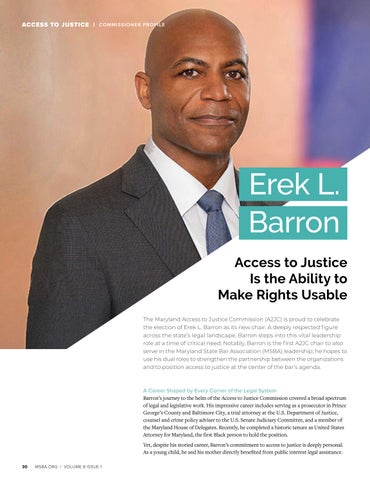
Access to Justice Is the Ability to Make Rights Usable
The Maryland Access to Justice Commission (A2JC) is proud to celebrate the election of Erek L. Barron as its new chair. A deeply respected figure across the state’s legal landscape, Barron steps into this vital leadership role at a time of critical need. Notably, Barron is the first A2JC chair to also serve in the Maryland State Bar Association (MSBA) leadership; he hopes to use his dual roles to strengthen the partnership between the organizations and to position access to justice at the center of the bar’s agenda.

A Career Shaped by Every Corner of the Legal System Barron’s journey to the helm of the Access to Justice Commission covered a broad spectrum of legal and legislative work. His impressive career includes serving as a prosecutor in Prince George’s County and Baltimore City, a trial attorney at the U.S. Department of Justice, counsel and crime policy adviser to the U.S. Senate Judiciary Committee, and a member of the Maryland House of Delegates. Recently, he completed a historic tenure as United States Attorney for Maryland, the first Black person to hold the position.
Yet, despite his storied career, Barron’s commitment to access to justice is deeply personal. As a young child, he and his mother directly benefited from public interest legal assistance.
“ A justice system that works only for people who can afford it is not a real justice system, but rather a service for those who can pay. Access to justice is ultimately about closing that gap.
“My mom and I received help through a domestic situation from a couple of legal aid lawyers,” Barron recalls. “But for that help, I might not be here today. I was only about four years old, but that experience stuck with me. I learned early that the law is a powerful tool and that lawyers can use it to help people and families.”
Now, following a return to private practice, Barron sees his appointment as A2JC chair as life coming full circle. He noted that at every stage of his professional journey, “I’ve focused on whether and how the law is truly available to everyone. The commission is where those questions live, so this role brings together the work I’ve been doing throughout my career.”
Answering the Call to Serve
When asked about the timing of taking on this leadership role following his departure from public service, Barron shared that the urgency of the moment demanded it. “The health care, housing, and socioeconomic challenges facing many Marylanders are harder than ever for the communities that can least withstand it,” Barron stated. He also brings to the role a network that spans the bench, bar, legislature, business, and philanthropy.
In an era marked by socio-political disruption, Barron believes leadership requires anchoring to immovable core principles rather than chasing every headline. “Those we serve depend on us to be the steady ship,” he emphasized. “If we stick to the mission and build broad coalitions, the work won’t rise or fall with any single administration or budget cycle.”
Redefining Access to Justice
For Barron, access to justice is not an abstract concept or a set of aspirational ideals; it is an operational necessity. He views an inaccessible court system as a threat to the integrity of the law itself.
“The law’s promises are only as real as its availability,” Barron asserted. “We have a system full of rights, but a right you can’t enforce is just words on a page. So, access to justice is the ability to make those rights usable, including in the civil courts where the stakes are home, health, and family, regardless of station in life.” He added that “a justice system that works only for people who can afford it is not a real justice system, but rather a service for those who can pay. Access to justice is ultimately about closing that gap.”
Framing the Call to Action for Private Practitioners and Pro Bono Work
Barron’s calls on private practitioners, corporate counsel, and large law firms to engage in pro bono work and to support civil legal aid. He firmly rejects the idea that expanding legal access is optional or a secondary concern for successful firms, stating that this is not charity or something extra, but rather who we say we are.
Barron notes that “our profession’s own ideals and rules already encourage pro bono work and support for legal services,” so he is simply asking the legal community to live up to a commitment it has already made. He emphasized that this can mean pro bono, but it also means resources, expertise, and leverage. Barron challenges the business side of law to integrate this work in a fundamental way, noting that law firms can treat access to justice as core to their mission rather than as a line in a glossy report. He also states that corporate counsel can use their considerable influence to move the companies and markets they touch, while the entire profession can help fund and build the infrastructure that puts help within reach.
Reflecting on his own time in private practice, first as a solo practitioner and then at a larger firm, Barron shared, “I saw how affordability can be a barrier to quality legal service—but also how civil practitioners can help fill those gaps, including through pro bono work. Successfully representing a client on death row, pro bono, changed my life, personally and professionally.”
He advises young attorneys and law students not to wait for a perfect public-interest job before starting to serve. He encourages them to take on that pro bono case or join a board because doing so consistently over a career will ultimately change more than any single job could. As Barron puts it, “The law gives lawyers power, and the only question is what they will do with it.”
Balance, From Scratch
For Barron, maintaining health and balance despite the stress of the legal profession requires a daily calibration, but he tries to stay physically active and take time to decompress. His hobbies include cooking and baking, “preferably from scratch.” Lately, he has been working on the perfect pancake recipe.