March 2024 Issue 3
RATIONAL REFLECTIONS By Bell Institutional
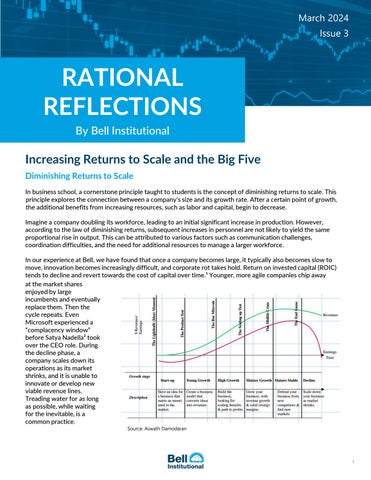
Increasing Returns to Scale and the Big Five Diminishing Returns to Scale In business school, a cornerstone principle taught to students is the concept of diminishing returns to scale. This principle explores the connection between a company’s size and its growth rate. After a certain point of growth, the additional benefits from increasing resources, such as labor and capital, begin to decrease. Imagine a company doubling its workforce, leading to an initial significant increase in production. However, according to the law of diminishing returns, subsequent increases in personnel are not likely to yield the same proportional rise in output. This can be attributed to various factors such as communication challenges, coordination difficulties, and the need for additional resources to manage a larger workforce. In our experience at Bell, we have found that once a company becomes large, it typically also becomes slow to move, innovation becomes increasingly difficult, and corporate rot takes hold. Return on invested capital (ROIC) tends to decline and revert towards the cost of capital over time.¹ Younger, more agile companies chip away at the market shares enjoyed by large incumbents and eventually replace them. Then the cycle repeats. Even Microsoft experienced a “complacency window” before Satya Nadella² took over the CEO role. During the decline phase, a company scales down its operations as its market shrinks, and it is unable to innovate or develop new viable revenue lines. Treading water for as long as possible, while waiting for the inevitable, is a common practice. Source: Aswath Damodaran
1