02.19
STRATEGIES & INSPIRATION FOR AUTO CARE SUCCESS
ENDING THE INDUSTRY’S IMAGE PROBLEM PAGE 30
SOCIAL MEDIA’S TRUE ROI
PAGE 13
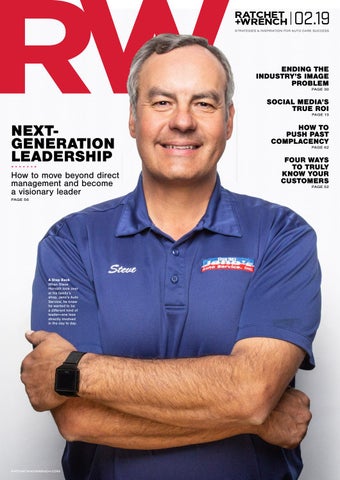
NEXTGENERATION LEADERSHIP How to move beyond direct management and become a visionary leader PAGE 56
A Step Back When Steve Horvath took over at his family’s shop, Jeno’s Auto Service, he knew he wanted to be a different kind of leader—one less directly involved in the day to day.
RATCHETANDWRENCH.COM
HOW TO PUSH PAST COMPLACENCY PAGE 62
FOUR WAYS TO TRULY KNOW YOUR CUSTOMERS PAGE 52
RESTORE OE PERFORMANCE
PADS
PADS
PADS
ROTORS
ROTORS
AND CUSTOMER SATISFACTION • Semi-metallic or ceramic friction material (as provided by the OE) • Powder-coated backing plate to help resist corrosion plus a 2-layer shim for noise control • Slots and chamfers as provided by the OE
• Semi-metallic or ceramic friction formulations to match OE • OE-style slot and chamfer designs and 3-layer shims to help eliminate noise • Application-specific hardware included in the box where required by OE • OE-style powder coated backing plate to help prevent corrosion and deliver OE fit
• Premium semi-metallic or ceramic friction formulations designed to outperform OE • Superior 4-layer shims to help deliver maximum noise control • Application-specific hardware included in the box where required by OE • OE-style slot and chamfer designs to help eliminate noise and improve performance
• Design mirrors OE physical characteristics such as mass, configuration and fin count • Engineered to deliver OE or better performance • Hat and edge coating on most 2012 and later, application to help prevent corrosion and runout
• Full Z-Clad zinc coating helps inhibit corrosion and eliminates pre-installation cleaning • High carbon formulation for superior heat dissipation and improved lifespan of rotors and pads • Design mirrors OE physical characteristics such as mass, configuration and fin count ©2019 AutoZone, Inc. All rights reserved. AutoZone, AutoZone & Design, Duralast, Duralast Gold, and Duralast Max are registered marks and Proven Tough is a mark of AutoZone IP LLC or one of its affiliates.
“FAILURE IS NOT AN OPTION WE’VE GOT TO GET IT RIGHT THE FIRST TIME AND EVERY TIME. I NEED MY CUSTOMERS SAFE AND SATISFIED.” DONNIE M. | TECHNICIAN | 24 YEARS OF EXPERIENCE
DURALAST DELIVERS THE MOST OE EQUIVALENT BRAKE PROGRAM IN THE INDUSTRY
Sign up for exclusive offers and more at DuralastTough.com
WORK
SMARTER
NOT HARDER
DIAGNOSTIC INTELLIGENCE NEW POWERFUL HARDWARE
MS908S
• 1.3GHZ + 1.7GHZ Hexacore Processor • 64G SSD Memory/32G Micro SD Card • 8M Camera / 2 USB Ports (32G MAXIMUM - CARD NOT INCLUDED)
NEW SMARTER SOFTWARE • Bi-Directional with Advanced Coding • Data PIDs from Vehicle Modules • Advanced Service/Reset Diesel Emissions • Key Programming/ADAS Identification
MAXIFIX & MAXICLOUD
Database of Repairs, Diagnostic Tips & Procedures
DATA LOGGING
Live Troubleshooting with Autel Tech Support Team
Compatible with the MP408 Oscilloscope & MaxiVideo Digital Inspection Scopes
PRE-SCAN
& POST-SCAN
COLLISION REPAIR READY SOFTWARE PACKAGE
PURCHASE INCLUDES: • Tablet Tool • Complete Connector Kit • Durable Carry Case • 1-Year Software Updates • 1-Year Warranty
WATCH NOW AUTEL.COM MAXITPMS.COM
HOW-TO-USE
Phone: (855) 288-3587 • USSUPPORT@AUTEL.COM AUTEL.COM • MAXITPMS.COM • MAXISYSADAS.COM © 2019 Autel Intelligent Technology Corp., Ltd., All Rights Reserved
TRAINING V IDEOS
@AutelTools
Follow Us @AutelTools
MS908SP
2019
Super Early Bird Savings: ENDS FEBRUARY 28
Get your All-Access Pass for the 2019 Ratchet+Wrench Management Conference! Network with peers Learn from autocare leaders 50+ sessions and 30+ speakers Prices go up again on Feb. 28. Quantities are limited.
OC TO B ER 3 - 5 RWCONFERENCE.COM
02.19 VO L . 7 N O. 02
F E B R U A R Y Develop Your Culture Gary Pontious Jr. has built an operation where team members buy into both the culture and the success of the company.
F E AT U R E
P R O F I L E
C A S E
30
36
48
Changing consumers’ perception of the auto repair industry needs to be a collective industry-wide effort.
Making the transition from one location to two meant that Gary Pontious Jr. needed a better handle on shop culture.
EXTREME MAKEOVER
BY NOR A JOHNSON
REBUILD CULTURE
BY KILE Y WELLENDORF
S T U DY
UNIQUE CUSTOMER REACH
Marketing outside the box, with something like a radio show, can be effective—but needs to be done right.
R E PA I R
L I F E
56
ESTABLISH YOUR VISION
Steve Horvath has made a purposeful choice to carve his own style at his familyowned shop, becoming a visionary leader. BY KILE Y WELLENDORF
BROOKS CLAYTON
BY KILE Y WELLENDORF
PRINTED IN THE U.S.A. COPYRIGHT ©2019 BY 10 MISSIONS MEDIA LLC. All rights reserved. Ratchet+Wrench (ISSN 2167-0056) is published monthly by 10 Missions Media, LLC, 571 Snelling Avenue North, St. Paul, MN 55104. Ratchet+Wrench content may not be photocopied, reproduced or redistributed without the consent of the publisher. Periodicals postage paid at St. Paul, MN, and additional mailing offices. POSTMASTERS Send address changes to: Ratchet+Wrench, 571 Snelling Avenue North, St. Paul, MN 55104.
ON THE COVER: STEVE HORVATH PHOTOGRAPHED BY MELANIE WATSON
0 2 .19 / R + W / 5
TA B L E O F C O N T E N T S
J U M P
10 ONLINE
S TA R T
20 BREAKDOWN
The dealership difference
S/P2’s career increase
23 VIEWPOINT
13 NUMBERS
NY launches new association
Social media’s return
14 AWARDS INSIGHT
25 SPEED READ
Attract more milennials
U.S. auto sales drop in 2018
17 EDITOR'S LETTER
26 SHOP VIEW
Polish your image
Engle Automotive
29 STRAIGHT TALK
Don’t prioritize profit over customers JOE MARCONI
CHRISTINA KIFFNEY
26
READ WHAT THE PROS READ. “I like Ratchet+Wrench because the articles are about current topics and really focus on owners and running a business. The topics are new, interesting and thoughtprovoking, and I always take away something.” - Troy Minske, Owner | Rum River Automotive, Princeton, MN
TO SUBSCRIBE OR RENEW FOR FREE TODAY, VISIT
RATCHETANDWRENCH.COM/SUBSCRIBE 6 / R + W / 0 2 .19
T O O L B OX
55 THE BOTTOM LINE
43 SHOP ADVICE
Take your health seriously
The keys to effective franchise transition
MITCH SCHNEIDER
44 LEADERSHIP
62 THE FIXER
Find the perfect mentor-mentee pair
Complacency and selfishness
47 INDUSTRY INSIDER
A ARON STOKES
Inside Kerry’s Car Care RISSY SUTHERL AND
52 CUSTOMER SERVICE
Get more out of your CRM system
THINKSTOCK
52
WIRED FOR
SUCCESS
You’re wired differently and we like that. America likes that. Visit futuretechsuccess.org and find out how your hands-on talent is the key to an amazing technical career. When Techs Rock, America Rolls ℠ futuretechsuccess.org
FUTURETECH
SUCCESS
™
0 2 .19 / R + W / 7
O N L I N E
E X T R A S
CLICK ON THE LOGO BELOW FOR PRODUCT INFORMATION
Advance Auto Parts
Jasper Engines & Transmissions
Mitsubishi
WIRED FOR
SUCCESS AUTEL
Kia Motors America
You’re wired differently and we KUKUI Auto Job Central America likes that. like that.
NAPA AutoCare
Ratchet+Wrench Management Conference
Visit futuretechsuccess.org and find out how your hands-on talent is the key to an amazing technical career. AutoZone
MagnaFlow
FUTURETECH
When Techs Rock, America Rolls ℠ futuretechsuccess.org
SUCCESS
BOLT ON TECHNOLOGY
Mitchell 1
8 / R + W / 0 2 .19
Tech Force
™
WORLDPAC
RADIO
EDITORIAL VICE PRESIDENT, CONTENT AND EVENTS Bryce Evans EDITORIAL DIRECTOR Anna Zeck ASSOCIATE EDITOR Nora Johnson STAFF WRITER Kiley Wellendorf SPECIAL PROJECTS EDITOR Jordan Wiklund CONTRIBUTING WRITERS Joe Marconi, Mitch Schneider, Aaron Stokes, Rissy Sutherland PRODUCTION ART DIRECTOR Zach Pate GRAPHIC DESIGNERS Audrey Mundstock, Leah Quinto PRODUCTION ASSISTANT Lauren Coleman SALES VICE PRESIDENT AND PUBLISHER Chris Messer 651.846.9462 / cmesser@10missions.com ASSOCIATE PUBLISHER Alysia Nelson 651.846.9463 / anelson@10missions.com SALES MANAGER Nathan Smock 651.846.9452 / nsmock@10missions.com REGIONAL ADVERTISING SALES Ross Kirgiss 651.846.9485 / rkirgiss@10missions.com CLIENT SERVICE SPECIALIST Jen George 651.846.9465 / jgeorge@10missions.com 10 MISSIONS MEDIA PRESIDENT Jay DeWitt GENERAL MANAGER AND PRODUCTION MANAGER Mariah Straub SALES SERVICE REPRESENTATIVE AND BOOKKEEPER Meghann Moore EVENT COORDINATOR Katie Cornet DIGITAL MEDIA STRATEGIST Josh Jaskulka MARKETING COMMUNICATIONS SPECIALIST Kasey Lanenberg EDITORIAL ADVISORY BOARD Leigh Anne Best, Mighty Auto Pro Andy Bizub, Midwest Performance Cars Greg Bunch, Aspen Auto Clinic Ryan Clo, Dubwerx Ron Haugen, Westside Auto Pros David Toole, Toole's Garage HOW TO REACH US 10 MISSIONS MEDIA 571 Snelling Avenue North, St. Paul, MN 55104 tel 651.224.6207 fax 651.224.6212 web 10missions.com The annual subscription rate is $72 (U.S.A. only) for companies not qualified to receive complimentary copies of Ratchet+Wrench. BACK ISSUES Past issue single copies are $8. Go to ratchetandwrench.com/backissues LETTERS TO THE EDITOR editor@ratchetandwrench.com ARTICLE REPRINTS For high-quality reprints or e-prints of articles in this issue, call 651.846.9488 or email reprints@ratchetandwrench.com. Opinions expressed in Ratchet+Wrench are not necessarily those of 10 Missions Media, and 10 Missions Media does not accept responsibility for advertising content.
New Ratchet+Wrench Podcasts. 3 SERIES WITH NEW EPISODES EVERY MONTH.
GROW. Series hosted by industry superstar Rissy Sutherland. Inside the processes, systems and operational strategies that have allowed the industry’s top shops to thrive. New episode this month.
LEAD. Series hosted by shop operator Aaron Stokes. The go-to resource for leadership lessons, philosophies and success stories. New episode this month.
INNOVATE. Series hosted by a rotating special guest each month. An introspective look at the industry’s most pressing topics from the people who know them best. New episode this month.
LISTEN AND SUBSCRIBE S E A R C H “ R AT C H E T + W R E N C H ” I N A P P S FOR APPLE AND ANDROID
AUTOMOTIVE GROUP
PODCASTS
STITCHER
POCKET CASTS 0 2 .19 / R + W / 9
CARQUEST NEW POWER STEERING PUMPS ®
ONLINE02.19 COM M EN T S , DISCUSS IONS , FEED BAC K A N D MORE FROM A ROUN D T H E W EB
READER OPINIONS:
BOOSTING YOUR SHOP’S IMAGE
—
In a Facebook comment in response to Ryan Clo's “Why A Great Shop Image is a Must” April online column, a reader shares what her shop does in order to create “wow moments” for her customers.
We look to create a ‘wow’ moment with every customer who walks through our door. We want every customer to become a forever customer with us. We not only offer exceptional customer service, but when they walk through our door, I want them to feel like they are walking into my home. A place where they feel at ease, a place where we are here to help and put their car worries at ease. Every customer gets a thank you gift when they leave. One month, we had bags of popcorn in the cars when they picked up with a note that said, “Thanks for popping in.” This month, for Christmas, we have candles and a note that says, “Thanks for making our spirits bright.” We also offer a gift to all the kids while they wait. We had a customer post on Facebook this week that they loved our service and so did their kids, and the kids wanted to know when they could come back. It’s the little moments that make life big.
Better Value, Longer Lasting Carquest® Power Steering Pumps are built new, specifically engineered to be stronger and last longer. • Improvements to OE designs on many pumps • Stronger designs in internal shafts and pumps
R A C H E L S P E N C E R // O W N E R , S P E N C E R ’ S A U T O C A R E // K R U M , T E X A S
WEEK LY DISCUSSIONS
DEALERSHIPS VS. REPAIR SHOPS
—
Every Thursday, a Q&A is posted to the Ratchet+Wrench Facebook page in order to open a forum for readers to openly discuss industry topics. A poll posted in mid-December asked readers, “What do you believe pulls customer into independent repair shops over dealership service departments?” The discussion resulted in over 65 thoughtful comments and replies.
• Pre-assembled with reservoir on select models • Limited Lifetime Warranty
ONLINE COLUMN
Join the discussion at Facebook.com/RatchetAndWrench
YOU ARE NOT ALONE
—
Ryan Clo details how shop owners can improve and grow from their struggles of entrepreneurship: “I see too many people get down on themselves. It’s hard at times and a little resilience can go a long way. Every entrepreneur has gone, is going, and will go through it at times. Be honest with yourself and the people around you, they will likely be the ones to help carry you through the valleys of shop ownership.”
PODCAST
RUNNING A FAMILY BUSINESS
RADIO
The full column can be found at ratchetandwrench.com.
— Learn more at
advancepro.com
For Rissy Sutherland’s monthly episode of Ratchet+Wrench Radio, she spoke with Michael Brewster, president of Gil's Garage Inc., about the challenges and opportunities of his thriving family auto shop.
JOIN US ONLINE WEBSITE: ratchetandwrench.com FACEBOOK: ratchetandwrench.com/facebook
10 / R + W / 0 2 .19
TWITTER: twitter.com/ratchetnwrench LINKEDIN: ratchetandwrench.com/linkedin INSTAGRAM: instagram.com/ratchetandwrench
FILE PHOTO
Ratchet+Wrench Radio can be found on all top podcast streaming apps.
YOUR SKILL. OUR PARTS.
Parts that exceed expectations, so you can too. Our commitment to quality parts is a promise we take seriously. With North America’s broadest import and domestic parts availability, we have the parts you need that meet or exceed OE specifications.
Learn more at advancepro.com
All trademarks marks are the property of their respective owners.
0 2 .19 / R + W / 11
A PERFECT FIT. A PERFECT PRICE.
EVERYTIME/
There’s a reason why Mitsubishi customers love Genuine Mitsubishi Parts. Designed as a direct replacement for the original part, Genuine Mitsubishi Parts provide the trouble-free performance customers have come to expect. For a flawless repair that will surely keep your customers happy, contact an authorized dealer for all your Genuine Mitsubishi Parts needs.
2019 MITSUBISHI MOTORS NORTH AMERICA, INC. ALL RIGHTS RESERVED
NUMBERS THE
TOPICS,
TRENDS,
AND
METRICS
DRIVING
YOUR
OPER ATION
SOCIAL MEDIA BY THE NUMBERS — Social media has become one the biggest avenues of inexpensive (or free) instant and wide-reaching marketing. But how often should you be updating your accounts; and what platforms should you even be on? By looking through the Ratchet+Wrench 2018 Industry Survey, we can determine the social media trends of shops. But the biggest question left is: Does social media use actually correlate to sales?
HOW OFTEN SHOPS PROMOTE THEMSELVES THROUGH SOCIAL MEDIA
26%
35%
16%
6%
3%
13%
1%
Daily
Weekly
Monthly
Quarterly
Yearly
Doesn't use social media
Didn't respond
Y E ARLY SALES VOLUME
THE SOCIAL MEDIA PLATFORMS SHOPS UTILIZE
Make under $250,000
6%
4%
29%
Make between $250,000–$499,999
6%
14%
30%
Make between $500,000–$744,444
13%
24%
13%
Make between $750,000–$999,999
15%
13%
5%
Make between $1 million–$2.4 million
45%
37%
13%
Make more than $2.5 million
10%
8%
4%
Didn’t know
5%
0%
6%
Facebook Google+ Twitter Instagram LinkedIn
The numbers above correlate to the following
PEXELS
100%
90%
80%
70%
60%
50%
40%
30%
Snapchat 0%
SHOPS THAT DON'T HAVE SOCIAL MEDIA
20%
SHOPS THAT PROMOTE SOCIAL WEEKLY
10%
SHOPS THAT PROMOTE SOCIAL DAILY
Become a Social Media Guru Want to explore more about promoting your shop on social media? On this Ratchet+Wrench Radio episode, Rissy Sutherland brings in two guests to discuss a vital marketing tactic for any shop—developing a presence on social media, specifically Facebook. — This episode is available wherever you listen to podcasts, or you can find it at ratchetandwrench.com/podcast
0 2 .19 / R + W / 13
Ratchet+Wrench Awards Insights feature past Ratchet+Wrench Award nominees. For more information, go to ratchetandwrench.com/awards
AWA R D S I N S I G H T
ALL-STAR NOMINEE
DWAYNE MYERS —
CO-OWNER DYNAMIC AUTOMOTIVE FOUR LOCATIONS IN MARYLAND
BY NORA JOHNSON
Dwayne Myers was nominated for the 2018 Ratchet+Wrench All-Star Awards for his role on advisory boards, committees, and organizations, as well as his fully developed and successful apprenticeship programs. But what really stands out about Myers is his ability to get millennials interested in the automotive industry. “We had struggled for years getting young/entry-level help. We were able to retain our more seasoned team members, but young minds were not interested in the automotive industry,” Myers says. Myers is the CEO and one of three owners of Dynamic Automotive in Maryland. They have a total of four locations throughout the state. Dynamic Automotive is constantly expanding, and adding more shops to its name. In an attempt to get young talented technicians and fill their pipeline, Myers started two apprenticeship programs through Dynamic Automotive. Their first is the youth program, and allows for junior and senior high school students to get on-the-job-experience and receive credit for their work. The second is their registered apprenticeship, a three-year program where apprentices work full time and gain free education that can be used toward a degree, Myers explains. Myers’ approach and program structure gets millennials excited and involved in the industry.
DEBUNK MYTHS. In the process of getting young talent into his shops, Myers attended career nights at local high schools in his area to constantly face the same challenge—the students’ parents didn’t want their child joining the automotive industry, Myers says. They had trouble seeing past the industry’s stereotypes of being a dirty and unprofitable field to enter. “We have tried for years to change parents’ outlook on our industry,” Myers says, “trying to explain how our industry has changed.” But once Myers was able to show the 14 / R + W / 0 2 .19
reluctant parents that their kids will get paid, with an opportunity for free education and a future in the industry, minds began to change. GIVE THEM A CAREER PATH. Before starting the two programs Dynamic Automotive has now, Myers tried to start another apprenticeship program on his own. It failed. His original program still focused on mentoring, but didn’t have a set structure, he says. He then decided to relaunch his apprenticeship program, but this time with the involvement of the state of Maryland. This partnership put meat on
the bones of the Dynamic Automotive apprentice programs and now gives millennials a view of their futures: a career path. “Career path” for millennials is a big word, Myers says. “We felt that we always had the program, but we never put it on paper and did not have a clear pathway for their future, something I know is critical if you want to attract young talent,” he says. “We tried and found it was through creating a good program that would give a clear pathway.” TELL THEM WHAT IT TAKES. After the Dynamic Automotive apprenticeship programs launched, Myers took 72 students on a field trip around his shop. He talked to them about the automotive business, what and how to charge customers, and what its takes to be in the industry. The discussion and tour was broad and covered a little bit of everything, and they loved it. Myers got six applications, just in the following week, with one of the students writing, “If I’m lucky to be a part of it” as a portion of one of their answers. By showing the students and parents what being in the industry truly involves, as well as their possible future, Myers is able to successfully bring in talented youth. He already has some incredible success stories of some of the apprentices that he has brought into his program, and recommends shops do the same. “Besides having a full pipeline of talented labor, we know that we are staged to grow,” Myers says.
FUE VANG
Getting Youth in the Industry
0 2 .19 / R + W / 15
Crafting Your Ultimate Shop Culture
W E B I N A R S
Learn to become the leader your operation needs to find and retain top talent. S H O P O W N E R R YA N C L O
FREE WEBINAR Get details and claim your spot. R AT C H E TA N DW R E N C H .C O M / W E B I N A R S
SPONSORED BY 16 / R + W / 0 2 .19
2/19 11am/cst
EDITOR'S LETTER
The Industry’s Image
IT’S TIME TO STRIVE TOWARD A MORE UNIFIED EFFORT
LEAH QUINTO
Most often it’s someone wearing shorts—or one time, it was flip-
flops. But there’s also the regular rotation of T-shirts, jeans, hats, hoodies, etc. We (at Ratchet+Wrench) hear about it almost every time it happens. Some times, it’s fair; some times, it’s not. Regardless, we understand the point. There are a lot of topics that we cover in our magazine’s pages every month—from leadership to human resources, from law to technology, from workflow to hiring. We attempt to look at your operations from every angle we can, and we try to provide new strategies and ideas that can help you succeed. The overarching “theme” to it all, though, falls back to why those (potential) fashion faux pas mentioned above are often pointed out when they appear in photos in our magazine: the industry’s image “problem.” Disclaimer before we continue: I’m not passing judgement on your shop attire. We actually have a fairly lax dress code here at Ratchet+Wrench headquarters. Personally, I tend to lean on the side of having dress code match the culture and identity of your business and the image you want to portray to your clients, partners, potential hires, etc. I’m not assuming I know enough about you to make those judgements about your operation. That said, it’s the No. 1 complaint or comment we receive from readers—They see the shorts or the flip-flops, and worry what message that sends about the image of this industry. Conversely, when readers pick up on a story of a shop operator and his or her team doing progressive things, the comment is usually something about how they love to see people elevate the way the general public views the field. That’s the goal—and my point to this rambling (yes, I have a point). You improve your operation, you portray a more modern, progressive image to your customers, and that impacts your market and those that interact with your business. But it takes everyone in the industry, working together toward those same goals to change that stereotype and perception with vehicle owners nationwide. Our main feature this month, “Breaking the Industry’s Image Problem” (page 30), discusses how shop owners across the country are using social media platforms to band together and slowly make these changes. If you take nothing else from this story (though, I think you’ll be able to take quite a lot from it), please let it be the simple, obvious fact that it isn’t about one business owner working toward a narrow goal; these are people realizing that an issue exists above the fray of their day-to-days and that it takes a larger, collective effort to truly push the industry forward. Many people are doing just that, and those are the people we try to feature in the magazine. If you’re not in that group, maybe it’s time to kick off the flip-flops and start pushing?
BRYCE E VA NS, VICE PRESIDENT, CONTENT A ND E VENT S BE VA NS@10MISSIONS.COM
0 2 .19 / R + W / 17
Kia.com
If it’s not in the right box, it’s not genuine.
From starters to alternators, oil filters to spark plugs, there is no substitute for genuine. The only way to assure that you are getting Genuine Kia parts, backed by the Kia Warranty, is to order them from your localoilAuthorized Kiaplugs, Dealer. Contact your From starters to alternators, filters to spark there is no substitute for genuine. The only way to assure localyou Kiaare dealer forGenuine assistance and delivery ofthe theKia parts you need. that getting Kia parts, backed by Warranty, is to order them from your local Authorized Kia Dealer. Contact your local Kia dealer for assistance and delivery of the parts you need.
*Genuine Kia replacement parts (except battery) sold by Authorized Kia Dealer under warranty are covered for the greater of (1) the duration of the New Vehicle Limited Warranty or (2) the first 12 months from the date of installation or 12,000 miles, whichever comes first. Labor charges not included when not installed by an Authorized Kia Dealer. Warranty is limited. See Kia’s Replacement Parts and 18 / R + W /Limited 0 2 .19 Warranty for further details. Accessories
J U M P S TA R T NEWS
SHOP VIE W
/
IDEAS
/
PEOPLE
/
TRENDS
26
BREAKDOWN VIEWPOINT SPEED READ
CHRISTINA KIFFNEY
SHOP VIEW
Come On In At Engle Automotive, co-owners Bryan and Mark Engle created a welcoming lobby.
0 2 .19 / R + W / 19
J U M P S TA R T
Bridging the Gap ONE COMPANY’S PUSH TO CREATE PROFESSIONAL TECHNICIANS
It’s not a matter of when technicians are
going to enter the automotive industry— it’s how they’re able to do so. According to the Ratchet+Wrench 2018 Industry Survey, 53.8 percent of readers listed the technician shortage as the single biggest challenge in the automotive industry today. In efforts to attack and dismantle the technician shortage that’s on the rise, S/ P2 Careers, a resume building hub, has formed a connection between students creating resumes for the automotive industry and businesses looking to hire. Recently, S/P2 Careers announced 2 0 / R + W / 0 2 .19
a staggering 50,000 student resumes were uploaded to its database in 2018— which is double the amount of resumes on the site in 2017, according to S/P2 Careers president, Kyle Holt. “It’s been really unbelievable,” Holt says. Roughly two years ago, the company launched a course called “Land that Job: Building a Resume,” for the career tech schools with which S/P2 worked. Holt says the program took a bite right out of the technician shortage by assisting students with their resumes, as well as working to connect both shops and
future technicians together. “Every industry event we went to—it didn’t matter if it was automotive service, collision repair, diesel, it did not matter— every single industry event, the No. 1 thing that everybody was talking about was the technician shortage,” Holt says. “It was always a problem and there wasn’t a clearcut solution.” While the 50,000 account for resumes that have followed an approval process— undergoing edits and revisions—the 25,000 resume increase from last year shows positivity in an industry that
THINKSTOCK
BY KILEY WELLENDORF
candidates in our system.” However, out of the 78,000 resumes, only 59,000 were placed on S/P2 Careers, Holt says. “We have a team that reviews every resume and determines [if] that resume is incomplete, incorrect, or inappropriate,” Holt says. “If it is, then we hold it.” Resumes are often held as it’s likely the student’s first resume created for the workforce. Students are then able to correct their resume which is later put up on the site for employers to sort through. “We’ve actually seen about a 20 percent increase in the number of resumes created, but one of the things that we’ve done is we got a little tighter this year on our review process and what we are willing to allow to be posted and visible to businesses,” Holt says. Students can choose whether or not they want to post their resume on S/P2 Careers once it’s approved by team members.
continues to struggle against finding new talent. “Our focus is on trying to help that next generation of technicians and the current generation of technicians really be more well-rounded so they’re better prepared for their career,” Holt says. “Whether it’s an internship, part-time, full-time work, we’re trying to give this next generation of technicians opportunities that we just have not done a good job of in the past; we’ve got to get them into the right first employer, get them involved in the industry while they’re still in school, and
keep them in the industry long term.” Crafting a Candidate Writing a professional resume is a skill that often requires an additional set of eyes the first time, S/P2 Careers has learned. According to Holt, a total of 78,000 students who are interested in joining the automotive industry have created resumes on the site. “We have candidates in all 50 states,” Holt says. “There’s some states that have far fewer states than others; for example, Texas is the state that has the most
Building a Connection After a resume is approved and completed, S/P2 Careers has found that students often hesitate to reach out to those in the industry. Holt identifies a gap that the program has tried to address by opening communication lines for both the student and potential employers. “What we’re finding is many of the students are not necessarily proactive in reaching out to industry because that’s not a skillset that they’ve been taught along the way, and many of them are waiting for their instructors to tell them where they should go, or have industry come to them,” Holt says. “It’s just not a skillset that they’ve learned yet.” A little more than 700 businesses have access to approved student resumes, Holt says, which includes larger organizations and single-owner shops. “They can see the entire resume except for contact information and student’s last name,” Holt says. “We want to make sure we protect the students privacy, while giving them every opportunity to find [career opportunities]. 0 2 .19 / R + W / 21
boltontechnology.com
I’m driven by a passion to succeed. Doesn’t matter if it’s my award-winning pulled pork recipe or running the best damn shop in the area, I never stop until it’s right. That means creating rock-solid customer loyalty, increased car counts and higher repair orders.
That’s why BOLT ON TECHNOLOGY is in my shop. 2 2 / R + W / 0 2 .19
Learn how BOLT ON can fuel your success, visit booths #733-741 and #832-840.
J U M P S TA R T
Joining a Trade Association TRADE ASSOCIATIONS CAN PROVIDE INSIGHT TO SHOP OWNERS WHO ARE LOOKING FOR ANSWERS BY KILEY WELLENDORF
qualified candidates from those schools with our members, but more than that, actually have a student membership and provide career building, programs and events for students, networking events between students and repairers. What do you believe trade associations are lacking in this industry?
New York’s first trade association, New York City Auto Repair Association (NYCARA), was recently established by founders Paul Stern, owner of LIFTNOW, and his son, Paul Stern Jr., marketing and business development of LIFTNOW. As equipment distributors, they have worked closely with auto repair shops in the area and noticed a slew of associations, but a lack in auto repair associations. “The customers are different [here], base constraints are different, credit constraints are different—there’s a lot of differences in the New York City area that the rest of the country doesn’t really understand,” Stern Jr. says. “A lot of people starting businesses here or running a business here need to sort of navigate some sort of unique challenges; we really are looking to help with those challenges through educational seminars, general meetings, and fundraisers.” Ratchet+Wrench sat down with Stern Jr. to learn more about how trade associations work to benefit those in the industry and why they’re worth looking into.
THINKSTOCK; PAUL STERN JR.
Why is it important for an auto repair shop to join a trade association?
I think it’s huge. It’s been really tough on independent repairers to keep a lot of their customers loyal. The right equipment helps, the right marketing helps, there’s a lot of things that can help sort of shift that balance, but at the end of the day, they’re not given the same support as, let’s say, a big chain of tire stores, or a big chain of OEM saying, ‘OK, these are the marketing campaigns you run and these are the promotions you run.’ The independent repairer doesn’t get that, and instead, they’re sort of bombarded with a bunch of different people and there’s no unified voice except for a few really shrewd business people. How does the independent repairer survive, one, but how do they prosper? How do they understand their regions the same way that bigger businesses can understand a region? Historically, this industry is plagued by
BACKGROUND: Paul Stern Jr. Co-founder NYCARA
a lack of education, and it’s not of a willingness to learn, but rather, there are a lot of materials that aren’t industry specific. One of our big missions is making some of this education just a little bit more tangible and accessible for a lot of these people. How do you plan on making your trade association stand out among others? Where
we’re going to stand out is a few different ways: we’re going pretty heavily into the educational seminar angle here, so I think that’s going to be a big one. We want to develop best practices and other concepts that maybe auto repairers aren’t paying attention to, but the rest of the world is. We’re in the midst of engaging high schools and colleges in the area, and I think that becomes a pretty important piece of this puzzle to engage students and young interest. What we’re going to end up doing further down the road is trying to match
I think there is a really big disconnect. I think the people in the industry, some of them want to learn, but some of them aren’t super well versed with things like running a business, per say, and then you combine that with an industry that’s changing super quickly. You have pressure from a lot of areas—especially in New York. New York is really the last area to be consolidated so you have consolidation creeping in, vehicle technologies are always rapidly changing faster than anybody can keep up. More than anything, we’re living in a world where the customer is either not driving at all, or expecting a level of service and delivery. I think what other trade associations may be lacking is the additional education, framed in a way to where, the customer is changing, the rest of the world is changing, and, as a result, this is how you’re going to remain competitive, rather than something that’s a little bit more general. It’s noble to want to help everybody, but when you paint the picture that it’s only a matter of time before this industry changes and catches up like the rest of the world, I think some more aggressive measures need to be taken. What are the business benefits of joining an auto trade association?
When you’re able to get together in a room with a bunch of people who are similar but different from you, that’s huge. I think another one of the big things to convince people of is that you’re not really competing with people in the room. This is a space where you can share ideas and bounce things off of each other and think about what we should be doing regulation wise. When you get in a room with a bunch of people with different perspectives, you’re always going to learn. 0 2 .19 / R + W / 2 3
THE TECHNICIAN
SHORTAGE W IL L N OT D E FE AT U S
autojobcentral.com 24 / R + W / 0 2 .19
J U M P S TA R T
US AUTO SALES TO DROP BELOW 17M U.S. auto sales are expected to drop below 17 million for the first time since 2014, reported CNBC. Automakers are projected to sell 16.8 million passenger vehicles in 2019, a 1.1 percent decline from this year, according to the National Automobile Dealers Association’s annual sales forecast released Thursday. U.S. sales peaked at 17.6 million vehicles sold in 2016 and have been falling ever since. For 2018, car buyers mostly purchased light trucks, crossover vehicles, pickups and SUVs. Now, with rising interest rates, dealers are growing concerned with “price creeping” that could keep some buyers out of the market, according to the report. Average interest rates on new-vehicle financing have risen 60 to 70 basis points from 2017 through the third quarter of 2018. The other big trend is the staggering shift from passenger cars to crossovers and truck-based vehicles that has taken place over the last several years. Automakers have been scrambling to realign portfolios around the shift. Light trucks are on track to account for 70 percent of all sales, with cars dropping to 30 percent.
AUTO CARE ASSOCIATION RELEASES TRADE STATEMENT Auto Care Association’s president and CEO, Bill Hanvey, released a statement regarding the temporary trade deal between United States and China. “We are pleased that President Trump and President Xi were able to reach a temporary trade deal during the G20 summit in Buenos Aires to not raise tariffs on $200 billion worth of imports from China. Tariffs inhibit the growth of our industry and make it more expensive for consumers to maintain and repair their vehicles,” Hanvey said. “Further, we are encouraged by the Trump administration’s commitment to engaging with the Chinese government in order to reach an agreement with re-
spect to forced technology transfer and intellectual property protection. We are hopeful that the upcoming negotiations will resolve many of our long standing concerns in these areas.”
ICAHN AUTOMOTIVE ACQUIRES RPM AUTOMOTIVE Icahn Automotive Group LLC announced that it has entered into a definitive agreement to acquire RPM Automotive. Headquartered in Jacksonville, Fla., RPM Automotive operates 10 locations with more than 100 service bays throughout the Northeastern part of the state. “The acquisition of RPM Automotive complements Icahn Automotive’s existing footprint in the region and will accelerate our growth in an important market for us. RPM Automotive has become a service leader in the Jacksonville area by providing a superior customer experience delivered by expertly trained store managers and technicians. The remarkable growth of RPM Automotive over the past two decades is a testament to the quality of its team members and service model,” said Dan Ninivaggi, chief executive officer of Icahn Automotive. Throughout 2018, Icahn Automotive has acquired independent and franchised locations in the Northeast, Midwest and South. These additions to the Icahn Automotive portfolio have been integrated under the Pep Boys, AAMCO and Precision Tune brands. Icahn Automotive currently includes more than 2,000 owned and franchised service locations throughout the United States and parts of Canada. “Icahn Automotive continues to increase the breadth and density of our service center coverage. We’re well positioned to capitalize on the growing demand for automotive service by individuals and fleets as vehicles become more technologically complex and the vehicle population grows,” said Brian Kaner, president of service for Icahn
Automotive. “As a full-service provider under multiple, well-known brands, we can service a vehicle throughout its entire lifecycle, from tires and routine maintenance to complex repairs.” In addition to acquisitions, Icahn Automotive has continued to invest in greenfield and existing Pep Boys, AAMCO and Precision Tune service locations, and in people, programs, technical training and technology to ensure a superior customer experience. Icahn Automotive recently launched Pep Boys Mobile Crew, a state-of-the-art mobile repair unit that will provide on-location maintenance and repair services. The company also announced a broad relationship with Amazon.com to provide professional tire installation services to online customers.
REPORT: NEARLY 17M FAULTY TAKATA AIR BAGS STILL IN USE Despite years of recalls involving faulty Takata air bag inflators, one-third of the recalled inflators have yet to be replaced. According to an annual report on recalls released late last week by the government, recall repair rates across 19 automakers involved in the recalls increased 30 percent over the course of the past 12 months (as verified by the National Highway Traffic Safety Administration). But the report indicates that 16.7 million faulty inflators out of the 50 million under recall have yet to be replaced, according to the Associated Press. The Takata air bag devices use the chemical ammonium nitrate to create a small explosion that inflates the air bags. But inflators have been found to explode with too much force, firing shrapnel at drivers and passengers. At least 23 people have been killed worldwide due to the problem. The inflators grow more dangerous as they age, due to the fact that ammonium nitrate deteriorates thanks to high humidity and cycles from hot temperatures to cold. 0 2 .19 / R + W / 2 5
J U M P S TA R T
1
Engle Automotive BY TR AVIS BE AN PHOTOGRAPHY BY CHRISTINA KIFFNEY
1 / A BUSY INTERSECTION Brothers Mark and Bryan Engle opened Engle Automotive in Loveland, Colo., in 1996, but purchased the property for his new building in 2008. Right off a major street, Engle’s shop remained somewhat hidden until a nearby Walmart set up shop and made Denver Avenue a busy street.
2 / A DESIGNER’S TOUCH Based on his large female customer database, Engle wanted his new building to have a feminine touch. So, he hired an area designer to fix up the lobby of his office. By painting the walls a new color, replacing the concrete floors with carpet, and reappropriating rustic metal cabinets into a modern service advisor counter, Engle’s designer crafted a welcoming aesthetic throughout the front office. This is especially notable in the shop’s waiting space, which is stocked with several chairs and a couch, magazines, a television, toys, and complimentary coffee and water.
3 / PROFESSIONAL PRESENTATION Engle believes how we dress and present ourselves is how people will judge us. Because he wanted his employees and shop to exude professionalism, he made everything fit the part. From his front office employees’ black polos to the wide array of awards on display to the spotless, clutterfree workspace, Engle says customers can sense the shop’s rectitude. 2 6 / R + W / 0 2 .19
2
HAVE AN OUTSTANDING SHOP? Send a few photos and a brief description to submissions@ratchetandwrench.com and we might feature it here.
SHOP S TAT S Owner: Mark and Bryan Engle
3
Location: Loveland, Colo. Size: 12,000 square feet Number of Lifts: 15 Staff Size: 16 (10 technicians, 2 service advisors, 1 CSR, 1 general manager, 2 owner) Average Monthly Car Count: 350 Annual Revenue: $2.6 million
4 / REACHING CUSTOMERS
4
5 6
On the west end of the lobby, customers will note the shop’s array of automotive products for sale. While Engle admits the profit margins are low, he also claims that having those products on display has attracted some lifetime customers. If someone purchases a brand new $80,000 truck and needs an American-made steel bumper, Engle says he can make that sale and then secure future repair work.
5 / A DRIVE-THROUGH SHOP Engle’s long building allows for an immense, drive-through repair floor. On each end of his rectangular shop, 14-foot-by-14-foot doors allow jobs to flow in and out (there’s a larger, additional for the shop’s diesel emissions work). Along the drive-through, the shop’s 15 bays are slanted at an angle and house the jobs. The center drain along the floor takes in water and grime as, once per week, technicians collectively squeegee clean their work stations.
6 / LEAVING WORK AT WORK Engle is proud of this final touch: each employee has his or her own locker and shower at work. He does this because it’s “nice to leave work behind you, and part of that is shedding your uniform” each day when you head home. 0 2 .19 / R + W / 27
2 8 / R + W / 0 2 .19
Columns
STRAIGHT TALK Joe Marconi
MAKE A GREAT ‘LAST’ IMPRESSION The customer experience doesn’t end with vehicle delivery
THINKSTOCK, MICHAEL HOEWELER
A few years ago, some friends and I were
having dinner at a local restaurant. There were six of us enjoying the food and having a great time. A few minutes after our waiter served us our coffee and dessert, the owner of the restaurant walked over to us, introduced himself and said, “I have people waiting for this table; how much longer do you think you’ll be?” Shocked by his comment, I hesitated for a second, looked up at him and said, “No worries, we’re done.” With just a few simple words, the owner of the restaurant wiped out the pleasant experience we were all having. As we were finishing up, we couldn’t help noticing the stares from our waiter and the owner. Their eyes were laser-focused on us. They made it obvious that they wanted our table. We didn’t say anything to our waiter, or the owner. But we told each other, “We’ll think twice about coming back to this restaurant.” None of us ever did go back to that restaurant. And I heard similar complaints from other friends about that restaurant. About a year later, that restaurant closed its doors for the last time. As a business owner, I fully understand what each table means in terms of profit. The tables at a restaurant are no different than the service bays in our business. The more people you can process through the restaurant, the more profitable the restaurant is. The more cars we can process through our service bays, the more profitable we are. While I don’t fault the owner of the restaurant for recognizing the need to be profitable, I do fault the owner for not understanding a basic rule in achieving success in business. And that is: You build a business one customer at a time and by developing strong, long-term relationships with those customers. And to maintain that success, a business must continuously cultivate those relationships. The owner of this restaurant didn’t get it. All of us had dined at his establishment
before. The owner didn’t see us as an opportunity to strengthen the relationships. He saw the opposite. By asking for our table, he put the emphasis on his next sale and eliminated any chance of us returning again. Losing customers, and not understanding why, is the kiss of death for any small business. What the owner determined important was profit per table, per person. The process to get people fed and done became the primary objective, when it should have been ensuring its customers were enjoying a nice meal and having a great time. It was a mistake that eventually led to his failure. Never think that customer quantity ever outweighs the quality of the customer experience. Making a memorable experience is the essence of great customer service. If we dig a little deeper, we find another mistake made by the restaurant owner: believing that the customer experience was over when the meal was over. The meal was prepared, it was served and we consumed it. Then, at some point during the end of that process, we became an obstacle to his next sale. He failed to comprehend that the sale is not over when the meal is over, and that everything that occurs right up to the moment when a customer drives away from his parking lot will have an influence on wheth-
er that customer will return in the future. The lesson for us is simple: Never lose sight of the importance of creating a customer. Establish a culture in your company that cultivates long-term relationships. Build a process that always strives for world-class customer service during the entire customer experience—and especially at car delivery. Never think that when the technician completes the repair, your job is done. The customer experience continues right up until the time the customer is picking up their car. The time you spend with the customer after the repair is done is as important as making the sale. Value each customer. Work on those relationships. Don’t worry about short-term profit gain. Remember: building long-term relationships builds long-term profit. By the way, that restaurant has recently opened up again. My friends and I went there for dinner last Friday night. We noticed that the new owner was walking around greeting everyone. He eventually made his way to our table, introduced himself and said, “Can I get anyone anything? It’s great to see you here tonight and hope to see you again soon. Thank you.” Now, you tell me: Do you think we’ll go back?
Joe Marconi has more than three decades of experience in the automotive repair industry. He is the owner of Osceola Garage in Baldwin Place, N.Y., a business development coach for Elite Worldwide and co-founder of autoshopowner.com. j.marconi@eliteworldwide.com ratchetandwrench.com/marconi
0 2 .19 / R + W / 2 9
BREAKING THE INDUSTRY’S IMAGE PROBLEM A D I S C U S S I O N O N WAY S T O R E V E R S E T H E N E G AT I V E INDUSTRY STEREOT YPES B Y
N O R A
R ATC HE T+W R EN C H
3 0 / R + W / 0 2 .19
|
J O H N S O N
FEBRUARY
2019
|
PAGE
30
Ready to Roll Don Foshay's sixshop operts.
0 2 .19 / R + W / 31
BR E AKING THE INDUSTRY ’S IMAG E PROBLEM
The bubble of influence—when individuals have limited views of something based on the segregated points of influence of where they receive their information. For instance, people who solely receive news from their own political party, will only continue to have their thoughts confirmed, never challenged or expanded. So, how does “the bubble of influence” relate to the auto industry? Perception. Customers’ perceptions of the industry are influenced by their few experiences they have within it, as well as what they hear from within their social circles. And as most would agree, the perception of the industry generally isn’t the most positive. “Technicians are internal customers. If we are looking at the industry and saying, ‘What’s the image of this industry?’ and we have a technician shortage, that’s a pretty good indicator,” says Lucas Underwood, owner of L&N Performance Auto Repair in Blowing Rock, N.C. Ratchet+Wrench continues to dive into the depths of this image problem by isolating specific industry misconceptions. But, this leaves the question of finding the best way to reverse said negative stereotypes, as well as ways shops can increase the public’s trust to gain business and ultimately, rid the negative image. In comes a new “bubble”—niche online social groups, coming together to spark change.
3 2 / R + W / 0 2 .19
The Facebook Group
Auto shops around the country (and world) are using social platforms to connect and discuss strategies to reverse the industry’s negative image. One of the largest social platforms comes in the form of Facebook groups. Many Facebook groups for auto shop owners are on the site, and one of the largest in numbers is the Auto Shop Owners Group (ASOG). Scott Pelava, owner of Lonsdale Auto Works in Lonsdale, Minn., created the network around four years ago. The following are discussion points from thousands of shop owners in these groups, and their ideas on ways your shop can add to the movement of reversing the industry’s negative image, especially for millenials. “If we can maintain the evolution to the industry, and handle the public’s perception of the industry, [customers] can begin to understand what their dollar is being spent on,” Pelava says.
1
Eliminate competitiveness.
Trust. It’s one of the biggest words that comes up when discussing the industry’s image. The public seems to continue to hold this negative perception of distrust, which then bleeds over into almost all other industry stereotypes. Pelava may have a reason as to why this misconception continues to grow. It comes down to the undermining of other businesses, he says. “Not treating every shop as competition or like the enemy, is a big thing,” Pelava says. He gives the example of being a patient going to the doctor: “If you’ve ever gone into the doctor and asked for a second opinion, and they come back with a different diagnosis, they would say, ‘I can see where they got this conclusion.’ They would never say, ‘That guy was a quack and didn’t know what he was talking about,’” Pelava explains. This sometimes happens between competing auto shops. A customer goes to a shop to figure out what is going on with his or her car and then goes to a different shop for a second opinion, only for the second to tear down the opinion and work of the previous. “If you talk to any other professional industry, that’s not happening. Those industries are lifting each other up,” says Lucas Underwood, shop owner and group moderator on ASOS. This puts the customer in an uncomfortable position and has him or her questioning the legitimacy of both places. “Everyone is quick to criticize the other guy, and that has done nothing but create a level distrust amongst the public,” Pelava says. “If you have another business that has done something incorrectly, reach out to that business first, and try and come up with a resolution. Try and let them know what’s going on and coach them in the direction to solve the problem,” says Underwood. This has been discussed on the Facebook discussion page on ASOG, but sometimes, these groups themselves almost act as part of the solution. “As an industry we are still fighting the stigma of, ‘I can do it cheaper,’ or, ‘So-and-so charged too much,’” says Andrew Lee, owner of AutoMotion Complete Car Care in Buchanan, Mich., and an ASOG moderator. Shop owners feel less aversion to helping fellow shop owners on the Facebook group because they are in different towns in a completely separate states, miles away and aren’t considered direct competition, Lee says. But he sees this mindset begin to shift the mentality of how shops interact with each other as a whole. “If I can be like that with someone a couple states away, why can’t I treat the guy across town the same way,” Lee says. That switch can eliminate some competitiveness and secure more trust in the industry for customers. “If you look at what’s driving by your shop, there’s plenty of potential. There is no reason we need to look at it from this competitive standpoint,” Underwood says.
2
Promote consistency.
In addition to these Facebook shop owner groups, there is also normally a moderator group. For ASOG, this is where Pelava, Lee, Underwood and the other shop owners working to maintain the page and discuss ways to best use the platform to spark industry change. “There’s a lot of debate that goes on about public perception,” Pelava says. This comes from the competing mindset of some shop owners running their businesses the way they want to because it’s their own, and others wanting shop owners to all follow similar practices. Pelava is a part of the latter group. “We try to promote some consistency industry wide, and that, in itself, changes the customer perception,” he says. “We have some great organizations that are moving in that direction; your ASA chapters, your independent garage associations are trying to facilitate consistency,” Underwood says. “If we can begin to teach some more standards, and standard operations across the board, I think it will definitely improve the image of the industry today.” Scott Pelava says that a majority of that consistency comes with shared ideas of professionalism. When employees are up front and dealing with customers, that gives a face to the industry. If the individual isn’t the greatest salesperson or not great with the customer, he or she can continue to add to the negative industry stereotypes, he says. “We’re trying to get the point across that we have to maintain professionalism,” Pelava says. He explains that being a good salesperson for a specific business, in turn makes he or she a good salesman for the industry as a whole. That can eliminate a lot of the mixed messages and negative stereotypes that continue to be fostered. “It is going to be a long drawn-out process to get there. It’s not something that’s going to happen overnight. But we definitely need to have some standards and bring some standard process and procedure to everything industry does,” Underwood says. 0 2 .19 / R + W / 3 3
BR E AKING THE INDUSTRY ’S IMAG E PROBLEM
3
Take advantage of social media.
Being a good salesperson for your business, and the industry as a whole, continues outside of your physical shop. The use of marketing and social media stands in as a representation of the auto industry, especially for younger generations. To change the minds of future customers you need to speak to them in their language, Pelava says. The best way to reach young customers today is through the generation’s biggest and most popular form of communication—social media. The tone and intentions of a company are easily showcased through how they present and interact online. But without taking advantage of the platform, or by not having a presence in general, a large avenue is lost. Social media is the ideal way to reach younger audiences to be potential customers, and to change and shape their views of the industry. “Some shops think they don’t need social media; they think just word-of-mouth works well enough. Social media is a different word-of-mouth,” Pelava says.
“Some shops think they don’t need social media; they think just word-of-mouth works well enough. Social media is a different word-of-mouth.” —Scott Pelava, owner, Lonsdale Auto Works
A lot of the shop owners hesitant to the social media switch seem to be older and near retirement, Underwood says. They are happy with what they do now and don’t want to create an online presence. But that decision eliminates an entire generation, and excludes them as new customers. Social media is essential to gain younger customers. Lee actually used the ASOG community to help with his own shop’s social media and marketing. He gave admin credentials to a fellow group member to take over his marketing and social media accounts. Once a shop has created its social media presence, Pelava suggests posting some informational pieces on Facebook or other platforms. This does two things: creates trust, and engages potential younger customers. 3 4 / R + W / 0 2 .19
4
Educate potential customers.
Education can go beyond the screen, and give an even more hands-on approach to letting customers in on a little bit of the industry. The knowledge and kindness extended from the shop to the community can spark change and trust in potential customers. The trust comes from debunking the stereotype that the auto repair industry tries to keep customers in the dark, that repair shops aren’t trying to perform work on their cars that they could have done themselves. These educational classes, and social media posts, remove the mythicality of auto care, Pelava says. He does this by offering women car clinics. His first one lasted three hours and included roughly 20 women. “That, in itself, was huge,” Pelava says. He covered the basics and beyond of auto care, including some classroom time and some time in the shop. The education gave the car clinic participants knowledge of what they can look out for on their own and when they should bring their car in to the professionals. Pelava will give advice and empower customers. This is so customers don't feel like the industry is trying to trick them and add to the misconception of distrust that surrounds the auto industry. Underwood strives to educate each customer that comes into his shop. “It helps create a culture where we’re trying to take care of the safety issue, trying to educate them about why those safety issues are important, and we’re showing them what their car genuinely needs to meet their needs,” Underwood explains.
5
Ramp up your waiting room and reception area.
When inside a shop, customers spend the most time inside the waiting room and reception area. This relationship between customer and space can greatly attribute to how they subconsciously view your shop, and the industry as a whole, Pelava says. The waiting room and reception area become almost a physical representation of the industry, especially for millennials who may not have had many other auto shop experiences. A shop’s waiting room is dirty and outdated? The industry must certainly also be dirty and outdated. Pelava, along with other ASOG moderators decided to ask members to post photos of their waiting rooms to a thread on the Facebook page, and what they got was, well, everything. From pristine “dealership alternatives” to dull rooms that looked to not have been updated since the 1950s, the Facebook group members saw it all. “Some shops have the mindset that their shop should be a reflection of themselves. They like race cars, so the waiting room is full of them. But the customers don’t care about race cars,” Pelava says. “They just want their car fixed.” Millennials want to be catered to, Pelava says, and a waiting room filled with car memorabilia won’t create that feeling. On the flip side, he saw shops that seem to have hit a waiting room homerun on accommodating the needs of younger customers. Some additions these waiting rooms have made include a simple snack station or a coffee machine, he says. Not only do these additives create a more comfortable and relaxing atmosphere to customers, but also quickly give the younger crowd the feeling of being catered to. Although, not all shop owners agree that this is an important factor. Underwood describes his Blowing Rock shop as being unorganized and not a “top shop” when it comes to its image. He argues that consistency and taking care of your customer means more than its physical form to both the shop and the industry’s image. Not all shop owners are going to agree with every imagebuilding tactic, but it’s important to break that bubble and discuss and implement change with others. Above all, the industry’s image issue is a “human problem,” Lee says. He suggests approaching it with empathy with taking ownership to help to find solutions. Those practices will help debunk and rebuild.
Join the Discussion — The Auto Shop Owners Group on Facebook and many others in the industry all discuss what can be done to create a shift in the misconceptions and stereotypes of the industry. Here is a list of more Facebook groups to search and join to take part in the discussion: Owners & Service Advisors of Auto Repair Shops Auto Shop Owners Encouraging Each Other Automotive Shop Owners Group (Modern Owners) Auto Repair Shop Owners Successful Shop Owners
0 2 .19 / R + W / 3 5
3 6 / R + W / 0 2 .19
Find Your A-Team Expanding his shop for the first time was a learning curve for Gary Pontious Jr. (center), but in the years since, he’s built a solid team.
Adding locations to the business is only made possible by catering to the staff BY KILEY WELLENDORF P H O T O G R A P H Y B Y B R O O K S C L AY T O N
the Right Crew 0 2 .19 / R + W / 37
CRAFTING THE RIGHT CREW
ithout a leader,
who can the team look to for success? At Toledo Auto Care in Toledo, Ohio, shaping staff members into knowledge-driven, hard-working team players is what makes the multi-location shop stay open today. “It’s my goal to be the Chick-fil-A of auto repair,’” says general manager of Toledo Auto Care, Gary Pontious Jr. “If you’ve been to a Chick-fil-A, you know that the customer experience is different than any other fast food experience.” Following overstaffing issues that occured once the business nearly doubled in size from 2006–2015, Pontious took a step back to determine what he wanted his shop culture to consist of and how he would create success from employees. Pontious took time to examine what was needed for the company to grow and said reading and researching helped him land on answer that has helped morph the business: build your company culture. In 2016, Toledo Auto Care decided to make the investment in an additional, second location for the company and ultimately, push for growth. The new shop, located on Heatherdowns Blvd. in Toledo, was an acquired business with an existing staff who would later be retained by their now predecessor. “My initial goal and focus started with customer experience and hasn’t wavered since,” Pontious says. “One of the things that I was interested in was leadership and [focusing on] leadership development as a niche for my company.” With two storefronts open today and plans for an additional third underway, 3 8 / R + W / 0 2 .19
the auto repair business has experienced how to properly navigate a team through new ventures by offering standardized training methods and the creation of a company culture that continues to retain as the business develops. Start with a leader. Prior to opening the second location, Toledo Auto Care was franchised, he says, and in an effort to help new hires, the shop went through and wrote down processes within the shop and updated all of the businesses manuals. “Bringing over two key staff members is one big thing; in opening the second location, I believe that the general manager of the company, or myself, should be spending at least six months up to a year regularly involved in that new location so that we’re establishing our culture, reinforcing our team leader, and establishing our culture,” Pontious says. “Bringing over a team leader is pretty critical for the culture being established.” Opening the additional store taught
Pontious a lot, he says. “You need to have a key manager and a team leader position and you need to have at least one technician that’s been in your organization at least over a year,” Pontious says. It’s important to bring in staff members that are familiar and comfortable with the shop’s processes when opening a new location. Arrive with a process. In order to provide customers with a positive experience, your shop has to first identify its overall company culture, he found. “To have that good company culture, you have to hire well and learn how to find these people that are going to fit into your culture, and how you do things is important,” Pontious says. “Companies tend to hire someone for what somebody knows and fire for who they are; what I’ve tried to do is turn that around and train them on what they know and what they don’t know.”
TOLEDO AUTO CARE Location: Toledo, Ohio Size: 5,000 square feet (Monroe Street); 4,000 square feet (Heatherdowns Blvd.) Staff Size: 22 (combined) Average Monthly Car Count: 650 (combined) Maintain Your Bond Despite running multiple locations, Gary Pontious Jr. still remains close to his staff and checks in frequently every day.
In the shop, success derived from a set staffing procedure that was created all by trial and error following overstaffing issues, Pontious says. Today, his employees are hired around a set model: two advisors for every four technicians. Upon acquiring the second location, Pontious met with staff members at the previous business and discussed the opportunity to work for the repair shop. “We did retain the staff,” Pontious says. “We met with them individually and walked through our process and how we do things, our pay programs and stuff at the time, which I’ve [now] tweaked. We needed to retain them to keep the business functional. “We made a year commitment to [the retained staff] to grow and develop them, and to give them every opportunity to accumulate them into our culture.” Spend time with hires. When employees start at the business, they will spend the day with Pontious
as a way to get acclimated with the company culture. “We make sure that everybody’s first day is usually spent with me and it’s not spent on the shop floor,” Pontious says. “They get to know who we are, what we do, and I usually take them to Chick-filA for lunch because the restaurant is very experience-oriented.” Those employees are not forgotten by Pontious after their first day either, he says. “To have that good company culture, you have to hire well and learn how to find these people that are going to fit into your culture, and how you do things is important,” Pontious says. “Companies tend to hire someone for what somebody knows and fire for who they are; what I’ve tried to do is turn that around and train them on what they know and what they don’t know.” Create staff partnerships. When employees are hired at the business, Pontious puts new hires in an onboarding training process that encourages growth
Annual Revenue: $2.5 million (combined)
and continued education, he says. Over the last six months, Pontious has worked to finetune the onboarding program, which caters to both technicians and service advisors. Following the first day, technicians and service advisors experience two separate onboarding processes, he says. “For technicians, what we do is put them with another technician and they work with them for usually 2–3 days and they get acclimated on our digital inspections and just how we do things,” Pontious says. Advisors spend the first couple of weeks with Pontious when they’re in the beginning stages of learning how the shop works. “[After] we begin to acclimate them into the store, they still come back once per week [to the hub location where Pontious works] to review phone calls,” he says. “They do that for a month every week. Then, for every three weeks they’re coming in, they do personal reviews.” 0 2 .19 / R + W / 3 9
INTUITIVE ANALYTICS ANALYTICS INTUITIVE Seamless Point-of-Sale Integration allows Kukui to display Seamless Point-of-Sale Integration allows an overview of all customer data and ROI, Kukui in oneto display an overview of all customer data and ROI, in easy-to-use dashboard. Keep track of all yourone business easy-to-use dashboard. Keep decisions track of allbased your business marketing metrics and make on campaign marketing metrics and make decisions based on campaign performance. performance.
Sign up with KUKUI and get your ďŹ rst month free! Sign up with KUKUI and get your ďŹ rst month free! For more information, contact our sales department For more information, contact our sales department
(877) 695-6008 695-6008 (877)
12 4 0 / R + W / 0 2 .19
M A K E
M O N E Y / S A V E
M O N E Y / W O R K
S M A R T E R
SHOP ADVICE LE ADERSHIP CASE STUDY CUSTOMER SERVICE
On the Air After a failed first attempt, James Stephenson started a new radio show that has helped increase customer referrals at his shop, Precision Auto Repair.
48
SHELBY CHARI
CASE STUDY
0 2 .19 / R + W / 41
42 / R + W / 0 2 .19
T O O L B OX / S H O P A D V I C E
our ideas a reality. At our shop, we always want to provide our customers with something to eat, we want them to feel comfortable, and we also have been able to provide our customers with a shuttle service that can even drop you kids off at school, if need be.
Ease Into Ownership Start out on the right foot by using the assistance provided by a franchise Amy Stehr signed a deal in 2007 with her husband, Mark, to become joint owners of a Christian Brothers franchised location in Rockwall, Texas. Stehr was without auto experience, but Mark worked in the dealership industry prior, and felt the opportunity would be beneficial for the community and the duo. A few years later, the location was set, but, unfortunately, Mark accepted a position elsewhere during the transaction, leaving the operation up to Stehr. “We actually signed a franchise agreement in August 2007 and we didn’t actually open the store until 2012,” Stehr says. “In that timeframe, my husband had made another commitment that he couldn’t get out of, and he asked me if I would simply open up the store for him. “At first, it was pretty intimidating.” Today, Stehr has taken full ownership of Rockwell’s Christian Brothers Automotive shop, and her husband now runs the second location in Forney, Texas. Stehr explains how working with a franchise can help ease some of the strains that come with opening a shop for the first time. AS TOLD TO KILEY WELLENDORF
THINKSTOCK
Our franchise picked out the location of our building, so we were given the call once the building was ready. We
actually signed a franchise agreement in August 2007, but didn’t officially open the shop until 2012. When it was time to open up the business, I was able to talk
There’s always a line open for us if we have questions. We have
with our “home office” who helped walk me through the process of what to expect as a franchise business owner and how to run the shop successfully. When we opened, my focus was really about getting the right people in the business that are going to help drive the store to be as successful as possible. We all have the same design, but we can add in personal touches.
We all have the same format as far as the mission and how the building looks, but we steer it the way it’s going to work best for the shop. Each shop is set up the same, but, with our franchise, we have a number of couches that helps make our front room look like a “family room.” I know shops that now have toothbrushes, toothpaste and diapers in the restrooms for customers, and I know shops that offer fresh-baked cookies at their business. We’re all about serving our customers and the franchise has been extremely supportive in making
support that makes sure our procedures are correct and connects us with others in the industry. If we’re ever running into specific issues around the office such as IT problems, we can contact the “home office,” or support center that is able to get everything up and running faster. The home office is also there to help us with vendors and additional advice about how we can improve our shop. We’ll have someone come in and check on the shop to critique it, which has been really beneficial and allowed us to see what we could do differently. The office gives us funds as well to give back locally and become more invested in our own community. Ever since we opened, we spend time supporting single moms and widows in the community, and that really hit home. We open one Saturday per year and provide oil changes and make sure vehicles are safe for those customers. We provide them with gas cards, a great fellowship, assist vehicles that are in bad shape, and the home office supports us financially. As far as locally, we choose what we want to participate in, so we always support local schools and churches that need help. 0 2 .19 / R + W / 4 3
T O O L B OX / L E A D E R S H I P
Create a working mentor/mentee pairing that succeeds BY NORA JOHNSON
4 4 / R + W / 0 2 .19
Before Christopher Petersen owned Northwest Automotive in Kalispell,
Mont., he used to be a technician at a dealership. While he was there, he would take part in training new apprentices. But with the poor team atmosphere and competitive nature of technicians in the dealership industry, the program came with fears. “There’s always the worry of, ‘I’m training somebody to take hours away from me,’” Petersen says. Petersen does say that the independent mechanical repair industry seems to not have that issue, with a lot more of a, “you scratch my back, I’ll scratch yours” attitude. While participating in the apprenticeship program at his old job, Petersen picked up tips and tricks for running his own successful program at his shop in Kalispell.
THINKSTOCK
The Matchmaker
One of the ways Petersen makes sure that his apprenticeship program continues to work at Northwest Automotive, is by pairing up apprentices with the right technician. How does he do it? By playing personality matchmaker. Below are his four tips for doing just that.
Check the senior technician’s interest.
Steve Reinarts, dean of automotive programs at Dunwoody College of Technology in Minnesota, sees the many partnerships built between mentors and his students–the successful and, although rare–the not so successful. Reinarts’ students go all over for their internships, from dealerships and collision repair shops to small auto shops. But every partnership must have a mentor with the same four qualities: they work well with others, have a good amount of experience, are giving, and excited to be involved, says Reinarts. “You’ll get more out of a volunteer, than if you tell somebody [to do it],” Reinarts says. Before Petersen starts the process of matching an apprentice up with a senior technician, he makes sure to speak with each tech to gauge their interest levels. This step separates the technicians that are ready and wanting to take an apprentice under their wing from those uninterested or unprepared. Multiple factors could come into play as to why a technician may or may not be ready to be a mentor. If a tech just recently mentored an apprentice, he or she might not want to step into the role so soon after to avoid the risk of getting burnt out, Petersen says. A tech might also want to negotiate pay, with the feeling that he or she put in too many hours with not enough added compensation during a previous apprenticeship session. “There are various different agreements with shops with how they can compensate their technician to be a mentor,” Reinarts says. Whichever way each shop decides
to compensate for their technician’s extra time and guidance, the importance of the mentor being comfortable with his or her pay is vital to how he or she views the program and ultimately, how successful the partnership will be. “It doesn’t matter how skilled that senior tech is, if they don’t seem interested or buy into the apprenticeship program, they are going to sour the new employee,” Petersen says.
Be aware of intentions.
Beyond making sure the senior technician is interested, and fully supports the apprenticeship program, Petersen warns shop owners to suss out their tech’s intentions. The senior technician may try and abuse his or her position by not accurately f lagging the work in which the apprentice participated. This misuse of power will ultimately create a negative dynamic. “What I look for in a mentor, and I’m going to be blunt, is not someone where all they worry about is money,” Reinarts says. Petersen says it’s rare in the setting of independent shops, unlike his past experiences in dealerships, to have techs worrying about apprentices eventually taking their hours and work from them, but he still speaks with them to ensure their responsibilities. “I always tell my technicians if you’re worried about what the other guy is doing, then you’re not concentrating on what you’re doing,” he says. Petersen hasn’t had issues with this at his Kalispell shop, and he attributes this to his ability to successfully match techs up with apprentices based on their personalities.
Take them outside the shop.
Petersen says that meeting with your new apprentice outside of the work environment is key to getting know who he or she is away from the industry. He will also “Facebook stalk” them to understand more of their general personality. “By the time I have agreed to bring an apprentice on, I’ve meet with them
several times. I might have taken them and their spouse out to dinner to get know them in a more casual environment to see what their interests are,” Petersen says. This step in the process becomes paramount in matching up the apprentice with the right technician. The connection between a successful pair goes beyond talent and industry knowledge and centers around shared interests, communication, and ultimately how they will get along with each other.
Get to know their passions.
While getting to know the new apprentice, Petersen takes note of a few factors that he will take into account when creating a match. One of the main traits he looks out for is how the individual communicates. Is he or she talkative or more reserved? What are the topics of conversation that he or she brings up? What are his or her hobbies and interests outside of the automotive industry? “I want whoever I pair up to have things in common, other than, ‘we just like working on cars.’ It helps the whole team environment,” Petersen says. Petersen then uses all of the information that he has accumulated to put together a successful mentor-mentee relationship. He will take into account his new apprentice’s personality traits, communication styles, and general interests to match him or her up with a tech in his shop that fits the same profile. So far, Petersen has been extremely successful in his pairing abilities. He says his apprenticeship program has been a positive experience and his mentor-mentee’s personalities have been well matched. Northwest Automotive continues to have a strong team, ready to bring on graduated apprentices as full time technicians. These cultivated matches may reach the ultimate success if they work out well. Reinarts says that a great pair will continue with the mentor ingraining mentorship skills on to the mentee, resulting in the cycle continuing. 0 2 .19 / R + W / 4 5
The 2019 Ratchet+Wrench RW To Go app is the most efficient way to improve your business. Gain access to podcasts, videos, articles and more. All in one spot. Wherever you go.
S P O N SOR E D BY: 4 6 / R + W / 0 2 .19
D O IN W A A N N P LO D P R S AD O T ID O F R O A E R N S F D F R iO O EE S R
FAST TRACK YOUR BUSINESS
Columns
INDUSTRY INSIDER Rissy Sutherland
CULTIVATE A FAMILY FEEL Culture has been key to Kerry’s Car Care’s non-existent turnover
FUE VANG
I had the opportunity to visit with Kerry
and Denise Neier and their Kerry’s Car Care shops for a few days this month in Phoenix and what they have going on is truly something special. I loved the shops and their team so much that I almost decided to pack up my things and come work with them every day! After years of working as a technician and dealing with the auto repair industry’s accepted low standards for customer care and service, Kerry decided that it was time for a change. In 1993, he and his wife, Denise, opened the flagship Kerry’s Car Care Phoenix. He was determined to design his shop’s policies and procedures around what is most important to his customers: a trustworthy and reliable shop that will get them back on the road and to their lives as quickly as possible. This drive to provide top-notch service resulted in the “say yes” policy, which ensures that, no matter the need, Kerry’s will always be there to help their customers and employees the best way possible. Over the past 25 years, Kerry and Denise have expanded to four locations across Arizona, and passed the role of regional manager along to their son-in-law, former Navy mechanic Chris Schulze. Chris retired from the U.S. Navy (where he served in remote villages in Kenya, Somalia and Guam) and, like Kerry, he had a passion for serving people and building teams. He loved what he did in the military, and, when he retired, Kerry gave him the opportunity to continue his passion by revolutionizing the auto repair business in Arizona. Kerry’s Car Care has little to no employee turnover, the highest customer service scores online and some of the highest-volume stores in the country. Just this month,
they are on track to serve over 1,000 customers in one location alone! I was able to attend a shop meeting, service advisor meetings, and GM meetings. Yes, they do all three every week and still run the numbers that they do! The day started with the service advisors coming in at 7 a.m. to a round table of camaraderie, role play, and discussion of how to better each other. Each advisor wrote their numbers on the whiteboard and they all coached each other on ways to improve. Then they broke into groups to talk about how to problem solve, and role played sales. Next, the technicians huddled up to talk about what was going well, what needed to improve, and how they were doing. One superstar female technician, who was named one of the best on the team, even came in after the meeting to volunteer to help others and work on improving her inspections! She just wanted to serve their team and be the best she could. As the day progressed, Kerry’s wife and daughter were also at the shops. They spoke with each team member, and were there to coach and serve where they were needed! That night, we all got together around Kerry and Denise’s dining room table, where all of the GMs come to sit. The entire table was jabbing each other about who came out on top! They all praised each other and they all coached each other. Not one person in that room looked at their watch trying to leave early, got frustrated when accountability hit, or complained about it being 12 hours into their workday. They were all laughing, coaching, and loving what they do. I asked everyone at the table—who are some of the top managers in the country— why they wanted to work for Kerry’s Car Care. They all agreed that this company was
Rissy Sutherland has opened more than 400 shops in her career as the executive for nearly a dozen automotive brands and now the president of SRS + Co. She is one of the industry's foremost experts in shop operations. sutherlandrissy@gmail.com ratchetandwrench.com/sutherland
their family. They all started at the same place and worked their way up. They are held to high standards, but know that they are cared for, served by, and loved by their team. They know that the owners and regional managers will never ask them to do a job that they wouldn’t do themselves. Kerry and Chris provide training in life, management, and business—they don’t just cover shop topics. They even have fun team outings, like bowling, shooting, laser tag and more. They give away contest prizes, and even a trip to Talking Stick Resort and Casino for one of the team members! The GM of the Scottsdale location, Jacob, said that he wakes up every day working with people that he knows will make him a better leader, salesman, and manager. He knows that he will have another opportunity to compete with his team mates, and he knows that Kerry’s is a place that provides future growth potential. Kerry, Denise, Leah and Chris make sure that they serve their employees each day, and that that service is passed along to their customers. They plan to continue to grow, and continue their tradition of having a team prayer circle on the land of any new location before breaking ground. 0 2 .19 / R + W / 47
T O O L B OX / C A S E S T U DY
Make an Impact James Stephenson never considered hosting a radio show. But, after he saw the impact it could have, he decided to create a show that was both entertaining and informative.
4 8 / R + W / 0 2 .19
Discover how one shop used a radio show to connect with customers
BY KILEY WELLENDORF PHOTOGRAPHY BY SHELBY CHARI
0 2 .19 / R + W / 4 9
T O O L B OX / C A S E S T U DY
J
ames Stephenson, owner of Precision Auto Repair, in West Springfield, Mass., found his shop’s calling for marketing while he was in the studio, answering questions on air about the repair industry lobbed at him by a customer, who doubled as a radio show host. Stephenson answered each question in simple terms, explaining exactly what the customer should do—with empathy. A week after the interview, Stephenson received a surprise phone call. It was an offer for his own hour-long radio show, at a 7 a.m. time slot on an AM station. “He had gotten a lot of positive feedback and asked if I wanted to come on in again,” Stephenson says. “I thought he was trying to fill in content.” As Stephenson learned, filling a radio show with your own voice doesn’t automatically mean that people will listen—or that it will bring in new customers. Without the right plan, it’s difficult to capture the audience. “The deal was that I would provide my content and the time in exchange for advertising,” Stephenson says. The show lasted a little over a year, and while it introduced him to a passion that he would later take advantage of, it wasn’t until years later that he would pick it back up and find the answer he was looking for.
THE BACKSTORY
Stephenson was at a leadership crossroads in the beginning of his career; the land he rented his business on had been purchased by a buyer, and he felt his message as an owner was not reaching new customers. “I needed to determine if I was going to move laterally and build the company,” Stephenson says. “It was either let’s go big or go home.” Stephenson had a better grip on how he could market his business and become a stronger leader, but he was unsure of the best route for marketing his business.
THE PROBLEM
Every Saturday morning, Stephenson hosted a 7 a.m. radio show in efforts to promote his business and provide answers to customers—he hoped. The show was on an AM station for an hour and featured a producer. “It was totally awful,” Stephenson says. “I would answer people’s questions, but I really didn’t have it together and didn’t think anything of it.” Stephenson envisioned callers asking questions regarding the industry that he would be able to answer, but instead, he struggled with finding content to fill the hour slot. More often than not, Stephenson’s callers were friends, 5 0 / R + W / 0 2 .19
A Conversation James Stephenson and Pat Kelly's on-air chemistry drives the success of the radio show "Boys Under the Hood."
which took out the educational aspect he hoped to promote. “I just don’t think we got anything out of it,” Stephenson says. For Stephenson, having the opportunity to try out a new marketing tactic was beneficial, but without the a plan in place, he was unable to accomplish the end goal he set for himself: reach customers. He quit the radio show after only a few months.
THE SOLUTION
Years went by before Stephenson’s phone rang after he was interviewed for a news story regarding charity work his shop had done. He was approached by the local radio station, Lazer, for an interview, which later turned into an opportunity to run his own show—on an even larger platform than before. “When I realized I was going to have
a really big audience, I knew I was going to either succeed or fail publicly,” Stephenson says. “[This time] it was very well thought out.” In September 2017, “Boys Under the Hood” was scheduled as a set 30-minute segment airing at 8 a.m. on Tuesday mornings with Stephenson and co-host Pat Kelly of Lazer Radio. Prior to its debut, commercials for the program were broadcast out to the station’s 20,000 listeners and Stephenson knew what he had to do to make it work. In order to reach a wider audience, everything about the show had to be wellorganized and come with a set-up plan, Stephenson says. He began to prepare, and over time, he began to perfect what he could do to really attract a solid audience. In starting the show, it was important for Stephenson to set up a professional, educational show for customers that they
PRECISION AUTO REPAIR & SALES Location: West Springfield, Mass. Size: 5,000 square feet Staff Size: 9 Number of bays: 6 Average Monthly Car Count: 200 Annual Revenue: $1.2 million
could essentially learn from. In doing so, everything in the show is timed accordingly—even the banter in the beginning of the show. Both co-hosts have been able to form a friendship through the show, which plays well with the theme of shop owner and customer, Stephenson says. “There needs to be more of a conversation than, ‘Welcome to the shop,’” Stephenson says. “Now we joke back and forth about current events so it makes it more relatable for people. We wanted people to feel more engaged and feel like they wanted to listen.” In setting up the new show, Stephenson created a landing page on his website where customers are able to submit their questions directly. When customers visit the page, they are prompted to fill out basic personal information, followed by their question about their vehicle issue while also filling in bubbles that indicate the time of the issue,
how long it has been occuring and more. “It helps us weed out questions that aren’t quality questions,” Stephenson says. “A lot of questions are the same things and some wouldn’t be valid questions like, “How much is it for a certain repair?’ or, ‘My mechanic is charging this amount.’ We don’t see those as valid questions. “While the radio show may seem like it’s just answering questions, you have to make sure you have valid questions that are going to fit [the program].”
THE AFTERMATH
“Boys Under the Hood” has morphed since its initial run dating back to September 2017. In the first couple of weeks, the show received around two questions by listeners, which then increased to four questions by the third week. Today, Stephenson says questions come in by the hundreds. “We wanted people to reach out to us
through social media or feel free to call in [to the radio show,” Stephenson says. “The ultimate end game is to get customers in the door.” Since questions are submitted directly through the website, Stephenson has watched users for the site rise, as well as gain momentum on the shop’s social media platforms. According to Stephenson, questions are generally compiled from the website submissions—where the site typically receives an additional 1,000 page views today—and also through social media platforms. Following each recorded segment, the show is then uploaded to Facebook and YouTube where Stephenson has watched interaction on the posts continually rise. “We average maybe 2,000 views on Facebook every single week,” Stephenson says. “I think we average around 1,000 people who watch the whole video.” Over the last year, the shop has seen a 17 percent spike in numbers since starting the show, Stephenson says. “What we’ve always done is just build our brand, and by building our brand, we’re out in the public eye,” Stephenson says. “It’s helped us grow the business. “We spend a lot less money than we used to and we get a lot more exposure.”
THE TAKEAWAY
Establish how you’re going to get to your vision before you begin to execute the plan. For Stephenson, tracking down the steps to take meant determining the overall goal. “[Our radio show] is about creating awareness in our industry,” Stephenson says. “We’re not going to change the world, but we’ll change the perception of shops in our area.” 0 2 .19 / R + W / 51
T O O L B OX / C U S T O M E R S E R V I C E
Meet Your Customers Identifying your average customer can build further shop success BY KILEY WELLENDORF
your shop doors throughout the day, who do you picture? Perhaps your shop is located in a small, tight-knit community where familiar faces and family members regularly bring their vehicles to you, or the opposite: new faces come in more frequently as your shop is centered in downtown of a bustling city. Every shop has their set audience. While various customers may come to mind, certain tracking and marketing procedures can help build a better understanding of who your average customer is, and how your shop can later market to them. Jim Murphy, Pro Service coach at Elite, coaches shop owners on ways in which they can accurately define their customer audience. “I truly think it’s important to understand [your average customer] from a standpoint of, ‘How do I want to look at putting out my message of who we are and who do we represent?’” Murphy says. “Some businesses are coupon driven, some are brand-recognition type of businesses, and some will market [based] on areas on the demographics.” Although customer relationship management (CRM) systems can compile customer information, such as communication history and contact information, it can be beneficial to take the next step and investigate further into who is coming into 5 2 / R + W / 0 2 .19
your shop on a daily basis. Often, shops do not look at what results are in front of them, Murphy says. “One thing that I find happening with a lot of guys that I coach is that they really don’t look for tools that give them the ability to look at how they’re doing from a retention standpoint,” Murphy says. “You can get new customers or you may still have new customers, but on a year-overyear basis, [you need to look at] how well we are doing at retaining those customers. “The data can come out of your programs, but it’s all about how you’re going to be able to extract them from.” Murphy details how shops can find out more about their customers through online platforms and, ultimately, develop an understanding of who the customers are, where they come from, and how the shop can benefit from the information.
“Where do my customers live?”
Tip: Finding your customers’ locations can provide insight on where to market. When customers visit a shop, every detail from that visit is dictated into the shop’s CRM system. The system reveals who the customer is, where he or she lives, contact information, as well history on prior visits. “When I’m coaching my guys, we look at demographics first,” Murphy says. According to Murphy, shops can
start by uploading the database into different online platforms to map out the customers as a whole. “You can upload your database into into different types of mapping software, so, that way, it gives you, really, a nice picture on where your customers come from,” Murphy says. “Once you get an idea of where customers are at, the next step is that you go to the U.S. Postal Office website; that will show you all of the rural routes or carrier routes of where [customers] are at around your zip code.”
“How old are my customers?”
Tip: Determining your customers’ ages can provide insight on how to appear more personable on social media.
THINKSTOCK
When you think of who comes through
as Inspectlet, that will give you other data information about who these people are and what they’re looking at, and I think that’s helpful.” Inspectlet offers a “playback” featuring that allows users to “watch individual visitors use your site as if you’re looking over their shoulders,” according to the company website. The device has the ability to record videos of your visitors as they use the site, which includes “mouse movement, scroll, click, and keypress.” “There are a lot of [shops] that are getting involved in looking at analytics of what types of individuals are being attracted to,” Murphy says.
“How do they respond?”
In today’s world, Facebook plays a key role in understanding online audience demographics. According to Murphy, Facebook videos are keyholders of information that shops can uncover user information from. “One of the things that’s becoming very effective for us to look at is [Facebook] videos that are watched [from start to end] in the ad manager,” Murphy says. “The ‘100 percent video watch’ seems to be one that is gaining a lot of weight to measure and compare among each other; if they’re [online users] only watching it 10 percent of the way, it’s probably not something that you’re going to want to share with somebody.”
“What catches their attention?”
Tip: Seeing how your customers interact with your website can help perform a better layout of what is and isn’t working on your online page. Shops with a working website can start determining who their customers are by identifying and tracking users that stop by their shop website. According to Murphy, it’s important to look at who is being attracted to your website, as well as even what devices are being used, such as PC-based or mobile. “When you look at different types of feeds it gives you a greater understanding of who you’re generating an interest from,” Murphy says. “There are programs that will help you look at analytics, such
Tip: Finding out about your customers’ experience can determine if he or she is likely to become a return customer. While every customer’s visit is different, having a follow-up procedure in place can help gauge how your customer base responds to your shop. According to Murphy, shops can understand who their customers are by reaching out via text message once the service is complete. “I’m finding that what seems to get the best reaction for any shop owners I work with is looking at very quick text message responses immediately after delivery,” Murphy says. “Not even waiting a long time [to reach out], but just getting the customer’s take on their guest experience.” Following the repair, Murphy suggests reaching out to the customer and thanking them for their service, along with including two questions that can provide insight to their shop experience. Murphy says it’s important to ask the following questions: “Would you be willing to refer us to a friend or family member?” and, “If you could wave a magic wand over my shop, what would you change?” After receiving back an answer from the customer, shop owners can identify whether the individual will come back and be a return customer. 0 2 .19 / R + W / 5 3
YOUR 24/7 AUTO CARE COMMUNITY FOLLOW US: • SEE PHOTOS & VIDEOS • GET THE LATEST AUTO CARE CONTENT • TELL US WHAT YOU REALLY THINK
ratchetandwrench.com/facebook
ratchetandwrench.com/linkedin
ratchetandwrench.com/twitter
ratchetandwrench.com/googleplus
BE PART OF IT ALL
Columns
THE BOTTOM LINE Mitch Schneider
NEVER SAY NEVER Avoid the negative effects of this industry
THINKSTOCK, MICHAEL HOEWELER
When I was diagnosed with primary myelo-
fibrosis and decided to share that diagnosis with the industry, I made a promise to myself that I would never write about it again. It made sense at the time. At least, to me. When the first question the oncologist asked was: “Have you ever worked with any petro chemicals, heavy metals or solvents?” He didn’t laugh when I answered, “Only since I was two!” That’s when it became instantly apparent that this disease I would be burdened with for the rest of my life was somehow inextricably tied to the industry we all serve. I waited a year to publish that column. I needed a year to wrap my head around the fact that I’d been diagnosed with a disease that was, essentially, incurable, untreatable and terminal—an unselfish gift from the industry I love. And, then, published it only to help other mechanics and technicians realize just how dangerous working in this profession can be. I made a point of keeping that column focused on you and the impact it can have on our long-term health and not on the disease itself. “Wear Gloves…” was all about the need to develop a healthy respect for what we do. I’m not going to lie, as the disease has progressed and my life has changed, I’ve been tempted to revisit that column and its content, but I’ve resisted until now. You see, we’re all cursed with short-term memory problems, especially with regard to our respective work environments. It’s easier not to wear gloves. Or, to wear them when they are torn or shredded, offering little protection. It’s easier not to wear safety glasses because they are scratched or distorted or because you can’t remember where they are hiding in your tool box or desk. I was diagnosed February 14, 2014, and I wrote the column the next day, but, I waited a year to submit it. Selfishly, I didn’t want to deal with the consequences of the diagnosis being out there in the world. Now, five years later, things have changed. The doctor’s favorite expression, “the biological pro-
gression of the disease,” has kicked in and the symptoms I’ve dreaded are now a part of my everyday reality. That’s the nature of an exceptionally rare myeloid cancer that is as relentless as it is diabolical. Consequently, I’ve decided to break my promise—something I am loath to do. I’ve made that decision for a number of reasons, not the least of which is the fact you don’t seem to have taken my warning seriously. No false admonitions of being unfairly accused! I’m not listening. I’ve been to your shops—at least, enough of them to witness your lack of concern for me. I’ve seen you washing your arms at the solvent tank! I’ve watched you continue to put something together or take it apart with shreds of nitrile hanging from your wrists. I’ve seen that emergency dash to the urgent care to dig a piece of something out of your eye, because it was too much of a pain to put your glasses on. And, I was at a shop recently where the absence of proper footgear resulted in a crushed instep. So, I’m breaking my promise for a number of reasons. There is just too much at stake—like your health—to ignore the simple things that can save your life. I’m ashamed to admit the second reason is selfish—a selfishness focused on the benefit of others. I’m at a point in “the biological progression of the disease” where one of the only remaining options is a stem cell bone marrow transplant. If you, or someone you know, has been down that road, you know just how daunting it can be. In all honesty, it’s a medically controlled suicide attempt as the doctors have to destroy just about all of your existing marrow before they can introduce the donors stem cells. For me, the doctor I’ve chosen and the facility we’ve agreed upon, it will mean 30 days of isolation as they try to wipe out my existing stem cells—and, my immune system with it. Then, three-and-a-half months of clinic every Monday and Thursday. For all intents and purposes, it means moving to Duarte or Azusa for the better part of four
months followed by a single weekly visit for an undetermined period of time. I’m not whining about any of that. Survival and a cure will far outweigh what constitutes a momentary inconvenience. We’ve made the decision and started the process. In fact, I just went through the classification testing, as have our kids. Then, it’s off to the national and international bone marrow registry for a match. And then, the fun begins. So, what I’m about to ask isn’t for me. It’s for the thousands, perhaps millions, of individuals like me who find themselves depending upon a donor match just as desperately as I am. It’s for the kids—the little ones—whose lives will be cut short if there is no one to volunteer. Volunteering as a donor is nowhere as intrusive as it once was. It’s relatively easy, in fact. All you have to do is go to bethematch.org and follow the prompts. Someone’s life depends on it … Someone you might even know.
Mitch Schneider is a fourth-generation auto repair professional and the former owner of Schneider’s Auto Repair in Simi Valley, Calif. He is an industry educator, author, seminar facilitator, and blogger at mitchschneidersworld.com. mitch@mitchschneidersworld.com ratchetandwrench.com/schneider 0 2 .19 / R + W / 5 5
“I STRUGGLE WITH ‘BOSS,’ BECAUSE I DON’T FEEL LIKE THAT GUY—THAT’S WHAT MY DAD AND BROTHER WERE.” Repair Life
5 6 / R + W / 0 2 .19
S T E V E H O R VAT H O W NE R JE N O ’ S A U T O S E R V IC E
P H OTO G R A P H Y BY M E L A N I E WAT S O N
Revisiting Relationships When Steve Horvath took over as owner of his family’s shop, he knew he wanted to change the way relationships were viewed—both with employees and other shop owners.
0 2 .19 / R + W / 57
R E PA I R L I F E / S T E V E H O R VAT H
W
hen Steve Horvath was 19, his brother, Jeno, hired him to work at his new business, Jeno’s Auto Service. The purchase was inspired by his father who ran his own shop as the boys grew up, but passed away when Horvath was 10 years old. “I don’t know if it was my dream to start it,” Horvath says. “My brother worked more in [my dad’s shop] and it was my brother’s dream to have an auto shop.” The shop predominantly survived in rented spaces, but really began to grow following the ultimately establishment of a fleet relationship with their local postal service. According to Horvath, the shop was able to build relationships through the partnership. In 1994, the shop traded in rented spaces following the purchase of a local gas station. Years later, in 2006, Horvath was approached by his brother to take over as owner. “It didn’t change a lot until I took over,” Horvath says. “I always say I had two different careers: I worked on cars from 1983–2006 and then I had a new job.” During Horvath’s transition, there were a few things he wanted to adjust: the owner to staff member relationship and the owner to owner relationship between other shops. “I’ve always felt that we should be friends with local shops,” Horvath says. “I think us lifting each other up and helping each other out is good for the industry.” While Horvath typically spends his time working with numbers today, he’s focused on bettering the atmosphere for his shop and ensuring that employees are set and satisfied with what materials and processes they’re working with today.
AS TOLD TO KILEY WELLENDORF 5 8 / R + W / 0 2 .19
I spent a lot of time observing how others lead and, when I took over, there were a few things that I wanted to change. I was
too young to really remember my dad in the shop, but in the ’60s when he was an owner, I imagine there was a lot of yelling and trying to tell everyone what to do. My dad was definitely a specific kind of leader, and that’s something I really don’t do at our shop. It’s funny because my brother and I really are opposites, so when I took over, I changed the ways things ran in our shop. I’m not sure whether this is positive or a flaw, but I really tend to love my employees, and I really believe it’s important to treat people decently. The employees are so important to this business and I do
JENO’S AUTO SERVICE
Location: Littleton, Colo. Size: 3,000 square feet Staff: 8 (4 techs, 1 service manager, 1 office assistant, 2 owners) Number of Bays: 5 Average Monthly Car Count: 250 Annual Revenue: $1.3 million
Leading with Care Owner Steve Horvath (second from left) has a close bond with his employees, which has helped him see the business from a different point of view.
care about how they’re doing and making sure that everything is going OK. It does get difficult when it comes to firing an employee, but whenever there is an instance where my service advisor and I have to have a meeting with an employee, I’ve been able to really gain a lot of understanding on their perspective. It’s important for me to keep my mind open because every perspective is different. I start my day by writing tickets for customers who dropped their vehicle off the night before. Depending upon weather,
I head out and also get the loaner fleet cars—we have around seven cars available for customers—started for the day to warm them up. 0 2 .19 / R + W / 5 9
R E PA I R L I F E / S T E V E H O R VAT H
“I’VE FOUND THAT I’M PRETTY INTERESTED IN NUMBERS, SO I ALWAYS LOOK TO SEE WHAT IS WORKING IN THE SHOP AND WHAT WE CAN DO TO BETTER OURSELVES .” —Steve Horvath, owner, Jeno's Auto Service
My staff is required to be in the office kind of funny because I’ve found that by 8 a.m., but we have a few guys that some of the safety warnings are for me come in around 7 and get things started when I help out around the shop, but it’s for the day. Around 8:30, our office assisimportant for us to make sure that our tant comes and then she takes over what’s employees are looked after and are workhappening up in the front office. ing with machines properly. I really tend to little things around the shop, but I generally try to schedule I really like to help out with the little meetings in the morning so I’m able to things around the office. I’ve found that help out our staff more throughout the I’m pretty interested in numbers, so I afternoon. For the most part I’m sitting in always look to see what is working in meetings with insurance companies in the the shop and what we can do to better morning, talking with some of our adverourselves. It’s really fun to look at the tising guys that come on through or I’m numbers when things are going well, at a personal appointment outside of the but also try not to get too down when shop. Those meetings will generally occur the numbers aren’t the greatest—it’s alaround 9 and last mid-morning; for me, ways a lesson for myself. it’s important to be able to get back to the Other lessons that I’ve learned typiguys before lunchtime so I can take over cally occur when I’m filling in for someand help while they head off to lunch. one who is sick or is unable to make it into Generally, in our shop, we find that the start of the week is the busiest and it slows down a bit as the week leads off, so I try to make sure that I’m available to help Time Management customers who typically Steve Horvath (right) come in around lunchprefers scheduling meetings in the morntime to drop off or pick ing so he’s available up their vehicle. to his staff throughout the afternoon.
After lunch, we have our half-hour weekly meeting where we go over things with our staff.
It’s become more of a chit-chat where I give updates on where things are at with new changes that are coming into the office or processes. The staff also brings up stuff that isn’t working, whether that’s equipment on the floor or things that they’re struggling with, and we have a nice discussion on what to do next. We started doing these meetings around a year ago and they’ve been really beneficial for us. We also meet once per quarter to go over safety issues and make sure that we’re tending to procedures properly. It’s 6 0 / R + W / 0 2 .19
work for the day. I always try not to micromanage my employees because I trust what they’re doing and telling me, but it really keeps me grounded when I get to step into their shoes for the day. More recently, I was filling in for our front office and I realized that our phone system really wasn’t working that great, so we decided to get a new phone system afterward. We’re all really honest with each other if a tool fails or something isn’t going right, but when I see it for myself it really brings everything back into perspective. At the end of the day, we really just want to be a shop that others trust. To be
trustworthy to our customers, we try to focus on honesty and keeping those relationships with other shops as positive as we can. If we have customers that come in and make a comment about the other business’ work, we try to steer that conversation away because it always seems to get back to the shop. I have friends in the industry who are shop owners that I meet with regularly for lunches and golf outings, and I’m also part of a radio show on Saturdays that features around 6–7 other shops, so we’ll work together frequently.
READ WHAT THE PROS READ
Grow your mechanical business with ideas and insights from industry experts. “I like Ratchet+Wrench because the articles are about current topics and really focus on owners and running a business. The topics are new, interesting and thoughtprovoking and I always take away something.” - Troy Minske, Owner Rum River Automotive, Princeton, MN
SUBSCRIBE OR RENEW FOR FREE TODAY! VISIT RATCHETANDWRENCH.COM/SUBSCRIBE
Columns
THE FIXER Aaron Stokes
COMPLACENCY AND SELFISHNESS Why it's our responsibility to provide value to all those around us
told me about the great level of success his business had finally achieved. After years of plugging away, building his operation, cultivating his team and driving growth in revenue and profit, he thought he’d reached the peak. He was looking ahead to retirement— maybe even an early retirement. After all, he had money in the bank. He hit a level of success few do. He was happy and satisfied with it, and from the conversation, I could tell he expected me to be, as well. I wasn’t. To be honest, I was frustrated with him. To start: His business wasn’t maxed out; far from. And he wasn’t maxed out in his potential in leading it; again, far from it. He hadn’t reached the peak. Instead, he was settling for a spot halfway up a mountain and calling it “good enough.” I hear similar stories over and over from people. And on the one hand, I am very happy about the success people have had, and the point they’ve reached in their journey. But let’s focus instead on that last word: journey. That’s what this all is—everything we do—a journey. So, when I hear people tell me they’re done, they’re settling, they’re packing it in and going to retire early (or simply coast until retirement) and live off the stacks they built up, they’re focused on an end destination and not the journey. To be completely honest, I find it selfish. And I tell them that; someone has to, because the bottom line is that people have God-given talents that have allowed them to achieve their success and grow their businesses. It’s their duty to continue to use those talents for the better until they’ve truly maxed out their potential. When people are unwilling to try to max out their talents, it hurts other people. I’ll explain. 6 2 / R + W / 0 2 .19
Every one of us, through our own specific talents, has value to provide the world—or on a more micro level, those around us. In building our businesses and pushing toward goals, we try to deliver that value in all we do. And people who have reached a level of success have seen how that comes back to them: You give value to the world, and the world rewards you back. We get compensated for it, and that allows us to grow our operations, give raises, offer promotions, expand to new opportunities. Meanwhile, it gives us the means to truly make a difference on another level: We can become more involved in charity work, we can give back to our communities, we can help struggling families, schools, churches, etc. All of that’s possible by trying to use our abilities as leaders within our businesses. When we check out of that process, though, and check out of pushing and driving for more in life, we shut off that value we try to provide to people. We sit back and stop growing. We limit the potential for those around us to grow. We limit the potential for us to make a difference in our communities. We limit our own opportunity to maximize the impact we can have. A selfish attitude comes in when we are more focused on protecting me than protecting those around us. And let’s get this misconception out of the way: Striving for success is not selfish; building profit is not selfish. Do you know what is, though? An attitude that limits our potential and drives us toward failure, when we have the talents, abilities and opportunities to achieve so much more if we only believed in ourselves and believed in the journey. So, whether you’re in the position of my friend I mention at the beginning of this article or you’re at a different place in your journey, my message is twofold.
Aaron Stokes grew his business, AutoFix, into a six-shop operation that is widely regarded as one of the top repair businesses in the country. He is also the founder of Shop Fix Academy. aaron@shopfixacademy.com ratchetandwrench.com/stokes
First, you need to truly believe that you have value to provide to the world. You can’t doubt that. You need to look at your God-given abilities and talents and understand that you have those for a reason. You built your business. You cultivated your team. You helped so-and-so through that rough patch. You mentored that young tech onto a better path. You did that free brake job for that single mother who couldn’t afford to get to work without her vehicle. You have made a difference. You have to believe that, and you have to understand that this is why you want to continue to grow your business, so that you can continue to help and lift up more people around you. And that brings us to the second part: Once you understand the value you provide and the impact it truly has, you can’t stop. You have to share that value with the world. And I don’t mean you have to be relentless and be behind a counter until the day you die, but you can’t settle, you can’t pack it in, you can’t sit back and coast. If you do, you’re wasting all that you’ve built and all that you’ve done. Don’t stop. My promise is that I will continue striving to add value to the world until the day I die. What about you?
FUE VANG
A month or so ago, a shop owner I know
GET THE PRODEMAND ADVANTAGE ProDemand® wraps the industry’s leading OEM & real-world repair information in a user-friendly interface that works the way you do. You’re always a click away from the information you need for the most efficient diagnosis and repair. From start to finish, advantages at every step of the repair process: Start the Job Right Plate-to-VIN vehicle identification, the latest TSBs & shortcuts to key specifications Diagnose the Issue Real-world diagnostic insights based on over a billion actual repairs Complete the Repair 1Search™ Plus delivers the exact information you need in a tech-friendly workflow Get started now with a free demo! Call us 800-275-4417 | Visit us: mitchell1.com Or find your local Mitchell 1 sales rep: mitchellrep.com repair information | shop management | shop marketing
© 2018 Mitchell Repair Information Company, LLC. All Rights Reserved. Mitchell 1® is a registered trademark used herein under 0 2license. .19 / R + W / 6 3
6 4 / R + W / 0 2 .19