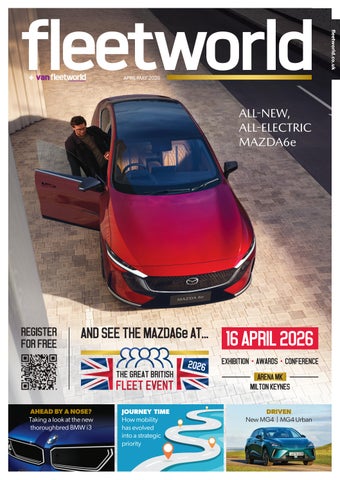
Welcome to this latest issue of Fleet World, which arrives as we look ahead to the forthcoming Great British Fleet Event on 16 April 2026
The conversations taking place reflect an industry in transition – one that is moving from simply managing vehicle assets to overseeing a far more fluid and interconnected ecosystem of corporate mobility. As the legislative and economic landscape continues to shift, the role of the fleet manager has never been more challenging, yet arguably never more central to a business’s bottom line and its sustainability credentials.
Our keynote mobility feature explores this shift in detail. From the democratisation of electric vehicle access to the complexities of autonomous insurance and the volatility of global energy markets, our contributors highlight that agility is no longer a luxury – it is a strategic necessity. We look at how data and flexible leasing are becoming the primary tools for mitigating risk in an era where traditional ownership models are being questioned.
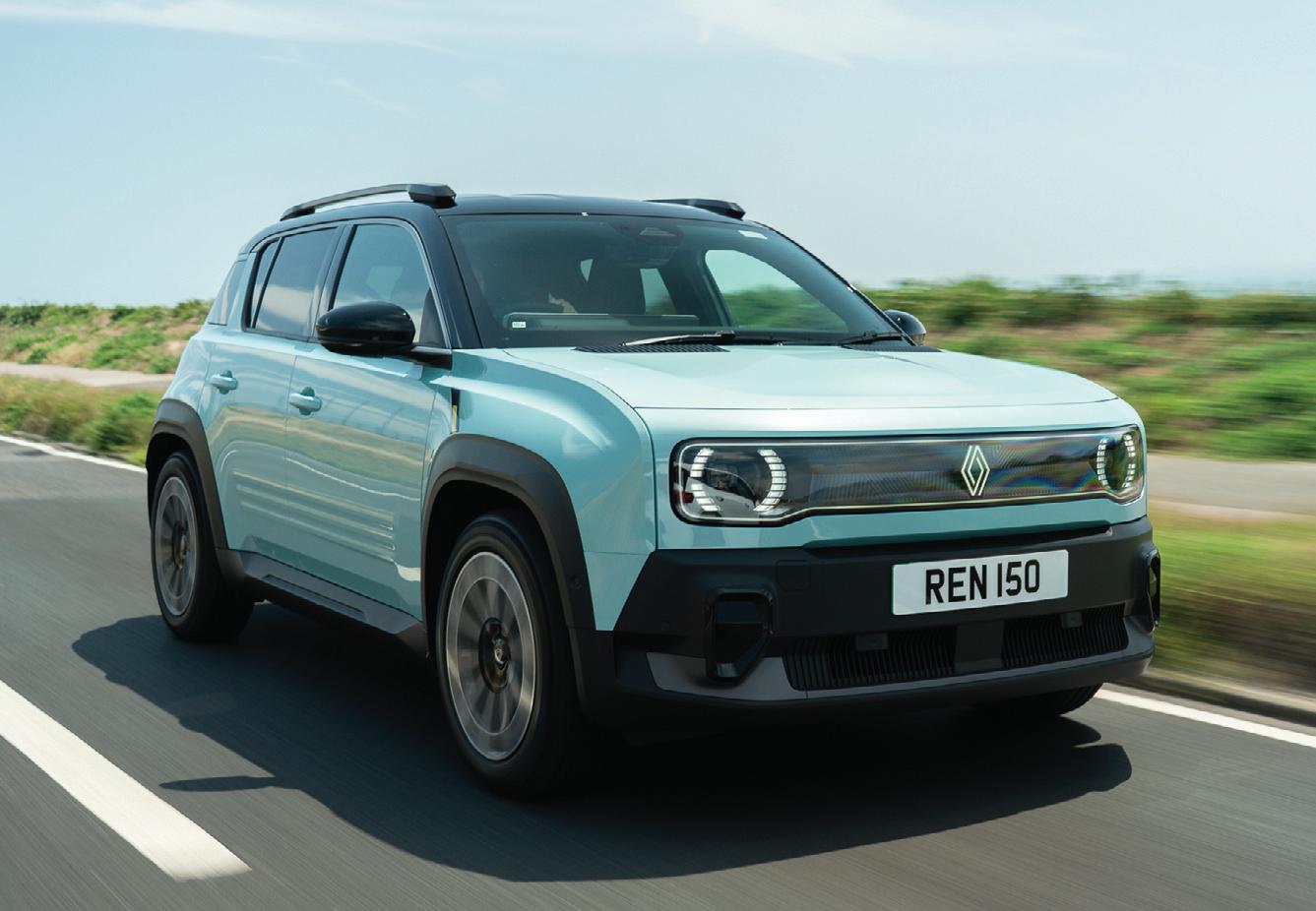
This theme of transformation is mirrored in our exclusive interviews. We sit down with Renault Group’s Justin Costello to discuss how one of Europe’s heavyweights is repositioning its corporate offering to meet the needs of a modern, diverse workforce. This strategic pivot is becoming increas-
ingly common as OEMs move from being simple vehicle manufacturers to becoming full-service mobility providers, integrating software and energy solutions directly into their fleet propositions.
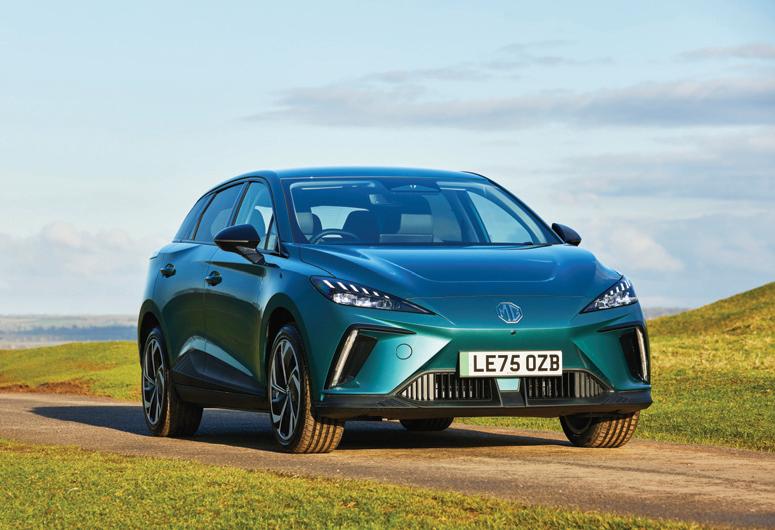
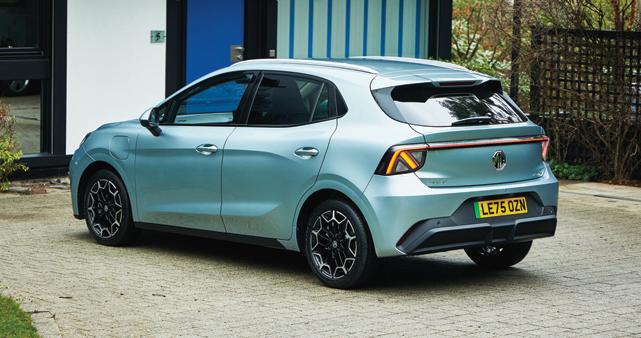
On the road, the electric offensive remains front and centre. We take a look at the forthcoming BMW i3 and get behind the wheel of the Toyota C-HR+. We also try the MG4 and MG4 Urban – models that are earning their places in the UK’s EV fleet landscape thanks to their blend of range, technology and accessible price points. These vehicles represent a maturing market where choice is finally catching up with corporate demand.
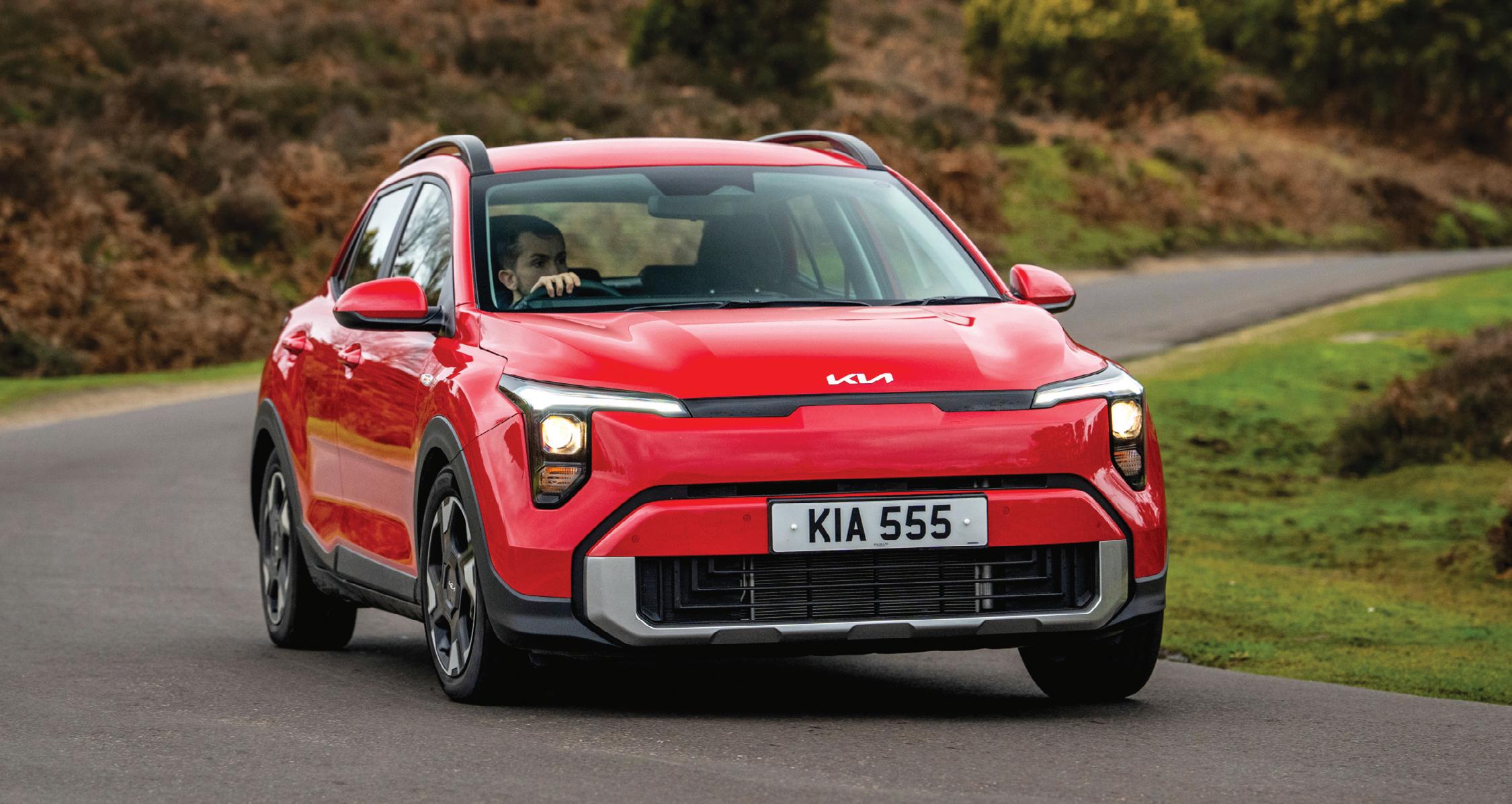
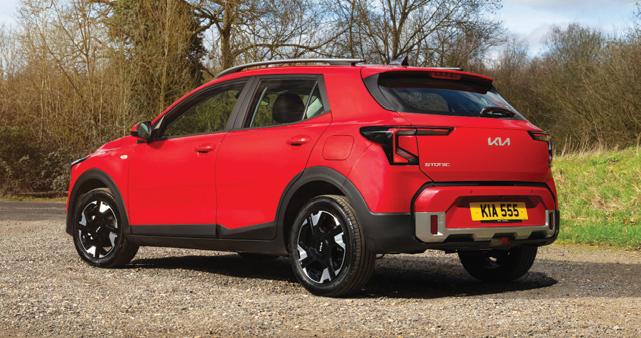
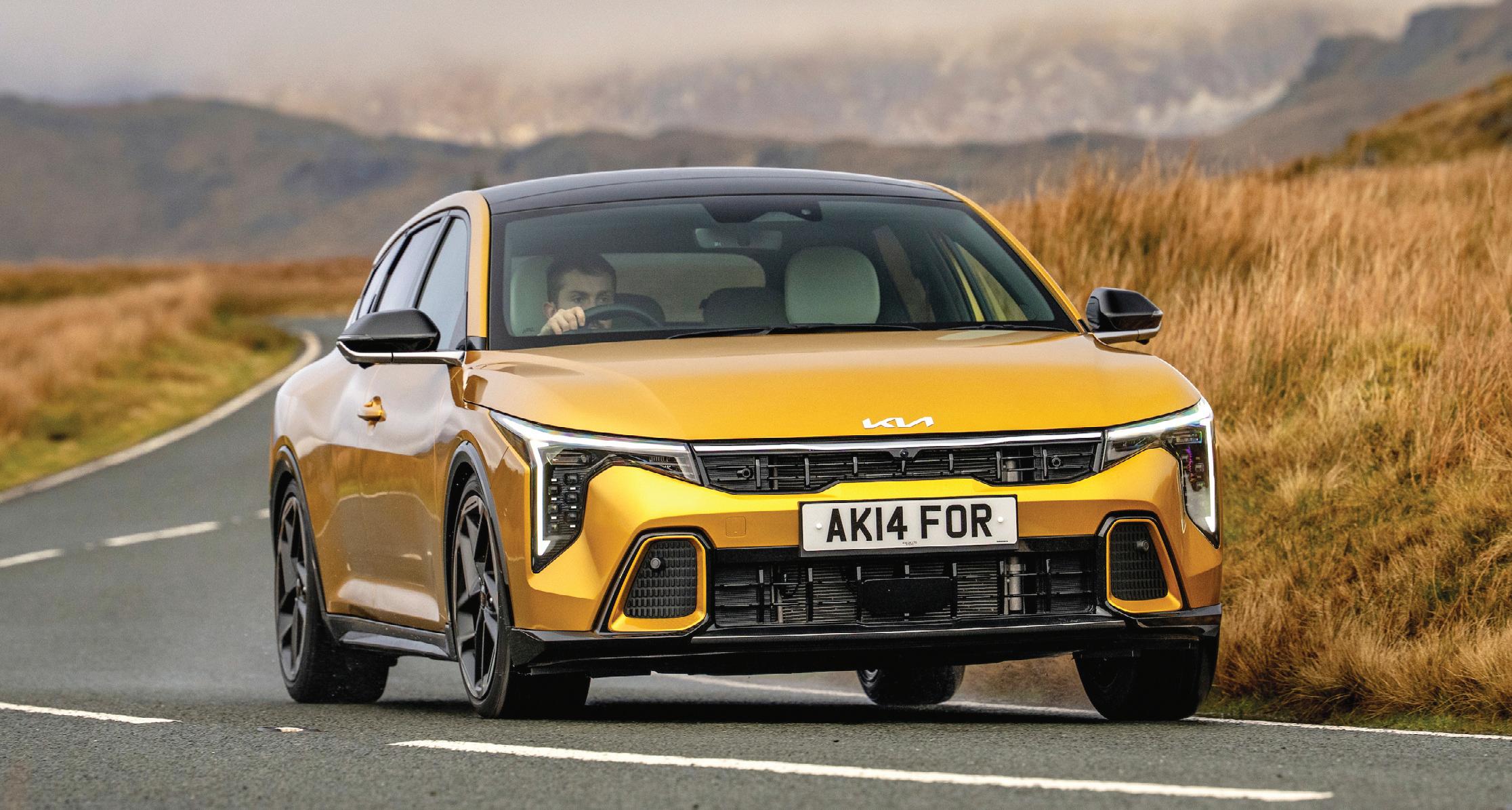
However, we recognise that the transition is not happening at a single speed for every operator. For those still balancing the practicalities of petrol power in specific highmileage or operational roles, we also take a look at the Kia K4 and the 2026 Kia Stonic. These reviews ensure there is pragmatic insight here for every fleet profile, regardless of where they currently sit on the road to zero.
Whether you are joining us at the Great British Fleet Event to network with peers and explore the latest innovations, or reading from the office, I hope this issue provides the perspective needed to navigate the increasingly complex road ahead.
Don’t miss out...
SCAN HERE to register for free!
Be sure to fully benefit from the FREE Masterclass seminar sessions at our upcoming Great British Fleet Event on Thursday 16 April 2026. The one-day fleet extravaganza promises to offer plenty of opportunities to meet inspirational people and learn ideas and approaches that can improve your fleet and your business. It’s also a brilliant opportunity for networking with suppliers in the industry! See more on page 37, and we look forward to meeting you there...
MAGAZINE
Martin Ward automotive consultant
What is your ambition in your current job role?
To carry on as long as possible, staying busy, in journalism and consulting. And to learn at least one thing every day and, most of all, to see my five grandkids grow up and be happy and healthy.
What job did you want to do when you were growing up?
To be an airline pilot. It seemed to be such a glamorous job back when I was growing up, but I’m glad now that I dodged that and went into the motor industry.
The best takeaway food? Indian, but it has to be half chips, half rice.
What’s the proudest moment in your career?
Working with so many manufacturers from early stages of a car’s design, right through to the final product, and seeing the original drawings, or clay models, finally come to life.
What’s your favourite film and why?
There’s Something About Mary I’m not one to watch films over and over again, but this film just makes me laugh.
If money was no object, what’s the first thing you would buy?
A flying car. It’s the best of both worlds because I could still take it out for a proper drive on the weekends, but then just fly over the traffic on the M1 or M62 during the week.
Name three cars in your dream garage?
Jaguar E-Type, VW ID. Buzz long body seven-seater, Citroën DS21.
What are the biggest challenges facing fleets at the moment?
The potential introduction of the pay-by-mile tax for EVs and PHEVs. This is going to be near impossible to police.
You’re on your dream holiday. Where are you? Having travelled the world a good number of times on business, the dream holiday is to stay local in Yorkshire.
Night in or night out? Mostly nights in.
Supermarket of choice? Morrisons.
What car do you currently drive?
A VW Multivan seven-seat plugin and a 1968 Mini Moke.
Tea, coffee or other?
Tea, black, no sugar. Made with Yorkshire water, of course.
Books, mags or podcasts?
I’ve never listened to a podcast, don’t get time to read a book, and magazines are too expensive. But I do listen to Radio 2.
Who is your idol in life and work?
After all these years, I still don’t understand how a car goes from an idea, onto a drawing board, through to the final driving product. So, my real idols are those huge teams who work together to make it all happen.
Volkswagen Transporter Commerce Short Wheelbase From £16.64 per day, delivered within 48hrs*
Ordered by 4pm Monday-Friday, excluding bank holidays *Rates
ANALYSIS
UK’s £1bn BOOST FOR ELECTRIC FLEETS
A TURNING POINT OR A LOGISTICAL LEAP OF FAITH?
The UK government has launched a massive £1bn investment package designed to kickstart the transition to electric heavy goods vehicles and vans. While the package is being hailed by some as a necessary lifeline for a greener economy, others say it’s a financial gamble that overlooks critical gaps in operational fleet readiness and repair workforce skills. By
Natalie Middleton.
The new funding aims to dismantle the two primary roadblocks to electrification: the staggering upfront cost of heavy electric vehicles and the lack of charging infrastructure.
The package of measures includes the new plug-in truck and van grants for 2026/7, now labelled as the Zero Emission Truck and Van grants.
Under the new terms, businesses can now claim up to £81,000 off a single heavy truck, covering up to 40% of the cost.
At the same time, the new plug-in van grant continues to offer up to £5,000 for electric vans.
Perhaps more crucially, a reinforced Depot Charging Scheme offers grants of up to £1m for businesses and local authorities to install high-powered charging points at their home bases.
The incentives are focused on bridging the cost gap and ministers hailed the move as a vital shield against volatile global fuel prices.
Decarbonisation Minister Keir Mather framed the investment as a dual-purpose win for the economy and the environment, stating the move “supports jobs” and “gives operators protection against shifting global fuel prices” amid ongoing international conflicts.
Advocates such as Jonny Berry of Novuna Vehicle Solutions called the
move “exactly the kind of backing fleets have been waiting for,” noting that depot charging is the make-or-break factor for van and HGV operators.
Similarly, the BVRLA highlighted that the support would give SMEs the confidence to “electrify at scale”.
But others in the industry warned that cash alone cannot solve the “real-world” hurdles facing the logistics sector – ranging from vehicle suitability to a critical shortage of qualified mechanics.
Major manufacturers have urged caution. Lisa Brankin, MD of Ford Britain and Ireland, warned that despite the grants, “fully electric vans still are unsuitable for many commercial businesses”. She argued that for drivers with demanding duty cycles, plug-in hybrids remain a more practical bridge than pure electric models today.
Venson Automotive Solutions echoed these concerns, warning that a “like-forlike switch” is impossible. It says that without a rigorous strategy covering grid capacity, payload requirements and mileage patterns, businesses risk:
• Increased vehicle downtime due to charging needs
• Inefficient charging schedules that disrupt delivery windows
• High ‘whole-life’ management costs if vehicles aren’t fit for purpose
While the Government focuses on vehicles and charging, the Institute of the Motor Industry (IMI) has raised a red flag regarding the human element of the transition. New data reveals a startling “mismatch” in the UK’s repair workforce: currently, only one in four UK technicians are qualified to work on electric vehicles.
Nick Connor, CEO of the IMI, welcomed the funding but warned that the transition risks being “constrained” without a skilled workforce.
“Funding vehicles and infrastructure is only part of the solution,” Connor noted. “Without the skilled workforce to maintain, repair and safely handle these vehicles – particularly high-voltage systems – the transition risks being constrained. We cannot afford a mismatch between the number of electric vehicles on the road and the number of qualified technicians able to support them.”
He called for targeted government support for training to ensure safety standards match the pace of the rollout.
The Government is investing billions into the UK’s transport and supply chains, but the focus now shifts from providing capital to real-world delivery. Whether the UK’s fleets can adapt as fast as the funding allows remains the billion-pound question.
We're the UK's No.1 breakdown service provider We have more expert patrols in more places
We fix 4 out of 5 cars at the roadside
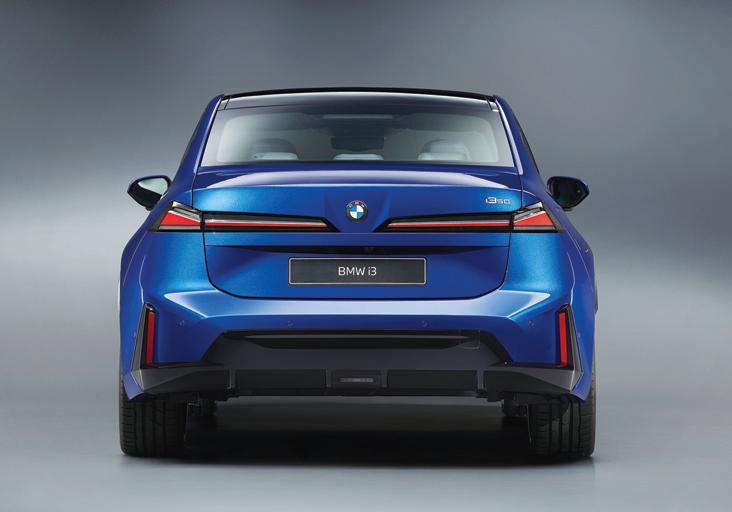
BMW i3
What is it? Electric premium saloon
When is it available? Autumn 2026
Biggest changes? Replacement for BMW i4 Fleet appeal? Likely to be BMW’s fleet best seller
Wait,
there used to be an
i3
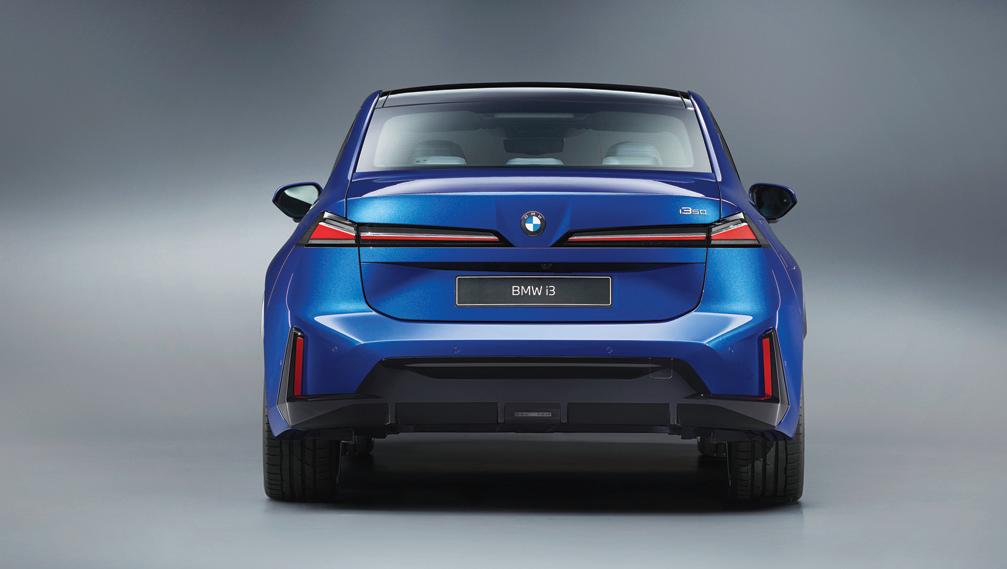
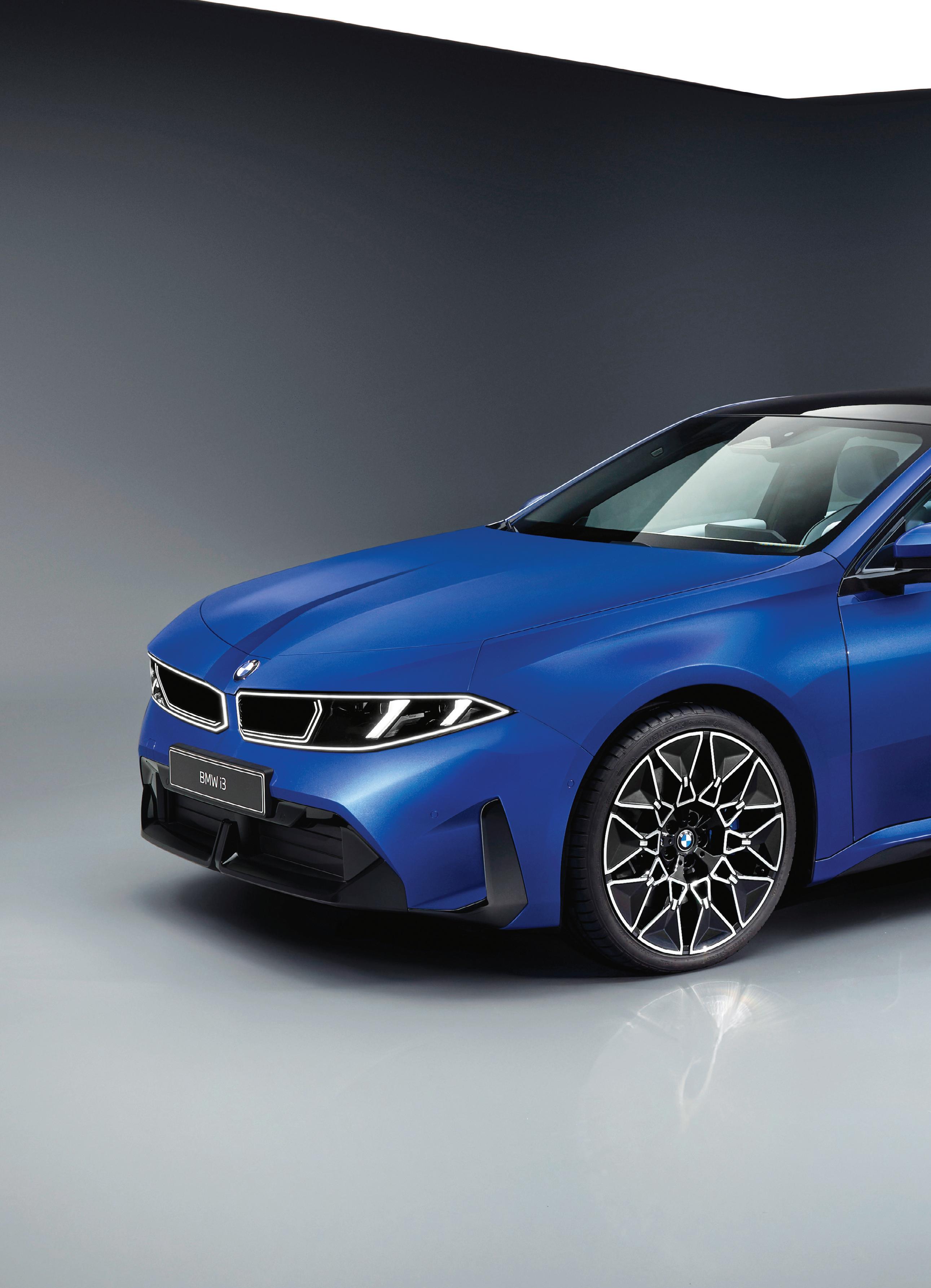
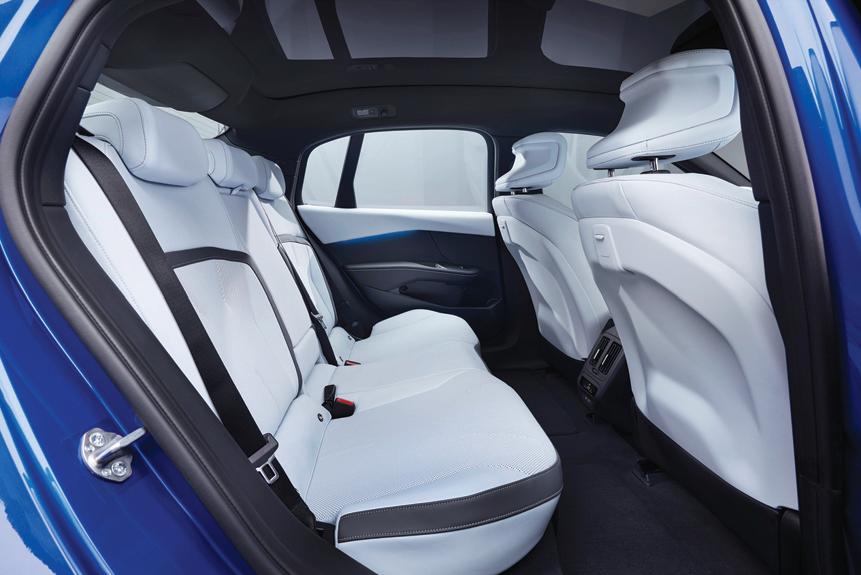
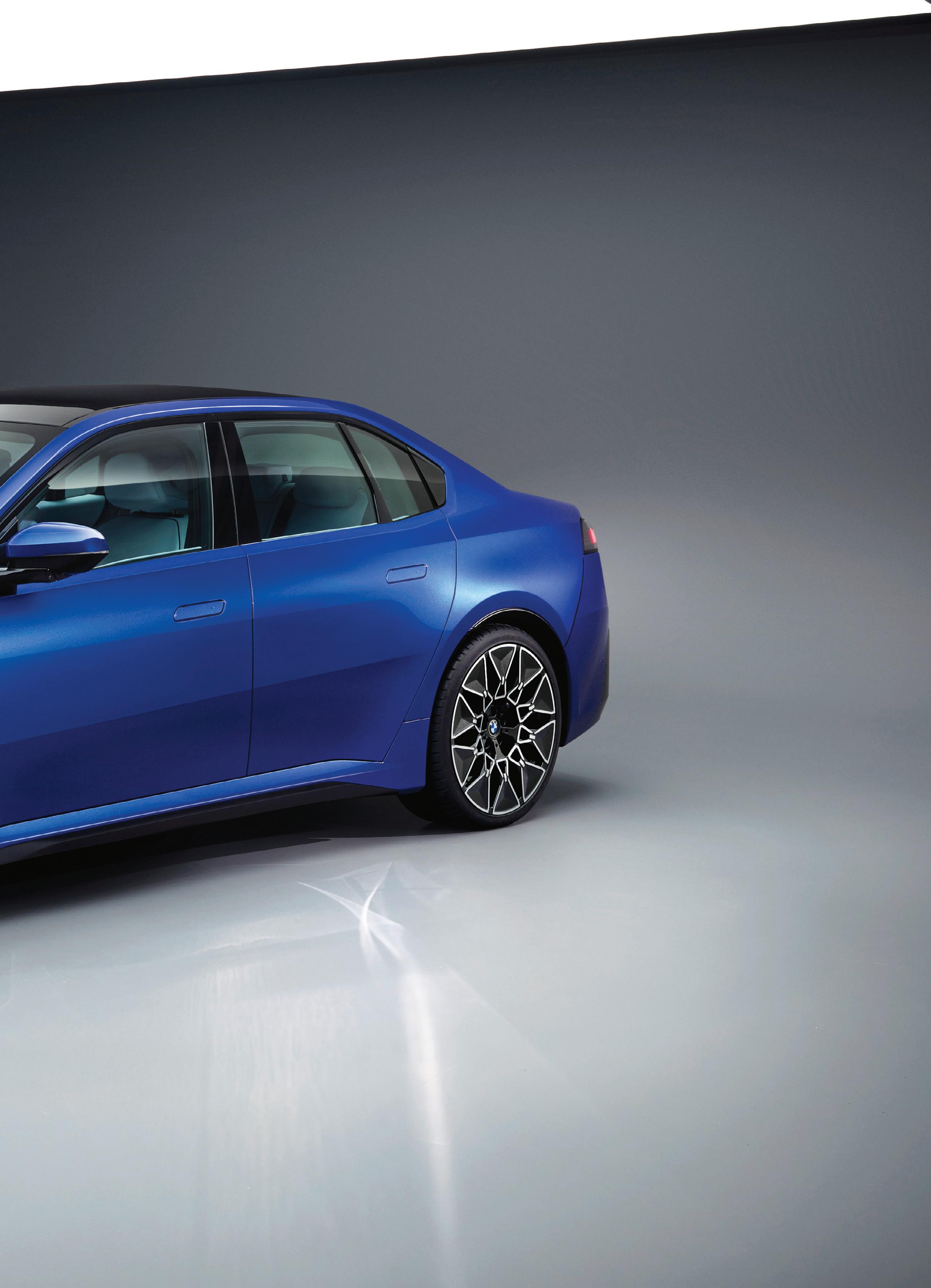
BMW’s pioneering electric small car is not back from the dead. The i3 is the first model to be introduced in the new 3 Series range. It’s essentially a replacement for the BMW i4, and will be available in both saloon and Touring body styles. Such is the importance of electric to BMW, this model is unveiled six months before we see the 3 Series saloon.
Capacity to impress
The second model in BMW’s ‘Neue Klasse’ vision (following on from the iX3), the car launches as a 50 xDrive with a dual-motor layout and 469hp. We expect to see less powerful and more powerful versions in due course. Battery capacity is 112kWh (gross), and, like the iX3, the battery unit is part of the car’s structure rather than sitting on the frame, allowing a reduction in weight. The WLTP combined cycle range is up to 559 miles – the longest of any production car to date. It can charge at up to 400kW and, on suitable chargers, add 250 miles of range in 10 minutes.
Business class
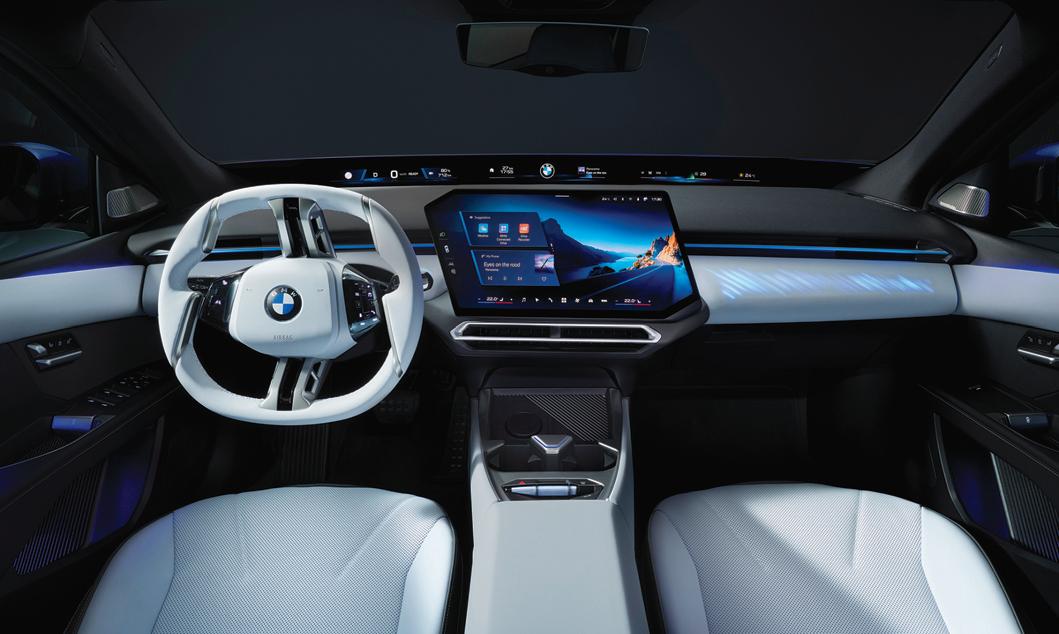
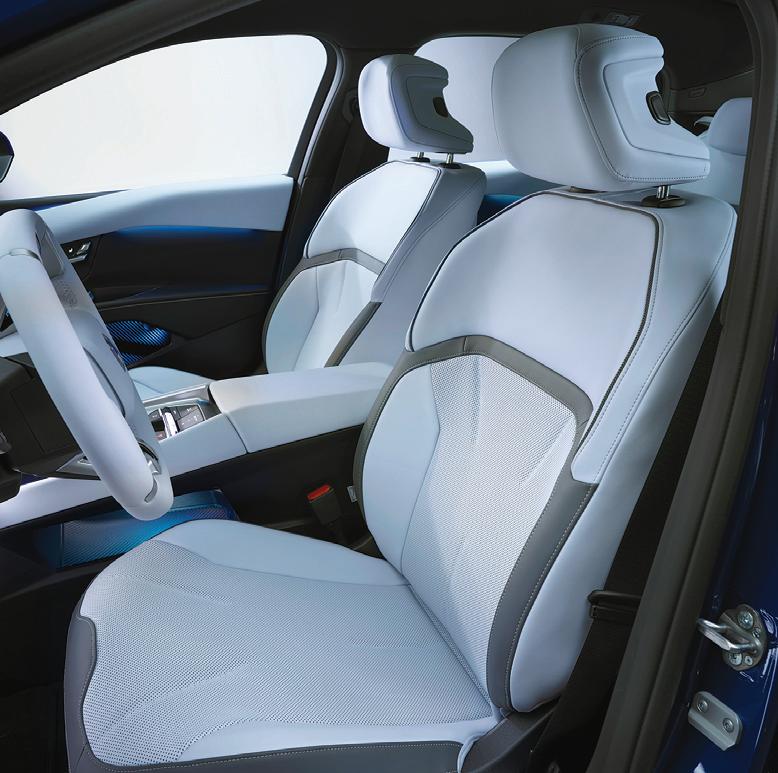
The i3 interior features BMW’s new Panoramic iDrive user interface and a focal point of this is the Panoramic Vision display that spans the base of the windscreen. Drivers can select widgets from their preferred info and data, and have them added to the display. There is a greater use of recycled materials inside than in the previous generations, and the whole cabin feels calm and driver focused.
Making the grade
The standard model is merely called i3 50 xDrive, with the option to upgrade to M Sport and M Sport Pro available, as with the iX3. There is also likely to be a number of options clustered into packs, with the Technology Pack usually the most significant for resale value.
VERDICT
This generation of EV is important for BMW to get right, as there is an opportunity to lead before Audi and Mercedes-Benz launch their rivals. The early signs are the i3 will hit the mark, and unlike the i4, which was only offered as a Gran Coupe, the saloon and Touring variants will broaden the car’s appeal.
... OF A FLEET MANAGER
Our industry insider lifts the lid on everyday fleet issues.
two-hour sit in service reception, and two free mugs of tea and Biscoff biscuits.
When I get the call from a driver to say a little yellow light has come on, in the midst of the instruments in front of them, I instantly know it’s going to be hassle; for the driver, and me, the fleet manager. The engine management light coming on is invariably a false alarm.
We recently had one of our drivers who had the dreaded yellow light syndrome. He called me, and asked what the problem could be. Of course I knew, sitting in my office over a hundred miles away, I am telepathic after all…
You never know if it is serious, or just a faulty sensor; it normally is the latter. He took it to his local garage, sat and waited for someone to look at it, and either condemn it, or say the usual, “It’s just a faulty sensor.”
As expected, it was a dirty CO 2 sensor, presumably cleaned and he was sent off on his way, after only a
But just two miles down the road, the light reappeared. He turned round and took it straight back. They said it really needed a new sensor as it was probably faulty – I could have told them that, from a hundred miles away.
But no sensors in stock, he’d have to book it in for next week. He turned up on time, and asked to wait. Another two hours later, and more free tea and biscuits, a new sensor was fitted. But the engine management light remained on, further diagnostics revealed it needed a new oil sensor, as that too was faulty, and could he book it in next week, as no part was in stock.
He duly turned up, again, at the right time, on the right day, and was told by the service receptionist they were busy, and there were seven other people also waiting for jobs to be done. Two and a half hours later, after yet more free tea and biscuits, it was finally repaired. They’d actually fixed a problem that really didn’t exist, just faulty sensors. Six and a half hours waiting in service reception, six mugs of tea, seven
packets of biscuits. What a waste of time for our busy drivers.
POTHOLES...
Potholes, potholes, I’ve never seen as many, and our drivers appear to be the experts in finding them, and driving into them. Seems almost every other day I get a phone call to say we’ve yet another flat tyre, at best, or at worst a completely ruined wheel and tyre, where both need replacing. And what a performance it is when that happens. Never a spare wheel in the car, usually having to wait quite a while for recovery. Tyres are easy to source, but wheels are not readily available in stock.
I have informed our drivers that if they do have tyre or wheel damage, take photos of the pothole, get the exact location, photos of the damage to the vehicle and send all evidence and receipts to the local council, and put in a claim. It is hit and miss whether they do pay out, or will try and say the road is well maintained and regularly inspected.
But it is definitely a pain going through all the rigmarole to get compensation. The money is important, but the time and hassle caused by potholes is immense.
“Our drivers appear to be the experts in finding them, and driving into them.”
Matt Hammond
vice chair, Association of Fleet Professionals
WHERE FLEET MANAGERS WANT HELP RIGHT NOW industry insight
The month of May sees our annual Association of Fleet Professionals (AFP) Conference held, as is now customary, at the British Motor Museum, Gaydon. It’s our showcase event, set to attract more than 200 delegates, and will be a great day full of vital discussions.
As with previous years, we have designed the content around the areas our members told us they want to see covered when they booked their place. Although we won’t have time to cover them all in detail at the conference alone, the results make fascinating reading. As a snapshot of where fleet managers are looking for ideas and support right now, they help us focus where we place our resources.
The top result by some distance is the shift to electric vehicles . This is unsurprising. The 2035 petrol and diesel end-ofproduction deadline looms closer with each passing month, and there is ongoing discussion about its implications. Much of the lowhanging EV fruit has now been picked and we are working through vehicles and applications that are more difficult to transition,
notably in the van sector, where electrification is occurring at a much slower pace than once expected. How, and even whether, this can be achieved will be an important subject at the conference.
Second is an area we call fleet management , a heading that describes the profession at a strategic level, covering everything from sustainability policies to the growing use of artificial intelligence. This is really the longer-term, even slightly blue-sky area of our programme and is sure to prompt some insightful discussions.
Next is compliance and risk. This topic is consistently rated as important by fleet managers both from a legal and ethical point of view, and there is added impetus at the moment following the recent announcement of the Government’s new road safety strategy, which has implications for fleets in several areas.
Fourth is infrastructure . It’s widely perceived that charging availability is the number one obstacle to electrification for fleets – in terms of location, cost of installation and the price of power. It’s also a brake
on EV adoption for many potential car and van buyers in the used sector. How this situation can be tackled, including our recentlylaunched shared charging project, is a key concern for AFP members.
Public sector fleets form an important, and growing, part of our organisation, with a dedicated committee that discusses their needs. This is a fascinating area where budgets are under pressure but some excellent work is being done, notably when it comes to speed of electrification.
A subject rapidly climbing up the fleet agenda is alternative fuels . This is a term that has at various times been attached to gas and electric cars and vans but in 2026, really refers to commercial vehicles powered by options including hydrotreated vegetable oil and biodiesel. There is considerable interest here and the AFP recently produced a new guide for members.
Second-to-last – although no doubt much higher in terms of real-world priorities – is cost. Spending almost everywhere remains tight and identifying new areas where savings can be made and value maximised is always a subject that attracts attention. Especially, at the moment, the role of new technology is a focus here.
Finally, and again not an indication of actual importance, are drivers . Managing employees who use the fleet forms a major part of everyday activity for our members, and we currently hear much about handling the large number of penalty charge notices being generated. Preventing and processing these is definitely an area of interest.
Looking back over this list in its entirety, it certainly provides a useful summary of the issues facing fleet managers in 2026, and we are shaping the content of the conference to reflect these concerns. While there are a host of challenges facing our profession, there are also many innovative solutions being created producing impressive results. We look forward to seeing our members on 13 May 2026 to hear about the latest thinking in all of these areas.
Start your EV journey today and contact one of our expert EV Consultants:
The Renault renaissance
In the fleet market, a 68% increase in true fleet volume is a result that demands attention. For Renault Group UK, this rise from a 0.7% market share in 2023 to a peak of 3.6% is the result of a two-year journey. I sat down with Justin Costello, head of fleet at Renault Group UK, to discuss the structural changes behind this conquest.
Costello attributes the momentum to three main changes, starting with a massive product offensive. “Renault Group and Renault have got the newest line-up probably in the industry outside of the new entrants,” he explains. “We’ve renewed almost every model in the last two years. In the staples, we’ve added new models and new segments – particularly electric vehicles. We’ve added Scenic, and Renault 4 and Renault 5 in that B-segment have been a great growth for us.”
The shift in the UK landscape is visible in the powertrain mix. “You’ll remember Renault from yesterday, right? It was diesels and Megane Tourer. Now we are around 70-80% EV, and that’s been phenomenal.”
Head of fleet Justin Costello explains how a group strategy is rewriting the fleet rulebook. By Simon Harris.
Beyond the metal, Costello has grown his team. “We’ve added some really crucial roles: a dedicated public sector manager, a dedicated national fleet aftersales manager – to give the right in-life service – and a new national leasing manager putting together leasing and a direct proposition.” At the centre is the fleet operations team. “The fleet operations is the heart of our team. It’s sales enablement for the fleet team, but it’s also the right service for our local fleet business and that SME space.”
The most process-driven change is the move to a unified Renault Group identity. “Everything we do to go to market is Renault Group,” Costello says. “If you think of what we could do portfolio-wise, we can offer everything from a Dacia Spring all the way up to a Renault Master E-Tech, Alpine A290s and now 390s. One contact, one contract. It’s really important for our customers that we can offer everything in one go.”
This group approach is delivering across all badges. “We doubled Dacia volume yearon-year. Alpine? We were the strongest
market outside of France. It’s been true group growth, not just Renault cars.”
With increased volume comes the need for capacity. Renault is currently growing its Pro Plus LCV specialist network from 30 to 50 sites. “We’re investing in much more capacity. We have some sites that are nonbranded behind the scenes that allow us to increase our footprint,” Costello notes.
The focus is on uptime and speed of communication. “Minimising downtime is the key focus, but data is absolutely at the heart of it. We are putting all of our LCV guys through more fleet-focused service training. We’re also spending a lot of money on what we can do for uptime, empowering our customers with data.”
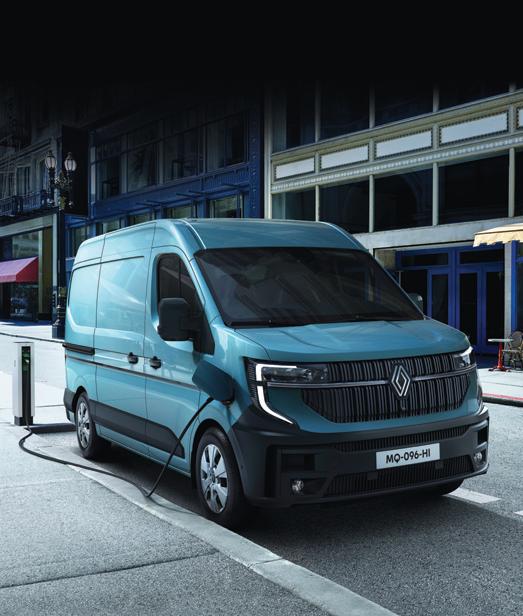
The new Master E-Tech (pictured below left) is already proving its worth with ‘megafleets’ such as Virgin Media and major utility businesses. “What I really like is the fact that in the SME space, customers are also saying, ‘Oh, 280-mile range. Great. I can make that work.’ We’re really hoping our Trafic van, with new technology and that range, is going to broaden that experience even more.”
Renault Group is offering fleets LCVs, high-performance Alpines, the Renault mainstays and value from the Dacia range.
The
Costello’s philosophy on EVs is about “democratising” ownership. “It’s about having the right vehicle at the right price point with the right tech,” he says. Regarding the Renault 4 and 5, he notes: “The conversation’s not about range. They’ve got great range, 250 miles plus, but that doesn’t even come into it. If you’ve got the right car for the right use, with a bit of character... customers begin to think about that in a more realistic way.”
He argues that for many, a massive range isn’t the priority. “If they’re doing a 30-mile commute, do they really need 400 or 500 miles’ range? Or would they rather save £10-15k on the list price?
Renault has done a really good job in having great value, whether you look at the Spring, the 5, the 4 – we are among the best-value EVs in the UK.”
This desirability feeds back into the other component of new car sales –retail. “You’re thinking, why is a head of fleet talking about retail? Used car is a retail environment. What we really need to do is make sure that we are creating a great first use on fleet and a really good
second use for retail. Because of the RV situation and the competitive list price, they’re being really well received in the retail space.”
Renault has opted to use the Google OS as the heart of its media system rather than building from scratch. “It’s something people are used to; it’s very quick and dynamic, not very laggy,” says Costello. “Google Maps is one of the most popular apps for any phone; the fact that it’s integrated in our car and essentially is our sat-nav just makes customers immediately at home.”
The brand is also winning fans with a ‘one-button’ approach to safety tech. “We have one button in most of the models that you can press that sets [ADAS] up for you in one go. What a lot of customers get frustrated about is as soon as they turn their car off, they have to individually set up all those systems. Feedback on that is phenomenal.”
Costello is a proponent of physical controls. “Our designers have worked hard to balance software and physical buttons. When you’re driving, you don’t
want complicated. You want safe, quick and easy. Physical buttons – are they old school? They’re really well received.”
Finally, Dacia has found its feet in the fleet world by solving specific logistical issues. “Dacia fixes fleet problems,” Costello claims. “We still have a sevenseat vehicle in the Jogger. It’s really popular because true seven-seat vehicles are in decline. We’ve also got Duster in a 4x4 for public sector and utility companies, and Duster Commercial where fleets don’t want the car tax burden.”
The introduction of the Spring has been “transformational”, offering an EV at less than £15,000 on the road. “When you’ve actually introduced the fact that we have the whole range, you then do get additional sales. Our overall growth is how powerful all of the brands are together.”
As the Alpine A390 joins the line-up –an “espresso thing” with “character” to rival the “standard-issue grey, boring SUV”, Costello says – the group portfolio is complete. The Renault strategy is simple: “One contact, one contract is the engine of the Renault renaissance.”
“The UK is the strongest market outside of France. It’s been true group growth, not just Renault cars.”
Renault 4 is winning drivers over for its standout looks as well as its great range
MOBILITY
REDEFINING THE JOURNEY
As fleet management and corporate travel merge, ‘mobility’ has evolved into a strategic priority, moving beyond simple vehicle assets to encompass driver safety, operational agility, and legal complexities.
Four industry leaders explore macro-trends, including the democratisation of vehicle access, shifting energy costs, and autonomous liability, to outline methods for achieving a safe, cost-effective travel experience.
EMBRACING EFFICIENT DRIVING
PDavid Savage, chief revenue officer at Lightfoot, says global markets and geopolitical factors are out of fleet managers’ hands, but driving efficiency remains the ultimate hedge against rising costs.
ump prices remain unpredictable, but how efficiently vehicles are driven is something fleet operators can control – and the savings are significant.
With petrol prices ranging from around 106p to 191p per litre over the past five years, and diesel from 112p to nearly 199p, long-term fuel cost planning has become increasingly difficult for fleet operators. These aren’t marginal shifts; they represent swings of up to 80% that can dramatically alter operating budgets with little warning.
A range of factors have driven this instability. Issues such as Covid, the threat of international tariffs, the ongoing conflicts in the Middle East and Ukraine and domestic challenges including increased taxation, have all contributed to significant fuel price uncertainty in recent years – and with the global outlook remaining unsettled, there is little indication that volatility will ease any time soon.
The fluctuations serve as a clear
reminder of where fleet managers should focus their energy.
Petrol and diesel costs can spike rapidly due to global events or supply pressures, and for fleets running hundreds or thousands of vehicles, even small per-litre changes can add hundreds of thousands of pounds to annual fuel bills.
In 2025, Lightfoot drivers saved around 109 litres of fuel for every 10,000 miles driven. If fuel reaches £2 per litre, that’s roughly £218 saved per vehicle – and for large fleets those efficiency gains quickly add up. That’s a meaningful financial buffer against market uncertainty.
The impact doesn’t stop at the forecourt. Rising energy costs can ripple through supply chains, pushing up delivery costs and squeezing operational budgets at a time when many businesses are already navigating rising expenses across the board.
With the UK electricity network still partly dependent on gas-fired generation, fleets transitioning to EVs aren’t
immune to energy price swings.
Volatility doesn’t just affect petrol and diesel – it can also influence electricity prices. That means even fleets moving to electric vehicles need to think carefully about how they manage energy use and efficiency. The underlying principle is the same whatever the fuel type.
Lightfoot’s in-cab driver coaching technology targets the behaviours that burn fuel unnecessarily – excessive acceleration, harsh braking and engine idling. Fleets using the system have reported fuel economy improvements of up to 15%, with a further 9% MPG uplift available through the Lightfoot driver app.
The reality is that fleets can’t control what happens to energy prices. But they can control how efficiently their vehicles are driven. In an unpredictable market, reducing consumption through smarter driving and better data is one of the most effective strategies available to fleet managers – and the results speak for themselves.
MOBILITY
THE RIGHT POLICY CAN ENSURE THE BEST MOBILITY EXPERIENCE FOR INFREQUENT BUSINESS TRAVELLERS GOING OVERSEAS
RBy Andy Bland, head of business rental UK & Ireland at Enterprise Rent-A-Car.
esearch has suggested that nearly three-quarters of UK small- and medium-sized businesses expect to see their revenue grow in 2026.
In our experience of working with organisations of all sizes, this often means an increase in business travel overseas, as organisations start to explore international trading and operations. At present, around 18% of Enterprise’s UK customers with up to 250 employees also rent vehicles for business travel abroad.
Managing employees who may have little to no experience of business travel can present a host of new considerations.
How can businesses design a plan to support employees and ensure they have the right mobility when travelling abroad while managing costs, risks and liabilities? What are the considerations for supporting employees new to international business trips, particularly those who are infrequent travellers?
Many first-time business travellers may have concerns about practical logistics –questions that go beyond the simple consideration of potentially driving on a different side of the road. This is where mobility partners can help to supplement in-house business travel expertise to ensure a great employee experience.
Sometimes the simple questions are the most important. For example, can your mobility partner support your employees at and near the locations they’re visiting?
The major international hubs are usually well-provisioned with transport operators, so how can your provider support employees branching out to explore roads less travelled, with the right vehicles, presence and support?
Airport rental is increasingly part of a picture that connects with vehicles located near accommodation, and with on-street car sharing options near railway stations and in city locations.
This creates a much wider range of options: does it make sense to encourage employees travelling long-haul to pick up ground transportation after they’ve had a chance to rest and refresh? If public transport – or even walking – is a better option while they’re in town, is it better to pick up a vehicle when they’re ready to move to their next location?
The car itself is another factor. Employees bringing product samples or other materials might need a larger vehicle. A documentary team might need to know interior measurements to ensure bulky padded equipment cases with fragile cameras and lights will fit inside.
Our 2025 On The Move research also found that 54% of people think there is too much technology in new vehicles. Is there someone on hand to explain how the tech in a rental car works to ensure employees feel supported, or information that can be shared in advance to address some of the key questions?
Our experience is that there can be no end to local variations. Car sharing and out-of-hours services are different in every country. An effective mobility agreement should ideally provide clarity of how that service will be delivered in every location.
Clear communications will help to ensure that those travelling have understood the travel policy – not just the what but the why.
Otherwise, an employee may take it on themselves to hire what appear to be the best options available. They may not understand the need to check insurance excesses, how damage will be handled, and if there are add-on charges.
Prearranged mobility options can also make the employee journey immensely better. If there is an opportunity to bypass a counter and head straight to the vehicle, it can be transformational.
Employees will feel more cared for and valued if clear thought has been given to streamlining the business travel experience and, as far as possible, shaping the ground transportation to suit their needs.
Infrequent overseas travelling may need additional support if you don’t have a business on the ground where people are travelling. Working with your mobility partners to create and communicate an effective travel policy can ensure that the employee experience is as positive as possible.
HOW VAN FLEETS ARE ADAPTING TO A MORE COMPLEX OPERATING LANDSCAPE
FSpencer Davi, sales and marketing director at Northgate Vehicle Hire, outlines what fleets can do to improve flexibility.
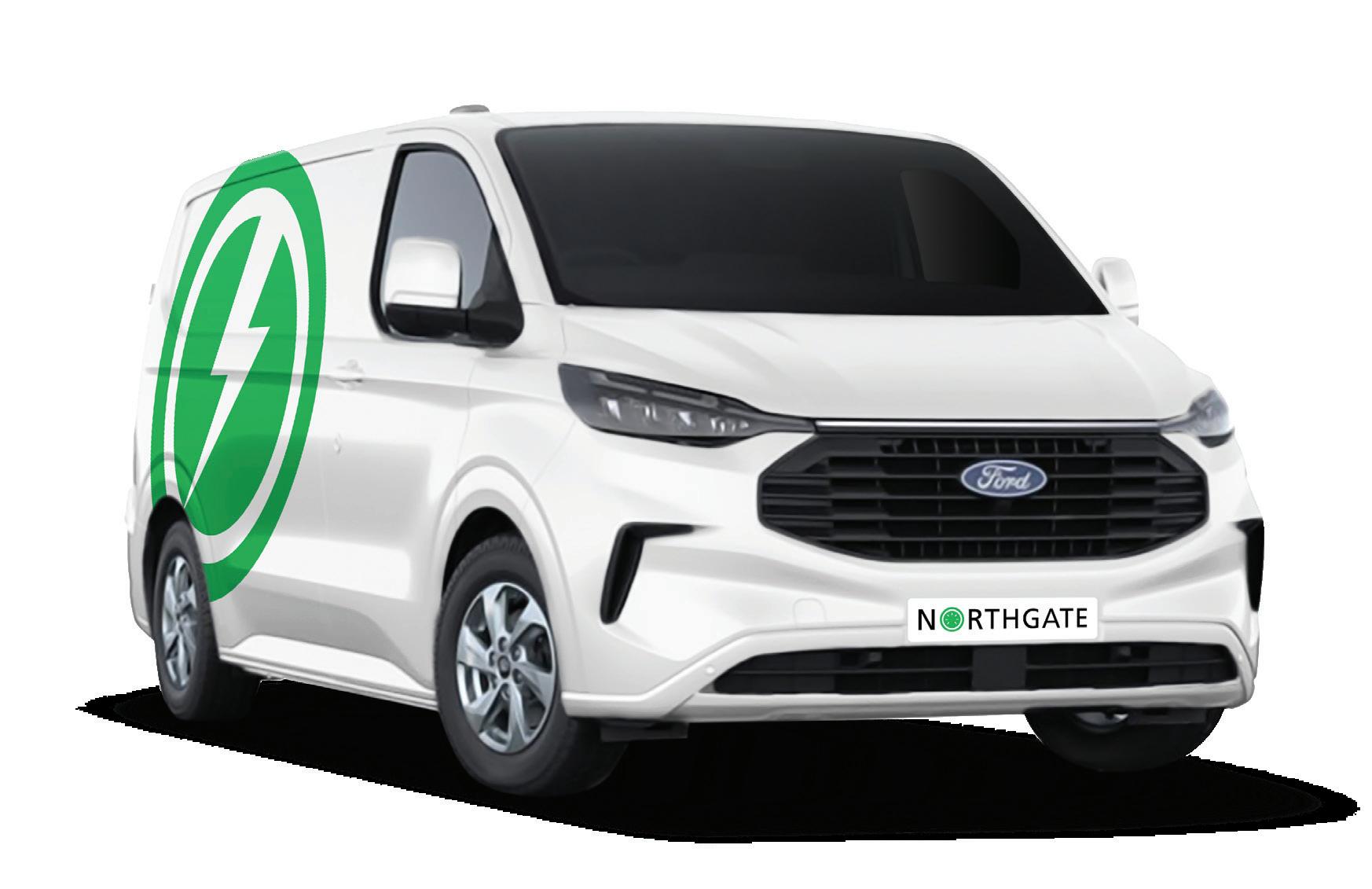
or LCV fleets, operational mobility –the ability to adapt quickly, respond to changing demands and minimise downtime – is becoming critical in delivering a consistent and efficient service to customers. From seasonal shifts and indemand products to the accelerating transition to zero-emission vehicles, the landscape is becoming increasingly complex.
Global events and wider economic pressures are also driving peaks and troughs in demand, which operators can’t control, highlighting the importance of flexibility even further.
Northgate Vehicle Hire is seeing this first-hand, and two areas – telematics and flexible rental solutions – are playing a particularly important role in helping fleets adapt.
We’re seeing customers that are really needing to adapt their operations at short notice. This level of change requires a more flexible approach, one where customers aren’t tied into long-term contracts that can make change costly.
Operators need the ability to adjust both fleet size and vehicle types in line with operational needs.
This flexibility is particularly important as fleets respond to the changing demands of electrification. While many organisations have clear sustainability targets, identifying which parts of a fleet can transition is not straightforward, requiring careful planning around total cost of ownership, operational efficiency, potential charging downtime and driver training.
Additionally, these decisions are being powered by data, giving fleets an evidence-based view of how their vehicles are actually being used, leaving less room for guesswork.
Electrification isn’t a one-size-fits-all solution. Fleets need to understand how their vehicles are actually being used before making that transition. Northgate also supplies trial vehicles, which allow
customers to try EVs in the right parts of their operation without disrupting service delivery.
Flexible rental is not just about shortterm demand. Many fleets are also turning to longer-term flexible hire models, which provide a more cost-effective option for vehicles needed over a longer period, without being locked in in the same way as traditional contract hire. This approach allows businesses to secure vehicles for extended use, while still retaining the flexibility to adapt as operational requirements evolve.
Alongside flexibility, telematics is increasingly central to how fleets understand and optimise their operations.
Fleet managers are looking for realworld insights into vehicle usage, from mileage and journey patterns to idling time and driver behaviour, to improve efficiency and reduce costs.
Fleets are placing much more value on data than they were even a few years ago. It’s not just about tracking vehicles; it’s about understanding how they’re being driven and used in day-to-day operations.
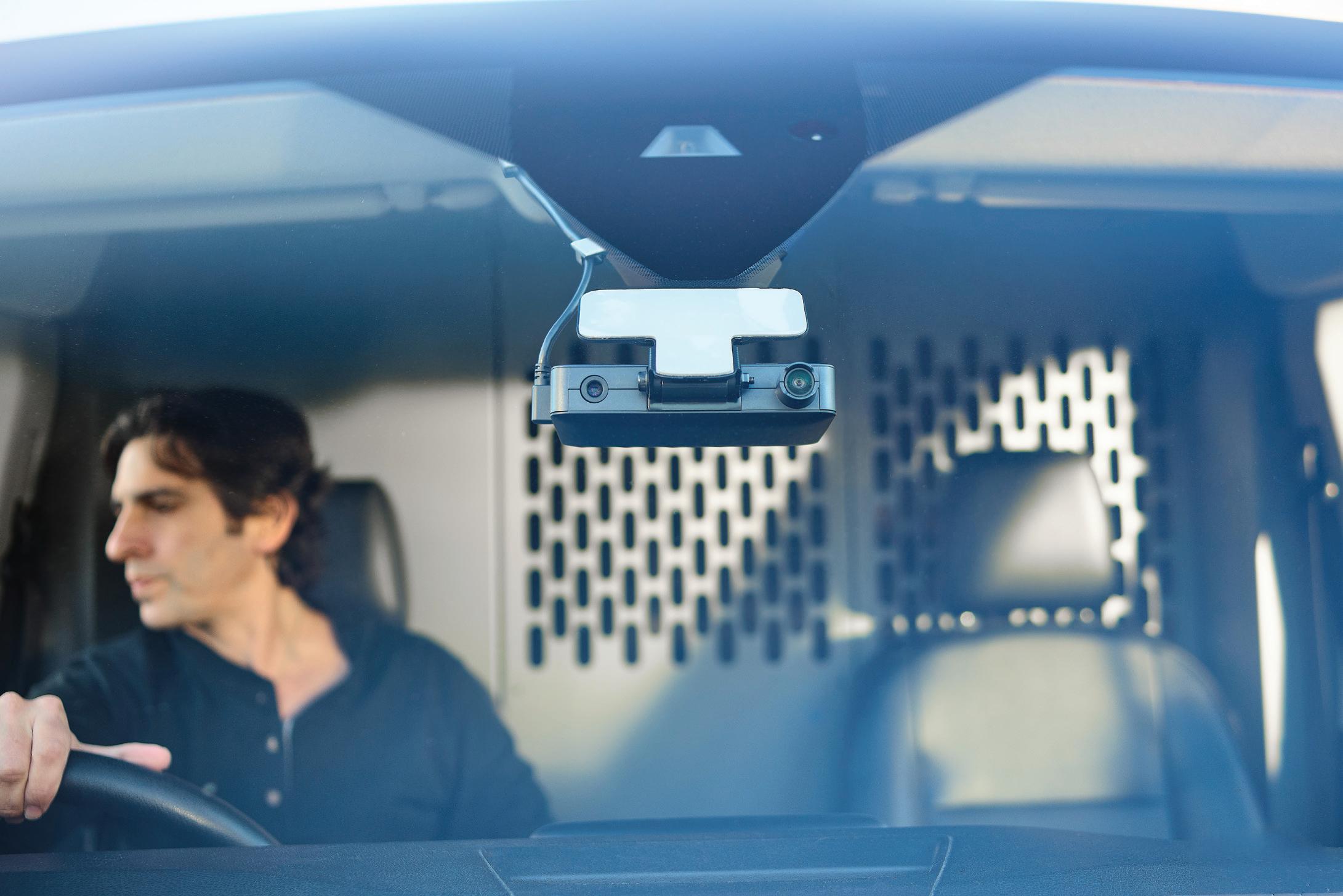
Camera-based telematics has been a key area of growth. By providing access to on-road footage, it takes telematics one step further, supporting driver safety and building more accurate risk profiles, which has become an important factor in managing insurance costs.
At the same time, telematics is playing a crucial role in supporting fleet electrification strategies. By analysing usage data over time, fleets can identify which vehicles are most suitable for EV replacement and where potential challenges may lie.
Northgate Vehicle Hire has seen this approach deliver tangible results through its Drive to
Zero initiative, where telematics data is used at the Consultancy stage to assess vehicle suitability, typical driver routes and mileage per journey, among other factors, to deliver phased transition strategies.
Data is the starting point for any successful EV transition. It allows fleets to move from assumptions to evidencebased decisions, understanding which vehicles can switch today and which require longer-term planning.
Importantly, the benefits of telematics are no longer limited to large fleets.
Northgate Vehicle Hire is seeing increasing uptake among smaller operators, who are recognising the role data can play in improving utilisation, reducing downtime and strengthening compliance.
Ultimately, operational mobility is about giving fleets the agility to respond to change and the insight to make informed decisions. Flexible rental provides the ability to adapt in real time, while telematics delivers the intelligence needed to optimise performance and plan for the future.
Introducing the
Preventing accidents is nearly impossible when you can’t see what's happening on the road. But you can see more, act faster, and improve driver safety with the Motive AI Dashcam Plus.
Can run 30+ AI models simultaneously
Hands-free communication between managers and drivers
Captures number plates automatically A unified design includes a built-in Vehicle Gateway
Discover all the AI Dascham Plus has to offer at .gomotive.com/en-gb
Motive empowers the people who run physical operations with tools to make their work safer, more productive, and more profitable. For the first time ever, safety, operations and finance teams can manage their drivers, vehicles, equipment, and fleet-related spend in a single system. Combined with AI, the Motive Integrated Operations Platform gives you complete visibility and control, and significantly reduces manual work by automating and simplifying tasks. Motive serves nearly 100,000 customers – from Fortune 500 enterprises to small businesses – across a wide range of industries, including transportation and logistics, construction, energy, field service, manufacturing, agriculture, food and beverage, retail, and the public sector.
AVS AND THE INSURANCE INDUSTRY WHERE ARE WE AT?
TNatalie Larnder, member of the Forum of Insurance Lawyers (FOIL) and partner and head of market affairs at Keoghs, looks at the unanswered questions for the UK’s motor insurance sector and the implications for fleet operators.
here’s growing excitement around autonomous transport – but far less scrutiny of what this means from an insurance and liability perspective – with Waymo confirming plans to launch fully driverless vehicles on London’s streets later this year.
The confirmation that fully driverless vehicles are likely to be on London’s streets during 2026 marks a significant milestone for the UK’s transport and insurance landscape.
Yet for all the technological momentum, the policy, regulatory and claims environment remains a work in progress. For insurers and fleet operators, the key issue is not simply whether autonomous vehicles (AVs) are coming – but whether the existing motor insurance framework is ready for them at scale.
The UK’s approach is evolving in real time. Unlike with other transport policy, fully autonomous pilots will be rolled out before the policy framework is fully settled, reflecting a deliberate decision by government to develop regulation alongside live deployment. This builds on earlier trials involving safety drivers, but represents a meaningful step-change: operational learning is now shaping policy, rather than policy preceding deployment.
Several consultations remain live or pending with government responses awaited and more consultations – including a consultation on the draft safety principles, expected later this year. A broader call for evidence on the regulatory framework is open now and closes in early March. It includes questions on the insurance framework, liability interfaces, data access, ASDE duties, incident reporting and investigation. The direction of travel is clear, but the detail is not yet fixed.
That uncertainty feeds directly into the insurance question. At present, it is difficult to conclude that the UK’s motor insurance regime is fully ‘ready’ for large-scale AV deployment, simply because core legal and operational questions remain unresolved.
The most significant unknowns sit at the intersection of motor and product liability. As vehicles become software-driven systems, responsibility is likely to be shared – potentially across manufacturers, software developers, third-party service providers and owners/fleet operators. Multi-party apportionment may become the norm rather than the exception.
Data will be central to this landscape. Determining liability when ‘the driver’ is software will depend on what information is captured, how it is stored, who controls it and how it is disclosed. Questions around ownership, retention periods, disclosure obligations and access rights are not merely technical – they go to the heart of how claims will be investigated and resolved. Without clarity, insurers risk operating in an evidential vacuum.
There are additional complexities. AV systems introduce new dependencies and exposures, including the potential for adversarial cyber incidents. Underwriting models will need to account for systemic risk, not just individual vehicle performance. Regulatory enforcement powers will also be critical: how quickly authorisation can be suspended, vehicles recalled, or software updated when systemic faults emerge will have direct implications for claims frequency and severity.
Early claims trends from testing phases are therefore likely to be closely scrutinised. Insurers will be looking not only at collision rates, but at incident typologies, repair costs, downtime and the role of software updates or system failures. Claims could become more complex and longer – running where multiple parties are involved and technical evidence is required.
A further consideration is the practical reality of a two-tier road environment. For the foreseeable future, fully autonomous vehicles and human-driven vehicles will coexist. That hybrid environment may prove more challenging than either system operating in isolation. Claims scenarios involving interactions between human drivers and autonomous systems will test existing liability assumptions.
The implications for pedestrian and cyclist safety are also nuanced. In theory, AVs should react faster and more consistently than human drivers, potentially improving safety outcomes. In practice, however, the coexistence period means there may be no immediate transformation in risk for vulnerable road users. Policymakers will be focused on ensuring that changes to the vehicle parc do not result in any deterioration in safety – and insurers will be watching closely for any shifts in claims involving pedestrians and cyclists, particularly where system behaviour and human expectations diverge.
Against this backdrop, the question of industry readiness is less about technical capability and more about engagement and adaptability. The insurance market has historically shown itself
MOBILITY
Navigating the new mobility landscape
The insights shared by our contributors highlight a clear shift in the fleet industry – moving away from rigid, long-term asset management towards a more data-driven and flexible ‘user-first’ model. Whether managing a local van fleet or a global travel policy, the common thread is the need for agility in the face of external volatility.
To ensure your mobility strategy remains fit for purpose in 2026 and beyond, consider the following action points:
• Prioritise efficiency as a hedge: Recognise that while global energy and fuel prices are outside your control, driver behaviour is not. Use in-cab coaching and data to create a financial buffer against market swings.
• Audit the infrequent traveller experience: Audit the infrequent traveller experience: Review your international travel policies to ensure they cater for those who rarely go abroad. Focus on streamlining the ‘ground transportation’ element to remove friction and improve employee welfare.
• Embrace ‘elastic’ fleet models: Evaluate where flexible rental can replace traditional long-term leases. This allows your business to respond to shifting demand or test new technology, such as EVs, without significant capital risk.
• Engage with the data of autonomy: As autonomous trials expand, start internal conversations regarding data access and liability. Understanding who ‘owns’ the data in a software-driven vehicle will be critical for future insurance and incident resolution.
• Bridge the information gap: Ensure that your mobility partners are providing more than just a vehicle – they should be providing the expertise, tech support and clarity of policy that empowers your employees to move safely and efficiently.
very capable of responding to new risks, but doing so effectively will depend on continued dialogue with policymakers and regulators. Early AV policy development did not always fully reflect the central role of insurance in maintaining a safe road environment. There are signs that this is changing, with greater recognition of the need for industry input.
Ultimately, autonomous vehicles are arriving before the rulebook is complete. For insurers and fleet stakeholders, the immediate task is not to resolve every unknown, but to remain closely involved as the framework evolves. The success of large-scale AV deployment will depend as much on legal clarity, data transparency and claims operability as it does on technological performance.
Kia Stonic
TCan another refresh for the Kia Stonic keep its appeal in the fleet sector? By Simon Harris. car to live with, offering precise steering and the ride quality is well-damped for a small car.
he B-SUV sector is perhaps the most crowded and cut-throat segment of the UK fleet market. At one end, you have the premium-aspirational players, and at the other, the value-driven workhorses.
The Kia Stonic has always navigated this space with a certain understated charm, and even as it reaches the more advanced stages of its current platform’s lifecycle, it remains a surprisingly relevant contender for the budget-conscious fleet following a refresh for 2026.
Time behind the wheel confirms that underneath the fresh face, the Kia Stonic has matured well. It doesn’t try to be a miniature off-roader; instead, it leans into its identity as a raised hatchback with a focus on agility and ease of use. It’s a car that fits perfectly into the urban SME fleet – compact enough for easy parking, but with enough SUV height to satisfy the modern driver’s preference for a slightly elevated seating position. It is pleasant enough, in every measurable way, even if it lacks the cutting-edge tech of its more modern stablemates.
Currently, the Kia Stonic is competing increasingly at the value end of the sector. As rivals such as the Ford Puma and even Kia’s own Niro have grown in size, complexity and price, the Stonic has carved out a niche as an honest, no-
nonsense alternative. For a fleet seeking to keep monthly contract hire rates under control without sacrificing standard equipment, the Stonic makes a compelling case. It is a vehicle that delivers value without making the driver feel like they’ve been relegated to the bargain basement.
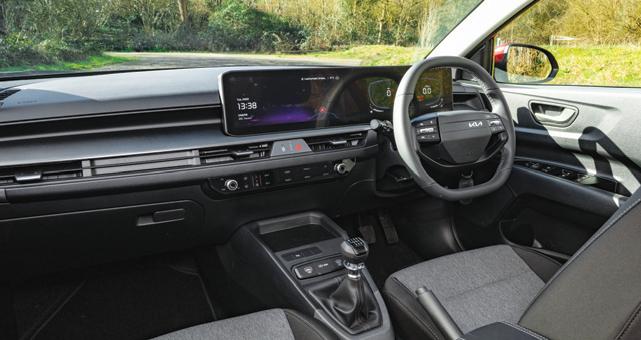
Inside, the cabin is functional and ergonomically sound. You don’t get the sprawling digital architecture found in the K4 or the EV6, but you do get an intuitive infotainment system and a tactile climate control setup that works without a second thought.
“The Stonic carves out a niche as an honest, no-nonsense choice.”
It feels robust – built to withstand the rigours of a fleet cycle with minimal fuss. Space in the rear and boot is adequate for its class, though it lacks the clever sliding seat versatility of some newer competitors.
On the road, the Stonic’s advanced lifecycle brings a certain level of predictable refinement. The 1.0-litre T-GDi mild hybrid engine offers enough pep for motorway jaunts while remaining genuinely frugal in city traffic. It’s an easy
It doesn’t set any new benchmarks, but as a dependable daily driver, it rarely puts a foot wrong.
Without a full-electric variant, its days as a mainstream fleet staple are naturally numbered, and there are already many Kia customers choosing the EV3 and looking ahead to the EV2 as alternatives. However, as an entry point into the BSUV segment for junior staff or predominantly local routes, it remains an excellent tool.
Despite its revamp, the Kia Stonic is the elder statesman of the Kia range. Its blend of value, equipment and that reassuring seven-year warranty makes it a pragmatic, pleasant and highly defensible fleet choice. It’s a solid performer that is gracefully entering its twilight years while still offering plenty of value to the right operator.
Narrow range; packaging limitations 7-word summary Pragmatic value choice, showing its advanced age
Also consider Renault Captur / Dacia Sandero Stepway / SEAT Arona
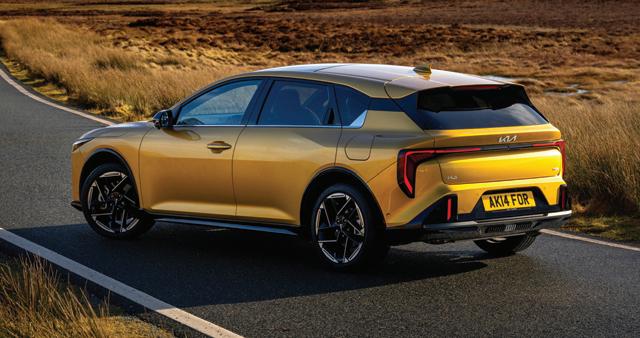
Kia K4 Hatchback
Kia believes there is still room in the global portfolio for a traditional hatchback that caters to the heart of the C-segment, following a series of launches that have highlighted the brand’s EV prowess.
The new Kia K4 hatchback arrives as the direct successor to the Kia Ceed – a model that has been a reliable staple of the UK fleet landscape for nearly two decades. Kia has moved production from its traditional European base in Slovakia to Mexico, reflecting the K4’s status as a global player designed to hit a specific value point.
On first encounter, the Kia K4 is an impressive piece of design. The sweptback silhouette and ‘Star Map’ lighting signature give it a premium, futuristic road presence that makes the outgoing Ceed look very conservative indeed.
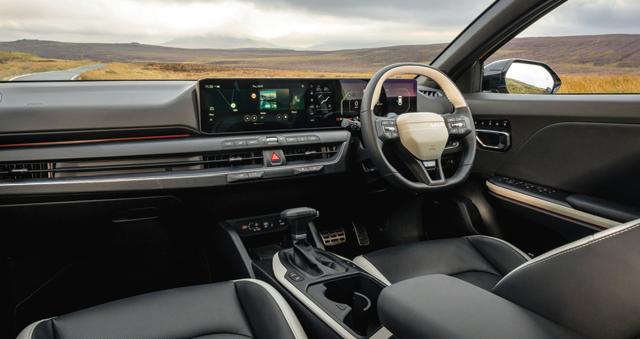
Inside, the cabin is equally ambitious, dominated by a wide-screen integrated cockpit that stretches across the dashboard. It is a digital environment that wouldn’t look out of place in a much more expensive vehicle.
Crucially, however, Kia’s designers have resisted the urge to bury everything in a sub-menu; physical buttons for core climate and audio functions remain, which is a major win for driver ergonomics and safety.
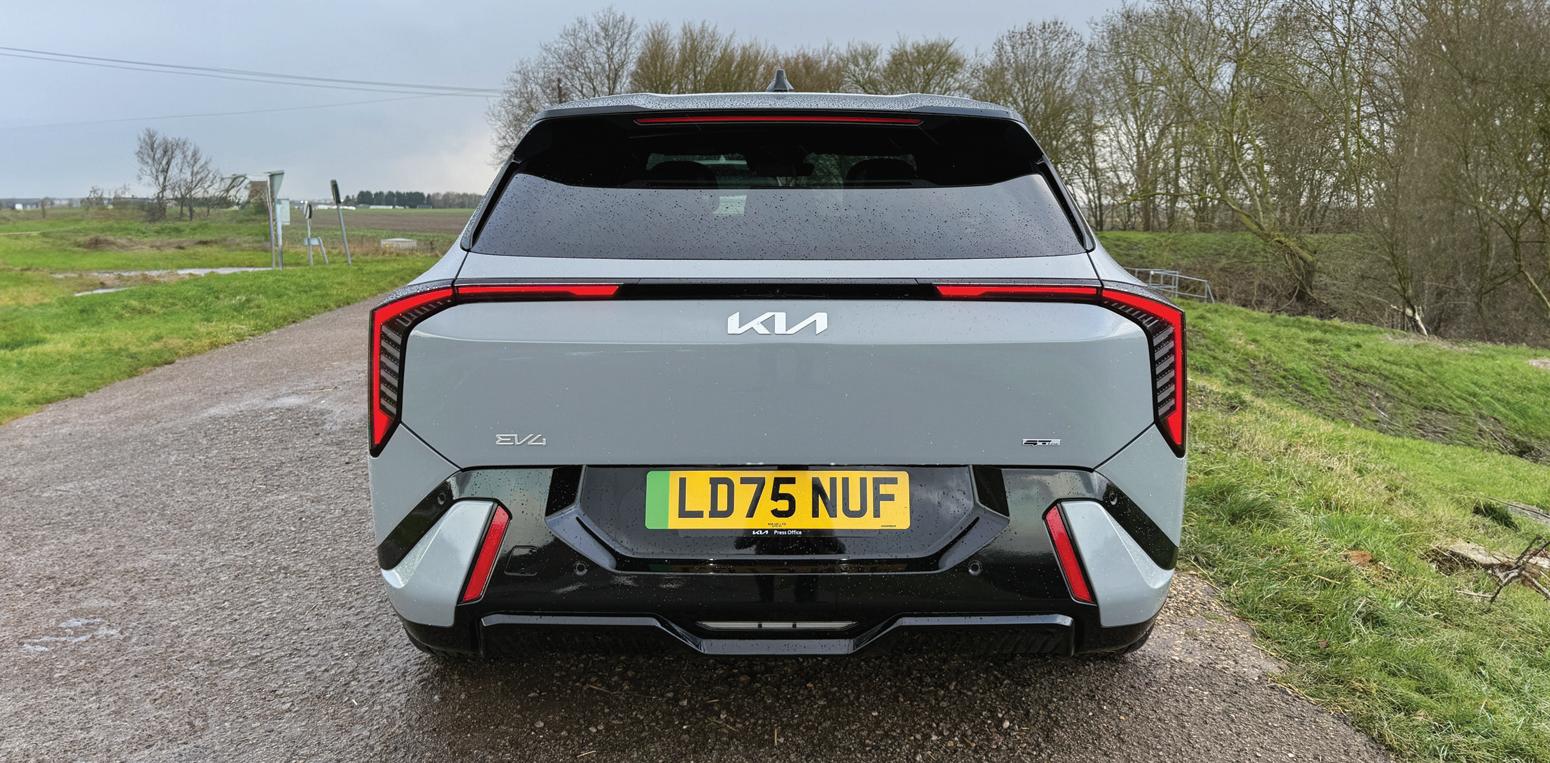
But the K4 finds itself in a slightly awkward position within Kia’s own hierarchy. Having recently spent time with the Kia EV4 (Kia’s electric medium hatchback) the K4 can’t help but feel like a less sophisticated machine.
While it is a ‘good’ car, it lacks the effortless technical refinement and the clever packaging inherent to a ground-up EV.
“The cockpit wouldn't look out of place in a more expensive car.”
The UK grade structure is Pure, GTLine and GT-Line S. While the GT-Line models and range-topper benefit from a multi-link independent rear suspension that provides a composed ride over the UK’s increasingly fractured road surfaces, the entry-level Pure makes do with a simpler, less refined torsion beam setup.
On the road, even in the higher grades, the K4 feels competent rather than sparkling. The steering is predictably light and urban-friendly, but when compared to the EV4, which benefits from a low centre of gravity and instantaneous torque, the K4 feels traditional and less agile. The 1.6-litre T-GDi unit is
a solid performer and will feel perfectly adequate to anyone not yet accustomed to EV performance, but it doesn't break any new ground.
The K4 is a well-built, technologically advanced hatchback that will satisfy the traditional job-need driver looking for a reliable petrol or mild hybrid car. With a starting price of £25,995, it undercuts the Volkswagen Golf significantly, making it a strong value proposition. And Kia’s seven-year warranty remains the industry’s best safety net, particularly for fleets running longer cycles.
Looking at the roadmap for 2026 and beyond, the K4 feels like a very high quality version of the ‘old way’ of doing things. The EV4 feels like the future of the C-segment; the K4 feels like a very polished finale for the combustion powered hatchback. It’s a solid choice for today, but for those prioritising technical evolution, it is a car for the present rather than the future.
7-word summary Polished petrol finale, eclipsed by electric future
Also consider Mazda3 / SEAT Leon / Volkswagen Golf
Kia’s first ICE car launch for a while reveals competence, if not flair. By Simon Harris.
Toyota C-HR+
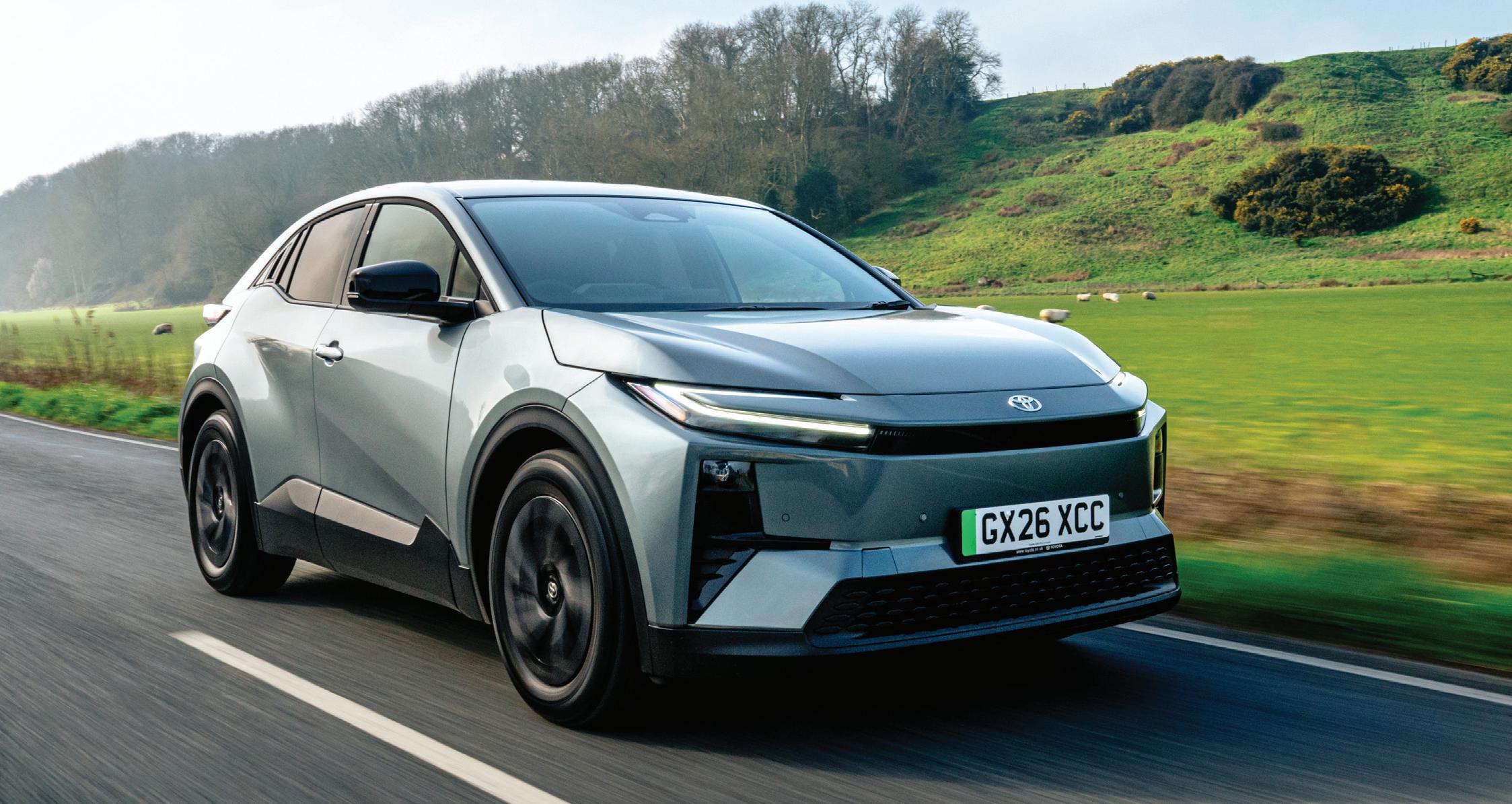
Toyota’s new electric SUV blends striking design with user-friendly features. By Simon Harris.
Toyota has shifted its electric strategy into higher gear for 2026. The C-HR+ now arrives as the third pillar of a refreshed line-up, joining the recently launched Urban Cruiser and the upgraded bZ4X.
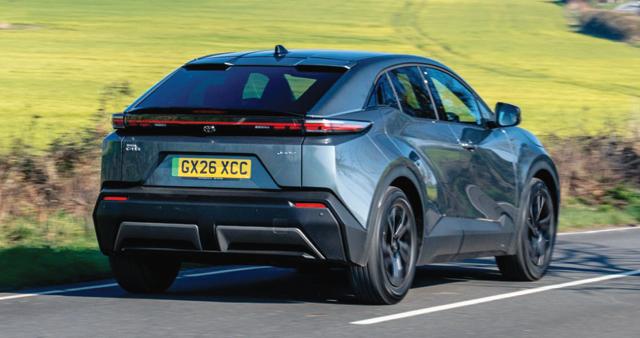
While it shares its ‘hammerhead’ styling with the hybrid C-HR, this is a standalone model built on the dedicated e-TNGA electric platform. Its dimensions are slightly larger than the C-HR hybrid, and it looks like a non-identical twin. It enters the C-segment squaring off against the likes of the Renault Megane E-Tech and Volvo EC40, where style is perhaps a little more important than practicality.
The C-HR+ is undeniably striking, carrying over the sharp creases and coupé-like roofline that made the original hybrid a hit in the corporate sector.
However, once inside, it is clear that this car has more in common with the bZ4X than its hybrid namesakes.
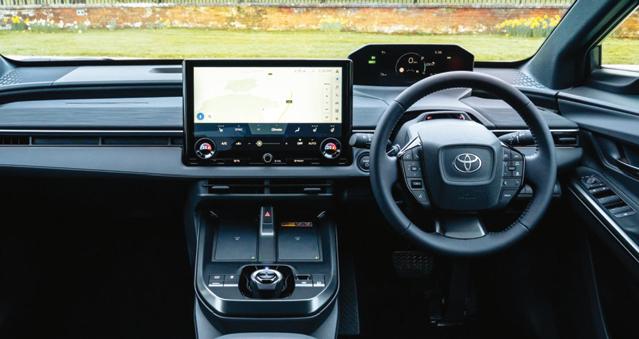
It inherits the same e-TNGA interior architecture, including the high-set instrument cluster and fabric-trimmed dashboard, but feels like a more cohesive and polished evolution of that layout, benefiting from a massive 14-inch touchscreen that is significantly more responsive than earlier Toyota systems.
On the road, the car is surprisingly
enjoyable. It avoids the leaden feel typical of many electric SUVs, offering well weighted steering and a supple ride that handles UK potholes with ease. It doesn’t attempt to be a performance car, but the lower centre of gravity inherent in its dedicated electric platform provides an agility that will appeal to the userchooser who wants something more responsive than a standard crossover.
“The C-HR+ provides an agility that will appeal to user-choosers.”
Toyota has prioritised efficiency over headline-grabbing 0-62mph times. The entry-level 165hp Icon model uses a 57.7kWh battery providing a 284-mile range, while the 221hp Design and Excel grades step up to a 77kWh unit.
In the mid-spec Design trim – expected to be the fleet volume-seller – this battery delivers a highly competitive official range of up to 377 miles.
Inside, the cabin is a significant step forward. The touchscreen dominates the dash, yet Toyota has wisely retained physical controls for the air conditioning pace in the rear is still a little tight due to the sloping roofline, but the 416-litre boot is a
useful improvement over the hybrid C-HR.
With a P11D starting from £34,495, the C-HR+ sits at a competitive price point for the volume C-SUV sector. When a charge is required, the 150kW DC rapid charging capability allows a 10-80% top-up in around 28 minutes, fitting neatly into a standard break.
Toyota’s ace card remains its ownership peace of mind. The C-HR+ is covered by a 10-year battery warranty – subject to an annual health check – which will be warmly welcomed by second-life leasing providers and RV setters alike. Battery health is visible to the driver through a dedicated screen in the instrument cluster, providing a level of data that is rarely shared so openly with the end-user.
The Toyota C-HR+ is a characterful and deeply sensible addition to the choice list. For those seeking a reliable, safe bet that doesn’t look like a boring box, the CHR+ is a significant milestone in Toyota’s electric offensive.
IN BRIEF
WHAT IS IT? Medium electric coupé-SUV HOW MUCH? From £34,495
ECONOMY? 4.2-4.6mpkWh
RANGE? 284-377 miles (WLTP)
Key fleet model Design
Stylish looks; range
Slightly compromised rear headroom
7-word summary Sharp design meets Toyota’s new electric maturity
Also consider Renault Megane E-Tech / Volvo EC40
MG4
MG’s benchmark matures with a refined interior while retaining its driver-focused character. By Simon Harris.
The MG4 was a watershed moment for the brand, marking the point where UK fleets began to take MG’s electric ambitions seriously.
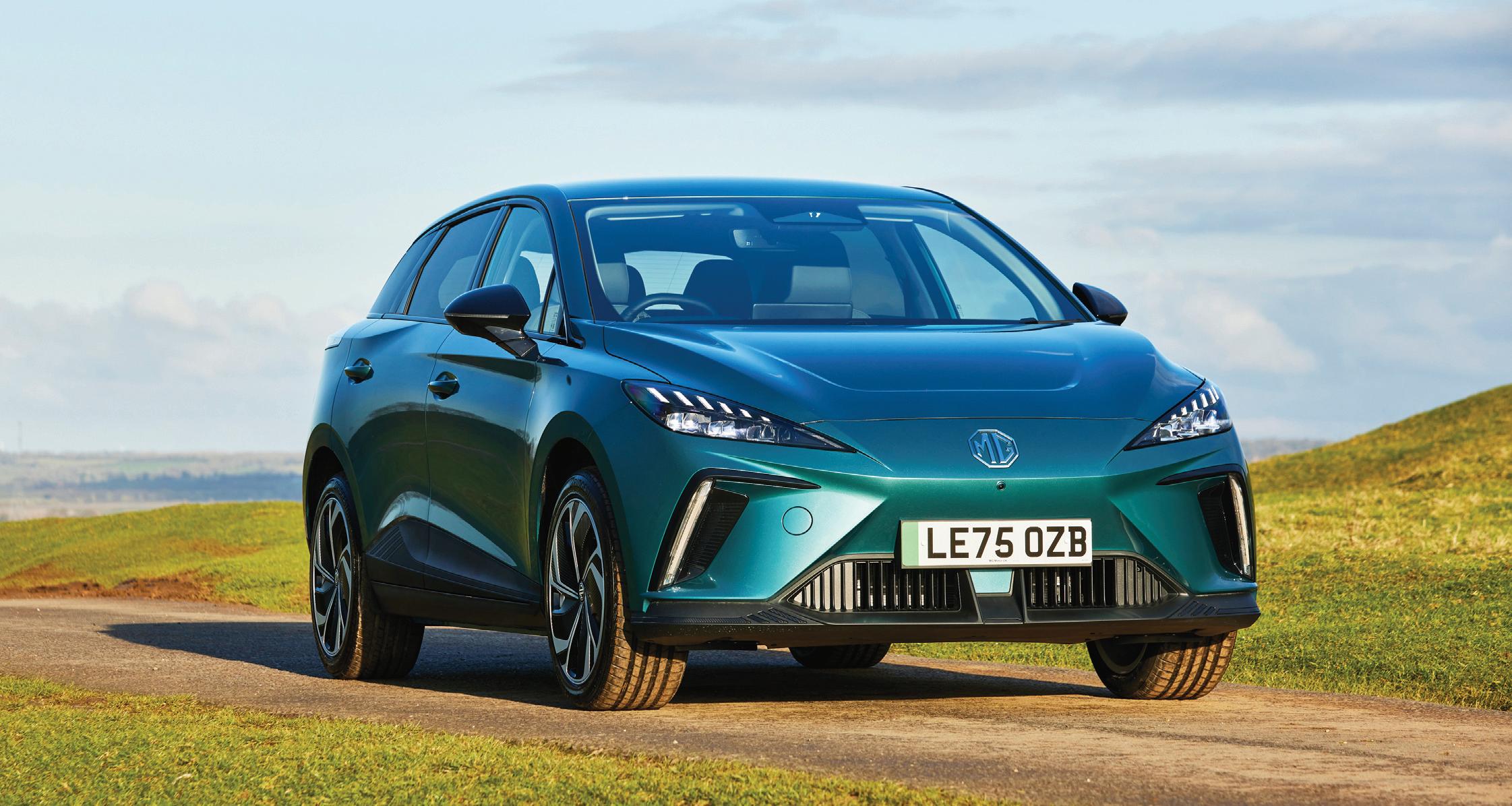
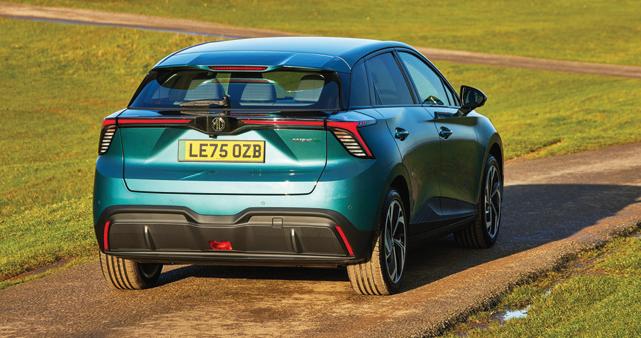
It offered a rear-wheel-drive platform and a competitive range at a price point that made its European rivals look expensive. But as the market matures with the arrival of sophisticated competitors such as the electric Vauxhall Astra, Peugeot 308 and the new Kia EV4, MG has responded with a mid-life refresh designed to keep its best-seller on the fleet radar.
On the road, the MG4 maintains the driver-centric character that set it apart at launch. While many of its peers in the C-segment have opted for a softer, more comfort-orientated setup, the MG4 offers more driver appeal.
The steering is quick and the nose is eager to tuck into corners, aided by the 50:50 weight distribution inherent in its dedicated electric platform.
The trade-off for this agility is a ride that remains firm. On the scarred surfaces of UK urban routes, you are more aware of the road’s imperfections than you might be in a Nissan Leaf or the Renault Megane E-Tech. However, for the user-chooser who values a car that feels taut and responsive, the MG4 offers a
level of engagement that is arguably superior to many rivals.
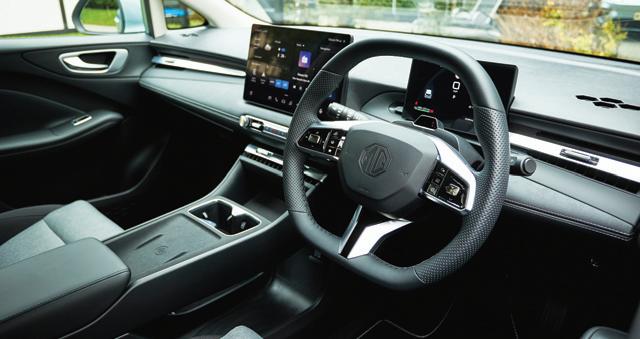
The most vital updates have occurred inside the cabin, where MG has addressed the primary complaints of fleet drivers. The new 12.8-inch central touchscreen is a significant step up in clarity and processing speed.
More importantly, the inclusion of a slim bank of physical shortcut buttons for climate and volume beneath the screen is a welcome feature. It reduces the cognitive load on the driver – a critical safety
“The most vital updates have occurred inside the cabin.”
factor for high-mileage users who previously had to navigate multiple sub-menus for some relatively simple tasks.
Space remains one of the MG4’s strengths. Despite its compact footprint, the long wheelbase of platform the MG4 uses liberates a surprising amount of interior room. There is genuine ‘stretchout’ space for rear passengers, and the boot remains a practical, wellshaped 388 litres. It is a car that easily handles the dual role of a weekday workhorse and a weekend family car.
But there’s only one USB connector in the rear, and no rear cabin light, which might make navigating child seat harnesses more difficult in the dark.
The 64kWh battery offers a 280-mile WLTP range, while the 77kWh Extended Range pushes that to 338 miles. The highperformance XPower version provides 250-mile comfort blanket for longdistance drivers, while the 150kW DC charging capability means a 10-80% topup for all versions can be completed in around 26 minutes – easily within a typical motorway break.
The updated MG4 is a more polished, more ergonomic and more desirable tool than the car it replaces. It has kept its sharp, slightly firm driving edge while fixing the interior foibles that held it back from true greatness. In a segment that is becoming increasingly crowded, the MG4 remains the benchmark for those who want their fleet car to be as engaging as it is efficient.
IN BRIEF
Key fleet model Premium Extended Range Value; engaging drive
Firm ride; single rear USB connector
7-word summary Sharp driving dynamics meet a matured interior
Also consider Vauxhall Astra Electric / Kia EV4 / Renault Megane E-Tech
MG4 Urban
MG’s value-focused disruptor trades dynamics for space and a segment-resetting price. By Simon Harris.
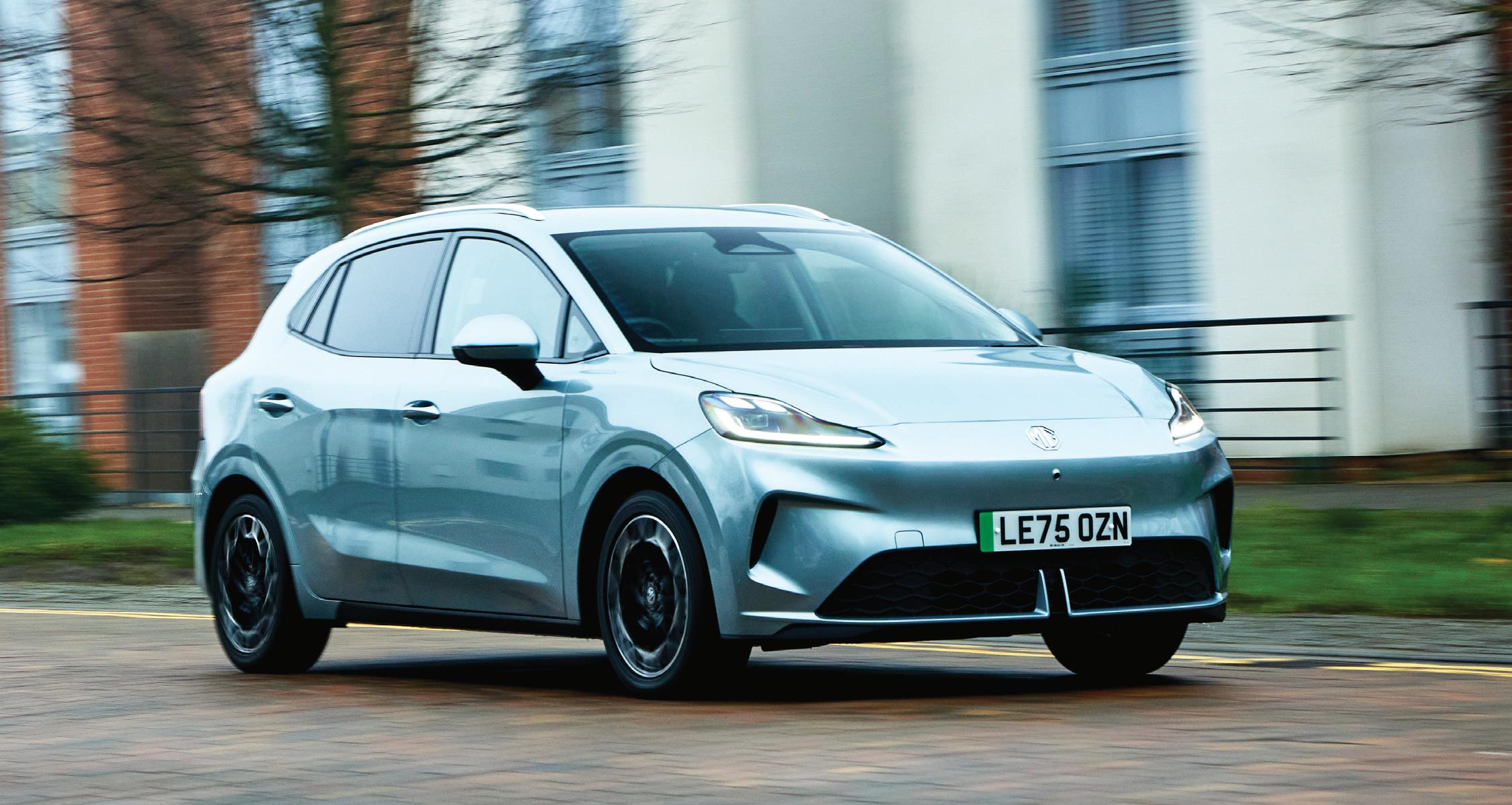
The MG4 Urban is a very different beast from the driver-focused hatchback that first established the brand’s fleet credentials.
While they might share a badge, the Urban is built on a bespoke ‘cell-to-body’ platform designed to prioritise interior volume and cost efficiency over outright performance.
It is a car aimed squarely at the highvolume compact SUV market, targeting the likes of the Vauxhall Mokka Electric and Ford Puma Gen-E by offering significantly more car for the money.
The move to a front-wheel-drive layout and a simpler torsion-beam rear suspension marks a clear change in philosophy.
In the standard MG4, the ride can feel a little firm on the road, with sharp responses that encourage a more spirited drive. The Urban trades that ‘zing’ for a more compliant, comfort-led setup. It feels softer and more settled over urban potholes, which is exactly where this car will spend most of its working life.
The Urban doesn’t feel as agile as its sibling on the road, but it is easy to place.
The steering is light, visibility is good and it feels far more manageable in tight city traffic than its footprint suggests. For a local authority fleet or a multi-stop urban operator, this shift from ‘sporty’ to
‘steady’ is a pragmatic one, although it completely lacks the ‘boy racer’ appeal of the MG4 hatchback.
MG has lowered the floor and stretched the cabin to its absolute limits by integrating the battery cells directly into the chassis (a similar technique to the one used by BMW in the new iX3 and i3).
“The Urban trades ‘zing’ for a more compliant ride.”
While it occupies a similar footprint to C-segment hatchbacks (it’s actually a little longer than the MG4 hatchback) its target audience are in cars such as the Vauxhall Mokka Electric and Ford Puma Gen-E, where it competes on price while offering much more space.
A note of caution is needed regarding the quoted 577-litre boot capacity, however. This figure is achieved by measuring to the roofline and including a substantial 98-litre underfloor cavity. When measured to the traditional parcel shelf, the space is more conventional for the class.
The MG4 Urban makes its case through an aggressive P11D price, which remains the fixed point for tax regardless of any subsequent manufacturer grants. This
lower list price ensures that the universal 4% BiK rate for 2026/27 translates into a very low monthly cost for the driver.
Two battery options are available: a 43kWh (201-mile range) and a 54kWh (258-mile range). While these won’t appeal to the 30,000-mile-a-year motorway rep, they represent the sweet spot for regional operations. Standard vehicle-to-load (V2L) also adds significant utility, allowing the car to power external tools or mobile workstations onsite – a feature that many more expensive rivals still list as an option.
The MG4 Urban is a dedicated, spacemaximising tool rather than a junior version of the standard MG4. It trades driver engagement for everyday comfort and a price-to-practicality ratio that is currently unmatched in the UK. For fleets looking to transition to electric without breaking the capital budget, the Urban is a remarkably honest and capable addition to the choice list.
IN BRIEF
WHAT IS IT? Compact electric SUV
HOW MUCH? From £23,495
ECONOMY? 4mpkWh
RANGE? 201-258 miles (WLTP)
Key fleet model Comfort Long Range
Space and value for money
Too soft for some; confusing size
7-word summary Maximum interior volume for a minimal price
Also consider Omoda 5 EV / Ford Puma Gen-E / Vauxhall Mokka Electric
ON FLEET
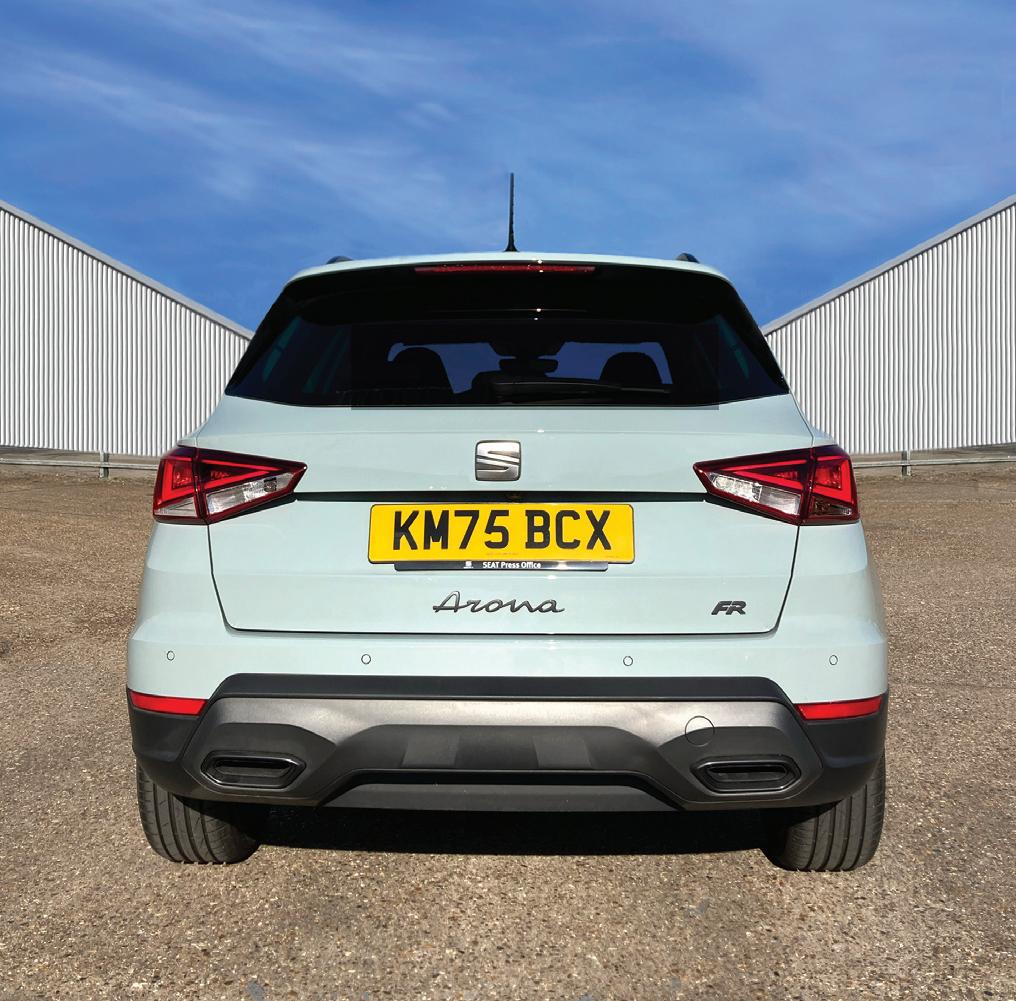
SEAT ARONA FR Sport 1.5 TSI EVO 150PS DSG
My return to the ICE fold has coincided with Trump and the crisis in the Middle East putting global oil markets into something of a tailspin.
Having spent a few months
not paying a great deal of attention to the price of a barrel of crude, when overnight forecourt price hikes translate to £4-5 extra when filling up with unleaded, it doesn’t go unnoticed.
Lucky, therefore, that our new SEAT Arona FR Sport 1.5 TSI EVO 150PS DSG, offers diesel-challenging WLTP fuel economy of 48.7mpg and, on a recent 300mile round trip, over 57mpg.
With the price differential at the pumps between petrol and diesel now routinely over 25p per litre, it’s not hard to see why relatively modest-engined petrol ICE models are proving popular.
The Arona looks great too, in a rather subtle shade of light blue –official exterior colour Oniric Grey – which is maybe more noticeable in the metal than in pictures and is pleasingly a no-cost option.
It feels more compact than our previous Cupra Leon eHybrid too, at 250mm shorter, and echoes our former long-termer’s reversing camera, meaning parking is a relative doddle.
The Arona is very comfortable as well, providing a slightly more compliant suspension set-up than the Leon, despite not offering quite the same wonderfully
supportive Dinamica bucket front seats the Cupra had as standard. They’re still listed as “sports bucket seats” on the Arona’s specification but it’s a reminder that not all cars are created equal, especially in light of the Cupra Leon range, with the aforementioned seats, starting at £4k more.
This isn’t a slight on the SEAT at all, merely acknowledging how good the Cupra is. The Arona’s front seats offer excellent heated functionality too, which makes up for a non-heated steering wheel.
Here’s hoping that our next report on the car brings some normalised fuel prices as well.
Luke Wikner
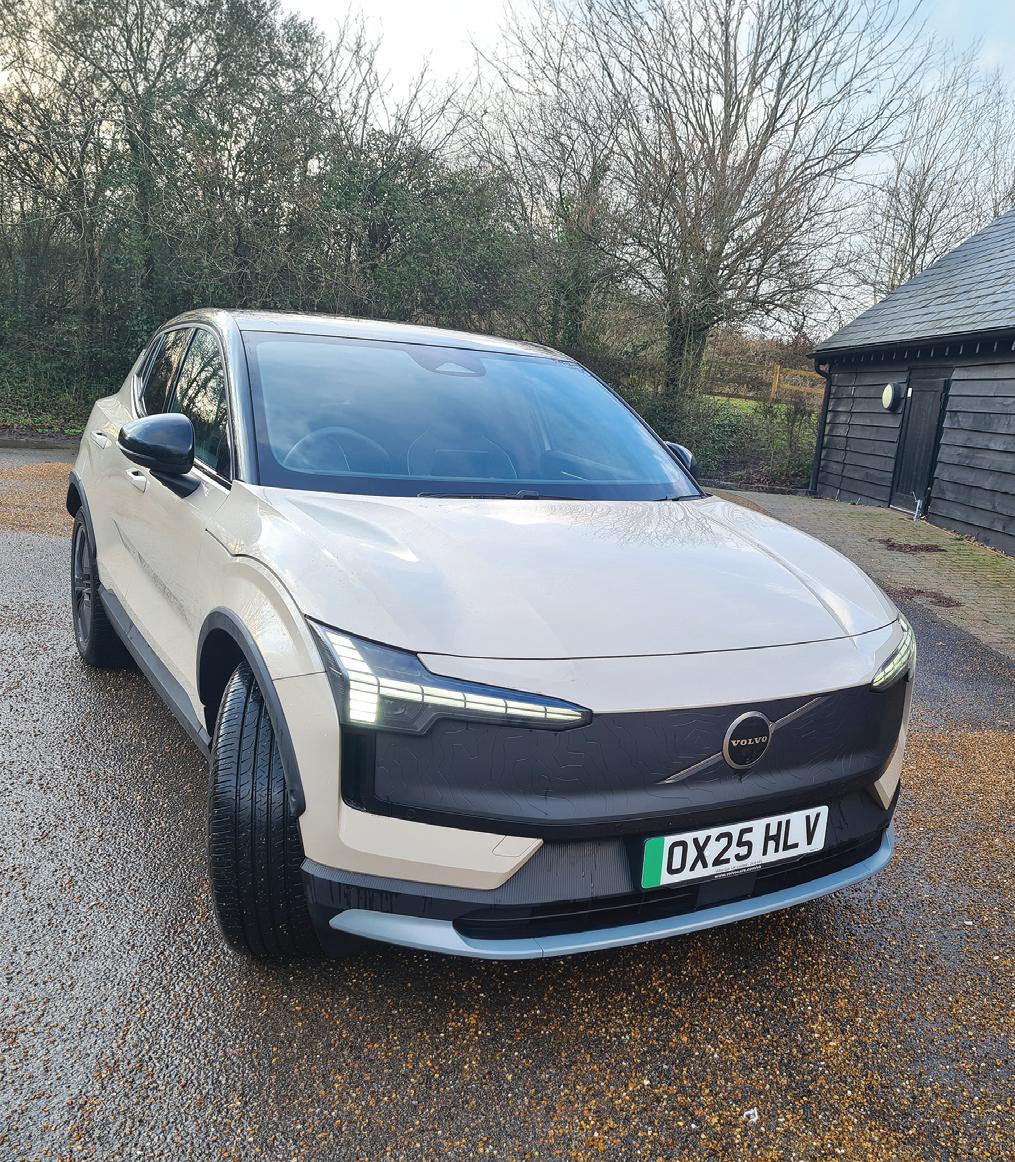
It’s impossible to file a report on the Volvo’s smallest electric SUV
ON FLEET
without commenting on the news about the new van version.
Electric car conversions are big news at the moment, and the EX30 Cargo brings added food for thought, with its high levels of onboard tech and the option of the ludicrous 428hp P8 all-wheel drive powertrain.
Throughout our test, I’ve appreciated Volvo’s smallest electric car’s compact footprint, which will also be a huge plus for van drivers. And in Cargo form, its versatility is heightened by stripping out the rear seats for a flat floor with a 1,000-litre load capacity and a 390kg payload.
We’ve optimised the cargo space on our long-termer by removing the adjustable floor. The EX30’s boot may be tighter than some rivals’, but this has made a massive difference. Combined with the low loading lip, the extra depth means I rarely notice the lack of space, bolstered by a small frunk and impressively large cabin storage bins.
Van drivers are likely to appreciate the high levels of spec too,
KIA EV4 GT Line
After three months and several thousand miles since January, the EV4 GT-Line has transitioned from a design statement to a daily tool. While my first update championed the return of the hatchback as a blow against the ‘SUV-ification’ of our car parc, the reality of living with this sharpedged fastback through a British winter has been a mixed bag.
The most glaring omission as we move out of March is the heat pump. In the GT-Line, it’s not even an option – you have to step up to the GT-Line S for that privilege. During the sub-zero mornings of February, this meant my efficiency took a hit, averaging a mediocre 2.8 miles per kWh. Without that scavenging hardware, the heater worked over-
time to keep the cabin habitable, noticeably trimming the realworld range. However, as spring approaches and temperatures hit double digits, the EV4’s aerodynamic ‘wedge’ profile is finally paying off, with figures now climbing back toward a healthy 3.8 miles per kWh.
The high-tail design also brings a practical quirk: rear visibility.
THE NUMBERS
P11D £47,005
BiK* 4% I £32 (20%) / £64 (40%)
RANGE 273 miles
FLEET RANGE 200 miles
EFFICIENCY 2.9mpkWh
although the lack of physical controls, plus the nested touchscreen menus, may frustrate.
But equally, the EX30 is excellent for Google integration, featuring Android Automotive OS with Google Maps, Google Assistant and Play Store built-in, without needing to pair up with a phone. And, true to its Volvo DNA, it’s packed with safety tech.
On the subject of tech, there’s also some exciting updates on the horizon, including the arrival of vehicle-to-load and a refreshed user interface, which will be rolling out to existing models, via a free over-the-air update. Happy days! Natalie Middleton
That dramatic rear deck looks striking from the pavement, but through the rear-view mirror, it creates a narrow letterbox view that makes the camera system more of a necessity than a luxury. On the road, the EV4 feels more planted hatch than lumbering crossover. It’s firmly in the new era of Kia design, and the agile feel rewards a tidy line through corners. It isn’t a sports car, but its lower centre of gravity makes it far more rewarding on a B-road than the EV3. It’s a car that proves you don’t need a high hip point to feel confident in everyday driving Simon Harris
POLESTAR 2 Long Range Single Motor
It’s funny how it’s easy to become obsessed by tiny things in cars. A rattle here, an annoying rough edge of a plastic moulding there.
For me in the Polestar 2, I’ve developed a rather unhealthy relationship with the efficiency readout. I’m afraid it won’t ever not bug me that it’s in kWh/100mls rather than the more traditional mls/kWh, but it also means
DE-FLEET REPORT
getting your head round the fact that a lower number is better.
Rather like the European metric figures for ICE vehicles, it’s a measure of consumption not efficiency, whereas with mpg and mls/kWh, you want the figure to be as high as possible. Like queuing, apologising and unhealthy tinned meat products, it’s just another thing that we do better than our friends across the Channel.
But as the ambient temperature has improved, so I’ve seen my consumption on the dash readout dropping. Admittedly, in the grand scheme of things, it’s really not much, but I’ve started to notice every time it drops a decimal point. So, first I was happy when it dropped into the 20s at 29.9kWh/100mls as stated previously and now I’m already at 29.6. Every little helps, as they say.
BMW iX (I20) xDrive45 M Sport LCI
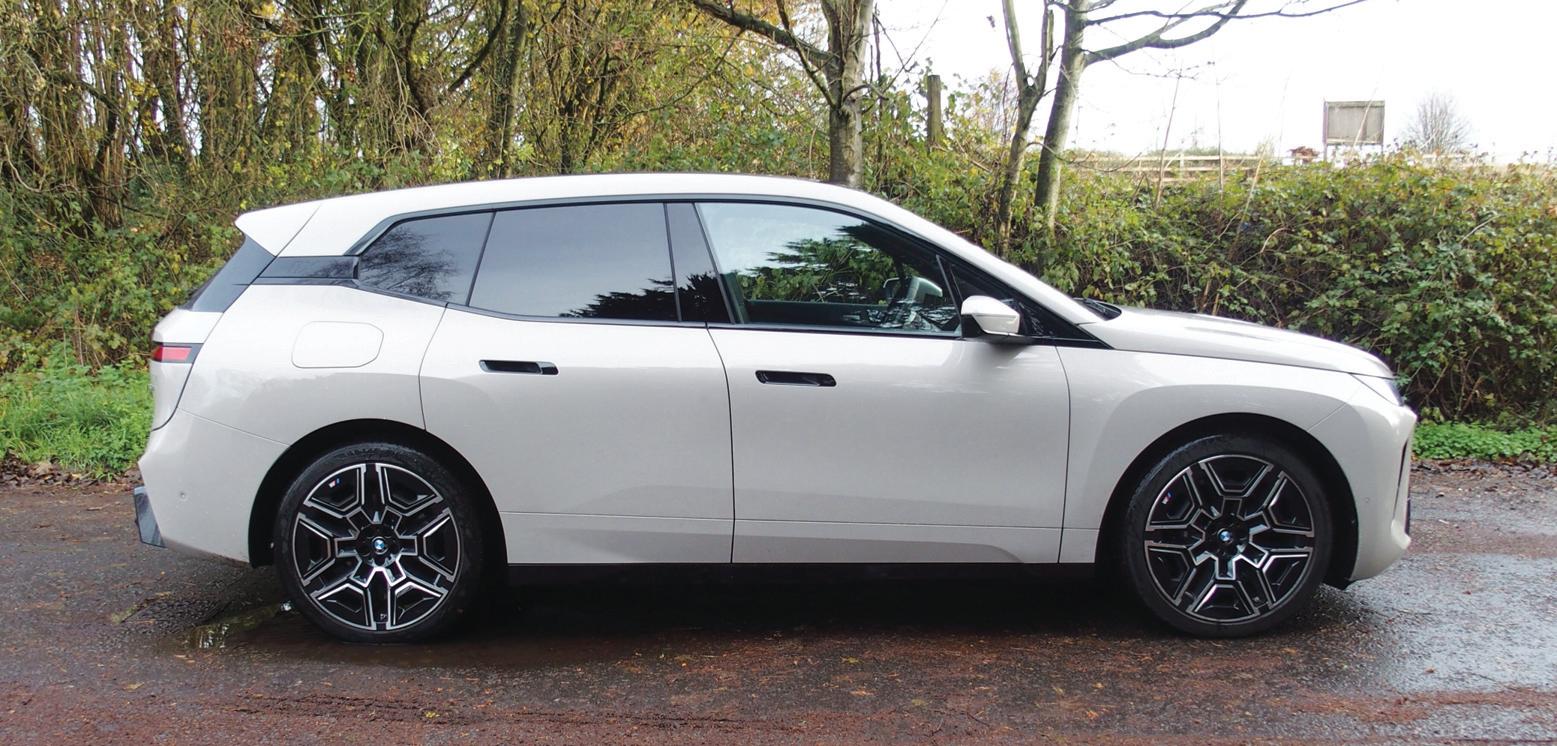
The iX has left us and it is certainly not your average fleet car in any sense. Most of us don’t get the opportunity to drive around in a car with a £100,000 price tag for a start. The question I always ask myself is how much better is it than a more ordinary car? Inevitably that depends on your priorities. For instance, I think that 22kW three-phase AC charging capability is a smart thing to
build into a car, but since I don’t have access to three-phase power, being able to charge in around four hours instead of 13 hours isn’t something that I can assess.
I have mentioned many of my likes and dislikes. Driving the car is simple thanks to straightforward controls for starting, drive selection, drive mode selection, and the all-round camera system. The car is whatever you want it to be –
luxury limousine, thanks to superb ride comfort and low noise, capacious transport for a family or a high-performance 4x4 model that can be shockingly quick when you want. Of course, being a BMW means that it handles very well too, quite something for such a large and heavy car. Its size can be a handicap too. It’s not the best choice for narrow country lanes because of its width
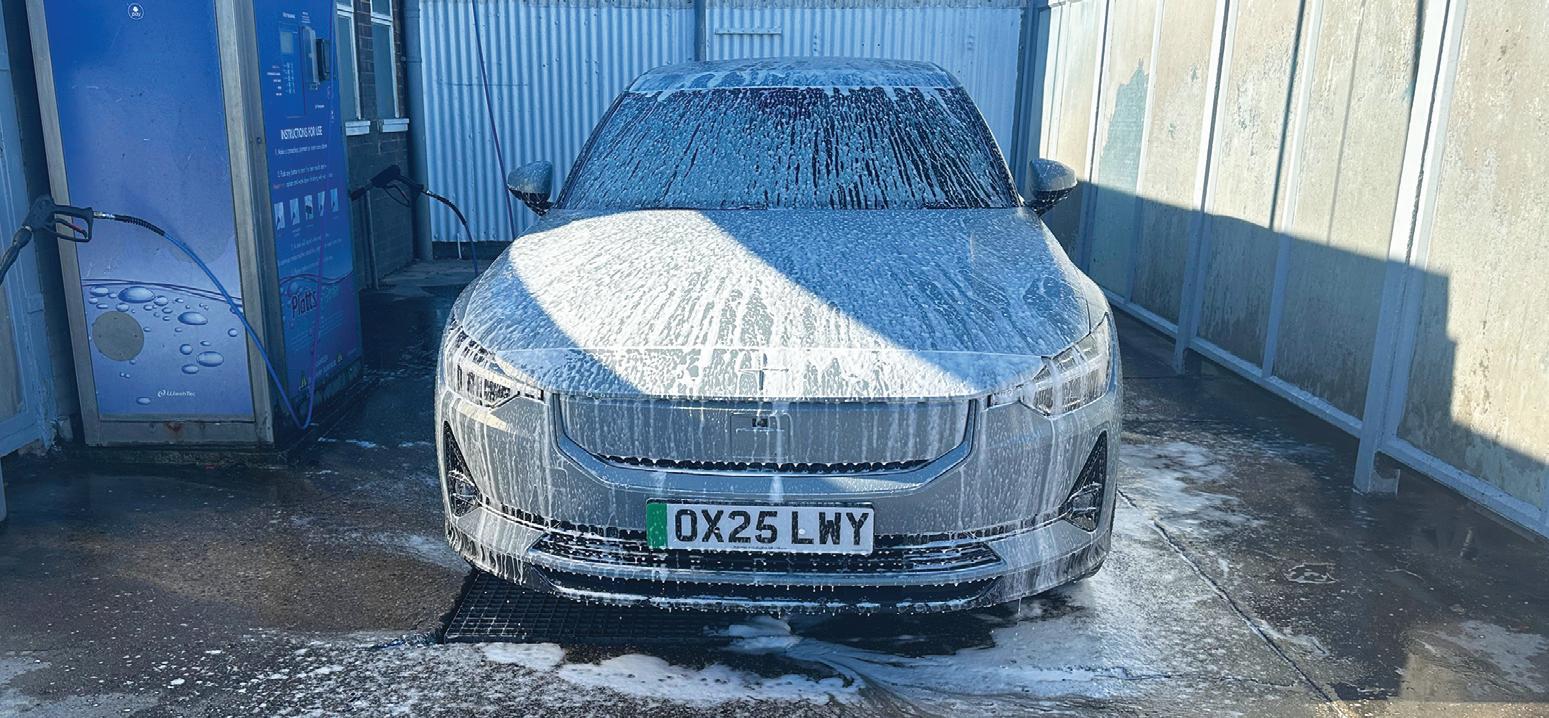
Also falling into the ‘I need to get a life’ category is something else I noticed after the longawaited visit to the car wash. I tend to leave the regenerative braking set to maximum, making one-pedal driving possible for the majority of the time. The result that I don’t have to rely on the friction brakes as much as a normal ICE car means a noticeable lack of brake dust.
When I look around at many other cars over the winter, their front wheels are coated black, but not those on the Polestar –another benefit of running an EV, I suppose.
Nat Barnes
and there are plenty of them around where I live. I have moaned about the lack of regenerative braking choice before. B mode can be fine on a twisty road, but given the car’s broad capabilities, it would give a performance-conscious driver more control and it is a performance car. Make no mistake though, living with the iX has been a great pleasure. It is one of the best electric cars I have driven and passengers have loved it for its space and comfort. If a large, highly capable electric SUV is very appealing and price is not a deterrent, the iX ought to be on your shortlist.
Reduce fleet downtime with Axioma’s mobile-first repair solution, combining AI triage, transparent pricing and nationwide coverage to deliver faster, smarter repairs. visit us on stand B13
Flex Hire Cars
FleetServicesConcierge
Salary Sacrifice Scheme
Lower cost. Lower risk. Maximum value.
One
Our full range of services:
FSGB Driver Management
Enhances road safety, boosts ef昀ciency, and supports continuous development.
FSGB Fleet Management
Offering expert advice to help you meet operational and 昀nancial goals.
Who are Fleet Service GB?
FSGB Accident Management
Report incidents 24/7 via the Achieve Driver App. From 昀rst noti昀cation to 昀nal repair.
Fleet Service GB provide a fully-integrated driver and vehicle 昀eet management solution. Powered by our Achieve Driver App and Hub, we support you every step of the way with personal service from our of昀ces in Wiltshire, 24/7.
Making Service Personal, delivering:
• Reduced costs
• Reduced emissions
• Reduced vehicle down time
• Driver wellbeing
• Improved 昀eet ef昀ciency
• Reduced insurance premiums
• Full compliance
• Visibility and transparency
FSGB Maintenance Management
Keeping vehicles well-maintained and maximising ef昀ciency, with our national price promise.
昀eetservicegb.co.uk
Visit us at stand B4 for the Great British Fleet Event Email us at: sales@昀eetservicegb.co.uk
Building collaborative partnerships:
icons
In the early 1990s, the British fleet market was a battlefield of status. For the middlemanagement tier, the choice usually boiled down to the ubiquitous Vauxhall Cavalier or the Ford Sierra (and, from 1993, the Mondeo).
But as the Mondeo arrived in showrooms, Rover Group launched a car that managed to disrupt the hierarchy: the Rover 600. More than just a premium-feeling alternative to Ford and Vauxhall, it was a masterclass in how to dress a mainstream platform in a Savile Row suit.
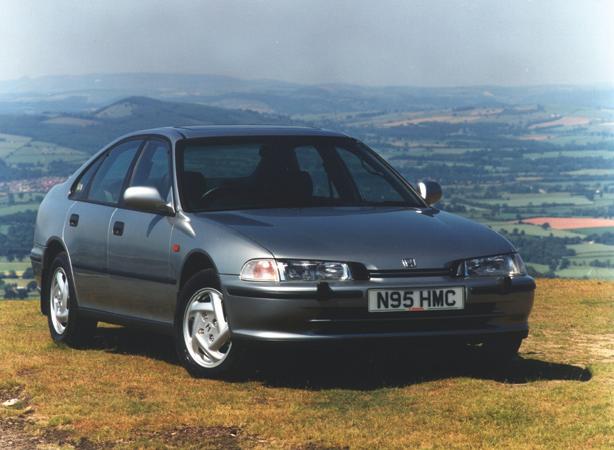
To understand the 600’s success, you have to look beneath the skin. This car represented the high-water mark of the Rover–Honda partnership. Underneath those elegant lines sat the chassis, suspension and much of the floorpan of the European Honda Accord.
The two companies had already collaborated on the 800 Series and the Honda Legend-based Rover Sterling, but while those cars sometimes felt like two different philosophies competing for space, the 600 was a far more integrated effort.
Built at the Cowley factory – today known as BMW Group’s Plant Oxford – the 600 combined British assembly with Japanese engineering. For fleet managers of the era, this was a godsend. It brought Japanese reliability and precision to a brand that had spent the previous decade shaking off the quality-control ghosts of the British Leyland era.
However, where Honda provided the skeleton, Rover provided the soul. Richard
We look back on some of the most important company cars of the last six decades
ROVER 600
Woolley’s design was arguably one of the most handsome saloons of the decade. It moved away from the ‘jelly-mould’ look of its Ford rivals in favour of something more classical. With its chrome-rimmed grille and sophisticated silhouette, the 600 looked as at home in a country house driveway as it did in a motorway service station. It established a premium design language that Rover would develop further with the later 75.
Inside, the transformation was equally effective. While the dashboard architecture remained largely Honda, Rover’s designers performed a minor miracle with the materials. By ‘Rover-ising’ the cabin – introducing high-quality cloth, leather and those signature wood-veneer inserts – the 600 gained a premium feel that its mainstream competitors struggled to match.
Due to the Rover-Honda partnership, underneath the Rover 600’s elegant lines sat the chassis, suspension and much of the floorpan of the European Honda Accord.
For the company car driver, sitting in a 600 Series felt like a promotion. It had an air of up-and-coming executive about it that made it a genuine alternative to a BMW 3 Series or an Audi 80, often at a significantly more attractive price.
On the road, the 600 was refined and composed. The Honda-sourced 2.0- and 2.3-litre petrol engines were smooth and free-revving, but for the high-mileage fleet driver, the arrival of the 620ti and the LSeries diesel were the real turning points.
The 620ti, with its 197bhp turbocharged T-Series engine, was a true sleeper – a wolf in sheep’s clothing that could easily embarrass more expensive sports saloons on the motorway. Meanwhile, the L-Series diesel offered the mid-range punch and economy that the emerging diesel fleet market demanded.
Crucially for Rover, the 600 didn’t just sell on looks; it held its value. The combination of Honda underpinnings and Rover’s elegant styling meant that residual values were strong, keeping monthly contract hire rates highly competitive. It was a car that satisfied both the driver’s ego and the fleet manager’s spreadsheet.
The Rover 600 represents a pivotal moment in fleet history. It proved that a badge could be successfully repositioned through a clever partnership and impeccable styling. For a brief, golden period in the mid-90s, the Rover 600 was the ultimate ‘aspirational’ fleet car – a vehicle that proved you’d arrived at a time when German brands on fleets were still relatively rare.
evfleetworld.co.uk
vanfleetworld.co.uk
Ford adds a fifth model to the Transit range with the launch of the Transit City
16 APRIL 2026
DON’T MISS OUT!
The perfect threesome
John Kendall
VFW editor
“It could be the boost in demand for electric vans that many manufacturers have been hoping for.”
ULEZ driving EV van demand...
A new Transit from Ford is always going to be headline news and when it’s the first Transit to also be built solely in China, it’s fair enough to ask a few questions. The Transit City (see p.6) will be made in China by JMC, which has produced Transits for more than 30 years for the Chinese market.
Ford has no doubt been weighing up the competitively priced van models coming here from China in the past few years. Given that the country does not have copyright laws and has a lower cost workforce, it is easier to understand how Ford has looked to this market to produce its first electric-only van range.
The van market is changing too. The arrival of more low emissions zones around the country is driving demand for electric vans and Ford is pitching the Transit City at urban users whose daily mileages are fairly modest. I was speaking to a local van owner recently who was telling me how much he is saving by operating an electric van. That information is spreading and particularly at a time when diesel prices have rocketed in recent weeks, it could be the boost in demand for electric vans that many manufacturers have been hoping for.
The Transit City is not all that Ford will be launching at the CV Show. It has joined the growing number of car manufacturers who have launched electric car-derived vans. The Ford Explorer Van will make its debut at the show, joining the Škoda Enyaq Cargo, Dacia Spring Cargo, Citroën ë-C3 and Volvo EX30 Cargo which have all appeared in the past year. Low emissions zones may also be the key to these new models
Once again, I hope to catch you all at this year’s Great British Fleet Event at Arena MK in Milton Keynes on Thursday 16 April 2026... See you there!
PLUGGING THE GAP
Can charging infrastructure keep up with electric vans? By
Matt MacConnell
Sales of electric vans are rising fast — but the infrastructure needed to keep them moving is still playing catch-up. Figures from the Society of Motor Manufacturers and Traders (SMMT) show that registrations of electric light commercial vehicles (eLCVs) climbed by 36.2% in 2025, signalling growing confidence among operators looking to decarbonise their fleets. Yet despite that progress, the sector still fell short of the UK government’s mandated 16% market share target for zero-emission van sales under the Zero Emission Vehicle mandate.
For many fleet operators, the biggest question isn’t vehicle availability or even upfront cost — it’s how and where those vans will charge. While the UK’s public charging network continues to expand at pace, much of it has been designed with passenger cars in mind rather than commercial vehicles operating to tight schedules and high daily mileages. Depot charging, grid capacity, public rapid hubs and home charging solutions all play a role but integrating them into a workable fleet strategy remains a challenge.
As van operators look to scale up electrification over the next few years, charging infrastructure providers will play a critical role. From fleet-focused charging hubs and smarter energy management to charging-as-a-service models, new solutions are emerging to help businesses
make the most of the available power.
So, is today’s charging infrastructure truly workable for electric van fleets — and what more needs to be done to turn growing interest in eLCVs into widespread adoption?
EV charger manufacturer Easee says the charging infrastructure available for electric van fleets today is broadly workable, although there is still progress to be made as adoption continues to grow. Easee told Van Fleet World that the charging network has expanded rapidly through transport corridors and urban hubs in recent years, exceeding the number of petrol pumps. However, that comparison does not tell the whole story, as vehicles remain connected for longer when charging, so continued investment and smart deployment of infrastructure will remain important as the market scales up.
“One of the biggest barriers for fleets considering electric vans is not always infrastructure itself, but confidence and understanding. Many businesses are still approaching electrification as an unknown. Charging infrastructure providers can help by simplifying the process, providing clearer guidance on depot design, vehicle charging behaviour and the most cost-effective ways to deploy charging at scale,” says Steven Frost, head of automotive at Easee.
“In practice, many depots assume
they require high-power rapid charging, but most commercial vehicles spend long periods parked, often overnight, either at the depot or at a driver’s home. In those situations, well-planned AC charging at 7kW, 11kW or 22kW is often the most practical approach. It places less strain on the local grid connection, is more cost-effective to deploy and works well when vehicles are scheduled around shift patterns and overnight dwell time,” Frost adds.
Home charging is also a major opportunity for van fleets. When drivers charge vehicles overnight at home, it increases vehicle availability during the working day and can allow fleets to take advantage of lower overnight electricity tariffs. Accurate reimbursement is key to making this work smoothly. Chargers equipped with MID-compliant metering can precisely measure the electricity used for business charging, providing a legally approved basis for billing and enabling fleets to reimburse drivers automatically. That accuracy is important for building trust between drivers and employers while keeping energy costs transparent.
Nexus Rental, a vehicle and plant hire company, says the transition to eLCVs presents clear operational advantages, but has found fleets question whether the charging infrastructure can truly support daily, large-scale use.
“One of the biggest barriers for fleets considering electric vans is not always infrastructure itself, but confidence and understanding.”
Steven Frost, head of automotive at Easee
There is a shortage of suitable LCV chargers nationwide, as many existing chargers are designed for cars rather than larger vans. This, paired with charging downtime, can hugely disrupt operations. Even for points with rapid chargers, having a vehicle off the road for 30-60 minutes can be incredibly costly and reduce efficiency. Infrastructure providers can help by prioritising simplicity and consistency. Fragmented payment systems remain problematic, with charging cards often limited to specific charge stations. Universal payment platforms, centralised apps and transparent access would significantly improve usability, while real-time available data and secure communication standards would increase trust, adds Nexus.
UK commercial fleet vehicle charging company Tual says the transition accelerates when fleets control their energy strategy, rather than waiting for the grid to catch up.
“For van fleets, the viable solutions today are depot-first strategies, batterybuffered fast charging for grid-limited sites, and infrastructure that can be installed rapidly without civil works becoming the critical path,” says founder and CEO Philip Clarke.
“In 2025, electric LCV sales rose by 36.2%, yet the 16% ZEV mandate share was still missed. That gap tells you something important. Infrastructure confidence has, and continues to be, the primary constraint.
“The current charging network is workable in pockets, but inconsistent at scale. Depot-based fleets with strong grid connections can move decisively. Those operating from urban depots, leased
sites or constrained industrial estates face a different reality.
“We need to stop framing this as a charger-count problem. It is a poweravailability problem. Vans are high-utilisation assets. If charging fails, utilisation falls. For fleets, that manifests itself entirely as operational risk.
“Charging infrastructure suppliers must therefore design for constraint. That means integrating storage, intelligent load management and deployable systems that work within existing connections. Reinforcement should be the exception, not the prerequisite,” adds Clarke.
As mentioned previously by Nexus Rental, constraints lie not just at the power level, but also in space. Many car parks are height-restricted, meaning taller vans can’t access charge points, and cables are often short and can’t reach van charge ports. Likewise, parking bays are designed with cars in mind, meaning long-wheelbase vehicles will struggle — and those with trailers have an even slimmer chance.
This said, commercial charging stations are beginning to pop up that offer more space for larger vans. For example, the Port of Tilbury Commercial EV Charging Hub in Essex, due to open this year, will feature 16 ultrarapid 360kW chargers capable of charging multiple vehicles simultaneously. Then there’s the E-Veezy Ultra-Rapid Hub in Crawley, which has 27 highpower long-wheelbase bays with 200kW and 400kW chargers. This is a positive move forward for those based in the south, but what Scottish fleets? Being a resident in Scotland, I’ve noticed that charging infrastructure for cars has
gone from bad to good in recent years — and the story continues with LCVS. Opening in 2026 is the Fastned hub in Aberdeen. This will be the UK’s first indoor drive-thru charging hub, featuring 12 ultra-rapid chargers with outputs of up to 400kW and an indoor warehouse with driver amenities.
Beyond the availability of chargers, several broader factors will shape how quickly electric van fleets scale in the coming years. Energy pricing is becoming increasingly important for larger operators, with electricity tariffs, demand charges and smart charging strategies playing a key role in keeping running costs predictable.
At the same time, regulatory pressure is set to increase as targets under the ZEV mandate rise throughout the decade and cities continue to expand clean air policies. Grid capacity also remains a structural challenge, with many depots facing long approval timelines and high costs when seeking higher-power connections from local distribution network operators.
To manage these complexities, fleets are increasingly turning to integrated telematics and energy platforms that can monitor vehicle usage, predict charging windows and optimise energy consumption across the fleet. Early adopters are often found in sectors such as parcel delivery and last-mile logistics, where predictable routes allow vehicles to return to depot charging overnight. In contrast, emerging technologies such as megawatt-level charging, mobile charging units and solar-plus-storage depots could further support the next phase of electrification.
FORD TRANSIT CITY
Ford will add a fifth model to the Transit range with the launch of Transit City at the CV Show this year.
The latest model is a joint venture with Jiangling Motor Corporation (JMC) of China. Ford has worked in partnership with JMC for over 30 years. The company has built four generations of Transit vans in China.
The electric-only Transit City will be comparable in size to the Transit Custom and be available in three body styles: L1H1 van, L2H2 van and chassis cab. No other model derivatives are currently planned. L1H1 models will be capable of carrying three Euro-pallets and handling payloads up to
OK is not OK
OK route planning software works. Until it doesn’t.
Descartes helps you move beyond OK systems to reduce unnecessary mileage and optimise delivery density.
To move your operations from OK to exceptional, visit us at Stand 5F103 at the Commercial Vehicle Show, 21 to 23 April 2026.
volume of 8.5m3 and payloads up to 1,275kg, while providing a load floor over 3,000mm long. The chassis-cab will offer a basis for conversions including refrigerated bodies, dropsides and mobile shops.
“Today, challenges aren’t just about carrying larger and heavier loads,” says Hans Schep, general manager, Ford Pro. “Van operators in cities — part of the van-powered sector worth over €1 trillion to Europe’s GDP — now also need to consider factors such as clean air zones, rising costs and operating restrictions while still delivering for their customers.
“Ford Pro saw a way to help cost-conscious firms who need the right tool for work in increasingly electric-only cities. With the right battery, load area and equipment levels, we could offer a super-simple vehicle that still ticks every box – to the point that you wouldn’t need a single optional extra.”
To this end, Ford will offer a single specification, helping to reduce cost and complexity. Standard equipment will include a load liner, half-height interior trim and load lashing points in the vans. In the cab there will be a heated driver’s seat, keyless entry and manual air conditioning. Other equipment includes Android Auto and Apple CarPlay, a 12-inch dashboard touchscreen, adaptive cruise control, parking sensors, automatic headlamps and a rear-view camera.
Target customers include businesses looking for a costeffective electric van for urban low-emission work, last-mile delivery operators, multi-drop couriers, service maintenance and repair providers, local authority fleets, utilities and building contractors as well as refrigerated delivery operators.
FORD TRANSIT CITY
All models will be equipped with a 56kWh lithium-iron phosphate (LFP) battery offering a range of up to 158 miles (254km), supplied by CATL in China. According to Ford, 90% of van operators in the segment drive less than 68 miles (110km) per day.
“Going electric can also yield financial benefits beyond saving on energy,” says Schep. “Fewer moving parts and service items mean we expect maintenance costs to be reduced by around 40% compared to an equivalent diesel vehicle; our service interval on Transit City is two years or 24,850 miles (40,000km).”
Power will come from a 110kW/150hp electric motor driving the front wheels.
This will help to simplify chassis cab conversions as the driveline will not interfere with chassis fittings. The frame rails have been designed for simpler
body building and easier access, while expertise from the E-Transit chassis cab has helped to optimise bolt patterns, standardise electrical connections and define ‘No drill’ zones to make conversions as efficient as possible.
Ford envisages that conversion work will be carried out by its network of 200 approved Ford Pro convertors across Europe. Existing partners will supply a float, box van and racking van initially. These will be joined by refrigerated and tipper variants in early 2027. Schep told VFW that although demand for chassis cabs in this sector is small overall, it is large in the Transit City’s target market.
Ford has optimised the one-pedal mode designed for the Transit City, having taken feedback from existing Ford electric van drivers. The manufacturer says this will improve efficiency
WATCH THIS SPACE... FORD EXPLORER VAN
and reduce driver fatigue during stop/start driving. The company is not planning to offer a 4x4 variant.
Transit City will be equipped with 11kW AC three-phase charging as standard, which would permit 10-80% charging in around four and a half hours. Maximum charging power is restricted to 87kW DC for rapid charging, with an average rate of 67kW.
Unlike current Ford Pro models, the Transit City will not be a ‘connected’ vehicle, but it will be available with a plug-in device to enable app connection for fleet management software and other applications.
Ford Pro will publish prices and open orders for the Transit City in in the next month. All variants are expected to be in dealers in October 2026, with One Stop Shop conversions available in early 2027.
Ford will also launch an N1-compliant conversion of the Explorer EV, joining other new entrants in the sector. Volvo recently announced the EX30 Cargo, following Škoda and other car makers into the electric car-derived van sector.
The Explorer Van will offer 1.3m3 of load space and a 600kg payload. Ford says it is able to offer a comparatively high payload because the weight of removed items such as the rear seats is equal to the weight of the load floor and bulkhead fitted in its place. Ford told VFW that rear-wheel-drive models will offer a range of up to 373 miles while four-wheel-drive models will offer up to 340 miles. Elsewhere in this issue we discuss the possibility of the Government reducing the payload at which vans will become eligible for a refund of VAT from 1,000kg to a possible 600kg. Perhaps the 600kg payload may also be related to that. If VAT is recoverable on the Explorer Van, it would make for a competitive price.