The Education of Gerard Papa '72
Politics,basketballandreligioninthestreetsofBrooklyn.
by Francis X. Basile, Jr.
GerardPapa'sskyblueSedande Villewasbuilttotravelgentler roadsthanWest11thStreetalongthe MarlborohousingprojectsinBensonhurst,Brooklyn.Normally,hebabiesthe car.Itrarelygoesfarfromthebiggreen housewherehegrewupinaquietItalian neighborhoodashortdriveaway.There arenodentsorscratchesinit.Thehub capsaresecureandthewhitewallsare white.Still,disregardingthelitter,the potholesandthepoverty,Papalovesto takeitoutforaspinwheresomeofthe kidshecoachesplaypickupbasketball.
''HeyGerard!Gerard!"Ahalfdozen skinnyblackkidsabandontheirgameon theMarlboroasphaltandsprintafterthe familiarCadillac.Papapullsover,but
FrancisX.Basile,Jr.iseditorofthe Pelham (N.Y.)Sun.
beforehelowerstheelectricwindowhe says,withathickBrooklynaccent: 'Watchthis.They'regoingtoaskwhen theleaguedinner'sgoingtobe."The windowslidesdown.Thekidscatch theirbreath.Theninunison:1--Iey Gerard,when'sthedinner?"
Thedinneriswhensomeofthe300 kids,blackandwhite,fromthe22teams intheFlamesYouthOrganizationsit downtogetherforaceremonialmealand mutualpatontheback.It'stocelebrate thecompletionofaseason,whenviolenceandfear,therulesthatsooften governtherelationsbetweenblacksand whiteshere,takeabackseattoteamwork,sweat,andgoodtimes.
AlloftheblacksinBensonhurstlivein theMarlboroprojects,Papaexplains. Therestofthearea,ontheothersideof theelevatedBsubwayline,ispredomi-
nantlyItalian-American.Theyareproud andprotectiveoftheirhomes,mostly smallandclean,withsculpturedshrubs andmanicuredlawns,separatedby fencesofchainlinkorwroughtiron. Manyofthemfelttheneighborhoodwas unjustlybrandedasracistfollowingthe 1982murderofWillieTurks,ablack transitworker,byagangoflocalwhite teenagers.Papadisagrees.Thepress's condemnationofracialparanoiainBensonhurstwasbyandlargeaccurate,he says."Ifanything,thesituationhasdeterioratedinthepastyear."
Thoughheprofessesatalentfor 'bridginggaps,"the30-year-old Papadescribeshimselfas"aplainold schlocklawyerfromBrooklyn."He graduatedfromColumbiaLawSchool in1975,justafterfoundingthefirst
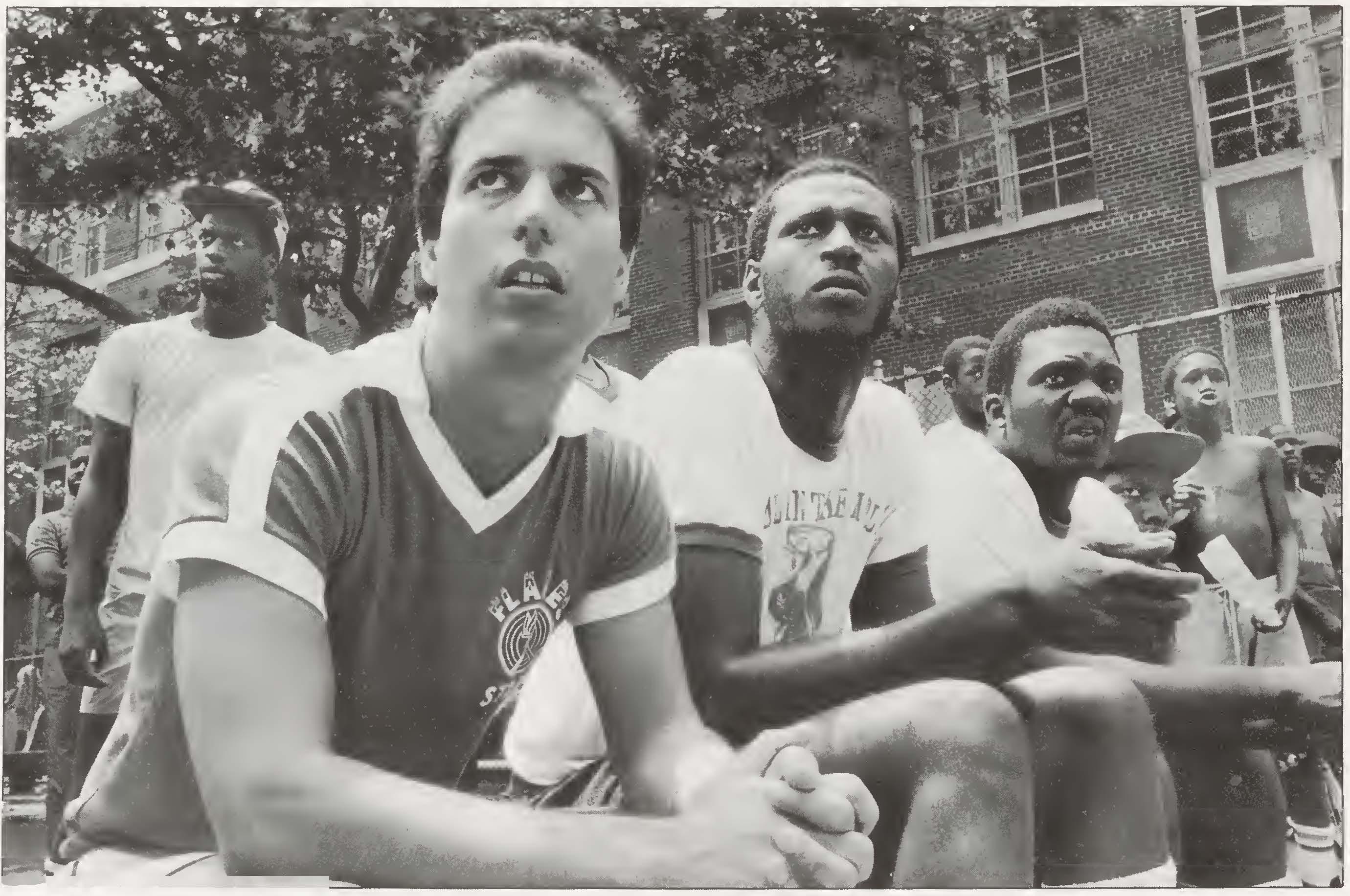
Flames team, and took a job as a tax attorney with a Wall Street firm. But the Flames took uP more and more of his time. He left the firm in 1979 (the Cadillac is the last remnant of those days) and opened a small general practice in Bensonhurst. He gives it only about ten hours a week, and occasionally represents team members who get into trouble, but he admits: 'Nope, I don't like practicing law." Papa relishes his recent practical training in street life, and appears more comfortable in a worn Flames T-shirt, gym shorts and sneakers than he possibly could be in a three-piece suit.
But the law had earlier seemed the route that would best lead him to where he could be an effective public servant. As a student at Columbia College, he had envisioned himself as an established statesman by the age of 30.
Booklearning had always come easily to Papa, who as a child was small, unathletic, and a little embarrassed about the good grades he got at St. Mary's, the Catholic elementary school next to his house (where hismotherworkedas asubstituteteacher), and later at Xaverian HighSchoolin BayRidge. "InhighschoolI never hung out. I didn't go out drinking with the other guys," he says. "I guess you'd say I was very serious."
He whisked through college in three years and graduated summa cum laude with a Phi Beta Kappa key. But what he had really been seeking was an education in self-assertiveness. He saw himself as too shy to make it in politics, so he purposely tested his character -nurtured by nuns and aprotective mother - against some of his ardent and outspoken classmates. It was the time of the Columbia studentstrikes; Papa was one of the dozen militant conservatives on campus who formed a group, Students for Columbia University, to oppose the radicals.
Once, after one group had torn down an American flag and raised a Viet Cong flag in its place, SCU collaborated with Columbia security guards ('They liked us," Papa says) to take it down and burn it for the local television cameras. Papa still has a shred in his room.
The goal of SCU was, in Papa's words, "to get the University to not cave in to the strikes., He recalls getting up early in the morning to try to keep classroom buildings open, literally dragging willing professors and students through crowds of pickets. "In those
days, I used to get so mad. I was a smart guy going to a good school and they were tearing down the institution. It was disgusting."
As a third-year law student in 1974, Papa found time to run in the Republican primary for the New York State Assembly seat in his home district. He lost. '1 was beat," he says of his first innings in political hardball, "and I learned much more than I cared to know. I wanted to forget the whole idea of politics and not get back into it."
The primary was in September. The Flames' first season began in October of the same year."Coachingthe kids was a differentoutlet for public service," Papa says, "and I really got into it. I had always been attracted to athletics, maybe because it came hard to me. In college the people I got along with best were either athletes or liberal types. The conservatives weren't my best friends. I don't know. For some reason, I'm more comfortable as part of an interesting dichotomy."
In their first year, the all-white Flames, named after the symbol of the Holy Spirit ("Stir into flame the gift of God bestowed on you."-2 Timothy 1:6) evoked more sympathy than interest. Most of the players had been cut from local parish teams and Papa had a lot to learn as a coach. They didn't come close to winning a game.
The next year the team had a .500 season -good enough, Papathought, to make it in the prestigious Catholic Youth Organization. All he needed was a parish to sponsor them.
Father Vincent Termine of Most Precious Blood Church, in the Bath Beach section of Bensonhurst, offered his parish's name and bingo hall. He and Papa painted white lines on the linoleum floors, erected portable backboards, and held open tryouts. Of those who made the roster, 60 percent were black and 40 percent were white.
The backlash was sharp and fast. Papa's tires were slashed, and he was bluntly reminded that it would be hard to coach basketball from a hospital bed. The black players who walked the blockand-a-half from the Marlboroprojects to Most Precious Bloodhad to fear for their lives. Some of them were barely teenagers. Papa recalls running from the hall one afternoon to find three white boys kicking a lone black curled up on the sidewalk. Before long, practices began and ended with a squad car posted out-
side. "It was World War III," Papa says, and he was the one who had led the invasion.
Racial integration was not his motive for forming the Flames in the first place. 'Noooo. Nope, nope, nope," he says, closing his eyes and shaking his head. '1 completely fell into it. As far as the people in Bensonhurst wereconcerned, I was guilty by associationwith black people." Since then, he has not been automatically embraced by everyone in Brooklyn's blackcommunityeither.Referringto a Flames team he coaches in an all-black summer league, he says, "I've slowly come to be accepted there as a coach, but there's been a little resentment over the fact that I'm a white running a successful black organization."
For two years the Flames were boycotted by all but two of the white kids in the neighborhood. Despite Father Termine's standing offer of the bingo hall, Papa took his players into exile. They were still affiliated with Most Precious Blood, but played only away games and practiced only now and then, when they could slip into a public high school gym.
Rock bottom came at the 1977-78 Christmas Tournament at Regina Pacis Hall in Bensonhurst. The big crowd was all white and, Papa recalls, "not too thrilled to see us there."
The Flames had just come out of the locker room and were wanning up before the final game of the tournament. One of the referees approached Papa and told him a player from the Regina team, who had just finished playing, was missing the sweat shirts, wallet and bus pass he had left in his locker. The implication, which spread quickly through the crowd, was that the Flames were responsible. The game was delayed at the start and again at halftime. The referees allowed it to resume only after Papa's nervous assurance that he would come up with the stuff. But when the final buzzer went off, the Flames were losers and the stolen property was still missing.
Papa was furious-with the team for betraying his trust and with himself for believing he could trust them. He told them they would each be searched. One objected, saying over and over: '1t's not right. It's not right... Papa lost his control, and with it, his innocence.
He grabbed the player (twice his size) by the jersey and threw him up against the lockers. Three others pulled him away. '1 was screaming andpractically in
tears,"hesays.'"Itoldthem1spentthree yearstryingtoshowpeopleyou'remore thanjustabunchofn-s,andyou're provingmewrong.'"Therewassilence.
Thesweatshirtsandthewalletsomehowmaterialized-itlaterturnedoutthe culpritwasaFlamesfollowerandnota player-butasfarasPapawasconcernedtheteamwasthrough.
Unawareofhisintentiontodisband theteam,twooftheolderplayers phonedhimlatethatnightandasked himtoleadameetingtopulltheteamto gether.Hereluctantlywentalong,but toldthemthey'dhavetorunit.He wantedtoseehowserioustheywere.At theendofthemeetingheagreedtocontinuecoachingonlysolongasthey obeyedcertainrules;highamongthem were"Don'tsteal"and"DowhatIsay"
Fromthenon,Papasays,"itwaslike amovie."Thoughhetakeslittlecredit asatechnicalstrategist,theteambegan toplaytogether.Ingameaftergame, propelledbyaneffectivefull-court press,theFlamescamefrombehindto winintheclosingminutes.Squeezing intotheC.YOplayoffs,theyswept theirdivision,beatingestablishedteams thathaddefeatedthemearlierinthe season,thenwinningthebigoneagainst HolyRosary.Miraculouslyafteronly
tworockyseasons,theFlameshadbecome1981C.Y.O.diocesanchampions. Ifthathadn'thappened,evenifthey hadcomeinsecond,Papasayswithcer tainty,theFlameswouldhavefolded. "'Before,theyhadlaughedatus,in Marlborotoo.AllofasuddenIhad respectasacoach.Allthewhitekidson theoriginalteamtooktheirFlames T-shirtsoutofthebottomoftheir drawers,goodblackplayerswantedto join,andthingsbegantosnowball."
TheFlamesorganizationfieldedsix teamsthenextyear.Papaleftthe WallStreetfirmtodevotehimselfvirtu allyfull-timetocoachingthekidsand learningmoreaboutwheretheycame from-thestreets.
Todaythereare22Flamesbasketball teamsdrawingplayersfromFlatbush, RedHook,Bedford-Stuyvesant,Bushwick,allovertheborough.Theteams playatalllevelsinavarietyofleagues andtournaments.Therearemanymore kidswhowanttoplaythanPapa's20 volunteersandpublicgrantscan support.
PapaandtheFlameshavereceived plentyofcongratulatoryattentionin thepress,includingwrite-upsinthe New York Daily News, acoverstoryin
New York magazine,andaCBSNews segmentproducedbyRobertLipsyte '57.ButPapahaswonacceptanceinthe neighborhoodsofBrooklynmoreby puttingtogethergoodteamsthanby publicrelations.'Vvegetaroundby word-of-mouthmorethannewspapers," hesays,"especiallyamongblacks.It's anentiresubculture."
Andwhatisthecoach'sroleinthat subculture?'Thecoachislikeapriestin theblackcommunity,"Papasayswithouthesitating.Herecallsthatoneofhis playerswasmurderedlastJanuaryon hiswayhomefromagame.Papahardly knewthefamily,butthemotherasked himtodelivertheeulogyatthefuneral. '1askedmypriesttohelpmeout.Ibeat mybrainsout.ButIdon'tthinkIdida verygoodjob.Iwashumbled."
Ifnotapriest,thenPapaisatleast thepublicservanthewantedtobe."I trytobeallthingstoallpeople,like PaulsaysinhisfirstlettertotheCorinthians."
Aninterestingdichotomy.If"all thingstoallpeople"ringsofpolitical sloganeering,PapaandPaularetalking aboutsomethingdifferent.'Idon'tmean itinthepoliticalsense.Myspecialtalentisbridginggaps.I'veusedithereto trytohelpkidsgrowup." 0