2026 NAB Show Daily News - DAY3

Page 1


The Future of Broadcasting

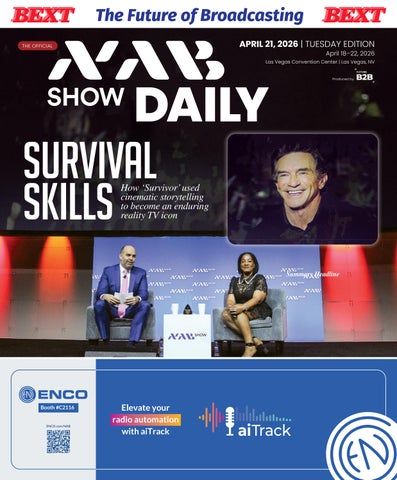
SURVIVAL SKILLS

How ‘Survivor’ used cinematic storytelling to become an enduring reality TV icon

Elevate your radio automation with aiTrack

Now you can build affordable live production and broadcast systems with SMPTE-2110 video! Blackmagic Design has a wide range of 2110 IP products, including converters, video monitors, audio monitors and even cameras! You get the perfect solution for intergating SDI and IP based systems. Plus all models conform to the SMPTE ST-2110 standard, including PTP clocks and even NMOS support for routing.

Build Professional SMPTE-2110 Broadcast Systems

The Blackmagic 2110 IP Converters have been designed to integrate SDI equipment into 2110 IP broadcast systems. The rack mount models can be installed in equipment racks right next to the equipment you’re converting. Simply add a Blackmagic 2110 IP Converter to live production switchers, disk recorders, streaming processors, cameras, TVs and more.

Conforms to the SMPTE-2110 IP Video Standard

Blackmagic 2110 IP products conform to the SMPTE ST-2110 standard for IP video, which specifies the transport, synchronization and description of 10 bit video, audio and ancillary data over managed IP networks for broadcast. Blackmagic 2110 IP products support SMPTE-2110-20 video, SMPTE-2110-21 traffic shaping/ timing, SMPTE-2110-30 audio and SMPTE-2110-40 for ancillary data.

Blackmagic 2110 IP Converters

Uses Simple 10G Ethernet for Low Cost

Blackmagic 2110 IP Converters are available in models with RJ-45 connectors for simple Cat6 copper cables or SFP sockets for optical fiber modules and cables. Using simple Cat6 copper cables means you can build SMPTE-2110 systems at a dramatically lower cost. Plus copper cables can remote power devices such as converters and cameras. There are also models for optical fiber Ethernet.

Incredibly Easy to Install

One of the biggest problems with SMPTE-2110 is needing an IT tech on standby to keep video systems running. Blackmagic 2110 IP converters solve this problem because they can connect point to point, so you don’t need to use a complex Ethernet switch if you don’t want to. That means you get the advantage of SMPTE-2110 IP video with simple Ethernet cables, remote power and bidirectional video.

From Future B2B the publisher of TV Tech, TVBEurope, Radio World, SmartBrief on Media & Entertainment, Mix, Sound & Video Contractor, Systems Contractor News, AV Technology, TWICE and more!

CONTENT

VP, Market Lead Carmel King MD, Content, Broadcast Tech Paul McLane

Content Director Michael Demenchuk Content Manager Wayne Cavadi

Contributors Tom Butts, David Cohen, Matthew Corrigan, Cindy Davis, Fred Dawson, Robert Edelstein, Michael Grotticelli, Carolyn Heinze, Elle Kehres, Phil Kurz, Nicholas Langan, Jon Lafayette, Victoria Martinez, Deborah D. McAdams, David McGee, Stuart Miller, Addie Morfoot, James E. O’Neal, Mark Pescatore, Jenny Priestley, Randy J. Stine, R. Thomas Umstead, George Winslow, Clive Young

Photographers

John Staley Photography & Phototechnik International

DESIGN & DISTRIBUTION

Senior Design Director Lisa S. McIntosh

Production Managers Heather Tatrow, Nicole Schilling

ADVERTISING

Managing VP Sales, B2B Tech Group Adam Goldstein

Ad Sales Raffaella Calabrese, John Casey, Janis Crowley, Zahra Majma, Joe Palombo, Debbie Rosenthal, Andi Tureson, Hayley Brailey-Woolfson

MANAGEMENT

SVP, MD, B2B Amanda Darman-Allen

VP, Head of US Sales, B2B Tom Sikes

VP, Global Head of Strategy & Ops, B2B Allison Markert

VP, Product & Marketing, B2B Andrew Buchholz

Head of Production US & UK Mark Constance

Head of Design, B2B Nicole Cobban

The Pulse of NAB Show

40 Consolidation, CTV Create Opportunities in Ad Tech

New systems focus on the convergence of linear and digital platforms 42 Microdramas Draw Major Interest

Low-budget, made-for-mobile format is finding viewers where they live

45 AWS Demos AI Tools to Deliver Vertical Video

52 Show Shots NAB Show 2026 in pictures

Local

Through Film

Team Deakins shares a lifetime of lessons behind the camera 16 Video Podcasting Leaps in Popularity

Medium extends its reach well beyond its traditional audio base 20 Audio Systems Get Boost From Cloud and AI

Infrastructure increasingly is hybrid, flexible and often invisible

What’s Happening Today on the Main

AWS Elemental Inference service is one example of how its technologies help companies rapidly embrace new consumer habits

48 MS NOW Uses Community to Build Up Its Brand

News network seeks to deepen its audience relationship

50 ATSC Celebrates 3.0’s Global Expansion

The goal is to create experiences compelling enough to get

Representatives from Brazil, India, S. Korea and the Caribbean discuss the standard’s implementation 54 North America Becomes BritBox’s Land of Opportunity

An audience-first approach is helping the streaming service build a loyal and profitable subscriber base

STORYTELLING INNOVATION

Cinematic Feel Makes

‘Survivor’ Built to Last

NAB Show honors pioneering reality show and talks live production with Jesse Collins at Opening Session

NAB Show celebrated 50 seasons of CBS’s “Survivor” with the presentation of the NAB Spirit of Broadcasting Award during Monday’s Opening Session.

NAB President and CEO Curtis LeGeyt was joined by “Survivor” host Jeff Probst, who beamed into the session via video from the

show’s location in Fiji, and fanfavorite competitor Cirie Fields to discuss the show’s journey.

Probst learned about “Survivor” while listening to the radio as he drove around Los Angeles. He heard Mark Burnett, the original producer, talking about how he was going to put 16 people on an island and force them to live together while voting each other out.

“I’m not exaggerating when I

say, from that moment forward, I wanted to be a part of ‘Survivor,’” Probst recalled.

“And I went after it with everything I could. I tried everything to get their attention. And when I finally got the job, I was so excited. The crazy part is, my enthusiasm is the same today. I love being a part of making ‘Survivor.’”

Probst took over as showrunner in 2010, bringing innovation

into the production workflow. He wanted to make the show even more cinematic than it had been under Burnett.

“We have elevated the cinematic experience through our cameras and our microphones, with the intention to fully immerse the audience as much as we can with the disconnect of a screen,” he said.

“We want to say, ‘This is what it’s like to wake up after a storm and look at your fingers, and then you hear a whisper over that person’s shoulder.’ … Between a camera and a microphone, we’re taking you inside their world.”

Fields said the show’s immersive nature is something she particularly enjoys as a viewer.

“When I watch it back now, I can feel that immersion,” she told the audience.

“My children can almost feel what I’m feeling when they see me dirty. They can actually see the sand and the grime on me, knowing that I slept just right there in the middle of the camp.”

CINEMATIC IN LIVE

Cinematic visuals are also finding their way into live production. For Jesse Collins, CEO of Jesse Collins Entertainment and renowned producer of the Grammys, Oscars, BET Awards and Super Bowl halftime show, technology is helping push the boundaries of what’s possible on-screen.

“We are able to use cinematic lenses now. They are enabling us to change the way that we shoot performances,” Collins said in a conversation with entertainment journalist Carolyn Giardina during the Opening Session.

“Technology is everywhere, and when it’s used properly, it helps make the content better.”

Collins cited Lauryn Hill’s performance at this year’s Grammys as an example of how technology has enabled him to bring an amazing visual and audio experience to the screen.

“Ten or 15 years ago, I don’t

know if we could have gotten that many live instruments in a live show, but we were able to get it done through advances in audio technology,” he said. In fact, Hill’s performance had more audio

BRINGING THE RUCKUS

inputs than any performance in Grammy’s history.

Collins also shared his thoughts on artificial intelligence and its potential impact on live production.

He said the technology is being used to help create visions of what producers want to accomplish. But he doesn’t think it will replace what viewers see on-screen.

“At the end of the day, an artist is going to be an artist. Beyoncé is Beyoncé. People want to see Beyoncé. And, especially in live television, that’s what people want. So I haven’t seen it really creep into the final broadcast.”

audience food for thought. During the Super Bowl halftime show, the broadcast is transferred from the broadcast game truck to one that handles just the musical performance. “There’s a terrifying moment leading into that, which is called the point of no return, that last minute when they’ve given us the broadcast and there’s no turning back,” he said. “Sometimes not all the cameras are connected, and then they’re working through it and working through it and working through it. Fortunately, it’s always worked out.

Asked if he has a wish list for how technology could help achieve something that’s not currently possible, Collins gave the

something that’s not currently possible, Collins gave the

Standup comic and “Curb Your Enthusiasm” co-star JB Smoove talked storytelling and brand building with Ankler Media CEO and Editor in Chief Janice Min at the panel session “Stand Up, Stand Out: JB Smoove and the Business of Being Funny.”

“If someone could create something where at the beginning of the event, everybody’s dialed in, I don’t know if that’s a massive truck with an entertainment side and a live broadcast sports side,” he said. “It would take a lot of that anxiety away in the transition and it would give us more time for entertainment.” ●

of the event, everybody’s dialed in, I don’t know if that’s a massive

Curtis LeGeyt
Jesse Collins

MEDIA REGULATION

Why Broadcast Is Well-Positioned to Safeguard Freedom of Speech

Local stations remain a critical buffer against shifting regulatory norms, panelists say

When Federal Communications Commission Chairman Brendan Carr took to X last month threatening license revocations over broadcasters not operating in the public interest, it became a case study for policy experts, educators and journalists alike.

How much government oversight is too much?

Commissioner Anna Gomez, currently the sole Democrat on the FCC, led a panel of experts who offered perspectives on the government’s role in ensuring that news outlets avoid bias, whether real or perceived.

A focal point was the concept of “jawboning” — government officials using informal pressure, public threats or social media to coerce media organizations into changing their coverage.

Threats raised on social media may not result in a direct policy change, said Joe Flint, entertainment business reporter for The Wall Street Journal, but may weigh heavily on a company looking ahead to its next license renewal.

“That’s where I wonder if the ultimate goal is to be in the back of an outlet’s mind, ‘Well, what lawsuit will this bring?’” Flint asked.

Casey Mattox, vice president of legal strategy at Stand Together, said the pressure can build gradually over time.

“People end up being slowly affected by this sort of accumulation of the gravitational force’s power,” he said.

But Robert Corn-Revere, chief counsel for the Foundation for

Individual Rights and Expression, said jawboning historically has been difficult to prove in court.

“It is going to require a licensee that has had enough and said, ‘We are being affected adversely by all of this pressure being brought on broadcasters, and we would like to put that to the test,’” Corn-Revere said.

You cannot completely remove bias from media, Mattox said, because to be human is to have bias.

Flint referenced the controversies around Howard Stern in his Infinity Broadcasting days to show that pressure from regulators is nothing new.

Mara Gassmann, senior staff attorney for the Reporters Committee for Freedom of the Press, pointed to two recent court decisions that are relevant though not directly involving the FCC.

U.S. District Judge Randolph Moss ruled in March that the Trump administration’s executive order to end federal funding for NPR and PBS was unconstitutional.

And District Judge Royce Lamberth ruled last month that the administration’s efforts to dismantle the Voice of America were “arbitrary and capricious.”

It is unclear where those decisions will lead, though CornRevere noted that the use of social media by Carr and others has caught the eye of federal courts.

Gomez pointed out that historically, the FCC has justified regulating broadcast content by arguing that spectrum was a scarce public resource and a “pervasive presence.”

Should that apply in today’s fragmented content landscape?

“We’ve got media literacy

programs, media education, but at the bottom end of the day, I don’t think it’s the government’s role to sort out what’s true or what’s false,” said Clay Calvert, nonresident senior fellow at the American Enterprise Institute.

“If everyone just took a little more time trying to listen and understand each other and not immediately go to ‘what is the agenda,’ I think we’d be a lot better off,” Flint said.

Local broadcasters, the panelists concurred, are uniquely positioned to push back and remain objective.

“All of this is sort of downstream of culture,” Mattox said. “You are in the best position, more than just about anybody, to do what is the most necessary thing to protect First Amendment rights going forward.” l

From left: Anna Gomez, FCC commissioner; Mara Gassman, Reporters Committee for Freedom of the Press; Casey Mattox, Stand Together; Robert Corn-Revere, Foundation for Individual Rights and Expression; Joe Flint, The Wall Street Journal; and Clay Calvert, AEI, on the panel session “The First Amendment and Press Freedom in Today’s Media Landscape.”

openGear for Broadcast & ProAV

Multiviewers

OG-Mi-9

OG-Mi-9+

OG-Mi-9#

OG-Mi-16#

4x1 Multiviewers

OG-MiniQ

OG-MiniDE-Il

OG-MiniDL-1+3 / 2+2 / 3+1

OG-MicroQ

Audio Embedder/De-Embedder

OG-DA-SDI-DE- 12G-Dante

OG-DA-SDI-EM- 12G-Dante

OG-DA-HM-EM- 12G-Dante

OG-DA-SDI-DE-12G

OG-SDI-EM-12G

HDR <> SDR Converter/Scaler

OG-HDR-UDX

HDBaseT3 Tx/Rx

OG-HDBT3-Tx

OG-HDBT3-Rx

Scalers with Genlock

OG-US-6000

OG-US-5500

OG-US-5000

OG-US-4000

OG-US-3500

Frame Synchronizer

OG-FS-4000

Scalers without Genlock

OG-Micro-UDX

OG-Micro-4K

OG-Pinnacle

OG-Pinnacle-C

OG-Pinnacle-L

OG-Micro-Single

OG-Micro-Single-C

Sync Generators

OG-SYNC

OG-SYNC-ACO

OG-PG-4000

Keyboard / Mouse

OG-KVM-IP-Tx-UHD

OG-KVM-IP-Tx

Booth: N1141

Our 50+ openGear solutions deliver flexible, reliable performance for seamless signal and video workflows.

Converters

OG-DA-SDI-HDTV-UHD

OG-DA-HDTV-SDI-UHD

OG-DA-HDTV-SDI-II

OG-SDI-HDTV

OG-3G-Mux-12G-ll

OG-12G-DeMux-3G-ll

Distribution Amplifiers

OG-DA-AV

OG-DA-AA

OG-DA-AES

OG-DA-WC

OG-DA-4HD-II

OG-DA-8HD-II

OG-DA-4UHD

OG-DA-8UHD

HDMI 2.0 Splitters

OG-HDM2.0-1x2 Dual

OG-HDM2.0-1x4

OG-HDM2.0-1x8

HDMI 2.0 Fiber Transmitter

OG-HDM2.0-FIB-II-Tx

CINEMA TECHNIQUES

They Shape Great Stories Through Film

Team Deakins shares a lifetime of lessons behind the camera

With Team Deakins, there is creativity in abundance.

Acclaimed cinematographer Roger Deakins and his creative and life partner James Deakins reflected on their lengthy career in a CineCentral Feature Presentation on Monday.

The two celebrated their book “Reflections: On Cinematography,” best described as a weaving of personal stories with the technical craft of filmmaking.

From their first date — which they can’t quite agree was a date — to their work on iconic films like “Barton Fink,” “The Shawshank Redemption,” “O Brother, Where Art Thou?” and “Skyfall,” Team Deakins discussed the creative process and the power of storytelling for a full house.

Roger began his career at art school before switching things up and heading to film school, where he quickly realized his calling.

“The dream was to keep away from a 9-to-5 job,” Roger joked. “I love shooting documentaries, I love going to different places, but I had no idea where it was going to lead.”

It led to music videos, documentaries and eventually film.

While filmmaking led to his illustrious career, it also took him to the set of “Homicide: Life on the Street” in 1991, where he met a screen supervisor named Isabella James Purefoy Ellis.

The union of Roger and James isn’t simply a love story of epic proportions. It is the very being of what has made them successful: collaboration.

Despite multiple Oscars and BAFTA Awards, Roger and James

Deakins remain humble and will be the first to tell you that storytelling is about teamwork.

of cinematographers are set in their ways, James feels, but Roger was readily willing to reinvent himself to use new approaches when appropriate.

Technology, Roger added, has only been necessary to create a world the director wanted. He was adamant that he doesn’t embrace technology because he likes it but because it tells a story he was trying to create.

They discussed Roger’s unique style of shooting (he doesn’t like multiple cameras) and lighting (he’s resourceful, sometimes using bulbs from Home Depot).

In a sense, the Deakins created the first immersive experience. Roger said he doesn’t like anything that feels like a layer between the audience and the character; he wants to bring the audience into the film.

Before the Deakins opened a lengthy Q&A, James elaborated on the successful podcast “Team Deakins.”

She said the duo had been asked so many questions on press junkets and tours that they started a podcast as a place to answer. However, when COVID-19 hit, others became more available.

The two began conversations with colleagues in the industry and wanted listeners to feel that they were eavesdropping on a dinner conversation.

The dream was to keep away from a 9-to-5 job. I love shooting documentaries, I love going to different places, but I had no idea where it was going to lead.”

Roger spoke of the pleasure of working frequently with the same gaffers, camera crew and other grips. Collaboration, said James, “is part of the joy, but it makes you better. If you foster an environment where people can offer ideas, you have a better range of ideas.”

Whether it was the LED takeover of sets, new lighting capabilities or the digital age, the two were open to technological change. A lot

ROGER DEAKINS, TEAM DEAKINS

There was one thing they noticed every guest on the show valued in common: collaboration.

“We all have the same job in different ways, but their passion is the same,” James said. “We enjoy talking to the people and have learned a lot.” l

From left: Roger and James Deakins were interviewed by cinematographer Adam Bricker in the CineCentral Theater.

SHOW SHOTS

team members discussing the multiplatform cloud production studio (from left): Carlos Uzcategui, customer success manager; Marcelo

marketing. ❶ It was time to step into the ring with Panasonic’s Ultra Pro AV Wrestling.

Bernhard Heigar poses for a photo with Boom, mascot for the Seattle Seahawks, at the Lumen Technologies booth.

senior customer success manager – Americas; and

Sam You, right, product and sales manager for Bosma USA, discusses the capabilities of its latest 8K cinema camera, with Michael Green, the company’s U.S. vice president.

Drake Creighton of Microsoft discusses intelligent media orchestration and agentic operations and work ows.

Grabyo
Teixeira,
Josie Waddams,

DO MORE TODAY. STAY IN CONTROL TOMORROW.

HUMAN INTERFACE

Unified control across MediorNet and hybrid SDI/IP productions.

• Vendor-agnostic, browser-based broadcast control system

• Deep integration with MediorNet for routing, processing, multiviewing

• Bridges baseband, SDI, and IP workflows in a unified system

MEDIORNET HORIZON ST 2110 MULTIVIEWER APP Native IP multiviewing for modern production environments.

• ST 2110 multiviewer with NMOS IS-04/05

• Up to 128 PiPs and 16 heads in 1 RU

• Proven MediorNet multiviewer workflows, now extended into IP

MediorNet unifies SDI and IP processing, routing, and multiviewing within a modular, distributed ecosystem that evolves with industry standards – from baseband to full IP – seamlessly integrated and controlled through Riedel’s hi human interface.

EXHIBITOR SPOTLIGHTS

AVID CONTENT CORE ENHANCEMENTS

N2226 | Avid Content Core is now commercially available and at the center of Avid’s presence at the 2026 NAB Show. The award-winning content data platform is the industry’s first true cloud-native production solution, unifying asset identity, ingest, storage, metadata, orchestration and rights information into a single intelligent layer, eliminating fragmentation across tools, teams and processes. By connecting these critical elements, Content Core supports hybrid environments spanning on-premises and cloud infrastructure, helping teams work faster across postproduction and news while improving how content is discovered, managed, and reused.

Building on the momentum from its launch at IBC 2025, Avid is showcasing new

TAG: IN NEW PARTNERSHIP, TAG BRINGS BROADCAST MONITORING TO OCI

W2323 | TAG Video

Systems and Oracle Cloud Infrastructure (OCI) are partnering to bring broadcast monitoring to OCI. The relationship marks a significant milestone in TAG’s cloud strategy, establishing OCI as a certified infrastructure platform for deploying the full TAG monitoring suite at any scale.

TAG’s Realtime Media Platform is now deployed and certified on OCI, with active work underway to bring the full TAG product portfolio to the platform. Broadcasters working with OCI will be able to count on a fully supported, production-validated monitoring stack that integrates natively into their OCI-based workflows.

Together, TAG and OCI provide:

• End-to-end IP-native signal visibility, from ingest to playout, on a cloud infrastructure designed for high-throughput media workloads.

• Scalable, flexible compute that adapts to the bursty, always-on nature of live broadcast without overprovisioning or cost surprises.

• A jointly supported deployment path, backed by TAG’s integration expertise and OCI’s enterprise infrastructure, for broadcasters.

TECHEX ENCOMPASS MASTER CONTROL SERVICES

W2267 | Encompass Digital Media and Techex are introducing new, fully managed, cloud-native Master Control services designed to meet the growing operational demands of live sports and entertainment broadcasting. The service integrates Encompass’s managed services expertise and Altitude Media Cloud platform with Techex’s tx darwin content transformation technology, with user interface and control capabilities from Densitron, are being showcased at the 2026 NAB Show.

Altitude Events, available as part of the Encompass Altitude product suite, enables broadcasters, sports rightsholders and media organizations to configure and deploy fully operational master control workflows with the agility, scale and cost efficiencies of the cloud.

The service manages the full chain of live event delivery, from acquiring signals from any location, processing them with dynamic branding, standards conversion, content and ad insertion, triggering to enable monetization and encoding and distribution to multiple endpoints. The combined Techex

innovations that extend Avid Content Core’s capabilities, including AI-driven intelligence, agentic workflows, and automation that helps organizations not only manage content, but actively understand, orchestrate, and monetize it.

“Content Core was built to help Avid’s customers modernize without disruption and transform without unnecessary complexity,” Avid CEO Wellford Dillard said.

and Encompass software-defined, cloud-native infrastructure means workflows can be initiated at the start of an event and removed once coverage is complete, enabling events to be delivered cost-effectively at scale.

MEDIAGENIX CONTINUOUS OPTIMIZATION MODEL

W1857 | Mediagenix is showcasing its latest innovations at NAB Show, demonstrating how media companies can move toward a more intelligent, continuous model of optimization across the entire content lifecycle. Key innovations on display include:

• Semantic Intelligence for Title Management and Monetization: Mediagenix transforms title and rights data into actionable commercial intelligence. By connecting content, rights and audience insights, the platform enables sales and licensing teams to identify opportunities faster, package content more strategically and drive stronger ROI from existing catalogs with intuitive and transparent discovery.

• Advanced Schedule Optimization: Moving beyond traditional automation, Mediagenix is introducing a dynamic scheduling system that continuously aligns programming decisions with audience behavior, rights constraints and monetization goals.

• Smarter Content Personalization: Mediagenix enhances both the broadcast/streaming curation and audience content discovery experience through AI-powered metadata enrichment, natural language search and context-aware recommendations.

INTERRA SYSTEMS BATON PLATFORM SHOWCASE

W2243 | At the 2026 NAB Show, Interra Systems is showcasing the latest version of its BATON platform, along with its entire suite of QC, monitoring and analyzing solutions, including ORION for real-time monitoring and VEGA Media Analyzer for deep technical analysis and debugging. Interra Systems has also announced that Elite Media Technologies has selected the BATON file-based QC solution for file-based media workflows.

BATON is used to automate quality control processes for media files, helping ensure compliance and consistency across formats, including SDR and HDR content.

“Our mission is to create high-quality media experiences for clients worldwide,” Nick Mairose, president and CEO of Elite Media Technologies, said. “After an in-depth evaluation, we selected BATON for its audio and video analysis, scalable architecture and feature set, which align with our commitment to maintaining high standards in content transformation and delivery.”

CROSS-PLATFORM PODCASTING

Video Podcasting Leaps in Popularity

Medium extends its reach well beyond its traditional audio base

Podcast listening in the U.S. reached new highs over the past year, as the medium continues to expand its audience base.

Yet for this audio-first medium, video is what has people talking.

The recently released 2026 edition of Edison Research’s Infinite Dial reports that 58% of Americans age 12 and older listened to a podcast in February 2026. That’s equal to about 167 million people.

That is the highest monthly podcast reach recorded in the study’s history, according to the Edison Research report.

Just how big is podcasting?

Conan O’Brien said his podcast

“Conan O’Brien Needs a Friend” allows him to reach more people than he did in late-night TV; in an interview with The New Yorker he said this allows him to be a “master of my own destiny.”

The show told Podcast News Daily that it has amassed some 660 million downloads since its launch. Radio entities too have been expanding their podcasting capabilities. According to Triton Digital’s U.S. Podcast Report, iHeartMedia averaged 69 million weekly downloads, followed by NPR’s 27.2 million and Audacy recording 14.8 million average weekly downloads.

OPTIMIZING FOR VIDEO

According to the Triton report, listening is still the predominant

method to consume podcasting. But the popularity of video podcasting has grown dramatically, and audio-first brands are expanding quickly into multiplatform operations.

Consumers are leaning into this and expanding how and where they engage with podcasts.

In fact, most consumers both listen and watch. A whopping 80% of respondents 18-plus said they consume podcasts both ways.

(Triton’s report also looked at how various genres behave differently in video; some are “watch-forward,” others “listenforward.” People often listen to science, history and fiction. They often watch music and sports, while comedy tends to

bridge both behaviors.)

iHeartMedia is enhancing its podcast offerings by adding fulllength video podcast distribution to iHeartRadio. The company said the move is designed to expand reach for creators.

Beginning later this year, podcasters will be able to distribute full-length video versions of their shows directly into both the app and web versions of iHeartRadio, alongside traditional audio episodes.

iHeartMedia also recently announced a video podcasting partnership with Netflix.

Gary Levitt
Conan O’Brien, shown at right with guest Martin Short, says his podcast has a wider reach than his late-night TV shows did.
Cindy Ord/Getty Images for Sirius XM

When it comes to the latest in advanced HDR performance, one format continues to deliver an amazing entertainment experience.

With more than 170 adopters and over 20,000 certified devices, HDR10+ dynamic metadata delivers a compelling combination of benefits including outstanding brightness and contrast, robust standardization, easy implementation, and no licensing fees. Making it an ideal choice for broadcasting, streaming and packaged media.

Now with HDR10+ ADVANCED, enthusiasts can also enjoy a variety of other exciting features including:

• Enhanced Overall Brightness

• Advanced Color Control

• Local Tone Mapping

• Genre-based Optimization

• Intelligent Motion Smoothing

• Adaptive Cloud Gaming

All of this is why leading content providers like Prime Video have announced their support for HDR10+ ADVANCED. To receive our latest white paper on HDR10+ ADVANCED, go to hdr10plus.org.

SNAPSHOTS

AIVE

2W300O | Aive is the ultimate softwareas-a-service (SaaS) engine for automated video versioning, leveraging MGT to hyperscale content delivery and ROI instantly.

Aive is the premier SaaS engine leveraging MGT to automate video versioning at scale. We transform master assets into high-performing cross-channel campaigns instantly. Achieve 80% cost savings and 3x faster time-to-market on average while maximizing ROI with our unique AI Creative Score. Scale your video impact, not your workload.

CLOUDASCENT

W2801G | CloudAscent democratizes media data and operations by reimagining how media organizations connect systems, orchestrate workflows and turn complexity into clarity across the entire media supply chain.

Qrate is a cloud-native media orchestration platform with a powerful workflow engine that automates the media supply chain. It unifies user-driven tasks and machine workflows, orchestrates legacy archive and content migrations, and aggregates fragmented, siloed and proprietary storage systems into a single pane of glass — making advanced media operations accessible to teams and organizations of any size across onprem, cloud and hybrid environments.

REMOTLY

W3228 | Remotly is the next-generation remote desktop.

Remotly is the most secure remote desktop software, delivering ultralow-latency 4K HDR access from anywhere. Designed for remote work and collaborative media teams, it supports creative workflows, IT operations, learning and gaming. This next-generation platform allows users to seamlessly manage computers from PCs, macOS, Android and iOS devices.

MOVIN INC.

C7708 | MOVIN Inc. builds motion AI systems that make studio-grade human motion capture accessible anywhere.

MOVIN is a motion AI company developing portable, LiDAR-based, real-time free-body motion capture that transforms human movement into clean, production-ready data anywhere. Its flagship MOVIN TRACIN provides studio-grade capture with a single device, three-minute setup and under 100 milliseconds latency for film and robotics, while TRACIN Multi enables multiperson capture for live performances.

On an investor call in March, Bob Pittman, CEO of iHeartMedia, called video podcasting “a wonderful expansion of the marketplace.”

AI continues to change podcasting in exciting ways, said Gary Levitt, an audio engineer and co-founder of Future Moments, which releases apps for content creation.

“Because AI can transcribe audio so easily, podcasts are becoming fully searchable by text. It’s turning millions of hours of conversations into an incredible knowledge resource,” Levitt said.

“Now tools like TapeSearch and Listen Notes make it possible to search any topic and instantly find the exact moment it was discussed in a podcast.”

MONETIZATION OF PODCASTS

Podcast advertising also continues to surge, according to research firm Magellan AI.

E-commerce and retail brands remain deeply invested in podcasting, it said, with financial services, telecom and tech remaining the top advertisers.

Magellan AI analyzes podcast advertising data from the top 3,000 U.S. podcasts as ranked by Apple Podcasts. It said the top 15 advertisers spent a combined $59.8 million in January.

As part of NAB Show’s Broadcast Management and Monetization Conference, the session “Hot Digital Trends: What to Know About Video, Podcasts and AI” explores where broadcast operations should invest their time and money.

Moderated by multimedia journalist John Wordock of WTOP in Washington, D.C., the panel (2:45 to 3:45 p.m. today in Room N259) will offer insights on these key digital areas.

Wordock said every broadcaster, whether television or radio, whether small market or large market, needs to create a strategy for video podcasts on YouTube.

“Think of YouTube as a storefront window for your podcast,” Wordock said.

The session will feature Andy

Slater, head of partnerships at ART19, Amazon’s podcast hosting and monetization platform. A 10-year veteran of the podcasting space, Slater works with top-tier creators and networks to optimize their publishing workflows and scale global ad revenue.

Video will also be the focus of today’s “Creating Automated Video for Podcasting” (C9226 Creator Lab Classroom). The session promises to help creators streamline camera switching, audio, recording and live streaming with smart production tech. ●

Big-Name Trend

Podcasts offer flexible multimedia opportunities for broadcasters, including video. iHeartMedia is deepening its “Creators First” strategy and has added full-length video podcast distribution to iHeartRadio at no cost to creators. The media company has also inked a video podcast partnership with Netflix.

Video is also coming to Apple Podcasts and, for the first time, so is dynamic ad insertion for video episodes, according to Apple. The company says it will roll out the “transformative” update this spring, using Apple’s HTTP Live Streaming (HLS) technology that will give creators new control and monetization opportunities while delivering the new viewing option for users.

John Wordock

Scale Remote Production Scale Remote Production

Harness the power of 140Gbps in a single X20

Harness the power of 140Gbps in a single X20

Find out more at NAB booth W1531

Find out more at NAB booth W1531

AUDIO ADVANCES

Audio Systems Get Boost From Cloud and AI

Infrastructure increasingly is hybrid, flexible and often invisible

More than ever, technology suppliers in 2026 are meeting media entities where they live and work, with a hybrid, flexible and often invisible ecosystem.

Audio infrastructure manufacturers and providers agree that while the “sound” still must be perfect, the exact location of the gear no longer matters.

“We are not moving towards a future where the physical location of the audio suite doesn’t matter anymore,” said Calrec Director of Product Management Henry Goodman. “We’re already there.”

WHO, HOW AND WHERE

While the “where” has shifted, the “who” remains the foundation of the broadcast. Humans are still largely mixing and shaping program output. “But how and where they do all this has changed beyond recognition,” Goodman said.

The show’s exhibit floor offers ample evidence for television, radio and streaming contexts.

Wheatstone is showcasing its VMX virtual mixing platform, which can serve as a single mixing backend for multiple consoles or surfaces, at its booth.

Marketing Director Dee McVicker said the cost benefits from virtualization are a focal point. “Not to mention removing the massive physical limitations of the studio as we know it,” she said.

For manufacturers, the challenge is ensuring that as consoles move from isolated desks to complex networks — whether on-site, on edge or in the cloud — the engineer’s experience remains intuitive.

Solid State Logic intends to decouple the “big console” experience from the giant desk. Berny Carpenter, SSL’s broadcast product manager, said that through the company’s Virtual Tempest Engine, the software can be deployed across public clouds or private data centers.

Does this flexibility mean that mixing can be performed truly anywhere? Wheatstone’s McVicker offered a nuanced take.

“We’re not taking away from the tactile feel of a fixed console, yet we’re not limiting you to that or where you might be mixing at the moment,” she said.

Goodman too said Calrec’s approach is to provide the “big console” experience in a portable package.

FIXED HARDWARE TO MOBILE APPS

In the West Hall, Lawo is preaching a philosophy of agility through its HOME Apps platform. The concept is a departure from the “one box for each task” style of broadcasting.

For a media outlet using a generic commercial off-the-shelf server, Lawo believes the platform is ideal for managing a succession of workflows, allowing a broadcaster to decide on Monday that it’s an audio mixer and on Tuesday that it’s a multiviewer by switching containerized microservices.

“Hardware infrastructure no longer dictates workflows: Workflows now define the agile processing stack,” said Wolfgang Huber, Lawo’s public relations manager.

According to Huber, that kind of agility is important in mobile production trucks, where every inch of rack space and watt of power counts.

Wheatstone’s VML, an HTML5-based virtual console, can be accessed through a web browser, offering mixing on a laptop, tablet, smartphone or desktop. “You have a lot of flexibility to set up remote broadcasts, temporary studios in a disaster situation or even add on a permanent production studio,” McVicker said.

BY YOUR SIDE

But how does an engineer harness all of the power available now, particularly from AI and automation?

At Telos Alliance, AI is framed as a “mixing assistant riding shotgun,” said Clark Novak, its marketing content manager.

Telos’ flexAI platform utilizes the Jünger Audio Intelligent Companion, an AI-powered automixer. Novak explained that flexAI pushes background noise down while keeping dialogue consistent, allowing the engineer to focus on the overall mix while the platform handles “small corrective moves.”

SSL offers a similar philosophy with its System T Dialogue Automix. Carpenter said that the system focuses on the active speaker across a large number of sources to reduce crosstalk.

Telos Alliance is showcasing its Axia Altus and Studio Essentials lines.
Wheatstone’s VML HTML5-based virtual console can be accessed through a browser for mixing on a device such as a tablet.

BIT TREE IS HERE AT NAB 26

See Dante, 12G and more at booth C6928

Wheatstone’s McVicker called it a hardware-agnostic philosophy.

As NAB Show exhibitors will demonstrate, the movement to flexibility is not an all-or-nothing proposition. Most facilities are adopting a hybrid approach — keeping hardware where tactile control is needed, but moving the

“It allows the operator to focus on the output, rather than reacting to who is currently speaking,” Carpenter said.

Lawo, for its part, sticks to deterministic algorithms in its KICK sports mixing technology, for example, to avoid “AI hallucinations” in high-stakes environments.

But with the platform’s closeball mixing, which is automated based on camera tracking data, Lawo’s Huber said the technology

allows the audio engineer to focus on creative storytelling rather than manual gain-riding.

But a recurring theme is that disappearance of large surfaces.

For instance, Telos Alliance’s Axia Altus and Studio Essentials lines allow mixing to be controlled entirely via a web browser.

“Virtual mixing isn’t about replacing the studio,” Novak said, “it’s about expanding it to other locations.”

NAB SHOW

This

chance to

ROSS, CHAIRMAN AND CEO, ROSS VIDEO

“heavy lifting” to the cloud.

As Calrec’s Goodman concluded, the tools must provide the operator with the ability to adapt to demanding environments.

Whether the processing happens in a basement rack or a distant data center, the mission remains the same: clear and compelling audio. ●

Industry EXPERTS Say...

WOLFGANG HUBER LAWO

“Hardware infrastructure no longer dictates workflows: Workflows now define the agile processing stack.”

DEE MCVICKER WHEATSTONE

“What we are really talking about here is a key part of the virtual airchain and all the flexibility and cost benefits that come with that, not to mention removing the massive physical limitations of the studio as we know it.”

HENRY GOODMAN CALREC

“Broadcasters want to expand and adapt their existing production facilities to meet the scale of a project rather than be locked into the traditional model of buying enough hardware processing for their biggest event of the year.”

BERNY CARPENTER SOLID STATE LOGIC

“We have engineers with a System T solution in cases small enough to check in as hold luggage on a plane, in which case being able to temporarily deploy a system whilst still retaining true broadcast-grade audio console functionality is a great benefit.”

CLARK NOVAK

TELOS ALLIANCE

“Virtual mixing isn’t about replacing the studio; it’s about expanding it to other locations and reducing hardware.”

Scan the QR code for more on why Ross has exhibited at NAB
By automating close-ball mixing based on camera tracking data, Lawo’s KICK sports-mixing system allows the audio engineer to focus on creative storytelling rather than riding gain.

MAKE EVERY LIVE BROADCAST INSTANTLY MULTILINGUAL

AI-Media is building the global infrastructure layer that makes live video accessible in every language.

Powered by the LEXI platform, we enable real-time AI voice translation, captioning, and accessibility for live broadcast and production workflowshelping content reach global audiences instantly.

NEW AT NAB

LEXI VOICE & LEXI TEXT ENCODERS

Purpose-built hardware enabling real time AI translation, captioning and multilingual audio for modern broadcast workflows.

EXHIBITOR SPOTLIGHTS

TUXERA FUSION SMB PLATFORM

N1660 | Tuxera is highlighting advances in performance at the 2026 NAB Show. Alongside the Tuxera Fusion SMB platform, which gives media users unprecedented gains in efficiency and productivity, Tuxera is bringing its performance-boosting approach to NFS architectures.

Higher resolutions, quality standards and large-scale collaborative workflows have stretched conventional file-sharing architectures beyond their limits. Tuxera, working with key industry partners, can now deliver blistering performance using a highly tailored and high-performing SMB platform.

STARFISH TECHNOLOGIES TS SPLICER, MONITORING DASHBOARD

W2017 | Starfish Technologies is presenting the releases of its TS Splicer (Win) and TS Splicer (K8) at the 2026 NAB Show. Alongside the splicer updates, Starfish will demonstrate its new Monitoring Dashboard. The dashboard provides a consolidated view of running services and system status, helping engineering teams supervise distributed environments more efficiently and respond quickly to operational changes.

According to the company, Tuxera Fusion SMB now delivers the best performance for connectivity between creative users and core storage where scalability is essential. When extreme performance is required, SMB Direct using RDMA can deliver up to 24.4 Gbps from a single 200 GbE connection, enabling workstations to access data at speeds approaching the limits of modern storage infrastructure. Tuxera is also addressing performance and connectivity for those that require NFS with Fusion NFS, particularly for rendering, VFX and image-scanning workloads.

FUJIFILM FUJINON 4K BROADCAST ZOOM LENS

C6325 | Fujifilm North America’s Optical Devices Division is introducing its FUJINON UA22x4.8BERD, a broadcast zoom lens designed for lightweight versatility and ideal for a wide variety of production situations. Initial orders of UA22x4.8 are expected to begin shipping to customers by the end of April.

UA22x4.8 is a portable zoom lens for 2/3-inch sensor broadcast cameras, covering the wide to telephoto focal range from 4.8 mm to 106 mm with a compact (9.9 inches/251 mm) and lightweight (4.8 pounds/2.17 kilograms) design. This lens is a versatile solution that works well in many situations that require maximum mobility, including news reporting, studio production and live sports broadcasts that require operators to capture the excitement and immersion of events from their assigned positions.

UA22x4.8 inherits the desired features of UA18x5.5, including its compact, lightweight design, while expanding the focal range on both the wide and telephoto side, further enhancing functionality and expressive capability.

MARSHALL ELECTRONICS

CV574-WP

IP 4K POV CAMERA

C8339 | Marshall Electronics is introducing its first all-IP 4K POV camera, the CV574-WP, at the 2026 NAB Show. The CV574-WP supports NDI|HX, providing ultraefficient, low-latency video transport over standard Ethernet networks. Adding the IP67-rated weatherproof design for reliable outdoor operations makes this camera the ideal addition to any REMI workflow.

TS Splicer has a wide range of functionality for processing encoded media streams, including clean switching of live feeds, ad replacement, regional program substitution, SCTE-35 processing and logo insertion. It operates with MPEG-2, H.264 and HEVC/H.265 streams across SD, HD and UHD services, and includes support for SMPTE 2022-7 input protection. The capabilities include numerous refinements developed in response to user feedback gathered over many years of supplying this technology.

Starfish transport stream processing is delivered as a suite of software applications running on Windows servers, as TS Splicer (Win), or within Kubernetes environments as TS Splicer (K8).

BECKTV BECKFLOW DOCUMENTATION PLATFORM

C3835 | BeckTV is launching BeckFlow, the first web-based schematic documentation platform designed and developed specifically for the media and entertainment technology industry by a systems integrator. BeckFlow automatically generates broadcast facility drawings from structured engineering data, including wire and equipment lists, greatly reducing manual drafting time, improving documentation accuracy and ensuring facility drawings remain synchronized with system designs.

The BeckFlow platform is able to ingest standardized BeckTV data templates and then deliver clear, consistent schematic diagrams without requiring traditional CAD workflows.

In the past year, BeckTV played a major role in new builds or upgrades for several organizations, including HuskerVision at the University of Nebraska; WVUE New Orleans; IMS Productions and IndyCar; North Carolina State University in Raleigh, North Carolina; M&T Bank Stadium, home of the Baltimore Ravens; and WINK-TV in Fort Myers, Florida.

The CV574-WP POV cameras feature an interchangeable M12 lens mount that

comes with a high-quality 4.0mm lens with a 77-degree horizontal angle of view. Featuring a 8.46 Megapixel 1/2.8-inch 4K UHD sensor at up to UHD 3840 x 2160p60 video output over IP with up to 1080p50/60 for NDI|HX, the camera supports multiple streaming protocols, including NDI|HX3, NDI|HX2, RTSP and RTMP. Its IP-centric design ensures efficient H.264 and HEVC encoding support and secure SRT streaming over Ethernet.

An integrated audio input enables embedding audio directly into the video output for streamlined production workflows.

2026 INDUCTEES INCLUDE

ON THE MAIN STAGE We Are Broadcasters

Today | 10 a.m.–11 a.m. N141 Main Stage

The “We Are Broadcasters” ceremony brings NAB Show together to celebrate the voices, leaders and storytellers shaping television, radio, technology and the future of broadcasting. This signature session also includes the presentation of the NAB Television Chairman’s Award, the Library of American Broadcasting Foundation Insight Award, the NAB Digital Leadership Award and the NAB Engineering Achievement Awards for Radio and Television.

This year’s NAB Television Chairman’s Award winner is comedian Nate Bargatze, known for his apolitical, family friendly humor and dubbed “The Nicest Man in Standup” by The Atlantic. Bargatze has broken multiple live-venue records, hosted the Primetime Emmy

Awards, written the No. 1 New York Times bestseller “Big Dumb Eyes: Stories From a Simpler Mind” and won a Grammy for his Netflix special and comedy album “Your Friend, Nate Bargatze.” He co-wrote, executive produced and stars in the comedy film “The Breadwinner,” to be released May 29, and is co-creator, host and producer of the ABC/Hulu game show “The Greatest Average American.”

Journalist, author and television correspondent Mo Rocca will be presented with the LABF Insight Award. A correspondent for “CBS News Sunday Morning” since 2011, Rocca has reported on a wide range of subjects including gerrymandering; the Vatican, where he interviewed Pope Francis; as well as profiles of Hollywood legends and historical portraits of U.S. presidents, often focusing on the overlooked. Rocca also created and

NAB SHOW

hosts the popular podcast “Mobituaries,” wrote a pair of best-selling books and has created and hosted programs exploring innovation, food and culture.

NAB DIGITAL LEADERSHIP AWARD

Hearst Television Senior Vice President of Digital Services Mike Rosellini will receive the NAB Digital Leadership Award, which recognizes an individual at a broadcast station, group or network who has played a significant leadership role in the digital success of a broadcast business through the use of new or emerging technologies. Promoted to his current role in 2023 after serving for a decade as vice president of digital operations, Rosellini leads teams responsible for product development, engineering, data and operations across Hearst Television’s station-branded news websites and mobile apps, as well as its Very Local direct-to-consumer streaming platform.

NAB ENGINEERING ACHIEVEMENT AWARDS

Sinclair Senior Vice President of Engineering Harvey Arnold will receive the 2026 Television Engineering Achievement Award for his leadership and longstanding contributions to advancing broadcast technology. Since 1998, Arnold has led engineering operations across Sinclair’s TV stations, with a strong focus in recent years on accelerating the industry’s transition to ATSC 3.0.

Bert Goldman, owner and president of Goldman Engineering Management, will receive the 2026 Radio Engineering Achievement Award, recognizing more than 50 years of leadership and innovation in broadcast engineering. He is a nationally respected expert in AM and FM spectrum analysis whose work spans station construction, technical operations and regulatory compliance. ●

Nate Bargatze
Mo Rocca
Mike Rosellini Bert Goldman
Harvey Arnold

From Las Vegas to New York

The global media industry meets at NAB Show.

In October, the conversation moves to the capital of media, advertising and finance. Join the leaders shaping the future of content, technology and storytelling at NAB Show New York.

October 21–22, 2026 | Javits Center Registration Opens July 2026

2026 Overview Map

WEST HALL

NORTH HALL

CENTRAL HALL

What’s Happening Tuesday in NAB Show Theaters

Listings are as of press time and subject to change. For updated listings, visit NABShow.com.

CINE CENTRAL

C6944

9:30 a.m.–1:30 p.m.

CineCentral Lab 2

CINECENTRAL WORKSHOP: THE STORYTELLERS GUIDE TO PRODUCTION ON A TIGHT BUDGET: ON SET

This hands-on workshop will walk participants through cost-saving techniques to produce a cinematiclooking project on a shoestring budget and with little time. Camera setup, lighting tips, movement (or no movement) of the camera will be taught, giving participants a new set of tools to apply to their next project.

Speaker: David J. Frederick, Cinematographer/Independent Professional

10 a.m.–1:30 p.m.

CineCentral Theater

CINECENTRAL PRESENTS: THE ART & EXECUTION OF A CINEMATIC BROADCAST

As audience expectations evolve, live content must look and feel as intentional as feature lm production. Join Live Cinema Services, as this session explores the creative vision, technical strategy and production work ows required to deliver truly cinematic live streams.

Moderator: Pamela Berry, Live Cinema Services

Panelists: Aaron Latham-James, Co-Founder and CEO, Live Cinema Services; Brandt Wille, Co-Founder/ President, Live Cinema Services; Mike Nichols, Partner/Chief Growth Of cer, Live Cinema Services

Noon–12:45 p.m.

CineCentral Theater

FREEPIK PRESENTS — THE HYBRID SET: HOW AI IS EXPANDING WHAT’S

POSSIBLE IN PRODUCTION – A CINECENTRAL CRAFT CLINIC

This session explores hybrid production work ows that integrate AIgenerated assets while keeping actor performances authentic and the physical set experience and crew intact.

Speaker: Noah Miller, Independent Professional

2 p.m.–2:45 p.m.

CineCentral Lab 2

CREAMSOURCE PRESENTS: VIRTUAL PRODUCTION WITHOUT THE SCARY PRICE TAG — A CINECENTRAL CRAFT CLINIC

Virtual production has a reputation problem. Too expensive. Too complicated. Too intimidating. It’s time to debunk that. Join Creamsource for a lively session that plucks image-based lighting out of the volume and onto the green screen.

Speaker: Jim Amorosino, Technical Director, Americas, Creamsource

3 p.m.–6 p.m.

CineCentral Lab 1

CINECENTRAL WORKSHOP: CINEMATIC LIGHTING ON A TIGHT BUDGET & SCHEDULE

This hands-on workshop gives participants experience in lighting techniques and skills that enhance the project, giving it a more cinematic look, while moving fast and with a limited budget. Multiple lighting scenarios will be taught.

CREATOR LAB

THEATER

C9226

10 a.m.–10:30 a.m.

THE AI TRAINING ECONOMY: NEW REVENUE OPPORTUNITIES FOR CONTENT LIBRARIES

While most AI conversations focus on what the technology creates, this session ips the script, examining what AI consumes and how content owners

can pro t from being at the front of that value chain. Drawing on real-world experience from the front lines of data licensing at Shutterstock, this session will outline the types of content currently in demand and how that demand varies across use cases.

10:40 a.m.–11:10 a.m. ACCURATELY PREDICT WINNING CONTENT

Most creators rely on instinct. And instincts are good! But now, with Presaige’s patent-pending predictive tools, you can accurately predict what will resonate best with your audience. Experience Presaige live in this enlightening, interactive session as we score real creative assets from the audience. See how our algorithm predicts content performance and makes suggestions to improve. Think you know what wins? Submit your work. The highest in-session score takes home a prize.

11:15 a.m.–11:45 a.m.

Creator Lab Classroom ARE WE NERVOUS YET: AN AI SURVIVAL GUIDE

AI is reshaping how content is created, distributed and owned. What once required a full team and a substantial budget can now be produced in minutes. See how creators are using AI as a creative partner — experimenting with AI-generated content, integrating new tools into their work ows and balancing innovation with protecting

their IP and original work.

Moderator: Eric Iverson, Partner and CTO United Talent Agency

Speaker: Bernie Su, Head of Creative, Pickford AI

2 p.m.–2:30 p.m.

CREATOR SURVIVAL GUIDE: CONTRACTS, BURNOUT & THE BUSINESS OF BUILDING CONTENT

Being a creator isn’t just about creating good content. It’s about negotiating contracts, protecting your work, avoiding burnout and guring out how to turn creativity into a sustainable career. NAB, in partnership with the Creator Council, has launched the Creator VIP Program to help creators level up and build for the long haul. Join us, and learn how you can get involved.

Speakers: Dylan Huey, CEO, Reach; Shira Lazar, CEO/Founder, What’s Trending; Mari Takahashi, Content Creator, AtomicMari; Travis Keyes, Photographer/Filmmaker/Content

Creator, Travis W. Keyes Photography; Nicki Sun, Host and Executive Producer, “The Nicki Sun Show”

2:30 p.m.–3 p.m.

CREATING AUTOMATED VIDEO FOR PODCASTING

Streamline camera switching, audio, recording and live streaming with smart production tech. Discover the tools and work ows behind fully automated video podcasts — and learn how automation

See You Next Year!

NAB Show exists because of the people and organizations who show up, share ideas, build connections and move this industry forward. To our exhibitors, attendees, speakers, partners, members of the press and the many teams working behind the scenes, thank you for making this year’s show possible.

APRIL 3-7, 2027

EXHIBITS APRIL 4-7

LAS VEGAS, NV

What’s Happening Tuesday in NAB Show Theaters

makes it easy to create polished shows at scale without a full crew.

MEDIA & ENTERTAINMENT

THEATER

W1647

10:15 a.m.–11 a.m.

THE TRAFFIC COLLAPSE IS REAL — NOW WHAT? LIFE AFTER FACEBOOK, X AND GOOGLE REFERRALS

Social platforms are pulling back from news, search is changing fast, and referral traf c is more volatile than ever. This session looks at what’s actually working now: newsletters, podcasts, apps, direct subscriptions, SEO rethinks and community- rst strategies — and what publishers should stop chasing. This session examines both distribution strategies and the evolving policy environment that could shape the future of news discovery.

Speakers: Lachlan Cartwright, Founder, Breaker Media; Aja WhitakerMoore, Deputy Editor in Chief, The Wall Street Journal; Anna Dubenko, Director

of Newsroom Audience, The New York Times; Will Payne, Deputy Editor in Chief, The New York Post Media Group

2 p.m.–2:45 p.m.

THE COST OF BEARING WITNESS: JOURNALIST SAFETY IN A POLARIZED AMERICA

As political polarization deepens and tensions in public spaces escalate, journalists increasingly face legal, physical and professional risks simply for doing their jobs. Recent high-pro le incidents involving reporters working in public settings have raised urgent questions about press freedom, law enforcement boundaries and the safety of journalists on the ground.

Speakers: John Berman, Anchor/ Correspondent, CNN; A.C. Thompson, Correspondent, Producer/Staff Reporter. PBS Frontline/ProPublica; Eric Rasmussen, Investigative Reporter, KSTP Minneapolis-St. Paul; Mara Gassmann, Senior Staff Attorney, Reporters Committee for Freedom of the Press; Mohamed Moawad, Show Host and Editor at Large, Al Jazeera

3 p.m.–3:40 p.m.

M&A IN MEDIA & TECH — CONSOLIDATION OR STALEMATE

As the media and technology landscape continues to evolve at breakneck speed, mergers and acquisitions have become a key strategy for growth, innovation and survival. But is the industry heading toward a wave of consolidation, or are we witnessing a strategic stalemate fueled by regulatory scrutiny, valuation challenges and market saturation? This panel brings together leading executives, investors and analysts to examine the current state of M&A in media and tech.

Speakers: Erik Hodge, Partner, The Raine Group; Tom Ara, Partner and Lead, Entertainment, Sports and Media, Weil, Gotshal and Marges

3:45 p.m.–4:30 p.m. THE EVOLVING PARADIGM OF BROADCAST NEWS

As audience expectations, technology and business models shift beneath the surface of traditional television, broadcast news nds itself in the midst of one of the most consequential transformations in its history. From local stations rede ning relevance to national brands adapting to digital rst audiences, this conversation brings together experts with deep operational, editorial and strategic insight into where broadcast journalism stands — and where it’s headed.

Speakers: Deborah Norville, Veteran Broadcast Journalist, CBS Media Ventures; Perry Sook, Chairman and CEO, Nexstar Media Group

SPORTS SUMMIT THEATER

share how radio- rst techniques, including sound, timing and precise descriptive storytelling, can help broadcasters across all platforms deliver more immersive and engaging coverage.

10:30 a.m.–11 a.m.

DRIVING THE FUTURE — IP WORKFLOWS IN MOBILE PRODUCTION

This panel brings together industry leaders who are actively deploying and supporting IP-based mobile production systems to share practical lessons learned from real-world implementations — while exploring how the shift to IP is shaping the future of live production on the road.

Speakers: Steve Reynolds, CEO, Imagine Communications; Bryan Bedford, Director of Consumer Industries and Business Solutions, Cisco Systems; Jason King, Senior Director of Engineering, IMS Productions

1:15 p.m.–1:45 p.m.

LIVE SPORTS, HIGH STAKES: THE END-TO-END INFRASTRUCTURE STORY BEHIND ‘THURSDAY NIGHT FOOTBALL’

What does it actually take to deliver one of the most-watched live sports broadcasts in America every single week, without fail? In this session, we pull back the curtain on the infrastructure partnership that makes it possible. From the stadium to the cloud and beyond, we’ll walk through the full technology stack behind a premium live sports production including the transport backbone, the network architecture, and how purpose-built partnerships across the delivery chain come together when the stakes couldn’t be higher.

W3643

10:05 a.m.–10:25 a.m. CALLING THE GAME WITH ALLAN WYLIE

Allan Wylie, a blind sports broadcaster and radio color commentator for the Delaware Blue Coats, offers a unique perspective on how the game is experienced beyond sight. In this reside chat, Wylie will

Speakers: Lori H. Schwartz. CEO and Founder, StoryTech; Jeff Sieracki, Director, Product Management, Lumen

2 p.m.–2:45 p.m.

THE FAN EXPERIENCE REIMAGINED How personalization, new content formats and hybrid physical-digital experiences are keeping the modern fan connected to sports year-round, wherever they are.

What’s Happening Tuesday in NAB Show Theaters

Speakers: Alyssa Meyers , Senior

Reporter, Sports Marketing, Marketing Brew; Shelby Williams , Head of Integrated Sports Marketing, AWS

3 p.m.–3:30 p.m.

AI IN SPORTS: FROM DATA TO DYNAMIC FAN EXPERIENCES

Join NVIDIA and AWS along with our partners for a forward-looking discussion on how AI is reshaping the sports landscape. From real-time translation and audio innovation to advanced analytics and scalable infrastructure, this panel explores how AI is enhancing performance insights, streamlining production, and unlocking new, personalized fan experiences.

Speaker: Sepi Motamedi, Head of Global Sports and Live Media Marketing, NVIDIA

3:45 p.m.–4:15 p.m.

HOW THE PGA TOUR TEED UP AUTOMATED BROADCAST PRODUCTION

the 2026 PILOT Innovation Challenge. Hear rsthand from these companies about their journey and how their solutions are shaping the future of the production pipeline.

3 p.m.–5 p.m.

THE STARTUP SHOWCASE

This fast-paced session features earlystage media and entertainment startups rede ning how stories get made, scaled and discovered. Expect sharp pitches, bold ideas and a glimpse at the technologies and formats shaping the next chapter of the industry.

Moderator: Lori H. Schwartz, CEO and Founder, StoryTech

TV & RADIO HQ THEATER

longer enough to keep your assets safe. Modern media work ows involve globally distributed teams, third-party vendors and automated AI tools, all of which introduce new vulnerabilities for leaks, ransomware and IP theft. Going beyond the rewall, this session will explore how to secure the next generation of media assets in a borderless, cloud-driven ecosystem.

11 a.m.–11:30 a.m.

YOUR DIGITAL AD SALES SUCK! HOW RADIO & TV LEADERS ARE ACCELERATING DIGITAL REVENUE

Broadcasters know what broadcasters need. This session will expose the limitations of traditional digital sales vendors and outline a more effective path to digital revenue growth — partnering with actual broadcasters who have built proven, turnkey digital ad sales platforms.

What licenses are required for streaming music over the internet? How is it different from licensing AM/ FM transmissions? What do you need to know before your station goes online? Join SoundExchange for a lesson in navigating the licensing landscape.

Speaker: Maria Bokel, Senior Analyst, Licensing and Enforcement, SoundExchange

3:15 p.m.–4 p.m.

DEVELOPING FOR ATSC 3.0 THROUGH THE PILOT NEXTGEN TV FELLOWSHIP

10:15 a.m.–10:45 a.m. BEYOND THE FIREWALL: PROTECTING THE NEXT GENERATION OF MEDIA ASSETS

As the broadcast industry migrates from on-prem hardware to decentralized cloud environments, the traditional perimeter — the rewall — is no

In this session you’ll learn how the PGA Tour was able to automate live broadcast production utilizing an events driven by the Shotlink Scoring Platform and Agentic AI. Discover how real-time shot data and player performance metrics trigger intelligent production decisions, enabling the tour to scale coverage across multiple courses simultaneously while maintaining broadcast quality.

Speakers: Jason Dvorkin, Head of Business Development, Americas for Media & Entertainment, Games and Sports, Amazon Web Services; Michael Raimondo, Vice President of Broadcast Technology, PGA Tour

2 p.m.–3 p.m.

A FIRESIDE CHAT WITH THE PILOT INNOVATION CHALLENGE WINNERS Join us for an engaging and conversive panel with the winners of

Speakers: Mike McVay, President, McVay Media; Remington Phillips, President and Founder, Crowd Fire Solutions; Todd Baker, CEO, CrowdFire Solutions

1 p.m.–1:30 p.m.

MUSIC LICENSING FOR INTERNET RADIO WITH SOUNDEXCHANGE

Meet the students from Howard University, the University of Missouri, the University of Minnesota and Clark Atlanta University who developed NextGen TV applications through the PILOT Fellowship with support from Amazon Web Services (AWS). Alongside industry experts, the fellows gained practical, rst-hand experience with NextGen TV technology.

4:15 p.m.–4:45 p.m.

IMPROVING AM RADIO COVERAGE AND THE FUTURE OF DIGITAL RADIO LISTENING

David Layer, vice president, advanced engineering, NAB shares updates

What’s Happening Tuesday in NAB Show Theaters

on NRSC research exploring AM single-frequency networks to strengthen reception and expand coverage, plus what today’s hybrid deployments reveal about metadata and user experience. The session concludes with the key takeaway: why broadcasters should be deploying and fully utilizing HD Radio.

Speaker: David Layer, VP, Advanced Engineering, NAB

VIDEONEXT THEATER

9:30 a.m.–10:15 a.m.

EFFICIENT BY DESIGN: CLOUDBASED PRODUCTION FOR MODERN BRANDS

As content volume, speed and personalization demands increase, organizations are reengineering their production pipelines to remove friction and redundancy. This panel focuses on how cloud-based production pipelines are being designed to streamline every stage of the process — from ingest and collaboration to versioning, approvals and delivery.

Speakers: Lisa Watts , CEO. CREE8 Inc.; Jordan Gross , Senior Video Producer, Coupa; Peter Hootman , Head of Production, Director, Intuit Credit Karma; Ron Tolentino , Strategic Adviser, Emerging Technology & Media, ProFlection Advisory; Tigh Holmstrom , Production Solutions Architect, Netapp

10:30 a.m.–11 a.m. THE ENTERPRISE STUDIO: REDEFINING HOW ORGANIZATIONS CREATE

This session offers a practical look at how enterprise brands can build internal studio capabilities — and identify the right external partners — to operate in a world of expanding content opportunities. We’ll explore

how emerging tools like virtual humans, immersive and mixed reality, generative AI, and AI-assisted personalization are shaping new work ows, team structures and operating models.

Panelists: Scott Kramer, Executive Producer, Content & Technology, MC2; Elena Piech, Interactive Producer, Samsung Electronics; Renard Jenkins, CEO, I2A2 Technologies, Studios & Labs; Sami Aziz, Executive Producer & Founder, Pale Blue Originals

11:30 a.m.–Noon HOW LIONSGATE SIMPLIFIED MEDIA OPERATIONS TO SCALE GLOBAL DISTRIBUTION

In this session, Lionsgate shares how it transformed its marketing operations by consolidating and simplifying its DAM ecosystem with Orange Logic. By streamlining workflows, the team increased speed to market while maintaining governance at scale.

Speakers: Garrett Sayre, Media Enterprise Account Executive, Orange Logic; Misti Vogt, SVP, Engagement, Orange Logic; Stephen Scruggs, VP, Business Operations Integration Services, Lionsgate

2 p.m.–2:45 p.m. FROM CORPORATE VIDEO TO IN-HOUSE STUDIO: HOW ENTERPRISES ARE BECOMING MEDIA MACHINES

Many large organizations now produce more video than traditional broadcasters — yet most are still structured like “corporate video departments.” This session breaks down how enterprise media teams are evolving into true in-house studios, creating everything from training and internal communications to entertainment-driven brand programming.

Speakers: Irad Eyal, Founder & CEO, Quickture; David Pond, Head of Production; LinkedIn; Jack Verschleiser, Director, Content & Business Strategy, Superconnector Studios

2:50 p.m.–3:45 p.m.

ARCHITECTING ROI: SCALABLE VIRTUAL PRODUCTION FOR ENTERPRISE TEAMS

Virtual production isn’t just for Hollywood anymore — it’s becoming an enterprise growth engine. In this session, we’ll unpack how a cross-industry collaboration created a lower-cost, virtual production work ow using incamera VFX and IP-based infrastructure. The Clorox Co. will share how this approach increased content output while maintaining cost discipline.

Speakers: Eric W. Shamlin , Founder/ CEO, FireBringer Media Group; Aaron Behman , Market Development Leader, AMD; Justin Lee , Associate Director of Production, The Clorox Co.; Katie Stout , Director of Transformation, The Clorox Co.; Rajesh Ramachandran , President and CTO, Qube Cinema

4:30 p.m.–5:15 p.m.

FUTURE FRAMES: WHERE AUDIENCE, AGILITY, ARTISTRY AND AI CONVERGE (#GALSGEAR)

Join us for a high-energy, behindthe-scenes conversation with the visionaries pushing creative and technical boundaries. From the precision and agility required to broadcast global spectacles like the upcoming FIFA World Cup, to lmmakers reimagining storytelling through cutting-edge previs, to digital creators building entirely new media ecosystems — this session dives into the future as it’s being built right now.

Speakers: Amanda Cupido, Executive Podcast Adviser, The Walrus; Jennifer Hyder-Michaels, Senior Project Manager, PSS Global Services; Laura Coover, Filmmaker & Director of Marketing, Orbital Studios; Nicki Sun, Head of Media Production/CEO, Puget Systems/Nicki Sun Media

EXHIBITOR SPOTLIGHTS

FARMERSWIFE EDITSHARE MEDIA STORAGE & WORKFLOW SOLUTIONS

N1251 | farmerswife is at the 2026 NAB Show featuring its project management solution, Cirkus. farmerswife will co-exhibit with EditShare, a leader in collaborative media storage and workflow solutions, at booth N1251.

Built specifically for media workflows and accessible across web, Mac and iOS, Cirkus connects planning with execution, ensuring every task, asset and approval moves forward efficiently.

farmerswife transforms complex production environments into structured, data-driven operations. Designed for scale, farmerswife connects people, resources, schedules and finances in one enterprise-ready platform.

Live demonstrations at NAB Show will showcase intelligent resource and talent scheduling, studio and equipment management, real-time budget tracking and financial oversight, time reporting and utilization analytics, multilocation and enterprise architecture.

EditShare builds network shared storage, media management and collaboration tools that power smart workflows for the media and entertainment industry. The

integration between EditShare and farmerswife enables organizations to connect their media infrastructure directly with operational planning, creating a seamless bridge from ingest to delivery.

HARMONIC SPECTRUM X PLUS MEDIA SERVER

W2831 | Harmonic is introducing Spectrum X Plus, the newest generation of its Spectrum X media server, offering double the channel density of previous generations. Spectrum X Plus dramatically simplifies video ingest and playout functions for broadcasters and content owners, significantly lowering the total cost per channel for broadcast delivery. Spectrum X Plus strengthens Harmonic’s leadership in playout-to-delivery solutions by enabling broadcasters to deploy high-performance playout infrastructure on premises, in the cloud with Harmonic’s VOS360 Media SaaS and in hybrid environments.

Built on a flexible, software-based architecture, Spectrum X Plus eliminates the constraints of traditional hardware-centric systems. The next-generation media server enhances performance for SMPTE ST 2110 environments, supporting SDI and SMPTE ST 2110 IP I/O or hybrid configurations. This advanced feature enables broadcasters to transition seamlessly from traditional SDI to fully IP-based workflows.

Spectrum X Plus shares the same file and graphics formats with VOS360 Media and can be controlled by the same automation and traffic systems.

VENUE TECH

Germany-based ASB GlassFloor’s LED sports �looring system replaces traditional wood basketball courts with surfaces that can display graphics during games.

Angeles Coliseum, the University of Southern California’s football stadium, replacing traditional signal distribution with an IP-based system.

Interactive technology is also reshaping the live event experience. Matt Weiss, vice president of business development and managing partner at BeckTV, said venues increasingly deploy gamified features that encourage participation.

Live Event Technology Expands Fan Engagement

The goal is to create experiences compelling enough to get audiences off the couch

Today’s live venues — sports stadiums, concert halls, corporate facilities and houses of worship — are becoming increasingly sophisticated in both technology and audience experience. With competition from television and streaming services, venues must offer compelling in-person experiences that keep audiences engaged and coming back for more.

Many successful venues are integrating technology that enhances the event rather than distracting from it. Examples include augmented reality visuals that overlay stage performances and interactive mobile apps that connect audiences to the action. System integrators

that design and deploy AV systems said understanding the audience is critical when selecting technology. In houses of worship and corporate settings, audio quality typically takes priority, followed by lighting and video.

HYBRID SOLUTIONS

At NAB Show, exhibitors and conference sessions are highlighting the tools that make these experiences possible. Professionals increasingly seek systems that combine software-defined flexibility with reliable hardware so they can create and distribute more content efficiently — without exceeding budget limits.

“I think more than ever, system engineers and producers want the biggest bang for the buck,”

said Dave Van Hoy, president of Advanced Systems Group (ASG), a longtime systems integrator that installs technology for hundreds of venues each year.

“They’re tasked with producing more content and better distribution systems, but with limited resources. It’s not a new challenge, but it’s getting trickier every year.”

Through technical sessions and panel discussions, attendees are exploring the latest strategies and technologies to support modern venue production.

Despite industry interest, Van Hoy estimated that only about half of live venues have transitioned to SMPTE 2110 IP-based architectures, leaving significant room for upgrades. ASG recently completed such a transition at the Los

“High-tech, gamified, interactive features help create an intense home-court advantage,” Weiss said. “At the Intuit Dome in Inglewood, California, the home of the NBA’s Los Angeles Clippers, seat sensors track fan cheering and movement to reward engagement. An immersive audio system tailors sound to every seat, making each one feel like the best in the arena.”

IMMERSIVE AUDIO EXPANDS

Audio innovation is another major trend. Beyond traditional stereo, venues are adopting immersive formats such as Dolby 5.1, 7.1 and Atmos systems with up to 22 channels. As streaming services began offering immersive audio to consumers at home, expectations for live events changed quickly.

“We’re seeing multichannel audio systems deployed in all kinds of venues,” Van Hoy said. “Concert halls are obvious, but sports stadiums are adopting them too. Broadcasters want immersive sound both for viewers at home and fans in the stadium. Achieving that often involves additional

Dave Van Hoy

microphones around the field and improved monitoring systems in control rooms.”

New for 2026 is an expanded four-day Sports Summit in the West Hall’s Sports Theater. The program explores how professional and collegiate stadiums are modernizing their facilities.

ADVANCES IN DISPLAY TECHNOLOGY

Display technology, another key element of live venues, has also advanced significantly. New LED systems offer higher resolution, lower power consumption and more affordable pricing.

NAB Show attendees are seeing the latest models using technologies such as MicroLED, Chip-onBoard (COB) and Glue-on-Board (GOB), which provide improved reliability and reduced moiré patterns compared with traditional display panels.

One notable development involves the Big 12 Conference, which used LED sports flooring developed by Germany-based ASB GlassFloor at the T-Mobile Center in Kansas City for its men’s and women’s basketball tournaments. The system replaces traditional wood floors with LED surfaces capable of displaying graphics and animations during games or events.

Modern 4K and 8K displays are also integrating artificial intelligence to automatically adjust brightness based on ambient lighting, enhance image sharpness through upscaling and monitor performance to predict potential failures.

While large stadiums typically use professional-grade LED

displays, smaller facilities such as houses of worship and corporate venues often rely on consumergrade commercial off-the-shelf (COTS) displays. However, these systems may not deliver the same durability or performance.

AI ACROSS WORKFLOWS

Artificial intelligence is expanding rapidly across the entire production workflow. At NAB Show, hundreds of new products will demonstrate how AI can automate processes and improve efficiency.

In corporate and worship environments, AI tools can track on-stage talent and quickly locate clips in large video libraries. Sports broadcasters are also using AI to automate highlight generation. For example, ESPN now provides automated highlight clips through mobile apps that fans can access while attending games.

Another technology gaining traction is the unified content management system. Modern venues rely on CMS platforms to centralize control of displays, video distribution and digital content.

“For increased efficiency, reduced costs and a better user experience, many venues are upgrading their CMS platforms,” Weiss said.

“They enable multiplatform distribution, live-to-VOD workflows, centralized monitoring, rapid clipping and dynamic advertising insertion.”

A recent example is M&T Bank Stadium, home of the NFL’s Baltimore Ravens. In collaboration with Ross Video, BeckTV expanded the stadium’s LED display system to enable stadium-wide control. The project added new displays in premium clubs and concourse areas, extending the Ravens’ CMS beyond the main bowl displays.

BETTER THAN WATCHING AT HOME

To remain competitive, live venues must replicate — and surpass — the production quality audiences experience at home. Today’s facilities are becoming dynamic environments where lighting, sound and visuals respond in real time to performances and audience reactions, often guided by AI-driven analytics.

These efforts reflect a broader trend: Fans increasingly value shared in-person experiences.

A study from venue hosting provider Boldyn Networks suggested 93% of fans prefer attending live events over virtual alternatives.

TO LEARN MORE

NAB Show sessions highlighting venue and event technology include:

“The Fan Experience Reimagined” Today, 2–2:45 p.m.

“AI in Sports: From Data to Dynamic Fan Experiences” Today, 3–3:30 p.m.

For more information, visit the NAB Show website at nabshow.com.

For venue professionals, NAB Show provides an opportunity to explore these innovations firsthand through exhibit demonstrations, technical sessions and informal discussions with peers.

“NAB Show attendees will discover tools they didn’t even know they needed,” Van Hoy said. “They’ll see technologies still in development that vendors are eager to showcase. It’s an exciting time for venue operators, and NAB Show is the place to see it all in action.” ●

Matt Weiss
The latest MicroLED displays provide improved reliability and reduced moiré patterns when compared to traditional display panels.

SPOTLIGHT ON: Bavarian Pavilion

Bayern International’s Bavarian Pavilion at NAB Show brings together Germany’s leading innovators in lm, broadcast and live production technology, showcasing precision-engineered cameras, robotics, lighting and work ow solutions.

range of lens and camera control, power solutions, remote heads, dollies, jibs and cranes.

BEBOB

C6539 | For more than 30 years, bebob stands for premium camera accessories and proven quality “made in Germany.” The product portfolio includes V-Mount, B-Mount and Gold-Mount compatible batteries, chargers, adapters and hot swap adapters. Innovative solutions such as the micro batteries, the CUBE 1200 or the B-Mount support bebob’s excellent reputation.

Blackcam Robotics

C6638 | Blackcam Robotics is a leading innovator in professional robotic camera systems for live broadcast and studio production. We deliver precise, smooth and very silent camera movement through customized modular equipment including studio pedestals, robotic arms, towers, dollies, etc. Supercharging creative workflows worldwide.

Camadeus Film Technologies

C6635 | Camadeus is a leading supplier of professional film, TV and live broadcast solutions. Working closely with award-winning international manufacturers including ARRI, cmotion and PANTHER, Camadeus offers a versatile

Chrosziel GmbH

C6537 | Crafted for magic. Engineered with precision. Since 1973, Chrosziel has delivered high-end lens control systems and precision camera mechanics trusted worldwide. Together, Chrosziel and DENZ stand for innovation, durability, and seamless workflow integration for film and broadcast professionals. Developed and manufactured in Germany.

cmotion GmbH

C6635 | cmotion has embraced the latest technology to produce the most advanced and innovative lens and camera control solutions for film, TV and live broadcast since 2002. NAB and Cinegear award-winning cmotion cGate opens the LBUS ecosystem to Ethernet with unlimited workflow possibilities over any distance. NAB Show award-winning Mainstation MST1 offers the first high-load, ultra-compact, on-set power solution.

DoPchoice GmbH

C6538 | For over 15 years, Munichbased DoPchoice has created innovative SNAP light-shaping tools for film, broadcast and live production.

From SNAPBAGS, SNAPGRIDS and RABBIT-ROUNDER to the new AIRGLOW, the company delivers lightweight, fast setup solutions for soft, efficient and precisely controlled LED lighting.

[E³] Engstler Elektronik Entwicklung GmbH

Panther GmbH

C6635 | Panther is known worldwide as the leader in development and manufacturing of camera support equipment such as dollies and cranes. Panther products have made significant contributions to the film industry.

C6638 | [E³] programmable RGB-backlit LCD keys create dynamic panel solutions for routers, master controls and intercom systems. SE6432 and TE6432 introduce Multi-Segment Color for two different colors in the upper and lower display segments including a smaller footprint for high-density panels. SD3624 and SC6432 support for our installed base.

FoMaSystems GmbH

C6636 | FoMaSystems engineers advanced camera stabilization systems for film, broadcast and live events. Honored with a Scientific and Engineering Award, we continue redefining precision and versatility. Our latest FoMa Antares Remote Head combines power and performance in a compact modular form, compatible with third-party robotic workflows.

Pomfort GmbH

C6534 | Pomfort’s software applications are indispensable for creating high-end moving images in the media and entertainment industry — including blockbuster films and series, broadcasts, music videos, live events and commercials. With its Silverstack, Livegrade and Reeltime product families, Pomfort develops professional solutions for media asset management, digital imaging and video playback on set and beyond.

Yamdu

C6533 | Yamdu is your single source of truth for all productions. The intuitive software coordinates workflows and consolidates all production data into one cloud-based platform to save precious time, bind teams together and bring a project to life on the screen. Learn more about the leading preproduction hub and visit us at NAB Show or online: Yamdu. com.

HD&P

SPOTLIGHT ON: Korea ICT Association Pavilion

Korea ICT Association (KICTA) is a nonprofit organization established to promote the growth and development of the information and communications technology industry. At NAB Show, companies in the Korea Pavilion will showcase innovative new technologies, presenting cutting-edge solutions and advancements.

C3036 | HD&P transforms broadcast camera capabilities through innovative fiber-optic technology, extending signal range and functionality. Our hybrid cable solutions transmit video, control signals, and power over long distances, enhancing production quality for studios and live events worldwide.

ALDN Co. Ltd.

C4544 | ALDN (Aladdin Lights) is a Seoul-based manufacturer specializing in premium LED lighting solutions for the broadcasting and media industry. With a strong focus on innovation, precision and reliability, we develop high-performance fixtures designed to meet the demanding needs of studios, film production, live events and photography. Our portfolio includes

flexible RGBWW lighting, compact and versatile A-LITE series, and advanced bi-color systems, all engineered for superior color accuracy, intuitive control and efficient operation. Recognized for refined design and professional-grade quality, ALDN delivers trusted lighting solutions to partners and creators worldwide.

DIGITAL FORECAST

C6035 | Digital Forecast Co. Ltd. was founded in August 2005 as a global solution provider for digital video and audio signal processing connectivity. Digital Forecast has been developing and producing a variety of 12G, 3G and fiber optic high-quality digital video and audio products for the past 20 years. Our company specializes in supplying a variety of broadcasting products. We will continue to expand our market share in the global market based on our flagship Bridge and Bridge UHD products.

The Conversation Continues

Listen to Changing Frequencies, the official NAB Show podcast, featuring conversations with the people shaping the future of media and entertainment. Then catch the NAB Show Recap, releasing April 29, 2026, featuring post show coverage from NAB Show 2026.

and subscribe on Spreaker or YouTube or scan the code below.

ADVANCED ADVERTISING

Consolidation, CTV Create Opportunities in Ad Tech

New systems focus on the convergence of linear and digital platforms

The consolidation reshaping the media industry is making advertising a vital topic at NAB Show.

Tech company executives say the trend elevates the importance of systems that enable broadcasters and other video publishers to manage advertising inventory across platforms and optimize revenue, especially as audiences continue to fragment.

Madhive CEO Jim Wilson said his broadcast clients are dealing with industry consolidation and the shift from linear to digital media. And as broadcasters are combining, cable networks and streamers are as well.

Advertising revenue is growing in importance amid resistance to rising subscription fees. “Broadcasters have been steadily losing

market share to Big Tech for years, and so the consolidation of broadcasters puts them into a better position to have scale to compete with Big Tech,” Wilson said.

SCALING UP, PRECISELY

Madhive’s advertising demand-side platform (DSP) gives broadcasters technology that enables them to offer precise advertising and scale to advertisers, said Wilson. He will participate on a TVB panel during NAB Show.

At a time when more ad sales are being executed programmatically, Madhive is helping to enhance the productivity of broadcasters’ local sales forces, the industry’s secret weapon. With its Maverick AI platform, Madhive puts market and viewer data at sales reps’ fingertips and makes writing proposals and taking orders more efficient.

5 KEY TAKEAWAYS

1 Consolidation is giving broadcasters and streamers the scale to compete with big tech for ad revenue.

2 Cross-platform sales tools let broadcasters package linear and digital inventory for easier buying.

3 AI platforms streamline sales proposals and operations, boosting productivity of local sales teams.

4 Live sports and events require ad tech that can insert spots in real time.

5 Programmatic and AI-driven buying and selling are expanding revenue opportunities.

consistent and easy-to-buy way.

“That’s the challenge that all of our customers are facing globally, and the U.S. is clearly no different right now,” he said.

Graham Heap, VP, product strategy, ad tech at Imagine Communications, said he sees the convergence of linear and digital audience and advertising as an issue its tech can address.

“Our customers are looking at ways to get fair value for their audience,” Heap said. To do that, they need to be able to package their digital and linear inventory and sell to advertisers and agencies in a

Imagine has been rebuilding its traffic and sales system to enable cross-platform sales and connectivity with ad servers. The current iteration of its platform is called OSI-X, which launched at last year’s show.

BLENDING DIRECT, PROGRAMMATIC

The company is also working on ways to integrate direct sales with programmatic buying.

“Buying TV ads is complex and buying digital impressions is kind of a breeze,” Heap said.

Graham Heap
Rick Young

“Bringing some of that simplification and programmatic is going to be a way for our customers to access different demand, particularly from small and medium-sized businesses.

“They know how to buy impressions on Facebook. What they don’t know is how to navigate the complex buying of traditional TV through proposals going back and forth. We think bringing programmatic on top of our sales and traffic system will be super important.”

Imagine is also working on agentic systems. Some are being deployed in its channel creation products. But there will be applications in advertising as well.

“The next big step would be to have AI agents on the buy side and sell side negotiating,” Heap said. Humans would still be in the loop to approve transactions, but AI would open more programmatic pipes.

“I think that’s the journey that we see the industry going on.”

LTN is embedding ad tech into its network to help programmers better monetize the burgeoning amount of live sports and other events on free ad-supported streaming television (FAST) platforms.

“The amount of live content on FAST platforms alone is growing significantly,” Rick Young, senior VP and head of global products at LTN, said. “So, the ability to get the ad triggers inserted in enough time to make decisioning engines downstream smarter is a big ask.”

With sports, you don’t know exactly when a commercial break

Imagine has been rebuilding its OSI-X traffic and sales system to enable crossplatform sales and connect with ad servers.

will occur. When the game action stops, you don’t always get the 10 seconds needed to tell dynamic-insertion systems about spots as they become available.

By integrating the ad stack with the channel origination system, Young said, it can be ready to process ad requests that satisfy the deal requirements of multiple clients in real time.

That means that in the middle of a soccer game, if there’s an injury and play stops, the network can trigger an ad request and get it filled before the player is taken off the field.

At the same time, instead of needing humans to monitor games for commercial opportunities, AI systems can identify special situations, such as when a goal is scored.

But even AI will have to get faster for advertising applications.

“AI isn’t there when it comes to live processing,” Young said. “It’s

you can wait, but live news, live sports, live events, you don’t always have the time.”

Madhive last year invested in Precise.ai, which is focused on building ad planning and buying tools for brands and agencies.

Wilson said Madhive is looking to use AI to create better products and improve the value proposition for clients.

On a secondary level, Madhive will use AI internally to speed up the creation of new products.

extremely expensive, it’s extremely CPU-intensive and you might be 10 seconds behind real time before you identify a goal.

“If you’re trying to get the ad trigger in immediately, it doesn’t work. There are use cases when

EXECUTIVE

Q&A

“From a development perspective, how can we scale more quickly?” Wilson asked. “How can we more quickly deliver more intelligent feature sets to our clients? That’s also really important.”

The company is also looking at ways to use AI to improve campaign management, campaign delivery and ad operations, Wilson said. l

Q: What technology trends will you be following most closely at NAB Show this year?

A: I’m watching how software-based architectures on COTS accelerate the shift to Dynamic Media Facilities — unlocking dramatic gains in flexibility, scalability and resource utilization compared to bespoke software-defined hardware. This also means less space, lower complexity and reduced costs. I’m equally excited about converged audio-video platforms: with HOME and apps like HOME Multiviewer and HOME mc² DSP, we already deliver these benefits at any scale, while our new I/O platform, Edge One, extends them from small to extremely large deployments.

Q.Lawo is a longtime exhibitor at NAB Show. What brings the company back to this event each year?

A: We come back to NAB Show because it’s the one place where partners, customers, innovators and the odd napkin visionary all collide in the best possible way. It’s the perfect venue to show how Lawo’s growing platform simplifies orchestration, configuration and secure management across IP-based operations — making life easier for broadcasters of every size. And naturally, we also return because people have learned to “follow the pretzel” to our booth for the day’s most productive happy hour.

EMERGING CONTENT

does have eyeballs.

“This isn’t something that’s just a fad,” said Erin McFarlane, head of vertical content at Dhar Mann Studios, which just struck a deal to produce 40 microseries for Fox Entertainment.

“It’s made with intentionality for fans and fits a mold of something that we saw missing from Hollywood for a long time: content really geared toward female audiences.”

NOT TRADITIONAL TV

Microdramas Draw Major Interest

Low-budget, made-for-mobile format is nding viewers where they live

One of the hottest content formats is growing so quickly that it doesn’t even have an agreed-upon name yet: It’s variously known as microdramas, microseries or sometimes just verticals.

If consensus is out on the name, there’s no questioning that the burgeoning format — low-budget series intended for viewing in the vertical orientation — is finding audiences where they live: on their phones.

The speakers at “Microdramas: The 60-Second Surge” panel in the West Hall’s Media and Entertainment Theater on Monday provided not only expert insight but brought a bit of drama themselves. Two panelists — Jana Winograde and Susan Rovner, upper echelon

industry veterans of traditional Hollywood — announced that their company, MicroCo, has been rebranded as aTwist.

“We’re really trying to differentiate ourselves in the space and create a place for fans that is fun and energetic, and that you want to return to over and over again,” said Winograde, CEO of aTwist and formerly with Showtime Networks and ABC.

“We’re microseries, but with a twist.”

Noting that “traditional Hollywood is very much in a moment of contraction,” Rovner, a former NBCUniversal and Warner Bros. Television executive, said that she and Winograde were attracted to the format.

“There was so much about it that reminded us of our beginning days in Hollywood, and the risk

was lower, because the cost is lower.

“When traditional Hollywood suddenly is spending $80 million for one series … the barrier to entry and the barrier to take a risk is so high, it stops being as fun,” Rovner said.

“So for us, this really felt like a place of growth, where we can make fantastic shows that we’re really proud of and really build something together.”

The format is making inroads quickly, said moderator Natalie Jarvey, editor of industry newsletter “Like & Subscribe.”

Microseries first developed in Asia but are catching on in the Americas. Some estimates put revenues at $11 billion last year. The format may not have name talent or large budgets yet, but with that kind of momentum it

One thing the format is not, said Second Rodeo Productions CEO Scott Brown, is traditional television.

“I’ve always said to our teams — and I’m not saying this is easy — but we’re not trying to make a Netflix show in a vertical aspect ratio; we’re trying to make a great vertical series.”

Brown screened a trailer for “Playback,” a musical drama series that debuted last weekend for the MyDrama platform. Totaling 100 minutes, the series counts comedian Hannah Stocking and “America’s Next Top Model” winner Sophie Sumner among its cast members.

Brown also courted controversy, stating that if microseries are going to work with unions, unions are going to have to accommodate the format.

“Creative people should have protections for them in a commercial art form,” Brown said. “Fundamentally, it makes sense; I think that’s important. But if we’re going to rely on business models that were successful in the 2000s to define the working practices of today, I think we’re going to encounter a lot of headwinds.

“I support the idea of guilds and unions,” he continued. “But they’re going to have to change with the times. I think the Vertical agreement from [SAG-AFTRA] represents thoughtful thinking in that direction; we’ll see what others follow.” ●

From le�: “Microdramas: The 60-Second Surge” panelists Erin McFarlane, Dhar Mann Studios; Susan Rovner, aTwist; Scott Brown, Second Rodeo Productions; and Jana Winograde, aTwist.

PRODUCTS & SERVICES SHOWCASE

ARDx™

Next-generation out-of-band KVM over IP technology designed for secure, scalable and flexible remote access. Ideal for critical applications, it overcomes software limitations with low-latency performance and high-quality video, audio and USB. Easily embedded across platforms, ARDx™ delivers reliable remote control and management over networks or the internet

The Canon RC-IP300 PTZ camera controller supports up to 200 cameras and delivers advanced features in a compact, lightweight portable design. The controller’s 3.5” touch screen provides robust and responsive menu navigation and supports live video previews of up to 9 cameras per page and supports touch Auto Focus.

Grass Valley Forum Focuses on Tech, Business Agility

It’s time to move beyond the hype of new technology and get down to business, Grass Valley CEO Jon Wilson said.

Wilson urged those at the GV Forum at the Renaissance Hotel to concentrate their efforts on realizing the benefits of a software-focused future.

“Media companies are already moving toward software-defined, virtualized and open architectures,” Wilson said. “The focus now is on how to implement these models in ways that align with the operational realities and deliver measurable outcomes.”

The GV Forum offered several panels and case studies to illustrate how the ongoing transformation is streamlining operations and enabling media organizations to do more.

Panels included:

•“Winning in 2026: How Media Leaders Are Aligning Business and Tech Strategies,” moderated by Grass Valley Chief Revenue Officer

Tim Banks with key technology leaders from Sinclair, Sky, NEP Group and NVP Spain.

•“Production in Motion: The New Operating Models for Live and Linear Media,” moderated by Fox Sports Vice President of Field Operations and Engineering Brad Cheney, with panelists from NBC Sports, Globo, Encompass Digital Media and CBC/Radio Canada.

•“Open by Design: Standardizing the Building Blocks of Modern Media Operations” with moderator Adam Marshall, Grass Valley chief product officer, and panelists from TATA Communications, Calrec, Netflix and Grass Valley.

There were also separate case studies presented by Francois Legrand,

senior director for Innovation at CBC/Radio Canada, and Chris Brown, Warner Bros. Discovery’s vice president of technology and operations at Discovery Atlanta.

Grass Valley also announced its latest technology introductions for NAB Show, including its unified Media Infrastructure, built on the AMPP OS, AMPP Orchestration and the ACE3901 gateway card; the LDX 180, with an in-house designed Xenios Super 35 imager; and a long-term broadcast audio technology partnership with Calrec that will integrate that company’s  ImPulseV virtual DSP software with Grass Valley’s AMPP cloud-native live production platform.

The main message of the event, though, focused on a sound business approach to the tech transformation and operational challenges facing the industry.

“The future belongs to media companies that combine captivating storytelling with streamlined operations and real business agility,” Wilson said. l — Phil Kurz, TV Tech

Ross Marks 34 Years of Innovation

Ross Video CEO David Ross used the company’s annual NAB Show keynote to highlight a host of new products and tech innovations that continue to push the company to record-breaking growth.

“This year was a milestone for us,” Ross said, as it marked the company’s 34th straight year of growth driven both by new, market-driven solutions and acquisitions. “We completed three acquisitions, a record for Ross,” with deals for Lama Audio Systems, ioversal and EagleEye, he said. “Each one expands what we can do together…in audio, experiential productions and camera motion.”

“This momentum is doing more than driving growth,” he added. “It’s expanding where Ross technology is using its production powers.” One

example of that was its recent work with CTI and the New York Stock Exchange to upgrade the exchange’s production facilities.

As in previous years, Ross used the hour-long keynote to describe its work with clients and to outline a wide variety of product upgrades and new solutions for its live production, graphics, switchers, audio, robotics and other product lines.

As part of that, Ross said it hit a major milestone by deploying more than 5,000 Ultrix frames in more than 120 countries. It said that Ultrix, introduced less than a decade ago, redefined broadcast infrastructure by combining routing, processing, multiviewing and audio into a single hyperconverged platform.

Another major theme was the company’s push to embrace newer technologies and approaches, such as AI, the Media eXchange Layer (MXL) initiative and the Joint Taskforce on Dynamic Media Facilities (JT-DMF) to simplify operations, streamline workflows and simplify tech integrations and interoperability.

“We’re applying AI across video, audio and natural-language workflows to help you achieve more and work faster,” CEO Troy English said. “AI is a game-changer for all of us.”

Ross also highlighted the launch of Indego, a unified platform for video production workflows, ingest, editing, workflow automation, asset management, editorial and playout.

“This powerful enterprise software represents an exciting new chapter for Ross,” he said. “Intego is a pivotal product at a pivotal time in our industry.”

Ross Video is in the North Hall at Booth N2005. l

— George Winslow, TV Tech

Adam Marshall, Grass Valley chief product officer, holds the new ACE-3901 gateway card.
Ross Video CEO David Ross delivers the company’s annual keynote.

AWS Demos AI Tools to Deliver Vertical Video

AWS Elemental Inference service is one example of how its technologies help companies rapidly embrace new consumer habits

As the entire media sector, from broadcasters and streamers to emerging content creators, faces another year of rapid change, Amazon Web Services (AWS) is offering a wide variety of demos, solutions, educational sessions and hands-on training at NAB Show that it says will help attendees capitalize on rapidly changing consumer habits.

Many of these AI- and cloudbased tools are designed to help broadcasters, creators and streamers address some of the thorniest challenges they face, said Stephanie Lone, global leader, Solutions Architecture, Media, Entertainment, Games and Sports Industry at AWS.

“We’re at this amazing inflection moment” of rapidly changing consumer habits that are roiling the M&A sector, she said. “There is research showing that 88% of the streaming content consumed by Gen Z viewers is on their

phone” and “users are spending more time watching vertical video than the time they spend time watching Netflix, Disney+ or Prime Video on their phones … That puts pressure on broadcasters and streamers to reach these viewers on the devices and with the formats they want to see.”

One example of how AWS helps companies adapt rapidly to a “mobile-first” world, she said, is AWS Elemental Inference, being demoed in the AWS booth (W1701).

This fully managed service applies AI in parallel to live video encoding so that broadcasters and streamers can automatically deliver a vertical feed of live action with only a six- to 10-second delay. “We already have customers like Fox and NBCUniversal that are benefiting from those real-time creation capabilities,” she said.

AWS is also addressing technologies and workflows for the creator sector, which has a much-expanded presence this year.

“Every live broadcast isn’t just competing with their traditional competition; they are also competing with TikTok, Instagram and YouTube,” Lone said, citing a February study from Omdia that found global microdrama revenue will hit $14 billion this year and top $20 billion by 2030.

At the same time, AWS is showcasing technologies to help creators.

“We will have demos in the Builder Space [at the back of the AWS Theater, W1333] where

people can go and get hands-on experience with various models,” she said. In addition, AWS is leaning into the creator space with an “AI Studio Startup Spotlight” at the AWS Theater on Wednesday (April 22).

PARTNERSHIPS ON EXHIBIT

AWS is also providing a host of demos from partners like AMC Networks, Sinclair, FanDuel, the NBA, Graham Media Group and Amazon’s Prime Video, as well as sessions where executives from Fox, Gray Media, Sky and others discuss how they use AI and cloud technologies in their operations.

“Most of our demos at the show are what I call the art of the real, not the art of the possible,” Lone said.

Other practical experiences include the new Builder Lab at the back of the AWS Theater, a place where attendees can see how easy it is to deploy these tools and play around with some of the AI models.

AWS is also hosting the Cloud Court Challenge, a collaboration with Toronto Raptors parent Maple Leaf Sports & Entertainment (MLSE) that lets attendees put their basketball skills to the test while they learn how the cloud and AI can influence athletic performance and fan engagement.

Participants in the challenge, located in the West Hall lobby, will receive performance insights through detailed data analysis and computer vision and take home their own player card and social video.

Visitors to the Amazon Entertainment Loft (W235LMR) can see how emerging AWS technology powers Amazon Luna, Prime Video and Fire TV under the hood. The loft also offers opportunities to network, play the latest games, and talk with Amazon subject-matter experts.

The AWS Theater (W1333) is offering more than 20 sessions showing how companies are using Amazon’s cloud and AI solutions to improve operations. l

Stephanie Lone
The AWS booth offers visitors a chance to see the company’s tools put to practical use.

EXHIBITOR SPOTLIGHTS

TRIVENI DIGITAL EXPANDED DTV+ SUPPORT

C1655 | At the 2026 NAB Show, Triveni Digital is highlighting expanded support for Brazil’s TV 3.0 standard, also referred to as DTV+, within its industry-leading StreamScope XM ATSC 3.0 analyzer (pictured) and GuideBuilder XM platform. As part of its commitment to the Brazilian market, Triveni products fully support the TV 3.0 variation of ATSC 3.0, ensuring broadcasters can efficiently validate and manage advanced DTV+ services.

Triveni also is showcasing an ISDB-Tb variant for its proven StreamScope MPEG analyzer, providing Brazilian broadcasters with a comprehensive quality assurance solution for both legacy and new over-the-air delivery standards during the transition.

DPA MICROPHONES N-SERIES FIRMWARE UPDATE

C4428 | DPA Microphones N-Series Digital Wireless System users in North America can now take full advantage of the system’s exceptionally wide tuning range. Recognized for advanced features such as True Radio Diversity and a 400-MHz super-wide tuning bandwidth, the new N-Series firmware provides customers in the U.S. and Canada with Duplex Gap and Guard Band access for a broader usable spectrum. DPA is unveiling this update at the 2026 NAB Show.

With the new firmware, all N-Series users will gain access to the 2-MHz Guard Band as well as the 6-MHz unlicensed portion of the Duplex Gap. Owing to the highly linear RF design and extremely low intermodulation characteristics of the N-Series, this increased space can accommodate up to 16 additional wireless channels. That margin is significant for houses of worship, regional theaters, corporate AV environments and other multichannel applications.

FUJIFILM EXPANDED 4K BROADCAST ZOOM LENS LINE

C6325 | Fujifilm North America Corp., Optical Devices Division, is introducing three new 4K broadcast zoom lenses: FUJINON UA16x4BERD (“UA16x4,” pictured), FUJINON UA30x7.3BERD (“UA30x7.3”) and UA94x8.7BESM (“UA94x8.7”). Each of these newly developed lenses covers a wide range of focal lengths in a single unit, providing strong support for immersive storytelling in a variety of broadcast production environments such as sports broadcasts, concerts, live events and studio production.

The newly developed UA16x4 and UA30x7.3 portable broadcast zoom lenses achieve both an extended wide-angle range and high zoom ratio, fitting a focal length range that surpasses previous models into a compact and lightweight body. UA30x7.3 delivers a best-in-class 30x zoom range, covering 7.3 mm-219 mm, and UA16x4 delivers a class-leading wide-angle range of 4 mm-64 mm while also achieving bestin-class 16x zoom range. UA94x8.7 is a versatile box zoom lens for 2/3-inch sensor broadcast cameras, covering the wide-angle to super-telephoto focal range from 8.7 mm to 818 mm, providing operational flexibility.

Triveni’s showcase also includes its advanced ATSC 3.0 emergency communications portfolio, including its SkyScraper XM data broadcasting system. Triveni is partnering with Digital Alert Systems and Device Solutions to enable robust emergency paging and public warning capabilities leveraging broadcast infrastructure.

MIDDLEMAN SOFTWARE FOOSBALL CHALLENGE

W3535 | At the 2026 NAB Show, Middleman Software is hosting a Foosball Challenge at booth W3535, inviting attendees to test their foosball skills against world champion Sullivan Rue (pictured) in a fun, high-energy showdown.

The experience will showcase Middleman’s latest solutions and highlight its experimental “AutoFoos” platform, a concept demonstration that uses tracking technology to enhance the foosball viewing experience with broadcast-style elements such as automated scoring and ball-speed insights.

Middleman Software builds advanced signaling and synchronization solutions for broadcasters, streaming platforms and live production teams.

BRAINSTORM BRAINSTORM SUITE 7

N2352 | Brainstorm is launching the newest version of its platform, Brainstorm Suite 7, at the 2026 NAB Show. This new version brings together significant advances in functionality and productivity and delivers practical power on a single on-premises workstation, making for a significant reduction in carbon footprint.

Suite 7 brings together all of the Brainstorm flagship products: InfinitySet advanced virtual, XR and AR production solution; Aston, the designer’s choice for real-time 2D and 3D motion graphics; and Edison, the simple route to immersive virtual and AR live events. These applications can run on eStudio, Brainstorm’s acclaimed render engine, also updated as part of Suite 7.

InfinitySet and Aston both enjoy better interoperability and have new video-wall management features, including advanced options for component graphics such as animated presets and interaction logic between templates. InfinitySet now includes 360-degree output per render, paving the way to content for virtual glasses.

As well as new features like QuickStart and Teleporter for automatic talent tracking with 4k cameras, Edison now has a lite version. Eddie is specifically oriented towards education while still being able to call on all the other elements of the Edison ecosystem.

HITOMI BROADCAST MATCHBOX PANORAMA

W2216 | Hitomi Broadcast is launching MatchBox Panorama, a visualization platform that brings timing and latency measurements from across production workflows together in one place.

Hitomi MatchBox is already the global standard in point-to-point latency and lip-sync measurement.

MatchBox Panorama is another huge leap forward, Hitomi said, bringing all the timing measurements together and enabling engineers to view their entire infrastructure in one place, identifying sources of latency and dramatically reducing the time it takes to align complex production networks.

MatchBox’s approach to measuring latencies and lip sync over a circuit uses a unique audio and video test pattern, created either in a MatchBox Generator or with the MatchBox Glass iPhone app for capture by a camera and microphone. The major advance in MatchBox Panorama is that it monitors multiple sources of the test pattern, and also allows for data probes to be inserted at any point in the signal path.

TEDIAL NEXT-GEN AI-POWERED MEDIA ASSET MANAGEMENT

W1851 | Tedial is a global innovation-focused tech company leading next-generation AI-powered media asset management (EVO MAM) with the first no-code media integration platform (smartWork), designed to accelerate digital transformation, upgrade your business, scale your media supply chain and focus on intelligent, resilient, cloudsmart hybrid media solutions.

At the 2026 NAB Show, Tedial is demonstrating how its intelligent, composable platform empowers media companies to transform their media asset management and supply chain operations. Designed as a future-ready foundation, the platform combines pervasive AI, composable architecture and deployment flexibility to increase operational efficiency, accelerate production and unlock greater content value.

Rather than being an add-on, AI is embedded throughout Tedial’s platform. Tedial’s comprehensive AI strategy integrates agentic AI capabilities directly into media workflows, enabling intelligent automation, proactive assistance and faster decision-making.

A key innovation is Tedial’s integration of agentic AI with the Model Context Protocol (MCP), providing organizations with comprehensive flexibility and control over their AI models and services.

IMAGINE COMMUNICATIONS

SNP-XS

N1328 | Imagine Communications has extended its Selenio Network Processor (SNP) line with SNPXS, a versatile addition that extends SNP into environments where space is at a premium but performance can’t be compromised. SNP-XS delivers ultraquiet operation and high-performance processing in a compact footprint, making it the ideal solution for edge deployments, facility expansions, remote

MNC SOFTWARE HVS PARTNERSHIP

W2661 | MNC Software is appointing Heartland Video Systems (HVS) as an authorized reseller for North America. The partnership will expand access to MNC Software’s solutions across the region, including its recently launched Tapestry orchestration platform.

The collaboration is already gaining traction in the market. HVS recently secured a major deployment with one of the largest broadcast station groups in the United States, replacing a legacy monitoring and control system with MNC Software’s Mosaic monitoring platform.

The agreement reflects growing demand for modern broadcast operations platforms that provide unified visibility, automation and control across complex infrastructures.

Unveiled earlier this year, Tapestry is designed to bring real-time automation and orchestration to dynamic broadcast environments where services are frequently created, modified and decommissioned, such as live sports and event-based production.

The platform enables engineering and operations teams to automate workflows, coordinate multivendor systems and manage resources across on-premises, cloud and hybrid infrastructures through a graphical interface.

BCNEXXT VIPE CONTENT DELIVERY

N257 | BCNEXXT is focusing on how broadcasters can turn today’s operational and market pressures into opportunity. Meeting with customers in the IABM Lounge (N257) and showcasing Vipe in collaboration with partners on the Synamedia stand (W2851), BCNEXXT is demonstrating how Vipe helps broadcasters and content owners move from channel management to maximizing efficiency and revenue.

In a world of FAST, AVOD and hybrid models, playout directly impacts revenue. Channels must launch quickly, evolve continuously and scale efficiently across regions. Vipe enables this shift by aligning agile infrastructure with real demand, transforming playout into a driver of monetization via elastic scaling based on channel requirements, cloud-native architecture, removing geographic constraints, and simplified operations that reduce complexity and cost.

Vipe replaces fixed rules with AI-driven adaptive logic, analyzing content complexity and deploying software and hardware on demand. Its “pay for what you play” model breaks the traditional one-to-one relationship between channels and servers, transforming high fixed infrastructure costs into variable, content-based expenses.

routing endpoints, mobile production and any space-constrained environment.

Built on the same field-proven architecture as the flagship SNP platform, SNP-XS supports SMPTE ST 2110 and ST 2022-6 IP standards while maintaining seamless interoperability with SDI-based workflows. It offers flexible I/O configurations and runs all 16 current SNP applications right out of the box, including UHD and HDR conversion, multiviewers, master control and JPEG XS.

NEWS STRATEGIES

MS NOW Uses Community to Build Up Its Brand

News network seeks to deepen its audience relationship

The future of news is not just about distribution but about building deeper, more direct relationships with audiences wherever they are.

That was the message of the session “The MS NOW Playbook: Building Community Across Platforms.”

Moderator Lachlan Cartwright of Breaker Media was joined by Marcus Mabry, MS NOW’s senior vice president of content strategy; Ari Melber, anchor and chief legal reporter; and Jen Psaki, anchor of “The Briefing Room With Jen Psaki” and social-media series “Psaki Bombs.”

Their conversation explored how the network is evolving beyond traditional linear television.

They said MS NOW’s independence — after NBCUniversal spun the former MSNBC and most of its other basic-cable networks into Versant in January — has become

a strategic advantage.

Independence aligns with the brand’s editorial identity, Melber said. Psaki described the post-transition organization as “smaller, mightier, more agile.”

That shift has allowed the company to invest in areas it had not prioritized before, particularly digital products and audience engagement.

Rather than positioning itself as just another streaming outlet, MS NOW is focused on creating a community product that deepens trust and participation.

Mabry said that MS NOW’s new app, slated to launch this summer, is not a streaming app. Instead, it is meant as a newsfirst community platform that gives audiences more direct access to talent, reporters and analysis.

The goal is to create a relationship where users can ask questions, interact with journalists and feel part of an ongoing conversation.

The strategy begins with audience needs, not with assumptions from inside the newsroom, Mabry said. It is rooted in research about what viewers want most: trustworthy information, context and a sense of connection in an overwhelming news cycle.

That sense of connection was central to the discussion of “superfans,” a term the panel used to describe the highly engaged viewers who do more than simply tune in.

Psaki said that at live events and in product testing, it became clear that the audience sees itself as part of a community, not just a passive viewership.

Melber added that “people don’t watch the news, they watch people,” noting that audiences connect with hosts through personality, perspective and shared experience. That dynamic, the panel argued, is what differentiates MS NOW in a crowded media market.

The conversation also described an aggressive digital expansion.

Melber discussed his early

embrace of YouTube as a way to extend interviews and conversations beyond the limits of linear television. Psaki echoed that point, saying that an hour-long show leaves little room for the lengthier discussions audiences increasingly want.

Both described digital video, YouTube originals, podcasts and short-form social content as ways to reach people who may never watch cable news but still want credible journalism. The network now draws more YouTube views than other news networks, heightening the payoff of that investment.

“The audience is so spread apart,” Psaki said. “You have to capture them where you can find them.”

Looking ahead, the panelists said their success will depend on staying experimental, meeting audiences across platforms and maintaining trust in an era shaped by misinformation and AI-generated content.

For MS NOW, the playbook is not just about audience growth. It is about creating a news brand built on authenticity, accessibility and community. l

From left: Lachlan Cartwright, moderator; Marcus Mabry, SVP of content strategy, MS NOW; and Ari Melber and Jen Psaki, MS NOW anchors, on a Main Stage panel.

EXHIBITOR SPOTLIGHTS

VIACCESS-ORCA MODULAR, CLOUD-NATIVE SOLUTIONS

W3123 | Viaccess-Orca is showcasing a portfolio of innovations designed to help broadcasters, telcos and streaming platforms simplify operations, reduce costs and modernize their services with confidence.

At NAB Show, VO is presenting hands-on demonstrations across service operations, user experience, content protection and platform monetization, highlighting how a modular approach to service delivery can reduce costs and complexity while supporting future growth.

With operators under growing pressure to cut costs while maintaining high-quality service, VO’s modular, cloud-native solutions support modernization without the need for disruptive overhauls. From OTT service expansion and multi-DRM strategies to improved service visibility and content protection, VO enables customers to evolve at their own pace, backed by long-term reliability and strong ecosystem partnerships.

PRODUCTS & SERVICES SHOWCASE

VO also is showcasing joint demonstrations with selected ecosystem partners, highlighting integrated solutions for improved time-to-market, rapid deployments, secure live content delivery and scalable, nonintrusive personalization.

IMAGINE COMMUNICATIONS

PRISMON MULTIVIEWER

N1328 | At the 2026 NAB Show, Imagine Communications is showcasing the latest advances across its Make and Monetize portfolio, highlighting softwarebased solutions for IP and cloud-enabled workflows, multisite media operations and next-generation advertising that help media organizations modernize operations, streamline workflows and strengthen their business models.

The latest addition to Imagine’s multiviewer portfolio, Prismon delivers powerful master control and cloud capabilities that complement the ultralow-latency production capabilities of the industry-proven SNP Multiviewer, enabling Imagine to offer the most comprehensive offering of IP and IP-hybrid multiviewer solutions available on the market. Deployable on-prem and in the cloud, Prismon is a software-defined multiviewer and convergent AV monitoring platform that delivers high-quality performance for production, playout, distribution and streaming applications. Its scalable, distributed architecture supports thousands of signals across dozens of mosaics and consolidates SDI, ST 2110, ST 2022-6 and OTT into a unified monitoring environment. The versatile Prismon control center allows operators to easily manage all displays from a single, workflow-optimized interface.

GLOBAL STANDARDS

ATSC Celebrates 3.0’s Global Expansion

Representatives from Brazil, India, S. Korea and the Caribbean discuss the standard’s implementation

Brazil’s announcement in August 2025 that it was adopting the physical layer of ATSC 3.0 represented a significant step for international uptake of the U.S.-based broadcast standard.

Bringing it to a nation of more than 212 million people — where 80% of the population watches over-the-air television — creates a multitude of opportunities to advance ATSC 3.0, which combines broadcast with internet protocol.

The standard, which consists of “best-of-breed” technologies, will reside within Brazil’s new DTV+ (aka “TV 3.0”) protocol, due to begin pilot tests in time for the 2026 FIFA World Cup in June.

Regulators and broadcasters hope “football fever” around the world’s largest sporting event will spur consumers to purchase new sets that support TV 3.0.

This was among many topics discussed by broadcast representatives from Brazil, India, South Korea and the Caribbean in Monday’s “NextGen TV and TV 3.0: A Global Conversation on the Future of Broadcasting” panel.

FCC Commissioner Olivia Trusty opened the conference, addressing the importance of broadcasters’ public-interest commitments.

She tied those obligations to the opportunities afforded by ATSC 3.0, which has been deployed to about 75% of the U.S. population.

While broadcasters see increased

competition in an expanding television universe, Trusty noted the industry’s “unique place in the media ecosystem.” She said it’s “critical” for the FCC to ensure that broadcasters not only survive in today’s competitive environment, but thrive.

“In a marketplace where competition and technologies are evolving, the FCC needs to get its policies right for broadcasters and the communities they serve — from ownership regulation, to the principles guiding the ATSC 3.0 transition, to continually reevaluating its regulations to ensure their benefits truly outweigh their burdens,” she said.

“If the commission achieves that goal, broadcasters will have both the ability and the right

incentives to keep serving the public interest, which I see as the best way of advancing those objectives.”

Frederico de Siqueira Filho, Brazil’s minister of communications, described the importance of broadcasting in the country’s culture.

“For decades, broadcasting has played a central role in Brazil. It’s not just media or entertainment, it’s a pillar of democracy, a tool for social inclusion, familial resilience and the primary source of information,” he said.

“Free-to-air television continues to be the most universal communication service in the country, reaching households across our regions, income levels and geographies. As we move into a new technology era, our objective is clear: to preserve these core values while unlocking entirely new capabilities. And TV 3.0 is how we intend to do that.”

Octavio Pieranti, commissioner at Brazilian regulator ANATEL, discussed new proposals to help ensure that TV 3.0 maintains equal footing with streaming services on smart TVs sold in the country.

These include mandating a button on TV remotes dedicated to the standard, part of a group of rules he refers to as “Providence of TV.”

“The remote control on new TVs must have a specific button that can access DTV+,” he said. “The main app of DTV+ must be at the first position of the app lists on the setup of the TV.”

ATSC President Madeleine Noland, who led the discussion, described Brazil’s progress with TV 3.0 as remarkable.

“We’re seeing momentum across the Caribbean, India and North America … Against that global backdrop, Brazil’s adoption of ATSC 3.0 as the foundation for DTV+ represents one of the most significant developments in next-generation products.” l

FCC Commissioner Olivia Trusty opens a panel on the global progress of ATSC 3.0.

DISCOVER WHAT’S NEXT FOR YOUR INDUSTRY WITH SMARTBRIEF.

Every day you’ll receive:

• Reliable insights from the industry’s leading resources.

• Newsle er designed for a two minute read.

• Simplified way to keep track of key industry trends.

SHOW SHOTS

Haivision’s demonstration wall at NAB Show, showcasing the company’s real-time video networking and video wall technology.

Designed for the DJI Ronin RS 2 three-axis gimbal stabilizer, the Tilta Hydra Alien Pro is mounted on a 2025 Ford Ranger, as seen by Timothy Peters.

Meghan Lopez, journalist and producer for E.W. Scripps, during a broadcast segment for TVU Networks.

The Canon EOS C400 cinema camera has the attention of Jean-Francois Curtes, as guided by Benoit Mercier, part of Canon’s U.S. staff.

Attendees Pearl, Lillian and Michael Lavalette browse merchandise at the NAB Store.

FOR-A Puts AI Into Vertical Video

FOR-A and Nippon TV have joined forces on viztrick AiDi — an on-device vertical video AI solution developed by the Japanese broadcaster.

FOR-A America is responsible for the sales and delivery of viztrick AiDi. AiDi delivers real-time player tracking for sports, as well as face tagging, object recognition, 2.5D telestration, auto-score graphics and motion data analytics, without the need for internet or cloud connectivity. The system’s on-device, real-time processing ensures consistent performance with low latency, regardless of internet connectivity. This enables it to be employed for outside broadcast environments and remote production workflows.

“Vertical video is the buzzword of the moment,”

FOR-A America President and Chief Operating Officer Satoshi Kanemura told the audience at the company’s annual FOR-A Connect event.

“You can be sitting on the couch watching something on the big screen, but your kids are watching on their cellphones. [Vertical video] is the coming moment.”

Viztrick aiDi’s real-time and player-tracking capabilities allow operators to draw directly on screen while automatically following moving players or objects.

While there are many solutions already available that use AI, what makes viztrick AiDi is its real-time capabilities, Kanemura added.

The solution has already been deployed by NBC Sports. Tim Canary, senior vice president of engineering at NBC Sports, reiterated Kanemura’s belief that vertical video is a serious trend in viewing habits, and added that the broadcaster has been “looking for a way into it.”

“We tried a lot of the usual options,” Canary said. “We tried center cut. We did some things that were non-real-time, using edit systems to track key frames and then output, but that was very labor-intensive. It took a lot of time. We still needed something better.”

NBC Sports chose viztrick aiDi because of its real-time and playertracking capabilities, which allow operators to draw directly on screen while automatically following moving players or objects.

“It is a very impressive tool, really the right tool at the right time for what we needed,” Canary said. ● —Jenny Priestley, TVBEurope

SNAPSHOTS

SPLICEGEIST

W3601-A | SpliceGeist is an automation platform that eliminates the most error-prone and time-consuming workflows in postproduction, allowing creative teams to focus on storytelling instead of technical cleanup.

SpliceGeist was built during postproduction on a theatrically released feature film to solve real-world conform, VFX tracking and delivery breakdowns. The platform automates dailies, version tracking, conform validation and deliverables, reducing manual errors and freeing post teams to focus on creative decisions rather than firefighting.

TOOLBOX

W3029 | Digital experts in OTT technology for streaming and entertainment platforms.

Toolbox delivers a robust and scalable end-to-end OTT platform built to support high-concurrency events. It integrates ingest, processing, distribution, analytics, and monetization, and—through its federated network—enables multi-market distribution and B2B2C models to accelerate the launch and growth of digital video services at scale.

IYUNO

W3523 | Iyuno combines global localization expertise with advanced technology and AI innovation to help studios and streamers scale content across languages, platforms and audiences worldwide. What if your content could remember its context across every language and season? CLOE captures story intelligence once and activates it across localization, marketing and interactive experiences. Powered by a Contextual Memory Graph, it enables AI-driven workflows with enterprise governance, faster turnaround, and consistent creative intent worldwide.

QUU

C2658MR | Quu is the industry leader in visual radio technology, enabling broadcasters to schedule and publish dynamic sales and programming messages on screens wherever radio is heard.

IQuu is a visual radio product that automatically displays sales and programming messages such as sports scores, weather and emergency alerts. Blending AI with Quu’s patented technology, IQuu is an industry first: dynamic radio metadata updates delivered with minimal station involvement.

FOR-A America President and COO Satoshi Kanemura

STREAMING STRATEGIES

North America Becomes BritBox’s Land of Opportunity

An audience-first approach is helping the streaming service build a loyal and profitable subscriber base

Culturally speaking, British storytelling is different from what is prevalent in the United States. How do you effectively translate that voice for American streaming audiences?

Dissecting the secret to brand positioning and programming success was the focus for “BritBox Keynote Fireside Chat: How North America Became British TV’s Biggest Opportunity,” a Monday session at the two-day NAB Show Streaming Summit.

It featured a conversation between Robert Schildhouse, recently promoted to CEO of direct-to-consumer for BBC Studios, and Elaine Low, staff writer for The Ankler.

Schildhouse is a streaming industry veteran with career stops at CBS and Hulu before his work with BBC Studios and BritBox. He said the first decade of the streaming industry was dedicated to establishing demand, sort of a “growth-at-all-costs strategy.” These days, BritBox has a different approach.

Schildhouse said the service takes an audience-first strategy. You don’t need 200 million subscribers to create a strong, durable business. The more important stat, for Schildhouse, is profitability — and he said BritBox is “probably near the top of that list.”

BritBox International was launched as a streaming service in 2017 by BBC Studios and ITV. BBC Studios took full ownership in early 2024.

An important distinction is that British TV is not a genre; instead, it has “distinctive lanes” of content, such as mystery, crime and

period dramas, which are different in approach and tone than those lanes in U.S. television.

Schildhouse believes there’s an audience that has never thought

the service has millions. He said its audience tends to be a little older and more loyal, and that BritBox doesn’t have to deal as much with churn that can be found with younger, more

We’re trying to create accessible on-ramps to get people to give us a try. We think about the lifetime value for our customers.”
ROBERT SCHILDHOUSE, BBC STUDIOS

ble on-ramps to get people to give us a try,” Schildhouse said. “We think about the lifetime value for our customers.”

BritBox also lives as a complement to other streaming products. He said he’s not trying to beat them; he wants to be distinctive and develop a relationship with his audience.

about British TV, but if they watch it, they will fall in love with it. He said BritBox has developed an “enormous amount of trust with our audience. We have to keep earning that trust.”

Like many streaming platforms, BritBox doesn’t go into specifics on subscribers, though Schildhouse said

fickle audiences — BritBox viewers are more receptive to a long-term commitment to a service.

Thus it’s no surprise that retention is an important BritBox strategy. The network wants to earn its way into living rooms, so it leans into its distinctive content.

“We’re trying to create accessi-

The network’s marketing and promotion strategy includes a significant relationship with Amazon, as well as a big spend on traditional TV and precise, targeted social media messaging.

He believes the future of streaming is aggregated, not fragmented. To that end, BritBox has had success with bundles, which Schildhouse sees as a low-friction way to introduce the network to audiences. l

Elaine Low, left, and Robert Schildhouse discussed BritBox’s approach to differentiating its service and maintaining subscribers.