Bell Wealth Q2 2026

Page 1


BELL WEALTH

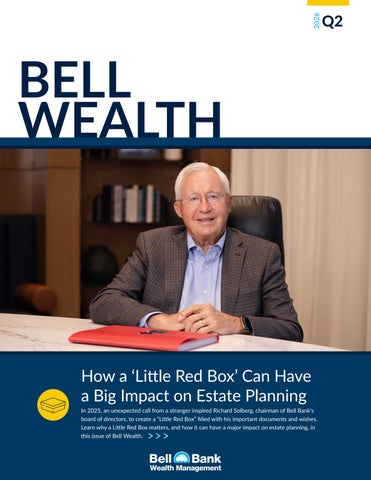
How a ‘Little Red Box’ Can Have a Big Impact on Estate Planning

In 2025, an unexpected call from a stranger inspired Richard Solberg, chairman of Bell Bank's board of directors, to create a “Little Red Box” filled with his important documents and wishes. Learn why a Little Red Box matters, and how it can have a major impact on estate planning, in this issue of Bell Wealth.

It’s not something anyone wants to think about, but everyone should have one.

In fall 2025, Richard Solberg received a call he wasn’t expecting from someone he’d never met.

It turned into a conversation that resonated with Richard, a longtime leader of Bell Bank and current chairman of Bell’s board of directors.

The caller was the daughter of a friend of Richard’s. She was calling to let him know that her father had passed away at his Florida home.

“I felt bad,” Richard said. “He was a good friend and customer of the bank.”

In talking with the woman, Richard asked how she found his cell phone number.

“It was in Dad’s ‘Little Red Box’,” she told him. She explained that her father had told her, “If something ever happens to me, find the Little Red Box. It will be in my home office in Naples, or in Fargo.” Sure enough, it was – and inside was a list of people to call if something happened. As the man’s longtime banker and friend, Richard was on that list.

There was more, the woman said: the Little Red Box also contained her father’s funeral wishes, his online passwords, his will and other important pieces of information. His forethought and organization, she added, were amazing.

— Richard Solberg

The story stuck with Richard and motivated him to create his own version of a Little Red Box – and to work with the Bell Bank Wealth Management team to create versions for clients.

“It’s not something anyone wants to think about,” Richard said, “but everyone should have one.”

WHY PREPARATION MATTERS

Greg Hammes, Bell’s chief legal officer, works closely with the bank’s trust clients on estate settlements and has seen firsthand how planning and preparation can make a meaningful difference for families following the death of a loved one.

However, preparing for death isn’t a topic families often want to discuss.

“The reality is, as Chairman Solberg has told me many times, it is not if it will happen, but when,” Greg said. “It is one of those things in life that does not care about age, gender or what you have in your bank account. We cannot avoid it. It is not whether you are ready to die, but whether you are prepared. That may sound morbid, but it is simply true.”

Studies have found that estate planning preparation has been declining in recent years. In a 2017 study, Caring.com, a senior living referral service, found that more than

40% of American adults reported having a will. By comparison, a November 2025 Pew Research survey found that only 32% reported having one.

While some Americans are preparing their estates for when they pass on, many are not, which can lead to confusion, stress and delays for their families.

“The questions I’ve often heard are: did they have a will or do any estate planning? What assets did they own? How do I get into their phone or check their accounts to see if there is money to pay the bills?” Greg said. “Without proper planning, families may not have many answers for those questions.”

That’s where the idea of a Little Red Box comes in. Whether a literal box or a portfolio-style folder, like the Bell Bank Wealth Management team has created for clients, your Little Red Box can serve as a central place to gather important information and documents.

While not a legal requirement, creating a Little Red Box can give your family a great place to start after your passing and can provide some certainty during a time of sorrow and chaos.

“One of the greatest gifts you can provide to your family is the gift of planning,” Greg said. If you would like guidance for organizing your important information and wishes and creating your own Little Red Box, our team is here to help.

LITTLE RED BOX: WHAT TO INCLUDE

KEY CONTACTS

Extended family/friends, clergy, attorney, executor, financial advisor, tax preparer, insurance agent and health care providers.

FUNERAL WISHES

Obituary draft, funeral home (cremation or burial) and service (officiant, pallbearers, readings, songs or special foods).

VITAL RECORDS

Birth certificate, Social Security card, copy of driver’s license/passport, marriage certificate/divorce decree and military service record.

DEPENDENTS

Information about dependents and instructions for care.

ESTATE PLANNING

Durable powers of attorney for financial and health care matters, last will and testament, living trust, location of safe deposit box and keys, and location of personal safe and keys or combination.

PERSONAL PROPERTY WISHES

Distribution of heirlooms, personal effects/items and titles/deeds.

FINANCIAL RECORDS

Most recent personal financial statement with full list of assets and liabilities; bank/credit card statements; investment statements for brokerage and trust accounts; investment statements for retirement accounts (pensions, 401(k)s or IRAs); insurance policies for life, health, auto and home; and beneficiaries for bank accounts, investments and insurance policies.

DIGITAL ASSETS

Passwords for cell phones, computers, websites and social media accounts; list of cloud storage and digital photo services; and list of online subscriptions and memberships.

OTHER IMPORTANT INFO

Wishes for the care of your pets and special messages to loved ones.

OTHER THINGS TO CONSIDER

• After creating your Little Red Box, it is important to share with someone where your box is located so that, in the event of your passing or disability, they can access your information quickly.

• Review your Little Red Box on an annual basis to ensure that everything is up to date and any additional items have been added. “It can be a good idea to do this every year when you file your income tax return,” Greg said.

HOW TO GET MORE OUT OF GIVING WITH A QUALIFIED CHARITABLE DISTRIBUTION

Are you age 70½ or older, charitably inclined, and looking for ways to reduce your taxable income? If so, a qualified charitable distribution (QCD) could be worth considering to help you get more out of giving.

WHAT ARE QCDS?

QCDs allow eligible individuals to make tax-free donations to qualified 501(c)(3) charities from certain retirement accounts. These distributions can come out of a traditional IRA, SEP/SIMPLE IRA (if inactive) or inherited IRA (if the beneficiary is over the age requirement).

The IRS sets an annual limit on how much individuals can give through a QCD and indexes that amount for inflation. In 2026, the QCD limit is $111,000 per individual.

It is important to note that QCDs cannot be gifted to donor advised funds, private foundations or supporting organizations. Married couples filing jointly can each give up to the annual limit if they both have their own IRA. QCDs have a direct transfer requirement, meaning distributions must be made directly from an IRA to the qualified charity.

BENEFITS OF A QCD

QCDs have several important financial planning benefits, including:

QCDs satisfy charitable giving goals in a fiscally smart manner.

Individuals who are still in the workforce and like to donate to charity typically either write a check or make an electronic donation from their checking account. If you are under age 70½, that approach makes sense and is something you have likely included in your budget.

However, if you are retired, over age 70½, and taking distributions

Giving to charity with a QCD...could allow you to satisfy your charitable giving goals in a more tax-efficient way.
— Nate Bence

from an IRA to replace your income, you might be using a portion of your IRA withdrawals to give to charity instead. The challenge, however, is that withdrawals from an IRA increase your taxable income. Giving to charity with a QCD instead could allow you to satisfy your charitable giving goals in a more tax-efficient way.

QCDs reduce or satisfy required minimum distributions.

Individuals age 70½ or older who have not yet reached their required minimum distribution (RMD) age (which is currently 73 for anyone born in 1951-1959 and which will be 75 for anyone born in or after 1960) can use QCDs to gift directly out of their IRA. Doing so helps reduce your IRA

balance and potentially lower future RMD amounts.

Those who have reached their RMD age can use QCDs to satisfy some or all of their RMD, as long as the amount does not exceed the annual QCD limit.

TIMING TO CONSIDER

QCDs must be completed by December 31 of each year to count for that tax year. Some individuals may choose to make their QCDs at that time as part of their year-end financial planning, but there can be benefits to making QCDs at the beginning of the year instead.

For example, making QCDs earlier can help you plan ahead for the remaining distributions needed to satisfy your

RMDs. Plus, making QCDs earlier in the year can help you and your tax professional understand what availability you have to take on more income, before pulling from investment accounts or cash.

If you choose to make QCD gifts near year end, we recommend you reach out to your IRA provider by the end of November to learn what deadlines and requirements your provider may have for completing QCDs.

WORK WITH YOUR ADVISOR

If you are interested in learning more about QCDs and whether they make sense for your situation, be sure to talk with your wealth advisor or tax professional.

WHAT TO KNOW ABOUT TARGET-DATE FUNDS

Target-date funds have become one of the most popular investment options in workplace retirement plans. Designed to simplify investing, these funds automatically adjust a specific mix of stocks, bonds and other assets as an investor approaches retirement.

For retirement plan sponsors and participants, here’s what to know about how target-date funds work and the role they play in retirement planning.

HOW TARGET-DATE FUNDS WORK

A target-date fund is built around an expected retirement year, with the fund’s mix of investments designed to become more conservative as the date approaches. For example, someone planning to retire in or near 2045 may invest in a 2045 target-date fund. Today, the fund may focus more on growthoriented assets like stocks, but as the calendar nears 2045, the mix of investments would change to include more conservative assets like bonds.

This process, known as the glide path, is intended to reduce risk over time without requiring the investor to manually manage adjustments to the fund.

BENEFITS OF TARGET-DATE FUNDS

For many investors, target-date funds can offer several major advantages:

• Simplicity: One decision helps keep your retirement account on track over time.

• Diversification: The fund spreads investments across asset classes.

• Professional management: Experts adjust allocations based on market research and long term expectations.

• Behavioral advantages: Automation helps participants stay invested and avoid emotional decisions.

CONSIDERATIONS AND POTENTIAL DRAWBACKS

Despite their benefits, target-date funds are not one size fits all and, like any investment, are not without risks. Key considerations include:

• Mismatch with personal risk tolerance: Some investors may find the fund too aggressive or too conservative.

• Retirement timing flexibility: Participants planning to retire earlier or later than the fund’s target date may need to adjust accordingly.

• No guarantee of safety: Even near retirement, target-date funds still carry market risk and can experience losses.

CONTACT US TO LEARN MORE

Bell Bank Wealth Management’s retirement plan services team offers a range of target-date funds for retirement plan sponsors and participants. If you are interested in learning more about how targetdate funds work, contact our retirement plan services team today.

Target-date funds have become one of the most popular investment options in workplace retirement plans.
— Mike Kobbervig

AFTER-TAX RETURNS: WHAT YOU KEEP, NOT WHAT YOU EARN

Albert Einstein is often credited with calling compound interest the “8th Wonder of the World.” If that is indeed the case, then I propose that after-tax returns be called the “9th Wonder of the World.”

After all, it is not what you make – it is what you keep. By implementing smart saving, investing and withdrawal strategies, you can make the most of your hard-earned dollars.

IDENTICAL RETURNS WITH DRASTIC DIFFERENCES

When it comes to taxes, distributions and your tax bracket are not the only factors to consider. It’s also important to understand the nuances of interest income, capital gains and dividends.

Consider two hedge funds with different investment approaches. Fund A focuses on investing both long and short in stocks, while fund B targets credit-oriented securities. At one point, both funds generated nearly identical 12% annualized returns over their first decade of operation. However, the results were drastically different for a taxable investor. Why? Because of the composition of those returns.

Fund A does not trade frequently, but aggressively harvests minor losses while usually holding core positions for years. That means it generates fewer taxable capital gains for investors along the way.

Compare that to fund B, which invests in credit and tends to trade more often, generating a significant portion of returns through short-term capital gains or interest income. Interest income and short-term capital gains are considered “ordinary income” and are generally subject to your highest ordinary income tax rate, instead of favorable dividend or long-term capital gains tax rates.

In this real-world example, after a decade of operation fund A only paid $1 in tax for every $100 earned due to the intense after-tax focus, while fund B was much closer to $50 for every $100 of earnings. That means the 12% stated return for fund B is more akin to a 6% return for the fully taxable, top income tax bracket investor. Even a great investment can quickly turn to average if you don’t account for taxes.

UNCLE SAM MAY HAVE A CLAIM ON “YOUR” ACCOUNT

As our example shows, you may have a large paycheck or see robust returns in your portfolio, but how much you actually take home can be misleading if taxes are an afterthought.

Imagine having a 401(k) or IRA worth $2 million. That is a great accomplishment, and by many definitions you could call yourself a multimillionaire. However, assets saved in those account types are generally

subject to both state and federal income taxes when they are withdrawn.

When you contributed money to the hypothetical account, it avoided income tax. That means Uncle Sam will eventually collect the government’s share as you make withdrawals later in life. Depending on your tax bracket, that $2 million could be 20% to 30% lower in terms of spendable dollars after taxes.

Some investors may conclude, “I don’t want this ongoing tax burden, so I’m going to take it all out at once so I know exactly how much I’ll have after taxes.” Unfortunately, taking out your entire balance at once could push you into the highest tax bracket, possibly resulting in upwards of 40% to 50% of your assets going to federal and state taxes.

WHAT THIS MEANS FOR YOU

For individual investors, this highlights the importance of structuring your savings, investments and withdrawals based on a long-term strategy that incorporates a tax-savvy approach. At Bell Bank Wealth Management, we can help you navigate tax implications and create a plan that works for you.

There is a famous saying that “death and taxes” are the only certainties in life. But investors who take an aftertax mindset might be able to say that the only certainties are death – and some taxes.

s

s

s What to Know About Target-Date Funds s The

NAVIGATING ASSET ALLOCATION DURING CHAOS

In his latest Economic Outlook, Greg Sweeney, Bell’s chief investment and economic strategist, discusses how chaos and uncertainty can create a volatile financial market. In those conditions, human nature might tell us to stay with the high-flying stock sectors that include tech, but sometimes the “comfort food” sectors, like consumer staples or energy, do well even though they don’t show up in the headlines. A measured approach that includes diversification can lead to long-term success, Greg writes. Visit bell.bank/business/insights to read more of Greg’s analysis.

Bell Wealth Q2 2026 by Bell Bank - Issuu