Sample Companion Grades 3–5 Grade 4 Module 5
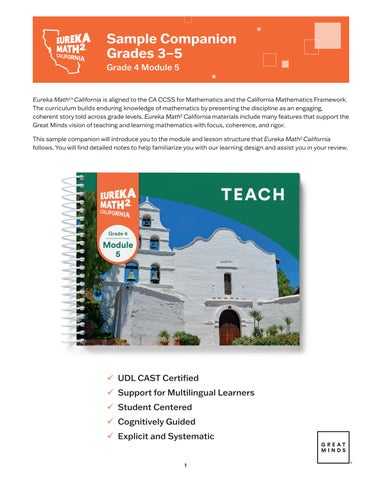
Eureka Math2 ® California is aligned to the CA CCSS for Mathematics and the California Mathematics Framework. The curriculum builds enduring knowledge of mathematics by presenting the discipline as an engaging, coherent story told across grade levels. Eureka Math2 California materials include many features that support the Great Minds vision of teaching and learning mathematics with focus, coherence, and rigor. This sample companion will introduce you to the module and lesson structure that Eureka Math2 California follows. You will find detailed notes to help familiarize you with our learning design and assist you in your review.
9 UDL CAST Certified 9 Support for Multilingual Learners 9 Student Centered 9 Cognitively Guided 9 Explicit and Systematic 1
Module 5 Overview
1
Place Value Concepts for Decimal Fractions Coherence: Before This Module
2
Grade 4 Module 4 In module 4, students decompose whole numbers and fractions as sums of smaller fractions with the same unit. They also rename fractions greater than 1 as mixed numbers. Students compare fractions with different fractional units by using multiplication and division to generate fractions with like units. They add fractions with like units by using strategies similar to those used with whole number addition.
Coherence: After This Module Grade 5 Module 4
© Great Minds PBC
In grade 5, students expand their understanding of place value units to include thousandths. They compare and round decimal numbers that include units to the thousandths, and they add, subtract, multiply, and divide with units to the hundredths. Students convert metric units of measurement and solve word problems that include decimal numbers.
14
EUREKA MATH2 California
Grade 4 ▸ Module 5
014-016_EM2CA26B_G04_M05_MO_TE_172620.indd 14
1
09/12/25 11:59 PM
The Module Overview sets the stage for success.
2
• Reveals the coherent, logical progression of mathematical concepts and practices in the module.
The Before This Module and After This Module sections • Articulate connections between the content of the module to the concepts of the Big Ideas across the mathematical learning journey.
• Provides clear explanations and visual examples of mathematical concepts and models.
• Explain the role of the grade-level concepts within the larger context of the curriculum.
• Illustrates at a glance the emphasis on mathematical investigations to address the Big Ideas of the grade.
2
TOPIC A
LESSON
2
Decompose 1 one and express tenths in fraction form and decimal form.
can write tenths in fraction form and “ Idecimal form.”
1
Standards California Content Standard
Language Objective
• 4.NF.C.6
• Use terms such as tenths, decimal fraction, decimal number, fraction form, decimal form, and decimal point to orally compare writing tenths in fraction form and in decimal form.
2
Standards for Mathematical Practice • SMP.8
3
Key Question • How can a decimal fraction be represented in decimal form?
Big Idea
Achievement Descriptor • 4.Mod5.AD3: Represent tenths and hundredths in decimal form, fraction form, or by using a model. (4.NF.C.6)
© Great Minds PBC
Circles, Fractions, and Decimals
50
EUREKA MATH2 California
Grade 4 ▸ Module 5 ▸ Topic A ▸ Lesson 2
050-063_EM2CA26B_G04_M05_A_L02_TE_172620.indd 50
1
10/12/25 12:04 AM
Language Objectives provide a specific language goal alongside the math goal, ensuring students develop the vocabulary and syntax needed to discuss complex concepts. These objectives are designed to ensure that mathematical content and English language development (ELD) grow together.
3
2
Key Questions help teachers quickly identify and focus on key learning in the lesson.
3
Achievement Descriptors show connections between content objectives and grade-level standards that focus on measurable student outcomes, tailored to enhance learning.
1
Lesson at a Glance Students use the context of fractions of a second to shade a tape diagram and write the value of the shaded part in multiple forms. Students decompose 1 meter into tenths and record tenths in decimal form and fraction form on a number line. Students express numbers in decimal form or fraction form. This lesson introduces the terms decimal fraction, decimal form, and decimal number.
2
3
Agenda
Materials
Fluency 10 min
Teacher
Launch 5 min
• Meter stick
Learn 35 min
Students
• Represent a Number in Different Ways
• Tenths in Decimal Form and Fraction Form (in the student book)
• Tenths on a Number Line • Write Numbers in Decimal Form and Fraction Form
Lesson Preparation Consider removing Tenths in Decimal Form and Fraction Form from the student books and cutting out the cards in advance or have students prepare them during the lesson. Prepare one set of cards per student pair.
• Scissors
• Problem Set
© Great Minds PBC
Land 10 min
EUREKA MATH2 California
Grade 4 ▸ Module 5 ▸ Topic A ▸ Lesson 2
050-063_EM2CA26B_G04_M05_A_L02_TE_172620.indd 51
51
10/12/25 12:04 AM
1
The Lesson at a Glance provides a snapshot of the lesson.
2
The Agenda • Uses a consistent structure—Fluency, Launch, Learn, Land—to create a predictable lesson flow. • Suggests pacing that balances emphasis on conceptual understanding, procedural fluency, and application.
3
Materials and Lesson Preparation save teachers time and ensure smooth lesson execution.
4
1
Fluency
10
Counting the Math Way by Tens Students construct a number line with their fingers while counting aloud and model a composition and a decomposition to prepare for representing tenths as a place value unit in lesson 3. For each skip-count, show the math way on your own fingers while students count, but do not count aloud. Let’s count the math way by tens. Each finger represents 10. Have students count the math way by tens from 0 to 100. What larger unit can we make with 10 tens?
1 hundred We can bundle 10 tens to make 1 hundred. (Clasp hands together.) Ask students to model bundling 10 tens by clasping their hands together. Model unbundling by unclasping your hands. Ask students to model unbundling 1 hundred by unclasping their hands.
© Great Minds PBC
Have students count back the math way by tens from 100 to 0.
52
EUREKA MATH2 California
Grade 4 ▸ Module 5 ▸ Topic A ▸ Lesson 2
050-063_EM2CA26B_G04_M05_A_L02_TE_172620.indd 52
1
10/12/25 12:04 AM
Explicit instruction and structured guidance leads teachers through the lesson, promoting effective delivery and student comprehension.
Fluency activities prepare students for the daily learning by • offering distributed practice of skills and concepts – preparing students for new conceptual understanding – building fluency with recently introduced material – maintaining skills or concepts from previous topics, modules, or grades • including predictable, repeated routines that build in rigor.
5
Whiteboard Exchange: Decompose Mixed Numbers Students subtract 1 or more from a mixed number and then say a number sentence to build fluency with decomposing mixed numbers from module 4. Display the number bond with an unknown part.
2
13
What is the value of the unknown part? Raise your hand when you know.
1
1 2
Wait until most students raise their hands, and then signal for students to respond.
3
_
2
2 3
2
13 ‒ 1 = 3
Display the unknown part. When I give the signal, say the subtraction number sentence beginning with the total. Ready?
1 2_ − 1 = 2_ 3
3
Display the number sentence. Repeat the process with the following sequence: 2
3
23
26
13 1
1 15
2 3 ‒ 1 = 12
25 ‒15 = 1
3
26 ‒16 = 1
4
2 10
3
4 12
12 1 3
2
© Great Minds PBC
5
25
3
38 1 24
1
8
4
6
5
3
3 8 ‒ 1 = 24 8
5
11
3 1 10
11
1 3 12 4 11 ‒ 1 = 3 11
2 3 ‒1 3 = 1 10
5
12
10
12
EUREKA MATH2 California
Grade 4 ▸ Module 5 ▸ Topic A ▸ Lesson 2
050-063_EM2CA26B_G04_M05_A_L02_TE_172620.indd 53
1
53
10/12/25 12:04 AM
Consistent use of visual representations and coherent models allow students to build deep, connected understanding of mathematical ideas.
Number Bond A powerful representation that builds across grade levels, reinforcing the WHY behind the math, even as the units and calculations become more complex.
6
Choral Response: Make 1 Students determine the unknown part to make 1 whole and say an addition number sentence to build fluency with partners to 1. Display _1 + 8
= 1.
What is the value of the unknown part? Raise your hand when you know.
_
Wait until most students raise their hands, and then signal for students to respond. 7 8
Display the unknown part.
1 7 1 8+8 =
When I give the signal, say the addition number sentence. Ready?
_ _
1 7 + =1 8 8
Repeat the process with the following sequence:
4 4 1 8+8 =
2 6 1 8+8 =
3 5 1 8+8 =
0 8 1 8+8 =
9 1 1 10 + 10 =
5 5 1 10 + 10 =
7 3 1 10 + 10 =
6 4 1 10 + 10 =
8 2 1 10 + 10 =
0 10 1 10 + 10 = © Great Minds PBC
1
54
EUREKA MATH2 California
Grade 4 ▸ Module 5 ▸ Topic A ▸ Lesson 2
050-063_EM2CA26B_G04_M05_A_L02_TE_172620.indd 54
10/12/25 12:04 AM
1
Choral Response activities promote equity. • Daily fluency activities intentionally vary how students respond so that students have different ways to express what they know (e.g., show with hands, write, and speak). • Fluency activities are low-stakes opportunities for all students to build knowledge and discern mathematical patterns.
7
1
Launch
5
Students use a basketball shot clock to wonder about time shown in decimal form. Invite students to Think–Pair–Share about sporting events that are timed and which of those events depend on the times being extremely accurate.
2
In a basketball game, a player might shoot the ball right before the shot clock runs out. In a swimming race or running race, sometimes it looks like two people tied, but in slow motion you can see one person was first. Their final times might be very close, but they are not the same. Set the context for the video. Tell students the video shows part of a college basketball game. The score is 67 to 64 and there are just 8 seconds left in the game. The team that is losing needs 3 points to tie the game and send it into overtime. Play the video of the basketball shot. Replay the video and pause it after the player makes the shot. How much time is left on the clock after the shot is made? Zero point seven seconds How would you describe how long zero point seven seconds is? It is less than 1 second.
Teacher Note
It is very quick. A number written in decimal form, such as 0.7, can be read as zero point seven or seven tenths. Saying seven tenths helps reinforce the value of the number. Use zero point seven until the unit of tenths is formally introduced.
© Great Minds PBC
It is a split second. Transition to the next segment by framing the work. Today, we will read and write measurements by using a decimal point.
EUREKA MATH2 California
Grade 4 ▸ Module 5 ▸ Topic A ▸ Lesson 2
050-063_EM2CA26B_G04_M05_A_L02_TE_172620.indd 55
1
55
10/12/25 12:04 AM
2
Launch engages students in the lesson with various approaches:
Think–Pair–Share • Invite students to build on each other’s ideas through mathematical discussion.
• Low-floor, high-ceiling activities that activate prior knowledge and create access points for all learners.
• Provide opportunities for multilingual learners to use and integrate language.
• Real-world examples and data as a means to spark inquiry and apply mathematical concepts.
• Allow all students to see themselves and others as mathematically competent.
• Rich student discourse through routines like think–pair–share. • A goal for the day’s learning.
8
Invite students to Think–Pair–Share about whether they think the statement is true or false. 7 can be written in unit form as 7 tenths, so I know that part I know that the fraction __ 10 of the statement is true. 7 seconds on the If the clock said zero point seven and we represented that as __ 10
7 . I think the tape diagram, then zero point seven could be another way to write __ 10
statement is true.
I see the number 7 in each part of the statement, and I’ve seen numbers like zero point seven when we count coins, so I think the statement is true.
Tenths on a Number Line Students decompose 1 meter and write tenths in decimal form and fraction form. Trace along the edge of a meter stick to create a number line with a length of 1 meter. Draw and label tick marks to represent 0 and 1.
3
1
Universal Design for Learning: Engagement
Materials—T: Meter stick
Let’s represent tenths another way. How can we use the meter stick to partition the number line into tenths?
Consider bringing in other real-world examples of quantities written with tenths. Local hiking maps may have distances labeled in tenths. A digital thermometer shows temperature with tenths. Students may relate to the average human body temperature, 98.6°F, as a familiar example of tenths.
There are lines and numbers on the meter stick that make tenths. Use the meter stick to draw tick marks and partition the number line into tenths. Direct students to problem 2. Invite them to label the tenths along the bottom of the number line in fraction form as you do the same.
Consider enunciating the th sound at the end of tenths to clearly distinguish the unit from tens. Post the two units with examples as a reference for students.
From the Learn book Module 5 Topic A Lesson 2
© Great Minds PBC
2. Label the number line.
0
0.1
0.2
0.3
0.4
0.5
0.6
0.7
0.8
0.9
1 10
2 10
3 10
4 10
5 10
6 10
7 10
8 10
9 10
10 1 ten
1
EUREKA MATH2 California
2
0.1 1 tenth
Grade 4 ▸ Module 5 ▸ Topic A ▸ Lesson 2
050-063_EM2CA26B_G04_M05_A_L02_TE_172620.indd 57
1
2
Multilingual Learner Support
57
10/12/25 12:04 AM
3
Universal Design for Learning (UDL) notes contain responsive suggestions and scaffolds for grade-level work to respond to students needs.
Conjectures Students ask questions and share conjectures throughout lessons, developing sound reasoning and challenging assumptions.
Multilingual Learner Support notes address possible language issues that may interfere with engagement of math content.
9
1 as 0.1 above the number line. Invite students to do the same. Label __ 10
This is another way to write 1 tenth. We can read this number as zero point one or as 1 tenth. Repeat the process with 0.2 and 0.3. Point to the next tick mark.
Promoting the Standards for Mathematical Practice
How do you think we will label this tick mark? Why? We will write zero point four for 4 tenths. I notice a pattern. 1 tenth has a 1 to the right of the decimal point. 2 tenths has a 2, and 3 tenths has a 3. I think the pattern will continue. Invite students to label 0.4 through 0.9 as you do the same.
When students repeatedly label tenths in fraction form and decimal form on the number line to make sense of decimal form, they are looking for and expressing regularity in repeated reasoning (SMP.8).
Point to the fractions written below the number line.
Ask the following questions to promote SMP.8: • What patterns did you notice when you labeled tenths in fraction form and decimal form?
What is the same about all the fractions? They are all tenths. A fraction with a denominator of 10 is an example of a decimal fraction. Decimal fractions can be written by using a decimal point.
2
1
• What is similar about how a number is written in fraction form and decimal form?
Point to the numbers above the number line. A number that is written with a decimal point is written in decimal form. A number written in decimal form is called a decimal number. We can write fractions with the unit tenths in decimal form. We can write a number in decimal form or fraction form. Both are different ways to record the same number. Invite students to turn and talk about how writing tenths in fraction form and in decimal form is similar and different.
58
EUREKA MATH2 California
The term decimal is sometimes used as a shortened way to refer to a decimal point or to a number written in decimal form. Model precision by using the more specific terms, decimal point and decimal form, and support students as they make sense of these terms with familiar phrasing.
Grade 4 ▸ Module 5 ▸ Topic A ▸ Lesson 2
050-063_EM2CA26B_G04_M05_A_L02_TE_172620.indd 58
1
© Great Minds PBC
Teacher Note
10/12/25 12:04 AM
2
Standards for Mathematical Practice are embedded throughout the curriculum, but they are highlighted where there is deliberate practice.
Mathematical Language • Formally naming new math terminology once students have experienced the concept helps them develop language skills to support mathematical learning and language objectives.
• Students use and develop academic language while engaging in the mathematical practices.
• Students experience modeled math-specific terms to use during student-to-student discourse.
• Teacher-to-student and student-tostudent interactions model the intent of the mathematical practices.
10
Write Numbers in Decimal Form and Fraction Form
1
Materials—S: Tenths in Decimal Form and Fraction Form, scissors
Students read and write numbers in fraction form and decimal form. Pair students and invite one student in each pair to remove Tenths in Decimal Form and Fraction Form from their books. Have partners cut out the cards, shuffle them, and stack them face down. Give pairs 3 minutes to • pick one card, • write the number in both fraction form and decimal form,
Multilingual Learner Support Consider having students label the numbers on the number line with the terms decimal fractions, decimal numbers, fraction form, and decimal form. fraction form
• compare answers, making corrections as needed, and
decimal fractions
1 2 3 4 5 6 7 8 9 10 10 10 10 10 10 10 10 10
• repeat the process until they have used all the cards. Circulate as students work. Ensure that students correctly use a denominator of 10 for each fraction and the leading zero and decimal point for each number written in decimal form.
0 0.1 0.2 0.3 0.4 0.5 0.6 0.7 0.8 0.9 1 decimal numbers
decimal form
Gather the class and invite students to share how they wrote each number. Which two numbers from the measurements are the same? The softball and the juice box both have measurements with the number 2 tenths.
2 Write 2 tenths = __ = 0.2. 10
Invite students to Think–Pair–Share about how they know the statement is true. Tenths can be written three different ways to represent the same number: in unit form, in fraction form, or in decimal form. Each number represents the same point on the number line. © Great Minds PBC
Each number is read the same way: two tenths.
3
Problem Set
Exit Ticket Lesson Problem set Differentiate the set by selecting problems for students to finish independently within the timeframe. Problems are organized from simple to complex. Sample solutions are at the end of this lesson.
EUREKA MATH2 California Removables
Self Reflection
After students write the amount on each card in a different way, invite students to write comparison statements by using the decimal numbers in the activity. Encourage students to use what they know about comparing fractions to help. Students may then list the decimal numbers in order from least to greatest and talk about what they notice and wonder. Students should compare decimal numbers of kilograms separate from decimal numbers of liters.
Grade 4 ▸ Module 5 ▸ Topic A ▸ Lesson 2
1
At Home
Engaging Tasks
59
Spiral Review
050-063_EM2CA26B_G04_M05_A_L02_TE_172620.indd 59
Family Math
2
Differentiation: Challenge
10/12/25 12:04 AM
Practice Partner
Practice
Remember
California element
• Students engage with the same content in various ways, ensuring access and allowing for strategic differentiation. • Teachers monitor student conversations to determine which students will share each strategy, building a coherent mathematical story.
2
Differentiation: Challenge notes provide adaptable strategies to enrich or extend learning for certain students.
3
The Problem Set includes a suite of problems organized from simple to complex for easy differentiation. It extends and reinforces classroom instruction by: • Strengthening conceptual understanding. • Building procedural fluency over time.
11
Land
1
10
Debrief 5 min Objective: Decompose 1 one and express tenths in fraction form and decimal form. Use the following prompts to guide a discussion about decimals and tenths. In what ways can we represent tenths?
1 can be decomposed into tenths on a number line or a tape diagram. Tenths can be represented in unit form. Tenths can be written in decimal form or fraction form. Both are units of tenths. When we write tenths in decimal form, the number of tenths is written to the right of the decimal point. How can a decimal fraction be written in decimal form? A number written in decimal form is another way to write a decimal fraction. We can use a decimal point and record a digit to the right of the decimal point to show the number of tenths.
2
Exit Ticket
Lesson
5 min Exit Ticket
Problem set
Self Reflection
Family Math
Removables
Spiral Review
Provide up to 5 minutes for students to complete the Exit Ticket. It is possible to gather formative data even if some students do not complete every problem. Sample solutions are at the end of this lesson.
At Home
60
Practice Partner
Practice
Remember
EUREKA MATH2 California
© Great Minds PBC
Direct students to the Self-Reflection on the back of the Exit Ticket. Have them read the I can statement to reflect on their learning in this lesson. Invite them to circle the choice that best matches their agreement with the statement. After they complete the Exit Ticket, consider having students confirm whether they still agree with their selection.
Grade 4 ▸ Module 5 ▸ Topic A ▸ Lesson 2
California element 050-063_EM2CA26B_G04_M05_A_L02_TE_172620.indd 60
1
10/12/25 12:04 AM
2
Students cement their learning in Land, where they • consolidate thinking through elaborative why and how questions that prioritize reasoning and justification and • engage in rigorous thinking, drawing conclusions from their work, making deep connections among mathematical ideas, and encoding information into long-term memory.
12
An Exit Ticket concludes the lesson, providing a daily formative assessment.
Sample Solutions
1
Expect to see varied solution paths. Accept accurate responses, reasonable explanations, and equivalent answers for all student work. TOPIC A Name
LESSON
Date
PROBLEM SET Problem Set I can write tenths in fraction form and
c. Circle the number written in decimal form that represents the shaded part.
7
8
9
10
11
12
13
14
15
16
17
18
19
20 21
22
23
24
25
26
27
28
29
30
6 a. Fraction form: _____ cm 10
b. Decimal form:
0.6
cm
Write the amount of water in fraction form and decimal form. 4.
3.
1L
1L 3
_____ L = 10
0.3
L
6
_____ L = 0.6 L 10
© Great Minds PBC
b. Shade the first 8 units of the tape diagram.
a. Label the number line by using fraction form, decimal form, and unit form.
1
10 tenths 9 tenths 8 tenths 7 tenths 6 tenths 5 tenths 4 tenths 3 tenths 0 tenths
1 tenth
2 tenths
9 10
0.9
8 10
0.8
7 10
0.7
6 10
0.6
5 10
0.5
2 10
3 10
4 10
0.4 0.3 0.2
1
1.
1 10
12
0.1
11
0
10
0 10
6
9
5
8
4
7
3
6
2
5
0 CM 1
4
0 CM
3
Use the tape diagram and number line to complete parts (a)–(c).
California CCSS-M
4.NF.C.6
2
© Great Minds PBC
Write the length of the bee in centimeters. The drawing is not to scale.
1
© Great Minds PBC
2.
Inch
10 10
decimal form.
2
EUREKA MATH2 California
Grade 4 ▸ Module 5 ▸ Topic A ▸ Lesson 2
13
14
EUREKA MATH2 California
EUREKA MATH2 California
G4 ▸ M5 ▸ TA ▸ L2 ▸ PROBLEM SET
Grade 4 ▸ Module 5 ▸ Topic A ▸ Lesson 2
050-063_EM2CA26B_G04_M05_A_L02_TE_172620.indd 61
61
10/12/25 12:04 AM
1
Sample Solutions • Goes beyond an answer key to include examples and representations of possible student strategies to help teachers orient to analyzing student work. • Provides a starting point for teachers to elicit, make sense of, and respond to student thinking.
13
TOPIC A
1
PRACTICE PARTNER
LESSON
Practice Partner
I can write tenths in fraction form and decimal form.
2
Write the total weight of the food in fraction form or decimal form. 3.
4.
California CCSS-M
4.NF.C.6
1.
Write the amount of water in fraction form and decimal form.
1L 2 ___ L= 10
0.2
L
6 ___ kg
0.6 kg
A fraction with a denominator of 10 is an example of a decimal fraction. fraction. A number that is written with a decimal point is written in decimal form. form. A number written in decimal form is called a decimal number. number. I can write decimal fractions in decimal form by using a decimal point. point.
0.9
10
kg
0 kg
I can read 0.6 as 6 tenths. I can write 6 tenths in fraction form as a decimal fraction with the denominator 10. I write _6_ .
0.5
I see that the intervals on the scale show tenths. I skip-count by tenths to find the weight of the pineapple.
10
I write 9 tenths as a decimal number.
SPIRAL REVIEW
I see 1 L labeled next to the top tick mark on the bottle. 1 L because the number line is Each interval represents __ 10 partitioned into 10 equal parts.
Spiral Review
5.
I start at 0 and count by tenths until I reach the tick mark that is level with the top of the water.
829,632
2 2 I write the decimal fraction __ . Then I write __ as a decimal 10 10 number in decimal form.
Write the fraction in decimal form. Shade the bottle to show the correct amount of water.
829,788
I can use a place value chart to represent 829,632 and 829,788.
5 in decimal form. I write the fraction __
1L
© Great Minds PBC
<
The first 3 digits of both numbers are the same and have the same place values. 829,632 has 6 hundreds. 829,788 has 7 hundreds. I know that 6 hundreds is less than 7 hundreds, so 829,632 < 829,788.
hundred thousands
ten thousands
thousands
hundreds
8
2
9
6
3
2
8
2
9
7
8
8
10
__5 L = 10
1 L. Each interval on the bottle represents __
0.5
L
10
I start at 0 and skip-count by tenths until I
829,632 has 6 hundreds. 829,788 has 7 hundreds. 6 hundreds is less than 7 hundreds, so 829,632 < 829,788.
5 L. represent ___ 10
Grade 4 ▸ Module 5 ▸ Topic A ▸ Lesson 2
009-010_EM2CA26B_SEAG4_A_M5L02_practice_partner_174235.indd 9
9
10
09/12/25 10:34 AM
1
ones
Both numbers have 8 hundred thousands, 2 ten thousands, and 9 thousands.
reach the tick mark that represents 5 tenths. I color up to the 5 tenths tick mark to
EUREKA MATH2 California
tens
EUREKA MATH2 California
G4 ▸ M5 ▸ TA ▸ L2 ▸ PRACTICE PARTNER
009-010_EM2CA26B_SEAG4_A_M5L02_practice_partner_174235.indd 10
Practice Partners* • Shows problems like those worked on in class and an example of the thinking that helps students solve those problems. • Serves as a useful tool for students to solve the Practice and Remember problems. • Guides families who may be supporting their student with the Practice and Remember problems at home.
*Practice Partners are in the Apply Student Edition Grades 1–5. 14
© Great Minds PBC
2.
Compare the numbers by using >, =, or <. Explain how you know.
09/12/25 10:34 AM
Observational Assessment Recording Sheet Grade 4 Module 5 Topic A
1
Student Name
Place Value Concepts for Decimal Fractions
Exploration of Tenths Standards
Achievement Descriptors
Dates and Details of Observations
4.NF.C.6
Represent tenths and hundredths in decimal form, fraction form, or by using a model.
4.Mod5.AD3
No content.
Achievement Descriptors Proficiency Indicators 2 4.Mod5.AD1 Express fractions with denominator 10 as equivalent fractions with denominator 100.
10
___ 100
10
100
© Great Minds PBC
RELATED CA CCSSM 4.NF.C.5 Express a fraction with denominator 10 as an equivalent fraction with denominator 100, and use this technique to add two fractions with 34 . 4 = ___ 3 as 30 , and add __ 3 + ___ respective denominators 10 and 100.4 For example, express __ 100
4 Students who can generate equivalent fractions can develop strategies for adding fractions with unlike denominators in general. But addition and subtraction with unlike denominators in general is not a requirement at this grade.
Partially Proficient
PP Partially Proficient
104
EUREKA MATH2 California
Grade 4 ▸ Module 5 ▸ Topic A
P Proficient
Proficient
HP Highly Proficient
Highly Proficient
Express fractions with denominator 10 as Express fractions with denominator 10 as equivalent fractions with denominator 100 when equivalent fractions with denominator 100. This page may be reproduced for classroom use only. given a model. Fill in the blank to make the equation true. Fill in the blank to make the equation true. Use the model to help you. __6 = ____ 100 10
104_EM2CA25_TEG4_M5_A_OARS_SS_172620.indd 104
10/12/25 12:11 AM
__6 = ____
100
© Great Minds PBC
10
310
EUREKA MATH2 California
Grade 4 ▸ Module 5
310-315_EM2CA26B_G04_M05_AD_resource_TE_172620.indd 310
1
10/12/25 12:21 AM
2
Observational Assessment Recording Sheets provide a short, qualitative checklist that captures student progress.
Proficiency Indicators help teachers see what proficiency looks like for a particular Achievement Descriptor and standard.
*Assessments available for download in the Eureka Math2 California digital experience. 15
1
2
TOPIC QUIZ Exit Ticket Name
1.
A-1
MODULE ASSESSMENT Exit Ticket
Date
Name
Think about the fraction _ . 10 3
1.
5-1
Date
Complete each equation.
Part A
on the number line. Plot and label _ 10 3
2 _ =_ 10
0
10
100
1
Part B
Write _ in decimal form. 10
5 _ =_
100
2.
3
Add.
3 _ =
32 4 _ +_ =
10
3.
100
8 61 _ +_ = 100
10
15 7 2_ + 3_ = 100 10
Think about the decimal numbers 0.4 and 0.25. Part A Use >, =, or < to compare the decimal numbers.
0.4
0.25
Part B Plot and label 0.4 and 0.25 on the number line to justify your answer to part A.
0
1
© 2026 Great Minds PBC
© 2026 Great Minds PBC
This page may be reproduced for classroom use only.
This page may be reproduced for classroom use only.
10
EUREKA MATH2 California
1
Grade 4 ▸ Module 5 ▸ Topic A
175
EUREKA MATH2 California
2
Topic Quizzes assess proficiency on major concepts and skills covered in a topic.
Grade 4 ▸ Module 5
Module Assessments* are summative and include a variety of item types that include selected response, constructed response, and open-ended questions. • Digital assessments provide visibility into student learning through formative and summative feedback and data and include auto-scoring of topic quizzes and benchmarks. • Assessments include many tech-enhanced items found with SBAC assessment. • Digital assessment data are available in various auto-generated proficiency reports at the individual, classroom, and school levels.
*Assessments available for download in the Eureka Math2 California digital experience. 16
203
Grade 4 Module 5 Module Assessment Scoring Guide
1
You may find it useful to score Topic Quizzes and Module Assessments. When these assessments are administered digitally, most items are machine scorable. If you give the assessments in a paper and pencil format, score them by hand.
The scoring guide uses a scale factor Target Proficiency Indicator Scale Factor to weight items differently. The scale factor is determined by the item’s target Highly Proficient (HP) 1 level of proficiency. Items that target high Proficient (P) 2 proficiency carry less weight because it is likely that the least number of students will Partially Proficient (PP) 3 answer them correctly. Items that target partial proficiency carry more weight because it is likely that the greatest number of students will answer them correctly. When a single item aligns to multiple proficiency indicators, the scale factor of the highest proficiency indicator is used.
Grade 4 Module 5 Topic A Quiz Scoring Guide
This page may be reproduced for classroom use only.
Scale factors allow for a student’s proficiency level to determine their grade, rather than a student’s grade determining their proficiency level. In a system in which a grade determines proficiency level, a raw percentage computation might convert a score of to score Topic Quizzes and Module Assessments. When these You may find it useful 5 points out of 10 into 50%. That 50% would result in a failing grade even though the assessments are administered digitally, most items are machine scorable. If you give the student may be partially proficient. Raw percentage computations can also allow very assessments in a one paper and pencil format, score them by hand. poor performance, such as 20% on one quiz, to result in a failing grade for the marking Every assessment has a scoring guide that shows the alignment between each item and period. That grade for the marking period may not accurately communicate the student’s an Achievement Descriptor and a proficiency indicator. The scoring guide tells how many proficiency. Using scale factors to weight items makes it possible for students to recover are possible for each item or part of an item. It also tells whether the scoring for from a single poor performance and builds scores to show partial points proficiency more clearly. an item is dichotomous (i.e., all or nothing) or polytomous (i.e., each embedded correct response earns partial credit).
© 2026 Great Minds PBC
© 2026 Great Minds PBC
This page may be reproduced for classroom use only.
Every assessment has a scoring guide that shows the alignment between each item and an Achievement Descriptor and a proficiency indicator. The scoring guide tells how many points are possible for each item or part of an item. It also tells whether the scoring for an item is dichotomous (i.e., all or nothing) or polytomous (i.e., each embedded correct response earns partial credit).
The scoring EUREKA guide uses a 2scale factor Scale Factor MATH California Grade 4 ▸ Target ModuleProficiency 5 ▸ ScoringIndicator Guide to weight items differently. The scale factor is determined by the item’s target Highly Proficient (HP) 1 level of proficiency. Items that target high Proficient (P) 2 proficiency carry less weight because it is likely that the least number of students will Partially Proficient (PP) 3 answer them correctly. Items that target partial proficiency carry more weight because it is likely that the greatest number of students will answer them correctly. When a single item aligns to multiple proficiency indicators, the scale factor of the highest proficiency indicator is used. Scale factors allow for a student’s proficiency level to determine their grade, rather than a student’s grade determining their proficiency level. In a system in which a grade determines proficiency level, a raw percentage computation might convert a score of 5 points out of 10 into 50%. That 50% would result in a failing grade even though the student may be partially proficient. Raw percentage computations can also allow one very poor performance, such as 20% on one quiz, to result in a failing grade for the marking period. That grade for the marking period may not accurately communicate the student’s proficiency. Using scale factors to weight items makes it possible for students to recover from a single poor performance and builds scores to show partial proficiency more clearly.
EUREKA MATH2 California
1
11
Grade 4 ▸ Module 5 ▸ Topic A ▸ Scoring Guide
Every Topic and Module Assessment has a Scoring Guide* that shows the alignment between each item and an Achievement Descriptor and a Proficiency Indicator. The scoring guide tells how many points are possible for each item or part of an item.
*Assessments available for download in the Eureka Math2 California digital experience. 17
Performance Assessment
LEVEL 4
1
Stained-Glass Windows Agenda • Build Context | 5 min • Assessment | 20 min
Name
• Close Assessment | 5 min Stained-Glass Windows
Materials and Preparation
Mr. Davis wants to install four stained-glass windows in his new house.
• Ruler
Three of the windows have already been designed.
• Scissors
Each window is a square, and all the windows are the same size.
• Set of colored construction paper, cut to resemble the windows
The colored parts of each window must be squares, right triangles,
• Set of pattern blocks
or right trapezoids. In the square for window 4, design a stained-glass window so that
Mathematical Practices in Action
the combined area of the blue parts of all four windows is equal to 1 windows. the area of 1__ 2 O
G
B
Window 1
O
O
G
B
G
B Window 2
Students are likely to demonstrate evidence of the following MPs as they complete the assessment.
G
O
Window 3
• Students make sense of problems and persevere in solving them (MP�) as they determine the size of fractional parts and make strategic decisions about partitioning a whole.
Window 4
Show and explain how you know.
• Students model with mathematics (MP�) as they represent the fractional parts of a stained-glass window with drawings or manipulatives.
PERFORMANCE ASSESSMENT | © 2025 Great Minds PBC
4 | Stained-Glass Windows
1
PERFORMANCE ASSESSMENT | © 2025 Great Minds PBC
1
4 | Stained-Glass Windows
Performance Assessments* are openended or open-middle real-world problems that invite students to demonstrate their math skills in a knowledge-rich context. • They integrate mathematics content and the language needed to participate in the Standards for Mathematical Practice. • A rubric offers suggestions for using assessment data to inform instructional decisions to support students’ consistent progress toward meeting or exceeding state standards. • The Plan–Check–Reflect tool in Performance Assessments gives students an opportunity for selfreflection and self-evaluation.
*Assessments available for download in the Eureka Math2 California digital experience. 18
1
1 DATA TALK Visiting Our National Memorials 10 minutes
Estimated Attendance at the Most Visited National Memorials, 2022
2
This data was collected by the National World War II Memorial 4,815,309
Park Service (NPS).
Lincoln Memorial 7,825,397
Korean War Veterans Memorial 4,010,009
Data Investigation | Ramp Heights Thomas Jefferson Memorial 2,975,148
How does the height of a ramp affect how far a ball rolls?
Martin Luther King, Jr. Memorial 3,321,897
Investigate by using the four steps of the statistical investigative process. Pearl Harbor National Memorial 1,545,582
Vietnam Veterans Memorial 4,886,254
Ask a Statistical Question
Franklin Delano Roosevelt Memorial 3,291,313
Mount Rushmore National Memorial 2,440,449
World War I Memorial 848,634
Collect Data
Analyze Data
The visualization shows estimates for the number of visitors to the ten most visited national memorials Pacing Suggestion in 2022. A memorial is a place or a structure that honors a person, a place, or an event. Students may wonder where these memorials are located. Mount Rushmore National Memorial is in South Dakota, and First Day the Pearl Harbor National Memorial is in Hawaii. The rest of the memorials in this visualization are in Facilitate Step 1 and begin Step 2 by having students Washington, DC.
plan and discuss.
Math
• Connected problem solving
30 minutes
• Measuring and plotting
Second Day DATA TALK | © 2025 Great Minds PBC
Content Connections
4 | Visiting Our National Memorials
Continue Step 2 by conducting the experiment and compiling class data.
1
Reading and Writing
• Cause and effect • Discussion questions
30 minutes
• Informational text
Last Day
Facilitate Step 3 and Step 4 to close the investigation. 30 minutes
Science
• Analyzing and interpreting data • Forces and motion • Planning and carrying out investigations
DATA INVESTIGATION | © 2025 Great Minds PBC
1
2
Data Talks* • Engage students in conversations around real-world contexts and data and spark inquiry. • Support with suggested learning scaffolds at just the right moment.
Interpret Results
Materials
Ball rolling down ramp
• Data Talk: Fastest Roller Coasters • Data Investigation student handout 1 per student
• Experiment Guide 1 per group
• Rulers 2 per group • Small rolling object, such as a table tennis ball 1 per group
• Measuring tape to
1 inches 1 per group __ 4
• Sticky notes 3 per group
• Roll of tape (optional)
4 | Ramp Heights | TE
1
Data Investigations* are multiday activities that empower students to explore the full statistical investigative process—from asking questions to collecting, interpreting, and reporting on the findings.
• Cover uncommon topics in science and humanities, building knowledge and connecting learning across subject areas. • Often connect mathematics to familiar topics to make the knowledge sticky.
*Data Talks available for download in the Eureka Math2 California digital experience. 19
Digital Tools that Enhance and Streamline instruction
Digital Manipulatives Teachers can use these tools to display and demonstrate mathematical concepts during class. Students can use these resources in class and at home to practice math concepts, reinforce their growing math understanding.
Context Videos Context videos help students see math in the real world and are accessible to all students, including multilingual learners. When available, videos can be accessed in the Eureka Math2 California digital experience.
How to Videos Short videos that support Great Minds® educators as they learn about implementation basics, math content, and instructional routines.
© 2026 Great Minds PBC | 031726
20