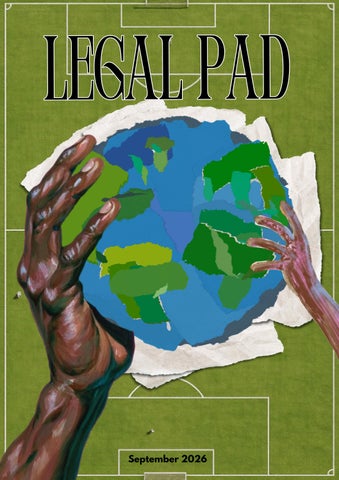
D PAD AL PA LEGAL LEG
September 2026
MEET THE TEAM
SPANISH TRANSLATION
BEHIND THIS EDITION
Editors-in-Chief Cati Cruz Adriana Bautista
Writers
Manav Amipara Thomas Baughman Penelope Gray Isabella Hernandez Giselle Montoya Nelly Mujica Abigail Segovia Angela Thomas Ashima Yadav
Cover Design Xochitl Garcia Isabella Lobo Teya Wordofa
Link: https://tinyurl.com/SpanishSeptember
FIND US ONLINE! WEBSITE
Graphic Design Adriana Bautista Thomas Baughman Cati Cruz Xochitl Garcia Isabella Lobo Mira Russell Teya Wordofa
Photographers Cati Cruz Bhavya Peri Emilio Vega Ashima Yadav
Link: https://thelawlegalpad.com
Spanish Translation Miguel Cauich Isabella Lobo Nelly Mujica
LP Games
Isabella Hernandez
1
Advisor Mr. Zambrano
Handle: @thelawlegalpad
CALENDAR
SAVE THE DATES!
Compiled By: Adriana Bautista
September SUN MON
TUE
WED THUR
FRI
SAT
28
29
01
02
03
04
05
06
07
08
09
10
11
12
13
14
15
16
17
18
19
20
21
22
23
24
25
26
27
28
29
30
01
02
03
October SUN MON
TUE
WED THUR
FRI
SAT
27
28
29
30
01
02
03
04
05
06
07
08
09
10
11
12
13
14
15
16
17
18
19
20
21
22
23
24
25
26
27
28
29
30
31
September: 25th: Oberlin College Visit 10:5011:30am 25th: Fall Fling 5:30-9pm 29th: Swarthmore College Visit 12:30-1:00pm 30th: Link Crew Yoga Day (4:305:30 pm)
October: 8th-9th: Fair Day (NO SCHOOL) 12th: Teacher PD (NO SCHOOL) 21st-22nd: PSAT (B-day) 30th: Fright Fest 4:30-9pm
2
3
Editor’s Note
Dear reader,
In her essay “Some Dreamers of the Golden Dream,” Joan Didion describes the season we are in as “the season of suicide and divorce and prickly dread, wherever the wind blows.” Well, I posit that Didion was being a total drag—granted, she was writing about an infamous murder case that happened during this dreaded season, but her dramaticism is what gets me. Didion’s writing about her native California often referenced the extreme heat that drove up crime rates, the mistrust she had of other people (and that they had of each other), but most of all, her love of where she descended from. That love of where we come from is one of the reasons I am incapable of shutting up about Joan Didion, and why I believe this edition is one born from a love of the Earth itself. The transitional period between summer and autumn overflows with delights. Pumpkin spice lattes are available again, competition season is beginning, and change feels imminent. For high schoolers, it is a time where the daily joys of the changing seasons make the stress of our courseload feel bearable, where change doesn’t seem so bad. As we enter the fall season, I feel that love of where we are and what could happen in the future returning, and the Legal Pad team offers you, the reader, a gift of appreciation for this season. In this edition, read about the potential demolition of Dallas City Hall, and what that means for the city’s political and cultural identity. You might also be interested in learning about the lack of contemporary teen media available nowadays, or the brimming gentrification of the Oak Cliff area, or the inherent prejudices that color even the crayons we use. As you read this edition, consider how humans connect with one another, and how those connections are severed by ourselves, too. This edition is a time capsule of the past summer and the current season, but it is above all a reminder of the importance of sticking together through thick and thin. So read on, reader. Think of how you occupy the landscape, and how you can help it. We encourage you to take a walk outside, breathe air that did not come from a vent, and appreciate the little things. After all, they are what makes life worthwhile. Love always, Adriana Bautista
4
KIN
?”
E
Y O U PASS M N A N C T “S HE YO CRA
COLOR
BY: PENELOPE GRAY AND MANAV AMIPARA
Before children are able to understand the formal meanings of bias or systemic inequality, they encounter the implicit social hierarchies of the world around them through the objects and words surrounding them as they grow up. “Can you pass me the skin color crayon?” Without hesitation, a hand would skip past the brown and tan crayons, reaching instead for a single pale peach crayon. For generations, this simple interaction played out in elementary school classrooms across the country as a seemingly harmless norm. Yet, embedded within that mundane childhood phrase was a subtle message about whose skin color was treated as a standard, and whose was simply another color in the crayon box.
A CRAYON’S IMPLICATIONS The harm of this default lies in how invisibly it operates. When one pale shade is presented as simply “skin color,” it can establish a standard that other children understand themselves against. A 2024 study conducted in a Danish kindergarten found that “normative whiteness” shaped how two fiveyear-old boys interpreted the darker skin of a Black classmate. The researcher argues that whiteness can become the norm against which other bodies are understood. This same pattern of contrast can appear in something as simple as a crayon box: one demographic is presented as the standard, while others become deviations from it. This is known as “othering,” the process of treating a minority group as different from a dominant group in an exclusionary way.
5
EARLY SOCIAL EFFECTS Calling one pale crayon “skin color” may seem insignificant, but children begin developing ideas about race and social status at an early age. A 2020 study published in PLOS ONE examined 420 children between the ages of 3.5 and 6.9 and found that children used race as a cue for social status. They expected White people to be wealthier than Black people and, in some cases, associated being White with higher social status. These findings suggest that children can begin absorbing racial ideas about status years before they are old enough to fully understand the systems behind them.
SYSTEMIC PREJUDICE BEYOND CRAYON COLORS
The crayon box is not an isolated example. For decades, “fleshcolored” bandages were primarily designed around lighter skin tones, leaving many consumers to use products that did not actually match their skin. Similar questions have appeared in technology. A 2019 study from the National Institute of Standards and Technology found that many facial recognition algorithms showed demographic differences in accuracy, including higher falsepositive rates for some racial groups.
Together, these examples reflect a broader pattern of othering. The issue is not that a single crayon creates prejudice. It is that everyday products and systems can repeatedly communicate who society centers and who it treats as an exception. A crayon may seem small, but the assumption behind it is part of a much larger pattern. Undoing these deeply embedded defaults requires far more than updating the name of a crayon or expanding product lines to be more inclusive of all skin shades. True progress demands the active interrogation of the “harmless” language, design choices, and social norms that are passed down from generation to generation. By recognizing how early these subconscious biases take root in the minds of children, they can begin to be unlearned. This ensures that children no longer grow up believing that humanity has a default standard, but rather that every shade has its place in the crayon box as a skin color, not just a color.
6
DALLAS DEMOLITION SPARKS DISCUSSION By: Ashima Yadav & Isabella Hernandez
Everything in a community serves a purpose. From the streets we walk on, to the buildings we do business in, everything has its place. This includes our beloved Dallas City hall building. From its historical and cultural significance and impact, to the communities’ outrage underlying with care, one thing is clear: the people of Dallas love their city hall, and that will never change.
A BUILDING WITH A HISTORY Dallas City Hall was built during a complicated time in the city's history. Planning began in the 1960s, not long after the assassination of President John F. Kennedy, when Dallas was facing national attention and a period of unrest. The new City Hall became part of the city's effort to look toward the future and bring its community together. In 1966, Dallas selected renowned architect I.M. Pei to design the building. Pei had already gained an international reputation and would later design the John F. Kennedy Library in Boston and the Louvre Pyramid in Paris. Construction began in 1972, and City Hall was dedicated in March 1978. One of the building's most recognizable features is its 34-degree slant. The unusual design was not simply made to stand out. The upper floors extend over the plaza below, providing shade throughout the day depending on the position of the sun. This helped create a comfortable public space where people could gather, meet and participate in events. Pei's design made City Hall more than a place for government workers. It was also meant to be a place for the community. The art surrounding City Hall has also become part of its identity. In front of the building sits The Dallas Piece, a large bronze sculpture by renowned British sculptor Sir Henry Moore. The sculpture, along with the building's architecture, has helped make City Hall one of Dallas' most recognizable landmarks.
7
WHY IS DEMOLITION BEING CONSIDERED? Nearly 50 years after City Hall opened, the city is questioning whether the aging building can continue serving Dallas in its current condition. Maintenance concerns have raised questions about how much it would cost to repair and modernize the building compared with relocating city government elsewhere. The city has been exploring possible locations for moving City Hall staff and functions while considering what should eventually happen to the current property. If the offices are moved, the mayor, City Council and other city departments would need new spaces. Council meetings and other public government functions would also have to take place elsewhere.
WHAT DOES THE COMMUNITY THINK?
The community of Dallas doesn't seem too thrilled about the demolition of its beloved city building; so much so, that a group is currently fighting to preserve it by suing the city and its top officials, alleging they have allowed the landmark building to deteriorate while failing to carry out repairs and preservation requirements mandated by city law. While it seems cruel, this lawsuit is in the end, a way to show that the community values this building with its whole heart, and who's to stop them from loving? The Save Dallas City Hall Coalition filed a lawsuit in August 2026 against the city and several city officials. These preservationists argue that the building should be repaired rather than replaced. To them, demolishing a structure designed by one of the world's most influential architects would mean losing an important piece of Dallas history. Others see the situation differently. Supporters of relocation point to the building's age, maintenance needs and the difficulty in adapting an almost 50year-old structure to the needs of modern government. For them, moving city offices could provide updated facilities and a more efficient space.
WHY DOES CITY HALL MATTER?
City Hall is more than a place where employees work. It is where the mayor and City Council conduct city business, where residents attend meetings, and where people can speak directly to their local government. The building has also welcomed visitors and dignitaries from around the world. For decades, City Hall has witnessed Dallas change around it. Its chambers have held political debates, its plaza has hosted gatherings and demonstrations, and its halls have welcomed generations of Dallas residents.
LOOKING TOWARD THE FUTURE...
The future of Dallas City Hall remains uncertain. Some see relocation as progress and an opportunity for modern government facilities. Others see preservation as a way to protect Dallas' architectural and cultural identity. The debate ultimately reflects two different visions for the city's future. One side sees an aging building that needs major investment, while the other sees a landmark worth protecting. Whatever Dallas decides, the discussion proves that City Hall is more than concrete and offices. It is a piece of the city's history, and that is why its future matters.
8
More More Than Than A Meal A Meal Just Just How Food Connects Culture and Community By: Abigail Segovia
As the world prioritizes fast food and convenience, we often become so focused on “just filling up” that we forget the sincerity behind home-cooked meals. Through our fast-paced lives, we often overlook the recipes that were preserved through generations of practice, the plates that reflect our cultural heritage, and how food overall brings us together as a community. Food doesn’t just keep us alive; it acts as a living reflection of centuries of culture and practice.
Identity Through Food Before we had the convenience of simply searching recipes online, they were taught through generations. Recipes were written on index cards and kept away in drawers, only to be used when teaching the next generation how to cook those same meals. It isn’t just a list; it shows centuries of technique and traditional cultivation. It reveals where the culture really comes from, the ingredients that shaped what we eat today. Global dishes are shaped by local ingredients. Dosa, a South Indian dish, is typically composed of black lentils, and can be served with sambar, which is a stew with a variation of spices, and vegetables like tomatoes and onions. On the other side of the globe, Sopes are a Mexican street food made from a thick corn masa base, typically topped off with tinga and queso fresco. Each delicious meal reflects its place of origin and the lifestyle behind it. Sophomore Zipporah Lindsey explained her connection to Cajun food saying “We often have to throw together whatever is in the cabinet, that’'s why Cajun cuisine has such a distinct taste.”
9
’s a m o m
ie p t o p
The Table Bringing People Together Beyond just personal identity, food has the power to create shared identities through simple places like a table. The act of “breaking bread” allows us to break down social barriers and create a sense of community with one another as we can bond over simply sharing a meal. Food can create connections among people and reflect their unique culture. Anthony Bourdain said in a Slate interview in 2010: "Food is everything we are. It's an extension of nationalist feeling, ethnic feeling, your personal history, your province, your region, your tribe, your grandma." This extends far outside the walls of homes. Around the world, festivals, parades, and carnivals are largely influenced by food. The world’s largest food festival, Taste of Chicago draws three million visitors annually to sample global cuisine like Mexican empanadas and Senegalese mafé, along with local highlights such as deep dish pizza and Italian beef. These events allow everyone to celebrate while also feeling a sense of belonging. Food can also be used to support the community at the local food pantry, community gardens, and soup kitchens. Meals can nourish the body and our sense of kinship, providing safe spaces for people to learn and express themselves and their culture through food.
Preserving the Culture Food is one of the most universal languages and we often don't give credit to how much it brings us together. Law Magnet teacher Mr. Turner noted that food reflects “Roots of the soul,” adding that “rich traditions will never leave as long as we keep themn around.” Cuisine itself shows how we can express our culture, history, and experiences through ingredients and techniques. By preserving traditional recipes, we allow the next generation to learn the true impact food has on society.
10
Pushed off the cliff How Dallas Communities Are Torn Apart
By : Thomas Baughman
8 years ago, Christopher and Lauren Lewis became Oak Cliff residents for roughly $250,000. Just 4 years later, comparable homes in the same neighborhood were selling for nearly double that price. At face value, some celebrate this shift because this wonderful neighborhood is finally appreciated for its value: walkability, community, culture, and vibrant celebrations. But around Chris and Lauren, longtime residents slowly leave as affordability slips from the hands that make the area so valuable. Oak Cliff faces a critical dilemma today: what happens when the investment a community has longed for becomes the reason long term residents who made that community can no longer afford to stay?
Oak Cliff’s History Reflects a History of Disinvestment The history of Oak Cliff complicates this question. In 1937, the federal Home Owners’ Loan Corporation (HOLC) gave the majority of southwest Dallas “D-Hazardous,” one of the lowest classifications in the redlining system that denied mortgages and institutional investment. Shortly after, the ‘50s and ‘60s saw the demolition of hundreds of East Oak Cliff homes to make way for I-35E construction. In the Tenth Street Historic District alone, this looked like the displacement of 176 families. For its entire history since the early establishment of the Tenth Street Freedman's Town in 1888, Oak Cliff has been shaped by policies that corner low income, Black, and Hispanic people into unstable conditions.
In the 21st Century, the Direction of Investment Reversed, but with Similar Outcomes. Developers continue to pour money into North Oak Cliff, particularly the Bishop Arts District and Jefferson Boulevard. Established by the city in 1992, The Oak Cliff Gateway Tax Increment Financing (TIF) District overhauled this area, financing redevelopment and infrastructure. Corridors that spend decades struggling to attract investment have been transformed by new businesses, restaurants, and housing in the area. Oak Cliff residents deserve safe streets, well maintained public spaces, functioning infrastructure and economic opportunity; there's no two ways around that fact. After a history of disinvestment, asking residents to reject development simply to preserve is an injustice on its own. This issue, however, is who gets to experience the benefits of development. Is it the affluent and White Dallasites that want to novel in culture for a better price or is it the family who lived on Ninth for 40 years.
11
A 2022 city survey found that 82% of West Oak Cliff residents experienced increases in their housing-cost burden during their time in the area. Homeowners may see rising property values as overdue wealth. For the much more common circumstance, renters and low income homeowners, the same increase often means higher rent, higher property taxes, or pressure \ to sell and get out. Dallas has recognized its contradictions in Oak Cliff. The Oak Cliff Gateway TIF includes funding for displacement mitigation, repair to homes, and stabilization for homeowners. The city acknowledges that investment and displacement aren’t mutually exclusive; however, many critics argue that this approach has come far too late and that private developers have and still can operate at a much faster pace than the city can effectively mend.
Ensuring that vitalization does not become another form of exclusion is the primary objective that the City of Dallas and private developers should hold higher if not at equal value than rapid economic growth because that growth can and should be sustained by the communities that have occupied these neighborhoods for 150 years. Now that investment has finally landed in Oak Cliff, Dallas and its developers must constantly evaluate the health of its current residents. If the residents can't keep up, support must follow. Otherwise, Oak Cliff residents will continue to be pushed off the cliff.
12
Teen Broadcasting: Where Has it Gone? By: Angela Thomas
It’s the Friday of Thanksgiving break in the early to mid-2010’s. You arrive home, huddle into your bed or couch, and turn on the TV. Glee, The Vampire Diaries, The Hunger Games, and many more appear on your TV guide and are all the craze at the moment among your fellow high schoolers. Say, weren’t all your friends debating about Team Edward or Jacob? Or how about the latest episode of Riverdale? This kind of media had teens talking because, well, it was specifically targeted towards teens! These years are what people commonly call the “Golden Age” of contemporary teen media. Imagine that same scenario from above in 2026–what contemporary media is there? It highlights a significant shift from teen-centric media to exclusively adult and children’s media. What’s the cause of such a shift, and more importantly, can we bring teen media back?
The Rise of Social Media and Short Form Content In addition to killing the average human attention span, social media and short-form content has also killed teen film and TV. With everything at the touch of your fingertips, whether it be mindless doomscrolling or the latest influencer haul, TV becomes irrelevant. According to Ofcom, a British-based broadcasting regulator, just 48% of young audiences tuned in on TV channels an average week last year, down from 76% in 2018. Social media actively keeps teens in a continuous cycle of scrolling and checking, leaving no time for traditional TV. Streaming services are another option on teen devices to consume shows, however, the average attention span of teens 15-18–which stands at 30 minutes as of 2026, isn’t enough to sustain longer shows. 30 minutes barely covers one episode of your average show. This new attention span affects the quality of media teens consume. Not only does it draw teens closer to short form content, but it causes producers to create less compelling stories with shorter run times.
13
The Death Of Teen Broadcasting As teen-dedicated channels become less and less profitable due to low view counts, these channels pivot to other genres to sustain themselves. The CW, Freeform, Disney Channel, Disney XD, and Nickelodeon are prime examples. These channels either went bankrupt, were discontinued, or shifted to other genres such as reality TV and sports for adults or broadcast shows solely for children. Netflix attempted the teen market for a while; however, when its newer original shows and movies weren’t received well by teens, they too stopped catering to teens. Besides the older teen media Netflix shows, the streamer has nothing else to offer for the modern teen. Other streaming services like Peacock, Disney+, Hulu, and Amazon Prime continue the trend. The average TV broadcasting network only has channels like ABC News and GSN (Game Show Network) geared towards adults. In addition to these, some offer children's channels like PBS and Nickelodeon. None offer teen-oriented channels.
Can We Fix This? In the words of a true lawyer, it depends. To achieve more teen media, teenagers as a whole and production companies will have to make some concessions and sacrifices. Companies will have to make the leap and experiment with teen shows regardless of profit. Teenagers have to sacrifice social media time for viewership of said teen shows. Funding isn’t necessarily the issue at these companies, but rather the real fight is convincing them to invest in new teen media. Many companies have inboxes for ideas on their official site or can be reached via email. If we want new 2026 classics that can rival the likes of Glee, Twilight, and other 2010s media, we as a society have to reprioritize teens as a whole.
14
TWO-STEPPING INTO TRADITION: HOW DANCE SHAPES COMMUNITY
By: Ashima Yadav
Dance is a beautiful performing art celebrated across cultures throughout the world. It serves many purposes, from self-expression to storytelling, rooted deeply in traditions, cultures, hardships, and even celebration. At Townview Magnet Center, we have a diverse student body representing a vast array of cultures from which significant dances originated and are still practiced today.
What is your favorite part of dancing?
Some of our own Townview students and talented dancers include Samanvita Mada, who practices Bharatanatyam; Eva Johnson in Folklorico; Iztacoycotl Hernandez, who does Aztec dancing; Camila, who is a ballerina and jazz dancer; Eliana Michael, who dances for her home school's drill team; and Jalyssa, who dances for our own Townview Royalettes in majorette style.
"My favorite part of dancing is being able to express myself without talking. I’m not a big talker, but dancing allows me to be expressive and honestly be me." (Camila)
These students volunteered to share what dance means to them and how it inspires culture and diversity within their communities.
"One example is when I met the mayor in 2018, where we performed in front of City Hall during their Christmas celebration. I've also had opportunities to perform at the Moody, Winspear, Annette Strauss Square, and Latino Cultural Center." (Eva Johnson)
How does participating in this dance connect you to a specific culture or heritage? "Bharatanatyam is a moving form of Indian history, literature, and tradition. I’ve learned a lot more about the stories in my culture and built an understanding of why certain traditions exist in Indian culture." (Samanvitha Mada) "Participating in this dance connects me more to an HBCU culture that I was never raised in. Through camps and coaching, I have learned so much more about Black culture." (Eliana Michael)
15
"I have done 8 regions in many different areas of Mexico and each one has taught me a different culture and style of dancing the steps, giving insight into the culture that my ancestors lived." (Eva Johnson)
What experiences have you had through dance that you wouldn’t have otherwise?
"I’ve made new friendships and built connections with people who share the same passion for dance. I’ve also had the opportunity to perform at different events and competitions." (Jalyssa)
How does dancing contribute to community? "Our performing group emphasizes a lot on the family and community aspect of dance. All dance groups have posadas to celebrate during holidays and we all connect during classes and performances." (Eva Johnson) "Dancing helps you connect with people in a way that talking won’t. It can help you get close to them by just being able to express yourself freely without being worried about what the other will think." (Camila) What is one memory that really stuck with you? "The day we went to Oklahoma and danced so long it began to rain, and we danced in the rain before heading home." (Iztacoycotl Hernandez) "Something called 'tickles.' If you think we got tickled I wish we did, but it was torture. 'Tickles' were a form to increase our flexibility. One day hid in the bathroom all smushed together to escape it. We all laugh about it now and it became a trauma-bonding experience." (Camila)
How do you think students practicing dance contribute to diversity at Townview? "Practicing a dance form can really help you get in touch with your cultural identity, and so more students practicing dance forms means more students can bring unique cultural backgrounds to the communities they are part of." (Samanvita Mada) "It allows us to become closer to one another. Every Friday morning I see a lot of people just coming together and busting it down in the hall, which brings everyone together." (Camila) Dance is more than just a performance; it’s a vivid display of authenticity. Dance inspires and leaves room for people to be their truest selves wholeheartedly. It’s a space that fosters confidence, community, and connections. Throughout the years, dance and arts from all cultures make any space more robust and inclusive. Our students here come from all over, from all walks, taps, twirls, and pirouettes of life.
16
The Townview Ties By: Giselle Montoya
Townview is mainly recognized district-wide for its unique structure; there are six different schools united under one building. Students with different aspirations cross paths every day, whether it’s through classes, clubs, or events. While each school has its own identity and community, the experiences students share across Townview create connections that go beyond those boundaries.
More Than a Schedule One of the biggest ways Townview brings its students together is through shared classes; the schools of law, health, ESSM, and business all share core classes, creating opportunities to meet and work with people outside of their own school. Even something as simple as working through a difficult assignment together can give students a shared experience that brings them closer. Elective classes expand those connections even further, bringing students from all six schools into the same classrooms. For example, language classes such as Spanish, French, and Korean bring together people who may have different academic interests but share an interest in learning something new. Language classes also bring different cultures together as students learn alongside people with contrasting academic interests. As everyone learns together, the class develops its own community where students can share, connect, and learn from each other. While some connections happen naturally in the classroom, others are created intentionally through programs designed to bring students together.
Finding common ground
Kranthi and mentees
17
Beyond the classroom, school organizations like the Law Link Crew create more personal connections between students. Mentors and mentees are matched based on their personalities and interests, giving students someone they can turn to throughout the school year. Emma, a Link Crew leader, explained that she regularly reaches out to her mentees to check on them and build a relationship in which they feel comfortable asking for help. “I think it’s very unique because it’s more personal than just asking a teacher or counselor for help, because every single student has one person they know they can go to and rely on that has experienced what they’re going through.” Her mentee, Kaylee, emphasized how much she appreciates Emma’s effort to communicate with her and the other mentees throughout the school day. Kaylee expressed, “I feel, despite being in different grades, it helps me remember that we are all teenagers.” Their experiences show that Link Crew isn’t just about having an older student give advice; it’s about creating relationships where both mentors and mentees can learn from and support one another.
There’s Room for Everyone Music is another way Townview brings students together, with Bandcreating a community that extends beyond individual schools. Through performances and shared experiences, students can connect with others who share their passion for music. One band student explained, “I met so many awesome people that I would not have otherwise met. Band is filled with many students that will be more than happy to help you at any time; you genuinely will create many friendships out of it.” Band also contributes to the Townview community by creating events such as Fall Fling, giving students from different schools an opportunity to come together outside of the classroom. Events like these turn the six separate schools into one shared space, where students can enjoy the experience together.
Townview
band pra
cticing
The Tr
iple D
Band
p e rfo r
ming
Although Townview is made up of six different schools, the boundaries between them are less distinct than they seem. From sharing classrooms to joining clubs, making connections through Link Crew, and coming together at events like Fall Fling, students are constantly creating bonds beyond their individual schools. These experiences show that the community at Townview is not defined by which school a student attends, but by the people, interests, and experiences that bring everyone together.
18
New Faces, Faces, New Same Law Law Magnet Magnet Same
By: Nelly Mujica
Change– to become different, or to replace one thing with another. High school is the epitome of where some of your biggest changes happen. Hormones, feelings, thoughts, maturity levels, they are constantly changing. And here at the Law Magnet, we are not new to change. Lets address it: some of our teachers are gone and we have had plenty of administrative changes. Let's start with the big man himself first.
Last year, our beloved Mr. Tadesse left to work for NextGen Personal Finance. Mr Araiza went down the road to Thomas Jefferson. Ms. Medrano left to pursue higher administrative roles. Mr. Jennings moved on to become one of the higher-ups at SkillUSA. Mr. Lyons traded the Law Mag for Marsh Middle School. Great…he left too. This list really seemed to be going on forever. But perhaps change isn't always for the
Mr. Jones came to the Law Magnet in the 2022-2023 school year. He quickly became a familiar face around campus as he led the school through several years of change and growth. This year, our new principal is Mr. Zuniga, who is also the principal of TAG. We’re like his adopted children now who can also expect birthday cards just like them.
best…? In the second semester of the 25-26 school year, Mr. Smeltezer left to go work in higher education. Think of your average office: a desk, a laptop, and half eaten donuts in the break room. Next thing we know, he’s coming back to the Law Magnet? Perhaps nothing can beat a room with no windows and telling kids to watch their language! But then again, this is what the Law Magnet brings — a vibrant community of amazing students with one of, if not the best, school culture.
19
We cultivate growth from hardships and
For returning students, seeing new faces
setbacks. We take them and convert
in familiar classrooms can feel strange.
them to National Champions or stellar
We get used to certain teachers, certain
leaders in our community. And this isn’t
routines, and even certain personalities
possible without change.
roaming the hallways. Then, suddenly, someone new is standing at the front of
So, while some familiar faces have
the room.
walked out our doors, new ones have
But that is kind of the point!
walked in. Here at the Law Magnet, we welcome new faculty and students with
The Law Magnet has never stayed
open arms, knowing that they, too, will
exactly the same. Every graduating class
become part of what makes this place
leaves something behind, every teacher
feel like home.
brings something different, and eventually every student becomes part of
Mr. Yoon, the new 11th
the culture we talk so proudly about.
grade teacher in charge of College
Change can be uncomfortable and
Transition for juniors
sometimes, we might even wish things
and the new Debate Coach.
could go back to the way they were. But
Ms. Forbes taking on AP Precalculus.
without it, there would be no new
Ms. Laredo teaches Algebra.
traditions, new leaders, new smiles, or new accomplishments to celebrate. The teachers and administrators who have left the Law Magnet have made their mark on our school, and the ones arriving now have the opportunity to
Mr. Vandiver taking over one of the first classes freshmen
encounter when
they begin their
exposure to
criminal justice.
make theirs. But if there is one thing that hasn’t changed, it’s us. The loud hallways, competitive teams, questionable language in classrooms, and a vibrant community somehow always finds a way to make people feel like they belong. After all, change is inevitable.
20
SCAVENGER HUNT By: Isabella Hernandez
1 Hint # NAL
THE FI E R E H EA W , AN THE AR ADS US FREE YEAR LE I VE ZONE OF EXCLUS N AND GLEE! TIO GRADUA
Hint #3
RIGHT IN THE MIDDLE OF OUR SACRED LAND, A SEAT AS BRIGHT AS A SUN IN THE LANDS, HERE IS THE SPOT YOU MUST FIND.
Hint #2 I SOUND LIKE A NOTEBOOK FOR A LAWYER'S HAND, I AM THE AREA THAT HOLDS THE LATEST SCHOOL NEWS ACROSS THE LAND.
Hint #4
LATE TO SCHOOL? TH IS PLACE HOLDS THE PASS, IT AS WELL HOLDS THE INFORMA TION OF THE SCHOOL AND ITS PAST .
Hint #5
E, A ROOM OF JUSTICE AND PRID CH AN ESSENCE OF LAW TO WHI URE WE ALWAY S ABIDE, A MINIAT COURT OF OUR PRECEDENTS S BEFORE, A CLUB THAT THRI VE AND PROMISES MORE.
Hint #7
E WE C N E I C S A O AN INTRO T LOVE, THE O T N R A E L ALL ASICS B E H T N R A E CLASS WE L ER ONE. B M U N E H T OF AND HAS
AFTER YOU'VE PASSED THE PREVIOUS EXAM, A NEW CLASS WILL ALLOW THE SAME KNOWLEDGE TO EXPAND. NOT THE FIRST ROOM, BUT THE NUMBER 2, THIS ADVANCED BRANCH IS WAITING FOR YOU.
20
Hint #6