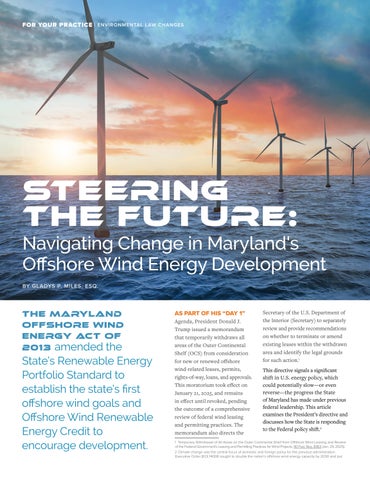
Steering the Future: Navigating Change in Maryland's Offshore Wind Energy Development
BY GLADYS P. MILES, ESQ.
THE MARYLAND OFFSHORE WIND ENERGY ACT OF
2013 amended the State’s Renewable Energy Portfolio Standard to establish the state’s first offshore wind goals and Offshore Wind Renewable Energy Credit to encourage development.
AS PART OF HIS “DAY 1” Agenda, President Donald J. Trump issued a memorandum that temporarily withdraws all areas of the Outer Continental Shelf (OCS) from consideration for new or renewed offshore wind-related leases, permits, rights-of-way, loans, and approvals. This moratorium took effect on January 21, 2025, and remains in effect until revoked, pending the outcome of a comprehensive review of federal wind leasing and permitting practices. The memorandum also directs the
Secretary of the U.S. Department of the Interior (Secretary) to separately review and provide recommendations on whether to terminate or amend existing leases within the withdrawn area and identify the legal grounds for such action.1
This directive signals a significant shift in U.S. energy policy, which could potentially slow—or even reverse—the progress the State of Maryland has made under previous federal leadership. This article examines the President’s directive and discusses how the State is responding to the Federal policy shift.2
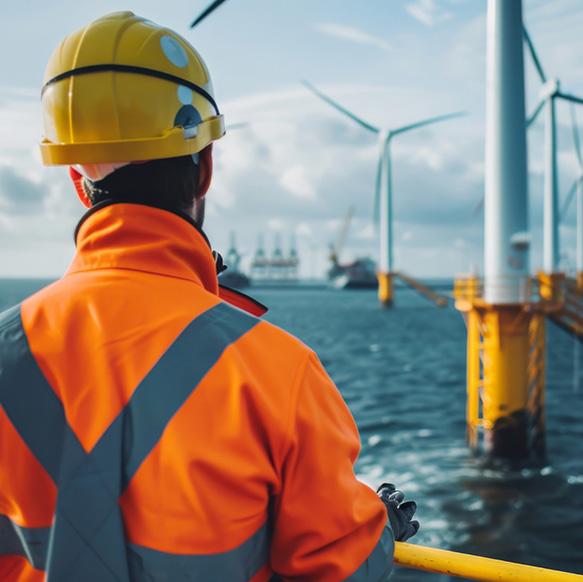
responsibility with the Bureau of Safety and Environmental Enforcement (BSEE) for administering that program, which consists of four phases:12
Planning and Analysis
Leasing
Site assessment and Construction and Operation.
Throughout each phase, BOEM typically consults with other federal agencies,13 and prepares an environmental impact statement under the National Environmental Policy Act.14
The National Oceanic and Atmospheric Administration (NOAA) plays a critical role in this process, frequently consulting with BOEM under multiple statutes such as the Endangered Species Act,15 the Magnuson-Stevens Fishery Conservation and Management Act,16 and, when applicable, the National Marine Sanctuaries Act.17 Depending on the project, additional Federal permits or authorizations may be required, including the issuance of an incidental take authorization by NOAA pursuant to the MMPA.18
States also play a critical role in evaluating offshore wind projects.19 Under the Submerged Lands Act of 1953, states have jurisdiction over the “lands beneath navigable waters within [their] boundaries” and the natural resources within those lands and waters.20 For Maryland, this jurisdiction extends three nautical miles seaward into the Atlantic Ocean, and includes 16 counties bordering the Atlantic Ocean, the Chesapeake Bay, and the Potomac River (up to Washington, D.C. municipal limits), covering a total of 12,407 square miles.21 Within this area, Maryland can regulate activities subject to federal powers related to “commerce, navigation, national defense, and international affairs,” and federal preemption.22 While Section 388 of EPAct23 and Section 307 of the Coastal Management Act24 provide the state with an opportunity to provide input in the federal decision-making process, the law is clear: all areas beyond three nautical miles and extending seaward up to 200 nautical miles are subject to the exclusive jurisdiction and control of the United States.25
A New Direction: The President’s Memorandum on Offshore Wind Development
Key elements of the President’s Memorandum are:
The Secretary and other federal agencies are temporarily prohibited from issuing new or renewed wind leases, permits, right-of-way, loans, or approvals for any area in the OCS.
The moratorium remains in effect until completion of a comprehensive review of Federal leasing and permitting practices, including an assessment of the environmental impacts of wind projects, as well as an analysis of the economic costs associated with intermittent electricity generation and the extent to which subsidies affect the viability of wind energy.
The moratorium is not intended to affect existing leases, but the Secretary is required to conduct a review of the ecological, economic, and environmental justifications for terminating or amending such existing leases and make recommendations to the President, identifying the legal basis for such action.
12 BOEM General Program Authority, Outer Continental Shelf, 218 Departmental Manual (DM) 1, Sep. 14, 2022; BSEE General Program Authority, Offshore Safety Environmental Enforcement, 219 DM 1, Sep. 14, 2022; see also Reorganization of Title 30-Renewable Energy and Alternate Uses of Existing Facilities on the Outer Continental Shelf, 88 Fed. Reg. 6376 (Jan. 31, 2023 (Final Rule to be codified at 30 C.F.R. pts 285, 585 and 586); The University of Rhode Island, Offshore Renewable Energy, What Is the Permitting Process for Large Wind Farms?, Jul. 1, 2020; Adam Vann, Offshore Wind Energy Development: Legal Framework, Congressional Research Service, R40175, Feb. 28, 2023.
13 Id.; 43 U.S.C.§§ 1337(p)(1) and (4).
14 42 U.S.C. §§ 4321 et seq.
15 16 U.S.C. §§ 1531 et seq.
16 16 U.S.C. §§ 1801 et seq.
17 16 U.S.C. §§ 1431 et seq
18 16 U.S.C. § 1371(a)(5); Adam Vann, supra note 13.
19 Id. at 2.
20 Id.; 43 U.S.C. §§ 1301(a), 1311(a)(1).
21 Id. at §§ 1301(a); 1311(a)(1); and 1312; See also NOAA, Office for Coastal Management, State Coastal Zone Boundaries, Feb. 9, 2012; State of Maryland Coastal Management Program and Final Environmental Impact Statement, Aug. 1978; Maryland Heritage Areas Program, Economic Impact Summary
22 43 U.S.C. §§ 1311(a)(2), 1314(a); see also supra note 19, at 2.
23 43 U.S.C.§ 1337(p)(7).
24 16 U.S.C. § 1456.
25 43 U.S.C. § 1331(a); Gulf Offshore Co. v. Mobil Oil Corp., 453 U.S. 473, 480-81 (1981).
U.S. WIND, INC.,
A
MASSACHUSETTS
corporation registered in Maryland, is presently the only developer in Maryland that has received all required approvals needed to conduct the first phase of construction.27
Jobs Act (Public Law 117-58).35 And, rescinds EO 14008 (which previously set a national goal of 30 GW of offshore wind energy capacity by 2030) thereby shifting federal focus back to fossil fuels like oil, natural gas, and coal, which were the cornerstone of Trump’s 2024 campaign.36
Moreover, EO 14260 identifies State “climate change” or related energy policies as threats to American energy dominance and national security. The order directs the U.S. Attorney General to take all appropriate action to stop enforcement of all state and local laws that burden the production and use of domestic energy resources. The order specifically implicates those laws that purport to address “climate change” or involve “environmental, social, and governance” initiatives, “environmental justice,” carbon or “greenhouse gas” emissions, and funds to collect carbon penalties or carbon taxes. The order further directs the Attorney General to submit a report to the President detailing actions taken to curtail those state laws.37
These new policies could hinder Maryland’s efforts, especially as they relate to offshore wind development.
Moving Forward
In Maryland, the Trump administration’s actions have been met with mixed reviews. The Director of the Maryland Energy Administration stated that the President’s actions “undercut state leadership on climate change,” will likely
“result in Maryland residents paying more for their energy,” and “pulls the rug out from underneath the clean energy companies, high-tech firms, and startup businesses .”38 In response, Maryland has joined other jurisdictions in a lawsuit challenging the President’s Memorandum.39 Whereas others in Maryland, like Senator Mary Beth Carozza, are trying to take advantage of the President’s actions with the hopes of reevaluating concerns that were made during the U.S. Wind permit process.40
The critical issue is whether the President can legally roll back the clean energy initiative, override state laws, and cancel appropriated funds. Lawmakers, businesses, non-governmental organizations, and courts are evaluating how best to navigate and respond to these changes.41

Gladys P. Miles is an attorney within the National Oceanic and Atmospheric Administration (NOAA), Office of General Counsel, Fisheries and Protected Resources Section. She provides legal counsel to the National Marine Fisheries Service. This article expresses the personal views of Ms. Miles and does not reflect the official views of NOAA or the U.S. Department of Commerce.
35 Id.; New York v. Trump, No. 25-1236 (1st Cir. Mar. 26, 2025); Woonasquatucket River Watershed Council v. USDA, No. 1:25-cv-00097-MSM-PAS (D. R.I. Apr. 15. 2025); National Council of Nonprofits v. OMB, Civ. Action No. 25-239 (D.D.C. Feb. 3, 2025).
36 Supra note 35.
37 EO 14260 of April 8, 2025, Protecting American Energy from State Overreach, 90 Fed. Reg. 15513 (Apr. 14, 2025).
38 MEA Director Responds to President Trump’s Attempt to Undercut State Leadership on Climate Change, Apr. 11, 2025
39 New York v. Trump, 1:25-cv-11221, Doc. 1 (Compl.) (D. Mass May 5, 2025).
40 See supra note 38; see also Kyle Orens, Critics Of Offshore Wind Believe The Pendulum Is Swinging In Their Direction, WBOC, Apr. 23, 2025.
41 Aton and Clark, Trump declares war on state climate laws, E&E News ClimateWire, Apr. 9, 2025.