I Am the Eggman
by Neil Rice
“I am the eggman, I am the walrus, Goo goo g’ joob Goo goo goo g’ joob!”---The Beatles
Honest Weight Food Cooperative has an Eggman! But in reality the Eggman is not one person, it is a variety of folks who have worked cooperatively over the years to supply our eggs. While Co-op eggs these days are supplied by a number of local farmers, HWFC has gotten eggs from the Cornell family farm in Hoosick Falls since 1992.
The idea of the Eggman comes from Member-Owner Peter Murdoch, who fondly recalls arriving in the chaos of our Quail Street location where he was met by an MO who would call out, “The Eggman is here!” So it quickly became Peter’s expected response to answer the call with a loud and high-pitched response coined from the Beatles’ popular (if rather meaningless and silly) song: “Goo
goo g’joob, goo goo g’joob!” (The writer had to look up these lyrics and was surprised because he always thought the line was “Kookoo kachoo, koo-koo kachoo!”)
So who are the MOs behind the idea of the Eggman? For Peter it started in 1992 when Bob, currently our benevolent Bulk Department guy, saw the need for getting the eggs to Albany and realized that Peter lived out that way, and he worked in Albany. Soon Peter started his Friday ritual of going to the Cornell Farm to load up the eggs and take them to the Co-op.
It was a biweekly task, with alternate weeks completed by another Rensselaer County MO Guinevere Thayler. Each week one of our MOs would meet a member of the Cornell family and load 12 or so boxes, each containing 12 dozen Cornell Farm eggs. (That’s 12 gross of eggs, not that the eggs were, or are, gross.) 12 gross = 144 eggs, so each fragile load consists of 12 x 144 eggs, or 1,728 eggs. Could be an omelet for a giant!
January RMM Vote Results
One ballot passed, approved by 98% of voting Member-Owners. See page 8 for details
It wasn’t long before his wife, MO Ellen Crane, began to share the egg-toting duties. They are still able to share that responsibility, and these days MO Rachel Riemann Akera, who also lives in the hills near Grafton and used to work with Pete, has picked up Guinevere’s role and delivers the eggs to HWFC on alternate weeks.
Some interesting moments surfaced in this process over the years. Can you imagine getting 1,728 eggs into a Honda Fit? Just ask Rachel: it can be done! And as far as we recall, no one has had to contend with a gross or two of scrambled eggs along the highway: when Ellen was rear-ended on Rte. 7 en route to the Co-op, somehow the eggs miraculously survived. And when Peter was forced by a detour to take the Northway south into Albany and his car’s differential went kaput, all it took was a call to the Co-op. A while later, staff MO Gail Fleisher
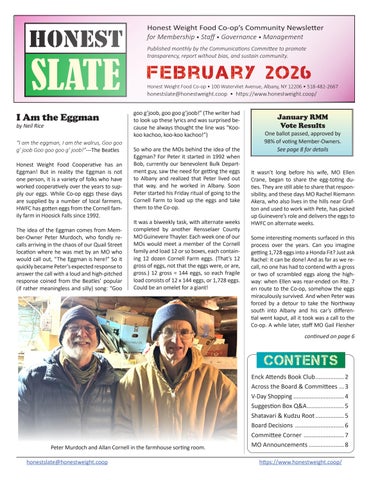
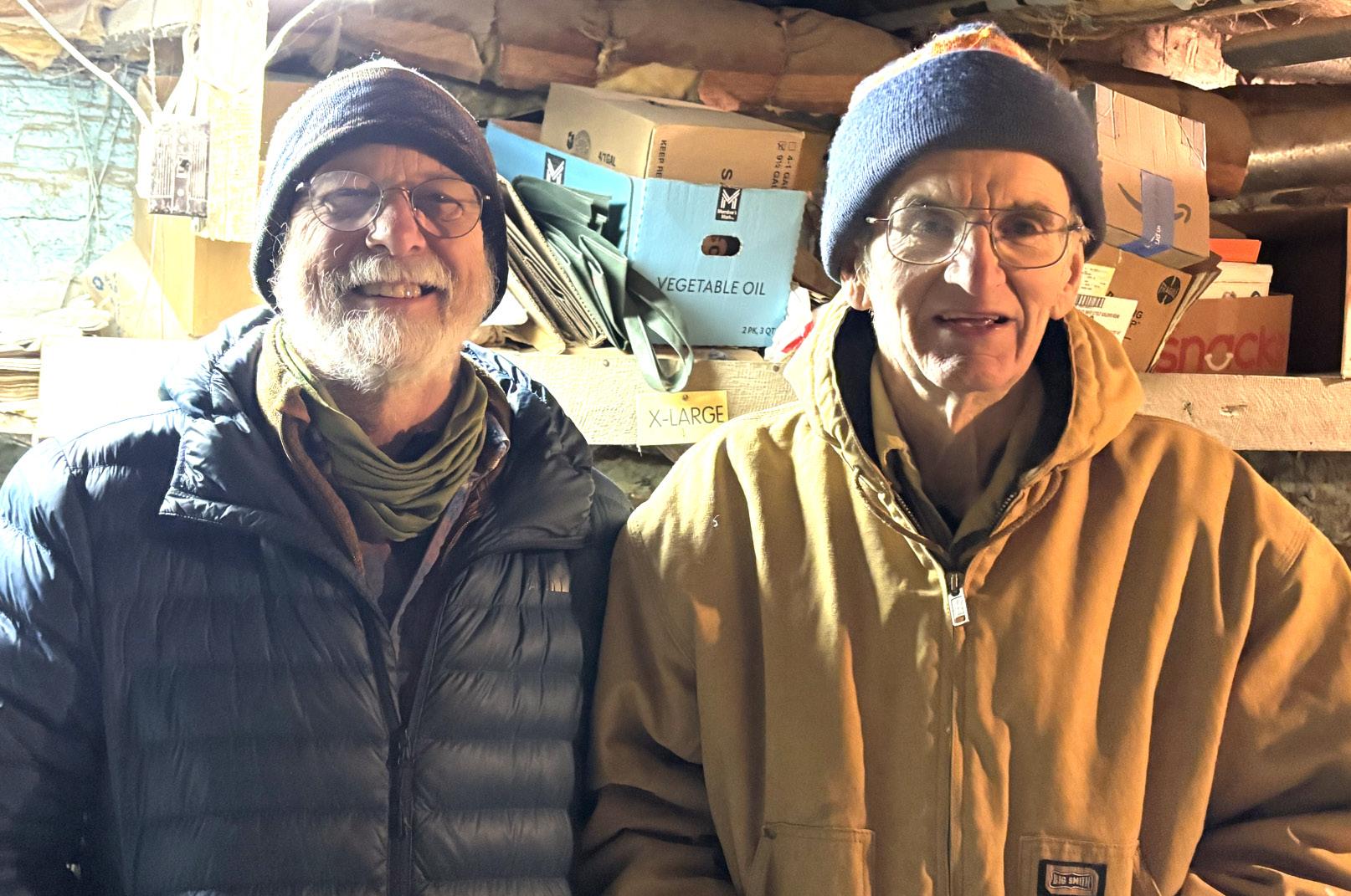
Peter Murdoch and Allan Cornell in the farmhouse sorting room.
2 Honest Slate February 2026
Author Attends HWFC Book Club to Peruse Plastic Problem
by Irene Kim
It doesn’t rust like metal or break like glass. It offers durable, lightweight storage. Cheap, inert, and easy to shape, it is in nearly everything around us—from the packaging on our sandwiches, to the stents in our arteries, to the fleece pullovers on our backs.
It is also overwhelming our landfills, choking our oceans, polluting our air, killing our wildlife, and poisoning us.
On Jan. 15, the book club convened to discuss Judith Enck’s book The Problem with Plastic. Enck herself was there to share insights from her research, listen to attendees’ observations, and field their questions. A faculty member at Bennington College, founder of the nonprofit Beyond Plastics, and former EPA regional administrator, Enck offered a sobering look at the hydra-headed quandary of plastic—how dependent we have become on it, how it is accumulating in our environment and in our bodies, how we cannot realistically recycle or safely reuse it.
To add insult to injury, plastic producers have gaslighted us into believing that we, not they, are responsible for the mountain of plastic waste we’re drowning in.
Enck explained that the plastics industry uses subversive marketing to make us think that all we have to do is recycle. But, unlike paper, glass, and metal, most plastics can’t be recycled. Most recyclers can handle only #1 (polyethylene terephthalate) and #2 (high-density polyethylene), but many of our food containers are #5. (Raise your hand if you thought you could just toss everything into the “single-stream” bin. Sorry, most of that ends up in landfills or incinerators.) Even if items are “recyclable” on paper, the waste stream is contaminated with 16,000 chemical additives that make recycling virtually impossible.
And the industry has been stealthily sneaking plastics into every facet of our lives with a cheerful “recycle responsibly!” while telling us that we are to blame for
the mountain of plastic piling up in our backyards. Enck pointed out that packaging manufacturers produced the famous “crying Indian” TV commercial from the 1970s, where an alleged Native American gets all choked up looking at the litter that has accumulated in a forest.
In addition, while telling us that recycling is a panacea, plastic producers have been making it nearly impossible to escape from their products. Did you grow up with cardboard milk cartons, refillable glass soda bottles, and 100% cotton clothes? Now just try to find a milk carton without a plastic spout; a soda bottle that isn’t plastic; or a garment that doesn’t contain polyester, elastane, or nylon. We’re assaulted by clickbait articles telling us to upcycle, downcycle, or otherwise craft away the piles of plastic waste—but every repurposed plastic yogurt cup, takeout box, soda bottle, spoon and fork, miscellaneous item ad infinitum is shedding microplastics into our air, water, soil, and bodies.
Why do producers push plastics so hard? Enck pointed out that the largest producers, the oil and gas industry, are seeing their traditional energy and transportation markets dry up as consumers turn to renewable energy sources and electric cars. In 2024, California Attorney General Rob Bonta sued ExxonMobil, our biggest plastic producer, for misleading the public about the recyclability of its products.
Plastics were never designed to be recycled. They all break down into microplastics. What’s maybe worse: reused and recycled plastics do so even faster than “virgin” plastics. It’s ironic that “green” products made of post-consumer recycled plastics are even more hazardous than products made of new resin. Attendees shared their frustration at trying to do the right thing by buying “green” toys and decking, only to find they had been making things worse.
One participant asked about pressuring producers by buying only products in sustainable packaging. While Enck encouraged everyone to avoid plastics to protect
“A sobering look at the hydra-headed quandary of plastic.”
their own health, she explained that such pressure would never force producers to change. Each minute, the equivalent of two garbage truck–loads of plastics is dumped into the ocean, where it sinks, breaks up into tiny particles, and is eaten by fish, turtles and other wildlife.
The plastics industry claims that the human body excretes ingested plastic harmlessly. But Enck countered that plastics have shown up in many parts of the body, including the blood, brain, heart, kidneys, placenta, and testicles. In the arteries of the heart, microplastics increase the risk of stroke. In the brain, they increase the risk of Alzheimer’s disease.
The only real solution? To greatly reduce the amount of plastics in our lives, said Enck, and the only way to do that is through legislation. She pointed out that while middle-class consumers might be able to buy food with minimal plastic packaging, their underprivileged counterparts cannot. The very people suffering in Cancer Alleys and disaster areas often have no option but to drink bottled water and eat food packaged in yards of plastic.
The only way to ensure healthy food and products for everyone, Enck explained, is to legally require producers to take responsibility for their products (“extended producer responsibility”). She mentioned a new bill that does just that: Packaging Reduction and Recycling Infrastructure Act (Senate bill 1464: Harckham, Assembly bill 1749: Glick) and urged attendees to contact their state legislators to support the bill.
Enck also encouraged attendees to check out her website, beyondplastics.org, which lists ideas for grassroots organizing, events, and resources for more information. She also teaches Bennington College’s Beyond Plastics course, which nonstudents can audit for $100.
Get Involved: Run for the Board or Join a Committee!
But WHY? I asked myself this question as I began to write this article. So, I researched the Board and committees to share observations.
HWFC thrives on Member-Owners’ energy, ideas, and dedication. Many ways exist to shape our community’s future beyond shopping and supporting local producers.
Taking a Leadership Role
The Board of Directors guides the Co-op’s overall vision and ensures it stays true to its mission. Serving is an opportunity to step up and enact policies that influence all aspects of the Co-op. New Board members often bring fresh ideas that strengthen our cooperative model. Most find leadership experience and confidence-building skills acquired via Board participation invaluable:
Impacting long-term goals
Ensuring accountability & transparency Representing interests of all MOs Honing independent thinking skills and good business-making decisions
With elections coming soon we encourage any MO in good standing to consider running. Not only does candidacy offer tremendous personal growth opportunity, but an increased number of candidates ensures a robust and meaningful election process.
A Board member spends a minimum of 15 and often 20+ hours monthly on Coop business: participating in open Board meetings, work sessions, and committee meetings (as liaison); reading committee financial reports, proposals, and materials; addressing staff and Membership issues; and attending Membership Meetings. All time spent in this capacity earns investment hours toward your store discount.
Committees are where your voice matters. Each committee plays a vital role in keeping our Co-op strong. Full Committee and Board of Directors descriptions appear in the Bylaws and on HWFC’s website.
Elections and Nominations
Committee recruits qualified candidates for Board elections. ENC oversees
election mechanics to ensure that timelines, eligibility rules, and voting procedures are followed.
Committees are where your voice matters.
Finance Committee provides financial oversight to the Board of Directors to keep the Co-op fiscally healthy in both the short and long term. They assist the Board by reviewing finances and identifying risks.
Membership Committee orients new Owners, maintains the Member-Owner Manual, preserves MO rights, and suggests ways to resolve MO issues and concerns.
Personnel Committee includes MOs, staff and managers who guide Employee Manual policies on evaluation and workplace conduct. PC reviews policy alignment with Co-op values for fair and consistent staff treatment.
Nutrition & Education Committee maintains the Co-op’s Food & Product Manual and provides educational food-related information.
Honest Arts Committee integrates local art into the shopping experience and broader community. Work of local artists and MOs is exhibited in the store’s back hallway.
Strategic Long-Range Planning Committee
affirms and applies HWFC’s mission and values to long-range goals. SLRP provides a multi-year strategic plan with measurable objectives and timelines. Its guidance helps the CLM and the Board align policy and operations. This committee conducts surveys at regular intervals to assess employee satisfaction and retention and MO and shopper satisfaction and concerns.
Communications Committee keeps MOs engaged in Membership activity and opportunities via accessible communication. It publishes Honest Slate, our monthly Membership newsletter, to publicize meetings, policy changes, Board elections, and other news of interest to our community.
Stay informed! MOs are encouraged to attend multiple Membership, Board, and committee meetings to better understand how HWFC governance works.
Anti-Racism
Committee’s goals comprise dismantling systemic racism not only within HWFC, but also within the food system itself, aiming to connect with communities of color and ensure our Co-op isn’t simply “not racist” but actively “anti-racist.”
Diversity, Equity, and Inclusion Committee
encourages HWFC to be more welcoming, equitable, and just. Members focus strongly on addressing any barriers to full participation within the Co-op within marginalized and underrepresented groups including, but not limited to: BIPOC, LGBTQIA, persons with disabilities, and low-income shoppers.
Environment Committee
aligns HWFC’s operations with ecological values. EC may explore and determine best ways to reduce waste, recycle, find environmentally responsible vendors, and evaluate energy and water usage. It may study and reach out to local environmental groups with the shared goal of reducing food waste.
Governance Review Council
(GRC) is responsible for monitoring and promoting good governance. This group is a Member-elected body distinct from the Board of Directors. Responsibilities differ from those of the Board in that the Council concentrates neither on running the business nor supervising the General Manager. GRC may provide support and analysis of HWFC policies or Bylaws upon request from the Board, committees, or MOs.
We hope that you find this article inspiring and consider taking an active role in making Honest Weight Food Co-op, better than ever!—Steve Konsistorum, ENC
Together, we can create a stronger Co-op.
To nominate yourself today, contact the Elections and Nominations Committee at: ElectionsComm@honestweight.coop.
Be My Valentine: 6 ways to say “I Love You” at Honest Weight
by Robin D. Schatz
Okay, Valentine’s Day can be a bit cheesy and overly commercial. But I confess I’m still sentimental about the holiday. When I was around 10, I obsessed over the anonymous Valentine’s card I received in the mail with the glittery picture of a pink poodle. It was signed only with a question mark. I like to think it was from my cute—and slightly older—neighbor, whom I happened to have a crush on. (He did own a poodle named Brandy.) But I never did find out who sent the card. It remains a sweet mystery.
While every day should be Valentine’s Day when it comes to showing your love and appreciation for your partner, almost everyone appreciates a thoughtful gesture or some extra attention on February 14.

But what to do? Restaurants are often crowded, and more expensive on the holiday; you’ve just recovered from the Christmas/Chanukah gifting season; and you don’t want to be so predictable as to grab the nearest satin heart from the drugstore.
My best advice: use your imagination—that matters far more than the price tag of the gift. Luckily, HWFC can help you show your love in a way that reflects your own personality and your unique relationship.
Goclassic with chocolate. HWFC has a great selection of fair trade and organic chocolates that will make any chocolate lover swoon. Farmhouse Chocolates, handcrafted in Vermont, offers gift-ready small boxes of dark chocolate Vermont Maple Truffles and a mixed box of dark and milk chocolate caramels.
There’s also the beautifully packaged single-origin chocolate bars from Askinosie, and premium bars and brittle from Saratoga Chocolate Co. You’ll find most of the higher
priced chocolates caddy-corner to the egg shelves. Other chocolate bars are located an aisle away from Bulk, under the sign that says “Tea.”

Say it with fruit. Head on over to the Produce Department for organic strawberries, another aphrodisiac. If you want to get fancy, dip them in melted chocolate. For extra credit, pick up a beautiful pomegranate. You guessed it—it’s another aphrodisiac.

Go green. I’m always charmed by a beautiful bouquet. You can pick up a bunch of organic sunflowers near Produce, as well as some adorable bowls of primroses or a rainbow of blooming kolanchoe plants.

Feed the foodie. Choose your be loved’s favorite foods. Assemble your own basket of fresh and packaged good ies from the Co-op or buy everything you need to cook a special meal together, whether fresh king salmon from Sea food, grass-fed steak from Meat, or a vegan dish. (Look up “Marry Me Tofu,” made with garlic, coconut milk, and sun dried tomatoes.) If cooking’s not your thing, Food Services has a great selection of dinner items in the Grab n Go section. Heat as needed and plate beautifully. Add your beverage of choice. Choose a sexy dessert. Then watch your favorite rom-com together.



Keep an eye out for special Valentine’s Day offerings in the store as the day gets closer, and do browse the aisles as you’re shopping. I found a heart-shaped wooden board from Creative Co-op in Housewares that would be lovely, presented with fruit, cheese, and a good bottle of wine. Whatever your heart desires, you’re bound to find something that says “I love you.”
Next Book Club Event

Make a bubble bath. Head over to the Wellness section and pick up a bottle of Aromatherapy bubble bath from Aura Cacia. It comes in chamomile and lavender. Add a scented candle for more atmosphere and a super loofah exfoliating washcloth.

and receive a massage. Pick up some massage oil in Wellness. The many kinds to choose from include Soothing Touch Ayurveda massage oil in sandalwood, peppermint, rosemary, and other scents. Look up some massage moves on YouTube or improvise.
Hello, Honest Weight Community! We had a fantastic January Book Club event with Judith Enck’s The Problem with Plastic. Thanks to everyone who turned out and to Judith for inspiring and educating us.
Our next book is Budget Justice: On Building Grassroots Politics and Solidarities by Celina Su. This title is available at Book House of Stuyvesant Plaza at 20% off for Honest Weight Book Club readers (you need not be an HWFC member). It’s also available online at Princeton University Press with discount code CSBJ30; and Member Services will have loaner copies.
Thursday, March 19 • 6–7:30pm in the HWFC Community Room
Join us for snacks, conversation, and connection. Author Celina Su will join us for the first hour via Zoom.
And May’s book is The AI Con: How to Fight Big Tech’s Hype and Create the Future We Want by Emily M. Bender, Alex Hanna. Hurrah!—Cara Benson
Shatavar i & Kudzu Root
by Erin Ethier
Shatavari (Asparagus racemosus) is used in the Ayurvedic tradition and is known as the “Queen of the herbs.” It is translated from Sanskrit (the sacred language of Hinduism) as “She who has hundreds of husbands.”
Shatavari grows in tropical Nepal, Sri Lanka, India, elsewhere in Asia, as well as Australia and Africa. A ground cover found at low altitudes with rich sandy soil, it can grow in colder climates, but the tubers need to come inside during colder months and are best grown in greenhouse conditions.
Believed to promote longevity, correct imbalances, build strength, increase memory, strengthen metabolism, and maintain youthfulness, it is used as a women’s reproductive tonic.
Kudzu root (Pueraria montana) is native to India, East Asia, China, and Japan. It grows abundantly in the region’s subtropical and temperate climates, thriving on hillsides, in sunny locations, and in woodlands. Introduced to the US in the 19th century, it is now prolific in the Carolinas, Georgia, Florida, Mississippi, and Tennessee. It’s considered an extremely invasive plant with an aggressive growth rate so there are absolutely no concerns about overharvesting.
Known to enhance soil fertility and stabilize erosion, kudzu is used in Asia as a nutritious food and has been valuable historically
during times of scarcity or famine. It is processed into porridge, pasta, and jellies.
Kudzu supports many categories of menopause complaints, including libido issues, bone density, and cardiovascular health.
It is recommended to take kudzu for at least 6 months to see results; effects are believed to last only while using it. Kudzu’s active constituent puerarin promotes hydration, reduces inflammation, generates moisture, and cools the body. Its phytoestrogenic properties may help in reducing bone loss because the compound daidzein, found in kudzu, mimics estrogen in the body.
Shatavari, also considered phytoestrogenic, is used for a wide range of hormonal health issues in both men and women. It is used to support fertility, breastfeeding, fetal development, the menstrual cycle and menopausal regulation, low libido/sperm count, and more.
Shatavari has traditionally been used in menopause as a cooling and moistening adaptogen, which makes it good for hot flashes and dryness. I have also seen improvement with dry eyes. A study from India showed that Shatavari may support libido and ease anxiety and depression. Its cooling effects may mitigate hot flashes, in turn aiding sleep. It also has a calming effect on the nervous system, playing an important role in mood and sleep patterns.
Shatavari protects the gastrointestinal lining, promotes gut motility, and helps allevi-
Q: Anicca Bakery is so delicious! Thank you for bringing them into the Co-op!
Suggestion Box answers are provided by our Honest Weight managers and departments.
Q: Rarely use the bathroom but today I had the opportunity…I think they could use a refresh. A few broken things could be fixed and some paint would go a long way!!!
A: You are absolutely correct! We have toilet paper holders on order and hope to be painting the doors early in the new year.
ate inflammation and irritation. It supports healthy mucosa, rendering it helpful for acid reflux and gastritis. It may help prevent kidney stones since it can inhibit crystallization of minerals. Shatavari is an antioxidant and anti-inflammatory and is considered an immunomodulator.
Kudzu root may lower the risk of heart disease, hypertension, and stroke by protecting cellular structures and reducing oxidative damage to lipids, proteins, and DNA. Some women can see an increase in these symptoms when entering menopause because of the loss of estrogen, so using herbs such as shatavari and kudzu can sometimes help minimize those effects.
Shatavari is best used in tincture and powdered form. I have also seen its benefits in pill form, depending on the strength and maker. I prefer kudzu root as a tincture, but capsules and powder can also be taken. Avoid both during pregnancy unless working directly with a doctor, midwife, or herbalist familiar with these herbs; but both can be used while breastfeeding. To use for medicinal purposes I suggest working with your doctor or herbalist.
Shatavari is available in the Wellness Department. Kudzu isn’t currently available at the Co-op but you can source it online.
HWFC does not provide medical advice. Please check with a health care practitioner before treating any condition. See page 6 for policies and full disclaimer.

A: We’re glad you like this local, organic bakery! They deliver Tuesday through Saturday.
Q: We miss the fig bars in Bulk. Help?
A: Our vendor who had supplied the fig bars discontinued them and we have not found an acceptable substitute.
Q: Are the sturdy plastic bags that the Produce Department’s spinach comes in recy-
clable? They are like ziplocks and have the HW logo printed in white. Must these go into landfill? Or can they be composted?
A: Our bags are not compostable. They may be taken to a plastic bag collection point.
Q: Reusable vegetable bags—mesh.
A: We carry mesh vegetable bags and will place some [for purchase] in our Produce area.

Honest Slate 6
B o a r d Decisions
At the Feb. 3, 2025, HWFC Board of Directors meeting, the Board decided to:
• Approve the Jan. 6, 2026 Board of Director Meeting minutes as presented.
• Affirm the decision made Jan. 24, 2026 to extend the Jan. 25, 2026 Regular Membership Meeting in-person voting hours through 6pm Tuesday, Jan. 27, 2026 due to expected adverse weather conditions.
• Approve the Finance Committee’s 2025–26 committee work plan as edited during the meeting.
• Approve the Membership Committee’s request to receive assistance from the Communications Committee to review the HWFC Committee Meeting pamphlet draft.
• Approve extending the HWFC Governance Incentive through the 2026 calendar year. The meeting adjourned at 9:43 pm.
Did You Know?
Our winter register drive yielded:
• 328 hats, gloves, and socks [presumably pairs]
• 322 personal care items
I am the Egg Man
continued from page 1
flew the coop from the Co-op to rescue the Co-op-borne precious cargo. Another clear example of what makes our cooperative fantastic: people stepping up without a grumble to get even unexpected jobs done.
The Cornell family farm is now operated by Allan Cornell and his wife, Edna. Allan’s dad, Ira Cornell, and his wife, Agnes, bought the farm Allan now runs back in the 1940s. Allan and his brother, David, grew up on the farm. Upon his return from military service in Vietnam, Allan, along with David, helped their parents run the farm. After Ira passed in 1992 the Cornell boys worked with their mom as the farm continued to prosper.


“We operate uniquely. Areas that differentiate us are produce, bulk, and culinary. What we’re really selling is a sense of community, belonging, and control.”
—Peter Waldmann, CLM

Ellen and Peter fondly recall being greeted by Agnes in the early days of bringing the eggs to Honest Weight. The formidably strong and kind Agnes would typically greet our MOs wearing a paisley dress and high, laced-up work boots. At her age, Agnes was not exactly a spring chicken, but she would pitch in and carry the boxes of eggs as well as our relatively young MOs.
feBruary 2O26

Editors & Contributors
Cara Benson
David Bulnes
Erin Ethier
Elisa Grimm
Don Kennison
Irene Kim
Steve Konsistorum
Carol Ostrow
Neil Rice
Anastasia Rodgers
Karen Roth
Robin Schatz
Janet Sorell
Christi Wright
honestslate@honestweight.coop Contact with questions, comments, ideas.
Submissions Policy
• Maximum article length is ~800 words.
• Material is published at the discretion of the Honest Slate team.
• Only signed work is accepted. Items are edited for length, grammar, & style.
• We may consider unsolicited material but encourage submitting ideas first.
• Letters to the Editor do not require preapproval.
February 2026
For the last couple of decades Allan and David have run the farm. Sadly, David died last June. Now Allan, his wife, and their son Dale operate the farm. Dale has branched out into vegetables as well, and operates a nearby farm stand. Allan says the farm currently has about 2,000 laying hens!
Cooperative enterprises like Honest Weight likely evolved from natural cooperation found in families.
Not surprisingly, the Cornell Farm’s story is a story of families and cooperation. Through their cooperative work on this farm the family survived and thrived. Cooperative enterprises like Honest Weight likely evolved from natural forms of cooperation found in families. During those years delivering eggs to HWFC Peter and Ellen raised their family. So their children, Sierra and Winslow, visited the Cornell Farm on many occasions. They grew up knowing what it’s like to walk through lawns with the chickens, witnessing chicks hatch in incubators, and seeing the egg-sorting gadgets that size the eggs and sort out those not fit for consumption. As children they were a part of their parents’ cooperative efforts, and a part of a bigger community.
So who is the Eggman? You are the Eggman, I am the Eggman, we are all the Eggman as we strive together to strengthen Honest Weight and the community we serve. The world could use a little more cooperation to make it more livable for everyone!
Statement of Purpose:
Honest Slate is a platform for HWFC Membership, Staff, Management, and Governance: promoting transparency, reporting news without bias, and sustaining community.
Honest Slate articles are for informational purposes and are not intended to diagnose or treat disease. Opinions expressed in Honest Slate do not necessarily represent the views or policies of Honest Slate or Honest Weight Food Co-op.
All contents ©2026 Honest Weight Food Coop; no material appearing in Honest Slate may be reproduced in any form without the express written consent of HWFC.
COMMITTEE CORNER
A summary of preliminary committee reports submitted to the Board of Directors (BOD) for its February 3, 2026, meeting. See Board Meeting packet for details. Board-approved committee reports are posted on HWFC’s website. Our committees help to run Honest Weight. See if there is a committee for you.
by Stephanie Conde
Diversity, Equity & Inclusion Committee (DEIC)
∙ Shared reflections on our first Community Cooking & Meal Share (CC&MS) event held Mon., Jan. 12 in HWFC’s Teaching Kitchen. Kathleen Standard, Ruth Ann Smalley, Kaori Otera Chen, and two other non-DEIC members gathered, cooked a large pot of nutritious vegan soup and rice, and shared with staff members and shoppers in the Teaching Kitchen as well as the neighboring community via HWFC’s parking lot Free Food Fridge.
∙ Discussed how DEIC conceptualizes organizing the CC&MS event as a way to unite and diversify the HWFC community. Will host a second CC&MS event.
∙ Noted appreciation of ongoing BOD support.
Anti-Racism Committee (ARC)
∙ Shared thoughts on MLK Day.
∙ Discussed subcommittee reports.
∙ Members to reread Guidelines for Visiting Guests, think about orienting members.
∙ Set March date for ARC potluck/work on racism. Discussed working with Karen Roth about planning committee potluck/anti-racism video showing/discussion evening.
∙ Working with Valerie on next tabling effort.
∙ Discussed open evening for Co-op on anti-racism, following United to End Racism model. Needs further discussion.
∙ Reading about Critical Race Theory and “White Privilege—Unpacking the Invisible Knapsack.”
White Affinity Group Meetings
Third Thursdays 6:30–7:45pm via Zoom
This is a group meant for white folks to work on eliminating racism and white supremacy. Join us as we share thoughts, feelings, successes, and mistakes in a warm, friendly, and nonjudgmental atmosphere.
Contact Tam for the Zoom link at Listeningpartnerships@gmail.com.
Nutrition & Education Committee (NEC)
∙ Discussed and unanimously passed: (1) new title; (2) new introduction for Section 7 of FPM (Food and Product Manual); and (3) adding paragraph titled “Member-Owner Role in Maintaining Product Standards” immediately following 3.1 Mission Statement (p. 2 FPM). Submitted these 3 changes for BOD approval and subsequent vote by Membership.
∙ Agreed on written guidance procedures for all NEC members.
∙ NEC continues tabling in store to promote and answer questions about FPM.
∙ Submitting article for Honest Slate
Governance Review Council (GRC)
∙ Approved Dec. 8 GRC minutes.
∙ Made report of Jan. 6 BOD meeting.
∙ Reviewed upcoming Jan. 2026 RMM.
∙ Discussed progress of Conflict Resolution Policy/Problem-Solving Guide (particularly Peer Review Panel portion) and training for Peer Review panelists.
Communications Committee (CC)
∙ Reviewed February’s Honest Slate and planned March’s issue.
∙ Next copy deadline is Feb. 19.
∙ Next publishing dates: Feb. 6, Mar. 6.
Personnel Committee (PC)
∙ Discussed Problem Solving Policy Review and Guidance. Reviewed BOD questions, discussion, and group editing. Revisions to be sent to full PC for review ahead of sending back to BOD.
Elections & Nominations Committee (ENC)
∙ Held introductions welcoming new Membership Program Administrative Assistant Valerie.
∙ Provided updates to ENC members on a way to record or transcribe Zoom feedback sessions on voting matters put to HWFC
Membership.
∙ ENC was ultimately not needed/requested to help support Staff Rep. vote (as discussed in recent BOD meeting).
∙ Discussed final tasks and actions needed to ensure ENC readiness for Jan. 25 RMM and Jan. 26 vote counting.
∙ Briefly discussed planning and next steps needed for April RMM and BOD election (nomination form, website, etc.).
∙ Shared lengthy discussion on recruitment ideas and challenges with achieving them (need practical ways to support recruitment efforts beyond what we do today to support quarterly meetings, elections, and voting). Recruitment efforts need people with experience recruiting for BODs. Christi, ENC’s newest member, has experience and is sharing ideas. Christi has a recruitment vision that “embeds itself in every committee,” so recruiting for BOD becomes a shared responsibility and our regular responsibility.
∙ Discussions are ongoing about possibly splitting ENC into two parts—Elections and Recruitment/Nominations—with separate roles.
2026
Regular Membership Meeting Dates
• Sunday, April 26
• Sunday, June 28
• Sunday, Oct. 25
HWFC Coffeehouse Open Mic Mon., Feb. 16 •
6:30–8:30pm
HWFC’s café fills with song, music, and readings every 3rd Monday! Coffeehouse Open Mic Night is open and free to Co-op Members and the public alike.
When we come together through music, song, stories, and fun, we reflect and regenerate our connectedness, unity, and capacity to create a space in which expressions of our talents, soulfulness, and unique vision are supported and valued—needed in our lives, our community, and our world.
Please join us for an evening featuring local performers and artists. Performer sign-in starts at 6pm. All types of family-friendly performances are welcome!
memBer-owner C o - o p p o r t u n i t i e s
Greetings Honest Weight Community, We had a very successful Membership Meeting on Jan. 25 with almost 250 Member-Owners (MOs) despite a snowstorm resulting in the store closing at 4pm! Thanks go to our CLM Peter who came in so we could run the meeting from the store.
These meetings are made possible with in excess of 40 folks from our community who mailed the notice, put together both electronic and paper ballots plus slides; supported check-in, coordinated the Zoom call, ran the meeting, presented, collected paper ballots at the store, counted votes, and entered hours for MOs who attended. A true cooperative effort!
At this meeting we approved adding language crafted by the Membership Committee to the Membership Manual—with 98% of voters saying “yes”—describing the Voluntary Member-Owner Emergency Hours Bank, which has been in use since 2018 (click here for information on the bank).
January RMM Vote Results
We were pleased to have 249 Member-Owners join us at Jan. 25’s remote HWFC Regular Membership Meeting.
Voting Results were as follows: Ballot #1: Member Owner Manual Changes Should we adopt the proposed Member-Owner Manual language on the Voluntary MO Emergency Hours Bank?
Proposed Language:
This emergency bank exists solely on Member-Owner (MO) voluntary donations, separate from a MO’s personal bank of unused hours. This bank provides a safety net for Member-Owners (MOs) who have invested time regularly over the prior 6 months and are facing hardships that prevent them from continuing to invest hours for an extended period of time. Hardships may include, but are not limited to, health issues, significant life changes and/or other situations at the discretion of the Membership Manager.
This resource acts as a safety net for MOs who regularly invest time to be able to keep their discount despite a challenging life circumstance. Since the meeting over 200 hours have been donated to the bank and several MO’s have requested to use hours from the bank. Amazing!
We have one MO need to fill! Maintenance & Grounds Support seeks someone in the architecture profession to produce drawings for a building project. Email: KarlBraun@ honestweight.coop
Thanks for reading!—Karen and Valerie, Your Member Services Team
RMM Highlights
Almost 250 MOs attended Jan. 25th’s RMM.
After a moment of silence in solidarity with “our brothers and sisters” in Minneapolis, Board President Wendy Hord told attendees: “This is a time to remember that we are a microcosm of the larger whole. Please let’s be kind…and support each other.”
Gratitude:
“An incredible thank you to whoever is still at the Co-op...making this happen.”
Requests from the Emergency Hours Bank will be fulfilled contingent upon the availability of hours in the bank at the time of the request and may also be contingent on prior use of the emergency bank.
MOs wishing to donate to the emergency bank or request donated hours can contact memberservices@honestweight.coop. Request and donation details will be kept confidential.
Of 194 ballots cast: 190 approved the resolution; 1 rejected the resolution; 3 preferred not to vote on this issue.
The resolution was approved by 98% of Members casting ballots and passed. Thank you to all who joined us and helped to make this meeting a success!
In Partnership and Affinity, The Honest Weight Board of Directors
Please note: data recorded from “non-confidential” votes by phone or Survey Monkey have only been used for the election/voting/vote-counting process for January 2026 and will not be “data-mined” or used for any other purpose in the future.
“Like no other store.”
“A CLM who cares about community and Membership.”
“That the Co-op exists. It’s truly the healthiest place to buy food and [involves] democratic factors.”
One MO who started shifts just before the holidays reported helpful, welcoming Front End interaction. Previously involved with Park Slope Food Co-op, she expressed how familiar and good it felt.
Topics ranged from product and operational queries to offering translation for Instacart shoppers with limited English language skills. Several committees presented. DEI’s recent cook and share event welcomed all who stopped by, shoppers included.
“We made a huge amount of soup,” reported Kaori Otera Chen. “We also added 50 servings of soups for the Free Fridge.”
“We had to stand on a step stool to stir that pot!” Kathleen Standard added. Share a meal with us next on Feb. 10, March 10, and April 14.
SLRP is developing a vision statement and strategic plan with “ways to take advantage of opportunities, avoid distractions, and mitigate threats to HWFC’s viability,” cochair Elaine Hills stated.
“Our [Board] has demonstrated a commitment to Membership by hiring top leadership [and has ensured] that our time investment program is foremost in—not in the back of—people’s minds,” stated an MO.