
“JUSTICE FOR ALL” IS A FUNDAMENTAL PROMISE, yet for hundreds of thousands of Marylanders forced to navigate the civil legal system alone, it often remains out of reach. In fiscal year 2026, the Maryland Access to Justice Commission (A2JC) took bold, strategic steps to bridge this gap, actively transforming the civil justice landscape to protect human dignity, preserve livelihoods, and disrupt cycles of systemic poverty and inequity.
This article highlights a transformative period of innovation, advocacy, and renewed vision for A2JC. Here, we showcase the pivotal milestones that highlight the Maryland Access to Justice Commission’s unparalleled value and unique contributions in fiscal year 2026.
In fiscal year 2026, the Maryland Access to Justice Commission:
At the conclusion of this fiscal year, we welcomed Erek L. Barron as the new chair of A2JC, succeeding Ward B. Coe’s transformative 10-year legacy. Barron brings over two decades of distinguished public service and legal leadership to the role. Most recently, as the first African American U.S. Attorney for the District of Maryland, he spearheaded significant civil rights, community safety, and government accountability initiatives. A steadfast advocate for expanding access to justice, Barron has championed legal equity through leadership roles with the Maryland State Bar Association, Maryland Legal Aid, and the Office of the Public Defender. His comprehensive expertise spans every level of Maryland’s legal system, including service as a federal prosecutor, state legislator, trial attorney, and national policy adviser.


“JUSTICE FOR ALL” IS A FUNDAMENTAL PROMISE, yet for hundreds of thousands of Marylanders forced to navigate the civil legal system alone, it often remains out of reach. In fiscal year 2026, the Maryland Access to Justice Commission (A2JC) took bold, strategic steps to bridge this gap, actively transforming the civil justice landscape to protect human dignity, preserve livelihoods, and disrupt cycles of systemic poverty and inequity.
This article highlights a transformative period of innovation, advocacy, and renewed vision for A2JC. Here, we showcase the pivotal milestones that highlight the Maryland Access to Justice Commission’s unparalleled value and unique contributions in fiscal year 2026.
In fiscal year 2026, the Maryland Access to Justice Commission:
At the conclusion of this fiscal year, we welcomed Erek L. Barron as the new chair of A2JC, succeeding Ward B. Coe’s transformative 10-year legacy. Barron brings over two decades of distinguished public service and legal leadership to the role. Most recently, as the first African American U.S. Attorney for the District of Maryland, he spearheaded significant civil rights, community safety, and government accountability initiatives. A steadfast advocate for expanding access to justice, Barron has championed legal equity through leadership roles with the Maryland State Bar Association, Maryland Legal Aid, and the Office of the Public Defender. His comprehensive expertise spans every level of Maryland’s legal system, including service as a federal prosecutor, state legislator, trial attorney, and national policy adviser.
DEVELOPED A STRATEGIC FRAMEWORK FOR CHANGE
Justice for all is a value our society holds dear, yet it often rings hollow for the hundreds of thousands of Marylanders forced to navigate the civil legal system alone. When Marylanders are empowered to resolve their civil legal problems, they are safeguarded against devastating life disruptions, enabling them to meet basic human needs, maintain family stability, and preserve their livelihoods.
To actively disrupt cycles of poverty and systemic inequity, the A2JC worked over the past year to crystallize a bold theory of change. This strategic framework ensures our work is grounded in achieving our vision and that we invest in four definitive strategies that make A2JC’s work unique among other access to justice organizations in the state. These strategies include:



UNITE CHANGEMAKERS:
We convene stakeholders, build consensus, and cultivate a climate ripe for system-wide reform.
CULTIVATE EXPERTISE:
We serve as Maryland’s central hub for research, data, and thought leadership, utilizing evidence to identify intervention points and build public awareness.
CATALYZE INNOVATION:
We spark momentum by introducing innovative solutions to close the state’s access-to-justice gap.
DRIVE REFORM:
We advocate for system-wide improvements by educating leaders and changing laws, court rules, and policies.
CONCLUDED THE WORK OF THE INNOVATIONS IN TIERED LEGAL SERVICES TASK FORCE

A2JC was one of the key partners in the Innovations in Tiered Legal Services Task Force (Task Force), with the Maryland Judiciary and Maryland State Bar Association. A2JC staffed the Task Force to conclude a 20-month deep examination of the use of allied legal professionals and legal technologies as a solution to closing the access to justice gap. As an interim measure, the Task Force published the first-ever comprehensive review of the existing use of Allied Legal Professionals in Maryland through the 2026 Audit Report.
DELIVERED THE FUTURE ROADMAP FOR ACCESS TO COUNSEL IN EVICTIONS (ACE) PROGRAM
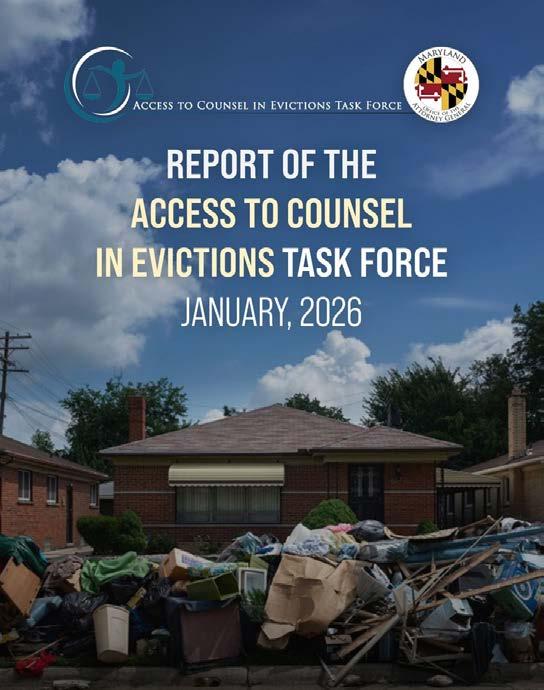
We helped publish the fifth and final ACE Task Force Report, marking a historic transition. After four years of visionary leadership, Executive Director Reena Shah stepped down as ACE Task Force chair, but not before laying out a definitive roadmap for the program's future. This roadmap secured the Task Force’s successful transition to the Department of Housing and Community Development and laid the groundwork for the permanent, stable funding needed to keep Marylanders in their homes.
The report revealed critical findings: Allied Legal Professionals (ALPs) are already authorized in over 15 types of state proceedings and can operate successfully in at least 15 federal agencies. There was no reported consumer harm or negative impact on attorney livelihoods. The report proves that introducing carefully tailored, formalized legal service tiers—such as community justice workers and legal practitioners—is a highly effective, safe, and necessary innovation to shrink Maryland’s justice gap. A final report of the Innovations Task Force will be delivered in fiscal year 2027.
SPEARHEADED BROAD PUBLIC AWARENESS WITH THE EMPOWERED VIDEO PROJECT

A2JC successfully launched the Empowered educational video project alongside a dynamic social media campaign to expose the realities of the civil justice gap. In a monumental triumph for A2JC, this compelling project secured national distribution, airing on public television stations across all 50 states and reaching a potential audience of 60 million households.
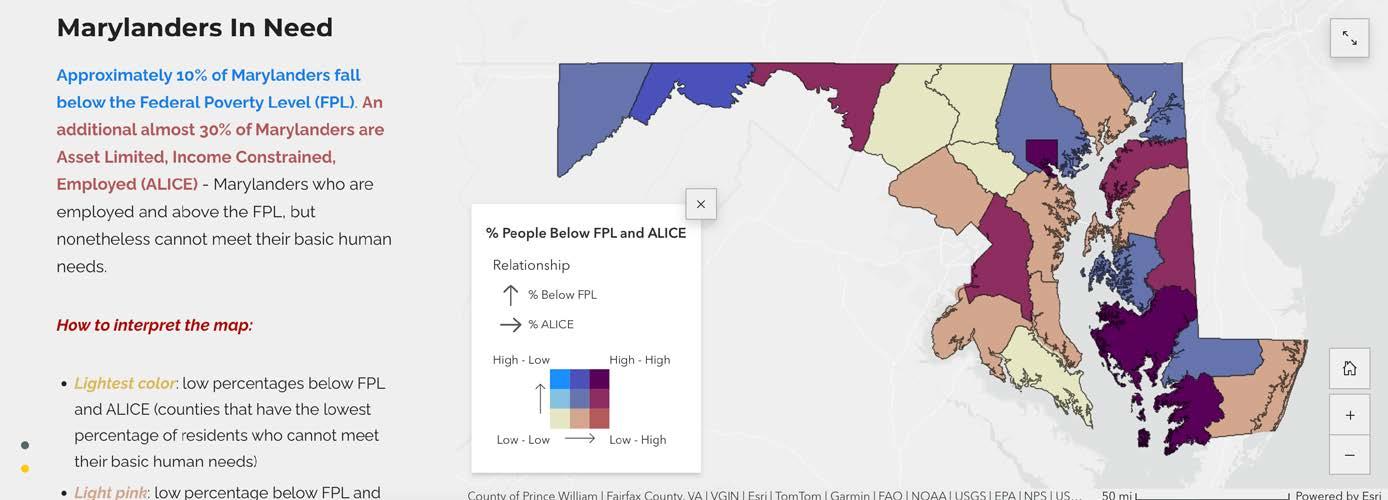
HIGHLIGHTED CONNECTIONS BETWEEN CIVIL LEGAL AID AND BASIC HUMAN NEEDS THROUGH DATA VISUALIZATIONS IN A STORY MAP
To illuminate the connection between civil legal aid and basic human needs and highlight the impact of the crisis of self-representation, A2JC published an interactive story map that masterfully weaves in-depth data with compelling storytelling. Through in-depth data curation and visually compelling maps, this project makes a strong case for why civil legal aid is not just a legal issue but a critical tool for fulfilling basic human needs such as housing, food security, and personal safety.
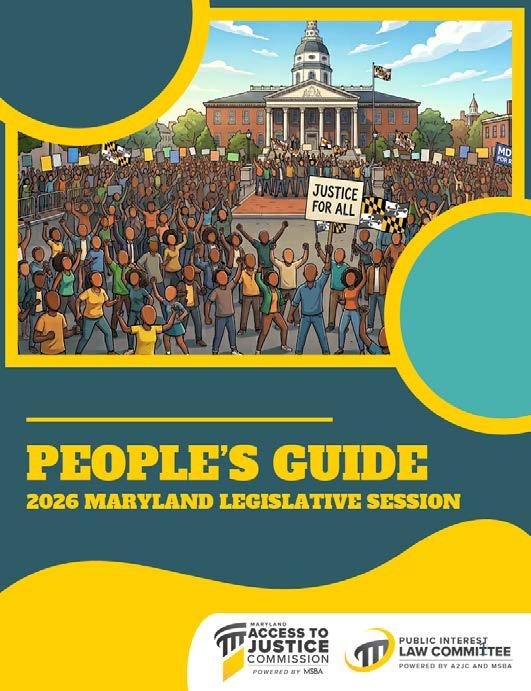
A2JC’s Public Interest Law Committee published the first-ever People's Guide, a groundbreaking, plain-language translation of the laws passed during the 2026 Maryland Legislative Session that were led or supported by the access to justice community.
DOCUMENTED COLLECTIVE IMPACT AND MADE IT EASIER FOR EVERYDAY MARYLANDERS TO UNDERSTAND THE LAWS THAT IMPACT THEM
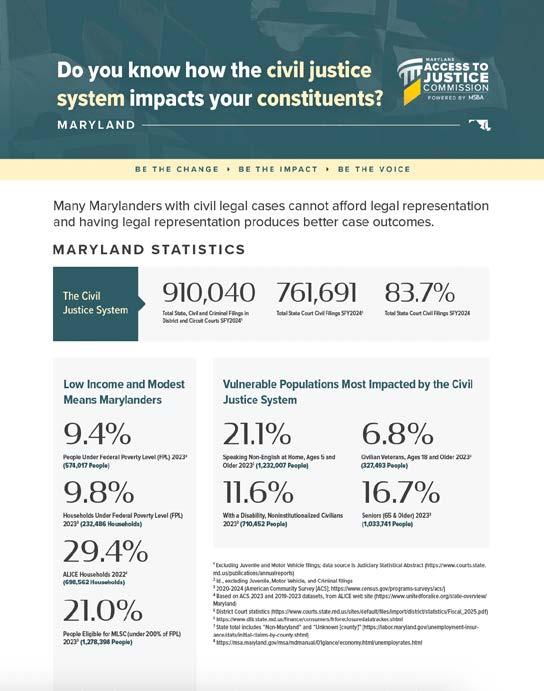
EQUIPPED DECISION MAKERS WITH FACTS ABOUT HOW THE CIVIL JUSTICE SYSTEM IMPACTS EACH OF MD’S JURISDICTIONS
To drive data-informed policymaking, we aggregated critical civil justice statistics into highly accessible state and county one-pagers for the State of Maryland and all 24 individual jurisdictions. These tools equip elected officials with a clear view of how the civil justice system impacts their specific constituents.
A2JC’s Public Interest Law Committee published the first-ever People's Guide, a groundbreaking, plain-language translation of the laws passed during the 2026 Maryland Legislative Session that were led or supported by the access to justice community. By stripping away complex legal jargon, this guide serves as a way for everyday Marylanders to easily understand and exercise their newly legislated rights, and as a demonstration of the collective impact of the access to justice community.
CONTINUED TO BUILD A PUBLIC INTEREST LAW COMMUNITY WITHIN THE MARYLAND STATE BAR

To create a space for all public interest-minded attorneys and allied legal professionals and supporters of access to justice to form meaningful connections and celebrate our collective work and impact, we hosted a spring Spark Social and the beloved MSBA Legal Summit “Pizza Party.”