FENDERBENDER.COM / JUNE 2019 MORRIS:
10 QUESTIONS EVERY BLUEPRINTER MUST ASK PAGE 59
Strategies & Inspiration for Collision Repair Success
Pave the Way
BECOME A VISIONARY LEADER PAGE 56
PROTECT YOUR DATA PAGE 34
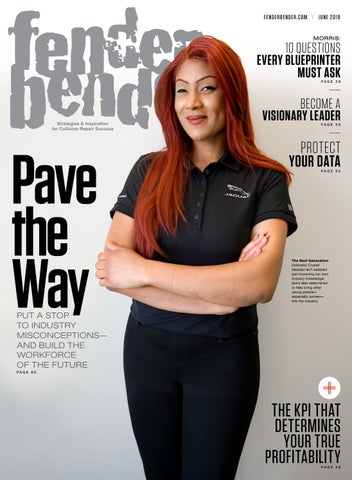
The Next Generation Estimator Crystal Madden isn't satisfied just improving her own industry knowledge; she's also determined to help bring other young people— especially women— into the industry.
PUT A STOP TO INDUSTRY MISCONCEPTIONS— AND BUILD THE WORKFORCE OF THE FUTURE PAGE 60
THE KPI THAT DETERMINES YOUR TRUE PROFITABILITY June 2019 | fenderbender.com 1 E 48 PAG
NOTHING MATCHES TODAY’S COLORS BETTER Ford Ruby Red. Inspired by the vivid hues of the ruby gemstone. Matching any color is easier when you’re spraying with the best. Learn more at envirobase.com
2 fenderbender.com | June ©2019 2019 PPG Industries, Inc. All rights reserved. The PPG Logo and Envirobase are registered trademarks of PPG Industries Ohio, Inc.
ADAS CALIBRATION
NEW COVERAGE / SOFTWARE
TARGETS
SUBARU Lane Keep
Subaru, Mazda (x2) Mercedes, Nissan, Mitsubishi
6 NEW LDW TARGETS PACK AGE
Part #
LDWTARGET2
Mazda Lane Keep
Graphic
Nissan Lane Keep
Mazda Lane Keep
Mercedes Lane Keep
Mitsubishi Lane Keep
Instruction
NEW CALIBRATION SOFTWARE Coverage Included FREE with Active Software Subscription
TRAINING V IDEOS
@AutelTools https://www.youtube.com/auteltools
Phone: (855) 288-3587 • USSUPPORT@AUTEL.COM AUTEL.COM • MAXITPMS.COM • MAXISYSADAS.COM © 2019 Autel Intelligent Technology Corp., Ltd., All Rights Reserved
Follow Us @AutelTools
June 2019 | fenderbender.com 3
07.16
11am /cst
WEBINAR
Presented by FenderBender
FROM FIRST SEARCH TO FINAL SALE UNDERSTANDING THE MODERN CUSTOMER JOURNEY.
FREE WEBINAR Get details and claim your spot. FENDERBENDER.COM/PODIUM
Sponsored by:
4 fenderbender.com | June 2019
june
0 6 .1 9 / V O L U M E 2 1 / N U M B E R 0 6
High-Quality Output As production manager, Dylan McCoy works closely with technicians to push work through the shop—and ensure effective quality control.
F E AT U R E
PROFILE
C A SE STU DY
S H O P TA L K
34
40
52
60
After climbing the ranks to become a production manager, Dylan McCoy rethought a number of shop processes.
As customer needs have changed, so, too, has the technology to remain in communication with them— including effective text messaging.
For Crystal Madden, providing a unique perspective in the industry has been a benefit both to her shop and her customers.
BY MELISSA STEINKEN
BY MELISSA STEINKEN
DATA DILEMMA With the influx of data in vehicles today, arming your shop to avoid hacking must be a priority.
JASON CRAIG
BY KELLY BEATON
CONSISTENT QUALITY
STAYING IN TOUCH
ALL INCLUSIVE
BY ALAYNA BAGGENSTOSS
Printed in the U.S.A. COPYRIGHT ©2019 BY 10 Missions Media LLC. All rights reserved. FenderBender (ISSN 1937-7150) is published monthly by 10 Missions Media, LLC, 571 Snelling Avenue North, St. Paul, MN 55104. FenderBender content may not be photocopied, reproduced or redistributed without the consent of the publisher. Periodicals postage paid at St. Paul, MN, and additional mailing offices. POSTMASTERS Send address changes to: FenderBender, 571 Snelling Avenue North, St. Paul, MN 55104. June 2019 | fenderbender.com 5
TAB LE OF CONTENTS
JUNE
QUICK FIX
13
21
29
Hiring a CSR
Solera’s new training facility
3M™ Trizact™ Hookit™
ANALYSIS
15
24
NUMBERS The ROI on benefits
16
AWARDS INSIGHT Effective technician communication
DRIVER'S SEAT The hard days of leadership
Standout Piece A 1950s-era Oldsmobile was converted into a couch for the waiting room at Showtime Collision Repair Specialists.
SPONSORED CONTENT
VIEWPOINT
30
The latest on consumer data privacy laws
SNAP SHOP Showtime Collision Repair Specialists
26
33
Tesla under investigation
Streamline your marketing
LIGHT HITS
17
HOW IT WORKS
THE BIG IDEA BY KEVIN RAINS
30
Maybe it’s time to repair your garage insurance.
Save up to 20% with direct insurance. Intrepid Direct is unlike any insurance option in the auto repair industry. We save you money by being a direct provider of insurance (there’s no middleman taking a cut.) Our industry experts provide the comprehensive coverage you expect with the quality service you deserve. For your quick-start quote, visit IntrepidDirect.com or call (877) 249-7181.
Intrepid Direct Insurance operates as Intrepid Direct Insurance Agency, LLC. CA License 0K95913. Products and services are provided by one or more insurance companies that are rated A+ (Superior), Financial Size Category XV by A.M. Best Company, Inc. Not all products and|services available in every jurisdiction, and the precise coverage afforded by any insurer is subject to the actual terms and conditions of the policies as issued. Certain coverages may be provided 6 fenderbender.com Juneare 2019 through surplus lines insurance companies through licensed surplus lines brokers. Surplus lines insurers do not generally participate in state guaranty funds and insureds are therefore not protected by such funds.
SHOW TIME COLLISION REPAIR SPECIALISTS
PAST THE PAGE
S T R AT E G Y
47
56
64
Three ways to give back and retain employees
Learn to become a visionary leader and grow your shop
Jumpstart a stagnant business
48
59
IDEA SHOP
FINANCE+ OPERATIONS Easy ways to improve your effective labor rate
LEADERSHIP
UPDATE
66
OUTSIDE THE LINES
IN THE TRENCHES
Find your personal industry role model
Top blueprinter questions
BY JASON BOGGS
BY STEVE MORRIS
51
PROCESS DRIVEN How to make a call center work
56
GET T Y IMAGES
BY RYAN CROPPER
June 2019 | fenderbender.com 7
TAB LE OF CONTENTS
ONLINE EXTRAS
CLICK ON THE LOGO BELOW FOR PRODUCT INFORMATION
3M Automotive Aftermarket
CARSTAR
WIRED FOR
SUCCESS Intrepid Direct
O'Reilly Auto Parts
You’re wired differently and we Insurance like that. America likes that.
Spanesi Americas
Visit futuretechsuccess.org and find out how your hands-on talent is the key to an amazing technical career. AUTEL
CCC Information Services
LAUNCH Tech USA When Techs Rock, America Rolls ℠ futuretechsuccess.org TECH USA
PPG
FUTURETECH
SUCCESS
Auto Job Central
Drew Technologies
Micro Tech Resources
Prima Welds
Axalta Coating Systems
General Motors
Mitsubishi
ProSpot
BASF
I-CAR
MobiTech
SATA/Dan-Am Company
8 fenderbender.com | June 2019
TechForce Foundation
™
EDITORIAL Bryce Evans Vice President, Content and Events Anna Zeck Editorial Director Kelly Beaton Associate Editor Melissa Steinken Staff Writer
COLLISION
Jordan Wiklund Special Projects Editor
C A S T
Jason Boggs Contributing Writer Ryan Cropper Contributing Writer Steve Morris Contributing Writer Kevin Rains Contributing Writer
EDITORIAL ADVISORY BOARD Jason Boggs Boggs Auto Collision Rebuilders Justin Fisher CARSTAR Yorkville Bob Pearson Pearson Auto Body Mark Probst Probst Auto Body
FenderBender’s
PODCAST NETWORK
Randy Sattler Rydell Collision Center Doug Voelzke Doug’s Custom Paint and Body
ART AND PRODUCTION Zach Pate Art Director
SERIES WITH NEW EPISODES EACH MONTH. Explore the industry’s biggest trends & most pressing topics.
Mitch Bradford Graphic Designer Fue Vang Graphic Designer Lauren Coleman Production Assistant
SALES Chris Messer Vice President and Publisher 651.846.9462 / cmesser@10missions.com Andrew Johnson Associate Publisher 651.846.9459 / ajohnson@10missions.com Nathan Smock Sales Manager 651.846.9452 / nsmock@10missions.com Ross Kirgiss Regional Advertising Sales 651.846.9485 / rkirgiss@10missions.com Shayna Smith Customer Success Representative 651.846.9460 / ssmith@10missions.com Jen George Client Service Specialist 651.846.9465 / jgeorge@10missions.com
10 MISSIONS MEDIA Jay DeWitt President Mariah Straub General Manager and Production Manager Meghann Moore Bookkeeper and Client Service Specialist Katie Cornet Event Coordinator Tiffany Fowler Senior Digital Media Strategist Kasey Lanenberg Marketing Communications Specialist Amanda Nicklaus Administrative Assistant HOW TO REACH US 571 Snelling Avenue North, St. Paul, MN 55104 tel 651.224.6207 fax 651.224.6212 web 10missions.com The annual subscription rate is $72 (U.S.A. only) for companies not qualified to receive complimentary copies of FenderBender.
ADAPT. DISRUPT. HOW I DID IT. MSO PODCAST. VISION.
BACK ISSUES Past issue single copies are $8. Go to fenderbender.com/backissues LETTERS TO THE EDITOR editor@fenderbender.com ARTICLE REPRINTS
A DA P T S E R I E S S P O N S O R E D BY:
M S O P O D C A S T S E R I E S S P O N S O R E D B Y:
For high-quality reprints or e-prints of articles in this issue call 651.846.9488 or email reprints@fenderbender.com. Opinions expressed in FenderBender are not necessarily those of 10 Missions Media, and 10 Missions Media does not accept responsibility for advertising content.
LISTEN AND SUBSCRIBE SEARCH “COLLISIONCAST” IN APPS FOR APPLE AND ANDROID
PODCASTS
STITCHER
POCKET CASTS
AUTOMOTIVE GROUP
June 2019 | fenderbender.com 9
50
C O N N E C T. T H R I V E . G R O W.
AU
G
U RE ST G I 1 ST TO E R S A BY VE $4
2019
TAKE THE NEXT STEP Grow your business with the help of the industry’s best.
S E P T. 3 0 - O C T. 2 M I N N E A P O L I S - S T. PA U L
Get your All-Access Pass by visiting: FENDERBENDERCONFERENCE.COM
WHAT TECHNOLOGY DO I NEED FOR MODERN REPAIRS? Repairing vehicles after a collision has extended far beyond cosmetic and structural damages. Technology has brought on a whole new host of tools to not only benefit repairs, but also create a premier customer experience. Customer Service CARSTAR locations across Canada leverage available technologies to streamline customer service processes creating an advantage in the industry. From scheduling to parts ordering, there are varieties of programs specifically developed to improve the customer experience and drive business success. For example, if a customer service representative has a program to inform them of capacity levels, they can more accurately schedule cars. Failure to manage scheduling can result in complaints from the customer and their insurance provider, ultimately jeopardizing relationships.
Repair Process For features like lane departure warning or blind spot detection to work, the repair process has been updated to accommodate this new technology. Having a third set of eyes not only reviewing your estimates but helping to coach you through what needs to be included for particular repairs ensures a seamless repair process for both your customers and team. With vehicles advancing at such rapid rates, it can be difficult to keep up. The EDGE Performance Platform and CARSTAR University, are tools that help CARSTAR franchise partners understand what technology they need. These exclusive platforms help educate owners, support the implementation of new programs and leverage national partnerships with key vendors for any additional assistance.
Would you like to have exclusive access to these benefits? Visit our website to learn more.
CARSTARFranchise.com 12 fenderbender.com | June 2019
PAST THE PAGE DISCUSSIONS, FEEDBACK, CONTENT AND MORE FROM AROUND THE WEB
REPORTER'S BLOG
SECRETS FOR HIRING TOP CSRs For the website’s weekly blog post, FenderBender recently spoke with Scott Wintrip, a hiring and recruiting consultant and the author of Sales Yoga and High Velocity Hiring. The topic: the keys to hiring stellar customer service representatives. Wintrip says that hiring for any customer service job presents its share of challenges, simply due to the customer-facing element of the role. Additionally, he feels that making such hires can be especially challenging for businesses like body shops, because visiting those businesses is such an intimidating process for many customers. Fortunately, for a position like CSR, it’s not necessary to hire someone with an industry background, Wintrip says. In fact, he feels that job applicants with backgrounds in hospitality, and even collection workers, can often transition rather smoothly to customer service jobs. “They tend to be good problem solvers—they don’t get rattled,” he says of those types of applicants. You can read the entire blog entry at fenderbender.com/hiringCSRs.
PODCAST PRIMER
COLLISION C A S T
Preparing for OSHA Visits FenderBender produces four podcasts per month, with topics aimed at offering collision repairers insight on how to navigate everyday life in the industry. Recently, the magazine spoke with Colette Bruce, the owner of Team Safety LLC, about how body shop operators can prepare their staff for visits from OSHA inspectors, and avoid violations as a result. One tip that Bruce especially emphasizes to shop owners: the value of holding monthly safety meetings. “It’s good team-building time,” she says. “And that’s when they find out that maybe there’s equipment that’s damaged, because they talk about it. So, bring in pizza once a month, and this is when you have your safety meetings and watch your safety videos—it could be on solvents, on compressed air, or respiratory protection—and talk about how it relates to what they’re doing.” You can listen to the entire conversation by accessing the podcast at fenderbender.com/OSHA.
Let’s Get Social
GETTY IMAGES
In a recent post on Facebook, FenderBender (@FenderBenderMag) noted the following: “FenderBender recently attended the Collision Industry Conference event in Nashville. And, we'd love to hear what industry events you feel we should consider attending in the future. Please leave a comment with your opinion.” In the months ahead, the FenderBender crew will traverse much of the U.S. and Canada to attend collision repair industry events, from San Diego, to Toronto, to Charlottesville, Va. And, you can keep tabs on our reporters—and get behind-the-scenes access—by following us through multiple social media channels.
CORRECTION
JOIN US ONLINE fenderbender.com fenderbender.com/facebook twitter.com/fenderbendermag fenderbender.com/linkedin instagram.com/fenderbendermag
In the feature story titled “How I Did it: Inspiration” in the May issue, "VeriFacts" was incorrectly spelled as "Verifax." June 2019 | fenderbender.com 13
COLLISION REPAIRERS
The CCC® Total Repair Platform brings all aspects of your business together – from estimating to customer engagement to DRP management – in a single platform. Learn more at www.cccis.com/get-ccc-one 14 fenderbender.com | June 2019
BY THE NUMBERS THE TOPIC S, TRENDS AND METRIC S DRIVING YOUR OPER ATION
MOST BENEFICIAL BENEFITS Which employee benefits pay the most significant dividends for shop operators? Statistics unearthed in the 2018 FenderBender Industry Survey aren’t completely conclusive, though they do indicate that providing life insurance to employees is especially valuable. According to the survey, just 36.5 percent of responding shop operators offer life insurance to employees, but those who do boast solid results. Consider: Of the shops that offer life insurance, 87.5 percent produce a yearly sales volume of $1 million or more, and 73.2 percent of those respondents enjoy a CSI score of 90 percent or better. While health insurance was the most popular employee benefit offered among the survey respondents (69 percent of shops offer it), that perk didn’t necessarily inspire noteworthy shop statistics. Here’s a look at some of the key metrics produced by shops who offer certain employee benefits: LIFE
HEALTH
BONUS PLAN
401(k)
100% 90% 80% 70% 60% 50% 40% 30% 20% 10% 0%
Yearly sales volume of $1M-plus
Cycle time of 7 hours or less
CSI of 90%+
Net profit margin of 11%+
Technician productivity of 100%+
Sales have grown in last 5 years
GETTY IMAGES
LEARN MORE
FenderBender has written several past articles focused on employee benefits packages. Perhaps the most exhaustive such article was “Creating a Solid Benefits Package,” which looked at how shop owners can provide a comprehensive benefits package that can help them attract and retain top employees. The article can be found online, at fenderbender.com/benefitspackages.
June 2019 | fenderbender.com 15
FINES HE
T
T
AWARDS INSIGHT
AWARDS NOMINEE:
R
CO
LLI
AI
SENIOR TECHNICIAN MID-TOWN BODY REPAIR GREENSBORO, N.C.
AWARDS IN
AL AKEROYD—
P SION RE
Nominate Today
FenderBender Awards Insights feature past FenderBender Award nominees. To nominate an inspiring collision repair professional, or for more information, go to fenderbender.com/awards.
B Y K E L LY B E AT O N
Most effective teams have a selfless leader, one who hates to see their cohorts struggle. At Mid-Town Body Repair in Greensboro, N.C., Al Akeroyd often serves as the quarterback that rallies the troops. If a rookie is struggling to grasp a certain procedure, Akeroyd, a senior technician, has no problems offering a pep talk. “I don’t want to see anybody fail at anything,” Akeroyd explains. “If they’re going to do something, I want to see that they’re doing it the correct way. I can take 15 minutes out of my day to help somebody; it doesn’t bother me. I’m that type of person―I’ll help anybody. “Because, sometimes I’ve asked somebody for help, too.” Akeroyd has worked in collision repair since the early 1970s―or, “the caveman days,” as he light-heartedly refers to them as. But, despite the fact he’s inching toward retirement, the senior bodyman has a knack for relating to entry-level employees. “I just try to be friendly and show them things in the shop,” Akeroyd says. Because “getting along is a big thing” in the workplace. Akeroyd, who is well-respected at Mid-Town due to the mentorship he provides, explains the best methods for communicating with today’s young technicians.
Welcome new hires.
Akeroyd takes it upon himself to make new coworkers feel right at home, from Day 1. He wants his new colleagues to feel like a valued member of a team. “I go up to them and introduce myself, and show them things in the shop,” Akeroyd says, and add that, “‘If you need a hand, I’ll help you.’ “If [a new hire] comes up to me and asks to use a screwdriver, I say, ‘Yeah, sure, here it is.’ I don’t lock my toolbox; I figure, if you work around people, you ought to trust them.”
Learn coworkers’ interests.
Workdays can get awfully monotonous if conversations never stray beyond repair procedures or work in progress. That’s why Akeroyd makes it a point to 16 fenderbender.com | June 2019
learn about coworkers’ personal interests, by asking about their favorite current TV shows, for example. Akeroyd says he especially appreciates watching young employees start to accumulate tools and forge a career in the collision repair industry. At Mid-Town, he says, “we all get along, just being friendly, talking about things other that body work. We find out about how people are outside of work.”
Offer hands-on teaching.
Akeroyd is the type of employee who enthusiastically approaches six-hour training sessions on Saturdays. So, it should come as no surprise that he eagerly embraces most opportunities to model proper repair procedures to young coworkers.
Training is valuable in its own right, Akeroyd says, but feels hands-on teaching is typically most effective in a shop environment. “When you actually do hands-on,” he says, “I think it’s a lot better than just sitting there, listening to somebody tell you how to do something.”
Share tricks of the trade.
Nothing lets new hires know that you’re on their side quite like teaching them some of the lessons that veteran employees have learned the hard way. “If [new employees] have a car in the shop, and they’ve got damage to a fender or a quarter panel,” Akeroyd says, “I’ll try to teach them the easiest way. And I’ll explain to the younger guys that, ‘This is a better way to do it. “If they’ve got questions, ‘Well, here’s where you want to start pulling [a dent] first.’”
Speak one on one.
In Akeroyd’s opinion, there aren’t drastic differences between his generation and today’s twenty-somethings. He has noticed, however, that members of Generation Z seem to prefer one-on-one conversations to group meetings. “The young guys I work with now all do good work, and they’re conscientious and care,” Akeroyd says. “I either pull them aside and talk at lunchtime,or, if I see them doing something improper, I’ll say, ‘Hey, I can help you; don’t use that method there because there are much easier ways to do it, and I can show you an easier way.’ “But I’m not stern, and I wouldn’t get angry. I’m always friendly.” Making an effort to relate to young employees, Akeroyd says, benefits both him and the entire shop.
FUE VANG
The Key to Communicating with Young Technicians
DRIVER ' S SE AT
The Difficulty of Leadership And why it’s worth putting in the work
NICK SPAETH
As I write this letter, I’m in the middle of one of the most difficult periods of my life. The
details of the situation don’t matter, but all I can really say is this: It’s tough. And along the way, I’ve had to learn a fairly unpleasant lesson: As a leader, the show must still go on. The magazine still needs to go out every month, the writers still need their stories edited, the team still needs a leader pushing us forward—even when, some days, the simple act of showing up and putting on a good face feels like enough of an undertaking. As business owners, I’m sure many, if not all, of you can relate. No matter where you’re at in the lifecycle of your business—just starting out, years in and less hands-on, on your way out—the success and future of your business still comes down to you. And that’s a lot of pressure. But this letter isn’t meant to be depressing or a pity party. If anything, the intent is to highlight something we don’t talk about enough when it comes to leadership: It’s really challenging, and you’re probably not recognized nearly enough for that hard work. There’s a reason so many people have horror stories about bad bosses, and it’s because it can’t easily be taught. For many of us, we went to school, learned a trade (I did, too, as a journalism major) and then got a job within that trade, where we excelled and grew into leadership roles. But there’s no way that any type of schooling could have properly prepared you for the complexity of being a manager to employees, or how to deal with an irate customer, or the emotional burden of supporting the livelihood of others. Some days—especially during the hard days—you may feel like you’re failing. But here’s the thing: More than likely, you’re doing just fine. The mere fact that you’re even reading this magazine, that you’re expressing interest in bettering yourself and your business, speaks volumes about your mindset. I hope that, within the pages of this issue, something—a story, a quote, a new idea—sticks with you and helps you in your business. On a fundamental level, that’s what we aim to do here every month at FenderBender. So, yes, being a leader is hard—but it’s also incredibly rewarding. The hard work can be very satisfying, and I’d like to recognize everyone putting in that work. And if, like me, you’re going through it right now, I hear you. We’ll get through it, and you don’t have to do it alone. There’s a reason that we write about community so much in FenderBender, and it’s because it’s key to avoid feeling isolated. I can speak from experience that a small group of trusted colleagues have made a remarkable difference in keeping me focused, laughing and looking toward the future.
ANNA ZECK EDITORIAL DIRECTOR a z e c k @10 m i s s i o n s .c o m
June 2019 | fenderbender.com 17
ONE BRAND. COMPLETE FOCUS.
Up to 14 holding locations
Universal Jig System
106 Series Straightening Bench
Gear Driven Fixtures
Dent Removal Systems, Frame Straightening Benches, Fume Extraction, Measuring Systems, Preparation Areas, Spray Booths, Universal Jig Systems, Vacuum Systems, Welders
Spanesi Americas, Inc. 123 Ambassador Dr. STE 107 Naperville, IL 60540 18 fenderbender.com | June 2019
2 2 4 - S PA N E S I (224-772-6374)
spanesi.com www.facebook.com/spanesigroup
QUICK FIX NEWS
|
IDEAS
|
PEOPLE
|
TRENDS
Running Smoothly Showtime Collision Repair Specialists, a shop located in Running Springs, Calif., features an overall layout designed to fuel stellar efficiency.
ANALYSIS VIEWPOINT
COURTESY SHOW TIME COLLISION REPAIR SPECIALISTS
SNAP SHOP
SN A P SHOP
30 June 2019 | fenderbender.com 19
20 fenderbender.com | June 2019
QUICK FIX
ANALYSIS
TAKING TRAINING TO THE NEXT LEVEL Solera has invested heavily to build an innovative training center outside of Dallas B Y K E L LY B E AT O N
COURTESY SOLERA
In the shadows of Texas Motor Speedway,
a unique auto repair and collision repair training facility is roaring to life. In Justin, Texas, construction is underway on Solera Holdings’ research and training facility, which is being designed with the intent to advance the auto industry. “We’re excited,” Chris Mullen, Solera’s vice president of research, says. “This is a service to the industry. Our mission is to utilize [a] network of independent research centers to improve the industry overall—the holistic approach to that entire workflow. “There isn’t this type of independent center currently located in the U.S. to serve the U.S. and Canada. … It’s a center that’s focused on research.” At the 13,000-square-foot facility 40
miles northwest of Dallas, trainees like technicians and insurers will brace for the future of the auto industry. The roughly $9 million facility is known as CESVI LIV, which essentially stands for “center for experimentation and road safety” and is a joint venture between Solera, a software company, and Spanish auto insurance company MAPFRE.
The Purpose
The Texas facility will serve as Solera’s North American research and training center. And, the center will, ideally, provide insight into how consumers use vehicles, while also allowing for research of new vehicle features. By doing exhaustive research, Solera officials feel the company can make the software it
sells more valuable for both body shops and insurers. “The unique approach that we’re taking,” Mullen explains, “is to focus a majority of the training on hands-on and realistic scenarios, so that students are leaving with a bankable skill [so] that they can apply that learning, and use that skill, in multiple scenarios. “Aluminum welding is an example,” adds Mullen, who previously worked for Nissan, Toyota, and State Farm. “There’s more and more aluminum in vehicles that are sold in the U.S. every year. And the need to be able to repair the aluminum is critical, and it’s a completely different skill—it’s a new and enhanced skill. So, the ability to train those students with hands-on practice, with the instructor June 2019 | fenderbender.com 21
YOUR 24/7 COLLISION COMMUNITY
QUICK FIX
ANALYSIS
fenderbender.com/linkedin fenderbender.com/facebook fenderbender.com/twitter fenderbender.com/instagram fenderbender.com/googleplus
right there to help them, it’s an approach that is shown to be very effective.” Once the facility opens its doors— likely in July—its instructors will teach courses on collision repair, electromechanics, and more. Its classrooms will largely resemble a body shop, but feature movable walls. While Mullen says Solera is currently finalizing the facility’s initial course portfolio, the center will feature bays dedicated to the following repair elements: paint and refinish, collision repair, welding, and heavy-duty trucks.
Peering Ahead
IS YOUR BODY SHOP PREPARED FOR A CYBER ATTACK? WHEN A CYBER ATTACK HAPPENS, WE KEEP YOUR SHOP UP AND RUNNING!
DON’T WAIT. GET SECURE TODAY. • It’s not a matter of if your Body Shop will be attacked, it’s when! • How much data are you willing to lose? • How much downtime can your Body Shop afford?
MICRO TECH RESOURCES PROVIDES • • • • •
Business Continuity & Data Recovery Ransomware Protection Cyber Security Total Disaster Recovery Full Service Body Shop IT Service Provider
Protect your business with MTR’s Data Security.
info@mtrgo.com 888.531.3582 IT4BodyShop.com Body Shop IT Solutions Made Simple.
MTR HAS OVER 30 YEARS OF BODY SHOP TECHNOLOGY EXPERIENCE.
22 fenderbender.com | June 2019
While many of the teachings at the Texas training center will be focused on the current needs within the repair industry, CESVI LIV will also help repair workers brace for the industry’s evolution. “One of the biggest trends that we all need to keep our eye on in the repair industry is the advanced driver-assistance system—the need to understand how to diagnose, repair, and calibrate,” Mullen notes. “When the car comes in, you have to figure out what’s wrong, and you have to diagnose the problem efficiently. Repair the car properly, and then make sure that those ADAS systems are calibrated. “And that’s critical, because those systems have some responsibility. So, they have to get put back on the road in a safe, functional way.” Mullen says any independent body shop employee is welcome to train at the Texas facility. “There’s a declining volume in our workforce of the skilled technicians that are able to repair these vehicles,” Mullen says. “At the same time … we have a massive increase in technology, through advanced driver-assistance technology. So, those two curves don’t support each other very well. “So, in that way, we would look to train individual technicians from independent shops, and we would look to train shops that would look to improve their workforce. We’re also there to serve the insurance sector, so we have a vertical in estimation.” Ultimately, the new training facility is being created to move the auto industry forward, Mullen says. “We tried to build the facility for where the industry is going,” she notes.
PROFESSIONAL GRADE
REFINISHING PRODUCTS FROM START TO FINISH
Let Us Be Your Parts & Equipment Supplier
www.oreillyauto.com/professional-catalogs
Professional Grade, Superior Performance, Built to Exceed
OVERSPRAY MASKING SHEETING
MASKING PAPER Available in several types and sizes: • Premium Gold • Blue Polycoated • White Urethane • Green Superior
MAKING IT FASTER AND EASIER THAN EVER TO ORDER PARTS
• • • • • •
Premium high density paintable plastic sheeting HDPE plastic masking sheeting continuous roll Corona treated for paint anchorage Superior cling allowing one-man application All sizes are available in dispenser boxes Sizes: 12’ x 400’, 16’ x 350’ and 20’ x 250’
AVAIL ABLE EXCLUSIVELY AT
FIRSTCALLONLINE.COM Visit our website for a complete, internet-based catalog designed exclusively for the Professional.
ADV 1423
June 2019 | fenderbender.com 23
QUICK FIX
VIEWPOINT
INSIDE DATA LAWS’ EFFECT ON CONSUMERS Consumer data privacy is a hot-button issue that could affect shops’ privacy policies BY MELISSA STEINKEN
A trending topic at April’s Collision Industry Conference (CIC) meeting in Nashville was data privacy and the right consumers have in regard to data privacy. After all, in the U.S. alone, new data-related laws are being introduced all the time. Frank Terlep led a session in Nashville regarding data access, privacy and security. The longtime collision repair expert outlined what repairers need to know going forward regarding bills such as the California Consumer Privacy Law that passed in June 2018. The law gives consumers the right to know what information corporations are collecting on them, gives consumers the right to tell a business not to share or sell their information and protects consumers against businesses that do not uphold the value of privacy. As Terlep sees it, after studying the law, it appears it can affect any business that a California resident would go to, even if the business is not in the state of California. Right now, the industry is seeing a proliferation of state initiatives, partially due to the failure of federal policymakers to address such issues, Bob Redding, ASA’s Washington, D.C., representative says. “There’s been numerous hearings in the 115 and 116 Congresses on data privacy,” Redding says, “but there’s no clear data privacy or data access path to date.” So, moving forward, collision repair shop owners need to be aware of how this might affect their consumer consent and privacy statements and other security practices in the shop. Redding feels the industry has to be careful because if policymakers and lawmakers extend their reach to protect consumers, there may be a point where it is too far and it could block repairers from gaining access to data that’s important to repair cars. FenderBender recently spoke with Redding and asked what collision repair shop owners should be aware of with regard to current data privacy issues.
What are some of the prominent bills in legislature right now related to consumer’s data privacy?
The California Consumer Privacy Act (CCPA) is one widely discussed example. The CCPA was passed in July 2018 and is set to go into effect January 2020. At a U.S. Senate subcommittee on manufacturing, trade, and consumer protection, Ryan Weber, president of the KC Tech Council stated, “a state-by-state approach to data privacy creates a compliance nightmare for the entire tech industry…[because] data does not abide by state boundaries… [and] as states create new and increasingly disparate privacy requirements, the result will prove untenable and could have a disastrous impact on small businesses and innovation.” NHTSA also released its “Cybersecurity Best Practices for Modern Vehicles” in the fall of 2016. But, these are voluntary guidelines and not new laws. I think states will continue to try and fill this void. 24 fenderbender.com | June 2019
How has the data privacy trend changed in recent years?
In hearing after hearing, we have seen both political parties expressing concern about protecting consumer data. A U.S. House Energy and Commerce Subcommittee hearing this year included witnesses for several independent public policy groups. Major data issues exist but no obvious path has evolved for next steps as far as congressional action. What is the main takeaway for shops in light of these laws?
There are several important pieces. First, we have to stay informed on any new and related state or federal laws. Second, we need to ensure, as best as possible, that our shops are secure. Finally, it is critical that shops have a clear, secure path to obtain the data necessary to repair vehicles. Shops cannot become collateral in an overzealous data
protection policy. There’s been a concern that there is a lack of formal data access stakeholder groups to work with policymakers. The lack of formal data access stakeholder groups to work with policymakers has been a concern. There was an attempt to establish a data access and cybersecurity stakeholder group at NHTSA in the last Congress through autonomous vehicle legislation. This bill passed the U.S. Senate Commerce Committee but was not taken up on the floor prior to adjournment. How will shops need to enhance their data management practices and update privacy policies?
At ASA and other industry meetings, leaders are sharing information and strategies relative to data and cybersecurity. Shop owners should monitor ASA’s website and stay on top of the industry news. Also, U.S. Senator Marc Rubio (R-FL), introduced legislation that encourages Small Business Development Centers to have trained staff available to work with small businesses in addressing cybersecurity issues in their businesses. This legislation recently passed the Senate Small Business Committee. Overall, why is it important for shop owners to learn about these data privacy laws?
Many consumers have had issues with devices, other than their vehicles, as far as data security. Consumers, consumer organizations and policymakers are seeking more information about what data is being accessed by businesses. For shop owners, it will be important to protect our customers while at the same time having access to important data to repair the vehicle. After the California law it begs the question as to why other states wouldn’t take a similar stance. I think that without federal law on the issue, more states are likely to follow in the footsteps of California and the CCPA.
* applies to all SATA RPS standard cups, however not to SATAminijet 3000 and older series.
SATA®RPS™
#01
BENDABLE The *SATA RPS cup can be safely tilted by up to 45° forward, right and left to facilitate easy access to almost any painting situation.
#03 SAFE
Firm connection between lid and cup (thread). No accidential detaching of cup from lid.
#02 CLEAN
The cup can be easily, cleanly and safely separated from the spray gun without making a mess!
#04
REFILLABLE The cups can be easily be refilled. The paint strainer can be exchanged by a spare strainer at any time.
For more information, please watch our product video at www.sata.com/rps
The exclusive independent distributor of SATA products in the US and Puerto Rico
Call Today! 800-533-8016 email: satajet@satausa.com
www.satausa.com June 2019 | fenderbender.com 25
News
QUICK FIX
For your daily collision repair news visit
LIGHT HITS
TESLA EXPLOSION PROMPTS INVESTIGATION One of Tesla's cars exploded in late April in Shanghai, which prompted an investigation from the company. It was not immediately clear which Tesla model was affected, but reports indicated the car was parked at the time of the fire. There were no known casualties. Tesla said it is in communication with all involved. In January, Chicago law firm Corboy & Demetrio said there have been at least 12 cases worldwide in the last five years of Model S batteries exploding. The statement was part of a lawsuit filed against Tesla that alleged a 2014 Model S had a defective battery pack, causing an 18-year-old passenger to die in an accident last year.
MICH. SUSPENDS BODY SHOP'S LICENSE The state of Michigan suspended in late April the registration of Detroit auto repair facility Livernois Collision. The collision repair shop's registration was suspended after it failed to comply with
26 fenderbender.com | June 2019
fenderbender.com/lighthits
requests by regulation agents to inspect dealership records. The facility failed to provide major component parts records and parts receipts from May 2018 to February 2019. The suspension was served April 2. The shop also had been cited by the state in April 2018 for failure to provide records.
FORD TO INVEST $500M IN RIVIAN Ford Motor has agreed to invest $500 million in Rivian, an electric-car start-up that is widely seen as a potential rival to Tesla, according to The New York Times. Rivian, based in Plymouth, Mich., plans to begin producing a pickup truck and a sport utility vehicle by the end of next year. Both will be powered by battery packs and are designed to be luxury vehicles that could appeal to many of the consumers drawn to Tesla and its upscale models. Ford is counting on the partnership to accelerate its efforts to field a range of electric cars and trucks, while it also pushes
to streamline operations, slash costs and increase profitability. Ford and Volkswagen are discussing pooling efforts to develop self-driving technology.
NHTSA INVESTIGATES ERRATIC AEB The National Highway Traffic Safety Administration (NHTSA) in April began investigating approximately 675,000 Nissan Rogues with 2017–2018 model years, according to the Center for Auto Safety. There have been no less than 87 consumer complaints of unintended braking after activation of Nissan’s automatic emergency braking (AEB), yet in violation of federal law Nissan has attempted to address the defect as a service matter rather than a safety problem. Many complaints indicated that the braking is abrupt or forceful, endangering both the Rogue occupants and people in nearby vehicles, who are forced to avoid a collision with a suddenly stopped vehicle. Over 400,000 Nissan Rogues were sold in both 2017 and 2018.
ONE TOOL TO RULE THEM ALL
T H E M O S T E F F I C I E N T WAY T O I M P R O V E B U S I N E S S
Gain access to business-building podcasts, videos, articles and more. All in one spot. Wherever you go.
P ODCASTS
V ID E OS
ART ICLES
THE 2019 FENDERBENDER
AND
MORE
FB TO GO APP
DOWNLOAD FOR FREE IN APP STORES FOR
ANDROID AND iOS
SPONSORED BY
June 2019 | fenderbender.com 27
THERE ARE NO SUBSTITUTES.
Many imitation parts have fit problems, ranging from twisted metal and misaligned mounting holes to major gap variances. Don’t settle for imitation, give your customers the real deal.
FOR MAXIMUM QUALITY AT COMPETITIVE PRICES, CONTACT AN AUTHORIZED MITSUBISHI DEALER TODAY.
2019 MITSUBISHI MOTORS NORTH AMERICA, INC. ALL RIGHTS RESERVED
SPONSORED CONTENT
HOW IT WORKS
THE FINEST, MOST EFFICIENT PAINT-FINISHING YET 8000-GRADE 3M™ TRIZACT™ HOOKIT™ FOAM ABRASIVE DISCS ELIMINATE COMPOUNDING AND MAKE DETAILING EASIER THAN EVER
For decades, 3M has led the automotive industry with some of the finest and hardest-working paint and refinish products in the market. Now, the latest and greatest from 3M is here: the 3M 1-Step Paint Finishing System featuring the all-new 8000-grade 3M™ Trizact™ Hookit™ Foam Abrasive Disc—plus 3M™ Perfect-It™ 1-Step Finishing Material and a family of polishing pads engineered to work with it. These 8000-grade abrasives are the industry’s finest, eclipsing the previous finest grade abrasive, 5000-grade Trizact™ foam discs. The combination of the Trizact™ 8000 grade abrasive foam disc, the new 1-Step Finishing Material, and the matched pads equals deeper, glossier finishes with no swirl and less clean-up. Using Trizact abrasives for paint finishing can reduce overall polishing time by 75 percent while providing consistent paint finish results.
3M
THE 3M 1-STEP FINISHING SYSTEM: HOW IT WORKS
The 3M™ Trizact™ 8000 disc uses uniformly-sized abrasive structures that provide regular patterns and consistent scratches for refining the smallest of imperfections. The disc is so effective that it eliminates the need for compound, reducing polish time and yielding a cleaner job. With this system, shops can expect reduced rework and comebacks caused by swirls and sand scratches. The new 3M™ Perfect-It™ 1-Step Finishing Material is a water-based product with an advanced formula and mineral for easy cutting and polishing—all in one step. “We engineered a product between traditional compounds and polishes,” says Marcus Schneider, Senior Application Engineer at 3M. “The finishing material is not as aggressive as a compound and not as fine as a polish.” Schneider has been working at the 3M campus for almost a decade. In that time, he’s worked on everything from dental composite crowns to industrial adhesives involving complex resins from sea to sky, fishing poles to aircraft. “It’s an amazing product,” he says, “and the extremely fine grade gives a beautiful finish. Getting the scratches out of the clearcoat is difficult, and the Trizact 8000 disc makes that job easier. The 3M™ 1-Step Paint Finishing System is specifically designed for collision and body shops.” The process is simple: First, remove dirt nibs, dust and level excess surface texture using a 3M Purple Finishing Film Hookit™ Disc (P1500 or P2000). Next, refine the remaining scratches using the 3000-grade 3M™ Trizact™ Hookit Foam Disc. Further refine the scratch (and skip compounding) using the Trizact™ 8000 Foam Disc. Finally, to remove the final sand scratches and achieve a high polish and shine, use the 1-Step Finishing Material and the matching foam finishing pads, working an area no larger than 2-feet x 2-feet at a time. Finish with a 3M detail cloth.
Together, Trizact technology and the 1-Step Finishing System can deliver: • Cleaner Jobs: No compounding equals less cleanup, as well as the opportunity to use foam instead of wool pads for less swirls. • Faster Buffing: Eliminate time spent chasing inconsistent sand scratches such as pigtails and other hard-to-see-but-impossible-to-miss imperfections that diminish shop productivity. • Better Finish: Customers only remember how the car leaves the shop—impress them with the results of 3M™ Trizact™ 8000 and the 3M™ Perfect-It™ 1-Step Paint Finishing System. Together, the whole of the products is greater than the sum of their parts. Features
Advantages
Benefits
Mineral technology
Replaces liquid compound so technicians spend less time with buffer
Saves time and money and increases productivity
Unique chemistry and water-based technology
Allows the technician to eliminate the compounding step and move directly to polishing Designed to perform in hot and humid climates Easy clean-up with less sling Wipes up easily without smears
Finishing Material
Washes off easily Less fatigue during clean-up
Saves time and money Improves health and safety Improves productivity Leads to high-quality repairs every time
Saves time and money Improves health and safety Easy to use
Eliminates compounding Trizact 8000
Provides a deeper, glossier finish
Saves time and money
Schneider and 3M understand that these products don’t exist in a vacuum—together, they can truly reduce technician fatigue, cut polishing time by 75%, and potentially increase shop revenue. “They’re really easy to use. You know what you’re getting and it’s repeatable on the shop floor. It’s a true 1-step polishing system using one liquid and one pad. You’re not using a compound.” “If you never put swirl in, you never have to get it out,” Schneider says with a smile. Learn how to increase productivity on the shop floor by visiting go.3M.com/trizact. June 2019 | fenderbender.com 29
QUICK FIX
SNAP SHOP
SHOWTIME COLLISION REPAIR SPECIALISTS
SIZE:
allow the shop to measure damaged vehicles with pinpoint accuracy. Similarly, the shop’s operators recently invested $50,000 in a Car-O-Liner Vision X3 frame measuring system. All told, the shop’s owners invested more than $300,000 on equipment upgrades a few months back. “I felt like it was ‘get in, or get out’ at this point,” Tyler explains. “At this point we’ve been here for 30 years and built a great reputation, but, as everyone knows, the industry’s changing. … I feel like, with the direction of the industry, this equipment is necessary to fix these cars properly—it was a costly investment, but it paid off.”
STAFF:
3. IN-GROUND BENCH RACKS
BY KELLY BEATON PHOTOS COURTESY OF SHOWTIME COLLISION REPAIR SPECIALISTS LOCATION:
Running Springs, Calif. OWNERS:
The Makeig family 13,000 square feet 13
AVERAGE MONTHLY CAR COUNT:
60
ANNUAL REVENUE:
$2.5 million
1. INNOVATIVE INTERIOR Decorative, classic car couches. Street lights. Neon lights. They all greet visitors to the lobby of Showtime Collision Repair Specialists in Running Springs, Calif. The guest area is filled with automotiveinspired furnishings and features a vintage decor that owner Mark Makeig largely designed. To make unique, automotivethemed couches, Mark Makeig once went to a southern California swap meet, purchased multiple antique cars, and, in the words of his son, shop manager Tyler Makeig, “chopped them up.” That’s why you’ll see a desk in Showtime Collision’s lobby that features the front end of a 1950s-era Oldsmobile. “We wanted to create a comfortable lounge area for our customers,” Tyler explains, “that showcases the creative craftsmanship of my dad.”
2. STATE-OF-THE-ART EQUIPMENT Showtime Collision features multiple, stateof-the-art pieces of alignment and measuring equipment. For example, the shop floor boasts a Ravaglioli computerized alignment machine that creates 3-D images, which
30 fenderbender.com | June 2019
Another key element of the shop’s recent upgrade was the purchase of two Car-OLiner bench racks, which quickly made an impact. “Our two main racks before were both above-ground installation,” Tyler explains. “When we did this upgrade, we did an in-ground installation with them, so they’re flush with the ground. That has really improved the efficiency of the shop; with the [new racks] being in-ground, it basically gave us two more bays to work out of. Whether the car needed to be clamped or not, it could still be rolled over the frame rack and the tech could work out of that bay. “That addition added two more complete bays to our shop, which has made it [so we’re] able to work on cars inside when the weather’s bad.”
4. SUPREME CLEANLINESS One glance at Showtime Collision’s paint mixing room indicates that cleanliness is a point of pride at the facility. The staff aims for an unprecedented level of cleanliness throughout the shop area. After all, the Makeigs feel that an immaculate, organized facility is an underrated element of producing top-quality collision repairs. “As far as cleanliness goes,” Tyler says, “we take so much pride in our facilities— and we demand that our employees uphold that. That’s the mentality around here.”
1
Submit Your Shop
Proud of your shop and want to show it off to your peers? Tell us about it at
submissions@10missions.com.
2
3
4
June 2019 | fenderbender.com 31
A X A LT A C O A T I N G S Y S T E M S Winning made easy.
Color, meet your match.
With the ColorNet® system from Axalta, it’s easy to get the right color match. The system, which works seamlessly with Cromax® EZ, includes the industry-leading Acquire™ Quantum EFX and on-screen ColorProofing that eliminates the need to do spray-outs. It’s color match made easy. Find your perfect match.
axalta.us/color Copyright © 2019 Axalta Coating Systems, LLC and all affiliates. All rights reserved. 32 fenderbender.com | June 2019
COLUMNS
THE BIG IDEA KEVIN RAINS
The Other Side of Marketing Complexity Making marketing simple and fun again
MICHAEL HOEWELER
I recently got in touch with my first love in business: marketing.
I love marketing! I remember the rush of figuring certain things out related to marketing early on in the history of my shops that allowed me to grow rapidly. I remember reading the book SEO for Dummies and realizing that ranking well online was going to play a huge role in the success of local businesses. I also remember buying a course from John Jantsch called “Referral Flood” and learned about the importance of building deep, meaningful relationships with key people and organizations that could send us lots of work. I began courting dealers, insurance agents and other business owners and forming alliances of mutual referrals through organizations like BNI and networking events through the local chamber of commerce. Our growth went on autopilot as these simple, but time-consuming, tactics online and in person started to gain traction. Then I purchased a second shop. And then a third. Along the way, I also joined CARSTAR, which has a whole department of people dedicated to marketing. So, we kept growing but now it was more through acquisition and working with a large marketing department with highly trained people and sophisticated tools and metrics. Recently, it became painfully clear that we were no longer experience organic growth in each store. We had reached a plateau. We had hit what Dan Sullivan, one of the top business coaches of all time, calls “the ceiling of complexity.” What once felt fun and easy had become complex and difficult. What is the best way to overcome complexity? Turning again to the wisdom of Dan Sullivan, he teaches that the only way through the ceiling of complexity is simplicity. We can't force our way through it with greater effort or complexity. We must find a simple solution. One very simple approach to marketing was developed by Allen Dib in his book The One Page Marketing Plan. He discusses the basic phases of marketing as “before,” during” and “after.” Let’s run these through the body shop filter and see what that can look like.
Before
This is the phase of crafting and announcing your USP or unique selling proposition. What sets you apart from your competitors? Are you a small, locally and family-owned shop that deeply cares for its customers and community? Perhaps you’re the biggest player in your area and you have the scale that allows you to have bigger, better equipment and technology. Maybe you’re the shop with most OE certifications in your zip code. Your shop has a unique story and personality that will resonate with a certain segment of people. Find that niche and don’t be afraid to share it at every possible turn.
During
This is the phase of capturing and nurturing leads. For us, this is typically people who come looking for an estimate. Of course, that’s not ultimately what they need. What they need is to have their vehicle repaired and back on the road as soon as possible. But, how the conversation typically starts is with their perceived need “to get an estimate.” More and more, I find myself trying to help potential customers understand that they don’t really need an estimate— they need to choose a shop and get their car in so repairs can get started. Estimates are often more a matter of sorting out who is paying for the repairs. I tend to think of the “during phase” as mostly educating customers on the repair process and making it as easy as possible for them to say “yes” to us just guiding them through the complexity of handling the insurance side, getting a rental set up,
scheduling and all the little details that go into them having an effortless experience. What about the ones that drive away, undecided? This is where we have to gently pursue them. A follow-up phone call within 24 hours. An email from the owner describing the shop’s USP. Sending a small gift. Some light touch that keeps your name in front of them as they are deciding what to do next.
After
How do you turn your customers into referral sources? Simple: Deliver a worldclass, effortless experience for them. It’s not about wowing them with some slick marketing brochure. People aren’t going to be impressed by our design savvy or technological expertise when they literally have Netflix in their pocket as an app on their phone. No, what people really want is not to be impressed but to be taken care of. Once they have had a great experience with you, they will become not only a fan, but also a referral partner happy to tell their family and friends about how easy you made everything. Allen Dib encourages his readers to think about the last time they referred a friend to a restaurant. You likely didn’t refer that restaurant as a favor to the owner. No, you referred the restaurant because you cared for your friend and want them to have a great dinner experience. Marketing is simply about developing relationships with people who need your services and turning them into raving, referring fans by giving them an effortless experience. Yes, there are marketing metrics and strategies and tactics but, in the end, we’re all in the people business.
KEVIN RAINS Kevin Rains is the owner of Rains CARSTAR Group with locations in Cincinnati, Ohio, West Chester, Ohio and Lexington, KY. He is also an industry consultant and founder of Body Shop 2.0.
E M A I L : kev i n r a i n s @ g m a i l .c o m A R C H I V E : f e n d e r b e n d e r.c o m /r a i n s
June 2019 | fenderbender.com 33
Learn how to avoid a crippling data breach at your shop from those that have first-hand experience
B Y K E L LY B E AT O N
34 fenderbender.com | June 2019
ale Opeka’s stomach sank. His body shop’s computer software had just been compromised by an outside source, and the experts he consulted with had exhausted every troubleshooting idea they could think of. “They threw up their hands and said, ‘You’re on your own,’” Opeka says, recalling a 2013 incident. “And I didn’t honestly know where to go. “It was a week full of torture.” Opeka, the owner of Opeka Auto Repair in McMurray, Pa., was about to get a crash course in dealing with data breaches. Here’s how it happened: A software provider stopped by the longtime family shop near Pittsburgh and performed a server upgrade. Yet, somewhere in the process of transferring data to the shop’s new server, an email was received by the Opeka Auto Repair staff. The email featured a bot, Opeka explains. “Someone opened it and ... they took over our complete database,” he explains. “Any data-based programs that we had became non-functional.” The Opeka Auto Repair staff spent much of the next week trying to resolve the data breach and restore key data, spending nearly $600 on data restoration and antispyware programs. Meanwhile, Opeka discovered that the hackers responsible for the data breach demanded a $500 ransom, paid out in Bitcoin. Data breaches—incidents in which information is stolen without the knowledge of a system’s owner—leave business operators feeling like they’ve been taken advantage of. And, by all accounts, these situations are happening at body shops throughout the U.S. and Canada. Data breaches are nerve-wracking to say the least. It’s a feeling Sandy Panduro, like Opeka, knows all too well. Two years ago, Panduro’s Fix Auto Sun Valley (Calif.) location had its server get ransomed. The shop’s staff came in on a Saturday morning and found that not a single computer file could be opened. A ransom note indicated that Panduro’s staff needed to pay hackers via Bitcoin in order to obtain a password to unlock and recover the shop’s computer files. “In the end,” Panduro recalls, “we invested in used laptops to at least write estimates temporarily, new firewalls, a new backup system, and countless IT man hours to recover our files after a week’s worth of work.” Not all data breaches that affect body shops these days are as elaborate, or involve Bitcoin. In the course of reporting for this story, FenderBender spoke with multiple shop owners who have had first-time customers visit their shop for a simple estimate, eventually opt not to get their vehicle’s small issue repaired, yet soon find wording such as “damage repair estimated’ attached to their vehicle through digital vehicle history reports. The culprit in those situations, industry veterans claim, are data pumps associated with shop management systems. Considering the immense amount of data that now flows in and out of body shops, data breaches, it would appear, are destined to impact—and frustrate—those in the collision repair industry for the foreseeable future “Not being able to get [the data breach] fixed through any means, other than paying those people, was extremely frustrating,” Opeka recalls.
June 2019 | fenderbender.com 35
FE ATURE
BIG DATA, SMALL BUSINESSES
Red Flags
In Scott Funk’s experience, no one is immune to the threat of a data breach. Funk, the IT manager at Global Finishing Solutions, has worked in that realm since before the internet came into existence. And he says hackers are as ubiquitous as ever these days. “You’ll be targeted almost every day,” Funk says. “Really, all [hackers] want is access to your email mailbox—to look for bank account information, routing numbers, check numbers, and credit card information. “Hackers … they’re just looking for the quickest, fastest way to make a buck.” As cars become more technical, anything a shop employee scans on a vehicle is saved on a shop computer. Compounding the potential for problems is the fact that, many elements of collision repair are time-sensitive; estimates need to be written efficiently, damage photos need to be sent quickly, and shops are graded on those things, which means shop employees are often in a rush to download information. And, because of that, if shops don’t have good security, it’s surprisingly easy for that information to be stolen. Data breaches tend to occur at body shops due to outside emails, or from shops not fully protecting their WiFi. In the case of emails, often hackers disguise themselves as insurers or customers to lure shop employees into downloading a virus via an attachment such as an apparent photo for a vehicle estimate. Meanwhile, many shops are taking steps to protect their WiFi from potential hackers. There are a couple main data breach warning signs to be mindful of, according to Funk: slow computer system speeds and a sudden inability to apply a computer company’s antivirus updates. “Maybe your system is slowing down a noticeable amount,” he says. “All of a sudden, things that were running well are taking 10 times longer—it takes longer to open files, longer to get out to the Internet. “Another common red flag along those lines is if you’re no longer able to apply security patches. Maybe your anti-virus is disabled—that’s an absolute red flag.”
Arming Yourself
By most accounts, data breaches are a growing threat throughout the collision repair industry. But preventing data breaches is possible. 36 fenderbender.com | June 2019
Doing so simply involves multiple steps. And, all too often, body shop operators are failing to take the required preventative measures. “Body shop [operators] think that having Norton anti-virus software is good enough,” says Jeff Harlan, the manager of network services for United Systems, a Kentucky-based company that manages IT for roughly 100 businesses. “There’s this idea that, ‘All I have to do is buy antivirus software and I’m good’—which is so far from the truth it’s not even funny. “Most body shops don’t have legitimate firewalls. So there’s no monitoring going on, there’s no outside defenses, and there’s not even the idea that I might be attacked, because, ‘Who cares; I’m just a small little body shop.’ And the reality is that hackers out there can scan the internet in just a few minutes for open ports.”
Harlan says that hackers are like cockroaches, just looking for any point of entry into intriguing places. Hackers, he says, “don’t care what’s behind the door. They’re just looking for one they think they can get through. And then they determine whether or not it’s worth doing anything with.” FenderBender spoke to numerous industry sources, seeking their advice for thwarting such hackers. Here’s what they had to say. LOCK ALL COMPUTERS.
Any time a shop employee steps away from his or her computer—be it to check an estimate, to look at a VIN number, or to take a picture—it should automatically lock. After all, it doesn’t take long for information to be stolen off a computer. It’s also wise to implement complex,
HOW HACKERS ATTACK McConnell Trapp, the director of Speed Trap Consulting near Detroit, essentially makes a living as a “white hat hacker”—a researcher who infiltrates computer systems to uncover flaws that might make them vulnerable to hackers. The computer expert recently spoke with FenderBender and explained hackers’ typical motivation when attempting to prey upon businesses like body shops. A S T O L D T O K E L LY B E AT O N
If I were coming into a body shop and I wanted to hack something, I’m looking at it one of two ways: I’m either trying to look at this kind of information to be able to get paid later, via the Dark Web or with a Bitcoin payment. I want to find a way to have the body shop at my command so, therefore, you must pay me somehow to release that information. Or, I just want to be like The Joker and watch the world burn. So, I’m not just going to do one car in that case; I want to do several. And that’s where I would go either to a central server in the back room of the body shop, or find out if there’s a WiFi signal that kicks out. If there’s a WiFi signal for guests, I’d suggest making sure it truly is guest access and not just where someone created a profile and just said, ‘Oh yeah, this is for guests if they want to get online.’ Bottom line: For the average body shop, my advice as far as cyber security goes is just don’t be cheap. Make sure that you have an IT person; if you don’t have one on staff, there are great independents that can be vetted and you can hire to be able to back up systems and make sure operating systems are up to par. It may cost you a little bit more, but it’s hurt immunity. It’s just being prudent. The initial investment is actually very small compared to what could happen. If everyone has good cyber security protocols then a lot of this concern is eliminated.
varied computer passwords (phrases are usually ideal, experts say, and easy to remember) that change every 90 days or so. In the same vein, industry insiders say it’s ill-advised to use the same password for multiple accounts or systems.
so also be aware of people that may access the system without your knowledge.” Fenske also says it’s important for shop owners to make sure they maintain control of remote access and login information when employees resign or are terminated.
LIMIT ACCESS TO DATA.
DON’T X OUT OF UPDATES.
It’s important to consider the security of computer data, especially the data confined on your shop floor. Gene Fenske, business account manager with Axalta Coating Systems, has often seen proof of that fact. “It’s astounding how many shops have internet connectivity on their mixing machine computers with no virus protection,” Fenske says. “I know of at least two shops whose business networks were slowed by viruses after employees surfed the net on shop computers—one was an owner’s son,
Though waiting out a computer update can feel excruciatingly long, closing out of those too early can prove costly. “You’re allowing a hole to be opened up by clicking past those security patches and updates,” GFS’ Funk says. A hacker might … gather your passwords. They could possibly set up a remote control type of thing to be able to look at files on your computer. The other thing that can happen is you can get so far behind on those patches and updates that you risk basically breaking your computer.”
PAY CLOSE ATTENTION TO SOFTWARE CHANGES.
Harlan suggests keeping an eye out for any changes to shop elements like accounting software. Accounting software like QuickBooks, for example, is often a target of hackers. “Let’s say that you see a transaction in QuickBooks that you know you didn’t do, or a transaction in QuickBooks is missing,” Harlan says. “Sometimes, what hackers have done is they’ve stolen the data [and] it messed up a record, or a row, within the database, so you can’t search things that you could search a couple days ago.” KEEP A LIST OF KNOWN THREATS.
It can be helpful for body shop staff to compile a running list of known suspicious entities, such as companies that are sending emails that appear to be spam. June 2019 | fenderbender.com 37
FE ATURE
BIG DATA, SMALL BUSINESSES
And, if those employees keep their IT resources up to date on that list, those technology experts can set up auto-blocks on shop computers. That way, a shop’s computers will automatically recognize suspicious digital activity and won’t allow any attempted automatic downloads.
time, but applying those patches and rebooting is important. … If there’s an exploit in an operating system that has been published on hacker sites, Microsoft will release security patches immediately to fix those—it’s important to apply that as quickly as you can.”
respected can offer peace of mind when computer software is compromised. Most of the industry experts FenderBender spoke to agreed: It’s most ideal to use an IT company that’s local, so you can meet IT experts face-to-face and build a level of trust.
PURCHASE SPECIFIC INSURANCE.
Insurers now sell specific coverage for data breaches known as “cyber liability/social engineering coverage.” That coverage, which starts at $3,000 per year, covers the loss of revenue, in addition to the expenses of the breach. And beware—as Panduro, of Fix Auto Sun Valley notes, “the limited coverage included with most policies covers none of this.”
Looking Back
KEEP TABS ON SCAN TOOLS.
It’s a warning multiple industry insiders say to be mindful of: If you notice someone on your shop staff bringing in their own personal scan tool, ask them why. Because, the insiders say, if a staff member brings in their own scan tool, claiming that it’s faster than what the shop can offer, it’s a red flag. “If an employee comes in with their own scan tool, that’s a big red flag,” says McConnell Trapp, a computer expert and director of Speed Trapp Consulting (see sidebar “How Hackers Attack”). “If you see someone with a scan tool that’s not authorized, question them—‘What are you doing, and why?’ … You need to have a very restricted chain of custody.” MANAGE YOUR COMPUTER.
Regularly patching or updating your computer’s operating system is critical in 2019. After all, those security measures can often unearth and pinpoint vulnerabilities within computer software, helping businesses make key adjustments. “If you’re in a Windows or Mac environment, patching the operating system is critical,” Funk says. “It can take some
USE FREE RESOURCES.
Many forms of estimating software, and a lot of insurance software, are associated with their own set of IT employees. And, you’re unlikely to be charged if you, as a shop operator, contact them, seeking their troubleshooting expertise. Typically, a body shop staff can tap into those resources for free, because it is using the company’s software. SEEK LOCAL IT HELP.
While it would be ideal for every body shop to have dedicated IT employees, most in the industry agree: due to the modest size of most collision repair businesses, budget constraints make that unrealistic. Hiring a local or regional IT company that’s well-
Dale Opeka can still vividly recall the roughly 20 work hours he spent back in 2013, as he was gripped with anxiety, trying to fight a faceless adversary. Battling hackers is frustrating, to say the least. “Once I paid them, they sent me a code and I plugged it in, and boom, we were up and running again,” Opeka recalls. “But that was an unnerving experience. The whole experience took one week to totally resolve. It sure was frustrating to go back to doing things by hand. “I was extremely relieved when everything was back running again.” Nowadays, Opeka Auto Repair protects its computers via antivirus software and firewalls. “And,” he says, “we explicitly tell everyone that works there not to open any emails if they don’t know where they came from; just delete them. So, we have not had a problem since. “But that [2013 data breach] was nerve wracking—it was like, ‘Here we go, we’re just throwing money away.’ “It was just an interesting experience, let me tell you. I was fascinated by the whole process.”
HACKING: A GLOSSARY Black hat hackers: Malicious computer hackers who attempt to find computer security vulnerabilities and exploit them; the opposite of white hat research hackers, whom many auto companies are now partnering with. Bot: A term used to describe a computer bug that compromises a system and has the ability to be remotely controlled.
38 fenderbender.com | June 2019
Botnet: A term used to describe a large number of compromised systems that can used for specific workloads. Dark Web: An area of the internet that is not indexed by normal public methods such as search engines. Key-logging: A piece of software that will log keystrokes that is normally delivered through
a piece of malware that a user unknowingly installs.
through an update function or download.
Phishing: A term used to describe an attack that serves as an attempt to get sensitive information like user names, passwords, or credit card details.
Spoofed email: An email that appears to be from a trusted source but is actually from a different source, featuring an email address that differs slightly from a legitimate one.
Patch: A change to the core software that a computer user is using. Patches are typically done on a consistent schedule
Zero-day: A type of exploit that’s used on computer systems the day it is found.
June 2019 | fenderbender.com 39
Humble Leader
Dylan McCoy sought input from employees before tweaking procedures at Lents Body Shop Inc. Soon, annual revenue spiked upward.
40 fenderbender.com | June 2019
THE SECRET TO EMPOWERING YOUR S TA F F A N D F R E E I N G UP YOUR TIME BY MELISSA STEINKEN PHOTOGRAPHY BY JASON CRAIG June 2019 | fenderbender.com 41
PROFILE
LEADERSHIP SWITCH
In college ROTC, Dylan McCoy was accustomed to rank in leadership. He knew who was in charge and everyone’s roles were clearly defined. Then, McCoy joined his father’s shop, Lents Body Shop Inc. in Portland, Ore., and within the span of a year, went from being an estimator, to the parts manager, and, finally, production manager. But, compared to his ROTC experience, leadership within the shop simply felt different, he says. All of a sudden, McCoy had to lead people who were 30 years his senior and had more experience in the industry. “I didn’t have a plan, but I think it’s better if you go into it thinking about what’s best for the employees,” McCoy says. He entered his role as production manager and knew that the way to earn the trust and respect of the existing employees was to not act like he knew how to do everything himself. Instead, McCoy asked his staff questions and made sure each person knew his or her opinion mattered and was valued. Eventually, the staff started working as a well oiled machine, and McCoy was able to turn some of the old shop processes on their head in October 2018, in the end producing an annual revenue of just over $3 million (up from $1.5 million when his father purchased the shop). Along with changing some processes, McCoy says that a big part of leading this change was striving for consistency each and every day—and he did so in a number of ways. “It’s really the linchpin of everything we do here,” he says. “Your process doesn’t have to be the best process in the world, but it will work better if you’re consistent as a leader and your team is all pulling in one direction.”
1. Change the layout.
BEFORE: At the beginning, McCoy and
his parts manager worked on the shop floor every day, but the duo started to encounter problems in that work environment. Their computers lost battery charge quickly and the environment was very noisy and less conducive to office work. So, McCoy decided to blow a hole in the process. Literally. AFTER: The shop renovated an old, fairly large storage closet to become McCoy’s and the parts manager’s office. Originally, this room was only accessible if an employee walked around a lunchroom next to the shop floor, past the owner’s office and then could enter the closet. 42 fenderbender.com | June 2019
After blowing a hole through the existing lunch room, McCoy was able to make a direct path from the shop floor to his renovated office.
2. Streamline workflow.
BEFORE: The production board itself
was also changed last October. Before, the team had to go into McCoy’s office, come to him with issues and McCoy or the parts manager would have to go back out to the shop floor to update the ETA of the vehicle. AF TER: At the start, the shop operated using CCC ONE and had production meetings every few days. Then, the team decided to use AkzoNobel’s Carbeat, which is an electronic production board
Determined Leader
Dylan McCoy, above, has implemented clearly defined procedures to inspire business growth at Lents Body Shop Inc., located in Portland, Ore.
that shows each car in real time as it moves to different areas of the shop. The system is used on shop computers, which were upgraded to at least 24 inches to accommodate the information on the production board. The ETAs of vehicles are changed depending on any unexpected delays in the repair, so, now, every employee can check the board and make decisions accordingly, he says. The team meets around the board twice per day, but in general, McCoy says the process raises his team’s confidence in its ability to make decisions on the repair. As an extra quality control check in the process, he’ll walk around and make audits on the quality control checklists that are handed between departments.
LENTS BODY SHOP LOCATION:
PORTLAND, ORE. SIZE:
10,000 SQUARE FEET STAFF:
7 IN THE BODY SHOP (3 JOURNEYMAN TECHNICIANS, 2 APPRENTICES, 2 PAINTERS), 6 IN THE FRONT OFFICE (PRODUCTION MANAGER, 1 PARTS MANAGER, 1 BLUEPRINTER, 1 ESTIMATOR, 1 CUSTOMER EXPERIENCE REPRESENTATIVE AND 1 CONTROLLER) AVERAGE MONTHLY CAR COUNT:
105
ANNUAL REVENUE:
$3.1 MILLION
without reflecting on his or her approach. He watched industry leaders like David Luehr, president of Elite Body Shop Solutions, in webinars and would gather ideas from attending industry events with other shop owners. AF TER: McCoy does “self-checks” to make sure he stays consistent in his leadership style. One area that he wants to work on involves more frequently praising his employees, he says. He wants to reach a better balance of praising and reprimanding. Recently, he read a book on one-minute management techniques and has started to utilize that advice. The book recommended taking one minute to go out to employees and compliment them on their work. By empowering his employees to make their own decisions and feel confident in their work, the shop can go the extra mile for the customer. For instance, if a customer needs a ride to work or home because their car is being repaired, any employee can offer to drive. “We shouldn’t make it harder on the customer,” McCoy says.
5. Re-evaluate SOPs.
BEFORE: The shop experienced a se-
The shop’s cycle time has also improved, dropping from four days to five, McCoy says.
3. Rethink the estimators.
BEFORE: The estimators were both
working on the same vehicles and workloads, which McCoy says didn’t make sense. But, one of the estimators was really good at interacting with customers and the other was excellent at negotiating with insurance companies. AF TER: Lents Body Shop is an employee-first body shop, McCoy says. Shop leaders encourage their staff to make their own decisions and work to show they trust in their staff. One change that McCoy made was
analyzing the shop’s estimators and their individual specialities. He decided to designate one estimator as a backend estimator, or blueprinter, and then have one other estimator deal with the shop’s customers directly. The blueprinter seldom interacts with customers, he says. Through switches like this one and making sure to take a close look at each employee’s strengths, McCoy and his parents were able to have zero employee turnover after they purchased the shop.
4. Define leadership style.
BEFORE: McCoy realized early on in
his time in the collision repair industry that a leader can’t accomplish anything
ries of unexpected issues, including issues with the customers. Sometimes the car would still be in detail but the customer would be informed of its completion or there would be an issue in the polished work. AF TER: As a guide for the staff, the shop has an arsenal of SOPs. While there are SOPs describing particular processes, McCoy says the SOPs don’t take into account exceptions to the rules. This is yet another area that he needs to be comfortable having his employees decide how to handle. For example, there is a system in place for techs to go into a designated cabinet and take a box of sandpaper or other items by also taking out the corresponding card with barcode. When the tech uses the sandpaper and places it on the cart, he or she is then responsible for scanning the card’s barcode to reorder that particular supply. But, if the card goes missing, there is no area in the SOP that covers what to do, McCoy says, and it’s the technician’s responsibility to find a solution. Like the rule for the SOPs, most rules in the shop show the employee’s expectation and not the exception, he says. June 2019 | fenderbender.com 43
Reduce CYCLE TIME and increase profitability! DriveCRASH ® is OE-approved and
accepted by insurance companies!
PRE-SCAN
POST-SCAN
are Cost: No Upfront Hardw
competitor’s tool Why pay $2500 for a ® CRASH ve ri D ve ha n ca u yo when onth? starting at $99.95/m
ol and
Full Diagnostics To Expert Support:
d by our team of You’re fully supporte r technicians and OEM-trained maste ork community. the Diagnostic Netw
Capabilities:
QuickScan, Module OE Pre/Post Scans, Calibration, SelfProgramming, ADAS and more! Driven Diagnostics,
t our website Give us a call or visi n, or to lease your io at rm fo in e or m r fo ® DriveCRASH !
844-772-7801 DrewTech.com/FenderBender
©2019 Drew Technologies, Inc. Patent(s) pending. 040319-1
STRATEGY LEARN
|
GROW
|
WORK SMARTER
Open Approach Idaho shop owner Rick Cope is using modern technology to communicate with customers.
IDEA SHOP FINANCE+OPERATIONS CASE STUDY LEADERSHIP
52
ADAM BARON
CASE S T UDY
June 2019 | fenderbender.com 45
PRIMA BODY SHOP EQUIPMENT OEM APPROVED WORLDWIDE
MIG•MAG•TIG DC•MMA•FLUX•SYNERGETIC•PULSE•DBL PULSE WITH DUALARC ALUMINUM STEEL DENT PULL IN WELDER
MULTI 205 w/Dualarc Alum/Steel Dent Pull ACAL puller Washer Wire, Cart Gauge, Grd & Spares
DENET PULL ACAL
PSC GUN SPR FORD KIT
Alum & Steel
Multiarc 201 Multiarc 202 Multiarc 205
Multi 1
Multi 2
Multi 5
$7,500
plus tax/freight
230/1 SGL PHASE HONDA and other OEM Approved 9,500, 13,000 & 15,000 amps 560 daN 1232 Lbs Squeeze pressure 230/3 Inverter ALL Include 5 water cooled arms through Tip
$9,995-$17,995
MULTI APPLICATION MIG-MAG TIG $2,500
to $7,995
DBL pulse etc sgl, two, 3 torch • 200 Plus Amps
STATE-OF-THE-ART PROCESSORS • ERROR CODES
HEATER
Alum/Steel
DENT PULL
MIG-MAG
Standalone Dualarc Alum/Steel
Dent Pull Multiarc
THE LASER MEASURING SYSTEM THAT IS
LIGHT YEARS AHEAD CARS, TRUCKS & TRAILERS
HEIGHT WIDTH LENGTH
FEATURE
XMS2 PRO
FLEET
Targets Laser Scanner Infinity Console Computer System Wireless Wi-Fi Printer Magnetic Adapters, Stems Side Body Kit Upper Body Tram & Software Tripod for Laser Scanner Scanner Support Bridge HD Truck Magnetic Adapters HD Truck Scanner Mount Mitchell Data & Technical Support (1st full year included) HD Truck Templates & Technical Support (1st full year included) Combination HD Truck & Car Available
12, 16 Optional l l l l l l l l l l
12, 16 Optional l l l l l l
EASY TO USE FOR STRUCTURAL BLUEPRINTING & REPAIR WITH VISUAL TARGETS AND ON SCREEN DISPLAY THROUGHOUT THE ENTIRE REPAIR
OPTIONAL OPTIONAL OPTIONAL l l
l l
l l
Ultra Fast Accurate Laser Scanning for Blueprinting and Precision Repair TO OVER 60 FEET with Colored 3D Visual and Structural Detail with Exacting Blueprint Reports for Repair & Reimbursement. Intelligent Targets virtually eliminate the need for the tech to return to the screen during the repair,
DEALER INQUIRIES WELCOME
PRIMA WELDS INC • 239.314.7683 • primawelds.com • INFO@PRIMAWELDS.COM
46 fenderbender.com | June 2019
STR ATEGY
IDEA SHOP
How to Incentivize Employees Three tips to motivating—and retaining— your employees
Chris Paquette would say that roughly 90 percent of the shops in the country are not fixing cars correctly and not taking care of their employees. Paquette, owner of K&E Auto Body & Collision Center in Queens, N.Y., has worked with his father since the shop first opened in 1995. The shop started from a mere “thought,” Paquette says, and now produces $3.6 million annually. Paquette became the sole owner of the business after his father retired roughly four years ago. He’s not immune to employees leaving the business. In fact, Paquette had to watch his brother and another business partner leave within the business’ first five years in existence after they decided to work exclusively in mechanical repair. Today, Paquette is dedicated to not only retaining the current staff he has, but also bringing new technicians into the fold. Recently, he started to offer more employee benefits, which he says promptly boosted morale. Paquette shares how he has introduced more employee benefits and handles issues that could be detrimental to the overall culture of his shop. Here is how he offers incentives to keep his staff happy and meet them at least halfway with their requests.
Even if you’re a small shop, try to consider all the different ways that you can offer benefits. For example, I offer a 401(k) package that I match by 3 percent. I also offer paid vacation days for my staff, including five personal days. I wanted to start offering more of these benefits because in the market that we’re in—New York—there is not that much physical space for the shop. We have a total of 18 employees and work out of a 5,000-square-foot facility so it can be very cramped and, as a result, the team’s mentality can lean to being more frustrated than anything else. Another easy way to offer some benefits is allowing f lexibility in your staff’s schedule. Since we’re very busy in our area, if they work late, I’m OK with them coming in late. I do let my team take personal calls as well, because it helps boost morale. I encourage them to minimize the amount of calls they take but sometimes it is an emergency situation.
Train new hires.
With anyone that you hire, it’s important to have a probationary period when they start. Roughly 99 percent of the time, I’ve seen people come back the next day after being hired because they have a good work ethic and want to work at the shop. But, I don’t tolerate cluelessness. If the person has no clue what he or she is doing at the beginning of his or her shift, then I’ll dismiss him or her within the hour or two. You can tell if a person doesn’t feel comfortable working on a car if he or she becomes skittish when approaching the car or picking up the wrong tools to repair it. We offer I-CAR training to all our staff after they’re hired. As a Tesla-certified shop, we also had each team member, even the office manager, go through training on how to be safe around those electric and autonomous vehicles.
Keep an edge around your competition.
AS TOLD TO MELISSA STEINKEN
Get creative with benefits.
staff members have if they don’t want to double check by coming to me.
Remembering to give the employee flexibility and pay him or her fair wages, as well as keeping their work environment friendly and clean, can make the difference between someone who leaves and someone who stays.
Create an employee rulebook.
About three times per year, we have a morning meeting in which we open the floor to issues and suggestions from the team on ways we can make the culture better. In between these meetings, we have morning meetings every morning to have a quick, pep talk for them and to talk about what is on the daily schedule. The reason those type of meetings are important is because it allows you to then create an employee handbook. Ours will be over 500 pages and will help regulate some in-house rules. The handbook will come as hard copy and we’ll have the staff sign a waiver that they received it and then keep the waivers filed in the office. The book will also answer any questions the
Keep looking for new talent to help your team stay a little more stress-free. We compete with other dealerships, MSOs and independent collision repair shops. So, we put our job posts on sites like Indeed, Craigslist and even talk to our friends in the industry to spread it via word-of-mouth. We want some younger technicians because then they’re more likely to stay with the company for longer. And, it’s important for us to say that we offer these benefits so we have a niche against the dealerships that have an easier time offering employee benefits packages. That’s part of the reason I decided to do this. But, before you begin, make sure to look at your finances and see if you have the budget to offer benefits. You need the money before you begin. In my career, I’ve learned that it is very helpful to hire management to help you sort through onboarding and employee benefits problems. By hiring managers, they’ll help you manage how many people can make up your staff capacity and you gain more control of your facility. June 2019 | fenderbender.com 47
STR ATEGY
FINANCE+OPERATIONS
Improve Your Effective Labor Rate
How to effectively improve the KPI that most accurately illustrates a shop’s profitability B Y K E L LY B E AT O N
Is your body shop reaching cruising alti-
tude, ascending, or descending? There’s no better way to gauge that than by monitoring your facility’s effective labor rate. “If I were a body shop manager, I’d want to make sure that I’m flying at the rate that I’m expecting,” says Peter Kowcz, a trainer with Edwards & Associates Consulting Inc. Effective labor rate, “is part of your dashboard.” Effective labor rate is a calculation that shows what a shop makes as profit per billed hour—total labor sales divided by total labor hours billed. Many in the collision repair industry feel effective labor rate is the key performance indicator that most accurately shows a shop’s profitability. 48 fenderbender.com | June 2019
To increase profitability and run a successful shop, shop operators must calculate their facility’s effective labor rate regularly, and then consider what can be done in terms of improvement. “You want to understand different types of labor that you’re selling,” Kowcz (pronounced “coach”) explains. “Basically, effective labor rate is the total hours that you sell, and total dollars you collect for those hours. … The effective labor rate should be at a rate where you’re able to achieve a 65 percent gross profit on that labor, minimum. So, for every dollar you collect, you want to make sure you’re only allowing 35 cents to go to technician wages, and the rest is retaining gross profit. “If your labor rate goes down, your
gross profit’s going to go down. And, if you have less gross profit, you’re endangering the profitability of the shop.” In the experience of Mike Harmsen, a 40-year collision repair industry veteran, it’s easy for shops to overlook little things that can add up to big money. And that’s why it’s important to consistently monitor effective labor rate. “You’ve got to check your parts totals, check your labor totals, and make sure the hours and dollars add up,” says Harmsen, the manager at Saint Cloud (Minn.) Collision Center. And, “make sure the hours match the full total for that sale.” Below, collision repair experts explain the key steps that shops can take to improve their effective labor rate.
ever the issue may be that’s drawing my labor rate down. “Insurance companies are setting the labor rates and they’re limiting our gross profit that we can collect on the labor hours that we sell. So, we have to monitor closely.”
Track each estimator’s paperwork.
GETTY IMAGES
Look for inconsistencies in daily reports.
When monitoring effective labor rate by looking at their shop management system’s daily reports, Kowcz instructs shop operators to take note of several elements. For example, for every dollar that their shop collects, what percentage of that sum needs to be earmarked for technician pay, what percentage needs to pay for expenses, and what percentage is left over for ownership? And, in Kowcz’s experience, if shop operators don’t closely monitor such figures, then their shop’s effective labor rate could drop as low as the mid-40s—well below anyone’s accepted benchmark. “I look at inconsistencies,” Kowcz says with regard to daily reports, “to understand and to limit my losses, and to correct what-
Often, if a shop’s effective labor rate has reached subpar levels, estimators’ paperwork will offer clues as to why—perhaps too many parts were charged out, or parts were added but a customer or insurance company wasn’t notified via a supplement. That’s why it’s important to keep close tabs on such documentation. “I track each estimator as they close their paperwork,” Kowcz says, “and see how their effective labor rate is adding up. If I see something that’s below my target, I’m going to look at some of the repair orders that estimators have and see what’s going on. For example, are we paying our technicians, or giving them more flat rate hours, but not collecting the appropriate labor for it?” Harmsen, whose shop boasts an average monthly car count of 315, agrees. “As far as controlling your wage, your estimating processes” are key, he says. “A lot of the time advisors get a little lazy. What they want to do is close a file and move on to the next. So, they want to make the number work out at the bottom. The manual entries are what you’ve really got to keep an eye on. If the estimate says it, it should say it on the final bill. “You’ll get some technnicians that, on the minor stuff, will just fix it and not say anything, because they’ve got to make a trip to the advisor’s desk [if they do]. You’ve got to have trained estimators to make sure that you collect for everything that you do.”
Do due diligence in your area.
A key step in improving effective labor rate is to research what your market will bear in terms of a customer pay rate. Then, if your current rate is below that mark, you’ll want to adjust accordingly. You need to make sure that you’ve done your market research on what other shops are charging in the area, Kowcz says. That’s why he suggests having shop employees call competitors to learn of their pricing (while blocking the caller ID). After all, he says, body shops
who are complacent and don’t do due diligence by looking at rates in their area may fall behind competitors. Harmsen, meanwhile, suggests sending entry-level employees out to shop at competitors’ facilities to do comparison shopping. “Shop your market,” he says, “and have [nearby] facilities write out an estimate. Send out [an employee] that would be treated like a general customer—somebody that they try to control. … I try to have somebody look at the whole process; there’s always somebody in your market trying to be a little cheaper, figuring they’ll get a little more work.”
Renegotiate with insurers.
Once you’ve studied what your market will bare, it’s usually a good time to go back to the bargaining table with insurance partners, Kowcz says. “Manage your insurance companies from a standpoint of rates,” he says. “You need to get with your insurance companies periodically. If, for example, the market rates are going up but the insurance company’s not increasing their rate, then you need to ask for it. Go to your insurance companies and say, ‘Hey, the last time we got an increase from you was X amount of months ago; we need to revisit this, because other shops in the market are getting this amount.” If your shop is among the market’s leaders in productivity, Kowcz notes, then you’re likely producing efficient cycle times, recording solid customer service scores, and, as a result, lowering an insurer’s rental rates. And, if that’s the case, then you, as a shop operator, hold the negotiating hammer. In that situation, Kowcz says, insurers “will come knocking at your door— they’ll want you to repair their vehicles … and they’ll start paying a higher rate.” That helps explain why, in Kowcz’s experience, the best shops monitor effective labor rates each and every day. “Your finger has to be on that pulse constantly,” he says of effective labor rate. “It’s not the only thing that a body shop manager should be looking at, but it’s one of the important ones. That’s something I believe every manager should have on the tip of their tongue every day—what’s your effective labor rate?” June 2019 | fenderbender.com 49
All-In-One Chip Repair! BEFORE
AFTER
Pro Spot’s NEW Windshield Repair Kit
Increase Shop Profits!
Chip repairs in 10 minutes or less! 877-PRO-SPOT 50 fenderbender.com | June 2019
Follow us on
COLUMNS
PROCESS DRIVEN R YA N C R O P P E R
Answering the Call
Examining the value of dedicating specific employees to focus on answering phone calls
FUE VANG, GETTY IMAGES
Nowadays, in my shops, there’s no
more chaos in the front office. Late last year, we opened a call center, and dedicated customer service representatives to answering phone calls all day, in an upstairs office. … And the benefits we’ve had have been enormous. It has really created a calming factor in our front offices, because now the phones aren’t going crazy; You don’t have one customer on the phone when you have another customer that walks in and wants face-to-face interaction. We talked about doing this for a long time, and there were some logistics involved. But, whether you have one location or 20, I really believe wholeheartedly in removing calls from the front office, where the customer interaction is. Knowing what I know now, even if I had one location, as long as my volume was enough that I could staff one person to just deal with the phone calls— away from the front desk—I would do that in a heartbeat. Because, if you think about it, it’s kind of crazy to have calls come in to a front desk, where that’s our time to shine with a customer that walks through our door. Think about all the businesses you visit like grocery stores—could you imagine being a customer, interacting with a grocery store employee, and they stop talking with you to answer the phone? That’s not an
ideal scenario. I believed we could do a much better job in the business by removing that type of scenario. Our offices are so noticeably more calm now, because you can dedicate the time needed to the customer right in front of you, and to the customer on the phone. Because, when you’re juggling both all the time, then you’re probably short-changing both customers. My initial vision of a call center was like what you would see at a large insurance company, where you have all these cubicles, and people answering phones all day. But, in reality, it’s completely the opposite. I went and toured one friend’s call center setup in Texas, and he simply had three people answering the phones, with one person doing online estimates. It was a tiny little office, but he told me it would blow my mind what a difference
that makes, by removing most of the phone calls from my front office. And he was right. With ours now, we use an upstairs office and we just moved all the phone calls into that room. It’s a 10-foot-by-20foot room, with three desks—two that are for the call center, and one for estimatics. Anyone that calls our main business number, that’s where the call goes. Our parts department will occasionally still get a call from a vendor at their desk but, for the most part, any customer communication for our shops now goes through our main phone number; each facility still has their own phone number, but it all comes into one room. We use seasoned CSRs that know what they’re doing; all of them have been with us for over a year. Our CSRs do one week in the call center, and rotate, so no one is stuck in the call center long term. We didn’t have to add any staff, we were just able to move the employees that we have. So, it was seamless and easy. We have weekly meetings to get feedback from employees about the call center. And, what we’ve really stressed to our employees lately is to spend more time interacting with customers. Because, as you know, if you’re sitting on the phone and someone’s standing in front of you, you’re going to rush that situation, and vice versa, normally. Nowadays, our employees are able to give customers more attention than they ever have before. And a lot of that just came naturally—by not being rushed by something going on around them. In a short amount of time we saw our CSI score jump up, to 98 percent, after implementing the call center. The benefits have been huge.
RYA N C R O P P E R is the owner of Able Body Shop, with three locations in Anchorage, Alaska, and Total Truck Accessory Center.
E M A I L : r c r o p p e r @ ab l e b o d y s h o p .c o m
June 2019 | fenderbender.com 51
STR ATEGY
CASE STUDY
CUSTOMER SERVICE IN REVIEW
H OW TO EF FO RT L ES S LY S TAY I N TOUC H W I T H CU S TO M ERS BY MELISSA STEINKEN
|
PHOTOGRAPHY BY JEREMY ERICKSON
As a second-generation owner of Cope Collision Center, Rick Cope is well aware of what his everyday customer looks like—and for him, it’s a mix of every type of person in the town of Meridian, Idaho. “We’ve been in business for so long, we’re a staple of the community,” Cope says. Cope took over his business from his father, Gerald, and, now, both his daughter and son also work in the business. While his daughter runs the front office, his son focuses on partschecking, mirror-matching and more shop floor processes. But, with a wide variety of customers 52 fenderbender.com | June 2019
coming into the shop, the staff had to adapt to the needs of its customer base and learn how to best communicate with and serve each person. The shop today receives a chunk of its customer base from people noticing Google reviews and ratings online. Overall, the shop produces $2 million annually and, on average, sees 65 cars come through the shop in one month. The shop strives to stay at the top of its game with its customers’ feedback, reviews and ratings, Cope says, yet the process to get to positive online reviews came with its own learning curve.
A Leader With Vision Rick Cope has used new computer software to help his Idaho shop quickly answer customer questions.
June 2019 | fenderbender.com 53
STR ATEGY
CASE STUDY
The Backstory
Gerald Cope opened Cope Auto Repair in 1963 and Rick Cope grew up in his dad’s business. The younger Cope went on to attend the state’s collision repair vocational program. Cope and his father switched over to do more collision repair—changing the name to Cope Collision Center with it—in 1982 due to changes in the mechanical space. Cope changed the name in an effort to better communicate the shop’s goal of delivering quality collision repairs to customers. Today, Cope continues to strive to communicate and provide the customer with the best possible vehicle repair. And, it’s paying off; right now, the shop’s average review rating on sites like Carwise is 4.8, he says.
The Problem
Roughly 8–10 years ago, Cope joined a 20 Group and quickly realized that some customer communication improvements were needed in Meridian. His shop has been a staple in the area with most customers coming in because they know its long history or have been referred to the shop. But, Cope eventually realized that, even though customers were being referred, the newer generations of customers experience service in different ways because of the technology available at their fingertips. This was right as texting was becoming more popular, Cope says, and the shop was starting to see that not every customer wanted to be contacted via a traditional phone call. Instead, customers were starting to text more and more. Cope’s shop was also garnering a lessthan-ideal score when it came to online reviews. The shop’s average for customer reviews was 4.5, he says. The shop staff needed to find a way to show they knew how their customer base was evolving and how to stay on top of that trend.
The Solution
Some older clients still want to be notified of repairs through a phone call, Cope says. Most of the customers coming through the shop are working adults in their 30s to 40s, even though the shop does do repairs for some high school students. Many others, though, want to be notified by text. Cope discovered his customers’ preferences by asking every single person 54 fenderbender.com | June 2019
through the door, in what manner they’d prefer to be communicated. This is a 10– 15 minute process, which might be a little longer if there are insurance companies involved. Typically, their customers prefer to be texted and that’s noted through the shop’s CCC UpdatePromise system. After a customer’s information is updated in the system, the customer will be sent a link to fill out a survey. So, Cope and his staff started by using the CCC system. They started using UpdatePromise, which has the customer leave a review on Carwise. Then, almost a year ago, they added on another service called Podium, a platform that gives customers options on messaging and customer interaction, on a trial basis. The process was smooth and the staff came on board to the change quickly, he says. After adding the software to the website so a little icon pops up in the corner that greets the customer and prompts him or her to utilize the tool to text the shop with any questions. The shop receives a text message from the customer and then the employee has the option to reply with his or her name and ask how he or she can help the customer. The messages can be accessed by any team member and they never expire in the Podium system. Now, the staff updates clients every day because they feel it’s important to keep them aware of changes in the vehicle, such as additional damages that might have been found in the supplement, or if the team needs to order another part. “We find that once they understand what’s happening with the vehicle, the customer wants to make sure it gets fixed,” Cope says. The shop’s employees found that, even if they’re updating the customer that nothing additional was found on their car, it’s better than receiving no updates. Through the Podium service, the shop was also able to increase its Google reviews. Now, for sites like Carwise, the shop averages a 4.8 and for Google, the shop has a 4.9 score. The team also tries to re-evaluate the process periodically to make sure they stay up to date with what a customer prefers.
The Aftermath
Since switching the process, the shop’s online review score has not dropped below 4.8. And Cope attributes that to the fact that
COPE COLLISION CENTER LOCATION:
MERIDIAN, IDAHO OWNER:
RICK COPE SIZE:
12,500 SQUARE FEET STAFF:
11 (4 OFFICE WORKERS, 7 IN THE SHOP, INCLUDING 2 IN THE PAINT SIDE/ DETAILER/PARTS PERSON/2 BODY MEN) AVERAGE MONTHLY CAR COUNT:
65
ANNUAL REVENUE:
$2 MILLION
his daughter, Danielle Thorp, makes sure to watch and monitor reviews daily. Thorp will respond to customer surveys and reviews every morning, she says. “Even if it’s on a Friday night or Saturday morning, I respond to them as soon as I get them,” she says. “This way it lets them know we appreciate them.” When it comes to customer updates, every day, no matter what time it is, the staff doesn’t leave the shop until the customer is updated on their repair.
The Takeaway
Since focusing more on their customer’s opinions in the repair process, Danielle has taken over control of the front office and managing the customer interactions. Thorp says that she has seen the best results from customers when she or another employee take the time to respond instead of outsourcing the responsibility to another company. For example, she tried paying Optimum Automotive to respond to all of them but thought the result simply wasn’t personal enough. “I like to personally respond to them because I have that one-on-one interaction with people and I can speak to conversations we had, or this and that, in those responses,” Thorp says.
Streamlined Processes At Cope Collision Center, the employees and ownership work in concert to promptly address client concerns and move work through the shop.
June 2019 | fenderbender.com 55
STR ATEGY
LEADERSHIP
Leading with a Vision
How to become a visionary leader—even if it seems out of reach BY MELISSA STEINKEN
every weekend, he’s in his shop—not because he has to be but because he loves the work he does. While Stemper has been in the industry for over 30 years, he opened his own shop, Stemper Auto Body, eight years ago. Stemper spurred his shop, located in Madison, S.D., to produce an annual revenue of $2 million and recently increased production by 10 percent. “I don’t care if I have one employee or 50, if I don’t do my job then my employees won’t do theirs, either,” he says. Stemper is a visionary leader, someone who has a vision and helps others see how they could contribute to it. He has two offices, one designated for his research into auto industry trends with papers and projects scattered atop his desktop, and the other office a clean space that he can use to meet with staff and customers. And, he’s hardly the only visionary leader in the collision repair realm. According to the 2018 FenderBender Industry Survey, 24.2 percent of owners in the industry see themselves as visionary leaders. Forty percent of those leaders produce annual revenue of $2.9 million to $4.9 million. Robert Amendola is another such shop owner. The owner of Autoworks of Westville Inc. in New Haven, Conn, Amendola recently completed a 3-year investment in his business and keeps his goals clear while creating a positive work environment for his staff. 56 fenderbender.com | June 2019
Today, Autoworks of Westville produces $3.2 million in annual revenue, and Amendola spends his time not only managing his vision for the shop, but also aiding the industry as a whole as the president of the Autobody Association of Connecticut. Amendola envisions a future in which his daughter is the next CEO of the company, but he still remains on in an advisory capacity. Now, he focuses on not micromanaging his team of 16 but instead preparing the shop for the future change in leadership, plus repairs on complex vehicles. Below, Stemper and Amendola outline how they remain visionary leaders in an evolving industry.
Teach your team to educate others.
Stemper’s staff makes an effort to go above and beyond for customers, the owner says. Today, his business does an average monthly car count of 125 in an 8,600-square-foot facility. And Stemper, a past president of the South Dakota Auto Body Association, has a passion not only for creating a positive work environment in his shop, but also emphasizing that there is a need in the industry to educate consumers about safe repairs. Whether getting paid for the specific repair or not, he says that it’s the shop’s job to make sure the repair is performed in a manner that promotes safety. This attitude is one he carries with him in all aspects of the industry. Despite no longer being the director of the state association, Stemper has remained involved
in the organization, attends its quarterly meetings and even has helped plan out recent meetings. The South Dakota shop is in the process of creating television and radio advertisements, and Facebook posts, with an aim to educate customers.
Create a succession plan.
Amendola says he has envisioned his daughter taking on ownership of his shop as he takes a step back in leadership. Amendola has been in the industry for over two decades and, while he’s close to retiring, he envisions his daughter replacing him rather effortlessly. Right now, his daughter runs the front office and was recently nominated for vice president of the state’s auto body association. Currently, the elder Amendola serves as the president of the Connecticut Auto Body Association, which meets monthly with the board of directors. In addition to his plan to advance the next generation
GETTY IMAGES
Pete Stemper works every weekend. Yes,
walks around his shop, checking in on the repairs and seeing how his employees are feeling. And, he also sets aside time for keeping his finger on the pulse of industry trends. Stemper typically takes time out of his day to do research on the OEM repair procedures that are currently required, for example. And one of the other ways he follows the trends in the industry is by following ongoing lawsuits. The South Dakotan says it’s important to invest in the quality of repairs. For instance, Stemper spends time investing in the safety and quality of the repair for the customer by buying what he feels is top-ofthe-line equipment. Along those lines, he purchased three resistance welders. Amendola also establishes goals, and makes certain to clearly state those to his staff. Then, he tries to allow employees to follow-through without micromanaging. He also provides his employees a 401(k) as a way to help them prepare for their futures.
Adapt to bring in business to your market.
forward in his shop, Amendola also has set up the shop for “fine-dining,” meaning the shop’s staff doesn’t worry about the number of DRPs it has but strictly focuses on repairing cars for customers. It’s all about moving his shop forward, Amendola says. Not only in preparing his daughter to take over operations, but also for preparing the team to take on everchanging challenges in the industry.
Lead by setting an example.
In order to set the shop up for his daughter to take over, Amendola says he has had to lead by example. His philosophy is that leading does not mean getting angry at staff members when issues arise. Instead, he works day in and day out to provide a positive work environment for his staff to stay long-term. Amendola feels that technicians, for example, will be more likely to stay when they feel confident in what they are doing. To make an environment in which
his team also likes their work, he created a 401(k) retirement plan and offers staff health benefits. In that same spirit, after every meeting the shop owner has with his staff, he implements one change or improvement at a time. At one time the shop had 12 DRPs and gradually withdrew from those programs, over the course of 15 years. Amendola sat down with his team and they realized that the programs were too stringent for the work everyone wanted to have going forward. And, he also had his team focus on eliminating errors in the process of ordering parts instead of trying to dedicate one of his employees as a parts person. “Keep them informed and in the loop,” Amendola says of employees. “The team, in its entirety, is far better off when we are all on the same page and there is no lack of communication between us.”
Consistently follow industry trends. For about an hour each day, Stemper
Since his body shop is located in an area far away from training centers and hotels, in a South Dakota town with a population of roughly 7,000, Stemper built a separate space that trainers can stay in when they visit the facility. That space serves as an onsite hotel for trainers or any other industry guests, Stemper says. It features sleeping quarters, a kitchen and a washer-and-dryer. Now, when an I-CAR trainer comes to the shop, he or she can stay for free, just a few steps from Stemper Auto Body’s shop floor. Amendola has also made an effort to adapt to the collision repair industry’s ebbs and flows. About 15 years ago, his shop had 12 DRPs and gradually withdrew from those partnerships, except for one that now makes up about 4 percent of the shop’s business. And, in the short-term, Amendola’s shop recently completed a three-year reinvestment program that cost $500,000, Amendola says. For business finance tracking, the shop uses a Padgett business service. “We’ve learned that we have to become the bank,” Amendola says, with regard to shop finances. June 2019 | fenderbender.com 57
THE TECHNICIAN
SHORTAGE W IL L N OT D E FE AT U S
autojobcentral.com 58 fenderbender.com | June 2019
COLUMNS
IN THE TRENCHES STEVE MORRIS
Do Your Due Diligence The questions to ask to set proper expectations In recent columns we’ve been focused
NICK SPAETH
on systems and processes that you will find valuable for your damage analysis or blueprinting processes. One of your initial considerations will be whether your blueprinter will also have the role of customer service representative. I don’t recommend having one person perform these dual roles. Your blueprinter needs to focus on completing all the tasks required to complete a thorough and accurate repair plan and should do this in one continuous flow. If your blueprinter is interrupted by customer drop-offs, check-ins, customer updates, or other random and unscheduled events, the start-stop syndrome will kick in and your blueprinter will struggle to complete the repair plans accurately and in a timely fashion. I think it’s better to have a dedicated customer service representative handle all customer facing events and interactions so that the blueprinter can focus on blueprinting. Many shops that have segmented the blueprinting operation have the customer service representative complete a written questionnaire with the customer. This questionnaire should be completed as part of your customer consultation process and should be done by your representative, not by the customer. You’ll want to develop your own set of questions for your shop but here are some suggestions of what to include relative to what your blueprinter needs to know along with the rationale for asking the question: How did the damage happen? The answer to this question needs to be as detailed as possible. For example, if the vehicle was hit while parked, the blueprinter will need to know if the vehicle was parked against a curb, which would alert the blueprinter to check for damage to the wheels, tires and suspension on the right side of the vehicle. You’ll want to paint a word picture of what happened in the loss so the blueprinter can visualize the event.
be empathetic with our customers, but if someone was injured in the accident, the blueprinter may also need to look for things like twisted seat-back frames in a rear-end collision, bent steering wheels in a front-end collision, bent gear selectors or center consoles in a side impact. How many people were in the car? The answer here can direct the blueprinter to specific inspection areas. As an example, there are many vehicles on the road today that have deployable headrests on the front and rear seats. Some of these headrests deploy and don’t register a DTC or fault on your pre-diagnostic scan/SRS diagnosis because the headrest mechanism is purely mechanical and has no electrical trigger to deploy the headrest. Was everyone wearing seat belts (locations)? Hopefully everyone buckles up before starting to drive nowadays, but the real reason for asking is so the blueprinter can check for deployed or damaged seat belts. Number of child car seats? Some insurance companies will reimburse the cost of replacing a child restraint that was in use during a car crash. The blueprinter needs to presend this information to the insurance adjuster so that customer can be compensated accordingly. Have you noticed anything different about the way the car drives? Sometimes a customer might have trouble articulating any changes they notice,
but if they say something like, “There’s a rumble underneath when I first start the car” the blueprinter should check the exhaust system for bent pipes or broken hangers. Have you ever had a vehicle repaired at a body shop before? If so, what was good and what was not so good about the repair experience? The answer here will alert the whole staff and the blueprinter to the actions or results that the customer appreciated in the past. Is there any additional work, unrelated to this? Does the customer want to pay out of pocket for repair work to be done on the other side of the vehicle? Maybe an upgraded detail or some touch-up paint work? The blueprinter is going to be able to help make sure these things get done, but only if he or she knows about them. Do we need to address any previous repairs or prior related damage? Here, the blueprinter needs to know if the small dent in the middle of a blend panel has been addressed with the customer. Is the customer going to pay for that dent or did the customer decline to repair it? Is the shop going to goodwill the dent repair? Review the customer’s expectations. Some of the answers here might involve concerns about the use of aftermarket parts, the length of repairs, the cost of repairs, quality levels and options on repair vs. replace of certain parts.
S T E V E M O R R I S is the director of operations for Pride Collision Centers, a seven-location MSO located in Southern California. He is an Accredited Automotive Manager (AAM) and ASE-certified master technician.
E M A I L : s t ev e m @ p r i d e au t o b o d y.c o m A R C H I V E : f e n d e r b e n d e r.c o m /m o r r i s
Is everyone OK? Not only do we need to June 2019 | fenderbender.com 59
“AT THE END OF THE DAY, I UNDERSTAND THAT THE CUSTOMER’S TIME ISN’T ALWAYS CONDUCIVE TO MINE.” CRYSTA L MADDEN PHOTOGRAPHY BY ADAM BARON 60 fenderbender.com | June 2019
Exemplary Service Estimator Crystal Madden pushes herself to provide stellar customer service at a pair of Florida collision repair facilities, often staying late to aid clients.
June 2019 | fenderbender.com 61
SHOP TALK
CRYSTAL MADDEN
Crystal Madden hasn’t always worked in the automotive industry. Just a few short years ago, Madden made a career change that was rather drastic. After she was in a life-changing car accident that left her unable to perform the day-to-day tasks of a nurse, Madden went from studying medicine to working in the automotive industry. Having been in an accident of that magnitude, Madden finds that it lends to her credibility as an estimator, since she has experienced what her customers are going through. Growing up, her dad was into cars, and moving into the collision repair industry has helped them bond—although, it wasn’t easy to get into. As it is a male-dominated industry, Madden says it was more difficult for her to be taken seriously. It was because of this that she decided to write a manual for women, titled “The Accidental Estimator,” detailing how to break into the field. This includes tips and tricks for women who want to work in the automotive industry. Since working as an estimator, Madden has been around luxury cars. Starting at a Mercedes-Benz dealership, she now works at a Jaguar dealership and collision repair center. The shops that Madden works for, Jaguar Fort Lauderdale and Margate Collision Center, are both located in southeastern Florida. Even though Madden has only been in the industry for a short time, she has loved every moment of it. “If you love what you’re doing, the day goes by really fast,” she says. However, she doesn’t base her day on the clock. Staying late and taking phone calls outside of operating hours are a normal part of her schedule. “I like to treat people the way I want to be treated, and I want someone to have fun with me,” she says. “I want someone to laugh around me … and I try to project that.” AS TOLD TO AL AYNA BAGGENSTOSS
When I clock in at the office in the morning, I get right to work. I’m check-
ing emails we got after hours, getting back to clients, and getting into quote requests. I do roughly five to seven each day, which is a lot considering how much I do around the office. I’m always doing something, whether that be interacting with the technicians and clients, or joking around with the other staff; I try to bring good vibes to the office. I make it a point to really keep going 62 fenderbender.com | June 2019
throughout the day. I keep organized by making lists of everything, keeping track of what I need to do and prioritizing the day. I have a set amount of tasks for each day, but things might be put on hold. You really have to stay open to the fact that things might get interrupted and you might have to go do something else. As soon as I get to work, I’m always interacting with the customers in some way. When a customer comes in for an
estimate, chances are that they’re pretty frustrated. Most people just want someone to listen to them—someone that’s going to let them vent their frustrations. A lot of times, I’m that person. I have to remind myself that they’re only human, and they’re going to be frustrated, and that’s OK. I try to joke with them a lot. It really helps them out when I catch them off guard with a little sarcasm or funny remark. But it always has to be authentic; you can’t force humor.
a lot about what it is that they’re doing. I also do a lot of work on my manual, doing the research and writing when I have the time. We really try to be as available for our customers as possible. For me, this means that I give my phone number to them so that I can answer questions after hours and on weekends. These issues happen all the time, not just during a 9–5 time period. I want them to feel like they can reach out to us whenever they need to. This attitude is just a part of what sets us apart. There is a certain level of professionalism in the office that’s expected of us. Everyone always looks put together and friendly. We’ve received a high level of recognition because of how we operate. We handle each problem so thoroughly. I’ll answer customers’ questions before they even know that they had any. We’ve gotten several J.D. Power and Associates Awards and Retailer Recognition. We really are No. 1 in our field.
Perpetual Motion Estimator Crystal Madden meticulously crosses items off her to-do list each day, and prides herself on making time for coworkers and clients.
This manual is all about women getting into the automotive industry, and how to do that. I decided to start writing this
There was a time that this man was very upset at the desk so I went to see what the problem was. He was talking about the problem he was going through and how he needed us to fix it. It isn’t my job to handle this kind of situation as an estimator, but, as a person, it was. I got to talking to him and got him to explain to me what was going on. After he relaxed a bit more, I made a witty comment and it made the whole situation that much better. By the end of the conversation, he
was laughing and joking with me. Now, every time he comes in, he makes it a point to say hello and ask how I’m doing. I spend my day trying to be as efficient as possible. For me, this means that I’m
always doing something. I take lunch at my desk most days so I can keep working on things and be productive. One way that I stay efficient is by working to always learn something. I read a lot of articles and talk to the technicians
because women can do anything. We’re just as strong, just as efficient, and just as capable as anyone else in the industry. It’s so important for women to be in this industry because it sets the standard for future generations. It really raises the bar for other women that want to be mechanics and plumbers and electricians. There’s no reason that a person can’t be in an industry because of their gender. I plan to have it finished soon. At the end of the day, I understand that the customer’s time isn’t always conducive to mine. If a customer comes in
close to closing time, I’m not going to tell them to come back tomorrow. I’m going to sit down and work out their issue because that’s my job. I pride myself on being thorough, and, sometimes, that means taking that extra time to be there for the customer. June 2019 | fenderbender.com 63
UPDATE
COLLISION SPECIALISTS
Setting Your Shop up for Long-Term Success Shop owner Greg Slack explains how he jumpstarted a stagnant business, fortifying it for the future B Y K E L LY B E AT O N
These days, Greg Slack takes joy in doing as many as 20 local sales calls per week, delivering oatmeal raisin or sugar cookies to businesses in towns like Livingston, Wis., to ensure that his collision repair business stays at the top of potential clients’ minds. Nine years ago, though, Slack derived little pleasure from his daily tasks as the majority owner of Collision Specialists, a two-location MSO. The business that his father, Jack Slack, founded in 1967 in rural Wisconsin was in a decade-long rut. Revenue levels had remained static for years, while the cost of doing business only increased, a story Greg Slack shared with FenderBender back in 2013 (fenderbender.com/slack).
Greg Slack Majority owner
business, for pennies on the dollar, to a minority partner. The only thing stopping him was family pride. “Back then, it was definitely stressful,” Slack recalls. “At the time, we had three kids, and I had a newborn. It was hard to go to work and do the same thing over and over each day.” Fortunately for Slack, in 2011 he began receiving consultation, and the advice he received from longtime collision repairers helped revitalize the MSO. Slack, who boosted Collision Specialists’ CSI score to 98 percent by 2017, breaks down the steps that shop owners can take to set their business up for longterm success.
Increase community involvement.
Seeking to fortify the foundation of his customer base, Slack began increasing his partnerships with local school districts back in 2013. After all, schools tend to serve as a community rallying point in rural communities like those in southwestern Wisconsin. “Each year,” Slack explains, “I do a back-to-school fundraiser, where we donate money in August and September. For those two months, I donate money back to the school of the customer’s choosing.” Collision Specialists also occasionally hosts charitable carwash events to aid youth organizations. 64 fenderbender.com | June 2019
“We actually detail vehicles the entire day,” Slack says. “We schedule about 40 cars—vacuum the inside, wipe down the dash, and we clean all the glass. The Leo Club, they run three different shifts of kids, and we have several stations, where [for example], one person’s job is to run a vacuum, and that’s all they do. They make about $1,500 for that oneday event.”
Incentivize employees.
In Slack’s experience, if employees don’t have a carrot dangled in front of them, work can become boring and monotonous. But, if a staff feels as though it’s largely in control of its earning potential, it can make a significant difference. That’s why, at Collision Specialists’ shops, technicians are paid at an hourly rate plus a production bonus for all of their billed hours. Estimators also receive monthly bonuses for work that flows through the shop. “Even my secretary has a bonus plan for how much money’s collected by the shop,” Slack says. “It gives her an incentive to keep hounding whoever owes us money. “If your employees don’t have something to achieve in front of them, then it’s just another job.”
Make local sales calls.
For each Collision Specialists location— both in Livingston, Wis., and in Fennimore,
Collision Specialists
Wis.—Slack makes sure that staff members make at least 10 weekly sales visits. Staff members canvas an area that stretches roughly 20 miles from either shop, armed with cookies from a local bakery. The sales calls largely serve as an introduction to potential customers and help future clients associate a friendly face with Collision Specialists. “If you’re at a local business, we’ve probably stopped there,” Slack says with a laugh. “When we walk in the door, people smile; they know they’re going to get some good cookies.”
Save for rainy days.
In 2012, on the advice of trainers, Slack began taking 5 percent of each week’s gross income and saving it in a separate bank account, in case his business ever endures another rough stretch. “Leave that money alone and don’t touch it,” Slack suggests. “Then, have your main checking account to run your bills and payroll. If that checking account starts to shrink, then it puts urgency on you and your staff to build that checkbook up. “It just makes you focus on collecting money and retaining money.”
VICKI JAMES
Slack briefly thought about selling the
READ WHAT THE PROS READ. “I HAVE TO TAKE MY HAT OFF TO FENDERBENDER. IT’S DEFINITELY BETTER & ABOVE THE REST.” - Greg Lobsiger, Owner Loren’s Auto Body, Bluffton, IND.
Grow your collision repair business with ideas and insights from industry experts.
TO SUBSCRIBE OR RENEW FOR FREE TODAY, VISIT
FENDERBENDER.COM/SUBSCRIBE June 2019 | fenderbender.com 65
COLUMNS
OUTSIDE THE LINES JASON BOGGS
Stack Your Corner Why community is key to success
66 fenderbender.com | June 2019
can look back at the time I met Mike and easily see a big shift in our company’s history. Just like Mark O’Meara had a career year in 1998, we, too, had a banner year in 2008, the year after we visited Mike Anderson. Fortunately for all of us in the collision repair industry, Mike still has a strong presence in this magazine, and with his consulting business, CollisionAdvice. He has brought his energy and enthusiasm to the FenderBender Management Conference as a presenter. I can’t tell you how many times I’ve had conversations on the phone with Mike as he’s sitting at the airport waiting to board a plane. He has always been generous with his time and is happy to help shops in this industry get better. He has definitely been a “Tiger Woods” to me for the last 12 years. The other “Tiger” I mentioned is a regular contributor to this magazine, Kevin Rains. I met Kevin at the first-ever FenderBender Management Conference in Philadelphia. Kevin did a presentation on marketing that blew me away. While I didn’t initially reach out to him, I attended his presentations the following year at the conference in Chicago. It was there I got to know Kevin better and developed a friendship with him. During the fall of 2017, our company experienced something we had never dealt with before. Our CSR’s husband was given a terminal diagnosis from his
doctor. He ended up passing in spring 2018 at a young age with a baby who he didn’t get to see make it to her first birthday. It was a very difficult time for everyone on our team and I questioned how to best lead us through it. I realized that Kevin was what I refer to as the “Tiger Woods of empathy” in our industry. If you’ve read Kevin’s articles, you know how much he cares for his team. He worked so hard to create a culture of care that you could even see it in his shop’s logo. I reached out to Kevin and asked his advice during that tough time. Kevin was very gracious with his time and the thoughts he shared with me were invaluable. While he didn’t have a magic potion to make things better, I couldn’t imagine going through that time without the help I received from him. There are many other people in the industry who have helped me along the way—I just don’t have enough space here to mention them all. While I am sure you have had people help at certain points, I would encourage you to find your “Tiger Woods” to help you reach new heights with your company. We all occupy the biggest room in the house, and that’s the room for improvement. As the number of shops continues to dwindle in our industry it will only continue to raise the level of competition. It can’t hurt to have a Tiger in your corner to help you compete.
JASON BOGGS is the owner of Boggs Auto Collision Rebuilders in Woodbury, N.J. He has attended the Disney Institute and Discover Leadership, and has studied lean manufacturing processes.
E M A I L : j a s o n @b o g g s au t o .c o m A R C H I V E : f e n d e r b e n d e r.c o m / b o g g s
FUE VANG
I’d like to introduce you to Mark O’Meara, a professional golfer. Mark O’Meara won 14 professional golf tournaments from 1981–97. That is a very respectable career on the PGA Tour. Another golfer, who needs no introduction, won 14 major tournaments in his first 11 years playing professional golf. His name is Tiger Woods. In 1996, Tiger Woods moved into the same neighborhood as Mark O’Omeara and the two became good friends on and off the course. The relationship clearly impacted O’Meara’s golf career, and, in 1998, he won two of the four major championships at the age of 41, which is unheard of in pro golf. When O’Meara was interviewed about how this turnaround came about, he gave a big nod to his relationship with Tiger Woods. The reason I share the success story of Mark O’Meara is that I believe we have the same opportunity in this industry. And, unlike the golfing world, where there is only one Tiger Woods, there are many operators in this industry that are like the Tiger Woods of our realm. If you are familiar with FenderBender, then I’m sure you know the names Mike Anderson and Kevin Rains. They have both been a “Tiger” for me at certain points in my career. I met Mike Anderson in 2007 when he spoke at our state’s AASP meeting. At that time in his career, he operated two shops in the Washington, D.C., area. Since that wasn’t too far from our shop, I asked him if we could come visit. Mike agreed, so I took a member from each department of our shop down to visit with him. He gave us a tour of his two shops, allowed for some Q&A time with his staff, and sat with us after and answered more of our questions. I’ll never forget the energy in our conversations on the train ride back from D.C. Our staff couldn’t wait to get to work the next morning and start making some changes to make our company better. I
CRAFTSMANSHIP KINSMANSHIP me e t s
You understand the importance of getting the job done right. We’ve developed the GM Collision Repair Network to provide tools and information that help promote proper, safe repairs of GM vehicles.
You can build on GM Collision Repair Network benefits by joining my GM Partner Perks. Participation at the Pro Perks ++ level is free for GM Collision Repair Network-approved shops. All Partners earn points on all of their GM parts purchases.
REWARDS & INCENTIVES MARKETING SUPPORT REPAIR RESOURCES PROFITABILITY & PRODUCTIVITY
Learn more and enroll now at gmgenuinepartscrn.com.
CERTAIN FROM THE START ©2019 General Motors. All rights reserved. The marks appearing in this ad are the trademarks or service marks of GM, its subsidiaries, affiliates, or licensors. June 2019 | fenderbender.com 67
SELF-SCANNING DIAGNOSTIC SCAN TOOLS HAVE ARRIVED!! LET ROXIE TAKE THE WHEEL
If cars today are smart enough to drive themselves, is it crazy to believe a scan tool can scan the car itself? We didn’t think so either. Roxie automatically scans all makes, models and modules and emails a pre/post scan report. Roxie speaks loudly as she calls out each module being scanned.