FENDERBENDER.COM / FEBRUARY 2017
MAKE DIAGNOSTIC SCANS WORTH THE INVESTMENT PAGE 4 8
Strategies & Inspiration for Collision Repair Success
ESSENTIAL STEPS FOR MANAGING MILLENNIALS PAGE 4 6
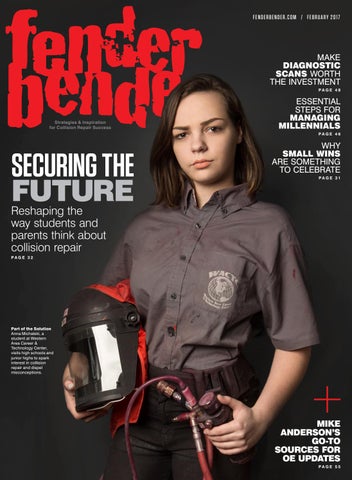
SECURING THE FUTURE
WHY SMALL WINS ARE SOMETHING TO CELEBRATE PAGE 31
Reshaping the way students and parents think about collision repair PAGE 32
Part of the Solution Anna Michalski, a student at Western Area Career & Technology Center, visits high schools and junior highs to spark interest in collision repair and dispel misconceptions.
MIKE ANDERSON’S GO-TO SOURCES FOR OE UPDATES PAGE 5 5
AS TRIED AND TRUE AS THE FAMILY NAME.
For successful business owners like the
Regnerus brothers at Alter Collision, reputations are hard-earned and long built. For over 35 years, the DELTRONÂŽ brand has stood by family-run outfits, offering the most advanced refinish technology and solutions their customers can count on for color match excellence, durability and outstanding appearance.
PPG Industries, Inc.| All rights reserved. 2Š2016 fenderbender.com February 2017 www.ppgrefinish.com
The PPG Logo and Deltron are registered trademarks of PPG Industries Ohio, Inc.
Still the One.
TA B L E O F CO N T E N T S
february
FEBRUARY
0 2 .17 / V O L U M E 19 / N U M B E R 2
PROFILE
38 PRECISE
GROWTH
Inside Marina Auto Body's quest to increase market share in the Los Angeles area.
PHOTOGRAPHY BY KEITH BERSON
BY KELLY BEATON
A New Angle In order to grow his collision repair business, Tom Williamson implemented a “hub-and-spoke” system and optimized its market reach.
February 2017 | fenderbender.com 3
TA B L E O F CO N T E N T S
FEBRUARY
A Helping Hand Maurice Gray, who is autistic, came to Conner Brothers Body Shop through the WorkSupport program at Virginia Commonwealth University.
F E AT U R E
C A S E S TU DY
S H O P TA L K
32
48
56
As more shops feel the constraints of a shrinking talent pool, many feel that the solution is fixing the negative "stigma" that has plagued the industry for years. BY TRAVIS BEAN
DIAGNOSTIC DECISION
Shop operator Bob McSherry moved swiftly to transform pre- and post-repair diagnostic scanning from a process disrupter into a true profit center for his business.
PASSION PLAY
A fast riser and quick learner, Juliet Lightner, 28, has used her infectious enthusiasm and genuine leadership approach to help push Major's Select Collision Center to new levels of success. BY TRAVIS BEAN
BY TRAVIS BEAN
Printed in the U.S.A. COPYRIGHT Š2017 BY 10 Missions Media LLC. All rights reserved. FenderBender (ISSN 1937-7150) is published monthly by 10 Missions Media, LLC, 571 Snelling Avenue North, St. Paul, MN 55104. FenderBender content may not be photocopied, reproduced or redistributed without the consent of the publisher. Periodicals postage paid at Twin Cities, MN, and additional mailing offices. POSTMASTERS Send address changes to: FenderBender, 571 Snelling Avenue North, St. Paul, MN 55104. 4 fenderbender.com | February 2017
PHOTOGRAPHY BY KIMBERLY FROST
RECRUITING REVOLUTION
I CRY WHEN SUNSET FADES.
Whichever color you’re using for your next paint job, make sure it’s the right one — with the Genuine GM Parts paint code lookup tool. Simply enter the year, make, and model of any GM vehicle dating back to 1982 to find its precise color code — taking the guesswork out of your bodywork. Visit genuinegmparts.com to utilize our paint code lookup tool for your next project today.
©2016 General Motors. All rights reserved. The marks appearing in this ad are the trademarks or service marks of GM, its subsidiaries, affiliates, or licensors. February 2017 | fenderbender.com 5
TA B L E O F CO N T E N T S
FEBRUARY
QUICKFIX
11
21
29
Maintaining your passion
Inside State Farm's labor rate shift
The keys to maximizing shop profitability
PAST THE PAGE
ANALYSIS
13
23
New speakers announced
Vincent Romans on industry consolidation
HOW IT WORKS
25
31
NABC executive director retires
How to create positive momentum for your business
15
AWARDS INSIGHT
DRIVERS SEAT
The industry's scanning dilemma
Connected Vincent Romans and his industry consulting and analysis firm keep a close watch on industry consolidation and trends.
Better Quality No more tape lines or missed edges. Factory finish every time.
HOLDS: HOODS TAILGATES DOORS LIFT GATES CARGO DOORS DECK LIDS FENDERS
23
BY KEVIN RAINS
Gate City Collision
Increase Spray Booth Capacity
Reduce Materials No more vehicle masking.
Spray multiple jobs at the same time.
> INNOVATIVE DOOR-FENDER STAND Part # I-DF
< INNOVATIVE ULTRA RACK Part # URPS
6
26
SNAP SHOP
The T-Hotbox PDR dent removal tool
THE BIG IDEA
LIGHT HITS
One tech's efficiency secrets
17
30
VIEWPOINT
MIKE WHE AL AN
CONFERENCE NEWS
• • • • • • •
NUMBERS
GO TO INNOVATIVETOOLS.COM TO FIND A DISTRIBUTOR AND SEE HOW WE CAN fenderbender.com | February 2017 MAKE YOUR SHOP MORE EFFICIENT
< INNOVATIVE SUPERSTAND Part # SS-II
1.866.4 38.4 88 4
S T R AT E G Y
45
IDEA SHOP
How to develop an effective social media plan
46
LEADERSHIP
The keys to motivating (and retaining) your millennial workers
52
61
HUMAN RESOURCES
UPDATE
Maaco continues push for airport fleet locations
A simple process to ensure your business is properly staffed as it expands
62
IN THE TRENCHES The options, issues and solutions to vehicle scanning
55
ON THE BUSINESS
Two key resources to ensure safe and quality repairs
BY DARRELL AMBERSON
63
BY MIKE ANDERSON
THINKSTOCK
INNOVATIONS 46
Marshall Auto Body's unique workstations
February 2017 | fenderbender.com 7
TA B L E O F CO N T E N T S
ONLINE EXTRAS
ONLINE EXTRAS
CLICK ON THE LOGO BELOW FOR PRODUCT INFORMATION Axalta Coating Systems
Genuine GM Parts
O'Reilly Auto Parts
BASF
Innovative Tools & Technologies
Polyvance
CAPA
Kia Motors America
PPG
ChemSpec USA
LAUNCH Tech USA
ProLine Tool & Supply
TECH USA Equalizer
8 fenderbender.com | February 2017
FenderBender-2-Feb.indd 1
Nissan North America
SATA
NRD
Vehicle Service Group
1/5/17 11:22 AM
EDITORIAL
Jake Weyer Editorial Director Bryce Evans Managing Editor Anna Zeck Associate Editor Travis Bean Staff Writer Kelly Beaton Staff Writer Tess Collins Custom Content Producer Kathleen Sandoval Web Content Producer Darrell Amberson Contributing Writer Mike Anderson Contributing Writer Kevin Rains Contributing Writer
EDITORIAL ADVISORY BOARD
Elissa Larremore CBS 1 Collision Robert McSherry North Haven Auto Body Steven Morris Pride Collision Centers Mark Probst Probst Auto Body Randy Sattler Rydell Collision Center
ART AND PRODUCTION
Zach Pate Art Director Nick Spaeth Senior Graphic Designer Fue Vang Graphic Designer Becca Sugden Graphic Designer Leah Quinto Production Artist
SALES
Chris Messer Publisher 651.846.9462 / cmesser@10missions.com Andrew Johnson National Advertising Sales 651.846.9459 / ajohnson@10missions.com Austin Becker Regional Advertising Sales Manager 651.846.9454 / abecker@10missions.com Michelle Allender Regional Advertising Sales 651.846.9452 / mallender@10missions.com Matt Mortinson Regional Advertising Sales 651.846.949452 / mmortinson@10missions.com Melody Todd Regional Advertising Sales 651.846.9468 / mtodd@10missions.com Carolyn Young Regional Advertising Sales 651.846.9468 / cyoung@10missions.com
10 MISSIONS MEDIA
Jay DeWitt President Anders Seefeldt Marketing Communications Specialist Mariah Straub Sales Service Supervisor Meghann Moore Sales Service Representative Katie Cornet Event and Special Projects Coordinator Josh Resch-Lien Digital Marketing & Multimedia Assistant
HOW TO REACH US 571 Snelling Avenue North, St. Paul, MN 55104 tel 651.224.6207 fax 651.224.6212 10missions.com SUBSCRIPTION SERVICE tel 800.869.6882 fax 866.658.6156 email fndr@kmpsgroup. com The annual subscription rate is $72 (U.S.A. only) for companies not qualified to receive complimentary copies of FenderBender. BACK ISSUES Past issue single copies are $8. Go to fenderbender.com/backissues LETTERS TO THE EDITOR letters@fenderbender.com ARTICLE REPRINTS For high-quality reprints or e-prints of articles in this issue call 651.846.9452 or email reprints@fenderbender.com.
February 2017 | fenderbender.com 9
Ensure a perfect spot-weld—even on high-strength steel—with the new MI-200T. Not only can it melt high-strength steel, it can do so using 40 percent less power than a standard cable plier welder. So you’ll get a flawless fusion while driving down your energy costs. Designed for all vehicle body repairs with high-strength steel Amperage service is one of the lowest in the industry, requiring only a 40A service High-performance, lightweight transformer pliers Can be continuously operated without the fear of overheating
Compare our spot welder to the other guys’: chiefautomotive.com/spot/fb 10 fenderbender.com | February 2017
NOTHING ELSE IS A
02.17 C O M M E N T S , D I S C U S S I O N S , F E E D B A C K A N D M O R E F R O M A R O U N D T H E W E B
FAC E B O O K
PODCAST
COLLISION C A S T
In February’s CollisionCast, editorial director Jake Weyer talks with FenderBender columnist Darrell Amberson of LaMettry’s Collision about maintaining a passion for the industry, making an impact—and drag racing. Listen now at fenderbender.com/collisioncast
FenderBender Visits 3M
Branden Loesch, senior application development engineer at 3M, shares how the company’s Cubitron II abrasives work during a FenderBender visit in December. Check out some of the products we were able to get our hands on at fenderbender.com/3Mvisit
High Level Support
FROM TOP LEFT: FENDERBENDER STAFF, MICHAEL HOEWELER
I have been with Service King now two months as a new GM ("Hard Work Meets Opportunity," December 2016). I cannot ever in my life remember working for a company so supportive of its employees. I am new and it has been a challenge to learn all the company ways. However, help has always been right there for me all the way. This is the attitude of the future of our industry. Thanks, boss! Steve Carey General manager, Service King Jacksonville, Fla.
FenderBender Launches New Website LINKEDIN
Business Plans
FenderBender in late December unveiled an overhauled fenderbender.com, with a cleaner, more modern design, better navigation and improved mobile compatibility. Now it’s even easier for you to find the business-building articles you’re looking for, along with daily news, podcasts and more.
Kelly Beaton, staff writer at FenderBender, asked group members how to go about formulating and carrying out effective business plans. How do you do it at your shop? Join the conversation at bit.ly/FBBusinessPlan
FOLLOW US ONLINE
fenderbender.com fenderbender.com/facebook twitter.com/fenderbendermag fenderbender.com/linkedin instagram.com/fenderbendermag February 2017 | fenderbender.com 11
Built for performance. Big success takes singular focus. That’s why at Axalta Coating Systems we’re 100% dedicated to the science and technology behind coatings. Our 150 years of innovation inspire us to perform better in every measure, designing systems that work harder than ever. Fueled by passion and perspective, we’re raising the bar and building a brighter future for our customers. Learn more at axalta.us
12 fenderbender.com | February 2017 Copyright © 2017 Axalta Coating Systems, LLC and all affiliates. All rights reserved.
T H E
L A T E S T
N E W S
O N
T H E
F E N D E R B E N D E R
M A N A G E M E N T
C O N F E R E N C E
Straight from the Experts Shop operator Kevin Rains is one of three FenderBender columnists who will return as a speaker at the 2017 FenderBender Management Conference in September.
EARLY BIRD SPECIAL
Registration Open
2017
—
FENDERBENDER STAFF
Registration for the 2017 FenderBender Management Conference, held Sept. 27–29 at the Westin Lombard near Chicago, is now open at fenderbenderconference.com. Early bird prices are available for a limited time.
See the FenderBender Columnists Live
At FenderBender, we are lucky to have some of the industry’s most passionate professionals as monthly contributors. Shop leaders Kevin Rains and Darrell Amberson, and coach and bona fide industry superstar Mike Anderson bring their substantial collision repair experience and drive for improvement to readers each month. The strategies they share are always grounded in real-world experiences. Name any business challenge and it’s likely they’ve faced and overcome it. All of them offered up their insights at last year’s FenderBender Management Conference as well, covering topics ranging from leadership to marketing to performance metrics to pre- and post-repair scanning. Beyond that, they were on hand to meet with attendees and impart their sage advice one-on-one. Our columnists will be back in Chicago for this year’s conference, ready to help take your business to the next level. It’s the only opportunity you’ll have to see them all in one place. Stay tuned to fenderbenderconference.com for updates on their sessions.
February 2017 | fenderbender.com 13
ACCEPT NO IMITATIONS
You can rely on Kia when it comes to collision parts. Don’t settle for imitations, give them the real deal with Genuine Kia Parts. High Quality and Excellent Fit at a Great Price. CHOOSE KIA! From headlights to tail lights, collision parts to transmissions and compressors, there’s just no substitute for genuine. And the ONL Y place you can purchase a Genuine Kia Part, backed by the Kia warranty**, is from your local Authorized Kia Dealership. Don’t get stuck selling counterfeit and parts not covered by the Kia factory warranty - contact your local Authorized Kia Dealer today for Genuine Kia Parts and Genuine Kia Reman Parts.
WE OFFER NOTHING BUT THE BEST Dedicated wholesale staff
Most parts are in stock
Competitive pricing
Find your local Kia dealer today! www.kia.com ** Kia Genuine replacement parts (except battery) sold by an Authorized Kia Dealer under warranty are covered for the greater of (1) the duration of the New Vehicle Limited Warranty or (2) the first 12 months from the date of installation of the Kia Genuine replacement parts or 12,000 miles. Labor charges not included when not installed by an Authorized Kia Dealer. Warranty is limited. See Kia’s Replacement Parts and Accessories Limited Warranty for further details.
14 fenderbender.com | February 2017
AWARDS INSIGHT
CHRIS O'DELL
Nominate Today
FenderBender Awards Insights feature past FenderBender Award nominees. To nominate an inspiring collision repair professional, or for more information, go to fe nde rbe nde raw ards .com .
FB AWARDS NOMINEE
CHRIS O’DELL
SENIOR BODY TECHNICIAN PARKS ROYAL BODY WORKS BOISE, IDAHO
Chris O’Dell, the senior-most body technician at Parks Royal Body Works in Boise, Idaho, has always appreciated the chance to resuscitate damaged vehicles. “You take a mangled piece of metal and bring it back to life, so to speak,” O’Dell explains. O’Dell always helps keep things running smoothly on Parks Royal’s shop floor—in fact, he consistently works above 200-percent efficiency. “Chris has led by example ever since he started with our company,” says owner Matt Thornton, who nominated O’Dell for a FenderBender Award. “He always strives to do the job right the first time.” O’Dell, who is I-CAR Platinum certified, details his tips for being as efficient as possible. BY KELLY BEATON
ed down here, he always said, ‘Slower is faster,’” O’Dell recalls. “Like, if you want to clearcoat the layout nice, you need to use a little bit slower of a hardener. And I still apply that [in] the body shop.” Minimize Your Downtime.
In his work, O’Dell strives to be a study in perpetual motion, limiting inactivity as much as possible. “You can’t just pull one job in, fix one dent and pull it out,” O’Dell says. “I’m pretty lucky; I have two stalls. So, if I have the ability to work on two or three jobs at the same time, then that’s so much easier. “A lot of times, if it’s a small repair, I won’t even tear a car down first. I’ll get filler on it, and then while the filler’s kind of chemically doing it’s thing, then I can tear a door down, or pull the bumper cover off.”
FUE VANG
Listen to Experienced Co-Workers.
O’Dell arrived at Parks Royal a decade ago as an up-and-comer in the collision repair industry, having won Idaho’s 2006 SkillsUSA competition while still an underclassman at Boise State University. Nevertheless, he wasn’t too proud to listen to advice from industry veterans. “A painter I worked with when I start-
Preload Your Stall the Night Before.
One secret to O’Dell’s success is his ceaseless attempt to save five minutes here and there—increments of time that, over the course of a week, add up. O’Dell has learned the value of preloading his stalls before leaving work at night. And, when he gets a work order,
he typically makes sure to have parts on hand ahead of time. “I always look the car over before I even start,” he adds. “I always look it over outside first, walk around it, know what I’m going to do. ‘Am I going to have to back the car in?’ … Things like that. It saves a ton of time.” Complete Tasks Without Interruption.
O’Dell sets himself up for success by always reaching a logical stopping point on tasks. That way, he never has to retrace his steps after, say, a meeting, wasting 20 minutes attempting to get back on track. “Around lunch time, if I’m right in the middle of something, I will always finish it,” he notes. And, when O’Dell does take breaks, he tries to make each pass through the shop floor as productive as possible. “If I want to go to the break room,” O’Dell says, “I can walk through the paint department. I can always see where my jobs are. You know, ‘I’m going to be getting this Acura back here in 40 minutes, so I’ll make sure to have my lift available.’ “You know, just simple things. It may take a little more time up front, but it’s going to save you in the long run.” February 2017 | fenderbender.com 15
Always keep a strategy in your back pocket. As long as you have your phone, you’ll have access to the premier collision repair podcast from FenderBender. Every month, CollisionCast will bring on a special guest and dive deeper into a featured FenderBender story. Tangents, questions, opinions. These are businessbuilding strategies straight from the source, for any situation.
SPONSORED BY
Listen for free at fenderbender.com/collisioncast Also available in apps for Apple and Android (Podcasts, Stitcher, Pocket Casts). 16 fenderbender.com | February 2017
D R I V E R ' S S E AT
EMBRACING CHANGE
Embracing Change
JAKE WEYER EDITORIAL DIREC TOR j w e y e r @ f e n d e r b e n d e r. c o m
Is your shop scanning vehicles yet?
NICK SPAETH
At the January Collision Industry Conference (CIC) meeting, a comment was
made during the Parts and Materials Committee's segment that once upon a time the group couldn't talk enough about parts and materials challenges. It's kind of remarkable to look back, even in my short time covering the collision repair industry, at the various hot-button items that have come and gone. Well, some have not gone entirely, but they've been replaced in importance with other changes. Recent CIC surveys of attendees, both at the January meeting and in a separate effort before the meeting, showed that as we move into 2017, repair procedures are the No. 1 item in need of addressing. A major piece of that issue is pre- and post-repair scanning, the topic that took the industry by storm in 2016. You'll find several pieces on the topic in this issue, from the case study on page 48, Darrell Amberson's column on page 62 and Mike Anderson's column on page 55. We're not trying to overdo it, but it's clear that scanning has become an important part of producing quality, safe repairs. And we aim to guide you through this complex subject until all stakeholders have worked together to address the many issues preventing it from becoming standard practice. February 2017 | fenderbender.com 17
TH E PERFECT FINISH
STARTS HERE
Professional Grade, Superior Performance, Built to Excel
URETHANE CLEARCOATS TO MEET ANY NEED • • • • •
Versatile Air dry or bake Spot, panel or overall finish Can be used with solvent or waterborne basecoats VOC-compliant clearcoats available
AVAILABLE EXCLUSIVELY AT
Parts Payoff rewards you for purchasing and installing the O’Reilly brands you know and trust.
IT’S FAST, SIMPLE AND FREE! For full program details visit FirstCallOnline.com
FirstCallOnline.com 18 fenderbender.com | February 2017
ADV 1114
NEWS
|
IDEAS
|
PEOPLE
|
TRENDS
quick fix ANALYSIS VIEWPOINT LIGHT HITS SNAP SHOP NUMBERS HOW IT WORKS
PHOTOGR APHY BY MIKE WHE AL AN
Future of Consolidation Despite consolidation slowing in the past two years, industry analyst Vincent Romans says it still remains a reality for the collision repair industry.
February 2017 | fenderbender.com 19
ESSENTIAL TOOLS FOR GENUINE SAVINGS. Nissan Genuine and Value Advantage® Parts deliver Nissan-validated fit, form and function to reduce cycle time and help improve customer satisfaction.
SEND US YOUR ENTIRE ESTIMATE Contact your Nissan Wholesale Dealer directly and get discounted pricing* back fast!
Discounted pricing*, easy order tracking, real-time delivery notifications. Traxpod.com
Fast ordering and discounted pricing*. CollisionLinkShop.com
nissantechnews.com parts.NissanUSA.com *Discount off MSRP for eligible popular parts only. MSRP excludes all applicable taxes. Participating dealer sets actual price. Exclusions apply. Subject to part availability. Value Advantage® remanufactured engines and transmissions are not included in eligible part categories and are not eligible for discount. Nissan, the Nissan Brand Symbol, “Innovation that excites” tagline and Nissan model names are Nissan trademarks. ©2016 Nissan North America, Inc. 20 fenderbender.com | February 2017
QUICKFIX
A N A L Y S I S
LACK OF BUSINESS SENSE, LACK OF PAY
State Farm’s recent announcement that it will recalculate labor rates in certain areas has some feeling the industry is moving backward BY TESS COLLINS
, State Farm made the announcement that it will no longer use its Auto Repair Facility Survey program to determine auto body labor rates in areas of New Jersey, New York and Pennsylvania. According to Sam Valenzuela, president of the National AutoBody Research and creator of the Variable Rate System (VRS), a free tool provided to shop owners that supplies labor rate information through an independent third party, this move is just a sidebar in a much bigger issue when it comes to labor rate pricing. From all of the data he’s seen through the VRS, Valenzuela says that for more than 10 years, the price of labor in the collision industry has not kept up with inflation. “A shop making the same rate they were based on inflation over 10 years ago is the bare minimum shops should be asking for,” Valenzuela says. “Many shops are making less. Think about it. With paint and material increases, wage increases, the rising cost of health care and a number of other factors, the current rates are not economically sufficient to survive, in our opinion.” To put this into context, Valenzuela provided the example of an insurance company paying a shop $40 per hour in
THINKSTOCK
On Dec. 5
2000. In order to keep up with inflation, that shop would need to receive $57 per hour today. The VRS shows that many shop owners are being paid less than this. “The industry is moving backwards,” Valenzuela says. “I think 2017 is the year of the labor rates.”
Labor Rates: Does One Size Fit All? “I’m thoroughly disappointed,” says Jerry McNee, Alliance of Automotive Service Providers of New Jersey (AASP/NJ) collision chairman and owner of Ultimate Collision Repair in Edison, N.J., when asked about the State Farm announcement. McNee’s frustration stems from the fact that he’s never seen tangible proof to back up the rate that insurers pay, aside from the survey that State Farm has issued in the past and will no longer use. When he asks the insurers, he says the response that he gets back is “that’s what your market area warrants.” Valenzuela says that he doesn’t believe in prevailing rates. He compares an insurance company paying everyone in a certain market the same rate to assigning everyone the same shoe size. There are a number of different variables that need to be accounted for when it comes to labor rates.
Valenzuela explains that shops need to know their value, and tools like the Variable Rate System survey can help. Depending on experience, the type of vehicle served, location and a number of other variables, there are a number of rates within a marketplace that can be acceptable. The key, according to Valenzuela, is to be able to show that the rates being charged are comparable to similar shops based on these factors.
Knowing What to Charge McNee doesn’t put all of the blame on the insurance industry. He says that shop owners also share the burden for the stagnant industry. When FenderBender contacted State Farm, the insurer released the following response to why it decided to stop using the Auto Repair Facility Survey program: “We believe repairer profitability and quality auto repairs that are reasonably priced can both be achieved. This change in our labor rates brings us more closely into alignment with the actual cost of vehicle repairs and is in the best interest of our customers.” When Paul Sgro, owner of Lee’s Garage in West Long Branch, N.J., and the national director of the Society of Collision Repair Specialists, was read this comment, he responded by saying that it probably stemmed from shops not knowing enough about the cost of running a business. Sgro says that insurers are able to make changes like this because they can source shops in the area that are paying less, but Sgro explains that those are lower quality repairs or are being done by shops that will eventually go out of business because they are not charging enough. February 2017 | fenderbender.com 21
22 fenderbender.com | February 2017
QUICKFIX
V I E W P O I N T Industry Growth In his consulting firm's recent profile of the collision repair industry, Vincent Romans analyzed industry consolidation and its nuanced growth.
And that value shift is simply a supply-and-demand issue, correct?
CONSOLIDATION’S NEW TREND
As MSO acquisition greatly slowed in 2016, Vincent Romans sees an industry ‘unfolding as it should’ BY BRYCE EVANS
Despite what headlines may indicate, the rate of consolidation in the collision repair industry hasn’t been a linear rise toward domination for the Big 4 consolidators—Service King, Caliber, ABRA and The Boyd Group. Instead, think of it more like a bell curve, Vincent Romans says. Romans’ industry consulting and analyst firm The Romans Group recently released its datadriven report, "Profile of the Evolving North American Collision Repair Marketplace." There were attention-grabbing highlights (such as the forecast for the Big 4 to gain a 20 percent total industry market share by 2020) but the overall message was far more tame: After peaking two years ago, the rate of consolidation has slowed. The numbers: In 2012, roughly $300 million worth of multiple-shop operations (MSOs) was acquired; that rose to nearly $1 billion in 2014, before falling back to just under $250 million in 2016. Consolidation is still very much the reality for the collision repair industry, Romans says, but it’s far more nuanced than many seem to think.
PHOTOGR APHY BY MIKE WHE AL AN
Why has consolidation appeared to slow in the last couple years?
There are a number of reasons that this slowdown is happening, and let’s go back to 2012, when large private equity firms played a huge role in consolidating the industry. It was understood by them that this dry powder they had would be leveraged to aggressively grow through acquisitions and they did just that.
But during the last five years, the cost to acquire these targeted, MSO platforms, steadily rose due to the aggressive competition among the Big 4 consolidators as well as the owner-operators’ increasing value perception and price expectations for selling their businesses. It was just getting too costly for the MSO consolidators to spend the money that the sellers wanted.
Some of it definitely is. There was a lot of cash/dry powder available and financing was inexpensive. Consolidators were aggressively purchasing multiple-location platforms, and we had this shift in owner perception about the increasing value of a business and the price expectation for selling. A lot of this was due to the MSOs' market-entry strategy many in which they targeted other MSO platforms. The larger consolidators did this to gain entry and large market share in target areas, and as they formed their competitive beachheads, it took out most of the early sellers that had the largest platforms. All of this has really led to this gap between the seller’s value and sales price expectations and the buyer’s expectations. That said, your report forecasts the Big 4 doubling their competitive stake by 2020, reaching a 20 percent market share? It’s a significant number, but does it signal “mass consolidation” for collision repair?
The future is clear that the top four MSO consolidators today will grow their businesses at a faster rate than those in the other segments of the industry. After the Big 4, those repair organizations in the $20 million-per-year or higher segment will have the second fastest growth rate; then the $10 million to $19 million, and so on. The combined sales at the end of 2015 was about $3.7 billion for the top four consolidators, which is nearly an 11 percent market share. By 2020, I believe they’ll have between $6.5 billion, which would be about 16.3 percent share, up to $8 billion, which would be a 20 percent share. So, it depends on how you view mass consolidation. February 2017 | fenderbender.com 23
GLASURIT 923-230 LVOC ALL PURPOSE CLEARCOAT THE NEW STANDARD FOR PREMIUM CLEARCOATS Glasurit 923-230 raises the global standard of excellence with this all purpose clear that covers everything from small panel and tight space applications to large areas and overalls. 923-230 offers great flow, industry leading gloss, and easy de-nibbing along with incredible sag resistance. This clear provides consistent GlasuritÂŽ quality in all climates. Learn more at basfrefinish.com/glasurit_923230.
24 fenderbender.com | February 2017
News
QUICKFIX
For your daily collision repair news visit
LIGHT HITS
fenderbender.com/lighthits
FORD CANCELS PLANS FOR MEXICO PLANT, ANNOUNCES INVESTMENT IN ELECTRIC VEHICLES Ford plans to introduce 13 new global electrified vehicles over the next five years, and the automaker also announced plans to invest $700 million to expand its Flat Rock Assembly Plant in Michigan. The motor company cancelled its plans to build a $1.6 billion plant in Mexico, according to a report by USA Today. The plant in Mexico had been met with opposition by President-elect Trump. Among the 13 new electrified vehicles announced include a hybrid version of the F-150 pickup and Mustang. The $700 million investment in Michigan will be used to expand the Flat Rock facility and build high-tech autonomous and electric vehicles along with the Mustang and the Continental. The expansion will add 700 new jobs.
NABC EXECUTIVE DIRECTOR ANNOUNCES RETIREMENT Chuck Sulkala, founder, first president, and executive director of the National Auto Body Council (NABC), announced his retirement on Jan. 3, effective at the end of 2017. During Sulkala’s tenure during the last 22 years, the NABC has become the leading voice to highlight the professionalism and integrity of the collision repair industry through community service involvement. Under his leadership, NABC’s member network of collision industry companies and professionals have united to collaborate on community service programs that help change and save thousands of lives across the country. These include, among others, the introduction of NABC’s Recycled Rides, the First Responder Emergency Extrication (FREE) and fundraising support for the Ronald McDonald Foundation. “I am humbled to have been a part of the National Auto Body Council history. It is incredible to think that this started out as a conversation with Tim Rooney, formerly with I-CAR, and Scott Biggs, with Body Shop Video at the time,” said Sulkala. “It is amazing to see how it has now become a powerful force
Safe Winter Driving A recent Allstate study concluded that the city of Brownsville, Texas, had the highest number of safe drivers operating in winter weather conditions.
in improving the image of the collision repair industry.”
ALLSTATE STUDY REVEALS CITIES WITH BEST BAD-WEATHER DRIVERS Allstate’s America’s Best Drivers Report reveals motorists in certain cities are safer drivers when operating in winter weather conditions. The report finds that when factoring precipitation with auto property damage claim frequency, Brownsville, Texas (27.4 average inches of precipitation per year; 14.6 years between collisions), has the safest drivers. Rounding out the top five: 2. Kansas City, Kan. (39.1 inches/13.6 years) 3. Cape Coral, Fla. (55.9 inches/12.9 years) 4. Madison, Wis. (37.3 inches/13.3 years) 5. Port St. Lucie, Fla. (63.7 inches/12.5 years)
CARSTAR BECOMES FIRST MSO TO HIT 500 LOCATIONS CARSTAR recently unveiled a new facility in West Chester, Ohio. The new location is the network’s 500th collision repair shop— making CARSTAR the first MSO to surpass that milestone. CARSTAR West Chester is owned by FenderBender columnist Kevin Rains. As part of the celebration, CARSTAR West Chester is set to refurbish a 2012 Hyundai Sonata to donate to a deserving local family in need.
GA. WOMAN WINS STATE FARM BAD FAITH CASE The Georgia Supreme Court has refused to hear State Farm's appeal of a 2014 verdict in an insurance bad faith and breach of contract case versus State Farm, involving a Georgia policyholder who had a Honda Accord insured by a State Farm policy in 2011. In 2011 the policyholder had her tires flattened, windows broken and the paint of her car scratched by a vandal. State Farm subsequently refused to pay towing costs, full car rental and full costs of repair when the plaintiff selected Hernandez Collision Center to repair her car. State Farm estimators testified that the plaintiff's car could be repaired in Savannah, Ga., for $5,045. Court documents state, though, that Hernandez Collision Center’s repair estimate was $9,589. Court documents note that State Farm's refusal to pay full repair costs left the plaintiff owing the body shop a balance of $4,297 for her repairs, and that she paid $1,125 for her rental car. The jury returned a verdict favoring the plaintiff for all damages she sought, plus $5,000. The jury also awarded her $30,000 in attorney fees. State Farm appealed the verdict to the Georgia Court of Appeals, alleging that the trial court should have dismissed the case, had improperly instructed the jury and had admitted testimony that State Farm believed was prejudicial. February 2017 | fenderbender.com 25
QUICKFIX
SNAP SHOP
GATE CITY COLLISION LOCATION:
Merrimack, N.H.
1
OWNER:
Mark Piekarski SIZE:
8,000 square feet STAFF:
11 (5 technicians, 2 painters, 1 parts manager, 1 receptionist, 1 CSR, 1 recondition) AVERAGE MONTHLY CAR COUNT:
120
ANNUAL REVENUE:
$2.3 million
1
2
The most eye-catching element of Gate City Collision’s three locations in Greater Nashua, N.H., might be their funny marquees, which began when owner Mark Piekarski thumbed through a joke book more than two decades ago. “That’s what we’re known for—being the place with the funny signs,” says Mark’s son (and Gate City’s current vice president), BJ Piekarski. “It’s almost like a point of reference now, because we’ve been doing it for so many years. It has been a great marketing tool.”
The Piekarski family has long taken pride in their shops’ community involvement. And in that respect, the race car that Gate City owns and sponsors (and BJ races in) serves as a rallying point. Piekarski often takes the car to community events, like those sponsored by the local Rotary Club. “We do a booth display with the race car and do free giveaways,” Piekarski explains. “Just to get our name out, and what exactly is entailed in collision repair that most people might not know. … It really catches the eyes of people. So it makes people want to come over, ask questions about the company.”
26 fenderbender.com | February 2017
RACE CAR
PHOTOGRAPHY BY NICOLE PIEKARSKI
FUNNY MARQUEES
Submit Your Shop Proud of your shop and want to show it off to your peers? Tell us about it at submissions@10missions.com.
2
4
3
5
3
4
5
Roughly two years ago, Gate City—which has earned Best Auto Body Repair Facility of the Greater Nashua area for five straight years—finished renovating an old Saab dealership in Merrimack, N.H., that the company purchased, and the redesign left Piekarski with an open concept office area. In fact, it was impressive enough that Enterprise Rent-A-Car and Allstate inquired about working out of that facility. The office is also equipped with a waiting area that garners compliments from customers due to its comfortable furniture, and an upstairs breakroom that Gate City employees truly appreciate. Finally, the office area also features a greeter, who refers each customer to the proper department.
Piekarski is especially prideful with regard to the Merrimack location’s methodical paint department. To make things run as smoothly as possible, Piekarski has his paint prepper come in an hour earlier than his painter, so cars can be prepped and moved into the booth for when the painter arrives. In turn, Piekarski’s painter typically works a shift that runs an hour later, to ensure all work is painted and wrapped up to be ready for the following day.
Another way in which Gate City stands out from the local crowd is through its use of a remote estimator, positioned full-time at a local Toyota dealership. The remote estimator performs all initial paperwork on damaged vehicles, looks the car over, and then repair work is completed at a Gate City facility, lending convenience to customers. “He acts as a liaison between the dealership and the repair facility,” Piekarski notes. “Due to growing that relationship and getting that estimator in a remote location, we get all the dealer’s business, and it’s been huge.”
OFFICE AREA
PAINT DEPARTMENT
R E M O T E E S T I M AT O R
February 2017 | fenderbender.com 27
SATAjet®1500 B SoLV For more options in the application of solvent materials The SATAjet 1500 B SoLV in HVLP and RP, provides fine finishes with cost saving transfer efficiency and keeps the wetting that is required using today’s Low VOC exempt solvent basecoat or the more traditional National Rule solvent basecoats. The SATAjet 1500 B SoLV is also a good choice for clearcoat appearance while meeting transfer efficiency and profitability expectations. Designed
for Full System Application: solvent-based basecoats, either Low VOC or National Rule as well as sealer and clearcoat. Nice-sized, even spray pattern Wide air pressure range from 7 – 35 psi. HVLP max 26 psi. Fast working speed Excellent value spray gun
Nozzle size Standard with RPS cups 0.3 l, 0.6 l, 0.9 l, 1 ea. Nozzle Set
HVLP RP
1.3 1.3
1.4 1.4
1010925 1010933
NEW
Further information: www.sata.com/SATAjet1500
1010892 1010917 1010967 1010975 1010941 1010959
SATAjet 1500 B SoLV RP approvals pending
The exclusive independent distributor of SATA products in the US and Puerto Rico
Phone: 800-533-8016 www.satausa.com E-mail: satajet@satausa.com
SATA, SATAjet and/or other SATA products referenced herein are either registered trademarks or trademarks of SATA GmbH & Co. KG in the U.S. and/or other countries.
28 fenderbender.com | February 2017
QUICKFIX
NUMBERS
CHARACTERISTICS OF THE MOST PROFITABLE COLLISION SHOPS It should come as no surprise that there’s a correlation between shop efficiency, productivity and profitability. Here’s a look at a few key metrics among the respondents to FenderBender’s 2016 KPI Survey that claimed an overall net profit margin of 16 percent or higher.
48.9% have an average technician productivity of 110% or higher
58%
71%
76%
84%
have a touch time of four or more hours per day
have an average key-to-key cycle time of seven days or less
have an average job-start-tojob-completion cycle time of seven days or less
boast an average technician efficiency of 120% or better
February 2017 | fenderbender.com 29
QUICKFIX
HOW IT WORKS S H O P R E V I E W S O F C O L L I S I O N R E PA I R P R O D U C T S
THE DETAILS T-HOTBOX PDR DENT REMOVAL WEBSITE:
betaginnovation.com TRAINING:
Several-hour, on-site training session available upon request USES:
Dent reduction and removal COST:
$1,995
THE REVIEW: Reviewing Betag Innovation’s dent removal tool
KEVIN MILLER DIRECTOR BMW CONCORD SAN FRANCISCO, CA
THE REVIEWER:
Kevin Miller is the collision center director at BMW Concord and has been affiliated with BMW for 25 years. He started working in the industry when he was in high school. He was a BASF paint rep for four years before he started working with BMW San Francisco. He eventually made the transition to BMW Concord and he is also the collision center director for Weatherford BMW in Berkeley, Calif.
THE SHOP:
BMW Concord is one of only four certified BMW collision centers in the Bay area of California. The 16,000-square-foot facility has been open since 2007.
30 fenderbender.com | February 2017
HOW IT WORKS:
The staff was introduced to the T-Hotbox by Betag Innovations when it was looking at other products offered through the Eco Repair Systems of North America. Eco Repair Systems approves products that improve efficiencies and reduce waste. Betag Innovations demonstrated the T-Hotbox, and Miller saw an opportunity to cut back on how often BMW Concord needed to hire a subcontractor for PDR work. The handheld unit removes dents by using heat to warm up the area around the dent, which allows the dent to pop back to its original state. Betag Innovations offers a unit that works on steel and one that works on aluminum, which was a runner-up for Best New Product at 2016’s SEMA Show. BMW Concord uses the steel model. The T-Hotbox is preset for time and power level. Once the time and power level has been selected, the dent removal device is held over the dent and the button is pressed. Depending on the severity of the dent, the dent will go back to its original state in a matter of seconds.
THE ROI:
A subcontractor would charge between $75–$100 per panel to come out to the shop. Since Miller only needs to call for severe dents, he said that the T-Hotbox paid for itself within a few months. The time savings has also been a huge benefit. Miller says the T-Hotbox removes dents in a matter of 30 seconds—the old way of grinding the paint off and pulling or pushing the dent out took about 15 minutes. Miller also says it’s improved his shop’s CSI. Because the method is so quick and effective, the staff can now remove dents that normally wouldn’t have been removed or would have been an extra charge without charging the customer anything.
PHOTO COURTESY OF KEVIN MILLER
T-HOTBOX PDR DENT REMOVAL
The shop has used the tool for a little over a year. Miller says that the tool works particularly well on panels that have not been severely damaged. All he has to do is warm up the area and soft dents are eliminated. Miller says that it cannot be used on all dents. Anything with a sharp crease will still require the shop to call someone for PDR, but the frequency that this has to be done has decreased significantly. Miller says that the T-Hotbox is used daily. He adds that he’s noticed that results will vary depending on the type of car it is used on, but that it works extremely well on the BMWs that his shop services.
COLUMNS
THE BIG IDEA KEVIN RAINS
College Football, Flywheels, and Your Shop How to create breakthrough momentum one day at a time
THINKSTOCK
I’m not a college football fan. So when
I write this name, please don’t tune me out if you like a rival team. I’m only interested in this guy because of how he leads and because one of my managers is a big fan of his. Ready? Nick Saban. Nick Saban is the highly intense and often controversial head coach of Alabama Crimson Tide football. What I have come to love and admire about Nick Saban is his focused intensity on getting the fundamentals right. Over and over again he drills his team to not focus on the score, but how to execute the next play that is right here, right now. His maniacal focus on doing the right thing play after play is what separates him from the pack. And make no mistake: He is separated from the pack. It’s like he coaches and plays in his own league. He has led his team to four national championships and groomed some of the greatest NFL players still playing today. Saban’s disciplined approach appeals to me precisely because it is what I lack. I have written about this before, but when I’ve taken personality tests, I always come back as a “quick start,” which may just be a nice way of saying, “You’re impulsive, you lack follow-through, and you’re undisciplined.” The good news for me and for you if you happen to fall into the same boat is that discipline is a choice. Follow-through can be a learned behavior. Being impulsive can be replaced by a new set of habits. While I do not want to lose my edge as someone who can get things moving from a dead standstill, I want to add the ability to see things through. I always, and I mean always, have energy to launch something. Seeing it all the way through to the end? Well, not so much.
Jim Collins talks about this in his book, Good to Great: Why Some Companies Make the Leap… and Others Don’t, as the “flywheel effect.” In his research, Collins and his team researched thousands of highly successful companies. One of the key abilities of all the great companies they studied was their ability to overcome a weakness through continuous improvement. The metaphor that Collins employs here is a flywheel. He writes: “Picture a huge, heavy flywheel—a massive metal disk mounted horizontally on an axle, about 30 feet in diameter, 2 feet thick, and weighing about 5,000 pounds. Now imagine that your task is to get the flywheel rotating on the axle as fast and long as possible. Pushing with great effort, you get the flywheel to inch forward, moving almost imperceptibly at first. You keep pushing and, after two or three hours of persistent effort, you get the flywheel to complete one entire turn.” He goes on to write about how each turn of the flywheel builds upon work done earlier and it eventually gains al-
most unstoppable momentum. My tendency is to think about the breakthrough coming all at once, from some heroic, one time act. However, if I’ve learned anything from Saban and Collins it is this: The daily, incremental, focused efforts are what lead to a sustainable momentum and eventual breakthrough. It’s easy to be amazed by the “overnight successes” but what we often do not see are the years of effort that preceded that breakthrough. This year for me and my shops our flywheel is going to be operations. For full disclosure, this is not my favorite part of owning and running shops! But with steady, incremental effort I’m planning to get that flywheel moving at some pretty high speeds by year’s end. For now though it’s just one turn at a time. What will your flywheel be and how will you get those first few important turns moving? And more importantly, how will you sustain that momentum? As always, I wish you the best and please reach out to me if I can help in any way.
KEVIN RAINS is the owner of CARSTAR Center City in Cincinnati and CARSTAR West Chester in West Chester, Ohio. He is also an industry consultant and founder of marketing website Body Shop 2.0. E M A I L : kevinrains@gmail .com A R C H I V E : f e n d e r b e n d e r. c o m /r a i n s
February 2017 | fenderbender.com 31
REVERSING THE STIGMA IT’S TIME FOR THE THE INDUSTRY TO COLLECTIVELY ALTER HOW IT MARKETS COLLISION REPAIR TO STUDENTS AND PARENTS BY TR AVIS BE AN
32 fenderbender.com | February 2017
KIMBERLY FROST
Paving the Way Kevin Conner, owner of Conner Brothers Body Shop, has emphasized training, recruiting and hiring new talent to the collision repair industry.
February 2017 | fenderbender.com 33
F E AT U R E
REVERSING THE STIGMA
wo-hundred students and teachers are packed into a room at the 2016 SEMA Show. By the end of the evening, $750,000 has been donated to CTE programs across the country. The Collision Repair Education Foundation is closing out the event by honoring two select students—the best of the best, the future of the collision repair industry. And all eyes are on Anna Michalski. “Two years ago, I didn’t really know what I was doing,” she says, standing at a podium, speaking to the crowd. “I was a teenager—nobody knows what they are doing at that age. I was really lost.” One month later, sitting in a classroom, readying for her final semester at the Western Area Career & Technology Center (WACTC) in Canonsburg, Pa., Michalski and her collision repair instructor, John Warabow, discuss the state of education in the industry with FenderBender. They speak of teenagers that believe trade occupations are for the “dumb” kids; shop owners that cry about the lack of talent; parents that would rather see their children attend four-year universities. And one word continually creeps into the dialogue: stigma. There’s a stigma about kids going to tech schools. We’ve been trying for years to get away from the stigma. There’s a stigma that has to be broken. This stigma exists among parents, students and business owners searching for quality employees amidst a crippling shortage of them. And every time that word is uttered, it’s abundantly clear that Michalski believes that feeling she spoke about one month earlier in a room filled with her peers is the real problem. I was really lost. But Michalski and Warabow, along with many shop owners, instructors and organizations that are fighting to reverse the stigma, aren’t just complaining—they have a solution, a multi-pronged solution that involves educating students and parents on the advantages collision repair offers, and rethinking the way this industry collectively attracts talent.
You know the numbers—you’ve probably heard them over and over. Still, here they are: The U.S. Department of Labor’s Bureau of Labor Statistics says the number of employed collision technicians decreased 12.1 percent between 1999 and 2005, yet expects the need to rise 9 percent between 2014 and 2024. Even worse: Economic and labor research firm Emsi reports less than 9 percent of technicians are under 25. ManpowerGroup’s “Talent Shortage Survey” says 32 percent of trade employers had difficulty filling jobs due to lack of talent. Throw in that there are currently 5.8 million unfilled trade position openings, according to the Bureau, and you’ve got a whole mess of numbers plaguing the collision repair industry. And while those statistics are troubling, one number worries Warabow even more. “My budget was cut to $5,000 this year,” he says. “So we’re in a panic mode. We’re doing the best we can on $5,000.” It’s not just WACTC—where Warabow has taught collision repair for 30 years—that’s suffering. Brandon Eckenrode, director of development at the 34 fenderbender.com | February 2017
Collision Repair Education Foundation, says the problem is widespread, and it’s contributing to the fact that collision repair training programs graduate only 1015 percent of their students. “Technical education programs’ budgets are being slashed across the country,” he says. “And it’s up to shop owners to get involved and help out.” With fewer students entering trade positions—collision repair in particular— it will only become more difficult to procure funding for educational programs, Eckenrode says. Which means the future of this industry hinges on its ability to reverse that stigma Michalski spoke about. Eckenrode isn’t necessarily talking about donations, which help technical programs purchase updated equipment as vehicles become increasingly more complex. While anyone can donate to the foundation—many donations handed out at the 2016 SEMA Show came from insurance companies and large corporations in the automotive aftermarket—to help spread its reach, Eckenrode says, more importantly, the shop owner’s role involves a grassroots approach: getting into schools and changing the discussion with students, guidance counselors, teachers and parents. How you choose to work with schools? Well, that’s where you can get creative.
Viable Options
“My name is Maurice Gray. I’m a Conner Brothers employee. My job here is mostly cleaning up, making sure the building looks great. When the technicians need me to help work on the cars with them, I’ll do that.” “What do you do for Recycled Rides?” inquires Kevin Conner, sitting
KIMBERLY FROST
The Stark Reality
Taking a Chance Kevin Conner (left) has advanced his four shops by joining programs at local universities, which has resulted in hires like Maurice Gray (right).
BE T T ER RE CRUI T ING
Hire Special Needs Employees
—
Because special needs employees have become integral team members, Kevin Conner says hiring people with disabilities is a great way of solving two problems. The first problem being, of course, the dwindling interest in collision repair positions. But also consider the unemployment rate for people with a disability, which stood at 10.7 percent in 2015, while the rate for those without a disability declined to 5.1 percent, according to the U.S. Department of Labor’s Bureau of Labor Statistics. “I think other owners would benefit from understanding the interaction that the staff experiences every day with a special needs employee,” Conner says. “They’ve become as much of a team member as anyone else.” VISIT DISABILITY.GOV FOR MORE INFORMATION ON HIRING SPECIAL NEEDS EMPLOYEES.
Look Outside Your Region across the table from Gray. “Sometimes,” Gray responds as a big smile spreads across his face, “they’ll tell me to hand over the keys and present the car to the recipient.” Conner, owner of Conner Brothers Body Shop locations in Richmond, Va. (three of the four locations were sold to Caliber Collision by the publishing of this article), hired Gray through the Virginia Commonwealth University’s (VCU) WorkSupport program, which helps people with disabilities find meaningful employment. Conner has filmed this YouTube video to promote the practice. Gray, an employee with Conner Brothers for two years, is autistic, and one of eight employees Conner hired through VCU’s initiative that have filled administrative and technical positions. And while not everyone from the WorkSupport program has worked out, Conner says hardworking employees like Gray have the necessary attitude for improving processes and culture, proving there are always viable options when you think outside traditional recruiting methods. “We’re all in the same boat across the country, and that boat is not going to turn around very quickly,” he says. “As small business owners, we are running hard
—
The Connecticut Technical High School System represents 18 different technical high schools in Connecticut—that’s 18 programs actively seeking to place their top students in businesses willing to collaborate. “I didn’t even know we had that many schools before I started working with [CTHSS],” Lisa Siembab says. “You tend to only know what’s in your direct market.” Don’t just restrict yourself to area schools. Contact programs across the state and discuss what you can offer, whether it’s setting up a student with an apprenticeship or full-time employment.
Promote CTE Programs
—
Backed by a great amount of research from Gallup, Dave Kapitulik says you should present technical programs as the rule, not the exception. Here are some facts CTHSS uses: • 80 percent of students taking college preparatory academic curriculum with technical education programs met college and career readiness goals, versus 63 percent of those without CTE. • Students attending technical high schools have demonstrated higher rates of on-time graduation and credit accumulation. • Students attending CTE high schools have a greater likelihood of successfully finishing college preparatory math. • The average high school graduation rate for CTE students is 93 percent, versus only 80 percent for the national graduation rate. • A ratio of one CTE class for every two academic classes minimizes the risk of high school dropouts. February 2017 | fenderbender.com 35
F E AT U R E
REVERSING THE STIGMA
every day, but we need to make time for finding the real talent out there—the people who are willing to work hard for us.” Take Lisa Siembab—owner of CARSTAR Berlin in Berlin, Conn., and executive director of ASAConnecticut—who, in addition to hiring several Hispanic technicians to her team, represents the collision repair industry on the Connecticut Technical High School System (CTHSS) to improve curriculum at technical high schools and set up apprenticeships throughout the state. “The state has never had this kind of representation from the industry,” she says. “We formed this group late last year, and it’s opened up the lines of communication for me with the instructors and the principals.” Dave Kapitulik, educational consultant for CTHSS’s transportation programs, has worked with industry professionals like Siembab to form action plans for increasing student engagement and improving technology at technical programs across the state. Their goal is to reach students early—before high school, if possible—to promote trade positions. “A lot of high schools have an exploratory program during freshman year, meaning many students are planning their careers before we can get to them,” he says. “We have to recruit all the way down to eighth grade to get kids to come to our schools.”
Getting the Word Out
ENLIST MILLENNIALS As evidenced by Michalski’s story: While shop owners need to facilitate change, they aren’t always necessarily the right people to motivate students. “I think in high school, no matter what they’re talking about during a presentation on careers, you’re probably tuning out the person if they’re over a certain age,” she says. “You really relate more to students.” Warabow and Michalski suggest enlisting entry-level employees at your shop and students at local technical colleges to speak with younger students, in hopes of 36 fenderbender.com | February 2017
recruiting them to not just technical positions, but administrative ones as well. Develop game plans and discuss the strategies you’ll use to increase interest. TALK ABOUT MONEY The ability to make money sooner and accrue less debt is a huge selling point for students, and even moreso for parents, Michalski says. There’s just one problem: Starting salaries for collision repair graduates are generally trumped by other professions, Kapitulik says. “It’s not to say they couldn’t make a great salary eventually—because if they’re driven, they will,” he says. “But why would a student attend a collision repair class when his buddy is going to make $27 an hour as an electrician?” On average, Kapitulik says collision repair graduates in Connecticut make $13 per hour. So there’s no way around it: Either promote collision repair without mentioning pay, or change the way you compensate entry-level technicians. BECOME A COMMUNITY ADVOCATE As Conner discusses all the philanthropy he performs for the city of Richmond, he reveals how he has so much pull with local technical programs. “When I go places around town, people tend to recognize me,” he says. “When I go into schools, counselors will want to listen to what I have to say.” Reversing the stigma involves being a community leader, Conner says.
KAELA SPEICHER
Anna Michalski recalls, clear as day, the moment that sparked her interest: Two WACTC seniors standing in her high school classroom, discussing a technical education versus a traditional four-year university. “I remember it was cool to me because they already had jobs,” she recalls. “And I was like, ‘They’re making good money while going to school. Why wouldn’t you do this?’” So now, on the cusp of graduating herself, Michalski is visiting high schools and junior highs throughout the state, equipped with the knowledge and strategies necessary for sparking interest for technical programs among parents and students and improving recruitment in the industry. And as someone who had never turned a wrench before enlisting in the collision repair program at WACTC, she’s thinks the right message could sway just about any student searching for a career path.
Ready to Work Anna Michalski hopes to turn her internship with a local dealership into a full-time job after closing out her final semester with the Western Area Career & Technology Center.
Show you’re invested in the betterment of everyone, and people will be more likely to return the favor. Then secure meetings with high school guidance counselors and discuss the advantages of promoting CTE programs for students. DISCUSS INTERVIEWING SKILLS As a community advocate herself, Siembab has found success helping students improve their interview skills. “A lot of kids have never done a single mock interview before entering college,” she says. “So instead of just sitting there, I teach them to form eye contact, how to shake the employer’s hand, and how to ask questions— all in all, proper etiquette for interviews.” In the end, it’s true grassroots marketing: You’re not necessarily promoting your shop—you’re presenting yourself as the expert, and instilling in students collision repair as a legitimate profession. And for Siembab, it’s working. She’s brought on several apprentices through CTHSS, and has helped many more secure jobs at collision repair shops around the state. USE TECHNOLOGY AS A SELLING POINT As advancing vehicle technology continues to shape the industry, it will also continue to be a blessing for recruitment, Warabow and Michalski say from the WACTC classroom. “These days, they aren’t just cars. They’re—” “Computers,” Michalski chimes in, finishing Warabow’s sentence. “Yes—drivable computers,” he adds. Over his 30 years of teaching, Warabow knows that now, more than ever, entry-level technicians need to be proficient with vehicle computer systems and diagnostics. “We have a totaled 2015 Chrysler 200 up on the frame rack, and they’re using frame machines and lasering systems,” he says of his students. “They’re doing things they never dreamed of. The bright ones, the ones that want to succeed, they understand what they can accomplish in this profession.” “It would be cool if we talked more about the technology. That would attract more kids that are into computers,” Michalski adds. “There has to be some balance, some middle ground we reach. We can’t just expect kids to want to be techs their whole lives.” It’s also beneficial to donate advanced equipment and totaled cars equipped with new vehicle technology to technical schools.
Read On —
HERE ARE SOME FENDERBENDER STORIES AND LINKS THAT EXPAND ON TOPICS DISCUSSED IN THE ARTICLE:
1 / Donate Now Donations to the foundation can be made at collisioneducationfoundation.org/donate-now/ 2 / Paving the Way JUNE 2016
How to host an effective career night 3 / Growing from Mistakes AUGUST 2014
How Kevin Conner breathed life back into his shop 4 / Erasing the Technician Shortage SEPTEMBER 2015
Hiring Hispanic employees helped Lisa Siembab bridge the recruitment gap 5 / More Online Visit fenderbender.com/education2017 to download CTHSS’s Annual Strategic Plan for improving recruitment 6 / Your Guide to Motivating Millennials PAGE 67
Develop a five-year pay structure (among other tips) for millennial employees 7 / Collision Shops that Give Back and Get Back DECEMBER 2014
Three unique stories about shops becoming community advocates 8 / Solving the Technician Shortage FENDERBENDER.COM/COLLISIONCAST
Our podcast interview with Fayetteville Technical Community College on revolutionizing how we train today’s technicians
ABOVE ALL: SHOW THAT YOU CARE As Michalski closes out her speech at SEMA, you can sense the passion, yet also the seriousness in her voice. Collision repair isn’t just a fad for her (she recently secured an internship with Sun Chevrolet in McMurray, Pa.). When students and shop owners came into her high school classroom to promote trade positions, it wasn’t just the money or the technology that sold her—it was the opportunity for something better; the chance to succeed at a profession she had never once considered. So that’s really what she wanted to drive home with the final words of her speech: Michalski’s dream of owning a shop herself someday started with one moment. So don’t just sell a job to these kids—sell collision repair as a chance to do something great. “There are people who don’t feel I should be in this industry, because I’m a woman, or because I’m too young,” she said, just before the room burst into a rounding applause. “And it’s great to finally be recognized as: ‘Yes, you’re supposed to be here.’” February 2017 | fenderbender.com 37
A HUB -A ND SPOK E SYST EM, HIG HLIG H T ED BY T HE REC EN T A D DI T ION O F A CUSTOMER CA RE CEN T ER, H AS G I V EN M A RIN A AU TO BO DY’S OWNER OP T IMISM
38 fenderbender.com | February 2017
B Y K E L LY B E AT O N PHOTOGRAPHY BY KEITH BERSON
MARINA AUTO BODY CUSTOMER CARE CENTER LOCATION:
MARINA DEL REY, CALIF. SIZE:
3,000 SQUARE FEET STAFF:
2 ESTIMATORS, 2 SUPPORT-STAFF MEMBERS, 1 PICK-UP/DELIVERY COORDINATOR AVERAGE MONTHLY CAR COUNT:
150 (ESTIMATED)
Customer is King In order to meet growing customer demand, Tom Williamson decided to open a dedicated customer care center for his regional MSO.
February 2017 | fenderbender.com 39
PROFILE
MEETING THEM HALFWAY
into Marina Auto Body’s new, 3,000-square-foot customer care center, which opened in January, they aren’t greeted with the usual noise that accompanies a collision repair center. And that’s exactly what owner Tom Williamson envisioned when he purchased an old mechanical repair service facility in Marina del Rey, Calif. After opening a nearly 27,000-squarefoot collision repair center near LAX (in Inglewood) in mid-2015, Williamson decided to add the new customer care center, which is located roughly 5 miles away from the other facilities in his three-location business. It’s all part of a “hub-and-spoke” system—a concept in which a repair center is centralized, with estimating centers on the perimeter of it—that Williamson envisions will help his MSO reach unprecedented levels of efficiency. “If we can make [our facility] close to a customer’s home, or work, where they can drop off their vehicle, and take that nuisance away from them, I believe we win and they win,” the owner explains. The new customer care center has few wasted elements. For example, the new shop features just a couple estimators, a pair of support staff members, an employee dedicated to coordinating the pickup and delivery of vehicles, a drivethru area to facilitate swift estimates, refurbished office space, and parking for five vehicles inside and six outside. There are no lifts on site, because no repairs are done at the facility. The customer care center’s main purpose is to simply funnel vehicles to Marina Auto Body’s large repair center in Inglewood. hen a client drives
40 fenderbender.com | February 2017
Williamson has run the MSO successfully since 1999, but feels incorporating compact customer care facilities might be necessary moving forward, given how the real estate market is trending in urban areas like Los Angeles. That area is less than welcoming of collision repair shops these days, due to restrictions— body shops aren’t permitted within 500 feet of a residence in L.A.—and real estate costs that have nearly quadrupled in recent years. Plus, the shop operator had heard of hub-and-spoke systems working smoothly elsewhere, such as with dealer groups. “What drove me to [adapting the hub-and-spoke model] is watching what’s happening with real estate prices,” Williamson says. “So this is the alternative: Let’s find smaller square footage, where we’re efficient about getting cars in and out of the repair center, and then make it convenient for the customer.”
BEING PROACTIVE
Williamson spent the last couple years on the offensive professionally, watching competitors fall by the wayside. “Municipalities don’t want body shops,” says the owner, who also noted that L.A. doesn’t allow spray booth permits within 500 feet of a residence. “What’s happening in the west side of Los Angeles: Anything that’s an industrial building, we see it’s going away. They convert the building to creative office space. … If we have rent here at some of these industrial spaces for $4 a square foot, the margins aren’t in our business to be able to conduct a collision repair facility like that. “So, what I’ve witnessed now in the last year and a half, is four collision centers around me, of different sizes, closing.” Williamson, whose two other Marina Auto Body locations do a combined $12 million per year, wanted to maintain a
Every Last Detail Shop owner Tom Williamson, second from left, is re-energized these days, after opening a dedicated customer care center in Marina Del Rey, Calif. The 3,000-square foot facility is a key element of Marina Auto Body's hub-and-spoke business system.
presence in the western part of Greater Los Angeles. He certainly didn’t want to spend years trying to cultivate a new customer base elsewhere. There’s only one other customer care center in Los Angeles, which also added to the appeal of that concept for the industry veteran. Plus, by utilizing one large hub for repairs by LAX, Williamson can have that busy facility operate for 14 hours a day, aided by a split shift. “I don’t really think most customers care where their car is being repaired,” Williamson notes. “They just want to know that it’s someone reliable—I think that gives customers a little comfort to say, ‘We understand, we get it, you’ve always done right. We’re leaving our car here, and let’s go.’” PLOTTING A PATH
Williamson studied the “hub-andspoke” system for months before his new
customer care center came to fruition. As a result, the owner has developed multiple streamlined processes for the facility. Estimates are written. Appointments are made. Vehicles are dropped off. Customers are connected with rental companies. Cars are transported to the larger Marina Auto Body repair center near LAX. Claims information is inputted, and then the repair center is notified that a vehicle is in transit. Additionally, Williamson stresses the importance of having his designated customer care employee and the file handler at the repair center communicate daily, so that they can relay information to the customer. The new facility, which also gets direct repair program assignments, may boast an Enterprise rental presence before long. “The customer’s time is valuable, so you try to ease that process,” the owner explains. “They’re dropping off their car … and they’re not sitting. Our customers, they don’t want to sit for 15 minutes; they’re busy and they want to get going.” Communication is paramount among a customer care facility’s small staff, Williamson says. “It’s just going to be about keeping people on task, that we understand the process and follow the process each and every time,” he says. “There are a number of steps that you always have to go through to make sure that all the information’s seamless, that the repairs are done, and that the quality control is in place. “We understand the communication, we understand the quality control that it’s going to take.” MOVING FORWARD
The customer care center in Marina del Rey is a fledgling facility, but its owner is optimistic about its future. Williamson expects an average of 7-8 vehicles of intake per day before long. “It looks to me as if the return on investment is going to be tremendous, as long as we can provide the proper service,”Williamson says. “Because, you know, we run collision centers maybe efficiently for nine hours a day. You pay rent 24 hours a day. And, if we can get 14 efficient hours a day through a split shift in the repair center, rather than having two repair
DEFINING A HUB-ANDSPOKE SYSTEM: The spoke-hub distribution model features a system of connections arranged like a wire wheel, in which traffic flows to the “hub” at the center. Essentially, a large facility acts as a business’ hub, with associated, smaller facilities benefiting from its presence and arranged around the hub like the spokes of a wheel. A chief benefit of this system: Time-consuming operations can be carried out at the hub, rather than at every business location.
centers, there’s a real efficiency there.” It costs most owners well over a million dollars to build a collision center these days. That’s why Williamson feels like an owner needs to run two shifts per day to maximize return on investment. Marina Auto Body’s owner also expects to see a legitimate ROI quickly due to his business’s loyal customer base, as well as insurance partners that understand his reasoning behind adapting the hub-andspoke concept. So far, Williamson sounds both content and energized by his investment in Marina Auto Body’s new customer care center. In fact, he’s already pondering possible locations for a similar facility. “It’s going to have its ups and downs,” Williamson said of the project, “and we’ll work through them and do what’s best for the customer. So, we’ll see. … I don’t see any reason for it to not be successful. “There’s nothing to lose, everything to gain.” February 2017 | fenderbender.com 41
TECH USA 42 fenderbender.com | February 2017
WORK SMARTER
strategy IDE A SHOP LE ADERSHIP CASE STUDY
PHOTOGRAPHY BY JASON HENRIQUES
HUMAN RESOURCES
Early Adopter Shop owner Bob McSherry has positioned his shop at the forefront of the industry by embracing numerous new processes.
February 2017 | fenderbender.com 43
RADIO
The ultimate collision repair app.
FENDERBENDER - FB TO GO
SPONSORED BY
DOWNLOAD NOW FOR FREE ON ANDROID AND IOS.
NEWS
Latest news, analysis, trends and reports.
44 fenderbender.com | February 2017
RUNNING A SHOP
Strategies for operations, leadership, education and more.
SHOP LIFE
Shop profiles, personal stories, inspiration and more.
MULTIMEDIA
Facebook, YouTube, Instagram and more.
S T R AT EGY
IDEA SHOP
Social Responsibility
How to ensure your staff uses social media in your company’s best interest AS TOLD TO TR AVIS BE AN
In the midst of the 2012 U.S. presidential election, with tensions rising one month before election day, home appliance maker KitchenAid’s social media manager posted this controversial tweet: “Obamas gma even knew it was going 2 b bad! 'She died 3 days b4 he became president'. #nbcpolitics” The fallout wasn’t pretty—with thousands of followers, an entire international company’s reputation was hurt by a single employee. While an extreme example, Keith Yurgosky says this highlights an important lesson for any business, big or small, that can’t afford to alienate customers: Developing a social media policy can help resolve such a situation swiftly. Or, better yet, prevent it from happening in the first place. As manager of Internet business at the University of Scranton Small Business Development Center, Yurgosky has helped hundreds of small businesses design social media policies regulating how companies and their employees use their social media accounts.
THINKSTOCK
A social media policy should be written out and signed by employees. Because
it’s an HR issue, there needs to be documentation of what the policy is, and what the punishments are for breaking the rules. Put it in an employee handbook the employee signs. Include what you consider confidential information that shouldn’t be shared. I’d recommend offering one or two warnings for issues that aren’t too detrimental to the business. If it’s severe,
there’s probably no choice but to cut ties. Larger companies will fire people over their social media posts—you probably won’t have to deal with that as a smaller company. But if someone does violate the policy, having those regulations in place protects you legally and allows you to sit them down and say, You broke this rule. You now have a warning. You also need to be aware of any state laws. It’s case by case. In Pennsylvania, you can fire anyone for anything you want. However, the U.S. National Labor Relations Act ruled against employers for firing employees for complaining on social media sites about their workplace conditions. So, just know your limits. Most of the businesses we deal with are mom-and-pop shops. Typically, it’ll
either be themselves doing social media, or they’ll have an intern or someone else doing it. If anyone else has access to your accounts, define roles for everyone. Who is responsible for what? What do these responsibilities include? Address the intention of social media and how you want to be branded. Also, make sure they understand they’re representing the business. They’re not representing themselves, so they need to keep their opinions out of it. Identify the kind of information they can put out so you don’t log in to Facebook and find your shop has posted about something that could be controversial. If anyone has access to your account
and then they leave the company, you have to make sure you change all your passwords and log-ins so they don’t continue to post on behalf of the company—especially if it’s an employee who leaves in a bad situation. Employees’ personal accounts can end up doing a lot of damage to a business.
So any time that they do say something that’s their opinion, and it pertains to your industry or your place of work, make sure you say that it’s their opinion and not the opinion of the company. It doesn’t need to be said for every post that person makes—it should just be disclosed in the employee’s profile bio. You’ll also want to make notes about posting on social media during work hours. You can either flat-out restrict it unless they’re on lunch, or you can be a little looser. One software company I know instituted Facebook Friday, when employees were allowed to talk about the company and promote it. If you run into trouble and create controversy, you have to address it and apologize. You’re a small business, so
you can’t alienate your core base. That’s not the way we feel. Issue an apology on the account, and then point them in the direction of an email or phone number so you can explain your policy to people and say, We will hear you out and settle any issues you may have. That way, hopefully, it doesn't result in a negative review or anything like that. February 2017 | fenderbender.com 45
S T R AT EGY
LEADERSHIP
Motivating Millennials Steps for attracting and retaining millennials as they take over the workforce TR AVIS BE AN
46 fenderbender.com | February 2017
doomed,” Adriana says. “In the next five to 10 years, we’re going to see so much change, and the millennials will be on top of it all. They’ll be so efficient and so good with the technology.” Share your vision. Robertson says you need to adapt the way you think, speak and act about millennials. They tend to value work they find fulfilling and meaningful, so your leadership is everything. First and foremost, be sure to clearly share your mission with millennials and how the service you provide enhances the lives of others. A full 90 percent of millennials want to use their talents and skills for good, according to the Society for Human Resource Management. Speak about your vision often at meetings, and post your values throughout the shop. Robertson says millennials prefer visions that have high ethics and values and focus on team-building—a community involvement program is generally attractive to them, for instance. In addition to responding to high moral values, Adriana says her millennial employees have more easily bought into the sisters’ plans to bring more technology into the shop and change up some of the processes. “Boomers tend to fear change. And it’s fair, because they know what works,” she says. “But millennials are risk takers, adaptive to change, look at things as an opportunity. If they see a problem, the first thing they think is, ‘How do we get past it?’” Develop a learning culture. You’ve probably heard about it ad nauseum
at this point, but in preparing for the millennial takeover, it’s more important than ever, Robertson says; you must make training and development a crucial component of your shop culture. For the Indomenicos, this has come much easier over the past year with their new millennial employees. They’re much more open to training than the veteran employees, the Indomenicos say, and have worked with the owners to form a training plan. “The younger generation wants to get trained, they want to do the right thing,” Adriana says. “Now it’s just about getting everybody on board at the same time and working together as a team. It’s easier to convince the older guys when the millennials buy into it.” Regularly speak about learning and training opportunities at meetings and
THINKSTOCK
what your shop will look like in five, 10, 20 years, but one thing is for certain: Millennials are taking over the workforce. The Pew Research Center reports that in 2015, the population consisted of 75 million millennials and 75 million baby boomers. By 2028, boomers are expected to fall to 65 million. Just eight years later, boomers will decline further to 50 million, while millennials steadily rise to 81 million. Throughout it all, Generation Xers will be on a steady slope downward. It presents a unique challenge for shop owners, as millennials are vastly different in so many ways from baby boomers and Generation Xers, say Adriana and Sabrina Indomenico, co-owners of Santostefano Auto Body. And as millennials themselves, they’re in a unique position as their peers have recently taken over two of three technician positions from veteran employees at their Middleton, Conn., shop. “We’re all in the same age bracket, so it’s interesting being their boss,” Sabrina says. “We probably have a different approach than most other bosses do because of that.” Charlie Robertson, chief operations officer for the Collision Career Institute, copresented on “The Millennial Takeover” at the 2016 SEMA Show and understands the daunting difference millennials present to shop owners in terms of management. But if you shift your mindset a bit, he says, you’ll see that when you start implementing the following practices and motivate millennials to succeed, they won’t just prosper because of their best qualities—the entire shop will. “If you’re scared of millennials, you’re You may have no idea
non-millennial employees. In addition, 87 percent of millennials say professional development is very important. Robertson recommends building a pay plan that marks increases at two, three, four and five years of employment. Throughout those years, they’re expected to achieve industry certifications and grow in their capacity and knowledge. Each time they achieve a certification, they get a bump in pay. However, if they fail to meet a certification, they’re put on probation and experience a pay freeze. Then work with them to best solve whatever is holding them back. Robertson says millennials thrive on constant feedback, and if they know doing well will result in a bump in pay, they’ll reward you.
while conversing with employees, she says. Make your employees’ development your most important task. The best way to do this, Robertson says, is to provide constant feedback. The days of semi-annual or annual reviews process are over. Millennials are always looking to improve their work, so it’s important to develop a culture of continuous improvement at your shop. “You have to be giving them constant feedback,” he says. “You’ve got to give them status reports on regular basis, and you need to be specific about what they’re doing.” Don’t create any formal schedule or try to plan it out—as you’re walking the shop floor, look for moments to offer positive accolades that commemorate good work. “Even if it’s small stuff they’re doing,” he says. “‘Hey, I like the way you did that. That panel was prepped
perfectly for paint. Nice job.’” Robertson says millennials also respond very well to constructive criticism, but will turn on you the second your feedback becomes overtly negative. “If they’ve done something that needs improvement, they will not stand for being yelled at or berated,” he says. “They’ll hit the door. We need to learn how to best provide them with critiques.” Create a clear career path. While a technician shortage is plaguing the industry, retention is just as big of an issue with millennials—if they don’t see a future of development and growth at your company, they will not stick around for long, Robertson says. Gallup found that 60 percent of millennials say they’re always open to different job opportunities—15 points higher than
Respect their work-life balance. When ranking what’s most important to them at work, an overwhelming amount of millennials in a Deloitte study placed a healthy work-life balance at the top. Work is not life to millennials, Sabrina says, as opposed to baby boomers and Generation Xers, who will put in extra hours to finish the week’s workload. Millennials are often motivated by flexibility with work schedules. While it may seem implausible to allow an employee to stay late on Thursday to leave early Friday—with how scheduling works at a body shop—Robertson says lending that flexibility could actually improve shop culture. The resulting changes benefit everybody, Robertson says. Everybody enjoys a little extra free time, and there would be no direct conflict from boomers or Generation Xers by adapting your processes in this way. “If you build an environment where everybody is learning, growing, and working together for the common outcome, everyone—not just millennials—will benefit from it,” he says. Millennials tend to value vacation and overtime pay over perks older generations valued, Robertson says. Revise your employee development, compensation plans and employee manuals to appeal to their interests. February 2017 | fenderbender.com 47
S T R AT EGY
CASE STUDY
Planning for Scanning A F T ER H EF T Y IN V EST M EN T S A N D IN S U R A N C E N EG OT I AT I O N S, B O B M C S H ER RY H A S T U R N ED PR EA N D P OST- R EPA IR D I AG N OST I C SCA N S IN TO A PR O FI T C EN T ER BY TR AVIS BE AN PHOTOGRAPHY BY JASON HENRIQUES
48 fenderbender.com | February 2017
Emphasis on Scanning In an effort to ensure quality and safety, shop owner Bob McSherry decided to implement preand post-repair scans.
February 2017 | fenderbender.com 49
S T R AT EGY
CASE STUDY
Why are you in the collision repair business? Bob McSherry really wants you to think about your answer to that question. Because, more than likely, your answer has something to do with protecting drivers on the road, restoring vehicles to pre-damage condition, performing a service for your community. But if you’re not performing diagnostic scans on every vehicle that comes through your shop before and after the repair, he’s not buying that answer. “The simple fact is, you can change all the airbag parts you want, but the airbag light is not going to come on if the occupancy sensor isn’t calibrated,” he says. “If you send a car out the door after it’s been hit and you don’t calibrate that front-seat sensor—which Toyota, Lexus, Acura, Honda, Hyundai, Kia state has to be done— then you’re going to be liable for someone getting hurt.” It’s that hard-nosed, no-nonsense approach to ensuring everyone’s safety that has led to incorporating pre- and post-repair diagnostic scans on every job that comes through North Haven Auto Body in North Haven, Conn. In the past year, McSherry has spent thousands on equipment and created standard operating procedures for his staff, all while improving efficiency with scanning and negotiating with insurance companies in an attempt to achieve an ROI.
The Backstory
After 32 years in the industry, McSherry has witnessed firsthand the evolution of collision repair, and he believes pre- and postrepair scanning is the most critical issue to hit it yet. And he’s been involved on the ground floor of it all, from discussing the issue on Mike Anderson’s business council to serving as a guinea pig for asTech’s original scanning equipment years ago to sitting on the I-CAR repairability committee, all while growing his business to $8.5 million in annual revenue in 2016. “I’ve gotten to meet the guys from Toyota and Honda and GM and Chrysler,” McSherry says about his time serving on the I-CAR repairability committee. “I would have never thought I’d work with these businesses and have a say in them making a difference in our industry.”
The Problem
That “difference” has been pushing the importance of requiring pre- and post-repair scans on vehicles to restore all components to factory settings. Because until it becomes commonplace and standard, and until OEMs start requiring it on every vehicle, McSherry says it will be impossible to negotiate with insurance companies to achieve an ROI on the hefty scanning investment. Over the past year, McSherry has heavily invested in scanning equipment, with his bill totaling $22,000 in 2016—in 2017, he expects to spend $27,000. And his only way of getting a proper return has been establishing an efficient scanning process and 50 fenderbender.com | February 2017
meeting halfway with insurance companies to recoup the scanning costs.
The Solution
At this point, scanning is a part of the everyday repair process at McSherry’s shop. It took time to get there, though. For you to do the same, he says you should consider the following. THE EQUIPMENT
It’s important to know what scan tools are right for your shop. Part of improving the efficiency of scanning at his shop has been having multiple tools at his shop’s disposal, McSherry says, which means heavy research is involved. “There’s a general lack of awareness in this industry,” he says. “If you never leave your four walls, you won’t learn much.” While you can certainly read about the various scan tools available, McSherry says he’s better able to tell if a scanner is right for his shop by physically testing it beforehand. He encourages shop owners to attend industry events and trade shows. Also, form relationships with dealerships and ask to test out their OEM equipment. “I schedule a visit, bring a technician with me, and ask him whether or not he thinks the tool is right for us,” he says. “You can test the ease of use and the functionality.” McSherry’s best friend has been the asTech 2 from Collision Diagnostic Services (CDS). The asTech 2 is a diagnostic tool that scans the vehicle and sends a service re-
quest to a staff of CDS technicians qualified to evaluate most makes and models. However, he says it’s important to have factory tools as well. With most vehicles heading out of shops on Thursdays and Fridays, he says wait times can reach the onehour mark for the report from CDS, so it’s good to have options so your technicians aren’t getting held up and leaving a vehicle idle in its bay. On top of two asTech 2 scanners, some of North Haven’s other diagnostic equipment include the Ross-Tech VCDS (for Audis and VWs), the Honda Diagnostic System, the Toyota Techstream, and a Tesla tool. THE PROCESS
While he’s still in the process of writing SOPs for scanning every repair, McSherry says it’s much harder to find a one-size-fitsall approach that works for every vehicle. “You build any system for the normal, not the exception,” he says. “The only problem is we get a lot of exceptions.” McSherry has done his best to control the elements by hiring a single technician specifically to perform any and all scans for the business. If that technician is tied up, others will jump in with one of the shop’s many scan tools to help out. When a car comes in, the paperwork goes in a designated staging area. The vehicle doesn’t go into production until it’s scanned, which is when the paperwork can move forward. The diagnostic technician then performs the pre-repair scan to document all fault codes and identify necessary repairs. When the car moves into teardown, it allows the technician to more clearly identify problems and perform any further scans that may be necessary. The technician notes each scan performed and the symptoms found in the labor lines. “To keep a scan tool hooked into a vehicle the whole way through is unrealistic. You’ve got to keep coming back,” McSherry says. “You could do up to four scans on one vehicle if you get everything cleared.” THE COSTS
The ROI on your investment will be slow, McSherry warns, especially depending on your vehicle makeup. If you service a lot of Toyotas or Hondas, he says those factory scanner purchases are no-brainers, and the original purchase should be recouped in no time. Evaluate your workload to determine if you take
Making the Investment Among the numerous investments he made included a Tesla factory scan tool, which allows his staff to clear all fault codes.
NORTH HAVEN AUTO BODY LOCATION:
NORTH HAVEN, CONN. OWNER:
BOB MCSHERRY SIZE:
18,000 SQUARE FEET STAFF:
30
AVERAGE MONTHLY CAR COUNT:
265
ANNUAL REVENUE:
$8.5 MILLION
in enough OE work to justify a purchase. Where you’ll run into more trouble, however, is with scanning prices and subscriptions. On top of equipment purchases, each scan on the asTech costs McSherry $89 to $209, and yearly subscriptions for his three different factory tools generally cost over $1,000 per automaker. While you can see a return on your subscription/equipment costs within months, McSherry says, your ability to make up the scanning costs will depend on your ability to negotiate with insurance companies. THE NEGOTIATION
McSherry charges $249 for a full scan, which involves a pre- and post-repair diagnostic scan and any calibrations. On top of that, he attempts to charge for any associated labor. Your ability to negotiate a fair price will depend, of course, on the insurance company. McSherry claims the two largest insurance companies in Connecticut are very difficult to work with. However, with the more lenient insurance companies, he says education has won many of them over.
“You have to educate them. You have to show them we wouldn’t have seen this problem if we didn’t scan it ahead of time,” he says. “Especially when you get into restraint systems, adaptive headlights, adaptive cruise control, etc.” When it comes to the tougher companies, McSherry says it’s important for his team to be diligent in its scanning processes and document every fault code that results from a scan. “With asTech, you get a statement for each repair with fault codes on it, and I have a much easier time getting paid,” he says. McSherry suggests listing out your scanning costs in tenths of an hour, so the heftier scans don’t stand out to insurance companies. “You have to be very specific in how you break it down in your invoice, because they look for big numbers,” he says. “You have to spoonfeed it and tenth them to death—tenths turn into hours, and hours turn into profit.” THE AFTERMATH
After several months of pre- and postrepair scanning each vehicle, McSherry
says scanning has become just another component of the repair process that his entire team has bought into. McSherry says he’s been able to get insurance companies to pay for about 70 percent of his scans. After $22,000 in equipment purchases and subscription fees, he says that ability to negotiate has allowed him to recoup the scanning investment by a slim margin. “On a Honda scan tool, you’re looking at paying $4,400 per year,” he says. “Even if you do a moderate amount of Hondas, you can pay for that in 3-4 months. Then it becomes a profit center.”
The Takeaway
While McSherry doesn’t like the fact that he has to fight insurance companies on the issue of scanning, he says the fact that scanning is an everyday occurrence at his operation allows him to sleep at night. “It’s all what you choose to do,” he says. “At the end of the day, I want to make the industry better than when I found it. That’s the way I look at it. If that means I eat some of the costs? So be it.” February 2017 | fenderbender.com 51
S T R AT EGY
HUMAN RESOURCES
Staffing Up as Your Business Grows How to avoid being overstretched when operating a growing shop K E L LY B E AT O N
52 fenderbender.com | February 2017
Roughly a quarter century later, Mitchell serves as the president-CEO of Car Guys Collision Repair, a central Florida MSO with plans to officially open three additional locations in early 2017. Letting Go Jack of all trades was a role that didn’t truly suit Mitchell. He’s much more content these days, essentially serving as a sideline general, entrusting key personnel groups to assistants. “What happens is, we wear so many hats, and we do so much, and it’s hard for a lot of people to let go of certain things,” notes Mitchell, who has run multiple MSOs in his career. “But then there’s times that you have to let go. “I’m the kind of guy that believes you’re not going to do this as good as I’m going to do it, but, in many cases … you’ll do the job. And, if you don’t do it right, I can coach you.” If a shop operator fails to delegate, or fails to add personnel at times when it’s imperative to do so, the situation can test their sanity. It’s a struggle Jill Meeuwsen, CEO of Synergy Management Consultants LLC, has witnessed often. “The shop owner isn’t and can’t be a jack of all trades, yet many try to be,” Meeuwsen says. “In today’s [era] of cheaper, faster and better year over year, it’s hard to keep up. I see more owners in serious stages of burnout every day. “So, owners that can take the initiative to move strategic things off their plate can have more time to focus on the business.” A shop owner might be able to pass off IT duties to a tech-savvy office assistant, for example, or transition an eager estimator into a managerial role.
Building Up If a business operator can’t leave his or her facility for the occasional long lunch, it’s a potential sign that less-than-ideal employees are in place, or shop processes need to be re-evaluated. Another common sentiment: Auto body employees need to be allowed to learn and grow in their roles; this can be accomplished by owners if they gradually increase staffers’ responsibilities over time, which can increase their confidence and purpose which, in turn, can also allow an owner more time to work on strategies for growing his or her business. “When employees don’t grow and learn, they end up leaving. They leave, and the owner stresses, and the cycle starts all over again,” notes Joe Martin, a market manager for Gerber Collision in southwest Florida. That said, some roles, like human resources or accounting, are best left to hired help from the outside.
THINKSTOCK
all too familiar with the expression “24/7/365.” The collision repair industry veteran embraced that mantra with open arms in the early 1990s. He painted cars. He staged cars. He ran his body shop’s office. Then, when his colleagues called it a day, Mitchell did even more paint work. “Years ago,” Mitchell recalls, “I worked Saturdays, I worked Sundays. I worked the whole year every day. I worked holidays.” One day, the workaholic received a rude awakening. With representatives from a major insurance company visiting his office, Mitchell saw an eagerly anticipated meeting get disrupted in a fashion that left him incredulous. “All of a sudden my door just burst open,” Mitchell says. “It was my cleanup guy. He says ‘Hey, boss, we need to order some hand cleaner.’ I said, ‘Do you think there’s anybody else that can order the hand cleaner for you? I’m a bit busy.’ … I was angry that this guy interrupts me to do that. But I realized that I created that environment. I was the guy who said it’s OK to order hand cleaner. “So that was the moment where I said, ‘You know what? I can’t work any more hours. I can’t do any more.” Soon after, Mitchell created a few new positions, naming a paint-shop foreman, for example, and hiring a production manager. In short, he began to designate and delegate, creating a clear chain of command. The shop operator had learned that knowing when to add personnel, or to delegate, can be instrumental in getting one’s growing business to run smoothly … and preventing the owner from being consumed by stress. Dave Mitchell is
losing by handling this position ourselves? Could our individual time be spent more effectively, producing results immediately, while creating another job for someone in the community?” Money can often be freed up in a body shop’s budget for new hires simply by re-evaluating relationships with vendors, considering elements such as pricing structure, new vendors, and possible performance/tier margins for largequantity purchasing.
“The single biggest factor for shops to get off the hamster wheel is solid leadership development, and coaching,” Meeuwsen says, “to get them to where they can start to plan and implement things that will help their business, such as outsourced HR.” HR managers can bolster the single biggest outlay of cash—human capital, Meeuwsen notes. Issues with payroll taxes, or the IRS? Those call for a competent CPA, in Mitchell’s experience. “I know so many [owners] that try to do it on their own, and they make mistakes,” the industry veteran explains. “And all of a sudden they’re getting audited … and now you have to go back and reconstruct all your records. You can get yourself in a world of trouble.” In order to find ideal hires for roles in areas like H.R. and accounting, Mitchell suggests seeking recommendations from other trusted business owners.
Branching Out Not every owner is going to experience the vivid epiphany Mitchell did long ago, when he made the clear and decisive choice to seek assistance around his shop. Sometimes, the best opportunities to add staff are those during which your business’s growth has plateaued. “If you’ve got people [working] at their capacity, you’re never really going to grow,” Mitchell notes. “Because you’re limited to what they’re capable of doing.” For example, Mitchell says it simply doesn’t pay to have employees maxed out, so it’s best to pay attention if staff members appear overwhelmed. If they are, it’s likely time for staff additions. “Just like a piece of equipment, you don’t want to run the techs wide open for too long,” Mitchell notes. Martin says he always asked himself, “What is the financial amount we are
Weighing Options If a shop’s issue with inefficiency isn’t a prolonged one, it may be able to be remedied by simply shuffling around in-house job duties. After all, it’s usually better to entrust a proven employee that has worked at your side for years, rather than make an impulse hire. “A lot of times, what people will do is they’ll throw bodies at a situation, because everyone’s running around and they’re so busy,” Mitchell says. “And they can’t take lunch, and they’re working until 6 o’clock at night, and they can’t get anything done and customers are screaming. “You’ve got to fix the process,” he adds. “And, if you do [need to hire], what kind of person do you need, and what do you need that person to do? “Just really think through what it is you’re going to do before you go start hunting—don’t rush into it.” Industry veterans seem to be in agreement: Owners of growing shop businesses should delegate, designate, and when it’s undeniably necessary, bring in reinforcements. “Why are you shooting a rabbit with a .30-6 [rifle]?” Martin asks. “If you are an operator and you are doing it all, take a step back and see where you can be the most productive, and spend your time there. Hire the other positions and build a team that can support one another.” Says Mitchell: “If you want to grow the business—if you want to open more locations, build a new building, increase revenue—then you’ve got to be able to focus.” February 2017 | fenderbender.com 53
Neutralizer AC® is manufactured by
Antistatic blow-off gun for autobody refinishing
NEUTRALIZE surface static charge ELIMINATE dust, fibers and airborne impurities
MADE Shed hours off your paint prep theneutralizerac.com NRD, LLC I 2937 Alt Blvd. I Grand Island, NY 14072 I 716-773-7634 I Toll free (US only) 1-800-525-8076 NRDLLC.com 54 fenderbender.com | February 2017
COLUMNS
ON THE BUSINESS MIKE ANDERSON
Finding Repair Information Solutions Whether it’s diagnostic scanning or another critical industry issue, you need the resources to answer all your questions
MICHAELHOEWELER
Every week, I get somewhere around
10–20 emails from folks across the industry, asking some variation of this question: Mike, how can I know if an OEM has released a position statement on diagnostic scanning, and, if they have, where can I find it? I kid you not—this question comes to me constantly. This morning, while writing this, I’ve already gotten it twice. (Wait, there’s another; make that three times!) Two thoughts on this: One, it’s great there are this many people engaged in the topic and interested in learning more; two, it’s disheartening that there are still so few shops that have made the adjustment to begin making pre- and post-repair scans a part of their daily operations. In my most recent Who Pays for What? Survey, we asked folks about vehicles scanning, and the responses were concerning. Only 50 percent of shops said they perform scans after the vehicle is repaired, and 44 percent said that when there are no dash lights on, they don’t see the need to scan. This is frightening information, my friends. I’ve gone over the issue rather extensively in this space in the past, and FenderBender has done a great job covering it over the last year. The bottom line is that automakers say we need to do this, and we’ve seen firsthand the dangerous ramifications for not doing it. But repairers across the country still struggle to find the information (provided by the OEM) on what is needed and when; they can’t find the official
documentation that would either help them to determine a proper procedure for their own businesses or help them in negotiations for reimbursement on the scans they performed. That’s why these emails come to me— and keep coming to me. And it’s not just about diagnostic scanning. Folks across the industry need information, and they need to know where and how they can find it. Now, here’s the good part: That information is out, and it’s actually available through a few very effective platforms. So, what I’d like to do this month is give you a brief overview on two of them—two websites that can be critical to repairing vehicles the right way. The first is OEM1Stop (oem1stop.com). When you go to this website, it acts as a portal for access to all the OEM repair procedures. Now, some of these OEMs require you to pay to access their websites (Audi, Toyota, Mercedes and Hyundai are a few examples), but the domestic manufacturers—GM, Ford and Chrysler—make their information available for free. It’s all right there, and one of the biggest resources that I love on this website is a blue button in the upper-right portion of the screen; it says “Position Statements.” This gives you every OEM’s full range of positions statements—all free to download. And, yes, diagnostic scanning is a part of that. Under the “Repair Procedures” heading, there’s an entire section dedicated to vehicle scanning with a button for each OEM. They couldn’t have made it simpler or more effective, and for your estimator who’s negotiating with an insurance representative over a charge for
a pre- or post-repair diagnostic scan, that estimator can pull of documented proof of why it is required. And he can do that in a matter of seconds. Seconds. Another great aspect of having this information at your disposal (beyond knowledge for your team, and working with insurance partners) is in discussion and marketing with consumers. There is an entire segment of this website (accessed just below the blue “Positions Statements” button) for consumer collision information. It takes you to an offshoot site that has tons and tons of great information to share with your customers, from the different in OE parts to choosing the right body shop. There’s OEM documentation there, too. What better way to start a discussion with a consumer than sharing this through social media, or attaching the links in check-in and follow-up emails? Educating consumers on the technology in their vehicles and the requirements in restoring them to a safe level gives you informed customers who can be smart, correct decisions regarding their vehicles. Now, extending from OEM1Stop, there’s another site that everyone has heard of, but doesn’t use anywhere near enough. And that’s i-car.com. I know everyone reading knows of this website, and knows a lot about I-CAR. But, with that being the case, why aren’t we better utilizing the tools they have available to us in regards to finding repair information? Just in regard to the scanning issue, I-CAR has a fairly new feature on its site now that is dedicated to the topic, describing all the different types of scans required on vehicles.
MIKE ANDERSON the former owner of Wagonwork Collision Centers in Alexandria, Va., operates CollisionAdvice.com, a training and consulting firm that assists shop operators nationwide. He is also a facilitator for Axalta Coating Systems’ 20 Groups in the U.S. and Canada, and is an Accredited Automotive Manager.
E M A I L : mike@collisionadvice.com A R C H I V E : f e n d e r b e n d e r. c o m /a n d e r s o n
February 2017 | fenderbender.com 55
56 fenderbender.com | February 2017
S H O P TA L K
JULIET LIGHTNER
“MY HEART HAS ALWAYS BEEN IN COLLISION REPAIR. I JUST CAN’T HELP IT.” JULIET LIGHTNER MANAGER MAJOR’S SELECT COLLISION PHOTOGRAPHY BY STUART LEASK
Breaking Barriers Juliet Lightner's rise to management in a maledominated field was not without obstacles, but she did it by age 27.
February 2017 | fenderbender.com 57
S H O P TA L K
JULIET LIGHTNER
Y
ou always dream of that first job being something fulfilling, something great, Juliet Lightner says. After years of attending auto shows with her father and brothers, her first internship as an auto body technician was promising and exciting. But, then again, things don’t always work out the way we plan them, she adds. “The internship did not go well,” she says. “They said I was too distracting and that I should get an office job somewhere. And I didn’t like that answer.” Lightner, who says being a young woman in collision repair resulted in similar remarks from others in the industry as well, used the discouragement as fuel for her career. She started with attending WyoTech, where she specialized in chassis fabrication and high-performance engines, and then working her way through the industry, from estimator to insurance representative to certified I-CAR instructor, all before landing a management position at Major’s Select Collision Center, one of four Pennsylvania body shops in the Select Collision Group—all by the age of 27. Select Collision Group owner Lee Cadwallader says it’s Lightner’s communication skills and dedication to continuous improvement that make her a fantastic leader, and it’s evidenced by how the young manager structures her day-to-day.
AS TOLD TO TR AVIS BE AN
58 fenderbender.com | February 2017
MAJOR’S SELECT COLLISION CENTER LOCATION:
MECHANICSBURG. PENN. SIZE:
15,300 SQUARE FEET STAFF:
12
AVERAGE MONTHLY CAR COUNT:
60
ANNUAL REVENUE:
$2 MILLION
When I first get in, I take a couple minutes to glance through my emails. I normally
don’t have time to look at them throughout the day, so I will start and end my day with emails. Then I go through our production board and update that if needed, in case any technicians stayed late the night before. I print out a production schedule that I give to each employee at our morning meetings at 9 a.m. The morning meeting is usually pretty straightforward. We have everybody in the shop, from the front desk to the parts department to estimators, included in that. It’s normally a good time for techs to let us know if there are any parts holding them up for the repairs. We go over what’s in process, if any cars are coming in, and if any cars are being delivered that day. We also address any customer updates that are needed at that time as well. They only last 10 minutes or so, but it’s a good way to set the tone of the
day. I try to lighten the mood a little bit, get them laughing and in a good mood. Everybody gets on the same page and feels a little more confident about the schedule. After the meeting, we make notes during the process of any insurance adjusters that need to be followed up with, any customer updates needed, which typically our office manager or estimator will handle. We try to give all our customers at least one or two general repair updates throughout the week. At those morning meetings, I’ll make time for passing along any important technical information that will help everyone become better at their jobs. Right now,
what we’re really trying to push is not focusing on specific training, but instead focusing on teaching our employees what information is available and how to attain it. For instance, on the repairability technical support portal of I-CAR’s
I try to follow up on the cars that will be coming to us, as well as the cars that left us. A lot of times, I will call back and thank the service advisor if they did refer someone to us. I try to keep that relationship happy and keep the communication as open as possible. When we’re obtaining certifications, I’ll call them and discuss any programs we’ve come across that are beneficial to dealerships and pitch it. Any helpful information that we can give them helps us in the long run as well. In the afternoons, I spend most of my time out in the shop, looking at everything with our technicians, getting them whatever they need. I got a Fitbit just so I can
On the Same Page Juliet Lightner kicks off every morning with a 10-minute meeting with all employees where she goes over repairs in process and potential obstacles.
website, it has all the information for vehicles regarding post-repair calibrations. All our technicians are outfitted with that, and it’s right at their toolboxes. So whenever you search for a vehicle, it’ll show all the optional sensors and convenience items, like lane change systems and parking assistance, that vehicles have and whether they need to be recalibrated after a loss. We’ve been trying really hard to push our technicians and estimators to be aware of those items. Sometimes we’ll host little training seminars. If it’s too big for a morning meeting, I’ll host a lunch-and-learn event, where we’ll buy lunch for everyone and go over a new piece of technical information. For the rest of the morning, I use any free time to focus on shop development planning. I’m the training coordinator for all of our facilities, so I’ll go through and see if there’s any training upcoming that needs to be scheduled and follow
up on certifications we’re working on. For instance, we just became Honda ProFirst certified. Throughout the day, I’m balancing writing estimates and walking the shop floor. I write estimates for our two
biggest DRPs and the Bobby Rahal Automotive Group. Bobby Rahal is a large local dealership. They refer their customers to us, and we also handle internal work for them. As a whole, we share a lot of the same principles and ideals on how we run our businesses and how we handle customers. So we really enjoy working with them, because it’s another group of people who set the bar and expectations of how they want their shops to run and employees to treat customers. With scheduling, I always try to leave at least a chunk of hours per week for any of their customers that have imminent issues. So we do keep that in mind whenever we’re scheduling our drivable vehicles.
track how many steps I take. I normally do about 15,000 steps per day. I’m pretty much constantly moving throughout the shop, being there for anything needed and being a helpful resource for my employees. I try at least once every two hours to go through the shop. I have a tablet I use our management software on, and I’ll speak with techs and make updates as I’m walking around the cars. We have several layers of quality control built into our process. So whenever a car comes to us, we check it in, document any unrelated prior damage, and document the full condition of the vehicle. Then before my body tech applies primer on any repairs, they get me so I can take a picture of the repair in process. Then I will check it before it’s painted, glance over the estimate, make sure the body work looks good, and then I also check it after it’s painted, before it’s reassembled. That way if there’s any kind of issue with the paint whatsoever, we can try to handle it before it’s actually built and ready to go. And then we do a final quality control check at the end where we look at the final product. To close out the day, I’ll try to do my final audit on any vehicles that have
gone, lock them, upload them to the insurance companies and send them the final payment. I do all the file uploads needed, and then I’ll check my emails one last time to see if there’s anything I need to take care of first thing for the following day. February 2017 | fenderbender.com 59
2017
SEPTEMBER 27-29 THE WESTIN LOMBARD CHICAGO, IL Register now before early bird prices end
FENDERBENDERCONFERENCE.COM
Photo: Darren Huggins, National Collision Director at Berkshire Hathaway Automotive Group, brings everyone together during last year's closing session on shop culture. Speakers for 2017 to be announced.
60 fenderbender.com | February 2017
U P DAT E
MAACO EXPANDS AIRPORT LOCATIONS
MAACO EXPANDS AIRPORT LOCATIONS
Changing Course In a transforming industry, Maaco decided to open franchise locations near airports specifically designed to service Hertz fleet partners.
M A A C O ’ S L O C AT I O N AT O ’ H A R E I N T E R N AT I O N A L A I R P O R T WA S A P I LOT FAC I L I T Y A F E W Y E A R S AGO, AND THE CONCEPT H A S S I N C E TA K E N O F F
MAACO LOCATION:
CHICAGO’S O’HARE INTERNATIONAL AIRPORT
B Y K E L LY B E AT O N
MIKE WHE AL AN
In late 2014, when FenderBender wrote about Maaco’s new location at O’Hare International Airport (“An Alternate Business Model,” fenderbender.com/maaco), the business concept was largely a novelty. Now it appears destined to be part of Maaco’s plan for years to come. A few years ago, Maaco reached the conclusion that it needed to change how it does business in a transforming industry. Eventually, the idea emerged to have the franchisor take its business to airports, where some of its large fleet partners were. In Chicago, Maaco partnered with owner Jay Patel, a successful franchisee since 1986. It has been a blissful union to date, with the O’Hare facility boasting an average monthly car count of 300, and recently adding a half shift each day. By March 2017, Maaco is expected to open four more locations near airports in Philadelphia, Boston, Phoenix and Detroit. That will bring the number of Maaco locations near airports to nine. How has Maaco’s airport concept evolved so quickly? Frank Petrane, vice president of fleet solutions, North America, for Maaco parent company Driven Brands, provided FenderBender with answers during a recent interview.
One key to the Chicago location’s success is the fact Maaco partnered with Hertz, which has plenty of property around airports. “We’re just opening in warehouse space and fixing rental cars,” Petrane explains. “We are paying approximately half of what a retail facility would cost in rent.
“You don’t need fleet drivers to find you, because you’re just servicing the airport.” Imagine that: a retail company establishing a non-retail facility. … In a lowmargin setup, where damaged vehicles typically have little more than dings. While the airport model might seem slightly illogical at first, the concept has taken off. After doing $45 million in fleet sales in 2012, Maaco projected that number to be $100 million by the time 2016 figures are finalized. “We believe, if run properly, all of these locations [near airports] are $2 million facilities within the first 16 months,” says Petrane, who feels it’s possible for some airport locations to handle 150 cars per week. Airport facilities like those at O’Hare have the chance to be successful due to the “factory mindset” utilized there, Petrane notes. The airport facilities feature setups where limited parts allow for more throughput. And, without retail customer interaction, the focus is solely on damaged units, allowing for swift turnaround. “Chicago, we certainly wanted to test it to make sure it was something viable,” Petrane adds, “and now it’s up and running and profitable, and now we can just go duplicate that. … It really is a simplified production model.” Maaco’s airport concept is mainly about trying to evolve as a company. Now Maaco is trying another, somewhat similar model, in which franchisees open new facilities that strictly handle fleet customers near main thoroughfares in cities. That
SIZE:
15,000 SQUARE FEET STAFF:
10
AVERAGE MONTHLY CAR COUNT:
300
ANNUAL REVENUE:
$1 MILLION
concept would ideally allow fleet-management companies to find Maaco easier than they could at the franchise’s airport locations. “We sell to many verticals,” Petrane adds, in reference to rental cars, fleetmanagement companies, private fleets, insurance carriers, and government and dealer groups. “We don’t necessarily need to be near airports to succeed with these customers. We’ve added five sales reps to the team this year to tackle these other decentralized fleet opportunities.” Currently, fleet work accounts for roughly 20 percent of Maaco revenue; The franchisor would only like that number to increase if it doesn’t erode more profitable work, Petrane noted. That said, Driven Brands’ vice president of fleet solutions, North America, sounds energized by the possibilities fleet appears to offer. “You’ve got to look at all the ways to grow a business,” Petrane says. “The industry is ever-changing. And, if you’re not changing, you’re stagnant.” February 2017 | fenderbender.com 61
COLUMNS
IN THE TRENCHES DARRELL AMBERSON
If you’re not scanning vehicles yet, it’s time to jump on board How are you doing in regards to perform-
ing pre- and post-repair scans? Are you addressing new technology issues? Have you been educating yourself and your staff? Have you developed a plan that works for your business? I fear there are some repairers that haven’t embraced addressing this critical part of collision repair. More and more OEMs have issued clear and direct position statements. I know there are some (repairers and insurers) who are skeptical, in many cases believing that the OEMs are exaggerating the need for scans and calibrations. Some people believe they are protecting themselves by passing this responsibility to repairers. Some cite other OEM positions that create the impression of being self serving, such as prohibiting aftermarket parts, prohibiting aluminum wheel repair, and prohibiting paintless dent repair. Therefore they believe these new OEM positions are also self serving. I understand the concerns. Yet, a major difference with the scan issue is that we cannot make an observation on the condition of the components without looking into the system through a scanner. And frankly, to take the risk of not knowing represents a major risk exposure when one considers the implications of a malfunctioning air bag restraint system or accident avoidance system. I personally believe that it is imperative that we as an industry embrace new technologies and promptly take steps to be certain that our collision repairs are complete and thorough, assuring that all systems work as designed. I know there are always sceptics who are slow to evolve. (Did you know The Flat Earth Society still exists? I checked. They 62 fenderbender.com | February 2017
even have a current website!) The excuse of “the insurers won’t pay for it” is diminishing. I know from experience most insurers pay for scans at least in some form, such as when there are accident-related fault codes. If you haven’t embraced the issue yet it is time to start. Here are a few brief points to consider:
IN HOUSE OR SUBLET?
Subletting all or some of this work to an independent vendor or a dealer may be the best solution for you. It avoids the set up costs, training, staffing, equipment, updates, etc. But keep in mind that all indications are that the new technologies will only become more prevalent in new vehicles. The need for diagnostics, calibrations, and repair will only become an increasingly significant part of collision repair. If you elect to do some or all of this work in house, understand that this isn’t simply about performing a scan and clearing fault codes. The cause of each code needs to be understood and addressed. Some are relatively simple and some are not. There are many required calibrations. There are situations where programming is required. There are some module or sensor orientation procedures required. As the technical needs increase, it may make sense for some, perhaps many, shops
to employ highly competent staff with new technology expertise.
AFTERMARKET OR OEM-APPROVED SCANNERS?
The independent mechanical industry has been using a lot of aftermarket scan tools successfully for a long time. Yet the OEMs direct us to use only factory scan tools. Aftermarket scanners have limitations, but some of the better ones can be a very good solution for many situations. They can also be much more cost effective considering their compatibility to many different brands of vehicles. If you elect to use aftermarket scanners, do your research and understand their limitations. There are scanners such as the AsTech which remotely connect to factory scan tools.
PROCESS CHANGES
If—hopefully when—you decide to perform pre- and post-repair scans on essentially all collision repair vehicles, implementing a process that assures compliance to your policies is a key issue. In other words, how will you be certain that the scans and appropriate calibrations and additional electronic repair needs are performed on each vehicle? You may need to document the scans and codes for your own as well as insurance claim reasons.
DARRELL AMBERSON is the president of operations at LaMettry’s Collision in the Twin Cities and a highly engaged, longtime industry volunteer and advocate.
E M A I L : damberson@lamettrys.com A R C H I V E : f e n d e r b e n d e r. c o m /a m b e r s o n
THINKSTOCK, MICHAEL HOEWELER
Are You Part of the Evolution?
Submit Your Innovation
I N N OVAT I O N S
Have you or your colleagues developed an innovative shop tool, piece of equipment or process to improve operations? Tell us about it at submissions@10missions.com.
MOBILE WORKSTATIONS
LOCATION:
WAUKESHA, WIS.
BATTERY-POWERED MOBILE WORKSTATIONS
SHOP:
MARSHALL AUTO BODY INNOVATOR:
AARON MARSHALL
M A RS H A LL AU TO B O DY CUSTOMIZED COM PUTER C ARTS TO AID SHOP EFFICIENCY
SIZE:
B Y K E L LY B E AT O N
STAFF:
13,000 SQUARE FEET 19
AVERAGE MONTHLY CAR COUNT:
200
ANNUAL REVENUE:
$5 MILLION
What They Are —
Space-saving custom carts equipped with battery power.
PHOTOGR APHY COURTESY MARSHALL AUTO BODY
The Inspiration —
Aiding Productivity The staff at Marshall Auto Body avoided potential safety issues by creating cutomized carts for computer systems.
In 2013, the crew at Marshall Auto Body in Waukesha, Wis., noticed a frayed cord uncomfortably close to a puddle. The group promptly came to a conclusion: That can’t happen again. “We all looked at each other,” production manager Ryan Martin recalls. “We all thought, ‘We should try something new.’” Manager Aaron Marshall eventually came up with the concept of using customized carts that are used as a mobile work station. Thanks to power provided by car batteries (a full charge usually lasts about two days), the need for cords associated with the carts is largely eliminated.
The ROI —
What They Do —
Beyond eliminating the hassle and potential safety hazard of cords, by essentially serving as mobile desks, Marshall Auto Body’s “computer carts” greatly aid shop efficiency simply due to their versatility. “Say you’re at [an immobile] workstation,” Martin explains. “If you need to leave the workstation to go and write notes down, and then go back to your workstation to actually put it on the estimate to make sure you get the right parts, you might be missing something, there might be things that happen in the meantime, you might forget something. But if you’re right at the car—if you’re five feet away—then you’re going to eliminate a lot of those mistakes. “You can bring your cart right to the car. It’s a lot more convenient.”
How It's Made —
Marshall Auto Body predominantly uses five computer carts—three for estimating, one for alignment work, and another dedicated for work done when using the frame machine. Computer monitors are bolted to carts and car batteries serve as the units’ engine. “We just took a car battery and got an inverter, and the car battery runs the cart,” notes Martin, who estimates that each cart takes a few hours to initially assemble.
From a small-scale perspective, the computer carts reduce clutter and improve safety. From a big-picture standpoint, the carts aid the repair planning process at Marshall’s, which has a touch time of 4.1 hours per day. “Because you’re right where you need to be,” Martin explains. “You’re right with the technician that’s doing the dismantling. [The carts help] to be more accurate. That way you don’t have to order parts in the middle of the repair; you get everything up front.” In short, Martin says, the carts have “made a world of a difference.”
The Cost —
With main components including 20-inch monitors, a computer tower, a mobile phone dock, a camera charger, a car battery, an inverter, plus the cart itself, each of these mobile workstations costs around $750.
February 2017 | fenderbender.com 63
Nod up, nod down.
That’s not what we call parts certification. Maybe we should forget about testing replacement parts completely. Skip developing those time-consuming strict standards. Get rid of our testing labs. And hand out pink slips to all our trained technicians. Maybe we should just call parts “certified”—and leave it at that. What could be easier? No, we can’t do that. We’ve always been sticklers for quality. Doing things the right way is in our DNA. We can’t fake it. It’s why CAPA invented crash part testing and certification over 29 years ago. And why we’ve become the gold standard for quality replacement parts. So we’ll keep testing to identify high quality parts and leave the rest for others to “certify.” Because we aren’t the only ones who care about quality. So do you.
TM
If it isn’t CAPA Certified, it isn’t a genuine replacement part. capacertified.org
64 fenderbender.com | February 2017