The Great Minds® Customer Success Program

At Great Minds® we believe that every student deserves great instruction—and every educator deserves support to make that happen. The Customer Success Program is our partnership in that mission. We offer trusted guidance, actionable insights, and personalized support for districts at any stage of implementation. The program is grounded in implementation science, curriculum research, and education leadership theory. The Great Minds Framework for Implementation Success shows how enabling conditions, professional learning, and teacher and student experiences interact. With the right vision, structures, and support, districts build the foundation for sustained implementation and student achievement.
The Customer Success Program strengthens four enabling conditions, which are foundational system-level structures and leadership practices that establish readiness and capacity for implementation. When these conditions are strong, teachers thrive. Classrooms are lively and students experience meaningful growth.
These conditions are foundational, systemlevel structures and leadership practices that establish readiness and capacity for implementation. These include a vision for sustained implementation, supportive site-based structures, conditions for effective professional learning, and growth-oriented culture.
Integrated Implementation Support
This type of support includes the targeted professional learning and leadership development that sustain and operationalize enabling conditions over time. They are iterative, job-embedded, and curriculum-aligned.
These factors capture educators’ implementation integrity, confidence, and sentiments—as well as classroom conditions such as digital engagement and teacher continuity. These indicators reflect whether teachers are prepared to implement the curriculum with consistency and depth.
The student experience represents how effectively high-quality instruction reaches learners. It includes observable shifts in student engagement and perceptions of the curriculum. These factors serve as critical feedback loops to inform ongoing implementation efforts and continuous improvement.
Student Achievement
Student achievement is measured by the demonstrated gains in knowledge and skills that result from consistent, high-quality instruction that is aligned with a knowledge-building curriculum.
The Customer Success Program is made up of three components that work together to strengthen teaching, empower leaders, and create classrooms where learning thrives.
The three components form a continuous cycle of reflection, planning, and growth, supporting every level of implementation.
Great Minds Success Leads establish a yearlong cadence of support. This contextualizes each component to meet each district’s unique needs.
Great implementation starts with clear insight. Our Implementation Health Monitoring tools provide clear, evidence-informed insights that help leaders make strategic decisions and strengthen implementation across their schools.
Implementation Framework Surveys are administered at the beginning, middle, and end of the school year. The surveys gather information on enabling conditions, teacher capacity, and student experience. The first survey produces an Implementation Health Diagnostic Dashboard to show the current state of enabling conditions. Alongside their Success Lead, implementation leaders analyze the state of their enabling conditions. Then they create customized action plans that strengthen conditions for success.
District leaders receive support in collecting and analyzing data about instructional readiness and student engagement using the Implementation Health Walkthrough Tool.
Implementation Health Walkthrough Tool Curriculum Use
LESSON COMPONENT FACILITATION
Math EM 2 : Fluency, Launch, Learn, Land | Humanities, W&W: Welcome, Launch, Learn, Land, Deep Dive
EMERGING
The teacher
Frequently disrupts the flow of the lesson (e.g., relies too much on the Teacher Edition [TE] or supplemental materials, does not refer to the TE when needed).
Facilitates lesson components in misalignment with their purpose (e.g., skips components, extends components 15 minutes or more beyond their recommended timing, or significantly deviates from the TE).
DEVELOPING
The teacher
Occasionally disrupts the flow of the lesson by over-relying or under-relying on annotations, notes, and/or the TE.
Facilitates lesson components in partial alignment with their purpose.
PEDAGOGICAL ELEMENTS | Inquiry and curriculum-specific elements include the following:
ACHIEVING
The teacher
Refers to annotations, notes, and/or TE as needed without major disruptions to the flow of the lesson.
Facilitates lesson components in alignment with their purpose.
ELA: Texts and supplemental texts, content and craft stages (WW) | Math: Coherent models (concrete–pictorial–symbolic), conceptual understanding, mathematical practices | Science: Anchor visuals, content learning cycle, investigation materials
EMERGING
The teacher
Facilitates the lesson without using curriculum-embedded activities and questions when appropriate.
Replaces curriculum-specific elements with non-curricular materials or skips pedagogical elements.
The teacher
Uses some or all curriculum-embedded activities and questions (e.g., Essential Question, focus questions) when appropriate.
Facilitates curriculum-specific elements with some alignment with their purpose.
ACHIEVING
The teacher
Uses curriculum-embedded activities and questions (e.g., focus questions) to drive students’ learning during a lesson.
Facilitates curriculum-specific elements of the lesson with alignment with their purpose. © 2025 Great Minds PBC
4 Implementation Health Walkthrough Tool

Walkthroughs help leaders track progress, celebrate growth, and identify opportunities for continued support. With the Walkthrough Results Dashboard, leaders and Success Leads have actionable data at their fingertips.

The Client Implementation Health Report brings these insights together, displaying survey data, walkthrough findings, and other key indicators in one comprehensive view. This report paints a thorough picture of implementation health across a district. Implementation teams and Success Leads use this report at midyear and end-of-year check-ins to celebrate strengths and refine next steps—ensuring continuous improvement and sustained success.
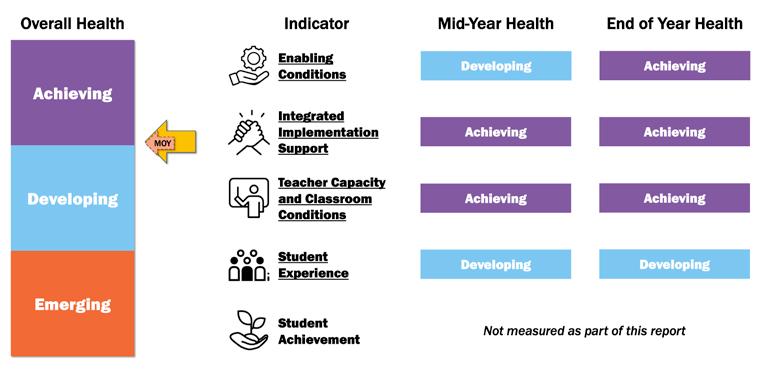
Together, these tools ensure that implementation is not just measured—it’s understood, celebrated, and continually strengthened.
The Implementation Success Portfolio is a comprehensive suite of resources to help leaders plan, reflect, and respond throughout the year. With their Success Lead, districts use these tools to turn insights into action.
The portfolio includes the following resources.

Research-Based Implementation Resources: handouts with guiding questions that deepen leaders’ understanding of implementation best practices and the Great Minds approach
Implementation Success Planning Workbook: an interactive and reusable workbook with templates for goal setting, action planning, and progress monitoring
Enabling Conditions Indicator Guides: detailed guides that define each enabling condition, provide practical examples, and address common challenges
These resources are used in partnership with a Success Lead throughout the year. This helps districts stay proactive and aligned. By turning implementation data into clear next steps, leaders and teachers can focus on what matters most—creating classrooms where learning flourishes.
Implementation success is a shared journey. Through hour-long virtual sessions, leaders and educators connect with peers from across the country. They share experiences, exchange ideas, and build collective expertise. These Professional Learning Networks foster collaboration and help teams translate knowledge into meaningful classroom practice.
In addition, districts engage in twice-monthly check-ins with their Great Minds Success Lead. These conversations ensure ongoing progress, address emerging challenges, and keep the focus on what matters most—supporting teachers and improving student learning every day.

Together, these continuous touchpoints ensure implementation is dynamic, supported, and sustainable.
From actionable data to strategic planning and collaborative learning, the Customer Success Program ensures districts can sustain success—year after year.
Partnering with Great Minds through the Customer Success Program means building the conditions for sustained student achievement. With expert guidance, actionable data, and a collaborative approach, districts can ensure that every classroom delivers on the promise of great instruction and great outcomes for all students.