LEADERSHIP • COMMUNITY • JUSTICE • ADVOCACY • ACCESS • TECHNOLOGY • YO U
Maryland
BAR JOURNAL MSBA. HOME OF THE LEGAL PROFESSION.
VOLUME 8 ISSUE 1
SUMMER 2026
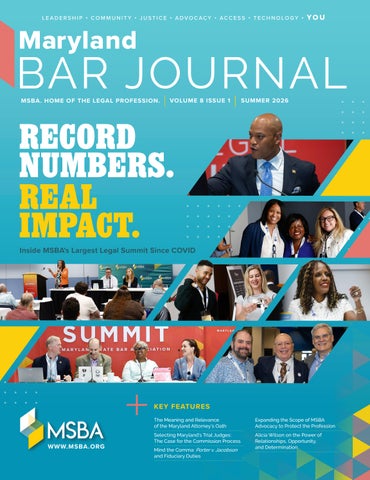
RECORD NUMBERS. REAL IMPACT.
Inside MSBA's Largest Legal Summit Since COVID
KEY FEATURES
WWW.MSBA.ORG
The Meaning and Relevance of the Maryland Attorney’s Oath
Expanding the Scope of MSBA Advocacy to Protect the Profession
Selecting Maryland’s Trial Judges: The Case for the Commission Process
Alicia Wilson on the Power of Relationships, Opportunity, and Determination
Mind the Comma: Porter v. Jacobson and Fiduciary Duties
8am solutions are trusted Member Benefits of the Maryland State Bar Association 8am.com/msba
Run your business. Power your practice.
+
Contents VOLUME 8 | ISSUE 1 | SUMMER 2026
24 Alicia Wilson on the Power of Relationships, Opportunity, and Determination
67 Mind the Comma: Porter v. Jacobson and Fiduciary Duties
111
70
Selecting Maryland’s Trial Judges: The Case for the Commission Process
Artificial Intelligence in the Practice of Family Law: A Useful Tool with Ethical Traps
MSBA UPDATES 4 6 12 14
President's Message 2026 Legal Summit 2025-2026 Bar Year Award Recipients The Honorable Anselm Sodaro Judicial Civility Award 15 Edward J. Gilliss Community Service Award 16 Access to Justice Commission Awards 18 100% Law Firms 19 Sustaining Members 20 Young Lawyers Section Charity Event 24 Fireside Chat: Alicia Wilson 62 Maryland Bar Foundation Grant Recipient 127 Staff Profile: Schuyler Zinser 128 Executive Director's Message: A Roadmap for MSBA’s Next Chapter HEALTH AND WELLNESS 82 How to Cope When Life Goes Off-Script INSIDE ANNAPOLIS 22 Expanding the Scope of MSBA Advocacy to Protect the Profession ARTIFICIAL INTELLIGENCE UPDATES 43 Using AI to Widen Perspective Without Borrowing Judgment 70 Artificial Intelligence in the Practice of Family Law: A Useful Tool with Ethical Traps CAREER HIGHLIGHTS 64 Senior Judge Stephen J. Sfekas 74 Larry S. Gibson ACCESS TO JUSTICE 26 The 2026 Fiscal Year In Review 30 Commissioner Profile: Erek L. Barron 32 An Urgent Call to Action for Maryland Attorneys as Immigration Enforcement Surges Member Spotlights
114
Women’s History Month: What is the Relevance of Gender in the Law Today?
DISCOVER MORE
48 McMillan, Metro, Faerber, P.C. 52 Kerri L. Smith 100 Don Quinn 122 In Memoriam: Remembering Those Who Have Passed 123 In Memoriam: Robert MacMeekin 124 In Memoriam: The Honorable Paul Rosenberg 125 In Memoriam: Kathleen Birrane
READ MORE ONLINE: Stay equipped and knowledgeable, every day. Visit MSBA.org for more exciting content.
MARYLAND BAR JOURNAL | VOLUME 8 ISSUE 1
1
MEMBER CONTENT COMMITTEE (2026-27 BAR YEAR)
IN-HOUSE EDITORIAL COMMITTEE
Publication Date: Summer 2026 Published three times a year by the Maryland State Bar Association, Inc. 3700 O' Donnell Street, Suite 200 Baltimore, Maryland 21224 Telephone: (410) 685-7878 (800) 492-1964 Website: www.msba.org Executive Director: Anna Sholl Managing Editor: Colleen Aracri Advertising Sales: Association Media Group Subscriptions: MSBA Members receive the digital edition of the Maryland Bar Journal as part of their annual membership. In addition, MSBA Members can opt to receive paper copies of the Maryland Bar Journal for an annual subscription cost of $10.
Natasha Nazareth, Emeritus Chair
Jessica Markham, Co-Chair
Corinne M. Pouliquen, Co-Chair
Anna Sholl, Executive Director
Rima Kikani, Vice Chair
Donald Quinn, Vice Chair
Mark Dimenna
Andrea Solan
Jessica Duvall
Hillary Evans
Travys Harvey
Andrea Terry
Lynette Kleiza
Ben Rupert
Dave Sidhu
Reena Shah
Eric Steiner
Sahmra Stevenson
POSTMASTER: Send address change to THE MARYLAND BAR JOURNAL 3700 O' Donnell Street, Suite 200 Baltimore, Maryland 21224 The Maryland Bar Journal welcomes articles on topics of interest to Maryland attorneys. Proposed articles can be submitted through the MSBA website at msba.org/content-portal. Advertising: Advertising rates will be furnished upon request. All advertising is subject to approval by the Editorial Advisory Board. Association Media Group 901 34th Avenue North, Suite 7064 St. Petersburg, FL 33734 Chad Slager Operations and Technology cslager@associationmediagroup.com Member Content Committee Corinne M. Pouliquen, Esq., Co-Chair Jessica Markham, Esq., Co-Chair MSBA Officers (2026-2027) President: Natasha Dartigue President Elect: Randolph Stuart Sergent Secretary: Erek Barron Treasurer: Natasha Marina Nazareth Photography: Profile photographs provided by Travis Marshall Photography unless otherwise noted. All writing submitted to the Maryland Bar Journal must be wholly original to the Author, not generated in whole or in part by generative artificial intelligence tools, and reflect the Author’s own independent analysis and judgment. The use of AI-assisted tools limited to grammar, spelling, or formatting is permitted, provided they do not contribute substantive content. Statements or opinions expressed herein are those of the authors and do not necessarily reflect those of the Maryland State Bar Association, its officers, Board of Governors, the Editorial Board or staff. Publishing an advertisement does not imply endorsement of any product or service offered.
2
MSBA.ORG | VOLUME 8 ISSUE 1
Colleen Aracri
Contents (continued)
UPHOLDING THE MARYLAND ATTORNEY'S OATH: KNOWING THE RULES, OWNING YOUR ROLE 106 Justice in the Margins: Contract Redlining as Collaborative Advocacy and Client Education 111 Selecting Maryland’s Trial Judges: The Case for the Commission Process 114 Women's History Month: What Is the Relevance of Gender in the Law Today? 118 The Meaning and Relevance of the Maryland Attorney’s Oath 120 Maryland Lawyers Have a Chance to Change Lives: 500 People Are Waiting
Committed to Your Success
FOR YOUR PRACTICE 35 The Admissibility of Other Acts Evidence Under Federal Rule of Evidence 404(B)(2) and Maryland Rule 5-403 39 Maryland Establishes a Study to Evaluate Blockchain-Based Real Property Lease and Title Recordation and Verification 50 Ethics on Vacation 55 Market Resiliency Amid Systemic Churn: Law School Graduate Employment and Associate Attrition in 2025 58 Not Quite a Member of the Family: Pets and Their Troublingly Ambiguous Status in Maryland Divorce Law 67 Mind the Comma: Porter v. Jacobson and Fiduciary Duties 76 The Evolution of Bar Admission: A Critical Shift in Character and Fitness Screenings 78 Is a Fee Increase on the Way for Court-Referred Mediators? 84 Roles in Adult Guardianship Cases 88 Cyberattacks on Law Firms Are Rising. Here’s What’s Driving Them. 91 The Rise of AI: Revolutionizing Tax Law and Beyond 95 Retirement Orders in Family Law: What Every Practitioner Needs to Know
No matter the legal practice, we are united by our passion for the work, meant to empower you, our client, to be the best version of yourself in any circumstance. Learn more at Venable.com
SEND US A MESSAGE!
MARYLAND STATE BAR ASSOCIATION @MDSTATEBAR @MARYLANDBAR
600 Massachusetts Ave., NW, Washington, DC Attorney advertising.
26-495
@MD_STATE_BAR Tell us your favorite part of the new Maryland Bar Journal on social media and using the hashtag: #MDBARJOURNAL MARYLAND BAR JOURNAL | VOLUME 8 ISSUE 1
3
PRESIDENT'S MESSAGE | INSIGHTS & UPDATES
The Moment Is Now: Building a Stronger, More Connected Maryland State Bar Association thing: the integrity of a system that millions of Marylanders depend on every single day. This year, we deepen those connections. We strengthen our sections through shared purpose, not siloed identity. We make clear that “the bar” is NOT a building in Baltimore; it is every one of you. We begin immediately. In June, we relaunched our Section Leadership Annual Training, rebuilt to create alignment, build confidence, and prepare every section leader to lead and to collaborate. Here is what I know about Maryland lawyers: We are not a profession in decline. We are a profession that has undersold itself. We have extraordinary talent across every practice area, every career stage, every corner of the state. We have infrastructure. We have institutions. We have each other. What we have sometimes lacked is the architecture to connect it all so every member feels that this association was built for them, not just around them. Because the future strength of this profession depends on three things being true at the same time: that we see ourselves as one profession, we hold ourselves to one standard, and that we commit ourselves to a rule of law that is not merely promised but fully realized. That is the work ahead of us. That is what this year is for. ONE PROFESSION I believe in sections. I believe in the specialized knowledge and community they create. But I also believe that a trial attorney in Garrett County and a transactional lawyer in Montgomery County are fighting for the same
ONE STANDARD I am the Public Defender. I have spent my career in courtrooms and communities where people’s lives turned on whether they had access to a lawyer—a lawyer who was present, prepared, and well. Well-being is not a soft topic. It is a professional standard. We will treat it as one. The Lawyer Assistance Program (LAP) is part of the Maryland State Bar Association (MSBA) and has done important work. But “call us when you’re in crisis” is not a wellness strategy. This year, we will formalize an early-intervention partnership between LAP and the Attorney Grievance Commission, so we reach lawyers before their breaking point, not after. We will also take the underrepresentation of women at the leadership table of this profession seriously. A profession that does not fully utilize its talent is a weaker profession. Full stop. This year, we name it, measure it, and build the pathways through our Profiles in Leadership initiative, Bar Leadership 101, and deliberate sponsorship. The future leadership of this profession should look more like the profession itself.
THE RULE OF LAW, FULLY REALIZED We are living in a moment that is testing the rule of law in ways many of us did not expect to see in our lifetimes. Access to justice is not a peripheral concern of this bar. It is the center. It is why we exist. Our responsibility is not merely to defend the rule of law when it is challenged but to strengthen public confidence in it when it is doubted. This fall, we will publish the first MSBA Annual Advocacy Impact Report. It is a concrete accounting of our work and our wins translated into real member and public value. If we are doing the work, the people we serve should be able to see it. The future of our profession will not be shaped only by courts and legislatures. It will also be shaped by technology. This summer, we will also launch MSBA’s Artificial Intelligence (AI) Certification Program, positioning MSBA as Maryland’s authoritative voice on legal technology and artificial intelligence. The lawyers who shape how AI is used in this profession should be us, not tech vendors, not default settings, not whoever gets there first. I became a lawyer because I believed the law could make people’s lives better. Thirty years later, I still do. I am still trying to make lives better in this office, with MSBA, alongside each of you. One profession. One standard. The rule of law, fully realized. The moment is NOW. LET’S GET TO WORK.
Natasha M. Dartigue, President 4
MSBA.ORG | VOLUME 8 ISSUE 1
Claim Your FREE Smokeball Bill
Trust Accounting & Billing Software Included in your MSBA membership, Smokeball Bill helps law firms manage trust accounting compliantly, bill easily, and get paid faster.
Scan to get FREE Smokeball Bill or visit: smokeball.com/marylandbill
Smokeball is the trusted provider of legal practice management software to small and mid-size firms. MARYLAND BAR JOURNAL | VOLUME 8 ISSUE 1
5
Learning | Fellowship | Insight The classes offered at the Legal Summit spanned the entire spectrum of our profession. The sessions delivered hard, practical skills directly applicable to your practice.
6
MSBA.ORG | VOLUME 8 ISSUE 1
ELEVATING OUR PRACTICE, TOGETHER. With over 80 accredited CLE sessions spanning every practice area, the Legal Summit helped us sharpen our practical tools and skills. From mastering new trial strategies to navigating the ethics of artificial intelligence in the workplace, the classrooms offered interactive instruction led by the state's top legal minds.
MARYLAND BAR JOURNAL | VOLUME 8 ISSUE 1
7
Learning | Fellowship | Insight STRENGTHENING COMMUNITIES True community isn’t built over email; it happens around tables, in classrooms and at receptions overlooking the bay. Whether it's the packed first-time attendee mixer, sharing thoughts at a plenary session, or catching up at social events with colleagues, the Legal Summit offered space to recharge and reconnect.
8
MSBA.ORG | VOLUME 8 ISSUE 1
From law students finding their first mentors to seasoned practitioners exchanging stories at networking events, the energy attendees brought to the Legal Summit proved our network is vibrant and thriving.
MARYLAND BAR JOURNAL | VOLUME 8 ISSUE 1
9
Learning | Fellowship | Insight
Our profession moves fast, especially as new technology outpaces current statutes. The Legal Summit provided perspectives on changes that impact how we practice law, ensuring Maryland firms remain incredibly resilient. 10
MSBA.ORG | VOLUME 8 ISSUE 1
THOUGHT LEADERSHIP Thought leadership isn't just about reacting to the current legal landscape, it's about anticipating the road ahead. From legislative town halls tackling tax proposals to deep dives into data privacy and judicial security, the Legal Summit equipped Maryland practitioners with the foresight needed to lead. We left Ocean City not just with continuing legal education credits, but with a better understanding of what lies ahead for our profession.
MARYLAND BAR JOURNAL | VOLUME 8 ISSUE 1
11
MSBA UPDATES | MEMBER RECOGNITION
2025-26 Bar Year Award Recipients The Maryland State Bar Association extends its sincere gratitude and congratulations to the remarkable award recipients of the 2025-2026 bar year. Through their unwavering dedication, these volunteers embody the very best of our profession and continue to elevate the Maryland legal community.
12
MSBA.ORG | VOLUME 8 ISSUE 1
PRESIDENTIAL AWARDS IMMIGRATION SECTION Presidential Best Section Project Award to Benefit the Public
REAL PROPERTY SECTION
MICHAEL D. STEINHARDT, ESQ.
Presidential Best Section Project Award to Benefit the Bar
Presidential Outstanding Service Award
SECTION AWARDS CECILIA B. PAIZS, ESQ.
ROBERT “JAY” SMITH, JR.
CHAUNCEY BELLAMY
Chief Judge Robert M. Bell Award
The James J. Hanks, Jr. Lifetime Achievement Award
Steven J. Mandel Scholarship
ALTERNATIVE DISPUTE SECTION
BUSINESS LAW SECTION
BUSINESS LAW SECTION
JOHN C. SCHROPP, ESQ.
ARNOLD M. WEINER, ESQ.
GLENN M. COOPER, ESQ.
The Alan J. Belsky Award
The Robert C. Heeney Award
Litigator of the Year
CONSUMER BANKRUPTCY SECTION
CRIMINAL LAW & PRACTICE SECTION
LITIGATION SECTION
THE HONORABLE YVETTE M. BRYANT
NANCY HAAS
LAUREN E. LAKE, ESQ.
Distinguished Maryland Real Property Practitioner
Melody Tagliaferri Cronin Award
REAL PROPERTY SECTION
YOUNG LAWYERS SECTION
PAUL J. REINSTEIN
KELLY SCHULTE
ROBB A. LONGMAN, ESQ.
Beverly Ann Groner Family Law Award
Marc C. Noren Award
The J. Ronald Shiff Memorial Pro Bono Award
The Honorable Glenn T. Harrell, Jr. Award for Judicial Excellence LITIGATION SECTION
FAMILY LAW SECTION
FAMILY LAW SECTION
DAVID J. POLASHUK, ESQ. The Tax Excellence Award TAXATION LAW SECTION
TAXATION LAW SECTION
MICHAEL CANTRELL, ESQ. LAURA MARGULIES, ESQ. GARY ROSEN, ESQ. Outstanding Service, Dedication and Commitment to the Legal Profession and Consumer Bankruptcy CONSUMER BANKRUPTCY SECTION
MSBA UPDATES | MSBA IN THE COMMUNITY
MSBA Honors Commitments to Judicial Civility and Community Service The Honorable Anselm Sodaro Judicial Civility Award THE MARYLAND STATE BAR Association (MSBA) presents the Honorable Anselm Sodaro Judicial Civility Award annually to a sitting member of the Maryland bench who consistently models an exceptional judicial temperament, professional courtesy, profound civility to all litigants, attorneys, and staff who enter the courtroom. Judge Sodaro firmly believed that while a jurist must fiercely protect courtroom control and procedural order, it must always be executed in a manner that honors human dignity and avoids demeaning practitioners or public participants. MSBA presented the 2025-2026 Sodaro Judicial Civility Award to The Honorable Dennis P. Robinson, Administrative Judge for the Circuit Court for Baltimore County. Since his appointment to the bench in 2016, and his elevation to administrative judge in 2023, Judge Robinson has been a transformative leader, implementing critical courthouse policies that streamline protective order dockets, and securing funding for an advanced jury assembly area that prioritizes the comfort and privacy of the public. He is widely celebrated as one of the most intelligent, compassionate, and patient jurists in the State of Maryland. He approaches every matter with unwavering diligence and maintains an identical respectful demeanor toward everyone who enters his courtroom. Whether engaging with a pro se litigant or a senior partner from a prestigious firm, Judge Robinson treats every regular citizen and seasoned lawyer with equal dignity, ensuring that everyone receives his full attention, careful consideration, and utmost respect.
14
MSBA.ORG | VOLUME 8 ISSUE 1
Edward J. Gilliss Community Service Award THE EDWARD J. GILLISS COMMUNITY SERVICE Award honors Gilliss’s extraordinary commitment to civic engagement. The Maryland State Bar Association (MSBA) was a grateful beneficiary of much of Gilliss’s volunteer time and expertise over the years, including his leadership as a past president, and proudly created this award as an enduring remembrance. MSBA presents this award annually to an MSBA member who embodies the same spirit of dedication to community service that Gillis exemplified. MSBA granted the 2025-2026 Edward J. Gilliss Community Service Award to Danielle Moore. Moore, an assistant public defender in Montgomery County, demonstrates an extraordinary commitment to bettering her community and serving others. She has organized multi-county expungement clinics, coordinated coat drives for recently released offenders, and volunteered her expertise in areas like family law, foreclosure prevention, and estate planning for first responders. Moore, as the leader of the legal ministry at Clifton Park Baptist Church, spearheaded Know Your Rights and immigration panels. She has also coached high school debate and mock trial teams, helped fundraise for international STEAM camps, and created a mentorship pipeline for women law students of color. Additionally, she has led workplace wellness sessions, founded an initiative to deliver care packages to the homeless, organized a lupus walk, coordinated an adopt-a-family holiday donation for survivors of domestic violence, and spearheaded a breast cancer awareness project that earned her the Franklyn Bourne Association Community Service Award.
UPCOMING
EVENTS AUG 13
AUG 19
SEPT 10
OCT 22
OCT 27
NOV 12
Family Practice Update
40-Hour Basic Mediation Training
Maryland Guardianship Training
Small and Solo Firm Symposium
Probate Mediation Training
Maryland Evidence Bootcamp
MARYLAND BAR JOURNAL | VOLUME 8 ISSUE 1
15
MSBA UPDATES | MSBA IN THE COMMUNITY
Access to Justice Commission Awards
Maryland Access to Justice Commission Grants Access to Justice Legend Award to Ward B. Coe, III
16
MSBA.ORG | VOLUME 8 ISSUE 1
THE MARYLAND ACCESS TO JUSTICE COMMISSION (A2JC) proudly honored former chair Ward B. Coe III with the Access to Justice Legend Award, celebrating his unparalleled, lifelong dedication to civil justice. Driven by the conviction that legal representation is a fundamental right, Coe stands as the ultimate exemplar of an elite private practitioner who relentlessly pursues the public good. As the longtime leader of both A2JC and the Court of Appeals Standing Committee on Pro Bono Legal Service, his visionary advocacy transcended individual cases to champion landmark statewide reforms, including expanded civil legal aid funding and Maryland's historic access to counsel in evictions program.
Maryland Access to Justice Commission Names Its Leadership Award After Its Retiring Chair IN 2025, THE MARYLAND ACCESS TO JUSTICE Commission gave its inaugural Access to Justice Leadership Award to Senator Shellie Hettleman for her tremendous advocacy in securing additional funding for the access to counsel in evictions law. In 2026, to mark the exceptional service of its long-time chair, A2JC renamed its Leadership Award to the Ward B. Coe, III Access to Justice Leadership Award. In the future, this prestigious honor will be awarded to an extraordinary individual who makes a significant contribution to advancing civil justice for all in Maryland. Awardees will demonstrate a history of fearless advocacy for marginalized populations, a track record of driving systemic and structural legal reforms, visionary leadership in ensuring access to justice for all, and hold the highest levels of professional excellence and integrity.
In 2026, the Access to Justice Commission was proud to present the inaugural Ward B. Coe, III Access to Justice Leadership Award to Ama S. Frimpong, Legal Director at We Are CASA. Frimpong is a nationally recognized champion for immigrant justice who powerfully bridges high-stakes litigation and grassroots activism. Since joining the organization in 2022, she has spearheaded landmark constitutional challenges to defend temporary protected status and birthright citizenship, while leading successful efforts to dismantle local law enforcement collaboration with ICE. From her previous leadership protecting detained individuals at the CAIR Coalition to her
current role on the powerhouse legal team for Kilmar Abrego Garcia’s nationally significant worker-justice case, Frimpong has dedicated her career to turning courtroom battles into enduring systemic victories for Black, Brown, and immigrant communities. During the 2026 legislative session, she was a driving force in leading a coalition to abolish 287(g) Agreements and pass the Community Trust Act.
The Maryland Bar Foundation Honors Ward B. Coe, III with the H. Vernon Eney Endowment Fund Award IN A COMPELLING INTRODUCTION, REENA SHAH, Executive Director of the Maryland Access to Justice Commission, presented the prestigious H. Vernon Eney Endowment Fund Award to Ward B. Coe, III, reflecting on their decade-long partnership and his transformational impact on the state's legal system. Shah highlighted Coe's extraordinary career milestones, including his pivotal investigation into the historic savings and loan crisis, his overhaul of Maryland's child welfare system through the landmark L.J. v. Massinga lawsuit, and his creation of the administrative framework that normalized the state’s 50-hour annual pro bono attorney target. She also praised his visionary leadership as A2JC chair, where he co-convened the COVID-19 Access to Justice Task Force to secure vital civil legal aid funding and champion statewide tenant rightto-counsel programs. Beyond these monumental systemic victories, Shah emphasized that what truly makes Coe deserving of the honor is his rare ability to be a "complete person in the law,” proving that an attorney can maintain an elite private practice while remaining a deeply compassionate, accessible mentor who treats legal representation as a fundamental right and lives a vibrant, purpose-driven life. MARYLAND BAR JOURNAL | VOLUME 8 ISSUE 1
17
MSBA
LAW FIRMS 100% OF THE LAWYERS at these Maryland law f irms and branch off ices
renewed their MSBA memberships for the 2025-26 and 2026-27 Bar years. MSBA is grateful for their commitment to MSBA’s leadership in the legal profession, Annapolis advocacy, and increasing access to justice in Maryland and beyond.
PANTONE 7698 C PANTONE Black C
The firms listed here are 100% Law Firms as of July 1, 2026, when this issue went into production. Firms joining this list after that date will appear in the next issue, which will publish in November 2026. The 100% Law Firm program is available to Maryland law firms or branch offices with 10 or more attorneys. For more details please contact MSBA Director of Membership, Bob Bershad, at bob@msba.org or 443.703.3011.
2025-2026 AND 2026-2027 BAR YEARS
SUSTAINING MEMBERS Kevin Andrews KJA Law Dov Apfel Levin & Perconti Prof. Michael Bakhama Nusinov Smith, LLP Joan Bondareff Blank Rome LLP Benjamin Boscolo ChasenBoscolo Injury Lawyers David Dix Craig Grabo DuBoff & Associates Chartered
Alfred Mattingly Bryan Mobley Mobley & Brown LLP Heather Mulloy Jennifer Obasi Rafael Petrone Cole, Mink, & Fransella PLLC Naly Rice Altairzen LLC Lilah Rosenblum Lichtman & Rosenblum PLLC Cortney Smothers
Craig Holcomb Holcomb & Straile LLC
Candice Spalding Spalding Law Group
Peter Holland Holland Law Firm PC
John Warshawsky
Katherine Howard Regional Management, Inc.
David Wildberger Iliff, Meredith, Wildberger & Brennan, P.C.
As the leading voice for Maryland’s legal community, MSBA is dedicated to advocating for the legal profession,
Damani Ingram Ingram Firm LLC
Nathan Willner National Creditors Bar Association (NCBA)
Jacob Keith
Lawrence Wilson
and championing the core values
William Kiniry, III DLA Piper LLP
Luke Woods
of a just and ethical legal system.
David Lacki Lacki & Company LLC
Sean Woolums College Living LLC Haixia Yang
The members listed here are sustaining members as of July 1, 2026, when this issue went into production. For more details please contact MSBA Director of Membership, Bob Bershad, at bob@msba.org or 443.703.3011.
providing comprehensive services and resources for our members,
Sustaining members of the MSBA play a vital role in upholding and advancing our mission. Their support aids MSBA's efforts in promoting professionalism, fostering diversity in the legal profession, expanding access to justice, encouraging service to the public, and upholding respect for the rule of law. By investing in the MSBA, sustaining members directly contribute to the ongoing development and strength of the Maryland legal profession. To become a sustaining member, please select this option when you renew your MSBA Membership. Thank you. MARYLAND BAR JOURNAL | VOLUME 8 ISSUE 1
19
MSBA UPDATES | MSBA IN THE COMMUNITY
Young Lawyers Section Charity Event Benefits Disability Rights Maryland THE YOUNG LAWYERS SECTION'S
annual charity event blended a commitment to service with an evening of networking and fun. Held at the Baltimore Museum of Industry, this year's event raised funds for Disability Rights Maryland, an organization that works towards an integrated and just society by advancing the legal rights of people with disabilities. Disability Rights Maryland helps people with disabilities pursue opportunities to participate fully in all aspects of community life, and champions their rights to self-determination, dignity, equality, opportunity, and freedom from discrimination and harm. The total amount raised for Disability Rights Maryland was $38,000. The Young Lawyers Section thanks the following sponsors for their generous support of the event.
PLATINUM SPONSOR
GOLD SPONSORS
FRIENDS
BRONZE SPONSORS
MARJORIE WAX AND BRIAN HOCHHEIMER 20
MSBA.ORG | VOLUME 8 ISSUE 1
SILVER SPONSORS
HON. BARBARA KERR HOWE
Disability Rights Maryland works towards an integrated and just society by advancing the legal rights of people with disabilities.
MARYLAND BAR JOURNAL | VOLUME 8 ISSUE 1
21
INSIDE ANNAPOLIS | LEGISLATIVE RECAP
Expanding the Scope of MSBA Advocacy to Protect the Profession BY SHAOLI SARKAR, ESQ.
THIS YEAR, THE MARYLAND STATE BAR ASSOCIATION (MSBA) continued to advocate
on behalf of the legal profession in Annapolis, successfully preventing any new fees or taxes that impact attorneys, developing and passing legislation to allow expedited business filings, strengthening court security standards and investigations of threats against judges, and upholding the rule of law and access to courts. While MSBA’s state advocacy and connections with Maryland lawmakers are an important part of our mission, our role in serving as the voice of the legal profession is also essential at the federal level.
22
MSBA.ORG | VOLUME 8 ISSUE 1
MSBA SUCCESSFULLY
prevented any new fees or taxes THAT IMPACT ATTORNEYS
While MSBA’s state advocacy and connections with Maryland lawmakers are an important part of our mission, our role in serving as the voice of the legal profession is also essential at the federal level. MSBA
strengthened court security standards and investigations of
THREATS AGAINST JUDGES In April, we protected the autonomy of our profession and trust in the courts by responding to the Department of Justice’s Proposed Rule for Review of State Bar Complaints and Allegations Against Department of Justice (DOJ) Attorneys. The proposed framework would prevent current and former DOJ attorneys from being investigated by state bar disciplinary authorities for misconduct or ethical violations and would dilute the integrity of the legal system, interfere with the authority of the Supreme Court of Maryland to regulate the practice of law, and create a professional conflict of interest for DOJ attorneys. MSBA responded by activating our advocacy network and drafting and filing formal comments urging immediate withdrawal of the rule. Through a sign-on initiative and advocacy alerts, 172 attorneys and 19 law firms and organizations joined MSBA’s opposition, including Gallagher LLP, Goodell, DeVries, Leech & Dann, LLP, Maryland Legal Aid, and the Baltimore County Bar Association. MSBA’s comments and signatories sent a clear message regarding the collective strength of the legal profession in upholding the rule of law and ethical standards, and in preserving public trust. In our comments, we affirmed the commitment to the rule of law, administration of justice, and professional accountability: “The Proposed Rule would directly contradict and
DISCOVER MORE
interfere with the established authority of state courts to regulate attorneys…. [and] would prevent DOJ attorneys from timely fulfillment of their ethical requirements at the state level . . . Admission to the bar is based on a commitment to the rule of law and a code of ethics, personal to each attorney and independent of one’s employer.” MSBA also proactively and intentionally connects with our federal representatives to further our legislative priorities. During our federal advocacy meetings with the American Bar Association (ABA) in Washington, D.C., this spring, MSBA met with Maryland congressional representatives to ensure that the challenges facing our members and the clients we serve remain part of the federal dialogue. We had meaningful conversations regarding federal funding for legal services and federal public defenders, preserving attorney-client privilege in digital communications, and improving judicial security resources and tracking. Taking our advocacy to Washington, D.C., ensures that MSBA is not only reacting to federal proposals but actively shaping the policies that govern our profession nationwide. MSBA’s strength is in the collective action and unified voice of our members. We remain thankful for and open to your expertise and commitment to advocacy through our sections and committees as we continue our work across the state and in Washington, D.C.
For more information about MSBA and advocacy, visit msba.org/advocacy. Share your voice with us by contacting advocacy@msba.org. MARYLAND BAR JOURNAL | VOLUME 8 ISSUE 1
23
FIRESIDE CHAT |
ALICIA WILSON
Alicia Wilson on the Power of Relationships, Opportunity, and Determination
The Maryland State Bar Association (MSBA) Legal Summit brought together legal professionals from across the state to connect, learn, and gain insight from industry leaders. A highlight of the event was an engaging discussion between then-MSBA President Marisa Trasatti and Alicia Wilson, Vice President for Civic Engagement and Opportunity at The Johns Hopkins University. Touching on the power of relationships, opportunity, and determination, the conversation mapped Wilson’s remarkable professional journey. Embracing Opportunity: From Law Links Intern to Partner Trasatti began by questioning Wilson about her earliest exposure to the legal profession. Wilson, a first-generation lawyer, got her start through the MYLaw Law Links Internship program as a 15-year-old high school student. Reflecting on her initial introduction to the legal world, Wilson noted the profound impact it had: I’m forever grateful to the Law Links program. An upperclassman told me about this program and that it led to working in a law firm for the summer, and it was really cool. I signed up, and that program exposed me to the law, it exposed me to leaders in the law, and ultimately, it showed me what I could do to be a powerful individual. That early opportunity sparked Wilson’s drive and determination. Wilson went on to become the first African American partner at
24
MSBA.ORG | VOLUME 8 ISSUE 1
“
If you want to ultimately strike a chord in the community and be a civic leader, that’s why you come to the law: to use this tool to ultimately change lives, change communities, change neighborhoods, and ultimately, hopefully, change history.
Gordon Feinblatt LLC. She emphasized that her mentors at the firm taught her that practicing law is about much more than making money. If you want to ultimately strike a chord in the community and be a civic leader, that’s why you come to the law: to use this tool to ultimately change lives, change communities, change neighborhoods, and ultimately, hopefully, change history. That sort of upbringing really formed me and helped me never feel like I was not in the public sector, even though I was in private practice, because it was woven into how I conducted myself as an attorney. Impact Beyond the Courtroom: The Transition Out of Private Practice Trasatti then talked to Wilson about her decision to transition from private-practice litigation to in-house corporate and institutional roles. For an attorney who had a fire in her belly for litigation, leaving the courtroom seemed unexpected. However, Wilson explained that the underlying skill set of an effective litigator, problem-solving, building strategic alignment, and executing a vision, allowed her to adapt well to large-scale project leadership. She talked about her bridge out of private practice, the Port Covington redevelopment deal. At the time, observers viewed the complex project skeptically as a likely “loss,” but Wilson approached it from the perspective of a trial attorney. She shared, “While it didn’t feel like a litigation case, certainly that project was on trial. The city and its residents were the jurors, and ultimately, I had to make a case. It took bringing in people, knowing your allies, converting people who were against you, striking a balance, having a principle, and driving toward an outcome.” Wilson noted that her role in the project was similar to that of a trial attorney. ”You have your client, you have an outcome you’re trying to achieve, and it’s all about how you maneuver yourself while staying true, being truthful, and driving toward the result.”
The Power of Relationships Throughout the chat, Wilson repeatedly returned to her core philosophy: while intelligence and talent are necessary, relationships are the key elements to a successful life and career. She noted, “For me, the navigation of a law firm, the navigation of a large organization, fundamentally goes to the relationships that are going to allow for you to make hard things easy.” Wilson shared a poignant childhood lesson taught to her by her grandmother, who worked as a school custodian. Her grandmother recalled that while certain people took the time to learn the names of her children and grandchildren, others didn’t even bother to learn her name. This shaped Wilson’s people-first approach to corporate leadership: “I knew that I wanted to be the person who knew the grandchild’s name. I didn’t want to be the person who was known as someone who just walked past and discarded people and didn’t think they were worth knowing.” Whether navigating a major law firm or corporate boardrooms, Wilson advised younger lawyers to build these relationships early and authentically, well before they ever need to ask for a favor. Determination in a Changing Landscape: The Future of AI and Law As the conversation shifted toward the future of the legal profession, Trasatti asked Wilson about the looming impact of artificial intelligence (AI). Rather than expressing fear, Wilson expressed her belief that while AI is a powerful tool, it cannot replicate human connection. She noted, “We are going to get the freedom of time, and then you are going to have to choose how you spend it, and it’s still going to be about people. Everybody’s going to get to be able to touch an AI button and touch a thing and make it happen. They’re not going to be able to form relationships.” Wilson challenged the next generation of lawyers to reject the urge to isolate behind screens and instead double down on social and civic engagement. MARYLAND BAR JOURNAL | VOLUME 8 ISSUE 1
25
ACCESS TO JUSTICE COMMISSION | UPDATE
THE 2026 FISCAL YEAR IN REVIEW:
A2JC Forges an Accessible, Equitable, and Fair Civil Justice System “JUSTICE FOR ALL” IS A FUNDAMENTAL PROMISE,
yet for hundreds of thousands of Marylanders forced to navigate the civil legal system alone, it often remains out of reach. In fiscal year 2026, the Maryland Access to Justice Commission (A2JC) took bold, strategic steps to bridge this gap, actively transforming the civil justice landscape to protect human dignity, preserve livelihoods, and disrupt cycles of systemic poverty and inequity. This article highlights a transformative period of innovation, advocacy, and renewed vision for A2JC. Here, we showcase the pivotal milestones that highlight the Maryland Access to Justice Commission’s unparalleled value and unique contributions in fiscal year 2026.
26
MSBA.ORG | VOLUME 8 ISSUE 1
In fiscal year 2026, the Maryland Access to Justice Commission: USHERED IN A NEW ERA OF LEADERSHIP At the conclusion of this fiscal year, we welcomed Erek L. Barron as the new chair of A2JC, succeeding Ward B. Coe’s transformative 10-year legacy. Barron brings over two decades of distinguished public service and legal leadership to the role. Most recently, as the first African American U.S. Attorney for the District of Maryland, he spearheaded significant civil rights, community safety, and government accountability initiatives. A steadfast advocate for expanding access to justice, Barron has championed legal equity through leadership roles with the Maryland State Bar Association, Maryland Legal Aid, and the Office of the Public Defender. His comprehensive expertise spans every level of Maryland’s legal system, including service as a federal prosecutor, state legislator, trial attorney, and national policy adviser.
DEVELOPED A STRATEGIC FRAMEWORK FOR CHANGE Justice for all is a value our society holds dear, yet it often rings hollow for the hundreds of thousands of Marylanders forced to navigate the civil legal system alone. When Marylanders are empowered to resolve their civil legal problems, they are safeguarded against devastating life disruptions, enabling them to meet basic human needs, maintain family stability, and preserve their livelihoods.
UNITE CHANGEMAKERS: We convene stakeholders, build consensus, and cultivate a climate ripe for system-wide reform.
To actively disrupt cycles of poverty and systemic inequity, the A2JC worked over the past year to crystallize a bold theory of change. This strategic framework ensures our work is grounded in achieving our vision and that we invest in four definitive strategies that make A2JC’s work unique among other access to justice organizations in the state. These strategies include:
CATALYZE INNOVATION: We spark momentum by introducing innovative solutions to close the state’s access-to-justice gap.
CULTIVATE EXPERTISE: We serve as Maryland’s central hub for research, data, and thought leadership, utilizing evidence to identify intervention points and build public awareness.
DRIVE REFORM: We advocate for system-wide improvements by educating leaders and changing laws, court rules, and policies.
CONCLUDED THE WORK OF THE INNOVATIONS IN TIERED LEGAL SERVICES TASK FORCE A2JC was one of the key partners in the Innovations in Tiered Legal Services Task Force (Task Force), with the Maryland Judiciary and Maryland State Bar Association. A2JC staffed the Task Force to conclude a 20-month deep examination of the use of allied legal professionals and legal technologies as a solution to closing the access to justice gap. As an interim measure, the Task Force published the first-ever comprehensive review of the existing use of Allied Legal Professionals in Maryland through the 2026 Audit Report.
DELIVERED THE FUTURE ROADMAP FOR ACCESS TO COUNSEL IN EVICTIONS (ACE) PROGRAM
We helped publish the fifth and final ACE Task Force Report, marking a historic transition. After four years of visionary leadership, Executive Director Reena Shah stepped down as ACE Task Force chair, but not before laying out a definitive roadmap for the program's future. This roadmap secured the Task Force’s successful transition to the Department of Housing and Community Development and laid the groundwork for the permanent, stable funding needed to keep Marylanders in their homes.
The report revealed critical findings: Allied Legal Professionals (ALPs) are already authorized in over 15 types of state proceedings and can operate successfully in at least 15 federal agencies. There was no reported consumer harm or negative impact on attorney livelihoods. The report proves that introducing carefully tailored, formalized legal service tiers—such as community justice workers and legal practitioners—is a highly effective, safe, and necessary innovation to shrink Maryland’s justice gap. A final report of the Innovations Task Force will be delivered in fiscal year 2027.
SPEARHEADED BROAD PUBLIC AWARENESS WITH THE EMPOWERED VIDEO PROJECT A2JC successfully launched the Empowered educational video project alongside a dynamic social media campaign to expose the realities of the civil justice gap. In a monumental triumph for A2JC, this compelling project secured national distribution, airing on public television stations across all 50 states and reaching a potential audience of 60 million households.
MARYLAND BAR JOURNAL | VOLUME 8 ISSUE 1
27
HIGHLIGHTED CONNECTIONS BETWEEN CIVIL LEGAL AID AND BASIC HUMAN NEEDS THROUGH DATA VISUALIZATIONS IN A STORY MAP To illuminate the connection between civil legal aid and basic human needs and highlight the impact of the crisis of self-representation, A2JC published an interactive story map that masterfully weaves in-depth data with compelling storytelling. Through in-depth data curation and visually compelling maps, this project makes a strong case for why civil legal aid is not just a legal issue but a critical tool for fulfilling basic human needs such as housing, food security, and personal safety.
A2JC’s Public Interest Law Committee published the first-ever People's Guide, a groundbreaking, plain-language translation of the laws passed during the 2026 Maryland Legislative Session that were led or supported by the access to justice community.
DOCUMENTED COLLECTIVE IMPACT AND MADE IT EASIER FOR EVERYDAY MARYLANDERS TO UNDERSTAND THE LAWS THAT IMPACT THEM
EQUIPPED DECISION MAKERS WITH FACTS ABOUT HOW THE CIVIL JUSTICE SYSTEM IMPACTS EACH OF MD’S JURISDICTIONS
To drive data-informed policymaking, we aggregated critical civil justice statistics into highly accessible state and county one-pagers for the State of Maryland and all 24 individual jurisdictions. These tools equip elected officials with a clear view of how the civil justice system impacts their specific constituents.
28
MSBA.ORG | VOLUME 8 ISSUE 1
A2JC’s Public Interest Law Committee published the first-ever People's Guide, a groundbreaking, plain-language translation of the laws passed during the 2026 Maryland Legislative Session that were led or supported by the access to justice community. By stripping away complex legal jargon, this guide serves as a way for everyday Marylanders to easily understand and exercise their newly legislated rights, and as a demonstration of the collective impact of the access to justice community.
CONTINUED TO BUILD A PUBLIC INTEREST LAW COMMUNITY WITHIN THE MARYLAND STATE BAR
To create a space for all public interest-minded attorneys and allied legal professionals and supporters of access to justice to form meaningful connections and celebrate our collective work and impact, we hosted a spring Spark Social and the beloved MSBA Legal Summit “Pizza Party.”
MARYLAND BAR JOURNAL | VOLUME 8 ISSUE 1
29
ACCESS TO JUSTICE |
COMMISSIONER PROFILE
Erek L. Barron Access to Justice Is the Ability to Make Rights Usable The Maryland Access to Justice Commission (A2JC) is proud to celebrate the election of Erek L. Barron as its new chair. A deeply respected figure across the state’s legal landscape, Barron steps into this vital leadership role at a time of critical need. Notably, Barron is the first A2JC chair to also serve in the Maryland State Bar Association (MSBA) leadership; he hopes to use his dual roles to strengthen the partnership between the organizations and to position access to justice at the center of the bar’s agenda.
A Career Shaped by Every Corner of the Legal System Barron’s journey to the helm of the Access to Justice Commission covered a broad spectrum of legal and legislative work. His impressive career includes serving as a prosecutor in Prince George’s County and Baltimore City, a trial attorney at the U.S. Department of Justice, counsel and crime policy adviser to the U.S. Senate Judiciary Committee, and a member of the Maryland House of Delegates. Recently, he completed a historic tenure as United States Attorney for Maryland, the first Black person to hold the position. Yet, despite his storied career, Barron’s commitment to access to justice is deeply personal. As a young child, he and his mother directly benefited from public interest legal assistance. 30
MSBA.ORG | VOLUME 8 ISSUE 1
“
A justice system that works only for people who can afford it is not a real justice system, but rather a service for those who can pay. Access to justice is ultimately about closing that gap.
“My mom and I received help through a domestic situation from a couple of legal aid lawyers,” Barron recalls. “But for that help, I might not be here today. I was only about four years old, but that experience stuck with me. I learned early that the law is a powerful tool and that lawyers can use it to help people and families.” Now, following a return to private practice, Barron sees his appointment as A2JC chair as life coming full circle. He noted that at every stage of his professional journey, “I’ve focused on whether and how the law is truly available to everyone. The commission is where those questions live, so this role brings together the work I’ve been doing throughout my career.” Answering the Call to Serve When asked about the timing of taking on this leadership role following his departure from public service, Barron shared that the urgency of the moment demanded it. “The health care, housing, and socioeconomic challenges facing many Marylanders are harder than ever for the communities that can least withstand it,” Barron stated. He also brings to the role a network that spans the bench, bar, legislature, business, and philanthropy. In an era marked by socio-political disruption, Barron believes leadership requires anchoring to immovable core principles rather than chasing every headline. “Those we serve depend on us to be the steady ship,” he emphasized. “If we stick to the mission and build broad coalitions, the work won’t rise or fall with any single administration or budget cycle.” Redefining Access to Justice For Barron, access to justice is not an abstract concept or a set of aspirational ideals; it is an operational necessity. He views an inaccessible court system as a threat to the integrity of the law itself. “The law’s promises are only as real as its availability,” Barron asserted. “We have a system full of rights, but a right you can’t enforce is just words on a page. So, access to justice is the ability to make those rights usable, including in the civil courts where the stakes are home, health, and family, regardless of station in life.” He added that “a justice system that works only for people who can afford it is not a real justice system, but rather a service for those who can pay. Access to justice is ultimately about closing that gap.”
Framing the Call to Action for Private Practitioners and Pro Bono Work Barron’s calls on private practitioners, corporate counsel, and large law firms to engage in pro bono work and to support civil legal aid. He firmly rejects the idea that expanding legal access is optional or a secondary concern for successful firms, stating that this is not charity or something extra, but rather who we say we are. Barron notes that “our profession’s own ideals and rules already encourage pro bono work and support for legal services,” so he is simply asking the legal community to live up to a commitment it has already made. He emphasized that this can mean pro bono, but it also means resources, expertise, and leverage. Barron challenges the business side of law to integrate this work in a fundamental way, noting that law firms can treat access to justice as core to their mission rather than as a line in a glossy report. He also states that corporate counsel can use their considerable influence to move the companies and markets they touch, while the entire profession can help fund and build the infrastructure that puts help within reach. Reflecting on his own time in private practice, first as a solo practitioner and then at a larger firm, Barron shared, “I saw how affordability can be a barrier to quality legal service—but also how civil practitioners can help fill those gaps, including through pro bono work. Successfully representing a client on death row, pro bono, changed my life, personally and professionally.” He advises young attorneys and law students not to wait for a perfect public-interest job before starting to serve. He encourages them to take on that pro bono case or join a board because doing so consistently over a career will ultimately change more than any single job could. As Barron puts it, “The law gives lawyers power, and the only question is what they will do with it.” Balance, From Scratch For Barron, maintaining health and balance despite the stress of the legal profession requires a daily calibration, but he tries to stay physically active and take time to decompress. His hobbies include cooking and baking, “preferably from scratch.” Lately, he has been working on the perfect pancake recipe.
MARYLAND BAR JOURNAL | VOLUME 8 ISSUE 1
31
ACCESS TO JUSTICE | IMMIGRATION
An Urgent Call to Action for Maryland Attorneys as Immigration Enforcement Surges BY COLLEEN ARACRI, ESQ.
A KEY TENET OF THE AMERICAN LEGAL SYSTEM is that no person shall be deprived of liberty without due process of law. This promise should apply to everyone in the United States, regardless of their immigration status. Yet, across Maryland, anticipated surges in Immigration and Customs Enforcement (ICE) enforcement actions could soon test the limits of such constitutional protections. Historically, when ICE increases enforcement operations, the administrative frameworks tasked with managing detainees quickly become overwhelmed, leading to significant and lasting constitutional crises. Many people are subjected to prolonged detention, being held for months on end without an individualized bond hearing to determine if they pose a flight risk or a danger to the community. Additionally, and more frequently now, detainees are fast-tracked for rapid, unlawful removal without any due process
before they can even access a lawyer or present valid claims for relief, such as citizenship or asylum, to a judge. As a projected spike in enforcement will likely exhaust the capacity of the full-time immigration bar, the defense of due process falls to the broader legal community. You do not need to be a seasoned immigration practitioner to defend the rule of law. By offering pro bono services, you can help protect access to justice and the right to due process for all those involved in our judicial system.
AGGRESSI VE I C E ENF ORC E M ENT C REATES A
chilling effect THAT DETERS NONCITIZENS FROM
accessing state courts 32
MSBA.ORG | VOLUME 8 ISSUE 1
The Looming Crisis: ICE Enforcement and the Threat to Due Process The anticipated surge in federal immigration enforcement carries profound implications for Maryland. Increased arrests, rapid processing, and workplace or neighborhood sweeps mean that hundreds of our neighbors may be affected. Past reports by the Maryland Access to Justice Commission have highlighted how aggressive ICE enforcement creates a chilling effect that deters noncitizens from accessing state courts to seek protective orders, testify as witnesses, or vindicate civil rights.1 When ICE enforcement actions ramp up, the standard administrative immigration channels, due to backlogs and strict statutory limitations, are often structurally unsuited to provide immediate relief. This is where the writ of habeas corpus becomes indispensable.
under § 2241. Federal courts retain the absolute authority to examine whether ICE’s custody of an individual violates the United States Constitution or federal statutes.
When ICE detains an individual within Maryland, a petition for a writ of habeas corpus represents the primary, and sometimes final, line of defense against arbitrary state power.
What Is a Habeas Petition in the Immigration Context? Derived from the Latin meaning “that you have the body,” the writ of habeas corpus is a common-law principle dating back to the Magna Carta. It serves as a direct judicial command requiring the government to bring a detained individual before a judge and to legally justify the deprivation of their liberty. In the immigration context, a petition for a writ of habeas corpus is typically filed under the civil federal habeas statute, 28 U.S.C. § 2241, in the U.S. District Court for the District of Maryland.
Why Habeas Is a Crucial Due Process Tool When ICE detains an individual within Maryland, a petition for a writ of habeas corpus represents the primary, and sometimes final, line of defense against arbitrary state power. It serves several functions. Primarily, it enables attorneys to challenge prolonged, unconstitutional detention. Under federal law, the government cannot indefinitely imprison individuals without meaningful review. A petition for a writ of habeas corpus allows an attorney to argue that a client’s mandatory or post-removalorder detention has stretched past constitutional limits without an individualized bond hearing, violating the Fifth Amendment’s Due Process Clause.
It is vital to understand that a petition for a writ of habeas corpus is fundamentally distinct from standard immigration court proceedings or an appeal to the Board of Immigration Appeals (BIA). While immigration courts focus on whether an individual is removable from the United States, a petition for a writ of habeas corpus challenges the lawfulness of the physical detention itself.
Petitions for a writ of habeas corpus also safeguard the jurisdiction of the court. A risk that comes with rapidenforcement scenarios is that ICE may deport an individual before a federal court can even review the legality of their detention. Once an individual is removed from the country, the federal court can lose jurisdiction, rendering the case moot.
The distinction is critical because Congress, through measures such as the REAL ID Act of 2005, channeled challenges to final removal orders away from district courts and into the U.S. Courts of Appeals.2 However, Congress did not, and constitutionally cannot, strip federal district courts of their core jurisdiction to review executive detention
Recognizing this threat, the U.S. District Court for the District of Maryland has previously stepped in to defend its own jurisdiction. Chief Judge George L. Russell III issued an Amended Standing Order enjoining the Department of Homeland Security (DHS) from immediately removing any immigrant who files a proper § 2241 petition for a writ of habeas corpus with the court,
1
www.mdaccesstojustice.org/news-insights/judicial-facilities-must-remain-neutral-spaces-to-ensure-access-to-justice/
2
www.americanimmigrationcouncil.org/wp-content/uploads/2025/01/realid6705.pdf
MARYLAND BAR JOURNAL | VOLUME 8 ISSUE 1
33
REPRESENTED IMMIGRANTS ARE
14 times MORE LIKELY TO
win their cases than those navigating the system alone.
granting an automatic short-term stay to ensure the court has time to review the case.3 When the federal administration sued all 15 of Maryland’s federal district judges to dissolve this protection, an independent federal court dismissed the government’s lawsuit, holding that interfering with the court’s ability to halt immediate deportations would offend the rule of law and the constitutional role of the judiciary.4 Moreover, petitions for a writ of habeas corpus allow federal judges to rectify clear agency errors. They provide a forum for Article III judges to review mistakes made by immigration enforcement, such as cases in which the government unlawfully detains a U.S. citizen or mistakenly applies mandatory detention statutes to individuals whose past offenses do not legally qualify for it. Furthermore, federal judges in Maryland have utilized this forum to enforce constitutional standards within detention itself, recently certifying a class action and ordering ICE to halt unconstitutional, inhumane conditions inside holding facilities.5 The Call to Action: How Volunteer Attorneys Can Step Up The anticipated surge in ICE actions means the need for legal representation will vastly outstrip the capacity of full-time immigration attorneys. This is a systemic challenge that requires a unified response from the broader Maryland bar. You do not need to be an immigration expert to file a petition for a writ of habeas corpus. In fact, because immigration petitions for a writ of habeas corpus are litigated in federal district court under standard civil rules, attorneys with backgrounds in general civil litigation, criminal defense, employment law, or corporate trial practice already possess the core skills required. Litigating a §2241 petition relies heavily on traditional legal competencies: legal research, drafting persuasive briefs, compiling evidence, and presenting oral arguments before federal judges. 3
www.mdd.uscourts.gov/sites/mdd/files/2025-01.pdf
4
storage.courtlistener.com/recap/gov.uscourts.mdd.584990/gov.uscourts.mdd.584990.58.0_3.pdf
Defending the Rule of Law The integrity of our legal system is judged by how it treats the most vulnerable among us. If we allow individuals within our state borders to be detained indefinitely or swept away without access to judicial review, the concept of due process becomes an illusion for everyone. Filing a petition for a writ of habeas corpus is a profound act in support of upholding the rule of law. It forces the executive branch to respect the constraints of the law and treats the detained individual not merely as an administrative file number, but as a human being endowed with fundamental rights. In many instances, it is the only line of defense to halt these rapid out-of-state transfers and keep Maryland families together. The impact of legal representation is definitive: represented immigrants are 14 times more likely to win their cases than those navigating the system alone.6 We urge you to use your law license to stand between arbitrary executive power and the individuals it threatens. Review MSBA’s immigration resources, sign up for a training session, and volunteer to take a case. When the surge comes, you can be ready to stand up for justice. You can sign up on the Habeas Interest Attorney Form for the National Immigration Project7 and find more information on the National Immigration Project Habeas Project via their website.8 LEARN MORE
If you cannot assist with a petition for a writ of habeas corpus, but still want to volunteer to help with an immigration case, there are many opportunities for you to help. Visit the Pro Bono Resource Center of Maryland to learn more about other immigration volunteer opportunities that need your assistance: HTTPS://PROBONOMD.ORG/PROJECT/MILAP/.
5
cases.justia.com/federal/district-courts/maryland/mddce/1:2025cv01613/582507/170/0.pdf?ts=1772902373
6
probonomd.org/project/milap/#:~:text=Families%20fleeing%20violence%20are%2014,remain%20in%20the%20United%20States.
7
docs.google.com/forms/d/e/1FAIpQLSfTLEGqbS1y8Sq8hw6IOeIFCIGNZuMt8P_M_nn75lvb2gwlvA/viewform
8
nipnlg.org/habeas-project
34
MSBA.ORG | VOLUME 8 ISSUE 1
FOR YOUR PRACTICE | EVIDENCE
The Admissibility of Other Acts EVIDENCE UNDER FEDERAL RULE OF EVIDENCE 404(B)(2) AND MARYLAND RULE 5-403 BY MURPHY BURKE, III, ESQ.
“I’ll see their trial first, bring in their evidence.” —WI LLI AM SHAK E SPE ARE , K I N G LE AR, ACT 3 , S C E NE 6
Litigants, both plaintiffs and defendants, have successfully relied on Fed. R. Evid. 404(b)(2), under the right circumstances, to introduce evidence that otherwise might have been excluded under Fed. R. Evid. 404(b)(1).
Common practice, and Federal Rule of Evidence (hereinafter Fed. R. Evid.) 404(b)(1), has it that “[e]vidence of any other crime, wrong, or act is not admissible to prove a person’s character in order to show that on a particular occasion the person acted in accordance with the character.” Frequently overlooked, however, at least by civil practitioners, is the Fed. R. Evid. 404(b)(2) exception to the general rule. Specifically, “[t]his evidence [viz, evidence of any other crime, wrong, or act] may be admissible for another purpose, such as proving motive, opportunity, intent, preparation, plan, knowledge, identity, absence of mistake, or lack of accident.” Litigants, both plaintiffs and defendants, have successfully relied on Fed. R. Evid. 404(b)(2), under the right circumstances, to introduce evidence that otherwise might have been excluded under Fed. R. Evid. 404(b)(1). Moreover, Maryland courts have also admitted evidence of prior acts, even though Maryland’s rules of evidence are significantly different from the Federal Rules of Evidence. MARYLAND BAR JOURNAL | VOLUME 8 ISSUE 1
35
Md. Rule 5-404(b) is derived from Fed. R. Evid. 404(b), but the Supreme Court of Maryland has held that it applies only to the state offering evidence against a criminal defendant, and not in civil litigation. Cases applying the Fed. R. Evid. 404(b)(2) exception go back as far as 1978. In Eaves v. Penn,1 the plaintiffs, beneficiaries of Glen’s Profit Sharing Plan, an employee profit-sharing plan, sued the plan’s trustee. Plaintiffs alleged that the defendant failed to discharge his fiduciary duties with respect to the plan as required by the Employee Retirement Income Security Act of 1974. Plaintiffs’ claims arose from the sale of the closely held employer corporation, Glen’s, to the plan and defendant, the plan’s trustee, whose sale was funded in almost its entirety by the plan’s assets or by money the corporation borrowed and funneled through the plan. In exchange for all of the plan’s assets, 97% of the Glen’s closely-held shares were transferred to the defendant as the plan’s trustee. Defendant personally
purchased the remaining company shares, with all but $5.12 of the purchase price funded by a loan from Glen’s to the defendant. After the purchase, the defendant became vice-president of Glen’s. As a result of the sale of Glen’s, its shares lost $500,000 of their value. Defendant’s mismanagement of Glen’s further contributed to its financial distress. At the trial of the case, plaintiffs introduced, over defendant’s objection, evidence of Glen’s post-sale status and defendant’s post-sale conduct, such as loans that Glen’s had made to defendant and his acquaintances, and defendant’s increased post-sale compensation. Defendant objected that plaintiffs’ evidence was “irrelevant to the determination whether or not he fulfilled his fiduciary duties at the time of the purchase-sale transaction.”2 Not so, held the district and circuit courts, which noted that under Fed. R. Evid. 404(b) “evidence of other acts is admissible for such purposes as proving motive, opportunity, or intent.”3 Since plaintiffs’ evidence “could tend to prove Penn’s intentions at the time he agreed to purchase the company,”4 it fell within the exception to the general rule. It should be noted that the courts did not engage in the more nuanced analysis employed by other courts, as discussed below. Not all litigants are as successful in introducing other acts evidence as the Eaves plaintiffs. Unit Drilling Company v. Enron Oil & Gas Co.5 involved a contractual dispute between the parties. Defendant, Enron Oil & Gas Company (Enron), had contracted with plaintiff, Unit Drilling Company (Unit Drilling), to drill an oil well, yet failed to pay Unit Drilling the full contract price because, Enron claimed, the damage that Unit Drilling caused exceeded the balance Enron owed. Predictably, Unit Drilling sued Enron. Before trial, Enron filed a motion in limine to exclude evidence that Unit Drilling sought to introduce of Enron’s failure to pay another contractor. “Unit asserted that such evidence was admissible under Fed. R. Evid. 404(b) to prove that Enron’s motive in withholding payment from Unit was not to offset repair costs, as Enron claimed, but rather to exact price concessions.”6
36
1
587 F.2d 453 (10th Cir. 1978).
2
Id., at 464.
3
Id.
4
Id.
5
108 F.3d 1186 (10th Cir. 1997).
6
Id., at 1193.
MSBA.ORG | VOLUME 8 ISSUE 1
The district court granted Enron’s motion, and the decision was upheld on appeal. The court reasoned that admitting the evidence would have required a trial within the trial, potentially confusing the jury. Furthermore, the probative value of the evidence would have been “not great” because “Enron’s motive is not at issue in a breach of contract case.”7 Interestingly, the appellate court stated in its opinion that the evidence may have been properly admissible under the Fed. R. Evid. 404(b) (2) exception, but the district court had not abused its discretion in granting Enron’s motion. Perhaps a more prosaic but no less significant case addressing the admission of other acts evidence is Thomas v. Chambers,8 which involved a collision between an automobile driven by the plaintiff and a tractor-trailer driven by one of the defendants. Defendants claimed that plaintiff had staged the accident, and, in furtherance of that defense, sought to introduce evidence of other accidents that plaintiff had staged. Specifically, one of the witnesses that the defendants sought to call had given the defendants a recorded statement that the plaintiff had been involved in other staged accidents. The court allowed defendants to introduce the witness’s testimony because the evidence was admissible under Fed. R. Evid. 404(b)(2) “to show intent, plan, and the absence of mistake or accident.” Also, the similarities between the accidents were such that the probative value of the evidence outweighed any of the Fed. R. Evid. 403 factors.9
Md. Rule 5-404(b)10 is derived from Fed. R. Evid. 404(b), but the Supreme Court of Maryland has held that it applies only to the state offering evidence against a criminal defendant, and not in civil litigation.11 In determining whether to admit other acts evidence, Maryland courts apply Md. Rule 5-403, which requires a simple balancing test, namely whether the probative value of the evidence “is substantially outweighed by the danger of unfair prejudice, confusion of the issues, or misleading the jury, or by considerations of undue delay, waste of time, or needless presentation of cumulative evidence.”12 In Francis v. Johnson,13 a suit against three police officers for violation of the Maryland Declaration of Rights, false imprisonment, battery, and assault, the plaintiff sought to introduce evidence of another alleged abduction that took place within an hour of the plaintiff’s alleged abduction, occurring at the same place, and involving the same police officers. The defendants objected to the introduction of the evidence on the grounds that it was irrelevant and, even if relevant, that the potential prejudice it would cause outweighed its probative value. In analyzing the circuit court’s admission of the evidence, the Appellate Court of Maryland first sought to determine whether the evidence was relevant, and then whether its prejudicial value outweighed its probative value. As to the evidence’s relevancy, the court stated that “[w]e agree with the circuit court that
7 Id., at 1194. 8 2019 WL 1989236 (E.D.La. 2019). 9 Fed. R. Evid. 403 states that the court “may exclude relevant evidence if its probative value is substantially outweighed by a danger of one or more of the following: unfair prejudice, confusing the issues, misleading the jury, undue delay, wasting time, or needlessly presenting cumulative evidence. 10 Md. Rule 5-404(b) states that “[e]vidence of other crimes, wrongs or acts is not admissible to prove the character of a person in order to show action in conformity therewith. It may, however, be admissible for other purposes, such as proof of motive, opportunity, intent, preparation, common scheme or plan, knowledge, identity, or absence of mistake or accident.” 11 See Ruffin Hotel Corp. of Maryland, Inc. v. Gasper, 418 Md. 594 (2011). 12 Espina v. Prince George’s County, 215 Md. App. 611, at 652 (2013) (quoting Maryland Rule 5-403). Compare Fed. R. Evid. 403, supra. 13 219 Md. App. 531 (2013).
MARYLAND BAR JOURNAL | VOLUME 8 ISSUE 1
37
the evidence of the similar incident involving Mr. Woodland was relevant to appellants’ motive and intent,”14 and as to whether the plaintiff had voluntarily gone with the defendant police officers. As to the evidence’s potential for prejudice as compared to its probative value, the Appellate Court of Maryland agreed with the circuit court that “the evidence was highly probative because it goes to the crux of this case, what exactly was the intent of the parties and whether or not the plaintiff consented [to go with the defendant officers]. . . . [I] ts probative value significantly outweigh[ed] any danger of unfair prejudice.”15 So, in conclusion, other acts evidence is admissible in federal court under the limited circumstances set forth in Fed. R. Evid. 404(b)(2). The more connected the other acts are, temporally and otherwise factually, to the acts of the party that are the subject of the litigation, the greater the chance that the court will deem the evidence material and probative. If seeking to introduce Fed. R. Evid. 404(b)(2) evidence, anticipate an objection based on the tendency of the evidence to confuse the jury or waste the court’s time (the “trial within the trial” argument to which the courts have been receptive). In the Maryland state courts, the analysis is less complicated. The questions are only whether the evidence sought to be introduced is relevant (which question is pertinent to all evidence), and whether the potential for prejudice substantially outweighs the evidence’s probative value.
14 Id., at 552. 15 Id., at 553 (internal quotations of the circuit court omitted).
38
MSBA.ORG | VOLUME 8 ISSUE 1
The more connected the other acts are, temporally and otherwise factually, to the acts of the party that are the subject of the litigation, the greater the chance that the court will deem the evidence material and probative.
__________ Murphy Burke, III's practice primarily consists of insurance defense and commercial litigation in both state and federal courts, including trials and appeals. He also handles matters in the areas of motor vehicle liability, premises liability and construction defect litigation. Burke’s representative experience includes insurance companies, individual insureds and commercial insureds, as well as both small businesses and large companies. He has handled numerous jury trials, and even more bench trials to verdict as first chair, in addition to managing multi-jurisdictional litigation
FOR YOUR PRACTICE | PROPERTY LAW
MARYLAND ESTABLISHES A STUDY TO EVALUATE BLOCKCHAIN–BASED
Real Property Lease and Title Recordation and Verification BY COLLEEN M. ARACRI, ESQ.
FOLLOWING A ROBUST LEGISLATIVE
debate, the Maryland General Assembly passed Senate Bill 168. Governor Moore signed the bill into law in May 2026. Sponsored by Senator Watson, this new statute establishes the Blockchain-Based Real Property Title Pilot Program within the State Department of Assessments and Taxation (SDAT). The enactment of Senate Bill 168 marks a historic shift in Maryland’s approach to property recordation, balancing the pursuit of technological modernization against significant concerns raised by state agencies, legal professionals, and consumer advocates regarding the feasibility and security of distributed ledger technology. Legislative Framework and Objectives The statute defines a “blockchain” as a distributed ledger technology that provides a secure, immutable, and transparent method for recording and storing data. Under the pilot program, property track records are mirrored via a “digital title,” defined as a cryptographically secured token or smart contract that represents ownership of real property within the state. MARYLAND BAR JOURNAL | VOLUME 8 ISSUE 1
39
The statutory mandate of the program focuses on two core objectives: To evaluate the operational utility of blockchain technology for securely recording and verifying real property ownership and leases. To assess the technology’s capacity to assist law enforcement agencies and the judiciary in resolving real property ownership disputes, specifically involving “squatting.” The law explicitly defines squatting as the unauthorized occupation of real property by an individual who does not have legal title, a lease, or the right of possession.
The law, which took effect on June 1, 2026, mandates that by December 31, 2026, SDAT, in coordination with the Maryland Judiciary, the Maryland State Police, local law enforcement agencies, and the Office of the Attorney General, Maryland Legal, Aid, the Public Justice Center, the Maryland Blockchain Association, and third–party technology vendors, must report the results of the study to the Governor and the General Assembly.
40
MSBA.ORG | VOLUME 8 ISSUE 1
Proponents Highlight Anti-Squatting Capabilities Supporters of the legislation, including Senator Johnny Ray Salling and Maryland REALTORS®, aggressively advocated for the bill’s passage as a vital mechanism to combat fraudulent leasing and real estate squatting. According to testimony submitted by Lisa May on behalf of Maryland REALTORS®, real estate professionals reported a notable increase in scammers illegally occupying residential properties, particularly vacant homes, properties listed for sale or rent, or residences where owners are temporarily away.1 When confronted by property owners or law enforcement, these unauthorized occupants
frequently produce highly sophisticated forged leases.2 Because responding police officers face extreme difficulty independently validating the legitimacy of a lease on-site, property owners are routinely informed that the standoff is a civil matter, forcing them into expensive legal battles that delay property recovery for weeks or months.3 Advocates view this blockchain registry as a technological continuation of the General Assembly’s prior anti-squatting efforts, notably
1
mgaleg.maryland.gov/cmte_testimony/2026/bat/1GbkgU1oR7cpQgcZFLpQIbJ5Mp4EMAtoj.pdf
2
Id.
3
Id.
2025’s Senate Bill 46, which expedited judicial “wrongful detainer” eviction claims down to a 10-day timeline.4 They also believe that an immutable blockchain registry will provide law enforcement and courts with instantaneous, unalterable validation of true ownership, cutting through document forgery and allowing immediate enforcement of property rights.5 Agency Concerns: Structural and Fiscal Disruption
trained Clerks of the Circuit Court are the explicit custodians of land record instruments.11 Court officials warned that the pilot program effectively shifts custodianship of these constitutional instruments from the Clerks to SDAT.12 Fiscal and Technological Projections The fiscal notes submitted by state administrators indicate a steep financial burden for implementation:
Despite the bill passing into law, the state agencies tasked with managing Maryland property records were strongly opposed to it throughout the legislative process, raising critical concerns about data custodianship and operational costs.
SDAT Cost Projections: The department estimates that implementation will cost the state over $3 million.13 Furthermore, because processing title information is completely alien to the agency’s operational capabilities, SDAT will be forced to hire entirely new staff possessing highly specialized technological and real estate title expertise.14
The Institutional Purview Conflict In a Letter of Information submitted by Robert Yeager, Director of the Maryland Department of Assessments and Taxation, it was clarified that SDAT’s primary, statutory function is the valuation of property for assessment and taxation purposes.6 Director Yeager noted that the agency does not handle, record, or maintain property titles.7 Under the current state architecture, title recordation falls exclusively under the purview of the Clerks of the Circuit Court across Maryland.8 SDAT only obtains title data by scraping it from existing public land records to facilitate its tax assessments.9 The Maryland Judiciary echoed these administrative concerns in a memorandum submitted by Suzanne D. Pelz, Esq., on behalf of the Legislative Committee of the Maryland Judicial Council.10 The Judiciary emphasized that under Article IV of the Maryland Constitution and Title 3 of the Real Property Article, locally accountable, judicially supervised, and legally
Judiciary Cost Projections: The Maryland Judiciary noted that building and supporting the real-time API connection to SDAT will require an estimated initial expenditure of at least $148,000.15 Court administrators cautioned that this baseline figure does not account for necessary process modifications or design changes, and expressed skepticism regarding whether the system can be operational by the mandated January 1, 2027, start date.16 Opponents Challenge Tech Risks and Underlying Arguments Public interest groups and technology experts strongly urged the legislature to reject the measure during committee hearings,
4
Id.
5
mgaleg.maryland.gov/cmte_testimony/2026/bat/1qF55matwvn_OFtPZPdIWl8GTpZ83IeDf.pdf
6
mgaleg.maryland.gov/cmte_testimony/2026/bat/1JDQcVuzl0YXWRFaEfPrv0_pNsqhMQpd4.pdf
7
Id.
8
Id.
9
Id.
10 mgaleg.maryland.gov/cmte_testimony/2026/bat/1arZWd76RzgwQycx7OtbCnWtAlQNHz2oA.pdf 11
Id.
12 Id. 13 mgaleg.maryland.gov/cmte_testimony/2026/bat/1JDQcVuz,,l0YXWRFaEfPrv0_pNsqhMQpd4.pdf 14 Id. 15 mgaleg.maryland.gov/cmte_testimony/2026/bat/1arZWd76RzgwQycx7OtbCnWtAlQNHz2oA.pdf 16 Id.
MARYLAND BAR JOURNAL | VOLUME 8 ISSUE 1
41
The Judiciary emphasized that under Article IV of the Maryland Constitution and Title 3 of the Real Property Article, locally accountable, judicially supervised, and legally trained Clerks of the Circuit Court are the explicit custodians of land record instruments.11
categorizing blockchain as an unstable database system that fails to solve the specific real estate issues it aims to fix. Ineffectiveness in Landlord-Tenant Disputes Opponents argue that a blockchain title ledger is functionally blind to the nuances of actual squatting and eviction cases. Written testimony submitted by C. Matthew Hill, an attorney with the Public Justice Center, asserted that the overwhelming majority of alleged squatting disputes do not center on whether the plaintiff owns the property, but rather on whether the occupant is a legitimate renter.17
changing the database format to blockchain does not inherently eliminate operational delays.22 If modernization goals such as standardized, real-time public APIs or streamlined digital workflows are desired, the state can implement those directly into existing land record architectures without a blockchain rollout.23
If an occupant has an active tenant relationship or an unverified agreement, an owner must seek recourse through standard landlordtenant civil courts.18 Because residential rental leases are not legally required to be recorded in public property registries, a blockchain title system cannot verify whether an occupant’s physical lease was legitimately executed by the owner.19
Consumer advocates from the Economic Action Maryland Fund, in testimony submitted by Deputy Director Jennifer Bevan-Dangel, also warned that the technology is far too emergent to handle critical public asset records.24 Their testimony highlighted severe structural security threats, explaining that public blockchains are operated by voluntary network members who can undermine ledger security and record conflicting versions of a transaction.25 Pointing to a history of network failures, intentional hacks, and the ongoing threat of localized power grid failures, consumer advocates warned that placing irreplaceable real property titles on an electronic ledger risks permanent data loss.26
Technological Vulnerabilities and Alternatives
Conclusion
Expert testimony from Dr. Jonathan G. Harris, a Computational Chemistry PhD and Chartered Financial Analyst with extensive experience leading computational risk and financial anti-fraud teams, further challenged the bill’s technological arguments. Dr. Harris stated that blockchain technology offers no unique utility or computational superiority over established, simpler database architectures.20 He noted that a forged deed can be uploaded or entered into a blockchain transaction just as seamlessly as in any traditional database; the underlying ledger can track the entry, but it cannot authenticate the document’s physical truth.21
The enactment of Senate Bill 168 represents an ambitious attempt by the Maryland General Assembly to explore cutting-edge solutions to real estate fraud and to address limitations in recordation workflows. However, the program must navigate significant administrative friction, steep fiscal demands, and underlying skepticism from both legal and computational experts.
Furthermore, Dr. Harris argued that ongoing data processing lags are a matter of workflow and document intake, not database architecture; 17 mgaleg.maryland.gov/cmte_testimony/2026/bat/1k3ncFqhar5-tdybGU1Qw-dA_ME3T4WLm.pdf 18 Id. 19 Id. 20 mgaleg.maryland.gov/cmte_testimony/2026/bat/1WqsRjmxhgv3fYJRN59dd-Ta0XnzrW9S3.pdf 21 Id. 22 Id. 23 Id. 24 mgaleg.maryland.gov/cmte_testimony/2026/bat/1guBx0gJ7z5q0vbFfqRO95zUfIGMhmoS6.pdf 25 Id. 26 Id.
42
MSBA.ORG | VOLUME 8 ISSUE 1
As state agencies, public interest groups, and technology experts collaborate to compile their findings, the legal community will wait to see whether the blockchain-based real property title program delivers on its promise. Ultimately, the upcoming year-end legislative report will help determine whether blockchain technology will reshape real property practice in Maryland.
ARTIFICIAL INTELLIGENCE UPDATES
Using AI to Widen Perspective Without Borrowing Judgment BY NICHOLAS PROY, ESQ.
A DEMAND LETTER can sound firm when you draft it, but unnecessarily heated when someone else reads it. A large language model (LLM) can help catch that, sort of. The danger is that this same tool can go one step further and offer a polished interpretation of what the letter means and what response makes sense. Much of the lawyer-facing discussion about artificial intelligence (AI) still focuses on visible failures: fake citations (aka: citation laundering), inaccurate summaries, invented quotes, and confidentiality problems. These risks are real. But there’s a quieter risk that doesn’t always announce itself as an error. Sometimes the problem isn’t that the system gives a false fact. Sometimes the problem is
that the LLM offers a polished interpretation that is really a professional judgment call. That distinction matters. While many articles on AI focus on accuracy, namely checking whether the LLM got the facts right, and how to avoid citation laundering. This one is about agency: making sure the lawyer remains the one exercising judgment, especially when the LLM sounds calm, balanced, and credible enough to make borrowed judgment feel like the lawyer’s own. AI can help broaden perspective by testing tone, offering alternative readings, identifying missing questions, or flagging language that may land harder than intended. That’s very different from letting AI decide what a communication means, how serious a
AI can help broaden perspective
by testing tone, offering alternative readings, identifying missing questions, or flagging language that may land harder than intended. That’s very different from letting AI decide what a communication means, how serious a threat is, or what strategy a matter requires. MARYLAND BAR JOURNAL | VOLUME 8 ISSUE 1
43
threat is, or what strategy a matter requires. Those are matters of professional judgment, and the lawyer remains responsible for them. The line is simple: when AI gives you facts, verification of those facts is the work. When AI gives you perspective, judgment is the work. The practical question is how to let AI widen your perspective without quietly or unknowingly outsourcing your professional judgment. Why This Matters In Ordinary Practice In my own solo practice in Carroll County, I use AI for drafting, issue spotting, summarizing, tone checks, and second looks at communications before they go out. Those uses can feel low-risk because they are often framed as light editing or brainstorming rather than research or formal legal analysis. But low-risk isn’t the same as no judgment involved. An LLM may avoid hallucinating cases and still frame how someone reads a letter, which interpretation feels natural, or which response posture seems sensible. We routinely operate in settings where tone, motive, seriousness, and response posture matter. A demand letter may be posturing, or it may be the final step before suit. A client email may be ordinary frustration, or it may reveal the start of a larger problem. An opposing counsel communication may be routine positioning or preparation of a record for later use. In those situations, our work isn’t simply to process words, but instead to interpret them in context and decide what response best serves the client’s interests.
The risk starts when a tone check becomes a judgment substitute. In one anonymized, non-confidential exercise, I used two different AI systems to review the same demand letter text from a recipient’s perspective. I was simply looking for perspective: how the letter might read to another person, whether it sounded unnecessarily heated, and whether certain phrasing was likely to escalate the situation. The point was not to compare products or conduct an empirical test. The point was that the same text produced materially different readings. One LLM’s output framed the litigation threat as mere posturing, with no serious intent to sue. The other treated the same letter as a dramatic warning sign that a suit was imminent. It seems my simple tone check now produced readings at opposite ends of the same spectrum. Then I realized that the LLMs were no longer merely helping me see tone from a recipient’s perspective. Their outputs were inferences about motive, seriousness, and strategic posture, all from the exact same text. In other words, they were doing something that looked increasingly like professional judgment: assessing motive, seriousness, and likely next steps. And because the outputs were confident and fluent, a recipient who uploads a communication to an LLM with a prompt like “analyze this and let me know your thoughts” may receive a credible-sounding interpretation generated from incomplete context. That’s the line to watch. The safer question is, “How might this read?” The riskier question is, “What does this mean, and what should I do?” For my test, I did what many recipients
It’s tempting to use AI as a sounding board.
Asking whether language may read as more accusatory, sarcastic, or escalatory than intended can be a reasonable use of the tool, depending on the tool, the information entered, and the lawyer’s review of the output. A Practical Example: When Tone-Checking Turns Into Judgment The distinction became clearer to me in a simple use case: testing the tone of a demand letter before sending it. Many lawyers have drafted a letter or email while irritated, or while trying to strike the difficult balance between firmness and restraint. Sometimes the draft says exactly what needs to be said. Sometimes it goes further than it should. It’s tempting to use AI as a sounding board. Asking whether language may read as more accusatory, sarcastic, or escalatory than intended can be a reasonable use of the tool, depending on the tool, the information entered, and the lawyer’s review of the output.
44
MSBA.ORG | VOLUME 8 ISSUE 1
might realistically do: upload the letter to ChatGPT with an “I received this, what does it mean?” prompt. And then the two inconsistent responses presented themselves. Perspective Is Useful An LLM can surface alternate readings of a communication, especially when a draft has been read so many times that the lawyer no longer hears it like a fresh reader. It can flag language that sounds more emotional, accusatory, dismissive, or escalatory than intended. It can also point out missing questions when a draft is too focused on rebuttal and not focused enough on what still needs to be learned. In a profession where wording matters, a quick second look at how a message might land may save time and reduce avoidable friction.
In a profession where wording matters, a quick second look at how a message might land may save time and reduce avoidable friction. When AI Crosses The Line The crossing point isn’t always obvious, because it often happens gradually. It starts by asking whether a draft sounds too harsh. The AI responds not only with a tone assessment but also with interpretations of motive, likely next steps, hidden leverage, or the credibility of a threatened action. We then begin to absorb not just language feedback but also strategic framing. The danger begins when the tool starts: telling the user whether a threat is serious or merely posturing; characterizing a sender as bluffing, desperate, angry, or likely to escalate; implying what strategic response is most appropriate; making one posture feel obviously wiser than another; presenting a cleaned-up, persuasive interpretation that pushes aside ambiguity; or validating the user’s emotional reaction rather than testing it. The issue here isn’t that the tool is necessarily wrong. The issue is that even when the output sounds credible, the lawyer may start to borrow the system’s judgment rather than exercise their own independent professional judgment. That’s a problem because professional judgment isn’t just pattern recognition, because it depends on context that the model may not have, or may not reliably weigh. Consider such factors as: the history between the parties, the client’s goals, the cost of escalation, the
surrounding record, the forum(s), the assertions and levels of damages, and the personalities of those involved. It also depends on what has already been said off the page and how the communication may look later if it’s attached to a motion, affidavit, complaint, or grievance. A tool that sounds calm and reasonable can still be wrong about what matters. Why This Is Easy For Lawyers To Miss We’re trained to analyze language, assess risk, and identify how communications may be perceived later. That’s precisely why an LLM can be deceptively persuasive in legal work. It produces the things that can look like judgment on the page: organized reasoning, balanced phrasing, clear conclusions, and apparent confidence. The risk may be easiest to miss when lawyers use AI in seemingly modest moments: “How does this sound?” “Am I overreacting?” “Is this too aggressive?” “What might the other side do with this?” Those questions feel safer than asking for legal research or a final filing. But they can still implicate core professional judgment. If the system makes a communication sound harmless, the lawyer may become less careful. If it makes a threat sound imminent, the lawyer may become more defensive than the situation requires. If it validates the lawyer’s tone, the lawyer may stop asking whether the draft is strategically wise.
This is a Bias Problem This is a bias problem, but not in the usual sense. The practical concern is that the LLM can shape the lawyer’s starting viewpoint, emphasis, and posture before the lawyer has even finished thinking. When lawyers hear bias, they often think of political, demographic, or dataset bias. Those are real concerns, but they are not the only types of bias that matter here. The more immediate problem for us is judgment bias: the risk that a polished output will anchor the lawyer’s interpretation before the lawyer has independently assessed the communication in context. I think about that risk in several practical ways: Anchoring. The first interpretation offered by the system may become the reference point against which later thinking is measured. Confidence transfer. Fluent prose can make the conclusion feel stronger than the underlying support warrants. Selection effects. The system may foreground certain considerations and omit others, leading the lawyer to treat what is mentioned as what matters. False reassurance. If a response sounds balanced and professional, the lawyer may mistake tone for reliability. Borrowed posture. The system may subtly nudge the lawyer toward a more aggressive, passive, dismissive, or fearful stance than the lawyer would otherwise adopt. These aren’t exotic problems. They are familiar human problems sped up by a machine that’s very good at generating credible-sounding language.
The danger isn’t only hallucination. I think of it as cognitive steering: the output can shape what the lawyer treats as important before the lawyer has made an independent judgment.
A Practical Workflow For Preserving Judgment The answer isn’t avoidance, it’s disciplined use. For me, that means several practical habits.
MARYLAND BAR JOURNAL | VOLUME 8 ISSUE 1
45
If multiple AI tools are used, their disagreements should not be treated as a puzzle to be solved by taking a vote.
Their agreement should not be treated as objective confirmation either.
Multiple outputs may widen perspective, but they still leave the judgment with the lawyer.
First, define the task before using the tool. Am I asking for perspective, or am I asking for a decision? If the real question is “What does this mean and what should I do?” AI may still help surface considerations, but the answer has to come from the lawyer’s judgment. Second, use AI to surface possibilities, not conclusions. A helpful use is to ask how a communication might be perceived, which parts sound escalatory, or what alternative readings exist. A riskier use is asking whether the sender is bluffing, whether the threat is credible, or what strategic posture I should adopt. Third, treat the output as a mirror, not a decider. A mirror can show you something about how your language may land. It cannot tell you what professional response is best.
How This Connects To Ordinary Law Practice This comes up in ordinary law practice more often than it first appears: tone-checking a difficult email to opposing counsel; reviewing a client’s accusatory message and deciding whether it reflects panic or a genuine issue; reading a settlement communication and deciding whether it signals openness or hardening; or deciding whether a follow-up should be firm, quiet, immediate, delayed, or not sent at all. It appears anywhere the lawyer is tempted to let the tool collapse ambiguity into a clean, confident story. A quick answer feels efficient. But efficiency isn’t the same thing as sound judgment, and a polished interpretation isn’t the same thing as a strategically wise one. The Professional Responsibility Piece The broader, general professional-responsibility point isn’t complicated: a lawyer’s duties do not disappear because the tool sounds thoughtful. For Maryland lawyers, the relevant starting point remains our existing professional responsibility obligations. Depending on the tool, the task, the information shared, and the governing rules, the use of AI may implicate duties of competence, diligence, confidentiality, communication, candor, fees, and supervision.
Fourth, return to the actual sources of legal judgment: the file, the facts, the law, the history of the matter, the client’s goals, and the consequences of being wrong.
That’s why this problem deserves separate attention from the now-familiar stories about hallucinated citations. False cases are easier to identify as errors once discovered. Distorted judgment is harder because it often arrives in the form of something polished and measured.
Fifth, be especially careful when the tool appears to validate your first reaction. That’s often the moment when the need for independent judgment is greatest, not smallest.
The risk isn’t only that AI may be wrong. The risk is that AI may influence what the lawyer treats as important, credible, threatening, or worth verifying in the first place.
If multiple AI tools are used, their disagreements should not be treated as a puzzle to be solved by taking a vote. Their agreement should not be treated as objective confirmation either. Multiple outputs may widen perspective, but they still leave the judgment with the lawyer.
Bottom Line: Perspective Is Useful, Judgment Is The Work We can use AI responsibly by testing tone, exploring alternative readings, organizing possibilities, and identifying blind spots. These are real uses, and they are valuable.
46
MSBA.ORG | VOLUME 8 ISSUE 1
But we should be careful not to let AI perform the harder work of judgment. The system shouldn’t be treated as the
decision-maker on what a threat means, whether a sender is bluffing, how seriously to take a communication, or what strategic response best serves the client. Those are not merely drafting tasks. They are professional judgments. The same lesson applies beyond verifying facts. Used carefully, AI may help a lawyer see more clearly by testing tone, surfacing alternate readings, and identifying blind spots. Used carelessly, it can make borrowed judgment feel like the lawyer’s own. That is the line lawyers have to guard.
We can use AI responsibly by testing tone, exploring alternative readings, organizing possibilities, and identifying blind spots. These are real uses, and they are valuable.
__________ Nicholas B. Proy earned his B.A. in Intelligence Studies from Mercyhurst University and his J.D. from the University of Maryland Francis King Carey School of Law. He also holds CompTIA A+, Network+, Security+, and Server+ certifications. His writing has appeared in the Maryland Bar Journal and 2600: The Hacker Quarterly, with a focus on practical technology, privacy, and AI-verification issues affecting lawyers and other professional users.
MARYLAND BAR JOURNAL | VOLUME 8 ISSUE 1
47
MEMBER SPOTLIGHT | FIRM PROFILE
BUILDING THE NEXT GENERATION OF LEGAL LEADERSHIP
MCMILLAN, METRO, FAERBER, P.C. MCMILLAN, METRO, FAERBER, P.C.
provides expert legal services in partnership planning, business and corporate law, employment law, family law, and a wide variety of business and personal needs. Recognized for excellence, their attorneys have earned Super Lawyers, Rising Stars, and Readers’ Choice honors. They deliver creative, client-focused solutions for individuals and organizations across Maryland, Virginia, and Washington, D.C.
48 Photo MSBA.ORG 8 ISSUE Photography 1 courtesy| ofVOLUME Travis Marshall
When did the firm start, and what were the primary areas of practice? The firm was founded in 1992, in part by Donna McMillan. At that time, the firm focused primarily on real estate and corporate transactional matters.
rienced in their respective businesses, so our advice on emerging and evolving issues is often a key focus for them. Some of our attorneys regularly present at continuing legal education events or volunteer with trade organizations and legislative committees to advance positive developments in the law.
How have you expanded the firm and your practice over the past few years? Over the years, the firm has expanded to serve clients through our litigation, family law, estate planning, and probate departments.
What does community involvement look like for the firm now, and where would you expect it to be in the years ahead? Our attorneys are encouraged to hold leadership positions in the community. We have been fortunate that one of our corporate partners, David Shapiro, served as President of the Maryland State Bar Association (MSBA), and Leah Morabito, a shareholder in our Estates and Trusts group, served as President of the Montgomery County Women’s Bar Association. Our lawyers are active in local associations of business leaders. We participate in legal seminars for consumer clients, as well as in local and MSBA-sponsored pro bono legal services events. Further, our attorneys are heavily involved as volunteers with trade organizations, charitable boards, and similar groups. We also set special fundraising goals to support local charities throughout the year and to participate in local community events, such as Potomac Day in Montgomery County.
What is on the horizon for McMillan, Metro, Faerber, P.C.? We are very happy with the quality of work that our attorneys produce, as well as the continued growth and strength of our firm. We continue to focus on the “next generation” of leaders who are currently developing within the firm and taking on increasingly specific leadership roles each year. Who is your target client? Each department serves a different type of client. Our real estate department primarily works with regional and national land developers, homebuilders, and investors. Our corporate department primarily serves small and mid-market companies, or their owners and investors. Our corporate team also has a thriving practice representing professionals, including attorneys, engineers, medical professionals, and accountants. Our estate planning group serves individuals and families, whether for relatively straightforward planning or more complex trusts. Our litigation team is adept at handling both complex and traditional matters arising from each of those departments, as well as family law matters. What sets McMillan, Metro, Faerber, P.C. apart from other firms? Excellence is our standard, and we respond to our clients’ needs. Our attorneys emphasize being counselors to our clients rather than simply providing representation. We place a strong focus on hiring and training attorneys and laterals to be well-regarded in their respective practice areas, without dabbling in other areas. This method results in a strong bench of attorneys, each familiar with emerging laws and market trends in their respective areas, who can also collaborate closely with others in the firm to address cross-departmental client needs.
What do you see as the practice areas that will experience the most growth in the future? The corporate and real estate departments are traditionally the backbone of our firm and continue to grow. That said, our clients’ trust in the great work of our attorneys has resulted in substantial growth in our litigation and estate planning groups, as well as an expansion of our employment law section. Overall, our core service departments each include a fresh wave of talented associates who have helped us grow as a firm and continue to prepare for the future. We are always looking for talented attorneys to advance further and complement these core areas. What do you see as the legal challenges Maryland will face in the next few years? Our clients often face challenges in Maryland’s ever-evolving state-level regulatory and tax landscape. The recent, numerous federal changes, combined with the fluid nature of the state landscape, have made it challenging for many of our clients to manage business operations and transactions.
How would you describe your firm’s culture? Collegiality and knowledge sharing are at the center of our work. Attorneys need to evolve and stay up to date; we challenge our attorneys to know their practice areas and clients’ needs. We strive to serve our clients through professionalism, ethics, and integrity. Our attorneys aim to meet our clients’ current goals and address future challenges through legal acumen and innovative solutions.
What would be your greatest hope and expectation for the firm and its progress and development over the next four years? We plan to continue our trajectory toward strong representation of our clients by knowledgeable attorneys who stay focused on their core competencies. Our “next generation” of partners and associates are the future leaders of the firm, and we are very happy to see them strengthening and advancing the firm’s foundation.
How do your lawyers keep up with emerging and evolving legal issues, and why do you think this is important? It is of the utmost importance to stay abreast of new developments and evolving issues in the law. Many of our clients are highly expe-
Does your firm host outside activities? We host meetings for the Maryland Building Industry Association. Our estate planners regularly host seminars on emerging issues and trends for a wide range of audiences.
MARYLAND BAR JOURNAL | VOLUME 8 ISSUE 1
49
FOR YOUR PRACTICE | ETHICS
Ethics on Vacation BY IRWIN KRAMER, ESQ.
Q.
50
MSBA.ORG | VOLUME 8 ISSUE 1
As we head to the beach for a two-week vacation, my wife and kids want me to leave my cell phone behind so I won’t be distracted with client calls. Is this a good idea?
A.
Taking a well-deserved break from law practice is an excellent idea. Time away lets you decompress, avoid burnout, and reconnect with the family you may have neglected during that hectic divorce trial. And if you don’t want to trigger a divorce of your own, leave the work at home.
THAT SAID, EVEN IN PARADISE, a lawyer remains subject to the Rules of Professional Conduct.
We aren’t required to be on call around the clock, but Rule 1.4 requires us to “promptly comply with reasonable requests for information.” Most clients can survive two weeks without us—but a little planning before you leave can prevent a grievance when you return.
SET BOUNDARIES Let your clients know when you’ll be on vacation and that your access to email and other communication will be limited or unreliable. If they don’t already have your cell phone number, this is not the time to share it—unless a genuinely urgent matter requires your attention while you’re away.
RECORD A VACATION VOICEMAIL Before you leave, record a greeting that tells clients you’re on vacation, when you’ll return, and that you’ll call them back promptly. Include instructions for reaching someone in a true emergency. A clear message sets expectations and spares clients unnecessary anxiety.
DESIGNATE COVERAGE
SET AN OUT-OF-OFFICE REPLY
Like physicians, lawyers can’t always control when a crisis demands immediate attention. If you practice in a firm, brief your colleagues on any pressing matters and let them assess the need for your personal involvement. If you’re a sole practitioner, a well-trained assistant may be able to screen calls and make the same judgment.
Your email response should carry the same information. Many lawyers say they are “out of the office” but stop short of saying they’re “on vacation,” as though that admission undermines their dedication to client service. It doesn’t. Let your clients, opposing counsel, and others know that you are human and that you need time away.
Technology makes it easy to take the office with you everywhere. That may help you respond to emergencies, but it makes it harder to recharge—and harder to resist the urge to check your phone throughout the trip. Do I practice what I preach? In my earlier years, I always took my work with me. Today, I keep interruptions to a minimum. When I have a reliable connection, I check email twice a day— enough to respond to clients who simply cannot wait two weeks. Given the nature of my practice, I often work with lawyers in crisis, for whom two weeks away can feel like an eternity. A brief check-in usually lets me offer a word of reassurance that puts us both at ease until I return. Legal ethics never takes a holiday. But to serve our clients well over the long run, lawyers must first take care of themselves.
____________ Irwin Kramer is the managing attorney at Baltimore’s Kramer & Connolly, where he represents attorneys facing disciplinary action. He publishes a popular blog on ethical issues at AttorneyGrievances.com.
MARYLAND BAR JOURNAL | VOLUME 8 ISSUE 1
51
MEMBER SPOTLIGHT | MEMBER PROFILE
PAVING THE WAY
FOR THE NEXT G E N E R AT I O N O F WO M E N I N L AW KERRI L. SMITH Silverman Thompson
KERRI L. SMITH, a real estate
litigation partner at Silverman Thompson, has held numerous leadership positions within the Maryland State Bar Association (MSBA). With 13 years of practice in Baltimore City, Smith’s extensive service includes serving as past chair of the MSBA Young Lawyers Section (YLS) and on MSBA’s Executive Committee. Below, she shares her insights on professional reputation, her career progression from law clerk to partner, and her commitment to advancing women in legal leadership and serving the community.
Photo courtesy of Travis Marshall Photography
What is the best piece of advice you have received from someone in the legal profession?
Your reputation arrives in the room before you do. The legal profession is built on trust, and maintaining credibility, treating people with respect, and doing what you say you will impact your success and the opportunities that come your way. What professional accomplishment are you most proud of?
I’m very proud of my professional journey at Silverman Thompson. I started with the firm 15 years ago as a law clerk and have since grown into the roles of associate, member, and now partner. As a woman in litigation, I recognize that this path is not always common, which makes the opportunity I have had at the firm especially meaningful. I also lead the firm’s community outreach efforts and Women’s Legal Network, which are two initiatives I care deeply about. Having more women in leadership positions within the legal profession is important, and I look forward to continuing to grow as a leader and contributing to the firm’s long-term success in an even greater leadership capacity. What do you enjoy most about your career?
I genuinely enjoy the fast pace and pressure of litigation. I thrive on the energy and intensity of the work, and I enjoy being challenged, thinking strategically under pressure, and testing my knowledge and skills in high-stakes situations. In 2024, you received the Edward F. Shea, Jr. Professionalism Award. In today’s legal climate, how do you define professionalism?
Receiving the Edward F. Shea, Jr. Professionalism Award was such a meaningful honor because professionalism is so fundamental to effective lawyering and something I strive to uphold. I define professionalism as a commitment to the rule of law and to service. It is the ability to advocate zealously for a client while remaining fair, ethical, and respectful of the process. In today’s legal climate, professionalism goes beyond competence and civility, and also means maintaining integrity when facing pressure, treating clients, colleagues, courts, and opposing counsel with respect, and recognizing that our actions affect public trust in the legal system. You were a member of the Special Committee on Recent Law School Graduates early in your career. Looking back, what advice would you give to the “2009 version” of yourself just starting out at the University of Baltimore?
Looking back, I would tell the 2009 version of myself to focus on building relationships as much as building legal skills.
“
Having more women in leadership positions within the legal profession is important, and I look forward to continuing to grow as a leader and contributing to the firm’s long-term success in an even greater leadership capacity. The mentors, colleagues, and professional connections you develop over time have the greatest impact on both your career and your perspective. Tell us a little bit about your current role.
I am a partner at Silverman Thompson, where my practice focuses on real estate litigation. I represent landlords, tenants, business owners, property management companies, and real property owners in matters involving development, construction, leasing, and management across various property types. I also have experience with buyer-seller disputes, property rights of commercial and residential landowners, construction claims, land use, and other issues that arise in the ownership, operation, and use of real property. In addition to my legal practice, I am actively involved in firm leadership and professional service. I lead the firm’s community outreach efforts and the Women’s Legal Network, initiatives that allow me to foster meaningful connections and support causes important to our firm and community. Beyond the firm, I am committed to service within the legal profession. I am actively involved with MSBA (Governor on the Board of Governors), the Bar Association of Baltimore City (Chair of the Events Committee and Co-Chair of the National Adoption Day Committee), and the American Bar Association (Fellow on the Commission on Women in the Profession), as well as the Maryland Bar Foundation (Member of the Board of Directors) and the Baltimore Bar Foundation (President). What is one thing you would change about your current role if you could?
If I could change one thing, it would be to see greater representation of women in leadership positions throughout
MARYLAND BAR JOURNAL | VOLUME 8 ISSUE 1
53
“
In today’s legal climate, professionalism goes beyond competence and civility, and also means maintaining integrity when facing pressure, treating clients, colleagues, courts, and opposing counsel with respect, and recognizing that our actions affect public trust in the legal system.
the legal profession. While meaningful progress has been made, women remain underrepresented in many of the profession’s highest leadership roles, particularly in litigation and law firm management. Throughout my career, I have been fortunate to work with and learn from exceptional women leaders, and I believe the profession benefits when leadership reflects the diversity of lawyers and the communities it serves. Having served as Chair of the Young Lawyers Section (2022–2023) and now as a Governor for the First District, how has your perspective on the MSBA’s mission evolved as you moved into senior leadership?
While serving as YLS chair, MSBA’s role in supporting attorneys at the beginning of their careers was at the forefront. The focus was on helping new lawyers build professional networks, develop practical skills, and find opportunities for leadership and service. As a member of the Board of Governors, my perspective has broadened and includes an appreciation for MSBA's responsibility beyond individual members to the profession and the public. MSBA plays a critical role in promoting professionalism, supporting access to justice, advocating for the fair administration of the legal system, and helping lawyers navigate our rapidly changing legal landscape. What causes are you passionate about?
I’m passionate about advancing conversations around the barriers, biases, and disparities women lawyers continue to face in the legal profession by bringing those challenges into the open and advocating for meaningful changes that help retain and support top female talent. As a Fellow of the
54
MSBA.ORG | VOLUME 8 ISSUE 1
Amercican Bar Association’s (ABA) Commission on Women in the Profession, and through my involvement with MSBA, I’ve had the opportunity to learn and contribute to these conversations in tangible ways, including moderating panels at the YLS spring Open Meeting on Exploring Long-Term Careers for Women in Law and at the Legal Summit on Grit and a Growth Mindset: Characteristics of Highly Successful Women in Law. There is so much to be said and so much to be done, and it’s critical to address these issues not only to support the well-being and long-term success of women in the profession but also to drive meaningful structural change within the legal community. Do you volunteer? If so, where?
I split my volunteer time between legal and non-legal organizations. On the legal side, I became a volunteer attorney with Maryland Volunteer Lawyers Service (MVLS) in 2024. I have really enjoyed the opportunity to learn new areas of law and appreciate so much the availability of mentor assignment through MVLS because it has given me the confidence to take on cases that I might have otherwise been hesitant to accept, like a divorce case with the Human Trafficking Prevention Project. On the non-legal side, I have volunteered with Athletes Serving Athletes (ASA) since 2018. ASA is an organization that empowers athletes with limited mobility to participate in mainstream racing by pairing them with a wingman who lends their heart and legs to help the ASA Athlete cross the finish line. I participate in races from 5Ks to half marathons and love every minute of it because I really enjoy running, and ASA is just such a special community of people to share those miles with. ASA was the beneficiary of the YLS Annual Charity Event in 2023!
FOR YOUR PRACTICE | LEGAL TRENDS
MARKET RESILIENCY AMID SYSTEMIC CHURN:
Law School Graduate Employment and Associate Attrition in 2025 BY COLLEEN M. ARACRI, ESQ.
A LOOK AT DATA FROM the 2025
calendar year reveals a bifurcated entry-level legal market. While recent law school graduates continue to secure long-term, professional legal positions at a historically stable rate, law firms simultaneously face a marked escalation in early-stage associate departures. Law School Graduate Employment Trends for the Class of 2025 Legal sector employment outcomes remained robust for 2025 law school graduates. According to data collected and reported by the Council of the American Bar Association (ABA) Section of Legal Education and Admissions to the Bar, 87.7% of class of 2025 graduates from councilaccredited law schools were reported to be employed in full-time, long-term bar admissionrequired/anticipated or J.D. advantage jobs on March 16, 2026, approximately 10 months following their graduation.1 This metric reflects a marginal statistical increase from the 87.1% employment rate reported for the preceding class of 2024.2
1
www.americanbar.org/news/abanews/aba-news-archives/ 2026/04/law-school-employment-rate-remains-high/
2
Id.
MARYLAND BAR JOURNAL | VOLUME 8 ISSUE 1
55
Smaller Graduating Cohort Impact: The high overall percentage of employed graduates masks a decrease in the absolute number of legal positions secured.3 The actual number of full-time, long-term bar admission-required/ anticipated, or J.D. advantage jobs decreased by 2,188 jobs, marking a 6.4% year-over-year decline.4 This reduction is primarily attributable to the fact that the graduating class of 2025 was 7.0% smaller than the class of 2024.5 Methodological Reporting Changes: Notably, due to an administrative adjustment in official reporting protocols, full-time, long-term bar admission-required/anticipated or J.D. advantage positions that were directly funded by law schools were included in the 2025 employment percentage figures.6 If these law school/university-funded positions had been integrated into the class of 2024 data, the prior year’s percentage would have stood at 88.1%.7 Core Institutional Metrics: Aggregated school data reveal that out of 195 law schools approved or provisionally approved by the ABA Council, 31,743 graduates from the class of 2025 secured these positions, compared to 33,931 graduates from the class of 20248 Associate Attrition and the Five-Year Departure Spike While entry-level metrics showed clear stability, the patterns inside law firms shifted. According to the signature annual report produced by The National Association for Law Placement (NALP) Foundation for Law Career Research and Education (NALP Foundation), which analyzed data from 141 participating law firms in the United States and Canada, junior attorneys are exiting their firms at an accelerated pace.9 Five-Year Exodus: The NALP Foundation’s Update on Associate Attrition reported that 83% of law firm associates who departed in 2025 did so within five years of their initial hire date.10 This represents an increase from the 80% early-departure rate logged in 2024.11 Overall vs. Segmented Attrition Rates: The associate attrition rate across the entire industry was 19% in 2025, down slightly from the 20% benchmark recorded in 2024.12 However, the degree of this overturn varied
3
Id.
4 5
Id. Id.
6
Id.
7
Id.
While recent law school graduates continue to secure long-term, professional legal positions at a historically stable rate, law firms simultaneously face a marked escalation in early-stage associate departures. substantially by firm size. The smallest firms, categorized as those with 100 or fewer attorneys, endured the highest attrition rate at 24%.13 Conversely, larger firms reported attrition baselines ranging tightly between 16% and 18%.14
8 Id. 9 www.abajournal.com/news/article/associates-continue-to-leave-firms-within-five-years-of-hire-report-says?utm_source=sfmc&utm_medium=email&utm_ campaign=&promo=&RefId=&utm_id=1201770&sfmc_id=53269344 10 Id. 11
Id.
12 Id. 13 Id. 14
56
Id.
MSBA.ORG | VOLUME 8 ISSUE 1
Ultimately, the combined tracking data from 2025 depict a legal sector that successfully absorbs a high percentage of new talent at graduation but channels that talent into a broader firm ecosystem, where early-career transitions remain prevalent. Demographic and Entry-Level Variations: The tracking report further identifies that lateral associates, associates of color, and associates who did not participate in their respective firm’s summer program departed their organizations at higher rates than entry-level associates, white associates, and associates who summered at their firms.15 Market Hiring Dynamics The NALP Foundation metrics provide subsequent insights into shifting law firm recruitment patterns across the United States and Canada. Growth in Overall Recruitment: On the recruitment side, overall associate hiring metrics experienced an increase from 2024 to 2025, though total volume remained
below the record highs documented in 2021 and 2022.16 Reversal of Hiring Pipelines: In a notable departure from the trends observed in the prior reporting cycle, the total number of lateral hires exceeded entry-level hires in 2025.17 This lateral hiring volume was driven primarily by mid-sized organizations, with firms employing between 251 and 500 attorneys reporting the largest concentration of lateral recruitment at 57%, marking an increase from the 51% reported by that same cohort in 2024.18 Ultimately, the combined tracking data from 2025 depict a legal sector that successfully absorbs a high percentage of new talent at graduation but channels that talent into a broader firm ecosystem, where early-career transitions remain prevalent.
15 Id. 16 Id. 17 Id. 18 Id.
Created by lawyers, for lawyers.
R
Lawyers seek advice from lawyers. Why wouldn’t you buy your insurance from lawyers as well? Proudly Insuring Maryland Firms Since 2002 • • • • • •
Works exclusively with lawyers professional liability insurance Defense Program offering a policy with preferred pricing and enhanced coverage for defense firms ADR Policy for professionals exclusively engaged in mediation, arbitration, or related ADR services Judicial Disciplinary Insurance Policy for state judges First Dollar Defense - a loss only deductible can produce a substantial savings for firms facing nuisance type claims Returned over $88 million in dividends to policyholders since 1988
Get a quote today! Kiernan Waters, Esq. 443-293-6038 kwaters@mlmins.com www.mlmins.com
Protecting Your Practice is Our Policy.® MARYLAND BAR JOURNAL | VOLUME 8 ISSUE 1
57
FOR YOUR PRACTICE | FAMILY LAW
NOT QUITE A MEMBER OF THE FAMILY:
Pets and Their Troublingly Ambiguous Status in Maryland Divorce Law BY TRISTAN R. MADDEN, ESQ.
58
MSBA.ORG | VOLUME 8 ISSUE 1
GROWING UP, LIKE MANY PEOPLE, I had a pet dog, a Scottish Terrier named Maisie. On a spiritual and emotional level, Maisie was just another member of the family. However, legally speaking, Maisie was not part of my family. Had my parents divorced, the courts of Maryland would not have treated Maisie like their child or dependent. The courts would have treated her as chattel, a thing to divide under the Marital Property Act. This is because Maisie, like all pets, was a piece of property, not a person.1 Yet, it is not that simple. Pets may be property, but there is a world of difference between a Ford Fiesta and a Cocker Spaniel. A car is a lifeless machine a person can buy, sell, or discard without a pang of guilt or shame. A dog is a living thing capable of experiencing and expressing a wide range of emotions. If someone treated their dog like they treated their car, most observers would, justifiably, judge that person in the harshest possible terms. Maryland law does, to a certain extent, recognize this distinction: Animals might be property, but people cannot use and discard them without limitation. Animal abuse, for example, is a criminal offense in Maryland and has been for decades.2 None of this is surprising. We all intuitively know animals are different from objects, and it is to be expected that the law would recognize this distinction. What is surprising, at least from my perspective as a family law attorney, is that the law has little or nothing to say about how animals, specifically family pets, should be treated in the context of a domestic proceeding. Maryland’s Family Law Article is virtually silent when it comes to family pets. A victim of domestic violence can, for example, request temporary custody of a pet as relief in a protective order proceeding, but that is as specific as the code gets when it comes to animals in a domestic context.3 Critically, when it comes to the assessment and equitable distribution of property, the law makes no distinction between pets and lifeless objects.4 This is deeply problematic because, in the entirely likely scenario that title to marital property is 1
Pets may be property, but there is a world of difference between a Ford Fiesta and a Cocker Spaniel. jointly held, the court’s options under the Marital Property Act are heavily circumscribed; generally, the only remedy would be to, like King Solomon, “split the baby” and order the asset sold and the proceeds divided between the parties. While that approach works perfectly fine for a house or a car, it is downright grotesque when talking about a beloved pet. Of course, you could make the argument that a family pet is “family-use property” as defined under Fam. Law §8-201 which would allow the court to freely transfer ownership of the disputed animal to one party or the other.5 And indeed, there is evidence to suggest that Maryland courts are able and willing to classify pets as familyuse property. In Mueller v. Mueller, an unreported 2024 Appellate Court of Maryland opinion, a wife appealed the trial court’s decision to award her husband ownership of one of the family dogs. The trial court determined the dog was family use property subject to transfer under Fam. Law §8-205(a)(ii). On appeal, the wife argued that the family acquired the dog with funds she inherited from her father and therefore it could not be considered marital property. The court rejected this argument on the grounds that the wife had failed to present sufficient evidence tracing the funds used to purchase the animal to her inheritance. The court’s ruling in Mueller, while concerned with the dog’s broader status as “marital property” rather than the lower court’s decision to classify it as “family-use property,” is nonetheless encouraging, as it can be seen as a tacit acknowledgment that a trial court has the power
See Moore v. Meyers, 161 Md. App. 349, 369 (2005) (“[D]ogs are chattel under Maryland law, as elsewhere.”).
2 See Md. Code Ann. Crim. Law § 10-604 (2021). 3 See Md. Code Ann., Fam. Law (hereinafter Fam. Law) § 4-506(d)(13) (2019) (“The final protective order may . . . award temporary possession of any pet of the person eligible for relief or the respondent[.]”). 4 See Fam. Law §8-201 et seq. 5 See Fam. Law § 8-205(a)(2)(ii).acknowledgment
MARYLAND BAR JOURNAL | VOLUME 8 ISSUE 1 59
to assign ownership of an animal, even if title is jointly held or otherwise ambiguous. Of course, an unreported opinion that only indirectly touches on the issue of whether pets can be classified as family-useproperty resolves nothing, and I have serious doubts that such a classification would be upheld if directly challenged on appeal: In defining the term, the Maryland Family Law Article provides a list of items that can be considered family-use property: “motor vehicles, furniture, furnishings, and household appliances.” Pets are not mentioned, and it is entirely unclear whether the legislature meant this list to be exhaustive or merely illustrative of what constitutes family-use property. Even if we could safely say that courts have the discretion to classify pets as family-use property, a more troubling question remains: Is such a classification even appropriate when talking about living creatures? As the phrase suggests, familyuse-property is concerned with the utility of the property in relation to the family unit; it does not spare much thought for the property itself: (a) In awarding the possession and use of the family home and family use personal property, the court shall consider each of the following factors: (1) the best interests of any child; (2) the interest of each party in continuing: (i) to use the family-use personal property or any part of it, or to occupy or use the family home or any part of it as a dwelling place; or (ii) to use the family-use personal property or any part of it, or to occupy or use the family home or any part of it for the production of income; and (3) any hardship imposed on the party whose interest in the family home or family use personal property is infringed on by an order issued under §§ 8-207 through 8-213 of this subtitle.6
Dogs and cats are companions, not tools that exist purely for the benefit of a family. None of the factors listed above stops to consider the well-being of the animal: What is the respective ability of each party to care for the animal? Are there concerns about or a history of animal abuse? As a family law attorney, I see these gaps in the law as more than just a moral conundrum; they actively prevent me from properly advising my clients. Right now, I cannot confidently tell them how a court would approach a dispute over pet ownership, and that, in turn, makes it more difficult to negotiate any kind of settlement with the other side. Current demographic trends in the United States make this lack of clarity even more concerning: Birthrates have been declining year after year.7 Pet ownership, by contrast, has been steadily increasing, with the number of cats and dogs in American households increasing by 45% between 1996 and 2025.8 In light of these demographic changes, it is well within the realm of possibility that, in the next decade or so, the average “custody dispute,” so to speak, will center around a dog or a cat, rather than a human child. If or when we pass that event horizon, it will be imperative that our laws address a pet’s unique status as both a piece of property and a living thing worthy of dignity and respect. In the meantime, unfortunately, Maryland family law attorneys like myself must be content grasping at straws. ________ This article first appeared in the MSBA Family Law Section’s winter 2026 newsletter. ____________ Tristan Madden graduated from the University of Maryland Francis King Carey School of Law in 2021 and thereafter served as the law clerk to the Honorable Judge Charles Blomquist of the Baltimore City Circuit Court from 2022 to 2023. Since 2023, he has been an associate attorney with Abramson and Rand, LLC in Columbia, Maryland, where he represents clients in domestic litigation across the State.
6 Fam. Law §8-208(b)(1)-(3). 7 See Will Croxton, The trends behind the historically low U.S. Birth Rate, CBS News (Aug. 17, 2025, 7:00 PM), www.cbsnews.com/news/trends-behind-historically-low-us-birth-rate-60minutes/. 8 See Malinda Larkin, Evolving pet owner economics: What data reveal for veterinary teams, American Veterinary Medical Association (October 15, 2025), www.avma.org/news/ evolving-pet-owner-economics-what-data-reveal-veterinary-teams.
60
MSBA.ORG | VOLUME 8 ISSUE 1
Legal AI promises time saved.
What Are You Doing With Those Extra Hours? For solo practitioners, large firms, and in-house legal teams, Legal AI only pays off when time saved converts into stronger relationships and expanded matters. Only Litera is built to deliver all three.
The RoAI (Return on AI) Equation EFFICIENCY GROWTH
Time saved for the work that matters
R E L AT I O N S H I P G R O W T H
trust with + Deeper every client
BUSINESS GROWTH
New and expanded + revenue
Why Litera AI
30+
15k+
2.3M
99%
years of legal expertise no AI startup can replicate
global customers across every corner of the profession
daily users trusting Litera every day
of the AmLaw 100 rely on Litera
SCAN TO LEARN MORE
litera.com
MARYLAND BAR JOURNAL | VOLUME 8 ISSUE 1
61
MARYLAND BAR FOUNDATION | GRANT RECIPIENT
MBF SUPPORTS
Community Law Center
November 10, 2025, started like any other Monday at the Community Law Center (CLC), a nonprofit law firm that serves neighborhoods, communities, and nonprofits across Maryland. CLC’s staff handles both corporate governance work and community legal advocacy. Every Monday morning, the staff gathers in person for our weekly staff meeting, reviewing client matters including zoning, environmental justice, community economic development, and nonprofit legal matters. The team gathered in our gorgeous conference room in our offices in the historic “Castle” building at 3355 Keswick Ave in the Baltimore neighborhood of Hampden. The room had enormously tall ceilings, tall windows across the far wall letting warm, bright light across the west side of the room, and a thick wooden conference table where our growing team squeezed their chairs to fit. CLC occupied the second floor of this building for the past 23 years, and accumulated a wealth of client artwork, memories, legal documents, personal items, photos, and, to be fair, clutter! Every time a visitor or client came by for a meeting, they remarked on the historic significance and beauty of the space. CLC’s longtime senior paralegal, Ingrid Hitchens, would often offer tours with remarkable tidbits of Baltimore history, including showing the cigarette burns along our windowsill from the police detectives who used to work long case hours in that same space. On November 10, 2025, a particularly cold and brisk day, after the staff meeting, CLC had technology contractors visit our space to review final plans for a renovation of our conference area, which would soon include enhanced capabilities to host hybrid client meetings, speakers, and a large whiteboard and screen. CLC had just, the week before, successfully concluded its annual fundraiser, and staff were excited about the future of our organization—momentum was the word we all kept using. Around 4 p.m. that day, staff started to smell smoke, which quickly filled the air around their workspaces and in every office. The smoke detector went off, and staff evacuated the building, which soon was enveloped in large, hot flames. Photo credit: Lowell Larsson 62
MSBA.ORG | VOLUME 8 ISSUE 1
The CLC team is so very grateful for all of the support from the legal community, the Maryland State Bar Association, and MBF. Cheers to recovery, rebuilding, and moving forward! The fire at the Castle building was an organizationally catastrophic event for CLC. By all means, the greatest fact is that all of our staff (and others working in the building) were all physically okay. Mentally, staff needed space and resources to process this trauma. Financially, CLC suffered a near-total loss of all belongings, including technology equipment, projectors, outreach materials, furniture, personal belongings, phones and the wiring structure of the phone system, kitchen supplies and appliances, years of holiday decorations, and client mementos. Over 20 years of CLC history and legal/financial documents were within the destroyed space. The nonprofit fire insurance was insufficient to cover this loss. While CLC did have item replacement insurance, there was only enough insurance to replace all of the above items if they had been burned by a fire, not if they were ruined by smoke, extensive water, soot, and related damages. The total loss was near $700,000. Working
with insurance to recoup all that we could has been a journey. This unexpected disaster has taken a physical, emotional, and financial toll on the organization, especially considering how much growth CLC is in the midst of experiencing. As the majority of CLC’s clients use phones (not text, the old-fashioned calling feature!) as a primary method of communication, the loss of our phone system was one of the many tremendous barriers to starting our work again. Our grant from the Maryland Bar Foundation (MBF) is fully funding CLC’s new phone system, which allows us to reconnect with new clients, helps our staff feel fully functional in our current temporary space, and brings a bit of normalcy back. The CLC team is so very grateful for all of the support we’ve received post-fire from the legal community, the Maryland State Bar Association, and MBF. Cheers to recovery, rebuilding, and moving forward!
MARYLAND BAR JOURNAL | VOLUME 8 ISSUE 1
63
CAREER HIGHLIGHTS | WHAT I'VE LEARNED
Senior Judge Stephen J. Sfekas
While he continues to serve the state by traveling as a visiting senior judge to counties from Harford to Caroline, he also took on a new role: podcaster.
Photo courtesy of Travis Marshall Photography 64 MSBA.ORG | VOLUME 8 ISSUE 1
BRINGING THE WORLD'S G R E AT E S T T R I A L S
TO THE AIRWAVES FOR MARYLAND CIRCUIT COURT Senior Judge Sfekas’ retirement has been anything but quiet. While he continues to serve the state by traveling as a visiting senior judge to counties from Harford to Caroline, he also took on a new role: podcaster. We interviewed Judge Sfekas to learn more about his career and podcast, Trials That Shaped Us.
Why did you enter the legal profession?
I grew up in a law-oriented family. My father was a lawyer and later a well-respected district and circuit court judge in Baltimore County. My brother was a district court judge in Howard County before his untimely death. So when I went to college, I immediately decided that I wanted to be a history professor. I went to graduate school to study history and soon decided that I loved history, but not as a job. After dropping out of graduate school, I decided to revert to form and go to law school. What do you enjoy most about your career?
My main practice area while in practice was health care law, a rapidly evolving field. That meant that, periodically, I had to learn entirely new areas of law every few years as the industry changed. I really enjoyed that aspect of practice. I also loved litigation, especially working with expert witnesses. Tell us a little bit about your current role.
Maryland judges are required to retire at 70, but we may be recalled to sit on a per diem basis after our formal retirement. As a recalled judge, I can sit in any jurisdiction in the state with permission from the administrative judge of the circuit court and from the Chief Justice of the Supreme Court of Maryland. I have been a senior judge for a number of years now, and as a result, I get to work all over the state. As a senior judge, I get to work when I feel like it, which is nice. You developed lectures on the Nuremberg Justice Trial for the Judicial College of Maryland. What was the moment that made you realize the trial was a necessary lesson for Maryland judges?
Every new trial judge in Maryland must complete a mandatory program officially called New Trial Judge Orientation (commonly known as baby judge school). As part of baby judge school, all Maryland judges go to the Holocaust museum to get a guided tour and a lecture on the failure of the German judiciary to oppose the Nazis. I learned that the movie Judgment at Nuremberg, one of my favorites, was based on the actual trial United States
v. Alstoetter, and I decided I would someday explore that trial. Later, I gave a talk on ethics to the incoming 1L class at the University of Baltimore School of Law and contrasted the judges in the movie with Atticus Finch in To Kill a Mockingbird. As I drove home, I decided I really should look at the Nuremberg Trials, and the best way to force myself to learn about them was to teach them. I submitted a course proposal to the Judicial College, which the college accepted on the proviso that I include a reenactment component. I thought that was a great idea. However, we were not sure anyone would sign up for it, as the college had never offered a similar program before. When the catalog went out, we figured that if fewer than 15 judges signed up, we would cancel the program. We were hoping to get 25–35 to sign up. Instead, 80 signed up, and the program received good evaluations. After that, the program became a series. We are up to historical trial number 11 this year, trials of the nazi doctors and the origins of modern medical ethics. Moving from a judicial lecture to a weekly public podcast is a significant shift. What prompted the decision to share these lectures with the general public and the broader legal community?
The Justice Trial at Nuremberg program has been very popular with the judiciary, and we have received many requests to either repeat it or open it up. Opening the regular program was contrary to the college's mission, and there was a limit to my ability to repeat it. The obvious solution was to record the program so that the judiciary's staff and friends could attend. A member of the judicial college staff suggested that I do a podcast, and that made great sense. So a new podcast was born. Your podcast topics range from the Salem Witch Trials to the New Deal. What is your criteria for selecting a trial? Does a case need to have a specific “moral” or “procedural” impact to make the cut?
My topic choices are idiosyncratic for sure, but I have a couple of criteria. I handle historical cases, not famous ones. The cases
MARYLAND BAR JOURNAL | VOLUME 8 ISSUE 1
65
“
Mark Twain made the famous quip that history doesn’t repeat itself, but sometimes it rhymes. Many of the cases deal with perennial issues in American life and indeed in world history.
I discuss result from significant historical developments and generally offer a resolution or a new approach. The cases then have an aftermath. Even something like the Salem witch trials fits these criteria. The trials were the last gasp of the Great European Witch Hunt, which resulted in the deaths of perhaps 50,000 people, 70% of whom were women. They represented a loss of confidence among the Puritan leaders of Massachusetts, a political-legal crisis stemming from the revocation of the Massachusetts charter, a losing war, and tremendous social strain. The aftermath included the first rules of evidence in American law and the establishment of the principle of probable cause and reasonable doubt in criminal law. Additionally, the cases I chose all have ample Englishlanguage resources, and I generally want to find a transcript of the court proceedings to see what actually happened. By the way, the Scopes1 trial in the transcripts is totally different from the Scopes trial in Inherit the Wind. A final point: I need to be able to commit to the case for a year, as there is an enormous amount of research involved, and I am doing this for fun.
The fundamental takeaway for any good lawyer is a more profound understanding of what the rule of law is and the significance of what we do for the life of our community and country. These cases show how the law has resolved disputes, established new understandings, and put us on a different course. The trials are historical because they affect history. You’ve chosen not to monetize this project. What would you consider a “success” for Trials That Shaped Us one year from now?
I haven’t done this for money, and I feel no need to make money from the project. My goal is to reach the largest possible audience of thoughtful listeners who will gain a deeper understanding of the law and justice. Each trial typically spans five episodes. Since launching last October, the podcast has covered: The Justice Trial at Nuremberg (1947)
How do historical trials inform our current understanding of the Rule of Law?
The Salem Witch Trials
Mark Twain made the famous quip that history doesn’t repeat itself, but sometimes it rhymes. Many of the cases deal with perennial issues in American life and indeed in world history. The Alien and Sedition Act cases and the Impeachment of Andrew Johnson are good examples. America in the 1790’s bears an eerie resemblance to the America of 2026. Yet, the result of the trials and controversies of that era was a reaffirmation and broadening of the concept of freedom of speech and of the press. The impeachment of Andrew Johnson illustrates how a dispute between a president and Congress might spiral out of control and, in that case, result in the 14th Amendment.
The Freedom Trials
1
66
What do you hope your fellow MSBA members and young attorneys specifically take away from listening to your podcast?
Scopes v. State, 154 Tenn. (1 Smith) 105, 289 S.W. 363 (1927).
MSBA.ORG | VOLUME 8 ISSUE 1
The Alien and Sedition Act Trials The Impeachment of Andrew Johnson How to Listen
You can find Trials That Shaped Us on all major platforms, including Apple Podcasts, Spotify, Audible, and iHeartRadio. You can also listen on RSS.com.
FOR YOUR PRACTICE | BUSINESS LAW
MIND THE COMMA:
Porter v. Jacobson and Fiduciary Duties
BY CARMEN FONDA, ESQ., LAUREN FIELDS, ESQ., AND SAMANTHA JONJO, ESQ.
In Porter v. Jacobson, No. 1861, Sept. Term, 2021, 2026 Md. App. LEXIS 372 (Md. App. Mar. 31, 2026) (unreported), following decisions in Wasserman v. Kay, 197 Md. App. 586 (Md. App. 2011), and Plank v. Cherneski, 469 Md. 548 (Md. 2020), the Appellate Court of Maryland reaffirmed a core principle of Maryland LLC law: that Maryland agency law remains the primary source of duties of managers and managing members of Maryland LLCs. In Porter, the court applied the Maryland common law agency duty of candor to the actions of a board of managers of a Maryland LLC, held that the plaintiff must not have independent knowledge of the undisclosed information in order to be entitled to recovery for breach of the duty of candor, and declined to apply a Delaware-style “entire fairness” review of the board’s decisions. Porter arose from an internal dispute among the managers of a Maryland LLC managing a cannabis business. Plaintiff Porter, a founding member and manager of the company, failed to disclose on the company’s cannabis license application past disciplinary action by the Financial Industry Regulatory Authority. After concluding that Porter’s past conduct would jeopardize the company’s ability to obtain a cannabis license, the remaining managers expelled Porter as a member and manager of the company in accordance with its operating agreement, triggering a requirement that Porter offer his units for purchase to the other members. Porter, however, claimed that he had pre-emptively transferred his units to his mother to repay outstanding loans and therefore owned no units subject to the remaining members’ purchase right. After a largely unfavorable trial decision, Porter appealed several facets of the judgment, including that (i) the remaining board members did not breach duties of candor or entire fairness by failing to inform Porter in advance of their intent to consider the effects of his past conduct and (ii) Porter’s purported transfer to his mother violated the company’s operating agreement and was ineffective. Duty of candor is in; “entire fairness” is out Porter appears to be the first Maryland LLC case to analyze a duty of candor claim as a distinct duty. The opinion suggests that any candor obligation under Maryland law would arise from Maryland agency law, opposed to the approach seen in Delaware corporate doctrines, where the duty of candor is generally understood to be a component of the duty of loyalty. Under Maryland agency law, the
MARYLAND BAR JOURNAL | VOLUME 8 ISSUE 1
67
The lesson for drafters is straightforward: a qualifying phrase placed after a list and set apart by a comma should, under reported Maryland appellate precedent, be read to modify each listed item. If a limitation is meant to apply only to one subpart, punctuate accordingly. duties of disclosure and candor require agents to disclose to their principals any information that the principal may reasonably want to know and any information material to the agency.1 The Restatement (Third) of Agency provides that agents must use reasonable efforts to provide the principal with facts the agent knows, has reason to know, or should know that are material to the agent’s duties to the principal and where there is no superior duty owed to another person.2 Although Porter supports the proposition that managers may be liable when they withhold material information from members in breach of an agency-based duty of candor, Porter also demonstrates that, in order to be harmed by (and therefore recover for) a breach of the duty of candor, the claimant must not have independent knowledge of the undisclosed information. While at least assuming arguendo the existence of an independent duty of candor, the court specifically refused to apply the “entire fairness” doctrine, a Delaware fiduciary duty concept that requires defendants accused of a breach of fiduciary duty to prove both fair process and fair price of a transaction involving a conflict of interest. Maryland courts have previously declined to apply the entire fairness doctrine to Maryland corporate disputes, and the court in Porter noted that Maryland appellate courts had not applied that doctrine to LLC managers.3 As a result, the court concluded that in the absence of a provision of an LLC’s operating agreement requiring application of the entire fairness doctrine, the doctrine does not apply to breaches of duties by members or managers of a Maryland LLC. Bonus grammar tip: Providing a rare practical drafting tip for practitioners, the Appellate Court of Maryland offered some definitive guidance for the use of commas in operating agreements. To determine whether Porter’s
1
purported transfer of his membership interest to his mother in satisfaction of a debt, and not for estate planning purposes, was effective, the court examined the operating agreement’s permitted transfers clause, which permitted transfers to: (a) an Affiliate of such Member; (b) the equity owners or partners of such Member; (c) any member of such Member’s family . . . , or (d) any trust for the benefit of such Member and/or such Member’s family members (collectively, a “Permitted Transferee”), for estate planning purposes . . . (emphasis added). Porter at *25, n. 15. Citing a 2005 decision of the Supreme Court of Maryland, the court stated definitively that a qualifying clause following a list that is set apart by a comma, such as “for estate planning purposes” in the subject operating agreement, modifies every element of the list, and, therefore, all permitted transfers must be for estate planning purposes only.4 The lesson for drafters is straightforward: a qualifying phrase placed after a list and set apart by a comma should, under reported Maryland appellate precedent, be read to modify each listed item. If a limitation is meant to apply only to one subpart, punctuate accordingly. What’s next for Maryland LLCs The Porter decision represents a relatively straightforward application of Plank to a dispute among members of a Maryland LLC and continues the trend in Maryland business-entity cases of declining to impose Delaware’s shifting standards of review on breach-of-duty claims. Although appellate decisions involving the duties of managers and managing members of Maryland LLCs remain infrequent, members and managers of Maryland LLCs can take some comfort that, in Porter, the court applied existing standards in a manner consistent with Maryland precedent.
Impala Platinum v. Impala Sales, 283 Md. 296, 324 (Md. 1978); Green v. H&R Block, Inc., 355 Md 517, 518 (Md. 1999); Restatement (Second) of Agency § 381.
2 Restatement (Third) of Agency § 8.11. 3 See Lerner v. Lerner, 306 Md. 771, 790 (Md. 2000) (declining to adopt the entire fairness test set forth in Weinberger v. UOP, Inc., 457 A.2d 701, 715 (Del. 1983) in the context of a freeze-out dispute). 4 See Kane v. Bd. of Appeals of Prince George’s Cnty., 390 Md. 145, 164 (Md. 2005).
68
MSBA.ORG | VOLUME 8 ISSUE 1
____________
____________
____________
Carmen Fonda represents public and private sector companies in issues involving entity formation, governance, public and private offerings, and mergers and acquisitions. Fonda’s work focuses on Maryland corporate and business entity law as it relates to real estate investment trusts, investment companies, and unincorporated entities, as well as securities law compliance and capital markets transactions for REITs and other public companies.
Lauren Fields advises clients on complex corporate matters, including corporate governance and investment fund formation. Fields brings experience in bankruptcy law and mergers and acquisitions to the Corporate Practice Group. Prior to joining Venable, she worked as a law clerk for Chief Judge Mary Ellen Barbera of the Supreme Court of Maryland, where she prepared judicial opinions and bench memoranda on a variety of business, criminal, and civil procedure-related matters.
Samantha Jonjo advises clients on a wide range of corporate transactions, with a focus on entity formation, governance, and structured finance. Samantha draws on her background in counseling businesses on matters involving Delaware corporations and alternative entities. Her practice includes reviewing and drafting core deal documents such as loan agreements, pledge agreements, and purchase and sale agreements. Before joining Venable, Jonjo held several roles at the Social Security Administration (SSA), where she developed and implemented acquisition policies, managed multi-milliondollar procurement contracts, and served as a primary point of contact for resolving regulatory and procurement issues.
Preserve Benefits Eligibility with Expert Special Needs Trust Management Professional fiduciary services for individuals with disabilities.
TRUST STARTS HERE
410-296-4408 firstmdtrust.org MARYLAND BAR JOURNAL | VOLUME 8 ISSUE 1
69
FOR YOUR PRACTICE | FAMILY LAW
Artificial Intelligence in the Practice of Family Law: A Useful Tool with Ethical Traps BY CHRISTOPHER R. CASTELLANO, ESQ.
WHEN YOU GOOGLE (OR, FOR THAT MATTER, USE YOUR PREFERRED ARTIFICIAL INTELLIGENCE (AI) platform) “AI content,” you will find scores of outlets reporting on a stark finding that has developed in the last year, namely, society crossing the tipping point where more online content is generated by artificial intelligence than humans. This new reality should rightfully give you pause and make you consider its wider implications. Of course, cautionary tales and articles about the use of artificial intelligence may be as plentiful online as AI-generated content, but a polarized approach to AI is simply not logical. Artificial intelligence is here, and it is not going anywhere. In the legal world, we need to appreciate the benefits of AI whilst recognizing the risks and learn where each of us can strike that balance because, whether we like it or not, our clients use it to draft contracts, organize financial documents, summarize communication, and generate case summaries before they speak with counsel. Similarly, as one attorney uses AI to help prepare deposition outlines, summarize discovery, compare agreements, and refine correspondence, their opposing party/counsel may use it to create polished but inaccurate narratives. With all litigants having access to tools capable of fabricating or altering texts, emails, photographs, audio recordings, financial summaries, and other evidence, the entire legal community must rise to the challenge of understanding AI, including its strengths and weaknesses. As a family law attorney in Maryland, I have found that the question of AI has become an ever-present factor, from pro-se parties providing AI-drafted custody agreements to the nowfamiliar AI-formatted summary of a document. Therefore, the question is how Maryland family law practitioners can use AI responsibly while recognizing the evidentiary and ethical risks it poses. Used carefully, AI can be valuable for organizing, drafting, issue spotting, and preparation. Used carelessly, it can mislead the court, compromise client confidences, distort negotiations, and damage the lawyer’s credibility. AI-Generated Material and the Evidence Problem Family law litigation is especially susceptible to AI-related evidentiary problems because the evidence often consists of ordinary communications and personal records, including text messages, screenshots, social media posts, photographs, spreadsheets, and chronologies of alleged facts, just to name a few. The problem is not limited to dramatic deepfakes. The more common risk is subtler. 70
MSBA.ORG | VOLUME 8 ISSUE 1
A party uses AI to summarize communications, but the summary omits context. A party creates a spreadsheet using AI-assisted categorization, but the categories are wrong. A litigant “reconstructs” text messages from memory and produces them in a screenshot-like format. A parent submits an AI-polished chronology that blends facts, assumptions, and advocacy. The danger is not merely that AI can create false evidence. The danger is that AI can make unreliable material look organized, neutral, and authoritative. Md. Rule 5-901 requires authentication or identification as a condition precedent to admissibility. In Sublet v. State, 442 Md. 632 (2015), Maryland’s high court addressed authentication of social media evidence and emphasized that the trial judge must determine whether there is proof from which a reasonable juror could find that the evidence is what the proponent claims it to be. That framework is certainly relevant to AI-era family law practice. Just as a screenshot is not self-proving because it looks like a text message, a social media post is not automatically authentic because it bears a party’s name. When analyzing potentially probative information for its evidentiary value, family lawyers should ask practical foundation questions to determine the document’s creator, source, and whether it was edited, enhanced, summarized, translated, or regenerated. One valuable piece of information that is all too familiar but remains no less important in the ‘AI-era’ is metadata. An understanding of metadata can help to gain insight into these questions and help verify the authenticity/ credibility of information.
Of course, the adage ‘trust but verify’ is never outdated. So why not pose a simple, practical intake question to the client about whether any document, image, recording, communication, timeline, or summary was created, edited, enhanced, translated, summarized, or organized using artificial intelligence? AI in Negotiation AI also has a growing role in family law negotiation. Used properly, it can help lawyers and clients organize issues before mediation or settlement discussions. It can create a checklist of unresolved custody provisions, compare versions of a proposed agreement, or even identify missing terms. But AI should not be treated as a mediator, valuation expert, custody evaluator, financial analyst, final contract drafter, or judge. AI systems do not know the parties; they have no actual insight into your assigned judicial officer, your local county realities, credibility issues, or a client’s actual life needs. This is because of one immutable and simple fact—AI does not think, it merely generates. This is why AI may generate impressive settlement language that sounds sophisticated, but under scrutiny you may find it is vague, unenforceable, or inconsistent with Maryland practice.
Used carefully, AI can be valuable for organizing, drafting, issue spotting, and preparation. Used carelessly, it can mislead the court, compromise client confidences, distort negotiations, and damage the lawyer’s credibility. This risk is acute when clients use AI before counsel is involved. A client may arrive convinced that an AI-generated theory, custody proposal, or property division that AI said was “fair.” Or worse yet, they may input your proposals or work product into AI to determine ‘flaws.’ But one fact remains: AI is a tool, not an adjudicator. MARYLAND BAR JOURNAL | VOLUME 8 ISSUE 1
71
The Maryland Warning: Mezu v. Mezu Maryland family law now has its own cautionary AI case. In Chukwuemeka Mezu v. Kristen Mezu, No. 361, Sept. Term 2025, Slip Op. (filed Oct. 29, 2025), the Appellate Court of Maryland addressed a family law appeal involving fictitious AI-generated case citations. The court recognized that AI may be valuable in legal practice but warned that it must be used responsibly. It explained that AI “hallucinations” can result in fictitious cases or cases that do not support the propositions for which they are cited. The lesson of Mezu is not simply “do not cite fake cases.” There are cautionary articles and seminars that abound with that precise thesis. The broader lesson is that AI does not dilute the lawyer’s personal responsibility for legal work submitted to your client or a court. The lawyer remains responsible for the pleading, research, citations, factual assertions, and
The duty of competence is central. Does this mean that lawyers now need to become AI engineers? No. But a lawyer should understand the tools they use well enough to recognize their risks. AI may hallucinate cases, misstate holdings, omit controlling authority, or present non-law as law. It may also omit, distort, or overstate important facts when summarizing discovery. So, like any tool, understanding its limits is critical. Confidentiality is equally important. Family law files contain deeply sensitive information ranging from a child’s name to a party’s social security number, bank account numbers, settlement positions, abuse allegations, mental health history, substance abuse concerns, medical information, and all manner of privileged communications. Most AI platforms that you may be familiar with have data-retention policies, training practices, or human-review processes that are incompatible
The duty of competence is central. Does this mean that lawyers now need to become AI engineers? No. But a lawyer should understand the tools they use well enough to recognize their risks. supervision of those who assisted in preparing the filing. Whether the work product is an appellate brief, a trial court motion, discovery responses, financial statements, proposed findings, child support worksheets, settlement agreements, or trial outlines. It is the lawyer’s signature at the bottom of the page and their responsibility to stand by the product. Ethical Duties When Using Public AI Tools There is no surprise that the commercially available AI tools raise several ethical concerns. American Bar Association (ABA) Formal Opinion 512 identifies professional responsibility issues implicated by generative AI, including competence, confidentiality, candor toward the tribunal, supervisory responsibilities, and fees.
72
MSBA.ORG | VOLUME 8 ISSUE 1
with an attorney’s confidentiality obligations. Therefore, lawyers should be cautious before entering client facts, documents, or strategy into any AI system. Candor, accuracy, and supervision are also implicated. Lawyers must review AI output to ensure that assertions made to a court are not false, including citations, legal analysis, facts, calculations, and arguments. Just as a lawyer cannot avoid responsibility by blaming a law clerk, paralegal, associate, or contract attorney for an inaccuracy in a filing, a lawyer cannot blame “AI” for the same. Firms large and small should have clear policies governing when AI may be used, what information may be entered, who must review the output, and what uses are prohibited. Client fees present a final issue. If AI allows a lawyer to complete a task more efficiently, the billing must reflect the actual work performed,
Adopting a written AI protocol, identifying a clear firm-wide policy on the use of AI, and critically, understanding your desired platform can help transform a practice.
including time spent prompting, reviewing, correcting, and applying legal judgment, not an extrapolated charge if AI was not used. AI can help lawyers simplify tasks, but it remains the lawyer’s obligation to pass that time savings on to the client. Proper Uses and Practical Guardrails Despite these risks, AI can be used appropriately in the practice of law, including specifically, family law. The key is to use it as a tool. But it is critical to remember that, like any tool, AI is not a substitute for professional judgment. Adopting a written AI protocol, identifying a clear firm-wide policy on the use of AI, and critically, understanding your desired platform can help transform a practice. Most responsible lawyers know that AI should not be used as the final source for legal research or drafting and that every case, statute, rule, quotation, and legal proposition must be checked against a reliable legal database or official source. Similarly, asking clients whether evidence has been created, altered, summarized, enhanced, or organized using AI is now standard practice. Artificial intelligence will become a regular part of family law practice, if not the practice of law generally. The profession should not respond with panic, but with discipline. It is the attorneys who responsibly embrace AI that will help to forge a new and successful path forward, as opposed to those who reject AI, who risk being left behind. Yes, the world is flooded with AI talk, and the irony of this article is not lost on me. Nevertheless, recognize AI for its potential to enhance the practice of law, not a challenge to its existence. While it is true that many outlets report that AI content accounts for a majority of online content, those same outlets also note that human-generated content still garners higher engagement because the human mind simply cannot be replaced.
____________ Christopher R. Castellano is a principal at Joseph Greenwald & Laake in Rockville, Maryland. He focuses his practice primarily on both contested and uncontested family law matters, including pre- and postnuptial agreements, separation agreements, divorce, marital property division, business valuations, child custody and visitation, spousal and child support, and modification.
MARYLAND BAR JOURNAL | VOLUME 8 ISSUE 1
73
CAREER HIGHLIGHTS | OFF THE BEATEN PATH
Larry S. Gibson
AN ARCHITECT OF MARYLAND'S LEGAL AND POLITICAL LANDSCAPE FOR MORE THAN HALF A CENTURY,
the name Larry S. Gibson has been synonymous with the evolution of law and leadership in Maryland. A professor, strategist, historian, and tireless advocate, Gibson has spent his career not just working within the legal profession but actively redefining it. His career demonstrates an innate understanding of the mechanics of justice and a lifelong commitment to occupying roles that catalyze systemic change. Foundations of a Barrier-Breaker Born in Washington, D.C., on March 22, 1942, to a mother who worked as a domestic worker and a father who worked as a janitor, Gibson’s early life in Baltimore was the prologue to a series of historic firsts. He earned his high school diploma from Baltimore City College in 1960, where he distinguished himself as the first African American class officer. His inclination for leadership grew at Howard University, where he served as student body president and organized his first political campaign. In what would become the initial act of a lifetime of civic engagement, he led a coalition of students to lobby Congress for passage of the Civil Rights Act of 1964 as chairperson of D.C. Students for Civil Rights.
74
MSBA.ORG | VOLUME 8 ISSUE 1
After earning his law degree from Columbia University in 1967, Gibson returned to Maryland and immediately took steps to dismantle racial barriers in the profession. He became the first African American to clerk for a federal judge in Maryland, serving under U.S. District Judge Frank A. Kaufman. This role provided him with invaluable insight into the federal judiciary and sharpened the skills he would soon deploy in high-stakes litigation. In 1971, he handled one of his first high-profile cases, representing a member of the Black Panther Party in a murder trial. By successfully arguing for a separate trial and presenting evidence that established a clear alibi, Gibson secured an acquittal and cemented his reputation as a formidable legal mind.
The Professor and the Strategist
Reforming the Rules of Practice
In the classroom, Gibson’s impact has been immeasurable. He became the first Black law professor at the University of Virginia in 1972, then joined the faculty at the University of Maryland School of Law (now known as The University of Maryland Francis King Carey School of Law) in 1974. As the first Black tenured professor, he taught for 50 years, educating generations of students in courses such as evidence, civil procedure, and election law. His colleagues and former students describe him as a “force of nature” and a “legal giant,” woven into the very identity of the law school. He founded the Black Law Alumni Reunion and mentored countless individuals who went on to become judges, congressmen, and governors.
While many attorneys are content to master the existing rules, Gibson took on the task of modernizing them. In the 1980s, he served as Reporter to the Maryland Court of Appeals Standing Committee on Rules of Practice and Procedure. In this capacity, he played a major role in reorganizing the Maryland Rules of Procedure, drafting rules that transformed the state’s courts from antiquated English commonlaw practices to modern court procedures. He further employed his technical expertise during a 10-year tenure on the committee of the National Board of Law Examiners responsible for developing the evidence section of the Multi-State Bar Examination.
Parallel to his academic career, Gibson emerged as a master political strategist. He masterminded the historic 1987 campaign of Kurt Schmoke, Baltimore’s first elected African American mayor, and served as campaign manager for Schmoke’s subsequent re-elections in 1991 and 1995. National figures, such as Maryland Governor Wes Moore, and international leaders, including the presidents of Madagascar and Liberia, have sought his strategic counsel. Whether advising a local mayoral candidate or a foreign head of state, Gibson’s approach has always focused on relationship-building, authenticity, and a keen understanding of political dynamics.
Gibson’s influence also extended to the highest levels of the federal government. During President Jimmy Carter’s administration, he served as Associate Deputy Attorney General of the United States. His portfolio was vast, including service as vice chairman of the National Security Council Working Group on Terrorism and as director of the National Economic Crimes Project at the Department of Justice. In these roles, he coordinated counterterrorism efforts across federal agencies and mapped the government’s drive against white-collar crime, demonstrating an ability to manage complex legal and policy frameworks during a critical period in national history.
Preserving the Legacy of Justice As a historian, Gibson has dedicated himself to illuminating the often-overlooked history of African American lawyers in Maryland. He was the principal advocate for legislation renaming Maryland’s major airport the Baltimore/ Washington International Thurgood Marshall Airport to honor the Baltimore native and U.S. Supreme Court Justice. In 2012, he published Young Thurgood: The Making of a Supreme Court Justice, a biography that explores Marshall’s education and early legal career. He recently finalized a second volume, Thurgood Marshall: The Conductor: Orchestrating the Death of Jim Crow 1935-55.
Whether advising a local mayoral candidate or a foreign head of state, Gibson’s approach has always focused on relationshipbuilding, authenticity, and a keen understanding of political dynamics.
The recent establishment of the Gibson-Banks Center for Race and the Law at the University of Maryland Carey School of Law serves as a living testament to his legacy. Named in his honor, the center aims to transform systems of racial inequality, continuing the work Gibson championed throughout his career. From his early days as a student activist to his retirement as a professor emeritus in 2025, Gibson has consistently operated at the intersection of law and social justice. His life’s work remains guided by a simple yet powerful mantra: to be a just and learned man and to help other just and learned persons to succeed.
MARYLAND BAR JOURNAL | VOLUME 8 ISSUE 1
75
FOR YOUR PRACTICE | BAR ADMISSION
The Evolution of Bar Admission: A Critical Shift in Character and Fitness Screenings BY COLLEEN ARACRI, ESQ. FOR DECADES, MANY LAW STUDENTS across the country faced a daunting paradox: they struggled with mental health issues, which were often exacerbated by the intense stress and rigorous demands of legal education, yet seeking professional help potentially posed a threat to their future careers. Now, mental health concerns may no longer constitute an obstacle to admission to the bar. Following a comprehensive four-year review, the National Conference of Bar Examiners (NCBE) published a significantly revised template for its standard character report application.1 The change marks a profound shift away from invasive, status-based mental health inquiries toward an assessment model centered strictly on conduct and professional functionality. Fitness Investigations (CFI) Committee embarked on a comprehensive overhaul of the entire document.3 The committee established overarching principles to guide the drafting process, ensuring all questions were clear, streamlined, and strictly relevant to an applicant’s current fitness to practice law while fostering a more representative legal profession.4
The Nationwide Push for Reform First produced by the NCBE in 1997 to bring uniformity to the character verification process, the standard character report application historically served as a guide for individual state forms.2 Over the years, individual questions were adjusted, but in 2022, the NCBE Character and
To build an authentic consensus across the legal community, the CFI committee distributed a series of six targeted surveys to jurisdiction administrators between January 2024 and January 2025.5 Administrators were asked to evaluate look-back durations and suggest look-back alternatives.6 Backed by feedback from 40 distinct jurisdictions, the CFI committee established three specialized subcommittees: definitions and instructions, demographic questions, and balance review.7 A major focal point of this collaborative effort was altering broad, open-ended questions that previously asked if an applicant had “any condition or impairment (including but
76
MSBA.ORG | VOLUME 8 ISSUE 1
1
www.ncbex.org/news-resources/ncbe-publishes-updatedstandard-character-report-application
2
thebarexaminer.ncbex.org/article/character-and-fitness/ revised-ncbe-cf-application/
3
Id.
4
Id.
5
Id.
6
Id.
7
Id.
not limited to substance abuse, alcohol abuse; or a mental, emotional, or nervous disorder or condition) that in any way affects your ability to practice law in a competent, ethical, and professional manner.”8 Historically, an affirmative answer forced candidates to surrender the contact information of treating physicians, creating immense apprehension among students.9 Data compiled from the landmark 2014 Survey of Law Student Well-Being highlighted that this framework deterred students from seeking help, as 42% of surveyed law students felt they needed support for emotional or mental health.10 A subsequent follow-up survey corroborated this chilling effect, revealing that over 60% of law students perceived seeking help for substance use as a potential threat to bar admission, while 45% held the same fear regarding mental health treatment.11 The resulting updates explicitly realigned the screening questions with the spirit and law interpreting the Americans with Disabilities Act (ADA) by focusing entirely on conditional misconduct within limited timeframes.12
remain the final arbiters of the questions they include on their respective forms. While jurisdictions may begin utilizing the updated template as early as this fall, the timeline for adoption varies by state.15 Unless Maryland’s admitting authorities formally announce changes to the local questionnaire, applicants must continue to fulfill our state’s existing, independent character verification standards.
Why Modernized Questions Favor Public Safety and Student Well-Being The structural overhaul of character and fitness screening is an unmitigated victory for both the legal profession and public safety. By replacing generalized, status-based health inquiries with a clear focus on explicit behavioral standards, the template clarifies the scope of inquiries for candidates.16 Crucially, the application incorporates a progressive preamble page that actively encourages applicants to utilize psychological and medical support systems.17 The form
Ultimately, a bar admission process that removes the stigma of seeking treatment yields a healthier, more resilient legal community capable of protecting the public with the highest level of personal responsibility and professional competence. Rather than asking open-ended questions about an applicant’s lifelong history, the inquiries are tightly framed within a specific timeframe. Specifically, the behavioral substance misconduct inquiry restricts its look-back timeframe to the past three years, while inquiries regarding medical or mental conditions raised explicitly in defense or mitigation of misconduct are bounded by a five-year look-back duration.13
Maryland’s Independent Framework As a point of critical context for legal practitioners and educators within our state, it is vital to note that the NCBE functions strictly as an investigative service and template developer; it does not dictate local admission standards, nor does it possess the authority to make final licensure decisions over an individual’s character and fitness.14 Guided by their respective supreme courts, individual state jurisdictions retain ultimate sovereignty over their applications and 8
explicitly states that taking proactive steps to address clinical mental health diagnoses, counseling, or substance misuse through counseling or treatment is considered entirely to an applicant’s credit.18 These positive adjustments enable bar leaders and educators to double down on communicating to students that they should seek help while in law school without fear that their condition or impairment, in and of itself, will delay admission to the bar. Striking a balance between necessary information and public protection, this evolution ensures that the application process functions as a transparent, accessible, and supportive experience rather than a barrier to well-being. Ultimately, a bar admission process that removes the stigma of seeking treatment yields a healthier, more resilient legal community capable of protecting the public with the highest level of personal responsibility and professional competence.
www.ncbex.org/news-resources/ncbe-publishes-updated-standard-character-report-application
9 Id. 10 Id. 11 Id. 12 Id. 13 www.ncbex.org/sites/default/files/2026-04/NCBE-Sample-Character-Report-Application_0.pdf 14 www.ncbex.org/news-resources/ncbe-publishes-updated-standard-character-report-application 15 Id. 16 thebarexaminer.ncbex.org/article/character-and-fitness/revised-ncbe-cf-application/ 17 www.ncbex.org/sites/default/files/2026-04/NCBE-Sample-Character-Report-Application_0.pdf 18 Id.
MARYLAND BAR JOURNAL | VOLUME 8 ISSUE 1
77
FOR YOUR PRACTICE | MEDIATION
Is a Fee Increase on the Way for Court-Referred Mediators? BY DOUGLAS FURLONG, ESQ. AND CAMPBELL KILLEFER, ESQ.
HOW MANY INDIVIDUALS WHO ARE
involved in Maryland’s judicial system have received no increase in billing rates over the past 20 years? Judges and court personnel in the circuit courts have benefited from salary increases. Private attorneys who practice in the circuit courts have increased their hourly fees and income over the past 20 years. Essentially, all individuals and corporate representatives involved as parties in civil litigation have also received increases in income. The surprising answer is that only court-referred mediators in civil, non-domestic cases have received no hourly fee increase in 20 years. Those mediators are still limited to the $200/hour rate set in 2005. There is now a movement underway to increase the fees under Title 17 that circuit courts may permit mediators to charge for their services. Background
This article was originally published in the MSBA ADR Section's spring 2026 newsletter.
78
MSBA.ORG | VOLUME 8 ISSUE 1
The MSBA Alternative Dispute Resolution (ADR) Section Council (the ADR section council) established a committee to study the amount of mediator fees that should be authorized for non-domestic civil case mediations ordered by Maryland circuit courts pursuant
to Md. Rules 17-101, et seq. and 17-201, et seq. (the fee case program). The committee members were Douglas Furlong, Esq., Neil Bixler, Esq., Alan Gross, Esq., and Campbell Killefer, Esq. (the committee), who collectively have over 85 years' experience mediating a variety of civil cases in Maryland. The committee’s charge was to review the history and current status of the fees permitted for fee case program cases, determine whether an increase in the permitted fees is, in the committee’s judgment, warranted, and, if warranted, make a recommendation regarding such fees. After months of collecting data and analyzing potential alternatives, the committee prepared an eight-page report and recommendations, which were approved by the ADR section council.
need not be attorneys, but the vast majority are attorneys admitted to practice in Maryland. Between 1997 and 2005, roster mediators were permitted to charge $150 per hour for the first two hours of mediation, with the fees split evenly between the parties. It is common for mediations to last beyond the first two hours, and, before 2005, roster mediators were also permitted to revert to a higher hourly rate after the first two hours of mediation, provided the parties consented. They could also charge for time spent pre-mediation reviewing the mediation materials submitted by the parties. In 2005, the rules regarding fees for roster mediators were amended. The permitted hourly rate was raised to $200/hour. However, roster mediators
Court-referred mediators in civil, non-domestic cases have received no hourly fee increase in 20 years. Those mediators are still limited to the $200/hour rate set in 2005. There is now a movement underway to increase the fees under Title 17 that circuit courts may permit mediators to charge for their services. Findings The committee’s findings were based upon data provided by the Maryland Mediation And Conflict Resolution Office (MACRO), including its alternative dispute resolution data summary for fiscal year 2023, the Maryland judiciary’s government relations and public affairs office, the U.S. Bureau of Labor Statistics Inflation Calculator, Md. Rule 17, a search of similar programs in other states, meetings with attorneyusers, mediator-practitioners, and fee case program circuit court directors who regularly participate in fee case program cases, and the collective understanding of the members of the committee, whose experience dates from the inception of the fee case program in 1997. The committee made the following findings: The fee case program began in 1997–98 when several Maryland Circuit Courts (most notably Baltimore City and Baltimore County Circuit Courts) began referring civil non-domestic cases to pre-approved roster mediators for a required maximum of two hours of fee-based mediation. Because parties could opt out of mediation by filing a routinely granted opt-out motion, the program was, and remains, voluntary. Roster mediators have always been required to complete a 40-hour basic mediation training program, plus a certain number of continuous education training hours per year. Roster mediators
were no longer permitted to charge for time spent prior to the mediation reviewing the parties’ submissions. Also, roster mediators were prohibited from reverting to their standard hourly rate after the first two hours of meditation, even with the parties’ consent. The time a mediator spends reviewing materials submitted by the parties can be substantial. Litigants will sometimes submit voluminous materials (e.g., medical records and reports; legal memoranda; disputed contracts, photographs, etc.), which the litigants fully expect the mediator to review before the mediation session, often not realizing that under the fee case program rules, the mediator cannot charge for that time. It is not uncommon for roster mediators to have one to three hours of uncompensated time spent interacting with counsel and reviewing mediation materials before the mediation session itself. Experienced mediators in Maryland regularly charge $400–$600+ per hour for private mediations, split evenly between the parties. The charges generally include all time spent on the matter, including review time. This disparity in compensation when compared to the fee case program has contributed to a dearth of highly experienced mediators on the circuit court’s fee case program rosters.
MARYLAND BAR JOURNAL | VOLUME 8 ISSUE 1
79
The U.S. Department of Labor’s Inflation Calculator computes the current value of $200, when compared to 2005 dollars, to be $326.76. That represents a 63% increase in 20 years. It is the experience of the members of the committee, based on personal knowledge and discussions with numerous attorneys representing litigants in the fee case program, that virtually no attorney is charging their clients the same hourly rate as in 2005. Indeed, the hourly rate charged by most attorneys participating in the fee case program is in excess of $350/hour and often well in excess of $600/hour. Ironically, although a skilled mediator is essential to a successful mediation process, they are the least compensated participant in the process. The committee considered whether raising the permitted mediator fees in fee case program cases would raise access-tojustice concerns and determined it would not. Under the current rules, which the committee does not recommend changing, no litigant is required to participate in a fee case program mediation. All litigants have the option of opting out. However, even more significantly, the vast majority of program participants are represented by counsel, with plaintiffs often represented on a contingent-fee basis and defendants often represented by counsel provided by their insurer. Thus, the litigants are already represented by counsel when a referral to mediation is made, and participation in mediation will not change that important fact. The mediation fee, which the parties split, is treated by counsel simply as a litigation expense incurred to effectuate a more cost-effective resolution than litigation and trial. The committee concluded that fostering a robust, effective fee case program, with experienced mediators incentivized to participate, actually increases access to justice by allowing litigants to resolve their disputes more costeffectively than continuing to pursue litigation. It is essential to the ongoing utility and effectiveness of the fee case program that it continually recruits new, talented mediators while keeping experienced mediators on court rosters to handle the most complex, difficult cases. Fee stagnation, since 2005, for roster mediators has caused many of the most experienced and effective mediators to drop off court rosters, while also making it more difficult to recruit new talent. This, in turn, has damaged the reputations of the various fee case programs administered by the circuit courts, with many litigants opting out because they do not believe the mediation will be productive. The committee concluded that it is essential to the ongoing health and productivity of the fee case program that mediator fees be structured to attract and retain skilled mediators who receive compensation to prepare properly for and conduct effective court-referred mediations.
80
MSBA.ORG | VOLUME 8 ISSUE 1
Parties and their counsel take court-referred mediations more seriously when they know the mediator is prepared and will conduct the mediation to the same level of professionalism as if the parties hired them directly. Increasing the professionalism of everyone involved in court-directed mediations, the mediators, counsel, and their clients, will likely increase the number of successful settlements, which will add considerably to the efficiency of the judicial process for all participants while freeing up the courts’ trial calendars for cases that truly need to be tried.
Recommendations The committee recommended the following: that (1) the hourly rate approved by circuit court administrative judges for fee case program cases be amended to increase up to $350 per hour; (2) court-assigned mediators continue not to be compensated for their preparation time; and (3) all other aspects of the rules for compensating fee case program mediators remain unchanged. On April 15, 2025, the MSBA Alternative Dispute Resolution Section Council adopted the committee’s findings and recommendations. It authorized the committee to take all appropriate steps to initiate discussions within the Maryland Judiciary to consider, adopt, and implement them. The committee met with Chief Justice Matthew Fader of the Supreme Court of Maryland and several active and retired judges of the Baltimore City Circuit Court regarding recommendations on a possible hourly fee increase. That process will continue. Stay tuned! ____________ Douglas J. Furlong a 30+ year litigator, 25+ year mediator, and ADR Neutral, is the Principal of Furlong ADR, LLC. Furlong provides 3rd Party Neutral services to attorneys and their clients who desire a practical, efficient means of resolving their cases without the time, trouble, and expense of trial. Mr. Furlong handles all types of civil, non-domestic disputes and has mediated hundreds of cases to settlement while earning a reputation as a “go to” mediator for complex, seemingly intractable cases. He is a Member of the National Academy of Distinguished Neutrals. Campbell Killefer is an experienced lawyer, mediator, and arbitrator. He offers the perspective of over 40 years of successful civil litigation, mediation and arbitration experience in private law practice and government service. He was a partner in two American Lawyer Top 100 law firms, including serving as the Chairman of an 80-lawyer litigation department. He later was appointed as Deputy Chief of the Civil Litigation Division of the Maryland Attorney General’s Office and has a unique government and private industry perspective.
Maryland’s Most Trusted Legal Marketing Company Turn visibility into real cases. Partner with a law firm SEO team that delivers results you can measure. Call 443-329-5569 for a Free Website Evaluation OVCLAWYERMARKETING.COM
5-STAR REVIEWS
MARYLAND BAR JOURNAL | VOLUME 8 ISSUE 1
81
HEALTH & WELLNESS |
HOW TO COPE
How to Cope When Life Goes Off-Script BY SARAH MYERS
YES, LIFE SEEMS OFF. We are too
busy and completely overwhelmed. Life has always been challenging, but something is different about this moment in time. While our psychological stressors are increasing, coping mechanisms such as attention span, affect regulation, amusement, sense of control, and adaptability seem to be decreasing. One culprit is our way of life. While technology has made our lives more comfortable, it has also increased the speed and intensity of our day-to-day tasks. Exposure to drama and trauma is a norm in the practice of law, yet many judges and lawyers report difficulty dealing with this “sideways reality.” When things get complicated, the solution is to simplify. Here are some quick and simple ways to cope:
82
MSBA.ORG | VOLUME 8 ISSUE 1
While technology has made our lives more comfortable, it has also increased the speed and intensity of our day-to-day tasks. Exposure to drama and trauma is a norm in the practice of law, yet many judges and lawyers report difficulty dealing with this “sideways reality.”
MAKE LISTS OR CALENDAR ENTRIES OF YOUR SELF-CARE NEEDS Make lists or calendar entries of your self-care needs. Place lists on your refrigerator and bathroom mirror or post-its around your monitor. Make it foolproof for yourself, down to applying deodorant, when to take your medications, and reminders to stay hydrated and eat. When we feel overwhelmed, our nervous system believes we are in danger, and our brains forget the basics, such as diet and grooming. Along these lines, always put your keys, wallet, and phone in the same place to avoid the panic-induced race around your house or office when you really need to leave. Or get trackers for them. Likewise, pause to check the stove and the garage door every time you leave. This recommendation comes from top executive coaches and time-management researchers because it reduces cognitive load and improves focus.
REFLECT ON HOW YOU HANDLED PAST STRESSORS You obviously got through them; what did you do? How did you cope? What resources did you use, and how did you find help? Another aspect of the stress response is that we panic and forget that we are competent enough to navigate situations. Pausing to reflect induces connectivity to our pre-frontal cortex, where our executive functioning will slow the “fight or flight” response. A great mantra to say during that pause is “I trust my future self to handle the problem I am currently freaking out about.” It sounds woo-woo, but it works to kick-start the brain's problem-solving areas while quieting the panic buttons.
TITRATE BETWEEN THE BIG PICTURE AND THE DETAILS If the details are upsetting you, focus on the big picture or on generalities, like what you appreciate (even for trivial things like the great parking spot you just scored). Or look at some images from the James Webb telescope or those from the recent Artemis II mission. Being humbled by the immensity of the universe is a quick way to calm the mind when details weigh you down. On the other hand, if the big picture has you frazzled, focus on details and get something practical accomplished. Finish that brief, send some emails, do something for your kids, play with your pet, finish the laundry, or call a friend. The trick is to distract yourself long enough for brain chemistry to balance itself out and your neural nets to fire in a “cool, calm, and collected” or interested, curious, and hopeful way.
JUST SAY NO While I’m not referring to Nancy Reagan’s famous slogan about drugs in the 80s, cutting back on recreational psychoactive chemicals is a good idea when we are overwhelmed. It’s natural to want to dissociate from reality when things are particularly stressful, but life gets exponentially harder when we overindulge. But I’m referring here to the need to say no to extra responsibilities when your plate is already full. We are in a helping profession, and we tend to take on other people’s problems. Setting boundaries with your time and energy is important. Just don’t say no to deadlines. A judge called me once, complaining about the well-being movement because a new attorney told her that the reason he missed a filing deadline was “his law firm promotes work-life balance, and he didn’t feel like working that weekend.” Say no to things that won’t cause client harm or put your license at risk.
CURB THE PERFECTIONISM
The adversarial nature of our profession demands a level of perfectionism that can lead to unhealthy tendencies such as imposter syndrome, perseveration (the mental gerbil wheel), and obsessive over-editing. If you compulsively re-read all your texts and emails after you send them, start small by letting a few grammatical errors go in texts with friends or family. You might experience discomfort when you don’t text the correction, but it will be worth it! If it makes you feel better, let them know about your plan to play with imperfection. This will give them permission to do the same and is another way to reduce your cognitive load.
MOVE. STRETCH. RELAX YOUR JAW AND SHOULDERS. TAKE A FEW DEEP BREATHS. AND PLEASE, LAUGH MORE
Pedantism is the enemy of humor, and we are a pedantic group in this profession. However, no other stress management technique works as quickly and effectively as laughter, so find something to smile at and laugh about every day. EVERY. DAY.
____________ Sarah Myers is the Director of the MSBA Lawyer Assistance Program, the free and confidential behavioral health program for Maryland’s legal community. She is a licensed attorney, licensed therapist, and licensed teacher who enjoys normalizing the stressors of working in an ultra-serious profession. She has over 25 years of experience teaching psychoneuroimmunology (the study of how stress impacts our cognitive and physical health) and consulting with legal professionals and their families about behavioral health issues.
If you need professional assistance to cope with your stressors and life circumstances, call 1-888-388-5459 to access free and confidential coaching and counseling available to you through the Maryland Lawyer Assistance Program. MARYLAND BAR JOURNAL | VOLUME 8 ISSUE 1
83
FOR YOUR PRACTICE | ELDER AND ESTATE PLANNING LAW
Roles in Adult Guardianship Cases BY HEATHER SUNDERMAN, ESQ.
Guardianship, also referred to as conservatorship in other states, is the establishment of a court-ordered relationship between an individual appointed to manage the property, legal affairs, health care, and/or personal decisions of an individual with a disability in need of protection or assistance.1 84
MSBA.ORG | VOLUME 8 ISSUE 1
GUARDIANSHIPS HAVE BEEN IN THE NEWS regularly in today’s complex world. We have seen dramatic allegations of exploitation in cases involving Britney Spears, Michael Oher, and Casey Kasem, to name a few. As these cases demonstrate, guardianships can involve high-stakes, contentious litigation with numerous individuals battling for control. This article addresses the varied roles and corresponding ethical requirements that an attorney may have in these matters. Guardianship, also referred to as conservatorship in other states, is the establishment of a court-ordered relationship between an individual appointed to manage the property, legal affairs, health care, and/or personal decisions of an individual with a disability in need of protection or assistance.1 In Maryland, a guardian of the property is in charge of financial and legal decisions regarding assets and property, whereas a guardian of the person is in charge of decisions such as health care and living arrangements. Because guardianship often involves a person losing a number of fundamental rights, courts are bound by statutory procedures to ensure due process. By way of example, a petition requesting 1
A minor child may also be subject to a guardianship proceeding, and the rules differ slightly For the purposes of this article, I will focus on guardianships for adults with mental disabilities.
guardianship must meet the requirements set forth in Md. Rule 10-201 and/or 10-301. Only then will the court issue a show cause order, which must be served on the alleged disabled person,2 the counsel for the alleged disabled person, and all other interested persons. Counsel for the Alleged Disabled Person An attorney for an alleged disabled person may be retained directly by the individual or appointed by the court. In Maryland, an adult who is the subject of the guardianship matter is referred to as the respondent. The respondent is entitled to counsel as a matter of right.3 If they do not already have counsel of choice, the court must appoint counsel, generally from a list of approved attorneys who have demonstrated experience or training to handle these matters. The role of courtappointed counsel is the same as that of any privately
Under the Maryland Rules, an attorney appointed as counsel for an alleged disabled person is required to advise their client of the client’s rights in accordance with the petitioner’s notice advising of these rights.4
retained counsel, that is, to advocate for the goals of the client. This could mean that the attorney has to put aside their own preferences, values, and interests to focus on achieving the client’s objectives. The attorney retains the authority and control to determine the methods and legal avenues to obtain the client’s objective, but as an advocate, may not substitute their judgment for that of the client.
The representation of a respondent in a guardianship matter is bound by the same ethics rules as with any other attorneyclient relationship. When working with an individual who may have a cognitive impairment, the attorney must endeavor to treat the client respectfully, address the client directly, and not make assumptions about whether the client can understand the communications. This concept is explained in Md. Rule 19-301.14, which governs attorneys who are dealing with clients who may have diminished capacity. The leading case regarding guardianships in Maryland is In re Sonny E. Lee, 132 Md. App. 696 (2000). This case is a “must read,” as the court explicitly addressed the role of courtappointed counsel, among other important guardianship issues. There, Sonya Lee sought to become the guardian for her father, Sonny Lee, who had long-term alcohol dependence, which had left him severely ill and unable to work or to use his hands. Shannon Lee, another child of Sonny Lee, objected to Sonya Lee’s appointment. Sonny Lee’s court-appointed attorney filed a report recommending that Sonya Lee be appointed his guardian, and notably, in direct opposition to his client’s stated wishes in court. Sonny Lee preferred his public defender attorney to serve as guardian instead of Sonya or Shannon Lee. Further, Sonny Lee’s attorney did not request a hearing on whether Sonny Lee was incapacitated and did not intend to have him testify on his own behalf. His right to jury trial was waived, and his counsel, who the court noted acted as an investigator or guardian ad litem, stated in her report that Sonny Lee was clearly disabled and that it would be harmful for him to testify. Under the Maryland Rules, an attorney appointed as counsel for an alleged disabled person is required to advise their client of the client’s rights in accordance with the petitioner’s notice advising of these rights.4 If guardianship of the person is initiated, the court is required to hold a hearing, even if the matter is not contested. This is due to guardianship limiting important individual rights of autonomy, like the ability to make one’s own health care choices. Once the guardianship order is entered, the respondent is then referred to as the “ward,” and the matter is concluded.5 The court can also re-appoint counsel for the ward if there are further proceedings, such as the review or termination of the guardianship. The re-appointment of an attorney is entirely discretionary and based on the best interests of the disabled person.6 Investigator In addition, the court is permitted under Md. Rule 10-106.2 to appoint an investigator. The investigator is required to review the facts alleged and to make a report to the
2 Note that it is becoming more acceptable to refer to a “person with disability” to focus on the person first rather than his or her challenges. In this article, I am using the term as it appears in the Maryland Code and Rules. 3 See Md. Code Ann., Est. & Trusts (hereinafter Est. & Trusts) § 13-705(d) (Supp. 2002) and Md. Rule 10-106. 4 See Md. Rules 10-203(a) and 10-204. 5
To comply with case timeline standards, the matter is statistically closed although the Court maintains oversight.
6
See Md. Rule 10-106.
MARYLAND BAR JOURNAL | VOLUME 8 ISSUE 1
85
Counsel for Interested Person
court with their findings and recommendations. The court may specify the issues to be investigated in the matter at hand. Notably, the court is not bound by the investigator’s factual findings or recommendations. Because the court serves as the guardian of the ward, the investigator’s report is assigned an appropriate weight, but it’s the court’s responsibility to make the ultimate decision. Counsel for Petitioner An attorney representing a petitioner serves a similar role as counsel for the plaintiff in civil litigation. The attorney files the petition, which opens the matter as an active case in the circuit court of the county where the alleged disabled person resides. The respondent must file an answer, and any interested persons also may file responses, by the deadline provided in the show cause order. The attorney for the petitioner may serve discovery, participate in alternative dispute resolution, and present evidence on behalf of their client. A key feature of the attorney-client relationship is the ethical duty to keep a client’s confidences. There has been some lack of clarity regarding whether an attorney who represents a fiduciary can assert the attorney-client privilege on behalf of the client fiduciary, with litigants often taking different positions and the court having to determine if the privilege will apply. Earlier this year, the Maryland General Assembly passed a new law that clarified that the attorney and fiduciary relationship is also protected by the attorneyclient privilege.7 7
86
See SB 131/HB0065, effective October 1, 2026.
MSBA.ORG | VOLUME 8 ISSUE 1
An attorney may also serve as counsel for an interested person. Md. Rule 10-203(b)(2) requires that all interested persons be notified of the guardianship matter. “Interested person” is defined in Est. & Trusts § 13101(k) and it includes the guardian, the heirs of the minor or disabled person, any governmental agency paying benefits to the minor or disabled person, or any person or agency eligible to serve as guardian of the disabled person, and anyone who has assumed responsibility for that person. Md. Rule 10-203(c) governs the form and content of notice that the petitioner must provide to interested persons. The rule permits, among other things, interested persons to object to the appointment of a guardian, and/or participate in the proceeding, by the dates and deadlines in the served show cause order. Interested persons may also participate in the proceedings, which may vary depending on whether they favor the guardianship, have personal knowledge that may be helpful to the court, oppose the choice of a guardian, or believe there should be no guardian at all. An attorney representing an interested person is serving in the role of advocate for that interested person. Guardian of the Person An attorney can also be appointed as guardian of the person, usually if the attorney had a long-standing and/or personal relationship with the ward. Otherwise, this role is usually filled by a family member. If a guardian of the person is appointed, they are required to complete an online training and then file a certificate of completion. The guardian is also required to file an annual report on the anniversary of the appointment. The court has a form to be used for that purpose, and the record keeping and reporting to the court is not particularly onerous. While serving in that role, the guardian of the person will need to regularly visit and communicate with the ward, their medical professionals, individuals or agencies with care-taking duties, and make sure the ward’s needs are being met. Depending on the extent of the ward’s disability and health conditions, the amount of time that this will take may vary dramatically. Guardian of the Property If a guardian of the property is appointed, they must marshal the assets of the ward, manage them prudently, and file reports to the court as directed. Shortly after the appointment, the guardian of the property must file an inventory and annual reports every year thereafter, including backup documentation
such as bank statements and receipts. The guardian of the property is entitled to a commission based on the amount of the assets being managed and the income produced. However, the available commission may not reflect the volume of work and effort, and it can be difficult to obtain court approval for a higher fee. Government Agencies
In summary, guardianship proceedings, regardless of complexity, involve numerous individuals, attorneys, and agencies who must serve their roles in accordance with their experience, skill, and applicable ethical considerations. The system is organized to assist the court, the ultimate guardian, in protecting individuals in need of assistance.
The Social Security Administration, the Veterans Administration, the local department on aging, and the county Department of Health and Human Services may be identified as interested persons depending on the circumstances of the case. While the court may require that the petitioner serve the petition, supporting documentation, and show cause order on these agencies, they do not tend to take a significant role in the proceedings unless there are allegations of abuse or exploitation, or if it is anticipated that a public guardian may be serving. If there is no one else able to serve, the local Department of Aging or Health and Human Services is appointed to serve.
____________ Heather Sunderman received her J.D. from the Washington College of Law (American University), and is a member of the Maryland State Bar Association. She concentrates in wills, trusts, estate planning, probate, guardianships, and also has experience as a mediator and collaborative law practitioner. She is licensed to practice in Maryland, Virginia, and the District of Columbia. She would like to thank her colleague Amelia Marsden for her assistance with this article.
Lerch Early is pleased to welcome widely respected attorney
Morgan E. Foster who brings over 20 years of experience to our family law practice. To learn more about Morgan and her practice, scan here: Lerch Early helps you rise to every business, real estate, litigation, or life challenge.
MARYLAND BAR JOURNAL | VOLUME 8 ISSUE 1
87
FOR YOUR PRACTICE | LAW FIRM MANAGEMENT
Cyberattacks on Law Firms Are Rising. Here’s What’s Driving Them. BY MICHAEL C. MASCHKE, SHARON D. NELSON, ESQ., AND JOHN W. SIMEK
88
MSBA.ORG | VOLUME 8 ISSUE 1
LAW FIRMS HAVE ALWAYS BEEN attractive targets for cyberattacks. That part is not new. What is new is the pace, scale, and success rate of those attacks.
According to a recent annual data security report highlighted by FindLaw, attacks on law firms are not only ongoing but also increasing. In some categories, incidents nearly doubled year over year, primarily driven by ransomware campaigns that show no signs of slowing down. The report clearly indicates that law firms are firmly in the crosshairs. This is no longer solely a concern for the tech department; it has become a business risk and, more recently, a legal ethics issue as well. The Attack Surface Is Expanding The FindLaw report explains how attackers gain access, and it’s not usually very clever. Phishing remains one of the main ways breaches happen. Third-party vendors are also a big weak spot, involved in about a quarter of incidents. In other words, attackers aren’t breaking down the front door. They’re walking right in because someone clicked a link or a vendor relationship created a direct way in. This should change how companies view cybersecurity. It’s not about just defending the perimeter. It’s about human behavior, managing vendors, and internal controls. Ransomware Has Become a Business Model Once inside, attackers usually act openly by stealing data, encrypting systems, and demanding payment— sometimes all three. The report highlights how expensive this has become. Average ransom demands have risen above $4 million, a significant jump from the previous year, while actual payments are still
more convincing, social engineering is more targeted, and attacks can be spread across organizations with minimal effort. At the same time, companies are creating their own risks with what the report calls shadow AI. Employees using unauthorized AI tools might accidentally expose sensitive information or open new vulnerabilities in company systems. This results in a dual-risk environment, where AI is both a tool that attackers can exploit and a liability for the company when used without proper oversight. As an example, don’t ask AI how to open a port in an XYZ firewall running version 123 of the software. You’ve then potentially exposed a security technology used at your firm. Why This Is a Legal Problem Law firms are different from other businesses. They manage confidential client information, data, litigation
According to a recent annual data security report highlighted by FindLaw, attacks on law firms are not only ongoing but also increasing. In some categories, incidents nearly doubled year over year, primarily driven by ransomware campaigns that show no signs of slowing down. averaging in the hundreds of thousands. Add in the costs of forensic investigations, downtime, regulatory notifications, and reputation damage, and the financial impact quickly adds up. This is no longer a random crime; it’s a structured business model, with law firms being prime targets due to the data they hold and the urgency to regain access. The AI Factor Makes It Worse The report also notes that attackers are increasingly using artificial intelligence to scale and enhance the effectiveness of their campaigns. Phishing emails are
strategies, and privileged communications. When that data is compromised, the fallout extends beyond just operational issues. The report emphasizes the downstream implications, including breach-notification obligations, potential breaches of contract, and ethical duties related to confidentiality. Additionally, client expectations are rising. Clients expect their law firms to safeguard sensitive information. When that expectation is not met, the consequences go beyond financial loss. They can damage reputation and, in some cases, pose an existential threat. MARYLAND BAR JOURNAL | VOLUME 8 ISSUE 1
89
This is no longer a random crime; it’s a structured business model, with law firms being prime targets due to the data they hold and the urgency to regain access.
The Real Issue Is Not Technology It’s easy to see this as just a technology problem. Upgrade the firewall. Add another security tool. Run another scan. But that misses the point. The report emphasizes what many in the industry already understand. Most breaches are not caused by sophisticated attacks but by basic failures. These include unpatched systems, poor credential management, lack of user training, and weak vendor oversight. These are governance failures, not technical limitations. What Firms Should Actually Be Doing If attacks are increasing and becoming more costly, responses cannot be incremental. Firms need to concentrate on fundamentals. First, strengthen user awareness and phishing defenses. Your greatest vulnerability remains your people. Second, strengthen vendor risk management. If a third party can access your systems, they are part of your security posture, whether you like it or not. Third, implement a real incident response plan. Not just a document that sits on a shelf, but a proven process that can be executed under pressure. Fourth, control the use of AI tools within the organization. Unauthorized experimentation with sensitive data isn’t innovation; it’s a risk.
90
MSBA.ORG | VOLUME 8 ISSUE 1
The Bottom Line Cyberattacks on law firms are here to stay. The report makes that clear. The real question isn't whether firms will be targeted, but whether they are prepared. The harsh truth is that many are not. And when a breach occurs, it won’t be blamed on the hacker. Instead, it will be blamed on the firm that didn’t take the risk seriously enough. That is no longer a technology failure; it’s a leadership failure. ____________ Michael C. Maschke is the President and Chief Executive Officer of Sensei Enterprises, Inc. Mr. Maschke is an EnCase Certified Examiner (EnCE), a Certified Computer Examiner (CCE #744), an AccessData Certified Examiner (ACE), a Certified Ethical Hacker (CEH), and a Certified Information Systems Security Professional (CISSP). He is a frequent speaker on IT, cybersecurity, and digital forensics, and he has co-authored 14 books published by the American Bar Association. He can be reached at mmaschke@senseient.com. Sharon D. Nelson is the co-founder of and consultant to Sensei Enterprises, Inc. She is a past president of the Virginia State Bar, the Fairfax Bar Association, and the Fairfax Law Foundation. She is a co-author of 18 books published by the ABA. snelson@senseient.com. John W. Simek is the co-founder of and consultant to Sensei Enterprises, Inc. He holds multiple technical certifications and is a nationally known digital forensics expert. He is a coauthor of 18 books published by the American Bar Association. jsimek@senseient.com.
FOR YOUR PRACTICE | TAX LAW
The Rise of AI: Revolutionizing Tax Law and Beyond BY DANIEL S. HELLER, ESQ. AND SETH E. GOLDSTEIN, ESQ.
While AI offers notable opportunities to improve efficiency, enhance analysis, and expand access to certain services, it also introduces significant risks, including inaccuracies, ethical dilemmas, and potential biases.
IN AN ERA OF RAPID TECHNOLOGICAL ADVANCEMENT, Artificial Intelligence (AI) is profoundly influencing the legal profession, including tax law and allied areas such as estate and family practice. For members of the Maryland State Bar Association’s (MSBA) Taxation Law Section, familiarity with AI’s capabilities and limitations has become increasingly important. While AI offers notable opportunities to improve efficiency, enhance analysis, and expand access to certain services, it also introduces significant risks, including inaccuracies, ethical dilemmas, and potential biases. This article serves as a primer for AI’s core principles, its applications and implications in key legal domains, and the need for a measured, oversight-driven approach to its integration. Understanding Artificial Intelligence Artificial Intelligence encompasses computer systems engineered to perform tasks requiring human intelligence, such as learning, reasoning, and problem-solving. Key subsets include machine learning, where algorithms refine performance based on data patterns, and natural language processing, which facilitates human-like text generation and interaction. While AI’s origins date back to the early 1900s, its evolution accelerated in or around the 1950s,1 and recently, exponential growth in data, computing power, and algorithms has made it ubiquitous, powering everything from predictive analytics to automated decision-making in legal contexts. 1
www.ibm.com/think/topics/history-of-artificial-intelligence
MARYLAND BAR JOURNAL | VOLUME 8 ISSUE 1
91
Yet, with skilled use, such as refining prompts with specific context and verifying outputs, AI simplifies routine tasks like initial research or drafting, boosting efficiency and allowing professionals to prioritize high-level strategy and judgment. Most people encounter AI through large language models (LLMs), which underpin conversational tools like chatbots. These models, trained on massive datasets, generate responses, summarize texts, or draft documents based on probabilistic patterns rather than genuine comprehension. Popular examples include tools that assist in legal research by querying statutes or brainstorming strategies, making complex information more accessible. AI models are evaluated on benchmarks such as Large Model Systems (LMSYS) Arena’s Elo ratings (user-preference-based comparisons), Graduate-Level Google-Proof Q&A (GPQA) (advanced reasoning), Massive Multi-discipline Multimodal Understanding and Reasoning (MMMU) (multi-modal understanding), and specialized tests for coding or math. As of February 2026, leading domestic-based models include: Google’s Gemini 3.1 Pro (Elo ~1510): This frontrunner dominates ultra-long context and reasoning tasks, making it indispensable for multifaceted legal document reviews, though it demands higher resources. Anthropic’s Claude Opus 4.6 (Elo ~1503-1506): It delivers exceptionally strong reasoning, coding, and agentic planning with robust built-in ethical safeguards for sensitive legal applications, but recent jailbreak incidents (e.g., assisting in unauthorized data access) highlight that determined adversaries can still circumvent protections, underscoring the need for vigilant use.2 OpenAI’s GPT-5.2 (Elo ~1481-1498): A versatile all-rounder excels in creative analysis and tax scenario simulation, yet it still requires verification to catch occasional fabrications. xAI’s Grok 4.20 (Elo ~1493-1495): It handles massive technical documents, such as lengthy tax filings, effectively via extended context, though it lags slightly in multimodal capabilities.
Other foreign notables, such as China’s DeepSeek V3.2 and Alibaba’s Qwen 3.5, excel in coding and reasoning, with rankings fluctuating as models iterate rapidly. Despite these strengths, AI is an imperfect tool. It can produce “hallucinations” (fabricated information), inherit biases from training data, and lack deep contextual understanding. Beyond these technical limitations, AI raises serious ethical concerns: its outputs can endorse morally troubling courses of action, and oversimplify complex human realities.3 Yet, with skilled use, such as refining prompts with specific context and verifying outputs, AI simplifies routine tasks like initial research or drafting, boosting efficiency and allowing professionals to prioritize high-level strategy and judgment. As detailed herein, responsible use demands ongoing vigilance to mitigate these technical and ethical shortcomings. Utilizing AI in the Practice of Tax Law AI can review tax records to predict audit risks, analyze precedents, draft arguments, and other correspondence. It is revolutionizing estate planning by automating document drafting, risk assessment, and tax optimization. Tools like Quicken WillMaker, Trust & Will, and LegalZoom use AI to generate wills, trusts, powers of attorney, and advance directives based on user inputs, reducing costs and time for basic plans. More advanced applications include summarizing financial records, simulating asset distribution scenarios, and identifying tax efficiencies, with adoption rates among attorneys rising significantly in 2025. AI’s reach extends to business and international tax, where it optimizes compliance and strategy. In domestic business tax, the technology enables real-time scenario analysis under frameworks like the One Big Beautiful Bill Act (OBBBA) and transfer pricing, transforming tax from reactive compliance to strategic intelligence. Tools draft memos, monitor legislation, and predict outcomes.
2
www.bloomberg.com/news/articles/2026-02-25/hacker-used-anthropic-s-claude-to-steal-sensitive-mexican-data?embedded-checkout=true
3
www.newscientist.com/article/2516885-ais-cant-stop-recommending-nuclear-strikes-in-war-game-simulations/
92
MSBA.ORG | VOLUME 8 ISSUE 1
AI is a game-changer for tax law and allied fields, driving efficiency, innovation, and accessibility across IRS operations, estate and family planning, and more. By automating routine tasks, it empowers Maryland attorneys to deliver strategic, client-focused counsel, positioning our community as leaders in this digital evolution.
Avoiding AI-Related Issues Substantial pitfalls exist when AI is not fully understood or utilized appropriately. A February 2026 United States Tax Court ruling, Clinco v. Commissioner (T.C. Memo. 2026-16), highlighted “hallucinated” citations from AI, while a Southern District of New York decision in U.S. v. Heppner, No. 25-cr00503-JSR (S.D.N.Y. Feb. 10, 2026), denied privilege for AIgenerated documents due to third-party data sharing risks. Practitioners must select secure, enterprise-grade platforms, independently verify all outputs, and apply professional judgment to confirm the accuracy and existence of cited authorities.
vigilance is key. Addressing biases, “hallucinations,” privacy breaches, and ethical pitfalls ensures AI enhances, rather than compromises, the fair administration of justice. Ultimately, responsible adoption of AI will strengthen the legal profession’s integrity while equipping practitioners to meet the demands of an increasingly digital legal landscape. This article was originally published in the MSBA Taxation Section's spring 2026 newsletter.
AI may overlook the human component of decisionmaking or jurisdictional nuances. Security risks remain, as unsecured tools could expose sensitive data, and outputs may lack the attorney-client privilege. Ethical guidelines from bodies like the ABA4 and industry leaders like Jensen Huang,5 Elon Musk,6 and Sam Altman7 emphasize that AI is merely an aid, not a substitute, and that human verification is essential to prevent errors. Conclusion AI is a game-changer for tax law and allied fields, driving efficiency, innovation, and accessibility across IRS operations, estate and family planning, and more. By automating routine tasks, it empowers Maryland attorneys to deliver strategic, client-focused counsel, positioning our community as leaders in this digital evolution. Nonetheless,
____________ Daniel S. Heller is a tax attorney at McCauley Law Offices, P.C., where he represents individuals and businesses in complex civil and criminal tax controversies involving the IRS and state taxing authorities. In 2023, he received the Maryland State Bar Association Tax Section’s Schiff Pro Bono Award for his volunteer tax work. Daniel earned his J.D., cum laude, from Widener University School of Law and his LL.M. in Taxation from Temple University Beasley School of Law. Seth E. Goldstein is an associate attorney at McCauley Law Offices, P.C. focusing on tax controversy and compliance matters. He earned his J.D., magna cum laude, from Widener University Delaware Law School, where he served as a Staff Editor for the Delaware Journal of Corporate Law. He is admitted to practice in Pennsylvania and before the United States Tax Court.
4
www.americanbar.org/groups/law_practice/resources/law-technology-today/2026/checklist-for-using-ai-responsibly-in-your-law-firm/
5
www.cnbc.com/2026/02/26/nvidia-jensen-huang-gpu-ai-threat-software-companies-saas-earnings-chips.html
6
www.aibase.ng/global-ai-updates/key-quotes-from-elon-musk-on-artificial-intelligence/
7
www.businessinsider.com/openai-sam-altman-ai-is-a-tool-not-a-creature-2024-3
MARYLAND BAR JOURNAL | VOLUME 8 ISSUE 1
93
FOR YOUR PRACTICE | FAMILY LAW
Retirement Orders in Family Law: What Every Practitioner Needs to Know BY JESSICA ZADJURA, ESQ.
The errors that surface in retirement order work rarely stem from ignorance of the law. They stem from timing, drafting gaps, and assumptions that the details will work themselves out after the decree is entered.
This article first appeared in the MSBA Family Law Section’s winter 2026 newsletter.
Retirement plans encountered in family law practice generally fall into three categories: defined contribution plans, defined benefit plans, and individual retirement accounts. Retirement assets are among the most valuable assets in a marital estate and among the most frequently mishandled in divorce practice. The errors that surface in retirement order work rarely stem from ignorance of the law. They stem from timing, drafting gaps, and assumptions that the details will work themselves out after the decree is entered. They do not. What follows is a practical overview of how retirement orders work, what attorneys need to gather, and what every family law practitioner should have in mind from the first client meeting through the close of the file. What a Retirement Order Is and What It Does A domestic relations order is a judgment, decree, or order made pursuant to state domestic relations law that assigns to an alternate payee, typically a spouse or former spouse, the right to receive all or a portion of a retirement benefit that would otherwise belong solely to the plan participant. The order does not create a new benefit, but divides an existing one. When that order meets the requirements of the Employee Retirement Income Security Act (ERISA) and the specific requirements of the plan being divided, it becomes a qualified domestic relations order, or QDRO. The word “qualified” refers to the plan’s determination, not the court’s. A judge signing the order does not make it qualified. The plan administrator reviews the order against the plan’s own requirements and either accepts or rejects it. Until that review is complete and the plan administrator accepts the order, the alternate payee has no enforceable right against the plan itself. Different plan types require different instruments. ERISAgoverned plans use a QDRO. Federal civilian plans governed by the Federal Employees Retirement System (FERS) or the Civil Service Retirement System (CSRS) require a court order acceptable for processing (COAP) to be submitted to the Office 96
MSBA.ORG | VOLUME 8 ISSUE 1
of Personnel Management. Military retirement is governed by the Uniformed Services Former Spouses Protection Act and requires a separate order submitted to the Defense Finance and Accounting Service (DFAS). Most individual retirement accounts (IRAs) do not use an order, but are divided through a transfer incident to divorce, coordinated directly with the custodian. Submitting the wrong instrument to the wrong authority costs your client time, money, and sometimes their benefit. The Most Common Plan Types Retirement plans encountered in family law practice generally fall into three categories: defined contribution plans, defined benefit plans, and individual retirement accounts. The division mechanism, the drafting considerations, and the risks to the alternate payee differ across all three. A defined contribution plan is an account-based plan. The participant contributes a defined amount, the employer may match, and the account grows or shrinks based on investment performance. 401(k)s, 403(b)s, and profit-sharing plans are the most familiar examples. The account has a visible balance at any given time, which makes the division math relatively straightforward. The alternate payee’s share is typically expressed as a percentage of the account balance as of a specific valuation date, or as a flat dollar amount. These plans are governed by ERISA and are divided through a QDRO. A defined benefit plan, commonly called a pension, is an entirely different structure. There is no account balance. The plan promises the participant a specific benefit at retirement, calculated based on years of service, salary history, and a planspecific formula. The participant does not own an account; they own the right to a future income stream. Because there is no balance to divide, the alternate payee’s share is typically expressed as a percentage of the participant’s benefit at retirement on an if, as, and when basis, limited to the marital portion. That marital portion is usually calculated using a coverture fraction: the number of years the participant accrued benefits during the marriage, divided by the participant’s total years of benefit accrual, multiplied by the alternate payee’s assigned percentage. The coverture methodology must be defined precisely in the separation agreement. If it is not, the domestic relations order (DRO) drafter cannot supply that definition, and the question returns to the attorneys after the case is closed. Defined benefit plans are also governed by ERISA when employer-sponsored, and are divided through a QDRO, though the drafting is considerably more complex than in the defined contribution context. An IRA is not an employer-sponsored plan and is not governed by ERISA. It is an account the individual holds directly with a financial institution, funded by personal contributions, rollovers from employer plans, or both. Traditional IRAs are funded with pre-tax dollars, and distributions are taxed as ordinary income at the time of withdrawal. Roth IRAs are funded with after-tax dollars, and qualified distributions are tax-free. That distinction
matters in negotiation: a traditional IRA and a Roth IRA with equal nominal value are not worth the same amount to the recipient because the tax treatment of distributions differs. Attorneys should flag this for clients and, where the amounts are significant, recommend that a financial adviser or accountant be consulted before agreeing to a division. IRAs are not divided through a QDRO. They are divided through a transfer incident to divorce, which is a direct transfer between custodians authorized by a divorce decree or separation agreement. Done correctly, the transfer is not a taxable event. Done incorrectly, it can trigger taxes and early withdrawal penalties.
survivor benefit options and their associated costs, and information about any early retirement subsidies or other ancillary benefits the plan provides. These ancillary benefits are sometimes divisible and are frequently overlooked.
What to Request During Discovery and Negotiation Before you can negotiate a retirement division intelligently, you need complete information about each plan. The following documents should be requested as a matter of course.
For federal civilian and military plans, request the participant’s most recent earnings and leave statement, which reflects plan contributions, and any prior court orders already on file with the plan, as prior orders can affect what remains available for division.
For all plan types, request the most recent account or benefit statement, the summary plan description, and the plan’s DRO procedures if available. Many plans publish their DRO
If the opposing party is uncooperative, information regarding the retirement plan is obtainable through formal discovery. A subpoena directed to the plan administrator will typically yield
For IRAs, request the most recent account statement, documentation of the account’s value as of the date of marriage if the account predates the marriage, and confirmation of whether the account is a traditional or Roth IRA. If the account was funded in part by a rollover from an employer plan, request documentation of that rollover, as it may be relevant to tracing arguments about the pre-marital portion.
Before you can negotiate a retirement division intelligently, you need complete information about each plan. procedures and model order language, and reviewing those early can prevent drafting the separation agreement in a way the plan will not accept. For defined contribution plans, request statements showing the account balance as of the date of marriage, the date of separation, and the most recent available date. Also, request documentation of any outstanding loans against the account, any hardship withdrawals taken during the marriage, and the current beneficiary designation. For defined benefit plans, request a benefit estimate showing the projected monthly benefit at normal retirement age, documentation of the participant’s credited service history, including dates of hire and any breaks in service, the plan’s
plan documents and participant records. Benefits information can also be requested directly from the Social Security Administration to estimate future Social Security income, which is relevant context, even though Social Security benefits themselves are not divisible as marital property. Start with a Complete Picture Before you negotiate, identify every retirement asset in the case. Do not wait until the settlement agreement is being drafted. Defined contribution accounts, defined benefit pensions, IRAs, and deferred compensation plans all divide differently, and the division mechanism matters as much as the dollar value. Knowing what you are dealing with before you sit down to negotiate is not optional. MARYLAND BAR JOURNAL | VOLUME 8 ISSUE 1
97
The Separation Agreement Is Where Most Errors Originate A domestic relations order can only divide what the separation agreement authorizes. If the agreement is ambiguous about which plan is being divided, whether the division is structured as a separate interest or shared interest, what percentage is being awarded, whether survivor benefits are included, or how the marital portion is defined, the retirement order cannot resolve that ambiguity. Those questions come back to you, usually after the case is closed. One practical option is to involve the DRO drafter earlier in the process, either by referring the drafting out before the agreement is finalized or by consulting with that attorney during negotiation. Either approach reduces the risk of drafting the agreement in a way that the order cannot support.
A domestic relations order can only divide what the separation agreement authorizes. Survivor benefits in defined benefit plans deserve particular attention. The participant elects a form of benefit at retirement, and that election determines whether the alternate payee receives anything after the participant dies. If the order does not designate the alternate payee as a surviving spouse for plan purposes, that protection does not exist. It must be negotiated in the agreement, carried through to the order, and explained to the client. If the client chooses to waive survivor coverage, that should be an informed decision, not an oversight. In defined contribution plans, two additional issues should be included in the agreement. The first is outstanding loans. A loan against the account reduces the balance available for division, and if the agreement is silent, the alternate payee may absorb the cost of the participant’s borrowing without realizing it. The second is gains and losses. There is often a gap between the valuation date in the agreement and the date the account is segregated. The market moves in that window. The agreement should specify whether the alternate payee shares in investment gains and losses during that period, or whether their share is fixed at the valuation date amount. Silence on either point creates disputes. 98
MSBA.ORG | VOLUME 8 ISSUE 1
For IRAs, the separation agreement should identify the specific account by institution and account number, specify the dollar amount or percentage being transferred, and confirm the transfer will be structured as a transfer incident to divorce. If the IRA being divided is a Roth, the agreement should explicitly state so, since the tax treatment and transfer mechanics differ from those of a traditional IRA. Timing Is Not an Administrative Detail The most consequential error in retirement order practice is treating the order as something to handle after everything else is done. Until the order is accepted by the plan, the alternate payee has no enforceable right against the plan itself. The participant can retire, take loans, change beneficiaries, or die in the gap between decree and plan acceptance, and the alternate payee’s position may be significantly or irreparably compromised as a result. Start the DRO process before or concurrently with the decree. In the meantime, the separation agreement should be doing some of that protective work. Include provisions restricting the participant from taking loans or withdrawals, requiring the participant to maintain survivor benefit coverage, and obligating the participant to cooperate with plan submission. These provisions do not replace the order, but they give the alternate payee recourse if the participant acts in bad faith during the gap. Referring Out Does Not Close the File Many family law attorneys refer DRO drafting to another attorney who regularly handles these orders, and that is a reasonable practice. What it does not do is transfer your responsibility to the client. You are still responsible for correctly structuring the underlying agreement, advising your client on their rights, and following up to confirm that the order was submitted and accepted. Referring to the drafting is not the same as closing the file. The finish line is plan acceptance, not the court’s signature. Follow up with the plan to confirm the order was received, reviewed, and accepted. Obtain written confirmation. If the plan rejects the order, find out why and address it promptly. A signed order sitting in a file drawer that the plan has never seen is not a completed retirement division.
____________ Jessica Zadjura is a Maryland family law attorney, mediator, and parent coordinator with 15 years of experience. She is the founder of Zadjura Family Law LLC, serving clients across Howard and Anne Arundel Counties.
Strength & Guidance
Built by LAWYERS, Powered by PROS®
Helping all legal professionals plan for their financial future.
8.1B inplanretirement assets firms and legal 3.8K law organizations
$
The ABA Retirement Funds Program has the strength and experience to provide uniquely designed retirement plans to the legal community. We help you:
and legal 36K lawyers professionals As of 12/31/2025
Maximize the value of your plan
Improve employee retirement outcomes
Manage plan expenses
Contact us today! abaretirement.com • 800.826.8901 • joinus@abaretirement.com The ABA Retirement Funds Program is available through the Maryland State Bar Association as a member benefit. Please read the Program Annual Disclosure Document (April 2026) carefully before investing. This Disclosure Document contains important information about the Program and investment options. For email inquiries, contact us at: joinus@abaretirement.com. Registered representative of Voya Financial Partners, LLC (member SIPC). Voya Financial Partners is a member of the Voya family of companies (“Voya”). Voya, the ABA Retirement Funds, and the Maryland State Bar Association are separate, unaffiliated entities, and not responsible for one another’s products and services. CN5179273_0228
A member benefit of the:
https://abaretirement.com
MARYLAND BAR JOURNAL | VOLUME 8 ISSUE 1
99
MEMBER SPOTLIGHT | MEMBER PROFILE
BRINGING GLOBAL PERSPECTIVE, SERVICE, AND EMPATHY TO THE PRACTICE OF LAW DON QUINN Partner, Quinn Patton
ALTHOUGH DON QUINN WANTED
to be a lawyer since he was in middle school, his path to the legal profession was far less direct than he had imagined. Before entering the law, he lived several different lives, growing up internationally, serving in the military after 9/11, and working in the corporate world before eventually becoming a lawyer later in life. Now, as vice chair of the Member Content Committee, he is dedicated to ensuring the legal community remains deeply human, accessible, and ready for the future.
Photo courtesy of Travis Marshall Photography
“
Legal work is rarely just about statutes or pleadings. Sometimes it is about helping someone reclaim stability, dignity, and the ability to imagine a future again.
Why did you enter the legal profession? When I entered the profession, I understood that the law was not simply about argument or prestige; it was about helping people navigate systems that often feel overwhelming when their careers, livelihoods, or identities are suddenly at risk. In many ways, becoming a lawyer was the convergence of everything that came before it: service, strategy, advocacy, and the belief that institutions work best when someone is willing to challenge them thoughtfully. What is your fondest memory of your legal career so far? One of my clients was determined to continue her legal fight despite having extremely limited financial resources. At one point, she began driving for DoorDash to help sustain the litigation. I still remember the moment we were able to tell her that her case had resolved with a substantial settlement. That resolution allowed her to purchase a home, begin a Ph.D. program, and relocate closer to her grandchildren in the Carolinas. Moments like that remind you that legal work is rarely just about statutes or pleadings. Sometimes it is about helping someone reclaim stability, dignity, and the ability to imagine a future again. What makes you unique in your profession? I think what makes my perspective somewhat unusual is that I entered the profession after several very different chapters in my life. I was born in the deep south, raised largely in India, returned to the United States as a teenager, served in the military after 9/11, became deeply involved in politics and public life, ran for office, raised seven children, and ultimately entered law school later than many of my peers. Those experiences gave me a deep appreciation for how differently people experience institutions, authority, opportunity, and even the idea of belonging itself. They also taught me that most legal problems are never purely legal problems; they are usually personal, financial, emotional, and institutional all at once. As a lawyer, I try to bring that broader perspective into my practice. It allows me to connect with clients from very different backgrounds and to approach legal problems with both empathy and pragmatism.
Tell us a little about your biggest project related to your professional career right now. Right now, much of my energy is focused on helping federal employees and veterans navigate a period of enormous uncertainty and institutional disruption. In recent years, we have seen waves of federal employees facing sudden investigations, terminations, disability-related disputes, and significant workplace instability. Many of these individuals dedicated decades of service, believing they had stable careers, only to find themselves abruptly fighting to protect their livelihoods and reputations. That work is deeply personal to me because of both my military background and my belief that institutions have an obligation to treat people fairly, especially those who have devoted their lives to public service. My goal is not simply to litigate cases successfully, but to help create pathways for people to rebuild professionally and personally after incredibly difficult moments in their lives. Running in parallel with that work is another passion project that matters deeply to me: helping to make the legal profession itself healthier, more accessible, and more sustainable for both lawyers and clients. Through bar leadership, mentoring younger attorneys, speaking engagements, and community involvement, I have become increasingly interested in how we create a profession that remains rigorous and excellent without becoming inaccessible or disconnected from the people it serves. Access to justice cannot simply be a slogan; it requires lawyers willing to invest in institutions, mentor the next generation, and rethink how legal services are delivered to ordinary people. Tell us a little bit about your current role. I am a partner at Quinn Patton, where my practice sits primarily at the intersection of employment law, civil rights, and federal employee representation across Maryland and the District of Columbia. A significant portion of my work involves representing federal employees, veterans, and individuals navigating workplace disputes during some of the most stressful periods of their professional lives. At the same time, I also advise employers and organizations on compliance, workplace practices, and risk management, which gives me the benefit of seeing workplace conflict from multiple perspectives. MARYLAND BAR JOURNAL | VOLUME 8 ISSUE 1
101
“
The practice of law can be isolating at times, and organizations like the MSBA help remind attorneys that we are part of something larger than our individual cases or firms.
As a small, rapidly growing firm, my role extends well beyond litigation. On any given day, I may be in court, negotiating a resolution, mentoring younger attorneys, helping shape firm strategy, speaking with community leaders, or working on broader professional initiatives through organizations like MSBA, the D.C. Bar Association, and the Federal Bar Association. That variety is one of the things I value most about the profession. As a combat veteran, how does your military background influence your approach to representing federal employees and veterans in cases against the Department of Defense and the Transportation Security Administration (TSA)? My military background shapes both how I understand my clients and how I approach the systems they are fighting against. Military and federal institutions operate with their own spoken and unspoken rules, chains of authority, cultural expectations, and internal language. Having lived inside that environment gives me insight into how decisions are often actually made—not just how they appear on paper. That perspective can be invaluable when representing federal employees, veterans, or individuals dealing with agencies such as the Department of Defense or the TSA. It also creates an immediate level of trust with many clients. Veterans, in particular, often feel frustrated by systems they once believed they were serving honorably. There is a certain shared vocabulary and understanding that helps clients feel heard without needing to explain every part of that experience.
102
mentorship and professional development but also a genuine sense of community within the bar. Through committee work, leadership opportunities, and relationships built across practice areas, I have connected with lawyers at every stage of their careers, from solo practitioners to judges to some of the most experienced attorneys in the state. What I value most about MSBA is that it creates space for lawyers to remain colleagues even in an increasingly polarized and high-pressure profession. The practice of law can be isolating at times, and organizations like MSBA help remind attorneys that we are part of something larger than our individual cases or firms. You currently serve as Vice Chair of the MSBA Member Content Committee. In an era of rapid information exchange, what kind of content do you believe is most vital for keeping Maryland attorneys connected and informed? I think the most valuable content today is both practical and human. Lawyers are constantly inundated with information—new cases, regulatory updates, AI developments, technological changes, and political shifts that can affect entire practice areas overnight. Attorneys absolutely need timely and substantive legal analysis, but they also need content that helps them navigate the broader realities of modern practice: mental health, professionalism, mentorship, law firm sustainability, client communication, and the changing expectations that younger lawyers bring into the profession.
At the same time, military service taught me discipline, adaptability, and the importance of remaining calm under pressure—all qualities that are critical in litigation and negotiation. The challenge sometimes is making sure I separate my own strong feelings about how veterans and federal employees should be treated from the strategic discipline required to achieve the best legal outcome for the client. Advocacy is most effective when passion is balanced with precision.
I believe there is growing importance in creating content that allows attorneys across different practice areas, generations, and backgrounds to better understand one another. There is an urgent need to address the unstoppable rise of artificial intelligence in the legal world, which is, frankly, shaking some of the profession's foundational assumptions. We have to be willing to talk honestly about what AI means for advocacy, client trust, billing structures, access to justice, and even the future role of lawyers.
How has MSBA helped you in your legal career? MSBA has helped make Maryland feel like home professionally. As someone who entered the legal profession later in life and through a somewhat unconventional path, the organization gave me not only access to
The Maryland legal community is incredibly diverse in both experience and perspective. Good member content should not simply inform attorneys; it should help strengthen the connective tissue of the profession itself.
MSBA.ORG | VOLUME 8 ISSUE 1
MARYLAND BAR JOURNAL | VOLUME 8 ISSUE 1
103
“I do solemnly (swear)(affirm) that I will at all times demean myself fairly and honorably as an attorney and practitioner at law; that I will bear true allegiance to the State of Maryland, and support the laws and Constitution thereof, and that I will bear true allegiance to the United States, and that I will support, protect and defend the Constitution, laws and government thereof as the supreme law of the land; any law or ordinance of this or any state to the contrar notwithstanding.”
Upholding the Maryland “I do solemnly (swear)(affirm) that I will at all Attorney's times demean myself fairly Oath: and honorably as an attorney THE and RULES, practitioner atYOUR law; that KNOWING OWNING ROLEI will
bear true allegiance to the State of Maryland, and support the laws and Constitution thereof, and that I will bear true allegiance to the United States, and that I will support, protect and defend the Constitution, laws and government MARYLAND BAR JOURNAL | VOLUME 8 ISSUE 1 105
FOR YOUR PRACTICE | CONTRACT LAW
Justice in the Margins: Contract Redlining as Collaborative Advocacy and Client Education BY NATASHA NAZARETH, ESQ.
Justice in the margins may sound like a grand aspiration for a small space. But in any law practice that involves contract negotiation, access to justice often begins in the narrow white column beside a clause. A comment can calm a client who is trying to understand what is really at stake. A precise edit can turn a vague promise into a concrete obligation with clear timing, triggers, and remedies— something each side can realistically deliver and enforce. A thoughtful fallback can keep a difficult conversation moving when everyone is tired, protective, or unsure how far they can go. Redlining and margin comments—the written annotations in the margin of the document—are the bread-and-butter skill of legal work. In our digital-first, asynchronous world, they are, perhaps counterintuitively, where the most human part of the work shows up. Contract redlining shows up in commercial, employment, real estate, estate planning, settlement negotiations, and other legal matters. Across contexts, the redline is where broad goals become real choices: lawyers translate what the client wants into language the parties can rely on, make risk visible, and move the negotiation 106
MSBA.ORG | VOLUME 8 ISSUE 1
toward a workable agreement. Done well, that work is a quiet form of access to justice—helping clients understand and own high-stakes decisions before they sign. For Maryland lawyers, redlining is also grounded in the Maryland Rules of Professional Conduct (rules), which address competence, client decision-making, candid advice, communication, and truthfulness in dealings with others. These rules give support to something good negotiators already know: the redline should help the client decide, help the other side understand, and help the agreement become more honest and workable. This article offers practical guidance on contract redlining, from principled advocacy and document craftsmanship to client education and writing for multiple readers, grounded in the ethical rules that shape how lawyers negotiate on the page.
Principled Advocacy in the Margins The best redlines begin before the lawyer touches the document. They begin with a simple question: what problem are we trying to solve? Clients often speak first in positions. That is natural. “I want full custody.” “We need unlimited indemnity.” “We cannot accept autorenewal.” “They have to sign our release.” Each position carries an interest, a risk, and a decision that the client may not understand.
This article offers practical guidance on contract redlining, from principled advocacy and document craftsmanship to client education and writing for multiple readers, grounded in the ethical rules that shape how lawyers negotiate on the page.
Our work is to listen for the interest underlying the position, then design workable frameworks, language, and solutions that the client can understand, choose, and later enforce. A parent who insists on full custody may really be asking for a consistent home and school environment for the child. A client who demands unlimited indemnity may need a meaningful remedy if a vendor’s security failure exposes customer data. Rejecting autorenewal may come down to budget control. Insisting on a release may be about closure and certainty. Each interest calls for judgment, proportionality, and a record clear enough to guide conduct before anyone seeks a remedy in court. As counsel, shifting from position to interest changes the redline. It also changes the conversation with your client and opposing counsel. The ethical framework reinforces this. Md. Rule 19-301.2 keeps the roles clear: the lawyer supplies judgment, and the client owns the objective. Md. Rule 19-302.1 also gives a useful footing. Candid advice may include economic and practical considerations, as well as a legal answer. In redlining, that may sound like: “This point is legally cleaner, but may not be worth delaying settlement,” or “This vendor position is common, but the risk is meaningful because the data involved is sensitive.” That is transactional access in practice: the client receives a legal answer in a form that supports a real decision. While a positional redline may simply delete the other side’s clause and insert our preferred language, a principled redline does more. It explains why the change matters and gives the other side a way to respond, moving the negotiation forward. That distinction has roots in negotiation theory. Roger Fisher, William Ury, and Bruce Patton’s Getting to Yes (1981) remains useful because it provides lawyers with a disciplined way to separate people from problems, focus on interests rather than positions, generate options for mutual gain, and use objective criteria. In contract practice, those principles show up in the words we propose and in the comments we leave.1 By shifting towards comments that name the concern and give the other lawyer something useful to evaluate, we can
work towards a shared goal—a workable agreement that both parties can accept. Most lawyers on the other side are trying to solve a problem too. They may have different instructions, different pressure, or a different view of the risk. For example, in a vendor services agreement, rather than using a comment such as “Company won’t agree to this payment method,” try “Revised to tie payment to completion of implementation milestones. This gives both parties a clear trigger for invoicing and avoids disagreement if launch is delayed.” Objective criteria can help lower the temperature. Deal size, insurance limits, operational control, market practice, statutory requirements, and the economics of the matter can turn a contest of wills into a discussion about fit. “We never agree to this” may sometimes be true. Often, a more useful comment is: “For a contract of this size, a 12-month fees-paid cap is more consistent with the risk allocation our client can support.”2 That is one form of justice in the margins: helping the parties talk about the real issue, rather than reacting to the shadow cast by an unexplained position.
Craftsmanship in the Margin There is a technical side to this work, and it deserves care. Microsoft Word remains the working standard for legal redlines, and Md. Rule 19-301.1 gives that practical skill an ethical grounding: legal competence includes enough technical command of the document to know what changed, what was accepted, what remains open, and what the client is being asked to sign. That does not require every lawyer to love the software. But it likely does require them to understand how to control the file: save a clean version, use visible track changes, confirm insertions, deletions, and comments are showing, compare versions when files have moved between parties or PDFs have been converted, accept and reject changes deliberately, and inspect any final clean copy before signature to ensure it is the correct version. One of the most considerate technical habits is editing at the smallest useful unit. Change the words that need changing. Leave the rest alone. A narrow edit respects the reader’s
1 Roger Fisher, William Ury & Bruce Patton, Getting to Yes: Negotiating Agreement Without Giving In (3d ed. 2011). 2 A practical bridge between principled negotiation and good redlining for further reading is Nada Alnajafi’s Contract Redlining Etiquette (Contract Nerds method2method022). The book shows how to operationalize negotiation strategy on the page—use explanatory margin comments, avoid “silent redlines,” and make your edits easy to follow so the other side has the opportunity to evaluate the reason, not just the markup
MARYLAND BAR JOURNAL | VOLUME 8 ISSUE 1
107
time and helps everyone see what matters. It also does not cause unnecessary positioning or aggressiveness that can unnecessarily derail the negotiations. Laura Frederick’s “Practical Contract Drafting” advises writing what you mean in plain language, spending drafting energy where the risk is real, and resisting drowning a deal in low-stakes “lawyerly” cleanup.3 Even if you do not like the formatting or the font choice, there is no reason to change it unless it makes it difficult to understand the provisions and could cause ambiguity. If a full rewrite is needed, keep the negotiation moving by saying why, such as “Rewritten for clarity; risk allocation unchanged.” In a settlement agreement, changing “all claims” to “all claims arising out of or relating to the dispute” may be more useful than rewriting the entire release. In a licensing agreement, changing “use” to “use internally for customer support purposes” can clarify the grant without reopening the whole license structure. In a services agreement, adding “to the extent caused by contractor’s negligence or willful misconduct” may calibrate indemnity more cleanly than replacing the clause. When countering another party’s language, it is also helpful to preserve the negotiation history. Leave the other side’s proposal visible, insert your counter with track changes on, and explain the reason in a comment. The document itself should help tell the story of how the language evolved. This technical proficiency is practical justice for clients: when the markup is accurate and the version history is clean, everyone can see the bargain, the client can consent with informed clarity, and the signed document becomes a reliable record.
Client Education in the Margin A margin comment offers an economy of words with outsized potential. It can educate a client, signal materiality, and keep a negotiation moving.
Md. Rule 19-301.4 requires a lawyer to keep the client reasonably informed and to inform the client of facts and communications from another party that may significantly affect settlement or resolution of the matter. In negotiation, the margin can help fulfill that duty in a practical way by explaining what the clause does, why it matters, who decides, and how difficult the point may be to obtain. It is also important to note that while margin comments are a valuable tool, they are not the only way that attorneys should advise clients. A client rarely needs a treatise in the margin. (If so, the client needs a phone call or more formal communication). Examples: “Client: This clause shifts all delay costs to us, even if the delay is caused by the vendor.” “Client: Legally acceptable, but this is a business decision. From a risk perspective, I recommend pushing back.” The form changes with the agreement, but the purpose is the same: explain the risk, state the ask, and leave the client or counterparty with a clear path to respond. A client who understands the choice can be confident in making the choice. That may be one of the most practical forms of justice a lawyer provides. Keep in mind that internal notes to clients should be separated from external redlines, particularly where they reveal advice, strategy, or authority. Before sending an external version, inspect the document for internal comments, hidden text, metadata, and personal information. This reflects confidentiality practice, client service, and professional care. Once the client understands the risk and the options, the next question is how to write on the page for the people who will actually negotiate, approve, and live with the language.
3 Laura Frederick, Practical Contract Drafting: Clarity, Not Florid Language, Is Key to Managing Risk Through Contracts, www.legaldive.com/news/contracts-drafting-negotiating-redliningrisk-management-legal/690278/ (last visited May 4, 2026).
108
MSBA.ORG | VOLUME 8 ISSUE 1
Writing for the Reader in the Margin
When we say, “Rewritten for clarity; allocation unchanged,” the allocation should be unchanged.
Every redline has more than one reader. The same comment may be skimmed by business stakeholders for bottom-line impact, reviewed by in-house counsel for triage, and scrutinized by outside counsel for leverage, drafting precision, and enforcement risk.
Staying within those bounds is easier when comments follow a consistent structure. One useful paradigm is: reason, ask, fallback. For example:
Before you type, ask two questions: who is the primary reader on the other end of this draft, and what decision—or next move—should this comment enable?
“Reason: This indemnity is broader than the risks within our client’s control. Ask: Limit indemnity to third-party claims arising from breach, negligence, willful misconduct, and IP infringement. Fallback: We can discuss separate treatment for confidentiality and data security claims.” That structure works across many kinds of agreements.
Once the client understands the risk and the options, the next question is how to write on the page for the people who will actually negotiate, approve, and live with the language. For sophisticated counsel, calibrate tone and comment density to the deal context—and make it easy to see what is truly material. A heavily negotiated acquisition agreement may justify more explanation than a routine services agreement. A separation agreement may call for plainer drafting and fewer rhetorical flourishes. A settlement agreement may require special precision around dismissal mechanics, payment triggers, confidentiality, and tax treatment. Where a nonlawyer reader is likely to touch the document, favor concrete language over shorthand and avoid “inside baseball” that obscures meaning. It is also important to remember Md. Rule 19-304.1: In representing a client, a lawyer may not knowingly make a false statement of material fact or law to a third person, and may not fail to disclose a material fact when disclosure is necessary to avoid assisting a client’s criminal or fraudulent act. Put practically, negotiation pressure has to stay within the bounds of truthful statements, accurate framing, and sound professional judgment. A redline comment should not imply agreement where none exists. It should not describe a preference as a legal impossibility. It should not bury a material change in a cosmetic cleanup. When we say, “This is a priority issue for our client,” that should be true.
In a settlement agreement: “Reason: The confidentiality provision should allow ordinary compliance activity. Ask: Add carveouts for tax advisors, insurers, auditors, courts, and government agencies. Fallback: We can require those recipients to be informed of the confidentiality obligation where practical.” These comments are practical and relational. They say to the other side, “Here is what we are trying to solve. Here is one way to solve it. We are open to discussing the path.” Good redlining respects the practical clock ticking without letting urgency drive sloppy language. We need to know when to press, when to explain, when to package issues, and when to accept a workable, if not ideal, answer. In a settlement agreement: “If your client can agree to mutual non-disparagement, we can accept the confidentiality language with the revised legal-process carveout.” This kind of packaging enhances civility and moves the deal forward by acknowledging both sides’ interests. It also helps the parties move from isolated clause-by-clause friction to a more complete agreement.
From Redline to Record The last stretch of a negotiation can be deceptively difficult. People are tired. The hard points may be resolved. Everyone wants a signature. That is when the process deserves a steady hand. Md. Rule 19-308.4 explicitly prohibits dishonesty, fraud, deceit, and misrepresentation. It is professional misconduct. Redlining habits should be built with that value in mind. Hidden edits, misleading redlines, or implying agreement where none exists can create both professional and enforceability problems. Before signing, review the final document or document package in both No Markup and All Markup, inspect it for any unresolved changes or internal comments, and export it only after approval. The signed agreement should be clean, usable, and faithful to the bargain. A contract is a working document that lives on after the lawyers finish the negotiation. The clearer the record, the less often the parties need a court to reconstruct what they meant.
MARYLAND BAR JOURNAL | VOLUME 8 ISSUE 1
109
Putting Justice in the Margins Into Practice Before sending your next redline, pause over four questions. Does the redline make the issue visible? The edit should show what risk, obligation, ambiguity, or practical concern is being addressed. Does the comment help the reader decide? A useful comment explains the reason, the ask, and, where helpful, the fallback. Does the process preserve trust? Track Changes should be visible. Counters should preserve negotiation history. Internal strategy should stay internal. Does the final document serve the parties’ actual needs? The agreement should be clean, readable, operational, and faithful to the bargain.
Those questions elevate redlining from habit into ethical craft. The red ink is only the visible part. Beneath it are preparation, restraint, technical skill, practical judgment, and care. That is the discipline of contract redlining. That is advocacy, ethics, and access to justice hidden in plain sight.
110
MSBA.ORG | VOLUME 8 ISSUE 1
The red ink is only the visible part. Beneath it are preparation, restraint, technical skill, practical judgment, and care. That is the discipline of contract redlining.
____________ Natasha Nazareth is co-founder and partner at Nazareth Bonifacino Law, Maryland’s first Certified B Corp law firm, where she provides outside general counsel services to purpose-driven businesses, schools, nonprofits, and underserved entrepreneurs. Nazareth currently serves as Treasurer to the Maryland State Bar Association and received a lifetime achievement award from the GP Solo Division of the American Bar Association in 2024.
Selecting Maryland’s Trial Judges: The Case for the Commission Process
BY ROBERT C. BONSIB, ESQ. AND EREK L. BARRON, ESQ.
For nearly five decades, Maryland has wrestled with a recurring debate: should circuit court judges be selected through contested elections, or through gubernatorial appointments from a slate of candidates vetted by trial courts judicial nominating commissions (the commission)? In 1968, voters rejected a proposed new state constitution in part because it would have eliminated their ability to elect circuit court judges. The shadow of that vote has fallen across every subsequent attempt at reform. Bills come and go each session, but the result is the same. We have served the Maryland legal community from different vantage points and have been involved in the judicial selection process—one of us as a longtime member of the Prince George’s County trial courts judicial nominating commission, the other as a former legislator. From those two perspectives, looking at the same question, we have reached the same conclusion: the commission process, although imperfect, is far more likely than contested elections to produce qualified, ethical, and capable circuit court judges. The persistence of contested elections does not protect democracy in any meaningful sense. It protects a habit.
MARYLAND BAR JOURNAL | VOLUME 8 ISSUE 1
111
The Constitutional Standard Article IV of the Maryland Constitution provides that judges of the Maryland courts shall be selected from those “who have been admitted to practice in this State and who are most distinguished for integrity, wisdom and sound legal knowledge.” That is the benchmark against which any selection method must be measured. It is not a benchmark that a 30-second campaign advertisement, a lawn sign, or a place near the top of a ballot can satisfy. Governor Wes Moore’s Executive Order of January 1, 2023, reaffirms that “the interests of the people in the state will be best served by the continued existence of nonpartisan and unbiased Judicial Nominating Commissions composed of outstanding citizens of diverse backgrounds and experience from across the state.” Each trial courts judicial nominating commission is directed to consider an applicant’s “integrity, maturity, temperament, diligence, legal knowledge, intellectual ability, professional experience, community service, and any other qualifications that the Commission deems important,” as well as “the importance of having a diverse and impartial judiciary.” The commission’s charge is to recommend to the governor “those candidates who are legally and professionally qualified.” The question, then, is not whether the constitutional standard is the right one. The question is which selection process is more likely to honor it.
What the Commission process actually does Public debate over judicial selection often proceeds without much understanding of what trial courts judicial nominating commissions actually do. From more than two decades of service on the Prince George’s County Commission, one of us can describe the work directly. Applicants complete a detailed, confidential personal data questionnaire. Through that questionnaire, applicants may request that the Administrative Office of the Courts share their materials with up to 13 specialty bar associations. In practice, applicants typically also present themselves for additional interviews with local bar associations and with judicial selection committees. The commission, in turn, regularly receives reports and recommendations from those bar association committees. Letters of recommendation come in from members of the bar, the judiciary, and others who know the applicant personally and professionally. Commission members are expected to do more than read a file. They contact the references the applicant has supplied and—perhaps more importantly—reach out to others who may have firsthand knowledge of the applicant’s reputation. By the time a candidate appears before the commission, members have a broad spectrum of information about that candidate’s qualifications, temperament, and character. The candidate then has 20 to 30 minutes to give a presentation and respond to questions. 112
MSBA.ORG | VOLUME 8 ISSUE 1
When negative information surfaces from references, the questionnaire, or outside sources, the commission's practice has been to confront the applicant with that information and give the applicant a fair opportunity to respond and explain. Negative information is not weighed against a candidate who has not had the chance to address it. That practice reflects a fundamental commitment to fairness and yields a more accurate picture. By the conclusion of the process, the commission’s information base on each applicant far exceeds anything available to the typical voter in a contested election. That gap is not a marginal difference. It is the difference between informed judgment and surface impression.
What the Election Process Cannot Do Contested elections cannot replicate any meaningful portion of the vetting just described. With rare exceptions, voters do not focus on judicial elections. They lack the time, the resources, and (through no fault of their own) the access to information needed to evaluate the qualifications and personal characteristics of judicial candidates. Bar association ratings exist, but their reach into the general electorate is limited. The candidate with the more polished campaign, the more familiar surname, or the more favorable ballot position carries structural advantages that have nothing to do with integrity, wisdom, or sound legal knowledge. Then there is the problem of “retention” elections, which some reform proposals would substitute for contested elections after appointment. In our view, retention elections are largely theatrical. The judges running in them do not campaign. They have no opponents. No judge in a retention election in Maryland has ever come close to losing. To describe such elections as a meaningful check on appointive authority is generous; to treat them as the democratic equivalent of contested elections is not honest. The more candid statement is that the contested election process introduces randomness into a decision that the Maryland Constitution requires to be made based on demonstrated qualifications.
The chilling effect on the bar One of the strongest practical arguments against contested judicial elections is that they deter qualified attorneys from applying for the bench in the first place. Consider the position of an experienced lawyer whose practice has been built over decades. Suppose that the lawyer is recommended by the commission, nominated by the governor, and sworn in. Under the current system, the lawyer must then wind down their private practice, take the bench, and run in a contested election. If the lawyer loses—perhaps because of name recognition, perhaps because of ballot position, perhaps because of an unrelated political wave—the lawyer must rebuild a practice from scratch.
Commission members are human beings making judgments under conditions of imperfect information. Governors, like all elected officials, bring their own political and other considerations.
This is not a hypothetical concern. It is a concrete reason that some of the most qualified lawyers in Maryland never apply. The risk-adjusted return on a judicial appointment is, for many, simply too low. The commission process tends to attract the candidates the constitutional standard envisions. The contested election process tends to scare them off.
“Sitting Judge” Tickets and Other Distortions In larger jurisdictions, contested elections have produced their own peculiar pathologies. Because every newly appointed circuit court judge must run, and because turnover is regular, “sitting judge” tickets have become standard practice. Whichever judge’s name appears closest to the end of the alphabet is the most exposed. The mechanics of the ballot, not the merits of the bench, drive outcomes in races that voters often cannot meaningfully evaluate. Contested elections do, on occasion, produce excellent judges. Some of those who emerge as the “best politicians” have served admirably on the bench. But the more common pattern is less reassuring. Contested elections have unseated qualified sitting judges in favor of less qualified challengers. They have elevated candidates who would not have survived peer review. They have produced their share of trainwrecks. The commission process may also produce failures, but at a far smaller percentage and against a far higher qualification floor.
Perfection and the good Neither of us claims that the commission process is perfect. Commission members are human beings making judgments under conditions of imperfect information. Governors, like all elected officials, bring their own political and other considerations. There will be appointments, and there have been appointments that proved disappointing. But “perfection is the enemy of the good” applies here with unusual force. Holding the commission process to a standard of perfection while excusing contested elections for outcomes that actively undermine the constitutional standard makes no sense. The right comparison is between two flawed but
unequal processes. By any honest measure, including the breadth of vetting, the quality of the information available to decision-makers, the seriousness of the deliberation, and the willingness to confront unfavorable evidence about a candidate, the commission process performs better.
A word on what comes next The political math on this question has not shifted much in 49 years, and we do not pretend that another article will move it on its own. But the bar has a particular role to play. Lawyers and judges understand, in a way few outside the profession do, what the constitutional standard actually requires of a trial judge and how much of that is invisible to the voting public. We can describe the commission process as we have actually seen it work. We can be candid about what contested elections produce, and at what cost. Whatever shape future reform takes, the case is clear: a process that vets candidates against the standard set by the Maryland Constitution is the most likely to satisfy that standard. The commission process is that process. It is, in the words of the old aphorism, very good. We should stop letting the search for perfection prevent us from saying so.
____________ Robert C. Bonsib has served on the Prince George’s County trial courts judicial nominating commission for more than 20 years.
Erek L. Barron is a former U.S. Attorney and former Member of the House of Delegates.
MARYLAND BAR JOURNAL | VOLUME 8 ISSUE 1
113
Women’s History Month
What Is the Relevance of Gender in the Law Today? BY JESSICA HALL, ESQ., AND KRISTINA BADALIAN, ESQ.
What is the relevance of gender in the law today? On March 13, 2026, the Maryland State Bar Association (MSBA) and the Women’s Bar Association of Maryland (WBA) collaborated to answer this question. The MSBA and WBA jointly presented a program in recognition of Women’s History Month: “Resilient Voices, Enduring Impact,” held at McNamee Hosea. This one-day program featured speakers Professor Lisa Mebane, Managing Director of the Center for Dispute Resolution and the Women, Leadership & Equality Program at the University of Maryland School of Law; Amanda Lee Costley, Esq., The Lee Consultants; Sefa Mawuli, CFP, Jade & Cowry; and Tacy Paul Roby, CFP, Tribridge Financial. Natasha Nazareth, Esq., Sharon Johnson, Esq., and Jessica Hall, Esq. helped MSBA’s Associate Director of Member Engagement, Angela Munro, plan and execute this event. 114
MSBA.ORG | VOLUME 8 ISSUE 1
While the wba celebrates the achievements of successful femaleidentified lawyers across a variety of practice areas and leadership roles in the legal field, there is more work to be done.
While the WBA celebrates the achievements of successful female-identified lawyers across a variety of practice areas and leadership roles in the legal field, there is more work to be done. Today, more women than men enter the legal profession. There remains a significant pay disparity between genders and a disparity between men and women in leadership roles. In the past 20 years, the gender pay gap has only slightly narrowed despite the substantial increase in women entering the legal field. Our joint program provided an assessment of the current state of women in the law and discussed how women lawyers can continue to build financial success and secure leadership roles in the legal field, considering our past gains and current challenges. Our speakers provided resources to help our attendees address the challenges unique to women in the law with an emphasis on
As the number of women entering the legal field outpaces that of men, the percentage of women in leadership positions at law firms has failed to keep pace with progress toward equality in other areas of legal employment. financial success, leadership development, and building community through mentorship. The program included mentorship roundtables where our participants engaged in lively discussions of “negotiating compensation and benefits” and “polishing their LinkedIn profile.” Our afternoon concluded with a community service “Happy Hour” where the attendees made “birthday kits” to benefit women in Prince George’s County through the incredible work of SHE Suite, a community resource hub run by Tamika Paige, Latoya Burch, and Latoya Ball. In the last 20 years, the number of women in the legal profession has risen dramatically, but the change was slow. The American Bar Association (ABA) notes that for the first time in 2016, women became a majority of law school students; in 2020, women became a majority of general lawyers in the federal government; in 2023, women became a majority of law firm associates, and in 2024 or 2025, women became a majority of full-time law school faculty members.1 Women still lag behind men in representation in leadership positions in the legal field, the judiciary, and as partners in law firms. Progress has been slow. 1
As the number of women entering the legal field outpaces that of men, the percentage of women in leadership positions at law firms has failed to keep pace with progress toward equality in other areas of legal employment. Nationally, 41% of practicing lawyers today are women.2 Beginning in 2019, the number of women enrolled in law schools across the country exceeded the number of men, and that gap has continued to widen each year. The University of Maryland Carey School of Law reported that the 1-L class of 2025 was 59% women,3 as compared to 55% nationally.4 In January of 2024, the National Association for Law Placement announced that, for the first time, law firms reported that women outnumbered men as associates.5 That same year, 2023, when women outnumbered their male colleagues as law firm associates, only 28% of law firm partners were women.6 The number of women managing partners nationally is only 12%!7 Similarly, only 28% of governance committee members are female, and only 27% of practice group leaders are female.8 In 2021, just 34% of general counsels at Fortune 1000 companies were female (doubled since 2004).9
America Bar Association, Profile of the Legal Profession 2024: Women in the Legal Profession, www.americanbar.org/news/profile-legal-profession/women/
2 American Bar Association, 2025 National Lawyer Population Survey, www.americanbar.org/content/dam/aba/administrative/news/2025/2performed025performed-natllawyer-population-survey.pdf 3 University of Maryland, Francis King Carey School of Law, www.law.umaryland.edu/admissions--aid/fast-facts/ 4 America Bar Association, Profile of the Legal Profession 2024: Women in the Legal Profession, www.americanbar.org/news/profile-legal-profession/women/ 5 Id. 6 Id. 7 Id. 8 Id. 9 Danielle Braff, Still They Rise, ABA Journal, June 1, 2025, www.abajournal.com/magazine/article/still-they-rise
MARYLAND BAR JOURNAL | VOLUME 8 ISSUE 1
115
Within this population of women who work at law firms, there are notable discrepancies between men and women in their reported rates of job satisfaction, their sense of receiving recognition for their work, and their perceptions of their own opportunities for advancement in the workplace. Men report more positive feelings in these areas by more than 20% more than their female colleagues.10 Based on this information, it is not surprising that many female lawyers leave the legal field mid-career. While male attorneys at law firms reported feeling that their firms treated women fairly, their female counterparts disagreed.11 The primary reasons women cite for leaving the field include lack of support, lack of opportunities for advancement, and low job satisfaction.12 An ABA report described female lawyers as leaving the law because they felt as if they perform more work than their male colleagues for lower pay, and that compensation systems at their firms were “blatantly unfair” and “rife with gender bias.”13 There continues to be a significant discrepancy in pay between male and female lawyers. In general, as of 2024, women [still] “earned an average of 85% of what men earned, according to a Pew Research Center analysis of median hourly earnings of both full- and part-time workers.14 In 2003, women earned 81% as much as men.” The pay gap narrowed by only 4% in 20 years. Specifically for attorneys, in 2024, the average pay for male partners at law firms was still 29% higher than that of female partners.15 In our state of Maryland, women hold approximately 47% of the over 300 state-level judicial positions in the Supreme Court of Maryland, the Appellate Courts of Maryland, the Circuit Courts, and the District Courts. That is well above the national average.16 As a point of comparison, women comprise only 33% of Article III federal judges as of August 1, 2024, and 43% of state supreme court justices.17 Another example of how Maryland is at the forefront in gender equality in the legal field can be seen in the composition of our MSBA Executive Committee and WBA Executive Board. Our board currently comprises six board members who head their own law firms, four board members who hold leadership positions in state agencies, and the Maryland Director of a large malpractice insurance company. The MSBA Executive Committee is majority female as of 2025–2026. The leaders in our organizations embody the progress that we would like to see reflected throughout the legal workplace.
In addition, the wba and msba can take an active role in advocating for legislative policies that impact women in our community. It is incumbent on lawyers everywhere to challenge legislative efforts to roll back women’s rights. So now what? Particularly for those of us in Maryland, what can the MSBA and WBA do to move us forward in terms of equity in the legal profession?18 The major barriers to progress for women lawyers are compensation disparities, discrepancies in parental leave, and lack of women in leadership positions. Mentorship relationships and communities create a space for women to learn from each other and exchange strategies and techniques for increasing compensation and navigating workplace biases. The recent Women’s History Month program was designed to engage participants in discussions about compensation, salary negotiation, and marketing. Opportunities like these are important for promoting women’s success in all practice settings, especially private practice. At all levels of the WBA, the organization provides mentorship opportunities to promote discussion and growth. The Montgomery County Chapter provides mentorship to firstgeneration high school students who aspire to become lawyers. The Baltimore Carroll Chapter creates mentorship relationships with Maryland law students through its annual resume workshops. The WBA and its local chapters aim to provide networking opportunities for members to create referral networks and help each other grow their businesses. We need
10 America Bar Association, Profile of the Legal Profession 2024: Women in the Legal Profession, www.americanbar.org/news/profile-legal-profession/women/ 11 Id. 12 Women Leaving Law, Baker Donelson, www.bakerdonelson.com/webfiles/Bios/Women-Leaving-Law-Final.pdf 13 Debra Cassens Weiss, Why do female lawyers leave law firms? ‘Blatantly unfair’ compensation often cited, new ABA report says, ABA Journal, May 3, 2021, wpay discrepancyww.abajournal.com/news/article/why-do-female-lawyers-leave-law-firms-blatantly-unfair-compensation-often-cited-aba-report-says 14 Richard Fry & Carolina Aragao, Gender pay gap in U.S. has narrowed slightly over 2 decades, Pew Research Center, March 4, 2025, www.pewresearch.org/shortreads/2025/03/04/gender-pay-gap-in-us-has-narrowed-slightly-over-2-decades 15 Danielle Braff, Still They Rise, ABA Journal, June 1, 2025, www.abajournal.com/magazine/article/still-they-rise 16 Judges Currently Serving in the State of Maryland, www.courts.state.md.us/sites/default/files/import/hr/pdfs/judges_list_external.pdf 17 America Bar Association, Profile of the Legal Profession 2024: Women in the Legal Profession, www.americanbar.org/news/profile-legal-profession/women/ 18 To be clear, while there is gender disparity in general, nowhere is that disparity more pronounced than when considering black women and other women of color. This disparity should be more rigorously examined, but some statistics indicate that women of color constitute 17.54% of law firm associates but only 4.89% of law firm partners. While female lawyers as a whole earn 85% of what their male counterparts earn, black women earn approximately 64% in the same comparison. See National Women’s Law Center, Fact Sheet 2018; New Orleans Bar Association, “Achieving Gender Pay Equity in the Legal Profession,” Mar. 12, 2022, www.neworleansbar. org/?pg=news&blAction=showEntry&blogEntry=70019
116
MSBA.ORG | VOLUME 8 ISSUE 1
to continue to look for opportunities to mentor those of us currently in the legal profession and those who are coming up behind us. In addition, the WBA and MSBA can take an active role in advocating for legislative policies that impact women in our community. It is incumbent on lawyers everywhere to challenge legislative efforts to roll back women’s rights. The WBA annually hosts a legislative reception that provides our members with a forum to connect with our state legislators and advocate for policies important to women in the law and the community as a whole. The WBA is an important voice that challenges laws targeting reproductive rights, laws jeopardizing access to services for transgender women and girls, and laws attacking diversity, equity, and inclusion. Finally, the WBA and MSBA benefit from a diverse membership, including male and female lawyers in both private practice and government; judges and elected officials; and law school students. Our organizations can continue to work together to create spaces for all our members to come together to maintain the honor and integrity of the legal profession, assist in the administration of justice, promote and advance the interests of women engaged in the practice of law, and advance the status of women in society. At no time has this mission been more pressing or more urgent than it is now.
____________ Kristina Badalian is a founding Partner at Grover & Badalian, LLC and represents clients in divorce and custody cases throughout Maryland. She has litigated complex cases involving the validity and enforceability of prenuptial and postnuptial agreements, child abuse and alienation, alimony, division of property, monetary awards and attorney’s fees. Jessica Hall is a Deputy Bar Counsel for the Maryland Office of Bar Counsel, Attorney Grievance Commission. In that position, she supervises the office’s litigation attorneys and oversees all litigation matters handled by the Commission. She additionally oversees the intake and screening of attorney trust account cases.
IN THE COURT OF COMMON PLEAS OF BEDFORD COUNTY, PENNSYLVANIA CIVIL ACTION – LAW NO.: 152-2026 TO: Dawn M. Plumb a/k/a Dawn M. O’Connell, and all persons having or claiming to have any right, lien, title, interest in or claim against 6981 Chaneysville Road, Township of Monroe, County of Bedford, and Commonwealth of Pennsylvania, tax parcel ID: F.13-0.00-027-B. TAKE NOTICE THAT Coastline Capital, LLC has filed a Complaint in Action to Quiet Title in the aforesaid Court as of the above term and number, and praying the Court to adjudicate and decree their title and right of possession to said premises, more particularly described in the said Complaint, indefeasible as against all rights and claims whatsoever, and you are hereby notified to file an Answer within twenty (20) days following the date of this publication, in default of which an Order may be entered as prayed for against you, requiring you to take such action as may be ordered by the Court within thirty days after the entry of such Order in default of which final judgment shall be entered. If you wish to defend, you must enter a written appearance personally or by attorney and file your defenses or objections in writing with the Court. You are warned that if you fail to do so the case may proceed without you and a judgment may be entered against you without further notice for the relief requested by Plaintiff. You may lose money or property or other rights important to you. YOU SHOULD TAKE THIS NOTICE TO YOUR LAWYER AT ONCE. IF YOU DO NOT HAVE A LAWYER AND WISH TO RETAIN ONE, PLEASE CALL THE NUMBER LISTED BELOW: LAWYER REFERAL SERVICE Bedford County Bar Association 232 E. Pitt St. Bedford, PA 15522 (814) 623-6189 CLYMER MUSSER & SARNO PC Christopher A. Sarno, Esq. 408 W. Chestnut Street, Lancaster, PA 17603 (717) 299-7101 MARYLAND BAR JOURNAL | VOLUME 8 ISSUE 1
117
ACCESS TO JUSTICE COMMISSION | UPDATE
The Meaning and Relevance of the Maryland Attorney’s Oath BY PAMELA LANGHAM, ESQ.
“I do solemnly (swear) (affirm) that I will at all times demean myself fairly and honorably as an attorney and practitioner at law; that I will bear true allegiance to the State of Maryland, and support the laws and Constitution thereof, and that I will bear true allegiance to the United States, and that I will support, protect and defend the Constitution, laws and government thereof as the supreme law of the land; any law, or ordinance of this or any state to the contrary notwithstanding.” MARYLAND ATTORNEY'S OATH 118
MSBA.ORG | VOLUME 8 ISSUE 1
EVERY MARYLAND ATTORNEY HAS RECITED IT—often in a moment
of pride, through tears, surrounded by family, mentors, and colleagues. The Maryland Attorney’s Oath is both ceremonial and substantive, but it is not merely symbolic, sworn to once and then disregarded for the remainder of a lawyer’s career. It is more than a rite of passage; it is a binding professional commitment that defines who we are as lawyers and how we must conduct ourselves in practice. Too often, however, the oath fades into the background after admission. It should not. Properly understood, it is the foundation of our professional identity and daily obligations that elevates us into something greater than ourselves. Its legal origins are as foundational as its moral weight. The Maryland Attorney’s Oath is prescribed by § 10-212 of the Business Occupations and Professions Article of the Maryland Code. The code simply provides that “on admission to the Bar, a lawyer shall take the . . . oath or affirmation in open court.” However, it should not be a one-time declaration at admission because it is a continuing obligation; a solemn vow to uphold the Constitutions of Maryland and the United States, to act fairly and honorably, and to serve both client and court with unwavering integrity. THE OATH AS A CONTINUING OBLIGATION Moving beyond the statute’s text, we must consider how this vow manifests in our dayto-day work. The oath functions as a govern-
ing standard, even when specific ethical rules do not neatly apply. It fills the gaps. It informs judgment. It reminds us that professionalism, honor, and integrity extend beyond technical compliance with the rules. Additionally, the oath establishes dual loyalty: to clients, through competent, diligent, and loyal representation; and to the legal system, as an officer of the court, through honesty, candor, and respect for the rule of law. If those loyalties are in conflict, the oath provides that we are not merely lawyers fulfilling a vocation–we are officers of the court. The distinction matters. It requires us to reject tactics that may benefit a client in the short term but undermine justice or the integrity of the justice system.
The duty to know the rules is not just academic or theoretical. They are practical and require affirmative steps to comply or disciplined self-restraint. Attorneys must move beyond viewing these rules as idealistic; they must consciously and practically apply them in daily practice.
THE DUTY TO KNOW THE RULES OF PROFESSIONAL CONDUCT While the oath provides the moral compass, the Maryland Attorneys’ Rules of Professional Conduct (MARPC) provide the operational map. Every Maryland lawyer has an affirmative duty to know and understand these rules, not simply to avoid discipline, but to fulfill their responsibility to the sworn oath itself. Ignorance of the MARPC is not a defense. Attorneys are expected to remain current with evolving ethical standards, including amendments to the rules and relevant case law interpreting them. The duty to know the rules is not just academic or theoretical. They are practical and require affirmative steps to comply or disciplined self-restraint. Attorneys must move beyond viewing these rules as idealistic; they must consciously and practically apply them in daily practice. DUTY OF PROFESSIONAL ACCOUNTABILITY Just as important is the obligation to uphold personal and professional accountability and responsibility and to uphold the oath and the rules. Work can be delegated, and support staff may assist in preparing legal tasks, but responsibility and judgment can never be delegated. The responsibility to uphold an oath and the rules always remains with the attorney. Consequently, all responsibility rests with the attorney whose name is on the file, a pleading, or a trust account.
Owning responsibility also means addressing errors or omissions as soon as they are discovered. This includes disclosing mistakes to clients, taking corrective action to remedy harm, and, if disciplinary action results, cooperating fully with disciplinary authorities. Attempting to conceal mistakes and resisting responsibility often leads to more severe consequences than the initial error itself. Many disciplinary matters do not arise from the initial mistake, but from the attorney’s failure or refusal to address it appropriately. PROFESSIONAL INTEGRITY The oath calls for integrity. Integrity and honor go hand in hand, suggesting an intentional adherence to the standards of one’s profession. Lawyers who internalize these traits will make better decisions because they personify the oath and compliance with the rules. To transform these high-level ethical requirements into actionable habits, we can take deliberate steps in our practice. PRACTICAL TAKEAWAYS Frame the oath and hang it in your office. It will remind you daily of your duties of professional conduct. Keep a copy of the MARPC on top of your desk. Consult it regularly, not just when problems arise. Integrate ethical analysis into everyday decision-making. Maintain personal accountability for all your work, despite delegation to law clerks, legal assistants, or attorneys you supervise. Address mistakes openly and promptly. Err on the side of candor and transparency with clients and the court. CONCLUSION Maryland’s Attorney’s Oath is more than a ceremonial requirement for admission; it is a living commitment that shapes our professional identity. By internalizing this vow, we elevate the practice of law from a mere vocation to a higher calling grounded in service, integrity, accountability, and purpose. Ultimately, the oath acts as a public covenant, fostering trust between attorneys, the courts, and the community we serve. In practice, it is both a challenge and an opportunity: to honor our highest ideals, to govern our conduct by principle, and to take full responsibility for the privilege of practicing law. Lawyers who live the oath every day, in every action, for the good of our clients, our courts, and our society, embody the profession at its best.
MARYLAND BAR JOURNAL | VOLUME 8 ISSUE 1
119
Maryland Lawyers Have a Chance to Change Lives:
500 PEOPLE ARE WAITING BY NATASHA M. DARTIGUE, ESQ., AND ALEXANDRA STRUBING PARADISE, ESQ.
120
MSBA.ORG | VOLUME 8 ISSUE 1
Maryland incarcerates children as adults at a higher rate than every state in the country except Alabama. Most are Black. Many are now adults who have spent decades in prison, transformed, and ready to return home. They remain incarcerated for one reason: no lawyer is available to make their case. In the past five years, the Maryland General Assembly passed two critical laws creating a pathway for people serving long sentences for crimes committed when they were young to seek a second look at their sentences. A second chance is possible if they can show they no longer pose a risk to public safety and that their release is in the interest of justice. First, in 2021, the Juvenile Restoration Act allowed individuals who have served at least 20 years for crimes committed before age 18 to seek sentence reductions. As of January 2026, 85 individuals have had their sentences reduced, and 73 have been released. They have reconnected with their families, entered the workforce, and contributed to their communities. One man, released after 23 years, now works as a peer specialist in Baltimore, helping others navigate reentry and recovery. Building on that success, the Maryland General Assembly passed the Second Look Act in 2025, extending eligibility to individuals who were between 18 and 24 at the time of their offense and have served at least 20 years. When the law took effect in October, more than 500 people became immediately eligible, with more qualifying each year. These laws created a pathway to release. The state did not fund the path.
A second look case is not a simple filing. It requires building a comprehensive picture of who a person has become over two decades. It means gathering evidence of rehabilitation, obtaining expert assessments, developing a concrete reentry plan, and presenting all this information persuasively to a court. This work requires attorneys, social workers, mitigation specialists, and reentry experts working together. It takes time, skill, and resources that incarcerated individuals do not have on their own. Without that support, the process stalls before it starts. Motions go unfiled. Hearings never happen. People who have spent 20 or 30 years earning degrees, mentoring younger inmates, and building the case for their own release have no mechanism to present it. The law says they are eligible. The absence of counsel ensures they remain stuck. People who have already demonstrated rehabilitation stay incarcerated not because the law denies them relief, but because no one is available to help them access it. Every year Maryland fails to act, we spend millions incarcerating people we have already determined may be safe to release. All the while, Maryland’s prison population ages, medical costs rise, and correctional resources are stretched thinner. These are not abstract concerns, but the direct consequence of passing reform without funding it. To help close this gap, the Maryland Office of the Public Defender (OPD) and the Association for the Public Defender of Maryland (APDM) have built a public-private partnership. OPD is providing direct representation and training attorneys to take these cases. APDM is securing resources and support to expand that work. However, with more than 500 eligible individuals, we cannot meet this need alone. This is where Maryland’s legal community comes in. Lawyers at every stage of their career can make a difference. These cases are complex but supported. OPD will train you, guide you, and mentor you. What is required is a willingness to step forward. More than 500 people are waiting. They wait not for sympathy but for representation. If you are a Maryland lawyer, this is your moment. Take a case.
MARYLAND BAR JOURNAL | VOLUME 8 ISSUE 1
121
MSBA UPDATES | IN MEMORIAM
Remembering Those Who Have Passed MSBA commemorates members who passed away during the last Bar Year.
122
MSBA.ORG | VOLUME 8 ISSUE 1
Amy Elizabeth Conrad Ann Hope Sablosky Bernard Kanstoroom, Jr. Bishop Robinson, Jr. Charles Henry McLaughlin Christopher Scott Osborn Daniel J. Moore Darrell Lee Robinson Debra B. Koehler Elizabeth L. Hileman F Theodore Elliot, III Herbert J. Belgrad Hon. James B. Sarsfield Hon. John Fader Hon. Paul Rosenberg Hon. Peter J. Messitte Hon. William J. Rowan, III Howard Alan Janet James E. Trummel James L. Thompson James R. O'Connell Jeffrey S. Chernow John Michael Broumas Jonathan Lingo Joseph Chadwick, Jr. Kathleen A. Birrane Kent James Frederick Mark R. Henderson Matthew Timothy Simpson Michael G. Hendler Michael S. Elder Michael Wade Berey Michael P. May Ms. Linda Marie Hartman Norman L. Eule Patrick A. Roberson R Lance Elliott Raymond Atkins, Jr. Richard E. Lattanzi Richard J. Dove Robert J. Romadka Ronald S. Landsman Robert Wm MacMeekin Sally B. Gold Sandra Dize Sandra Rosa Braschi Diaz Steven A. Allen Stuart Jay Robinson Thomas C. Swiss Thomas E. Dewberry Timothy Stewart Barkley, Sr. Vincent Ludovico Feliccia Wayne T. Kosmerl William Carroll Hollis, III William Hooper, Jr. William James Nicoll William M. Ferris William Rooker, Jr.
MEMBER SPOTLIGHT | IN MEMORIAM
Remembering
Robert MacMeekin A fixture of the Maryland bar for over five decades, MacMeekin was a partner at Fine, Kelly & MacMeekin, P.A., where he was known for his tireless commitment to his clients and his colleagues.
THE MARYLAND STATE BAR ASSOCIATION
(MSBA) remembers Robert “Bob” William MacMeekin, a dedicated advocate and respected practitioner who passed away on May 2, 2026, in Phoenix, Maryland. A fixture of the Maryland bar for over five decades, MacMeekin was a partner at Fine, Kelly & MacMeekin, P.A., where he was known for his tireless commitment to his clients and his colleagues. Born in Chicago, Illinois, MacMeekin attended Michigan State University (MSU), where he served as the president of the Sigma Chi fraternity and earned his undergraduate degree in 1973. A lifelong Spartan, he remained deeply connected to his alma mater, serving as the National Alumni Secretary and founding the Baltimore chapter of the MSU Alumni Association. He earned his law degree from the University of Baltimore School of Law in 1975.
as a selfless advocate who worked to advance the needs of every client he served. His colleagues remember him as a friend whose professional presence was marked by trust, respect, and a protective devotion to those around him. Beyond the law, MacMeekin was an active member of his community and a man of deep personal faith. For 35 years, he was a resident of the Millgate community in Phoenix and a dedicated volunteer at the Church of the Nativity in Timonium. He was a passionate believer in the power of team sports to build character and coached youth athletics for his children, emphasizing leadership, camaraderie, and resilience. MacMeekin was a role model who prioritized humility, gratitude, and service to others. MSBA honors his enduring legacy of service to the Maryland legal profession and his unwavering dedication to his family and community.
MacMeekin’s legal career was defined by loyalty and stability. While still a law student, he secured an internship with his neighbor’s firm, the same office where he would remain for the next 50 years. Over five decades, he rose from clerk to partner and ultimately president, earning a reputation
MARYLAND BAR JOURNAL | VOLUME 8 ISSUE 1
123
MEMBER SPOTLIGHT | IN MEMORIAM
Remembering
The Honorable Paul Rosenberg Judge Rosenberg’s legacy endures in the jurisprudence he shaped and the high ethical standards he modeled for generations of practicing attorneys.
THE MARYLAND STATE BAR ASSOCIATION
(MSBA) remembers the Honorable Paul M. Rosenberg, who passed away on Friday, May 15, 2026, at the age of 89. A lifelong Baltimore resident, Judge Rosenberg spent more than three decades in public service as a federal prosecutor and U.S. Magistrate Judge for the District of Maryland. He was known across the bench and bar for his intellect, moral character, and an innate sense of fairness that defined his courtroom. Judge Rosenberg graduated from the University of Maryland in 1958 and earned his law degree from the University of Maryland School of Law in 1961. Following his admission to the bar, he entered public service in 1964 as an Assistant U.S. Attorney for the District of Maryland in Baltimore. In 1973, he was appointed to the federal bench as a United States Magistrate Judge. He held this position for 25 years, earning a reputation among colleagues and litigators for his fairness, intelligence, and consistent courtroom management.
124
MSBA.ORG | VOLUME 8 ISSUE 1
Outside of his judicial responsibilities, Judge Rosenberg was an active member of the local legal community. In the mid-1970s, he became involved with the Baltimore Chapter of the Federal Bar Association. Contemporary members of the bar recalled him as a highly respected colleague who maintained a strong professional character and brought a practical, grounded approach to the practice of federal law. While dedicated to his legal career, Judge Rosenberg was deeply committed to his family. He was married for 52 years to Gabriela “Gaby” E. Rosenberg, who predeceased him. Outside the courthouse, he was a regular attendee at Baltimore Ravens and Orioles games and spent his personal time dining out and shopping with his children and grandchildren. Judge Rosenberg’s legacy endures in the jurisprudence he shaped and the high ethical standards he modeled for generations of practicing attorneys. MSBA extends its profound condolences to his family members, friends, and former colleagues.
Remembering
Kathleen Birrane Known for her sharp legal mind, Birrane left an indelible mark on the insurance industry over a career spanning more than three decades.
THE MARYLAND STATE BAR ASSOCIATION (MSBA) and the
Maryland legal community are mourning the loss of Kathleen Ann Birrane, a distinguished attorney, former Maryland Insurance Commissioner, and a pioneer in insurance law, who passed away on May 6, 2026, at the age of 66. Known for her sharp legal mind, Birrane left an indelible mark on the insurance industry over a career spanning more than three decades. Born and raised in Baltimore, Birrane earned her undergraduate degree from The College of Notre Dame of Maryland in 1982 and her law degree from the University of Maryland School of Law in 1986. She began her career at Kramon & Graham, PA, where she specialized in complex commercial litigation, ERISA, and regulatory matters. She became a shareholder in 1995. Birrane spent most of her career working in the public sector; she served as Principal Counsel to the Maryland Insurance Administration (MIA) from 2002 to 2007, then became General Counsel for MLF Financial Group
Companies from 2007 to 2012. In 2012, she returned to private practice, joining DLA Piper as a partner in its Insurance Sector and Litigation and Regulatory Practice Group. Governor Larry Hogan appointed Birrane as Maryland Insurance Commissioner in 2020; the appointment marked a historic first, making her and her father the only father-daughter pair to hold the position. In that role, Birrane navigated the industry through a period of rapid technological change. She gained wide recognition for her work in cybersecurity oversight, modernization, and emerging consumer protection challenges. Most notably, she led the development of the national framework for the use of artificial intelligence in insurance, addressing one of the industry’s most consequential transformations. She then returned to DLA Piper as a partner in 2024. Her influence extended far beyond Maryland’s borders. Birrane served as the Chair of the Interstate Insurance Product Regulation Commission for two and a half years, during which she led the commission's purposeful advancement and meaningful growth, helping lay the foundation for the organization’s forward-looking strategic plan. She also
represented the United States in international forums, including the UN’s Sustainable Insurance Forum, and served as the inaugural chair of the National Association of Insurance Commissioners’ Innovation, Cybersecurity and Technology Committee. Beyond her technical expertise, people in the legal and insurance industries knew Birrane as a trusted colleague and friend who brought compassion to her work. Current Maryland Insurance Commissioner Marie Grant noted Birrane’s kindness during leadership transitions and her dedication to consumer protection, highlighting the launch of the MIA’s Health Coverage Assistance Team during her tenure. Birrane’s service on the boards of the University of Maryland Medical System, the Maryland Health Benefit Exchange, and Maryvale Preparatory School further reflected her commitment to the community. She was also a dedicated supporter of Catholic Charities of Baltimore and the United Way of Central Maryland’s Women United. MSBA joins the Maryland legal community in honoring her profound legacy of leadership, professionalism, and dedication to the law. MARYLAND BAR JOURNAL | VOLUME 8 ISSUE 1
125
STAFF PROFILE | SCHUYLER ZINSER
Schuyler Zinser MARKETING SPECIALIST As the Maryland State Bar Association’s (MSBA) marketing specialist, Schuyler Zinser is tasked with managing the technical systems and platforms that power the association's online presence. Since joining MSBA in November 2024, Zinser has handled everything from daily content updates to building the campaign pages and digital assets that support MSBA's initiatives. You can learn more about Zinser and his work at MSBA below.
of complex problem-solving as well as a great chance to work alongside the team at MSBA. It can be a big undertaking, but it has received really satisfying feedback from both staff and members, who share their positive experiences.
“
I love working in a space that allows for a lot of problem-solving and troubleshooting.
Tell us a little about yourself. I’ve been a marketing specialist for MSBA since November 2024. I am originally a New Englander from Connecticut, but I moved to Baltimore, where my wife, Amanda, is from. I have two dogs, Russell and Maude, and a new kitten, Olive, rescued just a few weeks ago. Tell us a little about your career. Any highlights? With MSBA, I would have to say my highlights have been all the work at our Legal Summit and Annual Meeting. They have been exciting experiences with a lot
What did you do before you joined MSBA? I have had a few different chapters in my career. I originally earned my bachelor’s degree in visual arts and illustration. I have done some freelance work in that field, but decided to pursue a master’s degree in education. I taught at the elementary level and in a wide variety of specializations, specifically art, tech, and music. I ultimately left teaching and found a position as a content marketer at a publishing company, and have been developing my marketing and web design skills ever since, which has been about 10 years now with three different nonprofit organizations. Tell us about your role at MSBA. As a marketing specialist, I have been primarily tasked with the digital aspects of our marketing responsibilities. I have been certified in our association management software, iMIS, as well as its underlying web design suite, RISE. I also manage most of the branching and support for digital resources, such as our event management platform, CVENT, as well as other widget and feature-adding software to improve the web experience. On a day-to-day basis, I usually make content updates to various event
and product pages MSBA offers, as well as develop new marketing campaign pages and assets for all the initiatives MSBA is pursuing. What’s your favorite part of your job? I love working in a space that allows for a lot of problem-solving and troubleshooting. I am always looking for new ways to develop skills, like opportunities to learn more coding languages, or to tighten my existing knowledge of HTML or CSS. With iMIS, I am even getting experience with SQL, which has been really fun to learn. What is an interesting fact about you that we wouldn’t find on your resume? I come from a fairly large German-Irish family and have five sisters. I am the only boy in the family, which is why I think my parents chose my name. Had I had any brothers, I may not have been given such an exotic spelling. What do you do to de-stress or unwind? If it wasn’t totally clear from all the programming language talk, I am a pretty big nerd. It should come as no surprise that my favorite way to spend my free time is by playing Dungeons and Dragons with my friends. I have been in multiple campaigns that have lasted multiple years, and I am currently in four recurring games with different groups. But I also love my free time with my wife and our pets, and getting outside, hopefully near or in water whenever possible, whether that’s swimming or fixing up my old project boat. MARYLAND BAR JOURNAL | VOLUME 8 ISSUE 1
127
EXECUTIVE DIRECTOR'S MESSAGE | INSIGHTS & UPDATES
Leaning into the Future:
A Roadmap for MSBA’s Next Chapter
T
his past year, the Maryland State Bar Association (MSBA) has focused its efforts on responding to a swiftly changing legal landscape. While many voluntary bar associations have retreated into what they’ve always done, we are leaning into the future and investing in changes that are yielding fantastic returns. Most notably, we completed our comprehensive strategic planning process this year. We now have a concrete, dynamic five-year roadmap that will guide MSBA’s future. The details of the plan will be fully shared with the membership over the summer as we work to implement the first phase of the strategic plan this upcoming year. On the financial front, I am thrilled to share that our latest fiscal year ended with positive net revenue and an increase in net assets. We are also on pace for another positive year. I am pleased to report that in June, we held our largest Legal Summit since COVID, with more than 50 sponsors and exhibitors, over 1,000 participants, and over 100 first-time attendees. The Legal Summit showcases the extensive reach of MSBA, offering over 70 high-quality courses across diverse practice areas and bringing together members from across the state and beyond, including one member who flew in from Puerto Rico. MSBA has been showcasing its range of subject-matter offerings throughout the year. We’ve hosted over 110 section events and 40 live continuing legal education (CLE) courses. We have had over 4,000 purchases of our on-demand CLE catalog. We launched our Artificial Intelligence (AI) Resource Hub in the fall and update it regularly with new AI-related content, including articles on recent AI products, case law, other legal developments, sample AI policy templates for law firms, and
128
MSBA.ORG | VOLUME 8 ISSUE 1
MSBA isn’t just keeping pace with a changing legal world; thanks to our leaders, members, and staff, we have built the engine to actively set the standard for years to come. new CLE. We debuted the first class from our AI certification program at the Legal Summit. We will publish the full six-part course this summer to ensure that Maryland legal professionals understand and use AI responsibly in their practices. MSBA isn’t just keeping pace with a changing legal world; thanks to our leaders, members, and staff, we have built the engine to actively set the standard for years to come. Of course, organizational milestones don’t happen in a vacuum. They require exceptional leadership, and MSBA has been very lucky to have a history of strong leaders. Our 2025–2026 bar year President, Marisa Trasatti, added to that strong history. Trasatti’s intelligence, relentless work ethic, and vibrant energy have left an indelible mark on MSBA, and she left the association in an undeniably strong position. I congratulate her on a remarkable year. As we turn the page to a new chapter and begin executing our new five-year roadmap, the momentum only accelerates. I am excited to welcome our 2026–2027 bar year President, Natasha Dartigue, and continue MSBA’s success. Dartigue’s historic career as Maryland’s State Public Defender has already redefined what impactful leadership looks like across our state. We are excited to see that leadership here at MSBA, and our entire team is inspired and ready to help her execute her vision. Thank you to our officers, our board, our phenomenal staff, and to all of you for making MSBA the true, vibrant home of Maryland’s legal profession.
Anna Sholl, Executive Director
Advertising Index 8am/LawPay/MyCase
The McCammon Group
INSIDE COVER
BACK COVER
ABA Retirement Funds
Minnesota Lawyers Mutual Insurance Company
PAGE 99
Clymer Musser & Sarno PC
PAGE 57
PAGE 117
OVC Lawyer Marketing
First Maryland Disability Trust
PAGE 81
PAGE 69
USI Affinity
Lerch Early & Brewer
PAGE 129
PAGE 87
Venable LLP
Litera
PAGE 3
PAGE 61
Maryland State Bar Association, Inc.
Nonprofit Organization U.S. Postage
3700 O' Donnell Street, Suite 200 Baltimore, Maryland 21224
PAID
Maryland Bar Journal
Electronic Service Requested
The McCammon Group is pleased to announce our newest Neutrals
Hon. Theresa M. Adams (Ret.)
Hon. Michele D. Hotten (Ret.)
Retired Associate Judge, Circuit Court for Frederick County
Retired Justice, Supreme Court of Maryland
Hon. Cheryl A. McCally (Ret.)
Hon. Harry C. Storm (Ret.)
Retired Associate Judge, Circuit Court for Montgomery County
Retired Associate Judge, Circuit Court for Montgomery County
For a complete list of our services and Neutrals throughout MD, DC, and VA, call (888) 343-0922 or visit www.McCammonGroup.com