S U R E F I R E WAY S T O B O O S T C U S T O M E R E N G A G E M E N T
PAGE 45
RUN LIKE AN
MSO OPERATIONAL INSIGHTS FROM THE BIG 4 AND MORE
PAGE 24
KEYS TO
INSIDE
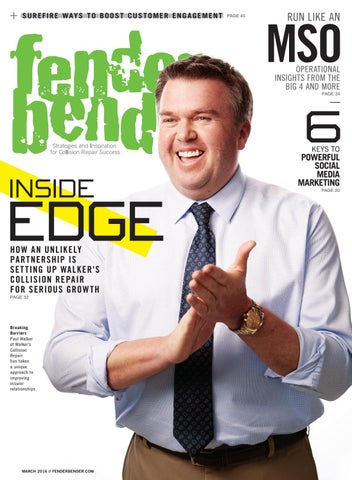
EDGE HOW A N UNLIK ELY PA RT NERSHIP IS SE T TING UP WA L K ER'S COL LISION REPAIR FOR SERIOUS GROW T H PAGE 32
Breaking Barriers Paul Walker of Walker’s Collision Repair has taken a unique approach to improving insurer relationships.
MARCH 2016 // FENDERBENDER.COM
POWERFUL SOCIAL MEDIA MARKETING PAGE 20
Better for the environment. Best for your bottom line.
Doing good for our planet can be great for business. Converting to the ENVIROBASE® High Performance basecoat system not only delivers environmental benefits, it provides superior color match and easier blending, plus improved cycle time performance. With added productivity and superb quality, it’s no wonder more shops have converted to the Envirobase High Performance system in National Rule areas than in all compliant regions of North America combined.
ENGINEERED
FOR EXCELLENCE
Follow us online:
www.ppgrefinish.com
©2015 PPG Industries, Inc. All rights reserved. The PPG Logo and Envirobase are registered trademarks of PPG Industries Ohio, Inc.
CONTENTS
ON THE COVER
Paul Walker, president of Walker’s Collision Repair, photographed by Jason Jones.
MARCH 2016 // VOLUME 18 // NUMBER 3
24. The Makeup of an MSO An inside look at the strategies and philosophies driving the growth of the industry’s largest multi-shop operations. BY BRYCE EVANS
32. Team Player Looking to build and enhance his DRP arsenal, shop owner Paul Walker hired a former insurance insider, a move that’s already paying off. BY TRAVIS BEAN
38. Lessons in Leadership
JASON JONES
A shop foreman reflects on lessons learned as a technician and how they help her as a manager and leader. BY TRAVIS BEAN
Getting the Job Done Shop foreman Jess Anderson, right, has led dramatic revenue growth at Ellis & Salazar in Austin, Texas.
PRINTED IN THE U.S.A. COPYRIGHT ©2016 BY 10 MISSIONS MEDIA LLC. All rights reserved. FenderBender (ISSN 1937-7150) is published monthly by 10 Missions Media, LLC, 571 Snelling Avenue North, St. Paul, MN 55104. FenderBender content may not be photocopied, reproduced or redistributed without the consent of the publisher. Periodicals postage paid at Twin Cities, MN, and additional mailing offices. FenderBender is a member of BPA Worldwide. POSTMASTERS Send address changes to: FenderBender, 571 Snelling Avenue North, St. Paul, MN 55104.
MARCH 2016
//
FENDERBENDER.COM
3
CONTENTS
45
49
STRATEGY 20. The Big Idea
12. Snap Shop
TNT Auto Body Repair in Glade Hill, Va.
14. Quick Fix
ANALYSIS The implications of one
state’s shop licensing system NUMBERS Characteristics of young
shop operators HOW IT WORKS The WRD-Spider
Glass Tool AWARDS INSIGHT How staff
attitudes impact customer experience IDEA SHOP Steps for coaching
Using social psychology in social media marketing
» BY KEVIN RAINS
22. On the Business
A more effective way to measure cycle time
» BY MIKE ANDERSON
59. Questions
Susanna Gotsch of CCC Information Services discusses changing demographics
66. Innovations
Using visual cues to track repairs
problem employees
45. Customer Service
Good communication is paramount to the success of any collision repair business. Here are four ways to make your customer interactions count.
49. Finance+ Operations The number of OE certification programs has exploded in recent years. Want in? You should consider these factors first.
52. Case Study
How an Oxford, Ohio, collision shop worked with a group of local students to reduce its environmental impact and utility costs.
EDITORIAL
SALES
EDITOR
PUBLISHER
Jake Weyer
Chris Messer 651.846.9462 cmesser@10missions.com
ASSOCIATE EDITOR
Bryce Evans
NATIONAL ADVERTISING SALES
SENIOR STAFF WRITER
Andrew Johnson 651.846.9459
STAFF WRITER
REGIONAL ADVERTISING SALES MANAGER
Anna Zeck
ajohnson@10missions.com
Travis Bean
10 MISSIONS MEDIA
WEB CONTENT PRODUCER
PRESIDENT
Austin Becker 651.846.9454 abecker@10missions.com
Tess Collins
Jay DeWitt
CONTRIBUTING WRITERS
MARKETING COMMUNICATIONS SPECIALIST
Robert Knudsen 651.846.9452
SALES SERVICE SUPERVISOR
Melody Todd 651.846.9468
SALES SERVICE REPRESENTATIVE
Daniel Weinberger 651.846.9473
Mike Anderson, Kevin Rains
PRODUCTION ART DIRECTOR
Zach Pate
PRODUCTION AND INTERNET COORDINATOR
Seth Engman
SENIOR GRAPHIC DESIGNER
Nick Spaeth
GRAPHIC DESIGNER
Fue Vang
GRAPHIC AND PRODUCTION DESIGNER
Tessa Luedtke
Anders Seefeldt Mariah Straub
Meghann Moore
REPRINT MARKETING STRATEGIST
Daniel Weinberger
REGIONAL ADVERTISING SALES
rknudsen@10missions.com mtodd@10missions.com dweinberger@10missions.com Eugine Welch 651.846.9477 ewelch@10missions.com
EDITORIAL ADVISORY BOARD Ryan Cropper Able Body Shop Robert McSherry North Haven Auto Body Greg McVicker Budd Baer Collision Center Steven Morris Pride Collision Centers Mark Probst Probst Auto Body Kerry Woodson Jungerman CARSTAR
» HOW TO REACH US SUBSCRIPTION SERVICE tel 800.869.6882 fax 866.658.6156 email fndr@kmpsgroup.com The annual subscription rate is $72 (U.S.A. only) for companies not qualified to receive complimentary copies of FenderBender. BACK ISSUES Past issue single copies are $8. Go to fenderbender.com/backissues OFFICE OF THE PUBLISHER 10 Missions Media, LLC, 571 Snelling Avenue North, St. Paul, MN 55104 tel 651.224.6207 fax 651.224.6212 web fenderbender.com LETTERS TO THE EDITOR letters@fenderbender.com ARTICLE REPRINTS For high-quality reprints or e-prints of articles in this issue, call 651.846.9452 or email reprints@fenderbender.com.
4
FENDERBENDER.COM
//
MARCH 2016
STAFF GRAPHICS
7. Past the Page 9. Driver’s Seat 11. Light Hits
Faster. Simpler. Seamless access to Genuine GM Parts. Parts ordering directly through your GM dealer, Bump2.0 pricing on more than 8,000 Genuine GM Parts, and integration through the MyPriceLinkSM workflow—get it all with CollisionLink,® a free, Web-based application with a more streamlined connection to Genuine GM Parts pricing through MyPriceLink. With CollisionLink, you have everything you need in one convenient application without any extra steps. Complete your estimates quickly and efficiently, while still getting real-time price visibility on Genuine GM Parts. Register for CollisionLink at no cost and enjoy all the benefits of MyPriceLink and Bump2.0 at collisionlinkshop.com.
©2016 General Motors. All rights reserved. The marks appearing in this ad are the trademarks or service marks of GM, its subsidiaries, affiliates, or licensors.
FENDERBENDER.COM
COMMENTS, DISCUSSIONS, FEEDBACK AND MORE FROM AROUND THE WEB
FenderBender revealed the names of six additional speakers for the 2016 FenderBender Management Conference, which will be held Sept. 19–21 near Chicago. Each speaker brings a wealth of collision repair experience to their sessions. They are: AARON MARSHALL, MANAGER, MARSHALL AUTO BODY • [Workshop] Lean Theory and Real-World Implementation RON REICHEN, OWNER, PRECISION BODY & PAINT • [Session] The New DRP: Using OE Certifications to Drive Business KEVIN RAINS, OWNER, CENTER CITY COLLISION AND PRECISION FRAME & BODY • [Session] Social Media Marketing that Works JIM KELLER, PRESIDENT, 1COLLISION NETWORK • [Session] Marketing is Everything: An Advanced Approach to Building a Better Brand MAX SORENSEN, DISTRICT MANAGER, ABRA AUTO BODY & GLASS • [Session] Developing an Apprenticeship Program to Grow Talent DARRELL AMBERSON, PRESIDENT OF OPERATIONS, LAMETTRY’S AUTO BODY • [Session] What’s Your WIP? Why Work in Progress is a Key Metric for Modern Shops
ONLINE EXTRAS
FROM THIS ISSUE’S SPONSORS Click on the logo below for product information.
Axalta Coating Systems
Mercedes-Benz
BASF
Nissan North America
CAPA
O’Reilly Auto Parts
CAR-O-LINER
Polyvance ®
For more information or to register, visit fenderbenderconference.com.
www.car-o-liner.com | 800-521-9696
CAR-O-LINER CCC Information Services
PPG
®
COLLISION C A S T
This month, staff writer Travis Bean sits down with Wayne Griffin, director of operations at Walker’s Collision Repair, to discuss ways to improve the relationship between shops and insurance companies. Listen now at fenderbender.com/collisioncast.
CONNECT WITH US ONLINE
www.car-o-liner.com | 800-521-9696
Genuine GM Parts
SATA DanAm Remember Group
Innovative Tools & Technologies
U-POL
Kia Motors America
Valspar
facebook/FenderBenderMag @FenderBenderMag FenderBender - The Collision Repair Professionals Forum youtube.com/FenderBenderMag fenderbenderlive.com
Vehicle Services Group
fenderbender.com/googleplus
MARCH 2016
//
FENDERBENDER.COM
7
Delivering More for Less
35% OFF MSRP*
The Right Parts
The Right Price
Right Now
Nissan Genuine and Value Advantage™ Parts deliver Nissan validated fit, form and function to reduce cycle time and help improve customer satisfaction.
Save 35% off MSRP* on thousands of popular collision parts. Get instant pricing alerts with TRAXPOD™ .
With TRAXPOD™ get deals, deliveries and status notifications from your preferred Nissan dealer directly to your desktop.
TRAXPOD™ is Free to Install for all Shops
Visit www.traxpod.com to self-install or contact OPS @ 877-USE-TRAX for assisted install.
*See participating dealer for details. 35% off MSRP for eligible popular parts only. Value Advantage remanufactured engines and transmissions not included in eligible part categories and not eligible for discount. MSRP excludes all applicable taxes. Participating dealer sets actual price. Exclusions apply. Subject to part availability. Nissan, the Nissan Brand Symbol, “Innovation that excites” tagline and Nissan model names are Nissan trademarks. ©2016 Nissan North America, Inc.
DRIVER’S SEAT
What’s Your Game Plan? The drum of consolidation has been beating incessantly for several years now.
The strategies that drive MSO success don’t have to be exclusive.
If you’ve grown numb to it or chosen to tune it out, I can’t blame you. But if you’re still reading this, you understand the importance of knowing where this trend is heading and where you might fit in, especially if you’re an independent shop. Whatever your perceptions about the Big 4 consolidators and other large MSOs might be, consider this: On average, they processed $3.3 million in collision work per shop in 2014, according to data from The Romans Group. The rest of the industry averaged $964,000. It’s a safe bet that the disparity is even greater now, more than a year later. Those stats, from this month’s cover story, “Inside the Big 4,” on page 24, should be a wake-up call for shops that have carried out business as usual, hoping to rely on the oft-recited mantra of “quality” or “good customer service.” Those things are expected of all shops; they are the starting point, not the recipe for collision repair success today. As consolidation continues (the Big 4 gained $1.5 billion in collision repair work through acquisitions during the last two years) their appeal to insurers and to an extent, consumers, will continue to increase for reasons beyond quality and good customer service. It’s how they achieve those things—how they measure and sustain them—that matters more. They have created standardized systems and processes across all facets of business that ensure repeatable success and peace of mind. This month’s story takes you into the world of some of the key MSO players to give you a better understanding of how their shops run, their driving philosophies, and how they’ve been able to grow at such a clip. There are takeaways for shops of any size. This isn’t a doom-and-gloom story for independents. It’s a look into a model that’s working, and in many ways can be replicated for your success.
Jake Weyer, editor jweyer@fenderbender.com
MARCH 2016
//
FENDERBENDER.COM
9
Performance. Reliability. Success. With our competitively priced replacement parts, you no longer have to settle for anything less than Mercedes-Benz quality. But that’s just part of the story. You see, our starters and alternators all carry a 12-month, no mileage-restriction warranty. So our parts are not only a great deal. They’re a great value. Since they’re genuine Mercedes-Benz, you can have confidence they’ll last, and so will your relationship with your customers. Contact an authorized Mercedes-Benz dealer or learn more at www.mbwholesaleparts.com.
* MSRP excludes state and local taxes, and freight if applicable. Prices may vary by dealer. See your authorized Mercedes-Benz dealer for additional details or a copy of the Mercedes-Benz parts limited warranty. Excludes CORE deposit.
LIGHT HITS
Your Industry’s News, in Brief OEC ANNOUNCES API MANAGEMENT PROVIDER OEConnection LLC (OEC) has selected Apigee to provide the application program interface (API) management for MyPriceLink. OEC’s patent-pending MyPriceLink technology uses a scalable API to provide online, real-time and dynamic pricing on GM collision parts based on timing and local market conditions. OEC will use the Apigee Edge API management software to provide API security, scale and analytics required for the new service to deliver real-time automotive parts pricing to automotive dealers, collision shops, fleets, independent adjusters and insurance companies throughout the U.S. “From the beginning, a core element of the OEC mission has been to make it easier for our customers to locate, buy and sell replacement auto parts at competitive prices,” stated Kathy Golden, executive vice president and chief technology officer for OEC. “We started by connecting dealers with other dealers, then dealers to their wholesale customers and consumers. Now, by leveraging our API strategy and Apigee, our technology has advanced to the point where we can help OEMs provide real-time dynamic pricing to the entire vertical market. We believe this is revolutionary for our industry.” ASSURED PERFORMANCE LAUNCHES OEM REPAIR PROCEDURE COMPLIANCE APP Assured Performance Network announced in January it will launch a mobile application program to document the use of OEM repair procedures for its network of certified shops. The Assured Performance OEM Repair Procedure Compliance App automatically transforms the shop’s estimate repair line information onto an interactive checklist and delivers the information to the technician through smart phone, tablet or desktop. The technician can then use the touch screen functionality and commands to take photos and provide
documentation as they follow OEM repair procedures for proper repairs. The application allows management to review and approve documentation and see alerts when no documentation is provided. All of the compliance documentation is linked to the original estimate and maintained electronically online and in the shop’s dataSAFE as a permanent record. “This technology-driven solution provides a shop with exactly what they need to manage quality and compliance efficiently. Third-party spot checks may be performed by an untested, untrained, or uncertified individual and can leave huge holes in the documentation, lead to questionable liability coverage, and can be very expensive,” said Aaron Clark, former MSO shop owner and Assured Performance vice president of certification and network development. The application will be provided exclusively to Assured Performance Certified Shops. Assured Performance will contact all of their certified shops and begin rolling out the program and providing instructions in the coming weeks.
a powerful tool,” said Sheri Hamilton, AAM, AMI chair and executive director of ASA-Midwest.
AMI LAUNCHES EFFORT TO COLLECT INDUSTRY-WIDE TRAINING PROVIDER INFORMATION The Automotive Management Institute (AMI) announced on Jan. 13 the launch of its industry-wide initiative to collect training provider information. Once collected, AMI will maintain the information in a searchable database on its website. “For many years, the industry has been discussing the need for an easily accessible and current database of all industry training information,” said Jeff Peevy, AMI president. “As a nonprofit, we believe AMI is uniquely positioned to collect, offer and maintain this free searchable database as a service to the industry.” All automotive service and collision repair industry organizations are encouraged to participate in this initiative. “By having a central database that the entire industry can turn to when specific training needs arise can be
ED. FOUNDATION ANNOUNCES DESIGNATION PROGRAM FOR SCHOOLS On Feb. 2, the Collision Repair Education Foundation announced a new designation program called the Collision School Readiness Benchmark. Under the new program, schools will be classified into three tiers: Tier 1: Advanced; Tier 2: Proficient; or Tier 3: Developing. The designation will be determined by the Foundation based on information provided by the schools on the capabilities of their programs. The criteria will focus on the number of hours of instruction, curriculum in place, along with what tools, equipment, and supplies a school uses to prepare their students for employment in the collision industry. If something is missing, a grant application will allow a school to request that item. The goal is to help every school acquire the resources to eventually achieve a Tier 1 designation.
VRS LABOR RATE SURVEY LAUNCHES IN ARKANSAS National AutoBody Research (NABR) in January announced the launch of its Arkansas VRS Labor Rate Survey. The online survey is free for all Arkansas collision repair shops. The survey provides collision repairers with statewide labor rate data. “There is a significant problem with labor rates in the state of Arkansas,” said the anonymous collision repairer survey sponsor. “The rates insurers pay are not only below the market price but also not sufficiently profitable for shops, who must continually invest in training, tools, equipment, and certifications to repair today’s increasingly advanced vehicles. Finally, we have a solution in the VRS, an independent survey and complete technology to help shops price their labor profitably and prove through documentation what the real market labor rate is for any area in our state.”
MARCH 2016
//
FENDERBENDER.COM
11
SNAP SHOP
TNT Auto Body Repair and Service Centers
SHOP
LOCATION OWNER SIZE STAFF
Glade Hill, Va.
Tim and Tara Wall
8,500 square feet 11
AVERAGE MONTHLY CAR COUNT ANNUAL REVNUE:
60
Slightly over $1 million
Husband-and-wife team Tim and Tara Wall make up the two Ts in TNT Auto Body Repair and Service Centers. They started the business in 2002 when, after moving from New York to Virginia to attend Bible college, an opportunity presented itself for them to rent a small collision repair shop in Glade Hill. The Walls rented—and grew the business—for six years, eventually supplementing their original space with another building that became available across the street. Then, in 2008, TNT Auto Body Repair made the big move to its new home; a sparkling, 8,500-square-foot, ground-up build that the Walls own. It includes a complete collision center, a service center, an “auto spa,” and its TNT Marine business segment.
3
The shop is split into two levels. The first level is the lobby, where customers can enjoy the flat screen TV, Wi-Fi, and Keurig machine. Kids have a wooden train set to keep them occupied. Customers can also shop TNT products while they wait. The Walls have a long-term goal of expansion. Producing their own product line was a great way to give the business the feel of a national brand. The shop has its own T-shirts, vinyl dressing, tire shine and all-purpose cleaner available for purchase. Above the lobby are the accounting and management offices where employee, marketing and financial meetings are held. The employee lounge is also located upstairs and is used for many purposes, including staff birthdays and a break room. The lounge also houses the “idea board,” a whiteboard where employees can share suggestions and ideas. Because it is located near Smith Mountain Lake, TNT saw an opportunity to differentiate. The shop began marketing itself as a marine facility. TNT Marine offers gel coat color restoration, fiberglass repair, and summer and winterization. Knowing that there would be high demand for marine work in the area, the bays in the shop were specifically built large enough to accommodate boats.
The TNT “Cool Bus” has become a sort of celebrity vehicle in the community. In the beginning, TNT had two 15-person vans that shuttled people to events. A year later, the shop got a deal on a Franklin County school bus and turned it into a shuttle to transport the community to events like the Franklin County Fair and concerts. Most of the time, transportation is donated as a way to give back to the community. The shuttle is a great form of advertising with the logo painted across the outside and a flat screen TV playing TNT commercials inside. “The ‘Cool Bus’ is a way to make people laugh and relax when they think of us,” says Tara.
» To see other shop spaces or to submit your own, go to fenderbender.com/snapshop CLICK HERE
12
FENDERBENDER.COM
//
MARCH 2016
COURTESY TNT AUTO BODY REPAIR
The shop can fit 15 cars inside at any given time. There is a downdraft prep station that takes all of the dust and dirt out of the bays while the technicians work.
7
2
1
5 6
4
8
MARCH 2016
//
FENDERBENDER.COM
13
QUICK FIX
DID YOU KNOW
Less than 20 percent of shops will meet the requirements for Class A under Rhode Island’s new two-class system.
NEWS // IDEAS // PEOPLE // TRENDS IN BRIEF VIEWPOINT
The Outlook for Rhode Island’s Two-Tiered Shop Licensing System
BY BRYCE EVANS
This spring, Rhode Island will begin to fully implement its new, two-tiered collision repair business licensing program, in which body shops will be designated as either Class A or Class B businesses. The law, which passed during last summer’s legislative sessions, was backed heavily by the Auto Body Association of Rhode Island (ABARI). The organization’s spokesperson, attorney Jina Petrarca-Karampetsos, grew up in her father’s Rhode Island collision business, Providence Auto Body, and was one of the guiding forces in getting the legislation passed. She explains the new regulation, why it exists, and why it could serve as an example for a potential solution for the rest of the industry.
help determine prevailing labor rates. It’s designed for all shops to be represented in those decisions. The classification law builds on that. Both are, above all, about consumer protection, which a lot of what ABARI does is aimed at that. With the times that we’re in, vehicle technology continues to increase, including the materials with which they are made. We felt there were some shops that were qualified to do these repairs, and others that weren’t. Consumers should have that knowledge to be able to make the choice, and coupling with the survey rate law, shops should be compensated accordingly. How does the new two-tier system work?
How did this legislation come about?
The process of putting this together started, oh, probably 15 years ago; it’s been discussed for a long time. For context, in Rhode Island we already have a survey rate law, which, I think, there is a lot of confusion over in states without a similar regulation. What the survey rate law does is require all insurance companies to survey all body shops, and then use those responses to 14
FENDERBENDER.COM
//
MARCH 2016
Rhode Island has had minimum requirements for becoming a licensed body shop for quite some time. These are standards that are actually quite high, and that standard has become the basis for our Class B shop designation. That means they have to be a modern business with frame machines, spray booths, certain welding equipment, etc., to be able to complete safe repairs on vehicles. Now, the main differentiation between
Auto Body Association of Rhode Island (ABARI) spokesperson, Jina Petrarca-Karampetsos
becoming a Class A shop and being a Class B shop in this system comes down to manufacturer certification. OEMs built the vehicles, and they’ve outlined how they need to be repaired; who better to certify these shops? What this does is take enforcement out of the state’s hands and keeps it in the industry with automakers. This law doesn’t create more government involvement or regulation in the industry. To become a Class A shop, you can file with the Department of Business Regulation at any time. There are no deadlines, and it’s an ongoing process. You simply need to provide written proof of automaker certification. Two other items needed for Class A: Shops must offer lifetime warranties and track customer complaints; and all shop technicians must meet state certification standards (Class B shops require one in five techs to be certified). Then, circling back to the labor rate survey part of this, insurers are now required to do two separate surveys— one for Class A shops and another, separate one for Class B shops. In theory, this should help promote a fair labor rate
COURTESY JINA PETRARCA-KARAMPETSOS
Auto Body Association of Rhode Island (ABARI) spokesperson, attorney Jina Petrarca-Karampetsos, explains the state’s move to designate Class A and Class B shops
that compensates shops properly for their ability and investment. How many shops are expected to achieve Class A status?
Rhode Island is a small state to begin with, and we have just around 200 body shops total. And some of those are very small, family businesses. We don’t expect all of them to try to become Class A shops. And that’s not necessarily a bad thing. Shops will need to determine their business model, who their customers are and make their decisions based on that. Being a Class B shop is not something to be looked down on. These are still very good shops in there. For those that do make this leap, I’d guess that just under 20 percent of shops will meet the requirement this year. That could change a lot in the next couple years, though, because it takes time to hit those OEM requirements. If a shop just recently started this process, it will
be a while before they can file for Class A status. We anticipate there being many, many more coming onboard in Year 2. Why is this regulation important to the future success of shop operators?
It goes back to that investment these shops are making in their futures. In most cases, they are spending well over six figures to be prepared to work on advanced materials in vehicles. The investment can be huge, and by doing so, they position themselves to fix vehicles they otherwise could not and should not work on. By having the two tiers, and the two separate labor rate surveys, it ensures that the insurance carriers will at the very least acknowledge the difference, and it should help operators earn a fair rate. From a consumer standpoint, this allows them to fully understand which shops can fix their vehicles correctly, which shops are trained, equipped
and have the knowledge and skill to make those repairs. It brings about consumer awareness, and it gives them the information to make an educated choice, which is what they need. Many industry organizations across the country have debated the merits of a classification system for collision repair businesses. Do you feel this two-tiered system might be the solution?
I definitely think so, yes, and that’s why we went with it. I’m relatively familiar with that argument nationally, and it’s a little different here because we’ve had minimum standards here for years. Those are still very high, and they ensure safe repairs. But the difference now is that, instead of debating whether we’re benchmarking the lowest level or a truly qualified level, we have tiers that accurately position businesses for consumers. We’ll see how it affects the marketplace.
READ WHAT THE PROS READ. “I HAVE TO TAKE MY HAT OFF TO FENDERBENDER. IT’S DEFINITELY BETTER & ABOVE THE REST.”
- Greg Lobsiger, Owner Loren’s Auto Body, Bluffton, IND.
Grow your collision repair business with ideas and insights from industry experts.
TO SUBSCRIBE OR RENEW FOR FREE TODAY, VISIT
FENDERBENDER.COM/SUBSCRIBE MARCH 2016
//
FENDERBENDER.COM
15
The Under-40 Shop Operator Percentages based on total number of respondents who are 39 or younger
: QUICK FIX
:
NUMBERS NUMBERS
The Typical Shop Operator Percentages based on total number of respondents who are 40 or older
The Under-40 Shop Operator Although only 13 percent of FenderBender’s How I Work survey respondents were under 40 years old, that minority represents the next generation of shop operators in this industry. Here’s a look at some characteristics of the young shop operator:
:
:
Are female
17%
6%
Have a parent who was or is in the industry
40%
28%
Launched their businesses independently
32%
42%
Earned a Bachelor’s degree
22%
12%
Occasionally work hands-on repairing vehicles
54%
44%
Never work hands-on repairing vehicles
23%
28%
Had annual revenue of $1 million or more in 2015
52%
57%
Have plans to expand the facility in the near future
71%
34%
Expect sales to trend upward in the next five years
90%
77%
Say insurer influence on the repair process is the biggest challenge facing collision repair shop owners today
30%
34%
The Under-40 Shop Operator Percentages based on total number of respondents who are 39 or younger The Typical Shop Operator Percentages based on total number of respondents who are 40 or older
Are female
17%
6%
Have a parent who was or is in the industry
40%
28%
Launched their businesses independently
32%
42%
Earned a Bachelor’s degree
22%
12%
Occasionally work hands-on repairing vehicles
54%
44%
Never work hands-on repairing vehicles
23%
28%
Had annual revenue of $1 million or more in 2015
52%
57%
Have plans to expand the facility in the near future
71%
34%
Expect sales to trend upward in the next five years
90%
77%
Say insurer influence on the repair process is the biggest challenge facing collision repair shop owners today
30%
34%
• Customizable
• UV
• Durable
• Waterproof
AUTOMOTIVE
Resistant
OFF ROAD
• Easy
to Clean
• Chemical
• Easy
to Apply
• Sound
MARINE
New lo ok same gr , ea produc t t!
Resistant Deadener
COMMERCIAL
INDUSTRIAL
HOW IT WORKS
WRD-SPIDER GLASS TOOL WEBSITE: wrdglasstools.com COST: $450 for the kit; $45 for each spool USES: Removes windshields, rear glasses and glass panels TRAINING: Shop operator Kye Yeung says the shop used the instruction manual and watched a few YouTube videos from WRD to learn how to use the tool. Overall, he estimates it took roughly 15 minutes.
WRD-Spider Glass Tool Lower the risk of nicks and scratches during the glass removal process
COURTESY KYE YEUNG
BY ANNA ZECK
HOW IT WORK S : After years of subletting out glass work, European Motor Car Works president Kye Yeung has started to make a concerted effort to bring glass work in house at his Santa Ana, Calif., shop. “We were finding that was a huge loss in our profit because our sublet was so high and we had to put up with the damage, and obviously, the wait time,” he says. “Just coordinating all of that is usually a hassle.” Since then, Yeung has invested in numerous glass tools available in the market, including the WRD-Spider Glass Tool, which the shop uses to remove glass. While there are numerous glass removal tools available on the market, most of them use some type of sharp object—such as a knife, cutting blade or stainless steel wire—which can nick the painted surface, upholstery or the composite. Those nicks added time to the repair process because the surface would then need to be sanded down and epoxy primered to fix the imperfection.
Because Yeung’s shop works on a lot of Aston Martin vehicles, which are made of carbon fiber and composite, Yeung purchased the WRD-Spider Glass Tool as an alternative for those vehicles. The WRD-Spider Glass Tool uses a nylon braid (Yeung compares it to a fishing line) that cuts the bond path without hurting moldings, upholstery and composite. In essence, the tool uses a low-speed drill and drive shaft that connects to the fiber line equipment. “We were able to remove the windows with relative ease compared to the other systems available to us,” he says. The tool isn’t a “cure-all,” Yeung says, as it doesn’t do small quarter glass windows, but he says that for larger quarter glass, front windows and back glass, it’s allowed the shop to perform the glass removal in house and with lower risk. “We still use the sublet people on certain type of repairs that we don’t have the time,” he says. “On the smaller stuff where the car is going into the paint shop and we don’t have
time to wait, it gives us a great alternative to do it in house.”
T HE RE T URN : Yeung says it took roughly 10 windows to recoup the cost of the tool. In addition, he says that reducing the amount of nicks that occur during the glass removal process has cut down on the extra hour or so that corrective process would add to the repair time. Although the spools of line do need to be replaced, he says one spool will last for three or four windows, which is more than the one-time-use stainless steel wire he was using before. Finally, he has been able to continue to reduce the amount the shop relies on subletting out glass work, which he says has helped maintain a lower cycle time and save time in the front office when it comes to coordinating and checking in on the subleted work.
» Interested in knowing the impact of a particular collision repair product in the shop? Send your suggestions to submissions@fenderbender.com. CLICK HERE
MARCH 2016
//
FENDERBENDER.COM
17
AWARDS INSIGHT
A Smile Goes a Long Way Deanna Werner discusses how her positive attitude makes the entire repair experience less stressful
customer becomes, how tough it gets, Deanna Werner says she strives to keep a smile on her face. And with the negativity and contention that can occur at a body shop, that’s no easy task. But Werner, customer service representative for Lefler Collision and Glass in Evansville, Ind., knows that she is the basis for the entire customer experience: If a customer starts off upset with her, then that negative energy will work its way through the entire repair process. “Her ability to stay positive and cheerful is absolutely incredible,” says Lefler vice president Eddie Dietz. “Not only do our customers and agents and vendors love her, but our entire organization seems to be in a better mood anytime they’ve been around Deanna.” Werner details how she reads customers and approaches speaking with them, and how showing a positive, helpful, caring attitude can go a long way in winning business and ensuring customer satisfaction. AS TOLD TO TRAVIS BEAN
When you talk to customers bringing in their cars, do you use any sort of script? No, I do not. I actually don’t like scripts. It’s too obvious to the customer. It’s like when you drive up to the drive-thru and they say, “Here are our specials, can I get you one?” They don’t ask you about your day or how 18
FENDERBENDER.COM
//
MARCH 2016
you’re doing, and they aren’t offering you any real help. It’s all very robotic. So how do you approach speaking with a customer? The first thing you do is make sure that a smile is on your face, because it reflects, even over the phone. You have to put them in the right place emotionally before you get to the dry stuff and get the information you need. I always try to make sure that I ask them right off, “Are you OK?” They want to know you care. The main thing is you get that customer in and let them tell their story. You just have to be patient and listen to their story. Once they’re done, then you can take it from there and get the basic info you need from them. Does that attitude especially help with people new to the repair process? Yes, especially if it’s a tow-in situation, because the damage is probably more severe and they’re even more stressed. You have to guide the customer step-by-step through the process and let the customer know how long it takes. Most people don’t realize how detailed and lengthy the collision repair process is: “We’re going to get our estimator out to take a look at it, get the estimate, get it off to the insurance company, get that approved, get your parts on order, get everything received, and then get your car fixed.”
Is it tougher to stay positive with angry, frustrated customers? Yes, but you have to. It has to do with your attitude when you greet that customer. You can tell when they’re a little excited, but you just have to take control of the situation right away and keep yourself calm. A big factor in keeping them calmed down is not over-talking. Let them say what they have to say. Don’t act like you’ve never had this situation before. Be understanding and they’ll return the favor. Does that positivity translate to the shop culture? It affects the overall tone of the office. It can be easy to succumb to the negativity. We try to set that tone in the front office with the customer before that estimator comes up. We get their information and get them settled with a drink, a cup of coffee. We use small talk to get them calmed down, and then it makes it easier and less stressful for everyone else interacting with that customer. You’ve just got to keep a positive attitude. That’s just an everyday thing. You have to decide when you get up in the morning, “This is how it’s going to be. No matter what comes my way, I’ve got to keep this attitude.”
» FenderBender Awards Insights feature past FenderBender Award nominees. To nominate an inspiring collision repair professional, or for more information, go to fenderbenderawards.com. CLICK HERE
TESSA LUEDTKE
No matter how busy it is, how angry a
IDEA SHOP
Improving Performance with On-the-Spot Coaching Disciplining an employee can be one of the most uncomfortable tasks someone in a leadership position has to undertake, says Steve Trapp, North American strategic accounts manager at Axalta Coating Systems. Even worse, is letting an employee go. However, Trapp says that should be the last resort. Instead of waiting for annual performance reviews to discuss deficiencies, he recommends on-the-spot coaching sessions, an idea Ken Blanchard introduced in his book, The One Minute Manager. Trapp discusses the concept of on-the-spot coaching to resolve problems, and how to determine when an employee should be let go.
THINKSTOCK
AS TOLD TO ANNA ZECK
If zero-tolerance policy violations weren’t violated, firing an employee should always be the last step in the process. The employee should never be surprised that they are being put on a path to progressive discipline. That’s where the concept of on-the-spot coaching— both positive and negative—comes in. This is something that should be done every day. The reason is that it builds mutual trust and lets them know that the goal is not to fire them. You’re not writing the employee up to be a jerk and build a case against them. Truly, you have to do four positive on-the-spot coaches over time for every one negative coaching session for people to perceive that you’re being genuine. That’s four over a period of time, such as six months. Because, if you don’t say squat to me for six months and then walk over and do corrective on-the-spot coaching, you’re not building any trust; you’re not building that emotional bank account that lets the employee know that you care enough about them to catch them doing things correctly and not just incorrectly.
Whether it’s positive or corrective, on-the-spot coaching should follow a simple procedure: 1) You have to define the thing that bugs you or that they’re not doing. You can only focus on one behavior or skill at a time. This is why I set interdepartmental standards and I spot check cars periodically to those standards to reinforce good and bad behaviors. I’m giving them very specific feedback. Keep your tone neutral and not punishing. If you get too punishing with your tone, it can make people defensive. But, you can be assertive by calling attention to your observations. Be clear that the behavior is unacceptable. 2) Have a specific recommendation in mind as a plan for improvement. You’re always giving them a specific example. 3) However, invite them into the discussion, too, and ask for their ideas. Allowing them to be a part of it and asking if there are any ways to enhance the correction gets you their commitment. 4) During that discussion, also mention the benefits for both them and the company of fixing the behavior.
5) Next, set some checkpoints that can be put in place for regular followup to make sure that the recommendation is being followed. 6) Finally, thank them for the coaching moment. That way, they realize this was a coaching session. This wasn’t just you randomly walking up to them. If you let a problem go for too long and didn’t mention it initially, you can still use the above process, but the approach changes a little bit. You can either do a group coach or an individual coach. In a group coach, gather everyone together and simply say you’ve noticed this has been going on for a while and wanted to discuss it. However, you can never point out an individual in a group setting. In an individual coach, say, “I’ve observed this in the last three days. It could have happened before that, but let’s not worry about how many times it occurred. Let’s just agree that this is something that we need to stop now.” That way, you aren’t bringing up a lot of baggage.
» Give us your ideas about marketing with Facebook by visiting fenderbender.com/ideashop. CLICK HERE
MARCH 2016
//
FENDERBENDER.COM
19
THE BIG IDEA
WANT TO MEET KEVIN RAINS? He will be a presenter at the FenderBender Management Conference Sept. 19–21 in Chicago and will be available for questions and discussion.
Online Influence Undoubtedly one of the most influential
writers on sales, marketing and leadership in our time is Robert Cialdini. His highly acclaimed book, Influence: The Psychology of Persuasion, is on the top 10 list of many recognized marketing experts. Yet the wisdom shared in the book can be applied to not only marketing, but also sales, leadership, politics, or even parenting. It truly is one of the few books that has an almost universal appeal and real-world application across several major categories. But how might this book apply directly to your shop’s social media marketing? What if the wisdom from the six key ideas presented in the book were focused on the tiny niche of marketing in our field? Let’s think of the six key ideas presented in Cialdini’s book as levers to move our social media marketing to a much higher level of visibility and profitability. Lever 1: Reciprocity. We tend to want to pay back someone who gives us something. Waiters and waitresses do this all the time and to good effect. That little thing that they do “just for you” is likely something they do 20
FENDERBENDER.COM
//
MARCH 2016
routinely and it sets them up for an even bigger tip. Something as simple as bringing a couple extra mints at the end of the meal when the bill is delivered has a powerful psychological effect. (See chapter 1 of the book for the research behind this. It’s fascinating.) A couple of the ways I try to give back on social media: Right before a winter storm, I put an offer out on our Facebook page to come in and get your windshield washer bottle filled and let us check your tire pressure free of charge. It’s a small offer that costs me pennies but it gets people thinking about our shop as a generous place right before a storm hits. And it’s not a “trick” or sales gimmick. It’s a genuine offer that actually helps our customers and keeps us top of mind when accidents are most likely to occur. Lever 2: Commitment Consistency. Since we are bombarded with so many choices, our brains actually like to make a singular commitment and then stick to it. Cutting out choices has become a modern day coping mechanism. On social media it’s great to
get “shout outs” for your shop. I’ve talked about our “Facebook Ambassadors” program in previous columns. We simply ask our best fans to give us shout outs or like or share certain things we publish each week. This has the benefit of creating great visibility by leveraging the networks of our fans, but even more importantly, it solidifies the ambassador’s commitment to our brand, which naturally leads to referrals. Lever 3: Social Proof. We trust things that are endorsed by people we like whether that is someone famous, a friend, or someone we perceive as an expert. On social media, posting positive reviews from customers has the effect of leveraging past customers’ opinions to help current or potential customers decide to choose your shop. And it’s always best to set a link directly to the review so potential customers can see that these are real, unbiased reviews on a third party site like Google, Yelp or Customer Lobby. Lever 4: Liking. We are way more inclined to listen to someone
THINKSTOCK
Using insights from social psychology to ignite your social media
KEVIN RAINS
we like even if that person is not an expert in a given field. This is why celebrity endorsements are so lucrative. Or to put it another way, this is why underwear companies pay former basketball players millions of dollars. Basketball players aren’t considered experts on the world of cotton undies. Nothing in basketball uniquely qualifies them as a subject matter expert for undergarments. But they are liked, therefore their opinion holds great sway in advertising. For social media marketing, if you can get an endorsement from someone who is famous, even just locally famous, it is golden. However, something we have more control over is becoming likeable ourselves. This is why we have to function as people in social media and not as an abstract brand. Being human—real, transparent, even our tone when writing—is such a critical skill. Make sure you’re engaging in conversations through social media, not just broadcasting sales pitches disguised as Facebook posts. Be real, warm, sincere, and caring. Lever 5: Authority. We listen to people who look and act like they know what they’re talking about. All it takes to believe the phrase, “trust me, I’m a doctor,” is for someone to walk into a room with a white coat on and stethoscope around their neck. But are they really? To know for sure we’d need to check their credentials, but our tendency—especially in crisis—is to trust someone who is confident and looks the part of an expert. On social media, there are hacks who don’t check facts, put up stupid memes that are poorly designed and polarizing, and in general look anything but professional. Don’t be a hack. Check facts. Care about the design, look and feel of your profile pictures and the things that get posted. In general, review your social media to make sure you portray a professional image throughout.
Lever 6: Scarcity. We tend to want things more that are in limited supply. So running specials and time-bound offers on social media are a great way to utilize this lever. Another great way is to hold competitions. We regularly do a “guess the estimate” where we show a picture of a wrecked vehicle and ask people to guess what it ended up costing to
fix. Then whoever gets the closest on dollar amount gets a gift card to a local restaurant. When someone else wants something, that creates a feeling of scarcity as there is only one winner and people jump in to try to out guess their peers. I hope these six levers of influence help you to gain both visibility and ultimately profitability.
Go Where Your Customers Are Get your own mobile friendly site and get found. Custom mobile websites for $995.
Call 866.414.2582 for Details remembergroup.com MARCH 2016
//
FENDERBENDER.COM
21
ON THE BUSINESS
WANT TO MEET MIKE ANDERSON? He’s the keynote at the FenderBender Management Conference Sept. 19–21 in Chicago and will be available for questions and discussion.
No More False Starts A focus on ‘pre-repair cycle time’ will allow your business to increase efficiency, decrease stress, and, ultimately, become more profitable Cycle time is important; we all know that,
right? Everyone in this industry, whether you’re a DRP shop or a non-DRP shop, must focus on cycle time. It’s just good for business—it keeps you in good standing with insurance partners, and it makes life easier from a cash flow perspective as you’ve probably paid out money for labor and parts on any job that’s sitting. But everyone knows this, right? And we’re all tracking cycle time effectively, right? Well, not so much. We tend to look at cycle times as one basic, overall number and that’s keys to keys—total days from the time the vehicle is dropped off to when it’s picked up. There’s more to it than that, though. There is also what I like to refer to as “micro cycle times,” and there are three of them: pre-repair cycle time, repair cycle time and post-repair cycle time. Pre-repair refers to the time between vehicle arrival and when you actually start work on the vehicle. Repair is from the time the job starts until it’s completed. And post-repair is from job completion to delivery. I look at each of these whenever I go into a shop. (The vast majority of management systems allow you to track this, by the way; if you don’t do
it or don’t know how, check with your provider.) For the most part, repair cycle time is pretty solid at shops. Technicians tend to work pretty quickly and get the job turned around. Where I see the biggest issue is in the pre-repair portion, and this is where every shop’s biggest opportunity for improvement often lies. So, how does the typical shop perform in this area? Well, usually, they’re at about one day—a full day from the time the vehicle arrives on site to the time it is actually in process. And that’s just smaller jobs; mid- to large-sized jobs are at 1–3 days with some sitting as long as six days. My friends, that is not good, and, really, there’s no reason it has to be this way. If you start getting to one day, two days, three or more days, you know there’s a problem. The best-in-class shops take no more than two hours to get a job in process after the vehicle shows up at the shop. Two hours. Now, obvously, we have to wait on insurance approvals and parts, but even with that, it should be less than 1–1.4 days. There are also re-inspection issues, but if you pull all of that out—the insurance approval and re-inspections—how long does that
Tips for Better Scheduling Scheduling can be one of the most difficult aspects of the repair process. Watch this video for my “best practices” for better scheduling: fenderbender.com/FenderBender/March-2016/No-More-False-Starts/
22
FENDERBENDER.COM
//
MARCH 2016
job still sit before you actually begin the repairs? If you find that your pre-repair cycle time is more than 1–1.4 days, there are four areas to focus on in your business that can fix this: 1. Scheduling. As an industry, we still take too many cars in on a Monday with the goal of having them out by Friday. What happens is that a good portion of those jobs sit at your shop until Tuesday or Wednesday before anyone even touches it or looks at it. I do a lot of work with Frank LaViola of Enterprise Rent-A-Car, and his data shows that many shops will have upwards of 70 percent of their overall work volume dropped off on a Monday. How are you supposed to process 70 percent of your weeklong workload on the first day? We can’t do this, and whether you know it or not, your business can’t afford the cost of a vehicle sitting and the cash you have tied up into it. Work has to be scheduled out appropriately. (If any of you are saying, “Well, the insurance company makes me do this,” we can cover that solution in a future column.) 2. Repair Planning. Having a clear and thorough repair-planning process is so critical, not only to reducing supplements but also to give clear direction to your team on what is expected. There needs to be 100 percent disassembly, and then we have to research all the parts and the corresponding OEM repair procedures. There might be times when the estimating system is missing something the OEM procedures and
MIKE ANDERSON
graphics would show you. You can’t miss on this stuff, and it all has to be written accurately the first time. Start thinking of supplements as a comeback or redo on your estimate! 3. Parts Procurement. How many of you have multiple parts orders on each RO? Too many are nodding their heads right now, I’m sure. If Part 2 is properly done, we should be on our way to knowing exactly what parts we need for the vehicle. From there, we need to ensure that we’re working with the right vendor that is knowledgeable and has good inventory. And we need a process in place for when those parts arrive to make sure they are mirror-matched, checked for defects and staged properly. If you’re not already, it’s time to start utilizing electronic parts-ordering solutions. Use technology. It’s your friend. 4. Administrative Process, Responsibilities and Team Setup. The administrative process needs to be streamlined, and there’s quite a lot that goes into it. Start with this: Make sure you’re using your management system to its fullest extent. Are there features you’re ignoring? Do you even know? Set up a time with your provider and get fully trained on all its available features. It’ll make everything else that much easier. From there, it’s about responsibilities and team setup. A lot of shops aren’t staffed or organized correctly on the admin side, and that creates a huge bottleneck—and a lot of unnecessary stress. Ideally, a shop would break down this way: one front-end estimator, who takes and writes all estimates for walk-in customers (this is a customerfacing position where people skills are essential); a customer service representative responsible for updating the customer throughout the repair process through the customer’s desired method of communication and keeping the paperwork balanced and current; a back-end estimator, who would serve as a team coordinator or repair planner, ensuring that items in Part 2 of this story are completed successfully to include quality control of the vehicle throughout
the various stages of repair; and, finally, someone in charge of the parts procurement aspects in Part 3. That setup can process roughly $250,000–$300,000 per month in sales from an admin perspective. Not all shops are that large and have the ability to staff like that, but you need to ensure that you’re staffed properly to handle each of those responsibilities.
Think of those four areas of your business as if your team was running a relay race—four separate pieces that all directly impact the final result. It all has to be there. No one part can fail. So, take a look at your team, its setup, and your micro cycle times. Don’t put your team in a position to fail before the repair has even started.
TWO LOCAL SHOPS OR 200 NATIONWIDE?
Rely On Car-O-Liner's Professional Distributors For The Right Training, Service & Solutions Contact Your Local Distributor For A FREE Demonstration!
Leading the industry in OEM Certified Approvals
Leading the Industry in OEM Certified Approvals
www.car-o-liner.com MARCH 2016
info@car-o-liner.com 844-833-9419 //
FENDERBENDER.COM
23
INSIDE TH BY BRYCE EVANS
A DEEP DIVE INTO INDUSTRY CONSOLIDATION, AND THE SYSTEMS, PROCESSES AND OVERALL ORGANIZATIONAL PHILOSOPHIES THAT ALLOW AMERICA’S LARGEST MSOS TO THRIVE 24
FENDERBENDER.COM
//
MARCH 2016
Tim Adelmann cringes at the term. He doesn’t like it; doesn’t think it fits. ABRA Auto Body & Glass has been growing since 1985, he says. That was the year Adelmann, now the company’s executive vice president of business development, personally opened and managed ABRA’s second-ever facility, located in St. Paul, Minn. “We’ve been known as operators throughout our business life,” he says. “We’re collision repair people. We’re just shop operators.” So, calling the company a consolidator? Adelmann just doesn’t see it.
But that’s the perception, he admits, and to many in the industry, the perception exists for a clear reason. ABRA is an anchor of the U.S. collision repair industry’s “Big 4,” a term commonly used to refer to the country’s four largest multiple-shop operators (MSOs) —a list that also includes Caliber Collision, Gerber Collision & Glass, and Service King. Combined, the Big 4 gained roughly $1.5 billion in collision repair work over the past two years through the acquisitions of other, smaller MSOs and individual body shops. That number alone accounts for
HE BIG 4 nearly 5 percent of the $ 33 billion U.S. industry. By the end of 2015, the Big 4 represented more than $4 billion in total work, a market share of more than 12 percent. The big are getting bigger, and the total amount of shops continues to decrease; hence the “consolidator” moniker, says Vincent Romans, managing partner and CEO of The Romans Group LLC, an industry consulting company whose research provided the aforementioned data. But don’t mistake the wave of acquisitions for ruthless business tactics, Romans adds. There are a
number of factors that have led to the industry’s rapid consolidation in the past 10 years—and there are clear reasons why it isn’t going to end any time soon. One of those reasons, though, often surprises many familiar with the impersonal, cost-cutting stereotypes that are often affixed to America’s largest corporations. “The truth is,” Romans says, “many of the industry’s largest [MSOs] operate very strong, very successful, and very consistent businesses. Much of their success is based on performance.” Performance. Procedures. Systems.
Structure. Philosophy. The Big 4 (and other large MSOs close behind them) have created repeatable, sustainable business models, geared to allow each individual shop to perform at the same level regardless of its market. And for independent shops looking to compete, it might be time to start looking more closely at what these companies do to thrive. “We’re shop operators just like you are,” Adelmann says. “It’s not about doing something overly complicated. We take something simple and do it very, very well.” MARCH 2016
//
FENDERBENDER.COM
25
— Let’s take a step back for a moment, Paul Gange says. Before fully discussing the industry’s consolidation trend, he says it’s best to understand the reasons behind it first. And that starts with insurance carriers. “Whether they know it or not, they are fundamentally fueling consolidation,” says Gange, the president of Fix Auto USA, which grew its franchise network above 100 shops in 2015. The collective push from carriers for a more consistent and efficient claims process—a push that started nearly 30 years ago with the first direct repair programs—has led them to favor single points of contact for larger volumes of work, Gange says. In other words, it’s far simpler and more cost efficient for them to deal with an MSO, a company that can offer multiple distribution points across a market. That’s part of it, he says. The rest comes down to the financial setup of the industry, one that still is very fragmented with many more facilities than needed to cover the total amount of work across the country. Romans says this has been obvious for quite some time, and ultimately, it was inevitable that the industry would follow many others before it (pharmacies, hardware stores, hotels, etc.) and slowly tighten up its broad reach. The recession eight years ago acted as an accelerator, Romans says, as private equity swept through collision repair, pouring money into MSOs and launching a race for each to capture more market share. The landscape changed quickly, and while the Big 4 seem to stand as a symbol to the entire industry of the continued push toward consolidation, the overall shift in the market certainly isn’t limited to those four companies. According to Romans’ data, MSOs with more than $20 million in annual revenue accounted for $6.2 billion in total sales for a 19.2 percent market share in 2014 (the most 26
FENDERBENDER.COM
//
MARCH 2016
The leadership teams at both CARSTAR and Fix Auto consider their organizations to be direct competitors with the industry’s largest MSOs. Here’s a look at how franchise networks have affected the indus-
try landscape (data from The Romans Group LLC: • Franchises alone accounted for 789 individual locations in 2014 with total sales of $1.094 billion— a 3.4 percent overall market share. • Total franchise network and large MSO (those
that generated more than $20 million in total sales) locations in 2014 reach 2,596, roughly 7.7 percent of the total industry. • Total combined revenue for those two segments nearly hit $7.5 billion, a 22.6 percent total market share.
recent year for which The Romans Group had complete data at time of press). That’s a $1.3 billion increase over 2013, and more than double the output from when that same demographic generated $2.7 billion in 2006. Throw in franchise networks, like Fix Auto and CARSTAR Collision Repair Experts (two companies that very much consider themselves to be rivals to the Big 4), and that’s another $1 billion and change to that pool. And there’s this: The large MSOs, on average, processed $3.3 million in collision work per location in 2014. The rest of the industry? Roughly $964,000. “It used to be easy as an independent to sit back and say, ‘Well, we outperform those consolidators and those franchise shops. We’re better,’” Gange says. “But the truth is that most independents don’t.”
— Driven Brands made the largest acquisition splash in 2015, adding CARSTAR to its collision and paint group that already included Maaco.
MIKE ANDERSON, COURTESY GERBER COLLISION & GLASS, COURTESY CALIBER COLLISION, COURTESY ABRA AUTO BODY & GLASS
FRANCHISE FACTOR
The acquisitions get the headlines, but Driven Brands group president Jose Costa says success is also measured in the amount of closures an MSO has in a given year—a number that normally sits at 3–5 percent in the collision industry. “Just as important as unit growth is maintaining the number of existing stores and keeping closures close to none,” says CARSTAR president Dan Young. “I have two goals: no closures and [add] a lot of stores.” Net growth, as Costa and Young describe it, is a large focus of all large MSOs and franchise networks. To have sustained success amidst rapid growth, Adelmann says, you “can’t afford a step backward every time you take one or two forward.” And that’s an area in which the industry’s largest MSOs, and the Big 4 in particular, have truly excelled. But how have they done that? What allows them to stand out? It comes down to three key areas of business: A SYSTEMIZED APPROACH. To grow, Adelmann says, a
business must be truly “replicable.” “We want quality on every repair at every location,” he says, “and that’s customer service, having a sense of urgency, managing the cost … all of that. And the only way of doing that is taking a real operations and systemized approach to it.” ABRA has had an operations manual, referred to as its “playbook,” for more than 30 years, but Adelmann says that recent changes in the last 10 years have truly streamlined the company’s operations and allowed its growth to take off (ABRA has gone from 114 to 338 locations in the past four years). The playbook serves as an easy reference guide for any operator in the system, containing all the company’s policies and procedures. There are also video tutorials that go with each portion. Tim O’Day, president and COO of Gerber, says his company takes a similar approach with its “Wow Operating Way” system, and both Service King and Caliber have their own programs, as well. “All our internal processes link back to our mission
Giants of the Industry statement, to ‘Wow Ever y The “Big 4,” as they’re often Customer … Be the Best,’” O’Day called, are growing—and says. “Every morning, our people doing so successfully. Their respective strategies come to work knowing exactly and philosophies offer a what they need to do and why. glimpse at what shops of any size can do to thrive in This is what allows us to build a the future. true culture of excellence from the inside out, across hundreds of shops and thousands of team members, from the shop floor to the executive offices.” There are finer details to each operating system; for instance, Service King utilizes its proprietary, electronic scheduling and management software systems, ACCUCenter and Overdrive, CEO Chris Abraham says. O’Day says Gerber is focused on segmenting repairs by job length (e.g., fast lanes within facilities), and that pre-repair preparation is a large focus—disassembly, blueprinting, parts procurement, etc.—in order to begin repairs within hours of a vehicle arriving, rather than days. The systems in place, Adelmann says, allow team members to act on their sense of urgency without inhibitors.
POOLING RESOURCES. As the average driver needs collision
DEALER DYNAMICS As both Berkshire Hathaway Automotive and AutoNation look to expand their respective dealership and body shop portfolio, Vincent Romans of The Romans Group LLC sees the dealer
collision shop becoming a larger player in the overall industry in the coming years. The numbers, from his organization’s 2015 report, support that thinking. • 39 percent of all dealerships had a body shop in 2014, the highest number in more
MARCH 2016
//
than eight years. • Average dealer body shop revenue was estimated at $1.17 million, the highest since 2007. • Total dealerowned body shop revenue was $7.5 billion in 2014, also the highest since 2007.
FENDERBENDER.COM
27
INSIDE THE BIG 4
repair services only once every seven years, brand recognition can be a large benefit for the larger MSOs, particularly when they move into new markets. (For example, Fix Auto spent more than $1 million in traditional advertising in 2015; CARSTAR is mostly a business-to-business operation, but Driven Brands has a combined budget north of $60 million for its Meineke and Maaco brands.) The largest MSOs also take advantage of their immense buying power with suppliers and limited overhead through call centers. It greatly curbs overall costs and allows each shop to focus on value in its offerings without shaving the price of the actual repair work itself. “Do you want to shop at a Wal-Mart or a Nordstrom?” Adelmann says. “We’re not the lowest price, but we provide the best value. It’s something we take a lot of pride in. We contain costs by repair vs. replace, properly sourcing appropriate parts, not blending into adjacent panels, doing work correctly the first time. We’re giving consumers and our business partners a Nordstrom-type outcome at a fair price and the best overall value.” RE-INVESTING FOR SUCCESS. Training and education is
at the foundation of what allows Gerber to thrive, O’Day says. I-CAR Gold status is the standard, not the exception. Eighty-one percent of all ABRA facilities have achieved I-CAR Gold status, and the rest, Adelmann says, are in the Road to Gold program. Every ABRA center has multiple technicians who have completed I-CAR welding certification. Continuous training puts each shop in a place where it can achieve that desired level of quality, Adelmann says. It’s a prerequisite for success. Put employees in a position to succeed, and the business will, too. Then, there’s also the career advancement opportunities, Abraham says, noting that Service King prides itself on providing more than just jobs to its team members; the company offers clear career paths.
ABRA: MANAGE YOUR WORKLOAD Tim Adelmann, ABRA’s executive vice president of business development, says one of the single most important operational tactics is managing the number of vehicles in your facility at a given time The days of taking work in on Monday and pushing jobs out
28
on Friday are long gone, he says. Focus on tight scheduling, prioritizing jobs and putting resources in the right places at the right times. “Let’s say you’re in Denver, where it commonly hails,” he says. “Hail repairs can be scheduled three to four months out. We still have our collision work in the shop, and we don’t need to drag down our
FENDERBENDER.COM
//
MARCH 2016
entire facility with driveable jobs. Schedule the work, keep communication open until the appointment, and then take in your non-driveable jobs.” Another quick tip: Avoid initial estimates. If a customer has already chosen your facility, Adelmann says, try to get the vehicle in for full disassembly before giving any estimates.
— If you’ve been following along at home, you’ve likely noticed the pattern. Some examples: There was the Gerber acquisition of Michigan-based Hansen Collision, and then the company acquired Collex Collision Experts of Florida in a $45 million deal shortly after. In December 2014, Service King acquired seven-shop Central Collision Centers out of Chicago, a business run by 2013 FenderBender Award winner Mike Caruso. For its part, ABR A had three head-turning pickups in 2015: all 23 locations of Kadel’s Auto Body; all 12 Keenan Auto Body facilities; and the entire seven-shop business of Lehman’s Garage. And, finally, on Jan. 19, another former FenderBender Award winner, Kim Parson of Automotive Collision Technologies in Baltimore, also sold. Caliber acquired her seven-shop business. So, that pattern: “The Big 4 consolidators clearly have a strategy of seeking out high-performing platforms with strong reputations in their markets,” Romans says. Reputation is the key word there. O’Day says it’s critical that Gerber finds “customeroriented” businesses that can integrate well into the company’s culture. Nothing is more important than “delivering a high level of customer service,” he says. “We strive to partner with like-minded management teams that share the same values the Service King family of repair centers is built on,” Abraham says. Adelmann agrees. ABRA wants an acquisition partner that already fits the mold of an ABR A shop. “Our goal is to be the employer of choice in each market place,” Adelmann says. “We want the best team from the top down.” Platform acquisition is often used as a launching pad for MSOs to enter new markets, Romans says. The idea is simple: The MSO purchases a large collision business with multiple successful locations. That gives the consolidator a market presence, a high level of distribution points for its insurance relationships, and allows it to build on the reputation of the business it acquired. Then, it builds out from there, either through purchasing smaller MSOs in the area, single-location acquisitions, or new, ground-up facilities. That’s the process ABRA follows, Adelmann says, and it uses its franchise option to help fill in markets (the company has nearly 60 franchise locations). And market build-up can come on just as quickly as market entry. ABR A first went to the Chicago market in mid-2014. By April of 2015, the company had more than 40 locations in the metro area. “We look for the right opportunities, the right partners, but once that’s identified and a deal is made,
we can wrap it up on a Friday and have it operating as an ABR A center by Monday,” Adelmann says. “For [new builds], we can be up and running for $400,000 in equipment.” New builds and smaller acquisitions will come into play much more in 2016, Romans says, as there are far fewer MSOs in the 20-plus facility demographic to purchase. “All MSOs will be building more greenfields and brownfields. They’ ll be building out their cluster markets,” he says. “These guys, when they build a greenfield, they don’t care about the land in the same way an independent would. They can do it at a much more affordable price and get a very high ROI in a very short period of time, because the insurance carriers are following them and are going to influence that business toward that.”
— Remember those other consolidated industries mentioned earlier? Romans says to take a good look; collision repair could wind up going in the same direction as hardware stores and pharmacies, industries dominated by a handful of large brands and topped off, to a much smaller extent, with small independents. That would be a good ways down the road, though, he says. Currently, the U.S. collision repair industr y is far from being “ fully consolidated,” according to
BIG BOY PERFORMANCE According to data collected by industry consulting organization The Romans Group LLC, the largest MSOs in the U.S. (those that generate more than $20 million annual revenue) accounted for 1,899 individual repair locations in 2014, the last year for which complete data was available. That’s 5.7 percent of the overall industry, compared to just a 2 percent market share in 2006, when those
large MSOs had just 959 locations. Here are a handful of other insights on the performance of the industry’s largest operators: • MSOs with more than $20 million in annual sales processed 19.2 percent of the industry’s $32.3 billion in insurance and customer-pay collision repairs in 2014. • That segment’s total sales of $6.2 billion was an increase of $1.3 billion over 2013 and more
than doubled its output in 2006 ($2.7 billion). • On average, those large MSOs processed $3.3 million per location, more than three times the $964,179 average for all repairers. • The top-10 largest independent MSOs represented $3.1 billion in revenue in 2014, which comes out to 50.7 percent of all MSOs in that $20 million-ormore category.
Romans. His data shows that, at the end of 2015, nearly 33 percent FOUR INDUSTRY of the industry’s total revenue was PREDICTIONS FROM VINCENT processed by a little more than 200 ROMANS: shops—a group that includes all MSOs with $10 million or more 1) One Big 4 consolidator will in annual revenue, the highestacquire another grossing dealer-owned shops, and in the next 12–24 months. (ABRA’s franchise networks. Tim Adelmann “Is that where consolidation shared a similar ends? I don’t think so. I see that sentiment.) 2) Another Big 4 point of total consolidation being consolidator will more like 60 percent,” he says. “And have an initial public offering (IPO), my projections … say that’s about similar to that of five to seven years off still.” The Boyd Group’s. 3) An international That leaves 40 percent of the player—possibly market for independent repairers. an insurer—may The dollars and jobs will still be get involved in U.S. MSO acquisition, there, Romans says, but the road and globalization will be harder for those businesses. could be a large 2016 trend. “Does it look bleak? I wouldn’t 4) With a renewed say that, but it’s going to be harder,” focus on collision he says. “You have to look at where repair, dealerships will become a your business is today and what greater competitor you’re planning to do now, in five for independent, franchise and years, in seven years, in 10 years. MSO collision What’s the end gain? What do you repair businesses. want to get out of your business? Romans says that Berkshire Hathaway And what are you willing to do to Automotive’s make sure that happens? ” aggressive growth plan could make the Because, Romans says, the company a member MSOs likely won’t be slowing down of a new “Big 5” anytime soon. group of operators. CARSTAR’s Young says that unit growth is his company’s No. 1 goal right now. Costa says that he aims to see both CARSTAR and CARSTAR Canada double in stores by 2020. Fix has similar lofty goals, Gange says, and while leaders at the Big 4 didn’t disclose their specific target numbers for growth, they all expect the rampant wave of acquisitions to continue. Both Romans and Adelmann say they wouldn’t be surprised to see one Big 4 acquire another within the next two years. “Just looking in my cr ystal ball,” Adelmann jokes, “ but I can say ABR A will not be a seller.” It’s an odd position to be in at this point, Adelmann admits. It doesn’t seem that long ago that he helped ABRA with its maiden expansion. Everything’s changed—and then again it hasn’t, he says. “You know, through all of it, I don’t feel that we’re any different,” he says. “Things are more [sophisticated], we’re always improving, but at the same time, we’re still just body shop guys. That’s who we are.” MARCH 2016
//
FENDERBENDER.COM
29
Change the rules.
You pursue excellence, set your own rules and refuse to settle. In fact, that’s what motivated us to invent a low-VOC solventborne basecoat that meets your high standards for quality, color match, application ease and environmental responsibility. Cromax Mosaic. Because the art of refinishing will never die as long as you’re in charge.
30
FENDERBENDER.COM
//
MARCH 2016
BECAUSE your reputation wasn’t built on compromise.
Call 855-6-AXALTA to set up an in-shop demo, or go to cromax.us/freemosaicdemo to discover this revolutionary new paint technology. MARCH 2016
//
FENDERBENDER.COM
31
INSURING
SUCCESS A SHOP OPERATOR TEAMS WITH AN INSURANCE REPRESENTATIVE TO SET UP HIS SHOP FOR THE FUTURE
BY TRAVIS BEAN PHOTOGRAPHY BY JASON JONES
The Right Direction Paul Walker has utilized the team around him to get his twoshop business thriving.
32
FENDERBENDER.COM
//
MARCH 2016
MARCH 2016
//
FENDERBENDER.COM
33
O
n the collision side, there’s Paul Walker. He was born and raised in the business, starting with a 30-by-40-foot garage 27 years ago and growing to two shops—one, a 50,000-square-foot facility filled with the latest technology. On the insurance side, there’s Wayne Griffin. He worked for Geico and Safeco for 30 years, training estimators on properly writing and documenting repairs and badgering shop owners about getting estimators the necessary training. And despite any preconceived notions you may have about this relationship or the shop-insurer dynamic in general, just know one thing: Walker and Griffin both care deeply about the customer experience, and both are on the same team. In fact, they’ve been on the same team for quite a few years, starting back when Griffin served as a quality assurance reinspector for Safeco, and continuing now through his recently appointed position as director of operations at Walker’s Collision Repair in Knoxville, Tenn., where he’s improving DRP relations by selling the shop’s customer service. The move indicates Walker’s vision for the business: His dozen-or-so DRP relationships catapulted his tiny shop into two multi-milliondollar facilities, and, according to him, bringing an insurance insider into the mix sets his shop up for further growth.
THE COLLISION EXPERT Walker thought he was on top of the world. Looking back on it now, he laughs. But as a 15-year-old farmhand with little money and dreams of running his own company, being paid $800 to paint a neighbor’s car was his first official business transaction. “I never looked back after that,” he says. Hard-working and self-taught, Walker started what would one day become the two-location operation out 34
FENDERBENDER.COM
//
MARCH 2016
Area of Expertise Wayne Griffin, left, has brought his insuranceindustry experience to Walker’s business, helping add a new element of customer engagement.
of his grandfather’s barn. He trained himself on painting and repairs, and continued to work on vehicles as his business expanded: He opened his first 1,200-square-foot location in 1989, and established his first DRP relationship 15 years later when he expanded with a 5,000-square-foot facility. “I started realizing the insurance companies worked for me,” he says. “I got in with local agents, and they started sending me the work. It brought in lots of different customers I’d never seen before and we gained lots of momentum.”
Walker replaced his original location with a 15,000-square-foot building in 2010 (thanks to a dozen new DRP relationships, he says), and recently wrapped up construction on his 50,000-square-foot dream facility. Despite his role as president of Walker’s Collision Repair, Walker has continued to keep up on his technical training, including recently becoming aluminum repair certified through I-CAR. He lives and breathes collision repair, and has made adding more DRP relationships the main focus for shop growth—and Griffin plays a huge part in that.
THE INSURANCE EXPERT Like Walker, Griffin grew up in body shops. However, as opposed to sticking with the family business, where he was being groomed as an estimator, Griffin decided to take his customer
WALKER’S COLLISION REPAIR LOCATION: SEYMOUR, TENN. SIZE: 15,000 SQUARE FEET STAFF: 24 AVERAGE MONTHLY CAR COUNT: 150 ANNUAL REVENUE: $4 MILLION
LOCATION: KNOXVILLE, TENN. SIZE: 50,000 SQUARE FEET PROJECTED STAFF: 30 PROJECTED MONTHLY CAR COUNT: 300 PROJECTED ANNUAL REVENUE: $8 MILLION
service talents to the insurance side. Star ting w ith Geico in 1986 and moving to Safeco in 2000, Griffin has remained an “industry guy” throughout his career, joining the Nashville I-CAR Committee several years ago and hosting estimating training for Tennessee shops on proper customer service and estimate writing. Griffin worked with Walker’s collision repair business for years, and as the two discussed the future of the industry, they each realized their combined talents could take Walker’s Collision Repair—which was primed to expand and add more DRP relationships—to the next level. “We had lots of conversations about what I brought from the insurance side, and what they needed on the body shop side,” he says. “That was my goal when I came here, to make sure we’re being good partners with the insurance side, with
photos, customer service, followups, and repairs.”
THE INSIDE SCOOP On the oft-contentious relationship between collision repair shops and insurance companies, Griffin’s philosophy has always been simple: “I think the most impor tant thing for both sides to do first is realize that nobody is against each other,” Griffin says. “We’re not enemies—we have a common cause, which is the customer.” Griffin and Walker have always gotten along as business partners and friends, and each understand they can help each other ensure success. And since Griffin knows the struggles on the insurance end, Walker’s Collision Repair can now offer solutions to those problems. “The insurance side is changing so much from the regular staff adjusters—now insurance companies handle
half of estimates through DRPs,” he says. “That’s more than 50 percent of their job that they’re not touching, that they’re not seeing. “We have to do that for them. We are their eyes when we’re working with these customers.” So when Griffin brainstorms methods of establishing more DRP relationships, he keeps one thing in mind: Insurance companies are another customer at your shop. And just like with any customer, you have to sell yourself. Here’s how: POLICIES AND PROCEDURES The key, Griffin and Walker say, is not only properly documenting policies and procedures aimed at excellent customer service, but also advertising your ability to execute to insurance companies. “A lot of the policies and procedures I’ve put in place are very insurance friendly,” Griffin says. “They’re MARCH 2016
//
FENDERBENDER.COM
35
INSURANCE SUCCESS
the same policies and procedures [insurance companies] want, such as documentation, customer service, and moving cars along in the blueprinting line. The insurance companies all love it.” DAMAGE REPORTS When Griffin sells the shop’s capabilities and gives insurance companies a tour, he starts at the front counter. “We share a common customer, so we started right with the beginning when we get an assignment from an insurance company,” he says. “We do a little more investigation, before we even make the first phone call.” Before the initial call to the customer, Walker and Griffin expect the front counter staff to dig into the damage report to make the repair process more efficient and convenient down the line for both the customers and repair team. This includes: •Determining if a car is drivable •Setting up a rental vehicle (Enterprise has its own office in each Walker’s location) •Planning a repair timeline to eliminate supplements •Planning possible parts needed for the repair THE INITIAL MEETING After gathering that information, “customer service” means catering to the client’s schedule and making the initial face-to-face meeting convenient. “What if the customer isn’t ready that day? What if they’re busy? Do they need directions? Do they need us to text them a Google Map? ” Griffin asks. “We try to start off by asking the customer what they need. When you approach them from that direction, you start a rapport from the front end, letting them know you care about them.” Using the information gathered in the damage analysis stage, Walker’s can accurately guide the customer through the potential timeline. “A major detriment to CSI scores is not laying out the repair process properly, and not follow ing up 36
FENDERBENDER.COM
//
MARCH 2016
“A MAJOR DETRIMENT TO CSI SCORES IS NOT LAYING OUT THE REPAIR PROCESS PROPERLY, AND NOT FOLLOWING UP AFTERWARDS. WE MAKE SURE WE’RE COVERING BOTH ENDS.” –WAYNE GRIFFIN, DIRECTOR OF OPERATIONS, WALKER’S COLLISION REPAIR
afterwards,” says Griffin. “We make sure we’re covering both ends.” THE ESTIMATE Through his past observations of estimators-in-training, Griffin has been able to shape a perfect list of policies and procedures that cater to insurance during the estimating process. “The most common mistake estimators make is not documenting fully and correctly,” Griffin says. “Most experienced estimators know how to write an estimate. They know what’s needed to repair the vehicle. But sometimes it’s hard to get them to realize that with insurance companies, there are [many] people that don’t have that experience level, and they’re not standing in front of the car.” That’s why documentation and photos are needed to provide information for any potential questions on the insurance end. Griffin and Walker require their estimators to explain certain decisions with notes and reasoning. “I think it’s very important that we tell the whole story, and that’s what I tried to get across in my previous position: Don’t leave facts out,” Griffin says. “You’re not just repairing a fender—why are you repairing that fender versus replacing it? What are you seeing there? There’s lots of information that needs to be shared.” CSI SCORES Talking about your customer service
skills is one thing, but producing results is another. Walker’s now conducts customer service surveys, reporting its CSI numbers to insurance companies through its CCC ONE management system. “We have follow-up calls with customers after they pick up the car,” Griffin says. “Someone calls within 48 hours to ask about the customer service survey, and to make sure everything is OK with the car, to get those results. Insurance companies want to see those surveys.” Oh, and the CSI scores they’re reporting to insurance companies? For both shops, the average is around 97 percent.
MOVING FORWA RD L abel i ng Wa l ker ’s Col l ision Repair as an “ insurance-friendly institution” has always been the goal for Walker. By working with Griffin, he will continue to build those relationships— and set the shop up for success in the process. “When you’ve got really nice facilities and equipment and technicians that know what they’re doing, that’s most important,” Griffin says. “But to show insurance companies that you are willing to work with them, that you have the technology to fix the cars correctly, that you’re putting policies and procedures into place that will help them and the customer, then they’re pretty willing to work for you. That’s the kind of shop they’re looking for.”
More power for the curves, tight turns and straightaways.
The Valspar Automotive family is growing to serve you better. Valspar Automotive has expanded, bringing more power to your business. That means you’ll have better access to more of the high-performance refinishing products you want, including advanced technology paints, coatings systems and accessories. Plus, you’ll get the technical assistance and expert help you need, all in one place, for great results from start to refinish.
INDUSTRIAL MIX
www.valsparauto.com
MARCH 2016
//
FENDERBENDER.COM
37
SHOP TALK
PATIENCE
MAKES PERFECT Jess Anderson’s career as a technician now makes her an effective leader as shop foreman
38
FENDERBENDER.COM
//
MARCH 2016
MARCH 2016
//
FENDERBENDER.COM
39
ooking back on her personality six years ago, Jess Anderson would describe herself as angry. Irrational. Irritable. Antagonistic. Depressed. Losing her father at the age of 9 and her mother at the age of 16, Anderson grew up with a chip on her shoulder. She hated school. She was contentious with her friends and family. And she had no idea what to do with her life. That was until she signed up for a collision repair class. “They told me I could use a hammer and get graded for it, and I was like, ’OK, sign me up,’” she says. “It turned into therapy for me. It helped me get my head on straight. I was going down a really crappy path, but then I found that and actually ended up loving it.” Working as a technician for four years at Ellis & Salazar Body Shop in Buda, Texas, she now describes herself as calm. Collected. Understanding. Deliberate. Considerate. Attentive. Helpful. And that abrupt shift in tone really paid off as she transitioned into her current managerial role as the shop’s foreman just six months ago. Being on the floor with her technicians for three years has allowed Anderson to be a more effective leader off the floor. By stepping back and calmly assessing the shop’s deficiencies, she not only made her technicians more efficient and productive, but also upped the shop’s monthly revenue average from $90,000 to $161,000 in just two months.
AS TOLD TO TRAVIS BEAN PHOTOGRAPHY BY JASON JONES
40
FENDERBENDER.COM
//
MARCH 2016
I try to lead by example. I lead how I want to be led. I now
think things through before I jump to conclusions. Rash decisions don’t work out well from a managerial standpoint. We can have fun and be friends, but we’re also going to get the job done. The first thing I do each morning is print out four copies of the production schedule for me, our porter, our customer service representative and our manager/estimator, and we go over it at our production meeting with the entire staff every morning at 8:30 a.m. We go over every car in the shop, which is typically anywhere from 25 to 35 cars. We’ll go over the production schedule and organize everything by the scheduled-out date, so the first ones we discuss are the ones going that day. Any issues are brought up first thing in the morning. That way everyone is on the same page to start the day. “We’re waiting on this light. We called about it yesterday, it should be here today.” Typically my parts guy and I know when our vendors come through and make deliveries, so
ELLIS & SALAZAR BODY SHOP LOCATION: BUDA, TEXAS SIZE: 20,000 SQUARE FEET STAFF: 11 (3 BODY TECHNICIANS, 2 PORTERS/DETAILERS, 1 MANAGER, 1 SHOP FOREMAN, 1 CSR, 1 SERVICE WRITER, 1 PAINTER, 1 PAINTER HELPER) AVERAGE MONTHLY CAR COUNT: 60 ANNUAL REVENUE: $1.8 MILLION
we estimate what time it’ll be here so the tech knows to keep an eye out for it. The meeting is where I’ll distribute the workload. There’s a lot to
take into account to make sure the guys are actually able to make a check at the end of the day. If I have a car I’m waiting for a supplement on from the insurance company, then I know that’s going to come through a lot sooner than ones that are not through a DRP. Each insurance company is different, too. If we call Progressive, it’s probably going to be out two to three days. If we call Geico, it’s a week. Laying out all that information allows me to make sure everyone is getting a fair share on any given day. Knowing what the techs can handle comfortably without overwhelming them is a large part of it. I worked alongside two out of the three current techs, so I was able to see their strengths and weaknesses; one tech might be able to do a quarter panel replacement a little faster than another. We hired a new tech that replaced me, and it was inter-
esting to try to figure him out. I had to get to know him personally and understand what he was used to from prior shops. I had to learn how to get him onto our program and what workload he can handle. It was all trial and error. Coming in, I knew how many hours he was used to running. I threw that and a little more at him and was able to see at what point he got overwhelmed, so now I have a better understanding on how quickly and efficiently he works. Around noon, I’ll typically go through parts orders with our porter.
He does all the receiving while I’m managing the floor. I’ll get with him and make sure he has all our return sheets for parts that need to be returned. I also look at the list and see which cars need what parts, what cars are supposed to go today, if I need to call my glass guy, if all the sublets have been checked on. I’ve freed up my manager to be able to focus on customer relations while I handle any issues that arise in the back of the house, whether it’s parts issues, supplements or MARCH 2016
//
FENDERBENDER.COM
41
equipment issues. Getting all of those things off of my manager’s plate has made a big difference in our customer satisfaction and our efficiency. It has been an interesting transition. I always knew how vital everything was, but whenever you’re thrown into controlling the schedule, then it’s a lot different. During my first month and a half, we had a lot of parts issues. The techs would trim out the cars and I’d bring them wrong or damaged parts. The communication between me and the porter and my techs was very poor at first. I’ve gotten that under control a lot more. Now, I’ll hand out the job to the tech, he’ll tear it down, write a supplement, bring it to me. I’ll then take that printed copy of the estimate, go out to the car, go over it line for line, check everything, take all my pictures. I also pull out every part we receive and take it over to the vehicle and mirror-match it to the damaged part. Going line by line ensures that we have truly replaced each part that is on the ticket, repaired each area and properly installed every R&I item. This will always be a part of my routine because not only does it ensure a proper quality control check, it also helps with making sure we are ordering only the parts we need. Instead of ending up with a bunch of returns throughout the vehicle repair process, we can order parts one time and be done and correct. We’re getting better at keeping track of the repair process and making it more efficient. In our management system, CCC
ONE, technicians move their cars on the computer when they’re done in their departments. Then I can pull up a report and see in which bays cars are spending the most time and where we’re getting held up. Then I can go to that tech and figure out the issues and address them. For a couple of weeks we had a lot of redos and a lot of technician errors—scratching paint, things like that. So we implemented a redo tracker. It’s a list that tracks 42
FENDERBENDER.COM
//
MARCH 2016
Forging Relationships One way that Jess Anderson has learned to distribute the workload is by getting to know the technicians and their limits to comfortably handle work.
the repair order, what we’re redoing on it and why, who the technician was, and how much in materials bills it costs. I said, “As a team, we need to work on having less redos.” If it became an issue with one technician, we sat them down and said, “OK, now you’re going to start paying for what you’re doing.” It’s reduced our materials costs significantly. The afternoon is when I focus on where we’re at with the cars that need to go out that day. I’ll go out on the floor, talk to the
techs and make sure they’re not having any issues. If a part hasn’t shown up yet, I’ll make a call and see when it’s going to be here. I’m making sure my techs and porters are actually on task and that we’re all on the same page. When the car goes to the wash bay, I’ll inform my manager/ estimator, who contacts the customer. After I’ve given my manger the go-ahead to call the customers, the last 30 minutes or so I’ll sit down and look at my list for the next day. If I need to shoot an email to my parts guy, I’ll get that out of the way and get those questions answered so I’m ready for the next day. I have always been one to face things with the attitude of “where there’s a will, there’s a way,” and taking that into a leadership
role means having to answer a lot of questions that others may have given up on. There is no such thing as a problem without a solution. Learning to be more patient at work has reflected in my personal life too. It makes me feel great knowing that at the end of the day I was able to help lead a great team to the goals we try to reach every day.
THE PERFECT FINISH
STARTS HERE
PROFESSIONAL GRADE, SUPERIOR PERFORMANCE, BUILT TO EXCEL
A COMPLETE LINE OF
PROFESSIONAL QUALITY REFINISHING PRODUCTS FirstCallOnline.com
STRATEGY
CASE STUDY
“I couldn’t spend millions of dollars to save $1,000.” Mike Libecap, CARSTAR of Oxford — PAGE 52—
MAKE MONEY // SAVE MONEY // WORK SMARTER
CUSTOMER SERVICE
Connecting with Customers Four ways to maintain excellent customer communication throughout the repair process BY ANNA ZECK
THINKSTOCK
Ross Smith has a simple motto for the
front-office staff at his high-volume shop, Kelly Paint and Body in Aiken, S.C.: If the customer calls, you lost the game. “If you haven’t already called and answered that customer’s question and you have to scramble around to do so, then you’ve already lost the game,” he says. It sounds simple but the J.D. Power U.S. Auto Claims Satisfaction Study backs up that claim. According to the study, which measures consumer satisfaction with claims settled in the last six months, the quickest way to dissatisfaction during the claims experience was if the customer felt he or she had to put in “a great deal of effort” to find out what was going on with the vehicle.
“It’s going to be a lot better experience when we make that first call and get that call before the customer calls and asks, ‘What’s going on with my car?’” Smith says. “One of the things we work hard on is cutting down on the incoming phone calls as much as possible by being very proactive with the customers.” Luckily, Smith says there are more tools and strategies than ever to help facilitate customer communication during the repair process that are not only more efficient, but also create more meaningful relationships between the shop and the customer. And while these tools are helpful, they shouldn’t act as a replacement for genuine customer interaction, says Richard Fish, owner of five Fix Auto locations in Southern California. Instead, they should be used as a
supplement to build trust and a more meaningful relationship. Smith and Fish discuss the tools and strategies they use to maintain better customer communication.
1) Set proper expectations. Smith says that the customer communication process needs to begin at check-in, which is an opportunity to set expectations. As part of his thorough check-in process, he focuses on two strategies that shops often miss. First, the customer completes the check-in sheet, which then goes into the management system. On that check-in sheet, the shop asks what method, what time of day and how often they prefer to be communicated with. “Some customers want it every day and some people say, ‘Just call me when MARCH 2016
//
FENDERBENDER.COM
45
STRATEGY CUSTOMER SERVICE
my car is ready,’” he says. “We find out from them what we desire.” The CSR then verifies all the phone numbers and information with the customer and notes the preferred method of communication in the management system so that all staff members who may come in contact with the customer are aware of that preference. “We want to be sure we have accurate information, an additional number, if they want to be texted with. If they do, we’ll send them a sample text. Our customer service rep handles all that up front with the customer,” Smith says. “They see us putting it in so they know we care.” The point, Smith says, is managing customer expectations. Sending a sample text ensures the customer knows what to expect and that it’s not spam. During that meeting, the CSR also walks the customer through the typical communication process so they know when to expect an update from the shop and what the update will entail. “The first call will be when we take your car apart. Then your next call will be if there’s additional parts and as the car moves, we’ll call you,” he says. “We walk them through the process of how we typically do it. We want them to have that right expectation, instead of them going home and thinking, ‘They’re going to call me this afternoon or in the morning.’ We try to set that expectation.”
2) Utilize rental reservation programs. Smith uses Enterprise’s Automated Rental Management System (ARMS) software to set up rental reservations for all his customers. He says that by doing so, he avoids having to call the local Enterprise branch, and he’s able to ensure that vehicles are reserved for the customer and available when the customer arrives at his facility. “It saves us time and gives us documentation that we have it handled and it goes straight into [Enterprise’s] system. In the past, we would call them in, but oftentimes, we would have customers show up and the guys in the branch hadn’t done their job,” he says. “As our partner, we don’t have to do that work 46
FENDERBENDER.COM
//
MARCH 2016
but one time, and we don’t have to worry about the customer having a reservation when they show up.” Now, he says that by simply taking 10 minutes in the morning to send electronic updates to the insurance carriers, he avoids having to field excessive phone calls from both insurance carriers and customers. “Sometimes that involves two or three people’s times,” he says. “Sometimes the receptionist doesn’t really know what’s going on; she has to get out to the customer service rep or the production manager, and if they don’t know the status, a third person might have to be involved. It’s a huge time-saver for us.” Smith says that it also cuts down on the miscommunication that can occur among staff when updating customers. “All the miscommunication that can happen during those calls, when someone doesn’t really know what they’re telling the customer,” he says. “If I’m proactive and I get to the customer before he calls me, I can call him on my time, instead of being out with another customer or having to take a message.”
3) Send updates throughout the repair process. When Fish initially began using the Update Plus feature of CCC ONE, he says he didn’t expect the in-process text updates to become a valuable method of customer communication for his shops. “I think the updates are very good, and if you look at our CSI comments, a lot of people say positive things about it. It’s very rare that someone asks us to stop doing those updates. It’s almost unheard of,” he says. “I think that’s a very effective update tool that a lot of the population is migrating to and seeing as more acceptable and less invasive than a phone call.” The shop uses both automatic text updates when the car moves into a new stage of the repair process and customized text updates when more detailed information needs to be communicated to the customer. The shop can also send pictures and video to the customer via email or text message. However, Fish also notes that he still
believes in granular updates and that an automated update should be viewed as a supplement, not the only method of communication. “We still call our customers on the phone twice a week—Tuesdays and Thursdays—and give them a granular update on what’s going on with their repair,” he says. “I would caution anyone, it is not a singular source for doing customer updates.” Fish says he’s also started to look into a function that he describes as “artificial intelligence-type updating.” The system will scan all jobs for changes in delivery time, scale the call patterns accordingly and alert the shop of particular customers that should be notified. He says that’s been particularly valuable when it comes to jobs that may not benefit from bi-weekly calls, such as longer jobs that don’t need as frequent of updates. “For example, if your estimated delivery date changed or a part was on back order, those would be filed and those would be red flagged to you and you would be able to decide what would make sense as far as communicating with customers,” he says.
4) Communication doesn’t stop when the repair does. Fish says that one of the biggest problems with collision repair is that most drivers only get into an accident every seven years. Top-of-mind awareness is difficult to achieve, he says, and he was looking for a way to extend his brand and remain in contact with the customer. Fish started using the post-repair text message function of his management system to do that. Now, the customer receives a text message one month, six months and a year after the repair. “It’s a lighthearted follow-up text that says, ‘It’s been a month since we fixed your Toyota. Hope all is going well with you, if you have any questions please give us a call,’” he says. “I think the postrepair updates have been very helpful. They’re brand-building updates that go on for another year. That was a way to extend our brand for another year with those clients that were fundamentally satisfied.”
Always keep a strategy in your back pocket. As long as you have your phone, you’ll have access to the premier collision repair podcast from FenderBender. Every month, CollisionCast will bring on a special guest and dive deeper into a featured FenderBender story. Tangents, questions, opinions. These are business-building strategies straight from the source, for any situation.
There’s always more to the story. So here it is. Listen for free at fenderbender.com/collisioncast Also available in apps for Apple and Android (Podcasts, Stitcher, Pocket Casts).
Smart choices start at the finish. As founder and CEO of the world famous West Coast Customs, Ryan Friedlinghaus can choose any finish he wants to complete his high-profile automotive rebuilds. His choice: R-M automotive refinishes. With a complete line of products that are easy to apply and deliver consistent results, R-M systems reduce material consumption and process times, helping Ryan and his team to increase throughput and profitability. Choose to put the perfect blend of productivity and performance to work for your collision repair center. Choose R-M.
Finish smart
Visit basfrefinish.com/rm to learn more.
48
FENDERBENDER.COM
//
MARCH 2016
Ryan Friedlinghaus | West Coast Customs
STRATEGY FINANCE+OPERATIONS
Boost Business with OEM Certifications The costs, benefits and ROI of becoming OEM-approved BY TRAVIS BEAN
STAFF GRAPHIC
When it comes to obtaining OEM certifi-
cations, Lupe Hererra doesn’t see any wiggle room. “If you’re not OEM approved and you do not have all of the proper equipment, at some point in the future, your doors will not be open,” he says. During the Ford National Body Shop Program rollout, Hererra, business development manager for the collision equipment supplier Challenger Agency, was instrumental in educating, equipping and assisting over 20 Texas, New Mexico and Oklahoma body shops to be compliant with Ford’s requirements for the 2015 F-150 military-grade aluminum-body truck. This trend isn’t exclusive to Ford—to assure quality repairs on their vehicles, major OEMs (including General Motors, Chrysler, Ford, Nissan, Infiniti and Honda) have created programs to train shops on achieving these certifications. While it’s an obvious move for OEMs, the time, money and effort
put into obtaining those certifications can actually pay off and boost business for shops, as well. Hererra has now become an inspector for the Assured Performance Network for shops throughout the southwest and continually stresses the importance of OEM training and its advantages. One of those shops was Barrett Collision Center in Abilene, Texas, where owner Rocky Champion has invested heavily in several OEM certifications. Both Hererra and Champion talk about the benefits and factors one should consider to ensure certifications are worth the investment for your shop.
Weigh the Costs Tracking the ROI on certain OEM certifications is crucial to deciding whether it will be beneficial to your business. Start with the costs to your business: Training. Most OEMs require shops to be I-CAR Gold certified, Hererra says. I-CAR provides training for many certified repair networks,
and you can visit its website to peruse available courses. In fact, your technicians may not be far from obtaining the credit for a certified program. If you’ve already achieved several of the necessary training requirements, then the additional steps to earn another OEM certification would come at a lower cost. “If I wanted to get Acura certification, I’ve already met most of the qualifications through Assured Performance,” Champion says. Equipment. Research the equipment required for a particular manufacturer. Since some of the equipment is specialized and needs to be purchased from a particular source, Hererra says to go directly to the company for all equipment costs. Champion saw OEM certifications as a convenient means of updating the shop’s aged equipment. “We needed a new frame machine, plus the heating element on our paint booth was wearing out,” he says. “It just wasn’t worth it to spend time MARCH 2016
//
FENDERBENDER.COM
49
STRATEGY FINANCE+OPERATIONS
repairing something that old.” Ongoing fees. Champion says a typical certification costs between $2,500 and $5,000 annually, but Hererra says several OEMs provide rebates based on grades and performance, and will assist with marketing the certification. “I’ve seen several shops use rebates to repair equipment that breaks down or purchase new equipment,” he says. “They want to continue the process because they see what it’s driving, the work it’s pushing through the front door.” When it comes to improving your bottom line, Hererra says it’s better to view all of these “costs” as investments for improving your business. “If their employees are trained, if their processes are developed, if they have all the right equipment, it’s going to increase profitability altogether, just because they’re going to be so much more efficient,” he says.
Research the Market “Doing your homework” is the most crucial step in determining the potential ROI for achieving OEM certifications, say Hererra and Champion. Knowing your market’s vehicle saturation and customer demographics aids in understanding which repair networks will bring in the most work. “Do I primarily do a lot of GM or Ford, or is it a combination of all?” Hererra says to ask yourself. “Within that program, you can pick and choose which ones you want to do and receive the certification. You may just want to do strictly aluminum because all you’re working on is Ford vehicles and you don’t need to worry about the rest.” If any one manufacturer is making up anywhere near 15 percent of the local market, then it’s probably safe to invest in that certification, Hererra says. With a healthy mix of vehicles in Texas, he encourages most shops to obtain all domestic certifications. A good way to begin determining whether an OEM certification is right for your shop is to survey shops in the 50
FENDERBENDER.COM
//
MARCH 2016
area. If most of them are concentrating on a certain certification, then the market is more than likely there. In fact, Champion flipped that approach on its head—when the local Nissan dealership eliminated its body shop and he saw no other area shops with a Nissan certification, he invested. “With them being out of the picture, almost everything Nissan goes to us,” he says. There are several ways of tracking the market. For DRP shops, Hererra says to capitalize on your insurance relationships in order to retrieve data about your workload. If you’re diligent about tracking your customers, your management system should provide this data as well. Hererra also suggests utilizing organizations that track vehicle demographics in your area, such as the Department of Transportation. He says partnering with a body shop organization, such as the Assured Performance Network, can aid in achieving several OEM certifications at once, which is crucial in several areas where there’s an even vehicle mix.
bottom line if they’re getting referrals from OEMs. It’s going to drive profitability in that shop.”
Work with OEMs
The value of being a “certified collision repair center” extends beyond receiving more work. OEMs are look ing to control the customer experience from purchase to repair to trade-in, and body shops can reap the benefits from the latter two stages. Carfa x reports will indicate whether a vehicle has been repaired at a certified shop, increasing the likelihood that future customers will visit the same shop. Also, it benefits the customer for the vehicle’s tradein value, which increases when a report states a car has been repaired at an OEM-approved facility. “I know it’s not an immediate return on investment,” Champion says of his many certifications. “It’s going to be a while, maybe as long as five years, to see a dramatic return. But I did that knowingly because this is the future of the business.”
Ultimately, a high return on your investment comes down to how much extra work you obtain through a certification, which you will weigh against overall costs of achieving the OEM’s approval. “If you’re paying $5,000 a year for a program, four customers will easily pay for that,” Herrera says. “It’s a very minimal expense. It’s more of an investment in yourself, in your company and what you’re doing.” Upon joining a repair network, Hererra says an OEM will handle a good portion of the additional marketing you’d have to perform to receive repair work from specific makes. Not only will more work flow through your shop, but those repairs are also typically higher-ticket jobs. “[OEMs will] say to car owners, ‘These are your premier shops,’” he says. “It has a huge impact on their
Promote the Certification Your shop can do plenty of its own legwork, as well, to ensure it receives work through specific makes. Hererra says to be sure to boast about your certifications in the customer waiting area, and improve your SEO by promoting the certification on your shop’s website. He says this can pay off in a huge way if you’re looking to use OEMs as an alternative to DRP work. “If a customer just bought a brand new F-150 and they get in a minor accident, they don’t want to report that to the insurance company. They’re going to [pay to] repair it themselves,” he says. “If the dealership they purchased the vehicle from has no collision center, at that point, they get on the Internet and find one that can repair their vehicle. Those shops are going to be listed on Google and on their OEM’s site for approved centers in the area.”
Beyond the Repair
Reduce the chance of costly paint mistakes due to poor color matching, not enough coverage, pre-paint and post-paint imperfections.
CH T A M N SU
R E N N I W W
Ultra-high CRI, COB LED 95 CRI No need to buy $100 back-up batteries; Sunmatch has the latest Lithium-Ion battery technology that gets up to 3 hours of battery life per charge
E BE S T N n d
nA CollisioProduct Repair 16
S
Charge indicator shows remaining battery life
0 EM A 2
No more $60 bulbs to replace The Sunmatch LED lasts up to 100,000 hours Shock/water/dust resistant. Highly reliable. 1 Year warranty Over 10,000 satisfied U.S. customers in 2015 alone
Solvent resistant glass lens
The Sunmatch is in every paint training center of the largest U.S. automotive paint company Specifications
Battery charge indicator > S U N M AT CH
PA R T #: SG - SM $149
1.866.438.4 88 4 EXCLUSIVE U.S. DISTRIBUTOR OF SCANGRIP PRODUCTS
Ultra-high CRI COB LED 95 CRI 4500 Kelvin 1100/550 lux (step 1/step 2) 400/180 lumen (step 1/step 2) IP65 1h/3h operating time 3.7V/2200mAh Li-ion Charging time 4h
FOR VIDEO DEMONSTRATIONS AND INFORMATION, CONTACT YOUR LOCAL JOBBER OR FIND ONE ONLINE BY VISITING INNOVATIVETOOLS.COM
52
FENDERBENDER.COM
//
MARCH 2016
CASE STUDY
Right as Rain SHOP AND STUDENTS PA R T N E R T O C U T A FA C I L I T Y ’ S WAT E R B I L L A N D E N V I R O N M E N TA L I M PA C T
BY ANNA ZECK PHOTOGRAPHY BY ALLISON BOEVERS
In it Together Tyler Hammerle and a team of three engineering students from Miami University worked with Mike Libecap to design a rainwater management system at his shop.
MARCH 2016
//
FENDERBENDER.COM
53
CASE STUDY
Mike Libecap says that when he thought about “going green,” rainfall was not necessarily what popped into his mind. In fact, he says that he never gave much thought to his shop’s water usage at all, or where it came from. However, as clean rainwater falls from the sky and onto the ground, it picks up pollutants from pavement and roofs, which is then carried down the street, through storm drains and eventually ends up in lakes, rivers or expensive treatment facilities. That’s what Libecap learned when Miami University professor Vincent Hand stopped in Libecap’s shop, CARSTAR of Oxford in Oxford, Ohio, two years ago and inquired about the shop’s wash bay and the water it used. The inquiry sparked a conversation that led to a partnership with a team of engineering students from Miami University to not only design a system that would reduce runoff and ensure a more healthy watershed, but also save the shop more than $1,000 a year on its water and sewage bill. BACKGROUND Founded in 1997, Libecap has grown CARSTAR of Oxford from a threeemployee, $30,000-per-month business into a $2.4 million, 11-employee shop in the small town of Oxford, Ohio. Libecap says Oxford is truly a college town: It didn’t even exist before the founding of Miami University in the early 1800s. Today, the U.S. census lists the town’s population at roughly 22,000, but without students, the town is about a third that size. Oxford revolves around the university, Libecap says, and it’s a common occurrence for the shop to work on the vehicles of students and professors, especially given the shop’s 54
FENDERBENDER.COM
//
MARCH 2016
involvement in the local chamber of commerce and its location in downtown Oxford.
THE PROBLEM As “going green” became a more prevalent trend in the collision repair industry, Libecap says he was interested in finding ways to reduce his carbon footprint. He just wasn’t sure how. For many years, the shop was too small to take on a massive environmental project. In fact, that’s exactly what he told Hand when he was in the shop to get his vehicle repaired two years ago. “He just asked my opinion on the environment and environmental issues,” Libecap says. “I told him it
was important to me, but at the same time, I couldn’t spend millions of dollars to save $1,000.” Hand was a member of the City of Oxford Environmental Commission at the time and was part of a project that involved talking with citizens, developers, business people and city officials about plans for improving stormwater management. A professor in the Institute for the Environment and Sustainability, he also acted as an advisor for the senior design project, a project that every engineering student must complete to graduate and that involves carrying out a project that the professors design. As he talked with Libecap, Hand recognized the numerous
CARSTAR OF OXFORD LOCATION: OXFORD, OHIO SIZE: 9,000 SQUARE FEET STAFF: 11 AVERAGE MONTHLY CAR COUNT: 30 ANNUAL REVENUE: $2.4 MILLION
Collecting Rainwater CARSTAR of Oxford owner Mike Libecap (above, left) set the parameters for the students’ design project, which ended up being two tanks that can hold up to 600 gallons of rainwater harvested from the roof of the shop via diverted downspouts.
opportunities a body shop had for an environmental design project and pitched Libecap the idea of a rainwater management system for his wash bays that could reduce his sewer and water bill almost immediately. “We pre-wash and post-wash after the repairs are completed,” Libecap says. “It was a curiosity. It wasn’t a super expensive project. It was under $3,000. It was worth taking the gamble on it and I saw the benefit.”
THE SOLUTION That’s when Tyler Hammerle and his team of three other Miami University engineer students took over in September 2014 to begin work on the project and act as the “sub-
contractors,” as Libecap calls them. Hammerle says the group started out by meeting with Libecap to go over expectations and initial thoughts. “Some of the restrictions he had was that it had to fit in his garage where the guy washes all the cars,” Hammerle says. “And he wanted a three- to five-year payback period on the system. Those were his two constraints, along without impeding anything or getting in the way of the activities that go on in his body shop.” The group then began compiling research to come up with a design. Through that research, Hammerle says the students discovered the benefits of harvesting rainwater. Rainwater harvesting is a three-step
process involving the collection of rainwater from surfaces (such as roofs), the storage of the rainwater in designated tanks, and the distribution of rainwater for indoor or outdoor use later on. By using rainwater harvesting systems, the reliance on groundwater can be significantly reduced; the rainwater is free from pollutants, including salts, minerals and other contaminants; and ultimately, the size of the water bill can be decreased. The students also discovered rainwater harvesting is easy to maintain and the overall cost of installation and operation is less than water purifying or pumping systems. Naturally, the biggest disadvantage of rainwater harvesting is unpredictable rainfall and water quality. So, the students also built a prototype to test the water quality. Hammerle says the parameters the students looked at were suspended solids, turbidity and pH. After conducting tests (using filter papers and pH probes), the students found that 90 percent of the water could be saved and used. The students also assembled weather data and made a histogram with rainfall collecting data for the last 20 years. They analyzed rainfall for the last year and, based on that data, found that with a 600-gallon system, there would only be roughly one week per year where there might not be enough water. After approving the project, Libecap purchased one 350-gallon and one 250-gallon tank (it was cheaper than purchasing one 600-gallon storage tank) and the design was implemented in July 2015. The students hired a plumber to use PVC to divert downspouts from the building to the garage and catch the rainwater. The garage is the lowest point in the building, Hammerle says, so gravity is able to do most of the work collecting the water. The system collects from a 4,200-square-foot roof and for every inch of rain, 600 gallons per 1,000 square feet of roof could theoretically be collected. The MARCH 2016
//
FENDERBENDER.COM
55
CASE STUDY
collected water first runs through a smaller plastic barrel, which catches any sediment from the roof. Ninetygrit PVC pipe prevented any sediment or contaminants in the water from entering the storage tanks. Then, the water flows into the storage tanks, which are located in the wash bays and connected to a high-pressure power washer to clean the vehicles. Overall, the project cost under $3,000.
THE AFTERMATH Although it took a couple weeks of fine-tuning the drainage system after installation, Libecap says that the system hit close to the mark nearly from Day 1. The system is recovering the projected amount of water from the roof, and the tanks have never gotten below half full, even with some mild weather in 2015. Hammerle says that the he takes frequent water samples to
56
FENDERBENDER.COM
//
MARCH 2016
analyze the water and found that it consistently exceeds Environmental Protection Agency requirements for clear water. The only work for the shop is to, on occasion, pour some bleach to kill bacteria. Previous to the implementation of the rainwater system, the shop used 12 gallons of water for each of the five cars the shop washed per day, adding up to 1,200 gallons a month. Furthermore, the employee in charge of the wash bay used a garden hose, which uses 10 gallons per minute. With the new pressure washer, that’s not only down to 2 gallons per minute, but it helps save an hour per day in wash times. With the system, the shop is on pace to save $1,000 annually on their water bill because they are no longer reliant on city water for the wash bays. Finally, Hammerle notes the benefits of a healthy watershed. “Instead of the rainwater going
down the downspouts and into the sewer system, it’s being used and not collecting the oils on the ground,” he says.
THE TAKEAWAY Libecap says that the project has been a win-win, overall. Not only is he happy with the result, he says it’s been eye-opening to see some of the significant green efforts that can be made in the shop for little money. “We worked together on the project as far as what was cost effective for a return rate of under five years,” he says. “We’re definitely interested in other ideas and we’re considering solar panels in the future.” Furthermore, he says that saying yes to this type of project was another way to get involved with the community and build relationships, particularly with the university.
Ungalvanized metal, missing welds, gaps you could drive a truck through. If we didn’t catch them guess who would?
A lot of aftermarket crash parts make you wonder “What were they thinking?” Missing welds, poor fit, ungalvanized metal, the list goes on.
tests to see if they fit, perform, last and are as safe as the originals. Only those that pass earn CAPA Certification.
So why mess with shoddy parts? Specify CAPA Certified replacement parts and you won’t have to. As the nation’s leading independent certifying authority we protect you and your customers by putting parts through tough
The CAPA Seal is proof a replacement part is certifiedby the industry leader in parts certification: CAPA.
So look for the CAPA Quality Seal to be sure you get the real McCoy: genuine, affordable CAPA Certified replacement parts. Leave untested parts for the uninformed.
If it isn’t CAPA Certified, it isn’t a genuine replacement part.
CAPAcertified.org
Want to see what happens to a replacement bumper that isn’t CAPA Certified? Check out the video at CAPAcertified.org/crash
BETTER
together.
What’s one without the other?
The applications in CCC ONE work together seamlessly from writing estimates to managing your shop, our platform is fully integrated. They go together like movies and popcorn.
Contact your CCC Representative to learn how CCC ONE can better your world.
www.ccc-one.com Š 2016 CCC and CCC ONE are registered trademarks and the CCC ONE logo is a registered servicemark of CCC Information Services Inc.
QUESTIONS
Demographic Changes to Impact Shops Susanna Gotsch, industry analyst at CCC Information Services, discusses how changes in population, geography, age and race will affect collision repairers AS TOLD TO ANNA ZECK
COURTESY SUSANNA GOTSCH
Age, race, gender, socioeconomic status—all of those demographic factors can deeply affect your business, says Susanna Gotsch. And as demographics change, your mix of customers evolves, as well. “As the U.S. population continues to age and become more diverse, these changes will ultimately impact these industries, as well,” Gotsch says. As the lead industry analyst at CCC Information Services, Gotsch leads the development of CCC’s data, which often demonstrates the correlation between trends within customer data and the broader economy. Gotsch discusses recent demographic changes within the U.S. and what shop owners need to understand about them. When it comes to overall population growth, what do you believe collision repairers should understand? Basically, if you look at the last census, which was 2000 to 2010, it had one of the slowest rates of growth in overall U.S. population since the Great Depression period. Since that time, it’s picked back up again. Although that rate was a little below 10 percent between 2000 to 2010, if you extend it to 2013, the growth rate overall was about 12.2 percent. Currently, the U.S. population is about 318 million. With population growth, the number of drivers in the U.S. is expected to grow, as well. Research from the Insurance Institute for Highway Safety projects over 10 percent growth in the U.S. driving age population between 2015 and 2030, with the greatest growth among the older age brackets.
While millennials have been perhaps the most talked-about generation in the last several years, they have gotten older. By 2050, the median age in the U.S. is expected to be 41 years, and by 2045, the number of Americans aged 65 and older will also grow 77 percent. Historically, accident frequency declines as the age of the driver increases. Data from the National Safety Council shows that drivers ages 25 to 34 consistently account for the largest share annually. With more growth in the sheer number of older drivers, that could continue to reduce auto claim frequency further in the future. Given that population growth, how has it impacted geographic demographics? Where people are situated is an important consideration, particularly when we look at the differences between
the urban and suburban. According to census data, most of the growth in the U.S. has occurred in the West and South area of the country. For folks looking to grow their business, understanding what type of population is growing and where it’s growing is certainly important to understand. If you break down the census data by region, the Northeast saw relatively slow growth, only 4.4 percent. If you compare that to the South, that growth is about 17.9 percent. The West saw growth of about 17.2 percent. So, it goes from about 5 percent versus 17 to 18 percent for the other two regions. There’s a pretty big differential in terms of the growth rate. More importantly, if you look at where people live, a lot of growth has occurred in some of the large metro areas. The biggest caveat is that those metro areas also include the suburbs. If you actually MARCH 2016
//
FENDERBENDER.COM
59
QUESTIONS SUSANNA GOTSCH
look at where people are living, about 50 percent of Americans still live in the suburbs. We came across an interesting study done by William Frey that looked at some of the largest metro areas with populations of 250,000 or more. What he found was that well over half of them experienced stronger growth in suburban growth than in primary city growth between 2013 and 2014. The difference that shop owners need to understand between the suburban and the primary city is access to public transportation, the ability to walk or bike to work. For most people in the suburbs, a vehicle is involved in some shape or form in their commutes. As employment numbers increase and gas prices remain low, we saw miles driven accelerate substantially last year. If you’re living in areas where people rely on their cars, that’s going to drive up subsequent exposure on individual vehicles and we believe that’s what is driving up frequency right now. Although the resurgence of new vehicle sales over the past year is well known, are there any demographic trends within those vehicle sales that repairers might not be aware of? If you think about the marketplace right now, we came out of the recession in which new vehicle sales tanked and used vehicle sales also fell off. Coming out of the recession, people were more cautious in terms of the purchases they made relative to the vehicle and the cost. You saw used vehicle prices rise substantially because the overall number of vehicles coming into the marketplace dropped, rental vehicle fleets weren’t being swapped out and leases were much lower as a share of overall sales. You had less supply at a period of more demand, so used vehicle prices went up. Now we have started to see that people are feeling more comfortable economically and new vehicle sales have accelerated. The average vehicle is 11.5 years old, so people are frankly just having to replace those vehicles. Consequently, we start to see new vehicle sales also grow. But when you compare the 60
FENDERBENDER.COM
//
MARCH 2016
demographics of the buyer, the majority of new vehicle purchases today are still being made by people 55 years and older. Everyone wants a part of that magic millennial generation, but if you look at the actual registration data from Edmunds, it shows that registration overall is down 27 percent from where it was before the recession for millennials. A lot of that has to do with higher unemployment, higher college debt and people getting married later. For those individuals that are buying them, the majority are purchasing used vehicles. The concern is that we have more of these people buying used vehicles and the majority of them carry financing because they can’t afford to purchase it outright. In fact, 55 percent of all used vehicle purchases are now financed. So the concern is that we have come out of the recession, new vehicles sales are back to record levels and we’re starting to see more leases, which leads to more returns. Eventually used vehicle prices will start to soften and what we don’t want to do is return to where we were 10 years ago when the floor fell out and people were stuck with vehicles that were worth a lot less than what they still owed. If the values fall, which they’re not likely to fall across the board quickly any time soon, the market trends point to softening. We’re seeing it in the newest model year vehicles because that’s where the supply has improved. It will trickle down and when that happens, the value goes down—especially on older year vehicles—and you reach that total loss threshold faster, which means more total losses. So it’s this gap in communication or information that we need to help consumers with. Consumers don’t always understand that the cost differential to repair a car between the oldest and the newest is much smaller than the cost differential between the value of a newer and older vehicle. With more customers potentially coming into the market buying used vehicles that will likely depreciate quicker over time, that may lead to more customers with bad experiences. And most people don’t think they’ll be in an accident, so when they
are, helping customers understand the economics of it will be that much more important, too. When it comes to the customers themselves, what should a shop owner know about how their customer base could be changing? You need to particularly think about what type of customer you have. Understanding the customer means understanding how they want to be communicated with, the customer expectations, how they find you, how they purchase your product. All of that can vary based on comfort levels with digital technology, whether it’s mobile apps, getting texts and the like. If you look at the younger generations, they’re becoming much more racially diverse faster than some of the older demographics. If you look at people ages 10 and younger, whites are going to become the minority in 2016. The population is becoming more diverse and we have already begun to see the growth opportunity within the changing demographics, specifically with Hispanic buyers. According to IHS Automotive’s Polk market data unit, total industry retail sales increased 5.9 percent in 2014, but retail sales to Hispanic consumers rose 15 percent. If you look at how people access information, Pew Research data has shown that most of the access to the Internet and digital information occurs through mobile devices, and much more so for African-Americans and Latinos than whites. I think the takeaways with this are having the ability to take advantage of knowing your customer base and adapting to the changes, and then understanding the challenges they may be facing financially if they have an older model year vehicle, they owe money on it and it’s a total loss. What does that ultimately mean for their overall satisfaction? Even if the shop doesn’t get the repair, their interaction could potentially be impacted if they’re not clearly helping the customer understand the economics and how the whole situation works.
READ WHAT THE PROS READ. “I HAVE TO TAKE MY HAT OFF TO FENDERBENDER. IT’S DEFINITELY BETTER & ABOVE THE REST.” - Greg Lobsiger, Owner Loren’s Auto Body, Bluffton, IND.
Grow your collision repair business with ideas and insights from industry experts.
TO SUBSCRIBE OR RENEW FOR FREE TODAY, VISIT
FENDERBENDER.COM/SUBSCRIBE
PROVEN SUCCESS
True shop leaders have real experience in collision repair. They are the ones with proven strategies. They are the ones making a real difference. True shop leaders are the ones pushing the industry forward.
SPEAKERS
MIKE ANDERSON
AARON MARSHALL
DARRELL AMBERSON
MAX SORENSEN
KEVIN RAINS
RON REICHEN
JIM KELLER
COLLISION ADVICE
MARSHALL AUTO BODY
LAMETTRY’S COLLISION
ABRA AUTO BODY & GLASS
CENTER CITY COLLISION AND PRECISION FRAME AND BODY
PRECISION PAINT AND BODY
1COLLISION NETWORK
There are those who manage. And there are those who lead.
2016
SEPTEMBER 19–21, 2016 // THE WESTIN LOMBARD // CHICAGO
Get promo codes. See the full agenda. Register before prices increase.
fenderbenderconference.com Fonts
Outlines
urethane supply company
®
For onR B our number contact Andrew Johnson at ajohnson@10missions.com. 62information FENDE E Nlimited DER.C O M /of / sponsorships, MARCH 201 6
Copyright ©2016 10 Missions Media, LLC
urethane
®
PROMOTION
THE FINDER
SPECIAL PRODUCTS, OFFERS AND EVENTS FOR FENDERBENDER READERS
Cromax® Mosaic™ Basecoat Brilliance Axalta Coating Systems, a leading global supplier of liquid and powder coatings, has introduced Cromax® Mosaic™, a fully featured low-VOC solvent basecoat for collision repair that provides outstanding coverage. The product blends just like traditional solvents, with excellent flake control and fast dry times that are not humidity dependent. It does not require blowers, stainless steel spray guns or new waste management processes. This new basecoat is available in a full palette of automotive OEM colors and alternatives, aimed at providing superior color match. It is ideally suited for any shop that wants or needs to meet low-VOC regulations and values an easy transition, with little training and no new equipment investment. For more information, visit us online at axalta.us/mosaic or call 855.6.AXALTA.
PHOTOS COURTESY COMPANY
Boost Your Profitability Introducing Color Advance, the new line of Glasurit® mixing base concentrates that take painting efficiency to a whole new level. The Glasurit Color Advance Boosters decrease the number of coats required to achieve hiding, reduce consumption and speed repair processes everywhere. These Boosters are introduced for over 1,580 popular colors that have been wet matched. The Color Advance product portfolio consists of three red toners, three blue toners and two green toners. Glasurit chemists formulated these Boosters to ensure Glasurit remains in the forefront of waterborne coatings. The Color Advance Boosters are a supplement to the current 90 Line mixing bases and are ideal for all body shops that want to turbocharge their efficiency and profitability! For more information, visit us online at basfrefinish.com/GlasuritColorAdvance or call 800.201.1605.
Car-O-Liner Aluminum Workstation for Aluminum Repair Are you prepared with the equipment required to repair new metals used in evolving vehicle design? Car-O-Liner’s aluminum workstation is a durable and portable high quality metal cart containing an array of tools ideal for aluminum repair. Innovative carbon fiber pull bars are lightweight, 3 times stronger than aluminum with a lifetime warranty and include an extended length ideal for longer truck beds. The work surface and shelves provide ample storage space. Organize your tools in one place to maximize productivity; keep them separate from other metals to avoid galvanic corrosion. Get the equipment you need and get the advantage! For more information, visit us online at car-o-liner.com or call 844.833.9419.
MARCH 2016
//
FENDERBENDER.COM
63
PROMOTION
THE FINDER
CCC ONE Parts Shopping Write better estimates and make smarter buying decisions with Parts Shopping. This CCC ONE Repair Workflow feature, now available on your desktop as well as your tablet device, gives you full access to a real-time inventory of parts pricing and availability while you write an estimate. Eliminate rekeying, save time and reduce errors by managing your parts through CCC ONE. Automatically apply your supplier preferences and DRP partner guidelines to quotes and orders. Shops using CCC ONE’s Parts Management and Ordering have reduced their return rates by an average of 25%. For more information, visit us online at cccis.com/parts-shopping or call 877.208.6155.
Efficient and Durable: Chief Fume Extractor Efficiency and durability were top of mind when Chief designed its all new fume extractor to complement its already stellar lineup of shop tools. The fume extractor uses an electric motor to draw weld fumes to a large Nanofiber cartridge. The filter offers a MERV (Minimum Efficiency Reporting Value) of 15, on a scale from 1-16, with higher ratings indicating greater efficiency. While traditional fume extractor arms are made of plastic tubing, the Chief fume extractor’s arm is manufactured of powdercoated aluminum with cast aluminum joints. This heavy-duty construction prevents wear and breakage in even the most demanding shops. For more information, visit us online at chiefautomotive.com/Shop-Tools/Fume-Extractor/ or call 800.445.9262.
Sunmatch Light - Winner of the Best New Product at SEMA 2016 The Sunmatch color-matching light reduces the chance of costly paint mistakes due to poor color matching, poor coverage, metallic layout, as well as pre-paint and post-paint imperfections. The Sunmatch also has the latest in lithium-ion battery technology that gives you up to three hours of use. Shock, water and dust-resistant makes it the perfect color-matching light. For more information, visit us online at innovativetools.com or call toll-free 866.438.4884.
New Plastic Welder/Workstation Combo Unit Available from Polyvance Polyvance is announcing the immediate availability of the 6071 Bumpersmith 2.0. This new machine offers a nitrogen plastic welding system combined with a clever, fold-out bumper workstation, which allows the technician to hold a bumper or headlight in just about any position for easy repair work. The nitrogen welder features a switch in the handle to help conserve bottled nitrogen gas; easily actuated by the palm of the technician’s hand; it only flows nitrogen gas when needed. The bumper pads and supports affix to the sides of the welder for compact storage. For more information, visit us online at polyvance.com/Nitrogen-Welders-1/6071 or call 800.633.3047.
64
FENDERBENDER.COM
//
MARCH 2016
PROMOTION
EC530 En-V™ Performance Clearcoat Designed with new resin technology to provide superior gloss retention for waterborne basecoats, En-V Performance Clearcoat is the low-VOC, high-quality solution for collision centers spraying ENVIROBASE® High Performance basecoat. En-V Performance Clearcoat uses a traditional two-coat application process. As a versatile production clear with a reduced bake cycle and air dry capability, EC530 provides enhanced efficiency. • Four reducers for range of operating conditions • Air dries to handle in less than 4 hours • Superior hardness out of bake and air dry • Can be buffed after cool down • Polishing not required • Excellent gloss and appearance • Short bake cycle—25 minutes For more information, visit us online at ppgrefinish.com or call 800.647.6050.
Auto Body Mobile Website and Customer Capture Specialists re:member group builds custom websites that make it easy for your customers to engage with you on their mobile device and even easier to book an appointment. We help you blow away your competition by emailing customers after a significant event like a storm. We even can survey your customers to make sure they’re delighted with their experience. We help your body shop be smart and profitable. For more information, visit us online at remembergroup.com or call 866.414.2582.
PHOTOS COURTESY COMPANY
Quality Runs in Our Family DOLPHIN™ Lightweight Body Filler is a premium two component lightweight polyester filler made with the highest quality European resins. Designed with the most challenging professional applications in mind, DOLPHIN™ Body Filler’s creamy texture enhances spreading capabilities and offers superior filling properties and effortless sanding. The DOLPHIN™ family of products works together as a system. Use and mix together DOLPHIN™ Body Filler with DOLPHIN™ Glaze and DOLPHIN™ Putty for superior filling properties on large dents, small scratches, and everything in between for a quick and easy repair process with unparalleled adhesion to most automotive substrates. When quality and productivity matter, don’t settle for anything less than DOLPHIN™. For more information, visit us online at u-pol.com or call 610.746.7081.
USC’s Dominator™. Shake. Spray. Dominate. Urethane-based Dominator™ Truck Bed Liner, by U.S. Chemical, uses the latest technology to deliver ease of application, superior coverage, proven durability and outstanding chalking resistance. Dominator is everything you want in a truck bed liner. User-friendly, premeasured components are a snap to use; simply mix, shake and shoot. The quick dry formula gets you back on the road faster. And Dominator™ Tintable triumphs with a beautiful, glossy, tough, finish with the closest OEM color match available. Dominator sets a new standard in truck bed liner. Dominate the road or jobsite today by visiting us online at dominator.uschem.com or call 800.321.0672.
MARCH 2016
//
FENDERBENDER.COM
65
INNOVATIONS
A Visual Process for Tracking Repairs
Flag of Efficiency Conner Brothers developed a simple process for updating jobs via key hooks and vehicle flags.
Kevin Conner’s shop uses visual cues and a synced management system to stay organized and identify where cars are in the repair process. BY TESS COLLINS
respective current stages in the repair process. THE INSPIRATION: While visiting his friend’s shop, Lee’s Garage
in New Jersey, Kevin Conner was inspired by the way they used visual cues to manage the shop floor. “We can make this work at our shop,” Conner remembers thinking. WHAT IT DOES: Conner devised a system that uses color-coded
flags, a management system with corresponding colors and boards for each stage of the repair process to visually alert staff of a car’s location. When a car first comes into the shop, it goes through the check-in process. It is entered into Conner Brothers Collision Center’s CCC ONE management system and is assigned a yellow flag. Once the car is looked over and the repair bill is created, it moves to the next stage. A car that can be worked on right away, (meaning all of the necessary parts are in) is given a green flag and moved to the appropriate department in the shop. Any jobs that can be fast-tracked, such as a bumper repair, are put in the fast lane and given a checkered flag. A car requiring parts that need to be ordered, or that for some reason cannot be worked on that day, is assigned a red flag and staged on the property. The flags are changed when needed. When a car is ready for paint, a pink sock is placed over the flag. Whenever a flag is changed or the car moves to a different location in the shop, it is updated in the management system. Conner is able to color-code the vehicles in the management system, as well. While the cars are moving through the repair process, their keys are also moving. Conner has four different parking areas and key boards that each map different repair phases. Wherever the vehicle is in the repair 66
FENDERBENDER.COM
//
MARCH 2016
process, the key is moved to the corresponding hook on the board. Total loss vehicles are staged on the property with a large “T” in duct tape. HOW IT’S MADE: In order for
the system to be streamlined, a management system that has the ability to color-code phases or categorize jobs is a must. The shop purchased 100 flags in the various colors that were needed. Conner uses the same type of flags that people use for sports teams on their cars. “They’re durable and stay on the car,” he says. To finish, a board that holds all of the keys must be made. Conner
SHOP:
Conner Brothers Collision Center (1 of 4 locations) LOCATION:
Midlothian, Va. OWNER:
Kevin Conner SIZE:
24,000 square feet STAFF:
15
AVG. MONTHLY CAR COUNT:
100
AVG. REVENUE:
$2.5 million
made his with PVC board.
THE COST: Conner estimates that he spent $250 at most for
the supplies, and spent two hours putting everything together. THE ROI: “It comes down to man hours. When you have to start
searching for something, it’s costing you $40–50 to look for a key. My guess is that by using this system and being more organized, we’ve saved thousands of dollars. Time is money,” says Conner.
» Did you develop an innovative shop tool or piece of equipment to improve your operation? Tell us about it at submissions@fenderbender.com CLICK HERE
COURTESY KEVIN CONNER
WHAT IT IS: A system that uses flags to identify jobs and their
Some work off a best guess; you work off a live-mapped blueprint. At Chief, we’re inspired by your craftsmanship – that’s why we offer products, training and unrivaled support to help you breathe new life into your projects.
chiefautomotive.com/nothingelse/fb
NOTHING ELSE IS A