An Urgent Call to Action for Maryland Attorneys as Immigration Enforcement Surges
BY COLLEEN ARACRI, ESQ.
A KEY TENET OF THE AMERICAN LEGAL SYSTEM is that no person shall be deprived of liberty without due process of law. This promise should apply to everyone in the United States, regardless of their immigration status. Yet, across Maryland, anticipated surges in Immigration and Customs Enforcement (ICE) enforcement actions could soon test the limits of such constitutional protections.
Historically, when ICE increases enforcement operations, the administrative frameworks tasked with managing detainees quickly become overwhelmed, leading to significant and lasting constitutional crises. Many people are subjected to prolonged detention, being held for months on end without an individualized bond hearing to determine if they pose a flight risk or a danger to the community. Additionally, and more frequently now, detainees are fast-tracked for rapid, unlawful removal without any due process
before they can even access a lawyer or present valid claims for relief, such as citizenship or asylum, to a judge.
As a projected spike in enforcement will likely exhaust the capacity of the full-time immigration bar, the defense of due process falls to the broader legal community. You do not need to be a seasoned immigration practitioner to defend the rule of law. By offering pro bono services, you can help protect access to justice and the right to due process for all those involved in our judicial system.
AGGRESSIVE
An Urgent Call to Action for Maryland Attorneys as Immigration Enforcement Surges
BY COLLEEN ARACRI, ESQ.
A KEY TENET OF THE AMERICAN LEGAL SYSTEM is that no person shall be deprived of liberty without due process of law. This promise should apply to everyone in the United States, regardless of their immigration status. Yet, across Maryland, anticipated surges in Immigration and Customs Enforcement (ICE) enforcement actions could soon test the limits of such constitutional protections.
Historically, when ICE increases enforcement operations, the administrative frameworks tasked with managing detainees quickly become overwhelmed, leading to significant and lasting constitutional crises. Many people are subjected to prolonged detention, being held for months on end without an individualized bond hearing to determine if they pose a flight risk or a danger to the community. Additionally, and more frequently now, detainees are fast-tracked for rapid, unlawful removal without any due process
before they can even access a lawyer or present valid claims for relief, such as citizenship or asylum, to a judge.
As a projected spike in enforcement will likely exhaust the capacity of the full-time immigration bar, the defense of due process falls to the broader legal community. You do not need to be a seasoned immigration practitioner to defend the rule of law. By offering pro bono services, you can help protect access to justice and the right to due process for all those involved in our judicial system.
AGGRESSIVE ICE ENFORCEMENT CREATES A chilling effect THAT DETERS NONCITIZENS FROM accessing state courts
The Looming Crisis: ICE Enforcement and the Threat to Due Process
The anticipated surge in federal immigration enforcement carries profound implications for Maryland. Increased arrests, rapid processing, and workplace or neighborhood sweeps mean that hundreds of our neighbors may be affected.
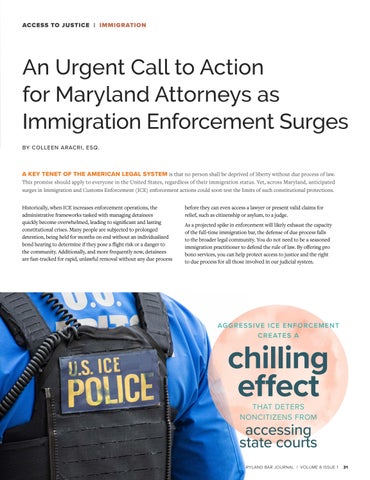
Past reports by the Maryland Access to Justice Commission have highlighted how aggressive ICE enforcement creates a chilling effect that deters noncitizens from accessing state courts to seek protective orders, testify as witnesses, or vindicate civil rights.1 When ICE enforcement actions ramp up, the standard administrative immigration channels, due to backlogs and strict statutory limitations, are often structurally unsuited to provide immediate relief. This is where the writ of habeas corpus becomes indispensable.
What Is a Habeas Petition in the Immigration Context?
Derived from the Latin meaning “that you have the body,” the writ of habeas corpus is a common-law principle dating back to the Magna Carta. It serves as a direct judicial command requiring the government to bring a detained individual before a judge and to legally justify the deprivation of their liberty. In the immigration context, a petition for a writ of habeas corpus is typically filed under the civil federal habeas statute, 28 U.S.C. § 2241, in the U.S. District Court for the District of Maryland.
It is vital to understand that a petition for a writ of habeas corpus is fundamentally distinct from standard immigration court proceedings or an appeal to the Board of Immigration Appeals (BIA). While immigration courts focus on whether an individual is removable from the United States, a petition for a writ of habeas corpus challenges the lawfulness of the physical detention itself
The distinction is critical because Congress, through measures such as the REAL ID Act of 2005, channeled challenges to final removal orders away from district courts and into the U.S. Courts of Appeals.2 However, Congress did not, and constitutionally cannot, strip federal district courts of their core jurisdiction to review executive detention
under § 2241. Federal courts retain the absolute authority to examine whether ICE’s custody of an individual violates the United States Constitution or federal statutes.
When ICE detains an individual within Maryland, a petition for a writ of habeas corpus represents the primary, and sometimes final, line of defense against arbitrary state power.
Why Habeas Is a Crucial Due Process Tool
When ICE detains an individual within Maryland, a petition for a writ of habeas corpus represents the primary, and sometimes final, line of defense against arbitrary state power. It serves several functions. Primarily, it enables attorneys to challenge prolonged, unconstitutional detention. Under federal law, the government cannot indefinitely imprison individuals without meaningful review. A petition for a writ of habeas corpus allows an attorney to argue that a client’s mandatory or post-removalorder detention has stretched past constitutional limits without an individualized bond hearing, violating the Fifth Amendment’s Due Process Clause.
Petitions for a writ of habeas corpus also safeguard the jurisdiction of the court. A risk that comes with rapidenforcement scenarios is that ICE may deport an individual before a federal court can even review the legality of their detention. Once an individual is removed from the country, the federal court can lose jurisdiction, rendering the case moot.
Recognizing this threat, the U.S. District Court for the District of Maryland has previously stepped in to defend its own jurisdiction. Chief Judge George L. Russell III issued an Amended Standing Order enjoining the Department of Homeland Security (DHS) from immediately removing any immigrant who files a proper § 2241 petition for a writ of habeas corpus with the court,
1 www.mdaccesstojustice.org/news-insights/judicial-facilities-must-remain-neutral-spaces-to-ensure-access-to-justice/ 2 www.americanimmigrationcouncil.org/wp-content/uploads/2025/01/realid6705.pdf
REPRESENTED
14 times
MORE LIKELY TO win their cases than those navigating the system alone.
granting an automatic short-term stay to ensure the court has time to review the case.3 When the federal administration sued all 15 of Maryland’s federal district judges to dissolve this protection, an independent federal court dismissed the government’s lawsuit, holding that interfering with the court’s ability to halt immediate deportations would offend the rule of law and the constitutional role of the judiciary.4
Moreover, petitions for a writ of habeas corpus allow federal judges to rectify clear agency errors. They provide a forum for Article III judges to review mistakes made by immigration enforcement, such as cases in which the government unlawfully detains a U.S. citizen or mistakenly applies mandatory detention statutes to individuals whose past offenses do not legally qualify for it. Furthermore, federal judges in Maryland have utilized this forum to enforce constitutional standards within detention itself, recently certifying a class action and ordering ICE to halt unconstitutional, inhumane conditions inside holding facilities.5
The Call to Action: How Volunteer Attorneys Can Step Up
The anticipated surge in ICE actions means the need for legal representation will vastly outstrip the capacity of full-time immigration attorneys. This is a systemic challenge that requires a unified response from the broader Maryland bar.
You do not need to be an immigration expert to file a petition for a writ of habeas corpus. In fact, because immigration petitions for a writ of habeas corpus are litigated in federal district court under standard civil rules, attorneys with backgrounds in general civil litigation, criminal defense, employment law, or corporate trial practice already possess the core skills required. Litigating a §2241 petition relies heavily on traditional legal competencies: legal research, drafting persuasive briefs, compiling evidence, and presenting oral arguments before federal judges.
3 www.mdd.uscourts.gov/sites/mdd/files/2025-01.pdf
4 storage.courtlistener.com/recap/gov.uscourts.mdd.584990/gov.uscourts.mdd.584990.58.0_3.pdf
Defending the Rule of Law
The integrity of our legal system is judged by how it treats the most vulnerable among us. If we allow individuals within our state borders to be detained indefinitely or swept away without access to judicial review, the concept of due process becomes an illusion for everyone.
Filing a petition for a writ of habeas corpus is a profound act in support of upholding the rule of law. It forces the executive branch to respect the constraints of the law and treats the detained individual not merely as an administrative file number, but as a human being endowed with fundamental rights. In many instances, it is the only line of defense to halt these rapid out-of-state transfers and keep Maryland families together.
The impact of legal representation is definitive: represented immigrants are 14 times more likely to win their cases than those navigating the system alone.6 We urge you to use your law license to stand between arbitrary executive power and the individuals it threatens. Review MSBA’s immigration resources, sign up for a training session, and volunteer to take a case. When the surge comes, you can be ready to stand up for justice.
You can sign up on the Habeas Interest Attorney Form for the National Immigration Project7 and find more information on the National Immigration Project Habeas Project via their website.8
5 cases.justia.com/federal/district-courts/maryland/mddce/1:2025cv01613/582507/170/0.pdf?ts=1772902373
If you cannot assist with a petition for a writ of habeas corpus, but still want to volunteer to help with an immigration case, there are many opportunities for you to help. Visit the Pro Bono Resource Center of Maryland to learn more about other immigration volunteer opportunities that need your assistance: HTTPS://PROBONOMD.ORG/PROJECT/MILAP/.
6 probonomd.org/project/milap/#:~:text=Families%20fleeing%20violence%20are%2014,remain%20in%20the%20United%20States.
7 docs.google.com/forms/d/e/1FAIpQLSfTLEGqbS1y8Sq8hw6IOeIFCIGNZuMt8P_M_nn75lvb2gwlvA/viewform
8 nipnlg.org/habeas-project
LEARN MORE