05.19
STRATEGIES & INSPIRATION FOR AUTO CARE SUCCESS
BECOME THE VISIONARY LEADER YOUR TEAM NEEDS PAG E 5 8
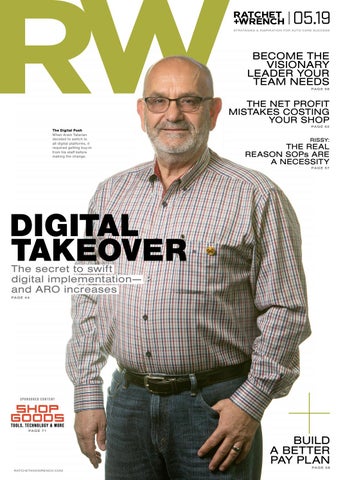
THE NET PROFIT MISTAKES COSTING YOUR SHOP The Digital Push When Aram Tatarian decided to switch to all digital platforms, it required getting buy-in from his staff before making the change.
PAG E 6 2
RISSY:
THE REAL REASON SOPs ARE A NECESSITY
PAG E 57
DIGITAL TAKEOVER The secret to swift digital implementation— and ARO increases PAG E 4 4
SPONSORED CONTENT
TOOLS, TECHNOLOGY & MORE PAG E 71
RATCHETANDWRENCH.COM
BUILD A BETTER PAY PLAN PAG E 3 8
“FAILURE
IS NOT AN OPTION. WE’VE GOT TO GET IT RIGHT THE FIRST TIME AND EVERY TIME. I NEED MY CUSTOMERS
”
SAFE AND SATISFIED.
DONNIE M. | TECHNICIAN 24 YEARS OF EXPERIENCE
Sign up for exclusive offers and more at DuralastTough.com ©2019 AutoZone, Inc. All rights reserved. AutoZone, AutoZone & Design and Duralast are registered marks of AutoZone IP LLC or one of its affiliates. 2 / R + W / 0 5 .19
WORK
SMARTER
NOT HARDER
DIAGNOSTIC INTELLIGENCE NEW POWERFUL HARDWARE
MS908S
• 1.3GHZ + 1.7GHZ Hexacore Processor • 64G SSD Memory/32G Micro SD Card • 8M Camera / 2 USB Ports (32G MAXIMUM - CARD NOT INCLUDED)
NEW SMARTER SOFTWARE • Bi-Directional with Advanced Coding • Data PIDs from Vehicle Modules • Advanced Service/Reset Diesel Emissions • Key Programming/ADAS Identification
MAXIFIX & MAXICLOUD
Database of Repairs, Diagnostic Tips & Procedures
DATA LOGGING
Live Troubleshooting with Autel Tech Support Team
Compatible with the MP408 Oscilloscope & MaxiVideo Digital Inspection Scopes
PRE-SCAN
& POST-SCAN
MS908SP
COLLISION REPAIR READY SOFTWARE PACKAGE
PURCHASE INCLUDES: • Tablet Tool • Complete Connector Kit • Durable Carry Case • 1-Year Software Updates • 1-Year Warranty
WATCH NOW AUTEL.COM MAXITPMS.COM
HOW-TO-USE
Phone: (855) 288-3587 • USSUPPORT@AUTEL.COM AUTEL.COM • MAXITPMS.COM • MAXISYSADAS.COM © 2019 Autel Intelligent Technology Corp., Ltd., All Rights Reserved
TRAINING V IDEOS
@AutelTools
Follow Us @AutelTools
0 5 .19 / R + W / 3
A PERFECT FIT. A PERFECT PRICE.
EVERYTIME/
There’s a reason why Mitsubishi customers love Genuine Mitsubishi Parts. Designed as a direct replacement for the original part, Genuine Mitsubishi Parts provide the trouble-free performance customers have come to expect. For a flawless repair that will surely keep your customers happy, contact an authorized dealer for all your Genuine Mitsubishi Parts needs.
2019 MITSUBISHI MOTORS NORTH AMERICA, INC. ALL RIGHTS RESERVED
05.19 VO L . 07 N O. 0 5
M A Y
Team Work At Hunter’s Garage, the small team works together closely, both in terms of the jobs that come into the shop, and growing the staff’s knowledge and skills.
F E AT U R E
P R O F I L E
C A S E
38
44
58
66
In order to entice the younger generations to the industry. it’s vital to find ways to make pay—and the larger career path—more attractive.
Going digital in your shop isn’t only a financial investment; it’s also an investment to train your staff and get them to buy in.
In order to grow his shop, Bruce Nation knew he had to become a visionary leader— even if it didn’t feel natural.
Internal training has been key to creating successful, long-term employees for Doug Hunter.
BY KILE Y WELLENDORF
BY KILE Y WELLENDORF
BY NOR A JOHNSON
BY KILE Y WELLENDORF
JULIE ROSILLO
RETHINK PAY
ELIMINATE PAPER
S T U DY
DEFINE YOUR VISION
PRINTED IN THE U.S.A. COPYRIGHT ©2019 BY 10 MISSIONS MEDIA LLC. All rights reserved. Ratchet+Wrench (ISSN 2167-0056) is published monthly by 10 Missions Media, LLC, 571 Snelling Avenue North, St. Paul, MN 55104. Ratchet+Wrench content may not be photocopied, reproduced or redistributed without the consent of the publisher. Periodicals postage paid at St. Paul, MN, and additional mailing offices. POSTMASTERS Send address changes to: Ratchet+Wrench, 571 Snelling Avenue North, St. Paul, MN 55104.
R E PA I R
L I F E
TRAIN YOUR STAFF
ON THE COVER: ARAM TATARIAN PHOTOGRAPHED BY BRETT NELSON
0 5 .19 / R + W / 5
TA B L E O F C O N T E N T S
J U M P
S TA R T
10 ONLINE
22 BREAKDOWN
14 NUMBERS
24 VIEWPOINT
16 AWARDS INSIGHT
28 SPEED READ
18 EDITOR'S LETTER
32 SHOP VIEW
Sending customer thank you cards
Prepare for electric vehicles
The return on 20 Groups
How to leverage your area
Become a community fixture
Tesla tweaks service program Automotive Procare in Rochester, Minn.
Finding inspiration
35 STRAIGHT TALK 32
Overcome common warranty issues JOE MARCONI
2 0 1 9 R A T C H E T + W R E N C H A L L- S T A R
YOUR TEAM WORKS HARD TO PROVIDE YOUR CUSTOMERS W I T H T H E SE R V I C E T H E Y D E SE R V E . N O M I N AT E Y O U R D E D I CAT E D A N D H A R D W O R K I N G T E A M T O DAY F O R T H E 2 0 1 9 R A T C H E T + W R E N C H A L L- S T A R A W A R D S . N O M I N AT I O N D E A D L I N E I S J U N E 1 5 MELISSA BRUNSON ADAMS AUTOWORX 2018 MANAGER WINNER
NOMINATE AT
R A T C H E T A N D W R E N C H . C O M /A W A R D S
ADMIN SUPPORT EXECUTIVE SHOP WORKER WILD CARD MANAGER
SPONSORED BY: proud to support those who elevate our great industry
6 / R + W / 0 5 .19
T O O L B OX
S H O P
G O O D S
SPONSORED CONTENT
53 SHOP ADVICE
Build a strong marketing budget
54 TECH+TOOLS
The ins and outs of installing security cameras
57 INDUSTRY INSIDER
65 THE BOTTOM LINE
How to become detailoriented MITCH SCHNEIDER
82 THE FIXER
Take advantage of busy times A ARON STOKES
The true value of SOPs
Master your net profit woes
79 MITCHELL 1
75 INTERSTATE BATTERIES
81 NAPA TRACS
ALLDATA Diagnostics turns a shop tablet into your No. 1 tool
Work smarter with the latest battery tester by Interstate Batteries
Mitchell 1 repair software provides everything you need to succeed today NAPA TRACs enterprise offers total shop management solutions
77 KUKUI
RISSY SUTHERL AND
62 FINANCE+OPERATIONS
73 ALLDATA
54
Kukui offers a comprehensive tool to build relationships with customers
0 5 .19 / R + W / 7
O N L I N E
E X T R A S
WIRED FOR
SUCCESS
CLICK ON THE LOGO BELOW FOR PRODUCT INFORMATION
Advance Auto Parts
You’re wired differently and we like BMW that. America likesMail that. Shark
Ratchet+Wrench Management Conference
Visit futuretechsuccess.org and find out how your hands-on talent is the key to an amazing technical career. Print & Direct Mail Made Easy
ALLDATA
Ford
When Techs Rock, America Rolls ℠ futuretechsuccess.org
Mercedes-Benz
Tech Force
FUTURETECH
SUCCESS
™
AUTEL
Interstate Batteries
Mitchell 1
TECHNET
Auto Job Central
Jasper Engines & Transmissions
Mitsubishi
The Network
AutoZone
KUKUI
NAPA AutoCare
Volkswagen
NAPA TRACS
WORLDPAC
8 / R + W / 0 5 .19
EDITORIAL VICE PRESIDENT, CONTENT AND EVENTS Bryce Evans EDITORIAL DIRECTOR Anna Zeck ASSOCIATE EDITOR Nora Johnson STAFF WRITER Kiley Wellendorf SPECIAL PROJECTS EDITOR Jordan Wiklund EDITORIAL INTERN Alayna Baggenstoss CONTRIBUTING WRITERS Joe Marconi, Mitch Schneider, Aaron Stokes, Rissy Sutherland PRODUCTION ART DIRECTOR Zach Pate ASSOCIATE GRAPHIC DESIGNER Lily Risken GRAPHIC DESIGNER Nicole Olson PRODUCTION ASSISTANT Lauren Coleman SALES VICE PRESIDENT AND PUBLISHER Chris Messer 651.846.9462 / cmesser@10missions.com ASSOCIATE PUBLISHER Alysia Nelson 651.846.9463 / anelson@10missions.com SALES MANAGER Nathan Smock 651.846.9452 / nsmock@10missions.com REGIONAL ADVERTISING SALES Ross Kirgiss 651.846.9485 / rkirgiss@10missions.com CUSTOMER SUCCESS REPRESENTATIVE Shayna Smith 651.846.9460 / ssmith@10missions.com CLIENT SERVICE SPECIALIST Jen George 651.846.9465 / jgeorge@10missions.com 10 MISSIONS MEDIA PRESIDENT Jay DeWitt GENERAL MANAGER AND PRODUCTION MANAGER Mariah Straub SALES SERVICE REPRESENTATIVE AND BOOKKEEPER Meghann Moore EVENT COORDINATOR Katie Cornet SENIOR DIGITAL MEDIA STRATEGIST Tiffany Fowler DIGITAL MEDIA STRATEGIST Josh Jaskulka MARKETING COMMUNICATIONS SPECIALIST Kasey Lanenberg ADMINISTRATIVE ASSISTANT Amanda Nicklaus EDITORIAL ADVISORY BOARD Leigh Anne Best, Mighty Auto Pro Andy Bizub, Midwest Performance Cars Greg Bunch, Aspen Auto Clinic Ryan Clo, Dubwerx Ron Haugen, Westside Auto Pros David Toole, Toole's Garage HOW TO REACH US 10 MISSIONS MEDIA 571 Snelling Avenue North, St. Paul, MN 55104 tel 651.224.6207 fax 651.224.6212 web 10missions.com The annual subscription rate is $72 (U.S.A. only) for companies not qualified to receive complimentary copies of Ratchet+Wrench. BACK ISSUES Past issue single copies are $8. Go to ratchetandwrench.com/backissues LETTERS TO THE EDITOR editor@ratchetandwrench.com ARTICLE REPRINTS For high-quality reprints or e-prints of articles in this issue, call 651.846.9488 or email reprints@ratchetandwrench.com. Opinions expressed in Ratchet+Wrench are not necessarily those of 10 Missions Media, and 10 Missions Media does not accept responsibility for advertising content.
New Ratchet+Wrench Podcasts.
RADIO
4 SERIES WITH NEW EPISODES EVERY MONTH.
HOW I DID IT. Series featuring a rotating guest each month. Hear about the challenges, opportunities and success stories from shop owners who found a way to thrive. New episode this month.
GROW. Series hosted by industry superstar Rissy Sutherland. Inside the processes, systems and operational strategies that have allowed the industry’s top shops to thrive.
S P O N SO R ED BY:
New episode this month.
LEAD. Series hosted by shop operator Aaron Stokes. The go-to resource for leadership lessons, philosophies and success stories. New episode this month.
INNOVATE. Series featuring a rotating guest each month. An introspective look at the industry’s most pressing topics from the people who know them best. New episode this month.
S P O N SO R ED BY:
Print & Direct Mail Made Easy
S P O N SO R ED BY:
LISTEN AND SUBSCRIBE S E A R C H “ R AT C H E T + W R E N C H ” I N A P P S FOR APPLE AND ANDROID
AUTOMOTIVE GROUP
PODCASTS
STITCHER
POCKET CASTS 0 5 .19 / R + W / 9
SEE THE DIFFERENCE IN OUR PARTS.
ONLINE 05.19 COMMENTS, DISCUSSIONS, FEEDBACK AND MORE FROM AROUND THE WEB
RW INTERVIEW SERIES:
BRIAN SUMP
—
In the second edition of the Ratchet+Wrench Interview Series, sponsored by AutoZone, Brian Sump breaks down how owners can best develop their team. Sump is not your typical shop owner. A former professional athlete, Sump had never turned a wrench in a shop before starting Denver-based Avalon Motorsports in 2007. But in the years since, he has used his business acumen and a detailed, process-based management philosophy to grow the German-specialty shop into what a number of industry consultants consider to be one of the best repair facilities in the industry. The full R+W Interview Series video can be found on the Ratchet+Wrench Facebook page.
Carquest® Gold Brake Pads • Manufactured by leading OEM and OES suppliers for reliable performance • Application-specific formulations for extended pad life and clean wheels
POLL OF THE WEEK:
PODCAST RADIO
THANK YOU CARDS
—
Every Wednesday, the Ratchet+Wrench Facebook page hosts a poll, sponsored by BOLT ON TECHNOLOGY to survey its readers. In the beginning of March, roughly 100 people weighed in on whether or not they send thank you cards or gifts to their customers.
• Multi-layer shim for quiet braking • Hardware included for most applications
HOW I DID IT: GERRY FRANK'S BLUEPRINT FOR SUCCESS
—
Gerry Frank is the founder of Repair Shop Coach and owner of Auto Repair Technology, both located in Brook Park, Ohio. According to a recent Ratchet+Wrench article, Frank is a “prophet with numbers,” one who took his shop to more than $1 million in revenue in the first year. During the podcast, he discusses a formula to help shop owners succeed. Listen to this episode on your favorite podcast streaming app, or at ratchetandwrench.com/podcast.
Learn more at www.AdvancePro.com
JOIN US ONLINE WEBSITE: ratchetandwrench.com
On top of the votes, 38 readers shared what their shops do for their customers in the comments. Look out for the next Poll of the Week to add your input.
FACEBOOK: ratchetandwrench.com/facebook TWITTER: twitter.com/ratchetnwrench LINKEDIN: ratchetandwrench.com/linkedin INSTAGRAM: instagram.com/ratchetandwrench
10 / R + W / 0 5 .19
COOL OFF WITH A/C SAVINGS
Save 15% on ANY brand A/C job including:*
†
• A/C compressor • Accumulator/receiver drier • Expansion valve/orifice tube We offer a full range of climate-control parts from quality brands like Carquest®, ToughOne®,Driveworks™, Factory Air®, and DENSO, so you can depend on the OE level of quality you expect. Learn more at www.AdvancePro.com
†
Only on Carquest, ToughOne, and Factory Air A/C jobs. See store for details.
*
Purchases must be on the same ticket to qualify. Quantities may be limited. Prices subject to change without notice.
Offer valid May 1 - August 31, 2019
0 5 .19 / R + W / 11
Choose Mercedes-Benz StarParts. An authentic parts option — at exceptional prices. 12 / R + W / 0 5 .19
StarParts is a parts line for Mercedes-Benz vehicles 5 years and older, which is: • Built for high functionality and fit • Backed by a one-year warranty* that includes parts and labor • Designed to enhance margins and help grow profits for your shop in the long run To order StarParts, contact your Mercedes-Benz dealership today. *To learn more, visit mbwholesaleparts.com/mercedes-benz-starparts.
0 5 .19 / R + W / 13
NUMBERS THE
TOPICS,
TRENDS,
AND
METRICS
THE NETWORKING NUMBERS
—
20 Groups, and other groups with a similar concept, help provide shop owners a networking system of other owners. These groups typically meet periodically throughout the year to discuss ideas, evaluate, and give advice. Are shop owners who participate in these peer networking groups gaining business knowledge that is truly affecting their shops’ performance? Ratchet+Wrench turned to the 2018 Ratchet+Wrench Industry Survey to see if there was any correlation between networking group involvement and shop performance. ARE YOU A MEMBER OF A 20 GROUP OR OTHER PEER NETWORKING GROUP?
DRIVING
YOUR
OPER ATION
WHAT IS THE DOLLAR AMOUNT OF YOUR AVER AGE REPAIR ORDER?
IN A 20 GROUP OR PEER NET WORKING GROUP
NOT IN A 20 GROUP OR PEER NET WORKING GROUP
Less than $200
1%
6%
$200–$399
34%
49%
$400–$599
40%
30%
$600–$799
13%
8%
$800–$999
4%
2%
$1,000 or more
7%
4%
Unknown
1%
1%
61% No 38% Yes 1% Unknown WHAT IS YOUR OVERALL GROSS PROFIT MARGIN?
IN A 20 GROUP OR PEER NET WORKING GROUP WHAT IS YOUR T O TAL Y E ARLY SALES VOLUME AT YOUR SHOP?
NOT IN A 20 GROUP OR PEER NET WORKING GROUP
50%
40%
21%
$750,000–$999,999
15%
10%
$1 million–$2.4 million
50%
26%
More than $2.5 million
11%
6%
Unknown
2%
4%
10%
0%
Beyond the Stats For more information on 20 Groups, as well as stories on how shops have changed their operations while being in one, check out the past Ratchet+Wrench article; The Power of 20 Groups.
14 / R + W / 0 5 .19
STAFF GRAPHICS
12%
Unknown
$500,000–$744,444
20%
Don't track
19%
60% or more
14%
7%
50-59%
3%
$250,000–$499,999
40-49%
Under $250,000
30%
30-39%
NOT IN A 20 GROUP OR PEER NET WORKING GROUP
Less than 30%
IN A 20 GROUP OR PEER NET WORKING GROUP
Beany’s - Reynoldsburg, OH TechNet Member since Sept. 2007
As a father and daughter shop that’s well known in our town, TechNet helps drive traffic as an advocate online where we would otherwise be overlooked. TechNet allows me to provide customers peace of mind, we are connected nationwide, backed by warranties, and are able to maintain our small town shop vibe and personality.
“
“
We’ve been in business for over 40 years...
JOIN THE TECHNET NATION Stay local and leverage the power of more than 9,900 shops in our network. With access to marketing, training and discounts, our Members have the tools to compete and win.
technetprofessional.com/rw FOLLOW US @TECHNETpros 0 5 .19 / R + W / 15
AWA R D S I N S I G H T
NOW ACCEPTING NOMINATIONS! Know someone deserving of a Ratchet+Wrench All-Star Award? Nominate them today at ratchetandwrench.com/awards
Finding Community BY NORA JOHNSON
GET YOUR QUESTIONS ANSWERED.Huh first turned to the internet to aid in some of his industry questions. “Initially, I was looking for a place where I could get help. I was very new to the business and I was kind of making things up as I went along,” he says. While searching for help, he stumbled upon an online shop owner community—in the form of Facebook groups and forums. “I just had so many questions—about how to run a business, what I should be doing in this situation or that situation. I was just posting a bunch of stuff asking for help,” he says. That’s when Huh began receiving comments and messages of advice and support from fellow shop owners. He was then able to assist other owners running into similar issues. “Once I got the help and I got the knowledge, I just wanted to share that with other owners,” he explains. Eventually, one of the groups became 16 / R + W / 0 5 .19
so large that they were looking for people to help out on the backend. Huh decided to become more deeply involved in the online community and step up. “I definitely wanted to do my part, because I’ve gotten so much help from them (the group),” he says. SHARE RESOURCES. Above asking for, and giving advice, Huh says these online spaces are specifically designed for sharing resources. He explains that these groups have file-sharing sections, where owners can post their employee handbooks or their shops’ specific policies and procedures. “Anything that's part of running an automotive repair business, everything’s on there,” says Huh. A lot of the resources that Huh has run across in these online communities, he has implemented into how he runs his shop now. “Almost everything I do now, I got the idea from another shop owner,” Huh says. With a large number of shop owners
ALL-STAR NOMINEE
JAY HUH —
CARMEDIX DURHAM, N.C.
starting their business from scratch, these resources can act as a lifeline. FIND SUPPORT. Beyond being a haven of resources and advice, these spaces also serve as a type of support group, Huh says. “There is a business standpoint of [the online community] and then there is an emotional standpoint of it,” he says. The stress of money and providing can easily become a heavy weight on those in the industry. “I feel like as shop owners, it’s very difficult being where we are, it’s kind of a lonely place. The industry itself is so expensive,” Huh says. “I think there are a lot of people in the industry that are hurting.” Huh says that these communities bring owners together and can create a support system for those seeking solace. “I just want everyone out there to know that they are not alone. There are other people in the same situation, and we definitely want to help because we’ve all been there,” he says.
FUE VANG
Jay Huh moved into his shop’s current Durham, N.C., location back in 2016, where he now shares his strip mall location, and walls, with four other repair shops. “There are 17 repair shops in a two-mile radius from us, and we are definitely the youngest shop [of them all],” Huh says. His six-bay shop, Carmedix, holds its own when it comes to additional convenience amenities. Huh recently started providing a successful pickup and drop-off service for his customers—which includes bringing their customer a rental vehicle while picking up the individual’s car, servicing it and then bringing it back to the owner—Jay calls them “free rentals.” “From the very beginning we wanted to make auto repair as convenient as possible for the customer,” he says. But this sense of direct two-mile competition doesn’t seem to penetrate past city lines—Huh is heavily involved in creating a community that helps to connect shop owners. “I am very heavily involved online, I like networking with other shop owners, and I meet with a lot of them quarterly,” he says.
AN EASIER WAY
TO GET YOUR
BEARINGS Finding the right hub-and-bearing assembly can be confusing. So Motorcraft® simplified the process by revising its lineup to greatly expand coverage. These units are competitively priced and fit many older vehicles. See your local dealer or distributor for all the details.
Right part. Priced right.
Motorcraft® is a registered trademark of Ford Motor Company.
0 5 .19 / R + W / 17
EDITOR'S LETTER
Why Not?
WHAT OUR ‘HEROS’ CAN TEACH US ABOUT OUR OWN POTENTIAL I had a poster on the back of my bedroom door as a kid. From
18 / R + W / 0 5 .19
And why not? If a 43-year-old with a bad back and a bum knee can push himself to outgun a slew of fit, energetic 20-somethings in their physical primes, why can’t you push yourself to get to that next level in your business, or to become a better leader, or to reach whatever goal it is you have set in front of yourself? Sure, it might not be quite as easy to relate to Tiger’s experiences as personal motivation, but, hopefully, all the pages that follow in this month’s issue help to do that. There’s a reason that the word “inspiration” is part of our tagline on the cover of Ratchet+Wrench every month. It’s the same reason that we use your fellow business owners to explain their strategies and stories each month. We’re not doing it to put certain people on a pedestal, or make their successes seem above the norm. Rather than staring mesmerized at their accomplishments, we want you to see that they are no different than you are and that you, too, can achieve what they have. Hopefully, when you finish reading, you don’t ask, “How did they do that?” And instead ask yourself, “Why can’t I?”
BRYCE E VA NS, VICE PRESIDENT, CONTENT A ND E VENT S BE VA NS@10MISSIONS.COM
LEAH QUINTO
the time my family moved into that house, right up until the day I moved out, it stayed there. I looked at it all the time, almost mesmerized by it, which is funny to think now, because to anyone who happened to glance at it, it wasn’t exactly an exciting image. It was a poster of Tiger Woods, crouched down, reading a putt underneath the phrase “The Eyes Have It.” Super simple, which is why it was so effective: All you ever notice are his eyes, and the intense focus in them. For anyone who followed golf at all from, say, 1996–2008, that look is very familiar. And for someone who grew up idolizing him, like I did, that look embodied everything that was great about Tiger Woods, the golfer. His mental strength and determination, his ability to will a ball to do whatever he needed in a crucial moment—the talent, practice, hard work and commitment that went into those moments was lost on a kid. I felt as though he had super powers. There’s no other way to say it: To the 10-year-old version of myself, Tiger was a superhero. I flashed back to that poster last month as I watched Tiger win the Masters. A lot has changed in recent years for him (multiple knee surgeries, four back surgeries, and, well, let’s just call it severely self-destructive behavior). Obviously, I don’t view him as I did when I was a kid. Yet, his comeback hit me far more than any of his previous accomplishments. And it made me think about how we view our idols, role models, mentors, etc. As you get older, the mystique slowly dissipates, and you realize that these superheroes of your childhood are far more ordinary than they always seemed. They’re human. They’re “normal” people. Like all of us, they’re fallible—but capable of great things. That’s what makes them (or simply their achievements) far more inspiring, though. The capes are gone, the magical powers don’t exist, and now that you see this person you idolized as truly no different than you are, you’re able to understand that you too are capable of achieving your own goals.
0 5 .19 / R + W / 19
Some think any filter will do. This will clear the air. Genuine Mercedes-Benz Air Filters allow up to 60% more clean air into your engine,* while still filtering out unwanted particles. That’s because our filters have more pleats to help block dirt, gravel, and other debris from reaching your engine. A cleaner engine — at a competitive price. This is why you should choose Genuine Mercedes-Benz Air Filters. Contact an authorized Mercedes-Benz dealer or learn more at www.mbwholesaleparts.com.
MSRP
66
$
Part # A 273 094 04 04
*As compared to leading paper air filters and based on test #ISO 5011-2000, which measures filtration efficiency using diesel soot.
MSRP and local taxes, and freight if applicable. Prices may vary by dealer. See your authorized Mercedes-Benz dealer for additional details or a copy of the Mercedes-Benz Parts Limited Warranty. 2 0 excludes / R + Wstate / 0 5 .19
J U M P S TA R T NEWS
SHOP VIE W
/
IDEAS
/
PEOPLE
/
TRENDS
32
BREAKDOWN VIEWPOINT SPEED READ
ALEXANDRA PETROVA
SHOP VIEW
Out of the Box An indoor pond sits as the centerpiece of Automotive Procare in Rochester, Minn. The attraction has become a favorite to both staff and customers of the shop.
0 5 .19 / R + W / 21
J U M P S TA R T
Brace for Change TWO EXPERTS ENCOURAGE THE INDUSTRY TO TAKE NOTE AND PREPARE FOR WHAT’S TO COME BY KILEY WELLENDORF
2 2 / R + W / 0 5 .19
EVs are on the rise. The push to develop electric vehicles has increased as automakers such as Volkswagen and Ford have all recently announced plans to put out EVs in the market within the next handful of years. According to J.P. Morgan’s 2018 study, “Driving into 2025: The Future of Electric Vehicles,” “electric and hybrid vehicles will account for an estimated 30 percent of all vehicles sales.” It’s not just OEMs that are on board—some states are highlighting the usage of electric vehicles, too. Maine recently revealed plans to add 50 public vehicle charging stations in addition to a $5.1 million subsidy in efforts to encourage EV use with citizens.
seek,” he says. “Don’t run away from it because you will be squeezed out.”
Dirk Spiers, chief executive officer of Spiers New Technologies, a full-service provider for battery life management, believes it’s important for those in the automotive market to not leave EVs behind. Spiers believes consumers are becoming more interested in EVs due to their price. “Prices keep coming down with electric vehicles,” he says. “They’re becoming cheaper and cheaper.” As the market for EVs continue to rise, it’s important for those in the automotive industry to become familiar with those vehicles in order to stay present, Spiers says. “I would say they need to get immersed in it because there are opportunities to
A Lag in Service Jason Simms, owner of Argonaut Garage in Berkeley, Calif., began servicing electric and hybrid vehicles at his shop seven years ago when the shop operated in a service gas station. Simms recalls watching EV customers air up their tires incorrectly, and offered advice as well as service. Seven years later, he assists customers that come in with Volts and even those who drive Teslas. Although Simms is based in California, he still only sees one EV customer per month, and those ROs are drastically smaller than his other customers’. “The base average for an electric vehicle is $120 maybe,” he says. “Our regular is hovering around $650.” The small repair order doesn’t surprise Simms, however, as EVs don’t require a lot of maintenance repairs. “We see very few electric cars at this point,” he says. Since EVs are inexpensive, Simms says he’s noticed that customers typically aren’t repairing the vehicles, as their maintenance issues can become more expensive than the vehicle itself. “When they need a big repair, it costs $3,000-$4,000 and people aren’t fixing them,” he says. “[You] diagnose it and they won’t fix it anyway. It’s diminishing returns.” However, Simms says he’s worked on vehicle issues such as battery degradation issues, axles, tire rotations, and fluid inspections. He says it’s important to be in the know when it comes to EVs.
“If they are going to actually get EVs in Iowa someday [for example], then knowing about those cars, instead of waiting, is really important,” Simms says. Prepare for What’s Next As electric vehicles become more popular, those in the automotive industry can anticipate growing change, Morgan Stanley’s Adam Jones commented in a recent article by CNBC. “As auto companies shift production towards electric vehicles, we expect increased pressure on a 100-year-old auto ecosystem supporting millions of jobs globally representing a risk to labor relations, earnings and the balance sheet,” Jones said to CNBC. While Simms hasn’t seen too many EVs come to his shop as of late, he believes it’s critical for shops to know how to treat EVs if they do continue to rise. “If people are interested in being in this business forever, if there’s a 25-yearold out there [starting a business], they better be paying attention [to EVs],” he says. Both Simms and Spiers recommend purchasing an EV in order to understand how the machinery works; Simms says it’s a cheap investment since the vehicles are priced fairly low. “I owned a Chevy Spark and understand how they work,” he says. “Find a friend who has one and let it go to the shop.” Additionally, shops can look into training facilities that can educate the shop, he says. “Embrace it. Don’t run away from it. Embrace it,” Spiers says. “The [EV] change is inevitable.” 0 5 .19 / R + W / 2 3
J U M P S TA R T
Overcoming Location Factors A RECENT SURVEY FROM REPAIRPAL REVEALED THE BEST AND WORST AREAS FOR AUTO REPAIR BASED IN THE U.S. BY KILEY WELLENDORF
RepairPal Inc. recently released a survey regarding the best and worst metro areas in the United States for car repair. According to the survey, factors for determining the best and worst areas included average repair bills, labor rates, road conditions, and mechanics per car used. The survey revealed that Honolulu holds the spot for the worst area for car repair, listing factors that include its high cost of living as well as the state with the second-fewest repair workers per car, according to RepairPal. Additionally, the survey revealed that the state had the fourth-worst roads among other cities. Eric Twiggs, performance coach at Automotive Training Institute says location is a common complaint shops have, but he doesn’t believe it’s one that’s truly an excuse for poor service. Prior to working as an automotive coach for the last 10 years, Twiggs previously worked as a shop manager and a district manager where he oversaw 500 employees. “Most of the areas that were rated as the worst were the ones that had the really high cost of living,” Twiggs says. “My big takeaway from a shop perspective is I think now it puts the burden on the shop owner to make sure you’re really improving your game [and getting customers into your business].” Twiggs sat down with Ratchet+ Wrench to discuss how location can be a small factor in a shop’s success, and how a shop can overcome a location flaw by providing excellent service to customers.
How can location alone affect your business as a shop owner? I think that location can affect you, but the perspective I have is that I can’t tell you how many times I’ve seen two shops in a location that somebody would consider to be a tough area— high cost of living, high unemployment rate—and one shop is struggling to keep the doors open, whereas the second shop is having its best year ever in the history of their business. I think location becomes a mindset a lot of times; the shop owner that’s focused on putting the right processes in place can thrive regardless of where they are. What’s interesting is location is one of the big things we hear; it’s kind of a running joke among my coaching colleagues: “My shop is different, my 24 / R + W / 0 5 .19
area is different.” We get people that say, “You know what, it’s just how you need to do things. It’s how you need to set up pricing.” Then we hear, “Well, you just don’t understand. I’m in Honolulu, I’m in Panama Bay—my area is different.” How can a shop owner change their negative outlook on their location and better cater to the customers they have? I would focus on value and ask yourself this question: “What makes your shop different?” You almost have to look at your shop from the lens of the customer; the customer has a lot of options and choices. Why would that customer want to do business with you instead of your competition, and what makes you different? You should have a clear answer to that question. If you’re in the market with a low labor rate and you’re looking to raise it, how do you explain to your customers or make your business seem worth the extra cost? I’ve seen this time and time again, when the customer feels the value, they will find the money. A lot of times when the customer is saying, “Oh, you’re too expensive,” what they’re really saying is, “This experience is not worth the money.” I would focus on communicating what the customer is getting for the experience and you’ll get less of those customer complaints about your expenses. How can a shop show the value of their business to customers? I think it starts with the image and having a high presentation. You want to have clean standards and really exceeding what the customer would expect as far as cleanliness, image, and how the employees are dressed. When I used to run shops, my technicians would always have their shirt tails tucked in, and they looked very presentable. Even something as simple as having digital inspections where you’re sending the customer an edited picture of exactly what’s going on with their vehicle; it’s one thing for me to tell you that you have an issue, but it’s another thing for me to send you a picture where I circle it and you can see exactly what I’m talking about. It helps build that trust.
What do you and your happy customers have in common? Genuine Volkswagen Parts. Help keep your customers satisfied and coming back. That should make you happy, as well. How convenient. •
Genuine Volkswagen Mechanical Parts offer the same factory fit and finish as the originals.
•
True VW quality and performance can mean faster repair times with fewer hassles.
•
Convert happy customers into loyal customers who are likely to refer others.
•
Help improve online reviews and generate more business.
Find an authorized VW Dealer near you at VWWholesaleDealers.com. Call 855.828.4016 for NO-CHARGE repair assistance when working on Volkswagen vehicles. “Volkswagen” and the Volkswagen logo are registered trademarks of Volkswagen AG. ©2019 Volkswagen of America, Inc.
SAVE LIVES. CLAIM CASH. EARN TRUST. Bimmerworks Ltd. in West Chester, PA has already earned $1,150 for completing 23 of their 30 VINs submitted so far! Autopia in Lenexa, KS has submitted 80 Recalls which, if completed, will result in $4,000! 2 6 / R + W / 0 5 .19
What led to these profitable and potentially life-saving results? Simply taking advantage of the BMW Takata Recall Incentive Program. IRFs around the country are building their customers’ trust and increasing satisfaction by following these easy steps: 1. 2. 3. 4. 5.
Visit BMWUltimateRewards.com to enroll or login Navigate to the Recall Support section Check customer’s VIN for open recall Submit VIN and inform customer Work with BMW Center to complete the free recall within 30 days
Each time you complete these steps, you earn $50 (5,000 Ultimate Rewards points*). Plus, you gain an even happier customer. BMW comes to you. In many cases, BMW Centers make this process even easier by using BMW Mobile Service to complete the Takata Recall right in your facility. Be sure to ask your BMW Center if this is an option for you.
Visit BMWUltimateRewards.com to enroll and start earning immediately. *Points can be redeemed for a VISA Pre-Paid card.
J U M P S TA R T
Survey Reveals Customers Skeptic of AVs According to AAA's automated vehicle survey, 71 percent of Americans are unsure of how trustworthy autonomous vehicles are, Consumer Affairs reports. “Those who are skeptical that fully self-driving cars will arrive that soon cited reasons such as lack of trust, not wanting to give up driving, the technology won’t be ready, and that road conditions will not be good enough to support the technology,” AAA said in a statement to Consumer Affairs. The study reveals that 44 percent are comfortable if autonomous vehicles were used for deliveries of food and packages, and 53 percent are more comfortable imagining being inside self-driving vehicles in low-speed conditions. AAA says autonomous vehicles are likely to increase in upcoming years.
“The more drivers understand both the benefits and limitations of the technology that is currently available, AAA believes the more prepared and receptive they will be for the experience of riding in a fully automated vehicle when the time comes,” the organization said to Consumer Affairs. “AAA believes the key to helping consumers feel more comfortable with fully self-driving vehicles will be bridging the gap between the perception of automated vehicle technology and the reality of how it actually works in today’s cars.”
EVs Could Cost Jobs Electric cars could take 3 million industry jobs in the next three to five years, CNBC reports. Morgan Stanley's Adam Jonas said electric vehicle production will result in workforce cuts as companies like Tesla become more mainstream. “As auto companies shift production
towards electric vehicles, we expect increased pressure on a 100-year-old auto ecosystem supporting millions of jobs globally representing a risk to labor relations, earnings and the balance sheet,” Jones said to CNBC. Jonas discussed VW Group chief executive officer, Herbert Diess' recent statements saying electric vehicles take 30 percent less labor to produce an electric vehicle than a traditional vehicle, which Jonas says could lead to the loss of jobs for 3 million workers. Additionally, Jonas told CNBC the number could increase as start-up brands like Tesla and Rivian could build electric vehicles at "50 percent reduction in direct labor or more." Jonas estimates the reduction could cost automakers upwards to $60 billion. SPEED READ CONTINUED ON PAGE 31
The 2019 Ratchet+Wrench RW To Go app is the most efficient way to improve your business. Gain access to podcasts, videos, articles and more. All in one spot. Wherever you go.
®
SPON 2SO 8 R/E DR BY: + W / 0 5 .19
®
D O IN W A A N N P LO D P R S AD O T ID O F R O A E R N S F D F R iO O EE S R
FAST TRACK YOUR BUSINESS
WE KEEP OUR CUSTOMERS HAPPY "I was pleasantly surprised when I received the markeeng approach from Mail Shark with NO upfront costs and the choice of weekly campaigns. I decided it was me to use a company that could handle all my direct mail markeeng needs. Once I called Mail Shark, Derek kindly took all my concerns to heart. He has been an awesome person to help me market to my customer base in a highly eff effeccve manner. Today, I can say with confidence, I am markeeng to my new and exissng customers with the best company around!"
Mew Hoage
OneWay Automoove Service, LLC.
Get a Quote & Free Samples
484-812-9711 | themailshark.com/values
0 5 .19 / R + W / 2 9
3 0 / R + W / 0 5 .19
3 D Printing to Aid Auto Repair A 3 D print project between Swinburne University of Technology, Tradiebot Industires, and AMA Group could bring a new development to the production of automotive parts. According to the 3 D Printing Industry, the collaboration is part of the 'Repairbot' project backed by the Innovative Manufacturing Cooperative Research Centre. The end goal for the partnership is to develop automated, 3 D printed repair service for cars. The project would ideally create low-cost repair service and be used with same-day repairs. “The Repairbot project is a great example of industry and research collaboration. The researchers at Swinburne have wholeheartedly embraced Tradiebot’s idea of developing a technology-driven solution that will automate the repair service for automotive plastic parts,” David Chuter, chief executive officer and managing director of IMCRC said to the 3 D Printing Industry. Currently, a lug was created by the
robotics team at Swinburne, led by Dr. Mats Isaksson. "The truly cross-disciplinary nature of this project has made it possible to develop new materials and methodologies hand-in-hand with the novel robotic solutions," Dr. Isaksson said. Car manufacturers such as Lamborghini have utilized 3 D printing. Ford has also printed parts for the upcoming Ford Shelby Mustang GT500 to save cost.
Technicians Needed by 2026 According to the Bureau of Labor Statistics, nearly 46,000 automotive service technicians jobs will be needed to fill through 2026, CNBC reports. A recent survey by the Conference Board found that as economic growth continues to rise in 2019, so will shortages for both blue-collar and low-paying service jobs, CNBC reports. “In the U.S., more than most other advanced economies, the American dream
is to go to a four-year college and not have a manual job. For a while it was not a problem because there was no shortage. Now, there is a big shortage, and people with a bachelor’s degree are just not interested in those jobs. There is a stigma connected to manual labor that is very hard to break,” said Gad Levanon, chief economist at The Conference Board. Michael Gerhart, master technician at Pep Boys, told CNBC the automotive industry's advancement has presented new training challenges to current industry workers. “Cars have changed a lot, even in the past 10 years as far as the diagnostic end of things, and training has become more advanced as far as what’s required to fix the current vehicles,” Gerhart said. “It definitely doesn’t get boring and it’s always changing.” In efforts to help bridge learning gaps, brands like Icahn Automotive have introduced educational opportunities such as "Race to 2026," to further expand educational opportunities.
2 0 1 9 R A T C H E T + W R E N C H A L L- S T A R
YOUR TEAM WORKS HARD TO PROVIDE YOUR CUSTOMERS W I T H T H E SE R V I C E T H E Y D E SE R V E . N O M I N AT E Y O U R D E D I CAT E D A N D H A R D W O R K I N G T E A M T O DAY F O R T H E 2 0 1 9 R A T C H E T + W R E N C H A L L- S T A R A W A R D S . N O M I N AT I O N D E A D L I N E I S J U N E 1 5 MELISSA BRUNSON ADAMS AUTOWORX 2018 MANAGER WINNER
NOMINATE AT
R A T C H E T A N D W R E N C H . C O M /A W A R D S
ADMIN SUPPORT EXECUTIVE SHOP WORKER WILD CARD MANAGER
SPONSORED BY: proud to support those who elevate our great industry
0 5 .19 / R + W / 31
J U M P S TA R T
1
Automotive Procare BY NORA JOHNSON PHOTOG R A PH Y BY A LE X A N D R A PE T ROVA
1 / VISUAL APPEAL Colin Chester became co-owner of Automotive Procare back in 2016, and later approached his brother-in-law, Alex Keehn, to become the second co-owner in 2017. “Some of my strengths are his weaknesses and vice-versa, so we make a pretty good pair,” Keehn says. In the few years they have worked together, Chester and Keehn have begun a remodeling process in their Rochester, Minn., shop. One of the shop’s standouts is its large and beautifully painted murals on the walls of the reception area. They recently said goodbye to the bright orange motifs that covered the shop’s walls and brought in a locally known painter to update the design. Their new mural now includes an intricate birch tree theme.
2 / MAIN ATTRACTION Although Chester and Keehn aren’t completely sure where the idea came from to bring in a real-life pond to the waiting room, they believe it was the brainchild of a previous owner (who built ponds as a side job) to grab customers’ attention. And that it does. Both Chester and Keehn say it’s the shop’s main attraction that surprises and entertains new customers and kids alike. The pond is home to two turtles, eight goldfish, and lots of baby koi. The shop’s owners and employees have become attached to the pond, and it continues to set their shop apart. 3 2 / R + W / 0 5 .19
3 / BRIGHT AMBIANCE An added bonus of the shop’s staple water fixture, is the calming white noise it produces. The pond has a waterfall atop, emanating the sounds of water trickling throughout the space. Chester and Keehn say this gives some privacy to the large open room and helps to drown out other sounds. Recently, they have decided to upgrade their shop’s lights to LED to help save cost and energy. They say that they are trying to be as green as possible, and avoid waste where they can. The lighting adds to a bright and clean environment, which Chester and Keehn say their staff especially appreciates.
4 / INTERACTIVE SPACE Other upgrades Chester and Keehn brought to Automotive Procare are some waiting room displays that advertise the services they provide. This helps their shop be more customer-oriented, since a lot of the people coming into their shop aren't aware of the many things that they do. The added information makes the front of their shop more interactive—so while waiting, customers also learn about Automotive Procare, what the shop can do, and how the business can possibly further help him or her.
2
3
HAVE AN OUTSTANDING SHOP? Send a few photos and a brief description to submissions@ ratchetandwrench. com and we might feature it here.
4 SHOP S TAT S Owner: Colin Chester & Alex Keehn Location: Rochester, Minn. Staff Size: 10 Average Monthly Car Count: 400 Annual Revenue: $1.2 million
0 5 .19 / R + W / 3 3
THE TECHNICIAN
SHORTAGE W IL L N OT D E FE AT U S
autojobcentral.com 3 4 / R + W / 0 5 .19
Columns
STRAIGHT TALK Joe Marconi
WARRANTY WOES Would you negotiate your prices with an extended warranty company?
MICHAEL HOEWELER
“Your labor rate is too high. If you can’t
negotiate your labor rate, I will have the car towed from your shop to another shop in your area that will do the work at the labor rate we want to pay.” Those were the words spoken to my service advisor a few weeks ago from a claims agent at an extended warranty company. The name of the company doesn’t matter. What does matter is what would you do when faced with this situation. Here’s another scenario you’re probably familiar with: After diagnosing a failed steering rack, the customer informed us that she had an aftermarket warranty policy. She asked me if I could find out if the steering rack is covered. I said, “Sure, I will be happy to help. But, just to let you know, most of the extended warranty companies I deal with have their own labor and parts pricing policies, which may not be aligned with our pricing. So, whatever they don’t pay, you will be responsible for. Are you OK with this?” My customer said, “Absolutely. I understand. I appreciate anything you can do for me.” I thought the hard part was over. What came next was bizarre. The insurance adjuster I spoke to authorized the repair, told me the labor dollars they will pay and then said, “OK, it looks like I have a used rack in a salvage yard in South Carolina. I can have that rack to you in two days.” I had to pinch myself to make sure I wasn’t in a weird dream. Used steering rack? Salvage yard? Is this guy for real? I quickly shot back and said, “Let me ask you a few questions. First, where does is state in the contract that your company will supply a junk yard part for your insured? And why
in the world would I remove an old wornout steering rack from my customer’s car and put back an old used rack from a junked vehicle? Is that really in the best interest of the customer?” The claims adjuster replied back, “Well, shops do it all the time.” I said, “I don’t think so, and I won’t do it either. Let me tell you how this is going to go. I am replacing the rack with a quality part, and I will make sure that my customer gets the best job possible. So, please give me the authorized amount and I will let the customer know what the balance is that your company will not pay.” He said, “You can’t do that.” I said, “Yes, I can. My customer is already briefed on the situation.” He reluctantly gave me the authorization number along with the dollar amount. I relayed the story to the customer. My customer then called the insurance company and gave them hell. They did end up authorizing additional money for the part I installed. Before we continue, I want to be fair and balanced. There are some extended warranty companies that try to offer their customers a peace-of-mind policy, and do pay a good portion of the repair. However, far too often, it’s a struggle to get an extended insurance company to agree to our labor and part prices. Here’s the deal. If you’re like me, you have spent countless hours understanding the numbers of your business. You’ve also spent a great deal of time and effort to put the right people in place, develop the right pay plans and have created the systems to run an efficient business. You know the balance between being
Joe Marconi has more than three decades of experience in the automotive repair industry. He is the owner of Osceola Garage in Baldwin Place, N.Y., a business development coach for Elite Worldwide and co-founder of autoshopowner.com. j.marconi@eliteworldwide.com ratchetandwrench.com/marconi
competitive and profitable. When you consider all this, we need to carefully consider how negotiating our prices will affect our bottom line. I understand the reality too. Sometimes, you really need the work. You don’t want to lose the job. And settling for something is better than losing the job. I have been there. But the truth is that negotiating your prices, in the long run, will not only hurt you, but will also hurt our industry across the board. By the way, my service advisor never did negotiate our labor rate. He simply told the agent, “Our labor rate is nonnegotiable. Do you have any other questions?” The agent eventually backed down and paid us the job at our labor rate. Be upfront with your customers. Clearly explain to them that their warranty policy may not cover the entire repair and come to an agreement with your customer before you call the warranty company. Lastly, make sure you know what it takes to earn a profit. Profit is needed to pay your expenses, put a little money aside for the future, pay your employees a decent wage and also pay yourself the salary you deserve. When you really analyze the bottom line and what’s really left over, do you really want to negotiate your prices? 0 5 .19 / R + W / 3 5
SPONSORED CONTENT
DURALAST CHASSIS— STRONGER BY DESIGN Duralast and Duralast Gold Chassis parts are tested and built to meet or exceed OE Performance even in the most extreme road conditions Day in and day out, commercial vehicles endure more stress than the average Sunday driver. Trucks, SUVs and other off-road vehicles haul harsh and heavy materials, trudge through rocky and uneven construction sites, and barrel up and down unfinished roads and highways en route to the next job. Without a stout chassis, not only is the driver and truck at risk—the job itself
is also at the mercy of the road, the elements, and the long-term stress on the vehicle. Ensure uncompromised quality and repeat customers with Duralast Chassis. The Duralast Chassis line provides OE handling, comfort and performance that helps improve ride quality, no matter where the road takes you.
CHASSIS • • •
Heavy-gauge steel with resilient components for improved performance and long life Hardware and grease fitting included where required by OE Torture tested for rugged dependability
DURALAST QUALITY STARTS WITH RIGOROUS TESTING All Duralast Chassis parts undergo extreme terrain and “torture testing” during development to ensure every Duralast part meets or exceeds OEM standards for performance. They are masterfully designed with heavy-gauge steel and resilient components to deliver reduced component wear, loose joints, suspension play, as well as improve ride quality. •
Stud and Housing Stress Tests: The main structural features ensuring a stout chassis undergo a variety of intense torture tests. The manufacturing team coats the studs and housing in a phosphate coating to bolster corrosion resistance and protect the chassis from the elements. Similar strength testing in regards to chassis hardness and fortitude ensure a seamless frame using the latest spectrometer technology to determine the correct metallurgical strength. Last, a high-definition profilometer checks surface roughness on the polished ball studs to the microscopic
•
•
level, ensuring no surface—no matter how small—is overlooked. Joint Durability Tests: Tie rods and follower ball joints undergo a rigorous three-axis gyroscope test, ensuring maximum torque and mobility where the chassis needs it most. Compression and tension-loaded ball joints undergo even more strenuous workouts during five-axis torture testing. Once approved, the entire structure undergoes fatigue testing to ensure maximum performance long after the parts have been installed, ensuring like-new status on every repair. Extreme Temperature Boot Tests: The boot undergoes rigorous and repetitive testing to guarantee maximum long-term durability. Repeated exposure to various ozone conditions verifies proper, like-new resistance to harsh atmospheres. The boot is also media-blasted with a rough salt/slurry mixture, bracing each Duralast Chassis against the harshest conditions imaginable.
AutoZone, All Rights reserved. AutoZone, and AutoZone & Design are registered marks of AutoZone LP LLC or one of its affiliates. All other marks are the property of their respective owners. 3 6 ©/ 2019 R+W / 0 5Inc. .19
SPONSORED CONTENT
A LARGER BALL MEANS GREATER DURABILITY
COMPETITOR LARGER BALL AND BEARING
STANDARD BALL AND BEARING
With a larger ball and integrated bearing to better absorb impacts, Duralast Gold ball joints are built for the harshest conditions and heaviest loads.
Competitors’ ball joints use bearing inserts that require smaller balls with less load-bearing surface.
LARGER BALL DIAMETER
+12%
CASE STUDY: 2006 - 2010 Ford Explorer
FLATTENED SURFACE AREA
+25%
HARDENED STUDS
LARGER BALL
INTEGRATED BEARING
ZERK FITTING
Induction hardening adds 50% more fatigue durability
More surface area better distributes the suspension load
Unique engineering eliminates failure point and holds larger ball
Contains premium grease, serviceability extends life of ball joint
DURALAST GOLD: TOUGHER THROUGH TECHNOLOGY™ From front to back, Duralast Gold Chassis parts are engineered to be Tougher through Technology™ and deliver greater durability and long-lasting quality for the hardest-working trucks, SUVs and fleet vehicles in the market. • •
•
Hardened studs undergo induction processes to add 50 percent more fatigue durability. Duralast Gold Chassis also includes larger balls than the competition to more evenly distribute the heavier suspension loads, that truck and fleet vehicles come with and are required to withstand. Duralast Gold ball joints are built for the harshest conditions and heaviest loads. A case study featuring 2006–2010 Ford Explorers found that Duralast Gold ball diameters are larger by 12 percent and have 25 percent more surface area. Integrated bearings help eliminate failure-point fatigue and friction to hold the larger ball securely and better absorb all impacts keeping the ride and
•
•
•
connection firm and smooth. Competitors’ ball joints use bearing inserts that require smaller balls with less load-bearing surface. Greasable high strength integrated bearing design for longer service life and most components are greasable and come with zerk fitting, containing high performance grease significantly extending the life of the ball joint over the competition. Superior corrosion-resistant coatings prolong service life. Consistency of corrosion protection varies with some competitors using low corrosion-resistant coatings while others offer no coatings whatsoever. Other features like useful grab points, large wrenching flats and knurled housings offer efficient and dependable installation.
From A to Zerk, Duralast and Duralast Gold Chassis provides OE or better quality and performance, restoring vehicles to like-new status. It starts with innovative design and rigorous testing and ends with quality parts at competitive prices.
THE ULTIMA TECHN PAY GU Structure your labor rate, benefit selection, and employee schedule to keep your technicians from leaving your shop By Nora Johnson
3 8 / R + W / 0 5 .19
ATE NICIAN UIDE 0 5 .19 / R + W / 3 9
T H E U LT I M AT E T E C H N I C I A N PAY G U I D E
Below are the four key compensation areas, and how independent shops can compete with other industries and careers.
“Half of all entry-level techs leave their jobs within the first one to two years.” This statement may or may not be too surprising, for the proof is in the industry’s staggering technician shortage, with some reports showing that, by 2026, the industry will be over 46,000 technicians short. But, there is one element that the former statistic proves: the shortage isn’t entirely due to lack of interest. “I feel like, for every person that wants to go out and write code or be a doctor, there’s an actual person out there that wants to work with their hands to build and accomplish things at the end of the day,” says Chris Cotton, industry coach and consultant. The technician shortage is an extremely complex and layered issue, but working toward keeping the technicians that do join the industry from jumping ship is a vital step to closing the gap. That leaves the question: How? “Young people aren’t being pulled away from the industry as much as they are being pushed,” says Cotton. “We’re an industry that’s been operating the same way the past 50 years, technology has changed but the way we treat our employees hasn’t.” He explains that the industry is at a crossroads right now, and although there are a lot of incredible advancements and great shops out there, changes with how technicians, and other shop employees, get paid needs to be examined.
4 0 / R + W / 0 5 .19
THE PAY “The median annual wage for all occupations that typically require a bachelor’s degree for entry, as determined by the U.S. Bureau of Labor Statistics, was $72,830 in 2017,” explains Elka Torpey, economist at the U.S. Bureau of Labor Statistics. According to the same report, the median annual wage for automotive service technicians and mechanics in 2017 was $36,950. Other trades that require an associate degree make a median annual wage of $43,472. In order to keep technicians from leaving the industry—or to get more young people to join the industry—pay should be more competitive to other outside trades and careers. Considering a shop’s labor rate is key to how much money is brought in, the first step to competitively paying technicians is to charge and collect a proper labor rate, says Cotton. “That means charging enough of a labor rate that sets up the business for success,” he explains.
Follow a formula. Finding a successful labor rate can be done by using a working formula. Cotton explains that most shops do this by following the “Oreo method,” which entails the owner calling up five or six of their competitors and asking what their labor rates are. They then take the most and the least expensive rate that they have collected and throw those figure out, lastly, they choose a rate that lands somewhere in the middle of the remaining numbers. However, Cotton warns this method might not be the most accurate way to determine a working rate, considering the overhead of every business is unique. A shop with a lower labor rate may not include any benefits for their employees, and a shop with a higher labor rate may include large benefit packages. Instead, Cotton advises shops to look at how much their technicians actually cost, along with their tax and benefit load to accurately decipher what the shop’s rate should be. Cotton says the first step to finalizing a figure is to determine exactly what goes into paying each technician. Those things include: • Actual hourly wage • Worker’s comp insurance • Health insurance • Disability insurance • Uniforms • Weekly lunches • Taxes, FICA, FUTA, SUTA • Miscellaneous items given to techs that fall in company perks, etc. The tax and benefit load is comprised of the last seven items on the list, explains Cotton. To calculate the labor rate, break down the tax and benefit load by hour and add the figure to the technician’s hourly wage, then multiply that number by 3.5 (the margin multiplier). This is because if you take any number and multiply it by 3.5, you will get a gross margin of roughly 71 percent. Cotton says most coaches try for a 60 percent margin, but he believes that is too low. In addition to figuring and using the 71 percent labor margin, he then suggests using a labor grid to make up the other 4 percent, resulting in a total labor margin of 75 percent.
3% charge less than $60
(Technician’s hourly wage + tax and benefit load by hour) x 3.5 = labor rate + labor grid Create individual plans. “Every technician has different needs, just like every shop does,” says Cotton. Shop owners should develop a pay plan for what fits each individual technician, depending on what the tech is looking for, how much the shop can afford to pay, and the technician’s level of productivity. At Roy 66 Service in Roy, Utah, Jason Ohlin pays the technicians at his $925,000 shop with an average monthly car count of 245, individualized salaries, year-end bonuses, as well as a variety of benefits. Ohlin says that each technician at his shop has a personalized salary depending on what he or she needs. One of his technicians currently needs health insurance so Ohlin includes that in the plan, while another doesn’t, and thus, has a different salary figure. Ohlin has found that salary works best at Roy 66 Service because he has seen flat rate pay structures result in hurried and inconsistent work.
Like Ohlin, Cotton recommends shops use a type of hybrid pay plan. He suggests that shops pay their technicians an hourly minimum wage as well as further incentives for both individual and team productivity. To incentivise quality work is also important, says Cotton. He gives the idea of pooling together money as a group and then giving it out depending on number of comebacks. Avoid overhiring. Another way to ensure quality technician pay is by avoiding over-hiring, or having more technicians than needed, which results in overall less productivity. Instead, keep fewer technicians on hand and keep them busier by making sure everyone is being productive. Over-hiring may result in technicians leaving and going elsewhere, says Cotton.
7% charge $70–$79
37% charge $110 or more
14% charge $80–$89
LABOR RATE BREAKDOWN According to the 2018 Ratchet+Wrench Industry Survey, 48 percent of shops have a labor rate less than $100.
22% charge $90–$99 15% charge $100–$109
“Every technician has different needs, just like every shop does.” —Chris Cotton, founder, autofix
2% charge $60–$69
13% answered “other”
29% pay flat rate
8% pay salary plus commission
TECHNICIAN PAY BREAKDOWN A majority of shops that participated in the 2018 Ratchet+Wrench Industry Survey pay their technicians flat rate. 7% pay salary 23% pay hourly plus commission
20% pay hourly 0 5 .19 / R + W / 41
T H E U LT I M AT E T E C H N I C I A N PAY G U I D E
EMPLOYEE BENEFIT BREAKDOWN According to the 2018 Ratchet+Wrench Industry Survey, the most common benefit shops provide their technicians is training reimbursement.
33 percent provide disability insurance 46 percent provide retirement plans 65 percent provide training reimbursement 58 percent provide health insurance 23 percent provide life insurance 22 percent provide other benefits, like vision and dental
THE BENEFITS According to the U.S. Bureau of Labor Statistics’ “2018 Employee Benefits in the United States” study, 87 percent of individuals in management, professional and related occupations have access to medical benefits. According to the same study, 78 percent of individuals in installation, maintenance, and repair occupations have access to medical care benefits. Employee benefits go much further than medical care, but this study highlights the difference between what the repair industry is offering comparatively to professions in business and management. Although not far behind, this statistic gives an idea to what the repair industry should strive toward in order to compete.
42 / R + W / 0 5 .19
Discover their needs. The best way to discover what benefits each technician needs and desires is to simply ask them, says Cotton. Some employees may be money-motivated, while others may be motivated by time off, he says. Or, some technicians, like Ohlin’s, might not need insurance (because they are able to be under their spouses’), while others may need medical, dental and visual. Cotton advises owners to sit down with each technician to find out what benefits he or she needs, and try and find a way to provide that to him or her. “There’s so much you can do with benefits,” says Cotton. “All those people (your employees) have certain goals and dreams, and if you figure what they are you can use them to help the shop.” On top of year-end bonuses, Ohlin offers his employees health insurance (if they need it) and he also contributes to their retirement. Get creative. An advantage to being an independent business owner is the flexibility and creativity that can be incorporated into employees’ benefits. Cotton has seen owners provide technicians with gym memberships, monthly car detailing and gas tank fills.
“I’ve heard of a situation where a guy wanted a four wheeler to drive around on the weekends, so the shop owner went out and bought a four wheeler, kept it himself and then let the employee have it every weekend,” Cotton explains. He encourages owners to discuss desires and dreams with employees, to discover what will work for them.
“I don't think we do a good enough job telling young adults what the industry can provide.” —Chris Cotton, founder, autofix
“If your employee wants to go on a hunting trip, you can include it in part of their pay plan and part of their benefits,” says Cotton. Regardless of the benefits package that is designed for each employee, the most important thing is to do is follow through with what is promised.
“The worst thing you can do is have a goal or something, not report back with how you’re doing, and then on the last day say, ‘Oh, if you guys would have done better, we would have met our goal, so I’m not gonna give it to you’,” says Cotton. “That’s the worst thing for group morale.” “As owners, we need to do what we say we are going to do,” he adds. “We can’t make empty promises we aren't going to keep.” Emphasize work-life balance. Unfortunately, small independent shops do not have the ability to be as flexible with hours and time off as bigger companies. Most large businesses could lose 20 percent of their people and still be fine, but in a small shop, one person can make a huge dent, says Cotton. He says that owners have to be prepared to work around that to help create successful work-life and homelife balance for their employees. Ask the technicians if they are married or if they have kids, because each one of those different people are going to have different needs for how much they want to work, says Cotton. The single person may want to work all the time and might be money-motivated, but the person with kids or a spouse may want to spend time with their spouse or family more.
Once owners get the answer to the above questions, they can then create ideal schedules for each technician, whether that includes a more flexible schedule or strict 40-hour workweeks. Shop owners should ask themselves, “How can I add value to their lives by giving them a schedule that they can live with?” Provide a future. “I don't think we do a good enough job telling young adults what the industry can provide,” says Cotton. Part of the issue of keeping young technicians in the industry is the lack of direction that is presented to them. Young adults want a career path; they want to advance and grow and feel like they are contributing to something, or like they belong and contribute to a team, says Cotton. But when techs get brought in on their first day, they unpack their tools, they meet everyone and then are given a ticket and off to work. They are presented with no advancement opportunities at the shop. “We all want to work and grow and move towards something,” says Cotton. “But we don’t make a good enough effort of helping young techs try to get to their next step.”
WHAT READERS SAID Readers were asked what they believe are pushing technicians away from the industry, below are their ideas and pay structure concepts. “Shops need to charge a real rate that allows us to pay our technicians a living wage. We pay full benefits (health, life, disability, and dental insurance) plus a salary of roughly $20-$30 per hour. But we also charge over $130 as a door rate.” Victoria Crosby Co-owner Russ’s Wrench Auto Repair “I took away their flat rate and gave them salaries. They worked harder, worked together more and quit complaining on slow days. They had better attitudes over all. Good equipment and education. Showing them you care about them just as much as the customer went a long way.” Heather N. Piechowski Genuine Auto Repair 0 5 .19 / R + W / 4 3
In the Numbers Since the switch to digital, Aram Tatarian has seen a significant jump in his shop's ARO.
4 4 / R + W / 0 5 .19
Push Past Hesitations How one shop owner walked his employees into the digital age By Kiley Wellendorf Photos by Brett Nelson
0 5 .19 / R + W / 4 5
P U S H PA S T H E S I TAT I O N S
Leading the Team Aram Tatarian was met with some hesitation when he began the digital switch—but was able to lead his team to success.
ram Tatarian moved his shop into the digital spectrum in Fresno, Calif.,
and was met with hesitation from his team members, as well as additional obstacles along the way. It turns out, even if you do have a plan, there are outside factors that come into play, despite the transition making sense in your head. For Tatarian, becoming digital meant bringing his shop into the modern era—a move that was difficult for his team to get used to in the beginning. “As a business owner, we have to be setting the vision for your business,” Tatarian says. “What contributed to the increase is two things: the economy has turned around the last two years and there is some excitement in the market,” Tatarian adds. “The other thing was—I think they go hand in hand—we were able to connect with digital inspection and once we started really implementing that, we did notice a huge jump in repair order average and response from the customers was just very [eye-opening].” Since moving into the digital spectrum, Tatarian has seen real changes in his shop floor and his process, increasing his former ARO of $557, he says. “The first year we implemented the digital inspection in 2017, our ARO jumped to $715,” Tatarian says. “Last year, our ARO jumped to $744, so we’ve seen increases every year with our ARO.” When you take a leap of faith, sometimes things don’t necessarily work out, but with enough patience and faith in a process, it’s possible to make a shift in your business work. For Tatarian, finding success meant cross into new territory and jumping over obstacles along the way. Tatarian shares instances of hesitation he was meant with when becoming digital, as well as how he was able to work through the process with his team. 4 6 / R + W / 0 5 .19
ARAM’S AUTO REPAIR Location: Fresno, Calif. Owner: Aram Tatarian Staff: 5 (3 technicians, 1 service advisor/ manager, 1 office assistant) Size: 5,000 square feet Average Monthly Car Count: 120 Annual Revenue: $1.1 Million
“What we’re doing is successful; why do we need to change?” It can be hard to get out of your comfort zone when making a change in the business. For Tatarian, he wanted to stay ahead in the industry, but knew it meant tapping into an era that he was unfamiliar with: digital inspections. “We wanted to be at the cutting edge of technology of what’s going on and what’s happening,” he says. Tatarian didn’t grow up in the digital age, but he knew the opportunities that come with moving from paper to digital inspections could only grow his business. “If you’re going to be a business in the future, you can’t wait for the future to get here before you get in it,” he says. “You have to get in it right now; if you wait too long, it might be too late.” Although everyone might not be ready to take a leap of faith, it’s important to reiterate with your team why it’s important to try something new out with your team, as well as how you’re going to work to get there. “You have to show as an owner that you’re invested in this and you want to see this implemented,” Tatarian says. “It’s not like the old days of, ‘If you don’t like it, you have to leave.’ You have to get your employees to be part of the solution.” You have to be invested, he says. “If you’re going to digital, you have to jump in there,” Tatarian says. “You will not be successful both ways—you have to make a decision and you have to move forward and find a way for your employees to buy into it. “You can’t force somebody to do something if they chose not to do it.” Owner takeaway: When talking to your team about implementing a new procedure, explain your thought process behind it and discuss your plan. “What happens if it doesn’t work?” Not everything will work out as planned, and it’s important to have a plan of execution when you’re met with failure. The first digital inspection tool Fresno Auto Repair tried was not successful. The program was hard to follow, his shop was not really instructed on how it works, and moving to a whole new inspection process was a lot for his team.
“It was very difficult to maneuver, set up and understand,” Tartarian says. “It did not fit with what we were doing and how we were running the shop.” The key, he says, was that his manager buys into the product, otherwise it becomes a chore to sell the product to the employees. Without abandoning the idea of implementing digital inspections altogether, Tartarian decided to check out a presentation by AutoVitals with his service advisor. The two spent the whole day meeting with the company and make the move to the new system. Once the team got onboard the product, the shop began to notice everyday changes, he says. “The guys are getting more comfortable using the digital inspection,” Tatarian says. Owner takeaway: As an owner, you have to make sure your management buys into what you’re doing, otherwise other difficulties will arise. “How long is it going to take us to get used to this?” After finding a digital inspection tool that Tatarian’s staff agreed with, the team decided to explore ways in which they could grow the ARO and reconnect with customers. In the past, the shop would inspect the vehicle, relay information to the customer regarding what they found, and then the customer would decide what service would be done. “We’re here to take care of the customer and if we’re not doing the inspection consistently the same way, then we really are not doing them service,” Tatarian says. Today, one new method that the shop has put an emphasis on is taking photos throughout the inspection process that are later presented to the customer. “We were always inspecting the vehicles, but I think the difference is that pictures are worth a thousand words, and I don’t have to sell anything,” Tatarian says. “They have to make the decision to see what to do with their vehicle—it’s not our job to sell them stuff, it’s our job to give them the information they need.” During each vehicle inspection, his staff takes time capturing photo evidence
of “good” parts that do not need to be touched, as well as “bad” parts, or ones that’s may need to be looked at further. “If they bring their vehicle in today and four months down the road, [customers] can see the inspection from four months to now [and] they can see the difference,” Tatarian says. In becoming digital, the team discovered the importance of connecting with more advanced customer base, he says. “Today’s customers do the research on their own before they buy or purchase the product,” Tatarian says. “What it’s done for the shop is, instead of sending the customer to Google and having them Google what they need, we’re getting them all of the tools that they need to find the information.” Owner takeaway: Try to include your team in figuring out ways in which to change a procedure; when everyone has the ability to bring new ideas in, it becomes easier to determine the best possible procedure for your business. “What do our customers get out of this?” In addition to digital inspections and communicating vehicle issues with customers, the shop has moved towards a more modern method of reaching customers—by text. Texting has allowed the shop to engage with customers more efficiently, Tatarian says. “We are learning how customers respond because we all do the same thing,” he says. “When I go to purchase a TV, I go look around and see what’s what, and I go to Google and do a review search [to see] how good is this product.” Communicating via text message has also allowed the business to bring in more customers and even change perspectives about the inspection process. Tatarian recalls a time where a customer was set on only getting a certain service done, but later changed her perspective after seeing provided photos from the digital inspection. “When I saw the pictures I was sold,” he recalls the customer saying. “She was a new customer; there was no trust built yet, but the pictures sold the job.” Owner takeaway: Communicate with your team and keep track of results to determine how successful the new procedure is. 0 5 .19 / R + W / 47
N RE E G 1 T IS O TE SA R V BY E $5 00 JU
INDUSTRY S U CC E S S THROUGH LEARNING Hear from industry leaders about the everchanging automotive industry and how your shop can thrive amidst these changes by attending the 2019 Ratchet+Wrench Management Conference.
OCTOBER 3 - 5 M I N N E A P O L I S - ST. PAU L
DATA DRIVEN DIRECT RESPONSE
2019
Learn more about the speakers, agenda and what will be happening when you visit RWCO N F E R E N C E .CO M
New Ratchet+Wrench Podcasts.
RADIO
4 SERIES WITH NEW EPISODES EVERY MONTH.
HOW I DID IT. Series featuring a rotating guest each month. Hear about the challenges, opportunities and success stories from shop owners who found a way to thrive. New episode this month.
GROW.
LEAD.
INNOVATE.
Series hosted by industry superstar Rissy Sutherland. Inside the processes, systems and operational strategies that have allowed the industry’s top shops to thrive. New episode this month.
Series hosted by shop operator Aaron Stokes. The go-to resource for leadership lessons, philosophies and success stories. New episode this month.
Series featuring a rotating guest each month. An introspective look at the industry’s most pressing topics from the people who know them best. New episode this month.
I N N O VAT E S E R I E S S P O N S O R E D B Y:
L E A D S ER IES S P O N SO R ED BY:
G ROW S ER IES S P O N SO R ED BY:
Print & Direct Mail Made Easy
LISTEN AND SUBSCRIBE S E A R C H “ R AT C H E T + W R E N C H ” I N A P P S FOR APPLE AND ANDROID
PODCASTS
STITCHER
POCKET CASTS
M A K E
M O N E Y / S A V E
M O N E Y / W O R K
S M A R T E R
SHOP ADVICE T E C H +T O O L S CASE STUDY FINANCE+OPER ATIONS
Stepping Back At Westlake Independent in Westlake Village, Calif., Bruce Nation has been able to pass down his shop knowledge to his team in order to focus more on being a leader.
58
FORREST LEO
CASE STUDY
0 5 .19 / R + W / 51
2 0 1 9 R A T C H E T + W R E N C H A L L- S T A R
YOUR TEAM WORKS HARD TO PROVIDE YOUR CUSTOMERS WITH THE SERVICE T H E Y D E SE R V E . N O M I N AT E Y O U R D E D I CAT E D A N D H A R D W O R K I N G T E A M T O DAY F O R T H E 2 0 1 9 R AT C H E T + W R E N C H A L L- S T A R A W A R D S . N O M I N AT I O N D E A D L I N E I S J U N E 1 5
MELISSA BRUNSON ADAMS AUTOWORX 2018 MANAGER WINNER
NOMINATE AT
R A T C H E T A N D W R E N C H . C O M /A W A R D S
ADMIN SUPPORT EXECUTIVE SHOP WORKER WILD CARD MANAGER
SPONSORED BY: proud to support t h o s e w h o e l e vat e our great industry
5 2 / R + W / 0 5 .19
T O O L B OX / S H O P A D V I C E
Market Efficiently to Your Customers HOW BUDGETING CAN LEAD TO EFFICIENT MARKETING FOR YOUR SHOP Your customers are out there and they’re rapidly changing; some communicate via text message and others sift through emails and newspaper articles to see what’s happening in the community. As time changes, it’s important that your marketing efforts adapt as well. Jeff Matt, owner of Victory Auto Service & Glass, a six-store operation in Minnesota and in St. Petersburg, Fla., sits down every year to determine what his marketing budget will look like. During the meetings, the team discusses how marketing tactics went throughout the year, whether the approach will be repeated, as well as what to plan for the following year. “I think of marketing as this: an initiative to move my business forward,” Matt says. For Matt, it’s important to focus on marketing that your customers can get behind and see for their eyes—it looks bad when marketing fools customers into thinking the business is something entirely different. AS TOLD TO KILEY WELLENDORF
Before you start marketing, you have to look at what your objective is for the marketing approach. Are you
trying to capture new customers, bring incentives in, or even establish yourself as a relatable company? Right now, we budget 3.5 percent, or $260,000, of our sales, for marketing because we achieve a 5 percent growth-per-year at the amount of spend. If we didn’t have the growth, then we would raise our marketing budget. This is what’s worked and we’re confident in this because we always track everything. In our business, we have four areas that we focus on in our marketing plan that are pretty simple and work for us: the new customer, first-time customer retention, existing customer retention, and image and branding.
THINKSTOCK
Work on your website because that’s the first thing new customers are going to see when they’re checking out your business. It’s important to have a nice
looking website and build it up to say all of the right things. Customers will notice when your marketing doesn’t match your business. We spend around $400–$600 per month for all of our locations on our website.
For new and existing customers, identify those who live around the area of your shop and send out mail that will bring customers into the shop. We spend
roughly $2,800 on postcards for new customers that we are trying to reach for the first time. We have a specific circumference around the shop that we focus on, and we try to touch on those people three to six times throughout the year. In addition to postcards, we try to determine other ways that physical mail can bring new customers into the business. Another worthwhile initiative is sending out inhouse coupons through the mail. This is a primary focus for us because it’s a way for us to become known to new customers, as well as give them initiative to come into the shop. Lastly, we send out mail to thank our customers. Instead of our customers receiving a card around the holidays, we send out Thanksgiving cards. We spend $5,000 on these cards that also include a voucher card for a set discount on the next visit. After a customer leaves your shop, that shouldn’t be the last time they hear from you regarding vehicle service.
Any customer who has visited one of our locations and needs additional work, we’ll
allocate $6,300 of our budget for declined service reminders. If some things didn’t get done on the vehicle, we follow up 30 days later, and we’ve found that the average ticket for those typically doubles. When a vehicle leaves your shop, declined service should be documented and followed up on. Whether it’s done by postcard—what we typically use—or by phone call, sending out a declined service reminder can really pull the customer back in to complete the vehicle’s service. Lastly, don’t be afraid to say no if your business is approached for an opportunity that doesn’t quite fit your marketing plan.
We talk a lot about image and branding in our business, and for us, we put our money into marketing efforts that fit our goal of being community based. 0 5 .19 / R + W / 5 3
T O O L B OX / T E C H +T O O L S
Secure Your Shop The ins and outs of security cameras, and how to choose the best ones for your shop BY NORA JOHNSON
Deciding how to protect your business, along with the equipment and employees
inside of it, is a daunting task. With ever-changing technology and monitoring structures, it’s easy to feel overwhelmed. Shop owners need to be able to decipher what types of security measures they want to take, what equipment works best for them, how their system is going to be monitored and how much they are willing to invest. Generally speaking, most shop owners should include two types of equipment to protect their shops, says Mary Abeln, co-owner of Trust Security in Edina, Minn. Abeln has worked with countless independent shops to assist in designing security configurations that help protect owners. She says a set of cameras and an alarm system should be security staples for shops of all sizes. “Paying for a good alarm and camera system that are easy to use and provide you with actual data is worth it to every business owner,” Abeln says. This set of equipment will protect from external theft as well as internal—which Abeln says typically makes up the majority of shop theft. Cameras and alarms also protect owners from issues with onsite injury, overall personal safety and peace of mind. “You have insurance all over the place in your shop, this is just another piece of that pie, the insurance pie,” says Abeln. Alarm systems are customizable to each shop’s pricing and protection needs, says Abeln, but typically work the same. The slew of options, varieties, and forms of technology come into play while choosing camera types. Here is a breakdown of the components, price, and benefits of the two most popular types of security cameras on the market.
THE EQUIPMENT System Overview Wired Wired security cameras are what most think of when picturing traditional cameras, Abeln says. The camera is connected to a DVR (digital video recording) system somewhere in the back of the shop. The DVR is where the camera memory and images are stored. This system will provide constant shots of everything happening inside (and outside if a camera is installed to the exterior). Wired cameras also allow for the 5 4 / R + W / 0 5 .19
user to connect the image stream to the Internet, allowing the owners to see what’s going on at their businesses from their smartphones or computers. This type of camera system takes more energy, has a more complicated installation process, and a higher price point than wireless security cameras, Abeln explains. Wireless Wireless cameras are more modern, but the name can be misleading, and doesn't necessarily mean the cameras
are truly wireless—they still need power, Abeln says. All images are stored in the cloud, she explains. One of the other larger differentiating factors is the amount of images it produces. The camera will take a larger number of images only when triggered by an event that it’s set up for, like specific motion or an alarm. Wireless cameras take less energy, installation time and have a lower price point, but due to the lack of continuous stream, may miss monumental events happening between frames.
THE SETUP
Pay Range
Wired The number of cameras shop owners should invest in depends on how big the shop is, and how much coverage the owner is looking for, says Abeln. “A security service advisor helps you come up with a plan that protects your perimeter to observe your employees, your customers, and those people out in front of your business,” says Abeln. Typically, a smaller shop uses four cameras, Abeln explains: three cameras for inside the shop and one for the outside. A good rule of thumb is to think about each wired camera being priced at $1,000, with the figure being all-inclusive, and including more than the physical equipment. Adding the internet component is an extra monthly cloud storage fee. Wireless A wireless camera system is $300 per camera, Abeln says. Although a lower price point, Abeln says users should expect to pay a higher monitoring rate that includes mandatory cloud storage.
It is important to factor in the possibility that the lower price point of wireless cameras does include the risk of losing money in the future, Abeln explains.
Monitoring
Regardless of the type of camera chosen, the stream of images needs to be monitored. If the decision was made to have the equipment professionally monitored by ADT, Vivant, or another monitoring company, owners should expect to spend somewhere between $40 and $60 per month, says Abeln. She says that the most important factor is to know where your security provider is monitoring. Relying on smaller monitoring companies may run the risk of lack of availability or support when needed. “If you cannot verify who is doing the monitoring, then you shouldn't do business with that company,” Abeln says. Monitored security systems can give the advantage of a possible insurance discount when demonstrated that the shop has both a security system and is professionally monitored, says Abeln.
Aaron Smith, owner of S&S Auto Repair, has run the Chattanooga, Tenn., 10-bay shop for the last six years. Around that same time, the shop invested in a boxed camera system and a DVR; Smith says the system worked fine, but, in the last couple of years, he noticed the camera’s poor resolution. “After I did some research, we noticed it was more important to invest in a good camera system,” Smith says. S&S Auto Repair now utilizes a set of 10 wired cameras throughout the shop. Smith says he decided to go with a wired system over wireless because of the shop’s size and the system’s reliability. “We’re not a small shop; we have 10,000 square feet, 10 bays, and it’s all enclosed, so in order to run a wireless system, you’re going to have to be able to link that to multiple access points,” Smith explains. He says that wired systems allow for faster access than waiting on a network. Wireless systems also run the risk of the network being down, resulting in a loss of coverage. “I’m not dependant on access points in order to record everything that’s going on,” Smith says. Each of Smith’s cameras have the ability to record in 1080i resolution and are placed strategically throughout his business; there are cameras on the shop floor, the front customer area, the parts department, and various other locations inside and outside the shop. Smith says the upgrade to HD has made the quality of the security camera footage a high enough quality that he can zoom in on specific cars or individuals with clarity if needed. The cameras help with monitoring potential outside theft and vandalization, company theft, liability issues and to simply keep an eye on the shop. “Having access to those camera systems on our phones while we were away on vacation, or away at a conference, or with family is crucial,” he says. Smith says that wired systems tend to cost a little more, but the stronger connectivity and dependability make the added expense worth it. “No camera system is a bad thing, so any kind of camera system that you can use for the time being within your budget is best. However, once you're able to afford something a little bit better, it’s always best to get that system,” he says. 0 5 .19 / R + W / 5 5
YOUR 24/7 AUTO CARE COMMUNITY FOLLOW US: • SEE PHOTOS & VIDEOS • GET THE LATEST AUTO CARE CONTENT • TELL US WHAT YOU REALLY THINK
ratchetandwrench.com/facebook
ratchetandwrench.com/linkedin
ratchetandwrench.com/twitter
ratchetandwrench.com/googleplus
BE PART OF IT ALL
Columns
INDUSTRY INSIDER Rissy Sutherland
NO REGRETS Why SOPs are key to peace of mind This month, I met with shop owners
across the country about what worked for them in the retention of their current customers. One of the items that came up a few times was a company that sent out rebate checks for their best current customers that had not been in the shop in the last 60 days and spent more than $250. The customer would get a rebate check to use on a future visit based on past spending. The numbers were amazing: a 15–20 percent response rate. Of course, I wanted to meet the person that came up with this program, why it works so well and how they were doing it. Meet Tommy Nickelson, the owner of Advanced Auto Repair in Denton, Texas. Today he has an eight-bay shop doing over $2.6 million per year in sales for repairs alone and has a customer retention company called Rebate Checks. Tommy first came up with the idea while working with the late Bob O’Connor at RLO Training. The first item that Tommy addressed with his 20 Group was not only how to generate new customers, but also how to get his current customers to come back because none of the CRM systems worked how he wanted them to work. Then he had a vision while at the counter one day. He started to see how, when mail came in, the only thing that stayed on his desks were checks. All mail, junk mail, letters and advertising ended up in the trash, but those checks stayed right there on the desk! Voila! That’s how rebate checks were born! He worked on improving the marketing piece with his 20 Group to put together the right letter and check program based on a customer’s previous spend amounts to give them a rebate in the form of a check that customers could use. Today, the rebate check section of his business does this process with little work from the shop owner at all and a return rate of 15–20 percent. Not only did this help other shop owners, but it also caused Tommy’s shop sales to increase by another $200,000 per year.
Next, a tire shop down the street came up for sale. Tommy decided to purchase the business, customer list and equipment. This expanded their business to almost $2 million in sales overnight. What he found was that with the right team mix of one service advisor up front to four technicians in the back, the back of the house to push the front of the house sales. After seven years, the building for the tire shop was eventually sold and he made the decision to combine both stores into the auto repair location. They were able to retain all the customers, managers and technicians into his eight-bay advanced auto repair facility taking it to $2.4 million without even expanding his footprint. Finally, Tommy still saw opportunities for growth and he contacted AAA to become a AAA location. Now, he has two full-time AAA vehicles in the area making up another $300,000 or more in revenue. Tommy’s story is extraordinary and continues to be today. I love seeing motivated shop owners continue to find innovative ways for not only their growth, but also helping each other along the way! There are many lessons learned from the 20 Group process that have made a difference that Tommy says he could never have been anticipated. For example, the importance of solid SOPs and job descriptions unfolded in a way Tommy never could’ve imagined. He had been dragging his feet on implementing a management structure and standard operating procedures for all positions within the company. Letting go and trusting others to take care of your business was not easy or comfortable. After a few nice, followed by not-sonice, nudges from his peers, they were finally finished. He now had a solid manager in place, everyone knew their job and was able to solve unexpected issues without needing guidance from Tommy. This couldn’t have happened at a better time. Within a few weeks, Tommy learned
Rissy Sutherland has opened more than 400 shops in her career as the executive for nearly a dozen automotive brands and now the president of SRS + Co. She is one of the industry's foremost experts in shop operations. sutherlandrissy@gmail.com ratchetandwrench.com/sutherland
that his dad had wasn’t going to be around much longer. He had only six months left of multiple camping trips to the lake, fishing, trips to doctors, chemo, lunches, dinners and so much more. Tommy says it was the best quality time they spent together. Had he not implemented the suggestions from the 20 Group, Tommy believes he would have been forced to choose between spending quality time with his dad or providing for his family and the 19 other employees at that time. Luckily, the group’s insight of what needed to happen within the business allowed Tommy and his wife to step away for extended periods planned and unplanned during those last six months. “I can’t thank them enough for that time they gave me,” Tommy says. “With that lesson, I feel compelled to help others or pay it forward. I know there are owners that, one day, will have a similar issue with a sick child, parent, or spouse and I would hope that they have the structure set up to be there for them just as I did.” 0 5 .19 / R + W / 57
T O O L B OX / C A S E S T U DY
BECOME A VISIONARY Discover how one shop’s monthly recognition program inspired staff members to work harder BY KILEY WELLENDORF PHOTOGRAPHY BY FORREST LEO
Behind every vision is a leader who wants to get the job done. Bruce Nation, owner of Westlake Independent in Westlake Village, Calif., has spent his career chasing numbers and growing the operation he started in 1988 after leaving the dealership industry. “I just thought I could do a better job,” Nation says. “I really had seen what my employers had done and I constantly saw shortfalls in what they were doing and how to do it better— nobody was listening.” While Nation is heavily involved in his operation, his leadership mentality changed after he realized the importance of spreading knowledge in the business, instead of keeping everything locked away to himself. 5 8 / R + W / 0 5 .19
“I was very intent on doing it my way or the highway,” Nation says. “[I thought], ‘I’ve got everything in the world, and if it’s not going to fly, it’s going to be my fault and nobody else’s.’” After determining the initiative of how to communicate effectively with his staff, he’s found that goals are more reachable and his staff is more eager to get the job done. “I’ve learned over the years to listen to people and don’t just discount what they say, even if it seems far-fetched,” Nation says. Today, Nation leads a team that understands what he wants, and is willing to go the extra mile to receive an achievement.
B R U C E
N A T I O N
W E S T L A K E IND E P E ND E N T
Get Buy-In Bruce Nation knew he wanted to grow his shop. But to do that, he also knew he had to get out of the day to day and lead his team to implement his vision.
0 5 .19 / R + W / 5 9
T O O L B OX / C A S E S T U DY
THE BACKSTORY
Roughly 15 years ago, Nation’s shop was successful, bringing in 120 cars per week, but it seemed as though he couldn’t keep his head above water. “I had people running everywhere and was thrilled to death that I was so busy all of the time, but I didn’t have money,” Nation says. “I thought to myself, ‘This has to be wrong.’” After taking a course with a consulting company, Nation realized that, instead of keeping procedures internally, he had to start passing on knowledge to his team members. “Believe me, I still like the place to run my way [because] it’s my shop,” Nation says. “I’ve learned to listen to people … people that work for me.”
THE PROBLEM
As the business began to grow, it became difficult to get everyone on the same page as Nation. Although he felt his team was in good communication with one another, it seemed as though certain tasks were not viewed as priority, and getting staff members to see the importance of the task was an issue. For instance, Nation’s accountant suggested the business clean up scheduling by switching over to a time clock. After informing staff members about the change, he found that nothing was being done—employees continued to not punch in the moment they got into the shop. In order to get his team to listen, he had to find some way to be heard. “I couldn’t get the guys to comply,” Nation says. “I needed them to comply and get the timeclock down.” When staff members aren’t following protocols, it can lead to issues that arise on the shop floor later down the road. And if he couldn’t get his employees to do something as little as use a time clock, how would he be able to get them to carry out larger projects?
THE SOLUTION
Nation realized that simply directing his employees to do something didn’t work. Plus, doing so required him to have to monitor the staff for consistency—a task that simply wasn’t feasible, given his higher level role in the business. Instead, he realized he had to take a 6 0 / R + W / 0 5 .19
WESTLAKE INDEPENDENT Location: Westlake Village, Calif. Size: 5,000 square feet Staff: 12 Average Monthly Car Count: 300 Annual Revenue: $2 million
more visionary leadership approach to the business and explain, reward and follow up. While talking wasn’t working, Nation decided to try a different leadership approach for his employees. In the instance that an employee would follow suit with a task, Nation would reward the employee with a small prize in front of the group during the shop’s monthly Saturday meeting. The action was inspired by his assistant who informed Nation that an employee had done really well using the time clock. “One guy that worked for me went a whole month and didn’t miss a punch,” Nation says. “He did a perfect job and my assistant brought this to my attention.” Since the first few years of the shop opening, the business met on a Saturday to work, go over numbers, and collectively meet as a team—it was the perfect opportunity to congratulate the employee, Nation realized. “When it came up to the Saturday meeting, I took a piece of Almond Roca wrapped in a foil and helium balloon and tied the string [to the piece of candy],” Nation says. “I gave it to the guy and said, ‘I want you guys to know that he did not miss a punch,’ and they gave him a hard time, but that became a big thing.” While small, Nation found that the initiative encouraged employees to try harder, even if it simply resulted in being in the spotlight for a few minutes and receiving a piece of candy tied to the balloon. It inspired them, made them work harder, and allowed Nation to see who was performing well above others.
THE RESULTS
The leadership tactic happened three years ago, and since the first prize, Nation has seen an increase in his employee’s productivity, as well as overall willingness to go the extra mile. Not only are employees listening to Nation, but he’s able to identify employees who are often not recognized for the prize. “One guy, in particular, his skills were good but he was not getting it done,” Nation says. “He worked next to an older guy who was constantly telling him what
Build Your Team Today, Westlake Independent runs efficiently and productively— regardless of whether owner Bruce Nation is in the shop. That’s freed up his time to coach staff.
to do, and the older guy left and I changed the racks and moved everybody.” After moving the employee, the employee has improved his productivity by 50 percent. “It just goes to listening to people,” Nation says. “[When I] gave it to my employees, it showed me what their personalities were.” When Nation hopes to change something in the shop, the recognition is tied to it, pushing employees to work harder and receive the recognition. “It does affect them; they like it a lot and I see where they are at the end of it,” Nation says. “They want to know how close [they] were and it’s engaging them and it improves their productivity and that’s what I’m looking—I need them to push a little bit harder.” The competition brings the team together, Nation says. “I think everybody likes it and we try to include everyone [in the victory], and I try to work with them,” Nation says. “It puts them in front of me, but really what I think does it here is the engagement; the fact that I talk to everybody here [and] I make sure that everybody knows
that this is what they did and this is how we get there, and that is what I need from you to get there.”
THE TAKEAWAY
While the competition is a small aspect that has motivated employees to work harder in their roles, it’s important to have a team that is willing to go above and beyond for your shop’s vision. For Nation, it’s all about communicating your expectations and ensuring that you hired the right talent for the role. “Whenever you hire an employee, you take responsibility for that person as long as they’re willing to buy into your example and buy into what you’re willing to do,” Nation says. As an employer, it’s essential to ensure you are not only setting reachable goals for your shop, but ultimately catering to employees, Nation says. “You need to be responsible for that person and they need to feel it; if they feel that you are giving them what they need in their life, if you can get them to see that you do care about them, that’ll build some loyalty that is outstanding,” he says. 0 5 .19 / R + W / 61
T O O L B OX / F I N A N C E + O P E R AT I O N S
Net Profit Mishaps Four things killing your shop’s net profit BY KILEY WELLENDORF
lower than normal? Why are some of your technicians scrambling when a car comes through your shop? Why can net profit play such a critical role in financial gain? According to the 2018 Ratchet+Wrench Industry Survey, 15 percent of respondents do not regularly track their net profit margin. Net profit is considered the “bottom line,” according to a report by the Market Business News, and can be found using the following equation: Add up all of the business’s total expenses and then subtract the revenue from it. Shop owner, Alan Symmes of Revolution Automotive Services in Norwood, Mass., joined a local automotive course in Boston to learn more about the business side of auto repair. After the course, Symmes says he went home and made changes to the business instantly. “I was learning how to analyze the numbers and read them, and then from there was once you have all of these numbers, then you can diagnose your business just like we diagnose the car,” Symmes says. “You start to see trends in things, you see dips in numbers, you see the numbers that are out of whack, and then from there I can analyze, and look into what causes that.” In two years, Symmes was able to increase his profits from $400,000 to $700,000 and credits it to making changes around the shop. Bryan Stasch, vice president of Automotive Training Institute says shop owners often don’t understand the numbers that come with running the business. Stasch has been in the automotive industry for 36 years where he ran and opened shops for 18 years. 6 2 / R + W / 0 5 .19
There are small components in your shop that have big impacts, and even though operations may look right on the outside looking in—numbers can reveal a different story. Symmes and Stasch reveal the mistakes that shops often make when it comes to net profit—and how to change them. 1. Your numbers aren’t tracked. It’s important to track numbers that not only will give you insight on your business, but allow you to turn over a profit afterward. According to Stasch, he’s worked with shop owners across the country who are talented, but often are unaware of what to track at their businesses. “Your average shop owner doesn’t know their ‘WIN’ number, [and] they also don’t know what their gross profit dollar need is for their business,” Stasch says. “So they just sell, sell, sell, at the end of the month they pay all of their bills and don’t understand there’s no money left.” According to Stasch, shop owners should redirect their focus from sales to drive grossprofit dollars and manage expenses. “Most focus on sales and focus on topline sales, and what they don’t understand is there’s not a single shop owner on the planet that gets paid on sales, when unfortunately everybody they surround themselves with does: service advisors, technicians, parts vendors,” he says. “Shop owner gets paid on what I refer to as ‘the gap’ between gross profit dollars and fixed expenses—they get to keep what’s left.” A ‘WIN’ number—what’s important now—Stasch says, can help lay out what sort of lifestyle you want and return of investment you want on your business. Stasch suggests determining how much
sales is needed for your WIN, or desired lifestyle: Gross profit dollars ÷ Gross profit margin as a decimal = sales needed. 2. Your services are priced low. Your labor rate is often not recognized by customers and is an adjustable mark on which your business can continually work. When it came to implementing changes in the shop, Symmes says the first thing that he changed was the easiest: the labor rate and the parts matrix. Previously, the shop was at $89 an hour, and he said he made the subtle change to $105. “Not a single person gawked at it,” Symmes says. “Today, we’re at $142.97, and nobody is gawking at it, and now we have scaling labor rates for the complexity of different jobs and cars that we work on.” While the labor rate is higher than previous years, labor rate is typically not discussed with customers, Symmes says. “We discuss line items [on] what does this job cost,” Symmes says. “‘It needs an alternator? That’s $1,000, not, ‘The alternator is $800 and labor is $200.’” In addition to adjusting labor hours, it’s beneficial to look at other items sold at your business, such your parts matrix. Symmes says he realized that
THINKSTOCK
Sometimes you have to ask yourself “why” in your business: Why are numbers
he was giving parts away for less than he should have. The issue, he says, is that his shop caters to German cars with high-end parts, and parts come from the dealer. Symmes began to matrix his parts to build value, he says. “Back when I first started the group, my parts margin was 36 percent,” Symmes says. “In December 2018, my parts margin was at 53 percent. That’s just incredibly huge. We made so much money just by putting in the correct numbers where it needs to be, and that doesn’t even touch on sales.” By taking a look and adjusting your labor rate prices, you’ll bring in more funds into our shop. 3. Your staff members rarely make time for training. The industry continues to develop every single year, and if your shop isn’t making time for training, then it can pose an issue to the reliability of your business. It’s important to ensure that your entire team is on the same page, collectively, otherwise issues can unexpectedly pop up. According to the 2018 Ratchet+Wrench Industry Survey, 50 percent of shops allocate nearly 1–5 percent of sales to training opportunities. Additionally, 28
percent of shops shared that they do not allocate money from sales to training. “I invest a lot of money in because it makes me money,” Symmes says. “Technicians that know what they’re doing can diagnose and repair cars faster than who is scrambling for the answer or trying to figure out how the system works when the car comes in the door—my techs know what they’re doing when the car comes in already.” He says it’s important that your entire staff is trained as everyone is part of the customer’s experience in the shop. “Sales has to know how to sell,” Symmes says. “I send them all over the country to get trained by the best people in the industry I think that can help them get better at what they do, and in turn, makes my business more profitable and it helps them build confidence too when they have tools for the job. “The tools can not only be a tool in the shop, but the knowledge of what to say or how to handle that price-shopper on the phone, or how to handle that difficult customer who is really drilling you on, ‘Why are you more expensive than others?’” In his shop, employees are required to attend industry training events, whether they’re nearby or further away. To stay ahead, Symmes books flights early in the year so his employees know when to anticipate traveling for training purposes. “They all get paid and they want to grow and be better,” he says. “The better they are, the more money they make.” 4. You haven’t defined your customer base. It’s important to market to the right
customer and bring them into your business. Every customer is different, Stasch shares. “Not every customer is a good customer,” Stasch says. “Unfortunately, [if you’re] discounting, you just train your customers.” When looking for the right customers, he says you can look at a wide variety of sources that provide insight about potential business. “Look at who your current customers are and your better customers,” Stasch says. “Learn the demographics and the psychographics of your customers.” For Symmes, his shop determined a customer avatar who the business is able to center marketing around, further bringing new business into the doors. “I have a customer avatar and she’s between 38 and 46 years old, she has a husband who works, she has a couple of children and they both drive German cars,” Symmes says. “I have this person dialed in; I know where she goes out to eat, I know where she grocery shops, I know everything about her, and I target my marketing in every aspect to attract her, and then everything else comes as a result.” According to Symmes, when you bring in the right customer for your shop, your business is able to grow from it as the right customer may later recommend services to others as well. “By bringing in the right customer, it’s allowed me to be able to do things that I need to do in my business to make it profitable,” he says. “The right customer is not concerned with price first. It’s actually fourth or five on the list of priority, and that’s really been the biggest thing for me: learning to define who the right person is and then market to that person.” 0 5 .19 / R + W / 6 3
READ WHAT THE PROS READ
Grow your mechanical business with ideas and insights from industry experts. “I like Ratchet+Wrench because the articles are about current topics and really focus on owners and running a business. The topics are new, interesting and thoughtprovoking and I always take away something.” - Troy Minske, Owner Rum River Automotive, Princeton, MN
SUBSCRIBE OR RENEW FOR FREE TODAY! VISIT RATCHETANDWRENCH.COM/SUBSCRIBE 6 4 / R + W / 0 5 .19
Columns
THE BOTTOM LINE Mitch Schneider
THE DEVIL IS IN THE DETAILS A case for sweating the small stuff
MICHAEL HOEWELER
There was a popular personal development philosophy that originated
in the late ’90s. It suggested there was no need to sweat the small stuff. And, that in the end, everything was really small stuff. When it first surfaced, I was already deep into my chosen profession and had created my own personal development philosophy. I called it MAD: meticulous attention to detail. For all intents and purpose, it was the very antithesis of “don’t sweat the small stuff.” In fact, it suggested that anything and everything worth doing was important and deserved your best effort to achieve perfect work. It recognized that perfection was a goal not often achievable, but nevertheless more than worth the effort. I became obsessed with “the small stuff,” knowing that if ignored it could quickly and easily become “big stuff.” The devil was really in the details and that “big stuff ” could quickly and easily come back to hurt you. MAD, as a philosophy, served me well both in life and in business. It helped avert, or at least mitigate, countless crises. After more than 50 years in business, it’s easy to spot when detail is not addressed and “small stuff ” is ignored, especially when you are aware of the chaos that normally follows. It is costly in terms of both productivity and profit when it occurs in your organization. But it can prove devastating when you are its victim. I know. I just lived through three weeks of it. A little more than three weeks ago I was prescribed the only FDA-approved drug to mitigate the symptoms of my disease. Its cost is insanely expensive— enough to take a nice European vacation or purchase a late model sub-compact every month. But, more than that, it is the only drug to help reduce the debilitating impact of the laundry list of symptoms that continue to present. It is what is classified as an oral
oncology specialty drug and requires prior authorization before the prescription can be filled. It isn’t very different from what you and I have to do when seeking authorization for an extended service warranty claim while working on behalf of one of our clients, only more exacting. The prescription was written on January 3 and was accompanied by the doctor’s prior authorization submission. I should have received it within just a few days. As with all cancer drugs, timeliness is critical. In the case of my drug, there is evidence that, when taken for more than 30 days before stem cell/bone marrow transplantation begins, it can greatly reduce the likelihood of graft versus host disease, a potentially life-threatening consequence of the transplant. When the drug did not arrive as expected, I waited until Monday before beginning my search for a reason. I started with my prescription drug coverage pharmacy only to find that the prescription had been denied for previous authorization, which I knew had accompanied the original script. After three days of unanswered queries to the hospital, the insurance company and the pharmacy itself, I was finally able to determine that someone at the hospital had failed to enter the correct diagnosis in the appropriate box: “myelofibrosis,” as opposed to “primary myelofibrosis,” and, as expensive as this medication is, that’s all it took. I alerted the hospital to let them know what was going and why, and then depended upon them to send in a prior authorization that filled out accurately. The form had to be submitted three more times before the prescription could be filled because they couldn’t see their own error and it took 21 days before the drug actually could be delivered. Don’t sweat the small stuff? Really? How many times have you seen one of your techs scratching their heads as they
Mitch Schneider is a fourth-generation auto repair professional and the former owner of Schneider’s Auto Repair in Simi Valley, Calif. He is an industry educator, author, seminar facilitator, and blogger at mitchschneidersworld.com. mitch@mitchschneidersworld.com ratchetandwrench.com/schneider
stood there wondering, “What the heck was I doing?” after having been distracted. It doesn't take much to send the entire shop into a dangerous downward spiral. Just a momentary lapse of consciousness before everyone in the place is racing around trying to figure out what just happened and why. One word left out of one document that revealed a lack of process and systems failures that could have proven deadly. The individual responsible could not see why their submission was rejected and kept re-submitting it until the fact the diagnosis was incomplete was pointed out to them by the patient. But how different is that from the tech that gets a cell phone call while working on a head gasket replacement and fails to finish the final torque sequence leaving the bolt loose and the clamping pressure inadequate? The devil is in the details and none of it is small stuff! Sweat the small stuff and there won’t be any big stuff. Pay meticulous attention to every detail in both your personal and professional lives and watch the stress that accompanies every unnecessary crisis in your world evaporate. 0 5 .19 / R + W / 6 5
$ $
$ $
“Our goal is to get [employees] to where they're making us money instead of costing us money.” Repair Life
Doug Hunter
PHOTOGRAPHY BY JULIE ROSILLO
6 6 / R + W / 0 5 .19
Back on the Road Conveiently. Constantly Learning At Doug Hunter’s business, Hunter’s Garage, a strong focus is placed on education and keeping talent within the industry.
0 5 .19 / R + W / 67
R E PA I R L I F E / D O U G H U N T E R
Doug Hunter purchased Hunter’s Garage in Hyde, Pa., alongside his two brothers and father in 1995, but became the sole owner after the three decided to back out of the organization in 2006. From 1995–2006, the team included the four gentlemen, but changed once Hunter took over. “Once I took over as an owner, I actually did it [by] myself for a year,” Hunter says. “I lived here [and] I was here constantly, and I [realized] trying to find a technician in 2006 was hard.” Hunter began seeking out employees in 2007, but realized that those who came to his door had little to no knowledge of the auto repair industry, and requested anywhere from $25– $30 per hour. “My wife and I sat down and we talked about trying to hire somebody,” Hunter says. “We decided why don’t we do the apprenticeship and see how that will work and it actually grew as we had employees.” Over time, it became easier to hire employees that were going to be successful as apprentices typically started from the beginning. “It got better and better,” Hunter says. “We came up with better training, we came up with online training for technicians, and we did a lot of seminars with the technicians and it works great. “We also do evaluations every couple of months so that way they know where they’re at with the position.” While every day is different at the shop, the business focuses on making constant improvements to not only reeducate those in the industry, but also ensure that they will not leave the industry.
HUNTER'S GARAGE
Location: Hyde, Pa. Size: 2,500 square feet Staff: 5 (2 technicians, auto technician apprentice, office manager, service writer) Average Monthly Car Count: 85 Annual Revenue: $400,000
We’re really proud of the apprenticeship program we run here. Our apprentice
AS TOLD TO KILEY WELLENDORF
When I get to the shop at 7 a.m., I start assessing jobs for the day. My
wife is our business manager, so I work with her throughout the day to go over different elements of the business. Employees will start arriving around 8 a.m., and we get them punched in for the day before we all meet as a group for a morning meeting. We make sure that employees get the job tickets going for the day and also make sure that parts are taken care of. During meetings, we also go over any concerns they may have and then go through ways to fix those issues. It’s also important for us to check in with our employees and make sure that they’re in the right headspace; when employees are not feeling the best, it can 6 8 / R + W / 0 5 .19
shop floor, but it gives me the ability to oversee everything that’s happening throughout the business. The shop’s main computer is at my service desk, which sits at the front of the shop, so I’m really overseeing everything if I’m at the desk.
really put a damper on their work and the customer will see that. As an owner, you have to really talk to your employees and make sure they’re in a good mindset when they’re working on customer vehicles. Once everything is accounted for, then I can really start focusing on my side of things for the day. I work on the shop floor and I would say that my day can change fairly often.
Since my wife is the business manager, she’ll update me on different items that come up throughout the day: phone calls, customers who want to speak directly with me, or questions she may have. It can be a lot of back and forth— moving from the front office back to the
program is a hands-on experience where they work in our shop for a minimum of six months. The program is constantly changing because there are always new things for the apprentice to learn. In our shop, we’re trying to get the apprentice to become comfortable and knowledgeable when it comes to vehicle repairs, so there are often opportunities where we will have an apprentice try to diagnose a vehicle, and then I’ll come over to double-check his or her work. If it’s good, then we’re good to go, and if it’s not, I’ll have the apprentice work through the issues. We also have our apprentice write up SOPs, which has been a tool that we use around our shop with our employees as well. More than anything, we really look for candidates who are passionate about
A Standard Procedure Doug Hunter works closely with his staff, and is currently focused on helping the team create updated SOPs for the shop.
the industry. Our current apprentice is 18 years old and is in high school, and we spend a lot of time looking over his work and ensuring that he’s on the right track. He’s eager, and for us, age really isn’t an issue. We’ve had apprentices in their 40s and we had a 26-year-old veteran who only knew how to change oil when he got here and was later hired on with our team as he progressed. One of the most successful apprentices that I hired on was a young lady who graduated from college in Ohio for auto tech and was unable to get a job anywhere. I had to give her a try and she was with us for around eight months, and she was probably one of the best we’ve had in our shop. We try to stay up to date with the latest technology, so we use a DVI system during our inspection process. The
digital vehicle platform is set up through our NAPA TRACS system, and whenever a vehicle comes into the shop, we do a full inspection on the vehicle—even if they just come in for an oil service. There’s a full checklist that we use that’s provided by the DVI, so the team is able to stay on top of the inspection process.
To get our customers on the same page as us, we take photos of the vehicle and then send those on up to the front office where they connect with the customer. It’s been really nice because we’re able to get approval for a repair while still standing in the shop. A lot of our customers will even respond by texting back and confirming the repair, which has really saved us time around the shop. After working in the shop for 20 years, I still have customers that are interested in speaking with me directly, so I’ll step away to explain a repair to them. If the customer has a question, is second guessing the repair, or maybe not understanding things exactly, then I will set my things down and meet with customers to explain why something failed on their vehicle or why they should repair their vehicle. To make sure our employees are on top of training and industry trends, we’ll make time in the shop to go over new procedures. On one Saturday during
the month, we have employees meet in the shop at 8 a.m. and clock in; then from there, we’ll go over training for
the day. We might cover diagnostics, or researching or even just focusing on repairing brakes—it really depends on the month. I’ll have my employees come forward with questions they have before that Saturday. It’s been really beneficial to see what they might be struggling with. One thing that we’ve focused on with our meetings is creating SOPs that are updated and accurate for staff members. If there’s ever a problem that technicians run into, we go over how to fix the issue, and then we have them do research on it. Afterward, the technicians will create their own SOP of it. If the SOP isn’t entirely accurate, I’ll tweak it and go over what was wrong and why. Once the SOP is correct, we’ll send it over to the office manager, and she’ll put it in the SOP book. As a shop owner, it’s really beneficial for me to sit down with everyone during these meetings and really gauge where my team is at. We’re trying to bring back positive change to the industry, and we are always trying to think of ways to make our team more professional in all that they do. 0 5 .19 / R + W / 6 9
The 2019 Ratchet+Wrench RW To Go app is the most efficient way to improve your business. Gain access to podcasts, videos, articles and more. All in one spot. Wherever you go.
®
SP O N SO R E D BY: 70 / R + W / 0 5 .19
®
D O IN W A A N N P LO D P R S AD O T ID O F R O A E R N S F D F R iO O EE S R
FAST TRACK YOUR BUSINESS
SPONSORED CONTENT
TOOLS, TECHNOLOGY & MORE No matter how successful your business is, there are always areas that can be improved upon that will take your shop to the next level. Whether that’s marketing more effectively in your front office, better communicating with your customers or making use of the tools on the shop floor, there’s always an opportunity to improve and increase your bottom line. Ratchet+Wrench’s Shop Goods has compiled several products to help foster relationships with your vendors and team and increase efficiency and revenues. Inside, you’ll find companies that have found strategies to better the industry through their goods and services. Take a look for the tools and technology that will take your shop to the next level.
TABLE OF CONTENTS
73
79
HARNESS TOTAL DIAGNOSTIC POWER
INFORMATION MAKES THE BEST REPAIR
alldata
ALLDATA Diagnostics turns a shop tablet into your No. 1 tool for swift and accurate repair information.
mitchell 1
Mitchell 1 repair software provides everything you need to succeed today.
75
81
interstate batteries
napa tracs
Work smarter, better and faster with the latest battery tester by Interstate Batteries.
NAPA TRACS enterprise offers total shop management solutions from sales and marketing to data, integration and support tools.
TECH-TESTED, SHOP-APPROVED: INTRODUCING THE IB PULSE™
77
kukui
SAY “YES” TO MORE BUSINESS WITH SHOP DATA SOLUTIONS
Kukui offers a comprehensive, All-in-One tool to manage your shop, build relationships with customers and grow your bottom line.
MANAGE YOUR WORLD
YOUR LIFELINE FOR FAST, ACCURATE REPAIRS
Call your local AutoZone Sales Representative visit ALLDATA.com or call (888) 531- 4092
From leading parts coverage to data driven solutions, get everything you need to repair vehicles … fast.
•
Quality parts and industry leading coverage
•
On demand delivery to help you turn bays
•
48-hour Guarantee parts and labor reimbursements
•
Efficient online ordering with enhanced account management tools
•
The industry leading software for up-to-date OEM automotive repair information
•
Includes repair and maintenance procedures, diagnostic information, TSBs, DTCs and more
•
Trusted by more than 400,000 automotive technicians worldwide
•
ALLDATA’s suite of products also includes a shop management system, diagnostic scan tool and hotline
©2019 AutoZone, Inc. All rights reserved. AutoZone and AutoZone & Design are registered marks of AutoZone Parts IP LLC or one of its affiliates. ALLDATA is a registered trademark and AUTOMOTIVE INTELLIGENCE is a mark of ALLDATA LLC. All other marks are property of their respective holders.
SPONSORED CONTENT
A LLDATA
difficult diagnostics
ALLDATA DIAGNOSTICS & TECHASSIST HOTLINE CAN ANSWER THE MOST CHALLENGING DIAGNOSTICS AND REPAIR QUESTIONS
For premier service and diagnostic solutions, look no further than ALLDATA. ALLDATA, an AutoZone company, provides the repair solutions your shop needs to service any vehicle, and AutoZone provides quality parts delivered fast. Together, they continually work to bring professionals efficient and reliable products/services to help keep their shops profitable.
COURTESY OF ALLDATA
ALLDATA Diagnostics ALLDATA Diagnostics turns your workshop tablet into the ultimate professional-level scan tool, pre-loaded with the power of ALLDATA’s industry-leading repair information. Get the repair info you need, when you need it, with the touch of a button. ALLDATA Diagnostics works with most major manufacturers to retrieve the lion’s share of P, B, C, and U codes, accounting for 99 percent of most of the work coming through the shop doors. It reads and displays PIDs, delivering real-time sensor data from all modules/vehicle systems, including PCM, TCM, SRS, ABS, chassis/ body systems, and more. The bi-directional component control connects with several vehicle systems to test specific components, and all pre- and post-DTC scan data is easily exportable to the shop or client. “It’s nicer to have the tablet at the car with all the information there,” says Jeff O., lead technician at Mike’s West Coast Auto Repair. “You’re not running back and forth or waiting for somebody else to get off the
computer... it’s nice to have all the information right there with the codes, the live data (which was very helpful for monitoring), wiring diagrams, and whatever you need. Everything is there on the tablet.” The ALLDATA Diagnostics tool is directly connected to the ALLDATA Repair/Collision network, and vehicle codes link to associated OE articles, including full-color wiring diagrams. Using the tool, technicians can access System Tests, Relearns, Resets, Initializations and Calibrations as directed by the manufacturer. The Drive Test mode allows access to all diagnostic data without needing Wi-Fi, so the tablet functions during the live driving test, ensuring maximum efficiency and accuracy of repairs. Tech-verified repairs are accessible without leaving the application, and manufacturer data and software updates are included with the ALLDATA Diagnostics subscription. “Back in the day, things were much more mechanical than electrical, so you didn’t really need wiring diagrams and such,” Jeff O. continues, “and you didn’t need component locations; everything was more simplified. Now it’s all driven by wires and cameras and just all different types of things. You have to have a scan tool and the right information to figure these cars out.”
ALLDATA Tech-Assist Bolstering the power of the ALLDATA Diagnostics tool, ALLDATA Tech-Assist is here to reduce diagnostic time and take on
more challenging repairs. The Tech-Assist hotline is staffed by ASE-Certified Master Technicians who have seen it all. From initial diagnostic troubleshooting to detailed step-by-step repair assistance, Tech-Assist can even use live video streaming to see, discuss, and advise on the repair. “The tech hotline is simple,” Jeff O. says. “They can live-stream and show you different components, talk to you and walk you through the repair. If you don’t know where something is, they can guide you. It’s a big, big help these days because even though as techs we know a lot, sometimes it’s nice to have another tech on the line to throw things back and forth and help you out. It makes a big difference.” The ALLDATA Tech-Assist hotline is available six days per week.
ALLDATA Repair To access ALLDATA DIAGNOSTICS, you need a subscription to ALLDATA REPAIR, the industry’s No. 1 choice for OEM-direct diagnostic and repair data, featuring unedited OEM mechanical information, including repair and maintenance procedures, diagnostic information, factory-direct diagrams, TSBs, DTCs and more. ALLDATA Repair also features over 300,000 non-OE full-color wiring diagrams. Next time a difficult job comes through your shop doors, ask yourself: Does my shop have the tools and tech it needs?
0 5 .19 / R + W / 73
Introducing our fastest, smartest battery tester yet. 74 / R + W / 0 5 .19
interstatebatteries.com/IBpulse
SPONSORED CONTENT
INT ERSTAT E BAT T ERIES®
tech tested, shop approved: introducing the ib pulse™ WORK SMARTER, BETTER AND FASTER WITH THE LATEST BATTERY TESTER BY INTERSTATE BATTERIES The best tools often appear the simplest. Hammers are made to pound. Rockets are made to fly. Whether pounding nails or blasting skyward on columns of flame, the perfect tool doesn’t need much explanation. “Any tool should solve problems,” says Brian Madeley, Senior Manager of the Products & Innovation group at Interstate and developer of the IB Pulse battery tester. “We always want to put time and thought into what technicians need.” That’s exactly what Interstate did.
COURTESY OF INTERSTATE BATTERIES
Shock the Shop “Techs are demanding more out of their tools these days,” Madeley says. The IB Pulse is designed to tackle the demands of modern repair. Mimicking smartphone technology, it guides you using simple on-screen prompts. It functions in tandem with wireless technology, updating quietly via Wi-Fi while the shop sleeps. Those updates include the latest OEM manufacturer info according to make, model and VIN number. The Pulse doesn’t require its users to have intimate knowledge of the vehicle and its battery location—it tells its users where the battery is located. Battery power-ups and resets can wreak havoc on the other electrical-dependent systems of the car such as power windows, mirrors, and sunroof; with the Pulse, technicians no longer have to look up how to reset those systems. The Pulse has VIN-specific reset directions built into its database. Its component parts are more reliable than other testers as well. “The cables and clamps connected to the Pulse are secured on the outside of the tool with screws; if something breaks, just unscrew the cable-set, swap the parts out, screw the cable-set on, and the repair continues,” Madeley says. The IB Pulse also accounts for time (also known as money in each and every shop). “Knowing the right vehicle for the battery,
the Pulse has a list of all the Interstate part numbers that fit that car,” he says. “We’ve shaved up to five minutes off the diagnosis compared to traditional methods of referencing a print catalog or online search.” The Pulse database provides battery barcodes and OE specs as well as full-color battery location diagrams. It runs on Android software and updates via a proprietary wireless router (the Wifi Hub) that the Pulse recognizes. “Techs love it,” Madeley says, “they really do—they love its ease-of-use, they love the fact that they don’t need training on it. They love the ergonomic design, how it fits
According to I n t e r s tat e ’ s W o r l d o f A u t o m o t i v e R e pa i r Study in 2018:
2 4 % of all cars on the road need a battery replaced
7 3 % of customers will buy a new battery when a battery test reveals a failing battery
8 0 % of mechanics own a battery tester but 30 percent of the testers do not work
6 6 % of cars reportedly have their battery tested, but Interstate’s testing data shows the average is actually closer to 35 percent; the IB Pulse can more accurately depict the true state of a battery’s charge quality In another Interstate survey, 53 percent of technicians cite training and turnover as the reason why shops don’t regularly test batteries. Creating a tester that is easy for inexperienced techs to use will improve testing frequency and increase margins.
in their hand, the redesign of the cable and clamps. It really makes their lives easier on a number of levels.” The IB Pulse is designed to function easily with gloves. “A modern piece of technology in a modern shop needs to be touchscreen, and many technicians wear gloves—sometimes they have to wear gloves. We need a tool that addresses that.” He pauses. “We can’t solve one problem at the expense of creating another one. We’ve hit that middle ground with the Pulse. It’s really a fantastic tool.”
Pulse for Profit The IB Pulse is capable of more than simply diagnosing batteries. It can help show you where money is being made—and lost. “Many techs undersell and don’t realize how much revenue and profit they’re leaving on the table by not testing batteries,” Madeley says. As a more accurate battery reader, the IB Pulse can create more revenue opportunities in the shop. Working with the Interstate database, the Pulse data pops into the cloud, and shops that use it will be able to see which technicians use it the most as well as number of cars tested per technician. “In the portal, Interstate charts battery replacement rates and industry standards between year, make and model, VIN number, and we can even show how many wipers / brake pads / alignments they should have sold based on national averages,” Madeley says. The IB Pulse is only available to Interstate dealers and those who sell their batteries. The Pulse and its Wifi Hub are available on a lease basis which includes a 24-hour hot swap program. Just because the tester goes down doesn’t mean cars stop coming in, and Pulse owners will always have a tester available at all times.
0 5 .19 / R + W / 75
(877) 695-6008
More thanKUKUI just Websites! Kukui helps thousands of shops take their business to the next level with the All-in-One Success Platform
RESPONSIVE WEBSITES
INTUITIVE ANALYTICS
Kukui websites are built on dynamic platforms, and designed to convert. Customized for each individual shop, Kukui uses design elements that promote brand recognition, while making it easy for customers to make appointments through the web, or by phone.
Seamless Point-of-Sale Integration allows Kukui to display an overview of all customer data and ROI, in one easy-to-use dashboard. Keep track of all your business marketing metrics and make decisions based on campaign performance.
DIGITAL VEHICLE INSPECTIONS
5ďšşSTAR REVIEW MANAGEMENT
The Kukui DVI improves the way shops communicate with customers and creates full transparency for the motorist into the repair process. With the Kukui DVI, technicians will nd ease in uploading photos, video, notes, and annotations along with a simple recommendation list. The easy to use mobile application provides a more personalized and detailed way of communicating vehicle inspection results to customers
Everyone likes getting 5-Star Reviews. Kukui Reviews was built to generate more reviews for your shop on your website and across the most common online directories like Google and facebook. Kukui Reviews detects when a customer has concluded a repair, automatically sending them an email or text message to leave your shop feedback.
Sign up with KUKUI and get your ďŹ rst month free! For more information, contact our sales department
(877) 695-6008 76 / R + W / 0 5 .19
SPONSORED CONTENT
KUKUI
Say Yes to More Business with Shop Data Solutions KUKUI OFFERS A COMPREHENSIVE, ALL-IN-ONE SUCCESS PLATFORM TO MANAGE YOUR SHOP, BUILD RELATIONSHIPS WITH CUSTOMERS, AND GROW YOUR BOTTOM LINE InMOTION Auto Care was formed at the intersection of preparation and opportunity. Sherri Stock’s love affair with cars began with a blue 1971 Chevy Nova Super Sport. She was the second woman to graduate from the automotive technology program at Southeast Community College (Milford, Neb.) and later worked for a Chrysler dealership for 25 years. The 2008 recession closed the business, and, after functioning for a few more years as a used Chrysler dealership, that business went under, too. “It was a high-priced corner, and we had to close,” she says. She was the service, parts, and body shop director. “I figured I’d just buy the equipment and build a shop. So that’s what I did!” InMOTION Auto Care opened in 2012. Today, inMOTION is thriving and Stock is one of the most well-known names in auto repair. She even serves as an advisory board member for MWACA, the Midwest Auto Care Alliance, helping to craft a prosperous future for shop owners and technicians alike. Stock runs a busy shop; she estimates they service 30–40 vehicles per day. To keep up with demand and continue growing (inMOTION’s annual revenue is about $2.5 million), she uses Kukui.
COURTESY OF KUKUI
Streamline Appointments, Reviews & More Stock feels that Kukui has helped InMOTION survive the tumultuous repair industry and thrive through an ever-changing market. “We’re just going to start becoming a ‘yes’ company—we’re going to say ‘yes’ to everyone who needs automotive help. We have the processes in place; we can handle more customers on a more timely basis,” she says. She cites Kukui as a major tool empowering
her operations, technicians, and revenue. Kukui helps shop owners everywhere: • See a bird’s-eye view of their business through the dashboard. Yes. • Capture specific point-of-contact data with every phone call and online interaction. Yes. • Schedule appointments without the use of a counter and service advisor through instant, online, mobile-friendly software. Yes. • Garner, post and respond to reviews instantly. Yes. • Update the website without waiting for technical help or approval. Yes. “We’re busy enough,” Stock says, “and Kukui allows our advisors to focus on the cars in front of them—they’re not stopping every five minutes for an oil change appointment (we run 15 or 16 a day). It empowers the customer and frees up time to do estimates.” InMOTION has been with Kukui for three years, and Stock can’t imagine working with any other company for her shop’s crucial data tracking, client capture and more. “The All-in-One platform is amazing,” she says, “you can’t beat it anywhere.” She also raves about the personalized client care Kukui provides; her representative, Dee, is available at a moment’s notice and eager to help whenever Stock has a question or comment. Stock and her team review the Kukui dashboard daily. They ensure email addresses are being captured and keep track of customer conversion over every phone call. One of Stock’s favorite aspects of the software is the reviews module. “The reviews program is hands-off,” she says. “All you have to do is reply to the comment that is made. Messages go straight to my phone/ email and I can answer the review. You’re not waiting months to get back to customers.”
Stock was recently on vacation and was able to check her reviews and respond to all clients poolside. Using Kukui, Stock has the ability to add the best reviews instantly to her website— the review ticker is one of the first things you see when navigating to inmotionautocare.com (as well as a beautiful overhead photo of the shop). “The reviews keep you up to date on what your customers are thinking,” she says. The other tool she constantly refers to is the online appointments module. “It’s convenient for the customer; they can look at your specials, and we automatically credit $5 for an online appointment,” Stock says. “It conveniences the customer and drastically cuts down incoming phone calls, freeing up our staff to focus on what’s important.” Previously, inMOTION employed a receptionist to handle their growing business. After some time with Kukui, they were able to eliminate that position due to the streamlined transparency that Kukui’s online appointment tool offers. “We didn’t have to replace her,” Stock says. To Stock, a tool such as Kukui gives her an edge, clears up her staff to do the work they want to do (not have to do) and empowers her customers to dictate auto repair a little more readily on their own terms, building trust and fostering a relationship with inMOTION. “I recommend Kukui to everybody,” Stock says, “to everyone in our MWACA group and to everyone else.. There are so many cars out there to work on—I don’t feel that offering another shop owner the same product is a bad thing. We need to work more as a community to help each other out. “It was just the right decision to go to Kukui.” Yes. For more information, contact Kukui at (877) 695-6008 or Kukui.com/rw.
0 5 .19 / R + W / 77
GET THE PRODEMAND ADVANTAGE ProDemand® wraps the industry’s leading OEM & real-world repair information in a user-friendly interface that works the way you do. You’re always a click away from the information you need for the most efficient diagnosis and repair. From start to finish, advantages at every step of the repair process: Start the Job Right Plate-to-VIN vehicle identification, the latest TSBs & shortcuts to key specifications Diagnose the Issue Real-world diagnostic insights based on over a billion actual repairs Complete the Repair 1Search™ Plus delivers the exact information you need in a tech-friendly workflow Get started now with a free demo! Call us 800-275-4417 | Visit us: mitchell1.com Or find your local Mitchell 1 sales rep: mitchellrep.com repair information | shop management | shop marketing
Mitchell Repair Information Company, LLC. All Rights Reserved. Mitchell 1® is a registered trademark used herein under license. 78 / R + W ©/ 2018 0 5 .19
SPONSORED CONTENT
MITCHELL 1
information makes the best repair MITCHELL 1 REPAIR SOFTWARE PROVIDES EVERYTHING YOU NEED TO SUCCEED TODAY
By today’s digital repair standards, the past is laughable. “We started out with books!” says Chuck Hartogh, president and co-founder of C & M Auto Care Inc., in Glenview, Ill. “We had a wall of Mitchell manuals, and every six months or so, a salesperson would stop in and say, ‘Hey, time to update the books.’” Luckily, those days are behind him. Now, Hartogh and his team get all the data they need for any repair using the online and digital resources of Mitchell 1.
COURTESY OF MITCHELL 1
MITCHELL 1 PRODEMAND & SURETRACK With each repair, the Mitchell 1 system is able to more effectively help C & M Auto Care. “They know what their shops are fixing,” Hartogh says. “They go through the system, identify the makes and marques, the frequency of work. That info is worth a lot to me not to throw parts at something.” To Hartogh, the value is clear. “Information fixes cars, and the more info we have, the better. The easier it is to access that info, the more efficient we are,” he says. Mitchell 1 ProDemand provides near realtime OEM information via technical service bulletins (TSBs) and other important details, while SureTrack features what thousands of other shops have found successful regarding certain repairs. Hartogh is particularly adamant about the speed, efficiency, and sheer volume of data he receives for every car that comes through his shop. “We never had all that info before,” he says. Having access to current TSBs is also
critical to his operation. TSBs from the manufacturer are uploaded and available soon after they’re issued. He cites a 2004 Honda Accord, for example, with a check engine light and two codes stored. Now, he can look those codes up instantly, see what TSBs address the issue, and also check for a sound, realworld possibility of the exact repair needed. Service writers can order the part while the technician begins working on the car. “It creates an efficiency and a reasonable jumping-off point,” Hartogh says. Hartogh describes bringing up the TSB info on the invoice for easy customer transparency about how and why something had to be fixed or may have to be addressed in the future. “Using all that info, you can offer a complete diagnosis and foster return customers,” he says, “and it’s enabled us to be more self-reliant.” SureTrack also features a comprehensive forum of technicians, owners and manufacturers who can offer even more help about certain fixes and maintenance. ProDemand also integrated seamlessly with Hartogh’s existing management software. “It’s beautiful,” he says, “and really easy. Other manuals involve copy-and-pasting VIN numbers, for example. Not with Mitchell 1. It’s easier for technicians, and the easier it is, the more we’ll use it.”
1SEARCH PLUS & ELIMINATING “THE LOOK” “With car repair, some customers get that ‘deer in the headlights’ look, and you need to be able to explain why you’re doing something
and what the cost is,” Hartogh says.“The last thing you want is someone walking away not knowing what just happened.” Hartogh describes the believability threshold all shop owners seek to achieve with their clients. Modern tools allow you to reach that threshold so much faster, he says, “and that builds trust, and in our business, trust is everything.” Mitchell 1 products have enabled Hartogh to empower his technicians, increase clarity with his customers, and enjoy a more robust bottom line while working smarter, not harder. In his shop, each bay has a computer, and he trusts his technicians to use them. In the shop, using the 1Search Plus feature in ProDemand is a breeze. “It’s an estimating guide,” Hartogh says. “You can type in a service code and it will give you the search results from their database for what could be the problem with the car. It’s a digital filter for whatever may come through your door, and which types of fixes were successful, and how many times.” Hartogh knows OEMs have their own websites for repair, but to Hartogh, that’s an inefficiency. “They also say OEM repair info is accessible via mobile, but I don’t want to look for repair info on that screen. We’ve laid out our shop and bays with computers to make it easy,” he says. “We want to empower the technicians to make money, and repair information is a big tool. We can’t do it without it.” For more information on Mitchell 1 shop tools, visit mitchell1.com.
0 5 .19 / R + W / 7 9
8 0 / R + W / 0 5 .19
SPONSORED CONTENT
NAPA TR ACS
NAPA TRACS® Enterprise— This Changes Every thing The year 1989 is remembered for several monumental events: The Berlin Wall came down. The Fine Young Cannibals released “She Drives Me Crazy.” And NAPA debuted the original NAPA TRACS® shop management system. It’s a different world now and NAPA has rolled out TRACS® Enterprise, its powerful, next-gen shop management software solution that’s packed with new features to keep NAPA installer customers up with the times. NAPA TRACS® Enterprise has been upgraded to handle every variable of shop management, from the tangible customers and products that come through your door to the intangible, multifarious factors that modern business demands, such as fast and powerful job estimating, multi-vendor connectivity, realtime sales and marketing data, security, company organization and management workflow solutions.
COURTESY OF NAPA TRACS
SALES NAPA TRACS® Enterprise enables seamless purchasing from NAPA and other vendors in the AConneX network; the ability to add parts to estimates and send orders to vendors with a few clicks. With the addition of many new features including PROJobs, users may combine parts and labor into a single, seamless search. PROTire allows users to quickly build and price tire packages and connect to tire suppliers to place orders. Job estimating has never been faster. Quick Quote streamlines the quote, by using suggested selling based on previously recommended vehicle services. “The Quick Quote, sub estimates, and recommended services work great,” says Levon Arnold, owner of Long Arm Mechanics in Garden City, Idaho, “and I can quickly provide a quote or multiple quotes for my customers to be ready when they ask, ‘How much is that going to be?’”
MANAGEMENT AND ORGANIZATION
SUPPORT
Its organization and management tools are as powerful as the companies it serves. The Manager’s Dashboard provides faster workflow and overview of all shop aspects, and includes detailed, customizable reports on uninvoiced work orders, voided work orders, overridden work orders, cancelled work orders, and all authorized log entries, maintaining the integrity and security of your products and staff. An interactive scheduler with full Microsoft Outlook integration enables bird’seye views of today’s events and tomorrow’s opportunities, and is customizable by bay and technician. Associated estimates and appointments stay in sync while maintaining task independence from one another; in other words, move the appointment and the estimate moves with it. Daniel Ronda, owner of Ronda AutoCare in Lowell, Michigan, agrees: “The Manager’s Dashboard makes it easy to pick out invoices that were not profitable, find out why, correct those errors and train advisors on how to obtain more profit on future estimates.”
TRACS® enterprise software includes on-site training and installation and is available from anywhere—even outside the TRACS® application. Phone support is available six days per week. Multi-shop functionality is perhaps the most groundbreaking aspect of NAPA TRACS® Enterprise. Available for single or multi-shop environments, the program is fully customizable and— more importantly—scalable, enabling multiple shops to share customer, vehicular, inventory and sales data. Data storage options range from the cloud to on-site servers to meet all your increasing data needs.
MARKETING TRACS® Enterprise contains a comprehensive email tool and also integrations with all NAPA CRM providers. It has the ability to create powerful templates and to assign them to custom email communications and campaigns. PDF integration allows copies of documents such as customer estimates and work orders to be easily attached and distributed.
DATA New TRACS® Enterprise reports provide detailed sales data for one or all shops and enterprise-level summaries for multi-locations. Other customizable options include accounts receivable, productivity, profitability, item and inventory, purchasing, daily sales detail, new work order, and new lists reports.
INTEGRATION NAPA TRACS® Enterprise integrates with the following industry-leading sales building tools to keep your business hopping:
• • • • • • • •
AccountingLink Auto Vitals Digital Visual Inspection (DVI) EasyPay Quick Screen LPM (Labor Profit Management) Technical Repair Information NAPA CRM Providers (MechanicNet, Demandforce, and Kukui) SmartCall
“Multi-shop functionality is the whole reason we changed over,” says Tyler Ellenson, owner of Tyler’s Automotive in Tigard, Ore. “Having to replicate was frustrating and time consuming. Now I can move to another store with a click of a button. It has made my life easier. Literally, at one terminal, I can see everything I need to see. It’s a game changer in the TRACS world!” NAPA TRACS® Enterprise makes the world—your world—more available to you. And the next revolution in NAPA management software—NAPA TRACS® Enterprise— is as groundbreaking now as it was then. Interested in taking a look at all the powerful new features in NAPA TRACS® Enterprise? Call 800-659-3710 today and schedule a free, no-obligation demonstration.
0 5 .19 / R + W / 81
Columns
THE FIXER Aaron Stokes
IT'S SPRING TIME And the busy season is upon us
8 2 / R + W / 0 5 .19
team is maxed out, and you increase marketing, you’re going to have to also increase payroll and hire more people. The cheapest way to grow and make more profit is to not hire anybody and only do more marketing while your company grows. But that also shows that your shop has lots of current capacity, and that you're not really getting everything you can out of it. The most expensive time to grow is when you're at that sweet spot, when your shop and team are maxed out and there's no more room. You go and market your shop and grow until you think, “Oh, crap, there is no way to do the work,” whether it be service advisors or technicians, and then you have to go and add those people. You’ll end up in a spot that’s not as profitable, but you have to go through this period to get to the next level. Once everything is rolling and you've gotten going, at that moment, that's when you are able to look back and say, ‘OK, that was a good idea,” or, “That idea I had? That was horrible.” It’s important to pause and think that way, to avoid tunnel vision. When trying to track your business, you want to compare this month’s performance to the same month’s numbers of last year. This is how you compare to see if all of your decisions compounded have helped you to grow and to get better. You will also want to compare your current month’s performance to the previous month’s, considering that’s what sets the stage of what's going on during the current year. You may have had a bad snow storm that rolled over in the current month, or a technician quit. So, you need to know last month’s numbers, as well.
Aaron Stokes grew his business, AutoFix, into a six-shop operation that is widely regarded as one of the top repair businesses in the country. He is also the founder of Shop Fix Academy. aaron@shopfixacademy.com ratchetandwrench.com/stokes
These comparisons can help to predict your shop’s performance going forward. If we can all ref lect and remember that it's a two-fold deal whenever we're trying to grow, and really look at last year versus this year, we’ll be able to see if we made good solid decisions. We can grade ourselves honestly as a leader and as an entrepreneur. If we didn't, we need to look at ourselves in the mirror and say, “This year’s going to be different.”
THINKSTOCK, FUE VANG
Are you excited yet? This is the time that your shop should step up to the next level, when all the efforts you have put in over the wintertime—all of the new systems and hires—should manifest this spring through summer as we come into the busy season. The changes you made last year should reveal themselves here in the coming months, and, as things really start to take off, you should be seeing higher numbers. You should see higher car counts and better profit margins. If you don't see higher numbers, then you need to stop and reflect on the decisions you have made over the last 12 months and ask yourself, “why?” What did you do during those slow times, in the winter when things weren’t as busy (although, this may not apply to extreme cold climate shops)? Our businesses should always be building, and each building block is a step to the next level. If you see yourself jump $20,000 per month in the summer, you are probably not going to fall as bad in the slower months— our highs are higher and our lows are also higher. We need to take advantage of those slow times and make sure we put in the effort to grow our company. Slow times are when you should employ new people, roll out new systems and ideas—not when you're blown out. When you're blown out, you're leaning those systems to keep the wheels on the bus. So, the question remains: How do you take advantage of those busier times and grow your shop? At the end of the day, you have to make sure that your capacity matches the budget you have spent on marketing. If the capacity of your shop and your current
PARTS PLUS CAR CARE CENTER PROGRAM
CRANK UP YOUR BUSINESS
with the best tools, training and support in the auto care industry.
www.partspluscarcarecenter.com
8 4 / R + W / 0 5 .19