How to Cope When Life Goes Off-Script
BY SARAH MYERS
YES, LIFE SEEMS OFF. We are too busy and completely overwhelmed. Life has always been challenging, but something is different about this moment in time. While our psychological stressors are increasing, coping mechanisms such as attention span, affect regulation, amusement, sense of control, and adaptability seem to be decreasing. One culprit is our way of life. While technology has made our lives more comfortable, it has also increased the speed and intensity of our day-to-day tasks. Exposure to drama and trauma is a norm in the practice of law, yet many judges and lawyers report difficulty dealing with this “sideways reality.” When things get complicated, the solution is to simplify. Here are some quick and simple ways to cope:
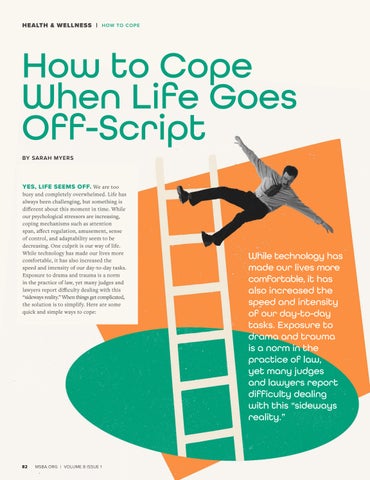
While technology has made our lives more comfortable, it has also increased the speed and intensity of our day-to-day tasks. Exposure to drama and trauma is a norm in the practice of law, yet many judges and lawyers report difficulty dealing with this “sideways reality.”
MAKE LISTS OR CALENDAR ENTRIES OF YOUR SELF-CARE NEEDS

Make lists or calendar entries of your self-care needs. Place lists on your refrigerator and bathroom mirror or post-its around your monitor. Make it foolproof for yourself, down to applying deodorant, when to take your medications, and reminders to stay hydrated and eat. When we feel overwhelmed, our nervous system believes we are in danger, and our brains forget the basics, such as diet and grooming. Along these lines, always put your keys, wallet, and phone in the same place to avoid the panic-induced race around your house or office when you really need to leave. Or get trackers for them. Likewise, pause to check the stove and the garage door every time you leave. This recommendation comes from top executive coaches and time-management researchers because it reduces cognitive load and improves focus.
REFLECT ON HOW YOU HANDLED PAST STRESSORS
You obviously got through them; what did you do? How did you cope? What resources did you use, and how did you find help? Another aspect of the stress response is that we panic and forget that we are competent enough to navigate situations. Pausing to reflect induces connectivity to our pre-frontal cortex, where our executive functioning will slow the “fight or flight” response. A great mantra to say during that pause is “I trust my future self to handle the problem I am currently freaking out about.” It sounds woo-woo, but it works to kick-start the brain's problem-solving areas while quieting the panic buttons.
TITRATE BETWEEN THE BIG PICTURE AND THE DETAILS
If the details are upsetting you, focus on the big picture or on generalities, like what you appreciate (even for trivial things like the great parking spot you just scored). Or look at some images from the James Webb telescope or those from the recent Artemis II mission. Being humbled by the immensity of the universe is a quick way to calm the mind when details weigh you down. On the other hand, if the big picture has you frazzled, focus on details and get something practical accomplished. Finish that brief, send some emails, do something for your kids, play with your pet, finish the laundry, or call a friend. The trick is to distract yourself long enough for brain chemistry to balance itself out and your neural nets to fire in a “cool, calm, and collected” or interested, curious, and hopeful way.
JUST SAY NO
While I’m not referring to Nancy Reagan’s famous slogan about drugs in the 80s, cutting back on recreational psychoactive chemicals is a good idea when we are overwhelmed. It’s natural to want to dissociate from reality when things are particularly stressful, but life gets exponentially harder when we overindulge. But I’m referring here to the need to say no to extra responsibilities when your plate is already full. We are in a helping profession, and we tend to take on other people’s problems. Setting boundaries with your time and energy is important. Just don’t say no to deadlines. A judge called me once, complaining about the well-being movement because a new attorney told her that the reason he missed a filing deadline was “his law firm promotes work-life balance, and he didn’t feel like working that weekend.” Say no to things that won’t cause client harm or put your license at risk.
CURB THE PERFECTIONISM
The adversarial nature of our profession demands a level of perfectionism that can lead to unhealthy tendencies such as imposter syndrome, perseveration (the mental gerbil wheel), and obsessive over-editing. If you compulsively re-read all your texts and emails after you send them, start small by letting a few grammatical errors go in texts with friends or family. You might experience discomfort when you don’t text the correction, but it will be worth it! If it makes you feel better, let them know about your plan to play with imperfection. This will give them permission to do the same and is another way to reduce your cognitive load.
MOVE. STRETCH. RELAX YOUR JAW AND SHOULDERS. TAKE A FEW DEEP BREATHS. AND PLEASE, LAUGH MORE
Pedantism is the enemy of humor, and we are a pedantic group in this profession. However, no other stress management technique works as quickly and effectively as laughter, so find something to smile at and laugh about every day. EVERY. DAY.
Sarah Myers is the Director of the MSBA Lawyer Assistance Program, the free and confidential behavioral health program for Maryland’s legal community. She is a licensed attorney, licensed therapist, and licensed teacher who enjoys normalizing the stressors of working in an ultra-serious profession. She has over 25 years of experience teaching psychoneuroimmunology (the study of how stress impacts our cognitive and physical health) and consulting with legal professionals and their families about behavioral health issues.