03.19
STRATEGIES & INSPIRATION FOR AUTO CARE SUCCESS
EPAY:
THE FUTURE OF CUSTOMER CONVENIENCE PAGE 55
TAKE CRITICAL STOCK OF YOUR SHOP CULTURE PAGE 62
BOUNCE BACK HOW TO PUSH
THE SECRET TO BETTER BODY LANGUAGE PAGE 49
PAST YOUR BIGGEST MISTAKES— AND THRIVE PAG E 3 6
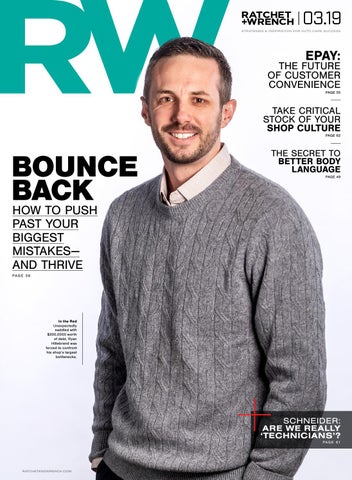
In the Red Unexpectedly saddled with $200,0000 worth of debt, Ryan Hillebrand was forced to confront his shop’s largest bottlenecks.
SCHNEIDER: ARE WE REALLY ‘TECHNICIANS’? PAG E 61
RATCHETANDWRENCH.COM
HELPING LOCAL SHOPS STAY LOCAL
Experience the Difference with TECHNET • Nationwide Warranty
• Training
• Exclusive Promotions
• Roadside Assistance
• Digital Menu Board
• And Much More
technetprofessional.com/membership FOLLOW US @TECHNETpros
A PERFECT FIT. A PERFECT PRICE.
EVERYTIME/
There’s a reason why Mitsubishi customers love Genuine Mitsubishi Parts. Designed as a direct replacement for the original part, Genuine Mitsubishi Parts provide the trouble-free performance customers have come to expect. For a flawless repair that will surely keep your customers happy, contact an authorized dealer for all your Genuine Mitsubishi Parts needs.
2019 MITSUBISHI MOTORS NORTH AMERICA, INC. ALL RIGHTS RESERVED
READ WHAT THE PROS READ
Grow your mechanical business with ideas and insights from industry experts. “I like Ratchet+Wrench because the articles are about current topics and really focus on owners and running a business. The topics are new, interesting and thoughtprovoking and I always take away something.” - Troy Minske, Owner Rum River Automotive, Princeton, MN
SUBSCRIBE OR RENEW FOR FREE TODAY! VISIT RATCHETANDWRENCH.COM/SUBSCRIBE
03.19 VO L . 07 N O. 0 3
M A R C H
A Welcoming Environment Henry Roggi (left) centers his day around improving shop culture—for his staff and his customers.
F E AT U R E
P R O F I L E
C A S E
36
42
54
62
A $1,125 average repair order is no accident for Stephane Grabina. It’s the result of consistent procedures and a tight-knit staff.
Creating an online bill pay portal is a way that Brian Bowersock’s three shops offer more convenience to customers.
BY KILE Y WELLENDORF
BY KILE Y WELLENDORF
A focus on the customer experience and retaining those customers has allowed Roggi’s Auto Service to grow to the $2.2 million revenue mark.
FIGHT BACK
It’s never too late to make the changes necessary to course correct and achieve your shop’s highest potential. BY NOR A JOHNSON
RAISE YOUR ARO
S T U DY
SIMPLIFY PAYMENT
R E PA I R
L I F E
RETAIN CUSTOMERS
SHELBY CHERI
BY KILE Y WELLENDORF
PRINTED IN THE U.S.A. COPYRIGHT ©2019 BY 10 MISSIONS MEDIA LLC. All rights reserved. Ratchet+Wrench (ISSN 2167-0056) is published monthly by 10 Missions Media, LLC, 571 Snelling Avenue North, St. Paul, MN 55104. Ratchet+Wrench content may not be photocopied, reproduced or redistributed without the consent of the publisher. Periodicals postage paid at St. Paul, MN, and additional mailing offices. POSTMASTERS Send address changes to: Ratchet+Wrench, 571 Snelling Avenue North, St. Paul, MN 55104.
ON THE COVER: RYAN HILLENBRAND PHOTOGRAPHED BY GARY KESSLER
0 3 .19 / R + W / 5
TA B L E O F C O N T E N T S
J U M P
8 ONLINE
S TA R T
22 BREAKDOWN
Top leadership reads
Missouri’s vehicle inspection debate
14 NUMBERS
25 VIEWPOINT
The benefits of visionary leadership
The future of flat rate pay
16 AWARDS INSIGHT
26 SPEED READ
Communicate your ideas
Consumers prefer indy shop experience
18 EDITOR'S LETTER
SPONSORED CONTENT
29 THE RETURN
Are your goals big enough?
NAPA's new headlight
30 SHOP VIEW
Signal Auto Care
30
33 STRAIGHT TALK
The low productivity fix
LEAH QUINTO
JOE MARCONI
2 0 1 9 R A T C H E T + W R E N C H A L L- S T A R
DO YOU HAVE A TEAM MEMBER WHO IS H A R D W O R K I N G , D E D I C AT E D , A N D S K I L L E D AT W H AT T H E Y D O ? N O M I N AT E T H E M F O R T H E R AT C H E T + W R E N C H AWA R D S. ENTRY DEADLINE IS JUNE 15, 2019.
NOMINATE AT
GINA STAMMERS A MASTER MECHANIC ADMIN SUPPORT
R A T C H E T A N D W R E N C H . C O M /A W A R D S
ADMIN SUPPORT EXECUTIVE SHOP WORKER WILD CARD
SPONSORED BY:
6 / R + W / 0 3 .19
MANAGER
T O O L B OX
61 THE BOTTOM LINE
49 SHOP ADVICE
Reconsidering the “technician” term
Improve your body language
MITCH SCHNEIDER
50 LEADERSHIP
67 THE FIXER
How to analyze your company culture
How to succeed by not following the crowd
53 INDUSTRY INSIDER
A ARON STOKES
Build better relationships
RISSY SUTHERL AND
58 FINANCE+ OPERATIONS
The secret to smooth expansion
GETTY IMAGES
49
Celebrating the Student Community of Future Transportation Technicians! Submit a Nomination at:
TechForceFoundation.org/FutureTechsRock 0 3 .19 / R + W / 7
O N L I N E
E X T R A S
CLICK ON THE LOGO BELOW FOR PRODUCT INFORMATION
Advance Auto Parts
Kia Motors America
NAPA AutoCare
WIRED FOR
SUCCESS AUTEL
KUKUI
You’re wired differently and we Mercedes-Benz Auto Job Central America likes like that. that.
NAPA AUTO PARTS
Ratchet+Wrench Management Conference
Visit futuretechsuccess.org and find out how your hands-on talent is the key to an amazing technical career. Ford
When Techs Rock, America Rolls ℠ futuretechsuccess.org
Jasper Engines & Transmissions
Mitsubishi
Tech Force
FUTURETECH
SUCCESS MobileSoft
™
TECHNET
WORLDPAC
8 / R + W / 0 3 .19
EDITORIAL VICE PRESIDENT, CONTENT AND EVENTS Bryce Evans EDITORIAL DIRECTOR Anna Zeck ASSOCIATE EDITOR Nora Johnson STAFF WRITER Kiley Wellendorf SPECIAL PROJECTS EDITOR Jordan Wiklund EDITORIAL INTERN Alayna Baggenstoss CONTRIBUTING WRITERS Joe Marconi, Mitch Schneider, Aaron Stokes, Rissy Sutherland PRODUCTION ART DIRECTOR Zach Pate GRAPHIC DESIGNER Audrey Mundstock PRODUCTION ASSISTANT Lauren Coleman SALES VICE PRESIDENT AND PUBLISHER Chris Messer 651.846.9462 / cmesser@10missions.com ASSOCIATE PUBLISHER Alysia Nelson 651.846.9463 / anelson@10missions.com SALES MANAGER Nathan Smock 651.846.9452 / nsmock@10missions.com REGIONAL ADVERTISING SALES Ross Kirgiss 651.846.9485 / rkirgiss@10missions.com CUSTOMER SUCCESS REPRESENTATIVE Shayna Smith 651.846.9460 / ssmith@10missions.com CLIENT SERVICE SPECIALIST Jen George 651.846.9465 / jgeorge@10missions.com 10 MISSIONS MEDIA PRESIDENT Jay DeWitt GENERAL MANAGER AND PRODUCTION MANAGER Mariah Straub SALES SERVICE REPRESENTATIVE AND BOOKKEEPER Meghann Moore EVENT COORDINATOR Katie Cornet DIGITAL MEDIA STRATEGIST Josh Jaskulka MARKETING COMMUNICATIONS SPECIALIST Kasey Lanenberg EDITORIAL ADVISORY BOARD Leigh Anne Best, Mighty Auto Pro Andy Bizub, Midwest Performance Cars Greg Bunch, Aspen Auto Clinic Ryan Clo, Dubwerx Ron Haugen, Westside Auto Pros David Toole, Toole's Garage HOW TO REACH US 10 MISSIONS MEDIA 571 Snelling Avenue North, St. Paul, MN 55104 tel 651.224.6207 fax 651.224.6212 web 10missions.com The annual subscription rate is $72 (U.S.A. only) for companies not qualified to receive complimentary copies of Ratchet+Wrench. BACK ISSUES Past issue single copies are $8. Go to ratchetandwrench.com/backissues LETTERS TO THE EDITOR editor@ratchetandwrench.com ARTICLE REPRINTS For high-quality reprints or e-prints of articles in this issue, call 651.846.9488 or email reprints@ratchetandwrench.com. Opinions expressed in Ratchet+Wrench are not necessarily those of 10 Missions Media, and 10 Missions Media does not accept responsibility for advertising content.
RADIO
New Ratchet+Wrench Podcasts. 3 SERIES WITH NEW EPISODES EVERY MONTH.
GROW. Series hosted by industry superstar Rissy Sutherland. Inside the processes, systems and operational strategies that have allowed the industry’s top shops to thrive.
GROW SERIES SPONSORED BY:
New episode this month.
LEAD. Series hosted by shop operator Aaron Stokes. The go-to resource for leadership lessons, philosophies and success stories. New episode this month.
INNOVATE. Series hosted by a rotating special guest each month. An introspective look at the industry’s most pressing topics from the people who know them best. New episode this month.
LISTEN AND SUBSCRIBE S E A R C H “ R AT C H E T + W R E N C H ” I N A P P S FOR APPLE AND ANDROID
AUTOMOTIVE GROUP
PODCASTS
STITCHER
POCKET CASTS 0 3 .19 / R + W / 9
SEE THE DIFFERENCE IN OUR PARTS.
ONLINE03.19 COM M EN T S , DISCUSS IONS , FEED BAC K A N D MORE FROM A ROUN D T H E W EB
FEATURED TOPIC:
PODCAST
NEW ONLINE COLUMNIST
—
MONROE® RoadMatic™ Strut Assembly • Assembly features all new components including strut, spring, and strut mount
RADIO
Ratchet+Wrench welcomes Bob Cooper as the newest online columnist. Cooper is the president of Elite, a company that strives to help shop owners reach their goals and live happier lives, while elevating the industry at the same time. The company offers industry peer group of 90 successful shop owners, training and coaching from top shop owners, service advisor training, along with online and in-class sales, marketing and shop management courses. Cooper speaks on the best-kept secrets to hiring techs and advisors in his inaugural column: “As someone who has grown some of the most successful shops in America, I’ve learned over the years that in order to hire top employees that my entire team will really enjoy working with, I have to pay very close attention to their personalities and behaviors during the interview process. I do that to this day with Elite, and it’s been one of the most important keys to my hiring success.”
MONTH-END ADVICE
—
"Don't wait 'til the end of the month!" This is great advice for just about anyone. In this episode of Ratchet+Wrench Radio, shop owner and R+W columnist Aaron Stokes describes the challenges and opportunities when month-end rolls around and your numbers aren't where you want them to be. Listen at ratchetandwrench.com/ podcast or on your favorite podcast streaming app.
CONTENT SNEAK PEEKS
—
Follow @ratchetandwrench for a look into upcoming articles and content.
WEEK LY DISCUSSIONS
• Strut technology is designed to meet OE specifications
LEADERSHIP READS
—
• Application-specific coil springs maintain OE ride height
To help create a space for readers to share their resources with one another, Ratchet+Wrench asked for leadership book recommendations. Some of the books in the comments included:
• Ready to install and saves installation time
Never Split the Difference: Negotiating As If Your Life Depended On It
The 7 Habits of Highly Effective People
BY CHRIS VOSS
Tribes: We Need You to Lead Us
BY STEPHEN COVEY
Grit: The Power of Passion and Perseverance
BY SETH GODIN
Extreme Ownership
Learn more at
BY JOCKO WILLINK
Join the discussion at facebook.com/RatchetAndWrench
advancepro.com
All trademarks marks are the property of their respective owners.
JOIN US ONLINE
WEBSITE: ratchetandwrench.com FACEBOOK: ratchetandwrench.com/facebook TWITTER: twitter.com/ratchetnwrench LINKEDIN: ratchetandwrench.com/linkedin INSTAGRAM: instagram.com/ratchetandwrench
10 / R + W / 0 3 .19
UNSPLASH, COURTESY MATTHEW ROAYAEE
BY ANGELA DUCKWORTH
YOUR SHOP. OUR SOLUTIONS.
Your success is our business, that's why we provide leading solutions critical to your shop: • TECHNET Professional
• MotoLogic Repair & Diagnostics
• Carquest® Technical Institute and WORLDPAC Training Institute
• MotoRev Shop Marketing
• Virtual Vehicle Repair Animations
• MotoShop Shop Management System
Learn more at advancepro.com.
Advance Auto Parts® family of brands. All trademarks marks are the property of their respective owners.
0 3 .19 / R + W / 11
Introducing Mercedes-Benz StarParts An authentic parts option — at exceptional prices.
12 / R + W / 0 3 .19
Made for vehicles 5 years and older, StarParts features a number of the common maintenance items you use the most, including: • Brake Discs • Brake Pads • Cabin Filters • Oil Filters • Spark Plugs • Wiper Blades Backed by a one-year warranty* that includes parts and labor, StarParts can offer enhanced margins to help grow profits for your shop in the long run. To order StarParts, contact your Mercedes-Benz dealership today. *To learn more, visit https://www.mbwholesaleparts.com/mercedes-benz-starparts.
0 3 .19 / R + W / 13
NUMBERS THE
TOPICS,
TRENDS,
AND
METRICS
DRIVING
YOUR
OPER ATION
THE BEST WAY TO LEAD
—
There are many ways to lead a shop, from working on cars alongside your technicians to managing the shop from an office miles away. Each individual has his or her own leadership style. But which style is more effective to a shop’s success and overall growth? The results below are pulled from our 2018 Ratchet+Wrench Industry Survey.
All numbers below correlate to the following D I R E C T I N V O LV E M E N T
HANDS OFF
D E M O C R AT I C
A U T H O R I TA R I A N
VISIONARY
TOTAL ANNUAL SALES TREND IN THE PAST 5 YEARS
43% “I get my hands dirty on the shop floor and lead by example.”
GROWN
19% “I trust my team with key decisions and am not afraid to delegate.”
LEADERSHIP STYLES
17%
56%
“I encourage staff input in decision making.”
72%
1% “It’s done my way or it doesn’t get done.”
19% “I focus on the big picture and inspire my team to succeed.” REMAINED FLAT
Y E ARLY SALES VOLUME
21%
Under $250,000
21%
3%
$250,000—$499,999
20%
11%
$500,000—$744,444
23%
15%
$750,000—$999,999
9%
20%
$1 million—$2.4 million
20%
43%
More than $2.5 million
3%
5%
Didn’t know
4%
3%
Beyond the Stats
DECLINED
11%
3%
INCONSISTENT
12%
5% PEXELS
Looking for more sources on leadership? Look into the book Good to Great: Why Some Companies Make the Leap ... and Others Don't by Jim Collins. Collins identifies leadership skills to aid businesses to success.
20%
14 / R + W / 0 3 .19
OMNICRAFT ™ GETS IT. FORD BACKS IT. Premium Omnicraft parts come with a warranty* that includes labor and has no commercial exceptions. Trust Omnicraft for your non-Ford vehicle repairs. OmnicraftAutoParts.com
*Limited labor costs. See seller for limited-warranty details. Omnicraft™ is a trademark of Ford Motor Company.
0 3 .19 / R + W / 15
AWA R D S I N S I G H T
NOW ACCEPTING NOMINATIONS! Know someone deserving of a Ratchet+Wrench All-Star Award? Nominate them today at ratchetandwrench.com/awards
ALL-STAR NOMINEE
DARRIN MONCUR —
The Next Step
OWNER DENNY’S AUTO RIVERTON, UTAH
BY NORA JOHNSON
“Good for the shop, good for the client, and good for the vehicle” is the mantra at Denny’s Auto, and it’s what creates its strong shop culture. When Darrin Moncur began taking on more of a leadership role at Denny’s Auto in Riverton, Utah, he also began making changes. Those changes have drastically impacted Denny’s Auto in both the front and backend of the shop, but before these results could prove themselves, Moncur faced some old school pushback. Now, Darrin is in the same position with his son, Mitch, who is stepping up to the plate with some even “newer school” ideas. Mitch Moncur nominated his father for a 2018 Ratchet+Wrench All-Star Award because of the immense growth Denny’s Auto has seen in sales and clientele numbers. Both Mitch and Darrin say this is due to their shop’s culture. “The culture is our biggest strength, and that bleeds into our customers. Our clients get to feel [the shop’s culture] too,” Darrin says.
16 / R + W / 0 3 .19
ing through the motions, Mitch explains. Now, the shop’s culture is a team environment filled with encouragement and support. INVOLVE THE WHOLE TEAM. Mitch is following his father’s path and brings fresh ideas to the shop. One of the concepts Mitch has brought forward is scheduled one-on-one meetings with staff. “He meets with all of the team members once per week and does oneon-ones with them. It’s given us this rebirth, is the way I see it,” Darrin says. Mitch says that during his meetings with staff, he checks in with them and gets to what is really on their minds. He keeps asking until they actually come out and say what they think. He also asks about the employees’ personal lives so they know they are cared about. Lastly, he sees what ideas they have and comes up with an action plan to put the ideas into motion. Darrin says these meetings have been a huge gamechanger. “What [Mitch] brought to the table
is creating a culture inside of the business, more than just working together as a team, and brought in a culture. It’s a fun place to work. We encourage and help develop all of our employees as individuals,” Darrin says. STICK WITH THE CORE VALUES. There are some things Denny’s Auto has always done that both Mitch and Darrin continue to exhibit as the pillars of the shop’s culture. Denny has always kept the same basic business philosophy at his shop, giving his employees a consistent and worry-free workplace. All of the technicians at Denny’s Auto get a base pay so they don’t have to stress about finances. This concept has continued to be a strong shop value. Mitch says that the shop’s success comes from emphasizing and focusing on compassion, cooperation and humility. With fresh ideas and a strong team culture, Denny’s Auto is able to evolve, Darrin says.
FUE VANG
COMMUNICATE YOUR IDEAS. The culture shift began when Darrin began working with the founder of Denny’s Auto, his father-in-law Denny. “Denny was kind of old school; the way he ran his business in the ’60s and ’70s was with an iron fist. When I came along, I came with a different approach, more of a team kind of environment, more of a, ‘let’s work alongside of each other,’” Darrin says. Darrin was faced with a little reluctance from the Denny’s Auto founder, but after the shop’s culture began to transfer into the happiness of the customers, Denny began to see the positive outcome. “He [Denny] started seeing the benefits and the success with the changes that were happening. He’s now singing a different tune and is all about it,” Mitch says. Communicating fresh ideas takes perseverance, he says, and it also takes a certain amount of humility on both sides. Everyone has the same goal, and it comes down to being willing to listen before go-
0 3 .19 / R + W / 17
EDITOR'S LETTER
Fighting Limitations WHY WE TOO OFTEN BLOCK OUR OWN PATHS TO SUCCESS
I have a hard time sitting still. I just can’t do it. I like to stand as
much as possible in meetings. I pick aisle seats on planes so that I can get up throughout the flight. I rarely watch TV; full movies even less. I prefer to be on the go. Always. Over the years, I’ve realized this about myself and made some attempts to slow myself down a little, if for no other reason than to save the sanity of those around me. Ten or 15 years ago, though, that wasn’t the case. A few months before I graduated from journalism school (I promise I have a point to all of this), I was overly eager and a little too confident—actually, let’s change that to naively cocky, because no 22-year-old is ever as self-assured nor as self-aware as he or she thinks. I only knew what I knew, and had no thoughts or concerns about what I didn’t. And I was ready to go. I needed to get moving on this whole career thing. Why wait? I was lucky enough to get sound advice from a number of people in my life during that time, none that has impacted me more than that of a longtime family friend. He spent his career in advertising, working with some of the largest companies in the country and creating campaigns that many would easily recognize still today. Drawing on decades of success and experience, his message was very simple: Always make decisions that push you further down the path to achieve your long-term goals. That’s paraphrased from a larger conversation about how to approach both big decisions (pursuing and choosing a job opportunity) and smaller, day-to-day choices. It was about staying focused on the big picture of what I wanted, and making sure I pursued my career in a way that would help me grow, improve and, eventually, ge to where I wanted. But the most impactful moment came at the end, when he asked simply: What is your career goal? Well, that’s an easy question, I thought, because, after all, at 22, I already had that part figured out. So, I told him, right down to the specific job title at the specific publication, which to be honest, I thought was a fairly ambitious goal. He didn’t agree. My goal, he said, wasn’t big enough (or well thought-out enough). If dedicated to it, I could get there in 10 years on an accelerated path; at a slower pace, maybe 20 years. I’d still have decades of my career left. What then? This is the message that stuck with me: 18 / R + W / 0 3 .19
Don’t set limits for yourself—especially by being short sighted in what you’re capable of doing. Again, that’s paraphrased a bit, but he encouraged me to reevaluate that goal and ask myself some important questions: What type of work do I want to produce? What type of impact do I want to have? How can I best use the talents I have and skills I’ve learned to have that impact? I’d like to say that those words had an immediate impact on me. They didn’t. I couldn’t think beyond my goal at the time. A little less than four years later, though, I completely understood. I sat in a cube at the very publication I said I dreamed of working at, across a divider from the very person who held the exact position I said I wanted. I was, physically, just inches from that goal—less than four years later. And I quickly realized I wanted no part of it. I couldn’t imagine doing that job for the next however many years, being stuck in one spot, never moving or growing. It felt claustrophobic to me. I wasn’t even there yet, and I already felt trapped in it. I readjusted everything. Not-so-oddly, this whole experience flashed back to me in reading this month’s cover feature, “On the Brink,” p. 46. Associate editor Nora Johnson does an excellent job describing the challenges and pitfalls of two (now) very successful business owners who were able to break past their own limitations to reach levels they hadn’t previously considered possible. And, even after doing so, both still push to achieve more. Don’t set limits for yourself. It’s a simple enough concept, but much harder in reality; balancing happiness and gratification against the pitfalls of complacency. In the end, I simply try to follow the advice I was given. I ask myself those questions, and try to keep moving down that path. Luckily, I don’t like to sit still for long.
BRYCE E VA NS, VICE PRESIDENT, CONTENT A ND E VENT S BE VA NS@10MISSIONS.COM
Some think all brake pads are alike. That’s just a bunch of noise. Genuine Mercedes-Benz Brake Pads emitted sound only once in an entire month during independent product testing. Compare that to 200 times for aftermarket alternatives.* What’s more, our brake pads are designed to fit precisely on the back plate for less slipping, and are made with an exclusive blend of materials that can eliminate virtually all brake noises. A quieter ride — at a competitive price. This is why you should choose Genuine Mercedes-Benz Brake Pads. Contact an authorized Mercedes-Benz dealer or learn more at www.mbwholesaleparts.com.
MSRP (front/back)
165/$94
$
Part # A164420222064 / A0084205320
*As compared to economy brake pads and based on brake test #LACT 502987, which measures the noise every time the brakes are applied.
MSRP excludes state and local taxes, and freight if applicable. Prices may vary by dealer. See your authorized Mercedes-Benz dealer for additional details or a copy of the Mercedes-Benz Parts 0 3 .19 / Limited R + W Warranty. / 19
The 2019 Ratchet+Wrench RW To Go app is the most efficient way to improve your business. Gain access to podcasts, videos, articles and more. All in one spot. Wherever you go.
®
S P O N SOR E D BY:
®
D O IN W A A N N P LO D P R S AD O T ID O F R O A E R N S F D F R iO O EE S R
FAST TRACK YOUR BUSINESS
J U M P S TA R T NEWS
SHOP VIE W
/
IDEAS
/
PEOPLE
/
TRENDS
30
BREAKDOWN VIEWPOINT SPEED READ THE RETURN
LEAH QUINTO
SHOP VIEW
Tool Up At Signal Garage, having the proper tools and training is vital for techs.
0 3 .19 / R + W / 21
J U M P S TA R T
Losing Safety Inspections—Again ANTI-SAFETY INSPECTION LEGISLATION MAKES ITS WAY BACK TO MISSOURI BY KILEY WELLENDORF
the Missouri Legislature. House Bill (HB) 451 was reintroduced in January by State Rep. J. Eggleston, assistant floor leader of the House, according to a press release. HB 1444 “repeals the inspection requirement for non-commercial motor vehicles, which is currently required in order to renew a motor vehicle license,” according to the bill summary from the House of Representatives. The Automotive Service Association (ASA) plans to oppose the bill, reigniting efforts that previously halted the bill from passing in May 2018. “There are approximately 15 state vehicle inspection programs,” ASA mechanical division director Tom Pippo said in a press release. “With the number of recalls and rapidly increasing vehicle technologies, the trend should be for more state inspection programs, not less. Missouri’s program is one of the best in the nation, and ASA has profiled it 2 2 / R + W / 0 3 .19
in hearings in Washington, D.C., and in other states. Any effort to repeal the program is nonsensical." Information obtained from the House of Representatives’ committee notes reveal that supporters of the bill, “say the bill will reduce government regulation and inconvenience to citizens without impacting roadway safety in any respect. Most other states have abolished safety inspections and there is no statistically showing of greater accident or injury rates.” From tax dollars to time, Rep. Eggleston shares why he’s in favor of dismembering the bill and leaving annual safety inspections in the past for Missouri, while ASA’s Washington, D.C. representative Bob Redding provides a counterpoint argument. The Safety Question
During Rep. Eggleston’s research, he decided to compare how much safer states were when they had inspections, compared to those that didn’t. The first
source he looked to was the Insurance Institute for Highway Safety, which holds records of fatal accidents.
“THIS IS A PREVENTATIVE RULE OF LAW AND IT’S NOT DIFFERENT FROM YOU SEEING A DOCTOR ONCE PER YEAR.” BOB REDDING WASHINGTON, D.C. REPRESENTATIVE AUTOMOTIVE SERVICE ASSOCIATION
After sorting states by safest to most dangerous, Rep. Eggleston discovered inspections didn’t necessarily mean states were safer. “Some are in the safe half, some are in the dangerous half—there really doesn’t seem to be a correlation between the
GETTY IMAGES
The so-called “anti-safety inspection bill” has fallen back into the hands of
J U M P S TA R T / B R E A K D O W N
states that have inspection and the ones that don't,” he says. Rep. Eggleston decided to continue looking to see if further data would explain whether or not states with safety inspections are safer. To further investigate, he says he looked towards studies done by the Highway Patrol comparing states that have inspections with states that don’t. “I got their most recent study and in it, it says they believe about 1.6 percent of all fatal accidents involve some sort of mechanical problem in states that have inspection programs,” Rep. Eggleston says. “So, they have inspections, but still 1.6 percent of traffic deaths have been due to mechanical failure they think, or that may be in the cause. “In the states that don’t inspections, that number is 1.4 percent—it’s not greater, in fact, it’s a hair less in states that don’t do inspections.” According to Redding, it’s difficult to capture all means of accidents. “We’ve been down this road before.
This is not about long lines and trying to tax the citizen—this is about vehicle safety,” Redding says. “When you have an accident, in most states, there are not investigations on brake and those kinds of matters, unless there’s a significant injury or death, so it’s too late. “This is a preventative rule or law and it’s not different from you seeing a doctor once per year.” The Autonomous Vehicle Influence
If the program is taken away, Missourians would save roughly $30 million, according to Rep. Eggleston. In addition, citizens would ideally not have to spend money on transportation to the the repair shop as well as lose time in productivity. “In Missouri, there’s roughly twoand-a-half million inspections done, and they charge $12 bucks a piece for this, so that adds up to $30 million in fees that Missourians have to pay to comply with this regulation that doesn’t really seem to be giving any more safety than not
having the regulation,” Rep. Eggleston says. “It’s a cost and there’s a hassle.” According to Redding, the time spent on an inspection in the shop can be necessary to determine whether or not a vehicle is safe. As autonomous vehicles inch closer to roadways, he fears that the vehicles may not be treated the same as other vehicles. “We believe it’s important, as we move to more autonomous vehicles in the future, that somebody has to look at these cars,” Redding says. “Those cars should have to go into an independent shop bay at some point for someone to look at.” Although autonomous vehicles drive the cars themselves, they face the same day-to-day risks that drivers experience on the roads today. “We go out, we take the car to work, or take it to a sporting event and we don’t worry about it,” Redding says. “That car can go through a stop sign, have a tire go bad like your tire today, and we believe those AVs should be inspected every year.” 0 3 .19 / R + W / 2 3
Kia.com
If it’s not in the right box, it’s not genuine.
From starters to alternators, oil filters to spark plugs, there is no substitute for genuine. The only way to assure that you are getting Genuine Kia parts, backed by the Kia Warranty, is to order them from your localoilAuthorized Kiaplugs, Dealer. Contact your From starters to alternators, filters to spark there is no substitute for genuine. The only way to assure localyou Kiaare dealer forGenuine assistance and delivery ofthe theKia parts you need. that getting Kia parts, backed by Warranty, is to order them from your local Authorized Kia Dealer. Contact your local Kia dealer for assistance and delivery of the parts you need.
*Genuine Kia replacement parts (except battery) sold by Authorized Kia Dealer under warranty are covered for the greater of (1) the duration of the New Vehicle Limited Warranty or (2) the first 12 months from the date of installation or 12,000 miles, whichever comes first. Labor charges not included when not installed by an Authorized Kia Dealer. Warranty is limited. See Kia’s Replacement Parts and Accessories Limited Warranty for further details.
J U M P S TA R T
Flat Rate Pay’s Continued Unpopularity SURVEY FINDS DEALER TECHS UNSATISFIED WITH FLAT RATE PAY PLAN BY KILEY WELLENDORF
A survey by Carlisle & Co. found that nearly one in four techs are satisfied with their careers, citing flat rate pay as an issue in their roles. The survey, completed by 35,000 techs, revealed that only 21 percent were pleased with flat rate pay. And while that type of pay plan has experienced some decline, according to the 2018 Ratchet+Wrench Industry Survey, flat rate pay was still the most popular pay plan (at 30 percent). Cecil Bullard, chief executive officer of the Institute for Automotive Business Excellence, isn’t surprised by techs’ dissatisfaction regarding flat rate pay. “I’m hoping, at some point, our industry gets completely away from flat rate. I don’t think it’s necessarily a good way to pay, in most instances,” Bullard says. “My hope is that it goes away.” According to the survey, flat rate is the top reason that technicians plan to leave their current jobs. Ratchet+Wrench sat down with Bullard to learn more about why flat rate pay is undesirable among techs as well as how to re-capture technicians leaving the industry to the payment method. Why is flat rate pay unpopular among technicians? What issues arise with paying technicians a flat rate salary?
What the dealerships have done in the past—I mean 25 years ago—if you were going to be a dealer tech, you were going to be an A-tech and you were going to pretty much line up all the work. So, you could do a job that was a seven-hour job in three hours, and get paid seven hours for it. And so, flat rate was a well-known and very accepted form of getting paid. The dealerships made a change in the ’90s and they decided they wanted to have more C-techs and not as many A-techs.
They’ve also taken away hours on these jobs, so now, when you get a three-hour job, it’s a three-hour job at the dealership— plus they’re not paying these techs like they used to pay these techs. That’s probably one reason that the techs feel as though they’re getting cheated and it’s not fair. Another reason is really that the shops that are doing it in many cases don’t have enough process—things don’t flow smoothly in the shop, so that techs can’t be productive. We see that all the time. I go into shops and I’ll look at their productivity, which is 50–60 percent, and you start asking questions about that lack of productivity, and start looking around and it’s really the fact that the shop doesn’t have good estimating processes and digital inspection processes. How might using a flat rate pay plan affect employee retention for technicians?
I don’t build any flat rate pay plans anymore; every pay plan that I build is a combination pay plan. There’s multiple ways to pay technicians—hourly and salary don’t really work because there’s no motivation to work harder, and then there’s flat rate. I think if you have a shop that runs very well that has good process where a technician can be very productive and you have lots of work lined up, then flat rate is fine. In fact, it’s a very motivation-heavy pay plan and that’s why we use it, to try and get the technician to work a little harder and do a little more. But if you don’t have good systems in process and you don’t have work lined up a week ahead, then you’re not going to keeps techs on a flat rate pay plan. What we find when we come into businesses is that you have a bunch of technicians there and most businesses have too many techs for the workload they have. If it’s a flat rate shop, the owner is like,
BACKGROUND: Cecil Bullard CEO Institute for Automotive Business Excellence
“Well, I don’t really care, because if they don’t do hours, they don’t get paid, and it doesn’t cost me.” The problem is, you have a bunch of techs who are all unhappy because nobody is getting paid and you end up keeping the lowest common denominator techs and not the good techs. What do you see as the future of using a flat rate pay plan?
I know there’s been some cases in California where the employee sued the employer because of the flat rate system and the courts upheld the employees. I think, at some point, if we’re smart, we move away from flat rate as an industry and we go with what I call a performanceenhanced pay system, which means there’s a decent base—$28 per hour—and the tech earns another $10 or $12 based on what they do. How can independent repair shops capture those who are leaving technician jobs in the dealership world?
The first thing that the shop owner really needs to do is learn how to run the business correctly through margins, systems, processes, real management leadership. When a business runs well, now we can go out and we can attract those guys because we pay them more. Many of the shops that I work with, the techs actually got paid 20–30 percent higher in other businesses because they were very productive and because the performance-enhanced pay system creates the ability for me to pay this guy more based on the fact that he is really productive and he does a great job. 0 3 .19 / R + W / 2 5
J U M P S TA R T
Survey: Dealerships Fall Short A recent study by Consumer Reports revealed that consumers report a more satisfied experience and are more successful at negotiating a discount than those who go to repair chains and dealerships. “In our survey of 40,000 Consumer Reports members, we found that in most cases, regardless of car brand, customers who brought their car to a non-dealership were significantly more satisfied than were those who went to a car dealership for repairs. The biggest differentiator is price. People get much better deal at independent and chain repair shops than they do at dealerships,” said James McQueen, communications specialist, Consumer Reports. Independent retailers scored 90 with those surveyed, followed by Jiffy Lube and Goodyear with a score of 88. The dealerships that scored the highest reader score
in regard to courtesy, timeliness, quality and price were Lexus, Volvo, Toyota, Acura, Honda and Lincoln, all with a score of 81 or above. Study: Drivers Unfamiliar With Tire Warning Light Younger drivers are more than 1.5 times more likely to identify popular emojis correctly than the tire pressure monitoring system warning symbol, revealed a new study commissioned by Goodyear Auto Service and Just Tires. In fact, 49 percent of younger drivers and 39 percent of overall drivers were unable to recognize the TPMS warning symbol in the survey of more than 1,000 U.S. drivers. The lack of awareness of the TPMS symbol, an electronic system designed to monitor the air pressure of a vehicle's tires, is a clear sign that some drivers are in the dark on what the light means and
what to do when it's triggered. Goodyear Auto Service and Just Tires said it wants to be the destination to clear up the confusion for consumers unsure what to do when their TPMS light illuminates, so it is offering drivers free tire care checks, including free tire, air pressure and TPMS inspections. The study also found that most drivers surveyed are not taking precautionary actions to prepare their cars for winter. Amongst drivers who live in areas with usually cold winters, less than half (42 percent) get their tires checked in advance of the winter season. And almost two in five winter drivers (37 percent) do not take any action at all to prepare their cars for winter unless they have an issue. As a general rule of thumb, drivers should check their tires monthly, especially during temperature shifts of 10 degrees or more.
The 2019 Ratchet+Wrench RW To Go app is the most efficient way to improve your business. Gain access to podcasts, videos, articles and more. All in one spot. Wherever you go.
®
SP ONSOR ED BY:
2 6 / R + W / 0 3 .19
®
D O IN W A A N N P LO D P A R O ST D ID O F R O A E R N S F D F R iO O EE S R
FAST TRACK YOUR BUSINESS
SPONSORED CONTENT
Reviews & Revenue in the Golden State FOR PRECISION AUTO REPAIR, THE KUKUI DASHBOARD IS A VITAL PART OF CUSTOMER SERVICE
KUKUI
When Ratchet+Wrench first contacted Precision Auto Repair, there were 3,999 five-star reviews on the website header. One week later, there were 4,013. Not bad. Family owned and operated since 1979, Precision Auto Repair sits just east across the bay from San Francisco. Beginning with Honda and Acura, Precision has specialized in foreign imports ever since and has expanded its service offerings steadily for almost 40 years. The shop homepage shows a long-haired chihuahua (Peanut), some La-Z-Boys (comfy!), and an office space in which you could perform surgery. Everything is clean, clean, clean. The site also lists customer services such as free WiFi, loaner cars, early bird/night owl drop-off, a courtesy shuttle and after-hours pickup. As any shop owner knows, however, this sort of presentation is neither simple nor easy. “It’s more than just 40 hours per week,” says Renee Edgren, CFO of Precision Auto Repair, “and I have to be able to communicate with our clients at all hours of the day and efficiently as possible.” To do so, she uses Kukui.
GOLDEN STATE GOLDEN SERVICE In early February, Edgren had just returned from vacationing in Maui. Using the Kukui Dashboard, she and her husband were able to monitor all client activity at Precision, even though they were more than 2,000 miles away. She responded to every single point of contact. “When I get an email, I keep them visible until I have a chance to sit down and review all of them,” she says. “It’s very easy and Kukui is very good at communicating. If you’re missing calls, it tells you. You can look and see when they’re coming in. … I find Kukui is an easy system to use.” For Precision, online reviews are part and parcel to staying competitive in the crowded Bay Area market. Kukui has a dedicated Reviews tab that does everything except write the review for you.
“Every customer gets a review. There’s also texting and Yelp and Google reviews. It’s important to respond to all reviews, good or bad—through Kukui, I respond to everything on Yelp, Google, and our own webpage. Even though it seems like I’m often writing the same thing, each message goes to different people and it’s an important message for them to get.” Edgren stresses that many clients don’t even visit the repair shop’s homepage first— they look for other public reviews on mobile apps such as Yelp, Angie’s List, Google, and more. After more than five years with Kukui, however, Edgren is positive she can keep up with the pace and power of her clients’ praise, and she understands why potential customers rely on crowd-sourced data—it’s often more reliable than anything else available.
“Kukui makes it very easy,” she says, “and the reviews are all in one spot. I can just log in, reply, and do them all that way, no matter the source. The appointment page works well, too—people make appointments, I confirm them, then simply transfer them to the shop. Everything we use on there seems to work easily.” If clients forget or neglect to leave a review, the Kukui Reviews tab also features a texting function that allows Edgren to reach out to them via their cell phones and ask for reviews as well. Kukui also monitors recommended maintenance for every client. “We have a setup where Kukui sends out regular maintenance interval messages— the program does it two ways. One is based on manufacturer (time and mileage), and one pulls from our repair management software that tracks our recommendations and input. Kukui automatically generates and reminds people what they need,” she says. Once per month, Edgren speaks with their dedicated service representative, Maury. “Maury emails me once per month with a rundown of the stats of the month prior,” Edgren says. “It’s a great system,” she adds, “it’s an all-in-one management solution.”
If you would like to learn more about the programs Kukui has to offer, visit their website at KUKUI.COM/ADWORDS, or call 877.695.6008.
2 0 1 9 R A T C H E T + W R E N C H A L L- S T A R
DO YOU HAVE A TEAM MEMBER WHO IS HARDWORKING, D E D I CATE D , A N D SK I L L E D AT W H AT T H E Y D O ? N O M I N AT E T H E M F O R T H E R AT C H E T + W R E N C H AWA R D S. ENTRY DEADLINE IS JUNE 15, 2019.
GINA STAMMERS A MASTER MECHANIC ADMIN SUPPORT
NOMINATE AT
R A T C H E T A N D W R E N C H . C O M /A W A R D S
ADMIN SUPPORT EXECUTIVE SHOP WORKER WILD CARD
SPONSORED BY:
MANAGER
SPONSORED CONTENT
See Better, Drive Safer LIGHT THE NIGHT WITH NAPA® NIGHT VISION™ HEADL AMPS STATS Product:
NAPA® NIGHTVISION™ Brilliant Headlight Bulbs Uses:
Superior headlight clarity Cost:
Starting at $49.99 (2-pack) Website:
NAPAonline.com
NAPA
When was the last time your customers really assessed their headlights? For many, the answer is “never.” Headlights are one of the most important safety aspects of operating a motor vehicle, yet they barely merit a second thought from most drivers. If they’re on, they’re working, right? Taking an apathetic view to a vehicle can only lead to one place: the repair shop. In the case of headlights, however, the destination for the driver, passengers, or pedestrians and other commuters could be much more dire—are your clients’ lamps lighting the night as they should? Recent studies published by the National Highway Traffic Safety Administration (NHTSA) show that vehicle lighting is critical, because while only 25 percent of driving occurs in the dark, 50 percent of crashes occur during those hours. Many factors influence safe driving, but proper lighting is a critical factor to safely operate a vehicle on today’s congested roads. So, ask yourself: Are my headlights bright enough? Are my customers safe enough? And what are we missing beyond the glare of the windshield? Bright, Brighter, Brightest: NAPA® Debuts New Headlamps Consumers often think about nighttime visibility as only how far one can see. But when it comes to safety, how much we can see around the road can be just as important as how far we can see down the road. Fortunately, NAPA® NIGHTVISION™ Brilliant Headlamp Capsules provide increased depth perception for better down-road and side-road visibility, meaning your customers will be able to see near, far and wide—and get to where they’re going as safely as possible. Two factors combine for the clearest picture of the road ahead: brightness and whiteness. Brightness refers to the intensity or magnitude of the beams;
the brighter the bulb, the better visibility in all directions around the path of the beams. Whiteness refers to a better contrast of elements on the road. A whiter light allows for a clearer, more defined view of the road while driving (including peripheral vision). A whiter light also gives more of a premium headlamp look akin to white or blue LEDs. Not all lamps are created equal, however. NAPA® offers three options in its NIGHTVISION™ line for the most value depending on your driving needs: Brilliant, Vivid, and Clear. The NAPA® NIGHTVISION™ Brilliant lamps are the cream of the crop. Brilliant in its mechanical superiority to OEM (and equally brilliant in lumens), these bulbs provide the whitest and brightest performance and come equipped with a proprietary optical coating on each lamp to help produce the purest, most darkness-cutting light imaginable. NIGHTVISION™ Brilliant lamps also come with an industry-leading three-year warranty, offering the greatest peace-of-mind for drivers everywhere. Next, the NAPA® NIGHTVISION™ Vivid lamps signify a massive step beyond traditional OEM headlight options. An evenly distributed light pattern provides augmented road visibility, and the same proprietary coating that appears on the Brilliant lamps can be found on the Vivid bulbs as well, producing more light output than a standard halogen bulb. Vivid bulbs come with a two-year warranty.
Finally, the NIGHTVISION™ Clear bulb is also available to light the path. Featuring a one-year warranty, the Clear lamps feature high-performance tungsten filaments to produce brighter light than OEM counterparts, immersing the road in more light than most stock vehicles after they roll off the assembly line. The NIGHTVISION™ Clear bulb features a one-year warranty. Because headlamps don’t last forever, the next opportunity to increase your customers’ safety (as well as the wellbeing of their passengers and fellow commuters) may be as simple as increasing the brightness of the bulbs. Once one bulb fails, the other isn’t far behind—bulbs deteriorate as they age. Replacing both at the same time offers the most efficient (and brightest) performance and visibility of the road. Next time you flick your headlights on, ask yourself one more time: “Is my safety open for compromise?” Brilliant, Vivid, and Clear—no matter which you choose, you won’t be wrong. And the night may seem just a little brighter. 0 3 .19 / R + W / 2 9
J U M P S TA R T
Signal Garage Auto Care B Y K E L LY B E AT O N PHOTOGRAPHY BY LEAH QUINTO
1 / EVER-EVOLVING EQUIPMENT
SHOP S TAT S Owner: Rami Derhy Location: St. Paul, Minn. Size: 1,800 square feet Staff Size: 5 Average Monthly Car Count: 240 Annual Revenue: $1.4 million
Rami Derhy has owned Signal Garage Auto Care, which has three Minnesota locations, for over two decades now. And he’s always eager to refine his facilities. His location on Grand Ave. in St. Paul, Minn., is a prime example. While the 1,800-squarefoot facility sits in a high-traffic area in an upscale neighborhood, Derhy is always seeking to improve things. That explains why, in 2016, the shop owner invested in three new Rotary Lifts—marking his second such expenditure since buying the location in 2011. But the investment in equipment helps the small facility address 70 vehicles per week—no small sum, considering the shop only employs two full-time technicians.
2 / INVESTING IN RENOVATIONS In a similar vein, Derhy has no qualms about consistently investing in renovations for his Grand Ave. facility, which, prior to 2011, had been vacant and rather rundown. Not long after taking ownership of the building, for example, the shop operator spent nearly $75,000 to replace a somewhat leaky roof. In recent years, Derhy also renovated the customer waiting area and repainted much of the shop. Derhy estimates that, since 2011, he has spent $300,000 in remodeling the facility.
3 0 / R + W / 0 3 .19
1
HAVE AN OUTSTANDING SHOP? Send a few photos and a brief description to submissions@ratchetandwrench.com and we might feature it here.
2
3 / SERVICE (ADVISORS) WITH A SMILE
3
While Derhy praises all employees, he feels his two service advisors have truly propelled Signal Garage to success. The veteran employees, who have 55 years of experience between them, are always smiling and conversational with customers. The shop operator repays his service advisors’ hard work by providing them with technology that aids their efficiency, like digital vehicle inspection software by AutoServe1. Derhy says the digital inspection software saves time, because now employees no longer need to waste time trying to “decipher” the handwriting of coworkers. He also feels that being able to quickly snap photos of vehicles helps his entire staff promptly get on the same page regarding necessary vehicle work.
4 / SUPREMELY CLEAN FACILITY
4
4
Signal Garage features one element you won’t see at many repair shops: a chandelier in the restroom. That’s just part of the comfortable atmosphere Derhy strives for at his business. After all, he wants customers to feel comfortable. “When I look at the customer area, it needs to feel like home,” he says. “So we clean, clean, clean, every day. We have an open/close checklist that, every day the service advisors and technicians have to fill out—you have to vacuum the floors, wash the floors. It’s got to be clean and comfortable; I don’t want a customer to smell grease, oil, and tires and all that stuff.” 0 3 .19 / R + W / 31
STARTING AT
*Owner - Bryan Kauffeld Ulmers Auto Care Center
3 2 / R + W / 0 3 .19
MOBILESOFT.COM/RW 844.637.1807
Columns
STRAIGHT TALK Joe Marconi
LOW PRODUCTION IS NOT YOUR TECHNICIAN’S FAULT And why it’s on you as the manager to fix it
MICHAEL HOEWELER
Got your attention? Good! Before I
start, let’s get something out of the way. Does technician aptitude or attitude affect the productivity of your shop? Absolutely. But this is the exception, not the rule. If your overall production levels are low, that is the sole responsibility of management. Let’s look at a few reasons for low production levels. The first area I want to address is billing. Many hours of labor go unbilled due to not understanding how to charge. This area is most prevalent with testing and inspecting. If your technicians are handed a work order, with no direction and not a clear process of what to do, or when to stop and ask for labor testing fees, there will be a ton of wasted labor hours, never to be recovered again. Next is training. Service advisor and technical training is a key component to high production levels. But let’s not forget in-house training. All policies and procedures must be reviewed often and refined if needed. Your team must follow a process. With no road map, labor dollars are lost. By the way, if you don’t have procedures in place, you need to make this top priority. Every successful organization has a detailed set of workflow guidelines. Let’s look at shop layout. How organized is your shop? Are shop tools and equipment readily accessible? Or do techs tend to wander around looking for the shop scanner or TPMS reset tool. Are stock items such as wiper blades and oil filters fully stocked and cataloged properly? Do technicians have separate access to technical information? Or are techs waiting to use the same computer station? Again, all these things kill labor production, which kills labor dollars. Next up is scheduling. There should be a structured approach to scheduling
where the day is balanced with enough opportunity to make profitable sales. Have a process where vehicle history is reviewed before the customer arrives. Any previous service recommendations or notes is any opportunity to make a sale. But the key ingredient is in preparation. A customer that’s scheduled for an oil change may have forgotten that he or she received a recommendation for tires. Informing the customer at the time of scheduling and preparing for the work ahead of time, greatly improves productivity and overall efficiency. Another problem area is with service advisors and their workload. The service advisor, in many situations, handles the front counter, the phone, scheduling, helps with dispatch, part procurement and sales. All these tasks are critical to the daily operations. However, nothing happens in the shop until a sale is made. You need to look at your service staff. Are estimates getting processed quickly and upsells getting back to the technicians in a timely manner? If not, this is another area where production suffers. Carefully analyze your staff and run the numbers. More estimates processed means more sales and higher profits. Adding a service advisor or an assistant may be the missing link in a shop’s production problem. Knowing your numbers is another key component to attaining high production levels. I will refrain from giving you benchmark numbers, since all businesses models are different. With that said, you need to determine your breakeven and establish your labor goal for the week. Then knowing your labor goal, you need to calculate how many labor hours you need per technician. Then, you need to communicate this number to each technician. Having clear expectations
Joe Marconi has more than three decades of experience in the automotive repair industry. He is the owner of Osceola Garage in Baldwin Place, N.Y., a business development coach for Elite Worldwide and co-founder of autoshopowner.com. j.marconi@eliteworldwide.com ratchetandwrench.com/marconi
and knowing the goals of one’s position is essential for hitting production goals. With regard to the technician’s responsibility, let’s remember one important fact; the technician has control over his or her efficiency. That’s it. If you dispatch a four-hour ticket to a tech, the ability of the tech to meet or beat that time depends on the technician’s skill, experience and training. There are a lot of other factors that influence production, such as the right pay plan and hiring the right people. But perhaps the most important influence is leadership. The shop owner or manager must study and look at the entire operations of the shop. Productivity goals must be established and then a system of monitoring production must be put into place. This includes sales goals, as well. Service advisors and technicians must get continuous feedback on their progress. Improvements in sales and in production, no matter how small, must be celebrated. The bottom line is this: If you’re not happy with your production level, you need to look at every aspect of your company that influences production. Improvements in key areas put technicians in a position to win. When they win, so do you. 0 3 .19 / R + W / 3 3
1 20
9
E SP
A
R KE
S
EXPAND YOUR KNOWLEDGE;
IMPROVE YOUR SHOP. Hear from auto care leaders about strategies that are proven to make your shop successful.
OCTOBER 3 - 5 Learn more about these industry experts and who they are by visiting
RWCONFERENCE.COM
AARON STOKES
ANDY BIZHUB
ANDY MASSOLL
BRIAN SUMP
BRIAN WEEKS
CHRIS CLOUTIER
DAVE STREIGEL
DONNY SEYFER
GERRY FRANK
GREG BUCKLEY
GREG BUNCH
JIMMY ALAURIA
LAURA FRANK
MITCH SCHNEIDER
RYAN CLO
SETH THORSON
2019
THE TECHNICIAN
SHORTAGE W IL L N OT D E FE AT U S
autojobcentral.com
On the Brink
6 business bottlenecks holding you back from achieving your true potential BY N O R A J O H N SO N
Learn from the Past Ryan Hillebrand (top) and Brandon Crusha (bottom) experienced huge hurdles at their shops—that they conquered.
P H OTO S BY G ARY K ES SLER AND R ANDY C OLE M AN
wo shops, on the brink of sinking. One in Oklahoma, trying to survive after a record low month of only $16,000 after two shop employees embezzled cash and destroyed vendor relationships. And one a few states away in Kentucky, with newly discovered debt of over $200,000 after a “trust your gut” mentality went awry. Both Brandon Crusha of Brotherhood Garage in Yukon, Okla., and Ryan Hillenbrand of Urbs Garage Incorporated, in Burlington, Ky., were faced with a decision. Do they throw in the towel, or do they put in the massive amount of work and dedication needed to rebuild their businesses? Both chose to rebuild. By addressing their shops’ bottlenecks, Hillenbrand and Crusha have been able to reach huge amounts of growth, and have successfully saved their shops from going under. Below are their stories, their isolated bottlenecks, how they were able to solve each one of them to obtain growth and security, and how other shops can do the same. “I’m really good at what I do, because I used to be really bad at what I do,” Hillenbrand says.
0 3 .19 / R + W / 37
ON THE BRINK
ON THE BRINK:
From the Inside Out How Brandon Crusha rebuilt after recovering from an inside theft issue
3 8 / R + W / 0 3 .19
THE BOTTLENECK:
Low Car Count and Lack of
Customer Growth
One of the first ways Crusha began rebuilding Brotherhood Garage was by going back to his roots, he says. A lot of it comes down to finding the right coach. Crusha’s previous coaching company advised him not to say “yes” to walk-in customers. When Crusha switched coaches to one better suited for himself and his shop, he reversed that mentality—and growth began. “His [Stokes’] coaching company taught me some different methods—a lot different than what I have been taught by the previous coaching company,” he says. “It’s more inline with what I believe, and how I think a business should be run.” Following the advice of his previous coaching company, Crusha was told to build and follow a schedule. They explained that people would just bring their cars in for the appointment and that would help build stability. But Stokes’ blew that out of the water with the “yes” mentality, Crusha says. “We are a very ‘now’ society. If someone told me I had to wait three days to get my car looked at, I would find somewhere that could look at it today,” he says. And that’s exactly how he used to run his shop, a mentality he’s returned to with great results. Now, when customers bring their vehicle in day of, Crusha’s staff will still take a look, even if they don’t have time to fix it that day, he says.
RANDY COLEMAN
n mid-2017, Brandon Crusha returned to his Oklahoma shop after attending an out-of-town coaching program to find a shop owner’s worst nightmare. While Crusha was gone learning how to ramp up and build his business, members of his staff were back at the shop, destroying it. They embezzled cash, ordered parts and sold them, and failed to pay the shop’s bills. This started a downward spiral for Brotherhood Garage of disgruntled employees and cash flow issues. In November 2017, Brotherhood grossed a total of $16,000 with five people on staff. “I could either focus on finding all the proof, and sending them [the employees] to jail. or I could focus on saving my business. I decided to focus on saving my business,” Crusha says. After seeing some of Aaron Stokes’ posts on Facebook, Crusha signed up for one of his courses and began implementing some of the techniques. Stokes visited Brotherhood Garage and encouraged Crusha to move to a different location he had been eyeing to get out of the now-toxic environment. Over the course of December 8–11, 2017, Crusha moved Brotherhood Garage to an entirely new location, let go all of his staff except for one tire and lube tech, and reopened shop. This lit a fire in Crusha. In 2017, Brotherhood Garage brought in $395,000 with 897 cars. In 2018, it brought in $743,000. Crusha has been able to pay off all his debt from the theft, and set an annual revenue goal of $1.5 million for 2019. “I now run the shop the way it should be run—as a business—instead of as a mechanic just trying to operate a business,” Crusha says.
BROTHERHOOD GARAGE Location: Yukon, Okla. New Frontiers Brandon Crusha has built his shop to a modern, $750,000 facility after years plagued with internal issues.
Size: 5,000 square feet Staff: 5 full time Average Monthly Car Count: 130 Annual Revenue: $743,000
“It gives people peace of mind to know what’s wrong [with their car] and how much it’s going to cost. As long as I can do that, people are happy,” Crusha says. THE SOLUTION:
Follow the “yes” mentality.
THE BOTTLENECK:
Absence of Visibility to Potential Customers
When Crusha moved Brotherhood Garage to the new location, he put his marketing in high gear. He changed everything about the shop’s branding, except for the name. It was a fresh start, he says. A new logo, website and advertising plan were put into action with his marketing company. “I didn't know how I was going to afford it, but I told them to go wild with marketing,” says Crusha. He says that if they did their job, he wouldn’t have to worry about the money he was spending. Brotherhoodgarage.com is now clean, easy to navigate, and makes it simple for customers to learn about their services. Before Brotherhood Garage was on on the brink, Crusha didn’t put money toward direct mail advertisements. He thought he couldn't afford it. Since allocating money to his marketing, Crusha now sends 10,000 mailers out per month to bring in new customers and attribute to growth. His marketing company also runs his social media and keeps him top ranked on Google, whereas before, the marketing agency only managed his website and SEO, and gave tips for his Facebook. Jumping all in and investing in a full marketing plan, instead of the basic guidance, has given Crusha confidence in how his shop is portrayed to the public. THE SOLUTION:
Put your trust in a marketing investment.
THE BOTTLENECK:
Untrustworthy and Unreliable Staff
Needless to say, Crusha had a staff issue. He was previously advised to grow his team, but some of the employees he brought in ended up
committing the greatest betrayal. After firing the employees that stole from him, he moved shop with only one remaining staff member. Crusha was forced to rebuild his team. But this time he was determined to pick the right people. “When I started building my team this year, I was just really selective, and it worked for me,” he says. By looking beyond pure skill, Crusha now looks deeper into who the individual is outside of his or her industry knowledge and technique. “You can turn a wrench, and you can be one of the best mechanics out there, but that doesn't mean I’m going to hire you,” Crusha says. “I’m looking for a certain attitude and a certain willpower. I’m really looking for someone I can depend on and I could call family.” Beyond hiring the right people, the embezzlement, unfortunately, taught Crusha an important lesson in trust. To ensure his staff never steals from him and Brotherhood Garage again, he put in place strict guidelines. Crusha sets these guidelines with his vendors, by setting up specific working hours that his employees are allowed to purchase from them. The previous fraudulent purchases happened outside work hours, and this ensures that the same issues won’t arise. He also has it set up that if someone does attempt to purchase something after work hours, the vendor must make a phone call to Crusha to verify the purchase. THE SOLUTION: Be selective with strict guidelines. 0 3 .19 / R + W / 3 9
ON THE BRINK
URBS GARAGE AND COLLISION CENTER Location: Burlington, Ky. Size: 15,000 square feet Staff: 12 Lifts: 9
ON THE BRINK:
Average Monthly Car Count: 230
Within the Pages
Annual Revenue: $1.3 million in repair shop, $1.9 million total
How Ryan Hillenbrand bounced back and grew his shop after discovering deep debt THE BOTTLENECK:
Lack of Business Knowledge
While putting together the pieces of rebuilding Urbs Garage, Hillenbrand realized how little he knew about running a business. So he made the decision to delve into education. “I got really invested in the education side of it, because I realized how valuable it was and how stupid I really was at running my own business,” Hillenbrand says. He got involved with three coaching companies, as well as went back to school. “I went back and started working on my MBA, because my engineering education didn't really get me the tools I needed to succeed in running a business,” he says. Through Hillenbrand’s investment in self-education, he began to learn how to read balance sheets and profit and loss statements, areas to which he says he was otherwise ignorant. The decision to become aware of the numbers gave Hillenbrand a look into the trouble Urbs Garage was truly in. “When you start reading the numbers, it gets pretty scary,” he says. He began going through the shop’s financials and became aware of the gravity of their situation. He was $60,000 in debt with state taxes, and $140,000 in debt with the IRS. “I had been operating all these years with the assumption that things were OK,” says Hillenbrand. Beyond being able to analyze his shop’s number, Hillenbrand began learning countless tools and techniques that have turned him into a successful shop owner and businessman. “What it really boils down to is education, training and just paying attention to the details and going from there,” he says. THE SOLUTION:
Invest in self-education.
THE BOTTLENECK:
Poor Employee Attitude
Hillenbrand describes the old company culture at 4 0 / R + W / 0 3 .19
GARY KESSLER
fter Ryan Hillenbrand graduated college with his engineering degree, he had no plans of jumping back into the family business. But, in 2008, his dad asked to come back and help out. Two years later and Hillenbrand began running Urbs Garage and Collision Center, an auto repair, collision repair and truck repair shop. But with a degree in engineering and only the knowledge of how his dad ran the business, he was not ready for the aftermath of the recession. “When I came back from school, I just started running it as I saw it, which was basically just operating the business, not paying attention to the books or the cash flow,” Hillenbrand says. He grew up watching his dad run the business, who never looked at the books and followed the “trust your gut” mentality. And it worked for his dad. They made good money over the years. So it only made sense that Hillenbrand followed suit. And then the recession hit. The price of everything rose, and greatly affected the shop and its clients. Numbers decreased. But Hillenbrand’s bookkeeper continued to tell him that their numbers were good and everything was fine. He continued investing in the much-needed upgrade of the shop’s equipment, without truly knowing the state of the shop. But after his bookkeeper left, Hillenbrand took a look at his numbers. Urbs Garage was in roughly $200,000 of debt. They were now on the brink, and huge changes needed to be made to save the shop. “I had issues in my office, I had issues in my car shop, I had issues in my body shop, and we started raising one ship at a time,” Hillenbrand says. “I sold the records, I reinvested that capital back into the company and then we were able to pay off the bills while we invested in the new technologies that we needed to, to become a sustainable shop.” Urbs Garage’s repair shop has already reached $1.3 million for the year in the car shop, and the body shop went from making $150,000 per year to $500,000, with plans to boost that to $1 million in 2019. It finished 2018 at $1.9 million in total sales. “You have to track the leaks in the boat before you can track the money coming in,” Hillenbrand says.
Turn It Around Ryan HIllenbrand has turned what was once a shop riddled with debt into a profitable, modern facility.
Urbs Garage as “really sad.” Employees would just come into work and then go home, and the general attitude was poor, he says. “My service advisor used to call customers and he would start with, ‘Are you sitting down?’ You're already setting yourself up for failure when you start with that,” Hillenbrand says. He also had experiences of talking to technicians about a comeback, only to get the response, “Well, it’s not my problem.” As part of the rebuilding process, Hillenbrand let go both of the service advisor and technician and brought in fresh talent. “We started hiring in good people, with good hearts,” he says. Hillenbrand started working with his tool suppliers, who helped him find his current head technician. He says that once he brought in one great employee, other good employees started to follow. “All of a sudden, our tickets started to change and our culture started to change, and people started picking up on this,” Hillenbrand says. He says that his current team is comprised of hustlers and hard workers. This new sense of determination and team culture aided with raising the boat of Urbs Garage.
“I was sitting here focusing on the business. I wasn’t focusing on the people and when we started focusing on the people, it started to change our culture and it started to change us making money,” Hillenbrand says. THE SOLUTION:
Focus on your people.
THE BOTTLENECK:
Low Technician Efficiency
Another issue that Urbs Garage faced was low technician efficiency. Hillenbrand began looking at billed hours in relation to what they brought in and came to the conclusion that they didn’t get jobs done in the time they needed to be. “The No. 1 thing for us was technician efficiency. We went from 50 percent efficiency up to 100 percent when we started getting good people in here,” he says. Hillenbrand also began eliminating waste, like the towing Urbs Garage used to offer, which turned out to be unprofitable. “No matter how much trouble you go through with finding people and no matter how much trouble you go through with car count, if you can be efficient and eliminate waste, you can, at the very least, survive. You can make a little bit of money before you find those other things that will make you a lot of money,” says Hillenbrand. THE SOLUTION:
Pay attention to billed hours and waste.
“When you are in the battle each day at work trying to fight out of a hole, it’s very hard. But remaining focused on winning is the goal. You have to have the fire and the will to succeed,” says Hillenbrand. 0 3 .19 / R + W / 41
STEP UP YOUR GAME Key elements in your shop that can improve your ARO
BY KILEY WELLENDORF PHOTOGRAPHY BY LESLIE JEAN
f Stephane Grabina, owner of BMW Excluservice in Rockville, Md., had to describe his shop’s average repair order, he’d say, “unusually high.” Since taking over the business from previous boss and mentor Lothar Schuettler in January 2013, he’s worked to tweak the shop’s processes in order to accommodate the changing industry. “The ARO when I first took over was about $750,” Grabina says. “[Our ARO is] $1,125—and that’s not including sales tax.” Prior to taking over BMW Excluservice, Grabina left the shop in pursuit of other opportunities. After a stint in the mortgage industry, which crashed, and, later, a dealership job that let him go right before the holidays, Grabina gave Schuettler another call. “I was supporting a wife and an infant,” he says. “I ended up calling Lothar and said, ‘Hey, here’s what’s happening; do you have anything for me?’ and he goes, ‘The timing couldn’t be any more perfect.’” Grabina worked for the business for three years and then officially became the owner starting Jan. 1, 2013. In the first year, the business stayed the same, he says, but he began to look for other ways to grow the shop. “One of the benefits is our average income for the area. We’re talking $220,000–$275,000, depending on the zip code you pick,” he says. Over the past few years, Grabina has worked to improve and sustain the relationship between his staff members and customers, which ultimately provides
Improve Your Staff The key to a $1,125 ARO, Stephane Grabina says, is a cohesive, efficient staff that carry out procedures.
trust, enabling customers to believe in the repairs suggested for their vehicles. Grabina highlights what aspects of the business he’s worked to improve, which has aided in the overall improvement of his business’ ARO. Creating a Comfortable Setting
In order to be the shop that customers want to visit, you have to work on creating a shop environment that customers are comfortable walking through. In fact, customers are encouraged to walk to the shop floor and talk with technicians. “Wherever your car can go, you can go,” Grabina says. “We [are] proud of the fact that our shop is clean and we encourage our customers to talk to technicians.” For Grabina, following his boss’ initiative of keeping the shop tidy played a large role in generating business. Advanced vehicle design has changed the way shops need to function. Repair information, diagnostic scanning, improved facilities— it all plays a role in needing a facility and level of professionalism that meets that overall shift. “We also have very high standards,” Grabina says. “We keep the shop clean [because] for us, it’s like a kitchen and a restaurant. It’s got to be clean to the point where you put a trash can underneath it to
catch the dust. We don’t put seat covers [on customers’ vehicles], so you just have to be clean and you don’t have to worry about that. “That was a set standard.” Now that customers aren’t confined to sitting back in the waiting room during their visit to the business, it’s helped establish relationships between both customers and technicians as both interact throughout the repair process. “I think the fact that [when] the client can put a face to the person whose working on the car, it [the service] becomes more personal,” he says. Grabina compares customers at the shop to those who get their hair done by the same person at the barber: Do you typically go to the same hairstylist, and what do you do if that hair stylist moves? “We want it to be a personal experience with the technician who is working on the car,” he says. “[We’ll say], ‘Hey, Jim saw the car and found this wrong with the car; we’ll go have Jim take care of it.” Owner Lesson: Establish shop expectations among employees. Developing a Modern Routine
As vehicles became more complex, Grabina realized that the shop needed to focus on implementing a modern-day inspection
BMW EXCLUSERVICE Location: Rockville, Md. Size: 5,000 square feet Staff: 12 (1 parts manager, 2 service writers, 1 general manager, 6 technicians, 1 parttime bookkeeper, 1 owner) Lifts: 9 Average Monthly Car Count: 122 Annual Revenue: $1.6 million
process for the business. The previous owner had an estimate sheet on the back of the repair order, Grabina says, but it covered more of the basics. “As cars changed, for example, we started working on cars that had an electronic power brake, [and we thought] we should add that to it. We were always going to find something new,” Grabina says. In December 2015, the shop decided to start writing down the items checked when building a repair order for customers as a way to nail down a checklist to which each technician tends. “It took about a month from the first draft until we [finished],” Grabina says. “We would try to meet once per week and if someone would go to the shop foreman and say something [new], then he would write it down. “At the end of the week, the shop foreman, another lead technician and I would meet and we would say, ‘Hey, we should do this.’” Once everything was set in place, Grabina says the shop brought in digital inspections so it can now offer its customers a more visually easy-tounderstand inspection. “Now we have pictures that we can email our customers,” he says. Adapting to the usage of digital 4 4 / R + W / 0 3 .19
inspections took a bit of time at first, Grabina says, but after seeing how it works, the staff has adjusted well to the new process. “So, most of the guys took a while to adapt, but once they got the hang of it, they don’t want to go back,” he says. Owner Lesson: Make necessary changes in order to accommodate the industry. Keeping His Staff Happy
When your staff is taken care of by the business, staff members are likely to stay at a company and work hard in the process. After taking over the reins, Grabina developed an appreciation for the legacy his boss left within the company, namely caring for your employees. “He was an incredible leader and an incredible culture generator,” he says. “We see ourselves as family and we watch each other’s backs and that’s how I believe we’re able to keep people.” The shop’s overall culture aided in the success of the shop, Grabina says. “We have the luxury of having a lot of technicians,” he says. “We have a technician that started in 1994, so this is his 25th year, starting next year, of being with the company, [and] another technician has been here for 17 years.” However, a small part of the culture
that Grabina tries to focus on is keeping all job positions filled. “The fifth or six [technician job] is kind of a revolving door,” he says. Since the shop caters to specifically BMWs, Grabina focuses on looking for individuals who are willing to learn and work directly with staff members during the training experience. “We usually hire someone who already has experience, but there’s not much that we can teach them on these cars because you’re only going to learn by habit,” Grabina says. “We usually have them shadow one of the senior technicians from a few days to a week, and we pay them a basic salary where we pay them hourly in order to have a check. “We do pay our technicians flat rate, but I want them to feel comfortable and ease [hires] into how we do things.” During the training period, Grabina’s staff is able to connect with hires and typically identify whether they’ll last long at the business. “If someone is not a team player or a primadonna, they will not last in our company,” Grabina says. “People have to be open and honest, and then the group brings you in; if you aren’t, then, I’ll be honest, you’ll get shunned.” Owner Lesson: Create opportunities where staff can grow.
WORK
SMARTER
NOT HARDER
DIAGNOSTIC INTELLIGENCE NEW POWERFUL HARDWARE
MS908S
• 1.3GHZ + 1.7GHZ Hexacore Processor • 64G SSD Memory/32G Micro SD Card • 8M Camera / 2 USB Ports (32G MAXIMUM - CARD NOT INCLUDED)
NEW SMARTER SOFTWARE • Bi-Directional with Advanced Coding • Data PIDs from Vehicle Modules • Advanced Service/Reset Diesel Emissions • Key Programming/ADAS Identification
MAXIFIX & MAXICLOUD
Database of Repairs, Diagnostic Tips & Procedures
DATA LOGGING
Live Troubleshooting with Autel Tech Support Team
Compatible with the MP408 Oscilloscope & MaxiVideo Digital Inspection Scopes
PRE-SCAN
& POST-SCAN
MS908SP
COLLISION REPAIR READY SOFTWARE PACKAGE
PURCHASE INCLUDES: • Tablet Tool • Complete Connector Kit • Durable Carry Case • 1-Year Software Updates • 1-Year Warranty
WATCH NOW AUTEL.COM MAXITPMS.COM
HOW-TO-USE
Phone: (855) 288-3587 • USSUPPORT@AUTEL.COM AUTEL.COM • MAXITPMS.COM • MAXISYSADAS.COM © 2019 Autel Intelligent Technology Corp., Ltd., All Rights Reserved
TRAINING V IDEOS
@AutelTools
Follow Us @AutelTools
0 3 .19 / R + W / 4 5
RADIO
New Ratchet+Wrench Podcasts. 3 SERIES WITH NEW EPISODES EVERY MONTH.
GROW.
LEAD.
INNOVATE.
Series hosted by industry superstar Rissy Sutherland. Inside the processes, systems and operational strategies that have allowed the industry’s top shops to thrive. New episode this month.
Series hosted by shop operator Aaron Stokes. The go-to resource for leadership lessons, philosophies and success stories. New episode this month.
Series hosted by a rotating special guest each month. An introspective look at the industry’s most pressing topics from the people who know them best. New episode this month.
GROW SERIES SPONSORED BY:
LISTEN AND SUBSCRIBE S E A R C H “ R AT C H E T + W R E N C H ” I N A P P S FOR APPLE AND ANDROID
PODCASTS
STITCHER
POCKET CASTS
M A K E
M O N E Y / S A V E
M O N E Y / W O R K
S M A R T E R
SHOP ADVICE LE ADERSHIP CASE STUDY FINANCE + O P E R AT I O N S
Added Convenience Brian Bowersock, owner of West Automotive Group, has added an online payment portal that now saves his three shop locations time.
LUCAS BARBIERI
CASE STUDY
54 0 3 .19 / R + W / 47
YOUR 24/7 AUTO CARE COMMUNITY FOLLOW US: • SEE PHOTOS & VIDEOS • GET THE LATEST AUTO CARE CONTENT • TELL US WHAT YOU REALLY THINK
ratchetandwrench.com/facebook
ratchetandwrench.com/linkedin
ratchetandwrench.com/twitter
ratchetandwrench.com/googleplus
BE PART OF IT ALL
T O O L B OX / S H O P A D V I C E
Talk With Your Hands HOW TO CONNECT WITH A CUSTOMER POSITIVELY USING BODY LANGUAGE When you speak with someone, where do you look? If your answer is the eyes, well, that’s incorrect. According to body language expert Dr. Lillian Glass, direct eye contact can be uncomfortable for the other party. Glass has spent her career helping professionals in multiple industries unravel what body language portrays to the other party, as well as the power that silent action holds. Beginning as a communication expert and working alongside those with speech and vocational problems, Glass’ background includes working one on one with A-listers such as actor Will Smith, as well as politicians, world leaders, and sports figures. “I’ve helped them develop a practice and trained [clients] for verbal and non-verbal communication,” Glass says. Body language can reveal a lot about an individual, and, when it comes to properly communicating with others, the tone of your voice is not the only thing that reveals your intentions. It’s important to focus on how you portray your body language in order to ensure a customer feels comfortable. “[Shop owners] need to be genuine, really know their product well and know their intention, and it will come out in your voice and body language,” Glass says. “People can smell phoneyness.” Glass details how to reflect positive body language when talking with a customer and instances that should be avoided as they exert negativity. AS TOLD TO KILEY WELLENDORF
THINKSTOCK
When you speak to someone, look at their entire face instead of focusing on one spot on their face. If you look at someone in
the eye for too long, it can make them feel uncomfortable, so try to avoid maintaining direct eye contact. You do need to focus on the individual when they’re talking to you. It’s important to have overall good face contact, where you take a few moments to look at different features of someone’s face while talking with them. I suggest focusing on elements of the face, such as the nose, for a few seconds and then looking at their whole face—it makes a whole difference. Don’t look away during the conversation either; eye contact is good,
but constant eye contact can be distracting or uncomfortable. Speak at a good pace—not too fast and not too slow. If you want to seem approachable,
then I would suggest smiling and trying to maintain a good facial expression. Keep your demeanour positive and show that you’re generally interested in what the individual is saying. You’ll be able to tell that someone is upset because their eyes will narrow and they’ll begin to breathe differently. In the instance that someone becomes upset, never tell someone to “calm down.” Instead, let them know that you can work something out.
Put space between yourself and the person with whom you’re speaking. I would suggest
standing arm’s length during a conversation so, that way, you’re not too close or too far away from the individual. If you’re standing, stand with both feet firmly planted on the ground and your head up high. Good posture means a lot when you are talking with someone for the first time. You should never rock back and forth because that shows that a person is nervous or uncomfortable. In addition, you may not notice it, but you should have both feet pointed toward the person you’re talking with because it’s a good sign that you’re giving the individual your full attention. Keep your hands out of your pockets while you speak to someone and try not to be stiff. When you do use your hands,
make sure that your fists are not clenched or you’re fidgeting. If you use your hands during a conversation, gesture toward your body and outward. Always try to avoid fidgeting because it can be distracting to the person with whom you are speaking. When you fidget, it shows that you’re not interested in what the person is talking about and can come off as being rude. Do not ever touch the person to whom you’re talking. In this day and age, you should not touch anybody while speaking to them. It’s important to show that you respect the individual and their space while in conversation. 0 3 .19 / R + W / 4 9
T O O L B OX / L E A D E R S H I P
Culture Analysis THE GO-TO GUIDE TO DISCOVER IF THE CULTURE AT YOUR SHOP IS A GOOD ONE BY NORA JOHNSON
you are able stop and analyze its effectiveness, changes can be made to further improve your employee retention, efficiency, and overall attitude of the staff in your shop. As an owner or a manager, you have the ability to control the atmosphere in your shop, once the weaknesses have been identified. “Culture always emanates from the top. It is perpetuated throughout the organization but it always is created at the highest levels and trickles in every direction from there,” leadership speaker Walt Rakowich says. And Rakowich knows company culture. Before becoming a leadership speaker, he was the CEO of real estate company Prologis, where he led one of the most dramatic turnarounds in Wall Street history. When he took over, it was the third-worst performing company in the S&P 500, but by implementing a change in culture through transparency, he turned the company around and restored its position in the industry. After retiring from his position at Prologis, Rakowich now speaks on how nextgeneration leaders can continue to lead during turbulent times and how they can create great company cultures. But how are shop owners able to evaluate the culture of their shop, and its effects on their employees’ attitudes and actions? “If you don't ask and you don't listen, you'll never find out,” Rakowich says. Below are his three steps for how shop owners can understand and analyze 5 0 / R + W / 0 3 .19
the culture they have created in their shops, as well as how the successful Borst Automotive owner, Jon Bradford, surveys the company culture at his two locations in Tucson, Ariz. Step 1: Look out for the signs.
Rakowich defines company culture as what people believe to be true in an organization. Whether that individual’s truth is right or wrong, it ultimately influences the decisions that employee makes and how he or she acts, he says. “Culture is not just about the beliefs in an organization, but how leaders positively influence the behaviors and lives of employees working in the organization,” he says. Knowing what a good company culture looks like is vital to being able to recognize whether or not the climate that management has set in place is working. Rakowich says that great company culture is rooted in trust and transparency. There are key signs to look out for when evaluating if you have culture issues. You’ll see a lack of collaboration between staff members, absenteeism, and a high turnover rate, Rakowich says. Another large sign of a failing company culture are closed office doors, which he says are a sign of lack of trust and communication. Step 2: Ask yourself the tough questions.
The biggest way to know if the culture that is set by management is working, is by asking yourself and your staff questions. “If you have a great culture, people passionately pursue their work. You
should be able to recognize it as a manager. If you don’t see it, you need to ask yourself why,” Rakowich explains. Asking yourself about the culture of your shop is crucial to identifying what’s working and what isn’t. Some questions to ask yourself: Am I creating an atmosphere of trust?
“Trust is the single most important word in great culture,” Rakowich says. If employees trust what you are doing, they also trust that the decisions being made have their best interests in mind. When creating an environment of transparency, everyone on the team is able to feel more at ease and comfortable. Am I being intellectually honest with both good and bad news?
Rakowich says that sometimes issues can come from not what you say as a manger, but also what you don’t say. Letting your
THINKSTOCK
Company culture is constantly changing and fluctuating, but when
THE SURVEY Jon Bradford administers the following survey to his employees through Survey Monkey. The answers come back anonymously to Bradford and his management team. Employees are asked to rate how they feel about the following statements 1 (strongly disagree) to 5 (strongly agree), along with some open-ended questions.
Employee Satisfaction My work is satisfying to me I am happy with my work-life balance I am paid fairly for the work I do I would refer someone to work here I would reapply for my current job My work environment promotes a positive and supportive culture Employees treat each other with respect What do you like most about working here?
Management I am comfortable going to my supervisor if I have a problem I feel valued at work Do you feel sufficient support from your management team? Why?
Benefits I think the benefits offered by the company provide security for me and my family What benefit would you add or change if it is an existing benefit? Why?
employees in on the good, the bad and the ugly can communicate to them that they are equally part of the team and further elevate trust. Do I explain the rationale behind the decisions that I make?
Leaving your employees in the dark adds to distrust and uncertainty, Rakowich says. He explains that some businesses make decisions in a vacuum. This creates a space where employees are left wondering what is going on and can further cultivate a less-than-favorable company culture. Step 3: Survey your employees.
To truly know how the state of your shop’s culture bleeds into how your employees operate and how they view their jobs, simply ask them, Rakowich says. You can do this by administering a formal survey through an online
surveying website like Survey Monkey, or on pen and paper. Another option is to have your staff participate in an informal survey, by sitting down with your employees and having a discussion. “The No. 1 question an owner should be asking their employees is, ‘What can I do to make your job better?’” says Ravowich. Around four years ago, Jon Bradford began administering surveys to his employees. Bradford says this is a way to let his staff anonymously say what they truly think. “We go over things that are important to people, and then try and implement them,” says Bradford. The surveys have given Bradford a look into how Borst’s company culture is working, and, more importantly, what can be done to help make the culture better. Bradford says that tons
of items suggested on the surveys have been implemented. For example, changes in their uniforms, time-off, personal time versus vacation time, and what days the shops are closed during the holidays. “If you have a great culture, people come to work passionate. If you don’t, they don't; you can see that as a manager and you need to ask yourself why,” Rakowich explains. These formal and informal surveys tend to boost company culture, he says. “Understanding your culture takes a willingness to ask and listen to what others have to say about it. In other words, it requires that managers continuously check in and gauge the temperature of their organization. By doing so, it helps perpetuate a good culture because it shows everyone in the organization that management cares,” Rakowich says. 0 3 .19 / R + W / 51
READ WHAT THE PROS READ
Grow your mechanical business with ideas and insights from industry experts. “I like Ratchet+Wrench because the articles are about current topics and really focus on owners and running a business. The topics are new, interesting and thoughtprovoking and I always take away something.” - Troy Minske, Owner Rum River Automotive, Princeton, MN
SUBSCRIBE OR RENEW FOR FREE TODAY! VISIT RATCHETANDWRENCH.COM/SUBSCRIBE 5 2 / R + W / 0 3 .19
Columns
INDUSTRY INSIDER Rissy Sutherland
BEING ALL IN Why relationships in this industry are crucial to success
FUE VANG
Anyone who knows me personally knows
that I am possibly the biggest Clemson Tiger fan alive. I grew up going to games, went to Clemson as a student (got too many worthless degrees), was a professor for many years and still fly across the country on a red eye just so I don’t miss a game! My love has grown even more for Clemson’s football team, not just because we are currently the national champs (sorry, I have to point this out), but also because of the great man that heads up this amazing team. Dabo Swinney had the right relationships to initially get his first chance as interim head coach at Clemson in 2008. His philosophy was all about a team mentality, servant leadership and having a genuine appreciation for every person’s role. His mantra became “All In” by giving everything you have with what you’ve got. This is what I love about Mike Difato and Eric Rutherford, who are the owners of Prestige European Auto Service in Fort Lauderdale. When you ask them what makes a successful shop owner, they will tell you it’s about relationships and being “All In” with everything you do. Eric first came into this business as a 10-year Master tech with BMW and then with Audi for four years. He knew he wanted to own a shop and, through relationships, was able to purchase his first business. He bought an existing Land Rover shop with a mentality that “customers are lucky to have us work on their cars” and that hired low-grade technicians. Eric immediately changed that to bringing the best of the best A-techs to the shop, renovating the shop to create more comfort for this team and customers and, finally, by providing the best customer service possible. Eric was all in as shop owner and technician.
One day, Eric was approached by a parent on his daughter’s softball team who asked, “How hard is it to run an automotive shop?” You can imagine the response that he gave to Mike, who was a successful marketing executive and entrepreneur. Mike started researching new business to branch into that had a strong GP, smart competitive stance and made sense for the changing world in which we live. He had a light bulb moment when he took his car to a shop one day. After the shop spent four hours diagnosing his car, he saw the line of vehicles waiting for service outside and he knew this was a business that needed another look! He found a shop that was for sale and instantly thought of Eric. He knew he wanted a successful relationship with an industry expert to go all in. They looked at the shop together and found that they made a perfect combination for a multi-shop chain in Florida. Eric realized he needed to get out of the back of the shop and learn more about running a business when he first heard me speak at a Ratchet+Wrench Management Conference and I talked about numbers, percentages and successful business ownership with little talk about actually fixing cars. That was when the light bulb went off for him to know these were skills to be further developed. Next, Mike and Eric jointly decided to go to a coaching program with Aaron Stokes’ group. They tested the group first but quickly realized that this group not only fast tracked them to an even more successful shop, but it was also about the caring relationships formed along the way. Next, they were introduced to Tim Ross the president of Mudlick Mail. Tim introduced them to successful direct mail programs and then to mobile advertising.
Rissy Sutherland has opened more than 400 shops in her career as the executive for nearly a dozen automotive brands and now the president of SRS + Co. She is one of the industry's foremost experts in shop operations. sutherlandrissy@gmail.com ratchetandwrench.com/sutherland
What Tim and Aaron provided to them was a true relationship with successful results with fellow business owners and executives who were all in. Due to these relationships, Eric and Mike are all in when Aaron or Tim recommend trying a new way of doing things. That’s part of the success that they have seen with Mudlick’s new mail to mobile campaigns that targets their customers’ phones and increases the times their customers see them. Repetition is the secret to success. If customers see you online, on their phones and then in the mail, you are top of mind. That repetition creates a view that, “They must be great and successful because I see that shop’s name everywhere”. Mike and Eric again went all in when trying this new program and the results have been amazing. The lesson is that when we create true relationships with employees, vendors, coaches and customers and then pair that with an “all in” philosophy, amazing wins and championships will follow! 0 3 .19 / R + W / 5 3
T O O L B OX / C A S E S T U DY
Discover how one shop reached customers through an online payment portal BY KILEY WELLENDORF
5 4 / R + W / 0 3 .19
Picture this: It’s almost time to close down the shop for the day. You call up a customer and let him or her know the vehicle is ready for pick-up. Unfortunately, the customer informs you that he or she is going out of town that evening but that their teenage son will pick up the car. Then comes the dreaded question: “Can I pay over the phone?” “Taking credit card payments over the phone would never be a good solution because it’s insecure,” says Brian Bowersock, owner of West Automotive Group located in Escondido, El Cajon and Kearny Mesa all in San Diego County, Calif. West Automotive Group struggled with finding the right way to cater to customers who are unable to revisit the shop to pay their bills. Bowersock’s shop sought other methods that would provide customers with a sense of relief and protection. “We often have good customers whose children are going to school and parents [who live out of the county or state] want to pay for repairs,” Bowersock says. “There wasn’t a great way to get that handled.” Although they found a method that worked from time to time, the overall lack of protection made Bowersock question whether or not the method was worth using at the business. 0 3 .19 / R + W / 5 5
T O O L B OX / C A S E S T U DY
THE PROBLEM
Catering to customers who are unable to pay their bill in-house becomes a headache when the only method of transferring the documents is via fax machine—and the customer doesn’t have access to one nearby. When it was requested to pay a bill off-site, the shop faxed over a form for the customer to fill out, which is then faxed back to the shop. “Having [personal] information sent back and forth by fax was not a good idea,” Bowersock says. “There was no guarantee with this process as it was still considered an unsecured card by the credit card processing company. “If a client decided to back charge a credit card, it was difficult to prove that the actual client was the purchaser.” Although the shop tried to shy away from customers not stopping in to pay their bill, there were situations where the fax method was the only option. “People have all kinds of things coming with their busy lives and they can’t make it during working hours,” Bowersock says. “We’re open from 7 a.m. to 6 p.m., and that’s happened where one person is paying the bill and someone else is picking up the car.”
THE SOLUTION
Around 2014, Bowersock approached his website provider with a proposition: He wanted to create an online payment system on his site. Inspired by his friend’s attorney web page that features an online payment system, Bowersock thought the feature could be unique to his customers and provide an easier outlet. “I said, ‘Hey, nobody does this, but I want you to put a payment system [on my site]’,” he says. “They said, ‘If you’ll work with this, then we’ll test it for free.’” 5 6 / R + W / 0 3 .19
WEST AUTOMOTIVE GROUP Locations: Escondido, El Cajon, Kearny Mesa, Calif. Size: Average is 4,500– 5,000 square feet each; Escondido location is 10,000 square feet Staff: 28 (total) Average Monthly Car Count: 600–650 (total) Annual Revenue: $6.2 million (total)
Since Bowersock was a test run for the program, he got the opportunity to run through different processes in order to figure out what works best for the site. Initially that test run resulted in a few dead-ends as the process to finding the right program was difficult. “It took about three months worth of processing to get it figured out,” he says. “Some of the credit card payment solutions are not user-friendly.” Finally, the provider found the best fit for the business and the website. “We found a provider that’s Internetbased,” Bowersock says. Now, when customers are ready to pay their bills, they simply head to the West Escondido Automotive website, hit “Pay My Invoice,” choose the shop location and follow the prompts to enter their contact information, invoice number and credit card information (all major credit cards are accepted). After the customer submits his or her payment, Bowersock’s system is alerted and it integrates into the backend of his site.
THE AF TERMATH
For customers that use the platform, having an online payment system has cut the transaction process in half, according to Bowersock. “I would say it [saves] hours because people can pay from their smartphone,” he says. “You can just have a phone and be able to pay this.”
LUCAS BARBIERI
THE BACKSTORY
Bowersock started West Automotive Group in 1993 when he was 23 years old. Prior to opening the business, he became an ASE-certified master technician with a smog license and worked at a dealership, in the U.S. Navy and at an independent facility. “The initial location started with four bays inside and three hoists inside,” Bowersock says. Since opening, the business has expanded to three different locations in California: West Escondido, West El Cajon, and West Kearny Mesa.
Appeal to Customers Brian Bowersock’s shop attracts a variety of customer demographics, why is why an online bill pay portal has become especially helpful for customer convenience.
While it’s not used for every customer visit, it’s been a viable option for the business. “We use the online payment system between the three shops 20–25 times per month,” Bowersock says. “It becomes a great benefit when speaking with clients who have children going to college in the area and they’re out of the area. “I often get calls and they ask if we have a platform for receiving payments if their college-age children bring vehicles in, and we can explain [that] they can pay through the website—it’s just one more benefit.” Although the program is up on the website, Bowersock has chosen to take a step back from marketing the option unless the customer is unable to stop by to pay the bill. By having the online payment system in place, it’s been able to assist customers who need the service, he says. “We don’t advertise it,” Bowersock says. “It’s not something that we want to use for every single customer, because we like having [customers] come in and pick up their vehicle.” Not only is personal delivery important for customers, but the other reason he doesn’t advertise this is because, as of now, the credit card processing fee is higher than the one in the shop. “When you do the transaction in person, the rate you pay is lower, so we only use it for situations that it has to be used for,” Bowersock says.
THE TAKEAWAY
Through this experience, he’s seen relief from his customers when they hear about the accommodating service, and his shops continue to have customers come back through the shop doors. Those situations include when customers are out of town or if a customer simply cannot make it back into the shop. Instead of having to send personal information over the fax or over the phone, the system allows customers to securely make a purchase. Not only does it make customer’s experience more convenient, but it also eliminates the hassle from the shop, Bowersock says. “I just think that, these days, it’s the most secure way of taking a credit card [payment],” he says. “It’s secure, it’s safe, it protects my clients, my employees, and it’s successful in that we can assist customers that we weren’t able to assist [in the past].” 0 3 .19 / R + W / 57
T O O L B OX / F I N A N C E + O P E R AT I O N S
Approach with Caution HOW TO PREPARE FOR YOUR NEXT BUSINESS VENTURE Moving to a new location can mean
one of two things: One, the location will bring about new customers and improve your business’ car count; or two, the location could be a bust and create stress and hassle for your original shop. While exciting, adding a second location can often be a struggle. “The second shop is the hardest,” says Doug Hillmuth, co-founder of Hillmuth Certified Automotive in Baltimore. “When we first started, we went too big.” After Hillmuth and his brother, 5 8 / R + W / 0 3 .19
William “Bill Jr.,” opened the business in 1978, the shop felt a push to grow and expand the business for those who worked in the facility. Then, the hunt for a second location came into play. “I did have a goal, in the back of my head, for four locations,” he says. The brothers did reach their goal of four locations, and, along the way, they learned exactly what constitutes a successful new location. The two also catered to different roles within the business: Hillmuth spent his
time working on finances and overall expansion plans, while his brother worked at the shop and would make sure the operations stayed in tact, he says. Today, Hillmuth says in order to make the business venture work, you need a plan in place for the business. “You have to have your model,” he says. “Your processes need to be well-written and understandable and thoroughly tested in your first location; you’re going to innovate and change, and it’s so important with the first move in and out to the second.”
UNSPLASH
BY KILEY WELLENDORF
demographics. For Hillmuth, he spends roughly 3–6 months researching the property before moving forward. “The build-up could be over years,” Hillmuth says. “With an acquisition, it could take a couple of years.” Those components are: 1. Traffic count and City Records
In order to really understand whether or not the land will be a success for the business, Hillmuth says he looks at both traffic count—something he can get from the Department of Transportation. “I tried to look at drive pattern on the right-hand side of the road where most people were traveling to,” Hillmuth says. “How much road frontage did I have [and] how much exposure was there on a good day because I didn’t want to be in the back of a development.” Along with watching traffic, Hillmuth suggests checking out available documents from the county planning board to figure out what’s planned in the area. “I would look at the traffic count and get the statistics of the travel count from that vicinity and I would get the demographics for the area by zip code,” Hillmuth says. 2. Nearby Housing
Hillmuth remembers the process he went through when bringing aboard a second location, and more importantly, he reflects on what the process taught him during the acquisition of his third and fourth location. Take time to research.
Before you begin taking steps toward purchasing a new business, it’s important to really look at several components that make up the property in order to determine if it’s a good fit for your
Hillmuth also looks at the area’s household income and the value of the homes within a 2- to 5-mile radius, he says. Different companies can give you access to that demographic information, Hillmuth says. “I would look at other shops in the area and count bays and compare that to how many households with a minimum of two cars or three cars per household,” he says. “I would do a ratio between bays available in the area versus cars. “I ran into that with the fourth location in Glenwood because it’s more rural than all.” Develop a financial approach.Throughout
your research process, it’s important to understand the financial changes that come with starting up a new venture. Before the business is open, it’s important to look into what needs to be done and how the shop can financially prepare for those changes. You have to know your business model, Hillmuth says.
“I used to do financial forecasting,” he says. “[I’d look at] what’s your average ticket now, what’s your location, and then what does your model say; look at your model and see if you have people in place [for the change].” According to Hillmuth, making sure you have financial cushion is helpful for the business, as incidents can always arise. “I went in and I borrowed extra money per capitol,” he says. “I said [to the bank], ‘This is what I need, and I needed two months worth of capital.’” Often, it’s better to have the money sitting around, just in case a situation arises, Hillmuth says. “I was borrowing up money to cover unexpected things, so we would have those reserves,” he says. Plan your shop layout.
Often, there is so much to cover in regard to ensuring that the property will be a great fit for your business. In order to really get a feel for what areas to check off while in the process of moving into the shop, it’s important to consult those within the industry, as well as outside of it, Hillmuth says. “In the beginning, it was people that had been in the business before and it was friends that had been in business and started businesses,” he says. “[It was] just taking the wisdom from others that had been in business.” One suggestion that really helped Hillmuth capture what the business would look like is getting in contact with equipment suppliers. “Equipment suppliers are known to go into a brand new place and [suggest] the best use of the area that you’re trying to facilitate,” Hillmuth says. After connecting with various equipment suppliers, he was able to track down what was necessary for the shop. Equipment suppliers helped Hillmuth visualize how to lay out his shop, such as making suggestions on where to put noisy equipment or the impact of placing bays in a curve in contrast to a straight line. “It’s little things like that,” he says. “They could really look at a facility and say, ‘Here’s how you can get the best use of the repair shop.’” 0 3 .19 / R + W / 5 9
RADIO
New Ratchet+Wrench Podcasts. 3 SERIES WITH NEW EPISODES EVERY MONTH.
GROW.
LEAD.
INNOVATE.
Series hosted by industry superstar Rissy Sutherland. Inside the processes, systems and operational strategies that have allowed the industry’s top shops to thrive. New episode this month.
Series hosted by shop operator Aaron Stokes. The go-to resource for leadership lessons, philosophies and success stories. New episode this month.
Series hosted by a rotating special guest each month. An introspective look at the industry’s most pressing topics from the people who know them best. New episode this month.
GROW SERIES SPONSORED BY:
LISTEN AND SUBSCRIBE S E A R C H “ R AT C H E T + W R E N C H ” I N A P P S FOR APPLE AND ANDROID
PODCASTS
STITCHER
POCKET CASTS
Columns
THE BOTTOM LINE Mitch Schneider
IDENTITY CRISIS Is “technician” an accurate description of our roles?
MICHAEL HOEWELER
I’ve been monitoring a number of industry
chat rooms (do they still call them chat rooms?) in order to remain aware of what’s going on in the industry. They keep me current and allow me to continue my love affair with our industry. While wandering through one of my favorites, Scott Brown’s Diagnostic Network, I came across a post written by Jorge Menchu, someone for whom I have the utmost respect. The post opened an old wound: the identity crisis our industry has suffered since I first entered the trade in 1966. It’s a crisis that leaves all of us wondering who we are and what to call ourselves. The post suggested that while we know what it takes to be a professional automotive repair technician, it queried whether or not the term technician carried enough weight “to imply/describe those who dedicate their life to mastering the science, engineering and diagnostics of the automobile.” He wondered if changing how we refer to ourselves could, in some way, improve our circumstance or standing in some heretofore unknown way. I have written about this before. The column was triggered by a visit to X-ray imaging center. I was intrigued by three certificates hanging on the wall that identified the X-ray technicians as ‘technologists.’ I was absolutely fascinated with the distinction and asked the technologist helping me what distinguished a technologist from a technician. He insisted there was a significant difference in education and training. Even though my trip to the imaging center and the column that followed occurred more years ago than I care to remember, it appears it is no less relevant today. We are trapped in an endless loop of identity confusion that has some of us constantly wondering what we can do to convince those we serve that the very essence of what we do has so dramatically changed and others completely unaware of just how important a change in the perception of the motoring public could be and/or what it could mean.
Are we looking at an industry that has evolved into three distinct and easily definable tiers: mechanic, technician and technologist, where mechanics are involved in mechanical repairs, parts replacement and maintenance; technicians are involved in a “to be defined” mid-level of light diagnostics and component replacement; and, technologists find themselves involved almost exclusively in high-level diagnostics? Let’s take a moment to see how these terms are defined. The dictionary defines a mechanic as: a person who repairs and maintains machinery. When I first started in this industry, I worked diligently to become the best mechanic I could become. A technician is defined as a person skilled in the details or techniques of a subject, art, or profession. As the industry shifted and a new level of technology began to appear in the middle to late ’70s, I shifted with it, trying to ride the transition from points to electronic ignition, from electronic ignition to computerized engine controls and emissions. And, a technologist is defined as an expert in a particular field of technology. Wikipedia takes that definition one step further (closer to what a technologist is likely to do in our arena) using an electrical technologist as an example, and defining it as follows: “an electrical technologist, as a person whose knowledge lies between that of an electrical engineer and an electrical tradesperson and an engineering technologist, as a specialist who implements technology within a field of engineering.” In an interesting post entitled “Who Is A Technologist” by Charles Eaton that appeared in Creating IT Futures, the author suggested that technologists are likely to have these five things in common: they are likely to think strategically; they are curious and are fixated on solving problems; they see technology as a tool to serve others; they believe that technology exists to serve the public for whom it was designed; and, finally, that technologists value collaboration, cooperation and respect.
Mitch Schneider is a fourth-generation auto repair professional and the former owner of Schneider’s Auto Repair in Simi Valley, Calif. He is an industry educator, author, seminar facilitator, and blogger at mitchschneidersworld.com. mitchs@schneidersauto.net ratchetandwrench.com/schneider
How many of you reading this see yourselves within the context of these definitions? But, none of this matters—none of it! Not unless, or until, we find a way to communicate this shift to those among us who haven’t a clue anything has changed. Not unless, or until, we achieve some sort of consensus within the repair community that these three distinctions are real and carry with them the rewards and responsibilities of each of these three tiers. And, perhaps most importantly, not unless or until we are able—as a cohesive community of professionals—to convince the motoring public of the changes that have occurred in our industry and how we, as a repair community, have evolved with them. Until that happens, we will never achieve the respect or reward we deserve for the sacrifice and effort it takes to achieve proficiency in any or all of these three tiers. We need to join together. We need to establish a working definition of what each of these three levels of performance is all about. We need to establish a professional standard for what it is we do. And, we need to communicate all of that with one strong unified voice. Unless, or until, that happens, it’s all rhetoric. And, we will find ourselves endlessly involved in the same circular discussion. 0 3 .19 / R + W / 61
"A LOT OF SHOPS ARE FIXING CARS AND NOT REALLY TENDING TO THE CUSTOMERS." PHOTOGRAPHY BY SHELBY CHARI
Repair Life
HE NR Y R O G G I V I C E P R E S ID E N T O F O P E R AT I O N S ROGGI’S AUTO SERVICE
6 2 / R + W / 0 3 .19
Create Appreciation Thank you cards to customers are just one way that Henry Roggi and his shop make customers feel appreciated, resulting in many long-time customers.
0 3 .19 / R + W / 6 3
R E PA I R L I F E / H E N R Y R O G G I
R
oggi’s Auto Service has had two shops today in the Hartford, Conn., community, but the second location was created as a solution for an issue that started in the early stages of the auto repair business. The original facility, which opened in 1948, was tucked behind apartment buildings creating little to no visibility for the shop. The lack of visibility for customers made the shop work harder to develop a culture that was easily-recognizable to the public, despite physical barriers that hid the building from the public. The shop formed a customer-first culture to stand out among others, and is something that vice president of operations Henry Roggi focuses on still today. After Roggi’s father, Wayne, took over the business in 1987, he made the decision to open a satellite location in Manchester. Later in 2005, the satellite location was moved to a downtown spot that was more accessible for Hartford residents—creating two stores in the Hartford area. Then, in 2012, the business consolidated under one roof, making the downtown location the sole store—one that wasn’t shielded from the public. “That [satellite location] was about 15 miles from where we are today,” Roggi says. After starting full time in 2007, Roggi has worked to develop a shop culture and, ultimately, strengthen customer relationships. “I think there’s a lot of shops out there that are fixing cars and not really tending to the customers or the client. I think that’s been pretty much our motto,” Roggi says. “The whole customer experience should be easy. I mean, it should be easy [because] you’re here to help somebody out when you need help and it shouldn’t be difficult.” Since Roggi was young, he’s had a passion for working on cars, but, over the years, he’s made a point to focus on customer retention and shop culture in order to make the business stand out today. AS TOLD TO KILEY WELLENDORF
Every day is really different; you go in with a plan, and usually within the first three minutes, the plan changes. I get
to the shop around 6:45 in the morning; I tend to everyday things like turning on the coffee pot and then I begin sorting through emails. I meet with my service advisor who comes in and we begin planning for how the day is going to go. We’re big on customer appreciation here, so when customers walk in the door, they see our “welcome” board that lists who will visit the shop that day. We just implemented the whiteboard a few months back and it’s a nice way for 6 4 / R + W / 0 3 .19
everyone to stay organized. Customers sometimes like seeing who is stopping by the shop that day and it’s just a way for us to show that our customers are more than just a number. We’ve found that it’s a good talking point, too. I have an office in both the front and the back of the shop, so I’m sometimes pulled in different directions at once. It’s my passion to work on cars, but I’m needed in other spots throughout the day, so I like to help out where I can. We have meetings with our staff every Tuesday at 9:45 a.m. During those
meetings, we always try to talk about something to do with the shop and overall shop safety. We go through both the good and the bad about how processes are going on in the shop and I would say that we always try to end on a positive note. In our business, we really focus on culture with our employees, but that doesn’t stop outside the shop walls—we want our atmosphere to be welcoming for everyone. We’re lucky enough to have guys that have worked here longer than I’ve been around, and it’s something we really take to heart. We have a guy who
Build a Team A close team has been the cornerstone of Henry Roggi’s (center) success and efficiency.
ROGGI’S AUTO SERVICE
Owner: Wayne Roggi Location: Hartford, Conn. Staff: 11 Shop Size: 5,000 square feet Average Monthly Car Count: 220 Annual Revenue: $2.2 million
has been here for 40 years and another who just celebrated 25 years, and I think that really says something about our shop. We try to treat everyone like family, and in that, we focus on ways to come together like one. It doesn’t happen as often as I hope, but I try to shoot for a monthly activity like bowling where we can all come together outside of the shop and bond. We all eat together at one table like a family when it’s time for lunch. In establishing that family-feel culture, we really try to get everyone together when we can. We show appreciation for our employees
and when it’s their birthday, we buy a cake. I think this has really helped our staff grow close; we really try to get everyone together, which has showed us great results. Our shop is close quarters, so we want to make sure that everyone can get along and work together as a team—that’s important for us.
me, as well as either a piece of candy or something that says “thanks.” During the holidays, we give reusable shopping bags and the customer seems to really appreciate it. I’d say we’ve gotten great response from our customers so far since bringing the initiative along, and we enjoy giving back to our customers.
I spend a lot of time focusing on marketing and putting together ways we can give back and support our customers, too. On Wednesdays, I dedicate some
At the end of the day, I get together again with my service advisor to go over how everything went that day. We
time to looking at marketing and ways we can give back. I have three different pillars that I focus on when marketing: new customers that come in, customer retention, and reviews. I think it’s a good way to make sure we’re doing what we’re supposed to do when we focus on those three aspects. It’s tough to micromanage every single customer that comes in, so this gives us the opportunity to really understand our customers. Roughly a year ago, we came up with the idea to give back to our customers once they leave our shop, so we now put thank you gifts in their vehicles when they head out. Gifts typically include a handwritten card from my father and
go through what the schedule looks like with customers and then we make sure customers have their follow-ups sent off. We use a text messaging service that helps us connect with our customers, so we make sure all of those messages are sent off. In order for us to prepare for the next day, we put together the schedule on a TV that we have set up in the office; we assign who is doing what, as well as the number of jobs that are expected for the day. The guys will be out of the shop by 5 p.m. and I’m usually out around 6 p.m. Either my father or I are the last ones to leave, and when we head out, we turn off all the lights, lock the doors, and close the gate. 0 3 .19 / R + W / 6 5
Columns
THE FIXER Aaron Stokes
BE ORIGINAL Why the key to getting out of your ‘day-to-day’ grind is all about approach
miles away from my shops, on vacation with my wife. And my phone has been silent. No emergencies. No fires. No questions. No need for updates of any kind. Yet, everything’s humming along nicely. In fact, we’re in the midst of a record month. It’s a nice reminder: My shops don’t need me on a day-to-day basis. I have great people in place who operate based on our systems, processes and overall operational model. For me, at times, it feels like auto-pilot. This is the goal, right? This is what we talk about so often and you’ve likely heard over and over. This is why we’re told, Work on your business, not in it. That last phrase is usually the go-to in explaining how to get to a higher-level position in your shop that allows you the freedom and success you always dreamed about in owning a business. I’ve been thinking about that phrase a lot lately, because I see too many people pursue that and end up finding more strife than success. And the reason for those struggles is pretty simple: They weren’t ready to step out of their businesses yet. When I (or anyone else you’ve ever heard say it) tell you to work on your business rather than in it, it comes with some important context: You can’t do that until your business is at the right point for you to step out of a day-to-day role. There’s no clear-cut rule on this, but a general guideline I tend to give is that people need to be past the $1 million threshold in annual revenue to consider 6 6 / R + W / 0 3 .19
this. It’s not a hard-and-fast benchmark, but let’s think about it a little bit. If you own a shop that is below that level, it’s likely that your “owner’s share” is still going to bills or debt. Now that you’re “on top” of the business, you’re not paying yourself the regular salary like you did as a lead tech or a service advisor; that goes to an additional person you added. If you don’t have enough volume (and the right mix of revenue and gross and net profit), you wind up taking steps backward. We don’t hear this story too much, though, because we like to trust what we see—and we only see what people want to show us. We see our buddy who owns a shop driving a brand-new pickup, or buying a boat. Now that he’s “on top” of his business and not grinding it out, he has all this money at his disposal. We don’t see that he should’ve never bought that and that in doing so, he’s essentially broke. Yet, we compare ourselves to him. We get caught in this trap of judging our business and making our decisions off comparisons to other people. And that’s when we make mistakes. So, how do the people who have moved “on top” of their businesses and done it successfully get to that point? By being original. I usually don’t like to do this, but I’ll use my own shops as an example: We are successful because we chose not to get caught in comparisons. We don’t try to replicate what other successful shops have done (even, though, yes, there certainly are plenty of things we can (and should) learn from each other). Instead, we worked to find what makes us unique and original.
Aaron Stokes grew his business, AutoFix, into a six-shop operation that is widely regarded as one of the top repair businesses in the country. He is also the founder of Shop Fix Academy. aaron@shopfixacademy.com ratchetandwrench.com/stokes
We wanted to differentiate yourselves. In doing so, we found our niche: We created an operational model that could scale the concept of working solely on European vehicles. Then we did the same with luxury American and Asian vehicles. We built everything around that and focused on what would work best for that niche. And because no one else was doing that, we built it out and created a monopoly on our market. We had a lean business model that focused on the right customer that would allow us to grow. And while we created a unique approach to operations, our process for building our business isn’t unique—you can and should do the same. What makes your operation unique? What makes you stand out? How can you do things differently to differentiate yourselves? Be original. Don’t get caught in comparisons. Find your operational model and push it to grow. Build the business you want, so that you can live the life you want. Focus on that, and you will be able to step out of the day-to-day; you’ll be able to work on your business rather than in it.
FUE VANG
As I write this, I’m a couple thousand
6 8 / R + W / 0 3 .19