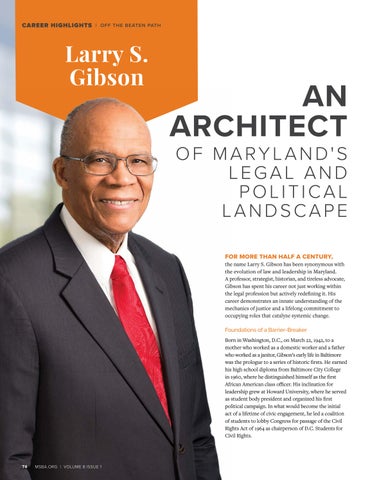

Larry S. Gibson AN ARCHITECT OF MARYLAND'S LEGAL AND POLITICAL LANDSCAPE

FOR MORE THAN HALF A CENTURY, the name Larry S. Gibson has been synonymous with the evolution of law and leadership in Maryland. A professor, strategist, historian, and tireless advocate, Gibson has spent his career not just working within the legal profession but actively redefining it. His career demonstrates an innate understanding of the mechanics of justice and a lifelong commitment to occupying roles that catalyze systemic change.
Foundations of a Barrier-Breaker
Born in Washington, D.C., on March 22, 1942, to a mother who worked as a domestic worker and a father who worked as a janitor, Gibson’s early life in Baltimore was the prologue to a series of historic firsts. He earned his high school diploma from Baltimore City College in 1960, where he distinguished himself as the first African American class officer. His inclination for leadership grew at Howard University, where he served as student body president and organized his first political campaign. In what would become the initial act of a lifetime of civic engagement, he led a coalition of students to lobby Congress for passage of the Civil Rights Act of 1964 as chairperson of D.C. Students for Civil Rights.
After earning his law degree from Columbia University in 1967, Gibson returned to Maryland and immediately took steps to dismantle racial barriers in the profession. He became the first African American to clerk for a federal judge in Maryland, serving under U.S. District Judge Frank A. Kaufman. This role provided him with invaluable insight into the federal judiciary and sharpened the skills he would soon deploy in high-stakes litigation. In 1971, he handled one of his first high-profile cases, representing a member of the Black Panther Party in a murder trial. By successfully arguing for a separate trial and presenting evidence that established a clear alibi, Gibson secured an acquittal and cemented his reputation as a formidable legal mind.
Reforming the Rules of Practice
While many attorneys are content to master the existing rules, Gibson took on the task of modernizing them. In the 1980s, he served as Reporter to the Maryland Court of Appeals Standing Committee on Rules of Practice and Procedure. In this capacity, he played a major role in reorganizing the Maryland Rules of Procedure, drafting rules that transformed the state’s courts from antiquated English commonlaw practices to modern court procedures. He further employed his technical expertise during a 10-year tenure on the committee of the National Board of Law Examiners responsible for developing the evidence section of the Multi-State Bar Examination.
Gibson’s influence also extended to the highest levels of the federal government. During President Jimmy Carter’s administration, he served as Associate Deputy Attorney General of the United States. His portfolio was vast, including service as vice chairman of the National Security Council Working Group on Terrorism and as director of the National Economic Crimes Project at the Department of Justice. In these roles, he coordinated counterterrorism efforts across federal agencies and mapped the government’s drive against white-collar crime, demonstrating an ability to manage complex legal and policy frameworks during a critical period in national history.
The Professor and the Strategist
In the classroom, Gibson’s impact has been immeasurable. He became the first Black law professor at the University of Virginia in 1972, then joined the faculty at the University of Maryland School of Law (now known as The University of Maryland Francis King Carey School of Law) in 1974. As the first Black tenured professor, he taught for 50 years, educating generations of students in courses such as evidence, civil procedure, and election law. His colleagues and former students describe him as a “force of nature” and a “legal giant,” woven into the very identity of the law school. He founded the Black Law Alumni Reunion and mentored countless individuals who went on to become judges, congressmen, and governors.
Parallel to his academic career, Gibson emerged as a master political strategist. He masterminded the historic 1987 campaign of Kurt Schmoke, Baltimore’s first elected African American mayor, and served as campaign manager for Schmoke’s subsequent re-elections in 1991 and 1995. National figures, such as Maryland Governor Wes Moore, and international leaders, including the presidents of Madagascar and Liberia, have sought his strategic counsel. Whether advising a local mayoral candidate or a foreign head of state, Gibson’s approach has always focused on relationship-building, authenticity, and a keen understanding of political dynamics.
Preserving the Legacy of Justice
As a historian, Gibson has dedicated himself to illuminating the often-overlooked history of African American lawyers in Maryland. He was the principal advocate for legislation renaming Maryland’s major airport the Baltimore/ Washington International Thurgood Marshall Airport to honor the Baltimore native and U.S. Supreme Court Justice. In 2012, he published Young Thurgood: The Making of a Supreme Court Justice, a biography that explores Marshall’s education and early legal career. He recently finalized a second volume, Thurgood Marshall: The Conductor: Orchestrating the Death of Jim Crow 1935-55.
Whether advising a local mayoral candidate or a foreign head of state, Gibson’s approach has always focused on relationshipbuilding, authenticity, and a keen understanding of political dynamics.
The recent establishment of the Gibson-Banks Center for Race and the Law at the University of Maryland Carey School of Law serves as a living testament to his legacy. Named in his honor, the center aims to transform systems of racial inequality, continuing the work Gibson championed throughout his career. From his early days as a student activist to his retirement as a professor emeritus in 2025, Gibson has consistently operated at the intersection of law and social justice. His life’s work remains guided by a simple yet powerful mantra: to be a just and learned man and to help other just and learned persons to succeed.