

Southeast Asia represents one of the most significant economic opportunities available to Australian businesses
The region's digital economy reached US$305 billion in 2025 — growing 74 times in a single decade. Its combined GDP is projected to reach US$10 trillion by 2040. Two thirds of the global middle class will be based in Asia by 2030.
And yet the majority of Australian businesses that attempt to expand into ASEAN fail — not because their product is wrong, not because the market is hostile, and not because the timing is poor.
They fail because they applied a Western strategic framework to a fundamentally non-Western business environment.
In 2001 a Harvard Business School professor wrote "Distance Still Matters" — one of the most cited papers in international business. His argument: companies underestimate the distance between home and target markets. Not just geographic. Cultural. Regulatory. Institutional
For Australian businesses entering ASEAN that gap is structural. And almost always invisible until it is too late.
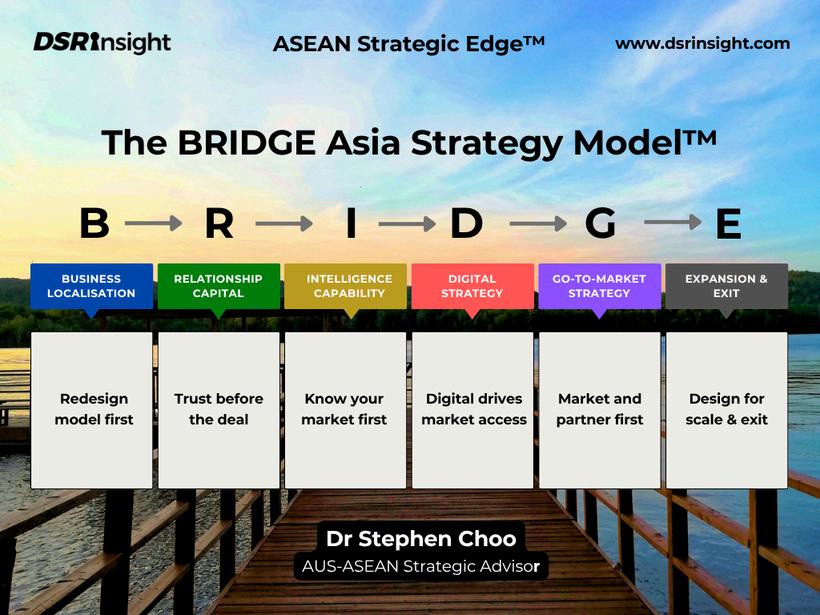
The BRIDGE Asia Strategy Model™ is a six-pillar framework developed through 25 years of advisory work across the Australia-Asia corridor.
The six pillars are:
B — Business Localisation: Your business model was designed for the Australian market. Localisation is not optional. It is the price of entry.
R — Relationship Capital: In ASEAN the relationship is not a path to the deal. The relationship IS the deal.
I — Intelligence Capability: The RICE Intelligence Framework™ — Regulatory, Intercultural, Commercial, and Ecosystem intelligence — before you commit capital or executive time.
D — Digital Market Strategy: Digital presence in ASEAN drives your market entry. Being invisible online is a market access problem.
G — Go-to-Market Strategy: Market selection and partner strategy determine everything — not instinct or familiarity
E — Expansion and Exit Strategy: Design for regional scale from day one. Preagree your exit mechanism before the partnership begins
The opportunity is real.
ASEAN is not an emerging opportunity. It is an arrived one.
The region's digital economy reached US$305 billion in 2025 according to Google, Temasek, and Bain's e-Conomy SEA 2025 report — growing from just US$40 billion a decade ago Three in five people across the region now shop online Over 60% of all payments are digital
ASEAN's combined GDP of approximately US$3.6 trillion makes the region the fifthlargest economy in the world. The demand for Australian expertise across resources, professional services, education, agribusiness, and technology is real, growing, and accessible to businesses that approach the region with the right strategy.
The reality is complex.
In 2001 a Harvard Business School professor published an article in Harvard Business Review that became one of the most cited papers in international business strategy. Its title: "Distance Still Matters."
His argument: companies consistently and dramatically underestimate the distance between their home market and their target market. Not just geographic distance. Cultural distance. Regulatory distance. Institutional distance. Economic distance.
For Australian businesses entering ASEAN that gap is not marginal. It is structural And it is almost always invisible — until it is too late
The most common conversation I have with Australian business leaders before they enter ASEAN is some version of: "What we sell here will work there we just need to get in front of the right people."
Page 3 of 15
This assumption that what works in Australia will work in ASEAN with the right introduction is the single most expensive strategic mistake Australian businesses make when entering the region.
The BRIDGE Asia Strategy Model™ was developed to address this assumption and to replace it with a rigorous, evidence-based framework that gives Australian businesses the strategic foundation to succeed in Southeast Asia.
Your business model how you create value, deliver it, price it, and capture it was designed for the Australian market. It reflects Australian customer expectations, Australian purchasing power, Australian decision-making patterns, and Australian commercial norms.
None of those things work the same way in ASEAN.
Business Localisation is the deliberate, systematic redesign of your business model for your target ASEAN market — not an adjustment, but a genuine redesign across six dimensions:
Are your customer needs the same here as at home? ASEAN customers are not a less sophisticated version of Australian customers They are differently sophisticated with priorities, preferences, and purchasing patterns shaped by cultures, economies, and histories that have no Australian equivalent.
Are your distribution channels transferable? Each ASEAN market has a dominant channel architecture through local distributors, family business networks, government procurement, or digital platforms that a new entrant must understand and work within.
Who are you actually competing against? Local competitors often have cost structures, relationship networks, and government connections that make direct competition on Australian terms inadvisable. Asia is generating world-class business models that Western companies must understand before they arrive.
How is the market structured? Family-owned conglomerates, state-linked enterprises, and digital platform ecosystems — Grab, Shopee, Lazada, Gojek — dominate large parts of the ASEAN commercial landscape in ways that have no Australian equivalent Page 5 of 15
What does the regulatory environment actually require? Not what the formal rules say on paper but how they operate in practice. The gap between formal regulation and actual commercial practice in ASEAN is one of the most consistently underestimated risks in international market entry.
How are customer and partner relationships built here? Relationship management is the dimension requiring the most fundamental redesign for Western companies entering ASEAN. It is not a nicety. It is the operating system of the entire market.
Business Localisation is not what you do when you arrive in ASEAN It is what you do before you book the ticket
In Australia we build relationships because we are doing business together. In ASEAN you do business together because you have built a relationship.
That sequence reversal changes everything.
In Australia trust follows performance. You work with someone, they deliver, you trust them. The relationship is a byproduct of the transaction.
In ASEAN trust must exist before the transaction begins. You do not do business with someone you do not know. And knowing someone in the ASEAN sense requires significant investment of time and genuine intent, with no immediate commercial agenda attached.
I use the word Capital deliberately. Capital accumulates over time. It generates returns — but not immediately and not predictably.
In my experience across the Australia-Asia corridor five dimensions of Relationship Capital matter most:
Face-to-face time with no immediate commercial agenda
Giving value before expecting anything in return
Protecting the face and reputation of your counterparts
Showing up consistently — not just when you want something
Thinking in networks — your contact is a door, not a destination
Companies that invest in relationships with transparent commercial intent consistently fail in ASEAN Their counterparts notice immediately Their investment produces no return because the relationship was never genuine.
Relationship Capital is not the soft side of ASEAN market entry. It is the hard foundation on which everything else is built.
I — Intelligence Capability: The RICE Framework™
The third pillar of The BRIDGE Asia Strategy Model™ is Intelligence Capability the systematic development of deep, accurate, on-the-ground intelligence across four dimensions before an Australian business commits capital or executive time to any ASEAN market.
DSRInsight calls these four dimensions the RICE Intelligence Framework™:
R — Regulatory Intelligence: Every ASEAN market has a distinct regulatory architecture — and it is rarely what it appears on paper The formal rules tell you what is theoretically permitted Regulatory intelligence tells you how business is actually done The answers differ dramatically across Singapore, Jakarta, Kuala Lumpur, and Ho Chi Minh City and the differences are commercially significant.
Page 7 of 15 © 2026 DSRInsight Pty Ltd | ABN 24 639 162 806 | All rights reserved
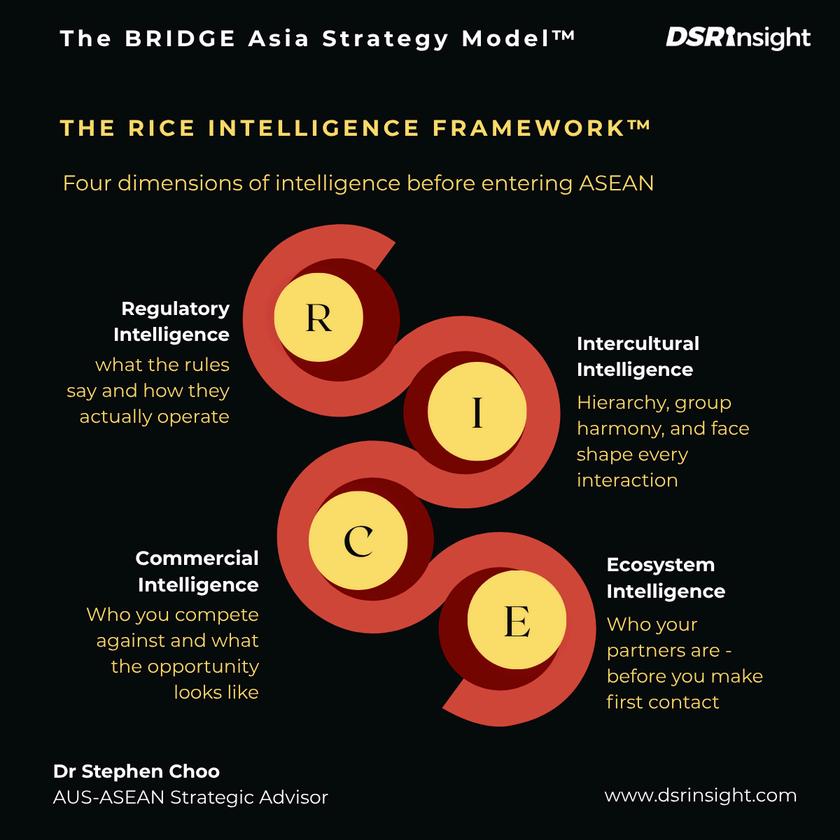
I — Intercultural Intelligence: Australia and most ASEAN nations sit at opposite ends of almost every cultural dimension that matters commercially. Hierarchy, group harmony, and face — the social currency of reputation and dignity — determine whether your meetings produce outcomes and your partnerships survive their first year
C — Commercial Intelligence: Every ASEAN market has a distinct competitive landscape and opportunity profile. Who you compete against is rarely who you compete against at home. Commercial Intelligence answers both questions before you commit capital or executive time.
E — Ecosystem Intelligence: Before first contact with any potential ASEAN partner you should already know who they are, how they are regarded in their market, and whether their objectives genuinely align. Entering that first conversation with intelligence already in hand changes everything about how it unfolds.
Intelligence Capability is the pillar that makes every other pillar possible You cannot localise your business model without knowing what you are localising for You cannot build Relationship Capital without knowing who to build it with
ASEAN's digital economy reached US$305 billion in 2025. Three in five people across the region now shop online. Over 60% of all payments are digital.
When a potential ASEAN partner, customer, or distributor receives your business card the first thing they do is search for you online. What they find in that moment determines whether the conversation continues.
If your digital presence was built for an Australian audience it will not resonate within ASEAN where platforms, content expectations, and signals of credibility and authority are fundamentally different. A digital presence optimised for one market actively works against you in the other.
Digital presence in ASEAN does not support your market entry It drives it Four questions determine whether your digital presence is working for your ASEAN ambitions or against them:
Is your content relevant to ASEAN audiences — or does it speak only to Australian ones?
Are you visible on the platforms your ASEAN counterparts actually use?
Does your digital presence demonstrate regional expertise?
When an ASEAN partner searches for you what do they find?
In ASEAN being invisible online is not a marketing problem. It is a market access problem.
9 of 15
The most common mistake businesses make when developing their ASEAN Go-toMarket Strategy: they decide to enter ASEAN and then start looking for a partner
That sequence sounds logical. It is backwards.
The right partner depends entirely on which market you are entering, which segment you are targeting, and what commercial outcome you are trying to achieve. Without those decisions made first you are not selecting a partner. You are selecting whoever is available.
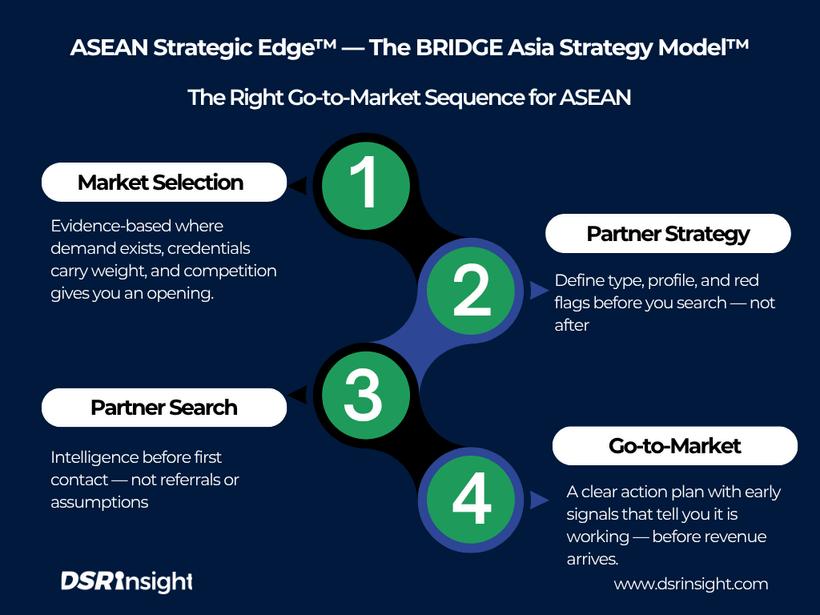
Market selection comes first
Most businesses choose their first ASEAN market on instinct or familiarity Singapore because it is English-speaking, Malaysia because someone has a contact there. This is not market selection. It is market defaulting.
Rigorous market selection asks different questions. Where does genuine unmet demand exist for your specific offering? Where do your credentials carry the strongest credibility? Where does the competitive landscape give you a real opening?
Partner strategy is not partner search
The most common cause of ASEAN market entry failure is not the wrong market It is the wrong partner in the right market
Partner strategy means designing the partnership before you search for the partner. What type distributor, agent, or joint venture? What does an ideal partner look like? What are the non-negotiables and red flags?
Only when those questions are answered does the search begin and the search itself must be evidence-based, not referral-based.
Three questions every Go-to-Market Strategy must answer
Which market and why this market over every other ASEAN market available to you?
Which partner type and why this structure over every other entry structure?
Which partner — and what evidence do you have that this specific organisation is the right one?
Most businesses can answer the first question partially. Very few can answer the second rigorously Almost none can answer the third with genuine evidence
Go-to-Market Strategy is where everything comes together
Go-to-Market Strategy is where Intelligence Capability, Relationship Capital, and Business Localisation combine into a specific, sequenced, executable plan. Your Intelligence Capability tells you which market to enter. Your Relationship Capital tells you who to build with. Your Business Localisation tells you what to take to market.
Go-to-Market Strategy decides how, when, and with whom.
Without those three decisions made rigorously and in the right sequence — you are not going to market You are hoping for the best
Two questions that most business leaders never ask before entering ASEAN: "How do we grow across multiple ASEAN markets once we establish ourselves in the first one?" And: "What is our plan if this does not work?"
The first most businesses intend to answer eventually and never quite get to.
The second most businesses actively avoid because asking it feels like planning to fail.
Both omissions are costly.
The most common trajectory of businesses in ASEAN: two to three years establishing themselves in their first market, then discovering that expanding to the second requires almost as much effort as the first The relationships do not transfer The regulatory knowledge does not apply. The brand recognition does not carry
12 of 15
Expansion Strategy means designing your initial market entry to create the foundation for regional scale from day one.
Before entering Market 1 ask: How will this market create leverage for Market 2? How will you build regional capability rather than country-specific capability? How long is your commitment horizon?
ASEAN rewards patience and punishes ambivalence.
Exit Strategy is not planning to fail It is the governance discipline that professionally managed organisations apply to every significant strategic commitment
Most companies entering ASEAN partnerships never design an exit mechanism When partnerships fail and a significant proportion do companies without a preagreed exit strategy face consequences that are commercially damaging.
What Exit Strategy means in practice:
Pre-agreed exit mechanisms built into every partnership agreement before the relationship begins
Intellectual property protection structured before entering any ASEAN partnership
Clear financial triggers that define when exit becomes the rational decision
The BRIDGE Asia Strategy Model™ is not a checklist It is a strategic sequence in which each pillar enables the next
13 of 15
You cannot localise your business model without Intelligence Capability the RICE Framework™ to tell you what you are localising for. You cannot build Relationship Capital without knowing who to build it with. You cannot execute a Go-to-Market Strategy without the localised model, the relationship foundation, and the intelligence that precedes it.
Understanding that dependency is what separates strategic market entry from expensive improvisation.
DSRInsight is an Australian-based strategic advisory firm specialising in ASEAN market entry intelligence and advisory services.
Our proprietary digital survey research methodology delivers systematic, evidencebased intelligence across all four dimensions of the RICE Intelligence Framework™ Regulatory, Intercultural, Commercial, and Ecosystem before your business commits capital or executive time to any ASEAN market
We work with Australian businesses and boards at every stage of ASEAN expansion
— from initial market assessment and partner identification to go-to-market strategy development and regional expansion planning
To discuss how The BRIDGE Asia Strategy Model™ applies to your specific ASEAN ambitions contact DSRInsight:
Dr Stephen Choo Chief Executive Officer
Digital Survey Research Insight Pty Ltd
ABN: 24 639 162 806
Address: 8/166 Brighton Road
Scarborough Western Australia 6019
E: info@dsrinsight.com
W: www dsrinsight com
The BRIDGE Asia Strategy Model™, ASEAN Strategic Edge™, and the RICE Intelligence Framework™ are trademarks of DSRInsight Pty Ltd.