

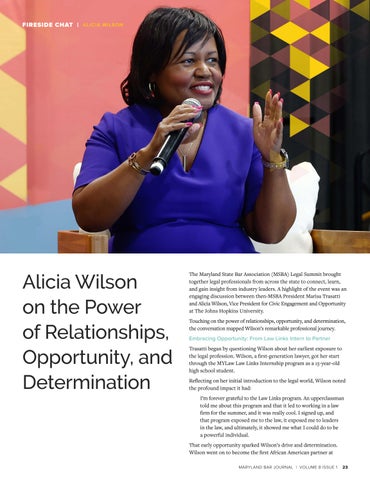

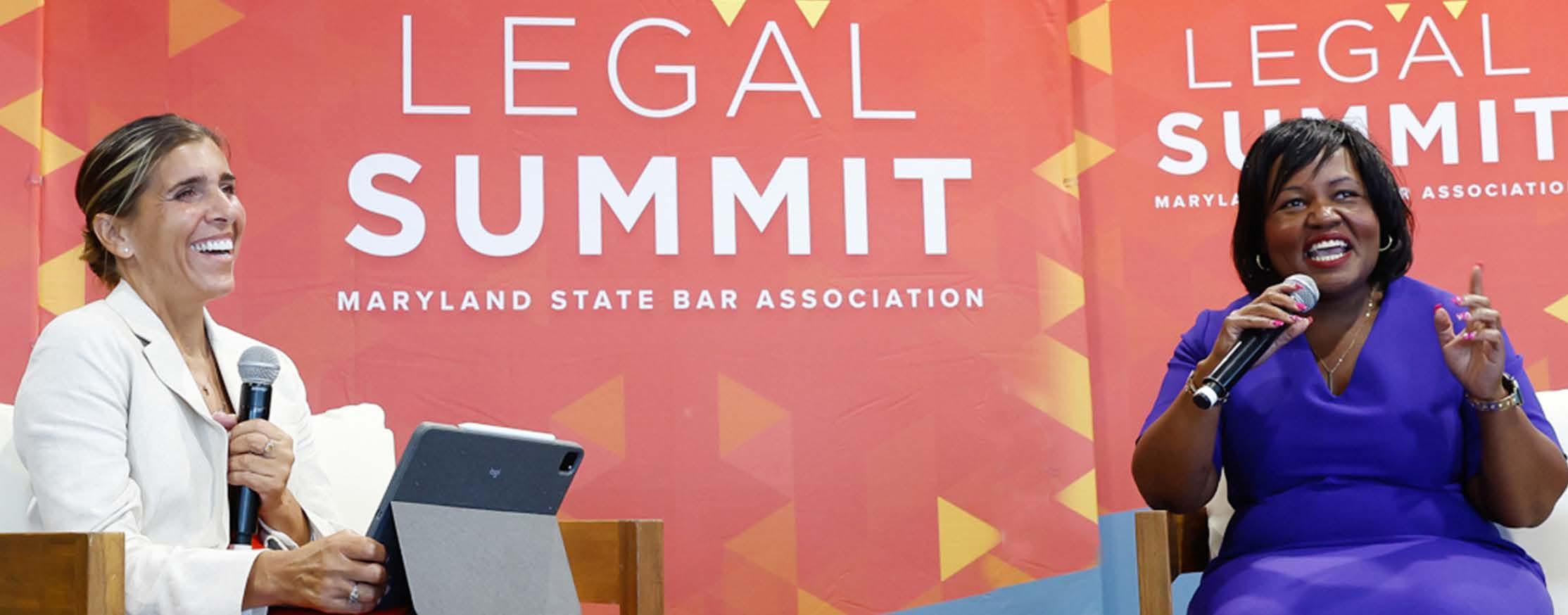
The Maryland State Bar Association (MSBA) Legal Summit brought together legal professionals from across the state to connect, learn, and gain insight from industry leaders. A highlight of the event was an engaging discussion between then-MSBA President Marisa Trasatti and Alicia Wilson, Vice President for Civic Engagement and Opportunity at The Johns Hopkins University.
Touching on the power of relationships, opportunity, and determination, the conversation mapped Wilson’s remarkable professional journey.
Embracing Opportunity: From Law Links Intern to Partner
Trasatti began by questioning Wilson about her earliest exposure to the legal profession. Wilson, a first-generation lawyer, got her start through the MYLaw Law Links Internship program as a 15-year-old high school student.
Reflecting on her initial introduction to the legal world, Wilson noted the profound impact it had:
I’m forever grateful to the Law Links program. An upperclassman told me about this program and that it led to working in a law firm for the summer, and it was really cool. I signed up, and that program exposed me to the law, it exposed me to leaders in the law, and ultimately, it showed me what I could do to be a powerful individual.
That early opportunity sparked Wilson’s drive and determination. Wilson went on to become the first African American partner at



The Maryland State Bar Association (MSBA) Legal Summit brought together legal professionals from across the state to connect, learn, and gain insight from industry leaders. A highlight of the event was an engaging discussion between then-MSBA President Marisa Trasatti and Alicia Wilson, Vice President for Civic Engagement and Opportunity at The Johns Hopkins University.
Touching on the power of relationships, opportunity, and determination, the conversation mapped Wilson’s remarkable professional journey.
Embracing Opportunity: From Law Links Intern to Partner
Trasatti began by questioning Wilson about her earliest exposure to the legal profession. Wilson, a first-generation lawyer, got her start through the MYLaw Law Links Internship program as a 15-year-old high school student.
Reflecting on her initial introduction to the legal world, Wilson noted the profound impact it had:
I’m forever grateful to the Law Links program. An upperclassman told me about this program and that it led to working in a law firm for the summer, and it was really cool. I signed up, and that program exposed me to the law, it exposed me to leaders in the law, and ultimately, it showed me what I could do to be a powerful individual.
That early opportunity sparked Wilson’s drive and determination. Wilson went on to become the first African American partner at

“
If you want to ultimately strike a chord in the community and be a civic leader, that’s why you come to the law: to use this tool to ultimately change lives, change communities, change neighborhoods, and ultimately, hopefully, change history.
Gordon Feinblatt LLC. She emphasized that her mentors at the firm taught her that practicing law is about much more than making money.
If you want to ultimately strike a chord in the community and be a civic leader, that’s why you come to the law: to use this tool to ultimately change lives, change communities, change neighborhoods, and ultimately, hopefully, change history. That sort of upbringing really formed me and helped me never feel like I was not in the public sector, even though I was in private practice, because it was woven into how I conducted myself as an attorney.
Impact Beyond the Courtroom: The Transition Out of Private Practice
Trasatti then talked to Wilson about her decision to transition from private-practice litigation to in-house corporate and institutional roles. For an attorney who had a fire in her belly for litigation, leaving the courtroom seemed unexpected. However, Wilson explained that the underlying skill set of an effective litigator, problem-solving, building strategic alignment, and executing a vision, allowed her to adapt well to large-scale project leadership. She talked about her bridge out of private practice, the Port Covington redevelopment deal. At the time, observers viewed the complex project skeptically as a likely “loss,” but Wilson approached it from the perspective of a trial attorney. She shared, “While it didn’t feel like a litigation case, certainly that project was on trial. The city and its residents were the jurors, and ultimately, I had to make a case. It took bringing in people, knowing your allies, converting people who were against you, striking a balance, having a principle, and driving toward an outcome.”
Wilson noted that her role in the project was similar to that of a trial attorney. ”You have your client, you have an outcome you’re trying to achieve, and it’s all about how you maneuver yourself while staying true, being truthful, and driving toward the result.”
Throughout the chat, Wilson repeatedly returned to her core philosophy: while intelligence and talent are necessary, relationships are the key elements to a successful life and career. She noted, “For me, the navigation of a law firm, the navigation of a large organization, fundamentally goes to the relationships that are going to allow for you to make hard things easy.”
Wilson shared a poignant childhood lesson taught to her by her grandmother, who worked as a school custodian. Her grandmother recalled that while certain people took the time to learn the names of her children and grandchildren, others didn’t even bother to learn her name. This shaped Wilson’s people-first approach to corporate leadership: “I knew that I wanted to be the person who knew the grandchild’s name. I didn’t want to be the person who was known as someone who just walked past and discarded people and didn’t think they were worth knowing.”
Whether navigating a major law firm or corporate boardrooms, Wilson advised younger lawyers to build these relationships early and authentically, well before they ever need to ask for a favor.
Determination in a Changing Landscape: The Future of AI and Law
As the conversation shifted toward the future of the legal profession, Trasatti asked Wilson about the looming impact of artificial intelligence (AI). Rather than expressing fear, Wilson expressed her belief that while AI is a powerful tool, it cannot replicate human connection. She noted, “We are going to get the freedom of time, and then you are going to have to choose how you spend it, and it’s still going to be about people. Everybody’s going to get to be able to touch an AI button and touch a thing and make it happen. They’re not going to be able to form relationships.”
Wilson challenged the next generation of lawyers to reject the urge to isolate behind screens and instead double down on social and civic engagement.