Leveraging AI and Legal Tech to Bridge the Maryland Justice Gap
BY COLLEEN M. ARACRI, ESQ.
THE DISPARITY BETWEEN THE LEGAL NEEDS of Marylanders and the resources available to meet them presents a significant challenge. In Maryland, 10% of households live below the Federal Poverty Line.1 An additional 28% of Maryland households fall into the ALICE2 threshold, which means their earnings exceed the poverty line, but they do not make enough to survive and meet basic needs like food, shelter, and childcare, let alone hire legal counsel at market rates.
Data indicates that 74% of low-income households experienced at least one civil legal issue within the past year.3 While legal services organizations offer vital support to those in need, they are frequently restricted by limited funding and overwhelming caseloads. This scarcity creates a justice chasm where the vast majority of Marylanders, numbering in the hundreds of thousands, who face life-altering legal hurdles, such as evictions, debt collection, or family law disputes, must navigate a complex court system entirely on their own. Without the help of an attorney, these people often struggle to identify their rights or properly file the necessary documentation, leading to inequitable outcomes that perpetuate the cycle of poverty.
In Maryland, the Access to Justice Commission’s Data and Legal Technology Committee is exploring ways to use AI and legal technology to create efficiencies in organizational workflows, applications in service delivery, as well as direct-to-consumer use cases. Separately, but relatedly, the Innovations in Tiered Legal Services Task Force, a joint initiative of the judiciary, the Maryland State Bar Association (MSBA), and the Maryland Access to Justice Commission (A2JC), is studying legal technology
In
Maryland, the Access to Justice Commission’s Data and Legal Technology Committee is exploring ways to use AI and legal technology to create efficiencies in organizational workflows, applications in service delivery, as well as direct-to-consumer use cases.
tools that could serve a swath of the population through TurboTax-like applications, which could give legal guidance and advice in relatively straightforward case-types.
In Maryland, like every other state, the demand for civil legal aid consistently exceeds the supply of attorneys. AI and other legal technology tools are emerging as resources to address this systemic failure. These tools serve as force multipliers, enabling civil legal aid organizations, their attorneys and staff, as well as pro bono attorneys, to reduce the time per case and help reach more clients.
SCALING LEGAL AID THROUGH WORKFLOW AUTOMATION
For many legal aid organizations and pro bono volunteers, one obstacle to expanding services is the administrative tax, or the time-consuming processes of intake, eligibility screening, and basic factual inquiry. Technology can now streamline these entry points to ensure that limited human resources are reserved for complex legal analysis.
MARYLAND’S ARTIFICIAL INTELLIGENCE LEGAL AID PLATFORM
Maryland Legal Aid (MLA) recently announced the official launch of MLAGPT, a secure, internally managed generative artificial intelligence platform designed specifically to support civil legal services. The platform represents a significant step forward in how nonprofit legal organizations can responsibly integrate AI while protecting client confidentiality and strengthening access to justice.
MLAGPT is powered by LibreChat, a model-agnostic AI platform, and is self-hosted within MLA’s secure cloud environment. The system operates under formal business associate agreements with AI providers and a zero data retention policy, ensuring that client information is not stored or used to train external AI models. This privacyfirst infrastructure reflects MLA’s core commitment to safeguarding the sensitive information entrusted to it by low-income Marylanders.
“MLAGPT is not about replacing human judgment,” said Vicki Schultz, Executive Director of Maryland Legal Aid. “It is about equipping our advocates and staff with a secure tool that reduces administrative burden, improves efficiency, and allows us to focus more of our time on strategic advocacy and direct client support.”
Unlike general commercial AI tools, MLAGPT has been tailored to the specific needs of civil legal services organizations. Attorneys and paralegals can use the platform to draft client letters, summarize lengthy case
files, brainstorm legal arguments, and translate complex legal language into plain English for clients. Administrative and operations staff can generate internal communications, create training materials, summarize reports, and streamline documentation workflows.
The platform also includes custom “agents” built around recurring legal aid tasks, such as case summaries, rent ledger analysis, and referral support, promoting consistency
In Maryland, like every other state, the demand for civil legal aid consistently exceeds the supply of attorneys. AI and other legal technology tools are emerging as resources to address this systemic failure.
and quality across offices. By standardizing workflows and reducing repetitive drafting time, MLA expects staff to devote more energy to complex case strategy and client engagement.
DIGITAL TRIAGE SYSTEMS
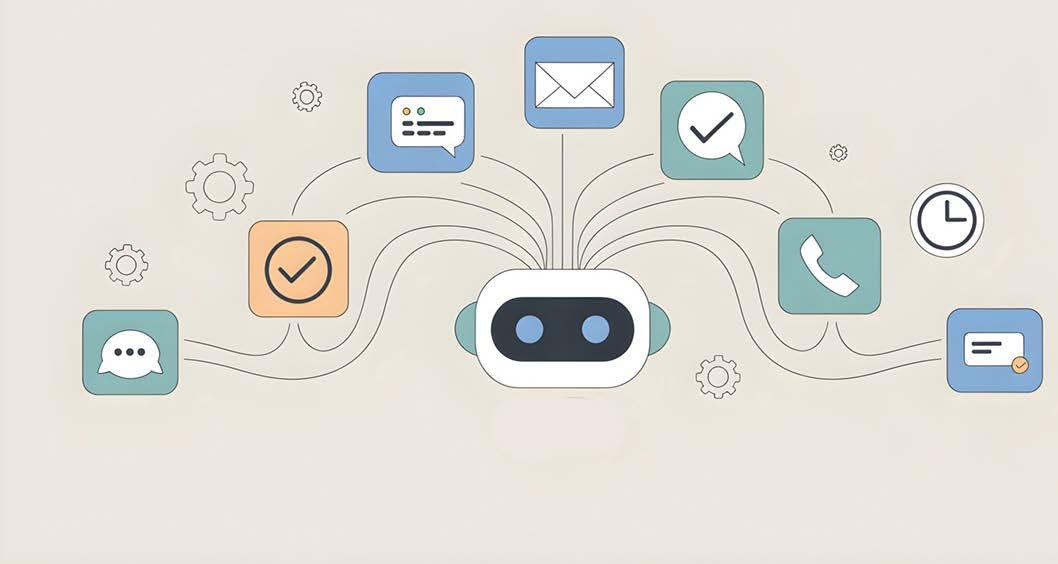
AI intake platforms and answering services can be deployed to provide 24/7 initial screenings. Legal intake involves high volume, repetitive Q&A, and standard decision rules, which are conditions where AI can excel.4 A large language model (LLM) can be programmed to ask the same questions an intake worker would, in a conversational manner, and interpret the answers.5 For example, Legal Aid of North Carolina (LANC), the state’s largest nonprofit law firm that serves 300,000 people annually seeking help with issues such as domestic violence and unlawful eviction, is testing an AI-powered voice agent for initial intake that operates 24/7 in multiple languages, addressing accessibility challenges for clients in rural areas or those with transportation issues, as an example of innovative AI implementation.6 Similarly, the Law Center for Better Housing (LCBH) in Chicago employs an AI chatbot called Rentervention that uses an LLM to provide 24-hour access to justice for those who may have otherwise fallen into the justice gap.7 Of those who accessed
4 justiceinnovation.law.stanford.edu/legal-aid-intake-screening-ai/#the-use-case-ai-assisted-housing-intake
5 Id.
6 legalaidnc.org/2025/11/18/legal-aid-of-north-carolina-launches-lia-2-0-marking-a-new-era-in-accessible-ai-powered-legal-information/
7 medium.com/justice-rising/a-pathway-to-justice-ai-and-the-legal-aid-intake-problem-0af735b92f17
the Rentervention, 90% of their informational needs were addressed via engagement with the technology.8
Because LLMs can process natural language, an AI agent can understand a client’s narrative of their housing problem and spot relevant details or legal issues (e.g., identifying an illegal lockout vs. a formal eviction) to ask appropriate follow-ups.9 By qualifying financial eligibility and identifying the specific legal issue (e.g., a failure to pay rent vs. an illegal lockout) before a human advocate intervenes, these tools can greatly reduce staff administrative burden, allowing attorneys to redirect their focus to substantive issues.10
In some instances, attorneys who want to offer pro bono services are hesitant because they cannot find the right opportunity. Platforms like Paladin11 are utilizing AI to match an attorney’s specific practice area and geographic location with real-time needs from local legal services providers, potentially inspiring more attorneys to volunteer their legal services.
GUIDED ASSISTANCE FOR SRLS
For self-represented litigants (SRLs), the complexity of Maryland’s court forms is a significant barrier to entry. To make legal aid more accessible, various nonprofits and judicial entities throughout the United States have launched free digital tools designed to help SRLs navigate complex court processes.
A2J Author12 is a software tool developed by CALI and the Center for Access to Justice & Technology at IIT Chicago-
8 Id.
9 Id.
Kent College of Law to deliver greater access to justice for self-represented litigants by enabling lawyers and law students to rapidly build user-friendly web-based document assembly tools called A2J Guided Interviews. These A2J Guided Interviews allow users to complete court documents by presenting a series of easy-to-understand questions while graphics virtually lead users along the path to the courthouse, where these documents can be filed. A2J Author can help self-represented litigants in a wide variety of legal matters, including filing for divorce, getting protection orders, answering debt collection suits, and modifying child support orders.
LawHelp Interactive13 is a non-profit tool managed by Pro Bono Net that helps SRLs prepare legal documents by answering simple, interview-style questions. It covers housing, family law, and debt issues, offering, for example, assistance with domestic violence protection orders. Legal service organizations can also use LawHelp Interactive to streamline their operations.
Another tool, Upsolve14 guides people through the bankruptcy process. Users begin by creating an account and completing a detailed questionnaire regarding their finances. After finishing a mandatory one-hour educational course, the platform’s software automatically generates the necessary court forms. The process concludes with a meeting between the user and a bankruptcy trustee; if the paperwork is in order, the user’s debt is typically canceled within a few months.
In the realm of housing, the Massachusetts Defense for
10 clemetrobar.org/?pg=CMBABlog&blAction=showEntry&blogEntry=131708#:~:text=AI%20answering%20can%20staff%20Lawyer,Cambridge%20University%20Press%20&%20Assessment+1
11 joinpaladin.com/#:~:text=Who%20We%20ServePro%20Bono,on%20their%20interests%20and%20expertise.
12 a2jauthor.org, with graphics that virtually guide/, with graphics that virtually guide
13 lawhelpinteractive.org/Home/Organization
14 upsolve.org/home?utm_source=google&utm_medium=cpc&utm_campaign=branded&utm_term=upsolve&utm_content=home&utm_device=c&gad_ source=1&gad_campaignid=22580237179&gbraid=0AAAAArEQMegdEhJVEtPI4l7QCtvGbnmjQ&gclid=CjwKCAiAtLvMBhB_EiwA1u6_Pkw0rQTGc9lUFgwSECk7_ t7MzxdEuopijgyISvyLkTlFJpC2qcIZzRoCJvcQAvD_BwE
The rise of AI in Maryland’s legal practice has been met with clear guidance from the judiciary and the Bar.
Eviction15 (MADE) offers a lifeline to tenants facing eviction. Functioning like a virtual interview, the platform asks users for details about their living situation, their landlord, and the specific claims of their case. Based on these responses, MADE produces the seven essential legal documents required for a court hearing, which the tenant then signs and files.
Florida’s Eleventh Judicial Circuit developed SOFIA16 (South Florida Interactive Access) to streamline family law matters like simple divorces and name changes. With SOFIA, people can request their simple divorce or adult name-change packet by email or online chat with a Self Help staff member, then they can register to use SOFIA, where an assisted document creator app will gather the information needed for the forms by asking them interactive questions online.
Multilingual AI translation tools are emerging as a potential solution to the linguistic barriers that often impede access to justice for Maryland’s diverse, multilingual population, as traditional human translation is expensive and often unavailable for emergency filings. Such tools are now being integrated into court websites and many legal aid portals.17
15 gbls.org/MADE
16 sofia.jud11.flcourts.org/
ETHICAL MANDATES AND PROFESSIONAL RESPONSIBILITY
The rise of AI in Maryland’s legal practice has been met with clear guidance from the judiciary and the Bar. Every Maryland attorney using AI and legal technology tools must adhere to the Maryland Attorneys’ Rules of Professional Conduct (MARPC):
Competence (Md. Rule 19-301.1):
As of the 2025–2026 bar year, technological competence is an explicit component of an attorney’s duty. Practitioners must understand the “risks and benefits associated with relevant technology.”
Confidentiality (Md. Rule 19-301.6): When using AI for pro bono intake, attorneys must ensure that client data is processed within a “closed” environment. Uploading sensitive client narratives to public, consumer-grade AI models without a “zero data retention” agreement may constitute a breach of confidentiality.
Supervision (Md. Rule 19-305.1 & 19-305.3):
The lawyer—not the clerk or the algorithm—is the ultimate guarantor of the filing. The failure to read the cases cited in a brief, regardless of how they were discovered, is unquestionably improper.
Technology will never replace the empathy, ethical judgment, or advocacy of a Maryland lawyer. It is, however, a tool that can help make significant strides towards reducing the justice gap. By embracing AI and legal technology tools to improve administrative efficiency, automate document preparation, and enhance language accessibility, Maryland can move closer to a system in which justice is not a luxury for the few but a reality for all.
17 getrobotsolutions.com/post/multilingual-a-i-bridging-the-access-to-justice-gap-in-modern-courts#:~:text=24/7%20Accessibility:%20A.I.,for%20court%20staff%20as%20well. ncsc.org/libraries/mozilla-pdfjs/web/viewer.html?file=https://www.ncsc.org/sites/default/files/media/document/NCSC%20Machine%20Translation%20Guide_0.pdf