Senior Judge Stephen J. Sfekas
While he continues to serve the state by traveling as a visiting senior judge to counties from Harford to Caroline, he also took on a new role: podcaster.


Photo courtesy of Travis Marshall Photography
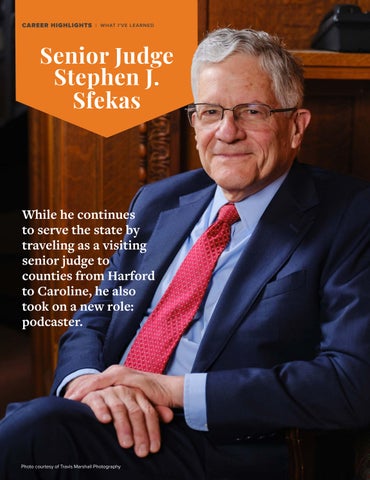
While he continues to serve the state by traveling as a visiting senior judge to counties from Harford to Caroline, he also took on a new role: podcaster.
FOR MARYLAND CIRCUIT COURT Senior Judge Sfekas’ retirement has been anything but quiet. While he continues to serve the state by traveling as a visiting senior judge to counties from Harford to Caroline, he also took on a new role: podcaster. We interviewed Judge Sfekas to learn more about his career and podcast, Trials That Shaped Us.
Why did you enter the legal profession?
I grew up in a law-oriented family. My father was a lawyer and later a well-respected district and circuit court judge in Baltimore County. My brother was a district court judge in Howard County before his untimely death. So when I went to college, I immediately decided that I wanted to be a history professor. I went to graduate school to study history and soon decided that I loved history, but not as a job. After dropping out of graduate school, I decided to revert to form and go to law school.
What do you enjoy most about your career?
My main practice area while in practice was health care law, a rapidly evolving field. That meant that, periodically, I had to learn entirely new areas of law every few years as the industry changed. I really enjoyed that aspect of practice. I also loved litigation, especially working with expert witnesses.
Tell us a little bit about your current role.
Maryland judges are required to retire at 70, but we may be recalled to sit on a per diem basis after our formal retirement. As a recalled judge, I can sit in any jurisdiction in the state with permission from the administrative judge of the circuit court and from the Chief Justice of the Supreme Court of Maryland. I have been a senior judge for a number of years now, and as a result, I get to work all over the state. As a senior judge, I get to work when I feel like it, which is nice.
You developed lectures on the Nuremberg Justice Trial for the Judicial College of Maryland. What was the moment that made you realize the trial was a necessary lesson for Maryland judges?
Every new trial judge in Maryland must complete a mandatory program officially called New Trial Judge Orientation (commonly known as baby judge school). As part of baby judge school, all Maryland judges go to the Holocaust museum to get a guided tour and a lecture on the failure of the German judiciary to oppose the Nazis. I learned that the movie Judgment at Nuremberg, one of my favorites, was based on the actual trial United States
v. Alstoetter, and I decided I would someday explore that trial. Later, I gave a talk on ethics to the incoming 1L class at the University of Baltimore School of Law and contrasted the judges in the movie with Atticus Finch in To Kill a Mockingbird. As I drove home, I decided I really should look at the Nuremberg Trials, and the best way to force myself to learn about them was to teach them. I submitted a course proposal to the Judicial College, which the college accepted on the proviso that I include a reenactment component. I thought that was a great idea. However, we were not sure anyone would sign up for it, as the college had never offered a similar program before. When the catalog went out, we figured that if fewer than 15 judges signed up, we would cancel the program. We were hoping to get 25–35 to sign up. Instead, 80 signed up, and the program received good evaluations. After that, the program became a series. We are up to historical trial number 11 this year, trials of the nazi doctors and the origins of modern medical ethics.
Moving from a judicial lecture to a weekly public podcast is a significant shift. What prompted the decision to share these lectures with the general public and the broader legal community?
The Justice Trial at Nuremberg program has been very popular with the judiciary, and we have received many requests to either repeat it or open it up. Opening the regular program was contrary to the college's mission, and there was a limit to my ability to repeat it. The obvious solution was to record the program so that the judiciary's staff and friends could attend. A member of the judicial college staff suggested that I do a podcast, and that made great sense. So a new podcast was born.
Your podcast topics range from the Salem Witch Trials to the New Deal. What is your criteria for selecting a trial? Does a case need to have a specific “moral” or “procedural” impact to make the cut?
My topic choices are idiosyncratic for sure, but I have a couple of criteria. I handle historical cases, not famous ones. The cases
“ Mark Twain made the famous quip that history doesn’t repeat itself, but sometimes it rhymes. Many of the cases deal with perennial issues in American life and indeed in world history.
I discuss result from significant historical developments and generally offer a resolution or a new approach. The cases then have an aftermath. Even something like the Salem witch trials fits these criteria. The trials were the last gasp of the Great European Witch Hunt, which resulted in the deaths of perhaps 50,000 people, 70% of whom were women. They represented a loss of confidence among the Puritan leaders of Massachusetts, a political-legal crisis stemming from the revocation of the Massachusetts charter, a losing war, and tremendous social strain. The aftermath included the first rules of evidence in American law and the establishment of the principle of probable cause and reasonable doubt in criminal law.
Additionally, the cases I chose all have ample Englishlanguage resources, and I generally want to find a transcript of the court proceedings to see what actually happened. By the way, the Scopes1 trial in the transcripts is totally different from the Scopes trial in Inherit the Wind. A final point: I need to be able to commit to the case for a year, as there is an enormous amount of research involved, and I am doing this for fun.
How do historical trials inform our current understanding of the Rule of Law?
Mark Twain made the famous quip that history doesn’t repeat itself, but sometimes it rhymes. Many of the cases deal with perennial issues in American life and indeed in world history. The Alien and Sedition Act cases and the Impeachment of Andrew Johnson are good examples. America in the 1790’s bears an eerie resemblance to the America of 2026. Yet, the result of the trials and controversies of that era was a reaffirmation and broadening of the concept of freedom of speech and of the press. The impeachment of Andrew Johnson illustrates how a dispute between a president and Congress might spiral out of control and, in that case, result in the 14th Amendment.
1 Scopes v. State, 154 Tenn. (1 Smith) 105, 289 S.W. 363 (1927).
What do you hope your fellow MSBA members and young attorneys specifically take away from listening to your podcast?
The fundamental takeaway for any good lawyer is a more profound understanding of what the rule of law is and the significance of what we do for the life of our community and country. These cases show how the law has resolved disputes, established new understandings, and put us on a different course. The trials are historical because they affect history.
You’ve chosen not to monetize this project. What would you consider a “success” for Trials That Shaped Us one year from now?
I haven’t done this for money, and I feel no need to make money from the project. My goal is to reach the largest possible audience of thoughtful listeners who will gain a deeper understanding of the law and justice.
Each trial typically spans five episodes. Since launching last October, the podcast has covered:
The Justice Trial at Nuremberg (1947)
The Salem Witch Trials
The Alien and Sedition Act Trials
The Freedom Trials
The Impeachment of Andrew Johnson
How to Listen
You can find Trials That Shaped Us on all major platforms, including Apple Podcasts, Spotify, Audible, and iHeartRadio. You can also listen on RSS.com.