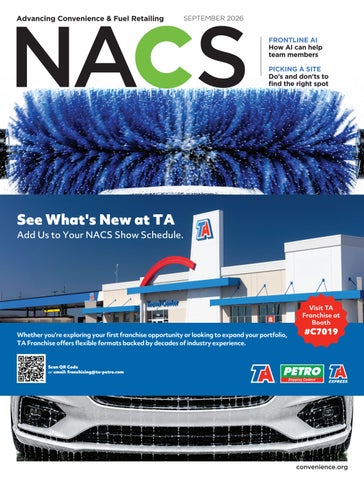
Advancing Convenience & Fuel Retailing
SEPTEMBER 2026 FRONTLINE AI How AI can help team members PICKING A SITE Do's and don'ts to find the right spot
See What's New at TA Add Us to Your NACS Show Schedule.
Visit TA Franchise at Booth Whether you're exploring your first franchise opportunity or looking to expand your portfolio, TA Franchise offers flexible formats backed by decades of industry experience.
#C7019
Scan QR Code or email: franchising@ta-petro.com
convenience.org
Advancing Convenience & Fuel Retailing
SEPTEMBER 2026 FRONTLINE AI How AI can help team members PICKING A SITE Do's and don'ts to find the right spot
convenience.org
Is your store ready for the Marlboro Cowboy Cut Kings and 100s? Offer your price sensitive AS21+ the latest from the Marlboro family of products.
Contact your AGDC Representative or wholesaler to get started on your order of Marlboro Cowboy Cut today.
D 5
F
ONTENTS NACS / SEPTEMBER 2026
FEATURES
36 The Value
Is in the Data
Loyalty programs can turn transaction-level insights into personalized offers and higher-value shopping trips.
26
48 Beyond Checkout
This article is brought to you by GS1 US. 2D barcodes have the power to enable more autonomous functions and boost customer engagement.
52 Shopping for the Next Site
‘Measure twice, cut once’ with a mix of analytics and old-fashioned inperson work.
62 Shifting ‘Cleaner’ Image generated with OpenAI
Reformulations and functional foods help meet consumers’ needs.
66 Lessons From
NACS Convenience Summit Europe What are the key insights and ideas from the gathering of industry leaders in Warsaw, Poland?
Built to Shine To find success with car wash, retailers have to build an experience worth coming back to.
74 Value Never Goes
76 AI on the
This Q&A is brought to you by Xcaliber International.
From training to troubleshooting, new tech gives workers a helping hand.
Out of Style
Fourth-tier cigarettes make a compelling offer for polyusers and customers with tighter wallets.
Front Line
STAY CONNECTED WITH NACS @nacsonline facebook.com/nacsonline instragram.com/nacs_online linkedin.com/company/nacs
Subscribe to NACS Daily—an indispensable quick read of industry headlines and legislative and regulatory news, along with knowledge and resources from NACS, delivered to your inbox every weekday. Subscribe at www.convenience.org/NACSdaily.
ONTENTS NACS / SEPTEMBER 2026
86 6 Trends in the Beverage Biz
Hard Seltzer Matures Though it’s down from its peak, hard seltzer has proven to be adaptable.
Customization, packaging trends, shifts in consumption and more are just some of what’s bubbling up.
94 Canada’s Nicotine Pouch Fight
Convenience retailers find themselves battling the government and illicit vendors to get pouches
104 Keep Money Moving
This Q&A is brought to you by Cash Depot.
107 Nice Ice
Offering clean, tasty ice can make a store a chill destination.
122 More Than Just Buzz
This Q&A is brought to you by PriceEasy. AI is already transforming convenience retail.
2 SEPTEMBER 2026 convenience.org
124 Ideas From
144 Maximize Your
164 Retailing on
A behind-the-scenes look at the 2026 NACS Ideas 2 Go video shoots.
Build your schedule from more than 50 Education Sessions at the 2026 NACS Show.
Whether standing as a launching point to adventure or a necessary rest stop for travelers, these three retailers let their locations be the guide to their store offers.
the Road
Return on Insight
136 Q&A: Lindsay
162 Beyond
Former SNL producer Lindsay Shookus will speak about creative trust and building adaptability at a NACS Show General Session.
This Q&A is brought to you by Mako Networks.
Shookus
Connectivity
Smart networks allow retailers to deploy the next big thing in technology—and the one after that—without adding complexity.
the Edge
Image generated with OpenAI
Cash management is a fundamental part of convenience retail, and inefficient systems may be costing you money.
BUILT RETAILERS FOR
DESIGNED FOR THE FUTURE
by Cash Depot
Typical Solutions
Eliminates Bank Fees
Added Fees
Eliminates deposit, restocking, and adjustment fees
Traditional fee structures continue
Faster Cash Access
Delayed Cash Availability
Next-business-day ACH funding
Provisional credit models
Fund Registers Anytime
Deposit Only
24/7 register funding and cash advances
Limited cash functionality
Multi-Denomination
Fewer Denominations
accepts all U.S. currency, recycles $1s, $5s, $10s, $20s, $50s, and $100s
Dispenses only $20s or a limited bill mix.
More Revenue Opportunities
Limited Capabilities
A growing library of consumer financial service integrations
Fewer integrations and flexibility
One Connected Platform
Multiple Systems
Deposit, recycle, and track cash in one solution
Disconnected machines and services
Proven Nationwide Platform m
Unproved Alternativies
1,000s performing at retailers today
Newer solutions
by Cash Depot
No Bank Fees. No Provisional Credit. Offset Cash Costs. More than a smart safe. A complete cash management platform.
Discover What BANK IN A BOX Can Do For You!
ONTENTS NACS / SEPTEMBER 2026
DEPARTMENTS 08
From the Editor
10
Faces of the Industry
12
NACS News
22
Convenience Cares
24
Inside Washington A federal judge just struck down five state SNAP waivers. What does that mean for retailers?
186 Fuels and Energy
$6,487
The average sales per store, per month of hot dispensed beverages in 2025. CATEGORY CLOSE-UP PAGE 192
190 Gas Station Gourmet
192 Category Close-Up
Hot dispensed beverages offer more options to meet consumers’ high expectations.
200 By the Numbers PLEASE RECYCLE THIS MAGAZINE 4 SEPTEMBER 2026 convenience.org
The presence of an article in our magazine should not be permitted to constitute an expression of the association’s view.
Image generated with OpenAI
IT’S A FACT
THE EXCELLENCE YOUR CUSTOMERS EXPECT Value. TasTe. QualiTy. 10
SAT 0% GUARISFACTION ANTE ED
That’s the Premier Promise Make quality your priority while keeping value in mind. Premier Manufacturing, Inc. is owned by U.S. Tobacco Cooperative, a cooperative of U.S. farmers who grow the finest U.S. flue-cured tobacco to make high-quality, value-priced cigarette brands for adult consumers.
www.gopremier.com
/ SEPTEMBER 2026 EDITORIAL
NACS BOARD OF DIRECTORS
Jeff Lenard VP of NACS Media & Strategic Communications (703) 518-4272 jlenard@convenience.org
CHAIR: Annie Gauthier, CFO/Co-CEO, St. Romain Oil Co. LLC (dba Y-Not Stop)
Ben Nussbaum Publisher & Editor-in-Chief (703) 518-4248 bnussbaum@convenience.org
OFFICERS: Chris Bambury, Bambury Inc.; Tom Brennan, Casey’s; Varish Goyal, Loop Neighborhood Markets; Charles McIlvaine, Coen Markets Inc.; Natalie Morhaus, RaceTrac Inc.; Travis Sheetz, Sheetz Inc.
Michelle Cassidy Managing Editor mcassidy@convenience.org
Lauren Shanesy Editor/Writer lshanesy@convenience.org Noelle Riddle Editor/Writer nriddle@convenience.org
PAST CHAIRS: Victor Paterno, president and CEO of Philippine Seven Corp.; Don Rhoads, president and CEO of The Convenience Group LLC
Chrissy Blasinsky Digital & Content Strategist cblasinsky@convenience.org
SUPPLIER BOARD REPRESENTATIVES: Bryan Morrow, Chobani & La Colombe; Kevin LeMoyne, The Coca-Cola Co.
CONTRIBUTING WRITERS Amanda Baltazar, Kate Bernot, Al Hebert, Steve Holtz, Pat Pape
SUPPLIER BOARD CHAIR: Bryan Morrow, Chobani & La Colombe
DESIGN
VICE CHAIRS: Mike Gilroy, Mars Wrigley; Jim Hughes, Liquid Death; Danielle Holloway, Altria Group Distribution Co.
Ji Ho Creative Director jho@convenience.org Lisa M. Zilka Senior Graphic Designer lzilka@convenience.org David Marvin Graphic Designer dmarvin@convenience.org
ADVERTISING Jennifer Leidich National Advertising Manager/ Northeast (703) 518-4276 jleidich@convenience.org
Join us at conveniencecares.org
GENERAL COUNSEL: Doug Kantor, NACS MEMBERS: Lisa Blalock, BP North America Inc.; Brian Donaldson, Maxol Limited; Tony El-Nemr, Nouria Energy Corp.; Terry Gallagher, Gasamat Oil Corp./Smoker Friendly; Erin Graziosi, Robinson Oil Corp.; Raymond Huff, HJB Convenience Corp. (dba Russell’s); Mark Jordan, Refuel Operating Co.; Thomas Love, Love’s Travel Stops & Country Stores; Crystal Maggelet, Maverik Inc.; Rich Makin, Wawa Inc.; Brian McCarthy, Blarney Castle Oil Co.; Andrew Mitchell, Toot’n Totum Food Stores LLC; Jigar Patel, Fastime; Stanley Reynolds, 7-Eleven Inc.; Kristin Seabrook, Global Partners LP; Doug Yawberry, Weigel’s Stores Inc.; Scott Zietlow, Kwik Trip Inc.
Austin Fuller Senior Writer afuller@convenience.org
COME TOGETHER. DO MORE.
TREASURER: Lonnie McQuirter, Director of Operations, 36 Lyn Refuel Station
NACS SUPPLIER BOARD CHAIR-ELECT: Kevin LeMoyne, The Coca-Cola Co.
MEMBERS: Tony Battaglia, PMI U.S.; Ryan Calong, Tropicana Brands; Jerry Cutler, InComm Payments; Jack Dickinson, Dover Fueling Solutions; Matt Domingo, Reynolds; Mark Falconi, Greenridge Naturals; Ramona Giderof, Diageo Beer; Adam Gryzbek, BIC Corp.; Kevin Kraft, Olipop; Jay Nelson, Excel Tire Gauge LLC; Jordan Nicgorski, JUUL Labs; Nick Paich, TriggerPoint Media; Bria Troy, PepsiCo Inc.; Melissa Vonder Haar, iSEE Store Innovations LLC; Jason Zagaria, Primo Brands; Derek Zahajko, CAF Inc.; GENERAL COUNSEL: Doug Kantor, NACS STAFF LIAISON: Bob Hughes, NACS RETAIL BOARD REPRESENTATIVES: Tom Brennan, Casey’s; Scott Hartman, Rutter’s; Kevin Smartt, TXB PAST CHAIRS: Vito Maurici, McLane Co. Inc.; David Charles, Cash Depot; Kevin Farley, InStore AI
Ted Asprooth National Sales Manager/ Midwest, West (703) 518-4277 tasprooth@convenience.org
Subscriptions and customer service: nacsmagazine@convenience.org
PUBLISHING
NACS Magazine (ISSN 1939-4780) is published monthly by the National Association of Convenience Stores (NACS), Alexandria, Virginia, USA.
Logan Dion Digital Media and Ad Trafficker (703) 864-3600 ldion@convenience.org Advertising production: production@convenience.org
Subscriptions are included in the dues paid by NACS member companies. Subscriptions are also available to qualified recipients. The publisher reserves the right to limit the number of free subscriptions and to set related qualifications criteria. POSTMASTER: Send address changes to: NACS Magazine 1600 Duke Street, Alexandria, VA, 22314-2792 USA. Contents © 2026 by the National Association of Convenience Stores. Periodicals postage paid at Alexandria VA and additional mailing offices.
FROM THE EDITOR Turn to page 66
My step c NAC S C ount peaked a t o curated nvenience Sum 22,000 on the se w mit Euro are pop alking tours a pe in W cond day of th re ular, too e a , if you w a highlight of rsaw. The well the eve ant less nt. Bus time on tours your fee t.
Around the World, Around the Table
8 SEPTEMBER 2026 convenience.org
alcohol segment as anyone on the planet. This issue, she tackles what’s going on with hard seltzer; next month, she does a deep dive into lager. Her story starts on page 112. Also: It’s almost time for the NACS Show. In this issue, you can skim all the Education Sessions (and start making a plan for which to attend) and get excited for the General Sessions. Lindsay Shookus (page 136) kicks things off at the Tuesday, October 6, opening General Session, which starts at 4:00 p.m., and the NACS Ideas 2 Go program (page 124) will debut during the Wednesday, October 7, General Session, which starts at 10:15 a.m. You’ll also hear from 2025-26 NACS Chair Annie Gauthier during that General Session. Not yet registered for the NACS Show? Visit NACSShow.com to register and to see the full schedule. Ben Nussbaum Editor-in-Chief, NACS Media
NACS staff
I
f you ask me, or pretty much any of my NACS colleagues, the best thing about working at NACS is the people. Not just inside the organization, but across the entire industry. Getting out of the office and going to events is always invigorating—because of the people. A recent trip to Warsaw for the 2026 NACS Convenience Summit Europe checked all the boxes. It’s a special experience to connect with industry leaders from around the globe, united by excellent programming and learnings. Shoutouts to Konrad Waclawik from NielsenIQ, Jan Kisielewski from Zabka and Agnieszka Bobrukiewicz from Orlen, who all represented the Polish market exceptionally well. Read about the event starting on page 66. Other highlights in this issue: • Steve Holtz contributes a story (page 94) on Canada’s nicotine pouch ban. It’s a fascinating read and a great reminder that the victories the NACS government relations team racks up are often behind the scenes—making sure bad ideas never gain momentum. • Kate Bernot is as plugged into the beer and
FACES OF THE INDUSTRY
A Little Bit of
I
Everything
n 1990, Jo Shalla started working at Sapp Bros. Travel Centers as a cashier. Thirty-five years later, after moving through roles in bookkeeping and store management, she’s now the general manager at the store’s Ogallala, Nebraska, location. The Omaha, Nebraska-based retailer operates 18 travel centers across the country, from Toquerville, Utah, in the west to Clearfield, Pennsylvania, in the east. As a general manager, Shalla said she does “a little bit of everything,” from helping her staff with their needs and interacting with guests, to stocking merchandise, placing orders and managing the books. She’s also often jumping in to run the register, work on the fuel pumps, clean the store and even cook. “It’s a lot of multitasking!” she said.
WHY SHE LOVES WORKING IN THE CONVENIENCE INDUSTRY I love working in the con venience industry because every day is different. It’s never boring! It is a challenging industry that is constantly changing. WHAT SHE FINDS MOST FULFILLING ABOUT HER JOB The most fulfilling part is the relationships you build with everyone. We come into
10 SEPTEMBER 2026 convenience.org
contact with a lot of people in a day; our guests, vendors, employees, colleagues and our support system. One of my favorite things is when someone stops in and says hi when they are traveling through. We get to hear about someone traveling to see family or friends, going on vacations or to graduations and weddings, moving into new homes, getting new jobs and having babies. The list goes on. We get in on the highlights of their lives.
Jo Shalla, general manager at Sapp Bros. Travel Center in Ogallala, Nebraska.
WHAT SHE WOULD TELL SOMEONE CONSIDERING A JOB IN CONVENIENCE Do it! You get to meet a lot of new people and stay in touch with people you already have met. We get to see some guests daily, others weekly, some monthly, some quarterly, some yearly and some just when they show up! We are considered essential, so when the world is shutting down, we get to go to work and help our customers.
We get in on the highlights of their lives.
NACS NEWS
Celebrating 24/7 Day The NACS Foundation honors the 2026 First Responders of the Year. This 24/7 Day, held on July 24, more than 105 retailers across all 50 states, as well as a number of industry supplier partners, celebrated. The annual event is our industry’s thank you to first responders for all they do for communities across the country. It’s also a way to celebrate the fact that convenience stores are there for first responders—24/7. This was once again a record-breaking year for participation. More than 35,000 stores gave out special thank you’s and goodies—from “Lifesavers for lifesavers” and free snacks to complimentary coffees and fountain drinks to first responders in uniform or with a badge. Now in its eighth year, 24/7 Day has become a true nationwide celebration, with doctors, nurses, EMTs, 911 operators and American Red Cross volunteers all invited to visit a participating convenience store and receive a thank you. “We know first responders don’t do it for recognition—they do it because they genuinely care about people,” said Kevin O’Connell, executive director of the NACS Foundation. “Every year, we gather as an industry to honor this commitment because we see firsthand the sacrifice, dedication and bravery it takes to run toward danger when the rest of us are evacuating or fleeing.” On 24/7 Day, the NACS Foundation also crowned its 2026 First Responders of the Year, selecting one winner and three runners-up from nearly 600 entries. Now in its second year, the award recognizes first responders who went above and beyond for their communities.
12 SEPTEMBER 2026 convenience.org
FIRST PLACE KAREN SHEPHERD
PATTONSBURG, MISSOURI First place winner Karen Shepherd has been a member of the Pattonsburg Volunteer Fire & Rescue Protection District for 26 years, with 23 of those years as an EMT-B. She estimates she’s been on more than 4,000 emergency calls. In March 2026, Karen was the first responder on the scene when a Pattonsburg teenager was involved in a near-fatal ATV accident with his twin. As his mother (the Missouri district manager for The Gas Spot convenience stores) called 911, a friend of the teens called Karen—who arrived on scene before the dispatch even went out. When Karen reached the teens, one of them was immobilized in the road with a significant head wound. She stabilized him and helped keep him safe and calm until he was airlifted to a Kansas City pediatric trauma center. Both siblings survived the accident. She won free gas for a year from GSTV, a $500 gift card from InComm Payments, a free trip to the NACS Show in October and a basket of goodies filled with her favorite c-store items.
CARL NIELSEN
FREMONT, NEBRASKA Carl’s recognition centered on his aroundthe-clock response to the Horizon Biofuels explosion in Fremont, Nebraska, in July 2025. As head of incident command, Carl drew on his decades of service as a volunteer firefighter, as well as his full-time job as operations manager with Sapp Bros. travel centers, to coordinate the response and collective efforts of multiple agencies across police, fire, emergency management and local and federal leadership to combat the initial incident, as well as the aftermath that lasted for weeks.
SGT. SHERIDAN AND K9 DEMBE
CHARLOTTESVILLE, VIRGINIA
Throughout 2025, Sgt. Sheridan and his K-9 partner, Dembe, demonstrated extraordinary dedication and professionalism, contributing to several high-profile arrests and consistently supporting critical operations across the county. Sergeant Sheridan responded to 373 calls for service—many involving urgent support to patrol units—and regularly made himself available for callouts, often stepping in without being asked. The runners-up, Nielsen and Sgt. Sheridan, won a $500 gift card from InComm Payments. They also received a trip to the NACS Show in October, where they will be honored on stage and receive donations and gift baskets of their favorite treats—including some special treats and a 24/7-day branded dog collar for Dembe.
NACS SEPTEMBER 2026 13
NACS NEWS
Mark Your Calendar for NACS and TEI’s New
Future of Mobility Summit NACS and the Transportation Energy Institute (TEI) have announced a new Future of Mobility Summit—an intimate, strategy-focused event for senior leaders in organizations that focus on fueling, charging, mobility and technology. The event will take place December 2-3, 2026, in Charlotte, North Carolina. The two-day Future of Mobility Summit will combine forward-thinking content, peer discussion and networking. In addition, executives from NASCAR will welcome Summit attendees for a oneof-a-kind networking reception at the NASCAR Hall of Fame, an interactive facility honoring the history and heritage of NASCAR. Sessions and discussions will: • Define the future of the forecourt and examine how mobility trends—EV infrastructure, alternative fuels, fleet electrification, connected vehicles and emerging technologies—are reshaping the role
14 SEPTEMBER 2026 convenience.org
of the forecourt and the driver’s path to purchase. • Create actionable insights by moving beyond high-level trends to practical implications for site design, investment strategy, partnerships and operational models. • Facilitate meaningful industry dialogue by bringing together retailers, mobility providers, technology companies and strategic partners for candid discussion and collaboration. “The forecourt plays a critical role in driving revenues and driving traffic inside stores. The Future of Mobility Summit will explore how convenience retailers and their supplier partners can continue to own providing mobility solutions, whether new fuels or new technologies that create integrated retail experiences,” said NACS President and CEO Frank Gleeson. Registration is now open. Visit convenience.org/ mobility to learn more.
WARNING: This product contains nicotine. Nicotine is an addictive chemical.
s. 7
77
Sw
C.
.
s.
NACS NEWS
TEI Announces Leadership Board for 2026–2027 The Transportation Energy Institute (TEI) has announced its board of directors for the 2026–2027 term. Joe Butler, vice president, fuel supply & optimization at Pilot Company, has been reelected as chairman of the board of directors. Karl Fails, chief operating officer at Sunoco LP, was elected to serve as treasurer. Mark McCarthy, Toyota Motor North America, was elected as a new member of the board. TEI also announced the first Board of Advisors Class of 2026, representing leaders elected during the first half of the year. The TEI Board of Advisors Class of 2026 includes: Chris Bambury, Bambury Inc. Cassie Benfield, Cenovus Energy Wesley Carter, Gulf Inc. Robert Grace, BP Doug Haugh, New Tide Development Chad Kobayashi, Maverik Inc. Brian Kuebert, Gilbarco Veeder-Root
Calendar of Events OCTOBER NACS Show October 6-9 | Las Vegas Convention Center Las Vegas, Nevada NOVEMBER NACS Innovation Leadership Program at MIT November 1-5 | MIT Sloan School of Management Cambridge, Massachusetts NACS Women’s Leadership Program at Yale November 9-13 | Yale School of Management, Yale University New Haven, Connecticut DECEMBER NACS & TEI Future of Mobility Summit December 2-3 | Sheraton Charlotte Hotel Charlotte, North Carolina
Ginger Laidlaw, Alternative Fuels Council Drew Lohoff, Colonial Pipeline Josh Pihl, Oak Ridge National Laboratory Austin Robida, CHS Bo Sasnett, United Uptime Services Brian Simpson, EcoEnergy
2027 FEBRUARY NACS Leadership Forum February 16-18 | Ritz-Carlton Amelia Island Amelia Island, Florida
MARCH NACS Day on the Hill March 16-17 | Four Seasons Washington D.C. Washington, D.C. NACS Human Resources Forum March 22-24 | The Ballantyne Charlotte, North Carolina APRIL NACS State of the Industry Summit April 21-23 | Omni Hotel Fort Worth Fort Worth, Texas MAY NACS Leadership for Success May 10-14 | Hershey Lodge Hershey, Pennsylvania JULY NACS Financial Leadership Program at Wharton July 11-16 | The Wharton School University of Pennsylvania Philadelphia, Pennsylvania AUGUST NACS Loss Prevention and Safety Symposium August 24-25 | Washington Marriott at Metro Center Washington, D.C.
For a full listing of events and information visit www.convenience.org/events.
16 SEPTEMBER 2026 convenience.org
LL
FL VOR ST RTS WITH
SLICES Johnsonville® Ultimate Sausage Slices Bold Flavor. Premium Quality. Give your customers quality they can see and taste. And keep your menu execution fast and easy. Johnsonville® Ultimate Sausage Slices bring a bold lineup of flavors designed to
V ISI T U
S
026 T T HE 2
HOW S S C N C4717 # Booth
expand menus and elevate protein builds across dayparts.
Find your slice at Johnsonvillefoodservice.com Johnsonville • Family owned since 1945 • Proudly made in the USA ©2026 Johnsonville, LLC
NACS NEWS
Member News RETAILERS Casey’s General Stores Inc. announced the appointment of Stanley J. Sutula III to its board of directors. Sutula brings over 35 years of experience in corporate finance, financial planning and operations, tax, strategic planning and risk management. Since 2020, he has served as the chief financial officer at ColgatePalmolive Company, where he oversees its global finance, global IT and mergers and acquisitions teams. Sutula was previously at Pitney Bowes Inc., where he served as executive vice president and chief financial officer. He also spent 28 years at IBM Corporation in various financial management roles. Sutula’s addition to the board will temporarily bring the number of directors from 11 to 12, as director Cara Heiden has decided to retire from the board effective September 2, 2026. Pump & Pantry announced that it has hired Marty Roush as its new senior director. Roush brings more than 25 years of leadership experience in convenience retail and operations, with a proven track record of supporting large-scale store networks, driving operational excellence and leading teams through growth and transformation. His experience includes leadership
18 SEPTEMBER 2026 convenience.org
roles with Maverik, Kum & Go and Target.
SUPPLIERS Philip Morris International (PMI) announced a series of regional leadership appointments that support its ongoing shift toward a smoke-free future. Marco Hannappel took over the role of president, Europe region. Hannappel brings extensive international experience and a strong track record in leading business growth across complex and highly regulated markets. Since joining the company in 2019 as president and managing director, Italy, he has held several senior leadership roles of increasing responsibility. Can Kuterdem has been appointed president of the Latin America and Canada region. Kuterdem is a seasoned business leader with strong general management experience. Most recently, as managing director, Poland, he transformed one of PMI’s largest European markets into a multicategory business, driving growth and strengthening organizational engagement. Gijs de Best was appointed president of the South Asia, Indochina, CIS and Middle East and Africa regions in January 2026. De Best began his career at PMI in 2004 as a financial analyst in the Netherlands
and has since held a range of increasingly senior roles across multiple markets and regions. Vassilis Gkatzelis continues as president of East and Southeast Asia, Pacific and PMI Global Travel Retail regions, a role he assumed in 2024 with expanded accountabilities for Southeast Asia as of 2026. He oversees a diverse set of markets spanning developed and developing economies, alongside the Global Travel Retail business. Meagan Crouch joined Flexeserve as operations coordinator. She plays a pivotal role in customer expeMeagan Crouch rience across the Americas and assists in all elements of the business, from organizing meetings and travel arrangements to welcoming all visitors to their HQ and serving as the first point of contact.
Keep NACS in the know— send your updates to news@convenience.org
Mark VII has announced the appointment of Kaleb Lingg as director of direct sales – east and Cameron McDonnell as director of direct sales – west. These strategic additions to the leadership team further reinforce the company’s commitment to driving growth, enhancing customer relationships and supporting sales excellence across North America. Kaleb Lingg joins the company with a strong foundation in business leadership, team Kaleb Lingg development and relationship building. Originally from Dayton,
Ohio, and now residing in Tampa, Florida, Lingg holds both a bachelor’s and master’s degree in business management. Cameron McDonnell brings extensive experience in operations, business development Cameron McDonnell and sales leadership. Most recently, he served in the automotive equipment industry as director of operations and business development for a paint booth equipment sales and service company, where he successfully launched and developed new territories
while overseeing day-to-day business operations. Farley Kaiser has been promoted to vice president of retail foodservice and leads the strategy, growth and execution of McLane’s retail foodservice and private label programs. She oversees McLane Fresh, including the CupZa!, Central Eats and Prendisimo brands as well as the McLane Innovation Kitchen. Kaiser’s responsibilities include helping customers develop scalable foodservice programs, advancing product and menu innovation, leading strategic growth initiatives and aligning culinary innovation, commercial strategy and operational execution to meet evolving consumer needs.
NACS SEPTEMBER 2026 19
NACS NEWS
New Members NACS welcomes the following companies that joined the Association in June 2026. NACS membership is companywide, so we encourage employees of member companies to create a username by visiting convenience.org/create-login. All members receive access to the NACS Online Membership directory and the latest industry news, information and resources. For more information about NACS membership, visit convenience.org/membership.
NACS HUNTER CLUB BRONZE AT&T Dallas, TX att.com RETAILERS Coronet Energy Las Vegas, NV Esmax Distribución SpA Santiago, Chile Four Rivers Co-operative Vanderhoof, British Columbia, Canada fourriversco-op.crs Golds Gym Dallas, TX Halftime & Bigs San Antonio, TX Harry’s Convenience Store Chattanooga, TN Jesse Mart Slave Lake, Alberta, Canada June Lake Junction June Lake, CA Lakeshore Market & More Excelsior, MN Legacy Feed & Fuel Meridian, ID Manteca Petroleum Inc. Tracy, CA
20 SEPTEMBER 2026 convenience.org
Mountain View Co-op Black Eagle, MT North Star Truck Stops Fontana, CA northstartruckstops.com Pinnacle Oil & Gas Holdings Sugar Land, TX Pronto Convenience Store LLC Reston, VA Quail Valley Market Aledo, TX Reeder’s LLC Tulsa, OK reedersautoandtire.com Shakopee Dakota Convenience Store Prior Lake, MN Spencer Distributing Palestine, TX Super Snacks BV Philipsburg, St. Maarten SV Liquor Depot Somerset, NJ The General Store of Watertown Inc. Watertown, NY tinysgeneralstore.com Tommy’s Petroleum LLC Granbury, TX Ohkay Travel Center/ Ohkay RV Park Ohkay Owingeh, NM
SUPPLIERS 7B Building & Development Lubbock, TX Alternative Biologics Benicia, CA gymsoda.com Atlan Stormwater Auckland, New Zealand Bank of America Merrill Lynch New York, NY Bitchslap LLC Alhambra, CA bitchslapenergy.com Confirm Biosciences San Diego, CA Crosley Cedar Point, NC crosley.com Diversified Botanics Draper, UT diversifiedbotanics.com Driveline Retail Merchandising Inc. Coppell, TX drivelineretail.com East Leaf Beverage LLC Mint Hill, NC E-Cloth Dover, NH Global Organic Minneapolis, MN globalorganicdistro.com Halo Branded Solutions Charlotte, NC
Hanover Foods Corporation Hanover, PA hanoverfoods.com
Outlaw Denver, CO outlawbeer.com Payment Products Vancouver, WA paymentproducts.net
Intouch Insight Ottawa, Ontario, Canada intouchinsight.com
Phusion Projects LLC Chicago, IL phusionprojects.com
Loon Fridley, MN theloonmn.com
Pod Salt Preston, England, United Kingdom podsalt.com
Louisa Foods St. Louis, MO louisafoods.com
Prefix New York, NY
Manshowr Wilmington, DE
Pringle Robotics Inc. Edwards, IL pringlerobotics.ai
Ole Smoky Distillery Sevierville, TN olesmoky.com
Promoflex Saint-Léonard, Quebec, Canada promoflex.com Revolution Cooking Newburyport, MA revcook.com Roses Southwest Albuquerque, NM rosessouthwest.com RPI Color Service Inc. Cincinnati, OH rpigraphic.com Skoka Inc. Austin, TX skokapouches.com
Three Sixty Merchandising Solutions Newport, KY threesixtymerch.com Food Sign Pros Broomall, PA foodsignpros.com VendorInvoiceHub LLC Freeport, FL vendorinvoicehub.com Vikta Energy Austin, TX viktaenergy.com
Survey Boston, MA survey.com
OCT. 6-9 / Las Vegas
The best show experiences
start with a plan
Use My Show Planner to plan your time ahead of arriving onsite in Vegas.
Start planning NACSShow.com/ShowPlanner
NACS SEPTEMBER 2026 21
CONVENIENCE CARES
Maverik’s donation to Warrior Rising reflects “a shared belief between the two organizations: that ownership, initiative and an entrepreneurial mindset build stronger people and stronger communities,” the company said.
Maverik Donates $250,000 to Warrior Rising The gift ‘honors the entrepreneurial drive that has defined America for two and a half centuries.’
M
averik made a $250,000 donation to Warrior Rising, a national nonprofit “that helps veterans and their families achieve the American dream through entrepreneurship.” As the nation celebrates its 250th anniversary, the gift “honors the entrepreneurial drive that has defined America for two and a half centuries,” Maverik said. The retailer said the donation reflects a shared belief between the two organizations that ownership, initiative and an entrepreneurial mindset build stronger people and stronger communities. “Building on its longstanding support of education, affordable housing and local hunger relief, Maverik chose to celebrate America’s 250th with a milestone investment in veteran entrepreneurs—
22 SEPTEMBER 2026 convenience.org
individuals who embody the country’s enduring spirit of initiative, resilience and enterprise,” the retailer said. “My dad, Jay Call, opened his first Maverik in Willard, Utah in 1960. He built the business on an entrepreneurial spirit and a belief in the power of hard work and personal ownership. Today, as a family-owned company with more than 16,000 team members across more than 830 stores, we’re proud to carry those values forward by empowering our people to think like business owners and serve their customers with pride every day. That’s why partnering with Warrior Rising is such a natural fit—we’re investing in veterans who share that same drive to build something meaningful for themselves, their families and their communities,” said Maverik’s Chief Executive Officer Crystal Maggelet.
In the Community Every year, the convenience retail industry dedicates billions of dollars to advancing the futures of individuals and families in our communities. The NACS Foundation unifies and builds on NACS members’ charitable efforts to amplify their work in communities across America and to share these powerful stories. Learn more at conveniencecares.org.
STEWART’S SHOPS Stewart’s Shops teamed up with the American Red Cross of Eastern New York for Stewart’s 11th annual ‘Give a Pint, Get a Pint’ campaign. The campaign attracted 11,100 blood donors in June, a 5% increase over last year. The 2026 campaign also attracted 827 first-time donors. Since the Red Cross and Stewart’s partnership began in 2016, the campaign has attracted more than 111,000 donors during a time of year when blood donations are in short supply.
TOOT’ N TOTUM QUICKCHEK QuickChek held its annual QuickChek Golf Outing this summer supporting New Jersey area charities. “Our Annual QuickChek Golf Outing, supporting Hunterdon Health and America’s Grow-aRow, delivered another tee-rific day on the course—and helped drive impactful work in our communities! Shoutout to our amazing sponsors, players and volunteers, your enthusiasm and generosity make this event a success year after year,” QuickChek said on LinkedIn.
Texas-based Toot’n Totum supported a local Texas charity to support disaster relief. “Together, we are #PanhandleStrong. Thanks to the incredible generosity of our guests, we’ve raised $30,186.21 for the Panhandle Disaster Relief Fund. Every dollar helps our community recover, rebuild and move forward. Thank you for making a difference,” the retailer said on LinkedIn.
WHITE BISON Nashville-based parent company Tri Star Energy continues to convert Southern Traders stores to the Twice Daily banner. To celebrate some recent conversions, the brand presented a $2,500 check to the Wiregrass Food Bank, a hunger relief agency serving Dale and surrounding counties in Alabama.
NOURIA Nouria donated 50 cases of bottled water to Oak Middle School in Shrewsbury, Massachusetts, “to support hydration and safety during the school’s end-of-year Field Day activities.” “Community partnership starts with showing up for the moments that matter. We’re proud to support students, educators and the communities that make a difference every day,” Nouria said on LinkedIn.
ONVO Pennsylvania-based Onvo brought family fun to the Scranton location of the Pennsylvania World Cup Fan Zones, the retailer said in a press release sent to NACS. Onvo said the free Scranton events featured a large main viewing screen and four additional screens to stream matches on four dates in July at the Lackawanna County Courthouse Square. There was an “Onvo Kids Zone,” which featured an inflatable soccer game with an obstacle course and slide. The retailer’s mascot, Onvo the Owl, was available for pictures at the event and there were free coloring pages for children. There was also a prize wheel for Onvo swag.
NACS SEPTEMBER 2026 23
INSIDE WASHINGTON
The SNAP Waiver Map Just Got More Complicated (Again)
A federal judge just struck down five state SNAP waivers. Here’s what it means for retailers.
BY MARGARET MANNION
I
f you’ve been trying to keep track of which states have banned what from SNAP purchases, don’t worry—a federal judge just admitted it’s confusing too. In late June, U.S. District Judge Amy Berman Jackson threw out the approval granted by the U.S. Department of Agriculture (USDA) of SNAP purchase restriction waivers in five states: Colorado, Iowa, Nebraska, Tennessee and West Virginia. USDA approved these waivers as pilot programs to
24 SEPTEMBER 2026 convenience.org
let states block SNAP recipients from buying things like soda, energy drinks and candy, all in the name of “making America healthy again.” In her ruling, Jackson stated that she wasn’t there to make a decision on the health debate, as the merits of the policy itself weren’t the question before her court. Her issue was much narrower— USDA was never given the authority to redefine what counts as “food” under SNAP, and neither the agency nor the states, as she wrote in her opinion,
can “force this square peg into a round hole.” WHO BROUGHT THIS FIGHT? The suit was brought by five SNAP participants, each one from an affected waiver state, who were personally impacted by the restrictions approved by USDA. The Colorado plaintiff is a single mother with Type 1 diabetes who relies on the occasional juice box or small can of soda to bring her blood sugar back under control quickly.
The Tennessee plaintiff is a full-time caregiver for her adult daughter, who has autism and a serious eating disorder called ARFID (avoidant/restrictive food intake disorder). ARFID causes her daughter to only be able to eat a few “safe” foods, all but two of which will be banned under the Tennessee waiver. The West Virginia plaintiff is a single parent working part-time and going to school full-time, who counted on SNAP-purchased sodas for the energy to manage eight-hour shifts,
childcare, school and schoolwork. In Nebraska, the plaintiff has a chronic spine condition, insomnia and severe plant allergies. Because he is allergic to coffee and tea, his dietician recommended low- or no-sugar energy drinks to help him stay awake during the day. Yet the Nebraska waiver bans all energy drinks, so he can no longer purchase those much-needed beverages. Finally, the Iowa plaintiff has diabetes and kidney issues, and the state’s complicated restrictions
prevent him from consistently buying foods that help him manage his health needs, such as prepackaged salads and sandwiches. He must also maintain proper hydration to manage his kidney disease, but the restrictions prevent him from doing so with Pedialyte or Gatorade. Each of these plaintiffs argued that USDA far exceeded its own authority and skipped the legally required public comment process on its way to approving these waivers.
NACS SEPTEMBER 2026 25
INSIDE WASHINGTON
Five States, Five Different Rules
Iowa Went the broadest route: Instead of naming specific banned items, the state excluded any food already classified as “taxable” under Iowa’s sales tax code. That swept in candy, soft drinks and prepared foods, with an exemption for seeds and plants that grow food.
Nebraska The first state in the country to get a waiver approved, back in May 2025. It banned soda, soft drinks and energy drinks. Nebraska also got a second waiver approved in May 2026 targeting candy while the lawsuit was still pending, which is its own special legal problem now. The drinks waiver was overturned by the judge, but the candy waiver will go into effect as planned in November 2026.
Tennessee Banned candy, soft drinks and any processed food or carbonated beverage where sugar (or a substitute like high-fructose corn syrup) was the primary ingredient. Implementation was set for July 31, 2026, so this one also got struck down before it ever took effect.
The Iowa plaintiff has diabetes and kidney issues, and the state’s complicated restrictions prevent him from consistently buying foods that help him manage his health needs. 26 SEPTEMBER 2026 convenience.org
West Virginia Banned soda only (regular, diet and zero-calorie), defined as any carbonated beverage with water, a sweetener, flavoring and carbonation.
Hafizul - adobestock.com
Colorado Restricted “soft drinks” only. Was set to take effect in October, meaning it never actually got the chance to impact stores before the ruling hit.
WHAT DID THE JUDGE DECIDE? The judge agreed with the plaintiffs and overturned the waivers in those five states only. The statute USDA leaned on to approve the waivers doesn’t cover pilot projects aimed at improving the health of SNAP recipients, which is the entire point of the waivers in question. In other words, USDA reached for the wrong tool in the toolbox and needs to go back to the drawing board. The result? The ruling vacates and remands the USDA approval letters for the five states, meaning those specific waivers are dead (at least for now). WHERE SNAP RETAILERS NEED TO PAY CLOSE ATTENTION The court’s decision applies only to the five state pilots that were actually part of the lawsuit (Colorado, Iowa, Nebraska, Tennessee and West Virginia, if you needed the reminder). The other approved state restrictions remain in effect unless more lawsuits are brought forward and a separate court knocks them down too. That leaves roughly 18 more states with similar waivers still standing, in various stages of rollout. Some are already live, and some are scheduled to kick in later this year or in 2027. Nebraska has its own special headache, because the state applied for a second waiver to restrict candy purchases in 2026 while this litigation was pending. What does that mean for SNAP retailers in Nebraska? While the soft drinks/energy drinks waiver has been declared dead, the candy waiver remains standing and will go into effect on November 1, 2026. It also doesn’t appear that USDA will roll over. Agriculture Secretary Brooke Rollins came out swinging after the ruling, calling it on Twitter the work of an “activist judge” and vowing to keep fighting for MAHA. An appeal could be expected, which means this saga may not be done yet. If an appeal and emergency stay of the court order are granted, the waivers will be live again and retailers will have to turn SNAP restrictions back on in the five affected states.
NACSPAC DONORS NACSPAC was created in 1979 by NACS as the entity through which the association can legally contribute funds to political candidates supportive of our industry’s issues. For more information about NACSPAC and how political action committees (PACs) work, go to www. convenience.org/nacspac. NACSPAC donors who made contributions in July 2026 are: Ryan Calong Tropicana Brands Group
Jon Hostasa Casey’s General Stores Inc.
Steven Robins Casey’s General Stores Inc.
Dan Dolgner Vollrath Company LLC
Brian Johnson Casey’s General Stores Inc.
Kory Ross Casey’s General Stores Inc.
Chad Frazell Casey’s General Stores Inc.
Sam Johnson J & M Distributors Inc.
Mark Stinde Casey’s General Stores Inc.
Sherri Hart Casey’s General Stores Inc.
Katrina Lindsey Casey’s General Stores Inc.
Ena Williams Casey’s General Stores Inc.
Brad Heetland Joey Op Co.
Darren Rebelez Casey’s General Stores Inc.
As of this writing (early July 2026), USDA has not indicated publicly if it will be appealing the court’s decision.
make SNAP more confusing, and our members are the ones stuck behind the register sorting it out in real time.
WHY NACS CARES (AND WHY YOU SHOULD TOO) NACS has long maintained that this patchwork approach is a nightmare at the register. Every state cooking up its own list of banned items means that retailers—especially multistate operators—are stuck trying to make heads or tails of differing definitions, reprogramming their point-of-sale systems, retraining cashiers and explaining to a confused customer why their debit card buys a candy bar but their EBT card doesn’t, depending on which side of a state line they’re standing on. These waivers
THE BOTTOM LINE This ruling is a win for convenience retailers, but it’s a narrow one. Although five states have been overturned, roughly 18 are still in effect, and an appeal may be looming. If your store operates in one of the affected states, double check before assuming the restriction is gone for good. Stay tuned. We certainly will. Margaret Mannion is a NACS director of government relations.
NACS SEPTEMBER 2026 27
BUILT TO
SHINE BY LAUREN SHANESY
J
ust over a year ago, Weigel’s opened its first car wash. It’s an express tunnel wash—a 125-foot building with a 110-foot conveyor. The car wash is typical of what you would see from a large, multisite car wash operator or a national wash chain—the exact competitors Weigel’s faces in its East Tennessee market. To celebrate the first anniversary of the car wash, Weigel’s didn’t just offer a discount or run a free wash promotion. It threw a party. “Who throws a birthday party for a car
26 SEPTEMBER 2026 convenience.org
wash? Well, Weigel’s does,” said Nick Triantafellou, director of marketing and merchandising at Weigel’s. “We’re celebrating not only the anniversary of the car wash, but that it’s been a year of the community trusting us with something they hadn’t seen us do before.” The traditional view might be that a car wash can be treated as an afterthought—that “building out back” that generates some extra revenue without requiring a lot of attention. But retailers that are finding notable success with their car wash operations
Maksym - stock.adobe.com
Retailers can find success with car washes, but have to build an experience worth coming back to.
are running them with intention. When done well, they can not only generate extra revenue, but build brand loyalty and increase customer engagement. “Any good investor will tell you that you need to diversify. But I don’t want car wash to just be about dollars and cents—it’s about the high-quality products that a retailer can provide to its customers,” said Art Ryan, director of car wash operations at Weigel’s. “Weigel’s Auto Spa is a high-quality wash, but it also further cements the overall value that our company provides to our community.”
Whether executing in-bay automatic washes with precision or building out full tunnel operations that can stand up to the industry’s largest operators, here’s a look at how retailers are going beyond just cleaning cars. CREATING A CAR WASH ECOSYSTEM During a panel at The Car Wash Show in Nashville, Tennessee, earlier this year, car wash leads from Sheetz and Kwik Trip emphasized that retailers need to evaluate the role a wash plays within their broader business strategy. Car wash being part of a larger value
NACS SEPTEMBER 2026 29
Car wash memberships are now viewed by consumers as essential services—ranking alongside streaming subscriptions like Netflix or Spotify in terms of perceived value. Source: International Carwash Association
30 SEPTEMBER 2026 convenience.org
“I give away a lot of washes … the app is our main conduit to talk to our customers,” Soisson said, noting that app-based promotions drive trial and repeat usage. Weigel’s has built both a membership base and a successful single-wash customer segment by tying its washes to its loyalty program, Ryan said. On Weigel’s Wednesdays, the retailer gives away a free item to its MyWeigel’s Rewards members. It also offers 50% off a single car wash. “Wednesdays traditionally are not a very busy wash day. But they’ve now become our fourth busiest day of the week only behind the weekends,” said Ryan. Weigel’s also sells washes at the pump, and offering fuel discounts with the purchase has caused customers to purchase the most expensive single wash option “because they get the max discount on the fuel that they’re pumping at that time,” said Ryan. “Yesterday was Wednesday, and 50% of all of our single washes that
came through were either Weigel’s Wednesday customers or from the gas pump,” he added. Another touchpoint Weigel’s incorporated for the business: order ahead pick up for foodservice at its wash amenity stations. “We have QR codes on the vacuums to direct customers to our online shopping experience. The signage is easy: Scan this QR code if you’re hungry, finish up your vacuuming and then go pick up your food next door,” explained Ryan. A BUILDOUT BLUEPRINT The car wash market might feel dominated by new, multitunnel and express washes, but Keith Lutz, CEO at Kleen-Rite Corp., said he is seeing “a tremendous amount of growth in the self-serve segment. I’m here to declare that it is not dead—it is still alive and well,” he said at The Car Wash Show. Self-serve models have a lower entry threshold for operators, with Lutz citing entry points closer to $1 million than the $5 million-plus
Maksym - stock.adobe.com
proposition tied to fuel and in-store purchases can be an advantage. Thinking of car wash in this way helps retailers offer more competitive pricing. “Car wash is not our only business. We’re trying to offer the best value … and encourage [customers] to shop our whole lot,” said Scott Soisson, car wash sales manager at Sheetz, explaining that you don’t need to push the price up to generate high margins. And don’t try to outprice your competitors in the market. “I don’t think that you should be raising prices every year,” said Shannon Jandt, car wash manager at Kwik Trip. Both retailers said that they keep prices the same across their multistate footprints of hundreds of in-bay automatic washes for consistency. Neither Sheetz nor Kwik Trip currently offer car wash memberships, which both Soisson and Jandt said can create long wait times that deter customers. Instead, they offer promotions at the pump and market car wash through their loyalty apps.
Weigel’s Auto Spa
The Weigel’s Auto Spa is an extension of the almost 100-year-old retailers’ brand, featuring playful branding with depictions of Ellie the Cow and nods to the company’s roots as a dairy. Wash packages and add-on options are named accordingly, like Ellie’s Milk Wash and Ellie’s Spot Remoover. The branding extends to every detail, including the wash’s amenities. Spray bottles with cleaning solution like Ellie’s Mooraculously Clear Glass Cleaner are also designed with Weigel’s iconography. Inside the wash, LED display screens show videos of Ellie in the car with directions like MOOve up, and digital projections of Ellie dance across the windshield.
Car wash generated an average of $7,520 per store, per month in 2025. Source: NACS State of the Industry Report of 2025 Data
likely needed for a tunnel operation. “Now you’re seeing both existing operators and new investors entering the space and rehabbing sites that were underperforming to make them inviting to the consumer again. The express model added a professionalism to the business that the self-serve industry followed, and it’s paying dividends.” He noted that many operators are seeing 25-30% returns on their investment. Weigel’s is currently building five more washes this year, with at least four on the books for 2027. With the new builds, the company will add in-bay automatics and mini tunnel models to its wash portfolio. The mini tunnels will be 60-foot buildings with a 25-foot canopy out front and an 80-foot conveyor. “We’re basically taking our 125-foot tunnel building and compressing it down into a smaller 60-foot space,” said Ryan. “We are swapping out some of the brush technology and slowing down the conveyor speed to half of the speed
that’s on the larger tunnel. That’s important because it gives the brushes the ability to sit on the car longer and it gives the chemical a longer dwell time to clean the vehicle. That all enables us to have a full tunnel car wash experience in a smaller footprint.” At all of its facilities, washes will be equipped with both touch and touchless washes. “They both do an excellent job, but they do it differently. The customer will have the ability to decide,” said Ryan. “This is common in the in-bay automatic model but not in tunnel washes. The equipment is usually designed for one or the other, but we have reengineered some of our equipment, rethinking how it can be utilized to interact with the vehicle as it’s going through the tunnels.” One of the intentions behind this decision was to create a consistent experience for customers. If you have a wash membership with Weigel’s, you can go to any of its locations, regardless of the model type, and access the wash of your choice.
Memberships Matter, but Aren’t the Only Route to Revenue
Additionally, 91% of members say they plan to keep their car wash subscription, while fewer than 5% expect to cancel in the next 90 days. Nearly nine in 10 members also say they would tolerate a price increase if quality
32 SEPTEMBER 2026 convenience.org
remains consistent (70% for non-members). Car wash memberships are now viewed by consumers as essential services—ranking alongside streaming subscriptions like Netflix or Spotify in terms of perceived value, according to the survey. However, Wulf emphasized that “a member is only one type of customer, and a membership is only one type of loyalty.” Tiered pricing and value messaging will be increasingly important, as will balancing subscription growth with strong appeal to one-time users, according to speakers at the event.
guguart - stock.adobe.com
While memberships aren’t the right business model for some convenience retail car washes, subscriptions do offer a predictable, recurring revenue stream. According to survey data shared by Eric Wulf, CEO of the International Carwash Association at The Car Wash Show, some sites are generating as much as 80% of revenue from memberships.
C-STORE CAR WASH GROWTH, SIMPLIFIED UNLOCK GREATER REVENUE WITH A SMARTER, HIGHER-PERFORMING CAR WASH Car washing is one of the most powerful profit drivers in the convenience retail ecosystem. As part of Dover Fueling Solutions, OPW Vehicle Wash Solutions brings C-store operators a unique 360° perspective on fueling, forecourt and vehicle wash performance.
OPWVWS.COM UNITED WE WASH
it, knowing some items might walk off the lot and that you have to have staff keeping everything stocked throughout the day,” said Ryan. “But it’s an investment we’ve made in the customer experience, and the customers really enjoy having all of those items available and in a place where they don’t have to walk around the parking lot looking for them.” A CAR WASH FOR THE COMMUNITY Despite the rise of multisite operators and national platforms, car washes are still hyperlocal businesses. Performance comes down to the individual site, said Eric Wulf, CEO of the International Carwash Association, while speaking at The Car Wash Show. Based on survey
34 SEPTEMBER 2026 convenience.org
data he presented, roughly 70% of car wash subscription members surveyed use only a single “home” location, with fewer than 10% visiting multiple sites. “That tells us this is a local business. What matters at the end of the day is where that wash is and how well it’s performing.” Wulf said that operators should focus on being community businesses. “Think about the social license that comes with opening a business. How do we treat the communities that we’re in? It’s the idea of intelligent growth— being mindful of how we are presenting ourselves to communities when 10 car washes are all trying to come into the same town. How do you make sure you’re telling your story about all the good things you do for the community?” With every detail of the Weigel’s Auto Spa connecting to the history and brand identity of Weigel’s, Triantafellou said that one of its biggest differentiators is that “its a celebration of Weigel’s and it’s built with the family in mind. You have kids that go through it and they fall in love with the experience, which makes it a good experience for the parents. And then they want to keep coming back. It is really fun.” “When you look at the marketplace, there’s nothing like it,” he continued. “It really celebrates who we are as a company and the brand itself, while also giving the best wash in the region. Our community has entrusted us with something that they spend a lot of money on, and that is because of our company legacy, our heritage and who we are.” Lauren Shanesy is a writer and editor at NACS.
The State of the Car Wash Market After a peak period of M&A growth and rapid new-to-industry site builds, market saturation is now the No. 1 operator concern, according to survey data presented by Eric Wulf, CEO of the International Carwash Association, at The Car Wash Show in Nashville, Tennessee, in May. Across multiple data sources, operators are seeing mid-single-digit growth— roughly 5% to 7% in the last 12 months, which is in line with future forecasts—with no sustained periods of decline predicted. M&A activity has cooled from peak levels and is now in a more historically “normal” state, said Wulf. While the industry overall is stable, site performance varies. A panel of operators at the event noted that newer sites are outperforming, while older, more mature locations are seeing lower single-digit growth. In highly competitive markets, overbuilding is creating additional pressure. “That 6% number shows the industry is healthy—but that’s also the average,” said Tom Fuller, owner of Team Car Wash. “Half the stores are doing better and half the stores are doing worse.”
monticellllo - stock.adobe.com; guguart - stock.adobe.com
A-PLUS FOR AMENITIES A consistent experience is also part of the reason Weigel’s will offer a host of amenities at its in-bay automatic locations, which Ryan said isn’t common practice. He plans to have cannister vacuums available for free as well as complimentary spray bottles with cleaning solution and microfiber towels. At the larger tunnel washes, customers can access about 30 vacuums along with all the same amenities. “Every vacuum stall has everything they need right there. There is cost in setting that up and then maintaining
Convenience retailers are using loyalty programs to turn transaction-level insights into personalized offers and higher-value shopping trips.
36 SEPTEMBER 2026 convenience.org
Iconic Prototype - stock.adobe.com
THE VALUE IS IN THE DATA
BY STEVE HOLTZ
T
he pitch for customer loyalty has always been easy to understand: Give program members a reason to come back, and they will. In convenience retailing, that reason has often been a few cents off a gallon of fuel, a free coffee after a certain number of visits or a digital coupon that nudges a shopper from the forecourt into the store. But many convenience retailers increasingly see loyalty less as a coupon book and more as an operating system. The rewards still matter, and so do the cents-off fuel offers, the points, the clubs and the surprise-and-delight promotions. The bigger prize is what those programs reveal about the customer: who is shopping, how often they visit, what they buy, what they ignore and what might bring them back tomorrow.
NACS SEPTEMBER 2026 37
When you get [loyalty] right, you’re not just driving one transaction. You’re building a habit and an ongoing relationship, and that’s where the real value lives. 38 SEPTEMBER 2026 convenience.org
“The other benefit of strong loyalty programs is access to the data,” said Jeff Keune, a former convenience retailer and founder and principal consultant at 4910 Consulting LLC. The strongest operators, he said, do not simply collect that information. They invest in the people and processes needed to manage it, mine it and use it to grow the business. In other words, the value is in the data. That concept is taking on new urgency as convenience retailers work to protect traffic, grow inside sales and build more durable relationships with shoppers who have more options than ever. A loyalty program can still drive them “onto the lot and then trade them into the store,” as Keune put it, but the next level is understanding which offers actually change behavior and which merely subsidize a purchase that would have happened anyway. FROM REWARDS TO RELATIONSHIPS Loyalty programs in convenience retail have matured. What once might have been a paper punch card is now often a mobile app, a personalized offer engine, a payment tool and a communications channel rolled into one. The customer
still sees the reward, but the retailer sees a richer picture of the trip. “Data is behind everything we do with RaceTrac Rewards,” said Lanna O’Connor, director of loyalty and digital marketing at Atlanta-based RaceTrac. “At the end of the day, it’s a value exchange. Guests tell us how they shop, and we make their experience better because of it. Without data, you’re just guessing. With it, you can actually be intentional and make sure the program is changing behavior, not just rewarding what was already happening.” That distinction—changing behavior rather than rewarding existing behavior—comes up often among retailers who are pushing loyalty beyond discounts. It’s the difference between sending every member the same offer and identifying that one guest who buys coffee three mornings a week and might be persuaded to add a breakfast sandwich, or the fuel customer who rarely goes inside but might respond to an offer tied to their commute pattern. Casey’s General Stores, for example, uses data to help its marketing team and category managers understand not only what guests buy but also how they engage with the brand.
Casey’s
Casey’s loyalty program, with 11 million members, is a “powerful flywheel” where personalization, engagement and data all build on each other.
YOU
SH O W !
AT COOL NEW PRODUCTS EXHIBIT
bOOTH c 3797 Grab a
ite
8
b
S V
4 S V
Or
Sca
a
n
S na
ck
Me !
R
G
Recent Loyalty Offers Loyalty promotions and program updates show how convenience retailers are using limitedtime offers, seasonal deals and fuel savings to encourage more frequent visits and bigger baskets. Here are five loyalty campaigns enacted by convenience retailers this year. • 10 cents off per gallon: Refuel Rewards members who spend $25 in-store automatically earn 10 cents per gallon in fuel savings. • Up to $2.50 off per gallon: Arko’s fas Rewards members can stack fuel discounts earned on qualifying in-store purchases, with savings of as much as $2.50 per gallon (available on up to 20 gallons) during the company’s 2026 Fueling America’s Future promotion. • 40 cents off per gallon: Several times a year, Circle K Inner Circle members receive a one-day offer for 40 cents off per gallon, redeemable by entering the phone number tied to their account at the pump or register. • $3 meal deal: 7Rewards and Speedy Rewards members could get a roller grill item, 7-Select chips and a Big Gulp drink for $3 as part of 7-Eleven’s limited-time summer offers. • Personalized offers: Bolla Market launched its first loyalty program in June, offering exclusive, app-only pricing on in-store products based on purchase history.
“Data is foundational to Casey’s Rewards and allows us to tailor the individual experience for each guest, however they prefer to shop with us,” said Steph Hoppe, vice president of omnichannel marketing at Ankeny, Iowa-based Casey’s. “It gives us a clearer view into how they engage with our brand: what they respond to, how often they visit, where we can make the experience the most relevant and, ultimately, best serve them.” The business case is straightforward: Loyalty members identify themselves, and their transactions can be connected across trips and, increasingly, across digital and physical channels. That gives retailers a way to move beyond aggregate sales reports and into patterns of behavior. The data can show whether a promotion drives a repeat visit, a category trial sticks, an offer works
The way members engage with offers tells us pretty quickly what’s resonating and what’s falling flat.
40 SEPTEMBER 2026 convenience.org
differently by region or a lapsed customer can be reactivated. Keune said the usefulness of the data depends on the platform, and strong systems can track loyalty usage and purchases “as a brand, region or district and down to the store and consumers.” Even simple programs can produce insight. “Some of the simpler ones do not capture all the data, but even data from a digital punch card can be meaningful,” he said. WHAT RETAILERS MEASURE The building blocks of loyalty data are familiar: transactions, visits, redemptions, engagement and financial performance. The power comes in connecting them. “It starts with the transaction data: how often members are showing up, what they’re buying and how that changes over time,” O’Connor said. “Redemption behavior is another big one for us. The way members engage with offers tells us pretty quickly what’s resonating and what’s falling flat.” For RaceTrac, that means pressure-testing whether the program is driving incremental
behavior or simply discounting purchases that already would have happened. “There’s a place for that in loyalty, too,” she said, “but at the end of the day, incremental is the goal.” Casey’s looks at many of the same things. “We tend to focus on the fundamentals first, including member growth, active engagement, transactions, redemptions and financials,” Hoppe said. “Those are the signals that help tell us where Casey’s Rewards is creating real value and where the opportunities exist.” Those signals then inform smarter offers, better timing and a more seamless guest experience across channels. In a retail environment where the same shopper might see a social post, open an app, order a pizza, buy fuel and redeem a reward in the same week, integration matters. Tom Brennan, chief merchandising officer at Casey’s, during the company’s investor day in June, described that integration
42 SEPTEMBER 2026 convenience.org
as “one coordinated system designed to acquire new guests, engage them across touchpoints and ultimately drive them back into the Casey’s ecosystem.” He called it a “powerful flywheel” in which digital capabilities and personalization drive higher loyalty participation, which generates more transactions and engagement, which in turn creates more data and unlocks new opportunities. That flywheel is becoming central to how leading retailers talk about loyalty. Casey’s CEO Darren Rebelez said the company’s “advanced AI-enabled technology platform,” coupled with nearly 11 million rewards members, is driving higher spends, more visits and more personalized guest engagement. PERSONALIZATION AT SCALE Personalization can mean many things in convenience retail: market-level
7-Eleven; Iconic Prototype - stock.adobe.com
In 2025, 7-Eleven’s Make My Day promotion through the 7-Eleven and Speedway apps awarded one loyal shopper $5,000.
relevance, such as recognizing regional food preferences, or store-level insight, such as understanding which locations overperform in certain categories. Increasingly, it also means tailoring offers to the individual guest. “There are pieces that are more regional, like understanding which markets have different product preferences,” O’Connor of RaceTrac said. “But the bigger opportunity is getting down to the individual level.” RaceTrac’s ability to personalize offers depends on a strong data foundation and the technology needed to act on it without overburdening teams. “When you can see how each member shops and what they care about, you can start delivering things that feel genuinely relevant to them and do it in an automated fashion,” O’Connor said. “We’re not personalizing for the sake of it, though. If it doesn’t feel helpful [to the customer], it’s just noise.” Hoppe described a similar balance at Casey’s. “Personalizing our guest experience happens at different levels,” she said. “Local and store-level insights help us match our offer with local demands and preferences,
Even Simple Data Counts While major retailers are investing in apps, realtime visibility, data engineering and AI-enabled platforms, consultant Jeff Keune of 4910 Consulting LLC cautioned that smaller or less technologically advanced programs can still produce insights. A punch card may not identify individual customers, but it can still reveal performance trends if operators track how often discounts are rung up, how many transactions include a card, how many rewards are granted and how results vary by store or region. While it’s “high-level and not tied to an individual,” Keune said, register data tied to punch-card discounts and reward activity can still help a retailer understand whether the program is being used and whether employees are prompting guests to participate. Not that a paper or basic digital card can compete with a sophisticated app. However, loyalty strategy begins with measurement. If a retailer can track participation, redemptions and transaction behavior, it can begin to see what’s working, Keune said. The same discipline simply operates at a more granular and automated level on advanced platforms. That discipline matters because data without action is just reporting. Lanna O’Connor, director of loyalty and digital marketing at RaceTrac, said managing loyalty data at scale comes down to clean data and asking the right people the right questions. RaceTrac has built a close partnership among marketing, analytics and data engineering “so we’re turning data into decisions, not just dashboards,” she said. Steph Hoppe, vice president of omnichannel marketing for Casey’s General Stores, made a similar point. “At our scale, collecting data isn’t the goal,” Hoppe said. “Organizing and operationalizing it in a way that allows us to make smarter and more meaningful decisions for the millions of guests who visit us every day is what really matters.”
NACS SEPTEMBER 2026 43
but the real opportunity is guest-level personalization.” A reward that feels random can get ignored, but a reward that recognizes a habit can drive the next trip. “Our biggest opportunity is relevance: connecting our offer directly to what our guest wants,” Hoppe said. That could mean encouraging a return trip, introducing a customer to a new category or reconnecting with a guest who hasn’t visited in a while. Brennan said Casey’s is moving “from static campaign-driven marketing to always-on data-driven engagement,” with the goal of driving frequency, preventing churn and reactivating lapsed users. THE VALUE EXCHANGE If the value for the retailer is data, the value for the customer has to be clear, immediate and trustworthy.
Drivers today expect more than a place to stop; they expect value and consistency wherever the road takes them. 44 SEPTEMBER 2026 convenience.org
Consumers are increasingly aware that they are sharing information when they enroll in a loyalty program, scan an app or accept a personalized offer. Retailers have to earn that exchange. “We know data-sharing is a real concern for consumers right now, and honestly, it should be,” O’Connor said. “People want to know their information is being handled responsibly, and we take that seriously.” RaceTrac has governance in place around member data, she said, but the customer benefit is what makes the exchange work. “When you share your data with us, we can give you a better experience,” O’Connor said. “Instead of generic promotions, we can serve up offers that match how you shop.” That can translate to a coffee customer being rewarded and encouraged to try a new pairing, or a morning fuel customer getting a reason to come inside. “When you get it right, you’re not just driving one transaction,” O’Connor said. “You’re building a habit and an ongoing relationship, and that’s where the real value lives.” That habit-building is especially important in a channel built around speed and routine. A loyalty program that makes the customer think too hard can
Love’s
A recent update to Love’s Rewards allows casual drivers to join professional drivers in earning points for the first time, while awards are enhanced for professional drivers.
A COMPETITIVE ADVANTAGE Industry research suggests that loyalty and digital adoption are becoming markers of stronger competitive positioning. Dunnhumby’s 2025 Retailer Preference Index, Convenience Channel Edition, found that top-tier convenience retailers are growing nearly two to three times faster than bottom-tier retailers and excel in quality, affordability, frictionless transactions, visibility and product variety. Leading retailers are also using capabilities that make it easier for customers to customize orders and transact across channels, the report said. The implication for loyalty is clear: Retailers that can identify customers, understand preferences and reduce friction have more tools for building emotional connection and spurring repeat behavior. App adoption and loyalty participation create important sources of first-party data, which gives retailers more ways to personalize experiences, measure outcomes and improve the next interaction. That last point is critical. Loyalty programs can be expensive if they are treated only as giveaways. A retailer that rewards every existing behavior without measuring incrementality may train customers to wait for deals instead of generating new trips or bigger baskets. A retailer that understands the data can be more selective, more relevant and more effective with its offers. “First, you can use [the data] to understand what benefits and promotions are working,” consultant Keune said, “and help the brand also understand which ones to amplify or advertise and which ones may not work as hard as others.” If consumers increase visits and take advantage of benefits, he said, they are more likely to become loyal to the brand and, ideally, increase both their visits and basket size. Steve Holtz is a c-store journalist with more than 20 years in the industry and president of Holtz Media Consulting.
46 SEPTEMBER 2026 convenience.org
Iconic Prototype - stock.adobe.com
Our biggest opportunity is relevance.
fail. That’s why recent program updates from retailers have emphasized simplicity as much as personalization. South Carolina-based Refuel in January launched an enhanced loyalty program that places fuel savings at the center of the experience. Members who spend $25 inside the store automatically receive 10 cents per gallon in fuel savings at the pump. The company also introduced targeted offers based on members’ interests and purchasing behavior, along with interactive challenges such as visit-based and gallon-based challenges. Love’s Travel Stops expanded its Love’s Rewards program this year, creating a unified program for professional and casual drivers. Casual drivers can earn points on gallons and in-store merchandise, while professional drivers can earn more points on merchandise, benefits such as shower credits and member best offers. “Love’s Rewards is a reimagining of how loyalty is rewarded on the road,” said Patrick McLean, chief marketing officer at Oklahoma City-based Love’s. “Drivers today expect more than a place to stop; they expect value and consistency wherever the road takes them.”
Trion WonderBar Tray System ®
®
The System That Sells ™
Oversize Packages
Dual Lane Merchandising
Frozen Food
Cheese and Fresh Pasta
Vac Pack Meat
Storewide Applications
Maximize Your Merchandising Space.
60
Y E A R S of
American Manufacturing
Trion Industries, Inc. Toll-Free 800-444-4665 info@triononline.com www.TrionOnline.com
Our revolutionary WonderBar® Tray Merchandising System is designed and manufactured with the most innovative accessories to increase facings, maximize visibility, enhance package billboarding, ensure product rotation, and reduce shrinkage for a full range of frozen, refrigerated and general merchandise products. Easy to install and adjust, this complete merchandising system also ensures quick restocking. Trion will help you optimize your display space, attract customers, increase sales and cut labor costs—and our products are built to last. No wonder we’re the industry’s leading manufacturer and supplier, with more than 16 million trays earning high praise from retailers and shoppers every day!
© 2026 Trion Industries, Inc. Patents and patents pending. Product photography is a simulation of a retail environment and is not meant to imply endorsement by or for any brand or manufacturer.
2D barcodes have the power to enable more autonomous functions and boost customer engagement.
R
etailers might not have thought about the barcodes on the milk, snacks or even fresh items that leave their stores in decades—if ever. But new barcode technology could help convenience retailers tackle some of their most pressing challenges, from managing perishables and responding to recalls to automating routine processes at checkout. Barcodes have come a long way since 1974, when the first Universal Product Code (UPC) was scanned on a 10-pack of Wrigley’s chewing gum. Retailers are preparing for this technology to shift to 2D barcodes by the end of 2027, according to GS1 US, the not-for-profit administrator of UPC barcodes that is also leading the barcode transition. Right now, the UPC barcodes on goods identify a product for checkout and that’s usually that. But 2D barcodes can contain and identify more
48 SEPTEMBER 2026 convenience.org
information, such as expiration dates, lot codes and other data that can improve visibility and decision-making. Rather than just a series of black lines, 2D barcodes are grids made up of dark and light spaces. Most people will already be familiar with one variety: the QR code. Retailers should be excited about the potential changes that 2D barcodes can empower, according to Lindsay Hillman, director of global standards at GS1 US. With barcodes that can carry more data, a retailer could set up automatic markdowns based on expiration dates or direct a loyalty app to interact with a customer based on their purchase history. “This is just the beginning for 2D barcodes,” said Hillman. “Point of sale is key for Sunrise 2027— that’s going to be the first driver, but there’s going to be so much future enablement out there.”
GS1 US
BEYOND CHECKOUT
This article is brought to you by GS1 US.
AUTOMATED MARKDOWN MANAGEMENT Hillman said that 2D barcodes can hold more information, such as expiration and production dates, batch/lots and serial numbers. The GS1 system of standards provides a common language for businesses to know what that information means. “As adoption progresses, we’ll see brands begin to add additional data that’s relevant for their companies,” Hillman said. One of the potential applications of that data in the 2D barcode is that retailers will have the ability to implement autonomous markdown pricing. For example, a convenience store could use data embedded in 2D barcodes to discount milk based on its sell-by date, Hillman said. She added that combined with other in-store technology, the barcodes could lessen labor around price reductions. “They could do it on other markdown pricing models if they’ve got different types of electronics within their store space,” Hillman said. “They could trigger their system to mark down at point of sale based on the sell-by date carried within the 2D code. It really enables the opportunity to automate.” She said the operator could decide to implement a markdown automatically, such as 20% off three
days prior to a sell-by date and then 60% off one day before that date or enter the markdowns manually each time. “The flexibility in how they would set up their system to automate these functions is really up to the retailer that’s making those choices, but the additional data carried in a 2D barcode enables all of that,” Hillman said. RESPONDING TO RECALLS There are also safety applications for having batch/ lot data directly on a product through a 2D barcode. With that information directly connected to the product, scanning it could trigger a notification at checkout in the event of a recall. “You’re able to stop that product from being sold in the event it wasn’t removed from the shelf fast enough,” Hillman said.
“Retailers have the opportunity to build very robust and intuitive engagements with their consumers.” NACS SEPTEMBER 2026 49
How Can Retailers Prepare for Sunrise 2027? Retailers need to evaluate the full landscape of their checkout and scanning systems to make sure that they have optical scanners ready to process 2D barcodes by the end of 2027, according to Lindsay Hillman, director of global standards at GS1 US. The not-for-profit organization that is leading the barcode transition and has long set and maintained the standards for barcode systems worldwide. Sunrise 2027 is their global initiative to drive the adoption of 2D barcodes. The focus right now is on getting point-of-sale systems updated and future-proofing products with the 2D barcode, according to Lindsay Hillman, director of global standards at GS1 US. “There’s so much technology out there and many points of scan within a retail landscape utilizing barcodes today,” she said. Here’s how retailers can make sure they’re prepared: • Check your scanners. Image-based scanners are required to read 2D barcodes, so if you’re still using a laser-based scanning system you’ll need to upgrade. • Update your POS system. Even if you already have optical scanners, they may not be set up to process 2D barcodes. Work with your solutions provider to ensure that your POS system is configured for 2D scanning capability. • Prepare good data practices. If you want to take full advantage of the information embedded in 2D barcodes, your system needs to be set up to collect and act on that data. Talk to your technology providers about how to implement changes that meet your business needs.
That information could also help if a subset of product needs to be removed from a shelf, Hillman said. For example, an operator wouldn’t have to throw out every head of lettuce because the additional information carried in a 2D barcode could help identify which specific lettuce needed to be tossed. Hillman said retailers would also be able to correlate a recalled product to a customer who bought it before the recall was issued. “In a situation where there is a recall, you’re able to say, ‘Hey, you purchased this on X date and it has been recalled, please return it back
50 SEPTEMBER 2026 convenience.org
to the store or dispose of it,’” Hillman said. “Retailers can do that right within their apps or through their loyalty programs based on the communication methods that they’ve set up with their consumer.” CUSTOMER INSIGHTS Personalization is the subject of a lot of conversation in convenience retailing right now. The information stored in 2D barcodes could fit right into that trend. The barcodes could inform retailers what, when and how frequently consumers are buying products, Hillman said. “Retailers are able to understand these habits and then they’re able to engage with customers differently,” Hillman said. Take a customer who visits a convenience store and buys coffee creamer every week. A 2D barcode would enable a retailer to interact with that customer based on those weekly purchases, according to Hillman. “Now I can say to them, ‘I know that your creamer that you purchased had a sell-by date three days ago. You may want to consider buying some new creamer before you get to the store this coming week,’” Hillman said. “Initiating the engagement based on the sell-by information that you captured at point-of-sale, the time that they purchased it and an understanding of their buying patterns.” In another example, a retailer could send out an alternative suggestion if a product the person normally buys at the store is running low. “Retailers have the opportunity to build very robust and intuitive engagements with their consumers,” Hillman said. How quickly the 2D barcodes can enable these use cases will depend on adoption progress on the products, Hillman explained. She said including the sell-by date in the 2D barcodes for dairy items, for instance, could be more relevant and adopted earlier than a similar data point on a shelf-stable product. “If a brand were to make the decision to move into including the expiration or including the batch/lot, they will likely have a manu facturing change to inline printing, this adoption could take some time to manage for brands,” Hillman said. But once those changes are made, Hillman said they can enable an exciting future. “2D barcodes open a world of possibilities for convenience retailers,” Hillman said. “The innovative uses will expand throughout the store, embedding opportunities in everything from center store to fresh items and foodservice.”
Anton - stock.adobe.com
52 SEPTEMBER 2026 convenience.org
Shopping for the Next
‘Measure twice, cut once’ with a mix of analytics and old-fashioned in-person work. BY AMANDA BALTAZAR
W
hat makes a great site? It starts by asking what makes a great site for your specific brand. You should know exactly what kind of retailer you are, what your identity is and who your customer is, said Elizabeth Kershaw, vice president, fuel location intelligence, Kalibrate, a location intelligence and retail analytics company in Irving, Texas. “Think about what is your brand; what are your services,” she said. Once you know that, you can look at areas that work for you. Which areas are growing the fastest? Where are the people you want to reach?
NACS SEPTEMBER 2026 53
Fresh Stop is a Charlotte, North Carolinabased operator that currently has 37 stores. It’s looking to rebrand them as Fresh Stop Express with a premium offering, and expects to open 15 to 20 a year by 2028. Madison Capital Group owns Fresh Stop. Its executive managing director, Josh Hamby, relies on a mixture of technology and old-school methods to find and assess new sites. A lot of the site selection process is finding your customers and putting your business in a convenient place for them, said Hamby. “It’s not simply about the number of cars that go past the site; it’s who’s in the car,” he said.
54 SEPTEMBER 2026 convenience.org
Knowing who your customers are will tell you what they like to buy, when they buy it and how often. In addition, knowing your customers means knowing their interests, their jobs and how they like to be marketed to, he said. Zooming out even further: How do they view the world? That customer profile, said Bill Stinneford, executive vice president of Buxton, a customer and predictive analytics firm in Fort Worth, Texas, “needs to be the north star.” “If you are looking at surrounding areas to expand into, you can start to see where there are high concentrations of your lookalike customer. Then you marry that with the traffic data to zone in on that.” Looking at other retail in the area can also tell you a lot about who’s shopping in that neighborhood. If there’s an Aldi, does that attract the same type of customers as you do, for example?
Fresh Stop
‘‘
A lot of the site selection process is finding your customers and putting your business in a convenient place for them.
Fresh Stop, based in North Carolina, finds sites with data but also the human touch: “Drive the market, see the site in person, walk around, talk to local businesses.”
VISIT MEIJI AMERICA AT NACS SHOW B OOTH #N29 47
in Grab-and-Go Give families a kid-friendly snack they’ll be glad to find. Simply Animals® 5 oz peg bags are easy to merchandise, easy to take along, and available in three fun flavors, all with no high fructose corn syrup and peanut-free.
Old-School Evaluations Technology is invaluable in finding new sites, but it’s also important to use some old-fashioned instinct and experience. Bruce Armistead was the real estate director for Toot’n Totum, based in Amarillo, Texas. He also worked for Alon/7-Eleven and Circle K and retired last year. He worked for 18 years in the c-store industry selecting sites. “Convenience retail must be located where the customers are—or be where the customers are going,” he said. “Keep it that simple, and don’t get stuck on having to find the perfect site.”
He offers these tips for retailers looking for sites: • Most important is the traffic count. For a high-volume convenience store the minimum is 20,000 to 25,000 vehicles per day. Armistead likes to hand count the cars, which is more accurate, and can be done at different times of the day and week. • A successful store needs a nearby population of 3,000 to 5,000. • All utilities must be along the property line, or within a few feet. • Study public plans for road improvements and potential road changes that impact the site.
56 SEPTEMBER 2026 convenience.org
• Select a signalized corner that’s easy-in and easy-out, right turn in, right turn out. This should never be minimized. At the same time, there are always exceptions. • Avoid having a barrier—a customer will not cross a river, a railroad track or a six-lane highway to get to your store. • A good site is often near the employers that never go out of business, such as the state capital, universities and major medical centers. • Planned development nearby provides future sales opportunities.
• For trade areas where development is planned but not yet built, weigh the risks. It could take two years or longer to get permits and construction completed, and it may be that you open just in time. • Being first to market can discourage competitors. Place “Coming Soon” signs as soon as possible. • Select the site you can confidently project will open at about two million gallons per year. Be very intentional in selecting sites for their potential for gallons.
LISTENING TO THE DATA To find a site, the next thing c-store developers should do is let analytics drive where there are opportunities or where there will be opportunities based on projected growth. The easiest way to get a good read on sites suitable for your concept is to get data on them. This includes traffic numbers, nearby competition, demographics (who lives and works nearby, their age, their income, what they buy), and which local community centers are close. It’s important to understand everything about a location, especially traffic and how people are moving within that area. If people are commuting out of the area, how are they getting there? Are they traveling past your store, or are most people staying nearby most days? If so, how are they likely to use your store and when? To find this out, Kalibrate deploys mobility data and geofences a location, or several locations, to compare them. From this it can estimate the demographic data for a site including population, ethnicity and age, and income level. The data also looks at electric vehicle usage in the area. You need to know what’s important to you within the analytics, said Stinneford.
58 SEPTEMBER 2026 convenience.org
Madison Capital, the operator of Fresh Stop, collates a wealth of data for every site, then uses tools such as Kalibrate and feasibility analyses, and makes sure everything matches up with the company’s internal analytics. Forecasting data can be helpful because all convenience stores want to be around, doing strong sales, for at least 10 to 15 years, Hamby pointed out. Rutter’s, based in York, Pennsylvania, uses a mix of in-house and publiclyavailable data to evaluate sites. And “while there is some feel to finding good sites, data can help validate or invalidate personal opinions,” said Chris Hartman, vice president of fuels, advertising and development. “Matching inherent knowledge with the data is a great way to confirm your plan or force more research.” It’s also important to know what’s around the location in terms of competition. That could be other convenience stores, QSRs or even grocery stores. Have any competitors put in for a permit? Are there any rezoning projects?
Rich - stock.adobe.com
‘‘
You could have access and the right demographics and the right everything else but you find out there’s a mine underneath the site.
‘‘
We consider a variety of factors, including traffic counts, access, demographics, competition, environment, topography and site size.
Don’t ignore competition from your own stores. If you have an existing network, understand the white space so you’re not cannibalizing your own c-stores, explained Kershaw. Also: Be aware of issues that will make the site a no-go. This can include sewer capacity or unsuitable soil. DOING IT IN-HOUSE Rutter’s typically finds sites for new stores through its in-house real estate team, but also keeps in touch with brokers outside the business. “You need a lot of avenues for finding locations. We research any opportunity,” said Hartman. “We consider a variety of factors, including traffic counts, access, demographics, competition, environment, topography and site size,” he explained. But, he added, data can’t factor in things like development that’s underway, so you need to have a feel for it too. And Rutter’s understanding of its customers, driven through its loyalty program, “is key to selecting great sites,” said Hartman. Rutter’s also wants to know what’s nearby like churches and schools. Is the area going to be developing more? If so, what kind of development, and what sort of person will it attract? Collecting disparate pieces of information is important, he said. “You could have access and the right demographics and the right everything else but you find out there’s a mine underneath the site. You have to have all those high-level boxes checked so you’re not looking at a site that’s unbuildable.”
60 SEPTEMBER 2026 convenience.org
You also need to know what’s planned for near a site, said Hartman. Is the town going to build a bypass, houses or a big retail development? Rutter’s discovers this through state websites and chatting to locals and businesses. “You want to know what’s planned 15 to 20 years out, if not longer,” he said. “If you’re building a store you’re not building it for five years but for a period of time to get a return on your investment.” BOOTS ON THE GROUND Visiting a potential site is just as important as looking at the data, said Kershaw, and ideally developers should visit a site at least twice. “When science and art work in concert you can do things quicker, easier and with more confidence,” said Stinneford. It’s the mixture of this and the analytics “that allows you to measure twice, cut once.” Topography is really important to every site, says Hartman. “Walking a site is important,” he said. Are there wetlands or endangered species of animals or plants that don’t get picked up by Google Maps? And visit a site at different times, ideally in different seasons and weathers. “A map is a snapshot in time so conditions can change,” he said. It’s important to use your judgement, says Hamby. “Drive the market, see the site in person, walk around, talk to local businesses, understand what challenges they face. Maybe the access looks great on a screen but when you go to it you can’t use the access points.” Hamby likes to talk with the owners of nearby businesses. Nothing can beat going in and chatting to employees or the manager, he said. He also uses Placer.ai to get traffic information on nearby restaurants. Hamby’s boots-on-the-ground approach continues after the site is selected. “I’m very big on community development, so I want to be in city hall or the mayor’s office, interacting with the local community, because they should have a say and know we’re listening.” Amanda Baltazar is a journalist who covers operations, design, marketing and trends for B2B publications.
info@akcrust.com akcrust.com
CUSTOM PIZZA. PROVEN PERFORMANCE.
r in e d r a o f e l s y r m ra ust g d o n r i p The m pizza erators. custo nience op conve
Shifting ‘Cleaner’ Reformulations and functional foods help meet consumers’ needs. BY PAT PAPE
62 SEPTEMBER 2026 convenience.org
and revamping existing products. Kellanova (formerly Kellogg’s) is lowering sodium in Pringles. Nature Valley moved away from high-fructose corn syrup in snack bars and is increasing the whole grain content in its wafer and protein bars. Yoplait introduced a version of Go-Gurt, its most popular yogurt tubes, with roughly 25% less sugar. At PepsiCo, seed and corn oils used to make some varieties of Lay’s chips and Tostitos are being replaced with olive and avocado oils. Doritos and Cheetos now have a Simply NKD line with no artificial colors and flavors. “This move underscores our commitment to flavor leadership,” said Rachel Ferdinando, CEO of PepsiCo Foods U.S. “We are expanding choices while still
protecting our iconic brands.” Even some private-label products are getting a makeover. According to the Food Industry Association’s 2026 Report on Food Industry Contributions to Health & Well-being, 64% of grocery retailers are reformulating private-label products, cutting back on sodium and sugar and boosting their offerings with extra protein and nutrients. EASY PROTEIN Protein is one of today’s biggest food-industry buzzwords. Food companies are adding protein to drinks, snacks and cereals, and placing more prominent protein labels on packaging. Protein add-ins are showing up in unexpected areas, such as Kellanova’s Pop-Tarts Protein with 10 grams
Mbadings - stock.adobe.com
mericans say it’s harder to consistently eat healthy than to do their taxes, exercise regularly or sleep eight hours a night, according to the International Food Information Council (IFIC), which has conducted an annual U.S. Food & Health Survey for the past two decades. Increasingly, consumers are looking to food manufacturers and retailers to make healthy choices easier. A recent survey by ADM, the multinational food company, found that more than two-thirds of consumers want producers to reformulate products, with 66% seeking more protein, 83% wanting less sugar and 57% hoping for reduced sodium. Manufacturers large and small are hearing consumers’ concerns
of protein per serving, which rolled out following the company’s introduction of Eggo Protein waffles and pancakes. “You can’t grill some salmon at lunch in the middle of a workday,” said Kaumil Gajrawala, beverage analyst with Jefferies, during a “Beverage Digest” podcast. “So, the easy protein category is protein shakes, protein bars; even cottage cheese and yogurt are back. The deliverables of easy protein are doing well.” Convenience and multifunctionality are reasons why protein bars and ready-to-drink protein shakes are booming. A 2025 Numerator survey found that 29% of consumers see ready-to-drink protein shakes as a viable protein source. GOALS FOR GUT HEALTH Millennials, ages 29 to 44, report experiencing more digestive health problems than other age groups, according to a survey
by Health.com. About half of Millennial respondents said they’ve been diagnosed with at least one digestive problem, as compared to Gen Z (30%), Gen X (42%) or Boomers (42%). Researchers have long known that fermented foods improve functioning of the gut microbiome and reduce inflammation. Sauerkraut, some pickles and sourdough
NO ARTIF ICIAL DYES
Despite the clamor for cleaner, more functional foods, consumers still insist that foods taste good. bread are all fermented, but they aren’t easy to tote around in a purse or pocket. That’s inspiring entrepreneurs to launch innovative products like Gut Nuts, fermented and dehydrated almonds, cashews and peanuts from Philosopher Foods of California, and Kraut
Ellengold - - stock.adobe.com; devdesignnotes - stock.adobe.com
PREBIOTIC
•
NO CORN SYRUP
LOW CARB
DAIRY FREE
ED NO SE OILS
LESS SUGAR
EN GLUT FREE
GUTDLY FRIEN
• •
LOW SODIUM
•
•
•
•
ADDED IN PROTE • PROBIOTIC
NACS SEPTEMBER 2026 63
70% of Americans say that snacking is a daily ritual. Source: IFIC Food & Health Survey
GOODBYE, DYES The Center for Science in the Public Interest, a vocal critic of artificial dyes in food products, claims that 19% of packaged U.S. foods and beverages contain synthetic dyes. Last year, the U.S. Food and Drug Administration asked manufacturers to voluntarily replace artificial colors with natural alternatives. Nestlé USA,
64 SEPTEMBER 2026 convenience.org
Conagra Brands and General Mills were among the companies that announced plans to do so. Mars Inc. also pledged to offer naturally colored M&M’s and other snack products by 2026. When the company commemorated M&M’s 85th birthday in August, it unveiled the newest versions of red, orange, yellow and green candies colored with dyes from natural sources, such as turmeric and beets. However, blue and brown colors have been difficult to recreate and missed the introduction. Mars hopes to have reformulated blue and brown colors by 2028. NEVER IGNORE INDULGENCE Despite the clamor for cleaner, more functional foods, consumers still insist that foods taste good. For 20 years, the IFIC Food & Health Survey has consistently shown that taste dominates food and beverage purchase decisions (85%), rating more important than price (64%), healthfulness (58%) or convenience (48%). Survey results also indicate that snacking is a daily ritual for most Americans (70%). “While many consumers are making healthier food choices, such as eating less sugar or smaller portions, they continue to seek indulgence like cakes and cookies, especially during celebrations,” said Elizabeth Sommer, customer marketing manager at Rich Products. “Rich has a wide range of options to meet their needs— from indulgent cakes to glutenfree, dairy-free and sugar-free options.” To help retailers source new snacks, a landing page on Rich’s website highlights “functional snacks that do more for your c-store,” she added. “Consumers looking for snacks
with functional benefits should check out our new Happy Orchard Veggie-Boosted Baked Goods, which are made with simple, clean ingredients, including fruit and vegetable purees, whole wheat flour and milled flaxseed and are packed with fiber, vitamins and flavor,” Sommer said. “The portfolio includes three individually wrapped products, each containing 25% less sugar than their traditional counterparts.” In the 2026 Rich’s Megatrends Report, the company identifies the trend of clean-eating-plusindulgence as a “Wellness Surge.” “Consumers are looking for foods that not only taste great, but also deliver functional benefits,” Sommer said. “When it comes to ingredients, consumers have a ‘keep-it-simple’ mindset. The 2025 Food Marketing Institute study found that 77% of consumers say that transparency is important, up 3% since 2024.” “Health and wellness today are very different from 10 years ago,” said Gajrawala. “Ten years ago, it was about restricting behavior and removing things from your daily consumption habits. Less sodium, less fat, less carbs. It was less of everything. “In today’s world, the healthy consumer is trying to figure out how much they can consume in order to live a healthier lifestyle,” he said. “How do I get as many grams of protein as possible? How do I have as much fiber as possible? From a business perspective, that’s the best possible thing. You want a consumer who wants more things, not less things.” Pat Pape is a writer who worked in the convenience store industry for more than 20 years.
Marko - stock.adobe.com
Krackers, a fermented sauerkraut cracker featuring fiber, omega-3s and prebiotics produced by Central Coast Live Foods, also in California. And the world is awash in gut-friendly sodas, such as CocaCola’s Simply Pop, PepsiCo’s Poppi and OLIPOP’s namesake blend of prebiotic fibers and botanicals— those are just three of the more familiar names among the many innovative beverage launches now on the market. Retailers can expect more introductions of prebiotic beverages.
110 and going strong.
Sinclair ® has been driving growth for 110 years, and we’re just getting started. Our longevity comes from being one of America’s most trusted fuel suppliers. We understand the challenges distributors face and partner with you to drive volume, strengthen your network and build customer loyalty that lasts. With a legacy rooted in reliability and growth, Sinclair is ready to help you scale your business and seize opportunities. When it comes to fueling success, DINO ® delivers. Come see us at the NACS Show Booth C6917.
Go with Sinclair. GO DINO!
Lessons From ‘Fast Learners’ In Warsaw, convenience leaders gathered to discuss the future—and eat a few hot dogs prepared by a robot chef. 66 SEPTEMBER 2026 convenience.org
BY BEN NUSSBAUM
“W
e’re fast learners.” That’s how one Polish retailer described his country’s businesspeople during a reception at NACS Convenience Summit Europe (CSE), held this year in Warsaw. CSE is all about inspiration. It might come from store tours, sessions on the stage or informal conversations with colleagues. This year inspiration came from the city itself. To walk Warsaw is to see a success story. The city is reinventing itself. It’s vibrant, prosperous (more on that in the sidebar “5 Facts to Understand the Polish Consumer”) and remarkably safe and clean. Walking Warsaw also means seeing a very specific, c-store centered success story. Zabka leads the way when it comes to convenience, with about 12,000 or so stores in the country and one on every corner (it seems) in Warsaw. In late July,
Old or New?
krivinis - stock.adobe.com
Warsaw, site of the 2026 NACS Convenience Summit Europe, has an extensive Old Town that transports visitors back in time to the 17th and 18th century. Is Old Town actually old? It was almost entirely rebuilt after World War II. Based on the large crowds of tourists,
whether Old Town is old is a moot point. Warsaw’s Old Town offered retailers gathered in Warsaw a lesson: Companies need to choose what they want to be and how they want to appear in the world. Make that choice, lean into it and authenticity will follow.
NACS SEPTEMBER 2026 67
The Polish Consumer in 5 Statistics 1
In 1989, as communism collapsed, the average Polish person made less than the equivalent of $2,000 per year while annual inflation hit 600%. But what a turnaround: The Polish economy had 28 consecutive years of growth from 1992-2020. Today, the per capita income is above $50,000, comparable to countries like the U.K. and Spain. That economic transformation means the retail landscape as it exists today is, relatively speaking, brand new. The largest players are brands that didn’t exist until the 1990s.
2
In Poland, 29% of spending on food occurs at small format stores (such as c-stores). That’s more than three times the average for Western Europe. Almost 55% of food spend occurs at discounters. That’s also about three times the average for Western Europe. What’s missing?
Hypermarkets and supermarkets, which are relatively small players in Poland. It’s a shopping basket culture, not a shopping cart culture.
3
Poland leads all of Europe in retail outlets per capita, with 1,917 stores per million people. By contrast, the Netherlands has the fewest stores per inhabitants at just 240 per million.
Join the learning at NACS International events. The inaugural NACS Convenience Summit Middle East & Africa will take place in Riyadh, Saudi Arabia, on November 16-18. In 2027, NACS Convenience Summit Asia takes place in April in Kuala Lumpur, Malaysia, and NACS Convenience Summit Europe takes place in London in June.
4
The average Polish person visits a discounter 13.8 times a month, a bakery 10.8 times a month and a convenience store 9.2 times a month, according to NIQ.
5
Retail media networks are advanced in Poland—Zabka has a prominent screen facing the street in almost every store. But in a twist, “retail media” still includes paper leaflets. While 57% of Polish people used a store app to find new products and promotions in the past month, 35% used a paper leaflet.
68 SEPTEMBER 2026 convenience.org
Couche-Tard bought a controlling interest in Zabka for $8.6 billion—despite Zabka not selling a drop of fuel. GETTING TO KNOW ORLEN AND ZABKA While it’s a competitive and dynamic market, the Polish convenience and fuel retailing landscape is defined by two clear market leaders: Zabka for convenience and Orlen for fueling sites. For Orlen, with almost 2,000 fueling sites in Poland and retail operations in six other countries, the key word, is “ecosystem.” It’s all part of a push to diversify. That’s according to Agnieszka Bobrukiewicz, who leads the company’s convenience operations. “We have two choices now,” said Bobrukiewicz. “Either we wait, and of course fossil fuel one day is going to drop. Or we don’t wait. We don’t want to wait. We want to build non-fuel to be as strong as the fuel business.” Drilling down into the consumer side of Orlen, the company offers everything from home insurance to smarthome systems to grocery delivery to energy for home and businesses in addition to its mobility fuel and convenience stores. The Orlen app is the hub to connect these different businesses into “one integrated ecosystem.”
and let people try our products. Going outside the station is a “What is the difference between what we have now and strong focus now,” Bobrukiewicz said. what we aim to have? We want to put all our services in one Jan Kisielewski, brand and customer strategy director, app,” Bobrukiewicz said. “So not only discounts for fuels and Zabka, struck some of the same notes. Again, “ecosystem” for our hot dogs, which we sell so much of, but also electromois the key word. As part of building an ecosystem, the Zabka bility, convenience of course, partnerships, and an integrated energy and gas offer. Let’s say you refuel in an Orlen station, not only do you have a good coffee bar, we THE POLISH CONVENIENCE AND FUEL RETAILING can give you a great discount for LANDSCAPE IS DEFINED BY TWO CLEAR MARKET LEADERS: energy and gas for your home or your office.” The physical store itself is an ecosystem, with the potential to have bike washing stations, parcel lockers, vending machines, a standalone automatic pizza shop, portfolio includes Maczfit, which delivers customers’ food for and even washer-dryer machines on site in addition to the the day, freshly cooked, to their door each morning; Dietly, a convenience offer. platform for comparing and ordering meal plans; Zabka Jush, As part of extending past mobility fuel, Orlen is leaning into an urban fast-delivery e-commerce platform for products from a presence at festivals and other large events where it sets up Zabka and its partners; and Delio, a similar delivery service a foodservice offer or coffee bar. “Our focus is first, create for outside urban areas. amazing petrol stations in terms of offer and design, and then And there are services, too. They “go far beyond being a go outside the station and promote it and create great events
Anton Kustsinski - stock.adobe.com
Zabka for convenience and Orlen for fueling sites.
NACS SEPTEMBER 2026 69
GETTING TO KNOW: ORLEN AND ZABKA Orlen
Zabka
27 years old
28 years old
10,789
The number of EV charging points Orlen plans to have built by 2035.
3,500+
Orlen locations operate in Poland and other European countries.
Zabka was founded in 1998.
18 million people live within 500 meters (about a third of a mile) of the nearest Zabka.
Kisielewski couldn’t share granular operational details, but small format store,” Kisielewski said. “You can collect and he did cite the company’s heavy investment in technology send parcels from Zabka, you can buy insurance from Zabka, as key to its success. “The data we collect and analyze is you can even bring your iPhone when it’s broken and leave unique and exceptional. We can support our franchisees it at Zabka and get a renewed phone after a few days.” The with a complex system powered by AI so they can easily, company continues to build out additional offers, including for example, complete orders and get deliveries and know the ability to purchase tickets for events. The goal is to create exactly when the deliveries will come to the store,” he said. “1,000 reasons to go to Zabka,” Kisielewski said. All of the above contributes to LEADERSHIP INSIGHTS Zabka being an “everyday hub,” Debbie Robinson received the NACS whether the customer is in the store Convenience Industry Leader of the or on the app. Year Europe award during NACS “We are fighting and competConvenience Summit Europe. ing against other apps that every Robinson heads the UK-based customer has in their pocket. We conglomerate OurCoop, which has want to be an app people visit at least 500 retail sites while also offering a once a day, not just keep in their pockrange of other services, including utiliets,” Kisielewski said. ties, travel planning, and daycares. Remember that Zabka does not She was joined on stage by Henry sell fuel. Its 12,000 or so locations Armour, NACS chairman emeritus & in Poland (plus a few hundred in CEO international. Romania) draw traffic exclusively for Highlights of the conversation the convenience store offer—and it Henry Armour, NACS chairman included: does 4.3 million transactions per day. emeritus & CEO international and “The leaders that I respond best Despite having 11,000 franchisees, Debbie Robinson, CEO of OurCoop to are the ones that leave you to it.” Zabka has a strong brand persona— Robinson contrasted this leadership style with one that “at one that came through in its stores even with the language every minute is asking you to justify every moment.” Her barrier. Kisielewski described the persona as “courteous” and journey, she said, has led her to a servant leadership mindset: “optimistic, with a sense of humor.” Her role is to “help people fly.” Of course, that doesn’t mean The system that makes that almost one-to-one franchise everything is rainbows—accepting the need to make hard model work feels like the secret sauce for Zabka. Of course,
70 SEPTEMBER 2026 convenience.org
Adam Bartosik - iStock; Alastair Fyfe/NACS
Orlen was founded in 1999.
Robbie the hot dog-cooking robot
3 new stores
a day are opened by Zabka.
11,000+ franchisees
for slightly more than 12,300 stores.
Tomasz - stock.adobe.com; NACS staff
decisions and have honest conversations is part of having a servant leadership approach. “In any job I’ve done, always look for a difference. What is it that you’re doing that no one else is?” Robinson cited how at the OurCoop childcare, every care provider is first-aid certified. “Everybody has the right to know what is expected of them.” Making sure people know what’s expected isn’t straightforward. While some are capable of “operating with a high degree of ambiguity,” others need “absolute clarity of their role and responsibilities.” For your teams, ask where each person falls on this spectrum and if they have enough guidance. “If you see talent in your organization, grab it, reward it, develop it.” Have a sense of urgency; don’t delay or leave any doubt what you’re doing. “If you find talented individuals that you can work with, they are truly priceless.” DARE TO DIFFERENTIATE It should be a point of pride for everyone in this industry that, collectively, we serve about half the population of the United States every day. But Armour warned: “It’s really easy in that environment to fall into the trap that I have to be all things to all people.” The result of falling into that trap: “The element of differentiation isn’t there.” That’s not great for consumers. It’s not great for the industry as a whole either, which dissolves into what Armour describes as a “sea of sameness.” As Armour and Mark Wohltman director of NACS Global, built the Warsaw walking tours, they chose an
Unmanned Doesn’t Mean Lifeless A Zabka Nano was my first experience inside an autonomous store. The autonomous stores I’ve been to in the United States— Amazon Go’s in airports—didn’t leave me excited for the future of unmanned retail. Applications in the United States might remain limited, but at this particular location in Warsaw? This Zabka Nano made sense. Its customers are mostly from the adjacent university. The students don’t behave like shoppers in the traditional sense. The Zabka Nano is more like their personal pantry. They know where everything is and are in and out in seconds. The store’s popularity means the traffic is constant. There’s no cashier, but the experience
is anything but cold. And then there’s Robbie. The hot dog-cooking robot inside the Zabka Nano proves food theater is possible even without employees. Its prominent position at the window grabs attention. Zabka is the largest operator of unmanned stores in Europe, with about 60 Nanos. One Zabka I visited in Warsaw was a standard Zabka c-store during regular operating hours but turned into a Zabka Nano, with parts of the store partitioned behind a metal barrier, during the overnight period. Jan Kisielewski, brand and customer strategy director at Zabka, cited universities and factories as ideal future locations for the concept. —Ben Nussbaum
NACS SEPTEMBER 2026 71
Coffeedesk
Vincent
Tchibo
assortment of coffee shops that illustrated how caffeine purveyors in Poland are differentiating. It’s not apples to apples with convenience, but the idea behind including coffee shops was to sharpen thinking and build conversations around that critical factor of differentiation. Green Caffè Nero leans into a cozy British library aesthetic, complete with overstuffed chairs and shelves full of books. It’s a common sight in Warsaw. The aesthetic is so intentional that it’s built into the franchise model, with operators required to invest certain minimums every year into décor. Coffeedesk feels technical and Scandinavian. There are fewer of these stores, but Coffeedesk has a booming online trade based on its position as a coffee authority. When you walk in the door, you’re met with a wall of expensive coffee makers that are for sale but also serve as a sort of mission statement. Vincent mimics a French pastry shop—you might be in Paris in the 1920s. Like the other coffee purveyors in Warsaw, this isn’t a half-hearted attempt to have a little personality. A clear brand persona is a high priority and executed across all aspects of the shop. Most interesting was Tchibo, which is a full-fledged coffee shop but also a sort of mini-Target, selling items like clothing and household goods. It has a loyal following of customers who wait for each wave of new products. In some ways, Tchibo is the opposite of hip—and leans into that. The other side of the spectrum: About Matcha knows exactly who its intended audience is: People wanting to take selfies in the coolest drink shop in Warsaw. Know your audience, even if differentiating costs you a few customers. “There are very different types of fish in the ocean. Don’t try to appeal to every species of fish because then you end up with a sea of sameness. It really comes down to what makes you different. What are you famous for? And that comes down to what fish you are targeting. … ‘This is the fish I’m going after, and I’m not going to waste a lot of effort on the rest of them,’” Armour said. Ben Nussbaum is the NACS publisher and editor-in-chief.
About Matcha
72 SEPTEMBER 2026 convenience.org
NACS staff; krblokhim - iStock
Green Caffè Nero
Fourth-tier cigarettes make a compelling offer for polyusers and customers with tighter wallets. 74 SEPTEMBER 2026 convenience.org
WE’VE SEEN A RISE IN POLYUSAGE—HOW DO FOURTH-TIER CIGARETTES FACTOR INTO AN EVOLVING BACKBAR STRATEGY? Nicolaus: The polyuser is splitting their nicotine budget, so the cigarette slice of that budget shrinks. Fourth-tier gives that customer a way to keep buying cigarettes at your store on the budget they actually have. I’d also tell retailers to quit worrying about pouches stealing space from cigarettes. Let the pouches earn their margin and let fourth-tier protect the cigarette trip, because cigarettes still pull a lot of people through your door. XCALIBER IS CELEBRATING ITS 25TH ANNIVERSARY THIS YEAR. WHAT LESSONS CAN THE COMPANY SHARE WITH CONVENIENCE RETAILERS? Nicolaus: Twenty-five years teaches you plenty, mostly the hard way. The big lesson is that value never goes out of style. We sold cigarettes through the 2008 recession and through a pandemic. The value segment grew both times and it’s growing right now. Retailers who treat fourth-tier like a temporary guest in their backbar leave money on the counter. Every time.
Xcaliber International
VALUE NEVER GOES OUT OF STYLE
SALES OF FOURTH-TIER CIGARETTES GREW SLIGHTLY BETWEEN 2024 AND 2025, DESPITE A SOFTENING OF CIGARETTE SALES IN GENERAL. WHAT’S DRIVING THIS GROWTH? Joe Nicolaus: Money. People have less of it. I could give you a longer answer, but that’s the engine under everything. A premium pack gets more expensive every year, and at some point, the smoker standing at the counter does the math. What’s changed is what happens after they switch. People try a fourth-tier cigarette, they like it and they keep buying them. The quality caught up years ago. The perception is just now catching up to the quality. NACS’s own State of the Industry data backs this up, too. Fourth tier grew sales in 2024 while most of the category shrank, and 2025 told the same story. So far, 2026 is more of the same, only faster. First-quarter industry data has the discount segment at a record share of the U.S. market.
This interview is brought to you by Xcaliber International, a NACS Hunter Club member.
LOOKING TO THE FUTURE, WHAT SHOULD RETAILERS EXPECT FROM FOURTH-TIER IN THE NEXT FEW YEARS? Nicolaus: Expect us to keep taking share. Every premium price increase is a billboard for our segment. Regulation is the other thing coming. Testing requirements keep expanding, and that will weed out suppliers who can’t keep up. If I ran a store, I’d be asking every fourth-tier supplier some hard questions about compliance before handing over shelf space. WHAT SHOULD CONVENIENCE OPERATORS KNOW ABOUT XCALIBER’S LABORATORY? Dr. Jesse Phillips: Xcaliber’s lab oratory is accredited to ISO/IEC 17025, the international standard for laboratory competence. Our methods, training, records, instruments, quality controls and reporting practices are independently evaluated. We have to continue demonstrating that the laboratory is operating properly to maintain that accreditation. What I would want convenience operators to understand is that the laboratory is directly involved in the products that they are selling. We perform testing that supports product quality, manufacturing consistency and regulatory requirements. We do that work in-house. Because the laboratory is part of the operation, we can communicate directly rather than waiting on results from a third party that may have very little understanding of our process. The laboratory gives us objective data about what is happening in production and allows us to act on that information. Most customers will never see the testing behind the product. They
will notice if the product is not consistent. A large part of our job is making sure that does not happen. HOW DOES XCALIBER’S PRODUCT MANUFACTURING AFFECT THE PRODUCT THAT ENDS UP IN CONVENIENCE STORES? Phillips: Xcaliber operates from a manufacturing complex of approximately 500,000 square feet in Pryor, Oklahoma. Leaf Forge, a new tobacco-processing facility of approximately 250,000 square feet, is located directly next to the Xcaliber operation. The proximity of the two facilities is important because it gives us more involvement in the tobacco before it reaches the finished-product manufacturing process. We can define the specifications we need, evaluate the processed tobacco against those specifications and communicate directly. Tobacco is an agricultural material, so how it is processed, stored and handled can affect the characteristics and, ultimately, the consistency of the finished product. The proximity of the facilities reduces the transportation, storage and handling that would normally occur between a tobacco-processing facility and a manufacturing plant. The result is a product made through a process with a high degree of internal oversight. The customer standing at the counter may not know how the tobacco was processed, how it was tested or how many people were involved in reviewing it—they simply expect the product they purchase today to be consistent with the one they purchased before. Our manufacturing and laboratory operations are built around providing that product.
JOE NICOLAUS
National Sales Manager Xcaliber International
DR. JESSE PHILLIPS
Senior Director of Research & Development Xcaliber International
“Retailers who treat fourth-tier like a temporary guest in their backbar leave money on the counter. Every time. NACS SEPTEMBER 2026 75
Uycoy - stock.adobe.com; Lisa M. Zilka
A I ON THE FRONT LINE
76 SEPTEMBER 2026 convenience.org
From training to troubleshooting, new tech gives frontline workers a helping hand. BY LAUREN SHANESY
I
f you’re reading this, you’re likely of an age where your default web browser is a search engine, like Google. Guess what—turns out that means you’re old now (even if you’re still objectively young). For rising generations, AI is now the default. “My son is in middle school, and the homepage on his school laptop is Perplexity,” said Shyam Rao, founder and CEO of Tote, an AI-native POS platform. “Everyone is bought into AI—the shift has already happened.” AI is also now becoming a tool for one of the most human-to-human roles—the convenience store frontline worker. With AI helpers for everything from inventory management and predictive maintenance alerts to standard operating procedures and on-demand training, frontline associates are leveraging AI to do their job better, and with less friction and more confidence. Frontline worker AI isn’t about replacing employees with AI functions—quite the opposite. “We never let go of anybody because Claude is doing the job,” said Babir Sultan, president and CEO of Fav Trip, who operates five stores
Frontline associates are leveraging AI to do their jobs better.
in the Kansas City, Missouri, area. He also founded Eagle Eye Live, an AI-based loss prevention startup for convenience stores. “It’s not about taking away jobs. There’s always something to do.” THE ASSOCIATE ASSISTANT C-stores are notoriously complex environments. In one shift, a frontline worker may be running the register, stocking shelves, cleaning, cooking or preparing foodservice, fixing broken equipment or putting out any number of proverbial fires that could be catching in the store. In some cases, they may be doing all that … while the only employee in the store. Practical AI applications can look like streamlining onerous workflows, managing time-consuming manual processes and offering on-demand help for employees on the job. “I always ask my team, ‘What is a tedious process that you don’t enjoy?’” said Sultan. “How do we offload that and make their life easier?” In one example, he has essentially hired a “fourminute category manager.” In his Claude account, he developed an agent that helps find new, popular and trending items to stock in the store. Fav Trip’s category manager asks it each day what the five top items are that the retailer should look at. Previously, that function would mean at least four to six hours per week combing the internet, looking at
NACS SEPTEMBER 2026 77
THE ON-DEMAND TRAINER AI is helping employees who may be new, still need additional training or haven’t yet internalized the vast amount of systems and
AI vision tools could identify operational needs in real time, such as when there are outof-stock products on shelves.
78 SEPTEMBER 2026 convenience.org
processes they need to learn on the job. AI can answer on-the-spot questions if a manager isn’t available or if a frontline worker needs an answer quickly and doesn’t know where to find it. Turnover remains high across retail, and new employees often need to learn dozens of systems, procedures and policies in a short period of time. “Imagine if you can ask an agent, ‘How do I clean the coffee machine?’ and boom, it pops up the five steps to doing it without having to go look for a manual,” said Bill Miller, president of GK Software USA, a cloud-based retail technology provider. “There’s an endless number of use cases.” Miller said he is seeing retailers explore AI agents that answer questions about everything from return policies and cleaning procedures to merchandising requirements and product information. Because the systems draw from current company documentation, employees receive updated guidance instead of relying on outdated manuals or word-of-mouth knowledge. “If somebody wants to return a half-eaten chicken (yes, that is a real example that happened to me as a retailer), what is the process for that? What am I supposed to do? What do I need to ask? How do I do it on the system?” explained Orit Bar-Ad, chief innovation evangelist at GK. When Tote was developing its AI-based point of sale and store software, the team went into a client’s
German Ovchinnikov - stock.adobe.com
social media and sifting through Google Trends to find high-demand products. “We can now do it in four minutes. It told me to stock items I didn’t carry even a month ago that are now our top sellers. It gives me information like who the distributor is, what the margin would be, etc.” Additionally, Sultan said he is in the process of testing new AI vision tools that could identify operational opportunities in real time, including alerts when staffing appears insufficient, when there are out-of-stock products on shelves or if there are busy areas of the store that require additional support or employees. “It might be able to tell me, ‘Hey, you’re very busy at this location, but there are only two people working,” Sultan said.
Hot dishes cooked in seconds!
Visit us at NACS Show Booth #C4706
The new talent for your kitchen Fully trained. With delicious recipes pre-programmed by our global team of chefs.
Ready for action. Simply select your menu, Press & Go! Multi-talented. One flexible appliance to cook, toast, grill and reheat.
75 secs Chilled
pizza pre-baked thin-crust All cook times may vary depending on food, portion size and unit used.
16”cavity
To book a demo scan code, or to find out more visit merrychef.com
Shown Merrychef conneX®16. Also available Merrychef conneX®12 with a 12” cavity.
store and observed frontline associates in action. “What we saw was that when an associate struggled with something, their first solution was to ask their fellow coworker. That coworker might have started a month ago. Neither person had any idea.” Next the employee found a manager, who directed them to a binder under the counter. The employee then flipped through stacks of pages trying to locate instructions. “We were like … this is crazy,” Rao recalled. Tote built an AI-powered assistant, its Genie AI feature, designed to serve as a concierge for frontline employees. Workers can ask operational questions through voice or text and receive guidance instantly in multiple languages or video formats. The AI can walk employees through lottery transactions, explain store procedures, answer foodservice questions or provide training support directly at the POS. “The associates are expected to help a whole bunch of people, but who’s helping them?
And that’s how we think about improving their experience,” Rao said. He said an AI-based system that provides real time prompts, directions or answers significantly expedites employee onboarding and training. They’re essentially learning to use the system in real time. AI can also be deployed to alert managers or store leads to training gaps and help them find fixes for workers. Employees often won’t tell managers when they’re struggling with something, said Kevin Farley, chief customer officer at InStore.ai. InStore.ai’s technology, which analyzes conversations at the counter and in the store and then uses AI voice analytics to surface operational improvement opportunities, can detect if employees say something on the job like “I’m having a hard time with this point-of-sale machine. I don’t know how to use it,” said Farley. He said that if it’s a recurring thing employees are discussing, the operator can step in and provide additional training on that specific tool or process. It can even be directly connected to the retailer’s training system for improved tracking and management, he added. THE CAREER COACH Sultan has also experimented with AI role-playing and coaching tools that simulate employee
Yes, that is a real example that happened to a retailer.
80 SEPTEMBER 2026 convenience.org
Md Shujan islam - stock.adobe.com
“If somebody wants to return a half-eaten chicken, what is the process for that?”
FOR FORTRADE TRADEPURPOSES PURPOSESONLY ONLY
COMING SOON! SPICY STRAWBERRY ZONE Meets Adult Consumer Needs:
60%
Spicy flavors are growing in popularity across different categories. 60% of Millennials want to try spice in their daily routine.1
Non-traditional flavors, such as spicy, are growing at a faster rate and capturing market share.2
+10%
Where available, spicy flavors contribute over 10% of volume (other MON developed markets outside US)3
Contact your local ITG representative to learn more. zone® and the zone logo design® are registered trademarks of Imperial Tobacco Limited used by ITG Brands, LLC under license. ©2026 ITG Brands, LLC
1. Datassential, Consumer Preferences | 2. Source MSAI – _L4, 13, 26 & 52 Wks through 6-22-2025 | 3. Source: Sweden Nielsen & Haypp – Data ending May 2025 Source
using them as examples, Farley suggested focusing on developing employees in the “middle tier,” who have the most potential for growth, he explained. “Top performers will likely succeed regardless, while turnover naturally tends to occur among the bottom group. But those employees in the middle tier are looking for coaching, training, recognition for what they did well and feedback for what they could improve upon. If you can convert the middle tier into your more high-performing group, you will see your retention rate increase,” he said.
THE CUSTOMER SERVICE ROCKSTAR “Sometimes you encounter an employee where they’re just staring at the walls if they don’t know the answer to a question. With AI, they have a safe source to ask, and the customer gets an answer quickly,” Bar-Ad said. AI can also help associates proactively identify and solve customer problems. For example, a system may detect that a fuel pump is out of paper and alert employees before customers start complaining that they can’t get receipts. In one example from Farley, a retailer using InStore.ai discovered the culprit of its declining coffee sales at one location through conversation data. “You might know what customers are buying, or not buying, but not why they make those decisions. What InStore. ai provides you is everything outside of the transaction log data,” AI can said Farley. help identify Customers at the store were problems, repeatedly telling cashiers that like aging the coffee was cold. The cause was aging equipment that was no longer equipment. keeping the coffee hot, and once the issue was identified and the equipment was replaced, the sales recovered. “But that complaint may have not have made it to management quickly. An individual frontline worker may only have been told the coffee was cold once, and so made new coffee without knowing the equipment was broken. The same thing might
82 SEPTEMBER 2026 convenience.org
peppastocker - stock.adobe.com
interactions with managers and provide feedback. “We will have Claude or ChatGPT role-play with them, talk to them and break that barrier of hesitation and give them feedback,” he said. He might set the AI up to simulate a manager having a conversation with an employee who is upset because the store is understaffed, and will coach the manager on how to navigate that exchange. It’s a tool that empowers the manager to take action when the conversation occurs in real life, he said. With InStore.ai’s conversation analysis capability, Farley said retailers could also use real customer interactions as training examples for employees. “A manager could say, ‘Let’s listen to how this person interacted with the consumer.’ Maybe it was an angry customer and they diffused the situation. Maybe they did a great job of upselling the loyalty program,” he said. Historically, those interactions disappeared and managers had little insight into what conversations were really occurring at the register. “But now there are these real-life training scenarios that you can share across your whole chain,” he said. In addition to identifying top performers and
joy f r e e s r h d u b a ke p Whether it’s our predeposited muffins that come ready to bake or our thaw & serve bakery items like muffins, muffin bites, cake bites or sliced loaves, our portfolio is full of items that will elicit joy, indulgence and delight in every bite.
e v o r u from o
s r u o y r ns o
Discover the baked-fresh products that are right for you at bakenjoy.com
©2026 Bake’n Joy Foods, Inc. All rights reserved.
AI is creating new opportunities for employee engagement and retention.
THE EMPLOYEE OF THE MONTH AI is also creating new opportunities for employee engagement and retention. Farley sees particular value in helping retailers better understand and support employees who might otherwise go unnoticed, maybe because managers didn’t witness outstanding behavior firsthand. A highly engaged overnight employee, for example, may create excellent customer experiences despite working during periods when managers are rarely present. Traditional performance measures, like sales data, might miss that contribution entirely. “You’re not getting visibility into that, so how are you recognizing those employees?” he asked.
AI-driven analysis can identify those interactions and provide opportunities for recognition, he said. THE CHANGE MANAGEMENT CHEERLEADER Sultan acknowledged that workers were initially hesitant about using AI. But adoption improved when leaders explained why changes were being made and demonstrated how the technology could make jobs easier. “We always tell them, if it makes your job more difficult, don’t do it,” he said. “If you can get your ‘why’ across, then that barrier to entry, that hesitation, breaks down very easily.” At NRF 2026: Retail’s Big Show, earlier this year, Rachel Allen, senior director, talent acquisition at 7-Eleven, shared how the company implemented AI into its hiring and HR workflows, and underscored how critical employee buy-in is when deploying new tech systems. “We’ll have a business strategy and then see where AI might be the problem solver. I think when you lead that way, you create a situation of building things with your employees versus it happening to them. A lot of the friction during implementations is because people feel out of control—like they’re not having a say in what’s happening to them,” she said. She noted that from the get-go, it’s important to listen to frontline teams and be willing to adjust based on their feedback. This mindset helps “build champions” for change management. Lauren Shanesy is a writer and editor at NACS.
84 SEPTEMBER 2026 convenience.org
iconic - stock.adobe.com
happen to someone working the next shift and no one is communicating. But when analyzed all together, AI found a pattern.” The insights can help retailers improve store offerings for customers while removing the burden from frontline employees to manually report every customer request, he said. “The goal is to provide Retail Frontline Intelligence and InStore.ai can connect meaningful dots. That simply was not possible before AI,” he added.
A PARTNER YOU CAN TRUST. QUALITY YOU CAN COUNT ON.
HIGH-VELOCITY VALUE SEGMENT STRONG RETAIL MARGINS RECOGNIZABLE, TRUSTED BRAND RELIABLE SUPPLY
REFINED TASTE. REWARDING PRICE. VISIT US AT
NACS SHOW BOOTH # N3253
FOR TRADE PURPOSES ONLY.
Ask about our full line of Kings, 100’s and Filtered Cigars.
Scan to connect with our team.
SALES@DOSAL.COM
800 - 434 - 7172
6
TRENDS
IN THE BEVERAGE BIZ Customization, packaging trends, shifts in consumption and more are just some of what’s bubbling up in beverages. BY PAT PAPE
86 SEPTEMBER 2026 convenience.org
A
beverage boom is underway, and foodservice operators of all types are wooing patrons with colorful coolers, carefully curated drink menus and more. Setting the pace is quickservice behemoth McDonald’s, which recently introduced a selection of innovative drinks, including Dirty Dr Pepper, a mango pineapple Refresher, and Red Bull Dragonberry Energiser. McDonald’s spent years testing assorted drinks at the chain’s shortlived CosMc outlets. Despite offering the new drinks at below-competitor prices, McDonald’s management predicts high margins and healthy profits. Other leading QSRs, such as Taco Bell, Panera Bread, Sonic, Chick-fil-A and Whataburger, are expanding their assortment of refreshers, flavored sodas, floats, craftstyle drinks and lemonades. Meanwhile, Dutch Bros, founded in 1992, is now the third-largest U.S. coffee chain, behind Starbucks and Dunkin’, according to Technomic. Dutch Bros credits much of its success to consumers’ love of colorful energy drinks and customizable cold beverages. The Wall Street
Journal recently reported that customized energy drinks are 25% of Dutch Bros’ sales. At the National Restaurant Association Show in May, Coca-Cola displayed a new self-serve machine for restaurants that lets consumers make their own dirty sodas and other infused drinks. Coke reps also distributed samples of Strawberry Hot Honey Lemonade and Blueberry London Fog, two colorful drinks aimed at the youth market and now in testing. Coke wouldn’t normally offer up test products before launch, but it shows that even major manufacturers are working to stay current on customers’ growing demands. Several c-store brands have followed suit. Wawa allows patrons to customize their own iced coffees, refreshers, smoothies and lemonade, and Sheetz is selling customized refreshers, smoothies and frozen drinks infused with Red Bull. Last year, QuikTrip introduced a new proprietary beverage program with a fountain machine that dispenses 40 options and includes noncarbonated offerings such as Powerade. 7-Eleven is currently testing high-end machines that produce custom beverages.
NACS SEPTEMBER 2026 87
Booth N
o.
Trion WonderBar ®
N2769
®
VISIT
US!
Sell More in the Same Space ®
Storewide Applications
Oversize Packages
Vac Pack Meat
Dual Lane Merchandising
Bagged Salads
Trion
®
WonderBar Trays ®
Maximize Your Merchandising Space ■ Increases product facings and rows, lifts sales as much as 20%. ■ Maximizes visibility and shopability and billboards package design.
Auto-feed trays and hooks assure a continuously well-faced display. ■ Simple design allows one-man installation in as little as one-tenth
the time of traditional systems. Reset 48 facings in as little as 15 minutes. Replanogramming any product is a snap. ■ Easy tray dismount and rear-loading reduce labor, speed restocking,
ensure product rotation, and reduce shrinkage. ■ Designed for center store, perimeter, general merchandise,
soft goods, cooler and freezer use. Tool-free universal mount adapts to all major gondola and upright configurations. ■ Choice of 3 bar profiles in 30," 3' and 4' lengths accommodate
trays and baskets, bar-mount and plug-in hooks, pouch hooks, auto-feed and security hooks, and horizontal and vertical sign and label holder systems. ■ System design allows 1" vertical adjustment and increased
usable tray and hook depth for even greater display capacity. ■ As many as 7 standard tray depths ranging from 13" to 24" are
available. Trays adapt to fit the width of virtually all products and package styles with Oversize, Standard, Dual and Mini Trays accommodating lane widths from 13/4" to 17 1/2". ■ A store tested solution with more than 16 million trays sold and
in use across retail. Proudly Made in the U.S.A.
Cheese and Fresh Pasta
Frozen Food
© Trion Industries, Inc. Patents and patents pending. Product photography is a simulation of a retail environment and is not meant to imply endorsement by or for any brand or manufacturer.
Candy and Gum
Scan QR for details on WonderBar
Tall Products
Trion WonderBar ®
®
Dual Lane Merchandising Create Exciting New Cross Sells
With the WonderBar® Tray & Bar Merchandising System, now you can bring related products neatly together in ways not previously possible. Fit many more items, sell families of products in different sizes, and increase impulse buying with cross-sells and adjacencies. ■ Dual Lane Tray accepts two narrow items for
side-by-side merchandising. ■ Unique design features separate paddles to
push each lane forward individually. ■ Asymmetrical lanes sell different-width products.
Each lane adjusts to fit products as small as 1¾" wide. Mini and Standard width trays available. ■ WonderBar offers a full range of bars, trays,
hook styles, pushers, spring tensions, label holders and signs adapt to any product, any size, storewide. ■ Consistently better product presentation with
less labor time spent facing. ■ Trays lift out for rear restocking and proper rotation.
Proudly Made in the U.S.A.
Quick Re-Planogramming
Choice of 3 Bar Profiles
Tool-Free Installation
Adjustable Width
Trion Industries, Inc.
60
Y E A R S of
American Manufacturing
297 Laird Street, Wilkes-Barre, PA 18702 Phone 570-824-1000 Fax 570-823-4080 Toll-Free In U.S.A. 800-444-4665 info@triononline.com www.TrionOnline.com
Trion Cooler and Storewide ®
AMT Adjustable Merchandising Tray ®
Organize Chaos, Increase Sales
Designed for yogurts; dips; spreads; puddings, gelatins and snacks; ice cream and sherbet; instant soup cups; microwave single-serves; food-to-go offerings; tubs, bottles and other difficult to organize products. ■ Small AMT adjusts from 2 11/16" to 3 5/16" wide for
4-6 ounce yogurt cups and similar small products. ■ Medium AMT adjusts from 3 5/16" to 3 15/16" wide for
5-6 ounce greek yogurt cups and mid-range offerings. ■ Large AMT adjusts from 4" to 4 5/8" wide for tub,
pint, 11/2 pint, ice cream and large containers. ■ Width adjusts in 1/8" increments and locks in place.
Two breakaways allow easy adjustment in the field from standard 22" length to 20" and 18." ■ Built-in manual feed allows trouble-free
forwarding and facing of products for increased sales and profits. ■ Trays lift out for rear restocking and proper rotation. ■ Durable, easy-clean plastic construction for long-life,
even under heavy use and in harsh environments. ■ Optional plain-paper label, sign and flag holder
provides a protected home for product & price information and improves promotional opportunities. Proudly Made in the U.S.A.
Built-in Manual Feed
Adjustable Width & Length
Built-in Handles & Ventilation
Paddle & Sidewall Extenders
Trion Industries, Inc.
60
Y E A R S of
American Manufacturing
297 Laird Street, Wilkes-Barre, PA 18702 Phone 570-824-1000 Fax 570-823-4080 Toll-Free In U.S.A. 800-444-4665 info@triononline.com www.TrionOnline.com
1. I AM MY DRINK; MY DRINK IS ME
88 SEPTEMBER 2026 convenience.org
FOR TODAY’S YOUTH, a beverage is more than a drink. It’s also a personal statement. According to the 2026 Keurig Dr Pepper (KDP) State of Beverages Trend Report, Gen Z (born 1997-2012) and Gen Alpha (born after 2013) believe drinks help them define their experiences, express their individuality and bring people together. Unlike older consumers, who tend to consume their favorite drinks repeatedly, younger people don’t have a single go-to beverage. Instead, they rotate flavors, functions and categories and expect drinks to meet their various needs. The KDP report focuses on five beverage trends. FIRST, younger consumers see drinks as a form of self-expression. Nearly six in 10 Gen Alpha and Gen Z consumers say their drink reflects who they are, and they’re twice as likely to choose brands that say something about them. They’re
attracted to unexpected flavors (58%), globally inspired options (57%) and unique LTOs (56%). SECOND, drinks set the mood. Among Gen Alpha and Gen Z, 58% say they choose their beverage based on mood or occasion. Among survey respondents, 63% said they prefer beverages that entertain or inspire, and they’re twice as likely as older consumers to seek beverages that make them nostalgic. THIRD, a single beverage can’t do it all. Gen Alpha and Gen Z have more emotional and functional needs per drink occasion. They retain their favorite drinks while expanding their options across more categories, but flavor is always important. They like fruity and juicy profiles (81%), sweet or indulgent flavors (75%) and citrus-forward tastes (72%). They consume bottled water (59% at least once a week),
soda (54%) and juice (50%). FOURTH is function, with 71% of young consumers seeking beverages that deliver benefits such as improved mental focus or sustained energy. But they expect both benefits and enjoyment in a single product, and they overindex on beverages that deliver both functional and indulgent benefits. FIFTH, digital channels are important in trial and discovery, with 63% of Gen Alpha and Gen Z reporting that friends, creators and social feeds sway their drink decisions and 70% saying they search online for reviews and ratings. They’re almost twice as likely as millennials to buy from brands that personalize recommendations, which indicates increased expectations for curated, algorithm-driven choices. However, 75% said eyecatching in-store displays influence their choices.
GEN Z AND GEN ALPHA’S MOST LIKED DRINK FLAVORS* Fruity and juicy
Sweet or indulgent flavors
Citrus-forward tastes
81%
75%
72%
*Note: Respondents could select more than one answer. Source: Nielsen; Grandview Research
2. COFFEE REMAINS AMERICA’S FAVORITE BEVERAGE
TWO-THIRDS (66%) of American adults drank coffee in the past day, according to the Spring 2026 National Coffee Data Trends Report from the National Coffee Association and Specialty Coffee Association (SCA). That’s more than any other beverage, including tap or bottled water, the report said. In addition, 47% of American adults enjoyed specialty coffee in the past day and 58% in the past week. As defined by the report, specialty coffee includes espressobased beverages (lattes, cappuccinos, etc.); non-espresso-based drinks, such as frozen blended beverages, cold brew and nitro coffee; and traditional coffee that consumers perceive to be brewed from premium coffee beans. Most pastday specialty-coffee drinkers enjoyed their brew hot (76%), but iced coffee is also popular (60%). Espresso-based beverages have gained
ALL IN GOOD TIME
prominence, with 45% of Americans consuming one in the past week, driven primarily by lattes, espressos and cappuccinos. Specialty coffee drinkers are more likely than traditional coffee drinkers to have consumed flavored and functional beverages—such as teas, water beverages enhanced with nutrients and milk alternatives—in the past day. The demand for specialty coffees is driven by consumers age 25-39. The most popular flavors for both specialty and traditional coffee drinkers are chocolate, caramel and brown sugar (including toffee and butterscotch) and vanilla. “When nearly half of American adults are
THE DEMAND FOR SPECIALTY COFFEES IS DRIVEN BY CONSUMERS AGE 25-39.
choosing specialty coffee on any given day, and when that preference is strongest among younger consumers, it confirms that quality, craft and the experience around coffee matter more than ever,” said Yannis Apostolopoulos, CEO of the SCA. “This data is both encouraging and a call to action to continue advancing the industry through innovation and agility.”
BEVERAGE-BUYING behavior is the result of routine, daypart and impulse, and studying typical shopping habits can help retailers stay competitive. Westrock Coffee’s proprietary research found that beverages, especially coffee, are the top reason consumers visit c-stores. More than 80% of c-store patrons go in specifically to buy a drink, and the majority know what they want when they arrive. Morning is not the only time for a cup of java. Joe Gaines, senior director of U.S. sales for Costa Coffee, The Coca-Cola Co., said 40% of mocha purchases are in the morning (before 11 a.m.), with 28% more between noon and 4 p.m., according to the company’s convenience retail data. “Together, these patterns highlight sustained demand across dayparts and are influencing how operators approach menu mix and daypart strategy,” he said.
Gaines also sees continued strength in hot chocolate, particularly as a year-round treat instead of a seasonal item. Almost half of hot chocolate purchases happen between 6 and 10 a.m., and another third happen in the afternoon, his company’s data shows. Overall, 18% of cups sold in c-stores are hot chocolate. “This level of performance reinforces its role beyond a seasonal item, positioning it as a reliable daily choice and a strong entry point for non-coffee drinkers and younger consumers.” Starbucks introduced protein to its menu in the fall of 2025 by allowing patrons to add protein-boosted milk or protein cold foam to their beverages. Customers purchase the most protein drinks around 8 a.m. on Fridays, the retailer shared on its website, and they most frequently order a Vanilla Protein Latte with 27 to 36 grams of protein, depending on size. In May, Starbucks reported an increase in traffic in the afternoons and into the evenings. Total visits are on the rise after 2 p.m., with the biggest gains between 3 and 5 p.m. “We’re seeing more visits continuing into the early evening, which shows how Starbucks is becoming part of customers’ routines well beyond the morning,” the company said.
3.
NACS SEPTEMBER 2026 89
4.
WINE IS FINE IN ALUMINUM
WINE PACKAGED IN cans first appeared in the 1930s, but the container got a boost when the Francis Ford Coppola winery began marketing canned wines 20 years ago. According to Nielsen, canned wine sales jumped from CANNED $2 million in WINE HAS 2012 to more A SHELF LIFE than $183 OF 12-18 million in 2020, MONTHS. and Grandview Research predicts that the global canned-wine market will reach $211.5 million by 2030. The steadily increasing demand for portable, convenient and single-serve
90 SEPTEMBER 2026 convenience.org
beverages, particularly among younger shoppers, is a major driver. Canned wine has plenty of benefits. Aluminum bottles and cans rely on internal liners that protect the contents and block light completely. Unopened wine in glass bottles can become tainted when mold grows in the cork, but there is no way for oxygen to get into an unopened aluminum can or bottle. An aluminum bottle can be conveniently resealed with a screw top. In addition to providing a simple form of portion control, canned wines are convenient, portable and shatterproof, making them appropriate for camping, picnics, beach days,
sporting events and concerts. Aluminum is much lighter than glass and less expensive to transport than glassbottled wine. And if you want a single glass of wine without opening a new bottle, cans are ideal. Canned wine has a shelf life of 12 to 18 months, but once the can is open, it should be consumed the same day. Aluminum is easier to recycle than other materials and is much more likely to be converted into new containers. The Aluminum Association and the Can Manufacturers Institute report that 43% of aluminum beverage cans sold in the United States in 2023 were ultimately recycled, compared with 39.6% for glass bottles.
Sunny Sky Products® brings NERDS®, JOLLY RANCHER®, SOUR PATCH KIDS® and Jarritos® into bold, ready-to-serve beverages that simplify execution and spark customer excitement. These licensed brands help operators stand out with craveable flavors, recognizable names and built-in consumer appeal. Bright flavors. Instant recognition. Built-in appeal.
info@sunnyskyproducts.com | 877-235-6466 | 11747 Windfern Road, Suite 100 Houston, TX 77064 Sour Patch Kids REDBERRY® SOUR PATCH KIDS, SOUR THEN SWEET, SOUR PATCH KIDS logo, REDBERRY, and SOUR PATCH KID Design are trademarks of Mondelēz International group, used under license. NERDS® is a registered trademark of the Ferrara Candy Company, used with permission. Jarritos® is a registered trademark of Jarritos, Inc. and used with permission. JOLLY RANCHER® trademark and trade dress are used under license.
DISAPPEARING DRINKS A COUPLE OF WELL-KNOWN beverages are disappearing. One is Schlitz, the “beer that made Milwaukee famous,” as one of its slogans went. After 177 years, production of Schlitz halted in May, a move blamed on strong demand for light beers and America’s changing preferences. However, its disappearance may be temporary, according to a representative for Pabst Brewing Co., owner of Schlitz. “Unfortunately, we have seen continued increases in our costs to store and ship certain products and have had to make the tough choice to place Schlitz Premium on hiatus,” said the representative, adding that the company looks for opportunities to bring back beloved brands based on customer feedback. This year, Coca-Cola discontinued its entire line of Minute Maid frozen juice concentrates in the United States and Canada. The mix-it-yourself beverage made its debut with orange juice in 1946, giving families nationwide access to affordable juice year-round. The offerings later expanded to include lemonade, limeade, pink lemonade and raspberry lemonade flavors. Although frozen juice generates nostalgic memories of a morning in Mom’s kitchen, today’s drink connoisseurs see concentrated juice as a less desirable “processed” product.
6.
5. 92 SEPTEMBER 2026 convenience.org
SO LONG, SELF-SERVE
IN 2023, MCDONALD’S USA reported that it would slowly phase out all in-store self-serve beverage stations by 2032. That effort is now underway, and the availability of self-serve drinks will vary by location until all stations are retired and replaced with crew-served beverages.
McDonald’s USA will phase out all in-store selfserve beverage stations by 2032. McDonald’s said the phase-out is intended to create a consistent experience for employees customers. Franchisees have said the move will help ensure food safety and provide theft protection. Pat Pape is a writer who worked in the convenience store industry for more than 20 years.
Aninka - stock.adobe.com
CANADA’S
94 SEPTEMBER 2026 convenience.org
NICOTINEPOUCH FIGHT BY STEVE HOLTZ
Following a volatile introduction in the country, convenience retailers find themselves battling the government and illicit vendors to get smokingcessation products back on shelves.
E
verything about nicotine pouches has been a shock to convenience store operators in Canada. After their unexpected introduction to the market in 2023 and Health Canada’s surprisingly quick acceptance of a select few of the new products as an instrument for giving up cigarette smoking, pouches became the fastestgrowing product in stores almost immediately. Unfortunately, what came next was an abrupt sales ban of the products in c-stores just a year later. Indeed, in Canada, the fastest-growing nicotine format went from novelty to superstar to legislative flashpoint almost overnight. Today pouches stand as perhaps the most hotly contested legal battle for retailers in the country. “There’s no way any country in the world could duplicate what happened here in Canada, because it’s astonishing,” said Jeff Brownlee, vice president of communications and stakeholder relations for the Convenience Industry Council of Canada (CICC). “It’s ridiculous when you think about it.”
NACS SEPTEMBER 2026 95
FROM APPROVAL TO BACKLASH For Canadian c-store operators, nicotine pouches arrived in 2023 as a licensed smoking-cessation product that seemed to fit naturally into a channel already built around age verification, controlled access and adult tobacco customers. By late summer 2024, however, the same products had been kicked out of convenience stores and moved behind pharmacy counters nationwide. Or as Brownlee puts it: “All crap broke loose!” The regulation has set off a fight between Health Canada (essentially, Canada’s FDA) and some of Canada’s largest convenience retailers, including Alimentation CoucheTard and Parkland Corporation (now owned by Sunoco LP). Their challenges argue that restricting legal nicotine pouches to pharmacies is unfair and counterproductive—the move has sparked an aggressive illicit market. The issue is not simply the loss of a promising new category. It is the logic behind the policy. Convenience stores can sell cigarettes, lottery and, in some provinces, alcohol. They routinely check identification for legal age and manage products that governments classify as adult-only. Yet they have been told they cannot sell the one and only Health Canada-authorized nicotine pouch, or any others, even when it is positioned as a nicotine replacement therapy for adult smokers trying to quit.
A Brief History of Nicotine Pouches in Canada The history of nicotine pouch sales in Canada is brief and volatile, and it remains a major point of contention between convenience retailers and the Canadian government. “There’s no way any country in the world could duplicate what happened here in Canada because it’s astonishing; it’s ridiculous when you think about it,” said Jeff Brownlee of the Convenience Industry Council of Canada.
96 SEPTEMBER 2026 convenience.org
“We keep asking the question: Why?” said Brownlee. “We’re not part of the problem that you’re trying to solve; we’re part of the solution.” Nicotine pouches first came to Canada in 2023, nearly a decade after they hit shelves in the United States. The came to prominence when Health Canada authorized the Zonnic brand, distributed by Imperial Tobacco Canada, as a nicotine replacement therapy under the Food and Drugs Act and Natural Health Products Regulations that July. The product contains no tobacco and came to market as a pouch placed in the mouth to temporarily relieve cravings and withdrawal symptoms. “In order to sell a nicotine pouch, you have to be licensed by Health Canada as a cessation product, as a type of nicotine therapy, like nicotine gum or nicotine lozenges,” said Eric Gagnon, vice president of corporate and regulatory affairs at Imperial Tobacco Canada. “Zonnic is the first nicotine pouch that has been approved by Health Canada.” It remains the only approved brand. It caught the convenience channel by surprise. “It went from zero to 1 million overnight,” Brownlee said. “We didn’t really even understand what they were.” But the opportunity was clear almost immediately. “They were a big seller for us,” Brownlee said. “We were selling tobacco
Nov. 2020
July 2023
Oct. 2023
Health Canada issues an advisory warning that unauthorized nicotine buccal pouches may pose health risks.
Health Canada authorizes Nicoventures Trading Ltd. to sell Zonnic nicotine pouches as a nicotine replacement therapy under the Natural Health Products Regulations.
Imperial Tobacco Canada announces the launch of Zonnic in Canada, positioning it as the first—and only—Health Canada-authorized nicotine pouch.
Lana Pietukhova - stock.adobe.com
products, so it made sense that we would continue to sell these nicotine products that are smokeless, nicotine replacement therapy.” Noting glaring gaps in the regulation of the products, convenience retailers themselves developed their own voluntary guardrails to sales. “We banded together and we created five pillars that said we would treat these like tobacco,” Brownlee said. That meant age-restricted sales, keeping pouches behind the counter, limiting visibility and avoiding advertising. It wasn’t enough for anti-tobacco groups, he added. The problem, according to critics of the original approval, was that a tobaccoaffiliated company had entered the cessation category with a flavored oral nicotine product at a moment when youth nicotine use remained politically sensitive. And with only cursory consideration of the market, according to detractors, Health Canada established overly restrictive regulations on the products in August 2024. The order cited concerns about recreational use by people who do not smoke, particularly youth under 18, and imposed new rules on emerging nicotine replacement therapies: • Sales were limited to pharmacies. • Behind-the-counter placement was required. • Limits were placed on flavors, allowing only mint and menthol.
“We’re not part of the problem that you’re trying to solve; we’re part of the solution.” • Front-of-package nicotine addiction warnings were enforced. • Nicotine quantities were limited to 2 or 4 mgs. • Youth-appealing promotions were banned. To the convenience channel, the decision felt less like targeted youth protection and more like a vote of no confidence. THE RETAILER ARGUMENT Canada’s convenience retailers say the pharmacy-only model ignores how adult smokers shop. Many adult tobacco consumers already visit convenience stores for cigarettes.
Nov. 2023
Aug. 2024
Aug. 2024
Oct. 2024
2025-2026
Health organizations call on the federal government to close regulatory gaps, warning that the approval allowed broad retail sale and marketing of flavored nicotine pouches.
Health Canada announces a ministerial order restricting new and emerging nicotine replacement therapies, including pouches, to pharmacy sales and limiting flavors to mint and menthol.
The pharmacyonly restriction takes effect, removing nicotine pouches from convenience stores and gas stations nationwide.
Alimentation Couche-Tard and Parkland Corp. file court challenges seeking to overturn the pharmacy-only rules.
Retailers, CICC, Imperial Tobacco Canada and some provincial voices continue urging Ottawa to reverse or revise the order, citing concerns about illicit sales and adult access to approved cessation products.
NACS SEPTEMBER 2026 97
As convenience retailers in Canada fight to regain their right to legally sell nicotine pouches in their stores, the number of allowable pouch products on the market in the United States is slowly growing under the second Trump Administration. In late June, the U.S. Food and Drug Administration (FDA) issued modified risk-granted orders to Swedish Match USA Inc. for the marketing of 20 Zyn nicotine pouch products following what the FDA said was an “extensive scientific review.” The first shipments of Zyn Ultra (9 mg and 11 mg moist variants at a lower price-per-pouch), as well as additional flavors in the Zyn dry flagship lineup, went out in July. “These launches are an important step in enhancing the portfolio and optimizing Zyn’s price premium, ensuring Zyn can effectively play in the most dynamic growing segments of the category,” the company said. “On June 30, the FDA granted MRTP authorization to 20 variants in the flagship Zyn range, the first and only for a nicotine pouch product. This serves as another example of the robust science behind our products and their potential to reduce the harm caused by smoking.” To date, FDA has authorized 26 nicotine pouch products.
Retailers argue that placing a cessation product in the same controlled environment would increase lawful access while keeping purchases age-verified. “In convenience stores, we sell cigarettes, which is an age-restricted product,” Brownlee said. “We sell alcohol in some provinces. We sell lottery.” They also continue to sell nicotine patches and gum. “But we can’t sell nicotine pouches.” Gagnon framed the frustration in similar terms. “Convenience stores can be trusted to sell adult-only products—they sell alcohol, they sell cigarettes,” he said. “And now the government is saying we can’t trust you to sell smoking cessation therapy, which makes no sense.” The business impact is difficult to separate from the broader tobacco environment. Brownlee said legal convenience retailers are already contending with contraband tobacco, online sellers and uneven enforcement. In a pattern familiar to retailers in the United
98 SEPTEMBER 2026 convenience.org
States, lawful retailers lose out on income while unregulated sellers fill demand. “The people who are left holding the bag are the convenience retailers that are law abiding and adhere to the government regulations,” Brownlee said. THE ILLICIT MARKET The sharpest industry criticism is that the order did not end demand for pouches; it redirected it. “Since the ban, illegal and untaxed nicotine pouches have flooded communities across the country, many with outrageous nicotine concentrations far exceeding what was ever legally sold in our stores, sold with no age checks and no oversight whatsoever,” said Kenny Shim, president of the Ontario Convenience Store Association. “The government didn’t eliminate youth access; it just handed the market to unregulated sellers who don’t care who they sell to. And it cost legitimate retailers meaningful revenue in the process.” Health Canada’s policy leaves approved products available through pharmacies, but retailers and manufacturers say consumers can more easily find unauthorized pouches online, in some specialty shops or through contraband channels. “The fallout is the biggest seller of nicotine pouches in Canada is not an approved product,” Brownlee said. “It’s one that you can access online or through reserves. Prohibition doesn’t work. By restricting this, interest in pouches went through the roof.” Gagnon said Imperial has identified “approximately 200 websites” selling illegal nicotine pouches in Canada. “It’s fairly easy to access these illegal products,” he said. “And then you have a number of specialty shops across Canada that are also selling these illegal products in their stores.” Added Brownlee, “It’s organized crime that is taking control of the nicotine-products market, and they’re smart. They’re always three steps ahead of the Canada government and the police. [These websites] are filling a void. They’re filling a demand where the legal channels can’t, which is really unfortunate.” That argument is central to the legal challenge by convenience retailers. In court filings, Mac’s Convenience Stores and parent company Couche-Tard allege the pharmacyonly rule is unfair and unconstitutional,
Lana Pietukhova - stock.adobe.com
Pouch Acceptance Grows in the U.S.
WHERE THE CHALLENGE STANDS That court challenge has stood unadjudicated for more than two years. The practical status today is that the federal restrictions remain in place: New and emerging nicotine replacement therapies such as pouches must be sold from behind pharmacy counters, and convenience stores cannot sell them. Retailer advocacy continues, and industry voices say provincial concern is growing as governments confront illegal supply. Gagnon said Imperial is engaging with the health minister and Health Canada while consumers and retailers push for change. “[Consumers] may have had to go back to cigarettes or are forced to buy illegal products, which they don’t want to do,” he said. The company’s policy ask is straightforward: Keep the product controlled, but return it to the adult retail environment. “If the goal is really to achieve that objective, Canada needs to look at its regulation and make these
“We need to be allowed to sell pouches in a controlled environment: behind the counter and age-verified. That’s what we’ve been advocating all along.”
100 SEPTEMBER 2026 convenience.org
products as accessible as possible,” Gagnon said. “We need to be allowed to sell pouches in a controlled environment: behind the counter and age-verified. That’s what we’ve been advocating all along.” For CICC, the fight is part of a larger debate about Canada’s nicotine strategy. Brownlee said the government needs to decide whether it wants a regulated adult marketplace that includes retailers with experience in age-restricted sales or a tighter legal channel that leaves room for illicit operators. “What we need is the government to really map out a nicotine strategy going forward,” he said. The convenience channel’s case is therefore both commercial and philosophical. Retailers lost a category that was selling quickly, but they also argue they lost standing as trusted compliance partners. Whether the courts agree remains to be seen. In the meantime, the Canadian pouch market remains split between a narrow legal path through pharmacies and a fast-moving illicit market that retailers say is undermining the very youth-protection goals the order was meant to serve. Steve Holtz is a c-store journalist with more than 20 years in the industry and president of Holtz Media Consulting.
Aninka - stock.adobe.com
while Parkland, owner of the On the Run chain, argues it will increase demand for illegal products already accessible to youth. The filings contend that limiting legal retail options aggravate, rather than reduce risks to health by pushing consumers toward unregulated products.
Conference: October 6-9, 2026 Expo: October 7-9, 2026 Las Vegas Convention Center
1,000’s of Products 435,000+ Sq. Ft. Expo 1,100+ Exhibiting Companies If the NACS Show is on your radar, this is your sign to register now. The connections, insights, and opportunities that shape the year ahead start at the NACS Show. Don't miss the event everyone will be talking about long after it's over.
Register before September 25 to
SAVE $150 nacsshow.com
KEEP MONEY MOVING
DOUG MARQUIS
Chief Revenue Officer Cash Depot
CASH MANAGEMENT IS SO IMPORTANT FOR CONVENIENCE RETAILERS—IS THERE ANYTHING YOU THINK BUSINESSES OVERLOOK IN THIS AREA? Doug Marquis: Retailers don’t always realize how much traditional cash management is costing them behind the scenes. It’s not just the obvious expenses—it’s everything happening day to day. There are direct costs, like bank deposit fees or armored transportation fees. But you also have employees making bank runs or waiting on armored carriers instead of helping customers. Staff must count drawers at the start and end of each shift and prepare
104 SEPTEMBER 2026 convenience.org
deposits. It all adds up. Another big factor is cash flow. Waiting times and potential credit adjustments can impact cash flow and access to funds for operating and growing the business. For instance, cash can sit in the store or in transit for days before it’s actually deposited into the business. And any smart safe money that is still physically in the safe but is also digitally in the bank account is a “temporary” credit that is subject to adjustment when the real money lands. When you really look at the full picture, good cash management is about eliminating inefficiencies and giving retailers a smarter, more streamlined way to run their businesses.
Image generated with OpenAI
Cash management is a fundamental part of convenience retail, and inefficient systems may be costing you money.
This interview is brought to you by Cash Depot, a NACS Hunter Club member.
WHAT DOES IT MEAN TO WHAT SOLUTIONS DOES RECYCLE CASH INSIDE CASH DEPOT OFFER THAT GO A STORE? WHY IS THAT BEYOND A SAFE OR ATM TO VALUABLE FOR RETAILERS? HELP WITH A STORE’S CASH Marquis: Cash recycling means NEEDS THROUGHOUT THE DAY? putting your money back into Marquis: Retailers need one platcirculation. Instead of paying to move form that supports the entire cash cash out of the store and then paying ecosystem—from the first employee to bring cash back in, retailers who opening the store to the last deposit of recycle their cash are maximizing the day. the value of what they already have BANK IN A BOX does exactly that. It on-site. provides secure store deposits, startFor example, the cash of-shift cash, bill breaking a customer deposits and cash advances all “Retailers today can be securely while recycling the funds who recycle for consumer financial recycled to provide start-of-shift cash for services. It’s all in a single, their cash employees, break large robust cash recycling are maxibills for registers or machine. What makes that replenish the ATM. so valuable is that every mizing the That’s valuable function works together. value of because it reduces costs At the end of the day, we like bank runs and cash don’t see BANK IN A BOX what they orders, and retailers as just a safer way to store maintain secure control already have cash and make deposits or of their cash. We like to even simply a better ATM. on-site. say that cash shouldn’t We see it as a complete just sit in a safe. It in-store cash management should be working for the business. and consumer financial services platCash recycling turns cash from a form that helps retailers reduce costs, static asset into an operational one, simplify operations and create new helping retailers reduce costs while opportunities for growth. improving day-to-day operations. BANK IN A BOX ALSO YOU’VE SAID THAT SMART OFFERS CONSUMERS SAFES ARE ONLY PARTIAL OTHER FINANCIAL SOLUTIONS. WHERE DO THEY SERVICES—HOW DOES FALL SHORT? THAT BOOST BUSINESS Marquis: Smart safes are great at FOR CONVENIENCE what they were designed to do, which RETAILERS? is securely store cash and help autoMarquis: Consumer financial mate the deposit process. But cash services give people a reason management is much bigger than to make a special trip to your making deposits. location. Our philosophy has been that Cash withdrawals are retailers shouldn’t have to build a important, but we’re seeing patchwork solution. They should have growing demand for other one platform that manages cash from services. In fact, industry the moment it comes into the store research shows that more than until it leaves, while also creating new 44% of consumers are interested opportunities to serve customers. in self-service bill payment, That’s why we built BANK IN A BOX. 31% want the ability to load
or purchase gift and prepaid cards and there is continued demand for accessible, convenient ways to purchase money orders. The key is making sure those services are marketed outside the store. When consumers know they can pay bills or purchase digital gift cards at a store, the location becomes a destination. Once customers are in the store, many don’t just complete their transaction and leave. They might grab a drink or snack. That creates incremental sales that wouldn’t have happened without those services. We call it the “foot traffic effect.” Consumer financial services at Cash Depot’s BANK IN A BOX don’t just generate transaction revenue. They create new customer visits. Every additional visit is another opportunity to build customer loyalty and grow overall store sales.
NACS SEPTEMBER 2026 105
NICE THOUGHTS Offering clean, tasty ice can make a store a chill destination.
Yeti Studio - stock.adobe.com
BY PAT PAPE
inter, spring, summer or fall, everyone uses ice for something: filling a cooler, creating a cold brew, applying a cold pack, preserving perishables or concocting a cocktail. It’s part of daily life. And in the convenience industry, the quality of ice can help stores differentiate themselves from competitors while driving incremental sales. Ice isn’t a one-size-fits-all product. It includes chewy or nugget ice, cube ice in full or half-cubes, clear gourmet ice, crushed ice, chip ice, flake ice and blocks. “Chewy ice originated as ‘hospital ice’ in the ’80s,” said Jeff Biel, vice president of marketing and customer experience at Scotsman Ice Systems. “Healthcare professionals began using it when hospitalized patients needed hydration but they didn’t want to give them big ice cubes. People really liked it.” Scotsman was the first company to create a chewy-ice machine, which was rolled out by Oklahoma City-based Sonic Drive-In. Chewy ice cools drinks quickly, takes on the flavor of the beverage and has a soft texture that’s easily munched. Demand snowballed, first in the South and then across the country. “Chewy ice is very popular in foodservice,” Biel said. “In the past 30 years, convenience stores and QSRs have adopted it. It’s spread throughout the nation, but the South is still the biggest market. People love their sweet teas and loading up their giant cups.” “We used to refer to the Southern part of the United States as the ‘chew belt’ because of the popularity of nugget ice,” said Scott Bingham, director of marketing at Follett Products.
NACS SEPTEMBER 2026 107
IT’S IN THE BAG In addition to having an adequate supply of clear ice for cool drinks, stores can create a significant profit center with bagged ice, especially in the summer months and around holidays. And c-stores have several options for selling bagged ice. “They can hand-scoop it themselves, which is very labor intensive and has opportunities for sanitation issues,” said Bingham. “Another option is to buy ice from a company that prepackages the ice and delivers bags to the store. That works fine, but it costs a lot more. Stores might be paying $2 for a bag of ice. If stores bag the ice themselves, it may cost 35 cents per bag.” By bagging their own ice instead of buying from a third party, c-stores can reduce costs and have greater control over their ice supply. Follett’s Ice Pro bagging bin is one option for retailers that want to bag their own ice. “Employees push a button, and the machine dispenses ice into a bag. You can do eight to 10 bags in a minute,” said Bingham.
Chewable ice has become a destination driver in many stores and can help support higher beverage sales.
108 SEPTEMBER 2026 convenience.org
“Storing bags of ice in the store drives customers inside, where there is a higher likelihood of additional sales,” Bingham said. NACS data shows that sales of bagged ice “averaged $1,048 per store, per month in 2025,” said Emma Tainter, research manager for analytics and programs at NACS. “Ice also has the highest grossmargin percentage across all merchandise categories, at 64.56%.” CLEAN AND SAFE To keep beverage consumers and baggedice buyers coming back, stores must offer clean-tasting, visually appealing ice, the type that comes from well-maintained machines that are cleaned regularly. “Most retailers use filtered water to make their ice,” said Biel. “We also recommend filtered water because water quality varies from city to city, and it’s important for the quality of ice. If you have contaminants in your water, your ice won’t freeze perfectly. You’ll have cloudy ice, and the cubes won’t form well. Using filtered water also extends the longevity of the machine, and you’ll have fewer service calls.” Ice-making equipment in hot, humid environments may need frequent cleaning, said Biel. If the equipment is placed near a foodservice area where employees are frying or baking, grease and other contaminants could get into the ice, interfering with the ice machine’s performance and possibly leading to health problems. According to the Centers for Disease Control and Prevention (CDC), contamination of ice machines most commonly comes from the water supply or the transfer of microorganisms from improper handling. The CDC recommends using dedicated ice scoops and routinely sanitizing ice machines and storage bins to ensure customer safety.
Yeti Studio - stock.adobe.com
“However, we’ve seen an explosion of interest in Chewblet ice [Follett’s branded ice equipment], and it’s not limited to any part of the country.”
Do you have limited s
We Don’t Just Ask “What?”
Where is your heat source?
Do you have limited space?
Consider a unit with a condenser on the left instead of right (standard) to keep it away from your heat source and prolong your refrigerator’s life
Consider our front-breathing, shallow depth undercounters or other space-saving products designed to fit into tighter kitchen spaces
PA43N
UC24SN
SCAN NOW:
gurations?
Go beyond “What?”
Do you need a different pan confi
Does your equipment need to be flush against the wall?
What are your height restrictions?
extra wide?
When looking for food service equipment, you may have been asked, “What do you want?”, and only offered what’s in a catalog, but Continental Refrigerator goes beyond that single question and answer. We get to the bottom of your wants and needs, and offer equipment designed specifically for you and your kitchen’s layout and workflow.
Where do you store dry ingredients?
Does your griddle produce extreme heat?
We Ask “What?” “Where?” “Why?”
How can your operation be more efficient?
Does your current chef prefer drawers over doors?
What is your ambient temperature?
What capacities are you looking for?
Do you frequent your walk-in to replenish ingredients?
Where is your heat source?
pace?
What is your workflow?
Is your griddle
CHOOSING THE RIGHT EQUIPMENT Choosing ice-making equipment for a busy convenience store involves a lot of considerations. Of course, retailers want equipment that produces mountains of ice, but Heath Ross, director of product management and marketing for Ice-O-Matic, said reliability and total cost of ownership are equally serious considerations. “In a busy c-store, proper sizing for peak demand, choosing the right ice for the dispenser and selecting equipment that is easy to clean and maintain can have a bigger long-term impact than the upfront purchase price alone,” Ross said. “Existing site conditions and ice type matters, too. Chewable ice has become a destination driver in many stores and can help support higher beverage sales.” For c-store retailers constructing new stores from the ground up, Ross suggests they work with experienced equipment experts to determine if air-cooled, remote or water-cooled systems are most appropriate for the new location. “New construction is an opportunity to optimize for reliability, serviceability, heat load and noise considerations from the start,” he said. “Choosing equipment
110 SEPTEMBER 2026 convenience.org
Pat Pape is a writer who worked in the convenience store industry for more than 20 years.
Yeti Studio - stock.adobe.com
Choosing the right ice for the dispenser and selecting equipment that is easy to clean and maintain can have a bigger long-term impact than the upfront purchase price alone.
well matched to the dispenser application and leaning on experts early in the design process can go a long way toward a problem-free performance.” In addition, retailers should look beyond the length of the ice machine’s warranty and evaluate what’s covered, especially major components, labor provisions, exclusions and any required maintenance conditions tied to coverage. They should also assess the manufacturer’s service network, parts availability and technical support resources, because support after the sale can be just as important as the warranty itself. Ross recommends that c-store operators shopping for ice equipment ask potential vendors the following questions: • How is the equipment sized for my peak beverage and ice demand? • Which ice type is best for my fountain or frozen beverage program, and why? • What cleaning and preventive maintenance is required, and how does that affect the total cost of ownership? • What does the warranty cover, especially major components such as compressors and evaporators? • What service support is available, including response times, parts availability and technical support? • What is the expected lifespan of the equipment in a high-volume store like mine? • How is the equipment tested before shipment? And don’t forget to check the interoperability of manufacturers’ ice machines with your beverage dispenser, Ross added.
HARD 112 SEPTEMBER 2026 convenience.org
SELTZER Matures Though it’s down from its peak five years ago, hard seltzer has proven to be adaptable and sticky, especially with today’s flavorseeking shopper.
Image generated with OpenAI
BY KATE BERNOT
D
uring the summer of 2019, Lil Nas X’s “Old Town Road” was inescapable. “Stranger Things” season 3 debuted on Netflix. The U.S. team won the FIFA Women’s World Cup. Covid wasn’t in anyone’s vocabulary yet. And seemingly every cooler at every backyard cookout in America was packed to the brim with White Claw. It’s been seven years since the summer of “Ain’t no laws.” At the time, hard seltzer had just exploded onto the U.S. alcohol market and created an entirely new category that upended the beer aisle’s status quo. That year marked hard seltzer’s highest growth rate, but peak hard seltzer sales wouldn’t come until 2021, when brands reached full national penetration and even grandparents understood that hard seltzer existed. In 2019, hard seltzers made up 7% of total beverage alcohol dollars in the United States, according to data from market research company Circana.
NACS SEPTEMBER 2026 113
43% of seltzer
according to data from research firm NIQ. The top six hard seltzer brands make up 98% of the segment, with the top two, White Claw and Truly, together holding 85%. “The segment is here to stay,” said Ethan Peiffer, brand manager at wholesaler Origlio Beverage, which includes White Claw maker Mark Anthony Brands in its portfolio. “It’s built such a huge base that we don’t feel that it’s going anywhere.” A COOLING CATEGORY WITH POCKETS OF GROWTH That’s not to say hard seltzer hasn’t faced headwinds. In the latest 52 weeks, maltbased hard seltzer dollars declined by 5.7% compared with the previous year in NIQ off-premises channels, outpacing overall beer/malt declines of 3.6%. However, this rate is slower than the declines seen in previous years, according to analysis by Danelle Kosmal, a consultant with 3 Tier Beverages. “The industry has been quick to write off seltzers after growth slowed rapidly and turned to declines after 2021,” Kosmal said.
Image generated with OpenAI
dollar sales in c-stores come from singles.
Since then, much has been reported about hard seltzer’s softening, bubble bursting or fizz flattening. (It’s too bad the category name lends itself to such easy analogies.) We’ve seen the long tail of hard seltzer proliferate and then contract, and we’ve watched the inevitable swell of spirits-based versions competing with the original maltbased brands. But don’t sound the death knell for traditional malt-based hard seltzer. Especially in convenience stores, it’s still a formidable category. According to data through mid-May from Circana, malt-based hard seltzers are a much larger category than craft beer in convenience stores, contributing twice as many dollar sales as craft did during roughly the first half of the year. White Claw Black Cherry is a top 15 beer brand in convenience stores, and the brand’s variety pack cracks the top 20. Seltzer’s long tail falling off has simplified the shelf and funneled drinkers toward reliable, high-volume brands. From a height of 353 brands on shelves in 2022, just 170 remain,
114 SEPTEMBER 2026 convenience.org
OCT. 6-9 Las Vegas
Plan ahead → Arrive ready Get the official NACS Show mobile app to find exhibitors, discover products, and use the interactive map of the convention center right from your phone. Download App
More than 35 years of experience in Petroleum Marketing, Mergers & Acquisitions, Real Estate, Risk Managment, Regulatory Affairs, Estate & Tax Planning, and Related Transactions Contact us today and find out how we can help your business successfully navigate any legal challenge. www.CumminsandWhite.com
Fred M. Whitaker Managing Partner (949) 852-1800 fwhitaker@cwlawyers.com
Single-serve cans and even nonalcoholic versions meet drinkers where they are. “[Hard seltzer] is a high-ring item for everybody. It’s a moneymaker that brings in a different clientele,” Peiffer said. “The end consumer found the brands they’re willing to spend their money on.” UNIQUELY ADAPTABLE FLAVOR AND RELEVANCE As a superbly versatile liquid, hard seltzer is well positioned to respond to shifting drinker preferences and interests, in terms of both flavors and cultural tie-ins. Brands deliver flavors inspired by other well-loved beverages, such as Truly’s lemonadeinspired line, Bud Light’s hard-soda seltzer line (including flavors Cherry Cola and Orange Soda) and Lone River’s portfolio, a nod to the Texas-born ranch water cocktail. Berry, tropical and citrus remain perennial favorites, to be sure, but some brands have found other niches, such as spicy, botanical and dessert-inspired flavors. Regional hard seltzer brands can lean into interesting flavors, too. For example, the Water Works line of hard seltzers produced by Missoula, Montana-based Draught Works Brewery includes a Mountain Berry flavor that nods to the state’s beloved huckleberries. California’s Crow & Wolf Brewing brings a tropical, confectionary vibe with flavors including dragonfruit, yuzu, vanilla sorbet and guava. NIQ data indicates that shoppers tend to have lower levels of “category planning” when shopping for ready-to-drink (RTD) beverages compared with traditional beer, wine and spirits, suggesting RTD shoppers are more likely to make decisions at the
Image generated with OpenAI
As drinkers increasingly chase flavor across all alcohol categories, hard seltzer remains synonymous with flavorforward offerings.
“However, the segment remains relevant, accounting for nearly one-third of total readyto-drink dollars across beer, wine and spirits.” As the novelty of hard seltzer has faded, it has matured into a staple fourth-category alcohol beverage alternative to traditional beer, wine and spirits. Suppliers continue to introduce new flavors and packages to meet consumer demand. Because of its flavor neutrality, hard seltzer has proven itself a resilient shape-shifter, able to adjust in taste, carbonation and ABV to reflect current beverage trends. As drinkers increasingly chase flavor across all alcohol categories, hard seltzer remains synonymous with flavor-forward offerings. Hard seltzer’s flexibility has helped it adapt to fast-changing consumer preferences, and some brands have grown in the process. Brands including Molson Coors’ Topo Chico Hard Seltzer, Boston Beer’s Truly and White Claw have introduced higher-ABV lines, called Topo Chico Hard Margarita Max, Truly Unruly and White Claw Surge, respectively. Higher-strength seltzers of 7 to 9.9% ABV are the only segment of hard seltzer that’s growing, up 12.5% in the last 52 weeks, Kosmal said. Higher-ABV seltzers—primarily White Claw Surge and Truly Unruly—are gaining even more momentum in c-stores than across other retail channels, up 17.5% in convenience for the latest 52 weeks, outpacing sales in grocery. Their bolder flavor and elevated alcohol content provide a cocktail-like experience in a convenient, single-serve can. New variety packs continue to be important in the highly flavor-driven hard seltzer space as well, with brands debuting new flavor combinations and cocktail-inspired packs to maintain consumer interest.
116 SEPTEMBER 2026 convenience.org
While 24 packs represent less than 1% of total sales in c-store, they grew
46% in the latest 52 weeks
shelf. Therefore, it’s important that retailers balance their assortment to include stalwart berry and citrus favorites while also including enough variety to satisfy the flavor-seeking customers who turn to hard seltzer and the broader RTD category for what’s next. “Flavor is king,” Peiffer said. “Once people find the flavor they really enjoy, they tend to gravitate toward that, but variety packs are still a huge part of the business.” Convenience store sales reflect both realities. Twelve-packs account for the highest sales (45%) of malt-based hard seltzer in c-stores, Kosmal said. However, singles are a very close second, accounting for 43% of seltzer dollars. “For Truly, variety and exploration are key reasons drinkers choose the brand, so we want to focus on maintaining fan favorites while introducing new limited-time offerings that drive novelty and discovery,” said Taylor Jette, senior manager of communications for The Boston Beer Company. Another plus for the segment: Unlike traditional alcohol categories, hard seltzer benefits from a lack of cultural baggage. Whereas red wine has long been tied to dining or rum to warm-weather cocktails,
118 SEPTEMBER 2026 convenience.org
hard seltzer is young enough to reinvent itself in new cultural moments and appeal to a broad demographic of consumers. “Beer marketers have been trying to crack the code of being gender-neutral after years of ignoring half the population. Big brewers haven’t really been able to do it, but then White Claw came in, and it’s always been a gender-neutral thing,” Harry Schuhmacher, editor and publisher of Beer Business Daily, told The Washington Post in 2019. (Data confirms that hard-seltzer drinkers are about evenly split between men and women, particularly in younger legaldrinking-age cohorts.) Hard seltzer brands have also leaned into partnerships and promotions tied to major events that attract a multicultural audience. Both Topo Chico Hard Seltzer and Truly capitalized on the FIFA World Cup this year. Truly, acting as the official hard seltzer of U.S. Soccer, released a limited-edition Star Squad soccer-themed pack with flavors such as Baller Berry and Red, White & Tru, as well as a U.S. Soccer-branded 24-ounce can. Topo Chico released a new soccer-focused 15-second commercial, “Hello Extra Time,” which debuted in late May. Topo Chico
Image generated with OpenAI
ending June 13.
past year in sales of high ABV seltzers across all channels.
LOOKING AHEAD FOR HARD SELTZER Though the seltzer category has matured, it’s certainly not static. Malt-based hard seltzers have yielded ground to spirits-based seltzers such as Gallo’s High Noon, Anheuser-Busch InBev’s NÜTRL, Suntory’s -196 and Stateside Vodka’s Surfside. In 2021, malt-based brands classified as beer made up 97% of total hard seltzer dollars; today, they make up about 74%, Kosmal said. “The introduction of High Noon and other vodka-based seltzers, along with the rapid growth of spirits-based cocktails, reshaped the RTD landscape and expanded consumer choice beyond malt-based offerings,” Kosmal said. “At the same time, pandemic-related closures of bars, restaurants and social events further accelerated RTD adoption and growth. Spirits-based cocktails, in particular,
benefited as drinkers sought convenient, bar-quality experiences at home.” But spirits-based RTDs aren’t always a one-for-one swap for hard seltzers, particularly not in terms of retail availability. (Many states confine spirits-based RTDs to liquor stores, limiting their reach to consumers.) Spirits seltzers were flat in total off-premises channels but up 4.4% in c-stores, according to Kosmal’s analysis of the 52 weeks ending June 13. Even within traditional malt-based seltzers, the category continues to morph. Leading brands have introduced higherABV and higher-flavor-intensity offshoots, keeping the core malt-based hard seltzer product synonymous with sessionable (low-alcohol) refreshment. Truly has expanded its seltzers into three buckets: light flavor, high ABV and bold flavor. White Claw has grown into cocktail territory with its Clawtails line of FMBs, higher ABVs with its Surge line and a non-alcoholic line called Zero Proof. Earlier this year, Topo Chico Hard Seltzer launched a line it defines as “flavored adult beverages,” still branded as Topo Chico Hard Seltzer but with less effervescence and more intense flavor. It also recently introduced glass bottle packages for both lines, supplementing the brand’s original slim cans. “The Surge line has been a point of differentiation that’s bringing in more of the younger crowd,” Peiffer said. “It’s bringing people into the category, which is important, and then they’re branching out from there.” Such innovations go to show that the boundaries of the hard seltzer category are still fluctuating, even as the segment matures. Core products and national brands will continue to define this space, but flavors, packaging, ABVs and regional plays aren’t remaining static. Despite headwinds— from spirits-based competitors and from general sluggishness in alcohol sales— malt-based hard seltzer has weathered the supposed bust, emerging as a staple category driving hundreds of millions in sales for convenience stores nationwide. Kate Bernot is a beverage alcohol reporter for Sightlines and Craft Beer & Brewing Magazine and the past director of the North American Guild of Beer Writers.
120 SEPTEMBER 2026 convenience.org
Image generated with OpenAI
12.5% Growth in the
was also one of the Molson Coors brands spotlighted in commercials on national and local TV; those ads ran in both English and Spanish and were broadcast during highprofile World Cup matches. “The biggest drivers are clear: engaging promotions and strong in-store visibility. That includes eye-catching displays, promotional packaging and digital touchpoints like rebates and in-app offers,” Jette said. “Partnerships, like our U.S. Soccer 24-ounce collectible cans, help drive discovery before, during and after the shopping trip.”
More Than Just
Buzz AI is already transforming convenience retail.
Chief Executive Officer PriceEasy
WHAT DO YOU MEAN BY CREATING A PERSONAL AI ASSISTANT? Golecha: Think about how you train a new employee. You explain what to monitor, what action to take, who to contact, when to follow up and when to escalate. Retailers can train AI in a similar way. For example, you could create a fuel inventory assistant and say: “Whenever inventory falls below 3,000 gallons, contact my wholesaler and request delivery within 24 hours. If they cannot deliver, follow up, evaluate alternatives and escalate based on my instructions.” Cortex can then continuously monitor the situation and help manage the workflow from beginning to end.
122 SEPTEMBER 2026 convenience.org
Slyfield - stock.adobe.com
RAJ GOLECHA
EVERYONE IS TALKING ABOUT THE FUTURE OF AI. WHAT IS AI ACTUALLY DOING IN CONVENIENCE RETAIL TODAY? Raj Golecha: AI is already fundamentally changing how convenience retailers operate. The biggest transformation is that AI is moving beyond analytics. It can connect information across the business, answer complex questions on demand, recommend actions and increasingly take actions on behalf of the retailer. PriceEasy’s Cortex AI acts as an intelligence layer connecting fuel pricing, store pricing, promotions, inventory, customer behavior and operations. Instead of analyzing each area independently, retailers can make holistic decisions on demand. More importantly, retailers can now create and train personal AI assistants that can actually perform work for them.
This interview is brought to you by PriceEasy.
“AI isn’t simply helping retailers analyze more data. It is creating new intelligence that previously wasn’t available. A retailer can create multiple personal AI assistants for different parts of the business. One might monitor fuel inventory and coordinate deliveries. Another could monitor competitors and pricing conditions. Another could analyze store performance and identify opportunities requiring attention. Because Cortex operates across the PriceEasy ecosystem, these assistants don’t have to work independently. Cortex becomes the intelligence and orchestration layer connecting the different pieces of the business. The fundamental difference is that traditional software performs predefined functions. AI can be trained around how the retailer wants work to get done. SAY A RETAILER WANTS TO BECOME MORE AI-DRIVEN. DOES THAT MEAN IT NEEDS TO REPLACE ITS EXISTING TECHNOLOGY? Golecha: No—and this is extremely important. Replacing technology across hundreds or thousands of locations can be expensive, disruptive and painful. The objective should not be to rip and replace the technology that already works. The much more practical approach is to put an AI intelligence layer on top of the retailer’s existing technology infrastructure.
Fuel pricing systems continue doing their job. POS systems continue processing transactions. Existing store hardware continues operating. Inventory, loyalty and back-office systems continue providing information. Cortex sits above these systems, connecting the information and adding intelligence and action. That allows retailers to transform an existing technology environment into a much more advanced, AI-driven operating system without replacing the underlying infrastructure. WHY IS CONNECTING THESE DIFFERENT AREAS SO IMPORTANT? Golecha: Convenience retail has traditionally operated through multiple systems. Fuel pricing may sit in one system, store pricing in another, promotions somewhere else, with POS, inventory and loyalty data in additional systems. What has historically been missing is the intelligence connecting them. Instead of simply asking Cortex, “What should my fuel price be?” a retailer can ask: “If I change my fuel price, what happens to volume, margin, customer traffic, fuel-to-store conversion, store sales and ultimately the profitability of the entire location?” That moves the industry from optimizing individual functions toward optimizing the entire business. ARE THERE ANY OTHER WAYS THAT YOU SEE AI TRANSFORMING RETAIL? Golecha: AI isn’t simply helping retailers analyze more data. It is creating new intelligence that previously wasn’t available. Retailers have historically had access to competitive fuel prices, but getting SKU-level pricing information from
competing convenience stores has been extremely difficult. Now we have tools that can create SKU-level competitive pricing intelligence at scale. Promotions are another great example of AI moving from analysis into execution. Retailers may create excellent promotions, but if the cashier doesn’t communicate them to the customer, much of the opportunity disappears. PriceEasy’s AI tools can identify opportunities to recommend relevant promotions and help execute the promotion while the customer is standing at the register. WHAT MAKES PRICEEASY’S APPROACH TO AI DIFFERENT? Golecha: PriceEasy is moving AI beyond analytics. Cortex acts as the intelligence and orchestration layer connecting fuel pricing, store pricing, promotions, inventory, customer behavior and execution. It can answer what happened and why, help determine what should happen next, and help execute the workflow itself. And importantly, retailers don’t have to replace the technology infrastructure they have spent years building. AI can sit on top of the existing infrastructure and transform it. That is where I believe the opportunity is today: Take the POS, back-office systems, pricing systems, hardware and operational technology retailers already have, connect them through an intelligent AI layer, and turn the entire environment into a far more connected and advanced AI-driven operation. The future of convenience retail isn’t about replacing everything with AI. It’s about using AI to make everything you already have dramatically smarter.
NACS SEPTEMBER 2026 123
Ideas From the Road Come along with us on NACS’ 2026 Ideas 2 Go video shoots. BY CHRISSY BLASINSKY AND LAUREN SHANESY
E 1
ach summer the NACS team hits the road to film Ideas 2 Go. These excursions, however, aren’t just excursions. They mirror the journey that road trippers take and that moment they arrive at the oasis they need to refuel, refresh, stretch and hit the restroom. This year, the NACS crew visited five retailers in five states: Mississippi, New York, Oklahoma, South Carolina and Tennessee. Be sure to check out the Ideas 2 Go videos at the NACS Show next month. Here’s a look at what you’ll see on screen (and some things you won’t see on screen).
2 SPRINT MART Fulton, Mississippi
124 SEPTEMBER 2026 convenience.org
CHESTNUT MARKET White Plains, New York
Over the years—since 1994—these shoots have taken us to some interesting, fun and iconic places as we travel from point A to B: 29 Palms, Yosemite National Park, Mt. Rushmore, the 9/11 Memorial in New York City and my personal favorite: a hot air balloon ride. This year, we added the birthplace of Elvis Presley in Tupelo, Mississippi, to the list—a fun landmark to commemorate Lauren’s first summer on the road for Ideas 2 Go. —CHRISSY BLASINSKY
Inside the stores, we get a glimpse of daily routines, meet the regular customers who make these stores their home base and see the impact that retailers have on their communities—like when the mayor of Fulton, Mississippi, stopped by Sprint Mart to show her support and let us know that it was her go-to store in the area.
5
—LAUREN SHANESY
WEIGEL’S Knoxville, Tennessee
4 3 REEDER’S Tulsa, Oklahoma
SPINX MARKET & EATERY Greenville, South Carolina
NACS SEPTEMBER 2026 125
1 SPRINT MART Fulton, Mississippi
“It’s like the old store was gobbled up by the new store,” is how one of Sprint Mart’s employees described Sprint Mart’s 13,000plus square foot store in Fulton that replaced the previous (and much smaller) store. —CHRISSY
Chicken tenders at Sprint Mart are not your ordinary tenders. It’s like they came from birds that can bench press 250—without the use of performance-enhancing drugs. I had to cut mine in half just to fit it in the dipping sauce container.
We tried practically one of everything from Sprint Mart’s foodservice menu, and it was the first time we’ve heard a fried potato wedge called a Jojo. Why are they called that? Nobody knows!
—CHRISSY
—LAUREN
Sprint Mart was our first stop this year, and consequently our first introduction to squishy butter. This summer will be remembered as the summer of squishy toys—from the butter to dumplings to mini jelly fish and giant ducks. You’ll hear a lot about these viral products and how they’ve been dominating the market in this year’s video series. Make sure to road trip home with your haul … we won’t say which one of us got flagged at TSA for souvenirs. —LAUREN
126 SEPTEMBER 2026 convenience.org
R I E TH YO L E U F
SPICY
Li
Going to the NACS Show? Visit BOOTH #C4917
W O L F UR
la n
chicke
47% OF ROLLERBITES® FANS WILL GO OUT OF THEIR WAY TO FIND THEM1 RollerBites® are flavor-stacked, protein-packed snacks that fit seamlessly into your grab-and-go workflow to keep traffic flowing and sales growing. Use the QR code to request your samples. Flavors include NEW Spicy Tequila Lime, Garlic Parmesan, Mike’s Hot Honey, Chicken & Waffle and more.
LEARN MORE
HomeMarketFoods.com | 800.367.8325 1 Sago/Mothodify, 2025 © 2026 RollerBites, All Rights Reserved
2 CHESTNUT MARKET White Plains, New York
Foot traffic at this Chestnut Market store mirrored the vehicle traffic that whizzed by on both sides of the lot. Located on the Hutchinson River Parkway, the “Hutch” store, as it’s affectionally called, sits in between the lanes of the parkway—a very busy roadway that sees over 100,000 New York commuters and travelers each day. Fueling positions on both sides the lot keep traffic flow moving for a quick in-and-out refueling experience. —CHRISSY
You never know who might be on your flight … and on this trip, we boarded the plane to find none other than former President Bill Clinton! Here’s Jeff Lenard, NACS vice president of strategic communications and media, with Clinton when the team landed in White Plains.
It just so happened that the New York Knicks were in the midst of their championship run at the same time we visited and filmed at Chestnut Market.
—CHRISSY
—CHRISSY
128 SEPTEMBER 2026 convenience.org
Ready for an Upgrade? Boost wash volume and revenue with faster, advanced tech. Lower operating costs via improved energy efficiency and water savings. The industry's best warranty, with one year of parts and service included. Reduce downtime with remote monitoring and expert troubleshooting capabilities. Enhance customer experience through modern equipment and consistent wash quality.
See the latest car wash technolgy for C-Stores at NACS Show Booth #C7385
markvii.com
3
We got the true Reeder’s experience when we did a Nee-doh drop and saw kids and adults alike come flocking to the store to add to their collection. One customer said she stopped by just to go “squishy hunting.” (Are we the only ones who didn’t know this was a thing?) —LAUREN
REEDER’S Tulsa, Oklahoma
An in-house chef creates the Reeder’s menu with dishes that are not commonly associated with our industry, like this fresh wasabi salmon bowl. We started the morning with some of Chef Kristi’s famous blueberry biscuits, which are the size of your face and one of the best blueberry biscuits we have ever had. —CHRISSY
If you haven’t been following Reeder’s on social media, you’re missing out. Motherdaughter duo Cheryl Ledbetter and Mary Hatheway actively post on everything from the store’s made-from-scratch foodservice items to trying the latest candy trends. —CHRISSY
This year was not the first time Reeder’s has been associated with the Ideas 2 Go brand. In January 2014, the retailer was featured in the Ideas 2 Go column in NACS Magazine. The article talked about how Reeder’s transitioned to unbranded fuel, forgoing their partner’s name on the canopy and making the decision to stand behind their family name brand. —LAUREN
130 SEPTEMBER 2026 convenience.org
We’re A Fixture in the C-Store environment
ce
life convenient! We’v
es ot the store covered.
• From front of house: store fixtures, POP product displays, endcaps, Q-Lines • To commercial refrigeration essentials: cooler shelving, accessories, milk carts • And of course: back of the house storage with wire decking
Come See Us At NACS Show, Booth #N2563 to explore all we have to offer!
Booth #N2563 • NashvilleDisplay.com • NashvilleWire.com
4
SPINX MARKET & EATERY Greenville, South Carolina
The store is rife with unique gifts and interesting wares, like locally made candles, pottery and food items like fresh bread from local bakeries. I went to college nearby (go Tigers!), so it was the absolute perfect place to pick up a hostess gift to bring to friends I was visiting after the video shoot. —LAUREN
Greenville is a hidden gem city in the south, and right in the heart of Main Street is Spinx Market & Eatery. One thing I noticed about the downtown area was that there didn’t seem to be a quick in-and-out place to grab a sandwich, a slice of pizza, self-serve coffee, a fountain soda or snacks. This store fills that need for locals who don’t have time during lunch for a sit-down restaurant and is also the to-go spot for supplies for people enjoying a picnic at the nearby Reedy River Falls. That’s right, there’s a waterfall in the heart of Greenville. Frank Gleeson (left), who is in his first year as NACS president and CEO, joined for our trip to Spinx. On the right is videographer extraordinaire Quillan Scheer, who was part of the NACS team for this year’s video shoots.
The Spinx Market site was a former gas station in the 1930s. Spinx worked with the Greenville Historical Society to track down photos of the original Sinclair Service Station, now they hang in the space.
—CHRISSY
—LAUREN
132 SEPTEMBER 2026 convenience.org
TURNING PIZZA INTO PROFITS FOR GENERATIONS. With over 11,000 locations and counting, Hunt Brothers® Pizza has been helping c-store owners for decades to make 50% profit margins or higher without adding labor or operational headaches. Realize your business’s full potential by calling (800) 453-3675 or visiting huntbrotherspizza.com/pizzatoprofits.
Visit us at our NACS Show booth #C4622
35 YEARS
© 2026 Hunt Brothers Pizza, LLC
5 WEIGEL’S Knoxville, Tennessee
The last time we visited Weigel’s for Ideas 2 Go in 2021, we did something I’m not sure we can replicate. We made the audience cry. And I say that with pride. Sharing the story of Weigel’s supporting Smoky Mountain Service Dogs five years ago is one of the most memorable experiences I’ve had in my 21 years at NACS (the video is still on our website: convenience. org/2021weigels, tissues not included). —CHRISSY
With two in-house chefs working at Weigel’s, one of whom once competed—and won—on “Chopped,” it goes without saying that we ate really well to close out this summer’s road trip. In addition to chicken tenders, pizza and other staples, Weigel’s is also making some amazing smash burgers, which we paired with the store’s dirty soda recipes, also dreamt up by the chefs. —LAUREN
We toured Weigel’s new 110,000-square-foot commissary, which supports its growing store count and foodservice program. As much as we wanted to show pictures of us in hairnets … those files appear to have mysteriously gone missing and unfortunately won’t be printed in this issue. —LAUREN
134 SEPTEMBER 2026 convenience.org
3.5x the electrolytes vs. the leading sports drink
†
Vita Coco New Flavors has 1265mg of electrolytes per 500ml; leading sports drink has ~292mg of electrolytes per 500ml
136 SEPTEMBER 2026 convenience.org
Creating Trust Building Adaptability
&
Former SNL producer Lindsay Shookus will speak during the October 6 NACS Show General Session. BY AUSTIN FULLER
NACS SEPTEMBER 2026 137
Q&A Lindsay Shookus
L
indsay Shookus spent 20 years as a producer at “Saturday Night Live,” but also speaks with nostalgia when talking about the Wilson Farms convenience store in her hometown. “That was the store my father always went to on his way home,” Shookus said. “It was part of our community.” Shookus, a seven-time Emmywinning and two-time Peabodywinning television producer, speaker and executive coach, will be the keynote speaker for the NACS Show General Session on October 6. She recently spoke with NACS Media about what to expect from her keynote, her time at SNL and her memories of Wilson Farms, which was acquired by 7-Eleven in 2011. Without giving away your best points, can you preview what you’re going to be talking about at the NACS Show in October?
If you’ve built a team and they trust each other and you have trusting relationships, it is the best foundation you can have for high-stress, high-pressure, challenging situations.
138 SEPTEMBER 2026 convenience.org
Lindsay Shookus: I was at SNL for 20 years and I was a talent producer when I was there. So each week I had a new host or musical guest or celebrity making a cameo that I was going to spend time with, that I was going to spend a full week with. I had 48 hours to basically make them my best friend, to build trust, to figure out what they need, their strengths, their weaknesses and to be a part of the team to make them really great in five days. After leaving SNL, what I’ve realized is that extends beyond the business world. Everyone in business needs to build relationships. They need to create trust. Everybody wants to be trustworthy.
Wilson Farms was also near one of my first jobs. That’s where you went when you needed a break, you know, you had your break time, you would go out and go to Wilson Farms. Also, the name was great. Wilson Farms was a great name. Let’s go back to the NACS Show. Is there anything you hope to take back from speaking at the NACS Show?
A Wilson Farm
s store openin
g in 1987.
We all need people to work, buy, invest, stay and come back, right? Those are the key things that every business wants. So I’m going to talk about trust and connection and how do we all do it better. What’s the nitty gritty to actually get it done and get it done well? We always want steadiness and we want peace and we want ease, but we just can’t slow pace and change. Another of the main things I focus on in my talk is the importance of adaptability. Then of course, I’m going to share some SNL stories. I hope we laugh. I’ll get a little vulnerable and we’ll have some fun. Laugh and learn and have some fun. Did you have a favorite convenience store growing up?
I learned that you can’t hire just on plain talent. You have to think: Are they adaptable?
I grew up outside of Buffalo, New York, in Williamsville, New York, and we had Wilson Farms. Wilson Farms was the store between my house and my dad’s office. They were very close together, so it was like the one place you could go between them. It was part of our community. We had this cute little village and it was the place people went. My dad would go for the basics, right? Eggs, milk, coffee. I went and I was getting like the Fun Dips. It’s pure candy, pure sugar. You would lick the stick, dip it in the sugar and then have more sugar on sugar.
140 SEPTEMBER 2026 convenience.org
I’m a curious person. To me, there’s nothing more fun than going and getting to kind of be swallowed up by an industry that I’ve never really experienced and talk to the people and walk the floor. I’ve heard the Expo is amazing. I’m on the lookout for the great candy to bring home to my kids because nothing makes Mom cooler than knowing the cool candy. It blows my mind how much candy has changed. I have four kids and they are candy kids, right? It’s so fun to see the healthy versions of candy and the protein versions of candy and where things have changed. I can’t wait to just talk to everybody. I just think it’s such a cool thing that I get to do where I get to pop in and learn and talk. I also love to hear the stories. I stand up on stage and I tell stories and they get to hear mine, but when I get to go around and meet people, it’s such a fascinating thing to get to ask questions of people that you’ve never met and you get to explore their industry. It’s really special. Another question related to “Saturday Night Live.” What’s the best lesson you learned while working there? You can’t avoid mistakes. I think this is industry agnostic. Mistakes are going to happen. Things are going to go wrong. Sometimes it’ll be your fault, sometimes it won’t. You can’t control all the mistakes and the failures and the bad stuff, but what you can control is you. You can control how you handle yourself after that. The two things I learned are: • Don’t react, respond. Just take your time. • After something hard happens, the best leaders in the world are the ones who go back and they learn from it. Don’t go through something bad and not learn from it.
Don’t react, respond. Just take your time. Working in the high-pressure environment of “Saturday Night Live” and thinking about the pressure convenience stores face, what lessons would you share to operators? My whole talk is about trust. I think trust is the antidote to high-pressure situations. If you’ve built a team and they trust each other and you have trusting relationships, it is the best foundation you can have for high-stress, high-pressure, challenging situations that sometimes can bring out the worst in people. Everyone acts better. They act with more respect, better leadership, better communication when they trust. You better be building those trusting relationships before the high pressure starts. You can’t build trusting relationships in a high-pressure situation, in that moment. Sometimes you can after, but the key is taking the
time to build that trust with your key players before the pressure really gets to you guys. Was there ever someone you were convinced was perfect for the show and it ended up not working out? How does that translate to business and hiring practices? SNL is like any business, right? No one has a perfect record in hiring. So there were plenty of people who we hired—on a writing, on a talent, on a staff level—and then they weren’t right for the show. It doesn’t mean they weren’t funny. If you get hired on SNL, you’re funny, period. It just means there were other reasons that it didn’t work out. I learned that you can’t hire just on plain talent. You have to think: Are they adaptable? Are they coachable? Are they resilient? Do they like to collaborate? Are they good teammates? You ran the talent department and were responsible for booking the hosts, musical guests and cast. Who was the funniest? I could list out a hundred, but I would say off the top of my head, I would go with Will Ferrell. Best guy in the world. So fun to be around. Martin Short makes the best entrance of anyone into a room. Kristen Wiig is one of my favorites because she is as funny as she is kind, and also her comedy is so relatable. What those three have in common is they’re all lovely people. It’s a lot easier to laugh with someone when you’re laughing with them and they’re not laughing at you. They’re really generous comedians. I think why I am drawn to the three of them is because they’re all good people. Austin Fuller is a senior writer at NACS. He can be reached at afuller@convenience.org.
142 SEPTEMBER 2026 convenience.org
DIGITAL LS SIG SIGNAGE GN GNA NAGE AGE GE E EXCELLENCE EX E XCEL CELL EL LLE LENCE ENCE
The smarter way to SCALE retail media networks
Menu Boards Tobacco Boards In-Store Audio CMS Electronic Shelf Tags Outdoor Screens Touch Screen
Deel Media delivers enterprise-grade digital signage designed to engage
One platform. Every screen. Built to move your business forward.
COME SEE US AT BOOTH #N2377
Maximize Your Return on Insight
Tori Soper/NACS
Every year, the NACS Show features around 50 Education Sessions—developed by industry experts for the benefit of the entire industry. These sessions cover everything from upcoming food and beverage trends to fuel and energy outlooks to agentic AI. The NACS Show returns to Las Vegas this year, October 6-9. Education Sessions take place in the afternoon of Tuesday, October 6, and in the mornings on Wednesday and Thursday, October 7 and 8. Use this list to pick your favorites and plan your schedule. Be sure to check out NACSShow.com for more details about these sessions, speakers, updates and a complete schedule for the 2026 NACS Show.
144 SEPTEMBER 2026 convenience.org
NACS SEPTEMBER 2026 145
BUSINESS STRATEGY
Build, Buy or Remodel Smart Strategies for Store Growth TUESDAY, OCT. 6, 12:30 P.M.
Expanding your store count comes with big decisions. This session explores the pros and cons of acquisitions, new builds, and remodels, along with insights on financing, market research, cultural fit, and finding the right opportunities. Attendees will also hear real-world lessons learned from operators on what happens after the deal closes and how to set a growth strategy up for longterm success. Designing Better Stops for Professional Drivers TUESDAY, OCT. 6, 2:45 P.M.
The Bets That Built Empires: Why the Best Business Decisions Looked Wrong at First THURSDAY, OCT. 8, 9:00 A.M.
The biggest breakthroughs rarely come from following best practices—they come from making bold bets that others dismiss. Join David Salyers, former VP of marketing, growth and hospitality at Chick-fil-A, and Aaron Fossas, VP at ADDO and co-hosts of “Wrong On Paper,” as they share the surprising stories behind unconventional decisions that became game-changing successes. You’ll leave with practical frameworks for identifying high-impact opportunities, evaluating smart risks and making the bold decisions that can set your business apart. 146 SEPTEMBER 2026 convenience.org
The NACS Coca-Cola Retailing Research Council’s Insights on Driving Trips WEDNESDAY, OCT. 7, 9:00 A.M.
Explore the key findings from the NACS Coca-Cola Retailing Research Council’s latest study on trip drivers in convenience retail. Find out what motivates consumers to visit stores, what influences their purchasing decisions and how these behaviors are evolving. The discussion will highlight actionable strategies retailers can use to align with shopper needs and increase trip frequency and basket size. The Rise of Residential Convenience Retail THURSDAY, OCT. 8, 8:00 A.M.
Residential embedded convenience retail is a new category where convenience is the amenity. Hear from leaders at Urban Value Corner Store as they share how their business model rethinks traditional assumptions around traffic patterns, customer engagement and retail placement by operating inside multifamily, mixed-use, student housing and master-planned communities.
Using Customer Insights to Personalize Promotions TUESDAY, OCT. 6, 1:30 P.M.
With more customer data available, do you know which insights actually drive results? Some data sources matter more than others, from POS and loyalty data to geolocation, app engagement, weather, vendor insights and demographic overlays. Hear how retailers are using customer segmentation, dynamic offers, trigger campaigns, personalized bundles and “just for you” pricing to create more relevant promotions and re-engage lapsed shoppers. What Top Retailers Do Differently WEDNESDAY, OCT. 7, 8:00 A.M.
Using insights from the NACS State of the Industry Report® of 2025 Data, this session takes a deeper look at consumer spending patterns, operational variables and what separates the top quartile of retailers from the bottom quartile. Presented by Jayme Gough, director of research and development at NACS, this session will dive into the data to answer questions. For instance, if top quartile
Tori Soper/NACS
As more brands invest in larger travel center formats, find out what it takes to operate them successfully. From real estate, staffing, capital investment, parking, fueling positions, safety and expanded services, attendees will gain practical insights and lessons learned from retailers who are committed to expanding their business in the travel center space.
IS YOUR BEVERAGE PROGRAM
Thirsting for More? STAY ONE SIP AHEAD. Get ready for every beverage trend with Rich’s complete portfolio, ranging from frozen creations to protein solutions, toppings, creamers and more.
ALL-IN-ONE CREAMER Sip it. Stir it. Splash it. It’s the ultimate secret creamy ingredient.
ON TOP® WHIPPED TOPPING Easily add a delicious dollop to any beverage.
SOFT WHIP COLD FOAM Pourable, ready-touse sweet cream cold foam with a light, creamy texture.
VISIT US AT THE 2026 NACS SHOW! BOOT C5225 OCTOBER 7-9TH
F’REAL BY RICH’S BLEND N’ SERVE BACK-OF-HOUSE PROGRAM Customizable shakes and smoothies in under a minute!
PROTEIN SYRUP 15g of liquid protein in every 1 fl oz pump.
interviews and real-world examples. Attendees will gain fresh perspective on emerging trends, technology expectations and how younger consumers influence merchandising, branding and experience.
What’s Convenient Now? Gen Z & Gen Alpha Weigh In
CATEGORY MANAGEMENT
WEDNESDAY, OCT. 7, 8:00 A.M.
What does convenience mean to the next generation of shoppers? In this interactive session, we explore how Gen Z and Gen Alpha define convenience with street-style
The Battle for Backbar Space
Merchandising in the Moment
WEDNESDAY, OCT. 7, 8:00 A.M.
TUESDAY, OCT. 6, 1:30 P.M.
Successful and impactful merchandising meets customers where they are. This session dives into how retailers can align product assortment, promotions and displays with key seasonal moments that drive engagement and sales. Learn how to create compelling in-store experiences that stand out, stay fresh and deliver results.
The backbar is evolving as nicotine pouches and alternative consumables compete for limited space. Hear about strategically allocating back bar space across oral nicotine, traditional tobacco, and emerging categories. Gain practical insights on merchandising, balancing profitability with security concerns, and preparing for what the future of the category could look like.
Puff, Purchase, Repeat—Winning With Tobacco Loyalty
Trip Drivers on Your Lot in the Post-Fuel Era
TUESDAY, OCT. 6, 12:30 P.M.
TUESDAY, OCT. 6, 2:45 P.M.
Can tobacco and loyalty programs work together? Learn what is needed from the tech stack, how participating retailers compare to non-participants and ways to evolve loyalty programs beyond traditional discounts. Case studies and real-world lessons will highlight practical strategies, common challenges and the tactics that delivered strong results.
New services and amenities, such as Amazon lockers and returns, car wash, specialty ice, propane exchange, refillable water stations, recycling, Coinstar and a drive-thru can create additional reasons for customers to frequent a c-store more often. Find out how these services can enhance customer experience, generate revenue and position stores as everyday convenience hubs for their communities.
The Next Wave in the Cold Vault WEDNESDAY, OCT. 7, 9:00 A.M.
Hemp-derived THC beverages create an opportunity for growth in convenience stores as an emerging category. Industry experts will explore what retailers need to know about selling these age-restricted products responsibly, how the category fits into convenience retail, and the future of the these products as federal and state legislation and regulations develop. State of the Industry Updates TUESDAY, OCT. 6, 1:30 P.M.
This data-driven session will review key industry performance, operational and financial metrics from the proprietary NACS C-Store Exchange (CSX) database. Find out what the numbers revealed for the first half of the year, 148 SEPTEMBER 2026 convenience.org
and what the remainder could look like as we head into 2027. By leveraging NACS benchmarking data, attendees will gain a deeper understanding of their competitive position and how to use this information to make datadriven decisions.
What’s Next in Beverages THURSDAY, OCT. 8, 8:00 A.M.
A category deep dive that explores what’s next in cold, hot and specialty beverages, and what customers will pay for. Nicholas Reed, category manager for cooler at Pilot Travel Centers, will discuss cold beverages and what is currently happening in the industry and what to expect.
FOODSERVICE
Commissary or Not? Evaluating the Centralized Foodservice Model TUESDAY, OCT. 6, 1:30 P.M.
Is a commissary right for your business? Hear two contrasting perspectives on the operational advantages and the
Tori Soper/NACS
retailers spend more on facilities, what are they spending it on? More frequent remodels? More lighting? This session is best for attendees who want to learn more about NACS data and get actionable takeaways.
40+ iffice and distributiin centers 1,500+ field service prrfessiinals Available 24/7/365
OWL™ Services is the premier provider of comprehensive services in construction, program management, compliance, security technology integration and fueling equipment sales and service, specializing in industries such as retail fueling, industrial operations, commercial fleets and electric vehicle (EV) charging across the United States, ensuring America’s mobility. For more information scan the QR code to visit the OWL Services website.
Be sure to visit us at the NACS Show
Booth t # C6837 info@owlservices.com info@owlservices.com
owlservices.com
specifically for smaller operators. From training and procedures to daily execution and accountability, participants will gain actionable takeaways strengthening food safety across their organization.
at Sprint Mart, will talk about core fundamentals that include food safety, cleanliness, training and culture.
Functionality in Snacking (Size Matters!)
WEDNESDAY, OCT. 7, 9:00 A.M.
WEDNESDAY, OCT. 7, 8:00 A.M.
Designing a Store With Foodservice in Mind TUESDAY, OCT. 6, 12:30 P.M.
With foodservice having a large role in convenience retail, designing stores to support a strong food offer is paramount—from layout and customer flow to kitchen space, equipment, operations and brand experience. Featuring perspectives from retailers involved in planning and executing these locations, hear how thoughtful site design supports foodservice growth, operational efficiency and customer experience.
As GLP-1 medications and high-protein diets shape how consumers eat, foodservice strategies are evolving. Find out how changing dietary habits are shaping menu development, including examples like Sheetz’s Eat Smart menu. Attendees will learn what today’s health-conscious consumers are looking for and identify strategies for balancing nutrition trends, protein-focused offerings and craveable convenience food. Fundamentals That Make or Break a Foodservice Program THURSDAY, OCT. 8, 9:00 A.M.
Food & Beverage Trends Shaping Convenience in 2027 TUESDAY, OCT. 6, 2:45 P.M.
Convenience foodservice and beverages are being reshaped by economic pressure, changing routines, health-driven behaviors, and evolving consumer expectations. In 2027, successful offerings will balance familiarity with discovery, indulgence with value, and function with enjoyment. This session explores the forces influencing food and beverage decisions, from global flavors and snack-first eating to protein, functional benefits, moderation, and customizable drinks. Using a researchdriven foresight approach, attendees will learn which trends have staying power versus short-term hype, why they are gaining traction, and how to identify the behavioral signals that will shape convenience foodservice innovation in 2027 and beyond. Food Safety Playbook: Top 5 Risks and Practical Solutions for Small Operators TUESDAY, OCT. 6, 2:45 P.M.
Industry experts will identify the top safe food handling risks and share a practical playbook of resources and operational guidance designed 150 SEPTEMBER 2026 convenience.org
Discover ways to define your foodservice offer in today’s c-store environment. For example, identify a signature offer and compete for market share through investments in space, equipment, people and partnerships. Industry experts Beth Hoffer, vice president of food and beverage at Weigel’s, and Ryan Krebs, senior director of food and beverage
How Convenience Stores Can Win Against QSRs As foodservice drives growth in convenience retail, competition with quick-service restaurants intensifies. At this session, Andrew Davis and John Moran from McKinsey & Company will offer insights into how c-stores can compete with QSR offerings. They will talk about elevating food offerings through menu innovation, kitchen design and digital integration that meets evolving consumer demands. The Secret Sauce of Foodservice Marketing THURSDAY, OCT. 8, 8:00 A.M.
This session explores how to market a foodservice program in a way that builds trust, reinforces brand credibility, and drives long-term customer behavior— not just short-term traffic. Participants will learn how to evaluate whether their marketing is truly working, align messaging with operational reality, and design foodservice offers that resonate with their core customers.
Tori Soper/NACS
potential challenges of the commissary model. From building consistency, efficiency and scale to introducing complexity, this candid discussion will offer a framework for evaluating whether a commissary aligns with your foodservice strategy and growth plans—or not.
THE FUTURE OF PIZZA IS IN GOOD HANDS. WE’VE ACQUIRED GREAT KITCHENS FOOD COMPANY! Rich Products is bringing even more to the table. With the acquisition of Great Kitchens Food Company ®, we’re expanding our pizza portfolio to include fully topped, take-and-bake pizzas and calzones, including delicious favorites from the Pizzeria Uno® brand. Combined with Rich’s industry-leading crusts and doughs, you now have one trusted partner for complete pizza solutions. GET A TASTE OF WHAT’S POSSIBLE. Keep your pizza program on the cutting edge and discover Rich’s expanded portfolio with solutions for every operation.
VISIT US AT THE 2026 NACS SHOW! BOOT C5225 OCTOBER 7-9TH
FUELS
Creating a Valuable EV Charging Experience TUESDAY, OCT. 6, 1:30 P.M.
Despite recent headwinds, the market for electric vehicles (EVs) will continue to expand and demand for public fast charging is projected to increase significantly as more customers who do not have access to home charging acquire lower priced and used EVs. Convenience retailers are perfectly positioned to serve these customers, but gaining their loyalty will require attention to details. This session will present findings from a new study by the Transportation Energy Institute (TEI) that dives deep into the driver experience when using a public fast charger, giving retailers the insight they need to deliver what their EV-driving customers want. Beyond the Pump: Building the Intelligent Site That Drives Loyalty and Profit WEDNESDAY, OCT. 7, 9:00 A.M.
How do investments to modernize your site translate into profitable growth? Convenience retailers are balancing the rise of the multienergy forecourt and the changing expectations of today’s consumers. The success of EV charging, alternative fuels, and new digital
touchpoints will depend on more than infrastructure alone. The retailers that lead the next decade won’t simply deploy new technologies , they will seamlessly connect energy, commerce, and customer experiences to build enduring loyalty. This session explores how retailers can combine intelligent site operations with customer-centric experiences to drive both loyalty and profitability. Attendees will learn how to reduce operational complexity, unify customer journeys, monetize dwell time, and maximize returns from forecourt investments. Outlook for Fuel Markets— What to Expect with Supplies and Prices?
Ownership vs. Hosting: An EV Charging Case Study for Convenience Retailers WEDNESDAY, OCT. 7, 8:00 A.M.
Convenience retailers who add EV charging have to decide whether they should own their charging infrastructure or host someone else’s charging infrastructure at their stores. This panel brings together a convenience retailer and an EV charging provider to walk through real-word case studies of deploying charging infrastructure at convenience stores. With a focus on practical insights, the discussion will cover key considerations for convenience retailers, as well as how to align charging investments with business goals and measure success.
TUESDAY, OCT. 6, 2:45 P.M.
The petroleum markets were put through the ringer in 2026 and the global market may never be the same. The disruption to the Persian Gulf in the first half of the year forced a complete reconsideration of the global supply system. Meanwhile, retailers were faced with the market realities of national average gasoline prices around $5 per gallon, with some markets experiencing prices above $7. How might the market reset after the tumultuous experience of this year? What should retailers know about the future of supply and price pressure?
Sexy Diesel—How to Leverage Your Local Fleet Business THURSDAY, OCT. 8, 8:00 A.M.
Among the most profitable customer segments of the convenience industry are the small fleet operators like the construction and landscape companies and the local and regional trucking companies. These fleets refuel several times each week and stock up on provisions from your stores. They also buy a lot of diesel fuel, which in 2025 generated average margins of 52 cents per gallon. How can you leverage your diesel fuel offer and gain the loyalty of these companies and their employees? It’s time to make diesel sexy again and capitalize on the profit opportunity. Winning the Customer Before They Need to Refuel or Charge Advanced technology is changing the customers’ path to purchase. Drivers are increasingly relying upon their smart phones and vehicle technologies to determine travel routes and to direct them to retailers offering products and services they need. The days of driving down the road and looking for a good place to stop are quickly becoming a thing of the past. Convenience retailers must ensure they are part of the customer decision making process long before the drivers realize they need gas or electricity. This session will discuss
152 SEPTEMBER 2026 convenience.org
Tori Soper/NACS
THURSDAY, OCT. 8, 9:00 A.M.
FUTURE READY
New to the NACS Show this year, the Future Ready track delivers seven fast-paced sessions that spotlight the technology trends reshaping convenience retail—straight from the NACS Strategic Initiatives team. Unlike traditional Education Sessions, each Future Ready session will include 15-20 minutes of insight followed by hands-on time with the technology. All of these sessions will take place in the Future of Convenience booth. One Scan, Endless Possibilities
Can Self-Checkout Sell AgeRestricted Products Safely? TUESDAY, OCT. 6, 12:30 P.M.
Discover how new technology makes unattended retail possible without sacrificing compliance. Winning the AI Search Race
Oh, SNAP! Navigating Our New SNAP Landscape
THURSDAY, OCT. 8, 8:00 A.M.
THURSDAY, OCT. 8, 9:00 A.M.
Learn how AI-powered search is changing customer discovery—and what you can do to stay visible.
The USDA’s final SNAP stocking requirements rule takes effect in November, and convenience retailers have a limited window to expand their shelf offerings or risk losing their SNAP authorization. The NACS government relations team will break down what’s changing, what it means for store operations and inventory and how retailers are approaching compliance. They will also talk about the broader SNAP landscape and how NACS is engaging with legislators beyond the stocking requirements.
Your Customer’s Wallet Is Going Digital—Are You Ready? WEDNESDAY, OCT. 7, 9:00 A.M.
See how mobile driver’s licenses and digital IDs are changing in-store verification—and what retailers need to do next.
THURSDAY, OCT. 8, 9:00 A.M.
See how identity connects payments, loyalty, promotions, age verification and more into a seamless customer experience. What You Don’t Know Can Cost You WEDNESDAY, OCT. 7, 8:00 A.M.
How real-time reporting uncovers missed age verifications before they become violations. Privacy Is Becoming a Competitive Advantage TUESDAY, OCT. 6, 2:45 P.M.
Consumer expectations and regulations are changing fast. Learn what retailers need to know now. 154 SEPTEMBER 2026 convenience.org
product categories. You will learn what they mean for retailers and gain a clearer understanding of the current policy landscape and the issues that could impact your business.
Your Google Rating Is Costing You Customers TUESDAY, OCT. 6, 1:30 P.M.
Understand what really influences your online reputation and practical ways to improve it.
GOVERNMENT RELATIONS
Government Affairs Update 2026 WEDNESDAY, OCT. 7, 8:00 A.M.
Industry experts will break down key legislative and regulatory issues shaping the convenience retail industry, including the latest developments in tobacco and nicotine regulation, labor policies, credit card fees and payments, and emerging
MARKETING A Tale of Multiple Media Networks
THURSDAY, OCT. 8, 8:00 A.M.
Retail media networks are becoming a powerful revenue and marketing tool for retailers. In this session, experts will share real-world case studies showing how retailers are using these platforms to create value for their brands and stores. Learn strategies for launching or participating in a network, including how smaller operators can get started and ensure their media offerings deliver measurable ROI.
Tori Soper/NACS
the tools and tactics that will ensure your physical location is represented to your customer when they ask their devices where they should go.
L o t. No ne w ing redien Just m ts. No ore w extra a y staff. s to s to bu erve, y, and m more ore re Ruiz F marg asons oodse in at t h r v e i ce ma regist produ er. kes it cts at e a a n s y leve y to p the in lus up l, givin spirat g you ion, a food n t h d e idea the ho progr s, w to t am in urn yo profit to you oppor ur hot r hard tunity est-w . orking
i t o ot
t o
your way. your wow.
'
Amplifying Your Message Through Merchandise and Meaning THURSDAY, OCT. 8, 8:00 A.M.
Storytelling is one of the most powerful tools for building meaningful connections with your audience. And it all starts with a deep understanding of today’s consumer. This session explores how brands can amplify their values through authentic storytelling, creating narratives that resonate with customers’ changing values & preferences, reinforce brand purpose, and drive long-term loyalty & advocacy. Additionally, we will apply a convenience store lens to these insights to inspire new strategies, e.g. branded merchandise, partnerships, new revenue streams.
OPERATIONS
Ideas in Action: Solutions From the Front Line, Part 1 THURSDAY, OCT. 8, 8:00 A.M.
Ideas in Action: Solutions From the Front Line, Part 2 THURSDAY, OCT. 8, 9:00 A.M.
The NACS Leadership for Success Program brings the brightest industry supervisors together to develop their personal leadership skills and become better leaders. For the past five months, participants have been working on reducing turnover and increasing employee engagement. In addition, they have been developing store managers by creating plans, setting goals and tracking progress. Hear what worked (and what didn’t) as the Leadership for Success participants sought to develop and strengthen their teams.
International Convenience Retail Innovation - Coffee as the Accelerator of Foodservice, Hospitality and Store Differentiation. THURSDAY, OCT. 8, 9:00 A.M..
One item, more than any other, defines everything else you do. Your coffee offer shapes your store design, customer mission, foodservice range, high-margin categories and loyalty — and today everyone from supermarkets to bike shops is competing for the same cup. Using examples from around the world, this session shows how to decide what the right coffee offer is for your customer, what each level actually requires behind the counter, and what to do about the cold, caffeine-led wave arriving now. Showcasing practical examples from every region of the world, you will leave with a practical action plan rather than a photo tour. Is This a Scam? Protecting Your Phone Lines TUESDAY, OCT. 6, 1:30 P.M.
Industry experts and retailers will explore common scams affecting
Tori Soper/NACS
The NACS Leadership for Success Program brings the brightest industry supervisors together to develop their personal leadership skills and
become better leaders. For the past five months, participants have been working on reducing turnover and increasing employee engagement. In addition, they have been developing store managers by creating plans, setting goals and tracking progress. Hear what worked (and what didn’t) as the Leadership for Success participants sought to develop and strengthen their teams.
156 SEPTEMBER 2026 convenience.org
®
retailers today, from cash-out and gift card fraud to social engineering and phone-based schemes. Through real examples and interactive audience participation, attendees will learn how scams happen, how much they can cost and practical strategies to deter them, including employee training, operational safeguards and tools that spot and stop fraud before it happens. You Have Questions: Experts Share Answers at Roundtables THURSDAY, OCT. 8, 9:00 A.M.
In this unique small group setting, attendees will have the opportunity to participate in a series of expert-led roundtables covering key operational areas such as loss prevention, HR, social media, vendor relations and more. This open, conversational setting creates a safe space to ask candid questions, exchange ideas and learn what’s working for others across the industry.
PEOPLE
Freeing Up Time for Your Store Managers THURSDAY, OCT. 8, 8:00 A.M.
Breaking the 90-Day Escape: A Roadmap for Onboarding TUESDAY, OCT. 6, 12:30 P.M.
New hires leaving within their first 90 days is costly and avoidable. This hands-on session will show you how to create a structured onboarding plan, deliver targeted training and foster early engagement. Discover actionable tools and tips to keep new employees invested, confident and contributing beyond their first three months. 158 SEPTEMBER 2026 convenience.org
More Than a Job: Careers Built in Convenience TUESDAY, OCT. 6, 12:30 P.M.
Hear how real career journeys into leadership roles within the convenience industry often begin at the store level. Through personal stories and practical examples, attendees will explore how to identify internal talent, create visible career pathways and help frontline employees see convenience retail as a long-term profession with meaningful opportunities for growth and leadership. Positively Energizing Leadership WEDNESDAY, OCT. 7, 9:00 A.M.
What makes certain leaders energizing to be around and how can you become one of them? In this session, Emma Seppälä, faculty director of Yale’s Women’s Leadership Program,
explores the science and practice of positively energizing leadership. She’ll share practical strategies to build resilience, strengthen relationships and elevate team performance in today’s demanding workplace. More Heart than Means – Community Engagement Behind the Scenes TUESDAY, OCT. 6, 2:45 P.M.
This session will share simple, realistic ways that small operators can build a positive culture through local giving, team engagement and everyday customer interactions. Learn how creating a fun workplace and building goodwill can lead to stronger loyalty and long-term growth. You will also receive a practical roadmap for creating a culture that works for your store, your team and your customers.
Tori Soper/NACS
What if your store managers could spend less time on paperwork and more time leading people? This session highlights practical ways to lighten the load, including centralized recruiting models and streamlined administrative processes that cut hours of daily work. Hear how companies like TXB are redesigning responsibilities so managers can focus on hiring decisions, team development and culture—not redundant tasks.
ONE SIP AWAY A
st
NACS Sho
A800 Fr
r
d in fr st t Boo
ff t’
br 109.
t Disco
mor
AI Hype Versus Retail Reality
TUESDAY, OCT. 6, 2:45 P.M.
SUPPLIER
This introductory session cuts through the hype on artificial intelligence to help retailers understand what AI is and is not. Using plain language and realworld retail examples, attendees will learn the differences between automation, AI and agentic AI, along with how these tools can improve operations and customer experience. The session also addresses common misconceptions, helping retailers identify practical opportunities while avoiding costly distractions.
WEDNESDAY, OCT. 7, 8:00 A.M.
Beyond Credit Cards: Digital Wallets that Actually Work
Strong networks don’t happen by chance; they’re built with intention. In this interactive roundtable session, participants will connect with peers across the convenience industry while exploring strategies to grow their network, increase visibility and create meaningful professional relationships that last. While centered on advancing and empowering women in the industry, all are welcome to join.
Supplier Session: Convenience Connect Convenience Connect is an exclusive opportunity for NACS supplier members to hear directly from convenience retailers about how they discover new products and maximize their time at the NACS Show. During this 90-minute session, a panel of retail leaders will share what they look for in new products, how they evaluate potential supplier partners and tips for making meaningful connections. The session concludes with 30 minutes of networking over light refreshments, giving you the chance to continue the conversation and build valuable relationships. Don’t miss this unique supplier opportunity to gain insights and make connections that can help grow your business.
TECHNOLOGY Agentic AI for Around the Clock Retail
THURSDAY, OCT. 8, 9:00 A.M.
Explore how agentic AI transforms store operations by moving beyond dashboards and alerts to continuous monitoring, decisioning and action. Through real-world retailer examples across pricing, promotions, forecasting and financial performance, attendees will see how AI can operate at speed and scale to identify issues and opportunities before they impact the business. The discussion will highlight how shifting from lagging to leading indicators enables smarter, faster decision-making at the store and enterprise level. 160 SEPTEMBER 2026 convenience.org
TUESDAY, OCT. 6, 2:45 P.M.
TUESDAY, OCT. 6, 1:30 P.M.
Mobile driver’s licenses and digital IDs are changing in-store verification. This session will explore how identity can connect payments, loyalty, promotions, age verification and more into a seamless customer experience. Real-time reporting can uncover missed age verifications before they become violations. This session will also cover how AI-powered search is changing customer discovery and what retailers can do to stay visible.
Shopping for AI Without Breaking the Bank THURSDAY, OCT. 8, 8:00 A.M.
Make sure your AI investment doesn’t create more complexity than value. This session equips retail leaders with a practical guide to evaluating and purchasing AI solutions and how to avoid costly traps. Explore common pitfalls such as hidden fees, usagebased pricing, subscription sprawl and integration challenges that can undermine ROI. The discussion will break down total cost of ownership across on-prem and SaaS models while highlighting the key questions to ask before making an investment. The 2026 Conexxus Technology Roadmap: Building Capabilities for the Future WEDNESDAY, OCT. 7, 9:00 A.M.
Drawing from extensive research beyond the industry’s confines, the 2026 Conexxus Technology Roadmap outlines the technological and cultural shifts that continue to shape the retail landscape. The roadmap will help you navigate and thrive within the constantly changing technology landscape. Don’t miss this opportunity to prepare today for the future.
Tori Soper/NACS
Women in Convenience: Networking Roundtables
Smart networks allow retailers to deploy the next big thing in technology—and the one after that— without adding complexity.
THE TRADITIONAL VIEW IS THAT NETWORKING IS A UTILITY UNTIL SOMETHING BREAKS. HOW HAS THE ROLE OF NETWORK MANAGEMENT CHANGED IN THE MODERN CONVENIENCE STORE? Jon Kelly: Historically, network success was measured by a simple question: Is the store connected? If the answer was yes, the network had done its job. Today, that’s not enough. Leading operators are becoming far more proactive. They’re using network intelligence to automate compliance, simplify vendor management and identify risks before they create disruptions. Network management is becoming a competitive advantage. Retailers that
162 SEPTEMBER 2026 convenience.org
view networking as a utility are often playing defense. But retailers that view it as a business platform can scale faster, deploy innovation more efficiently and adapt more quickly to changing consumer expectations. In the next decade, the network won’t simply connect stores. It will determine how quickly retailers can innovate, how effectively they can scale and how much value they can extract from every technology investment they make. WHAT’S THE BIGGEST MISTAKE YOU SEE RETAILERS MAKE WHEN MODERNIZING THEIR OPERATIONS? Kelly: Many operators modernize one project at a time—maybe they start
with digital signage, then invest in a loyalty program or update a payment system. Individually, each investment makes sense. Collectively, they often create a fragmented environment. The result is higher costs, slower deployments, greater operational risk and increased burden on stores and IT teams. The fastest ROI often comes not from adding another application, but from simplifying the technology stack that’s already in place. Retailers can unlock meaningful savings by consolidating infrastructure, reducing vendor dependencies, standardizing technologies across locations and creating a common platform that supports multiple business initiatives.
Mako Networks; ihor - stock.adobe.com
BEYOND CONNECTIVITY
This interview is brought to you by Mako Networks.
This is especially true in the fuel industry, where operators often inherit layers of legacy infrastructure from acquisitions, brand requirements and historical compliance decisions. The retailers generating the strongest returns are focusing on simplification first. When technology becomes easier to deploy, manage and support, every future investment delivers greater value. Simplicity isn’t just an operational advantage—it’s a financial advantage. WHAT TECHNOLOGY DECISIONS HAVE THE BIGGEST IMPACT ON LONG-TERM SCALABILITY? Kelly: Growth creates complexity. Too often, companies build technology environments that work well at 50 locations but become difficult to manage at 500. The retailers that scale most successfully have created a common technology foundation. They look for platforms that are centrally managed, cloud-enabled, secure by design and capable of supporting multiple brands and operating models. This is especially important for multibranded and proprietary fuel operators. Every new brand, payment platform, loyalty initiative or digital service introduces new requirements. Without standardization, costs and complexity will increase with every new feature. The most successful retailers are thinking about whether today’s decision will make tomorrow’s growth easier or harder. They prioritize flexibility, automation and centralized management over solutions that solve only immediate problems. HOW DO YOU ADDRESS THE CHALLENGES THAT COME WITH MANAGING TECHNOLOGY ACROSS MULTIPLE LOCATIONS? Kelly: Running technology across hundreds or thousands of locations is fundamentally different from managing a single store. Every location has its own tech needs and when
something goes wrong, identifying the root cause quickly can be difficult. The three challenges we hear most often are visibility, consistency and support. First, many retailers lack real-time visibility into what’s happening across their estate and often discover issues only after a store is impacted. Second, maintaining consistency becomes harder as operators add locations, acquire businesses or manage multiple fuel brands. Inconsistent configurations inevitably lead to inconsistent outcomes. Third, support can become a burden when multiple vendors are involved, creating delays and frustration when critical systems are affected. Technology should remove complexity, not add it. Retailers that simplify their environment can resolve issues faster, deploy new technologies more efficiently and scale with greater confidence. WHY IS RELIABLE, SECURE CONNECTIVITY SO IMPORTANT FOR CONVENIENCE RETAILERS? Kelly: Virtually every revenuegenerating activity in a convenience store now depends on connectivity. A decade ago, an internet outage might have been largely inconvenient. Today, it can impact transactions, customer experience, operational efficiency and revenue simultaneously. When you need to process card transactions, connect foodservice systems, enable remote operations, deliver digital marketing and more, connectivity issues aren’t just isolated IT problems—they are direct business disruptions. Retailers also face an increasingly sophisticated landscape of cyber threats. Convenience stores manage sensitive payment information, customer data and critical operational systems that make them attractive targets. Protecting those assets requires resilient, secure, monitored connectivity.
JON KELLY
Chief Revenue Officer Mako Networks
The retailers that scale most successfully have created a common technology foundation. They look for platforms that are centrally managed, cloud-enabled, secure by design and capable of supporting multiple brands and operating models.
NACS SEPTEMBER 2026 163
164 SEPTEMBER 2026 convenience.org
RETAILING ON THE EDGE
Whether standing as a launching point to adventure or a necessary rest stop for travelers, these three retailers let their locations be the guide to their store offers. BY STEVE HOLTZ
F
or some, it’s about creating something unique. For others, it’s exploiting the surroundings that make a location unexpected. Either way, retailers who do business in out-of-the-way locations or unusual circumstances are finding ways to create a point of differentiation and even make themselves a destination. Here’s a look at three independent convenience store retailers that stand out as much for their business strategies as where they are located.
NACS SEPTEMBER 2026 165
Inside Hollow Mountain
Location Hanksville, Utah Owner Don Lusko Opened 1984
AT HOLLOW MOUNTAIN, the first surprise is not what is on the shelves. It is where the shelves are. Drivers rolling through Hanksville, Utah, a tiny desert crossroads of roughly 155 people, find the store at the junction of State Routes 24 and 95, where the extended miles of red rock country begin to feel especially long. The sign promises the usual roadside comforts: gasoline, diesel, cold drinks, snacks, souvenirs, maps and restrooms. But when customers step through the glass doors, they walk straight into what used to be solid rock. “It’s carved into a rock layer,” said owner Don Lusko, who has spent about 30 years working in the place locals and road-trippers know as Hollow Mountain. “You’re walking into a cliff face.” In 1984, the original owner, Harry Thompson, and a business partner saw thick weekend traffic headed toward nearby (relatively, it’s still a four-hour drive) Lake Powell and wanted to put a gas station on the corner. There was just one problem: A giant rock sat where the business needed to be. Hanksville, Lusko said, had little available land because it is hemmed in by federal
We are situated exactly where somebody needs gas and a bathroom. We don’t really need to advertise.
property. So Thompson did what made sense in uranium country: He hired uranium miners to blast a hole in the rock. They blasted out a tunnel, furred out walls, added sheetrock and utilities, and opened on Memorial Day weekend. The price tag was about $75,000. And it was worth it; according to Lusko, the store paid for itself that first weekend. Hollow Mountain has the odd charm of a tourist attraction and the practical urgency of a lifeline. Atlas Obscura described it as an oasis in the desert with fuel, a restroom and snacks in climate-controlled air after miles
Hollow Mountain
166 SEPTEMBER 2026 convenience.org
Petr - stock.adobe.com
Quirk Built into a cliff face
of high-desert bentonite clay ridges and isolated sandstone monoliths. But Lusko is quick to say the store’s real advantage is simpler than novelty. “We are situated exactly where somebody needs gas and a bathroom,” he said. “We don’t really need to advertise.” Inside, most of the store looks like a regular convenience stop. The sales floor is about 3,500 square feet, Lusko estimates, though he has never measured it. There is a side tunnel used for storage. It’s what remains from a 2007 plan to add a Subway sandwich shop before the housing crash drained cash flow. In the restrooms, the rock is left bare, allowing customers to touch and admire the sandstone, one cool palmful at a time, making clear the building is not merely decorated like a cave. It is one. Lusko came to the business sideways. He knew Thompson through rural Utah’s overlapping circles, worked as Hollow Mountain’s bookkeeper and helped expand the store in 2000. Thompson complained there was not enough room. Lusko had “a little explosive experience,” and Thompson was an old uranium miner, so the two chipped away at the rock and put in larger restrooms. When Thompson later wanted out, Lusko took over in 2004 with a handshake, followed by 20 years of payments. Since then, he’s seen a change in the store traffic, though tourism remains the lifeblood of the location. In its early days, Hollow Mountain rode the boat traffic to Lake Powell. “Everybody had a boat,” Lusko said. “It was freeway traffic thick with boats.” The housing crash and more recent issues facing Colorado River water levels thinned the boat traffic over time. Today, motorists are more often bound for the numerous national parks in the region. “We’re like a pit stop in between Arches, Capitol Reef, Bryce and Zion.” Still, summer provides a reliable rush. Warm weather can start the season early, as it did this year in March, but Hollow Mountain typically counts on Memorial Day through Labor Day to pay the bills. The town of Hanksville is well-suited for a short, intense burst of tourism: one motel, a handful of restaurants, some cabins, and not much else. Lusko stays open year-round anyway. “When
you shut machines off, they sometimes don’t like to start back up,” he said. With 12 fueling positions and only three employees (including Lusko and his wife), Lusko finds operating the store requires thinking like a businessman, mechanic, electrician, clerk and desert survivor. Repair people are expensive to summon. Something like a broken front door is exorbitant because of the cost of getting a glass shop to make the trip to Hanksville, Lusko said, so he fixes what he can himself. And with a store that sits at the end of a long power line that runs through protected parkland, even electricity requires backup plans. “Our power goes out all the time,” he said. “So we have backup generators and all sorts of pre-preparation for disastrous situations, so to speak.” In a place built by blasting into stone, resilience is part of the floor plan. That may be the real story of Hollow Mountain. It is quirky enough to get photographed and shared online by those passing through, and it’s also useful enough to matter. It is a souvenir stop, a fuel stop, a restroom stop and a strange little monument to making-do. The mountain was in the way, so someone hollowed it out. Four decades later, travelers still pull in from the desert, step through a door in the rock, and find exactly what they need.
The space for the Hollow Mountain convenience store was blasted out of a cliff face in 1984. Inside, Hollow Mountain leans on typical c-store fare, plus local color and souvenirs.
NACS SEPTEMBER 2026 167
Basecamp Convenience
Reaching Basecamp
Location South Fork, Colorado Owner Ross McKinney and Aricca Wallace Opened 2025
168 SEPTEMBER 2026 convenience.org
It’s just the intersection of two highways, but we saw the opportunity so we moved forward.
McKinney, partner and owner at Basecamp Convenience, also has a hand in operating Dara’s Corner Markets in and around Manhattan, Kansas. But South Fork was not another neighborhood store. It was a nine-and-a-half-hour leap west into a high-altitude, highway-dependent market where success would depend less on nearby rooftops and more on visibility, access, seasonality and the ability to become a trusted last stop before the pass. “Most of our locations in Kansas are more located in or around neighborhoods,” McKinney said. “This site is very much dependent on highway traffic.”
IanDewarPhotography - stock.adobe.com
Quirk Gateway to the Great Continental Divide
SCENIC SOUTH FORK, Colorado, is known as the eastern gateway to the Great Continental Divide, a place where Highway 160 bends toward Wolf Creek Pass and the San Juan Mountains rise in every direction. It’s there that Ross McKinney and a partner chose to build Basecamp Convenience, a location very specifically designed for specific groups of customers: yes, the about 500 local residents, but even moreso, truckers, skiers, RV travelers, hikers and families headed into the nearby Rio Grande National Forest. McKinney operates seven other c-stores— but they are in Kansas, more than 600 miles away. The rural site earned his buy in based on trust in former employee Aricca Wallace, who helped McKinney see the promise in the out-of-the way location and who is McKinney’s partner in Basecamp. “She used to be our office manager 20 years ago,” he said. “[She and her husband] have a second home in South Fork, and they just felt like it was a great opportunity, that the community needed a newer, bigger, more up-to-date convenience store. [It] was on Aricca’s recommendation that we came to check out the town, which is very small. It’s just the intersection of two highways, but we saw the opportunity so we moved forward.”
170 SEPTEMBER 2026 convenience.org
“[Fresh food] is definitely our largest category department for inside sales,” McKinney said. Fuel partner CHS Inc./Cenex calls Basecamp a shining example of the variety of one-of-a-kind independent retailers that the farmer-owned cooperative and fuel distributor serves in the United States. “For a store like Basecamp Convenience in South Fork, Colorado, the role of the convenience store goes beyond fuel,” said Gary Braaten, director of retail development for CHS Inc. “It serves local residents, seasonal visitors and travelers heading into the surrounding outdoor recreation areas. Cenex supports retailers in these environments with high-quality fuels, brand recognition and programs designed to help them strengthen their operations, enhance their visibility and continue serving their communities in a meaningful way.” Basecamp opened for business in July 2025. McKinney said the first year of business was “good” and that sales this past winter were “better than expected.” But he expects results to grow nicely in year two thanks to improved access from Highway 160. “The highway access opened up,” he said in late June. “That process has taken quite a long time from December 2024 up until yesterday to finally get the construction finalized and traffic opened up.” Before then, customers had to exit a block away and loop around behind the store— hardly ideal for a retailer whose business model depends on easy entry and exit. With direct highway access now open, the owners expect stronger traffic and sales. Still, seasonality remains one of the location’s core challenges. A remote store must be ready for summer crowds, for winter ski traffic and for holiday spikes, when appropriate. It also has to manage labor, inventory and operating costs during slower months. At Basecamp, employees are mostly from the local area, McKinney said, with some traveling as much as 45 minutes from nearby towns. That unusual mix creates complexity and also resilience. A store built only for tourists might struggle in winter. A store built only for locals might miss the highway opportunity. Basecamp’s bet is that South Fork needs both: a polished convenience store for the community and a mountain-road hub for those passing through.
IanDewarPhotography - stock.adobe.com
Basecamp Convenience in South Fork, Colorado, stands as a gateway to the Great Continental Divide. Inside, Basecamp leaned on its rustic location to guide store design with modern amenities and product offers.
As a result, the location demanded a different kind of store. Basecamp sits on a 4.5-acre lot. The building is larger than Dara sites, as well, at roughly 8,500 square feet. On the forecourt: 12 gas pumps, two dog parks (bigger dogs get their own space) and an outdoor patio that allows customers to enjoy a view of the mountains while they eat. In the rear, a separate diesel canopy and expanded parking await long-haul truck drivers. That detail matters in a mountain corridor often closed by weather and where drivers need a safe place to wait it out. Inside are many of the traditional c-store products, plus the Mountaintop Gifts & Gear retail area managed by local resort Tiny Timbers. The “Basecamp” name is more than branding. It reflects where the store sits and who it serves. The Town of South Fork promotes itself as a basecamp for outdoor recreation, surrounded by vast national forest and yearround activities, including fishing, hiking, skiing, rafting, ATV riding and camping. McKinney said the store builds on the traditional convenience offer with fresh-made foodservice, freeze-dried hiking meals, RV and camper accessories, and trucker supplies. Foodservice includes smoothies, bakery, sandwiches and pizza.
VISIT US AT NACS SHOW VIS
BOOTH N2928 BO ®
©2026 HORMEL FOODS, LLC ©2026 COLUMBUS MANUFACTURING, INC
WE SAVED YOU A SNACK START EXPLORING HORMELFOODSERVICE.COM/ CONVENIENCE
Quirk Gateway to Yosemite National Park Location Lee Vining, California Owner Denise Molnar and her parents Opened 1996
TIOGA GAS MART and its Whoa Nellie Deli in Lee Vining, California, will celebrate its 30th anniversary this year. Started as a simple fueling stop with gas station food near the eastern entrance to Yosemite National Park, Tioga Gas Mart has spent the past three decades developing into a gift shop, a culinary destination, a live-entertainment venue and more. That unexpected mix in a remote part of the country has become a draw for travelers. The setting explains the appeal. Lee Vining is a tiny community of only a few hundred residents. It’s tucked between the Sierra Nevada and the strange blue expanse of Mono Lake. It is the kind of town where the landscape does much of the marketing: tufa towers rise from the lake, aspens color the canyon in fall, and Highway 120 climbs west toward Tioga Pass and Yosemite’s high country. For much of the year, Lee Vining feels quiet. In summer, it becomes a funnel for campers, hikers, park visitors and
We are a seasonal business so we stay open from end of April to early November. road-trippers moving between the desert, the mountains and the national park. And the food stands on its own two feet. Online publication The San Francisco Eater called the deli “a culinary gem steps from the pump,” and online reviews tend to circle back to the same discovery: Travelers arrive expecting a utilitarian roadside stop and instead find fish tacos, buffalo meatloaf, breakfast burritos and outdoor seating with views of nearby Mono Lake. Tioga’s Gas Mart’s webpage now leans into
Tioga Gas Mart/Whoa Nellie Deli
172 SEPTEMBER 2026 convenience.org
Petr - stock.adobe.com
The Edge of Yosemite
that reputation, promoting “fuel, food and famous views.” “We are a family owned and operated store since 1996,” said Denise Molnar, co-owner of Tioga Gas Mart and Whoa Nellie Deli, which was opened by her parents. Molnar can recall helping build the store shelves as the store readied to open, very much a DIY project. Over the years, the store has become a roadside hybrid: convenience store, gift shop, restaurant, camping supply stop and informal welcome center for visitors moving through the Eastern Sierra. “We’ve evolved over the years to accommodate our clientele in the best possible way,” Molnar said. That clientele is unusually broad. Some customers are international tourists bound for Yosemite. Others are campers who need a forgotten item, road-trippers looking for fuel, or families lingering over lunch before or after going through Tioga Pass five miles to the east. “Our large selection of items caters to the many different travelers that come to our store,” Molnar said. Tioga Gas Mart does not get a full year to make its model work, as snow and inclement weather force the road closed each winter. “We are a seasonal business, so we stay open from end of April to early November,” Molnar said. This year, the store opened for the season on April 25.
Business builds as the weather improves. “[It] really ramps up when Tioga Pass opens, which depends on the amount of snow received during the winter,” she said. For a store at the edge of a national park travel corridor, summer is not just busy; it means an almost constant flow of traffic. And it ramps up quickly, as if the starter gun has been shot at the beginning of a race. “Once schools get out, we go into full summer mode with huge summer crowds,” Molnar said. Preparation starts before those crowds arrive. The team orders pallets of water, tracks best sellers and stocks custom souvenirs—T-shirts, water bottles, mugs and stickers—that can take weeks to produce. In a business where winter can close the doors and summer can fill the parking lot, the season is everything: Forecast carefully, stock deeply and be ready the moment the pass says go.
Tioga Gas Mart stands as a gateway to tourist traffic visiting Yosemite National Park in the Sierra Nevada Mountains of California, while its Whoa Nellie Deli delights travelers with gourmet meal options, from fish tacos with wasabi crème fraiche to wild buffalo meatloaf, lobster taquitos and espresso drinks.
Steve Holtz is a c-store journalist with more than 20 years in the industry and president of Holtz Media Consulting.
NACS SEPTEMBER 2026 173
Cool New Products Guide This advertorial-style guide of services and packaging appears monthly and is an information-packed tour of ideas and approaches that can change how consumers view your store or choose your brand. It spotlights the newest thinking in convenience and fuel retailing and gives you an advance look at ways of staying in front of industry trends. Products are categorized the same way we organize the Cool New Products Preview Room at the NACS Show each year in October— New Design, New to the Industry, New Flavors, Health & Wellness, Green (EcoFriendly), New Services and New Technology. Products are considered “new” this year if they’ve been introduced since October 2025. The products featured here also can be seen in the Cool New Products Discovery Center at www.convenience.org/coolnewproducts.
NEW DESIGN
Anchor Packaging Invertibles™
One part is both the base & lid!
Foodservice leaders know – as operations expand, space and labor are critical. Invertibles™ combines the base and lid into one innovative design, reducing SKUs, freeing up storage, and eliminating mismatched inventory. The easy-close, microwave-safe container keeps prep moving and is ideal for hot or cold grab-and-go. It’s a smarter way to simplify operations and do more with less!
174 SEPTEMBER 2026 convenience.org
NEW SERVICE
Coin Wrap, Inc. $88.88 Penny Offer - Delivery Charges Included
How Much is Penny Rounding Costing You? Eliminates Rounding Costs on 1,250+ Cash Transactions $50.00 (100 Penny Rolls) - Free Delivery Tracking 2-Day Delivery to Most Locations Nationwide Two-50 Roll Boxes of Standard Penny Rolls All Coin and Change Order Costs Included All Shipping & Handling Costs Included
NEW TO THE INDUSTRY
PARTYBOMB PARTYBOMB Party Crasher & PARTYBOMB Blast Pack
The new flavored alc brand bringing NEW shoppers to the FMB category
PARTYBOMB is a brand born out of fun, flavor, innovation, inclusivity and a hint of ‘80s nostalgia. The flavored alcoholic beverage offers fans a high-quality, flavor-forward, real-fruit drink to get the party started. PARTYBOMB is a low-fizz, malt-based recipe that’s available in single-serve 19.2oz cans in four delicious 8% ABV flavors: Hard Pineapple Whip, Hard Strawberry Lemonade, Hard Mango and Hard Watermelon. The PARTYBOMB Blast Pack Variety 12-Pack includes 5% ABV beverages in four flavors: Hard Pineapple Whip, Hard Strawberry Lemonade, Hard Peach and Hard Punch. In addition to real fruit and natural flavors, PARTYBOMB is made with real sugar, and DOES NOT contain any weird ingredients or have an artificial aftertaste. PARTYBOMB offers flavor fans a superior real-ingredient option and store owners a unique product that brings in new category shoppers. Learn more online at www.drinkpartybomb. com or on social media @drinkpartybomb. Visit PARTYBOMB at NACS Show booth #N379. NACS SEPTEMBER 2026 175
NEW DESIGN
BIC Inc. BIC Lighters
Light Up Your Sales with Quality and Safety. To order, visit newrequest.bic.com
NEW TO THE INDUSTRY
C. Cretors and Company 12 oz T-3000 2 FT Self-Serve Popper
Cretors Introduces a New Self-Serve Popper Designed to Boost Profits
Designed for maximum self-service efficiency and profitability, the new Cretors 12 oz. T-3000 2ft Self-Serve Popper/Warmer reduces labor costs by shifting service from employees to customers – while driving impulse sales. A customer-controlled conveyor system dispenses fresh popcorn directly into the containers, eliminating hand contact and elevating sanitation. Perfect for c-stores, retail spaces, theatres, bars, cafeterias or any environment offering free refills or a self-service concession experience. Contact Shelly Olesen at 847-616-6901 or visit www.cretors.com.
176 SEPTEMBER 2026 convenience.org
NACS
NEW TO THE INDUSTRY
NACS: National Association of Convenience Stores
CIGTRUS
THRIVR
Behavioral Habit Replacement for Smoking & Vaping
Turn online searches to store visits
Habit Replacement for Smoking
96% of consumers use the internet to find local services, and more than half choose a c-store because of its location. Make sure your stores are found, trusted and chosen with NACS THRIVR. Manage accurate listings, customer reviews and local social content across 150+ platforms, all from one place. You can find *us* at the NACS Show at C400.
Cigtrus is a natural, nicotine-free inhaler designed to help satisfy the behavioral hand-to-mouth habit associated with smoking and vaping. Unlike traditional nicotine replacement products that focus on nicotine cravings, Cigtrus complements the smoking cessation category by addressing the physical routine many consumers continue to miss. Smoke-free, vapor-free, and non-electric can be used ANYTIME, ANYWHERE.
Book a demo at convenience.org/talk-THRIVR and see how your customers find your stores... or don’t.
NEW FLAVORS
Krispy Krunchy Chicken® Krispy Krunchy Chicken® Jambalaya
Krispy Krunchy Chicken® Jambalaya
Krispy Krunchy Chicken® Jambalaya brings bold Cajun flavor and serious comfort to every spoonful. Made with seasoned rice, savory spices and classic Louisiana-inspired flavor, it’s a hearty, satisfying side that pairs perfectly with Krispy Krunchy Chicken’s signature hand-breaded chicken and tenders. For operators, Jambalaya also offers a smart way to make the most of every batch: leftover chicken can be added to create an even heartier offering while helping reduce food waste. Easy to serve and packed with the bold flavor guests crave, Krispy Krunchy Chicken Jambalaya brings a little taste of Louisiana to menus nationwide.
NACS SEPTEMBER 2026 177
NEW TECHNOLOGY
NCCO RightBytes®
RightBytes Provides Real-Time Recommendations
An all-in-one AI platform that connects and simplifies foodservice data so convenience store operators can make faster, smarter decisions. Stop guessing and start making decisions with confidence. Get a demo at booth C5775 at the NACS Show, or get started today at ncco.com/nacs
NEW TECHNOLOGY
Morrison Cup Solutions Variable Print Paper Cups
Leave an Impression with Variable Print Paper Cups
Coffee, hot chocolate, and everything in between just got a serious upgrade. Morrison Cup Solutions’ Variable Print Options bring full-color, print-on-demand customization to your hot dispensed beverage cups. Just a 5,000 cup minimum and endless possibilities. Get fresh, on-brand designs whenever you need them. Change your look by season or promotion, and give customers a reason to reach for your cup at the hot beverage station. Simple ordering, fast turnaround, unbeatable print quality. Visit morrisoncup.com or call 800-888-1912 to see what’s possible.
178 SEPTEMBER 2026 convenience.org
NEW TECHNOLOGY
Red River Software Omni Retail
Announcing The Next Evolution of Back Office
Rooted in decades of service to c-store operators, Red River Software is entering a new chapter and unveiling the next evolution of back-office technology. With our new cutting-edge platform, Red River Omni Retail, operators get accessible, actionable data without app downloads or operating system constraints. From real-time sales data to AI-powered insights, Red River Omni Retail will empower you to manage your business on-the-go.
NEW FLAVORS
Hormel Foods Convenience COLUMBUS® Charcuterie Snack Trays, PLANTERS® Trail Mix
FEED THE DEMAND FOR PROTEIN SNACKS
Make room for protein with COLUMBUS® Charcuterie Snack Trays, and pack the nut aisle with PLANTERS® Trail Mix in new 2 oz packs and 10-pack caddies. Explore more at http://hormelfoodservice.com/convenience
NACS SEPTEMBER 2026 179
NACS
NACS: National Association of Convenience Stores Talent Insights Dashboard
Industry-specific workforce benchmarks for convenience retailers
Generic retail HR benchmarks on compensation or other hiring data can only tell you so much. The NACS Talent Insights Dashboard delivers convenience-specific compensation, turnover, recruiting and benefits data, helping HR, operations and executive leaders benchmark against operators like them. Compare results by role and company size to identify workforce trends, validate compensation strategies and bring data-backed recommendations into leadership discussions. Explore workforce insights across 39 job titles, 26,000+ stores and 386,000+ employees to support smarter workforce planning, stronger retention strategies and more informed compensation decisions. Explore the latest data at convenience.org/talent or schedule a consultation with NACS Research Analyst Chris Wise at convenience.org/ChatWithChrisW.
NEW DESIGN
Shark Eyes, Inc Realtree® & VP Racing®
#1 Eyewear Distributor - Licensed Products
Coast to Coast Distribution of Licensed & Classic Eyewear Products! We Have Competitive Pricing, Depth, and Excellent Service. Retail Ready Products Ready to Sell! NACS Show Booth #N251
180 SEPTEMBER 2026 convenience.org
NEW FLAVORS
Stone Gate Foods Tater Kegs
THE TATER THAT’S GREATER
Tater Kegs are shredded potato mixed with delicious flavors. All the best parts of a baked potato in the perfect handheld package. From the freezer, to the fryer, to the customer. Serve them in a variety of different ways and in many different applications. Great for to-go. Tater Kegs have a hold time of up to 4 hours under heat lamps. With all the uncertainties in the world today we should be able to be certain that our food always has great flavor, and Tater Kegs provide that comfort in every bite! Tater Keg flavors include Bacon Cheddar Chive, Cheese Bomb, Bacon Jalapeno, Buffalo Chicken, Crab Feast, Chorizo Burrito, Breakfast Skillet & The Reuben. Request samples today at www.taterkegs.com!
NEW FLAVORS
Ruiz® Foodservice El Monterey® Beef Birria Empanadas
Bring a trending flavor to your menu
Each flaky empanada is filled with rich, slow-stewed shredded beef, seasoned with Mexican chilies and spices for a flavor that’s spicy but not too spicy. Rooted in tradition with modern appeal, this street-style classic is backed by a predicted 188% menu penetration growth*. Available with or without sleeves for grab-and-go ease. *Datassential Food Profile Report, December 2025
NACS SEPTEMBER 2026 181
HEALTH WELLNESS
Monster Energy Company STORM
STORM Energy for Life
STORM sparks you to make an early morning sweat after a late night of fun. Because balance makes life, and the memories better. You’ll have the confidence to try new workouts and take on extra challenges. We don’t tip toe around our ingredients. We use them because they are effective. If you are ready to feel good and do good, then its time to crack open a STORM. We’re more than just an energy drink for a buzz… like we said, we are energy for life.
NEW FLAVORS
Meiji America, Inc. Stauffer’s Simply Animals
Put More Fun in Grab-and-Go
Give families a kid-friendly snack they’ll be glad to find. Simply Animals 5 oz peg bags are easy to merchandise, easy to take along, and available in three fun flavors, all with no high fructose corn syrup and peanut-free.
182 SEPTEMBER 2026 convenience.org
NEW FLAVORS
Goya Foods Inc. Plantain Chips
LIMITED DROP. UNLIMITED SABOR.
Introducing GOYA® Adobo-Inspired Plantain Chips and Tostones Chips, a limited time snack innovation combining crispy plantains with the bold, savory flavor of GOYA® Adobo. Seasoned with garlic and Latin spices, this”Limited Drop. Unlimited Sabor.” offering is built to drive excitement, trial, and incremental sales in the growing snack category. Available in 4 oz. Plantain Chips (12 units per case) and 7 oz. Tostones Chips (6 units per case), these craveable flavors help differentiate your assortment and boost merchandising opportunities across displays and impulse placements. Contact your GOYA representative or email salesinfo@goya.com | Trade.goya.com
NACS
NACS: National Association of Convenience Stores State of the Industry Report® of 2025 Data
In-store sales are up, but costs are too. Industry data tells the real story.
Today’s convenience retailers face a challenging balancing act: managing rising costs while maintaining profitability and still trying to plan for future growth. The NACS State of the Industry Report® of 2025 Data provides trusted benchmarks and market intelligence across category sales, profitability, labor, foodservice and fuel performance. Built from industrywide operating and financial data, the Report helps leaders understand what’s driving performance and make informed decisions that support long-term growth and stronger profitability. Compare your business’s performance against the industry and your peers at convenience.org/SOIReport.
NACS SEPTEMBER 2026 183
NEW TO THE INDUSTRY
Sunny Sky Products NERDS® Strawberry Punch Slush
New NERDS® Strawberry Punch Slush - Sweet, Tangy & Berry Bold
Loaded with juicy strawberry punch flavor, this Nerds Strawberry Punch Slush bursts with sweet-tart intensity and playful pops of flavor in every icy sip. Bright, craveable, and packed with attitude, it’s a frozen treat that’s as fun as it is unforgettable.
NEW FLAVORS
NEW FLAVORS
Stateside Brands
Vita Coco
Surfside Half & Half Variety Pack
New Flavors
Try our new Half & Half flavors:
Newest Refreshment All-Stars!
Inspired by the success of our signature Half & Half + Vodka. Our variety pack includes: - Surfside Half & Half + Vodka - New! Surfside Raspberry Half & Half + Vodka - New! Surfside Mango Half & Half + Vodka - New! Surfside Blackberry Half & Half + Vodka
- Sports-Drink-Inspired Coconut Water Flavors - 3.5x the electrolytes vs. the leading sports drink - Taste profile designed to be light + chuggable - No artificial dyes or flavors - When? Hydrate on the go, post-workout recovery, everyday replenishment, team sports & outdoor activities
184 SEPTEMBER 2026 convenience.org
HEALTH WELLNESS
Momentum Management Dynamo Delay
Dynamo Delay Endurance Spray for Men
Last Longer & Take control of the moment in bed. Dynamo Delay™ is a professional-strength endurance spray featuring a 13% Lidocaine USP formula and a metered-dose pump for more control. It is the strongest, clinically proven formula on the market. Period. Apply 1-3 sprays, wait 5-10 minutes for absorption, wipe away the excess before intimacy, and wash off after the fun. One bottle, 270+ sprays, a dependable secret your cash register and the customer will enjoy! Made in the USA. Available in a 12ct POP counter display. *Make Love More Fun when paired with The Screaming O ColorPop Quickie* Contact Us Today! Phone: +1 310-446-1632 Email: Dan@momentum-management.com
NEW TECHNOLOGY
TruAge Solutions Digital age verification technology built for the future of commerce
Prove Age. Protect Identity.
TruAge helps retailers verify age faster, strengthen compliance, and protect customer privacy—all without slowing down checkout. Built by NACS and Conexxus in partnership with leading retailers and manufacturers, TruAge is a mission-driven, not-for-profit solution designed around one goal: keeping age-restricted products out of the hands of minors. Free to all convenience store retailers and built into leading POS systems, TruAge makes age verification simple, secure, and seamless.
NACS SEPTEMBER 2026 185
FUELS & ENERGY
Predicting the Unpredictable With so much uncertainty in the markets, it’s best to focus on key consumer insights.
186 SEPTEMBER 2026 convenience.org
O
ver the first half of 2026, the fuels market experienced a wild ride. Even if you thought that the conflict with Iran was likely, how it unfolded certainly couldn’t have been predicted—and as of mid-August, it’s still uncertain. Oil prices briefly fell to pre-conflict levels, but wholesale gasoline prices stayed stubbornly high. The on-again, off-again hostilities appear to be back on as of this writing, and it’s very much uncertain how and when ship traffic will resume through the Strait of Hormuz.
kittisak - stock.adobe.com
BY JEFF LENARD
That’s just one factor that could affect the petroleum markets over the next few months. The weather, specifically Gulf Coast hurricanes, also could wreak havoc on the U.S. refining industry. In addition, politicians looking to score points with voters for the November midterm elections could look to demonize parts of all or the petroleum industry. Not surprisingly, some of that has already started. Will tariffs or other measures be imposed? And could price controls be far behind? It wouldn’t be the first time. In 1971, President Nixon sought to calm inflation by introducing price controls on food and fuel, among other items. And those are just a few possible uncertainties that could stress the market—and fuel retailers. Not only is the future very much uncertain, but there is also not much the average retailer can do about the unpredictable. So, taking the advice of former baseball player Oscar Gamble, who like Yogi Berra was notable for his quotes that didn’t seem to make sense but kind of did, “Ain’t no sense worrying about the things you got no control over ’cause if you got no control over ’em, ain’t no sense worrying.” Instead, let’s review a few consumer insights that are in your control, looking at results gleaned from a NACS 2026 consumer survey. GAS IS THE PRIMARY REASON FOR THEIR STOP Picture a consumer who buys gas and goes inside the store. Gas is still the top driver for that visit. Among consumers who say they bought gas and also went inside the store during that fueling occasion, 44% said that they went to the store to purchase gas. Having a competitive gas price is an important part of the offer that gets consumers inside your store.
What was the main reason for your stop?
60%
THEY PREPLAN STOPS Most drivers say that they determine where they are going to buy gas before they even get into the car: 60% say that they decide where they are buying gas before they get into the car, compared to 31% who make the decision after they are already driving. While drivers are making decisions on where to buy their fuel before they even start their vehicles, that doesn’t mean that an on-site presence isn’t also critical. How you present your business plays a critical role in whether you become that station that drivers consider for regular visits. Is the lot clean and well lit? Is the in-store offer compelling? Yes, gas
say that they decide where they are buying gas before they get into the car.
How do you decide where to buy gas? Before driving: Before I get in the car because I regularly go to a certain store
41%
Before I get in the car by looking online
11%
After I map out a route of where I’m going
8%
While driving: When I see a good gas price
17%
When my “low fuel” light comes on
11%
When I see any store regardless of price
3%
Said don’t know/not sure
9%
Source: 2026 NACS Consumer Survey
To buy gas
44%
To buy food
28%
To buy beverages
20%
Source: 2026 NACS Consumer Survey
still drives customers to the lot—but the reverse is also true, with 48% of people who filled up saying that their primary reason for the stop was to get something to eat or drink. And one way to entice drivers is through technology.
NACS SEPTEMBER 2026 187
FUELS & ENERGY
Much more likely
53%
Somewhat more likely
35%
Only a little bit more likely
9%
Not at all more likely
3%
Source: 2026 NACS Consumer Survey
LOYALTY CAN BE THE DECIDING FACTOR The smartphone has revolutionized retail, and that includes convenience and fuel retailers. First the bad news: It virtually wiped out important sales categories including magazines, newspapers, maps, camera film and greeting cards, not to mention sales of items to lost travelers who stopped at a store to get directions and also bought an item. However, there was one positive: The smartphone changed the relationship between the customer and the retailer from existing just inside the store to existing
188 SEPTEMBER 2026 convenience.org
LOOKING AHEAD “It’s tough to make predictions, especially about the future,” noted Berra. And he’s not wrong. Everything feels uncertain—because it is—so trying to reconcile big issues outside our control will be difficult. But there are some certainties based on what consumers have told us. By focusing on those knowns—gas often drives in-store purchases, purchase decisions are often made before drivers are in their cars and loyalty programs can help you cut through the clutter—you can help ensure your success when everything feels in flux. Jeff Lenard is NACS vice president of media and strategic communications.
Nick Alias - stock.adobe.com
Does a c-store loyalty program make you more likely to shop there?
anywhere—and that presents new opportunities. Half of all consumers (49%) say that they are a member of a c-store or gas station loyalty program. That direct connection to the consumer allows retailers to have conversations with their customers before they get in their vehicles, when most decisions are made. And loyalty programs make drivers more likely to shop at specific stores.
Why Gas Prices Are Always a Political Issue The reason that politicians focus on gas prices as a campaign issue is because their surveys of the electorate show that gas prices are always top of mind, and they are not very well understood. Unfortunately, c-stores also are considered more expensive—and more profitable—than other local businesses, which can put them in the crosshairs of negative campaign ads or social media posts. Sixty percent of consumers say that items cost more at c-store than at other local businesses, compared to 15% who say items cost less at c-stores, and 40% say that c-stores tend to be more profitable than other local businesses, compared to the 17% who say that they are less profitable.
Hear From ur Clients
B H # 6401
S F WA I WI H B SI SS
ADD ENERGY Co.
Your driver Jim B will be delivering fuel today to 12 East 2nd St. Anywhere, NC
Raven® Mobile
Back Office and Mobile Software
addsys.com
NACS SEPTEMBER 2026 189
GAS STATION GOURMET Cory Neveaux bought a location that had been called Hot Food Corner. “Instead of reinventing the wheel” he called his store Hot Food Corner II.
Filling the Plate BY AL HEBERT
At Hot Food Corner II, it’s all about good food at a good price (and cake).
190 SEPTEMBER 2026 convenience.org
“I
would say our food makes us a destination. I’ve had people from Minnesota to Texas come in. They tell me it’s on the list of places to stop,” said Cory Neveaux, the owner of Hot Food Corner II in Delcambre, Louisiana. “I appreciate people who come in daily,” Neveaux said. “I try to change things up for those people, but overall, I try to stay consistent. They want to know you can get a kabob or chicken tenders,” he said, adding, “I have two guys who come in and get chili dogs for breakfast and come back for lunch and order chili dogs.” Neveaux worked in the oil fields for most of his life, but when he had the opportunity to buy the location in 2022, he took it. “I’ve always had a passion for food and hospitality. I just enjoy cooking, sharing meals and creating memorable experiences for others,” he said. “Service is very important,” Neveaux said. “The majority of the employees have been here since day one. Customers like to see a familiar face.” Plate lunches are the star of the show here. No one wants to order a plate lunch and find they can see the bottom of the plate. It’s all about getting your money’s worth. Neveaux keeps prices low and the plate full. “Some of my most expensive plate lunches are the combination lo mein at $12.99 and the brisket, the fried ribs
“Our servings are huge. ... It’s hard to find a plate lunch for $9.99,” said Neveaux (right).
and Crawfish Monica at $13.99. Crawfish Monica is fancy, so it costs a little more, but customers love it. I was afraid of serving it at first, but we got a good reaction.” Sometimes, it’s the little things that set a c-store menu apart from the rest. “We do something different,” said Neveaux. “With each meal we give customers a slice of cake. Most places don’t give dessert with a plate lunch.” His wife bakes the cakes from a mix, and the mix and icing are available for sale in the store. “I rotate plate lunches every week,” Neveaux said. Dishes in the rotation include smothered pork chops, smothered sausage, chicken fried steak and meatball stew.
We do something different. With each meal we give customers a slice of cake. Most places don’t give dessert with a plate lunch.”
Neveaux tried to get away from a Louisiana favorite. “When I took over I said we’re not doing smothered chicken. My staff said we can’t get rid of it. We have smothered chicken four days a week. It’s in a brown gravy with rice.” Customers plan ahead. “People order plate lunches for the next day. We write tickets the day before for the lo mein. We want to make sure we have enough. We sell out of étouffée and shrimp and crab stew.” Al Hebert (GasStationGourmet. com) is the Gas Station Gourmet, showcasing America’s hidden culinary treasures.
NACS SEPTEMBER 2026 191
CATEGORY CLOSE-UP HOT DISPENSED BEVERAGES
Beyond the Coffee Pot Coffee is important, but a variety of hot dispensed beverage options help meet consumers' high expectations. BY PAT PAPE
NACS Category Definition: Hot Dispensed Beverage
irina_girichi - istock.com
The hot dispensed beverage category has seven subcategories: coffee, cappuccino and specialty coffee, refills, hot chocolate, other hot dispensed beverages, coffee club mugs and hot tea. (See convenience.org/categorydefinitions for the full guide.)
192 SEPTEMBER 2026 convenience.org
Hot Dispensed Sales Per Store, Per Month
$6,416 $6,487 2024
2025
Hot Dispensed Gross Margin
63.97% 59.83% 2024
2025
Source: NACS State of the Industry Report® of 2025 Data
L
ast year was a challenge for the hot dispensed beverages category. As a percentage of foodservice sales, hot dispensed beverages were flat in 2025 at 8.5%, according to the NACS State of the Industry Report® of 2025 Data. The real news was in the commodity cost of coffee, which ate into margins. Gross profit from hot dispensed beverages declined by 5.4% in 2025 to $3,881 per store, per month, the result of gross margin decreasing by 4.14 points in 2025, down to 59.83%.
Coffee and cappuccino and specialty coffee represented 89% of hot dispensed beverage sales in 2025.
NACS SEPTEMBER 2026 193
CATEGORY CLOSE-UP HOT DISPENSED BEVERAGES
Hot Dispensed Beverage Sales by Daypart Heatmap Percentage of sales during each hour of each day Time of Day
Sunday
Monday
Tuesday
Wednesday
Thursday
Friday
Saturday
Total
12:00 AM
0.08%
0.05%
0.05%
0.05%
0.06%
0.07%
0.08%
0.43%
1:00 AM
0.06%
0.05%
0.05%
0.05%
0.06%
0.06%
0.07%
0.40%
2:00 AM
0.06%
0.06%
0.07%
0.07%
0.07%
0.07%
0.07%
0.48%
3:00 AM
0.09%
0.15%
0.14%
0.16%
0.15%
0.17%
0.12%
0.98%
4:00 AM
0.15%
0.39%
0.41%
0.39%
0.41%
0.40%
0.25%
2.39%
5:00 AM
0.32%
1.31%
1.36%
1.39%
1.36%
1.36%
0.67%
7.78%
6:00 AM
0.79%
2.67%
2.88%
2.89%
2.87%
2.90%
1.57%
16.57%
7:00 AM
1.33%
2.90%
3.04%
3.09%
3.06%
3.16%
2.14%
18.70%
8:00 AM
1.47%
2.08%
2.07%
2.11%
2.05%
2.14%
1.92%
13.84%
9:00 AM
1.36%
1.37%
1.31%
1.31%
1.28%
1.36%
1.48%
9.47%
10:00 AM
1.02%
0.87%
0.79%
0.85%
0.80%
0.86%
1.02%
6.20%
11:00 AM
0.68%
0.57%
0.51%
0.54%
0.51%
0.53%
0.66%
4.00%
12:00 PM
0.47%
0.43%
0.40%
0.42%
0.39%
0.40%
0.44%
2.95%
1:00 PM
0.36%
0.33%
0.32%
0.32%
0.31%
0.34%
0.33%
2.32%
2:00 PM
0.32%
0.29%
0.29%
0.30%
0.29%
0.31%
0.30%
2.10%
3:00 PM
0.29%
0.29%
0.29%
0.33%
0.29%
0.31%
0.29%
2.08%
4:00 PM
0.26%
0.30%
0.27%
0.27%
0.26%
0.28%
0.26%
1.90%
5:00 PM
0.23%
0.25%
0.25%
0.25%
0.25%
0.26%
0.24%
1.73%
6:00 PM
0.20%
0.22%
0.21%
0.21%
0.22%
0.23%
0.21%
1.48%
7:00 PM
0.17%
0.15%
0.15%
0.16%
0.17%
0.19%
0.17%
1.15%
8:00 PM
0.14%
0.13%
0.13%
0.14%
0.14%
0.16%
0.15%
0.99%
9:00 PM
0.11%
0.11%
0.11%
0.12%
0.14%
0.14%
0.13%
0.86%
10:00 PM
0.09%
0.10%
0.10%
0.10%
0.10%
0.12%
0.11%
0.72%
11:00 PM
0.06%
0.06%
0.06%
0.07%
0.07%
0.09%
0.07%
0.47%
Grand Total
10.12%
15.11%
15.24%
15.57%
15.32%
15.89%
12.76%
100.00%
Source: NACS State of the Industry Report of 2025 Data
194 SEPTEMBER 2026 convenience.org
Hot Dispensed Beverages Snapshot Same-Firm Sample, Per Store, Per Month Percent of Sales
Avg. Sales/Store
Avg. GP/Store
Gross Margin %
2024
2025
2024
2025
2024
2025
2024
2025
Coffee
68.6%
66.7%
$4,401
$4,322
$2,961
$2,699
67.28%
62.46%
Cappuccino and Specialty Coffee
20.4%
22.3%
$1,311
$1,444
$758
$803
57.83%
55.61%
Hot Chocolate
4.5%
5.0%
$288
$328
$152
$178
52.92%
54.27%
Refills
3.9%
3.4%
$250
$221
$174
$145
69.61%
65.45%
Other Hot Dispensed Beverages
2.1%
1.8%
$135
$120
$47
$36
35.14%
29.81%
Coffee Club Mugs
0.4%
0.6%
$26
$36
$9
$14
36.85%
38.83%
Hot Tea
0.1%
0.2%
$7
$15
$3
$6
39.47%
41.27%
TOTAL
100.0%
100.0%
$6,416
$6,487
$4,104
$3,881
63.97%
59.83%
Source: NACS State of the Industry Report of 2025 Data
Lower-than-expected harvests in some coffee-growing regions, tariffs on imports and creeping inflation all contributed to declines in sales, gross profit and gross margin for the largest of the subcategories in 2025: coffee, which represented nearly 67% of hot dispensed beverage sales. Coffee, when combined with the second-largest subcategory of cappuccino and specialty coffee, which represented 22.3% of hot dispensed beverage sales in 2025, represented most (89%) of the category’s sales. Most hot dispensed sales (66.36%) take place during the breakfast hours, between 5 a.m. and 9 a.m. Hot dispensed sales in c-stores peak between 7 a.m. and 8 a.m., a time period that accounts for 18.7% of all hot beverage sales. The morning hours drive sales of hot dispensed beverages as the return to in-office work continues and remote work becomes increasingly less common.
CATERING TO CUSTOMIZATION “Maybe 20 years ago, customers were only going to a convenience store to get gas and maybe go inside and get some coffee, but it was black coffee,” said Javier Carro, senior product manager for coffee and beverages at McLane. “Now with coffee shops launching so much innovation, convenience stores are following that trend.” “Coffee has become a daily ritual and affordable indulgence,” said Gage Johnston, marketing manager for Franke Coffee Systems, Americas. “Today’s consumers are looking for personalization. They want to customize beverages with flavors, protein options, sweeteners, flavored creamers and toppings while maintaining speed and consistency. At the same time, customers still expect the classics.” One way to provide a first-class experience is to give consumers more control over their drink order,
The Power of CSX Data CSX, the engine behind category metrics and NACS State of the Industry data, provides current and customizable tools for financial and operational reporting and analysis in the convenience industry. Retailers can measure their company by any of the myriad metrics generated via our live database. Contact Chris Rapanick at (703) 518–4253 or crapanick@convenience. org for a complimentary executive walkthrough.
NACS SEPTEMBER 2026 195
CATEGORY CLOSE-UP HOT DISPENSED BEVERAGES
Ube (pronounced “oohbeh”) is a purple yam often used in drinks and desserts in the Philippines, and it has started to appear on U.S. menus. Starbucks and Costa Coffee have rolled out drinks infused with ube, which has gained the reputation of a superfood. Much like blueberries, the tuber’s color comes from anthocyanins, antioxidants that can help fight disease. Experts say that ube may help support healthy digestion, blood pressure and blood sugar. To create a cup of purple java, the veggie is typically made into a flavored syrup, halaya (ube jam) or a paste blended with milk. Ube has a mild, nutty flavor and an Instagrammable color. But it doesn’t contain caffeine naturally, so any energy boost comes from the coffee added to the drink.
according to Kathleen Timperman, chief science and innovation officer for Finlays Solutions. “For coffee, that means the ability to choose a grind type and beans that suit their flavor preferences,” she said, noting that bean-to-cup machines enable personalization, freshness and all-day availability. CONSUMERS CRAVE LTOS When planning for LTOs and rotating seasonal flavors, Circle K listens to customers and solicits their feedback. “This helps us deliver the unique experiences our customers expect when they visit our stores,” said Shawn Barnes, head of dispensed beverages for Circle K North America. “We’re always looking for ways to tailor and broaden the coffee bar for our customers who rely on us to deliver café-quality beverages in our stores. We’ll continue listening to customers and testing and innovating, including through our partnerships.” While classic flavors still anchor the menu, “consumers are increasingly craving novelty and experience,” said Kyle Newkirk, chief commercial officer at Westrock Coffee. “And textural elements—cold foam, popping
The c-stores experiencing strong growth in hot beverages are those that have moved beyond the one-sizefits-all model for dispensed beverages. pearls, layered builds—are reshaping what younger consumers expect from a beverage altogether. It’s no longer just about taste; it’s about the full sensory experience.” Although coffee gets the most attention in the hot beverage
dontree_m - istock.com
Purple Coffee is Hot
various flavors to introduce subtle differences in familiar beverage territory. “A familiar baseline is tea with lemon, but you can use lime instead,” said Timperman. “Botanical and fruit-forward flavors like raspberry, blueberry and others can be layered into hot tea and hot chocolate to create richer, slightly more complex flavor experiences.” As for hot chocolate, it always gets a strong lift during colder months, but experts say it’s no longer just a seasonal drink. “Consumers view premium chocolate beverages as year-round treats. Flavored hot chocolates, specialty toppings and indulgent beverages have helped expand its appeal beyond winter,” said Johnston. “Beverage programs should no longer be built around coffee alone. Consumers increasingly expect choice,
department, tea and hot chocolate deserve consideration as well. “Tea is evolving on two fronts simultaneously,” said Newkirk. “It has great functional benefits and carries a health halo, with green tea and black tea still the leading SKUs. But low and no-caffeine options are uniquely positioned to serve the wellness needs of younger consumers, who seek beverages that reduce stress and support mental well-being. “The opportunity is for c-stores to give hot tea the credit it deserves as a functional, intentional choice rather than just a commodity item, while building a cold dispensed platform that includes functional teas and refreshers that resonate with younger consumers,” Newkirk said. Finlays Solutions reports that consumers are enthusiastic about elevated classics, a trend that uses
U i o i i l o
O is i c ! o
oi
I -S
customization and quality across coffee, tea and chocolate offerings. Operators that deliver all three effectively can create a more compelling destination and drive incremental beverage sales throughout the day.” Timperman believes beverage programs can get creative by providing both dark and white chocolate options and serving drinking chocolate over ice or in blended frozen drinks. “C-stores have evolved from quick stops into lifestyle destinations,” said Timperman. “The convenience stores experiencing strong growth in hot beverages are those that have moved beyond the one-sizefits-all model for dispensed beverages.” Pat Pape is a writer who worked in the convenience store industry for more than 20 years.
o
o s l . C
co
o
c
i io S
o
Sc
s
... sc
v i w
3.06 3.56 4.47
!
9 10-
9 10-
9 10-
VISI OU OO N CS S OW 202
C3385 NACS SEPTEMBER 2026 197
ADVERTISER INDEX Contact Information
Page
Thank you to these advertisers who have demonstrated their support of the convenience and fuel retailing industry by investing in NACS Magazine.
Contact Information
Page
ADD Systems ������������������������������������������������������� 189 addsys.com
DEEL Media ���������������������������������������������������������� 143 deelmedia.com
AK Pizza ����������������������������������������������������������������� 61 akcrust.com
Deschutes Brewery �������������������������������������������� 175 drinkpartybomb.com
Altria Group Distribution Company ������������������������Inside Front Cover AGDCTradeRelations@Altria.com altria.com tobaccoissues.com
Dosal Tobacco Corp. ����������������������������������������������85 dosal.com Dri-sump ������������������������������������������������������������������9 dri-sump.com
Contact Information
Page
Magical Industries Corp. (Importer of Cigtrus) �����������������������������������106, 177 cigtrus.com Mark VII Equipment, Inc. ����������������������������������� 129 markvii.com McLane Company, Inc. �������� 45, Back Cover (254) 771-7500 mclaneco.com
Momentum Management LLC ��������������������������� 185 momentum-management.com
Rich Products / f’real ������������������������������� 151 richs.com freal.com
Anchor Packaging ������������������������������������174 anchorpackaging.com
f’real foods ����������������������������������������������� 147 freal.com
Bake’n Joy Foods, Inc. ������������������������������������������83 bakenjoy.com
Gadre USA Inc ��������������������������������������������������������39 gadre-usa.com
BIC Corporation ��������������������������������������� 176 us.bic.com/en_us
Good Times USA LLC ���������������������������������������57, 99 goodtimestobacco.com
The Bazooka Companies, LLC. ���������������������������157 bazookacandybrands.com
Goya Foods, Inc. �������������������������������������������������� 183 goya.com/en
NACS Future of Mobility Summit ����������������������199 convenience.org/connect-learn/ future-of-mobility-summit
The Boston Beer Company ����������������������������������111 bostonbeer.com
Grabba Leaf LLC ����������������������������������������� 41 grabbaleaf.com
NACS Show 2026 My Show Planner ������������������� 21 nacsshow.com/MyShow-Planner
BUM Energy ����������������������������������������������������������93 getrawnutrition.com/collections/bum-energy
GS1 US ��������������������������������������������������������������������� 51 gs1us.org
NACS Show 2026 Mobile App ����������������������������� 115 nacsshow.com/MyShow-Planner
C. Cretors & Company ����������������������������������������� 176 cretors.com
HF Sinclair ��������������������������������������������������������������65 hfsinclair.com
NACS Show 2026: Last Chance ���������������������������101 nacsshow.com
Calico Brands, Inc. ������������������������������������������������ 19 calicobrands.com
Home Market Foods ������������������������������������������� 127 homemarketfoods.com
Cash Depot ���������������������������������������������������3 cdlatm.com
Hormel Foods ������������������������������������������������171, 179 hormelfoodservice.com
NACS State of the Industry Report® ���������������� 183 convenience.org/Solutions/BusinessIntelligence-Data-Analytics/NACS-State-of-theIndustry-Enterprise
Continental Refrigerator. ����������������������������������109 continentalrefrigerator.com Continental Refrigerator ����������������������������������109 Cool New Products Guide �����������174-185 continentalrefrigerator.com convenience.org/Media/ NACS-Magazine/Cool-New-Products
Monster Energy Company ��������������������� 182 monsterenergy.com Morrison Cup Solutions ���������������������������������������178 morrisoncup.com
NACS State of the Industry® Talent Insights Dashboard ����������������������������������������������������������� 180 convenience.org/Research NACS THRIVR ���������������������������������������������������������177 convenience.org/THRIVR
Joey Op Co. ������������������������������������������������119 buyjoey.com
Nashville Wire Products dba Nashville Display ������������������������������������������������������� 131 nashvillewire.com
Johnsonville Sausage Co. �������������������������������������17 johnsonville.com
NCCO Group �����������������������������������������������������������178 ncco.com
JTI LIGGETT LLC ����������������Inside Back Cover jti.com
OPW Vehicle Wash Solutions ������������������������������33. opwvws.com
Kretek International �������������������������������������������� 117 1.800.358.8100 kretek.com
OWL Services ������������������������������������������� 149 owlservices.com
Coin Wrap, Inc. ��������������������������������������������������� 175 coinwrap.com
Cummins & White ���������������������������������������������� 115 949.852.1800 cumminsandwhite.com
198 SEPTEMBER 2026 convenience.org
Krispy Krunchy Foods, LLC ��11, 177, Outsert krispykrunchy.com
Portion PadL �������������������������������������������������������� 125 portionpadl.com
Red River Software �������������������������������������������� 179 redriversoftware.com
Franke Coffee Systems �������������������������� 159 franke.com
ITG Brands �������������������������������������������������� 81 (866) 328-2485 itgbrands.com
Polar King International Inc. �������������������������������35 (866) 576-7645 polarking.com
Mike’s Hot Honey ����������������������������������������������������7 mikeshothoney.com
Amos Sweets Inc. ������������������������������������153 amossweets.com
Chyl Brand LLC ���������������������������������������������� 102-103 (404) 642-4967 getchyl.com
Piston Technologies Inc �����������������������������Outsert piston.com
Premier Manufacturing �����������������������������������������5 (636) 537-6800 gopremier.com
Excel Tire Gauge, LLC ������������������������������161 exceltiregauge.com
Hunt Brothers® Pizza �������������������������������133 huntbrotherspizza.com
Page
Merrychef/Cleveland Range ��������������������������������79 merrychef.com
American Coalition for Ethanol ������������������������ 169 flexfuelforward.com
Chester’s International �������������������������� 139 205.949.4690 chesterschicken.com/franchise-with-us/
Contact Information
PMI U.S. (ZYN) �������������������������������������������� 15 (800) 367-3677 smna.com
Ruiz Foodservice �������������������������������155, 181 ruizfoodservice.com Shark Eyes, Inc. ��������������������������������������������������� 180 sharkeyes.com Shep Digital Solutions ��������������������������������������� 197 shepdigital.com Stateside Brands ������������������������������ 141, 184 drinksurfside.com store.statesidevodka.com Stauffer’s �������������������������������������������������������� 55, 182 meijiamerica.com/collections/stauffers Stone Gate dba Tater Kegs �������������������������������� 181 taterkegs.com Stratas Foods LLC ��������������������������������������������������59 stratasfoods.com Sunny Sky Products ���������������������������91, 184 sunnyskyproducts.com Suntory Global Spirits ����������������������������� 121 minus196.com/en-us/ The Vita Coco Company ������������������135, 184 vitacoco.com TravelCenters of America ����������������������Bellyband ta-petro.com Trion Industries �����������������������������������������47, Insert (800) 444-4665 triononline.com TruAge ������������������������������������������������������������������ 185 mytruage.org Xcaliber International �������������������������������73 (888) 4-XCALIBER xcaliberinternational.com
December 2-3, 2026 Charlotte, NC
Winning the Next Mile Starts Here. Fuel, EV charging, alternative energy, connected vehicles, and changing customer expectations are reshaping the mobility landscape. The NACS and TEI Future of Mobility Summit brings together the leaders navigating these shifts and turning industry change into business opportunity. Join senior decision-makers across retail, transportation, energy, and technology for practical insights, candid conversations, and meaningful connections. Leave with new strategies, fresh perspectives, and the confidence to win the next mile.
Register today and join the leaders shaping the future of mobility. /convenience.org/mobility
BY THE NUMBERS
Car Wash by Region
In 2025, the average across all stores was $7,544 per store, per month. The top decile recorded $10,035 and the bottom decile $2,212.
Across the country, operators are using car wash programs to drive revenue, increase site visits and strengthen customer loyalty. But performance can vary depending on the type of wash, regional market conditions, weather and local competition. Here’s a look at how car wash profitability stacks up per store, per month across different regions of the United States.
Region 5:
CENTRAL 2025:
$7,583
Region 3:
MIDWEST 2025:
Region 6:
Region 1:
$9,855
WEST
NORTHEAST 2025:
2025:
$12,792
$6,387
Region 4:
SOUTH CENTRAL
SOUTHEAST
$4,907
$4,615
2025:
Region 2: 2025:
NACS
Source: State of the Industry Report of 2025 Data
200 SEPTEMBER 2026 convenience.org