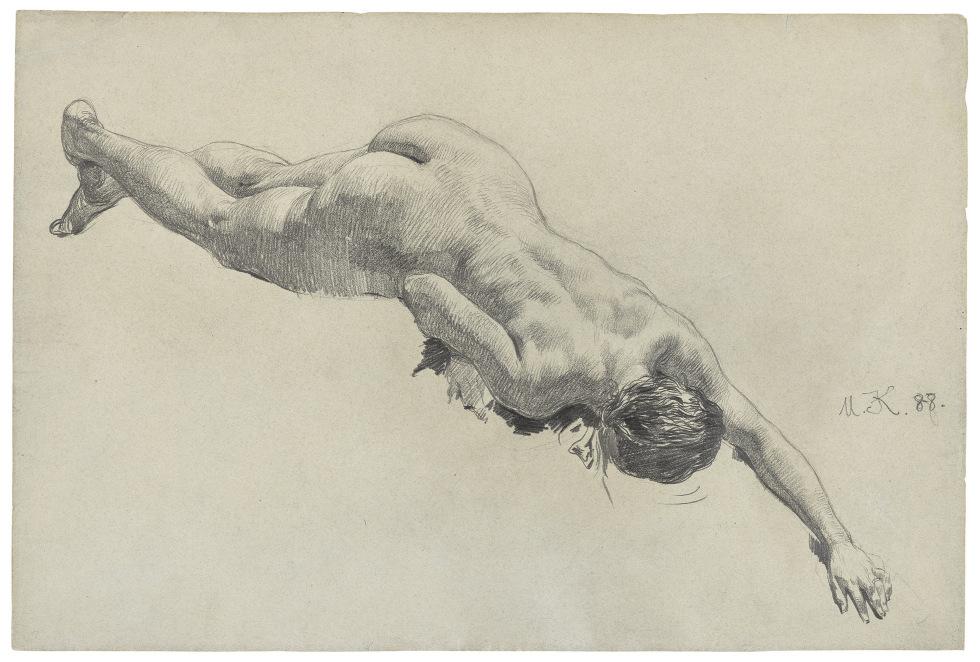
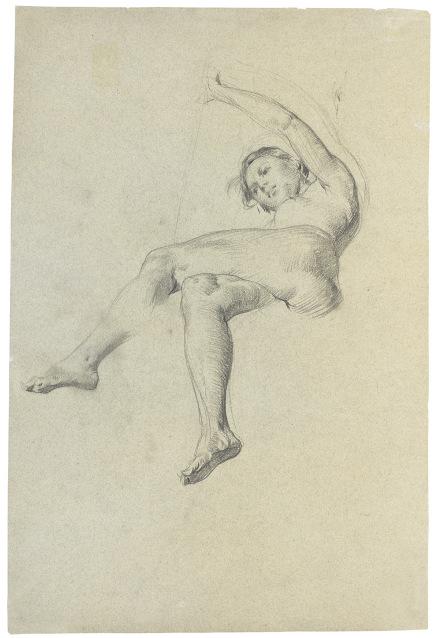
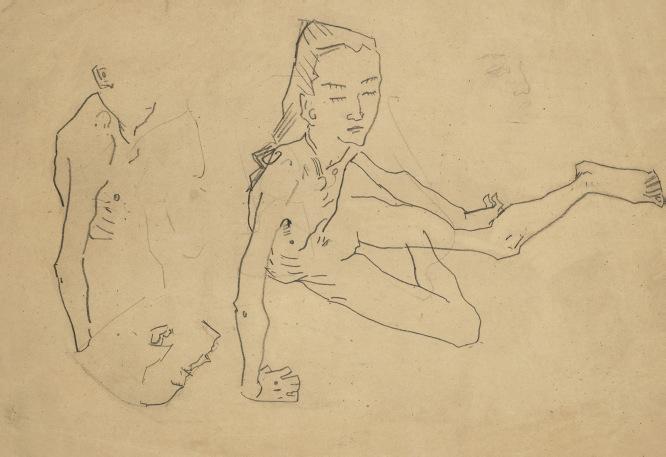
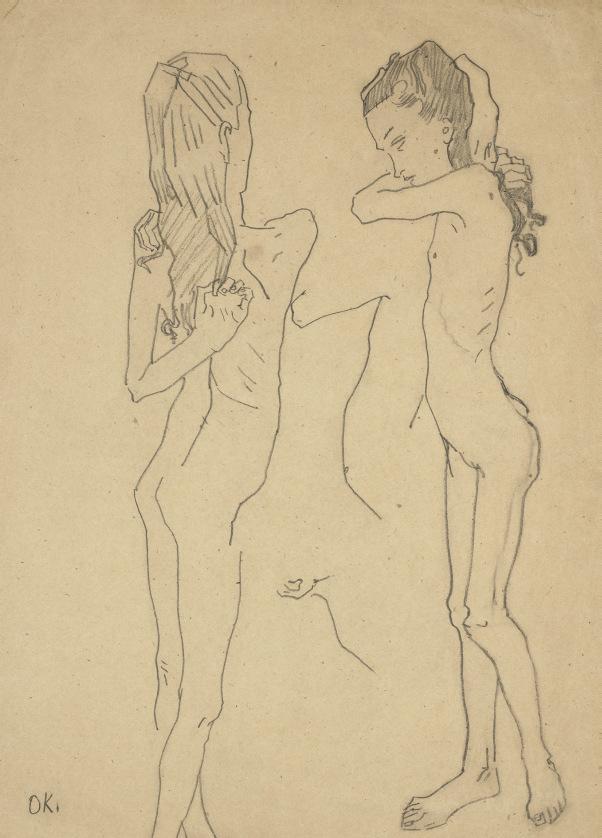
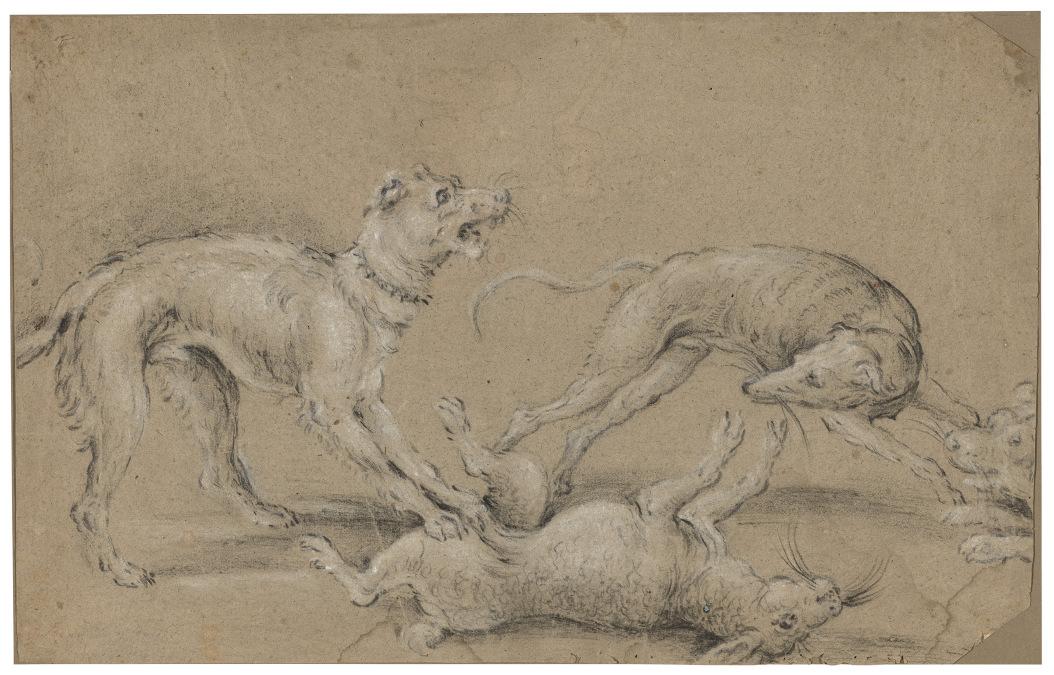
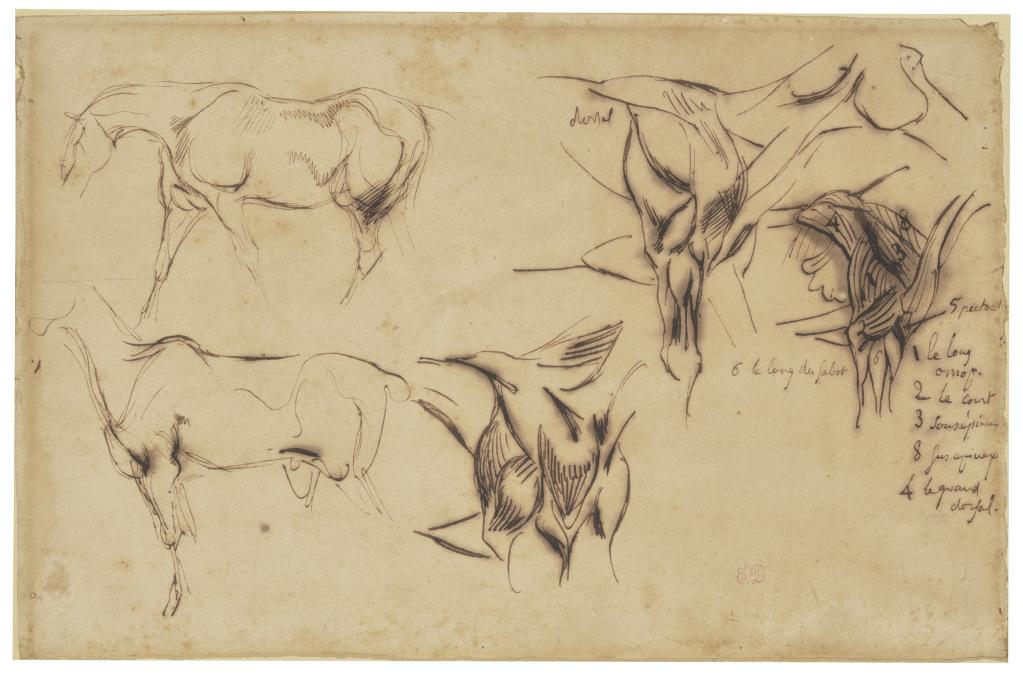
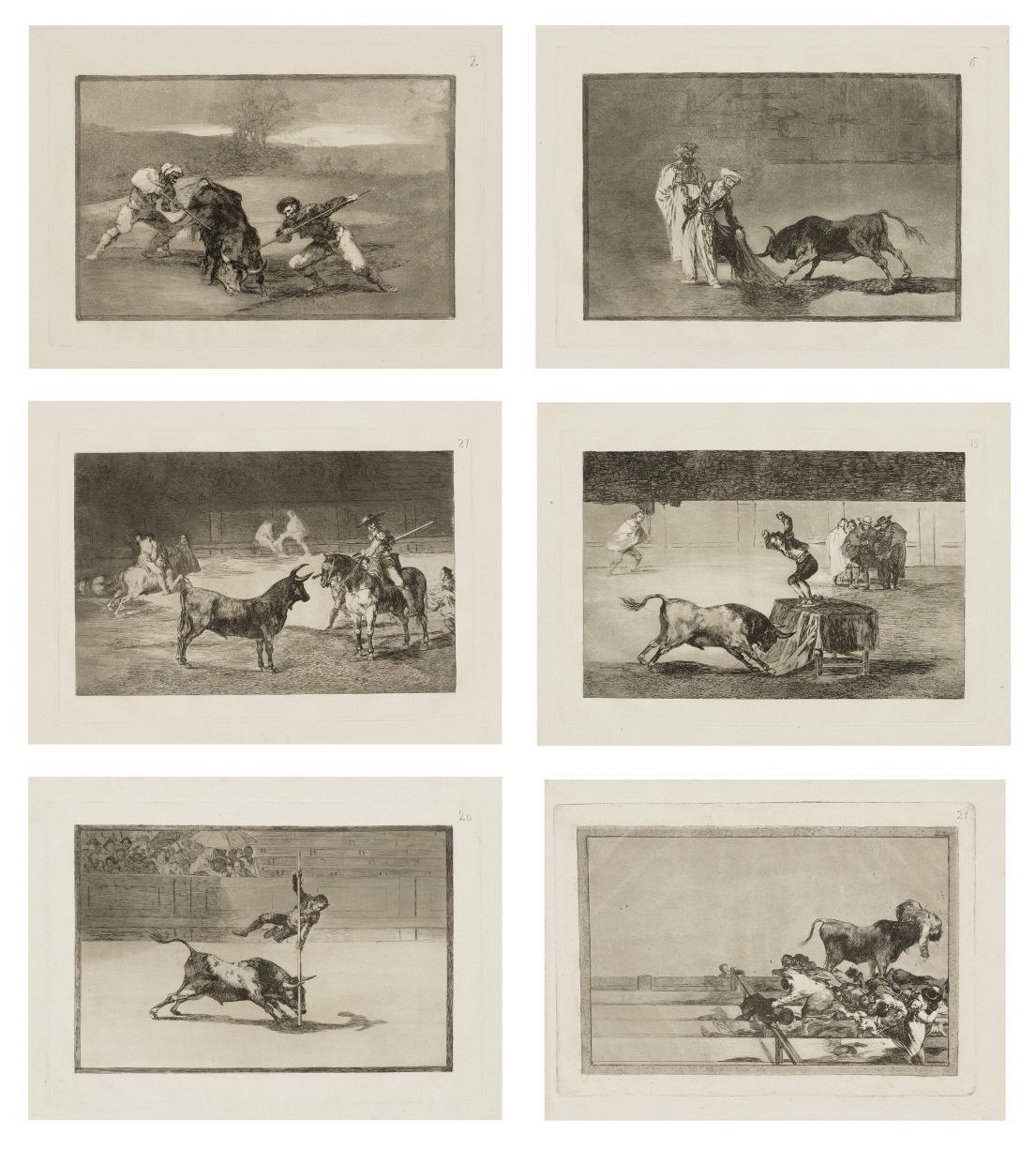
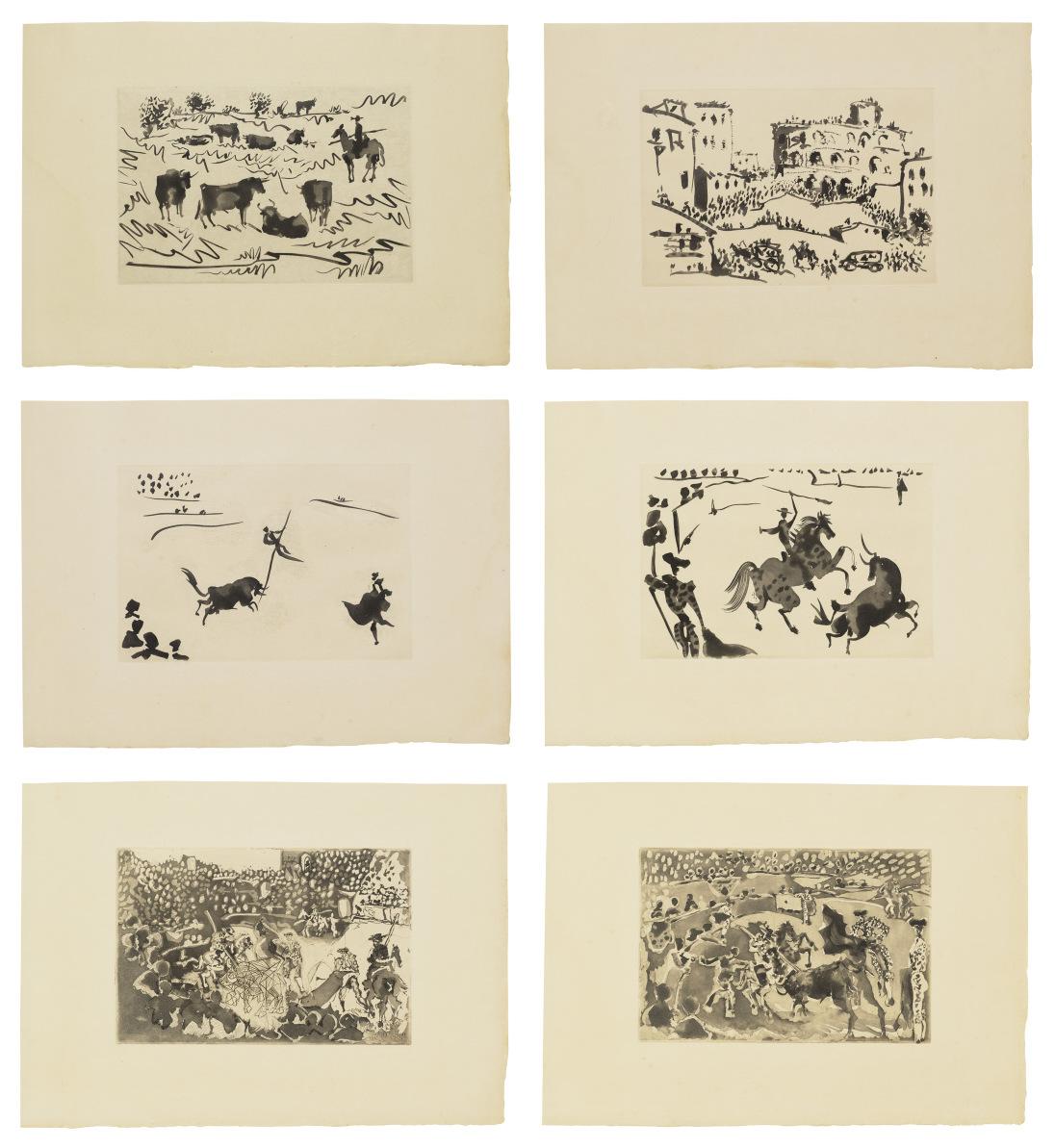
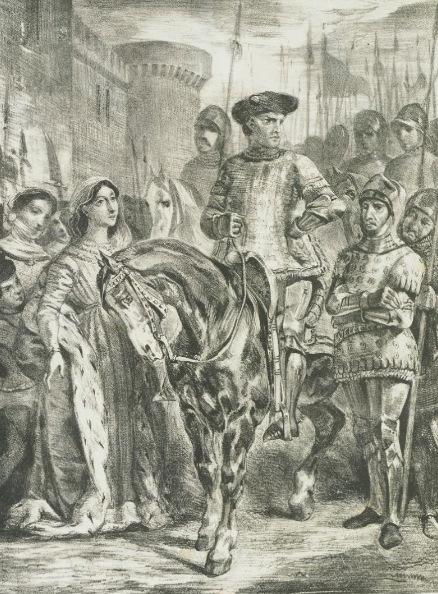
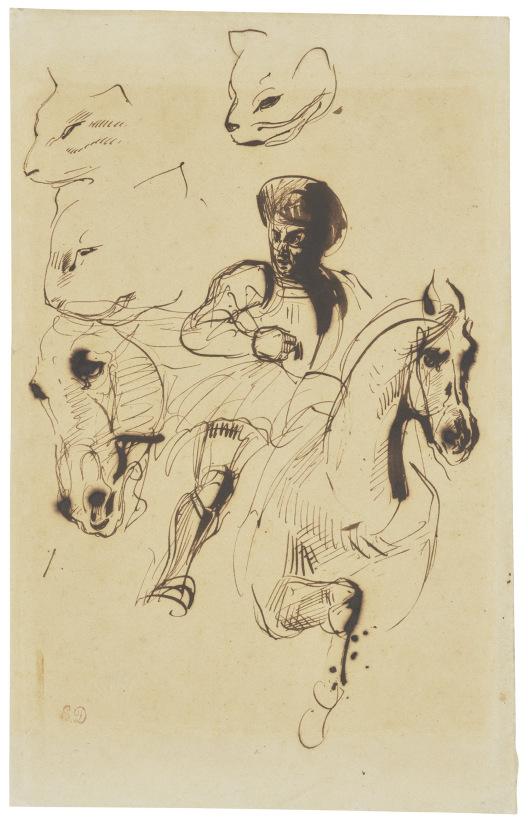
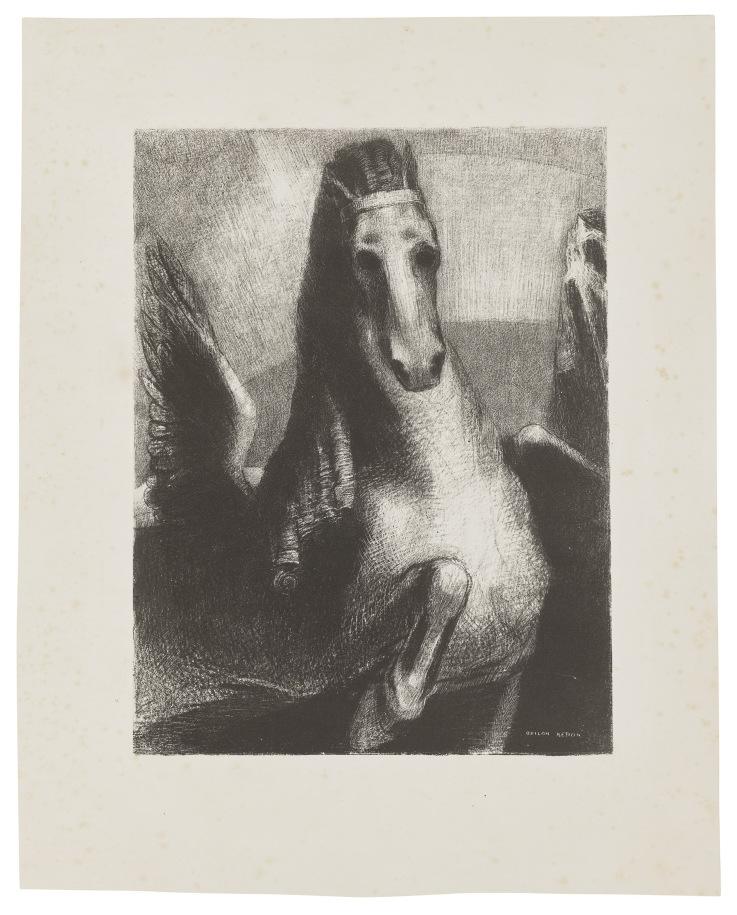
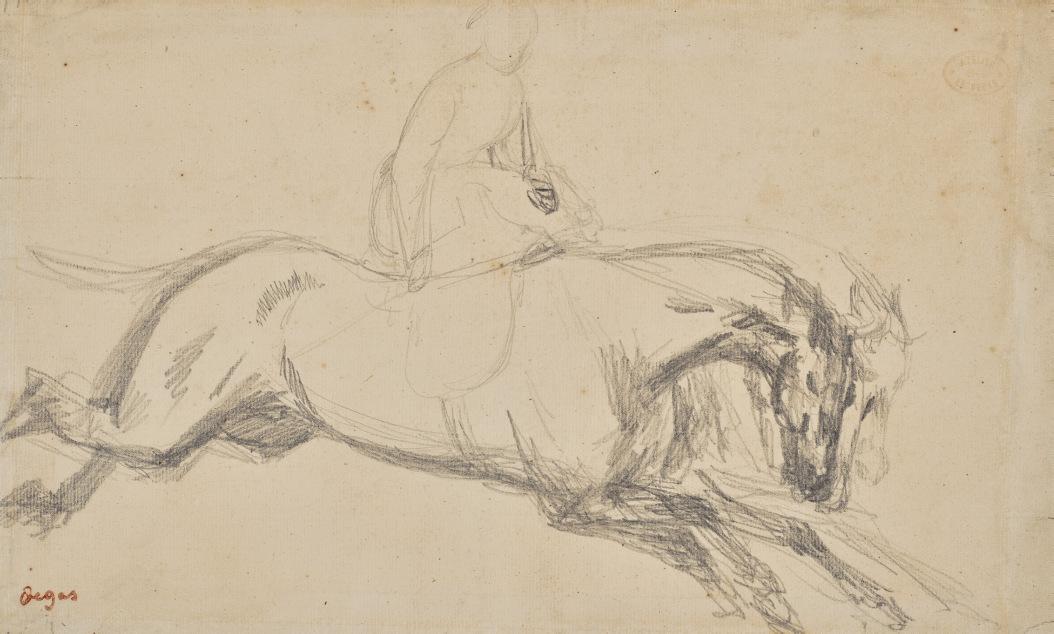
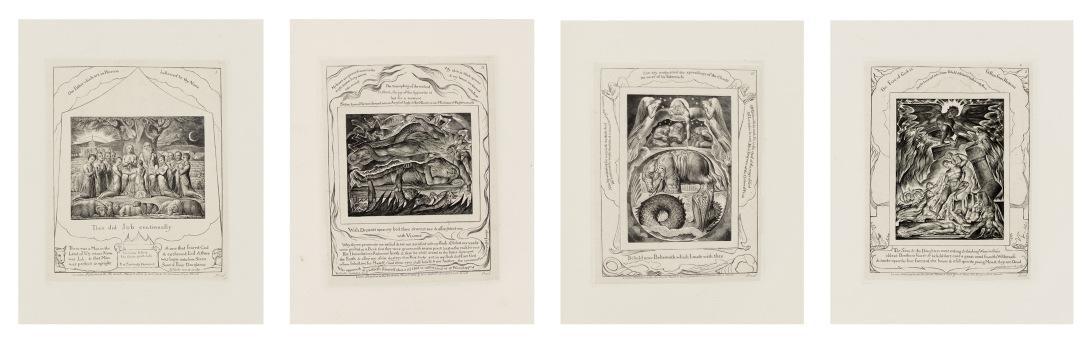
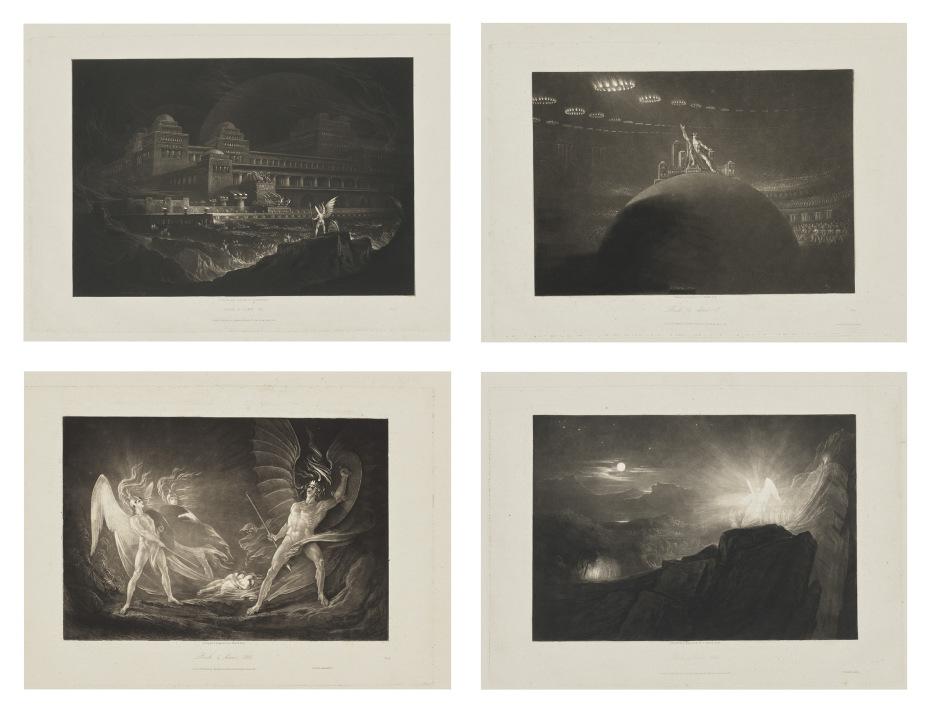
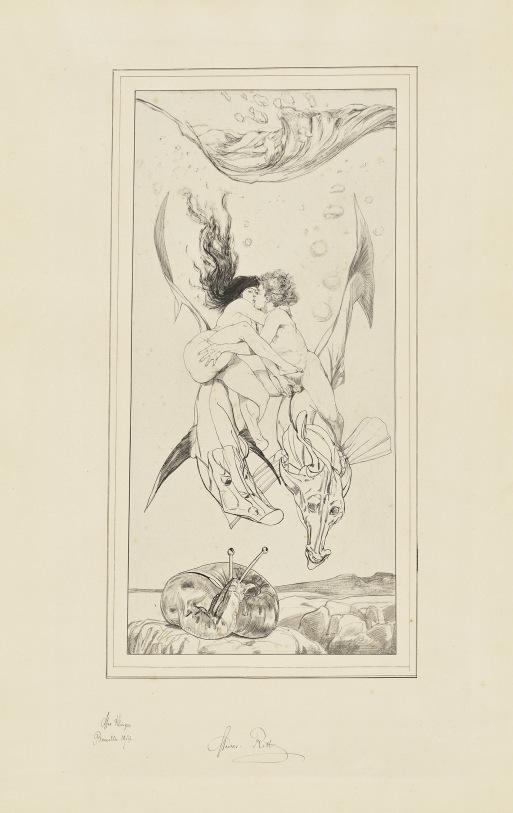
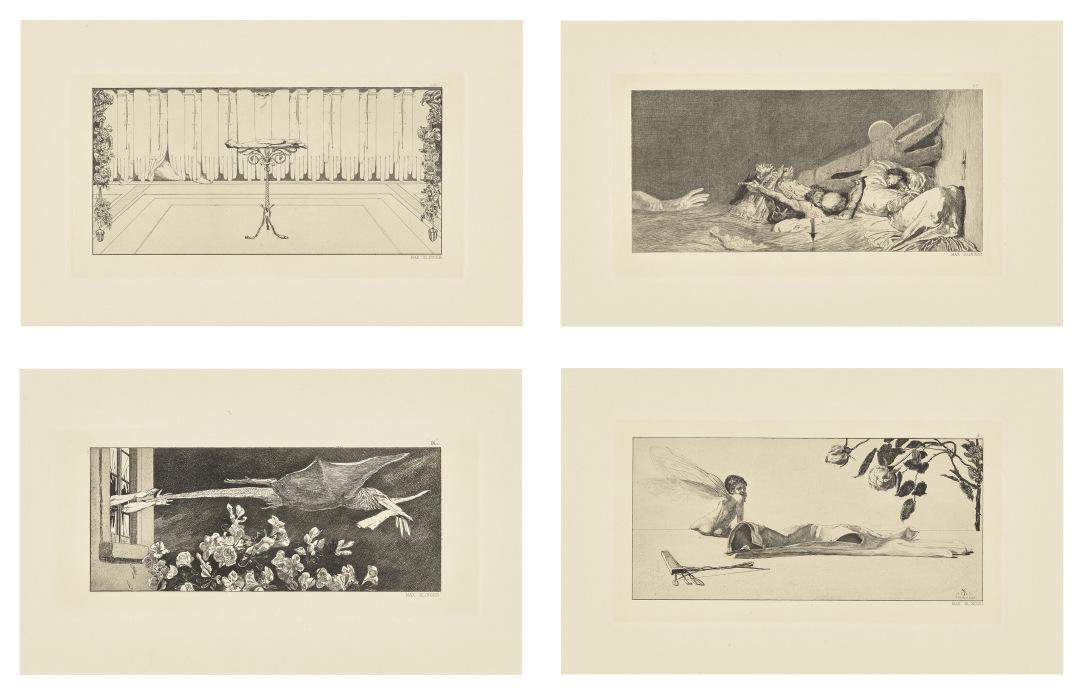
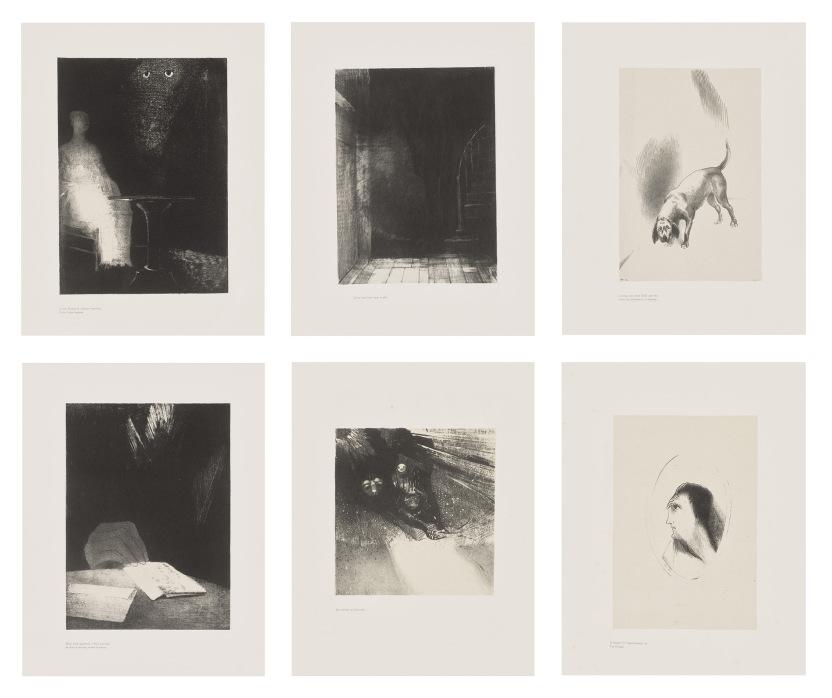
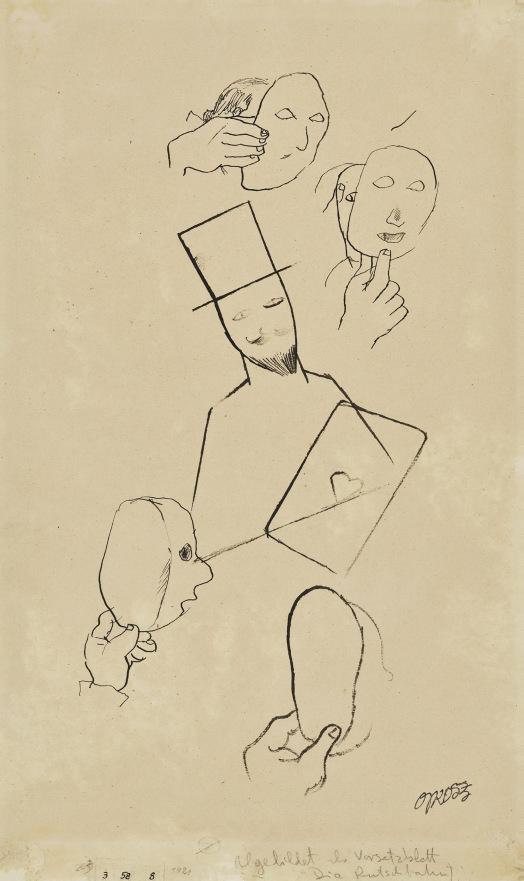
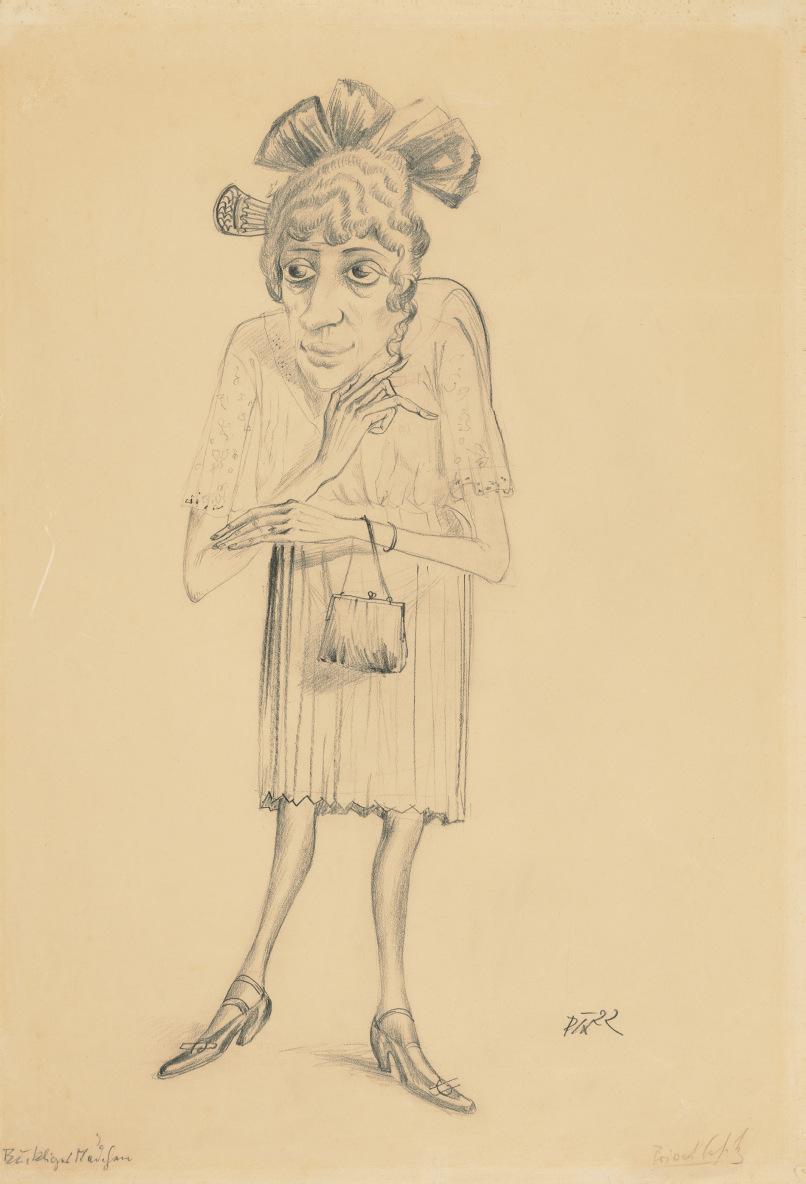
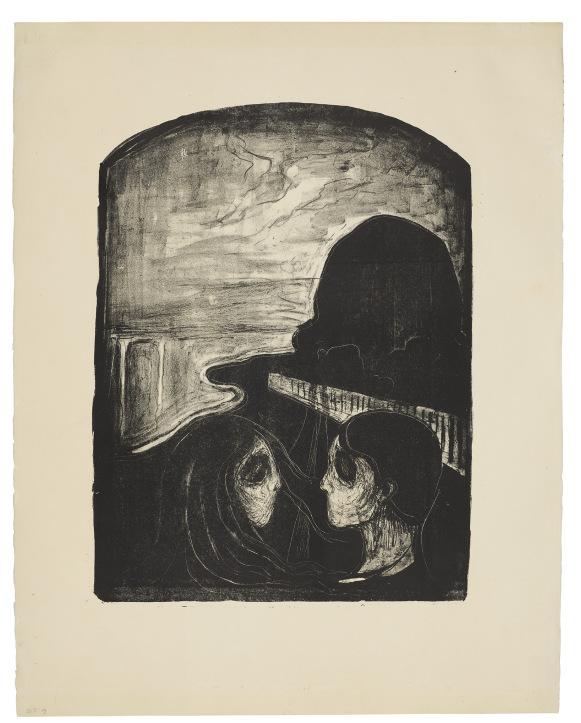
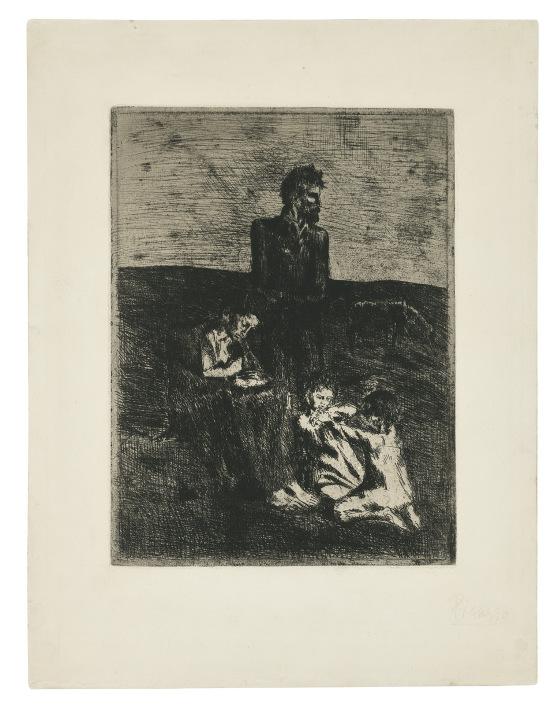
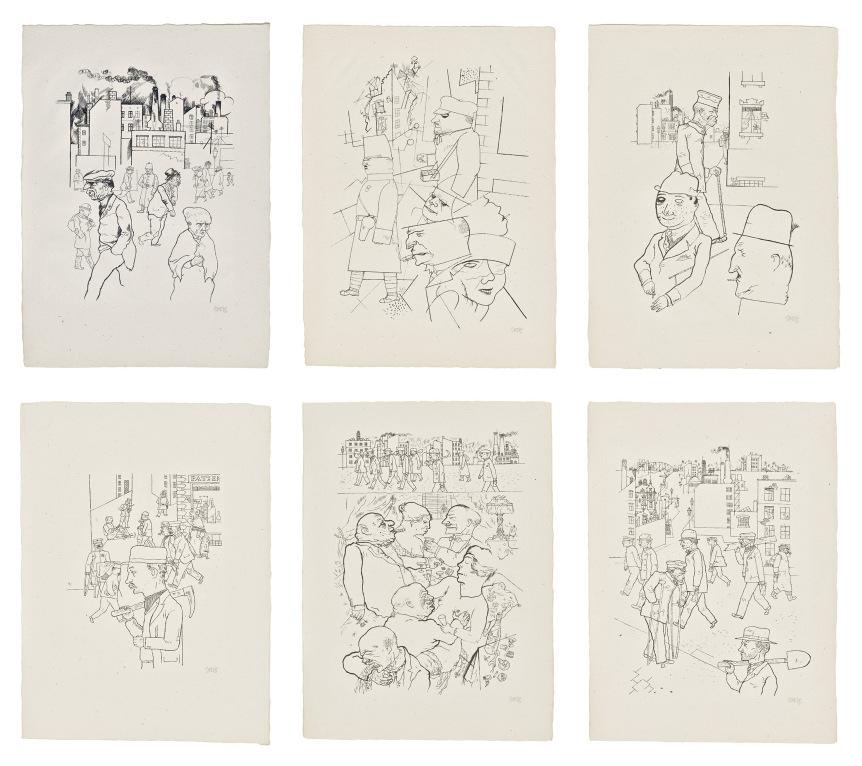
Saturday 7 March 2026 at 6:00pm 8 King Street, St.James’s London SW1Y 6QT
VIEWING
Wednesday 25 February 10.00 am -5.00 pm
Thursday 26 February 9.00 am - 5.00 pm
Friday 27 February 9.00 am - 5.00 pm
Saturday 28 February 12.00 pm - 5.00 pm
Sunday 1 March 12.00 pm - 5.00 pm Monday 2 March 9.00 am - 5.00 pm
3 March 9.00 am - 5.00 pm
4
5 March 9.00 am - 2.00 pm
6 March 9.00 am - 5.00 pm
7 March 12.00 pm - 6.00 pm
AUCTIONEERS
Veronica Scarpati & Zack Boutwood
AUCTION CODE AND NUMBER
In sending absentee bids or making enquiries, this sale should be referred to as TORO-23970
ABSENTEE AND TELEPHONE BIDS
Tel: +44 (0)20 7389 2658
Fax: +44 (0)20 7930 8870
CONDITIONS OF SALE
The sale of each lot is subject to the Conditions of Sale, Important Notices and Explanation of Cataloguing Practice, which are set out in this catalogue and on christies.com. Please note that the symbols and cataloguing for some lots may change before the auction. For the most up to date sale information for a lot, please see the full lot description, which can be accessed through the sale landing page on christies.com.
BUYER’S PREMIUM
In addition to the hammer price, a Buyer’s Premium (plus VAT) is payable. Other taxes and/or an Artist Resale Royalty fee are also payable if the lot has a tax or λ symbol.
Check Section D of the Conditions of Sale at the back of this catalogue.
Principal Auctioneer: Adrien Meyer
SPECIALISTS FOR THIS AUCTION
Veronica Scarpati Specialist, Head of Works on Paper Sale Impressionist & Modern Art
Helene Rihal Head of Department, Paris Old Master Drawings
Natasha Haining Cataloguer Prints & Multiples
Frederique Darricarrere-Delmas Head of Prints, Paris Prints & Multiples
& Watercolours
Isabella Scott Well Research Assistant Prints & Multiples
SERVICES FOR THIS AUCTION
Enquiries
For general enquiries about this auction, please email emwood@christies.com
Post-Sale Services
Becky Allen
Post-Sale Coordinator
Payment, Shipping, and Collection
Tel: +44 (0)20 7752 3200
Fax: +44 (0)20 7752 3300
Email: PostSaleUK@christies.com
Buying At Christie’s
For an overview of the process, see the Buying at Christie’s section.
Absentee and Telephone Bids
Tel: +44 (0)20 7389 2658
Fax: +44 (0)20 7930 8870
Auction Results
Tel: +44 (0)20 7839 9060
Client Services
Tel: +44 (0)20 7839 9060
Fax: +44 (0)20 7389 2869
Email: info@christies.com Tim Schmelcher
Email. First initial followed by last name@christies.com
Catalogue notes by James Baskerville, Matthew Biedermann, Zack Boutwood, Alice Broadbent, Eleonore Dupin, Natasha Haining, Louisa Hutchinson, Annabel Lawton, Murray Macaulay, Eliza Owen, Hélène Rihal, Tim Schmelcher, Isabella Scott-Well, Emily Whittle, Emily Wood and Maja Zakowska. Copyright coordination by Chiara Gallo and Samantha Moreno.
We are grateful to Rob Bennett, Ollie Chapman, Elizabeth Dawnay, Leyla Hasan, Sophie Kappellides,
Maria Morando, and Steve Ward, for their assistance in the making of this catalogue, and to Zoe Ainscough, Keith Gill, Caroline Harrison, Sophie Khan, Charlotte Lee, Helen Loveday, Dominic Lynch, Maike Mueller, Ben Smith, Florina Weber and above all Emily Wood for making this sale possible.
Once again, we thank the children of Klaus and Helga Hegewisch – Susanna, Katharina, Ariane, Clementina, Jonas and Jessika – for their continued trust and cooperation.
No part of this catalogue may be reproduced, stored in a retrieval system or transmitted by any form or by any means, electronic, mechanical, photocopying, recording or otherwise, without the prior written permission of Christie’s.
Murray Macaulay Head of Prints, Europe Prints & Multiples
Stefano Franceschi Specialist Old Master Prints
Emily Wood Senior Sale Coordinator Prints & Multiples
Zack Boutwood Cataloguer Old Master Drawings
Annabel Lawton Cataloguer Impressionist & Modern Art
Annabel Kishor
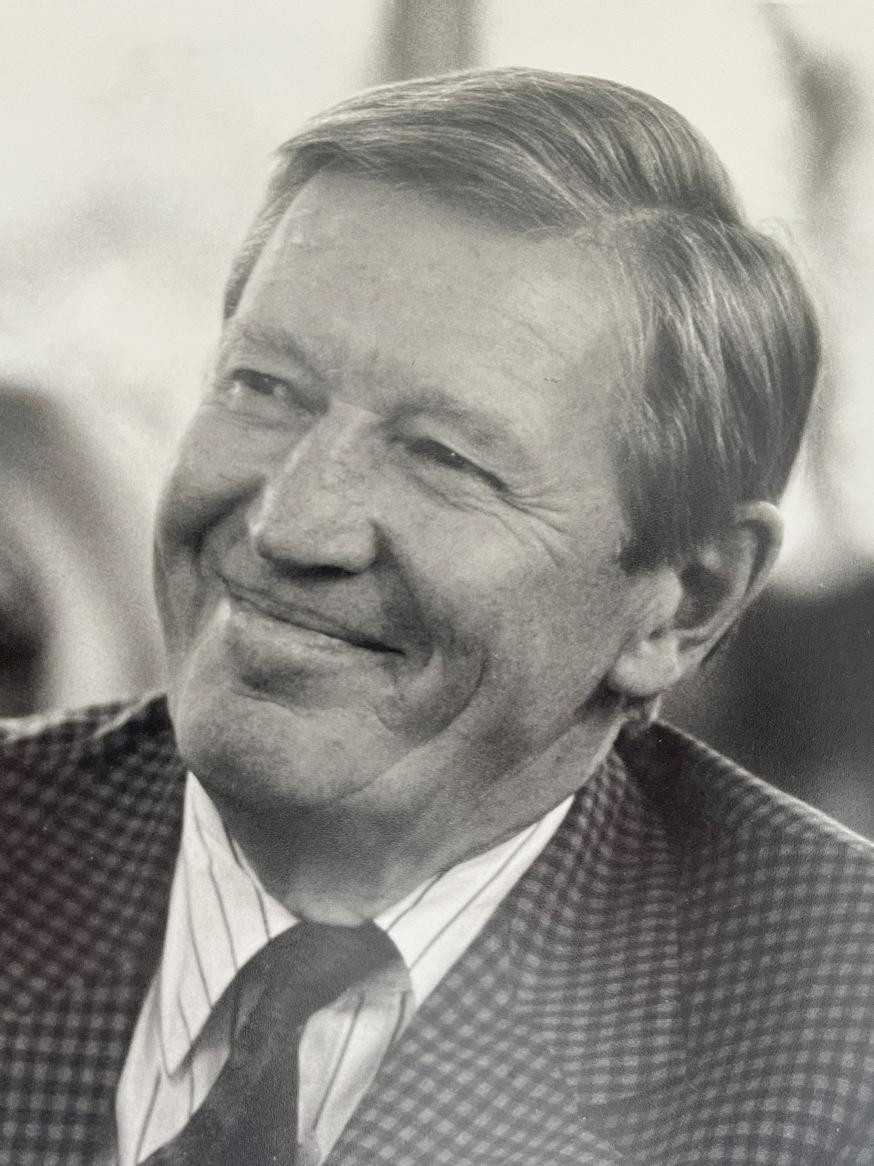
Klaus Hegewisch (1919-2014)
Spellbound: The Hegewisch Collection – An Introduction
by Tim Schmelcher
My first encounter with Klaus Hegewisch occurred in 2007, when he was bidding over the telephone on a group of proofs from Goya’s Desastres de la Guerra. The auction included ten very rare, lifetime impressions from the fabled holdings of the German-Dutch collector Franz Koenigs (1881-1941), which had been consigned to Christie’s by his descendants. At the time, I was only vaguely aware of Klaus Hegewisch as an important collector of modern prints and drawings, in particular by Picasso, but not of his keen interest in Goya – and many other artists! He bid strongly on the first of these proofs, but stopped at the high estimate. He let go quickly of the next lot, which he liked less, thinking – quite reasonably, it seemed – that there were eight more to come and he would surely be able to acquire a few of them. From then on, he bid with great tenacity on the following lots, but came to realise that his competitor – another telephone bidder – had decided to buy them all, at any price. Yet Klaus was not one to give up easily. Although he remained impeccably polite, his mood changed from joviality to quiet determination. Alas, when the hammer fell on the last of these lots at a price four times higher than the estimate, once again to his invisible opponent, he had not bought a single sheet. He thanked me and sighed. Wanting to cheer him up, I said that there would be other opportunities, but he just laughed dryly and said: “I don’t think so.”
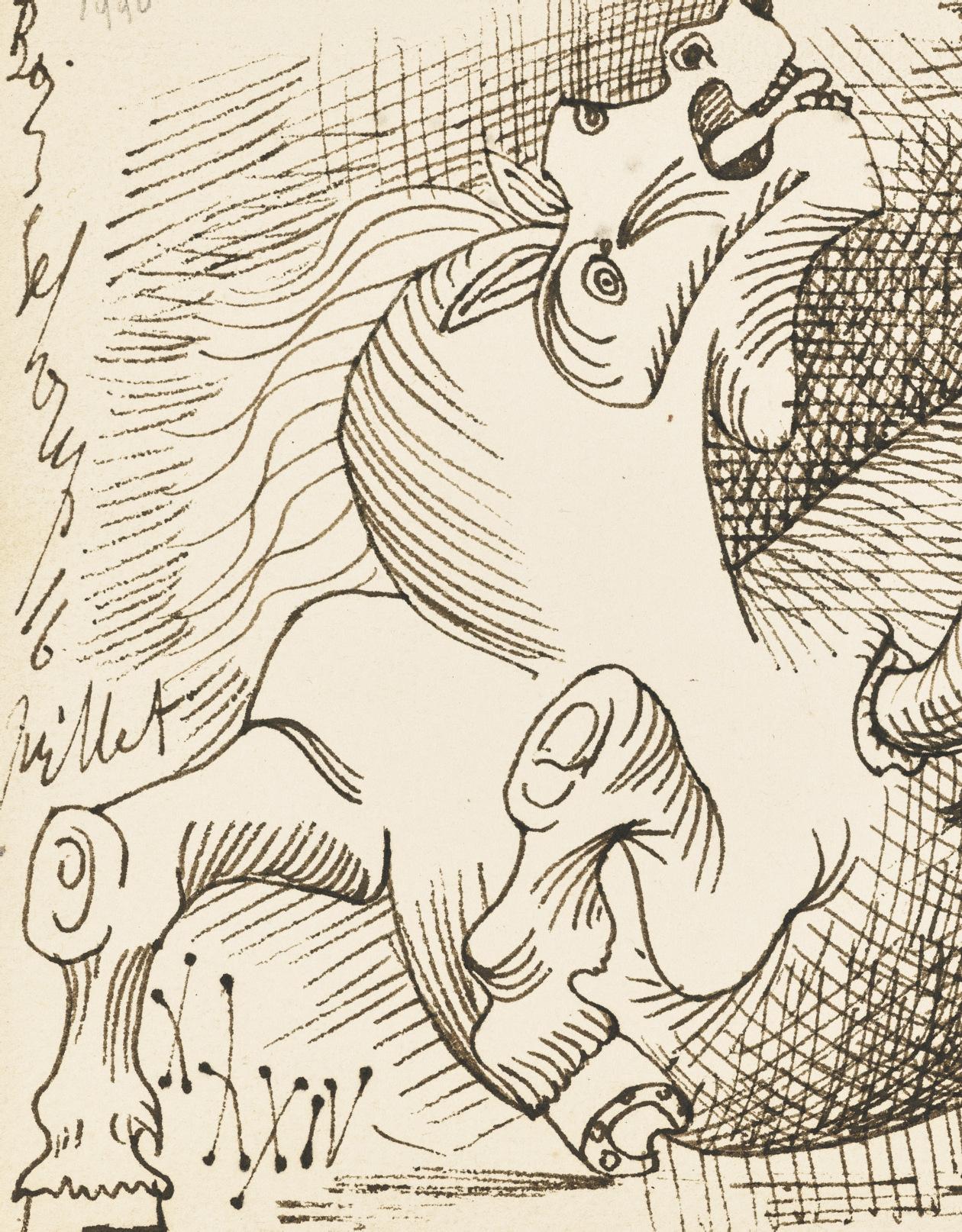
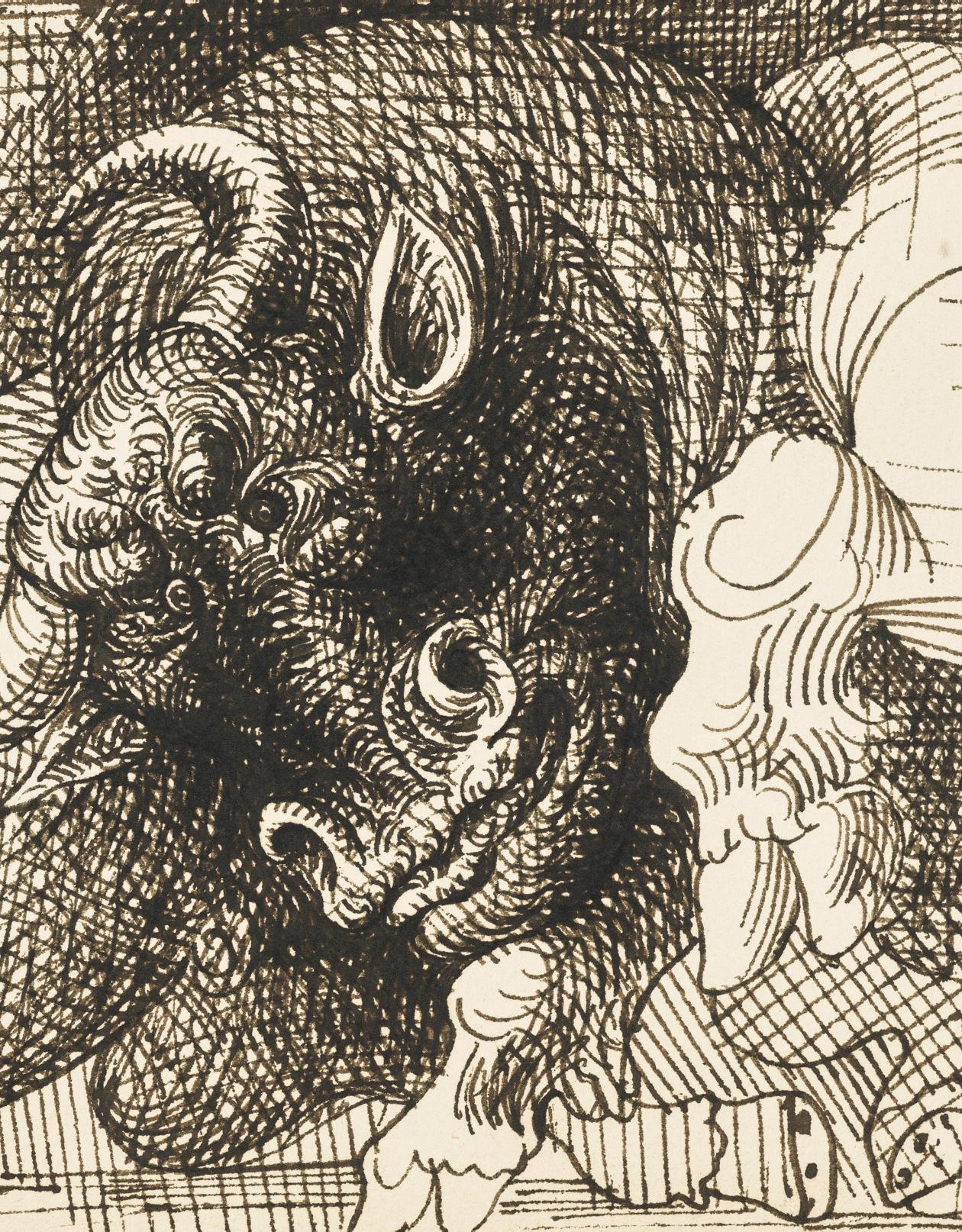
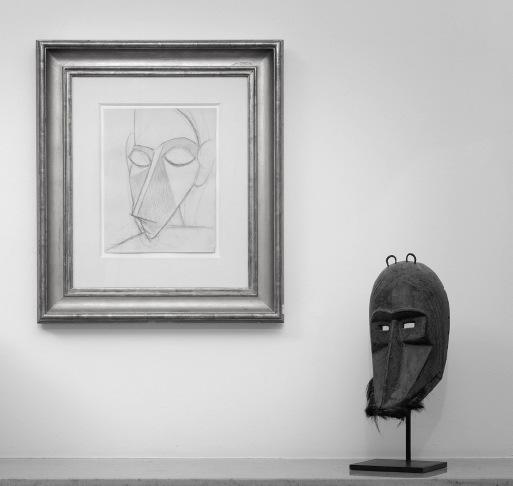
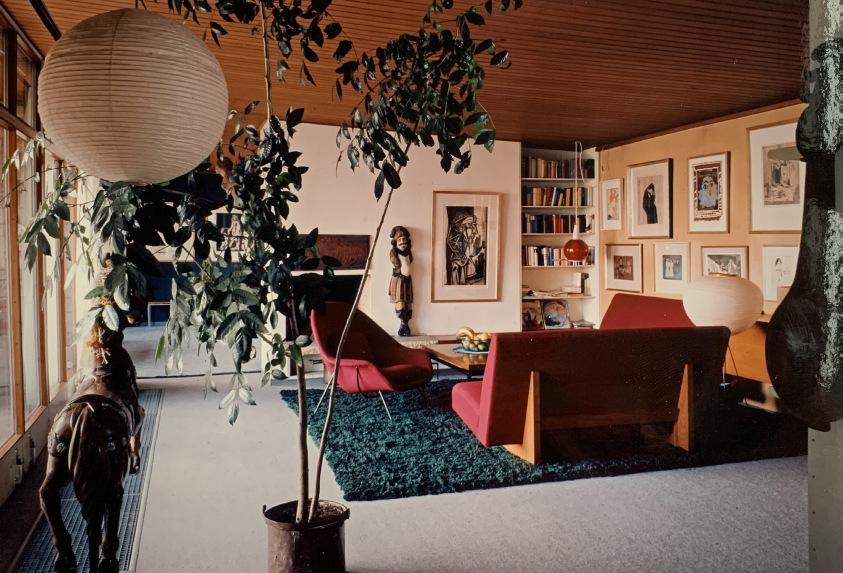
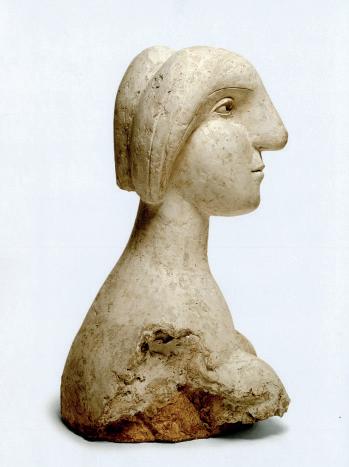
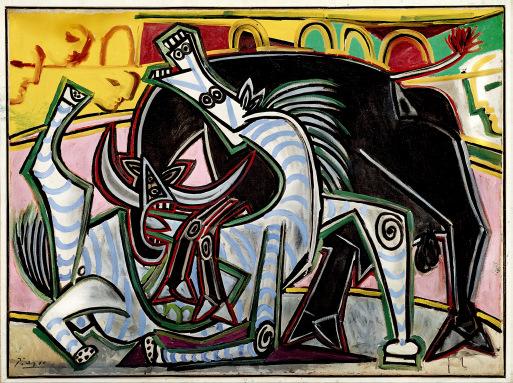
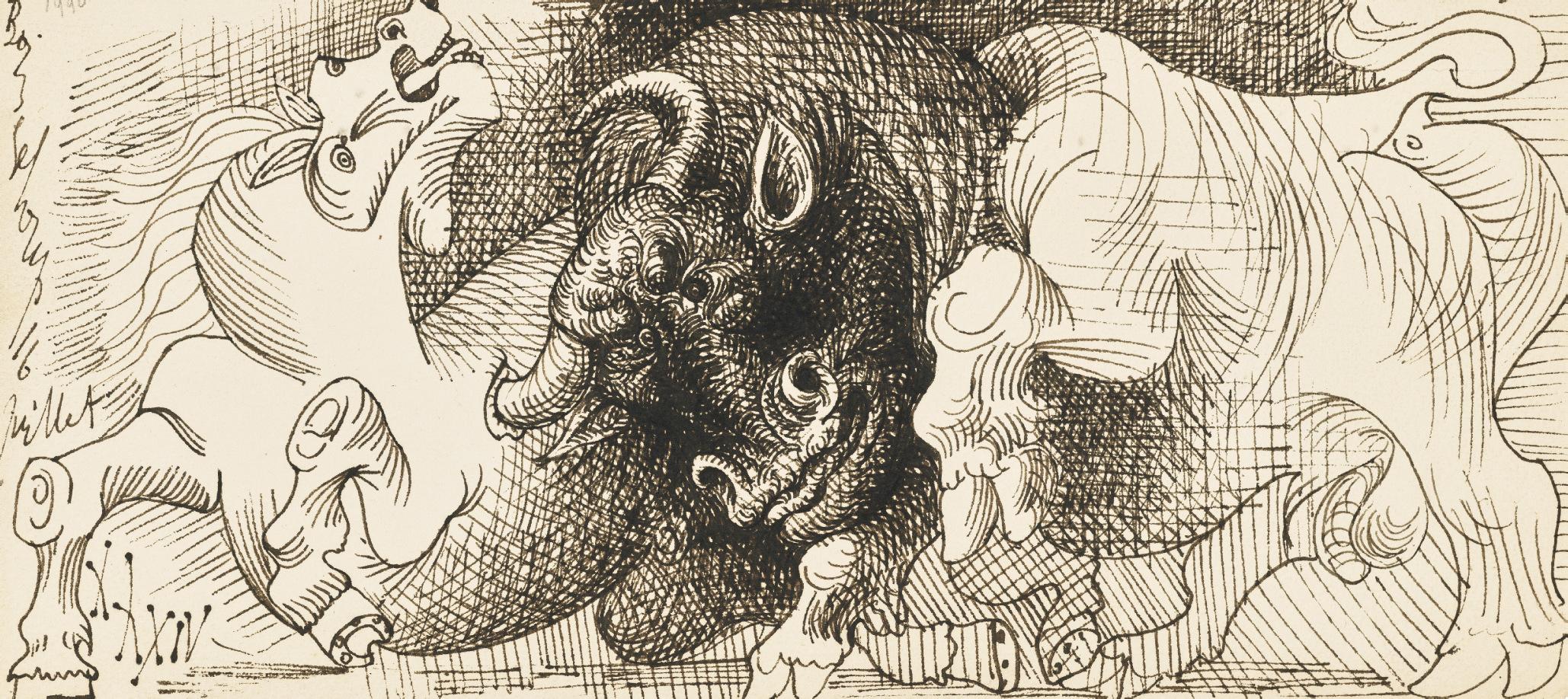
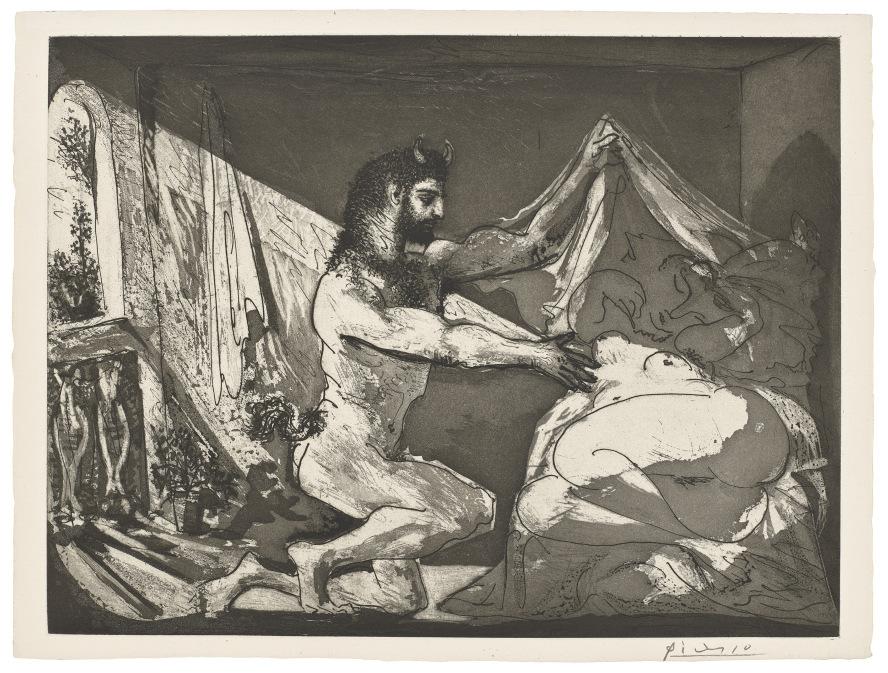
On my next visit to Hamburg, my colleague Christiane zu Rantzau and I were invited for tea, and I met Klaus and his wife Erika for the first time in person. We were served a spicy tea from Paris and later shown around their flat, in a typical, white-washed Hamburg house of the late 19th century, not far from the Alster Lake. Sitting down in the living room, what struck me first - as a print specialist - was that we were surrounded by Picasso’s masterpieces of printmaking: an early impression of Le repas frugal, La Minotauromachie, La femme qui pleure (later sold to MoMA), La Femme a la fenètre, Le faune dévoilant une femme (lot 934) and others. I had seen impressions of these before – albeit never all at once in a single room! What was even more astonishing was that these prints where accompanied by drawings, including some of closely related subjects: next to Le repas frugal was a charcoal drawing of an emaciated man and woman, Le Couple, of the same year 1904, while La Minotauromachie was only one print amongst a whole group of drawings on the theme of bulls, bullfights and the minotaur (see lot 932). There were other remarkable correspondences: the drawing La Coiffure (Femme se coiffant) hung above the bronze sculpture of the same motif, and below the drawing Nez quart de Brie, a preparatory drawing for the Desmoiselles d’Avignon (1907), stood a wooden mask from Côte d’Ivoire of the type that had inspired Picasso in his turn towards a very reduced figurative style.
In the adjacent dining room were other icons of modern European graphic art, such as Edvard Munch’s Madonna, Melancholy III and his Self-Portrait with a skeleton arm, as well as a small but exquisite self-portrait of Max Beckmann as a young medical orderly and a large self-portrait in pencil by Otto Dix. The master bedroom was a cabinet of old master prints and drawings, with a wall covered with the greatest of Dürer’s engravings facing Rembrandt’s Three Trees, Baldung’s Bewitched Groom and drawings by Tiepolo, Carracci, Delacroix and
In the corridor and study were drawings and prints by Degas, again Otto Dix, Feininger, Kollwitz, Léger, Matisse, Meidner, more Picasso, Redon… Without exception, the works were museal in quality, and yet - the overall effect was surprisingly low-key. There were no paintings and thus hardly any colour, everything was quite simply framed, and the interior comfortable but understated: some English mahogany and vernacular oak furniture, a few beautiful Caucasian kilims, fine Uzbek suzanis thrown over the beds, and floor-to-ceiling shelves filled with classic and modern literature, poetry and art books. The surroundings perfectly reflected the character of the inhabitants: Klaus was a tall, lanky man, softly spoken, with a wry smile and sparkly, bright eyes, who even in his eighties possessed an almost boyish charm, dressed with casual elegance in an open-necked shirt and flannel jacket. Erika was a little more theatrical, but equally poised. Although very feminine, her voice had a warm, almost smoky timbre, and she liked to wear trousers and neckties, perhaps a nod to the androgynous fashion of 1920s Berlin or the gamine look of 1950s Paris.
We then climbed the stairs to the attic. Here was Erika’s studio, who was an accomplished portrait painter, draughtswoman and printmaker in her own right. Behind her easel and work tables, we saw large plan chests, each drawer marked with an artist’s name, and realised that we had by no means seen everything. The following year, in 2008, Klaus instructed us to prepare a full inventory of the collection. Until then, there was no single, comprehensive record of the whole collection. Now, the real work lay ahead of us and we began at Jersbek, where the Hegewischs were renting a side-wing of a baroque manor house as a
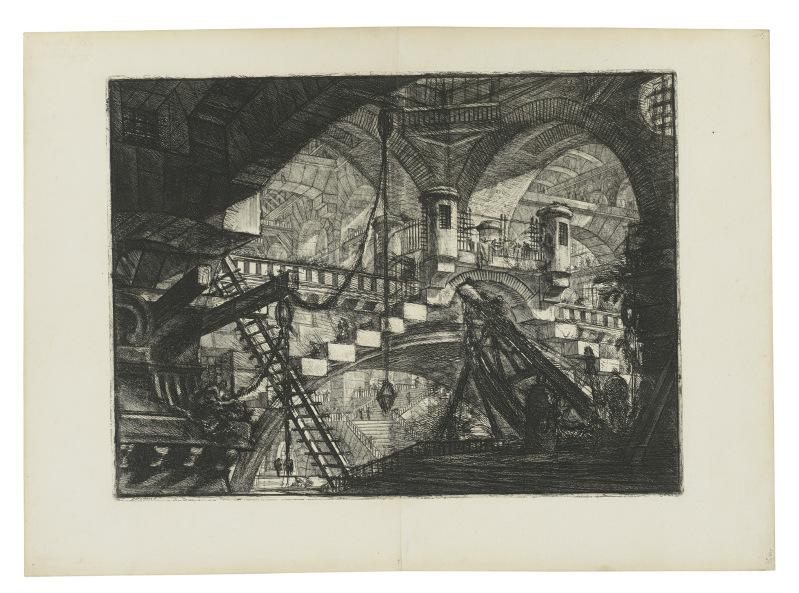
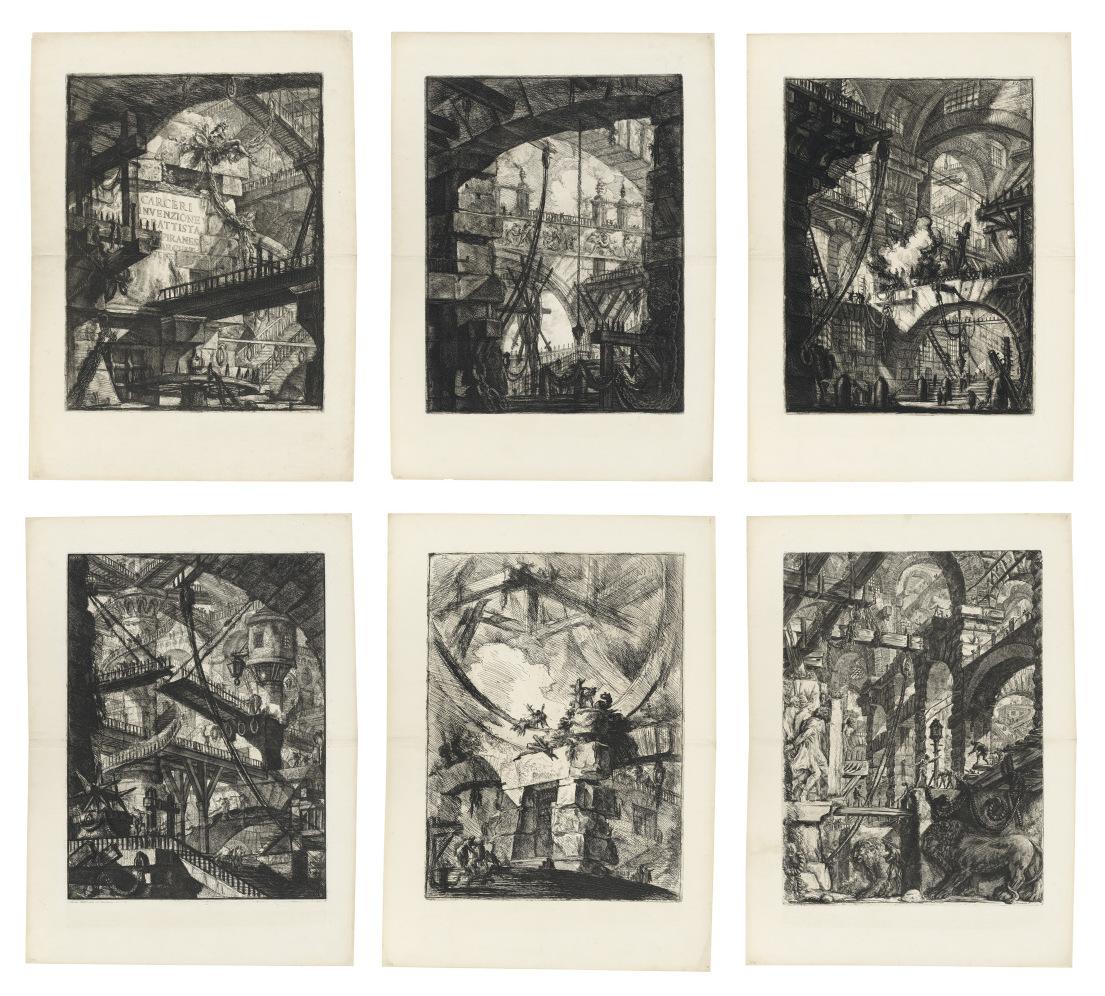
country retreat, in a remote area to the northeast of Hamburg. It was here that I fully grasped the size and depth of the collection: there was a small corridor hung with an exquisite collection of prints by James Ensor, a storage room filled with early proofs and the complete graphic series by Max Beckmann, all in frames and ready for public display; portfolios by Klinger and Redon, prints and drawings by Bresdin, a full set of Carceri by Piranesi... (see lots 906, 947, 948, 959, 960, 964, 966, 974, 977, 979, 980, 982 & 991) I spend a week there, taking notes and photographs, and then returned to the flat in Hamburg. There, finally, in the drawers were the great works of Goya - Los Caprichos, La Tauromaquia, Los Desastres de la Guerra, Los Proverbios (lot 942) – and many other treasures. Over the next months and years, my colleagues and I continued to record and value the holdings - not always an easy task, as the Hegewischs were generously and frequently lending to exhibitions around the world, and works were being relocated and rehung as they moved between museums, warehouses, and their places in the city and the countryside. Working with Klaus and Erika over the years, we were always aware of being in the presence of extraordinary collectors and of handling one of the finest, most sophisticated but also most personal collections of works on paper in the world. It is a privilege and an education that continues to this day.
YOUTH AND WAR
Klaus Hegewisch’s life spanned almost a century and encapsulated the trauma and recovery of Germany in the 20th century, and its political, economic and cultural life of the post-war period.
He was born in Hamburg in 1919, just as World War I had ended, as the only child of Gertrud (née Thiele) and Alexander Hegewisch, whose family came from Lübeck, an ancient Hanseatic harbour city on the Baltic Sea. The father was a lawyer and a liberal mind; the mother a free spirit with an independent streak – their marriage did not last long. They separated when Klaus was little, and although they both loved him very much, they were somewhat unreliable and often absent parents, distracted by their own lives, and money was in short
supply. He often went to stay with his paternal grandparents in Lübeck, travelling by train on his own, the conductor bribed with a cigar to keep an eye on the boy. From early on he had to look after himself and to take responsibility, also for his mother, an ambitious dreamer with a tendency to live above her means. The parents did however provide for a good education: he attended Hamburg’s oldest Grammar School and, at a youngster’s rate, joined the city’s most prestigious sailing club. An academic higher education however was of little appeal to young Klaus. Having grown up in two harbour cities, he felt drawn to the sea and the wider world. He left school at the age of 16 to earn a little salary for himself and - in a very Hanseatic tradition – joined a merchant company, Nottebohm & Co., as an apprentice. The firm imported coffee, tobacco, timber and cotton from Central and South America.
Klaus had just completed his apprenticeship in spring 1939 as NaziGermany prepared for war. At first, he was drafted into labour service on a farm for six months, then to the German navy as a sailor on a patrol boat and mine sweeper in the North Sea. Only a few months into the war, the ship was hit by a torpedo and sunk; many of his comrades could not be rescued. It was the first of a series of disasters Klaus would experience – and miraculously survive – during the war. Aged only 22, he was promoted to Lieutenant and entrusted with the command of a larger vessel and crew. Despite all hardships and danger, he tried to keep his men in good spirits, and was much liked and respected. But as news reached him of the bombing raids on Hamburg in 1943, which left the city in ruins, much of the population homeless, injured or dead, his parents’ homes destroyed and many of his wider family and friends killed, he became increasingly vocal in his doubts about the war and the Nazi government. He refused to follow the command to ‘take no prisoners’. In 1944, his ship was hit once again, with several casualties and many wounded. During these last months of the war, one of his crew denounced him for his critical stance, and he was repeatedly interrogated. In the meantime, his father was arrested for his association with the dissident group around Helmuth James Graf von Moltke and Peter Graf Yorck von Wartenburg, called Kreisauer Circle. He was arrested, interned and sentenced to death, a fate he only escaped due to the advance of the British troops in
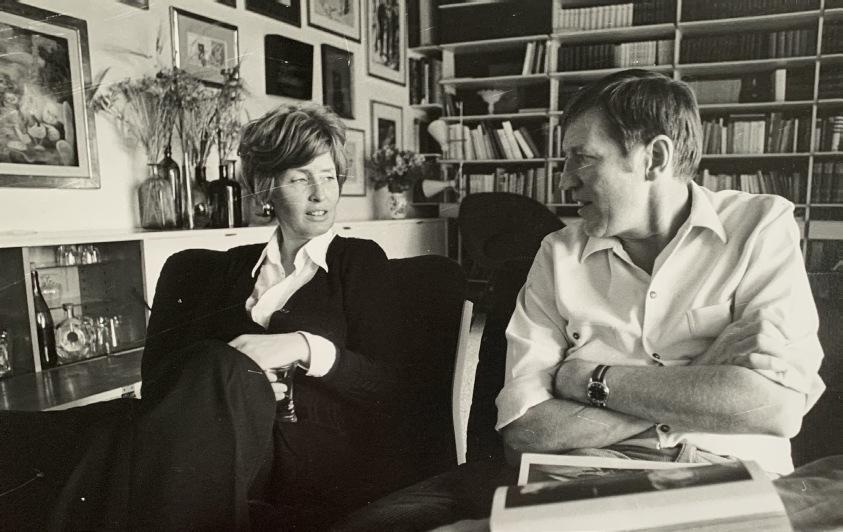
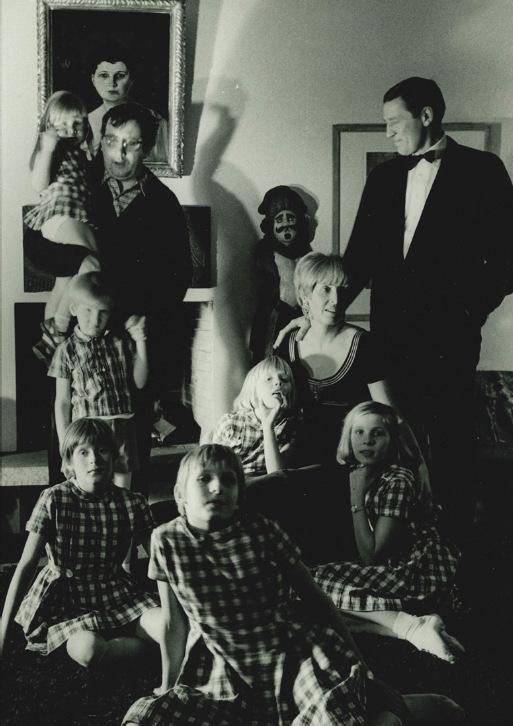
Helga and Klaus Hegewisch in their house, Bismarckstein, Hamburg, circa 1964
Northern Germany. As the war finally ended, Klaus continued to serve as a commander on a mine sweeper to clear the shipping routes around the coasts of Denmark and Norway. The vessel hit a mine and sank almost instantly, with devastating effect: almost the entire crew, many of whom he considered friends, were killed. Only he and three others survived. He was finally demobilised aged just 26, highly decorated but injured and ridden with anxiety and guilt about this last catastrophe. Back in civilian life, he suffered a breakdown from which he slowly recovered by retreating for several months on the North Sea island of Sylt.
WORK, FAMILY AND FRIENDS
Despite his traumatic experiences in the navy, Hegewisch would remain a passionate sailor, crossing the Atlantic more than once and keeping a small sailing yacht well past his 80th birthday. His professional life would also be intricately linked to the sea. At the end of 1945, he joined a small import business for fruit and vegetables. He soon became a partner and managed to expand the firm swiftly over the next few years. In 1950, he married Helga Bruns, called ‘Hexi’ by everybody, daughter of Willy Bruns, a successful fruit shipper from Hamburg. Also commercially they soon joined forces, with Bruns remaining in charge of importing bananas from Ecuador, and Hegewisch taking care of their distribution in Germany, as well as managing the import and sale of other fruits and produce from Southern Europe and Latin America. The company did well and continued to grow and adapt until Klaus retired, aged 67, in 1986.
Privately, things were also going well for Klaus and his young wife Helga. In 1955, she gave birth to their first children, the twins Susanna and Katharina, and they moved into a bungalow overlooking the river Elbe, designed and built for them by an architect friend. Over the next nine years, they would have four more children: Ariane, Clementina, Jonas and Jessika. Helga, full of verve, intellectual ardour and a
passion for literature, brought a host of inspiring friends into their life, including many writers and journalists, such as the publisher of the news magazine Der Spiegel, Rudolf Augstein, the art theorist and Fluxus member Bazon Brock, the literary critics Marcel Reich-Ranicki and Fritz J. Raddatz, the left-wing journalist and later member of the terrorist cell RAF, Ulrike Meinhof, the historian and later editor of the Frankfurter Allgemeine Zeitung, Joachim Fest, and many others –people who would shape the cultural and intellectual life of WestGermany for decades to come.
A young family, a booming business, a modernist house full of children and interesting friends – it must have felt like a rebirth, after a difficult youth and the dark years of the war. As many of his generation, Klaus rarely spoke of his experiences during the war. Today, his children believe that it was through art that their father dealt with his trauma and the demons of the past.
COLLECTING ART: THE EARLY YEARS
Curiously, there is an invisible maritime connection to the beginnings of the Hegewisch Collection. As early as the mid-1950’s, Klaus made some modest purchases in Hamburg auction houses, but it was his wife who got him interested in modern art: her father’s cargo ships had a few cabins and a galley for passengers and it was Helga’s task to give them a fresher, more contemporary look. Together, they began to regularly visit the art academy in Hamburg (then Landeskunstschule) to acquire works by students for the ships’ interiors. They befriended one of the teachers, Wilhelm Grimm (1904-1986), and it was he, Klaus Hegewisch would later say, who ‘taught him to see’.
Grimm was an Expressionist of the second generation with a particular interest in printmaking – a liking that would have an important influence on the collection. Two of Grimm’s most talented students were the graphic artist Horst Janssen (1929-1995) and the surrealist
Paul Wunderlich (1927-2010), and the Hegewischs began to collect their prints and drawings. Janssen lived nearby and they became friends. Klaus valued his opinion and often sought his advice during these first years of buying art. In return, he supported and tolerated the artist even at moments of his most outrageous drunkenness, for which he was notorious. At times, Janssen would throw bricks at the Hegewisch house at night – and still be commissioned to design the birth announcement of their daughter Clementina.
Increasingly relying on their own judgment, the Hegewischs began to look back at the art of the first half of the 20th century and acquired works by Max Beckmann, Edvard Munch, Egon Schiele, Pablo Picasso, amongst others. In later years, Otto Dix became a friend and visited them in Hamburg, where he relished the atmosphere on the Reeperbahn, Hamburg’s famous red-light district.
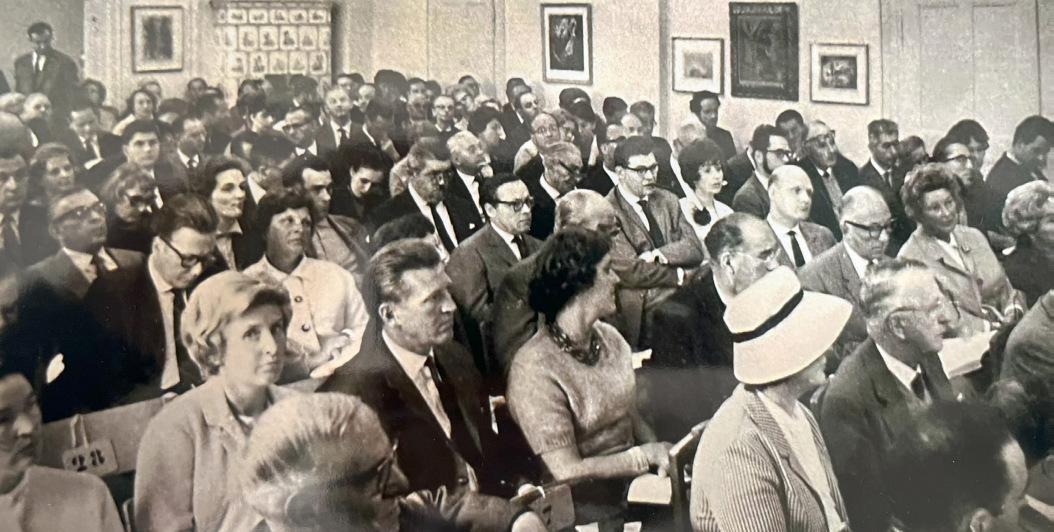
The local, very reputable firm Dr. Ernst Hauswedell & Co. (later Hauswedell & Nolte), was one of the first auction houses were Klaus and Helga bought. Soon, they also travelled to Bern to attend the sales at Galerie Kornfeld. The auction business at the time was very much an insider market, and the Hegewischs were among the few private collectors in the room, surrounded by dealers.
Both houses had particular expertise in works on paper, and right from the beginning, prints and drawings would dominate their collection, as can be seen in photographs taken in their house in the 1960s. It was around this time, however, that the occasional painting would appear on the walls, such as a canvas by Christian Schad. Other acquisitions included important paintings by Richard Oelze, Max Beckman, Otto Dix and a little later Richard Lindner and Francis Bacon. Although Klaus was open to contemporary art, and as a juror had supported the Lichtwark-Prize of the City of Hamburg to be awarded to Joseph Beuys, he remained focused on European art of the early 20th century. The most significant acquisitions of old master prints and drawings were made later, but from the mid-1960s onwards, works of the 19th century by Delacroix, Klinger, Goya and others were being added.
The Hegewisch Family with the artist Horst Janssen, Hamburg, circa 1965
Helga and Klaus Hegewisch at Klipstein und Kornfeld, circa 1960
COLLECTING ART: THE LATER YEARS
The 1970s brought change: Helga’s and Klaus’s marriage began to falter and in 1973 they finally separated. Helga followed her profession as a children’s author, novelist, and scriptwriter, and eventually married the influential mid-20th century journalist and intellectual Melvin Lasky, publisher of the political magazines Encounter and Der Monat. For a while she lived in London, but later settled in Berlin, where she still lives today.
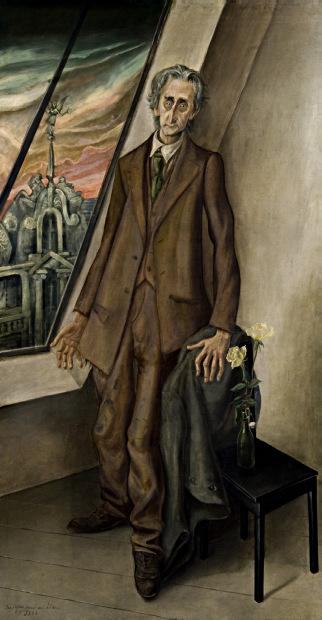
Over the course of the following decades, the collection also underwent some important permutations: some canvasses by Francis Bacon and Richard Oelze stayed with Helga, while Klaus, after his retirement in 1986, decided to sell all his remaining paintings and to place the best works in public collections: Richard Lindner’s Telephone (1966) was sold to the Kunsthalle Nuremberg , the portrait The Poet Iwar von Lücken (see lot 910) by Otto Dix (1926) was acquired by the Berlinische Galerie; and Max Beckmann’s Carnival (1920) went to the Tate Gallery in London. These deaccessions and the sale of his business allowed Klaus to deepen and refine his collection of graphic arts, on which he would from then on concentrate exclusively.
In 1981 Klaus had married Erika (née Vaupel; 1929-2024), who as a portrait painter, graphic designer and illustrator had an innate affinity to works on paper. She shared and supported his collecting interests, while he in turn encouraged her to explore printmaking for herself.
In the meantime, new opportunities had begun to present themselves: in 1973, Pablo Picasso had died and his granddaughter Marina inherited one fifth of his estate. In the following years, the art dealer Jan Krugier (1928-2008) in Geneva began - with the help of young Wolfgang Wittrock – to catalogue and sell prints and drawings on her behalf. Klaus was able to acquire some outstanding works from this source (see lot 932 & 937). Together with Erika, he continued to travel to Bern for the annual sales at Kornfeld in June, veritable conventions of the ‘works on paper-world’. The great connoisseur and auctioneer Eberhard Kornfeld (1923-2023) became a good friend who, until late in his long life, would habitually recover from the auction season at the Hegewischs’ summer house on the island of Rhodes. By then, Klaus had also begun to attend auctions at Sotheby’s and Christie’s in London and New York. Relatively little was bought on the French art market, although the Hegewischs both loved Paris and eventually bought a small garret apartment for themselves in the Quartier Latin. They would come to visit the many great museums and see exhibitions, which piqued their interest and shaped their tastes.
Back home, during the 1970s and 80s, Hamburg experienced an extraordinary artistic blossoming and two of its main cultural institutions, the Deutsches Schauspielhaus theatre and the Hamburger Kunsthalle, attained international importance. Of the protagonists of this period who also became Klaus’s friends, two in particular are worth mentioning in this context. From 1969-1990, the art historian Werner Hofmann (1928-2013) was director of the Kunsthalle. During this period, he staged a series of groundbreaking exhibitions which transformed the understanding and awareness of ‘Art around 1800’. Hofmann was a great influence on Klaus Hegewisch as a collector, and their personal exchanges undoubtedly fostered his interest in artists such as Füssli, Blake, Daumier, Menzel, Delacroix and above all Goya. Meanwhile, in 1972, Ivan Nagel was appointed director of the Schauspielhaus, which he turned into a hotbed of contemporary theatre. Together with his successor Peter Zadek (1926-2009) – also a friend – Ivan Nagel revolutionised what could be done and said on stage. Nagel however was not only a theatre director, but a cultural scholar and critic who later wrote, amongst other texts, a fascinating essay on Goya’s two paintings of the Maja desnuda and Maja vestida at the Prado (‘Der Künstler als Kuppler’, in: I. Nagel, Schriften zur Kunst:
Goya – Dannecker, Berlin, 2011). The Hegewischs always attended his premieres at the Schauspielhaus, and it is not difficult to imagine Klaus and Ivan together pouring over Los Caprichos and Los Desastres de la Guerra. Klaus, once described as ‘a fairly lonesome man with a thousand contacts’, had found in Ivan Nagel a kindred spirit and perhaps his closest friend.
EXHIBITIONS AND THE HEGEWISCH-KABINETT
Although the Hegewischs very much lived with the collection, Klaus felt strongly that it should not be locked away, and that his treasures be made accessible to the public. From quite early on, works were regularly lent to exhibitions in Hamburg, but also further afield in Europe, as well as in the USA, Japan and Australia.
Perhaps encouraged by his friendship with Werner Hofmann, he began thinking of exhibiting their collection on a more regular and formal basis, rather than just responding to individual loan requests. It was however never a question of placing the entire collection permanently in a museum – the art was too much part of their homes and daily lives. In 1996, a solution was found with the Hamburger Kunsthalle, then led by Hofmann’s successor, Uwe M. Schneede. The contemporary wing of the museum, the Galerie der Gegenwart, was still under construction, but it was agreed that, situated between the galleries for modern and contemporary art, a new space would be dedicated to exhibiting prints and drawings from his holdings. It would be called the Hegewisch-
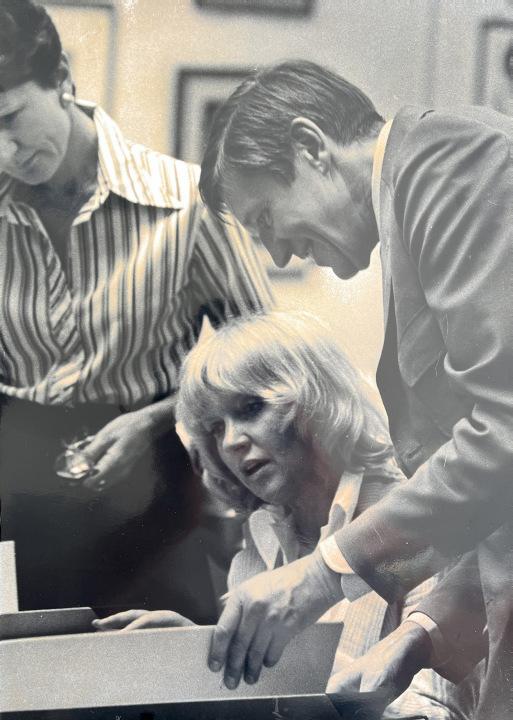
Erika and Klaus Hegewisch at a preview, circa 1985
Kabinett and the collection made available for changing exhibitions for nearly 20 years well, after the collector’s death in 2014. The Galerie der Gegenwart and the Hegewisch-Kabinett opened in 1997 with an exhibition of the most important prints and drawings by Picasso. From then on until 2016, every aspect of the collection would be illuminated and many works from the holdings shown in a nearly uninterrupted series of over twenty exhibitions at the Kunsthalle alone. Klaus Hegewisch’s commitment to the museum would manifest itself further by the gift of the outstanding, early crayon drawing of The Sick Child by Edvard Munch to mark the 60th birthday of the director, Uwe M. Schneede, in 1999.
SPELLBOUND
The title chosen for this collection and series of sales points in two directions. The term ‘spellbound’ has many connotations and can mean charmed, enchanted, beguiled, mesmerized, but also bewitched, possessed or even cursed. It thus describes Klaus Hegewisch’s relation to the art he collected, which fascinated and enthralled him. For him it was a blessing, but also a spell and an obsession.
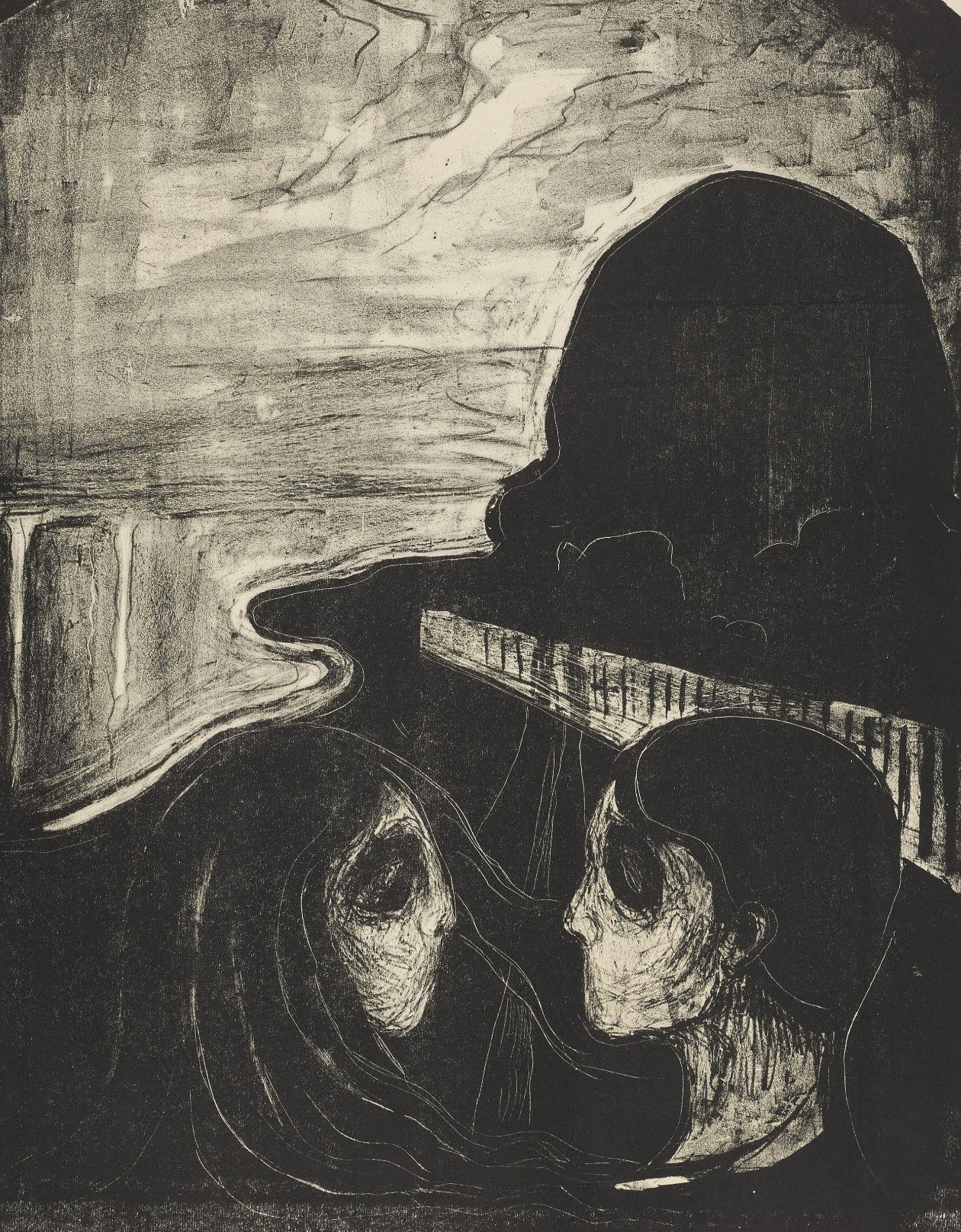
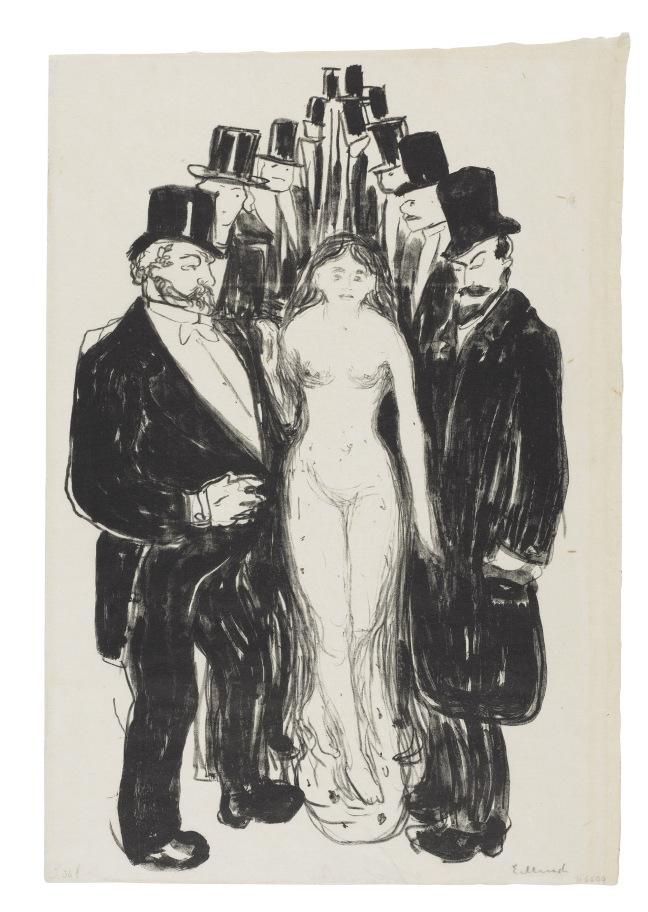
At the same time, the word ‘spellbound’ conjures up the motifs and essence of the works he felt attracted to. As he once admitted in a conversation, Klaus Hegewisch felt drawn to the darker, ominous side of life when it came to choosing works for his collection. It has already been suggested that art offered him a path to confronting his own and his country’s traumatic past. The artists best represented in the collection – Goya, Ensor, Redon, Munch, Beckmann, Dix, even Picasso – certainly don’t promise a particularly cheerful viewing. This is not to say that every work in the collection – nor in fact the collection as a whole – is gloomy. There is plenty of beauty, sensuality and humour – in Ensor’s grotesques, Redon’s reveries or Goya’s satires for example – and the brilliance of the works is such that the overall effect is elating. It is perhaps Picasso, the artist who became central to the collection, whose oeuvre best encompasses the wide emotional range of the collection: wonder and joy, charm and lust, but also melancholy, squalor and angst, even horror.
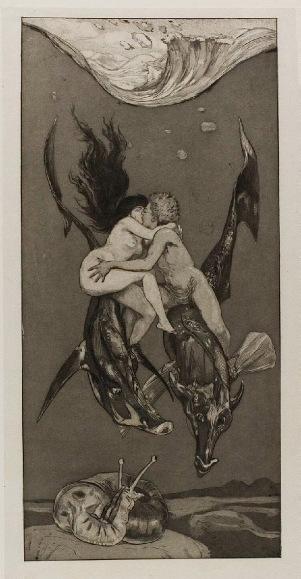
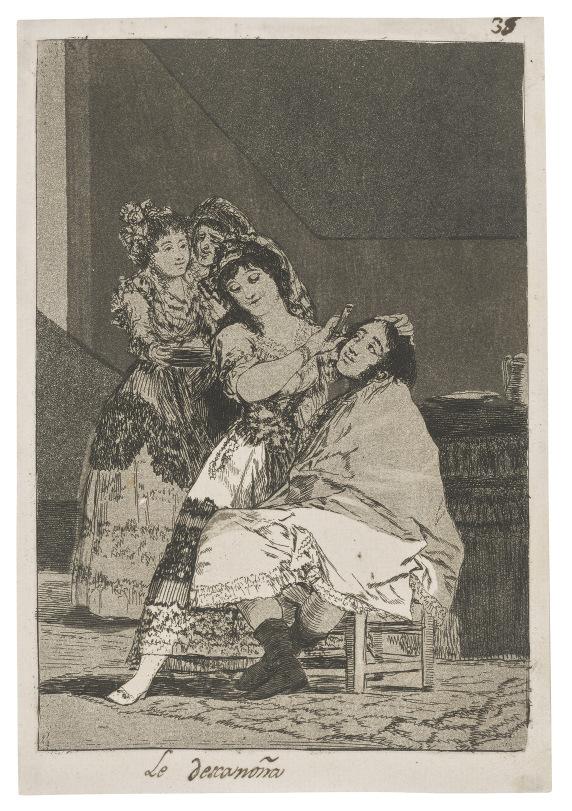
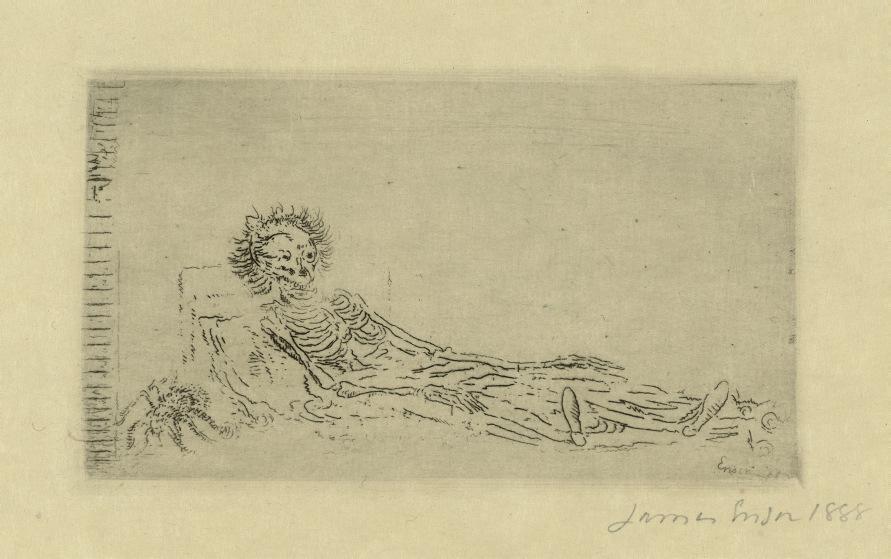
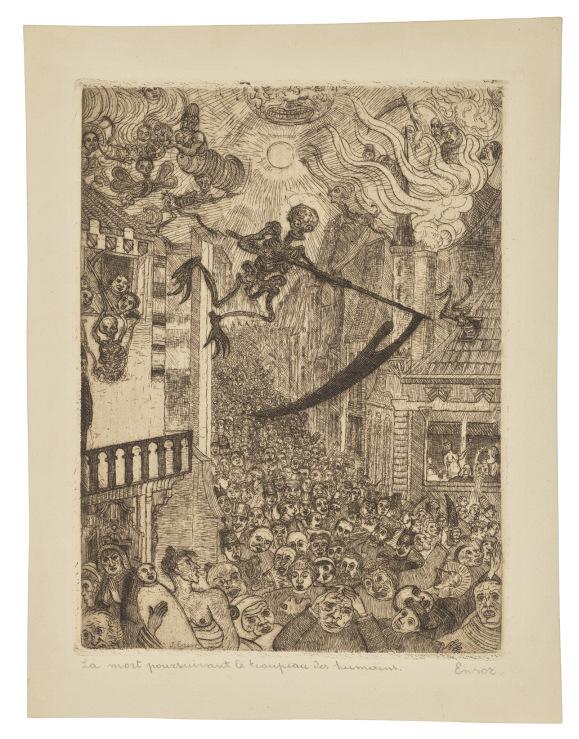
The graphic arts are the natural domain of political protest and social critique, plenty of which can be found here, in the works of Goya, Beckmann, Grosz, Dix and others (see lots 955, 958, 959, 960, 975, 976 & 981). Yet the sombre aspects of the collection are not, on the whole, found in the exposure of injustice, terror, and cruelty. What fascinated Klaus was something more subtle and timeless: the nature of the human soul itself. Not an anxious man by all accounts, he was less interested in the physical reality of life than in the psychological, irrational phenomena - the passions, desires, dreams and fantasies –that drive and torment us all. The images in the Hegewisch Collection teem with mythical and fantastical creatures, from Dürer’s serpent in paradise to Goya’s winged demons and goblins, from Redon’s nocturnal chimera, Ensor’s vengeful skeletons and Klinger’s sirens to Picasso’s minotaurs and fauns (see lots 929, 933, 934, 935, 936, 941, 942, 946, 948, 979, 989, 990, 991). Even many of those animals which in themselves seem real and natural – Baldung’s horse, Goya’s cats, bats and owls or Dürer’s stag appearing to Saint Eustace are envoys from another world.
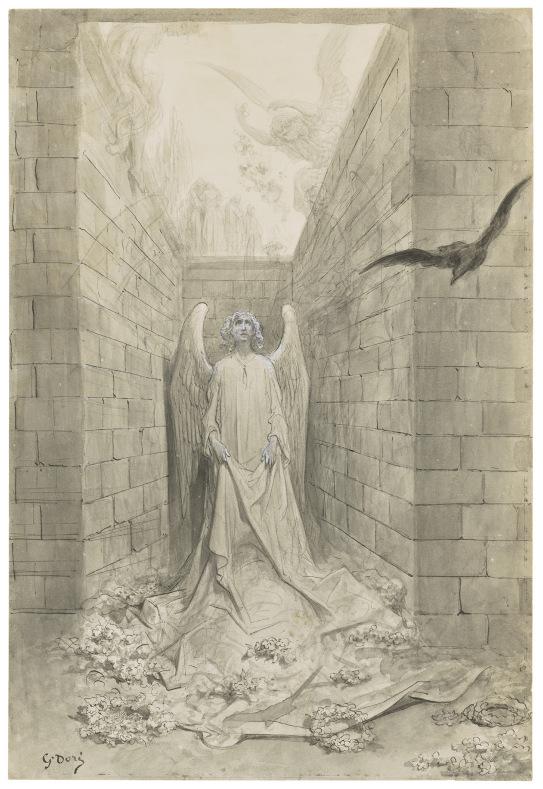
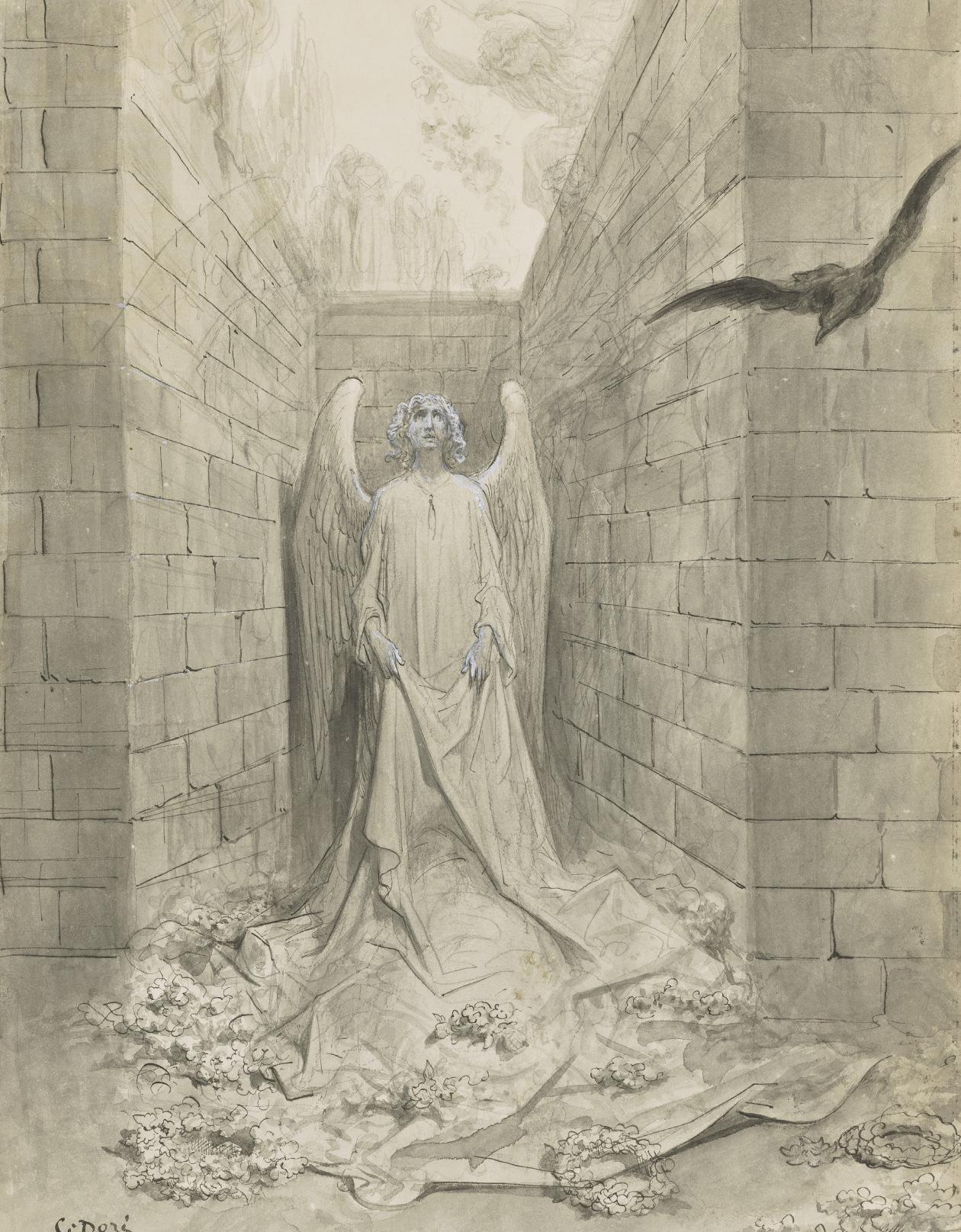
Hamlet’s famous dictum that ‘There are more things in heaven and earth, Horatio/ Than are dreamt of in your philosophy’ (W. Shakespeare, Hamlet, 1.5.167-8) sums up much of the spirit of the collection. In Edgar Allan Poe’s poem ‘The Raven’, of which an edition illustrated by Gustave Doré and two of his preparatory drawings are included in the collection, the narrator is mourning the death of his beloved Lenore, when at night he hears a tapping at his door. He is filled with dread – ‘here I opened wide the door; - darkness there and nothing more’– as he is visited by a raven who, repeatedly, speaks only
one word: “Nevermore”. The raven is a messenger from the land of the dead or perhaps an emanation of his dead lover herself (see lot 945). The story is a good example of the phenomenon of ‘the uncanny’, described by Sigmund Freud in his essay ‘Das Unheimliche’, published in 1919. Analysing the German word unheimlich itself, Freud realises that it is not the opposite, but an inversion of the word heimlich, which carries ambiguous notions of ‘homely’ but also ‘secret’. To prove his point, he cites definitions of the word unheimlich, such as the following by Friedrich Schelling: ‘Uncanny is what one calls everything that was meant to remain secret and hidden and has come into the open’ (quoted in: S. Freud, The Uncanny, transl. David McLintock, Penguin Classics, London, 2003, p. 132). We thus experience as ‘uncanny’ what was once familiar and central to our understanding of the world, but has since been repressed by rationality, science, the enlightenment: a mythical world pervaded by earthly and unearthly forces - spirits, demons, ghosts and gods - which could be manipulated through animism, magic and sorcery.
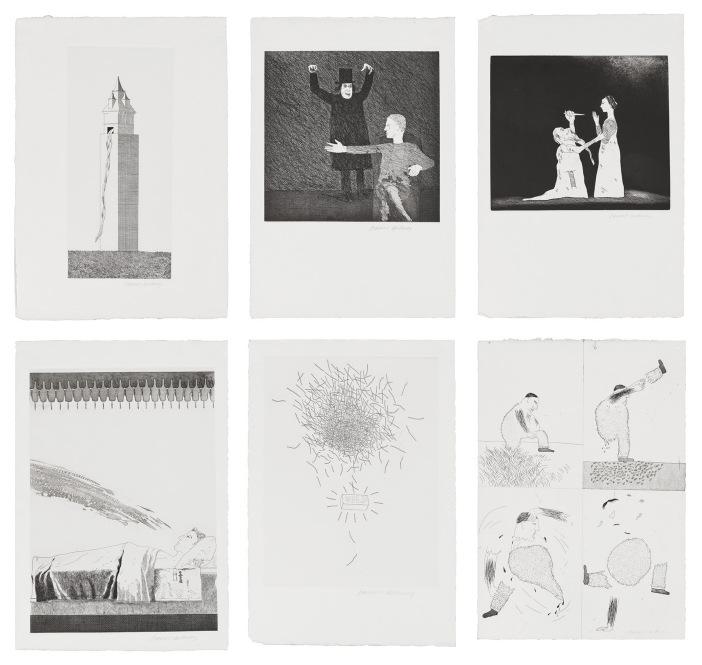
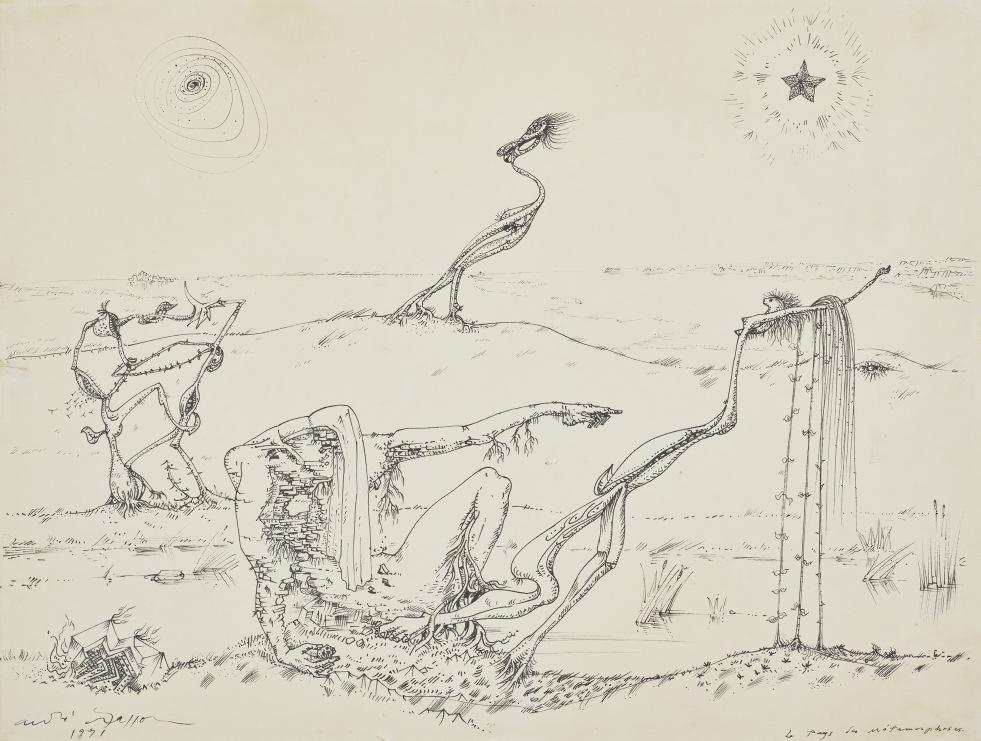
By no means every work in the Hegewisch Collection can be described as ‘unheimlich’, but once aware of the concept, one sees it again and again: in Baldung’s Bewitched Groom and his malevolent horse, Delacroix’s Faust et Mephisto dans la nuit du Sabbat, in Dürer’s Dream of the Doctor, Goya’s witches and bogeymen (lots 941 & 942), Oelze’s strangely human Vogel Fritz or Redon’s sentient yet disembodied heads. It comes as no surprise then that even the more contemporary works in the collection, David Hockney’s Six Fairy Tales (lot 950) and André Masson’s Pays de Metamorphoses (lot 971), in very different ways, correspond to this theme.
Even the most lyrical, tender or explicitly erotic works in the collection have an enchanting or beguiling quality, which causes disquiet rather than comfort. Seemingly quotidian subjects, such as Picasso’s La Coiffure (Femme se coiffant), attain a haunting aspect when seen from this perspective: anyone familiar with German culture, on seeing the
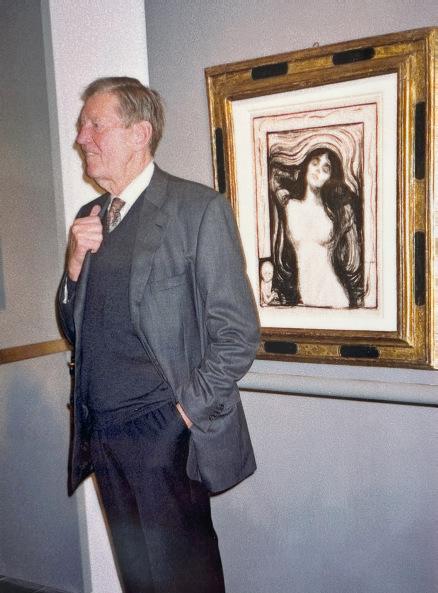
Klaus Hegewisch, probably at the opening of the exhibition Edvard Munch ‘… aus dem modernen Seelenleben’, Hamburger Kunsthalle, 2006.
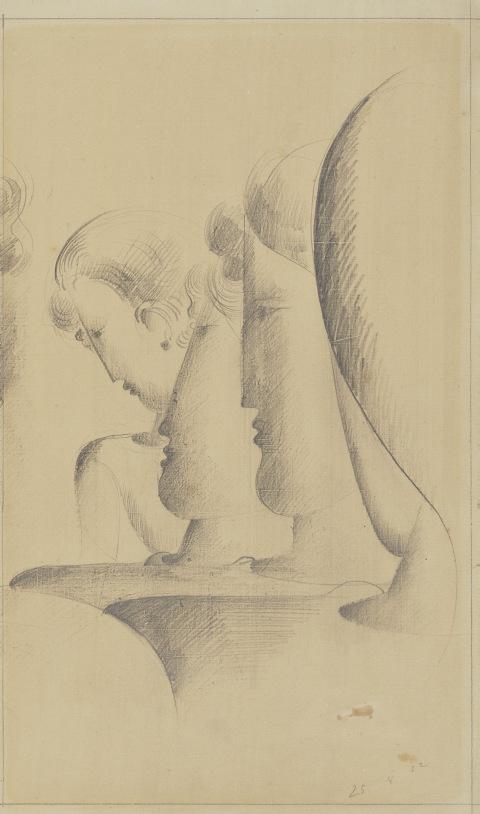
figure of the woman combing her hair, would think of Heinrich Heine’s poem Die Lorelei. Presumably based on a local folk tale, it tells of a woman sitting on a cliff high above a treacherous stretch of the Rhine, singing and combing her long, golden hair; the boatsmen on the river below, distracted and bewitched by the siren sounds and the sight of the beautiful woman, lose control of their vessels and drown in the rapids. Picasso himself may not have known the story, but the theme of an enchanting, seductive woman occupied him throughout his long artistic career. To stay with Picasso: his preparatory drawing for Les Desmoiselles d’Avignon of 1907, appears devoid of such uncanny connotations, until one realises – so brilliantly demonstrated in the Hegewisch Collection – that the pared-down facial features are based on a very specific type of wooden mask from the Ivory Coast, itself a magical and spiritually charged object (see p.7). Certainly, the drawing may above all be the product of formal experimentation, as are for example those by Oskar Schlemmer (lot 911) and Fernand Léger, but with looking at these images comes a sense of something otherworldly, ethereal lurking beneath the surface.
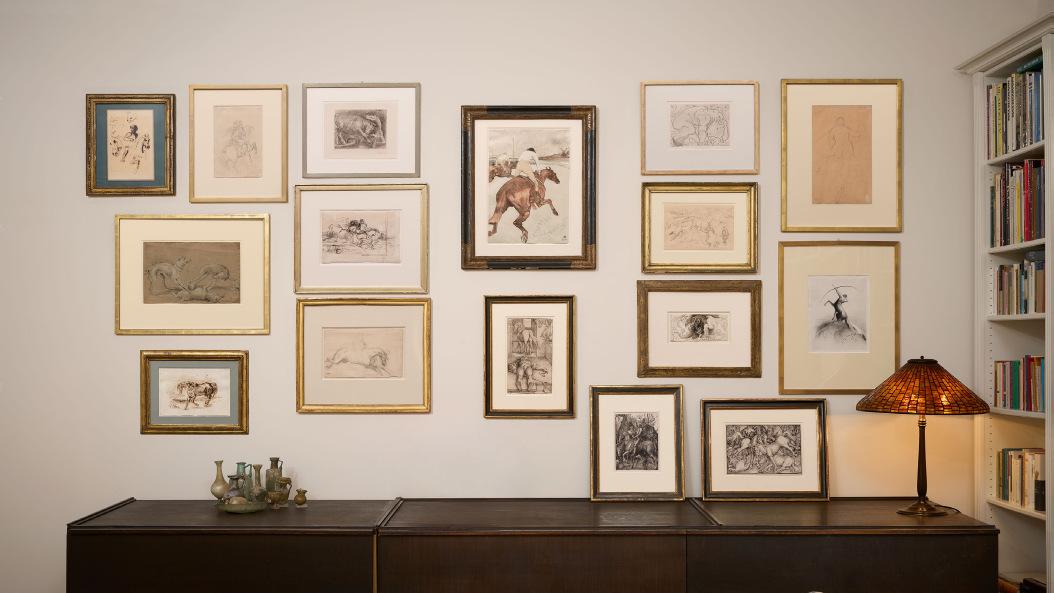
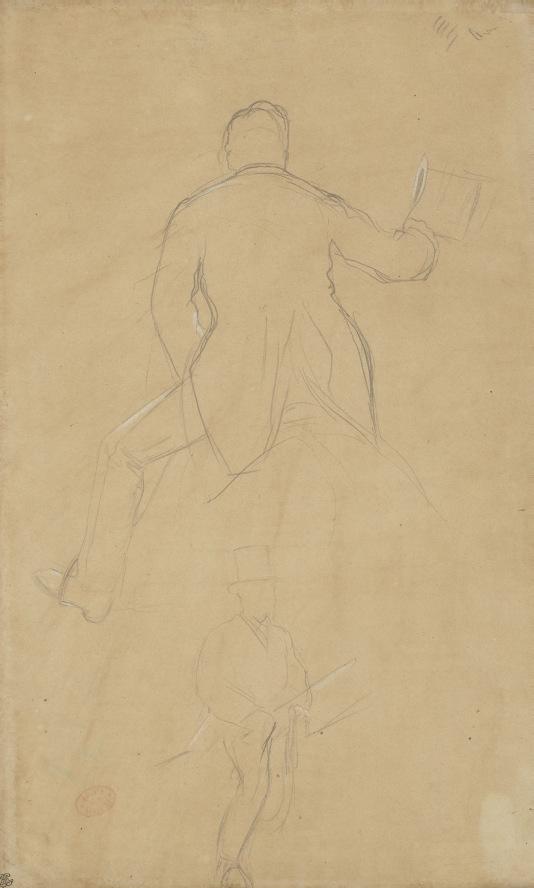
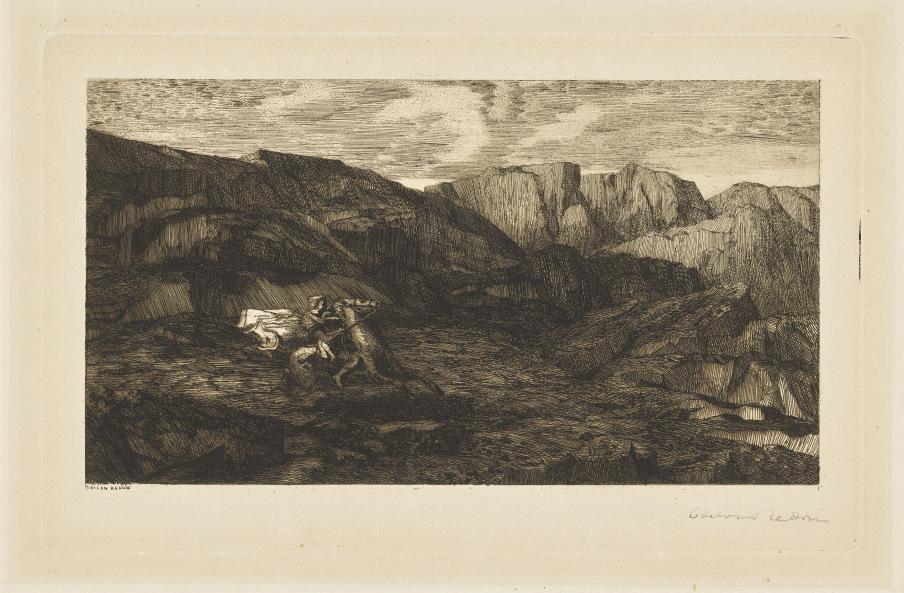
In the Hegewischs’ last apartment, a whole wall was dedicated to depictions of horses and riders, from Dürer and Delacroix (lots 925 & 928) to Redon (lots 929 & 965), Degas (lot 930), Toulouse-Lautrec and Picasso (lot 932). The strong presence of this equestrian theme has always puzzled me: Klaus Hegewisch was a sailor and had no practical interest in horses whatsoever. It may well be that, once he had recognised it as a motif, he became fascinated by different artists’ skill and manner in representing it. In hindsight, however, I suspect there was more to it than pure enjoyment of draughtsmanship and artistic brilliance. German visual and literary culture is replete with ghostly or nocturnal riders, from Dürer’s Knight, Death and Devil, Goethe’s ‘Erlkönig’ (depicted by Odilon Redon in his etching La Peur) (lot 965) and ‘Faust’, to Theodor Storm’s ‘Schimmelreiter’ and Rainer Maria Rilke’s ‘Die Weise von Liebe und Tod des Cornets Christoph Rilke’, a
prose poem Klaus loved very much.
The man and collector Klaus Hegewisch embodied many aspects of his epoch. Having lived through the horrors of the war and the Nazi-period, he gratefully and consciously embraced every moment of freedom and joy his life thereafter granted him. Above all, he admired the radicalism and uncompromising stance of the artists he collected, their dedication to their work, their independent view of the world, and their willingness to explore new territories, unbound by convention. He saw artistic creation as an expression of a non-conformist existence. As a successful businessman and father of a large family, he had many obligations and constraints to comply with, yet more than once said to his children that he would have preferred to live the free life of a clochard in Paris. Moments of great enthusiasm and deep despair, of light and shadow, were equally part of his life and character. Perhaps this is why ultimately the graphic arts spoke to him more than painting.
The Hegewisch Collection is remarkable for the astonishing range, focus and quality of its holdings, which make it one of the greatest private ensembles of art on paper in our time. Yet, what makes it truly exceptional and endlessly fascinating is the depth to which it was shaped by the mind – the interests and obsessions – of the collector himself. If this introduction has helped the reader seeing these works and their manifold relations through the ‘inner eye’ of Klaus Hegewisch - and in turn through their own eyes – it has achieved its purpose.
Tim Schmelcher
London, July 2025
Tim Schmelcher works as a specialist in Christie’s Prints Department. He joined the firm in 2004 and specialises in old master prints and prints of the 19th and early 20th centuries.
on laid paper, without watermark a very fine impression of the first state (of four) printing darkly, sharply and with great contrasts with fine vertical wiping marks and a subtle plate tone, more prominent towards the right plate edge with narrow margins, the upper corners restored, otherwise in good condition
Plate 10,4 x 9,4 cm. (4¿ x 36 in.)
Sheet 10,7 x 9,6 cm. (4º x 3æ in.)
£12,000-18,000
US$17,000-24,000
€14,000-21,000
PROVENANCE:
Unidentified, initial R in brown ink verso (not in Lugt). Galerie Kornfeld, Bern, 15 June 2007, lot 80. Acquired from the above sale; then by descent to present owners.
EXHIBITED:
Hamburg, Hamburger Kunsthalle, Mit dem inneren Auge sehen - Meisterwerke aus der Sammlung Hegewisch, September 2016January 2017, no. 39, p. 37 (ill.) & 77.
LITERATURE:
A. von Bartsch, Catalogue raisonné de toutes les Estampes qui forment l'Œuvre de Rembrandt..., Vienna, 1797, no. 19, pp. 17-18.
A.M. Hind, A Catalogue of Rembrandt's Etchings; chronologically arranged and completely illustrated, London, 1923, no. 144, p. 80 (another impression ill.).
C. White & K.G. Boon, Hollstein's Dutch and Flemish Etchings, Engravings and Woodcuts: Rembrandt van Rijn (vol. XVIII), Amsterdam, 1969, no. 19, p. 8 (another impression ill.).
E. Hinterding, J. Rutgers & G. Luijten, eds., The New HollsteinDutch and Flemish Etchings, Engravings and Woodcuts 1450-1700: Rembrandt, Amsterdam, 2013, no. 158, pp. 7-9 (another impression ill.).
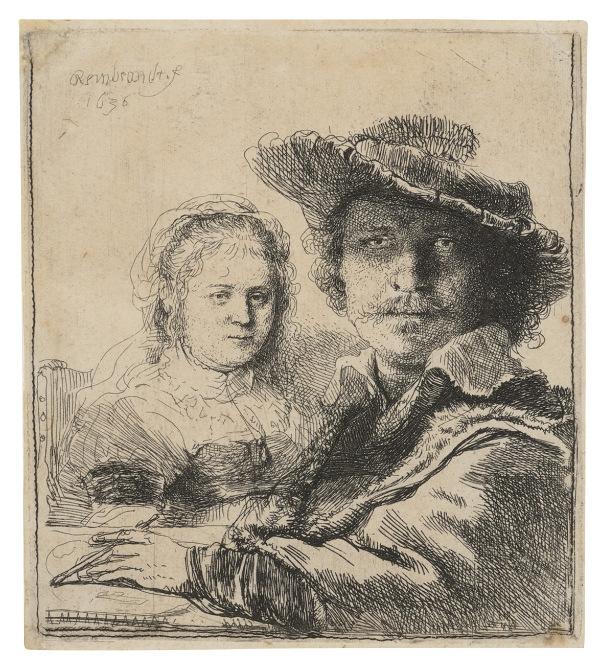
This is a fine example of Rembrandt's famous self-portrait with his wife Saskia, an impression of the rare first state, before Rembrandt removed the little accidental curved line on her forehead. When Rembrandt etched this plate in 1636, they had been married for two years. Saskia van Uylenburgh was born in 1612 into a large and influential family in Leeuwarden, where her father served as burgomaster. Saskia and Rembrandt undoubtedly met through her cousin, the art dealer Hendrick van Uylenburgh (circa 1587 – 1661), with whom Rembrandt was living and working since his move to Amsterdam in 1631. Although Rembrandt frequently depicted Saskia, as herself or in disguise, this is the only portrait of the couple. As a double-portrait of the artist with his wife, this etching is almost without precedent in print, with the notable exception of the double-portrait of Israhel van Meckenem with his wife Ida of around 1490, which Rembrandt may well have
known. Self-Portrait with Saskia shows the artist prominently in the front, while Saskia sits at the back of the table. Both are dressed in 16th-century costume, presumably as a way of placing the image – and himself as an artist – in the Renaissance tradition. Rembrandt seems to be at work, seemingly drawing the very scene he is observing in the mirror, although this is certainly a ploy, as the two portraits were very likely created in at least two separate sittings. Despite the slightly disjointed aspect of the two figures, there is a great tenderness and pride in their proximity on the sheet, and the way he presents her as his wife, with such poise and quiet confidence. He must have loved her very much, as his many depictions of her suggest, most poignantly the sketches of her being ill, and it is sad to think that only six years later Saskia would no longer be alive.
*902
REMBRANDT HARMENSZ. VAN RIJN (1606-1669)
Self-Portrait in a Velvet Cap with Plume etching
1638 on laid paper, partial watermark Strasbourg Lily (pendant initials WR) a fine impression of the second state (of four) printing sharply and delicately yet with good contrasts some tiny ink smudges on and just below the mouth and on his right eye with thread margins on three sides or trimmed on the platemark below some minor foxing and staining, a couple of short tears otherwise in good condition
Plate 13,3 x 10,3 cm. (5º x 4¿ in.)
Sheet 13,5 x 10,5 cm. (5¡ x 4¿ in.)
£7,000-10,000
US$9,500-13,000
€8,100-11,000
PROVENANCE:
Vittorino Cavalli (20th century), Reggio Emilia, Italy (Lugt 4608).
Private Collection, Italy; Christie's, London, 8 July 1998, lot 205. Acquired from the above sale; then by descent to the present owners.
LITERATURE:
A. von Bartsch, Catalogue raisonné de toutes les Estampes qui forment l'Œuvre de Rembrandt..., Vienna, 1797, no. 20, pp. 18-19.
A.M. Hind, A Catalogue of Rembrandt's Etchings; chronologically arranged and completely illustrated, London, 1923, no. 156, p. 82 (another impression ill.).
C. White & K.G. Boon, Hollstein's Dutch and Flemish Etchings, Engravings and Woodcuts: Rembrandt van Rijn (vol. XVIII), Amsterdam, 1969, no. 20, p. 9 (another impression ill.).
E. Hinterding, J. Rutgers & G. Luijten, eds., The New Hollstein - Dutch and Flemish Etchings, Engravings and Woodcuts 1450-1700: Rembrandt, Amsterdam, 2013, no. 170 , pp. 31-32 (another impression ill.).
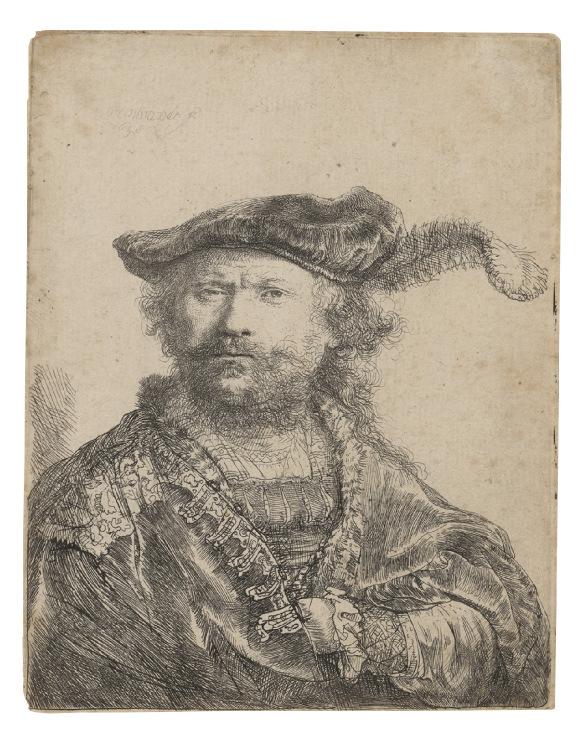
Created two years after the Self-Portrait with Saskia (see previous lot), Rembrandt with this print continued a small series of self-portraits in which he presented himself very confidently dressed in extravagant 16th-century dress, thereby placing him in the tradition of the great painters of the previous century: Raphael, Titian, but also Albrecht Dürer. The plumed cap may be a reference to the soldiers' and halberdiers' costumes found in some of Dürer's prints.
Rembrandt's had by now achieve an astonishing mastery of the etching technique. In the present print, the modelling and shading of his face and hair with the most delicate lines is particularly remarkable and can only be fully appreciated in early impressions such as the present one.
CARRACCI SCHOOL, 16TH CENTURY
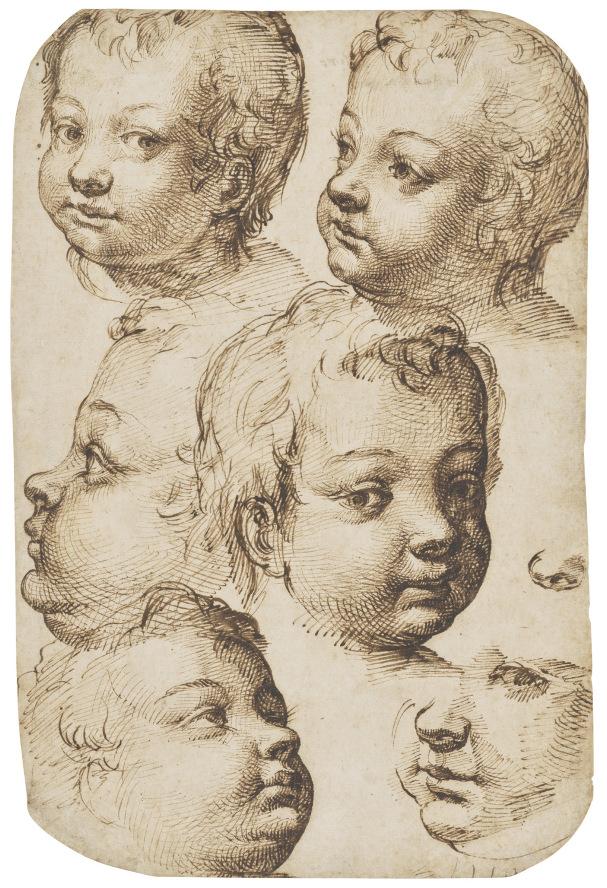
Six Studies of Heads of Putti
inscribed cesino/ Camiaia (verso)
pen and brown ink, watermark Coat-of-Arms with Bird, corners rounded 28.1 x 18.5 cm. (10¿ x 7¡ in.)
£4,000-6,000
US$5,400-8,100
€4,600-6,900
PROVENANCE:
Christie's, London, 9 December 1980, lot 34 (as attributed to Bartolomeo Passarotti).
William H. Schab Gallery, New York, Old and Modern Master Prints and Drawings from the Fifteenth to the Twentieth Century, 1981, no. 8, ill. (as Agostino Carracci).
Acquired from the above; then by descent to the present owners.
EXHIBITED:
Hamburg, Hamburger Kunsthalle, Aus der Werkstatt des Künstlers –Druckgraphik und vorbereitende Zeichnungen der Sammlung Hegewisch, March 1999 - October 2000, pp. 12 and 85 (ill.).
Hamburg, Hamburger Kunsthalle, Agostino Carracci - Die Schule der Zeichnung, 2001 (no cat.).
Previously attributed to Bartolomeo Passarotti (1529-1592) and subsequently to his pupil Agostino Carracci (1557-1602), the drawing is more likely the work of an artist active in the Carracci School.
LEARN MORE
HONORÉ DAUMIER (1808-1879)
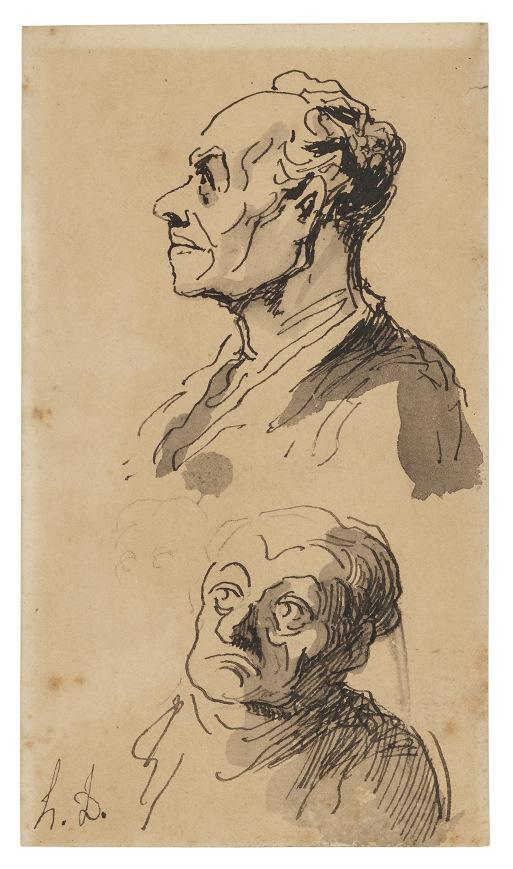
Two Studies of Heads
signed H.D. (lower left) pencil, pen and black ink, grey wash on paper 13.7 x 7.8 cm. (5¡ x 31 in.)
£7,000-10,000
US$9,500-13,000
€8,100-11,000
PROVENANCE:
Barbizon House, London, probably by 1921, no. 521. Joseph 'Jos' Hessel, Paris. Étienne Bignou, Paris.
Paul Cassirer, Berlin.
Fritz S. Hess (1903-1983), Berlin; his sale, Fischer, Lucerne, 1 September 1931, lot 16 (withdrawn); then remaining in his collection until at least 1967 (according to K.E. Maison).
Sotheby's, London, 7 December 1977, lot 102. Acquired at the above sale; then by descent to the present owners.
M. Sadleir, Daumier - The Man and The Artist, London, 1924, pl. 46 (top section reproduced only).
C. Martine and L. Marotte, Daumier - Cinquante Reproductions avec un Catalogue, Paris, 1924, no. 39 (illustrates the sheet as having three studies, the top one now trimmed).
E. Fuchs, Der Maler Daumier, Munich, 1927, pp. 15 & 43, pl. 16 (illustrates the sheet as having three studies, the top one now trimmed).
K.E. Maison, Honoré Daumier - Catalogue raisonné of the Paintings, Watercolours and Drawings, London, 1967, vol. II, no. 118, pl. 21, mentioned under no. 59.
An indefatigable caricaturist, Daumier remains a key artist of the 19th century, whose talent went far beyond the circle of the press, in which he worked for the most part, and earned him unanimous recognition from his peers. His raging empathy spared no one; from his series on lawyers to that on train travelers, he never ceased to portray his contemporaries, sometimes impassioned, sometimes placid, always humorous.
His profound humanity combined with a great sense of derision inspired numerous head studies, which were a way to test the characters
he wanted to represent. The sheet is a perfect example of the artist's style, showing two striking and endearing figures in a few vivid strokes, heightened with grey wash. The head in the upper part of the sheet shows similarities with The Connoisseur, a watercolor at the Metropolitan Museum, New York (inv. no. 29.100.200; K. E. Maison, op. cit., no. 370) and dated 1860-1865. Originally composed of three head studies, the present sheet has been cut in two pieces at an unknown date (between 1927 and 1944); the missing part is now in the Burrell Collection in Glasgow (inv. no. 35.220; K. E. Maison, op. cit., no. 59).
REMBRANDT HARMENSZ. VAN RIJN (1606-1669)
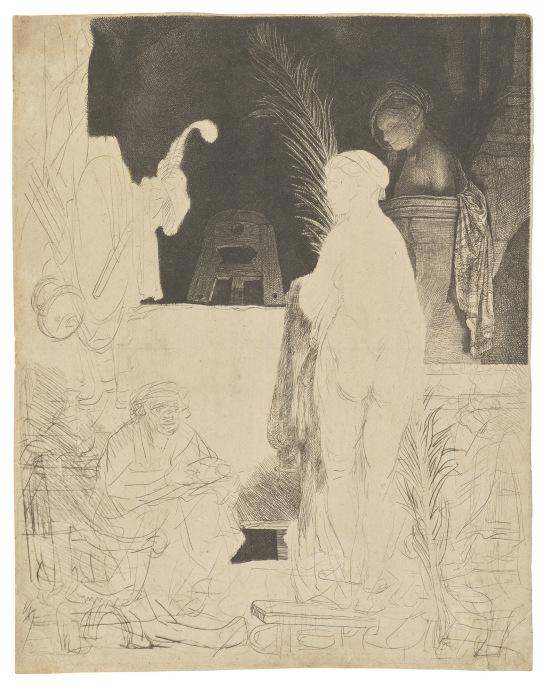
The Artist drawing from the Model ('Het beeldt van Pigmalion')
etching and drypoint circa 1639 on laid paper, watermark Basilisk (Hinterding A.a) a very good impression of the second state (of four) printing richly, darkly and with good contrasts still with some burr on the palm frond and elsewhere slightly slipped at lower left with partial narrow to thread margins on three sides, trimmed to or inside the subject below thinly backed, some repairs at the corners and sheet edges Sheet 23,7 x 18,6 cm. (93 x 73 in.)
£7,000-10,000
US$9,500-13,000
€8,100-11,000
PROVENANCE:
Alexander John Godby (1853-1934), Baltimore (Lugt 1119b); his posthumous sale, Sotheby's, London, 29 January 1935, lot 154 (with two other impressions) (£ 3; to Parsons). Parsons & Sons, London (without stamp; see Lugt 2881). Private Collection, France; Christie's, London, 28 June 1990, lot 165.
Acquired from the above sale; then by descent to present owners.
LITERATURE:
A. von Bartsch, Catalogue raisonné de toutes les Estampes qui forment l'Œuvre de Rembrandt..., Vienna, 1797, no. 192, pp. 166-167. A.M. Hind, A Catalogue of Rembrandt's Etchings; chronologically arranged and completely illustrated, London, 1923, no. 231, pp. 100-101 (another impression ill.).
C. White & K.G. Boon, Hollstein's Dutch and Flemish Etchings, Engravings and Woodcuts: Rembrandt van Rijn (vol. XVIII), Amsterdam, 1969, no. 192, p. 92 (another impression ill.).
E. Hinterding, J. Rutgers & G. Luijten, eds., The New HollsteinDutch and Flemish Etchings, Engravings and Woodcuts 14501700: Rembrandt, Amsterdam, 2013, no. 176, pp. 45-46 (another impression ill.).
In this beguiling unfinished print, an artist is shown seated in his studio, drawing from a live model who stands on a pedestal, her back and rear facing the viewer. The background is dark and densely hatched, with the white leaves of a palm frond in the model’s hand and the contours of a sculpted bust emerging from the darkness. There is debate over whether the incompleteness of the print was due to Rembrandt abandoning the work or if it was intentionally left unfinished. A related drawing in the British Museum (inv. no. Gg,2.248) suggests that Rembrandt was trying to resolve the composition but ultimately decided not to make further changes. The print’s unfinished quality is particularly fascinating and offers rare insight into
Rembrandt’s creative process, which is typically revealed only through early states and working proofs of other subjects. It also engages with broader themes, such as the dynamic between artist and model and the act of drawing itself. The alternative title occasionally given to this print, Pygmalion, seems forced, trying to attribute a narrative to a print that clearly depicts an artist drawing from a live model - not a mythical sculptor obsessed with his creation. Despite never completing the print, Rembrandt evidently did not view it as a failure. It was printed in considerable numbers during his lifetime, suggesting that both the artist and contemporary collectors valued the work, perhaps just because of its unfinished quality.
*906
MAX BECKMANN (1884-1950)
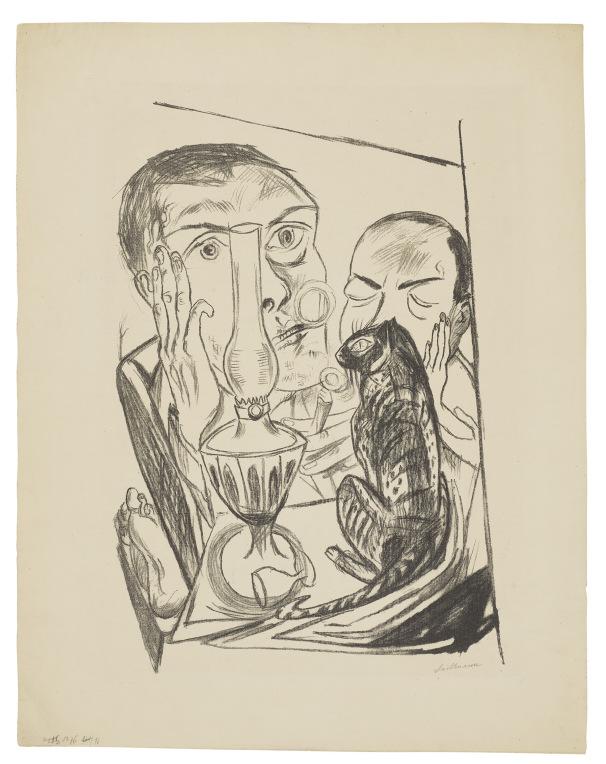
Selbstbildnis mit Katze und Lampe
lithograph 1920 on laid paper, watermark ORIGINAL HAND LINEN/ P & H signed in pencil
one of approximately twenty unnumbered impressions from the total edition of fifty (including ten on simili Japan paper and twenty numbered impressions on the same laid paper)
published by Verlag Karl Lang, Darmstadt, 1921 or 1922 with wide margins, probably the full sheet in very good condition
Image 46,8 x 31,7 cm. (18.2/5 x 12.5/1 in.)
Sheet 59,5 x 46,5 cm. (23.2/5 x 18.3/10 in.)
£12,000-18,000
US$17,000-24,000
€14,000-21,000
PROVENANCE:
Hauswedell & Nolte, Hamburg, 7 December 2007, lot 27. Acquired at the above sale; then by descent to the present owners.
LITERATURE:
J. Hofmaier, Max Beckmann - Catalogue raisoneé of his Prints, Bern, 1990, no. 162 B.c., pp. 428-429 (another impression ill.).
This large and important portrait is a precursor to the more famous drypoint Selbstbildnis mit steifem Hut (Hofmaier 180) of 1921, where a lamp and a cat feature equally prominently in the foreground. In the present lithograph we see Beckmann's friend Ugi Battenberg halfreclined in the background, his bare feet sticking out on the left behind the seated Beckmann. While Battenberg seems to have dozed off, the artist is wide awake, blowing smoke rings, his eyes haunted and glaring into a void, perhaps still haunted by his memories and trauma of the first World War, which had only ended two years earlier.
λ*907
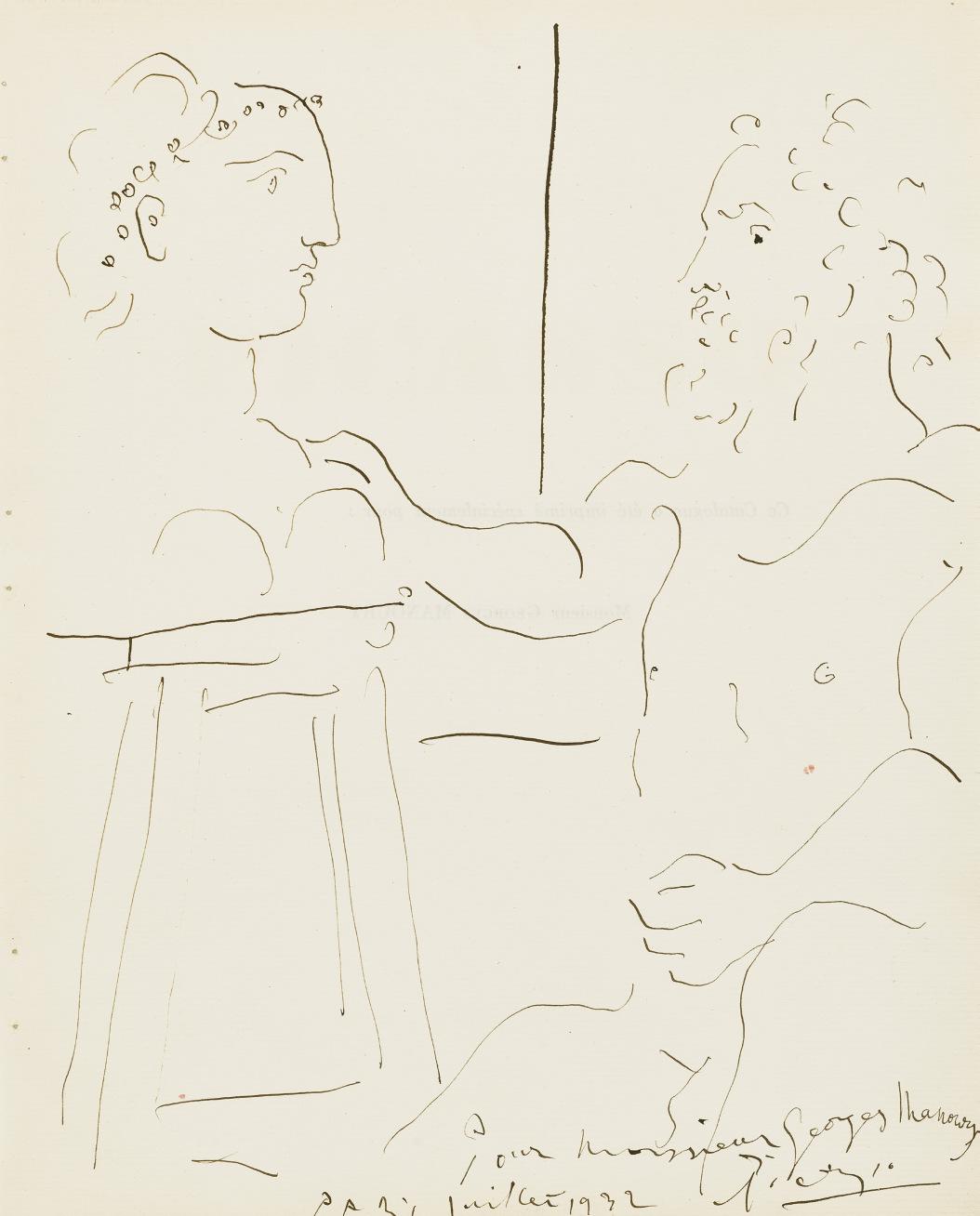
PABLO PICASSO (1881-1973)
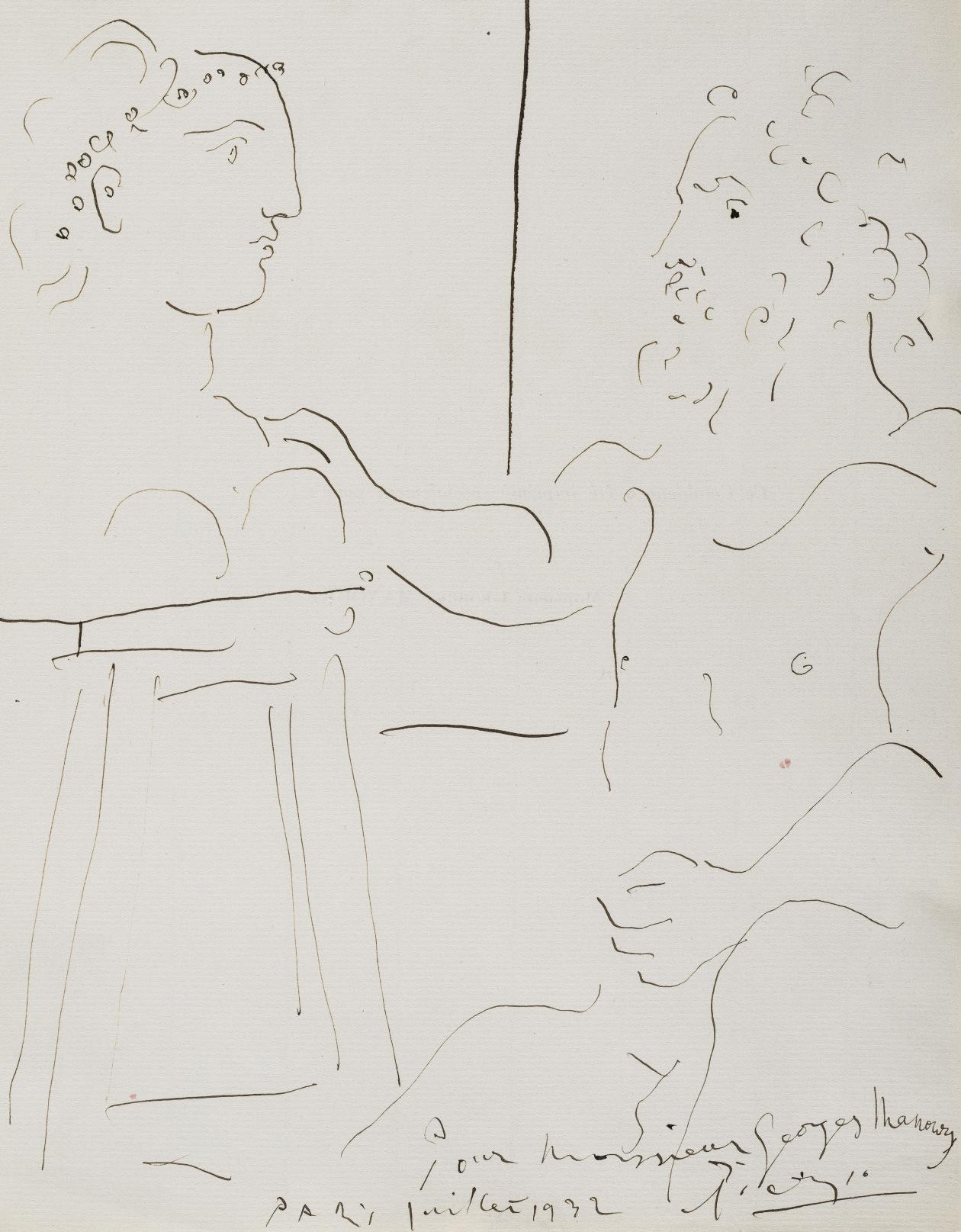
Sculpteur avec buste de jeune fille sur une sellette
signed, dated and inscribed Picasso Pour Monsieur Georges Manoury Paris juillet 1932 (lower right) pen and ink on frontispiece
28,1 x 22,5 cm. (11¿ x 8√ in.)
Executed in Paris in July 1932
£70,000-100,000
US$95,000-130,000
€81,000-110,000
PROVENANCE:
Georges Manoury, Paris; a gift from the artist in July 1932. Galerie Kornfeld, Bern, 23 June 2000, lot 121.
Acquired at the above sale; then by descent to the present owners.
EXHIBITED:
Oslo, Munchmuseet, Pablo Picasso - Den blinde Minotaurus - grafikk og tegning, November 2002 - February 2003 (no cat.).
Hamburg, Ernst Barlach Haus - Stiftung Hermann F. Reemtsma, Pablo Picasso - Der Stier und das Mädchen - Meisterblätter aus der Sammlung Hegewisch, June - October 2010, no. 13, p. 112 (ill. p. 60; titled 'Bildhauer mit Büste einer jungen Frau auf einem Schemel').
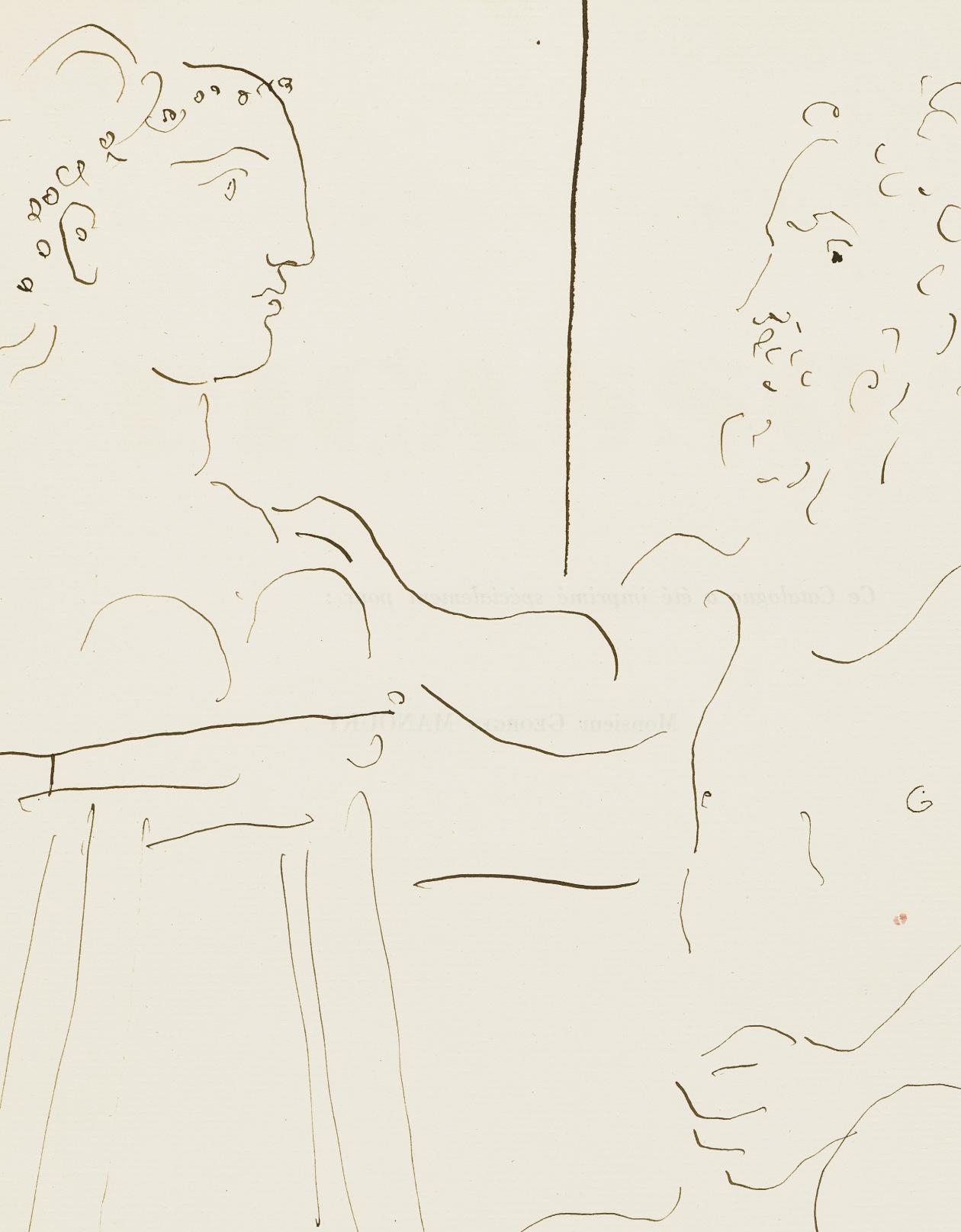
Executed in July 1932, Pablo Picasso’s exquisitely drafted Sculpteur avec buste de jeune fille sur une sellette offers rich insight into the legendary artist’s work at a critical point in his career. The present work is drawn onto the frontispiece of an exhibition catalogue for the seminal 1932 Picasso retrospective at Galerie Georges Petit- the first and only exhibition which the artist personally installed. Held in Paris between 12 June and 30 July that year, the exhibition not only cemented Picasso’s reputation as an unparalleled leader of the European avantgarde, it allowed the public and the artist himself to reflect on and evaluate thirty years of singular innovation. The drawing depicts one of the most vaunted yet intimate subjects in Picasso’s corpus - an artist in the very act of creation, an autobiographical subject that he would continue to explore throughout the remainder of his career.
In Sculpteur avec buste de jeune fille sur une sellette, Picasso utilizes a fluid, economical line to masterfully construct his subjects and grant them a sense of affecting immediacy. The long, continuous line of the bust’s visage (an unmistakable homage to Picasso’s muse MarieThérèse Walter) contrasts with the variegated, short curling strokes that coalesce into the bearded head of the seated sculptor. Both figures are articulated in the spartan, classicizing manner typical of the artist’s graphic output of this period. The male figure is captured in the act of creation, his right hand modeling the bust’s shoulder, recalling the myth of Pygmalion and Galatea.
One of Picasso’s most groundbreaking inventions was his reimagining of the relationship between drawing and sculpture, an innovation carefully conveyed in the present work. As Olivier Berggruen aptly observes, for Picasso, ‘drawing could hint at sculpture, just as sculpture could be imbued with painterly or linear qualities’ (‘Pablo Picasso: The Line and the World,’ in Picasso: Seven Decades of Drawing, exh. cat., Acquavella, New York, 2021, p. 13). Picasso created numerous sculptures in the late 1920s into the early 1930s, treating the practice as drawing in the third dimension. The artist sculpted an important series of busts in 1931 depicting Marie-Thérèse Walter, and the present work captures the essence of this series, exploring the relationship between literal and virtual modes of representation.
Picasso inscribed the present sheet with the dedication ‘Pour Monsieur Georges Manoury Paris Juillet 1932,’ and the catalogue edition on which he executed the drawing was printed especially for Manoury, a noted Parisian art world figure. The retrospective at Georges Petit was a watershed moment for Picasso, uniting for the first time three decades of his artwork in the same space. The exhibition was also notable for being the first public exposure of his portraits and sculptures of Marie-Thérèse, the young model whose arresting features immediately captivated Picasso when he spotted her on a Parisian street in 1927. The present work captures Picasso dwelling on his creation of the many sculpted portraits he made of Marie-Thérèse, while simultaneously looking forward to new possibilities inspired by his most important muse.
The Comité Picasso has confirmed the authenticity of this work.
LEARN MORE
SIR EDWARD COLEY BURNEJONES, BT., A.R.A., R.W.S.
(1833-1898)
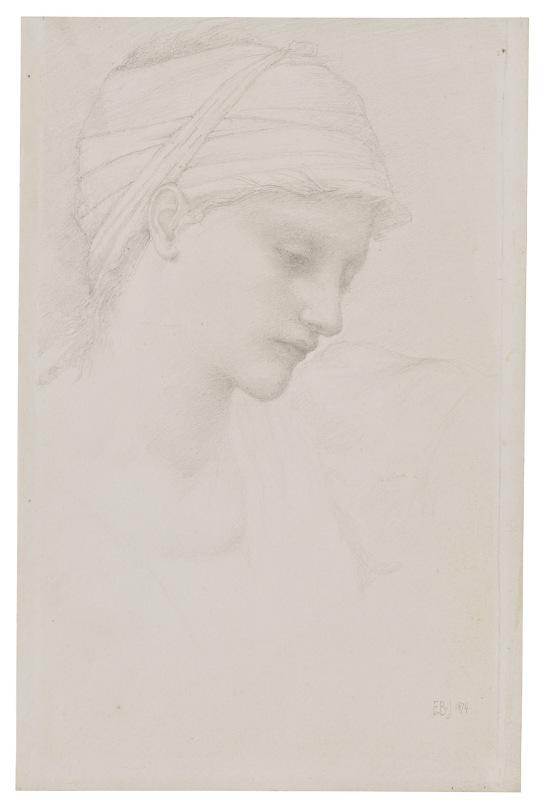
Head Study for the Goddess Fortune looking down to the right in 'The Wheel of Fortune'
signed and dated EB-J 1874 (lower right) pencil on paper 27,2 x 17,7 cm. (10æ x 7 in.)
£12,000-18,000
US$17,000-24,000
€14,000-21,000
PROVENANCE:
Julian Hartnoll, London. Christie's, London, 12 June 1973, lot 27. Piccadilly Gallery, London; acquired at the above sale. Galerie Michael Hasenclever, Munich (Symbolismus, OctoberNovember 1973, no. 7).
Acquired from the above; then by descent to the present owners.
EXHIBITED:
Munich, Villa Stuck, Sir Edward Coley Burne-Jones: Studien, Zeichnungen und Bilder, December 1974-February 1975, no. 17. Hamburg, Hamburger Kunsthalle, Aus der Werkstatt des Künstlers – Druckgraphik und vorbereitende Zeichnungen der Sammlung Hegewisch, March 1999 - October 2000, pp. 29 (ill.) & 91. Hamburg, Hamburger Kunsthalle, Mit dem inneren Auge sehen - Meisterwerke aus der Sammlung Hegewisch, September 2016January 2017, no. 5, pp. 40 (ill.) & 75.
LITERATURE:
Burne-Jones Catalogue Raisonné, online edition, accessed January 2026, unnumbered.
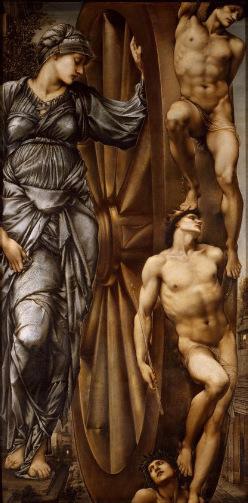
This delicately drawn study is one of a number of sheets executed by Burne-Jones as he developed the figure of the goddess Fortune for his monumental painting The Wheel of Fortune, completed and immediately exhibited at the Grosvenor Gallery, London, in 1883 and now in the collection of the Musée d'Orsay, Paris (inv. no. RF 1980 3). There are at least four other versions of the composition in existence, all with slightly differing details, including one in the The National Gallery of Victoria, Melbourne (inv. no. 381-2; see J. McPhee, Masterpieces from the National Gallery of Victoria, Melbourne, 1996, p. 48) and another in the National Museum of Wales, Cardiff (inv. no. NMW A 206; see M. Harrison & W. Waters, Burne-Jones, New York, 1973, p. 133).
The Wheel of Fortune was conceived as part of a larger project, The Story of Troy (The Troy Triptych) (Birmingham City Museum and Art Gallery, inv. no. 1922P1J8; see M. Harrison & W. Waters, op. cit., p. 103), which Burne-Jones had begun in 1870 following a trip to Italy, where he had encountered several sources of inspiration, including Andrea Mantegna's altarpiece of the Virgin and Child with Saints at the Church of San Zeno, Verona, and Michelangelo's frescoes for the Sistine Chapel. The composition of The Wheel of Fortune was for one of the four allegorical figures (Fortune, Fame, Love and Oblivion) that frame and divide the predella panels of the Troy Triptych
Sir Edward Coley Burne-Jones, BT., A.R.A., R.W.S., The Wheel of Fortune, oil on canvas, Musée d’Orsay, Paris, inv. RF 1980 3.
EGON SCHIELE (1890-1918)
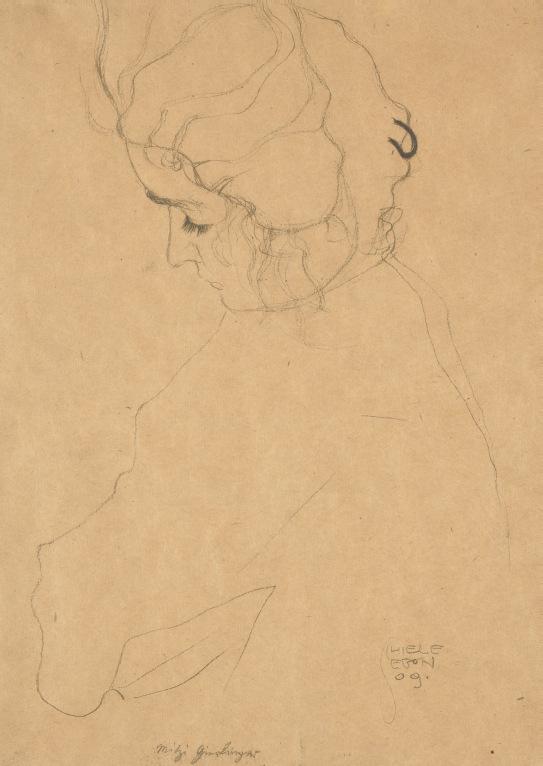
Mitzi Gierlinger
signed and dated SCHIELE EGON 09. (lower right) pencil on paper
31,3 x 22,5 cm. (12º x 8√ in.)
Drawn in 1909
£30,000-50,000
US$41,000-67,000
€35,000-57,000
PROVENANCE:
Acquired by 1985; then by descent to the present owners.
LITERATURE:
J. Kallir, Egon Schiele: The Complete Works, London, 1998, no. 276, p. 378-379 (ill.).
Executed in 1909, when Egon Schiele was just 19 years old, this intimate drawing of Mitzi Gierlinger belongs to a pivotal year in the artist’s development, and is an early example of the striking and expressive draftsmanship that would come to define Schiele’s work. Mitzi Gierlinger depicts the daughter of Johann Gierlinger, a blacksmith living just outside Vienna, with whom Schiele was lodging at the time. Having left the Vienna Academy earlier that year and unable to afford professional models, Schiele relied largely on family and friends as sitters. Gierlinger later recalled that Schiele drew her many times in the courtyard of the house. Depicted in profile, with her hair piled atop her head and heavy eyelashes cast downward, Mitzi appears to be lost in thought, or perhaps reading as suggested by similar compositions of her from the same year, one of which is in the Minneapolis Institute of Art. The quiet intimacy of the scene situates the viewer as a close observer, privy to a contemplative moment.
The year 1909 marked a crucial turning point in Schiele’s life and career, commonly heralded as the moment of his breakthrough to artistic maturity. Dissatisfied with the conservative aesthetics and teaching of the Vienna Academy, Schiele left the institution to form the Neukunstgruppe, positioning himself in opposition to academic convention. That same year, he was invited by his mentor Gustav Klimt to participate in the Internationale Kunstschau, where his work was exhibited alongside that of established Austrian and international artists, affirming his emergence as a significant new voice in Viennese modernism.
Mitzi Gierlinger captures the artist in this moment of transformation, as his technical confidence and emotional expressiveness began to coalesce into a distinctly personal language, bearing early explorations of elements that would become central to Schiele’s oeuvre. Schiele’s precocious skill as a draftsman is evident; in the portrait he achieves a striking sense of realism through clean, economical line and contour. At the same time, the line varies expressively: Mitzi’s eyebrows and eyelashes are rendered with intensity, drawing attention to her downward gaze, while the loose, searching strokes that describe the stray hairs at her temples and the nape of her neck introduce a sense of tenderness and immediacy. The sitter appears peaceful and self-contained yet subtly charged with inner tension.
This intimacy invites the viewer to consider the sitter’s internal world, revealing Schiele’s growing sensitivity to the psychological nuance which would define his work. The elevated perspective and tightly cropped composition, suggesting Mitzi is observed from above, are characteristic of Schiele’s drawings from 1909 onward, creating a sense of proximity and shared space between the subject and viewer that reinforces the intimacy which pervades the work.
The expressive charge of the figure is heightened by her isolation within the picture plane. Mitzi Gierlinger is set against an almost entirely blank background, removed from any spatial context. From 1909 onwards, the influence of Gustav Klimt’s densely ornamented backgrounds begins to recede as Schiele’s focus shifts decisively toward the human figure. Increasingly, his subjects are thrust into a pictorial void, where compositional emptiness intensifies vulnerability and emotional presence. This stark opposition between figure and ground would remain a central feature of Schiele’s work throughout his career. Here, the absence of context draws the viewer’s attention entirely to Mitzi’s introspective state. The present work encapsulates the significance of 1909 as a year of metamorphosis in Schiele’s career. Created on the threshold of profound personal and stylistic change, Mitzi Gierlinger captures both the intimacy of a moment and the beginning of a radically new artistic direction.
OTTO DIX (1891-1969)
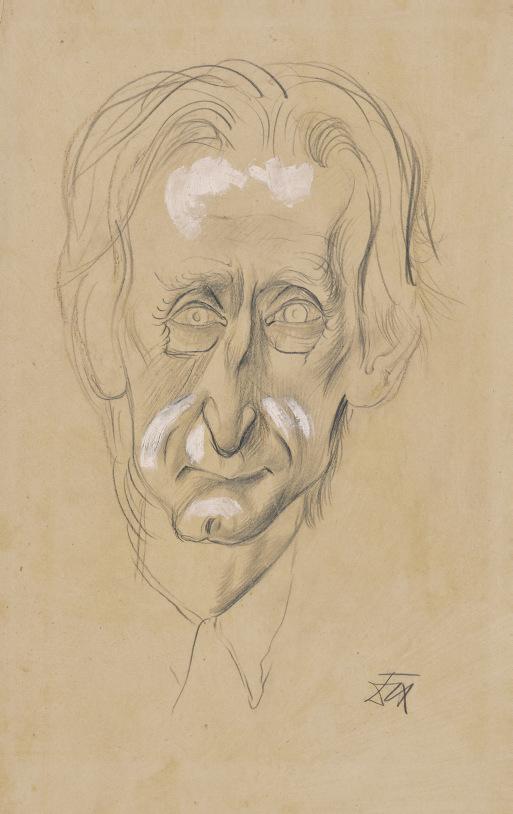
Kopf des Dichters Iwar von Lücken
signed DIX (lower right)
gouache and pencil on paper laid down on card
41,6 x 25,7 cm. (16¡ x 10¿ in.)
Executed circa 1925-1926
£15,000-20,000
US$21,000-27,000
€18,000-23,000
PROVENANCE:
Galerie Wolfgang Ketterer, Munich, 8 December 1970, lot 191. Kornfeld & Klipstein, Bern, 23 June 1982, lot 166.
Galerie Michael Hasenclever, Munich; acquired at the above sale. Acquired from the above in November 1982; then by descent to the present owners.
EXHIBITED:
Ingelheim am Rhein, Museum Altes Rathaus, Der Traum von einer neuen Welt - Berlin 1910-1933, April - June 1989.
Hamburg, Hamburger Kunsthalle, Aus der Werkstatt des Künstlers – Druckgraphik und vorbereitende Zeichnungen der Sammlung Hegewisch, March 1999 - October 2000, pp. 71 (ill.) & 106 (titled 'Iwar von Lücken' and dated '1926').
LITERATURE:
U. Lorenz, Otto Dix - Das Werkverzeichnis der Zeichnungen und Pastelle, vol. III, Bonn, 2002, no. NSk 2.6.5, p. 1011 (ill.; with incorrect medium).
The important final oil painting for which this work served as a study, Der Dichter Iwar von Lücken (1926), was also previously owned by Klaus Hegewisch. Iwar von Lücken was a Baltic-German poet whom Otto Dix portrayed in the 'New Objectivity' style characteristic of the Weimar period. The life-size painting was sold by Klaus Hegewisch to the Berlinische Galerie, Berlin, where it is held today.
Helena (Tut) Schlemmer (the artist's wife), Stuttgart; by descent from the artist. Dieter Keller, Stuttgart, by 1965; probably acquired from the above.
Galerie Michael Hertz, Bremen.
Acquired from the above in February 1967; then by descent to the present owners.
EXHIBITED:
Hamburg, Kunstverein in Hamburg, Meister der Zeichnung in der deutschen Kunst des 20. Jahrhunderts, September - October 1967, no. 201, p. 203 (ill.; with incorrect dimensions); then Frankfurt am Main, Frankfurter Kunstverein, October - December 1967.
LITERATURE:
W. Grohmann, Oskar Schlemmer - Zeichnungen und Graphik, Stuttgart, 1965, no. ZB 406, pp. 276 (ill.) & 277.
The Human Figure
*912
CIRCLE OF AGOSTINO CARRACCI
(1557-1602)
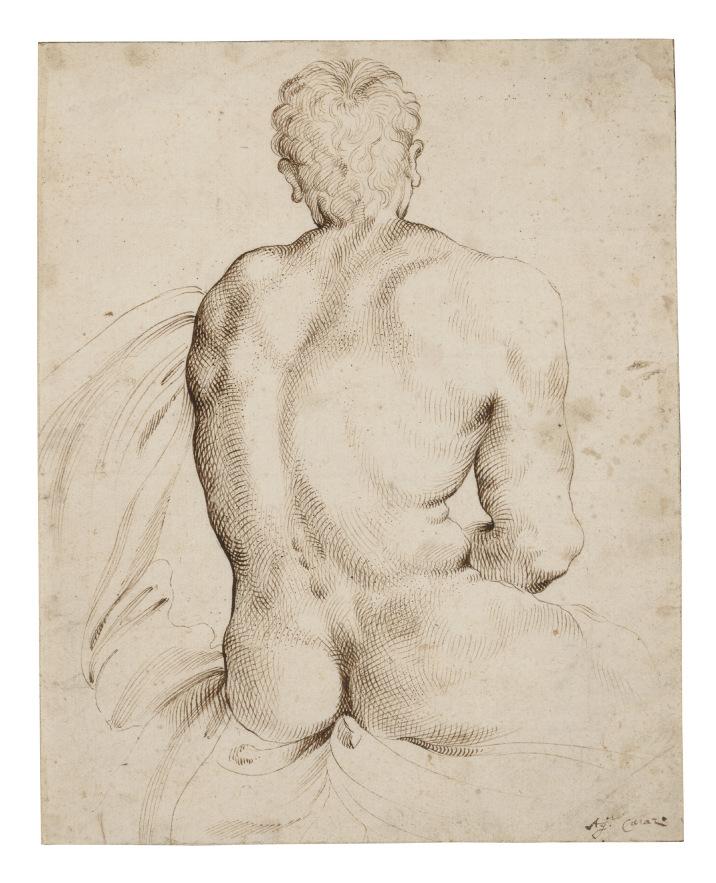
Seated male Nude seen from behind with inscription Ag.no Caraz. (lower right) pen and brown ink on paper 25,4 x 20,3 cm. (10 x 8 in.)
£4,000-6,000
US$5,400-8,100
€4,600-6,900
PROVENANCE:
Sotheby's, London, 5 December 1977, lot 75 (as Agostino Carracci). Acquired at the above sale; then by descent to the present owners.
EXHIBITED:
Hamburg, Hamburger Kunsthalle, Aus der Werkstatt des Künstlers –Druckgraphik und vorbereitende Zeichnungen der Sammlung Hegewisch, March 1999 - October 2000, pp. 14 & 85, ill. (as Agostino Carracci). Hamburg, Hamburger Kunsthalle, Agostino Carracci - Die Schule der Zeichnung, 2001 (no cat.).
The author of this study was most likely an artist in the circle of the Carracci in Bologna. The composition reminds one of the engravings in the Scuola perfetta per imparare a disegnare tutto il corpo humano, a teaching manual published in the early 17th century and based on drawings by Agostino Carracci. The subject derives from one of the figures in the lower portion of Michelangelo’s Last Judgement (see The Illustrated Bartsch, 39, Italian Masters of the Sixteenth Century, no. 71).
LEARN MORE
*913
GIOVANNI BATTISTA TIEPOLO (1696-1770)
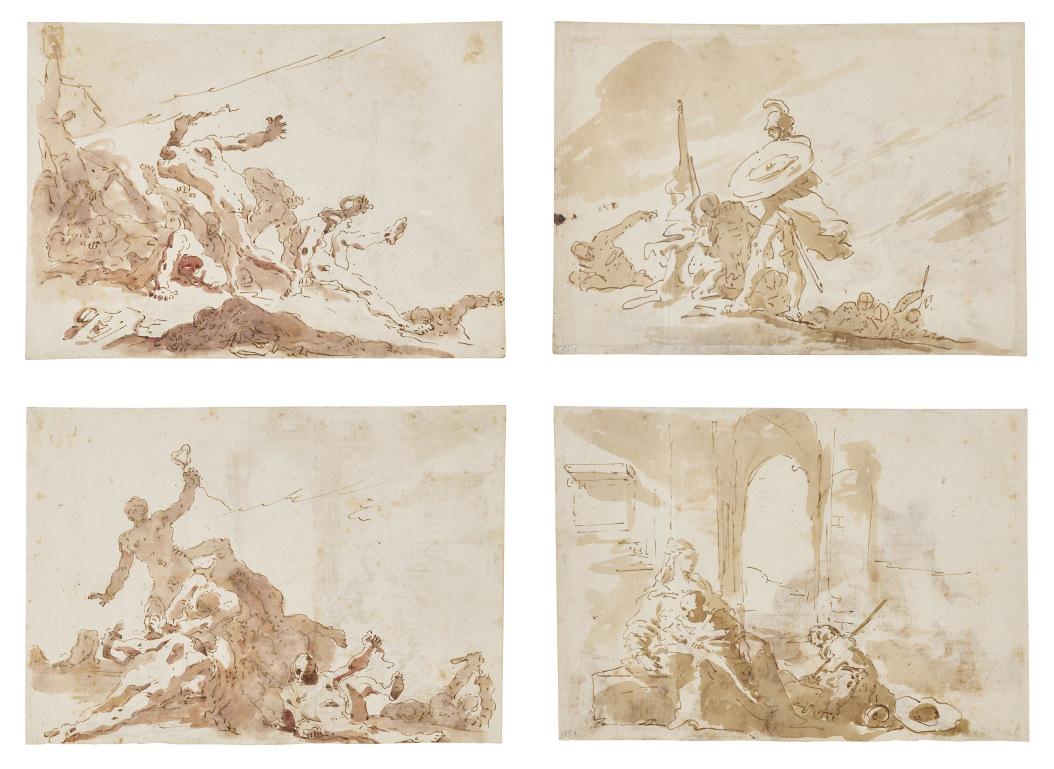
Studies for Figures in Moses and the Bronze Serpent (recto); The Death of Sophonisba (verso); and Studies for Figures in Moses and the Bronze Serpent (recto); The Holy Family (verso)
pen and brown ink, brown and red wash (recto); pen and brown ink, brown wash (verso)
14,3 x 20,3 cm. (5¬ x 8 in.) (each)
£15,000-25,000
US$21,000-34,000
€18,000-29,000
PROVENANCE:
Archduke Friedrich Ferdinand Leopold of Austria (1821–1847), Vienna. Karl & Faber, Munich, 4 June 1981, lot 915 (part lot).
Charlotte von Prybram-Gladona (1910-2002), Salzburg.
Karl & Faber, Munich, 7 June 2005, lots 150 & 152.
Acquired at the above sale; then by descent to the present owners.
LITERATURE:
H. Voss, Un Taccuino di Disegni del Tiepolo Giovane, 'Saggi e Memorie di storia dell'arte', II, 1958-59, pp. 315, 317-322.
These two drawings were part of a now dispersed album commonly referred to as the Gdansk Album. Several sheets from the album have been identified in the last half-century, including a double-sided study in the Prado, Madrid (inv. no. FD215), a sheet in the Wallraf-Richartz Museum, Cologne (see: Disegni del Tiepolo, exh. cat., Udine, 1965, p. 57, no. 10, ill.) two sheets, one double-sided, in the Lorser Feitelson Collection at the Art, Design & Architecture Museum, Santa Barbara (inv. no. 1985.163a and 1985.163b; see: Old Master Drawings from the Feitelson Collection , exh. cat., Santa Barbara, University Art Museum, University of California, 1983, no. 63), and finally three sheets, two of which are double-sided, in the National Museum, Gdańsk (see Tiepolo i tiespoleschi w zbiorach polskich rysunki, ryciny, obrazy, exh. cat., Warsaw, Muzeum Narodowe, 1997, nos. 3–5).
Like most of the sheets in this group, the two drawings depict nude men wrestling with serpents. These are studies for the biblical story of Moses and the Bronze Serpent (Numbers 21:4–7). The story of Moses and the Bronze Serpent seems to have interested Tiepolo for several years. The subject is depicted in the background of the painting Alexander and Campaspe in the Montreal Museum of Fine Arts, which is generally dated to around 1725-6 (Giambattista Tiepolo 1696-1770 , exh. cat., Paris, Musée du Petit Palais, 1998-1999, no. 13), while a large fresco of this subject, now in the Gallerie dell'Accademia, Venice, was painted around 1728.
(recto)
(verso)
(recto)
(verso)
LEARN MORE
EDGAR DEGAS (1834-1917)
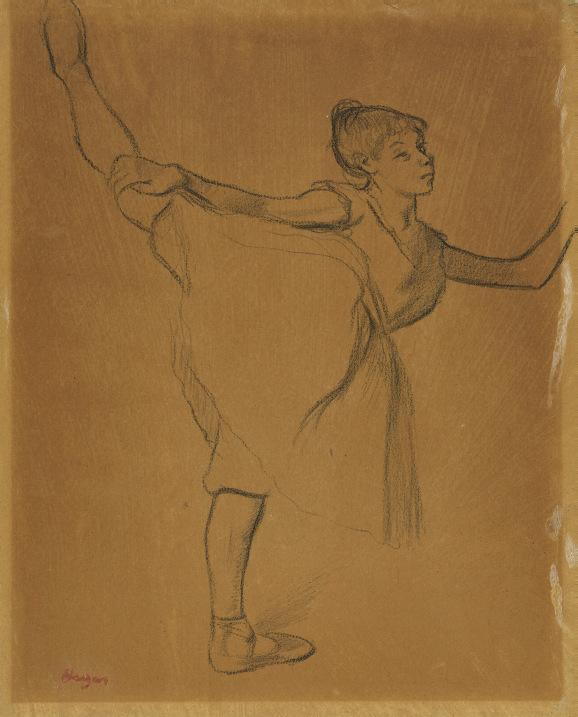
Danseuse, la jambe droite levée stamped with the signature Degas (Lugt 658; lower left) charcoal on buff paper laid down on board 31 x 24,5 cm. (12º x 9¬ in.)
£30,000-50,000
US$41,000-67,000
€35,000-57,000
PROVENANCE:
The artist's estate; 3rd sale, Galerie Georges Petit, Paris, 7 April 1919, lot 84a.
Galerie Durand-Ruel, Paris; acquired at the above sale. Durand-Ruel Galleries, New York; acquired from the above in January 1920.
A. Gallatin, New York; acquired from the above on 13 March 1920. Sotheby's, New York, 12 November 1988, lot 115. Acquired at the above sale; then by descent to the present owners.
EXHIBITED:
New York, Durand-Ruel Galleries, Exhibition of Pastels and Drawings by Degas, March 1920, no. 23.
Hamburg, Hamburger Kunsthalle, Weibsbilder, September 2000March 2001 (no cat.).
Detroit, Detroit Institute of Arts, Degas and the Dance, October 2002 - January 2003, no. 159, pp. 145 (ill.), 146 & 291 (titled 'Dancer Stretching in Attitude', with incorrect dimensions and dated 'circa 1880'); then Philadelphia, Philadelphia Museum of Art, FebruaryMay 2003.
Hamburg, Hamburger Kunsthalle, Von Delacroix bis CezanneFranzösische Zeichnungen des 19 Jahrhunderts, November 2004 - February 2005 (no cat.).
Hamburg, Hamburger Kunsthalle, Degas: Intimität und Pose, February - May 2009, no. 18, pp. 64 (ill.), 65 & 132 (ill.; with incorrect medium, dimensions and dated 'circa 1880').
LITERATURE:
L. Browse, Degas Dancers, London, 1949, no. 81, p. 365 (ill.; titled 'Danseuse se dégourdissant à la barre' and dated 'circa 1880-1882').
In Danseuse, la jambe droite levée, the figure of the ballet dancer- the most emblematic of Degas’ subjects- is presented in the arabesque penché position. Requiring strength and suppleness, the artist’s eye is captivated by the dancer’s prowess; her leg, although held aloft in tension, remains in balance, rendering the pose both elegant and seemingly effortless. A fine example of Degas’ famed draughtsmanship, his own artistic adroitness is here declared as much as that of his model. Significantly influenced by the advent of photography, Degas composes his drawings with a quintessentially modern sense of immediacy and spontaneity.
LEARN MORE
*915
MAX KLINGER (1857-1920)
Reclining female Nude, seen from above (recto), Reclining female Nude seen from the Front (verso)
signed and dated M.K. 88. (lower right)
pencil on blue-grey paper
30,8 x 46 cm. (12¿ x 18¿ in.)
£3,000-5,000
US$4,100-6,700
€3,500-5,700
EXHIBITED:
Hildesheim, Roemer und Pelizaeus Museum, Max Klinger: Wege zum Gesamtkunstwerk, August - November 1984, no. 61, p. 272, fig. 19.
Hamburg, Hamburger Kunsthalle, Weibsbilder, September 2000March 2001 (no cat.).
LEARN MORE
OSKAR KOKOSCHKA (1886-1980)
Zwei Aktstudien nach Lilith Lang, Tochter des Gauklers (recto); Sitzender Akt nach Lilith Lang (verso)
signed with the artist's initials OK. (recto; lower left) black crayon on paper
44,6 x 30,7 cm. (17Ω x 12¿ in.)
Executed in 1907
£40,000-60,000
US$54,000-81,000
€46,000-69,000
PROVENANCE:
Mercury Gallery, London. Galerie Welz, Salzburg; probably acquired from the above, until at least 1971. Acquired by 1999; then by descent to the present owners.
EXHIBITED:
Salzburg, Galerie Welz, Meister des 20. Jhdts - Gemälde, Plastik, Aquarelle, Zeichnungen, Summer 1968, no. 43, p. 14 (illustrated p. 28; recto titled 'Studienblatt Kinderakte', dated 'circa 1906-1907' and with incorrect medium; verso titled 'Rückseitig sitzender Mädchenakt mit aufgestütztem Arm und andere Details').
London, Mercury Gallery, Summer Exhibition, June - September 1969, no. 183 (ill.; recto titled 'Two nude girls', dated 'circa 1905-1906', with incorrect medium and dimensions; verso titled 'Seated girl', dated 'circa 1905-1906', with incorrect medium and dimensions).
Hamburg, Hamburger Kunsthalle, Experiment Weltuntergang: Wien um 1900, April - May 1981, no. 69, p. 65 (ill.; recto titled 'Tochter des Gauklers', dated '1906-1907' and with incorrect medium; verso titled 'Sitzende und Profilstudie', dated '1906-1907', with incorrect medium and inverted dimensions).
Vienna, Albertina, Oskar Kokoschka: Das Frühwerk (1897/98 - 1917)Zeichnungen und Aquarelle, March - May 1994, nos. 36 & 37 (ill.; recto titled 'Zwei stehende weibliche Akte einander zugewandt; Detailstudien' and with incorrect medium; verso titled 'Sitzender Mädchenakt, die rechte Hand aufgestützt; Detailstudien', with incorrect medium and inverted dimensions).
New York, Solomon R. Guggenheim Museum, Oskar Kokoschka - Works on Paper: The Early Years, 1897-1917, June - August 1994, no. 17, pp. 84 & 86-87 (ill.; recto titled 'Zwei stehende weibliche Akte einander zugewandtDetailstudien' and with incorrect medium; verso titled 'Sitzender Mädchenakt,
die rechte Hand augestützte; Detailstudien' and with incorrect medium). Hamburg, Hamburger Kunsthalle, Aus der Werkstatt des Künstlers –Druckgraphik und vorbereitende Zeichnungen der Sammlung Hegewisch, March 1999 - October 2000, pp. 52-53 & 100-101 (ill.; recto titled 'Zwei stehende weibliche Akte einander zugewandt, Detailstudien' and with incorrect medium; verso titled 'Sitzender Mädchenakt, die rechte Hand aufgestützt, Detailstudien', with incorrect medium and inverted dimensions). Rome, Complesso del Vittoriano, Klimt, Kokoschka, Schiele - Dall'art nouveau all'espressionismo, October 2001 - February 2002, no. 46, p. 111 (ill.; recto titled 'Due nudi di ragazza', dated 'circa 1907', with incorrect medium and dimensions; verso titled 'Nudo di ragazza seduto'); then Trieste, Civico Museo Revoltella, February - April 2002.
Vienna, Belvedere, Oskar Kokoschka: Träumender Knabe - Enfant Terrible, January - May 2008, no. 32, p. 69 (ill.; recto with incorrect medium).
LITERATURE:
E. Rathenau, Oskar Kokoschka: Handzeichnungen 1906-1969, New York, 1971, nos. 11 & 12, p. 12 (ill.; recto titled 'Tochter des Gauklers, Studie zur Lithofolge 'Die träumenden Knaben'', dated '1906-1907' and with incorrect medium; verso titled 'Tochter des Gauklers', dated '1906-1907' and with incorrect medium).
I. Dolinschek, Oskar Kokoschkas Entwicklung als Illustrator 1906 bis 1909Eine Untersuchung anhand der Illustrationen 'Die träumenden Knaben' und 'Mörder, Hoffnung der Frauen', Eichstätt, 1983, nos. 19 & 20, pp. 44, 150 & 164 (ill.; titled 'Tochter des Gauklers').
W.J. Schweiger, Der junge Kokoschka: Leben und Werk 1904-1914, Vienna, 1983, pp. 48 & 60 (ill.; verso titled 'Studie zu einem sitzenden Mädchen', with incorrect medium and dimensions).
Kühn, Oskar Kokoschka und 'Der Sturm', Münster, 1987, no. 94 (ill.).
A. Weidinger, Oskar Kokoschka: Dreaming Boy and Enfant Terrible, exh. cat., Stenersen Museum, Oslo, 1996, no. 58, p. 46 (ill.; recto titled 'Two Nude Studies of Lilith Lang', with incorrect medium and dimensions).
A. Weidinger & A. Strobl, Oskar Kokoschka - Die Zeichnungen und Aquarelle 1897-1916, Salzburg, 2008, nos. 190 & 191, pp. 110-111 (recto ill. p. 110; verso ill. p. 111).
(verso)
Oskar Kokoschka became infatuated with the model for these drawings, Lilith Lang, to the disapproval of some of her progressive but nevertheless respectable family- her father was a lawyer, and her mother a prominent women’s rights activist. His interest in her quickly developed into an obsession.
Recognising Kokoschka’s talent, the Principal of the Wiener Werkstätte (The Vienna Workshop) commissioned from him an illustrated children’s story. By this time Kokoschka, aged 21, had met the 16-year-old Lilith at the Kunstgewerbeschule (School of Arts and Crafts) in Vienna. He promptly substituted the commission with his own more subversive illustrated narrative poem Die träumenden Knaben (The Dreaming Boys; the print portfolio is also present in the Hegewisch Collection), which he dedicated to Klimt and for which the present drawings were probably preparatory studies. The verse tells the story of a young boy and a girl named Li who live in an Edenic forest full of plants, exotic birds and other animals. The boy’s rite-of-passage visions and erotic dreams constitute a barely disguised pean from the artist to Lilith. He would later describe the book as his first love letter.
The Wiener Werkstätte was a pioneering centre of artistic ideas and Kokoschka would find a new distinctive voice there as his art transitioned away from decorative Jugendstil towards Expressionism.
These studies pinpoint a key moment of stylistic evolution as they prefigure elements of the final colour lithographs in the published book.
The present work shows the elegant figure of Lilith seen from behind and again in profile as she reaches her arms behind her back. On the reverse, the same figure sits with eyes closed, one leg tucked under the other, leaning on an outstretched hand. Viewed from slightly above, this perspective over-emphasises the size of her head in relation to her body. Kokoschka uses continuous lines to render the body’s lineaments. The face is depicted as fresh, delicate, and alluring - glossy long hair trails down her back and her lips are full and slightly parted; her eyes, wide and heavily lidded. These features contrast starkly with her thin body. The contortion of each pose, coupled with the economy of line, seen for example in the jutting shoulder blade of the first figure, demonstrates Kokoschka’s mastery of anatomical draughtsmanship and heighten a sense of the artist’s empathy for the subject’s unguardedness.
Although deliberately exaggerated, there is an unflinching honesty to these studies which steadfastly renounce flattery and privilege instead a physical but non-literal ‘truth’. This is fairy tale laid bare; the nudity is indicative of an otherworldly arcadianism as much as eroticism. Kokoschka’s expressionistic distortion of form would influence key artists including his near contemporary, Egon Schiele.
(recto)
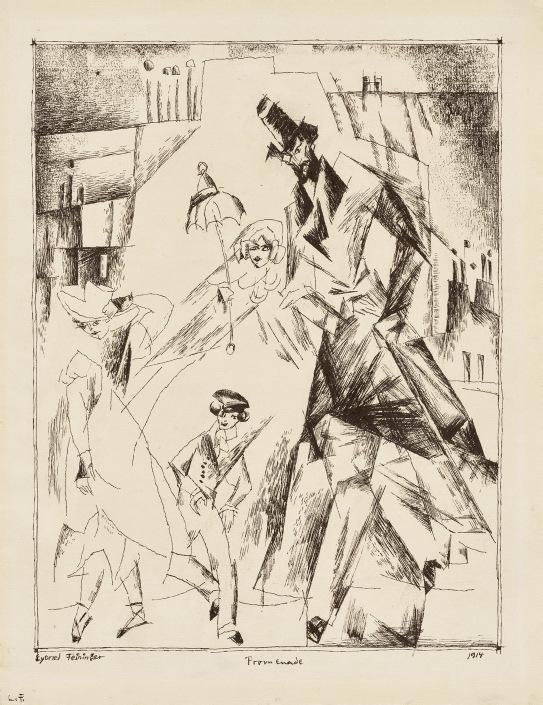
LYONEL FEININGER (1871-1956)
Promenade
signed, dated and inscribed Lyonel Feininger Promenade 1914 (along the lower edge); signed again with the artist's initials and inscribed X L.F. (lower left); with the estate stamp FEININGER ESTATE (on the reverse)
pen and India ink on paper
30,8 x 23,5 cm. (12¿ x 9º in.)
Executed in 1914
£50,000-70,000
US$68,000-94,000
€58,000-80,000
PROVENANCE:
The artist's estate.
Marlborough-Gerson Gallery, New York; acquired from the above in September 1971.
Galerie Otto Stangl, Munich; acquired from the above in June 1973; Hauswedell & Nolte, Hamburg, 6 June 1974, lot 457.
Donald Thomas Bergen (1930-2009), London; acquired at the above sale.
Private collection, United Kingdom; Christie's, London, 2 December 1980, lot 240.
Hauswedell & Nolte, Hamburg.
Acquired from the above in October 1989; then by descent to the present owners.
EXHIBITED:
Dresden, Galerie Emil Richter, Lyonel Feininger: SonderAusstellung seiner Gemälde, Aquarelle, Zeichnungen und Holzschnitte, September 1919, no. 141 (with incorrect medium).
Hanover, Kestner-Gesellschaft, Paul Klee, Lyonel Feininger: Gemälde, Graphik, XXIX. Sonder-Ausstellung, November 1919January 1920, no. 165.
Chicago, Allan Frumkin Gallery, Lyonel Feininger: Etchings, Drypoints, Lithographs, Drawings, 1902-1924, December 1974, no. 28 (with incorrect medium and dimensions).
Notre Dame, Art Gallery, University of Notre Dame, German Expressionist Drawings from the Collection of D. Thomas Bergen, May - June 1977, no. 10, pp. 16-17 & 32 (ill.; with incorrect medium and dimensions).
Kiel, Kunsthalle, Lyonel Feininger: Gemälde, Aquarelle und Zeichnungen, Druckgraphik, June - August 1982, no. 33, p. 93 (ill.; with incorrect medium and dimensions).
Lugano, Museo Cantonale d'Arte, Lyonel Feininger: La variante tematica e tecnica nello sviluppo del processo creativo, September - November 1991, no. VI.3, p. 91 (ill.; with incorrect medium and dimensions). Hamburg, Hamburger Kunsthalle, Lyonel Feininger: Die Zeichnungen und Aquarelle, January - April 1998, no. 48, pp. 83 & 211-212 (ill.; with incorrect medium); then Tübingen, Kunsthalle, April - June 1998. Hamburg, Hamburger Kunsthalle, Aus der Werkstatt des Künstlers –Druckgraphik und vorbereitende Zeichnungen der Sammlung Hegewisch, March 1999 - October 2000, pp. 56 & 101 (ill.; with incorrect medium).
Hamburg, Hamburger Kunsthalle, Lyonel Feininger: Menschenbilder - Eine unbekannte Welt, October 2003 - February 2004, no. 90, pp. 95 & 151 (ill.; with incorrect medium and dimensions).
Yokosuka, Yokosuka Museum of Art, Lyonel Feininger: Retrospective in Japan, August - October 2008, no. 60, pp. 82 & 195 (ill.; with incorrect medium); then Nagoya, Aichi Prefectural Museum of Art, October - December 2008; and Sendai, The Miyagi Museum of Art, January - March 2009.
Ingelheim am Rhein, Museum Altes Rathaus, Lyonel Feininger, Alfred Kubin - Eine Künstlerfreundschaft, May - August 2015, p. 122 (ill.; with incorrect medium); then Vienna, Albertina, September 2015 - January 2016.
Apolda, Kunsthaus Apolda Avantgarde, Traumstadt - Lyonel Feininger und seine Dörfer, September - December 2019, no. 54, p. 101 (ill.; with incorrect medium).
Dating from 1914, Promenade marks a pivotal moment in Lyonel Feininger’s career, when he forged a fully synthesised pictorial language at the intersection of Cubism and German Expressionism. Informed by his exposure to Cubist innovations in Paris and rooted in the expressive and spiritual concerns of his German background, the work belongs to the decisive phase in which Feininger turned away from caricature toward his mature artistic idiom. Here, his formal vocabulary coalesces in fractured planes, rhythmic diagonals, and compressed architectural and spatial elements that would remain central to his oeuvre
Achim Moeller, Managing Principal of The Lyonel Feininger Project LLC, has confirmed the authenticity of this work. The work is registered in the archives of The Lyonel Feininger Project LLC, New York - Berlin with the no. 2031-1126-25.
*918
LYONEL FEININGER (1871-1956)
Spaziergänger (Promenade)
woodcut
1918 on thin, laid Kozo Japan paper signed in pencil
presumably an unnumbered proof aside from the deluxe edition of ten on this paper and the standard edition on German paper of one hundred, published in Neue Europäische Graphik I, by the Staatliches Bauhaus, Weimar, 1921, with the Bauhaus blindstamp at lower left with margins in very good condition
Block 37 x 29,3 cm. (14Ω x 11¬ in.)
Sheet 41 x 35 cm. (16º x 13æ in.)
£6,000-8,000
US$8,100-11,000
€6,900-9,200
PROVENANCE:
Kornfeld & Klipstein, Bern.
Acquired from or through the above, invoiced on 6 February 1968; then by descent to the present owners.
EXHIBITED:
Hamburg, Hamburger Kunsthalle, Aus der Werkstatt des Künstlers –Druckgraphik und vorbereitende Zeichnungen der Sammlung Hegewisch, March 1999 - October 2000, p. 57 (ill.) & 101-102.
Yokosuka, Yokosuka Museum of Art, Lyonel Feiniger: Retrospective, August - October 2008; then Aichi Prefectural Museum of Art, Nagoya, OctoberDecember 2008; and The Miyagi Museum of Art, Sendai, January - March 2009, no. 68 (ill.), p. 82.
LITERATURE:
L. Prasse, Lyonel Feininger - A Definitive Catalogue of his Graphic Work: Etchings, Lithographs and Woodcuts, Cleveland,1972, no. W 113, p. 171 (another impression ill.).
K. Weber, Punkt Linie Fläche - Druckgraphik am Bauhaus, Berlin, 1999, no. 1.2., p. 36 & 38 (another impression ill.).
This large and important woodcut, closely related to previous drawing of 1914 (see lot 917) but taken to a greater degree of abstraction, was published in the first portfolio of prints by the master teachers of the Bauhaus. Feininger met its founder and director Walter Gropius in 1918 and joined the Bauhaus in Weimar as a teacher the following year. In 1921 he was appointed director of the school's print workshop.
LEARN MORE
*919
LYONEL FEININGER (1871-1956)
Two Hurrying Men
dated MAR 22 08 (lower right) pencil on paper
13,3 x 10,5 cm. (5º x 4¿ in.)
Drawn in Paris on 22 March 1908
£500-800
US$680-1,100
€580-920
PROVENANCE:
Alois J. Schardt (1889-1955), Berlin, Halle & Los Angeles; a gift from the artist. Achim Moeller Fine Art, New York. Private collection, Paris; Kunsthaus Lempertz, Cologne, 4 December 2004, lot 975.
Acquired at the above sale; then by descent to the present owners.
EXHIBITED:
Nuremberg, Germanisches Nationalmuseum, Feininger à Paris, June - August 1992, no. 90, pp. 88 (ill.) & 103; then Paris, Grand Palais, XVIe Biennale des Antiquaires, Feininger à Paris: Lyonel Feininger - Les Dessins Parisiens, 1892-1911, September - October 1992; and New York, Achim Moeller Fine Art, November 1992 - January 1993.
Achim Moeller, Managing Principal of The Lyonel Feininger Project LLC, has confirmed the authenticity of this work. The work is registered in the archives of The Lyonel Feininger Project LLC, New York - Berlin with the no. 2032-1126-25.
LEARN MORE
WILLI BAUMEISTER (1889-1955)
Athleten
signed and dated Baumeister 33 (lower right) charcoal, pencil and estompe on paper
43,5 x 33,7 cm. (17¿ x 13º in.)
Executed in 1933
£8,000-12,000
US$11,000-16,000
€9,200-14,000
PROVENANCE:
Hans Hildebrandt (1878-1957), Stuttgart; a 60th birthday gift from the artist on 29 January 1947.
Dr Rainer Hildebrandt (1914-2004), Berlin; by descent from the above. Kunsthandel Wolfgang Werner, Bremen; by 1984; probably acquired from the above.
Acquired from the above in February 1985; then by descent to the present owners.
EXHIBITED:
Bremen, Kunsthandel Wolfgang Werner, Zeichnungen, Summer 1984, no. 2 (ill.). Stuttgart, Staatsgalerie, Willi Baumeister: Zeichnungen, Gouachen, Collagen, April - June 1989, no. 67, p. 123 (ill.); then Kassel, Museum Fridericianum, July - September 1989; Edinburgh, The Fruitmarket Gallery, December 1989January 1990; and Bern, Kunstmuseum, February - April 1990 (no cat.).
LITERATURE:
D.J. Ponert, Willi Baumeister: Werkverzeichnis der Zeichnungen, Gouachen und Collagen, Cologne, 1988, no. 528, p. 209 (ill.).
The work is registered in the archives of the Archiv Baumeister im Kunstmuseum Stuttgart.
LEARN MORE
*921
HENRI MATISSE (1869-1954)
Odalisque (Femme étendue)
signed Henri - Matisse (lower right)
pen and India ink on paper 28,5 x 38,7 cm. (11¿ x 15º in.)
Executed circa 1921-1922
£150,000-250,000
US$210,000-340,000
€180,000-290,000
PROVENANCE:
Galerie Étienne Bignou, Paris, by 1926. Galerie Aktuaryus, Zurich.
Werner Bär (1899-1960) & Nelly Bär (1910-1975), Zurich; acquired from the above in 1944; their estate sale, Sotheby Parke Bernet, London, 30 March 1977, lot 82.
Acquired at the above sale; then by descent to the present owners.
EXHIBITED:
London, The Lefèvre Galleries, Exhibition of Works by Henri Matisse, June 1927, no. 26 (titled 'Jeune fille étendue'; dated '1925').
Amsterdam, Musée Municipal, Cent ans de peinture Française, April - May 1928, no. 27 (dated 'circa 1924').
Winterthur, Kunstmuseum, Die Plastiksammlung Werner Bär, SeptemberNovember 1951, no. 132, p. 19.
Zurich, Kunsthaus, Zwei Zürcher Sammlungen, Werner Bär - Plastik, Kurt Sponagel - Graphik, August - September 1959, no. 151, p. 26; then Bern, Kunstmuseum, September - November 1959.
Kassel, Alte Galerie, Museum Fridericianum, Orangerie, Documenta IIIHandzeichnungen, June - October 1964, no. 1, p. 148 (ill.; titled 'Liegende Odaliske').
Saint-Paul de Vence, Fondation Maeght, À la rencontre de Matisse, JulySeptember 1969, no. 37, p. 35 (ill.; with incorrect medium).
Hamburg, Hamburger Kunsthalle, Weibsbilder, September 2000 - March 2001 (no cat.).
Basel, Fondation Beyeler, Henri Matisse - Figur, Farbe, Raum, March - July 2006 (ex. cat.).
Hamburg, Hamburger Kunsthalle, Parcours: Bilder vom Orient, May - August 2006, no. 51, p. 53.
Stuttgart, Staatsgalerie, Matisse: Menschen, Masken, Modelle, September 2008 - January 2009, no. 61, p. 156 (ill.; with incorrect medium); then Hamburg, Bucerius Kunst Forum, January - April 2009.
Hamburg, Hamburger Kunsthalle, Mit dem inneren Auge sehen - Meisterwerke aus der Sammlung Hegewisch, September 2016 - January 2017, no. 17, pp. 72 (ill.) & 76 (titled 'Liegende Odaliske').
LITERATURE:
C. Zervos (ed.), Cahiers d’Art, no. 6, Paris, July 1926 (ill.).
W. Bär, Sammlung Werner und Nelly Bär, Zurich, 1965, pp. 160 (ill.) & 255.
G.-P. & M. Dauberville, Matisse: Henri Matisse chez Bernheim-Jeune, vol. II, Paris, 1995, no. 529, p. 1083 (ill.).
K. Engler, 'Hamburg Kultur', in: Welt am Sonntag, no. 38, Berlin, 2000, p. 120 (ill.; dated 'circa 1928').
Reclining on a sumptuously upholstered chaise longue, the titular figure in Henri Matisse’s Odalisque (Femme étendue) gazes unabashedly towards the viewer, her cheek resting against her hand as she props herself up against the cushions behind her. She is dressed in rich costume, with swathes of ornately textured robes draped across her, gathering into thick folds of fabric as they flow over her sinuous body. Odalisque (Femme étendue) was executed circa 1921-1922 while the artist resided in Nice.
Matisse had first come to this city on the shore of the Mediterranean in late 1917, keen to escape the bitter cold of Paris winters. Enamoured by the quality of light in Nice, as well as its temperate climate, Matisse returned each winter, taking up residence at the Hôtel Méditerranée et de la Côte d’Azur, until September 1921. He would later rent an apartment of his own on the place Charles-Félix, which would become his base for almost two decades and the setting of some of his most celebrated works.
During Matisse’s initial sojourn in Nice in 1917, a mutual friend arranged for him to visit Pierre-Auguste Renoir, who lived in the nearby Cagnes-sur-Mer. By then in his late seventies, Renoir suffered from crippling arthritis but remained devoted to his art, painting every day except Sunday. Matisse deeply admired the old painter’s dedication and fortitude, and the two developed a friendship that lasted until Renoir’s death in 1919. The scholar Jack Flam noted the influence of their time together over Matisse’s pictorial output, declaring that ‘Renoir gave him the impetus to make new contact with his own sensuality’ (Matisse: The Man and his Art 1869-1918, New York, 1986, p. 473). Indeed, Renoir’s example inspired Matisse to shift away from the austerity of his wartime works, and to explore new ways of depicting volume, texture, and light, as well as establishing his enduring appreciation for the odalisque, which would remain a favoured subject over the following decades.
One of the most prominent themes of 19th century Orientalist paintings, the odalisque manifested in Western art as an alluring, seductive figure plucked from a European fantasy of life in the East. The motif had been canonised by a number of the century’s most revered French artists, such as Jean-Auguste-Dominique Ingres and Eugène Delacroix, and so, when Matisse began to give more prevalence to the subject following the end of World War I, he place himself into a richly established tradition and into the legacy of these celebrated masters. Renoir, too, was a part of this art-historical lineage, and the sensuality that subsequently emerged in Matisse’s odalisques, as well as his preoccupation with the subject matter itself, was indubitably galvanised by the pair’s relationship. Matisse’s interest in Orientalist subject matter was informed by his trips to Algeria and Morocco in 1906 and 1912-1913, respectively. During these travels the artist had been enraptured by the brilliance of light, vivacity of colour, and the elegant rhythms of ornamental designs. He had collected textiles since his days as a poor art student in Paris, and had acquired vibrant pieces to add to his collection in the souks of Morocco and the bazaars of Algeria.
Georges Matisse has confirmed the authenticity of this work.
LEARN MORE
The majority of Matisse’s elaborate textiles and Oriental furnishing came from a small boutique on the rue Royale in Paris, run by a merchant of Lebanese origin, but imported garments and fabrics were also readily available in the marketplaces of Nice and Marseille. Hilary Spurling, a biographer of the artist, suggested that Matisse’s 1919 collaboration with the Ballets Russes for their 1920 production of Le Chant du Rossignol had introduced the potential of costume to him. Over the ensuing years, Matisse enthusiastically incorporated elements of Orientalist costume into his odalisques, and lavishly decorated his apartment on Place Charles-Félix with Middle Eastern fabrics, drapery and furniture.
The present lot pulsates with Matisse’s passionate appreciation for textiles and materiality, as his skilled draughtsmanship transforms the eponymous odalisque’s attire into a symphony of patterns and textures. With light, delicate lines he evokes the gauzy translucence of his model’s diaphanous undergarment, while with bolder, layered strokes of ink he conveys the differing textures of the elaborate finishings; the embroidered trefoils and floral motifs, the beaded trim on the neckline, the twining threads of the tasseled cords, and the rich cuffs. Her sensual physicality and her compelling gravitas are amplified by the intensity of the concentrated lines that constitute her form. Matisse renders her in a more naturalistic style of figuration than he adopts for the room around her, asserting the entrancing dominance of her presence over the surrounding space.
λ*922
PABLO PICASSO (1881-1973)
Femme au Fauteuil No. 1 (d'après le rouge) ('Le manteau polonais')
lithograph 1949 on Arches wove paper signed in pencil, numbered 3/50 (there were also five or six artist's proofs)
Mourlot's third state (of four) the full sheet in very good condition
Image 69,5 x 54,7 cm. (27¡ x 21Ω in.)
Sheet 76 x 56,5 cm. (29√ x 22º in.)
£40,000-60,000
US$54,000-81,000
€46,000-69,000
PROVENANCE: Oscar Stern (1882-1961), Stockholm; then by descent; his posthumous sale, Kornfeld & Klipstein, Bern, 30 May 1964, lot 139. Acquired at the above sale; then by descent to the present owners.
EXHIBITED:
Hamburg, Hamburger Kunsthalle, Picasso, Der blinde MinotaurusDie Sammlung Hegewisch in der Hamburger Kunsthalle, February 1997, pp. 66-67 (ill.) & p. 88.
Oslo, Munch-Museet, Pablo Picasso - Den blinde Minotaurusgrafikk og tegning, November 2002 - February 2003 (no cat.). Hamburg, Ernst Barlach Haus - Stiftung Hermann F. Reemtsma, Pablo Picasso – Der Stier und das Mädchen – Meisterblätter aus der Sammlung Hegewisch, June - October 2010, no. 36 (ill.), p. 115.
LITERATURE:
G. Bloch, Picasso - Catalogue de l'oeuvre gravé et lithographié 1904-1967, Bern, 1968, vol 1, no. 586, p. 142 (another impression ill.)
F. Mourlot, Picasso Lithographe, Paris, 1970, no. 134, p. 109 (another impression ill.)
B. Rau, Pablo Picasso - Die Lithographien, Stuttgart, 1988, no. 386, p. 243 (another impression ill.)
Picasso’s Femme au Fauteuil lithographs depict Françoise Gilot, his partner at the time, shown seated frontally in the distinctive embroidered Polish coat he brought back from his trip to Wrocław in 1948. Her poised silhouette offered Picasso a stable framework through which to explore the expressive possibilities of lithography during his most intensive period of working at the Atelier Mourlot. Although the motif remains constant, he continued to make changes to the key- and colour stones from one state to another, reflecting different graphic schemes ranging from descriptive modelling to increasingly abstract and symbolic forms.
The two impressions presented here illustrate the boldness with which Picasso re-worked the composition from one state to the next. In the earlier state, Gilot’s features and the basic structure of the armchair remain legible, while the later state shows the figure distilled into sharper, more geometric forms. This dramatic shift exemplifies Picasso’s experimental approach in 1949, treating each state not as a modification of the last but as a new piece of art. Together, they offer a concise insight into the speed, variety and ambition of his post-war lithographic practice.
LEARN MORE
PABLO PICASSO (1881-1973)
Femme au Fauteuil No. 4 (d'après le violet)
lithograph 1949 on Arches wove paper signed in pencil, numbered 23/50 (there were also five or six artist's proofs)
Mourlot's fifth state (of seven) the full sheet in good condition
Image 69,7 x 54,7 cm. (27Ω x 21Ω in.)
Sheet 76 x 56 cm. (29√ x 22¿ in.)
£35,000-50,000
US$48,000-67,000
€41,000-57,000
PROVENANCE:
Galleria La Bussola, Turin (their stamp verso).
Dr Ernst Hauswedell, Hamburg, 28 November 1959, lot 701. Acquired at the above sale; then by descent to the present owners.
EXHIBITED:
Hamburg, Hamburger Kunsthalle, Picasso, Der blinde MinotaurusDie Sammlung Hegewisch in der Hamburger Kunsthalle, February 1997, pp. 68-69 (ill.), & pp. 88-89.
Oslo, Munch-Museet, Pablo Picasso - Den blinde Minotaurusgrafikk og tegning, November 2002 - February 2003 (no cat.).
Hamburg, Ernst Barlach Haus - Stiftung Hermann F. Reemtsma, Pablo Picasso – Der Stier und das Mädchen – Meisterblätter aus der Sammlung Hegewisch, June - October 2010, no. 37 (ill.), p. 116.
LITERATURE:
G. Bloch, Catalogue de l'oeuvre gravé et lithographié 1904-1967, Bern, 1968, vol I, no. 588, p. 143 (another impression ill.).
F. Mourlot, Picasso Lithographe, Paris, 1970, no. 137, pp. 231-237 (another impression ill.).
B. Rau, Pablo Picasso - Die Lithographien, Stuttgart, 1988, no. 395, p. 243 (another impression ill.)
Wondrous Creatures
ATTRIBUTED TO FRANS SNYDERS (1579-1657)
Hounds hunting a Hare
indistinctly signed (?) and dated 1643 (?) (lower left) black chalk heightened with white chalk on light brown paper, the upper left and lower right corners cut 26,8 x 42 cm. (10¬ x 16Ω in.)
£1,000-1,500
US$1,400-2,000
€1,200-1,700
PROVENANCE: Wolf Stubbe (1903-1994), Hamburg; Hauswedell & Nolte, Hamburg, 7 June 2000, lot 99 (as Frans Snyders).
Acquired at the above sale; then by descent to the present owners.
FERDINAND-VICTOR-EUGÈNE
DELACROIX (1798-1863)
Five Studies of Horses, three écorché
inscribed and numbered 5 pectoral / 6 le long du sabot 1 le long / omop. / 2 le court / 3. sous épineux / 8 sus épiney [sic] / 4 le grand / dorsal. (centre right)
pen and brown ink on paper 21,9 x 34 cm. (8¬ x 13¡ in.)
£5,000-7,000
US$6,800-9,400
€5,800-8,000
PROVENANCE:
Estate of the artist, with his studio stamp (Lugt 838a); his posthumous sale, Hôtel Drouot, Paris, 22-27 February 1864, possibly part of lot 507 ('Études anatomiques. d'après l'écorché et le squelette de cheval') Kornfeld, Bern, 24 June 1999, lot 381 (with other sheets). Acquired at the above sale; then by descent to the present owners.
The sheet is typical of Delacroix's equine studies, often executed from life. His tutor, the neo-classical artist Pierre-Narcisse Guérin (17741833), had encouraged him early on in his artistic career to study the natural world, rather than relying on copying from antiquity, which was standard practice for aspiring artists at that time. This, combined with the influence of the equestrian paintings by Théodore Géricault (17911824), lead to Delacroix studying the horse in great detail, as stated in his journal entry of 15 April 1823, where Delacroix expressed his wish to master the subject: 'I must absolutely begin to draw horses. I must go to the stables every morning, go to bed very early, and get up very early' (W. Pach (ed.), The Journal of Eugene Delacroix, New York, 1948, p. 46).
FRANCISCO DE GOYA Y LUCIENTES (1746-1828)
La Tauromaquia
a set of 32 etchings with burnished aquatint, drypoint and engraving from the set of 33, lacking plate 15
1815-16
on laid papers, with watermarks Serra, Morato, Arches, or without watermark a composite, almost uniform set, mostly printed in dark sepia First Edition, published by the artist, Madrid, 1816, Plate 11 from the Third Edition
very good impressions, printing sharply and with good contrasts, occasionally showing minor wear the sheets loose (as issued), with margins some minor cockling, creasing, staining and foxing otherwise in good condition
Plates 24,5 x 35 cm. (9æ x 13√ in.) (and similar)
Sheets 32,3 x 45 cm. (12¬ x 17æ in.) (and similar or smaller)
Overall 43,2 x 52 x 5,5 cm. (17 x 20Ω x 2º in.) (each box)
£40,000-60,000
US$54,000-81,000
€46,000-69,000
PROVENANCE:
Mostly acquired (individually or in group lots) from Galerie Kornfeld, Bern, between 1966 and 1980.
Zdenko Bruck (1903-1979?), Bern and Buenos Aires (Lugt 5407; Plate 14 only).
EXHIBITED:
Hamburg, Hamburger Kunsthalle, Goya - Das Zeitalter der Revolutionen 1789-1830, October 1980 - January 1981, nos. 256, 258-262, pp. 289-299 (six plates only).
Hamburg, Hamburger Kunsthalle, Francisco de Goya: Tauromaquia oder Die Kunst des Stierkampfs, July - October 2003 (no cat.).
Hamburg, Hamburger Kunsthalle, Pablo Picasso: La Tauromaquia oder Die Kunst des Stierkampfs, July - October 2005 (no cat.).
LITERATURE:
L. Delteil, Le peintre graveur illustré: Francisco Goya, Paris, 1922, nos. 224-237, 239-255 (other impressions ill.).
T. Harris, Goya - Engravings and Lithographs - Catalogue raisonné, Oxford, 1964, nos. 204-217, 219-236, pp. 305-328, 330-349 (other impressions ill.).
Goya had been an aficionado of bullfighting since his youth, but it was not before he was nearly seventy years of age that he turned to this grand and ancient rite as a subject of his art. In 1814-16 he created a series of etchings with aquatint depicting the evolution of the bullfight. In 1816 he published a selection of 33 of these prints under the title La Tauromaquia in a small edition of unknown size. The publication was met with little success - this First Edition remained the only one printed within the artist’s lifetime.
When Goya began working on these etchings, the Peninsular War (1808-1814), which Goya had so unflinchingly depicted in Los Desastres de la Guerra, had just ended. To a certain degree, La Tauromaquia can be seen as a continuation of the Desastres: once more Goya's subject is fighting, acts of cruelty, bravery, cowardice, and death. He is less interested in the colourful spectacle of the fiesta – the crowds in the stands are merely hinted at – than in the mortal encounter between man and bull, depicted in dark sepia ink and brilliant white highlights against a backdrop of varying tones of grey. It is these subtle gradations of the aquatint tone, depicting light and shade and evoking the heat and dust of the ring, which lend these dramatic, at times horrific scenes a haunting atmosphere and ethereal beauty.
*927
PABLO PICASSO (1881-1973)
La Tauromaquia
the complete set of 28 sugar-lift aquatints 1957 on Japon ancien paper unsigned a very rare proof set aside from the 12 additional suites included in the two deluxe editions with the two additional plates (B. 977 & 978; included only in the deluxe book edition of 12)
printed by Jacques Frélaut at Atelier Lacourière, Paris published by Ediciones la Cometa de la Editorial Gustavo Gili, Barcelona, 1959 the full sheets in very good condition
Plates 20 x 30 cm. (7√ x 11√ in.) (and similar)
Sheets 35 x 49,7 cm. (13æ x 19Ω in.) (and similar)
Overall 43,5 x 52,5 x 9 cm. (17¿ x 20æ x 3Ω in.) (box) (28)
£30,000-50,000
US$41,000-67,000
€35,000-57,000
PROVENANCE:
Editorial Gustavo Gili, Barcelona. Galerie Kornfeld, Bern, 18 June 2004, lot 129. Acquired at the above sale; then by descent to the present owners.
EXHIBITED:
Hamburg, Hamburger Kunsthalle, Pablo Picasso: La Tauromaquia oder Die Kunst des Stierkampfs, July - October 2005 (no cat.). Hamburg, Ernst Barlach Haus - Stiftung Hermann F. Reemtsma, Pablo Picasso – Der Stier und das Mädchen – Meisterblätter aus der Sammlung Hegewisch, June - October 2010, no. 42.1-28 (ill.), p. 116.
LITERATURE:
G. Bloch, Catalogue de l'oeuvre gravé et lithographe 1904-1967, Bern, 1968, vol 1, no. 950-978; pp. 207-212 (other impressions ill.).
P. Cramer, Pablo Picasso - The Illustrated Books, Geneva, 1983, no. 100, pp. 252-255 (other impressions ill.).
B. Baer & B. Geiser, Picasso - Peintre - Graveur, Bern, 1990, no. 970-998, pp. 294-331 (other impressions ill.).
Following in Goya's footsteps, Picasso's Tauromaquia is the second great series in the history of printmaking dedicated to the bullfight. Both Goya and Picasso based their prints on the classic text on the Spanish bullfight, Tauromaquia o arte de torear, by José Delgado (alias Pepe Illo), first published in Madrid in 1816. While Goya was foremost interested in conveying the drama and atmosphere of the fight, Picasso depicts the scenes as a visual - one might even say 'graphic' - spectacle. Picasso had made some first etchings on the theme of the corrida in 1928-29 (see Baer 136-141) and included some bullfighting scenes in the Suite Vollard (1930-37), but it seems that the sugar-lift technique employed here finally gave him the language to create a larger series on the subject. In their pared-down starkness and concise simplicity of form, some of the plates are reminiscent of the cave paintings of Altamira. The two very rare supplementary plates are different in character, more tonal, complex and in closer proximity to the event, and were therefore probably not included in the standard editions.
LEARN MORE
FERDINAND-VICTOR-EUGÈNE
DELACROIX (1798-1863)
Man in Armour on Horseback, with Studies of a Horse's Head and Cats' Heads
with inscription no. 204 (verso)
pen and brown ink, brown wash on paper 30,9 x 19,6 cm. (12¿ x 7æ in.)
£12,000-18,000
US$17,000-24,000
€14,000-21,000
PROVENANCE:
Estate of the artist, with his studio stamp (Lugt 838a); his posthumous sale, Hôtel Drouot, Paris, 22-27 February 1864, possibly lot 419 ('Cavalier arabe au galop. Dessin â la plume.') Christie's, London, 5 July 2005, lot 193. Galerie Paul Prouté, Paris (Dessins - Estampes, 2006, no. 21, ill.).
Acquired from the above; then by descent to the present owners.
This drawing appears to be preparatory (in reverse) for Delacroix's lithograph of 1829, Duguesclin au château de Pontorson, created for the Chroniques de France, although there are some differences to the final composition, notably the position of the horse. Other preparatory drawings for the lithograph exist, including Duguesclin à cheval, entouré de soldats et de femmes, près d'un château-fort (also in reverse), at the Louvre (inv. no. RF 3377; see: M. Sérullaz, Inventaire Général des dessins école Française: Dessins d'Eugéne Delacroix 17981863, Paris, 1984, p. 111, no. 148, ill.).
Whilst Delacroix painted lions and tigers frequently, the studies of cats' heads in the present drawing illustrate his fascination with the domestic animal. The art critic Jules Champfleury said of Delacroix's relationship with cats: 'At the head of the list of contemporary artists who have studied and painted the cat, stands Delacroix, a man of febrile and nervous temperament. The sketch-books sold after his death hear witness to his persevering studies of that animal. Nevertheless, there are no cats in his pictures, and for this reason: Delacroix made tigers of his cats! ... It is unfortunate, however, that the Romantic master did not leave behind any paintings of cats; he knew them better than anyone else and would have found in their faces ample material to exercise his active imagination.' (J. Champfleury, Les chats: Histoire; Moeurs; Observations; Anecdotes, Paris, 1869, pp. 125-6).
Ferdinand-Victor-Eugéne Delacroix, Duguesclin au château de Pontorson, 1829, lithograph
*929
ODILON REDON (1840-1916)
L' Aile
lithograph 1893 on Chine appliqué paper from the edition of 25 impressions printed by Becquet, Paris with wide margins
some pale foxing, otherwise in good condition
Image 31,8 x 24,5 cm. (12Ω x 9Ω in.)
Sheet 44,2 x 35,6 cm. (17Ω x 14 in.)
£5,000-7,000
US$6,800-9,400
€5,800-8,000
PROVENANCE:
Galerie Kornfeld, Bern, 18-19 June, 1998, lot 762 (unsold). Acquired after the above sale; by descent to the present owners.
LITERATURE:
A. Mellerio, Odilon Redon, New York, 1968, no. 122, p. 111 (another impression ill.).
S. Pinsky, M. Rosen, I. Mackenzie, Prints and Portfolios by Odilon Redon (1840-1916), exh. cat., London, June-July 1997, no. 21 (another impression ill.).
Within Odilon Redon's dark and melancholic printed oeuvre, this image of the divine winged horse Pegasus surrounded by an aureole of light is a remarkably uplifting work. Pinsky, Rosen and Mackenzie thought it might be symbolic of the recovery of his country several years after the defeat in the Franco-Prussian War of 1870-71. The 1890s in France, the height of the Belle Époque, were a period of optimism and renewed confidence.
It appears that Redon and the printer had envisaged an edition of fifty, but but the actual print-run did not exceed 25 impressions and a few trial proofs.
LEARN MORE
*930
EDGAR DEGAS (1834-1917) Amazone
stamped with the signature Degas (Lugt 658; lower left); with the atelier stamp (Lugt 657; upper right)
pencil on paper
21 x 35,1 cm. (8º x 13æ in.)
£15,000-20,000
US$21,000-27,000
€18,000-23,000
PROVENANCE:
The artist's estate; fourth sale, Galerie Georges Petit, Paris, 4 July 1919, lot 235a.
Nunès et Fiquet, Paris; acquired at the above sale. Probably Galerie Thannhauser, Lucerne (no. 742); by 1927.
Robert von Hirsch (1883-1977), Basel; his posthumous sale, Sotheby Parke Bernet, London, 27 June 1978, lot 817.
Acquired at the above sale; then by descent to the present owners.
EXHIBITED:
Hamburg, Hamburger Kunsthalle, Aus der Werkstatt des Künstlers –Druckgraphik und vorbereitende Zeichnungen der Sammlung Hegewisch, March 1999 - October 2000, pp. 25 (ill.) & 90 (dated '1867-1868').
Hamburg, Hamburger Kunsthalle, Von Delacroix bis Cézanne - Französische Zeichnungen des 19. Jahrhunderts - Werke aus der Sammlung Hegewisch und dem Kupferstichkabinett, November 2004 - February 2005 (no cat.).
Hamburg, Hamburger Kunsthalle, Degas: Intimität und Pose, February - May 2009, no. 128, p. 282 (ill.; dated '1867-1868').
LITERATURE:
J.S. Boggs, Degas at the Races, exh. cat., National Gallery of Art, Washington, 1998, fig. 43, p. 69. (ill.; titled 'Galloping Horse with Woman Rider' and dated '1867-1868').
LEARN MORE
*931
EDGAR DEGAS (1834-1917)
Chasseur au chapeau haut de forme with the atelier stamp (Lugt 657; on the reverse) pencil heightened with white on formerly coloured paper 45 x 28,5 cm. (17¬ x 11º in.)
£8,000-12,000
US$11,000-16,000
€9,200-14,000
PROVENANCE:
The artist's estate. Hector Brame, Paris. Marcel Louis Guérin, Paris. Christie's, London, 30 November 1982, lot 114. Acquired at the above sale; then by descent to the present owners.
EXHIBITED:
Hamburg, Hamburger Kunsthalle, Aus der Werkstatt des Künstlers –Druckgraphik und vorbereitende Zeichnungen der Sammlung Hegewisch, March 1999 - October 2000, pp. 27 (ill.) & 90 (dated 'circa 1873').
Hamburg, Hamburger Kunsthalle, Von Delacroix bis Cézanne - Französische Zeichnungen des 19. Jahrhunderts - Werke aus der Sammlung Hegewisch und dem Kupferstichkabinett, November 2004 - February 2005 (no cat.).
Hamburg, Hamburger Kunsthalle, Degas: Intimität und Pose, February - May 2009, no. 125, p. 279 (ill.; dated 'circa 1873').
PABLO PICASSO (1881-1973)
Cheval et taureau
dated and inscribed Boisgeloup 16 juillet XXXIV (along the left edge); dated and inscribed again Boisgeloup 16 juillet XXXIV (on the reverse)
pen and ink on paper
12 x 25,7 cm. (4æ x 10¿ in.)
Executed in Boisgeloup on 16 July 1934
£150,000-250,000
US$210,000-340,000
€180,000-290,000
PROVENANCE:
The artist's estate.
Marina Picasso (b. 1950), Paris; by descent from the above.
Galerie Jan Krugier & Cie., Geneva (no. JK 2861); on consignment from the above.
Acquired from the above in 1981; then by descent to the present owners.
EXHIBITED:
Munich, Haus der Kunst, Pablo Picasso: Eine Ausstellung zum hundertsten Geburtstag - Werke aus der Sammlung Marina Picasso, February - April 1981, no. 174, p. 337 & 339 (ill.; titled 'Stier und Pferd'); then Cologne, Josef-Haubrich-Kunsthalle, August - October 1981; and Frankfurt am Main, Städtische Galerie, October 1981 - January 1982.
Venice, Centro di Cultura di Palazzo Grassi, Picasso - Opere dal 1895 al 1971 dalla Collezione Marina Picasso, May - July 1981, no. 220, p. 328-329 (ill.; titled 'Toro e cavallo' and with incorrect medium).
Tokyo, The National Museum of Modern Art, Picasso: Masterpieces from Marina Picasso Collection and from Museums in U.S.A. and U.S.S.R., April - May 1983, no. 138, pp. 279 (ill.) & 336 (titled 'Bull goring a Horse' and with incorrect medium); then Kyoto, Municipal Museum, June - July 1983.
Bielefeld, Kunsthalle, Picasso - Todesthemen, January - April 1984, no. 50, pp. 212 (ill.) & 294-295 (titled 'Stier und Pferd').
Melbourne, National Gallery of Victoria, Picasso: Works from the Marina Picasso Collection in Collaboration with Galerie Jan Krugier, Geneva, with Loans from Museums in Europe and the United States of America and Private Collections, July - September 1984, no. 107, p. 116 (ill.; titled 'Taureau et cheval'); then Sydney, Art Gallery of New South Wales, October - December 1984.
Bielefeld, Kunsthalle, Picassos Surrealismus: Werke 1925-1937, SeptemberDecember 1991, no. 79a, p. 340 (ill.).
Paris, Musée Picasso, Picasso: Toros y Toreros, April - June 1993, no. 68, p. 174 (ill.) & 253 (titled 'Taureau et cheval' and with incorrect medium); then Bayonne, Musée Bonnat, July - September 1993; and Barcelona, Museu Picasso, October 1993 - January 1994.
London, Croydon Museum, Cock and Bull stories: A Picasso Bestiary, MarchMay 1995, p. 43 (ill.; titled 'Bull and Horse' and with incorrect medium).
Kyoto, The National Museum of Modern Art, Picasso: The Love and the Anguish - The Road to Guernica, October - December 1995, no. 26, pp. 99-100 (ill.; titled 'Bull goring a Horse' and with incorrect medium); then Tokyo, Tobu Museum of Art, December 1995 - March 1996.
Hamburg, Hamburger Kunsthalle, Pablo Picasso - Der blinde Minotaurus - Die Sammlung Hegewisch in der Hamburger Kunsthalle, February 1997, pp. 36-37 (ill.) & 80-81 (titled 'Stier und Pferd'; ill. again on the back cover).
Madrid, Museo Thyssen-Bornemisza, Picasso: Corrida de toros, 1934, January
- May 1999, no. 6, p. 48 (ill.; titled 'Toro y caballo' and with incorrect medium). Martigny, Fondation Pierre Gianadda, Picasso: Sous le soleil de Mithra, June - November 2001, no. P 57, p. 95 (ill.; titled 'Tête de taureau', with incorrect medium and dimensions); then Paris, Musée Picasso, November 2001 - March 2002.
Oslo, Munchmuseet, Pablo Picasso - Den blinde Minotaurus - grafikk og tegning, November 2002 - February 2003 (no cat.).
Münster, Graphikmuseum Pablo Picasso, Pablo Picasso and Marie-Thérèse Walter: Between Classicism and Surrealism, May - August 2004, pp. 207 (ill.) & 221 (titled 'Bull and Horse' and with incorrect medium).
Malaga, Museo Picasso, Picasso. Toros, April - July 2005, no. 47, pp. 164 (ill.) & 202 (titled 'Toro y caballo'; with incorrect medium).
Hamburg, Ernst Barlach Haus - Stiftung Hermann F. Reemtsma, Pablo Picasso - Der Stier und das Mädchen - Meisterblätter aus der Sammlung Hegewisch, June - October 2010, no. 18, p. 112 (ill.; titled 'Stier und Pferd').
LITERATURE:
C. Zervos, Pablo Picasso, vol. 8, Œuvres de 1932 à 1937, Paris, 1957, no. 211, pl. 98 (ill.; with incorrect medium).
S. Goeppert & H.C. Goeppert-Frank, La Minotauromachie de Pablo Picasso, Geneva, 1987, p. 25 (ill.; with incorrect medium).
Cheval et taureau shows the agonised yet intimate moment when a bull, head lowered for maximum upward force, thrusts one of its horns deep into the body of a horse whose deaththroes are rendered as an ecstasy of pain. The bull’s expression is one of savage ferocity as it obeys an atavistic instinct to gore its victim; its flared nostrils and angry brow speak of dominance, bloodlust and blind animality. Meanwhile the horse, with its head reared back, eyes widened, shrieks a final cry of terror.
Picasso’s affinity and identification with the power, virility and intensity of the bull is a motif which frequently recurs throughout his oeuvre - a multi-layered symbol expressive of the primordial life-force that charged his artistic vitality. In the context of his Spanish cultural heritage and more specifically the corrida the bull embodied notions of aggression and raw brutality while the horse represented nobility and sacrifice. The bullfight was a spectacle in which the tragic struggle between the forces of life and death, the essence of the human condition, was repeatedly reenacted.
More widely, the artist was fully aware of the rise of fascism in Italy and Germany at the time and was exploring ways in which the suffering and torment that contemporary political turmoil entailed could be portrayed. Cheval et taureau anticipates some of the aspects of his most famous anti-war painting Guernica, made two years later during the Spanish civil war, in which horse and bull stand for helpless suffering and untamed barbarity.
The mark-making here is as purposeful and direct as the subject matter is elemental, its confidence typical of Picasso’s bravura certitude. The composition is taut - its framing barely able to contain the power and dynamism of its figures. The bull has one front hoof raised as it uses the full force of its musculature to deliver the fatal injury to its quarry while the horse similarly raises its own leg, but this time in a paroxysm of pain, a travesty of its normal elegance as its belly and rear legs are brought to ground.
Picasso also delineates a mirroring between the beasts as if to underline the symbiosis of their relationship in this final act. The viewer cannot help but notice the sinuously feminine lines of the horse’s mane as it flies in twisted movement, marks which are echoed in the bull’s lustily swooshing tail. The intensity of the ink hatches around the bull’s head and shoulders also shadow the body of the horse and the upper background as if to emphasise this area of the drawing as the locus for pain and the corresponding sensation of it.
Picasso wrestled with the complexity of desire in its many forms throughout his career. His art often explored the troublingly conflicted urges of arousal and aversion and Cheval et taureau exemplifies his honest recognition, through visual metaphors of subjugation, that a primal longing for life could be inextricably linked to a capacity for ruthless cruelty.
λ*933
PABLO PICASSO (1881-1973)
Minotaure caressant une dormeuse, from: La Suite Vollard drypoint
1933 on Montval laid paper, watermark Vollard signed in pencil from the edition of 260 with narrow margins (there was also an edition of fifty with wider margins) published by Ambroise Vollard, Paris, 1939 the full sheet in very good condition
Plate 29,6 x 36,6 cm. (11¬ x 14.13/8 in.)
Sheet 33,8 x 44,4 cm. (13¡ x 17Ω in.)
£40,000-60,000
US$54,000-81,000
€46,000-69,000
PROVENANCE:
Henri Petiet, Paris; his number 363 in pencil at lower left (partially erased and repeated by another hand below).
Private Collection, USA.
Christie's, New York, 3 November 1998, lot 514. Acquired at the above sale (through Kornfeld); then by descent to the present owners.
EXHIBITED:
Oslo, Munch-Museet, Pablo Picasso - Den blinde Minotaurus - grafikk og tegning November 2002 - February 2003 (no cat.).
Hamburg, Ernst Barlach Haus - Stiftung Hermann F. Reemtsma, Pablo Picasso – Der Stier und das Mädchen – Meisterblätter aus der Sammlung Hegewisch June – October 2010, no. 14 (ill.), p. 112.
LITERATURE:
G. Bloch, Catalogue de l'oeuvre gravé et lithographe 1904-1967, Bern, 1968, vol 1, no. 201, p. 68 (another impression ill.).
B. Baer & B. Geiser, Picasso - Peintre - Graveur Bern, 1990, no. 369 ll.B.d., pp. 206-207 (another impression ill.).
The bull, the minotaur and the faun were important figures in Picasso's personal imagination, which in a variety of ways personified his complex and contradictory attitude towards women. For the present two etchings (see also lot 934) from the Suite Vollard - two of the most important and desirable plates in the series - he took inspiration from Rembrandt's etching of Jupiter and Antiope of 1659, and thus linked his own imagery to Greek mythology. The motif of the 'sleeping beauty' - with the onlooker caught between the conflicting impulses of desire and the wish not to disturb the sleeper - is an ancient and timeless motif, and occurs also with the gender roles reversed, as in the myth of Endymion and Selene.
LEARN MORE
λ*934
PABLO PICASSO (1881-1973)
Faune dévoillant une femme, from: La Suite Vollard
aquatint 1936 on Montval laid paper, watermark Picasso signed in pencil from the edition of 260 (there was also an edition of fifty with wider margins) published by Ambroise Vollard, Paris, 1939 the full sheet in very good condition
Plate 31,5 x 41,7 cm. (12Ω x 16¡ in.)
Sheet 34 x 45 cm. (13¡ x 17æ in.)
£40,000-60,000
US$54,000-81,000
€46,000-69,000
PROVENANCE:
Hauswedell & Nolte, Hamburg, 6 December 1997, lot 1029. Acquired at the above sale (through Kornfeld); then by descent to the present owners.
EXHIBITED:
Hamburg, Hamburger Kunsthalle, Picasso - Der blinde Minotaurus - Die Sammlung Hegewisch in der Hamburger Kunsthalle, February 1997, pp. 52-53 (ill.) & p. 85.
Oslo, Munch-Museet, Pablo Picasso - Den blinde Minotaurus - grafikk og tegning, November 2002 - February 2003 (no cat.).
Hamburg, Ernst Barlach Haus - Stiftung Hermann F. Reemtsma, Pablo Picasso
Rembrandt Harmenz. van Rijn (1606-1669), Jupiter and Antiope: the large Plate, 1659. Sold, The Sam Josefowitz Collection, Graphic Masterpieces by Rembrandt van Rijn, December 2023, Christie’s London, Lot 69
– Der Stier und das Mädchen – Meisterblätter aus der Sammlung Hegewisch, June – October 2010, no. 28 (ill.), p. 114.
LITERATURE:
G. Bloch, Catalogue de l'oeuvre gravé et lithographe 1904-1967, Bern, 1968, vol 1, no. 230, p. 75 (another impression ill.).
B. Baer & B. Geiser, Picasso - Peintre - Graveur, Bern, 1990, no. 609 VI.B.d., pp. 93-98 (another impression ill.).
Minotaure aveugle guidé par une fillette I, from: La Suite Vollard
drypoint with burin and scraper 1934 on Montval laid paper, watermark Vollard signed in pencil from the edition of 260 (there was also an edition of fifty with wider margins) published by Ambroise Vollard, Paris, 1939 the full sheet in very good condition
Plate 25,2 x 34,7 cm. (10 x 13æ in.)
Sheet 34,0 x 44,5 cm. (13¡ x 17Ω in.)
£8,000-12,000
US$11,000-16,000
€9,200-14,000
PROVENANCE: Estate of the artist.
Marina Picasso (b. 1950), Paris; by descent from the above.
Galerie Jan Krugier, Geneva. Acquired from the above; then by descent to the present owners.
EXHIBITED:
Hamburg, Hamburger Kunsthalle, Picasso - Der blinde Minotaurus - Die Sammlung Hegewisch in der Hamburger Kunsthalle, February 1997, pp. 44-45 (ill.) & p. 82.
Hamburg, Hamburger Kunsthalle, Aus der Werkstatt des Künstlers –Druckgraphik und vorbereitende Zeichnungen der Sammlung Hegewisch, March 1999 - October 2000, p. 81 (ill.) & 108-109.
Oslo, Munch-Museet, Pablo Picasso - Den blinde Minotaurus - grafikk og tegning, November 2002 - February 2003 (no cat.).
Hamburg, Ernst Barlach Haus - Stiftung Hermann F. Reemtsma, Pablo Picasso – Der Stier und das Mädchen – Meisterblätter aus der Sammlung Hegewisch, June – October 2010, , no. 22 (ill.), pp. 18, 28, 33 & 113.
Hamburg, Hamburger Kunsthalle, Mit dem inneren Auge sehen - Meisterwerke aus der Sammlung Hegewisch, September 2016 - January 2017, no. 27, p. 61 (ill.) & 76.
LITERATURE:
G. Bloch, Catalogue de l'oeuvre gravé et lithographe 1904-1967, Bern, 1968, vol 1, no. 222, p. 72 (another impression ill.).
B. Baer & B. Geiser, Picasso - Peintre - Graveur, Bern, 1990, no. 434 XII.B.d., pp. 306-310 (another impression ill.).
Lots 935 and 936 belong to a sequence of four works in Picasso’s Suite Vollard exploring the theme of the blind Minotaur. While the central motif remains constant—the Minotaur guided by a young girl observed by fishermen and a sailor—subtle changes alter the narrative. In lot 935, the girl, whose features identify her as Picasso’s mistress Marie-Thérèse Walter, gently leads the Minotaur while holding flowers, a symbol of sensuality. She is framed by an arch besides which, upside-down, hangs the scratched image of violent murder. This inset scene, engraved earlier in 1934 for a book by Benjamin Péret, refers to Jacques-Louis David’s The Death of Marat, to which Picasso added the figure of Marat's assassin, Charlotte Corday. Brigitte Baer suggested that the figure of Marat represents Marie-Thérèse, while the knife-wielding Corday symbolizes Picasso’s wife Olga Khokhlova. In lot 936, the girl strides forward holding a white dove, a symbol both of purity and peace. Despite the Minotaur’s size, her confident lead suggests a shift in power, and the inclusion of the dove perhaps Picasso’s hope for a gentler outcome to their relationship, which would however end shortly after.
LEARN MORE
λ*936
PABLO PICASSO (1881-1973)
Minotaure aveugle guidé par une fillette III, from: La Suite Vollard
etching with engraving, scraper and aquatint 1934 on Montval laid paper, watermark Picasso signed in pencil from the edition of 260 (there was also an edition of fifty with wider margins) published by Ambroise Vollard, Paris, 1939 the full sheet in very good condition
Plate 22,6 x 31,3 cm. (8√ x 12¡ in.)
Sheet 33,9 x 45,0 cm. (13¡ x 17¬ in.)
£12,000-18,000
US$17,000-24,000
€14,000-21,000
PROVENANCE:
The artist's estate.
Marina Picasso (b. 1950), Paris; by descent from the above. Sotheby's, London, 5 February 1982, lot 133. Acquired at the above sale; then by descent to the present owners.
EXHIBITED:
Hamburg, Hamburger Kunsthalle, Picasso, Der blinde Minotaurus - Die Sammlung Hegewisch in der Hamburger Kunsthalle, February 1997, pp. 46-47 (ill.) & p. 82. (cat. by C. Heinrich; intro. by W. Spies).
Oslo, Munch-Museet, Pablo Picasso - Den blinde Minotaurus - grafikk og tegning, November 2002 - February 2003 (no cat.).
Hamburg, Ernst Barlach Haus - Stiftung Hermann F. Reemtsma, Pablo Picasso – Der Stier und das Mädchen – Meisterblätter aus der Sammlung Hegewisch, June – October 2010, no. 25 (ill.), pp. 18 & 113-114. (cat. by A. Stolzenburg).
Hamburg, Hamburger Kunsthalle, Mit dem inneren Auge sehen - Meisterwerke aus der Sammlung Hegewisch, September 2016 - January 2017, no. 28, p. 62 (ill.) & 76. (catalogue by Jonas Beyer, with additional texts by Steven Reiss, Wolfgang Wittrock and an interview with the collector by Belinda Grace Gardner).
LITERATURE:
G. Bloch, Catalogue de l'oeuvre gravé et lithographe 1904-1967, Bern, 1968, vol 1, no. 224, p. 73 (another impression ill.).
B. Baer & B. Geiser, Picasso - Peintre - Graveur, Bern, 1990, no. 436 IV.B.d., pp. 312-313 (another impression ill.).
H. Bollinger, Picasso's Vollard Suite, Stuttgart, 1956, no. 95.
LEARN MORE
λ*937
PABLO PICASSO (1881-1973)
Le Taureau V lithograph
1945 on thin, tan wove paper a rare trial proof of the fifth state (of eleven) probably the full sheet some repaired paper losses and tears
Image 31,5 x 43,0 cm. (12¡ x 17¿ in.)
Sheet 40 x 55 cm. (15æ x 21¬ in.)
£4,000-6,000
US$5,400-8,100
€4,600-6,900
PROVENANCE:
The artist's estate.
Marina Picasso (b. 1950), Paris, with her stamp verso (Lugt 3698); by descent from the above.
Galerie Jan Krugier, Geneva; on consignment from the above. Acquired from the above in April 1996; then by descent to the present owners.
EXHIBITED:
Hamburg, Hamburger Kunsthalle, Picasso, Der blinde Minotaurus - Die Sammlung Hegewisch in der Hamburger Kunsthalle, February 1997, p. 60 (ill.) & p. 87.
Oslo, Munch-Museet, Pablo Picasso - Den blinde Minotaurus - grafikk og tegning, November 2002 - February 2003 (no cat.).
Hamburg, Ernst Barlach Haus - Stiftung Hermann F. Reemtsma, Pablo Picasso
– Der Stier und das Mädchen – Meisterblätter aus der Sammlung Hegewisch, June – October 2010, no. 32.1 (ill.) pp. 28-35 & 115.
LITERATURE:
G. Bloch, Catalogue de l'oeuvre gravé et lithographié 1904-1967, Bern, 1968, vol 1, no. 389, p. 111.
F. Mourlot, Picasso Lithographe, Paris, 1970, no. 17.5, pp. 27-30 (another impression ill.).
B. Rau, Pablo Picasso - Die Lithographien, Stuttgart, 1988, no. 94, p. 209 (another impression ill.)
I. Lavin, Picasso's Bulls or the History of Art from Behind, Berlin, 1993 (another impression ill.).
The following three impressions from Picasso’s famous sequence of lithographs Le Taureau (lots 937-939) are a remarkable record of the artist’s creative process, documenting, like stills from a motion picture reel by Eadweard Muybridge, the gradual progress of Picasso’s deconstruction of the animal. Executed on a single slab of limestone, the traditional material for lithography, Picasso worked his bull through eleven ‘states’ or stages. Beginning with a powerful specimen, horned head lowered in a display of aggression, the animal is pared back in successive states through erasure and redrawing. Lithography relies on the principle of the repulsion of grease and water, with the image drawn onto the surface with oily crayons and washes and then chemically fixed with a gum arabic etch. In stone lithography changes can be made by scraping away the surface in the drawn or inked areas, re-exposing the underlying, virgin stone, for correction or revision.
There is a dichotomy between the apparent hardness of the material, and the mutability of the images that can be created and altered on its surface, and in Le Taureau Picasso pushed this potential to new creative heights. By the fifth state (lot 937) the bull’s back has been lowered and the body crisscrossed by intersecting shapes abstracting the musculature of the animal. In the sixth state (lot 938), it’s bulk has been substantially reduced, and the head, scrotum, sheath, and tail clarified and redefined, re-emphasizing an archetypal profile of a bull. In the final five states the revisions are even more radical, culminating in the eleventh state (lot 939), in which it has been reduced to the barest essentials.
Jean Célestin, a master printer at the Imprimerie Mourlot, memorably described the making of this extraordinary series:
One day he began this famous bull. A superb bull, wonderfully plump. I thought it was finished. Far from it. Second state. Third state... By the final state, only a few lines remained. I watched him work. Removing and removing. I thought back to the first bull. I couldn't help but think, what I don't understand is that he is finishing where he should have started! But he was searching for his bull. And to arrive at this bull of a single line, well, he had gone through all those other bulls! (quoted in: H. Parmelin, 'Le mur de fer de Picasso', in F. Mourlot, Picasso Lithographe, 1970, n.p. [our translation]).
Fernand Mourlot records that 18 proofs of the first ten states were printed but no editions issued; only the eleventh, final state was published in an edition of fifty impressions.
LEARN MORE
λ*938
PABLO PICASSO (1881-1973)
Le Taureau VI
lithograph
1945 on cream Arches wove paper
a rare trial proof of the sixth state (of eleven) the full sheet, a deckle edge below in good condition
Image 30,2 x 44,2 cm. (12 X 17º in.)
Sheet 32,5 x 44,2 cm. ( 12æ x 17Ω in.)
£8,000-12,000
US$11,000-16,000
€9,200-14,000
PROVENANCE:
Galerie Jan Krugier, Geneva. Acquired from the above in 1996; then by descent to the present owners.
EXHIBITED:
Hamburg, Hamburger Kunsthalle, Picasso, Der blinde MinotaurusDie Sammlung Hegewisch in der Hamburger Kunsthalle, February 1997, p. 61 (ill.) & p. 87.
Oslo, Munch-Museet, Pablo Picasso - Den blinde Minotaurusgrafikk og tegning, November 2002 - February 2003 (no cat.). Hamburg, Ernst Barlach Haus - Stiftung Hermann F. Reemtsma, Pablo Picasso – Der Stier und das Mädchen – Meisterblätter aus der Sammlung Hegewisch, June – October 2010, no. 32.2 (ill.), pp. 28-35 & 115.
LITERATURE:
G. Bloch, Catalogue de l'oeuvre gravé et lithographié 1904-1967, Bern, 1968, vol 1, no. 389, p. 111 (another impression ill.).
F. Mourlot, Picasso Lithographe, Paris, 1970, no. 17.6, pp. 27-30 (another impression ill.).
B. Rau, Pablo Picasso - Die Lithographien, Stuttgart, 1988, no. 95, p. 209 (another impression ill.).
I. Lavin, Picasso's Bulls or the History of Art from Behind, Berlin, 1993 (another impression ill.).
PABLO PICASSO (1881-1973)
Le Taureau XI lithograph 1945 on Arches wove paper
a rare proof of the eleventh, final state, aside from the signed and numbered edition of fifty the full sheet, a deckle edge below in good condition
Image 28,6 x 38,5 cm. (11.2/8 x 15.2/8 in.)
Sheet 32,5 x 44,2 cm. (12√ x 17¡ in)
£6,000-8,000
US$8,100-11,000
€6,900-9,200
PROVENANCE:
Private Collection, Switzerland; Christies, New York, 3 November, 1998, lot 530.
Acquired at the above sale (through Kornfeld); then by descent to the present owners.
EXHIBITED:
Oslo, Munch-Museet, Pablo Picasso - Den blinde Minotaurusgrafikk og tegning, November 2002 - February 2003 (no cat.).
Hamburg, Ernst Barlach Haus - Stiftung Hermann F. Reemtsma, Pablo Picasso – Der Stier und das Mädchen – Meisterblätter aus der Sammlung Hegewisch, June – October 2010, no. 32.3 (ill.), pp. 28-35 & 115.
LITERATURE:
G. Bloch, Catalogue de l'oeuvre gravé et lithographié 1904-1967, Bern, 1968, vol I, no. 389, p. 111 (another impression ill.).
F. Mourlot, Picasso Lithographe, Paris, 1970, no. 17.11, p. 30 (another impression ill.).
B. Rau, Pablo Picasso - Die Lithographien, Stuttgart, 1988, no. 100, p. 211 (another impression ill.).
I. Lavin, Picasso's Bulls or the History of Art from Behind, Berlin, 1993 (another impression ill.).
LEARN MORE LEARN MORE
Dreams & Visions
JACQUES CALLOT (1592-1635)
La tentation de Saint Antoine etching 1634 on laid paper, watermark Double-headed Eagle (similar to Lieure 60) a very good, rich impression of this large print fifth, final state the full sheet, with deckle edges some pale foxing and a few rustmarks otherwise in good condition
Plate 35,6 x 46,5 cm. (14 x 18¡ in.)
Sheet 50 x 67 cm. (19æ x 26Ω in.)
£2,000-3,000
US$2,700-4,000
€2,300-3,400
PROVENANCE:
Galerie Kornfeld, Bern, 8 June 1966, lot 40 (erroneously as third state). Acquired at the above sale; then by descent to the present owners.
EXHIBITED:
Hamburg, Hamburger Kunsthalle, Verhext - Phantastische Graphik aus der Sammlung Hegewisch, November 1997 - April 1998 (no cat.).
LITERATURE:
J. Lieure, Jacques Callot: catalogue raisonné de l'oeuvre gravé, Paris, 1927, no. 1416, vol. 7, pp. 93-95 (another impression ill.).
FRANCISCO DE GOYA Y LUCIENTES (1746-1828)
Lo que puede un sastre, plate 52 from: Los Caprichos
etching with burnished aquatint, drypoint and engraving 1797-98 on laid paper, without watermark Harris' state II.1 (of three)
a very fine, early trial proof, with letters but before the exclamation mark in the title
a very rare trial proof before the edition published by the artist in 1799
(Harris recorded only three such proofs) printing sharply, with great contrasts and inky relief some aquatint left unburnished on and around the left hand of the phantom trimmed inside the platemark but retaining a blank border outside the image in good condition
Sheet 21,1 x 13,6 cm. (8¡ x 5¡ in.)
£10,000-15,000
US$14,000-20,000
€12,000-17,000
PROVENANCE:
Dr. Josef Hupka (1875-1944), Vienna (without stamp and not in Lugt; according to Kornfeld).
Galerie Kornfeld, Bern, 21 June 2001, lot 387. Acquired at the above sale; then by descent to the present owners.
EXHIBITED:
Hamburg, Hamburger Kunsthalle, Goya - Das Zeitalter der Revolutionen, 1789-1830, October 1980 - January 1981, no. 45, p. 98-99 (ill.).
Hamburg, Hamburger Kunsthalle, Verhext – Phantastische Graphik aus der Sammlung Hegewisch, November 1997 – March 1998 (no cat.).
LITERATURE:
L. Delteil, Le peintre graveur illustré: Francisco Goya, Paris, 1922, no. 89 (another impression ill.).
T. Harris, Goya - Engravings and Lithographs - Catalogue raisonné, Oxford, 1964, no. 87, pp. 125-126 (another impression ill.).
Titled Lo que puede un sastre! ('What a tailor can do!'), plate 52 of the Caprichos shows a young woman and other figures falling on their knees in front of a broken tree dressed as a bogeyman. It is clearly an allegory for the gullibility of the people, arguing that it takes very little to make them believe - in superstition, religion, authority and power. The demons in the air, depicted in delicate etched lines only, are clearly figments of the woman's fantasy, demonstrating how willingly her imagination adds to the charade.
Goya seems to have completed the plates almost without revisions before he started printing the edition; there are very few working or trial proofs of the Caprichos, most of which only show errors and omissions in the titles or tiny differences in the subject compared to the finished prints, such as the present example. Yet, these earliest impressions, pulled from pristine plates, allow us to appreciate Goya's mastery of etching and aquatint in their full splendour and subtlety.
FRANCISCO DE GOYA Y LUCIENTES (1746-1828)
Los Proverbios ('Los Disparates')
the complete set of 18 etchings with aquatint and drypoint circa 1816-24
on heavy wove paper, watermark Palmette and J.G.O. or without watermark with the lithographic title-page fine, rich impressions from the First Edition of three hundred copies published by the Real Academia de Nobles Artes de San Fernando, Madrid, 1864
the aquatint printing well, with a light, varied tone in the highlights the sheets loose, with wide margins generally in good condition
Plates 24,2 x 35,2 cm. (9Ω x 14.in.)
Sheets 32,4 x 47 cm. (12¡ x 18Ω in.) (and similar)
Overall 43.1 x 51.8 x 6.5 cm. (17 x 20¡ x 2Ω in.) (box)
£30,000-50,000
US$41,000-67,000
€35,000-57,000
PROVENANCE:
Sotheby's, London, 13 July 1972, lot 136. Acquired at the above sale; then by descent to the present owners.
EXHIBITED:
Hamburg, Hamburger Kunsthalle, Goya - Das Zeitalter der Revolutionen 17891830, October 1980 - January 1981, nos. 141-150, 152-154, 156-158, 160-162, 249b, pp.195-208, 286 (ill.) (14 plates only).
Hamburg, Hamburger Kunsthalle, Verhext - Phantastische Graphik aus der Sammlung Hegewisch, November 1997 - April 1998 (no cat.).
Hamburg, Hamburger Kunsthalle, Tierisch!, March - June 2008 (no cat.) (three plates only).
Hamburg, Hamburger Kunsthalle, Obscur – Klaus Hegewisch zum 90. Geburtstag, October 2009 - January 2010, pp. 4,5 (ill.) (two plates only).
LITERATURE:
L. Delteil, Le peintre graveur illustré: Francisco Goya, Paris, 1922, nos. 202-219 (other impressions ill.).
T. Harris, Goya - Engravings and Lithographs - Catalogue raisonné, Oxford, 1964, nos. 248-265, pp. 372-401 (other impressions ill.).
Francisco de Goya created his final and most enigmatic print series in the years between 1816 and 1824. The series was first published posthumously under the title Los Proverbios, although Goya's own annotations for the working proofs include the word 'disparates', meaning 'follies'. As a result, this print series is known by both titles. Like Goya's 'black' paintings, begun in 1819 after his recovery from a serious illness and filled with macabre visions, Los Proverbios are imbued with an overwhelming sense of absurdity and pessimism and appear to reflect Goya's precarious mental state at the time. Each of the etchings depicts isolated figures in dark, often nightmarish landscapes. While some plates appear more satirical, others depict gruesome monsters or attacks on innocents. The compositions have few precedents and virtually no parallels in 19th-century art, but may relate to the artist's interest in carnival themes, which he had often explored in his sketchbooks. It is doubtful that Goya ever intended them for a wider public. The fate of the plates after completion is only partly understood. It is known that the series originally comprised 22 plates, and these were left with Goya's son Xavier upon the artist's departure from Spain, remaining hidden until Xavier's death in 1854. Eighteen of them passed through two owners before coming to the Royal Academy of San Fernando in 1862, where they were cleaned and published for the first time in 1864 - it was only at this point that proverbs were assigned to each plate, which somehow seemed to relate to these enigmatic images. Meanwhile the four remaining plates had made their way to Paris, where they were discovered in the early 1870s. They were eventually published in the French periodical L'Art in 1877 and are hence not part of the present first edition.
LEARN MORE
WILLIAM BLAKE (1757-1827)
Illustrations of the Book of Job
the complete set of 22 engravings including the title-page 1823-25 on India appliqué paper on wove paper, some watermarked Whatman / Turkey Mill 1825, some without watermark a very fine, uniform set from the First Edition one of circa 150 sets on this paper with the word proof on each plate co-published by the artist and John Linnell, London, 1825-26 fine impressions, printing sharply and silvery, with intense contrasts with the original publication announcement label by John Linnell, dated March 1826 with wide margins, presumably the full sheets bound in a 19th-century burgundy Morocco binding, with the artist's name, title and date in gilt on the spine in very good condition
Plates 19,7 x 16,5 cm. (7æ x 6Ω in.) (and similar)
Sheets 41 x 31,5 cm. (16√ x 12º in.) (and similar)
Overall 43,8 x 34 x 1 cm. (17º x 13º x 1/2 in.) (book)
£10,000-15,000
US$14,000-20,000
€12,000-17,000
PROVENANCE:
Salman Schocken (1877–1959), Zwickau, Jerusalem and Pontresina (not in Lugt); his posthumous sale, Die BIbliotheken Salman Schocken & Karl Wolfskehl Teil I & II, Hauswedell & Nolte, Hamburg, 26-28 November 1975, lot 606.
Acquired at the above sale; then by descent to the present owners.
LITERATURE:
L. Binyon, The engraved designs of William Blake, New York, 1967, no. 105-126, pp. 65-76 (other impressions ill.).
D. Bindman, The complete graphic works of William Blake, London, 1978, no. 625-646, p. 486 (other impressions ill.).
Formally and technically, the Illustrations for The Book of Job are arguably William Blake's most coherent and sophisticated works in the print medium. They are perhaps the most elegant expression of his very idiosyncratic style and understanding of the world, and of his boundless imagination, teeming with monsters, demons and angels. The Book of Job is an ancient Hebrew text included in both Jewish and Christian scriptures. Job was a wealthy and righteous man, ‘blameless and upright, fearing God and shunning evil’ (Job 1:1). Job’s piety is challenged by Satan, who claims that Job’s righteousness is dependent on God’s blessing, and that, should God withdraw it, Job would curse Him. God grants Satan permission to test Job, and Job is afflicted with grievous trials, losing his children, wealth and health. The narrative centres on Job’s complaint to God, in which he protests his innocence and the injustice of his fate. The Book of Job is a meditation on the mystery of human suffering and challenges the conventional notion that God rewards virtue and punishes sin. When God finally speaks in the famous concluding chapters he neither explains his reasons for Job’s suffering nor defends his justice, but instead expounds his divine wisdom and authority.
In 1821 the artist John Linnell asked William Blake to make him a copy of a set of watercolours illustrating the story of Job, which Blake had first created in 1805-06 for his patron Thomas Butts. The original watercolours are now at the Pierpont Morgan Library, New York; the copies for Linnell at the Fogg Art Museum, Harvard. The commission was intended to relieve Blake’s precarious finances, and in 1823 Linnell had another idea to help his protégé: to create an engraved series of the subject. A contract was issued in March 1823, and Blake began to revisit his original designs. He reduced the scale of the images and sketched additional pencil studies and ideas for border designs. These sketches, originally in Linnell's collection, were sold at Christie's in 1935 and are now at the Fitzwilliam Museum, Cambridge. Although the engravings are dated 8 March 1825, they did not in fact appear until the following year, as stated in the original publication announcement, present in our copy. The present set is from the earliest publication. There were another 65 sets printed on French paper with the word proof, and a further one hundred on Whatman paper with the word proof erased, all as part of the First Edition. The Second Edition of one hundred copies was published by John Linnell in 1874.
LEARN MORE
*944
JOHN MARTIN (1789-1854)
Illustrations to Paradise Lost the complete set of 24 mezzotints, some plates with etching and touches of drypoint
1824-27
Plate 1 on wove paper, all others on laid paper, three with watermark T. DUPUY, two with watermark fragments a very fine lettered proof set of the First Edition (Large Version) very dark and velvety impressions, printing very sharply and with intense contrasts printed by Chatfield & Co. and J. Lahee, published by Septimus Prowett, London, with his address each plate engraved Proof or PROOF without text (as issued) the full sheets with very wide margins some foxing, surface dirt and other minor defects
Plates 25,5 x 35,5 cm. (9√ x 14 in.) (and similar)
Sheets 39 x 56 cm. (15Ω x 22 in.) (and similar) (24)
£8,000-12,000
US$11,000-16,000
€9,200-14,000
PROVENANCE:
Sotheby's, London, 2 December 1977, lot 54. Acquired at the above sale; by descent to the present owners.
EXHIBITED:
Hamburg, Hamburger Kunsthalle, John Martin: Paradise Lost, February - May 2007 (no cat.).
LITERATURE:
J. Campbell, J. Wees, R. Burnett, John Martin: Visionary Printmaker, York, 1992, nos. 26-73, pp. 38-89.
John Martin’s Paradise Lost, conceived between 1825 and 1827 as an illustrated companion to Milton’s 17th-century epic poem, stands among the most influential graphic projects of British Romanticism. An endeavour befitting the grandeur of the text, Martin’s set of twentyfour mezzotints captures the wild sublimity and luciform qualities of Milton’s poetry. Demonstrating astute foresight, the publisher Septimus Prowett chose Martin, a painter with limited printmaking experience as the illustrator, prioritising artistic sensibility over the practicalities of production. Indeed, the phantasmagorical wildernesses that came to characterise Martin’s printed oeuvre were already evident in his early paintings of Miltonic subjects, notably Adam’s First Sight of Eve (now at The Glasgow Museums).
Martin quickly developed a fluency in the mezzotint process. More than merely competent, he reached beyond the printmaking conventions of his contemporaries: dispensing with preparatory drawings, his subjects were executed directly onto the plates. This sense of invention paired with a reduced dependency on the etched line, allowed the artist to achieve a soft tonal range and celestial quality in pure mezzotint. The eternal opposition of light and dark that permeates through Paradise Lost is essential to Martin’s rendition. Isolated shafts of light delineate perspective and depth through vast, densely inked spaces. The author of The Chronicles of Narnia, C. S. Lewis (1898-1963), later observed of Milton’s cosmos: 'When we look up at the night sky, we are looking through darkness, but not at darkness.'
LEARN MORE
GUSTAVE DORÉ (1832-1883)
'Sorrow for the lost Lenore' - An illustration for Edgar Allan Poe: 'The Raven' signed G. Doré (lower left) black chalk, pen and black ink, grey wash, heightened with white on paper
together with: Edgar Allan Poe, The Raven, the complete book comprising 26 steel-engravings after Gustave Doré, 1883, with title and text, published by Samson Low, Marston, Searle and Rivington, London, 1883, with title and text, bound within the original paper-covered boards with the artist's name, title and design in gilt and black on the front, the binding worn
Sheet 52.6 x 35,6 cm. (20æ x 14 in.)
Book 47 x 38 cm. (18Ω x 14æ in.) (2)
£10,000-15,000
US$14,000-20,000
€12,000-17,000
PROVENANCE:
Piccadilly Gallery, London, 1978. Acquired from the above; then by descent to the present owners.
EXHIBITED:
Hamburg, Hamburger Kunsthalle, Verhext – Phantastische Graphik aus der Sammlung Hegewisch, November 1997-July 1998 (no cat.).
Hamburg, Hamburger Kunsthalle, Aus der Werkstatt des Künstlers – Druckgraphik und vorbereitende Zeichnungen der Sammlung Hegewisch, March 1999 - October 2000, p. 36 (ill.) & p. 94.
ENGRAVED:
By F. S. King in: E. A. Poe, The Raven, London, Sampson Low, 1883, New York, Harper & Brothers, 1884 (see H. Leblanc, Catalogue de l’œuvre complet de Gustave Doré, Paris, 1931, pp. 280-281).
This large and imposing sheet is a preliminary drawing for an engraved illustration to the publication of Edgar Allan Poe’s The Raven of 1883. It illustrates the second stanza of the poem:
Ah, distinctly I remember it was in the bleak December; And each separate dying ember wrought its ghost upon the floor. Eagerly I wished the morrow;—vainly I had sought to borrow From my books surcease of sorrow—sorrow for the lost Lenore— For the rare and radiant maiden whom the angels name Lenore— Nameless here for evermore.
Doré was one of the most sought-after and active illustrators of the latter half of the 19th century. He illustrated publications such as Dante’s Divine Comedy (between 1861 and 1868) and Milton’s Paradise Lost (1866), amongst many others. The Raven was to be Doré’s final project; he produced 26 large illustrations for the poem, completing the
series of drawings just before his death in January 1883 – with the book being published posthumously.
Several drawings of similar technique and dimensions for The Raven are known, some of which are in public collections, including: ANATKH at the Musée d’Art Moderne et Contemporain, Strasbourg (inv. no. 55.992.13.31; see Gustave Doré. L’imaginaire au pouvoir, exh. cat., Paris, Musée d’Orsay, and Ottawa, National Gallery of Canada, 2014, no. 76, ill.); For the rare and radiant maiden whom the angels name Lenore –/ nameless here for evermore in the National Gallery of Canada, Ottawa (inv. no. 14935; see ibid., no. 228, ill.); Le Corbeau et la Mort in the Museé d’Orsay, Paris (inv. no. 266496, see Christie’s, Paris, 22 March 2023, lot 92). The preparatory drawing for ...here I opened wide the door; Darkness there and nothing more... was also part of the Hegewisch Collection and sold at Christie's, London, 16 October 2025, lot 303.
LEARN MORE
MAX KLINGER (1857-1920)
Meeresritt (Sea ride)
signed, inscribed and dated Max Klinger. / Bruxelles 1879. (lower left, on the artist's mount), and further inscribed Meeres - Ritt (lower centre, on the artist's mount) pen, brush and India ink and grey wash on paper 39 x 18 cm. (14¡ x 7¿ in.)
£20,000-30,000
US$27,000-40,000
€23,000-34,000
PROVENANCE:
Dr Johannes Mohrmann (d. 1906), Hamburg; his posthumous sale, Amsler & Ruthardt, Berlin, 30 October 1907, lot 119. Hans Steinwachs (1880-1934); Gutekunst & Klipstein, Bern, 14-15 June 1934, lot 253.
Kornfeld & Klipstein, Bern, 9 June 1976, lot 540. Acquired at the above sale; then by descent to the present owners.
EXHIBITED:
Possibly New York, Carus Gallery, Graphic Works of Max Klinger, May - June 1977 (catalogue untraced).
Berlin, Galerie Pels-Leusden, Max Klinger, February - May 1978. Hildesheim, Roemer und Pelizaeus-Museum, Max Klinger - Wege zum Gesamtkunstwerk, August - November 1984, no. 53, pp. 166 (ill.) & 271.
Frankfurt, Städtische Galerie im Städelschen Kunstinstitut, Max Klinger 1857-1920, February - June 1992, no. 77, p. 134 (ill.); then Leipzig, Museum der bildenden Künste; and Wuppertal, von der Heydt-Museum, June - September 1992.
Munich, Museum Villa Stuck, Max Klinger: Zeichnungen, Zustandsdrucke, Zyklen, October 1996 - January 1997, exh. cat., no. 94a, p. 191 (ill.). Hamburg, Hamburger Kunsthalle, Aus der Werkstatt des Künstlers –Druckgraphik und vorbereitende Zeichnungen der Sammlung Hegewisch, March 1999 - October 2000, pp. 34 (ill.) & 93-4. Hamburg, Museum für Kunst und Gewerbe, Nackt - Die Ästhetik der Blösse, February - April 2002.
LITERATURE:
S. Kim, Das Ornamentale in Max Klingers Druckgrafik - Unter besonderer Berücksichtigung der Antikenrezeption und des Japonismus, Heidelberg, 2007, vol. I, p. 160 (ill. in vol. II, fig. 109).
This erotic drawing of a couple embracing as they descend to the depths of the sea is a preliminary work for Klinger's print Verführung (Seduction), Plate IV of the artists' series of 14 etchings titled Ein Leben (Opus VIII), published in Berlin in 1884. The series of prints uses Symbolism to explore the social injustices facing women in the late 19th century. It tells the story of a young woman who, abandoned by both her lover and society, turns to a life of sex work. The print is also in the Hegewisch Collection.
Max Klinger, Verführung (Seduction), Plate IV, Ein Leben (Opus VIII)
MAX KLINGER (1857-1920)
Ein Handschuh - Opus VI the complete set of ten etchings 1878-80 on cream wove paper the final states, with the engraved name of the artist fourth, final edition of unknown size, published by the artist, Leipzig, 1898, printed by W. Felsing, Berlin with the original title and contents page the full sheets in very good condition
Plates 25,1 x 34,5 cm. (9√ x 135/8 in.) (and smaller)
Sheets 43,9 x 59,8 cm. (17º x 231/2 in.) (and similar)
Overall 46,8 x 63 cm. (18¡ x 24æ in.) (portfolio) (10)
£4,000-6,000
US$5,400-8,100
€4,600-6,900
EXHIBITED:
Hamburg, Hamburger Kunsthalle, Verhext - Phantastische Graphik aus der Sammlung Hegewisch, November 1997 - April 1998 (no cat.).
LITERATURE:
H. Singer, Max Klinger: Radierungen, Stiche und Steindrucke 1878-1903, San Francisco, 1991, 113-122, pp. 40-44.
Max Klinger's Der Handschuh recounts in ten very precise etchings without text the enchanting story of a young man, presumably the artist himself, finding a lady's white glove on a roller skating rink, and becoming obsessed with it and the allure of its owner. In his dreams or imagination, the fetishised glove takes on a life of its own, grows to monstrous proportions and is pursued by a dragon, who ultimately flies off with it and takes it to the ethereal realm of Eros, personified by a cupid with insect wings. It is the most elegant and perplexing of Max Klinger's fantastical visual poems, anticipating many of the preoccupations of surrealism, decades before the term was coined.
LEARN MORE
*948
ODILON REDON (1840-1916)
La Maison hantée
the complete set of six lithographs and the title page 1896 on Chine appliqué on wove paper, the title on thin Japan paper fine impressions from edition of sixty printed by A. Clot, published by R. Philipon, Paris the full sheets, within the original grey paper folder with the title in black on the front in very good condition
together with the book:
Edward Bulwer-Lytton, La Maison hantée, transl. by R. Philipon, printed by E. Arrault, Tours, 1894 dedicated on the title page in black ink 'A Hizarbin,/ bien amicalement/ Jean Tabris/' the cover loose and with losses all within a later, black calf box
Images 25,4 x 18 cm. (10 x 7¿ in.) (and smaller)
Sheets 45 x 31,3 cm. (17æ x 12º in.) (and similar)
Overall 49 x 35 x 2 cm. (19º x 13æ x 3/4 in.) (box) (6)
£4,000-6,000
US$5,400-8,100
€4,600-6,900
PROVENANCE:
René Philipon (1869-1936), Paris; then given to Luc Hizarbin (19th century), France (according to Philipon's dedication under his pseudonym 'Jean Tabris'). Dr Ernst Hauswedell, Hamburg, 28-29 November, 1975, lot 1049. Acquired at the above sale; then by descent to the present owners.
EXHIBITED:
Hamburg, Hamburger Kunsthalle, Verhext - Phantastische Graphik aus der Sammlung Hegewisch, November 1997 - April 1998 (no cat.) (M. 160,161).
Munich, Haus der Kunst, Die Nacht, November 1998 - February 1999, nos. 151153, pp. 349-350. (M. 160,161,163).
Hamburg, Hamburger Kunsthalle, Pablo Picasso: La Tauromaquia oder Die Kunst des Stierkampfs, July - October 2005 (no cat.) (M. 161, 162, 164). Hamburg, Hamburger Kunsthalle, Auf Stein gezeichnet – Lithographien von Bresdin bis Vuillard, November 2013 – March 2014, nos 70, 71, p. 90-91 (ill.). (M. 160,161).
LITERATURE:
A. Mellerio, Odilon Redon, New York, 1968, nos. 160-166, pp. 118-119.
S. Pinsky, M. Rosen, I. Mackekenzie, Prints and Portfolios by Odilon Redon, exh. cat., The Fine Art Society, London, no. 27 (other impressions exh. and ill.).
Odilon Redon's La Maison hantée is based on the gothic novella The Haunted and the Haunters by the English politician and writer Edward Bulwer-Lytton (1803-1873). The story was first published in an abridged version in Blackwood's Magazine in 1859, then as a book in 1905. It was the collector, writer and publisher René Philipon who translated the text into French and commissioned Redon to create this set of lithographs inspired by the novella. Remarkably, his French translation and publication of 1894, included in this lot, predates the first English book edition. As a writer, Philipon used the nom de plume 'Jean Tabris', and he dedicated the present copy of the book to 'Luc Hizarbin'probably also a pseudonym. An article on Odilon Redon was published under that name in the esoteric French journal Le Voile d'Isis (1894, no. 156:1-3); the true identity of its author has not been established.
LEARN MORE
GEORGE GROSZ (1893-1959)
Der Zauberer (Herz-Ass)
stamped with the signature GROSZ (lower right); with the Nachlass stamp and numbered 3-58-8 (lower left)
brush and pen and India ink on paper
39,5 x 24 cm. (15Ω x 9Ω in.)
Executed in 1921
£4,000-6,000
US$5,400-8,100
€4,600-6,900
PROVENANCE:
The artist's estate.
Sotheby & Co., London, 5 December 1968, lot 371. Mercury Gallery, London; acquired at the above sale.
The Brook Street Gallery, London.
Sotheby & Co., London, 4 April 1974, lot 335. H. Lubitz; acquired at the above sale.
Christie's, London, 6 December 1977, lot 152.
Acquired at the above sale; then by descent to the present owners.
EXHIBITED:
Stuttgart, Württembergischer Kunstverein, 1900-1945: Künstler in Deutschland - Individualismus und Tradition, September - November 1986, pp. 239 & 347 (ill.; dated 'circa 1921', with incorrect medium and dimensions). Berlin, Deutsches Historisches Museum, Kassandra - Visionen des Unheils 1914-1945, November 2008 - February 2009, no. V12 / 15, p. 271 (ill.; titled 'Zauberer und Masken', dated 'circa 1921', with incorrect medium and dimensions).
LITERATURE:
I. Jeżower (ed.), Die Rutschbahn: Das Buch von Abenteurer, Berlin, 1922, p. 7 (ill.).
Ralph Jentsch has confirmed the authenticity of this work.
LEARN MORE
λ*950
DAVID HOCKNEY (B. 1937)
Illustrations for 'Six Fairy Tales' from the Brothers Grimm
the complete book of 39 etchings, some with aquatint 1969-70 on Hodgkinson handmade wove paper, watermark DH/PP with title, text and justification
Edition B, signed in pencil on the justification, annotated Ed B and with the copy number 62/100 from the edition of one hundred, published by Petersburg Press, London, 1970 with the additional suite of six loose etchings (S.A.C. 85, 96, 97, 99, 103, 108) each signed in pencil recto, numbered and inscribed Grimm, Ed. B 62/100 in sepia ink verso within the original blue calf binding, boards and slipcase in very good condition
Plates 39 x 28 cm. (15¡ x 11 in.) (and smaller)
Sheets 45 x 31 cm. (17Ω x 12º in.) (and similar)
Overall 47,4 x 32 x 4,7 cm. (18¬ x 12¬ x 1√ in.) (slipcase) (39)
£12,000-18,000
US$17,000-24,000
€14,000-21,000
PROVENANCE:
With Kasmin Gallery, London. Acquired from the above on 7 October 1970 (for £250); then by descent to the present owners.
EXHIBITED:
Rotterdam, Museum Boijmans Van Beuningen, David Hockney: Grafiek/ Prints, August - October 1992, nos. 36-38 (ill.), pp. 74-79.
LITERATURE:
Scottish Arts Council, David Hockney Prints, 1954-77, London, 1979, nos. 70-108 B.
Museum of Contemporary Art Tokyo, David Hockney Prints 1954-1995, Tokyo, 1996, nos. 67-105, pp. 70-84.
Hockney’s celebrated Illustrations for Six Fairy Tales from the Brothers Grimm comprise a series of 39 etchings illustrating six of the artist’s favourite folk stories collected by the Brothers Grimm. By the late 1960s, as demand for his paintings outstripped supply, Hockney embarked on this ambitious printmaking project to reach a wider audience. Hockney drew on a wide range of art historical sources, referencing works by Hieronymous Bosch and René Magritte as well as Japanese ukiyo-e prints alongside his own drawings and photographs.
The tales Hockney chose for the project were ‘The Little Sea Hare’, ‘Fundevogel’, ‘Rapunzel’, ‘The Boy who left Home to learn Fear’, ‘Old Rinkrank’ and ‘Rumpelstilzchen’.
'They’re fascinating, the little stories, told in a very simple, direct, straightforward language and style; it was this simplicity that attracted me. They cover quite a strange range of experience, from the magical to the moral. My choice of stories was occasionally influenced by how I might illustrate them. For example, Old Rinkrank was included because the story begins with the sentence, “A King built a glass mountain.”
I loved the idea of finding how you draw a glass mountain; it was a little graphic problem. I included other stories simply because they were strange.' (David Hockney by David Hockney, Thames & Hudson, London, 1976, p. 195).
The book was issued in four editions of one hundred (Editions A-D), each accompanied by an additional suite of six loose etchings, while a separate, deluxe portfolio edition included an additional set of all 39 prints. The suite of six prints which accompanies the present Edition B comprise The tower had one window; Inside the castle; Cold water about to hit the prince; Old Rinkrank threatens the princess; Gold; He tore himself in two. The cancelled printing plates are now in the collection of the Victoria & Albert Museum, London.
LEARN MORE
The Human Condition
FRANCISCO DE GOYA Y LUCIENTES (1746-1828)
Le Descañona, plate 35 from: Los Caprichos
etching with burnished aquatint 1797-98
on laid paper, without watermark Harris' state I.2 (of three) a brilliant, early working proof extremely rare, possibly the earliest known impression of this plate, before the edition published by the artist in 1799 and before the printed title and plate number, these added in pen and brown ink by the hand of the artist printing sharply, with bright highlights and considerable inky relief trimmed inside the platemark but retaining a blank border outside the image in good condition
Sheet 21,4 x 14,7 cm. (8Ω x 5æ in.)
£20,000-30,000
US$27,000-40,000
€23,000-34,000
PROVENANCE:
Dr. Josef Hupka (1875-1944), Vienna (without stamp and not in Lugt; according to Delteil, Harris and Kornfeld).
Galerie Kornfeld, Bern, 7 June 1978, lot 360. Acquired at the above sale; then by descent to the present owners.
EXHIBITED:
Hamburg, Hamburger Kunsthalle, Verhext – Phantastische Graphik aus der Sammlung Hegewisch, November 1997 – March 1998 (no cat.).
LITERATURE:
L. Delteil, Le peintre graveur illustré: Francisco Goya, Paris, 1922, no. 72 (this impression cited; another ill.).
T. Harris, Goya - Engravings and Lithographs - Catalogue raisonné, Oxford, 1964, no. 70, p. 107 (this impression cited; another ill.).
Set in a barber shop or possibly a brothel, a dolled-up young woman is giving a young man a shave, as he looks up at her with naive desire. He is smitten, while she - as the title suggests - is only after his money. Le descañona, written here by the artist's hand and slightly misspelled (with the tilde on the second n), translates as 'She fleeces him'.
The present impression is probably unique and the earliest known example of this print, before the engraved title. This plate is known for the variety of aquatint tones, and the precise tonal definition on this brilliant sheet is astonishing.
LEARN MORE
EDVARD MUNCH (1863-1944)
The Alley ('Smuget')
lithograph
1895 on thin laid Japan paper signed in pencil
a very good, strong impression of the second, final state, the full sheet in very good condition
Image 42,5 x 26,6 cm. (16æ x 10Ω in.)
Sheet 44,3 x 30,6 cm. (17Ω x 12 in.)
£18,000-25,000
US$25,000-34,000
€21,000-29,000
PROVENANCE:
Galerie Kornfeld, Bern, 6 June 2008, lot 101. Acquired at the above sale; then by descent to the present owners.
LITERATURE:
G. Schiefler, Verzeichnis des graphischen Werks Edvard Munchs bis 1906, published by the author, Berlin, 1907, no. 36, pp. 52-53. G. Woll, The Complete Graphic Works, Oslo and London, 2012, no. 43, p. 74 (another impression ill.).
One of Edvard Munch’s earliest lithographs, The Alley (1895) depicts a disturbing scene: a nude young woman flanked by two rows of men who gaze intently upon her exposed, slight body. Presented in the foreground of this triangular composition, the pale form of the woman is softly rendered in light strokes of lithographic crayon, sharply contrasted with the dark, velvety evening-wear of the leering, bourgeois men that surround her. This stark tonal opposition –produced through the artist's gestural application of ink to the chosen support of thin laid Japan paper – invokes a sense of encroachment and power imbalance, intensified by the work's tightly cropped composition.
Created amid widespread social transformation in late 19thcentury Europe, The Alley reflects shifting gender dynamics, which would become a recurring theme throughout Munch’s practice. Despite the outward conservatism of Kristiania, a regulated sex trade functioned within the religious state, establishing a deep hypocrisy within the ostensibly moral society, which this image seems to expose. The present work has also been occasionally titled Carmen, linking the image to Georges Bizet’s famous opera, which premiered in Paris in 1875. Recounting the story of a defiant woman who seduces both a torero and a soldier, who ultimately kills her out of jealousy, the musical play scandalised its contemporary audiences. Whether or not the artist himself thought of the opera when he created this print, it is an association which introduces a more complex reading of female agency and objectification within Munch's equivocal print. Executed in a loose, gestural combination of tusche and crayon, the print’s suggestive graphic language mirrors the ambiguity of its subject matter and exemplifies Munch’s ability to create concise and highly emotive images, which however resist any simple or fixed interpretation.
JOHANN HEINRICH FÜSSLI, HENRY FUSELI, R.A. (1741-1825)
A nude Woman seated on another partial nude Figure, with further Figure Studies (recto), and Two Women attending to a Child with a further Figure Study (verso)
pencil (recto); pencil, pen and black ink (verso) on paper, watermark IVY MILL / 1805
24,6 x 20,3 cm. (10æ x 9 in.)
£5,000-7,000
US$6,800-9,400
€5,800-8,000
PROVENANCE:
Roger Henry Pocklington Senhouse (1899-1970), London. Wolf Stubbe (1903-1994), Hamburg; Hauswedell & Nolte, Hamburg, 7 June 2000, lot 237.
Acquired at the above sale; then by descent to the present owners.
EXHIBITED:
Hamburg, Hamburger Kunsthalle, Weibsbilder, September 2000-March 2001 (no cat.).
LITERATURE:
G. Schiff, Johann Heinrich Füssli 1741-1825, Zurich & Munich, 1973, nos. 1622 (recto) & 1625 (verso).
A taste for fantastic and supernatural themes permeated culture in Britain from around 1770 to 1830 and Füssli – with his predilection for the horrific and the erotically charged – emerged at its centre.
As early as the 1780s, the artist began to explore his interest in the mystical, demonic, and mythological. This double-sided sheet can be dated to between 1810-1820 (according to G. Schiff) and is typical of Füssli's characteristically erotic œuvre, with the elaborate hairstyles depicted both recto and verso much like those in his drawings of courtesans.
(verso)
(recto)
MAX KLINGER (1857-1920) Anerbieten (The Offer)
signed and dated M. K. 83. (lower right) pencil on paper
20.4 x 31.3 cm. (8 x 12¡ in.)
£7,000-10,000
US$9,500-13,000
€8,100-11,000
PROVENANCE: Gustav Kirstein (d. 1935), Leipzig; then by descent to his wife Clara Stein Kirstein (d. 1939).
Confiscated by the Gestapo in 1939; then allocated to the Museum der Bildenden Künste, Leipzig (Lugt 1669).
Restituted and returned to the heirs of Gustav and Clara Stein Kirstein in 2000; Sotheby's, London, 29 March 2001, part of lot 55.
Thomas Le Claire, Hamburg (Master Drawings - Recent Acquisitions, 2005, no. 39, ill.).
Acquired from the above; then by descent to the present owners.
EXHIBITED:
Munich, Museum Villa Stuck, Max Klinger: Zeichnungen, Zustandsdrucke, Zyklen, October 1996 - January 1997, exh. cat., no. 96 D, p. 114 (ill.).
LITERATURE:
R. Hartleb, Max Klinger, Berlin, 1985, no. 5 (ill.).
H. Guratzsch (ed.), Max Klinger - Bestandskatalog der Bildwerke, Gemälde und Zeichnungen im Museum der Bildenden Künste Leipzig, Leipzig, 1995, p. 199, no. C384 (ill.).
This drawing is preparatory for Plate VI of Klinger's Ein Leben (Opus VIII). See lot 946 for another drawing relating to the print series.
Max Klinger, Anerbieten (The Offer), Plate VI, Ein Leben (Opus VIII)
LEARN MORE
λ*955
OTTO DIX (1891-1969)
Buckliges Mädchen
signed and dated DIX 22 (lower right); inscribed Buckliges Mädchen (lower left); inscribed again Privatbesitz (lower right)
black crayon and pencil on paper
67,5 x 46,9 cm. (26Ω x 18Ω in.)
Executed in 1922
£30,000-50,000
US$41,000-67,000
€35,000-57,000
PROVENANCE:
Property of the artist, until at least 1964. Galerie Nierendorf, Berlin, by 1966; probably acquired from the above. Acquired from the above by 1971; then by descent to the present owners.
EXHIBITED:
Heidelberg, Kurpfälzisches Museum, Kunst in Dresden: 18.-20. JahrhundertAquarelle, Zeichnungen, Druckgraphik, September - November 1964, no. 124, pp. 45 & 46 (ill.; with incorrect medium).
Berlin, Galerie Nierendorf, Otto Dix, September - December 1966, no. 7, p. 13 (ill.; with incorrect medium).
Hamburg, Kunstverein, Otto Dix - Gemälde, Aquarelle, Zeichnungen, Graphik, December 1966 - January 1967, no. 141; then Frankfurt am Main, Frankfurter Kunstverein, February - March 1967 (with incorrect medium).
Stuttgart, Galerie der Stadt Stuttgart, Otto Dix zum 80. Geburtstag: Gemälde, Aquarelle, Gouachen, Zeichnungen, Radierfolge 'Der Krieg', OctoberNovember 1971, no. 236, p. 171 (with incorrect medium).
Paris, Musée d'Art Moderne de la Ville de Paris, Otto Dix: Peintures, aquarelles, gouaches, dessins et gravures du cycle de 'La guerre', FebruaryApril 1972, no. 114, p. 86 (titled 'La bossue' and with incorrect medium).
Hamburg, Kunstverein in Hamburg, Otto Dix - Zeichnungen, Aquarelle, Grafiken, Kartons, April - June 1977, no. 39, pp. 69 (ill.) & 131 (with incorrect medium and dimensions).
London, Hayward Gallery, Neue Sachlichkeit and German Realism of the Twenties, November 1978 - January 1979, no. 71, pp. 28 (ill.) & 142 (with incorrect medium).
Munich, Museum Villa Stuck, Otto Dix, August - October 1985, no. 257, pp. 124 (ill.) & 307 (with incorrect medium).
Berlin, Kunsthandel Wolfgang Werner, Otto Dix: Dame mit Nerz und Schleier - Aquarelle, Zeichnungen und Graphik um ein neu entdecktes Bild von 1920, November 1995 - January 1996, no. 3 (ill.; with incorrect medium). Saint-Paul de Vence, Fondation Maeght, Otto Dix: Metropolis, July - October 1998, no. 149, p. 152 (ill.; with incorrect medium and dimensions). Regensburg, Ostdeutsche Galerie, Otto Dix: Welt & Sinnlichkeit, October 2005 - January 2006, p. 219 (ill.); then Schaffhausen, Museum zu Allerheiligen, June - October 2006.
New York, The Metropolitan Museum of Art, Glitter & Doom: German Portraits from the 1920s, November 2006 - February 2007, no. 66, p. 195 (ill.; with incorrect medium).
LITERATURE:
H.E. Kleine-Natrop & F. Löffler, 'Die Medizin im Werk von Otto Dix', in: Personal- und Vorlesungsverzeichnis der Medizinischen Akademie, Dresden, 1968, pp. 14 (ill. fig. 13) & 16.
H. Kinkel, Otto Dix: Protokolle der Hölle - Zeichnungen, Frankfurt, 1968, no. 81, p. CXXI & pl. 81 (ill.; with incorrect medium).
B.S. Barton, Otto Dix and Die neue Sachlichkeit, 1918-1925, Ann Arbor, 1981, no. V.C.7, p. 142.
O. Conzelmann, Der andere Dix: Sein Bild vom Menschen und vom Krieg, Stuttgart, 1983, p. 250 (ill.; with incorrect medium).
U. Lorenz, Otto Dix, Das Werkverzeichnis der Zeichnungen und Pastelle, vol. II, Bonn, 2002, no. EDV 9.2.5, p. 827 (ill.; with incorrect medium).
In the years that followed World War I, the streets of Germany’s cities were populated by what Otto Dix recognised as certain ‘types’. Having moved to Düsseldorf to become a Master Student at the Art Academy, he witnessed first-hand the impact of defeat on the public. Thus he depicted a world in which the war-wounded, the old, the streetwalkers and criminals co-existed against a background of economic and political instability. Ever the social commentator, Dix satirically pictures this ‘Mädchen’ in Neue Sachlichkeit style as a ‘hunch-backed’ member of the middle classes. With her etiolated legs, hands and arms, her bulging eyes, and outdatedly ornate hair comb, she strives for gaiety yet cuts a hapless figure, forlornly clinging to the tradition of the outing for which dressing up remained a prerequisite.
EDVARD MUNCH (1863-1944)
Attraction I ('Tiltrekning I')
lithograph and scraper 1896 on cream wove paper unsigned a very good, rich and dark impression with wide margins, deckle edges at left and right in very good condition
Image 47,2 x 36 cm. (18¬ x 14¿ in.)
Sheet 65,7 x 52 cm. (25√ x 20Ω in.)
£20,000-30,000
US$27,000-40,000
€23,000-34,000
PROVENANCE:
Estate of the artist; bequeathed to the City of Oslo (stamped), then transferred to the Munchmuseet (their stamp verso), Oslo; de-accessioned in 1968 (their deaccession stamp verso; inscribed in brown ink with their inv. no. 207-33) (the stamps not in Lugt).
Galerie Kornfeld, Bern, 23 June 1995, lot 107.
Acquired at the above sale; then by descent to the present owners.
EXHIBITED:
Hamburg, Hamburger Kunsthalle, Edvard Munch: '... aus dem modernen Seelenleben', March - May 2006, no. 54, pp. 77 & 156, pl. 33 (ill.).
LITERATURE:
G. Schiefler, Verzeichnis des graphischen Werks Edvard Munchs bis 1906, published by the author, Berlin, 1907, no. 65, pp. 66-67. G. Woll, The Complete Graphic Works, Oslo and London, 2012, no. 75 a, p. 106 (another impression ill.).
‘When we stood facing each other and your eyes looked into my eyes then I felt as if invisible threads led from your eyes into my eyes and tied our hearts together’ (Edvard Munch, quoted in: B. Torjusen, Words and images of Edvard Munch, London, 1989, p. 78). Set in the coastal town of Åsgårdstrand, Attraction I (1896) is a haunting expression of emotional entanglement. Frequently returning to the study of intense moods and emotions, ‘attraction’ was a recurring motif throughout Munch's oeuvre that he explored across different media. The present work holds clear compositional parallels with Munch’s painting Eye in Eye (1899-1900) and follows an etched version of this subject produced in the previous year. Executed here with tusche, crayon and fine incisions within the densely inked areas, Attraction I demonstrates the artist’s experimental approach to the medium, as well as his rapid mastery of the tonal qualities of lithography, having only embarked upon printmaking in the autumn of 1894.
The rocky shoreline of the fjord – which would provide the setting for many of Munch’s most emotive works – is simplified here through an austere pictorial language that exploits the expressive potential of this planographic printing technique. Sea and sky dissolve into blended tones of black, while the profiles of two lovers are discernible only through delicate white lines cut into the deep black planes of the foreground, so very effective in this rich, dark impression. By scraping away the ink, Munch accentuates the woman’s flowing hair which envelops her lover, visually binding the figures together and symbolising their emotional connection and sexual desire. Harnessing the potential of lithography through the interplay of these tonal gradations and textures, Munch powerfully distils the complex emotions that underpin the beginnings of human relationships. The present sheet was part of the artist's estate, which he had bequeathed to the City of Oslo. It thus part of the collection of the newly established Munchmuseet, where it was held until 1968, when the museum decided to part with some duplicate impressions from their rich holdings.
LEARN MORE
PABLO PICASSO (1881-1973)
Les Pauvres etching 1905 on laid paper signed in pencil
a very fine, early impression, one of a few impressions printed before the plate was steel-faced printing strongly and sharply, with intense contrasts and a rich plate tone with wide margins in good condition
Plate 23,6 x 17,8 cm. (9¡ x 7 in.)
Sheet 34,5 x 26,3 cm. (13¬ x 10¡ in.)
£30,000-50,000
US$41,000-67,000
€35,000-57,000
PROVENANCE:
Galerie Kornfeld, Bern, 21 June 1996, lot 100. Acquired at the above sale; then by descent to the present owners.
EXHIBITED:
Hamburg, Hamburger Kunsthalle, Picasso, Der blinde MinotaurusDie Sammlung Hegewisch in der Hamburger Kunsthalle, February 1997, pp. 18-19 (ill.) & p. 76.
Oslo, Munch-Museet, Pablo Picasso - Den blinde Minotaurusgrafikk og tegning, November 2002 - February 2003 (no cat.).
Hamburg, Ernst Barlach Haus - Stiftung Hermann F. Reemtsma, Pablo Picasso – Der Stier und das Mädchen – Meisterblätter aus der Sammlung Hegewisch, June – October 2010, no. 3 (ill.), p. 110.
LITERATURE:
G. Bloch, Catalogue de l'oeuvre gravé et lithographié 1904-1967, Bern, 1968, vol 1, no. 3, p. 21 (another impression ill.).
B. Baer & B. Geiser, Picasso - Peintre - Graveur, Bern, 1990, no. 4.ll.a., pp. 22-23 (another impression ill.).
One of Picasso’s earliest prints, Les Pauvres was created in 1905, shortly after the artist had settled in Paris, living in rather precarious conditions at the Bateau Lavoir. Picasso produced a number of etchings during this period, the most famous being Les repas frugal of the same year, which reflect the lives he witnessed around his studio. Depicting scenes of poverty, emaciated figures, alcoholics and itinerant circus or street performers known as ‘saltimbanques’, they capture social conditions as well as Picasso’s personal experiences of financial and emotional difficulty.
Les Pauvres depicts a destitute family: a looming male figure stands behind a seated woman while two children play at her feet. The horizon line and barely visible horse in the distance locates the scene outdoors, but Picasso's heavily etched landscape presents an indeterminate, stark and desolate space. The sombre mood is heightened by the rich plate tone, suggestive of a grey, stormy sky above the family. To provide contrasts, Picasso selectively wiped the excess ink from the mother
and children. The children’s youthful innocence as they entertain themselves with nothing but each other is highlighted against the dark background, and the mother’s downcast gaze and huddled posture with folded arms are gently illuminated, revealing her tender sorrow. The present sheet is among the very few early impressions before the plate was steel-faced in 1913 by the publisher Ambroise Vollard (1866-1939), who had acquired the plates of Picasso's earliest etchings from the artist. In electro-plating the copper plates with a thin layer of steel, they could withstand the large print-run envisaged by Vollard for his publication of the prints, which became known as the Suite des Saltimbanques. In doing so, the depth and clarity of the etched lines were reduced, and those later impressions lack the intense contrasts as well as the rich plate tone and selective wiping of Picasso's own first proofs, printed around 1905 by Eugène Delâtre. It is therefore only in the few early impressions, such as the present sheet, that the sombre mood and stark beauty Picasso sought to achieve is fully realised.
LEARN MORE
*958
GEORGE GROSZ (1893-1959)
Im Schatten
the complete portfolio of nine photo-lithographs and the title page 1921 on hand-made, heavy wove paper each signed in pencil with title and justification copy number 50, from the Edition C of thirty copies (the total edition was one hundred)
published by Malik Verlag, Berlin, 1921 the full sheets, with deckle edges with the original beige half-silk folder all in very good condition
Images 39,6 x 28,8 cm. (15¬ x 11¡ in.) (and smaller)
Sheets 48,8 x 35,5 cm. (19º x 14 in.) (and similar)
Overall 50,3 x 36,5 x 0,7 cm (19æ x 14¡ x 1/4 in.) (portfolio) (9)
£8,000-12,000
US$11,000-16,000
€9,200-14,000
PROVENANCE:
Kunsthandel Wolfgang Werner, Berlin. Acquired from the above in 1978; then by descent to the present owners.
EXHIBITED:
Hamburg, Kunstverein in Hamburg, George Grosz - Leben und Werk, October - November 1975; then Frankfurt, Frankfurter Kunstverein, December 1975January 1976, no. 119, pp. 78-79 (ill.) & p. 174.
LITERATURE:
A. Dückers, George Grosz: Das druckgraphische Werk, Frankfurt am Main, Berlin, Vienna, 1979, no. M IV 1-9, pp.194-196 (other impressions ill.). R. Jentsch, George Grosz 1893-1959: Ein großes Nein. Der visionäre Grosz, Namur, 2013, pp. 106-113 (other impressions ill.).
Im Schatten ('In the Shadows') is among Grosz’s most acute and visually refined print portfolios, its nine lithographs capturing the social imbalance and moral ambiguity of post-war Berlin with stark, austere lines. As for many of his publications, the artist deliberately embraced an 'industrial' production method: Im Schatten is based on Grosz's pen drawings, which were then photographed and transferred to lithographic stones.
The bleak street scenes and and one rather louche interior exemplify the sharp perceptiveness and anger of Grosz’s graphic work at the time of the Weimar Republic. As Dückers observes, the portfolio marks a key moment in Grosz’s shift toward a more distilled and observational satire, which focusses on the plight of workers, the urban poor, and impaired war veterans, often juxtaposed with the decadence and obscenity of 'fat cat'-industrialists and the indifference and brutality of police- or militia-men.
Complete, signed sets of Im Schatten, such as the present lot, are increasingly scarce, and this example is notable for its uniformly good condition and presence of the original title page and portfolio.
959
MAX BECKMANN (1884-1950)
Lili von Braunbehrens: Stadtnacht ('City Night')
the complete suite of seven lithographs including title 1921 on thin laid Japan paper each signed in pencil copy number LXXVIII from the deluxe portfolio edition of one hundred copies with the original cardboard folder and thin card mounts the cover label numbered in pencil LXXVIII together with the book: with title, text, seven lithographs, and justification signed in pencil on the justification, numbered LXXI, from the deluxe book edition of one hundred with the original half-vellum binding with colour-printed, patterned boards both published by R. Piper & Co. Verlag, Munich, 1921 all in very good condition
Images 21 x 15,5 cm. (8º x 6 in.) (and similar)
Sheets 30,7 x 24,5 cm. (12¿ x 9æ in.) (and similar)
Overall 36,5 x 27 x 1 cm. (14¡ x 10æ x 1/2 in.) (portfolio)
Overall 27,7 x 23 cm. (11 x 9¿ in.) (book) (6)
£6,000-8,000
US$8,100-11,000
€6,900-9,200
PROVENANCE:
Suite:
Kristen Rasmussen (20th century), Sweden (with his bookplate, woodengraving, 1952, designed by Mark F. Severin).
Dr Ernst Hauswedell, Hamburg, 28 November, 1959, lot 393.
Book:
Kornfeld und Klipstein, Bern, 11 June 1968, lot 58.
Acquired at the above sales; then by descent to the present owners.
EXHIBITED:
Hamburg, Hamburger Kunsthalle, Menschenorchester, August - November 1998 (no cat.).
Hamburg, Hamburger Kunsthalle, Max Beckmann: Zeichnungen und Druckgraphik aus der Sammlung Hegewisch, November 2005 - January 2007, nos. 22-22.7 & 22.a, pp. 84-91, pl. 48-54 (ill.) & p. 163 .
LITERATURE:
J. Hofmaier, Max Beckmann - Catalogue raisonneé of his Prints, Bern, 1990, no. 164-170, pp. 434-449.
Lili von Braunbehrens (1894-1982) was the daughter of Beckmann's landlord in Frankfurt at the time. The artist was impressed by the young, sight-impaired writer's work and persuaded his friend Reinhard Piper to publish a selection of twenty of her poems, inspired by evening walks in the city, together with his illustrations.
The deluxe suite and book were published separately, each in an edition of one hundred; there was also a standard book edition of five hundred copies. It is extremely rare for the suite and book to be offered together, as in the present lot.
With the portfolio Jahrmarkt, conceived and executed in the year 1921, Max Beckmann turned to a theme that had and would continue to inspire many modern artists: that of wandering players, the circus and fairground attractions. Many of the works in the portfolio were executed in Vienna, and are based on his visits to the Prater, the large amusement park.
While Picasso in his Saltimbanque Suite (see lot 957) was interested in the romantic, yet melancholic and precarious existence of the Parisian street players, and later Fernand Leger and Henri Matisse were fascinated by the colourful displays and the excitement of the circus spectacle, Beckmann's attitude is far more distanced. With his satirical eye and sharp drypoint needle he exposed the banality and absurdity of this popular entertainment. This critical stance is however alleviated by Beckmann's sense of humour and irony, with which - in one of his great self-portraits - he casts himself in the role of the barker, who's job it is to sell all these attractions, in the first plate of the portfolio. It is not surprising that, in his various letters to the publisher Reinhard Piper, 'amusing' is the one word Beckmann chose repeatedly to described this series of prints, which is undoubtedly one of his greatest achievements as a printmaker.
MAX BECKMANN (1884-1950)
Jahrmarkt
the complete set of ten drypoints 1921 on wove paper each signed in pencil from the edition of 125 on this paper (there was also an edition of 75 on Japan paper) published by the Marées Gesellschaft, R. Piper & Co. Munich, 1922, each with their blindstamp with the original half-linen folder, cover sheet and booklet with table of contents and justification the full sheets, with deckle edges below with light-staining, otherwise in good condition
Plates 33,5 x 25,8 cm. (13º x 10¿ in.) (and smaller)
Sheets 53 x 38,3 cm. (20√ x 15¿ in.) (and similar)
Overall 56 x 42 x1,5 cm. (22 x 16Ω x 1/2 in.) (portfolio) (10)
£15,000-25,000
US$21,000-34,000
€18,000-29,000
PROVENANCE:
Villa Grisebach, Berlin, 28 November, 1997, lot 51. Acquired at the above sale (through Kornfeld); then by descent to the present owners.
EXHIBITED:
Hamburg, Kunstverein in Hamburg, Meister der Graphik in der deutschen Kunst des 20. Jahrhunderts, October - November 1970, no. 24. (H. 191 only).
London, Hayward Gallery, Neue Sachlichkeit and German Realism of the Twenties, November 1978 - January 1979, no. 13, pp. 139-140.
Hamburg, Kunstverein in Hamburg, Max Beckmann: Zeichnungen und Druckgraphik, September - November 1979, nos. 84-93, pp. 86-94 (ill.) & p. 9, 137.
Hamburg, Hamburger Kunsthalle, Max Beckmann - Berliner Reise, January - March 1984, nos. 46-55.
Hamburg, Hamburger Kunsthalle, Menschenorchester, AugustNovember 1998 (no cat.).
Berlin, Käthe-Kollwitz-Museum, Max Beckmann: Zeichnungen und Druckgraphik, January - March 2001.
Frankfurt, Städel Museum, Max Beckmann: ... such is life..., MayAugust 2001.
Hamburg, Hamburger Kunsthalle, Max Beckmann - Zeichnungen und Druckgraphik aus der Sammlung Hegewisch, September 2006 - January 2007, nos. 22-22a, pp. 92-103, pl. 55-64 (ill.) & pp. 163.
St Petersburg, State Hermitage Museum, Max Beckmann – Works from Museum and Private Collections of Hamburg and Lübeck, November 2007 – January 2008, nos. 56-65 (ill.), pp. 107-116.
LITERATURE:
J. Hofmaier, Max Beckmann - Catalogue raisonneé of his Prints, Bern, 1990, no. 191-200, pp. 496-521 (other impressions ill.).
LEARN MORE
λ*961
ZORAN MUŠIČ (1909-2005)
Le fauteuil rouge
signed and dated MUSIC 96 (lower right) oil on canvas
146,2 x 114,3 cm. (57Ω x 45in.)
Painted in 1996
£15,000-25,000
US$21,000-34,000
€18,000-29,000
PROVENANCE: Artist's studio.
Galerie Ditesheim, Neuchâtel.
Galerie Jan Krugier, Geneva. Acquired from the above in 2007; then by descent to present owners.
EXHIBITED:
Galerie Jan Krugier, Ditesheim & Cie., Geneva, Zoran Music - Works from 1947 to 2001, October 2001-January 2002, no. 4, p. 11 (ill.) (cat. by M. Peppiatt & J. Clair).
Zoran Mušič's painting Le fauteuil rouge, painted in 1996, marks the chronological endpoint of the Hegewisch Collection, and a fitting one at that. The most important Slovenian artist of the 20th century, he was born in the Gorizia region (then still part of the Austrian Empire) near the border to Italy, lived through both World Wars, was arrested and tortured by the Gestapo in Italy, and survived Dachau concentration camp, where he recorded his experiences in hundreds of drawings, many of which have survived. After the war, he eventually settled in Paris with his wife Ida Barbarigo. From the 1950-70 he mostly painted landscapes, often bordering on abstraction, but later in his long career returned to figuration. The present large painting is a haunting example of this last period:
'At the beginning of the 1990s in his later days, Music spent most days alone, drawing and painting. He painted himself: his body gradually disintegrating and his face disappearing, as the eroding landscape he had always pursued. He also painted his wife Ida. “I do not paint others, because I don’t know them,” he once said. The figures appear out of the empty space and seem unfinished. The colours of his self-portraits are those of the desert — harsh and sober — eliminating the superfluous and reduced to a minimum. Music said: “What interests me is bringing out the interior aspect. I see my portrait like any other landscape, a landscape that reflects what is inside me.” (Quoted from: www.axelvervoordt.com/gallery/artists/zoran-music [accessed on 25 January 2025])
Landscapes of The Mind
*962
REMBRANDT HARMENSZ. VAN RIJN (1606-1669)
Landscape with Cottages and a Hay Barn: Oblong etching with touches of drypoint 1641
on laid paper, watermark fragment Strasbourg Lily (possibly with Initials 4WR, see Hinterding A.g.) and a countermark fragment a very fine, atmospheric impression printing sharply and clearly, with strong contrasts and depth with touches of burr on the signature and elsewhere, and a subtle plate tone with small margins in good condition
Plate 12,7 x 32 cm. (5 x 12æ in.)
Sheet 13,4 x 33,1 cm. (5º x 13 in.)
£35,000-50,000
US$48,000-67,000
€41,000-57,000
PROVENANCE:
Unidentified, initials UDN in pencil (not in Lugt).
Friedrich Kalle (1804–1875), Cologne, Bonn (Lugt 1021); his posthumous sale, F.A.C. Prestel, Frankfurt am Main, 22 November 1875, Lot 898 ('Magnifique épreuve de cette pièce capitale, d'une vigueur de ton extrêmement rare à trouver. Elle est pleine de barbes …') (RM 640; to Goupil). Probably with Goupil & Cie., Paris. Unidentified blindstamp (not in Lugt), possibly related to the above. Private German Collection; Hauswedell & Nolte, Hamburg, 2 June 2007, lot 824.
Acquired from the above sale; then by descent to present owners.
LITERATURE:
A. von Bartsch, Catalogue raisonné de toutes les Estampes qui forment l'Œuvre de Rembrandt..., Vienna, 1797, no. 225, p. 192.
A.M. Hind, A Catalogue of Rembrandt's Etchings; chronologically arranged and completely illustrated, London, 1923, no. 177, pp. 87-88 (another impression ill.).
C. White & K.G. Boon, Hollstein's Dutch and Flemish Etchings, Engravings and Woodcuts: Rembrandt van Rijn (vol. XVIII), Amsterdam, 1969, no. 225, p. 109 (another impression ill.).
E. Hinterding, J. Rutgers & G. Luijten (eds.), The New Hollstein - Dutch and Flemish Etchings, Engravings and Woodcuts 1450-1700: Rembrandt, Amsterdam, 2013, no. 199, pp. 85-86 (another impression ill.).
In Landscape with a Cottage and a Haybarn, the distant views on either side of the cottage juxtapose town and country, urban and rural life. In fact, three elements are being contrasted - a rich city on the left, a wealthy manor house on the right, and a humble rural dwelling in the centre. Although realistic, it is undoubtedly a work of Rembrandt's imagination, created in his studio from various motifs observed in the surrounding countryside. The town in the distance at left is Amsterdam, and most scholars agree that the building on the right are the ruins of the main residence of the amusingly named Kostverloren estate, which Rembrandt was to draw on more than one occasion (see Benesch 1270). In an essay on Rembrandt’s landscapes Cliff Ackley characterised the cottage as ‘an island, a central mass or hub around which open space circulates. The circular motion around the farm is emphasized by wellworn curving paths and drainage ditches as well as patterns of light and shadow…The landscape is enlivened by signs of human activity that slowly reveal themselves: two children fishing in the ditch, a figure accompanied by a dog crossing a bridge over it, figures dimly perceived at the window and door of the cottage, and a boat moored in the river before Kostverloren.’ (C. Ackley et. al., Rembrandt's Journey - Painter, Draftsman, Etcher, exh. cat., Museum of Fine Arts, Boston, 2003, p. 188-9.)
LEARN MORE
PAUL CEZANNE (1839-1906)
Paysage avec pêcheur (recto); Maison dans les arbres (verso)
pencil on paper
30 x 46,3 cm. (11æ x 18º in.)
Drawn circa 1880 (recto); drawn circa 1886-1889 (verso)
£20,000-30,000
US$27,000-40,000
€23,000-34,000
PROVENANCE:
Lord Kenneth Clark, London; by 1936; then by descent; Sotheby's, London, 5 December 1985, lot 505.
Acquired at the above sale; then by descent to the present owners.
EXHIBITED:
Hamburg, Hamburger Kunsthalle, Französische Zeichnungen: Von den Anfängen bis zum Ende des 19. Jahrhunderts, February - March 1958, no. 182, p. 68 (titled 'Landschaft mit Angler'; with incorrect medium); then Cologne, Wallraf-Richartz-Museum, March - May 1958; and Stuttgart, Württembergischer Kunstverein, May - June 1958.
LITERATURE:
L. Venturi, Cézanne: Son art - son œuvre, vol. I, Paris, 1936, no. 1243, pp. 300 & 348 (recto illustrated vol. II, pl. 344; recto titled 'Pêcheur' and verso titled 'Arbre').
A. Chappuis, The Drawings of Paul Cézanne: A Catalogue Raisonné, vol. I, London, 1973, nos. 777 & 912, pp. 200 & 218 (recto illustrated vol. II, pl. 777 and verso pl. 912; recto titled 'Landscape, with a man fishing').
L. Venturi, Cézanne, Geneva, 1978, pp. 88 & 172 (recto illustrated p. 88 and titled 'Landscape with a man fishing').
W. Feilchenfeldt, J. Warman & D. Nash, The Paintings, Watercolors and Drawings of Paul Cezanne, An Online Catalogue Raisonné, nos. FWN 1077 & FWN 1227 (accessed 2025).
These two Provençal scenes, Paysage avec pêcheur (recto) and Maison dans les arbres (verso), reveal Cezanne’s deep attachment to the region’s natural landscape as well as the refinement of his celebrated draftsmanship. While arboreal motifs occupied the artist throughout his career, Paysage avec pêcheur introduces a bucolic addition: a solitary fisherman set along the bank of a sleepy river. Bark, foliage, and flowing water are rendered through delicate tonal modulations, simultaneously creating spatial recession and capturing the distinctive luminosity of Provence, to which Cezanne returned in the late 1870s following frequent stays in Paris.
Despite areas of unworked paper in the upper portions of the composition, the surrounding forms envelop the scene through subtle contours and a remarkable suggestion of volume. Celebrating nature’s fecundity, the interlacing forms create the impression of an outdoor refuge. A branch extending over the figure and across the sheet
poignantly recalls Cezanne’s oft-quoted reflection, as remembered by his friend, poet, and first biographer Joachim Gasquet: 'He loved trees. Toward the end, with his need for sustained solitude, an olive tree became his friend. The tree’s wisdom entered his heart. "It’s like a living being", he said to me one day. "I love it like an old colleague. I’d like to be buried at its feet.”' (quoted in: Cezanne, exh. cat., Philadelphia Museum of Art, 1996, p. 372).
Both the figure on the recto and the secluded house partially obscured by foliage on the verso evoke a quiet solitude coloured with peacean atmosphere that speaks to the harmony of nature which envelops the human experience. At the same time, the precision of the spatial construction and the economy of means with which the scenes are articulated underscore a defining concern of this period in Cezanne’s oeuvre: a growing preoccupation with geometry and a rigorous command of line and form.
(recto)
(verso)
LEARN MORE
RODOLPHE BRESDIN (18221885)
Le Bon Samaritain lithograph
1861 on light tan Chine appliqué on grey China paper, on wove paper ('deux chines')
a fine impression of Préaud's first state B (of two) from the second or third edition, printed in 1867 (there were one hundred copies of the second edition and a total of 300 of the third edition)
printed by Lemercier, Paris with wide margins, probably the full sheet in good condition
Image 56,5 x 44,2 cm. (22º x 17Ω in.)
Sheet 75,6 x 58,8 cm. (29æ x 23¿ in.)
£8,000-12,000
US$11,000-16,000
€9,200-14,000
PROVENANCE:
Kornfeld & Klipstein, Bern, 17 June 1970, lot 182 (CHF 25,000). Acquired at the above sale; then by descent to the present owners.
EXHIBITED:
Hamburg, Hamburger Kunsthalle, Verhext - Phantastische Graphik aus der Sammlung Hegewisch, November 1997 - April 1998 (no cat.).
Hamburg, Hamburger Kunsthalle, Traumwandler - Odilon Redon und Rodolphe Bresdin, February - June 2003 (no cat.).
Hamburg, Hamburger Kunsthalle, Obscur – Klaus Hegewisch zum 90. Geburtstag, October 2009 - January 2010, pp. 6,7 (ill.).
Hamburg, Hamburger Kunsthalle, Auf Stein gezeichnet –Lithographien von Bresdin bis Vuillard, November 2013 – March 2014, no. 5 (ill.), pp. 47, 78.
LITERATURE:
D. van Gelder, Rodolphe Bresdin - Catalogue Raisonné de l'Œuvre Gravé, The Hague, 1976, no. 100, pp. 66-73.
M. Préaud, Rodolphe Bresdin 1822-1885: Robinson graveur, Paris, 2000, no. 29, pp. 72-75.
According to the Gospel of Luke, Christ explained what it means to 'love thy neighbor as thyself' by telling the parable of the Good Samaritan: a man travelling from Jerusalem to Jericho was robbed, beaten and left wounded and naked by the side of the road. Both a priest and a Levite passed by without helping him. Then came a Samaritan - belonging to a tribe hostile to the Jews - travelling along the road: 'when he saw him, he had compassion on him, and went to him, and bound up his wounds, pouring oil and wine, and set him on his own beast, and took him to an inn, and took care of him.' (Luke 10: 33-34)
This is the scene depicted here, in Rodolphe Bresdin's largest and most famous print. Yet when first presented to the public at the Paris Salon in 1861, it was exhibited under the title Abd-el Kader secourant un chrétien. The Algerian Emir Abd-el Kader or Abd al-Qadir (18081883) had united Arab and Berber tribes in the resistance against the French colonization of Northern Africa. Despite being an enemy of the French, he was known for his humanity and respect for life; in 1860, he intervened in the Damascus massacre and saved the lives of thousands
of Christian inhabitants of the city. This dramatic episode must have still been on everybody's mind when Bresdin created the print a year later, and a depiction of the Good Samaritan made a perfect tribute to this event.
Yet, the true protagonists of the print are not the figures, but their surroundings. The following description of the print in Joris-Karl Huymans' novel Á rebours of 1884 sums up the effect Bresdin's print had - and still has - on the viewer: 'Le Bon Samaritan ... is a large engraving on stone: an incongruous medley of palms, sorbs and oaks grown together, heedless of seasons and climates, peopled with monkeys and owls, covered with old stumps as misshapen as the roots of the mandrake; then a magical forest, cut in the centre near a glade through which a stream can be seen far away, behind a camel and the Samaritan group; then an elfin town appearing on the horizon of an exotic sky dotted with birds and covered with masses of fleecy clouds. It could be called the design of an uncertain, primitive Dürer with an opium-steeped brain'.
LEARN MORE
*965
ODILON REDON (1840-1916)
La Peur etching 1866 on wove paper, watermark MBM signed in pencil a fine, rich and tonal proof impression of the extremely rare second state (of three)
before the two editions of 1866 and 1922 of thirty copies each with wide margins
some light-staining and two repaired tears in the margins
Plate 14 x 22,3 cm. (5Ω x 8æ in.)
Sheet 22,4 x 29,8 cm. (8√ x 11æ in.)
£7,000-10,000
US$9,500-13,000
€8,100-11,000
PROVENANCE:
Galerie Kornfeld, Bern, 23 June 2000, lot 878 ('Prachtvoller Probedruck des höchst seltenen II. Zustands...').
Acquired at the above sale; then by descent to present owners.
EXHIBITED:
Hamburg, Hamburger Kunsthalle, Traumwandler - Odilon Redon und Rodolphe Bresdin, February - June 2003 (no cat.).
LITERATURE:
A. Mellerio, Odilon Redon, New York, 1968, no. 6, p. 87 (another impression ill.).
S. Harrison, The Etchings of Odilon Redon, New York, 1986, no. 7, plate 7.ii. (another impression ill.).
Sharon Harrison records only three impressions of the first state, with the etched signature and date (Rijksmuseum, Amsterdam; Museum of Fine Arts, Boston; Private Collection, Switzerland). Of the present second state, with the etched signature remaining but the date burnished off, she also lists three examples, all signed in pencil (two at the Art Institute of Chicago; one at the Kunstmuseum, Winterthur).
In the third, final state, the etched signature was removed and an edition of thirty copies printed in 1866 in Paris. A second, posthumous edition of thirty impressions was printed in 1922 at the request of the artist's widow.
The subject is based on the poem Der Erlkönig by Johann Wolfgang von Goethe (1749-1832), a ballad famously set to music by Franz Schubert (1797-1828). In the song, the hammering notes of the piano are suggestive of the horse's frantic gallop, as the rider desperately tries to bring his sick child to safety, while the boy - visible in Redon's print mainly by his pale legs dangling down the side as he clings onto his father's neck - is retelling his feverish visions of the Erlkönig, the King of the Fairies, first tempting, then threatening to take him away - as he tragically does in the end.
LEARN MORE
*966
GIOVANNI BATTISTA PIRANESI (17201778)
Carceri d'Invenzione
the complete set of 16 etchings with engraving circa 1749-61
on laid paper, watermark Fleur-de-Lys in Double Circle (Robison 36), the titlepage without watermark
a fine, uniform set of these important prints from the Second Edition, Third Issue, published by the artist, Rome, circa 1765-75
fine, rich and luminous impressions, with intense contrasts and a light plate tone
just beginning to show some minor wear in places the sheets loose, with wide margins, with red- or gold-tinted edges generally in very good condition
Plates 54 x 41,4 cm. (21º x 16º in.) (and similar)
Sheets 71,5 x 52 cm.(28º x 20¡ in.) (and similar)
£25,000-35,000
US$34,000-47,000
€29,000-40,000
PROVENANCE:
Galerie Bassenge, Berlin, 18-19 May 1978, lot 3791. Acquired at the above sale; then by descent to present owners.
EXHIBITED:
Hamburg, Hamburger Kunsthalle, Verhext - Phantastische Graphik aus der Sammlung Hegewisch, November 1997 - April 1998 (no cat.) (six plates only).
Hamburg, Hamburger Kunsthalle, Obscur – Klaus Hegewisch zum 90. Geburtstag, October 2009 - January 2010, pp. 2,3 (ill.) (one plate only).
LITERATURE:
H. Focillon, Giovanni-Battista Piranesi, Paris, 1918, no. 24-39, pp. 145-158.
A. Hind, Giovanni Battista Piranesi: A critical Study, with a list of his published Works and detailed Catalogues of the Prisons and the Views of Rome, London, 1922, no. 1-16, pp. 38-42 (other impressions ill.).
A. Robison, Piranesi: Early Architectural Fantasies - A Catalogue Raisonné of the Etchings, Washington, 1986, no. 29-44, pp. 139-210 (other impressions ill.). J. Wilton-Ely, Giovanni Battista Piranesi: The Complete Etchings, San Francisco, 1994, no. 26-41, pp. 48-78 (other impressions ill.).
Only the mysteries of Goya's and Blake's visions (see lots 942 & 943) have provoked as much interpretation as Piranesi's Carceri d’Invenzione. Even if we can never be certain to approach the true meaning of his artistic inventions, it is worth noting that these looming and fantastical architectures make this set of prints stand apart from Piranesi's main body of work. While many of his printed series are depictions, some even archaeological surveys, of existing buildings, ruins or excavations – with the possible aim of recording the magnificence of Rome's imperial past and argue for the superiority of Roman culture – the purpose of the imaginary, monumental interiors of the Carceri remains a mystery. They certainly are an expression of his architectural interests, which may have been fostered by his father, who was a stone-mason, and show the influence of his early training in stage design with the Galli da Bibiena family in Bologna. The rather theatrical, two-dimensional treatment of the space is certainly reminiscent of a stage backdrop, complete with trompe-l'oeil effects and dramatic lighting. Whatever inspired Piranesi to construct in his mind these haunting, monstrous spaces, they represent an astounding feat of the imagination and occupy a unique position in the history of European art and printmaking.
LEARN MORE
*967
LYONEL FEININGER (1871-1956)
Viaduct of Meudon
dated Thurs May 11 . 11 (lower left)
pencil on paper
24,2 x 31,5 cm. (9Ω x 12Ω in.)
Drawn on 11 May 1911
£5,000-7,000
US$6,800-9,400
€5,800-8,000
PROVENANCE:
Alois Jakob Schardt (1889-1955), Halle, Berlin & Los Angeles; a gift from the artist; then by descent.
Achim Moeller, New York; acquired from the above in 1985; Christie's, London, 9 February 2006, lot 636.
Acquired at the above sale; then by descent to the present owners.
EXHIBITED:
Baden, Stiftung Langmatt Sydney and Jenny Brown, Lyonel FeiningerLokomotiven und Eisenbahnlandschaften - 40 Zeichnungen und Skizzen 19011913, May - October 1991, no. 29, p. 63 (ill.; titled 'Viadukt von Arcueil').
LITERATURE:
E. Jacobs (ed.), Transfer - Feininger zeichnet: Hommage an einen großen Künstler und Weltbürger, Weimar, 2008, pp. 48-49 (ill.; titled 'Viaduct von Arcueil').
Achim Moeller, Managing Principal of The Lyonel Feininger Project LLC, has confirmed the authenticity of this work. The work is registered in the archives of The Lyonel Feininger Project LLC, New York - Berlin with the no. 2034-0108-26.
LEARN MORE
LYONEL FEININGER (1871-1956)
The Disparagers ('Die Neidlinge') etching
1911 on yellow laid paper signed in pencil, dated 19ii, titled Die Neidlinge and dedicated Herrn Wilhelm Werth,/ mit herzlichem Glückwunsch./ Weimar d. 22.X.22.
a very fine, early impression of this important etching, printing strongly and with much plate tone with wide margins
the yellow paper faded to a light brown within the mount window, a repaired tear in the lower margin
Plate 21,5 x 26,7 cm. (8Ω x 10¬ in.)
Sheet 31,6 x 37,7 cm. (12Ω x 14√ in.)
£5,000-7,000
US$6,800-9,400
€5,800-8,000
PROVENANCE:
Wilhelm Werth; presumably a birthday present from the artist, given on 22 October 1922 in Weimar.
EXHIBITED:
Hamburg, Hamburger Kunsthalle, Meister der Druckgraphik in der deutschen Kunst des 20. Jahrhunderts, 1970, no. 46. Hamburg, Hamburger Kunsthalle, Aus der Werkstatt des KünstlersDruckgraphik und vorbereitende Zeichnungen der Sammlung HegewischVon Toulouse-Lautrec bis Picasso, March - October 2000, p. 55 (ill.) p. 101. Yokosuka, Yokosuka Museum of Art, Lyonel Feiniger: Retrospective, August
- October 2008; then Aichi Prefectural Museum of Art, Nagoya, OctoberDecember 2008; then The Miyagi Museum of Art, Sendai, January - March 2009, no. 40 (ill.), p. 54.
LITERATURE:
Leona Prasse, Lyonel Feininger - A Definitive Catalogue of his Graphic Work: Etchings, Lithographs and Woodcuts, Cleveland, 1972, no. E 38, p. 73 (another impression ill.).
Bridges and viaducts held a particular fascination for Feininger from early on in his artistic career. The present etching is closely related to the drawing of the same year of the Viaduct of Meudon (see previous lot). In the print he completed the image by adding a fictitious, ancient cityscape, which seems to cling on to a steep hill and is completely dwarfed by the monumental building looming over it. He also added some cartoonish figures to the scene, staffage more than characters, which are pitiful and unnerving at once. The title The Disparagers, etched onto the plate at the lower sheet edge, does not offer much of an explanation, nor does the German title Die Neidlinge, which the artist added in pencil in the margin. One is left with an uneasy feeling of witnessing a clash of a traditional, settled way of life with a restless, industrial modernity of which the giant railway bridge is only an emblem.
The dedication dated 1922 confirms beyond doubt that this is one of the very rare early impressions; the larger edition was printed much later and does not print with such richness of tone and contrast.
LEARN MORE
λ*969
RICHARD OELZE (1900-1980)
Immer wenn es Sonntag war
signed Oelze (lower centre)
oil on panel
48,6 x 64,2 cm. (19¿ x 25º in.)
Painted in 1948
£40,000-60,000
US$54,000-81,000
€46,000-69,000
PROVENANCE:
Acquired by 1968; then by descent to the present owners.
EXHIBITED:
Bremen, Graphisches Kabinett, 1952, no. 5 (no cat.).
Hanover, Kestner-Gesellschaft, Richard Oelze: Œuvre-Katalog, 1925-1964, September - October 1964, no. WV 26, pp. 13, 36 (ill.) & 209.
Venice, Biennale, Deutscher Pavillion, 1968, no. 68; then Recklinghausen, Städtische Kunsthalle, 1968-1968, no. 64 (ex. cat.).
Hamburg, Hamburger Kunstverein, Alternativen - Malerei um 1945-1950, February - March 1974.
Berlin, Akademie der Künste, Richard Oelze: Gemälde und Zeichnungen, January - March 1987, no. 26, pp. 36 & 209 (ill.); then Düsseldorf, Kunstsammlung Nordrhein-Westfalen, March - May 1987; Bremen, Kunsthalle Bremen, July - September 1987; and Munich, Museum Villa Stuck, December 1987 - February 1988.
Wilhelmshaven, Kunsthalle Wilhelmshaven, Richard Oelze - Landschaften, August - September 1994; then Worpswede, Barkenhoff Stiftung, September - December 1994; and Hamburg, Galerie Brockstedt, Richard Oelze: Die Landschaft des Zeichners, January - February 1995.
Hamburg, Hamburger Kunsthalle, Verhext - Phantastische Graphik aus der Sammlung Hegewisch, November 1997 - March 1998 (no cat.).
Richard Oelze’s Immer wenn es Sonntag war is a hypnotic conjuration of a phantasmagorical realm, where figures and domestic objects condense into recognisable forms before an otherworldly landscape. Shrouded with a sense of enticing mystery, Oelze’s crepuscular composition beguiles the viewer, compelling them to explore the misty landscape before them, while simultaneously probing into the recesses of the viewer’s mind and consciousness.
Painted in 1948, Immer wenn es Sonntag war testifies to Oelze’s time with the Parisian Surrealists in the mid-1930s. Though Oelze never became a formal member of the group, his works were included in a number of watershed exhibitions and publications co-ordinated by André Breton. While Oelze, as a German citizen, had to leave France in 1936 due to changes in domicile policies, he remained in correspondence with Max Ernst, whose work and working practice he had long-admired. In the present composition, Oelze’s staccato, ultrafine brushstrokes render the foliage as almost crystalline crags, akin to the porous rocky surface in the foreground of the scene, and recalling the alchemical aesthetic created by Ernst’s frottage and grattage techniques. Here, the sharp materiality of the natural landscape - the rugged ground, the greenery, and the anhedral tree trunks which protrude from the shrubbery- contrasts with the hazy translucence of the anthropomorphic figures and the homely artefacts; the armchairs, and golden ornate picture frame, imparting the work with both an ephemeral and a magical quality. Among the faces on the left side of the painting, which seem to materialise out of the rolling, pearlescent clouds to meet the viewer’s gaze, a seated figure points to his left, directing our attention to the red-caped woman who boldly ventures further into this dreamlike hinterland - an invitation for the viewer to follow her.
LEARN MORE
λ*970
RICHARD OELZE (1900-1980)
Studie für 'Erwartung'
signed and dated Oelze 35 (lower right) pencil on paper
37,6 x 45,6 cm. (14æ x 17√ in.)
Drawn in 1935
£12,000-18,000
US$17,000-24,000
€14,000-21,000
PROVENANCE:
E.L.T Mesens (1903-1971), London; his estate sale, Sotheby's, London, 26 April 1972, lot 215.
Acquired at the above sale; then by descent to the present owners.
EXHIBITED:
Knokke-le-Zoute, Grande Salle des Expositions de 'La Réserve', 75 Œuvres du Demi-Siècle, 1951, no. 77, p. 63 (titled 'L'Expectative' and with incorrect medium).
Hanover, Kestner-Gesellschaft, Richard Oelze, September - October 1964, no. 214, p. 86.
Hamburg, Hamburger Kunsthalle, Lichtwark-Preis: Richard Oelze, November 1973 - January 1974.
New York, Spencer A. Samuels & Company, Richard Oelze, April - May 1974, no. 18 (titled 'Expectation').
Berlin, Akademie der Künste, Richard Oelze: Gemälde und Zeichnungen, January - March 1987, no. Z 32, pp. 162 (ill.), 241 & 240 (ill.); then Bielefeld, Kunsthalle Bielefeld, March - April 1987; Hamburg, Kunstverein in Hamburg, May - June 1987; and Munich, Museum Villa Stuck, December 1987 - February 1988.
Wilhelmshaven, Kunsthalle Wilhelmshaven, Richard Oelze - Die Landschaft des Zeichners, August - September 1994, p. 46 (ill.); then Worpswede, Barkenhoff Stiftung, September - December 1994; and Hamburg, Galerie Brockstedt, 1995.
London, Goethe-Institut, The Art of German Drawing VI: Willi Baumeister, Ernst Wilhelm Nay, Werner Heldt, Richard Oelze, November - December 1988, no. 15, pp. 35 (ill.) & 80.
Paris, Musée d'art Moderne de la Ville, Années 30 en Europe - Le temps menaçant, 1929 -1939, February - May 1997 (ill.; dated '1933').
Hamburg, Hamburger Kunsthalle, Verhext - Phantastische Graphik aus der Sammlung Hegewisch, November 1997 - March 1998 (no cat.).
Esslingen, Galerie der Stadt Esslingen, Georg Winter - Alan Charlton - Richard Oelze, December 1998 - January 1999.
Hamburg, Hamburger Kunsthalle, Aus der Werkstatt des Künstlers –Druckgraphik und vorbereitende Zeichnungen der Sammlung Hegewisch, March 1999 - October 2000, pp. 83 (ill.) & 109-110 (titled 'Erwartung').
Bremen, Kunsthalle Bremen, Die Söhne des Junggesellen - Richard OelzeEinzelgänger des Surrealismus, November 2000 - January 2001, no. 21, pp. 108 (ill.) & 186; then Leipzig, Museum der Bildenden Künste, February - April 2001.
LITERATURE:
The Connoisseur, London, April 1972, vol. 179, no. 722, p. 96 (ill.; titled 'L'Attente').
H. Kinkel, in: Weltkunst, Munich, June 1980, p. 1752.
T. Hilton, 'Legacy of Terror', in: The Guardian, London, 16 November 1988, p. 46.
'The Art of German Drawing VI: Willi Baumeister, Ernst Wilhelm Nay, Werner Heldt and Richard Oelze', in: Arts Review, London, 2 December 1988, p. 865 (ill.).
R. Damsch-Wiehager, Richard Oelze: 'Erwartung', Frankfurt, 1993, no. 25, pp. 36-37 (ill.; titled 'Erwartung').
This work is a direct study for one of Richard Oelze’s most seminal paintings, Erwartung (1935-1936), housed in the collection of the Museum of Modern Art, New York. In a stark Surrealist idiom, both Erwartung and the present Studie für 'Erwartung' center upon the charged pause of anticipation; figures can be seen from behind facing a barren landscape whose void intensifies the work’s sense of unease and suspended meaning, characteristic of the Surrealist movement.
LEARN MORE
λ*971
ANDRÉ MASSON (1896-1987)
Le pays de Métamorphoses
signed and dated andré masson 1941 (lower left); inscribed Le Pays des Métamorphoses. (lower right)
pen and India ink on paper
50,5 x 66 cm. (19√ x 26 in.)
Executed in 1941
£12,000-18,000
US$17,000-24,000
€14,000-21,000
PROVENANCE:
Private collection, New York; Kunsthaus Lempertz, Cologne, 29 November 1967, lot 512.
Acquired at the above sale; then by descent to the present owners.
EXHIBITED:
Hamburg, Hamburger Kunsthalle, Verhext – Phantastische Graphik aus der Sammlung Hegewisch, November 1997 - March 1998 (no cat.).
Düsseldorf, K20 Kunstsammlung Nordrhein-Westfalen, Surrealismus 19191944 - Dalí, Max Ernst, Magritte, Miró, Picasso, July - November 2002, p. 333 (ill.; with incorrect medium).
Berlin, Deutsches Historisches Museum, Kassandra - Visionen des Unheils 1914-1945, November 2008 - February 2009, no. VII / 3, p. 313 (ill.)
The Comité André Masson has confirmed the authenticity of this work.
ALBERTO GIACOMETTI (19011966)
Têtes, bustes et pommes (AGD 4732)
signed, dated and inscribed Alberto Giacometti Paris le 7 juin 1961 (lower centre)
pencil on paper tablecloth
64,5 x 50 cm. (25¡ x 19¬ in.)
Drawn in 1947
£40,000-60,000
US$54,000-81,000
€46,000-69,000
PROVENANCE:
Galerie Claude Bernard, Paris.
Private collection, Europe; Sotheby Parke Bernet, New York, 20 May 1982, lot 159.
Acquavella Galleries, New York.
Galerie Jan Krugier & Cie., Geneva (no. JK 3746); acquired from the above.
Acquired from the above in July 1983; then by descent to the present owners.
EXHIBITED:
Hamburg, Hamburger Kunsthalle, Aus der Werkstatt des Künstlers - Druckgraphik und vorbereitende Zeichnungen der Sammlung Hegewisch, March - October 2000 (ex. cat.).
Têtes, bustes et pommes evokes the charged atmosphere of Giacometti’s workspace in Montparnasse. Having moved there in December 1926, the modest studio remained the centre of his creative life over the next forty years, becoming a place of obsessive engagement where the artist's physical environment mirrored the workings of his mind.
Returning to the building in 1945, he resumed his practice amid his familiar clutter, which over time became a living archive of both completed works and abandoned ideas, each object and mark bearing witness to his ongoing pursuit of presence and perception. Contemporary accounts describe walls covered with swiftly executed sketches, maquettes and plaster figures clustered across tables and floors, and accumulations of drawings and paintings layered with dust, clay, and plaster. Within this seemingly chaotic but willful environment, Giacometti’s studio assumed the character of an interior landscape, reflecting the interplay of perception, memory, and imagination that animated his practice, and giving context to drawings such as Têtes, bustes et pommes, in which figures and forms seem to inhabit both the material and psychological dimensions of the space.
As the artist and publisher Alexander Lieberman recalled, 'The walls are gray, the sculptures gray and white, interspersed with the sepia accent of wood or the full glint of bronze […] In the darker corners of the room, the long, narrow life-size figures seem like apparitions from
another planet' (quoted in: The Artist and His Studio, New York, 1960, p. 277). This description of Giacometti's workspace echoes that of the present lot - amidst dense, intersecting lines cutting through the white surface of the paper, elongated figures and spectral heads emerge and recede within the confines of the artist’s studio. As in Atelier I (1950), the studio serves as a projection of the artist’s psyche. Giacometti translates the spatial and emotional intensity of his workspace, rendering the room itself as a vivid reflection of his mind, populated by the figures, objects, and 'ghosts' of creative thought that surrounded him.
Both works reveal how intimately Giacometti’s environment informed his imagination, and illustrate his wish to 'render [his] vision' by capturing not only what he saw but also the deeper, almost transcendental impressions that underlay his perception (quoted in: Alberto Giacometti, The Museum of Modern Art, New York, 2001, p. 31), emphasizing his pursuit of a presence that extends beyond mere surface appearance. This delicate balance is evident in Têtes, bustes et pommes where perception and invention converge within the space of the atelier.
The Comité Giacometti has confirmed the authenticity of this work which is registered in the Fondation Giacometti’s online database, the Alberto Giacometti Database, under the AGD number 4732.
LEARN MORE
The Macabre
ALBRECHT DÜRER (1471-1528)
Hercules at the Crossroads engraving circa 1498 on laid paper, watermark Small Jug (Meder 158) a fine Meder II a-b impression
printing strongly, with good contrasts, depth, and inky relief trimmed to or on the borderline on three sides, just inside the subject above some pale stains and other small defects Sheet 31,6 x 21,9 cm. (124 x 8¬ in.)
£15,000-25,000
US$21,000-34,000
€18,000-29,000
PROVENANCE:
Otto Gerstenberg (1848-1935), Berlin; presumably acquired from the above; inscribed by his secretary Montag with the deaccession number M. 43 in pencil verso (Lugt 1840c; see also Lugt 2785); probably sold to Colnaghi & Co., London, and Harlow & Co., New York, with the majority of his collection in 1922.
Hauswedell & Nolte, Hamburg, 27 May 2005, lot 45. Acquired at the above sale; then by descent to the present owners.
LITERATURE:
A. von Bartsch, Le Peintre Graveur, Vienna, vol. VII, 1808, no. 73, p. 42.
J. Meder, Dürer-Katalog, Vienna, 1932, no. 63, pp. 94-95.
F. W. H. Hollstein, German Engravings Etchings and Woodcuts, ca. 1400-1700, Albrecht and Hans Dürer, Amsterdam, 1962, no. 63, pp. 55-56 (another impression ill.).
W. L. Strauss (ed.), The Illustrated Bartsch, New York, 1980, vol. 10, no. 73, p. 64 (another impression ill.).
R. Schoch, M. Mende & A. Scherbaum, Albrecht Dürer - Das druckgraphische Werk, Munich, 2001, vol. I (Kupferstiche, Eisenradierungen und Kaltnadelblätter), no. 22, pp. 76-78 (another impression ill.).
In his Netherlandish diary of 1520-21, Dürer himself referred to this print simply as 'Hercules', yet the meaning of the scene remained the subject of debate. Having borne various titles such as 'The Effects of Jealousy' and 'The Great Satyr', Erwin Panofsky most convincingly identified the subject of this engraving as Hercules at the Crossroads As related by Prodikos and Xenophon, the young Hercules had to choose between a life of Virtue or one of Vice. In Dürer's depiction, the hero's position however is ambiguous: it is uncertain whether he fights on the side of Virtue, personified by the standing woman wielding a club, or is defending the sinful couple of the woman and the satyr.
The significance of the putto with a songbird fleeing to the right or Hercules’s buffoonish headdress of horns and a cockerel are equally unclear.
The print is closely related to a drawing Dürer made a few years before,
probably as early as 1494, during his first sojourn in Italy. The pen and ink drawing, which is today in Hamburg (Kupferstichkabinett, inv. no. 23006), depicts the death of Orpheus: the ancient Greek musician Orpheus, having lost his beloved Eurydice, renounces all love for women and advocates instead the love of boys, placing his musical skills in the exclusive service of Apollo. In revenge, Dionysus sent the Maenads to tear him apart.
An earlier, anonymous engraving of the same scene and in the same direction, including the putto but with a lute instead of the lyre in the foreground and an altogether different landscape in the background, is also in the Kupferstichkabinett in Hamburg (inv. no. 22). The engraving was probably printed in Ferrara during the last third of the 15th century, and both the engraving and Dürer’s drawing are believed to be based on a lost design by Andrea Mantegna (1431-1506).
LEARN MORE
RODOLPHE BRESDIN (1822-1885)
La Comédie de la Mort
lithograph 1854 on pale blueish-grey, laminated simili-China paper a very fine, sharp impression of the rare first state (of five) printed by Bertrand & Barthère, Toulouse, 1854 with wide margins, probably the full sheet in good condition
Image 21,6 x 15 cm. (8Ω x 5√ in.)
Sheet 40,5 x 28,2 cm. (16 x 11¿ in.)
£5,000-7,000
US$6,800-9,400
€5,800-8,000
PROVENANCE:
Rudolf L. Mayer (1895-1962), Colmar & Washington, D.C. (Lugt 4534); then by descent to his wife, Catherine Halphen.
Kornfeld & Klipstein, Bern; presumably on consignment from the above. Acquired privately from the above on 19 June 1965; then by descent to the present owners.
EXHIBITED:
Hamburg, Hamburger Kunsthalle, Verhext - Phantastische Graphik aus der Sammlung Hegewisch, November 1997 - April 1998. (no cat.).
Hamburg, Hamburger Kunsthalle, Traumwandler - Odilon Redon und Rodolphe Bresdin, February - June 2003. (no cat.).
Hamburg, Hamburger Kunsthalle, Auf Stein gezeichnet – Lithographien von Bresdin bis Vuillard, November 2013 – March 2014, no. 4 (ill.), pp. 46, 78.
LITERATURE:
D. van Gelder, Rodolphe Bresdin - Catalogue Raisonné de l'Œuvre Gravé, The Hague, 1976, no. 84, pp. 34-38 (another impression ill.)
M. Préaud, Rodolphe Bresdin 1822-1885 : Robinson graveur, Paris, 2000, no. 129, pp. 160-162 (another impression ill.).
Only nine impressions of the present first state are known to date.
LEARN MORE
FRANCISCO DE GOYA Y LUCIENTES (1746-1828)
Se aprovechan, plate 16 from: Los Desastres de la Guerra
etching with drypoint circa 1810-20 on laid paper, watermark SERRA (circa 1810-1816)
Harris' state I.1 (of three)
a very fine impression of this extremely rare, early working proof before the addition of the lavis, the engraved and burnished work, and before the posthumous editions with wide margins in good condition
Plate 15,8 x 23 cm. (6º x 9 in.)
Sheet 20,5 x 31 cm. (8 x 12¿ in.)
£20,000-30,000
US$27,000-40,000
€23,000-34,000
PROVENANCE:
With August Laube Kunsthandel, Zurich. Acquired from the above in 1978; then by descent to the present owners.
EXHIBITED:
Hamburg, Hamburger Kunsthalle, Goya - Das Zeitalter der Revolutionen, 1789-1830, October 1980 - January 1981, no. 239a, p. 281.
Hamburg, Hamburger Kunsthalle, Goya - Los Desastres de la Guerra, November 1992 - January 1993, nos. 35, pp. 40 (ill.) & p. 173.
Hamburg, Hamburger Kunsthalle, Callot, Goya, Dix: Der Krieg, December 2002 - March 2003 (no cat.).
LITERATURE:
L. Delteil, Le peintre graveur illustré: Francisco Goya, Paris, 1922, no. 135 (another impression ill.).
T. Harris, Goya - Engravings and Lithographs - Catalogue raisonné, Oxford, 1964, no. 136, p. 200 (another impression ill.).
The early trial proofs of Los Desastres are the only record of how Goya himself had intended these etchings to look. By the time this now famous series of prints, depicting the horrors of the Napoleonic Wars and subsequent the famine and brutal repression, could be published, Goya was long dead. In the meantime, tastes had changed and the printers of the first edition of 1863 decided to pull them with considerable plate tone, which darkened but also obscured and mellowed the gruesome scenes. Goya's own proofs, by contrast, have a starkness and immediacy which seems more akin to reportage than to artistic interpretation, and makes them all the more disturbing. This supposed veracity is of course an illusion - although Goya had witnessed such events - as each image is carefully composed. The present plate is remarkable for the gentle modelling of the dead bodies with minute dots and subtle shading, depicting them with an almost erotic tenderness that speaks of his empathy for dead and stands in sharp contrast to the violence and cruelty they have endured.
Tomas Harris only knew of two examples of this state, one in Madrid (Biblioteca Nacional) and one in New York (Metropolitan Museum of Art). Another proof, of Harris's state II.2., was sold at Christie's, New York, on 28 January 2014 (lot 14; $106,000).
LEARN MORE
*976
FRANCISCO DE GOYA Y LUCIENTES (1746-1828)
Tan bárbara la seguridad como el delito ('The Little Prisoner')
etching with engraving circa 1810-15 on hand-made laid paper, without watermark probably Harris' state II.2 (of four)
a very fine, rich proof impression without letters before the First Edition published by the Gazette des Beaux-Arts, Paris, 1867 printing darkly and velvety, with intense contrasts and considerable inky relief with wide margins some diagonal folds, mainly in the margins generally in good condition
Plate 11,1 x 8,7 cm. (4¡ x 3Ω in.)
Sheet 20,3 x 16,1 cm. (8 x 6º in.)
£2,000-3,000
US$2,700-4,000
€2,300-3,400
PROVENANCE:
Sotheby, Parke-Bernet, New York, 3-7 May 1976, lot 506 (described as an impression from the First Edition with letters uninked; sold together with another post-edition impression).
Acquired at the above sale; then by descent to the present owners.
LITERATURE:
L. Delteil, Le peintre graveur illustré: Francisco Goya, Paris, 1922, no 31 (another impression ill.).
T. Harris, Goya - Engravings and Lithographs - Catalogue raisonné, Oxford, 1964, no. 26, pp. 46-47 (another impression ill.).
This small, yet unforgettable print belongs to a group of three etchings of prisoners, each depicting a single male figure, shackled or chained and with leg braces, in a dark cell. An impression of all three prints was pasted into an album containing a proof set of the Desastres de la Guerra, which Goya gave to his friend Agustín Ceán Bermúdez, suggesting that they were roughly contemporary. If not in format and style, they are certainly related to the Desastres in spirit, in their empathy and anger about the suffering inflicted on individuals by the state or other authorities. The title of this plate translates to 'The custody is as barbarous as the crime'. The Little Prisoner was never published in Goya's lifetime, and the present sheet is probably a proof before the first edition.
RODOLPHE BRESDIN (1822-1885)
Battle in the Mountains
signed and dated Rodolphe Bresdin 1864 (lower left) pen and black ink on paper 13,3 x 8,6 cm. (5º x 3Ω in.)
£15,000-25,000
US$21,000-34,000
€18,000-29,000
PROVENANCE:
Maurice Méaudre de Lapouyade (1870-1949), Bordeaux. Pierre Lafargue (d. 2005), Bordeaux; his posthumous sale, Cazaux & Associés, Bordeaux, 19 November 2005, lot 107.
Galerie Jan Krugier, Geneva.
Acquired from the above in 2007; then by descent to the present owners.
EXHIBITED:
Cologne, Wallraf-Richartz-Museum, Die schwarze Sonne des Traums - Rodolphe Bresdin - Radierungen Lithographien
Zeichnungen von Rodolphe Bresdin, September - November 1972; then Frankfurt am Main, Städelsches Kunstinstitut, December 1972 - January 1973, no. 28.1 (ill.) (exh. cat. by H. A. Peters).
The Hague, Haags Gemeentenmuseum, Rodolphe Bresdin 18221895, October 1978 - January 1979, no. 133 (ill.) (exh. cat. by D. van Gelder).
LITERATURE:
D. van Gelder, Rodolphe Bresdin - Monographie en Trois Parties, The Hague, 1976, I, p. 36, fig. 23.
(actual size)
This drawing by Rodolphe Bresdin is dated 1864, at which point the artist was in Bordeaux, a few months before he met his future pupil
Odilon Redon (1840-1916). It is representative of the miniaturist taste of the artist as well as of his etching-like drawing style.
According to Préaud (M. Préaud, Rodolphe Bresdin, 1822-1885: Robinson graveur, Paris, 2000, p.20), drawings by Bresdin are relatively rare when compared with the artistic output of his contemporaries. His œuvre can be divided into two distinct categories: elaborate drawings made on fine ivory-coloured paper, typically signed and dated, and intended for exhibitions and sale; and working sketches, made for the artist's own reference. The present sheet belongs to the first - and rarer - category. Bresdin also executed a copy of it on tracing paper (RISD Museum, Providence, inv. no. 35.267, see: D. Van Gelder, op. cit., p.35, fig.24) to keep a reference of the composition after selling it.
This sheet perfectly reflects the style and working process of Bresdin. As some contemporaries noted, the artist was not used to draw after nature. He preferred inventions, a predilection which explains the fantastic atmosphere and the strangeness that infuse his work. A master printmaker, Bresdin played with the confusion between techniques and media: this is not only visible in the highly refined pen work which rivals engraved lines, but also in the way he layered the shadows with pen strokes, reminiscent of etchings.
Mountain landscape and rocks have kept the attention of Bresdin during all his career. More specifically, Bresdin drew several battle scenes in mountains and rocky landscape (British Museum, London, inv. no. 1929,0608.1; Chicago Art Institute, Chicago, inv. no. 1949.77) in the early 1860’s. Bresdin's art is strongly inspired by the northern Renaissance, both in the style and in the subjects chosen by the artist. The present sheet can be related to The Suicide of Saul of 1562 by Pieter Brueghel the Elder (circa 1525-1569), which features a battle scene in a mountain landscape (Kunsthistorisches Museum, Vienna, inv. no. GG1011). Bresdin seems to have been fascinated by the moving mass of riders and spades and by the anonymous miniature figures depicted from the far. Another inspiration for this drawing is the work of Joachim Patinier (circa 1483-1524), active at the beginning of the 16th century and mostly known for his fantastical rocky landscapes. With the vertiginous rock that climbs to the sky at the center of the composition, Bresdin seems to have drawn the lessons from the Flemish master in a very convincing way.
Since its creation, the drawing seems to have left Bordeaux only in 2005. During that time, it has been part of the collection of Maurice Méaudre de Lapouyade (1870-1949), a local scholar who dedicated several publications to the history of his home town and region. Later it appears in the collection of Pierre Lafargue, a doctor and major collector of artworks by Odilon Redon and Rodolphe Bresdin.
LEARN MORE
JAMES ENSOR (1860-1949)
L'Exécution
signed and dated Ensor. 93 (lower left); signed again, dated, numbered and inscribed James Ensor L'execution - 40 L 32 1893 (on the reverse)
oil, brush and pen and ink, coloured crayons and pencil on panel 39,8 x 32,1 cm. (15¬ x 12¬ in.)
Executed in 1893
£40,000-60,000
US$54,000-81,000
€46,000-69,000
PROVENANCE:
Probably Sam Salz (1894-1981), Brussels. Probably Kunsthandel Huinck & Scherjon, Amsterdam (no. 588); by 1930.
Daniël George van Beuningen (1877-1955), Vierhouten; acquired in 1931; then by descent; Christie's, London, 29 November 1982, lot 16.
Acquired at the above sale; then by descent to the present owners.
EXHIBITED:
Amsterdam, Kunsthandel Huinck & Scherjon, James Ensor, December 1930, no. 24 (ill.).
Paris, Gazette des Beaux-Arts, Ensor, June - July 1939, no. 36, p. 19 (with incorrect medium).
Zurich, Kunsthaus, James Ensor, May - July 1983, no. 248, pp. 256 (ill.) & 355 (with incorrect medium); then Antwerp, Koninklijk Museum voor Schone Kunsten, August - October 1983. Hamburg, Kunstverein in Hamburg, James Ensor, December 1986February 1987, no. 23, pp. 77 (ill.) & 159 (with incorrect medium).
Munich, Kunsthalle der Hypo-Kulturstiftung, James Ensor: Belgien um 1900, March - May 1989, no. 33, pp. 122-123 (ill.; with incorrect medium).
Madrid, Banco de Bilbao-Vizcaya, James Ensor, March - May 1996, p. 122 (ill.; with incorrect medium).
London, Barbican Art Gallery, James Ensor: Theatre of Masks, September - December 1997, no. 41, pp. 119 (ill.) & 131 (with incorrect medium).
Brussels, Musées royaux des Beaux-Arts de Belgique, James Ensor, September 1999 - February 2000, no. 123, p. 156 (ill.; with incorrect medium).
New York, The Drawing Centre, Between Street and Mirror: The Drawings of James Ensor, April - July 2001, no. 84, p. 252 (ill.; with incorrect medium).
LITERATURE:
E. Verhaeren, James Ensor, Brussels, 1908, p. 118.
G. Le Roy, James Ensor, Brussels, 1922, p. 184. Beeldende Kunst, vol. XIX, Amsterdam, 1932, no. 1 (ill.).
F.-C. Legrand, Ensor, cet inconnu, Brussels, 1971, no. 150, p. 114 (with incorrect medium).
R. Hooze, S. Bown-Taevernier & J.-F. Heijbroek, eds., James EnsorTekeningen en prenten, Antwerp, 1987, no. 101, pp. 148 & 236 (ill.).
X. Tricot, James Ensor: Catalogue raisonné of the Paintings, vol. I, 1875-1902, London, 1992, no. 351, p. 338 (ill.; with incorrect medium).
X. Tricot, James Ensor: The Complete Paintings, Brussels, 2009, no. 363, p. 319 (ill.; with incorrect medium).
Executed during the artist’s most prolific period, L’Exécution encapsulates James Ensor’s penchant for cynicism alongside his deep engagement with his Flemish heritage. His native land imbues the architectural setting of the image, notably through the windmill overlooking the scene, and even shapes the picture’s composition. Indeed, Gisele Ollinger-Zinque notes a reference to Bruegel in the clusters of figures arranged throughout the picture plane (F.-C. Legrand, Ensor, cet inconnu, Brussels, 1971, p. 65).
These medieval characters gather in a macabre procession to witness an execution unfolding before a seemingly religious edifice, a structure that recalls Bruegel’s infamous representations of the Tower of Babel and the divine retribution visited upon human hubris. Referencing La Cathédrale, one of Ensor’s most notorious etchings, Wilhelm Fraenger described the edifice as a moribund entity, drawing toward it the vices and excesses of the crowds swarming at its feet (W. Fraenger, 'Die grafischen Künste', in: Chefs-d’œuvre de la gravure européenne 14101914, Munich, 1965, p. 232).
Considering this interpretation and the recurring themes that shape Ensor’s oeuvre, L’Exécution emerges as a grotesque spectacle in which biblical imagery is recast as a satirical critique of social hypocrisy and institutional authority. The absurdity of the mise-en-scène, heightened by its caricatural figures and the crowd’s blind convergence toward death, echoes the disquiet of an era grappling with the unsettling transformations of modern life. In this way, the work resonates with the broader sentiment shared by artists of the period, confronting the alienation and moral ambiguity brought about by accelerating urbanisation and societal change.
LEARN MORE
*979
JAMES ENSOR (1860-1949)
Mon Portrait en 1960 etching
1888 on simili-Japan paper signed and dated in pencil, counter-signed and titled verso a very good, tonal impression of the second, final state with wide margins some light-staining, otherwise in good condition
Plate 6,9 x 11,9 cm. (2æ x 4¬ in.)
Sheet 15,6 x 24,6 cm. (6¿ x 9æ in.)
£3,000-5,000
US$4,100-6,700
€3,500-5,700
PROVENANCE:
Kornfeld & Klipstein, Bern, 13 June, 1968, lot 277 (together with Crânes et Masques).
Acquired at the above sale; by descent to the present owners.
LITERATURE:
L. Delteil, Le Peintre-Graveur Illustré (XIXe et XXe Siècles) - Tome XIX: Henri Leys - Henri de Braekeleer - James Ensor, Paris, 1925, no. 34 (another impression ill.).
A. Croquez, L'œuvre gravé de James Ensor, Paris, 1935, no. 34 (another impression ill.).
A. Taevernier, James Ensor - catalogue illustré de ses gravures, leur description critique et l'inventaire des plaques, Ghent, 1973, no. 34, pp. 94-95 (another impression ill.).
J. Elesh, James Ensor - The Complete Graphic Work, The Illustrated Bartsch, New York, 1982, no. 34, p. 122 (another impression ill.)
J. Becker, R. Hirner, C. Ottnad, & C. Schönjahn, James Ensor - Visionär der Moderne, Gemälde, Zeichnungen und das druckgraphische Werk aus der Sammlung Gerard Loobuyck, Albstadt, 1999, p. 120 (another impression ill.)
Ensor often used the skeleton motif as a means of exploring his own mortality. Mon Portrait en 1960 is a witty take on this sombre theme. One hundred years old and long dead, his skeleton reposes on a pile of cushions, accompanied by a hairy spider and three snails. Sprouting strands of dishevelled hair, his eyeless skull ruefully grins at us, embarrassed by the indecorous, disintegrating state in which he finds himself.
LEARN MORE
*980
JAMES ENSOR (1860-1949)
La mort poursuivant le troupeau des humains drypoint and etching 1896 on laid Van Gelder paper bearing title and signature in pencil by another hand a very good impression of Elesh's third state (of four), printed in brownishblack ink with margins in good condition
Plate 23,8 x 18,1 cm. (9¡ x 7¿ in.)
Sheet 29,2 x 22 cm. (11Ω x 8¬ in.)
£4,000-6,000
US$5,400-8,100
€4,600-6,900
PROVENANCE:
Probably Dr Ernst Hauswedell, Hamburg, 2 July 1962, lot 596. Presumably acquired at the above sale; then by descent to the present owners.
EXHIBITED:
Hamburg, Hamburger Kunsthalle, Verhext - Phantastische Graphik aus der Sammlung Hegewisch, November 1997 - April 1998 (no cat.).
LITERATURE:
L. Delteil, Le Peintre-Graveur Illustré (XIXe et XXe Siècles) - Tome XIX: Henri Leys - Henri de Braekeleer - James Ensor, Paris, 1925, no. 104 (another impression ill.).
A. Taevernier, James Ensor - catalogue illustré de ses gravures, leur description critique et l'inventaire des plaques, Ghent, 1973, no. 104, pp. 254-255 (another impression ill.).
J. Elesh, The Illustrated Bartsch: James Ensor - The Complete Graphic Work, New York, 1982, no. 106, vol. 414 p. 192-193 (another impression ill.); vol. 414 Commentary, p. 213.
J. Becker, R. Hirner, C. Ottnad, & C. Schönjahn, James Ensor - Visionär der Moderne, Gemälde, Zeichnungen und das druckgraphische Werk aus der Sammlung Gerard Loobuyck, Albstadt, 1999, p. 137 (another impression ill.).
Ensor’s web-footed Death hovering over a shrieking crowd of people in La Mort poursuivant le tropeau des humains is a comical take on the traditional iconography of the Triumph of Death. As in the medieval tradition of the Danse macabre, he is the great leveler, who reaps all of humanity, irrespective of status, wealth, power or moral virtue. The crowd includes all of society: men and women, soldiers, monks, judges, kings and peasants.
In his depiction of this teeming mass, Ensor took inspiration from Edgar Allen Poe’s tale The Man of the Crowd, a vision of mankind blinded by mundane concerns and desires. With his characteristically savage humour, Ensor turns this into a burlesque comedy of Death: a glutton, similar to the figure seen in Les Sept Péchés Capitaux, is vomiting on passers-by; behind him two women feast … Mankind, distracted by vice and excess, is oblivious to the mortal threat, but will soon be united by the inevitable fate that awaits us all. The narrow street recalls another etching by Ensor, La Musique rue de Flandre, but instead of a formal procession, the crowd uncontrollably rushes forward; an endless mass of humanity hurtling towards an unavoidable fate.
LEARN MORE
*981
MAX BECKMANN (1884-1950)
Bei der Operation
signed, dated and inscribed Bei der Operation Beckmann 9.9.14 (lower right) gouache and brush and wash and pen and India ink on coloured paper 26,1 x 21 cm. (10º x 8º in.)
Executed on 9 September 1914
£8,000-12,000
US$11,000-16,000
€9,200-14,000
PROVENANCE:
Reinhard Piper (1879-1953), Munich; acquired directly from the artist; then by descent; Karl & Faber, Munich, 29 June 1981, lot 81.
Hans Pels-Leusden, Berlin; acquired at the above sale; then by descent. Graphisches Kabinett Kunsthandel Wolfgang Werner, Bremen; acquired from the above in 1999.
Acquired from the above in 2000; then by descent to the present owners.
EXHIBITED:
Bremen, Kunsthalle, Max Beckmann in der Sammlung PiperHandzeichnungen, Druckgraphik, Dokumente, 1910-1923, October - December 1974, no. 10, p. 29, fig. 16 (titled 'Kleine Operation' and with incorrect medium).
Munich, Galerie Günther Franke, Max Beckmann: 180 Zeichnungen und Aquarelle aus deutschem und amerikanischem Besitz, February - April 1975, no. 10 (titled 'Kleine Operation' and with incorrect medium).
Bielefeld, Kunsthalle Bielefeld, Max Beckmann: Aquarelle und Zeichnungen 1903 bis 1950, October - December 1977, no. 37, pp. 33 (ill.; with incorrect medium); then Tübingen, Kunsthalle, January - February 1978; and Frankfurt and Main, Städelsches Kunstinstitut, March - May 1978. Düsseldorf, Kunstsammlung Nordrhein-Westfalen, Max Beckmann - Die Nacht, September - November 1997, no. 35, pp. 91 (ill.) & 168 (with incorrect cataloguing and medium).
Hamburg, Ernst Barlach Haus, Max Beckmann - Krieg, Zeichnungen und Druckgraphik 1913-1919, November 2000 - January 2001, no. 1, pp. 2 (ill.) & 30 (with incorrect medium); then Berlin, Käthe-Kollwitz- Museum, JanuaryMarch 2001.
Hamburg, Hamburger Kunsthalle, Max Beckmann - Zeichnungen und Druckgraphik aus der Sammlung Hegewisch, November 2005 - February 2006, no. 5, pp. 28-29 (ill. fig. 3) & 157 (with incorrect medium).
St Petersburg, State Hermitage Museum, Max Beckmann - Works from Museum and Private Collections of Hamburg and Lübeck, November 2007January 2008, no. 10, pp. 17 & 61 (ill.).
Bonn, Bundeskunsthalle, 1914: The Avant-Gardes at War, November 2013February 2014, pp. 173 (ill.) & 347 (with incorrect medium).
LITERATURE:
M. Beckmann-Tube, 'Feldpostbriefe aus Ostpreussen, mit zehn Zeichnungen, von Max Beckmann, zusammengestellt von Frau Beckmann-Tube', in: Kunst & Künstler, vol. 13, Berlin, 1915, p. 131 (ill.).
S. von Wiese, Max Beckmanns zeichnerisches Werk 1903-1925, Düsseldorf, 1978, no. 185, pp. 158-159 (ill. fig. 145) & 199 (with incorrect medium).
H. Kinkel, 'Großer Auftritt für Beckmann', in: Frankfurter Allgemeine Zeitung, Frankfurt, 11 July 1981, p. 24.
M. Eberle, Max Beckmann, Die Nacht: Passion ohne Erlösung, Frankfurt am Main, 1984, no. 16, pp. 52-54 (ill.; titled 'Kleine Operation' and with incorrect medium).
M. Eberle, World War I and the Weimar Artists: Dix, Grosz, Beckmann, Schlemmer, New Haven, 1985, pp. 94-96, pl. 76 (ill.; with incorrect medium).
A. Jürgens-Kirchhoff, Schreckensbilder - Krieg und Kunst im 20. Jahrhundert, Berlin, 1993, p. 162 (ill.).
H. Kinkel, Fundstätte und Nachtvogel: Zeichnung seit Klinger, Berlin, 2012, no. 85.
U.-M, Schneede, ''Ich habe gezeichnet, das sichert einen gegen Tod und Gefahr" - Max Beckmanns Kriegsjahre 1914/1915, in: 1914: Die Avantgarden im Kampf, exh. cat., Bonn, 2013, pp. 254-263.
D. Schubert, Künstler im Trommelfeuer des Krieges 1914-1918, Heidelberg, 2013, p. 456ff (ill.).
C. Lenz, Max Beckmann, Münster 2022, pp. 28 (ill.) & 50.
In 1914, the year this drawing was made, Beckmann volunteered as a medical orderly on the Eastern front. He presumably sketched the scene in situ in a field hospital, as a wounded soldier is being treated on his left leg, presumably to remove a piece of shrapnel or a bullet. The chair in the foreground and the fact that the nurse is holding the bag for a saline drip or blood infusion up by hand indicate the makeshift nature of this operation.
LEARN MORE
MAX BECKMANN (1884-1950)
Der Traum I (Totenklage)
drypoint 1923-24 on wove paper
signed in pencil, titled and inscribed Totenklage (Probedruck) and dated 23 a very fine, early proof impression, printing with much burr and a subtle plate tone
one of a small number of trial proofs, Hofmaier's state A (of B.d.) before the edition of ten impressions on Japan paper and approximately 25 on wove paper probably the full sheet, a deckle edge above very pale staining in the margins, otherwise in good condition
Plate 46,1 x 21,4 cm. (18¿ x 8¡ in.)
Sheet 62,1 x 36 cm. (24¡ x 14¿ in.)
£7,000-10,000
US$9,500-13,000
€8,100-11,000
PROVENANCE:
The Estate of the late Ethel S. Paul; Christie's, New York, 31 October 2005, lot 91.
Acquired at the above sale; then by descent to the present owners.
EXHIBITED:
St Petersburg, State Hermitage Museum, Max Beckmann – Works from Museum and Private Collections of Hamburg and Lübeck, November 2007 –January 2008, no. 89 (ill.), p. 140.
LITERATURE:
J. Hofmaier, Max Beckmann - Catalogue raisonné of his Prints, Bern, 1990, no. 302, pp. 742-743.
Hofmaier dated this print to 1924, but the inscription on this impression suggests that Beckmann began working on it in 1923 and printed at least the present trial proof at the end of that year. It may thus be the earliest known example of this large and impressive print, which combines the realistic depiction of a wake with surreal, rather nightmarish elements, as the woman's requiem is played by two animals dressed in carnival costumes.
LEARN MORE
*983
FÉLICIEN-JOSEPH-VICTOR ROPS (1833-1898)
La peine de mort
signed Felicien Rops (lower right)
black chalk and grey wash on paper, indistinct watermark 40 x 28 cm. (15æ x 111 in.)
£2,500-3,500
US$3,400-4,700
€2,900-4,000
PROVENANCE:
Eugène Rodrigues (1853-1928), Paris; Moline, Paris, 7 March 1900, lot 19.
EXHIBITED:
Hamburg, Hamburger Kunsthalle, Aus der Werkstatt des Künstlers –Druckgraphik und vorbereitende Zeichnungen der Sammlung Hegewisch, March 1999 - October 2000, p. 23 (ill.) & p. 89.
ENGRAVED:
By Felicien Rops, softground etching, circa 1880.
This haunting drawing of a woman clutching her hair as she looks up to the sky in the glimmer of sunrise, with the looming guillotine in the background and its victims' severed heads barely hidden by the white sheet in the foreground, is preparatory for an etching of the same title, dated to circa 1880, an example of which is in the Cleveland Museum of Art, Ohio (inv. no. 2014.328).
LEARN MORE
Faith
ALBRECHT DÜRER (1471-1528)
Saint Jerome in Penitence engraving circa 1496 on laid paper, watermark Large City Gate (Meder 260) a very good, dark Meder e impression printing sharply, with good contrasts, depth and considerable inky relief trimmed to or just inside the subject generally in good condition Sheet 31,6 x 22 cm. (124 x 8¬ in.)
£8,000-12,000
US$11,000-16,000
€9,200-14,000
PROVENANCE: Galerie Kornfeld, Bern, 21 June 2002, lot 29. Acquired at the above sale; then by descent to the present owners.
LITERATURE:
A. von Bartsch, Le Peintre-Graveur, Vienna, 1808, vol. VII, no. 61, p. 37.
J. Meder, Dürer-Katalog, Vienna, 1932, no. 57, p. 98.
F. W. H. Hollstein, German Engravings Etchings and Woodcuts, ca. 1400-1700, Albrecht and Hans Dürer, Amsterdam, 1962, no. 57, p. 48 (another impression ill.).
W. L. Strauss (ed.), The Illustrated Bartsch, New York, 1980, vol. 10, no. 61, p. 55 (another impression ill).
R. Schoch, M. Mende & A. Scherbaum, Albrecht Dürer - Das druckgraphische Werk, Munich, 2001, vol. I (Kupferstiche, Eisenradierungen und Kaltnadelblätter), no. 6, pp. 38-40 (another impression ill.)
Saint Jerome seems to have been a favourite of artists, and Dürer devoted no less than six prints to him; three woodcuts, a drypoint and two of his most important engravings (see also lot 985), including the present one. This popularity may have sprung from his appeal as a figure of self-reflection. As the translator of the Vulgate in his study and a hermit in the wilderness he was understood to be an archetype of both scholar and artist.
The first of his truly large engravings, the present work has been dated to about 1496. It is very close in date and composition to the small painting of the same subject in the National Gallery, London, but whilst in the painting the Saint is placed in a lush mountain meadow, in the
engraving he kneels between sharp cliffs in a dry, sandy trough. It is a fine example of how Dürer adapted his subject according to the media he employed: the painting makes full use of colour in the description of the vegetation and the sky at dusk, whilst in the engraving the stark black lines perfectly describe the bleakness of the barren landscape. Rocky cliffs were an established symbol for the hostility of the world at large - Leonardo's Madonna of the Rocks being a prominent example. Yet in Dürer's engraving the symbolism of the rocks is not without its ambiguities: sharp and hostile on the one hand, they also support the little chapel in the background, and can be read as an emblem for the solidity of the church.
LEARN MORE
ALBRECHT DÜRER (1471-1528)
Saint Jerome in his Study engraving 1514
on laid paper, watermark fragment Small Jug (Meder 158) a fine Meder b impression printing silvery yet warmly with good contrasts and depth trimmed to or on the borderline, fractionally into the subject in places
a few short, skilfully repaired tears, the sheet thinly backed generally in good condition
Sheet 24,5 x 18,7 cm. (9¬ x 7¡ in.)
£70,000-100,000
US$95,000-130,000
€81,000-110,000
PROVENANCE:
Saint John Dent (d. circa 1884), London and Milton, Hampshire (Lugt 667); his posthumous sale, Sotheby’s, London, 28 March 1884, lot 371 (£17.10; to Ellis).
Possibly Frederick Startridge Ellis, London (1830–1901). With Knoedler & Co., New York (their stocknumber 1616 in pencil verso).
Galerie Kornfeld, Bern, 17 June 1987, lot 71. Acquired from the above; then by descent to the present owners.
EXHIBITED:
Mainz, Gutenberg-Museum, Gewusst wo! - Wissen schafft Räume, October 2008 - January 2009, no. 32, pp. 212-213 (ill.) & 67-70, 73.
LITERATURE:
A. von Bartsch, Le Peintre Graveur, Vienna, vol. VII, 1808, no. 60, p. 37.
J. Meder, Dürer-Katalog, Vienna, 1932, no. 59, p. 92.
F. W. H. Hollstein, German Engravings Etchings and Woodcuts, ca. 1400-1700, Albrecht and Hans Dürer, Amsterdam, 1962, no. 59, pp. 50-51 (another impression ill.).
W. L. Strauss (ed.), The Illustrated Bartsch, New York, 1980, vol. 10, no. 60, p. 54 (another impression ill.).
R. Schoch, M. Mende & A. Scherbaum, Albrecht Dürer - Das druckgraphische Werk, Munich, 2001, vol. I (Kupferstiche, Eisenradierungen und Kaltnadelblätter), no. 70, pp. 174-176 (another impression ill.).
The date of the print, 1514, coincides with the year of publication of the translation of Saint Jerome's biography into German by Dürer's friend and fellow Nuremberg citizen Lazarus Spengler. Here, the saint is immediately identifiable by his attributes - the cardinal's hat and the lion - as he sits writing at his desk in a small, light-filled chamber. It is a friendly room where one might feel welcome, were it not for the lion and a sleeping dog guarding the entrance, and the wooden bench turned away from us as if to shield the saint from any intrusion. Together with Melencolia I and Knight, Death and the Devil, Saint Jerome in his Study is one of the three so-called 'Meisterstiche' ('Master Prints') by Albrecht Dürer. The term is appropriate as with these prints he undoubtedly reached the height of his capacities as an engraver.
Aside from their technical brilliance, the prints are also connected by their near-identical format and their concentration on a single figure in a highly complex, richly symbolic environment. If, as has been suggested, they represent three different modes of virtuous living, Saint Jerome depicts the lonely, quiet life of the man of letters. It is the bright sunlight falling through the bull's eye windows, throwing their pattern on the walls and flooding the room with warmth, described by Dürer with dazzling virtuosity, which is the formal theme of this print, and which make it one of the most charming and best-loved of all of Dürer's engravings, lavishly praised by Giorgio Vasari, who wrote that 'nothing more and nothing better could be done in this field of art'. Yet Dürer in his unique brilliance and skill as a printmaker made that sunshine still seem out-shun by the saint's halo.
LEARN MORE
REMBRANDT HARMENSZ.
VAN
RIJN (1606-1669)
The Angel appearing to the Shepherds
etching, engraving and drypoint 1634
on laid paper, watermark Arms of Württemberg (Hinterding B.a.) a very fine, early impression of the third state (of six) printing richly, with great clarity, contrasts and depth with tiny touches of burr on the angel and the signature with small margins some minor folds, creases and other smaller defects generally in good condition
Plate 26,2 x 22,1 cm. (10º x 8¬ in.)
Sheet 27,4 x 22,8 cm. (10æ x 9 in.)
£20,000-30,000
US$27,000-40,000
€23,000-34,000
PROVENANCE:
The family of Rembrandt's wife Saskia van Uylenburgh (1612-1642), according to the inscription below.
Unidentified, inscribed voor 25.st_ gekocht tot Uylenburgh in pen and brown ink verso (not in Lugt).
Unidentified, initial G in pen and brown ink recto (not in Lugt). Francis Calley Gray (1790–1856), Salem, Massachusetts (see Lugt 1101).
F. C. Gray Collection, Harvard College, Fogg Art Museum (Lugt 1101); a bequest from the above; with their duplicate stamp (Lugt 4835) and presumably inventory number 4914 in pencil and the initials of the conservator Edward Hale Greenleaf (Lugt 5207); Christie’s, London, 1 December 1987, lot 58.
Acquired at the above sale; then by descent to the present owners.
LITERATURE:
A. von Bartsch, Catalogue raisonné de toutes les Estampes qui forment l'Œuvre de Rembrandt..., Vienna, 1797, no. 44, pp. 46-47. A.M. Hind, A Catalogue of Rembrandt's Etchings; chronologically arranged and completely illustrated, London, 1923, no. 120, p. 74. C. White & K.G. Boon, Hollstein's Dutch and Flemish Etchings, Engravings and Woodcuts: Rembrandt van Rijn (vol. XVIII), Amsterdam, 1969, no. 44, p. 22 (another impression ill.).
E. Hinterding, J. Rutgers & G. Luijten, eds., The New HollsteinDutch and Flemish Etchings, Engravings and Woodcuts 14501700: Rembrandt, Amsterdam, 2013, no. 125, pp. 201-202 (another impression ill.).
The Angel appearing to the Shepherds of 1634 is one of Rembrandt’s first religious etchings on a large scale. The present fine impression allows us to fully admire the many delightful elements of this richly varied composition: the angel and the little putti swirling in the sky around the Holy Spirit, almost invisible in the blinding light, and the stunned shepherds and their animals, fleeing in terror, all suddenly illuminated by the celestial apparition. The rest of the scene - the two figures emerging from the cave at lower right, curious to see what’s causing the tumult, the distant landscape by night, the travelers down by the river with their fires reflected in the water, and the dense forest with a gnarled old tree and a palm at the edge - is fading into nocturnal twilight. The various parts of the composition each strike a
very different tone: the angel does have a certain severity and grandeur about him, while the scene of the panic-stricken herdsmen and beasts is almost burlesque in its vivacity, in contrast with the quiet, lyrical feel of the distant landscape at night. Yet, Rembrandt brings it all together in a grand tableau.
According to the inscription on the reverse, which reads: 'for 25 stuivers bought from Uylenburgh', the present impression appears to have been acquired - we don't know by whom - in the 17th century from a family member of Rembrandt's wife Saskia, possibly her cousin Hendrick van Uylenburgh (circa 1587-1661). Hendrick was an important art dealer and probably introduced her to Rembrandt during the time the young artist lodged with him in Amsterdam after his move from Leiden in 1631.
LEARN MORE
GIOVANNI BATTISTA TIEPOLO
(1696-1770)
The Adoration of the Magi etching circa 1740
on laid paper, with an indistinct countermark a fine impression of the first state (of three) printing with dark accents, good contrasts and depth with small margins some pale staining generally in very good condition
Plate 43,2 x 29 cm. (17 x 11¡ in.)
Sheet 45,1 x 30,5 cm. (17æ x 12 in.)
£5,000-7,000
US$6,800-9,400
€5,800-8,000
PROVENANCE:
Unidentified, indistinct word in dotted blue ink verso (not in Lugt). Inscribed V. Haller 1841/43 in pencil verso.
With David Tunick Inc., New York (with his stocknumber in pencil verso).
Christie's, London, 8 December 1984, lot 632. Acquired at the above sale; then by descent to present owners.
EXHIBITED:
Hamburg, Hamburger Kunsthalle, Aus der Werkstatt des Künstlers - Druckgraphik und vorbereitende Zeichnungen der Sammlung Hegewisch, March 1999 - October 2000, p. 19 (ill.) & 87.
LITERATURE:
A. de Vesme, Le peintre-graveur italien; ouvrage faisant suite au peintre-graveur de Bartsch, Milan, 1906, no. 1, pp. 381-382.
A. Rizzi, The Etchings of the Tiepolos, London, 1971, no. 27, pp. 8081 (another impression ill.).
H. Russell, Rare Etchings by Giovanni Battista and Giovanni Domenico Tiepolo, Washington 1972, no. 41, p. 83 (another impression ill.).
The Adoration of the Magi, Giovanni Battista Tiepolo's largest etching, is related to a much smaller drawing by the artist in pen and brown wash over pencil at the Cantor Arts Center in Stanford, yet one is not a copy or translation of the other into a different medium. The artist clearly saw them as very different works, and Tiepolo's drawing style and his etching manner are quite distinct: in his drawings (see also the following lot), the use of wash lends weight to his figures and objects and grounds the composition, and his lines, however sketchy, are long and firm; the etching in contrast is made up of a myriad of short lines
and tiny flicks of the needle. By varying the density and direction of his etched marks, he creates shading and texture. The overall effect of the print is one of constant flux: everything seems aflutter, as if a gust of wind could make the whole scene diffuse and disappear. It is a stylistic peculiarity that can be observed in some of Giovanni Battista's best etchings, in particular the Scherzi and some of the Capricci, and goes beyond mere technical or aesthetic considerations. Rather, by formal means, Tiepolo seems to make a philosophical point: the visible world is not a solid place, but a mirage - diaphanous, fleeting and ephemeral.
GIOVANNI BATTISTA TIEPOLO (1696-1770)
The Holy Family resting on the Flight into Egypt, with two Angels kneeling black chalk, pen and brown ink, brown wash on paper, fragmentary watermark 29,7 x 21,6 cm. (11æ x 8Ω in.)
£30,000-50,000
US$41,000-67,000
€35,000-57,000
PROVENANCE:
Probably given by the artist or his son Lorenzo to the Library of the Somasco Convent, Santa Maria della Salute, Venice. Probably Count Leopoldo Cicognara (1767-1834), Venice. Probably Antonio Canova (1757-1822), Venice; then by descent to his halfbrother.
Monsignor Giovanni Battista Sartori-Canova (1775-1858), Venice; by descent from the above.
Probably Francesco Pesaro, Venice. Probably Edward Cheney (1803-1884), Badger Hall, Shropshire, by 1842; by descent to his nephew
Alfred Capel-Cure (1826-1896), Blake, Essex, by descent from the above; Sotheby's, 29 April 1885, part of lot 1024 (two volumes of drawings; to E. Parsons).
Probably Savile Gallery, London (Tiepolo Exhibition, May 1928, possibly no. 38 'Madonna and Child, St. Joseph and attendant Angels').
P. & D. Colnaghi & Co., London (Exhibition of Old Master Drawings, AprilMay 1952, no. 29, ill.).
Lieutenant Richard S. Davis (1917-1985), Minneapolis. Dorothy Braude Edinburg (1920-2015), Boston (with her mark; not in Lugt). Jo-Ann Edinburg Pinkowitz (1948-2022), John Edinburg and Hope Edinburg; Sotheby's, New York, 12 November 1987, lot 105.
Acquired at the above sale; then by descent to the present owners.
EXHIBITED:
Hamburg, Hamburger Kunsthalle, Aus der Werkstatt des Künstlers –Druckgraphik und vorbereitende Zeichnungen der Sammlung Hegewisch, March 1999 - October 2000, pp. 18 & 87 (ill.).
This drawing was probably part of an album of at least seventy drawings depicting the Holy Family given by Tiepolo or his son Lorenzo to the Somasco Convent in Venice in 1762, before the artist left for Madrid. The album passed through a number of Venetian collections, including that of the sculptor Antonio Canova. By 1842 it had been sold to British collector Edward Cheney and was included in his sale in 1885. The album likely stayed largely intact until it was dispersed at the Savile Gallery in London. George Knox described the sheets from the album as 'the most magnificent sustained testimony to Giambattista's graphic inventiveness' (G. Knox, Tiepolo, A Bicentenary Exhibition, exh. cat., Cambridge, Fogg Art Museum, 1970, see no. 89).
Sheets from the album are held in important private and public collections, including the Metropolitan Museum of Art, New York (J. Byam Shaw & G. Knox, The Robert Lehman Collection, Italian Eighteenth-Century Drawings, New York, 1987, nos. 93-4), and the Morgan Library and Museum, New York (J. Bean & F. Stampfle, Drawings from New York Collections III, The Eighteenth Century in Italy, exh. cat., New York, The Metropolitan Museum of Art, 1971, no. 134). Another sheet depicting the Holy Family was sold at Christie’s, New York, on 29 January 2015, lot 36.
For part of the 20th century, the drawing was in the collection of Lieutenant Richard S. Davis, an art collector and officer in the now famous unit known as 'The Monuments Men' during the post-war period, who was later appointed curator and then director of the Minneapolis Institute of Art.
LEARN MORE
FRANCISCO DE GOYA Y LUCIENTES (1746-1828)
Obsequio á el maestro, plate 47 from: Los Caprichos
etching with burnished aquatint and engraving 1797-98
on laid paper, without watermark Harris' state II (of three)
a superb, early, undescribed trial proof, with the title and plate number but before the burnishing of the doll or child probably the earliest known impression of this plate, possibly unique, before the edition published by the artist in 1799 printing sharply, with brilliant highlights and considerable inky relief
the accidental scratch on the sleeve of the foremost figure and the text guidelines very distinct trimmed inside the platemark but retaining a blank border outside the image in good condition
Sheet 20,6 x 14 cm. (8¿ x 5Ω in.)
£15,000-25,000
US$21,000-34,000
€18,000-29,000
PROVENANCE:
Dr. Josef Hupka (1875-1944), Vienna (without stamp and not in Lugt; according to Kornfeld).
Kornfeld & Klipstein, Bern, 13 June 1974, lot 329. Otto Schäfer (1912-2000), Schweinfurt (Lugt 5881); acquired at the above sale; his sale, Kornfeld, Bern, Meisterwerke der Graphik von 1425 bis 1925: Teile der Sammlung Otto Schäfer, 24 June 1992, lot 367.
Acquired at the above sale; then by descent to the present owners.
EXHIBITED:
Hamburg, Hamburger Kunsthalle, Verhext – Phantastische Graphik aus der Sammlung Hegewisch, November 1997 – March 1998 (no cat.).
LITERATURE:
L. Delteil, Le peintre graveur illustré: Francisco Goya, Paris, 1922, no. 84 (another impression ill.).
T. Harris, Goya - Engravings and Lithographs - Catalogue raisonné, Oxford, 1964, no. 82, p. 120 (another impression ill.).
The present, probably unique, impression of this plate is one of the very few proofs of the Caprichos which differ not only in the inscriptions but in the image from the published version. Here, the small doll-like figure or baby offered with great devotion to the devil, is not yet burnished white, as in all other known examples. The huddles figures piously paying their respect to the tall, horned figure at right all wear hooded cloaks, identifying them as monks and nuns. The titles translates to 'A gift for the master'.
The outstanding printing quality of this proof lends it a presence and vibrancy not found even in the finest examples from the First Edition.
LEARN MORE
ADOLPH VON MENZEL (1815-1905)
A Study of a kneeling Man for 'Friedrich II und die Tänzerin Barbarina'
charcoal and white chalk with stumping on dark brown paper, the upper righthand corner cut
30,4 x 23,4 cm. (12 x 9º in.)
£25,000-35,000
US$34,000-47,000
€29,000-40,000
PROVENANCE:
Alexander Friedrich 'Fritz' Werner (1827-1908), Berlin (Lugt 1054).
Franz Skarbina (1849-1910), Berlin.
Max Minkowski, Königsberg (1844–1924); his posthumous sale, Rudolph Lepke, Berlin, 12-15 May 1925, lot 237.
Gallery Arnoldi Livie, Munich.
Acquired from the above in 2005; then by descent to the present owners.
This drawing by Menzel, arguably the greatest German draughtsman of the 19th century, dates to the early 1850’s and is a preparatory sketch for a painting showing the meeting between Frederick II of Prussia (1712-1786) and the dancer Babara Campanini (1719-1799), known as 'Barbarina', now in a private collection. The painting was one of a series of scenes from the life of Frederick the Great. The scene depicts Frederick II, the Chevalier de Chasôt, General Rudolph von Rothenburg, and Count Francesco Algarotti with the Italian dancer Barbara Campanini. Kugler writes (p. 213): 'After the opera, when she [Barbara Campanini] had danced, he [Frederick] liked to take tea in her cabinet, and sometimes Frederick himself invited her to dinner in intimate company‘ (‚Nach der Oper pflegte er gern, wenn sie getanzt hatte, in ihrem Kabinette den Thee einzunehmen, zuweilen auch ward sie von Friedrich selbst in vertrauter Gesellschaft zum Abendessen eingeladen').
Menzel’s life encompassed the evolution of the Prussian society from the Battle of Waterloo in 1815 to the reign of Emperor Wilhelm II, through the revolution of 1848. A successful artist, he was acclaimed by Prussian court and maintained close relations to the state officials and dignitaries. Throughout his career, Menzel was fascinated by the figure of Frederick the Great, King of Prussia, both as an enlightened sovereign and founder of the Prussian military state. Menzel largely contributed to Frederick's legend as a key figure of the Prussian and German national myth. In 1840, he illustrated Kugler’s History of Frederick the Great, a project which gained him much public recognition and was the basis for the series of paintings.
LEARN MORE
*991
JAMES ENSOR (1860-1949)
L'entrée du Christ à Bruxelles drypoint and etching 1898 on simili-Japan paper signed and dated in pencil, counter-signed, titled and dated verso a very good, clear and slightly tonal impression of Elesh's third state (of four) with wide margins, probably the full sheet in very good condition
Plate 24,8 x 35,7 cm. (9æ x 14¿ in.)
Sheet 31,8 x 49,6 cm. (12Ω x 19Ω in.)
£12,000-18,000
US$17,000-24,000
€14,000-21,000
PROVENANCE:
Kornfeld & Klipstein, Bern, 13 June, 1968, lot 320. Acquired at the above sale; by descent to the present owners.
EXHIBITED:
Paris, Musée du Petit Palais, James Ensor, April - July 1990, no. 200, p 230 (ill.).
LITERATURE:
L. Delteil, Le Peintre-Graveur Illustré (XIXe et XXe Siècles) - Tome XIX: Henri Leys - Henri de Braekeleer - James Ensor, Paris, 1925, no. 114 (another impression ill).
A. Croquez, L'œuvre gravé de James Ensor, Paris, 1935, no. 114 (another impression ill).
A. Taevernier, James Ensor - catalogue illustré de ses gravures, leur description critique et l'inventaire des plaques, Ghent, 1973, no. 114, pp. 280-285 (another impression ill.).
J. Elesh, James Ensor - The Complete Graphic Work, The Illustrated Bartsch, New York, 1982, no. 118, Vol. 141 p. 215-218 (another impression ill); Vol. 141 Commentary pp. 229.
J. Becker, R. Hirner, C. Ottnad, & C. Schönjahn, James Ensor - Visionär der Moderne, Gemälde, Zeichnungen und das druckgraphische Werk aus der Sammlung Gerard Loobuyck, Albstadt, 1999, p. 181 (another impression ill.).
Aside from personifications of Death, the figure of Christ takes an outstanding place within Ensor’s oeuvre. No fewer than 13 of his etchings depict scenes from the life of Christ. In an article for the anarchist magazine La Société Nouvelle, the eminent socialist intellectual César de Paepe had described Jesus as the first Jewish socialist. In the same spirit, Ensor in L’Entrée du Christ à Bruxelles imagined Jesus arriving as a revolutionary political figure during the maelstrom of the Brussels carnival. Ensor regularly attended carnivals in Ostend and Brussels and was fascinated by the energy and noise of the crowds, and their latent potential for violence. According to the Gospels, Jesus entered Jerusalem on Palm Sunday and was hailed as a liberating king. A few days later the same crowd shouted for his execution before the Roman authorities. The fickle nature of the throng is suggested by the many masked and grimacing faces, highly suggestive of Bosch and Bruegel, evoking a terrible sense of foreboding. As the critic Arsène Alexandre wrote in his review for Le Figaro of Ensor’s exhibition at Salon des Cent in 1898-99, ‘James Ensor [is] a visionary, a Flemish artist in the purest tradition of old Hieronymus Bosch and Hell Brueghel. A surprising imagination, an evoker of crowds, a creator of fantastical sights, sometimes horrible, sometimes burlesque, most often both. [Quoted in: F. Dornhöffer, James Ensor, in: Die Graphischen Künste, no. 23, Vienna, 1900, p. 35-42). END OF SALE
LEARN MORE
THE HEGEWISCH COLLECTION: SELECTED
EXHIBITIONS HELD AT OR IN COOPERATION WITH THE HAMBURGER KUNSTHALLE
Hamburger Kunsthalle, Max Beckmann -Berliner Reise, February - March 1984.
Hamburger Kunsthalle, Pablo Picasso – Der Blinde Minotaurus, February 1997, catalogue by Christoph Heinrich, with a contribution by Werner Spies.
Hamburger Kunsthalle, Verhext –Phantastische Graphik aus der Sammlung Hegewisch, November 1997 - March 1998.
Hamburger Kunsthalle, Max Beckmann –Menschenorchester, August - November 1998.
Hamburger Kunsthalle, Aus der Werkstatt des Künstlers – Druckgraphik und vorbereitende Zeichnungen der Sammlung Hegewisch, March 1999 - October 2000, catalogue by Sebastian Giesen.
Hamburger Kunsthalle, Weibsbilder, September 2000 - July 2001.
Ernst Barlach Haus, Hamburg, Max Beckmann: Krieg - Zeichnungen und Druckgraphik 1913-1919, November 2000January 2001; then Käthe-Kollwitz-Museum, Berlin, January - March 2001, catalogue by Sebastian Giesen & Martin Fritsch (with loans from other collections).
Hamburger Kunsthalle, Agostino Carracci: Die Schule der Zeichnung, July - October 2001.
Hamburger Kunsthalle, Edvard Munch: Das kranke Kind – Die graphischen Fassungen March - June 2002, catalogue by Uwe M. Schneede
Hamburger Kunsthalle, Hogarth – Dirne, Wüstling und eine moderne Ehe, MarchNovember 2002.
Oslo, Munchmuseet, Pablo Picasso - Den blinde Minotaurus - grafikk og tegning, November 2002 - February 2003.
Hamburger Kunsthalle, Callot, Goya, DixKrieg, December 2002 - March 2003.
Hamburger Kunsthalle, Traumwandler – Odilon Redon und Rodolphe Bresdin, February - June 2003.
Käthe-Kollwitz-Museum, Berlin, Picasso – Der blinde Minotaurus, August - November 2003.
Hamburger Kunsthalle, Francisco de GoyaCaprichos, November 2003 - March 2004.
Hamburger Kunsthalle, Francisco de GoyaDisparates, April - October 2004, curated by Petra Roettig & Fiona McGovern.
Hamburger Kunsthalle, Von Delacroix bis Cezanne – Französische Zeichnungen des 19 Jahrhunderts, November 2004 - February 2005.
Hamburger Kunsthalle, Pablo Picasso – La Tauromaquia oder Die Kunst des Stierkampfs, July - October 2005.
Hamburger Kunsthalle, Max Beckmann – Zeichnungen und Druckgraphik aus der Sammlung Hegewisch, Part I, II & III: November 2005 - January 2007, catalogue by Andreas Stolzenburg, with contributions by Petra Roettig, Uwe M. Schneede, Kristine von Oehsen & Chistiane Zeiller.
Hamburg, Hamburger Kunsthalle, Edvard Munch: ‘... aus dem modernen Seelenleben’, March - May 2006, catalogue by Ulrich Luckhardt.
Hamburg, Hamburger Kunsthalle, John Martin: Paradise Lost, February - May 2007.
State Hermitage Museum, St Petersburg, Max Beckmann – Works from Museum andPrivate Collections of Hamburg and Lübeck,
November 2007 - January 2008, catalogue by Mikhail Dedinkin.
Hamburger Kunsthalle, Tierisch! –Tierdarstellungen aus vier Jahrhunderten, March - July 2008.
Hamburger Kunsthalle, Obscur – Klaus Hegewisch zum 90. Geburtstag, October 2009 - January 2010, with a publication by Hubertus Gassner & Dorothee Gerkens.
Ernst Barlach Haus - Stiftung Hermann F. Reemtsma, Hamburg, Pablo Picasso – Der Stier und das Mädchen – Meisterblätter aus der Sammlung Hegewisch, June - October 2010, catalogue by Andreas Stolzenburg.
Hamburger Kunsthalle, Otto Dix – Der Krieg, April - August 2011.
Hamburger Kunsthalle, Im Banne des Dunkels – Charles Meryon und die französische Radierbewegung, November 2012 - March 2013, catalogue by Jonas Beyer (with loans from the museum’s permanent collection and the Kupferstichkabinett Berlin).
Hamburger Kunsthalle, Auf Stein gezeichnet – Lithographien von Bresdin bis Vuillard, November 2013 - March 2014, catalogue by Jonas Beyer.
Hamburger Kunsthalle, Mit dem inneren Auge sehen – Meisterwerke aus der Sammlung Hegewisch, September 2016 - January 2017, catalogue by Jonas Beyer, with contributions by Steven Reiss, Wolfgang Wittrock and an interview with Klaus Hegewisch by Belinda Grace Gardner.
CONDITIONS OF SALE • BUYING AT CHRISTIE’S
CONDITIONS OF SALE
These Conditions of Sale and the Important Notices and Explanation of Cataloguing Practice set out the terms on which we offer the lots listed in this catalogue for sale. By registering to bid and/or by bidding at auction you agree to these terms, so you should read them carefully before doing so. You will find a glossary at the end explaining the meaning of the words and expressions coloured in bold. As well as these Conditions of Sale, lots in which we offer Non-Fungible Tokens for sale are governed by the Additional Conditions of Sale – Non-Fungible Tokens, which can be found at Appendix A to these Conditions of Sale. For the sale of Non-Fungible Tokens, to the extent there is a conflict between the “London Conditions of Sale Buying at Christie’s” and “Additional Conditions of Sale – Non-Fungible Tokens”, the latter controls.
Unless we own a lot ( symbol), Christie’s acts as agent for the seller. This means that we are providing services to the seller to help them sell their lot and that Christie’s is concluding the contract for the sale of the lot on behalf of the seller. When Christie’s is the agent of the seller, the contract of sale which is created by any successful bid by you for a lot will be directly between you and the seller, and not between you and Christie’s.
• BEFORE THE SALE
A
1
• DESCRIPTION OF LOTS
(a) Certain words used in the catalogue description have special meanings. You can find details of these on the page headed ‘Important Notices and Explanation of Cataloguing Practice’ which forms part of these terms. You can find a key to the Symbols found next to certain catalogue entries under the section of the catalogue called ‘Symbols Used in this Catalogue’.
(b) Our description of any lot in the catalogue, any condition report and any other statement made by us (whether orally or in writing) about any lot, including about its nature or condition, artist, period, materials, approximate dimensions or provenance are our opinion and not to be relied upon as a statement of fact. We do not carry out in-depth research of the sort carried out by professional historians and scholars. All dimensions and weights are approximate only.
2
• OUR RESPONSIBILITY FOR OUR DESCRIPTION OF LOTS
We do not provide any guarantee in relation to the nature of a lot apart from our authenticity warranty contained in paragraph E2 and to the extent provided in paragraph I below.
• CONDITION
3
(a) The condition of lots sold in our auctions can vary widely due to factors such as age, previous damage, restoration, repair and wear and tear. Their nature means that they will rarely be in perfect condition Lots are sold ‘as is’, in the condition they are in at the time of the sale, without any representation or warranty or assumption of liability of any kind as to condition by Christie’s or by the seller.
(b) Any reference to condition in a catalogue entry or in a condition report will not amount to a full description of condition, and images may not show a lot clearly. Colours and shades may look different in print or on screen to how they look on physical inspection. Condition reports may be available to help you evaluate the condition of a lot Condition reports are provided free of charge as a convenience to our buyers and are for guidance only. They offer our opinion but they may not refer to all faults, inherent defects, restoration, alteration or adaptation because our staff are not professional restorers or conservators. For that reason they are not an alternative to examining a lot in person or taking your own professional advice. It is your responsibility to ensure that you have requested, received and considered any condition report.
• VIEWING LOTS PRE-AUCTION
4
(a) If you are planning to bid on a lot, you should inspect it personally or through a knowledgeable representative before you make a bid to make sure that you accept the description and its condition We recommend you get your own advice from a restorer or other professional adviser.
(b) Pre-auction viewings are open to the public free of charge. Our specialists may be available to answer questions at pre-auction viewings or by appointment.
5
• ESTIMATES
Estimates are based on the condition, rarity, quality and provenance of the lots and on prices recently paid at auction for similar property. Estimates can change. Neither you, nor anyone else, may rely on any estimates as a prediction or guarantee of the actual selling price of a lot or its value for any other purpose. Estimates do not include the buyer’s premium or any applicable taxes.
• WITHDRAWAL
6
Christie’s may, at its option, withdraw any lot at any time prior to or during the sale of the lot. Christie’s has no liability to you for any decision to withdraw.
• JEWELLERY
7
(a) Coloured gemstones (such as rubies, sapphires and emeralds) may have been treated to improve their look, through methods such as heating and oiling. These methods are accepted by the international jewellery trade but may make the gemstone less strong and/or require special care over time.
(b) It will not be apparent to us whether a diamond is naturally or synthetically formed unless it has been tested by a gemmological laboratory. Where the diamond has been tested, a gemmological report will be available.
(c) All types of gemstones may have been improved by some method. You may request a gemmological report for any item which does not have a report if the request is made to us at least three weeks before the date of the auction and you pay the fee for the report.
(d) Certain weights in the catalogue description are provided for guidance purposes only as they have been estimated through measurement and, as such, should not be relied upon as exact.
(e) We do not obtain a gemmological report for every gemstone sold in our auctions. Where we do get gemmological reports from internationally accepted gemmological laboratories, such reports will
be described in the catalogue. Reports from American gemmological laboratories will describe any improvement or treatment to the gemstone. Reports from European gemmological laboratories will describe any improvement or treatment only if we request that they do so, but will confirm when no improvement or treatment has been made. Because of differences in approach and technology, laboratories may not agree whether a particular gemstone has been treated, the amount of treatment or whether treatment is permanent. The gemmological laboratories will only report on the improvements or treatments known to the laboratories at the date of the report. We do not guarantee nor are we responsible for any report or certificate from a gemmological laboratory that may accompany a lot
(f) For jewellery sales, estimates are based on the information in any gemmological report or, if no report is available, assume that the gemstones may have been treated or enhanced.
8 • WATCHES & CLOCKS
(a) Almost all clocks and watches are repaired in their lifetime and may include parts which are not original. We do not give a warranty that any individual component part of any watch or clock is authentic Watchbands described as ‘associated’ are not part of the original watch and may not be authentic. Clocks may be sold without pendulums, weights or keys.
(b) As collectors’ watches and clocks often have very fine and complex mechanisms, a general service, change of battery or further repair work may be necessary, for which you are responsible. We do not give a warranty that any watch or clock is in good working order. Certificates are not available unless described in the catalogue.
(c) Most watches have been opened to find out the type and quality of movement. For that reason, watches with water resistant cases may not be waterproof and we recommend you have them checked by a competent watchmaker before use. Important information about the sale, transport and shipping of watches and watchbands can be found in paragraph H2(g).
B • REGISTERING TO BID
1 • NEW BIDDERS
(a) If this is your first time bidding at Christie’s or you are a returning bidder who has not bought anything from any of our salerooms within the last two years you must register at least 48 hours before an auction to give us enough time to process and approve your registration. We may, at our option, decline to permit you to register as a bidder. You will be asked for the following:
(i) for individuals: Photo identification (driving licence, national identity card or passport) and, if not shown on the ID document, proof of your current address (for example, a current utility bill or bank statement).
(ii) for corporate clients: Your Certificate of Incorporation or equivalent document(s) showing your name and registered address together with documentary proof of directors and beneficial owners; and (iii) for trusts, partnerships, offshore companies and other business structures, please contact us in advance to discuss our requirements.
(b) We may also ask you to give us a financial reference and/or a deposit as a condition of allowing you to bid. For help, please contact our Credit Department on +44 (0)20 7839 9060.
2 • RETURNING BIDDERS
We may at our option ask you for current identification as described in paragraph B1(a) above, a financial reference or a deposit as a condition of allowing you to bid. If you have not bought anything from any of our salerooms in the last two years or if you want to spend more than on previous occasions, please contact our Credit Department on +44 (0)20 7839 9060.
• IF YOU FAIL TO PROVIDE THE RIGHT DOCUMENTS
3
If in our opinion you do not satisfy our bidder identification and registration procedures including, but not limited to completing any anti-money laundering and/or anti-terrorism financing checks we may require to our satisfaction, we may refuse to register you to bid, and if you make a successful bid, we may cancel the contract for sale between you and the seller.
• BIDDING ON BEHALF OF ANOTHER PERSON
4
(a) As authorised bidder. If you are bidding on behalf of another person who will pay Christie’s directly, that person will need to complete the registration requirements above before you can bid, and supply a signed letter authorising you to bid for them.
(b) As agent for a principal: If you register in your own name but are acting as agent for someone else (the “ultimate buyer(s)”) who will put you in funds before you pay us, you accept personal liability to pay the purchase price and all other sums due. We will require you to disclose the identity of the ultimate buyer(s) and may require you to provide documents to verify their identity in accordance with paragraph E3(b).
5
• BIDDING IN PERSON
If you wish to bid in the saleroom you must register for a numbered bidding paddle at least 30 minutes before the auction. You may register online at www.christies.com or in person. For help, please contact the Credit Department on +44 (0)20 7839 9060.
• BIDDING SERVICES
6
The bidding services described below are a free service offered as a convenience to our clients and Christie’s is not responsible for any error (human or otherwise), omission or breakdown in providing these services.
(a) Phone Bids
Your request for this service must be made no later than 24 hours prior to the auction. We will accept bids by telephone for lots only if our staff are available to take the bids. If you need to bid in a language other than in English, you must arrange this well before the auction. We may record telephone bids. By bidding on the telephone, you are agreeing to us recording your conversations. You also agree that your telephone bids are governed by these Conditions of Sale.
(b) Internet Bids on Christie’s LIVE™
For certain auctions we will accept bids over the Internet. For more information, please visit www.christies.com/register-and-bid As well as these Conditions of Sale, internet bids are governed by the Christie’s LIVE™ Terms of Use which are available at www.christies. com/christies-live-terms
c) Written Bids
You can find a Written Bid Form at any Christie’s office or by choosing the sale and viewing the lots online at www.christies.com. We must receive your completed Written Bid at least 24 hours before the auction. Bids must be placed in the currency of the saleroom. The auctioneer will take reasonable steps to carry out written bids at the lowest possible price, taking into account the reserve If you make a written bid on a lot which does not have a reserve and there is no higher bid than yours, we will bid on your behalf at around 50% of the low estimate or, if lower, the amount of your bid. If we receive written bids on a lot for identical amounts, and at the auction these are the highest bids on the lot, we will sell the lot to the bidder whose written bid we received first.
• CONDUCTING THE SALE
C
1
• WHO CAN ENTER THE AUCTION
We may, at our option, refuse admission to our premises or decline to permit participation in any auction or to reject any bid.
• RESERVES
2
Unless otherwise indicated, all lots are subject to a reserve. We identify lots that are offered without reserve with the symbol • next to the lot number. The reserve cannot be more than the lot’s low estimate, unless the lot is subject to a third party guarantee and the irrevocable bid exceeds the printed low estimate. In that case, the reserve will be set at the amount of the irrevocable bid. Lots which are subject to a third party guarantee arrangement are identified in the catalogue with the symbol º♦
3 • AUCTIONEER’S DISCRETION
The auctioneer can at their sole option:
(a) refuse any bid; (b) move the bidding backwards or forwards in any way they may decide, or change the order of the lots; (c) withdraw any lot; (d) divide any lot or combine any two or more lots; (e) reopen or continue the bidding even after the hammer has fallen; and (f) in the case of error or dispute related to bidding and whether during or after the auction, to continue the bidding, determine the successful bidder, cancel the sale of the lot, or reoffer and resell any lot. If you believe that the auctioneer has accepted the successful bid in error, you must provide a written notice detailing your claim within 3 business days of the date of the auction. The auctioneer will consider such claim in good faith. If the auctioneer, in the exercise of their discretion under this paragraph, decides after the auction is complete, to cancel the sale of a lot, or reoffer and resell a lot, they will notify the successful bidder no later than by the end of the 7th calendar day following the date of the auction. The auctioneer’s decision in exercise of this discretion is final. This paragraph does not in any way prejudice Christie’s ability to cancel the sale of a lot under any other applicable provision of these Conditions of Sale, including the rights of cancellation set forth in section B(3), E(2)(i), F(4) and J(1).
4
• BIDDING
The auctioneer accepts bids from:
(a) bidders in the saleroom; (b) telephone bidders, and internet bidders through ‘Christie’s LIVE™ (as shown above in Section B6); and (c) written bids (also known as absentee bids or commission bids) left with us by a bidder before the auction.
5
• BIDDING ON BEHALF OF THE SELLER
The auctioneer may, at their sole option, bid on behalf of the seller up to but not including the amount of the reserve either by making consecutive bids or by making bids in response to other bidders. The auctioneer will not identify these as bids made on behalf of the seller and will not make any bid on behalf of the seller at or above the reserve. If lots are offered without reserve, the auctioneer will generally decide to open the bidding at 50% of the low estimate for the lot. If no bid is made at that level, the auctioneer may decide to go backwards at their sole option until a bid is made, and then continue up from that amount. In the event that there are no bids on a lot, the auctioneer may deem such lot unsold.
6 • BID INCREMENTS
Bidding generally starts below the low estimate and increases in steps (bid increments). The auctioneer will decide at their sole option where the bidding should start and the bid increments.
• CURRENCY CONVERTER
7
The saleroom video screens (and Christies LIVE™) may show bids in some other major currencies as well as sterling. Any conversion is for guidance only and we cannot be bound by any rate of exchange used. Christie’s is not responsible for any error (human or otherwise), omission or breakdown in providing these services.
8 • SUCCESSFUL BIDS
Unless the auctioneer decides to use their discretion as set out in paragraph C3 above, when the auctioneer’s hammer strikes, we have accepted the last bid. This means a contract for sale has been formed between the seller and the successful bidder. We will issue an invoice only to the registered bidder who made the successful bid. While we send out invoices by post and/or email after the auction, we do not accept responsibility for telling you whether or not your bid was successful. If you have bid by written bid, you should contact us by telephone or in person as soon as possible after the auction to get details of the outcome of your bid to avoid having to pay unnecessary storage charges.
9 • LOCAL BIDDING LAWS
You agree that when bidding in any of our sales that you will strictly comply with all local laws and regulations in force at the time of the sale for the relevant sale site.
D • THE BUYER’S PREMIUM, TAXES AND ARTIST’S RESALE ROYALTY
1 • THE BUYER’S PREMIUM
In addition to the hammer price, the successful bidder agrees to pay us a buyer’s premium on the hammer price of each lot sold. On all lots we charge 27% of the hammer price up to and including £1,000,000, 22% on that part of the hammer price over £1,000,000 and up to and including £6,000,000, and 15% of that part of the hammer price above £6,000,000. VAT will be added to the buyer’s premium and is payable by you. For lots offered under the VAT Margin Scheme or Temporary Admission VAT rules, the VAT may not be shown separately on our invoice because of tax laws. You may be eligible to have a VAT refund in certain circumstances if the lot is exported. Please see the “VAT refunds: what can I reclaim?” section of ‘VAT Symbols and Explanation’ for further information.
2 • TAXES
The successful bidder is responsible for all applicable tax including any VAT, GST, sales or compensating use tax or equivalent tax wherever such taxes may arise on the hammer price and the buyer’s premium VAT charges and refunds depend on the particular circumstances of the buyer. It is the buyer’s responsibility to ascertain and pay all taxes due. VAT is payable on the buyer’s premium and, for some lots, VAT is payable on the hammer price Following the departure of the UK from the EU (Brexit), UK VAT and Customs rules will apply only. For lots Christie’s ships or delivers to the United States, sales or use tax may be due on the hammer price buyer’s premium and/or any other charges related to the lot, regardless of the nationality or citizenship of the purchaser. Christie’s will collect sales tax where legally required. The applicable sales tax rate will be determined based upon the state, county, or locale to which the lot will be shipped or delivered. Successful bidders claiming an exemption from sales tax must provide appropriate documentation to Christie’s prior to the release of the lot. For shipments/deliveries to those states for which Christie’s is not required to collect sales tax, a successful bidder may be required to remit use tax to that state’s taxing authorities. Christie’s recommends you obtain your own independent tax advice with further questions.
For lots Christie’s ships or delivers to Jersey (Channel Islands), GST at a rate of 5% will be due on the hammer price, buyer’s premium, freight charges (as set out on your Shipping Quote Acceptance Form) and any applicable customs duty. Christie’s will collect GST from you, where legally required to do so.
For lots purchased by a successful bidder with a registered address in India and who has bid via Christie’s LIVE™, an Indian Equalisation Levy Tax at a rate of 2% will be due on the hammer price and buyer’s premium (exclusive of any applicable VAT). Christie’s will collect the Indian Equalisation Levy Tax from you, where required to do so.
• ARTIST’S RESALE ROYALTY
3
In certain countries, local laws entitle the artist or the artist’s estate to a royalty known as ‘artist’s resale right’ when any lot created by the artist is sold. We identify these lots with the λ symbol next to the lot number. If these laws apply to a lot, you must pay us an extra amount equal to the royalty. We will pay the royalty to the appropriate authority on the seller’s behalf.
The artist’s resale royalty applies if the hammer price of the lot is 1,000 GBP or more if located in the United Kingdom at the time of sale. The total royalty for any lot cannot be more than 12,500 GBP. We work out the amount owed as follows:
Royalty for the portion of the hammer price (in Pounds Sterling)
4% up to 50,000
3% between 50,000.01 and 200,000
1% between 200,000.01 and 350,000
0.50% between 350,000.01 and 500,000 over 500,000, the lower of 0.25% and 12,500 GBP.
• WARRANTIES
E
1
• SELLER’S WARRANTIES
For each lot, the seller gives a warranty that the seller:
(a) is the owner of the lot or a joint owner of the lot acting with the permission of the other co-owners or, if the seller is not the owner or a joint owner of the lot, has the permission of the owner to sell the lot or the right to do so in law; and
(b) has the right to transfer ownership of the lot to the buyer without any restrictions or claims by anyone else.
If one or more of the above warranties are incorrect, the seller shall not have to pay more than the purchase price (as defined in paragraph F1(a) below) paid by you to us. The seller will not be responsible to you for any reason for loss of profits or business, expected savings, loss of opportunity or interest, costs, damages, other damages or expenses.
The seller gives no warranty in relation to any lot other than as set out above and, as far as the seller is allowed by law, all warranties from the seller to you, and all other obligations upon the seller which may be added to this agreement by law, are excluded.
• OUR AUTHENTICITY WARRANTY
2
We warrant, subject to the terms below, that the lots in our sales are authentic (our ‘authenticity warranty’). If, within five years of the date of the auction, you give notice to us that your lot is not authentic subject to the terms below, we will refund the purchase price paid by you. The meaning of authentic can be found in the glossary at the end of these Conditions of Sale. The terms of the authenticity warranty are as follows:
(a) It will be honoured for claims notified within a period of five years from the date of the auction. After such time, we will not be obligated to honour the authenticity warranty
(b) It is given only for information shown in UPPERCASE type in the first line of the catalogue description (the ‘Heading’). It does not apply to any information other than in the Heading even if shown in UPPERCASE type
(c) The authenticity warranty does not apply to any Heading or part of a Heading which is qualified Qualified means limited by a clarification in a lot’s catalogue description or by the use in a Heading of one of the terms listed in the section titled Qualified Headings on the page of the catalogue headed ‘Important Notices and Explanation of Cataloguing Practice’. For example, use of the term ‘ATTRIBUTED TO…’ in a Heading means that the lot is in Christie’s opinion probably a work by the named artist but no warranty is provided that the lot is the work of the named artist. Please read the full list of Qualified Headings and a lot’s full catalogue description before bidding.
(d) The authenticity warranty applies to the Heading as amended by any Saleroom notice
(e) The authenticity warranty does not apply where scholarship has developed since the auction leading to a change in generally accepted opinion. Further, it does not apply if the Heading either matched the generally accepted opinion of experts at the date of the sale or drew attention to any conflict of opinion.
(f) The authenticity warranty does not apply if the lot can only be shown not to be authentic by a scientific process which, on the date we published the catalogue, was not available or generally accepted for use, or which was unreasonably expensive or impractical, or which was likely to have damaged the lot
(g) The benefit of the authenticity warranty is only available to the original buyer shown on the invoice for the lot issued at the time of the sale and only if, on the date of the notice of claim, the original buyer is the full owner of the lot and the lot is free from any claim, interest or restriction by anyone else. The benefit of this authenticity warranty may not be transferred to anyone else.
(h) In order to claim under the authenticity warranty, you must: (i) give us written notice of your claim within five years of the date of the auction. We may require full details and supporting evidence of any such claim;
(ii) at Christie’s option, we may require you to provide the written opinions of two recognised experts in the field of the lot mutually agreed by you and us in advance confirming that the lot is not authentic If we have any doubts, we reserve the right to obtain additional opinions at our expense; and
(iii) return the lot at your expense to the saleroom from which you bought it in the condition it was in at the time of sale.
(i) Your only right under this authenticity warranty is to cancel the sale and receive a refund of the purchase price paid by you to us. We will not, in any circumstances, be required to pay you more than the purchase price nor will we be liable for any loss of profits or business, loss of opportunity or value, expected savings or interest, costs, damages, other damages or expenses.
(j) Books. Where the lot is a book, we give an additional warranty for 14 days from the date of the sale that if on collation any lot is defective in text or illustration, we will refund your purchase price, subject to the following terms:
(i) This additional warranty does not apply to:
(a) the absence of blanks, half titles, tissue guards or advertisements, damage in respect of bindings, stains, spotting, marginal tears or other defects not affecting completeness of the text or illustration;
(b) drawings, autographs, letters or manuscripts, signed photographs, music, atlases, maps or periodicals;
(c) books not identified by title;
(d) lots sold without a printed estimate;
(e) books which are described in the catalogue as sold not subject to return; or
(f) defects stated in any condition report or announced at the time of sale.
(ii) To make a claim under this paragraph you must give written details of the defect and return the lot to the sale room at which you bought it in the same condition as at the time of sale, within 14 days of the date of the sale.
(K) South East Asian Modern and Contemporary Art and Chinese Calligraphy and Painting.
In these categories, the authenticity warranty does not apply because current scholarship does not permit the making of definitive statements. Christie’s does, however, agree to cancel a sale in either of these two categories of art where it has been proven the lot is a forgery. Christie’s will refund to the original buyer the purchase price in accordance with the terms of Christie’s authenticity warranty provided that the original buyer notifies us with full supporting evidence documenting the forgery claim within twelve (12) months of the date of the auction. Such evidence must be satisfactory to us that the lot is a forgery in accordance with paragraph E2(h)(ii) above and the lot must be returned to us in accordance with E2h(iii) above. Paragraphs E2(b), (c), (d), (e), (f) and (g) and (i) also apply to a claim under these categories.
(l) Chinese, Japanese and Korean artefacts (excluding Chinese, Japanese and Korean calligraphy, paintings, prints, drawings and jewellery).
In these categories, paragraph E2 (b) – (e) above shall be amended so that where no maker or artist is identified, the authenticity warranty is given not only for the Heading but also for information regarding date or period shown in UPPERCASE type in the second line of the catalogue description (the “SubHeading”). Accordingly, all references to the Heading in paragraph E2 (b) – (e) above shall be read as references to both the Heading and the SubHeading
3 • YOUR WARRANTIES
(a) You warrant that the funds used for settlement are not connected with any criminal activity, including tax evasion, and you are neither under investigation, nor have you been charged with or convicted of money laundering, terrorist activities or other crimes.
(b) Where you are bidding as agent on behalf of any ultimate buyer(s) who will put you in funds before you pay Christie’s for the lot(s), you warrant that:
(i) you have conducted appropriate customer due diligence on the ultimate buyer(s) and have complied with all applicable anti-money laundering, counter terrorist financing and sanctions laws;
(ii) you will disclose to us the identity of the ultimate buyer(s) (including any officers and beneficial owner(s) of the ultimate buyer(s) and any persons acting on its behalf) and on our request, provide documents to verify their identity;
(iii) the arrangements between you and the ultimate buyer(s) in relation to the lot or otherwise do not, in whole or in part, facilitate tax crimes;
(iv) you do not know, and have no reason to suspect that the ultimate buyer(s) (or its officers, beneficial owners or any persons acting on its behalf) are on a sanctions list, are under investigation for, charged with or convicted of money laundering, terrorist activities or other crimes, or that the funds used for settlement are connected with the proceeds of any criminal activity, including tax evasion; and
(v) where you are a regulated person who is supervised for anti-money laundering purposes under the laws of the EEA or another jurisdiction with requirements equivalent to the EU 4th Money Laundering Directive, and we do not request documents to verify the ultimate buyer’s identity at the time of registration, you consent to us relying on your due diligence on the ultimate buyer, and will retain their identification and verification documents for a period of not less than 5 years from the date of the transaction. You will make such documentation available for immediate inspection on our request.
F • PAYMENT
1
• HOW TO PAY
(a) Immediately following the auction, you must pay the purchase price being:
(i) the hammer price; and
(ii) the buyer’s premium; and
(iii) any amounts due under section D3 above; and
(iv) any duties, goods, sales, use, compensating or service tax or VAT.
Payment is due no later than by the end of the seventh calendar day following the date of the auction, or no later than 24 hours after we issue you with an invoice in the case of payment made in cryptocurrency, as the case may be (the ‘due date’).
(b) We will only accept payment from the registered bidder. Once issued, we cannot change the buyer’s name on an invoice or re-issue the invoice in a different name. You must pay immediately even if you want to export the lot and you need an export licence.
(c) You must pay for lots bought at Christie’s in the United Kingdom in the currency stated on the invoice in one of the following ways:
(i) Wire transfer
You must make payments to: Lloyds Bank Plc, City Office, PO Box 217, 72 Lombard Street, London EC3P 3BT. Account number: 00172710, sort code: 30-00-02 Swift code: LOYDGB2LCTY. IBAN (international bank account number): GB81 LOYD 3000 0200 1727 10.
(ii) Credit Card
We accept most major credit cards subject to certain conditions. You may make payment via credit card in person. You may also make a ‘cardholder not present’ (CNP) payment by calling Christie’s Post-Sale Services Department on +44 (0)20 7752 3200 or for some sales, by logging into your MyChristie’s account by going to: www.christies. com/mychristies. Details of the conditions and restrictions applicable to credit card payments are available from our Post-Sale Services Department, whose details are set out in paragraph (e) below.
If you pay for your purchase using a credit card issued outside the region of the sale, depending on the type of credit card and account you hold, the payment may incur a cross-border transaction fee. If you think this may apply to, you, please check with your credit card issuer before making the payment.
Please note that for sales that permit online payment, certain transactions will be ineligible for credit card payment.
(iii) Cash
We do not accept cash in England.
(iv) Banker’s draft
You must make these payable to Christie’s and there may be conditions.
(v) Cheque
You must make cheques payable to Christie’s. Cheques must be from accounts in pounds sterling (GBP) from a United Kingdom bank.
(vi) Cryptocurrency
With the exception of clients resident in Mainland China, payment for a lot marked with the symbol may be made in a cryptocurrency or cryptocurrencies of our choosing. Such cryptocurrency payments must be made in accordance with the Terms for Payment by Buyers in Cryptocurrency set out at Appendix B in these Conditions of Sale.
(d) You must quote the sale number, lot number(s), your invoice number and Christie’s client account number when making a payment. All payments sent by post must be sent to: Christie’s, Cashiers Department, 8 King Street, St James’s, London, SW1Y 6QT.
(e) For more information please contact our Post-Sale Service Department by phone on +44 (0)20 7752 3200 or fax on +44 (0)20 752 3300.
2 • TRANSFERRING OWNERSHIP TO YOU
You will not own the lot and ownership of the lot will not pass to you until we have received full and clear payment of the purchase price, even in circumstances where we have released the lot to the buyer.
3 • TRANSFERRING RISK TO YOU
The risk in and responsibility for the lot will transfer to you from whichever is the earlier of the following:
(a) When you collect the lot; or
(b) At the end of the 30th day following the date of the auction or, if earlier, the date the lot is taken into care by a third-party warehouse as set out on the page headed ‘Storage and Collection’, unless we have agreed otherwise with you in writing.
• WHAT HAPPENS IF YOU DO NOT PAY
4
(a) If you fail to pay us the purchase price in full by the due date, we will be entitled to do one or more of the following (as well as enforce our rights under paragraph F5 and any other rights or remedies we have by law):
(i) to charge interest from the due date at a rate of 5% a year above the UK Lloyds Bank base rate from time to time on the unpaid amount due;
(ii) we can cancel the sale of the lot. If we do this, we may sell the lot again, publicly or privately on such terms we shall think necessary or appropriate, in which case you must pay us any shortfall between the purchase price and the proceeds from the resale. You must also pay all costs, expenses, losses, damages and legal fees we have to pay or may suffer and any shortfall in the seller’s commission on the resale;
(iii) we can pay the seller an amount up to the net proceeds payable in respect of the amount bid by your default in which case you acknowledge and understand that Christie’s will have all of the rights of the seller to pursue you for such amounts;
(iv) we can hold you legally responsible for the purchase price and may begin legal proceedings to recover it together with other losses, interest, legal fees and costs as far as we are allowed by law;
(v) we can take what you owe us from any amounts which we or any company in the Christie’s Group may owe you (including any deposit or other part-payment which you have paid to us);
(vi) we can, at our option, reveal your identity and contact details to the seller;
(vii) we can reject at any future auction any bids made by or on behalf of the buyer or to obtain a deposit from the buyer before accepting any bids;
(viii) to exercise all the rights and remedies of a person holding security over any property in our possession owned by you, whether by way of pledge, security interest or in any other way as permitted by the law of the place where such property is located. You will be deemed to have granted such security to us and we may retain such property as collateral security for your obligations to us; and
(ix) we can take any other action we see necessary or appropriate.
(b) If you owe money to us or to another Christie’s Group company, we can use any amount you do pay, including any deposit or other partpayment you have made to us, or which we owe you, to pay off any amount you owe to us or another Christie’s Group company for any transaction.
(c) If you make payment in full after the due date, and we choose to accept such payment we may charge you storage and transport costs from the date that is ninety (90) calendar days following the auction in accordance with paragraphs Gc and Gd.
5
• KEEPING YOUR PROPERTY
If you owe money to us or to another Christie’s Group company, as well as the rights set out in F4 above, we can use or deal with any of your property we hold or which is held by another Christie’s Group company in any way we are allowed to by law. We will only release your property to you after you pay us or the relevant Christie’s Group company in full for what you owe.
However, if we choose, we can also sell your property in any way we think appropriate. We will use the proceeds of the sale against any amounts you owe us and we will pay any amount left from that sale to you. If there is a shortfall, you must pay us any difference between the amount we have received from the sale and the amount you owe us.
• COLLECTION AND STORAGE
G
(a) You must collect purchased lots within thirty (30) days from the auction (but note that lots will not be released to you until you have made full and clear payment of all amounts due to us).
(b) If you do not collect any lot within ninety (90) days following the auction we can, at our option:
(i) charge you storage costs at the rates set out at www.christies.com/ en/help/buying-guide/storage-fees.
(ii) move the lot to another Christie’s location or an affiliate or third party warehouse and charge you transport costs and administration fees for doing so and you will be subject to the third party storage warehouse’s standard terms and to pay for their standard fees and costs.use’s standard terms and to pay for their standard fees and costs. (iii) sell the lot in any commercially reasonable way we think appropriate.
(c) The Storage Conditions which can be found at www.christies.com/en/ help/buying-guide/storage-conditions will apply.
(d) Nothing in this paragraph is intended to limit our rights under paragraph F4.
• TRANSPORT AND SHIPPING
H
1
• TRANSPORT AND SHIPPING
We will enclose a transport and shipping form with each invoice sent to you. You must make all transport and shipping arrangements. However, we can arrange to pack, transport and ship your property if you ask us to and pay the costs of doing so. We recommend that you ask us for an estimate especially for any large items or items of high value that need professional packing before you bid. We may also suggest other handlers, packers, transporters or experts if you ask us to do so. For more information, please contact Christie’s Art Transport on +44 (0)20 7839 9060. See the information set out at www.christies.com/ shipping or contact us at arttransportlondon@christies.com. We will take reasonable care when we are handling, packing, transporting and shipping a lot. However, if we recommend another company for any of these purposes, we are not responsible for their acts, failure to act or neglect.
• EXPORT AND IMPORT
2
Any lot sold at auction may be affected by laws on exports from the country in which it is sold and the import restrictions of other countries. Many countries require a declaration of export for property leaving the country and/or an import declaration on entry of property into the country. Local laws may prevent you from importing a lot or may prevent you selling a lot in the country you import it into. We will not be obliged to cancel your purchase and refund the purchase price if your lot may not be exported, imported or it is seized for any reason by a government authority. It is your responsibility to determine and satisfy the requirements of any applicable laws or regulations relating to the export or import of any lot you purchase.
(a) You alone are responsible for getting advice about and meeting the requirements of any laws or regulations which apply to exporting or importing any lot prior to bidding. If you are refused a licence or there is a delay in getting one, you must still pay us in full for the lot. We may be able to help you apply for the appropriate licences if you ask us to and pay our fee for doing so. However, we cannot guarantee that you will get one. For more information, please contact Christie’s Art Transport Department on +44 (0)20 7839 9060. See the information set out at www.christies.com/shipping or contact us at arttransport_ london@ christies.com.
(b) You alone are responsible for any applicable taxes, tariffs or other government-imposed charges relating to the export or import of the lot. If Christie’s exports or imports the lot on your behalf, and if Christie’s pays these applicable taxes, tariffs or other governmentimposed charges, you agree to refund that amount to Christie’s.
(c) Lots made of protected species
Lots made of or including (regardless of the percentage) endangered and other protected species of wildlife are marked with the symbol ~ in the catalogue. This material includes, among other things, ivory, tortoiseshell, crocodile skin, rhinoceros horn, whalebone, certain species of coral, and Brazilian rosewood. You should check the relevant customs laws and regulations before bidding on any lot containing wildlife material if you plan to export the lot from the country in which the lot is sold and import it into another country as a licence may be required. In some cases, the lot can only be shipped with an independent scientific confirmation of species and/or age, and you will need to obtain these at your own cost. Several countries have imposed restrictions on dealing in elephant ivory, ranging from a total ban on importing African elephant ivory in the United States to importing, exporting and selling under strict measures in other countries. The UK and EU have both implemented regulations on selling, exporting and importing elephant ivory. In our London sales, lots made of or including elephant ivory material are marked with the symbol and are offered with the benefit of being registered as ‘exempt’ in accordance with the UK Ivory Act. Handbags containing endangered or protected species material are marked with the symbol ≈ and further information can be found in paragraph H2(h) below. We will not be obliged to cancel your purchase and refund the purchase price if your lot may not be exported, imported or it is seized for any reason by a government authority. It is your responsibility to determine and satisfy the requirements of any applicable laws or regulations relating to the export or import of property containing such protected or regulated material.
(d) Lots of Iranian origin
As a convenience to buyers, Christie’s indicates under the title of a lot if the lot originates from Iran (Persia). Some countries prohibit or restrict the purchase and/or import of Iranian-origin property. It is your responsibility to ensure you do not bid on or import a lot in contravention of any sanctions, trade embargoes or other laws that apply to you. For example, the USA prohibits dealings in and import of Iranian-origin “works of conventional craftsmanship” (such as carpets, textiles, decorative objects, and scientific instruments) without an appropriate licence. Christie’s has a general OFAC licence which, subject to compliance with certain conditions, may enable a buyer to import this type of lot into the USA. If you use Christie’s general OFAC licence for this purpose, you agree to comply with the licence conditions and provide Christie’s with all relevant information. You also acknowledge that Christie’s will disclose your personal information and your use of the licence to OFAC.
(e) Gold
Gold of less than 18ct does not qualify in all countries as ‘gold’ and may be refused import into those countries as ‘gold’.
(f) Jewellery over 50 years old
Under current laws, jewellery over 50 years old which is worth £39,219 or more will require an export licence which we can apply for on your behalf. It may take up to eight weeks to obtain the export jewellery licence.
(g) Watches
Many of the watches offered for sale in this catalogue are pictured with straps made of endangered or protected animal materials such as alligator or crocodile. These lots are marked with the symbol ψ in the catalogue. These endangered species straps are shown for display purposes only and are not for sale. Christie’s will remove and retain the strap prior to shipment from the sale site. At some sale sites, Christie’s may, at its discretion, make the displayed endangered species strap available to the buyer of the lot free of charge if collected in person from the sale site within one year of the date of the sale. Please check with the department for details on a particular lot. For all symbols and other markings referred to in paragraph H2, please note that lots are marked as a convenience to you, but we do not accept liability for errors or for failing to mark lots
(h) Handbags
A lot marked with the symbol ≈ next to the lot number includes endangered or protected species material and is subject to CITES regulations. This lot may only be shipped to an address within the country of the sale site or personally picked up from our saleroom. The term “hardware” refers to the metallic parts of the handbag, such as the buckle hardware, base studs, lock and keys and/or strap, which are plated with a coloured finish (e.g. gold, silver, palladium). The terms “Gold Hardware”, “Silver Hardware”, “Palladium Hardware”, etc. refer to the tone or colour of the hardware and not the actual material used. If the handbag incorporates solid metal hardware, this will be referenced in the catalogue description.
• OUR LIABILITY TO YOU
I
(a) We give no warranty in relation to any statement made, or information given, by us or our representatives or employees, about any lot other than as set out in the authenticity warranty and, as far as we are allowed by law, all warranties and other terms which may be added to this agreement by law are excluded. The seller’s warranties contained in paragraph E1 are their own and we do not have any liability to you in relation to those warranties
(b) (i) We are not responsible to you for any reason (whether for breaking this agreement or any other matter relating to your purchase of, or bid for, any lot) other than in the event of fraud or fraudulent misrepresentation by us or other than as expressly set out in these Conditions of Sale; or (ii) we do not give any representation, warranty or guarantee or assume any liability of any kind in respect of any lot with regard to merchantability, fitness for a particular purpose, description, size, quality, condition, attribution, authenticity, rarity, importance, medium, provenance, exhibition history, literature, or historical relevance. Except as required by local law, any warranty of any kind is excluded by this paragraph.
(c) In particular, please be aware that our written and telephone bidding services, Christie’s LIVE™, condition reports, currency converter and saleroom video screens are free services and we are not responsible to you for any error (human or otherwise), omission or breakdown in these services.
(d) We have no responsibility to any person other than a buyer in connection with the purchase of any lot
(e) If, in spite of the terms in paragraphs (a) to (d) or E2(i) above, we are found to be liable to you for any reason, we shall not have to pay more than the purchase price paid by you to us. We will not be responsible to you for any reason for loss of profits or business, loss of opportunity or value, expected savings or interest, costs, damages, or expenses.
J • OTHER TERMS
1 • OUR ABILITY TO CANCEL
In addition to the other rights of cancellation contained in this agreement, we can cancel a sale of a lot if: (i) any of your warranties in paragraph E3 are not correct; (ii) we reasonably believe that completing the transaction is or may be unlawful; or (iii) we reasonably believe that the sale places us or the seller under any liability to anyone else or may damage our reputation.
2 • RECORDINGS
We may videotape and record proceedings at any auction. We will keep any personal information confidential, except to the extent disclosure is required by law. However, we may, through this process, use or share these recordings with another Christie’s Group company and marketing partners to analyse our customers and to help us to tailor our services for buyers. If you do not want to be videotaped, you may make arrangements to make a telephone or written bid or bid on Christie’s LIVE™ instead. Unless we agree otherwise in writing, you may not videotape or record proceedings at any auction.
• COPYRIGHT
3
We own the copyright in all images, illustrations and written material produced by or for us relating to a lot (including the contents of our catalogues unless otherwise noted in the catalogue). You cannot use them without our prior written permission. We do not offer any guarantee that you will gain any copyright or other reproduction rights to the lot
5
4 • ENFORCING THIS AGREEMENT
If a court finds that any part of this agreement is not valid or is illegal or impossible to enforce, that part of the agreement will be treated as being deleted and the rest of this agreement will not be affected.
• TRANSFERRING YOUR RIGHTS AND RESPONSIBILITIES
You may not grant a security over or transfer your rights or responsibilities under these terms on the contract of sale with the buyer unless we have given our written permission. This agreement will be binding on your successors or estate and anyone who takes over your rights and responsibilities.
• TRANSLATIONS
6
If we have provided a translation of this agreement, we will use this original version in deciding any issues or disputes which arise under this agreement.
• PERSONAL INFORMATION
7
We will hold and process your personal information and may pass it to another Christie’s Group company for use as described in, and in line with, our privacy notice at www.christies.com/about-us/contact/ privacy and if you are a resident of California you can see a copy of our California Consumer Privacy Act statement at https://www.christies. com/about-us/contact/ccpa
8 • WAIVER
No failure or delay to exercise any right or remedy provided under these Conditions of Sale shall constitute a waiver of that or any other right or remedy, nor shall it prevent or restrict the further exercise of that or any other right or remedy. No single or partial exercise of such right or remedy shall prevent or restrict the further exercise of that or any other right or remedy.
9 • LAW AND DISPUTES
This agreement, and any contractual or non-contractual dispute arising out of or in connection with this agreement, will be governed by English law. Before either you or we start any court proceedings and if you and we agree, you and we will try to settle the dispute by mediation in accordance with the CEDR Model Mediation Procedure. If the dispute is not settled by mediation, you agree for our benefit that the dispute will be referred to and dealt with exclusively in the English courts; however, we will have the right to bring proceedings against you in any other court.
10 •REPORTING ON WWW.CHRISTIES.COM
Details of all lots sold by us, including catalogue descriptions and prices, may be reported on www.christies.com. Sales totals are hammer price plus buyer’s premium and do not reflect costs, financing fees, or application of buyer’s or seller’s credits. We regret that we cannot agree to requests to remove these details from www.christies.com
• GLOSSARY
K
auctioneer: the individual auctioneer and/or Christie’s. authentic: a genuine example, rather than a copy or forgery of:
(i) the work of a particular artist, author or manufacturer, if the lot is described in the Heading as the work of that artist, author or manufacturer; (ii) a work created within a particular period or culture, if the lot is described in the Heading as a work created during that period or culture;
(iii) a work for a particular origin source if the lot is described in the Heading as being of that origin or source; or
(iv) in the case of gems, a work which is made of a particular material, if the lot is described in the Heading as being made of that material.
authenticity warranty: the guarantee we give in this agreement that a lot is authentic as set out in section E2 of this agreement.
buyer’s premium: the charge the buyer pays us along with the hammer price catalogue description: the description of a lot in the catalogue for the auction, as amended by any saleroom notice
Christie’s Group: Christie’s International Plc, its subsidiaries and other companies within its corporate group.
condition: the physical condition of a lot
due date: has the meaning given to it in paragraph F1(a).
estimate: the price range included in the catalogue or any saleroom notice within which we believe a lot may sell. Low estimate means the lower figure in the range and high estimate means the higher figure.
The mid estimate is the midpoint between the two.
hammer price: the amount of the highest bid the auctioneer accepts for the sale of a lot
Heading: has the meaning given to it in paragraph E2.
SubHeading: has the meaning given to it in paragraph E2.
lot: an item to be offered at auction (or two or more items to be offered at auction as a group).
other damages: any special, consequential, incidental or indirect damages of any kind or any damages which fall within the meaning of ‘special’, ‘incidental’ or ‘consequential’ under local law.
purchase price: has the meaning given to it in paragraph F1(a).
provenance: the ownership history of a lot
qualified: has the meaning given to it in paragraph E2 and Qualified Headings means the section headed Qualified Headings on the page of the catalogue headed ‘Important Notices and Explanation of Cataloguing Practice’.
reserve: the confidential amount below which we will not sell a lot saleroom notice: a written notice posted next to the lot in the saleroom and on www.christies.com, which is also read to prospective telephone bidders and notified to clients who have left commission bids, or an announcement made by the auctioneer either at the beginning of the sale, or before a particular lot is auctioned.
UPPER CASE type: means having all capital letters.
warranty: a statement or representation in which the person making it guarantees that the facts set out in it are correct.
VAT SYMBOLS AND EXPLANATION (FOR ALL LOTS EXCLUDING NFTS)
IMPORTANT NOTICE:
The VAT liability in force on the date of the sale will be the rules under which we invoice you. You can find the meanings of words in bold on this page in the glossary section of the Conditions of Sale.
VAT PAYABLE
No Symbol We will use the VAT Margin Scheme in accordance with Section 50A of the VAT Act 1994 & SI VAT (Special Provisions) Order 1995 No VAT will be charged on the hammer price VAT at 20% will be added to the buyer’s premium but will not be shown separately on our invoice †
We will invoice under standard VAT rules and VAT will be charged at 20% on both the hammer price and buyer’s premium and shown separately on our invoice For qualifying books only, no VAT is payable on the hammer price or the buyer’s premium
* These lots have been imported from outside the UK for sale and placed under the Temporary Admission regime Import VAT is payable at 5% on the hammer price VAT at 20% will be added to the buyer’s premium but will not be shown separately on our invoice
Ω These lots have been imported from outside the UK for sale and placed under the Temporary Admission regime Customs Duty as applicable will be added to the hammer price and Import VAT
register to bid with an address within the UK you will be invoiced under the VAT Margin Scheme (see No Symbol above)
• If you register to bid with an address outside of the UK you will be invoiced under standard VAT rules (see † symbol above)
For wine offered
Whether you buy the wine in bond or out of bond, 20% VAT will be added to the buyer’s premium and shown on the invoice
VAT refunds: what can I reclaim?
Non-UK buyer If you meet ALL of the conditions in notes 1 to 3 below we will refund the following tax charges:
on the Duty inclusive hammer price
No symbol We will refund the VAT amount in the buyer’s premium † and α We will refund the VAT charged on the hammer price VAT on the buyer’s premium can only be refunded if you are an overseas business The VAT amount in the buyer’s premium cannot be refunded to non-trade clients ‡ (wine only)
No Excise Duty or Clearance VAT will be charged on the hammer price providing you export the wine while ‘in bond’ directly outside the UK using an Excise authorised shipper VAT on the buyer’s premium can only be refunded if you are an overseas business The VAT amount in the buyer’s premium cannot be refunded to non-trade clients
* and Ω We will refund the Import VAT charged on the hammer price and the VAT amount in the buyer’s premium
1 We CANNOT offer refunds of VAT amounts or Import VAT to buyers who do not meet all applicable conditions in full If you are unsure whether you will be entitled to a refund please contact Client Services at the address below before you bid
2 No VAT amounts or Import VAT will be refunded where the total refund is under £100
3 To receive a refund of VAT amounts/ Import VAT (as applicable) a non-UK buyer must:
a) have registered to bid with an address outside of the UK; and
b) provide immediate proof of correct export out of the UK within the
required time frames of 90 days from the date of the sale Lots purchased with the * and Ω symbol must be exported via a controlled export’
4 Details of the documents which you must provide to us to show satisfactory proof of export/ shipping are available from our VAT team at the address below We charge a processing fee of £35 00 per invoice to check shipping/ export documents We will waive this processing fee if you appoint Christie’s Shipping Department to arrange your export/shipping
5 Following the UK s departure from the EU (Brexit) private buyers will only be able to secure VAT-free invoicing and/or VAT refunds if they instruct Christie’s or a third party commercial shipper to export out of the UK on their behalf
6 Private buyers who choose to export their purchased lots from the UK hand carry will now be charged VAT at the applicable rate and will not be able to claim a VAT refund
7 If you appoint Christie’s Art Transport or one of our authorised shippers to arrange your export/shipping we will issue you with an export invoice with the applicable VAT or duties cancelled as outlined above If you later cancel or change the shipment in a manner that infringes the rules outlined above we will issue a revised invoice charging you all applicable taxes/charges If you export via a third party commercial shipper, you must provide us with sufficient proof of export in order for us to cancel the applicable VAT or duties outlined above
9 All reinvoicing requests corrections or other VAT adjustments must be received within four years from the date of sale
If you have any questions about VAT refunds please contact Christie’s Client Services on info@christies com Tel: +44 (0)20 7389 2886 Fax: +44 (0)20 7839 1611
8 If you ask us to re-invoice you under normal UK VAT rules (as if the lot had been sold with a † symbol) instead of under the Margin Scheme the lot may become ineligible to be resold using the Margin Schemes You should take professional advice if you are unsure how this may affect you
SYMBOLS USED IN THIS CATALOGUE
The meaning of words coloured in bold in this section can be found in paragraph K, Glossary, of the section of the catalogue headed ‘Conditions of Sale’.
º Christie’s has provided a minimum price guarantee and has a direct financial interest in the lot. See Important Notices and Explanation of Cataloguing Practice in the Conditions of Sale for further information.
º♦
Christie’s has provided a minimum price guarantee and has a direct financial interest in this lot. Christie’s has financed all or a part of such interest through a third party. Such third parties generally benefit financially if a guaranteed lot is sold. See the Important Notices in the Conditions of Sale for further information.
⇔
A party has provided Christie’s with a bid to cover all or part of Christie’s financial interest in the lot and may benefit financially from such bid. See the Important Notices in the Conditions of Sale for further information.
Christie’s has a financial interest in the lot. See Important Notices in the Conditions of Sale for further information
¤ A party with a direct or indirect interest in the lot who may have knowledge of the lot’s reserve or other material information may be bidding on the lot
λ
Artist’s Resale Right. See paragraph D3 of the Conditions of Sale for further information.
• Lot offered without reserve
Lot incorporates material from endangered species which could result in export restrictions. See paragraph H2(c) of the Conditions of Sale for further information.
≈
Handbag lot incorporates material from endangered species. International shipping restrictions apply. See paragraph H2 of the Conditions of Sale for further information.
Lot incorporates elephant ivory material. See paragraph H2 of the Conditions of Sale for further information.
ψ
Lot incorporates material from endangered species which is shown for display purposes only and is not for sale. See paragraph H2(h) of the Conditions of Sale for further information.
Lot is a Non Fungible Token (NFT). Please see Appendix A
– Additional Conditions of Sale – Non- Fungible Tokens in the Conditions of Sale for further information.
Lot contains both a Non Fungible Token (NFT) and a physical work of art. Please see Appendix A – Additional Conditions of Sale – Non-Fungible Tokens in the Conditions of Sale for further information.
With the exception of clients resident in Mainland China, you may elect to make payment of the purchase price for the lot via a digital wallet in the name of the registered bidder, which must be maintained with one of the following: Coinbase Custody Trust; Coinbase, Inc.; Fidelity Digital Assets Services, LLC; Gemini Trust Company, LLC; or Paxos Trust Company, LLC. Please see the lot notice and Appendix B – Terms for Payment by Buyers in Cryptocurrency in the Conditions of Sale for further requirements and information. † ,
See VAT Symbols and Explanation in the Conditions of Sale for further information.
See Storage and Collection Page.
Please note that lots are marked as a convenience to you and we shall not be liable for any errors in, or failure to, mark a lot
IMPORTANT NOTICES
CHRISTIE’S INTEREST IN PROPERTY CONSIGNED FOR AUCTION
Δ Property in which Christie’s has an ownership or financial interest
From time to time, Christie’s may offer a lot in which Christie’s has an ownership interest or a financial interest. Such lot is identified in the catalogue with the symbol Δ next to its lot number. Where Christie’s has an ownership or financial interest in every lot in the catalogue, Christie’s will not designate each lot with a symbol, but will state its interest in the front of the catalogue.
º Minimum Price Guarantees
On occasion, Christie’s has a direct financial interest in the outcome of the sale of certain lots consigned for sale. This will usually be where it has guaranteed to the Seller that whatever the outcome of the auction, the Seller will receive a minimum sale price for the lot. This is known as a minimum price guarantee. Where Christie’s holds such financial interest, we identify such lots with the symbol ° next to the lot number.
º♦ Third Party Guarantees/Irrevocable bids
Where Christie’s has provided a Minimum Price Guarantee, it is at risk of making a loss, which can be significant if the lot fails to sell. Christie’s therefore sometimes chooses to share that risk with a third party who agrees, prior to the auction, to place an irrevocable written bid on the lot. If there are no other higher bids, the third party commits to buy the lot at the level of their irrevocable written bid. In doing so, the third party takes on all or part of the risk of the lot not being sold. Lots which are subject to a third party guarantee arrangement are identified in the catalogue with the symbol º♦ In most cases, Christie’s compensates the third party in exchange for accepting this risk. Where the third party is the successful bidder, the third party’s remuneration is based on a fixed financing fee. If the third party is not the successful bidder, the remuneration may either be based on a fixed fee or an amount calculated against the final hammer price. The third party may also bid for the lot above the irrevocable written bid.
Third party guarantors are required by us to disclose to anyone they are advising their financial interest in any lots they are guaranteeing. However, for the avoidance of any doubt, if you are advised by or bidding through an agent on a
lot identified as being subject to a third party guarantee you should always ask your agent to confirm whether or not they have a financial interest in relation to the lot ⇔ Financial Interest/Irrevocable bids
Where Christie’s has a financial interest in a lot, Christie’s is at risk of making a loss if the lot fails to sell. As such, Christie’s may share that risk with a third party who agrees, prior to the auction, to place an irrevocable written bid on the lot and may receive compensation from Christie’s. Christie’s requires the bidding party to disclose to anyone they are advising of their financial interest in the lot
Bidding by parties with an interest
When a party with a direct or indirect interest in the lot who may have knowledge of the lot’s reserve or other material information may be bidding on the lot, we will mark the lot with this symbol ¤. This interest can include beneficiaries of an estate that consigned the lot or a joint owner of a lot Any interested party that successfully bids on a lot must comply with Christie’s Conditions of Sale, including paying the lot’s full buyer’s premium plus applicable taxes.
Post-catalogue notifications
If Christie’s enters into an arrangement or becomes aware of bidding that would have required a catalogue symbol, we will notify you by updating christies.com with the relevant information (time permitting) or otherwise by a pre-sale or prelot announcement.
Other Arrangements
Christie’s may enter into other arrangements not involving bids. These include arrangements where Christie’s has advanced money to consignors or prospective purchasers or where Christie’s has shared the risk of a guarantee with a partner without the partner being required to place an irrevocable written bid or otherwise participating in the bidding on the lot. Because such arrangements are unrelated to the bidding process they are not marked with a symbol in the catalogue.
Please see: http://www.christies.com/ financial-interest/ for a more detailed explanation of minimum price guarantees and third party financing arrangements.
EXPLANATION OF CATALOGUING PRACTICE
Terms used in a catalogue or lot description have the meanings ascribed to them below. Please note that all statements in a
catalogue or lot description as to authorship are made subject to the provisions of the Conditions of Sale, including the authenticity warranty. Our use of these expressions does not take account of the condition of the lot or of the extent of any restoration. Written condition reports are usually available on request.
A term and its definition listed under ‘Qualified Headings’ is a qualified statement as to authorship. While the use of this term is based upon careful study and represents the opinion of specialists, Christie’s and the consignor assume no risk, liability and responsibility for the authenticity of authorship of any lot in this catalogue described by this term, and the authenticity warranty shall not be available with respect to lots described using this term.
PICTURES, DRAWINGS, PRINTS, MINIATURES AND SCULPTURE
Name(s) or Recognised Designation of an artist without any qualification: in Christie’s opinion a work by the artist.
QUALIFIED HEADINGS
“Attributed to…”: in Christie’s qualified opinion probably a work by the artist in whole or in part.
“Studio of …”/“Workshop of …”: in Christie’s qualified opinion a work executed in the studio or workshop of the artist, possibly under their supervision.
Circle of …”: in Christie’s qualified opinion a work of the period of the artist and showing their influence.
“Follower of …”: in Christie’s qualified opinion a work executed in the artist’s style but not necessarily by a pupil.
“Manner of …”: in Christie’s qualified opinion a work executed in the artist’s style but of a later date.
“After …”: in Christie’s qualified opinion a copy (of any date) of a work of the artist.
“Signed …”/“Dated …”/ “Inscribed …”: in Christie’s qualified opinion the work has been signed/dated/inscribed by the artist.
“With signature …”/“With date …”/ “With inscription …”: in Christie’s qualified opinion the signature/ date/inscription appears to be by a hand other than that of the artist.
The date given for Old Master, Modern and Contemporary Prints is the date (or approximate date when prefixed with ‘circa’) on which the matrix was worked and not necessarily the date when the impression was printed or published.
STORAGE AND COLLECTION
COLLECTION LOCATION AND TERMS
Please note that at our discretion some lots may be moved immediately after the sale to our storage facility at Momart Logistics Warehouse: Units 9-12, E10 Enterprise Park, Argall Way, Leyton, London E10 7DQ.
At King Street lots are available for collection on any weekday, 9.00am to 4.30pm.
We may charge fees for storage if your lot is not collected within thirty days from the sale. Please see paragraph G of the Conditions of Sale for further detail.
Collection from Momart is strictly by appointment only
We advise that you inform our Christie's Client Service Collections Team cscollectionsuk@ christies.com at least 48 hours in advance of collection so that they can arrange with Momart. However, if you need to contact Momart directly: Tel: +44 (0)20 7426 3000
Email: pcandauctionteam@momart.co.uk.
PAYMENT OF ANY CHARGES DUE
Lots may only be released from Momart on production of the ‘Collection Order’ from Christie’s, 8 King Street, London SW1Y 6QT.
The removal and/or storage by Momart of any lots will be subject to their standard Conditions of Business, copies of which are available from Christie’s, 8 King Street, London SW1Y 6QT. Lots will not be released until all outstanding charges due to Christie’s are settled.
SHIPPING AND DELIVERY
Christie’s Post-Sale Service can organise local deliveries or international freight. Please contact them on +44 (0)20 7752 3200 or PostSaleUK@christies.com.
To ensure that arrangements for the transport of your lot can be finalised before the expiry of any free storage period, please contact Christie’s PostSale Service for a quote as soon as possible after the sale.
Units 9-12, E10 Enterprise Park, Argall Way, Leyton, London E10 7DQ
Tel: +44 (0)20 7426 3000
Email: pcandauctionteam@momart.co.uk
Identity Verification
Anti-money laundering regulations require Christie’s and other art businesses to verify the identity of all clients. To register as a new client, you will need to provide the following documents, or if you are an existing client, you will be prompted to provide any outstanding documents the next time you transact.
Private Individuals
• A copy of your passport or other government-issued photo ID.
• Proof of your residential address (such as a bank statement or utility bill) dated within the last three months.
Please upload your documents through your christies.com account: click ‘My Account’ followed by ‘Complete Profile’. For alternative ways to provide your documents, please contact info@christies.com.
Organisations
• Formal documents showing the company’s incorporation, its registered office and business address, and its officers, members and ultimate beneficial owners.
• A passport or other government issued photo ID for each beneficial owner and authorised user.
Please contact info@christies.com to set up your organisation account.
Our Sustainability Pledge
Christie’s is printing fewer catalogues as our business and client needs evolve. When we do print, we uphold the highest sustainable standards. Our catalogues are printed on fully recycled paper, with vegetable-based ink and biodegradable laminates.
‘Five years ago we made a decision to create a more sustainable future for Christie’s. With a 69% reduction in our carbon emissions since 2019, we have shown it is possible and in doing so have driven change in the art market. Art is a source of personal joy and enrichment and that should not come at the expense of the environment.’
Bonnie Brennan Chief Executive Officer
Scan to learn more about our sustainability goals and projects
To opt out of receiving future Christie’s catalogues, please email info@christies.com
VINCENT VAN GOGH (1853-1890)
Coin de jardin avec papillons
Price realised: $33,185,000
Christie’s New York, May 2024
GCC 2024
Prints & Multiples
London | 12th – 26th March 2026
EXHIBITION
14th – 26th March 2026
8 King Street
London SW1Y 6QT
CONTACT
Alexandra Gill agill@christies.com
+44 (0)20 7752 3109
JOAN MIRÓ (1893-1983) Équinoxe
Etching with Aquatint and Carborundum in colours, 1967, on Mandeure Rag Paper, Signed In Pencil, Numbered 74/75, Published By Maeght, Paris