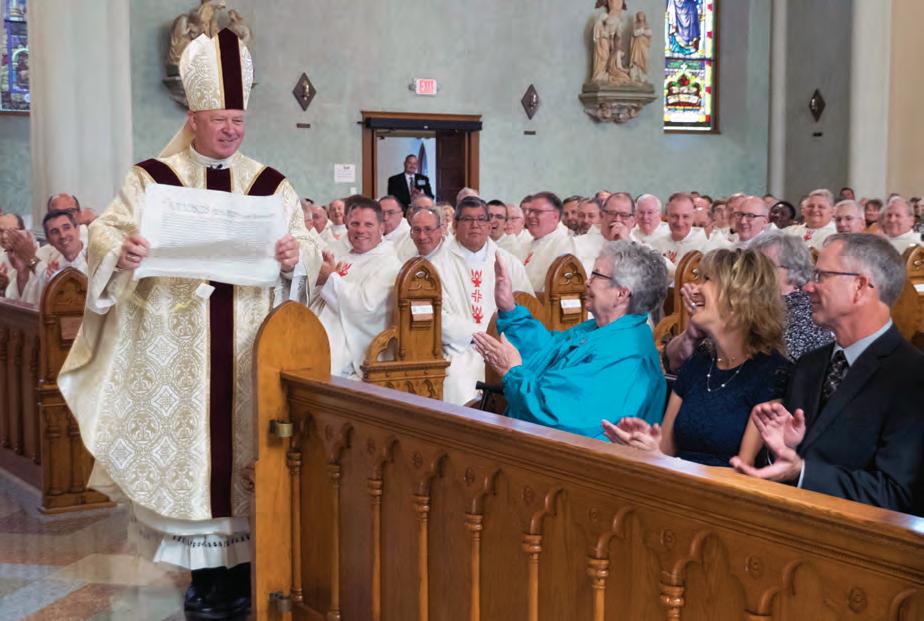
Bishop Chad W. Zielinski displays the Papal Bull declaring his appointment as the fifth bishop of New Ulm.
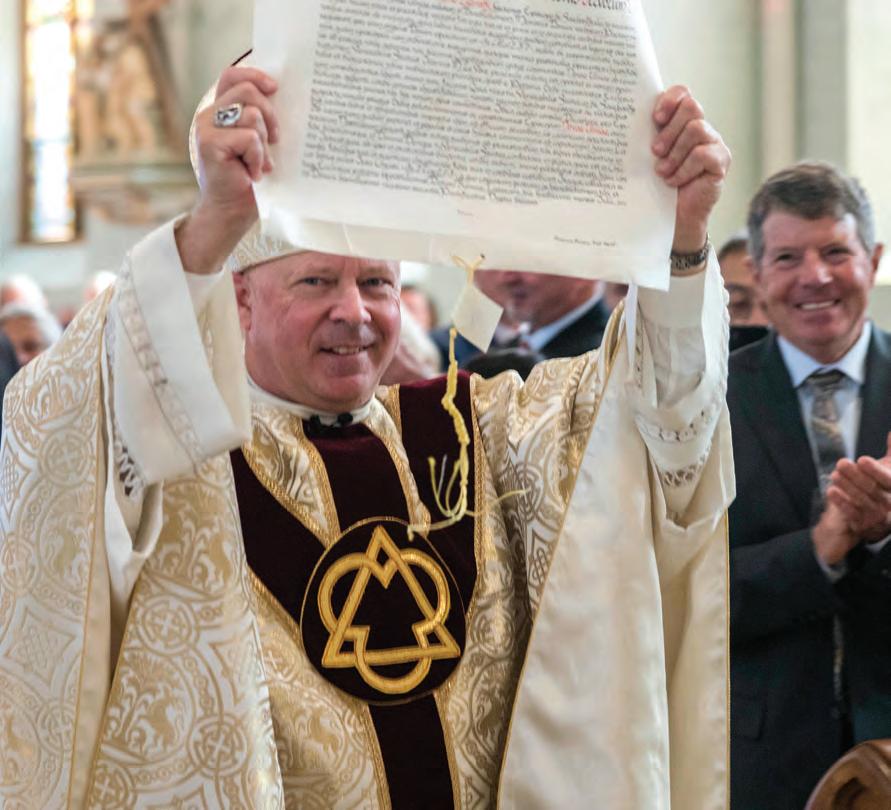
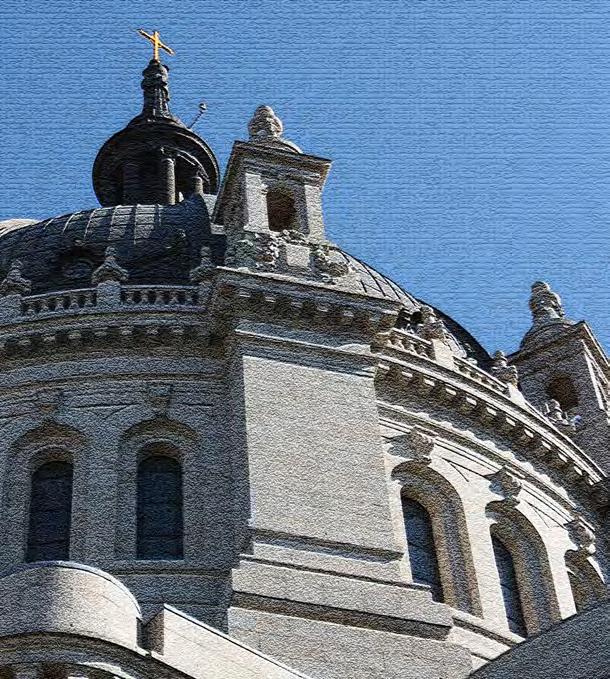
at the Church of St. Mary in Sleepy
held
 Minnesota’s Most Rural Diocese Diocese of New Ulm Vol. 37 No. 2 October/November 2022
(Photo by Mary Woitas)
Minnesota’s Most Rural Diocese Diocese of New Ulm Vol. 37 No. 2 October/November 2022
(Photo by Mary Woitas)
The Episcopal Installation was
on Tuesday, Sept. 27
Eye. SEE SPECIAL COVERAGE, pages 6-11 It’s official!It’s official!
Children’s Holy Field Trip
MOMS fight for abortion regulation return
 by Barb Umberger
The Catholic Spirit
by Barb Umberger
The Catholic Spirit

A group of mothers filed a motion to intervene in Ramsey County District Court Sept. 12, two months after a judge ruled July 13 that six laws regulating abortion in Minnesota were unconstitutional under the state constitution. The laws struck down included a 24-hour waiting period and requirements affecting minors, including parental notification for abortion-seeking girls under age 18.
Teresa Collett, a law professor at the University of St. Thomas’ Minneapolis campus, serves as lead counsel to “Mothers Offering
Maternal Support,” a group of about 50 mothers of at least one minor daughter, who filed a motion Sept. 12 to intervene in Dr. Jane Doe, et al. v. State of Minnesota.
She said she found it “astounding” that in three years of litigation, Attorney General Keith Ellison failed to consider a fact known to every parent of a teenager: They often make risky decisions and are susceptible to stress and pressure.
MOMS held a news conference at the Minnesota State Capitol Sept. 13, where Collett and three members of MOMS spoke. Renee Carlson, general counsel for Minneapolis-based True North Legal, which supports the MOMS group’s effort, emceed the news conference.
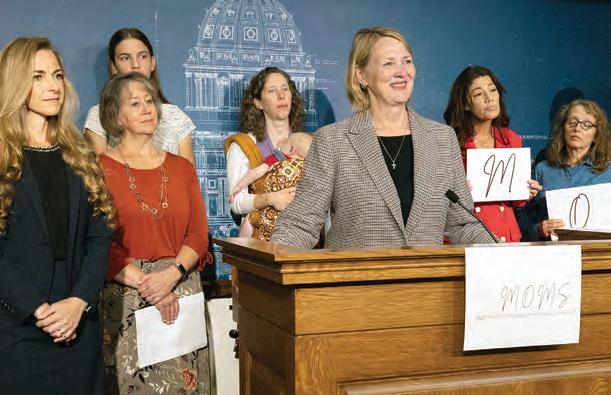
“We are optimistic that the district court judge will, in fact, allow us to enter the case, reopen the judgment and allow us to defend these laws that the attorney general failed to defend,” Collett said.
The Minnesota Catholic Conference and other pro-life groups support MOMS’ efforts, said Jason Adkins, MCC’s executive director and general counsel. A decision on the motion is expected relatively soon, he said.
Mothers who have at least one minor daughter and are interested in becoming involved with the MOMS group can email momsofmn@protonmail.com.
Educators gather for diocesan Faith Formation Day
Day’s agenda focused on prayer and work
by Dr. Michelle Kramer
REDWOOD FALLS – Over 200 teachers, youth ministers, catechists, and directors of religious education from throughout the 15 counties of the Diocese of New Ulm gathered for the annual Faith Formation Day on Monday, Oct. 3, at the Church of St. Catherine in Redwood Falls.
Sponsored by the diocesan offices of Schools, Youth Ministry, and Faith Formation, this educational opportunity helped those charged with ministry to young people receive spiritual formation. The day began with Mass concelebrated by Fr. Anthony
Hesse and Fr. Cornelius Ezeiloaku who serve the Church of St. Catherine, and Fr. Brendan Rolling who serves the Christ the King Area Faith Community (Canby, Ivanhoe, Lake Benton, St. Leo, Tyler, and Wilno).
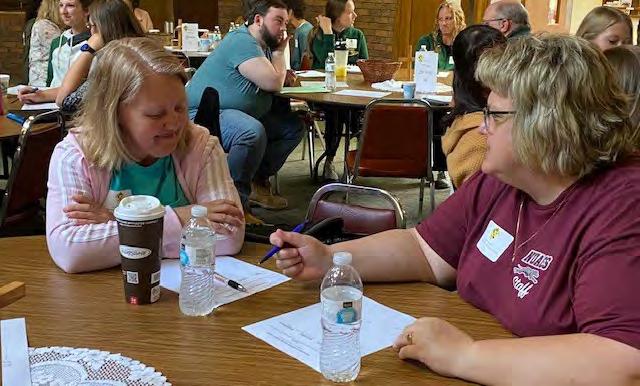
The morning session was a mini-retreat on prayer led by Fr. Rolling. Participants experienced a meditative type of prayer with the Scriptures and learned how it related to practice in the classroom. Educators were asked to consider the various learning styles of students and adapt their prayer experiences accordingly. Faith Formation Day participants had the opportunity to connect and collaborate with grade or subject-alike groups from across the diocese. Pictured are New Ulm Area Catholic School teachers Jenny Janssen, left, and Janelle Kopacek. (Photo by Dr. Michelle Kramer) (Continued on page 15.)
Minnesota’s Most Rural Diocese Diocese of New Ulm Vol. 37 No. 2 October/November 2022 Page 3 Fr. Rademacher to turn 90! Page 5 Eucharistic Revival playbook released Page 19 Election Year Statement from Minnesota Catholic Bishops Visit us online! www.dnu.org inside The Prairie Catholic l Page 1 l October/November 2022
(Photo by Tamara Klawitter)
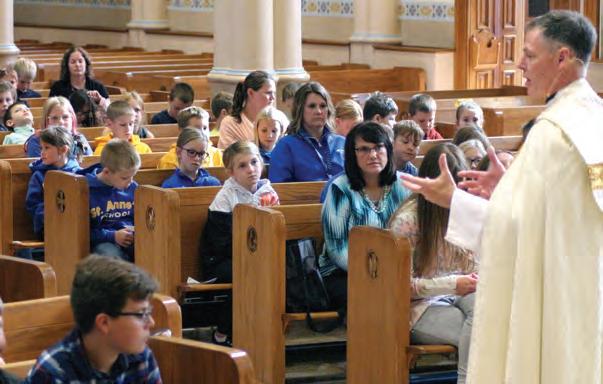
NEW ULM - Monsignor Douglas Grams, rector of the Cathedral of the Holy Trinity in New Ulm, presided over the diocesan sponsored rosary prayer service held October 7 at the Cathedral. Catholic elementary school students and home-schooled students from all around the diocese gathered for this annual event.
Teresa Collett, center, a law professor at the University of St. Thomas in the Twin Cities, talks during a press conference at the State Capitol Sept. 13 by a group of mothers known collectively as MOMS — Mothers Offering Maternal Support. At left is Renee Carlson, general counsel for Minneapolis-based True North Legal, who served as emcee of the press conference. (Photo by Dave Hrbacek, The Catholic Spirit)
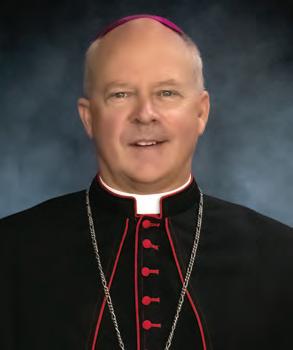
by Bishop Chad W. Zielinski
The Glorification of God
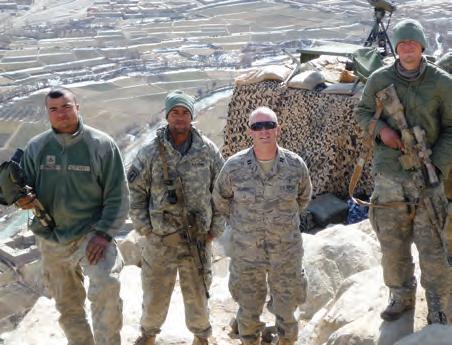
As a priest of 26 years, I have had the humble honor and blessing of offering the Holy Mass on countless occasions, beginning with the good people of God in my home parish of St. Bernard of Clairvaux in Alpena, Mich., following my priestly ordination on June 8, 1996, to celebrating Mass for our uniformed military personnel throughout the USA while on a mountain top during a deployment to Afghanistan, and most recently serving as the bishop in the villages along the Yukon River leading up the Bering Sea Coast to the most western parish in the United States on the Island of Little Diomede, 2.4 miles from Russia. All this movement of God’s grace has led me to a most
The Prairie Catholic, the official newspaper for the Diocese of New Ulm since May 1972, is published every six weeks, Sept.–June.
Publisher: Bishop Chad W. Zielinski
Editor: Christine E. Clancy
Submission deadline is the 1st of each month prior to publication.
Publication office: Diocesan Pastoral Center, 1421 6th Street North, New Ulm, MN 56073; phone: 507-359-2966, Email: dnu@dnu.org Website: www.dnu.org
Postmaster: Send notice on Form 3579, “The Prairie Catholic,” 1421 6th Street North, New Ulm, MN 56073-2071. Periodical postage paid at New Ulm and additional mailing offices. USPS 926-760.
That they may have life
splendid Glorification of God in the celebration of my Installation Mass in the Diocese of New Ulm on Sept. 27, 2022.
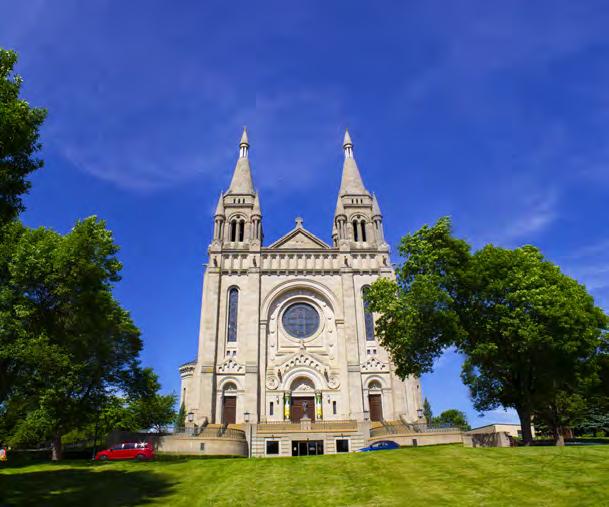
As bishops, priests, deacons, friends, family, and faithful of God from near and far literally stepped into St. Mary’s Church in Sleepy Eye, one’s soul was pulled heavenward by the transcendent beauty of the sacred space. This magnificent edifice solely dedicated to the glorification of God united people from 15 counties in the south and west central plains of Minnesota for a single purpose: to glorify God in the celebration of the Holy Mass.
Following the celebration of the Mass of Installation, I heard numerous comments from chancery staff, faithful gathered from all corners of the diocese, family, priests, and brother bishops: “That was the most beautiful Mass I attended;” “The music was extraordinary - the best I have heard;” “This was extremely well organized and I could see many hands contributed to this beautiful celebration;” “I have never seen so many bishops, priests, sisters, deacons, people gathered for the most beautiful Mass I have ever attended;” “I got off the combine to drive all the way here, and it was certainly worth it,” “Bishop, thanks for letting me serve this Mass – it was an honor.”
From a brother bishop: “Chad, this Installation Mass was extraordinarily beautiful with a lot
of hard work by many people.”
These varied comments of each person’s participation in the Sacred Liturgy united all of us from near and far into a most joyous mystical Body of Christ, offering praise to the Father for the gift of his Son in the Holy Eucharist.
In my homily, I began by referencing the diocesan prayer for a new bishop. For almost two years, the good people of God of the diocese have hounded Heaven in asking God for a pastor who would lead them in the way of holiness. To this day, those words echo loudly in my heart and soul. They are a constant reminder that the faithful of God thirst for holiness and are united in heart and mind with their shepherd. They want to walk the way of holiness daily, living out their Catholic faith. This invitation is profoundly humbling and filled with great joy.
I also invited the faithful of the diocese to join me in a pastoral approach to entering into the Eucharistic Revival process: “Hearing God, handing him your heart, and having hope!” Since entering the Eucharistic Revival process that started on Corpus Christi Sunday, June 16, we have lived in a world filled with noise. We need to slow down and listen to God speak to us through his Sacred Word, prayer, and adoring him in the Holy Eucharist at adoration. This encounter with His grace will move us to an act
of surrendering our hearts to him. As individuals, families, parishes, and a diocese, we will “go into the deep” with Jesus to encounter healing and transformation in celebrating the Holy Mass. Let us go forth into the world as children of the light filled with “renewed hope.”
Following the celebration of the Installation Mass, I met numerous faithful from various parts of the diocese. It was great to hear personal stories, those asking for prayers for a loved one, inviting me to visit their parish and home, and so many thanking me for my “yes” to serve as the bishop. The most touching moment as I greeted folks was a little girl of about seven years of age coming up to me and giving me a big hug, and simply saying, “I am so happy you are our bishop.”
Although it is with great joy and honor that I serve you, the faithful of this diocese, it is not so much my “yes” to Pope Francis to serve as the bishop of New Ulm but our hearts and minds united in our Catholic faith together saying “yes” to God.
My work begins The weeks following the Installation Mass have launched me into a very busy schedule. I have traveled to a few communities to celebrate the Sacrament of Confirmation. During the months of preparation leading up to the Confirmation Mass, candidates are asked to write a letter to the bishop
explaining their desire to be confirmed. Their heartfelt words deeply touched me.
I was able to meet with each confirmation group for a short chat before the Mass. Normally, I have found high school youth rather chatty, but they were silent, their gaze riveted on me. So, to avoid putting them on the spot, I shared what I collectively heard in their letters: you are thankful to your parents for being raised Catholic, your faith is important to you, you see the grace of the Sacrament of Confirmation as drawing closer to God, you want to grow in holiness, and you believe the world is need of healing and Jesus has something better to offer.
In silence, they all vigorously nodded in agreement throughout my comments.
What an absolute honor and joy to walk on the sacred ground of the lives of these young people – and I told them these exact words –“this brings me great hope!”
As I drive down the roads across the prairie of the Lord’s amassed loveliness, I have to confess to you and Almighty God, watching the morning sun glisten off the golden hue of the corn being harvested, I am a very blessed man. I’ve got it good!
I am so happy and honored to serve you as your shepherd. Together we join our prayers in saying “yes” to Jesus in our walk of faith to grow in holiness.
St. Peter, Canby
Schoenstatt
Sleepy
Statement of ownership, management, circulation
year, “The Prairie Catholic” was published every six weeks, September – June resulting in seven issues. Location of the office of publication and general
office of the publisher, Bishop Chad W. Zielinski, is 1421 6th Street North, New Ulm, MN 56073-2071.
editor is Christine E. Clancy, 1421 6th Street North, New Ulm, MN 560732071. “The Prairie Catholic,” the publication of a non-profit organization, is authorized to mail
Section 411.3
postal regulation(s). “The Prairie Catholic”


The Prairie Catholic l Page 2 l October/November 2022
PTHERA RIE CATH o LIC
During the 2021-2022 publishing
business
The
at special rates, according to
DMM
accepts advertising only by invitation. Extent and nature of circulation Net press run Free or nominal rate distribution Total paid circulation Total distribution office use Total Average # copies each issue during last 12 months 21,509 21,509 none 21,509 116 21,625 Actual # copies single issue publication date 9/2022 21,331 21,331 none 21,331 114 21,445 Nov. 1 – Cathedral High School Mass – New Ulm Nov. 5 – Mass at
Nov. 6 – Mass at St. Leo, St. Leo Nov. 9 – Mass at
on the Lake,
Eye Nov. 9 – Diocesan Corporate Board Meeting Nov. 10 – Diocesan Staff Meeting, Catholic Pastoral Center, New Ulm Nov. 12-18 – USCCB Fall Assembly, Baltimore, Md. Nov. 29 – Seminarian visit, St. Paul Dec. 1 – Diocesan staff meeting, Catholic Pastoral Center, New Ulm Dec. 10 – Feast of our Lady of Guadalupe celebration, St. Mary, Willmar Dec. 11 – CoR Night speaker, 4 p.m., St. Aloysius, olivia Dec. 12 – Minnesota Catholic Conference meeting, St. Paul Dec. 15 – Diocesan staff meeting, Catholic Pastoral Center, New Ulm Dec. 27 – Dinner with seminarians, New Ulm Dec. 28 – Meet with seminarians individually, Catholic Pastoral Center, New Ulm Editor’s note: Calendar respresents the bishop’s schedule at the time “The Prairie Catholic” went to press. Bishop’s calendar from the bishop Featured Speaker: Bishop Chad Zielinski Topic: St. Joseph: Protector of the Incarnation Diocese of New Ulm CoR NIGHT faith l food l fun December 11th Church of St. Aloysius, Olivia For more information: www.dnu.org/cor-night Meet our new bishop!
Fr. Behan remembered for his ecumenical heart
A priest more than six decades - Fr. Germain Rademacher to celebrate 90th birthday
Fr. Harry Behan
Fr. Henry “Harry” Behan, a retired priest of the Diocese of New Ulm, residing in Ireland since 2007, died on Oct. 4, 2022, at the age of 80.
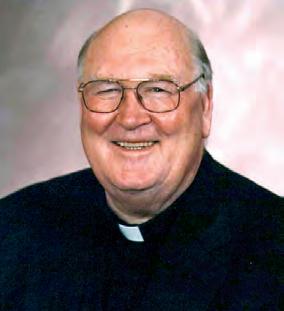
Fr. Behan was ordained for the Diocese of Brentwood, London, England, on June 17, 1973, in All Hallows, Dublin, Ireland. He was incardinated into the Diocese of New Ulm on Aug. 19, 1982.
Following ordination, he served as associate pastor in Grays Thurrock, Essex, England, and
Billericay, Essex, England. In the Diocese of New Ulm, Fr. Behan served at St. Patrick in Kandiyohi, St. John in Darwin, St. Malachy in Clontarf, Visitation in Danvers, Sacred Heart in Murdock, St. Bridget in DeGraff, St. Frances in Benson, the Cathedral of the Holy Trinity in New Ulm, St. Mary in Bird Island, St. Thomas More in Lake Lillian, Sacred Heart in Franklin, St. John in Hector, St. Peter in St. Peter, St. Dionysius in Tyler and St. Genevieve in Lake Benton.
“Fr. Harry’s primary focus in ministry was to reach out and meet the needs of the people,” commented longtime friend Sr. Betty Larson, former director of Catholic Schools for the Diocese of New Ulm. “He had an ecumenical heart that touched many Christians and often went the extra mile in service to others. He was a true friend to all,” she said.
Fr. Behan retired from active priestly ministry in November 2007 and moved to Ireland.
Official Appointments
Bishop Chad W. Zielinski has announced his first official appointments since being named the fifth bishop of the Diocese of New Ulm by Pope Francis.
Effective Sept. 25, 2022.
Monsignor Douglas Grams to serve as Vicar General of the diocese in addition to serving as Moderator of the Curia, Bishop’s Delegate in Matters Pertaining to Sexual Misconduct, rector of the Cathedral of the Holy Trinity, New Ulm, pastor the Churches of St. Mary in New Ulm, St. John the Baptist in Searles, and St. George in West Newton Township (Holy Cross Area Faith Community), and Canonical Administrator of New Ulm Area Catholic Schools.
Monsignor Eugene Lozinski to serve as Chancellor of the diocese and parochial administrator
NOTICE:
of the Churches of St. Mary in Arlington, St. Michael in Gaylord, St. Joseph in Henderson, St. John–Assumption in Faxon Township, and the merged parish of St. Brendan in Green Isle and the Oratory of St. Thomas in Jessenland. (Corpus Christi Area Faith Community)
Fr. Mark Steffl to serve as Judicial Vicar and ViceChancellor of the diocese in addition to pastor of the Churches of St. Paul in Comfrey, St. Michael in Morgan, Japanese Martyrs in Leavenworth, and St. Mary in Sleepy Eye. (Divine Mercy Area Faith Community)
Carol Hacker to serve as director of the Office of Finance for the Diocese of New Ulm.
by Christine Clancy The Prairie Catholic
NEW ULM – Born 90 years ago on Dec. 4, 1932, on an 80-acre farm in rural Rosen, Minn., just three miles from the South Dakota border, Fr. Germain Rademacher wonders where all that time went but counts every year as a blessing. The oldest of 11 children, with only one sister in the bunch, his parents were deeply committed to their Catholic faith. “Our parents were our first teachers in every way,” said Fr. Rademacher.
Ordained to the priesthood on Feb. 23, 1958, he and the late Fr. Darold Lehman were the first two priests to be ordained for the newly formed Diocese of New Ulm (1957), at the Cathedral of the Holy Trinity in New Ulm by the first bishop of New Ulm, the Most Reverend Alphonse J. Schladweiler.
As a young seminarian, Fr. Rademacher wasn’t sure if the priesthood was his calling but wondered what God had in mind. “Somewhere, someone said to me, ‘being a priest is a way of serving your soul and souls of others’ –two wonderful goals,” he said.
Reflecting on the first years following ordination, Fr. Rademacher remembers them as challenging. “I found myself continuously thinking about preparing for effective preaching. But I always found comfort in
Effective Oct. 13, 2022 – Bishop Chad Zielinski has granted Fr. Aaron Johanneck, parocial vicar of the St. John Paul II Area Faith Community (Glencoe, Silver Lake, Winsted), a leave of absence for two years as he enters the novitiate for the Norbertine Fathers and Brothers at the monastery in Silverado, Calif. Please keep Fr. Johanneck in your prayers as he enters this period of discernment.
diocesan church
por Bishop Chad Zielinski La Glorificación de Dios
Durante mis 26 años como sacerdote, he tenido el humilde honor y la bendición de ofrecer la Santa Misa en innumerables ocaciones, comenzando con la comunidad en mi parroquia natal de St. Bernard de Clairvaux en Alpena, Michigan después de mi ordenación sacerdotal el 8 de Junio de 1996 al celebrar la Misa para nuestro personal militar a lo largo de los Estados Unidos, en la cima de una montaña durante un despliegue en Afganistán, y más recientemente como el obispo en las aldeas a lo largo del río Yukón que conducen a la costa del mar de Bering hasta la parroquia más occidental de los Estados Unidos en la isla de Little Diomede, a 2.4 millas de Rusia. Todos estos acontecimientos me han llevado a una Glorificación espléndida de Dios en la celebración de la Misa de mi Instalación en la Diócesis
diocesan
Para que tengan vida
de New Ulm el 27 de Septiembre del 2022.
Mientras los obispos, sacerdotes, diáconos, amigos, familiares y feligreses llegaban de todas partes literalmente a la Iglesia de Santa María en Sleepy Eye, nuestras almas fue atraída por la belleza trascendente de este lugar sagrado. Este magnífica edificación esta dedicado exclusivamente a la glorificación de Dios ya que unió a los fieles de los 15 condados de las llanuras centrales del sur y oeste de Minnesota con un solo propósito: Glorificar a Dios en la celebración de la Santa Misa.
Después de la celebración de mi instalación, escuché numerosos comentarios por parte del personal diocesano, feligreses de todos los rincones de la diócesis, familiares, sacerdotes y hermanos obispos: “fue la Misa más hermosa que he asistido,” “la música fue extraordinaria, la mejor que he escuchado,” “Estuvo muy bien organizado y pude ver el gran número de voluntarios que contrubuyeron a esta celebración tan hermosa,” “Nunca había asistido a una Misa tan hermosa y tener el privilegio de haber visto tantos obispos, sacerdotes, hermanas religiosas y diáconos
juntos,” “deje de trabajar en la cosecha para asistir a este evento, y ciertamente valió la pena,” “Obispo, gracias por dejarme servir en esta Misa, fue un honor.”
Comentario de un hermano obispo: “Chad, esta misa fue extraordinariamente hermosa, fruto del gran trabajo de muchos.”
Estos variedad de comentarios sobre la Sagrada Liturgia unieron a los fieles de todas partes, en un gozoso Cuerpo Místico de Cristo, ofreciendo alabanza al Padre por el don de su Hijo en la Sagrada Eucaristía.
En mi homilía, hize referencia a la oración diocesana por un nuevo obispo. Por casi dos años, el buen pueblo de Dios de la diócesis ha estado implorando a Dios por un pastor quien sería el encargado de guiarnos por el camino a la santidad. Hasta el día de hoy, esas palabras resuenan con fuerza en mi corazón y alma. Son un recordatorio constante que los fieles de Dios tienen sed de santidad y están unidos en corazón y mente con su pastor. Ellos quieren caminar diariamente hacia el camino de la santidad y vivir su fe católica. Esta invitación es profundamente humilde y sean llenos de gran gozo.
De igual modo, invite a los fieles de la diócesis para que se unan a mí a un enfoque pastoral al entrar al proceso del Avivamiento Eucarístico: “¡Escuchar a Dios, entregar tu corazón a él y tener esperanza!” Desde que empezó el proceso del Avivamiento Eucarístico, domingo de Corpus Christi, 16 de Junio, vivimos en un mundo
de distracciones. Necesitamos ir más despacio y escuchar a Dios a través de
su palabra sagrada, la oración y adorarlo en la Sagrada Eucaristía durante la adoración. Este encuentro nos conducirá a un acto de rendir nuestro corazón hacia Él. Como individuos, familias, parroquias y diócesis nos enfocaremos a un “encuentro más profundo” con Jesús para encontrar la sanación y la transformación cuando celebramos la Santa Misa. Vayamos al mundo como hijos e hijas llenos de luz con la “esperanza renovada.”
Después de la celebración de Instalación, tuve la gran oportunidad de conocer a fieles de varias partes de la diócesis. Fue un gran honor escuchar historias personales, algunos pedían oraciones por un ser querido, me invitaron a visitar su parroquia y su hogar y muchos me agredecieron por responder “si” al llamado de servir como su obispo. El momento más conmovedor fue cuando una niña de unos siete años se acercó a mí y me dio un fuerte abrazo y me dijo: “Estoy tan feliz que seas nuestro obispo.”
Aunque es un gran honor ser su pastor, no se trata de haber respondido “si” al Papa Francisco al llamado de servir como el Obispo de New Ulm, pero nuestros corazones y pensamientos unidos en nuestra fe católica decir juntos “si” a Dios.
Mi trabajo comienza Mi agenda ha estado cargada semanas después de la Misa de Instalación. He ido a algunas comunidades para celebrar el Sacramento de la Confirmación. Uno de los requisitos para la confirmación es que los candidatos deben escribir una carta al obispo explicando su deseo de ser confirmados. Sus palabras
conmovedoras me conmovieron profundamente.
Antes de la Misa con cada grupo de confirmación, tuve la oportunidad de dar una charla breve. Normalmente, he notado que los estudiantes de secundaria hablan bastante, pero este grupo estaba en silencio y con su mirada clavada en mí. Entonces, para evitar ponerlos en apuros, compartí lo que leí en sus cartas: Ellos están agradecidos con sus padres por haberlos educado católicos, su fe es importante para ellos, saber que el Sacramento de la Confirmación los acerca a Dios, quieren que crezcan en santidad, y creer que el mundo necesita sanación y Jesús tiene algo mejor que ofrecernos.
Ellos en silencio, estuvieron de acuerdo con los comentarios que dije.
¡Que alegría y de gran honor caminar en este suelo sagrado en la vida de estos jóvenes, y les dije las siguientes palabras exastas: “Esto me llena de gran esperanza!”
Al manejar por la carreterra de la bella pradera del Señor, tengo que confesarles y a Dios todopoderoso, ver como el sol brilla por la mañana con el tono dorado del maíz que se está siendo cosechado, me siento muy bendecido. ¡muy afortunado!
Me siento muy feliz y honrado servirlos como su pastor. Juntos, unamos nuestra oraciones para decir “si” a Jesús en nuestro camino a la fe y crecer en santidad.
of Years Married As of Dec.
Parish:
Phone Number or E-mail:
The Prairie Catholic l Page 4 l October/November 2022
church
lleno
Bishop Zielinski May you be greatly blessed in your ministry in the Diocese of New Ulm, so all in your diocese will be HEALTHY, HAPPY AND HOLY! Catholic Diocese of Sioux Falls Have you been married 65 years or more? The Prairie Catholic will be honoring couples who are members of a parish in the Diocese of New Ulm and will be celebrating a 65th or beyond wedding anniversary in the year 2023. Complete this form and return it, along with a current photograph (no newspaper clippings, please), no later than Nov. 30, 2022, to The Prairie Catholic, 1421 6th Street North, New Ulm, MN 56073, or e-mail cclancy@dnu.org. Announcements will be featured in the January/February 2023 edition. Groom’s Name: _______________________________ Bride’s MAIDEN Name: _____________________________ Parish and City Where You Were Married: _____________________________ Date Married: ___________________ Number
31, 2023: _________________________________________________________ Current
_______________________City: _________________
________________
by Zelda Caldwell Catholic News Agency
When a 2019 Pew survey revealed that only 31% of Catholics believe in a basic tenet of their faith – that the Body and Blood of Christ are truly, really, and substantially present in the Eucharist – the U.S. Catholic bishops decided to take action.
At the annual meeting of the United States Conference of Catholic Bishops (USCCB) in 2021, the bishops called for a multi–year National Eucharistic Revival to restore and promote an understanding of and devotion to the Eucharist. The initiative will culminate in a National Eucharistic Congress in 2024, which the bishops hope will be attended by more than 80,000 Catholics.
A ‘playbook’ created for Catholic leaders
As a first step, the team organizing the revival released a “playbook” to assist diocesan leaders, priests, and Catholic school administrators in coming up with plans to stoke up fervor for the Eucharist within their communities.
Bishop Andrew H. Cozzens of Crookston, Minn., chairman of the USCCB’s Committee on

Evangelization and Catechesis, notes in the preface to “Leader’s Playbook: Year 1,” that the faithful are called to be “missionary disciples.”
The mission, Cozzens writes, is to “renew the Church by enkindling a living relationship with Jesus Christ in the Eucharist.”
‘It’s about a relationship with Jesus’
Having a relationship with Jesus isn’t something new, Fr. Craig Vasek, a priest of the Diocese of Crookston and a member of the team of priests tasked with helping ignite eucharistic faith, told Catholic News Agency
“It’s something that Jesus asked of us at the beginning. This is what he’s doing with his 12 disciples, and what he wants to show the world,” he said. “He wants to share a living relationship with us, and in no place greater than the Blessed Sacrament.”
If some are not accustomed to talking about Christ in this way, Fr. Vasek says that’s a sign that something has been missing in the way Catholics practice their faith and pass it on to others.
“This has been the cry of the
Church for decades, of those who are paying attention, who say, ‘We can’t just do things and promote programs. We have to introduce people to Jesus,” Fr. Vasek said.
“Pope Benedict was all about how our faith is not a number of ethical principles or something, but it is about a person. It’s about an encounter. It’s about a relationship with Jesus.”
“We all need to get on our knees and say, ‘Lord, I need your grace. I need your forgiveness, and I
need your mercy so that I can become more like you, and that I might live more fully in the Holy Spirit.’ I mean, this is what we need. That’s what we’re talking about,” he said.
“So we’re recovering that basic element, we are re-proposing a living relationship with Jesus.”
Practical suggestions for parishes and schools The playbook includes practical suggestions for fostering personal encounters with Christ in the
Eucharist, including eucharistic processions, retreats on the Eucharist, and “Mercy Nights,” evenings of adoration, music, and fellowship.
One of the suggestions is for parishes to request a visit of the relics of Blessed Carlo Acutis and St. Manuel Gonzalez Garcia, special intercessors for the revival.
Fr. Vasek’s parish in Minnesota recently hosted the relics for an evening of adoration, confession, and veneration.
“A bunch of people afterwards commented that this was such a transformational night, with such a Catholic feel,” Fr. Vasek said.
“It’s one thing that we were able to do that was an evening of great grace.”
The playbook’s suggestions for “reinvigorating devotion” include sharing inspiring stories about the Eucharist, such as testimonials from people in the diocese, and stories about eucharistic miracles and the transformative power of the Eucharist in the lives of saints. Promoting the practice of short visits to the Blessed Sacrament and instructing the faithful on how to make a holy hour are also recommended.
Parishes are advised to offer formation programs to teach the faithful about the Real Presence of Christ in the Eucharist, and how to “open oneself more fully to the grace of receiving Jesus in Holy Communion.”
The executive team of the National Eucharistic Revival will soon make available additional resources for Catholic leaders and all lay people at its website, www. EucharisticRevival.org.
Register for the free Heart of the Revival newsletter to stay informed about events related to the revival and new materials for formation and inspiration.
Pregnancy
diocesan church The Prairie Catholic l Page 5 l October/November 2022
Enkindling a relationship with Jesus Eucharistic Revival team’s playbook meant to encourage enthusiasm for the Eucharist
Bishop Daniel J. Felton and the faithful of the Diocese of Duluth congratulate Bishop Chad W. Zielinski on his installation as Bishop of New Ulm
"He must increase, I must decrease."
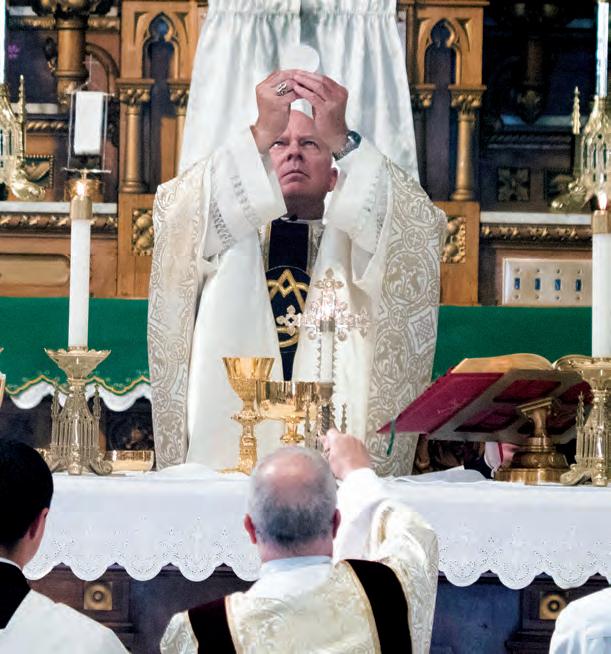
One of the priorities of the National Eucharistic Revival is to restore and promote an understanding of and devotion to the Eucharist. This too will be a priority for Bishop Chad Zielinski, pictured celebrating Mass at the Church of St. Mary in Sleepy Eye following his installation as the fifth bishop of the Diocese of New Ulm. (Photo by Mary Woitas)
support services include assistance with: an unplanned pregnancy, finding resources, preparing for the birth of a child, and relationship counseling. Adoption: Information on and assistance in discerning an adoption plan and its options as well as resources for people interested in adopting. Abortion: The Church’s message is one of healing and hope. Counseling and spiritual support are provided for those affected by abortion. offices located in New Ulm, Marshall, Hutchinson, Willmar offering pregnancy and adoption counseling, Project Rachel, and Respect Life Resources Catholic Charities Call 1-866-670-5163 | pkral@dnu.org
new bishop - special report
Installation of Bishop Chad W. Zielinski, fifth bishop of New Ulm
First proposal to faithful – “Hear God, Hand Him Your Heart, Have Hope!”
 by Christine Clancy
The Prairie Catholic
by Christine Clancy
The Prairie Catholic
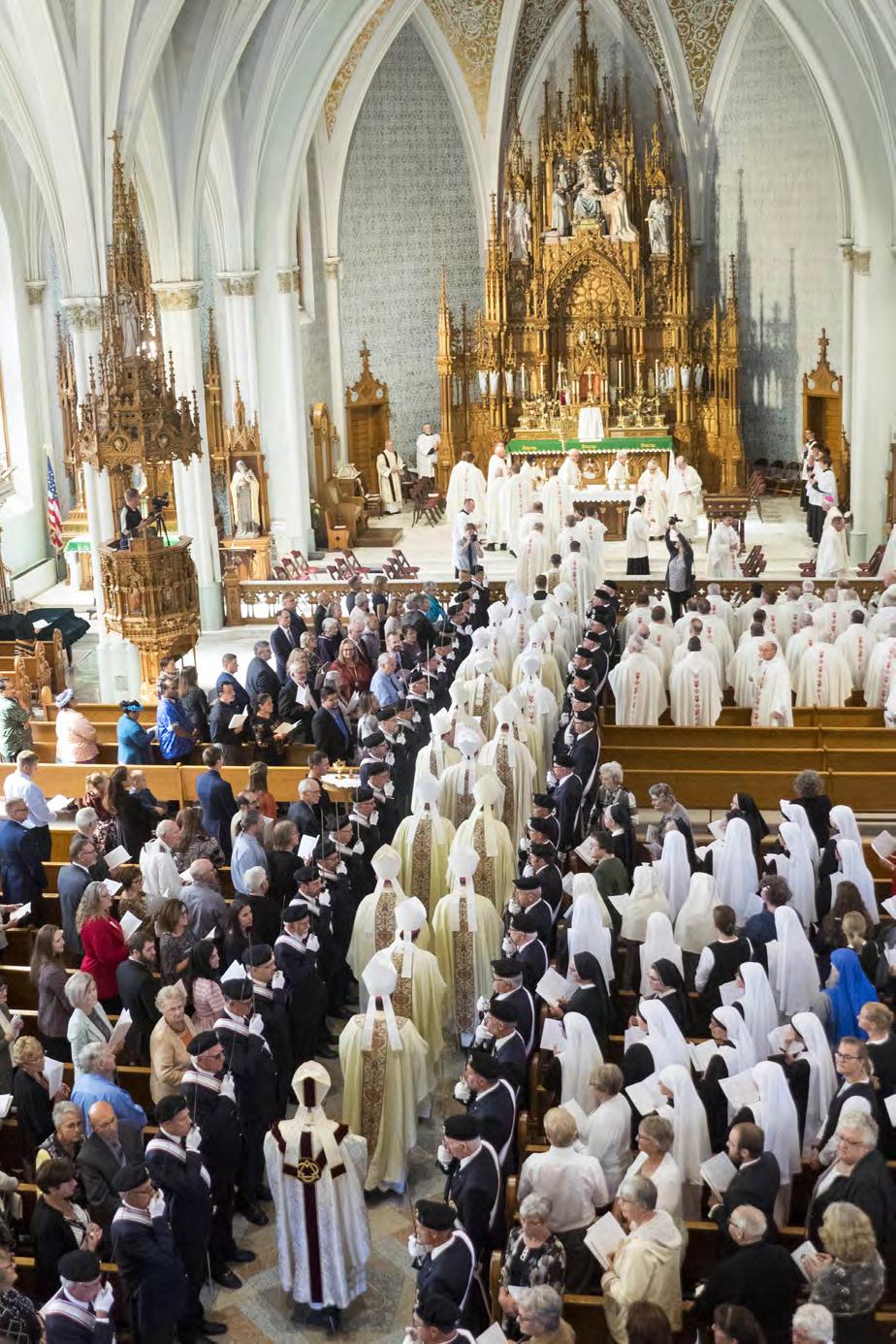
SLEEPY EYE – After two years of prayer for a new shepherd, church leaders and the Christian faithful of the Diocese of New Ulm and beyond gathered on a sunny autumn day in what was a joyous transition filled with rich uplifting music. Hundreds, including priests, seminarians, deacons, consecrated religious, and laity, as well as ecumenical and civic leaders, traveled from near and far to the Church of St. Mary in Sleepy Eye to witness Bishop Chad W. Zielinski, the former bishop of Fairbanks, Alaska, take on his new role as the fifth bishop of New Ulm during an Episcopal Installation Mass held on Tuesday, Sept. 27, 2022.
Twenty-four prelates traveled from near and far to attend the Installation Mass. They were: Archbishop Christophe Pierre, apostolic nuncio to the United States; Archbishop Bernard A. Hebda, St. Paul and Minneapolis; Archbishop Allen H. Vigneron, Detroit; Archbishop Timothy P. Broglio, Archdiocese for Military Services; Archbishop Andrew E. Bellisario, Anchorage-Juneau; Archbishop Emeritus Roger Schwietz, Anchorage-Juneau; Bishop Emeritus John M. LeVoir, New Ulm; Bishop Donald J. Kettler, St. Cloud; Bishop Daniel J. Felton, Duluth; Bishop Andrew H. Cozzens, Crookston; Bishop Robert E. Barron, WinonaRochester; Bishop Emeritus Richard E. Pates, Des Moines; Bishop John T. Folda, Fargo; Bishop Donald E. DeGrood, Sioux Falls; Bishop Peter M. Muhich, Rapid City; Bishop James P. Powers, Superior; Bishop Jeffrey J. Walsh, Gaylord; Bishop Earl A. Boyea, Lansing; Bishop Emeritus Walter A. Hurley, Grand Rapids; Bishop Luis R. Zarama, Raleigh; Auxiliary Bishop Joseph A. Williams, St. Paul and Minneapolis; Auxiliary Bishop Gerard W. Battersby, Detroit; Auxiliary Bishop Neal J. Buckon, Archdiocese for Military Services; and Auxiliary Bishop Peter L. Smith, Portland.
On behalf of Pope Francis, Archbishop Pierre, the papal

nuncio, read the Apostolic Mandate (Papal Bull) declaring Bishop Zielinski as the head of the Diocese of New Ulm. The nuncio then presented the Mandate, signed by the pope, to Bishop Zielinski, an action that signifies taking possession of the diocese.
With a smile on his face, the chief shepherd displayed the Mandate to all in the sanctuary, then to the congregation. Holding it high above his head with certain joyfulness, Bishop Zielinski processed through the aisles of the Cathedral as all broke into jubilant applause, welcoming the new shepherd of New Ulm.
In his homily following the installation, the bishop told the congregation that after receiving the news in June from the nuncio concerning his appointment to New Ulm, he was pleased. “Growing up in farm country in Lower Michigan, I had a personal insight into what this meant,” Bishop Zielinski said. “My immediate response was, “Archbishop, this is great news, wonderful news! Please thank the Holy Father.”
In an attempt to break the silence that followed, Bishop Zielinski said to the nuncio, “I bet you rarely hear that response?” With a laugh, the archbishop said he would pass along the enthusiastic sentiments to the Holy Father.
To his new flock, the bishop offered no far-reaching plans but instead, in part, reflected on the former words of Pope Francis that we become aware of the many opportunities each day to grow in holiness; “Christ invites us to become a gift of love to all around us – live each moment of our life with joy and love.”
A thirst for the Holy Eucharist
The bishop noted one of the top pastoral concerns that surfaced in the recent diocesan phase of the Synod on Synodality process which he said was echoed throughout the United States: a thirst for the Holy Eucharist. It was at this point in his homily that the bishop made his first proposal; “Focus on three ways or actions –Hear God, Hand Him Your Heart, and Have Hope!”
Hear God: “We live in a world filled with overpowering noise and distractions,” the bishop said to those gathered. “People are fueled by anger in verbal jousting matches, firmly standing their ground in polarized positions,
because ‘I’ and ‘me’ have become the source of all our thoughts, feelings, and decision-making. We have hunkered down in our own homes, hearts, and minds with our earphones plugged in and our eyes fixed on a screen. Maybe it is time
(Photo by Christine Clancy)
to put everything in the proverbial airplane mode or ‘hear God’ mode and listen.”
The Prairie Catholic l Page 6 l October/November 2022
(Continued on page 7.)
Bishop Zielinski: “Have renewed hope in God’s providence”
Hand Him Your Heart: “No matter what is happening in your life, where you are, how overwhelmed you are, how awful you feel, the doubts and wounds you have – hand God your heart,” the bishop instructed. “He wants it as it is right now.”
Have Hope: Bishop Zielinski referenced Scripture (Luke 5:6) “When they had done this, they caught a great number of fish, and their nets were tearing.” Over the last eight years of serving as bishop of Northern Alaska, the bishop said he had the honor to join his Yupik brothers and sisters in their subsistence way of living – a centuries-old way of life of living close to the earth, trusting God the Creator to provide for all needs.
“Similar to the Yupik people of the Yukon,” the bishop said, “you have been tilling the land, harvesting crops, baling hay –working until you sweat, . . . you are covered in tractor grease, oil, diesel fuel for aftershave, and this radiates a stench that says without words, “I feel great; that was a good day of hard work; you know what hard work is!”
“You today and your previous generations lived on hope and

by God’s providence. You are a people of hope. I look forward to putting on my gloves and joining you in this hard work as we hear God, hand him our hearts, and have renewed hope in God’s providence.”
Fr. Tony Hesse said hearing Bishop Zielinski’s homily gave him a reenergized feeling in his ministry. “There is an excitement about it, a newness about it in anticipation of where God will lead us now with this new shepherd; definitely, there is excitement!” Fr. Hesse is pastor of the Church of St. Catherine in Redwood Falls and pastor in the Light of the World Area Faith Community (St. Anne in Wabasso and the merged parish, Our Lady of Victory in Lucan).
“It has been a glorious day for the Diocese of New Ulm,” said Fr. George Schmit, senior associate in the Heart of Jesus Area Faith Community (St. Mary in Bird Island, St. Aloysius in Olivia, and Holy Redeemer in Renville).
“We have been blessed with a good bishop, and I am excited for what the years ahead will be for our diocese. He comes humble, ready to listen, wanting to serve us and make our diocese a better diocese,” Fr. Schmit said.
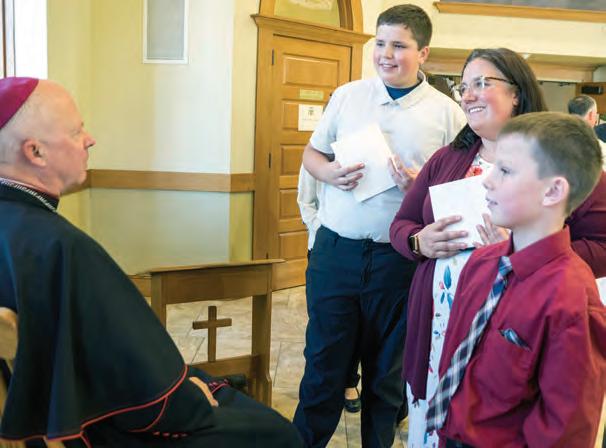
Left: Well-wishers lined up to meet Bishop Zielinski after the Mass, welcoming him to the diocese. Pictured greeting the bishop is Stephanie Schulte and her sons, William, left and Quentin. The Schultes are members of St. Michael’s in Gaylord.
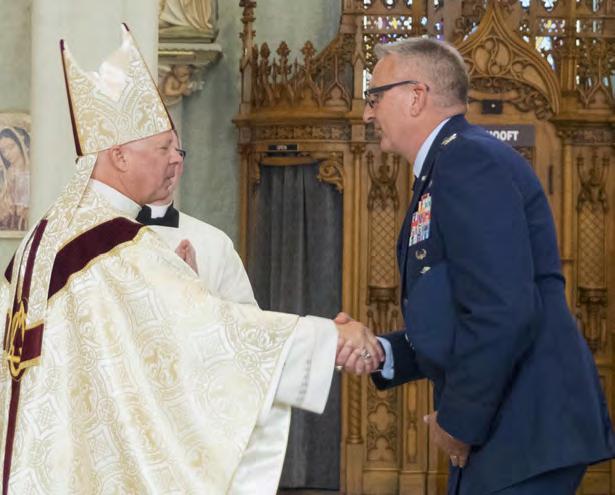
Below: Retired Colonel Glen Christensen represented the area veterans during the Installation Mass’ Rite of Welcome. Christiansen is a member of St. John the Baptist in Searles.
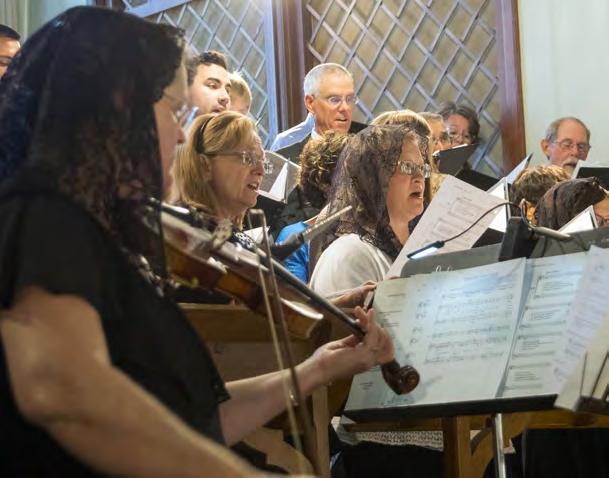
Rich and vibrant music was sung throughout the Church of St. Mary’s in Sleepy Eye during the Installation Mass of New Ulm’s new shepherd. The choir consisted of talented voices and musicians from all corners of the Diocese of New Ulm. Sean Connolly, former choir director at St. Mary’s conducted the ensemble and Rebecca Visser of St. Mary’s played the organ.
A video recording of both the Solemn Vespers (prayer service) and the Installation Mass are available for viewing online on the Diocese of New Ulm website, www.dnu.org/livestream. To read the bishop’s homily, www.dnu.org/bishop.
The Prairie Catholic l Page 7 l October/November 2022
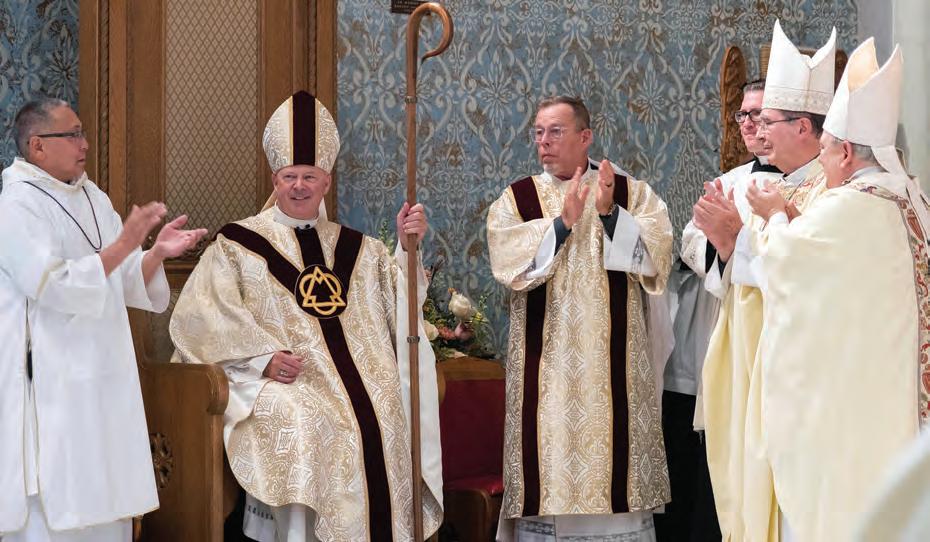
After Bishop Zielinski was escorted by both Archbishop Christophe Pierre and Archbishop Hebda to the cathedra, (the bishop’s chair), he was presented with his crosier at which time he officially became the bishop of New Ulm. Joining the assembly in applause is (l-r) Deacon Dominic Hunt of the Diocese of Fairbanks, Alaska, Deacon Mark Kober and Fr. Aaron Johanneck of the Diocese of New Ulm, Archbishop Christophe Pierre-apostolic nuncio to the United States, and Archbishop Bernard Hebda of the Archdiocese of St. Paul and Minneapolis.
(Continued from page 6.)
(Photos by Mary Woitas and Christine Clancy)
new bishop - special report
new bishop - special report
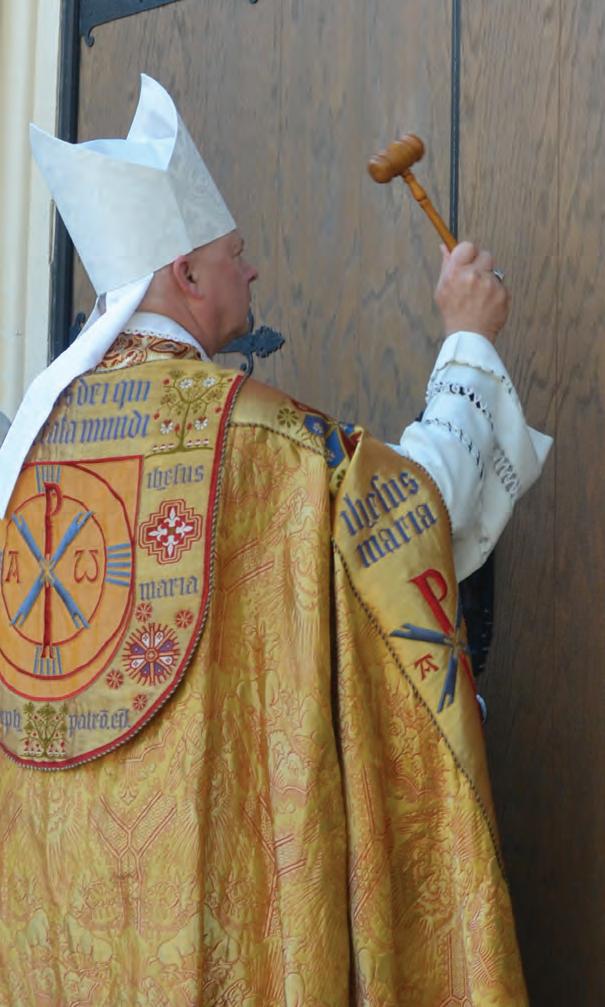
Pictured left: Bishop Zielinski knocks on the front doors of the Cathedral in New Ulm prior to the start of the Solemn Vespers (prayer service) held the evening prior to the Sept. 26 Installation Mass.
A representation of “taking possession of the diocese,” the doors were opened by former diocesan administrator Monsignor Douglas Grams who welcomed the new chief shepherd and led him to the sanctuary.
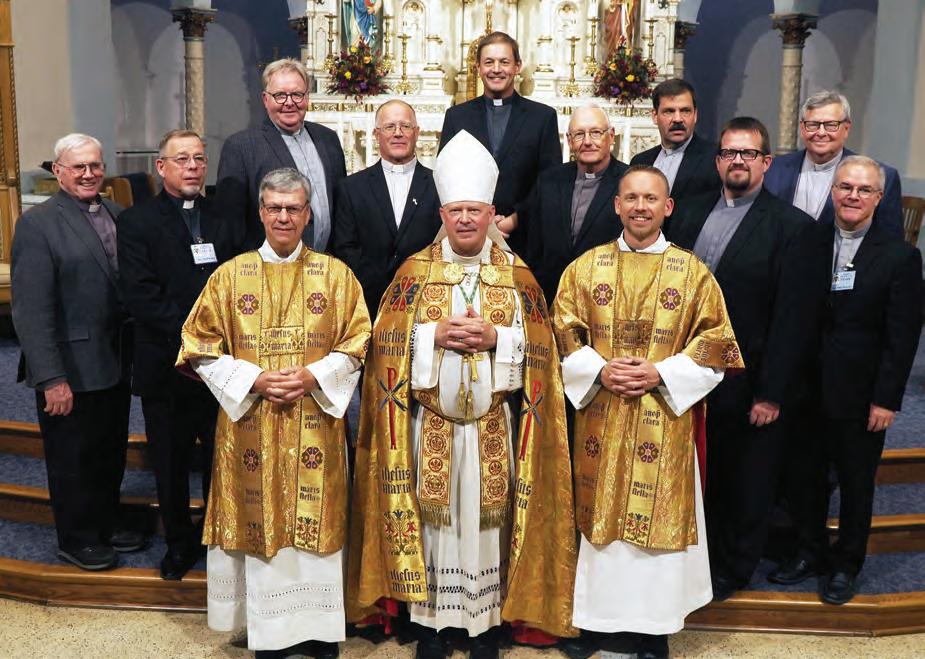
Pictured above: Permanent deacons of the diocese who were present at the Vespers Service gathered for a photo with their new bishop. Currently there are 17 assigned permanent deacons serving in the Diocese of New Ulm.
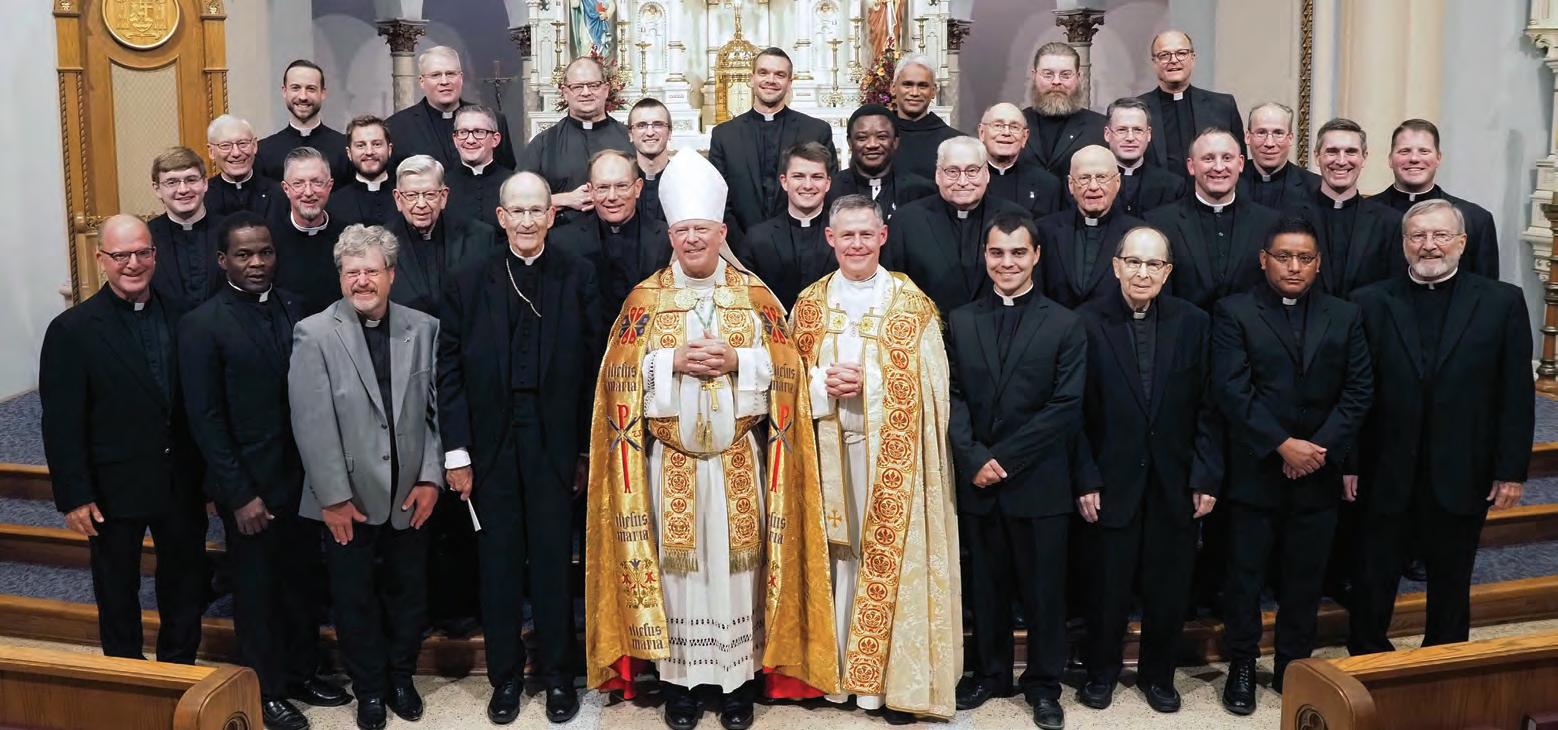
Pictured below: Bishop Zielinski is surrounded by priests of the diocese (active and retired) that were present at the Solemn Vespers at the Cathedral. Pictured left of Bishop Zielinski is Bishop Emeritus John M. LeVoir who served the diocese from 2008-2020 and Monsignor Douglas Grams, former diocesan administrator and rector of the Cathedral. Currently in the diocese there are 31 assigned priests and 19 retired priests.
(Photos by Mary Woitas and Christine Clancy)
The Prairie Catholic l Page 8 l October/November 2022
bishop - special report
From active duty to Alaskan shepherd to the bishop of New Ulm
by Mary Frances Myler
From Northern Michigan to the Middle East, to the remote reaches of North America, and now back in the rural Midwest, Bishop Chad Zielinski, 58, has served the Church’s peripheries, bringing the life of Christ to members of the armed forces, native Alaskans, and small-town parishioners alike. On Sept. 27, he was installed as the fifth bishop of the Diocese of New Ulm, an appointment that follows decades of physically demanding ministry.
Serving God and country Born and raised in Michigan, Zielinski enlisted in the Air Force after graduating from high school, attracted by service to the greater good of society, a sense of patriotism, a desire for travel, and the educational opportunities available. In the Air Force, he became involved in the military base’s close-knit parish community and helped teach religious education.
“I was close friends with the Catholic chaplain, and I got to see what he did on a day-to-day basis. God was stirring within me the desire for ministry, and people would say, ‘Have you ever thought about becoming a priest?’ God works through all that,” he told the Register Oct. 3.
A priest encouraged Zielinski to enter seminary to discern if God was calling him to the priesthood. After four years of active duty, Zielinski entered Mount Angel Seminary in St. Benedict, Oregon, where he earned a bachelor’s degree with honors in philosophy in 1989. He continued his formation as a seminarian for the Diocese of Gaylord and received his Master of Divinity degree in 1996 from Sacred Heart Major Seminary in Detroit. He was ordained to the priesthood on June 8, 1996.
A return to active duty
After the terrorist attacks of Sept. 11, 2001, the military increased its recruitment of chaplains, and Zielinski received a letter asking him to consider serving in the military once more. He told the recruiter that he was considering service as a chaplain but that he hadn’t spoken to his bishop yet.
“The recruiter picked up the phone when he saw my email and called me within 10 minutes. He said, ‘We need you tomorrow,’”
Bishop Zielinski recalled. He prayed about the decision before approaching Bishop Patrick Cooney of Gaylord, Mich., and explaining the great need for chaplains.
Bishop Cooney approved his return to military service.
“I kept in touch with Bishop Cooney.
Within a year, I was deployed to Baghdad, shortly after the war kicked off, and I kept him updated on what life was like as a chaplain. He was a bit older than my father, and he would always tell me that he felt like he had a son in the military who had gone off to war,” Bishop Zielinski said.
Fr. Zielinski served in three combat deployments. Because of the need for Catholic chaplains, he would often celebrate seven or eight Masses on a weekend, serving not only the Air Force, but also the Navy, Army, Marines, and international forces.
As a chaplain, Fr. Zielinski celebrated Mass anywhere he could, sometimes in a chapel tent, other times in the field. In
Afghanistan, he flew by helicopter to 19 different combat outposts to provide Mass and ministry presence. Once, he celebrated Mass with a priest from the Czech army on top of a mountain. They had climbed up the mountainside to visit a sniper team and had to construct a makeshift altar out of MREs for Mass.
In the military, the chaplain has privileged communication, so people of all faiths came to speak with Fr. Zielinski because their conversations could be fully confidential.
“We had this expression: that I was a priest to the Catholics and a chaplain to all,” he said.
Life as an Alaskan Shepherd After returning from his combat deployments, Fr. Zielinski served at the U.S. Air Force Academy in Colorado Springs, Colo., as vocation recruiter for the Archdiocese for the Military Services, USA, and as chaplain of Eielson Air Force Base in Alaska. He received numerous military awards and decorations for his service and was promoted to major in July 2013.
In November 2014, while Fr. Zielinski was at Eielson Air Force Base, Pope Francis named him the bishop of Fairbanks, Alaska. Within two weeks of his installation, Bishop Zielinski flew by bush plane for his first visit to several remote villages. In one of the villages, the church was a small cabin, with a small neighboring cabin that served as a rectory. With no running water, Bishop Zielinski melted snow and drew water from a community well. “As I was there, I thought, ‘This is just like a deployment.’
And as I stood at the airstrip waiting for the bush plane to come, I was looking at the same backpack and duffel bag I had carried in Afghanistan. And I had a flashback to standing on a mountaintop waiting for a helicopter. I realized that God would take the difficulties and challenges of war and use them for a greater good,” he said.
Bishop Zielinski saw the providential connections between his deployments and his assignment to Fairbanks. Familiar with serving among different cultures in the Middle East, he felt equipped to encounter the Yup’ik Eskimo and Athabaskan Indian cultures. “You go in there with an open heart and mind, and you’re going to learn from the people. You’re going to experience the beauty of their culture. As I’ve left that diocese now, I’ve left a blessed man,” he said. “They have a culture that lives with dependence on God for food, a subsistence way of life, and they very much have an attitude of thankfulness like I’ve never seen before in my whole life.”
Chad
The Diocese of Fairbanks is 410,000 square miles, which is 2.5 times the size of California. There are 46 parishes, but only nine are accessible by road, as 37 parishes are located in remote villages only accessible
The Prairie Catholic l Page 9 l October/November 2022
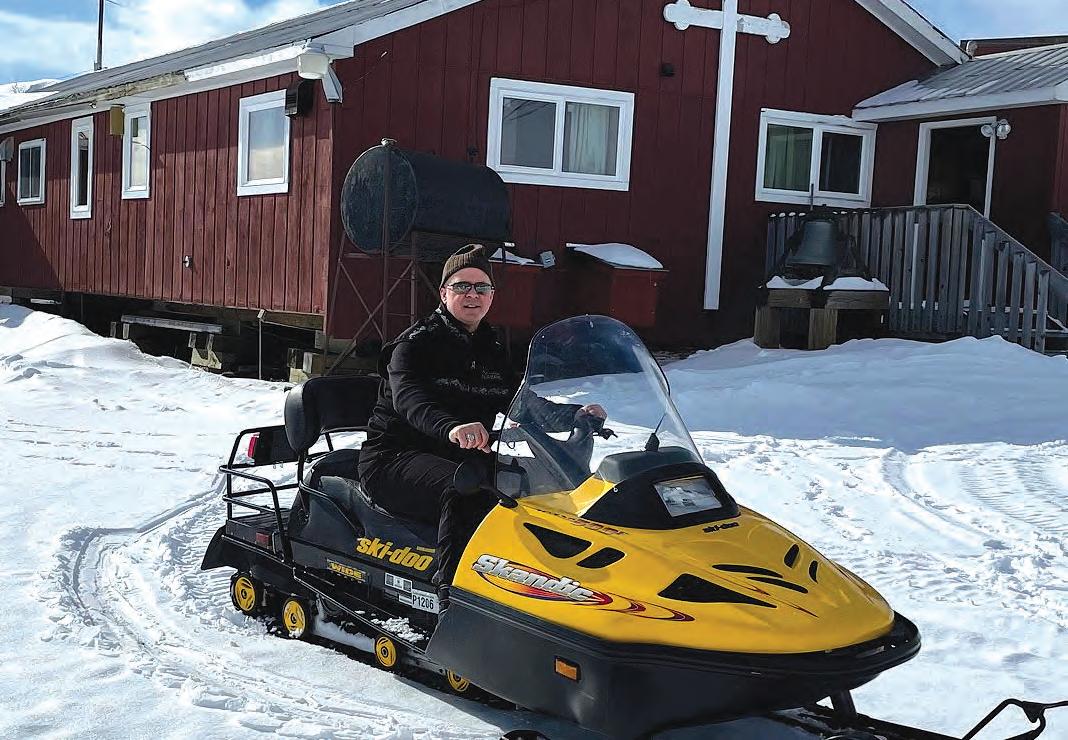
Bishop Chad Zielinski often traveled by snow machine to minister to his flock in Alaska. (Photo courtesy of Alaskan Shepherd Vol. 59, Issue 4)
The Diocese of Fairbanks
and the Diocese of Congratulations BISHOP DONALD KETTLER AND THE PEOPLE OF THE DIOCESE OF SAINT CLOUD OFFER PRAYERS AND BEST WISHES AS YOU BEGIN YOUR EPISCOPACY IN THE DIOCESE OF NEW ULM. BISHOP CHAD ZIELINSKI Heart of Mercy • Voice of Hope • Hands of Justice (Continued on page 11.) new
bishop - special report
Bishop’s mom says love for God makes her son a good shepherd
by Kathryn Ballalatak Prairie Catholic correspondent
ALPENA, MICH. – In the words of Pope Francis, “How precious is the family, as the privileged place for transmitting the faith.” Linda Zielinski and her late husband, Don, who passed in 2020, fully embodied this idea in their home and family life with their five children, including their oldest, Chad, who was born on Sept. 8, 1964, ordained a priest in 1996, and a bishop in 2014.
Linda, a lifelong Catholic belonging to All Saints Parish in Alpena, reflects on her son’s childhood, vocation discernment, and, ultimately, his life of service in the Church.
Childhood on a hobby farm It was in 1965 when the Zielinski family moved out of Detroit and eventually settled down in Alpena, Mich., (pop. 9,987). For the Zielinski’s, it was the right choice – much smaller than Detroit but significantly bigger than Mackinaw City, Mich., (pop. 704) and Rogers City, Mich. (pop. 2,669), which is where the family had first settled down. “It was nice going to a smaller community to raise kids,” said Linda, who grew up in Detroit and attended Michigan State University, where
she and her husband, Don, met. Linda was a stay-at-home mom until her last child, Cirrae started school. Then, she was employed as a social worker for the county. Don was a science teacher, which Linda said paired well with the family’s life on the 120-acre hobby farm outside of town.
“I don’t know if you remember the [sitcom] show Green Acres?” asks Linda. “That’s what our farm was like. [Don] was always trying something new. Sometimes things didn’t turn out too well,” she laughs. “I would find frozen [animal] specimens in my freezer that he would take to school to show kids.”
The farm was a busy place and full of animals (ducks, pigs, horses, cats, and dogs all came to Linda’s mind). “[As a child], I remember Chad loved making animal sounds until I sent him outside because he was driving me crazy,” she laughs.
And there was plenty of room for gardens as well. Linda talked about how her son loved hunting and fishing as a young boy and helped plant over 5,000 Christmas trees throughout the property.
“He also loved to tease his sisters. But he was, I think, a
little more serious. Everything he did, he did well, whether picking berries down the road or picking vegetables for farmers, baling hay, hauling Christmas trees . . . he worked his hardest.”
Catholic life
As a family, Don and Linda kept church and God at the center of their lives. They attended St. Bernard’s (one of the four Catholic churches in town).
“My husband taught CCD at the church. We were both lectors and Eucharistic ministers. I think all of that has an influence,” she says.
Bishop Chad was always involved in the youth program at church. He attended Catholic school at St. Bernard’s through the first grade before transferring to public school, where he played football in junior high and participated in trap shooting in high school.
When her son announced his decision to enter the seminary, Linda and Don’s response was level-headed and unassuming.
“You’re thinking, ‘This is just something he’s investigating.’ I know he took a break and worked in a hospital in Oregon for a while, just to make sure … In case he changed his mind, we were careful not to get too excited. Of course,
we always totally supported him.”
Although Bishop Chad has had many assignments, Linda finds his installation as the bishop of Fairbanks, Alaska, especially fitting since that was the location of his first adventure after high school. Linda explained how he and a friend purchased a vehicle together and drove to Alaska, where they worked for a summer, earned money at a fish factory, sold the car, and then flew back home.
Eight years after his appointment as bishop of Fairbanks, Linda was present at her son’s Installation Mass as the fifth bishop of New Ulm and she was very impressed with the town. “Alpena is pretty much the same size as New Ulm. It seems to be very clean and very neat. I think he’ll feel quite at home there,” she said.
While Bishop Chad settles into his new role in the Diocese of New Ulm, Linda will continue with her hobbies, church activities, and family time in Alpena. With 18 grandchildren and nine greatgrandchildren, all in Michigan, family get-togethers are frequent and lively.
During the week, you will find Linda playing cribbage and having
lunch with friends. And once a month, a group of ladies from church goes to the senior center to play cards. “We do fun things!” she laughs.
With Bishop Chad back in the Midwest, Linda said that perhaps there will be a few more visits home. “Well, I call it home,” she said.
As for the Diocese of New Ulm, Linda feels it is in good hands. The answer comes easily when asked what she thinks makes her son such a good shepherd: “It’s his love for God. And [being a shepherd of the Church] is his way of giving, of being of service to his fellow man.”
Above all, as a parent, Linda feels very fortunate that all her children still attend church: “Many of my friends, their children no longer go,” she said. “Maybe part of that is because their brother is a bishop and they wouldn’t dare not go,” she laughs. “But I feel very blessed that way.”
The Prairie Catholic l Page 10 l October/November 2022
United in Faith, Hope and Love Welcome to Minnesota Bishop Chad Zielinski! Congratulations as you celebrate your Installation as the fifth bishop of the Diocese of New Ulm.
Archbishop Bernard A. Hebda, Bishop Joseph A. Williams, and the faithful of the Archdiocese of Saint Paul and Minneapolis
new
Bishop Zielinski’s mother, Linda Zielinski, front-left, her daughter-in-law Theresa and son Todd join in the assembly’s joy-filled applause as they acknowledge the official mandate signed by Pope Frances, officially declaring Bishop Zielinski as the bishop of New Ulm. (Photo by Christine Clancy)
new bishop - special report
Growing up with a future bishop
by Christine Clancy
The Prairie Catholic
As a young boy growing up in the Midwest, Bishop Chad Zielinski was the oldest in a family of five siblings.
Brother Todd and youngest sister Cirrae talked with The Prairie Catholic, reflecting on growing up with a brother whose vocation choice was first the military and eventually the priesthood.
n Todd, a little over two years younger than Bishop Zielinski, describes his brother as having “a heart of gold.”
Q. What is a favorite memory of your brother growing up?
A. I always looked up to my brother and enjoyed it when I spent time with him. Fishing and hunting with my dad and brother were always great times.
Q. What was your reaction when he told you he was named a bishop?
A. This was very exciting and
surprising since he wasn’t very old. When my brother was a diocesan priest, one of his priest friends told me that he expected my brother to be chosen as a bishop someday.
Q. What can the people of the Diocese of New Ulm expect from their new bishop?
A. They can expect him to pour his heart into the people and preach the truth of our Catholic faith.
Q. What are you most proud of about your brother?
He has continually grown closer to Jesus and Mary throughout his priesthood.
n Cirrae, the youngest sibling, describes her brother as “compassionate and caring.”
Q. What is a favorite memory of your brother growing up?
A. I was nine when Chad left for Alaska for summer right after he graduated from high school and before he joined the
military. Although I don’t have a lot of memories due to the age difference, I will say he won the award for teasing his sisters; he never missed an opportunity. I think he would secretly pat himself on the back, feeling like his mission was accomplished, and he scored himself another point!
Q. How would you describe your brother?
A He is compassionate and caring but definitely has a military background, so he is a hard worker and likes structure and punctuality!
Q. What can the people of the Diocese of New Ulm expect from their new bishop?
A Structure. And he also wants to help people and their relationship with God and to follow the teachings of Jesus.
Q. What are you most proud of about your brother?
A His love for Jesus and passion for wanting everyone to make the right choices so that we may all be in heaven together someday. As busy as he is and as far away as he has always lived, keeping connected with his family has always been a priority. Plus, he is also an amazing cook!
Q.What advice would you offer your brother as he shepherds the Diocese of New Ulm?
A Although we usually look to him for advice, I would say connecting with the children and young adults and letting them understand the funny, enjoyable
person he is outside of the status of being a bishop (and military officer). Take time to smile, laugh, and enjoy what Minnesota has to offer.
Serving the Church on the peripheries
from page 9.)

by bush plane. Often, one priest will serve three or four villages, flying between them, or traveling by snow machine in the winter and boat in the summer. Typically, a priest will celebrate Mass once every two months when he visits the village.
The pandemic complicated travel, severely limiting priests’ ability to serve remote Catholic communities.
Bishop Zielinski visited a village at the end of the pandemic lockdowns where Mass had not been celebrated for 17 months. He was struck by their uncomplaining endurance of such restriction of the sacraments.
“The people never complained,” he said. “When I celebrated Mass, all they said to me in Yup’ik was ‘Quyana’ – thank you.”
Following a recent spinal-fusion surgery, Bishop Zielinski’s doctor urged him to avoid extreme physical exertion. “The surgeon suggested that I can’t keep driving snow machines, pounding down
the Yukon River, driving four wheelers through the tundra,” he said.
“It tears at my heart to leave a diocese where I established many friendships and grew to love people of a completely different culture, but I take those blessings with me,” he said. “I’m excited to be in New Ulm. For me, it’s a lot like coming home to Northern Michigan.”
In his closing remarks to the Register, Bishop Zielinski emphasized the importance of faith in the family, which can help young men and women discern their vocations.
“Knowledge of the faith is important, but you need to have a relationship with Jesus Christ to
hear the call – just like the disciples when they heard, ‘Come, follow me, and I will make you fishers of men.’ You have to know who Jesus Christ is to hear the call, and then you have to trust in him, that he will make you a priest, that he will form you to be a priest.”
Article courtesy of National Catholic Register, a service of EWTN News, Inc., www.ncregister.com.
The Prairie Catholic l Page 11 l October/November 2022
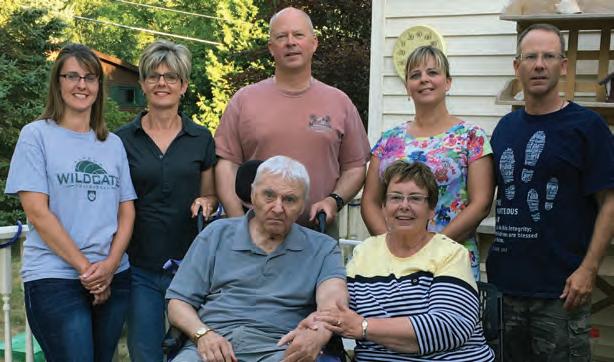
Bishop Zielinski’s family: Parents Linda and the late Don Zielinski; siblings Cirrae, left, Susan, Bishop Zielinski, Jana, and Todd.
(Continued
Fr. Zielinski on deployment in Afghanistan, 2010.
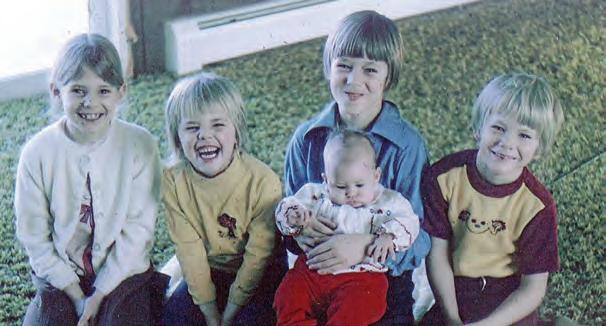
1973 Zielinski siblings: Susan, Jana, Chad, baby Cirrae, and Todd
Check out UPCOMING EVENTS happening throughout the diocese! Visit www.dnu.org
Diocesan Ministries Appeal


Renewed in Hope
After serving the past eight years in the Diocese of Fairbanks, I am fully aware of the countless blessings I have received from the 46 parishes that comprise the northern regions of the state of Alaska. The native Alaskan brothers and sisters patiently helped form me to be the shepherd I am today. They opened my mind and heart to their traditional way of life, culture, beauty, and richness.
I am most grateful to our Holy Father for entrusting me to serve as the shepherd of the Diocese of New Ulm. I come with the same open heart and mind, eager to learn and encounter new blessings as I visit parishes, Catholic schools, and families in this beautiful prairie land of south and west-central Minnesota.
As I continue to meet many of you, I am reminded of the words of Pope Francis – “We must restore hope to young people, help the old, be open to the future, spread love.” This year’s Diocesan Ministries Appeal theme – Renewed in Hope – echoes the Holy Father’s sentiments.
Without your prayers and financial support to the DMA, the good works of this annual appeal would not be possible.
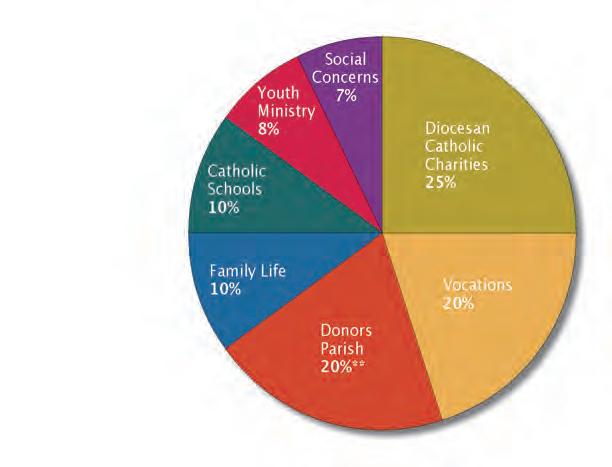
Parishes will also benefit from your generosity as twenty percent of each DMA dollar will be given to the parish of your choice to be used for a designated purpose.
God continues to call all of us to unite our efforts as one family, reaching out with compassion to build His Kingdom right here in our parishes and across this beautiful diocese.
Thank you for joining me in this labor of love through your gift to the Diocesan Ministries Appeal. May God bless you, and may we continue to be Renewed in Hope here in the Diocese of New Ulm.
Sincerely Yours in Christ,
The Prairie Catholic l Page 12 l October/November 2022
Dear Friends in Christ,
2022 DMA GOAL: $1,200,000
Diocesan Ministries Appeal set to kick off in parishes November 12-13
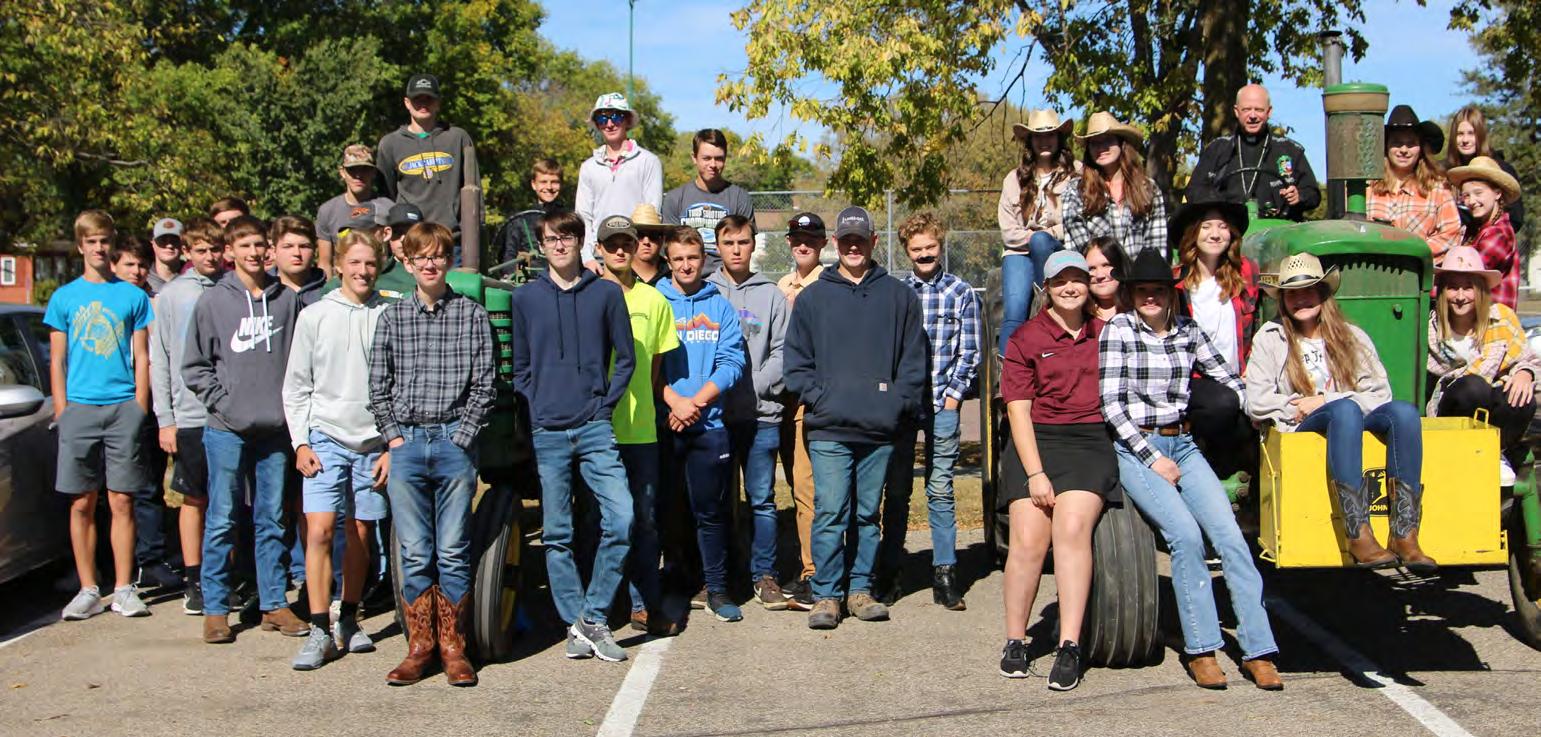
New Ulm Area Catholic Schools 2022 Homecoming/Photo by Tamara Klawitter
Note: Twenty percent of each DMA dollar is returned to the parish of the donor’s choice to be used for a designated purpose. Thank you for helping to support ministries that are so vital to the Church today, and for generations beyond. This year’s DMA supports six diocesan ministries as represented in the pie chart. To make an online donation to the DMA, visit the Diocese of New Ulm secure giving web page, www.dnu.org/dma.Give NO w! (MORE DMA COVERAGE, Pages 13-14.)
Diocesan Ministries Appeal
Diocesan Ministries Appeal supports good works of the diocese
Mattheisen, Mitch and Katie Maurer
St. Mary, Bird Island Arlene Dooner, Amy Hollan, Tom Mack, Ronald Willey
St. Peter, Canby Fr. Keith Salisbury*
St. Clara, Clara City Tom and Sandra Gunter, Brian and Brenda Harguth, Fr. Jerome Paulson*, James and Sherron Thein, Joseph and Alice Thissen
St. Paul, Comfrey Matthew and Erin Eischen, Denice Evers, Martha Fredin, Alphonse Mathiowetz
St. Willibrord, Gibbon Jerome Petersen
St. Pius, Glencoe Ronald and Debra Donnay, Robert and Gloria Eberhard, Fr. Aaron Johanneck*, Ivan and Blanca Jimenez, Bruce and Denise Johnson, Jeff and Denise Lueders, James Mayer, Barry and Susan Mielke, Eugene and Brenda Rothstein
Patricia Munson, Ron and Joyce Nielsen, Jeffrey and Catherine Peters
St. Michael, Madison Dallas and Michelle Croatt, Fr. Brian Oestreich*
The Bishop’s Guild is a recognition society of individuals who gave to the 2021 Diocesan Ministries Appeal at a level of $1,000 or greater. Membership is broken down into three Circle of Faith Levels: Gold represents a gift of $5,000 or more; Silver, $2,500 or more, and Bronze, $1,000 or more.
GOLD
Robert Brix – St. Clara, St. Clara; Dr. Martin and Amy Janning – St. Mary, Willmar; Brian and Ronda Mathiowetz – Japanese Martyrs, Leavenworth (undesignated); Jeff Neutzling – St. John, Darwin; Douglas and Leanna Olsem –Holy Redeemer, Marshall; Jan Rauenhorst – St. Aloysius, Olivia; Glen and Deb Schilling – St. Peter, St. Peter; Fr. George Schmit – St. Mary, Bird Island; Deacon Paul and Julie Treinen – St. John, Ortonville; Mary Alice Robasse –St. Anne, Wabasso
SILVER
Brett and Danielle Almich – St. Andrew, Granite Falls; Anthony and Mary Amon – St. Mary, Willmar; Paul and Julie Anderson – Japanese Martyrs, Leavenworth; Steve Biebl – St. George, West Newton Twp.; Rick and Ruth Bot – St. Edward, Minneota; Robert Buysse – Holy Redeemer, Marshall; Paul and Rebecca Carlson – Our Lady, Spicer; Daniel and Grace Coudron –Holy Redeemer, Marshall; Harry and Karen Fenstra – St. Mary, Willmar; Maurine Goblirsch – St.
Mary, Arlington; Edward and Katherine Green – St. Mary, Willmar and Cathedral, New Ulm; Paul Holzemer – St. Michael, Madison; John and Sharon Illikman – St. Mary, New Ulm; Jerome Jensen – St. Francis, Benson; Walter Kerber – Holy Trinity, Winsted; Jay and Vawn Krzmarzick – Holy Trinity, Winsted; Jeffrey and Gail Lehn –St. Anastasia, Hutchinson; David and Jacqueline Lynn – Cathedral, New Ulm; Joann Masters – St. Andrew, Granite Falls; Myron and Becky Mathiowetz – St. Michael, Morgan; Michael and Susie Miner – St. Peter, St. Peter; John and Bonnie Mohr – Holy Family, Silver Lake; Doris Petracek – St. Anne, Wabasso; Paul and Marvel Pryor – St. Catherine, Redwood Falls; Timothy and Lora Rahe –Cathedral, New Ulm; Dennis and Barbara Schreier – St. Catherine, Redwood Falls; Michelle Schultz – St. Michael, Morgan; Nancy St. Sauver – St. Andrew, Granite Falls; Mark and Ann Suhr – St. Anastasia, Hutchinson; Carol Turner – Holy Redeemer, Marshall; John Virnig - St. Andrew, Granite Falls
BRONZE St. Mary, Arlington Dave and Dee Czech, Deacon Timothy and Debra Dolan*, Duane and Patricia Geib
St. Francis, Benson Cletus Grossman, Kathy Hilleren, Leslie Honebrink, William and Janet Luzum, Timothy and Carol
St. Mary, Cottonwood Jerry and Donna Sanders
St. John, Darwin Fr. Patrick Casey*, Weston and Mary Jo Edwards, John and Kristan Haffley, Patrick and Mary Hansen, Fr. Jeffrey Horejsi*, Bill and Judy Klein-Pells, Mark and Jennifer Smith
St. James, Dawson Burton and Rosemary Hendrickson, Brent and Alyssa Larson, Gary and Ingrid Larson, Andrew and Michelle Ross, Jerome and Lavonne Schuelke, Nicholas and Claire Weimann
St. Bridget, DeGraff Patrick and Bev Byrne, Anthony and Charlotte Rosemeier
St. Andrew, Fairfax Leo and Doris Csukker, Fred Kienlen, Leroy Nosbush, George Wendinger, Frank and Desiree Ziegler
St. John, Faxon Deacon Timothy and Debra Dolan*
St. Michael, Gaylord Deacon Timothy and Debra Dolan*, Mickie Moos, Douglas and Iris Parrott, Nathan and Cindy Posivio, Richard Reinhart
St. Eloi, Ghent Lyle Decock, Rita Engels, Dan and Shari Maeyaert, Fr. Todd Petersen*, Dale and Lila Schmidt, Donald and Monica Senden, Ronald Sussner, Jerry and Carolyn Van Keulen
Holy Rosary, Graceville Donald and Geraldine Diekmann, LeRoy Doll, Roger and Betty Frisch, Jerome and Helen Holker, Fr. Brian Oestreich*, Cassandra Rahrlien, Terry and Audrey Rahrlien, James and Tara Stotesbery
St. Andrew, Granite Falls Raymond and Margaret Martin, Dr. Arthur and Billie Rillo
St. Joseph, Henderson Deacon Timothy and Debra Dolan*
St. Anastasia, Hutchinson James and Catherine Allen, Dolores Brunner, Tom Burich, Fr. Patrick Casey*, Douglas and Carol Dobratz, Larry and Betty Gunderson, James and Sandra Haasl, Allan and Phyllis Maiers, Irene Matousek, Emmet and Marge McCormick, Thomas McGraw, Leann Melberg, Catherine Moldestad, Roselyn Peterson, Richard and Beatrice Prellwitz, Robert and Genevieve Schmit, James Young
SS. Peter & Paul, Ivanhoe Archie and Connie Citterman, Joan Gawarecki, Robert Knoff, Fr. Keith Salisbury*, Allan and Jane Steffes
St. Genevieve, Lake Benton Fr. Keith Salibury*, Curt and Lori Timmerman
St. Joseph, Lamberton Fred Berg, Craig and Barb Wetter
St. Philip, Litchfield Harlan and Denise Andersen, Charles and Ann Fuller, Teresa Hankins, Fr. Jeffrey Horejsi*, Ashley and Tracy Huhn, David and Barb Keeling, Bruce and Joyce Kiehn, Anthony Lorber,
Our Lady, Manannah Fr. Jeffrey Horejsi*, Janet Johnson, Roxann Knisley, Deacon Roger and Pamela Osborne, Mark Shepersky, Joe and Diane Springer, Michael Wuertz
Holy Redeemer, Marshall Robert Aufenthie, Magdalen Bergstrom, Todd and Jane Bock, Gregory and Paula Boerboom, Dorrence and Joyce DeCock, Gregory and Mary Deutz, Todd and Brenda Dirckx, Thomas and Julie Dolan, Charles and Bernice Fischer, James and Jan Fuhrmann, Lois Henkel, Jack and Terry Hennen, Fr. Dennis Labat, Anthony and Ruth Louwagie, Dennis and Evelyn Louwagie, Reinhold and Connie Mathiowetz, Scott and Cheri Mathiowetz, Thomas and Lisa Meyer, Lawrence and Lavonne Moorse, Deacon Kenneth and Janice Noyes, James and Wanda Ochocki, Michael and Amanda Oney, Dean and Doreen Peterson, Gabe and Jill Pieper, Steven and Susan Sammons, Thomas and Linda Sanders, Andrew and Tawny Schotzko, David and Marcia Schroeder, Mary Striegel, Lu Ann Thielges, John and Bobbi Verly, Todd and Pauline Vogl, Matthew and MacKenzie Weller, Donald and Angeline Wyfflels, Joe and Bobbi Zeug
St. Michael, Milroy Dallas and JoAnn Dolan, David and Patricia Zwach, Dean Zwach
St. Edward, Minneota Mark Buysse, Fr. Patrick Casey*, Fr. Todd Petersen*, James and Mary Myhre
St. Joseph, Montevideo Lannon and Mary Brown, Fr. Patrick Casey*, Marvin and Marlene Dehne, Paul Dezeeuw, Knights of Columbus – Council 1551, Carleton and Patricia Niemand, Wesley and Jessica Stettner
14.)
The Prairie Catholic l Page 13 l October/November 2022
(Continued on page
Contributions of Bishop’s Guild members vital to appeal’s success
Diocesan Ministries Appeal

Bishop’s Guild membership continued
St. Michael, Morgan
Thomas and JoAnn Green, Karen Greenberg, Emma Iffert, Kenneth and Virginia Landkammer, Tony and Brenda LeGare, Wilfred and Theresa Spaeth, Patrick and Colleen Wildt
Sacred Heart, Murdock Paulette Collins, Philip and Judith Hoffer, Ronald and Ginny Wille, Mike and Sandy Yost
Cathedral, New Ulm Thomas and Amanda Andrews, Carol Beranek, Michael and Becky Boyle, Florian and Rosemary Dittrich, Charles and Carol Guggisberg, Mark and Lisa Guggisberg, Thomas and Patricia Hayes, Neil and Angela Herzog, Patrick and Bernadette Herzog, Roy and Helen Janni, Earl and LaRae LaPlante, Bishop John LeVoir, Chris and Mary Loetscher, Fr. Gerald Meidl, Wallace Mertensotto, Richard and Monica Mueller, Dr. Gary and Janet Neubauer, Gerald and Lorie Reinarts, Marilyn Reinhart*, Monsignor John Richter, Denise Richter, Ronald and Barb Schoo, Vince and Kate Sloot, Florian Wurtzberger
St. Mary, New Ulm
Andy and Anne Biebl, Tony and Carol Boelter, Dr. Mario and Christine DeSouza, Mike and Jane Domeier, Robert and Mary Ellen Domeier, Patrick and Nicole Eckstein, Monsignor Douglas Grams, Marie Guldan, Gary and Danelle Hauser, Janice Helget, Tom and Shirley Henderson, David and Anita Hoffmann, Greg and Lori Howard, Chuck and Carolyn Keller, Elizabeth Kennedy, Mike and Kathy King, Doug and Paulette Kral, Peter and Linda Neigebauer, Mary O’Connor, Robert and Gayle Ranweiler, Marilyn Reinhart*, Mary Reinhart, Ron and Barb Saffert, John and Ann Schotzko, Helen Schweiss, George Stueber, Drs. Jay and Ellen Vancura, Ellwood and Beth Zabel
St. Paul, Nicollet
John and Rose Mary Hiniker, Deacon Steven and Buffy Spilman, Patrick Zins, Paul and Donna Zins
Holy Rosary, North Mankato Richard and Cathleen Ahern, Eugene and Shirley Brandt,
Richard and Sue Cashman, David and Julie Collins, Marion Giefer, Michael and Diane O’Dea, Thomas Rheaume, Dr. James and Darlene Schorn, Daniel and Brenda Voracek
St. Aloysius, Olivia Fr. Patrick Casey*
St. John, Ortonville Terrence and Judith Gere, William and Diane Hartman, Joseph and Hillary Henrich, Fr. Brian Oestreich*, Richard Schluter, Roman and Carol Taffe
St. Catherine, Redwood Falls Jason and Leah Balko, Scott Balko, Scott and Shelly Baune, Matthew and Laura Buckley, Brandon and Valerie Crooks, Duane and Shereen Frank, George and Jenifer Goblish, Chad and Stacey Heiling, Fr. Anthony Hesse*, Richard and Joanne Horejsi, Collette Irlbeck, Richard and Lorraine Jacoby, Thomas and Constance Johanneck, Douglas and Teresa Karsky, Anthony and Julie Kramer, Elizabeth Lange, Laura Rohlik, Thomas and Deborah Stotesbery
Holy Redeemer, Renville Fr. Patrick Casey*, Roger and Gina Hagen, Petri and Janice Papinaho, William Schafer
St. Joseph, Rosen Gerald and Brenda Adelman
St. John, Searles Allen and Kayla Berg, Ione Grossmann, Randy and Mary Kraus
Holy Family, Silver Lake Steve and Fiammetta Householder, Fr. Aaron Johanneck*, Dr. Lawrence and Kathleen Mottl, Fr. Robert Mraz, John and Kathy Nowak, Robert and Peni Jo Penas, Ronald Penas, Richard and Patricia Rotzien, Kenneth and Kathleen Snegosky, Brian and Julie Stibal
St. Mary, Sleepy Eye Richard Callanan, Michael and Marjorie Hoffmann, Deacon Mark and Tami Kober, Patrick and Jacque Krzmarzick, Brent and Rachel Kucera, Deacon Michael and Gina McKeown, Kevin and Karen Olson, Wayne and Patti Pelzel, Mark and Anita Schwartz,
John and Rosemary Schwartz, David and Kathleen Sellner, Charles and Kathy Spaeth, Peggy Tauer,
Our Lady of the Lakes, Spicer Brian and Kathy Bollig*, Ron and Verdonna Dobbs, Leon and Neila Duchene, Larry and Janet Fleck, Mary Glimsdal, Michael Goldschmidt, Roger and Jonelle Heinen, Patrick and Mary Laib, John Muffley, Fr. Jerome Paulson*, Tim and Mary Pieh, Diane Pyka, Gerald and Rebecca Reiter, Jose and Mely Rojas, Ron and Bette Schmitz, Elta Stalboerger, Robert and Tami Thein, Joseph and Jane Willett, Patrick and Hanne Williams
St. Raphael, Springfield Paul and Sharon Pieschel, Shirley “Jodi” Pieschel, Deacon Barry and Karen Reindl, Michael and Denise Reiner
St. Leo, St. Leo Randy and Christine Kraus, Fr. Keith Salisbury*
St. Peter, St. Peter Jeff and Peggy Borgmeier, William and Marge Boys, Jeffrey and Sharon Crowley, Margaret Fitzpatrick, Philip and Shirley Hodapp, William and Rosemary
Plaetz, Robert and Julie Plaetz, Ronald and Nancy Plaetz, Bradley and Paula Pohlen, Greg and Debra Price, Chuck and Joann Robasse, Gary and Monica Rohlik, Alfred and Florence Salfer, William and Mary Schwarz, Delbert and Phyllis Skoblik, Raymond and Alice Thull
St. Anthony, Watkins Fr. Richard Gross, John and Rachel Kinzer, Robert and Lynn Lange
St. George, West Newton Twp. Brad and Diane Franta, Dolores Franta, Rosemary Franta, James and Rita Gleisner, David and Nancy Reed
St. John, Wilno Ronald and Diane Dritz, Kevin and Judy Leibfried, Eugene and Aileen Paluch, David and Barbara Popowski, Steven and Carol Ratajczak, Fr. Keith Salisbury*, William and Wendy Sterzinger
St. Mary, Willmar Roque and Kristel Arcilla, Edward and Marcia Arndorfer, Brian and Kathy Bollig*, Helaine Bolter, Mike and Pam Cain, Joan Conway, Thomas and Kaye Dooley, Beverly Engleson, Vernon Flaig, Jason and Sadie Fussy, Loren and Linda
Ronald and Loretta Holmgren, Joanne Kovall, Doug and Donna Kuehnast, Marion Larsen, Harold and Mary Jo Larson, James and Rose Larson, Charles and Myrna Loso, David and Judy Lux, Bob and Jean Masters, Fr. Jerome Paulson*, Mary Schnell, Patrick and Pamela Schwab, Rick and Kathy Schwantes, Nathan and Wendy Streed, Louise Thoma, Mary Louise Wallin, Marty and Judy Wieland
Holy Trinity, Winsted Raymond and Carol Bayerl, Fr. Eugene Brown, Jeff and Michelle Campbell, Dennis and Sue Dunne, Roger and Rose Ann Grotbo, Fr. Aaron Johanneck*, Robert and Irene Kutz, Barbara Millerbernd, Michael and Maria Nathe, Joseph and Melissa Neumann, Craig and Shari Remer, Francis and Germaine Schommer, Gerard Stifter, Marlene Zimmermann
St. Francis, Winthrop Kevin and Sue Lauwagie
Gifts without designation: Tom and Laurie Fox, Fr. Brian Mandel, Mary Lou Mathiowetz
*These donors assigned their single gifts to several parishes with which they have been or are
BISHOP CHAD W. ZIELINSKI
from the Clergy, Religious and Lay Faithful of the DIOCESE OF CROOKSTON
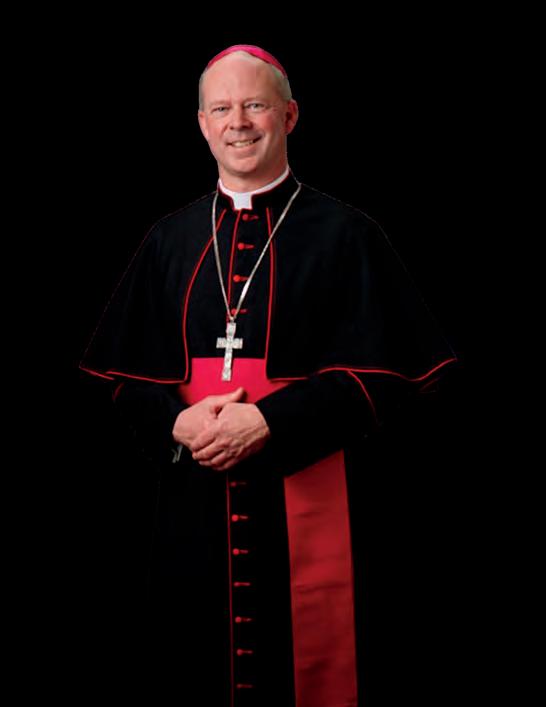
“The Diocese of Crookston offers heartfelt congratulations to Bishop Chad Zielinski! We welcome his deep pastoral heart for sharing the love of Christ. We know the people of the Diocese of New Ulm will be blessed by their new shepherd.”
The Most Rev. Andrew H. Cozzens Bishop of Crookston
The Prairie Catholic l Page 14 l October/November 2022
(Continued from page 13.)
Congratulations
by Fr. Mark Steffl, STL, JCL
Canon Law refers to the material goods that the Church owns as “temporal goods.”
The laws relating to their good management are treated in a section of the Code of Canon Law titled “The Temporal Goods of the Church” with 56 separate canons divided into four sections: “The Acquisition of Goods,” “The Administration of Goods,” “Contracts and Alienation of Goods,” and “Pious Dispositions and Pious Foundations.”
The first canon in this section on Temporal Goods of the Church describes the Church’s understanding of the purpose of these material goods and the Church’s right, in the name of the Lord, to acquire, own, administer and, at times, dispose of them, in order to fulfill the Church’s mission of the salvation of souls.
Ask a Canon Lawyer
This month’s questions: Who Owns Church Property?
Because the Church exists throughout the world and within many different civil legal systems, a provision is set up in order for property to be owned and administered by legal entities established and defined by the Church. Canon law calls these legal entities “juridic persons,” which are roughly equivalent to the civil concept of “corporations” so that property can be administered by those who use the property. (It wouldn’t make too much sense for the pope to attempt to directly administer all the property of the Church, or even for a diocesan bishop to directly manage all the property for a diocese.) Each diocese and each parish within a diocese is its own “juridic person,” and other juridic persons can also be established to administer their own property: institutions such as a Catholic hospital, university, or school; for example, or a shrine or similar place of pilgrimage.
Specifically for us in the State of Minnesota, each parish is incorporated as a non-profit

religious corporation, and by civil statute, each parish has a corporate board of five individuals. Of these, three are members ex-officio: the bishop of the diocese, the vicar-general of the diocese, and the priest appointed pastor of the parish. The other two are the “trustees” – lay members of the parish who are recommended to the diocesan bishop by the pastor and appointed for a specific term.
It is these juridic persons (as religious corporations) who, in Minnesota, hold the title of ownership for parish property: land, buildings, etc. Any administration of property that involves buying or selling of land and buildings, and contracts over a specifically defined amount need the approval of this corporate board. Otherwise, the dayto-day oversight is legitimately exercised by the pastor and anyone he assigns to assist him in the name of the parish and for the good of its mission.
Catholic schools in diocese continue to work toward diocesan standards
from page 1.)
The afternoon included break-out sessions that addressed the needs of schools, directors of religious education, and youth ministers. Fr. Rolling provided tools and ideas to help educators learn more about those they are evangelizing. He emphasized the importance of sharing stories and personal encounters with Christ. “Personal stories have power, and they help us show others how we are walking with Christ and how this makes all the difference,” he said.
The second break-out session was led by Dr. Denise Donohue, Deputy Director of K-12 Programs at The Cardinal Newman Society. Donohue earned her doctorate in school administration, with a concentration in curriculum development and a dissertation
on the establishment of private, independent Catholic schools.
As a co-author of the Catholic Curriculum Standards, her presentation emphasized the importance of intentionally grounding everyday classroom work in the framework of Catholic teaching.
As Catholic schools in the diocese continue to work toward developing diocesan standards, the diocese enlisted guidance from Jill Annable, an educational consultant with Loyola University’s Greeley Center for Catholic Education. Annable shared a video presentation outlining the process for developing standards for Catholic schools. Although each Catholic school in the diocese has its own set of curriculum standards, school leaders will be working together to establish a
set of standards that specifically integrate Catholic identity into the classroom curriculum in response to the controversial challenges posed by today’s culture. These standards have already been developed in the area of religion/ theology for kindergarten through eighth grade.
With the help and guidance of the Greeley Center for Catholic Education and the Cardinal Newman Society, school leaders will continue to work toward comprehensive curriculum standards for all areas of study.
Editor’s note: Dr. Michelle Kramer is director of Catholic Schools for the Diocese of New Ulm.
Can. 1254 §1 The Catholic Church has the inherent right, independently of any secular power, to acquire, retain, administer, and alienate temporal goods in pursuit of its proper objectives.
§2 These proper objectives are principally the regulation of divine worship, the provision of fitting support for the clergy and other ministers, and the carrying out of works of the sacred apostolate and of charity, especially for the needy.
Most of our parishes in the Diocese of New Ulm have a cemetery, which, although it may have a separate committee or board to oversee it, is owned by the same civil corporation as the parish. When parishes are merged into one, the civil title for parish property, including a cemetery, eventually passes to the parish that a former parish is merged into so that it is always a clearly defined legal reality of who is responsible for the property.
Next Issue: How is an Apostolic Pardon/“Last Rites” different from receiving Anointing of the Sick?
Editor’s note: Fr. Mark Steffl serves as judicial vicar of the Office of the Tribunal for the Diocese of New Ulm and is a canon lawyer, msteffl@ dnu.org, (507) 2335316.
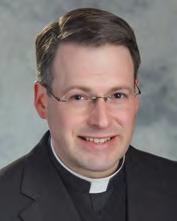
education The Prairie Catholic l Page 15 l October/November 2022
Do you have a question regarding canon law that you would like to see answered here? E-mail The Prairie Catholic, cclancy@dnu.org. In the subject area indicate “Ask a canon lawyer.”
(Continued
Synod on Synodality 2021-2023
by Carl Bunderson Catholic News Agency
The Synod on Synodality has thus far demonstrated the “joys, hopes, and wounds” shared by members of the Church in the United States, according to a report on the process issued recently. “These consultations express a deep desire for greater communion,” read the U.S. Conference of Catholic Bishops’ (USCCB) National Synthesis document, released Sept. 19.
The fruit of consultation in the Latin-rite dioceses in the U.S, as well as Catholic associations, organizations, and national ministries, the synthesis noted several themes: enduring wounds, especially those inflicted by the sexual abuse crisis; enhancing communion and participation in the life of the Church; ongoing formation for mission; and engaging discernment.
In a letter prefacing the report, Bishop Daniel Flores of Brownsville, chair of the U.S. bishops’ doctrine committee, wrote that it is “an expression of what we as a Church have heard each other say when asked about our deepest preoccupations and hopes for the Church of which, by the grace of God, we are all a vital part.”
He emphasized that “the publication of this document is not a concluding moment, however; it is a reflective, forward-moving moment. It is an invitation to listen, to discuss together and to discern together as the Church, about how best to understand and act upon those matters that sit deeply in the hearts and minds of Catholics in the U.S.”
The report noted that the abuse crisis “has eroded not only trust in the hierarchy and the moral integrity of the Church, but also created a culture of fear that keeps people from entering into relationship with one another and thus from experiencing the sense of belonging and connectedness for which they yearn.”
Division within the Church was also a major wound, especially related to the use of the Traditional Latin Mass: “The limited access to the 1962 Missal was lamented; many felt that the differences over how to celebrate the liturgy ‘sometimes reach the level of animosity. People on each side of the issue reported feeling judged by those who differ from them.’”
Division among the bishops was also noted: “The perceived lack of unity among the bishops in the United States, and even of some individual bishops with the
Congratulations
Holy Father, as a source of grave scandal. This perceived lack of unity within the hierarchy seems to, in turn, justify division at the local level.”
Marginalization was another wound highlighted in the synthesis, with two groups highlighted. The first is those with a lack of social or economic power, “such as immigrant communities; ethnic minorities; those who are undocumented; the unborn and their mothers; people who are experiencing poverty, homelessness, or incarceration; those people who have disabilities or mental health issues; and people suffering from various addictions. Included also in this group are women, whose voices are frequently marginalized in the decision-making processes of the Church.”
The second marginalized group, the report said, “includes those who are marginalized because circumstances in their own lives are experienced as impediments to full participation in the life of the Church. Among these are members of the LGBTQ+ community, persons who have been divorced or those who have remarried without a declaration of nullity, as well as individuals who have civilly married but who never married in the Church.”
Regarding greater communion and participation, the synthesis indicated a desire “to be a more welcoming Church where all members of the People of God can find accompaniment on the
journey. The synodal consultations mentioned several areas where there existed a tension between how to walk with people while remaining faithful to the teachings of the Church.”
Prominent here was “the desire to accompany with authenticity LGBTQ+ persons and their families” and the “deep need for ongoing discernment of the whole Church on how best to accompany our LGBTQ+ brothers and sisters.”
The divorced often feel unwelcome, the report noted, suggesting “a more transparent and clear annulment process.”
Greater “leadership, discernment, and decision-making roles for women” were included as a desire in nearly all the synodal consultations.
“Another common hope for becoming a more welcoming Church revolved around removing barriers to accessibility and embracing those with special needs and their families, particularly as it relates to an individual’s sacramental life,” the report highlighted. “One of the regions reported a lack of inclusion because there are so few priests and other ministers who are fluent in American Sign Language. Families expressed great joy when steps of inclusion were taken, while many acknowledged the work still left to be done.”
Greater efforts should be made “to welcome diverse cultural
and ethnic communities” and to overcome racism, according to the synthesis.
Concern over young people’s failure to practice the faith was widespread, and “young people themselves voiced a feeling of exclusion and desired to participate more fully as members of the parish community. The feeling of exclusion also manifested itself in some youth seeking a sense of belonging in the Church’s ancient tradition of faith, prayer, and devotion.”
The need for continuing spiritual, pastoral, and catechetical formation was recognized, along with the importance of strengthened communication: “Nearly all of the synodal consultations saw clear, concise, and consistent communication as key to the strong desire for appropriate transparency … As the Church seeks to continue down the synodal path, a commitment to clear, transparent, and consistent communication will be crucial.”
Turning to discernment, the synthetic document said: “The rediscovery of listening as a basic posture of a Church called to ongoing conversion is one of the most valuable gifts of the synodal experience in the United States.”
According to the report, about 700,000 people participated in the diocesan phase of the synod in the U.S., out of 66.8 million Catholics in the country. The national synthesis concludes the diocesan phase of the Synod of Synodality. The continental stage, in turn, will be a preparation for a Synod of Bishops to be held at the Vatican in 2023.
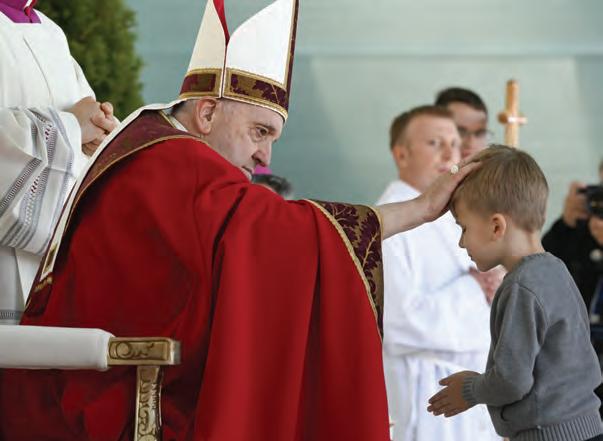
Diocesan synthesis
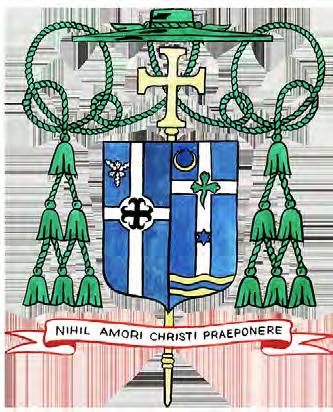
The Synod on Synodality diocesan synthesis report that was created as a result of parish gatherings and submitted to the USCCB on behalf of the Christian faithful of the Diocese of New Ulm can be found on the diocesan website, www.dnu.org/ synodalchurch.
Please continue to pray for this Universal Synod as it now transitions into the continental stage in preparation for a Synod of Bishops to be held at the Vatican in 2023.
nation The Prairie Catholic l Page 16 l October/November 2022
United States synod synthesis shows ‘desire for greater communion’
Pope Francis’ Synod on Synodality, calls the entire Church to discern how the Spirit is moving through and with the Body of Christ — inside and outside the Church — so that we may continue to fulfill our mission to evangelize in the world. (Photo by Vatican Media)
Bishop David D. Kagan and the clergy, religious and lay faithful of the Diocese of Bismarck offer sincere congratulations to Bishop Chad Zielinski and a promise of prayers on his appointment as the Bishop of the Diocese of New Ulm.
by Jackie Finstad NUDCCW president
Women in the Diocese of New Ulm pray and serve in countless ways bringing the feminine genius to the various missions of the Church. Both in family life and Church life, women shoulder numerous responsibilities and duties, often undertaken in hidden ways that go unnoticed.
An ongoing tradition for the
New Ulm Diocesan Council of Catholic Women (NUDCCW) is to honor each year a woman who is a member of a parish in the diocese and exemplifies the values of prayer, service, and mission.
The chosen candidate is presented the Woman of the Year award at the annual New Ulm Diocesan Council of Catholic Women Convention held each spring. In 2023, the Church of St. Mary in New Ulm will host the DCCW convention. Be sure to mark your calendar. And, if you know of someone deserving of the Woman of the Year recognition, please take a few moments to nominate her!
Nomination rules:
- Each nomination must be submitted by a group of three individuals.
- More than one name from each parish may be submitted.
- Nominees cannot have previously received this award.
- Current diocesan CCW voting board members are not eligible.
- Judging is based on family commitments, participation in parish activities and committees, involvement in CCW on all levels, and community activities.
- Nominations will be kept confidential until the award is presented at the convention.
- Information about the nominee must be obtained without talking to the nominee.
Nomination forms are available from your CCW parish president or on the New Ulm Diocesan Council of Catholic Women website, www.nudccw.org/ woman-of-the-year.
All submissions must be received by Jan. 31, 2023.
Counting the ‘silences’ within our loudest days
by Christopher News Notes
Wouldn’t it be nice if God would send us how-to instructions on this project called life, or at least some obvious clues that might lead us in the right direction? We pray and reflect, looking for signs that we’re on the right path, but we often spend a lot of our time “recalculating,” like a GPS trying to guide us toward our intended destination after several 632 wrong turns. Life isn’t easy, and discerning God’s still small voice amid the noise and chaos seems downright impossible. But, if we carve out time for those necessary one-on-one conversations with the Lord, we’ll start to recognize the Spirit moving in our life. Regular doses of silence and solitude, in which we put ourselves fully in the presence of God, rank among the top must-haves for both spiritual seekers and those yearning to grow in their faith.
day-to-day world. She notes that in Conjectures of a Guilty Bystander, Merton states that it can be damaging for us “to be carried away by a multitude of conflicting concerns, to surrender to too many demands, to commit oneself to too many projects, to want to help everyone and everything.”
Sometimes, it isn’t just the world outside keeping us from silence, but our own seemingly-endless anxious thoughts. Hall recalled a nun at Santa Rita Abbey in Arizona saying to her, “Sooner or later, you have to get to the point where you take on your own inner noise and let God take you by the hand and lead you along.”
by Tracy Meyer NUDCCW Spirituality Commission
“For I was hungry, and you gave me food. I was thirsty, and you gave me drink, a stranger and you welcomed me, naked and you clothed me, ill, and you cared for me, in prison, and you visited me,” (Mt. 25:35-36).
If one were to look around, there is certainly no lack of Council of Catholic Women (CCW) activities happening in parishes throughout the Diocese of New Ulm.
Parish Council of Catholic Women have been busy helping with brunches, luncheons, recognitions, bake sales, church cleanings, and fundraisers. There is such a wide variety of other services the parish CCW offers. These are all wonderful and necessary activities.
Are you a Martha or a Mary?
Jesus tells Martha in the Gospel of Luke, “Martha, Martha, you
are anxious and worried about many things. There is a need of only one thing. Mary has chosen the better part, and it will not be taken from her.”
While Jesus was not correcting Martha, he invited her to join Mary. So how do we choose the better and still get things done? Should we stop being ambitious? The simple answer is no. We must remember to balance Martha and Mary in our lives.
The Diocese of New Ulm Council of Catholic Women will soon be busy preparing for the holidays and all the “Martha” jobs that come with it. While that is not bad, we must remember Jesus’ invitation and choose the better part, as Mary did.
Advent begins this year on November 27, the beginning of the new Church year – an excellent time to hit the reset button. There are so many resources out there to assist
you along the way. Some of my favorites that I recommend you check out include FORMED. org. Contact your parish to see if they have a subscription. Dynamic Catholic video is another excellent resource you can have sent directly to your email each morning. The United States Council of Catholic Bishops, www.usccb. org, offers numerous resources too including Advent calendars.
The Catholic Company has a beautiful way to start your day with prayer by simply going to catholiccompany.com and clicking morning offering in the top toolbar.
This Advent, try spending time in Eucharistic Adoration, saying the Rosary, meditating on the scriptures, or attending the Sacrament of Reconciliation.
We are so blessed by what the Catholic faith has to offer.
Seek out sacred silence When Becky Eldredge was a junior at Louisiana State University 20-something years ago, she took part in a Busy Person’s Retreat, where she learned how to pause in her daily life to make time for stillness and prayer. She devised a term for the sacred space within us where God resides: “the inner chapel.” She has used that term many times in her work as a spiritual director and has now authored a book with that title.
Making time for stillness, Becky learned, is key. “What [being still] does to our body…is take all those heightened emotions and…adrenaline, and it starts calming it. So it does something to us physically. Then, it’s the gift of…coming into this silence and knowing it’s not an empty silence – knowing that in our Christian tradition…it’s making daily time to be with the one who completely loves us unconditionally, who offers us mercy like we can’t even fathom. It’s the Christ, the one we belong to.”
Author and filmmaker Cassidy Hall was moved to quit her job and visit all of the Trappist monasteries in the United States (17 at that time) after reading Trappist monk Thomas Merton’s book, New Seeds of Contemplation. And Hall is well aware of the “tension” that we confront when trying to discern God’s still small voice amid the constant chatter and busyness of our
Hall recommends counting the silences “within our loudest days.” It could be as simple as a glance out a window while our children clamor behind us or the wind on our face as we take out the trash. She adds, “Silence is already here; it is already yours. Silence is the space between each word you’re reading, the pause between your daily tasks, the emptiness that connects us together, the knowing glance you give your partner… It’s so important to nurture daily silence, sacred pauses amid the mundane moments of our lives where God speaks to us.”
Listening as prayer
When it comes to discerning God’s still small voice, there’s simply no getting around the tough interior work of prayer and meditation – and the countercultural work of building silence and sacred space into our busy days. The world says, “Do, do, do! Go, go, go!” If we could hear God, he would probably say, as we read in Scripture, “Come away to a deserted place all by yourselves and rest a while” (Mark 6:31)
Look at just about any of the great saints and spiritual masters and you’ll quickly realize that silence is a key part of the discernment equation. Like Elijah on the mountaintop expecting to find God in floods and earthquakes and fire, we, too, often expect God to show up in our lives in spectacular ways. But, as Elijah taught us, it was in the tiny whisper that he finally heard God speak. If God is whispering to you today, right now, would you hear it?
Editor’s note: For information regarding Christopher News Notes visit www.christophers.org.
catholic life The Prairie Catholic l Page 17 l October/November 2022
It’s not too early to start searching for that DCCW Woman of the Year!
Are you a Martha or a Mary? how do we choose the better and still get things done?
social concerns
Our Catholic president and the most pressing moral issue of our time
by Bishop Robert Barron
On numerous occasions throughout his public career, President Biden asserted his personal belief as a Catholic that human life begins at conception and that abortion, therefore, is morally wrong. He has always been quick to add, however, that he is unwilling to use the law to “impose” this personal conviction on anyone else. He presumably feels that since this understanding of human life is a function of uniquely Catholic doctrine or dogma, it would be as objectionable to require everyone to accept it as it would to require all Americans to assent to the dogma of the Immaculate Conception or to the articles of the Nicene Creed.
But this is so much nonsense. Opposition to abortion is not a matter of doctrine in the strict sense of the term, but rather a conclusion drawn from moral reasoning and from the findings of objective science. It is an indisputable fact that human life – which is to say, a living human being with a distinctive genetic structure and identity – comes into existence at the moment of conception. It is furthermore a fundamental axiom of ethics that innocent human life ought never to be attacked. These insights and principles are the foundation of an argument against abortion that
can and should be made in the public forum; they are decidedly not a matter of “dogma” peculiar to Catholicism. I fully understand that people might disagree with the line of reasoning that I’ve proposed. Fine, let’s argue the matter in the public forum and see which of us can garner majority support. But please don’t tell me that I’m imposing a dogma on you.
And while I’m at it, may I say, I am mightily tired of the way the President and his allies use the term “impose.” Time and again, they say some version of, “I’m unwilling to impose my beliefs on others.” Now that we’ve established that opposition to abortion is not a matter of sectarian doctrine, can we also admit that any law, by its very nature, imposes on others? If a majority of federal representatives formulated a piece of legislation to set the speed limit at 65, and if the executive agreed with this determination, a law would go into effect imposing this viewpoint on the entire society.
The same goes for tax codes, anti-trust regulations, minimum wage requirements, civil rights statutes, etc. Laws don’t suggest; they impose. And behind every truly just law, there is some moral principle: preserving life, establishing greater justice, protecting the poor, fostering the
common good, etc. So if you were to ask me whether I was working to impose on the entire society a law that would protect the rights of the unborn, I would say, “Yes.” And then I would add: “And what’s your point?”
And finally, can we please put paid to the silly position first articulated by Governor Mario Cuomo 35 years ago and then tiresomely repeated by far too many Catholic politicians ever since that “I am personally opposed to abortion, but publicly I support it.”
Again, one might make such a distinction in regard to a strictly doctrinal matter, arguing, for instance, “I personally believe it is indispensable to attend Mass every Sunday, but I would never dream of sponsoring legislation to that effect.”
However, since opposition to abortion, as we have just shown, is not a conviction born of “dogma” but rather of moral reasoning, it is utterly incoherent to claim that one can hold to the position privately but not defend it publicly. It would be precisely analogous to someone in the nineteenth century saying that though he personally finds slavery abhorrent, he will do nothing to eliminate it or even to stop its spread. It would also be precisely analogous to someone in the mid-twentieth century saying that though his personal conviction is that Jim Crow laws are morally repugnant, he will fight publicly to keep them in place.
In light of this, can you see why so many Catholics, including your humble scribe, find the President’s statements and actions in regard to abortion policy so repellent? The man claims that he objects to abortion, that he considers it morally wrong, and yet, time and time again, in the most straightforward, even strenuous manner, he strives, by word and deed, to make it more available, more acceptable, more legally defended. In the nineteenth century, the viscerally anti-slavery Abraham Lincoln did not pursue the extreme anti-slavery policy advocated by the abolitionists; rather, he took a more moderate position, endeavoring to hem slavery in, to limit its spread, in
the hopes that he was setting it on course for extinction. This was, for the sixteenth president, a matter of prudential political judgment.
If our current president, convinced as he claims to be that abortion is wrong, were to take steps in the direction of curtailing the practice, or if he could have found positive words to say about the Dobbs decision that at least gives individual states the right to restrict abortion, I might see him in the mold of Lincoln. But instead, he presses forward, advocating the most radical pro-abortion policy imaginable, seeking to codify into law the Roe v. Wade and Casey decisions that essentially made abortion up to the moment of birth a matter of legal impunity in our country.
President Biden speaks often of his Catholic faith, attends Mass regularly, and prays the Rosary. I have absolutely no reason to doubt the sincerity of his Catholicism. But I am sorry to say that, in regard to the most pressing moral issue of our time, he stands athwart both right reason and the explicit teaching of his Church.
Editor’s note: Bishop Robert E. Barron has served as bishop of the Diocese of Winona-Rochester since 2022. He is the founder of the Catholic ministerial organization, Word on Fire.
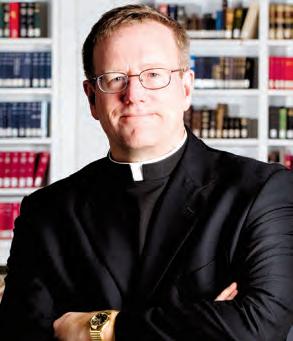
Editor’s note: The Minnesota Catholic Conference, the public policy voice of the Catholic Church in Minnesota, is providing an “Inside the Capitol” update during the state legislative session.
We are often asked – by both laity and priests – why the Minnesota Catholic Conference (MCC) does not produce voter guides or candidate scoresheets that identify candidates and votes they took on specific bills or lay out their positions on issues. Understandably so, the frequency of this query tends to grow in the weeks leading up to a big election.
MCC does not produce voter guides for some important practical reasons. For one, legislators rarely take clear-cut votes on specific or solitary issues; legislation is often rolled into omnibus bills that include many pieces of legislation and is usually adopted along party-line votes by a whole legislative caucus. Secondly, candidates generally do not respond to questionnaires from outside groups about their positions,
particularly ones that do not provide endorsements or campaign contributions.
Furthermore, if we were to try and cobble together their positions via public sources, they are often intentionally ambiguous about positions on controversial issues, and even the construction of such voter guides would entail editorial choices that could lead to accusations of bias.
Ultimately, MCC believes relying on voter guides and scoresheets undercuts the process by which citizens must educate themselves about the issues, and form relationships with candidates so that they can influence their work throughout their time in office. We cannot be content to vote once every couple of years and then wash our hands of the results. Our system
requires active participation by its citizens, or important decisions will be left to those who show up. It is why the Church calls the laity to be “faithful citizens.”
The work of faithful citizenship must begin with forming one’s conscience in the Church’s social teaching – the toolbox of principles used to shape social and political life. It is not a set of prescriptions or ready-made answers. Instead, it is a mental model for wellformed Catholics to guide their actions.
This year, the Minnesota’s bishops have offered a statement about how to prioritize the principles of Catholic social teaching in light of the signs of the times, particularly during an election-year debate in which abortion dominates the headlines. (See Page 19 in this issue of The Prairie Catholic.) Take time to familiarize yourself with the
statement, which sheds light on the need for right relationships to create true justice and the preeminence of prenatal justice in our voting considerations. Once we form our conscience, then we inform ourselves of the candidates’ positions and apply our formation to their positions.
Making an informed vote requires that we get to know our candidates. MCC provides, among other resources, a downloadable questionnaire to ask questions of your candidates. Visit www.mncatholic.org/ electionresources. Here you will also find a series of video interviews conducted with candidates for state legislature so that Catholics have examples of the types of conversations they can have with candidates.
Reaching out directly to candidates allows you to learn where they stand on issues of life, dignity, and the common good. That is the recipe for informed voting, but also the building blocks for relationships that can help transform our state for the better.
The Prairie Catholic l Page 18 l October/November 2022
Bishop Robert Barron
Inside the Capitol: Whom
should
I vote for? MN
bishops offer statement on how to prioritize the principles of Catholic social teaching
Archbishop Bernard Hebda, Archdiocese of Saint Paul and Minneapolis
Bishop Joseph Williams, Archdiocese of Saint Paul and Minneapolis
Bishop Andrew Cozzens, Diocese of Crookston
Bishop Daniel Felton, Diocese of Duluth
Bishop Donald Kettler, Diocese of Saint Cloud
Bishop Chad Zielinski, Diocese of New Ulm
Bishop Robert Barron, Diocese of Winona-Rochester
Right relationships
The task of politics is to foster justice and the common good. Despite our many differences, pursuing justice is a cornerstone political value shared by almost all Americans. In Catholic social doctrine, working for justice requires establishing right relationships between persons, where each is given his or her due. Justice requires that all parties embrace certain responsibilities toward each other. Paraphrasing Pope St. Paul VI, if we want peace, we must work for justice.
There are different types of justice. Commutative justice requires justice in commercial exchange. Distributive justice requires, among other things, that each person and family have access to the material resources they need not just to survive, but also to flourish. Economic justice means building an economic order on right relationships that foster both distributive and commutative justice. Social justice requires creating those conditions for all social actors, including schools, faith communities, and the government, to fulfill their social responsibilities.
Criminal justice should be built on criminals taking responsibility for the injustice perpetrated on victims, and society working through the penal system to rehabilitate and then restore offenders to the community. Other types of justice include racial justice, environmental justice, and legal justice.
When there is injustice in society, that is, when society fails to establish right relationships, the state can step in to help right what is wrong and to repair, in some measure, what is broken. That is a task of prudence, which is why it is important to carefully choose our elected leaders who, often at great sacrifice, take on the responsibility of making those decisions. They should be wise and virtuous. And voters, informed by Catholic social doctrine, should consider how candidates will work for the various types of justice across a spectrum of issues, including education, public safety, tax policy, migration, creation stewardship, and healthcare.
This year, in a special way, we call on Catholics to consider how a candidate will work for prenatal justice as a pre-eminent consideration in his or her voting calculus. Prenatal justice is not simply being anti-abortion, though that is the foundation of the prolife witness. Prenatal justice means establishing right relationships between the mother and the unborn child in her womb, between society and the unborn child, and between society and the mother and father of the unborn child. As life begins in the womb, so must justice. As we discuss below, there are responsibilities entailed by each set of relationships and good public policies that follow.
Fostering prenatal justice
The recent Dobbs decision by the U.S. Supreme Court, declaring that there is no right to an abortion protected by the U.S. Constitution, has returned the matter of abortion to the political process for deliberation.
Will states allow the continued killing of innocent human life? What are our responsibilities to the child and the mother? How do we foster right relationships between them and the broader society for the common good? These are questions elected officials must answer as they work to foster prenatal justice.
It would be a dereliction of duty for us as bishops to pretend as though the abortion question was not a focus of Minnesota’s election discourse this year, especially as Dobbs has changed the abortion landscape in this nation. And as Pope Francis teaches, we cannot stay silent when nearly a million unborn lives are being cast aside in our country year after year through abortion.[1]
Right now in Minnesota, the situation is troubling: in spite of the fact that scientific inquiry has definitively determined that human life begins at conception[2], a woman can procure an abortion for almost any reason at any stage of pregnancy up till birth. To put this in perspective, in 2021 there were 222 abortions involving babies older than 20 weeks. Almost half of all abortions are paid for with taxpayer funds. Our laws allow an 11-year-old girl to get an abortion without even one parent knowing. There is no requirement in force that a licensed physician perform an abortion. And abortion proponents, including elected officials, are working proactively to shut down pregnancy resource centers.
Fostering right relationships requires that we determine what we, as a society, owe the unborn child in the womb. At minimum, that is the right an innocent human being has to life, as well as the protection of the law from being killed. It also requires
welcoming the child into the world. Part of that welcome is establishing right relationships between mother, father, and child. We must encourage marriage and family stability, and clarify that abortion is not about bodily autonomy and freedom, but about the life of another human being for whom the father and mother are responsible.[3]
It follows that if we are intent on protecting innocent children from abortion, and ensuring that parents meet their obligations, then, as a society, we must step in to ensure that mothers and fathers are supported when necessary due to economic hardship.[4] This means, among other things, policies that fund: nutritional supports for expectant mothers; adequate healthcare coverage during and after pregnancy for both mother and child; childcare assistance; housing supports; early learning assistance programs; and parenting education. Enacting paid family and caregiver leave laws would help people retain work and care for their newborns. Reconsidering whether our adoption policies are unreasonably burdened by excessive costs or barriers to participation is an imperative. We also need to continue to support pregnancy resource centers through programs such as the Positive Alternatives grants that help them walk with women in need during crisis pregnancies.
Even beyond the pregnancy and years of early childhood development, we have a social duty to remove barriers to marriage, having children, and being able to raise them well. In short, we need to make family economic security the principal consideration in budget and tax policy discussions. By raising the family to the top of our state’s policy priorities, we can help restore the family to its proper position as the foundational building block of society and the place where children can flourish.[5] In doing so, Minnesota can become the best place to bring children into the world.[6] And even if our state maintains a permissive abortion policy, putting families first will hopefully weaken demand for abortions.
In sum, working for prenatal justice transcends the false binary of pitting mother against child. Our public policy can foster right relationships and support the work of fulfilling our responsibilities to each other. It is in the fulfillment of our duties, even in difficult situations, that we grow in virtue and character and realize the best chance of true happiness.
Faithful citizenship
We encourage Catholics and other advocates for human life to step proactively into the political debate both winsomely and charitably, and
to use creatively all peaceable levers of political power to prudently, and incrementally, transform our cities and our state into places that respect the human rights of the unborn by welcoming them in life and protecting them by law. Part of that work is voting. A representative democracy such as ours requires that the citizenry elect good people into office and continue to inform their elected representatives of their views on important issues.
Unfortunately, many candidates are openly advocating for Minnesota to become an abortion sanctuary state with taxpayer-funded abortion on demand, as well as pledging to deregulate the abortion industry by removing safeguards put in place to protect women from medical malpractice or to protect teenage girls from ill-considered abortions. Far too many others, moreover, although professing to be pro-life on paper, are going out of their way to avoid talking about Minnesota’s future as a potential abortion sanctuary or what should be done to limit abortion, preferring to avoid the subject altogether.
In this situation, it is incumbent on the Catholic laity to be especially proactive in speaking to candidates about prenatal justice and supporting legislative and judicial efforts to limit abortion. The effect of proactive engagement with candidates, not just in this election cycle but also during their term of office, will give courage and political will to those who support pro-life policies in principle, and moderate the pro-abortion extremism of other candidates and elected officials.
Catholics cannot expect just laws will be enacted without their faithful citizenship and building relationships with legislators. That is what faithful citizenship is all about.
Combating abortion - a pre-eminent concern in public life
As Archbishop José Gomez, president of the U.S. Conference of Catholic Bishops, has noted, calling abortion a pre-eminent concern does not mean it is the only concern.
[7] Ensuring that every human life is welcomed in life and respected by law does not end at birth. As discussed above, we believe that our Catholic faith leads us to promote an eco-system of public policy that promotes human flourishing for mother and child from conception to natural death.
What we seek to emphasize here is that, just as the bishops of the U.S. have identified the ending of abortion as a pre-eminent policy priority[8], so too should Catholic voters make protecting innocent human life and stopping abortion extremism a preeminent consideration in our voting calculus.[9]
[1] “[R]egarding abortion, the point when human life begins is not a religious belief but a scientific fact -- a fact on which there is clear agreement even among leading abortion advocates. Second, the sanctity of human life is not merely Catholic doctrine but part of humanity’s global ethical heritage, and our nation’s founding principle.” (USCCB, “Living the Gospel of Life,” 23).
[2] Mark Pattison, “Pope Francis ‘has our backs’ on pro-life cause, says archbishop,” Catholic News Service, Jan. 24, 2020, available at https://catholicnews.com/ pope-francis-has-our-backs-on-pro-lifecause-says-archbishop/.
[3] We understand that sometimes pregnancy can be the result of sexual coercion and rape. These are difficult situations that require care and sensitivity. We do not condone abortion in these instances, but we recognize that fostering justice may mean society has a special responsibility to care for the mother and child, including economic supports or facilitating adoption. Our parishes will help women in these difficult situations.
[4] Though the overwhelming majority of abortions are procured because the mother does not wish to have a child, almost one in five are reportedly procured specifically due to economic hardship.
[5] See the Minnesota Catholic Conference “Families First Project” (familiesfirstproject.com). Policies such as a permanent state child tax credit are the cornerstone of this initiative.
[6] It should be emphasized that working for policies that promote human flourishing does not absolve anyone from the responsibility of working for an end to the state-sanctioned killing of innocent human life. “[B]eing ‘right’ in such matters can never excuse a wrong choice regarding direct attacks on innocent human life. Indeed, the failure to protect and defend life in its most vulnerable stages renders suspect any claims to the ‘rightness’ of positions in other matters affecting the poorest and least powerful of the human community.” (USCCB, “Living the Gospel of Life,” 22).
[7] “A political commitment to a single isolated aspect of the Church’s social doctrine does not exhaust one’s responsibility towards the common good.” (Congregation for the Doctrine of the Faith, Doctrinal Note on Some Questions Pertaining to the Participation of Catholics in Political Life, 4, 2002).
[8] “Pope speaks to U.S. bishops about pro-life issues, transgender ideology,” Catholic News Service, Jan. 16, 2020, available at https://www.osvnews. com/2020/01/16/pope-speaks-to-u-sbishops-about-pro-life-issues-transgenderideology/. (Note Pope Francis’s agreement with U.S. bishops that abortion is a preeminent social and political concern).
[9] “[A] well-formed Christian conscience does not permit one to vote for a political program or an individual law which contradicts the fundamental contents of faith and morals.” (Congregation for the Doctrine of the Faith, Doctrinal Note on Some Questions Pertaining to the Participation of Catholics in Political Life, 4, 2002).
ElEction Day in MinnEsota is november 8th!
Catholic Election Resources www.mncatholic.org/
ElE ction YE ar StatE m E nt from th E catholic Bi S hop S of minn ES ota
electionresources
VATICAN CITY – With a click on a tablet in front of the crowd gathered in St. Peter’s Square on Sunday, Oct. 23, Pope Francis became the first person to register for the next World Youth Day to take place Aug. 1-6, 2023, in Lisbon, Portugal.
Targeted at people between the ages of 16 to 35, the pope urged young people to register now for the international event which is typically held on a different continent every three years but was postponed to 2023 because of the COVID-19 pandemic. St. John Paul II established the weeklong youth gathering in 1985. At some
past World Youth Days, attendance has reached into the millions.
Lisbon, the Portuguese capital, is just 75 miles from Fatima, one of the most visited Marian pilgrimage sites in the world where the Virgin Mary appeared to three shepherd children in 1917 with a message of peace and a request for prayer.
The theme of Lisbon’s World Youth Day is “Mary arose and went with haste.” In his message for the event, Pope Francis urged young people not to postpone all the good that the Holy Spirit can accomplish in them. “Now is the time to arise! Like Mary, let us
‘arise and go in haste.’ Let us carry Jesus within our hearts and bring him to all those whom we meet,” the pope said.
ST. PAUL – Encouraging Catholics to lead the way and inspire others to join the effort, the Minnesota Catholic Conference, the public policy arm of Minnesota’s Catholic bishops, embarked last month on a multiyear campaign to build up the family while strengthening charity and justice in society.
“We’re trying to bring people out of their silos, to make connections, to encourage this work, and to give it real momentum,” said Jason Adkins, MCC executive director, and general counsel.
Two websites will be focal points for the effort: familiesfirstproject. com and civilizationoflove.net. The sites are independent of the conference’s website mncatholic. org to help draw people to the campaign who are not members of the Catholic Church but could adopt Church teachings and policy initiatives that help the broader society, said Ryan Hamilton, MCC government relations associate. Hamilton said that policy initiatives under the Families First Project include lobbying for a state tax credit for families that
would have a real impact – such as $1,800 per child. With rising inflation, it’s been estimated that households will spend an extra $5,200 this year compared with last year for the same basket of consumer goods, he said. Such a tax credit would offset those increasing costs for a family with three children.
The goal is to “transform Minnesota into a state where the economic well-being of the family has been elevated to the top priority for elected officials and a focal point of public policy discussions,” Hamilton said. The site encourages people to share their stories of helping
create a civilization of love and offers monthly challenges, such as supporting pregnancy resource centers, which also strengthens the U.S. bishops’ Walking with Moms pro-life initiative, Adkins said.
He said the November challenge would be burying the dead, a work of corporal mercy.
Adkins said that December’s challenge is likely to increase shelter space for the homeless. “All these things build up the common good,” he said.
(MCC information reported by The Catholic Spirit.)
National Vocation Awareness Week November 6-12, 2022 Please ask Our Lord for more dedicated, holy priests, deacons, and consecrated men and women.
