A step closer to becoming Catholic
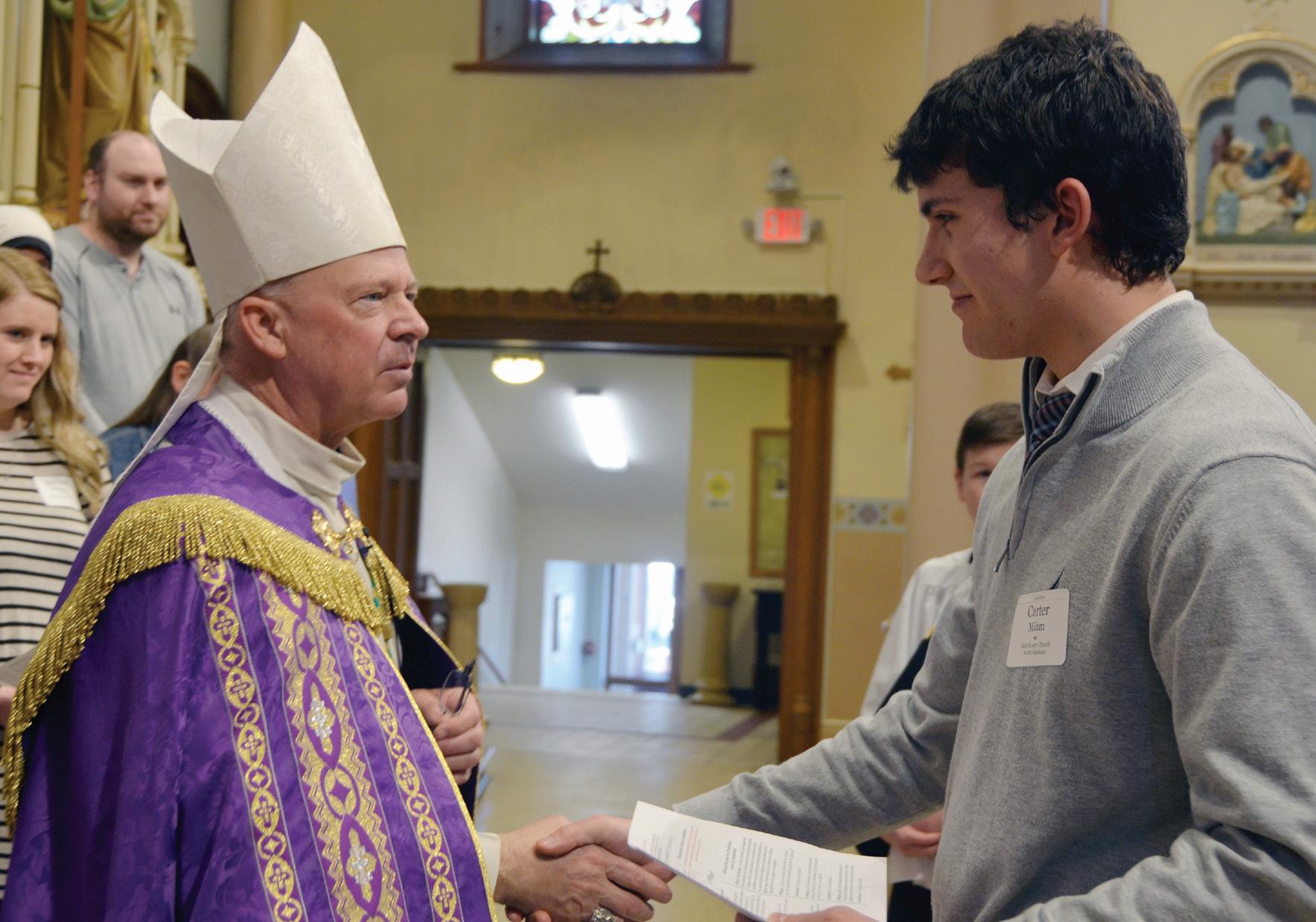
NEW ULM – Bishop Chad W. Zielinski greets Carter Mihm, a candidate from the Church of the Holy Rosary in North Mankato, during this year’s Rite of Election and Call to Continuing Conversion held on Sunday, Feb. 18, at the Cathedral of the Holy Trinity in New Ulm. Each year, the local Church gathers to celebrate this ritual as one of the steps for adults who will be brought into full communion with the Church at the Easter Vigil. The ritual includes prayers for those being initiated, especially those who are to be baptized. These prayers emphasize the Lord’s choice of the candidate as well as their choice of Christ and his Church. At the conclusion of this rite, the catechumens are called “the elect” and enter into the final weeks of Lenten recollection and preparation, along with all of the faithful leading up to Easter.
Minnesota’s Most Rural Diocese Diocese of New Ulm Vol. 38 No. 5 March 2024
(Photo by Christine Clancy)
Minnesota’s Most Rural Diocese Diocese of New Ulm Vol. 38 No. 5 March 2024
(Read more on pages 8-9.)
Doctors, people with disabilities and pro-life leaders oppose the physician-assisted suicide bill in Minnesota
by Anna Wilgenbusch
The Catholic Spirit
Editor’s note: The following article deals with topics including depression, mental health and suicidal ideation. If you are, or someone you know is, struggling with such difficulties, resources include the 988 suicide and crisis lifeline and SAMHSA’s National Helpline at 1-800-662-4357.
Jean Swenson was an ambitious 28-year-old teacher working with at-risk youth in Minneapolis when her life changed forever. As she drove a car full of teenagers in a drug rehab program back from an outing in 1980, she collided with a semitrailer. Swenson’s body was thrown into the windshield, the force of which broke her neck. Looking down to see her blood dripping onto the floor of the vehicle, she realized that she could not move.
Page 3
Brent Sundve installed as lector
Page 6
An encounter with those in need
Page 10 Ask a Canon Lawyer
“I kept saying to myself, ‘Even though I walk through the valley of the shadow of death I will fear no evil, for you are with me,’” Swenson recalled of the painful minutes after the collision. Swenson said she fell into a deep depression in the months after the accident. She found it difficult to accept that she would never play her piano again, cook for herself, or go to the bathroom without assistance.
“I wanted to die. I thought my life was over,” Swenson recalled. Fortunately, Swenson said, physician-assisted suicide was not an option for her. She is now very grateful to be alive.
But if legislation for people diagnosed with a terminal condition passes in Minnesota and opens the door to potential expansion, assisted suicide could one day be an option for people like Swenson. Such legislation would be a tragedy, said Swenson, who is paralyzed from the neck down.
Canada, for example, now allows those with incurable illnesses or disabilities to take their lives. Some Canadian legislators have proposed to include people with mental illness in assisted suicide programs.
“It doesn’t stop here, but it expands,” Swenson said.
The Minnesota Catholic Conference (MCC), which represents the public policy interests of the state’s bishops, said in a recent action alert that the bill is “one of the most aggressive physician-assisted suicide bills


patient to a doctor who will.
Dr. Robert Tibesar, a pediatrician and member of St. Agnes in St. Paul, said in a Jan. 30 interview that he has been watching the proposed legislation and fears it would violate the conscience of ethical doctors.
“To say to someone, ‘Well I’m not going to harm you, but I’m going to send you to someone else who is going to harm you,’ still goes against our conscience. It still violates our covenant relationship with our patient,” said Tibesar, who is president emeritus of the Catholic Medical Association Twin Cities Guild.
in the country” and violates the teaching of the Catholic Church.
“As Catholics, we are called to uphold human dignity,” MCC wrote. “Legalization of assisted suicide works against this principle because death is hastened when it is thought that a person’s life no longer has meaning or purpose.”
The proposed legislation –HF1930/SF1813 – would allow anyone with a six-month terminal prognosis to come to Minnesota to get a prescription for a lethal drug. People who have disabilities are not included in the bill, but some warn that the legislation, if enacted, could soon expand to them as well.
Despite the opposition of prolife leaders, many physicians, people with disabilities including Swenson and mental health experts, testimony and action
taken by the House Health and Finance Policy Committee Jan. 25 appeared to signal that the legislation has momentum.
After a three-hour hearing, the committee passed the bill. The House Public Safety Committee discussed the issue once the legislative session began on Feb. 12. [For updated Committee action on this bill, see pg. 7.] Committees in the Senate and the House must act favorably toward the bill by a March 22 deadline to keep the legislation in play. Those who oppose the proposed legislation pointed to several concerning aspects of the bill.
Medical ethics
The proposal would not require doctors to prescribe a lethal dose of a drug to patients who meet all criteria for it. However, the bill states that doctors who refuse to provide a prescription for the lethal dose are required to refer a

Dr. Paul Post, a family medicine doctor who retired in 2019 after 37 years of practicing medicine in Chisago City, testified against the legislation at the hearing and said in an interview that referring patients to a doctor who will kill them is “just as serious” as prescribing the lethal dose.
“If you are making the referral, you are still involved in the act, so that doesn’t really take care of your freedom of conscience,” he said.
Tibesar and Post also expressed concern about a lack of sufficient mental health checks in the proposed legislation. The bill states that the physician who prescribes the medication is also the one who would refer the patient to a mental health specialist if he or she deems it necessary.
(Continued on page 7.)
Visit us online! www.dnu.org inside The Prairie Catholic l Page 1 l March 2024
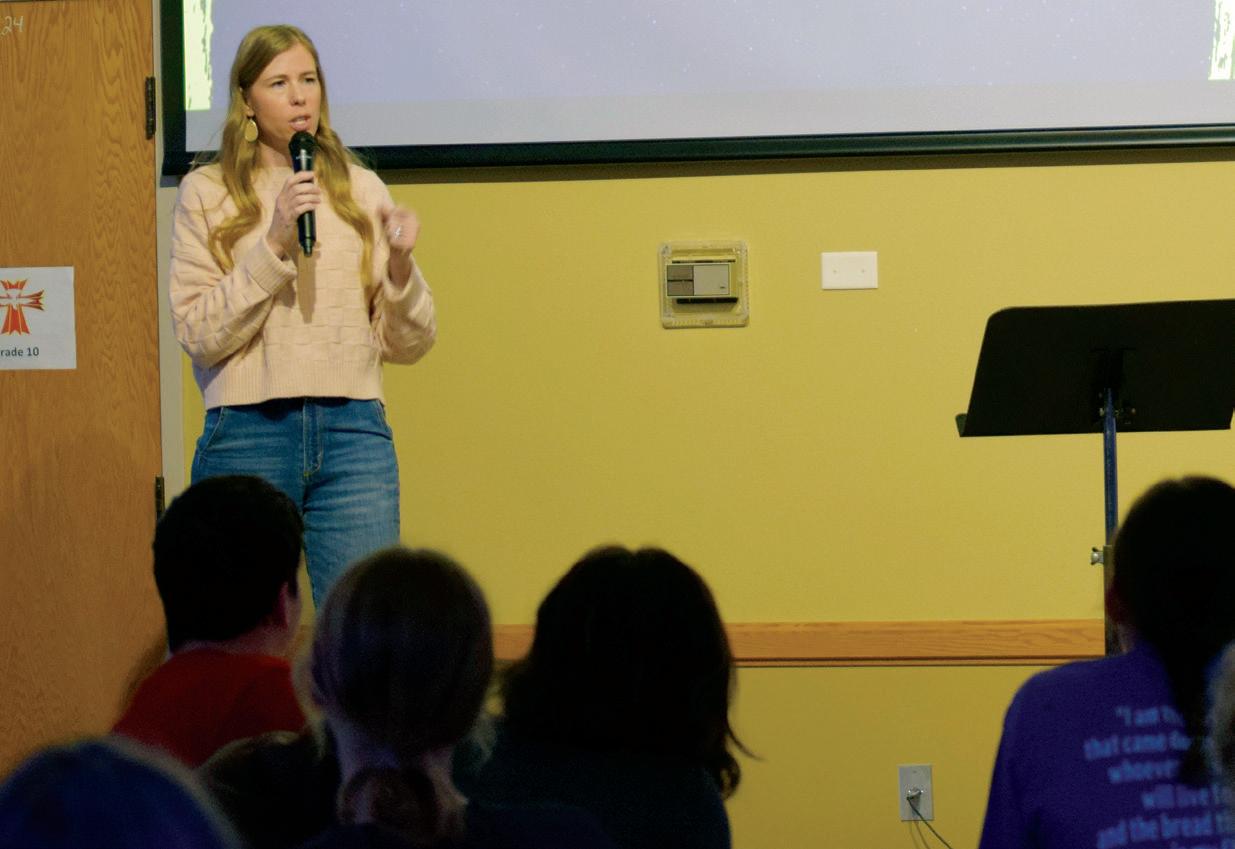
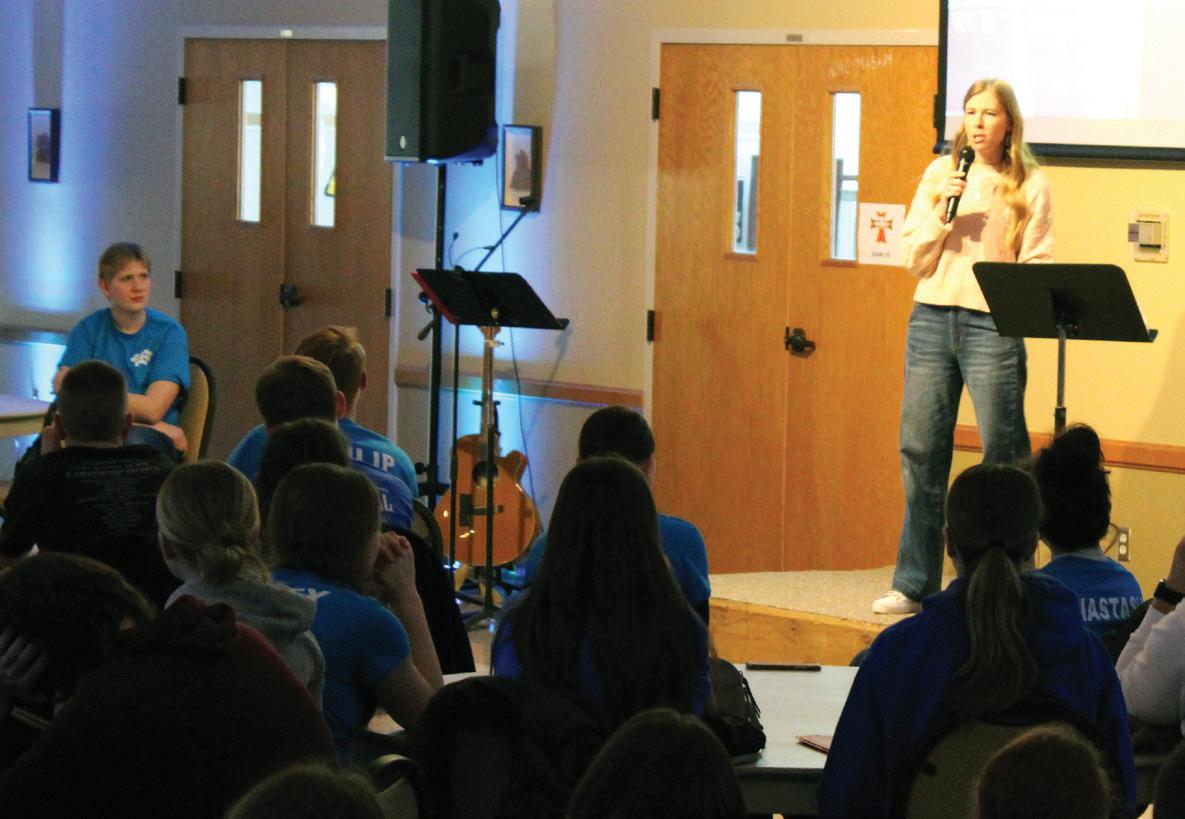
OLIVIA - Catholic speaker and author Lisa Cotter, was the keynote at the COR Night youth event held in Olivia. Kotter spoke about the importance of virtuous friendships.
The End-of-Life Options Act is gaining momentum at the Minnesota State Capitol. The bill would require that doctors and nurse practitioners advise those diagnosed with a terminal illness of the opportunity to receive lethal drugs that would end their life.
(Photo by Helen Fischer)
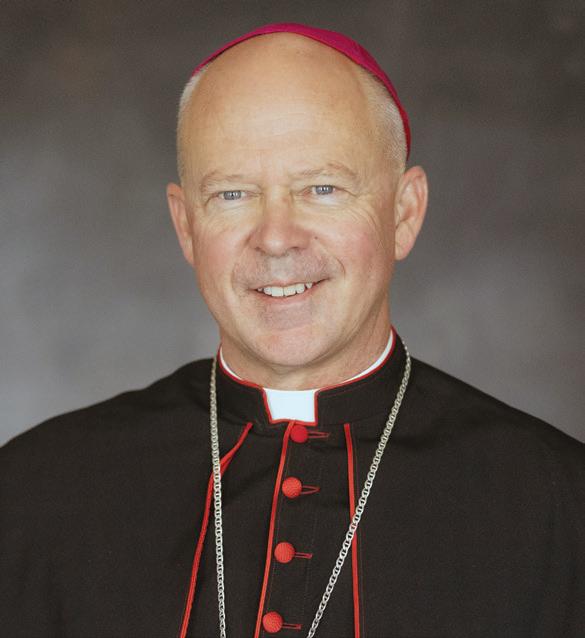 by Bishop Chad W. Zielinski
Mary Magdalene - The Apostle of Apostles
In my recent travels within and outside the diocese, I have listened to people enthusiastically share their thoughts about the television series The Chosen, a historical drama about the life of Christ. While this is not intended to be a documentary, the producers have done extensive research, and you feel drawn into a unique encounter with the person of Jesus and his disciples in the Bible.
In episode 1 of the first season, Jesus calls the first disciples, declaring he is the Messiah - “The Chosen One.” One of the key figures is Mary Magdalene, who is graphically portrayed as mentally unstable and a woman battling demons.
In Luke 8:2, Mary Magdalene is

PTHERA RIE CATHOLIC
The Prairie Catholic, the official newspaper for the Diocese of New Ulm since May 1972, is published every six weeks, Sept.–June.
Publisher: Bishop Chad W. Zielinski
Editor: Christine E. Clancy
Submission deadline is the 1st of each month prior to publication.
Publication office: Diocesan Pastoral Center, 1421 6th Street North, New Ulm, MN 56073; phone: 507-359-2966,
Email: dnu@dnu.org
Website: www.dnu.org
Postmaster: Send notice on Form 3579, “The Prairie Catholic,” 1421 6th Street North, New Ulm, MN 56073-2071.
Periodical postage paid at New Ulm and additional mailing offices. USPS 926-760.
diocesan church
That they may have life
described as one from whom Jesus cast out seven demons. One of the most powerful scenes in episode 1 draws the viewer to see her leaving an establishment of ill repute with a tormented look on her face, disheveled clothing, and unkempt hair. She sees Jesus, played by Jonathan Roumie, walking toward her; she looks at him, turns away, casts her head downward, and continues walking. Jesus stops, turns toward her, and calls her name, “Mary.” The locals had not called her by the name given to her by her parents at birth. Mary stops, turns toward Jesus, and he looks at her with a glowing smile, a font of mercy, and embraces her. Mary is emptied of evil and filled with forgiveness and divine love in one powerful action of divine embrace.
At a General Audience on July 22, 2012, the Feast Day of Mary Magdalene, the late Pope Benedict XVI noted, “In what does this profound healing which God works through Jesus consist? It consists of true, complete peace, brought about by the inner reconciliation of the person, as well as in every other relationship: with God, with other people, and with the world. Indeed, the Evil One always seeks to spoil God’s work, sowing division in the human heart, between body and soul, between the individual and God, in interpersonal, social, and international relations, as
well as between human beings and creation. The Evil One sows discord; God creates peace.”
God asks us to be at peace with him and with others. This is why we hear throughout the Lenten season, “Come back to me with your whole heart,” “Return to me,” “Create in me a new heart,” and “Renew in me a steadfast spirit.”
Like Mary Magdalene, Jesus desires us and calls each of us by name. This is why, on Easter Sunday, we will be witnesses to the Resurrection and renew our baptismal promises, a time in which our name is joined to the Holy Trinity and intimately bound to the Risen Christ.
During our baptism, it is not just words but a movement of the Holy Spirit that pierces the depths of our souls. We are filled with the perfection of divine love and united into the Communion of Persons of the Holy Trinity for all eternity. This is intimacy with Christ, who loves our entire heart, mind, and soul and asks us to respond to him and others in acts of love.
Like Mary Magdalene, we are wired for intimacy and peace, but in our sinfulness, we sometimes fall to temptation and seek things in unhealthy and unholy ways. This brings about darkness, a loss
Tiny preborn lives are at stake!
WASHINGTON – New proposals in Congress threaten human life and religious freedom. The need to accompany and support the increasing number of families struggling with infertility is real. But after largely misunderstanding a recent ruling by the Alabama state Supreme Court, many members of Congress, including those who consider themselves pro-life, are in a rush to impose a new national “right” to in vitro fertilization (IVF) and other such technologies that threaten preborn human lives and treat people like property (like surrogacy, gene editing, and cloning). At least one of the current proposals could also threaten religious hospitals,
Correction
of direction, a feeling of not being loved or wanted, and disconnected from family, friends, and even God. Jesus’ mission is to seek out the lost sheep and return them to the flock. I pray that this Lenten Season has been a time in which you are able to identify those areas of your life that you need to surrender to Christ and ask him to cast away all that is not healthy and holy, filling you with his healing presence.
On Tuesday of the Octave of Easter, we will hear from John’s Gospel 10:11-18. This is the culmination of Mary Magdalene, whom St. Thomas Aquinas calls “Apostle of the Apostles.” She is sitting outside of the tomb of Jesus weeping. She turns to a man she thinks is the gardener but is Jesus and says, “They have taken my Lord, and I do not know where they laid him.” Jesus replies, “Woman, why are you weeping? Who are you looking for?” She repeats, “If you have taken him away, tell me where you laid him?” Jesus then says, “Mary!” In calling her name, she recognizes Jesus and responds to him, saying Rabbouni (teacher).
I have always wondered why Mary Magdalene was the first to encounter the Risen Christ. She was the eager one who got up early and ran to the tomb. Even before Jesus cast out the demons and healed her, she was seeking
charities, schools, and other organizations that do not enable or cover these medical procedures, and even could apply to minors.
The United States Catholic bishops asks that you contact your members of Congress to oppose bills and resolutions that claim to protect these problematic “rights” to IVF and other “assisted reproductive technologies” (ART) that cause the death of countless human embryos and violate human dignity.
TELL CONGRESS! Send your message to: www. votervoice.net/BroadcastLinks/cP0FXLRes17J23sRwuMIQ
In the January/February issue of The Prairie Catholic under “Priestly Anniversaries,” the parishes Fr. Brian Mandel serves were incorrectly reported. He serves the St. Isidore the Farmer Area Faith Community (Murdock, Benson, and Appleton).
Fr. Michael Doyle was ordained June 3, 1989.

Christ in the depths of her soul.
Jesus allowed her to see and experience an enormous capacity of love that God has for us, calling her to join the band of disciples and telling her that this love had to be shared and announced to the world. All of us are like Mary Magdalene. Although we might never wrap our minds around the inexhaustible mystery of the Passion, Death, and Resurrection of Jesus, like her, we can experience that personal encounter of Resurrection peace that he gives to her and the disciples as he breathes the Holy Spirit upon them and simply says, “Peace be with you.”
Throughout the weeks of the Easter Season, we will hear about the early Church from the Acts of the Apostles. As Jesus invited Mary Magdalene, we too are invited to a personal and radical encounter with the healing presence of the Risen Christ, and we are sent forth as fearless witnesses of the Resurrection of Christ to announce to others that God has made you for greatness.
An enormous capacity for divine love lives within each of us. Hear his words: “Peace be with you.”
St. Mary Magdalene – Apostle of the Apostles, pray for us!
Render a salute – take a knee Support our first responders.
Last month, news headlines reported the brutal murder of two police officers and a firefighter. Daily, men and women in uniform rush to protect the citizens of Minnesota, willingly putting their lives online to save others.
As your bishop, I encourage everyone to thank personally our first responders for their faithful service to God and country and pastoral leaders of our parishes to consider offering a special Mass, prayer service, or remembrance of these responders in a petition during Mass.
I offer a salute to all our first responders and those who have lost their lives in the line of duty. Please join me in remembering them and their families in prayer.

The Prairie Catholic l Page 2 l March 2024
Bishop’s calendar
Mar. 17 – Apostles Peter & Paul AFC Confirmation, St. Peter, St. Peter
St. John Paul II AFC Confirmation, St. Pius X, Glencoe
Mar. 19 – Diocesan Staff Meeting, Diocesan Pastoral Center, New Ulm
Priests Personnel Board Meeting, Diocesan Pastoral Center, New Ulm
Diocesan Finance Council/Priests Council Meeting, Diocesan Pastoral Center, New Ulm
Eucharistic Revival Committee Meeting, Diocesan Pastoral Center, New Ulm
Mar. 20 – Committee on Parishes Meeting, Diocesan Pastoral Center, New Ulm
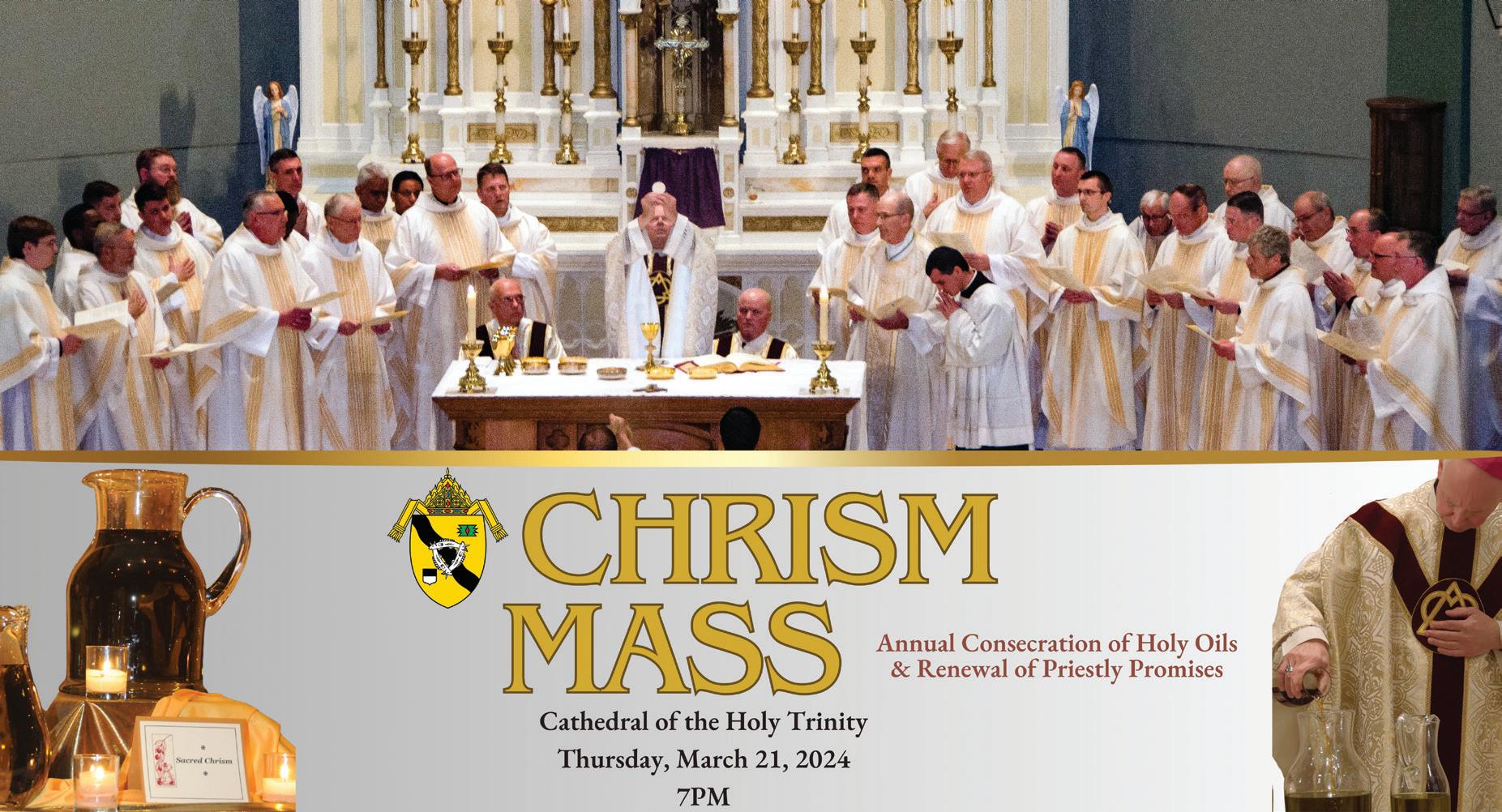
Mar. 21 – Diocesan Chrism Mass, Cathedral of the Holy Trinity, New Ulm
Mar. 22 – Vocations Team Meeting, Diocesan Pastoral Center, New Ulm
Mar. 24 – Palm Sunday Mass, Cathedral of the Holy Trinity, New Ulm
Mar. 28 – Holy Thursday Mass, Cathedral of the Holy Trinity, New Ulm
Mar. 29 – Good Friday Service, Cathedral of the Holy Trinity, New Ulm
Mar. 30 – Easter Vigil Mass, Cathedral of the Holy Trinity, New Ulm
Mar. 31 – Easter Morning Mass, St. George, West Newton Township
Apr. 7-11 – Annual Diocesan Priests Retreat, Christ the King Retreat Center, Buffalo
Apr. 14 – Holy Family AFC
Confirmation, St. Joseph, Montevideo
St. Isidore the Farmer AFC Confirmation, Sacred Heart, Murdock
Family COR Night , St. Aloysius, Olivia
Apr. 16 – Diocesan Staff Meeting, Diocesan Pastoral Center, New Ulm
Diocesan Ministries Appeal Committee Meeting
Priests Council Meeting, St. Aloysius, Olivia
College of Consultors Meeting, St. Aloysius, Olivia
Apr. 21 – Heart of Jesus AFC
Confirmation, St. Mary, Bird Island
Light of the World AFC
Confirmation, St. Catherine, Redwood Falls
Apr. 27 – New Ulm Diocesan Council of Catholic Women Convention Business Meeting and Mass, St. Pius X, Glencoe
Apr. 28 – Spirit of Life AFC
Confirmation, St. John, Ortonville
Editor’s note: Calendar respresents Bishop Zielinski’s schedule at the time “The Prairie Catholic” went to press.
Pray for vocations
World Day of Prayer for Vocations April 21
This year marks the 61st anniversary of the World Day of Prayer for Vocations to be celebrated on Sunday, April 21, 2024. Join Bishop Chad W. Zielinski in promoting vocations to the priesthood, religious life, and diaconate with your prayers.
Prayer calendar
A daily Prayer Calendar for vocations to the priesthood and consecrated life is available on the Diocese of New Ulm website, www.dnu.org/vocations.
DNU College Student Connect
Are you a parent or grandparent
diocesan church
Sundve among 17 men installed as lector at Saint Paul Seminary in February
 by Christine Clancy The Prairie Catholic
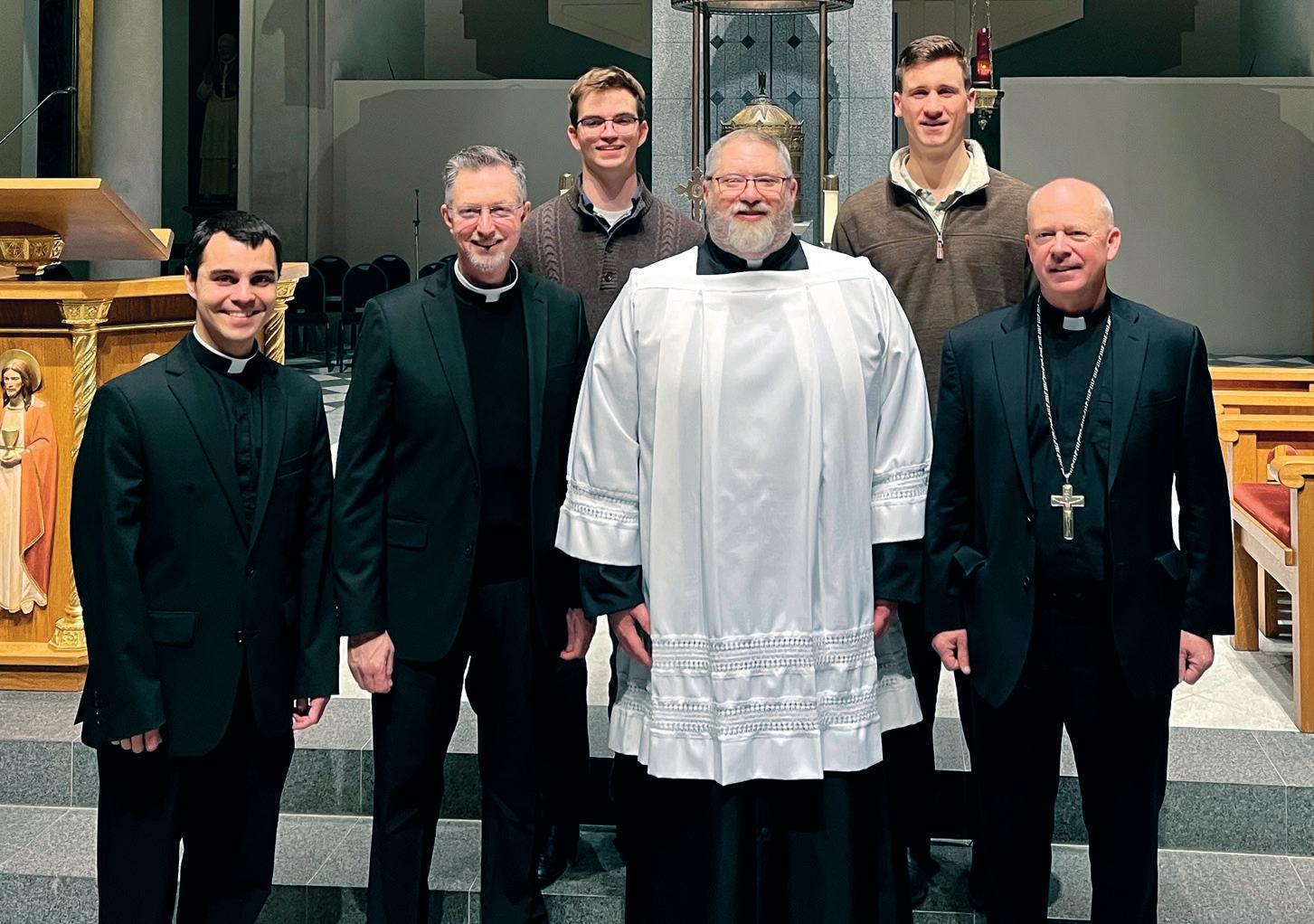
ST. PAUL – On Feb. 12, 2024, a combination of 17 men in formation from 11 dioceses celebrated the installation as lectors at The Saint Paul Seminary in St. Paul. Bishop Chad W. Zielinski of New Ulm was their
celebrant for the Mass.
Among the men installed was Diocese of New Ulm seminarian Brent Sundve (Theology I). Sundve is the son of Mary Sundve of Litchfield, Minn.
In seminary formation, lectors proclaim scripture readings,
recite the Psalms, lead general intercessions in the absence of a deacon, and guide the singing and active participation of the faithful during the liturgy.
Installation as a lector serves as a stepping stone toward the roles of acolyte, transitional deacon, and, ultimately, priest.
Bishop Peter M. Muhich of Rapid City passes away after battle with cancer
of a current college student from the Diocese of New Ulm? The diocese would love to connect. Get us their mailing address and the Office of Vocations will send them a special “#DNU Care Package” just in time for stressful exams, papers, and finals! The package includes things like rice krispie or scotcheroo bars, beef jerky, and a Miraculous Medal blessed by Bishop Zielinski. Please include the first and last name of your college student, mail address at college, year they will graduate, hometown, and home parish. Email: vocations@dnu.org

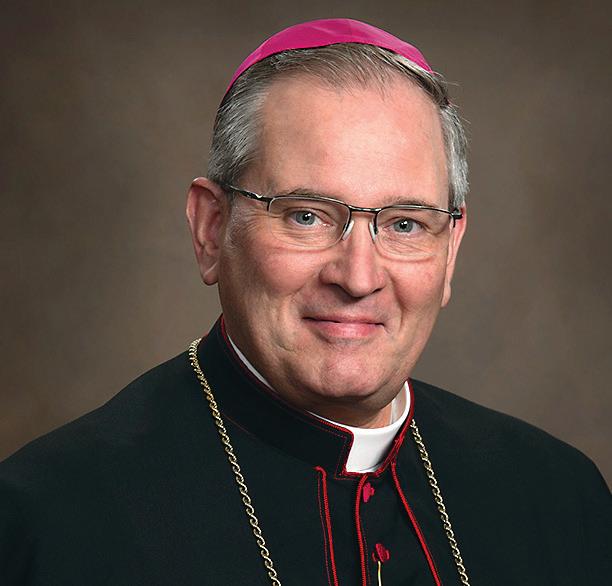
Bishop Muhich
The Diocese of Rapid City, SD, on Saturday, Feb. 17, 2024, announced the death of Bishop Peter M. Muhich, with the prelate’s death coming days after
he entered hospice care. “With sorrow, the Diocese of Rapid City shares the news that Bishop Peter M. Muhich, 62, died on Feb 17,” the diocese said in a tweet on Saturday afternoon. “He was in hospice care after suffering from esophageal cancer,” the diocese said. “Eternal rest grant unto him, O Lord, and may perpetual light shine upon him.”
Ordained a priest of the Diocese of Duluth in September of 1989, Bishop Muhich was appointed by Pope Francis as the Bishop of Rapid City, where he was installed in July 2020.
The Prairie Catholic l Page 3 l March 2024

The Diocese of Rapid City is part of U.S. Region VIII, which includes the dioceses in Minnesota, North Dakota, and South Dakota.
Bishop Chad W. Zielinski of the Diocese of New Ulm said in a statement that he had the honor of serving on the United States bishops Native American Affairs Subcommittee with Bishop Muhich over the past three years. “He is a man who truly had the heart of Christ the Good Shepherd,” Bishop Zielinski said.
Bishop Chad W. Zielinski of the Diocese of New Ulm, front row- far right, presided over the Mass at the Saint Paul Seminary for the installation of lectors. Also pictured from the diocese are front row, l-r, Fr. Tanner Thooft, assistant director of Vocations, Fr. Brendan Rolling, director of Vocations, and newly installed lector Brent Sundve. Back row, l-r, seminarians Matthew Wood and David Rabaey. (Not pictured: seminarian Noah U’Ren.) (photo courtesy of The Saint Paul Seminary)
 por obispo Chad Zielinski
María Magdalena - La Apóstol de los Apóstoles
por obispo Chad Zielinski
María Magdalena - La Apóstol de los Apóstoles
En mis recientes viajes dentro y fuera de la diócesis, he escuchado a la gente compartir entusiastamente sus opiniones sobre la serie de televisión “The Chosen”, un drama histórico sobre la vida de Cristo. Dado que esto no está destinado a ser un documental, los productores han realizado una extensa investigación, y te sientes atraído hacia un encuentro único con la persona de Jesús y sus discípulos en la Biblia.
En el episodio 1 de la primera temporada, Jesús llama a los primeros discípulos, declarando que es el Mesías, “El Elegido”. Una de las figuras clave es María Magdalena, quien es retratada gráficamente como mentalmente inestable y una mujer que lucha contra demonios. En Lucas 8:2, se describe a María Magdalena como aquella de quien Jesús expulsó siete demonios. Una de las escenas más poderosas en el episodio lleva al espectador a verla salir de un establecimiento de mala reputación con una mirada atormentada en su rostro, ropa desordenada y cabello despeinado. Mientras se va, ve a Jesús, interpretado por Jonathan Roumie, caminando hacia ella; lo mira, se aleja, baja la cabeza y continúa caminando. Jesús se detiene, se vuelve hacia ella y la llama por su nombre, “María”. Los lugareños no la habían llamado por el nombre que le dieron sus padres al nacer. María se detiene, se vuelve hacia Jesús y él la mira con una sonrisa radiante, una fuente de misericordia, y la abraza. María es liberada del mal y llena de perdón y amor divino en una poderosa acción de abrazo divino.
En la Audiencia General el 22 de julio de 2012, el Día de la Fiesta de María Magdalena, el fallecido Papa Benedicto XVI señaló: “¿En qué consiste esta profunda curación que Dios obra a través de Jesús? Consiste en una verdadera y completa paz, lograda por la reconciliación interior de la persona, así como en todas las
Para que tengan vida
demás relaciones: con Dios, con otras personas y con el mundo. De hecho, el Maligno siempre busca arruinar la obra de Dios, sembrando división en el corazón humano, entre el cuerpo y el alma, entre el individuo y Dios, en las relaciones interpersonales, sociales e internacionales, así como entre los seres humanos y la creación. El Maligno siembra discordia; Dios crea paz”.
Dios nos pide estar en paz con él y con los demás. Por eso escuchamos durante toda la temporada de Cuaresma: “Vuélvanse a mí con todo su corazón”, “Vuelvan a mí”, “Crea en mí un corazón nuevo” y “Renueva en mí un espíritu firme”. Al igual que María Magdalena, Jesús nos desea y nos llama a cada uno por nuestro nombre. Por eso, el Domingo de Pascua seremos testigos de la Resurrección y renovaremos nuestras promesas bautismales, un momento en el que nuestro nombre se une a la Santísima Trinidad y se une íntimamente al Cristo Resucitado. Durante nuestro bautismo, no son solo palabras, sino un movimiento del Espíritu Santo que penetra en las profundidades de nuestras almas. Estamos llenos de la perfección del amor divino y unidos en la Comunión de Personas de la Santísima Trinidad por toda la eternidad. Esto es intimidad con Cristo, quien ama todo nuestro corazón, mente y alma, y nos pide que respondamos a él y a los demás con actos de amor.
Al igual que María Magdalena, estamos diseñados para la intimidad y la paz, pero en nuestra pecaminosidad, a veces caemos en la tentación y buscamos cosas de manera poco saludable y poco santa. Esto trae oscuridad, una pérdida de dirección, una sensación de no ser amados o deseados, y desconexión de la familia, amigos e incluso de Dios. La misión de Jesús es buscar a las ovejas perdidas y devolverlas al rebaño. Oro para que esta Temporada de Cuaresma haya sido un tiempo en el que puedas identificar esas áreas de tu vida que necesitas entregar a Cristo y pedirle que aleje todo lo que no es saludable y santo, llenándote con su presencia sanadora.
El martes de la Octava de Pascua, escucharemos en el Evangelio de Juan 10:11-18. Esta es la culminación de María Magdalena, a quien Santo Tomás de Aquino

llama “Apóstol de los Apóstoles”. Ella está sentada fuera de la tumba de Jesús llorando. Se dirige a un hombre que cree que es el jardinero pero es Jesús y dice: “Se han llevado a mi Señor, y no sé dónde lo han puesto”.
Jesús responde: “Mujer, ¿por qué lloras? ¿A quién buscas?” Ella repite: “Si lo has llevado, dime dónde lo has puesto”. Jesús entonces dice: “¡María!” Al llamarla por su nombre, ella reconoce a Jesús y le responde: “¡Rabboni!” (maestro).
Siempre me he preguntado por qué María Magdalena fue la primera en encontrarse con el Cristo Resucitado. Ella fue la que estuvo dispuesta a levantarse temprano y corrió hacia la tumba. Incluso antes de que Jesús expulsara los demonios y la sanara, ella estaba buscando a Cristo en lo más profundo de su alma. Jesús le permitió ver y experimentar una enorme capacidad de amor que Dios tiene por nosotros, llamándola a unirse al grupo de discípulos y diciéndole que este amor debía ser compartido y anunciado al mundo.
Todos somos como María Magdalena. Aunque quizás nunca podamos entender completamente el misterio inagotable de la Pasión, Muerte y Resurrección de Jesús, como ella, podemos experimentar ese encuentro personal de paz resucitada que él le da a ella y a los discípulos cuando les da el Espíritu Santo y simplemente dice: “La paz esté con ustedes”.
A lo largo de las semanas de la Temporada de Pascua, escucharemos sobre la Iglesia primitiva en los Hechos de los Apóstoles. Al igual que María Magdalena, estamos invitados a un encuentro personal y radical con la presencia sanadora del Cristo Resucitado, y somos enviados como testigos intrépidos de la Resurrección de Cristo para anunciar a otros que Dios te ha hecho para la grandeza. Una enorme capacidad de amor divino vive dentro de cada uno de nosotros. Escucha sus palabras, “La paz sea contigo”.
Santa María Magdalena – Apóstol de los Apóstoles, ¡ruega por nosotros!
Mary and loneliness?
A journey only she could understand
by Sister Constance Veit, lsp Guest commentary
Pope Francis has focused our attention on one of his familiar themes – the problem of loneliness in our contemporary culture. He has written about this issue in his messages for the World Day of the Sick, for Lent, and for this year’s World Day of Grandparents and the Elderly, to be celebrated on July 28, in conjunction with the feast day of Jesus’ grandparents, Ss. Joachim and Anne.
“It is not good that man should be alone,” he wrote for the World Day of the Sick, citing the Book of Genesis. “From the beginning, God, who is love, created us for communion and endowed us with an innate capacity to enter into relationship with others. Our lives, reflecting in the image of the Trinity, are meant to attain fulfilment through a network of relationships, friendships and love, both given and received. We were created to be together, not alone.” Precisely because communion is so deeply rooted in the human heart, he wrote, the experience of abandonment, solitude, vulnerability and insecurity associated with serious illness can be frightening, painful and even inhuman.
In his Lenten message Pope Francis spoke of Lent as a time to pause in prayer and in the presence of a wounded brother or sister.
“Love of God and love of neighbor are one love,” he wrote. “Not to have other gods is to pause in the presence of God beside the flesh of our neighbor.”
Prayer, almsgiving and fasting are not three unrelated acts, he said, but a single movement of openness and self-emptying, in which we cast out the idols and attachments that imprison us, enabling our atrophied and isolated hearts to be revived.
“In the presence of God, we become brothers and sisters, more sensitive to one another: in place of threats and enemies, we discover companions and fellow travelers. This is God’s dream, the promised land to which we journey once we have left our slavery behind.”
On the second day of Lent, the Vatican announced the theme for this year’s celebration of Grandparents and the Elderly. Drawn from Psalm 71, the theme

is “Do Not Cast Me Off in My Old Age,” calling attention to the fact that, “sadly, loneliness is the bitter lot in life of many elderly persons, so often the victims of the throwaway culture.”
“By cherishing the charisms of grandparents and the elderly,” the press release reads, “and the contribution they make to the life of the Church, the World Day seeks to support the efforts of every ecclesial community to forge bonds between the generations and to combat loneliness.”
During the first days of Lent, I’ve been following the traditional devotion of the seven sorrows of Mary and I’ve been struck by how alone Mary must have felt in her sufferings. Her vocation was so singular, and her life so unique, that no one with whom she shared her earthly journey could have fully understood her life experiences, no matter how empathetic they strove to be.
Consider how alone Mary must have felt after the angel’s announcement that she had been chosen from among all women to bear the Savior.
Imagine Mary’s anxiety when her son was suddenly missing during their journey home from Jerusalem, how confused she must have been when her neighbors in Nazareth chased Jesus out of the synagogue and tried to throw him off a cliff, how sorrowful and lonely she must have felt after the death of her husband, Joseph, and then how lonely she must have been when her Son had left home to pursue his mission. Although there are many examples that could be cited – imagine Mary’s heart –wrenching sorrow and her sense of abandonment as her Son suffered a hideous death on a cross.
During this Lenten season, pause, as our Holy Father suggests, to reflect on Mary’s sorrows as they are portrayed in Scripture.
If you are experiencing loneliness or feel abandoned – no matter the cause – ask Our Lady to help you use your suffering to draw you closer to her Son, who suffered for love of us.
And if someone you know is experiencing pain or isolation, ask for the grace to know how to pause in the presence of this wounded brother or sister and to offer them the consolation of Christ who is always with us.
The Prairie Catholic l Page 4 l March 2024 diocesan church
When it feels like my prayers don’t do anything
by Fr. Michael Schmitz
ASK FATHER MIKE:
I’ve been told that I can pray to God, and that he hears my prayers and answers them.
I’ve been frustrated though, because it seems like it doesn’t do anything. Am I missing something?
This is a great question, not only because it reveals that you are aware of God’s desire that we turn to him in our need but also because you are acting on this and actively reaching out to him. All prayer is “good prayer.”
And yet, what are we looking for in our prayer? And who exactly is it that we are approaching when we pray? These two questions might seem superfluous, but they are essential in order to understand why it is that we become upset when God doesn’t give us what we want.
First, it is important to remember that our prayers do not “change” God. God is perfect and does not change. Of course, this raises the question: Then why ask God for anything at all? The short answer is that God is good and always wills our good. At the same time, God wants to include you in his plan of bringing his blessings to the world. When we pray, not only are we spending time with our Father and coming to know his
heart more intimately, but praying increases our desire for his will to be done and allows us to actively participate in his mission to bring his grace to this world.
Prayer is the honor that God extends to us. He allows us to be his coworkers in his plan of salvation.
Yet it can feel like we aren’t heard when we ask God for help. And we can be sorely tempted to complain. What do we do with that?
It is in these moments that I am so grateful to the Lord for the Catechism of the Catholic Church, because the Catechism asks this exact question. Here is the answer: “In the first place, we ought to be astonished by this fact: when we praise God or give him thanks for his benefits in general, we are not particularly concerned whether or not our prayer is acceptable to him.”
Have you ever noticed this in yourself? When we are thanking or praising God, we can tend to nonchalantly throw out casual prayers of gratitude. This isn’t “wrong,” but it could reveal a certain attitude towards God that is not really troubled about whether God hears our prayers or doesn’t care if we’ve thanked or praised him properly.
But when we ask for something,
our attitude changes dramatically! We make sure that we get on our knees, we fold our hands in what we think is just the right way, we word our prayers in a way that we imagine God will hear the best. Am I the only one who might do this? Probably not. Because it is in those moments that we desperately want something that we treat God seriously.
But do I treat God with that same level of seriousness when I thank him? If I don’t, then this reveals something to me about me. It reveals the image that I have of God. God might simply be an afterthought when I’m in times of comfort and is only necessary for my needs. This is what the Catechism goes on to say: “What is the image of God that motivates our prayer: an instrument to be
used? or the Father of our Lord Jesus Christ?”
What is my image of God? Is he only there to bail me out of trouble? Is God the “divine genie” to whom I turn when I’m desperate? And when I turn to him, who do I think he is? Is he just there to be my 24hour therapist/ATM? Or is God … God? Is he the God he has revealed himself to be? Does he get to be the Good Father whom we trust? Or does God only get my attention if he gives me what I want?
Maybe there is a little bit of Veruca Salt in every one of us (the spoiled girl in “Willy Wonka” who demanded “I want an OompaLoompa NOW, Daddy!”). But God is our Father. And he is good.
Because of that, he can say “no” and we can still trust him. Because he is Father, he can say “no” because he knows what we need better than we do. And because he is good, we can trust him because he wants what we need more than we do.
Ultimately, we trust God’s answer even when it is difficult, because he knows us better and loves us better than we know and love ourselves.
Editor’s note: Fr. Mike Schmitz is a Catholic priest and evangelist well known for his social media videos and podcasts, hosted the 2021 breakout podcast “The Bible in a Year” (with Fr. Mike Schmitz)™, which became the #1 podcast on the Apple charts after its January 2021 launch, and is the most popular Catholic podcast of all time. Fr. Mike is the central figure of the new 2023 daily podcast The Catechism in a Year (with Fr. Mike Schmitz), which guides listeners through the entire Catechism of the Catholic Church, providing explanation, insight, and encouragement along the way.
St. Anthony, Watkins on May 19 at 4:00 PM
Want to be a part of a Eucharistic Congress but unable to go to Bemidji or Indianapolis? Join us at the Church of St. Anthony in Watkins on May 19 to spiritually participate in the national pilgrimage. The Marian Pilgrimage Route to Indianapolis for the National Eucharistic Congress begins at Lake Itasca, MN on Pentecost Sunday May 19. Bishop Zielinski and others from our diocese will travel from Lake Itasca to Watkins. All are invited to join us there! Bring your statue of Mary to be blessed by Bishop Zielinski who will also share a message of Eucharistic Revival. Watch for more details on our website www.dnu.org.



As a part of the Eucharistic Revival in the Diocese of New Ulm, Bishop Zielinski offers reflections on the liturgy based upon a book by Abbott Jeremy Driscoll, OSB, titled “What Happens At Mass.” The series is available in both audio or text, English and Spanish. Visit www.dnu.org/liturgymatters and learn more about the Mysteries of the Sacred Liturgy.

The Prairie Catholic l Page 5 l March 2024
spirituality
social concerns
Lent: a time to encounter Jesus through connections with those in need
by Anisabel Palma Director of Hispanic Ministry
Throughout the Lenten season, the Church encourages us to pray, fast, and give to those in need. When I was younger, I understood how these spiritual disciplines helped me personally, but I wondered what effects these had on the Church. Now, I see that our spiritual actions do make a difference.
On a recent trip to the Texas/ Mexico border, I met two women who shared their story of their journey to seek a better life. As we journey through Lent, I want to share with you what I have come to understand through these encounters.
Ana of Columbia
Ana secured an appointment to seek asylum in the United States. She traveled by bus from Colombia with her two children. While waiting for their appointment in Mexico, they were kidnapped. The kidnappers confiscated their phones and contacted their family in Colombia, who had to sell everything Ana ownedappliances, furniture, and more - to gather the $7000 ransom.
During their captivity with others, they endured inadequate food and opportunities for personal hygiene. One woman in the group confided in Ana that she had been raped during one of the days she was separated from the group.
Ana found strength in her faith and constant prayer throughout the two weeks of captivity. Once the ransom was paid, the family was left at the doors of a shelter run by a church. They received food, clean clothes, and a place to rest until their appointment day for seeking asylum. Church volunteers then drove the family to the U.S. border, where they legally entered the country. I met Anna and her children at a shelter operated by Catholic Charities in McAllen, Texas. While they are now in the U.S., they are searching for a sponsor and learning to navigate the complexities of the immigration system, trying to adjust their status. There is no guarantee that their case will be approved, but at least they are in a place where they can dream of a better life.
Veronica of Ecuador
I met Veronica at another shelter operated by the Catholic Church in San Benito, Texas. She was just
17 when she departed Ecuador last November, accompanied by her three-year-old son, David, with an asylum appointment in hand. Struggling to make ends meet in Ecuador, Veronica lived with her father after her son’s father fell victim to gang violence. Fearing for her safety amidst gang threats, she made the difficult decision to flee Ecuador with her son. With minimal funds, she walked as much as possible, saving money for food rather than transportation. She joined a group preparing
“God walks with his people” Pope’s theme for World Day of Migrants and Refugees
Each year, the world observes World Day of Migrants and Refugees (WDMR) on the last Sunday of September. It is a day designated yearly by the United Nations to commemorate and honor people who have been forced to flee their homes, people who have escaped conflict, seen adversity, and, against all odds, forged their way to find greener pastures in places far away from their homes. This day has been designated to recognize the courage and fortitude of these people and heighten our level of empathy and understanding for the plight and difficult decisions many immigrants have had to make.
The Holy Father’s theme for the 110th World Day of Migrants and Refugees is “God walks with his people.” His message focuses on the itinerant dimension of the Church, with special attention to migrant brothers and sisters, who are a contemporary icon of the Church on the move.
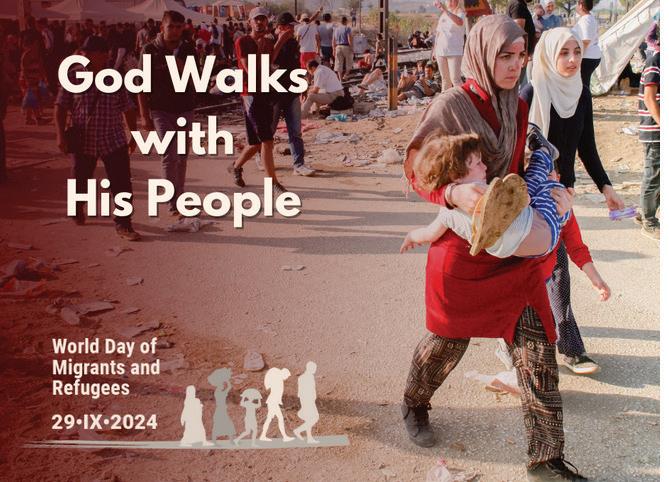
Francis’ suggestion is a journey to be made together, synodally, overcoming every obstacle and threat, in order to reach the true homeland. Along the way, wherever one finds oneself, it is essential to recognize the presence of God who walks with his people, giving them guidance and
protection at every step.
Therefore, the starting point is to recognize the Lord present in his people, the Emmanuel who, in every migrant, knocks at the door of our heart and offers himself for the encounter.
Veronica faced challenges due to her age and her son’s appearance, prompting authorities to doubt their relationship. She had to undergo a DNA test to prove David was her son.
The church provided shelter for three months, and now Veronica is seeking legal assistance for her immigration paperwork, permanent residence, and employment.
to cross the treacherous Darien Jungle, one of the world’s most dangerous jungles. Amidst the journey, she witnessed people suffering from insect bites, dehydration, and other perils.
Pressing on foot, the duo eventually reached Mexico, where Veronica was robbed of her remaining funds. Forced to halt her journey, she worked odd jobs while sleeping on the streets to save enough money to continue to the United States. Unable to afford a bus ticket, she opted to latch onto the side of a train, successfully reaching the U.S. border with her son, albeit witnessing others fall from the moving train. Upon arrival,
“Freedom to meet migrants’ basic human needs must be preserved,” says Bishop Rhoades
WASHINGTON –Bishop Kevin C. Rhoades of Fort Wayne-South Bend, chairman of the U.S. Conference of Catholic Bishops’ Committee for Religious Liberty, expressed solidarity with faithdriven ministries to migrants and noted the special need to protect religious liberty. His remarks commended the February 23 statement issued by the Catholic bishops of the State of Texas.

As I listened to these stories, I witnessed profound destitution and heard accounts of incredible survival, recognizing that these women's successful journeys (in contrast to the thousands who do not make it) were attributed to God. Where did they find the strength to persevere? Indeed, I believe everything comes from God.
In an era marked by global migration, our Catholic faith beckons us to address the needs of those in our midst. As you engage in your spiritual disciplines this Lenten season, may you discover opportunities to encounter Jesus through connections with neighbors in need, even if they have a different skin color or speak a different language. Regardless, they are a brother or sister in the Lord, and their prayers and sacrifices (through the mystery of the Communion of Saints) are the means through which the Lord blesses you in your own times of need.
“It is hard to imagine what our country would look like without the good works that people of faith carry out in the public square. For this, we can thank our strong tradition of religious liberty, which allows us to live out our faith in full.
“As the tragic situation along our border with Mexico increasingly poses challenges for American communities and vulnerable persons alike, we must especially preserve the freedom of Catholics and other people of faith to assist their communities and meet migrants’ basic human needs. I join my brother bishops in the State of Texas in expressing solidarity with those seeking simply to fulfill the fundamental biblical call: ‘whatever you did for one of these least brothers of mine, you did for me.’”
The Prairie Catholic l Page 6 l March 2024
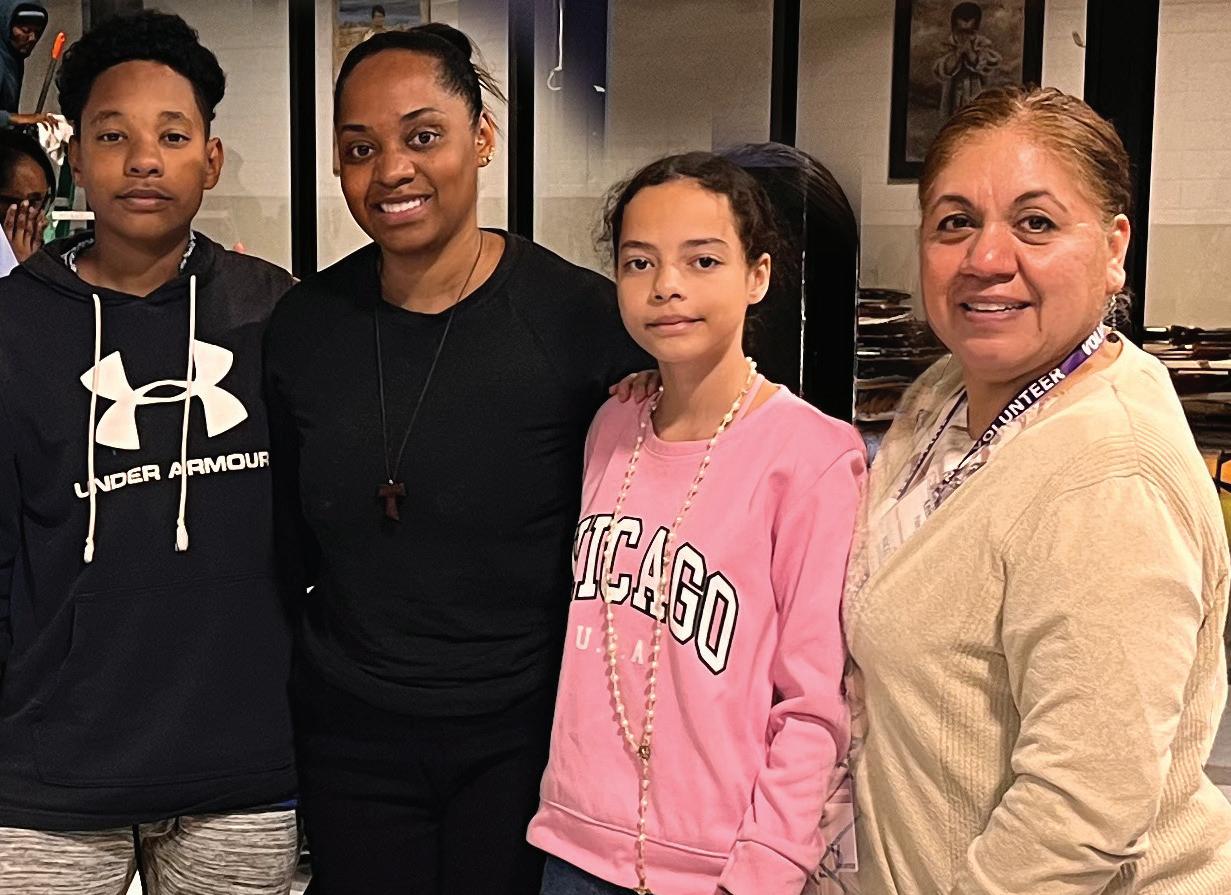
Diocese of New Ulm director of Hispanic Ministry Anisabel Palma, far right, is pictured with Ana and her two children who sought asylum in the United States. (Photo submitted)
MN Catholic bishops: “As Catholics, we are called to uphold human dignity”
(Continued from page 1.)
Tibesar suggested this system could allow biased and agenda-driven doctors to disregard signs of concern. “It would not be a true evaluation of the patient’s mental health by an objective, unbiased medical expert in mental health,” said Tibesar. “It is just an … insincere effort to appease people who may have a concern.”
Dr. John Mielke, chief medical director at St. Paul-based Presbyterian Homes and Services with more than 40 years of experience caring for the elderly in Minnesota, said at a news conference held by the Minnesota Alliance for Ethical Healthcare before the House hearing that the legislation would “corrupt the physician’s ethics” by requiring the doctor to list on the death certificate the underlying diagnosis as the cause of death rather than assisted suicide. The alliance is MCC’s endof-life care partner organization. It can be reached at ethicalcaremn.org.
Moreover, the bill would require doctors to determine a six-month-or-less prognosis for the patient to be eligible for assisted suicide. This prognosis, Mielke said, is virtually impossible to accurately determine. Patients outlive a six-month diagnosis in about 17% of cases, he said.
Dr. Paul Wojda, an associate professor of theology at the University of St. Thomas in St. Paul who specializes in healthcare ethics and has been following the issue, said in an interview Jan. 30 that if the bill passes into law there is a risk that doctors who oppose physician-assisted suicide will be terminated from their positions, or not hired, or simply not admitted to medical school. “Healthcare professionals – mostly nurses but also it could include some doctors – are put into situations where they are asked or even required to do things that are contrary to their conscience. It leads to
serious distress on their part,” said Wojda, who did not testify at the Jan. 25 House hearing.
Lack of oversight
Wojda also said the bill would require “really, really minimal” data to be recorded about the practice of physician-assisted suicide. The legislation would only require that data be collected on how many prescriptions doctors give for a lethal drug, how many patients take the prescribed doses and how many doctors are prescribing the doses.
Unlike Oregeon’s assisted suicide law, which served as a model for the proposed Minnesota legislation, no data on the race, age, gender, or self-reported motives would be collected of those who die in Minnesota. Wojda said it is fanciful to think this would not lead to abuse. “If I as a provider know that it is not going to be public information, then maybe I am a little less vigilant about it,” Wojda said.
Teresa Collett, a professor at the University of St. Thomas School of Law and director of the UST Prolife Center, testified at the hearing. In an interview, she said the lack of data collection under the proposed legislation is “absurd and terrible public policy.”
“We are going to know virtually nothing,” she said. “We are not going to know if it is being abused … we simply will not have the tools to detect why people are doing this.”
Potential for abuse
While it is illegal and would remain illegal under the proposed legislation for insurance companies to refuse a patient treatment in favor of them dying, cases of this happening in other states have nonetheless been documented. In 2017, the Washington Times in Washington, D.C., reported that an
HF1930 another step closer to law!
ST. PAUL – On Thursday, March 7, Diocese of New Ulm staff, Sr. Candace Fier, director of Family Life, and Deacon Tim Dolan, director of Social Concerns, traveled to the State Capitol in St. Paul to attend the House Public Safety Finance and Policy Committee meeting whereby an 8-6 vote advanced the Physician Assisted Suicide bill a step closer to legalization.
Attending this critical meeting allowed both Sr. Candace and Deacon Dolan to witness outstanding pro-life testimony by physicians and lawyers, as well as discussion by pro-life committee members that captured the truth of the dignity of every human being from conception to natural death. “Their defense of life was a forceful witness to the tragedy of this bill and the common call to every human being to protect the most vulnerable among us,
insurance company offered assisted suicide to a patient but not chemotherapy due to the cost of treatment.
“(The bill) is fraught with potential abuse,” Collett said.
Disability rights activists say that regardless of how the legislation expands, the bill as currently proposed is already working against people who have disabilities.
Kathy Ware – whose son Kylen Ware has quadriplegic cerebral palsy, epilepsy and autism – said that the proposal invalidates the worth of the lives of those with disabilities. At the Jan. 25 committee hearing, she advocated for greater resources and home health aides for the disabled, rather than making physician-assisted suicide an option for the terminally ill.
“Doctor and practitioner-prescribed suicide will weaponize an already biased medical community even further against my son, Kylen, and his peers. We are already looked at as a burden to society and a drain on resources and finances,” Ware wrote in testimony to the Minnesota House.
Legislating physician-assisted suicide, according to Ware and other disability rights activists, would only intensify the stigma against those with disabilities.
Legislating despair
Collett said that if passed, the bill would “give way to despair.”
“I think, as a lawyer, as a matter of public policy, we should not be encouraging people to despair. We should instead be encouraging them, walking with them, and helping them find sufficient meaning to continue until natural death occurs,” Collett said in an interview.
PHYSICIAN-ASSISTED SUICIDE
Under proposed physician-assisted suicide legislation HF1930/SF1813 in the Minnesota Legislature:
• If passed, a resident of any state could come to Minnesota to receive a dose of lethal medication
• The family of the person who will commit physician-assisted suicide does not have to be notified
• A doctor does not have to be present when the lethal dose is administered
• A physician who objects to the law would still be required to refer a patient to a doctor who will assist with their suicide
• A mental health evaluation is not required unless a physician deems it necessary
If the legislation passes, anyone will be able to come to Minnesota and obtain an assisted suicide if:
• The patient is over 18 years old
• The patient has a prognosis of six months or less to live
• The patient is deemed mentally fit
• The patient can administer the lethal dose themselves
Data that Minnesota will collect if the bill passes into law:
1. How many lethal prescriptions were written
2. How many doctors wrote these prescriptions
3. How many people who were prescribed the medication took it
strong message not of empowerment but of rejection.”
including the sick and suffering,” said Sr. Candace.
Due to the complexity of this bill, Sr. Candace explained that there will be several committee hearings to ensure that the appropriate committees address all the potential issues connected with the bill.
“We thanked the legislators we visited for taking a stand against this bill, and they, in turn, thanked us for contacting them and letting our voices be heard. As one representative reminded us, ‘When you make your voices heard, we can truly say that we are speaking for our constituents.’ So please keep contacting your representative’s office,” Sr. Candace said.
“If avoidance of suffering is the highest good then the Passion makes no sense,” said Collett, who described her father-in-law’s final months of life as extremely important and valuable to her family. “There are things we learn from suffering that we cannot learn any other way.”
Isaac Wicker, a mental health therapist and a member of St. Peter in North St. Paul, has worked with many patients who have struggled with suicidal ideation throughout his career. This legislation would be devastating to the mental health of those who already do not feel hope, he said.
“At an institutional level, we are saying that it is OK for you to die. We don’t need you; we don’t want you; we don’t care,” Wicker said in an interview. “That could be a really
The proposed legislation requires a prognosis of six months or less of life for one to qualify – the very period when profound personal and interpersonal healing can occur, Wicker suggested.
“The last six months of a person’s life, especially if the (family) system is aware that those are the last six months, that time can be very dynamic. A lot of healing can happen, a lot of reconnection and amends,” Wicker said.
Tibesar said that for Christians, the end of one’s life can be a time to find meaning in suffering in the light of Christ. “It might actually be the holiest thing that person has ever done, to suffer well for those last days, weeks, months, whatever it takes. It might truly be their shining moment from a spiritual sense,” Tibesar said.
Statement by Minnesota Catholic Bishops
A BETTER WAY FORWARD, a statement by the Catholic bishops of Minnesota concerning physician-assisted suicide is available in English/Spanish at www.dnu.org/familylife or contact your parish.
The Prairie Catholic l Page 7 l March 2024
respect life
The secret to effective YOUTH MINISTRY
by Kevin Losleben
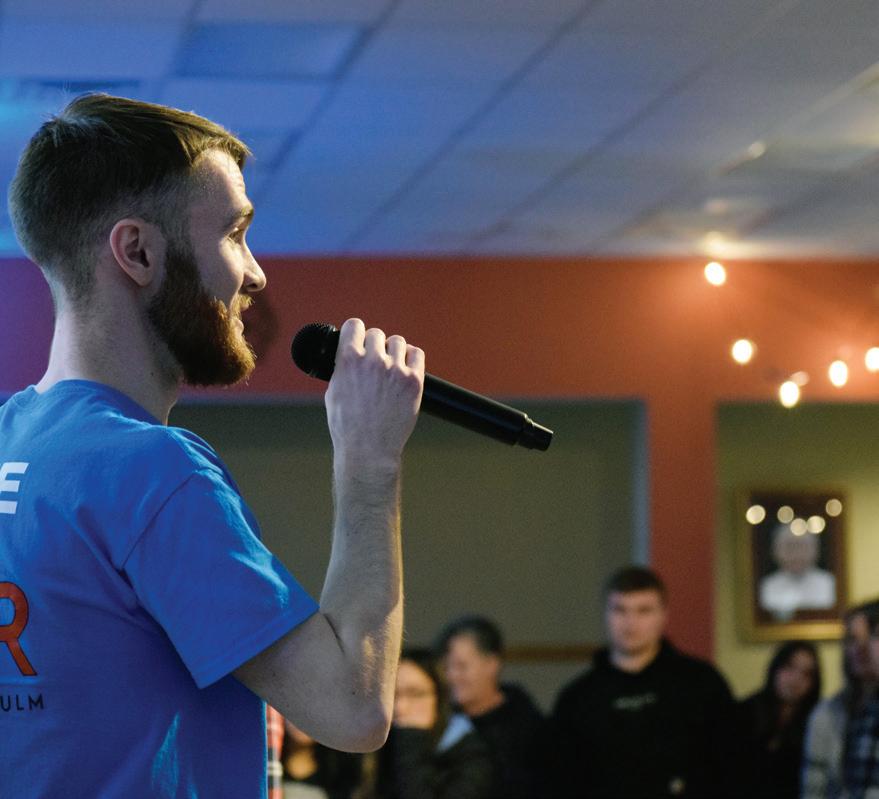
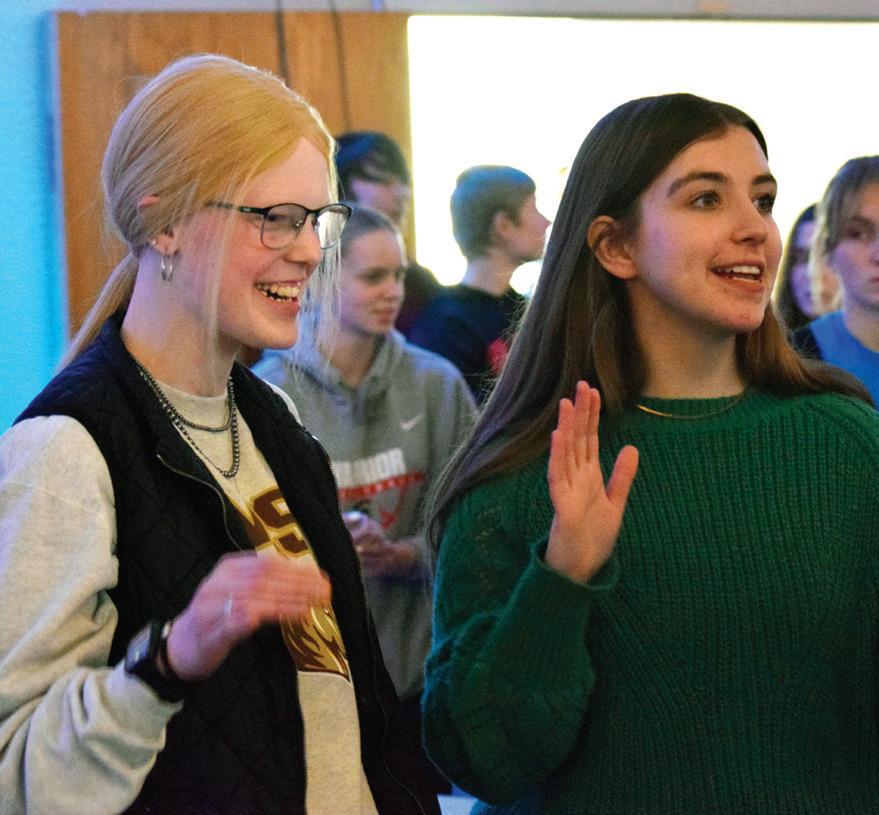
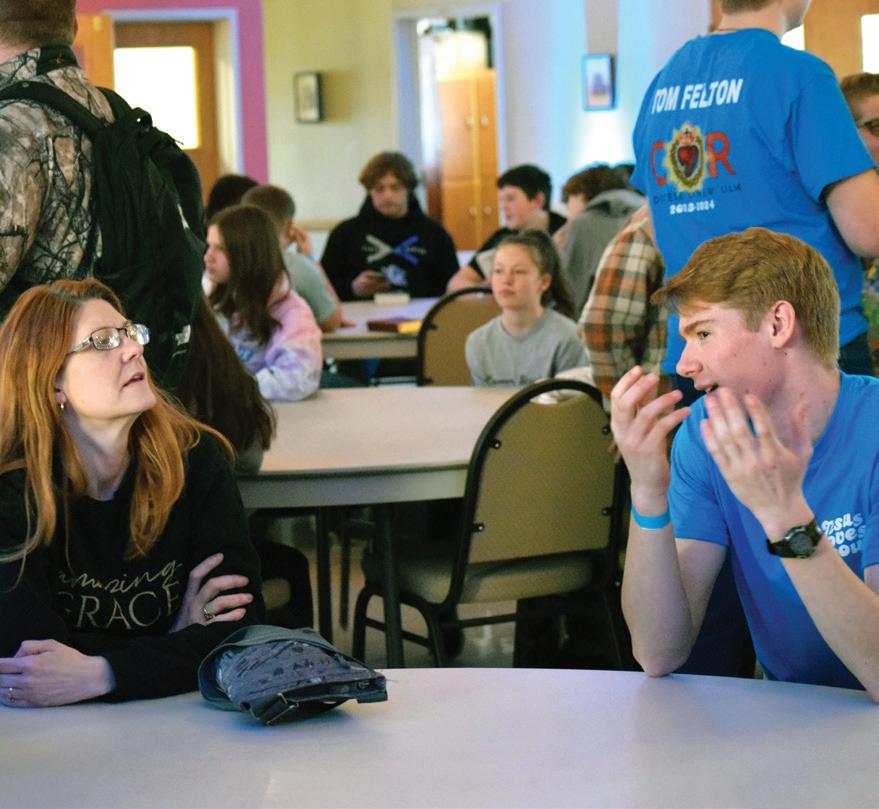
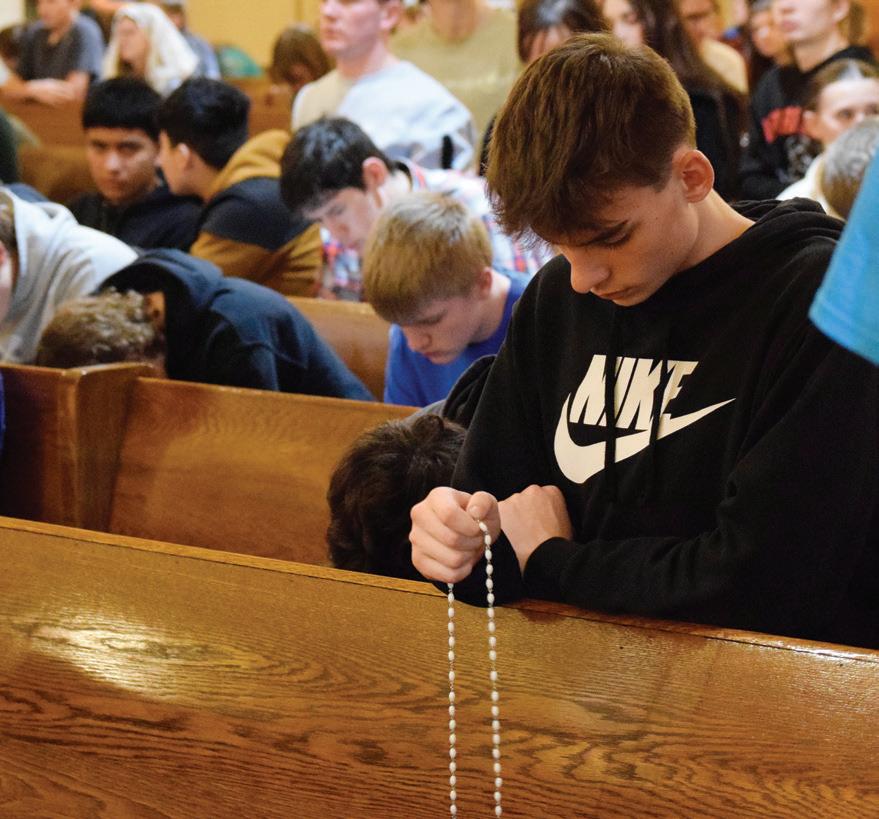
Well over 200 people attended the Diocese of New Ulm COR Night on Sunday, Feb. 18, 2024, at the Church of St. Aloysius in Olivia. They came from all four corners of the diocese for an entertaining and uplifting night centered around faith (and perhaps some pizza). Nationally-known Catholic speaker Lisa Cotter, the evening’s keynote, spoke about the importance of virtuous friendships.
“In the heart of our hearts, these are the friendships we want,” Cotter explained. “People who are there for you through thick and through thin. People who are there to support, but also to push us to become the best that we can be.”
It was these types of friendships that Clare Braswell found serving on COR (which stands for Choir, Outreach, and Reception), a diocesan youth group focused on prayer, service, and community. After suffering through the deaths of three loved ones in the course of a year, Braswell began to sink into depression. “I was so anxious about becoming depressed that I ended up working myself into a depression. That depression quickly made me hate my life and hate the one who was making me live, which was God,” Braswell explained during her testimony given to the COR Night audience.
Braswell eventually attended a youth conference where she had a profound encounter with Jesus in the Eucharist. Set ablaze with a desire for God, she recognized that she needed a community to
support her. “Getting involved in COR and getting involved in my home parish youth group has helped me to gain a community rooted in Christ,” Braswell said.
In a post-COVID world, young people crave authentic relationships, and this past year, COR experienced a significant growth in membership with 40 members. Members commit to 15 minutes of daily prayer and are given an adult mentor who coaches them in their walk of faith. Finding friends who will support them is a big draw for young people wanting to join COR. These three relationships – with peers, caring adults, and the Lord – are the types of relationships young people are seeking.
Blake DeVries, a junior at Elkton School District in South Dakota, is another example of youth seeking these relationships. DeVries is a three-sport athlete and all-state linebacker. He is also Methodist. This past winter, a friend invited him to attend COR Night, which was held in December. “I really enjoyed the adoration and the sacred music,” DeVries reminisced about his first COR Night experience.
Through a series of events in his life during the 8th and 9th grades, DeVries came to the realization that the Catholic Church was the church that Jesus Christ founded. “I was, like, convinced of the pope being the antichrist, and then I did my own research.” After many prayers, hours of research, and talks with an influential Catholic teacher at his public school, DeVries now prays a daily rosary
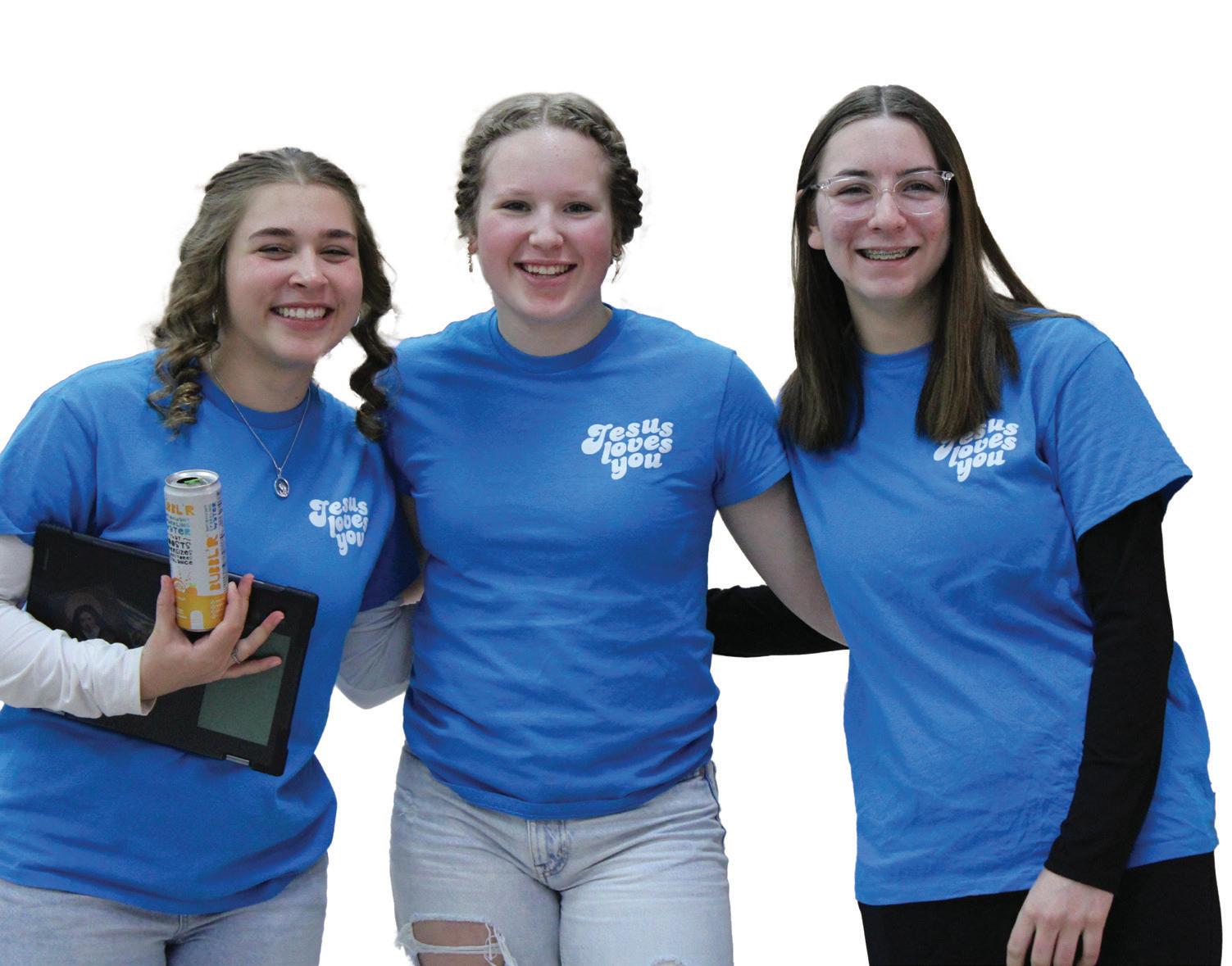
Highlights of February COR Night
and hands his friends books about the Eucharist to read during “free read” time at school.
“I guess some of them already believe in the Eucharist,” he chuckled.
DeVries saw – in the life of his teacher and in the truths he was discovering through his research – an authenticity that other religions did not possess. And he just had to share the good news. After his positive COR Night experience, DeVries recruited his friends to attend the most recent COR Night in February. He managed to recruit 49 of his friends to attend.
“There was probably like 30 [kids] that are Catholic and then, yeah, around like 17 or so [that were Protestant],” DeVries said. “I think everyone had a positive experience, and I had some girls that came with some of their friends that were Protestant, and they asked me how they could become Catholic.”
DeVries and his friends see something authentic in the Catholic Church and in the lives of those living her teachings to the fullest. “I’ve been to everything,” said DeVries. “I’ve been to nondenominational youth conventions…I’ve been to every type of Protestant gathering there can be, and nothing can compare to the [Catholic] Church being the Church that Jesus Christ founded with the sacred liturgies and adoration and confessions and sacred music…The Protestant boys that came with were like, ‘Yeah, I really enjoyed the music in the background.’…I think probably it was probably most agreed-on that everyone’s favorite part was holy hour [adoration].”
The secret to effective youth ministry is authenticity. Youth recognize authentic relationships and authentic worship when they see it. This is evident in young people like Clare Braswell and Blake DeVries, who come from different areas but find the same thing.
Kevin Losleben is the director of Youth and Young Adult Ministry for The Diocese of New Ulm. He can be reached at klosleben@dnu.org.
C hoir, O utreach, and R eception
COR meets once a month for a time of games, food, fellowship, discipleship, small group discussion, and prayer. COR members serve at COR Night.
Who can join?
Any practicing Catholic in the Diocese of New Ulm entering grades 10-12 interested in following Jesus. COR youth promise to pray daily, go to Confession regularly, and read the assigned readings. A schedule of meetings is available upon request.
How do I join COR?
COR applicants will fill out an application and go through a simple interview process. Two references will be needed: one from a parent and another from a non-family parish leader. The application period is from April –August.
For more details visit the Diocese of New Ulm Youth and Young Adult website, www.dnu.org/youth.
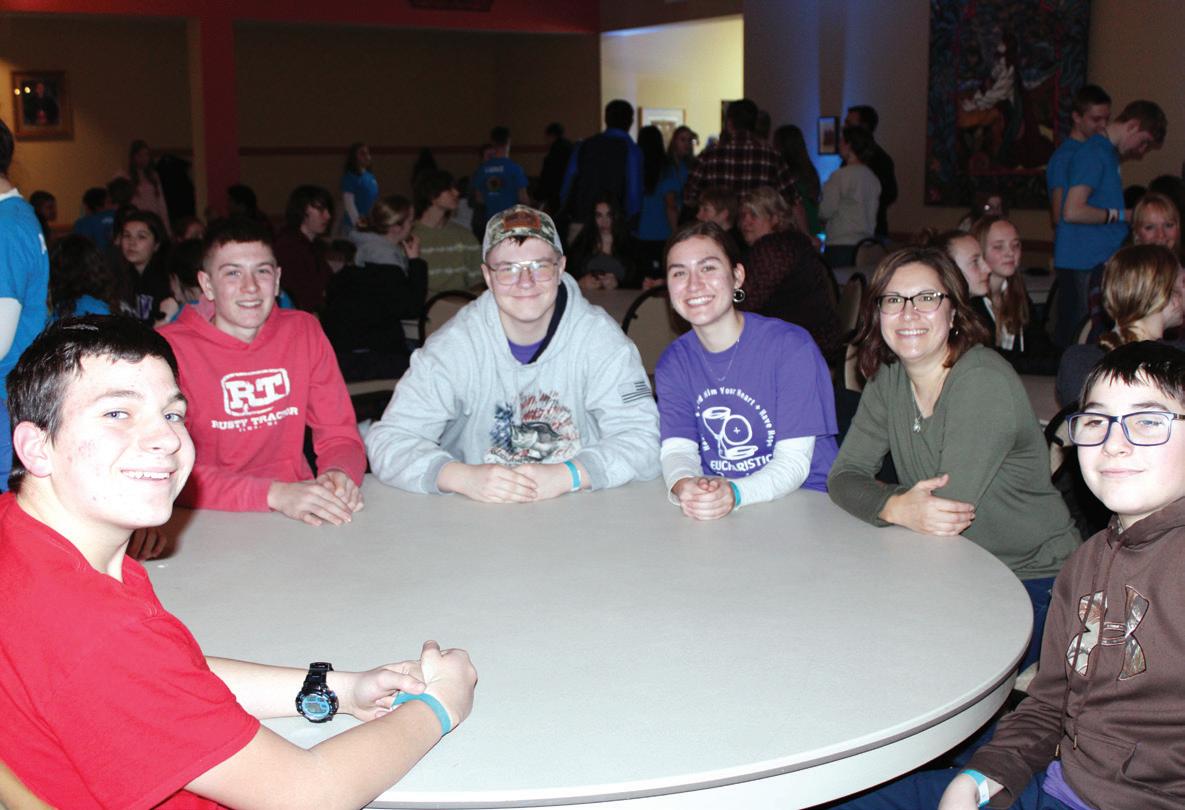
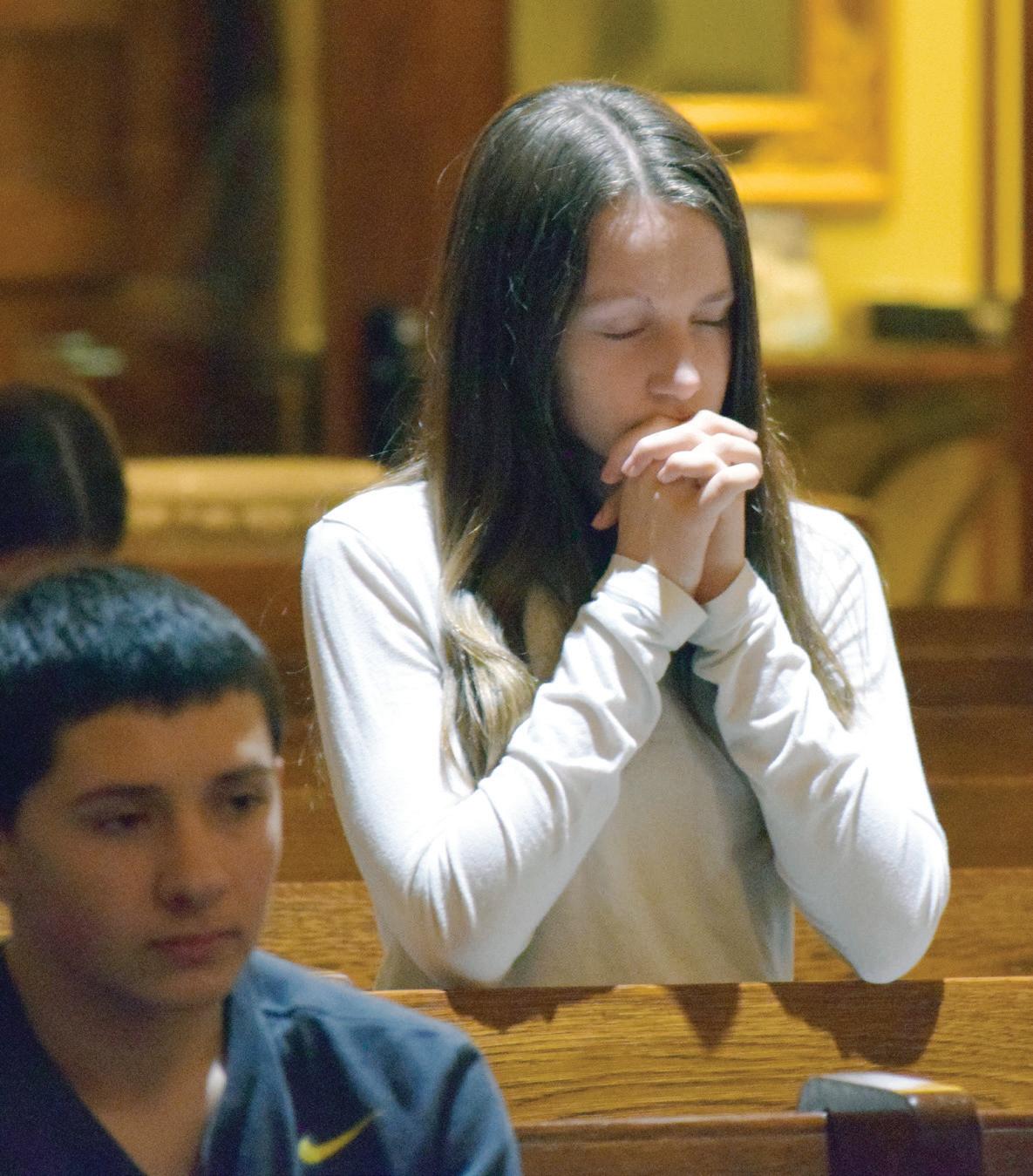


“Finding friends who will support them is a big draw for young people wanting to join COR. These three relationships – with peers, with caring adults, and with the Lord – are the types of relationships those who join COR tend to be seeking. ”
The Prairie Catholic l Pages 8-9 l March 2024
education
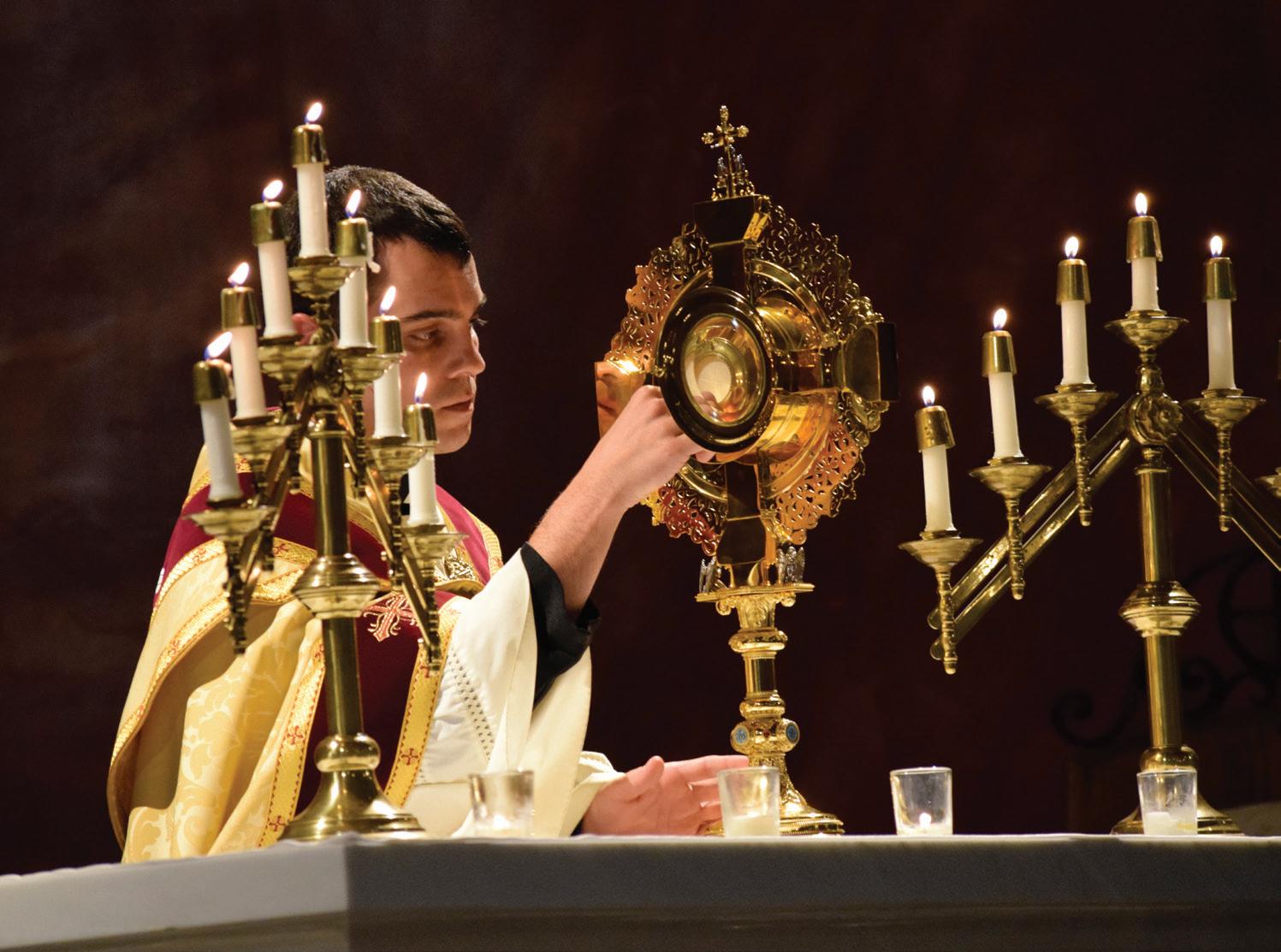
Fr. Tanner Thooft, a priest of the Diocese of New Ulm who serves as assistant director of Vocations, prepares for Eucharistic Adoration during the February COR Night held in Olivia. (Photo by Helen Fischer.)
(COR Night photos by ????????)
 by Fr. Mark Steffl, STL, JCL
The Code of Canon Law, which governs the Church’s discipline, contains a specific section that regulates the acquisition, administration, and disposition of the “temporal goods” of the Church. This section is relatively short compared to other sections of the Code of Canon Law because the Church acknowledges that there are also many national and local civil laws and regulations that govern how the Church uses her resources.
The section of the Code on this area begins by stating the right that the Church has to acquire “goods” such as property:
Can. 1254 §1. To pursue its proper purposes, the Catholic Church by innate right is able to acquire,
Ask a Canon Lawyer
This month’s question:
If I leave a bequest in my will for my parish to be used only for a specific purpose, will my wishes be respected?
retain, administer, and alienate temporal goods independently from civil power.
§2. The proper purposes are principally: to order divine worship, to care for the decent support of the clergy and other ministers, and to exercise works of the sacred apostolate and of charity, especially toward the needy.
This “right” to acquire property is a recognition of the need for the Church to be able to fulfill the mission that the Church received from the Lord himself and is aimed to provide places for the worship of God and reception of the sacraments, to care for those who see to this mission, and for charitable acts.
The level at which most people experience this is within a parish, where people give financial offerings on a weekly basis with their “Sunday offering” envelopes.
This money is administered by the pastor (parish priest), with the assistance of his parish finance council (in the Diocese of New Ulm, this is usually referred to as the “administrative council”). The proceeds of this collection go to the upkeep of parish buildings, salary and benefits for parish (and school) staff, heat, electricity, snow removal, and countless other expenses entailed in the running and upkeep of a parish. (A small parish in the Diocese of New Ulm can have an annual budget of $75,000-$100,000 — a larger parish with a school might have an annual budget of $3 or $4 million.)
There are times when people wish to give extra gifts to the Church, particularly bequests from an estate. Many such gifts are given without specific designation, which is very helpful in providing for the needs of the Church. (In the parishes that I care for, it is common for individuals to leave
a bequest to the parish.) Other times, specific “capital” needs require fundraising for a large expenditure like a new church roof or parking lot that goes beyond the usual parish budgeting and fundraising.
Outside of these ways of providing for the needs of the Church in its particularities, there are times when people desire to give gifts for specific purposes. The donor’s wishes need to be respected (both morally and legally) if they are given for a particular purpose. Church law makes it clear that if the restrictions on the gift’s use are overly burdensome or restrictive, there may be times when a bequest or large donation might not be accepted. An example would be someone wanting to give money to a parish with “strings attached” that makes it better not to accept, or sometimes even impossible to receive the gift or bequest. Although this doesn’t happen often, it is something that administrators have to be careful of, and occasionally even seek advice about from experts
and one’s superiors so that the “temporal goods” of the Church don’t get in the way of the mission that they are supposed to help the Church to accomplish and fulfill.
The entire section of Church law on temporal goods is ultimately about the Church being mindful of the sacrifices that the Christian faithful make as their part in fulfilling the mission of the Church. We all have the obligation to assist in that mission in various ways, and the law ensures that such matters do not get in the way of that mission and its proper end: the salvation of souls.
Next Issue: Are children of a marriage that is declared “null” (annulment) by the Church considered “illegitimate”?
Fr. Mark Steffl serves as judicial vicar of the Office of the Tribunal for the Diocese of New Ulm and is a canon lawyer, msteffl@dnu.org, (507) 233-5316.
Minnesota Catholic Conference urges participation to help families, defeat physician-assisted suicide and sports gambling
As the Minnesota Legislature opened the second half of its 2023-2024 legislative session on Feb. 12 at the Minnesota State Capitol in St. Paul, Jason Adkins, executive director and general counsel of the Minnesota Catholic Conference (MCC), and Maggee Hangge, MCC’s policy and public relations associate, sat down with The Catholic Spirit of the Archdiocese of St. Paul and Minneapolis to discuss key issues facing lawmakers and the people they represent.
Urging people to support legislation that helps individuals and families and to contest bills that are detrimental to the common good and contrary to Church teaching, Adkins and Hangge addressed physicianassisted suicide, mandating health insurance coverage for in-vitro fertilization procedures, as well as the legalization of sports gambling. Questions and their responses have been edited for clarity and brevity.
Q. Could you start us off with what you do at the conference and what the conference is set up to do?
[Adkins] Our staff assists the (Minnesota Catholic) bishops in their public policy and legislative outreach. So we go to the Capitol, to members of Congress, about important issues impacting life and dignity. And then we find ways to activate more Catholics to help them make their voices heard and amplify the voice of the bishops on important legislative issues … life issues, but also issues related to poverty, family, economic security, housing deprivation, that we would be derelict in our duties if we didn’t help.
Q. Regarding abortion, we saw a significant change last year (lawmakers codified a right to abortion, expanded taxpayer funding to include elective abortions, and eliminated a 24-hour waiting period before a woman could undergo an abortion, among other changes). Are there other areas that Catholics should be alert to and wanting to get involved with?
[Hangge] Working to help families is one piece of it. We’re

also working collaboratively with other groups in the state to figure out a path forward. We’ve gotten a lot of requests from parishes to come out and speak, probably over a dozen that I’ve done … to give a rundown of what happened last session, what’s coming, how people can get involved.
Q. There is legislation proposed this session (HF1658/SF1704) that would mandate health insurance plans – including those provided by religious organizations — to cover in-vitro fertilization procedures. Can you share where
this legislation falls when it comes to the Church’s teaching on the ethics of conception?
[Hangge] We know that it’s hard when parents are facing infertility, but we also don’t want to mass produce children. Eugenics can come into this (with) a lot of ethical implications. What do we do with the embryos that are left over? Another thing that this bill could do is potentially normalize surrogacy (bearing a child for another woman) in the state. Quoting Pope Francis, “I deem deplorable the practice of

so-called surrogate motherhood, which represents a grave violation of the dignity of the woman and the child.”
Q. There is legislation known as the End-of-Life Options Act (HF1930/SF1813). Others call it the Assisted Suicide Act. Can you explain what this legislation seeks to do and how Catholics can approach the issue?
[Adkins] The bill would require that doctors and nurse practitioners, when dealing with patients with a terminal diagnosis, that they advise them of the opportunity to receive what’s called assisted suicide, or lethal drugs, that they can take themselves to end their lives.
We should be pursuing better healthcare options and giving people more healthcare choices, not pushing them into a corner where they feel like assisted suicide is their only choice. Our position is, let’s expand healthcare options and find better ways to care for one another.
(Continued on page 15.)
education The Prairie Catholic l Page 10 l March 2024
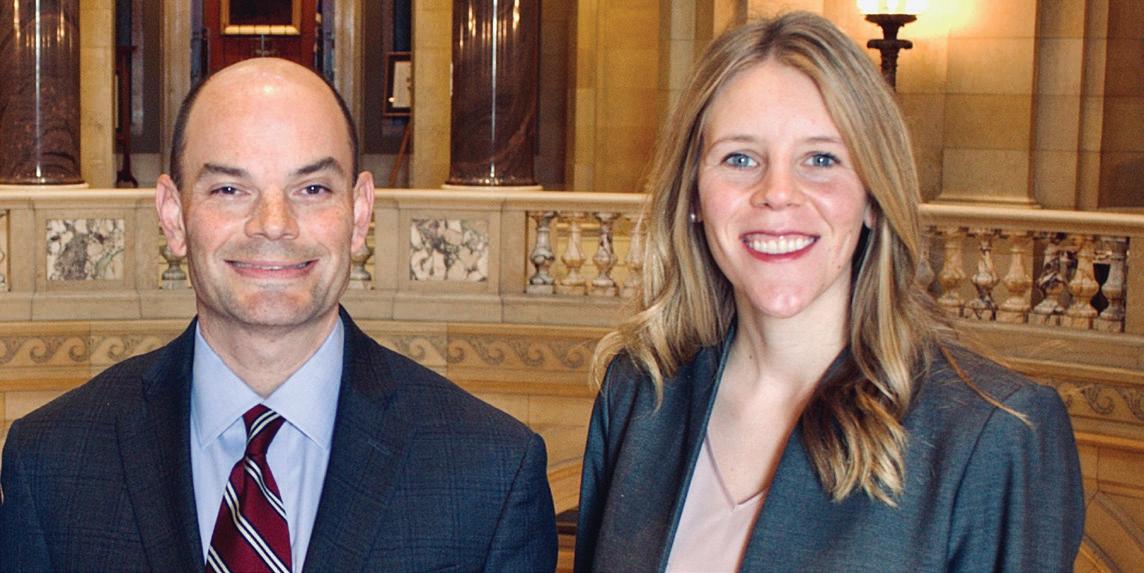
Jason Adkins and Maggee Hangge of the Minnesota Catholic Conference at the Minnesota State Capitol in St. Paul. (Photo courtesy of the Minnesota Catholic Conference.)
St. Patrick, St. Joseph, and the conversion that makes all the difference
by Bishop Robert Barron
I am always pleased when the feasts of St. Patrick and St. Joseph roll around every year, the first on March 17 and the second on March 19.
Joseph is especially dear to the Italian people, who celebrate him with festive meals, and Patrick, of course, is specially reverenced by my own people, the Irish, who celebrate him with parades, parties, and (often) too much drinking. Though separated by four centuries and though hailing from extremely different cultures, Patrick and Joseph have a great deal in common, spiritually speaking. For both stubbornly situated their lives in the context, not of the ego-drama, but the theo-drama, and therein lies their importance for the universal church.
Let’s consider St. Patrick first. A Roman Briton, born in the early fifth century, Patrick, while still a young man, was kidnapped by raiders and brought to Ireland, where he lived the brutal life of a slave. One can only imagine the darkness of these years: torn away from family, friends, and home, compelled to learn an unfamiliar language, treated with disdain, forced to do the most disagreeable work. How often he must have wept. How often he must have cried out to God, wondering how he could have been so thoroughly abandoned.
After six years in Ireland, Patrick finally managed to escape and return home. Some accounts have it that he then sojourned in France, doing his theological studies there and becoming ordained as a priest.
Looking at this life from a purely natural or psychological perspective, one would readily conclude that still youthful Fr. Patrick would never want to journey again to the place where his life had hit rock bottom. Or perhaps, he would want to return there as chaplain to an invading army! Instead, he decided to go back to Ireland in order to carry the Gospel to those who had enslaved and persecuted him.
How can we explain this?
We have to move beyond a merely natural and psychological framework and understand his life theologically. Stated differently, we have to appreciate that Patrick, like all of the saints, saw his life as ingredient in a drama that God was directing and producing. He appreciated that the whole awful experience of being a slave was not simply dumb suffering, but was, strangely, a preparation for the work that God had for him.
During those terrible years, he learned a great deal about the history, topography, and language of the Irish; he came, perhaps, to love some of their lore and religious customs. Like Moses among the Egyptians, he came to understand the “enemy” culture from the inside and hence was able, with special skill and creativity, to engage it. Now think of the worst moment of your life, the time when you hit bottom.
How do you read it? Pointless pain – or a moment of particular grace?
Now let us look at St. Joseph. Every episode of his life recounted in the Bible is a crisis. He discovers, to his dismay, that the woman he loved and to whom he was betrothed to marry, was pregnant. How lost and confused he must have been.
The Mosaic law permitted him to hand Mary over to be stoned to death, but his native decency prevented him from taking that path. Instead, he resolved, undoubtedly with a broken heart, to divorce her quietly.
But then the angel of the Lord appeared in a dream and explained the anomalous pregnancy. Placing his own fears and preoccupations to one side, Joseph understood what was happening in the context of God’s providence and he took Mary as his wife.
Next, discovering that the child was in mortal danger, Joseph took mother and baby on a perilous journey, across hundreds of miles of trackless desert, to an unknown country, an unknown village, an
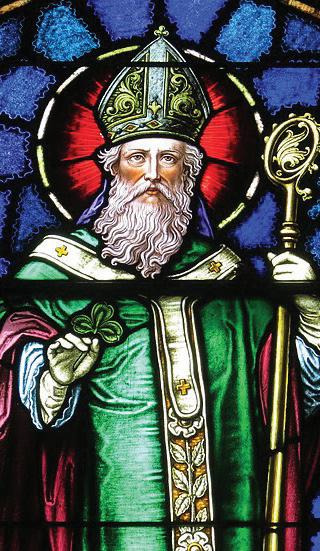
St. Patrick of Ireland is one of the world's most popular saints. He was born in Roman Britain in 387. Patrick preached and converted all of Ireland for 40 years and worked many miracles. After years of living in poverty, traveling and enduring much suffering he died March 17, 461 at Saul, where he had built the first Irish church.
unknown people. Anyone who has ever been forced into exile, compelled to leave his homeland, or even obliged to move to a new city to take up a job knows the anxiety that Joseph must have felt. Now add to it the keen sense that your baby is being pursued by agents of the government, intent upon murder. But Joseph went because God had commanded him.
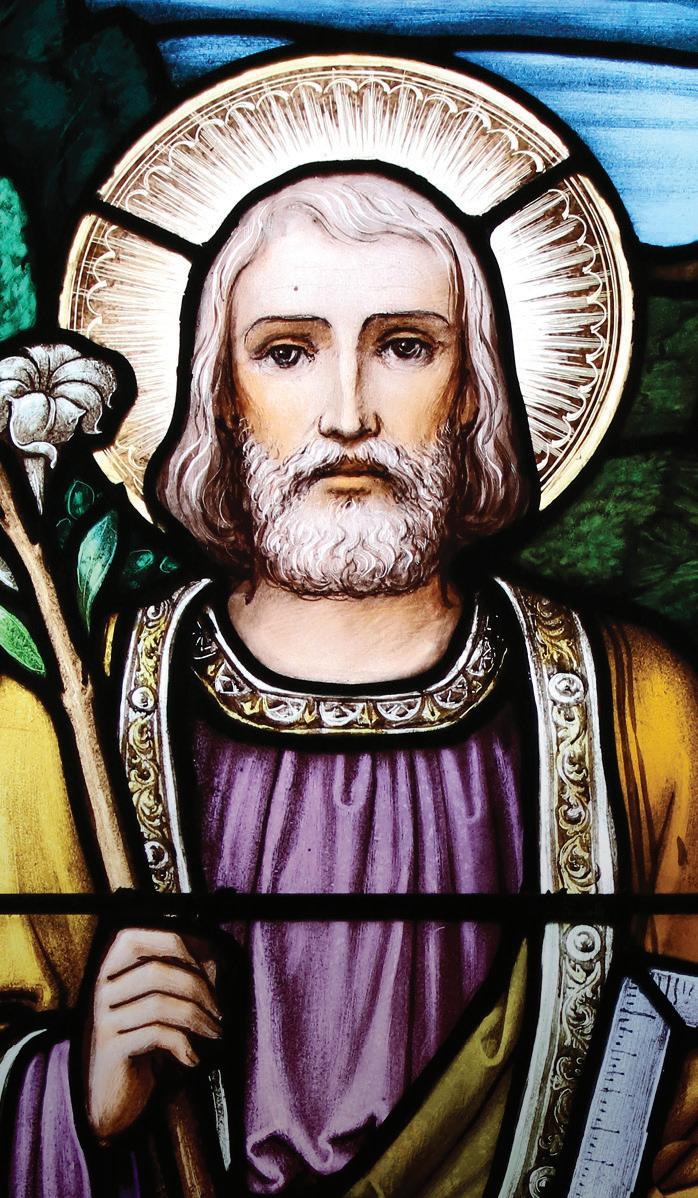
St. Joseph, spouse of the Blessed Virgin Mary, is regarded as the patron saint of workers. Pope Pius IX declared him to be both the patron and the protector of the Catholic Church, in addition to his patronages of the sick and of a happy death, due to the belief that he died in the presence of Jesus and Mary.
Finally, we hear of Joseph desperately seeking his lost twelve-year old son. Speak to any parent who has gone through a similar experience – looking for a child who has wandered away or been taken – and you will hear of a fear beyond measure. And this anxious search went on for three days. Did Mary and Joseph sleep? Did they eat? What did they say to one another? Thus we
fully understand Mary’s reaction when, having finally discovered Jesus among the doctors in the Temple: “Son, why have you done this to us? Your father and I have been looking for you with great anxiety?” And they received that devastatingly understated response: “Why were you looking for me? Did you not know I must be in my Father’s house?”
Quietly taking the child home, Joseph once more put aside his human feelings and trusted in the purposes of God. The little we know about Joseph is that he experienced heartbreak, fear unto death, and a parent’s deepest anxiety, but each time, he read what happened to him theo-dramatically and not egodramatically.
This shift in attitude, this reorientation of the heart, this conversion is what made Patrick the patron of the Irish and Joseph the patron of the universal Church.
Editor’s note: Bishop Robert E. Barron has served as bishop of the Diocese of Winona-Rochester since 2022. He is the founder of the Catholic ministerial organization, Word on Fire, www.wordonfire.
education The Prairie Catholic l Page 11 l March 2024
Vatican releases pope’s schedule for Holy Week and Easter 2024
by Catholic News
Agency
ROME – The Vatican has released Pope Francis’ schedule for Holy Week 2024, which will include five papal liturgies, Stations of the Cross at the Colosseum, and other traditions to mark the most sacred week of the year.
Easter is the highest feast in the Catholic Church, known as the “solemnity of solemnities,” celebrating Jesus’ resurrection and defeat of sin and death, and the Vatican celebrates Holy Week with pomp, reverence, tradition, and a busy schedule.
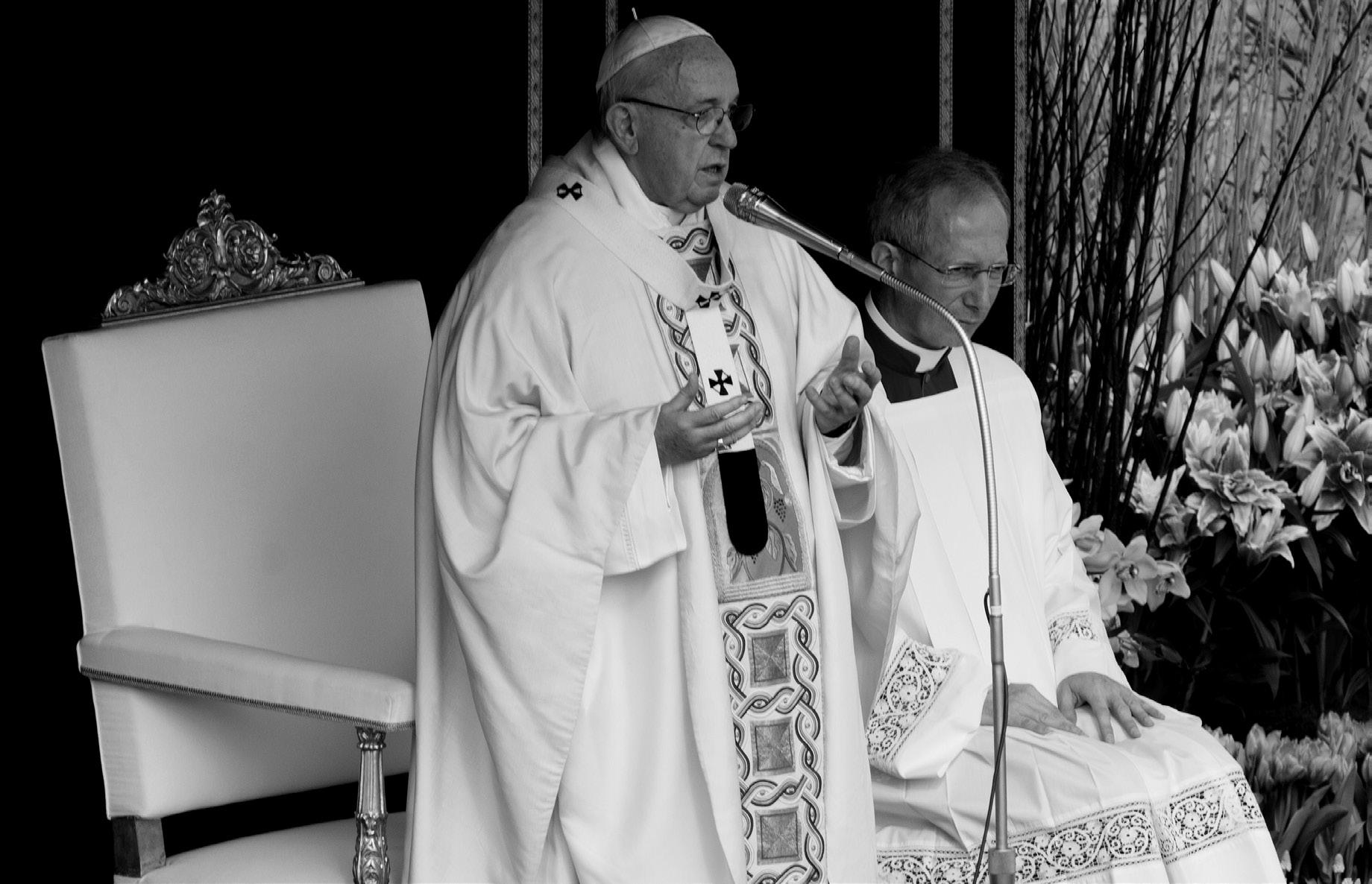
The 87-year-old pope is scheduled to preside over liturgies on each day of the Easter Triduum as well as Palm Sunday.
Holy Week 2024 begins on March 24 with Palm Sunday and culminates with Easter on March 31. Here is the Vatican’s full schedule:
Palm Sunday
On Sunday morning, March
24, Pope Francis is scheduled to preside over Mass for Palm Sunday, also known as Passion Sunday or the Commemoration of the Lord’s Entrance into Jerusalem.
The Mass, which will be in St. Peter’s Square at 10 a.m. local time, will kick off with a grand procession of deacons, priests,
bishops, cardinals, and laypeople carrying palms. The procession includes olive tree branches, palm fronds, and the large, weaved palms called “parmureli,” all blessed by Pope Francis.
Holy Thursday
Pope Francis is set to start Holy Thursday with a chrism Mass in St. Peter’s Basilica at 9:30 a.m. in the presence of cardinals, bishops, and priests living in Rome. During the Mass, Pope Francis, as the bishop of Rome, will bless the oil of the sick, the oil of catechumens, and the chrism oil to be used in the diocese during the coming year.
The Vatican has yet to release the details for where Pope Francis will celebrate Holy Thursday Mass 2024. Last year, the pope offered Mass at the juvenile detention center Casal del Marmo, the same detention center where he offered Holy Thursday Mass in 2013 shortly after his election.
Good Friday
Continuing the liturgies of the Triduum, Pope Francis is also scheduled to preside over a celebration for the Passion of the Lord on Good Friday at 5 p.m. in St. Peter’s Basilica. During this liturgy, which is not a Mass, Cardinal Raniero Cantalamessa, the papal preacher, typically preaches instead of the pope. In the evening, Pope Francis will lead the Stations of the Cross devotion at 9:15 p.m. in Rome’s
Colosseum illuminated by candlelight.
Holy Saturday
On Holy Saturday, Pope Francis is set to preside over the Easter Vigil at 7:30 p.m. in St. Peter’s Basilica. The Easter Vigil, which takes place on Holy Saturday night, “is the greatest and most noble of all solemnities,” according to the Roman Missal.
The liturgy begins in darkness with the blessing of the new fire and the preparation of the paschal
candle. At the Vatican, cardinals, bishops, and priests process through the dark basilica carrying lit candles to signify the light of Christ coming to dispel the darkness.
Pope Francis also typically baptizes new Catholics at this Mass.
Easter Sunday
The morning of Easter Sunday, Pope Francis will preside over Mass in St. Peter’s Square at 10 a.m. on a flower-decked parvise.
After Mass, he will give the annual Easter urbi et orbi blessing at noon from the central balcony of St. Peter’s Basilica.
Urbi et orbi means “to the city [of Rome] and to the world” and is a special apostolic blessing given by the pope every year on Easter Sunday, Christmas, and other special occasions.
In 2023 close to 100,000 people were present in St. Peter’s Square for the blessing.
Holy Father’s March prayer intention: For the martyrs of our day
Pope Francis released his prayer intention for March, asking for prayers for the martyrs of our day, and recalling a story he was told by a widowed Muslim man who recounted the martyrdom of his Christian wife as she defied terrorists.
by Francesca Merlo Vatican News
In the new release from The Pope Video, www.thepopevideo.org, Pope Francis requests prayers for the new martyrs of our day so that they might “imbue the Church with their courage and missionary drive.”
Introducing his prayer intention for the month of March, Pope
Francis decides shares a story which he says “is a reflection of the Church today” and one that is “the story of a little-known witness of faith.”
He recalls the story of a widowed man whom he met when he visited a refugee camp in Lesbos. The man, a Muslim, recounted the harrowing story of how his wife, who was Christian, was asked by terrorists to throw a crucifix to the ground. “She didn’t do it, and they slit her throat in front of me,” the man told the pope.
Pope Francis notes that this man “held no grudges,” and was instead “focused on his wife’s example of love, a love for Christ that led her to accept, and to be faithful to the point of death.”
The Holy Father emphasizes that there will always be martyrs among us and that “this is a sign that we are on the right path” as the courage and witness of the martyrs, “is a blessing for everyone.” The pope continues, “I have been told that there are more martyrs today than at the beginning of Christianity.”
Thus, Pope Francis invites all the faithful to pray for those who risk their lives for the Gospel, all over the world, so that they “might imbue the Church with their courage and missionary drive, and be open to the grace of martyrdom.”
Silent martyrs
The Pope’s Worldwide Prayer Network created this month’s
video in collaboration with Aid
To the Church In Need (ACN), a Papal Foundation whose mission is to help the faithful wherever they are persecuted, oppressed or in need through information, prayer and action.
In the video, the story of the Christian lady who died refusing to throw the crucifix on the ground alternates with other images of Christian communities on pilgrimage and cites examples of courage, such as that of the first Servant of God from Pakistan –Akash Bashir – who died almost 20 years ago in 2015 to prevent a terrorist attack on a Church in Lahore filled with members of the faithful.
In its press release accompanying
this month’s prayer intention, the Pope’s Worldwide Prayer Network notes that in 2023 alone, ACN received reports in 40 countries of people who were assassinated or abducted because of their faith.
Nigeria has become the country with the highest number of assassinations; in Pakistan, in the diocese of Faisalabad, the churches and homes of the Christians in Jaranwala were attacked; and in Burkina Faso, Catholics in Débé were expelled from their village solely because of their faith.
The Prairie Catholic l Page 12 l March 2024 national
Vatican City – Pope Francis celebrates Easter Mass and the Urbi et Orbi Blessing in St. Peter’s Square on April 1, 2018.
catholic life
In accord with Eucharistic Revival, April convention to focus on New Evangelization
by Carolyn Keller NUDCCW vice president
“I have made you a light to the Gentiles, that you may be an instrument of salvation to the ends of the earth.” Acts 13:47
Just before his ascension, Jesus commanded the apostles and us to go and make disciples of all nations. He is commanding us to be evangelists, to lead others to salvation. With this in mind, our 2024 New Ulm Diocesan Council of Catholic Women (NUDCCW) Convention focuses on evangelization in concert with the United States Conference of Catholic Bishops’ National Eucharistic Revival.
Kelly Wahlquist, the convention’s morning speaker, will discuss “Being Women in the New Evangelization.” Wahlquist is
a wife and mother of three who resides resides in Minnesota. She is a dynamic and inspiring Catholic author and speaker whose gift of weaving personal stories and scripture together with practical advice allows her audience to enter more fully into what Pope John Paul II and Pope Benedict have called us into – to be witnesses of our faith and part of the New Evangelization. Wahlquist founded WINE: Women in the New Evangelization and is the director of the Catechetical Institute at The Saint Paul Seminary.
Wahlquist’s presentation will be followed by an afternoon talk on evangelization led by Leonard and Yazmin Gutierrez.
Leonard is the director of Evangelization for the Diocese of New Ulm. The couple
served as missionaries with FOCUS (Fellowship of Catholic University Students) at the University of Oklahoma and Benedictine College, where Leonard served as a team director.
The couple, along with their two-year-old twins Bosco and Chiara, moved to New Ulm last year. Since their move, Yazmin has been a stay-at-home working mom engaged in marketing, property managing, and, most importantly, helping women recover physically postpartum.
Mark your calendar to attend the New Ulm Diocesan Council of Catholic Women Convention at the Church of St. Pius X in Glencoe on Saturday, April 27, 2024, to hear inspirational speakers, for fellowship, and to shop vendors and partake in the silent auction.
Be an Instrument of Salvation
New Ulm Diocesan Council of Catholic Women Convention
Saturday, April 27
Church of St. Pius X in Glencoe
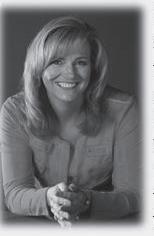
Kelly Wahlquist, keynote speaker, is a wife, mother of three, inspiring Catholic author and speaker residing in Minnesota. She is the founder of WINE: Women In the New Evangelization and the Director for the Catechetical Institute at The Saint Paul Seminary.
Leonard and Yazmin Gutierrez will speak on evangelization. Leonard is the New Ulm Diocesan Director of Evangelization and was a FOCUS missionary and Team Director at University of Oklahoma and Benedictine College. Yazmin served as a FOCUS missionary at the University of Oklahoma and Benedictine College.
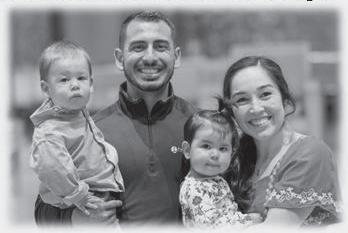
Encountering Jesus through the Gospel
by Leonard Gutierrez
The story of the prodigal son is known as one of the most famous and relatable of Jesus’ parables. During Lent in particular, it is quite often reflected upon as a sort of examination of conscience either by reading the story in Luke 15, viewing the famous Rembrandt painting called “The Return of the Prodigal Son,” or perhaps by reading the wellknown book “The Return of the Prodigal Son” by Henri Nouwen. The listener is often moved to ponder where and how one has either gone astray or lived a life full of envy and resentment. The younger son in the story portrays a life that is too concerned with the treasures of the world as he asks for his share of inheritance from his father, only to then squander his property in loose living. We then see a glimpse of what envy and resentment can look like in our own lives through the older son, who refuses to celebrate the return of his younger brother.
It is important to note that Jesus was telling this parable to an audience that included tax collectors and sinners as well as Pharisees, directly sharing a parable that spoke to their way of living and invited them to consider how they needed to respond to him as their hope and savior. There have been times in my life when I have been the younger brother, squandering away gifts for my own sake, only to lose myself and forget where my greatest treasure lies. Then there are times when I am the older brother, finding it difficult to celebrate the coming home of one who was lost but has now been found. In each of these moments, I am reminded, particularly in the sacraments of the Eucharist and Confession, that the focus is always on Jesus. It is not on my possessions, my will,

what I think I deserve, or even my failure. Jesus Christ has the power to heal, transform, and redeem what is broken. He has the power to receive joyfully and mercifully those who have distanced themselves from him and remind those who have grown envious of his generosity that they are loved and have not been forgotten.
There is a celebration that is awaiting each of us at our entrance into Heaven. There is a good Father who is ready to welcome us home again, and an array of saints in Heaven and friends on earth who are ready to celebrate our return to the Father’s house. May we be able to see the Father’s gift of his son Jesus Christ awaiting us in the sacraments of the Eucharist and Confession and of the Holy Spirit, who is our advocate, our guide, and giver of life this Lenten season as we return home and joyfully welcome those who were lost but have now been found.
Leonard Gutierrez is the director of the Office of Evangelization for the Diocese of New Ulm. He can be reached at lgutierrez@dnu.org; (507) 233-5361.

The Prairie Catholic l Page 13 l March 2024
www.dnu.org Promote your parish or Catholic school event on the Diocese of New Ulm website! Email pforst@dnu.org.
Program of the Day 7:30 Registration & Breakfast Silent Auction begins & Vendors open 8:00 Rosary 8:30 General Assembly 9:00 Keynote Speaker Kelly Wahlquist Business Meeting Woman of the Year 11:00 Mass Lunch 1:30 Yazmin & Leonard Gutierrez 2:30 Divine Mercy Chaplet Eucharist Exposition & Benediction 3:00 Door Prize Drawings
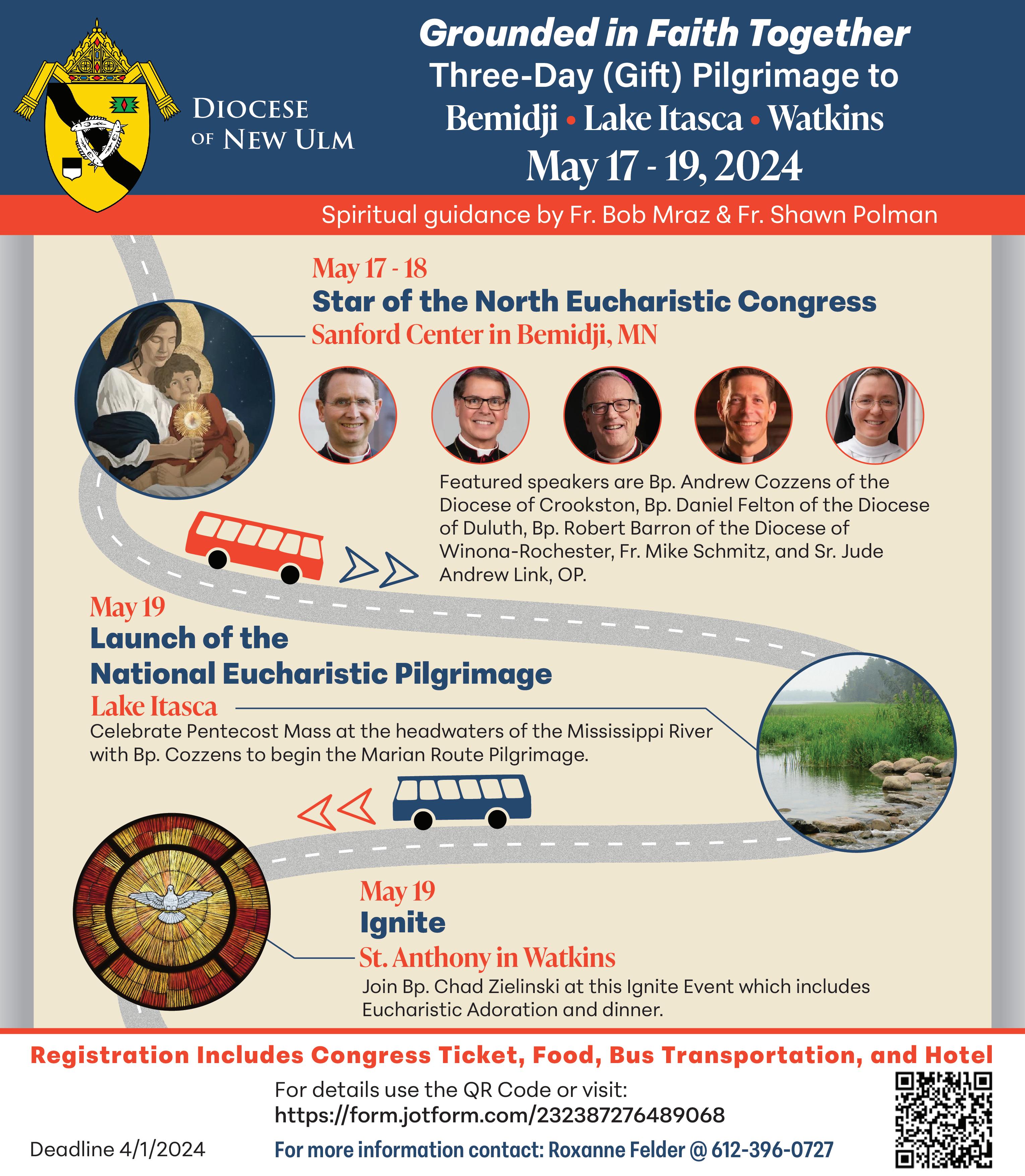
The Prairie Catholic l Page 14 l March 2024
around the diocese
Reigniting Eucharistic faith
Dynamic Eucharistic preacher visits three parish communities in diocese
by Elli Burmis Prairie Catholic correspondent
HUTCHINSON – In support of the multi-year National Eucharistic Revival leading up to the National Eucharistic Congress to be held in Indianapolis July 17-21, 2024, a team of “National Eucharistic Preachers” was formed. This Eucharistic Revival initiative of the United States Conference of Catholic Bishops (USCCB) was established with the overall goal of awakening a desire among the faithful to encounter the true presence of Jesus in the Eucharist and to cultivate personal devotion and relationship with him.
As stated on the National Eucharistic Revival website, www. eucharisticrevival.org, renewal of Eucharistic preaching is an important focus of the three-year Eucharistic Revival happening in dioceses and parishes across the United States. “There is an invitation from the bishops of the United States to ignite our faith in the Eucharist in a way that flows from and returns to the Eucharist,” stated Fr. Jorge Torres, a priest of the Diocese of Orlando and staff member dedicated to the Eucharistic Revival at the USCCB.
In February, Eucharistic preacher Fr. Joe Laramie of the Society of Jesus, one of the 50 such preachers, presented his talk, “The Eucharist: Leading Us to the
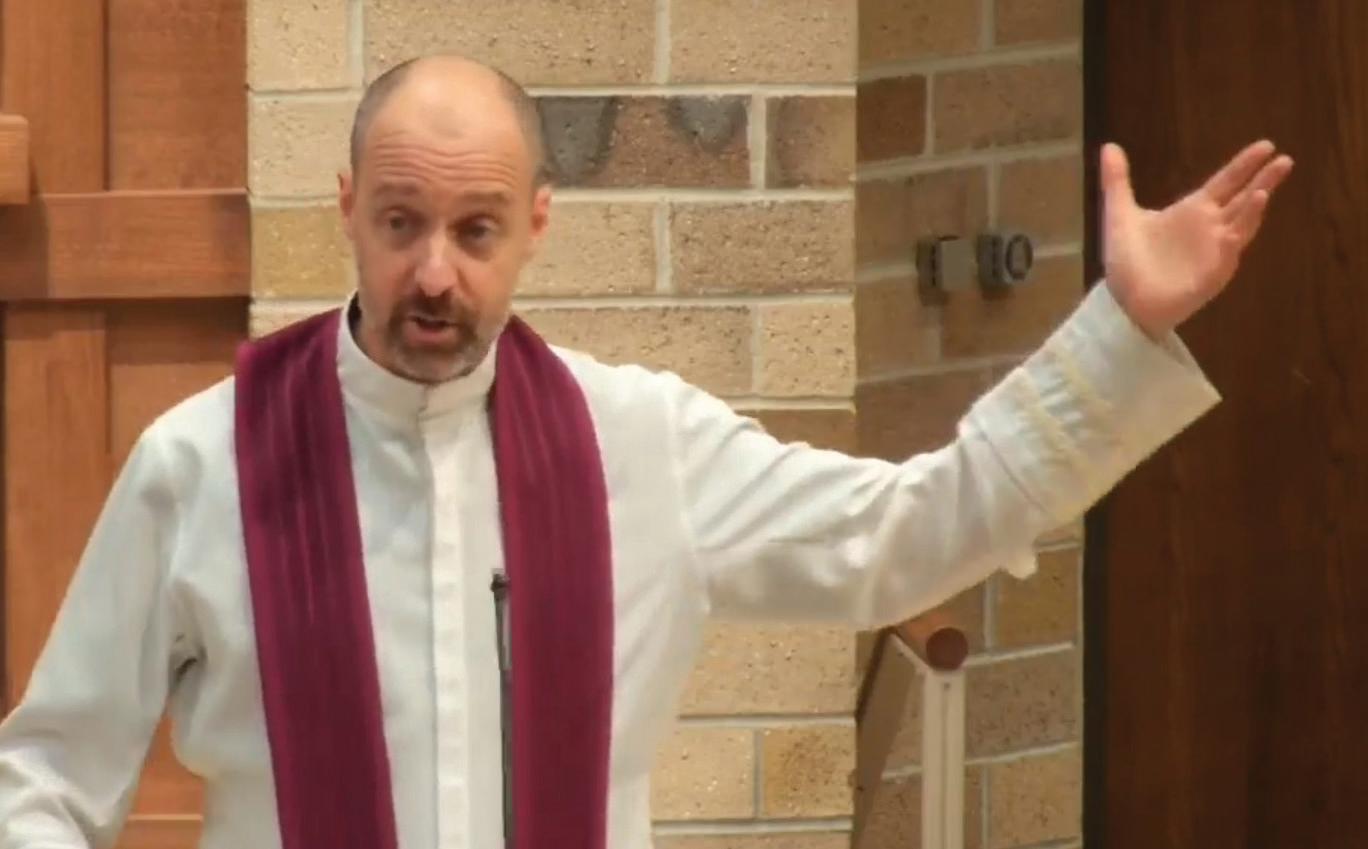
The National Eucharistic Revival is a movement to restore understanding of and devotion to Jesus Christ in the Eucharist. Jesuit priest Fr. Joe Laramie is one of 50 priests priests who have been comissioned to help rekindle passion and appreciation to the Eucharist. He is pictured presenting on Feb. 24, 2024, at St. Anastasia in Hutchinson. (Photos by Elli Burmis)
Sacred Heart,” at three parishes in the Diocese of New Ulm – St. Peter in St. Peter, St. Anastasia in Hutchinson, and St. Edward in Minneota.
In preparation for his presentation on Saturday, Feb. 24 at St. Anastasia in Hutchinson, Fr. Laramie told his audience that he prayed, asking Jesus for guidance and direction. The Lord’s response was, “Tell them I love them.”
With that key message, Fr. Laramie delved into God’s immense, incomprehensible, and unconditional love, particularly
through the lens of the Eucharist. “He mingles our bodies and blood [with his own] to make us more like him,” Fr. Laramie said.
Fr. Laramie told his audience that the Eucharistic Revival is truly a gift to the Catholic Church in America and similar to the mission of Jesus himself; its intention is to ignite fires and spread the passion, faith, and love of God. It aspires to “draw back the sheep who have gone away,” he said.
Specifically relating to Jesus’ institution of the Eucharist in Matthew 26:26, the preacher
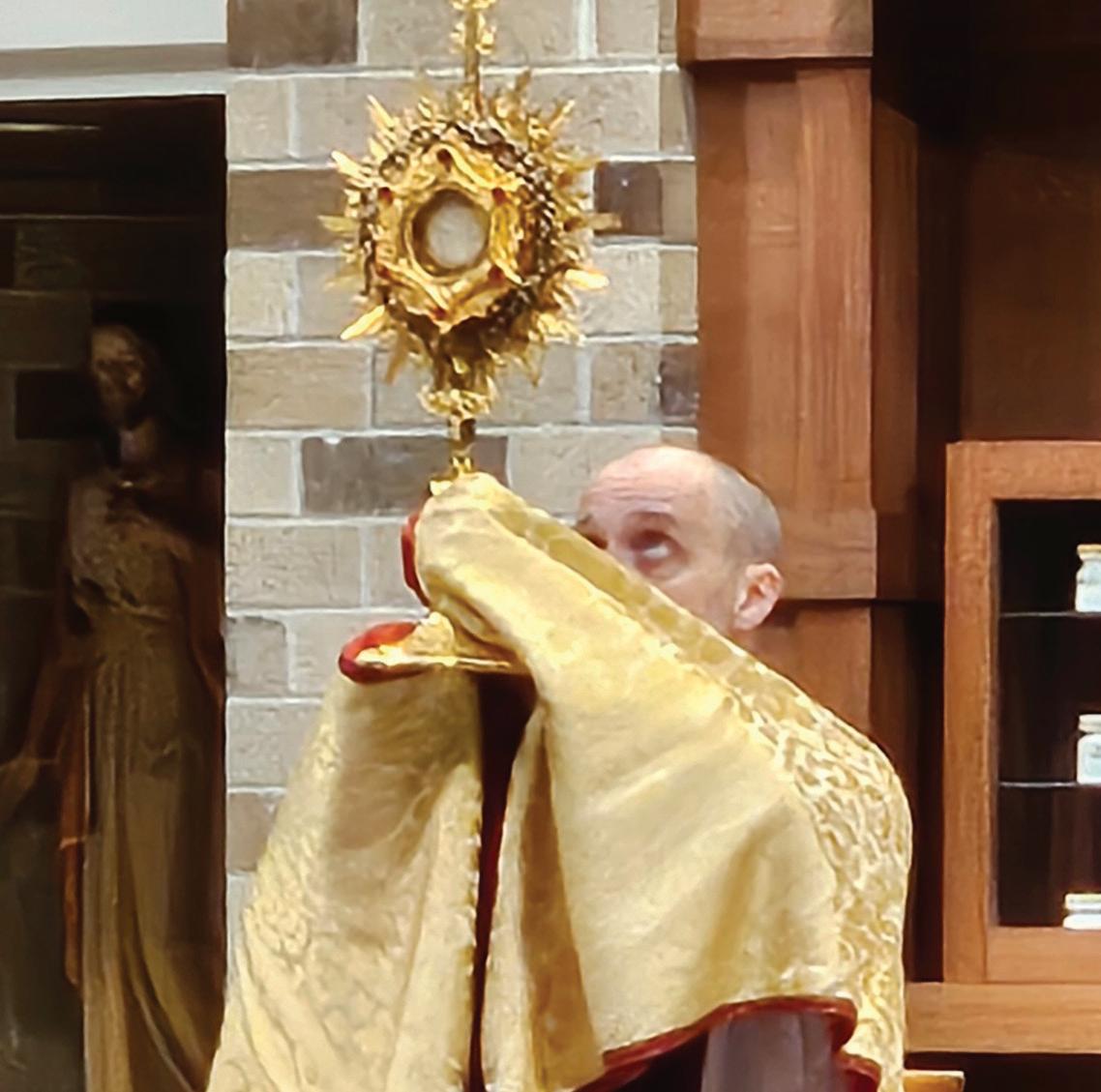
shared his personal reflections to ignite this depth of faith and love with the audience. When referring to a reflection entitled “Took, Blessed, Broke, and Gave: The Eucharist: His Heart, My Heart,” he talked about how Jesus “broke” the bread just before His body was broken on the cross and explained that similarly, we are broken people. Yet, Jesus says, “Come to me as you are with your broken hearts. Christ promises renewal, strength, and a channel of mercy shining through the wounds of
Key issues currently facing Minnesota lawmakers
(Continued from page 10.)
Q. That brings me to the thought that mandated health insurance plans for in-vitro fertility procedures, assisted suicide, have not passed. Where can people go to have their voices heard on these issues and others?
[Hangge] People can go to (the Minnesota Catholic Conference website) mncatholic.org. We have a “take action” button right on the home page. There are a series of action alerts on these two key (and other) issues. People can go there, click the bill that’s of interest to them or take action on all of them if they want. We have a message that’s curated and with the click of a button, it’s sent to their legislators.
Q. There is a lot of information on the webpage as well about issues that people can read about and act on.
[Adkins] Right. We even have a bill tracker that at any given moment you can see what bills the Catholic Conference is taking a position on. … We’re trying to make it easier for people to participate in public life. Praying for our elected officials is really important. But then taking that next step and sending an email. Go out and get a group of people together, meet directly, face-toface with our legislators. We find that nine times out of 10 people don’t even know who represents them. We’ve all got to participate. Otherwise, someone else is going to show up and they’re going to be the ones who have the influence
over what laws are made here.
Q. There has been a proposal to legalize sports betting (HF2000/ SF1949). It didn’t pass this last go around, but it is still alive and might be debated. Can you talk about the Joint Religious Legislative Coalition’s opposition to gambling expansion and what it hopes to accomplish this session regarding online sports betting?
[Adkins] We’re glad to partner with others in the faith community and have a united front in defense of human dignity through the Joint Religious Legislative Coalition. The Minnesota Catholic Conference, along with the Minnesota Council of Churches, the Jewish Community Relations Council, and the Islamic Center of Minnesota, built (the coalition).
We find common ground for the common good on povertyrelated issues. And one of our longstanding positions has been against the expansion of gambling. Why? Of course, the Catholic Church is the bingo church, right? It’s not so much that games of chance are wrong. But the types of gambling prevalent today are heavily addictive. It’s meant to stimulate a passionate response, just like all addictive behaviors. And it puts people into a system that breaks apart families, harms people financially, and drives people deeper into debt and deeper into poverty.
Q. Is there anything you would like to add to our conversation before we sign off?
[Hangge] One of the things we do
[our] broken hearts.”
“Jesus pours out his life and love for us through the sacraments,” Fr. Laramie said. From Christ, we as Christians can get the energy and “sustenance we need to help others” and fulfill our callings. “Sacred Heart of Jesus, have mercy on us.”
To learn about the National Eucharistic Preachers visit https:// eucharisticrevival.org/eucharisticpreachers/.
at the Catholic Conference … (is) to help educate the faithful and create opportunities for them to exercise their faithful citizenship. One of the ways we do that is by offering first Friday adoration at the Capitol. The first Friday of every month, we host adoration in the Government Dining Room, in the basement of the Capitol building. About 40 to 60 people on any given first Friday come pray with us. We would encourage people to come pray for their elected officials (and) pray for the work that the Church is doing in the public square.
Editor’s note: This story appears courtesy of The Catholic Spirit, https://thecatholicspirit.com/.
The Prairie Catholic l Page 15 l March 2024
St. Paul and Minneapolis Archbishop Bernard Hebda led the Minnesota Senate and Minnesota House in prayer March 7, even as a House committee debated and moved forward a bill that would legalize physician-assisted suicide.
“Almighty God, you have made each person in your image unique and irreplaceable. Help us to recognize our common humanity and our true identity as brothers and sisters, irrespective of our race or cultural backgrounds or the ways in which we seek you,”
the archbishop prayed.
The archbishop was joined at the Minnesota State Capitol by Auxiliary Bishops Joseph Williams and Michael Izen, and Catholic bishops across the state, including New Ulm bishop Chad Zielinski for an annual meeting with lawmakers in their offices.
The meetings came at a critical time for Minnesotans as several bills work their way through the Legislature that Catholic leaders say would erode human rights in the state.
Members of the House Public Safety Finance and Policy Committee heard testimony, debated and amended a bill HF1930 – that would allow physician-assisted suicide for patients diagnosed with a terminal illness and with a prognosis of six months or less to live. With an 8-6 vote, the bill was amended and referred to the Judiciary Finance and Civil Law Committee, where it was scheduled for a March 12 hearing. The companion Senate bill is SF1813.
For more on the bishops visit and other bills before the legislature, visit www.thecatholicspirit.com/ news/local-news/archbishophebda-leads-lawmakers-inprayer/.
CVS and Walgreens, the two largest pharmacy chains in the country, announced on March 1, 2024, that they will soon begin selling the abortion pill mifepristone in select locations in New York, Pennsylvania, Massachusetts, California, and Illinois.
Chemical abortions are committed via a two-pill regimen consisting of the drugs mifepristone and misoprostol. This type of abortion works by cutting off the nutrients
necessary for an unborn child to develop and then expelling him or her from the womb. Chemical abortions are widely believed to be on the rise nationally and may account for over half of all U.S. abortions.
The Biden administration has significantly loosened restrictions on abortion drugs in recent years, allowing pills to be administered via mail and telemedicine without in-person doctor examinations.
The FDA’s broad approval of mifepristone is being called into question currently as oral arguments in the FDA v. Alliance

for Hippocratic Medicine case are set to be heard by the Supreme Court on March 26. The decision could restore key abortion pill restrictions that were in place before the Biden administration and could determine whether mifepristone can be prescribed by telemedicine or sent through the mail.
The U.S. Conference of Catholic Bishops has voiced grave concerns regarding chemical abortion pills, citing “the destruction of innocent human lives and the loosening of vital safety standards for vulnerable women.”
Strengthening the Church at Home SUPPORT THE HOME MISSIONS APPEAL APRIL 27-28 IN PARISHES www.usccb.org/catholic-giving/opportunities-for-giving/
