❱
9
21 ❱ 27 Fundraising Contact supplement Management ❱
Retailing in a digitized world
magazine
PM 4 0 0 5 0 8 0 3
Vol. 27 • No. 5 • May 2014
The Authority on Data-Driven Engagement & Operations
Gary Tannyan
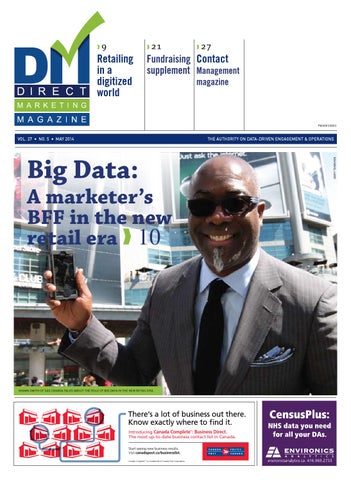
Big Data:
A marketer’s BFF in the new retail era ❱ 10
Effective PPi
Path/File name
Colour Space
Effective PPi
news
Colour Space
Shawn Smith of SAS Canada talks about the role of big data in the new retail era. t:7.5”
There’s a lot of business out there. Know exactly where to find it. TM
Start seeing new business results. Visit canadapost.ca/businesslist. Canada Complete™ is a trademark of Canada Post Corporation.
CPC_13_N_1010_A.indd 1
4/18/13 4:28 PM
t:2”
Introducing Canada Complete : Business Direct. The most up-to-date business contact list in Canada.
The single most important campaign decision you will ever make. Lots of decisions are made when you design and execute a marketing campaign. However one decision stands out. All the studies prove the same thing: if you want better campaign results, get a better list. That’s because 60% of your campaign’s ultimate success is due to the accuracy of the list. Sure, the offer, timing, and creative are important too. But the list will have far more influence on your results than any other decision you make.
ALL RESPONSECANADA DATABASES ARE CUSTOM TAILORED TO YOUR TARGET MARKET SPECIFICATIONS.
Everyone, everywhere in Canada, complete with names, phone numbers and demographics. This is precision targeting at its best! Movers spend up to 8x more on just about everything. Get to them first, before your competition does. Tired of the old and just plain wrong? This is the B2B list you really want. It’s what successful campaigns are built on.
Decide on the best. Decide on ResponseCanada. For more information and to request pricing visit www.ResponseCanada.ca.
BETTER DATA
FROM CANADA’S LEADER IN CONTACT DATA SOLUTIONS
)
The ResponseCanada family of prospect databases are built and maintained by Cleanlist.ca, an Interact Direct company.
cleanlist.ca 1-800-454-0223 sales@cleanlist.ca www.cleanlist.ca
// 3
Vol. 27 | No. 5 | May 2014 EDITOR Amy Bostock - amy@dmn.ca PRESIDENT Steve Lloyd - steve@dmn.ca DESIGN / PRODUCTION Jennifer O'Neill - jennifer@dmn.ca Advertising Sales Mark Henry - mark@dmn.ca Brent White - brent@dmn.ca Chantal Goudreau - chantal@dmn.ca CONTRIBUTING WRITERS Geoff Linton Sangeeta Bhatnagar Stuart Pearson Andrew D'Amico Yana Persky Steve Falk Michelle Sexsmith Kevin Gonyea Billy Sharma, Stephane Latreille Shawn Smith Jennifer Lee Ron Stocks John Leonard Matthew Leppanen
Targeting & Acquisition
LLOYDMEDIA INC. HEAD OFFICE / SUBSCRIPTIONS / PRODUCTION: 302-137 Main Street North
❯❯10
Cover story: Big Data – a marketer’s BFF in the new retail era Engagement & Analytics
Markham ON L3P 1Y2 Phone: 905.201.6600 Fax: 905.201.6601 Toll-free: 800.668.1838 home@dmn.ca www.dmn.ca EDITORIAL CONTACT: Direct Marketing is published monthly by Lloydmedia Inc. plus the annual DM Industry Source Book List of Lists . Direct Marketing may be obtained through paid subscription. Rates: Canada 1 year (12 issues $48) 2 years (24 issues $70) U.S. 1 year (12 issues $60) 2 years (24 issues $100) Direct Marketing is an independently-produced publication not affiliated in any way with any association or organized group nor with any publication produced either in Canada or the United States. Unsolicited manuscripts are welcome. However unused manuscripts will not be returned unless accompanied by sufficient postage. Occasionally Direct Marketing provides its subscriber mailing list to other companies whose product or service may be of value to readers. If you do not want to receive information this way simply send your subscriber mailing label with this notice to: Lloydmedia Inc. 302-137 Main Street North Markham ON L3P 1Y2 Canada.
❯❯6
Seeing the trees through the forest
❯❯ 8
Parlez-vous français? Canada, it’s time to start tapping into global French-speaking consumers
POSTMASTER: Please send all address changes and return all undeliverable copies to: Lloydmedia Inc. 302-137 Main Street North Markham ON L3P 1Y2 Canada Canada Post Canadian Publications Mail Sales Product Agreement No. 40050803
THIS ISSUE OF DM MAILED BY:
Complete Mailing Service 1-888-683-2501 • 416-755-7761 www.completemailing.com
May 2014
❯❯12
❯❯9
Retailing in a digitized world, to a digitized customer
Getting a clear image of online customers – on both sides of the border
❯❯14
Welcome to the new retail universe How customer loyalty can help retailers cash in on multi-channel shopping
Why retailers have to be everywhere, all the time DMN.ca ❰
// 4
Table of Contents Operations & Logistics FUNDRAISING SUPPLEMENT
Contact management supplement
❯❯22
❯❯3
To mail, or not to mail?
❯❯16
Can not-forprofit justify direct mail?
Why acceptance make good business sense
❯❯23
❯❯18
Build it and they will come 10 essential tips for launching a successful ecommerce site
Why a social media contest works
❯❯24
Direct & Personal
❯❯20
Retail logistics 2.0 Powering the omni-channel shopping experience
Coming in the
june issue of
Success stories: Canadian Tire Financial Services The little company that could
❯❯4
Building on your strengths Ensuring company growth through proper staff development
❯❯6
10 questions to ask before buying a phone system
The power of one
❯❯26
When politics meets technology
❯❯8
Hardware solutions Hosted PBX phones
Issue focus – Email marketing ❯❯ ❯❯ ❯❯ ❯❯
Why marketers should keep sending emails Email surveys: getting data the easy way Email delivery management Success is in the lists
Special Report – The future of web banners: How has the design, purpose, value proposition etc. changed over the years? How do you measure success? How do you determine if the web banner is the right medium for your client?
Supplement – Social Media Marketing ❯❯ ❯❯ ❯❯
❱ DMN.ca
Twitter for marketers Social selling: brand first, sales second Building an effective social media strategy
May 2014
Analytics Forecast demand, right down to the store level.
Markdowns, coupons, BOGOs, loyalty points, multichannel marketing. Nothing is simple about moving merchandise. But why sell yourself short when there’s a smarter way to predict how customers will respond to pricing and promotions? With automated, real-time forecasts down to the individual store level, you can see the immediate impact on demand. Understand the cross-effects on related items. Determine if new products will shake things up. And find the perfect balance between inventory and investment. Visit us
sas.com/ca/retailforecasting
SAS and all other SAS Institute Inc. product or service names are registered trademarks or trademarks of SAS Institute Inc. in the USA and other countries. ® indicates USA registration. Other brand and product names are trademarks of their respective companies. © 2014 SAS Institute Inc. All rights reserved. S117789US.0114
// 6
Targeting & Acquisition
Seeing the trees through the forest By Geoff Linton
The changing landscape Retailers in Canada are undergoing a metamorphosis. Profit margins are shrinking and the competition is getting fierce with more US competitors coming across the border to open stores every year. These US based retailers are coming armed with robust ecommerce capabilities (note: only 35% of Canadian retailers currently have e-commerce capabilities) and Amazon, one of the most innovative companies, is pushing into retail and their scale could be a game changer. McKinsey Consulting reports that end-to-end digitalization and technology is affecting multiple retail functions. Digitalization will impact the in-store shopping experience, checkout/payments and of course marketing communications. Marketing for retailers is getting more demanding all the time. Today’s hyper-connected consumers want information at their fingertips whether it’s via a smartphone, tablet or a desktop computer. As a result, a consumer’s path-to-purchase involves numerous touch points pushing your marketing team to be “always on”. But there are constraints. Marketers can’t do everything. There is only so much budget and time. There are only so many Above-The-Line (ATL) ❱ DMN.ca
vehicles that marketers need to seed the market with. Now is the time to look at the business model and challenge those assumptions. To win in the long term, retailers need to deliver on their core value proposition, emphasize their differentiation, and provide a better product/service experience. The outcomes that will result are trust, customer loyalty and profits. But what strategies and tactics really drive retail business? Challenging the assumptions: Myth #1: Traditional market research & tracking is sufficient Many retailers rely too much on industry research and sponsored omnibus tracking reports. These industry reports are good to show trends but customer behaviour can be skewed if it is based on self-reported data. The best data is your own customer’s behavioural data. You’ll be surprised at how much variability there is between segments. Put the averages aside and look at shopping frequency and average order size by smaller sub-segments. Myth #2- Bigger budget is better Many retailers believe that Share of Voice (SOV) is critical. Increasing the level of promotional spend is
one tactic how retailers typically compete. The larger the media spend the better. But they also need to keep in mind that competitors may be overzealous and wasteful. Blindly following competitors can be inefficient. Overinvesting in a particular vehicle can lead to saturation (where incremental spend gets little marginal impact). In a recent retail case study from McKinsey mass marketing had 3x the spend to digital but only one third the ROI (Retail Marketing & Branding, J. Perrey & D. Spillecke, Wiley 2013 p125). Leaders test and follow the discipline of not spending too much. Instead, they focus on what vehicles are best for their business model. Myth #3- Acquisition trumps retention Over the last 20 years of working with retailers I have seen that 30% of a customer base typically generates 70% of revenue. One of my pet peeves is that so many retailers are obsessed with acquisition (at the detriment to retention). Why is that? According to the DMA, retailers spend 10x more on display advertising than email messaging. Furthermore, social is the new shiny object for many retailers
and it’s costing them big dollars. But leaders are data driven marketers who know the value of each of their deciles. For instance, online grocer Fresh-Direct focuses on loyalty curves and models. Through analytics FreshDirect has grown their top loyalty segment by 14%. Remember that direct mail or emailing the customer base is smart. But many retailers underinvest in direct and they are so busy watching mass metrics… they overlook their own. Myth #4- Stick to your knitting & what got you there: For years print flyers have been the life-blood of retail. Flyers are popular with retailers because they provide reach and they keep brands top of mind. Few executives are willing to upset the balance and challenge the budget spent on flyers. But consumers have shifted and the digital revolution has changed things. The best way to fund digital is to trim a bit from vehicles that may not be performing well and allocate these funds to these new channels. Leaders are testing and optimizing their flyer spend. Loblaws is doing flyer suppression tests and one senior executive boldly forecasted that May 2014
// 7
Targeting & Acquisition Loblaws could be completely out of flyers within three years. Loblaws is changing their promotional model from mass discounts (on flyers) to selective targeted offers to specific customers. In grocery retail, flyers are an enabler and helps consumers prepare their weekly shopping lists. But technology (apps, web flyers, email flyers) are enhancing the customer experience by personalizing offers and automating shopping lists. Case study: Re-booting the promotional strategy at M&M Meat Shops M&M Meat Shops is a national retailer with over 450 franchise based locations. Their eMax loyalty program has millions of members and they have years of SKU level data tied to individual members. Despite this robust database M&M Meat Shops’ marketing spend is a fraction of large grocers so, the challenge becomes how to stick out in a crowded marketplace. With increasing competition from big box stores and large grocers, M&M Meat Shops fell into the trap of using the weekly print flyer as their hero. M&M Meat Shops franchisees loved the tactile nature of print and how it allowed them to showcase a cross-section of products each week. But customer behaviour was shifting and they overlooked the customer data they were sitting on. Last year the moment of truth came for the marketing team. Each week they distributed millions of print flyers and deployed a similar eFlyer to their email base. Overall open rate and click campaign metrics looked fine and research confirmed that customers loved their brand. However, shopping frequency was down and the time interval between purchases was too long. Their marketing team was knee deep in data but ankle deep in insights.
It was time to go back to marketing basics and find out what was really happening beneath the surface. Lesson 1: Tap into your data M&M brought in outside advisors to get an unbiased picture of their situation. They needed to see the trees in the forest. We started with some fundamental queries into the data to understand the nuances of their customer behaviour. Their top decile was too big a proportion of their total sales (and middle deciles shopped 50% fewer food categories at their store). Note: in frequency retail there is a lot of profit potential in the middle segments by just getting them to shop one more time. Inbox Marketer created actionable marketing charts (histograms, decile rankings, segment matrices) that showed differences in behaviour (and potential value). Lesson 2: Smarter budgeting is best Print flyers can be a tonnage game (wide reach=big volume) and grocers typically stick to what has worked historically. But flyers can eat up a budget. The big question is what happens if you do flyer optimization tests and shift savings into digital messaging? M&M Meat Shops is evolving to smarter digital CRM. They pivoted their content strategy (from 100% eFlyer) and broadened the type of email messages they deployed. The messaging vehicles became more relational with loyalty messaging and lifestyle eAlerts. Note: similarly Loblaws loves digital also. At a recent CMA Loyalty conference, Loblaws showed a response chart that indicated that digital has several times the response rates (versus print flyers). Plus email flyers also produce “digital data nuggets” that are valuable in monitoring an individual’s clickstream behaviour.
How do leaders select the appropriate touch points and allocate your budget for maximum effectiveness and efficiency?
They create models based on their business. McKinsey Europe has created a weighted algorithm that scores different marcom vehicles/ instruments on their Reach, Cost and Quality. Many vehicles have widely different cost efficiencies. In one example the “Cost for Actual Reach” (RCQ score) for flyers is 9.9 versus 2.5 for direct mail versus 0.4 for email and 0.2 for POS. According to their example, flyers should be used selectively. Note: the optimal mix varies on industry and business model.
Lesson 3: Greater focus on retention of individual customers Acquiring new customers is great but the past customers are more critical to the health of a retailer. Protecting specific segments is essential for profits. M&M Meat Shops now more closely monitors their “active” opt-ins. Their in-house email team uses an email system that allows them to easily see campaign curves, mobile read rates, social clicks, and 360 degree behaviour of individuals. Smarter (more targeted and relevant) email is efficiently driving results and store traffic. Lesson 4: Evolve & don’t stand still Complacency is dangerous in retail. Leaders think and test before they move. Smart CRM is an iterative
Time to take a fresh look at your postal software?
process. Today’s leaders take a smart retail marketing practices from the offline world (best customer thank you, next best product, depth-ofrepeat modelling, reactivation) and bring them into today’s digital world. Automated messaging streams and personalization keeps your messaging fresh. Don’t get stuck in a rut. Using different templates for different message types keeps your audience engaged. Marketers need to do more homework and tests before jumping into new areas. M&M Meat Shops eyes are wide open and they now can see both the trees and the entire landscape! Geoff Linton is the President of Inbox Marketer.
SwitchMe Offer! Transition from your current software and save $500 off your current price!*
With its clean, modern user interface, frameworks Canada from SmartSoft is the premier, SERP Recognized postal software. Get your demo today!
© 2014 SmartSoft Inc. * New customers only. Applies to any SERP Recognized Software you currently subscribe to
May 2014
try.smartsoft.ca/fresh 888.227.7221 contact@smartsoft.ca DMN.ca ❰
// 8
Targeting & Acquisition
Parlez-vous français? Canada, it’s time to start tapping into global French-speaking consumers
By Yana Persky
A
ccording to a new study from Google and L2, a U.S. based think tank, a huge disconnect exists between Canadian retailers’ e-commerce and in-store channels. The study does not paint a pretty picture when it comes to Canadian retailers’ penetration into e-commerce, highlighting that an estimated 40% of funds are sent across the border to international retailers. Does this mean Canadian retailers should be discouraged from participating in e-commerce? Absolutely not! Yes, the reality is Canadian retailers are battling with domestic consumers, losing 68% to international online retailers. However, by leveraging its strength in appealing to French-speaking consumers - especially those located outside of Canada - domestic retailers can succeed in e-commerce and carve out a nice and unique market share. French unites retailers & consumers Due to its common language and similar culture, cross-border e-commerce between EU Frenchspeaking countries and Canada has great potential. Unfortunately, Canadian companies are ignoring this huge opportunity and in general, are failing to recognize the power of international expansion via e-commerce. In fact, according to the Google & L2 study, currently, only 10 out of 33 companies headquartered in Canada, provide shipping to the U.S. and other countries. Language plays a key role in driving profitability in cross-border e-commerce. Consumers tend to search for products or services in their native language and naturally they will ❱ DMN.ca
be drawn to retail web sites that they can easily understand. According to a global survey presented by Payvison, 25% of the payment service providers and merchants that participated in the survey said when it comes to selling online services and products internationally they first focus on regions that share a common language. Furthermore, 70.3% of all respondents believe that sharing a common language is a stronger business driver, than sharing a common border. Take Europe for example, where common language plays a pivotal role in driving e-commerce between EU countries. For example, Austrians and Swiss buy from German e-retailers while Belgians shop on French or Netherland based retail web sites. Mountain Equipment, Ssense & Icejersey are amongst the few Canadian retailers to embrace cross-border e-commerce. They have developed the channel to effectively service cross-border shoppers in various ways, including being able to properly ship internationally and create French-friendly web destinations. Today there are 77 million native French speakers in Europe – this is not a bad number for Canadian retailers to begin sinking their teeth into. Further proving the cross-border, language-driven market potential for Canadians, today 18% of French speakers (outside of Canada) purchase online from Canadian online retailers and this equates to approximately 5.5 million consumers. These facts and figures clearly demonstrate Canadian retailers do already appeal to French speakers and can further leverage this
advantage and increase market share by penetrating the French-speaking European e-commerce market. Sounds good, now how to get started” Step One: Know which markets make sense to enter Before setting up shop, it is important for Canadian retailers to deeply analyze which geographical locations make sense for them to enter. A natural starting point is obviously targeting Europe, and within Europe, France, Belgium, Monaco, Switzerland and Luxemburg are the countries to target due to the high number of French speakers in each. Step Two: Partner wisely In order to succeed in cross-border e-commerce, Canadians need to partner with the right partners that will enable them to seamlessly and cost-effectively make the jump into their desired geographical locations. Retailers who want to sell into Europe, should start off by contacting their current payment processing partners and find out if they have an expertise in the European Frenchspeaking e-commerce market. If their current payment partner does not, then they should work with the right one that can help them move into the geography quickly and as easily as possible. Another key ingredient in this process is the fact that the payment partner must also work with solid acquiring bank partners that have licenses and jurisdictions within each French-speaking European country. Why is this important? Because there are several obstacles to overcome when entering the EU such
as banking and exchange fees as well as legal, compliance, regulations, and risk/fraud challenges and the right acquiring bank, together with the right processor can successfully enable retailers to painlessly overcome these obstacles. SMEs & independent retailers can also succeed There is a misconception that only e-commerce giants have the resources to enter global markets – this is not the case. Today, through the right processing and acquiring partnership relationships even SMEs and your ‘local mom selling jewelry from her garage’ can sell globally. Good partnerships will enable these small guys to easily create their own merchant accounts as well as facilitate in setting up business entities in each country – a must for conducting e-commerce in local countries. In addition and most importantly, they will get them up and running in a relatively short amount of time so they can begin to increase their revenue quickly. Canada has a high population of SME and independent retailers and if they can tap into the French-speaking market beyond Canada it would grow their businesses significantly. The bottom line – Canadian retailers should take advantage of their expertise in selling goods that are customized for French-speakers and use that expertise to grow their businesses beyond the Canadian border. Yana Persky is the Competitive Intelligence Manager at Credorax (www.Credorax.com)
May 2014
// 9
Targeting & Acquisition
Retailing in a digitized world, to a digitized consumer To meet today’s consumer expectations, retailers must be everywhere, all the time By Jennifer Lee
Y
ou’re in the market for a new television. You’ve got a number of choices – and I’m not talking just about the TV’s make and model. Today your options extend to how and where you buy. You can shop online, browse on a mobile app, search for a group-buying offer or flash sale, visit a traditional bricks-and-mortar retailer, or do any combination of these things. For the players on the other side of the transaction, the retailers, this new path to purchase brings with it, a complex array of choices and channels. It’s a central truth of retailing that you must be where your customers are – only now they can be anywhere. How can retailers maintain sales by connecting with consumers in a 24/7 world? The answer lies in the next evolution of omni-channel retailing and digitization. Technology has given people the ability to shop how they want, anytime, anywhere, compelling retailers to expand their sales channels. Retailers are using digital technologies to develop their e-commerce, mobile and social media presence, in addition to physical stores, to be where their customers are. Their aim: to deliver the best brand experience possible by integrating channels. The new path to purchase The path to purchase used to be linear. The customer discovered the product, purchased the product, and received customer service in that order. Today the path to purchase is full of twists and turns and is much more customerdriven. It begins with research: 72 percent of smartphone users conduct research via their mobile device before purchasing. Customers are more informed and retailers must be ready to deal with increasingly savvy shoppers. The customer now has more May 2014
power than the retailer. Shoppers frequently seek advice before they buy. One in three consult friends and acquaintances on social networks, and a similar number read online product reviews. Word of mouth has always been a powerful form of marketing, but now that power is amplified by social media, with consumers sharing both good and bad shopping experiences worldwide. Over 80 percent of customers pre-shop in store, checking out a product in person before purchasing online. Even in the shopping aisle, consumers may price-compare on a mobile phone to determine whether they’ll buy in-store, or order from a competitor online. A sale can happen at any point in this journey. Retailers must adapt to ensure they are available to potential customers when they want to interact with their brand. The proliferation of technology and digital platforms and tools has many of the nation’s largest retailers planning reductions in their physical footprint. Does this real estate down-sizing trend suggest that the new world of retailing will cannibalize traditional in-store sales? The world of the connected consumer isn’t that straight forward. Bricks-and-mortar is here to stay The role of the store is critical to the constantly connected, omni-channel consumer. When done right, omnichannel retailing can complement traditional bricks-and-mortar stores, while allowing businesses to extend their reach more efficiently—with less costly square-footage. Mobile devices and physical stores are key to today’s shopping experience: 62 percent of consumers use online and mobile channels to help them shop at stores, using their devices to look for store locations, product availability and prices. Customers are much more likely to begin their path to purchase online and end it in-store than to use stores as showrooms and purchase online.
The power of digital will continue to rise: by 2016, 35 percent of all in-store purchases will be influenced by a retailer’s online presence. Far from driving customers away from stores, digital platforms can enhance the in-store experience. The cosmetics giant Sephora leverages the ubiquity of smartphones to better engage with its customers. After noticing that iOS devices dominated its mobile in-store traffic, Sephora enabled its loyalty program to be accessed from Apple’s Passbook mobile wallet app. Now buyers can use the app to check and redeem loyalty points while shopping. Even in purely digital sectors, physical stores still have their place. There is a growing movement toward showrooming, where customers examine merchandise in-store. Some pure-play digital retailers are even using showrooms to allow customers to experience their products because shoppers still value seeing a product first-hand. In the omni-channel universe, successful retailers will be those who find the right blend of digital and in-store retailing. Omni-channel retailers win with omni-channel customers Omni-channel retailing revolves around the customer, putting their needs and preferences first. While this is clearly good for the customer, it’s good for business, too. Omni-channel consumers spend more. Deloitte’s 2013 Holiday retail survey showed that omni-channel buyers shop more frequently and spend over 70 percent more on holiday shopping than their peers who only shop in-store. More importantly, an omni-channel customer is a loyal one. Loyalty is built on trust, and today’s media-savvy consumers put far greater trust in word of mouth recommendations than in advertising. More than half of consumers turn to family and friends on social networks for shopping
recommendations. This type of interaction develops a deeper brand connection, thus customer loyalty. Research shows that 67 percent of word-of-mouth customers remain brand loyal. Perhaps the biggest benefit for retailers is a hidden one. Every time customers interact with a brand, whether in a physical store, on mobile, social or through e-commerce, retailers are able to collect data and lots of it. Leveraged properly, this information can unlock the key to understanding the customer and how they shop, while also reducing reliance on costly market research. Data analytics allow us to make sense of each data point, enabling retailers to create highly customized experiences by connecting the right offer to the right customer at the right time. At the heart of it, omni-channel is creating a strategic network which leverages digital, and gathering valuable customer path to purchase insight. This allows the organization to make better choices on how they build their retail footprint, invest in digital assets and drive profitability. It’s easy to say the store is dead – but that simply isn’t true. The physical store is strategically important in developing the long-term relationship with the consumer. This is the advantage that retailers have over pure-play online retailers. Don’t believe me? Look at the traditional online retailers that have established a physical presence to better position themselves for success with today’s consumer. Jennifer Lee is a Partner and the National OmniChannel leader at Deloitte. She has over 15 years of experience advising clients on developing OmniChannel strategies and focuses on transitioning clients from a multi-channel experience to an OmniChannel experience via eCommerce, mobile and Store of the Future.
DMN.ca ❰
Engagement & Analytics
// 10
Big Data:
Gary Tannyan
A marketer’s BFF in the new retail era
❱ DMN.ca
May 2014
// 11
Engagement & Analytics
By: Shawn Smith
C
anada’s retail sector has had its fair share of shakeups. In the past two years, incumbents have been faced with tough competition and pressure to drop prices, hoping to lure consumers from newer entrants like Target. Meanwhile, retail icons like Sears are closing up numerous shops, pointing to what may be a new era of retail in Canada. For now, 2014 is shaping up to be a battle of luxury retail, with high-end stores by the likes of Nordstrom and Saks entering the Canadian market and Holt Renfrew’s recent announcement for a major expansion. Regardless of whether you’re a high-end luxury retailer or bargain superstore, competition has never been fiercer and the fight for customers has never been more important to survive. Enter big data. An overhyped term for some, big data defined is when the volume, velocity and variety of data exceeds an organization’s storage or compute capacity for accurate and timely decision-making. However it’s defined, big data is a game changer for many retailers struggling to serve customers amid the tsunami of competitors vying for their attention. Whether you believe in the potential of big data or not, few can argue that it offers retailer’s a competitive advantage because it changes the way they engage with their customers, regardless of touch point. Big data offers a means to understand the customer and this is critical in a world where shoppers are engaging in a myriad of channels to support their purchasing decisions. There is a massive opportunity to improve customer-centric decisionmaking by building deeper insight from a massive stream of internal and external data, here are a few examples: Personalization: Help me help you! In an era where customers hold more power than ever before, retailers are expected to be smarter in the way they communicate. More precise and more targeted engagements are simply expected by today’s modern consumer. Mobile data holds lots of opportunities, from geographical insights to real-time support for customers across multiple devices. As a result, the most advanced retailers are looking at ways to transform smartphones into electronic personal
May 2014
shoppers, helping connect consumers more readily to products, promotions and personalized offers through the ever-present device in their pockets. Research by Leger Research, commissioned by SAS Canada, shows Canadians shopping habits can be directly impacted by personalized offers on their smartphone. When asked what they would do if, while out shopping and they received a promotion on their smartphone which applied to either the item they were intending to buy or a complementary product, 38 per cent of Canadians said they would buy both items. Additionally, 58 per cent said they’d be interested in receiving personalized promotions from nearby stores while they were out and about. For Canadian retailers this means two very important things: mobile marketing can not only help to increase sales, but it also allows bricks and mortar stores to compete more effectively with online retailers by creating a highly personalized shopping experience for the consumer – however they like to shop. In an age when consumers are flooded with offers and have a seemingly endless choice of where and who they buy from, the retail marketer who relates to them personally stands to earn not only share of mind, but share of wallet. And in an age where the world has gone mobile, smart retailers will learn how to harness the power of the device, by delivering targeted, personalized offers when and how the consumer wants to receive them.
destroy a brand overnight. Monitoring and social sentiment analysis are as important to preserving the retailer’s brand as they are in driving enjoyable customer experiences to win the hearts and mind of new and existing consumers. In 2014 and beyond retailers should be using social media analytics to understand the social content that drives brand perception, all while tying this information into a larger omni-channel strategy to ensure loyalty programs, sales, etc. are in synch with their customers’ needs. The Omnichannel is the new normal Today’s customers experience brands through the multi-channel matrix of modern media, including social media, websites, print news, search and SEO, out-of-home advertising, TV, word-ofmouth and PR. This is a world where customers know almost as much about the products they are buying as the retailers selling them because of the wide availability of information on the internet. To attract the widest variety of customers, retailers must embrace integrated multi-channel marketing. Enabling an integrated omni-channel vision begins with assembling rich customer information. For marketers that means binding together all on and offline data sources for a complete and consistent view of a customer that cuts across the enterprise, transforming 1 5/24/2013 4:35:39 PM data—bigadm_dm_4c.pdf and small—into customer
insight that is made available across the organization to drive smart customer-centric decision-making. Conclusion Big data and the proper use of analytics enables actionable customer insights. If used correctly, retailers can leverage big data to navigate the changing retail landscape by generating valuable insights for personalized marketing or to optimize their assortment and merchandising decisions. When a retailer uses all available data to better understand the customer, it can create innovative sales programs, empower associates and make better decisions. Those retailers that don't take their data seriously run the risk of being shoved onto the clearance rack. Shawn Smith is a Sr. Solutions Specialist
currently employed in SAS Canada’s Retail Practice. In his current role, he is responsible for helping clients gain value from current and future investments in analytic retail technologies. Shawn has extensive knowledge and deep domain expertise in retail analytics and in devising and executing strategies to better understand shopper behaviour and Omni-channel evolution.
Embrace social media as a critical communications tool For retailers, social media marketing and the analytics that go with it can certainly pay dividends. In today’s hypercompetitive retail market, it is imperative that retailers relentlessly extract and integrate social media data to deliver superior customer experiences. Additionally, with consumers regularly connecting with retailers via social channels to learn more about company information, products and promotions it’s not just about the data to support the customer experience, but also the importance of monitoring for negative sentiment. In today’s connected world, a negative customer review or experience can
DMN.ca ❰
// 12
Engagement & Analytics
Getting a clear image of online customers –on both sides of the border By Michele Sexsmith
L
ike many e-commerce companies, Coastal Contacts faced a marketing dilemma that bricks-and-mortar stores often don’t confront. The online seller of contact lenses and eyeglasses had plenty of transactional data about its customers but only a fuzzy picture of what they were actually like. To simplify its online ordering process, the company asked few questions and had little lifestyle and psychographic information about its customers. “We had a lot of transactional data but not a lot of information about who these people were and how to market to them.” says Curtis Petersen, Vice President of Marketing at Coastal Contacts, from the company’s headquarters in Vancouver.
❱ DMN.ca
For most of the 14 years since its founding, Coastal Contacts—which now serves customers in Canada, the U.S., Europe and Asia—had relied on sales data to inform its email and direct mail campaigns. But when Petersen, a former marketer at Telus, joined the company eight years ago, he brought with him a firm belief in data-based marketing. As the leader of Coastal Contacts’ advertising, media spending and analytics teams, he wanted the kind of demographic, psychographic and lifestyle data that would help them better target their marketing messages. “The more data you have, the better your marketing decisionmaking,” he says. “We believe in a marriage of data and analytics to
produce effective email and direct marketing.” To flesh out a portrait of its customers in Canada and the U.S., Coastal Contacts turned to Environics Analytics (EA). EA offers the PRIZM segmentation system with two distinct models to classify customers into 66 lifestyle types in each country—including some segments found on both sides of the border. By identifying the PRIZM segments of more than 800,000 customers, company marketers hoped to better understand its best customers. In addition, they sought to determine
each target group’s mindset and leisure activities using Environics Social Values and BBM in Canada, as well as Simmons in the U.S. “We like the idea of putting an additional flag on our customers,” says Petersen, “and then using that data to aggregate them and see how they differ in cluster make-up.” The analysis, completed last month, revealed that nine PRIZM target groups—five in Canada and four in the U.S.—account for nearly two-thirds of Coastal Contacts’ customers in both countries. And two important segments—a group of May 2014
// 13
Engagement & Analytics
young, urban singles and couples who enjoy shopping and pursue ecologicalfriendly lifestyles and a mid-toupscale family group concerned with brand and price—are present in both the U.S. and Canada. But the analysis also found key differences. Canadian customers tended to be more upscale, suburban and brand oriented. The Americans were more likely to be midscale, urban and price focused. Part of the different shopper types can be explained by the history of e-commerce. Because the U.S. is home to many more e-tailers, competition is fiercer and prices tend to be lower. In Canada, though 83 percent of the population uses the Internet—among the highest in the world—the percentage of users who shop online is relatively low. As Petersen observes, “There are only a few e-commerce companies that have done a good job in Canada. So many Canadians buy from U.S. retailers and face horrendous shipping times, steep exchange rates and sometimes surprise bills at the door. Our customers in Canada tend to be higher income and more tech savvy because you just don’t have tech laggards buying online.” Of particular interest to Petersen, the analytics also highlighted which attitudinal statements resonated most with the target groups. For instance, the wealthiest Canadian families scored high for a statement such as “I often buy things just because they are beautiful.” Meanwhile, the more downscale urban group expressed a different attitude: “It is important to me that people admire the things I own.” Using such insights, analysts recommended messaging that promoted fashionable frames for the wealthy consumers seeking
The segmentation analysis allowed us to understand our customers based on data rather than gut feel.”
a “cultured” aesthetic that would differentiate them from others. For the midscale group, the suggested messaging promoted the status appeal of well-known premium brands offered at a significant cost savings. With the data-based results, Petersen added a new dimension to his marketing strategy, creating what he describes as “four layers” of customer data: 1. which products and brands they’ve purchased 2. their RFM (recency, frequency, monetary) behaviour indicating how recently they purchased, how often and how much they spent 3. their current purchase patterns, such as whether they responded to an email campaign promoting plastic frames or transitional lenses 4. the new segmentation data. “That last layer provided us with demographic and psychographic data which didn’t exist in our customer database,” explains Petersen. “It allowed us to better communicate with our customers to make sure we’re using the correct tone and right message. For example, should we lead with value or higher-end brands in our messaging?” With EA’s segmentation-based findings still fresh on Petersen’s mind,
Highest user adoption
this past Earth Day, April 22, Coastal Contacts conducted a marketing test for a line of eco-glasses made from recycled material. When comparing customers who’d previously purchased the eco-brand versus those whose PRIZM profile showed an ecologicalfriendly lifestyle, Petersen found a higher response rate among the repeat buyers. “The product itself was a more important motivator than an ecofriendly value alone,” says Petersen. “But integrating the two pieces of information—from our database and from EA—was more powerful than one data source alone. It provided an additional refinement.” The company plans to use that integrated data approach in the future, creating a matrix of what Petersen calls “hero segments” to detail how each of the nine groups behave—which brands they prefer, at what price points, responding to which message. “So if we’re running a promotion for Brand X,” says Petersen, “we can look at the matrix and determine what kind of message to use on a Monday for which target group. If we’re going to send out a free shipping promotion for a spring clearance sale, we’ll determine which brands should be marketed to what customers. We’ll do a customized email to customers targeted by both products they’ve bought in the past as well as the values statistically associated with what they care about.”
Lowest cost of ownership
Such lessons aren’t only valuable in e-commerce, according to Petersen. In an age of big data, he believes that layering on more information about customers is the key to serving them better—online or in the bricks-and-mortar marketplace. “The segmentation analysis allowed us to understand our customers based on data rather than gut feel,” he notes. But Petersen cautions that even a solid analysis needs to be revisited. “It’s easy to go out and develop a persona that will be stale in nine months and inaccurate in eighteen,” Petersen observes. “By embedding our data into our database and re-segmenting them we’re able to see how our customers change over time. That’s helped us inform our direct marketing communications to keep it current.” And with a clear vision of who their customers are and what they want, Coastal Contacts doesn’t need rose-tinted glasses to see a bright future. Michele Sexsmith is Vice President and leader of the media, retail, real estate and manufacturing practice at Environics Analytics.
Highest rate of standardization
Award-winning customer service
Why us? We make software solutions that empower all your decision-makers…because everyone makes decisions. Business Intelligence and Analytics | Integration | Data Integrity informationbuilders.com WebFOCUS
May 2014
iWay Software
Get Social
Omni
DMN.ca ❰
// 14
Engagement & Analytics
Welcome to the new retail universe How to capitalize on a multi-channel universe through customer loyalty
By Stephane Latreille
I
n 2012, the New York Times declared it to be the year of Big Data. Fast forward to 2014, and the phrase has already become antiquated, with marketing and technology firms now referencing ‘smart data’ and ‘intelligent data’ instead. The speed with which the phrase “Big Data” went from Ted Talk topic to punch line speaks to the speed with which technology now disrupts legacy business models and marketing disciplines. Consider the technological evolution we’ve witnessed just within the past decade: the shopping experience has moved from in person to omni-channel; the smartphone has gone from miraculous to ubiquitous; some device makers have gone from leaders to followers; analytical computation has moved from the back office to the cloud. At the speed of business today, what can we possibly take for granted? How do we keep up and capitalize on this new universe? It is important to focus on the few things that will remain eternal despite technological disruptions and cultural shifts. For one, brands and retailers still, and always will, attract customers based on the quality of their products, a positive customer experience, and competitive prices. However, the new multi-channel shopping universe adds a layer of intricacy to the retail marketing landscape and businesses must work harder at building a unique value proposition that reduces the role of price in purchasing decisions. The digital revolution requires a deliberate and well thought through marketing investment to address the omni-channel customer, those ❱ DMN.ca
who shop through multiple channels, whether mobile, online, or in-store. In this new reality, brands and retailers need to present meaningful offers and targeted communications to the right customers, through their preferred channels, at the right time. While this is no easy feat, the intersection of smart data and loyalty programs makes it possible for retailers to create those ‘personalized’ customer relationships, even in an omnichannel universe. Building real relationships By focusing on really getting to know their customers, and working towards building real relationships with them, brands and retailers alike have the opportunity to truly capitalize on the multi-channel universe. Merchandise, promotions, pricing and other aspects of the customer experience aren’t worth much if they are not based on a highly detailed understanding of the customer’s individual needs and wants. Gathering and analyzing relevant data can help businesses create the notion of a one-to-one relationship. Place all of your data collection efforts in service of customers, through seeking their permission and using their data transparently, as well as through rewarding them for voluntarily sharing personal information. Data which can be gathered through a robust loyalty program can help in making personalized customer connections and customizing shopper information and promotions via social media channels, subscription services, targeted coupons and digital campaigns. Focusing on the right data The rise of large data sets collected from an exploding number of digital, social, and mobile channels offers the potential for big rewards. But the sheer volume of data, and the challenge of connecting it to develop a complete view of the customer, can be overwhelming. Through the use of
a loyalty program, retailers have the ability to gather core transactional data, which provides useful boundaries for dynamic customer segmentation efforts that result in more precisely targeted and relevant offers. These analytics can improve operational decision making on everything from price, store format/ location to inventory, as well as define rewards and recognition that increase customer engagement. Creating the complete customer experience Most consumers today rarely use a single customer channel – instead they engage with brands and retailers at multiple points in the customer journey. Customers conduct product research online before visiting your store; “like” your Facebook page before heading to your website; or visit your store to research a product before finding a lower price online. Through these different channels, it is imperative to provide customers with a holistic way of interacting. In this environment, a silo-driven channel mindset no longer works. By combining insights from transactional analysis with data points from the entire purchase cycle, businesses can infuse customer relationships with a seamless, cross-channel experience. For example, when in-store, allow customers the opportunity to use their mobile phones to enhance their experience through mobile in store offers, allow customers to pay for their purchases via mobile wallets at checkout. When customers are not headed to the physical store location, connect with them through an online channel by offering personalized offers or incentives – or even free shipping to their closest retail location to usher them in-store. Keeping it consistent To this point, it is also very important to build channel continuity and loyalty is one way to do this. Consumers become frustrated when a retailer
offers one price online and another in-store or when they lack visibility into item availability at the local retail location. A robust loyalty program can help provide a consistent experience across all channels to create a seamless shopping experience that allows shoppers to navigate with consistency, flexibility and autonomy through every interaction. Retailers and brands should focus on building, understanding, and articulating the customer journey across all brand experiences (online and offline) to understand how customers engage, how they react to various brand experiences, and what motivates their purchases. In an omni-channel universe, today’s consumers have high expectations from their relationships with brands and retailers. They expect consistency throughout their entire brand shopping experience, including recognition of who they are and where they are in the purchasing journey. They further expect to be rewarded for purchasing activity and, in turn, reward those brands that best address their needs with greater affinity. Technology will evolve, new sources of data will come online, and economic headwinds will continue to buffet us. By leveraging customer-centric data to build real relationships between customers and brands in this new omni-channel universe, those that focus on the customer never need worry about the rise and fall of the latest marketing buzzword. Marketing and technology trends come and go—but customer loyalty is forever. Stephane Latreille is the General Manager, Retail at Aimia. Aimia, a global leader in loyalty management, has unique capabilities and proven expertise in delivering proprietary loyalty services, launching and managing coalition loyalty programs, creating value through loyalty analytics and driving innovation in the emerging digital and mobile spaces.
May 2014
Q1 SP
FINA N S CIA L RING
2014
• Ca
nada
’s Ind
epen
dent
Maga
zine
R
IE EM
PR
ns | Da
ta | P-
Card
s | EC
M | Te
chno
logy
7 Reas To Aut ons Accounomate Payabl ts e Worki On C ng With M ustom ar er Dat keting a
Best P Credi ractices fo t Car d Thef r Fightin g t & Fr aud
Here C Year omes th e of eEver ything
Reach marketers & financial executives Our magazines are must-reads for key executives in core corporate competencies.
Can you help our readers: • Create a strong financial structure and healthy economic ecosystem to ensure capital and cash flow keep their engines running? • Determine who their customers should be, how they can reach them most effectively, and how they can turn data-driven marketing into profitable sales? • Build efficient and effective financial systems to enhance payments and billings between their companies and their customers and vendors? • Convert all the data and information they collect from every contact point into tangible benefits that increase revenue and reduce costs? • Equip their companies with the tools, technology, systems and hardware needed to manage their operations, to create new services or products, and deliver them to their market? • Manage their customers with smoothly functioning support departments that are properly staffed and equipped to solve problems, foster loyalty and retain customers? • Make any or every step in that chain better, faster, cheaper, and more profitable?
We can help you tap into the ecosystem at the points that will drive your campaigns. To advertise or get more information and media kits:
905-201-6600 | 1-800-668-1838 | 302-137 Main Street North, Markham ON L3P 1Y2 Visit our websites:
Direct Marketing magazine, www.dmn.ca Contact Management magazine, www.contactmanagement.ca Payments Business magazine, www.paymentsbusiness.ca
Canadian Treasurer magazine, www.canadiantreasurer.com Canadian Equipment Finance magazine, www.canadianequipmentfinance.com Financial Operations magazine, www.financialoperations.ca.
E
llectio
SU
ceiva bles | Co
IS
Paya bles | Re
// 16
Operations & Logistics
Acceptance makes good small business sense Large majority of Canadian merchants accepting credit cards say benefits outweigh costs By Kevin Gonyea
T
he Canadian economy is built on a foundation of small businesses, and contrary to some suggestions, small business owners and operators who accept credit cards do so because they understand the benefits and costs of digital payment, according to a recent â?ą DMN.ca
Harris/Decima survey. In fact, despite some reports that small businesses prefer cash over credit cards, the poll conducted for MasterCard found that more than two-thirds of small businesses that accept credit cards (69 per cent) said the benefits of accepting credit card
payment outweigh the costs. It’s a matter of customer service, and is also of good for business management. Most respondents said they accept credit cards because that’s the way their customers want to pay. But while it may start with customer service,
the merchants surveyed found a lot of other benefits to digital payment. They say card acceptance makes it easier to manage their business, with 59 per cent citing ease of processing as a benefit, and 57 per cent citing certainty of getting paid. Major credit cards guarantee the merchant May 2014
// 17
Operations & Logistics
gets paid, and they protect the consumer from fraud, which means the institution providing the credit card bears any risk in a transaction. Merchants see the benefit of that, and also the benefits of precise record keeping and effective cash management – both tools that help them run their businesses better. The small business leaders also pointed to greater sales opportunities. More than half (52 per cent) said their customers are more likely to make a purchase if they can pay with a credit card. Research has shown that when merchants accept credit cards, they attract more customers, and the average purchase per customer goes up. Credit card acceptance also enables small businesses to punch above their weight, significantly expanding their geographic reach beyond their local neighbourhood. Two-thirds of small business respondents reported making remote sales (telephone, internet) to consumers who paid with a credit card. And they said those remote sales had a big effect on their business. For those merchants who sold online, 20 per cent said remote sales accounted for between 11-50 per cent of their total sales. For 14 per cent, remote sales accounted for more than 50 per cent of their sales, none of which would have been possible without credit cards. Accepting credit cards also enables retailers to make it easier for foreign visitors to purchase, without the need and expense of currency exchange. Among survey respondents, 43 per cent said they have made credit card sales to visitors from outside Canada. And for those small businesses that benefit from sales to foreign visitors by credit card, the increase in business is not inconsequential. Ten per cent of small businesses surveyed said credit card sales to visitors from outside Canada comprised more than 10 per cent of their business. The merchants surveyed by Harris/ Decima were savvy about their payment options, including their option to offer consumers a discount for paying with cash or debit cards. But it appears most respect the customers’ desire to pay with a credit card. Besides the convenience and security of credit card payment, Canadian consumers also seem to be motivated by love of loyalty programs that help them stretch their dollars. Consumer research has shown nine in 10 Canadian adults use loyalty May 2014
Credit card acceptance also enables small businesses to punch above their weight, significantly expanding their geographic reach beyond their local neighbourhood.” programs to collect points or miles, with each active on average with three different loyalty programs. When those loyalty programs are part of a premium credit card, 40 per cent of merchants surveyed by Harris Decima said those premium card holders are their best customers. The Harris/Decima survey is important because despite overwhelming consumer preference for digital (credit, debit) payment, there are still a few penny-wise and poundfoolish merchants who think they are helping their business by accepting only cash. They operate under the mistaken belief cash is free to them. It is not. Far from it. Cash exposes merchants to the risk of theft (including inside job), robbery, and counterfeit currency, as well as the risk of human error during the exchange. Managing cash to avoid human error or “shrinkage” often means the time-consuming process of counting, recounting and counting again, which makes cash the slowest payment medium. Even then, there are inevitable errors. With cash on hand, merchants must also pay for security (e.g., surveillance cameras and security guards), secure storage (vaults and cash registers), and for counterfeit-detection equipment and training. Larger merchants often need armoured car services to carry cash, and financial institutions charge them fees for cash deposits, cash withdrawals, and coin ordering. Smaller merchants have to carry cash themselves, or rely on employees to carry it to deposit boxes. Merchants also pay insurance premiums in an effort to protect themselves from losses due to theft. Smaller merchants spend less on security, which means they are in effect self-insuring. They must absorb any losses. Cash transactions also tend to be slower at the register, especially
compared to new tap-and-go payment methods. The result is that retailers are able to process fewer customer payments in cash, and consumers using cash average smaller total purchases. Cash customers spend less than credit card customers. Small businesses operators need all the help they can get. They need to maximize sales opportunities, find the best customer service options, and manage their time, manpower, budgets, accounts, administration, HR and financial strains. It’s hard work, but don’t underestimate Canada’s small business people. The ones who accept
credit cards have done the cost-benefit analysis and understand the full value they get from that, whether it’s attracting the big spenders, providing the customer service and payment options their customers want, cutting the cost of handling cash, or managing risks and adopting more effective businesses processes. Kevin Gonyea is Vice-President, Head of Acquirer Merchant Relationship Management at MasterCard Canada.
See More. Know More. Smarter marketing and brand protection using email data
Return Path gives you the data-driven insight you need to build an email program that connects with more customers, drives higher marketing engagement, and protects your brand. For more information about how Return Path can improve the way email works for your business, please contact us.
416.979.2049 • returnpath.com 1235 Bay Street, Suite 400, Toronto, ON M5R 3K4
DMN.ca ❰
// 18
Operations & Logistics
Build it and they will come
10 essential tips for launching a successful e-commerce site By Rob Stocks
A
lthough Canadians are typically slow to adopt technology, it is becoming an indisputable necessity to have a robust e-commerce portal if you are a retailer, manufacturer or non-profit organization. And while it has never been easier to sell online with the proliferation of off-the-shelf solutions,
the road to e-commerce success is can be filled with potholes, detours and frustration. And marketers, working on behalf of their clients, face a bewildering array of platforms, plug-ins, and third-party services all dedicated to generating online revenue. Bringing all of these processes into alignment can be a complex undertaking. In
ideaLEVER’s 18 years of e-commerce experience we have found that those who have the greatest success with online selling are those with greatest precision in planning ahead of their website build. After a decade-and-a-half of online shopping, customers have high expectations for their online shopping experience. They want
THE HIDDEN COSTS OF E-COMMERCE If you are in the process of launching or relaunching a website there are dozens of platforms available to you – each with a dizzying array of options, features and benefits. In almost 20 years of website development, ideaLEVER has seen its share of success and failures in the e-commerce space. One of the biggest impediments to success we witness is the failure to adequately anticipate the hidden costs that are necessary to create a profitable online store no matter the platform.
MARKETING: This will likely be your biggest ongoing cost. A monthly budget for Pay-Per-Click campaign can run you $5000 to $1 million. If your SEM is effective it’s money well spent. Other costs (time or money): e-newsletters, blogging, white papers, PR, SEO, Social, A/B testing. Look to spend 5%-10% of revenues on marketing (salaries and services combined). CUSTOMER SERVICE & FULFILLMENT: Customer service can no longer be an afterthought. Participants in Google’s new Trusted Stores Program (a service that rates online retailers’ customer service) saw a 3.1% rise in conversion and 5.5% increase in order size. UPGRADES & INTEGRATION: We recommend our customers budget 5%-10% of gross sales annually to improve their site and user experience. This could mean enhanced mobile, integration to 3rd-party software or design improvements. SECURITY: This point has been hammered home by the recent Heartbleed security breach (a flaw in an open-source SSL certificate). Look to spend $120 to $1000 a year for a commercial-grade SSL certificate. Comprimised security can sink you online store faster than an iceberg did in the Titanic. TRANSACTION FEES: If you have your own payment gateway then you’re doing the right thing. Look to pay 2%-3% of gross sales to your payment processor. And if you’ve been processing for a while then it’s time to pick up the phone and re-negotiate. It’s not unusual to save 30-to-40 basis points by shopping aound.
❱ DMN.ca
Infographic: ideaLEVER.com To learn more powerful e-commerce strategies please visit: http://www.idealever.com Image: ©iStockphoto.com/Lonely
May 2014
// 19
Operations & Logistics
1. Determine what your goals are. Without goals you will never know if you are succeeding. You can set goals for whatever makes the most sense for you: visitors, orders, total sales. A good target for an e-commerce site is to convert two percent of your visitors into customers. So if you want five orders a day, you are going to need 250 users a day, or 7,500 unique visitors a month. If you are not getting that level of traffic now, you will need a budget to help you drive traffic or you will have to adjust your goals. 2. Complement or cannibal? How will e-commerce support your existing sales or fundraising channels? Despite massive growth, e-commerce is still only a small portion of total sales or funds raised. And often, online sales will cannibalize your existing offline sales. And this is not a bad thing if you do the math. Online retail is growing at 15 percent a year; retail might be growing a three percent a year. If you’re not cannibalizing your own in-store sales to some degree, then someone else is. If you are selling through other channels (phone, mail-order, bricks and mortar) consider how the e-commerce site will help support
May 2014
those channels. Many shoppers use the web to pre-shop and still convert offline.
HootSuite to schedule your posts. This, of course, requires time and resources Budget accordingly.
3. Process evolution Think about the cost and impact on existing operations and processes. A new e-commerce site will change your existing processes so all members of your staff will have to adjust. If you are currently doing direct mail or other campaigns, you now need to plan to make sure your landing pages, messages and offers are consistent. This is going to change how your current campaigns are rolled out.
7. The marketing mix Have a clear idea how your e-commerce site will fit into your overall marketing mix. It will require a great deal of resources (searchengine optimization, search engine marketing, social media, blogging). How much of your marketing budget will you re-allocate to online? How will your offline efforts support it?
4. The cost of integration What systems will your e-commerce site have to integrate with? You might be able to manage the logistics manually at the beginning, but as your site grows, you are going to need plan for the automation of many of your processes. If you are using multiple systems (fulfillment, accounting, point of sale, ERP, donor management) you need to investigate if, and how, they can all communicate. If they can’t all talk together you may be forced to rebuild the entire site in the future. 5. The measure of success Measure your results. Direct Marketers excel at testing and tracking responses to campaigns and offers. Determine how your chosen platform will support the same sort of detailed tracking. This could require advanced support for web tools like Google Analytics. This is not just site visits and unique visitors, but also keywords, A/B testing and, most importantly, conversion rates. The goal should always be incrementally improving the results of your website. 6. Social engineering Encourage and monitor social sharing: recommendations from friends and strangers have a huge impact on consumers. Encourage sharing with tools like AddThis and ShareThis which also provide excellent tracking tools to show you what people are sharing and how much additional traffic it is driving to your site. Knowing what people are engaging with can help you do more. Social media is a great way to connect with existing and potential customers for your e-commerce site. Your customers are already Tweeting, Instagraming, and Facebooking so you need to be too. Use tools like
8. Customer acquisition Unfortunately, if you build it they will not come. You need to have a viable plan and budget in place to drive traffic to your website. Determine who your customers are and have a clear idea how you are going to attract them online. This will likely be the single biggest ongoing cost to your operation. Pay-Per-Click ads on Google and Bing find customers with the intention to purchase. Facebook ads can be targeted to people who match your customers demographic and psychographic profiles.
designed to be Responsive so it adapts to all of the different ways people use the internet. It needs to match your brand, your message and support your unique calls to action. Will you need a dedicated App (development costs of $75k to $300k or more) or will a mobile optimized site be able to do most of the heavy lifting? 10. Work with experts There are experts that can help you during all phases of the life cycle of your e-commerce website. Budget for a reputable consultant or company that can help you with the following: design, development, user experience, custom programming, search engine optimization, search engine marketing, social media, content marketing, direct marketing, fulfilment. If it’s not in your budget to hire these experts to do the work, at the very least hire them to consult on your strategy as this can save you significant time and money.
Rob Stocks is the founder and president of ideaLEVER Solutions, a BC-based web and e-commerce development company that serves clients across North America. For nearly 9. Device agnostic 20 years, ideaLEVER has built partnerships Design your site for impact across with entrepreneurial organizations to grow all devices. Mobile has changed their revenue with powerful and innovative everything. Your site needs to be online solutions. SMR 046 THE Data Specialists Ad FNL.qxp_Layout 1 2014-02-03 8:02 PM
DATA SPECIALISTS
THE
convenience, they want trust, and they want security. They want it on their computer, their tablet, and their phone. In short, they want the Amazon experience. Your e-commerce site is a key part of your strategy (and has to enhance your reputation, reflect the quality of your products, services, or organization) and must match your traditional offline efforts. Managing a successful e-commerce operation requires a special set of skills and a whole new vocabulary. The days when you could simply launch a site to attract customers are long gone and consumers have an incredible range of choices from whom they buy or to whom they donate. While you won’t have Amazon’s resources, you must produce a roadmap that will deliver an experience that is equal, if not better, than your competition. Your success will be determined months before you get your first order through careful planning. In an effort to help chart the course for online success we offer these 10 essential tips for launching a successful e-commerce site.
• Data analytics & customer profiling • Consumer, Business & Specialty lists • Clean, low NIS rate & high PC level coverage • Geo-demographic & Ethnic targeting • List matching, cleansing, merging & purging • Address validation & correction
OVER 35 YEARS OF PROVIDING ANALYTICS & DATA SOLUTIONS
For details call or visit 905-474-5271 SMRinfo@smres.com DMN.ca ❰
// 20
Operations & Logistics
Retail Logistics 2.0 Powering the omni channel shopping experience By Stuart Pearson
A
dvances in mobile commerce and point of sale technology fueled by a growing consumer demand for access to retail “anywhere” present both significant opportunities and significant challenges for retailers of all sizes. New technology required Today’s customers expect real-time access to information whether that means checking inventory at store locations in relative proximity to one’s current location, the ability to place an online order to reserve in-store inventory for pick-up or the ability to save a sale by allowing store associates to ship product from another store or distribution centre directly to a client location, a significant gap exists today in the sense that most retailers point of sale and back end systems aren’t designed to provide such services. For small retailers migrating from a legacy system to a platform that can provide these capabilities may seem like a complicated and costly change while for large retailers the complexity and cost is far greater. Thankfully innovative software solutions are being developed to specifically overcome these challenges by a number of organizations including leading Canadian providers such as Tulip Retail and well known multinationals such as IBM. In addition to taming the issues of inventory visibility and order processing, such solutions also provide additional benefits given their ability to provide the retailer with valuable customer profile information aggregated through a customers’ interactions online and in-store. As if that wasn’t significant enough today’s better omni-channel platforms can provide consumers and sales associates alike with consistent, rich and relevant product information in
real-time whether it be information accessed directly by the customer over the internet or by a store associate using a tablet in order to better explain and compare product features to an in-store client. Balancing return on assets with fulfillment efficiency and in store customer engagement Obviously another benefit of omnichannel retail is its’ ability to capture sales for store (or distribution centre) inventory which may not have been otherwise visible or accessible to a prospective customer. In a country as large and sparsely populated as Canada is, being able to sell and ship even the last unit of a SKU from a location where it might not otherwise have sold in a timely manner is a huge benefit as is the ability to ship large or heavy items from a location closer to the customer than they might otherwise have originated from. While these benefits can lead to a better return on assets it’s important to ensure that the soft-costs of such activities are fully considered. Asking retail associates to pick, pack and ship orders means they aren’t on the sales floor engaging customers who took the time to come specifically to your store. Additionally from an ecommerce fulfillment perspective there is a large delta in order processing efficiency between an order fulfilled in-store without automation, the benefit of scale and given potential associate inexperience vs. orders fulfilled by a dedicated direct to consumer fulfillment centre. Reinventing the supply chain From a retail supply chain perspective, historically technology, cost and the need for a one-size fits all solution have meant that retail supply chains have been designed for efficiency (i.e. goods are moved in bulk from their
In its purest form the definition of Omni-Channel Retail includes not only leveraging one’s own retail and ecommerce storefronts but also leveraging complementary affiliate and marketplace sites. For retailers and vendors this can include marketplaces such as Shop. ca as well as micro-sites or full blown brand specific sites using sites such as Shopify. Organizations such as Think Logistics offer the ability to market a single pool of inventory across a wide range of top tier online retail destinations. ❱ DMN.ca
point of manufacture e.g. in Ocean containers or ship and or train or via truck in full carton quantities in order to minimize supply chain costs as a percentage of sales). For businesses that required faster and more responsive supply chain facets such as air freight and smaller, more frequent “just-in-time” orders were the key to increasing responsiveness, nearly always at the expense of cost. While arguably any retailer operating in nearly any country would benefit from a supply chain solution that could merge these two very desperate supply chain concepts successfully, retailers in Canada are especially well positioned to benefit from recent advances in robotic logistics solutions which effectively enable such a hybrid (efficient/responsive) supply chain (in addition to driving speed and efficiency within a retailers in-sourced or outsourced direct to consumer fulfillment center.) By virtue of their design these robotic systems bring the storage location that a product is to be received into or picked from to an associate receiving or shipping an order. In fulfillment centres handling less than case quantities of goods shipping to store or consumer the direct labour costs in such a facility are typically 40-60% of total fulfillment centre operating costs and of that 40-60% of that cost is typically consumed by the actual walk time of an associate putting away received inventory or each picking outbound orders. By using a robotic fulfillment system this net cost which often equates to 20-30% of total fulfillment cost can be eliminated as the payback on such systems can occur in as little as two years. Additionally these new found cost savings and the flexibility of these systems present opportunities to create solutions that provide not only rapid, direct to store, less than case quantity replenishment and cost effective direct to consumer fulfillment but also the unique opportunity to merge goods ordered just-in-time from a distributor or other such drop ship vendor with stocked inventory which can greatly reduce outbound direct to consumer shipping costs while increasing customer satisfaction through
increased “single box, complete order” deliveries for end customers. Retailers such as Walgreens, Staples and The Gap among others have all seen significant improvement in both customer satisfaction and key operating metrics as a result of their investment in robotic less than case pick technology and its ability to deliver cost effective just in time results. By nature, omni-channel retail reinforces the importance of delivering a unified brand experience to each customer regardless of how or where they choose to interact with your company. Implementing a robust and cohesive Omni-channel retail experience can be done cost effectively leveraging technology available today. By virtue of their open framework design an investment in an omnichannel solution not only allows you to easily integrate legacy internal systems but it also allows you to seamlessly integrate with third party systems whether those parties are product vendors or distributors or third-party logistics service providers. Additionally their open framework means these platforms are designed to support integration with future systems as advances in solutions such as customer relationship management and retail commerce continue to provide retailers with additional capabilities. Stuart Pearson is the Vice President,
Contract Logistics at Think Logistics Inc. With nearly two decades of retail and ecommerce logistics experience Stuart’s held progressive management positions within a number of leading distribution and supply chain service organizations. As an internet logistics pioneer Stuart has designed and overseen both large and small tailored fulfillment solutions serving a wide range of notable retail organizations. Think Logistics is Canada’s next generation eCommerce & retail third-party logistics service provider. We deliver world-class service, next level speed and cost efficiency to organizations serving the North American from our advanced fulfilment centre strategically located within the Greater Toronto Area. As an innovator in our field, Think Logistics is the only Canadian logistics service provider utilizing state-of-the-art mobile robotics in order to increase efficiency and flexibility in order to deliver a superior customer experience to the end customer. May 2014
FUNDRAISING Supplement
INside
To mail or not to mail? Why social media contests work
Politics meets technology
// 22
Supplement
FUNDRAISING
To mail or not to mail?
Can not-for-profit justify direct mail? By John Leonard
W
e’ve all heard the criticism about a charity (pick any one that uses mail) wasting money on a mail package. The recipient may look at a mail package as an expensive method of communicating and, no doubt, mail is not the least costly channel to reach a donor or potential donor. The few, but most vocal adversaries to DM for charity can be those already aligned with a charity. While an occasional recipient may consider mail an expense on a charity, who they are and their reaction to receiving the solicitation may in fact be an indication of channel’s value. Direct mail is a targeting medium and this sort of reaction is typical of someone who is familiar with the charity and who cares about how the charity spends donations. These two emotional responses are a strong indication that the target audience is the correct audience to which the charity should be speaking. What an individual recipient may not fully appreciate is that outbound communication is necessary to maintain donors and acquire new ones – these two facts are the lifeblood of any charity’s donor base. Individually a donor may be fully engaged in the charities of their choice, but many others might have a number of distractions at any given time. Today our lives are fast paced with a myriad of things happening around us from work to family. On top of our daily duties we’re faced with thousands of messages every day which all fight for our attention, memory and ultimately our interaction. As marketers we have a better appreciation for the need to stay top-of-mind. In the last number of years our interaction with [traditional push] advertising media, social media (created by peers), social advertising (pushed through social channels)
❱ DMN.ca
has enabled more messages and communications, but in my opinion, has at the same time increased a kind of white-noise of communication. In comparison to many other marketers NFPs are faced with an unexciting, albeit worthwhile, product to market. Becoming a donor or donating again is typically not a spur of the moment event, but a reflective consideration of one’s actions. By thinking in these terms it’s no surprise that direct mail continues to deliver value for NFPs given it is tangible and not fleeting. Considering all media is a necessity and choosing which ones to perform what tasks can be challenging. Brand awareness, engagement and response can all play a role in what an NFP is trying to accomplish. But when it comes to the task of creating a tangible response (donors), direct mail remains an important consideration to drive value. Telling the story behind the charity can be an important aspect to move prospects to donors. There is a reason why many nor-for-profit letters tend to be longer. The “green” message that swept the printing and mailing industry more than a decade ago has lost some steam. A recent press release from the Two Sides organization in the U.S. identifies 20 major organizations that have stopped using the environment as a reason to go paperless. It remains a savings for a company when its customers go to paperless billing. However, the green aspect may not be as strong as it was and some indications are that delinquency rates are affected without the “reminder” factor of receiving a physical mail piece. Online marketing can be a great method of encouraging participation and support, especially for events. From my personal feed anyhow, my
friends are “passionate” about their opinions, sharing and they “like” many things. It is full of soapboxes and fun events but I can’t tell you which of my friends is donating money to a certain cause, nor am I ever asked about it. I have read a few articles, for both sides of the “slacktivism” debate around “likes” making a material difference. Social media can play a role in a communication strategy but it is not the marketing unicorn we once believed it once was. It has its own cost factors including things like monitoring, content creation and even conversation management. While the Canadian Anti Spam Legislation is kind to NFPs, our e-mail boxes are nonetheless being used more than ever before with some estimations putting the number of spam e-mails at 65%. Filters catch many of those, and they catch things they shouldn’t – I missed a registration for an important event due to the e-mail being routed to my spam folder. Our decade plus long journey with electronic media and marketing has been interesting and we have so many more choices to communicate. This doesn’t make each of them the perfect fit for every purpose and often it takes a mixture of two, three or four channels to accomplish your marketing goals. There is some renewed interest in some traditional channels and approaches to help support donations. I have heard of two charities over the last eight years who decided to try alternate methods to drive donations and eventually returned to some form of direct mail because the other channels were not seeing the same traction. Make no mistake, from a response standpoint many replies now come back over the internet. CPC notes that 67% of online purchases are made as a result of direct
mail. There’s a companion story in here somewhere for another day. Mail continues to appeal to NFPs because it allows for modeling and targeting of recipients. That mail box has approximately 20% less traffic than seven years ago (as opposed to our inbox) so a mail piece can stand out. Due to the traditional method of delivery it’s not filtered out before the recipient can see it. Given your target research is done correctly there is a good chance your message will be read. Look at what some of the larger NFPs are doing with sweepstakes and premium mailings to engage both donors and non-donors. The key is to understand the audience, speak to them and mail to them. Finally we can’t overlook the fact that above all, mail is tactile. Touch it. Feel it. There are studies that suggest mail creates stronger impressions in the brain than electronic and others that indicate direct mail is perceived as more trustworthy than social media. The question isn’t can NFPs justify direct mail; the more accurate question is how should NFPs be deploying direct mail in to their marketing mix to maintain and drive my donor base? John Leonard is V. P. - Sales & Marketing of Cover-All Computer Services Corp. where he works with his sales team and clients to develop relevant and effective communication by using data and technology. Having once worked inside the agency culture, partnered with a variety of printers and currently involved with awareness and education he is an advocate of direct marketing and the benefits of using data in communication to drive better results and establish stronger relationships. John can be reached at jleonard@cover-all.ca, 416-354-4210 or search him on Linkedin.
May 2014
// 23
Supplement
FUNDRAISING
Why a social media contest works
WE MAKE A
TWITTER LINKED IN
By Steve Falk
I
f ever there was a campaign that cried out to be multi-channel, it’s a contest. Take a look at the infographic below, based on our recent What’s the Story? contest, and you’ll see why I say this. A multi-channel approach starts with you, when you promote the contest through several different channels. We’ve named a few of the common social media options. There may be others that work better for your audience though. Keep using a multi-channel approach when you set up the entry process. In the diagram, you’ll see that I’ve suggested Facebook and your website as channels to enter. Once again, your choice depends on your target audience. Then, social media magic starts to happen. Sharing and voting is when the “viral” component can really start to kick in. Although it’s certainly possible it will go viral in the earlier stages (say, your invitation to enter), building in a voting process or an incentive to share can really light things up. Make sure you do your part once again by announcing the winners through multi-channels and make it easy for your winners to make another big splash for you – by telling all their friends online that they won your contest. I can’t guarantee these five steps will win you any contests. But they could win you kudos for you next campaign.
DIRECT MAIL
& SHARE IT WITH YOU
BLOGS TELEMARKE
T
YOU ENTER
THROUGH YOU SHARE AND ASK YOUR FR IENDS
OR...
OUR WEBSITE
To Vote!
LINKED IN
WE COLLEC T THE VOTES AND ANNOUNCE
SHARE TO TE LL YOUR FRIEND S YOU WON THE
THE WINNERS!! FACEBOOK TWITTER LINKED IN
LINKED IN
DIRECT MAIL BLOGS TELEMARKE
T
Steve Falk is president of Prime Data, whose clients benefit by bringing technological
innovation and marketing automation together with variable data printing and direct mail.
Identify, attract and engage donors with end-to-end nonprofit solutions. DATA SOLUTIONS Gather critical information to measure processes and performance.
MARKETING SOLUTIONS Boost donor engagement to build your brand – and donor loyalty.
DONATIONS PROCESSING Every donation handled efficiently while reducing costs.
CUSTOMER SERVICE Turn every interaction into a chance to build trust and loyalty.
ACKNOWLEDGEMENTS & MAILING SERVICES Courteous service with high mailing accuracy at the lowest postal rates.
FULFILLMENT End-to-end fulfillment solutions include eCommerce sites, order management, inventory warehousing and delivery.
NONPROFIT SOLUTIONS Call or visit our website: 866.897.7987 | cds-global.com/nonprofits info@cds-global.com |
May 2014
@CDSGlobalNP
DMN.ca ❰
// 24
Supplement
FUNDRAISING
Ann Morrison The power of one Foundation Fighting Blindness saying gifts had been made in honour of Gavin. Fast forward a few years and this letter became the control letter for the Foundation’s first direct mail campaign and remained the control letter for 10 years. “But one person did something different from making a donation. When my friend Meg Soper learned that Gavin was diagnosed with retinitis pigmentosa she opened her heart and made a gesture that changed the future for our family and the Foundation Fighting Blindness.”
By Billy Sharma
A
fter studying at the University of Western Ontario, Ann Morrison became a mechanical engineer. After graduating she worked for Northern Telecom in a manufacturing environment that made printed circuit boards. “Then I had a career crisis,” Ann recalled. “I decided I needed to move into a career that allowed me to have more interaction with people. So I moved into Corporate Communications and worked for a number of companies in a sales role. “When I became pregnant with my oldest child, Gavin, I decided to stay home with him, and I continued to stay home as his two younger siblings joined the family.” A life-changing event “In 1998 when Gavin was 5 years old, he was diagnosed with an incurable degenerative eye disease called retinitis pigmentosa. My husband and I were still reeling from the news when six months later we were fortunate enough to attend a patient conference hosted by the Foundation ❱ DMN.ca
Fighting Blindness. This event opened our eyes to the new world of vision loss that we had suddenly become a part of. “It also filled us with hope about the future. We learned about emerging gene therapies and stem cell research funded by the Foundation Fighting Blindness that had the potential to lead to treatments and cures. After attending the conference I was ready to talk about this news with our friends and family and I could think of no better way than by expressing it in a letter. “Little did I realize that I was writing the beginnings of my first direct mail piece. I sent this heartfelt letter to 60 of our friends and family and I was shocked by the response it got. Without really knowing it, I had made an “ask” in the letter. I encouraged people to support this small organization that no one knew of that was doing great work to change the future for Gavin and others affected by blinding eye diseases. “Next thing I knew I was receiving acknowledgement cards from the
Suddenly a new way to help the Foundation Fighting Blindness was born. “I can honestly say, without a shadow of a doubt, that Comic Vision would never have been born if it weren’t for Meg. “Meg’s heartfelt and generous offer snowballed into something huge. Knowing Meg as I do now, I know she didn’t make this offer lightly. When she said ‘I think we should do a fundraiser to raise money for research for this disease’, she said it with a commitment to make it happen. But I didn’t know that at the time. “We were at a dinner party when she made that offer and I would be lying if I didn’t admit there had been some wine involved. But a few days after the dinner party, Meg called me and said that she had convinced the owner of the Laugh Resort to donate the club for a night in April.
“Meg proceeded to say that she was going to arrange all the comedians and that I just had to do everything else.” Ann had no idea what everything else meant? “I hadn’t ever done any fundraising before but hoped I would figure it out with the help of family and friends. “I want to add a little sidebar here. You see, to me, Meg was a mother of 2 little kids (ages 5 and 2) and I knew she worked part time as an operating room nurse, but I had never seen her perform as a comedian, nor had any of the other women in our moms’ group. I mean, we thought she was funny and all, but we had no idea she was actually an up and coming stand-up comedian. She didn’t really talk about it much. I guess it was hard to work into the conversation when we were busy talking about weaning and potty training. “Anyone who knows Meg knows she loves to laugh and have fun. So it was no surprise that she set the bar very high when it came to creating a great night of comedy for our guests at Comic Vision. The team I rallied to help with the first Comic Vision in 1999 were of course the members of our moms’ group. We sold the tickets dirt-cheap and acquired about a million raffle prizes that the club had barely room to display. The night is a bit of a blur to me, but I will never forget how great the comedy was (thanks to Meg) and how nervous I was to do my short speech.” The private side of Ann Married for 25 years to her husband David, they have three wonderful children: Gavin, 21, Zach, 19, and daughter Lee, 17. Ann told me, “I like to alpine ski, snowshoe, sail, and bicycle, do yoga and read. We bought a tandem bike last year so our son Gavin could join us in the Foundation’s Cycle for Sight event. We had a team called Gavin’s Crankers and we raised over $20,000 last year. His cousin captained the bike but my husband trains with him on the tandem when his cousin isn’t available.” May 2014
How Ann got more involved with the charity “I had organized Comic Vision twice as a volunteer, in 1999 and again in 2002. The first year it raised $7,800 and the second year it raised $34,000. In 2003, the Foundation asked me if I would be willing to come work as a fundraiser for the organization. The goal was to expand Comic Vision across Canada. The goal was daunting but I was willing to try. “In 2010 my role at the Foundation Fighting Blindness changed. The person I had been mentoring took over for me as the National Event Manager of Comic Vision and I was moved into the role of Manager of Major Gifts. Now as the Director of Philanthropy of the Foundation Fighting Blindness, I also oversee the Annual Giving and Direct Response Program and the Major Gift Program. I am fortunate as founder of Comic Vision always to have a role at its event as a spokesperson and many of my friends and relatives are still involved. It is in my blood. “However, as in many small organizations, fundraisers wear various hats, so when I came onboard with the Foundation, I was also given the Direct Mail portfolio and was tasked with organizing the annual Vision Quest patient conference. These were all uncharted territory for me but I loved the years I had the opportunity to learn about both these areas of our organization. However, as the years went by I had to give up the Direct Mail portfolio and Vision Quest educational conferences because Comic Vision grew and grew. First one city, then two, then we added a new city every year until we got to the point where we had to split up the tour into two weeks. The year we did four cities back to back, ending with the Vancouver show, almost killed us. “Today Comic Vision is coast to coast (London, Oakville, two events in Toronto - a second one for young professionals was created in 2010, Vancouver, Calgary and new this year Halifax).” Help from many along the way “My sister, Jane Humphreys, got me through engineering, when I thought I couldn’t do it, by calling me and giving me pep talks. Jane suggested I examine my options when I wasn’t happy in my first career and she gave me the confidence to take on the job at the Foundation after being out of the work force for 11 years. Apart from my parents and husband, she has always been my biggest cheerleader. May 2014
// 25
Supplement
FUNDRAISING
“My husband makes it possible for me to commute for three hours a day by keeping our family and home together. My kids have been very independent and responsible, making it easy as a mother. And Jane has been so much more than a sibling to me; she is my friend and she has supported me through every phase of my life and is still is a mentor when it comes to my career development. She has helped me become very self-aware. “And then there is Meg, the first inspiration for Comic Vision. She believes in the power of laughter and humour and the importance of it being part of our lives every day. I love that Meg is interested in everyone she meets and in her process of getting to know people she always finds their best qualities (she would make a great donor relations specialist). She has taught me to believe in myself when I’m on stage but not to underestimate the hard work and practice necessary to prepare. She has guided me gently with sensitivity and humour and I am very grateful to her for her mentorship. “I would be remiss if I didn’t mention how Comic Vision has affected our family and friends. Firstly, if you want to put either your friendship or family relationships to the test, just ask those that are closest to you to volunteer their time, literally until the end of time. I will be forever grateful to our friends and family who have helped with Comic Vision since day one. They are the best. “Through my job I have met so many people who live with low vision and who have been inspirational to me. My son, Gavin, would be at the top of that list. Never in his life has he complained about being born with this disease. It is part of who he is, but it doesn’t define who he is or what he can do. As I said, he is my hero. “And the other benefit that I didn’t see coming is what Comic Vision has done for Gavin. He has been coming to Comic Vision since he was nine years old and he is now 21. He’s gone from standing on stage beside me, to thanking our guests for coming, to telling his own story. Comic Vision has helped him find a way to articulate what it is like to live with a degenerative eye disease. “It has also made him thankful for all the people who attend Comic Vision year after year who are helping fight the fight against blindness with their laughter and generosity. Gavin knows that Comic Vision is making a huge impact on the amount of research that
the Foundation Fighting Blindness is funding each year. And with progress will come treatments and cures for him and everyone living with vision loss. I think Comic Vision has helped him find some perspective about his disease. It certainly has taught him firsthand about the ‘power of one’.” Selling hope “Now, I sell ‘hope’ which is challenging but I know the Foundation Fighting Blindness is making a difference and is changing lives every day. Our vision: To restore Hope and Sight. “My understanding of donor stewardship reminds me of the importance of keeping in touch with friends. I have been so fortunate that I can honestly say that every friend I have ever had has stepped up and helped me fundraise for the Foundation Fighting Blindness, either through Comic Vision, Cycle for Sight or in some other way. I am very lucky to have such a wonderful network of friends on top of an incredible family. “Meg is proof that when one person opens their heart and makes a generous offer, it can inspire others, and together they can make
a difference that changes the future. Our tag line for Comic Vision is, “Share the Laughter and see the hope”. That is Comic Vision in a nutshell. “I have met many other parents who are going through the same thing we went through when Gavin was diagnosed and I can say with confidence to them ‘it is going to be okay’. Only time gives you that perspective. Gavin is 21 years old, in 4th year University and has adapted to becoming legally blind with courage and resiliency. He is an inspiration.” And what an achievement it has been. Last year the Foundation Fighting Blindness exceeded its targets and raised over $4.2 million dollars. To date, Comic Vision has raised over $5 million dollars for the Foundation Fighting Blindness. And there you have it: The power of one can make a difference; the collective actions of many can do wonders. Billy Sharma is president and creative director
of Designers Inc. He can be reached via email at designersinc@sympatico.ca or by telephone at: 416-203-9787.
minerva fundraising solutions
Are YOU Ready for 2014 Event Season? Pledge & Donor Form Reconciliation, Data Entry & Scanning, Banking & Donation Processing, Tax Receipting - we can help!
For Event Services contact Nan Niemela at 800-263-0669 x178 or nancy@ims.ca
DMN.ca ❰
// 26
Supplement
FUNDRAISING
Politics meets technology Text-to-give for political donations By Andrew D’Amico
I
t’s no secret that mobile phones are the most pervasive device – always on, always with a person – with the power and potential to reach current and potential constituents anytime with a call-to-action to give, participate, to become involved. Now, the ability to raise money via text
messaging is available for political parties and candidates through Zipstripe Corp.’s Zipgive platform for mobile donations, a strategic method for voters to support their candidates financially. The technology allows smart-phone users to donate a predetermined amount directly through
Congratulations!
To our $8,500 What’s the Story? prize winner...
Bethany’s Hope Foundation Pick up your free multi-channel contest white paper at primedata.ca/white-paper
primedata.ca 1.888.261.2584 x 301 ❱ DMN.ca
their device to support their candidate. ❯❯ Empower a wider range of donors ❯❯ Reach a younger audience 18 to 35 ❯❯ Donation amounts range from as little as $5 to as high as $25 per text ❯❯ Collect valuable cell phone numbers for remarketing ❯❯ Obtain complete donor information Text-to-Donate is an effective means to raise funds quickly and easily, as used successfully by US President elect Obama in his winning presidential campaign. SMS technology has been applauded as the secret weapon that was used successfully in President Obama’s political campaigns and resulted in one of the most extensive grass roots political contribution programs ever. The Obama program ended with an unprecedented rally of voters and donations that were received through SMS technology. Text alerts for voter mobilization With continued increase in smartphone users Zipstripe’s SMS technology is ideal in its use in political campaigns as it can deliver politician’s messages to voters quickly, inexpensively and in real time. Through a defined keyword and a pre-designated short code, voters can opt into receiving messages from political candidates and parties. These messages can include: ❯❯ Calls to Action to take part
Updates on key issues Organization of volunteer support ❯❯ Mobile surveys ❯❯ Reminders to voters to get out and vote on Election Day Considered to be one of the most effective methods for today’s political candidates, text messaging and mobile donations can reach a broad targeted group of voters with real-time engagement in political campaigns, be it breaking news, requesting donations or delivering insider perspectives to voters. ❯❯ ❯❯
Successful political campaigns start with engagement and fundraising Zipstripe’s SMS technology provides candidates the ability to raise funds and speak directly with the voter. Participating carriers to date include Canada’s largest mobile carriers Rogers and Bell. Never before have you had such a pervasive way to contact supporters and engage in an effective and impactful way. Utilize the full scope of this technology for a successful political campaign, where pricing is only a $1500 setup fee and $500/month. Andrew D’Amico is the Key Account Manager at
Zipgive. He can be reached at 905-856-7395 ext 345. For more information on Zipgive visit www.zipgive.com
May 2014
THE CUSTOMER EXPERIENCE MAGAZINE ISSUE 2 • 2014
10 questions to ask before buying a phone system ❯❯The little company that could ❯❯Ensuring company growth with proper staff development
There are a lot of good reasons to consider the cloud. Increased flexibility. Faster deployment time. Minimal upfront capital expenses. Reduced IT requirements. But selection of the best contact centre cloud-vendor is the make-orbreak decision. The Communications as a Service offering from Interactive Intelligence is used by some of the most well-respected companies around the world. Our cloud solution provides you the high levels of security you require, with the level of control you determine, and the ability to move to on-premises if your business needs ever change. Moreover, you have access to the broadest set of applications available, with the ability to move as rapidly as you’d like. Good reasons to trust the Interactive Intelligence cloud.
www.inin.com CONTACT CENTRE • UNIFIED COMMUNICATIONS • BUSINESS PROCESS AUTOMATION Cloud or On-premises
Success Stories
The little company that could The secret to Canadian Tire Financial Services’ call centre success
T
he call centre industry is not typically referenced in the same sentence with metrics such as 10-year average tenure and 93 per cent employee engagement. However, these numbers are in fact part of the Canadian Tire Financial Services (CTFS) success story that has recently earned the company its third consecutive Call Centre of the Year award from Service Quality Measurement Group (SQM). Since 2002, SQM has presented CTFS with more than 60 awards. Another interesting fact (if the above hasn’t caught your attention): no other company has earned the top honour of Call Centre of the Year three years running … CTFS has achieved it twice! What is it about this world class company that enables its continued success in the area of first call resolution, customer and employee satisfaction? Is it in a magical “secret sauce” which the company jokingly refers to it as? It extends beyond employee programs, process improvements and competitive compensation and benefits. It starts, many would say, with the red triangle that plays an extraordinarily large part in the everyday lives of Canadians from coast to coast. In the Canadian retail industry, the triangle is synonymous with retail giant, Canadian Tire. Attached to this giant, is the little company that could. CTFS’ roots go back to 1961 when a small credit company in Ontario’s Niagara Region began managing the books for a few local merchants that included one Canadian Tire store. This evolved into credit granting to customers and shortly, the birth of Canadian Tire Acceptance Limited in 1968. Today, the company has grown to approximately 1,400 employees and supports the growth of the “Tire” and its banners in an increasing number of ways. The call centre operations employ 800 people across three locations in Welland and St. Catharines, Ontario. They provide call centre services for more than four million of their own MasterCard customers and they perform collections, recoveries and customer security (fraud prevention) services and receive incoming customer calls for the Canadian Tire Retail stores, a 24/7 Roadside Assistance program, the Home Services division and several Retail Banking products. In total they handle inbound call volume averaging 400,000 calls per month or 4.8 million per year.
Enough about who they are, how do they do it? The secret to the company’s world class results, says Dave DiFelice, Vice President – Customer Service and Operations, is the influence of two key factors: the employees’ pride in the triangle and a strong culture focused on creating and keeping customers for life. “I’m not sure which one came first, or if it even matters – the two things are completely intertwined and play out Issue 2 • 2014
in our world class results,” says Dave. “The instant you have both running at high speed, and in tandem, you have the perfect environment for sustainable world class service. Employees try harder on every call, every situation and that drives first call resolution and customer satisfaction.” In fact, some might say, the two are quickly becoming melded into one. By definition alone, CTFS’s culture – to support the Canadian Tire brand by delivering an excellent customer experience through all interactions (phone, email or web) and create customers for life – is linked to brand affinity. “The (customers for life) philosophy connects employees to the brand. They love Canadian Tire and care about what they do, therefore they care about the customer, which drives first call resolution and world class service,” says Dave. One important aspect of this phenomenon, is consistency. The customers for life philosophy has been in place for more than 15 years and everyone is aligned to it – from the executive level to the newest frontline representative. It is also supported by a monthly employee recognition program of the same name. This longevity becomes increasingly important when you consider the long tenure of the CTFS call centre team. The focus on creating excellent experiences also transcends to the employee experience. CTFS representatives know the work they do is valued – by the customer and by the leadership team – and they’re given the freedom and proper support to be successful. In turn, that means employees stay. The call centre has a very low attrition rate (5.4 per cent in 2013), which over the years, results in the ten-year average tenure and high knowledge and expertise at the frontline level. The long tenure trend
continues for those supporting the frontline – supervisors (17 years) and managers (20 years). Although CTFS is batting a thousand with pride in brand and strong culture built on customers for life, it hasn’t neglected other must-haves in creating a great place to work: flexible benefits package, profit sharing, stock purchase plans, $18-22/hour average pay plus bonuses. CTFS also employs proven feedback channels at various levels. First they survey all customers through SQM Group. This gives them direct and meaningful feedback on each frontline representative. Second, the representatives themselves have access to a “voice of the customer” system that allows the team to track common customer pain points for further analysis and correction. Third, they involve representatives in generating solutions. “We’ve had tremendous success in fixing problems when we involve our frontline team in the development and implementation of a process improvement” says Dave. “They hear from our customers all the time, so they know what’s not working properly and often have great ideas on how to fix it.” A recent example of this would be upcoming changes to a set of letters previously sent to inactive customers. “Our representatives told us about this customer issue. We involved them in a cross-functional group to solve the problem and we’re implementing the fix this month.” If there was a secret sauce for world class service, CTFS is the one to develop and market it. They’ve got a world-class recipe: pride in the brand, strong culture, and tools and programs to bring out the very best.
contact management | 3
Employee Engagement
Building on your strengths To ensure company growth, proper staff development must occur across all levels By Sangeeta Bhatnagar
W
e have taken the time to do proper recruitment/ selection and onboarding. As a company you have developed a culture to retain your top employees (those with great attitude + desired competencies). To ensure company growth, and to continue to retain our top employees, we need to have proper staff development across all levels. There is a thought that I share with my clients, around the fact that we first must build our people in order for them to build within their teams. Within every company, big or small, there are several smaller business units. Within each business unit, there are small units that function and deliver a product or service. Let’s tap the strengths of our staff, allow them to develop and watch the team blossom!
High Type
4 | contact management
How do we start to develop our staff?
Step 1 -This will start by understanding the needs, wants and goals of each staff member. Step 2 - Some development can be general for all staff but some can be customized to each to ensure maximum return on investment. After understanding the drivers and motivating factors for each of our
Dominant
Influencing
team members, we can apply certain tasks to allow for development. The best development comes from focussing on the strengths of the individual and then putting them in an environment where they must overcome some of their weaknesses in order to succeed. Step 3 – Here is a brief guideline to assist in determining some developmental steps.
Steady
Compliant
Strengths
Quick Action Creating Change Taking Charge Getting Results
Verbalizing Generating Enthusiasm Optimism
Staying in One Place Demonstrating Patience
Following Directions Maintaining Standards Checking for Accuracy
Motivated by:
Challenges Power & Authority
Flexibility, Freedom to Talk, share ideas New fun activities/ adventures
Stability, Peace Having time to adjust to change
Being Included in the Idea Process Having Time to Analyze Facts Good Reasons
Areas to start developing
Collaboration, Increasing people skills
Taking Ideas to Execution Increased focus on task completion
Leading a team, Learning how to say ‘No’ when appropriate
Collaborating with various personality types to increase people skills Issue 2 • 2014
Employee Engagement
Developing leadership skills Leadership is used in every avenue our lives from our workplace, to our outside activities and in our personal lives. There many authors on leadership with various themes and laws. Here are few points summarized from John Maxwell’s 21 Irrefutable Laws of Leadership. Here are a few that each of us can apply regardless of “position” in a company: • Law of Leadership – One true measure of leadership is INFLUENCE Leadership is about influence. It is taking people, a team from where they are today – Point A to Point B – where they need to end up. • Leadership develops daily - Not in a Day Everyone in the team has the potential to be a leader as there is something called 360 degree Leadership. Leadership is continuous growth, listening and learning to be a humble. Effective leaders can influence in a positive or negative manner from anywhere within the organization. It is important to recognize your leaders early on and develop them. Most Leaders are Readers. Read the positive and build yourself so that you can build your team! • Law of Solid Ground – Trust is the foundation of Leadership Remember that saying – “you are only as good as your word” – Mean what you say and say what you mean. • The Law of Buy In – People buy into the leaders first and then the vision. When your team trusts you, they will believe in the vision you share and then help you move the Team from Point A to Point B.
Practical application A client of mine recognized that development had to be customized to each of her team players. Someone that was more fast-paced and task orientated just blossomed when he was given a challenging project to complete. He was able to share his vision for the project, tap into his strong sense of task and utilize his ability to lead. The development came into effect because he had to work with more people and learn collaboration in order to complete the task. In this scenario, the agent that was comfortable working alone now had to tap his strengths and collaborate with others. He had to listen to ideas, allow others to shine and provide guidance as required. Since his motivating factors were tapped, he enjoyed the development process. ROI: 1. Timely task completion. 2. An engaged team-player ready for the next level. 3. A strong task person learning how to collaborate with the other team members Another situation occurred when an agent was recognized as having outstanding “People skills”. She was full of energy and knew everyone on the floor and on many of the different shifts. Her area of development was to become a little more task orientated. By tapping into her motivating factors, which was talking and connecting with people, this agent was assigned to organize the team social and volunteer activities. Her manager recognized what she loved to do, which was really anything
Highest user adoption
Lowest cost of ownership
of a social nature. In doing so, she tapped into some skills that were not so comfortable as in delegating tasks, organizing meetings and sticking within a specific time frame. All of this development focussed around her primary strengths and motivating factors. ROI: 1. Creative socials with an increased number of staff ready to participate as the largest influencer knew how to put the “Party on 2. A engaged, vocal influencer spreading energy to others 3. A strong, vocal “people” person learning how to complete tasks on time, within budget Sangeeta Bhatnagar, Principal, SB Global Human Capital Solutions has over 15 years of Talent Acquisition and Team/Leadership Development experience utilizing the Model of Human Behaviour. work is meaningful and that they are contributing to the success of the organization. Through my work with a variety of contact centres, one thing is consistent – employees want to feel proud of where they work and what they do. This is reinforced through the leadership words and
Highest rate of standardization
Award-winning customer service
Why us? We make software solutions that empower all your decision-makers…because everyone makes decisions. Business Intelligence and Analytics | Integration | Data Integrity informationbuilders.com WebFOCUS
Issue 2 • 2014
iWay Software
Get Social
Omni
contact management | 5
Feature
10 questions to ask before buying a phone system Before you decide to invest in a phone system, you should ask the person you’re buying from the following 10 questions. By doing so, you can save yourself thousands of dollars and countless hours of headache. Hosted PBX provides your business the flexibility to adapt your phone system to your changing business needs. By Matthew Leppanen
1
What start-up costs are there beyond setup & equipment fees?
Many companies make a purchase decision based off of the quote that they receive, but often there are hidden costs that aren’t included that could add thousands of dollars over the length of a contract. You should find out exactly what you will need to purchase or supply in order to use the service, including; phones, servers, switches, interface cards, power adaptors, and the voice or IP access connection. What is expected of your team to install and 6 | contact management
setup the new phone system? Will the provider also be your single point of contact for the access portion or will you have to source that separately? One area that is often under estimated is the internal project management effort and costs by having to onboard a new system.
2
What costs are not included in your monthly plan?
Not all providers are created equal and that is no more evident than on costs like moves, adds, changes, and deletes (MACD) and features outside of the base monthly plan. Are the advanced features the sales rep told you about included or extra? We’ve found that many service providers Issue 2 • 2014
Feature and hardware companies talk about advanced features, however, what they don’t tell you is that you have to pay extra for them. These usage-based features or additional licences can add up quickly, especially when every user in your company takes advantage of them.
3
Will you be able to send & receive faxes?
One of the biggest challenges with a VoIP phone system is the handling of fax calls. Many companies will state that they support fax calling, but when you finally start using it you may discover it’s not what you expected. Fax on VoIP requires T.38 support, not only on the phone system, but throughout your VoIP provider’s network to fully make and receive fax calls. Without it, you may only send or receive partial faxes or have frequent failures. It’s important to find out if you can plug your fax machine directly into your phone system or if you will require additional equipment. In some cases, you’ll need to buy a traditional phone line because your fax machine is not compatible with T.38.
4
What level of complexity is involved in adding a call centre?
Adding call centre applications to a phone system can vary on complexity to a great degree. On traditional premise based systems, it often involves additional servers and complex license structures for the various user types and reporting modules. Configuration requires expertise often only available through a support agreement or professional services. Hosted phone systems offer the availability to quickly add call centre on a per unit basis and are completely virtualized. Factors such as speed to market, frequency and level of effort required for changes, scalability, and the ability to easily move agents to other locations are all important to review before you choose a phone system.
5
Can you easily add call centre agents who telecommute?
Many companies make a purchase Telecommuting for call centre agents is growing at a rate of 40%1 and is seen as a dramatic way to improve productivity while reducing operating costs. It is estimated that attrition rates decrease by 30%2 in call centre environments that support work from home. But many companies have been challenged with adopting teleworking for their call centres in a cost effective manner due to complexity. Hosted environments have been designed to easily support this on both a permanent and occasional basis. All productivity gains made through teleworking could be quickly erased if the complexity to configure, deploy, and manage teleworkers is miscalculated. 1 Michael DeSales, strategic analyst, Frost & Sullivan, April 19, 2010 2Working Successfully with Gen Y, Call Centre Times, 2013
6
Can the system expand as your company grows?
Many phone systems are designed for a specific number of users and it can be quite surprising to learn that the phone system you bought last year is no longer able to support your business because you have added employees and exceeded its capacity. This can be a very costly mistake for many businesses. Finding out in Issue 2 • 2014
advance the process for adding more phones, increasing access, or adding more locations is important. When considering scalability in a call centre environment one of the big challenges is in call capacity. Premise-based systems require a channel for every call in queue while hosted holds calls in the cloud and only sends them to a live agent, requiring only a channel per live agent. Miscalculating your long-term requirements can lead to fast busy signal because someone cannot connect – resulting in a poor corporate appearance, bad customer experiences and, quite possibly, lost business.
7
How do they guarantee your quality of service (qos)?
Quality of service varies dramatically from provider to provider. VoIP has many advantages over traditional voice phone lines, but without a Qos guarantee you’ll find many disadvantages and a lot of frustration. Some providers offer monitoring of their equipment, but if your voice packets travel over the open internet you may be exposing your business to a loss in quality and potential security risks. Without Qos guarantees you could experience jitter, latency, and interference which could impact your revenue and customer experience. Further to this, what happens if there is an outage in the IP connection or to the power in your office? Take the time to understand how Qos will be handled, who will be responsible, and what the implications will be to your contract terms if you’re not happy with the Quality of service that you receive.
8
Do they provide 911 or e911?
In an emergency situation at your office, what will happen if someone dials 911 on the new phone system? Will the 911 dispatchers know where you are or will you be required to provide address details? It’s important to know this in advance so you can make an informed decision on what is the best solution for your business. Understanding the differences between 911 and e911 could mean the difference in saving someone’s life – maybe even your own. Ensuring your provider is in full compliance of regulatory guidelines on 911 management will also save you from costly litigation as a result of not meeting the basic needs of
your employees in the event of an emergency.
9
What s the disaster recovery plan?
With the globalization of business many call centres are finding their customers are from around the world, making serviceability more complex. But what happens if there is a disaster and people can’t come into work? Recent floods in Alberta and ice storms in Ontario have proven to be a huge challenge to keep a business up and running especially when global customers are completely unaware of local issues. The importance of having a phone system that inherently has a DR plan in place is cannot be overstated. Having a hosted system can allow for immediately turning an office environment into a virtualized one by sending all employees home to let them make and receive their queued calls. Find out what the DR plan is and how it can help maintain business continuity.
10
What is their contract termination policy?
Finally, you’ve reviewed the questions above and you feel confident that you’re making a sound decision on your new phone system, but what happens if your business changes and you need to cancel your contract early? What if the service provider doesn’t meet your quality expectations and you want to find a new supplier? If you bought your phone system are you stuck with it? Business-class services generally also come with a contract so beware of their month-to-month offers, as you are likely sacrificing something from 1-9. Matthew Leppanen is Director of Product Management at Primus Business
contact management | 7
Hardware Solutions
Hosted PBX phones New offerings from Primus Business Services ensures your agents always hear and sound the best PANASONIC® KX-TGP550 IP phone and cordless handset provide quick and easy expandability. Ideal For • Small & home offices, and retail • Working anywhere in the office Features • Expand up to 6 cordless handsets - all you need is an electrical outlet • Configure handset as a companion or as its own extension • DECT 6.0 technology provides crystal clear voice quality, and is interference resistant • Backlit LCD on handset & base unit • Two 10/100 Ethernet ports PRIMUS SOFTPHONE • Hands-free speakerphone Allows HPBX users to send • 2.5 mm headset jack and receive calls from a PC, laptop, or mobile device. Ideal For • Sales, mobile & teleworking staff • Managers & executives Features • Call Display, Speakerphone, Hold & Mute • Multiple-Call & Video Call support • Automatic Codec selection to ensure optimal call quality • Desktop version for Microsoft Windows, & Mac OS • Mobile version for iPhone, iPad & Android • Mobile softphone can utilize Wi-Fi and Cellular data networks
POLYCOM VVX500 A business media phone delivering best-in-class communications and voice quality. Ideal For • Call centre & receptionists • Managers & executives Features • Up to 12 line appearances • Polycom HD Voice up to 14KHz • 3.5” Colour touch-screen • Full duplex speakerphone with Acoustic Clarity Technology • 2x 10/100/1000 Ethernet ports • Video calling (with add-on camera) • Expansion module support
8 | contact management
Issue 2 • 2014
// 35
Resource Directory
Advertising Agencies
Mass Direct/Unaddressed
VDP Calendars
dĂƉ ŝŶ ƚŽ /ŶĐƌĞĂƐĞĚ ZĞƐƉŽŶƐĞƐ͊
Customized. Personalized. Variablized.
ŽŶ͛ƚ ũƵƐƚ ƚŚŝŶŬ ĚŝŐŝƚĂů Žƌ ƉŚLJƐŝĐĂů͕ ĚŽŶ͛ƚ ŝŐŶŽƌĞ ƐŽĐŝĂů ũƵƐƚ ďĞĐĂƵƐĞ LJŽƵ͛ǀĞ ĂůǁĂLJƐ ĚŽŶĞ ŵĂŝů͘ 'Ğƚ ƚŚĞ ďĞƐƚ ŽĨ ďŽƚŚ ǁŽƌůĚƐ ĂŶĚ ŝŶƚĞŐƌĂƚĞ LJŽƵƌ ĐĂŵƉĂŝŐŶƐ ƵƐŝŶŐ tŽŽĚ Θ ƐƐŽĐŝĂƚĞƐ͛ ϯ ŝŵĞŶƐŝŽŶĂů DĂƌŬĞƚŝŶŐ ;ϯ DͿ ƐLJƐƚĞŵƐ ĂŶĚ ďŽŽƐƚ LJŽƵƌ ƌĞƐƉŽŶƐĞ ƌĂƚĞƐ ϯͲϰ ƚŝŵĞƐ͊ dĂƉ ŝŶ ƚŽ ĂŶ ŝŶĐƌĞĂƐĞĚ ĨůŽǁ ŽĨ ƌĞƐƉŽŶƐĞ ǁŝƚŚ ϯ D͘
905.731.7455 888.548.7725 www.kitspak.com Sample request: Scan
ϰϭϲ͘Ϯϵϯ͘Ϯϱϭϭ ĐůŝĞŶƚƐĞƌǀŝĐĞƐΛǁŽŽĚͲĂŶĚͲĂƐƐŽĐŝĂƚĞƐ͘ĐŽŵ ǁǁǁ͘ǁŽŽĚͲĂŶĚͲĂƐƐŽĐŝĂƚĞƐ͘ĐŽŵ
or visit
www.kitsVDP.com
DM CREATIVE
CALL CENTRE PRODUCTS / SERVICES
DATABASE MARKETING
WWW.KARALYTICS.COM
KARALYTICS CONSULTING SERVICES INC. Experts in Database Marketing & Customer Analytics.
to advertise Contact Brent White, brent@dmn.ca | Mark Henry, mark@dmn.ca
FULL SERVICE OPERATIONS
Phone: 416-270-8896 Email: jobs@karalytics.com
Karalytics is a consulting firm entirely dedicated to providing quality talent and Analytical leadership to the Database Marketing community.
JOB SEEKERS: Upload your resume at www.karalytics.com. We are always seeking to match the best and brightest talent with exciting opportunities!
We supply onsite professionals committed to lending their wealth of database marketing expertise and business skills to assist corporations in delivering on their complex business initiatives.
EMPLOYERS: Visit www.karalytics.com and upload your job postings for FREE. We have the experience and Professionals to help you succeed on your next project.
8 Dohme Ave. Toronto, ON M4B 1Y8 Tel: (416) 755-7761 Fax: (416) 755-8231 Email: info@completemailing.com Toll Free: 888-683-2501 www.completemailing.com - Inkjet Envelopes or Direct Impression
- Mail Merge and Personalized Laser Printing
- Inserting: Automated and Manual
- Address Verication/Correction and Postal Sortation
- Addressed Admail and Publication Mail
- Data Entry and Database Management
- Polybagging, Tubing, Hand Assembling & Kits
- Photocopying, Collating, Stapling, Folding & Printing
Data Mining & Analytics | BI Reporting | Campaign Design & Measurement | Integrated Data Solutions
• Predictive Analytics • Customer Value Management • Data Management • Business Intelligence Reporting
▶ Premedia & Design ▶ Digital, Litho & Flexo Printing ▶ Data Processing & Entry Services ▶ Promotional & Transactional Direct Mail ▶ Fulfillment & Distribution 24/7 Contact Number: 416.201.1420 Experts in Emergency or Fast Turnaround Projects 75 Superior Blvd., Mississauga, ON L5T 2X9 www.datadirect.ca
Tel: 905.564.0150 Fax: 905.564.6621 Toll Free: 1.877.247.1464
For more information please contact: Debbie Major 905.564.0150 x108
Gary Stavro
905.564.0150 x296
// 36
Resource Directory FUNDRAISING
LIST SERVICES
• As a boutique list service provider offering specialized data sets, our content is authoritative & accurate! • We concentrate our data gathering efforts and have an acumen for these industries: Finance, Environment, Associations, Libraries, Health Care, Media, Lawyers, Education & Government • No other list service will work as closely as we do to meet your unique needs. • Contact Information at 1-866-433-4739 or info@greyhouse.ca
T:4.625” LIST SERVICES
ResourceDirect2011_Layout 1 8/30/11 3:36 PM Page 1
Get more out of your
Marketing Database T:4”
Now you can accurately reach every business prospect. Introducing Canada Complete : Business Direct. The most up-to-date business contact list in Canada. TM
Use it to target your prospects more efficiently. Plus, you’ll see better response rates because you’re reaching only the right individuals. There’s no other list like it in Canada. No business should be without it.
Explore the many direct marketing solutions we offer: • New Business Leads • Customized Prospecting Lists • Email Marketing Services • Customer Profiling • Data Processing & Data Hygiene
Start seeing new business results. Visit canadapost.ca/businesslist only from Canada Post. Date:
July 4, 2013
Canada Client: Complete™ is a trademark of Canada Post Corporation. Cleanlist.ca
AD:
Carter
AM:
Sinclair
Docket:
3540
Version:
F6
Application:
Print, 4x4.325", 4C
Media:
Direct Marketing Magazine
PLEASE NOTE This file has been optimized for its intended application only. For uses other than intended please contact Seed for alternate formats.
&3&B B1B B& LQGG
30
BETTER DATA BY
APPROVALS
DATE
FINALS TO PRODUCTION
Studio
Art Director: Copywriter: Print Mgr: Client Serv: Colour: Fonts:
J. FINN J. GARBUTT P. MCKEEN B. MCNABB 4C TT SLUG OTF, FRUTIGER LT STD
Call 800-873-6183 or visit www.infogroup.ca
tap into
targetsource
TM
PRODUCTION NOTES
Canada’s largest and most recognized consumer marketing database
Type Mgr.
1 million
FRom CANADA’S LEADER iN CoNTACT DATA SoLuTioNS Proofreader
Title: NOW YOU CAN ACCURATELY REACH EVERY BUSINESS PROSPECT Pubs: DIRECT MARKETING
Art Director Copywriter
Data Enhancement • Phone Append • Demographics Prospect Databases • ResponseCanada • Consumers, Movers and Businesses Custom Solutions
Creative Dir.
Region/Layer Code:
Ask for a FREE EvALuATioN and pricing!
Acct. Mgmt.
Client
DUE DATE: APR 19
Find out how ICOM can be your single-source solution AD NUMBER/COMPONENT: for customer intelligence that can be parlayed into an CPC_13_N_1010_C omnichannel contact strategy. REVs
0
2 million households
1,000
household characteristics PDF
1 800.603.4555 | epsilon.com | info@epsilon.com
1-800-454-0223 sales@cleanlist.ca
)
Data Cleaning Typesetting: Optic Nerve • Address Correction LASER% This advertisement prepared by PUBLICIS 100% • Mover Update • Deceased Identification
emails
Print Mgr.
cleanlist.ca an interact direct company
to advertise in
Direct Marketing Resource Directory Contact Brent White, brent@dmn.ca | Mark Henry, mark@dmn.ca
// 37
Resource Directory LIST SERVICES
MAILING EQUIPMENT
Mailing Services
Contact: Kim.Young@nadminc.com • Jannet.Lewis@nadminc.com • Jacqueline.Collymore@nadminc.com
Email Marketing Service TARGET, ENGAGE & BUILD YOUR CUSTOMER BASE From simple to complex, we’ll handle your email campaign from start to finish – delivering professional quality and results every time. Scott’s Email Marketing Service will help you:
PLASTIC CARDS
High quality offset PLASTIC CARDS, manufactured in Canada
TARGET INFLUENTIAL AUDIENCES
. Runs from 250 to 1,000,000 . Magnetic stripes, card encoding . Bar codes, smart cards . Card personalization . Fast turnaround times
DESIGN ENGAGING EMAILS SEND CASL COMPLIANT MESSAGES MEASURE CAMPAIGN RESULTS
Ref: SMSL14
CONVERT LEADS INTO CUSTOMERS
1-877-517-6864
lists@scottsdirectories.com ScottsDirectories.com
SMR 032 The Data Service Specialist 4.625 x 2_Layout 1 12-01-30 7:39 PM Page 1
THE DATA SERVICE SPECIALISTS
· · · · ·
Advanced analytics Consumer &marketing business survey lists CHAID prospect data mining Customertree profiling, trade area analysis Customer profiling; Trade area analyses Geo-demographic & ethnic targeting Geo-demographic & ethnic Data appending, cleansing & targeting enhancement Customer updating, merging/purging 35 years of list helping businesses grow SMRinfo@smres.com
905.474.5271
www.smres.com
www.cdnprintplastic.com Tel: (416) 240.7775 1.877.236.7746 Fax: (416) 241.0825 91 Kelfield St. #6, Toronto, ON M9W 5A3 sales@cdnprintplastic.com
Authorized resellers for:
. Zebra Card, Datacard, Fargo,
Evolis card printers
. Photo ID cards and systems
Direct Marketing represents all areas of the DM
industry: from small businesses to Canadian Business 1000 companies. No matter what our reader's size, resources or strategies, each and every organization we reach is driven by data, powered by orders and striving for loyal customers.
To advertise in Direct Marketing Resource Directory Contact: Brent White, brent@dmn.ca Mark Henry, mark@dmn.ca
// 38
Resource Directory Unaddressed Delivery
adm_dm_4c.pdf 1 5/24/2013 4:35:39 PM
Direct Marketing Magazine With a qualified circulation of 6,400 primary readers and another approximate 11,000 secondary readers, Direct Marketing reaches a unique audience of marketing executives and their agencies who are responsible for creating, managing, supporting and fulfilling more than $51 billion in annual sales generated through a range of direct response channels. To advertise in Direct Marketing Resource Directory Contact: Brent White, brent@dmn.ca Mark Henry, mark@dmn.ca
to advertise in direct marketing resource directory Contact: Brent White brent@dmn.ca | Mark Henry mark@dmn.ca