❱
11
❱
Secret Agent Man
15
❱
Match Made in Data Heaven
The Era of You
Using the marketing weapon you didn't know you had
24
Why marketers have to become 'marketing scientists'
The evolving roles of data scientists and value architects PM 4 0 0 5 0 8 0 3
Vol. 26 • No. 5 october 2013
The Authority on Data-Driven Engagement & Operations
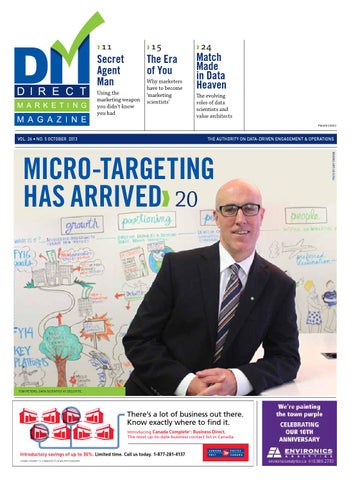
Tom Peters, data scientist at Deloitte.
photo by Gary Tannyan
MICRO-TARGETING HAS ARRIVED❱ 20
t:6.4375”
There’s a lot of business out there. Know exactly where to find it. TM
Introductory savings of up to 30%. Limited time. Call us today. 1-877-281-4137 Canada Complete™ is a trademark of Canada Post Corporation.
CPC_13_N_1010_A_R1.indd 1
5/23/13 2:28 PM
t:1.75”
Introducing Canada Complete : Business Direct. The most up-to-date business contact list in Canada.
// 3 DATA ANALYTICS Vol. 26 | No. 5 | October 2013 EDITOR Amy Bostock - amy@dmn.ca PRESIDENT Steve Lloyd - steve@dmn.ca
❯❯6
Marketing success in a digital world The power of analytics in mobile commerce
DESIGN / PRODUCTION DemiGroup - info@demigroup.com
LLOYDMEDIA INC. HEAD OFFICE / SUBSCRIPTIONS / PRODUCTION: 302-137 Main Street North Markham ON L3P 1Y2 Phone: 905.201.6600 Fax: 905.201.6601 Toll-free: 800.668.1838 home@dmn.ca www.dmn.ca EDITORIAL CONTACT: Direct Marketing is published monthly by Lloydmedia Inc. plus the annual DM Industry Source Book List of Lists . Direct Marketing may be obtained through paid subscription. Rates: Canada 1 year (12 issues $48) 2 years (24 issues $70) U.S. 1 year (12 issues $60) 2 years (24 issues $100)
THIS ISSUE OF DM MAILED BY:
Complete Mailing Service
❯❯15
Welcome to the Era of You Marketers are becoming ‘marketing scientists’ to meet challenges of more personalized data
On the occasion of their 10th anniversary, Environics Analytics founder Jan Kestle talks about the changing data analytics landscape and how her company has changed with it
❯❯20
Micro-targeting has arrived
❯❯8
Case Study: Ontario Lottery and Gaming Corporation
❯❯10
Leveraging location insight to drive business opportunities
❯❯11
Secret Agent Man The marketing weapon you didn’t know you had
The availability of customer data has exploded and with it new questions about what’s ‘clever’ and what’s ‘creepy’ marketing
social MARKETING ❯❯21
Case Study: SaskTel
❯❯22
Turning ‘Madvocates’ into advocates
❯❯23
Ten tips for your next social marketing campaign
❯❯24
Executive Roundtable Sponsored by Boire Filler Group, this roundtable explores how data scientists and value architects are working together to realize value through business analytics.
POSTMASTER:
Canada Post Canadian Publications Mail Sales Product Agreement No. 40050803
A proven analytic method for customer mining
A decade of insight
Direct Marketing is an independently-produced publication not affiliated in any way with any association or organized group nor with any publication produced either in Canada or the United States. Unsolicited manuscripts are welcome. However unused manuscripts will not be returned unless accompanied by sufficient postage. Occasionally Direct Marketing provides its subscriber mailing list to other companies whose product or service may be of value to readers. If you do not want to receive information this way simply send your subscriber mailing label with this notice to: Lloydmedia Inc. 302-137 Main Street North Markham ON L3P 1Y2 Canada.
Please send all address changes and return all undeliverable copies to: Lloydmedia Inc. 302-137 Main Street North Markham ON L3P 1Y2 Canada
The CHAID Tree:
❯❯16
Advertising Sales Mark Henry - mark@dmn.ca Brent White - brent@dmn.ca CONTRIBUTING WRITERS Geraldine Tenten Jan Kestle Tom Peters Lori Bieda Neil Everett Peter Cuthbert Taslim Somani Phil Kaszuba Justin Lemrow Andrew Penchuk Lawrence Spicer Matt Matsui Scott Cook Paul Tyndall Mike Aoki Alexis Zamkow Shaw Tao
❯❯14
❯❯12
Are you ready? Part one of a three part series about instituting marketing data management and governance
1-888-683-2501 • 416-755-7761 www.completemailing.com
october 2013
DMN.ca ❰
Directives
Good data:
the secret ingredient to good analytics By Jan Kestle
With all the excitement about big data and new media, it’s no surprise that many marketers are focused on our industry’s latest technological advances. From BI software platforms to interactive dashboards, there are plenty of new techniques and applications to help businesses carry out their data-driven marketing analytics. But what’s sometimes lost in this romance with tools is that they are of little help without quality data. If you want to develop factual insights on consumers, and deploy effective target marketing that offers the right services to the right people, there’s no getting around the requirement for accurate, authoritative data. Data quality is receiving increased attention lately following the release of the National Household Survey (NHS). The decision to halt the mandatory long-form census in favour of the voluntary NHS has raised many concerns about the response rate, sample bias and data quality. While 20 percent of Canadians traditionally received the long-form census, with a 94 percent response rate, only 69 percent fully completed the NHS, which went to 33 percent of Canadians. The NHS actually resulted in a larger number of Canadians participating than the traditional long-form census; however, because of the voluntary nature, it cannot represent the complexity of the Canadian population at the level of detail that marketers need. Gaps in census data have a direct impact on our understanding of consumers and the economy. The latest data on income indicated a sharp drop in the number of millionaires reported in the 2011 NHS, raising provocative questions. Did the wealthy simply choose not to fill out the questionnaire, preferring not to be counted? Or are there in fact fewer millionaires as a result of the recession? Because of the move away from the mandatory longform census, NHS users may never have a reliable answer to that question. For direct marketers, these issues with data quality cannot be ignored. The NHS results do not have the precision of the traditional long-form census at smaller levels of geography. Marketers accustomed to using dissemination areas (DAs) and postal codes for their marketing campaigns will simply not be able to rely on the released NHS results. In fact, so far the NHS releases have not included any DA-level data due to quality issues. While DA data can be purchased from StatsCan, it’s on a buyer-beware basis, and we recommend not using the NHS DA data “as-is”. Marketers will face holes in their knowledge as they try to locate stores, ❱ DMN.ca
Editor's Letter understand consumer needs, place advertising, optimize their merchandise mix and select media. At Environics Analytics (and presumably at other data companies), we are using best practices to enhance the NHS data in order to include it in our current and projected demographics offerings. The goal is to provide an updated, small-area view relying on other input sources—such as postal counts and taxfiler data—and still use what can be relied on from the NHS in our models. We also plan to release an “Adjusted NHS” DA-level database for some but not all variables. The number of variables will be determined by the availability of data sources and methodologies to reliably modify the data. Already, other offerings like our WealthScapes and DemoStats datasets are being used by many analysts who had previously relied only on the long-form census results. To be clear, we are not criticizing StatsCan: They have collected the data according to their mandate and released those data points that meet their professional quality assurance standards. The government’s decision to change the approach has resulted in data problems for many, but the direct marketing industry applications are particularly affected. We believe that using as-is NHS data in the same way analysts have used the long-form census data in the past will result in poor analytics, no matter how good the customer data, methodologies and tools. Of course, data of questionable quality lurks in other sources. Many businesses and not-for-profits rely on legacy databases with duplicate names, several variations of the same address and hopelessly outdated data. Multiple customer databases may be housed in different departments within one company, hampering the ability to create a single, 360-degree view of a consumer. Without reliable data, businesses are unable to make informed decisions when forecasting growth, selecting retail sites, analyzing population and household trends, and developing media plans. It’s the same old GIGO story: Garbage In, Garbage Out. Making sure you’re using high-quality data can be challenging. Not long ago, our company completed a project to help an office supply chain update its sales forecasting platform for its hundreds of store locations across North America. It took four months of painstaking work just to clean the company data. The project ultimately created an effective model that could forecast sales based on customer and product categories across multiple market types. But no matter how good the model, without highquality data, the company would not have been able to determine with confidence how a potential new location would perform. Marketing is a mix of art and science. Optimizing the scientific side requires the highest quality data available all the way down to the lowest level of geography possible. Ignoring the need for quality data will render marketing analytics worthless—no matter how sexy the software or vibrant the visualization tools. Jan Kestle is the founding president of Environics Analytics.
// 4 A BIG issue around Big Data
Understand your customers in greater depth, improve your marketing campaigns and maximize the ROI of your direct marketing. The DM trifecta. Kind of a blinding flash of the obvious, I know, but what is new is how we’re doing it. There’s this great tool out there now – Big Data (perhaps you’ve heard of it) and it’s opening doors for direct marketers to make better use of what they know about their customers. At DM we dedicate two issues a year to the topic of Data and Data Analytics and never run out of things to talk about or people to talk to. In fact, we could do six issues a year on the topic and still fill the book. In this issue we have a great mix of thought leadership articles and case studies that speak to advancements in data use, practical applications of data analytics and how the industry has changed their perception of Big Data and how to use it. We’re excited to bring you another Executive Roundtable this month as well. Sponsored by Boire Filler Group, pioneers in the data analytics space, the discussion includes well known industry leaders on both the data scientist and value architect (marketer) sides. Turn to page 24 and sit in on the discussion about how data scientists and value architects are working together to realize value through business analytics. We’re also taking a side trip into the world of social marketing with an insightful “how to” article from Stephen Thomas Ltd. that will help you plan your next social marketing campaign. Our friends at LoyaltyOne will show you how negative customer comments about your company in social media – especially by participants in your loyalty program – can seem like a sharp blow to your brand but when addressed properly, can translate to higher sales. And finally, a case study from SaskTel that outlines how the telco used social to start fanning football fever for Rider Nation and their championship dreams. Contact Management magazine once again makes an appearance this month – a perfect fit with its theme of data in the contact centre. It also contains the official show guide for the 4th Annual GTACC Conference being held in Toronto next month. Another jam-packed issue! Next month DM will be at Graphics Canada running two editorial panels – The role of VDP and How print is remaining relevant – and we’d love to see you there. If you’d like to participate in the panels please drop me a line. Cheers, Amy october 2013
The single most important campaign decision you will ever make. Lots of decisions are made when you design and execute a marketing campaign. However one decision stands out. All the studies prove the same thing: if you want better campaign results, get a better list. That’s because 60% of your campaign’s ultimate success is due to the accuracy of the list. Sure, the offer, timing, and creative are important too. But the list will have far more influence on your results than any other decision you make.
ALL RESPONSECANADA DATABASES ARE CUSTOM TAILORED TO YOUR TARGET MARKET SPECIFICATIONS.
Everyone, everywhere in Canada, complete with names, phone numbers and demographics. This is precision targeting at its best! Movers spend up to 8x more on just about everything. Get to them first, before your competition does. Tired of the old and just plain wrong? This is the B2B list you really want. It’s what successful campaigns are built on.
Decide on the best. Decide on ResponseCanada. For more information and to request pricing visit www.ResponseCanada.ca.
BETTER DATA
FROM CANADA’S LEADER IN CONTACT DATA SOLUTIONS
)
The ResponseCanada family of prospect databases are built and maintained by Cleanlist.ca, an Interact Direct company.
cleanlist.ca 1-800-454-0223 sales@cleanlist.ca www.cleanlist.ca
TradeAd_9.5x13_F5.indd 1
13-07-04 10:47 AM
// 6
data analytics
Marketing success in a digital world The power of customer analytics in mobile commerce
By Lori Bieda
W
ith mobile devices expected to outnumber humans by 20171, the potential for mobile marketing will undoubtedly be significant. But how will Canadians, already subject to the barrage of consumer marketing from multiple channels, contend with this? According to new research by Leger, commissioned by SAS Canada, Canadians are looking to their smartphones to deliver better in-store shopping experiences. Canadians surveyed said they would buy more if presented with promotional offers on their phone while out shopping. When asked what they would do if they received a promotion on their phone that applied to either the item they were buying, or a complimentary product, 38 per cent said they would buy both items, showing the power of mobile in product cross-sell. In addition, 58 per cent said they’d be interested in receiving personalized promotions from nearby stores while out shopping, adding credence to location-based marketing offers. Yet, in order to personalize promotions and feed growing consumer expectations for relevant marketing, organizations must analyze large amounts of customer data, ranging from: point-of-sale transaction data, online clickstream data, social media sentiment, unstructured data from call centre logs and email threads, through to emerging mobile-based location data, and more. All this data can overwhelm companies already managing thousands of campaigns per year, and retailers, who regularly deal with hundreds of thousands of product SKUs. Couple this with the growth of emerging marketing channels like mobile and social layer in increased complexity for marketers
setting out to monetize their customer information and transform data into a competitive advantage.
Omni-channel becoming omnipresent Increasingly, organizations – from retailers, to banks, to telcos, to insurers - are investing in omni-channel strategies. Omni-channel is the enablement of a customer-intelligent enterprise providing connection across not only marketing channels, but organizational functions. The goal: infuse the organization with customer insight while bringing the organization easily to the foot of the customer. That has different implications to how organizations market (more targeted, real-time, better integrated), but beyond that, done right, it affects how the whole organization works. Decisions across the enterprise from customer-driven merchandise selection (think Pinterest, and crowdsourcing), to pricing, to differential service strategies, through how companies view their risk, fraud and collections strategies, (exercising tolerance, and extending more, based on the profile of the customer) change in the omni-channel world. Enablement of that integrated omni-channel vision begins with assembling rich customer information. For marketers that means binding together all on and offline data sources for a complete and consistent view of a customer that cuts across the enterprise, transforming data—big and small—into customer insight that is made available across the organization to drive smart customer-centric decision-making. The key to transforming that wealth of data into customer-intelligent actions is to power it with analytics because the sheer variety, volume and velocity with which information streams at the marketing analyst can be overwhelming. Analytics helps organizations mine and unearth opportunity within data to determine its value drivers, and where to focus
The key to transforming that wealth of data into customer-intelligent actions is to power it with analytics because the sheer variety, volume and velocity with which information streams at the marketing analyst can be overwhelming." ❱ DMN.ca
efforts for greatest returns. Engendering greater customer loyalty Personalized promotions can also improve customer loyalty. The same survey found that 47 percent of smartphone owners said they would be more likely to return to a store that sent personalized promotions to their device while they shopped. Findings suggest that Canadians want more from their shopping experiences, and mobile is ripe to deliver, as 82 per cent of respondents said that it would be helpful to access detailed product/service information on their phones while browsing in store. Tapping into the power of mobile apps will be also prove fruitful for marketers as a means to deliver on this personalized experience. Even while consumers online have been increasingly unwilling to register for most web sites--thereby limiting marketers’ ability to gain customer insight and deliver promotions through these channels—popular, value-add mobile apps make registration a requirement to securing the service, thus making it easier for marketers to learn about the customers. Moreover, the app gives marketers an additional source of information to learn about customer behaviour. In an age where information is the key to relevant marketing, organizations assembling the richest data sources, superior customer analytics, with the ability to act in realtime will have a sustainable competitive edge. Because today’s consumer, flooded with choice, and powered by smartphones are no longer bound by borders. They can instantly crossquote, compare features and purchase everything from purses to cars, navigating from bricks to clicks faster, in many cases, than the companies they do business with. The future of customer loyalty will rest heavily on the marketer who cuts through the clutter, and strategically harnesses the power of customer information and analytics to deliver what customers have told us they want: personalized interactions. Three essential ingredients to unlock the power of mobile marketing Assemble rich customer information – from multiple sources
to create a clear view of the customer. Most often that involves things like: the customer’s transaction history (both on and offline), SKU-level basket information, returns, any stated client preferences or online click stream data (to infer preferences and understand things like abandoned carts and impending needs), and mobile app usage, to name a few. Find customer opportunity in data through predictive analytics – employing predictive analytics throughout the marketing process to not only segment customers, and build propensity models, but to recalibrate models and adjust them as new information becomes available, using self-learning models to capitalize on emerging consumer trends and needs. Implement real-time marketing decision engines – to execute at the speed of marketing today and take advantage of real-time client insight, marketers need real-time capability. This is fundamental in the digital age to convert insight into opportunity and deliver real-time offers down to the device. Incorporate smart decision engines into the marketing infrastructure which are flexible and adaptable and can consume the full range of analytical inputs from models, business rules and triggers. Lastly, ensure the solution can also receive realtime information based on important new insight from customers such as proximity to retail store location which may be a trigger for offer execution. Conclusion With mobile slated to overtake the desktop in 2015 as the primary means by which consumers access the web2, the mobile has become the window into the consumer’s online world. With always-on connectivity, consumers’ expectations for relevancy have never been greater. Only the analytically savvy marketers will be in a position to leverage the wealth of data available to drive optimal real-time offers straight to the consumer’s device. To thrive in a world of smart devices, marketers need to be that much smarter. Lori Bieda, Executive Lead, Customer Intelligence, SAS Americas For more information about SAS’ Customer Intelligence solutions, please visit: http://www.sas.com/software/ customer-intelligence/
(Endnotes)
1 Cisco Visual Networking Index: Global Mobile Data Traffic Forecast Update, 2012–2017: http://www.cisco. com/en/US/solutions/collateral/ns341/ns525/ns537/ ns705/ns827/white_paper_c11-520862.html 2 Morgan Stanley http://www.morganstanley.com/ index.html
october 2013
// 8
data analytics Screenshot 1:
Marketing spend is now focused in specific trade areas or postal codes versus an entire city or region.
within a one hour radius. Untapped markets and customers that reside outside of trade areas can also be identified and targeted with tailored campaigns and incentives. Business listings included with Esri Business Analyst are leveraged to identify and contact ideal partners for promotions
Screenshot 2: The
OLG can accurately assess the ability to draw customers to various site locations and refine or optimize distribution networks.
Case Study:
Ontario Lottery and Gaming Corporation
Analytical tools drive performance and reveal new insights in OLG’s business intelligence
map out contests, promotions and product offerings in a geographical context. In 2008, OLG’s Gaming Division adopted GIS to plot information on a map view, but lacked analysis capabilities to extract meaningful insights from the data. There were no tools in place to profile loyal customers, monitor customer behavior, model the impact of planned activities or tap into new markets. To optimize its business strategy, the OLG would need to invest in analytical tools and add a geographic context to its business intelligence.
By Peter Cuthbert
T
he Ontario Lottery and Gaming Corporation (OLG) directly and indirectly employs almost 17,000 people at 27 gaming sites and is responsible for the sale of lottery products at approximately 10,000 retail locations. Generating almost $7 billion annually, the organization contributes a significant portion of its revenue to the province of Ontario while supporting the local economy. In 2010, the OLG’s Analytic Centre of Excellence recognized the power of adding location-based data to business intelligence and invested in Esri Business Analyst (Canadian Edition) solution. As a result, they’ve achieved a deeper understanding of customer behaviour, optimized offerings, targeted new clientele and streamlined operations across its brands and business lines. The challenge The Ontario Lottery and Gaming Corporation manages a number of brands including: Lotteries, INSTANT Games, PRO·LINE, OLG Slots & Casinos, Charitable Gaming and Resort Casinos. The organization also hosts regular contests and promotions throughout the year within the province of Ontario. With tens of millions of customers, a diverse portfolio of offerings and billions of dollars in revenue, the OLG manages and process an enormous amount of statistical and operational data. A commitment to player protection also means that data security and privacy is a top priority. Prior to leveraging GIS – a system for capturing, analyzing and displaying geographic information – the OLG managed information as tabular datasets stored in spreadsheets. An inability to visualize their data made it difficult to communicate plans with key stakeholders or ❱ DMN.ca
The solution The OLG selected Esri Business Analyst (Canadian Edition): a solution that combines GIS analysis and visualization capabilities with extensive demographic and business data. Leveraged to service two key client groups, senior gaming executives and internal marketing staff, it supports customer profiling and enables loyalty program activity and market penetration to be analyzed within the context of location. Using trade area analysis, customer behavior can be correlated with geographic locations to identify the OLG’s most loyal customers. Gravity modelling is also used to monitor a gaming site’s ability to draw customers from various locations. This analysis is referenced to inform the loyalty member rewards program and support the OLG’s overall corporate strategy. Drive times are also monitored and correlated to customer behavior which proves especially useful during post-campaign analysis. Through a map view, it can be determined whether a campaign was more effective among customers within close proximity of an establishment vs. customers
such as hotels and restaurants. Using built-in templates, maps and reports are then readily produced to communicate the results of analysis with key stakeholders. The benefits By integrating valuable corporate data with location-based data, the OLG can seamlessly monitor customer behavior on a provincewide scale. As a result, marketing spend is now focused in specific trade areas or postal codes versus an entire city or region. Gaps in market saturation can be readily identified and assessed so that communication efforts can be targeted to areas of lower customer penetration. Through profiling, the OLG can also minimize promotional and communication costs by contacting only those who are likely to be interested in a particular campaign or promotion. Predictive modeling makes it possible to accurately assess the ability to draw customers to various site locations and refine or optimize distribution networks based on location analysis. Rather than sifting through rows of data, analysts can now rely on an intuitive map interface to gain a real world perspective of their trade areas. This has led to improvements in data quality as the ability to visualize information allows inaccuracies or anomalies to be readily identified and corrected. In an effort to build on these successes, the OLG Gaming Division’s Analytic Centre of Excellence is planning to expand its use of Esri Business Analyst to other lines of business including iGaming: an internet gaming initiative that will aim to set a gold standard for safe and responsible gaming. Peter Cuthbert is the Director of Business Planning & Analytics at OLG october 2013
Fact or Fiction: Millennials don’t know how to work, have an inflated sense of entitlement, and want everything now.
Uncovering the truth about today’s younger workforce:
Mythbusting Millennials November 19th
8:15 a.m. – 2:00 p.m. Arcadian Court, Toronto With companies like PwC estimating that by 2016, 80% of their workforce will be comprised of Millennials, it’s no wonder this generation is the subject of much focus and attention. A large cohort with a strong voice and a big impact, it is important to understand what really makes this generation tick. Learn what drives the often-misunderstood, hyper-connected, über-social Millennial and help shape how this generation is perceived in the workplace. Join our cross-generational leaders to explore the myths surrounding young workers. Walk away with practical tools to close the divide between managers and today’s emerging workforce.
Tickets:
$295 + HST
Join the conversation. Opening Keynotes: Ruth Wright, Director of Leadership and HR Research, The Conference Board of Canada, and Diane Dowsett, AVP Talent Management, LoyaltyOne, review 2012 Canadian research on the meaningful differences between Millennials and Gen Xers – how they lead teams, grow professionally, consume content, and engage with technology.
Hot-Debate Panel: Moderator: Michael J. Beckerman President, Ariad Communications
Member Rate
Panelists: Mark Lawson Office of Tim Hudak, Leader of the Ontario PC Party
For group rates, please call 416.487.5932. Conference Partners
Christian Mathews-Gagne Retail Sales Representative, Kraft Foods Canada Marla Natoli Mobile Strategy, Development and Operations, Olive Media
Gold
Media
Silver
Creative
Kerry Reynolds Head of Consumer Marketing, PayPal Canada Sarah Simpson Chief Client Officer, Squareknot
CMYK / .ai
Student
ScalaForMarketers.com
// 10
data analytics
Leveraging location insight to drive business opportunities By Phil Kaszuba
T
oday, we live in an increasingly mobile society. Distance and time are reduced by technology and lifestyle. As virtual as the world may appear, we still stand firmly planted in one or more locations from which we live, work and play. At the same time, the data we create has grown in both volume and complexity. According to a Deloitte report, 85 per cent of all data has a location component. Many businesses are aware of the value that having good data can bring from a business perspective. Ensuring that you have current, correct, complete and accurate location information can help businesses identify new opportunity through more effective targeted campaigns to upsell and cross-sell to existing customers and to improve targeting of new prospects. A recent study revealed that 60 per cent of a campaign’s success is driven by effective targeting. With effective targeting being so important to success, it is astounding how many businesses are basing their analysis on problematic data. According to a study conducted by The Data Warehouse Institute, 40 per cent of businesses reported that they had a loss, had problems or accrued additional costs as a result of poor data quality and 48 per cent did not have a plan to manage or improve their data quality. Any good marketing campaign needs to start based on analysis of data that is current, correct and complete. Postal codes were designed to support the delivery of mail. Postal codes change frequently due to population shifts and new construction. About 100,000 new residential addresses are added every year. With the number of changes that occur during a year, if your data is not current, this will result in placing customer and prospect records in the wrong postal code boundaries resulting in an incorrect analysis of your current customer base. By having accurate and more current information, such as having up-to-date postal code boundaries, marketers are able to uncover where customers and prospects are located at the most
The big deal about linking your quoting & CRM systems
How companies are turning big data into big pricing power and sales effectiveness By Andrew Penchuk
N
ot long ago, if you told your sales reps your company was going to enforce pricing rules and discounting guidance, you’d probably lose them at the word “enforce.” But in this era of technological advances that shortcut virtually everything we do, the tide is turning. High-performing sales teams are learning how technology – specifically, data and analytics – can help them sell more effectively, especially when you start with the end result: They’ll be able to close more profitable deals, faster and with less effort. And the way to do that is by linking quoting and Customer Relationship Management (CRM) systems. Here’s a look at why companies that follow today’s pricing and sales negotiation best practices are able to make transformational gains, like turn around declining margins, increase revenues and outsell their competitors – even in a tough economy.
❱ DMN.ca
Easily manage pricing It begins with confidently setting the right prices. Pricing is so complex and difficult to manage that most organizations take a simplistic approach to determining their price list. It is often a list based on their competitor’s prices that is applicable to every customer. In essence, it amounts to one-size-fits-all pricing. This strategy doesn’t take into account the many variables that determine what a customer – or a group of customers with shared traits – will actually pay for a product. However, when quoting is linked to CRM systems, companies can cut through this complexity by easily segmenting, loading and centrally managing their pricing in their CRM, where reps have immediate access to it.
granular level and ultimately uncover any new prospects or segments that may have been missed. By having this information, marketers will be able to effectively maximize the overall reach of their campaigns, most importantly to the right people. Beyond generalizing their current and prospective customer base through postal code, the precise location of a customer or prospect can be determined by using high precision geographical co-ordinates that help pinpoint the exact location right down to the roof-top. This enables an even more precise analysis of customer and prospect location to enable an even more targeted campaign. For example, the proximity of a prospective customer to a telecommunication companies existing infrastructure will make the difference between being able to quickly and cost effectively provide a specific service to the customer or the time and cost of building out additional infrastructure. In many areas, there may be customers with the same postal code that are outside
the telecommunication company’s serviceability boundary. An analysis of the potential customers by postal code will identify a number of customers that may not be eligible to acquire the service. However, an analysis taking into account the exact location of the customer will improve the effectiveness of the marketing campaign and can reduce the costs of infrastructure build-out. In another example, the Electrical Safety Authority (ESA) a delegated administrative authority acting on behalf of the Government of Ontario with specific responsibilities for electrical safety, is utilizing high precision geocoding to help in enhancing service delivery and customer satisfaction by enabling residents to find local licensed electrical contractors within a specified proximity of their residence or business. With location data, they were able to put together an interactive tool on their website that ultimately enhanced the level of customer service. Retailers have been using postal codes to gather
Increase efficiency Instead of searching for the latest price list or spreadsheet, now reps can simply point and click to view account-specific product and bundled prices, cross-sell and up-sell opportunities, discounting guidance and promotions directly in their quotes. This greatly reduces the risk of pricing errors and simultaneously boosts productivity, which is important, when you consider that a recent study (conducted by the Industrial Performance Group) showed average salespeople spend just 38 percent of their time on revenue-generating activities; for peak performers it’s 58 percent. Imagine the gains if you could get those 38 percenters up to 58 per cent. With active sales leads, pending work items, email, alerts, price approvals, work documents and the customer relationship
management pipeline together in one place, companies can take the guesswork and manual effort out of complex pricing decisions, and create a onestop-shop for sales. Work smarter They’re also able to overcome consistency challenges. For example, one of our customers told us that they were being shopped with multiple calls into the sales team, hoping each time for a different rep who would give a better price. By linking quoting and CRM systems, reps have a complete quote history, so they can sidestep that issue. Companies also gain a built-in audit trail. Think about all the “offline” conversations that surround a single deal. Whether it’s face-to-face, or by phone, email or social tools, these discussions aren’t capoctober 2013
// 11
data analytics analytical insight, to better understand customers and their purchasing limitations. Answers to such questions as how far are customers willing to travel to a certain location to make a purchase, or how much are specific customers purchasing at stores within a geographical boundary are now uncovered. This key and pertinent information is valuable in better positioning future products and help in developing marketing campaigns and tactics that are more specific and targeted to what the customer really wants. To a marketer, this type of analytical insight is priceless. Many retailers are also using location data to support flyer distribution that convey a special offer that vary by location, to the strategic planning and implementation of marketing components, such as billboards or bus advertisements that are uniquely tailored to a specific segment or ethnic group, location data provides marketers with key insight that helps in determining which elements to utilize within their campaigns and
where should they be placed to drive overall success. As you can see, there are so many advantages and benefits to the analytical insight that location data can provide to a marketer, but imagine this – incorporating other key areas of context that would allow marketers to develop more dynamic and targeted messages. Enriching the analytical insight of location data and connecting it with demographic content to make customer profiling more detailed; or appending the location data with a prospect’s name and phone number or business information to essentially create and tailor messaging that is more personal and unique. Each one of these is just some options that can take the original insight of location data to a higher level. When data analytics is used correctly and properly, the end result can lead to tremendous success for a business’ marketing efforts and activities. Union Gas for example, was able to leverage location data along
with key demographic content to focus their marketing campaign to the right audience with the right message to promote energy conservation programs to eligible clients in an effort to reduce natural gas consumption among this group. As a result Union Gas realized a 400 per cent increase in the uptake rate of their marketing programs. In the past, location intelligence has focused on accuracy of databases used in direct marketing and offline analysis such as store location and risk profile. To take full advantage now requires moving beyond data accuracy and static use, to real time analytics within the organization. Customers who take advantage of this can expect to generate profit and reduce risk. Those who ignore it will certainly face a competitive disadvantage, inefficiency and reduced business performance. Don’t be the latter.
tured anywhere. By quoting within CRMs, companies can document every conversation and approval, which dramatically lowers the risk against any sort of legal review as well as consistently aligns pricing to the specific account and the scope of the opportunity.
processes with performance metrics. Sales managers can pull up dashboard analytics and instantly rank deals, customers and salespeople relative to peers. The result is a much clearer assessment of an individual’s contributions to improving the profit performance of their company. And instead of focusing on discounting at the backend of negotiations, which is akin to stopping a racecar driver with a few speed bumps, companies can now incent salespeople into caring about profits at the start of a deal by confidently delivering them accurate, differentiated pricing terms.
that pricing enforcement equals profits. Today’s quoting tools that leverage CRMs not only increase adoption of this investment, but enable organizations to exploit one of their biggest assets – their own big data. It enables these companies to achieve a level of connectivity where critical pricing information is communicated with ease. The right price is set with confidence, helping them win more deals, and eliminate profit leaks as well as one-size-fitsall pricing. Collaboration and visibility into negotiations means expertise is shared with each new deal, which exposes best practices. And their business won’t just thrive, they’ll be well poised to outperform.
Stop leaving money on the table Improving margins is difficult when companies distribute a spreadsheet to sales reps coupled with some stern warning around discounting compliance. What’s more, it creates a negative relationship, pitting sales reps against pricing managers, as they convince everyone around them that the only way to get the deal done is by lowering price. By contrast, today’s quoting technology instills disciplined pricing october 2013
The bottom line: pricing enforcement = profits When it comes to minding the bottom line, high-performing sales organizations know
Secret Agent Man
The marketing weapon you didn’t know you had By Matt Matsui
W
Andrew Penchuk is the director of
ith so much data and information at our fingertips every day, it’s easy to believe that we have everything we could ever need to create the perfect marketing campaign. While a business certainly knows more about their customers today than they did a decade ago, there is still an almost endless supply of information yet to be discovered. What is a CMO to do? The simple answer is listen. Nearly 100 years ago, Bernard M. Baruch said, “Most of the successful people I’ve known are the ones who do more listening than talking.” That advice still holds true today. CMOs have an incredible resource to listen to what their customers are saying everyday right at their fingertips – the contact center. The contact center fields thousands of calls from customers offering valuable insights into the company, its products and services. The call center agents fielding these calls were at one time primarily a vehicle for customer support. They would take a call, make notes on the complaint or request being shared and then try to help the customer resolve their issue. Along the way, companies began to realize that while a customer was on the phone, there was also an open sales opportunity. Customers called with a question about their account and the agent on the phone took the chance to upsell them on a new service with more features for about the same price. The role of the agent was beginning to evolve. Today, there are tools that are refining the agent’s role even further. With speech analytics, it’s now easier than ever to detect patterns and trends in every conversation coming into the contact center. This gives the company all the data they could possibly want to know about a customer. Perhaps more importantly, the granularity of data also provides instant feedback to the organization and allows for more precise identification of a customer’s preferences than ever before. As a result, the role of the agent is shifting once again to becoming a strategic asset to the marketing organization. Market research is happening in real-time as the agent is able to ask more probing questions of a customer during a conversation. By seeding verbal markers within the speech analytics tool, the agent is able to conduct on-the-spot market research and instantly expand the intelligence coming into the organization. Agents are no longer just a sympathetic ear, but researchers who have their finger on the pulse of market dynamics. The CMO suddenly finds themself in the enviable position of having an exponentially larger market research team. There is no longer a human resource constraint on the data that is able to be gathered. Instead the challenge becomes how quickly you can incorporate the feedback and, for the CMO, to maximize the organization’s imagination in making the most of that data in the next marketing campaign. This goes beyond the CMO as well. The VP of Sales gets greater insights into customer buying patterns or feedback on the competition. The product development team hears first hand customer opinion – both good and bad – about the product features, and maybe, even hears something that triggers the next big idea. Legal teams are now able to promptly deal with compliance issues saving time and potentially a lawsuit down the road. The whole organization has a renewed and vested interest in taking time to listen to the customer and can do so easier than ever before. Sometimes the simplest ideas offer the best solutions - just listen for it.
mid-market success with PROS, www.pros.com
Matt Matsui is Vice President of Product & Marketing at Calabrio, Inc.
Phil Kaszuba is the Vice President &
General Manager of DMTI Spatial
DMN.ca ❰
// 12
data analytics
Are you ready? In a data-enabled marketing world, instituting marketing data management and governance is now an essential function for marketing executives.
The following is the first in a three part series on the rise of data management as a core marketing function. The series delves into why marketers should adopt a more formalized approach to managing their data; methods to implement their solution and finally the key success metrics and best practise learnings. As this topic is a new and emerging area for Marketers, we encourage you to join in the discussion, add detail to the context, and most importantly begin the dialogue within your marketing teams as to how you are going to take on a more engaged role in this critical data-enabled marketing world. By Paul Tyndall, Alexis Zamkow and Jan Kestle
data is considered a strategic asset, data management and governance encompasses the strategy and tactics of managing critical data assets within an organization to protect the integrity of the data, the owners and users of the data, the legal ramifications and brand reputation when data is used, and finally the efficacy of the lifecycle of data through creation, consumption and ultimately destruction.. Data governance is a process, a team, a commitment and a culture. It requires integration between disciplines across an organization, all committed to the responsible use and safekeeping of data elements, as well as the appropriate and optimal solutions to drive business success.
Part 1: A marketer’s new data world is staring them in the face and looking for someone to take control! Are you heeding the call of data? As a senior marketing executive your time is often spent on strategic product positioning, marketing communications, pricing, distribution strategies and competitive assessments, but do you carve out time to oversee the management of your data?…probably not….. and frankly why should you, since IT is generally in charge of data integrity. It is true that data governance and management has traditionally been the mandate of IT, and focused more so on the routine documentation of data elements, publishing of data flowcharts and source of record, and in some cases outlining who to call when you need data or have a problem with your report. This view of ❱ DMN.ca
internal data might have been sufficient for yesterday’s marketer, but today, a marketer without their finger on the pulse of their data could be nearing the end of their tenure. Leading edge Marketing teams are now fully engaged in the process of sourcing, collecting, interpreting, sharing and executing on data, and thus their role has now evolved to being a major participant, and sometimes even the leader, in the internal data management dialogue. The management of data, sometimes called data governance, isn’t a just technical system, an application, or a technology process. In the world of Big Data, where corporate
Can you answer today’s critical data questions? In the world of data-enabled marketing solutions, marketers should now consider themselves an official Data Steward, and with that comes considerable responsibility to the management of that information. The new function of marketing data management is fraught with unique challenges such as Partner sourcing through data sharing agreements; collection of unstructured data from online and mobile sources; transformation of data from both internal and external sources; and highly prescriptive terms of use for opt-in data for both off-line and online use. In light of these complexities, it would not be unusual for the following questions to be posed to Senior Marketing executives: ❯❯ Who is responsible for the integrity and accuracy of data collected by marketing, october 2013
// 13
data analytics and then used by others? How are you ensuring that new data sources / elements you generate (e.g. social media, customer panels, shopper marketing etc.) are being captured with rights management in mind and shared appropriately within the organization? ❯❯ How are you transforming or creating new data elements in a way that is repeatable and extendable? If these elements are leveraged outside of marketing, are they understood and used correctly? ❯❯ What is the level of sensitivity and impact of each data element collected, and what are the ramifications if these are no longer available or credible? ❯❯ Do you have the flexibility to respond to quickly changing opportunities in the market or are your metrics / segments carved in stone and updated infrequently? ❯❯ Do you ensure that definitions for metrics, segments, and channels are kept up to date with your requirements? ❯❯ Who is responsible to data partners when their data is engaged and used or mis-used and what happens if marketing experiences a data breach with internal or partner data? These questions are just some of the many avenues that internal and external stakeholders will find increasingly important to understand as our use of data expands and the intimacy of the resulting marketing executions with customers increases. With marketing pushing the boundaries of increased insights, customization, and personalization the associated data risks increase, and thus the need to proactively manage data becomes an essential function. ❯❯
Who, or what, is going to help you? To be able to effectively answer these critical questions requires marketers to have structured oversight, requisite documentation, rights management rules, access control and legal protection, integrity flags and issues escalation protocol for the data that “they own”. All of these functions unfortunately are not traditionally found in the job descriptions or responsibilities within a traditional marketing team. Data management and marketing have now collided to demand a need for a unique and structured marketing data governance function which demands a new set of skills within marketing departments that in the past may have been “borrowed” or outsourced to a third party for tactical and not strategic reasons. But being in the driver’s seat does not always mean that there are the requisite skills within the marketing team to handle these sensitive issues, and thus that is where the collective wisdom and skills of a multi-functional marketing data management and governance council can be a Senior Marketer’s most effective solution. What is the function of a marketing governance council? Assembled with representation from product development, legal, privacy, BI analytics, and IT architecture, this group of individuals builds and approves the roadmap of how data is sourced, from whom, when, how and how often. They are the expert resources that can define opportunities and issues with new product plans or partnership considerations, they can facilitate communications between marketing and IT through speaking the same language. And, they are also often the first line of defence for any issues that could arise through the use of internal or external data. Proactive guidance, internal advocacy and standardization, external partnership oversight, processes for data sharing/integration, and executive readiness are all on the agenda for the marketing data management and governance council. Offering a clear and documented perspective from the marketing lens, this council is the link to the traditional IT data governance function that will share similar functions. Communications between departments can now be more effective as there is a structured flow of information, responsibility and expectations between these two departments, who often face conflicting pressures. Having a structured forum for issues management between teams allows for a streamlined, timely and consistent approach to the day-to-day conflicts that arise, as well as identifying areas of joint opportunities october 2013
What do I do now? Based on the rationale outlined, we hope that you now see that data management and governance should be an essential part of your marketing team’s function. To turn this insight into action thought is the hardest part. In Part 2 we will suggest the required team structure, their roles, and the skills needed. In addition, to put this theory into action, we will suggest the potential mandate and tactical plans that would begin a marketer’s journey into true data management and governance.
that could benefit the organization. Speaking the same language and respecting similar rules of engagement helps teams operated more efficiently and effectively. When the working teams are in alignment, executives can focus on the larger strategic tasks that can make measureable change to an organization rather than focusing on fixing the “broken stuff”. Finally this new reality may well be a godsend for not just marketers, but also for IT groups who are charged with meeting the needs of their marketing partners without necessarily having the knowledge and insights to fully understand the requirements and applications of data in the new dynamic marketing world.
Paul Tyndall, RBC Royal Bank, Client Knowledge & Insights, Alexis Zamkow, General Manager, Data and Targeting Services, Canada Post and Jan Kestle, President, Environics Analytics are members of the Canadian Marketing Association’s Customer Insights & Analytics Council.
Toronto
CONFERENCE AND EXHIBITION December 9-10 at Hyatt Regency Hotel
Unlocking the power of your customer information
ACHIEVE BETTER MARKETING RESULTS WITH DATA: Drive an integrated approach to harness customer data Engage customers and maximize your marketing ROI Meet the most innovative firms and experts Learn about the marketing technology landscape
Don’t miss this 2-day conference STAY AHEAD OF MARKETING TRENDS!
CRITICAL INSIGHTS FROM: Twitter Walmart TD Bank Forrester Research Monster RBC National Post RAPP DBB Rotman OCAD
HEAR FROM OVER 50 SPEAKERS OF THE DATA MARKETING SPHERE! Kirstine Stewart
Head of TWITTER CANADA Former EVP of CBC English Services
Michael C Wong Director of Enterprise Business Intelligence Services RBC ROYAL BANK
Ann Cavoukian, Ph.D Information and Privacy Commissioner OIPC OF ONTARIO
Jean-Paul Isson Global Vice President BI and Predictive Analytics MONSTER WORLDWIDE
IN PARTNERSHIP WITH:
MORE INFORMATION AT WWW.DATAMARKETING.CA DMN.ca ❰
data analytics
CHAID Tree
a proven analytic method for customer mining By Shaw Tao, PhD
R
ecruiting new customers is essential to every business whether it is a start-up or an established organization. This is especially true for products and services where the incidence rate of consumer interest is very low. Differ! ent campaign options exist with varying degrees of success from flyers that blanket an area to digital marketing that pinpoints prospects. Ultimately, success rests on connecting with the consumer who is most likely to be receptive to the product or service being promoted. And in today’s competitive climate it is imperative that businesses take advantage of the insight into potential customers offered by analytical data. “How do I find Mr. or Ms. Right who wants a special product or service?” is a typical question confronting most businesses. It is a particularly difficult question when the product or service is not used commonly. The answer: data mining analytics. Why choose data mining analytics? It provides extra leverage by creating a map that leads to the right prospects. A method called “CHAID Tree Supported Prospective Customer Mining”, or “CHAID Tree PCM”, is one of these effective analytical tools developed by SM Research to do just that. CHAID Tree, an advanced statistical method known as the Decision Tree method, is used to determine how a target variable relates to key factors or characteristics. The method is usually used in studies such as market penetration, customer segmentation, predicting and interpreting responses and customer targeting or profiling. Here is how it works. Every existing business has in its transactional database clues or nuggets of information that can be mined for a wealth of details. The more information that is available in the customer list, the better the results will be. However, CHAID Tree PCM can dig up useful results with as little as surnames and postal codes or telephone numbers. By mapping the current customer list to a general population database such as a residential telephone directory database, this model has the ability to analyze the profiles of current customers and find household clusters that have much higher incidence rates to become new customers than on average. By concentrating on these household clusters instead of selecting randomly, the recruiting rate can be raised significantly. The benefit? Fewer mail pieces or phone calls that translate into higher sales. CHAID Tree PCM can be applied to a variety of situations.
Case 1 This case is an in house study to answer the question asked by many clients, “Where are households with investments (excluding real estate) of $500,000+ located?” Generally people would assume that the amount of investment is highly related to income. Our study, however, found that the target variable, investment, actually was related to other key demographic factors. Based on some national survey databases, a consumer list with selected information/variables was constructed: Investments: ❯❯ Contains values “Yes” – has $500K+ in investments, and “No” – has less than $500K in investments. ❯❯ Household Income: Contains values by ranges 1 to 10 ❯❯ Dwelling Value: Contains values by ranges 1 to 8 ❯❯ Customer Age: Contains values by ranges 1 to 8 ❯❯ Other information: Surname (for possible ethnicity), Postal Code (for location), etc. By analyzing this list, CHAID Tree PCM generated a tree illustrated below in all its simplicity: The tree provided some useful information: 1. Among selected variables, Dwelling Value, rather than Household Income, was the most important factor determining whether a customer had $500K+ investments or not. ❱ DMN.ca
// 14 2. Although the general incidence rate of households with $500K+ investment was low (7.2%), this study found that some household clusters had much higher incidence rates. These clusters were: ❯❯ Households living in dwellings with Dwelling Value 7, within Age groups 8 to 9 and earning Income 10. The incidence rate of this cluster was 51.3%. ❯❯ Households living in dwellings with Dwelling Value 8, within Age groups 7 to 9, as well as 3, and earning Income 9 or 10. The incidence rate of this cluster reached to 64.5%. By concentrating on these selected households, rather than randomly reaching out, the expected incidence rate could be raised from 7.2% to at least 51.3%. Why did the finding not support the intuitive assumption that income would be the main determinant? It reflects the changing demographics. Since the 1990s, Canada has accepted about 250,000 new immigrants every year. Many of these new immigrants are highly educated and can find high income positions. But compared to long time residents, their investments outside of real estate is low. Instead of investing in the market, they are pouring money into mortgage payments. Case 2 Sometimes the results can be impressive. In this case, a fledgling long distance telephone company wanted to expand its market share using telemarketing campaigns to contact potential customers. Based on the existing customer list, its market penetration at that time was 0.31%. Because of this very low penetration instance, the company’s previous campaigns using random calls were not very successful. A better solution was needed. We applied CHAID Tree PCM to help the company locate the most likely prospects. A list of its existing customers with only two variables, home phone number and surname, was supplied. By mapping this list to our residential telephone directory database, a complete household list containing variables of customer status and other key demographics was generated. Upon analysis, CHAID Tree PCM found some household clusters with much higher incidence rates. These households were then selected as the targets for the campaigns that followed. The critical role that analytics played in the success of the marketing efforts was acknowledged in the words of the Marketing Director, “SM Research played a major role in my company’s 200% sales growth by utilizing SMR’s market research tools and analytics.” As these case studies indicate, analytics can provide deeper insight into consumers’ behaviour and characteristics and into the market at large. Furthermore, CHAID Tree PCM for data mining can tackle difficult problems and generate efficient, feasible solutions.
october 2013
// 15
data analytics
Welcome to the Era of You
Marketers are becoming ‘marketing scientists’ to meet challenges of more personalized data By Geraldine Tenten
F
or today’s marketing professionals, analyzing data to measure campaigns and make decisions has long been a commonly held best practice. But for too long, doing so in a spreadsheet has been what has passed as “marketing analytics.” The fact is, organizations today have access to an unparalleled amount of client information, and restricting “data analysis” to what has traditionally fit on a spreadsheet puts too narrow a lens on the topic of marketing analytics as a decision-support tool. In-house information such as order, billing or account history has typically been collected and stored, albeit often in different systems that never ‘talk’ to each other. But there is also data from client interactions such as email correspondence, callcentre reports, Web click history or dialogues that when tapped could reveal a wealth of customer insights. The rise of social media has created a third, external source of information on everything from clients hobbies’, social activities, memberships and professional histories. To be effective, marketing professionals need a strategy to be able to mine all of this data, apply advanced analytics and understand their customers to serve them better and gain a competitive advantage. Increasingly, this means knowing their customers as individuals. Gone are the days when marketing targeted industry segments and broad demographics. Today we’re in the “era of you.” The challenge becomes how to, in real time and at scale, find ways to serve an individual customer’s needs based on a fuller, more personal picture of what that individual wants, often in advance of them being able to voice those wants. We recently surveyed more than 350 marketing professionals on how equipped they feel in the face of this transformation and found only 23 per cent see themselves as highly effective at uncovering new insights to generate additional business value. Only 25 per cent claim to be highly effective at identifying and capturing new markets. And only 32 per cent claim to be highly effective at engaging with individual customers. As terabytes grow, progressive marketers are adopting a more prescriptive way of capturing and analyzing data and becoming, essentially, “marketing scientists,” equipped with advanced analytical capabilities which in turn drive both a broader scope of impact, and improved outcomes for their marketing campaigns. So what are the characteristics of these new marketing scientists, compared to more traditional marketers?’ We’ve identified three core skills attributes: They “architect” data While most marketers are good at collecting traditional data, such as clickstreams and Web site traffic, collection alone isn’t enough. This approach won’t glean the kind of insights marketers crave, from what consumers are saying on social media about a new fashion trend, to whether the supply chain can support a spike in demand for ice cream based on an unexpected heat wave. In contrast, marketing scientists pull together a range of “unstructured” data sources, including social media discussions, blogs and online reviews. They structure and organize that information to make it easier to analyze so they can appeal to customers on a more personalized level. LabelSneak, a UK-based men’s clothing outlet wanted to understand which items were the most popular, what customers were saying about the latest promotions, and what circumstances led to the most effective sales. They designed a program that draws insights from tweets that include Instagram photos and from conversations between consumers on social channels, mobile, and tablet devices which. Since its launch, LabelSneak has seen revenue growth of 148 per cent. They apply science Most traditional marketers rely on gut instinct. In fact, less than 20 per cent adopt scientific approaches to their marketing research. But marketing science involves indepth analysis. This comes down to designing, testing and refining hypotheses. It is similar to what scientists do when they develop a new medicine, and then use those october 2013
findings to create models for predicting how people will react in different situations. To make the most of this opportunity, marketing scientists are adopting new skills such as statistical analysis and benchmarking against control groups. Often, the insights that are generated can be used to develop forecast. As sophistication grows, models can better predict the impact of different actions and help prescribe the best option, given all the circumstances. We applied this principal to our own marketing activities in Canada. In the past, our marketing team planned events according to the needs of internal constituents, based on knowledge and experience from the previous year. By applying analytics, our demand programs team now plans and invests in events based on analyzing historical outcomes and predicting the viability and effectiveness of proposed activities. We also are able to simulate which variables can be changed to improve the predicted outcome of an event. As a result, we’ve doubled our return on marketing spend, reducing by a third the number of marketing events annually, while achieving a increased yield from those activities of 36 per cent. They influence action While 82 per cent of traditional marketers still rely on hunches, marketing scientists are already developing ways to use data to influence action. They are also nearly three times more likely to collaborate with the rest of the enterprise, from Chief Information Officers to the heads of human resources. Predicting the future doesn’t mean much unless an organization can act on that information. And nearly half of marketing scientists have established a culture of data-driven decision making. Cemex, a global building-materials company, created an internal social network where employees collaborate and share expertise. Within a year, more than 20,000 employees signed up and nine global innovation initiatives were underway, helping the company launch its first global product in record time. Marketers have always been responsible for knowing the customer, defining what to market and perhaps most importantly, for protecting the brand promise. Going forward, that will require not only the acquisition of new technical and analytical skills but also an increased profile internally as champions of cultural change. It requires being more closely aligned with the CIO, CHRO and the CEO functions, on a common brand vision. And it sets the conditions for marketing to play new roles in driving business success. Geraldine Tenten is director of marketing and communications for IBM in Canada.
IDEAS
implement
results
For your database & communications needs.
Check out our new website: www.cover-all.ca
COVER-ALL
1170 Birchmount Road, Scarborough ON M1P 5E3 t. 416-752-8100
e. info@cover-all.ca DMN.ca ❰
data analytics
A decade of insight
As Environics Analytics gets ready to celebrate ten years in the industry, Founder and President Jan Kestle talks about how she’s seen the data analytics landscape change and how her company has changed with it. By Amy Bostock ack in 1990, businesses not only had data about the external world and segments that they had been using for a long time but, according to Jan Kestle, that was also the time when marketers started to get their hands on their own customer data. “That meant being able to bring together their data and our data and use the tools of the trade to really do data mining in an interesting way,” says Kestle, who was running Compusearch at the time. “And I think that helped our whole industry in marketing analytics grow in the ‘90s—getting your hands on your own customer data and combining it with other quality data to provide an integrating capability and get the data to tell business stories.” The industry, she says, made a lot of progress during those years, when the old demographics data world and the CRM phenomenon came together. Working with other industry veterans like Steve Shaw, Kestle became involved in the early implementation of bringing together what used to be called geodemographics and CRM. “He headed a group called Links Database Technologies that was a sister company to Compusearch,” she recalls. “And we had a vision in 1993 of the need to combine data mining business intelligence with external data and geo data. We had some good experiments between 1995 and 2000, but they were early stages.” What they envisioned was a future of combining analytics and big data, but it was only the early stages and the technology wasn’t quite there. After some time away from the data analytics world, Kestle returned to her first love and set her sights on providing marketers with tools and services to help them understand their customer data.
B
One more time, with feeling “The concern that a lot of people expressed to me in the early 2000s was that they were buying their demographic, lifestyle, behaviour and marketing data more from data suppliers than people who had a lot of experience in their implementation for marketing purposes. So I talked to a lot of people—other people in the industry, marketers and some large customers. “I decided to start over, leveraging some of that experimental work we had done integrating data, technology and services.” Instead of being a micro-marketing data and software company, Kestle and her founding team decided that the new venture would focus on that sweet spot of understanding the business problem you are trying to solve from a marketer’s perspective. “We would try and understand what data you have, what data we could bring to add insight to it and then build teams of people who knew how to use those data to answer key business questions. The goal would be to help marketers put programs in place that they can execute against the data and measure the results.” From this vision, Environics Analytics was born. “It was a fine line between being a consulting company and being a products and services company. If you are looking just at the business case, which of course I was because I was trying to raise money to do this, you have to get that mix right. If you are just in the consulting business, you can charge by the hour and you don’t have a lot of investment in R & D, data, software and technology. But if you are in the data and software business, you can invest a lot in R & D and then sell the same thing over and over. We wanted to do something in between. So that is what we set out to do when we started Environics Analytics—get the right mix of data, software, services and consulting, and still do it in a way that was sustainable.” ❱ DMN.ca
Jan Kestle and her team are excited about celebrating ten years in business and have lots of news and events planned to mark the occasion.
// 16
“The November 4th anniversary coincides with our user conference this year, which is taking place on November 6th,” she says. “We will be announcing a lot of new things there. At ten years old, we’re in a much better position than we were when we marked five years. We have continued to grow the business, investing in new products and developing new partnerships. So we have many things to celebrate at the user conference. At the end of it, we are going to have a big party, and we’ll also have an internal celebration later, which should be lots of fun.”
Knowing the right questions to ask When Kestle started Environics Analytics, some marketers knew what questions they wanted to ask, but many still needed help determining what questions they should be asking. “I think that by the early 2000s, a lot of marketers were trying to get the right combination of offer, message, target audience and right medium. That is really what successful marketing is: saying the right things to the right people at the right time through the right channel. And so we were really fortunate to reinvent our business at a time when there was a lot more awareness about the new available channels. The marketer understands that TV, radio and print are not the only mechanisms; there are also social media and digital media out there. In the early days of our company, we benefited from the fact that marketers were savvy enough to know they wanted to understand the right message and the right channel, but they were still searching for tools that would help them answer those questions.” Her team started with the basics—building the databases. “Nobody wants to just buy demographic projections or a segmentation system,” she says. “Those are nice products, but the reason why people buy those products, and particularly a PRIZM-type product, is because it integrates demographics with media, behaviour, lifestyle and psychographic data. And allows you to bring your own data to help you better understand what’s happening at your organization’s locations. The power in these systems is their ability to integrate a consistent view of customers and customer segments. And so we had to build all of the databases, and we developed partnerships with PMB, NADbank, BBM, Ipsos and a variety of other companies that had data in order to create a 360-degree view of the continued on page 18 october 2013
Editors Letter
october 2013
// 17
DMN.ca â?°
// 18
data analytics continued on page 18
order to be successful.”
customer. And we had to build them into a system so that it wasn’t just our data but our data combined with other key databases so we could offer our clients a broader view of their customers.”
Why it clicked There are a few reasons why Kestle feels that her business has succeeded. “Two things were happening in the outside world. One was this whole preoccupation with big data— and it has really become something that everybody is interested in. There is a lot of cynicism about it, but the reality is that mainstream business people understand that data-driven analytics can help them with their consumer insight. And for Environics Analytics, we passed our start-up phase and reached our more mature phase at the same time that everybody was saying, What is my big data strategy and what can I do with big data? “Now there are still a lot of questions about what big data really is and what it means, but the appetite for using analytics to make business decisions has really accelerated. While marketing and analytics department people often have trouble getting the budget for data and for analysis, I think they’re getting more support now just because of the focus on big data.” The second event that’s happened, she says, is the total transformation of media—really the other side of the coin of big data. “From the point of view of a marketer who is working for a brand or a retailer or a government department, the fact that the consumer is now in charge of how they want to be marketed to has resulted in a lot of changes in how people think about analytics. All of the measurement organizations do a great job in measuring the media most often consumed. But there isn’t a good way other than using tools like the ones we’ve built to measure the variety of media consumed by four or five different types of customers defined by PRIZM. Because
Ready, set, launch After building the basic data and partnerships, Kestle had to ensure that she built teams of people who understood how the data were derived and used, and who also understood something about marketing. So Environics Analytics specifically recruited people who had experience in customer insight and analytics in a wide range of industries, such as banking and insurance, telco, travel, media, and retail, as well as government and not-for-profit sectors. “We had the data, we had the partnerships, we had the insight team and we had a marketing department that really understood the value of consumer segments and could name them, image them… make them come alive. We had all the necessary components to be able to provide an integrated solution, but it still took quite a bit of effort to build the business.” There were other players in the marketplace and other people trying to approach the business from different perspectives, so it took Kestle’s team a few years to get to the point where they had the right combination of data, software, consulting experience, industry expertise and marketing expertise. “And when all that clicked for us, we were ready to provide both services and systems to a larger number of businesses. When that happened, I really felt then that we were on to something. And I was very fortunate to have business partners who were patient and understood that we needed a complete offering in
PRIZM enables users to integrate a lot of other data, they can look at their four or five different kinds of customers and see their behaviour—whether it’s for traditional, digital or social media. And this can help the marketer start to understand the spending mix across multiple channels so that there is a datadriven basis for an omni-channel strategy. This has been the most exciting thing for us, to be able to help people understand there is some kind of solution.” So now what? Jan Kestle and her team at Environics Analytics have packed a lot into ten years. So what are her plans for the next ten years? “Well the most important thing is to listen to customers and make sure that we keep them happy. I think that we’ve got the right formula in terms of offering different kinds of products. But we’re still working to crack the integration of online and offline media to ensure that our services can help people more through omni-channel optimization. That is a big priority. And we want to continue the work we have started to do recently at the strategic level. It’s very frustrating when we’re called by a customer for help with data and insight when they’re halfway through a program. It is so much more rewarding for us, and we think for the customers too, to be there at the beginning and help them plan their data strategy. We want to continue getting guidance from our customer advisory board, which we started it three years ago. We have great participation, meeting twice a year by phone and twice a year in person. Our board members help us with all of our strategic direction decisions about products and services. So we plan to keep listening to a larger collection of people about what they need in order to better serve our customers.”
SMR 031 THE Data Specialists Ad_Layout 1 12-01-28 2:46 PM Page 1
THE
DA T A SPECIALISTS Providing data solutions for over 35 years. • • • • •
Consumer & Business lists Target by geography, ethnicity & demographics Data analysis & customer profiling Data appending, cleansing & enhancements Trade area analysis
Call for details and pricing
SMRinfo@smres.com 905-474-5271
❱ DMN.ca
october 2013
// 19
october 2013
DMN.ca ❰
cover story
Micro-targeting has arrived
// 20
The availability of customer data has exploded and with it, new questions about what’s ‘clever’ and what’s ‘creepy’ marketing By Tom Peters
I
t wasn’t that long ago that targeting consumers through postal codes was considered revolutionary. Leading edge were the campaigns that targeted households while knowing the likely response. With the explosion of customer data now at our fingertips — and found increasingly online — we’ve entered a new era of targeted marketing. Using Big Data, marketers today are able to target their customers with Ginsu knife-like precision and offer the right message with the right offer to the right customer at the right time. Done well, micro-targeting, or “silent marketing,” remains under the customer’s radar — creating a favourable view of a product or service without an obvious ad, or message that screams and shouts at the audience. But if marketers go too far, this micro-targeted approach can feel like an invasion of privacy, or even creepy. Eyebrow-raising examples of retailors using public information collected to micro-target their customers with personalized offers are everywhere. And it’s easy to imagine the embarrassment if certain coupons or promotions were sent to moms based on the magazine buying habits of their adult children who share the same address. But actually, analyzing data generated through purchases and then assembling data sets to predict individual preferences and shopping behaviour is clever. As more and more companies harness the power of Big Data to deliver the optimal message, proof points and offers to specific individuals, customers’ demand for these customized offers and experiences is growing — especially as consumer demographics shift. More and more young people shop exclusively online and have come to expect tailored online experiences. Deloitte’s recent Analytics Advantage Survey found that interviewees were not overly concerned about corporate efforts to get to know their individual preferences and target them with useful information about the products they like or need. In fact, many customers welcome a more personalized approach — as long as the promotions are relevant and of benefit. Customers may even overlook how unusually well a company knows them if it means they get superior offers or services. It’s a trade-off: I’ll share personal details with you, but I expect value in return. Consider the consumer who regularly buys books from an online retailer. Over time, a profile of reading preference emerges to the point where the retailer is able to suggest titles, based on past purchases, the consumer is likely to enjoy. As a consumer, there is great value in this type of marketing — the time they would normally spend surfing for titles of interest is dramatically reduced. And imagine if the retailer was also able to offer incentive coupons suited to the consumer’s interest and shopping patterns. In many ways, saving the consumer both time and money could be described as good customer service. Of course, micro-targeting exists well beyond the retail space. The 2012 Obama U.S. presidential campaign used data analysis and microtargeting to help win the election. Campaign organizers employed a large analytics group and built an extensive and detailed voter profile database that helped them better understand the electorate. Where ❱ DMN.ca
Big Data and micro-targeting made the difference was in its ability to help organizers identify persuadable voters to target. Messages were tailored to swing voters in key battleground states, going far beyond just targeting people through their postal codes — more of a sledgehammer approach. Instead, the data allowed organizers to drill-down and speak to individuals living in certain households. And in the end, this Big Data insight sent Obama straight to the White House for a second term. Where things do get creepy is when companies know more about you than they should — when they’ve broken privacy laws, or obtained private information without consent. As consumer preferences and expectations around customized and targeted marketing shift, we expect to see companies revise and update their privacy policies and customer consents to keep pace and stay on the right side of the ethical and legal line.
It’s an exciting time for marketers given how analytics can be used to get a detailed look at their customers, but marketers walking the privacy tightrope with Big Data should keep in mind the following five takeaways to avoid stumbling and falling: Update your privacy policies Most Canadian laws have not kept pace with the rapid changes in technology — social media, smartphones, mobile apps, GPS and similar technologies — which means most corporate policies designed to safeguard privacy are out of date. Be transparent Be clear about your intentions to use Big data and ensure that the value proposition encourages customers to give the required consent. Obtain customer consents — but use them with care Just because you’ve obtained customer consent doesn’t mean you don’t need to be careful in your targeting
efforts. Customers must be aware they are being targeted and have the option to optout. Tread carefully when minors are concerned Marketers should take a highly stringent approach to consent and other requirements under Canada’s general privacy and advertising statutes, and they should abide by best practices in disclosure, transparency, consent, data collection limits and safeguards. Don’t be creepy Organizations must strike a balance between a consumer’s willingness to provide data and their privacy concerns and needs. Tom Peters is a data scientist at
Deloitte. Read more about how innovations around social media, mobile technology and advanced data analytics are transforming customer behaviour and what it means in Deloitte’s Customer focused growth: Rising expectations and emerging opportunities at Deloitte.ca. Connect with Tom on LinkedIn and let him know what you think: is micro-targeting clever or creepy? october 2013
// 21
social marketing
Case Study:
SaskTel
SaskTel™ is going viral green - not enviro - with a marketing campaign that asks How Green R U? for the Saskatchewan Roughriders™ as the telco starts fanning football fever for Rider Nation and their championship dreams…
S
askTel (www.sasktel.com) will be turning Saskatchewan green this fall in a province-wide digital and social marketing campaign to boost the fortunes of the Roughriders, leading to the big game in the Canadian football championship to be hosted in Regina in November, 2013. The campaign, which represents a major shift in their creative strategy by using real people is built around a challenge to Rider Nation, the Roughrider’s loyal fans, and asking How Green R U? by posting photos of themselves on the campaign website, www.howgreenRU. ca in their most outrageous fan outfits. The Roughrider green logo is the inspirational source for the concept and fans are being urged throughout the campaign to show their true colours and adopt green as their favourite hue in their clothing, face paint, hair colour and anything else their creativity can imagine. The major push, developed and executed by strategic digital agency, Blast Radius (www.blastradius.com) out of its Vancouver office, uses print, radio, outdoor, online and social media and will blanket the province. It runs from mid-August through to the big game, in which the Roughriders hope to be victorious. “SaskTel is the homegrown communications service provider for Saskatchewan and the official communication provider and biggest fan of the Roughriders,” said Janson Anderson, senior director, marketing (communications and customer experience). “Blast Radius has developed a game-breaking campaign for us, which brings out the animal in our own fanatic employee fans, wearing their wildest green creations and rooting for the home team. We believe this will get the entire province behind us and make for a winning campaign. And the Riders are very much on board with us.” “The people of Saskatchewan are really and truly crazy about the CFL™, and of course the Riders in particular. Rider pride runs deep,” explained John Ounpuu, vice-president, strategy, Blast Radius. “How october 2013
Green R U? is about using the power and reach of the SaskTel brand to give voice to a celebration of football and home town pride that’s uniquely Saskatchewanian.” How Green R U? is an idea that unites SaskTel, the Roughriders and Rider Nation in a celebration of Rider Pride and positions the company as the official communications provider to the team. SaskTel customers will be invited to be part of the fun with the How Green R U? challenge, which asks all SaskTel customers to take their best Roughrider related photographs and post them on Instagram with a How Green R U? hashtag. Photo booths will be placed at events throughout the province and outfitted with Rider themed paraphernalia and backdrops -- locker rooms, AstroTurf, green watermelons. Professional photographers will be on hand and assisted by special teams to help people dress up, supply body paint, hats, wigs, and real
watermelons. The photos will form an online gallery and participants will be encouraged to share their photos through social channels. Winning photos will be eligible to win SaskTel merchandise, Rider merchandise and tickets for regular season games. Grand prize winners will receive two tickets to the Grey Cup game on November 24, 2013. The campaign marks a significant change in creative strategy for the company as it kicks off with print executions in colour newspaper, outdoor and paid media banners and features authentic SaskTel employees showing their passion wearing Rider paraphernalia as they perform their jobs. A How Green R U? website will engage fans with contest information, links to the photo gallery, Instagram and Rider social channels. The campaign is supported province-wide with a host of SaskTel Street Team events throughout its duration. Even the SaskTel logo has been painted green from its customary blue for the duration of the campaign. Customers may also download a Rider app for their smart devices to track Rider progress through the season with stats and late breaking news. The campaign and all campaign materials were designed and executed by Blast Radius in its Vancouver office. DMN.ca ❰
// 22
social marketing
Turning ‘Madvocates’ to loyal advocates Addressing negative WOM can raise customer spending By Neil Everett
A
t first, negative customer comments about your company in social media – especially by participants in your loyalty program – can seem like a sharp blow to your brand. However, negative word-ofmouth (WOM), when addrwessed properly, can translate to higher sales, according to the 2013 LoyaltyOne Social Media Transaction Impact Study. The study suggests that a swift response, promptly communicated to the public as well as a company’s best customers, can boost sales. If businesses analyze and understand customers’ discontent, then make meaningful re-engagement efforts through a personalized approach, they can re-ignite customers’ passion for the brand. The study examines the AIR MILES Reward Program, Canada’s premier coalition loyalty program, and illustrates the correlation between customers’ inclination to post negative
feedback on social sites and their level of passion and engagement with a program. The study shows that not only are angry posters 70% more actively engaged with brands than non-posters, but that negative posters who redeemed after posting their commentary exhibited a subsequent 36% increase in transactions. LoyaltyOne worked with a team of researchers and linguistic analysts from Northwestern University’s Medill IMC Spiegel Research Initiative to examine relevant posts related to the Reward Program. Linking each post and viewing event back to transaction and redemption data, the analysts compared behaviors for a 15-week period against a control group of 10,000 offline loyalty program members. Analysis revealed that those who posted negative comments were more actively engaged in terms of earning loyalty program currency,
Save $200 OFF Your Current Postal Software!*
*applies to any SERP recognized Presortation Software you currently subscribe to
“Frameworks Makes Mailing Easy” “After 18 years as a Mailing Professional, I can honestly say that this is the easiest Canadian postal software I have ever used” – Budley Efta, Professional Mailer
AS EASY AS 1-2-3! 1
Try frameworks Canada FREE for 30 days
2
We GUARANTEE to save you money off any recognized Presortation software you subscribe to
3
We’ll even help you SWITCH by giving you up to 6 months FREE, based on the remaining length of your subscription
CALL 888.227.7221 WEB www.FrameworksCanada.com EMAIL info@smartsoft.ca
❱ DMN.ca
redeeming for rewards and otherwise actively participating. The lesson: while passionate customers are often the quickest to praise, recommend and advocate for companies, they can also be the quickest to take them to task when disappointed. A negative engagement with these individuals can serve as both a warning and, when best practices are employed, an opportunity. About a third made redemptions after posting their commentary. The study examined their downstream activity, and negative posters who then redeemed exhibited a 36% lift in collection activity over their collection level before the announcements. That’s compared to a 21% increase (natural lift) from redeemers within the Control Group over the same period. The catalyst? Heightened engagement. Negative WOM commentary appears to place the program top of mind with negative posters. Following their reward review and redemption process, they are further reminded of the program’s value, leading to increased activity. Of course, loyalty programs want and need passionate members. But with any relationship, emotion doesn’t always flow in a favorable direction. Programs must attentively monitor the relationship to keep it positive, particularly when implementing changes. Here are some tips for leveraging that brand passion and turning ‘upset’ to ‘advantage’: ❯❯ Use the data. Analyze transactions, redemptions and social media
traffic data from both posters and viewers during and after any period provoking negative WOM. ❯❯ Take action if the social media “buzz” and sales indicate a notable impact from negative commentary. A targeted response plan should express appreciation and promote positive program incentives. ❯❯ Be swift and sincere when responding. Recognize opinions and react in a non-confrontational manner to reassure posters and viewers alike that the brand cares about customer feedback. ❯❯ Go public. Angry comments can dampen transaction activity by other readers, so publicly responding through the same social media channels can ensure that the positive changes are seen. A good starting point for the response plan is to focus on what makes members loyal to a program in the first place. As with personal relationships, arguing is not fun, but making up is. Negative comments can hurt, but they don’t have to have an adverse effect for businesses. Even a company’s most outspoken critics have passion for the brand, and their activity can actually be proof of high customer engagement. Understanding the source of criticism and preparing a strategy for recovery can spur surprisingly positive consumer behaviors. Neil Everett is Senior Vice President and Chief
Marketing Officer at LoyaltyOne
october 2013
// 23
social marketing
tips for your next social marketing campaign Get your audience to think and act differently
By Taslim Somani
S
ocial Marketing - not to be confused with ‘social media’ marketing - is conducted by organizations with the objective of achieving larger societal benefits, not financial gain. Because of this, we typically see non-profit organizations and governments as the primary sponsors of these types of campaigns. However, corporations are increasingly taking on societal issues for a variety of reasons, including those driven by financial, governance and corporate social responsibility priorities, not to mention just for some good ol’ PR. Whatever the motivation, social marketing campaigns begin and end with a societal issue as the focal point – anything from gay rights, obesity, and prescription drug abuse, to bullying, cancer screening, drunk driving, and so on. Changing attitudes and behaviours around these important societal issues is hard to achieve, and often, it can take a long time to see results. However, social marketing campaigns often do help to chip away, slowly, at these issues. Anyone knows we’re not going to solve the problem of bullying overnight, but social marketing campaigns can help change attitudes over time. The best social marketing campaigns – anti-smoking and ‘Sneeze into your sleeve’ are great examples - are those that are actionoriented and inspire the target audience to make a change in their own behaviour to provide a wider societal benefit. That’s why social marketing is so particularly well-suited to direct marketers – we want our audience to do something when given a call-to-action. While a mass campaign can help to raise awareness of a societal issue, it’s the direct marketer’s job to translate that awareness into an action – either physical or attitudinal. And the campaign driving that action is usually best managed online – through online banner ads, on a microsite or mobile app – or through a traditional direct mail effort. Although the tactical options are plentiful, in the array of social marketing campaigns we’ve undertaken for our nonprofit clients, a few things stand out. Here are my top 10 tips: Begin with the end in mind This is true not only for highly successful people (it’s Stephen Covey’s second habit in his book The Seven Habits of Highly Successful People), but also for highly successful campaigns. Identify what you want your social marketing campaign to achieve, and set objectives that are as specific as possible. For example, engage 20,000 young people between the ages of 18 and 25 on the issue of hidden sugars in their diets, and get them to take an action around reducing their sugar consumption.
➊
october 2013
Define your target audience It’s so important to know who you want to reach for the issue you’re concerned with, and to be as targeted as you can. If you want to change behaviours around bullying in high schools, do you want to reach parents, teachers, or the kids themselves? Knowing who you want to reach will help focus your campaign’s message, and inform your media plan. The ‘general public’ is not a target audience. Research your audience Once you’ve identified your target audience, invest in a bit of research. What is your audience’s current understanding of the issue? What is their current behaviour? What are some of the obstacles to changing their attitudes and their behaviour? Your front line program staff will have some great insights. Focus groups are also great, but you could also try online surveys if budgets are tight. This research will inform your campaign strategy, and identify areas you should highlight and avoid. Deliver a bold message As with all marketing, a bold message will get you noticed. There’s no room for wishy-washy, mild language. This is one instance where provocative messaging can bolster response. If you can take some assumptions we make about the particular issue you want to address, and make your audience challenge themselves, you’ll set yourself up for success. Test creative Because we are sometimes dealing with issues that have stigma or negative connotations associated with them, you want to test your creative. You may not wish to spend thousands focus grouping a TV spot and then thousands more revising it based on feedback. Instead, focus group a few different options for creative concepts, language to be used in the campaign and your call-to-action. Doing so will bolster response. Take a multi-channel approach Social marketing campaigns are best when they are big, bold and use multiple channels. A broad splash in mass media, even for a short time, supported by online (social media, search, display advertising), is the way to go. Mass media impressions (TV, billboards, print) help provide cover and generate conversation, online encourages engagement and response. And please, be sure to include video in anything you do online! Plan for earned media Earned media can be a huge boost to your social marketing campaign, but only if you think about it in the planning stages. Are you going to pitch stories to the press? What is your hook? Is there research to back you up? Or, are there relevant, recent examples you can leverage? Do you have relationships with media and subject-matter experts you can tap into? A massive media buy can get you pretty
➋
➌
➍
➎
➏
➐
far – even with a mediocre campaign, but the reality is, we don’t always have big dollars to spend. Well positioned news stories can help to increase reach more cost-effectively. Recruit celebrities I love celebrity endorsements! And I think lots of other people do, too. While A-listers demand big bucks to be the face of beauty campaigns or luxury products, there are a host of others – local celebs or TV personalities - that can bring that celebrity sheen to your campaign. If chosen strategically, they’ll help connect with your target audience. And, because they are high profile, they act as role models, inspiring changes in behaviour of your audience, which can really help to bolster response and results. Follow-up with your audience So, let’s say you’ve done everything right in your campaign – you’ve used mass media and direct channels, you have a bold, compelling message and strong call-to-action, you’ve even connected with your target audience in a meaningful way. Now what? Well, now isn’t the time to stop, sit back and enjoy the results of your campaign. In fact, it’s time for more – more encouragement and more engagement with this crop of early adopters. Please don’t abandon them! Keep them informed, and leverage their success in changing their own behaviour to recruit more supporters for your cause / campaign. In fact, if you can, be ready with a direct marketing campaign to reach these folks once your first campaign is complete. They’ll be your best advocates, and involving them will go a long way to advancing the social change you seek. Design and implement a measurement system When all is said and done, everyone will ask, “Soooo, how did the campaign do?” Plan for measurement and evaluation in a strategic way, basing them on the objectives of the campaign. For example, if your goal is to change behaviour around texting while driving, benchmark a starting point and plan for market research after your campaign, either custom or as part of an omnibus. Additional evaluative measures include (but are not limited to) media monitoring to help keep track of earned media impressions, web analytics to track how people are getting to your site and whether or not they take an action, and phone / online surveys. These metrics help you measure outcomes. You’ll also want to include some long-term measures such as reduced numbers of tickets, collisions, and injury related to distracted driving, to measure overall impact of your social marketing campaign.
➑
➒
➓
Taslim Somani is Vice-President, Digital and Marketing Strategy at Toronto-based Stephen Thomas Ltd (www. stephenthomas.ca), Canada’s premier integrated fullservice agency specializing in marketing and fundraising exclusively for the non-profit sector. DMN.ca ❰
EXECUTIVE ROUNDTABLE
// 24
The participants
Tim Trussell
Emma Warrillow
Richard Boire
Stephen Shaw
Colin Tener
Larry Filler
Tom Peters
A member of the Solution Specialist Group at SAS, Tim Trussell is the analyst lead for Canada. In this role he talks to customers about unstructured data, text analytics and, as SAS evolves their practice around Big Data, looking at leveraging appliances, visualization, and unstructured data all with the analytical bent.
Chief DiGGer at Data Insight Group, or DiG, a company that helps companies bring clarity to their customer data, and understand what it is saying about their customers. DiG does a lot of work with both databases and analytics to help clients improve their marketing and customer experience
A partner with analytics company Boire Filler Group, Richard Boire has been helping companies use their information to help in making better decisions for over 30 years. His role is more on the analytics/technical side with a view on this to improve overall business results.
As Chief Strategy Officer at kenna, a 200-person marketing services company, Stephen’s role is to guide clients on the adoption of customer management strategy. kenna is a marketing solutions agency with a focus on customer management for both B2B and B2C clients.
As V.P. Customer Solutions at CVM Marketing, his role is primarily helping clients understand what their data is saying.
A partner with Boire Filler Group, Larry leverages his experience in CRM Marketing and his knowledge of data to lead clients throught the analytics journey. Much of his time is spent with the clients, making sure they understand what they should be doing with their data and how they should be leveraging it to solve business problems.
One of the partners in the advanced analytics area at Deloitte Analytics, his focus is building advanced analytics capabilities, designing and executing analytic methodologies that put the power of data-driven insight into the hands of decision makers.
A match made in data heaven How data scientists and value architects are working together to realize value through business analytics. By Amy Bostock
An introduction Gartner found that by 2015 more than 4.4 million jobs will be required to support big data initiatives. This Executive Roundtable, sponsored by Boire Filler Group, will examine the roles of the data scientist and value architect in arriving at optimal analytical solutions. Industry experts will discuss the “marriage” of these two areas and explore some of the details of how these two areas arrive at analytical solutions. Finally, they’ll address the myths and misconceptions about these two roles when it comes to managing your company’s data. Now and then: defining the roles As the ways in which customers use data change, so has the perception of what data scientists and value architects do within a company. But according ❱ DMN.ca
to Richard Boire, partner at Boire Filler Group (and a data scientist himself), although companies have changed how they view these roles, the roles themselves haven’t changed significantly. “How has my, or our, roles changed? In a way, it really hasn’t changed. I think what’s changed is more the publicity around it. Because there’s so much data out there in terms of social media, a lot of the publicity is around how do we use all this social media occasion-type data to make better decisions? “It really comes down to the old days, when we had raw transaction data and were trying to make sense out of it. The approach, or the critical thinking, that one is using to take that raw transaction data and make meaningful information represents the major challenge when it comes to data science or data mining. Yet, these same challenges that existed
back then in 1988, still persist today. The only thing is, today, you’re in this new paradigm or new era of social media, where I do think we have to embrace new tools. But the approach or process of involving the business people, the value architect and data scientist, helps to ensure that organizations are obtaining this high level of critical thinking for a given business problem. Yet, this approach, or that way of thinking about a problem has not changed.” Stephen Shaw, Chief Strategy Officer at kenna has spent time in both roles and feels that today’s marketers (value architects) strive for insight to understand what customers want and, more than that, to anticipate what they want. “So, when Rich talked earlier about how the real issue hasn’t changed, he’s right - Big Data is now raising people’s consciousness about data, but they’re fixated on the wrong thing. We need to be, and continue to be, evangelists around customers and what they need. That’s the real job of the marketer - not creating advertising programs or campaigns. Unfortunately, big agencies still think that way. So, the big question is how do you train companies that are organized around brands and products to be thinking about customers? That’s the big leap.” “It’s so true, absolutely,” says Colin Tener, V.P. Customer Solutions at CVM Marketing. “But, the role of the data scientists I don’t think has changed. Our job is to ask the right questions, assess the facts in an objective way, help them with implementation and rigorous testing and measurement and help october 2013
EXECUTIVE ROUNDTABLE demonstrate ROI because, at the end of the day, they’ve got to go back to their internal management and get money to fund the programs. And, to Steve’s point, part of the role I think we’re playing, and I think the agencies are running to this, is showing that measurement is becoming increasingly important. There is more data, but measurement scares both clients and supplier partners, because measurement makes it easier for people to point out what’s wrong and what’s not there. And, our job I think is to be the arbitrators of truth, to a degree. That sounds a little flowery, but we are the people who should be pointing out when the emperor is not wearing any clothes. We have the ability to do that. That role hasn’t changed, we just have way more data, we have more challenges, and we have more tools. But, our fundamental role is still advisory, recommendation, training, helping.” The audience has also changed, says Larry Filler, partner at Boire Filler Group. “I would say that it’s a much broader audience today. If you go back 10 years, potential clients were not calling you. We needed to call them to educate them on the need for analytics. Today, most understand the need, they believe that their data is an asset, but most are unsure of what to do with the vast amounts of data that they have. Online data and a whole new generation of people looking at this data has changed the landscape. Through this medium people are exposed to the insight that data can provide. This is great for our industry, but to a degree is dangerous if one forgets that this is only one channel or source of data and that they need to link this data to other consumer data available to them. Most organizations are not connecting the dots.” “I know, for me, what’s changed about my job is I’m spending more time educating people,” says Emma Warrilow, Chief DiGGer at Data Insight Group. “Everybody’s bought in to the fact that we need analytics, we need data. It used to be that we were either trying to convince people that they needed it, or they came to us with a very clear problem - I need to increase response, and so I want to build a predictive model to increase my response rates. People had a very clear idea what the data was going to do. Now, everybody says we need analytics, and so I find now that my job is much more about helping people to understand that analyzing for the sake of analyzing is going to give them nothing. “I know, for me, what’s changed about my job is I’m spending more time educating people,” says Emma Warrillow, Chief DiGGer at Data Insight Group. “Everybody’s bought in to the fact that we need analytics, we need data. It used to be that we were either trying to convince people that they needed it, or they came to us with a very clear problem – ‘I need to increase response, and so I want to build a predictive model,’ for example.. People had a very clear idea what they wanted the data to do. Now, everybody says ‘we need analytics’, and so I find now that my job is much more about helping people to understand that analyzing for the sake of analyzing is going to give them nothing. “First of all, what does analytics even mean? Everybody has a different definition and there are thousands of people who are out there just generating october 2013
// 25
report after report without adding insight. And, so we have this challenge around what does it really mean to analyze something? To change behaviours is the only way that it has any value to the business. Just reporting on the click rate doesn’t tell you anything, it doesn’t do anything. It only does something if you can understand how do I change that click rate?” Tom Peters, a partner in the advanced analytics area at Deloitte Analytics doesn’t think that the process of taking business decisions using data has changed. He says they still fall into the big camps of you collect the data, you do some discovery and you drive insight. “You do the interpretation and the modelling and then you story tell. Storytelling is a new term, but it’s what we’ve always been doing. Those processes have not changed. What’s changed is the speed and agility at which our clients are asking for results.” Peters cites an example of how Deloitte is adapting to that need for fast and agile results. “We work with clients now on things we call “proof of concept”. The idea is to get really good at small data first, forget the Big Data stuff. We’ll pull a small amount of their data into the lab and go through a series of analytical processes to discover things in the data that they wouldn’t have seen before. We’re trying to find patterns using all manner of techniques. “Really what we’re helping our clients think about is creating an environment to build intelligence. And, whether it’s about the customer, whether it’s in their workforce or whether it’s about fraud and anti-money laundering, the same process applies. Successful small scale proofs of concept promote the discussion about how to execute on a larger scale. It changes the conversation from “what is analytics and big data” to “how can I deploy this on an ongoing basis.” For Tim Trussell, a member of the Solution Specialist Group at SAS, the idea of data scientists is elitist. “I don’t agree with such a narrow definition. I think that it got formed because it gets confused too often with things that it’s not,” says Tim Trussell, a member of the Solution Specialist Group at SAS. “And so data scientists had to come up with a unique definition that seemed elitist, because it’s not a statistician and it’s not an analyst.”
So how different is the name ‘data scientist’ than the old, traditional term ‘data miner’? “Well, I wonder whether it’s just a fancy title,” says Trussell, “because when I hear the data science role being described, I’m thinking, that’s really the data miner, data mining being the ability to use and manipulate data, then to use tools to either build a model or do analytical reports. That’s always been my notion of what data mining is - using data to solve a problem. It could be, as I said, just generating reports, creating a list, doing analysis, building a model. But, you are using data.” “Data Scientists, as we are trying to define them, are a diverse mix of all the traditional skills,” says Peters, “with new new methodologies and tools to support visualization and communication of complex information.” Technology Advancements in technology have given companies more tools and increased capabilities when it comes to getting the most from their data. According to Tener, the motivation behind data use hasn’t really changed, nor has the structure of how you get there. “It’s the tools and the capabilities that you’re building to actually do more with what you’ve got,” he says, “but I actually think that’s a downside. The technology is great, but I think technology has advanced too far ahead of where the person using it has.” “Rich and I get into these philosophicaldiscussions all the time, ,” says Filler. “ Many organizations can benefit from things as simple as value segmentation, especially if they have never done this type of work before. Organizations really need to assess their short and long term needs and then align software and technology to those needs. Many are purchasing fantastic software that allows them to do advance analytics and create beautiful executive level reports only to realize after the fact that they don’t have budget to hire the experts required to use the software and in many cases are not ready for advance analytics anyways. Often companies, especialy those new to analytics, don’t yet require all these great tools. They really need pragmatic analysis that will give them the biggest bang for the buck. Analysis that DMN.ca ❰
EXECUTIVE ROUNDTABLE will help rationalize future investment.” “I recently had a discussion with a client on whether they needed Big Data tools,” says Warrillow. “They wanted to train everyone and start using R to do the work they were doing. I argued that this was overkill - they’re not doing Big Data, they’re doing basic transactional analysis; there are so many basic questions they haven’t answered about their business. Yet they want to go ahead and invest money and time in changing the process and toolset.” In Trussell’s opinion, that same agility, or desire for agility, comes from the fact that there’s so much media around data scientists and the ‘diamond’ stories. “You know, the story of the guy at Wal-Mart who decided to do something differently. He didn’t even start with a problem. He just had some data and then he found the problem afterwards. Those stories get so publicized that there’s a demand at the executive level for insight. And, the statement that the software vendors have capitalized, of course they did. When there’s a customer screaming that they want something, and they’re looking out into the marketplace for individuals who can think and they’re not finding them, if a vendor is smart enough to listen to their customers they will say, hey, you want this? We’ll sell it to you. So, I think the software industry, and the reason that the technology has eclipsed the capabilities is because there’s a pent-up demand without enough people who are ready to use it. “Having said that, I think my role at SAS is, in part, the software industry also saying that we need to have responsible practitioners, otherwise we’re going to just dump some software and they’re going to make it shelfware in a couple of years. We market to our customers the same way that you guys market, or you help your customers market to their customers, in that you need to also keep in mind retention at the same time you’re doing acquisition. So, our goal is in-house enablement.” But are marketers missing the point? “Let’s go back to what I was saying earlier, about the motivations for analyzing data,” says Shaw. “I once had a conversation with the analytics head of a major retailer who operates one of the biggest loyalty programs in Canada, and they were pretty darn
// 26 smart about how they were analyzing movement of products off the shelves . And he wasn’t reporting to the CMO – he was reporting to the CEO. But the focus was on merchandising – not customer behaviour. Again, a big part of our role in this industry is to ultimately get customers to embrace the concept of customer marketing.” At a recent conference on web analytics, Warrillow remembers sitting in a room full of people who are all about metrics, all about information but the word customer never came up. “In two days of listening to this conference, not one person ever talked about linking to the customer sale. Everything was about I’ve got this great way of measuring this. But, all they’re looking at is how many customers came, how many customers clicked; it actually was fascinating. It was all about reports and click through, or time spent trying to trace a small percentage of customers - like detailed analysis on the 1% of customers who happen to fill out the warranty card online. But, what about the other customers?” “There are two words holding the marketing business back,” says Shaw. “One is campaigns and the other is targeting. If we can eliminate them from our lexicon we start to think differently. This is about providing a better experience to people. Not targets, not consumers, but people.” “Sometimes I think we can over complicate things” says Filler, “The example I like to use , perhaps because I’m a baseball fan, is what they callspray charts. The analytics is quite simple, but the data visualization brings it to life. Analyst have split the hitting zone where pitchers throw the ball into a grid with 9 sections. They keep a history for each batter the shows when a ball is thrown into a particular section, what percent of the time they hit the ball, and if they hit the ball where on the field does the ball land. With this information pitchers and coaches can make informed decisions about how to pitch to a particular batter and based on that strategy, where is the best place for them to position their fielders to attempt to get an out. I believe this is a great example of what we need to strive for. The problem has been identified. Relevant data to address the problem is available and output or data visualization reports are easy to interpret so even a novice fan can understand how to use them.” The evolution of data – the birth of the hybrid One of the challenges facing the industry today is, according to Warrillow, that analytics is happening across all sorts of verticals and so a data scientist has nothing to do with marketing. “A data scientist is an analyst who could work in any industry and that’s a little bit different than our predictive modellers of old who typically were marketing analysts from day one,” she says. “I think that’s changing and one of the things that worries me a bit about that is are we going to end up back in the days of the silo of the analyst?” “I think we’ve learned enough to know what shouldn’t happen,” says Peters. “The centralized analytics model needs “direct line” connections into the organization. The centralized model around analytics fosters a creative environment. However, if you just leave it there with a director who oversees it,
❱ DMN.ca
you become a silo and it doesn’t get delivered to the business properly. What you need are these, and I’ll use the term that Rich used, value architects - people who can be a translators between that and the business. The pure analytics resources sit together and figure out business problems supplied to them by the business analyst respesenting a certain part of the business – marketing, HR, finance, etc. They work together and learn together in a creative environment while being directed by the business challenges of the day. This is where the new data science can really have an impact. It’s a more organizational view as opposed to just being about the customer, but I think it’s, really, where the rubber hits the road.” So, does now the onus fall on the value architect on the marketing side to make sure that doesn’t happen? “I think there are a lot of roles that need to be played; I think we sometimes fall into the scenario where we’re going to have these people who are really great with R and Hadoop, on one side, and creative types on the other. That’s great, but we also need to have people who still speak data in between.” What we have today, she says, is a gap in education. “I think that there’s a real gap in terms of teaching what all of us have been saying here about the approach to data. It’s not just teaching technical skills – SAS, SQL, Python or R. What you have to teach them in school is about thinking, about an approach. So, if you’re in data mining or data science, it’s about teaching that approach.” “I think there’s also two other culprits here,” says Tener, and, to a degree, our industry is to blame in that we don’t put as much investment back into our own people as we probably should. I also blame the software industry. The software industry has spent 20 years telling you that you could buy analyst in a box – that you don’t have to have people who are knowledgeable, all you have to do is buy this software package, plug it in, push the button, you’ll get an answer. Yes, you will get an answer. And, as long as it works, no one will complain. The moment it doesn’t work, you’re screwed. And, so I think there are challenges there. The software industry has attempted to push analysts into the back room and I think that was a big mistake.” “Look at us around this room,” says Shaw. “We’re successful, in part, because we’re good storytellers, good interlucutors – effective at turning analysis into strategy. But where is the next generation of analysts going to come from? Taking somebody who’s a trained coder or data analyst and asking them to also generate insight market analysis – that’s tough. We need to develop a generation of hybrid analysts, comfortable with facts and conjecture. Someone who knows how to find the “magic intersections” as I call them – the strategic segments.” “But, I would argue,” says Filler. “I think the success of a number of people in this room is due to the fact that you guys are really hybrids. You have developed skills to become hybrids either because you had to, or maybe because of where you worked. You always got involved in the business problem, and then you married your analytical skills to solve the problem. But this opportunity is not necessarily out there today. We have a lot of people that may be great programmers, and the demand on these people is so great that the notion of being able to put the october 2013
EXECUTIVE ROUNDTABLE two skills together is not always going to be possible. Organizations need to allow employees to develop these two sets of skills, or create teams that can do the same thing.” Both skills might not often exist in the same person but when you find those people, the panel agrees, you hang on to them. “I don’t dispute that you can train and find people who have a gift for discerning patterns in the data and being able to explain it in the form of infographics,” says Shaw. “I go back to Colin, whose gift has always been his business acumen. It wasn’t just his econometric skills that has made him successful. It has been his ability to connect the insights to the business problem and outcome in a way that senior decision makers get. There are a ton of people out there, skilled in statistical disciplines, who can find the answers. They just don’t know what questions to ask. Half the challenge, maybe more, is simply asking the right questions.” Bringing it all together The problem, says Filler, is that too many companies focus on the desired outcome and not the process. “The reality is that we need to change business processes in order for analytics, to be used to its full capacity. And, that takes cultural change, which is hard. Companies need to focus on the process of building data knowledge, converting that into business strategies and always, always measure the outcomes.” “I don’t think the answer is inside companies, it’s got to actually be outside companies,” says Trussell. “If you look at the success of the behemoths south of the border like Amazon, they live by building these galactic databases and collecting information from multiple sources, turning it into value and turning it back into the marketplace.” “But, they need a mandate from the organization, not just from marketing and not just from IT,” says Tener. “They need a mandate from the organization, as they are going to be driving the business results that they are mandated to deliver. The CEO has to drive that decision. If they’re going to be a data-driven organization and they’re going to make decisions that way, great, then somebody needs to be tasked with fulfilling that mandate. It really is about aggregating those resources internally, allowing them to synthesize a little bit. But, they need to be deployed into the organization in multiple ways, and the only way that can happen is with somebody that has a senior-level mandate to make that happen.” Getting social with your data Social media has brought a lot more data to the table and having a profound impact on how data scientists and value architects talk to their clients. “There is lots more data coming from lots of places and, yes, social media is one of those places,” says Warrillow. “The big difference with social media is that we’re having a hard time linking it to a customer, so the conversation is different. “When I started, it was all direct mail, everything was direct mail. And, over time, that evolved to email. Everyone was all excited about email and this was going to change everything. Then we started talking october 2013
// 27
about the fact that the measures were still the same. Now it’s social. You still need to decide, did somebody respond? Did it influence behaviour? And, what is response – clicking or liking isn’t response.” “We manage customer communities for some of our clients,” says Shaw. “You’d be amazed how many people join these communities, even for the most innocuous products, perfectly willing to chat about the latest products, and what they like and don’t like . There is a strong vein of insight to be drawn from people who care enough to post their comments.” So, who’s best positioned to take that unstructured data and start to formulate insight out of it? “It’s not the same people doing the heavy data lifting - it’s actually the people who are closest to these communities,” says Shaw. “This is about talking to your brand advocates, the customers who are driving 80% of your sales. So, I wouldn’t discount social media. I would just say that we haven’t figured out yet how to use it properly”. But, argues Filler, if you’re using that for idea creation, then you need to compare it to the alternative- so have two teams. Have one team that does it the old-fashioned way, and have one team using it for idea creation and see what difference the new approach yields. Shaw points to ideation forms and feedback forms as a great way to reach out to customers. Starbucks is the classic example of using the ideation form to move ideas through the innovation pipeline. “It’s a way of reaching out to people for new ideas and that, I truly believe, will eventually transform our business. Go back to our real job as marketers - it’s to understand and anticipate what customers want. If that’s the case, and more and more people are now participating in social media to one degree or another, we’d better learn how to leverage these conversations. The trick will be to integrate social insight with behavioural and attitudinal information – to triangulate what people say, do and think.” “So, as a tools provider, I can tell you I’ve had at least a half a dozen conversations with marketing that have gone this way, where they came in because we have a social media product like Radian6,” says Trussell. “We talk to them about listening, reporting, getting insights from trends, but then they ask, well, what’s the underlying technology? And, then we start having a conversation around text analytics, and going into linguistic analytics and understanding the parts of
speech, and going into those algorithms. And they say, oh, you have that capability? So I start talking about the differences in sentiment and text mining and going through text corpuses and proper context. Then they say, well, can that be applied outside of social media? And then, quite quickly, this conversation that started with social media goes to something that they’ve got untapped already in the organization for every customer that can be tied back to the customer database. So even though the conversation starts with social media, it almost always ends up with call centre memos, etc. There is bigger data within the organization that’s untapped, in an unstructured format, than social media.” “I think it also comes down to, if you’re looking at this value, this data, again coming at it from the science side, take a look at what you have in the structured data,” says Boire. “For instance, if you’re building targeting tools, like churn models or response models, what am I already getting on the structured side, versus all this unstructured or semi-structured data? How much more additional lift does that that gives me, that’s looking at it in a very tactical way. I think some of the conversation that I’m hearing on the social media side is on the strategic side, so taking a look at what’s being said, and can we formulate different strategies about content that’s being said, which is different than, typically, my world, which is the modelling where we’re doing things at an individual level. So, I’ve always viewed social media, what’s happening, in two different ways. There’s my world, the predictive analytics world, where I can start to append all this information to an individual customer level. But, then there’s the more strategic world, which is trying to interpret what to do with this new information.” “Conducting sentiment analysis with tools like Radian6 is great, but the first time you run it, you might not get these incredible insights,” warns Filler. “But, if you run it every week for 52 weeks and then said, geez, what was different about this week versus that week, and then ask what did we do as a company that was different this week versus that week? Did we have certain products on sale? Was there a product recall? If you analyse these things, then you really start to understand the relationship between you activites, consumer sentiment and hopefully sales.” “But, the idea is not looking at the social media intelligence as a point in time, but to look at it as a DMN.ca ❰
EXECUTIVE ROUNDTABLE
trend. What is my baseline conversation around properly categorized and segmented end data?” says Trussell. “It takes some time to get it right but then, what we actually found, anecdotally, and I wanted them to implement is, social media was a really good leading indicator about what was going to come next in the call centre. So, what they were able to do, by having the communications on the customer experience side was say, if we see this spike on this level, and we can drill down and we have the technology at our fingertips to get into the comments, we can forewarn an episode of product defect or a warning or a complaint, so that the customer insight group, or the contact centre, can be prepared.” “But, the idea is not looking at the social media intelligence as a point in time, but to look at it as a trend. What is my baseline conversation around properly categorized and segmented end data?” says Trussell. “It takes some time to get it right but then, what we actually found, anecdotally, and I wanted them to implement is, social media was a
Be a part of the discussions: Direct Marketing will be hosting two interactive sessions at this year’s Graphics Canada being held in Toronto November 21-23 and we’d love you to take part! If you would like to speak on one of the panels please contact Amy Bostock, Editor of DM at amy@dmn.ca or 905-20-6600 x227. ❱ DMN.ca
// 28
really good leading indicator about what was going to come next in the call centre. So, what they were able to do, by having the communications on the customer experience side was say, if we see this spike on this level, and we can drill down and we have the technology at our fingertips to get into the comments, we can forewarn an episode of product defect or a warning or a complaint, so that the customer insight group, or the contact centre, can be prepared.” Wrapping it up Although there were a number of differing opinions on the data industry amongst our panellists, the overall theme that they all seemed to agree on was that there’s a really big gap that exists right now and it’s keeping companies from using their data effectively. Part of the blame can be put on silos within the industry of silos – a problem that could potentially be solved with the introduction of the hybrid employee. But are these employees really the solution to breaking down these silos, or are these
silos just always going to exist, and data scientists and value architects will have to learn to work within them more effectively? “I think the company has got to break it down first, and then look for the hybrid employees,” says Boire. “I think it has to be an organizational decision to move away from the silo and then they can start to fill in how they’re going to solve that.” “It’s a tough one, because it depends on the type of business,” says Shaw. “I’ll go back to something you guys raised earlier – that someone (I think at an executive level) has to be the champion. And that somebody has to be able to work across all of the lines of business. It should be within the purview of the CMO – but sometimes the job goes to the Chief Customer Experience Officer. Maybe there’s now a need for a Chief Knowledge Officer ” “When Royal Bank brought market research into their marketing analytics group from PR, which was probably 15 years ago, they were so ahead of the curve,” says Warrillow. “Royal Bank said, oh, I think market research and predictive modelling and segmentation should all be in the same team- and, I don’t think very many people did that 15 years ago.” “Some of the organizations are actually going in the other direction,” says Peters, “I have seen some situations where customer experience officers who are not part of or even talking to the marketing group, having separate business agendas. In this case, the analytics for customer acquisition and for customer retention are done within different groups with competing metrics and without consultation – all that matters is the metric. Centralize analytics focused on one-view of the customer relationship would produce better outcomes” “I like the vision of having all of the analytics in one spot, having the forensics guys and the fraud guys and the marketing guys,” says Tener. “I’d be happy if we could start with one of those. So, get the marketing group, have the market research people and the data people and the analysts in the same team, wouldn’t that be nice? I could start with that and move towards where you’re going. Overall though, I think organizations are starting to see, we as an industry are starting to see and recognize that the analytics needs to take more of a leadership role.”
SeSSion 1:
SeSSion 2:
Keeping print relevant in an increasingly digital world Mobile marketing, QR codes, augmented reality, iPads and other tablet devices – these are all new communication alternatives to print. In this panel discussion you will learn how the Canadian printing industry can continue to keep relevant in the minds of CMOs and customers by combining the strength of print with electronic communications technologies.
The power of VDP Variable printing is more than just slapping a name on an envelope. Variable data printing opens a world of marketing information for printers. Providing vital information of customers’ needs and preferences, VDP proves to be beneficial for the customer, but also to businesses. In this session learn how gathering this detailed customer information for use in direct marketing pieces can easily cater to your customer’s needs.
october 2013
News
THE CUSTOMER EXPERIENCE MAGAZINE ISSUE 3
Personality matters:
Behavioural analytics now a reality in contact centres ❯❯Finding your voice in Big Data ❯❯Customer care as a second language ❯❯GTACC 2013 Conference Show Guide Issue 3
contactmanagement.ca | 1
Trust the Geeks for everything you need to make the right marketing moves. Data - No one gives you access to more information about your customers’ behavior, lifestyles and attitudes. Plus we have the most comprehensive data in Canada when you want to expand into new markets. Software - Our ENVISION micromarketing tool gives you the power to analyze customers and markets anywhere in North America. It’s fast, easy-to-use, cloud-based and perfect for locating high-potential sites. Analytics - Our custom analytics team lets you harness big data without tapping internal resources or acquiring dedicated software. With veteran analysts, integrated tools and advanced processes, we’ll help you meet any business challenge.
Know more. Market smarter.
environicsanalytics.ca
2 | contactmanagement.ca
416.969.2733
Issue 3
Data in the Contact Centre
Finding your voice in Big Data By Tom Goodmanson Big data can be overwhelming. Companies are discovering that the volume of data coming into their organization is exponentially growing and there are many more channels of customer communications that they need to pay attention to than ever before. The contact center alone sits on top of endless amounts of useful data, but is not always able to share that information effectively throughout the enterprise. The key to solving your big data challenge is to add structure and reason to your data, and it all begins with the voice of your customer. Speech analytics today offers companies a simpler and more modern approach in tackling the contact center’s most complex form of data – the phone call. By incorporating a simple user-experience and clear trending and reporting into speech analytics solutions, businesses can easily locate collective patterns and valuable business insight found in the real, spoken customer conversations happening in the contact center. As businesses tune into these voice conversations, the insight can be leveraged and applied throughout the organization to solve business issues and take advantage of opportunities. Here’s an example. We have a customer that’s an online retailer struggling with a high volume of cancellations for orders placed through their contact center. The problem posed a significant threat to recurring revenue. They tried to evaluate CRM records, but weren’t finding they were gaining insight early enough for any corrective action to be effective. By adding the element of voice analysis to order-taking conversations, this business is now analyzing thousands of daily calls and extracting what agents and customers are saying to indicate possible defections, including common objections, competitive mentions, cancellation threats and more. Another great business case is margin protection. Finding the right balance between customer incentives and margin protection can be tricky, but a challenge that speech analytics can help solve. One of our rapidly growing manufacturing customers Issue 3
empowered their agents to present coupons and other special incentives as a remedy for customer issues, yet needed a system of checks and balances so agents had guidance and direction about when such offers were truly required. By applying speech analytics to customer service transactions, this business is now correlating coupon and incentive offers to the root cause of complaints. This allows them to provide clear direction to agents, so they can remain empowered while still protecting margin. Compliance and risk mitigation is also very popular application. It is priority one in many industries, including forprofit universities where non-compliance infractions pose a risk to federal aid for student loans, not to mention loss of reputation. One such university was attempting to monitor compliance through random manual review, yet only had the capability to listen to less than 1% of the 70,000 daily incoming calls. Today, speech
analytics automatically captures and analyzes 100% of their calls, revealing those which require further attention and helping to focus training as required. Bid data is only overwhelming if you focus on the technology and not the business problem you are trying to solve. A good solution is more than just good technology, it needs to be easy to use and it needs to provide clear value. Today, through modern software approaches that simplify data collection and management, businesses have a solution that can more easily turn all of that unstructured data coming into the contact center into meaningful business information that has real impact. Many of our contact centers customers have cracked that code, finding that the simple application of the right product can return phenomenal results to the business. Tom Goodmanson is President & CEO of Calabrio, Inc. contactmanagement.ca | 3
Banking / Financing
Three years in
Why the new branch retail model of Canadian banks is working
By Lawrence Spicer, RBC The way customers bank has changed significantly with the prevalence of the internet and growth of the smart phone usage and features. Customers are empowered by technology and want options and flexibility on how they bank with their financial institution. But that does not mean the end of the storefront experience. They expect the access and convenience with banking that they get from best in class retailers. In fact an optimized branch experience is as important as it ever was; the branch continues to be a key destination for Canadians even as their usage of digital channels continues to rapidly grow. What we are witnessing today is banks leveraging new technology to make it interactive and easier for customers to bank with them. Canadian banks stand apart in this regard, having been recognized internationally for this new and innovative approach to customer service. RBC in fact recently won the Retail Banker International (RBI) award for Innovation in Customer Service and the Best Retail Bank in North America. An integral contributor to this international success was its “Out of the Box” Retail Store concept, an initiative that has dramatically changed the way banks interact with customers, while at the same time, giving them the latest and greatest tools to explore and discover their financial planning options. The creation of RBC’s new Retail Store was to deliver a unique experience suited to the modern day customer that combines technology and personal service. A key component of the planning process was understanding what it is people want from their financial service providers. This was distilled to four core customer needs: convenience, advice, service and 4 | contactmanagement.ca
value for money. These Stores have become inviting retail locations where customers can come to peruse interactive merchandising zones, liaise with staff, attend seminars and provide educational entertainment. In addition, our staff is mobile and can support clients by sharing the latest product selection tools and calculators on tablets. Our new stores offer a more open, friendly, and engaging environment for customers. Whether purchasing a first home or saving for retirement the store is designed to support our staff interactions by offering tailor made solutions for our clients. RBC Retail Stores offer: • A best-in-class professional retail experience and advice centre designed to meet client needs by creating a personalized banking experience that is informative, friendly and accessible. • An open, friendly, and engaging atmosphere where clients can ask questions or gather information on their own and get personalized tailor-made advice. • State of the art interactive technology to help clients easily explore financial questions that
are important to them. The retail store concept was piloted in 2010 as part of a comprehensive approach to customer innovation that encompassed multiple business lines, products and channels. To date, there are 120 Retail Stores nationally, that were either converted or opened in the new store model. Since launching the stores, the feedback and results have been exceptional. Not only have they led to a significant increase in client experience scores, they have also increased the client’s likelihood to recommend the bank, as well as business volumes and client acquisition. The retail store concept has also beat out retail heavyweights such as Walmart and Sobey’s in Strategy Magazine’s 2012 Shopper Innovation Awards. Finding innovative and effective means to address customer needs has always been at the heart of the banking industry. ATMs, online and mobile tools have played a tremendous role in revolutionizing the customer service model. Now it’s time for banks to re-introduce the advantages of technological advancement to the in-store experience. Like many industries whose competitive survival depends on customer acquisition and retention, banks have learned that the service experience cannot be confined to a single channel. More importantly, despite the incredible strides made in automating routine transactions, there will always be a demand -and a need - for the human touch. As Vice-President, Channel Strategy, Canadian Banking, RBC, Lawrence Spicer heads the national office Channel Strategy team, and is accountable for both branch and ATM networks, consisting of 1250 branches and 4700 ATMS, across the country. Lawrence leads the Canadian Banking Channel Capabilities Transformation, optimizing network distribution capacity and introducing the new Retail Store strategy across the retail bank.
Issue 3
Analytics in the contact centre
Personality matters
Meaningful business impact Mattersight, a leader in enterprise analytics focused on customer-employee interactions, offers analysis showing that a behavioral mismatch between a customer and employee, as opposed to a favorable behavioral connection, has a significant impact on business outcomes across industries, even in highly specialized contact center functions:
Behavioral analytics is now a reality in contact centres
Business Outcome
Impact of Behavioral Connection
By Scott Cook
Sales Conversion Rate
85% to 230%
Customer Retention/Attrition Rate
25% to 50%
Customer Service Cost/ Efficiency
35% to 45%
Student Enrollment Rate (Private Sector Education)
200% to 700%
Debt Cure Rate (Collections Organization/Function)
Over 1400 Basis Points
We all know that the best product or price does not always win, the most convenient solution is not always selected by the buyer. Buyers are people. People act based upon personality and behavioral factors that occur during business interactions. Personality matters. There is no denying that the people in your contact center can be the difference in a competitive marketplace where consumers have many choices and no shortage of information. Enlightened enterprises are now establishing processes and deploying technology to effectively leverage personality, communication styles, and behavioral characteristics to improve the customer experience and business outcomes. Mattersight believes that understanding and leveraging the impact of personality and human behavior will be the first truly transformative customer relationship management (CRM) innovation in decades. We believe using personality data will create a dramatic, new level of personalization to enhance customer experience which will, in turn, drive meaningful benefits from a cost, revenue, retention, and customer satisfaction perspective.
Behavioral analytics is now a reality Today, the technology, linguistics analysis, and application of psychological models are all now advanced enough to make behavioral analytics in the enterprise a mainstream reality. One such example is the commercialization of communication and psychological models for behavioral analytics. It is possible to determine a caller’s personality and communication style, emotional state, level of engagement or distress, and other behavioral characteristics from the way they interact with a contact center agent. We can also now analyze how our employees perform with customers based upon those behavioral characteristics. Most importantly, these new insights are also now actionable. Here’s how it works. Each person has different behavioral characteristics that, in essence, define an individual’s “human operating system.” These differences in personality drive the differences in how we interact with others. Starting with the research of world renowned psychologist, Dr. Taibi Kahler, evidence strongly supports the premise that recurring patterns of language come from a common set of personality parts. Kahler’s work was used in the 1970’s by NASA for astronaut selection. NASA could not afford personal interaction issues negatively impacting a mission and potentially endangering lives. Similarly, if we can understand the personality and communication style of each customer, we can more effectively communicate with them and increase the likelihood of a positive business outcome in our own enterprise. By listening to a number of customer service calls about a common problem - for example, calls about account statement changes - you can easily identify a number of the common personality styles and how they are manifested in different language patterns. Common examples might include: • “this account information is so confusing to…I just don’t understand it.” • “this is the third time I have called about this issue; this is so frustrating.” • “man, all this paperwork is such a hassle.” • “what kind of a company would keep making the same mistakes on their statements?” Each of these language “choices” comes from a different personality style, but they evidence a common level of customer dissatisfaction regarding account statement information. Further, these statements give meaningful insights into each customer’s individual “human operating system” which can be leveraged to more effectively communicate. Issue 3
Personality in the enterprise contact center Innovative companies with some of the most successful customer experience programs have already begun to capture, analyze, and act upon personality, communication styles and other behavioral characteristics. A government healthcare benefits manager that has repeatedly been recognized by JD Powers for exceptional customer service has been using behavioral analytics for years and has seen consistent improvements year after year. They analyze customer-employee interactions to identify member personality types and communication preference, as well as employee strengths dealing with different caller types. They route callers to the best available agent for handling the personality type for each specific caller. As a result, they: • Reduced average talk time (ATT) for calls by 16% • Improved beneficiary satisfaction levels and improved first contact resolution (FCR) • Met service levels during a very challenging period when new government mandates were being implemented • Developed a business case demonstrating 651% ROI and break even within 4 months for deployment at all 6 call center hubs Each individual customer has different expectations and behaviors. Similarly, each individual employee has different strengths and weaknesses handling different types of calls. As a result, the success of a given customer interaction is often determined by which employee handles that interaction and how well their competencies and behavioral characteristics align with each specific customer’s needs. Mattersight is the leader in enterprise analytics for and customer-employee interactions. For more information, please visit www.mattersight.com/PBR or contact us at info@mattersight.com or call 312-454-3585.
contactmanagement.ca | 5
Column
Keeping the peace The secret to dealing with irate clients
I
was furious. I felt like throwing my phone against the wall. Four hours earlier, I had called my Internet Service Provider to add a feature to my account. I felt happy during my initial call since this new feature sounded exciting. Then the problems started. The company sent a confirmation email with the wrong address for the installation. I had to call back to the Customer Service department to correct the error. The first Agent I spoke with could not even identify the problem. So, he transferred me to another department. The second Agent asked more questions and then transferred me to their supervisor. The supervisor asked many of the same questions again before fixing the problem. However, the supervisor’s actions caused a new problem. The installation address was correct, but there was a new service charge that was not on the original email. I had to call again and ask to speak to a Manager, to have that problem fixed. Amazingly, not one person apologized for the problem or acknowledged this bad experience. In my seminars, I train Agents and Managers on how to handle irate callers. I know the right way this interaction should have been handled. My Internet Service Provider dealt properly with the facts of my complaint. However, they never addressed my frustration at having to call back three 6 | contactmanagement.ca
times. As a result, I felt very disappointed. I may even cancel my account with this company and find a new provider. In their book, “Difficult Conversations: How to Discuss What Matters Most”, authors Douglas Stone, Bruce Patton and Sheila Heen identify three levels of conversation: facts, feelings and ego. How does this idea apply to customer service? Most contact centres train their Agents to focus on facts. Agents begin the call by asking for the client’s name, account number, model number, etc. They ask factual questions regarding products or services. This approach is fine when customers simply want to change a service or update their address. However, a fact based approach will fail to calm upset callers. Irate callers want someone to listen, empathize and make them feel important. A screaming customer will not listen to your Agent’s solution - even if your employee is right - until the client’s feelings and ego are addressed. That is the secret to dealing with irate callers: focus on feelings and ego first. Once the caller has calmed down, you can uncover the facts and solve their problem. Here are seven tips you can share with your Agents to help them deal more effectively with your caller’s feelings and ego: 1. Do not interrupt the caller: They will simply start their rant over again,
lengthening the call and further damaging the relationship. Instead, let the customer vent. 2. Make the conversation between two people, rather than a customer and a corporate entity. Train your Agents to use “I” rather than “We” when speaking to a customer. For example: “I want to help you with this issue” rather than “We will look into that and someone will get back to you.” 3. Use your caller’s name, so they feel they are not just an account number. 4. Acknowledge your customer’s upset feelings by using empathy statements such as, “I’m sorry you went through that.” 5. Soothe your customer’s ego by treating them with respect. Allow them to have some level of control over the conversation by asking them non-threatening questions such as, “To help solve this problem, do you mind if I ask a few questions?” 6. Demonstrate a willingness to help by adding, “I want to help you with that situation” or “I can fix that for you right now.” If you need to transfer your caller to another department, do a warm transfer by introducing your client to the new person and recapping the key points of your client’s problem. 7. Never blame the customer, even if the problem really is their fault. Focus on fixing the problem, rather than fixing the blame. Instead of saying, “You shouldn’t have pressed “Control, Alt, Delete’’ on your computer, say, “Next time that happens, click the “Escape key” to minimize the screen.” As a contact centre Team Leader or Manager, share these tips with your Agents at your next team meeting. Discuss each point and ask your Agents for examples of when to apply these techniques. To build upon these tips, ask your Agents for their own favourite techniques for calming irate callers. Mike Aoki is the President of Reflective Keynotes Inc. (www.reflectivekeynotes.com ), a Canadian training company that helps contact centres improve their sales, customer service and management results. A call centre expert, Mike has been interviewed by the Customer Experience Show and the Globe and Mail. He also serves on the Advisory Council of GTACC (the Greater Toronto Area Contact Centre association www.gtacc.ca ) and will be Master of Ceremonies for their 2013 Annual Conference.
Issue 3
GTACC 2013 CONFERENCE
Take it to the NEXT level! November 8, 2013 • Brampton, ON
Issue 3
contactmanagement.ca | 7
>> Welcome Letter
Welcome to GTACC 2013!!
>> keynotes
Michael “Pinball” Clemons
We have a great day planned for you, with a little something for each of you. Thank you for joining us as we strive to give you a day of great personal development, practical knowledge, sharing of best practices, super networking and lots of FUN! This is our 4th Annual Conference and I am thrilled that each year we are able to grow and continue to serve the greater community. We have been blessed to have great conferences and that is due in part to our very supportive sponsors. I would like to thank our GTACC 2013 Sponsors: Altivon, Infinite Media, Advantage Communications, BrantTel, Contact Management, five9, Group Elite, HGS, Nuvoxx, RBC, Socialicity, Scotiabank, Telax, Teleopti, and Teleperformance. We also have fantastic speakers that are all willing to share their wisdom for the greater good of the contact centre community. GTACC would like to extend our deepest gratitude to Anthony Haines, Aran Hamilton, Bryan Pearson, D. John Jackson, Dean Turchiaro, Evelyn Chan, Frank Tersigni, Gina Mulic, Gregg Tilston, Rob Paterson, Marco Sciarra, and Sundeep Gokhale. So much thanks must go to the Advisory Council for they humbly serve behind the scenes doing whatever is asked of them and all on a volunteer basis. Thank you to Afshan Kinder, Evelyn Page, Graham Kingma, Jeff Doran, June Naranowicz, Katherine Thompson, Kevin Hornidge, Mike Aoki, Nygel Weishar, Pat Perdue and Wayne Morris. Thank you for being part of GTACC 2013! I hope you have a great day and are able to connect, learn and grow while taking things to the NEXT level! Sangeeta Bhatnagar Chair – GTACC
Thanks to our sponsors!
8 | contactmanagement.ca
Few people exemplify the qualities of personal excellence, teamwork, community leadership, and overcoming the odds better than CFL legend Michael “Pinball” Clemons. With boundless energy, Pinball’s talks centre on the potential for each of us to achieve anything we set our minds to. Unabashedly emotional and impactful, he shows audiences how to put heart into everything they do. Pinball joined the National Football League in 1987, and the Toronto Argonauts (and the CFL) in 1989. He was nicknamed “Pinball” because of his running style: his diminutive size and extraordinary balance allowed him to “bounce” between defensive players, drawing comparisons to a pinball machine. In 1990, he was honoured with the CFL’s “most outstanding player” award, after setting the single-season record for all-purpose yards. He played his last game as an Argonaut in 2000, before becoming head coach of the team. In 2007, Pinball stepped down as head coach to become the Chief Executive Officer; in 2009, he was appointed to Vice-Chair of the team. That same year, he founded the Michael “Pinball” Clemons Foundation, which is dedicated to helping disadvantaged youth. He is also currently working with Marc and Craig Kielburger, founders of Free the Children, in an initiative to build schools and clean water systems in Africa.
D. John Jackson
Vice President of Global Customer Services Strategy, Planning, Engineering, Innovation & Customer Identity at FedEx. “The Right Now World….How Will You Lead” Key points of discussion: ❯❯ Understanding changes in technology and the changing marketplace ❯❯ Realizing the importance of innovation ❯❯ Exploring the competitive landscape ❯❯ Creating a thriving environment to unleash creativity and innovation ❯❯ Leadership in the changing marketplace D. John Jackson serves as Vice President of Global Customer Services Strategy, Planning, Engineering, Innovation & Customer Identity responsible for Global customer services strategic/tactical planning at FedEx. His role entails implementing corporate strategies that focus on customer satisfaction across the FedEx enterprise and leveraging technological breakthroughs occurring in the marketplace to improve customer experience. FedEx serves more than 220 countries and territories, including every address in the United States. More than 300,000 FedEx team members worldwide handle over seven million shipments for customers each business day. As a visionary leader in a global environment, Jackson has provided direction on initiatives resulting in more than $170 million in incremental international business revenue. Additionally, under his leadership, global systems designed to improve customer experience and shipping processes have been successfully implemented. With more than 27 years of engineering and international business experience, he is frequently called upon to share his expertise with FedEx operating groups and customers, as well as external business, educational and community organizations. Jackson is a distinguished lecturer and motivational speaker on a broad range of topics from the Global Economy to Leadership and Teamwork. Jackson’s leadership accomplishments and strong business acumen have also earned him numerous awards and honors, including five (5) FedEx Five Star Awards -- the Corporation’s most prestigious recognition for superior performance; and a listing in Dollars and Sense magazine as one of the “Best and Brightest in Corporate America.”
Issue 3
>> program schedule 8:00 - 8:50 AM
Registration Open
◗◗ Networking and meeting up with friends ◗◗ Continental Breakfast ◗◗ Visit GTACC Café and meet our Event Sponsors
8:50 - 9:15 AM Event Kick-Off
◗◗ Opening Remarks - Event Kick-off Sangeeta Bhatnagar & Mike Aoki
9:15 - 10:15 AM
Morning Keynote Keynote: Michael “Pinball”
Clemons Few people exemplify the qualities of personal excellence, teamwork, community leadership, and overcoming the odds better than CFL legend Michael “Pinball” Clemons. With boundless energy, Pinball’s talks centre on the potential for each of us to achieve anything we set our minds to. Unabashedly emotional and impactful, he shows audiences how to put heart into everything they do.
10:20 - 10:50 AM
Wellness Coffee Break
◗◗ Networking and connecting with friends ◗◗ Visit GTACC Café for a coffee and a chance to chat with our Sponsors
Issue 3
◗◗ Play Bingo by visiting with all our vendors to have your name entered in the draw for an IPAD!
10:55 - 11:55 AM
Full Group Session
Keynote: D. John Jackson, FedEx - The Right Now World….How Will You Lead ◗◗ Understanding changes in technology and the changing marketplace ◗◗ Realizing the importance of innovation ◗◗ Exploring the competitive landscape ◗◗ Creating a thriving environment to unleash creativity and innovation ◗◗ Leadership in the changing marketplace
12:00 - 1:00 PM
Luncheon Buffet
◗◗ Enjoy a wonderful lunch, network with other professionals and visit GTACC Café ◗◗ Don’t forget to get your Bingo card stamped by our gracious sponsors!
1:00 - 1:50 PM BREAKOUTS Session 1:
A: Social Media: The Next Level! Gina Mulic of Rogers Communications, Evelyn Chan of ING Direct, and Gregg Tilston of Flight Centre Limited B: Mobile Commerce and the
Customer Experience, with Aran Hamilton, Vantage Analytics.. Three trends about to impact your industry: ◗◗ Digital ID and authentication ◗◗ Omni channel / mobile retail (getting one view of the customer) ◗◗ Mass data mining and predictive analytics for the SMB C: WFM Strategies - Common challenges - exceptional solutions! Dean Turchiaro, Scotiabank International and Marco Sciarra, Bell Canada
1:55 - 2:45 PM Session 2:
A: Employment Law and Social Media Sundeep Gokhale, Sherrard Kuzz LLP Privacy and Surveillance: Understanding An Employer’s Rights and Obligations. ◗◗ Is there is a “Right” to Privacy ◗◗ Employee Monitoring and Surveillance ◗◗ Addressing IT and Social Media Related Misconduct ◗◗ Looking to the Future... fingerprints, retinal scans, ‘clouds’ and beyond B: Delivering Superior Customer Experience through a Next Generation Contact Centre - Frank Tersigni, Altivon Biography Customer experience is certainly the term of the moment. But it can be incredibly difficult and elusive to create, monitor, and master. This session will provide specific
details on how a next generation contact centre with the appropriate characteristics can be deployed with the ultimate customer experience as the objective. Particular attention will be paid to new contact center applications which can significantly and positively impact the customer experience.
2:50 - 3:10 PM
Wellness Coffee Break
◗◗ Networking ◗◗ Visit GTACC Café for a coffee and a chance to chat with our vendors!
3:15 - 4:15 PM
Presidents Panel Discussion:
◗◗ The President’s Panel - Visionary Leaders Taking Teams to the Next Level ! ◗◗ Anthony Haines - President and CEO, Toronto Hydro Corporation ◗◗ Bryan Pearson - President and CEO, LoyaltyOne Inc. ◗◗ Rob Paterson, President & CEO Alterna Savings
4:20 - 4:45 PM Final Wrap Up
◗◗ Announcements, Prizes and.....Vendor Bingo Draw!! ◗◗ GTACC Gives Back!
contactmanagement.ca | 9
Analytics in the Contact Centre
Do you really know your customer data? Behind-the-scenes look: how organizations fail to leverage customer data from the IVR to improve customer experience By Justin Lemrow
N
owadays organizations are inundated with customer data. The debate on how to best leverage this data is a hot topic. Most companies have gotten smart about using data from their web channel and call center agents, but these alone don’t provide a full picture. If the goal is to understand the customer’s experience with the brand, businesses that don’t include data from all service channels cannot accurately assess the experience. If enterprises aren’t collecting the right data from the Interactive Voice Response (IVR) channel they are missing a huge piece of the puzzle, and one that strongly influences the true customer experience. The IVR is almost always the first interaction that consumers have when they call for customer service; the IVR is like the “front door” to the phone channel – so there is clearly opportunity to mine significant customer data from it. Do you really know your IVR customer data? Ask yourself these questions: • Do you know the top five goals your customer wants to accomplish in the IVR? • What success metrics do you define in the IVR? Can you apply the conversion or accomplishment metric from your website to provide channel comparisons? • How quickly does your fastest customer navigate your IVR? The slowest? • What points cause the most difficulty in your self-service channel, and when do customers opt out to the live-agent channel? • What analytics are you using to ensure your IVR is performing at its peak? • Do you leverage the web interaction data in your IVR? Visa versa? With call center agents? As a leading provider of customer selfservice solutions, our organization (Contact Solutions) has experience helping large businesses across myriad industries to optimize their IVR systems and glean the most useful data from them. What we’ve found is that 10 | contactmanagement.ca
many enterprises make basic mistakes that seriously impact the value of their data. First and foremost, many organizations don’t take a fully representative sample of customer data. For example, one client was using a customer scoring system by analyzing data from the website and the live-agent interactions in the call center. However, the company was not including data from the IVR in its analysis of its customers, effectively ignoring one of the most important – and frequently used (more than 50% of all customer interactions) – customer segments where first impressions with the brand are made. The result: the client damaged the validity of its data and therefore missed an opportunity to make a positive impact on the business and instead made a service change that was largely ineffective. Also, we regularly see businesses failing to use collected data to improve the customer experience. Companies must not only track customer data across channels, but utilize it immediately and with fluidity in order to best serve clientele – otherwise known as the practice of service continuity. These actions can sometimes be quite simple, but can have an enormous impact on customer satisfaction. For example, when consumers call customer service and are required to enter an account number or phone number in the IVR, they shouldn’t be required to repeat that information if transferred to a live agent. Similarly, if consumers are using an online service channel and then choose to call customer service for additional help, the phone channel should be linked to the online channel in order to pick up where the customer left off and expedite the service process. Enterprises also frequently miss the opportunity to tailor the IVR experience based on past customer behavior. For example, imagine a customer who frequently calls the IVR for service surrounding the same task or problem. Each new instance that this customer calls he should be offered a shortcut
to accomplish that goal, since there is a high likelihood that is what he is calling about. By implementing personalized touches like this in the IVR, companies can reduce customers’ time and effort and thus reduce customer service costs by hopefully allowing more customers to be serviced effectively in the IVR without needing to transfer to live agents. However, with so many avenues to leverage data to improve customer experience, many organizations get overwhelmed and don’t know where to begin or how to translate it into business results. When the prospect of big data is intimidating, sometimes it is better to start small – and what better place to begin than analyzing customer interactions that are already happening in the customer service frontlines, the IVR? We suggest the following four actions to take today: IVR customer interaction data represents the voice of your consumer and should be considered as valuable as receiving daily focus group results. So to begin, make sure to mine the right data; track the Who, When, Where, Frequency and Length of customer service interactions, and compare them with benchmarks – both industry and other channels. Consider, are you managing your IVR by art and intuition or by using datadriven customer insights? Next, ensure that data entered in the IVR is immediately visible in the call center and other service channels, and vice versa. There is no use in having valuable customer data if it can’t be effectively leveraged to improve customer experience on the spot. Once the right IVR data is in place and being mined on a regular basis, be sure to share the findings with your marketing, sales, account management and even executivelevel departments to drive business decisions. This data is critical to the continuous improvement of your customer experience and has direct influence on revenue. Don’t forget the big picture. IVR is a good place to start, but establish a plan to incorporate and compare customer data from all service channels to best complement an overall brand strategy. Customer perception data from surveys is also valuable, especially when combined with actionable information from all customer service channels. Justin Lemrow is the Director of the Continuous Improvement Practice at Contact Solutions. Issue 3
// 29
Resource Directory Advertising Agencies
DATABASE MARKETING
VDP Calendars Customized. Personalized. Variablized.
WWW.KARALYTICS.COM
KARALYTICS CONSULTING SERVICES INC. Experts in Database Marketing & Customer Analytics.
905.731.7455 888.548.7725 www.kitspak.com Sample request: Scan
Phone: 416-270-8896 Email: jobs@karalytics.com
Karalytics is a consulting firm entirely dedicated to providing quality talent and Analytical leadership to the Database Marketing community.
JOB SEEKERS: Upload your resume at www.karalytics.com. We are always seeking to match the best and brightest talent with exciting opportunities!
We supply onsite professionals committed to lending their wealth of database marketing expertise and business skills to assist corporations in delivering on their complex business initiatives.
EMPLOYERS: Visit www.karalytics.com and upload your job postings for FREE. We have the experience and Professionals to help you succeed on your next project.
Data Mining & Analytics | BI Reporting | Campaign Design & Measurement | Integrated Data Solutions
or visit
www.kitsVDP.com
CALL CENTRE PRODUCTS / SERVICES
• Predictive Analytics • Customer Value Management • Data Management • Business Intelligence Reporting
Association of TeleServices International
CALL CENTER AWARD OF DISTINCTION #1 RANKING
Mass Direct/Unaddressed
A Leading North American Call Centre We provide unique and individual solutions for telephone answering, email response, and web interaction. If you need daytime telephone reception, after hours emergency dispatch, or if you're launching a marketing campaign and need support to handle large call volumes, we're the company you're looking for!
Call us today and see how we can help your business grow. Extend Communications Inc 49 Charlotte St., Brantford, ON N3T 2W4 Tel: (519) 759-6820 Toll Free: 800-265-9975
info@extendcomm.com
51 Water St. N., Cambridge, ON N1R 2B3 Tel: (519) 658-0555 Toll Free: 800-727-5177
All Call Communications 13-318 Guelph St., Georgetown, ON L7G 4B5 Tel: (905) 877-6973 Toll Free: 877-871-7273
dĂƉ ŝŶ ƚŽ /ŶĐƌĞĂƐĞĚ ZĞƐƉŽŶƐĞƐ͊ ŽŶ͛ƚ ũƵƐƚ ƚŚŝŶŬ ĚŝŐŝƚĂů Žƌ ƉŚLJƐŝĐĂů͕ ĚŽŶ͛ƚ ŝŐŶŽƌĞ ƐŽĐŝĂů ũƵƐƚ ďĞĐĂƵƐĞ LJŽƵ͛ǀĞ ĂůǁĂLJƐ ĚŽŶĞ ŵĂŝů͘ 'Ğƚ ƚŚĞ ďĞƐƚ ŽĨ ďŽƚŚ ǁŽƌůĚƐ ĂŶĚ ŝŶƚĞŐƌĂƚĞ LJŽƵƌ ĐĂŵƉĂŝŐŶƐ ƵƐŝŶŐ tŽŽĚ Θ ƐƐŽĐŝĂƚĞƐ͛ ϯ ŝŵĞŶƐŝŽŶĂů DĂƌŬĞƚŝŶŐ ;ϯ DͿ ƐLJƐƚĞŵƐ ĂŶĚ ďŽŽƐƚ LJŽƵƌ ƌĞƐƉŽŶƐĞ ƌĂƚĞƐ ϯͲϰ ƚŝŵĞƐ͊ dĂƉ ŝŶ ƚŽ ĂŶ ŝŶĐƌĞĂƐĞĚ ĨůŽǁ ŽĨ ƌĞƐƉŽŶƐĞ ǁŝƚŚ ϯ D͘ ϰϭϲ͘Ϯϵϯ͘Ϯϱϭϭ ĐůŝĞŶƚƐĞƌǀŝĐĞƐΛǁŽŽĚͲĂŶĚͲĂƐƐŽĐŝĂƚĞƐ͘ĐŽŵ ǁǁǁ͘ǁŽŽĚͲĂŶĚͲĂƐƐŽĐŝĂƚĞƐ͘ĐŽŵ
www.WeAnswerYourPhone.com
CALL CENTRE PRODUCTS / SERVICES
DM CREATIVE
// 30
Resource Directory FULL SERVICE OPERATIONS
T:4.625” LIST SERVICES
8 Dohme Ave. Toronto, ON M4B 1Y8 Tel: (416) 755-7761 Fax: (416) 755-8231 Email: info@completemailing.com Toll Free: 888-683-2501 www.completemailing.com - Inkjet Envelopes or Direct Impression
- Mail Merge and Personalized Laser Printing
- Inserting: Automated and Manual
- Address Verication/Correction and Postal Sortation
- Addressed Admail and Publication Mail
- Data Entry and Database Management
- Polybagging, Tubing, Hand Assembling & Kits
- Photocopying, Collating, Stapling, Folding & Printing
▶ Premedia & Design ▶ Digital, Litho & Flexo Printing ▶ Data Processing & Entry Services ▶ Promotional & Transactional Direct Mail ▶ Fulfillment & Distribution 24/7 Contact Number: 416.201.1420 Experts in Emergency or Fast Turnaround Projects 75 Superior Blvd., Mississauga, ON L5T 2X9 www.datadirect.ca
Now you can accurately reach every business prospect. Introducing Canada Complete : Business Direct. The most up-to-date business contact list in Canada. TM
Use it to target your prospects more efficiently. Plus, you’ll see better response rates because you’re reaching only the right individuals. There’s no other list like it in Canada. No business should be without it.
For more information please contact:
Date:
Debbie Major 905.564.0150 x108
Tel: 905.564.0150 Fax: 905.564.6621 Toll Free: 1.877.247.1464
Gary Stavro
905.564.0150 x296
July 4, 2013
AD:
Carter
Docket:
3540
Version:
F6
Application:
Print, 4x4.325", 4C
Media:
Direct Marketing Magazine
Start seeing new business results. Cleanlist.ca AM: Sinclair Visit canadapost.ca/businesslist only from Canada Post.
Client:
PLEASE NOTE This file has been optimized for its intend application only. For uses other than inten please contact Seed for alternate formats
Canada Complete™ is a trademark of Canada Post Corporation.
&3&B B1B B& LQGG
30
BETTER DATA
FUNDRAISING
BY
APPROVALS
DATE
FINALS TO PRODUCTION
FRom CANADA’S LEADER iN CoNTACT DATA SoLuTioNS Studio
CANADA POST DM MAG, AC AND CC PRINT CPC 13 1010 NONE Output At: 100% 100% 1” = 1” Trim: 4.625” X 4” 4.625” X 4” Bleed: NONE NONE
Date: 4-17-2013 3:48 PM Artist: OPTIC PREPRESS
CYAN,
MAGENTA,
YELLOW,
Art Director: Copywriter: Print Mgr: Client Serv: Colour: Fonts:
J. FINN J. GARBUTT P. MCKEEN B. MCNABB 4C TT SLUG OTF, FRUTIGER LT STD
Data Cleaning • Address Correction • Mover Update • Deceased Identification
Typesetting: Optic Nerve This advertisement prepared by PUBLICIS
BLACK
Data Enhancement LASER% 100% • Phone Append • Demographics Prospect Databases • ResponseCanada • Consumers, Movers and Businesses Custom Solutions
LIST SERVICES
Type Mgr.
Proofreader Print Mgr.
Title: NOW YOU C Pubs: DIRECT MA
Art Director
Ask for a FREE EvALuATioN and pricing!
Copywriter Creative Dir.
Region/Layer Code:
Acct. Mgmt.
Client
DUE DATE: APR 19
1-800-454-0223 sales@cleanlist.ca
)
Client: Project: Docket: Client Code: Built At: Scale: V.O.: Safety:
cleanlist.ca an interact direct company
• As a boutique list service provider offering specialized data sets, our content is authoritative & accurate!
CL_ResourceAd_4x4.325_v04.indd 1
Susan Higgins, Senior account manager Phone : 514-574-4537 shiggins@allegrodirect.com www.allegrodirect.com
• We concentrate our data gathering efforts and have an acumen for these industries: Finance, Environment, Associations, Libraries, Health Care, Media, Lawyers, Education & Government • No other list service will work as closely as we do to meet your unique needs. • Contact Information at 1-866-433-4739 or info@greyhouse.ca
C
// 31
Resource Directory LIST SERVICES
12 Million+ Emails
Get more out of your
Marketing Database
TARGET, ENGAGE & BUILD YOUR CUSTOMER BASE TA R G E T Y O U R C A M PA I G N
Explore the many direct marketing solutions we offer: • New Business Leads • Customized Prospecting Lists • Email Marketing Services • Customer Profiling • Data Processing & Data Hygiene
Select from over 12 million executive emails spanning every industry sector and job function imaginable.
DESIGN YOUR EMAIL From ideation to design, we will help you craft the right look and message to captivate your audience.
M E A S U R E E V E RY T H I N G Receive post-campaign reports that offer valuable intelligence on key success factors related to your email campaigns.
CONTACT US TODAY
1-800-387-6598 lists@scottsdirectories.com
Call 800-873-6183 or visit www.infogroup.ca SMR 032 The Data Service Specialist 4.625 x 2_Layout 1 12-01-30 7:39 PM Page 1
Ref: SEML12
ResourceDirect2011_Layout 1 8/30/11 3:36 PM Page 1
Reach over 2,000,000 Canadian consumers with TargetSource® TargetSource® delivers superior results and exceptional value CANADIAN MAILING MACHINES INC.qxd • Canada’s largest consumer responder database – • Canada’s largest consumer responder databaseover 2 • Canada’s largest consumer responder database - over 2 million Canadian consumers and 1000+ data selects million Canadian consumers and 1000+ data selects over 2 million Canadian consumers and 1000+ data selects • 500,000+ permission based email addresses • 800,000+ permission based email addresses • 800,000+ permission based email addresses • Package Insert Programs to over 1 million households annually • Modeling, profiling and database enhancement • Modeling, profiling and database enhancement solutions • solutions Modeling, profiling and database enhancement solutions
THE DATA SERVICE SPECIALISTS
11/05/2007
2:07 PM
Page 1
· · · · ·
Advanced Consumer &marketing business survey lists analytics CHAID prospect data mining Customertree profiling, trade area analysis Customer profiling; analyses Geo-demographic & Trade ethnic area targeting Geo-demographic & ethnic&targeting Data appending, cleansing enhancement Customer updating, merging/purging 35 years of list helping businesses grow SMRinfo@smres.com
905.474.5271
www.smres.com
Find out more Contact Tony Rizzuto at 1-800-603-4555 ext. 2290/ Tony.Rizzuto@epsilon.com epsilontargeting.com epsilon.com epsilon.com
MAILING EQUIPMENT
Street, 3115 Sartelon
Laurent, Quebec Hodge, St. H4R Laurent, 3115 Sartelon Street,St. St.540 Laurent, Quebec H4R1E7 1E7 Qc H4N De C Contact: Fred De Civita or Frank De Civita Contact: or Tel.: 514-744-9351 Fax: 514-744-0816 Tel.: 514-744-9351 Fax: 514-744Tel.: 514-744-9351 Fax: 514-744-0816 Tel.: Fax: 514-744-0816 Email: info@epc-cmm.com Email: info@epc-cmm 540 Hodge, St. Laurent, Qc H4N 2A4 Fred Contact: De Civita orDe Frank De Civita Contact: Fred Civita or Frank E-Mail: info@epc-cmm.com
Email: info@epc-cmm.com
WE IN PROVIDING QUALITY REFURBISHED EQUIPMENT MAILING WESPECIALIZE SPECIALIZE IN PROVIDING QUALITY MAILING REFURBISHED
EQUIPMENT WE SPECIALIZE IN PROVIDING QUALITY REFURBISHED MAILING EQUIPME
WE IN PROVIDING QUALITY REFURBISHED MAILING EQUIPMENT SPECIALIZE Bursters • Forms Cutters Folders • Letter Opener • Inserters We carry a large selection of •parts &Folders supplies with savings up •toInserters 50% Bursters • Forms Cutters • • Letter Opener Meters Labellers • Inkjets • Postage • Z Fold Feeders • Inkjet Feeders Labellers • Inkjets • Postage Meters • Z Fold Feeders • Inkjet Feeders GBR Smart Feeders • Tabbers • Polybaggers • Forms Cutters • Inkjets •• Tabbers Smart Feeders Tabbers • Polybaggers Our Specialty is rebuildingGBR and upgrading of Bell & Howell inserters. • Folders Postage Meters • Polybaggers Our Specialty isof•rebuilding and with upgrading of to Bell & Howell inserters We carry a large selection parts & supplies savings up 50%. Our Specialty is and upgrading ofsavings Bell &upHowell • Letter Opener • Z rebuilding Fold Feeders We carry a large selection of parts & supplies to 50%inserters •GBR with • Inserters We carry a largeWE selection ofUSED partsEQUIPMENT & supplies with savings up to 50% ALSO BUY WE ALSO BUY USED EQUIPMENT Visit ourstop website for latest Inventory www.epc-cmm.com Make us your one supplier WE ALSO BUYwebsite USED EQUIPMENT | www.epc-cmm.com Visit our for latest Inventory www.epc-cmm.com all your mailroom needs MAKE STOP SUPPLIER FOR MAILROOM MAkEUS USYOUR YOURONE ONEFor STOP SUPPLIER FORALL ALLYOUR YOUR MAILROOMNEEDS` NEEDS MAKE US YOUR ONE STOP SUPPLIER FOR ALL YOUR MAILROOM NEEDS
Contact: Kim.Young@nadminc.com • Jannet.Lewis@nadminc.com • Jacqueline.Collymore@nadminc.com
// 32
Resource Directory Mailing Services
Unaddressed Delivery
adm_dm_4c.pdf 1 5/24/2013 4:35:39 PM
PLASTIC CARDS
High quality offset PLASTIC CARDS, manufactured in Canada . Runs from 250 to 1,000,000 . Magnetic stripes, card encoding . Bar codes, smart cards . Card personalization . Fast turnaround times www.cdnprintplastic.com Tel: (416) 240.7775 1.877.236.7746 Fax: (416) 241.0825 91 Kelfield St. #6, Toronto, ON M9W 5A3 sales@cdnprintplastic.com
Authorized resellers for:
. Zebra Card, Datacard, Fargo,
Evolis card printers
. Photo ID cards and systems
to advertise in direct marketing resource directory Contact: Brent White brent@dmn.ca Mark Henry mark@dmn.ca
MUST USE BLUE
MUST SUPER ‘NEW’
MUST PROMOTE SAMPLING
MUST BE SCAL ABLE
MUST USE BRAND JINGLE
MUST BE FIREFOX 1.0 COMPATIBLE
MUST NOT REFERENCE PARANORMAL
MUST USE EXISTING IMAGES
MUST USE BOOKMAN OLD ST YLE
MUST SAY WEB ADDRESS TWICE
MUST SAY WEB ADDRESS TWICE
MUST SHOW CHOCOL ATE CHUNKS
MUST FEATURE SPONSOR LOGOS
MUST SHOW ALL SCENT SKEWS
MUST HAVE PRODUCT DEMO
CMA AWARDS GAL A NOVEMBER 29 WESTIN HARBOUR CASTLE, TORONTO FOR TICKETS: THE-CMA.ORG/AWARDS
MANDATORIES. IDEA. CLIENT. AGENCY. WHOEVER PUT IT TOGETHER BEST, WINS GOLD.
CONSIDER REUSING L AST YEAR’S WORK
MUST BE MEASURABLE
MUST USE CURRENT TAGLINE
MUST NOT OVERPROMISE TRANSFORMATION
MUST NOT USE HYPERBOLE
MUST DRIVE TO SOCIAL
MUST FIT WITH U.S. WORK
MUST TEST 3 AREAS
MUST BE FRENCH AND ENGLISH
MUST NOT ALIENATE MILLENNIALS
MUST HAVE A DOG