


We specialise in safety solutions that actually work: PPE and plans that can be used daily to boost worker productivity while giving them peace of mind.
• Head & Face Protection
• Hearing Protection
• Eye Protection
• Hand & Arm Protection
• Body Protection & Uniform
• Foot Protection
• Cold Protection
• Heat Stress Protection
• Fall Protection
• Portable Gas Detection
• Respiratory Protection
• Chemical Protection
• Welding Protection


• Electrical & Arc Flash Protection
• Safety Flashlight
• Razor Wire Protection
• High Pressure Jetting Protection
• Cryogenic Protection
• Lock-Out Tag-Out
• Fire-Fighting Outfit
• Food Handling
• Marine Life-Saving
Operational HQ in Singapore and international supply chain network at key locations to support the quick turn-around needs for Oil & Gas, Marine/Offshore and Shipping clients:
• Singapore
• Malaysia
• Rotterdam
• Fujairah
• Houston
• Shanghai
SCAN TO VIEW MORE


Published by DMET-MERI Alumni (Singapore)
Chief
Editor
Sunil Anand Roy
Editorial Team
Kapil Berry
Balaji Krishnamurthy
Deependra Singh
Pranesh Kumar
Rupesh Kumar
Arpit Jain
Design and Production
Simple Reels Genesis Pte Ltd

DMET-MERI Alumni (Singapore) continues to grow and this is evident from the increased get-togethers and celebrations amongst alumni.
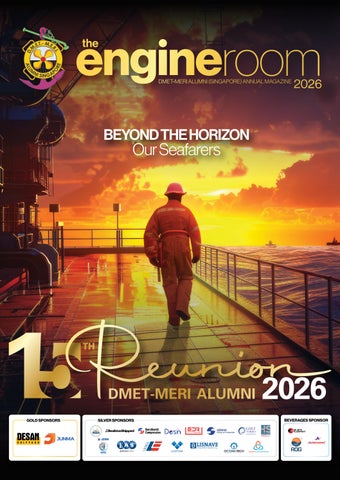
The theme for this year is “Beyond the Horizon Our Seafarers” . Seafarers, who have been braving multiple challenges, form the backbone of global trade, which in turn has been getting increasingly harsh and demanding. Issues such as braving weather or inventing ways to transport cargo across the seas, have become a thing of the past. In today’s era, seafarers are courageously facing a volatile world where geopolitical tensions and military escalations are getting common.
“Sailor, with their built-in sense of
order, service and discipline, should really be running the world.” – Nicholas Monsarrat. His statement very aptly fits the modern seafarer, who gains their wisdom working and travelling with people of diverse cultures, befriending people across the world, bringing essential commodities to households globally in the most economic and efficient manner and thereby serving the world without any bias of their own.
The Year 2025 saw increased focus of alumni on health and sports. DMET Singapore XI Cricket team created some waves amongst the shipping and cricket loving community in Singapore, as they played and performed well in tournaments. Additionally, DMET Dhawaks group was created which
now has more than 35 alumni walking, running and motivating each other.
Inside you will find a mix of technical and non-technical articles contributed by alumni and our valued sponsors. As every year, we have poems, paintings and cartoons from the alumni and their family members which we hope you will enjoy.
Current and past issues of “The Engine Room” can be accessed on Issuu: (https://issuu.com/dmet-meri-alumnisingapore-publishing/docs/) or by scanning the QR code as provided.
Wishing all the seafarers Safe Seas and Happy Voyages Always! ▄
Our Alumni is now online! Look for us and join us on social media platforms by scanning the QR codes below!


Committee
Sanjiv Mishra President
Sanjay Verma Vice President
Kaushik Roy Secretary
Deependra Singh Asst. Secretary
Balaji Krishnamurthy Treasurer
Rupesh Kumar Asst. Treasurer
Kapil Berry Executive Member
Alok Pandey Executive Member
Sunil Anand Roy Executive Member
Pranesh Kumar Executive Member
Vinay Gupta Executive Member
Mrityunjay Singh Executive Member
Associate Committee Members
Rajesh Sapre Arpit Jain

Chief Guest
His Excellency Dr Shilpak Ambule, High Commissioner of India to Singapore
Guest of Honour
Dr. (Mrs.) Malini V Shankar, Vice Chancellor at Indian Maritime University
Hosted by (Emcee) Clince Varghese - India’s award-winning corporate emcee and TV presenter
Main Performers Indian Band - 1st Runner-up of India's Got Talent – Sound of Souls (SOS)
Dance Performances Winner of India's Best Dancer (2023) –Samarpan Lama with Sushmita Tamang
Other Programs Ganesh Vandana – Group performance by the Singapore Indian Fine Arts Society
Lucky Dips – Three rounds Local Performers


Sanjiv Mishra (Roll Number 3806, Class of 1991)
Dear Esteemed Alumni, Honoured Guests, and Valued Partners,
Awarm welcome to the 15th Annual Reunion and Networking Dinner of the DMET–MERI Alumni (Singapore) Association.
This year, we are delighted to host our celebration at the iconic The Ritz-Carlton, Millenia Singapore — a bigger and finer venue for our growing and vibrant alumni community. I hope you enjoy reconnecting and strengthening the bonds that unite us.
Our theme this year, “Beyond the Horizon Our Seafarers,” pays tribute to the men and women who keep global trade moving across oceans despite evolving challenges. We proudly dedicate this evening to their resilience, professionalism, and commitment.
Over the past year, we have continued to organise meaningful events that brought our alumni community closer together.
Highlights of 2025:
• Annual reunion (29th March): We celebrated 14th reunion at the elegant Shangri-La joined by more than 500 guests, alumni, spouses and industry partners.
• Annual General Meeting (8th May): Alumni gathered to review the year’s activities and financial updates.
• Technical Meet (23rd May): Held at M Hotel Singapore with over 125 alumni in attendance. The theme, “Women in Maritime,” featured inspiring discussions, including participation by two lady cadets from our alma mater (IMU Kolkata Campus, erstwhile DMET-MERI)
• DMET Family Day (30th August): Hosted at Stella Seaside Lounge, welcoming nearly 400 alumni and family members for a memorable evening with games, music, drinks and dinner.
• Diwali Movie Show (18th October): We booked an entire hall at Carnival Cinemas for alumni families to enjoy the film Jolly LLB 3, celebrating the festival together.
• Sports Time – Bowling Event (20th November): Organised at Kallang Bowl, followed by dinner at Rocking Rickshaw, combining sport and fellowship.
Beyond our regular engagements, we continued our annual charity commitment with donations to Ramakrishna Mission and Shree Narayana Mission, reaffirming our responsibility toward the wider community.
We are also pleased to expand DMET SG Adda to weekends, with an additional outlet at Anglo Indian Cafe & Bar, where alumni and their families enjoy a 50% discount on F&B — creating yet another platform to connect informally.
I extend my sincere gratitude to our sponsors, partners, and organising committee members whose dedication makes our initiatives possible. Most importantly, I thank each alumnus and family member for being an integral part of this vibrant fraternity.
Let us continue to strengthen our network, celebrate our shared heritage, and carry forward the spirit of maritime professionalism and camaraderie in the years ahead.
Warm regards,
Sanjiv Mishra President DMET–MERI Alumni (Singapore)
Website: dmetalumnisg.com


I am delighted to learn that the DMET–MERI Alumni Annual Reunion will be held on 28th March 2026 at The Ritz-Carlton, Singapore. My warm greetings to the organisers and to all alumni participating in this significant gathering.
Singapore stands as one of the world’s leading maritime hubs, and it is heartening to note the strong presence of graduates from India’s premier marine engineering institution, DMET-MERI, serving across diverse and responsible positions within the maritime ecosystem here. Their professionalism, technical excellence, and leadership continue to strengthen maritime cooperation and reflect the high standards of Indian maritime education and training.
Alumni reunions such as this are a testament to the enduring bonds forged during formative years at one’s alma mater. Having had the privilege of being invited to the annual reunion over the past two years, I have witnessed first-hand the deep camaraderie, shared pride, and abiding affection that unite the alumni community. Such platforms not only celebrate nostalgia but also foster mentorship, collaboration, and collective progress.
As India and Singapore continue to deepen their maritime partnership, the contribution of skilled Indian seafarers and maritime professionals remains invaluable. I commend the DMET–MERI Alumni (Singapore) for sustaining this vibrant network and for upholding the spirit of excellence and integrity in the global maritime domain.
I extend my heartiest congratulations on this occasion and convey my best wishes for the continued success of your association. May the spirit of maritime professionalism and camaraderie grow stronger with each passing year, and may you continue to keep the Indian seafarers’ flag flying high across the seas.
Dr. Shilpak Ambule
High Commissioner of India to Singapore


t is an honor to connect with the global maritime fraternity through this edition of “The Engine Room”.
As we navigate the complexities of a rapidly evolving industry, the DMET-MERI Alumni (Singapore) continues to stand as a testament to the enduring spirit of excellence, resilience, and technical mastery. From the rigorous training at your alma mater to the cutting-edge boardrooms and engine rooms of today, our alumni remain at the heart of global trade.
The maritime landscape is undergoing a profound transformation. As we look toward the horizon, three pillars define

our path forward: Sustainability & Decarbonization, Digital Integration, and of course, the human element.
Singapore serves as a global maritime hub, but the influence of our alumni reaches every corner of the world. This magazine is a celebration of that reach—a bridge connecting the veteran chief engineer, the innovative tech founder, and the aspiring cadet.
To our fellow mariners and industry partners: let us continue to collaborate, innovate, and uphold the high standards that the DMET-MERI name represents. Whether we are face-toface in a Singapore port or connected via these pages, our shared heritage is our greatest strength.
Esteemed Ambassadors of DMET/ MERI/ IMU(KC),
It is with immense pride and honour that I extend my warmest greetings to all the esteemed Alumni. Over the years, the Alumni have emerged as torch bearers of the ethos of DMET-MERI-IMU(KC). Each one of you have made significant contribution to the Society through your perseverance, dedication and work ethics, which have helped you, not only to master the waves and sail into the prestigious positions in your areas of expertise, it has also brought laurels to our institution, reinforcing its reputation for nurturing professional competence, character building and commitment. The mentorship and encouragement provided by our Alumni, across the world, supplemented by their leadership skills and integrity, have always been a source of inspiration for the Cadets at IMU(KC), who surely like to emulate you. I wish to appreciate the concerted efforts of the entire team at DMET-MERI Alumni (Singapore) towards ensuring that the name of our institution continues to hold a place of pride amongst the entire Maritime Fraternity.
Our Campus today is a vibrant hub of academic vigour, innovation and holistic development of Cadets, that transforms a young lad into a professionally competent, confident
and highly resilient Marine Engineer, ready to take on the challenges onboard ships at high sea. Yet, we remain ever mindful that the true strength of IMU(KC) lies in the people who embody its spirit – its Alumni.
At this juncture, I express my gratitude to DMET-MERI Alumni (Singapore) for having sponsored the visit of two Lady Cadets to attend this event last year, which has provided them a wider perspective into the entire gamut of activities in the Maritime sector. May I request for your continued support to the Campus, towards effecting incremental improvements in amenities for the Cadets, be it on training, sports, infrastructure, etc.
I sincerely wish you your Annual signature event, Reunion 2026, a grand success and hope to maintain this healthy rapport with all of you in the years ahead.
Best wishes & Jai Hind !!

By Surabhi Singhal D/O Manish Singhal Roll number 5057 | Class of 2001
eafarers have existed for as long as humanity has looked beyond the shoreline toward distant horizons.
From ancient traders navigating by stars to modern crews guiding massive vessels across digital charts, their presence runs through the history of civilization. References to seafarers appear across cultures, myths, and literature, where the sea is often portrayed as both a giver and a judge, most famously in works such as The Rime of the Ancient Mariner, which captures the isolation, persistence, and moral weight of life at sea.
Seafaring has never been a profession that unfolds in the spotlight. It moves forward quietly, shaped by routines that demand focus and composure rather than applause and recognition. While the world on land follows familiar rhythms, life at sea is measured by steady vigilance, careful coordination, and the constant awareness of what cannot be left unattended.
The horizon is ever-present—a marker of distance, challenge, and continuity. To exist in this space is to accept that impact is often invisible, and that effort matters most when it is unobserved. Ships advance because decisions are made deliberately, without spectacle, and without margin for error. The work continues through countless small, precise choices, each contributing to outcomes far beyond the ship itself.
Generations of seafarers have followed the same quiet code. Skills are honed, systems maintained, and responsibilities met with diligence. The profession carries forward through these repeated acts of attention, care, and steadfast presence, remaining unbroken even as technology and trade evolve.
Modern life assumes continuity. Supplies reach distant lands, systems function without interruption, and expectations are met without thought. That smooth functioning rests on hands and minds operating beyond notice, attending to details most will never witness. It is a labour sustained by presence, focus, and a steady respect for the vast environment in which it unfolds.
The sea offers no applause. It offers only consequence, demanding alertness and measured judgment. In navigating it, seafarers inhabit a space defined not by external approval, but by a constant responsiveness to the conditions around them, a readiness that quietly defines those who navigate it, without spectacle.
Beyond the horizon, our seafarers continue—not as symbols or stories, but as steady constants in a world that often overlooks how much it depends on what remains unseen. The ocean is a moving city, and seafarers are the invisible citizens who keep the world running. ▄
By Junma Services Pte. Ltd.

The Digital Frontier in Marine Engineering
The maritime industry is currently navigating a period of unprecedented technological transformation. As modern vessels become increasingly complex and international environmental regulations grow more stringent, traditional reactive maintenance models are proving insufficient. The integration of industrial Assisted Reality (AR) and Artificial Intelligence (AI) represents a strategic evolution in marine asset management. By bridging the gap between shoreside technical expertise and onboard execution, and by shifting paradigms from scheduled maintenance to condition-based maintenance (CBM), advanced systems are redefining operational reliability in marine engineering.
One of the most persistent challenges in contemporary shipping is the onboard skills gap. High-specification marine equipment requires specialized diagnostic knowledge that may not always be available among the active sailing crew. E’Eye addresses this operational bottleneck by facilitating immediate, live remote assistance through industrial Assisted Reality (AR).
It is crucial to distinguish Assisted Reality from consumer-grade Augmented Reality. While Augmented Reality attempts to overlay complex 3D holograms onto the physical world—often creating visual clutter and requiring high processing power—Assisted Reality prioritizes situational awareness and safety. The E’Eye system utilizes a ruggedized, head-mounted device designed to integrate seamlessly with standard personal protective equipment (PPE). Instead of obstructing the engineer’s field of view, it employs a high-resolution monocular micro-display positioned just below the user’s line of sight. This acts as a “virtual dashboard,” allowing the technician to maintain full eye contact with the physical engine while simultaneously glancing at complex technical schematics, historical engine data, or step-by-step digital workflows.
Crucially, in the extreme high-decibel environment of a ship’s engine room, the system’s advanced noise-cancellation microphone arrays allow for 100% voice-controlled navigation. This completely frees the engineer’s hands to execute mechanical tasks safely. A stabilized, high-definition camera streams a precise “see-what-I-see” first-person
perspective to shoreside experts. Furthermore, real-time, bidirectional speech and text translation algorithms (supporting up to forty-four languages) eliminate the linguistic barriers that frequently complicate international crew operations. This ensures that technical directives are conveyed accurately and executed with surgical precision, reducing misdiagnoses and the costly cycle of guesswork.
While Assisted Reality optimizes the physical execution of maintenance tasks, AI-driven platforms like the JEOS fundamentally alter the decision-making process regarding when and why maintenance occurs. JEOS functions as an intelligent, analytical layer operating in tandem with the existing Engine Management System (EMS).
At its core, the system utilizes advanced Machine Learning (ML) algorithms to continuously ingest and analyze. high-frequency sensor data, including temperature gradients, cylinder pressure fluctuations, and vibration signatures. By establishing a dynamic “digital twin”—a virtual baseline of the engine’s optimal performance—the AI identifies micro-anomalies that precede mechanical degradation. For example, a mathematically subtle increase in fuel consumption, when correlated with specific cylinder pressure deviations, triggers a “Critical Alert.” This predictive capability allows vessel managers to transition fully to Condition-Based Maintenance (CBM), proactively preventing severe damage and maximizing equipment availability to over 99.5%.
Thermodynamic Efficiency and Algorithmic Recommendations
Beyond failure prevention, the AI engine focuses on the Total Cost of Ownership (TCO) by optimizing thermodynamic efficiency. By continuously analyzing the engine’s load diagram against optimal parameters, the system generates actionable insights to refine fuel injection and combustion efficiency. In an industry sensitive to bunker fuel costs and strict Carbon Intensity Indicator (CII) compliance, achieving a 25-35% improvement in operational efficiency is both a significant financial advantage and a regulatory necessity.
The deployment of integrated Assisted Reality and AI systems offers robust architectural advantages for fleet management:

• Decoupled Operational Costs: Historically, technical support required extensive travel budgets and logistical delays. AR remote assistance decentralizes this expertise, allowing senior engineers to diagnose and guide repairs across multiple global vessels simultaneously without leaving the shore base.
• Unified Data Topologies: JEOS ensures effortless connection with existing management systems, preventing data silos. This smooth data flow allows for longitudinal trend analysis, informing better dry-docking strategies and lifecycle resource allocation.
• Risk Mitigation: Early failure detection algorithms prevent catastrophic breakdowns, safeguarding both the
crew and the physical asset, effectively converting stalled repair hours into profitable sailing days.
Looking toward the next decade, the maritime industry is rapidly advancing toward semi-autonomous operations. The future of AI in this sector will rely heavily on “Edge Computing”—processing complex diagnostic data locally on the vessel’s servers to ensure zero-latency responses, even in deep-sea environments with severely constrained satellite bandwidth.
The ultimate trajectory is a closed-loop, self-regulating maintenance ecosystem. In this future state, the AI engine (JEOS) detects anomalous wear; the system instantly pushes a voice-activated digital workflow to the onboard technician’s Assisted Reality micro-display (E’Eye) for preemptive replacement; and the ship’s automated procurement API simultaneously orders the replacement part.
The convergence of hands-free Assisted Reality and intelligent predictive analytics represents a fundamental restructuring of marine engine management. By deploying these technologies, ship owners and managers can navigate the escalating complexities of modern engineering. The transition toward intelligent, data-driven operations ensures enhanced safety parameters, optimized operational costs, and rigorous environmental compliance, establishing a new technical standard for global maritime operations. ▄


Consultancy


By LENOL
Why older gas engines used BN 4-5 oils
For several years, gas fuelled four stroke engines in the marine sector operated successfully with low BN lubricants, typically in the range of BN 4-5. These oils were designed for clean burning fuels such as natural gas, which contain almost no sulphur and therefore produce little sulphuric acid during combustion. They operated at lower mean effective pressures and lower combustion temperatures, so the lubricant was exposed to less thermal stress than in modern gas engines. Under these conditions, a low BN was sufficient, and keeping the sulphated ash content extremely low was the top priority to avoid deposit formation in the combustion chamber. The lubrication strategy was straightforward: low BN, extremely low ash, minimal neutralization needed.
Why modern gas engines require higher BN
Today, however, engine design and operating conditions have changed. Modern gas engines run at higher temperatures, higher pressures and with lean burn combustion strategies that increase thermal stress on the lubricant. Extended oil change intervals increase the stress on the lubricant further. These conditions generate more oxidation and nitration-based acids, which require a higher neutralization reserve. As a result, lubricants with BN 7 have become the preferred choice.
BN 7 oils are also beneficial for older gas engines
BN 7 oils are fully compatible with older engine designs and can be used in them without modification. The higher BN provides more neutralization reserve, allowing for longer operating hours between oil changes, reduced maintenance costs, and improved stability of the oil condition over time. Even older engines today often run at higher loads, with longer continuous operation and under higher thermal stress. BN 7 oils offer better resistance to oxidation and nitration for older gas engines running in modern conditions. Another advantage is that operation on distillate fuel is possible for a limited time. If the engine primarily burns gas, BN 7 oils allow for safe operation on distillate pilot fuel without the corrosion risk that BN 4-5 oils would face and without increasing deposit formation. This flexibility was not available with older BN 4-5 oils.
The move from BN 4-5 to new BN 7 in gas engine oils is driven by the evolution of engine technology. Higher BN oils offer better corrosion protection, longer oil drain intervals, and improved stability under high temperature conditions –all while maintaining the ultra low ash levels (≤0.5%) required for clean gas combustion.
For both modern and older gas engines, BN 7 oils represent a clear improvement in performance, protection, and operational flexibility.

By DMET Samvaad Team
Kolkata, 19 February 2026
The Association of Ex-Cadets of DMET (AECDMET), Kolkata, sponsored the first Internal Hardware Hackathon – Stage I, conducted from 7 to 14 February 2026. This screening phase was designed to identify first-year cadets possessing the aptitude, creativity, and hands-on capability required for sensor integration and data acquisition in real-world applications.
Seventy cadets, organised into fourteen teams of five, participated with remarkable enthusiasm. Each team was provided with standardised equipment — ESP-32 microcontroller, two BMP280 digital pressure sensors, HC-SR04 ultrasonic module, IR sensor, perforated PCBs, headers, wire, resistors and basic tools — to build a fully functional Data Acquisition System (DAQ). The objectives were deliberately rigorous: all sensors operating simultaneously within acceptable ranges, professional soldering on perforated boards, CSV data logging, real-time data visualisation, wireless transmission, and CAD design of a suitable PCB.
Evaluation was comprehensive and multi-layered, conducted under the close supervision of faculty mentors and senior cadets. Teams were graded on safety practices, sensor


functionality, data validity, visualisation quality, soldering excellence, and advanced features such as non-Python visualisation environments and wireless capability. Thirteen of the fourteen teams successfully delivered working prototypes, with several achieving Distinction and High Distinction grades. The level of competition among the top ten teams was exceptionally high, reflecting the depth of talent uncovered during the week.
Particularly noteworthy were the diverse technical approaches. Most teams employed SPI/I2C protocols for sensor interfacing and ADC for analogue inputs. Data logging was predominantly achieved through Python scripts, while visualisation ranged from elegant HTML/JavaScript web dashboards with real-time graphing to sophisticated Python implementations using Tkinter and Matplotlib. Wireless transmission and custom PCB designs further distinguished the highest-performing groups.
Cadets who qualified for distinction grade based on the evaluation criteria are awarded Certificates of merit. All other participants issued participation certificates.


The event was made possible through a generous grant of ₹ 20,000 from AECDMET, which covered all components, tools and certificates. This investment has already yielded impressive returns in the form of motivated, skilled young engineers ready to tackle Stage II the actual engine test-rig monitoring project.
Outstanding individual performers who narrowly missed team selection due to collective team dynamics were recognised with “Individual Excellence” awards and granted
Wild Card entry into Stage II, ensuring that exceptional talent is not lost.
Cadets were behind the planning, organizing and executing the event across the batches from 4th to 2nd Year. They include – Ronit Bal (2022-2026); Pranav Amit Prasad and Ashmit Jaiswal (2023-2027); Shivam Mourya and Abhinav Krishna (2024-2028).
We plan to conduct similar hands-on work shops and hackathons in future on a range of skill sets. ▄


By Advait Thakur | Roll Number 8565 | Class of 2022 and Ritbik Kumar | Roll Number 8923 | Class
he shipping industry has long been a cornerstone of world trade and economy. Throughout centuries, the industry has witnessed transitions aimed at improving efficiency without compromising the environment’s safety. Balancing economic efficiency with environmental responsibility has remained one of its greatest challenges. The engineering complexity of vessel dynamics and operations creates one of the most constrained optimization challenges in global supply chains. Despite these challenges, the shipping industry is one of the most efficient and cost-effective solutions to global supply chains, but it remains one of the key contributors to global carbon emissions, about 2-3% of global GHG emissions. The International Maritime Organization (IMO) serves as the industry’s primary global regulator, setting standards to reduce its environmental footprint.
Life-cycle thinking is essential in shipping because it shifts decarbonization from isolated fuel combustion metrics to a system-wide accountability framework that integrates fuel sourcing, vessel operations, human capacity, and economic incentives.
The strong initiatives in terms of “net-zero GHG emissions from shipping by or around 2050” have been a crucial steppingstone in motivating the stakeholders to adopt greener approaches to operate the industry. The advent of alternate fuels and more energy-efficient designs to improve the EEDI and EEOI of the fleets has been one of the critical indicators of success. Historically, most regulatory
measures focused on a tank-to-wake approach, addressing emissions generated during onboard fuel combustion. The MEPC’s adoption of LCA Guidelines on the Life Cycle GHG Intensity of Marine Fuels represents a crucial step in transforming the way we think of ‘sustainability’ initiatives. IMO, in its adoption has emphasized on creating ‘Fuel Lifecycle Label (FLL)’ carrying information on feedstock, production/ processing routes, emission factors with ‘well-to-wake’ approach that calls for accounting emissions across life cycle stages from fuel sourcing, production and to use.
A critical dimension of implementing carbon-reduction policies lies in evaluating how prepared seafarers are to manage this transformation. As the industry moves toward LCA based sustainability frameworks, the responsibilities of onboard personnel will expand beyond routine operations to include greater data awareness, fuel traceability, and environmentally informed decision-making. Encouragingly, recent developments demonstrate the sector’s adaptive capacity. The induction of alternative-fuel-powered vessels, specialized training programs, and the integration of smart engines and advanced control systems have shown that crews can effectively assimilate innovative technologies into everyday shipboard practice.
The transition from heavy fuel oil to low-Sulphur fuels, and increasingly toward biofuels and other alternatives, has been achieved through structured procedures and continuous learning. Although technical and operational challenges have emerged, they have served as opportunities for
refinement rather than setbacks. Looking ahead, the success of LCA implementation will depend not only on regulatory frameworks but also on empowering seafarers as active sustainability contributors. With targeted training and transparent data systems, crews can play a decisive role in ensuring that environmental ambitions translate into safe, efficient, and practical maritime operations. However, effective LCA implementation also requires a broader rethinking of sustainability beyond fuel choice alone.
It is also necessary to think ‘sustainability’ as a broad system as a complex function of energy source, land and water use, biodiversity, chemicals, and waste etc. This transformative approach enables the identification of technological and operational innovation opportunities for building and adopting technology that gets us closer to more sustainable shipping. While carbon and water-negative goals are foundational, they are often too abstract for immediate operational change. Moving beyond “carbon-negative” slogans requires a shift toward radical, data-driven transparency. By implementing initiatives like “Fuel Life Cycle” and going beyond it, and having standardized “Cargo or Ship Labels,” the industry can transform abstract goals into actionable metrics.
Much like food labels allow consumers to monitor their diet and conclusive health, a Digital Ship/Cargo Passport or Labels could provide a transparent record of a vessel’s
environmental impact - covering route efficiency, capacity utilization, and lifecycle sustainability. This framework shifts the maritime industry from passive compliance to active stewardship, ensuring the ocean-cargo-climate nexus is protected through the same level of scrutiny we apply to our own well-being. Meaningful implementation depends significantly on the operational competence of onboard personnel. When seafarers are trained in data management and carbon tools, they stop being just “crew” and become Sustainability Stewards. Their first-hand expertise ensures that green technologies work in the middle of the ocean, not just on a computer screen.
For shipowners, this creates both environmental and economic value. A trained crew using real-time Life Cycle Assessment (LCA) would help integrate operational realities in alternative technology adoption such as alternative fuels; shipowners and companies could essentially “mint” carbon offsets by leveraging onboard experience to figure out the best alternative technologies or best marginal abatement curve (when it comes to GHG emissions). This shift could catalyze the professional development in seafarers and rebrand them as a high-value professional in this climate-aware economy and help shipowners transforming the crew’s expertise into a financial asset, ensuring our oceans stay clean while making the shipping business smarter and more profitable. ▄


By Santosh Tiwari |
The IMO’s life-cycle GHG guidelines and CII regime shift the focus from theoretical design efficiency to real-world, well-to-wake emissions per transport work. For many existing ships, especially deep-sea tonnage, bio-methane (Bio-LNG), bio-methanol and ethanol blends are among the few options that can be deployed immediately without major engine or hull modifications..
Biomethane liquified into Bio-LNG for maritime use could meet 3% of the total energy demand for shipping fuel in 2030 and 13% in 2050. As a drop-in fuel blended with fossil LNG, bio-LNG could meet 16% in 2030 and 63% in 2050 with 20% blending ratio. When the value chains are optimised, it can deliver negative emissions.
Liquefied biomethane can be used as Bio-LNG in the same engines and bunkering systems as fossil LNG, turning today’s LNG-ready fleet into a platform for rapid GHGintensity reduction.
Bio-LNG produced from waste streams can cut well-towake GHG emissions by up to about 80% compared with conventional fuel oil while almost eliminating SOx and particulates, directly improving both climate performance and local air quality. Sustainable biodiesel or ethanol-based blends at 20–30% can typically reduce well-to-wake carbon intensity by 15–20%, enough in some cases to move a ship’s CII from an E to a C rating in a single year.
Biogas-derived bio-methanol and advanced ethanol fuels complement biomethane by targeting different engine technologies and trading patterns. Bio-methanol can be produced from the same biogas feedstocks as Bio-LNG, sharing the low-ILUC, waste-based sustainability profile while serving two-stroke methanol engines now entering the market.
For existing liquid-fuel engines, ethanol and FAME blends up to around 30% can be used as drop-in fuels, delivering
double-digit percentage reductions in well-to-wake emissions and thus in reported CII carbon intensity. Emerging IMO and flag-state guidance clarifies that only biofuels with certified full life-cycle reductions (often at least 65% vs marine gas oil) may claim a lower Cf in CII, underlining the importance of robust sustainability certification.
1. Bunkering infrastructure is a major challenge in uptake of the Biofuels. Currently, 185 ports have LNG infrastructure in place. Infrastructure expansion is expected to take another 5-7 years to attain the infrastructure maturity.
2. Digitalization: The complexity of multiple fuels, blend ratios, certificates and routes makes digitalization indispensable; spreadsheets cannot keep pace with evolving CII, FuelEU Maritime and ETS rules. Modern voyage and fleet-level optimisation platforms can ingest high-frequency operational data (speed, draught, weather), fuel-flow measurements and certified well-to-wake intensities for each bio-fuel batch, then simulate how different biomethane and ethanol-blend strategies will affect CII ratings and cost over multi-year horizons.
Digital fuel-and-emissions workbenches, often connected to verification services, validate bunker delivery data, automate application of the correct Cf for each certified biofuel, and generate compliant IMO DCS and CII reports.
For a typical container ship or tanker, a pragmatic pathway might start by introducing 20–30% certified ethanol or FAME blends on selected routes, capturing immediate 15–20% carbon-intensity reductions and stabilising CII ratings while digital tools track performance and costs.
Under MEPC.1/Circ.905, biofuels can improve a ship’s CII only if they are treated as a distinct fuel with a certified, lower CO2 conversion factor (Cf) derived from full well-to-wake performance.
1. Prove the biofuel is “sustainable”
i. Use a recognised sustainability certification scheme (e.g. ISCC, RSB or other schemes listed under ICAO CORSIA) for each biofuel batch.
ii. Ensure the certificate states the fuel’s well-towake GHG intensity in gCO2e/MJ and confirms at least 65% GHG reduction versus fossil MGO of 94–95 gCO2e/MJ (i.e. ≤33 gCO2e/MJ).
iii. Keep “Proof of Sustainability” together with the Bunker Delivery Note (BDN); this documentation must be available for verifier and Flag/RO audits.
If a biofuel is not certified, or does not reach the 65% reduction threshold, it must be treated as the equivalent fossil fuel (no CII benefit).
2. Calculate the CO ₂ conversion factor (Cf)
i. Take the well-to-wake GHG intensity from the certificate (gCO2e/MJ).
ii. Multiply it by the fuel’s lower calorific value (LCV) in MJ/g to obtain Cf in gCO2e/g fuel:
Cf=GHG intensity×LCV
iii. For blends (e.g. B30, FAME/MGO, bio-LNG/LNG), calculate a weighted average Cf based on each component’s energy share.
This Cf replaces the default value in the CII Guidelines for the corresponding quantity of certified biofuel consumed.
Our experienced and skilled divers know the hull of a ship like the back of their hands. We can repair, remove or install a range of underwater equipment.
Our services include:
• Underwater hull cleaning and propeller polishing;
• ROV solutions for Inspections and Hull Cleaning with fouling reclaim;
• Underwater Repair solutions, UT gauging;
• PBCF installations;
• Class In-Water Surveys.
• Offshore drilling operational solutions. 2.
We extend our services to include a range of marine and decarbonization expertise:
• CII, AER & SEEMP III preparation;
• Plan approvals of ship design for ship owners;
• Full suite of vessel performance solutions;
• Techno-commercial feasibility studies and implementation;
• New build, retrofit and drydocking project management; and
If you’d like to find out more, then p please get in touch:
200
#14-03B
3. Record and report correctly in DCS/CII
i. In fuel-consumption monitoring systems and noon reports, record certified biofuels as separate fuel types, with volumes/tonnes and associated Cf used for emissions calculations.
ii. Ensure the DCS annual report and CII calculation apply:
• certified biofuel tons × certified Cf;
• fossil fuel tons × default Cf;
• blended fuels × weighted-average Cf based on energy.
iii. Keep a clear audit trail linking each bunker stem (BDN), its sustainability certificate, the Cf used, and the voyage/period over which it was consumed.
4. Use digital tools to industrialize the process
i. Implement digital fuel-management and emissions platforms that can ingest BDNs and certificates, automatically calculate Cf from GHG intensity and LCV, and apply it per voyage in CII simulations.
ii. Configure dashboards to show the CII impact of switching between fossil fuel, certified bio-methane/Bio-LNG, ethanol or biodiesel blends, enabling evidence-based decisions on fuel strategy and charter-party commitments.
By ensuring biofuels are properly certified, quantified and digitally integrated into emissions reporting, owners can legitimately lower calculated carbon intensity and improve CII ratings while aligning with the IMO’s interim guidance.. ▄


Viswa delivers that precision. Through a global laboratory network and highly experienced marine specialists, Viswa provides independent, data-driven insight that helps shipowners, operators, and technical managers mitigate risk, optimise performance, and protect high-value assets - at sea and ashore.
WHY VISWA:
A Partner - Not Just a Service Provider
• Over 30 Years of Maritime Technical Expertise
• Trusted by Global Shipowners & Operators
• Independent, Accurate & Actionable Technical Insight
• Early Risk Detection. Preventive Intelligence. Solution based Approach.
• Supporting Conventional & Alternative Fuel Ecosystems
THE DIFFERENCE
Viswa does not merely test samples.
• It delivers clarity.
• It reduces uncertainty.
• It strengthens technical decisions that protect vessels and profitability.


Fuel & Alternative Fuel Testing : Comprehensive analysis of conventional and emerging marine fuels to detect contamination, incompatibility risks, stability concerns, and performanceimpacting variables - before they affect your engines.
Lube Oil Testing : Advanced lubricant diagnostics that protect critical machinery, reduce wear rates, extend component life, and enable predictive maintenance planning.

Water Testing : Precise evaluation of onboard water systems and potable water for crew safety, for MEPC regulatory compliance of scrubber water systems and VGP and IMO regulatory compliance of ballast water systems.
Bunker Quantity Surveys (BQS) : Independent fuel quantity verification ensuring transparency and quantity reliability during bunker transfers and Remaining On Board surveys.


VSIP – Vessel Savings Initiative Program : Operational inefficiencies during fuel procurement, consumption, and lubrication management often remain invisible - but are very costly. VSIP identifies measurable optimisation opportunities across fuel and lube cycles, helping operators unlock significant cost savings while improving vessel efficiency and environmental performance.
Global Presence. Local Expertise. Supporting fleets worldwide through strategically located laboratories and technical specialists.
LOCATIONS : USA | UK | UAE | Singapore | China | India | Belgium | Cyprus
CONTACT US : www.theviswagroup.com info@theviswagroup.com Precision Today. Performance Tomorrow.
By Viswa Group
The global marine bunker fuel industry supplies about 300 million metric tonnes of fuel each year to 60,000 vessels. At $650 per metric ton, the market is worth $195 billion. Losses from short supply and poor fuel quality is estimated at 4%, or about $8 billion annually.
The supply chain involves refineries, storage terminals, suppliers, bunker barges, and vessels. Fuel quality affects engine performance, compliance, reliability, and safety. Limited transparency at custody transfer points can cause contamination, adulteration, blending errors, and quantity shortages, leading to engine damage, downtime, higher costs, and disputes.
Blockchain provides a decentralized, tamper-proof ledger that records fuel quality and quantity at every transfer point, improving transparency, traceability, and integrity.
Blockchain Technology – What is it?
Blockchain is a distributed ledger where data is securely stored across a network of computers (nodes), each holding a copy of the ledger. Data is organized into chronologically linked blocks using cryptographic hashes, ensuring integrity and immutability.
Once recorded, data cannot be changed without network consensus. Authorized users can access transactions, while cryptography protects against fraud and cyber threats. Its decentralized design makes blockchain ideal for industries requiring high transparency and tamper resistance.
Custody Transfer Points in the Bunker Fuel Industry
Custody transfer is the legal and physical transfer of fuel from one party to another. Accurate measurement, quality control, and regulatory compliance are critical at each stage.
Typically, there are four custody transfer points:
• Enhanced Reliability
• Data Integrity
• Streamlined Processes
• Traceability
• Clear Documentation
Blockchain in Bunker Fuel Industry
– How does it work?
• Agreement between all parties
• Analysis of fuel oil samples at all Custody Transfer Points
• Data upload to the Blockchain ledger
• Comparison of Results
Conclusion
Blockchain technology strengthens the bunker fuel supply chain by improving transparency, traceability, and data integrity. With immutable records, real-time monitoring, and automated compliance, it helps prevent contamination, quantity discrepancies, and costly engine damage.
Beyond Financial benefits, blockchain enhances operational reliability and maritime safety by reducing unexpected machinery failures. By building trust, ensuring compliance, and lowering operational risk, it supports a more resilient and efficient bunker fuel ecosystem. ▄


By Uttam Kumar | Roll Number 5461 | Class of 2004
Not long ago, ship crews had to walk up to the bridge just to make a phone call. Personal emails could be read by the Master of the Vessel, and staying connected with loved ones meant waiting for the weekend to make expensive calls. I still remember when email first became mainstream during my early years at sea - it felt revolutionary.
Technology is transforming our lives at an unprecedented pace. Even in the maritime industry, traditionally viewed as slow to adopt change, digital advancements are reshaping operations at sea and on shore.
For today’s cadets, uninterrupted connectivity is normal. For many of us who sailed two decades ago, it was unimaginable. We have personal emails, real-time video calls, AI-assisted navigation, digital twins, and automation optimizing every aspect of maritime operations. But with all this progress comes a critical challenge: How do we ensure that seafarers and shore teams not only cope with these changes but truly benefit from them - while mitigating the downsides?
The last 25 years have dramatically accelerated technological change in maritime. Automation, data-driven decision-making, and AI-enabled workflows are redefining maritime operations. Yet these advancements come with concerns:
• Information Overload & Resistance – The rapid shift to digital systems can be overwhelming.
• Skills Gap – Not everyone has the training or confidence to use new tools effectively.
• Connectivity vs. Isolation – While technology keeps us connected, excessive reliance can lead to social disconnect.
• Cybersecurity Risks – More technology means greater exposure to cyber threats.
We often speak about innovation for the people. But are we ensuring that seafarers and maritime professionals have the right resources to embrace digital transformation in a way that enhances their well-being rather than adding pressure?
The industry is already integrating technology across vessels and shore operations, but we must go further. A people-first, community-driven approach is essential to making this transition successful. Digital transformation cannot be driven by one entity alone. It requires coordinated action across the entire maritime ecosystem:
Governments
Invest in better satellite and 5G networks to ensure stable, affordable connectivity for seafarers.
• Standardize global digital training programs, like STCW, for seamless skill development.
• Provide tax incentives for companies investing in maritime technology adoption and crew training.
• Promote cybersecurity awareness and implement stronger data protection laws.
Education Systems
• Update maritime training curriculums to include AI, automation, and digital literacy.
• Integrate AR/VR into onboard training to simulate real-life scenarios.


Continued from Page 35
• Equip cadets with skills to analyze real-time vessel performance data.
• Encourage collaborations between tech companies and maritime universities.
Companies
• Establish structured upskilling initiatives and on-demand digital help desks for crew and shore employees.
• Encourage strong digital leadership at all levels.
• Simplify IT processes to reduce frustration and improve adoption.
• Foster a culture of innovation while balancing work-life well-being.
Regulators
• Set up maritime AI ethics & cybersecurity frameworks.
• Mandate digital safety and cyber awareness training.
• Introduce a Digital Maturity Index to encourage positive reinforcement.
• Establish industry-wide digital well-being guidelines to mitigate screen fatigue and social media overuse.
Communities
• Develop Maritime Tech Knowledge Hubs to facilitate industry-wide learning.
• Create open-source digital tools accessible to all maritime professionals.
• Promote digital well-being by organizing mental health support groups and mentorship programs.
Individuals
• Proactively invest in learning new digital skills.
• Support colleagues through mentorship and knowledge-sharing.
• Balance online connectivity with real-world interactions both at sea and ashore.
Technology as an Enabler, Not a Replacement Technology is revolutionizing maritime operations, but people remain at the core of progress. Digital tools are enablers - not replacements. Their true value lies not in automation alone, but in how effectively they support the judgment, resilience, and expertise of industry professionals. True success lies not just in deploying technology, but in ensuring that those who operate it feel empowered, supported, and valued.
From predictive maintenance powered by digital twins to remote inspections and AI-assisted navigation, the shift is already well underway.
By fostering a forward-looking digital maritime ecosystem, we can turn digital disruption into empowerment. The future of maritime will not be defined by artificial intelligence alone, but by how intelligently we empower the humans behind it. ▄


By Rupesh Kumar | Roll number 5313 | Class of 2003

Life at sea is both demanding and rewarding. In the maritime industry, crew wellness is not just a matter of personal health, it’s a cornerstone of operational safety and efficiency. Seafarers operate in one of the most challenging professional environments, spending extended periods away from family while managing complex ship operations including long periods of isolation, extended contracts, and limited access to support systems. These factors can significantly impact morale, performance, and overall well-being.
Life at sea can be mentally and emotionally taxing. Prolonged isolation and demanding schedules contribute to stress and fatigue, which in turn affect safety and productivity. Recognizing this, the industry is increasingly prioritizing crew care through structured wellness initiatives.
Maintaining physical health is essential. This includes:
• Ensuring balanced nutrition and clean water supply
• Providing access to medical care and fitness facilities
• Enforcing proper rest hours to prevent fatigue
• Conducting regular health checks and upholding hygiene standards
Mental health support is equally critical. Key measures include:
• Tackling loneliness and isolation during long voyages
• Offering mental health helplines and support resources.
• Encouraging open dialogue and a supportive onboard culture
• Facilitating internet access for communication with loved ones
A positive onboard culture enhances well-being. Strategies involve:
• Promoting teamwork and mutual respect among diverse multinational crews
• Organizing recreational activities, social events and celebrations
• Ensuring transparent leadership and fair treatment
• Implementing wellness training and feedback systems
By fostering a holistic approach to wellness, the maritime industry can ensure that crew members are not only safe but also supported—physically, mentally, and emotionally.


By Pranesh Kumar Roll number 5171 | Class of 2002


In this article I have tried to put together my thoughts as to how seafarers’ journey has evolved over the past many decades and how it would possibly take shape as we enter 2050 and beyond. We must better understand how the marine business needs to change to keep the sailors who are so important for global trade and commerce by learning about their past, present, and future.
The Past: Seafarers of Endurance and Practical Seamanship
For most of the 20th century, being a sailor meant being physically strong and having practical skills. All of the work on ships was hard and required strong muscles to move objects, run and fix the engines, handle the cargo equipment, and do many other activities that required power and stamina.
Communication with home was a joy as it was rarely achieved and delayed. Seafarers often spent months at sea without meaningful contact with their families.
Despite these hardships, seafarers developed strong professional identities built on discipline, teamwork, and resilience.
This generation of seafarers formed the backbone of global shipping during the expansion of international trade in the late twentieth century.
This generation of seafarers formed the backbone of global shipping during the expansion of international trade in the late twentieth century.
The Present: A Profession Under Pressure
Today’s seafarers operate some of the most technologically advanced transport systems in the world. Ships are equipped with integrated bridge systems, automated engine monitoring, satellite navigation, and global communication networks. Internet of Things, Smart ships, live data transfer to and from vessels etc etc and lists goes on to present a picture of how technologically advanced and digitally connected, today’s ships are.
Mental Health and Wellbeing
Life at sea remains physically and psychologically demanding. Long working hours, fatigue, isolation, and limited shore leave can significantly affect wellbeing.
Recent research suggests that 38.8% of seafarers show signs of depression and 56.7% experience symptoms of anxiety, highlighting the psychological challenges associated with maritime work.
At the same time, the industry faces a growing recruitment challenge. According to global workforce forecasts, the maritime industry may require nearly 90,000 additional officers by 2026 to operate the expanding global fleet.
Younger people are less interested in sailing since they have to be away from home for long periods of time and also work long hours. This has forced the industry to rethink how it attracts and keeps talent.


Windlass & Mooring winches.
All
Deck cranes
Free fall davits
Rescue boat davits
Steering systems
VRCS systems
Marine
Framo pumps
All marine Electrical panels building, troubleshooting & commissioning.
Marine Engines Two stroke & Four Stroke


VOYAGE REPAIRS - WORLD WIDE
STEEL & PIPE FABRICATION & INSTALLATION
MAIN ENGINE 3D SCANNING ENGINE SERVICE
SPARES & EQUIPMENT SUPPLY
BWTS 3D SCANNING AND INSTALLATION ELECTRICAL & INSTRUMENTATION
MECHANICAL WORKS
CTS Offshore and Marine (CTS) delivers a comprehensive range of engineered and cost-effective asset integrity solutions for the offshore and marine industries worldwide. Headquartered in London (UK), CTS’s presence spans regional offices and operational centers located in Singapore, UAE, India, Malaysia, Romania, Netherlands, Bulgaria and Brazil.
We have over 25 years of experience, good safety record with accredited safety and quality system through our global network of strategically located offices
Mission to be the best and biggest service provider in our sector to the Offshore Oil and Gas and Marine sector. We pride ourselves as being competitive, innovative, delivery on time and on budget, with no down time. Also assist to fast track projects to accelerate asset earnings and return on investments.
CTS provides services safely and professionally with dedicated, capable, committed and experienced team of veterans from the same industry.

Continued from Page 43
Looking toward the future, the maritime industry is entering a period of rapid transformation driven by technology and environmental regulation.
Automation and Smart Ships
Automation, artificial intelligence, and advanced sensor systems are transforming ship operations. These technologies will reduce routine manual tasks (No more ABs needed !! – we will see) but increase the complexity of decision-making.
Seafarers will increasingly act as system supervisors and data interpreters, overseeing automated equipment rather than manually operating machinery.
Decarbonisation and Alternative Fuels
Shipping is undergoing a major transition toward cleaner fuels such as LNG, ammonia, hydrogen, and methanol. These fuels require new safety procedures, operational practices, and specialized technical knowledge.
Industry research indicates that over 80% of seafarers believe they need additional training to manage new technologies that are being used in the maritime sector.
Digital Skills and Cybersecurity
Ships are becoming increasingly connected through

satellite networks and digital platforms. While connectivity improves efficiency and communication, it also introduces cybersecurity risks.
Future seafarers will need digital literacy, data analysis skills, and an understanding of cybersecurity threats to safeguard maritime operations.
Human–Machine
Even in highly automated vessels, humans will remain essential. Autonomous systems may assist navigation and engineering functions, but human judgement will continue to play a critical role in safety, emergency response, and complex decision-making.
To meet these challenges, maritime training systems must evolve rapidly.
Future maritime education will focus on:
• Digital navigation and automation management
• Alternative fuel technologies
• Cybersecurity awareness
• Data analytics and decision-support systems
• Simulation-based training and continuous professional development ▄


Why the next chapter of digital navigation starts with choosing the right ECDIS backbone?
By Nikhil Dravid | Product Sales Manager, Wartsila

The IMO’s S-100 framework marks the biggest shift in digital navigation since ECDIS became mandatory. However, this transition is not simply about adopting a new chart standard. It is about preparing the bridge, the systems, and the people for a more data rich, connected and operationally demanding era.
S 100 is not a format change. It is an architectural change. It demands hardware that can evolve, software that can adapt, and workflows that can support a more dynamic flow of information than ever before.
Digital navigation is becoming a connected ecosystem. In today’s operations, fragmented tools and disconnected workflows add pressure where clarity is important. That is why choosing an ECDIS, designed as a digital navigation backbone, becomes particularly important for modern ships. S 100 compatible hardware with cost efficient upgrade paths to meet regulatory timelines and beyond, helps support safe and compliant voyages on thousands of vessels worldwide.
A connected ECDIS becomes more than a bridge tool. It becomes an operational hub. Real time updates, ship shore integration, remote diagnostics, and data driven decision support transform ECDIS into a platform that underpins compliance, efficiency, and long term fleet readiness.
Future proofing also means people proofing: Digital navigation requires digital competence. This evolution with simulation networks and type specific online training, helps in crews’ transition - smoothly and confidently.
S 100 is a catalyst for more than compliance: A connected, future ready ECDIS unlocks better voyage planning, tighter ETA predictability, optimised fuel use, and reduced emissions, turning regulation into opportunity, not burden.
The path forward: S 100 will redefine how fleets navigate. Explore how your fleet can prepare for S 100 and beyond. ▄


At sea and ashore, Synergy has proudly and successfully engaged a great many DMET alumni. Here then. Here now. Here always. Carry the legacy.


By Joyashish Basu Roy S/O Jagadendu Basu Roy Roll number 5399 | Class of 2004
Along long time ago when the universe was really young there was a big glowing blob. This cloud was called a Lyman-alpha blob. It was huge. So huge that you could fit hundreds of galaxies inside it. The blob was not empty at all, it was a home and a birth-pace for many galaxies and stars.
Inside the blob, the small galaxies were spinning and moving trying to get stronger and brighter. Stars were twinkling with all their might spreading goodness and warmth. Quasars were sending out beams of energy that made the whole blob brighter. Dark matter was also there, quiet and invisible making sure that everything had room to move, just like the cytoplasm of a cell. (If you come to think of it, the entire universe is just like an extended version of a cell, the basic unit of life)
The blob liked watching all of this. It said, “Grow, galaxies. Shine, stars.” Someone will eventually notice my light and wonder how the universe came into being.

Then suddenly the blob felt restless. Inside, the galaxies were fighting for space. They were exploding too quickly. The blob was afraid it would crumble. The stars became fainter. The galaxies feared they would never become more powerful.
Then out of sheer luck, powerful quasars emitted a beam of radiation that illuminated the entire globe. This energy was used by the stars to shine brighter than before. Together, the galaxies began to move. The blob radiated a light so intense it could be seen for millions of light years.
A long time later when humans invented the telescope and saw the blobs faint light. They realized that the universe was more diverse than they ever thought.
The Lyman-alpha blob was happy because it had survived its times and kept its promise. The Lyman-alpha blob was proud of what it had done. ▄


By Sumedha Singh D/O Shashank Kumar | Roll number 5001 | Class of 2001
There was a time when childhood was a closed-door experience. If you were a child of the eighties or nineties, your most embarrassing moments or beloved memories are all trapped in physical photo albums, tucked away in dusty cupboards. These memories are private property, shared only with those you invited into your living room. Today, that door has been swung wide. In our current era, the “private” childhood has nearly vanished, replaced by a life lived — from its very inception — in the public eye.
Every generation is shaped by the technologies it inherits. The children of the eighties grew up with landlines and limited TV channels; the children of the nineties witnessed the rise of home computers and early chatrooms. Today’s children are shaped by platforms that collapse distance and create outreach. Through social media, they are not just growing up online; they are growing up with an audience. That audience can feel intrusive. A child’s digital footprint often begins before they can spell their own name, curated by well-meaning parents who share milestones out of pride and affection. In many households, this has introduced new negotiations: Who gets to post what? At what age should a child have power over their image and decisions? Is a family moment still intimate once it is public?
A teenager passionate about astronomy, coding, or digital art can now find mentors and collaborators across continents.
Where previous generations navigated difference in isolation, today’s children can find communities that reflect who they are. A child questioning their identity can encounter stories that resonate within seconds. Another child with an obscure hobby can discover thousands of people who share it. Creative tools that once required studios now sit in our pockets. The power of expression is available to everyone from the comfort of their home.
This duality of exposure and empowerment sits at the heart of modern childhood.
The tension often surfaces within families. Parents who grew up with an offline adolescence may view the internet as a space of risk, while we children see it as a space of belonging. Disagreements about screen time or social media are rarely about devices. They are about values: independence, safety, trust, and autonomy.
But what is most significant is not that childhood is more public, but that it is more permanent. In earlier decades, embarrassment faded with time. Today, the past can resurface with a search bar. Yet this permanence also encourages a different kind of self-awareness. A childhood mistake that once faded in the schoolyard can now live indefinitely in a digital archive. Children learn media literacy instinctively, curating their presence with a sophistication that would have seemed improbable a generation ago. They understand that identity, online and offline, may be constructed.
It is also crucial to realize that despite the algorithms and archives, the essential work of growing up, testing boundaries, and forming identity remains the same. Childhood remains childhood.
Private childhood has not disappeared; it has simply shrunk, sharing space with a new public layer of experience. Families are not abandoning intimacy but renegotiating it. We are learning how to balance connection with consent and memory with respect.
The difference is not that one generation had it easier or harder. It is that each generation inherits a distinct experience to overcome. Ours happens to be navigating through online media. The challenge for this generation is not escaping the digital world but learning how to grow up wisely within it.


From 20 September to 4 October 2025 , three proud survivors of the DMET Class of 1972 — now considerably wiser (and marginally slower on staircases) — set sail with their better halves on a 14-day Baltic & Scandinavian Capitals cruise aboard the elegant M.S. Rotterdam
The voyagers were:
Rajan Bhandari (1495) & Poonam, Rajaish Bajpaee (1487) & Vandana, Sudhir Kumar Gupta (1505) & Nita.
Together, they cruised through the postcard-perfect landscapes of Norway, Denmark, Germany, Estonia, Finland, and Sweden , discovering fjords, palaces, cobbled streets, and—most importantly—buffets.
A special highlight was meeting batchmate Surinder Singh (1479) and his wife Amardeep, along with their son settled near Oslo. Nothing beats meeting an old friend in a new country and immediately picking up the conversation exactly where it was left… in 1972

Onboard, the days were filled with laughter, stories of hostel mischief, tales of professors both feared and fondly remembered, and updates on children, grandchildren, knees, and cholesterol levels. The spouses, meanwhile, quietly confirmed many long-suspected facts about their husbands’ student lives.
The weather behaved beautifully, the food was dangerously excellent, and the cruise itself was organised with military precision by Sudhir Gupta — proving that once a Mess Committee Chairman, always a Mess Committee Chairman.
In fact, nearly fifty-three years later, he is still lovingly known simply as “Chairman.” Some titles are for life.
All in all, it was a journey of friendship, nostalgia, and shared laughter — proof that while hairlines may retreat and waistlines advance, the spirit of DMET camaraderie sails on forever. ▄


“Where are you from?”
By Amit Suri | Roll number 4866 | Class of 1999

It’s a question I’ve been asked more times than I can count, and yet I’ve never managed to give an answer that feels true. I usually offer something polite, something convenient - and almost always something different. It isn’t dishonesty; it’s uncertainty. There must be many like me, people who drift between places and identities, unsure of where they truly belong. Some don’t care, some don’t realise it, and others are simply so busy navigating life that “where they’re from” defaults to the place of their birth.
I have lived in Mumbai for over twenty years. Does that make me a Mumbaikar? A Maharashtrian? I’m not sure. I don’t quite feel like either. Two decades of living in a city and yet carrying an uncomfortable sense of unbelongingwhat does one do with such a feeling? Some days I dream of leaving, but I never quite know for where.
Funnily enough, my heart often wanders to the mountains - to the hills of Mussoorie, where I spent my school years. I miss it in flashes: the crisp air, the green silence, the mist rolling over slopes, the langurs, the friendships built on shared mischief. I even miss the bullying, the bruises, the chaos of boarding school. But I am not a Pahadi at heart either. Mussoorie shaped me, but it didn’t claim me.
Perhaps I belong to the sea, where I once sailed across oceans and continents. In Brazil, during a customs check, an officer glanced at my passport photo image - short hair, tidy collar, the earnest face of a boy - and then at the man in front of him, who had long curls brushing his shoulders, evening shadows on his face. He frowned and said, “You don’t look Indian.” I didn’t know whether to agree or protest. All I managed was, “Perhaps you don’t know much about India.” He squinted, stamped my passport, and moved on. Another port; another place where I didn’t quite belong,
or was made to feel that I don’t belong to the country that issued me my passport.
His words stayed with me, hurtfully. If I don’t “look Indian”, then where do I belong? My father was born in undivided India, in Jalalpur - now in Pakistan; my mother’s family came from Lahore. All of us dislocated by a phenomenon that occurred in 1947, “the partition” - migrants of history, broken fragments of a homeland that no longer exists, except in history books. Am I a Pathan? Pakistani? Rootless? Wingless? None of the above. I simply ‘unbelong.’ A wanderer without the glamour of being a nomad.
My parents settled and raised us in Calcutta, which also ceased to exist, and is now Kolkata. Nevermind, I never felt Calcuttan either. I would walk its streets strangely aware that its warm, cultured people were somehow different from me - and I was different from them.
Now, in mid-life, the question “Where are you from?” barely stirs anything warm in me. I want to answer it but words fail me. The answer is perhaps simple: nowhere. Or perhaps everywhere. Liar! It may sound resigned, but it isn’t. ‘Unbelonging’ is a place of its own. It may be a sea or a continent, or maybe just a feeling… but it exists, and some of us live there.
I don’t particularly like that feeling, but what choice do any of us have? Many who “belong” don’t truly feel at home either. So welcome, my friend, to the undefined kingdom of ‘unbelonging’. Let’s make peace with it. Because in truth, where we belong depends less on geography and more on the heart of the person asking.
And in our own hearts, we know we unbelong, and that is its own strange home. ▄

Albwardy Damen is the official service partner in the UAE for a large number of well-known and international marine equipment manufacturers

Niigata Engines and Z-pellers

Yanmar Marine Diesel Engines
4-Stroke Medium Speed Engines

MET Turbo Turbo Chargers

Marflex Deepwell Cargo Pumps

Kawasaki Thrusters & CPP

KEMEL Stern Tube Seals & Intermediate Shaft Bearings

Heila Cranes Custom built marine & offshore cranes

Praxis Automation Automation, Navigation and Electric Propulsion

J-ENG UE 2-Stroke Engines

Mitsubishi Kakoki
Kaisha
MKK Oil Purifiers
MHI-MS Deck Cranes
Samgong-Mitsubishi Purifiers


By Sunil A. Roy | Roll number 5019 | Class of 2001
was sailing as a 4th Engineer on a geared bulk carrier. As this was the only bulk carrier I sailed on, it remains memorable experience in many ways even after more than 2 decades. 30 days port stays at every port, people coming onboard from ashore in 100s, the superstitious and yet the wisdom of the crew from Diu, who defied all logics and completed every puzzling job with comfort and fun. The crew even danced Garbha at night.
I was responsible for attending the Cargo Cranes, when discharging operations were on and was even barred from entering the Engine Room at port, because of my duties on these Cranes. One fine afternoon during sailing, when I was working on the Crane, with Mukesh, a young rating and on his first ship, we saw black seagulls flying around. Mukesh, who had become my best friend, warned me to finish off the work quickly and get back as weather was going to turn bad. I wondered about this random wisdom from him, in the midst of my serious troubleshooting and recalled which book did I miss reading, where this warning was paraphrased. Without trying to hide my ignorance from him, I asked him to explain the reason for this warning. He explained that this was common knowledge for fishermen in Diu.
I took his advice, wrapped up the work, and returned indoors. We were just in time, when strong wind and waves started building. I have forever remembered this humble learning from a young trainee wiper. The textbooks felt like blank pages in front of a young fisherman working onboard on foreign going vessel.
The Year was 2003 and Port was Mombasa, Kenya, notoriously famous for Stowaways and hence multiple messages from the office for thorough checks prior to departure. Having a reputation of being sincere amongst my mates, I was asked by the Chief Engineer to carry out the search on the bottom platform. With a “Brightstar” torch in my hand, I started my search like the Jailor (Ashrani) of Sholay. Kneeling with the torch to check on the tank top, I could see something that looked like a dirty hose, and wondered what it was, till a pair of eyes opened and sparkled like Diamond. Afraid that if I moved he’d run and it may be extremely difficult to find the man again, I shouted for my mates to rush down and keep a track on him. The man tried to run away, but with my mates already down, he could not go far off around the bilges and surrendered. We fed him well before
handing him over to the shore security, who gave him the royal treatment and took him away in shackles, while raining canes on him.
Suddenly my reputation turned from that of Asrani to Thakur, who had caught Gabbar Singh alone with his bare hands.
The year was 2015, I was already working ashore as Technical Superintendent and one of our group tankers was calling Kenya. My colleague, responsible for the vessel, had sent all the warnings to the Master and the vessel had sailed safely and master had confirmed checks for Stowaways done and none found. Having known and having 1st hand experience, I recalled my glory day of being the superstar of Sholay at Sea and proudly narrated the story to my colleagues.
4 days after the vessel had sailed, we were informed by the Skipper that 5 stowaways were found onboard. I always compare that moment as Gabbar Singh had escaped from prison and come to haunt the poor villagers at sea. This time, the stowaways being caught after departure and at sea, made us dance for the next 10 days, till the vessel arrived at Rotterdam.
The stowaways kept running around the ship, climbing even on masts prior to arrival, with the skipper begging them to behave and surrender and the crew keeping watch on them. The authorities in Europe welcomed them with garlands, medicines, clothes, food. P&I insurers felt pity on Master and closed the case promptly.
Gabbars @ Sea, are known to dare to stay for days on rudder stock, make their way up through anchor chains, declare their appearance suddenly after spending weeks hidden, create shadowy movements that make the crew nervous and even spark stories of ghostly creatures onboard.
Gabbars @ Sea have transformed from innocent Stowaways and heavy weathers to Sea Pirates, graduated to notorious Somali pirates kidnapping seafarers for ransom, and now geopolitical conflicts shooting missiles on ships.
These are some of the threats and challenges brave sailors have been shouldering with courage and honour to keep the world trade flourishing much like the innocent villagers in the story of Sholay. ▄


Poetry is the melody of the soul expressed through condensed language.


By Gurjeet Kaur W/O Gurvindar Singh | Roll number 5266 | Class of


Our ultimate hull coating solution just got even better with Hempaguard Ultima, a new, innovative and patented silicone system.
With over 5,000 vessel applications, the Hempaguard® range of hull coatings is one of the most trusted solutions on the market, certified by DNV


By Ranjit Narayanan
Roll number 2831 | Class of 1983
My mobile rang shrill from a number that was very familiar
Picked up in just one ring as it was from one very dear
Said excitedly that he will be traveling to the land down under
In the blink of an eye canceled all other appointments without a furore
Spending time with one who shared five decades wasn’t much of a choice
Adrak chai that was shared reminded of past
Times that was shared upon the anvil of time
Forging friendships under the repeated blows
That life rained upon us all endlessly as we trode our own highways
The single malts lightened the load our weary shoulders carried
As memories of yesteryears shown in clearer focus and light
Reliving them wearing rose tinted glasses as the crystal glasses were emptied
Old autumn friends reaching out to the times we spend in our spring
Many of whom seem to be known even before we met
In the freezing and hazy Calcutta winter of seventy nine
Time when boys became men, some of whom peeped into the window of my soul
Eventually we acknowledge that it comes down to this in the end
These are what I value more deeply, those memories that I shared with a friend.


By Ranjit Narayanan Roll number 2831 | Class of 1983
Look how fast life goes by
From joining the work first day,
To walking away on the last
Looking back at the Neon sign, that once
Announced the place of my work
First few day will sure be strange
No urgent emails to respond
Or any phones calls to answer
No early morning rushed tea
Or newspapers left unread
Neither any deceptive respect
When walking by desks in office
Or annual target that need reaching
Business trips on red eye flights
It’s a long distance that’s traversed
From somewhere beyond the horizon
Brown cardboard boxes stand in a row
Filled with memories and stationery
Embraces all around with colleagues
Occasional tear drop escaped an eye
Old images kept flooding the mind
An ache crossed as the sunset neared
Twilight stealthily crept in unnoticed
End of day brought in night’s beauty
Full moon rising painted a silvery path
Upon the waters of a choppy ocean
No longer in despair sunsets I watch
But look ahead for the night’s allure


Global Presence - Own & Associated Network in:
Singapore | India | UAE | UK | Malaysia | South Korea | Indonesia | Bangladesh | China | Panama | Turkey | Vietnam | South Africa | Netherlands
Our Expertise : Turbocharger Services & Spares
Reconditioning & Performance Enhancement
Retrofit & Custom Engineering Solutions
Comprehensive Global Support
Trouble shooting 24x7 Highly Skilled & Certified Technicians

By Santosh Kumar Gupta Roll number 3941 | Class of 1993
Main-engine,
Compressors,

SINCE 2016

International Ship Supply
Global digital B2B marketplace


By Ramesh Subramanian


Helping to build the sustainable future of gas. Scan the QR code or visit lr.org/gas


T“A journey of
a
thousand miles begins with a single step.”
he DMET Alumni community in Singapore has always found ways to stay connected. The famous DMET Adda, filled with sea stories, laughter and the usual banter over a glass, has long been the default setting. But one day, a few adventurous alumni suggested an unusual idea.
“What if we meet early in the morning… and go for a run?”
And just like that, five stubborn middle-aged “kids” all somewhere around 45 years old decided to meet at 0630 hrs at East Coast Park and attempt a 10 km run. The team carried over the enthusiasm and bonding from the college days.
Who would have thought that men who once complained about midnight watches would voluntarily wake up before sunrise to run?
That morning, DMET Dhaawaks was born. The team hoped the group would grow quickly, but travel schedules and the Christmas, New Year holidays nearly killed the momentum. However, as every DMETian knows, resourcefulness and improvisation are in our nature, and the group soon found its rhythm.
The solution was simple: run anywhere, anytime, and share it in the WhatsApp group.
Soon, runs began appearing from across the worldSingapore, Norway, Croatia, Malta, China, Spain, Turkey and India. The group grew to 38 members spanning ages 35 to 55. Some members moved from barely walking to running regularly while others kept their commitment even while travelling. The simple act of posting a run created something powerful: accountability and encouragement.
When one Dhaawak runs, another feels like lacing up.
To celebrate this spirit, the group organized a DMET Walk & Run event on 8th February, with 10 km and 5 km categories. It also marked the end of the first 6-week DMET Dhaawaks Run Campaign , supported by DMET-MERI Alumni (Singapore)
The results surprised everyone:
• 1300+ km covered
• 180+ posts shared
The Dhaawaks now proudly carry a slogan that perfectly captures the spirit of the journey: “Dead Slow to Full Speed.”
And the next season is already being planned. Because sometimes the best way for DMETians to stay connected isn’t just over food, drinks, and old sea stories. Sometimes it begins with a pair of running shoes and the courage to take the first step together. ▄


DMET 1972 Reunion in the City of Lakes Udaipur, 7–11 February 2026
If nostalgia were fuel, Udaipur would have needed a refinery that week.
Four days, five nights, fourteen couples, and one unbreakable bond — the DMET 1972 batch gathered in the regal embrace of Udaipur for yet another chapter in a friendship story that began more than five decades ago. While we planned for twenty-four couples, life, health, and grandchildren’s schedules intervened — but the spirit of the batch sailed in at full steam regardless.
For many of us, the memories went back to our first reunion at Manori Beach Resort in 1997 — the era when email was a novelty, dial-up tones were music to the ears, and we were just beginning to rediscover each other after settling into careers, families, and respectable waistlines.
Day 1 opened with a warm Meet-and-Greet where the hugs were genuine, the laughter loud, and the snacks enthusiastically consumed. Thoughtful mementos — customised journals for the gentlemen and elegant ethnic potlis for the ladies — ensured that nobody would forget the trip… even if they forgot where they kept their reading glasses.
Day 2 saw us touring Udaipur’s jewels — Lake Pichola, the Lake Palace, and a tractor-buggy ride that reminded us that suspension systems are truly engineering marvels. Lunch at 1559 AD was a sensory delight — good food, great company, and the pleasant realisation that we still enjoy eating as much as we did in our hostel days (though digestion now requires strategic planning).


Day 3 turned spiritual with visits to Eklingji, Nathdwara, and Haldi Ghati. The intricate carvings left us humbled — our forefathers-built temples with astonishing precision long before we learnt to tighten bolts correctly in workshop class.
The Final Evening at Ambrai, overlooking Lake Pichola, was the grand crescendo. The Black-and-Gold theme ensured everyone looked elegant, distinguished, and at least ten years younger under the soft lights. Live Bollywood music soon dissolved any remaining formality, and before long, the dance floor resembled a reunion of enthusiastic but slightly cautious knees.
As always, the farewell came too soon. Promises were made — to meet again soon, to stay in touch, to monitor
cholesterol levels, and to keep walking (both for fitness and for catching flights).
The reunion was a resounding success — filled with laughter, good food, cold beers, warm companionship, and the comforting realization that while hair may thin and steps may slow, friendship only grows stronger with time.
A special salute to Vinod Khosla (1514), Omesh Chandra (1460), and the ever-reliable Delhi Core Team for steering the ship with their trademark dedication and enthusiasm. Until the next port of call, gentlemen — and ladies — the DMET spirit sails on. ▄


Remembering and preserving the important events and people in our lives
Reunion


Name
1969 Syed Mahmoodulla 1187 Retired
1969 Amit Ray 1210 Retired from Lloyd's Register
1970 Vishnu Saili 1242 Trishsai Marine Services, Singapore
1971 Pradeep K Misra 1375 Ex Thome Ship Management Pte Ltd
1971 Ovijit Roy 1409 Retired
1972 Rajan Bhandari 1495 Ex Executive Ship Management
1973 Bodh Nath Prasad 1627 IS Container Pte Ltd
1974 Vijay Bhandari 1672 Kaizen Maritime Pte Ltd
1977 Ved Trivedi 1993 Agnito International Singapore
1977 Anil Ahuja 2031 Asian Flavors Pte Ltd
1978 Srinath Medepalli 2042 MPSS singapore Pte ltd
1978 Rashim Berry 2077 Eastern Pacific Shipping Pte Ltd
1980 Hariharan Sankaran 2239 MTM Ship Management Pte. Ltd.
1980 Rajiv Sankar 2325
1981 Gurjit Singh Chadha 2421 OCS Services Pte Ltd
1981 Deepak Seth 2431 K Line PTE LTD
1981 Bimal Kumar Sinha 2433 Harris Pye
1981 Yatin Gangla 2480 Masthead Enterprises Pte Ltd
1981 Ashutosh Rao 2491 Kaizen Offshore and Marine Pte Ltd
1981 Sanjay Verma 2496 Wartsila
1978 Karrah Krishna Kumar 2521 Kk Maritime Pte. Ltd.
1978 Krishnamurthi Venkatesh 2544
Executive Ship Management Pte Ltd.
1977 Unnikrishnan Edakunni 2545 Tiansan Shipping pte ltd
1982 Rajkrish Kumaran 2579 Self Employed
1982 Sheshashayee Venkatraman 2599
Radical Advice Pte. Ltd
1982 Tatta Seshu Raghavacharyulu 2972 Green Sails Singapore
1985 Rajendra Gurnani 2985 Avalontec Engineering Singapore
1985 Anand Rao 3001 Galvantrix Pte Ltd
1985 Arvind Kumar Saxena 3006
1985 SP Singh 3007
Executive Ship Management Pte. Ltd
Executive Ship Management Pte. Ltd
1985 Srikant R Ayyer 3014 Andrew Moore & Associates
1985 Vijay Dattatreya 3015
1985 Salil Kumar 3060 MMS Co Ltd
1985 Subroto Mitra 3093
Columbia Shipmanagement Pte Ltd
1986 Raminder Chhatwal 3201 Hafnia Pte. Ltd.
1986 Ashok Nair 3235 Marine Consultant
1986 Shridhar Viswanathan 3273 Daya Marine Consultancy Pte Ltd
1986 Brijesh Tewari 3275 LRS
1986 Abdhesh Prasad 3287 Shoei Ship Management
1983 Akhil Dalakoti 3330
1987 Vijay Raju 3373
Executive Ship Management


Customised Solutions for New Building Project Management & Retrofit Projects

End-to-End Project Management


1987 Deepak Arora 3374 NYK Shipmanagement Pte. Ltd.
1987 Kapil Berry 3381 DNV Singapore Pte. Ltd.
1987 Balaji Krishnamurthy 3382 V Ships
1987 Alok Misra 3400 Goodwood Ship Management
1987 Devendra Khanduri 3405 Pacific International Lines
1987 JB Sinha 3420 Bernard Schulte shipmanagement
1987 Sanjay Agrawal 3423 MOL Global Ship Manangement Pte Ltd
1987 Prem Chand Singh 3452 Interocean
1987 Sunil Karan 3459 OSM Thome
1987 Sanjiv Gupta 3461 Storm Geo Pte Ltd
1987 Atul Ojha 3469 BSM Singapore
1987 Manoj Bole 3470 MPA | Maritime Port Authority of Singapore
1987 Vinay Kumar Gupta 3472 Memphis Marine & Offshore
1987 Naveen Kumar 3474 Reliance Global Energy Services (S)PLtd
1988 Dharmendra Shirsat 3518 Nautarex Systems Pte Ltd
1988 Sandeep Jain 3532 Fleet Ship Management
1988 Maharishi Bhargava 3553 Eastern Pacific Shipping Pvt Ltd.
1988 Ajay Yadav 3565 OSM Thome
1988 Anil Sinha 3589 Executive ShipMgmt Pte. Ltd.
1988 Omprakash tiwary 3595 Searland Management services
1988 Vikas Trivedi 3603 Synergy Marine Group
1988 Krishan Sharma 3610 Comaea Consulting Pte. Ltd.
1989 Dharmendra Pathak 3656 Executive ShipMgmt Pte. Ltd.
1989 Ajay Chaudhry 3672 Synergy Marine Group
1989 Anzarul Hassan 3675 Bernhard Schulte Shipmanagement (singapore) Pte. Ltd.
1989 Sandeep Kumar 3678 PiscesER1 Marine Infotech Singapore Pvt Ltd
1989 Uday Kumar 3684 MOL Shipmanagement Singapore Pte Ltd


1989 Bal Govind Singh 3686 Anglo Eastern Ship Management Pte. Ltd.
1990 K Srinivas Patnaik 3724 VVS Ship Management Pte Ltd
1990 Rakesh Kumar Agrawalla 3726 OSM Thome
1990 Prosanto Roy Choudhury 3732 V Ships
1990 Ramesh Patro 3742 RR Marine Consultancy Pvt Ltd
1990 Ashvin Mande 3754 Pacific Gas
1991 Praveen Jindal 3779 MMS Co Ltd
1991 Sanjiv Mishra 3806 DNV
1991 Sarat Nayak 3807 OSM Thome
1992 Upendra Kumar Dubey 3823 Laurel Ship Management Pte Ltd
1992 Karmesh Kumar Tiwari 3826 MC Shipping Ltd, Singapore
1992 Neeraj Uberoi 3827 MOL Shipmanagement Singapore Pte Ltd
1992 Arbind Singh 3845 Asian-Alliance Ship Mgmt Pte. Ltd.
1992 Subhashish Basak 3860 Chevron
1992 Avanish Pandey 3868 Unix Line Ship Management
1992 Dhyan Chandra Jha 3871
1992 Tarkeshwar Prasad 3880 Executive Ship Management Pte Ltd
1992 Sanjay Verma 3882 OSM Thome
1992 Vibhor Kumar 3895 MOL Tankship Management Pte Ltd
1992 Anubhav Garg 3913 NYK Ship Management
1992 Anupam Kumar Singh 3933 MOL Tankship Management Pte Ltd
1993 Rajesh Sapre 3936 Hafnia Pte. Ltd.
1993 Suryansh Srivastava 3943 Executive Ship Management Pte Ltd

Room 1501(153), 15/F, SPA Centre, 53-55 Lockhart Road, Wanchai, HongKong Tel:+852-3118545.Fax:+852-25218478, 24HRS Line: +86-15821320332
E-mail: info@sea-automation.com
Sea Automation Marine Services Limited is goal to improve the best service to meet customer’s request, It would be your trusted cooperation forever in China, It Concentrates On Developing Automation Repair, Service, Conversion, Upgrade And Supply.
We Have A Repair Team With Rich Practical Experience And Professional Knowledge, Who Take Up With Automatic Equipment Repair, Normal Service And New Control System Design and fabricate. Also Provide Instrument Calibration (Including Electric Meter, Gauge, Tools, Gas Detector, 15ppm etc).
We provide professional and 24-hour service to our customers all over the world, and also we have built stable cooperation to worldfamous shipping companies MTM, Raffles ship Management, STOLT-NIELSEN, ANGLO EASTERN, Eastern Pacific Shipping, Apex Ship management etc. BSM SINAGPORE, The China Navigation Pte Ltd.
SEA AUTOMATION MARINE SERVICES LIMITED aims to provide one stop marine service in china with a significant cost and time saving for global customers
Z H E N G Y U Mobile: +86-15821320332
S E A A U T O M A T I O N M A R I N E S E R V I C E S L I M I T E D NO.353 JiaMuSi ROAD, #0503, YangPu, SHANGHAI, China. Tel: +86-21-39542921 Fax: +86-21-39199577
E-mail: zhengyu@sea-automation.com, info@sea-automation.com
1993 Ashish Bagchi 3952
MOL Global Shipmanagement
1993 Rajesh Verma 3965 Thawe Marine Pte Ltd
1993 Bhupinder Soin 3970 MOL Global Shipmanagement
1993 Rajeev Bhatt 3999
1993 Gurpreet Singh 4004
1993 Kamlesh kumar Singh 4005
1993 Nishit . 4009
1993 Tirtha Sarathi Chattaraj 4029
1993 Avijit Parya 4031
1993 Pramod Pandey 4050
1993 Srinivasan Raghunathan 4059
MOL Ship Management Singapore
Eastern Pacific Shipping Pte Ltd
Ocean Network Express
MOL Tankship Management Pte Ltd
Anglo-Eastern Shipmgmt Pte. Ltd.
MMS Bulkship management pte ltd
Anglo-Eastern Shipmgmt Pte. Ltd.
Executive Ship Management Pte Ltd
1993 Pradeep Naik 4065 CMA CGM
1994 Manish Singal 4111
1994 Prodyumna Dutta 4117
1994 Ajay Kumar Mendiratta 4119
1994 Pankaj Gupta 4126
Shell Eastern Trading Pte. Ltd.
BP
OSM Thome
Anglo-Eastern Shipmgmt Pte. Ltd.
1994 Sure Bharani Krishna 4137 MOL Ship Management Singapore
1994 Sumit Kumar 4145
1994 Girish Sreeraman 4147 DNV Singapore Pte. Ltd.
1995 Rajiv Biswas 4241 Blue Ridge Marine
1995 Amit Chaudhary 4258 CTS Offshore and Marine
1995 Deependra Singh 4274 Ishima Pte ltd
1995 Anshul Saxena 4306 Norstar Ship Management
1996 Subodh Kr Sharma 4331 MOL Ship Management (Singapore) Pte Ltd
1996 Ansuman Ghosh 4350 UK P&I Club
1996 Parag Singh 4358 Anglo eastern ship management
1996 Namit Mathur 4381 MOL Global Ship Management Ltd
1996 Satya Prakash 4408 Executive Ship Management Pte Ltd
1996 Diptendra Paul 4418 NYK Shipmanagement Pte. Ltd.
1996 Rama Vara Prasad Vucha 4422 ExxonMobil
1996 Sourav Ray 4428
Executive Ship Management
1994 Anujit Prasad 4455 Fairmont Shipping
1994 Rajiv Malhotra 4499 OSM Thome
1994 Basant Pratap 4504 Bernhard Schulte Shipmanagement Pte Ltd
1994 Sonjay Bairagi 4517
1997 Apurva Agrawal 4533 Fleet Ship Management Pte. Ltd.
1997 Brijendra Bisht 4534 Hafnia Pte. Ltd.
1997 Sandeep Hazra 4535 Fleet Ship Management Pte Ltd.
1997 Moloy Podder 4557 MOL Global Ship Management Ltd
1997 Shirish Sharma 4559 Crest Line Marine Solutions
1997 Kaushik Roy 4579 Ishima Pte ltd
1997 Rajesh Shah 4583 OSM Thome Ship Management Pte.
1997 Arvind Singh 4637 Fleet Ship Management Pte
1998 Pankaj Singhal 4726 Fleet Ship Management Pte Ltd.
1998 Jayanta Das 4731 Skeiron Logistics Pte. Ltd.
1998 Ratan Kumar Jha 4750
1998 Ashish Kanojia 4756
Recreate Marine and Offshore Pte Ltd
Anglo-Eastern
1998 Sanjeev Jha 4761 OSM Thome
1998 Jitendra Kumar 4765 Executive Ship Management Pte Ltd
1998 Jitendra kumar 4765 Executive Ship Management Pte Ltd
1998 Vijoy Dick 4768 Goodwood Shipmanagement
1998 Praveen Kumar Sah 4771 Eastaway Ship Management Pte Ltd.
1998 Vivek Kumar Misra 4773 Chevron
1998 Nawin Sharma 4794 MOL
1998 Piyush Raj 4795 DNV Singapore Pte. Ltd.
1998 Anil Kathuria 4796 Hitachi Energy
1998 Abhay Kumar 4797 MOL
1999 Mukesh Kumar 4817 Executive Ship Management
1999 Anurag Bhatia 4846 MTM SHIP MANAGEMENT SINGAPORE
1999 Mayank Agarwal 4863 Fleet Ship Management Pte. Ltd.
2000 Anshuman Agrawal 4931 Fleet Ship Management Pte Ltd
2000 Shriyush Thakur 4943 Western Shipping
2000 Dheeraj Singh 4955 ZeroNorth
2001 Atman S Kumar 4979 Chevron Asia Pacific Shipping
2001 Rishi Jauhari 4981 NYK EOSM 2001 Ashish Panwar 4987 Indian Register of Shipping (IRClass) 2001 Shashank Kumar 5001 Executive Ship Management Pte Ltd 2001 Harsh Kumar 5005 BW Epic Kosan Maritime Pte Ltd
2001 Rajesh Mishra 5006 Bernhard Schulte Shipmgmt (Singapore) Pte Ltd
2001 Sunil Anand Roy 5019 OSM Thome
2001 Ashish Srivastava 5074 MOL Tankship
2001 Brijesh Kumar Pandey 5080 AP Moller Maersk
2001 Atul Singh 5088 OSM Thome
2001 Rajnish Kumar 5092 Thawe Marine Pte Ltd 2002 Ruchi Tripathi 5096 Chevron Asia Pacific Pte Ltd 2002 Abhishek Goyal 5097 Fleet Ship Management Pte. Ltd.
2002 Anuj Goel 5115 BW Epic Kosan Maritime Pte Ltd
2002 Ashok Sacchani 5122 Fleet Ship Management Pte. Ltd. 2002 Bhaskar Sengupta 5127 APM Terminals
2002 Jagdish Shaw 5141 MOL Ship Management (S)
2002 Kumar Neeraj 5151 MSCI Inc.
2002 Pranesh Kumar 5171 Hafnia Pte. Ltd.
2002 Prem Shankar 5173 Kuok Group
2002 Shashank Ajmani 5208 MTM Ship Management Pte Ltd.
2002 Sumit Kumar 5210 Neptune Pacific Direct Line
2002 Shasi Kumar Tenali 5217 MTM Ship Management Pte Ltd.
2002 Vikram Dutt 5221 BW Epic Kosan Maritime Pte Ltd 2003 Ashish Kumar 5246 NPDL Pte. Ltd.
2003 Gaurav Mishra 5264 Sea Salt Technical Group
2003 Gurvindar Singh Sokhi 5266 Diamond Ship Management
2003 Mritunjay Mishra 5283 Fleet Ship Management Pte Ltd
2003 Niranjan Kumar 5290 AESM Singapore
2003 Ravi Ranjan 5307 Fleet Ship Management Pte Ltd.
2003 Rupesh Kumar 5313 MTM Ship Management Pte Ltd
2003 Shyamal Tewari 5324 Fleet Ship Management Pte Ltd
2003 Subhash Singh 5331 Shinpo Engineering Pte Ltd
2003
Sudipto Chowdhury 5332
2003 Tajinder Singh 5336
2004
Abhishek Singhal 5339
2004 Amol Kumar Mishra 5366
2004 Ankit Manral 5376
2004 Himanshu Singh 5396
2004
Jagadendu Basu Roy 5399
2004 Jitendra Kumar 5401
2004 Manish Prashant 5415
2004 Nitin Chaudhary 5421
2004 Sumit Kapoor 5451
Fleet Ship Management Pte Ltd
Fleet Ship Management Pte. Ltd.
Fleet Ship Management Pte Ltd
Electromek Marine Pte Ltd
Electromek Marine Pte Ltd
Excelerate Energy
MMS Bulkship Management
Goodwood Ship Management
Lloyd's Register
Executive Ship Management Pte Ltd
Anglo-Eastern ship management Singapore
2004 Uttam Kumar 5461 Synergy Marine Group
2004 Vishal Anand 5467
2005 Gaurav Agarwal 5504
2005 Manish Kumar 5518
2005 Ranjan Kumar Tripathi 5553
OSM Thome
Executive Ship Management Pte. Ltd
Anglo-Eastern ship management Singapore
Shinpo Engineering Pte Ltd
2005 Saurabh Malhotra 5564 Ishima Pte Ltd
2005 Susant Nameirakpam 5570
Fleet ship management pte ;td
2006 Arpit Jain 5601 Fleet Ship Managemnet Pte Ltd
2006 Ayush Kumar 5617
2006 Barun Gupta 5619
2006 Kunal Gautam 5636
Fleet ship management pte. ltd
K Marine Ship Management Pte Ltd
Marufleet Management pte ltd
2006 Nitin Kandwal 5649 Synergy
2006 Vaibhav Dixit 5700
2007 Abhishek Gupta 5724
2007 Nilay Bipul 5778
2007 Puneet Mishra 5785
2007 Tarun Raj 5818
2008 Anshu Gupta 5849
2008 Sunil Chauhan 5943
2008 Vikash Kumar 5949
2009 Amit Kumar 5967
2009 Dinesh Kumar Sharma 5994
2009 Sankalp Dubey 6051
2009 Varun Kapoor 6062
Diamond Ship Management Pte Ltd
Fleet Management (Singapore)
Executive Ship Management
Anglo Eastern Ship Management
Diamond Ship Management
Fleet Ship Management Pte Ltd
Marufleet management Pte Ltd
Eastern Pacific Shipping Pte Ltd
Fleet Ship Management Pte Ltd
Neptune Pacific Direct Line
Fleet Ship Management Pte Ltd
Fleet Ship Management Pvt Ltd
2009 Varun Kumar Gupta 6065 Rightship
2011 Rohit Mittal 6338
2012 Mrityunjay Singh 6459
2012 Vikas Kumar 6528
BW Epic Kosan Maritime Pte Ltd
Fleet Ship Management Pte. Ltd.
MaruFleet Management Pte Ltd
2013 Ankur Yadav 6564 Fleet ship management Pte. Ltd.
2013 Kumar Abhishek 6619
2013 Manjeet Bhushan 6628
2013 Vikash Kumar 6714
2015 Banty Kumar 7164
2017 Utsav Halder 7513
2018 Antriksh Negi 7577
2020 Rajan Srivastava 8180
Anglo Eastern Ship Management Pvt Limited
Anglo Eastern ship Managament Pte S Ltd
Fleet Management Singapore
Laurel Ship Management Pte Ltd
Pacific International Lines
Laurel Ship Management Pte. Ltd.
Shinpo Engineering Pte Ltd

Our Expertise:
Main Engine:


➢ Complete Overhaul – Fuel Pumps & Turbo Charges
➢ Liner Dimension Measurements (LDM)
➢ Liner Honing - In-Situ
➢ Maneuvering System
Auxiliary Engine:
➢ Major Overhauling
➢ Crankshaft Replacement & Major Overhauling
➢ In-situ Crankshaft Grinding
Mechanical:

➢ Deck & Engine Machineries (Includes all the Pumps, FWG)
➢ Remote Control Valves
Hydraulic System:
➢ Windlass & Mooring, Cranes and Steering Gear
Fabrication & Installation:
➢ Structural Steel, Outfitting & Pipe Fitting, Fabrication & Installation
Riding Team:
➢ Repair at Sea
➢ Drydocking Manpower Support
Manufacturing & Supply:
➢ Pneumatic Hydraulic Pump
➢ Aux Engine Flywheel Gear (Starting Gear)
Our Global Presence:


HEXXON MARITIME SERVICES PRIVATE LIMITED

Singapore. Email: shiprepair_sg@hexxon.in


HEXXON MARITIMME SERVICES

Chennai - India. Email: shiprepair@hexxon.in


HEXXON MARITIME SHIPS REPAIRING

Dubai - UAE. Email: shiprepair_uae@hexxon.in


PT HEXXON MARITIIME SERVICES

Batam – Indonesia. Email: shiprepair_id@hexxon.in


HEXXON MARITIME SERVICES S.A.S

Bagota – Colombia. Email: shiprepair@hexxon.in


ROHANI MARITIME SERVICES PTY LTD


Sydney, NSW – 2145 – Australia. Email: technical@rohanimaritime.com

Trust in every delivery
Reliability at the ship's side


