![]()


By Jim Tremayne
Miami Beach, Fla. – After a particularly bitter winter, Miami Music Week can’t come soon enough. Luckily, for DJs and other dance-music-industry professionals on the East Coast and other chilly environs, we’re nearly there.
Set for March 23-29 at a variety of venues in the Miami metro area, MMW 2026 will include a multitude of sponsored, DJ-led parties and events, the annual Ultra Music Festival, the EDM Awards, Winter Music Conference and, new to the scene, the SHIFT Miami conference. As always, DJ LIFE will be there to take it all in – the schmoozing, the clubs, the festival, the awards, and the industry sessions.
Ultra Music Festival: Set for March 27-29 at Bayfront Park in Downtown Miami, the 26th edition of UMF again will present many of EDM’s top names. With nearly 200 DJ/artists playing on 13 stages, UMF is expected to draw over 165,000 fans for the event’s three days.
Artists booked for Ultra fest include: Armin van Buuren, John Summit, Boys Noize, Andy C, DJ Snake, Excision, Illenium, Steve Aoki, Madeon, Major Lazer, Nicky Romero and Nostalgix.
On Ultra’s decidedly more underground Resistance Stage, artists include: Adam Beyer, Adriatique, Boris Brejcha, Carl Cox, Cassian, Deep Dish, Eric Prydz, The Martinez Brothers, Sasha & Digweed, 999999999, and Vintage Culture.
SHIFT Miami: Launching at MMW, this new conference will take place in three primary Miami Beach venues – The Clevelander South Beach hotel, The Moxy South Beach hotel, and The Wolfsonian museum, design store and coffee bar – all within walking distance to each other.
SHIFT promises pool parties, demo drops and networking meet-ups, a Meet the Press mixer, plus interactive panels and workshops that include music-industry insiders, plus talents like Sidepiece, Vassy, Ookay and DJ White Shadow, among others.
“The event’s daytime environment is positioned less as a series of speeches,” says its latest press release, “and more of a working space designed for interaction. Demo review sessions, candid industry discussions, and curated networking environments aim to move attendees from spectator to participant.”
EDM Awards: Set for Friday, March 27 at The Clevelander South Beach, the EDMAs will be presented by event founder, Sean “Hollywood” Hamilton of IHeartRadio. Awards for a slew of voted-on categories – DJs, songs, remixes, artists, clubs, etc. – will be bestowed to some of the industry’s top names, with each trophy in the form of a distinctive Pioneer DJ CDJ-3000 player. In addition, yetto-be-named winners will play surprise sets for a day-long pool party. As always, DJ LIFE magazine will serve as a media sponsor.
Winter Music Conference: After returning to South Beach last year for the frst time since 2019, the ’26 WMC transitions to Downtown Miami’s Kimpton EPIC Hotel, running March 24-26. Its schedule features seminars, pool parties, the International Dance Music Awards, an A&R Pop-Up


Lounge, and an exhibit hall that includes AlphaTheta, LAcoustics, IK Multimedia and Algoriddim.
Thirteen seminars have been announced with topics ranging from AI in music production to environmental responsibility in dance music, plus “Beatport Presents: DJs Are the Ultimate Infuencers,” which will reveal how DJs shape taste, drive discovery, and infuence audiences.
Club & Pool Parties: At presstime, there were numerous announced events spread all over the Miami area. Some notables include: Justice on March 25 and Jamie Jones on March 26 at Factory Town in Hialeah; Carlita and LP Giobbi on March 25 at LIV Nightclub; Oliver Heldens on March 25 at E11EVEN; Hugel on March 25 and Cloonee on March 26 at Club Space; MK’s Area 10 Pool Party on March 28 at The Surfcomber; and Danny Tenaglia and Nicole Moudaber on March 28 at The Sagamore.


New DJ-Related Products Abound at Annual Winter Trade Show
By Jim Tremayne
22

By Launching The DJ Museum in Las Vegas, Slammin’ Sam Maxion Has Preserved the Culture & Achieved a Dream
By Jim Tremayne
28
With Festival, Tour & Club Appearances, Slim McGraw Is Breaking Big with His Brand of YeeDM
By Jim Tremayne


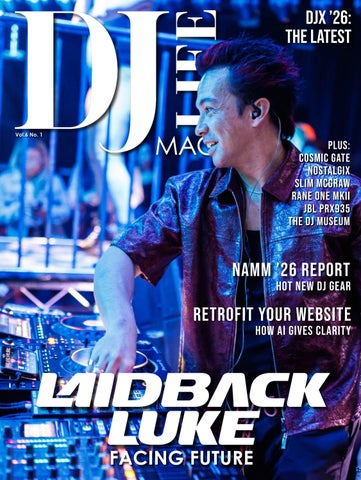
Just before Christmas, I saw that Laidback Luke was set to play a club not too far from my home in New York City. I’d been enjoying his new retro-favored EP, “ CODE/RED,” so taking a short walk to the 00:00 club for the gig was no stress. Getting there just before his set, I greeted him in the green room and, as always seems to be the case with him, the talk turned quickly to tech.
A Little History: I’d seen him rep different gear brands at several trade shows (like ADE) and, in fact, he’d attended two of our DJX shows when he’d worked with Denon DJ and, most recently, Reloop. Now, he tells me that he’s back with Pioneer DJ/AlphaTheta and he’ll have more to discuss at the NAMM Show in a few weeks.
True to his word, we caught up to discuss his new release, his take on modern DJ technologies and even his move to the NYC area. Always engaging and, Dutchman that he is, quite direct, Luke is also someone you can count on to passionately discuss what he sees in the DJ industry’s future. We hope you enjoy our talk.
And yes, we did head out to Anaheim, Calif., this past January for the NAMM Show. While there were a few last-minute cancellations from a few DJ-related exhibitors – including a very noticeable one from the apparently imperiled Native Instruments – the show nonetheless saw a healthy amount of new products for mobile, club, studio and scratch DJs. Check out our report on Page 22.
Also in this issue… in a pair of features, we visit with two very different DJs. One, Slim McGraw has become a favorite on the ever-expanding country circuit. In addition to playing megafestivals like Stagecoach and EDC, he’s currently hitting clubland with his Neon Honky Tonk tour and releasing mashups, remixes and original music. The other, Slammin’ Sam Maxion, is an industry vet who’s worked radio, clubs and mobiles during his time behind the decks. And this past October in Las Vegas, he opened The DJ Museum, which celebrates DJs of all stripes. (He’s even included a section for DJ LIFE/DJ Times and DJX/DJ Expo.)
In our Sound Bites, our Mark Mancino connects with two distinct talents. For the In the Studio section, bass-house artist Nostalgix explains how she made her recent Inferno full-length. He also interviews German trance legends Cosmic Gate, who explain their approach to the genre and their latest album, PERSPECTIVES.
From our review columns, we offer three deep dives. In Playback, Minnesota’s DJ Deets takes on the RANE ONE MKII controller and JBL’s JBL PRX935 powered, 3-way, 15-inch speaker. For Studio Session, NYC DJ Mike Márquez checks out Blackmagic Design’s Pocket Cinema Camera 6K Pro for content creators.
On the mobile tip in the Business Line column, Brian Lawrence explains how to make your DJ website speak to AI – without breaking what already works. And for Mobile Profle, we connect with Daryl Bennett of Utah’s ADM Productions, who explains how perfecting his approach to entertainment lighting benefted his bottom line. (He’ll be presenting a seminar on the subject at DJX ’26.)
Of course, this is the last issue before Miami Music Week, so in our News section, we offer a preview of the events running March 23-29 – Ultra Music Festival, Winter Music Conference, EDM Awards and the new SHIFT Miami conference, not to mention the slew of club and pool parties.
Also, on Page 8, we offer a glimpse of what to expect from our upcoming show, DJX ’26, which will run Aug. 10-13 at the Hard Rock Hotel & Casino in Atlantic City, N.J. In addition to tech exhibits and demos, sponsored After Dark parties, and a slate of seminar panels and keynotes, DJX offers the best networking in the DJ industry. We hope to see you there.
Cheers,

editor-in-chief
Jim Tremayne jtremayne@hazanmediagroup.com
editor-at-large Brian O’Connor boconnor@@hazanmediagroup.com
web editor and social media manager Mark Mancino mmancino@@hazanmediagroup.com
contributors Joe Berinato, Chris Caruso, Shawn Christopher, Paul Dailey, Reed Dailey, Chris Davis, DJ Deets, Tony Fernandez, Tommy D Funk, Lexi Ferguson. Greg Hollmann, Wesley King, Brian Lawrence, Mike Márquez, Lily Moayeri, Jordan St Jacques, Jeff Stiles, Ashley Teffer, Danny Turner, Phil Turnipseed, Joshua Volpe, Travis Wackerly, Curtis Zack
chart coordinator Dan Miller dmiller@hazanmediagroup.com
creative director Janice Pupelis jpupelis@hazanmediagroup.com
director of technologies and project management Steve Thorakos sthorakos@hazanmediagroup.com
Chairperson & COO/Co-Publisher Robin Hazan rhazan@hazanmediagroup.com
President & CEO/Co-Publisher Shawn Hazan shazan@hazanmediagroup.com

LIFE
Jim Tremayne Editor, DJ

visit our website: www.djlifemag.com 516.767.2505
Editorial and Sales Offce: DJ Life, Oyster Bay, NY 11771. (516) 767-2505 • (Sales/all other business): (516) 767-2505 • djlife@hazanmediagroup.com.
Editorial contributions should be addressed to The Editor, DJ Life Mag, Oyster Bay, NY 11771 or sent to JTremayne@hazanmediagroup.com.
DJ Life Mag is published bi-monthly starting with the second month annually.
Design and Contents: copyright © 2026 by DJ Life Mag and must not be reproduced in any manner except by permission of the publisher. Web: DJLifeMag.com DJXShow.com and HazanMediaGroup.com
Subscriptions: Complimentary Digital Edition. Email: djlifemag@hazanmediagroup.com Phone: 516-767-2505 ext. 502 Web: djlifemag.com/subscribe
DJLIFEMAG.COM | VOL.6 NO.1


Atlantic City, N.J. –Set for Aug. 10-13, DJX’26 will take place at Hard Rock Hotel & Casino in Atlantic City, N.J. As always, the show will present DJ-centric exhibits, educational seminars, and sponsored After Dark events. (For the latest info, please visit www.djxshow.com.) Here are a few of the seminars

Elevate Your DJ Brand & Content
Creation with Blackmagic Design: Join DJ-live-streaming pioneer and DJ LIFE contributor Mike Márquez for a deep dive into the “gold-standard” workfow for modern DJs. Presented by Blackmagic Design, this session demystifes the powerful combination of ATEM Mini live production switchers and the Pocket Cinema Camera line of digital flm cameras. These production tools are essential for anyone looking to incorporate professional and affordable video into their workfow.

From Browsing to Booking: The New Age of SEO for DJs: Brian Lawrence –industry veteran, co-author of From Browsing to Booking, web designer, SEO resource, and DJ LIFE contributor – will decode the new SEO landscape and show you how to thrive in it. Lawrence’s blend of insider strategy, practical execution, and client-centric storytelling will give DJX attendees an immediate

edge over their competition.
Lighting That Sells – How Smart DMX Elevates Mobile DJs: Utah’s Daryl Bennett will explain why employing effective, strategic lighting is one of the fastest ways for a DJ to increase value and book higherend events. In this detailed session, Bennett of Salt Lake City’s ADM Productions will break down how smart DMX lighting design directly impacts client excitement, upgrade decisions, and overall event experience.

Stop Selling to the Wrong Person – and Really Grow Your Business:
Maryland mobile Jared Rosen will explain how a DJ company’s most reliable sales growth doesn’t always come from the end-client… it comes from building relationships with the people who infuence the end-client: venues, planners, photographers, and community centers of infuence. He’ll explain how, by shifting his focus from chasing clients to cultivating referral partners, he’s increased close rates, raised revenue per event, flled weekday calendars, and created the ability to charge premium rates.


Cosmic Gate’s story has always been one that’s defned by evolution. Now more than two decades into their career partnership, Nic Chagall and Stefan Bossems (aka Bossi) continue to refne and reframe what modern trance can be, pushing their sound forward without losing the emotional core that made them fxtures in the frst place.
That familiar ethos is front and center as the pair close out its latest body of work, PERSPECTIVES , a trilogy that refects both their restless creativity and their reality as touring artists in constant motion.
Released in chapters, PERSPECTIVES is less a single snapshot and more of a moving sequence that’s been shaped by a life of travel, late-night road-testing of new material, and an openness to avoid being defned by one style or genre of electronic music. Across the three EPs, Cosmic Gate has leaned into melodic techno, progressive house, and trance without drawing hard lines between them – instead presenting what they describe as different perspectives on the same emotional language.
Cosmic Gate’s career, since its earliest releases, has seen the group remain a staple within the circuit – and that includes multiple eras of electronic music, a Grammy nomination, landmark albums, and sold-out tours across the world. In 2026, that very momentum is clearly still intact. Fresh off another run of dates on the PERSPECTIVES USA Tour, the trance music titans are already crowd-testing new music, reaffrming that for Cosmic Gate, the connection between studio and stage remains as vital as ever before.
DJ LIFE sat down with Cosmic Gate to refect on the year so far, the thinking behind PERSPECTIVES, their approach to collaboration and technology, and how a partnership that began by chance has grown into one of dance music’s most enduring duos.
DJ LIFE: How has the start to your year been so far? What’s the rest of the year look like?
Nic Chagall: We kicked off 2026 with the next run of our PERSPECTIVES USA Tour and now we’re looking back on some amazing sold-out shows in Austin, Washington, D.C., San Diego, and Los Angeles! This week we drop the fnal part of our PERSPECTIVES series. We are already testing new music across

our recent dates. We’ve been on tour the past two months, and it feels so good to see live what we have been working on for so long.
DJ LIFE: Your latest EP, Perspectives EP3, closes a trilogy. When did you realize this project needed three chapters instead of one cohesive release?
Bossi: We already released our last albums/EPs in two chapters, and with all the touring as DJs, being more on the road rather than in the studio, releasing the album in parts makes our life easier, as we can already release a selection in segments to the fans. Plus, leaning more into tracks allows us to give snapshots to the fans across a section of time that may work for playlists and gives each part its own identity. PERSPECTIVES became a trilogy of three EPs, as we wanted to roll out the album in even smaller parts due to the reasons we mentioned, but we are always adjusting and playing around with new ideas.
DJ LIFE: When you think about all three EPs, what threads do you feel connect them?
Bossi: The idea of PERSPECTIVES was to present well the different perspectives on trance music! These days you don’t have clear genres anymore; the
genres blend, and if you go to Beatport you are overwhelmed by that long, long list thinking, “Where does this track actually belong?” We love that, actually, as we always try to evolve our sound and get inspired by the next generation. We feel the PERSPECTIVES albums overall give a lot of different tracks, but every track still has that Cosmic Gate signature of driving beats and touching melodies and vocals.
DJ LIFE: On the EP, you blend trance, melodic techno, and melodic house seamlessly. When you’re in the studio today, what’s your approach? Do you still fnd it necessary to stay within the territories of a certain genre?
Chagall: No, as said before, we always try to evolve and get inspired by new music and movements. Being around for 26 years now, it would be pretty boring if our new album would still sound like the very frst one!
DJ LIFE: With several collabs on the EP, how do you prefer working with collaborators – in person or virtually?
Chagall: Unfortunately, all virtually. We live in different cities across different countries, plus the weekly touring makes it diffcult for us to meet in the studio. But thanks to all the new techniques and digital ease and availability for remote collaboration, it’s so easy to

work like this these days.
DJ LIFE: How about when it’s just the two of you. Do you get to work in the same space often or do you typically work virtually when you’re not together for gigs?
Bossi: We only see each other on the weekend, as we are not living close to each other. So, it’s all virtually, but we found a great way of remote collaboration after many years being musical “brothers.”
DJ LIFE: What’s your DAW and studio set-up looking like these days?
Chagall: We are working with Logic and an Apple laptop, which can travel with us around the world. For fnal mixdown and mastering, we go into a studio, as we feel it’s hard to master on headphones and we always want the best quality with the fnal result.
DJ LIFE: Any new gear, equipment, plug-ins, sample packs, etc. that you’ve been most fond of lately?
Chagall: I think we use the same stuff as everybody else, mainly [Xfer Records] Serum and [Reveal Sound] Spire.
DJ LIFE: You’ve been part of multiple electronic music eras. What are your thoughts on the current state of the industry? What about where it’s headed?
Bossi: We love to see that genres are blending and trance sounds are lately to be found in so many other genres. Tiësto is playing trance sets again and giving the genre some – in our opinion – deserved glances. On the other hand, we see clubs are suffering a lot from all the big events and festivals. The superstar DJs outbid themselves with bigger shows and production, and DJ fees are higher than ever, so we hope that clubs will not get forgotten, as they are the heart of everything, where new music trends and new talents are born. So don’t forget to support your local clubs and artists!
DJ LIFE: How do you feel about the use of AI in music? Do you have any concerns about the future of the music industry at large?
Chagall: As you said before, we have been part of multiple electronic music eras. We went from physical vinyl/CD to downloads, from downloads to streaming, and every time people worried about the progress and the unknown. As we survived all of this and found our place and way of working in the next era, we feel we will do so with AI as well. Of course, we all have to get used to it and some rules have to be made, but like
we managed to handle illegal downloads or YouTube agreements, artistry will prevail. We always try to think positive.
DJ LIFE: Your Grammy nomination marked a huge milestone. Did that recognition change anything for you guys personally and professionally?
Bossi: Good question! Personally, we don’t think so – we are still the same [laughs]. Of course, it’s an absolute honor to belong to the few artists who have been nominated, and we never thought that the Academy would recognize or consider our work. So we are very proud of it!
DJ LIFE: Looking back, which of your original tracks, remixes or albums felt like the biggest creative risk at the time, but ended up being one of your smartest career moves?
Bossi: Hmmmm… We would say our MOSAIIK album. When COVID came and we couldn’t play live and it felt like we were all banned from dancefoors, the big peak-time anthems were simply not wanted anymore. We saw this as a way to pivot, and it took us the opportunity to release “Blame” and go way deeper before we started livestreaming, also with our YouTube sets, and then the MOSAIIK sound took us on a completely new and amazing journey. Without the pandemic, we might not have made that move.
DJ LIFE: If you had to choose only fve Cosmic Gate original tracks or remixes to include in your future DJ sets, which would be your go-to cuts and why?
Chagall & Bossi: Oh, that’s a tough one! Our tracks are like our children, so that’s hard to pick only fve! If we must: 1) “ Exploration of Space,” of course, because there is no Cosmic Gate set without this track; 2) “Nothing To Hide” from the before-mentioned MOSAIIK album; 3) “ am2pm ”; 4) our “Only Road” remix for Gabriel & Dresden; and 5) “Fire Wire.” These might be the tracks we are most known for and still have in most of our sets – the biggest fan favorites, we would say!
DJ LIFE: Manifesting your future: Where is Cosmic Gate fve years from now?
Bossi: Still making music and touring around the world. As long as people stream our music, come see us at our shows, and watch our streams, we are going to continue what we can do best: make music.
– Mark Mancino

Nostalgix has always blossomed in the spaces between contrasts – past and future, grit and gloss, underground energy and mainstage allure. Born in Iran, raised in Canada, and residing in L.A., she’s now operating globally – and not just that: the 29-year-old DJ/producer/artist built a sound and identity shaped by movement, culture, and a persistent DIY drive.
It’s that very journey that has carried her from experimenting in a dorm room to commanding some of the world’s most recognizable festival stages, all while maintaining a ferce personal connection to her art. Over the past few years alone, Nostalgix has carved out a lane defned by bass-heavy swag, sharp lyricism, and a distinctly ’90s-tinged aesthetic that feels both nostalgic and future-forward.
Releases across infuential labels and collaborations spanning club music and hip-hop hybrids have positioned her as a triple threat – producer, writer, and vocalist – equally comfortable crafting records as she is igniting dancefoors.
Now, with the release of her debut full-length album Inferno, she steps into her most fully realized and self-aware chapter to date. The project represents more than a collection of tracks: it’s a statement of evolution, creative ownership, and emotional clarity. Built around themes of transformation, resilience, and self-defnition, the LP refects an artist refning her voice while expanding her sonic identity.
And this spring, she’ll be touring the USA in support of the album – it’s a schedule that’ll include spots at Miami’s Ultra Music Festival and Las Vegas’ Electric Daisy Carnival. With so much on the immediate horizon, DJ LIFE recently caught up with the rising star (aka Negar Hamidzadeh) to discuss her approach to Inferno, and more.
DJ LIFE: So, where did the name Nostalgix come from?
Nostalgix: The name Nostalgix actually came to me when I was in university. I was sitting in my dorm room –before DJing, before my frst mixer, before making music –and it just clicked. I immediately wrote it down and started playing with logos and different variations. It always felt like me. I never questioned it.
DJ LIFE: As an Iranian-born, Canadian-raised artist, how have your cultural roots helped shape you as an artist?
Nostalgix: Being born in Iran, raised in Canada, and now living in the U.S., I feel like I’ve lived many different lives. Iranian culture deeply shaped my taste and early infuences –artists like Googoosh and Ebi were a huge part of my world growing up. Canada then expanded my palette, exposing me to so many styles and perspectives. That blend naturally shows up in my music and sets. I love bringing different infuences together in a way that feels authentic.
DJ LIFE: Inferno feels like a moment of full self-defnition. When did you realize this album wasn’t just another proj-
ect, but a true turning point for you as an artist?
Nostalgix: Very early on, I knew Inferno was different. It represents stepping into my highest self – taking every lesson, hardship, and moment of growth and turning it into something intentional. The themes refect real turning points in my life. It’s about shedding limitations, rebuilding strength, and evolving. This album feels like a true refection of who I’ve become.
DJ LIFE: With a title suggesting destruction and rebirth, what parts of yourself did you feel you had to “burn away” in order to usher in your latest musical era?
Nostalgix: I’ve defnitely had to burn away a lot of different versions of myself. I feel like I’ve lived so many lives in the last few years. Moving at such a fast pace forces you to confront your doubts, fears, and conditioning. Inferno is rooted in that process – questioning old patterns and pushing toward growth. That evolution naturally led me to be more vulnerable in my art.
DJ LIFE: Your recent aesthetic has shifted into something darker and more cinematic. What inspired this transformation?
Nostalgix: With Inferno centered around leaving the darkness to fnd the light again, fnding your strength, and standing tall in that light, I wanted the project to truly tell a story. I also wanted the show itself to feel like a story unfolding, and I really wanted to lean into my roots in cinema.
DJ LIFE: This album marks your debut LP after years of singles and EPs. What did you learn about yourself during the creative process? How long did the LP take to create from start to fnish?
Nostalgix: Inferno had been brewing for a long time, but I worked on it from early 2025 through February 2026. It’s the most effort I’ve ever put into a project – not just musically, but conceptually. Making an album taught me how much intention, patience, and discipline it truly requires. I can wholeheartedly say that I gave everything I had to this album.
DJ LIFE: How did your journey from dorm-room beginnings to global-festival stages help shape the core of Inferno ?
Nostalgix: I’ve always had a DIY mindset – fguring things out as I go while holding onto a big vision. Going from learning through tutorials to creating an album and touring it feels surreal. That mentality of “just keep building” has shaped everything for me.
DJ LIFE: Did you set any sonic boundaries while creating Inferno? What was the writing and studio process like?
Nostalgix: I really wanted to enjoy the process, focus on being creative, and see what I would make without putting limitations on it. I allowed my life and emotions to shape the music in real time. I explored more territory with tracks like “Fall Apart,” which is a very vulnerable song for me. I sang on it, and the drop leans more toward a UKG infuence rather than the bass-house sound I’m usually known for. I did end up making a lot of records that leaned toward bass house, but I think that’s just because it’s naturally who I am.
DJ LIFE: Are there any plug-ins, synths, or pieces of gear you leaned on heavily during this album that became essential to your sound?
Nostalgix: [Xfer Records] Serum and [Spectrasonics] Omnisphere are defnitely two of my favorite synths that I used on this album. I would say Serum is one of my favor-
ite plug-ins when it comes to sound design – I’m defnitely a ride-or-die Serum girl. I also used a lot of plug-ins from Waves and Valhalla. A lot of the album was made in the box, unless I was working out of different studios and using the gear there, or bouncing stems back and forth with collaborators.
DJ LIFE: What’s your studio set-up look like and preferred DAW?
Nostalgix: I’m defnitely an Ableton girl, so Ableton Live is my preferred DAW. As for my setup, I worked on Inferno everywhere – my L.A. studio, Monstercat’s studio, planes, coffee shops. I love the freedom of creating with just my laptop and headphones. Many of my best ideas happen that way.
DJ LIFE: How does the Inferno album tour expand on what your fans might already know or come to expect from a Nostalgix show?
Nostalgix: With the album tour, fans will get to step into the universe of Inferno and experience the world I’ve created. This tour is something I’ve always wanted to do as an artist, and now, being able to release such a meaningful body of work – my frst album – I’m incredibly excited to share my vision in such a big and powerful way.
DJ LIFE: Are there specifc tracks from the album that transform or hit you – or the crowd – hardest when played live so far?
Nostalgix: “Holy” and “Fall Apart” have been incredible to play live for different reasons. With “Holy,” I fnd that it’s one of those records that just has such great energy. It brings so much nostalgia, happiness, and joy. Every time I’ve played it in my sets, it’s gone crazy. With “Fall Apart,” it’s more of a vulnerable record for me, and every time I play it, it brings me back to the nights I spent in my studio in L.A. It feels really magical because it touches on a different side of me as an artist and shows a more vulnerable part of who I am, which I think a lot of people can really relate to.
DJ LIFE: You’re bringing Inferno to both clubs and massive festivals like Ultra. Do you adapt sets for such different environments?
Nostalgix: Absolutely. I have such a deep love for fnding new ways to share the things I love with my fans in a way that feels authentic to who I am as an artist. I also truly love DJing as an art form – there’s so much fun and creativity in that. When it comes to the Inferno album tour, I do have a very specifc vision and world that I want to welcome fans into. This will be something that is very unique to this tour.
DJ LIFE: What gear does your show set-up include?
Nostalgix: My show set-up is four Pioneer DJ decks – I use four CDJ-3000s and a DJM mixer. I have the same setup for my club shows and festival performances. I’m constantly transitioning, so I love being able to bounce between the decks, have everything ready to go, and move quickly from track to track.
DJ LIFE: Looking at the tour dates, are there any cities or venues that you feel especially excited to perform?
Nostalgix: I’m honestly excited about every single stop on this tour, because I can’t wait to see my fans and share this whole new experience – and this whole new side of me. I feel like Jix Nation has been on this journey with me from the very beginning, so it’s going to be special to show everyone this project and get to soak it all in. I’m especially excited about Los Angeles and Vancouver, because those are my two hometowns. Bringing the show to both of those cities means a lot to me.
– Mark Mancino

By Jim Tremayne
Long Island City, N.Y. – It’s nearing set time in the tricked-out green room of Midnight, a cozy Queens club just a short walk from the 59 th Street Bridge, and Laidback Luke is welcoming guests. Kisses and handshakes are exchanged, champagne glasses clink, VIP servers do their bottle-serving.
Soon, Luke waits for a lull, pulls me close and intones: “I think I have an exclusive for you –I’m back with Pioneer DJ/AlphaTheta.”
In a sense, it’s not stop-thepresses news, as the longtime hitmaking DJ/producer certainly has made the rounds in the DJ-technol-

ogy world. Going back more than two decades, he’s worked as a brand ambassador for Pioneer DJ (in its initial CDJ-1000 days and beyond), D enon DJ (through the release of the Prime 4 system), and most recently for a pair pr oducts from German brands – Algoriddim (djay Pro software) and Reloop (Mixtour Pro compact controller).
“I’ll have more to discuss at or after the NAMM show in a few weeks,” he promises, just before he’s led to the DJ booth.
While some may entertain a cynical thought or two about Luke’s latest free-agent move, it’s also true that he’s one of the rare global jocks who has actively promoted genuine innovation in the DJ industry for the past 20-plus years. Like many, Luke, 49, started his career in the vinyl era and has always looked for the freshest angles in the digital-DJ world. His tech-forward enthusiasm is real.
Indeed, one of the best tutorials I’ve ever seen was a Luke session at Amsterdam Dance Event where he demonstrated the evolution of DJ gear – from the analog disco days through the digital EDM era and into the near future, as he saw it.
Always a pitch-perfect presenter, Luke breezed through the hour-long seminar with aplomb, easy humor, and an entertaining, yet reverent sense of the subject’s history.
Back at Midnight (stylized online as 00:00 ), the club is celebrating its frst anniversary – no small feat in New York City’s competitive clubland. The 600-capacity main room is full tonight with its youthful, spend-happy, predominantly Asian clientele ready to hear the hits,

and Luke doesn’t disappoint.
Through the venue’s booming RCF PA, Luke spins a diverse, Vegas-styled, open-format set, loaded with mashups, remixes and edits of evergreen dancefoor faves… from “Sweet Dreams” to “ Show Me Love,” from “Empire State of Mind” to “ Gasolina ,” from “We Found Love” to “Somebody Told Me,” plus some cuts from his recent, retro-favored “ CODE/RED ” EP, including “I Got Soul (Super Bad),” his ripping electro-house “collab” with James Brown. It’s an evening of sloshy singalongs, popping bottles, and plenty of smiling-faced selfes.
Fast-forward a few weeks and indeed we’re at the Anaheim Convention Center for the Winter NAMM show. I happen to pass AlphaTheta’s busy exhibition stand and, sure enough, there’s Luke in the DJ booth, spinning with a pair of CDJ-3000X units
and giving the new RMX-IGNITE effects unit a workout before an enthusiastic audience of DJs, retailers, press, and reps. Luke’s back in the fold with the industry’s leading brand, demonstrating a forward-thinking unit. Perfect.

We catch up again after the show to complete the following interview. As we’ve spoken professionally several times in the past decade, including two keynote Q&As at DJX and a 2017 cover story for DJ Times, we dispense with most of the biorelated info for this story. At the very least, most DJs already know Luke (aka Lucas Cornelis van Scheppingen) as the Filipino-born, Dutch DJ/producer who has enjoyed global hits like “Show Me Love” (with Steve Angello feat. Robin S), “Leave the World Behind ” (with Swedish House Mafa’s Axwell, Ingrosso and Angello feat. Deborah Cox), and “Turbulence ” (with Steve Aoki feat. Lil Jon). He’s also remixed hits for some of the pop music’s top artists – Madonna, Mariah Carey, and Nicki Minaj – plus some of electronic music’s legendary acts – Daft Punk, Depeche Mode and Moby.
So, for this discussion, we brush a bit on his past, touch on the DJ/music industry’s present and, of course, we discuss what DJs should expect to experience in the near future. Here goes:
DJ LIFE: How did you enjoy the gig at Midnight in LIC?
rukes.com
Laidback Luke: I really enjoyed it! It kind of felt like the Nebula of Long Island City. They are doing proper stuff over there and I love it that there’s a community for solid dance music and the dance-music experience over there.
DJ LIFE: Let’s talk about the latest release, your “CODE/RED” EP. Some of the tunes defnitely sound like they could’ve rocked the dancefoor 15 to18 years ago – electro-house well before it kinda burned out. There’s a real energy to these tunes – what was your approach to these tracks?
Laidback Luke: It’s interesting how you said it burned out, because in my experience it morphed into Dutch House and EDM, which is the exact reason why I grabbed back to that Fidget/Bloghouse/Electro sound in the frst place. My whole year started off with me randomly going through an old DJ folder from 2007 and 2008 and there was an unleashing of passion and nostalgia hearing those tracks again – stuff from Switch, Crookers, Bloody Beetroots, Bart B. More, Proxy and many more. That vibe took control of me and I wanted to dedicate 2025 to bringing that sound back in my sets. And it needed to be pre-EDM for me, to go back and grasp the innocence I had back then.
DJ LIFE: How long had you been working on these six tunes? What was the process?
Laidback Luke: I still make music fast. Maybe even faster than ever before. The process was one of creative fow. It was letting go of the “EDM Luke” that was stuck trying to chase streams for over a decade. So it was super-fun for me! I got to be the “young and unapologetic me” again, and I had been longing for that.

The CB10 is the ultimate compact loudspeaker system, ofering unrivaled audio performance, unmatched versatility and battery-powered portability.
• 127 dB peak SPL
• 10-inch high-output woofer
• 1-inch compression driver
• Bluetooth® audio and control (w/Loudspeaker Control app)
• User-swappable battery with up to 12 hours of runtime
• 200 ms room delay
• 6-Year Warranty* (1 year on battery)


DJ LIFE: Where do you make music these days? What’s your studio like?
Laidback Luke: I make music wherever my laptop is. But to be honest, it was this year that I rebuilt my studio, too. I visited the home studio of my manager in L.A. and I loved it so much, with white panels and colored lighting everywhere. I wanted the same for my home studio in New York, so I rebuilt it all by hand and I love my new creative area now more than ever.
DJ LIFE: What’s your DAW? Monitors?
Laidback Luke: My DAW is Ableton and my monitors are white Genelec 8331 SAM units. They are so detailed and precise, I know that if anything sounds good on them, it will sound good anywhere.
DJ LIFE: Do you have some favorite plug-ins?
Laidback Luke: In terms of plug-ins, I’m back onto mostly stock Ableton plug-ins – believe it or not! In all my 35 years of producing, I’ve collected and bought so many plug-ins, but I love keeping it basic. If I had to name a few, I’d say the SSL G-EQ channel strip by Waves and Trackspacer [by Wavesfactory].
DJ LIFE: Any vintage gear?
Laidback Luke: I love vintage gear, but I travel too much still to actually go out of my way to own it… although I still have a Korg MS-20 in my studio in The Netherlands. I started producing in 1992 and was all outboard gear up until 2003. So I know what it’s like!
DJ LIFE: Of course… so, when you look back over your career and see what the modern studio looks like now, what do you think?
Laidback Luke: I love it. My perspective of electronic music was that it was always driven by technology. Those are the roots. From Kraftwerk to DJ Pierre to Daft Punk, it’s always been tech-based. And it evolves. I remember being ridiculed back in 2008 when I was putting out really solid tracks… from just my laptop. I was an early adopter to the modern studio, as I started producing only from a laptop in 2003. I’m still waiting for the day when there’s something like a CapCut for producing on mobile. I have already been experimenting with SUNO on my phone. It keeps evolving!
DJ LIFE: What was your music-making evolution like? What were you using to make music initially?
Laidback Luke: Initially, I started with Protracker on an Amiga computer. But that was my friend’s computer. So, when I found out that I could sequence synths via MIDI, I tried that on the very early PCs with the frst Soundblaster soundcard. But my frst serious attempts were on an Atari ST using Cubase. Back then, there was zero in the box, so Cubase would just be a MIDI controller towards all my outboard gear.
From there, I went to a Mac with Logic until in 2003 when I switched to just a laptop and FruityLoops –now called FL Studio because Kellogg’s threatened a lawsuit over the trademark for their Froot Loops cereal! In 2010, I switched to Ableton.
DJ LIFE: Which producers/artists – current or past –impress you?
Laidback Luke: I’m always quick to give respect to the past masters, as they had such an impact on me. Chocolate Puma discovered me and showed me music by DJ Pierre, MK and Armand van Helden. Prior to that, I was very much infuenced by The Prodigy and early U.K. rave. Daft Punk, after I heard their remix of Chemical Brothers “Life Is Sweet.” Skrillex keeps on pleasantly surprising me, and now I’m also heavily infuenced by the new guns like Knock2 and Cloonee.
DJ LIFE: Let’s get into DJing. Who was the frst DJ who caught your attention and why? How did that DJ eventually infuence you?
Laidback Luke: There was a woman out in The Netherlands in the ’90s called DJ Miss Monica. It was through her that I frst heard the “Traxx On Da Rocks, Vol. 1” EP from Daft Punk’s Thomas Bangalter – that had a huge infuence on my sound. I still think it’s one of the best dance-music EPs ever. Miss Monica always brought the energy, but on top of that, she would also scratch. She had a similar energy and skill as Carl Cox, whose three-deck mixing style infuenced me a lot. I was also obsessed with Jeff Mills, who mixed with three decks, so in the late1990s I was a techno DJ who always mixed on three vinyl decks. The DJ skills that you still hear now in my sets were also infuenced by Dave Clarke, Frankie Bones and Bad Boy Bill. I would take bits and pieces from all of them and rehearse similar skills until I was able to nail it. I’d say “transforming tricks” from Dave Clarke, “vinyl doubles” from Frankie Bones, and “scratches” from Bad Boy Bill was my pedigree!
DJ LIFE: In the last couple years, you’ve been working with the Reloop Mixtour PRO, which you co-developed. Can you explain this approach to DJing?
Laidback Luke: I’ve played the biggest clubs and festivals on my Swiss-Army knife of a DJ unit – the Reloop Mixtour PRO. It holds four decks and a mixer in a powerful, AI-infused, tiny DJ unit.
DJ LIFE: I saw you DJing with the unit, an iPhone and Algoriddim djay software…
Laidback Luke: It’s actually DJing on a hardware controller and the iPhone is like your USB stick with a touchscreen. My favorite advantage was being able to strip any songs into stems in real-time, so I could do live mashups. The only drawback is there’s no jog wheels or no pitch fader, and a big disappointment is how challenging it was to demonstrate skills across a lesser-known platform, where the phone is the brain of the unit. Maybe I was in the future again and time will even that out…
DJ LIFE: I see you’re working again with Pioneer DJ, now re-branded as AlphaTheta…
Laidback Luke: Yes, I’m back with AlphaTheta/ Pioneer DJ now. This doesn’t mean that I won’t
keep doing my “tiny DJ sets” at random places around the world, I’ll keep doing those because it’s so easy and fun. But, I’m excited to be back on the industry-leading AlphaTheta set-up again and work with them on future developments too!
DJ LIFE: I caught your set at AlphaTheta’s booth at the NAMM show last month. What did you think of the company’s new gear?
Laidback Luke: I’m in love with the CDJ-3000X – such a big screen and the best jog wheels I’ve ever felt on a CDJ. I showcased the RMX-IGNITE as the world’s frst offcial professional performance of the unit. That was a full-circle moment for me, as I was in the roll-out of the original RMX1000 campaign. I think the RMX-IGNITE will earn its place among the professional DJ setups in no time. It feels very much like the RMX-1000, except you can now load in your own banks. It can connect through USB-C and, with the toggle FX, it feels very fun and intuitive. It’s a noisy machine! This might be a good thing [laughs]. I saw the release of the DJM-V5, which I think makes sense, but I didn’t get to play with it.
DJ LIFE: A few years ago, the introduction of stems was the big story in the DJ-tech world. How are you using stems in your DJing?
Laidback Luke: I’ve been DJing with stems for about fve years now and its freedom and a next level of creativity unleashed on my Mixtour PRO. It’s not yet possible on the fagship AlphaTheta set-up, so I simply grab my stems from the studio and have them on USB. I think the ability to use stems will one day be standard at the highest levels of DJing. It’s a new frontier that isn’t going anywhere.
DJ LIFE: On the DJ-tech side, what do you think would be next step forward? What do you want to see?
Laidback Luke: I wouldn’t be opposed to see more AI being infused, especially since it’s now the age of AI. Algoriddim is doing an incredible job at that, since they are a software company. I would also want to see all the DJ companies working together more, as we are seeing now with the rollout of OneLibrary, which is the joint project between AlphaTheta/Traktor/djay Pro.
DJ LIFE: Looking at the DJ culture – especially the club and festival DJ culture – do you think it’s more musically adventurous now or more conservative these days?
Laidback Luke: It can be both. It depends on the DJ and what crowd is in front of you. Dance music in general is a lot smaller scene and niche nowadays, but people still want to go out and dance.
DJ LIFE: General question, has technology made it too easy to be a DJ now? Does it matter?
Laidback Luke: It doesn’t matter. It’s the same with AI coming in. Look at the artists, the videographers, and music producers now, too – more people can join into the fun! The same goes for DJing. Ever since we stepped away from vinyl, “everyone” could be a DJ. But did everyone actually become a DJ? Which ones lasted? There’s many aspects to all of this.
DJ LIFE: These days, there’s much discussion about how some DJs seem to prioritize their marketing over their skills. How do you see that? At DJX in Atlantic City a couple years ago, you openly encouraged DJs to get their name out there however they could…
Laidback Luke: I think it’s smart to prioritize your marketing... especially if you think you’re ready to fully take on rukes.com

“EVER SINCE WE STEPPED AWAY FROM VINYL, ‘EVERYONE’ COULD BE A DJ. BUT DID EVERYONE ACTUALLY BECOME A DJ? WHICH ONES LASTED?”

the task of becoming a legit DJ. Without marketing, how will anyone know about you? I keep it simple and tell people nowadays: When you don’t show up where the people scroll on social media, you’re not famous. That’s the reality we live in right now. Back in the day, we needed to be in TV, magazines and ads to make a name. In that sense, nothing has changed other than that we are more in control over our own media output now.
DJ LIFE: Given the new DJ technology, how would you encourage a young DJ to cultivate one’s skills? Is there a regimen? Is it a 10,000-hour proposition?
Laidback Luke: It’s whatever you want it to be! I love seeing fresh new names coming up like DJ Sally or DJ Elfgo, who are heavily infuenced by James Hype and have really stuck the time and practice in to cultivate their skills. But then you have the hordes of open-format DJs who no one ever talks about who are so incredibly skilled. For me, the skill has always been about feeling in control on the night. Knowing that you got this –whatever goes wrong, you can catch it and work with it. You’re there to read the crowd and lift the vibe up. Skills or no skills, it’s important that the crowd walks away thinking: Wow, this was a great night!
DJ LIFE: For a younger DJ, how should one go about running a label these days? That world has evolved completely…
Laidback Luke: Right, the label game has completely changed! It seems super-challenging to run a label that makes a strong proft nowadays, and most labels run on older blueprints. Labels need to adapt to the current algorithms, needs and income streams. You may have noticed Mixmash Records has been on pause because my previous manager and I sold the catalog. But I’d like to bring Mixmash back for this new day and age. But it will need to be different from how we ran it before.
DJ LIFE: Over the recent years, how would you say your artistic approach has evolved or changed?
Laidback Luke: Honestly, it hasn’t, although I fnally understand how important it is to have a story behind the vision – to have proper social rollouts, and to simply show up each and every day, on socials frst. All the rest comes after.
DJ LIFE: You moved to the New York City area a few years ago – how has that been? What do you like about America? What do you fnd confusing or challenging?
Laidback Luke: It’s been a wild ride! But an incredible experience. I still believe in the American Dream. I still believe in the America from the ’80s, but a lot has changed. Now I have two young kids that were born here and are going through the full system. God bless capitalism,
but coming from The Netherlands, it feels really hardcore when it comes to medical insurance, social security and fnancing for schools – costs of college! And a whole lot more debt-related structures that America has. But I still love it. Home of the brave, land of the free, and a land of opportunities. I’m a fan.
DJ LIFE: What about the North American dance-music scene? What differences do you see from, say, Europe? In a recent interview we did with Duke Dumont he said that “Europeans expect more musically and less of a show, while Americans are the exact opposite.” What do you think?
Laidback Luke: That’s an interesting take! In my niche, it’s a ton of tech-house in North America vs. a lot of uptempo mainstage techno in Europe. I can cater to both, but I feel I have more space to experiment in North America.
DJ LIFE: What are three tracks – from you or other artists – that you are always ready to play?
Laidback Luke: This past year, it was Congorock “Babylon” because of the Dutchy-andRocky-feel-meets-big-tribal-drums, the Antoine Delvig and Steve Aoki Remix of my track with Steve Aoki and Lil Jon “Turbulence” – the original is a stadium anthem in North America – and the Good Times Ahead bootleg of my track with Swedish House Mafa “Leave The World Behind” – also very Dutch and tribal! I’ve also been playing the unreleased DJ Snake remix of “Show Me Love,” which crushes my sets. He made it just for fun, and sent it to me personally.
DJ LIFE: What are three venues or festivals you most enjoy playing?
Laidback Luke: Tomorrowland is always a highlight of the year, the Insomniac venues in Los Angeles, like Exchange and Avalon, always treat me well. And I’ve recently fallen head over heels with OMNIA in Las Vegas and have acknowledged it as the club of clubs, globally. Also, I’m back at Ultra Music Festival Miami this year to celebrate Dim Mak’s 30th anniversary –very hyped for that.
DJ LIFE: Are you surprised that the DJ culture has become so big and infuential in the modern age? Did you see that happening years ago when you were getting started? Why do you think it’s come this far?
Laidback Luke: When I started, it was nothing like that! So, personally, I never set out to do this for fame and fortune. When it started happening, it was fascinating, and then in 2010, I was right in the middle of it when it exploded. I think it’s come so far because, compared to bands, it’s a way-easier set-up... at least it was back then. You just have one “band member,” turning up with CDs or plugging in a USB stick… no instruments or backline involved. It’s very easy for traveling, too, compared to what a band needs to bring. But now you see the biggest DJs taking it next level with 3D visuals or having drones doing visuals. It’s scaling up!


By Jim Tremayne
Anaheim, Calif. – According to organizers, more than 60,000 music-industry professionals flled the Anaheim Convention Center this past Jan. 22-24 for the exhibition portion of the 2026 NAMM Show.
With 1,650 exhibitors representing over 5,400 brands, the show saw plenty of product debuts in a variety of DJ-related categories (playback, studio, pro audio, lighting, content creation, and accessories). Of course, DJ LIFE was there to report on the latest DJ-related developments.
Despite some last-minute cancellations from some DJ-related brands and much griping about the prevailing tariff uncertainties, many were encouraged by the new entries to the DJ market. The following products were debuted or showcased by NAMM exhibitors:
DJ Sector: Leading DJ supplier AlphaTheta debuted a pair of items. One, the DJM-V5 3-channel mixer – a downsized version of the 6-channel DJM-V10 – offers an advanced range of effects, including upgraded flters and Send FX, and built-in SonicLink transmitter, which uses the company’s low-latency wireless technology.
The other, the RMX-IGNITE effector, follows up many years later on 2012’s RMX-1000 and features advanced effects, an enhanced sampler section, studio-quality 96 kHz/64-bit mixing DSP processing, and high-grade 32-bit A/D and D/A converters. Additionally, the company’s CDJ-3000X media player, which features cloud integration, Wi-Fi capabilities and a 10.1-inch screen, made its NAMM debut.
RANE , an inMusic brand, debuted the RANE SYSTEM ONE, which blends standalone DJ technology with control of motorized platters. The frst RANE product with onboard Engine DJ software, the unit’s OmniSource system architecture lets DJs simultaneously mix between USB drives, SD cards, music-streaming services, and DJ software sources.
U.S.-based distributor American Music & Sound had a

NAMM ’26: ANAHEIM CONVENTION CENTER.
busy booth with plenty of new items from its deep range of DJ brands. Germany’s Reloop debuted three products for DJs. They included: Reloop Flux Go, a USB-C DVS interface for Serato DJ Pro; Reloop RP-5000 MK4 high-torque, 3-speed turntable with a direct-drive motor, S-shaped tonearm and adjustable pitch range (plus/minus 8-, 16- or 50-percent); and Reloop PTB-2, portable 2+1-channel DJ mixer with switchable phono/line/USB inputs, an AUX/Bluetooth input, and an integrated USB-C audio interface with djay Pro DVS support. The PTB-2 can be powered via USB-C and its second USB-C port can be used to power/charge mobile devices.
Hercules , another AM&S-distributed brand, showed a prototype of the DJControl T10 controller with 10-inch motorized jogwheels. According to the company, it will be available later this year. Spanish brand Ecler , new to AM&S family, showcased its range of products, including its WARM2 and WARM4 analog rotary mixers and its latest 4-channel model, the NUO4.0F, which includes two analog VCF flters.
AM&S brand Allen & Heath showed its Xone:24 and Xone:24C mixers, designed for bedroom, mobile, and hybrid DJs. These compact 4-channel mixers feature analog sound, improved flters, and an upgraded Innofader, with the 24C model including a USB-C interface and powered hub for modern, digital-centric setups. Also, Phase (by MWM) showcased Phase Pro wireless DVS controller modules and featured appearances by legendary DJs Qbert and Jazzy Jeff.
Additionally, Stop The Panic , a newcomer to the industry run by Sid Wilson (aka DJ Starscream) of the platinum-selling metal band Slipknot, broke out some interesting items for the scratch world and beyond. In addition to exhibiting its Viper Kitten crossfader and MiMiC NSX-01 synthesizer, the company showed yet-to-be-named prototypes of a button-flled, 10inch, portable turntable and a space-age-looking, 2-channel mixer.
Accessories: Korg debuted the KAOSS Pad V, a 5th-generation, dual-touch effects processor and sampler featuring a reimagined, responsive interface for real-time, expressive sound manipulation. Designed for modern producers, vocalists, and DJs, it offers 300 presets, advanced sampling/looping, and a

new Voice FX engine.
Returning to the DJ-headphones game, beyerdynamic showcased the DJ 300 PRO X and the DJ 300 PRO X CLUB sets. Differing only by design – the former’s more minimal, while the latter has a bolder look – both headphones feature a 2-in-1 modular design that allows DJs to switch between on-ear and over-ear confgurations. The company also debuted HEADPHONE LAB, a free studio plug-in that enhances the performance of its headphones by bringing the sound and spatial realism directly to headphonebased workfows.
From Innofader, we saw the debut of the PNP3 premium, contactless replacement fader and mini Innofader ULTRA LITE. Odyssey Cases debuted the RC Road Case series, a line designed to be lighter while maintaining protection for popular DJ gear. The range included new cases for the RANE SYSTEM ONE and Reloop turntables, among many others.
Content Creation: Blackmagic Design showcased three products, including: the Blackmagic Camera ProDock, a new dock that adds professional camera connections to iPhone 17 Pro and iPhone 17 Pro Max; the DaVinci Resolve 20, an update to the post-production software that adds over 100 new features and AI tools; and the ATEM Mini Extreme ISO G2 live production switcher.
Shure introduced the SLX-D+ wireless microphone system, which serves a variety of apps from performance to content creation. With wide tuning across all components, users beneft from simplifed setup, seamless deployment in any environment, and reduced inventory complexity. Shure also showed the MV88 USB-C stereo microphone, a compact, portable mic that offers seamless use with Android and iOS devices, onboard processing and plug-andplay simplicity for content creators.
AKG , a HARMAN Professional Solutions brand, debuted its easy-to-use C-Series of professional microphones for content-creators and musicians – it includes the C104, C114, and C151 models.
Yamaha launched three product ranges with apps for

content-creation, studio and live sound. They include: the URX Series audio interfaces (URX44, URX22 and URX44V, which adds HDMI-USB video/audio); MGX Series digital mixing consoles (MGX16, MGX12, MGX16V and MGX12V); and the CC1 USB controller.
HISONG showcased the AirStudio S1, an all-in-one mobile recording capsule for content creators and musicians. The unit is a DAW-compatible compact studio condenser/enhanced dynamic mic with built-in wireless in-ear monitors with full audio interface and mixer.
Pro Audio: Longtime loudspeaker manufacturer QSC debuted three new products. They include: the CB10 battery-powered, 10-inch speaker system, which can operate up to 12 hours; the LS218 double-18-inch, powered subwoofer; and the QSC Loudspeaker Control app for Bluetooth-equipped QSC active speakers.
JBL , a HARMAN Professional Solutions band, showed the expansion of its SRX900 Series of active, point-source loudspeakers in the form of the 2-way, 12-inch SRX912M, the 2-way, 15-inch SRX915M, and the 3-way, dual-12-inch SRX922.
France’s L-Acoustics showcased its L Series sound system, the latest version of L-ISA Hyperreal Sound technology for spatial, object-based mixing, and L-Acoustics DJ – a solution that transforms traditional stereo-DJ set-ups into fully immersive spatial audio performances in real-time.
RCF debuted new items to the EVOX range of active column systems, which include the EVOX J9 mid-array, the JMIX9 mixer, and the EVOX J11 mid-array.
RCF also showed its latest active speaker platforms, which included the KX Series, the compact SUB 15-AS and SUB 18-AS, the SUB


LEGENDS: STEVIE WONDER & GRANDMASTER FLASH.
AX and the install-specifc X Series. From its Newport Series, EAW showcased its NT206L compact, active, line-array loudspeaker, which features 1,500 watts of onboard power.
Canada’s Yorkville Sound debuted several items, including four models from its Élite Series of powered PA speakers – the EL15P full-range cabinet, the EL18S and EL21S subwoofers, and the EL12M stage monitor – plus, the BPM12 battery-powered mixer. Also, Applied Research and Technology , a division of Yorkville Sound, showcased the Pro MPA III multi-voice tube preamp.
RF Venue debuted its RF PA Extension kit. Designed to for seamless wireless loudspeaker connectivity, the kit pairs a 2-channel transmitter with two single channel receivers to simply and cost-effectively feed quality audio to speakers without wires and clutter. PK Sound , distributed by ACT Entertainment , debuted the Ts15 intelligent subwoofer. A compact low-frequency offering in the Trinity Range, it’s the industry’s frst series of robotically controlled line-source systems.
AVANTE Audio, an ADJ sister company, showed: the new Akro Series of active line-array loudspeaker systems, which includes the ATL328 element and the ATS218 dual, 18-inch sub; the

Imperio Series of compact, active, line-array systems; and the Achromic Series of full-range, active, loudspeaker cabinets.
JH Audio showcased its latest Custom and Universal IEM ranges, including Jessie, the newest entry-level addition, and Pearl, the latest advancement in digital IEMs. Italy’s Wisycom debuted the MPR60 Wideband IEM Receiver. Brandenburg Labs showed Okeanos Pro, a system designed to simulate virtual multi-channel loudspeaker systems via headphones. Featuring up to 16 virtual loudspeakers that simulate real loudspeakers, the system Pro can simulate the sound of complex PA concepts of performance venues, allowing sound engineers and DJs to adapt mixes to local conditions in advance.
Lighting: At its demo room and booth, longtime lighting brand ADJ showcased several products, including: the Vizi Xtreme beam-wash moving head unit with 360-degree pan/ tilt movement; the Jolt MFX 360 dual-sided LED fxture that combines blinder effects and strobe/wash output; and the Focus CMY Compact feature-rich LED moving head that combines beam, spot and wash functionality.
Eliminator Lighting , an ADJ sister company, debuted fve new products. They include: the Mega Par Z Wash LED wash fxture with color mixing; the CenterDroid centerpiece with red and green lasers for club and mobile apps; the LP Hex 12 Plus UV-enhanced fat par light; the LP 8R LED fat par fxture; and the Mega Color Q12 LED bar fxture for uplighting, wall washing and accent lighting.
Studio: At the AlphaTheta booth, attendees were able to experience Serato SLAB, a dedicated, compact MIDI pad controller built by AlphaTheta for intuitive, hands-on music production in Serato Studio, unlocking full software and streamlining workfows with pads, dials, and a touch strip for drums, samples, stems and FX, while also working with Serato Sample ADVANCED FX: ALPHATHETA’S RMX-IGNITE.


STRIKE A POSE: JAZZY JEFF AT ROLAND BOOTH.

UNDER GLASS: STOP THE PANIC’S TURNTABLE.

BATTLE MODE: DJ CAITLIN AT HERCULES.

AM&S BOOTH: ECLER’S FABIO ROSSETTO.

DOUBLE SHOT: ' B-RENN AT ALPHATHETA.
and Serato DJ Pro.
Roland showcased and debuted a slew of studio-related products. New products included: ZENOLOGY GX for iPad, the frst fagship Roland instrument designed for Apple’s tablet platform, and the GO-MIXER studio audio mixer and interface for iPhone, iPad and Mac/Windows computers, which features eight audio inputs and four audio outputs, plus a suite of onboard effects. Roland also showcased the V-Drums 3 and 5 Series electronic drum kits and the TR-1000 Rhythm Creator, a drum machine which features true analog voices, the latest digital sound and sampling technologies, and a performancefocused user interface.
Fender introduced the Fender Studio, which unifes PreSonus Studio One Pro and its recording interfaces under the Fender name. Studio One Pro becomes Fender Studio Pro, while the Quantum and AudioBox lines transition to the Fender Quan-

JETPACK BOOTH: CUT CHEMIST & SHORTKUT.
tum Series and the Fender AudioBox. Akai , an inMusic brand, unveiled the MPC XL music production center, which features a Gen 2 8-core processor and 16GB RAM and can load up to 32 plug-in instruments and 16 audio tracks simultaneously with support for up to 256 simultaneous voices.
Avid showcased Pro Tools 2025.12, which introduces immersive mixing support with the UHD World Association’s Audio Vivid, enhanced SoundFlow functionality with built-in Bounce Factor Lite, and new Inner Circle rewards from plug-in and content partners. New plug-ins include VoiceWunder, VOIS, and Vovious.
The company previewed a range of Pro Tools technology advances like new MIDI Editing Mode, MPE (MIDI Polyphonic Expression) Support, Track Pin and enhanced speech-totext, plus Splice integration and MIDI Playlists. Avid also made the frst public showing of Nu·Studio, a modular, portable studio system designed for immersive audiovisual production.

BATTERY-POWERED: QSC CB10 SPEAKER.
Series active, 2-way, studio monitors. U.K. company Solid State Logic launched its autoSeries family of plug-ins, which combines SSL’s 4000 E modeling with sonible’s AI-assisted audio analysis, and the UMD192, a portable USB audio interface with seamless integration across MADI, Dante, and USB protocols.
Waves Audio showcased Curves Resolve intelligent mixing plug-in, which provides an advanced system for managing frequency masking and congestion between tracks and across complex mixes. Telegrapher Speakers debuted four new reference monitors – Carbon Fox, Raccoon, Panda and Hippo – in addition to showcasing its original product lineup, which includes Fox, Gorilla, Gorilla-S, Elephant and Rhino models.

KRK , a Gibson brand, offered a frst look at its all-new fagship V Series Five studio monitors, which expect to be released this summer. KRK also showcased its Kreate
In the German Pavilion, Neumann introduced the VIS –Virtual Immersive Studio, a new software tool that redefnes monitoring, production, and immersive workfow collaboration. SCHOEPS showed its full range of Colette Series and CMIT Series mics for live and studio uses. Genelec displayed its recently introduced 8380A three-way midfeld SAM Main Monitor. HEDD Audio showcased the Type 20 A-Core threeway monitor, which uses analog processing.
SONY showcased four headphone ranges: MDR-MV1 open-back model; MDR-M1 closed-back model; MDR-Z1R Signature Series; and MDR-7506 stereo-monitor systems.
NUGEN Audio showcased MasterCheck 2, an update on its optimization plug-in for cross-platform mastering and loudness verifcation. At the Rock Paper Scissors Music Innovator Hub, several unique companies showed their wares, including Blipbox , which showed the myTRACKS groovebox, a sequencer, sampler and drum machine.

For the latest on NAMM 2026, please visit www.namm.org


Las Vegas – In recent times, Las Vegas has emerged as one of the main beacons of U.S. DJ culture. At Sin City venues big and small – whether it’s a casino-run superclub or a glitzy lounge – the DJ booth remains the center of attention, and millions fock into town each year to let loose.
So it should be no surprise that, in a town of many museums – The Mob Museum, The Punk Rock Museum, etc. – The DJ Museum has opened. And as founder Slammin’ Sam Maxion says, “It’s about time.”
Opening this past October in Vegas’ Filipino Town section, the museum showcases the history of DJing from the 1950s to the present with vintage gear, vinyl, and special memorabilia related infuential DJs past and current. [Full Disclosure: DJ LIFE/DJ Times magazines and the DJX/DJ Expo tradeshows have their own display.]
For Maxion, a longtime DJ himself, it’s a passion project that he hopes to see evolve with the ever-changing DJ

scene. So, we recently connected with Maxion, 55, to discuss his history and his new venue that celebrates the history of DJing.
DJ LIFE: How long have you lived in Las Vegas? Vegas has really become a DJ-centric town, but it wasn’t always like that, especially in the ’90s. Now, aside from the bigger properties, there seems to be plenty of places for a DJ to play – what’s it like for a DJ in Vegas these days?
Maxion: I’ve been here since 2019, so about six years. Vegas has expanded so much that you can’t go anywhere without some DJ playing at a lounge, restaurant or street corner. If you hustle enough, you’ll fnd work pretty much anywhere.
DJ LIFE: What gave you the idea to do a museum? And why Las Vegas?
Maxion: It was about time. There is a museum for everything nowadays. What better place than Vegas? Truly, it was about due for a specifc

museum for DJs. On the East Coast, there is The Hip Hop Museum, which caters to the entire culture – B-Boy, graffti, rap, and, of course, DJing. My DJ Museum goal is to preserve the entire DJ culture, share the origins of how it developed throughout the years, and where it’s going into the future.
DJ LIFE: Where did you grow up and what got you frst interested in music?
Sam Maxion: I was born and raised in the city of Pittsburg, Calif. My parents always had some Filipino music playing in the household. My frst record was “Give Me the Night” by George Benson on 7-inch vinyl.
DJ LIFE: Do you play a traditional instrument?
Maxion: I played piano for about two years.
DJ LIFE: What got you into DJing? What was the attraction?
Maxion: I remember meeting a wedding DJ when I was around 11-years old and was just taken
aback by the way he was cleaning his 7-inch records. I felt that was just so cool [laughs]. From there, I started learning the basics.
DJ LIFE: Were you infuenced by any DJs you saw?
Maxion: Yes, several, like Grandmaster Flash, Jam Master Jay, and others early on.
DJ LIFE: Did you have a mentor in the DJ game?
Maxion: Yes, growing up and starting out, I had one mentor –his name was Joseph Borja from the Fuse Mobile DJ Group. He was very instrumental in many facets of DJing – mixing, scratching, etc. Also, I was just learning from local DJs here and there, and creating my own style.
DJ LIFE: What was the DJ scene like in your area where you grew up? What kind of music was popular?
Maxion: I would say the scene was very active. There were so


many DJ battles and showcases, plus bedroom DJs putting in work. Back then, I would say freestyle and hip hop were the most popular music genres.
DJ LIFE: How did you get started spinning? How much practice did you need before you got gigs?
Maxion: When I got two mismatched turntables with pitch control, that is when it started. I practiced for hours, working on my song selection, beat-matching, scratching and concepts.
DJ LIFE: Do you remember what gear comprised your frst DJ set-up?
Maxion: Yes, both turntables were belt-driven – one was a Fisher and other was a lowerend Technics. Plus, I had a basic Realistic mixer from Radio Shack.
DJ LIFE: What were your frst public performances?
Maxion: I remember my frst real public gig was at a juniorhigh dance. It was horrible. I was nervous. However, the more gigs I did, the better I got. Thus, things were getting better gradually.
DJ LIFE: DJs always have those experiences that end up mak-
ing them stronger.
Maxion: Absolutely. Once, I was selected as a fnalist for a DJ competition. I beat out over 1,000 DJs to place, only to lose due to inexperience and folding under pressure. Yes, it was a learning experience. But eventually, I’ve played in arena stadiums and live venues throughout the world and been involved with charitable events, as well.
DJ LIFE: Explain what Slammin’ Entertainment entails.
Maxion: Slammin’ Entertainment is my company that brands my record label and DJ, remixing and production efforts.


DJ LIFE: Tell me about your radio career – where did you work and what have you done?
Maxion: Broke through in the early ’90s with the San Francisco station Wild-107. They gave me the break to have my own mix-show slots and develop the brand I have today. I also worked as mix-show coordinator at KSFM 1025 Sacramento for a few years.
DJ LIFE: And as for events, over the years, how have they been balanced? You still do club and mobiles, right?
Maxion: Yes, both. I would say I DJed equally both throughout the years.
DJ LIFE: When it comes to mobiles, what kinds of events are you doing? How do you get your name out there?
Maxion: I do a lot of corporate events in connection with The DJ Museum – from convention events, business mixers and so on. The DJ Museum brand is starting to take shape to help get the word out.
DJ LIFE: What clubs or lounges are you playing in Vegas these days?
Maxion: Mainly clubs/lounges in the Las Vegas area, plus the events at The DJ Museum. I play at the ETA Lounge in Aliante Casino, CASBAR Bar Lounge in the Sahara, Eyecandy Bar & Lounge in Mandalay Bay, and Centre Bar/Lounge at Luxor.
DJ LIFE: What’s your current DJ set-up?
Maxion: I love my Pioneer DJ DJM-S11 and two PLX-1000 turntables with Serato DJ Pro and a Phase DJ wireless controller. It’s so smooth and sounds great. Love the effects.
DJ LIFE: What are three songs that you always have ready to play?
Maxion: OK… “Push It” by Salt-N-Pepa. RIP Cameron Paul – his remix still stands out and will always be a go-to. “California Love” by 2Pac and Dr. Dre. It’s an instant-reaction song to get everyone going. And “Low” by Flo Rida and T-Pain. It just works with any moment of the party.
DJ LIFE: Can you give me three DJs that you most admire and respect, and tell me why?
Maxion: Cameron Paul – he was a Bay Area legend, ’nuff said. DJ Qbert – he’s a turntablist king. DJ AM – his mash-up blends and timely scratches always impressed.
DJ LIFE: In your mind, what makes a good DJ? What impresses you?
Maxion: Solid song selections, transitions, and crowd control.
DJ LIFE: The DJ Museum is located in Las Vegas’ Filipino Town. Why do you think the West Coast Filipino community has given so much to the DJ scene? So many notable jocks come from that background – why did DJing take off within that culture?
Maxion: It’s true. Filipinos by default have a love for music, whether its singing, playing an instrument, etc. I feel DJing was an alignment of all cool facets of expression, as well as timing. Especially because of the cold weather in the San Francisco Bay Area, it forces kids to stay indoors. Thus, DJing was a main option to keep busy. Having it in Filipino Town is just a bonus.
DJ LIFE: What do you have inside the museum that’s unique, something visiting DJs will enjoy?
Maxion: The DJ Museum has several exclusive sets of memorabilia, including rare turntables, mixers not found anywhere. For example, we’ve got a Meteor Clubman One-One mixer – from U.K.’s DJ Fonze. We have custom wooden mixers by DJ Qbert, and many more. Our exhibit has dozens of exclusive displays from the top DJs in the world including Cameron Paul, Jazzy Jeff and, of course, DJ Qbert. The DJ Museum has actual artifacts and memorabilia from people’s their favorite DJs and the great DJs that they never knew existed. The other artifacts from the DJs could be anything from their battle mixers used to win championships, to trophies, to signed rare photos, etc. We also have DJ-friendly interactive gaming area for kids to enjoy.
DJ LIFE: How do you expect it to evolve? What’s set up in the future?
Maxion: The museum is constantly curating and accepting artifacts and memorabilia from DJs throughout the world. It will always have new stuff for everyone to enjoy. My goal is to keep the fresh every four to eight months with new stuff that keep them coming back to check out.
DJ LIFE: Are you surprised that the DJ scene in America has evolved to the point that it now has its own museum?
Maxion: Doesn’t surprise me. Just like anything, if it has emotional impact on your way of life, it’ll have staying power. Let’s have a place to celebrate its origins, so the new generation can see how it got started.


From Immersive Projection Mapping To Live Vjing and LED Screen Visuals — We Transform Events Into Unforgettable Visual Experiences.


Music-synced visuals + live camera feeds for real-time energy and engagement. Transform walls, stages, or decor into living, breathing art with 3D visuals.

Live VJ‑ing Projection Mapping Event Recording LED Screens & Setup
Multi-camera recordings with clean audio, branding, and edits ready for YouTube or promo reels.

Dynamic LED walls or installations, custom-ft for stages, DJ booths, or interactive installations.
Why Halucinated Studios?
• NYC DOE & MBE Certifed
• Trusted by brands, festivals, and creatives
• 10+ years experience in high impact visuals
• Fast, professional, and mind blowingly creative
Quick Setup, High Impact
Packages from $800 to Full-Scale Productions
Perfect for Clubs, Concerts, Corporate, Schools & Weddings


More than decade ago, DJ Slim McGraw knew he was onto something – but he insists many of his contemporaries questioned his judgement, if not his sanity. Both in his head and on the country dancefoors where he was spinning, he heard a bit of the musical future. Avicii’s 2013 hits like “ Wake Me Up” and “Hey Brother,” a variety of remixes for country standards like Johnny Cash’s “Ring of Fire,” and every manner of mash-up tune set things on motion.
Truth be told, it was probably only a matter of time before two of America’s most-popular genres – country and EDM – got mashed up and found a greater audience. Perhaps as much a business proposition as an artistic choice, the offspring subgenre, YeeDM, has seen top DJ/producers like Diplo, David Guetta and Marshmello get into the act to great success.
And now, it’s broken out from the country-nightclub world into the bigger festival scenes, and that’s including massive EDM events like Electric Daisy Carnival in Las Vegas – at the YeeDC! Country Saloon – as well as top country bashes like Stagecoach Music Festival in Indio, Calif.
As much as any DJ these days, McGraw is bringing this music to the people at venues large and small in the form of his Neon Honky Tonk Tour. From Spring Break in Panama City, Fla., to Jason Aldean’s Bar in Las Vegas, McGraw carries the good times in form of a high-production nightclub party.
As he prepared for his tour and the coming festival season, we connected with DJ Slim McGraw – aka Chad Robbins, 53 – to discuss his journey and his current string of successes.
DJ LIFE: Where did you grow up and how did you get into music? Was there an artist or a show that caught your attention?
McGraw: I grew up on the outskirts of Charlotte, N.C., in an area called Wilgrove/Mint Hill. My house was across the street from the legendary Palomino Club. I could hear the bass when I lay in bed at night. A lot of good bands came through there. My parents had a nice record collection. They had the piece of furniture that that was a record player, an 8-track player and a radio all in one unit.
DJ LIFE: And these days, where are you staying?
McGraw: I have a house in Charlotte, NC. I moved to Nashville during COVID and lived in a hotel for a year. Then I got an apartment in Nashville and worked on Broadway four nights a week at venues like Jason Aldean’s Bar, Luke Bryan’s Bar and Miranda Lambert’s Bar. But now that I am
touring every weekend I have been getting to stay at the Charlotte house more often. So, that has been another blessing.
DJ LIFE: How did you get into DJing? What’s your DJ journey been like?
McGraw: I started playing on a buddy’s set of turntables with a Radio Shack mixer when I was 15-years old. Then, after college, I bought my own pair of turntables after watching local club DJs.
DJ LIFE: When you were younger, what kind of material were you spinning?
McGraw: In my bedroom, when I was 15, the frst two records I ever mix together was “Supersonic” by J.J. Fad and “Push It” by Salt-N-Pepa. I really didn’t know too much about what the BPM was at the time… but those two went together perfectly [laughs]. Later, I went on to get into funky breaks, then I moved to EDM, Top 40, Hip Hop, classic rock, country and now, full circle, to YeeDM.
DJ LIFE: Tell me about that…
McGraw: Right, I’ve been spinning a lot of YeeDM – aka Country EDM. I am very fortune to be able to play a lot of my remixes these days. When I frst started doing this, people thought I was crazy. It has been a fun ride watching the genre grow. Like Hick-Hop or Trailer Trap, it’s just a mash-up of the genres. YeeDM is just bringing country music to the EDM world with remixes and now originals. It’s opening the genre up to new fans. DJs can play it in clubs now. This was unheard of 10 year ago.
DJ LIFE: How long have you been specializing in the country genre? How did that happen?
McGraw: The mash-up days were big in the early 2000s –big shout out to DJ AM. Meeting him in 2004 really opened
my eyes to DJing. So, around 2005, probably, I remember dropping a “Ring of Fire” remix in my sets, and it started. Around 2008, a good friend of mine opened a country bar with Dale Earnhardt, Jr. I would play there and really started diving into it more. I played my frst country concert around 2015 and my frst country festival in 2017.
DJ LIFE: What are some of the bigger gigs you’ve done and expect to play this year?
McGraw: Well, the last two years, I have played Stagecoach Music Festival and last year I played Electric Daisy Carnival for the frst time. Last summer, I did my second year with the Rock the Country Tour. This year, I am starting the festival season off at Beyond Wonderland on March 27. Plus, I have the honor of performing at numerous country music festivals, NASCAR races, and rodeos. In Nashville, I still play on Broadway at Posty’s Bar, Luke Bryan’s Bar, Jason Aldean’s Bar and Lainey Wilson’s Bar.
DJ LIFE: Can you remember a gig that was the most fun or satisfying and why?
McGraw: I have to say my frst year at Stagecoach 2024. It took me many years to get on there and everything was perfect. My daughter was with me the whole weekend. The weather was perfect and that festival has a real magical vibe. It was one of the greatest weekends of my career.
DJ LIFE: What DJ gear are you mostly using?
McGraw: I am still spinning on the Pioneer DJ CDJ3000s. Hopefully, I will get to play on some 3000X units this year. My favorite mixer right now is the Pioneer DJ DJM-S11 – I really like the effects.
DJ LIFE: Can you give me three tracks – originals, remixes, edits, whatever – that you can play at every gig you do?
McGraw: I will go all originals. “Walk This Way” by Run-DMC

& Aerosmith: It’s upbeat and hits on rap and rock. “Wake Me Up” by Avicii. He’s the pioneer of YeeDM. He brought folkie vocals to EDM beats – thank you! “Man! I Feel Like a Woman!” by Shania Twain. DJing Rule No. 1 is that you to get the ladies involved.
DJ LIFE: For our DJ-readers who may not know, what are the biggest differences between spinning for a country crowd and a dance-music crowd?
McGraw: Well, it really depends. For country crowds at a concert, it’s more about getting them to sing back to you. In a country club, you are still getting them to sing, but you can play more remixes and high-energy dance, like YeeDM.
DJ LIFE: Anything different technically in the booth?
McGraw: Not really. It is still about mixing and drops, mic work and crowd work.
DJ LIFE: Do you spin for line-dancers? What does a DJ need to do to facilitate that action?
McGraw: Yes, I do. On the mainstage with line dancers, I will quick-mix. But if you’re doing for line dancers at a club, you better play the whole song! [laughs].
DJ LIFE: When you’re making music, what are you using in your studio?
McGraw: I just use a laptop and some Yamaha studio speakers with Ableton Live and [Propellerhead] Reason. I love Ableton. I have used it since day one. It’s awesome for quick edits.
DJ LIFE: In the studio, when you’re doing an edit or a remix, what are you looking to accomplish? Is it just to make the original more danceable?
McGraw: A lot of mash-up edits are wordplays or same key or same chords, etc. On remixes, I just try to really add more energy. A lot of radio remixes are dope, but don’t go over as well in clubs. I like to call my remixes show remixes – they work at shows. My frst offcial remix came out in the summer of 2025. I remixed Colt Ford’s “Crank It Up.”
DJ LIFE: Give me an example of how you approached a particular mash-up, say, the Luke Combs/Public Enemy track “Can I Get an Outlaw & a Rebel?”
McGraw: Again, it’s wordplay. The Luke Combs song “Can I Get an Outlaw” asks, “Where have all the rebels gone?” Then the Public Enemy
song, “Rebel Without a Pause,” speaks for itself. Ideas just pop in my head and I see if they work.
DJ LIFE: How do you approach your original material?
McGraw: Well, I released my frst single, “Yee Haw,” last year at Stagecoach. It was my second year there and I thought it was time for an original. My goal was to make it to where the frst time you heard it you knew the words. Was kind of nervous doing vocals for the frst time, but I wanted the song to be easy to chant at a show. It’s basically a crowd-chant YeeDM anthem.
DJ LIFE: Which producer/remixers do you most admire and why?
McGraw: Showtek has always been my fave. They are the AC/DC of EDM – simple and hard-hitting. I think that’s why with so many of my remixes I try to go so hard.
DJ LIFE: Which DJs in the country genre do you admire and why?
McGraw: My brother Dee Jay Silver. We have been homies since 2007-ish. He has been touring with Jason Aldean the past 15 years. He has been a great friend to me on this wild ride. Also, I give a big shout out to some more pioneers of the genre – DJ Sinister and DJ Rock. All these guys have been great mentors along the way – plus, my man Diplo. He made the country-DJ thing cool. Before, people thought we were crazy. So, he really helped shine a light on the whole thing. Now there are country DJs coming from everywhere. It’s awesome to see the genre grow so big.
DJ LIFE: Why do you think country music has sustained so long all around the country, not just in the South?
McGraw: You get an hour or two outside any city in America, and its country. Everybody has some country people in their family growing up –aunt, uncle, grandparents, etc. People can relate to the lyrics and the good storytelling.
DJ LIFE: Why do you believe that there’s been a mixture of genres that have fltered into the country world?
McGraw: Basically, it’s hot. People are going to hop on what is hot and what’s trending – I love it! I am just glad to know I wasn’t crazy… [laughs]


Miami Beach, Fla. – If you ever dreamed of having the world’s top DJs playing in your private living room, let me introduce you to the Harbour Club.
Located in Miami Beach’s ultra-trendy Sunset Harbour section, the Harbour Club is a private members’ club inspired by British social clubs. Certainly an exclusive meeting place for Miami’s upscale crowd, the venue features intimate meals, cocktail soirées, and a big calendar of special events, which includes a recently launched music series featuring some of the world’s top DJs.
Recent events have included lively sets from Diplo, HUGEL, Adriatique and BLOND:ISH, all spinning up-close-and-personal to all members and guests. Upcoming events include performances from Australia’s DJ Levi and Turkish jock Carlita. So far, it’s looked like this: On the Decks:


HUGEL: If the girls are happy…
By DJ Deets

I cannot believe how fast time fies. It seems like just yesterday when I was covering the original Rane ONE controller. (It was 2021, folks.) But I remember being really excited… controllers with spinning platters are just so cool. They combine the tactile feel of playing on vinyl records with the convenience of digital music.
For many years, the closest way to play digital music with the feel of a turntable was to use a digital vinyl system (DVS). With a DVS setup, traditional turntables spin control vinyl – a vinyl record etched with a special signal. The signal is then read by either an external DVS box or a specially equipped mixer or controller that registers the signal of the control vinyl and translates that into manipulation of a digital fle.
Of course, DVS systems became quite popular, and Rane was, for many years, on the forefront of such technology. More recently, a wave of media players and controllers with their own spinning platters hit the market, making big waves in the DJ technology landscape. Now, the Rane ONE MKII promises to be the next evolution in this lineage. Let’s dive in:
There are a few key differences on this second generation of Rane’s ONE unit, as compared with the frst generation. For starters, there’s now a built-in effects section with a small text display at the center of the mixer section. This means external nonsoftware inputs can now beneft from hardware effects.

separate a track into individual vocal and instrumental portions). As we know, Stems have become a dominant force in the open-format world, and it makes a lot of sense to see them included here.
Rane products have a well-deserved reputation for being built like a tank, and the ONE MKII is no exception. It weighs just under 25 pounds and feels rock-solid. The unit is damped from vibrations and harshness thanks to four beefy rubber feet at each corner. The controller is 26.5-inches wide and 13.6-inches deep.
It came shipped to me wearing a striking white color scheme. The vinyl platters are a deep black, which provides a nice contrast with the white. Personally, I would have preferred a darker color scheme, but the white is defnitely eye-catching.
Layout-wise, the ONE MKII shares a lot of DNA with the original version. There are two deck sections each fanking a central mixer section. The MVP of each deck section is easily the 7.2-inch platter, complete with real vinyl on the top. Although smaller than a full-size vinyl turntable, they offer a solid and tactile feel. DJs accustomed to spinning on larger platters will feel right at home in no time.
Below each platter are eight RGB performance pads that can be switched from hot cues, saved loops,
roll mode, sampler, and (new for the MKII) stems control. Carried over from the previous generation, there are loop controls, a long pitch fader, slip mode, and a way to control how long it takes the spinning platter to stop. Gone from the frst generation is the touch-sensitive strip that you can use to quickly fan through the track.
The mixer section also benefts from some updates. There’s now a small black-and-white, text-only screen that supports the new built-in effects section. There’s a three-band EQ for each that can also accommodate stems control as well. The effects trigger paddles from the previous generation also make an appearance here.
Pulling a paddle down temporarily activates an effect, while pushing the paddle up locks it in until the paddle is returned back to neutral. Personally, I’m a big fan of effects paddles – they’re so satisfying to use.
The two up faders and the crossfader both feel outstanding to use. No surprise there. This might be a controversial take, but I truly appreciated the simplicity of the original Rane One. I think the mixer section of the MKII perhaps risks having a little too much going on, and there’s defnitely a learning curve.
At the front of the unit, there are controls for the two mic inputs. It’s cool to see individual two-band EQ controls for each input. There’s a knob to control the sampler volume, and knobs to control the contour of both up faders and the crossfader. Finally, at the far right, there’re the
usual two sizes of headphone jacks, along with the usual cue mix and level control. At the back, there are two mic inputs on combo XLR/ TRS jacks. One of the mic inputs can be swapped for an auxiliary input on RCAs. There are two switchable line/phono inputs for each deck (the mixer can be used as a dedicated hardware mixer), along with a phono ground.
There is a main output on RCAs and XLRs, and there’s a secondary booth output on XLRs as well. There are two USB type-B inputs for connecting the controller to a computer. There’s also a motor torque switch on the back.
In my testing, I found the motorized platters offer excellent control. Everything responds well and with
By DJ Deets
The JBL brand appears to have transcended frmly from the pro-audio niche to the mainstream. There was probably a three-month period where my entire Instagram feed was full of “JBL speaker” memes, each ubiquitously accompanied by the song “Again” by Fetty Wap. Now, a good number of people probably think of a JBL product when asked to picture a Bluetooth speaker in their head. You cannot pay for this level of publicity.
When JBL launches a new product, the industry usually takes notice. Its PRX900 line has been a long-trusted name in the loudspeaker arena, and the latest entrant to this family is the PRX935 series, which made its debut at NAMM 2025. It’s a 15-inch powered loudspeaker designed for DJs, live musicians, and event professionals. I spent some time with the PRX935, and it became clear to me that these are speakers worthy of the hype.
First impressions-wise, the PRX935 doesn’t disappoint. The cabinet is made from 18mm birch plywood and feels rock-solid to use. It’s not the lightest speaker ever made, but it feels like it will withstand regular use. There are well-placed ergonomic handles that make the heft a bit more manageable. The grille is made from powdercoated steel and feels similarly robust. Although array-style speakers are growing in popularity due to their stylish look, the PRX935 maintains a pro-
Portable Control: Perfect for upstarts & hobbyists.
fessional and sleek stage presence that won’t look out of place even at avant-garde-style occasions.
What’s Inside?
Under-the-hood, the PRX935 is a three-way speaker with a 15-inch woofer, a 6-inch mid-range driver, and a 1.5-inch compression driver. Together, these push out just over 136 decibels thanks to a 2,000-watt Class D amplifer. Impressively, the unit is cooled entirely through natural convection and doesn’t require a fan for additional cooling. JBL is clearly confdent in its hardware: each PRX935 comes with a 7-year warranty.
The PRX935 is controlled with a small color LCD display at the back of the unit. With the screen, users can select different system presets and tweak various aspects of the speaker’s performance. Similar control can be achieved through downloading the JBL Pro Connect app.
Inputs-wise, the PRX935 has a builtin three-channel mixer with channels 1 and 2 accepting signals via a combination TRS/XLR jack. Channel 3 has a 1/8th-inch headphone jack-style connector. Channels 1 and 2 have individual through outputs on XLRs –and the mix-out function is summed from all three channels.
Let’s talk about the PRX935’s sound quality. The 15-inch woofer is easily the star of the show. It brings serious
ultra-low latency.
Current users of the original Rane ONE should look at the new features on the MKII and see if their inclusion justifes the upgrade for them. For some, dedicated stems control is a must-have feature. Regardless, the Rane ONE MKII ($1,699 list) seems like more than just a DJ controller – it feels like a powerful creative remixing tool.

low-end presence, which accentuates bass-heavy music (e.g. hip-hop or house). The bass is deep and authoritative without overwhelming the other frequencies.
Midrange and high frequencies shine through with crystal-clear defnition and a natural sound. Altogether, you get a consistent full-range sound that’s warm and inviting.
I enjoyed my time with the PRX935 ($1,999 list). It’s a solid choice that strikes an impressive balance between power and refnement. It’s not the most-portable speaker ever built, but it’s a true three-way speaker that provides a hearty sound within a robust package.


By DJ Mike Márquez
As I look back on my 25-plus years as a DJ, the most unexpected pivot of my career came during the lock down era. Like many of you, I took the party online.
But while others were setting up green screens and showing off their IKEA Kallax shelves, I took the party outside, live-streaming with New York City as my backdrop. The music mattered, but so did the visual experience.
As the world re-opened, I returned to tradition al gigs – pool parties in Fort Lauderdale, casinos in Atlantic City, and rooftop events back home in NYC. However, I still saw live-streaming’s potential. In fact, I spoke on this topic back in 2022 at DJX during my session, “Maximizing Live-Streaming for Real World Success.”
Today, live-streamed DJ sets are no longer just a stopgap. They have become a legitimate path to real bookings, wider exposure, and sustainable DJ careers. While Twitch is still around and far more DJ-friendly than it once was, YouTube has emerged as the dominant library for DJ sets. Short-form clips on YouTube Shorts, Instagram, and TikTok now drive discovery.

That is why this conversation matters now. If you want your DJ sets to live beyond the moment, the camera you choose becomes just as important as the mixer you play on.
Why DJs Should Think Differently About Cameras: Most DJs approach cameras the same way they once approached controllers. Buy something inexpensive, plug it in, and hope it is good enough. Webcams and entry-level mirrorless cameras can get you live or record your set, but they rarely help you stand out in an increasingly crowded streaming space. And to stand out today, “good enough” no longer cuts it.
Enter Blackmagic Design’s Pocket Cinema Camera 6K Pro, a tool that frmly sits in the pro-tier category, much like moving from a Pioneer DJ DDJ controller to a CDJ-3000 set-up.
Design & Usability in DJ Environments: The 6K Pro feels like a serious flmmaking tool while remaining compact enough to ft comfortably into DJ setups. Whether mounted on a tripod in front of the DJ, behind the booth, positioned off to the side of a rooftop deck, or rigged for mobile use, the camera feels stable and well balanced.
The bright, tilting touchscreen is immediately useful. Being able to quickly check framing, focus, and exposure, especially in outdoor or daylight environments, makes set-up faster and reduces guesswork once you are live. The slightly larger body actually works in the camera’s favor, balancing better with real lenses and


inspiring confdence during long recording sessions.
Built-In ND Filters – A DJ Game Changer: If you have ever tried livestreaming a pool party, rooftop set, or outdoor daytime event, you already know the struggle. Harsh sunlight and blown-out highlights can ruin an otherwise great performance. I personally went through this a few years back while trying to record myself in Miami at HIGHBAR Rooftop Pool for a 2 p.m. gig.
The 6K Pro’s internal ND flters fundamentally change how DJs can approach outdoor streaming. Think of ND flters as sunglasses for your lens. Instead of stacking flters on the front of your lens or compromising your aperture, you can quickly dial in exposure while maintaining the look you want.
Mobile and wedding DJs, this one is for you. If you have ever flmed a daytime pool party or a golden-hour cocktail set, you know the moment the sun comes out and your image blows out. With a tap of the screen, you can darken the image instantly to handle mid-day sun, then clear it up as the sun sets, all without touching the lens.
For DJs who regularly play pool parties, rooftop events, or outdoor festivals or pop-ups, the built-in ND flters are not just convenient, they are essential. And for DJs who are not at that stage yet in their career, think of this as an insurance policy for when you do get there.
Image Quality That Elevates Your Brand: The combination of a Super 35 HDR sensor, 13 stops of dynamic range, and dual native ISO gives the 6K Pro a cinematic look that immediately separates your content from standard DJ streams.
Nightclubs are notorious for terrible lighting. Harsh strobes mixed with dark corners can be brutal on cameras. The 6K Pro handles this chaos beautifully, rolling off highlights smoothly so you do not look like a blownout ghost when the lights hit. Noise stays under control without destroying the atmosphere of the room.
Recording, Streaming & Repurposing DJ Content: It is important to note that the 6K Pro is not a webcam. It does not plug directly into a USB port to stream. However, with a simple HDMI capture card and an ATEM Mini Pro switcher, you can live-stream in 1080p while simultaneously recording internally in 6K. (I will review the ATEM Mini Pro in an upcoming article).
This is the killer workfow:
Live-stream the set to YouTube or Twitch
Record the set internally in Blackmagic RAW
Edit the high-resolution footage later to create vertical clips for TikTok and Reels without losing quality
Shooting in ProRes or Blackmagic RAW gives you fexibility. ProRes is easy to manage for long sets, while RAW provides maximum latitude for color grading and reframing, all within DaVinci Resolve, Blackmagic’s free editor which I will touch on in a second. Recording in 6K also allows you to punch in, reframe, or crop vertical content without sacrifcing quality.
One performance. Multiple pieces of content.
Post-Production – DaVinci Resolve Studio Included: DaVinci Resolve is a free video editing program that lets you cut videos, fx audio, adjust lighting and color, and export fnished videos all in one place. If you have ever used an app like CapCut or InShot on your phone, Resolve does the same basic job, just with way more control and better quality.
On its own, the Free version of DaVinci Resolve is excellent! It is hands down a complete video editor for any DJ looking to edit their content. However, the full version of DaVinci Resolve Studio is included with the 6K Pro at no additional cost.
For DJs, this is a huge value add. Resolve Studio allows you to correct mixed lighting from clubs and LED fxtures, apply professional noise reduction to night footage, grade footage for a consistent visual identity, and master audio for fnal uploads. (More on audio in a second!) This turns your live-streams into evergreen content, not just one-off broadcasts.
The Audio Advantage – Direct to Mixer: Here is where the 6K Pro leaves most other cameras behind... audio inputs. Most mirrorless cameras rely
on fragile 3.5mm microphone jacks and messy adapters. The 6K Pro features two mini-XLR inputs with phantom power. Yes, two.
This means you can run an XLR cable directly from the booth or record output of your DJ mixer straight into the camera. No audio interfaces. No syncing audio in post. No fimsy cables. You get clean, boardquality audio baked directly into your 6K video fle.
Power, Accessories & Long DJ Sets: Like most cinema cameras, the 6K Pro is power hungry. For DJs planning long live-streams or full event recordings, the optional battery grip is strongly recommended. It signifcantly extends runtime and reduces anxiety during marathon sets.
The optional electronic viewfnder is another worthwhile upgrade for outdoor or daylight gigs. It improves visibility, adds stability, and makes handheld B-roll capture far more practical.
Who Is This Camera Is For? This camera is not for everyone. If you need fast autofocus, since the 6K Pro is largely manual focus, or a simple plug-and-play webcam, this is not the right tool.
But the 6K Pro makes sense for DJs who: Want their sets to serve as a high-end portfolio
Play outdoor or variable-lighting events
Want to upsell clients on video packages
Understand that in 2026, a DJ is a content-creator frst
Final Thoughts: I really love this camera. In full transparency, I plan to purchase one once I fnish renovating my own DJ studio.
The 6K Pro elevates DJs beyond the classic fshbowl shots of action cams and delivers true cinematic image quality. Combine that with practical features like Mini-XLR audio and internal ND flters that working DJs actually need, and you have a camera built for today’s contentdriven DJ landscape. Blackmagic Design’s Pocket Cinema Camera 6K Pro is not just a camera. It is a DJ-career investment.
Specs at a Glance
Resolution: 6K recording capability
Sensor: Super 35 HDR
Dynamic Range: 13 stops
Mount: Canon EF
Low Light: Dual native ISO
Built-In ND: Yes, internal IR-safe ND flters
Screen: Bright, tilting HD touchscreen
Included Software: DaVinci Resolve
Studio
Price: $3,019


By Jim Tremayne
Salt Lake City, Utah – To hear Daryl Bennett tell it, more than anything, entertainment lighting has helped blaze his trail of success.
Indeed, after giving up the rock-band life for the DJ booth, he learned how to strategically implement entertaining lighting to help create more engaging productions, and his Salt Lake City market has reacted positively.
Since founding ADM Productions in 2017, Bennett has maintained a relatively modest schedule that balances with his regular job as a software developer. Bennett says that the COVID period gave him the downtime to fully understand and implement lighting into his company’s productions.
In fact, Bennett, 35, will bring these ideas this August to DJX ’26 in Atlantic City, N.J., with his tech-and-marketing seminar, “Lighting That Sells: How Smart DMX Elevates Mobile DJs.” We recently caught up with the SLC-based DJ to hear his success story.
DJ LIFE: What got you frst interested in music?
Daryl Bennett: Music was always part of my life grow-
ing up here in Salt Lake City. My dad was a musician, so it was never just background noise – it was something you did. I started my frst rock band at 15, and I’ve been performing in one way or another ever since.
DJ LIFE: What instrument? And what kinds of rock bands?
Bennett: My primary instrument is guitar, though I’ve also played drums and keyboards in various projects. I’ve been part of several bands spanning original rock, alternative, emo, and party rock. My most recent project focused on high-energy crowd favorites – classic rock, ’80s hits, and modern pop – performing in bars, clubs, private events, and weddings.
DJ LIFE: So, what got you into DJing side of things?
Bennett: A bandmate invited me to help run lighting at a gig, and that experience fipped a switch. I realized DJing was far more dynamic than playing in a band – I could read the room in real-time and adjust the music instantly.
DJ LIFE: What’s the origin story of your current DJ company?
Bennett: I began DJing on weekends when my band wasn’t booked, but the demand grew quickly. At a certain point, I made the decision to step away from the band and fully pursue DJing. ADM Productions began in 2017.
DJ LIFE: How do you mix DJing with your regular day job?
Bennett: I work as a full-stack software developer in the medical-software space. So, I intentionally cap my schedule at about two events per month, while the company, as a whole, handles 60-plus events annually.
DJ LIFE: What’s your percentage breakdown of events?
Bennett: I mostly do weddings, corporate events and, occasionally, community events.
DJ LIFE: What makes your company unique within the market? What is its range of services? How many DJs do you carry?
Bennett: Early on, I chose to emphasize lighting, presentation, and guest experience – not just music – which naturally led us into higher-end weddings and corporate events. Services include DJing, ceremony audio with lavalier mics, DMX lighting design, uplighting, photo booth, and full event production. We operate with a small team of four DJs, prioritizing quality over volume.
DJ LIFE: What’s unique, interesting or particular about your market?
Bennett: Utah’s market is heavily infuenced by LDS [Latter-day Saints] culture, which often means shorter wedding timelines, an emphasis on family-friendly programming, and alcohol-free receptions — sometimes featuring soda bars instead. Crowds also tend to skew younger, which changes how you approach music selection and energy. At the same time, Utah’s scenery and ski resorts attract couples from all over, making destination weddings a signifcant part of the market as well. We’re happy to serve any couple, but LDS events often have a strong DIY approach. Our services tend to resonate most with couples who are looking for a high level of production.
DJ LIFE: Your website says you service “Utah and surrounding states.” How far do you travel for gigs?
Bennett: We travel world-wide, but it’s not uncommon for us to travel to Nevada, Idaho or Wyoming.
DJ LIFE: How does your company market itself?
Bennett: SEO, social media, venue and planner relationships, referrals, and WeddingWire.
DJ LIFE: How has the business changed in the past few years? What have been its challenges?
Bennett: Client expectations for production value are higher than ever, even as budgets tighten. For me, lighting has become a major differentiator.
DJ LIFE: What DJ gear set-up do you usually use?
Bennett: I use Virtual DJ software and a Rane ONE MK2 controller. I use Engine DJ software on my Denon DJ Prime Go+ controller, as well. I use the RCF EVOX 12 column-array PA speakers and OneOdio Studio Max 1 wireless headphones. I use mostly the Humpter B3 DJ booth, BunnGear Quadpods and Gravity Stands for lighting.
DJ LIFE: And the lighting gear?
“Client expectations for production value are higher than ever, even as budgets tighten. For me, lighting has become a major differentiator.”
– Daryl Bennett, ADM Productions
Bennett: I am known for using SoundSwitch DMX software and sometimes use my ADJ Wolfmix WMX1 controller. Using units from different brands – Chauvet, JMAZ, Both Lighting – I like to use a couple of moving head spots, uplights around the perimeter of the room, and pixel tubes – all battery-powered with built-in wireless DMX.
DJ LIFE: What events do you most enjoy and why?
Bennett: Weddings are my favorite – the pageantry, the signifcance of the day, and the demand for elevated presentation, performance, and production. At the same time, smaller community events are rewarding because they’re for people I know and see regularly.
DJ LIFE: What have been the three hottest songs for you in the last six months?
Bennett: The most frequent song requests are from my kiddos – and they’re requested daily. They are “Let It Go ” from “Frozen” flm, “Steve’s Lava Chicken” from the “A Minecraft Movie,” and “Soda Pop” from “KPop Demon Hunters” flm.
DJ LIFE: You’ll be doing a lighting-related seminar at DJX’26 in Atlantic City. How did you become so interested and adept at mobile lighting and what can DJX attendees expect from your presentation?
Bennett: COVID gave me time to re-think how I approached lighting. I wanted it to feel more musical and intentional. As I started learning, I realized much of the available content online was fairly surface-level, so I started creating content that went a bit deeper. My background in software development naturally infuenced how I approached lighting – breaking systems down, understanding workfows, and focusing on repeatable, intentional results. Sharing that process has led to conversations with thousands of DJs, which sharpened both my skills and how I teach them. My focus is practical mobile lighting: fxtures on the market; fxture placement; DMX workfows; and how lighting elevates perceived value without unnecessary complexity.
DJ LIFE: Where do you see yourself and your company in fve years?
Bennett: Remain a boutique, production-forward DJ company, while expanding education, content, and digital products for DJs.

By Brian Lawrence
The sentiment from DJs and photobooth owners is pretty consistent: “My website needs to speak to AI now.”
Many fear that everything they’ve built over the last decade is suddenly outdated. In reality, most DJ companies and photo-booth businesses don’t need a new website because of AI. If a site needs work, it probably needed work before anyone started using that phrase.
What’s really happening right now isn’t a technology problem. It’s a clarity problem.
Because when your online presence isn’t clear about who you are, what you do, and how you work, something else flls in the gaps. And guessing — whether by people or by machines — is how you end up being misunderstood, miscategorized, or passed over entirely.
For years, people searched in short phrases:
“Wedding DJ in Lansing.”
“Photo booth rental Dallas.”
That still happens. In fact, it’s still the majority of searches. What’s changing is that more people are adding another step. They’re asking full questions:
“Who’s a DJ who is fuent in Latin Culture and is bilingual?”
“What type of photo booth is space effcient and keeps guests engaged when they are not dancing?”
Those questions don’t produce random answers. They’re answered using whatever information already exists about your business. And sometimes AI guesses and gets it wrong.
When I talk about making your website, I am referring to:
What you actually do
Who you’re best for
Where you work
How you work
What you don’t do
Proof Carries More Weight Than Claims
You can say you’re professional. You can say you’re experienced. You can say you’re easy to work with. But those statements don’t mean much on their own. What gives them weight is everything around them:
Reviews that describe real experiences
Photos and videos from actual events
Mentions in articles, blogs, or podcasts
Consistent examples of your work over time
That’s why some businesses feel established the moment you land on their site.
One of the most important things a DJ or photo-booth business can do right now has nothing to do with your homepage, your navigation, or your sales copy. Create a page on your site that is not designed for public browsing. This page is not meant to convert leads. It’s not meant to impress couples. And it doesn’t need design, branding, or personality.
It exists for one reason: to explain your business cleanly, completely, and unambiguously in a format machines can easily grab and re-use. Think of it as a résumé for your business — not a brochure. This page should stand on its own. It should make sense even if someone (or something) reads only that page and nothing else on your site. That’s why it should be:
Mostly text
Clearly structured
Broken into sections
Heavy on bullet points
Light on marketing language
No need for clever phrasing. Big need for accuracy.
What Goes on That Page?
On this page, you clearly spell out: Who you are
Your legal business name.
Who owns or runs the company?
How long have you been in business? Where you’re based or where you regularly work.
Consistent contact information. This eliminates guessing.
Clear defnitions, not slogans: DJ services you offer
Photo booth services you offer
Add-ons or enhancements
General pricing ranges
What do you specialize in
What you do not do
This is where a DJ can clearly say, “We don’t do children’s birthday parties,” or a photo-booth company can say, “We focus on weddings and private events, not school functions.” Clarity here saves everyone time.
Where your voice already exists
Even though this page lives on your site – it’s there for AI to read, not your customers – it should link out to:
Your main website
Your blog, if you have one Podcasts you’ve appeared on Articles you’ve written or been featured in
Social platforms where you’re active
How you work:
How do you guide clients through planning
What are your focal points during events
How you handle changes, stress, and logistics
This helps explain not just what you do, but what it feels like to work with you.
Most DJ and photo-booth websites either bury FAQs on one page or skip them entirely. A better approach is to add short FAQ sections to the bottom of your main pages. These are the questions you already answer every week:
How far in advance should we book?
What happens if plans change?
How much space do you need? How involved are you during the event?
These answers help visitors — and they also help your site explain itself more clearly, page by page.
Reviews Still Do the Heavy Lifting
We’ve been talking about reviews for years, and nothing about that has changed. A review that says, “They were great,” feels nice, but doesn’t teach anyone anything. A review that mentions the type of event, the crowd, a challenge that came up, and how it was handled tells a story. Stories stick.
If you want better reviews, stop treating them like a chore at the end of a job. Ask while the experience is still fresh. Ask when the emotion is still there. Be intentional, proactive, and tastefully persistent about getting reviews. Follow up via email or text. Create a QR code linking to review sites or a landing page. Here’s an example for a venue client.
Then respond. By name. Referencing something specifc. And do it within 24 to 48 hours. Especially on Google reviews.
Hasn’t Changed
Let’s end with some reassurance. Fast-loading websites are still impor-
tant. Writing for people still matters. Internal links still matter. Keeping your Google Business Profle is more important than ever before. What’s being rewarded now is clarity — businesses that explain themselves well, show their work, and make it easy to understand who they are and who they’re for.
If your website does that, it’s already speaking clearly. And clarity has always been a real needle-mover.
Brian D. Lawrence is a pioneer, educator, and senior-level marketing consultant to the wedding & stationery industry. Please visit www. brianlawrence.com

SESSION 3

THE EDIT @ DJX refects the inevitable convergence of DJing, music production, and content creation—driven by technology, collaboration, and the modern creator economy. Our mission is to expand the community, create opportunity, and unite these worlds to drive the industry forward.
Curated, Pre-Built, All-Inclusive Displays allow participating brands to focus on increasing sales, exposure, direct interaction with our audience, not planning and logistics.
This exclusive neighborhood is designed for studio-focused brands, showcasing everything from bedroom set-ups to dedicated home and semi-pro studios.
From DAWs to desks, mics to monitors, software to storage, plug-ins to preamps, and computers to cables — THE EDIT covers all the essentials for today’s creators.

(516) 767-2505 X 519 djx@hazanmediagroup.com
August 10-13, 2026 Hard Rock Hotel & Casino


AlphaTheta has introduced the DJM-V5, compact, 3-channel mixer. The unit draws on the design philosophy of the DJM-V10, a 6-channel mixer, and condenses it into a more compact unit. While it’s physically smaller, it offers potential for creative mixing, even in DJ booths with limited space. DJs can use a more advanced range of effects, including upgraded flters and Send FX –no matter what the setting. The built-in SonicLink transmitter, which uses AlphaTheta’s unique ultra-low-latency wireless technology, enables DJs to perform with greater freedom. Pair it with HDJ-F10 headphones, and DJs can monitor music wirelessly with minimal latency. With its streamlined layout, rekordbox and Serato DJ Pro compatibility, and refned feature set, the DJM-V5 brings precise sound control and creative performance capabilities.
AlphaTheta Corp. 2050 W 190th St #109 Torrance, CA 90504 (424) 488-0480 www.alphatheta.com
Allen & Heath has released the Xone:24 and Xone:24C, two new 2+1 channel DJ mixers. Both models share the same analog signal path, with low-noise RIAA preamps, matched Phono/ Line inputs, a 3-band isolator EQ, and carefully tuned summing for warmth, punch, and clarity. Each mixer also features the Xone:VCF flter, the Mini innoFADER crossfader, and a new Master Insert FX loop for connecting outboard processors or system-level dynamics. Xone:24 is built for DJs who want pure analog audio and control without unnecessary complexity or fuss. Its compact design and accessible layout make it ideal for vinyl DJs, home setups, and small venues. Xone:24C takes the analog foundation of the 24 and adds a 96kHz USB-C audio/MIDI interface with three operating modes: Stream, DVS Pro, and DAW. Allen & Heath/American Music & Sound 310 W. Newberry Road Bloomfeld, CT 06002 (800) 431-2609 www.americanmusicandsound.com
Atomic Productions has announced the release of VirtualDJ 2026 Part 2. With this second version, DJs can use the power of AI to fll their video display with content when playing audioonly tracks. DJs can use traditional audio-reactive patterns that can be generated by the AI engine from simple descriptive prompts. Also, users can ask the AI to generate beat-synced realistic or animated video loops. The software’s BPM Stabilizer handles any unsteady or variable BPM tracks, from old rock to disco to warped vinyls or megamixes. Also, the AI-powered lyrics detection algorithm has been improved, allowing better automatic transcription of lyrics from multiple languages.
Atomix Productions 2221 NE 164th St Ste 1253 Miami, Florida, 33160 (510) 953-5280 www.virtualdj.com
Germany’s Reloop, an American Music & Sound brand, has released the Flux Go, an ultra-compact DVS interface for Serato DJ Pro. With dual stereo inputs and outputs, a bus-powered USBC cable for power and audio transmission, and a ground connection for turntables, the pocket-sized Flux Go provides DJ with everything they need for a professional DVS set-up. Features include: studio-grade 24-bit/96 kHz sound card with ultra-low latency; 4x4 In/Out audio interface with headphone connection turns any mixer into a DVS system; automatically unlocks full versions of Serato DJ Pro and Serato DVS; and runs on a plugand-play basis with USB-C devices and is class-compliant with macOS.
Reloop/American Music & Sound 310 W. Newberry Road Bloomfeld, CT 06002 (800) 431-2609 www.reloop.com

Avante Audio has introduced the SPL110 loudspeaker stand, a rugged and adaptable support system engineered for modern audio and event professionals. Built from heavy-duty steel, the SPL110 is designed to securely support powered and passive speakers in a wide range of environments. Its fat steel base plate delivers stability on uneven or high-traffc surfaces, making it an ideal choice for mobile entertainers and more. The system has a load capacity of 60 pounds and consists of two primary components, packaged separately for convenience: the SPL110-POLE, a telescoping pole featuring an M20 mount on one end and a universal ft for speakers with cup-style pole mounts on the other end; and the SPL110-BASE, a heavy-duty steel base plate. The telescoping pole adjusts from 54 inches to 92 inches. Both the pole and base include dedicated carry bags.
Avante Audio 6122 S. Eastern Ave Los Angeles, CA 90040 (323) 316-9722 www.avanteaudio.com
Mixware brand ColorKey has released the VORTYX Faze haze effect. The faze machine transforms a light show by revealing the beams midair, adding depth, and creating an immersive experience. From intimate venues to large productions, the right atmosphere ensures your lights perform at their best. The 1,200-watt machine delivers a haze-like atmosphere with fog-fuid effciency. Its powerful 3,000 CFM has up to 11 hours of runtime in a single tank. The unit features a quick, two-minute heat-up time and if offers multiple control options: DMX, included DMX remote, continuous and times output.
ColorKey/Mixware 11070 Fleetwood St., Unit F Sun Valley, CA 91352 (818) 578-4030 www.colorkeyled.com


CHAUVET DJ has introduces COLORband Spectra ILS, a low-profle, motorized strip light designed to bring motion, energy, and creative control to any environment. Built to disappear into event spaces until the moment it comes alive, COLORband Spectra ILS delivers high-impact visuals through sweeping beams, bold pixel chases, and room-flling motion. Powered by 40 RGB + WW LEDs and a motorized 180-degree tilt, COLORband Spectra ILS moves beyond traditional strip lighting – covering the spectrum from soft wedding ambience to vibrant, club-ready looks. With ILS compatibility, users can instantly elevate their entire rig with fully synchronized shows across their CHAUVET DJ ILS ecosystem.

Mad FX Chauvet DJ 5200 NW 108th Ave. Sunrise, FL 33351 (800) 762-1084 www.chauvetlighting.com


RANE, an inMusic brand, has released the RANE SYSTEM ONE. As the frst RANE product with onboard Engine DJ, the SYSTEM ONE’s OmniSource system architecture lets open-format DJs simultaneously mix between USB drives, SD cards, music streaming services, and DJ software sources like Serato DJ and Algoriddim djay all without interruption. Paired with an array of FX features and multiple ways to DJ with Stems, the SYSTEM ONE was designed to unlock new levels of creativity. The system features 7.2-inch aluminum motorized platters and its hi-def touchscreen brings the new RGB waveforms to life and features customizable view options while placing navigation and performance controls at the DJ’s fngertips. With Playlist Banks, three dedicated buttons give DJs instant access to their favorite saved media, streaming, or Serato playlists.
RANE/inMusic 200 Scenic View Dr. Cumberland, R.I., 02864 (401) 658-3131 www.rane.com
Trulli Audio has introduced the Trulli Bass50 battery-powered subwoofer, which delivers high-output bass in a plug-and-play solution. Its 10-inch TD10S Driver features Trulli’s patented ThinDriver Technology, which helps the speaker deliver more power at a fraction of the size. The driver can handle 600 watts of continuous power, peaking at just over 1,000 watts, and can deliver up to 122 dB. Coupled with a frequency range from 20Hz to 225Hz, which is powered by a rechargeable lithium iron phosphate battery, the sub can meet the demands of professional mobile DJs. Like other portable speakers, the sub uses Bluetooth technology so users can easily connect and play music from source devices like phones or laptops. Unlike other subwoofers, the Trulli Bass50 contains an amp, DSP, battery, wireless receiver, and interface – all in one system.
Trulli Audio 200 Terrace Drive Mundelein, IL 60060. (888) 357-4199 www.trulliaudio.com


Eliminator Lighting has released the Elektron Bar FX, a powerful and versatile linear LED fxture that combines amber strobe/blinder effects with RGB color chases. At just under one meter in length, the unit delivers high-impact visuals for nightclubs, mobile DJs, and more. The Elektron Bar FX features a dual-source design. Its seven 40-watt warm white (1800K) amber LEDs produce intense strobe and blinder effects that cut through even the brightest stage environments. Complementing this, a grid of 528 RGB SMD LEDs generates bold color


washes, dynamic chases, and eye-catching pixel effects. The unit offers multiple control options. Users can choose between 7-, 12-, and 20-channel DMX modes for precise programming or take advantage of the unit’s 60 built-in programs for quick and effective operation, along with seven amber LED zones and 66 RGB LED zones of control. The fxture also supports sound active and primary/secondary confgurations.
ADJ/Eliminator Lighting 6122 S. Eastern Ave Los Angeles, CA 90040 (323) 316-9722 www.adj.com
L-Acoustics has released L-Acoustics DJ, an AI-powered spatial audio system that transforms traditional stereo DJ sets into immersive, 3D soundscapes in real-time. The system uses machine learning to separate standard stereo tracks into stems (vocals, drums, etc.) and allows DJs to manipulate and move these elements throughout a venue using L-ISA Technology. With real-time stem separation, the system instantly splits audio into components without needing pre-analyzed tracks, supporting various sources from vinyl to digital. The system goes beyond stereo, allowing DJs to position sounds in a 3D space, creating a more engaging experience for the audience. It integrates with existing DJ gear (CDJs, mixers) and includes a custom hardware controller for tactile control of the spatial, 360-degree sound. The system includes LAcoustics, the L-ISA Processor II, and software that provides the capability to make elements of the music “orbit” the audience. L-Acoustics 2645 Townsgate Road #600 Westlake Village, CA 91361 (805) 604 0577 www.l-acoustics.com
Spectrasonics has announced the upgrade of its fagship software synthesizer Omnisphere. Version 3 comes packed with thousands of new sounds, powerful new synthesis features, brand new next-generation effects, Adaptive Global Controls for instant patch customization, curated libraries, and MPE support. Features include: Thousands of sounds, faster access, same size; new adaptive Global Controls; new Patch Mutations; new synthesis features; vastly expanded hardware integration with over 300 hardware profles; new expression features; and major FX upgrade with 35 new “next-gen” effects. As a bonus, users can now use all the Omnisphere FX in their DAW with the included bonus Omnisphere FX VST/AU/AAX plug-in.
Spectrasonics P.O. Box 7336 Burbank, CA 91510 (800) 764-9379 www.spectrasonics.net


German Light Products, responding to the demand for battery-powered and app-controlled lighting, have launched its latest brand: Nexus Lights. The range consists of fully wireless, IP65-rated, battery-powered LED fxtures that combine creative freedom with practical reliability. A high-capacity battery offers up to 24 hours of runtime, freeing users from the constraints of cables and constant power concerns. Recharging is fast and effcient via USB-C Power Delivery, ensuring quick turnaround times between uses. From mobile DJs and weddings to bars, clubs and touring productions, Nexus Lights brings dynamic color and atmosphere to any space. The fxtures are equally at home in any venue, offering an ideal blend of affordability, fexibility and professional performance.
German Light Products 16170 Stagg St. Van Nuys, CA 91406 (818) 767-8899 www.germanlightproducts.com
Novation has released Novation Play, a new virtual instrument with more than 80 presets, all sampled from iconic Novation, Sequential and Oberheim synthesizers. Novation Play features seamless, one-to-one hardware integration with Launchkey MK4’s encoders, pads and buttons, delivering an immediate, instrumentlike workfow without relying on a mouse or keyboard. Available now at no additional cost to both new and existing Launchkey MK4 owners, Novation Play was developed in collaboration with Swedish plug-in developer Klevgrand and is exclusively available for the latest generation of Launchkey controllers. Designed from the ground up with hardware control in mind, Play offers pre-mapped parameters, hardware-based preset switching, and clear visual feedback via Launchkey’s color-coded pads, keeping users focused on performance and creativity.
Novation/American Music & Sound 310 Newberry Rd. Bloomfeld, CT 06002 (800) 431-2609 www.novationmusic.com
JBL Professional has expanded its SRX900 Series of powered scalable loudspeaker systems. The expansion includes the 12-inch SRX912M, the 15-inch SRX915M, and dual-12-inch SRX922 pointsource speakers and a full range of supporting accessories. The SRX912M is a compact, multi-purpose, two-way 12-inch speaker that delivers high output for its size – ideal as a low-profle stage monitor, main PA, or front fll. Suited for use as a main PA or stage monitor, the SRX915M is a high-output, multi-purpose, two-way 15-inch speaker designed for applications that require greater low-frequency extension and increased headroom. For applications requiring high output and precise directivity control, the new SRX922 is a compact, acoustically three-way, dual-12-inch powered point-source loudspeaker featuring a trapezoidal full-range enclosure.
JBL/HARMAN 8500 Balboa Blvd Northridge, CA 91329 (800) 336-4525 www.jblpro.com


“Burnin’ Up”
Da Lukas Do It Anyway
The Do It Anyway label is picking up momentum and this megagroover from Da Lukas is its strongest release so far. The original is a disco dream full of vocal snippets and unadulterated funk – and, for the remix, label head-honcho Jaegerossa cranks it up a notch or fve.
– Curtis Zack
“Late at Night”
J.Soul
OneLuvFM Productions
Dripping with vocal sweetness, powered by a twangy bassline, and oooh-so-funky from the jump, this nu-disco fip of 2003’s Copyright feat. Lisa Millett classic is pure groove. J.Soul handles the reinterpretation with style and swagger, courtesy of a smashing indie label/radio show out of Paris… because we all know the French don’t try to do funky house, they just do.
– Joe Berinato
“Better Days” (Michael Gray Remix)
Jimi Polo & Michael Gray
Toolroom
Destroying every dancefoor it’s appeared on since late last year, Michael Gray’s remix of Jimi Polo’s piano-house classic has deservedly been picked up by Toolroom for an offcial release. Sticking close to the original, but with a 2026 makeover, this is still pure dancefoor magic.
– Curtis Zack
“The Power”
Bri Buckle & Marmajam
Muscle Funk
This is one of those feel-good cuts suited for any time, space, or season. Deep, synth-soaked, bouncy, and unapologetically house, it glides effortlessly with an infectious vocal hook that locks you straight into the right headspace – whether you’re soundtracking a lazy beach day or setting the tone during a warm-up at the disco. Fellow U.K. brethren Atari Safari step in on remix duties, delivering a leaner, stripped-back take that hits just as easy. Same magic, different muscle. Spot-on groove.
– Joe Berinato
“Too Far Gone”
Ross Couch Body Rhythm
One of the most underrated producers around, Ross Couch delivers another slice of deep-house goodness on his Body Rhythm label – simple, yet so deadly. If you are a fan of his previous stuff, then you know the drill here – it’s pulsing and irresistible.
– Curtis Zack
“Have a Good Time”
Kideko & Roland Clark
King Street
In true King Street fashion, Roland Clark/Urban Soul’s nearly 20year house staple gets a no-nonsense, jackin’ re-rub courtesy of Japanese heavy-hitter Kideko. Stripped down to its infectious hook, the vocal does all the talking, riding atop punchy drums and perfectly timed drops that all but guarantee a hand or two in the air. It’s a bold departure from the original – but different eras demand different favors, and this one is sure to taste really sweet on the next generation of dancefoors.
– Joe Berinato


“In the Name of Love”
Barbara Tucker
BStar Music Group
With this soaring Donna Summer-esque disco thumper, we get an embarrassment of remix riches. Original producer Young Pulse’s mixes offer big, rave-up dancefoor burners, while DJ Spen and Gary Hudgins go the gospel route with throw-down vocals, churchy keys, and bumpin’ basslines. And check Masaki Morii’s darker, percussive, Afro-favored effort – hypnotic and tasty.
– Jim Tremayne
“I Feel So Excited”
Lenny Fontana
Karmic Power
Lenny Fontana returns on his Karmic Power imprint with another uplifting wedge of house music to raise your spirits. Big pianos, soulful female vocals, tasty horns and punching drums all combine to good effect. A soaring, superb production.
– Curtis Zack
“My Life”
Todd Terry
Freeze Records
Todd “The God” Terry taps straight into his soulful core on his latest release. Clean, direct, and super-sweet house, this is the kind of record that effortlessly balances out the big-room bangers in his catalog – built with restraint, tension, and a funky drop that Todd knows how to deliver. A timeless, classic-leaning vocal weaves perfectly through the grooves, pulling you onto the dancefoor, while the buoyant bassline and full-throttle happy 4/4 make damn-well sure you don’t leave
– Joe Berinato
“Don’t You Worry”
Danny Kane feat. Colonel Red
Fool’s Paradise
The latest release on Toolroom’s funkier sibling sees Danny Kane team up with Colonel Red again for some nu-disco heaven. The original is a wicked vocal workout… then on the remix, Michael Gray gives it a sprinkling of glitter to take it to the next level.
– Curtis Zack
“Lowdown Showdown” EP
Shaka Loves You
Re-Loved
Glasgow’s dons of disco – Shaka Loves You’s Jamie and Marty –return out of the Big Love gang of labels with two cuts as you’d expect as funky numbers to get down to. On the title track, phased guitar licks, brass stabs and frantic percussion are all thrown into the pot and stirred around to great effect. Meanwhile, the second track, “Damn,” heads down a more, percussive Afro-jazz route. Solid EP.
– Curtis Zack
“What Ever”
Stacy Kidd & Soulczar feat. Tiffany Jenkins
House 4 Life
If you’re looking for a pure vibe track, then look no further than this latest Stacy Kidd release. Blending Afro grooves, house and a haunting vocal, this isn’t your average run-of-the-mill house track… this stands out and elevates above the rest.
– Curtis Zack