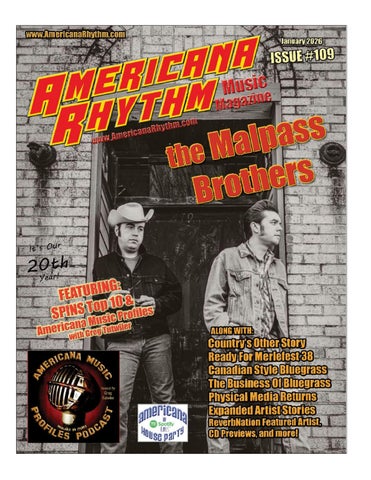
Issue 109
Country Music’s Other Founder
Ever wonder, Why do I do the things you do? Act the way I act? Ever said;
By Edward Tutwiler
In the late 1940s, I lived with my folks in a four room house on the edge of a farm. My folks did not have much but my music-loving mother had somehow scrapped together enough money to afford a huge wind-up Victoria record player an d a st ack of 78r pm record discs. Sh e taught me how to crank that player, deposit a disc on the turntable, and set the tone arm needle in t he gr oove. The music and voice th at emit ted from the bowels of that box was hollow and tinn y sounding but still magic to my ears. Most of her record collection (I now suspect about 30 total records) was what we called hillbilly music; and the one that I played over and over until I could sing all the words was titled, The Wreck of the Ole’ 97 and the song on the other side was titled, The Prisoner ’s Song. Some years later, while looking at th at r ecor d label, I n ot ed t he sin ger ’s n ame t o be Ver n on Dalhart.
Who Am I?
Get your Personality Profile report and find out. Scan the QR Code here
Americana Rhythm is published six timesa year. All corresponCONTRIBUTORS dence should be sent to PO Box 45, Bridgewater VA, 22812 or Ed Tutwiler email to greg@americanarhythm.com. Copies of Americana Wayne Erbsen Rhythm are made available free at variouspick up locationswithin Donna Ulisse the publication’sregion. Subscriptionsare available inside the United Mike Aiken States (only) for $24 US currency made payable by check or Andrew McKnight money order sent to, Subscriptions at PO Box 45, Bridgewater, Dan Walsh VA, 22812. Foreign subscription requests should be sent to Rebecca Frazier greg@americanarhythm.com. Copyright 2022. All rights reDISTRIBUTION served. Reproduction of any content, artwork or photographs is strictly prohibited without permission of the publisher or origi- North River Publishing Integrated Music Media nal owner. All advertising material subject to approval. PUBLISHER/EDITOR IN CHIEF Greg E. Tutwiler Associate Editor Ed Tutwiler MARKETING & PROMOTION Mark Barreres (GrassRootsNetworking.com) ADVERTISING Letters, Comments, Suggestions greg@americanarhythm.com Businessoffice 540-433-0360 www.am ericanarhyt hm.com advertising@americanarhythm.com
2
That player and those discs are long in the past now some 75+ years later but time cir cles and swirls as one drifts through life, and sometimes the past meets the present in most unusual ways. This past fall during our usual networking sessions at the IBMA gat h er in g, I met Mr. Jack Hinshelwood, a singer and guitar player with a perchance for old country music. Mr. Hinshelwood asked me if I knew who Vernon Dalhart was. I thought a minute, drew a blank, so h e t old me Vernon was a hillbilly singer from long ago. I then reflected back to my distant childhood, that old Victoria player, and my mother ’s records. That n ame appeared in my mind. I told Jack that I not only knew the name but could remember singing along with his voice on a record.
The Rest Of The Story It is now time t o tell you what Jack told me about this Vernon
SUBSCRIBE TODAY! Send us your name and address along with your check or money order for $20 for 5 issues, made out to Americana Rhythm, to PO Box 45, Bridgewater, VA, 22812. (PLEASE PRINT CLEARLY) You can also subscribe Via PayPal on line at www.AmericanaRhythm.com Name: Address: City: State:
www.AmericanaRhythm.com
Zip:
PLEASE PRINT!
Or, Subscribe using PayPal VISIT www.AmericanaRhythm.com
Stay up to date with us at
www.AmericanaRhythm.com
Issue 109
h istorian , liner notes writer, and producer, Olson has received multiple awards, inclu din g n in e Grammy nomin at ion s, t wo IBMA Best Liner Notes for a Recor ded P r oj ect Awards, and the Josie Mu sic Award for Music Producer of the Year.
Dalhart. Jack began by first telling about a multi-media stage presentation on Dalhart’s life and career that he an d educator, Ted Olson, have created. This presentation combines historic recordings, photos, and videos, and has Ted speaking an d Jack performing Dalhart songs live. This is an ambitiou s project that includes the stage show and a Rivermont Records produced four CD box set featuring 100 classic Dalhart recordings. These recordings are restored to sound better than the originals; and this set is accompanied by a luxur ious hard-back book written by Ted Olson. Jack Hinshelwood has a long career as a singer, songwriter, and award-winning multi-instrumentalist. He has entertained audiences with performances of tradit ional and Americana music. Jack is a winner of the Knoxville World’s Fair Gu itar Championship, the Wayne Henderson Guitar Championsh ip, and a twotime winn er of the pr estigious Galax Old Fiddler ’s Convention guitar contest. Jack co-produced and per formed with a tour ing concert program celebrating the music and legacy of Doc Watson. Also, Jack has performed for over 20 years as a touring artist for the Virginia Commission for the Arts. Ted Olson is a Professor of Appalachian Studies at East Tennessee State University. He has produced and curated mor e than 25 documentar y albums of tr adition al Appalachian music. As a music
Ted Olson did an in-dept h st udy abou t Ver n on Dalhart in, The Conversation, an online publication found at: www.conversation.com. Ted has allowed u s to glean from his words found there to put together our study here.
Digging Deeper Many writers, in cluding us here at AR, have often written about the influence th at the recording sessions in Bristol, TN in 1927 had on country music. It turns out that we may not know the real st or y. It seems t h at cou nt r y mu sic’s origin story has been heavily influenced by this romanticized notion of authenticity. We are lead to believe that this incident represents t he origin of the gen re. We have been told t hat those musicians collected for that session wer e wor kin g-class Sout herners, and t hat a savvy record company producer discovered talented but unknown perfor mers. However, a recording session that occu rred three years earlier, on Aug. 13, 1924, has a stronger claim to the origin of the launching of cou ntry music as a genre. That session featured a classically trained singer living in New York City, who had previously recor ded opera, pop and jazz, rat her than some fellow from the h ills. That artist was Vernon Dalhart.
own tastes and experiences. The companies first tried recor ding such material in northern cities but soon found it easier to take recording equipment to southern locations and record there. Ralph Peer did just that in Atlanta, in June, 1923. He recorded an artist known as Fiddlin’ John Carson; an d t h at 78 r pm r ecor din g quickly sold 500 copies, which demon str ated coun try mu sic’s commercial poten tial. Peer later produced the famous Bristol Sessions that resulted with several emerging nation ally known artists but only generated modest sales and was not as successful as other Appalachian sessions of the lat e 1920s. Never th eless, t h e Bristol Sessions became the origin story of country music.
Earlier Than Bristol? The Bristol-centered origin story denies earlier contributions to the genre by other pioneering recording artists and none more influential than Vernon Dalhart. If any ar tist should be con sidered as having shown the commercial viability of cou ntr y music, it is Dalh art . His given n ame was
Marion Try Slau ghter II and he was born in Jefferson, Texas, on April 6, 1883. Dalhart grew up sin ging for folks in h is hometown. He invented his stage name fr om t he n ames of t wo Tex as towns. As a you th in Texas, he worked as a ranch hand. Dalhart moved to New York City in 1907, with th e hopes of gaining a career as a grand opera vocalist. He was a trained vocalist, having taken lessons at the Dallas Conservatory of Music before leaving home. He continued vocal training in NY with opera instructor Isador Luckstone. He did land a place in opera and toured nationally with light opera productions for several years. After 1916, Dalh art concentrated on a recording career, making light opera, pop and jazz records in a succession of city-area studios, including Edison Records, (some have said he was one of Thomas Edison’s favorite singers). By the early 1920’s, having never realized his dream of becoming a serious opera singer, his primary income continued on page 5
By the early 1920s, record companies, were seeking n ew markets. They found them first from black folks want ing records recorded by black folks and then from rural white folks wanting to hear records that reflected their
www.AmericanaRhythm.com
3
Issue 109
4
www.AmericanaRhythm.com
Issue 109
Vernon continued from page 3 was recording. However, he had never established a distin ctive sound and personality to set him apart in the pop and jazz worlds. All that changed on Aug. 13, 1924. On that day, Dalh art r ecor ded two songs for the emerging but not yet identified country music market. He recorded The Wreck of the Old 97" and The Prisoner ’s Son g, for the Victor r ecording company who then released the t wo son gs on a 78 rpm disc. Dalhart claimed The Prisoner ’s Song was composed by a family member and received a share of the publishing royalties. The song ultimately brought Dalhart fame and some wealth. This disc became country music’s first major hit by selling seven million copies and an additional one million sheet music copies. It is worth noting, that both of these recordings are now en shrined in the Grammy Hall of Fame. Dalhart re-
corded for many labels under his own n ame an d man y pseudonyms; and his massive discography is almost impossible to discern.
Not Enough Credit By the time of the Bristol Sessions, Dalh ar t had alr eady recorded hundreds of country songs for dozens of companies, and a number of Dalhart’s records had become widely popular. He was re-
sponsible for an est imat ed 3000 r ecor din gs an d was cou n t r y mu sic’s most popular artist in the 1920s era. In this modern era, Dalhart has been m a r g i n a l i z ed . Even so, he was inducted into the Cou n t ry Mu sic Hall of Fame in 1981. Today h e has few champion s despit e t h e fact t h at man y leadin g coun tr y music st ars have covered songs from Dalhart’s vast repertoire. This neglect of Dalhart is likely becau se of h is background as an opera singer with formal musical training and thus deemed not country enough despite the fact he originally was a Texas far m boy. Th us Vern on Dalhart faded into the mists of time.
(to be released in 2026), and continuing to the present moment in the multi-media stage presentation with Jack Hinshelwood, I have been working toward restoring Dalhart’s rightful place in our collective memory as a significant pioneer of country music.” Jack Hinshelwood had this to add, “When Ted and I started discussing this program, he mentioned that many musicians don’t realize how many songs in their repertoire were either first recorded or first made popular by Vernon Dalhart. When I sat down and went through his discography, I was amazed t o fin d over 30 Dalhart songs in my own repertoire t hat I didn’t realize were son gs h e r ecor ded. To me, Dalhart’s legacy is the influence his recordings have had in helpin g t o cr eat e t h e Amer ican songbook, and the impact he had on so many of America’s music legends.
Hopefully, this will change with this multi-media effort by Olsen and Hinshelwood. I reached out to them recently for some per son al thoughts about Dalhart. Her e ar e Ted Olsen ’s thoughts, “For many years I have researched the origin s of coun t r y music, yielding four box sets that ex plor e fou r separ at e events in the creation of the genr e (the 1925 Asheville session s, th e 1927-1928 Bristol sessions, the 19281929 Johnson City sessions, and the 1929-1930 Kn oxville session s). When the 2019 Ken Burn s count ry music documen tary discussed this early chapter of the genre’s history without mentioning Dalhart—one of the central figur es in shaping the genre’s sound and in discover in g t he genre’s potential audience—I decided to do something to try to correct this oversight. Beginning in conversations with Rivermont Records to create a curated boxset compiling highligh ts fr om Dalhart’s prolific recording career
www.AmericanaRhythm.com
To date Ted and Jack have presented their production on two separate dates. The next scheduled performance is for April 17, 2026 at the Jackson Theater in Jonesborough, TN for the International Storytelling Center. They are currently working on a web sit e an d will post a complet e schedule there as soon as the site goes live
.
5
Issue109
Bluegrass Canadian Style At IBMA this past September, I w as approached about the subject of Canadian Blueg rass music, and it’s proper place in the Bluegrass conversation. So we invited Canadian Bl uegrass musician and promoter, Karen DeC oste, to spend some time telling us about the Canadian bluegrass story. - editor
Bluegrass Music originated in the
Boys, The Canadian Grass Unit, Bluegrass Tradit ion, Rustic Harmony, The Barrel Boys, The Bluegrass Diamonds, and The Lonesome Town Painters. Additinally, some well- known artists include Vic Mullen, Eddy P oir ier, Ray Leger e, Fran k Doody, Gordon S t obbe, Ron S avoie, Ru ssell
Appalach ian r egion s of t h e United States, h owever this music took a stron g hold in Canada in the late 1950’s and early 1960’s. Radio signals picked up in these areas exposed th e local folk and country musicians to Bluegrass Mu sic. The accessibility of t he banjo, mandolin and fiddle were already popular in Canada, so the music resonated with Canadian audiences. Similar to the immigrants in the US, where stories of hardship and struggles were told through song, Canadian ’s were familiar with hard work and h ard times. The authenticity of Bluegrass Music was appealing and became a treasured form of ex pression for musicians and audiences. Bill Monroe, Flatt & Scru ggs, the Stanley Brothers, and others inspired this generation. Bluegrass Music in the Maritimes often incorporates elements of Celtic and Scot tish music, an d Fr ench -Canadian mu sic, wh ile Qu ebec blen ds fiddle tunes and storytelling, and the western regions have a stronger influence from Country and Roots Music.
Early Canadian Bluegrass One of t h e ear liest blu egr ass ban ds in the Mar itimes (Nova S cotia, New B r u n swick an d Prince Edward Island) were the Birch Mountain Boys, featuring Vic Mullen, Brent Williams and Har r y Cr omwell. T h e Yor k County Boys from Ontario were anoth er ver y ear ly Can adian blu egrass band featu ring Mike Cameron, Rex Yetman and “Big John” McManaman. Ot her notable bands include Denis LePage and Station Road, The Dixie Flyers, The Boutilier Brothers, The Good Brothers, The Slocan Rambler s, Th e Dead S out h , Jake Vaadeland & the Sturgeon River
6
By Karen DeCoste
tivals have US bands and Canadian bands as part of the weekend entertainment. These festivals are important opportunities for audiences to see and experience live music. Wher e music is concerned, there are no barriers from country to country, all just equally ener get ic an d en joyable. Th e Tottehnam Bluegr ass Festival in Ontario, Blueberry Music Festival in Stony Plain Alberta, PEI Annu al B lu egrass an d Old Time Music Festival are three notable long running festivals.
Formal Organization
S awler and man y ot h er s. Of cou rse, we cann ot forget th e women who have been influential in Bluegrass Music in Canada as well. Women such as Jan et McGarry, Bella White, Amanda Wilkinson and Lori Yates, Natasha Richard and a n ew trio on the scene fr om t he Maritimes, The Sunny Mountain Gals (featuring Kr ist in Kavo u kian , Jan et McGarry & Kar en DeCoste).
Associations, Societies, and Clubs help to keep th e music in many communities, bot h smaller rural setting, and large urban centers. The Bluegrass Music Association of Can ada featur es a Nation al magazin e, Bluegrass Canada, wh ere con tributors across t he Nation share events, band informat ion an d happenings. (See Bluegrass Canada.ca). Society’s such as The Downeast Bluegrass & Oldtime Music Society, and the
There are many celebrated Canadian bluegrass artists that win international competitions, participate in US festivals and are featured on streaming services and radio programs. Turn the radio dial to Bluegrass Junction and you will hear bands such as Jackson Hollow, The Spinney Brothers, and many others. An important part of the growth of Bluegrass Music in Canada was the for mation of festivals. The longest running bluegrass festival in Canada is the NS Annual Bluegrass & Oldtime Music Festival which celebrates 53 years July 2026. There are many long running festivals in Canada. Most fes-
www.AmericanaRhythm.com
PEI Bluegrass and Old Time Music Society are ju st two in the Maritimes that have a mandate to promote and preserve Bluegrass Music. Th er e are man y clubs across Canada that have local jam sessions and small concerts that keep t h e commu n it y familiar with the music and is a great place for the next generation of pickers to hear t he music. Neil Rosenberg, although born in the US, now calls Newfoundland & Labrador, Canada his home. He is a retired Professor Emeritus of Folklore at the Memorial University. He is an active musician and has written sever al very influential Bluegrass Music books inclu ding B luegr ass: A Hist or y (1985) and he has published over 75 articles. An exciting new festival, the PEI Winter Bluegrass Festival will be held March 19-22, 2026 and will have over 15 hours of main stage music, professional workshops and local artisans (see page XXX for details). From the longest running festival to many new festivals popping up, bluegrass music is alive and thriving here in Canada.
Issue 109
www.AmericanaRhythm.com
7
Issue 109
Business Of Bluegrass Our main respons ibility when we staff the AR booth at the IBMA gatherings is to meet, greet, and network with bluegrass music industry folks who pass through the exhibit hall. That is the way I met Joanne Ledesma.
your music over someone else’s.” The book is capped with a collection of interviews with a group of folks in the bluegrass world who are at various points in their careers. In these interviews, these career pickers answer several key questions that every aspiring artist considering a professional life in bluegrass music should ponder carefully for the insight contained there.
Joanne Ledesma is a music business strategist and manager with over 30 years of experience in the entertainment industry. Her work includes full artist management, and consultant for festivals, events and companies using music for their brand. Her latest venture is as a published author and this is the subject that led to our discussions. Joanne Ledesma’s literary effort is titled, Career Pickin’ Music Business for Bluegrass . This book is a career guide written with bluegrass artis ts in mind, It contains s tep-by-step strategies to help artists protect their songs, register copyrights and understand royalties. Artists can learn how to promote music, s ecure bookings, and take advantage of opportunities in publishing, streaming, and licensing. It does all this with clear tools and practical examples. Overall, the purpose of this book is to give the profes sional artist the knowledge to make smart business decisions and build a sustainable career. The book is currently a selfpublished work by Ms. Ledesma; and she was doing a soft launch at the IBMA gathering in September ’25 where I met her. The book was well received by the bluegrass community gathered there. If you are interested in obtaining a copy of this current first run, you can purchase it for $30 directly from her website (mus icbizgal@gmail) starting mid November, ‘25. The hard launch is scheduled for first quarter, 2026 with a release to Amazon as well as other major online retailers. The book begins by introducing the reader to an understanding of the
8
By Edward Tutwiler
bluegrass landscape. She tells the reader that bluegrass is both a blessing and a hurdle. She blesses the music for its authenticity and simplicity; however, does not fail to explain the hurdles that modern technology places before a simple artist who might not have the digital fluency to take advantage of the modern tools that are available.
It is hard for this reviewer to pick the most important aspects of this book; however, I think it is critical that an artist understand about copyrighting one’s material; branding one’s image and all aspects of how social media can make one’s career. The other material presented therein is also just as useful and important as well and not to be discounted. While I am never going to be up on the stage picking and singing those tunes I have learned to love over a lifetime of listening and later
There is a very understandable section on copyrighting one’s original music creations. Here is an example, “Copyright gives the songwriter or composer, the excusive right to decide who can use, record, or perform that song. It is how the law protects your creative work… .” There is a whole chapter on the crafting of songs—not how to write a song but what to do with it in six detailed steps after it is written. Ms Ledesma writes a whole section or how artists should create an identifying brand for themselves; she writes, “When music becomes a business, categorization becomes essential. Without a specific context or reliable description, it’s harder for others to see why they should listen to
www.AmericanaRhythm.com
writing about, I found this Career Pickin’ Music Business for Bluegrass an extremely interesting and informative book. I certainly gained some insight of the pain and peril that could befall a budding artist trying to kick-start a professional career as a performer of bluegrass music. The book is well written and eas y to read; and while it is written with the newcomer in mind, much of the material, I suspect, could be very useful to a grizzled road warrior as well. I believe the charts and forms that the author includes for readers to copy and use to ease the business side of their business should be very helpful. I recommend the book without reservation and believe it to be an asset to any person embarking upon bluegrass as a career. Pick up a copy for yourself soon. You can learn more about Joanne Ledesma and her work from her web site: www.MusicBizGal.com
Issue 109
Thanks to our partnership with ReverbNation (www.reverbnation.com) we are honored to give you a peak at a few of the nation’s hardest working indie artists. Each month we select one entry to showcase for you here. Enjoy! THIS MONTH’S FEATURE:
By Greg Tutwiler
Raggedy Anne
That song spiraled into, ‘lets make an album.’ They proceeded to write anall original 10 song album over the next few years, figuring it all out along the way. “That original album must not have been too bad, because that was when we were contacted by the folks in Nashville. We really learned a lot there from them. T hat experience led us to change our name to, Raggedy Anne, something that felt a little more exciting. She became an alter ego of sorts for us, and allowed our songs and writing to really step it up a notch,” they said.
FEATURE ARTISTS ReverbNation.com
There’s just something special about s ibling harmony. Sis ters , Cara Anderton, and Cas sidi Hesdon, are known for their perfectly, in-sync harmonies, that range from sweet and haunting, to fiercely powerful. Once they discovered their synchronicity, it was clear they had a common goal to pursue. These two now share their talents as the country duo, Raggedy Anne. Cara and Cass moved around a lot growing up, and even joke that they actually don’t have a hometown – although they’ve both recently ended up in St. Louis this past year, and have decided they’re going to stick together to keep, “living life and doing music together. I guess if we had to pick a hometown it would be Grove City, Pennsylvania, because that was our last family stop, and our parents still live there,” Cara said.
How It Started Cara said she has a vivid memory of going through some boxes of old pictures and things of her mother’s. “I had to be maybe in 7th grade,” she recalled. “I found some tapes. Mom said those were old tapes of her singing songs like Fleetwood Mac, and Linda Ronstadt covers, as well as a few records with some originals. We never really knew that mom sang. We probably knew she could sing, but we hadn’t known that she had opened up for all these big names, and traveled the country doing it. She left it when she decided to have a family. Now though, she sings in bands again and is still amazing. She is
a nice tribute to all the places we had lived together as kids,” they said.
T he Future
a coach to us, and could put us to shame,” she quipped. That discovery led the sisters to pursue the idea of singing together. “We joined choirs and found our voices there. We started entering contests and doing solos … we just didn’t quite know where that could lead, and didn’t have a vision of what this could lead into until later.” Their father’s job led them around the country before landing the family in PA, during their high school years, to be nearer to family. “That is where we really started singing together; even our mom started singing again there. We both eventually picked up and moved to Virginia (Cass), and Miss ouri, respectively, after college, and continued to pursue music long distance with Pennsylvania being our home base. We would travel back to gig and write. We had officially formed a duo called, East & West, there at a really strange time when we were finis hing college, but after writing an album together, we wanted to finish recording it. We had amassed a good following too, and it was then we realized we had something worth pursuing,” Cara recalled.
T he Next Level
Writing and singing together was fun for Cara and Cassidi, and they began to realize it was going over pretty well with their growing fan base. “We en-
joyed working together on songs as writers, and our voices just blended with that family harmony – being sisters. and best friends, it was just fun. Once we started gigging, we just kept the ball rolling, with new songs, contests, etc. “It just naturally kept growing. Once that first album was finished, we had a release party, and realized that people were coming to see us, and really liked our work, which was an amazing feeling,” they both concurred. “What really sold the idea that we needed to pursue this, was when Nashville called. Our work had won some song contests that reached the ears of industry professionals, and after meeting with them, we decided to take this leap, and write with professionals, and continue learning. With those experiences, we gained so much more knowledge, and our work has continued to grow.”
Ulterior Motive
The girls really just started writing their own music to give them an advantage when participating in contests. Cara said, “We were finalists in a show called the, Country Colgate Showdown, and had read that original songs earned more points, so we wrote one. That song ended up being the title track on our first album called, “Between the Lines,” we produced when we were known as East & West. (Cara is East because she was born in Pennsylvania, and Cassidi is West because she was born in Wyoming) “We thought it paid
www.AmericanaRhythm.com
2025 finds them finalists in the American Songwriter W ide Open Country contest with their song, “Mouth from the South.” “We have been very lucky that all of our released songs, so far, have their place in many different contests, as winners. We currently have four songs; “Love of a Good Man,” “This Shirt,” “Mouth from the South,” and “Ghost Town.” We have two more ready to go, and we are working on releasing them in 2026. We’ve got a lot in the vault too, that we are hoping to get in the studio to record soon, as well,” they reacted. The sisters plan to continue along this path, continuing to write, record, and release a new song every one to two months. “We also plan to continue performing , and trying to establish a new fan base in the St. Louis area, where we both now live. We are excited to have a closer proximity to Nashville too, and hope to pe rform at more songwriting rounds this next year. Our long term goals are evolving though, as we have become mothers. We always hope to get out and perform, but our focus on the long term has shifted into the possibility of pitching our songs to artists and publishing houses in the Nashville area. We want our music to be an experience our listeners can feel like a part of, a way to truly get to know us, and become part of our extended family in a sense.”
Find more here: www.raggedyannemusic.com
9
Issue 109
The Malpass Brothers
By Greg Tutwiler
Two brothers, Chris and Taylor Malpass, grew u p in Goldsboro, Nort h Carolina. One day they discovered their grandfather ’s LP collection. To them, it was like discovering gold. It was a treasure ch est of classic, golden -er a, traditional coun try music. They stu died t he br ot her-harmon y bluegrass duos of the L ouvin Brothers, Wilbur n Brothers, Jim & Jesse, and the rich, authentic sou nds of singer s like, Han k Williams, Merle Haggard, Lefty Frizzell, and Charlie Pride. Their future was sealed, and today the Malpass Brother s travel around the coun try paying tribute the mu sic t h ey gr ew u p on , entertaining audiences, not only wit h t h eir “ sou n d like” renditions, but also adding their own original, traditional music to go along with it. The Brothers began singing and playing alongside their dad, Chris Malpass Sr., at an early age. “Our grandfather (My dad’s dad) ran a lit tle bar an d played and sang country music th ere,” Chris told me. “We began learning how to play and sing fr om our grandfather. It started growing, and we began tr aveling place t o place, even before we had a driver ’s license, so my dad was taking us. He played bass with us, because He said, ‘If I got to drive, I might as well play,’ Ch ris laughed. “He played with us for a lot of those early years.” While the younger Taylor finished up high school, Chris began writing songs and playing out on the road with steel guitar legend, Don Helms – as an original member of the Drifting Cowboys. One day Chris found himself jamming on Merle Haggar d’s bus, which would one day prove prophetic. Upon graduation, Taylor flew out to Redding Califor nia to j oin Chris as the opening act for Merle Haggard – which lasted for seven years.
The Haggard Years “It was a dream come true,” Chris recalled. “I didn’t think there was any better singer than Merle Hag-
10
gard. I still don’t. It was a magical experience. There’d be moments when you’d be talking to him like talking to anyone else. He was such a genuinely good guy, and we were around him so much. We were practically living out there at the ran ch. At times you forgot it was Merle Haggard, you know what I mean? Then all of the sudden, you’d hear him sing, or you’d be sitting there with him, and you’d see an album cover, and he’s sitting righ t there, and you think, ‘Dang, this is the guy that influenced me to do wh at I do now.’ So, I never took that for granted. Looking back now, I really missed it.” “Sure, it was har d. My first trip out, our first tour was almost 28 days long, wow. I had never been gone that long, and I thought, ‘Man, I don’t know if I can do this’; but man, I’d do it again. I’d do it again in a heartbeat.” The brothers opened the shows with The Strangers (Merle’s band) backing them. Then Merle would come out after their set. “Then we would step off stage,” Chris recalled. “And a lot of times I would
go back out at t he end and talk him off the stage, you know, say, ‘come by hags Country Store,’ do the whole sales thing, which was cool.” Chris recalled having a sense that things were winding down and that they’d need to find their own pat h. “Merle was one of th ose larger than life people that you thought would live forever,” Chris said. “But you knew that he had done it for so long, and you knew his health wasn’t great. So, the last year or so, Taylor and I started taking more dates on our own as the Malpass Brothers. I had a conversation with Merle, and I think he un der st ood. I th ink h e r espected us for knowing that we wer e tr ying to build our own thing. I never wanted to be one to ride off anybody’s coattails for sure. So when the time came that we weren’t working with Merle as much, we focused more on our solo career. We were planning to work with him on his last tours though, but I t hink we did the right thing by stepping out on our own when we did. All good things do come to an end, of course. But Merle’s music, for sure, will live
www.AmericanaRhythm.com
forever, and I think about him every time I walk on that stage,” Chris reflected.
A New Era In 2011, Mer le pr oduced t h e brothers’ debut album, Memory That Bad, on Hag Records. The title track hit n umber six on the CMT P u r e Coun t r y 12-P ack Countdown and remained in the charts for sever al weeks. Doyle Lawson then produced their self titled second album, and they released a live album in 2017, Live At The Pa ramount. Th e 2023 release, Lonely Street, brought even more attention to the duo as they also began to find more notoriety on TV. (A new gospel collection and a live project are both projected for 2026.) Aroun d 2015, L arr y B lack of Larry’s country diner on RFD TV brou ght them on t o play. “We didn’t know how it would go because it was a brand new audience for us,” Chris said, “but Larry said that the phones just lit up. And fr om t her e, we j ust wer e constantly doing various cruises, and the reunion shows he would host. It really grew into what we have
Issue 109
now, which was a chance to host our own show on RFD TV.” “There’s not a mainstream station or place really, you can go to hear this music. And RFD TV, brought all t he old shows back home, brought a lot of artists back to the height t he folks hadn’t seen in years, and some that they’d never seen, like us. If that outlet hadn’t been there, then there’s a lot of artists that might not be out there doing what they do, you know?”
The Live Experience While their original music stands on its own , th eir live per forman ces are someth ing else entirely. “We’re all about the tradition,” Chris stat ed. I mean, Taylor plays Leon Rose’s guitars, and I play Charlie Louvin’s guitar. Every time we go on stage, we’re trying to present the history and keep the tradition alive.”
The Malpass Brothers have now become a staple at bluegrass festivals. Chris an d Taylor grew up around a lot of bluegrass music, but of course gr avitated towards Mer le, Han k W illiams, t h e Louvin brothers, etc. “Yes, classic country is our first love,” Chris reiterated. “We got introduced to the bluegrass community by getting to play at some of those festivals early on. The crowds there are very t raditional, and don’t want anything changing their traditions, but I think they saw that we were just as traditional about our country music, and so they welcomed u s with open arms,
and we’ve ended up playing bluegrass festivals all the t ime. It’s crazy.” And while It’s tr ue – the music is always on point – there’s a flair for the funny that puts the cherry on top of their live performances. The banter between the two, you have to pay att ention to make sur e they’re not serious sometimes, which makes it even more funny. “As Taylor and I started traveling and doing this, it just happened, ” Chris commented. “I’d say someth ing, and Taylor would smart off to me. You could ask the guys in the band; It’s kind of that way off stage too. It’s a constant. It’s just a sibling thing I guess. He likes to gather stuff, funny stuff, from fans, and he’ll use that too. You never know what he’s gonna say, an d it keeps it inter esting for u s. Sometimes he catches me off guard.” “We n ever make a set list eit her, so when we go ou t t h er e, w h a t ev er show we give you is what is r eally fr om our heart that night. I think t hat ’s su per i mp or t a n t , and I think it comes across to the crowd. So the jokes, T a y l o r ch an ges t h em u p. He’ll t ell some I’ve never heard, and then throw in some of his little sly comments. It’s just what we do, and somehow it works. It’s the only way we know to do it; it’s to just be your self.”
www.AmericanaRhythm.com
11
Issue 109
Issue 108
Listen to the expanded interviews by searching Americana Music Profiles on all of your favorite Podcast platforms!
Jeremy Parsons
Michael Joseph Ulery
Meghan Hayes
Born and raised in San Antonio Texas, it wasn’t until he was 17 that singer-songwriter, Jeremy Parsons caught the music bug. “My parents tried to get me to take guitar lessons when I was younger, but I was an outdoor boy. Sitting down, inside, was not an option,” he recalled. “Especially for 30 to 60 minutes with a complete stranger.”
Michael Ulery spent his formative music years traveling through rock and punk, on his way to a delightful balance of mixed heritage, Americana music. The central Ohio native’s latest instrumental release, Mild November, brings Michael back to his Americana roots.
Meghan Hayes has three critically acclaimed albums to her credit leading up to her most recent album, Latecomer, a 10 song collection that s how cases her unique ability to craft a good story, and a voice that accompanies it perfectly.
“Texas country was at s uch a good place when I was in my late teens. I was attending these shows, so the outer influence was there,” he said. But I hadn’t c onsidered it for myself. I was just taking it one day at a time. But I was looking at that guitar standing in the corner one day, and I thought, ‘I’ll change the strings and play around with it.’ There was something about that moment for Jeremy that just clicked. He recalls a magic happening, and literally played that guitar until his fingers bled. “From then on – as soon as I got home from school – that was it. Homework took a back seat. For me at that moment, that was what mattered.” Within a year or so, he was writing his own material and not long after that, playing dates out in various venues. “I tried college – probably for the sake of everyone else,” he quipped. “But it just wasn’t me. I was at that age, just turned 21, and I wanted to go to Nashville and see what happens.” Jeremy ended up living in Nashville for 10 years after landing a cut he had written on a Grascals record, within the first 10 months of being in Nashville. Fast-forward, Jeremy has spent the past decade traveling and playing all over the US and Europe. His unique rapport with his audiences, and his Texas influenced approach to music gives folks a genuine experience at his live performances. The first single off his latest album, “Things I Need To Say,” was a Top 40 Roots Music Report charting song.
To find out more, visit www.jeremyparsonsmusic.com
12
Michael remembers distinctively having a couple KISS records in his collection as a young boy growing up in the 70’s. “Music really hit me when I was about 12, and wanted to emulate that rock music. Randy Rhodes is probably the reason I picked up a guitar,” he recalled. “I still listen to a lot of that type of music now, even though my ow n performances have tamed a bit. I still have an ’81 Marshall Amp in my studio,” he laughed. “It’s never been that far away, it’s always been kind of there.” As a child, he heard stories of his grandfather, born in the Appalachian region, playing banjo alongside accordion, harmonica, and fiddle players. It prompted him as an adult to explore his heritage and that style of music. “I think the acoustic, instrumental, Americana side of mus ic has always been there for me because my musical tastes were always very wide ranges,” Michael recalled. But it w as the multi-layers of even some of the rock musicians of his earlier years, and the deep cut instrumental songs often found on some of the prominent rock albums that pushed him to explore that side of his music in recent times. Mild November is a return to his roots, with the initial three songs and the title track seated in an American Primitive, Americana, and folk-blues vein. Other tracks lean on his Celtic roots, like the song, “Biscuit Tin, ” a song that was influenced after a visit to his Scottish ancestral roots in the Isle of Skye in the Northern highlands of Scotland. You can even find hints of Native American music surfacing on certain track – and reflective of a previous album release. To find out more, visit w w w .https://m ichaeljosephulery.bandcam p.com /
www.AmericanaRhythm.com
The Virginia born artis t s aid s he moved every year as a kid before making a more permanent home in Nashville, TN. “This is by far the longest I’ve lived anywhere,” she exclaimed. Meghan said she’s been writing songs since she was about 15, and doing music ever since. She recalls her great aunt gifting her a classical guitar as a young girl. “I just picked up the Bob Dylan songbook,” she said. “It had chord charts, and that’s how I learned to play guitar.” Meghan said she believes she’s been singing about as long as she’s been speaking. “I just love to sing,” she exclaimed. “I’ve often joked I’d be happy if my career had just been singing background vocals – obviously I love all the other things too, but I just adore harmonies and seek them out wherever I go.” Meghan is also a published poet and has written a number of short stories throughout her career – upon graduating college she said she felt like her path was as “someone who wrote poetry to music,” she said. “I guess it stuck because I’m still doing it. I still write poetry, but there just tends to be music associated with the things that come into my head, so I just go with it.” With the latest release, Latecomer, Meghan hopes to get on the road with the material this coming winter and early spring, “at least for the Southeastern part of the country,” she said. “Ashville, up into the Shenandoah Mountains, Atlanta, and down into that region we’ll see where it goes from there. I’m often surprised at how tours evolve. I’ve also been really pleased with the radio play,” she said. To find out more, visit www.meghanhayes.com
Issue 109
Why Physical Media Is Making A Comeback In an era domin ated by digital streaming and on-demand access, it might seem coun ter intu itive that records, CDs, DVDs, and even casset t e t apes ar e en j oyin g renewed popu lar ity. Yet across generations, physical media has staged a surprising resurgence— su ggest in g t h at somet h in g deeper than nostalgia is at play. On e of t h e str on gest for ces beh in d t h is comeback is tangibility. Physical media offers a sensory experience that digital files can n ot r eplicat e. Vin yl records, with their large artwork and tactile grooves, invite the listener into a ritual: pulling the record from its sleeve, placing it on a turntable, and lowering the needle. Cassettes, once maligned for hiss and inconvenience, now appeal because t hey feel real— objects to hold, collect, and share. In a world where the vast majority of music and movies exist only as ephemeral files, physical media provides a sense of solidity and presence. Closely tied to t angibility is the desire for owner ship. Streaming services offer conven ience and
vast libr ar ies, but access can disappear as quickly as a licensing contract changes. Physical media, by contrast, belongs to the buyer. That sense of h aving something t h at can n ot be r emot ely r evoked—n o a lgor it h m, n o
subscription tier, no region lock— resonates with consumers weary of fleet in g digital availability. Owning a recor d, DVD, or CD feels mor e secu re and personal than rent ing access through a service. An ot h er dr iver of ph ysical media’s resurgen ce is ritual and attention. Digital consumption is fast , fr agmen t ed, an d oft en backgr ou n ded . We st r eam playlists while multitasking, skip
through movies with ease, and jump between screens. Physical media, h owever, en cour ages focus. Listening to a full album on vin yl or watch ing a movie on DVD inherently slows down how we engage with art. For many, this slower mode of consumption feels r icher— n ot mer el y passive en t er t ain men t , bu t an intentional experience. Collectibility also plays a sign ificant role. Limit ededit ion r ecor ds, color ed vinyl, retro packaging, and box set s h ave become covet ed it ems. For fan s, collecting physical media is a h obby an d often a way t o connect with ot hers who share similar interests. Social media commu n it ies h ave emer ged ar ou nd collection s; un boxing videos an d shelf tour s att ract au dien ces eager t o celebr at e curated libraries. The collectible nature of physical media turns music an d film into something ar t isan al an d mean in gfu l— objects with history and personal significance.
www.AmericanaRhythm.com
Interestingly, the resurgence isn’t limited to older generations who r emember th ese for mats from t h eir you t h. You n ger fan s— Digital Natives—are embracing vinyl an d casset tes pr ecisely because t hey are dif ferent from t h e digit al n or m. To t h em, physical media is novel, retro, and au t h en t ic—qu alit ies t h at command cultural cachet. These for mat s car r y aest h et ic an d emotional value that transcends mere ut ility. Creators themselves have fueled th e t r en d. In depen den t musicians, filmmakers, and small labels oft en r elease ph ysical editions as a way to connect with audiences and generate revenue at a t ime wh en st r eamin g royalties ar e minimal. Physical releases become st at emen ts of artistic identity and commitment, r ein for cin g t heir valu e in a crowded digit al landscape. The revival of physical media is not just a nostalgic throwback— it’s a reaction to the intangibility of digital cultu re. People crave ownership, r it ual, focus, an d con n ect ion . P h ysical media provides all of these: a way to slow down, choose meaningfully, and hold something r eal in a virtual world.
13
Issue 109
Listen to the expanded interviews by searching Americana Music Profiles on all of your favorite Podcast platforms!
Vi Wickam
Reagan Browne
Jacob Jones
Colorado, fiddler, singer and songwriter, Vi Wickam recently released The Thanksgiving Album, because, as he put it, “the world needs Thanksgiving music.” The album features eight original songs and one instrumental, a cover of the traditional, “Turkey In The Straw.” It brings together elements of Americana, bluegrass, folk, country, Celtic, and even Jazz.
Reagan Brown, singer, songwriter from Dallas Texas, has been called, “the guy with a million dollar voice.” Reagan’s latest EP, Runnin’Straight Through A Neon Light, was released this past September.
Country singer, songwriter, Jacob Jones is in the midst of an ambitious 21 song album, with the first eight tracks now available on an EP titled, American Drifter. The songs come out of his own personal journey as a “military brat,” as he refers to himself. He grew up in a military family that w as alw ays moving, and he learned early on what sacrifice, service, and resilience looked like.
“I love getting to play music,” he commented. “I’ve been making it pretty much my whole life. ” Vi w as raised in a musical family, and toured as part of The Wickam Family Band. He recalled, “If you’d look at old family photos, you’d find a picture of my dad holding me, dancing around while there was music playing. First time I appeared on stage, I think I was two or three years old.” Vi said he started playing the fiddle when he was seven years old. “By the time I was in high school I was already winning money in fiddle contests,” Vi recalled. “I was playing professional gigs by the time I was 13 or 14. If I wasn’t doing music I would not feel like I was a whole human.” Vi became a four time Colorado State Fiddling Champion, a finalist at the Grand Master’s Fiddler Championship, and a three time runner up in the National Fiddle Contest. In 2012 he released his Fiddle Tune A Day project, posting a new fiddle tune every single day for a year. He had Top Five success with his 2018 albums, Armadillo on a Hot Tin Roof, and, Twas The Night Before Christmas. He says this latest Thanksgiving project is a celebration of gratitude, connection, and community. It was born out of a simple kitchen table conversation between he and his wife Christiana. “I wanted to create a real emotional connection with people. One of the songs, when my w ife heard it for the first time, she teared up. I thought, ‘alright, we’ve got something here.”
To find out more, visit www.viwickam.com
14
Reagan grew up in south Texas, and then moved to California in his 20s to, as he put’s it, “do the whole music scene out there,” before moving to Las Vegas to play on a country based show on the Vegas strip. He then moved to Nashville in March of 2020. “The first day I was there, it was that tornado that unfortunately wiped out about half the city,” he recalled. “Then covid hit.” a move back to Dallas, where his whole family resided, made since pretty soon after. “As a toddler, I remember listening to 45 records I found in my grandmother’s clos et; Beac h Boys and original Beatles 45s were my first music listening experience,” he recalled. “The first instrument I ever had was a toy snare drum,” he laughed. “But I think I got into music like a lot of kids, sitting around watch MTV and seeing all those amazing bands. One day the ‘Jump’ video came on by Van Halen, and I think that changed things in my mind.” “In kindergarten one day, a kid brought a guitar for show and tell. I didn’t even really know what it was. I picked it up and started riffing with it, it just went from there,” he said. Regan’s been in bands his whole life. “I was in bands out in Hollywood, playing on Sunset Strip,” he said. “My mindset is just drawn to music, it’s really all I know. I ended up writing all the songs for the bands I was in, and became the s inger almost by default, as the bands always needed a singer. I guess that’s what really set me up to become a solo guy,” he said.
Nashville is home for this son of a military man, and he says he’s, “always had that sense of patriotism.” “I lived in nine different states growing up,” he recalled. “But when I think of home, I think of Alabama. My dad’s entire family is from there, so that’s always felt like home base at least.” Jacob said he started being involved in music while in youth group, and “started writing songs to impress girls,” he quipped. “I decided I wanted to move to Nashville and write songs when I was in college.” Jacob has been a full time musician and songwriter in Nashville for the past five or six years. “I love all kinds of music, but I definitely lean more in that red dirt/Americana kind of lane; I just love the songwriting and the musicianship.” “The brand of music I’ve done has always been pretty consistent,” he observed. “I don’t know that living in different places actually changed any of that, I just think it refined it.” Jacob said he went to three different colleges in three years, and then dropped out to do music full time. “I realized after about a year and a half that I’d rather do music full time, so I went to Liberty University to their recording engineering school, but then I realized very quickly I’d rather be out there doing it than trying to get a degree that didn’t really do a whole lot for me.”
The EP is available on all of your favorite streaming services. To find out more, visit www.reaganbrownemusic.com
www.AmericanaRhythm.com
To find out more, visit @jacobjonesmusic
Issue 109
www.AmericanaRhythm.com
15
Issue 109
WoodSongs Old-Time Radio Hour Relocates After completing three years at the Lyric T heatre, the s yndic ated, international b roadc as t of the WoodSongs Old-Time Radio Hour moves to the historic, Scottish Rite Hall, to start the 2026 season. “We greatly appreciate our residency at the Lyric Theatre, it’s been wonderful, ” said folksinger Michael Johnathon, creator and hos t of Wo o d S o n g s . “Everyone from Judy Collins to Béla Fleck, Blind Boys of Alabama, Tommy Emmanuel, Amy Grant, Bobby Rush to Roger McGuinn have all appeared on the stage of the Lyric along with literally hundreds of other artists from around the world.” The Scottish Rite is a fraternity-run venue that foc u s es greatly on c ommunity s ervic e, es pec ially children’s charities and more. The new venue is very audience friendly, with about 300 theater s eats in a
16
beautiful, rustic s etting, with an abundance of free on-site parking. “T he members of The Lexington Scottish Rite are excited to partner with WoodSongs ,” s aid Carl Gibson, Sec retar y of the Sc ottish Rite. “We feel c onfident that the lega c ies of s ervic e w ill be enhanc ed by the partnership. We look forward to seeing everyone in February 2026 and beyond. Featuring a new look and a new stage, the main broadcast of WoodSongs as well as the sister series WoodSongs Kids will be produced at the Scottish Rite for the next five years. Both productions air on hundreds of radio stations worldwide including regionally WEKU WUKY and The HOUND FM, s een in millions of USA TV homes on public television including KET, the RFD-T V netw ork and broadcasting in 177 Nations on the American Forces Radio Network.
www.AmericanaRhythm.com
Over 375 Interviews
38th Merlefest On The Way Alison Krauss & Union Station
Why It Works
feat ur in g Jerr y Dou glas, Old Crow Medicine Sh ow, Char les Wesley Godwin , B lackber r y Smoke, Molly Tu ttle, and Ketch Secor are just a few of the names set to headling the 38th edition of Merlefest, set to take place on the campus of Wilkes Community College, in Wilkesboro, NC, April 23 – 26, 2026.
It’s such a well oiled machine, and one that many other festivals have modeled over t he year s. An d while measured growth is often a good th ing, Wes acknowledges they are limited by the room they have there. “We are limited as far as real estate goes – we can only fit so many people on campus. So we focus on ways we can grow that helps our community, and hope we can still wow our fans every year, ” he said.
It’s such an accomplishment to have a festival continue at this level for this long. “I have to give
spread acr oss this place. It ’s a lot. And it’s a big sch edule, but it’s a lot of fun to pu t together. This year we’re addin g a new shuttle to help folks get from the lower parking lot where the Americana stage is, around towards the hillside stage. People who have been here before will understand what that means and how helpful that is.”
The History Mer lefest was originally t he, Eddie Merle Watson Memor ial festival. As the story goes; Years
a lot of the credit to the folks that put this festival together back in t he ear ly days, ” dir ector Wes Whitson, told us. “They had a the vision to do all the good t hey could wit h this festival, w h en ev er th ey cou ld; ever yt h in g from placing n o n p r o fi t organ izations in the food booths, and let t in g t h em r aise mon ey for their causes. T h e main mission of our festival is t o provide student scholarships, and other ways we can fun d, an d help make real change for folks in our community here at Wilkes Community College. Everyt hing we do goes back to the students and the community here.”
“It works out pretty well,” he exclaimed. “Our campus is beautifu l, an d we’ve got volunt eers working all year long to keep it
looking good. Especially heading into the spring, t hey really get at the top of their game, and have it looking really good for festival time. We draw big crowds, but th ere’s st ill room for per son al space too. T her e are 12 stages
ago, a horticultu re instructor at the college wanted to raise money for the gardens on campus. “The gar den s h ave always been a thing,” Wes said. “He had a friend who knew Doc Watson, and knew that he was very active in his community, and they asked him to do a on e t ime fun dr aiser t o r aise
www.AmericanaRhythm.com
Issue 109
By Greg Tutwiler
money for th em. He said h e would if they would n ame the event in honor of his recen tly passed son, Merle Watson. That’s how it started. It’s been 40 years this fall since Merle passed away, and we’ve got ou r 40th anniversary coming up in 2028.” A lthou g h the mu si c some ti me s se e ms ac ross the board, you have to understand a little something about how Doc viewed music. “When Doc an d Me rl e we re tou ri n g , maybe they were at a random cl ub setting up some where, an d someone wou l d ask, ‘what are we goi ng to he ar tonig ht,” Wes offered, “They would say, ‘we pl ay , tradi ti on al pl u s mu si c . That me an s we pl ay tradi ti onal musi c, plus an ything el se we want to play .’ An d so the festival adopted that mind-set that Doc brou g ht with hi m. So we ’ve g ot bl u e g rass, A me r i c a n a music, and folk music, but we also have rock and roll, and blues and, and even country music, you know, it’s an open space. We feel like we’re honoring that leg acy of Doc and his traditional plus music.”
17
Issue 109 of. Of the many we encounter throughout the year, we share whatwe think are some you would also enjoy. In no partucular order, here are 10 of the freshest ones that have come across my desk in the past few months! Please check themout, and if you like one or more, letthe artist know how you found our about their music. As always, support them when you can and help all of us help keep music liv e!
Welcome to the re-fr eshed version ofSPINS. The intentremains the same - to offer you a variety of new music listening experiences from some artists you may not have heard
Tyler Grant Flatpicker
www.tylergrant.com Tyler spent years touring with Abigail Washburn after graduating college. The Southern Califo rnia born guitarist, singer, songwriter then spent time touring with Drew Emmitt, and then Bill Nershi, drawing him to the Rocky Mountains. Hisnew album is dripping with talent.
Tidalwave Road Skin and Bones
www.tidalwaveroad.com
Skin and Bonesisthe debut album from the new, straight-ahead, bluegrass gro up, Tidalwav e Ro ad. The Williamsburg, KY family-led band has their roots deep in Appalachian tradition, but clearly carving their own path. They’re on my watch list!
Got one you want us to c ons i der ? send i t to: Uncle Woody The Spin Doctor, PO Box 45 Bridgewater, VA 22812
Dear Maribella and the Pigkickers On Forgotten Paths
www.dearmaribella.com Thissibling bluegrass act has their music rooted deeply in the Blue Ridge Mountains, and their, “feet planted firmly in the Carolina sand.” An exciting band to keep an eye on for sure 2025 saw them perform at Merlefest and IBMA.
Morgan Brake Stuck Loving You
www.beckybuller.com Multi-instrumentalist, Becky Buller, has written songs for three Grammy award-winning albums, and the recipient of 10 IBMA awards. She says, “this new collection of songs is singing me into being. They awoke a deep love of music within me.” We can hear why!
Easy Come, Easy Go
www.morganbrake.com
www.burnettsistersband.com
You woulld like up and coming, Tampa Bay singer, Morgan Brake just anyway - but when you realize this is the 16 year old’s debut album, you start thinking Sierra Hull- did we mention Sierra o ffers background v ocals on this project? Keep an eye on Morgan!
Recently no minated for an I BMA moementum award, the Sisters drop their highly anticipated new album, Easy Come, Easy Go . With a #1 single; “The Song of the Mountains,” They have beco me one of the mo st talked about, new bluegrass actsof the year.
Carl Ray
Valerie Smith
Comi ng Home
www.carlray.com Houston Texas is home for country/ grass singer, guitarist, Carl Ray. He’s opened fo r The Spinners, BB King, Teddy Pendergrass, and others. His latest album, and bluegrassgospelproduction tilted, Coming Home, has the bluegrass world paying close attention.
Jennie Arnau
Becky Buller Songs That Sing Me
The Burnett Sisters
Rising Tide
www.jenniearnaumusic.com This is Jennie’s first album since 2009. She uses these 14 new songs to tell her story - one of resilience and determination. She had stepped away from music to care for her mom - and her songwriting served as healing therapy during that time. The result isrich.
Maggie’s Journal
www.bellbucklerecords.com The latest album for bluegrass troubadour, Valerie Smith, tells the story of her great-grandmo ther, Margaret Attebury Brooks-McCamis. It’s taken 12 years to produce. The result is 30 tracks - two CDs, of songs telling the story gleened from journals found in an attic trunk.
Robert Debble The Space Between Us
www.robertdebble.bandcamp.com Long Beach, CA to Seattle transplant, Robert Debble brings his unique, sometimesouter space tinged, arrangements to us on his latest record, The Space Between Us. This is the long awaited, four year project from thisAmericana singer-songwriter. Cool listening album.
You can send new Americana CD releases for consideration to PO Box 45, Bridgewater, VA, 22812 / greg@americanarhythm.com
18
www.AmericanaRhythm.com
Source: https://bluegrasscountry.org/festivals/
Issue 109
Luba Dvorak Born in Czechoslovakia, raised in Vancouver, Canada, and broken into American music culture in New York City in the early 2000’s – Singer/ Songwriter Luba Dvorak moved in 2017 to Houston, T X to cultivate his sound, and band, Brooklyn Twang. In 1980, when I was about six or so, my family immigrated; basically escaped to Aus tria where we spent about a year and a half as refugees,” Luba recalled. “I grew up in Canada, and that’s where I started playing music.” “I was born into it,” Luba said when asked about the origins of his music career. “On my dad’s side there’s a long linage of musicians. My dad was part of what they call the Tramping Movement. Public assembly of 10 or more people was outlawed in Czechoslovakia. There was this group of folk songwriters that would get on the trains every weekend and go out in
the woods and build these big bon fires and sit around and sing. My dad was very high up in that scene.” “Even when we moved to Canada, there were a lot of those Ex Pat Czech Tramps still going out every weekend
into the lush Canadian countryside. They would recreate part of their old country heritage there. So I was in it. There were guitars at the house; there were people always at our house singing; so I just naturally gravitated towards it.” “I wanted nothing to do with it, of course,” he said. “But I would listen to my little walkman at night and hear all these bands like Dire Straits, and Bruce Springsteen, and Tom Petty. It was rock in the 80s. When I was 10, I heard, “Born In The USA,” and I thought, ‘what is this!’ I’d never grown up with Western music, technically. I liked the look of it and the power of the music, so that is really the bug that bit me.” Luba’s latest CD, Holding Pattern, is a powerful statement by an artis t w ith a strong sense of past, and an earned trepidation about the future. To find out more, visit www.lubadvorakcom
www.AmericanaRhythm.com
19