colouring
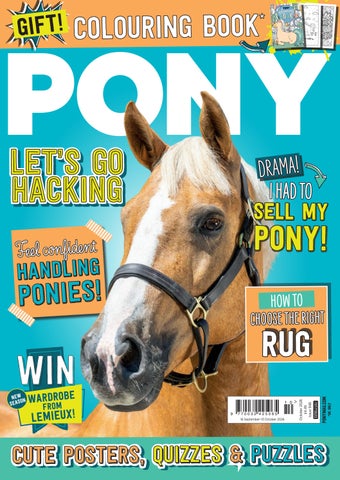
GIFT! COLOURING BOOK
*
K BBOOOOK
Pony Colouring Book2 2026.indd 17
colouring book2
Let’s go hacking
10/08/2026 11:42
pony! HOW TO CHOOSE THE RIGHT
770032 425065 16 September–13 October 2026
Cute posters, QuiZzes & puzzles
*UK ONLY
9
PONYMAG.COM
1 0
DJMurphy
WARDROBE
October 2026 £4.49 Issue 948
RUG
WIN LEMIEUX!
10/08/2026 11:42
sell my
ponies!
FROM
Pony Colouring Book2 2026.indd 19 10/08/2026 11:36
1
DRAMA! I HAD TO
Feel confident handling
NEW n o seas
2026 cover_v2.indd
b i x l e e l f n d e i s r f Let’s find out more about flexion and how it can benefit your pony’s training!
Y
ou’ll have heard your instructor talking about your pony’s bend, and how flexible they are. But do you know what flexion is and how can you improve it?
?head fmelnteofxaiopon hnaisttheis W ’s ny move Flexio
ere the skull meets and poll (the joint wh but bend describes the top of the neck), your pony’s showing the whole body. When is slightly to the left ad he inside flexion, their and, from the saddle, or right from the poll le to see your pony’s you should just be ab il. inside eye and nostr
Why is flexion important?
Flexion helps your pony… • relax through the jaw • soften at the poll and through the neck muscles • stay balanced and engaged • work in a lighter contact, rather than leaning on the rider’s hands • perform to the best of their ability
8
PONY magazine
did you know? Don’t ask for too much flexion – it’s a small movement of the head, but the neck stays still.
How to Ask for flexion
After warming up, make a transition to halt. Check you’re sitting straight in the saddle with equal weight on both seat bones and stay relaxed through your body. Then ask your pony to flex to one side by gently squeezing the inside rein. Don’t give away your outside rein – the movement you’re asking for is very small. The moment your pony moves their head to the inside, soften your hand and reward them.
TOP TIP
Always ride exercises equally on both sides. Then think – does your pony find it easier one way than the other?
FGelttiengxtheioidena ofeflexxioenrinchaislt?eWhsy not lk and trot…
a go in wa give these exercises
2. Alternate flexion 1. Straight lines Ride large around the arena and ask your pony to stay flexed to the inside as you go down the long sides. Keep your pony on the track so their hindlegs following the hoofprints left by their forelegs. Repeat it a few times, then have a go the other way.
Ride large around the arena, then ask your pony to flex slightly to the inside for a few strides before switching to outside flexion. Try this a few times on each rein and notice whether your pony starts to feel looser through their body and working in a more relaxed contact. If everything’s going to plan, repeat it on a 20m circle on each rein.
PONY magazine
9
on the
straight and
narrow How to jump skinnies with confidence!
I
f you love going crosscountry with your fave pony, then being able to confidently jump skinny fences is a must! But even if XC isn’t your thing, why not give this exercise a go to test your straightness skills? Jumping skinnies can be pretty tricky, but it’s the best feeling when you ace it – let’s give it a go together!
Set it up You’ll need a pair of wings or blocks, two long poles and at least one short pole. If you have a skinny brush fence, that’s ideal! Set up the fence in the middle of the arena, over X – you can do it on the diagonal or centre line, whichever you prefer.
22
PONY magazine
did you know? Jumping skinnies tests your riding skills and how effectively you and your pony communicate!
TOP TIP
The guide poles help channel your pony on the approach. You can also place them on the landing side of the fence to help you stay straight on the getaway, but set them further apart so you don’t risk your pony treading on them.
How to progress Introducing the idea of skinnies gradually is key to success and will give you time to refine your aids. Only progress to the next step when you feel sure your pony is confident and capable of your current level.
SWatrmeuppas1:you normally would for a jumping a session. It’s a good ide the off to practise riding lots track and adding in k ec ch to ns itio of trans ng rki wo is ny po your independently and listening to your aids.
Step 2:
Place the wings slightly wider apart than your short pole is (leave the pole to one side for now) and then add in your guid e poles on the approach. Ride between the wings in walk, trot and then canter. Mix it up by approaching on both reins so your pony is prepared for this later on.
TOP TIP
If your pony spooks at the wings, move them further apart, then slowly bring them closer as your pony gets used to them.
PONY magazine
23
All about
hoof boots Got a barefoot pony? Here’s everything you need to know about hoof boots!
OUR EXPERT
Liz Hapgood
The Hoof is the founder of ialist Bootique, a spec . op sh hoof boot
I
f your pony is barefoot or you’re thinking about transitioning them to the shoe-free life, hoof boots are definitely worth considering. When the ground is hard, stoney or your pony isn’t used to not wearing shoes, hoof boots can provide protection and help prevent the soles of your pony’s feet from becoming sore or bruised – ouch! Let’s find out more…
did you know? Most boots are designed for un-shod hooves but some can be worn over shoes for extra protection.
When are hoof boots used?
Some people use them all year round but the peak season is April–October. At this time of year, many ponies are being ridden more and the ground can be harder, too.
42
PONY magazine
What are they made from? Hoof boots are generally made from tough plastic. Some boots have a fabric upper part, while others use leather. Neoprene or foam is often used in wraps or gaiters (which help prevent rubbing) as they work well and are quick-drying. Fastenings can vary – you’ll find some boots Many boots have use Velcro and replaceable parts, which others have is super handy and can straps that you help keep the boots loop onto a metal going for years to bobble on the come! boot.
TOP TIP
How many boots do you need? Grip matters!
Every brand of hoof boots has its own tread design, and some have different ones for different models! Tread patterns vary from quite deep (good for wet, slippery conditions) to more slimline (better suited to roadwork or in drier conditions).
Whether you need two or four boots depends on your pony. Some ponies are much more comfortable with boots on all four feet, even if it’s just for stony hacking or longer rides. Others will be happy with boots just in front, or behind if they wear front shoes!
PONY magazine
43