
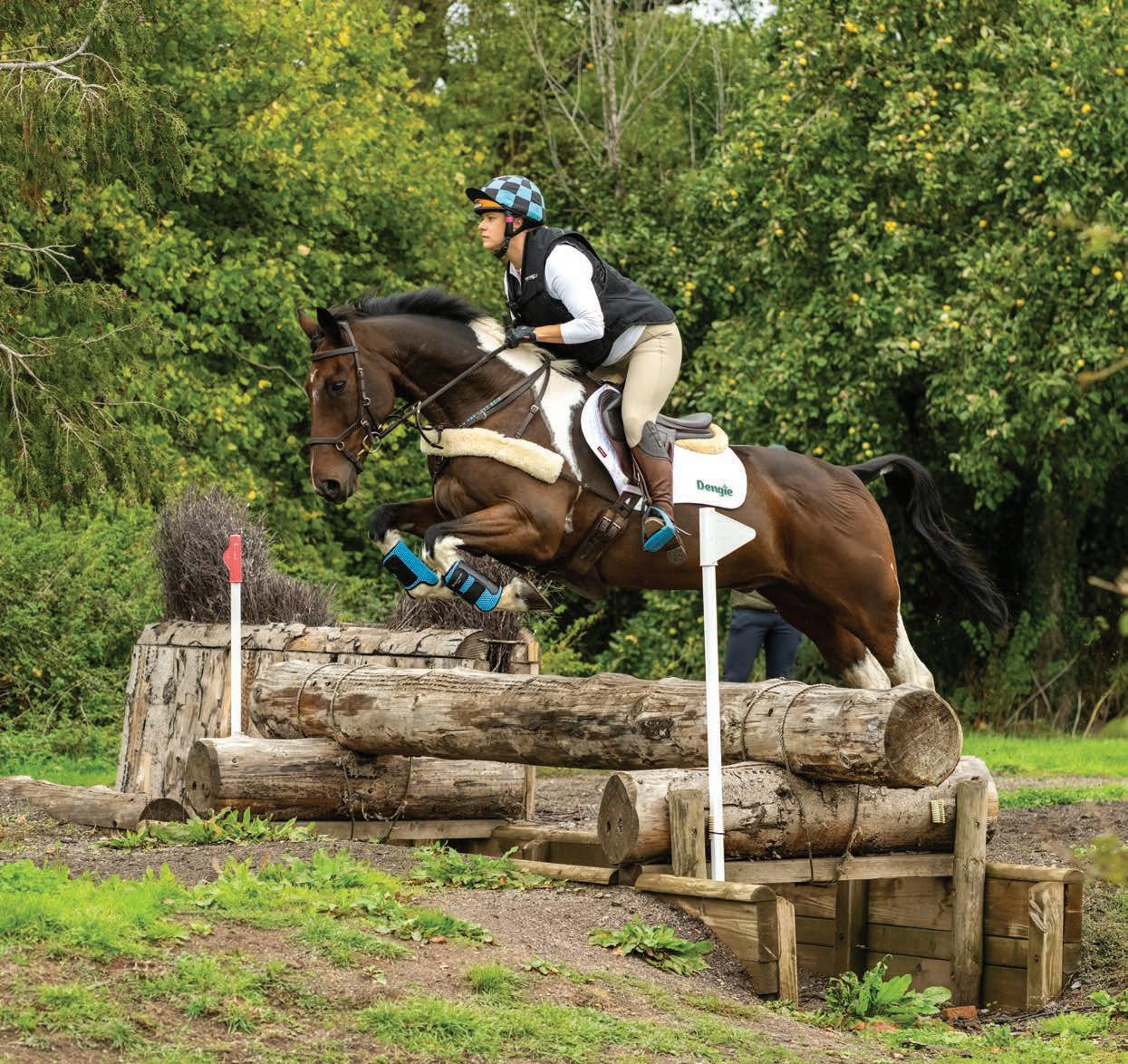
Gearing up for Badminton Grassroots or aiming to qualify for next year’s competition? Eventer Alex Bragg helps you prepare grassroots
This spring, around 200 grassroots eventers will drive through the hallowed gates of Badminton House to tackle the BE90 and 100 Championships.
Whether you’re lucky enough to be one of them, or it’s still a dream, preparation is key to success. But how can you ensure you and your horse are ready to take on the challenge? I’m here to help you prepare for the big day.
Alex Bragg is a 5* eventer and BE Level 3 Accredited coach. In 2024, he finished 3rd at Badminton and 8th at Burghley with Quindiva. Alex also competes in SJ internationally up to 3* level.

The checklist:
In this feature I’m going to cover some key elements I work on with my grassroots clients to help them prepare for the event, including...
• how to get your horse fit
• organising your training and competition schedule
• the areas to focus on in training
• managing problems that may arise
• how to refine course-riding skills
While Badminton isn’t known for being hilly, if you live in a very flat area, it’s really important to adapt your training to develop stamina on a gradient. To do this, we travel to racehorse gallops on a hill. If you can go somewhere that’s got a good surface, letting your horse jog downhill is a good way to keep his heart rate and muscles simmering so you’re not starting from cold every time you travel back up.
Knowing how and when to progress your horse’s fitness schedule takes a little trialand-error as every horse is different, so there’s not a one-size-fits-all approach. But as you prepare for the eventing season, I recommend incorporating a weekly targeted fitness session in your horse’s schedule.
Then, six to eight weeks before the main event, make sure you’re doing something once a week that will get your horse’s heart rate up to increase his cardiovascular fitness – for example, interval training or a trip to the gallops. When it comes to raising his heart rate, there’s a linear graph – the faster you go, the higher the heart rate.
But the problem with this is that the faster you go, the greater the risk of injury.
Your horse’s heart rate during a ‘hacking’ canter would be around 140 beats per minute (bpm), but to increase fitness levels, it needs to be 180–200bpm.
So, how do you get your horse fit while minimising the risk of injury? A study showed that for every degree you increase an incline, but maintain the speed of the canter, heart rate increases by 6bpm – so a 2% incline results in an additional 12bpm. If you can use a track that’s on a hill to do your fitness work, you don’t need to go as fast, therefore minimising the risk of injury and helping your horse get fitter safely.
Spot the difference
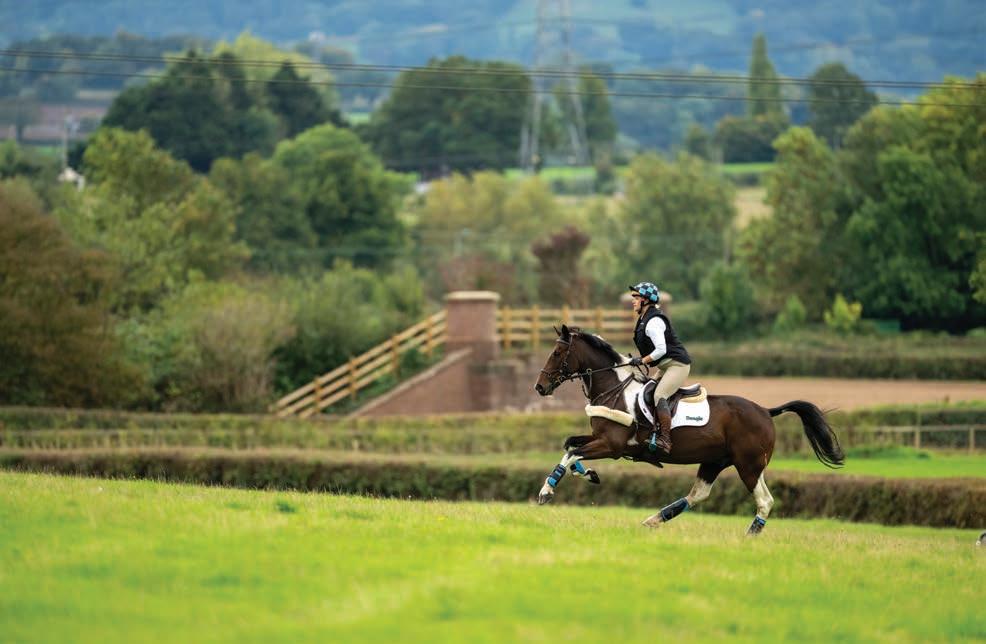
At championship level, although the cross-country fences are no larger, the technicality of the track will be greater, and the length of the course and number of jumping efforts will be longer than what you’re used to.
British Eventing courses follow the below guidelines...
• BE90: courses can be 1,600–2,500m long with 18–23 jumping efforts
• BE100: courses can be 1,800–2,800m long with 18–25 jumping efforts
However, in 2025, the Badminton
Grassroots Championship BE90 and BE100 courses were just over 2,800m long and had 28 and 29 jumping efforts respectively. Therefore it’s essential that you take this into consideration when working on your horse’s fitness and training.
Gemma Stevens won the Hickstead Eventer’s Grand Prix and Hong Kong IHS Six Bar in 2025. She has nine top 10 finishes at 5*, plus a win at Bicton 5* in 2021 and the 2024 7yo Champs.

No matter what level you’re training or competing at, adding accuracy tests to your schooling will improve your riding and your horse’s focus. This layout is great fun, and nailing it will boost you and your horse’s confidence, too – perfect with the competition season around the corner.
The first step is to establish accuracy and confidence, then increase technicality – let’s get started.
Set it up
If you have arena cross-country fences at home, great, but the core aspects of this layout are achievable with whatever you have access to. You’ll need a few short poles to create skinnies, plus standard 3m ones for the corner, and some wings or blocks. Set out the fences according to the diagram and position a pair of poles on the ground either side of the skinnies to act as tramlines, plus one pole on the narrow side of the corner for guidance. Later on you can add fillers, brush or even water trays if you have them. The double can be set out at a one- or two-stride distance, but allow room for four (17.4–18.3m) strides between the other elements so you have more time to make the turn.
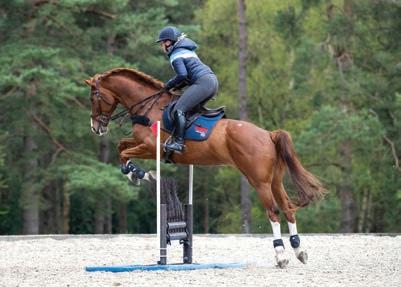
This layout is great fun, and nailing it will boost you and your horse’s confidence
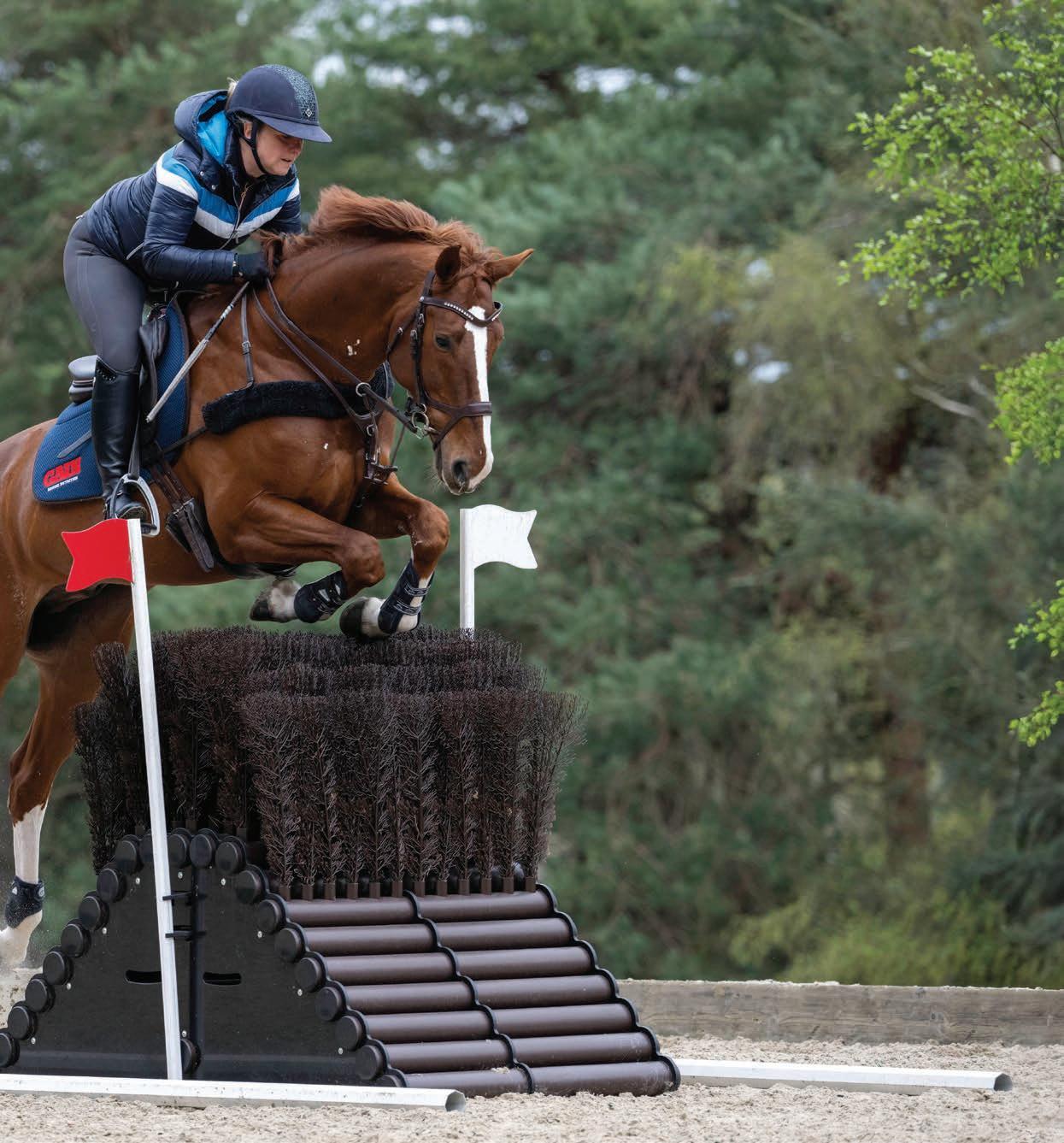
You’re sure to find plenty of narrow fences on course, sometimes even as part of a combination. Start by riding over the skinny positioned on the three-quarter line. Then, when your horse is confidently jumping that in both directions, ride through the double of skinnies. Riding two in a row requires an extra level of straightness and accuracy.
• Finding your line early will help your horse be straight through his body, with his hindfeet following the footfalls of his front feet – this is important for jumping cleanly.
• Channel him forwards towards the fence, with even hand and leg aids.
• Think about keeping your eyes up towards the other side of the fence and your shoulders facing forwards –
If your horse is new to skinnies, it’s worth going back to basics. Trot through wings positioned slightly wider than the pole, then progress slowly from there.
twisting or leaning to one side, even only slightly, could cause your horse to drift or lose balance.
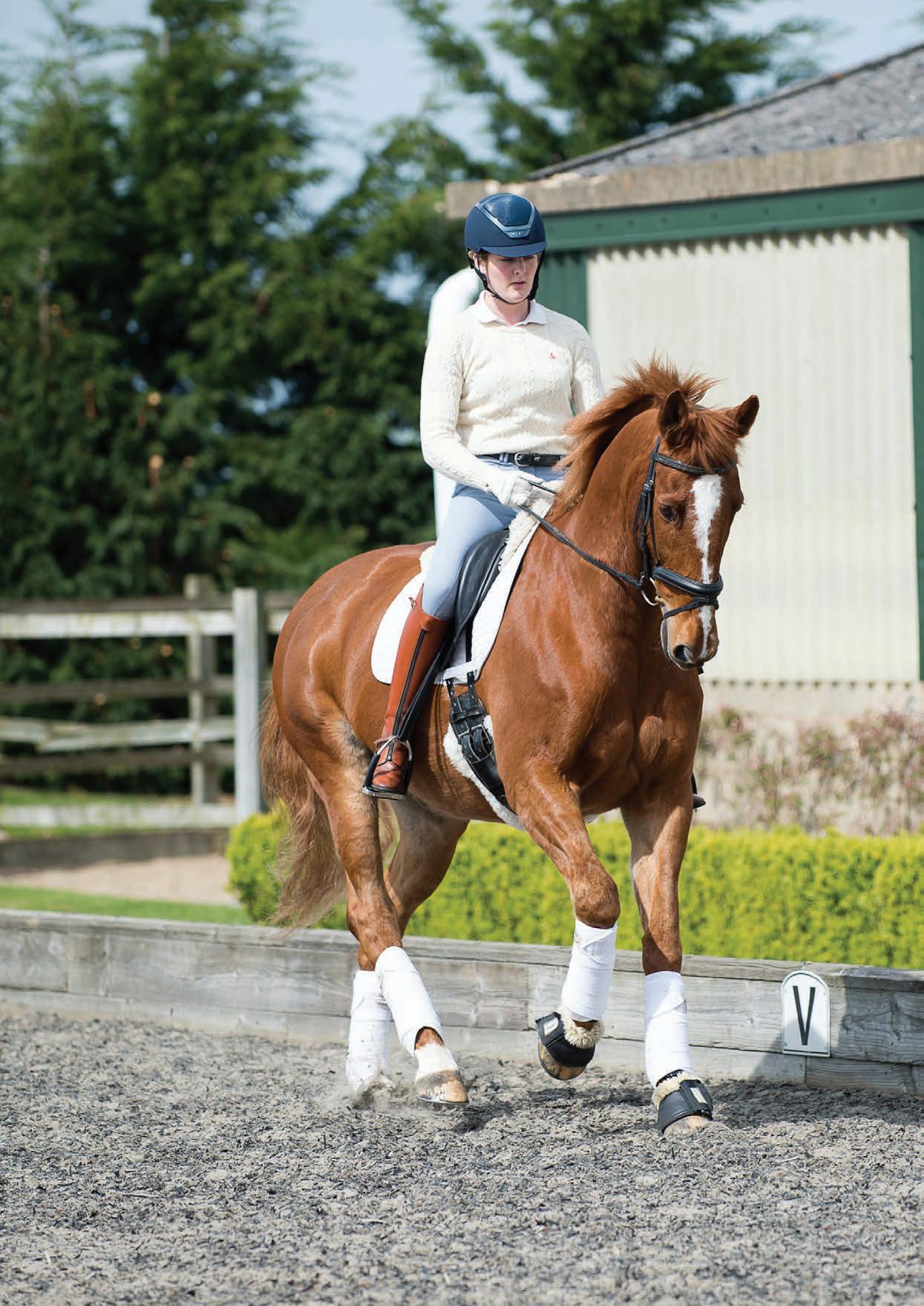
Our simple exercises will do wonders for your horse’s suppleness, balance and straightness
Lateral exercises are a great way to improve your horse’s way of going and –added bonus – if you’re keen to dabble in, or move through, the levels of dressage you’ll be well prepared.
Suitable for all levels, read on to make light work of leg-yield, shoulder-in, travers and half-pass with our fun exercises.
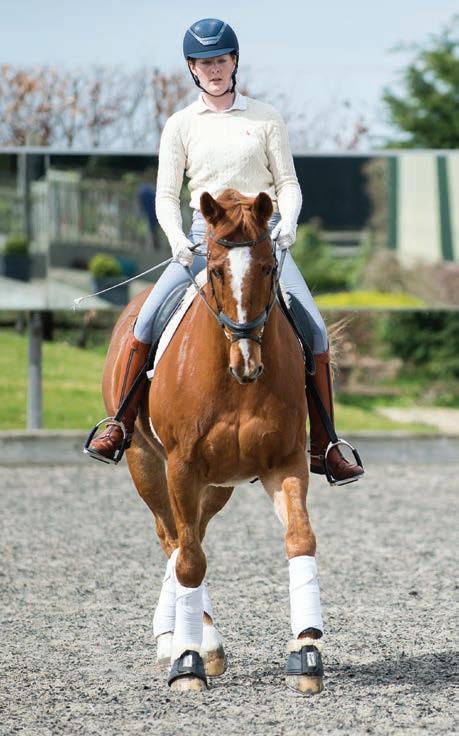
Leg-yield asks the horse to move forwards and sideways while slightly flexed away from the direction of travel. It can be added into training once your horse has learnt to go forwards in a straight line and on turns and circles.
To ensure your horse isn’t just falling towards the track, end your leg-yield on the inside track, and position him in shoulder-in to check you’re in control of his shoulder.
Introduce the idea by riding a diagonal line from the centre line to the corner marker, maintaining inside bend. Once your horse is confident with this, begin to ask for sideways steps, building up to riding down the three-quarter line before asking for leg-yield towards the track.
In leg-yield, aim for a small amount of flexion at the poll as opposed to too much bend. If your horse bends away from the direction of travel too much, he’ll fall onto his outside shoulder.
Use your inside leg to ask for sideways steps while at the same time closing your outside rein to help to support your horse’s outside shoulder.
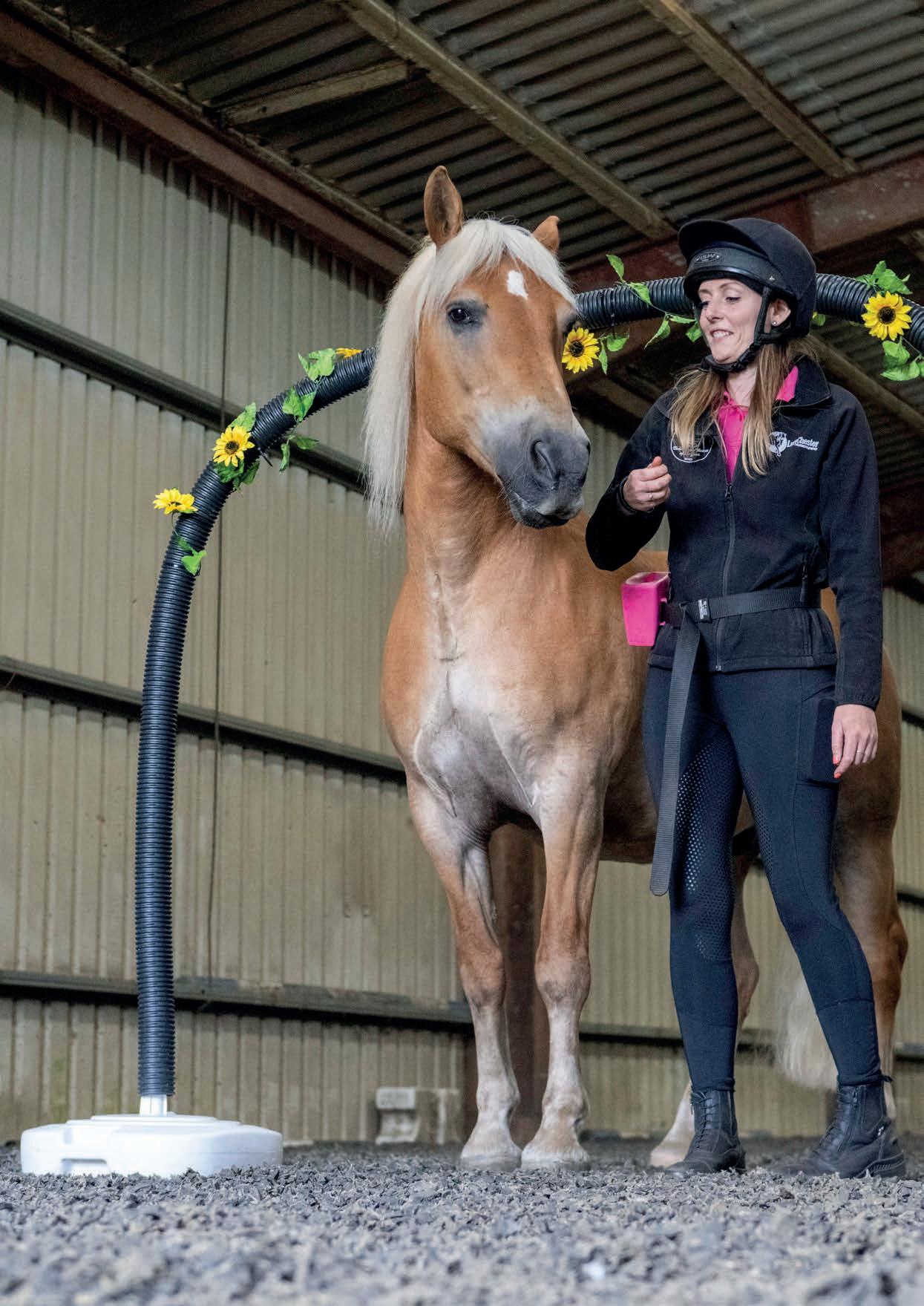
There’s always motivation in training, so consider what’s motivating your horse. Is he trying to avoid pressure or, instead, working for a reward?


How would you define liberty training? In essence, it’s training a horse without tack or ropes, loose either in the arena or another training location. Unlike free schooling, when a loose horse is lunged or encouraged around the arena, often at speed or over jumps, liberty’s aim is for the horse to be calm and engaged, and to have both freedom and choice.
Using positive reinforcement for liberty work makes training easy – the horse wants to be with you because you’re associated with nice things. By doing this, you are reinforcing the behaviour you want to see more of, which, in turn, makes the horse more likely to offer that behaviour again.
If using food as a reinforcer, use the lowest value you can, such as hay or grass pellets. Tasty treats are much more desirable and your horse will smell them in your pocket, but by using something less exciting, you’re setting yourself and your horse up for success. You can also use scratches as a reward if that’s something your horse enjoys.
Liberty’s aim is for the horse to be calm and engaged, and to have both freedom and choice
Clicker training can really speed up the learning process for the horse by offering clarity and motivation. The click marks the exact moment the horse gives the desired behaviour, and this indicates he’ll receive a reward. For example, if you call him, click the moment he takes a step towards you and reward him when he reaches you. This will establish a good recall. And, because he’s been rewarded, he’s more likely to respond next time, although it can take multiple repetitions for the cue to be established.
The marker (or bridge signal) can be a click with a handheld clicker or a spoken marker word. Nervous horses can sometimes be afraid of the sound of the clicker, so it might be better to use your voice to prevent him feeling conflicted – he wants the reward, but doesn’t want to hear the scary noise.
When you’re feeling downhearted, simple mind tools can remind you what success feels like
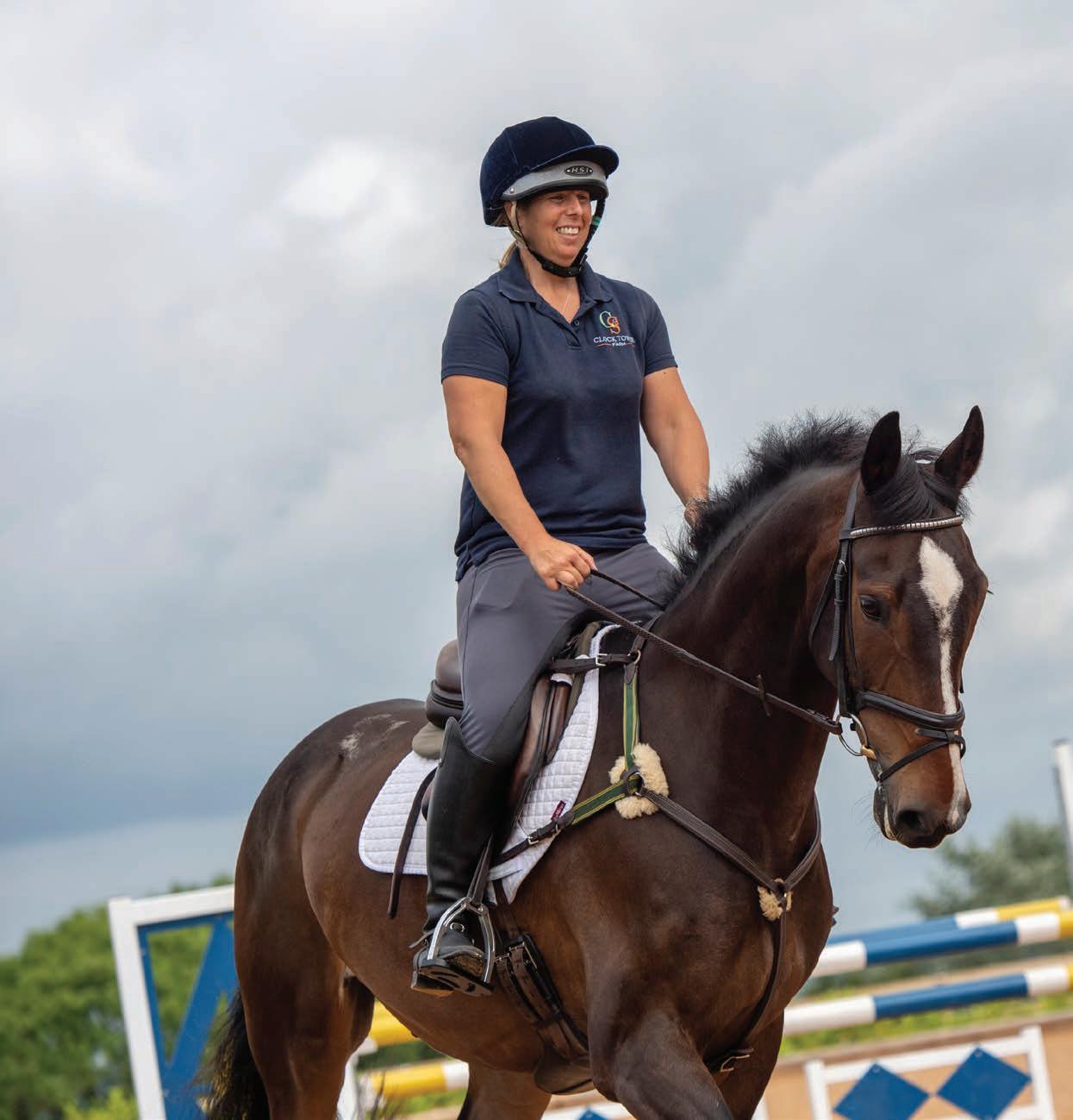

As winter draws to a close, we can often be left feeling quite defeated following the months of bad weather and dark evenings. So, how can you turn this around and, instead, lift your mood by setting yourself up to succeed? By approaching each day with a slightly altered perspective, you can make more of the time you have with your horse and continue to progress with your goals.
Goals are there to encourage us out of our comfort zone and push ourselves a little bit more so we can grow and develop not only ourselves, but our horses, too.

Start by setting realistic, challenging and progressive goals...
1. Be flexible: as much as you may have one very specific goal in mind, you’re human, your horse is a living, thinking being and you’re dealing with the outside influence of the weather and surrounding environment, too. Therefore, rigid goals aren’t going to be easily achieved, but when you allow for a certain amount of flexibility, you’ll set yourself up for success.
2. Track your progress: this can be done on paper in a journal or diary, or you can keep a log in your telephone via an app. By keeping a record, you can see how far you’ve come, whether you’re heading in the right direction or if you need to alter your aims a little to keep progressing. This not only helps to keep you motivated, it also instils discipline and helps with focus. A record can provide positive reinforcement, which, sometimes, is very much needed.
3. Remain disciplined: motivation comes and goes frequently, so one day you might be raring to go but the next barely mustering the energy to do anything. However, having discipline will really help you out. For example, you might not be motivated to muck out every day, but selfdiscipline will make you do it for the wellbeing of your horse.
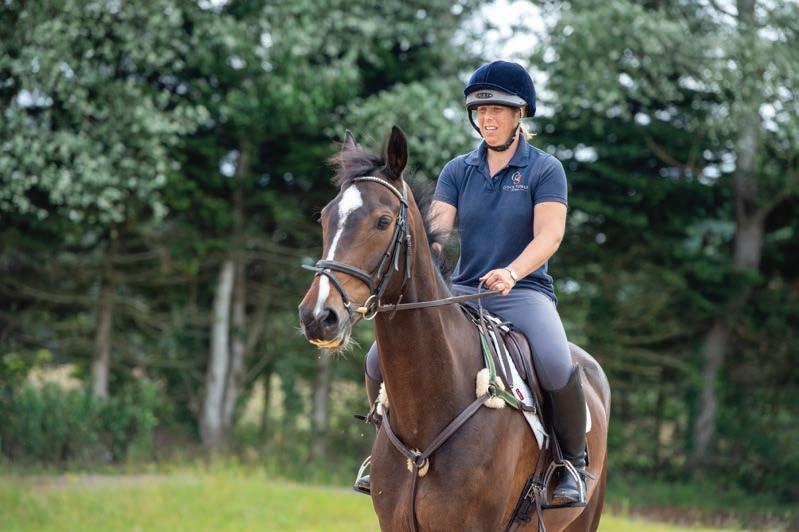
Sometimes tasks can seem simple and straightforward for one person but quite challenging for another. We’re individuals and so are our horses, and different personalities on both sides can make routine tasks quite daunting. Comparison is the thief of joy, so try not to compare yourself with others around you.