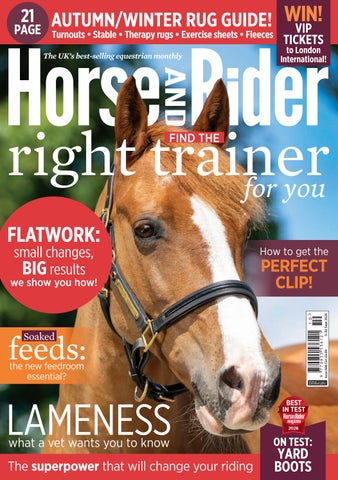
21 AUTUMN/WINTER RUG GUIDE! WIN! VIP PAGE Turnouts Stable Therapy rugs Exercise sheets Fleeces
to London International!
right trainer for you FIND THE
small changes, BIG results
we show you how!
How to get the
PERFECT CLIP!
3–30 Sept 2026
FLATWORK:
feeds: Soaked
the new feedroom essential?
LAMENESS what a vet wants you to know
The superpower that will change your riding
Issue 689 Oct £4.99
Issue number 689 October 2026 n Autumn laminitis: how to avoid it n Does your saddle fit? n Fun pole layouts to spice up your schooling n Joint supplements n What do you know about atypical myopathy?
The UK’s best-selling equestrian monthly
TICKETS
DJMurphy
ON TEST:
YARD BOOTS
PART ONE
Building Photos: Jon Stroud. With thanks to D&H for their help with this feature, dodsonandhorrell.com
blocks Darren Hicks shares some useful exercises to help develop your horse’s training EXPERT
Darren Hicks is a Grand Prix dressage rider based in Gloucestershire. Following a successful career in eventing, he’s now developed a reputation for bringing on dressage stars of the future.
W
hether your horse is just starting out in their dressage career or you’re looking for some new exercises to incorporate into training sessions, you’re in the right place. Why not try some of these next time you ride?
Adding variety to your horse’s routine will help to keep them happier in their body and mind
20 Horse&Rider | October 2026
horseandrideruk.com
DRESSAGE GOALS
In this
feature Why variety of work matters Improve canter transitions How introducing lateral work early benefits your horse
horseandrideruk.com
October 2026 | Horse&Rider 21
Making progress Part three
Nina Gill is a BHS Stage 4 Coach based in Warwickshire and owner of Fancy Footwork Equestrian, and the Polework Patterns and Equiniser apps.
I
f you have a straight and supple horse, the chances are you’ll go on to achieve great things together. But what can you do to establish these basics? There’s no need to spend hours of your training time just riding 20m circles and complicated lateral exercises – of course they’ll help, but there are so many more fun and engaging ways you can work on these fundamental skills. The third and final part of my progressive polework layout will help you do just that.
Photos: Joss Ridley
Take the triangle one step further and challenge your horse’s responsiveness and agility
EXPERT
28 Horse&Rider | October 2026
horseandrideruk.com
POLEWORK PLANS
Set it up
Add two more poles to the layout in last issue so you extend the line through the triangle. Grab two sets of wings and keep them at the side for now.
LINE 1 This line is something a bit different and should only be ridden in walk – it’s a tight turn every few strides so don’t risk putting too much strain on your horse’s body. Plus, doing it in walk will give you much more time to prepare and ensure your horse
is working correctly, which makes it even more beneficial. Make sure you ride it on both reins equally and pay attention to which rein your horse finds more difficult so you can work to improve it.
TOP TIP
Start by doing the same sort of exercise around the outer edge of the layout to gently introduce your horse to the idea.
TOP TIP
Top tips
• Keep your horse in a consistent, relaxed rhythm as you approach the poles. • Use your eyes to guide your horse – looking round the turn will turn your shoulders slightly and encourage your horse to turn theirs, too. • You want your horse to almost cross their front legs as they step around the turn – think of three straight lines connected by a turn, rather than a circle around the central triangle. To do this, you need to support your horse’s outside shoulder with your outside rein close to the wither. • Maintain a soft contact on your inside rein and avoid asking for too much bend, otherwise your horse might fall out. • Use your half-halts. Prepare for each turn with a squeeze on the outside rein before releasing and pressing with your legs to keep the forward momentum. horseandrideruk.com
The outer poles are there for support and consistency in your line, so check how far away from them you are after each turn.
October 2026 | Horse&Rider 29
Turn
the tables
Eventer Alex Bragg shares his tips for a smooth, confident crosscountry round
EXPERT
Alex Bragg is a 5* eventer and BE Level 3 Accredited coach. In 2024, he finished 3rd at Badminton and 8th at Burghley with Quindiva. Alex also competes in SJ internationally up to 3* level.
I
Photos: Jon Stroud
f your horse loses their footing or balance on the approach or between fences, whatever the cause, it can really knock their confidence – not to mention the impact it could have on their ability to jump the next fence. Some problems are unavoidable – a stumble or slippery patch – but others are the result of rider error. Which is why it’s so important to ride your lines and turns with purpose and stay focused to help you keep the balance and rhythm you’ve worked hard to establish. Here are some things to consider.
34 Horse&Rider | October 2026
horseandrideruk.com
CROSS-COUNTRY
When teaching an inexperienced horse, don’t present them with an option that’s the wrong answer Head on
When introducing a horse to crosscountry, and even while warming up for a session with more experienced horses, I always approach the fences at a 90-degree angle – in other words, headon. This means the fence is right in front of the horse so they will be able to see it earlier, helping eliminate the option to go left or right. Approaching the fence in this manner means that, if you need to make any adjustments, your horse is in a position that they can do so efficiently. If your horse is straight through their body, and you need to open the stride, their hindquarters are directly behind them to push – it’s all about presenting your horse so their mechanics work in your favour.
horseandrideruk.com
Alex’s insights Always set yourself up for success. This means when teaching an inexperienced horse, don’t present them with an option that’s the wrong answer through your own lack of discipline. Make the answer clear from the beginning – for example, with obvious aids and positioning to show which you’re riding towards, rather than letting your reins slack and giving them the option to go in another direction.
October 2026 | Horse&Rider 35
Photos: Jon Stroud
Finding the right instructor Alison Buttery explains what to consider when looking for a new riding coach
50 Horse&Rider | October 2026
horseandrideruk.com
FINDING A TRAINER
Assess your goals
Firstly, spend time being honest with yourself, and think about what you’re looking for from your coaching and riding in general. Most riders would say they want to improve. But improvement means different things for all of us. A rider preparing for affiliated competition has different needs to someone who hacks twice a week. A rider working through a confidence issue needs something different from another rider who is ambitious but unsure about how to step up a level. Being clear about what applies to you makes an enormous difference to finding the right person.
Needs must
There are three basic psychological needs that have to be met for you to feel genuinely engaged and to sustain that engagement over time: • Autonomy: the sense that your choices and preferences are respected. • Competence: the sense that you are actually getting better at something. • Relatedness: the sense of being genuinely cared about and understood. Most riders need some degree of all three, but the ratios can shift. When confidence is fragile, feeling that sessions are building on something rather than exposing gaps tends to matter most. When things are going well and you’re ready to push further, being involved in the direction of your training and having your instincts respected becomes more important. Knowing which end of that spectrum you’re currently sitting at helps you recognise much more quickly whether a coaching relationship is the right one for you right now.
EXPERT
Alison Buttery is a certified mindset and confidence coach, a BHS APC senior coach and an experienced rider, who specialises in helping riders overcome their nerves. She’s also the founder of The Everyday Equestrian.
I
TOP TIP
A coach who asks about you and your horse, goals, challenges, strengths and skills is demonstrating they want to get the whole picture.
f something in your riding feels stuck and you can’t quite put your finger on why, you’ve had the same coach for years and the sessions have stopped feeling like you’re progressing – or perhaps you’ve never had consistent support – it might be the time to consider looking for a new instructor. However, finding the right coach often feels more challenging than it probably should. So how do you go about it? horseandrideruk.com
October 2026 | Horse&Rider 51
Clipping perfection Our clipping expert explains how to achieve the perfect finish TOP TIP
EXPERT
Photos: Jon Stroud, Clippersharp
Victoria Goody is the Co-Director of Clippersharp and Founder of Smart Grooming.
When purchasing clippers, ensure they’re comfortable to hold, not too heavy, and as quiet as possible. This will make them easier to use and more acceptable for your horse.
C
lipping is an art and it takes a lot practice to achieve a perfect finish. So, whether you’re preparing for the show ring, keeping your horse comfortable through the winter months, or simply making everyday exercise and coat care more manageable, here’s how to achieve a clip that’s natural, even and free from unsightly tram lines.
110 Horse&Rider | October 2026
horseandrideruk.com
CLIPPING TIPS
Preparation is essential
Perhaps the biggest mistake people make is attempting to clip a dirty horse. Even a coat that appears clean will contain grease, dust and dander that quickly dull blades and make it difficult for them to glide smoothly through the hair. Ideally, bath your horse a day or two before clipping. Where bathing isn’t possible, thorough daily grooming combined with a hot cloth wash can produce good results. Use warm water with an astringent-based wash to help lift grease and dirt from the coat without soaking the horse – this leaves the hair cleaner and easier to clip. The cleaner the coat, the easier the blades will cut, reducing wear on your equipment and producing a smoother finish.
Check your equipment
TOP TIP
If your clippers require tensioning, follow the manufacturer’s instructions carefully. Incorrect tension is a common cause of poor clipper performance.
horseandrideruk.com
There’s nothing more frustrating than discovering your clippers aren’t performing properly once your horse is ready, so check your clipping kit before the day. Professional servicing at regular intervals keeps motors running efficiently and allows worn parts to be replaced before they fail. Equally important are the blades themselves. Sharp, clean blades are essential for producing an even finish and reducing heat build-up during clipping. A few days before clipping, assemble your equipment and give the clippers a trial run. This simple check gives you time to resolve any problems, arrange servicing or replace worn blades without unnecessary stress.
Choose the correct blade
Selecting the correct blade depends largely on the type of coat you’re clipping. Horses with a dense, woolly winter coat are often better suited to a medium blade that removes hair efficiently without overworking the machine. Horses with finer, softer coats may clip beautifully with a fine blade, producing an exceptionally close finish. Modern clipping equipment generally falls into two categories. Traditional full-sized clippers use larger blades secured with a tension set, while many lightweight or trimmer-style machines use convenient snap-on blades that require no manual tension adjustment. October 2026 | Horse&Rider 111