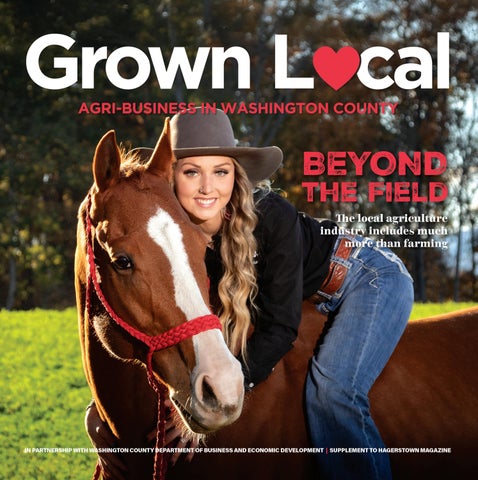
As Washington County celebrates its 250th year, it remains true to its agricultural heritage.
8 History and Agriculture
Washington County is home to many historical sites and farms. Agriculture and history meet at the Sherrick Farm near Sharpsburg.
10 Farm of the Year
For more than two centuries through nine generations, the Schnebly family has worked the Crown Stone Farm.
16 Genetic Improvements
Part of a national company, TransOva Genetics in Boonsboro helps breed better bovines.
ABOUT THE COVER Sierra Rowe has loved horses since she was very young. Now she’s competing in national barrel racing competitions and teaching others how to ride.
22 Ag Expo and Fair
Washington County’s annual Agricultural Expo and Fair is the highlight of the year for the farming community.
30 Off and Running
Clear Spring resident Sierra Rowe is carving out a name for herself on the national level of barrel racing.
36 Back in the Saddle
A Washington County small business creates custom-fit saddles that are more comfortable for the horse and rider.
42 Living Large
Caring for large livestock on the farm requires the help of specialists like farriers and veterinarians.
46 Markets and Orchards
Washington County residents have access to fresh fruits and vegetables all year through a network of local farmer’s markets and orchards.
50 Drink Local
Distilleries, wineries, and breweries create traditional and innovative beverages for local enthusiasts.
56 What’s in Your Yard?
Annette Cormany is a master gardener who teaches classes and helps residents with their backyard gardens.
60 Recipes
Down on the farms of Washington County, the eating is good; and local farms are happy to share some secrets.
The Board of County Commissioners of Washington County would like to thank you for making Washington County, Maryland, your favorite place to live, work, and play. We deeply appreciate all who choose to reside, do business, and raise their families in our remarkable community.
Washington County is home to a rich agricultural heritage, historically significant landmarks, world-class businesses, and award-winning educational institutions. As Commissioners, we remain committed to ensuring the highest quality of life for our residents through a vibrant agricultural sector, public safety, strong infrastructure, exceptional educational opportunities, and other essential services.
Agriculture has been the cornerstone of Washington County’s landscape since 1776. Our farms continue to nourish families across our community, our state, and far beyond. Washington County proudly stands as Maryland’s top producer of tree fruits, with apples, peaches, pears, cherries, and plums leading a diverse selection that also includes other fruits such as strawberries, blueberries, and raspberries.
Washington County is also recognized as one of Maryland’s leading dairy-producing regions, reflecting a strong tradition of high-quality milk and dairy operations that contribute significantly to the state’s agricultural output. Our agricultural economy is strengthened by beef, equine, poultry, pork, timber, grain, and feed crops, as well as a growing number of specialty farms. The farm-craft beverage sector of local wineries, breweries, distilleries, and cideries remains one of the most dynamic and fast -growing segments of our local economy.
While our farmers are the heart of Washington County’s long-standing agricultural heritage, today’s agricultural success stretches beyond the field. Washington County’s agriculture is supported by veterinarians and veterinary technicians, the equine and sport-horse industries, conservation professionals, agribusiness leaders, food-safety experts, educators, researchers, and ag-technology innovators who keep our farms thriving. These careers, together with our
producers, form a strong network that protects the health of our herds, advances sustainable practices, and ensures the continued strength of our rural economy.
These supporting careers ensure that our producers have the tools, science, and services needed to farm efficiently, sustainably, and successfully. Whether through advances in precision agriculture, the expansion of agritourism, or the development of new, value-added products, agriculture in Washington County is stronger because of the interconnected workforce that surrounds it.
Agritourism continues to serve as an important bridge between farms and the community. Farm tours, hayrides, corn mazes, equine experiences, festivals, and other on-farm activities help residents and visitors connect with local agriculture while supporting the growth of small businesses. These experiences highlight the dedication, innovation, and diversity that define Washington County’s agricultural landscape.
The Washington County Board of County Commissioners, together with the Washington County Department of Business and Economic Development, extends a heartfelt thank you to the farmers, agricultural families, and the professionals who support them. Your collective efforts provide essential food, fiber, fuel, and services, strengthening the well-being of our community. We are truly grateful for your contributions.
Agriculture and American history live side-by-side in Washington County
The history of American agriculture parallels the history of Washington County, Maryland, a region deeply rooted in American heritage. Celebrating our 250th anniversary along with the country’s 250th, we recall how early settlers were drawn by the fertile land of the valley, which they found perfect for grains, fruits, and raising livestock. The network of waterways including Conococheague Creek, Licking Creek, Sideling Hill Creek, Tonoloway Creek, and the historically significant Antietam Creek were perfect for mills. Now, a quarter of a millennium later, agriculture remains a primary industry here. More than 80 percent of land in the county is used for agriculture or forestry purposes. One of the most historically significant farms in the county is the Sherrick Farm, now under the auspices of the National Park Service for its roll in the Civil War. After the Confederate defeat at the Battle of South Mountain, Gen. Robert E. Lee pulled back his troops and made a defensive stand near Sharpsburg, positioning artillery on the high ground overlooking the Sherrick Farm. During the Battle of Antietam, the farmhouse (pictured here) was hit by artillery but not badly damaged. However, the fields and food stores were ravaged by hungry soldiers. The farm was used as a field hospital in the aftermath of the battle, and the Union army stayed for nearly six weeks tending to the dead and wounded. Even during America’s bloodiest day, agriculture played a key role.
2026 Farm of the Year
Nine generations of the Schnebly family have worked the land of Crown Stone Farm
By Rebecca Long Chaney
For more than 200 years and now through nine generations, the Schnebly family has worked the land, milked cows, and operat-
ed Crown Stone Farm. So, it’s no surprise the historic farm was honored as the 2025-26 Washington County, Maryland, Farm of the Year.
J.C. Schnebly and his wife, Beth, operate Crown Stone Farm with his parents, John and Pam Schnebly.
“The Farm of the Year program was created to recognize farms that stand out for their excellence in agriculture and their contributions to the vitality of Washington County’s farming community,” says Kelsey Keadle, Agricultural Business Specialist for the Washington County Department of Business and Economic Development. “This award reflects the dedication and resilience of local farming families, highlight-
ing achievements in production, conservation, preservation, and community involvement.”
The Schnebly family is very humbled by the award and is grateful for the opportunity to work together.
“I get to work and see my family every day and share the love we have for this land,” says John Schnebly. “We are privileged to
live, raise our families, and work on this farm.”
John Schnebly’s ancestor, John Henry Schnebly, immigrated from Switzerland to Lancaster County, Pennsylvania, and in 1813 moved to Washington County and founded Schnebly Homestead, which is now Crown Stone Farm. The farm is divided into two parcels that adjoin, 180 acres in Maryland and 162 acres in Pennsylvania. The
The Schneblys near the crown stone survey marker set during the 18th century Mason-Dixon Line survey to demarcate Maryland and Pennsylvania.
family rents another 200 acres.
As it began more than two centuries ago, Crown Stone Farm is 100 percent family owned and operated. Family members spanning three generations balance chores. John Schnebly, his wife Pam and their two sons and daughters-in-law, J.C. and Beth and Jeremy and Stacie, juggle the lengthy list of responsibilities.
“John does all of the milking along with J.C. and William (John’s broth-
er),” says Pam Schnebly. “John and I do all the accounting work, and J.C. and Beth’s family does all aspects of herd management.”
Jeremy is the crop and machinery manager, and gets help with planting, harvesting, and machinery repair from their three sons, kindergarten through eighth grade. Jeremy’s family along with J.C.’s family all help with cow, heifer, and calf-raising duties. J.C. and Beth’s children, two now in college
and their youngest, a senior in high school, help with young stock and do all the registrations and fair entry paperwork.
“All family members help with preparing and exhibiting the show animals,” John Schnebly says. “All of the grandkids have their own registered animals. They have exhibited in local, state, and national shows. The older kids help with milking and all farm tasks when needed and daily during the summer and
The Schnebly family accepts the 2026 Washington County Farm of the Year award.
when college and school are closed. My nephew, Brian, also helps with some of the calf-care tasks.”
The three generations milk 182 cows and farm more than 500
acres of corn, alfalfa, soybeans, and barley.
John Schnebly is the seventh generation, making his sons, nieces and nephews the eighth generation and his grandchildren the ninth generation on the family farm. Having three generations living on the farm means a lot to the family as they have instilled a strong work ethic in the next generation.
It’s obvious the grandchildren are following in their parents’ and grandparents’ footsteps loving dairy cattle and being strong advocates for agriculture.
“Crown Stone Farm got its
name because of the five-mile stone marker on the farm,” Pam says. “There was a survey on the Mason-Dixon line for Lord Baltimore and William Penn, and the crown is on both sides of the stone. We have preserved it for future exhibits.”
Although they now raise all six of the major dairy cattle breeds, they are most passionate about the Guernsey breed. “John’s father, Seth Schnebly, the sixth generation, purchased his first Guernsey in 1955,” Pam says.
Guernseys have been synonymous with the Schnebly name for seven decades. Their greatest success was exhibiting the grand champion bred and owned Guernsey at the All-American Dairy Show in Harrisburg and hosting hundreds of Guernsey breeders for a global tour.
“We were very proud to be asked to host a farm tour for 300 people during the World Guernsey Conference,” John added.
The Schnebly family not only has worked tirelessly on the farm concentrating on sustainability, conservation practices, and cover crop programs that improve soil health, reduce erosion and preserve farmland for future generations, but continue to adapt to new technologies and farming methods in order to continue their legacy in the dairy industry.
Crown Stone Farm shows off some of its Guernseys during a Maryland 4-H Dairy Youth event.
Trans Ova has been paving the way with dairy and beef cattle genetics for more than 40 years, with the original office opened in 1980 in Sioux Center, Iowa. It was not until 2012 that the livestock reproductive company also opened an office in Maryland in the rolling hills of Washington County.
Dr. David Faber and Dr. Daryl Funk of Iowa founded Trans Ova, and it was initially a veterinarian practice that focused solely on cattle reproduction services.
“Their motivation was to provide the best service to cattleman that would allow them access to cutting-edge technologies to build the quality and performance of their herds,” says Michael Creek, Trans Ova senior director of operations. “Trans Ova started performing IVF (in vitro fertilization) services in the 1990s to amplify the ability for cattleman to gain reproductive and genetic advantages in their respective marketplace.”
Landing a career with Trans Ova Genetics was a dream come true for Creek. He grew up on Palmyra Farm, an Ayrshire farm with international acclaim, just 20 minutes from the Trans Ova Office in Boonsboro. He started at that location in 2015 as the herdsman. Today, Creek is responsible for operational management of the domestic United States for Trans Ova.
“I am one of the very lucky people in this world who get to do, I think, exactly
what I was meant to do,” Creek says.
“I get to stay involved in a part of the cattle industry that I have always loved. I get to work with great cattleman all over the country and have the opportunity to meet people from Texas and California to New York and Florida who are as passionate as I am.”
Creek believes Trans Ova not only has changed the lives of employees but has helped clients find great success with their cattle.
Research by the Trans Ova staff will help produce 70,000 IVF cattle embryos this year.
“I get to grow with an amazing company that has fantastic values that drive our success,” the Washington County native says. “Most importantly I get to work with great people, and I’m fortunate enough to be a leader of that team. There are over 500 people on our team and every single one of them is vital to the success we have, and it’s a great honor to work with them.”
Trans Ova’s IVF system is renowned for its
ability to produce great embryos, but more importantly more healthy calves that will make them more money every generation of cattlemen, according to Creek.
“Trans Ova Genetics will produce over 700,000 IVF cattle embryos this year with 70,000 being produced at the Boonsboro location,” he says. “We work with some of the largest and most famous cattle operations around the world as well as the smallest most specialized farmers like me at my own farm to improve their cattle and add value to their business.”
Michael Creek, Trans Ova senior director of operations, grew up on Palmyra Farm in Hagerstown.
The Boonsboro Trans Ova facility specializes in embryo transfer, in vitro fertilization, donor housing, recipient options, sexed semen, genetic preservation and cloning and lactating and dry cow donor housing.
The genetic specialists operate 10 IVF labs across nine states with two in Texas.
“Trans Ova either operates or has partnered on three additional labs in Australia, Brazil and Canada with the intention of adding more partners and locations in the future,” Creek says.
“A great deal of our embryo export work is performed out of the Boonsboro lab as well as the work that the team does with some of the most influential cattle breeders in the world,” he says. “But I believe that the most unique feature is the culture that is created by the people at the center. The team is incredible and their results are a symptom of that.”
There are about 500 active clients that the Boonsboro facility works with in New York, Pennsylvania, New England, and Ohio as well as doing other regional work in the Middle Atlantic. Maintaining a successful
embryo transfer business is no small undertaking. From IVF preparation, careful harvesting, storing, and shipment—all phases must be done with great attention to detail.
In addition to a great team in the Washington County Trans Ova office, Creek says the facility employs a great group of regional couriers and utilize the local logistics and shipping services to assure safe shipment of embryos. Over the years, Trans Ova has expanded its business to include small ruminates and swine in
efforts of genetic preservation.
One thing is for sure, Trans Ova Genetics’ mission statement, “To provide opportunity and advantage through genetic acceleration,” will continue to be the driving force behind the company’s global success.
Youthful Energy
Young agriculturists keep the Washington County Ag Expo and Fair moving forward
By Rebecca long Chaney
When it comes to the Washington County Ag Expo and Fair, it’s no secret that the event remains successful year after year thanks to community leaders and dedicated volunteers. It truly takes a village to pull off all the activities scheduled daily at the agricultural event.
Ribbon winners Stephen Lowe and Krista Anderson with their fowl at the 2025 Washington County Ag Expo and Fair.
Maddy Fitz gives some attention to her goat.
In addition to folks on the fair board coordinating all parts of the Ag Expo, the Washington County, Maryland 4-H Extension educator, Ashley Travis, organizes 4-H activities. According to Travis, 4-H and participating in the Ag Expo teaches young county residents about responsibility, time management, giving back to others, leadership, building self-esteem, goal setting, problem solving, and decision making.
“The 4-H projects that our youth carry throughout the year, and exhibit at the Ag Expo and Fair are a catalyst for them to learn life skills that will benefit them in their daily lives and allow them to develop into competent and contributing members of society,” says Travis.
Washington County 4-H has almost 4,000 youth involved annually through community clubs, in school, after school, and camping. “We also have 93 volunteers that are screened, trained, and provide continuing professional development in order to extend the reach of the 4-H program even farther into the communities of Washington County,” she says.
The Ag Expo and Fair plays a huge role for 4-H members. “Animal science 4-H projects are the largest and most popular 4-H project in Washington County 4-H with 83 percent of 4-H youth in Washington County enrolled in agricultural related projects,” Travis says. “Over 100 youth sell their livestock projects annually through the Washington County 4-H Youth Market Sale. However, many youth also carry breeding projects in the areas of dairy cattle, beef cattle, sheep, swine, goats, rabbits, and poultry.”
While the fair keeps the 4-H educator busy, it still requires a list of behind-the-scenes professionals, workers, and volunteers to operate a busy fair. Veterinarians must check in livestock, making sure all animals are healthy. Judges for all indoor exhibits and livestock shows must be invited. And the list goes on with helpers who include local feed nutrition representatives, auctioneers, photographers, event sponsors, show organizers, admission workers, and more.
Not only do 4-H youth develop lifelong memories at the fair, they learn life skills. “The Washington County 4-H livestock program allows youth to gain these life skills that will ultimately benefit them in their adult lives as they pursue college, careers, and the workforce,” she says. “4-H’ers use their revenue to buy new project animals for the next year, save for college, etc. That teaches them financial skills at a young age.”
For Joe Frey, Washington County Ag Expo and Fair president, the Ag Expo represents the past, present and future. “The Ag Expo is a way for 4-H and FFA kids to be able to display their animals and projects and to help educate the public,” Frey says. “The county fair is one of the most resourceful events to share the agricultural story.”
Agricultural fairs across the country bring the community together. While many activities have remained the same, the Ag Expo and Fair has introduced new attractions and events over the years as the fair continues to grow and expand. One addition is Kids’ Fest.
This year will mark the fifth Kids’ Fest, hosted on Kids’ Day at the fair.
The afternoon fun day was the idea of Rhonda Uzelac, a 4-H mom and volunteer. She’s been working with the kids’ event every year.
“The first year was 2022 with the goal of having something for kids on “Kids’ Day,” along with community involvement,” Uzelac says. “We wanted to spread the word to kids about not only the fair but about agriculture. After many years working as a teacher, I wanted to have an event for them to come and enjoy time at the Ag Expo while having fun and learning at the same time.”
Kid’s Fest is held annually now on Wednesday at the Ag Expo from 2 p.m. to 5 p.m. “I think the Ag Expo is bridging the gap between city and farm, not only for the kids but for adults as well,” Uzelac says. “There are a lot of people who really don’t know where their food comes from or what agriculture is all about. Educating the public is one goal we have every year, and one way is starting with the kids.”
Every year, participation in Kids’ Fest grows. Last year 300 kids enjoyed the program along with their parents.
“Community vendors set up at Kids’ Fest and each vendor has an activity and handout for the kids,” she says. “We also have included a scavenger hunt throughout the barns to meet with 4-H and FFA exhibitors who are there to talk about their animals.”
According to the Ag Expo’s organizers, 4-H and FFA members often wear many hats—raising livestock, making indoor projects, being spokespeople at the fair, educating the public, and being role models for younger members.
Robbie Nichols lives on a farm in
Fairplay and carries several 4-H projects. He enjoys raising ducks, turkeys, chickens, rabbits, dairy goats, and sheep as well as cats. Nichols also enjoys food preservation, hobbies and collections, horticulture, photography, STEM and visual arts.
At 15 years old he juggles a lot as a freshman in high school. “My favorite project at the Ag Expo is sheep because no other 4-H’ers really show wool sheep,” he says. “I have rare breed wool sheep—Black Welsh Mountain sheep, Scottish Blackface, and Romeldale/CVM sheep. It gives me the opportunity to teach other 4-H members and the public about them.”
Not only does Nichols enjoy educating others about sheep, but he uses their wool to make projects. “I get to exhibit some of my fiber arts projects in crafts and sewing,” he says. “For the last three years I have been the only participant in the Shepherd’s Lead contest but still enjoy doing it.”
Four-H runs deep in the Nichols’ family with his mother as a former 4-H educator and his two siblings very active until they aged out of the program. “Hanging out with friends that have the same interests and lifestyle as me is fun,” he says. “A lot of my school friends don’t understand all I do with my animals and going to shows. We all work hard but make sure we have fun, too.”
Jenna Hanes with her prize goat Luna.
Alexis Iseminger readies her cows to be shown.
Kristy Jenkins with her granddaughter Evie Wilston checking out the chickens.
The teenager also enjoys the fair’s market sale. “On Youth Market Sale night, it’s always busy with kids showing their market animals for the last time,” Nichols says. “Selling them is hard sometimes but the paycheck is a nice reward.”
Kelly Shank agrees and sees firsthand how the market sale is both rewarding and tough. “I currently serve as the president of the Washington County Ag Expo and Fair Youth Market Sale,” she says. “During fair week, I act as the primary point of contact and coordinator for the livestock market sale and help ensure everything runs smoothly for exhibitors, buyers, and volunteers.”
While 4-H livestock exhibitors are excited when they get a good price for their market animals, they are also sad to say goodbye to an animal they’ve worked so many hours with during the year.
“The market sale ties together months of preparation, animal care and learning into a single experience that reflects how market livestock works in the real world,” Shank says. “Overtime, this has become more than just an event—it’s a tradition and a legacy within Washington County that connects generations through agriculture, education, and shared support for youth.”
A true promoter of the fair is the Washington County Ag Expo and Fair Queen, selected annually at the event. Haley Doyle won the crown last summer.
“The first word I said after hearing my name as the winner was “Wow!,” she saidsays. “I was overwhelmed with excitement and gratitude.”
Doyle, 16, is active in 4-H, FFA, unified sports and chorus. Her 4-H projects include home arts and breeding rabbits and dairy goats. “I enjoy sharing and talking
Over 100 youth sell their livestock projects annually through the Washington County 4-H Youth Market Sale. “ “
—Ashley Travis
with the public about my projects and agriculture during the week of the fair,” she says. “Seeing a child’s face light up when they get to pet my rabbit or see a cow up close for the first time is a special experience. I also enjoy seeing other 4-H’ers exhibit their projects and helping younger exhibitors learn and gain experience.”
The Smithsburg youth says the Ag Expo gives 4-H members a chance to educate the public. “I believe that fairs serve as an amazing example of educating the community about agriculture,” she says. “At county fairs, children and adults can learn about the process of raising meat animals, growing produce, and how dairy products are produced. It’s important to know that your food and clothes just don’t magically appear in the store.”
With so many young people involved in agriculture, there’s no doubt the future is looking very bright in Washington County.
Barreling ALONG
Clear Spring’s Sierra Rowe is making her mark at the national level in barrel racing
By Rebecca Long Chaney
Sierra Rowe fell in love with horses when she was just seven years old. At that young age began riding English and competing in hunter/jumper shows, but when she discovered the speed and thrill of Western riding, she became enamored with the sport and the competition.
“I began barrel racing in 2017 with a few friends, and I was immediately hooked on the speed, precision, and bond between horse and rider that it requires,” Rowe says. “I was homeschooled starting in fifth grade, which gave me the flexibility to travel, train, and compete more often.”
Speed, persistent training, guts, confidence, and skills along with a talented horse are the winning recipe for a successful barrel racing team. And that’s just what the Washington County resident has earned through hours of practice and perseverance. Rowe has competed all over the country, including local
–Sierra Rowe “ “
I began barrel racing in 2017 with a few friends, and I was immediately hooked on the speed, precision, and bond between horse and rider that it requires.
–Sierra Rowe “ “
I’ve even had the opportunity to compete at nationals in several different states out West.
The young, skilled equestrian currently has 15 weekly students that range in age from 2 years old to 78 years old. “I love that mix. It keeps every day exciting,” Rowe says. “Some of my students are just starting out, while others are now competing at shows and races. Watching them build confidence, skills, and competing at barrel races with their horses is one of the most rewarding parts of what I do.”
fairs, barrel racing events, and the high school rodeo circuits.
“I’ve even had the opportunity to compete at nationals in several different states out West,” she says.
“While barrel racing is a huge part of my life, my main career is teaching riding lessons, training horses, and managing the performance horses at Timber Creek Equine owned by Tim and Kim Myers of Williamsport.
Barrel racing is something I truly love and live for, but I also enjoy helping others learn and grow in their sport.”
According to the equine specialist, her long-term goal is to see her lesson students succeed and to help them get the
chance to move up to a pro rodeo level and purchase their own horses.
“Personally, I also want to continue growing my own career by producing solid, talented horses that can make their mark in the sport,” she says. “I also want to compete more on the pro rodeo circuit and hopefully make it all the way to the National Finals Rodeo one day.”
Successful barrel racers need one critical thing—a great partner, and in this case that’s a trusty, well-trained steed that is fast and gritty. Rowe’s first barrel racing horses were Apple and Kipper, animals she acquired when she was seven years old from the barn where she took lessons. “I started out riding Apple in English classes, then later transitioned her into the Western speed events,” she says.
Over the years she’s found other athletic horses that both she and some of her students ride in barrel races. “I absolutely love being around animals—especially horses—full time,” Rowe says. “Horses are my passion, and I honestly feel like you can see their souls through their eyes. Barrel racing combines everything I love; the connection with the horses, the adrenaline of competition, and the friendships that come from the rodeo world. I’ve met amazing people through the sport who have become life-long friends.”
One of those great friends was Camrin Sellers of Cherokee, Kansas, a barrel racing horse trainer Rowe met while in Kansas looking at a horse to buy. “That same year, Camrin traveled to Wyoming to watch Nationals, and afterward, I went home with her to continue training,” Rowe says. “We spent weeks traveling to rodeos, competing, and working with different horses, and she quickly became one of my biggest mentors and inspirations.”
While Rowe is living her dream—teaching riding lessons and barrel racing competitively—she does admit there are challenges like horses having accidents. “One of the hardest parts is keeping the horses healthy and in top condition,” she says. “But each challenge has made me stronger and taught me how to be more patient, resilient, and grateful.”
Rowe is changing lives through her work ethic, passion for horses, and ability to teach others.
“I describe myself as very competitive, but my biggest motivation comes from my love of horses and the sport itself,” she says. “Every time I step into the arena, I aim to be better than I was the run before—and I love helping others find that same fire and passion for barrel racing.”
IMPROVING EQUINE CARE
Washington County saddle fitting company is changing the equine industry
BY REBECCA LONG CHANEY
Annette Gavin moved to the United States from the United Kingdom in 1994 to become an associate professor of equine studies at Wilson College in Philadelphia. During her tenure, she recognized a significant gap in equine care, and there were no established procedures for fitting saddlery to ensure the horse’s comfort, health, and the rider’s safety.
She found her way to Washington County, Maryland after working with Ian Hastilow, a master saddler in the United Kingdom, and in 2005, founded her saddlery company in Clear Spring.
“Our business specializes in saddle fitting, bridle fitting, and related products that directly impact equine comfort and performance,” Gavin says.
The “fitters” at HCS, USA Saddlery are fully qualified through rigorous training programs offered by the Society of Master Saddlers and the City & Guilds Institute in the UK. These programs are comparable to an associate’s degree but typically completed over three-to-four years. HCS stands for Hastilow Competition Saddles.
“Over the years, we’ve seen tremendous growth in the industry,” Gavin says. “Riders are increasingly aware that properly fitted equipment enhances the horse’s comfort, improves balance, and leads to a quieter, more responsive horse. One of the most rewarding aspects of our work is witnessing the transformation in horses and the joy it brings to their riders. Our ethos has always been to be advocates for the horse, they can’t speak with words, riders can. Riders can tell us what they like and what works for them.”
Annette Gavin takes measurements as she prepares to fit a horse for a saddle.
The saddler said they do their best to translate their needs to improve the relationship riders have with their horses.
“It is our goal as a company to not only grow ourselves by expanding our fitting range and promotion of the brands we carry but also to promote the industry as a whole,” Gavin says.
“We encourage all horse owners to engage quality trained, educated, and experienced saddle fitters for their saddlery needs.”
The Clear Spring equine business serves serious com petitors in dressage, eventing, and jumping as well as conscientious pleasure riders. The company is woman owned and led and employs six people—four of whom are saddle, bridle, and certified bit fitters and two full time in the office and warehouse. Gavin and business partner, Amber Markley, are not only certified but are master saddlers.
“All of the fitters have competitive riding experience that gives them firsthand knowledge to help us advise our cli ents better, and I personally competed to advanced level in dressage and eventing in the UK,” Gavin says.
A unique feature of the business is that it’s mobile. The fitters travel to their client’s locations all over the Middle Atlantic to measure, fit, and access either their current saddles or take other saddles for them to try.
A finished saddle from HSC USA Saddlery in Clear Spring.
“We carry nine brands in our new stock and over a dozen in our secondhand inventory,” the master saddler says. “We fit saddles of all makes and models. Even though we specialize in English style saddles we have the knowledge and expertise to fit western and side saddles as well.”
Currently, Gavin sees a rise in interest in working equitation—a sport that blends dressage with other skill-based activities.
“In response, we’ve developed a new adjustable saddle with one of the saddle manufacturers whose products we carry,” she says. “They also work with us in designing products that work on the American market. This saddle is designed to support trail riding, endurance, and working equitation all in one.”
In addition to the popularity in working equitation, HCS, USA Saddlery Fittings and Sales is expanding into the polo world.
“We have an adjustable saddle tailored to the unique demands of the sport,” Gavin says. “Another exciting trend is the growing emphasis on research-based product development, which is shaping the future of equine equipment.”
The local saddlery prides itself on personal customer service, being in business for more than 30 years, and having more than 100 years of combined experience on staff.
Although there are many challenges, Gavin’s passion shared with employees along with her equine expertise makes it quite clear this Washington County equestrian business will continue to grow and serve Middle Atlantic horse lovers.
The need for large animal experts for a variety of occupations is thriving in Washington County. Decades ago, entrepreneurs saw a need in Western Maryland and established businesses with hopes of success.
Not only have these businesses found success, but they surpassed expectations. Washington County is a huge agricultural-based county requiring niche services in large-animal care from veterinarians as well as farrier services for the growing equine industry in the area.
In July 1991 veterinarians Tom Mercuro and Richard Eastep joined forces to start Mid-Maryland Dairy Veterinarians (MMDV) in Washington County.
“After researching several areas, the ‘Hub City’ (Hagerstown) was determined to need large animal veterinary services,” said John Heizer, one of the first veterinarians in the practice.
Heizer came on board in the fall of 1991 as an independent contractor and by April 1992 was with the practice as a full-time partner.
“Originally, we served the Washington County and Frederick County, but with time and word of
mouth, we grew to provide veterinarian services in many states in our region,” Heizer says. “Looking back, it is unbelievable how we started with three veterinarians and before you knew it, we had grown to six vets.”
Matt Iager joined MMDV 30 years ago and now serves as a consultant for the business.
“I’ve been involved in all aspects of bovine herd health and production management medicine, specializing in embryo transfer and exporting elite dairy cattle genetics to 26 foreign countries,
Dr. Jessica Lambert of Mid Maryland
Dairy Vets gives the calves a checkup.
along with several teaching and research assignments,” Iager says. “MMDV is known for its quality veterinary care that integrates cow-side medicine with client education. We are problem solvers and solution-driven and passionate about production management services. We continue to strive for excellence.”
The Western Maryland Veterinary practice has a large customer base of more than 400 clients in Maryland, Virginia, West Virginia and Pennsylvania. “Each veterinarian has a unique skill set and passion for various specialties in our industry, and that has played a pivotal role to our success,” Iager says.
One of the newer veterinarians in the practice is Jessica Lambert, starting with MMDV in 2017 when she graduated from Virginia-Maryland College of Veterinary Medicine. As the only female in the practice, she said her graduating class was predominately female.
“The trend continues with veterinary classes mostly females,” Lambert says. “There is a shortage of all types of veterinarians across the country, especially large-animal vets.”
This love evolved into the native Marylander becoming a farrier. Now, back in Washington County, the dedicated expert continues to share his skills and talents with horse owners in the area.
“I got started shortly after graduating from the Maryland Horseshoeing School in 2002,” Grimm says. “I was apprenticing with two professional farriers while beginning to take on my own customers, so it was a very busy time. By 2004, I was full time and servicing a wide range of horses—from backyard companions to performance horses. The early years were all about learning, refining my skills, and building a reputation for quality and reliability.”
She says juggling her profession as a veterinarian with being a wife and mother is a challenge, but she loves working with cattle every day.
“There is a lot of satisfaction in making recommendations to keep herds healthy and figuring out ways to maximize profitability for these clients who are feeding the world,” she says. “Growing up on my family’s dairy farm inspired me to become a veterinarian, by fostering my passion for the dairy industry and my love for animals.”
Like the veterinarians at MMDV with a deep commitment to dairy and beef cattle, Andrew Grimm found his passion with horses. After relocating to Texas from Maryland in the 10th grade, not only was Grimm introduced to western culture but fell in love with horses.
And just like large-animal veterinarians, Grimm also sees a shortage of farriers in Maryland.
“I believe equine interest in Maryland continues to grow,” he says. “Between pleasure riders, show barns, and small private farms, there is a lot of life in the horse community here.”
The local veterinarians and farriers have something in common—their clients become like family.
“I enjoy getting to know my clients and their families, many of them becoming long-time friends,” Grimm says. “I love working outdoors and being around horses every day. Every horse is different, and every hoof tells a story, so the work stays interesting. There’s also a deep satisfaction in helping horses stay comfortable and sound, knowing that your work directly impacts their performance and wellbeing.”
Although Grimm loves his work as a farrier, he does admit that physically, being a farrier is demanding work.
“It takes a toll on your back, knees, and hands,” he says. “Finding balance between work, health, and family life is also a challenge for most farriers. It’s a trade that requires dedication not only to the craft but to the lifestyle that comes with it.”
Grimm serves about 100 customers and 200 horses. After 14 years, he transitioned to part time.
“Being a farrier is a craft that blends art, science, and horsemanship,” he says. “It takes years to develop the skill and understand how to do it well, and there’s always something new to learn.”
MMDV also prides itself on education, often offering educational seminars at client appreciation day.
“After 40-plus years as a veterinarian, and as I look back, it is really unbelievable that I have been a part of a wonderful practice,” Heizer says. “I have had the privilege of working with outstanding veterinarians and office staff. The office staff played a vital role in our success as they are the face of the practice. The relationships we built with farmers and their families, including watching the
next generation take over the farm, have been priceless.”
Heizer says the work turned out to be more about relationships than cows.
“I worked on some of the most famous and prized cows, but that was just the icing on the cake,” he says. “Working with farm families, watching children grow up, the farms improve, new facilities, being invited to graduation parties, weddings, etc., it was not a career, but a life well lived.”
So, whether you need a top-notch veterinarian to work on your dairy or beef animal or you’re looking for an expert farrier to shoe your horse, Washington County has you covered.
Farrier Andrew Grimm works with horses throughout Washington County.
HAGERSTOWN MARKETS
The Arc WC Farmers Market
Enjoy fresh, seasonal vegetables and fruits. You can’t get any fresher unless you’re growing your own. Try new recipes featuring local vegetables and fruits. Support local farms with farmto-table produce. Operating since 2017. 820 Florida Ave. Hagerstown
Open third Fridays: July 17, August 21, September 18 from 8 a.m. to 11 a.m.
Contact: Janis Williamson at jlwilliamson@arcwc-md.org or call 301-797-2121 ext. 2236 or mymonarc.org/farmers-market
Vendor fee: Free
Meritus Medical Center Farmers Market
Local vendors have a variety of goods for purchase, and the Meritus Community Health Team offers free blood pressure and pre-diabetes screenings during market hours. Operating since 2009.
Robinwood Professional Center Atrium Area
11110 Medical Campus Road, Hagerstown
Open year round, Tuesdays from 10 a.m. to 1:30 p.m.
Contact: meritushealth.com
Washington County Farmers Market Elks Lodge
Local farmers, bakers, artisans selling their best. Food truck weekly. Operating since 1991.
Elks Lodge No. 378
11063 Robinwood Drive, Hagerstown
Open Wednesdays from 3 p.m. to 6 p.m.
Open from May 13 to Sept. 30
Harvest Market is Oct. 14
Contact: 301-271-2149 or richardcalimer@scenicview orchards.com
Vendor Fees: $10 per day www.facebook.com/elksmarket
Historic Hagerstown City Farmers Market
Fort Ritchie Farmers Market
Fort Farmers Market brings produce from the farm to your hands and is part of the Fridays at the Fort weekly events. With many excellent and unique vendors, the fourth Friday of the month becomes a thing to look forward to. Castle Drive, Fort Ritchie, Cascade
Starting at the Flagpole
Fourth Friday each month from June 26, July 24, August 28, September 25 from 4 p.m. to 7 p.m.
Contact: 301-241-2231 or ritchierevival@gmail.com
Vendor fees: Drop-in rate $25 monthly or $100 for full season
The Historic City Farmers Market is the oldest continuously operating farmers market in Maryland and is believed to be one of the oldest farmers markets in the country. Operating since 1783. 25 West Church Street, Hagerstown Open every Sunday, noon to 4 p.m. April through September
Contact: mainstreethagerstown.org/ farmersmarket
Vendor fees: Free for full season
COUNTY MARKETS
Boonsboro Farmers Market
We are striving to improve our community through sustainable means. 241 Potomac Ave, Boonsboro Tuesdays from 4 p.m. to 7 p.m.
Sharpsburg Farmers Market at Battleview
Take a Sunday drive in Washington County and make a stop at the Battleview Market. Opened in 2023; parking behind Battleview Market. 5331 Sharpsburg Pike, Sharpsburg Open first and third Sunday 10 a.m. to 2 p.m.
April 19, May 3, May 17, June 7, June 21, July 5, July 19, Aug. 2, Aug. 16, Sept. 6, Sept. 20, Oct. 4, Oct. 18
Contact: 301-992- 0751
sharpsburgfm@gmail.com
Vendor fees:
Open May 5 to October 20
Contact: farmersmarket boonboro@gmail.com
Vendor Fees: $15 per day, $125 for full season; partial season $60
There is something definingly autumn about biting into a crisp, juicy apple picked right from the tree—its crunchiness, juiciness, and aroma are an experience we all enjoy. No Maryland county produces more apples than Washington County, and getting fresh apples is an experience available at 11 local orchards and markets. There’s nothing quite like pulling off the road to stop at a roadside market for fresh fruit and vegetables. Here’s your opportunities in our area.
78 Acres
23340 Fruit Tree Drive, Smithsburg
Visit: June to November
Varietals: Fuji, Gala, Stayman, Golden Delicious, Ginger Gold, Honey Crisp
Also: Peaches, nectarines, seedless grapes, and vegetables
Contact: info@78acres.com
Barr
Orchards
22301 Durberry Road, Smithsburg
Visit: Mid July to October
Varietals: Ginger Gold, Cameo, Golden Delicious, Stayman, Gala, Enterprise, Gold Rush, Pink Lady
Also: Peaches and sweet cherries
Contact: (301) 824-2849
jibarr5@juno.com
Bragunier Orchards
12775 Indian Springs Road, Big Pool
Visit: June to November
Varietals: Golden Delicious, Red Delicious, Jonagold, Granny Smith, Rome, York, Braeburn, Fuji, and Stayman
Contact: (240) 520-1564
bragunierorchard@gmail.com
Edgemont Orchards, Inc.
13034 Jacques Lane, Smithsburg
Visit: June to October
Varietals: Red and Golden Delicious, Empire, Jonagold, Ida Red, Fuji, Gala, Honey Crisp, Rome
Varietals: Gala, Honeycrisp, Jonathan, Early Fuji, Golden Delicious, Mutsu, Red Delicious, Jonagold, Cameo, Winesap, Stayman, York, Rome, Fuji, Pink Lady, and Grimes Golden
Also: Peaches and tomatoes
Contact: (301) 582-4884
info@lindenhallfarm.com
Mountain Valley Orchard, LLC
22549 Jefferson Blvd., Smithsburg
Visit: Mid-May to December
Varietals: Red and Golden Delicious, Stayman, Gala, Red Fuji, Jonagold, Honey Crisp
Also: Strawberries, peaches, cherries, and vegetables
Contact: (301) 824-7602
www.mountainvalleyorchard.com
Rinehart Orchards, Inc.
14511 Rinehart Road, Smithsburg
Visit: June to April
Varietals: Red and Golden Delicious, Gala, Ginger Gold, Fuji, Jonagold
Also: Peaches and nectarines
Contact: (301) 824-2045
www.rinehartorchards.com
Raise a Glass
Pathfinder, Meinelschmidt’s distilleries win awards for local spirits
Washington County, Maryland, is making a name for itself in the distillery business. Both Pathfinder Farm Distillery in Boonsboro and Meinelschmidt Distillery in Hagerstown are emerging as top Maryland producers of whiskey, bourbon, and other spirits.
At this year’s prestigious 2025 Heartland Whiskey Competition, Pathfinder won several medals, including Best Farmer-Distiller Bourbon and Best of State for its Bloody Butcher Bourbon. The biennial Heartland Whiskey Competition—sanctioned by the American Craft Spirits Association—celebrates the deep relationship between corn and craft whiskey across America’s heartland states and beyond. Pathfinder’s Bloody Butcher Bourbon was selected by a panel of distinguished industry professionals that evaluated entries through a blind tasting across nine whiskey categories and multiple age ranges.
Pathfinder also earned a gold medal for its Bloody Butcher Bourbon, a silver medal for its Red Corn Moonshine, and a bronze medal for its Orange Cranberry Moonshine.
“Since we began growing our heritage Bloody Butcher corn, mashing with Appalachian Mountain spring water, and bottling our family’s favorite recipes, people have been telling us that it’s really good stuff,” says owner Nate Kraft. “Earning Best Farmer-Distiller Bourbon and additional honors
from the American Craft Spirits Association’s Heartland Whiskey Competition affirms what our fans have been saying all along—that we’re capturing true terroir and handcrafting the finest spirits from seed to glass.”
The Heartland Whiskey Competition uniquely honors the role of farmer-distillers, alongside corn growers from 21 participating states. No other national spirits competition highlights agricultural heritage and “best of state” achievements in this way.
At the Maryland Department of Agriculture’s 2025 Maryland Spirits Competition, Meinelschmidt’s Straight Bourbon Whiskey was selected as the Maryland’s Best Farmer’s Choice Award winner in a blind tasting. Meinelschmidt’s whiskey is made with malted white winter wheat, malted barley, field rye, yellow corn, and bloody butcher corn and is aged for three years in American oak. Ingredients came from Ernst Grain Farm in Clear Spring and Pathfinder Farms in Boonsboro.
Local aficionados of whiskey can sample these award winners, along with other local spirits, at the distillery tasting rooms.
BREWERIES
1 Antietam Brewery 140 Western Maryland Parkway, Hagerstown Antietambrewery.com; 240-513-4490
2 Cushwa Brewing Company 10210 Governor Lane Blvd., Williamsport Cushwabrewing.com; 301-223-3434
3 Hub City Brewery 25 West Church Street, Hagerstown www.hubcitybrewery.com, 301-302-3717
4 Interchange Tiki Bar & Brewery 10212 Governor Lane Blvd., Williamsport 240-750-6596
13 Frog Eye Vineyard 19612 Albert Roelkey Lane, Knoxville www.frogeyevineyard.com
14 The Vineyards of Mapleville Manor 21219 Champagne Lane, Boonsboro
15 Stone House Urban Winery 14320 Castle Drive, Cascade, Historic Fort Ritchie 240-513-4565 DISTILLERIES
16 Church Street Distilling
25 W. Church Street, Hagerstown www.churchstreetdistilling.com
17 Meinelschmidt Distillery 54 S. Potomac Street, Hagerstown www.meineldistillery.com
18 Pathfinder Farm
5515 Mount Carmel Church Road, Keedysville www.pathfinder.com; 301-799-4455
Backyard growing gardening is
By Rebecca Long Chaney
With inflation and families needing more money to pay for weekly groceries, more people in Washington County are starting to grow some of their own food.
The local extension service in Washington County, Maryland is experiencing a huge increase with folks who have never grown food before wanting to start their own garden.
Annette Cormany, horticulture educator and master gardener coordinator with the University of Maryland Extension, said people are definitely more interested in growing their own food to save money and know where their food is coming from.
“In response, the university has enhanced its resources for home growers,”
Cormany says. “Locally, we offer classes on growing food and have expanded the food areas of our teaching gardens.”
Cormany has been sharing her passion and knowledge of gardening for almost two decades.
“We are fortunate to have significant support from our community, partners, and participants,” she says. “Last year 112 Washington County master gardeners gave over 7,000 volunteer hours in service to the community. We learn, give, and grow together and have a good time doing it. I’m now taking applications for the master gardener class of 2026.” Cormany says the best things to grow in your
Annette Cormany shows off a giant cucumber harvested in one of the teaching gardens at the Washington County Agriculture Education Center in Boonsboro.
backyard are the foods you love to eat.
“Personally, I can’t be without my fresh tomatoes, cucumbers, and basil, but everyone has their favorites, and it’s fun to try new things,” she says. “If someone is a beginning gardener, I encourage them to start with transplants rather than seeds which can be more challenging.”
She suggested it’s best to start small and grow your garden with your experience. She also explained the importance of paying attention to building healthy soil.
“We garden in clay and rocks, which can certainly be challenging. But every soil type has its benefits, and we teach people how to build healthier soil to grow healthier
and we’ve developed web pages with practical advice.”
The master gardener program trains enthusiastic folks interested in all areas of gardening and growing food and flowers. One of its goals is to inform and inspire people in the community to learn safe, effective gardening techniques that build healthier backyards and communities. The University of Maryland Home and Garden Information Center provides 500 free publications, how-to videos, the Maryland Grows blog, plant and insect sheets, growing tips, and answers gardening questions.
“Education is our mission, and we offer a broad variety of resources to help gardeners,” Cormany says. “The master gardeners and I teach classes, give talks, offer plant clinics, do Bay-Wise landscape reviews, and deliver hands-on teaching in our demonstration gardens.”
Their classes, workshops, and events are well attended. “Last year, the master
Horticulture educator Annette Cormany teaches a class on beating bugs with fewer chemicals at Sunny Meadows Garden Center near Sharpsburg.
gardeners and I reached nearly 1,200 people with our garden talks, and we recently taught more than 800 people at our educational booth at Boonsboro Days,” she says. “We are blessed to have more than 20 community partners who help us extend our educational reach in areas such as water quality, pollinator protection, monarch education, native plant support, and natural resource management.”
Growing your own garden gives you a better understanding and appreciation for what farmers do daily on a
Working as a horticulturist for nearly two decades has cemented Cormany’s belief that what we do in our gardens truly matters and is so rewarding.
“I get to help people and learn something every day,” she says. “It’s gratifying to be able to offer sustainable solutions to gardening problems. I love seeing people get excited about gardening and learning how to create beauty, feed their families, and help protect the environment. Collectively, our backyards add up to more acreage than the national parks.”
The extension expert believes that everyone could benefit from having a backyard garden.
“Whether you are
just getting started in gardening or a seasoned gardener, please let me know how I can help you solve a problem, learn more or just enjoy your garden more,” she says. “There is great joy to be had in a garden.”
If you have a green thumb, love to learn, and want to share what you know, visit https://extension. umd.edu/locations/washington-county/home-gardening/ to sign up for a master gardener class in Washington County. Some fall classes include growing a butterfly garden, putting your garden to bed, and children’s learning activity.
From Your Garden
Recipes from local farms
Tomato Pie
From AK Acres
Ingredients
1 (9-inch) pie shell (homemade or store bought)
4 large tomatoes peeled and sliced (from your garden)
1 large onion diced (from your garden)
1 cup mozzarella cheese grated
1 cup cheddar cheese grated
1/2 cup sour cream
3 tablespoons mayonnaise
Directions
1. Preheat oven to 350 degrees F. Bake the pie shell about 10 minutes or until lightly brown.
2. Peel and slice tomatoes, place in a colander and sprinkle with salt. Allow to drain for 10 minutes.
3. Stir together sour cream and mayonnaise, add the cheeses, salt and pepper.
4. Layer tomatoes and onions in pie shell. Spread the sour cream mixture on top. Bake 30 minutes until lightly browned and cheese is melted.
5. Remove from oven and sprinkle torn basil leaves on top. Cool slightly. Serve warm.
Crispy FrittersZucchini
From Crown Stone Farm Ingredients
2 medium zucchinis, grated
1 teaspoon salt (for drawing out moisture)
1 egg
1/2 cup flour (or 1/3 cup flour plus 2 tablespoons corn meal for extra crunch)
1/4 cup grated parmesan cheese (optional but amaz ing)
2 green onions or 1/4 onion, finely chopped
1 to 2 cloves garlic, minced
Salt and pepper to taste
Oil for frying (olive or vegetable)
Directions
1. Grate zucchini and place in a bowl.
Sausage and Cream Cheese Stuffed Peppers
From Feather Fletched Farm
Ingredients
4-6 green bell peppers
1 cup chopped celery
1/2 onion chopped
1 lb. loose sausage
1 clove crushed garlic
8 ounces cream cheese
3-4 tablespoons chopped parsley
1/2 cup breadcrumbs
1/4 cup chevre or parmesan cheese
Spaghetti Sauce From Linden Hall Farm
Ingredients
3 tablespoons olive oil
1/2 cup breadcrumbs
Optional: a few tablespoons of hot sauce
Directions
1. Preheat oven to 400 degrees.
2. Sauté in a pan over medium-high heat, add olive oil. Once heated, add celery and onion and sauté for about 8 minutes.
3. Add sausage and garlic and cook until browned.
4. Add cream cheese and stir until melted.
5. Take off heat and stir in parsley, breadcrumbs and hot sauce.
6. Stuff peppers with vegetable and cream cheese mixture, top with chevre or parmesan cheese. Garnish with parsley. Bake for 15 minutes or grill until char develops.
8 6-ounce cans tomato paste
1 1/2 cups sugar
1 teaspoon basil leaves
1 teaspoon oregano
1 teaspoon crushed red pepper
Directions
1. Cook tomatoes and garlic, strain.
2. Cook peppers and onions in oil until soft.
3. Add to juice, paste, sugar, salt, and seasonings
4. Cook 30 minutes (cook for 2 hours to make it thicker).
5. Put in jars and seal. Makes around 10 quart jars
Old Fashioned Blackberry Jam (without Pectin)
From Cait's Coop
Ingredients
4-6 cups fresh blackberries
4-6 cups sugar (equal to your berries)
8-ounce mason jars with lids and rings
6-quart stockpot
Masher and large spoon
Whisk
Directions
1. Rinse blackberries and mash with a potato masher.
2. Measure out equal parts of mashed blackberries and sugar.
Cowboy Candy
From Rhoderick Family Farm
Ingredients
10 jalapeño peppers
10 banana peppers
1 small onion
5 garlic cloves, thinly sliced
1/2 teaspoon sea salt
1 cup apple cider vinegar
1 cup distilled white vinegar
3 cups granulated sugar
3. Cook blackberries until boiling and boil for 3 minutes.
4. Add sugar and boil 3 minutes.
5. Remove from heat and whisk 3 minutes.
6. Pour into sterilized jars. Leave a 1/2 to 1-inch headspace.
7. Wipe rims with vinegar and add lids and rings.
8. Water bath for 10 minutes then let cool 24 hours then check that your lids have sealed.
Directions
1. Slice the jalapeño and banana peppers into rings and place them in a large bowl; cut the onion in half, then thinly slice and add it to the bowl; add the sliced garlic; sprinkle with sea salt, toss well to combine, and set aside.
2. In a medium saucepan over medium-high heat, combine the apple cider vinegar, white vinegar, and sugar. Bring to a rolling boil and boil for 3 minutes, stirring often.
3. Add the pepper mixture to the saucepan. Return to a boil and cook for an additional 3 minutes.
4. Using a slotted spoon, carefully transfer the peppers, onions, and garlic into clean jars.
5. Continue simmering the remaining vinegar mixture until reduced to approximately 2 cups, about 5 to 8 minutes.
6. Pour the hot reduced syrup evenly over the peppers in the jars.
7. Seal the jars with lids and refrigerate. Chill overnight before serving—though the flavor deepens beautifully by day two and is even better after one week.
Cowboy Candy will keep for up to three months in an airtight container in the refrigerator. For longer storage, it may be preserved using a traditional water-bath canning method.