DiversaMente ISSN 3103-7704
A R T
C U R A T O R
M A G A Z I N E
ART | ARTISTS | CULTURE
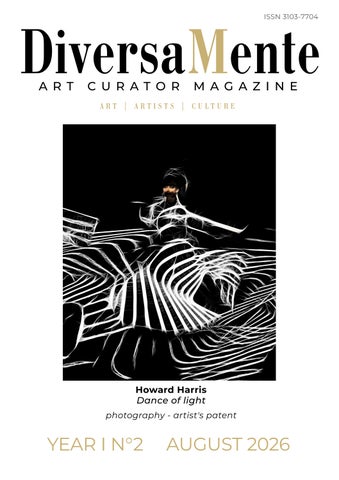
Howard Harris Dance of light photography - artist's patent
YEAR I N°2
AUGUST 2026
DIVERSA MENTE - ART CURATOR - MAGAZINE Online serial publication with bimonthly periodicity Year I n. 2 August 2026 PUBLISHER DiversAmente Arte REGISTERED OFFICE Via Vittorio Veneto, 216 - 80054, Gragnano Naples OPERATIONAL HEADQUARTERS Via Benedetto Croce, 12 - 80134 Naples CF 90113900634 EDITORIAL DIRECTOR Simona Rossi
Email: artediversamente@gmail.com - info@diversamenteartcuratormagazine.it PEC: diversamente.arte@pec.it © 2026 - Simona Rossi - DiversAmente Arte
ISSN 3103-7704
INDEX
Howard Harris - 4 Marco Verdelli - 10 Marcelle Mansour - 13 Emanuela Martolò - 16 The Inner Latitude - 20 Inside the Work - The Calling of Saint Matthew - 24 Gianni Sallustro - In-Depth Analysis - 29 Federica Faella - 40 Samuele Comite - 43 Gianluca Guadagno - 46 Stefano Colombo - Enjoy Your Life -49
Howard Harris
Howard Harris develops a research in which photography, perception, and technology converge in a profoundly recognizable language. Born and raised in Denver, Colorado, he trained at the Kansas City Art Institute and subsequently at the Pratt Institute in New York, where he explored the relationship between form and space. He combines this training with over thirty-five years of experience in design and technology, elements that naturally flow into his artistic practice.
For Harris, photography represents the origin of a process that transcends the twodimensionality of the image. His Techspressionist research is constructed through layering, transparency, and different visual planes, capable of changing depending on the light and the position of the observer. The work thus acquires a mobile perceptual dimension: the viewer, by shifting their point of view, participates in the image's continuous transformation. In 2017, Harris obtained a U.S. patent for the process he developed to create his layered works, a particularly significant achievement for an artistic pursuit in which technological innovation becomes an integral part of the language. His official biography identifies dimensional and multi-layered images as one of the distinctive elements of his work. The technique, however, finds its meaning in the reflection that sustains it. For Harris, seeing means continually building a relationship between what appears and what belongs to the viewer. Light, movement, and space meet memory, emotion, and individual experience. Photography thus loses the fixity of the instant and introduces a second moment, that of observation. The image demands to be traversed by the gaze and changes as it is viewed. It is precisely in this relationship that the maturity of his research emerges. Technology and experimentation remain tools at the service of an expressive need, while photography and matter converge to bring the work closer to the object. Harris works on the boundary between the visible and the perceived, making depth a physical and mental space. His career has achieved significant international recognition.
4
Their works are exhibited and represented in the United States, the United Kingdom, and Europe, and appear in publications such as International Artists of the Decade, International Contemporary Masters, Top 10 Contemporary Artists, and 50 Artists to Invest In. Numerous international awards accompany a research that has successfully combined invention, design rigor, and artistic sensitivity. Howard Harris thus brings a particularly timely reflection to contemporary photography: every image possesses a visible reality, while every gaze constructs its own experience of that reality. It is in the shifting space between these two dimensions that his work continues to unfold.
www.hharrisphoto.com Instagram: @howardharrisphotoart Facebook: @howardharrisphotoart
5
Dance of Light Howard Harris Print on aluminum €6,100
Dance of Light is the image chosen for the cover of issue 2 of the Magazine. The work embodies one of the most profound aspects of Howard Harris's research: stratification becomes the place where the image loses the certainty of the moment and acquires its own temporality. The different levels simultaneously retain presence and movement, entrusting the gaze with the task of continually recomposing their meaning. Dance thus transforms into an interior experience. The body passes through the light, leaving traces that seem to belong to memory, where each experience is deposited on the previous one, modifying it and being transformed in turn. The observer also enters into this process: position, distance, and timing of the gaze determine an everchanging relationship with the work. Harris uses layering as a language capable of describing the complexity of seeing and, at the same time, that of remembering. Dance of Light preserves the persistence of what passes through us: experience persists through superimpositions, sediments, changes form, and continues to act long beyond the moment that generated it.
6
No Monkeys Howard Harris Print on aluminum €6,100
The title No Monkeys introduces an ironic fracture into the work, preventing the gaze from settling for the seductive immediacy of the image. Howard Harris seems to play Paragraph text with our need to recognize and attribute meaning to what we see, while constructing a universe in which every perceptual certainty is continually called into question. The eye searches for a reference, a figure, perhaps the very thing the title declares absent, and in searching for it, it enters into the mechanism of the work. It is here that Harris shifts the question from vision to interpretation: seeing inevitably becomes projecting something of oneself onto what appears. No Monkeys thus takes on the character of a subtle perceptual paradox. The more the image seems to present itself in its own clarity, the more it forces us to recognize that the gaze is rarely innocent. We seek what we know even where it might not be, because every vision carries with it memory, expectation, and imagination. And it is precisely in this gap between what exists and what we believe we see that Harris places the viewer.
7
Tubes Howard Harris Print on aluminum €3,900
In Tubes, Howard Harris leads our gaze toward a depth that seems to precede form, a dark space from which color emerges, gradually gaining consistency. The luminous material emerges as if part of a generative process, transforming what might otherwise be perceived as emptiness into a place brimming with possibility. Layering affects perception by creating successive thresholds: the gaze traverses the work, seeking depth and continually encountering new levels. Color then becomes an experience of emergence, an energy born from shadow and conquering space. Harris brings technique into the very meaning of the work. Tube evokes that original moment when something begins to manifest, when light, color, and form emerge from the still indistinct depths. Depth thus becomes a generative space, capable of transforming the act of seeing into the sensation of witnessing a birth.
8
To Many Wars Howard Harris Stampa su alluminio € 6.100
In To Many Wars, the three-dimensionality characteristic of Howard Harris's work takes on a dramatic force. The world seems to sink into the work, sucked into a spiral composed of national flags, while fire symbolically consumes its surface. Technique becomes an essential part of the meaning: depth transforms the fall into experience and leads the gaze toward a center that appears increasingly distant. Flags, symbols through which peoples and states affirm their identity and belonging, participate in the same vortex. Their multiplication constructs the image of a fragmented humanity that, paradoxically, shares a single destiny. At the center remains the Earth, engulfed in flames, almost crushed by the weight of the divisions that surround it. Harris conveys the work's most disturbing meaning through depth: as identities continue to assert and overlap, the world sinks and burns. To Many Wars thus becomes a reflection on collective responsibility, because every border belongs to men, while the Earth on which those borders are drawn belongs to the destiny of all.
9
MarcoVerdelli Marco Verdelli was born in Varese in 1957 and built his relationship with art through an education that, since the 1970s, has allowed him to explore different techniques and to progressively recognize material and color as the most authentic tools of his own expression.
At the Angelo Frattini State Art High School in Varese, he experimented with oil, engraving, etching, woodcut, Indian ink, pastel, and watercolor; in the following years, he continued this research through collaboration with the artists and professionals of the Montefeltro group. The Varese area occupies a central place in his sensibility. Landscape, woods, and hills belong to an intimately known universe and become the material of a painting in which the relationship with nature takes on the value of an inner experience. Verdelli seeks that subtle zone where a place ceases to be merely space and becomes memory, belonging, emotion. His statement, "Art for me is pure emotion," perhaps contains the most immediate key to understanding his work. The act of painting stems from feeling and finds in simplicity an expressive measure, far removed from the need to overwhelm the image. Color, material, and gesture preserve an intimate dimension, granting the work the ability to convey that vibration that often precedes words. A member of the Independent Artists of Varese, Verdelli has participated in numerous group exhibitions in Italy and abroad, with appearances indicated in his biography in Varese, Porto Ceresio, Florence, Rome, Venice, Sanremo and Milan, and in international contexts such as New York, Dubai, Beijing, Monte Carlo and Paris. Throughout its journey, nature maintains the value of a space for listening and reconciliation. It is from this relationship that a painting emerges, capable of transforming the familiar landscape into a shareable experience, allowing the observer's sensitivity the time and space necessary for emotion to find its own form. Instagram: @marcoverde1957
10
In San Martino and its mountains, the landscape acts as a threshold. The mountain belongs to an ancient symbolic tradition: a place of elevation, of distance from the ordinary, an ideal point of connection between the earth and what transcends it.
Verdelli attenuates its consistency until it becomes an almost mental presence. The path that penetrates the space introduces a second archetype, that of the walk, and brings the landscape into an existential dimension: crossing means advancing toward something that lies beyond the immediate reach of the gaze.
This theme continues in the Cypresses of San Quirico d'Orcia. In Mediterranean culture, the vertical tree carries meanings linked to duration, transition, and continuity between different dimensions of existence. Arranged along the road, the cypresses symbolically accompany the journey and transform the landscape into a space of transition. Nature becomes a framework through which to interrogate human time.
11
In Castelluccio di Norcia, the relationship changes, with the settlement appearing contained within a vastness that surpasses it and introduces the comparison between human construction and the permanence of the land. The village becomes a sign of human presence, of its need to inhabit and leave its mark. Nature maintains an immensely broader temporality and welcomes that presence. within a cycle that precedes and transcends it. Color accentuates this relationship, giving the land a vitality that removes the landscape from simple contemplation.
Cavalli al moto ultimately shifts the same reflection from permanence to vital impulse. The horse pervades the Western imagination as a figure of strength, freedom, and the urge to overcome limitations. The artist captures, above all, its archetypal component, in which body and movement coincide in a drive that belongs to the primary dimension of action.
The four works synthesise the construction of a coherent path between elevation, crossing, belonging, and impulse, symbolic nuclei through which the artist interrogates different conditions of existence. The landscape takes on the value of a cultural and interior territory, while nature becomes the place where human experience continually recognizes its own measure.
12
Marcelle Mansour Self-Portrait - Sunbird and Iris on My Head - 2025 Marcelle Mansour develops her research at the intersection of memory and identity, spirituality and transformation, constructing a language in which light becomes a visual medium and a tool through which to explore the deepest dimensions of human experience. An Australian multidisciplinary artist, academic, bilingual author, and poet, she combines a background in Fine Arts with studies in Literature, a component that informs the symbolic nature of her work. Her Christian-Palestinian origins and the life she has built in Australia fuel a reflection on identity as a layering of individual experience, belonging, and collective memory. Her practice, which began with traditional painting, Byzantine icons in egg tempera and gold leaf, and life portraiture, has progressively expanded to digital figurative painting, Abstract Light Painting, and hybrid forms based on light. The legacy of the icon is a significant key to his research. The artist transfers the symbolic value of light into the present, while faces, color, and layering become tools for exploring the relationship between the visible and the interior. Nature, birds, flowers, and cultural references simultaneously take on the value of signs of continuity, belonging, and transformation. His career has achieved significant international recognition, with appearances at the 13th Florence Biennale, the Biennale of Sydney, the Museum of Modern Art and the Museum of Arts and Design in New York, World Art Dubai, the Carrousel du Louvre, and the MEAM in Barcelona. His works are included in the permanent collection of the Museum of the Americas. Among his awards are the Medal of the Order of Australia (OAM), along with the Presidential Award and the First Prize of the Budapest International Juried Art Competition. In Marcelle Mansour's research, personal experience and collective memory thus flow together in a contemporary language capable of gathering ancient symbols and leading them towards new possibilities of meaning.
13
Self-Portrait - Unveiling the Invisible - 2026
Marcelle Mansour's four works appear to belong to a single movement that proceeds from individual identity to cultural memory, and from there reaches a collective dimension. Self-Portrait - Unveiling the Invisible focuses on the complexity of the self. The self-portrait, traditionally entrusted to the recognizability of the face, here becomes a threshold through which memory, spirituality, and transformation emerge. The layering of light accompanies an identity conceived as a process, continually modified by what is experienced, remembered, and inherited. The influence of the Byzantine icon gives light an additional function, linked to the possibility of making a dimension belonging to interiority perceptible.
The Red Poppy - 2024
This layered identity finds a particularly significant symbolic synthesis in The Red Poppy. The red poppy belongs simultaneously to the Australian memory of the ANZAC and to the Palestinian tradition, uniting in a single natural element the two cultural geographies that run through the artist's history. The flower thus takes on the value of a bridge between belonging, generations, and memories. Its biological fragility interacts with the persistence of the symbol: what has a short life in nature can transcend time through the meaning a community entrusts to it.
14
In Self-Portrait - Sunbird and Iris on My Head (work in Biography), cultural heritage enters directly into the representation of the self. The Palestine sunbird, the Faqqua iris, and the embroidered dress become symbols through which Mansour brings her Palestinian heritage into the present. The self-portrait thus transforms into a space of continuity between person and culture. The bird evokes movement and transition, the flower the principle of regeneration, while the dress preserves a memory entrusted to tradition and its transmission. Belonging takes on a vital nature, capable of accompanying the individual through different places and transformations. The Angel's Symphony of Peace ultimately leads this journey toward universal significance. Angel, doves, olive branches, traditional dress, and the oud construct a universe in which spirituality, culture, and nature converge around the theme of peace. The angel assumes the archetypal role of mediator between different dimensions; the dove and olive tree carry with them a thousand-year-old symbolic memory, while the oud introduces music as a language capable of transcending borders and affiliations.
The Angel’s Symphony of Peace - 2023 From the artist's face to the memory of a people, to the aspiration for peace, Marcelle constructs a path in which the individual microcosm gradually enters into relationship with the human macrocosm. Light accompanies this journey as a principle of knowledge and transformation: it makes memory present, passes through inherited symbols, and allows personal experience to become a shared language. Identity emerges as living matter, composed of what we receive, what we experience, and the new meanings we are capable of generating.
Instagram: @marcelle_mansour www.marcellemansour.com.au 15
Emanuela Martolò THE FORGOTTEN PROFESSIONS Some jobs continue to exist in workshops and small spaces where time seems to have a different dimension, entrusted to people with knowledge gained through experience. Emanuela Martolò dedicates her series "I mestieri dimenticati" (Forgotten Jobs) to this world, a selection of which we present here. Her gaze focuses on the permanence of gestures that still belong to the present, even though contemporary life has progressively pushed them to the margins. Emanuela enters the workplace without transforming them into stage sets, allowing the concreteness of the environments and the practice of the craft itself to construct the narrative. Black and white accompanies this choice naturally, while the close-up allows her to get closer to the action and accurately convey its character. I mestieri dimenticati isn't necessarily about lost jobs: rather, it depicts what we risk losing sight of while it's still before us. This is where the lack of nostalgia comes from in Emanuela's images, which remain anchored to the present and the reality of those who continue to practice these professions. It is precisely this ability to observe what tends to become invisible while maintaining an intact relationship with reality that defines one of the most recognizable aspects of his photographic research. And it is from this quality of gaze that DiversaMente Arte's choice to represent her arises.
Instagram: @emanuela_martolo
16
17
18
19
T H E I N N E R L AT I T U D E by W. A. Conte Simona Rossi's research stems from a multidisciplinary background in which art, cultural heritage, and the study of the psychic dimension combine to construct a complex and layered perspective. The artist's career has been consolidated over the years through exhibitions, awards, and a research capable of traversing diverse languages while maintaining its own internal coherence. To understand its more mature direction, it is best to start from ES. From a work in which something that already belonged to the previous phases of his research seems to have been deposited, by subtraction.
Simona Rossi - ES - Oil on canvas - 140x70 cm
ES is constructed around very few elements. An almost immobile expanse, a vessel reduced to a minimal presence, a horizon that tends to dissolve. The verticality of the mast interrupts the horizontal breadth of the space and finds a downward continuation in the reflection, connecting what emerges with a depth only sensed. The apparent stillness does not coincide with the absence of tension; on the contrary, it seems to contain it. We do not know whether the vessel is proceeding, waiting, arriving, or moving away: the artist forgoes narrative and entrusts the weight of the image to the relationship between a minimal presence and the surrounding immensity. Even the title inevitably opens up to a psychic dimension, but it would be reductive to transform ES into the illustration of a psychoanalytic concept.
20
Surface and depth, visible and invisible, control and possibility are already inscribed in the work's structure. The title amplifies this ambiguity without resolving it. It is by looking back that the rarefaction of ES reveals its origin. In Tumulto dell’anima che aspira a quel che il corpo ignora (Tumult of the Soul Aspiring to What the Body Is Ignorant), Awakening, Oltre (Beyond), and Ancora (Another), the tension is much more evident, but what changes is not so much the nature of the quest as the way it takes shape. Matter, light, and movement occupy the space with varying intensities, continually connecting a present condition with something that seems to exceed it.
Simona Rossi - TUMBLE of the soul that aspires to what the body ignores - Oil on canvas - 100x50 cm In "Tumult of the Soul Aspiring to What the Body Ignores," the contrast between density and openness, darkness and luminosity, is explicitly stated in the title: the bodily limit confronts an aspiration that doesn't seem to recognize it as a definitive boundary. The tension is still exposed, physically perceptible. In Awakening, that same energy takes the form of emergence. A luminous nucleus bursts into the dark field and spreads through space. Light doesn't describe: it happens. It becomes the sign of a transition between latency and manifestation, between a state that holds back and something that can no longer remain contained. Beyond shifts this dynamic once again. A luminous current passes through space without revealing its destination. The "beyond" remains outside the image and precisely for this reason gains strength: the focus is not on reaching it visually, but on making the tension of the crossing perceptible.
21
Simona Rossi - AWAKENING - Acrylic on canvas - 80x60 cm
Simona Rossi - BEYOND - Oil on canvas - 40x30 cm
22
Simona Rossi - AGAIN - Oil on canvas - 140x70 cm With Ancora, the sea becomes an entire field of forces. The waves, the depth, and the variations in light construct a surface that doesn't grant the gaze definitive stability. It's significant to compare it to ES: the marine subject might suggest an immediate continuity, but it's the difference that's revealing. In Ancora, the movement is manifest; in ES, it's restrained. The sea is therefore not reiterated as a subject, but used to express different conditions. Thus, the five works, considered together, demonstrate a continuity that is not dependent on the repetition of a single stylistic signature. The densities, colors, and gestural intensity vary; a communicative dynamic based on recurring polarities such as darkness and light, surface and depth, stability and disturbance, limit and crossing persists. Even when the landscape remains recognizable, it rarely retains a purely descriptive function. Sea, sky, light, and horizon become places of connection. What interests the artist seems not to be the representation of a space, but what can happen within it and, above all, what that space is capable of evoking beyond its visual evidence. It is in this sense that we can speak of an interior latitude and not of a generic landscape of the soul, of continuously shifting coordinates between what it contains and what it tends to transcend, between a recognizable condition and the possibility of its transformation. From this perspective, ES neither interrupts nor concludes the previous path; it radically alters its scale. The work's maturity lies precisely in its subtraction. The artist does not abandon the tension that runs through his research; he simply abandons the need to display it entirely.
23
INSIDE THE WORK by Simona Rossi
The Calling of Saint Matthew by Michelangelo Merisi da Caravaggio
There are works to which a knowledge of art history is only the first step. The Calling of Saint Matthew belongs to this category because Caravaggio takes an extremely brief Gospel episode and transforms it into a reflection on human freedom, selfacknowledgement, and that almost imperceptible moment in which a life can change direction.
24
The painting was created for the Contarelli Chapel in the church of San Luigi dei Francesi in Rome and, along with The Martyrdom of Saint Matthew, was exhibited to the public in 1600. It was Caravaggio's first major Roman ecclesiastical commission and marked a decisive turning point in his career. The subject is taken from the Gospel of Matthew: Christ meets Matthew at the tax booth and invites him to follow him. A few words, a before and after. Caravaggio carefully chooses the space between them. This is where art history must necessarily enter, because Caravaggio's revolution also makes sense in relation to the figurative culture of his time, as the sacred episode is transferred into the artist's contemporary world. The clothing, setting, and characterization of the figures bring a remote event closer to the experience of the seventeenth-century viewer, producing that extraordinary impression, also noted by modern scholarship, that the evangelical event is occurring in the present. Contemporaneity has a further meaning here: if the calling occurred only in the time of Christ, we could observe it as history, Caravaggio brings it into his present and transforms it into possibility. Christ enters the human space almost sideways, accompanied by Peter. His gesture permeates the painting before the viewer can fully reconstruct its meaning. The outstretched hand inevitably recalls Adam's in Michelangelo's Creation in the Sistine Chapel, but the relationship is transformed: in Genesis, God offers Adam the beginning of life; in Caravaggio's canvas, Christ offers Matthew the possibility of a new life. Between the two hands, ideally, lies the distance between being born and choosing who to become.
25
The light follows the same direction as the call. It enters from the side, passes through the darkness, and reaches the group gathered around the money. It possesses a physical plausibility and simultaneously takes on a symbolic function. Caravaggio manages to make the optical phenomenon coincide with the irruption of grace without transforming the scene into a supernatural apparition. The sacred enters the real and does so while life continues. This is perhaps one of the most radical aspects of The Calling. Some characters perceive what is happening, others remain focused on the money. The call passes through the same space, the light reaches different men, and each reacts according to their own availability. Caravaggio thus introduces, within a religious scene, an extraordinary representation of the selectivity of the human gaze: we can find ourselves faced with the same event and experience completely different realities.
Even the identification of Matthew, seemingly elementary, continues to be a matter of debate among scholars. The traditional reading recognizes Matthew as the bearded man who raises his hand to his chest, as if surprised by the possibility that the call was addressed to him. The gesture contains a question even before an answer: me? And it is precisely that brief interval that makes the work psychologically extraordinary. Matthew still belongs at the table. Christ has already ideally pronounced the call, while the decision has yet to be made.
26
Caravaggio suspends the narrative at the moment in which the previous identity continues to exist and the future one has just become possible. Vocation then takes on a meaning that transcends religious narrative. It is the moment of recognition, when something breaks into the known order and forces the individual to confront a previously unexpressed possibility of self. Money, too, takes on a specific weight in this context. Matthew is a publican, a tax collector; his status therefore belongs to the world of calculation, exchange, and possession. What has organized his existence up until that moment remains on the table. From the other side comes a request that implies transformation. Caravaggio thus constructs a tension between two systems of value without resorting to abstract allegories: he makes them present in the same space.
The call, above all, leaves freedom intact. Christ points. Matthew must choose. It is this distance that makes the scene powerfully human even today. Authentic transformation always requires a transition in which the individual recognizes a possibility and decides whether to embrace it. Light can point, another can call, an event can shatter the previous equilibrium; the subsequent movement belongs to the person. For this reason, too, Caravaggio's darkness acquires a function that vastly surpasses the celebrated chiaroscuro. Darkness contains what still awaits recognition. Light reveals and connects. The boundary between the two dimensions physically passes through the canvas and simultaneously through the consciousness of the characters. Caravaggio thus manages to represent an invisible event through entirely human consequences. No heavens open. No architecture separates the sacred from the everyday. Christ enters the same space where coins are counted and business is conducted. This very proximity radically alters the meaning of the episode: the possibility of transformation arrives within ordinary existence, while we are busy being what we believe ourselves to be. 27
The Calling of Saint Matthew thus becomes a work on the very brief span of awareness. There is a man before the call, and there is the Matthew we know after it. Caravaggio chooses to paint what lies in between: the moment in which both are still possible. And perhaps this is why, after more than four centuries, that hand continues to ideally reach beyond Matthew. The direction of the gesture enters the spectator's space and the question changes addressee. What happens when light reaches us?
28
GIANNI SALLUSTRO T H E
I N - D E P T H
A N A LY S I S
Gianni Sallustro encountered theater at an early age and recognized in acting the place where his curiosity about humanity could find concrete expression. The character becomes a possibility for knowledge, a presence to be explored until it becomes believable to the audience. When asked many years later what qualities an actor should possess, he responded with two words: "histrionic and credible." The first refers to the capacity for transformation that is intrinsic to the interpreter's craft; the second involves daily study, because credibility is built through practice and the willingness to continually question what one thinks one knows. His training proceeded within this need, the Commedia dell'Arte, studied in depth with Antonio Fava, gave him tools that mainly concern the actor's presence and the mastery of the body in space. It was through Fava that he met Dario Fo, which Gianni would later credit as a turning point in his professional life.
29
It's significant that, when recounting his own journey, he chooses to define himself as "my own Pygmalion": he doesn't deny the importance of the teachers and people he's met, indeed he openly cites them, but he traces his growth to a work built without favoritism and tested each time on stage. Among the endorsements he's received over the years are Massimo Ranieri, Gabriele Lavia, Emma Dante, Antonio Calenda, Antonio Capuano, Roberto De Simone, Michele Del Grosso, and Dario Fo himself. These names come from diverse backgrounds and convey the breadth of a journey in which Gianni avoids limiting himself to a single idea of theater. Pulcinella, entrusted to him by Fo, remains one of the roles to which he is particularly attached; Mercuzio, directed by Gabriele Lavia, demands a different quality of presence. With Antonio Calenda, he tackles Na' sceneggiata, an experience he will remember for the way popular tradition maintains its power when handled rigorously, while Roberto De Simone leads him toward a dimension in which the stage carries with it a deeper cultural memory and a ritual component capable of transforming the actor's relationship with the word. Michele Del Grosso enters this experience. When the two meet, Sallustro has already begun his professional journey. Michele Del Grosso founded the Teatro Instabile Napoli during a particularly intense period of Neapolitan theatrical research, and built his work around the actor, his expressive potential, and the need to free him from easy solutions. His relationship with Gianni grew slowly and lasted about twenty years, sustained by daily practice in which rehearsals played a crucial role. Del Grosso could return to the same stage many times and ask the performer to revisit it until he found the right balance. Gianni understood the value of this discipline because he recognized it as a prerequisite for actorly freedom: only when what one does has been truly mastered can the actor allow it to live without becoming rigid. He absorbed that lesson and carried it with him, transforming it according to his own way of working.
30
Razzullo and Sarchiapone under the big top continues the confrontation between the two for a long time, allowing Gianni to rediscover, within the Cantata dei Pastori, part of the training he gained through the Commedia dell'Arte. The circus setting brings a recognizable tradition to the stage while simultaneously freeing it from the temptation to reproduce what the audience already knows. The show returns in different editions, and each return becomes an opportunity to see how much an actor changes even when the text remains the same. With Sei prime scenes by Manlio Santanelli the terrain changes completely. Gianni participates in the world premiere with Antonella Monetti and encounters contemporary writing that calls for a more streamlined relationship with the stage. This constant shift between distant materials prevents him from retreating into a preestablished, personal style and helps build the flexibility he himself considers essential to an actor. Caravaggio on Stage Caravaggio holds a special place in his memory. Sallustro plays Michelangelo Merisi and tackles a character in which the boundary between the man and the artist remains continually permeable. The painter seeks out models, arranges them in space, and constructs images before the spectators; what art history consigns to the fixity of the painting is brought back to the moment of its formation. For Gianni, this means entering Caravaggio, following the creative process and the tensions of a biography that continue to weigh on the work. Many years later, he would still cite this role among those he loved most. His relationship with Michele Del Grosso also fostered a profound awareness of the conditions under which culture is produced. Sallustro understood the economic importance of theater and advocated a path free of favoritism, often constructed without the resources that would facilitate the realization of a project. Michele showed him how inventiveness can be crucial precisely when resources are limited.
31
Gianni will make that ability his own, subsequently bringing it into his own productions and into his work with young people. In 2007 he founded the Vesuvian Academy of Theatre and Cinema in Ottaviano. Michele Del Grosso is still fully present in his professional life and Gianni continues to act, so the Academy was born within a living theatrical experience, while those who teach continue to face the same challenges they pose to their students. It is this contemporaneity that profoundly affects the physiognomy of the Academy itself. Sallustro envisions a training program that prepares actors for the true complexity of the profession. Theater remains the center, but the camera enters the studio along with the voice and the techniques needed for dubbing. Experience gained on the body is applied to mime and physical work, while writing and directing broaden the actor's understanding of the process through which a performance is created. The disciplines are numerous, yet the Academy's structure takes on its full meaning primarily through the relationship Gianni establishes with his students. The students arrive with very different possibilities: some immediately demonstrate a natural ability to be on stage, others need a longer journey before being able to expose themselves. There are fragilities that emerge precisely when the body becomes visible to others, and seemingly solid certainties that, faced with real work, must be rebuilt. Gianni observes these differences and intervenes with the person in front of him, seeking the path through which they can find their own credibility. His teaching method leaves room for the student's specificity, because an identical technique produces different results when the user is different, and he works precisely on this distance: he knows how to wait if a student needs time and he also recognizes the moment when waiting risks turning into protection. The demand grows along with the possibilities he sees emerging. The Academy quickly became involved in theatrical productions, and the students began working alongside already trained actors. Some participated in performances featuring Michele Del Grosso, directly experiencing the research of the maestro with whom Gianni continues to work. This is what brought him into the same space as an actor and as the person responsible for the training of the young people he brought with him, listening to those who act alongside him.
32
In this context, the student quickly understands that theater thrives on precise relationships: a wrong entrance alters the other actor's timing, a distraction can disrupt the tension built by the scene, and what happens on stage always affects multiple people at once. Gianni brings the students into this responsibility when he believes they can handle it, and once in production, he considers them an integral part of the work. It is here that his idea of the "histrionic and credible" actor finds a concrete pedagogical translation: the ability to transform oneself has value when it is supported by sufficient tools to make the character real to the viewer. Initial talent is only of limited importance; what matters is how much a person is able to work on themselves and how well they are able to take into account those sharing the scene. Over the years, some students choose a profession, others direct their lives differently, while the Academy continues to work, welcoming new generations and maintaining its Its purpose is to serve as a training and production center. Gianni envisions it as an organization capable of supporting those who wish to transform acting into a profession and, at the same time, of influencing the individual undergoing that experience. This is where the concept of associating good people with good actors comes from: a simple synthesis of a principle that, in practice, involves respect for the work of others and the responsibility with which each person occupies their place. The collaboration with Marcello Radano's Talentum Production further expanded its activities. Through this relationship, over one hundred and fifty shows and numerous films were produced, while students were also offered roles in Rai and Mediaset productions. The Academy thus took on a role that transcended that of a school, bringing training directly into contact with the professional world. Mater Camorra grows within this season. The starting point is Bertolt Brecht's Mother Courage and Her Children, but the material is transferred to a reality close to the life of the person who brings it to the 33 stage.
The extensive development with Michele Del Grosso allows the use of Brechtian structure to delve into the Camorra system, demonstrating how violence can penetrate people's everyday lives and progressively restrict their options. Gianni returns to the show several times, and the different versions accompany its evolution. Academy students also participate in the production, working alongside more experienced performers and tackling material that directly pertains to the local area in which they live. Sallustro asks them, above all, to construct believable characters, because the work's civic strength depends on the stage's ability to convey human beings, even before ideas. Veronica Montanino's participation in the 2014 edition introduces an element that profoundly alters the relationship between representation and reality. Veronica is the daughter of Gaetano Montanino, the security guard killed by the Camorra, to whose memory the show is dedicated, and she plays Catarina. She thus brings to the stage a story that is part of her own family experience, and the presence of that memory further highlights the responsibility with which Mater Camorra approaches its narrative. The work received recognition and was included in the Federico II University's digital library, dedicated to the Camorra and the culture of legality. The Academy's work also received an award from the State Police. These achievements mark a journey that has become deeply rooted in the region and confirm the ability to transform theater into a space where the civic dimension fully maintains its artistic quality. Sallustro returned to Mater Camorra several times and came to define it as part of his own flesh and blood. It's an expression that says a lot about the relationship built with that work, which has grown over time together with the people who participated in it. The experience he gained with young people also inspired Gianni to delve deeper into the pedagogical aspect. This study came when practice had already posed specific questions, allowing him to address them through additional tools. Subsequently, the work expanded into local schools, where theater became, above all, an educational experience. In this context, Sallustro paid particular attention to the spoken word and reading aloud, observing how a person's relationship with themselves can change when they learn to give form to what they read.
34
The experience he gained with young people also inspired Gianni to delve deeper into the pedagogical aspect. This study came when practice had already posed specific questions, allowing him to address them through additional tools. Subsequently, the work expanded into local schools, where theater became, above all, an educational experience. In this context, Sallustro paid particular attention to the spoken word and reading aloud, observing how a person's relationship with themselves can change when they learn to give form to what they read. I Wanted to Fly was born from one of these paths. Gianni wrote the screenplay based on his experience with the students and brought the project to film production. The short film won several awards and demonstrated how his work in schools managed to find its own form without losing its connection with the people who inspired it. Meanwhile, cinema continued to occupy a prominent place in his acting career. Gemma Tisci's Ricordi in bianco e nero (Memories in Black and White) cast him in the role of Raffaele Cutolo, and the direction was handled by students at the Academy. The relationship between teacher and students here takes on a unique form: Gianni acts in front of the camera while some of the students he trained direct the work. The film won numerous awards, and Sallustro traveled across Italy to receive awards for this experience and for Raffaele Ceriello's L'eredità (The Legacy). With Vincenzo Pirozzi's Il peso giusto del vuoto (The Exact Weight of the Void), he joins a project in which he co-stars with Cristina Donadio and Peppe Servillo. His film career spans a thirty-year career, and he retains the ability to transform that Gianni considers essential for an actor. His relationship with the camera requires a different level of precision than that of the stage, and this very difference allows him to re-examine what he has built over the years (La squadra, Un posto al sole, Carabinieri, Sette vite, I Cesaroni, Un Medico in Famiglia, are some of his appearances in RAI and Mediaset productions), while dubbing complements a professional versatility that Sallustro champions, describing himself as an actor capable of adapting like a chameleon to different mediums. During this period he also worked on La barba and continued to develop projects involving other languages, radio dramas with Anita Pavone and Rosalba Di Girolamo, 35 the
He collaborated with Piero Chiambretti on the video poems written by Felicita Chiambretti, and a new film project with Antonio Ruocco is underway, in which Gianni returns to play Raffaele Cutolo. The project continues without losing its relationship with the Academy, which remains the place where training and production continue to converge. The recognition received from the Chamber of Deputies takes on a special significance in this journey: Gianni Sallustro has been awarded as best theater and film actor with a socially engaged role, a recognition that complements a body of work already widely developed locally and restores national prominence to a substantial portion of his research. Mater Camorra has addressed organized crime through theater, the Academy has built a concrete relationship between training and professional opportunities over the years, while educational projects have brought the stage into contexts where its value also extends to personal growth. Michele Del Grosso remained a constant presence until the last days of his life. Their relationship had now spanned nearly twenty years and also encompassed a personal dimension that transcended their shared work. Gianni remained at his side during his final years. When Michele died, Sallustro had a fully recognizable artistic history, and the Accademia Vesuviana had long been an active institution. He later took over the artistic direction of the Teatro Instabile Napoli. He arrives at the TIN with a deep understanding of its history and brings his own mature experience. His leadership allows him to continue to consider the theater as a place of work rather than a facility to be managed. Productions remain central, and the Academy finds in the TIN space a further point of contact with the professional scene. The students thus continue to meet performers from different backgrounds and to engage with a practice that Gianni keeps open to discussion. He personally remains on stage, because the actor continues to be the place from which he questions the theatre even when the responsibilities have become numerous. In the same period Roberto De Simone's The Passion of the Christ sees him among the reciting voices together with Mariano Rigillo, Franco Iavarone, Peppe Servillo and Elettra De Simone, he rediscovers a ritual dimension already encountered in his own path, but arrives there with a different maturity, after decades of work and with a knowledge
36
of the voice now crossed by theatrical and cinematographic experiences very distant from each other.
Oedipus Rex, on the other hand, brings him back to one of the most radical figures of ancient tragedy, a man forced to fully understand what he would have preferred to ignore. Sallustro continues to seek out characters capable of exposing the actor to a real question, and maintains this openness even as he leads the TIN and oversees the work of the Academy. In recent years, the memory of the twentieth century has become increasingly present in his research. H.H. Seeds of Extermination is based on Antonio Masullo's Trilogy of Evil, and Gianni developed the play's script, also taking on the direction and acting roles. Nazism is addressed through the men who transformed an ideology into a system capable of administering extermination, revealing the point where individual responsibility continues to exist even within an enormous apparatus. Sallustro brings this question to the stage because history retains its value when it can still interrogate the present. Interest focuses on how a person comes to accept what gradually becomes normal within a system and on the possibilities that remain open when that same person begins to recognize its nature.
37
"I Do Not Forget" continues this research. Hitler and Himmler enter the same space as Claus Schenk von Stauffenberg, and the latter's presence opens a fracture in the representation of the system, introducing the possibility of a decision matured from within. Gianni explores the moment when awareness becomes choice and the cost of that choice when it arrives within a reality to which one has already belonged. The performance is scheduled for April 25 and 26, 2026. The timing of the performance during Liberation Day reflects the very meaning of the work, built around a memory capable of still generating awareness. Gianni is immersed in rehearsals, the Teatro Instabile Napoli is in its season, and the Academy continues its work with the students. On the night between April 19 and 20, 2026, Gianni Sallustro died suddenly. Io non dimentica (I Do Not Forget) was scheduled to be performed a few days later. For the boys of the Academy, death interrupts a relationship that is still part of everyday life: some are now professionals, others have chosen Different paths and new generations continue to identify with an experience that marked a significant part of their growth. Gianni remains the master with whom they learned to hold a stage, and the person capable of knowing each person well enough to know when to wait and when to ask for more. Even today, many call themselves "Gianni's boys," with a naturalness that renders any commemorative construction superfluous; his name continues to be a part of their conversation.
Gianni Sallustro's Vesuvian Academy of Theatre and Cinema is ending its activities, but the young people who continue to work in theatre or cinema will ensure that their Maestro lives on forever, within a theatrical history that, through them, will remain connected to the present.
38
39
FEDERICA FAELLA Federica Faella completed her dance training in Naples, at the L’Arte del Movimento school, where she graduated in Classical Academic Technique, Repertoire, Contemporary Technique, and Modern Jazz. She continued her studies in Rome at the National Academy of Dance, choosing the contemporary path and earning a first-level academic diploma. Alongside her formal training, she also attended seminars and workshops with Italian and international instructors, a creative movement workshop, and further training opportunities, made possible by scholarships for the Professional Program of the Italian Dancers Association and for the modern technique courses at Balletto di Toscana. Already during her formative years, she participated in events and festivals dedicated to classical and contemporary dance, including the Gubbio National Classical Dance Festival, the Maiori Festival, and the Pollino Dance Festival. Her first prize at Agorà Arte in the Modern Jazz Soloists category marked one of her first personal accolades and her entry into a broader professional dimension. Federica works in Italy and abroad with the Skaramacay Dance Company and gradually brings her experience to a wide variety of entertainment fields: she participates in the Sanremo Music Festival and in the advertising industry with the Lilia commercial, while her work as a dancer begins to complement that of a choreographer. For Comovex Eventi, she choreographs productions for shows and events, thus entering a phase in which her knowledge of movement is also used.
40
to build on the work of other interpreters. Her experience continues with Noche Brava, an agency specializing in entertainment and performance for Alpitour World. Here, Federica continues to work on choreography for productions designed for a wide audience and part of an organizational structure that requires continuity and the ability to adapt stage work to different contexts. Cinecittà World represents a further step in her career: she joins the park's artistic cast as a dancer, experiencing a form of performance in which dance must integrate with highly structured characters, settings, and production rhythms. She subsequently passes the selection process for Disneyland Paris, entering an international reality where technical preparation is essential. It must coexist with interpretative precision and the ability to maintain consistent performance quality. His career also includes film with I Graffi, a short film directed by Daniele Falleri. It's a different experience than the live stage, but consistent with a career that has spanned several stages over time.
41
languages without losing the central relationship with the body and movement. After gaining extensive professional experience as a dancer and choreographer, Federica brings part of this wealth to her teaching. She teaches ballet, modern, and contemporary dance classes and mentors young students through qualified training. Her teaching, therefore, stems from a consolidated practice on stage, allowing her to convey a knowledge that takes into account not only technique, but also what happens when that technique must function within a choreography and truly support a performance. Federica has recently collaborated with Stefano Colombo's Enjoy, artistically directing shows on tour at four-star resorts and curating the choreography. This work brings together her experience as a performer, her expertise in choreographic construction, and her ability to mentor young dancers and performers during their preparation. This phase further expands her role in the show, giving her responsibility for the entire stage construction and artistic coordination of the productions.
Instagram: @faellafederica 42
SAMUELE COMITE Samuele Comite's approach to vocals began through rhythm. Born and raised in Crotone, he began as a drummer at a young age and discovered music in clubs and on stage, in a world where the connection with the audience precedes any construction of an artistic image. His transition to singing stemmed from a passion already oriented toward soul and black music, and gradually shifted the focus of his experience, without erasing the rhythmic sensibility that continues to define his approach. The voice thus becomes the instrument through which she finds her own identity. Warm, physical, naturally inclined towards soul sounds, it develops above all in live work, where Interpretation requires an immediate connection with what's happening around him. Over the years, his career has brought him into contact with internationally renowned musicians and artists, experiencing experiences that have put him in direct contact with a musical tradition born far from Calabria but which quickly became an integral part of his development. A particularly significant phase came with The Style, a project born from a meeting with producer Giuseppe "Joe" Crugliano, in which soul, dance, and electronic music found common ground. Devotion took the project to New York, while Samuele traveled to Miami and participated in the Winter Music Conference as part of And Let The Singer Be Heard, an event linked to the international house scene. It was one of the moments in which the path built up to that point found a broader dimension, and his vocals entered a space where house, gospel, and soul naturally coexisted.
43
Around the same time, he met British singer Natasha Watts. In Crotone, the two worked together and even shared the stage in a soulful house performance, a further step in a journey that continues to move between soul and contemporary styles. The return to live performances remains a constant. Samuele continues to perform and is also featured on the Kroton Jazz Festival program, demonstrating a versatility that allows him to move across different contexts while maintaining his distinctive vocal style. The onstage photography perhaps captures this part of his identity better than any other definition: the singing is born within the music, in the relationship with the band and in the response of the listener. His training as a drummer seems to resurface here, in his ability to inhabit time without rigidifying it and to leave the voice the space it needs to expand. Over the years, Comite has continued to work through collaborations and live productions, maintaining a strong relationship with the soul, gospel, and black repertoire that has accompanied his growth.
44
The phrase chosen to introduce his biography, "Music is the mirror of the soul," then takes on a less generic meaning: it describes a concept of interpretation in which technique serves to make something personal recognizable, without replacing it. His most recent experience brought him back to live audiences. In the summer of 2026, Samuele Comite collaborated with Enjoy, performing at resorts on the Ionian coast of Basilicata. The locations and dimensions of the scene change, but that direct relationship with music that has accompanied his journey since the beginning and which continues to find its most natural expression in singing remains.
Instagram: @samuele988 45
GIANLUCA GUADAGNO Gianluca Guadagno was born in Naples and began his career in the entertainment industry at a young age. At sixteen, he entered the world of dance and tourist entertainment, building a career that led him to work as a dancer, choreographer, and team leader. Collaborating with various entertainment and event agencies has allowed him to develop a unique expertise in family entertainment, through formats inspired by magic and fairy tales brought to theaters and piazzas throughout Southern Italy. At the Lilloland amusement park, he took on the role of Artistic Director and Team Leader, working in collaboration with Francesco Mastandrea. This experience broadened his relationship with the production of shows and the artistic management of the group. while continuing to develop personal research on movement. It was during this journey that one of the most unique experiences of his career arose. Balich Wonder Studio chose him as an aerial soloist to perform the Diver of Paestum during the Universiade at the Maradona Stadium in Naples. Gianluca thus brought one of the most famous images of ancient Campanian art into the performance space: the young man depicted in the Tomb of the Diver, suspended at the moment of his leap. That gesture, captured for centuries in the fresco, returns to movement through the performer's body.
46
His training in aerial disciplines continued with Bungee Dance and Aerial Dance, culminating in his qualification as an ACSI National Judge. Suspension work became a regular part of his practice, complementing dance and choreography, allowing him to take on performances in which the athletic dimension is directly integrated into the stage design. His career also included the Mister Italia competition, where he won the national Mister Talento sash, an award tied to stage presence and performance ability. In addition to his artistic work, Gianluca participates with AVIS on a humanitarian mission in Kenya and collaborates with a nonprofit organization, bringing clown therapy to hospitals. His relationship with children continues through his work with schools in Campania, where he manages educational and theatrical projects such as Teatro-Gioco and Predanza.
47
He currently works as an actor, dancer, and choreographer for the company Ma dove vivere i cartoni, continuing his experience in family entertainment and playing characters from fairy tales and cinematic imagery. His acting work also extends to television productions distributed on Prime Video, combining his extensive live experience with screen acting. Last summer, Gianluca Guadagno collaborated with Enjoy at a resort on the Ionian coast of Basilicata, also returning to the entertainment industry.
touristic field where he had taken his first steps, with an experience now gained through dance, choreography, aerial performance and direct work with the public.
Instagram: @g.luca.guadagno
48
STEFANO COLOMBO E N J O Y
Y O U R
L I F E
Stefano Colombo has been working in the entertainment industry for over forty years and has come to management through a journey built from the inside, first understanding the stage and then everything that allows a show to exist. He studied dance in Genoa with Riccardino, earned a certificate in Artistic Direction at the Teatro San Ferdinando in Naples, as part of the De Filippo company, and worked for many years as a choreographer and artistic director in Neapolitan theaters. At the same time, he taught dance at the William Masella school in Piazza Cavour, an experience that allowed him to observe artists even as they were still forming their professional identities. Dance remains the starting point. Stefano also participates in RAI productions as a dancer and thus understands firsthand the discipline required of those who enter the stage, respecting the timing required for a complex production, and maintaining the quality of their presence regardless of what's happening around them. When he later chooses the artists, this experience will have a tangible impact: behind a performance, he sees the work required to sustain it. Over time, his interest extended to the overall construction of the show. Costumes became part of this research, and Stefano developed relationships with specialized companies, traveling directly to England to source materials and clothing from the London market, inspired by the imagery of major international music stars. The costume, in his view, belongs to the character and contributes to the credibility of the scene; the focus on what the audience sees therefore begins long before the artist enters the stage. The same principle applies to the writing of his shows. He is a SIAE author and creates original productions, gaining experience over the years through
49
theaters, cruise ships, and resorts, including international ones. The transition to direction and management stems from this progressive understanding of the various stages of production, from artist selection to the final form of the show. Enjoy is the most recognizable result of this journey. In the entertainment and tourism industry, the term "entertainment" can easily suggest something simple, almost spontaneous. Behind a professional production, the opposite happens. A resort requires planning, cast selection, and the ability to maintain a consistent standard throughout an entire season in front of an everchanging audience. Enjoy works precisely with this structure, drawing on Stefano's experience in entertainment management and international entertainment to build productions where the quality of the outcome also depends on what happens offstage. He personally recruits the performers he puts on his shows with. The selection process naturally begins with professional ability, but talent alone offers little guarantee when a group must work together for months. Willingness to join a team therefore becomes part of the evaluation process and also explains the attention Enjoy pays to the conditions under which artists are invited to work. Appropriate costumes and reliable technical equipment are essential to the quality of the show, while a decent environment and timely payments are essential to the quality of the professional relationship. Enjoy considers these elements part of the same system, because retaining talented artists means creating conditions that make them desirable to work together again. It's an approach that Stefano Colombo also embodies well. After many years in the industry, he knows how quickly an organization can lose credibility in the eyes of an artist, and how, conversely, a proper relationship allows a production to grow over time. For him, artistic direction also includes the ability to identify the right people to build a show with and give them the space they need to express their talents. In Enjoy's latest productions, this approach has brought together professionals with very different backgrounds. Federica Faella brings her experience in dance, teaching, and choreography to the project; Gianluca Guadagno has a background that includes dance and aerial performance; Samuele Comite introduces a vocal style built on soul and black music. Stefano works with these differences without trying to flatten them, using them instead in the creation of shows for the resorts. When describing what most impresses him about artists, Colombo speaks of the energy that precedes the start of the show, those few moments when the cast is still backstage and knows they're about to meet the audience. It's one of the few areas of the show that, despite years of experience, still eludes planning: everything has been prepared, but the connection with the audience has yet to happen.
50
Enjoy was born and continues to work within this gap between organization and performance. Stefano knows both well because he's experienced them personally: he knows what it means to be on stage and what it takes to make that stage work. Today, his work consists primarily of bringing these two experiences together, choosing artists, building productions, and creating the conditions for a group of professionals to transform an entertainment program into a show capable of leaving something behind for the audience.
Instagram: @enjoyyourlifesrls @stefanocolombocapovillaggio FB: @stefanocolombocapovillaggio http://enjoyyourlifeentertainment.com Whatsapp: +39 380 7560681
51
OTHERWISE A R T
C U R A T O R
M A G A Z I N E
YEAR I NO. 2 AUGUST 2026 ISSN 3103-7704
www.diversamenteartcuratormagazine.it © 2026 - Simona Rossi - DiversAmente Arte