distiller
™
the voice of craft distilling
INSIDE
Taking Care of Your Most Important Containers
Inside the RNDC Collapse African Grains What’s A Cigar Blend, Really? In Conversation with Tattersall Distilling Pendleton Whisky’s Wild Rodeo Ride What Whiskey Buyers Want Now
[ winter 2025/26 ]
1
2
[ distilling.com ]
2026
Since 2007, ADI has upheld the highest standards in the industry and was the first competition to provide written feedback for every entry! Winners of the ADI International Spirits Competition gain prestigious recognition, enhanced market visibility, and valuable promotional opportunities that can significantly boost their brand’s reputation and sales.
2026 COMPETITION DEADLINES Early Bird Registration February 6, 2026 To apply for a COLA Waiver for International Spirits: February 20, 2026 For Spirits Registration: March 6, 2026
Connecting the best spirits in the world with the best retailers, importers, and distributors!
To Receive Entries: March 13, 2026
www.distilling.com/adi-isc [ winter 2025/26 ]
3
distiller™ magazine •
DISTILLING.COM •
Founder & President Emeritus Bill Owens bill@distilling.com President Erik Owens eriko@distilling.com Editor-in-Chief Margarett Waterbury margarett@distilling.com Graphic Designer Gail Sands gail@distilling.com Advertising Sales Brandon Vinyard brandon@distilling.com sales@distilling.com Contributors Scott Thomas Anderson, Max Garrone, Maggie Gigandet, Eric Kozlik, Kurt Maitland, Jacopo Mazzeo, Virginia Miller, Gabe Toth, Margarett Waterbury Editorial Submissions: margarett@distilling.com Winter 2025/26 • Vol 21, Issue 4 Distiller is published quarterly by the American Distilling Institute, LLC. 22752 Bayview Ave., Hayward, CA 94541 Copyright 2025 by the American Distilling Institute. Nothing shown may be reproduced in any form without permission. Our mission is to foster growth and success of craft spirit producers through hosting best-in-class conferences, providing comprehensive educational services, offering networking opportunities and connecting producers with top-tier solutions providers. Go to distilling.com to join ADI, view the map of craft distilleries, or learn more about craft distilling. facebook.com/americandistiller linkedin.com/company/american-distilling-institute @americandistilling instagram.com/americandistilling
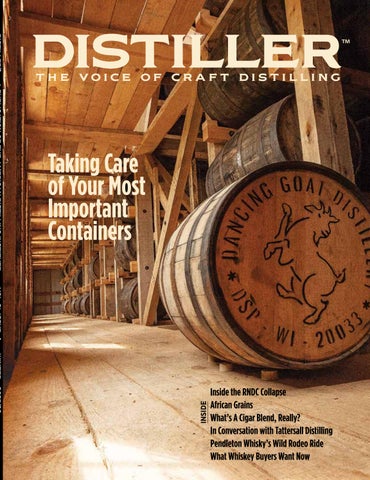
On the Cover — Barrels resting at Dancing Goat Distillery in Cambridge, Wisconsin.
4
[ distilling.com ]
Editor’s Letter How many times do you have to do something before it becomes a tradition? I propose twice. If you like it enough for a repeat, you’ve officially started a tradition. I have a new one: Nog Night, when our friends gather to make individual batches of eggnog. My husband Andy supplies several crates of spirits (like most of us in the drinks industry, we have many lifetimes’ worth on hand). The price of admission is at least six eggs per person, plus an inadvisable amount of full-fat dairy, a big bowl, and a whisk. After a quick briefing on how to make eggnog — The Joy of Cooking and Charles Mingus are both authorities on the matter — everyone’s off to the races to make their own custom batch. At the second annual Nog Night, nobody made the same thing. I went traditional: rum, brandy, Grand Marnier, B&B. Andy went full free jazz with Kirsch, amaretto, and crème de menthe and cacao. One friend, a former 4H champion, was very choosy about her cream. A private chef steeped his half-and-half with fresh mace and cloves from Zanzibar. But everyone’s delight at getting to choose from amongst dozens of options of rum, brandy, whiskey, tequila, and liqueur was identical — and thanks to the magic of sugar and dairy fat, everyone’s batch tasted amazing. These two modes, tradition and delight, are where the spirits industry shines brightest. The holidays are an easy place to see that, but they’re far from the only venue. This issue is packed with stories that shine a light on the relationship between spirits, tradition, and delight, from the private delight of pairing spirits and cigars to the vast traditions that exist under the umbrella of rodeo culture. We also cover the traditional and nontraditional uses of African grains, the delightful surprises at some of the best cocktail bars in the country, and how the traditional ways of marketing spirits might be falling short of delighting younger consumers. Hopefully this holiday season brought you the chance to participate in some old traditions and create some new ones. And in both cases, hopefully there was plenty of delight. Happy New Year from everyone at ADI,
Margarett Waterbury
[ winter 2025/26 ]
5
EXPERIENCE THE DIFFERENCE
Rely on proven equipment and a dedicated partner Complete Distilling Systems, Custom Stills, Mash Houses, Lauter Tuns, Fermentation, Barrel Handling, Spirit & RTD Canning, Piping and Controls.
TITLE SPONSOR
At Middleby, our combined sales, service, and engineering teams collaborate closely to bring your distillery vision to life, supporting every step of your beverage production journey.
DeutscheEquipment.com | Info@DeutscheEquipment.com | +1 704-900-6606 6
[ distilling.com ]
CONTENTS Winter 2025/26 | Volume 21 #4
COVER STORY 68
Barrel Maintenance 201
A master class in going beyond the basics, from repairing leaks to foraging cattails. By Gabe Toth
Ingredients and Formulation 16
26
The South’s First Distillers Barley
With GN0 Vivar, breeders may have cracked the code for a warm-climate barley with the enzymes distillers need. By Maggie Gigandet
36
Seeds from the Cradle of Humankind
Sorghum, millet, teff, and fonio are inspiring new generations of distillers from Africa to Chicago. By Jacopo Mazzeo
Money Matters 26
What do Whiskey Consumers Want Now?
Collecting is out, value is in, and nobody can rest on their laurels. By Kurt Maitland
[ winter 2025/26 ]
7
YOUR FULL-SERVICE WHISKEY PARTNER
350k+ 16
barrels managed
spirit types
35+
distillery partners
AGED WHISKEY Access to unique, limited, and high-quality barrels that were cultivated with purpose and precision.
NEW FILL PROGRAM Never pay for wood upfront again - rethink the way wood is financed to free up funds for growing your brand.
BARREL MANAGEMENT Unmatched expertise and scale to provide the most flexible, cost-effective, and worry-free solutions for barrel ownership.
LEARN MORE
8 [ distilling.com ] WWW.BRINDIAMOGROUP.COM
55
mash bills
CONTENTS 46
Distribution and Channels 58
Inside the RNDC Collapse
The great California shake-up of 2025 is still working its way through the system. By Scott Thomas Anderson
Places and Faces 84
National Top 10 Craft-Focused Bars
From Vegas to Chicago, New York to New Orleans, these 10 bars are serious about artisan spirits. By Virginia Miller
94
Distiller Interview
Jon Kreidler and Dan Oskey of Tattersall Distilling By Virginia Miller
100
Bartender Interview
Carlo Splendorini and Raymundo Delgado of Bar Sprezzatura By Virginia Miller
76
Marketing and Packaging 46
How Pendleton Whisky Became the Taste of Rodeo
A success story that shows the power of sticking to your roots. By Margarett Waterbury
76
What’s a Cigar Blend, Anyway?
Is there really something special about this popular style — or is it just clever marketing? By Eric Kozlik
In Short 5
Letter from the Editor
10
News & Events
12
Bottleshop
Yebiga Rakia
By Max Garrone
104
Advertiser Index
[ winter 2025/26 ]
9
news in brief
NEWS TTB UNVEILS NEW DISTILLED SPIRITS FORMULA TOOL The TTB has released a new Distilled Spirits Formula Tool designed to quickly help distillers and importers find out whether a product needs formula approval before submitting a label application. The agency says the new tool will offer clear and accurate information, improved guidance if a formula is required, and result in fewer errors and faster approvals. Find the tool online at TTB.gov.
EVENTS ADI INTERNATIONAL SPIRIT COMPETITION Registration for the 2026 ADI International Spirit Competition is now open. Early bird registration closes February 6th, and the last day to register spirits is March 6th. Submit your products to the craft spirits industry’s leading competition to receive written feedback on all products from expert judges, plus the chance to win medals and meet with retail partners. ADI members get discounted entry fees. Visit distilling.com for more details and to submit your products. ADI2026: MIAMI BEACH
IS INNOVATION SLOWING DOWN? Bump Williams Consulting reported that the number of new product introductions in beverage alcohol is down sharply, falling 41% between 2023 and 2025. Traditional spirits (as opposed to flavored spirits) had the third-largest drop in new items, from just over 1,100 to 660. Traditional beer and wine were the first and second largest declines, respectively. “Today’s new is failing to keep pace with yesterday’s new, and what has remained on the shelves year-to-year has continued to contract,” Williams told Brewbound.
10
[ distilling.com ]
August 18-19, 2026 We’re thrilled to announce that the 2026 ADI Craft Spirits Conference and Expo will be held August 18-19th, 2026, at the Miami Beach Convention Center in beautiful Miami Beach, Florida. Workshops, tours, and other events will be held before and after the conference. Keep an eye on our website for hotel announcements, airfare discounts, registration information, and a full conference schedule. WEBINARS Did you know ADI hosts free bimonthly webinars? Recent topics have ranged from tariffs and marketing to the history of three-chamber stills and how to have a better relationship with your distributor. New topics are coming online all the time, and you don’t even have to be a member to register — check out the schedule and sign up online at distilling.com/events
No barley, no bourbon.
A heartfelt thank you to the unsung heroes behind every spirit. Before the stills run and the barrels age, it all begins in the field. Behind every bushel of malted barley is the tireless work of growers whose efforts lay the foundation for spirits of true character and complexity. They endure unpredictable weather, rising sustainability demands, and the pressure to do more with less—yet they continue with resilience, care, and commitment. With harvest season now complete across North America, we pause to recognize the vital role these growers play in every step from grain to glass. At Soufflet Malt Americas—alongside our family of brands, Canada Malting Co., Great Western Malting, and Country Malt Group—we’re honored to work with them and remain committed to supporting their continued success. Let’s raise a glass to the ones who make it all possible.
by ®
®
[ winter 2025/26 ]
11
bottleshop
By Max Garrone
Devin’s SOFT ’N TASTY
CORN WHISKEY
Distillers Devin Cain and Ansley Coale have worked on a number of remarkable spirits, including Low Gap Whiskey, but their newest product is a whiskey made from sweet corn designed to highlight the flavors and aromas of the fresh, undried grain. Devin’s Soft ’n Tasty Corn Whiskey runs counter to the standard whiskey approach of using dried #2 yellow dent corn, an industry standard for bourbon because of its high starch content. Instead, Coale and Cain use sweet white corn freshly shaved off the cob to highlight the flavors that come from its sugars. Coale says that “instead of tasting flavors that have decomposed down to starch and [been] reinvented by being heated back into sugar,” they focus on treating the fresh corn just like fruit to maintain that flavor in the final spirit. Cain was inspired after helping a farmer make a fresh corn vodka. He wondered, “What if I were to make a whiskey with fresh sweet corn rather than dried field corn?” So he borrowed a small still from Coale and, after a lot of experimentation, arrived at a prototype. Coale thought it was fantastic, so they moved to the former Germain-Robin Cognac still for the final R&D stage. Two-and-a-half years later, in 2025, they released Devin’s Soft ’n Tasty Corn Whiskey. While it meets all of the standards of identity for whiskey, the product lives conceptually somewhere between a whiskey and a fruit distillate. To make it, pallets of fresh white sweet corn are husked and the kernels are stripped from the cobs before being crushed and fermented with Epernay Champagne yeast, the same strain used in Germain-Robin’s brandies. Coale says that freshness is key for sweet corn: “You have to get it fresh. Everyone rushes to eat it because the flavor is so delicate.” That unique approach is inspired by a long history in the craft spirits industry. Coale previously worked with Hubert Germain-Robin to run the Germain-Robin distillery in Mendocino County. The pair wanted to return to the slow distilling techniques that Germain-Robin felt were being abandoned for a more industrial style. Their much-lauded spirits redefined brandy as a category and helped launch craft distilling in the United States. Today Coale remains focused on slow distillations on the former Germain-Robin Charentais still installed at the Craft Distillers distillery in Ukiah, California. He uses the same process as for his bran12
[ distilling.com ]
Above — Distillers Devin Cain (right) and Ansley Coale. Courtesy photo. [Opposite page] Germain-Robin still. Courtesy photo.
dies: slow, hand-operated distillations that take 12 to 14 hours to extract the flavors that he and Cain are after. Taking additional cues from French brandy techniques, only rainwater is used for proofing. The whiskey rests for three months in stainless steel, but other than that, the only aging comes through the addition of a touch of wood-aged whiskey at the end in order to make the flavor pop like fresh corn. And it does taste fresh. It’s an amazingly light whiskey at 43.8% ABV that shines on its own or blasts off in a highball. In contrast to the expected bourbon flavor, there’s almost no wood and barely any viscosity. It clearly has a new identity, which might resonate with drinkers who are looking for a spirit with a real spring to its step. This fresh corn whiskey is also aimed at reinvigorating the spirits market. Coale has been at the forefront of many distilling innovations over the years. He was one of the first American craft distillers back in 1981, helped develop Hangar 1 Vodka, and was early into the mezcal business. While there are many well-reported strains on the contemporary spirits business, Coale sees this as a fresh product that could help push the distilling industry forward. “Many people want to drink things they haven’t drunk before,” he says. “We had this wonderful experience with the first Californian brandy and then the first premium vodka and then with Mezcalero. It’s so much fun bringing out products that are great. Now the whiskey market is having trouble. I hope that I can create so much excitement around a brand, like with Hangar 1, and reinvigorate what’s going on.” Max Garrone writes about wine, beer, and spirits and the cultures that create them. You can find his work on his Substack: Spirit Lives (https:// spiritlives.substa ck.com/). [ winter 2025/26 ]
13
Now Automate Bottle Banding on a Budget Put away the heat gun and try the fast, affordable way to apply and heat shrink tamper-evident bands and sleeve labels on bottles.
Video Here!
With our automated neck bander, heat tunnel, and companion conveyors, it’s easy to get a perfect, professional seal every time – even on tall bottles with long necks and unique shapes.
Free test with your bottles and bands Free quote Free videos/ literature
Go to DeitzCo.com • 732-681-0200
14
[ distilling.com ]
[ winter 2025/26 ]
15
By Maggie Gigandet
BARLEY THE SOUTH’S FIRST DISTILLERS
Brent Manning and Brian Simpson moved to Asheville, North Carolina, in the late 2000s and began investigating the local craft beer scene. “When we really put the sustainability lens on it, we realized the only thing local was the water and the people,” says Manning. So they opened Riverbend Malt House in 2010 to bring local grains to local brewers, and they began working with distillers about five years later.
Riverbend Malt House in Asheville, North Carolina, is making big steps towards its vision of distillers barley grown in the South with a new barley variety from Oregon State University. Courtesy photo.
[ winter 2025/26 ]
17
Manning has noticed that more distillers are interested in using local ingredients. He attributes this trend to a range of reasons, including marketing strategies and pledges to reduce environmental impact. And while Riverbend now offers about 20 products such as malted oats, rye, wheat, and corn, they haven’t been able to provide one ingredient. “Barley has been an almost goose egg from a distilling standpoint,” says Manning. This isn’t unique to Riverbend. Southern-grown barley appropriate for distillers simply didn’t exist. Historically, the southern U.S. mainly grew winter barleys, which are sown in fall and harvested in early summer, while the western U.S. grew spring barleys, which are sown in spring and harvested later in the summer. Winter barleys lack the necessary enzyme levels for effective mash conversion, so southern distillers have had to add exogenous enzymes to their mash or buy malted varieties with enough enzymatic power from the western U.S. or other countries, especially Canada. Grain distilling especially may require this higher level of enzymes since the mash bill may include a variety of unmalted grains and only a small amount of malted barley. Because that small amount must convert its own starch as well as the starch in the unmalted grains into simpler sugars for yeast, it needs a large amount of enzymes to do so. Other mash bills may not need the malt to pack such a strong enzymatic punch. Chattanooga Whiskey in Chattanooga, Tennessee, follows this approach. The distillery’s products are usually made from a mash that contains at least 25% malted grain. This higher ratio of malt means there are already plenty of enzymes. “It’s important, don’t get me wrong. But we usually like to focus more on flavor than enzyme/process,” Grant McCracken, Chattanooga Whiskey’s founding distiller and current chief product officer, writes in an email. Manning acknowledges that it’s possible a southerngrown distillers barley once existed, but he isn’t convinced. He’s never found proof of this in historical records, and the stories he’s heard are implausible. But Manning and his team are now testing a barley that 18
[ distilling.com ]
could be the solution: GN0 Vivar, the first modern winter malting barley to be grown in the South with enough enzymes for distillers. Because of climate change, the barley industry as a whole is becoming more interested in winter varieties, and GN0 Vivar is expected to encourage this attraction. These varieties’ earlier harvest avoids damage from summer droughts, and they need less irrigation and produce more grain. Farmers can use less herbicide since the crop suppresses weed growth. If climate change leads to milder winters in the western U.S., more farmers may have the option to grow these varieties.
The floor maltings at Riverbend Malt House. Courtesy photo.
Because of climate change, the barley industry as a whole is becoming more interested in winter varieties …
[ winter 2025/26 ]
19
® INDUSTRY-LEADING DISTILLERY MANAGEMENT SOFTWARE, TRUSTED BY OVER 1,000 DISTILLERIES WORLDWIDE
Schedule your demo today to unlock your distillery's full potential.
Inventing GN0 Vivar Dr. Patrick Hayes is a professor emeritus of barley breeding and genetics at Oregon State University, and he and his team created GN0 Vivar. He can trace GN0 Vivar’s roots to the beginning of his own career. During his undergraduate studies in archaeology, he spent a year as a translator at the Centro Internacional de Mejoramiento de Maiz y Trigo, a nonprofit agricultural research center in Mexico. There he met the late Dr. Hugo Vivar, a plant breeder. Inspired by Vivar and the Green Revolution’s focus on agriculture, Hayes decided to stop studying archaeology and focus instead on agricultural research.
(720) 638-4958 WWW.FX5.COM SALES@FX5.COM
Riverbend Malt House was founded in 2010, and offers a broad range of malts including barley, rye, wheat, and corn. Courtesy photo.
When Hayes became a barley breeder at Oregon State, he reconnected with Vivar. Over the years, they developed a personal and professional relationship and exchanged barley varieties to further their research. GN0 Vivar is descended from Vivar’s donated germplasm, or plant materials, and Hayes named it in honor of his mentor. But Vivar donated more than just his name to this variety. Through his contributed barleys, it’s likely he introduced a genetic surprise into its lineage. The GN0 portion of the variety’s name signifies that the variety does not produce glycosidic nitrile (GN). In the mid-1980s and 1990s, scientists learned that some barley varieties produce GN when malted, and when 20
[ distilling.com ]
[ winter 2025/26 ]
21
GN is combined with heat and copper during distilling, it is converted into the carcinogen ethyl carbamate. Wondering if they had any varieties that did not produce GN, or were GN0, Dr. Hayes and his team began testing. They discovered that Full Pint, a spring barley descended from Vivar’s donations, was GN0. The team made Full Pint available in 2014 and deemed it “[t]he first known GN0 variety released in North America.” While American distillers can choose whether to limit ethyl carbamate in their products, the United Kingdom and Canada strictly regulate it. For manufacturers interested in selling in those markets, barleys that don’t pro-
…when GN is combined with heat and copper during distilling, it is converted into the carcinogen ethyl carbamate. Fermentation Products & Services Let us be your one-stop resource for all your fermentation needs!
Active Dried Yeast Strains FermPro Distillers Yeast FermPro Brewers Yeast
Enzymes
Nutrients
Gluco Amylase
FermLife
Alpha Amylase
FermDAP
Birko Products
Training
Patco 376
Laboratory Training
Antifoam 100
Optimization & Process Improvement
Brewery Cleaner Bru-R-Ez
Operations Training
Laboratory Services Bacterial Analysis HPLC Testing Yeast Cell Counts ferm-solutions.net
22
customer@ferm-solutions.com
[ distilling.com ]
202-978-3376
duce GN will be a new tool to ensure compliance. In 2015, Dr. Hayes and his team bred a daughter of Full Pint with Calypso, a popular European winter barley. This created GN0 Vivar and its sister, Top Shelf. Both are GN0, and both have shown a good level of disease resistance to stripe rust and scald. Unusually, initial tests on GN0 Vivar show resistance to bacterial leaf streak. While there are some differences between these two varieties in their enzyme levels and the amount of starch broken down into sugars during mashing, called malt extract, Dr. Hayes likens these differences to that of a BMW and a Porsche. “Everybody is going to agree — hey, these are high performance sports cars,” he says. After their release, maltsters began testing these new varieties. Washington’s Great Western Malting grew Top Shelf. After Manning spoke with Hayes at a craft malt conference in early 2024, Riverbend bought GN0 Vivar seed and began its own experiments, eager to see how it performed on a commercial scale. Riverbend contracted with growers in Kentucky, North Carolina, and coastal Virginia to grow GN0 Vivar during the winter of 2024–2025. The crop did well, producing a yield similar to other varieties without requiring any additional fertilization, herbicides, or pesticides. Even though Kentucky experienced a lot of
Left — Inside the malt house at Riverbend. Courtesy photo. Bottom — Riverbend Malt House still uses traditional hand tools for its floor maltings. Courtesy photo.
rain near the end of the season, the variety was ready to harvest earlier than others, which helped it to avoid issues. When Riverbend malted the harvested GN0 Vivar, the team learned the grain needs a higher steep out moisture and longer germination at a cooler temperature than their standard process to achieve the right level of enzymes. Now, that first batch of malted GN0 Vivar is in its final test. Selected southern distillers have successfully used the malted barley to make whiskey and have reported that the initial flavor is good. But Manning and his team must wait six months for the test batches to age. At that point, the distillers will give a final judgment and will know if GN0 Vivar produces a whiskey with a unique flavor or one that will work well in their existing products. Hurdles and Opportunities for GN0 Vivar It’s too early to know if, or how, GN0 Vivar will change southern distilling. If the current batch passes its flavor test, growers will need time to produce these seeds at scale. And it remains to be seen if growing GN0 Vivar is even financially feasible. If Riverbend must sell this malted barley at higher prices than products offered by larger malt houses, will distillers pay and be able to recoup that cost from their own sales? Manning thinks they can. He also thinks it’s possible that GN0 Vivar’s success could encourage more maltsters to operate in the southeastern U.S., especially if several large distilleries decide to use local malted barley. Farmers are planting Riverbend’s 2026 [ winter 2025/26 ]
23
…GN0 Vivar could be an economic opportunity, providing farmers another crop to grow and maltsters another variety to offer. GN0 Vivar crop this fall, and Manning and his team have purchased additional GN0 Vivar seed so they can continue malting it in the meantime. Hayes agrees that GN0 Vivar could be an economic opportunity, providing farmers another crop to grow and maltsters another variety to offer. “As a plant breeder, our varieties are sort of like our kids,” he says. “You want them to succeed. And I hope that Vivar does that, but you also realize that it is not the answer to all barley needs.” He sees the variety as a useful tool in continued barley breeding. Manning also hopes that GN0 Vivar will prove to be the first crucial step in the process of developing local barleys. “Once you get that cornerstone set, a plant breeder can build on that and build so Vivar’s second cousin will be a better yielder than Vivar was,”
he says. “And that will continue to build the economic argument for going local as time goes on.” McCracken is already interested in trying GN0 Vivar. He and Chattanooga Whiskey have worked with Riverbend in the past, and he knows that they can enhance a grain’s flavor with their malting expertise. “Overall, our feeling with new varieties is that we’re always open to trying them — especially on our non-core recipes,” McCracken writes. “Whether they show us benefits from flavor or enzymatic perspectives, we’re just happy to try out new options closer to home.” Maggie Gigandet is a Nashville freelance writer focusing on the outdoors and people with unique passions. Her work can be found in The Atavist, Backpacker, Atlas Obscura, and Smithsonian Folklife.
In distilling, precision and consistency are essential to creating high-quality spirits. Miura’s modular steam systems provide reliable, on-demand steam to support mashing, distillation, and cleaning processes with unmatched efficiency. Designed for sustainability and scalability, our boilers help distilleries achieve peak performance while maintaining the integrity of their craft.
See why distilleries choose Miura, visit www.miuraboiler.com
24
[ distilling.com ]
Celebrating
250TH Anniversary
UNITED STATES OF AMERICA
0y ea rs
of Am er ic a
ns
p ir
s s la
.
25
it. O
n e le g e n d a r y g
[ winter 2025/26 ]
25
WHAT DO WHISKEY CONSUMERS WANT NOW? The collector frenzy has cooled, wallets have tightened, and consumers are reevaluating value. The next chapter begins with a renewed focus on the fundamentals.
We are living through disruptive times — in all senses, and that includes the spirits industry. The market is clearly changing, leaving distillers and brands confronting existential questions about younger drinkers, the role of limited-edition bottlings and collector mindset, and whether new products and styles still have a place in an increasingly crowded marketplace. The answers to those questions may help shine some possible ways forward, so I’d like to share what I’ve been witnessing for the last year or so. In addition to writing about spirits, I run a whiskey-tasting club in New York.
26
[ distilling.com ]
A busy night at Whiskey Ward on the Lower East Side of Manhattan. Courtesy photo.
By Kurt MAITLAND [ winter 2025/26 ]
27
I co-host a podcast on whiskey history called Decades Distilled, and I’ve been hired to do private tastings all over the United States. Because of these multiple roles, I have a fair amount of brand and consumer feedback to draw on. Before we begin, however, we all need a little refresher on how we got here. The House that COVID Built I don’t think people give enough weight to how the pandemic changed everyone’s spending and how that affects the industry today. Most people make a budget for the year: for new clothing, a car, a vacation, etc. The pandemic turned all of that on its head. Your planned trip to London, Disneyland, or Mexico? Up in smoke. If you were anything like me and my friends, you weren’t going to the office, you weren’t buying new clothes, and you weren’t spending money on commuting. Food, housing, utilities, and entertainment (we’ll come back to this one) were our only constants. All that budgeted money, like you, had nowhere to go — so it went into things that could entertain us or make us feel good. Those purchases were less necessities and more what we would call discretionary items like new computers (which we “needed” to better work from home) or a big new TV, because that was one activity we could still enjoy. For example, sales of guitars blew up during the pandemic. They couldn’t sell or build them fast enough. It makes sense. We were all stuck at home with not much to do, so when better to re-engage with our youthful
28
[ distilling.com ]
I don’t think people give enough weight to how the pandemic changed everyone’s spending… Above — A class on the future of Japanese whisky at the 2023 Whisky Show with Jota Tanaka of Fuji-Gotemba Distillery, Ichiro Akuto of Chichibu Distillery, and Yoshitsugu Komasa of Kanosuke Distillery. Photo by Kurt Maitland. Below — The floor of Whisky Show London. Photo by Kurt Maitland.
[ winter 2025/26 ]
29
The aroma of tradition
delusions of grandeur and play rock star? The sales of amplifiers, pedals, and guitars all saw significant sales bumps in 2020 and 2021. Something similar happened with spirits. We couldn’t go out, so we entertained more, spending time with small circles of friends and family when we could. Those gatherings took on an extra significance. Often, this was one of the only times we interacted with people who were not our family or living in our homes.
…[younger crowds] are still hungry for knowledge and open to new flavor experiences, but advertising alone isn’t enough to draw them in. In an effort to be good hosts, we couldn’t just pour the same old same old. We needed to up our game. For many spirits fans, a chunk of that newfound disposable income went into upgrading our pours. We could splurge on that fancier bottle or take a chance on that limited edition we always wanted. Everyone was more willing to explore and expand their drink options. This increase in spending lifted all boats. This is why I do not like using the spirits sales figures of the pandemic as a base for anything. It was such an unusual time that those figures created truly unrealistic expectations. We all knew this couldn’t go on forever. Eventually, some semblance of our old lives would creep back in. Once we returned to the office, could gather in bars, and travel, that extra bit of disposable income vanished. Add in a little inflation, and suddenly we all got a quick reminder of the stark difference between “needs” and “wants.” And that brings us to the present day and all its uncertainties.
Purveyor of fine new and used barrels since 1963 (419) 467-1101 www.kelvincooperage.com 30
[ distilling.com ]
Can We Still Attract Younger Drinkers? Younger consumers have options today that older generations would have killed for when we were their age. In college, if I wanted rye, I could only get my hands on two bottles: Jim Beam Rye, which seemed to come out a few times a year, and Old Overholt. If I wanted a cocktail, it was usually some slurry in a machine or something out of a bad pre-packaged mix. That is not the case now. There is rye everywhere: local releases, big brands, even world whiskeys. Today’s mediocre cocktails are still better than the best I could have gotten my
hands on when I turned 21. Also, younger consumers, like all of us, have CBD and cannabis options that can turn their heads, but that is a discussion for another day. When I’ve done tastings with younger crowds, I find they are still hungry for knowledge and open to new flavor experiences, but advertising alone isn’t enough to draw them in. I think they are skeptical of being told about how great a spirit is (perhaps they’ve been burned before), and they are cost-conscious to boot. When I pour them spirits that they don’t know, they will ask questions about where it is from, how it was made, where they can get it, and how much it costs. In my experience, taste and cost are the two biggest drivers. Releases that sit between $40 and $60 seem to do well. Bottles in the $80–$100 range can move, but I find that consumers have to taste the value. Taste is the magic word. They don’t just want it to display well; they care less about a name. They want to drink it, pour it for friends, and enjoy sharing a good dram. Are Limited-Edition Bottlings Still Desirable? The simple answer is yes. There is always a market for limited editions. I find that as whiskey fans develop their palate, they tend to become less afraid of higher-proof offerings and more willing to try releases that would take the enamel off of their teeth. At the same time, however, fans are now looking at the increased price and weighing whether it is worth it. Part of why I included a pandemic recap was to illustrate how and why the buyers of today are less flexible than they were a few years ago when it comes to price. A few years ago, there was extra money available to be spent. It was easier to get a buyer to step up a price point or two and take a chance on an expensive limited release. Now, unless they are a collector, they aren’t just opening up their wallet and forking out cash on a whim. I sense a bit of fatigue among buyers. Not that they don’t still love whiskeys and other spirits, but many people bought bottles during the pandemic that they have yet to open. Budgets are tighter now, and that backlog is a factor. That money is already spent and some limited releases are already in your possession. Do you really need one more bottle? I’ll draw on the guitar industry parallel again. During the pandemic, people bought guitars and related gear like it was going out of style. Now you see a lot of that same equipment being sold as people need to free up cash or upgrade to better gear. It’s not that they aren’t spending at all, but they aren’t spending as much, and they are definitely looking for ways to use what they already have, because today’s consumer budgets just aren’t what they were a few years ago.
There Is No Substitute For Experience
Let Us Share Some Of Ours With You Manufacturing Chillers & Cooling Systems since 1977 Point of use glycol chillers, central chillers & evaporative cooling towers – Advantage has a full range of products, a broad range of capacities & a nearly unlimited number of configurations to support distillery-wide processes that keep your distilling efforts consistent batch to batch. Let Advantage design an energy saving, first cost saving, complete system – built specifically for you!
Made in the USA
317 .887 .0729 advantageengineering.com [ winter 2025/26 ]
31
That’s your whiskey and spirits fan right now. They’ll say they want something new, maybe even high-proof and limited, but they don’t always have the budget for it. They’re making calculations about value and return on investment — and unlike guitars, you usually can’t trade in your bottles for the upgrade.
indication of what consumers are willing to spend for something special. In a recent auction I participated in, several expensive bottles did not go above the reserve listing price. Two years ago, there would have been a dog fight for the bottle at the closing minutes and the seller would have gotten a better price.
What About Collectors? Are People Still Open to New Things? The collector mindset is not driving purchases, at least From what I see, yes. Just looking at the tastings I’ve not in the way it was in the mid-2000s. Part of it is run this year, if people like what they taste, they will exhaustion, and to be honest, the big brands did this seek it out, and if the price doesn’t scare them, they will to themselves. There was a time when “special releases” attempt to purchase. People often ask me “How much?” were actually special. They were rare and limited releases and “Where can I get this?” I’ve even had tastings where that a brand put out maybe once a year. attendees find bottles online and are ordering them Seeing how this could boost sales, some brands put the pedal to the metal and boosted the number of special releases they put into the market, as well as the price. In effect, they were trying to “will” collectibles into being. Put a release in a fancy box, upgrade the bottle, and people would beat a path to your door while throwing money at you. If you were a fan of a brand, you would try to get all of the bottlings you could. That became harder when a brand released whole ranges of “collectibles” every year. It wasn’t sustainable, and here is the thing, you don’t really “make” collectibles. The market decides that something is collectible and puts a value on it. Most of the things that are collectible now, be they furniture, watches, guitars, or whiskeys, were simply well-made, well-designed, and well-priced when released and gained in popularity and value An impromptu Manhattan Whiskey Club tasting at a member’s apartment with over time. Lora Hemy of Roe & Co. Photo by Kurt Maitland. Let’s use Weller 12 as an example. When I got into whiskey, it was a tasty, reasonably before the tasting is over. This has been true of New priced bourbon you could buy for $25 or $30. I knew Zealand whiskies, Japanese whiskies, American single bars in New York that used it as their well. Now that it’s malts, bourbons, and ryes that were new to the people thought of as “baby” Pappy, you will pay well over $100 I poured for. A good friend, Robin Robinson, would for it — if you are lucky enough to get it at that price. always talk about the fundamental power of “liquid on I would be lying to say that collectors don’t exist, but lips.” I think he learned that phrase from someone else, there are fewer that will still buy everything a distillery but regardless, it remains true. releases. They will grab a bottle or two of their favorites, but the days of buying 12 different special releases So Where Should We Focus Our Attention? from a distillery seems to be a thing of the past. The The name of the game in these times is not so differhardcore collectors are making trades with other collecent from what it’s always been: Engage your audience, tors or bargain hunting via auction markets, if they are educate them, listen to what they want, and do more of looking at all. Auction prices are also down a bit, a clear what works. 32
[ distilling.com ]
Just starting out? come to
You’ve t place. the righ
With MGP, you have experienced advocates in your corner. We’re not just a supplier–we’re your partner, always available to consult and troubleshoot on any aspect of your process.
We have the ability to offer aged product as a starting point for a start-up. Or, we can work with you to create your own recipe.
Let’s make something exceptional, together. [ winter 2025/26 ]
33
NEED CANNING PRODUCTION? TURNKEY CO-PACKING & MOBILE CANNING SOLUTIONS FOR BEVERAGES
THROUGH OUR VAST CO-PACKING AND MOBILE CANNING NETWORK, WE CAN BRING YOUR BEVERAGE TO LIFE IN MANY WAYS.
WWW.IRONHEARTCANNING.COM INFO@IRONHEARTCANNING.COM Aloha Whisky Bar in Tokyo. Photo by Kurt Maitland.
Not every brand, distillery, or spirit maker can have ambassadors, nationwide distribution, or all of the tools that bigger brands use on a regular basis. But every brand can establish relationships with a store, a bar, a restaurant, or a tasting club. Every brand can host events, cultivate fans, and engage with potential customers. From personal experience, people love to meet with makers to taste their products and hear their stories. If a bar is making a cocktail with your spirit, consumers who like it will ask “What did you make this with?” followed by “Where can I get it?” Lean into that. If you are selling a lot of your spirit at a bar or a store, see if they want to partner with you for events. Take that opportunity to become a true brand ambassador, to make connections, meet customers, and — you knew it was coming — get liquid on lips. Kurt Maitland started his whisk(e)y journey with drams of Jameson, the beloved drink of a college friend, and he has been exploring the world of whiskey ever since. He currently nurses a fascination with old books on the whiskey industry, dead distilleries, and Japanese whisky, which led him to be consulted by The Atlantic. Maitland is currently the Deputy Editor of the Whiskey Reviewer website, has released a book on cocktails called Drink, and is in the process of wrapping his second book on cocktails.
34
[ distilling.com ]
Advanced Yeast, More Flavor From the makers of iconic Fleischmann’s Yeast for baking and with a craft distilling heritage dating back to the 1850s, the new Pinnacle Distinction range of products is brought to you by AB Mauri and AB Biotek, leaders in yeast fermentation. Pinnacle Distinction offers a portfolio of yeast offering unique, natural and rich flavors for today’s distillers who are looking to stay ahead of the pack with superior products to meet the demands of contemporary consumers. Our global reach and technical expertise ensure high standards of quality, consistency and performance. If you’re looking for ‘Yeast for Flavor’ and are ready to optimize your distilling processes, please get in touch with us today. Let’s take your finished products to the next level together with Pinnacle Distinction!
BANANA SPLIT
FLORAL & FRUITY
ARTISAN RYE BREAD
RED BERRIES & ROSE WATER
SCAN HERE for more info
www.pinnacledistilling.com distillersinfo@abbiotek.com [ winter 2025/26 ]
35
By Jacopo Mazzeo
[ winter 2025/26 ]
37
In Europe, historical beer styles are endangered species. Traditional cask ale is struggling to survive in Britain, drinkers in Belgium are turning away from strong, malty abbey beers, and the Czechs are increasingly swapping double decoction pilsners in favor of hoppy IPAs. Meanwhile, in Africa, a rich variety of traditional brews such as umqombothi in South Africa and omuramba in Uganda continue to thrive largely untouched by global brewing trends. These mostly homemade drinks remain little-known outside their regions of origin. The indigenous grains used to make them have also long been largely un-utilized in the West, whether in cooking or in the production of fermented beverages. In recent years, however, Africa’s contribution to global agriculture has gained a certain degree of international recognition, and its wealth of native grains has begun to attract some attention as a result — not only as food, but for brewing and distilling too. Sorghum Among the grains gaining significant traction is sorghum, the world’s fifth-most important cereal after rice, wheat, corn, and barley, and the second-most cultivated in Sub-Saharan Africa, where it is a staple food for millions across the continent. For alcohol production, sorghum is particularly distinctive in that both its stalks and seeds can be fermented and distilled. The stalks, when crushed, yield a sugar-rich juice that can be boiled into syrup and subsequently fermented and distilled into a spirit reminiscent of rum, a practice with historical roots in the United States, Australia, and in parts of Sicily. Meanwhile, the seeds can be treated like any other grain. They come in a wide range of colors (white, pale orange, tan, red, dark brown, and brownish-red) though black, white, and red are the most commercially common. Across Africa, countless traditional brews are produced from sorghum seeds, while their role in distillation is more prominent in Asia, particularly in the production of baijiu in China. There, distillers mill and steam the kernels to aid gelatinization before fermenting with naturally harvested yeast cultures known as qu. In South Africa, local grains pioneer Pieter van Helden of Helden Whisky is reviving the cultural and agricultural significance of African sorghum by crafting spirits from a locally grown variety sourced from the fields surrounding his distillery. “We started this distillery to pursue two things: innovation in whiskey, and a focus on Africa as our source of inspiration,” he says. “We wanted to create our own styles by exploring the possibilities of African ingre38
[ distilling.com ]
Above — Red sorghum. Courtesty photograph. Previous page — White sorghum. Photograph by Luis Rodriguez.
[ winter 2025/26 ]
39
dients, particularly grains, which remain underexplored, while expanding the whiskey world in terms of flavor profiles.” With many different types of sorghum available, Helden focuses specifically on the red variety, a high-polyphenol type traditionally used in southern Africa both as a staple food and for brewing various styles of beer. Its tannic character, more pronounced than in paler varieties, can impart a slightly bitter taste (one reason the latter are more commonly used in cooking), but it can also bring greater complexity of flavor and aroma to a beverage. “You have different types of sorghum,” Helden explains. “Mostly, the sweet ones are used for food, either as whole grain or malted grain. It can be made into flour for baking, cooked into dishes, or eaten as porridge, which many people in our area know very well. Then there is bitter sorghum, which has higher tannin levels in the husk than typical sweet sorghum and is less prone to bird damage.” Like barley, Helden malts his sorghum before use, stating that the unmalted route would offer a rather neutral flavor. Instead, malting lends an elegant taste that reflects the character of the wood while also adding a soft, silky texture. Because it is quite high in starch that is readily accessible when malted, Helden says it is possible to brew a 100% sorghum wash, similar to the process used for traditional African beers. In his own production, he uses a small amount of barley to aid the conversion of starch into sugars, but because this occurs at higher temperatures, the rest of the mash bill must be converted separately. “It’s a bit of a challenge sometimes. If you don’t carry out the gelatinization step properly, you don’t access all the sugars that are there.” The small size of the grains poses an additional challenge, as their varying size and consistency mean they must be milled separately as well. Finally, storage can also be an issue, since sorghum cannot be kept for long periods like malted barley. Despite these obstacles, the strong supply chain for sorghum in southern Africa means it has significant potential to become a more prominent ingredient in whiskey and spirits production in the region, potentially inspiring more distillers worldwide. 40
[ distilling.com ]
Above — Pieter Van Helden measures the gravity of a mash at Helden Whisky in South Africa. Courtesy photo. Below — Millet grains. Photograph by Manikath Halyal.
“In South Africa, the malted sorghum supply chain is quite well established,” Helden explains. “That meant I didn’t have to build a malting house specifically for my distillery. The volumes produced by these malting houses are quite large due to demand for beer and malted sorghum for human consumption. So, while it is not as big as the corn or wheat industry, it remains a significant part of southern Africa’s agricultural sector, particularly for beer production.”
…innovative distillers worldwide are exploring millet — a group of glutenfree, drought-resistant grains that are a staple in Africa.
Below right — Robert Birnecker, master distiller and founder of KOVAL distillery in Chicago. Courtesy photo.
Millet As with sorghum, innovative distillers worldwide are exploring millet — a group of gluten-free, drought-resistant grains that are a staple in Africa. In Namibia, for instance, Wolfgang Koll of Ondjaba Whiskey uses a mix of local grains, including a local barley, a small amount of sorghum, and a higher proportion (about 25–30%) of a local pearl millet called mahangu to create his distinctive range of elephant dung–smoked whiskeys. “Mahangu is readily available to us; it is commonly eaten in the north of Namibia in small villages, so we buy it directly from the villagers,” he says. “It contributes a very interesting nutty flavor to my whiskey, which I noticed persists through maturation.” Millet is also a favorite for whiskey production for third-generation Austrian distiller Robert Birnecker of Chicago-based Koval Distillery. The distillery sources all its grain from within the Midwest, using millet for 49% of the mash bill in Koval Bourbon, Koval Bottled-in-Bond Bourbon, ands the recently launched limited-edition Thresh & Winnow Straight Bourbon Whiskey Finished in Brandy Casks. The distillery even offers a “varietal” millet mash bill whiskey. “The impact millet has on flavor is huge. We find that it softens the ethanol heat and is responsible for the more distinctive notes in our bourbon, like the ‘mango chutney’ character. In any of our millet whiskeys, I notice people tend to pick up some kind of tropical fruit,” says Birnecker.
[ winter 2025/26 ]
41
Beyond the characteristic flavor and aroma it imparts, a major appeal of millet is that it is gluten-free (a characteristic it shares with other typical African grains) and has sustainability potential. “Millet is naturally gluten-free, so spirits distilled from it are accessible to people with gluten sensitivities… but another big factor in our decision to use millet was the crop’s role in regenerative agriculture,” he says. For Birnecker, the greatest challenge in using millet remains the supply, due to the cost of organic millet and competition from larger producers who can purchase in greater volumes. Yet he believes millet holds significant potential to become more widely used, with its long heritage in African traditional beers like bantu and in several Asian spirits such as Nepal’s raksi serving as strong inspiration for modern, experimental distillers. Teff and fonio With sorghum and millet already making noticeable inroads into the world of craft distilling, other African grains with strong potential for quality spirits production may soon follow suit. “We would like to expand beyond sorghum,” confirms Helden. “Millet is fairly easy to obtain in our area, and there has been much greater availability of teff, specifically Augustus teff. But there are a lot more African grains that we should be looking at, like fonio, which I think is a really interesting one to explore.” Teff is a cereal that thrives in a wide range of ecologies and can tolerate harsh conditions where most other grains struggle. Interest in it has grown significantly also due to its highly attractive nutritional profile and being naturally gluten-free, making it a suitable substitute for wheat and other cereals in food applications for people with celiac disease. Teff is a staple in Ethiopia, traditionally used to make a local brew called tella, a smoky beer darkened
Berlin Packaging is the world’s largest Hybrid Packaging Supplier®. We help spirits brands succeed with superior, affordable packaging delivered on time and within budget.
42
• Huge in-stock bottle selection
• Vast global supply network
• Award-winning custom design
• Inventory management
[ distilling.com ]
Teff is a cereal that thrives in a wide range of ecologies and can tolerate harsh conditions where most other grains struggle.
[ winter 2025/26 ]
43
with baked bread and flavored with gesho leaves, which act as bittering agents. It is also used alongside other grains in the production of various types of moonshine, which demonstrates its clear potential for craft distillers willing to experiment. Meanwhile, fonio is another highly resilient crop that thrives in harsh climatic conditions. It performs exceptionally well in drought-prone regions such as West Africa, where it has been cultivated for over 5,000 years, with some sources tracing its domestication as far back as 4,500 BCE. Following the widespread adoption of corn and Asian rice in West African economies, along with a growing reliance on imported cereals, interest in this native crop declined among local populations. In recent years, however, it has experienced a real resurgence. Its initial popularization as a “superfood” by New York–based Senegalese chef Pierre Thiam gradually sparked growing interest in its use in beverages as well. Celebrity brewer Garrett Oliver of New York’s Brooklyn Brewery was the first to pioneer the use of fonio as a beer ingredient, incorporating the grain into a series of releases and through his Brewing for Impact project, a collaboration with seven breweries worldwide aimed at showcasing the potential of this ancient grain. Since then, interest in brewing with fonio has spread across Europe, North America, and even locally, where it is regularly employed by craft brewer Raphaël Hilarion of Dakar-based Maison Kalao. Because fonio is a particularly difficult grain to work with, especially due to its sand-like dimensions, North American fonio distributor RahrBSG recommends clients to use it at rates of up to 40%. However, Salt Lake City–based
Sorghum in the field in South Africa. Courtesy photo.
ENGINEERED-TO-APPLICATION LIQUID MIXING SYSTEMS
Achieve Repeatable Results in Distilling Applications
View product specs, request a quote, or request a rep visit. To get started, visit: brawnmixer.com or, call: 616.344.0212 © 2025 NBE Holdings Company
44
[ distilling.com ]
Kiitos Brewing has managed to push the boundaries further, successfully brewing a fonio-only recipe. With its rapidly rising popularity among craft brewers, sourcing fonio is becoming increasingly easier and more affordable, meaning it is already accessible for distillers keen to experiment with it. “A whole ecosystem is being created around fonio,” points out Malick Diedhiou of U.S.–based ingredient supplier Terra Ingredients. “More villages in West Africa are cultivating it because it provides a higher income for farmers, and numerous cooperatives have been established to bring it to market.” The long pedigree of sorghum, millet, teff, and fonio in traditional African beer production, and the growing range of successful craft spirits, provide clear evidence of their potential to deliver novel aromas, flavors, and textures in the production of distilled beverages. Combined with their strong sustainability credentials and the increasingly robust supply chain that makes them more accessible than ever, African grains present a tangible, viable, and highly promising opportunity for innovative and experimental craft distillers. Jacopo Mazzeo is an award-winning UK-based journalist, photographer, and consultant covering drinks and travel-related stories. He regularly contributes to titles such as Whisky Magazine, Wine Enthusiast, SevenFifty Daily, Decanter, and Good Beer Hunting. He consults on consumer trends and marketing strategies, and judges international wine, beer, and spirits competitions. Before he embraced full-time journalism, he studied musicology at the University of Bologna, took a PhD at the University of Southampton, and worked as a sommelier. A list of the publications he collaborates with and samples of his work can be found at jacopomazzeo.com.
[ winter 2025/26 ]
45
BY MARGARETT WATERBURY
Giddy Up, Bottoms Up HOW PENDLETON WHISKY BECAME THE TASTE OF RODEO
F
rom the Pendleton Whisky Platinum Deck, you can see straight down into the bucking chutes at Cowtown Coliseum in Fort Worth, Texas. A visiting Brazilian vaquero climbs onto the back of a chestnut-brown bronco, who stamps his feet in irritation. The lights are low, but from above you can see the vaquero meticulously wrapping his rigging — the handle he’ll cling to for dear life in just a few moments — in the glow of 15 high-resolution LED screens circling the arena, all showing ads for Pendleton Whisky. Fort Worth’s largest rodeo has just two main sponsors: American Hat Company, which makes cowboy hats, and Pendleton Whisky. Hats and whiskey are perhaps equally important to rodeo’s conception of itself. But how did whiskey, specifically Canadian whisky, become such a central signifier of cowboy life — and how did Pendleton, a brand from Oregon, come to dominate the national rodeo circuit? The answers hold lessons for distilleries of all types about authenticity, community, and the incredible power of picking a bit and sticking to it.
Above — Pendleton Whisky draws on its rodeo heritage and an increasing interest in Western fashion and culture to market to consumers across the country. Courtesy photo. Opposite page — Pendleton Whisky gets its name from the Pendleton Round-Up, the oldest continually running rodeo in the country. Courtesy photo.
[ winter 2025/26 ]
47
Above — Pendleton Whisky has become synonymous with the Pendleton Round-Up since the whisky was introduced in 2001. Photography by Heath Herring. Below — The historic wooden bucking chutes at the Pendleton Round-Up inspired the wooden crate packaging for Pendleton’s Director’s Reserve expression. Photography by Heath Herring.
OREGON ROOTS Pendleton Whisky traces its roots back to Hood River Distillers, Oregon’s oldest distillery and the oldest continuously operating spirits company east of the Mississippi. It was founded in 1934 just months after the end of Prohibition in Hood River, Oregon, about an hour east of Portland. Hood River Distillers’ initial products were distilled from apples and pears grown nearby (the region is famous for tree fruit), but over the past 91 years it diversified into a broad range of often affordably priced bar staples. In 2001, a sales representative identified an opportunity: Create a whiskey that could be sold during the Pendleton Round-Up, an iconic rodeo held every September in Pendleton, Oregon, about two hours east of Hood River. The brand was officially launched in 2003, licensing its imagery — the iconic bucking horse and tagline “Let ’er Buck” — from the Round-Up. At first, it was available only in Oregon, Idaho, Washington, Montana, Utah, and Wyoming. But it became clear right away that the brand had serious legs, and the relationship with the Round-Up was a big reason why. First held in 1910 as a “frontier exhibition” by the local community, the Pendleton Round-Up is now the oldest rodeo not only in Oregon but the entire United States, and one of the most famous and prestigious rodeos in the world. It also has an unimpeachable reputation for authenticity. Famously non-commercial, it does not allow advertisements 48
[ distilling.com ]
IV
Y
AN N
ER NIV SA
RY
AN
Packaging solutions that keep your spirits high!
ERSA
R
PROVIDING PACKAGING COMPONENTS SINCE 1980
Roots in the packaging industry stretching back nearly 100 years Custom design and a variety of material options to help you achieve your perfect packaging by working with materials such as glass, ceramics, plastics, metals and wood.
514.487.6660 | phoenixpackaging.com [ winter 2025/26 ]
49
inside the grass arena, and it is one of the only remaining rodeos still using wooden bucking chutes. It has extraordinarily strong relationships with many of the Columbia Plateau tribes, who gather each year at the on-site Teepee Village. Last year there were 271 teepees, making it the largest Native encampment in the United States. It’s been named Large Outdoor Rodeo of the Year by the Professional Rodeo Cowboys Association 11 times and enlists more than 1,000 local volunteers each year — a not-insignificant portion of the town’s 17,000 residents. “The Pendleton Round-Up is really more than a rodeo,” says Tia Bledsoe, Pendleton’s brand heritage director. “It’s basically a living representation of the American West.” “I hear it every year,” says Erika Patton, general manager of the Pendleton Round-Up. “People come from all over the country and the world, really, because this is one of their bucket list rodeos. I truly think it’s just the vibe. We’ve stayed true to our Western heritage.”
Packaging Fit for your Craft In-house engineering teams, so that you GET THE BEST OPTION for your craft. LOCAL REPRESENTATIVE and dedicated support team offers world-class service.
Contact us to learn how we can help grow your brand.
920.701.4283
belmark.com
“People come from all over the country and the world, really, because this is one of their bucket list rodeos.” Buoyed by the Round-Up’s cultural significance, the brand continued to grow. By 2018, it was selling more than 250,000 nine-liter cases, and while it already had a national footprint, it was primarily concentrated west of the Mississippi. But Hood River Distillers felt another owner would be best positioned to take the brand to the next level, so Pendleton was sold to Becle, S.A.B. de C.V., the parent company of Jose Cuervo tequila, for $205 million. The new owners were ready to invest in growth on the back of rodeo culture through their U.S. subsidiary, Proximo Spirits. The true challenge would be to drive expansion while preserving the hard-fought authenticity the brand had hung its hat on.
Scan here to Contact us!
FILLING AND CAPPING SYSTEMS
custom engineered for the distilled spirits industry www.FoggFiller.com - Fogg@ProMachBuilt.com - 616-786-3644
50
[ distilling.com ]
HITTING THE RODEO CIRCUIT In many ways, Proximo’s approach has been one of restraint. Since changing hands, Pendleton’s marketing has remained laser-focused on rodeo and Western sports. In 2025, it sponsored more than 300 Western events in 41 states. In addition to the Round-Up, it is now also the official whiskey of the Professional Bull Riders, the Professional Rodeo Cowboys Association, and as of 2023, the Cowtown Coliseum in the Fort Worth Stockyards, which holds a fullfledged rodeo every single week and sees millions of visitors each year. That latter partnership has been especially important. Bledsoe calls Cowtown Pendleton’s “second brand home.”
Raise the Bar with Our Tailored Spirits Packaging and Unmatched Service
[ winter 2025/26 ]
51
Above — Pendleton’s relationship with the Fort Worth Stockyards and Cowtown Coliseum was formalized in 2023. Courtesy photo. Below — Texas Longhorn cattle descend from Spanish and English cattle lines, and are a symbol of the Fort Worth Stockyards. Courtesy photo.
The strategic importance of a brand home that exists yearround, rather than a single week a year, has intuitive appeal. So, too, is a brand home easily accessible from anywhere in the country. Pendleton is a three-hour drive from either Portland or Boise and its closest commercial airport — Walla Walla, Washington — is served by a single airline with just two flights a day. Beyond those practical aspects, the Cowtown Coliseum and its surrounding neighborhood, the historic Fort Worth Stockyards, offer another window into Western culture and history. The Fort Worth Union Stockyards and Fort Worth Dressed Meat and Packing Company opened in 1890, capitalizing on the recent rail line to send Texas livestock to the world. By 1907, a million head of cattle each year were passing through the stockyards. All those cattle meant cowboys, and a thriving commercial district selling boots, tack, and, yes, whiskey soon sprang up. Today, those cattle are long gone — the only longhorns you’ll see are at the rodeo or driven through twice a day as part of a historic reenactment — but the shopping and restaurants remain, now drawing 10 million visitors each year. “The stockyards is really an authentic symbol of Western heritage,” says Bledsoe. “It’s one of those places where his52
[ distilling.com ]
tory, community, and cowboy culture come together and feel very real. It’s very different from Pendleton, but the values are all there.” Since the partnership began in 2023, more than 47,000 Pendleton cocktails have been sold at the Cowtown Coliseum. Pendleton-branded kiosk bars outside the venue — the Fort Worth Stockyards has no open container laws — saw sales grow 80% between the first quarter of 2024 and 2025. All that growth has been driven primarily by Pendleton Original, the same easy-drinking expression first released at the Round-Up more than 20 years ago. It’s an acknowledgement of a core truth: Despite the overt displays of American patriotism that are everywhere in rodeo culture, the iconic drink of the American cowboy is Canadian whisky.
WHERE CANADIAN IS STILL KING Tim Long, the general manager of Cowtown Coliseum, is a Pendleton fan himself. Until about 15 years ago, he drank “another brand,” he says darkly. But Bledsoe, a beamingly earnest advocate for rodeo culture, finally got to him. “It’s all I drink now. If I go out and they don’t have Pendleton, I just won’t drink that night,” says Long. “Like cowboys around the world. I’m very brand loyal. Once you’ve got me, you’ve got me.”
Western culture is everywhere in the Fort Worth Stockyards, making it an ideal partner for Pendleton Whisky. Courtesy photo.
inkteam.com 800.727.8337
We help distilleries have better merchandise strategies. Expert Brand Guidance • Completely Custom Artwork • Online Store Solutions
Trusted by these great brands: H E AV E N ’ S D O O R DISTILLERY
TRY US
R I S K - F OUT REE
Create your InkTeam Account
FREE FREE S ART HIPPIN
G
A FREE, all-access pass to a faster, simpler, and more creative way to manage your merchandise.
[ winter 2025/26 ]
53
What If?
CRAFT BEVERAGE INSURANCE FOR 40 YEARS DISTILLERIES & BREWERIES property | general liability | liquor liability | barrel storage workers compensation | auto | equipment breakdown Northampton MA 413.586.1000 distilleryinsurance.net
Rodeo culture is not exclusively American, of course — or rather, it’s “American” in the broader sense, as in the Americas. Alberta’s Calgary Stampede is the world’s largest outdoor rodeo, and Latin America has a thriving vaquero culture from Mexico to Patagonia. So how is it that Canadian whisky cemented itself as the cowpoke’s drink of choice? “It comes down to proximity, Prohibition, and preference,” says Andrea Fujarczuk, program coordinator and professor of artisan distilling at Niagara College in Niagara-on-theLake, Ontario. Proximity, in that many of the Western states are closer to Canada than Kentucky. Prohibition, in that Canadian whisky made big inroads in the United States during Prohibition, especially in remote regions of the West where enforcement was thin on the ground. And preference, in that rural Westerners developed a taste for Canadian whisky’s delicate, low-intensity flavor and its easy mixability during Prohibition, and then kept that tradition alive generation after generation. The received wisdom is that people don’t want to drink what their parents drank. That certainly seems to be true in many places. Cowboys, however, very much do seem to want to drink what their parents drank — and their parents, and their parents’ parents, drank Canadian whisky.
So how is it that Canadian whisky cemented itself as the cowpoke’s drink of choice? IF IT’S NOT BROKE Cowboys willingly get on wild bulls and bucking broncos that fling them 10 feet into the air, stomp on their bodies with tens of thousands of pounds of force, and charge them with horns the width of a Volkswagen Jetta. Clearly, they are unafraid of intensity. Yet Pendleton Original is a remarkably easygoing whisky: 80 proof, with a feather-light body and a finish so fleeting it hardly exists. That’s by design. “Each of our SKUs has their own flavor profile, but they all finish smooth,” says Bledsoe. So far, Proximo has mostly resisted SKU proliferation at Pendleton. But not entirely. A few years ago, Proximo started pushing Pendleton to introduce a bourbon. Bledsoe balked at first. After 22 years of working on Pendleton, she was wary of adding something so different to what is otherwise a tightly focused portfolio of four Canadian whiskies united by that light-bodied, easy-drinking vibe. She only relented when they agreed to create a bourbon with that signature light-as-air finish. “We tested it with the Round-Up before we launched it to make sure it spoke to being a true bourbon but finished smooth,” she said. Pendleton Bourbon made its debut in
54
[ distilling.com ]
LARGEST SUPPLIER OF BULK ALCOHOLS IN THE WORLD
YOUR PARTNER IN BULK ALCOHOL STORAGE & SUPPLY Brand-New Stainless-Steel Tanks
Custom Blending Capabilities
ISO 9000:1 Compliant
Largest Variety of Tank Sizes
State of the art tote and drum filling lines
Lab Services
Dedicated Fixed Piping Per Tank
Monitoring & QA
Rail / Truck In & Out
Jennifer@ultrapure-usa.com
|
203.662.9761
|
www.bulkalcohol.com
T-Top Corks Unbreakable Stock Sizes Wood Printing Laser Etching Colored Caps Colored Shanks Custom Designs
sales@paulsonsupply.com www.paulsonsupply.com
(209) 545-6994 [ winter 2025/26 ]
55
November 2024, with a nationwide rollout in February 2025. Proximo says it’s been another success, becoming one of the fastest-growing bourbon brands in the U.S. market over the past year and outperforming brands like Old Forester King Ranch Bourbon and Bulleit Barrel Strength Bourbon in terms of absolute case volume.
Manufacturer of semi-automatic & automatic filling, corking, capsuling & labeling machines designed for distilleries
DO IT ALL
PACKAGING MACHINES www.cda-usa.com
+804.918.3707 56
sales@cda-usa.com
[ distilling.com ]
“The best partnerships feel organic and tell a story — a true story — about a place or a purpose or the community” ALL ABOUT AUTHENTICITY Pendleton's distinctly un-trendy approach is one that other brands can learn from. “My advice to smaller producers is to stay true to who you are and where you come from,” says Bledsoe. “You don’t need a century-old story to be authentic. You really need to honor your roots. Don’t try to be everything to everyone. Really figure out who you are. That’s your story.” Partnerships with cultural institutions like the Pendleton Round-Up or Cowtown Coliseum have been pivotal to Pendleton’s growth. They’ve also been mutually beneficial, which has given them special power. Long calls Pendleton a “class act,” and Patton says the relationship has exceeded anyone’s expectations. “Pendleton whisky has been such a wonderful supporter. It’s been a game changer for the Round-Up, quite honestly,” she says. In 2025, nearly 100,000 Pendleton whisky cocktails were sold at the Round-Up over the course of a single week. “The best partnerships feel organic and tell a story — a true story — about a place or a purpose or the community,” says Bledsoe. “You really want to start with alignment over exposure. Find a partner who genuinely shares your values.” And, of course, the values of your customers. “When both sides are rooted in the same culture and can show up authentically, that’s where the connection feels real,” says Bledsoe. “And consumers can sense that. They’ll know.” Margarett Waterbury is the editor of Distiller Magazine. Based in Portland, Oregon, she covers drinks, food, and culture for national and international press. She is the former managing editor of Edible Portland, as well as the cofounder and former managing editor of The Whiskey Wash, an awardwinning whiskey website twice recognized as Website of the Year by the International Whisky Competition. In 2017, Margarett won the Alan Lodge Young Drinks Writer of the Year award from the Spirits Journal. She received fellowships for the Symposium for Professional Wine Writers in 2017 and 2019. Her first book, Scotch: A Complete Introduction to Scotland’s Whiskies (Sterling), came out in 2020.
MAESTRO
The quintessence of the elegance, prestige and luxury.
View more!
TINCLASS capsules and T-BAR LUX closures are specially designed to dress the best high-end spirits worldwide. The perfect choice for brands that look for sophisticated details and strive for distinction.
[ winter 2025/26 ]
57
CHAOS IN
California By Scott Thomas Anderson
58
[ distilling.com ]
How and Why RNDC’s Abrupt Exit Caused a Distribution Earthquake in the Golden State Jason Lockhard oversees an underground Art Deco swimming pool surrounded by liquor bottles from around the world. In the days of Prohibition, his subterranean hideaway was bustling with the same revelers who were helping Sacramento earn its reputation as one of the wettest cities in the West. Now, it serves as an unlikely storage area and time-traveling spectacle for a restaurant that Lockard opened in the city’s historic Elk’s Tower. Known as Locked Barrel, the place is a cozy den of black oak and battered bricks sitting two blocks away from California’s State Capitol building. From its bar, patrons can glance down to that swimming spot from the Roaring 20s, taking in the ornate lamps and dazzling murals that hint back to when bootlegged bottles of pleasure were snuck onto local docks inside hay stacks. But it is not just the Jazz Age drawing visitors into Locked Barrel — it’s also curiosity of the palate. Sacramento is the political hub of the fourth-largest economy in the world, and people working in its downtown district know that Locked Barrel will pour the distilled spirits they’ve always wanted to try, not to mention introduce them to novel bottles they’ve never heard of. In fact, Lockard has gathered more than 800 different whiskeys inside his restaurant. He’s so passionate about the magic of fermented grains that, three years ago, he founded the Off the Rails Whiskey Festival, which is now held annually at California’s Railroad Museum.
Whether at his restaurant, while hosting his whiskey club, or in the midst of his big festival, Lockard loves getting drinks connoisseurs to try the craft spirits he believes in. Dan Garrison of Garrison Brothers Distillery has poured at Off the Rails, as has Karith Sudhir of Phenomenal Spirits. A team from Frey Ranch Whiskey has been part of the event since Day 1 as well. But in August, as Lockhard was still basking in the afterglow of Off the Rails 2025, he was suddenly confronted with a serious issue. One of his main alcohol distributors, Republic National Distributing Company — better known as RNDC — was quitting the California dream altogether. And the state’s second-largest distributor was getting out the door fast, too: Lockhard was told he could place his last orders up to August 31 and get his final deliveries on September 2. Then, lights out. Lockard knew he wasn’t just losing a conduit to mainstream brands and legacy spirits, he was also saying goodbye to his trusted RNDC sales representative, Brian Lee, a knowledgeable and highly experienced expert with his finger on the pulse of newer products. Given that Locked Barrel is known as a lair of whiskey discovery, its owner had to worry whether this would affect its competitive edge. “I mean, in this business, the distributors are
Jason Lockard, owner of Locked Barrel and founder of California’s Off the Rails Whiskey Festival, was taken off-guard by RNDC’s sudden departure. Photo by Scott Thomas Anderson.
[ winter 2025/26 ]
59
California is one of the largest markets for distilled spirits in the nation, which is why its Off the Rails Whiskey Festival has grown in attendance for three straight years in a row. However, starting September of 2025, numerous craft brands were in danger of being locked out of distribution in the state after RNDC abruptly left. Photograph by Will Thompson.
the lifeblood of what you do,” Lockard stresses. “They’re the people you have to go through to get the product that you need, but they’re also the people who are theoretically supposed to introduce you to new products, so that you know what’s available and when it’s available, especially when you’re talking whiskey and getting allocations that others might not have.” All across California, other drinking establishments that were craft-centric by nature had to brace for impact concerning getting barrel picks, finding cutting-edge brands, and sharing specialty products. Meanwhile, a much broader confusion was settling in for bars, restaurants, hotels, country clubs, and stores across the most populous state in the union: Given that California has a three-tiered system, where were all the missing products going to come from? But craft distillers and emerging brands may have been the most-stunned by RNDC’s departure. Some of them spent years working to get signed by such a company. Now they were suddenly out in the cold when it came to one of the nation’s biggest markets. In the coming weeks, California’s alcohol landscape would be altered forever. 60
[ distilling.com ]
How Did It Happen? On a grey and muggy September afternoon, Brian Lee strolled down Main Street, Woodland, a city built in one of California’s oldest breadbaskets for tomatoes, almonds, rice, and wheat. Lee was wandering under the slate-grey clouds exactly one week after RNDC exited the Golden State — a move that cost him his job of 17 years. Woodland had long been part of Lee’s sales territory. He first started working with its business owners as a rep for Young’s Market, then a significant player in California alcohol distribution. Much later, in 2022, RNDC purchased Young’s. Not much changed for Lee at first. Whether supplying wine to Woodland’s upscale Italian restaurant, mezcal to its mission-style cantina, or helping its Irish pub stock bourbon and plan whiskey-and-food pairing events, Lee always made sure proprietors around the city’s historic boulevard had the products they needed to power their menus. But in June, Lee had to break the news to owners across Woodland and Sacramento that RNDC was closing shop in the state. It was not an outcome that Lee or his fellow Young’s sales specialists ever anticipated.
Attendees of California’s Off the Rails Whiskey Festival get their pours going. Like most bar owners in California, the event’s founder, Jason Lockard, had to deal with numerous distribution disruptions from RNDC’s decision about his state. Photograph by Will Thompson.
“A lot of us were actually hopeful when we heard about it,” Lee remembers of the acquisition three years before. “At the time, Young’s was really just about the West Coast, with California as its big market. So, we were excited because RNDC was the third-biggest distributor. Combining with RNDC would make us a true number two distributor, right behind Southern. We also assumed there would be some good infrastructure — better process and procedures and maybe even software — that would get translated over to California.” But warning signs were quickly on the horizon. Almost as soon as the ink was dry on the Young’s deal, Sazerac cut ties with RNDC, taking Buffalo Trace bourbon, Fireball Whisky, Pappy Van Winkle bourbon, and Corazón tequila with it. That happened in early 2023. Lee says that there was no sense of panic with his colleagues at that point. “It was a big supplier. Them leaving was definitely something we didn’t expect,” he acknowledges, “but it was only one supplier, so we weren’t too sure there was a problem.” Lee recalls most of 2024 feeling like a normal business year. However, eventually a rumor began to swirl that one of RNDC’s major clients, Brown[ winter 2025/26 ]
61
Brian Lee, who was a veteran sales representative for RNDC, stands in front of Kitchen428 Restaurant & Mojo’s Lounge, an establishment in Woodland, California’s historic quarter that Lee distributed alcohol brands to before RNDC’s exit from the state. Photograph by Scott Thomas Anderson.
Foreman, had put out a Request for Proposal, or RFP, regarding potential new contracts for distribution in California. That was concerning to Lee and his team because Brown-Foreman is the parent company of Jack Daniel’s Whiskey, Woodford Reserve Whiskey, Old Forester Whiskey, Tequila Herradura, Diplomático Rum, and other products. Nevertheless, some of RNDC’s sales reps tried to ease their nerves by reasoning that Brown-Foreman might just be putting the RFP out to pressure their company for better terms in upcoming negotiations. Then… the bomb dropped. Tito’s Vodka, a family-owned company that had been doing business with Young’s Market since the day it first moved bottles into California, cut ties with RNDC as its distributor in that state. Lee and his co-workers heard murmurings about supposed problems between Tito’s and RNDC leadership, but Lee says he’s not sure what really caused the break-up. What Lee and his coworkers did know was the Tito’s was moving its California distribution to Reyes
62
[ distilling.com ]
Beverage Group, which is a Coca-Cola distributor that does business in that state as Golden Brands. They also knew they’d lost the ability to provide their customers with one of the most popular vodkas in the nation. Lee tried to carry on by getting the bars and restaurants he worked with to load up on other vodkas, such as Stoli, Hangar 1, Reyka, and New Amsterdam. Lee says that, because he had such good working relationships with his clients, some actually changed the vodkas they were using for their signature cocktails and even their wells. But that could only go so far. Customers dictate what rules at the cash register — and many customers are staunchly brand-loyal. Four months after the Tito’s debacle, BrownForeman pulled the trigger on breaking with RNDC in California. It wasn’t long until Lee and other RNDC sales reps learned they’d soon be out of a job. RNDC’s CEO Bob Hendrickson ultimately issued a statement, saying, “We’ve made the difficult business decision to withdraw from California, which affects many of the roles in the state. We are complying with all regulatory obligations and are committed to handling every transition thoughtfully and smoothly, and ensuring everyone is treated fairly
Small batches. Big selection.
and respectfully… We are grateful for the support of these employees and will do our best to support them during this time.” RNDC did not respond to interview requests for this story. Upon hearing the announcement, one thing that Lee knew he’d miss was helping elevate new and exciting brands on the horizon. Lee notes that, in addition to Locked Barrel — Sacramento’s whiskey equivalent to Willie Wonka’s chocolate factory — the places that allowed him to pitch the most interesting craft spirits were high-caliber cocktail bars. “At those places, they’re not necessarily looking for a brand name,” Lee explains. “They want to know how this spirit was made, where it was made, how it tastes. They want to know the story behind who makes it. I’ve had establishments say, ‘Hey, I want a minority-owned brand. Or, I want a female master distiller. Or, I want something that’s local. That does give a sales rep for a large distributor room to showcase something new.” What happens to craft in California? As Lee was walking by Woodland restaurants that he might not work with again, Cris Steller was putting the finishing touches on a dream that was 13
ONE CLEAR CHOICE !
LEADERS IN PACKAGING SOLUTIONS for the CRAFT DISTILLING INDUSTRY
www.oberk.com
cschilling@kolscontainers.com 800-457-5657
[ winter 2025/26 ]
63
And people who had put all of their marketing, and all of their push, into on-premise and off-premise sales… suddenly didn’t have a distributor.
Your Brand. Their Passion. Reach over 2.9 million Whiskey Enthusiasts.
PROUD MEDIA PARTNER OF ADI
Plan your print and digital marketing campaign with us Contact Chris Rose, 859-300-9200 chrisr@paragraphpublishing.com Scan the QR to enjoy FREE access to our American Whiskey Digital Library 64
[ distilling.com ]
years in the making. An early trailblazer for craft distilling around California’s capital, Steller, along with his family, spent over a decade building a loyal fanbase for their whiskeys, brandies, and gins. Now that Steller’s company, Dry Diggings Distillery, is associated with talent and consistency, they’re finally opening the full restaurant that they always wanted on their premise, allowing them to experiment with spirit and food pairings and showcase their projects in signature cocktails. However, just days away from unveiling the project, Steller’s attention was being split by the fallout from RNDC’s exodus. That’s because he is also the executive director for the California Distillers Association. When some of the best craft brands in California lost their hard-won distribution deals almost overnight, Steller quickly heard about the stress. In the end, more than a dozen of the association’s members were impacted. “A lot of people didn’t know that there was even an issue,” Steller reflects. “Then, [RNDC] came in and were like, ‘Party’s over.’ And people who had put all of their marketing, and all of their push, into on-premise and off-premise sales, who were with RNDC — all of them suddenly didn’t have a distributor. They were just left in this kind of no-man’s-land.” Steller adds, “They had to go and do something else, because we have to do the three-tier system in this state… It really left a huge hole.” Steller also points out that the timing of RNDC’s departure was rough. California distillers had just come out of a year when total spirits revenue across the U.S. dropped 1.1%, according to industry reports. That means sales were a concern for almost all craft producers in the Sacramento area where Steller operates, and no one could deny once wellknown brands Gold River Distillery and J.J. Pfister Distilling Co. closed their doors for good in 2024. Steller doesn’t think it is his place to name the particular craft producers who lost their RNDC deals, but he emphasized that those owners are now having to confront the void at the same time that they’re navigating a challenging market environment.
where innovation meets craft GAI 3621 fe can 10-SPOUT FILLER-SEAMER CANNING MONOBLOCK WITH SINGLE HEAD SEAMER AND TRIVOLVER ROTATING TURRET FOR UP TO THREE DIFFERENT LID SIZES.
prosperoequipment.com
1-800-953-3736 info@prosperoequipment.com [ winter 2025/26 ] 65
INTR ODUCING ABE’S
SCOUT C O N T I N U OU S ST I LL LE AD THE WAY
H : 15’ 5. 75” W: 12’ . 75” Up to 1.5 L /Min
Stamina, precision, and a small footprint: The Scout Continuous Still delivers high-grade output with less downtime. Scaled down from our larger Sentinel Continuous Still, its modular adaptability and advanced controls let you dial in the perfect product. The Scout gives you “Big-Still” firepower in a scalable, costefficient package, keeping you mission-ready and on target. Acquire yours today!
E Q U I P M E N T
2001 SW 6th St, Lincoln, NE 402.475.2337 | ABEequipment.com
Another thing irking Steller about how everything went down was that, right up until RNDC left the state, it was opposing efforts from the California Distillers Association to get its members’ temporary Direct-to-Consumer sales ability from COVID permanently enshrined into law. “The irony is that they were still fighting us at the state Capitol,” Steller says. “They were still being extremely difficult on DTC. And yet, they just pulled out of the state. It’s like, ‘Why is anyone listening to you?’” Over the next two weeks, interested parties like Steller and Lee began to hear about realignments. St. George Spirits, the oldest craft distiller in California, fixed its RNDC problem by signing a deal with Skurnik Wines & Spirits, a smaller, New Yorkbased distributor that specializes in top-tier products. Similarly, Redwood Empire Whiskey, which was founded along California’s Russian River, overcame its RNDC fallout by signing with Breakthru Beverage Group, a distributor that’s also headquartered in New York. Meanwhile, a distributor in Southern California called Pacific Edge Wine & Spirits stepped into the RNDC vacuum to help some premium brands get back into the Golden State, including Monkey in Paradise Craft Vodka, Blue Nectar Tequila, and Ronald Isley’s Contagious XO Brandy. “We are a small, family-owned company with a sole focus on specialty spirits,” Pacific Edge Vice President Scott Tallon told Distiller via email. “We at Pacific Edge are the antithesis to the RNDCs.” One person who’s now doing business with Pacific Edge since RNDC’s withdrawal is Lockard. He’s been paying attention to how the greater fallout in the state is coming into focus. Having worked in the restaurant industry for 20 years, Lockard is still surprised by how fast RNDC decided that it had failed in California. He also doesn’t think the story necessarily had to end that way. “The idea that RNDC came in and bought Young’s Market for a substantial sum of money, and then this happened in such a sport span, it’s pretty wild,” he observes. “And the reality is they can’t blame COVID for this. No, this was self-inflicted.” Scott Thomas Anderson is a veteran reporter based in California. While his main job over the years has been covering the drug world, environmental crime, urban poverty and long-term investigations, he’s lately balanced his hard news focus with cultural writing and travel journalism, filing pieces on time spent in Greece, Croatia, Spain, Italy, Ireland, Scotland and Southern France.
Contact us!
66
[ distilling.com ]
[ winter 2025/26 ]
67
201 BARREL MAINTENANCE 201 By Gabe Toth
68
[ distilling.com ]
The rickhouse at Dancing Goat Distillery in Cambridge, Wisconsin. Courtesy photo.
[ winter 2025/26 ]
69
I
n the last issue of Distiller, we looked at some basic repair and upkeep practices for the workhorse American oak barrel, but not all barrel troubles can be solved with hydration, hoop tightening, and a couple of spiles. Some issues and barrel management methods require a deeper understanding of the vessel, its construction, and its strengths and weaknesses. Here we will examine some more involved techniques that require a greater understanding of the barrel and the types of wood a distiller might encounter. For Nick Maas at Dancing Goat Distillery in Wisconsin, the first step in managing a troublesome barrel is to identify what simply can’t be repaired. There are only a few issues that fit into the “terminal” category: a split or broken head; broken, cracked, or split staves; a broken chime; and porous grain. Barrels that have been impacted will sometimes develop a crack running perpendicular to the grain, across the stave. Maas considers those to be broken and retires them because they can no longer be trusted. He firmly advises that distillers clarify their arrangements with the cooperage prior to purchasing barrels so that terminal issues or unacceptable barrels can be properly addressed as soon as they arrive. If the crack is on the bung stave or otherwise located such that the barrel could be “clocked” (stored with the break oriented toward the top of the barrel, rather than on the sides or underneath), that can allow the barrel to still be used. However, cracks and leaks, even above the liquid line, will increase evaporation and also offer a window into the barrel for things like dust, spores, or other environmental contaminants. Maas notes that there are some irresolvable contamination issues that can be introduced if the distiller isn’t careful, including smoke taint, chemical taint, or mold. A broken chime undermines the structural integrity of the barrel, he said, and a stave that leaks due to porous grain is simply not of the quality required for barrel construction and should not have been selected by the cooper. “What you usually see (with a porous stave) is liquid seepage,” Maas says. The distiller might not be able to identify a distinct spot that’s leaking, but the stave will never be liquid-tight. If a hoop is dented into the chime, then it can’t be tightened properly. The hoop could be removed and hammered flat so that it can more readily fit around the barrel, but Maas and his team aren’t interested in taking on that additional workload. It's best practice to generally leave barrels alone after filling and to be gentle with them when they do have Casks resting at Dancing Goat Distillery. Courtesy photo.
70
[ distilling.com ]
Nick Maas checking barrels at Dancing Goat Distillery. Courtesy photo.
…the first step in managing a troublesome barrel is to identify what simply can’t be repaired.
to be moved, sampled, or otherwise interacted with. The cracked bung stave is an example of an issue that can sometimes be avoided by not rolling the filled barrel around so that the full weight of the barrel lands on the weakest, most stressed spot on the barrel. However, if the distiller needs to roll barrels, it’s best to do so with full ones that will maintain consistent pressure as they’re moving around. Avoiding the use of a bung knocker, which can potentially hammer staves out of place if used over an extended period of time, is another important consideration. Not for the Faint of Heart When it’s time to actually repair a barrel, though, it’s not time for timidity. Maas says distillers will often overestimate how sound their barrels are and treat them poorly, but when it comes time to fix them he sees the same distillers approach repairs apprehensively — not afraid to drop a barrel from height, but then hesitant to grab the mallet and hammer a stave back into place. More-involved repair work might include shifted staves in the body of the barrel or in the head itself, which can be knocked back into place. Maas likes to use wedges, rather than spiles, for certain leaks such as the stave-end joint repair on the head or a wider leak between staves on the bilge. Multiple wedges can be used to seal a streak in a stave, a weakness running lengthwise with the grain. The approach involves using a wedge punch and inserting wedges around and sometimes across the flaw in the wood. For a smaller streak, he might place four wedges to create a box around the streak, or possibly closer in than the outside edges of the streak. On a head joint, he might treat a streak like stitches, going above, below, and through the streak. If the distiller puts too many wedges in, they can turn a streak into a split, making the problem much worse. Maas says an experienced hand will put the first wedge in and be able to tell where more pressure needs to be applied. “It’s about occupying space and applying pressure where we don’t have it,” he says. “You’re trying to push it from a little further outside, compress it together.” Some repairs are unique to the type of wood being used. Maas is particularly fond of European oak for his spirits but says “it’s incredibly fickle to deal with,” adding, “The wood is actually softer, but it’s harder to bend it without splitting it, and it requires a lot more skill to work with. The wood itself is just more fragile.” Different Oaks, Different Problems A major difference in the way that French oak
WEDGE PLACEMENT FOR SEALING STREAKS
staves are made compared to American oak is that the latter can be sawn down into staves, while the former have to be split, allowing the grain to dictate the size of the stave, and then the sides can be trimmed. This also makes French oak staves more prone to splitting. Maas doesn’t work with mizunara oak (Quercus mongolica var. crispula) at all because of its high price and extremely porous wood. Part of the trouble with mizunara oak, as well as with European oak varieties, is a lack of tyloses. Tyloses block the pores in hardwood trees and are crucial for making a liquid-tight barrel. American oak is rich in tyloses, preventing the
[ winter 2025/26 ]
71
HIGH QUALITY LABELS. IMPECCABLE SERVICE.
716.542.3000 | www.niagaralabel.com
Educational
Webinars PRESENTED BY
AMERICAN DISTILLING INSTITUTE Scan this code to see a recent webinar
ays d s r Thu
on h t n mo M EST a e P Twic at 12
72
[ distilling.com ]
staves from absorbing liquid in one place and transmitting it to a different location — possibly the outside of the barrel. Ray leaks, or unblocked pores, can be dealt with in the same way as wormholes, knots, or other spot leaks: punched or drilled out and plugged with a wood spile. Ultimately, it’s important to know when to call it quits. Maas says he has limits on the cooperage work that he’ll undertake and that major issues are cause for a barrel to be retired — if it has to be taken apart for repairs, it’s not worth it. Off With Its Head Andy Garrison at Tuff Talk Distilling and Stone Barn Brandyworks uses a lot of French oak that he reprocesses at the distillery in Oregon. He also infuses products like nocino in-barrel and then has to take the head off the barrel to remove the solids. “If I get a barrel from a winery, I’ll generally take the head off and look inside the barrel, because we don’t make anything that I want wine character in,” he says. He’ll take a few hoops off of one side, leaving on but possibly loosening the bilge hoop, then tap with a hammer around the head to loosen any staves that are fixed in position. This can be a delicate operation, he says, since the barrel head can fall into the barrel in the process, potentially damaging the croze or the small staves on the far outside of the head. He uses a head puller (a question mark-shaped metal tool that can be hooked around one edge of the head to lower it into the barrel) to remove the head without flexing or straining the two smallest head staves. Some coopers also use a heading key, a corkscrew-looking tool that screws into the head and provides a handle to help take the head out or put it back in. “You can definitely use makeshift tools, but everything is easier when you have the right tools, and they pay for themselves pretty quickly considering they last a lifetime,” Garrison says. He often retoasts the light or medium toast wine barrels that he receives so that they meet his own personal specifications. Prior to toasting, he cleans the barrels of any remaining wine residue so that it doesn’t caramelize and burn during toasting, creating a barrel that tastes of acrid, smoky, charred wine. He’ll bung the barrel, securing the bung with a ratchet strap, and fill it with a solution of soda ash or Proxycarb, a common barrel cleaner used in wineries. With the removed head also in the barrel, he lets it soak for about a day or overnight. “It dissolves the top layer of the wood. If you did it for a long time, it would dissolve quite a bit of it. And in the course of doing that, it’s dissolving out that wine residue from the stave,” Garrison says.
LET US QUOTE YOUR 2026 GNS NEEDS Our grain neutral spirits offer a versatile, cost-effective, and consistent base that streamlines production, reduces ingredient costs, and ensures uniform quality for every batch. Take advantage of our annual, tiered pricing structure — let us quote your 2026 GNS needs and see why so many have made the switch. Andy Garrison rechars wine barrels on an as-needed basis. Photo by Margarett Waterbury.
After the barrel is drained and rinsed thoroughly, he removes the other head and puts the rings back on to make sure the staves are tight. Then he builds a small fire in a barbecue chimney starter from pieces of stave from a retired barrel and tips the barrel over the fire so the chimney is inside. It takes about 45 to 60 minutes, with the target being a gentle heat treatment, not smoke. He covers the top of the barrel with a piece of sheet metal and flips the barrel over periodically. “Once it starts to smell good — mocha and coffee beans and toasted French oak and Cognac — then I take it off the fire and let it cool overnight. So it’s a bit of a process, but for me, it saves a thousand dollars, so it’s worth doing.” Flagging a Problem Whenever Garrison takes the head off of a barrel, particularly with French oak, he’s looking for places that will need flagging to prevent leaks. Flagging is a type of cattail or reed; it’s available for sale, but once or twice a year Garrison harvests his own cattails, peels and washes them, then cuts them into lengths and dries them. Flagging is good for compression leaks, says Garrison. When the head is removed, the cooper or distiller can insert lengths of flagging between the staves to help ensure that the barrel is tight when
REQUEST A QUOTE Available in 192-proof carbon filtered or unfiltered. Looking for lower proof? Let’s chat. Packaging options include drum, tote, tanker, or rail.
clearsourceus.com
sales@clearsourceus.com | 585.798.6695 Medina, New York [ winter 2025/26 ]
73
are beveled and whether the head staves are connected it’s reassembled. Garrison said that flagging is frequently with dowels, nails, or just a groove. “It can be a little bit found between pieces of the head, where it’s hardest to get compression. “A barrel is a circle, so it’s really hard of an adventure getting them back together,” he says. Garrison never finds himself taking a barrel fully apart to get an even amount of compression. [Coopers] will typically put flagging in between the pieces of the head as to replace a stave, though. Used barrels are cheap and staves are non-standard, particularly given how French just a little bit of extra insurance.” oak has to be split. “Because we source barrels from winDistillers can also add flagging to the joint between the head and the body of a reassembled barrel, he said. eries, we probably have 20 different cooperages’ worth of barrels here, all of which have “If you have the barrel together and it’s leaking from slightly different construction parameters. So it’s just the croze and you’re not in a position to tighten the hoops not really plausible to try and “A barrel is a circle, so it’s replace a stave,” says Garrison. that much, you can wedge really hard to get an even His focus is on being pracflagging into the croze with tical and developing the right a chisel or a screwdriver, and amount of compression.” flavor, rather than exploring that works surprisingly well,” Garrison says. “You take the the limits of barrel longevity. “We’re using it two to three piece of cattail, twist it like a times and then it goes to a brewery,” he said. “After the piece of rope and then you just lever it into the croze with breweries use it two or three times, I don’t think anybody a screwdriver. They’ve actually made tools specifically for wants it. At this stage the barrel is fine. The barrel is a vesdoing that called a chincing iron.”When the head is off, sel that is perfectly ready to ship nails or herring or whathe’ll also take a moment to clean the croze of any residual ever up the Mississippi River for another hundred years.” rye paste, flour paste, wax, or other applications. Reinstalling the head, Garrison says, is a little difGabe Toth is a brewer, distiller, and journalist in northern Colorado. ferent based on the particular cooperage it came from. He manages the production distillery for The Family Jones and is the American oak barrels are the easiest, which is why he uses author of the recently published book Craft Floor Malting: A Practical them for infusing nocino and other liqueurs. French oak Manual.” When not writing or fermenting grain, vegetables, meat, or barrels can be challenging, depending on how the staves cheese he can be found in the mountains looking for deep powder.
74
[ distilling.com ]
Craft Distillers
F o u n dat i o n s ™
EvErything to support your brand, on onE foundation. You focus on distilling and sales, we handle the rest. foundations™ is a complete program for Craft Distillers that let’s you focus on distilling and sales: the only things that matter. We do the rest: TTB and state permitting and filings, PO processing, invoicing, arranging delivery, warehousing, and compliance. We do it faster, more efficiently and less expensively then doing it yourself. The US alcohol beverage industry is one of the most complex and regulated in the country. Don’t be fooled into thinking it’s merely paperwork.
additional bEnEfits to you and your brand: • Working Capital Solutions • Long Term Barrel Aging and FTZ Storage
office +1.215.240.6020 info@americanspiritsltd.com americanspiritsltd.com •••••••••••••••••••••••••••••••••••••
[ winter 2025/26 ]
75
76
[ distilling.com ]
The Art of the Cigar Blend Luxury price tags and lavish finishes have made the style a marketing sensation. Behind the hype is a story about balance and restraint.
By Eric Kozlik
C
igar blend whiskeys have enjoyed a steady climb in popularity recently, thanks in no small part to the effort and achievements of a number of influential blenders in the United States and abroad over the last several decades. Although the moniker has no direct relation to age, proof, mash bill, or cask finish, it still commands super- and even ultra-luxury price points by capturing the imaginations of consumers who are excited by the prospect of pairing a high-end whiskey with a good cigar. At first glance, the value proposition of a cigar blend (or cigar malt) whiskey seems obvious: It’s what you reach for when you’re about to enjoy your favorite Churchill or robusto. But given the lack of regulation for the term and its relatively recent incorporation into the American whiskey industry, it’s worth exploring what distinguishes cigar blend whiskeys from the rest of the rank and file and how to think about the deceptively tricky practice of spirits and cigar pairings.
The Origins of Cigar Blend Whiskey Deprived of its historical context, the term “cigar blend whiskey” is about as useful as the terms “cereal blend milk” or “salad blend dressing.” It takes a mainstream flavor pairing that people have enjoyed for centuries and implies that something “extra” needs to happen during production in order for the consumer to enjoy it properly. Taken this way, it can seem like just another marketing dog whistle aimed at the rather sizable space where cigar enthusiasts and whiskey aficionados overlap. But if you take a look at the history of cigar blend spirits, a few key details emerge that lend some substance to the practice of blending with a cigar in mind. Above — A good cigar blend should stand up to — but not require — a cigar. Courtesy photo. Opposite page — Joseph A. Magnus’ cigar blend bourbon includes whiskey finished in Armagnac, Cognac, and sherry casks. Courtesy photo.
[ winter 2025/26 ]
77
Consulting master blender Nancy Fraley is inspired by French blending traditions, including cigar blends. Courtesy photo.
The tradition can be traced back to Cognac, where French brandy producers have been creating special cigar blends since the 1980s (and possibly earlier). According to master blender Nancy Fraley, the specific flavor profile sought after in these French cigar blends is known as rancio, which is achieved by long, slow oxidation of brandy distilled on heavy lees (dead yeast brought over from fermentation) and aged in a humid cellar. Also a desirable tasting note in Armagnac and certain fortified wines from France and Spain, rancio is
agreed by many to develop in distinct stages in Cognacs between 10 and 50 years of age. So-called “early-stage rancio” expresses a perfumed and complex nut and fruit aroma, which then proliferates into a host of mushroomy, spicy, tropical, and incense-like notes as the spirit continues to mature and transform in the barrel. Some of the flavors associated with later-stage rancio include curry spices, ginger, sandalwood, old books, and, fittingly, “cigar box.” Due to its shifting, multifaceted qualities, rancio might be better described as a “character” than a single flavor note, and it was this character that Fraley says was missing from the W.L. Weller bourbon in her whiskey glass one evening in the mid-2010s as she sat smoking her pipe. According to Fraley, the realization hit her at that moment: “I come from a brandy background. My mentor [California brandy maker Hubert GermainRobin] created his first cigar blend back in 1994… What if I did that with a bourbon?” Then out came a bottle of vintage Armagnac with its prominent rancio notes, out came the blending pipettes, and the notion of cigar blend bourbon was born. She remembers being so excited that she called the owners of Joseph A. Magnus & Co. at midnight to pitch them the idea, which was initially met with some confusion. In 2015, their now-famous Cigar Blend Bourbon, finished in Armagnac, Cognac, and sherry casks, made its debut. “I’ve noticed a lot of producers out there who think that a cigar blend is all about the cask finish,” says Fraley, “but what they don’t understand is that it has nothing to do with what I’m trying to achieve.” Unlike blenders with experience in a single spirits category, Fraley is highly sensitive to the qualitative differences between whiskey and other spirit types. Her underappreciated gift to the industry is the simple truth that American whiskey doesn’t age the same way Cognac does. Consequently, to express those rich, multilayered esters in a bourbon, one needs to approach the process differently than they do in France. Referring to the Joseph A. Magnus cigar blend, she explains, “because the bourbon distillate isn’t quite capable of developing that rancio quality, the brandy finish is there to kind of replicate that note.” In other words, the cask finish isn’t an end unto itself, it’s a vehicle for evoking a specific sensory quality.
…the specific flavor profile sought after in these French cigar blends is known as rancio… 78
[ distilling.com ]
[ winter 2025/26 ]
79
Pairing Is Caring In the Scotch category, probably the most iconic cigar malt whiskey is produced by Dalmore, and the evolution of this expression is illustrative of the two manners in which producers can communicate the purpose of their blends to consumers. According to Whisky Advocate, Dalmore’s cigar malt was developed in the 1980s by master blender Richard Paterson as a pairing for one of his favorite Cuban cigars: Partagás Serie D No. 4, which has a robust and earthy flavor. This led to the bold decision to release a non-age-stated whiskey matured entirely in Oloroso sherry casks, oozing with enough fruity sweetness to cut through the dark, rich smoke. This expression remained an important member of the Dalmore portfolio for the next couple decades until it was mothballed in 2007. The twist came in 2012, when Paterson set out to develop a blend to pair with a greater variety of cigars, which prompted a reformulation still dominated by 70% Oloroso sherry, but with 20% aged in bourbon barrels and 10% in cabernet sauvignon barriques for added tannin structure. While it mirrors the increasing mainstream popularity of both whiskey and cigars, this move toward a more generic cigar pairing profile reveals a potentially uncom-
fortable truth about how spirits producers think about cigar blends. Whereas evangelists for every spirits category and style clamor to celebrate nuance and revel in the fine-grained distinctions that make their darling drams unique, whiskey brands remain oddly comfortable treating cigars like a monolith. On one hand, making whiskey more accessible and inclusive is valuable, and most consumers have been pretty happy with these more flexible blends, but on the other hand, it should come as no surprise that these days most people think “cigar blend” is little more than a code word for “sherry bomb.” At the end of the day, implying that a whiskey blend can be suitably paired with any cigar is like taking an airbrush to the unique flavors and brand quirks that allow a whiskey brand to stand out in the first place. Another issue that crops up frequently in cigar blends when the tradition of the style takes a back seat to broader marketing concerns is the temptation to bottle at a high proof to justify luxury pricing. The result is a clash between smoke and ethanol, where the flavor subtleties of both the cigar and the whiskey become lost in the fog of war. "The whiskeys that pair best with cigars tend to clock in somewhere between 80 and 100 proof," says Maggie
Enzyme Soluuons to Reduce Viscosity & Boost Yield SEBstar HT Super™ ViscoSEB L™ SEBAmyl GL™
SEBPro PL™
80
[ distilling.com ]
“The whiskeys that pair best with cigars tend to clock in somewhere between 80 and 100 proof.” Kimberl, a noted whiskey and cigar pairing expert who pens regular cigar columns for American Whiskey. “For a while, whiskey brands were releasing special cigar blends at proofs so hot that they just anesthetized your palate, drowning out any flavor nuance you might get from the accompanying cigar. Fortunately, I have started to see some of the proofs on these cigar blends dropping to more reasonable levels.” Kimberl is extremely attuned to how complicated it can be to pair a specific cigar with a specific bottle of whiskey. To help demystify the process, she teaches whiskey and cigar pairing class every year at the New Orleans Bourbon Festival that regularly sells out. Her methodology involves lining up a number of different whiskeys with varied styles and mash bills and then acquainting attendees with two time-honored pairing strategies. The first involves similarity — pairing like with like — in an effort to zero in on consonant flavor characteristics found in both the whiskey and the cigar, such that they “rhyme” on the palate. This approach is often favored when working with bold or assertive spirits and can result
in the selection of a cigar with a correspondingly robust profile. But leaning solely on this tactic can trigger an arms race of smoke and flavor, where every pairing must be louder and more extreme than the last, and not everyone wants to live in a world like that. In situations where less intense flavors are the order of the day, a subtler, more complementary pairing game plan can achieve success. The game here is to locate a particular flavor in the whiskey or the cigar and then search for a pairing partner that brings something entirely different to the table. Perhaps you want a lighter-bodied cigar to help lift up the chocolatey single malt you’re sipping, or maybe a nice wheated bourbon to act as the honeyed backdrop for your spicy, nutty Macanudo Maduro. Nonobvious (but delicious) food pairings like Champagne and fried chicken or caviar and white chocolate are examples of this “opposites attract” or “1+1=3” strategy in action. The Flavor of Time Although whiskey can be imbibed in myriad settings and occasions, when you crack open an exquisite cigar
[ winter 2025/26 ]
81
Fraley says the Cognac and Armagnac finishes are to evoke the elusive characteristic of rancio, rather than add literal brandy characteristics to Joseph A. Magnus’ Cigar blend. Courtesy photo.
All-in-One Analysis, No Distillation. Alex 301 | Alex 501
Accuracy of 0.25 % v/v for beer, wine, sake, spirits <100 g/L Accuracy of 0.5 % v/v for non-turbid spirits >100 g/L extract up to 47 % v/v Measurement of alcohol and extract from 0.5 % to 47 % v/v Sample preparation kit for cloudy beers and wines included One-button operation with results in under three minutes
www.anton-paar.com
82
[ distilling.com ]
blend to accompany your favorite cigar, time is what you’re really tasting. A whiskey in one hand and a cigar in the other anchors you to the here and now, forcing you to attend to the present in a way that seems to dilate time, aided by the countervailing stimulant and depressant effects of the tobacco and alcohol and warped by the swirling smoke. The aesthetic pleasure enjoyed in moments like this can’t be quantified by figures like proof points, age statements, or phenolic parts per million or charted on a flavor wheel. Maybe that’s why rancio remains an important North Star for blenders or enthusiasts in pursuit of great cigar blends: It literally can’t be achieved without great time and care. The hand of the blender comes through not as some flavor genius at play with barrels but as an agent of time and a steward of precious liquid that is softened and rendered intricate as it breaks down and time slips away. When viewed this way, a great cigar blend is proof that a truly transcendent tobacco and whiskey pairing is worth the time, worth the cost, and worth savoring. Eric Kozlik is the founder and principal consultant at Direct Fire Consulting and the host of The Modern Bar Cart Podcast. He has been recognized by The New York Times, the Tales of the Cocktail Foundation Spirited Awards and Artisan Spirit Magazine as a leading voice in the spirits and cocktail industry.
FOR QUALITY DISTILLERY EQUIPMENT AT THE MOSTAFFORDABLE PRICES Affordable Distillery Equipment Http://distillery-equipment.com Paul@distillery-equipment.com Phone: (417) 778-6100 45 gallon Standard Series Baine Marie Still
150 Gallon Standard Series Baine Marie Still
In jacket electric heat with 16,500 Watt controller ½ HP agitator, 4 bubble plate 4” copper column Tube & shell condenser with parrot 2 Copper catalyzers which remove all sulfides Column and condenser automation available
This still has has an electric self contained heating system in the jacket The 33kW heating system is controlled by a programable PID controller 1hp geared agitator, This is a self contained turn key sysem This still as pictured will produce any spirit except for vodka and gin Gin basket and vodka columns are availiable
Price: $10,471.38
800 Gallon Pro Series Mash Tun Stripping Still
This still performs stripping runs in as little as 2 hours Heavy duty 5HP geared explosion proof agitator handles the thickest mashes. Massively oversized condenser will condense anything you throw at it Super heavy duty construction with ¼” thick 304 stainless inner boiler Steam jacket and insulation jacket copper catalyzer for sulfide removal
Price: $21,086.02
500 Gallon Ultra Pro Whiskey Still
100 Gallon Ultra Pro Vodka Still
This still will run any spirit you desire, except for vodka from scratch 12” columns, steam jacket super heavy duty construction Super heavy duty agitator with gear box Fast run times of 1 hr heat up, plus 2 hrs for stripping and 3 hrs for whiskey. Internal copper catalyzers that remove all of the sulfides. Includes gin basket
With the addition of a gin basket this still will run any spirit Fast run times for whiskey, vodka, rum and gin Super heavy metal thicknesses with solid construction Heavy duty geared explosion proof agitator Internal copper catalyzers for removing all of the sulfides Steam jacket or optional electric heating system for oil jacket Includes gin basket and CIP system
Price: $64,193.39
Price: $42,217.21
Price: $43,627.08 300 Gallon Ultra Pro Vodka Still
300 gallon Ultra Pro Vodka Still with split vodka column, gin basket & CIP pump. This still will produce any type of spirit. This unit has four copper catalyzers to remove sulfides from the spirit We have a steam fired option and an electric baine marie option Low profile model is less than 12’ tall, all copper models are available
Price: $84,637.39 [ winter 2025/26 ]
83
Indienne Chicago, a buttermilk vodka cocktail
84
[ distilling.com ]
10 Top U.S.
BARS Showcasing Craft Spirits STORY & PHOTOGRAPHY
By Virginia Miller
Around the nation, notable new bars are always springing up, while restaurants continue to feature some of the best bars in their cities. In fact, many restaurants now take their bar programs so seriously they consult with or hire renowned bartenders to spearhead their spirits and cocktail selections, even keeping step with the food at the best spots. As I constantly travel, I taste the best of what’s happening now — whether it be cutting-edge creativity like Indian-influenced cocktails at Indienne in Chicago, perfected and rare classics like Nocturno in Las Vegas, or elegant yet crushable drinks like at Bar Sprezzatura in San Francisco. Importantly for the craft distilling world, these bars also offer small-batch spirits whether heavy in a specific category or across spirits. Here, in no particular order, are ten national bars doing it right across the United States.
[ winter 2025/26 ]
85
Indienne, Chicago
Chef Sujan Sarkar has launched and runs noteworthy modern Indian restaurants from San Francisco to India, but Michelin-starred Indienne is his most exciting, visionary, and delicious. From this lofty, chic River North brick building, Sarkar is showcasing Indian food that is rooted in authenticity yet outside-the-box. Drink This: Indienne is not just about the food. Bar manager Akshar Chalwadi designs cocktails so original and delicate as to keep step with the food, making the bar worth a visit on its own merits. His seabass cocktail is a fine example: Seabass and smoked salmon–infused gin mingles with lacto-fermented cucumber, dill, and silky chile oil for a shockingly savory yet subtle drink. Drinks are refined and vibrant, whether a fizzy-light buttermilk yogurt-washed vodka cocktail laced with cumin and carom seed or a bright ginger, gin, mango, and calamansi sipper.
Nocturno, Las Vegas
Opening in May 2025, Nocturno is a chill outpost for expert classic cocktails off-Strip in the Arts District. DJ Flores, chef at Milpa and James Beard semifinalist for Best Chef Southwest, opened the bar with cocktail guru Lu Lopez, who has a consummate knowledge of the classics showcased in a deep menu served in beautiful vintage-inspired glassware. They make syrups in-house, showcase small brands, and focus on details like quality ice and chilled glassware. Drink This: Lopez apprenticed under cocktail vets like Attaboy’s Sam Ross and previously ran cocktail bars at the Venetian Resort, offering consummate hospitality and perfectly balanced classic drinks. Variations in each classic style, from a Gimlet to a Fizz, is where the menu gets interesting — like Sam Ross’ Freight Train Swizzle of aged rum, Green Chartreuse, falernum, lime, mint, and Angostura bitters, beautifully layered in a tall glass.
Top — Indienne, Chicago tamarind ehiskey cocktail. Bottom — Nocturno’s Lu Lopez
86
[ distilling.com ]
Ladino, San Antonio
Bar Sprezzatura, San Francisco
Opening in 2022 in the Historic Pearl district, Ladino is easily San Antonio’s best modern Middle Eastern restaurant, with a quality level that keeps up with the greats around the country. Chef Berty Richter’s cuisine is a tribute to his Turkish mother (whose roots are in Italy, Bulgaria, and Greece) and the Jewish-Balkan food he grew up with. Wood-burning oven–cooked sourdough pita bread aromas waft through the buzzy, glowing space alongside a plethora of dips, small plates, and charcoal-grilled dishes.
Under towering high-rises, glass-walled Bar Sprezzatura boasts one of the most gorgeous dining rooms in San Francisco. With Venetian cicchetti (bar snacks) and cocktails, it’s a haven for chef Joseph Offner’s handmade pastas and Italian dishes. Italian expat and longtime SF bar pioneer Carlo Splendorini with Raymundo Delgado ensure the bar is one of the best in the nation, with warm hospitality taking the beautifully balanced cocktails, food, and vintage Italian spirits to the next level.
Drink This: Thoughtful cocktails intrigue, playing culinary with Middle Eastern ingredients and condiments like a lively green schug margarita that combines tequila, mezcal, jalapeno and serrano chiles, cilantro, lime, and ras el hanout spices with their house schug hot sauce made with green pepper and herbs. Santorini Bikini pairs beautifully with the food, a tzatziki-infused vodka cocktail with cucumber, lime, and aloe juices, aromatic with fresh dill.
Drink This: Splendorini and Delgado craft elegant, crushable cocktails and spritzes — some paired with cicchetti — alongside a deep regional Italian wine list. Seasonal delights like Loto Bianco (Capovilla Sicilian Rhum, rum, lime, jasmine-infused dry curaçao, orgeat) coexist next to house favorites like Martini Al Tartufo, mixing gin, Carbonadi Enrico Toro Genziana bitter liqueur, and truffle cordial, paired with a parmesan, activated-charcoal cracker and truffle pearls.
Bottom left — Ladino’s Santorini Bikini cocktail, San Antonio Bottom right — Raymundo Delgado and Carlo Splendorini of Bar Sprezzatura
[ winter 2025/26 ]
87
The Manor Bar at Rosewood Miramar Beach, Montecito, CA
A spacious yet cozy book-lined lounge just off Rosewood Miramar Beach’s main lawn sports lush carpet, couches, chairs, fireplaces, and wood walls. The chill daytime vibe morphs to candlelit Manor Bar at night, sometimes with live music. Director of Bars Eliza Hoar has a storied history in cocktails from Maine to NYC, Aspen to San Diego. She was mentored by bar vet Jackson Cannon in Boston. Manor Bar’s literary cocktails, 3D cocktail book and bespoke glassware are created just for them with European-based 3D Vault. Their literary-influenced Cocktail Chronicles menus continue as Hoar recently rolled out a fifth edition with an “ode to California” menu of cocktails inspired by novels, music, poems, and screenplays featuring quintessential California ingredients, locales, and ethos. Drink This: Examples on their changing menu include Elfland, a vodka, strawberry cordial, dill, and bubbles tipple, or Center of the Earth, a mix of The Lost Explorer Mezcal, blanc vermouth, Chinese 5-spice, watermelon, lime, and pistachio. Drinks are served in dramatic ways, whether poured from clear animal vessels or hidden inside checkerboard boxes or globes. Their spirits collection holds treasures, including some by smallbatch distillers, like Wyoming Whiskey featured in their spirituous Valhalla cocktail.
88
[ distilling.com ]
Cure, New Orleans
Since opening in 2009 in a former fire station, Cure brought New Orleans into the modern-day cocktail renaissance. But Cure founders Neal Bodenheimer and Matthew Kohnke have done the harder work of keeping the neighborhood cocktail bar relevant ever since. Bodenheimer also wrote Cure: New Orleans Drinks and How to Mix ’Em with Emily Timberlake in 2022, while the bar won a James Beard award and placed on North America’s 50 Best Bars. Drink This: I prefer drinking on the laid-back courtyard patio over the lofty bar where the music tends to run loud. Rare classics I’ve long adored are on the menu, like Army + Navy. The tight bar team contributes to an ever-changing menu, innovating creative drinks to suit every palate. Beloved smaller spirits often get featured in cocktails, like Still Austin rye whiskey in their Sazerac or local Cheramie Cane & Table (their sister bar) house select rum with honey, lime, ginger, and a touch of peated Scotch. Whether a Basque cider–graced Appletini, a black pepper and beets–touched twist on a classic Champagne Cocktail, or a Sazerac variation with Fernet and Chareau aloe liqueur, Cure deftly plays with the classics in fresh ways.
Miss River, New Orleans
Opening August 2021 in the towering Four Seasons New Orleans along the Mississippi River, Miss River is a modern tribute to legendary New Orleans restaurants like Galatoire’s and Arnaud’s. Chef Alon Shaya of the great Saba Nola and Safta Denver pays beautiful homage to bayou dishes with current sensibilities, including tableside presentations and live jazz at brunch. Drink This: While feasting on the likes of crab dumpling potato gnocchi in a blue crab shellfish broth or Emily’s (Shaya’s wife) camellia red beans and jasmine rice with buttermilk fried chicken, sip an Espresso Martini flambéed tableside, a lush variation of the Sazerac, or house creations like Hummingbird, combining gin, Savoia Vino Aperitivo, pecan cinnamon cordial, passionfruit, and lava salt.
Left — Cure cocktail, New Orleands Bottom left — Miss River New Orleands, serving tableside Bottom right — Miss River cocktail [Opposite page] The Manor Bar at Rosewood Miramar Beach, Montecito, CA
[ winter 2025/26 ]
89
Eos & Nyx, San Jose
Lifestyle brand MO Hospitality is behind some of San Jose’s best bars, like Paper Plane, MINIBOSS, and Still O.G. Their latest, Eos & Nyx, opened in November 2024 in a dramatic, two-story, tree-filled space in downtown San Jose. Chef Nicko Moulinos’ roots in Corfu, Greece, anchor the menu, which is also informed by his experience cooking at Eric Ripert’s legendary Le Bernardin in NYC and Kwame Onwuachi’s Kith/Kin in DC. Minimizing food waste, Moulinos plays with everything from grilled meats and whole fish to pastas like potato gnocchi in pesto Genovese, pine nuts, and local flowers. Drink This: Cocktails are a highlight at Eos & Nyx, from the winning team behind MO’s bars, George Lahlouh and Dan Phan. While spiritous-sweet drinks like Banana Hammock (mezcal, amaro, banana, dry vermouth) are popular, more complex, memorable sleeper hits include Licensed to Dill (apricot eau de vie, aquavit, dill, Greek yogurt, lime) and a Ramos Gin Fizz variation, Eye of the Beholder (olive liqueur, vanilla, condensed milk, cream, egg white, maldon sea salt, olive oil).
Right — Eos & Nyx, Eye of the Beholder cocktail Below left — Eos & Nyx in San Jose, CA Below right — Tikchan in Wailea Maui [Opposite page] Top — Tikehau Maui’s Going Bananas cocktail Bottom — Shipwreck Bar & Sushi at Rosewood Kona Village, Kailua-Kona, Big Island
90
[ distilling.com ]
Tikehau, Wailea (Maui)
Open November 2023 in the Wailea Village strip mall that houses foodie stops like Koast restaurant and Kohola Brewery, Tikehau is easily Maui’s best tiki bar — and one of the best in all Hawaii. It’s tiny but colorful and vibrant inside, its modern mall exterior belying the quality of the cocktails and rum selection. They’ve also won awards for their poke and serve a range of Hawaiian bites. Drink This: As often as possible, locally sourced ingredients and local rums star. Playful tiki mugs keep it fun, while drinks aren’t too sweet. Whether a 1944 Mai Tai or Snoop POG boozy pineapple, passionfruit, orange, gin, lime, and Aperol cocktail, they let the rum shine. Going Bananas shows off Oahu’s great Kō Hana Kea rum with house macadamia nut orgeat, banana liqueur, and lime.
Shipwreck Bar & Sushi at Rosewood Kona Village, Kailua-Kona (Big Island)
Kona Village, A Rosewood Resort, has multiple beachfront bars, but Shipwreck Bar & Sushi is a dreamy, quirky escape where you can watch the sunset, feet in the sand, sitting around a bar that was actually a shipwrecked schooner, the New Moon, brought to Hawaii in the 60s by resort founders Johnno and Helen Jackson. Though the vessel sank in Kahuwai Bay, its spirit lives on in this open-air bar, nestled in the sand under coconut palms.
Drink This: Order sushi and crushable rum-forward cocktails from the basic, short menu, like a bold Conrad’s Mai Tai inspired by the original, boozy Trader Vic’s 1944 creation in Oakland, California. A grassyfruity banana daiquiri is made with local apple bananas and Hawaiian rum and rhum agricole, which feature prominently in a few cocktails on property. Virginia Miller has been a dining, spirits and cocktail writer/editor and judge since 2007, writing for over 60 publications globally and editor/columnist at Zagat, Time Out, SF Bay Guardian, Whisky, Gin, Rum and American Whiskey Magazine, Distiller Magazine, a VP of Content at Table8 and more. She consults in food and drink, co-created Avion’s Reserva Cristalino tequila and ongoing projects for Pernod Ricard, consults on short and longterm spirits, cocktail and dining projects, creating drink menus for Michelin-starred restaurants and more. Virginia judges in international dining, spirits and cocktail competitions, including being the W. North America Chairperson for The World’s 50 Best Restaurants, Tales of the Cocktail, IWSC and SF World Spirits.
[ winter 2025/26 ]
91
Interested Interested in in aa booth booth or or sponsorship? sponsorship? Reach Reach out out to to sales@distilling.com sales@distilling.com
AUG. 18 & 19 92
[ distilling.com ]
2 0 2 6
Supported Supportedby by
MORE MORETHAN THAN 40 40 SESSIONS, SESSIONS, WORKSHOPS WORKSHOPS AND AND EVENTS EVENTS INCLUDING: INCLUDING:
Gin Gin Summit Summit Rum Rum Summit Summit ADI's ADI's International International Spirits Spirits Competition Competition Awards Awards luncheon luncheon Sustainability Sustainability Summit Summit
REGISTRATION REGISTRATION OPENS OPENS APRIL APRIL 11 Submit Submit your your session session proposal proposal by by January January 15 15 on on our our website website [ winter 2025/26 ]
93
DISTILLER INTERVIEW
Jon Kreidler & Dan Oskey of Tattersall Distilling
Opening Tattersall Distilling in 2015 in Minneapolis, Minnesota, Jon Kreidler and Dan Oskey have defined craft distilling in the upper Midwest. Over the past 10 years, they’ve produced a wide range of spirits, from whiskeys and brandies to aquavit and liqueurs. Tattersall’s fernet, amaro, and unusual offerings like coconut aquavit have rightly garnered cult followings. In 2021, the company moved to River Falls, Wisconsin, just over 30 miles from Minneapolis and even closer to St. Paul. The move allowed Tattersall to expand to a 75,000-square foot facility and open the distillery’s first restaurant, a big retail market, and indoor and outdoor event spaces. The new space also allowed Tattersall the ability to increase production volume from a volume cap of 40,000 proof gallons up to 200,000 proof gallons of spirits. Kreidler and Oskey are childhood friends with a shared dream to run a sustainability-focused distillery. Oskey has a bartending background Dan Oskey (left) and Jon Kreidler (right), cofounders of Tattersall Distilling. Courtesy photo.
94
[ distilling.com ]
By Virginia Miller
One of the biggest aspects that sets us apart is our focus on sustainability.
running The Strip Club Meat & Fish, where he created everything from scratch including mixers, tonics, and bitters. In his bartending heyday, he was named 2013 Best Bartender by Eater Minneapolis. When working at Hola Arepa, he started pre-bottling cocktails and helped launch Joia All-Natural Soda and Easy & Oskey Bitters Kits, all directly leading to Tattersall’s canned cocktails. Kreidler secured an MBA from the University of Chicago and spent 15 years in finance, nurturing his nearly lifelong love of whiskey and gin. Vacationing on the West Coast with his wife, Michelle, Kreidler was charmed by the regional craft distillery boom. He went home, reconnected with Oskey, and started attending Michigan State University’s Artisan Distilling program. Together they birthed Tattersall. Here, in their own words, Kreidler and Oskey talk about opening Tattersall, growing their brand, current challenges, and their future vision for the distilling world. Tell us about how you came to launch Tattersall. Kreidler: Law changes in Minneapolis in 2012 drastically reduced the annual permit to operate a distillery. Shortly after that happened, I started looking into the idea pretty seriously and started by visiting craft distilleries in other states, mainly on the West Coast, where similar laws had previously changed, to see what exactly a microdistillery looked liked and to see if it could potentially be a viable business. From there, it was a ton of research, speaking to more distillers, attending a distilling school, putting a business plan together, convincing my eventual co-founder and business partner that this was a good idea, more research and re-writing the business, hiring industry experts to help us refine the plans, raising funds, and making it happen. We would distill at home during the week every night and then get together on Wednesdays with my wife to taste through everything and work on the business plans. That went on for about nine months before we were able to do that in the actual distillery. Oskey and I didn’t have any previous background in distilling. Oskey was a bartender and had his own DIY bitters company and was part of a soft drink company. I had a finance background and had worked with companies in many different industries, but we were coming
at the spirits world from a different perspective. We were trying to build something new and different. When we opened the business to the public, there really wasn’t another distillery like us in the country, so we focused on the bar as the focal point of the brand and trying to compete with the best bars in the country. The laws in Minnesota forced us to make everything that we were serving in the bar. We made a huge portfolio of products so that we could essentially make whatever we wanted in the bar. It was a bit crazy, but it was really exciting and we were doing things that really hadn’t been done before. What makes your spirits and approach different from others? Oskey: One of the biggest aspects that sets us apart is our focus on sustainability. We have the largest solar array of any distillery in the country to date, and that powers 100% of our 75,000-square foot facility. We also have a water reclamation system tied into our distilling process, and we upcycle just about everything from our barrels to the peeled fruits that we garnish cocktails with. Another aspect is our steadfast focus on hospitality. Beyond just the person-to-person hospitality on-site, it has been our belief since day one that flavor is an expression of hospitality, and we recognize that that takes place both inside and outside our building. The creative focus on the flavors of Tattersall products is embodied in the extensive time developing each one, where we put an equal weight on aroma and sensation alongside flavor itself. We also believe in strong and lasting partnerships, from our farmers to the retailers who continue to support us. Lastly, we’re also in a sweet spot now that we’re 10 years old, so our aged spirits have matured to a point we could only imagine when we first started out. How are you approaching tariffs and current challenges in craft distilling? Kreidler: We’ve been dealing with rising tariffs for nearly 10 years now. About eight years ago we were sourcing some of our custom glass from China, but with rising tariffs at that point, we had to shift production to Taiwan. Since then we have moved production to Europe and have [ winter 2025/26 ]
95
tried moving more domestically, but it is really hard to get custom glass domestically unless you are buying enormous volumes. We try to ensure we have multiple vendors in different countries for everything we are purchasing so that we can move quickly if we get surprised by prices or tariffs. Sometimes you can avoid hits, but a lot of times you simply have to take them and try to save money in other areas or raise prices. It’s a constant battle. The bigger challenges these days are one the demand side. Preferences are constantly shifting, and you have to try to be nimble and stay ahead of the big swings. A lot of people produced an enormous amount of whiskey over the past five years, and softening demand has led to a glut of supply. An uncertain economic outlook has led to people reducing spending and, in many cases, trading down for less expensive options. Younger drinkers are drinking less and frequently replacing alcohol with THC. There are always new pressures. How do you and your team pursue relationships and promotion of your spirits at restaurants, bars, retail, customer-to-customer, online, etc.? Oskey: We try to meet our audience where they are at and provide solutions for what they are looking for. Tightline Vodka, perhaps our simplest product, is organic and made very sustainably via harvesting the solar energy produced on our roof, so people can feel good about the lack of carbon footprint it has. It is also priced aggressively and hyper-neutral with very little alcohol bite due to the proprietary process in how we make it, so people can really taste the difference when compared side-by-side with other brands. On the flip side, we also have more unique products such as Tattersall Toasted Coconut Aquavit, which is great in a simple drink like a mule or a more complex, espresso-based drink. That product in particular is one we see a lot of creativity with on menus in bars and restaurants. So we meet people where they are at while simultaneously introducing them to additional products and offering services such as customized consulting or bottling some of our more unique single barrel offerings. What is your philosophy and style in distilling and your unique place in spirits? Oskey: Our ethos is built around using real ingredients while being respectful to the planet 96
[ distilling.com ]
…those of us who have survived the past five years have become extremely resilient.
around us. We do our best to be approachable, even with our more unique offerings where we might have to show people an example in how to use them. We can do this most readily on-site in our restaurant bar, showing people different applications for our spirits and liqueurs. While we want to make life easier and more interesting for our guests, we also take the approach that everything we do will result in an experience. How do you envision the world of small-batch spirits/craft distilling evolving in the coming years? Oskey: A lot of us smaller producers have been around for a while now, so it will continue to be fun to see all the properly aged spirits like whiskey and rum that will continue to come out over the next several years. There also seems to be an inherently rebellious approach on behalf of craft distillers where we kind of do what we want to and experiment as we please, as opposed to just jumping on the latest trends and flooding the market with more
variations of those trends. As the big conglomerates have continued to try to gain more market share and trounce us out of existence along the way, those of us who have survived the past five years have become extremely resilient. We’re able to have conversations with our customers and hear their needs and in turn actually act on those needs. That’s the beautiful thing about being small and nimble: We can let curiosity guide our creativity and truly innovate. Virginia Miller has been a dining, spirits and cocktail writer/editor and judge since 2007, writing for over 60 publications globally and editor/columnist at Zagat, Time Out, SF Bay Guardian, Whisky, Gin, Rum and American Whiskey Magazine, Distiller Magazine, a VP of Content at Table8 and more. She consults in food and drink, co-created Avion’s Reserva Cristalino tequila and ongoing projects for Pernod Ricard, consults on short and longterm spirits, cocktail and dining projects, creating drink menus for Michelin-starred restaurants and more. Virginia judges in international dining, spirits and cocktail competitions, including being the W. North America Chairperson for The World’s 50 Best Restaurants, Tales of the Cocktail, IWSC and SF World Spirits.
NOSING
SERVICES • Custom blending & product formulation • Spirits maturation program engineering • Quality assurance, evaluation of distillates & taste profiling • Sensory analysis • Staff training
Nancy Fraley 510-891-1180 | 510-316-6879 | nancylfraley@yahoo.com [ winter 2025/26 ]
97
Thanks for a Great ADI2025
San Antonio Texas 2025 Thanks to everyone who joined us at our 22nd annual conference this summer in San Antonio. It was terrific to see more than 1,350 old and new friends, learn from industry luminaries, and taste some incredible craft spirits courtesy of the Texas Whiskey Association and the Texas Distilled Spirits Association. We can’t wait to see you all next year in Miami Beach!
98
[ distilling.com ]
Hubert Germain-Robin International Consultant
Over 50 years of experience in the making of premium craft spirits
“One of the world’s top ten distillers.” — Spirit Journal
Master Distiller / Master Blender
Offers consultation in: Alambic potstill distillation, Aging and cellar management, Organoleptic evaluation, Reduction and blending, Staff training & Workshops
- Author Published by White Mule Press - Available at all booksellers -
Traditional Distillation
The Maturation of Distilled Spirits
A philosophic, artistic and technical approach on ancestral pot still distillation
Explores the intricacies of aging a spirit in the barrel
Art & Passion
+33-7-87-08-03-21
Vision & Patience
|
hubertgermainrobin@gmail.com [ winter 2025/26 ]
99
BARTENDER INTERVIEW
Carlo Splendorini & Raymundo Delgado of
Bar Sprezzatura Is it Europe or San Francisco? Bar Sprezzatura — dubbed Bar Sprz — is a gorgeous all-day restaurant and bar in a second-floor, glass-walled dining room perched on One Maritime Plaza, surrounded by high-rises like Italy-meets-NYC with San Francisco's world-class ease. Besides chef Joseph Offner’s top-notch Italian food, cocktails, wine, vintage spirits, and seductive space, it’s all about the “you’re part of our family now” hospitality of bar director Carlo Splendorini — recently returning as bar director over Michael Mina group nationwide, which just recently acquired Bar Sprz — and lead bartender Raymundo Arvizu, affectionately called Mundo. Italian native Splendorini began staging at the tender age of 14 at Caffe di Perugia alongside then Bacardi Classic champion, Maurizio Brizzi, one of Italy’s most celebrated bartenders. From there, he went on to Germany and then London, sharpening his bartending skills and knowledge of international spirits and cocktails at Nobu Green Park. In 2007, he made the big move to San Francisco, creating the bar program at nowclosed Gitane, where he honed his expertise, becoming lead bartender for Michelin-starred flagship Michael Mina San Francisco, then bar director internationally for the Mina Group, a role he’s just taken on again. He’s won numer-
Carlo Splendorini (left) and Raymundo Delgado (right) lead the bar program at Bar Sprezzatura in San Francisco, California. Courtesy photo.
100
[ distilling.com ]
We’re here to do one thing only. From the time somebody comes in until they leave, they need to have a better day.
By Virginia Miller ous awards and accolades internationally and consulted on many bar programs. Since the early 2000s, Arvizu worked his way up from dishwasher — a job his uncle helped him get — to front of house at Kimpton Group's Postrio in San Francisco for over a decade, and eventually the Mina Group as lead bartender at Mina’s flagship, where he and Carlo met. Here, Mundo’s love of cocktails solidified, leading him to help open and run restaurants in Hawaii, then back to SF as bar director for the Hi Neighbor Hospitality Group of restaurants. Here, in their own words, Splendorini and Arvizu talk about current challenges and future vision for the distilling world and what true hospitality means. What led you into the cocktail and the bar world? Splendorini: Look, I’m a shy guy. At the beginning, when my dad told me I had to do hospitality school, I didn’t understand why. But he said something that impressed me: “My father died way too young. I couldn’t listen to him. So give this a chance. One day, you’re gonna thank me.” So I did. As a high school student. I didn’t know what I was doing, but I knew we were broke. Then I was taken under my brother’s wing, who had a coffee shop. [There I learned to] love the reaction each guest has. I realized then I had a natural palate for flavor and figured out I understand what people want in very little time and conversation. In hospitality, let’s face it: We’re here to do one thing only. From the time somebody comes in until they leave, they need to have a better day. It’s all about listening and watching. [Re: his move to San Francisco from London] Because the city has so many great bars and restaurants, so many classic cocktails. It fascinated me. I saw in San Francisco the California Dream. Every movie, every time I turned the TV on, it would show people in San Francisco. I’m the kind of person that takes those signals, and I’m glad I did. Probably the best decision in my life. Arvizu: I was very close to my grandma and spent a lot of time with her in the kitchen. First love was food. I’ve always been a big eater, a big foodie. I have a good palate, and it got better working in high-end restaurants. I was blessed to work in fine dining with really amazing chefs. My uncle, who was a busser, is the one who showed me that side of hospitality. Postrio back in the day was a beautiful, glamorous, gorgeous restaurant. I was a food run-
ner, an expediter, so I was at the place where you could see both sides of hospitality. Eleven years with Postrio; I went through all the stations, leaving as a server, then I got to work with the MINA group, where Carlo was running the program. One of our GMs told me that I was too charismatic and a little too hyper to be just a server, that I should try the bar. So I started as a barback under Carlo’s wing. The understanding of flavor Carlo had was phenomenal. And we had every product from around the globe to play with. That was another layer of fascination, just being able to play, deconstruct, reconstruct, learn how to manipulate flavors. To Carlo’s point, the reaction of people: seeing how they respond to something fun that comes from your hands, from your understanding. How are you approaching current challenges in the industry? Splendorini: Staffing was always a big challenge, but we have very little turnover and we’re growing. And we don’t hire often [but hire and train wisely]. Sprezzatura started where there was nothing. Everyone thought we were crazy — and we are. But we believed in the power of hospitality and empowering people. It’s easy to tell an employee, “Do that,” but if you don’t show them first and lead by example, it’s meaningless. Everyone has something to offer, and we’re deeply dedicated to our staff and to hospitality. Something as simple as a glass of bubbles can go a long way. We do a special welcome pour when guests come in. We’re all in sync. Everyone participates. That’s why I always say “we.” I believe good solutions, good technique, and good recipes come from that shared dedication. Our bar staff is spectacular. The energy — the eye contact, the connection — it’s real. Feelings are real. People remember how they felt more than what they drank. Arvizu: We’d rather elevate the people already working with us. Just invest more, educate more in-house, and it has given us good results. A challenge I’ve been noticing is one we don’t mind in the daytime, [rather] it’s at 8 pm when people are having a good time. Instead of declining, it’s growing. I think people [can] misunderstand bars nowadays. I have a beautiful bar, and once a day I find a guy with a laptop at 8 o’clock, surrounded by beautiful people — and they just want to work. I mean, I know I’m in the middle of the Financial District, but I think a bar is a place [ winter 2025/26 ]
101
to meet people, chat, and interact… I don’t want to be that annoying, snobby bartender, but I don’t want you just staring at your computer [or phone] not talking to anyone. What is your philosophy on deciding what spirit brands to stock in your bar? Arvizu: I would say good product speaks first. I can be in love with the company, and I love the support of big brands. But at the end of the day, when I taste something — and I know it’s the same for Carlo — our wheels turn right away. The first thing we think is, “What can we do with this, and how can we share it with the guest?” Because at the end of the day, we’re salespeople. So we have to understand the market and what guests are looking for. If it’s edgy, if it has a story, I like it a hundred times better. And if the product is amazing? I love to share it. Splendorini: Quality is very important. Then the idea [region, location, season]. You have to stay on theme, using quality products. Then listening. Because look, we can build something to our dreams, what we like. But without listening, we’re not going to go far. If a guest is there every day and he likes a certain martini with a certain gin, weak, heavy, whatever — there’s no question, right? [Even] if there’s something you’re not super proud of but it’s what sells, you do it anyway — because we are salesmen. How do you educate customers on small-batch spirits or new drinks? Arvizu: I wouldn’t say we “educate” guests. I think we share stories. “Education” can come off as snobby. I educate my staff, but with guests, it’s about sharing. Splendorini: It’s not what you say; it’s how you say it. Someone might order a Sazerac all their life, and it’s always been rye. How do you tell him it was originally made with Cognac without offending him and still making his night better? That’s the art. It’s not education, it’s sharing. You elevate the experience without judgment. For example, if someone orders an Old Fashioned with bourbon, you acknowledge it’s a great choice, then offer something similar — maybe something new, rare, or highly allocated — to broaden their experience without pushing. Arvizu: The best way to share new products, especially small-batch, is side-by-side tastings. We have the freedom to do that. Let guests taste a new spirit next to something they already love. It helps them 102
[ distilling.com ]
understand the difference, and it’s fun. It breaks that shell without being pushy. Splendorini: Exactly. And I’ll make it even more personal. If a guest mentions they vacationed in Italy and also asks for Tito’s, I'll say, “What about something from the Dolomites instead?” It connects emotionally through story. Arvizu: One of the things I try to share with people is that a single individual product reacts so differently depending on how you treat it. Like cardamom or even just a carrot. Any product [or ingredient] can react so differently depending on the way you handle it. That’s why we're always learning. I didn’t plan to be a chef, but guess I was meant to be a bartender. The kitchen never called my name because I always wanted to talk and connect. They call me “Shmundo” for a reason: I love to schmooze! I love getting to know people. That’s one reason I’m a bartender. In a city packed with notable bars, how do you set yourself apart? What is your philosophy on hospitality? Splendorini: Our focus is clarity. Every drink, every interaction, is intentional. It’s not just about making cocktails, it’s about curating an experience. From sourcing ingredients to designing menus, we think of the guest first. Arvizu: We also embrace curiosity. We’re always experimenting with techniques, flavors, and presentations. Not for the sake of show, but to understand what truly resonates with people. I was more into art and design originally, but when I started working behind the bar, I realized it combined so many things I loved: creativity, precision, people, energy. It became a way to express myself. Like Carlo said, the goal is always the guest — making sure they leave better than when they arrived. Splendorini: Hospitality is a game of detail. Every gesture matters. Every choice, from the glass you serve to how you listen to someone’s story. [It all] builds the experience. Arvizu: And it’s also about energy. The bar is like a stage, but behind the scenes, it’s precision, teamwork, timing. That combination keeps me coming back every day. Splendorini: One example: when somebody pays a check, it’s not done. The guest is not gone until they are gone. So even if they pay, they’re still your guest. You refill their water, you walk them out. That’s the difference: going the extra mile. That’s the way that we run things.
Arvizu: Hospitality is simple. We understand it, we embrace it, we breathe and sweat it. That’s why our Negroni tastes better than the same recipe across the street. The way we present it matters. We train our staff daily: Do not turn your back after handing off a cocktail, do not look away before it’s received. Those little touches — the eye contact when you set down a cocktail — that’s what makes it taste better. Don’t throw down the napkin and coaster aggressively. Set the cocktail down with grace, and share that moment with the guest. Those little touches are what Carlo and I work on every day. That’s something being lost in hospitality day by day. We amplify it every time you walk through our door. That’s who we are. How do you envision the bar world evolving in the coming years? Splendorini: I would say distilleries will become more and more like bars. You see a couple of amaro places opening in San Francisco, different from other cities, like Brucato [a microdistillery, bar/restaurant]. Having everything done on-site with their own products is an experience, more of a gastropub where they offer tours, help people understand how their liquids are made, meet the people behind it. That’s a really cool evolution to see. Arvizu: I think it’s one of the most challenging industries today because people are drinking less, being more mindful about what they drink. I think we’re heading into a rough patch. I want to say we’ll continue to grow and strive, making bars more fun. But I think the world needs to relax and let us relax with it. To enjoy life again, be less mindful of what’s wrong, laugh more. We’ve stopped laughing, enjoying, and socializing. It’s important to go back to wanting to see your friends, hang out, be together. That’s the challenge of hospitality moving forward. It’s easier to go to a restaurant and have dinner today than to go to a bar for a couple of drinks. I think bars and bar-restaurants will have very different futures. Stand-alone bars may struggle more. Virginia Miller has been a dining, spirits and cocktail writer/ editor and judge since 2007, writing for over 60 publications globally and editor/columnist at Zagat, Time Out, SF Bay Guardian, Whisky, Gin, Rum and American Whiskey Magazine, Distiller Magazine, a VP of Content at Table8 and more. She consults in food and drink, co-created Avion’s Reserva Cristalino tequila and ongoing projects for Pernod Ricard, consults on short and longterm spirits, cocktail and dining projects, creating drink menus for Michelinstarred restaurants and more. Virginia judges in international dining, spirits and cocktail competitions, including being the W. North America Chairperson for The World’s 50 Best Restaurants, Tales of the Cocktail, IWSC and SF World Spirits. [ winter 2025/26 ]
103
advertiser Index TITLE SPONSOR
SILVER SPONSOR
Barrel Hub ........................................................................................................... 2 Brindiamo Group ...................................................................................... 8 Country Malt Group / Great Western Malting ............................................................ 11 Deutsche Technologies .................................................................... 6 Glencairn Crystal ................................................................................... 25 Liquor Bottle Packaging ............................................................. 29 MGP .......................................................................................................................... 33 Saverglass ............................................................................. Back Cover Supercap ........................................................................................................... 57 Thoroughbred Spirits Group ................................................ 39 Vendome Brass & Copper ......................................................... 21
Anton Paar ...................................................................................................... 82 Berlin Packaging .................................................................................... 42 Brawn Mixer ................................................................................................. 44 ClearSource ................................................................................................... 73 Dalkita ....................................................................................................................... 4 Enzyme Innovation ............................................................................ 80 Gusmer Enterprises ........................................................................... 14 Herti US ............................................................................................................... 96 Inline Filling Systems ....................................................................... 81 Miura ...................................................................................................................... 24 Pavisa | Nouvel .......................................................................................... 62 PGP Glass .............................................................................................................. 5 Stoelzle Glass .............................................................................................. 61
PLATINUM SPONSOR AB Biotek .......................................................................................................... 35 Affordable Distillery Equipment ..................................... 83 American Spirits Exchange ..................................................... 75 Crafted ERP .................................................................................................... 79 Daeyoo Tech. Co (DYE) .................................................................. 67 Independent Stave ............................................................................ 19 J.C. Ribeiro USA ....................................................................................... 43 Lallemand Biofuels & Distilled Spirits ......................................................................... 107 Phoenix Packaging ............................................................................. 49 Prospero Equipment ........................................................................ 65 Tricorbraun .................................................................................................... 51
GOLD SPONSOR Advantage Engineering .............................................................. 31 American Ethanol / Heritage Spirits .................................................................................. 74 Central Indiana Ethanol (CIE) ............................................... 13 Deitz Co. ............................................................................................................. 14 !nk ............................................................................................................................... 53 Kelvin Cooperage ................................................................................. 30 Moonshine University ................................................................ 105 O.Berk / Kols Container .................................................................................... 63 Paulson Supply ........................................................................................ 55 Rahr / Brewers Supply Group .......................................... 103 Specific Engineering ........................................................................ 45
104
[ distilling.com ]
BRONZE SPONSOR ABE Equipment ....................................................................................... 66 Apholos Metal Labels & Closures .................................. 66 Astrapouch .................................................................................................... 22 Belmark ............................................................................................................... 50 Ferm Solutions ......................................................................................... 22 Five x 5 ................................................................................................................. 20 Fogg Filler ........................................................................................................ 50 Matrix Technologies ......................................................................... 34 Niagara Labels .......................................................................................... 72 Iron Heart Canning ............................................................................ 34 Signature Spirits / Ultra Pure ................................................ 55 Tapi USA ............................................................................................................. 20 Whalen Insurance ................................................................................ 54 ZAK Cooperage ....................................................................................... 54
AND… ADI Conference & Expo 2026 ..................................... 92-93 ADI ISC ...................................................................................................................... 3 ADI Membership Benefits .................................................... 106 ADI Webinars .............................................................................................. 72 American Whiskey Magazine .............................................. 64 CDA Filling & Labeling Machines ....................................................................... 56 Hubert Germain-Robin ................................................................ 99 Imbibe Magazine .................................................................................. 15 Nosing Services ....................................................................................... 97 Spirit of Hven .......................................................................................... 105
YOU DON’T KNOW 337 WHAT 4000+ YOU 90+ DON’T KNOW. 200+
DISTILLERIES LAUNCHED
CLASSES TAUGHT
EDUCATED ATTENDEES
INDUSTRY EXPERT INSTRUCTORS
V I S I T M O O N S H I N E U N I V E R S I T Y. C O M From field to bottle – Science in Every Drop Optimize your spirit production with precision, sustainability, and expertise. We provide advanced consultancy and laboratory analyses of raw materials, mash, and finished spirits, ensuring quality, character, and aging potential.
Our analysis services include:
• Creation and improvement of recipes for Vodka, Rum,
Whisky, Brandy, Gin, Aquavit, liqueurs etc.
• Analysis and evaluation of ingoing raw materials • Yeast performance & fermentation profiling • Chemical analysis with assessment and quantification
of acids, alcohols, aldehydes, esters, phenols etc.
• Sugar content and yield optimization • Cask influence & maturation development • Creating, evaluation and assurance of wood policy • Product filtering, polishing and adjustment • Evalutaion och finished product and fingerprinting
Consulting for resource optimization: • Process flow efficiency • Reduced energy consumption • Waste management with a circular approach • Guidance toward sustainable production and certification within given standards
We offer the following: • Free consultation to evaluate your needs • Quotes to single or multiple projects • Weekly, monthly or annual retainer systems. • Send an inquiry to: info@hven.com
Do you really know what’s happening inside your distillate? Our experience ranges from craft distilleries to large-scale operations. We help you make data-driven decisions for informed actions. This helps you improve flavor, increase process stability, and make a smaller environmental footprint. End of the day a more reliable product.
Let us help you become a smarter and more sustainable distillery, so you can focus on your business [ winter 2025/26 ]
105
Join the American Distilling Institute
Unlock success in craft distilling with the American Distilling Institute (ADI). As a member, you’ll gain access to exclusive distiller and supplier resources, advanced networking opportunities within our community, and industry-leading events and workshops
Stay Ahead:
Connect:
Get Recognized:
Access technical guides, and relevant webinars, workshops, and discussions to grow your distilling knowledge.
Network with over 3,000 distillers, suppliers, and industry experts through our Annual Conference and via our online ADI Member Forums.
Showcase your spirits at ADI’s International Spirits Competition. Earn industry recognition while receiving professional feedback on your entries.
Member Perks
Enjoy discounts on events, supplies, and services as well as:
ADI’s Annual Resource Directory
Distiller Magazine
A one-stop shop for industry suppliers crucial to the success of your business.
Three issues per year with exclusive content available only to ADI Members.
Elevate your craft and support your success: Join ADI today! 106
[ distilling.com ]
To learn more visit distilling.com/resources/join-adi
TC
INNOVATE AND ELEVATE The Bioengineered Yeast Strain To Explore Uncharted Aromatic Journeys.
NEW
www.lallemanddistilling.com distilledspirits@lallemand.com @Company/Lallemand-Biofuels-&-Distilled-Spirits LallemandDistilling
[ winter 2025/26 ]
107
MALTY
FOR MORE INFORMATION
DESIGNED TO AMPLIFY THE BEAUTY OF CREAM LIQUEURS MALTY in 700 ml Amber and Dark Amber colors fashions a strong identity, conscientiously tailored to cream liqueurs. It is designed with the traditional high finish, the strongly pronounced rounded bulb and the fine lines of a tapered silhouette, all enhanced by a small round punt. Its optimized glass weight of 550 grams is also a tribute to responsible design. Authentic and innovative, MALTY is a perfect match for all cream liqueurs.
Saverglass, Inc. | saverglass.com 2950 Cordelia Road, Fairfield (CA) 94534 West Coast & Pacific Northwest: (707) 666-5383 East Coast & Mid West: (860) 999-3428